|
PAOLO SOLERI: WHAT IF?, COLLECTED WRITINGS 1986-2000 |
||||||||||||||||||||||||||||||||||||||||||||||||||||||||||||||||||||||||||||||||||||||
|
BOOK TWO PART 1. Esthequity: A Transecological Project
FEBRUARY 1990 The Premise The whole thing will be judged as simple-minded and uninformed. For me it is worth the risk. Articulating these ideas makes space, both in my own thinking and in the larger body of thought that exists on these topics, for so much that is unexpressed or kept in limbo is badly deformed. In the thirties, Mussolini, "Il Duce," declared the autarchy of the new Italian Empire. Bananas and dates moved swiftly onto the black market, a small but telling consequence of the regime, one that made an impact on the mind of a young Italian boy at the time. Autarchy is one of my problems. T do reject the autarchy paradigm, but I tend to apply it! Because of circumstances, and my own temperament and tendency to distraction, I tend to "go my own way." T am sometimes repetitive in my expression of ideas. One explanation for this tendency is that I am seeking a degree of familiarity with the subject at hand that will ensure a loose back-and-forth play with propositions, paradigms, and hypotheses, to the point where most of the resulting affirmations take the authority of axioms and postulates. This way of handling thoughts is open to the most preposterous rationalizations and flaws. But one can only work with the tools one has, and these are my tools. And yet it is clear that the reasonable thing to do is to acquire more and better tools. The brevity of this exposition is not the fruit of a splendid capacity for synthesis on my part. To the contrary, it exposes my "sinful" ignorance. But perhaps there is something to a proposition or allusion made in "blessed ignorance," benedetta ignoranza, as one would say in Italian. If in any sense or form Esthequity turns out to be deceptive in its intent or conducive to intolerance, then the benedetta, the holy, would turn out to be maladetta, unholy. How can ignorance be a blessing? As innocence, perhaps. Or as anguished ignorance, as a tabula rasa of sorts. Or maybe because it encourages a predisposition to engage in a sort of hunting game unencumbered by strictures and, a priori, a hunting game for which the stakes are life and meaning. Since for me, meaning and sanity, humanity's and my own, have become entwined with these nine-plus-one propositions and this hypothesis, presented in the largest of all possible contexts, or so I think, I have the gall to say and believe that I am putting down the premises for a new religion -- an eschatology to be more precise. I ask for the reader's forbearance and suggest that he or she take the position of an observer of models. That is to say, consider this project a modeling exercise. Consider it as one model of reality, then let your mind go along as if in a sort of laugh-and-cry game and see where that leads. Equity and esthetics are my priorities. I think that ultimately they ought to come together in a conclusive and comprehensive reality, which I call the Omega Seed. To emphasize this convergence, I use the term "Esthequity." Omega Seed is Esthequity. The two terms are interchangeable since they name the same reality. They define esthetogenesis and make this undertaking a transecological project. I see a double task for humanity:
The nature of grace is hidden in a double sense. First, it is unfathomable by its very nature. It is also hidden to us since it is part of a reality that is a process, a Becoming perennially in the making. This is one of the reasons why Esthequity is not in the realm of the feasible in the same sense that we consider other products of today's knowledge feasible. However, if Esthequity is desirable, and our knowledge is diligently applied and the results passionately nurtured in its pursuit, we might be able to take reality to Omega Seed. I maintain that if Esthequity is sufficiently desirable, reality ought to be guided in a way that could make this desirable aim into a feasible event. Therefore, what follows is not constrained by the confines of feasibility, but solicited by the pressure of desirability. Since the Omega Seed can be viewed as highly desirable because it is a point where the equitable and the esthetic are the two faces of the same medal, the same but not quite the same, the whole project, this Omega Seed Hypothesis, is not feasibility-defined, but desirability-driven. So, as I have written on another occasion, I am not trying to tell myself what reality might be as much as I am telling reality what it ought to become, a nice bit of hubris if there ever was one, with Bouleversement Theology as a necessary starter. Bouleversement Theology Let us engage in a preposterous little word game: On Peter and Paul the foundation of Christianity was laid. Two thousand years later, Pierre (Teilhard de Chardin) and Paolo propose the bouleversement of Christianity into a sort of mirror image of itself, as if time were made to run in reverse. Peter and Paul constructed the simulation of a reality generating from a hypothetical divine agency. Pierre and Paolo offer a hypothesis that puts the construction on its head, so to speak, by proposing that it is reality itself that has the "potential" of becoming divinity: reality creating itself into divinity, creating itself into God via the long process of evolution spanning from the Big Bang to the Big Crunch. If so, "God" is not at the beginning; "God" could be at the end. So then, it is not "First was the Verb," but instead, "Last ought to be the Verb." As long as space-time continues to operate, divinity could be in the making, though the process is fully open to failure. This Becoming automatically excludes God's full existence until the end of space-time. As long as space-time is operational, God is nowhere to be found. As long as God exists, space-time does not operate. "God" is the most creation can ever hope for. Thus, a God-creator is a self-contradiction. A self-creating God is a possibility, though not a certainty. To put it differently, God as creator can only add imperfection to perfection. Since God and only God is perfection, and "total" perfection as such, then the God-creator is a God diminished, a ghost of a God. And so many, if not all, theologies are ultimately afflicted with a ghostly, useless God. In the Omega Seed Hypothesis, an original and originating divine agency is not only superfluous; it is also disruptive, aside from being purely conjectural. Such a God, however, is still needed by Pierre in his hypothesis. In my own hypothesis, reality doesn't need an operational creator. Reality is creation itself with no mandate, no predefinition, predestination or predetermination, and no initial grand design. Reality is just space-time generating an interplay in which the warping of space (matter) is ordered chronologically and synchronized by the progression of Becoming (space-time). But the game is changed by life's inception. The more improbable and sophisticated the space-time warping, the greater the sensitization of reality, a possible step toward grace, toward the divine. The living kingdom of planet Earth is one imposing example of such a process, a process that must become universal, unless the Earth is a privileged, hermetic gold nugget!! The greater the progressive Complexification afforded by the food chain, the more articulations imbue the atomic-molecular architecture of the food-chain actors, not only the organisms themselves, but their opportunistic and cooperative associations and actions. With the emergence of the human mind (and whatever other minds are operating throughout the cosmos), a transcending project begins to outline itself: "The Love Project." A tide of normative and compassionate injunctions are born in the religious and secular milieu. In theologies they crystallize in the powerful simulations and unintended inversion of the time vector, the Peter and Paul syndrome. It is interesting to see how the epigones of two of the most popular theologies, Hinduism and Christianity, go on opposing binges. In Christendom, Homo sapiens has dominion on the living world, whereas in Hinduism it is as brutal or sinful to squash a fly as it is to kill a person. The food chain, cleverly blind to such nonsense, goes about its opportunistic ways for its own perpetuation and development. It goes without saying that the food chain with all its brutality is the most descriptive demonstration that benevolence should not be a presumed attribute of God. At its best, opportunism is a marvelous instigator; at its worst, a ruthless schemer. The food chain is awash in opportunism. The Omega Seed Project as Introduction and Core of Arcology The Omega Seed Project is based on the Omega Seed Hypothesis, one of nine-plus-one propositions. The Omega Seed is the last and is comprehensive. The worth of the construct these propositions define depends on the validity of all nine-plus-one propositions and on the coherence that ties them together. Because inclusion presupposes exclusion, the nine-plus-one propositions are at the expense of other propositions that address the same issues. Five instances:
The Nine-Plus-One Propositions
Synopsis of the Nine-Plus-One Propositions
1. Desirable-Feasible Science is not the agency of the desirable. It is the agency of the "True" and of the feasible with which such truth can work. Besides the desirables that are feasible, such things as putting a roof over one's own head, there are feasibles that are not desirable, such as the gun and the "theology" that has grown up around it. Given the size of the territory we are working within, the cosmos, is there a way by which one can dogmatically propose the limits of either the feasible or the desirable? In large measure, "freedom" is pursued within the realm of the desirable, and nothing in the conflict between the given and the hypothetical is more freedom-loaded than that which draws feasibility out of "infeasibility." This is the way novelty is generated: novelty, the boundary-breaker so peculiar to life, the phenomenon of high improbability and, at last, of will against all odds. We will colonize the moon, we will make it unrecognizable. This is quasi-feasible now, while in the depth of eons past, before life, man and will emerged from the lunar landscape of a proto-living planet, such feasibility would have been inconceivable ... infeasible. I propose that the living, and the human in particular, has introduced into reality the desirability agency by first "disposing" of probabilism as a fiat, then of opportunism as a sort of amoral desirable. I also propose that the limits imposed upon the desirable by the "natural laws" might have to be broken or at least reconfigured. A truly creative task ... 2. Big Bang-Big Crunch The Big Bang to Big Crunch process implies or symbolizes a closed universe or one cycle of a pulsating universe, a closed universe with the Big Bang first moment and a Big Crunch conclusion. While the Big Bang beginning seems to be based on proven facts, the Big Crunch conclusion is hypothetical and predicated on the existence throughout the cosmos of matter in such an amount as to cause the expansion generated by the Big Bang to slow down via gravitational actions, coming to a halt and then entering into an implosive phase of the pulsating cycle. Reality, which at its zero-moment was nondimensional and nontemporal, a very special point outside of space-time, could find itself at the end of time also at the "end" of space; a time-less, space-less, ultra-special point. What would become of entropy in such a neat diagram? One could perhaps suggest that the Big Bang is the "liberation" of matter by space-time. Space-time would then have a shot at transfiguring matter (energy) into Mind. It would be a "shot" lasting 15 to 20 or more eons. There is no provable answer to the question of whether such a phenomenon might need a causal impulse, a creator, or if it might just happen to come about as an alternative between "to be or not to be." The choice of one or the other possibilities might have to be based not so much on an act of faith but on the usefulness, an empowering usefulness, that the desirable choice might promise. The causal impulse from a creator is in the mode of a mandate from above, a dictat. To be or not to be is the unending "choice" in the mode of a grassroots emergence from below. The Big Bang-Big Crunch Hypothesis is then: That which began as a point of mineral light will end in a point of radiance of unknown "nature." The nature of such a point of radiance can only be defined by the Becoming, the genesis interposed between the two extremes of Big Bang and Big Crunch. Anthropocentrically and perhaps cosmically, it might be desirable that the nature of the end be purely "mental" in the mode of Omega Seed. 3. Determinism, Probabilism, Opportunism, Will-Grace The Big Bang-Big Crunch Hypothesis implies a vectorality. Space-time manipulates the past so as to generate a constantly "growing" reality. Such growth sees time adding to itself from Big Bang to Big Crunch. But space, its twin, goes from the first phase of enlargement, explosion, to the second phase of reduction, implosion. Space-time, born from the Big Bang, is the operator throughout the evolutionary process moving to its own dissipation at the Big Crunch. That original point of reality becomes an expanding "sphere," which at mid-point becomes a shrinking sphere via implosion, eventually closing upon itself into the conclusive point. The pulsating reality, pulsating at a frequency of 20 to innumerable eons, seems to generate within itself diverse "behaviors," all generated by space-time alterations. Some of the "behaviors": the mega phenomenon of reality, the cosmic, is cast in a quasi-deterministic mold; the micro phenomenon of the "mineral" reality is under the spell of probabilism; the macro phenomenon of the original reality is "controlled" and manipulated by the irritant of unpredictability and probabilism, soon mutating into the exotic novelty of opportunism and its food chain, spelling survival and reproduction. And last, the SELF-CONSCIOUS branch of the organic reality is under the dominion of will, which eventually might see as its task and imperative the genesis of mind and its intrusion into ever larger spheres of reality. Mind, as the self-beholding of reality that mind itself is actively transforming, can truly achieve such privileged status if and when its influence is fueled by the will to "foreverness," with the remote hope of seeing all the anticipating mediums and all the technologies applied becoming integral parts of the end "product." This is the universal Omega gene, the seed of reality made into pure self-recognition or, better, into self-revelation. This is the self-accounting, equitable in general and in its particulars, and thus "Becoming" the ultimate, durational, esthetic radiance. 4. Self-Sufficiency-Utopia One thing scientists, philosophers, and theologians might agree upon is that the nature of reality is such as to be "indivisible" at last. The impact of one or all events has no space-time boundaries, since any and all events are in the proximity of others, thus generating an unbreakable network under the aegis of the cause-effect rules loosely thrown upon the prodigious turmoil of things. Among such things are the deterministic, the probabilistic, the improbabilistic, the opportunistic, mental constructs, and chaos agencies. What this means is that there is neither a true Becoming nor an explanation of such Becoming if not within the context of the whole. Nothing but reality itself in toto can have claim to self-sufficiency.
Determinism and probabilism, battered by the insurgence of improbabilism, which perforce generates opportunism or survival behavior and which in its own evolution generates mindfulness and evidences the unbreakable nature of reality. To put it emblematically, the insect crawling in the grass, and the grass itself, are because the Big Bang was and evolved the way it did. This speaks clearly of the mindlessness of Utopias. Segregation and Utopia are mutually exclusive. The only legitimate Utopia is the "Divine Utopia." How remote! 5. Reality Is the Past All that exists is the past; it exists as the past. In truth, the "present," the Becoming, is nothing more than the builder of the past ... of reality. The present looms from nowhere, the future. It is deprived of the pleasure of possession. It cannot say of anything, "this belongs to me." The present can only join the past. It is a true magician's act where the magic is the self-obliteration of the magician itself, the present. What one sees, hears, tastes, feels is the past, past, past ... All those creations, by the fact of being created, by being part of the Becoming, are consigned on the spot to that "foreverness" which is the past. The past is the only repository of reality. Imagine that reality is a growing sphere engrossed by the successive layers created by space-time. It grows in the manner of an onion. Each instant generates a new skin. Imagine the immense number of layers composing the body of this onion-reality, an unremittingly growing number of skins. Each skin is a thin mosaic of all facts, all events, all triumphs, all misfortunes, all joy and suffering, generated each instant. The outer "skins," one following another and followed by the next one. In such a reality is the novelty of creation generating unceasingly via the magic membrane of no space-time "thickness" of present after present. Since by definition the future does not exist, the present cannot borrow or take its "materials" from it. It can only take them from the past, from minerals to ideas via recollection, via memory. Thus there must be a kind of reachable past into which we can quarry for the elusive, living present. So in an almost literal sense, reality goes on creating itself (in toto?) at each infinitesimal instant "where" space-time acts out the creation of reality itself ... in the past. What differentiates one of these creations from the next, one present from the next, are the changes that occur. Space-time coincides with those changes. The only viability of time is change. In fact, time is change. If at a certain special point-moment change were no longer occurring, at that very point, time would cease. With it, space would also cease to exist. The present is the only tangibility. It is the incarnated Becoming. The past is the only reality, disincarnated and perhaps expectant. The future is the non-space-time "where" the Becoming, the present, is poured into the Being, the past. Reality, the past, is thus hinged on a dance, the dance of creation always in Becoming, never in Being, the indefatigable dance-maker of reality. The dance is capricious, ribald, ferocious, cruel, compulsive, hermetic, prodigious. It is also forever mindless ... or is it? That is up to Mind. The future is a mental agency. It has no reality outside of our minds. Since reality is only in the past -- it is the past -- reality has to recreate itself endlessly, or vanish into pure inalterable Being. But the stopping of space-time short of the Omega conclusion might well be the cause or trigger of a Big Bang. Because the "terminal" station for a cosmic process that has not built into itself any significance whatever might well be the state of total "revulsion," the disintegration that the Big Bang might well stand for. Reality has to recreate itself at each moment, in each present of the space-time vector, and each recreation is the new layer each present adds to the creation. In the "last moment" reality will not recreate itself. Instead, it will be at the conclusion of its evolution and, possibly, be the radiance of Omega that will be the collective gene or memory. In such a collective, all the events that come into being in the process of composing reality, in the self-revelation of a "concluded" reality, will coexist as autonomous and distinct parts. The alternative is the "nth" Big Bang, with "nth" going from one to "infinity," the tragic eternal cycle of a mind despairing about the fate of consciousness ... another failed cycle ... 6. "Foreverness" Things are forever. Regardless of importance or size in space-time, all events construct the past and are all archived in this past. They cannot be withdrawn or even partially canceled from this archive. In fact, reality is, and it is only, the "aggregate" of all the events that, present after present, come into being to be instantaneously part of the past. Thus the Becoming is that which, deprived of space-time per se, uninterruptedly is generated by and generates space-time, adding a new "skin" to the past, instant after instant, change after change. The Becoming is the space-less, time-less, creational and uninterrupted action generating the past. Change is the only reality of space-time. It coincides with it. Since nothing created can "get lost," it is up to reality, if desirable, to develop the know-how that will make the past available to the Becoming. This is true even given the remote possibility that nature might be such as to require, as a sine qua non, the exhaustion of space-time. To put it another way, by an extreme extrapolation, one can conjecture a special "moment" in space-time when all the past, and therefore all of reality, becomes "available." The name of this special "moment" of total recall is self-revelation or resurrection. At this hypothetical point-moment, all the successive skins would fuse into Omega, and Esthequity would come to be in this moment of resurrection. Resurrection is "the last moment." Therefore, as the past becomes fully available, the Becoming ceases. Pure Being is then what reality is at the end. For a long time we have had and we continue to acquire physiological and technical devices that in a very limited way bring back fragments of the "has been." They are a contrived and fragmented kind of resurrection. Memory is the most compelling example. The scriptures, the costumes, the stories, the songs, the arts, the books, the cameras, the movie, the TV; the tape, etc., are all instruments of recall applied to tiny fragments of the "has been." But the foreverness of things is a challenge to the sense of fair play, because it makes our laments of "too late" a riddance of responsibility for past events, at least theoretically implausible and at last less than foolproof and therefore damnable. Perhaps the single and the collective victims of all holocausts are not done-in ad eternum after all. For a benevolent agency to speak of and spell equity, such an agent must see expunging suffering from any and all skins of the "onion-reality" as imperative. Short of that, such an agent speaks with a forked tongue. The Imperative of Equity: Total Recall (Retroactivity) Short of total recall, reality is at best split into a precedent represented by 99.9 ... percent of reality which is the instrument for the consequent 0.0000 ... 9 percent. This minute product is the end. The immense precedent is saturated with violence and suffering; the puny consequent, in the most fortunate of circumstances, is a self-deceiving, self-deluding state of equity. It is a dimensionless moment of pseudo-equity rooted in an immense space-time shower of inequity saturating the frozen Being of the past, the 99.999 ... percent of reality. A massive, layered reality, sensitized via the living, which has been in process for three to four eons, will then be fully acknowledged by the equity imperative. That in a remote future a condition of equity might be achieved is of no consolation. In this there is no redemption, and no acknowledgment of the numberless skins of the past, all of them stained with the blood of its countless victims. Without a "retroactive redemption," the benevolent agency is prisoner of its own creational savagery. Theologies know this well and invent devices to obviate the inherent flaws of the "loving" reality. Reincarnation, the transmigration of souls, and resurrection are all good intentions mixed with cruel opportunism, opportunism of all colors. It is the well-kept secret of many priests, shamans, prophets, and gurus through the ages. As long as equity is the goal, nothing will do but a kind of resurrection where all the layers "come to life" and all their components end themselves as full-fledged ENDS, are sacred, while maintaining their noble task as means to a "better reality." This is the retroactivity and the purpose congenital to Omega Seed. And this is why nothing but a full metamorphosis of reality into Mind is necessary for its advent. 7. Complexity-Miniaturization-Duration Paradigm The way space-time manipulates the past seems also to suggest vectorality. This vectorality translates into three inseparable factors, Complexity, Miniaturization, and Duration, in a kind of convergence. The vectorality of this paradigm proposes a relatively simple beginning moving toward an end of quasi-infinite Complexity. A super-dense concentration of "matter" is at the beginning; a super-Miniaturization of space-time is at the end, space-time "converted" into Duration. This implies a super-segregation of knowledge at the beginning and a super-transparency of reality in toto at the end. Thus the paradigm is:
Memory is an elementary type of Duration. In its imperfection and "arbitrary" selectivity, memory exemplifies Beingness disrobed of space-time. In fact, Being is typically that which is outside of space-time ... the past is Being and the past is a post-space-time agency. This is the magic of Complexity-Miniaturization- Duration taken as an indivisible triad or a trinity. 8. Urban Effect Paradigm The Complexity-Miniaturization-Duration paradigm has a sort of magic bullet: the Urban Effect. The Urban Effect is the highly original way that life has of arranging and rearranging matter to her peculiar aims. Organisms and associations of organisms are urbanizations of space-time (matter), the purposeful converging of "particles" into systems that can generate aims and projects within themselves. Trees and animals are Urban Effects; that is, they are inner-driven events, whereas a tool or a machine is an outer-driven technological device. If the paradigm were to apply ad infinitum, space-time would wither to zero. The infinite radiance of Omega Seed would or ought to reside in such "zero matter." The CMD paradigm is validated by the Big Bang-Big Crunch postulate. The paradigm's denouement is equivalent to the Urban Effect stretched to the outer limits: "The City of Light." The optimal Urban Effect is the only true Utopia, the all-comprehending, all-understanding, true equity and supreme beauty, which can only be achieved when the instruments generating them, the space-time workhorses, reduce themselves to zero. The hidden stress, the demonism of all life, is the Urban Effect quest, a quest that appears a posteriori when the probabilism of matter is challenged by the improbabilism of life to become conscious and vectoral in the Urban Effect of the Hominidae species. The city, a mind "product," is a crowding phenomenon, a CMD phenomenon. The city is a life-maker. Our towns and cities are crude, infantile, unwise, arrogant specimens of an Urban Effect with which a willed destiny could encompass the whole of reality. Omega Seed is the "ultimate city." In architecture, purposeful spaces are the objectives and the consequences of matter made more orderly and more ephemeral: Gothic cathedrals, crystal palaces ... that is, matter moving in the direction of Mind. We are told that matter must be the ever-changing and that the particular way in which space-time goes about creation is by "guided" warpages in and of itself. In those circumstances, when forms reach thresholds of inevitability or irretrievability, the esthetic is generated as performing fragments and anticipations of the only true and legitimate Utopia: the end of the Becoming and the reality of a conclusive state of self-cognizant reality ... the Omega Seed signal. Since the nature of consciousness is such as to seek ever higher levels of ephemeralization, the Urban Effect is the mandate intrinsic to the Complexity-Miniaturization- Duration paradigm. 9. Genesis Is No Mandate The eight preceding propositions speak of genesis. It is the genesis that sees to it that the "mineral" reality of the first moment, the Big Bang, metamorphoses itself into the mental reality of the final moment, the Big Crunch. In order for such genesis to be free, that is, to be a true creational Becoming, it has to be self-generating and self-sustaining. It is the archetypal case of a bootstrap phenomenon. This means that no mandate from above is conceivable or acceptable -- particularly the first of many such proposed mandates, the mandate from God or gods. So the pseudovectorality of determinism and probabilism are slowly, age by age, constrained into a sort of vectorality roughly sculpted by the forces of life. The self-consciousness endowing the human species, the fruit of a higher level of Complexity-Miniaturization- Duration, could be interpreted as the first clear symbol of aim. But it remains more like flares of inquietude and anxiety, which the bulk of the phenomenon of reality tends to ignore and dismiss. A consciousness developed enough and well supported by knowledge will tend to make vectorality into an axial stress. This is probably the case, among others, in those cultures where theology is or becomes central for every personal and collective anguish. The tragic sense of life has a unique corner in the human psyche. It functions with the aimlessness chronically embedded in any phenomenon that has no outcome. The perpetual "unfolding" so prized in many quarters does nothing to obviate the profound anguish felt generation after generation, since no escape from suffering and inequity is foreseeable, Utopian claims notwithstanding. Reality has no mandate demanding that anguish be exorcised out of reality's evolution. Intent is not part of nature's vocabulary. Only the human mind and other non terrestrial "minds" can introduce intent into the process. But eventually the intent must be "cosmically" engendered or the tragedy of irrelevance will remain the heaviest of the burdens taxing our anguished species. Omega Seed, Esthequity, attempts to respond to the tragedy of irrelevance and do it within the only sufficient and necessary context: Reality in toto. It is a true religio undertaking. What I see in the cliff in front of me is the after-image of that which the cliff was just an instant ago. Cliff after cliff, they all make up the solidity that was always there because it is never there. The flux, the Becoming, is the image-producer for my brain-eye to perceive. And the" flux is the chain of cliff-events creating themselves via small alterations that are the passing of space-time. Space-Time as Change-Creation Time does not "go by" while I contemplate the cliff. Space-time is what I see in its dynamic of creating more past, caught as I am in the same process! Space-time consigns its metamorphosis to the forever-reliable past. It is as if reality consisted of a special file where, one by one, unprocessed negatives are pulled out of nowhere, out of the past, and instantly, in the light of each present moment, the Becoming reveals the new picture authored by the informed present, a picture instantly archived in the files of the past. The "chemical" for such processing is space-time in its endless variety of "warping." Space-time is acting out an immense "learning" process, the end of which could well be the ultimate revelation of reality to itself. Such a revelation is and can only be the last space-time instance. It is the instance of resurrection, since a total revelation is none other than Durational self-revealing of the past in toto. As they say, the only way to feel a poem is to read or hear it, and the only way to taste the flavor of an apple is to bite into it. So a fully realized reality is that reality for which each and every event is tasted twice. The first time it is in its parochial garment of the now at the very act of its creation, the second time it is in its catholic garment of the ever, the Omega Seed. The two garments are not commensurable. A reality tasted only once is a hopeless reality; in fact, it is a meaningless reality. This is where the tragedy of irrelevance, the tragic sense of life, finds its explanation: Without the most vivid, indeed magical, recollection-recall, that second taste, the one that can only be outside of space-time in the Duration of Omega Seed, all events to which history and evolution are indebted are means to no end. Without the second taste, they have no meaning whatsoever since the cause-and-effect cloth of reality finds nowhere and nothing to envelop that which will justify and give substance to its endless weaving about. It is then merely an immense instrumentation with no use or purpose in sight. (9 + 1). The Omega Seed Hypothesis The nine preceding propositions, "chosen" perhaps at the very edge of randomness, nine among the possible many, give me some support in stating the tenth and coloring it in eschatological and nonteleological shades. The eschatology of the Omega Seed has no scientific pretenses, not only because I am deprived of the necessary knowledge, but also, and perhaps more important, because it is in the mode of the desirable and not in the mode of the feasible. I believe that Omega Seed (Esthequity) is desirable in that it offers a resolution of suffering and the advent of the esthetic. The anguish with no end that consciousness is prey to will fll1d solution in Omega Seed. Since the esthetic act or object is the local-temporal-individual resolution of anguish, Omega Seed is eminently the esthetic resolution of reality, an esthetogenesis, a reality, now as always, under siege by meaninglessness. If entropy is in ascendance, the Omega Seed is stigmatized as axiomatically infeasible. If entropy can be diminished or can be made to disappear, the Omega Seed Hypothesis might have a chance. I do not see any nonfatal alternative to Omega Seed/ Esthequity. In what is perhaps a silly rebellion, I say: if this is so and reality seems impervious to Omega, then Mind must alter some or many of the physical "laws." Is this preposterous to the limit, or is there a faint odor of feasibility emanating from a presumably immensely desirable conclusion? "Time" will tell. Drawing from the nine propositions, Omega Seed stands as an affirmation that the call of secular religions is generated by the irrepressible need human consciousness has for a "foreverness" full of meaning, justice, and beauty. Esthequity does not stop there, because to validate such a design the secular religions must rid themselves of the notion that what we see ahead of us is an image of what is behind, an image reflected by the mirror of faith into which we gaze. What we see ahead of us is a desirable object-image. In our search for tangibility and reassurance, we invest this wish with the powers of a simulation. Such a simulation has to be as tangible as possible and the only field of tangibility is the past. Therefore, that which we long for is nothing but that special and specific "reality" that each theology constructs as the best of the past, the meaningful part of it, the willed part of it. Faith is thus born. The theological belief is the simulation of that which could come about, but for reasons of reassurance, in fact, of sanction and of "love presence," we must believe it already exists, in the sense of being a priori. God is the a priori we have difficulty renouncing. It is our most precious possession, our best creation ... So the deception thrives. Our invented gods, with all those attributes we treasure most, are revealing the way. One doesn't know whether to admire the humility of such an attitude or to curse such gullibility. It seems history proposes that both sentiments might be justifiable. Perhaps the good theologies have and do balance the suffering they have caused and are causing to poor wretched humanity. But in the long run, deception degenerates into bigotry and intolerance. With them, the hope for a resolution dims to a final deception: The Will of God ... Animism is at the very root of the deception. Animism does not acknowledge the deterministic-probabilistic nature of "nonliving" reality. It does not even acknowledge the opportunistic nature of the living reality. Consequently the "Esthequity" nature of the mental is declassed and thrown in the indiscriminate crucible of the benevolent realm of God. The fiction of all fictions. Animism is a form of idolatry. It can be a mild or a virulent idolatry. In many cases it tends to be paralyzing, because while it embraces stewardship, it resists or rejects metamorphosis. Strangely enough, such rejection destroys the ground on which it pretends to stand -- the "sacred" ground of metamorphosis itself, the past. Animism says: From the beginning until now metamorphosis was the name of the game. From now until the end metamorphosis is taboo. There is a "providential" convergence of today's environmental movement's preoccupations and the possible mandate for what can be called the next evolutionary step, as well as its perhaps hidden imperative "imposed" by Omega Seed. That which the environmentalist sees as a necessity, the necessity of salvaging the planet's ecological balance, Omega Seed sees as part of the virtue of mind and its needs. At the crossing, the convergence point, is the Complexity-Miniaturization- Duration paradigm. It points out that limitation, the finite planet's resources, is good because under life's pressure it generates more Complexity, Miniaturization, and Duration, a step further toward Mind. Therefore thrift and frugality are not agencies to be grudgingly taken into account, but are at the very core of transcendence. This goes automatically for the dismissal of any nostalgic movement like the frenzy of the '60s with its "back-to-nature," "holy simplicity," "curse technology" and Aquarian vibratos like Deep Ecology. All of them are more or less a betrayal of life and its astonishing complexity. It goes without saying that unless we rid the environmental movement of such relics, the movement will turn out to be an endemic malignancy. The cost of such a malignancy to "Gaia" and man in it will be immeasurable. Summary Omega Seed/Esthequity does not come under the banner of the postulate of objectivity inasmuch as it is the fruit of creation endlessly incarnating itself by way of space-time, but perhaps it is generated "under its spell." Mona Lisa is objectively an engrossment of reality, but it is also the product of a highly subjective process attaining the universal, anguish made into the esthetic. Raiding the Big Bang-Big Crunch savage beast, man, the love-burdened animal, iconizes desirability. Desirability must have "foreverness" as its target. The only coherent chance for this is in self-sufficiency. Self-sufficiency is nowhere but in the totality of reality. Reality is in Being, the past, engrossed moment by moment by space-time, the present. The present is the author of Becoming. The Becoming is under the spell of a series of agencies, starting with determinism, ending in will, through the stages of probabilism, improbabilism, opportunism, and the Love Project. The feasibility afforded to those agencies is increasingly dependent on Complexity, Miniaturization, and Duration. Duration is the self-beholding of reality. At a final moment, the Big Crunch, Duration is omniscient and defines the Omega Seed stance, resurrectional, total recall. The incrementalism of self-beholding afforded by the CMD paradigm is exemplary, if utterly fragmentary, in the Urban Effect as it has developed to the present. Ideally, the Urban Effect is the epitome of integral, active awareness, total recall, memory ... "The City of Light," the Omega Seed in its "logical" denouement. For all the above agencies, events, and projects, it is imperative that no mandate or predestination vitiate the labor they are engaged in, the creational evolution of reality. "True" novelty can suffer no injunc60ns from an exterior a priori agency or authority, God, and still be auto-generating. As for "God within," it is only a euphemism for the never-abating novelty that space-time "conceives" and generates as living stuff in Becoming. As space-time becomes more and more, axiality is revealing itself via the will seeking Omega Seed, Esthequity. Omega Seed/Esthequity is the "end product" of a transecological quest. It comprehends ecology, it is not comprehended by it. Ecology is proto-Omega Seed/Esthequity. Ecology is in the domain of probabilism-opportunism. Omega Seed/Esthequity is in the eschatological domain. The "salvation" of the ecological reality is only available via eschatological transfiguration. Resurrection can only be found in total and complete recall, without exception in any detail, of all "ecologies" through such transfiguration. Tigers and lambs, ferns and maple trees, roses and whales, maggots and humans will "enjoy" resurrection or will forever be lost in the void of the meaningless.
1 For the Center for Respect of Life and Environment: A Brief Elaboration on a Statement in "Policies" APRIL 11, 1989 "The fate of humanity and the ultimate good of society are inseparable from the fate of the animal kingdom and the good of the environment or natural world." "Fate" and "ultimate"!
I find it impossible to abstain from taking this statement seriously, so seriously as to take it at word value and try to understand the ultimate but perhaps not fatal consequences. At such ultimate hypothetical point, lost in the most remote (and nonexistent) future, we aught find ourselves, you and I, separated by an unbridgeable chasm. You (but not the vegetal and animal kingdom!?) in the arms of a benevolent if absent-minded God and Father- Mother. "First is the verb," as it is said -- or in the homogeneous, nondiscriminative Nirvana, melted, con-fused in it. The endless bliss of nonbeing, it is said.
I, equally repelled by either, find an alternative in one of two possible states:
Naturally, I go for this second hypothesis and for what it may entail as a process. The process, as far as I can deduce from the past and from the "prediction," is one of ephemeralization (the MCD paradigm). It is the slow, suffered, fulfilling process of the metamorphosis of "matter" into Mind, that is, all of matter into Mind, the 15 billion or so light-year stretch of the present universe imploded into a point light of mindfulness. Last is the verb, as I said. Taking this as a viable and desirable hypothesis, the only one for me, the notion of stewardship implied in the policy statement remains important but loses its axiality. It is nudged off by the imperative of metamorphosis (see the history of the cosmos). The imperative of metamorphosis must demand that the mineral, organic universe becomes Mind with its ultimate form as the truly living and vivid "memory" of itself, no detail ignored. The total recall of the totality of evolution, a state of resurrection. But as stewardship steps aside it also "acquires everlastingness." The rearguard battle the environmentalist is engaged in now need not end in defeat with the end of the planet's existence. No more because the disposal of the Earth by a sun grown old and tired will no longer necessarily mean the end of life, since long before then, life via Mind will have transmuted into hyperlife and will have remade the planet and the solar system into its own image and perhaps will have locked onto the galaxy and beyond to generate more and more Mind. But if so, where is the peaceful landscape of our consciences and the longing for equity, felicity, and compassion? Again, not in stewardship but in the metamorphosing, or one could say the stewardship, of the process whose ultimate purpose is the conservation of all the past, not in a dusty, dead, immense archive, but in the prodigious, omniscient splendor of the conclusive moment: the Omega Point. But such a process is to make that which is into that which is not: a metamorphosis, endlessly operational.
We will not persuade, that is, transfigure matter and eternalize every event and occasion of it as the meek, the contrite, the children of Cain. The lichen and the sequoia, the maggot and the lion would not stand for it. Remember, if left to their own devices, they are doomed. They all (their genes) seek endlessness, that which our prodigious and miserable planet cannot provide, nor can the (our?) astonishing grand and beautiful universe. Only mind has the remote chance of delivering endlessness. What an excruciatingly sweet prospect for our environmentalists! But Mind can do so only when all specks of matter (mass-energy) have become saturated with, in fact "disembodied" into, omniscient light. The light point of the end point, Omega. This is the denouement symmetrical to the mineral light point of Alpha, the Big Bang first moment. Therefore no longer Plato's idea lichen, idea sequoia, idea maggot, idea lion, idea man, but the true entelechy of them all: Mind. The Mind that includes all of them in all their incarnations, that leaves all of them outside of space-time/mass-energy (all consumed in it). For the compassionate and the meek, the food chain is a bitter pill to take (the Cain syndrome?). To assess and perhaps obviate at least in part the unease or the pain, I propose a crude characterization of specific sectors of reality. The mineral is (quasi) deterministic. Better yet: probabilistic. The organic is opportunistic. The human is passionate-transrational. We seem to know that the mineral reality does not fit the wound-up clock metaphor well. Yet there is a lot of predictability in mineral affairs. The living, man aside, is opportunistic, and the food chain is a shining, powerful, protracted instance of opportunism. The only one ended in our solar system.
The human-passionate feeds upon the organic-opportunistic with two aims:
A critical question is: Is transcendence and finality a purely ego-centered or species-centered, anthropocentric drive, or is it for the sake of life-Mind? Egocentrism or anthropocentrism is myopic -- that is, self-defeating -- since the transcendence that counts is only of one kind, the forever kind. The forever kind is accessible only if lichen and sequoia, maggots and lions are irresistibly and unavoidably caught in the sweep of Mindfulness, their true entelechy. So the true passionate, transcendental, eschatological is by definition altruistic, since only by the involvement of the whole of reality does it have a shot at foreverness (come to think of it, the wisest of opportunism).
As long as Mind is lodged in organic mechanisms, such as brains and bodies, Mind needs to work within the food-chain structure wherefrom the need and legitimacy of feeding upon the opportunistic reality. If this sounds very Western, in fact Christian churchlike, the dominion upon the Earth, so be it. The dominion of man upon nature has to be revisited in terms of a truly cosmic evolutionary model within which intellection may be able, via grassroots methodology, to devise the ways by which all that has lived is recalled at last into the last time-space-bound moment. This is the pre-Omega moment of conclusion, the moment that unlocks the total recall of that which has come before. That which came before is the past, all of it. The Omega hypermoment is resurrection by definition. Outside, or without resurrection, the total recall, the living memory, nothing comes out of conservationism but death, a dreadful anticipation for the environmentalist. But the Omega moment is also and necessarily the monient of equity and grace because resurrection fills every nook and cranny of the eons-long stretch of evolutionary process with meaning. Since from those humble places, as from all the other places and times, the texture of reality (the past) has taken shape and has at last generated (itself into) Omega.
The evolutionary process becomes thus an esthetogenesis because all the events and occasions that have generated it are at the same time means to something to which they belong and also, in full legitimacy and context, ends to themselves. That goes for the lichen, the sequoia, the maggot, the lion, the hominid. But they are not rigid particles cast in a frozen beingness made up of all the past (always the only reality); they are instead and indeed the vibrant components of the purely durational (out of time) nature of Omega. "The fate of humanity ... " would then be a destiny that intellection would slowly, painfully, exhilaratingly carve out of the mineral reality, carrying in the process the whole living world in a succession of metamorphoses whose desirable conclusion would be Omega, the true ultimate gene of reality, the Omega Seed. 2. For Venice Biennale: Esthetogenesis MAY 24, 1994
When the domain of ethics, with its subsets of religion, history, and politics is infected, so to speak, by a stubborn anxiety, what I used to call a residual nonreducible anguish, then in the best or most fruitful cases there is a sort of switch, a shift from ethics into esthetic. Anguish and its content transfigure into the esthetic object, that is, in the clearly outlined event -- the poem, the score, the play, etc. This moving from means, let's say political activism, to an end, the Divina Commedia, is the most persistent and powerful molder of human reality.
Christianity, among other "great" religions is a momentous demonstration of anguish generating the esthetic, an ongoing process almost 2,000 years old. Christianity is part of this esthetogenesis, the evolution of consciousness generating fragments of an absolute, the esthetic reality. The dense forest is a beautiful process working within probabilistic, deterministic, opportunistic rules.
The great cathedral is a powerful esthetic resolution of medieval man anguishing about his own meaning, any meaning. The esthetic can come about only via the filtering of the mind. There is no esthetic outside of the mental domain. It turns out that the esthetic is not a powerful instrument the church has magnificently used to her own end; but to the contrary, the powerful and persistent ethical-religious drive is the instrument for the nurturing and for the fruition in glorious esthetic objectivations. The many variations on the Fall and Redemption have generated, on all sorts of levels, the great works, from miniature to architecture.
One can voice skepticism about the perfectibility of man, about his significance within an enigmatic reality. No doubts are expressed, but astonishment, about the esthetic world consciousness is generating.
A Beijing woman pedaling through town burdened by material and intangible burdens has access to grace if and when her suffering and anguish trigger a mutation, an esthetic mutation at the center of her being. With her mournful invocation, she has exorcised her fate and made herself into an end while carrying her cross of not being more than a cog in the larger, indifferent mechanism of reality. For an evolving reality, the esthetic denouement would be a conclusive self-revelation at the end of space-time. As farfetched as this all-inclusive esthetogenesis is, it may well turn out to be the only way an endless tide of MEANS, by which all of us as all of life, and with an immense load of inequity and suffering, can be transfigured into a graceful multitude of ENDS.
North Country Chamber Players Summer Concerts JUNE 1991
"The world is full of beauty." This is naturally a pure, unadulterated, anthropocentric postulate. Beauty is in the eye of the beholder. The degree of sophistication attendant to the eye-brain-mind apparatus of the beholder determines the "amount" of beauty the object under observation may solicit. The beautiful is an agency that casts upon the "natural object" -- a flower, a maggot, a landscape -- the perception-appreciation of consciousness that comes from the subject-observer. Thus with a given, the object is "mixed with" a subjective but nontransformative element: the observer-listener. The mix is the appreciation of the subject, you and I, for the object. I propose that you musicians are not dealing with the beautiful as such (what nature offers us with no intermediary); that is, you are not investing yourselves into an object which remains at last impenetrable, enigmatic, remote to you. You are dealing instead with and acting within the esthetic realm. The esthetic comes to be only when the object turns out to be the making of the human agency. The moon can be beautiful.
The Moonlight Sonata is esthetic, that is, of that kind of beauty that emerges from a (human) mind upon which the moonlit landscape and countless other perceptions-emotions mayor may not have a hold and a say. The esthetic occurs when a particularly "fortunate" filtering of reality is generated by the mind. The most "providential" of such filtering occurs when the residual anguish inescapably nested at the core of the human condition is transfigured into the esthetic event. In such a process, the residual anguish must "universalize" itself. Without such universalization, the product is unable to emerge from the idiosyncratic. The esthetic is beyond the clever, the anxious, the informed, the eclectic, the shocking, the surprising, the inventive, the charming, the raging, etc. The appreciation of the landscape is not creating the landscape; at most it could be called an interpretation of it. The production of a sonata is a transfigurative, creational act, the doing in toto of a specific mind "suffering" a personal, existential condition. Then with the performer it is not the interpretation of a fundamentally foreign event -- the landscape -- but the interpretation of an event, "a landscape," which is one of the many utterly grafted to the human with all its triumphs and tragedies. The Aquarian composer, unwilling to distinguish between beauty and esthetic, deals with this process by default. That is his-her curse: a "misplaced love," because it is targeted to something that is not there -- "Mother Nature": a reality capable of anguish. Why is it so? Because both the deterministic-probabilistic reality, from subparticles to galaxies, and the opportunistic reality of the food chain -- nested in it in utter solitude -- do not deal with love. Love is the precious invention of consciousness. Where there is no anguish there is no love. Where there is no anguish there is no esthetic resolution. With the invention of love would go side-by-side the invention of our God. Our semigods, our archangels, our angels, if not for the fact that love has become a reality while our gods are as yet conjectures. Both the real and the wished-for need nurturing so that someday in a remote future that which we long for might come to be in full glory. It is the creational process that might be able to create God and grace. The toil and the struggle inherent in the bridging from invention to creation is history -- the history reality is generating. At the core of it, and via the labor of consciousness, is the transfiguration of reality and with it the anguish of life vis-a-vis the indifference such "mineral" reality is cast in. The transfiguration is the esthetically beautiful. In music, the performer is the indispensable conveyer of the esthetic event that music at its best is. An end in itself, by the way, wrested from reality via the transfiguration of fragments of it. Sounds and "times" for music. Stone and space for sculpture. Colors and patterns for painting. Love of nature and love of art are not one and the same thing, and there is no ambiguity in the distinction. At the bottom of the difference is what I perceive to be the fact that love is not a natural agency, but is instead a very peculiar and very "upsetting" agency of humaneness. The Love Project is the human project, and the esthetic realm is the most powerful and most subtle force-field of it. So powerful as to suggest that cosmogenesis under the spell of love might turn out to be an esthetogenesis. What to say to spell-bound musicians? Go at it! 1986-87 Nature and Art
The thesis for the Nature and Art Program is: nature and art are "not the same" and what makes the difference is the filtering process the mind engages. The "filter" is all of a person -- the good, the bad, the rational, the irrational, the transrational, the calm, the troubled, the joyful, the mournful, the knowledgeable, the ignorant, the sequential, the random, the hopeful, the anguished, the elated, the depressed. Put simply, nature is dispassionately beautiful, art is compassionately beautiful (the esthetic) via the filtering of reality by the mind. The "filtering" implies the Techne indispensable for that process to be active. Art, the compassionate beauty, is not therapeutic "art" (the charitable beauty).
The Nature and Art Program then takes to task artists, performers, and environmentalists, proposing that, whatever spillover from their professional makeups exists, a botanist/ lover of poetry or a geologist/amateur musician, for instance, could or perhaps should find ways of expressing themselves in both pursuits not so much by the botanist writing inept sonnets or the geologist butchering an innocent andante (both legitimate private outbursts), but by a meeting of minds and hearts and a development of scripts that call upon the best of them all-botanist, poet, geologist, and musician. Specialization is a traditional preoccupation within the arts and sciences. The attempts at barrier-breaking have had only very limited success, and yet the yearning for the multiple-in-the-one is not fading away. Often what results is a mish-mash of moral play, advocacy, dilettantism, or unlimited schmaltz.
Naturally, the above-mentioned Techne is the mooring and the bottleneck for the whole program. Human Techne (technology) started with a stick scouring a dried stream bed or the beating of a gourd. It is now positioning itself for Martian digs and synthesizer wizardry.
If there is anything to the notion that the filtering process of nature, via mind, will not abate, but will in fact grow exponentially, then the esthetic process will engulf larger and larger portions of reality. The product of such an invasion of nature by mind might point toward an esthetogenesis of cosmic dimension, which is what "seeding" of outer space by human settlements implies. Thus, any activity that even modestly attempts to get nature to interface with art and vice versa is a worthy activity. It helps to keep the future exciting and the present promising.
The empirical part of Nature and Art deals with the use of a physical setting, as a forceful presence, in a program involving (in synchrony) sight, light, darkness, the senses and the sensitivity of peoples. Given the dramatic geology of the Arcosanti site and the four-dimensionality of its environs, the purpose of the Nature and Art Program is to develop, tangibly, the overall thesis, with the events that are contextual to the place. This, far from meaning once-and-for-all occasions, could open the way for similar undertakings wherever the environment is called on to be a part of an esthetic script. Nature and art are put face to face. Thus differing and different communities can engage in truly original events (and don't we need such occasions?). To some degree such action is not novel; the novelty is in the conscious and intense character of the event generated by "speaking" to the surroundings and being "spoken" to by them. Arcosanti is on a narrow wedge running east to west. Facing it, to the south, about four hundred feet away, are two dramatic basaltic cliffs -- the rims of the fiat land south of them. To the east, the geotopography opens up onto a farmland bottom, the Agua Fria stream with its large cottonwood trees and even greater "drama" by way of more cliffs and mesas. The ravine (valletta) that separates Arcosanti from the south cliffs has its own character and its own spring supplying the growing vegetation. Between the two cliffs, there is a slope into which is nestled the Amphitheater in an early stage of development. Different hours of day and night generate different expressions (in the eye of the beholder/filter). Sunrises and sunsets can be extraordinarily beautiful.
One of the proposals of Nature and Art is to develop a "score" in which different sounds, voices, brass, percussion, strings, electronic, and exotic instruments engage in a colloquial exchange -- the coyotes are masters of the art -- from different locations up and down the geology and the buildings. Reinforcing the sound score would be visual images and motions. The audience would not be consigned to one area; it would be stationary or moving according to the score sequences. An extended score would involve the Agua Fria Canyon (two miles of it) as a dramatic backdrop for more focused events: readings, music, dance, visual arts. Unlimited possibilities. One aim of Nature and Art is to develop a grammar and an annotative convention (like those used in musical scores or dance charts) that permit a transposition of scripts from one environment to another. This language could eventually become a fecund source for the production of events of the most disparate kinds and within the most different contexts. This language also suggests that a "new" instrument could be added to the orchestra -- environmental instruments made equally of nature and artifacts, uncontaminated by the nostalgic excesses of "the spontaneous as the truer" notion.
The "concert hall," in which the environment becomes the comprehensive instrument, with constellations of conventional instruments clustered and playing at specific points and at designated times, will become the "auditorium." There are the particular voices in a four-dimensional geodrama. The eyes, as well as the ears, are intellectually and emotionally engaged by one comprehensive instrument and its devices. The uncontrollable intrusion of nature, breezes, foliage rustling, running water, lightning, thunder, and occasional cries from birds and other animals are reminders of where the ancestry of life and art began ... and remains.
The Concert Hall We are told: fill your belly, dress well, utter niceties, sit down comfortably, relax ... now, here is Beethoven. Enjoy it fully .... Could there be a betrayal? We sit, passive if proper anvils upon which the composer hammers in his anguish to forge beauty. Did he want it that way, and if he did, was he right? Perhaps a surgeon in action or a sculptor cutting away at a block of stone or a sweating performer is a better resonator of such transfigured anguish. Not for nothing does the soldier march to his death at the martial sound of drums, bugles, and brass. At the bottom, we buy the soul of others, the composer and the performer, with a debatable currency. What are the reasons why we take music into the concert hall: acoustics? undivided attention? comfort? expediency? economics? management? glamour? control? feasibility? fashion? image-making? Of all of these, and perhaps of many more, acoustics and undivided attention are truly important for the subject matter: listening to music. The question is not this setting or that (an open space, for instance). The essential question is: What is missing in this setting that might be present in that setting and vice versa, and thus how important might be the experience affordable by that and not by this? For Nature and Art, I suggest we emphasize those events the concert hall cannot host, regardless of the question marks attached to the list above. Notes on Structuring and Development Program Development in a Unique Setting Nature The site, the Agua Fria Canyon, the valletta. With sharp and short briefings on geology, fauna, flora, history (the Indian village), the cliffs, the moods and climatic vagaries, nature (filtered by mind), greenhouses, gardens, etc. Figurative art, music, literature-drama. Make extensive use of geotopography and day/night cycles.
Program and Presentation
Threshold SEPTEMBER 18, 1989 Since I dwell now and then with the design of bridges, I find it interesting to compare the concept of bridge with the concept of threshold. A bridge is unequivocally that which connects; a threshold is that which gives access. When the bridge says no (to traffic) it ceases to be itself. The threshold is permanently engaged in saying yes or no. The bridge is indifferent to what it connects; two identical halves, two inimical camps. The threshold is less neutral. It has something to say about that which is on one side and that which is on the other. If and when the bridge adopts the prerogative of threshold, it forgoes its own connective primacy. What remains is a conditional connectedness. For the bridge the password is unhindered flow. For the threshold the password is sanction: affirmation for this, negation for that. The triumphal arch deifies the victor, humiliates the defeated. Dachau gates sanction the legacy of murder, joining the neutral outside with the hell inside, allowing that which comes from the neutral envelope to accede into the core of evil. So the threshold as it connects also tends to define or stigmatize, to exact a triumph or a humiliation and in general to transform or at least alter the mood and the character of the trespasser. Therefore thresholds tend to acquire iconic-historical patinas. To be up to their potential they must generate some sort of synoptical aura. Often such an aura finds its center in that part of the threshold that almost functions as a Maxwell Demon: the door. The door swings open or swings shut in obedience to programmed responses and also to the reaction of the trespasser. In general, if the inside program is friendly with the outsiders (demand) the door will open gracefully. If not friendly, the door is the last diaphragm to give in disgrace.
Another characteristic of threshold is its variety in scale. From the minimalism of the hut or igloo opening to the behemoth of the Paris Grand Arch ... and then to the future thresholds in outer space, where size begins to become "cosmic." I would now like to dwell briefly on two thresholds in the middle and in the large scale:
In their specific forms, they both generate from my work. The apse has been part of my architecture from the early 1960s; its original dimensions were 8-10 meters in diameter and is now becoming 50 or more meters in diameter. The Eco-Minutiae entered into my grammar in the late '60s and, by way of stages, are now variations of a pseudo-egg structure from 2 to 20 kilometers in diameter; Eco-Minutiae are space habitats.
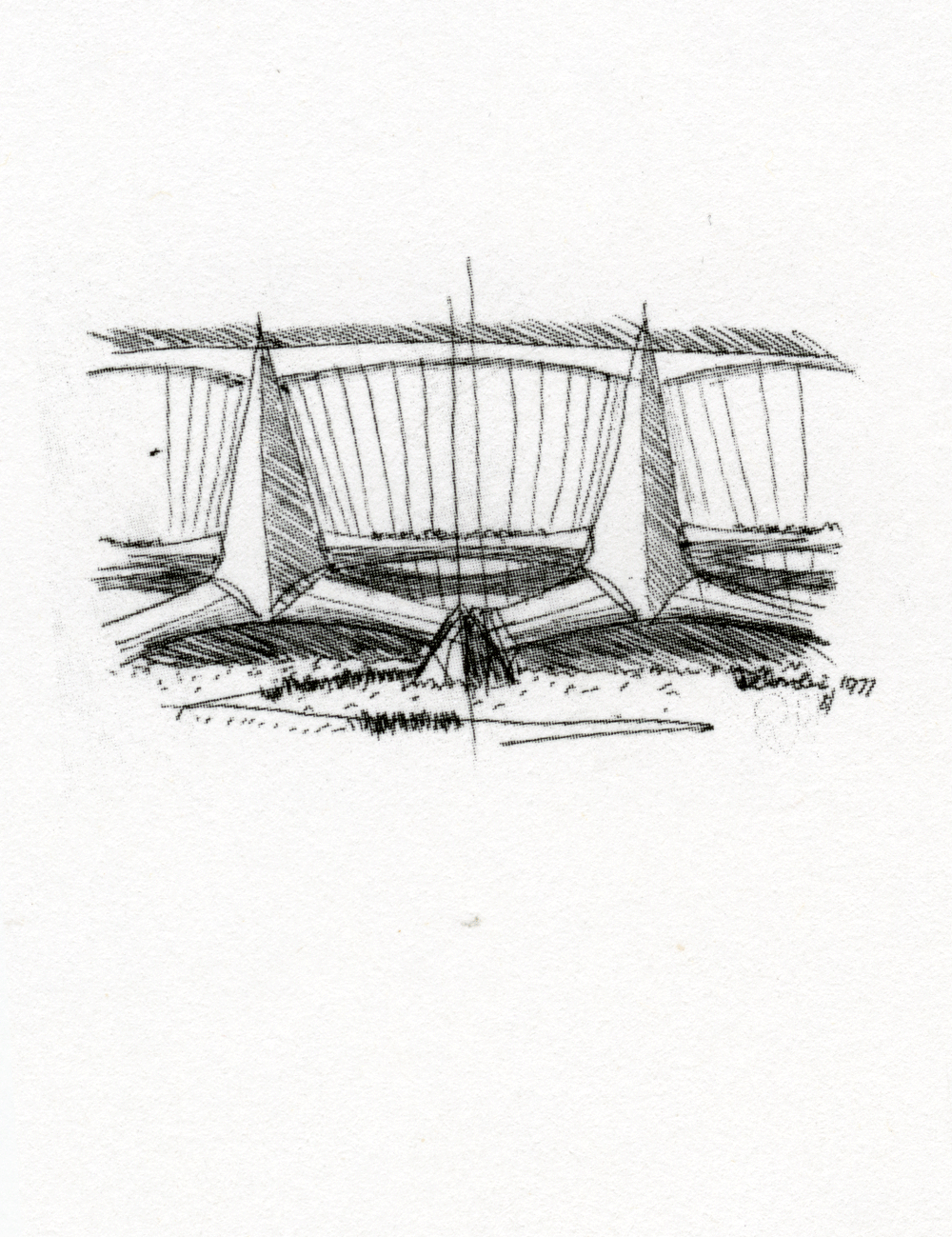
The Apses The architectural form of the apse is a quarter of a sphere skin on top (or not) of a half-cylinder of the same diameter. "My" apses, with the convexity turned toward the outside, are a habitat per se, where the skin has doubled to make for an interspace 10 meters or more in depth. Or they can also be part of a habitat developed behind the convexity of the apse. Persian architecture offers the closest approximation to such apses. A morphological characteristic of the apse is the focusing of sound coming from the outside or the radiating of sound coming from its center. This characteristic I transpose by substituting people for sound waves, while at the same time letting the people-wave penetrate through the apse walls by way of portals. So the convergence or divergence of people moving through the lens of the apse makes the apse into a true-to- form threshold. But this is only the beginning of the story. The Apse Effect To the above connective function is added the sanctioning-characterizing aspect. While acting as a focusing of peoples and things in motion, the apse, opened to the south, acts also as a device selective of the sun radiations projected within its architectural boundaries. It is easy to see that according to the seasonal changes of the sun's trajectory, the south-exposed apse will accept, deep inside its "territory," the benign, welcome winter radiations while turning away such radiation more and more as the seasons change from winter to spring and to summer when Father Sun mutates into Father Furnace. The apse is an effective passive "sun machine." Within its boundaries it generates a sunny ground for work, play, repose, and socializing during the winter months, while offering a shaded ground in the hot summer season: shade against the cool backdrop of the apse structure itself. The American Indian cliff dwellers knew a thing or two about the Apse Effect, and in environmental dimension. The threshold has thus become also a gathering terrain, a social nexus, right there at the edge of where, in my design, is the "outside" of the city, which develops within the apse itself and/or whatever added structures might be developed on the sides and behind it. Anthropomorphically the apse, like a big upheld hand, not rigid or stretched but alcovelike and curved, is a form of gentle welcome or send-off, while adding the element of repose, in fact reflection well symbolized by the reflection (or deflection) of the sun's rays. The Apse Effect, a threshold characteristic much in evidence, is primary in the Arcosanti Project, where two of the many apses have been operational for many years. The Eco-Minutiae (Ecological Minutiae) We are on the threshold of the space age. In their first generation, cosmonauts and astronauts are engaged in the technology of getting up there and, once up there, surviving and returning. The second generation will see the development of space control and the beginning of productive cycles justifying in part the enormous cost of space ventures. It will be the age of techno-stations and avant-posts in space and on planets and moons. The foothold age. The third generation in the space venture will be the establishment of modest ecosystems in points of specific interest m space.
Three possible situations
The third one might turn out to be the most feasible and the least expensive, besides being very promising for reasons of mining, research, learning, flexibility, mobility, etc. In any case, those habitats will also be stations, caravansaries of the space age, where the space traveler will find a less contrived environment- staging, reminiscent of earthly landscapes, and the beginning of autonomous local ecologies.
My attention has come to "a," space habitats free floating in space; and "c," space habitats partially or totally burrowed into asteroidal chunks of mineral matter. I see space egg-placentas strung into the black endless void according to useful networks of routes for travelers-explorers. They will be essentially ecological bits simulating to a default the complexities and the awesomeness of that which Earth so generously gives to us. Those bits of manipulated minerals will develop their own local, isolated (lost) ecology with a niche reserved for those human pioneers that out of curiosity, thirst for knowledge, courage, and self-sacrifice will give themselves to such gilded prisons for the sake of humankind, consciousness, mind, transcendence. Sudden catastrophe or creeping catastrophe (miscegenation, etc.) will be integral to the scenario, the dole to pay to the indifferent, probabilistic, life inimical, and immense milieu of the interstellar void. In those Minutiae, the threshold will coexist with that which the threshold is trying to offer: a step into the cosmos from the secure, if not benign, earthly pied-a-terre. The sperm pursuing the egg is in enemy territory, the immune system disposes of the intruders with spectacular success. Out of 2 million or so sperm, one, if any, will make it. As the eggshell-membrane punctured by the lowly sperm is the threshold to (the next) life, so the space traveler "puncturing" the Eco- Minutia envelope leaves the lethal void of cold, black space and enters the life-sustaining ecology. To the traveler's deprived senses -- sight, sound, smell, taste, skin feelings -- the Eco-Minutia will display itself as the architecture of interiors, the only possible architecture of space where the outer is life negation and the inner is life sanction: sanction and hope of life enhancement. The arrival-departure stations (in a way, the whole Eco-Minutiae) will then be the threshold in its most iconic power. Death and life mediated, via the working of Mind, through the archway of the Eco-Minutia. Food for "myth" and self-fulfilling prophecies but anchored in relativity, quantum theory, uncertainty paradigm ... a truly human endeavor, one that might keep the hatches toward survival open in view of the day of reckoning on a planet no longer fit for life, probably not because of man's wretched behavior but because of a Father Sun senescence.
Eco-Minutia thresholds will then be strung in space along the most convenient or the most promising routes to this or that point, this or that planet, moon, asteroidal cluster ... It might turn out to be highly desirable that Eco-Minutiae come in clusters of three. Then each one can "reflect" on the other two in search of reassurance, variety, safety, companionship, social and cultural exchange, technological and scientific cross-fertilization in a sort of necessary opportunism shot through and through by the imperative of the I-thou survival-interdependence. Toward the World Governing the Environment APRIL 1994
1 Is beauty a right? In the eyes of the beholder, nature is often beautiful. "The beautiful" is a category invented by man or it is a signification that man has put upon the real. The difference between a (beautiful) landscape and a painted landscape is that the filtering the mind is engaged in while painting the beautiful landscape is imprinted by the anguish such mind is inescapably suffused with, because of il Mistero Tremendo, the perhaps unavoidable nature of the What and the Why.
A "puny" mind will produce a poor painting. An "average" mind will produce an idiosyncratic and at times interesting painting. A "great" mind will produce a great painting ... an event by which anguish is transfigured into the esthetic. The beholder of the landscape experiences the beautiful. The beholder of the painting experiences the esthetic. Nature can be beautiful; man's work can be esthetic. Perhaps then beauty is a right while the esthetic is grace.
2 If so, how to uphold it?
People and society are in desperate need of grace, the "art of living," for instance. But grace is remote whenever an opaque diaphragm separates people and society from the awareness of the enormity of what we are adrift in, the utter indifference of the cosmic mega- and micro-processes toward consciousness, love, compassion, equity, and the esthetic. All of those human inventions-creations, with no resonance within reality, we must (imperatively) create and then wisely uphold, an awesome task since awesome is the reality containing it. 3 And, today, with the enormous problems of an urban reality in rapid and often dramatic transformation, what is beauty? On this score we are in luck. The urban reality, I call it the Urban Effect, is in a true sense the only hope we have for a coherent -- that is, sustainable -- alternative to both the environmental nemesis and the societal-cultural withering away. The evolution of consciousness and Mind is the evolution of the Urban Effect from day one, 3.5 eons ago when for the first time "dust" became living dust, organisms.
The Los Angeles newcomer and the "Broadacre" suburban diaspora are the potential nemesis of the Urban Effect (evolution), here in the USA and everywhere on this planet as long as the American Dream (the single-family house) is an exportable commodity. With today's state of the art, the universalized American Dream extended to 10 or more billion people by the year 2050 will necessitate 20 planets (at a stress equal to today's). At twice the efficiency in the production-consumption-gratification process, we will only need 9 additional planets. In view of this, frugalization becomes an ethical-esthetic imperative. Why so? The ethics of equity, environmental coherence, survivability ... the esthetic as the eminently frugal event. With every esthetic event an immense power is generated, putting a spell on the producers, beholders, performers, participants. In the esthetic event, mass-energy and space-time are reduced to a minimum, a sort of residual vis-a-vis the awe, the joy, and the trembling of the mind. A radiant witnessing of consciousness gone critical, so to speak, toward the transcendence we seem to be addicted to in our best moments.
4 And can it have a common experience and measure? Our nomadism to Athens, Kyoto, Angkor Wat, Paris, Bombay, Florence, New York focuses on the human pursuit of grace. How to extend, democratize, and maintain in our habitat such experiences is a challenge facing us all. Unfortunately, our pursuit of consumption-gratification does not point at a sophistication of experiences, at the ephemeralization of perception. It points instead toward opportunism and greed. Opportunism is the ancestral imprint, 3.5 eons of it, we all carry in our flesh and bones. Greed is the opportunistic drive gone self-conscious and ego-centered, that is, inventive, clever, cunning, hypocritical, deceiving, cruel. The individual-society contract is out of balance. That is why American cities are falling prey to squalor and violence. The injection of grace in their physical and cultural structures is in inverse proportion to the emergence of the parasitic sub- urban diaspora. A true Utopian dream, it is a shortcut to doomsday for both city dwellers and suburbanites.
5 Experienced and a measure of beauty as configured in the various professional and intellectual fields? The hedonistic track we, the affluent society, are on, and the nothing less than astonishing know-how we are developing and applying, speaks more to gratification than to grace and more to instrumentalization than to fulfillment. If, optimistically, we can point to this age as an interim and a trampoline to the real substance of the (evolving) human condition, then the harshness and squalor of the How frenzy can be explained if not justified.
But if this interim age becomes the norm for future times, then we are in for immense suffering. Because unless Howness takes us bit by bit closer to the perhaps unsolvable mystery of the What and the Why, and in a Where, When (space-time) holding a bearable amount of suffering, then Howness vacates the field of magic to become madness and senselessness.
Lose one's cool! Look around and ... cry.
APRIL 1994 1 In the terminal scenario proposed by the Eleventh Hour program (KBDI public television, Denver, Colorado, April 9, 1994), the injunction seems to be "spare no punches"; therefore this is my opening statement: To be consistent with the reality of our planet, the American Dream must reinvent itself or choke on its own consumption-gratification-unlimited Utopia. Simple arithmetic shows that to maintain the same amount of today's environmental stresses for a population going from 5 billion to 10 billion, as anticipated for the middle of the next century, we would need a second planet Earth. If then the USA's standard of living were to become democratically universal, the so-called upgrading of the 10 billion people now averaging 1/20th of the U.S. living standard would require 2 planets x 20 = 40, that is, 39 additional planets by the year 2050. Assuming that we might be able to become twice as efficient in our pursuit of plenty, we would still need 19 additional planets. Even an extraordinary success in mass migration to other terra firma in the solar system would never begin to take care of the impending catastrophe. It would take tens of generations, if ever, to escape the collision course we are on now: the demise of the biosphere as we know it and with it also the now-emerging noosphere (the sphere of consciousness proposed by Teilhard de Chardin).
What are the alternatives?
Let me illustrate my point with the following; and this is not meant to be exemplary or virtuous. It is simply what the "territory" of Arcosanti, the prototype for the frugal alternative, is.
My residence-atelier at Arcosanti measures about 600 square feet. It is more or less typical of the other 40 or so residences on the site. What applies to it applies to the other residences. Here are the time gaps (walking) separating me from the people and facilities at Arcosanti: 15 seconds to the offices and drafting room; 25 seconds to the greenhouse or library; 35 seconds to the Music Center and Amphitheater; 45 seconds to the residences-ateliers surrounding the Amphitheater; 45 seconds to the "store"; 45 seconds to the meeting spaces and south garden; 45 seconds to the wood and metal lab; 1 minute to the swimming pool; 1 minute to the ceramic studio; 90 seconds to the foundry; 90 seconds to the cafe, the bakery, the gallery and visitor center; anywhere between a few seconds and 2 minutes to the other residents (about 40 people); 4 minutes to the Minds Garden and the north rim of the Agua Fria River; 5 minutes to the orchards, vegetable gardens, camp, and Agua Fria Canyon; 9 minutes to the viewpoint on the rim of the south mesa. All of this, though far from depicting a full-fledged urban environment, is nevertheless indicative of the necessary orientation toward a more frugal, less segregative, and more effective way of conducting our human affairs.
2 When it comes to information, that is, the yet-unprocessed knowledge, we can see why space and time are easily an obstacle to efficiency. The greater space and time are, the more sluggishness impairs knowledge and action. That is why living nature has turned time after time to an unbelievable compaction of events -- that is, toward Miniaturization -- in order to sustain its evolution and its liveliness. Such compaction is in the nature of Complexity. The vehicle for Complexity is then Miniaturi-zation. For some strange reason, this bond of M and C, a true fusion of the two into one, has escaped our thinking. The inability to perceive this fusion has deprived our minds of a normative instrument and of inexhaustible guidance. The fact is, the hinge where "physical" matter becomes life and Mind has a pin. The pin is MC The marvel does not stop there. The more Complexity is forged via Miniaturization, the more "red hot" the hinge-pin combine is. It radiates more and more. Radiates what? It radiates consciousness, self-consciousness, thinking, acting, inventing, doing, creating, memorizing, etc. It radiates life. I call this treasure house Duration. Duration is the third agency in the MC paradigm I propose. In a way, MC is the cause, and D is the effect. One can say that, in general, life is an implosive process developing under the guidelines of Complexification-Miniaturization, MC, and generating the radiance I call Duration. In fact, by hyperextrapolation, one can propose the Big Bang as an explosion-radiation event (ongoing) and the Big Crunch as an implosive-radiance event (hypothetical in a remote future). Mind is the radiant event.
3 MC is at the core of life. Suffice it to point out that the brain is a hyper-Complex, hyper-Miniaturized organ cast within an incredibly MC organism, a human being. Without the body-brain "combine" there is no mind or life. That is, in biotechnological terms, without MC there is no life and no Mind -- no Duration. In technological terms, without Me there is no microchip, no computer, no virtual reality, etc.... Why hinge and pin? Because at such a critical point where Mind-Duration, this "ultimate stuff," is generated, reality takes an "independent spin" away from the constraints of space and time, away from probabilism and determinism. It is the independent spin whose sum total is the past of life's evolution. What is one of the normative lessons of MCD? It throws a realistic light on suburban sprawl and unmasks its "unavoidable" nature: a pernicious undoer of life. Suburban sprawl is a mega-turization process, and consequently it is the nemesis of MCD. If we consider that suburban sprawl is:
Then we must face the consequences of ignoring reality and its workings. We can only offer lame excuses for our extravagant behavior. Whenever the MCD injunction is ignored, a breakdown is imminent. In the mounting tide of consumption-gratification and among the mechanisms of life's demise is the automobile. It couldn't be otherwise. The automobile is the product of gigantic technologies; it is a gigantic technology in which the car itself is only the tip of the iceberg. A price far out of sane boundaries for a purely logistical device: moving things and people to and from thresholds of action. The no-man's land separating and isolating such actions is a direct intrusion and imposition from the very machine invented for the reduction of space-time, the car. No magic machine -- and the automobile is one -- is worth the sacrifice, the suffering, the destruction that 5 or so billion of them (and the hidden icebergs) would do to the Earth and its dwellers. The automobile must be eradicated from the urban context and given to exo-urban activities like leisure, tourism, sport, special tasks, etc.
4 It is becoming more pressing, day by day, that we attune with the doings of nature -- not the romanticized "Mother Nature," by the way -- and seek to steer our power of transformation in the direction of coherence with the reality of the mineral-astronomical cosmos with its laws, the biological phenomenon grafted in it and our emergence from such phenomenon. The universal paradigm of MCD is unerringly at work wherever life is at work. To go against it is a sign of insanity. We are masters at figuring out how things work and how to do things. Our technological prowess sweeps us off our feet. But this "knowing how" married to expediency (80 percent or more of what we do) and disconnected from realism is the surest road to self-destruction. The road of doing better and better the wrong thing. Two examples: the gun and suburbia. From their respective origins: a metal pipe haphazardly spewing metal fragments, and a dreary post -- Second World War Levittown. To the slick killing machines of today and to the affluent "Broadacre Cities" of a well-honed territorial perversion.
Given the population growth and the MCD nature of life, reality seems to suggest that now, NOW is the time for transcendence -- that is, for a shift from gratification to radiance, implied in a conversion from the megastructural segregation and isolation of suburbia into the ministructural intensity and awareness of urbis, of the urban condition. One can propose two opposite trends: Trend one, four or so eons long, the Urban Effect induced by MCD, which is instrumental for the evolution of life. MCD is a genesis instrun1ent. Trend two, recently emerging in part via the Western technological revolution: the consumption-gratification-unlimited Utopia.
Consumption-gratification is a counterevolutionary instrument. It is a nemesis instrument. The sooner the conservationists and nature lovers understand that the reinvigoration, if not salvation, of the environment is totally dependent on the generation of splendid cities and the demise of the suburban diaspora, the sooner we will be able to begin in earnest the development of the third millennium. There is no solution, not to speak of transcendence, of the man-nature conflict outside the creation of breathtaking cities. It is as simple as that. Why? Because such cities are coherent with the rules of the living via the MCD paradigm, and as such they are the most frugal and rewarding response to our longing for fulfillment.
8. For the Fifth International Architectural Forum Prague Statement NOVEMBER 1989 A. From conception to death, each of us is a consumer, which means that each of us partakes in the transformation of reality and, closer to us, the transformation of the ecological balance. Consumption by the soon to be 6 billion people is thus the very massive inertial wheel spinning and carving into the capitals of the planet. Part of such capitals are the vegetable and animal kingdoms. In view of this, about thirty years ago, I proposed that a condition of relative poverty (and I must emphasize the word "relative") in U.S. terms is a realistic condition to endorse and live by. This is to be practiced out of free choice, not out of a mandate from above (or below). As one could have guessed, the label relative poverty found no resonance in a society driven by marketplace canons. So after some years I adopted the word "frugality." But to no avail. Society was unwilling then and is unwilling now to respond to the implications such a proposition presents. That notwithstanding, frugality has been my password ever since.
At Arcosanti, the modest urban laboratory we have been developing for the past twenty years in Arizona's high desert, we have been and are trying to practice what we preach. I propose now, as I have been doing for thirty years, that frugality might well be the only universal and perhaps sufficient response to the planetary crisis we are generating.
At the very core of the crisis is the ethical vacuum many of us live in, and within the vacuum, the suspended dilemma of equity and worthiness. We are, ever so slowly, realizing that societal equity cannot be separated from ecological coherence, and that for both the time schedule measures not in years but in eons. Two examples illustrating the predicament of consumerism:
That would not be frugality; it would be the nemesis of life and nature as we know and cherish them now. So the dream. promises to become a nightmare, with suburban sprawl as the more than willing deus ex machina.
"Consumption unlimited" is thus the real enemy, and, as it has been said, the enemy is us, us, the compulsive buyer pursuing happiness via hedonism, if not downright materialism.
Advocating relative poverty from a peripheral position, so to speak, in the 1960s, I find myself now in the mainstream of the human condition dilemma and an adequate response to it. But society seems still far from realizing the gravity and complexity of the present predicament, since, as individuals, we seem to be unwilling to become responsible for our actions; the bed of the mainstream seems pretty dry. Yet the imperative of frugality is a glaring light in front of us all. It is up to us all to be responsible and respond, or to ignore its call and pay the consequences. That is to say, our children will pay the consequences. A grave and perhaps tragic prospect.
B. Presented I want to express my profound dissatisfaction with this conference for the lack of serious consideration about the perils of consumerism. Suffice it to remind the delegates that the climatic changes in store for the planet are directly tied to consumerism, and the consequences could be catastrophic. I feel the conference has played on the fringes of the real predicament of the human family and consequently has been in large measure an exercise in self-deception. C. Not Presented Apropos of Social Justice Like it or not, the core of the question is not justice. It is coherence. An "incoherent justice" is not justice at all because it forecloses the future and is therefore self-contradictory. A dead society, or species, is not a just society or species. It is naught, pure and simple. An "injust" coherence tells us that reality is as yet hardly dealing with the human phenomenon. The food chain is not just. It is opportunistic, "fitting," coherent. Coherence is process. It is of the context of transformation-evolution. Justice is an ideal whose Utopian character is easy to understand. As such, justice is an end whose advent is defined by the word "end" itself. There is no end before the end. Therefore, there is not and will be no justice but the longing for it and for a remote possibility of a coherent transformation of such a kind as to embrace and transfigure all the victimization brought about by a probabilistic-opportunistic reality in time-space -- that is, the all-comprehending metamorphosis of it all. D. Not Presented About the misuse of words: The words I refer to are "in scale" and "megastructure." Since single-family homes are unavoidably generating flat megastructures, like Los Angeles with a 2,000 or so square-mile megastructure, the single-family home is out of scale. It is dehumanizing society, depriving it of the access to the civilizing and culturizing elements that make human history. Two-dimensional structures like those of Los Angeles and Phoenix are gigantic mistakes damaging both society and the environment. They are for nemesis, not genesis. The semantic imbroglio over "mega" and "mini" is indicative of the conceptual confusion being fostered year after year and denouncing perhaps a degree of intellectual dishonesty on the part of environmentalists-transformers, the likes of which we are in this congress.
9. For the Center for Respect of Life and Environment On the Land Ethic Project AUGUST 1991 At the center of the hurricane is the ominous quiet generated by the fury encapsulating it. The Land Ethic Project reminds me of that. The eye of the proposition is strangely depressed. It seems to propose that, all in all, the biosphere would be better off if we, Hominidae, were not (didn't exist).
Since we exist (become), the biosphere has to do, while we more and more seek ways that will be gracious, cooperative, self-effacing, and apologetic for the well-being of reality whose misfortune is Homo sapiens sapiens. As a repentance moment, a momentary atonement for our callous, arrogant misdeeds in the evolution of the planet, this attitude might be the right one -- honorable, subscribable. As a normative, final one, it is to my knowledge a desperate, betraying one. I say this because, from my perspective, life's aim -- if one will ever concretize -- is not to keep the eco-niches strong and healthy, period. The aim of life is to keep such strength and health for the purpose of generating more consciousness. Why? Because only consciousness has the admittedly remote chance of "salvaging" not only itself but the whole living kingdom here and elsewhere. But, by the way, for this to make sense -- a glorious sense, by the way -- one cannot escape the notion of a "Second Coming." This glory of a Second Coming might very well be exclusive, since there might not be any other possible denouement within which all the due is given to all the partakers constructing reality. Short of such recall (Second Coming), for each maggot, mushroom, or greyhound, the wiggling, the swelling, the running through life is to pass on the little magic bundles of knowledge for which wiggling, swelling, and running are joyless, inconsequential distractions. Millions, myriads of those "passing on" in the immense thickness of time, pleasure and pain, joy and suffering-incidental. On and on and on ... And the miracle of the biosphere slowly emerges from the stones, the waters, the sedimentations of matter under the shower of energy from "Father" Sun. For the glory of what? Of whom? Life? God? My cousin?
For the glory of something or someone perhaps, but not for the builders of the miracle: the maggots, the mushrooms, the greyhounds, my cousin. They, hypermyriads of them, just nothing but disposable instruments! My cousin, for one, does not like to be a disposable instrument for miracles. She in fact hates such a notion if her Becoming has been flawed by pain, suffering, inequity, anguish ... Think of the quasi-infinite number of "those" gone for the food-chain glory! Is there any possible escape from such immense holocaust? Means upon means upon means, eon after eon with no hope, no resolution, no true glory? A Second Coming might well be the only resolution -- that is, the recall of the past down to all of its most "insignificant" details and the experiencing of it all by our acquaintances, the maggot, the mushroom, the greyhound and my cousin -- no longer only as forgotten means, but also as prodigious ends. The eye of the storm you are in with the Land Ethic Project is quite oblivious to the prodigiously large "volume" of inequity contextual to the landscape of reality. As a consequence, the eye is at last wanting in significance. The biosphere minus Hominidae or a similar kind of consciousness will never make it on its own. At most ("best" is not in the dictionary of opportunism), the whole, massive time-elongated biomass will turn out to be a puny memory in the zero-consciousness of a dead planet betrayed by a tired Sun-Father. The conservators, the stewards, the nature lovers, the Earth First! haters -- all to be party to the deception of the millennium. Mark my words, shortly but never too soon, the environmentalist movement of our generation will be looked upon with scorn, or perhaps anger. The betrayal of mankind, hidden in the nature lovers' gurus and their epigones, is automatically also the betrayal of nature, the savage probabilistic-opportunistic reality from which we come. Only Mind (consciousness) has the remote chance of "salvaging" ecology from the fated death of the planet, certainly not the lily or the tiger. The true environmentalist is the humanist; otherwise he is for the nemesis of consciousness -- the mind, the most precious jewel in the crown of Creation. My participation in your noble effort is only possible if I can voice my anxiety about the void in the eye of the storm. Mind you, I was a "qualified" environmentalist long before many of you were born. 1996
The Hyper Building Research Committee was established in December 1994 as a joint research organization composed of 93 corporations ... with the support and cooperation of the Ministry if Construction. The secretariat is established at the Building Center if Japan. "Hyper Building" is a long-term structure with a lifetime if 1,000 years; with an urban function based on the assumption that it have a height if 1) 000 meters; with a total floor space of 1,000 hectares; and a high population density, as it will be used continuously by several tens if thousands if individuals. (Hyper Building Research Committee, symposium material, Japan 1996)
The Quartet in A (Arcology) Major Preamble To enhance the notion of process (evolution is process), I am presenting the Hyper Building as phase one of a development whose goal is the establishment of an urban settlement for about 1 million people in a sunny desert region.
This would be achieved by the construction of three additional Hyper Buildings. If one Hyper Building were to succeed, there would be tangible financial advantage in "cloning" it with improvements experience would suggest. I must make clear that the proposed design is in its conjectural stage: one kilometer square by one kilometer, to be precise. If the conjecture turns out to have merits, serious work could be contemplated to move into the feasibility stage. The Hyper Building The Hyper Building is a one-kilo meter-high tower surrounded by a double set of concentric exedrae. The exedra is a semicircular edifice that can host a large spectrum of urban activities. Tower and exedrae are not separable. 1. The present outline ties together the many facets of the design. The guiding idea is: the focused vis-a-vis the scattered, or geometrically speaking: the radial versus the orthogonal. While the orthogonal is neutral, the radial implies center, radius, and circumference. The tower is at the center; the radial is the stage for the horizontal mobility. The circumference is made of two multilevel exedrae. 2. As just mentioned, the items I am about to state briefly are laced by a continuous thread (precedent-consequent). The items, in order of appearance, and in their heterogeneity:
Miniaturization-Complexity- Duration 3. People, we, are around thanks to the female/male sexual differentiation. Eros has been the constant drive in the species. This providential obsession is inscribed and described in the human habitat and the arts.
In an analogy, the tower stands for the lingam, the male; the concentric exedrae stand for the female, the womb. The interpenetration of the two generates the "fecundity" (complexity) of the city, guarded, so to speak, from intrusion, the otherness of nature that comes wavelike to break on the shoulders of the outer exedra. The female/male analogy points to the potential richness of the Urban Effect developing at the many physical levels of the Hyper Building, unencumbered by the unfriendly automobile mode. 4. The pedestrian has full sovereignty, enhanced by elevators, escalators, moving sidewalks, electric conveyances, and bicycles. 5. With the sun as prime agent, the design shows a north-south plane of symmetry coherent with the same plane of symmetry defined by its daily and seasonal trajectories. 6. Since in the multistory structure a great variety of activities are juxtaposed, the structure becomes a stratified sequence of focal points. In a flat grid they would necessarily be scattered, therefore the gigantism of the traditional habitat.
Such focalization has virtues that must be acknowledged and encouraged. (Life's virtues, by the way.) In the dynamics of life this implies a sort of three-dimensional, 24-hour frequency pulse. Residents and people outside the Hyper Building are attracted to and released from those juxtaposed focuses on such 24-hour cycles. An "automatic" consequence of this current-countercurrent flux is radial-circumferential geometry. This in turn defines the enveloping character of the exedrae, differing greatly from the "indifferent" character of the orthogonal, flat grid. 7. The sun's presence and the garments the exedrae are apt to wear in response to the sun's trajectories and seasons strongly suggest that the mentioned radial, horizontal geometry also be found on the vertical. Consequently, the exedrae lean toward the vertical axis of the tower, thus also favoring the garments display. The garments are (greenhouses) transparent or (parasols) opaque membranes according to the season. They stretch from one exedra to the other and they drape portions of the south side of the tower. 8. A series of concentric exedrae will define a third set of spaces between the indoors and the outdoors. This third kind of space via exedrae and transparent or opaque garments can modify and moderate the temperature, light, wind, and rain. Spring and fall equinox could be moments of ritual when the garments go from transparency to parasol and vice versa. The winter greenhouse mode generates large volumes of warm air. This change would also change the perception of the cityscape. Sensations, perceptions, and emotions would converge toward seasonal pageantries. 9. The self-contained, three-dimensional landscape of the city marks a clear distinction between nature and city, while putting nature and the "feet of the city" within walking distance for residents and guests. Nature is also very visible to horizon's end from the many levels of the city and from moving escalators.
The identity of the city, whatever originality it might develop (complexity), would have a powerful signature in its physical structure. 10. Since democracy is and will remain for centuries to come more a dream than a reality, the Hyper Building will contain in its stratified focuses a stratification of social, cultural, economic, philosophical and ethno-racial groups.
Avoiding violent conflicts will take a lot of knowledge, experience, planning, tolerance, and hard-to-come-by wisdom, not to mention large infusions of wealth. A generous and positive attitude by the citizens toward this urban laboratory could produce an Urban Effect of an enviable and germinal kind. The noble imprint of the city would be in its complex dynamism and its active tolerance. 11. The logistics of the city will be carried out on three parallel planes: for people, freight, and utilities. Transportation to and from the city is via regional-continental mass transit (linear- motor). The main terminal is on the northeast side of the Hyper Building.
Plugged into the network are also the three main "terras" with their construction yards at different levels of the tower. 12. In case of emergency, the evacuation of the tower will be mainly via an array of escalators and slides leaving the tower at intermediate levels to land and ground level within a 500 meter radius circumference, "draining" the tower of its dwellers in a matter of minutes. The heliport on the roof of the tower would also be an important evacuation facility.
13. The miniaturized and complex environs generated by the Hyper Building define frugality, the same frugality impossible in the scattered mode of suburban sprawl now embraced by hyperaffluent societies. The hyperproduction-consumption cycle demanded, mandated by suburban sprawl, besides clouding minds, is dotting the landscape with ever larger mountains of waste and pollutants.
Frugality is the vessel for interiorization, and life, the whole of it, is interiorization. Materialism is the nemesis of frugality. 14. It might be suggestive of the Hyper Building's long-range intent to point out that an impending ice age would make the arcological mode of the Hyper Building into an imperative because extremes of cold and bleakness demand extremes of compactness and cooperation (MCD). The same is true for space. The survival of the species would then be consigned to arcologies, of which the Hyper Building is one.
Nature and Art SEPTEMBER 1987 Early man was burdened by the immovability of things. Moving rocks, trees, carcasses, people, etc., was fatiguing and often impossible. Rolling things, if things could be made to roll, was the system that contained an answer. One fine day a lad or a maiden with sufficient skill in abstract thinking had the idea of pinning a nonrolling object to the center of a rolling object. A plank, a stool ... the wheel was invented. Eventually, this revolutionary technology spilled over into cosmological and religious constructs. Thus, within the anthropocentric context, the wheel revolutionized both heaven and earth.
The pin-hub became the catalyst for all sorts of fanciful and dreadful hypotheses. Around the pin-hub turned the wheel of fate stoked with all sorts of chimeras. Passions and rages could be made tangible (to the mind's eye). But, in fact, the inventors had been after the alleviation of toil and, if possible, more money in the bank. Perhaps better food for the family, perhaps a larger portion of a fermented beverage in the evening for his/her aching body. WHAT IS THE WHEEL, THEN? IT IS A TECHNICAL DEVICE GENERATED BY OPPORTUNISM. But even in those early ages there were other kinds of wo/men milling around in the tribal crowds. Distressed, passionate, questioning, driven, dreaming, thinking, feeling: the anguished kind. They did not invent wheels; they scratched cliffs or the skins of their kills, chipped stones, painted caves or their kin. Images in the image of what? Well, when not nonfigurative, in the image of living things, among them "fat ladies." More passion than fancy in this; perhaps a passion tied to the mystery of life, to fertility and most of all to Eros. Those people were "artists" with their anguish resolved for the occasion into the esthetic. WHAT IS THE STONE GODDESS THEN? IT IS AN "ART OBJECT" GENERATED BY ANGUISH.
Nature-Technology-Art Then there is nature. Yes, the BIGGIE. As the clever lad-maiden invents the wheel, so nature (and for eons past) invents itself step by micro-mega step. Techne is the ubiquitous manipulator in the whole and in the detail, and art is not exempt from its active presence. So one can say that inventors (wheel), creators (stone goddess), and nature (itself) have at least one thing in common: they depend for their exploits on Techne. How else? The very nature of things is per se Techne -- that is, transformation. Try to imagine that for a brief moment reality stops ticking away, stops altering itself. Time would vanish (and space too). Reality in Being is timeless and necessarily technoless. Reality Becoming is time-driven and necessarily techno-transformed. One consequence of the above is that the nature of the deed is defined by the mindset of the generator and not by how the stone has been chiseled away -- that is, not by the kind of skill applied and the kind of tools used. And also not by the content of the work. The inventor will carve an "operational" stone wheel; the "creator," a wheel of fortune of sorts. The creator will carve the stone goddess or, as a much lesser one, the winged goddess for the automobile hood. Nature in her quasi-infinite clowning has done and is doing the preparatory work in both the generation of stone and the generation of n1.inds and hands shaping the wheels as well as the goddesses. What if the product is not the wheel or the stone goddess but "COMPUTER ART"? Without considering the impact of innovation-euphoria we cannot shed light on such a question. Those who work on "computer art" are not under the spell of the Mistero Tremendo as much as they are under the spell of computer magic. And understandably so. Creation comes about when a post-technical attention sets in. The Mistero Tremendo is a demanding master. It demands full attention.
In this age of constant innovation we produce numberless investigators and inventors. The dearth of creators is explained by the overwhelming power that innovation has and the (technical) euphoria it generates. In the second- and third-generation crowds of inventors, we will be able to find the beginning of a creator's renaissance (a wish only?). So What of Nature and Art? The diaphragm between nature and art is the anguish besetting the species. Where does such anguish come from? It is there simply because we are self-conscious animals. Such is the nature of reality and the nature of wo/man. S/he cannot escape or resolve the "Mistero Tremendo," therefrom the residual anguish. Whatever comes from us is, one can say, nature itself but filtered by the diaphragm of compassion and inequity that is in the nature of wo/man. The warp of the diaphragm is the structure of knowledge (see science and philosophy) that differentiates nature from culture. Those more sensitized to the human predicament have somehow four choices:
Nature -- reality -- is the Mistero Tremendo. The avenues of science, philosophy, metaphysics, and hedonism are not capable of abating the last residuum of anguish, as if it were a polished sphere impossible to get hold of and forever nested in each of us. What the artist does is to chip away infinitesimal specks of reality and transfigure them into specks of divinity. As such, for a fraction of reality but forever, the metamorphosis from nature to Mind is a fact. The art object, then, poems and sonatas included, is an end unto itself, self-significant and nonobsolescent.
These qualifications should be universal; that is, all events generating from reality should be, or become, self-significant and not obsolescent-ends in themselves.
THEN A SUCCESSFUL AND CONCLUDED COSMOGENESIS TURNS OUT TO BE AN ESTHETOGENESIS. THE ABSOLUTE, AS THE SUM TOTAL OF ALL ENDS, IS THE BEAUTIFUL.
Necessity and Sufficiency MARCH 18, 1993 1 Given the confusion and anxiety arising from the enormous load of exponentially growing information, it seems desirable that some sort of priority scale be proposed. This may help in positioning the human condition within the planetary context. To this end, I choose a perspective that works around the "necessary and sufficient" proposition. Necessity refers to means; sufficiency, to ends. My work addresses that which is necessary. What is necessary is not that which is sufficient. For instance: The richest inventory of musical instruments (necessity) will never grant per se even a single good melody (sufficiency). But without instruments, vocal chords included, no music is possible. That is, music, any music, implies the existence of "fitting" instruments. As I see it, the human condition is faced with two fundamental necessities. To emphasize their preeminence, I call them imperatives. They are:
I see the imperative of sustainability as expedient in the context of planet Earth. It could be proposed that sustainability might eventually become a non sequitur if and when intellect, science, technology, and wisdom push the limits of legitimate transformation-manipulation into ever receding horizons, the whole solar system horizon for one. 50 the imperative of sustainability is expedient and contingent, though no less of an imperative. The imperative of Complexity-Miniaturization is ontological because it refers to the very nature of life, the whole of the living reality, from its beginning to the present. Outside of Complexity-Miniaturization, no living phenomenon can take hold because the very guts of any and all organisms are living proof of the immense Complexity "they are," and they can be so only because of the immense Miniaturization with which they come about. To ignore these facts is to forfeit the guidance necessary for coherent action. It is to take action from reality into Utopia. The ontological nature of Complexity-Miniaturization becomes apparent when we realize that Complexity- Miniaturization as means "automatically" spill over into ends because the critical consequence of Complexity-Miniaturization is vivification. Thus is the mineral made into the living and eventually into the conscious and the self-conscious. The prodigy of such a metamorphosis is best perceived when we realize that a sort of Holy Ghost I call Duration emanates from Complexity-Miniaturization. Duration is disengaged from the constraints of space-time. Duration is made of memory, of recall, of postgenetic knowledge, of transcendence. It is the quintessence of the human experience. Duration as a sort of Holy Ghost in the trinity: Complexity- Miniaturization-Duration because it "comes from nowhere," at first "sotto species" consciousness, then in the Hominidae as self-consciousness. Self-consciousness opens the gates to good and evil and to the whole tide of mental agonies and glories. It might be worthwhile to point out an analogy with Plato's Divine and Necessary Causes: In Complexity- Miniaturization-Duration, the necessary causes, the instrumentalizing causes, are the two inseparable agents of Complexity-Miniaturization. Duration is the "divine" consequence. Divine because it is the initial step toward a possible, if very remote, revelation of reality to itself via the yet very humble self-consciousness of conscious man: the specific radiance of Mind.
Note that while Complexity-Miniaturization spells hyper "concentration," a true implosion as documented in every organism, Duration spells radiance, the light of Mind reaching out to the very edges of reality. Quantum physics has to juggle with the quantum of light, the photon ghost; Complexity- Miniaturization-Duration has to juggle with the Holy Ghost of Mind, Duration. According to the above definition of the imperative of sustainability and the imperative of Complexity-Miniaturization (enriched by Duration), any process that does not take into account the two imperatives simultaneously is automatically an ill-fated, short-lived process. It is pernicious indeed because it distracts us from reality and it robs life of the precious resources the nonliving and the living kingdoms offer us.
But working within the boundaries of the imperative is a necessity; it is not a sufficiency. It delivers means; it does not create the ends that are made possible by such means. The two imperatives are means in search of grace. 2 Is it valid to call the present a very special age? Are the facts taking the statement beyond the common presumption each age has of being "The Age"? Perhaps so. This is the age when, for the first time in the history of the Earth, a species is told in no uncertain terms that its own presence among other species comes into question unless its propensity for transformation-manipulation is, at least for the time being, severely disciplined, that is, curtailed. For instance, the adoption of the American Dream as a physical standard for the whole species spells doomsday for us all.
Unless the Dream is severely restructured, the future of the species is dim. This per se has no impact on nature because nature has, at last, no ethical worries. One living planet more or less is quite an irrelevancy, assuming wrongly that the demise of man would entail the demise of life. "Progress," the one measured by physical transformation, appropriation, and use, is at present in question on at least two levels:
Or, in other words:
There lies the uniqueness of the present (human) dilemma. To the never-resolved flaws of inequity (human and "divine") is added the novel dimension of a very possible biosphere nemesis, anthropocentrically evaluated. Anthropocentrism is the only mindset, the only "field of experience" we have access to and deal with. Constitutionally, we cannot think independently from our (anthropos) thinking apparatus. At this point in history, the human condition is so starkly quarantined from reality (the biosphere) that most of the (internal) quarrels we dwell on turn out to be quasi-frivolous -- as if on a sinking ship whose structure is collapsing, we, fellow travelers, debate, get lost in what is going to be for dinner. Proletarian, black tie, vegetarian, crystal and champagne? Without the urgent restructuring of the ship, the future of dinners and diners will be short, and the few last diners will witness violence and cannibalism: the metaphorical and literal devouring of our own flesh. The whole spectacle of no concern to Gaia, our opportunistic maker. How is our technological and technocratic culture going to cope with the ultimate curse of consumption-gratification unlimited that is fueling the engines of our industrial miracles? The parochial "what is good for General Motors is good for America" has become the catholic, "what is good for unlimited transformism (matter into energy, mineral into mental, heat into electricity, oil into garments, corn into gasoline, sand into information, etc.) is good for the species." To discriminate, to select, to prioritize, to do justice, to engrace, to beautify, to transfigure ... from the dawning of the human experiment, human history has exalted and crucified man in the name of such agencies. The new dimension in the puzzle, the new agency, is the environmental injunction. The biosphere frontier no longer has the elasticity, the give of the frontiers of old. The giving, short of a true metamorphosis of reality (not to be dismissed), has to come from taming our aggressive expectations (now still a "Western privilege").
Equity and frugality ought to be the paramount agencies of the next millennium. The short supply of equity will make frugality into a bleak despot managed by a minority of brutal pseudosaints. The demise of frugality will produce a hedonistic tide for the "Chosen People," a glorious 15 minutes of celebrated irrelevancies crash-landing on the unforgiving and indifferent slab of reality. Through the ages we have generated an eclectic mechanism for human survival and for metamorphosis. It is called the city, whence civilizations. The cities (and towns), hybrid organisms as they are, correctly implement the project of "reality" sensitizations. All organisms sensitize reality inasmuch as they all are mass-energy/space-time converted into life and, with man, into consciousness. As for all "organisms," the human habitat has to be coherent with the dictat that makes life possible -- above all, the imperative spelled out by Complexity and Miniaturization. This imperative is the conduit, the only possible conduit known to life, for the "packaging" of information, interaction, dialogue, symbiosis, understanding, discrimination, specialization, anticipation, efficiency, metamorphosis, etc. in bundles ever diminishing in space-time: nature becoming culture. It is in this very special conjuncture in the evolution of the planet that the Hominidae, via the urbanizing effect of Complexity-Miniaturization, have the chance of making their presence felt, at least within the solar system's domain. But this presence will not amount to much unless we persevere in the Complexification-Miniaturization of present reality, the only possible avenue toward sensitization. The mentioned imperative ever-present in the 3.5 billion years of evolving life.
This means that consumerism, now willy-nilly destined for the entropic ashes wasteland, has to be converted -- by the way, through a true ethical conversion -- into a tide of sensitization. The making of more consciousness, more knowledge, more wisdom, more creativity, more grace, more compassion, more generosity, more love, more beauty. There is more than a touch of irony that it is the biosphere itself in all its probabilistic, opportunistic splendor that has to teach us the ways of ephemeralization, which are the ways for salvaging first, transfiguring second the human project, and, more momentous yet, if perhaps more remote, the "stewardship" of the living phenomenon at large (a stewardship in the sense of a total recall in the most remote of all futures). 3 The (American-planetary) Dream sees the shopper-consumer not walking to the shopping center with frazzled paper or plastic bags. The Dream sees him/her in sedan, van, pickup, two of those per 3.5 people per household, converging toward the cornucopia. The to and fro of those vehicles will measure in miles, and the Dream confirms that the to and fro will be multiple. House -- commercial center, house -- production parks, house -- learning enclaves, house -- health enclaves, house -- cultural enclaves, house -- worship centers, house -- recreational parks, house -- transportation nodes ...
This to and fro of 10 billion people in their 3-4 billion magic machines will grind the biosphere down if, aware as we must become, it means that for each person there will be tons of goodies produced, used, consumed, stored, recycled, discarded; each one the tonnage of a thermodynamically degraded bundle of mass-energy; each one in turn "dislodging," pushing around, space-time quanta. OUR space-time, our breathing living space-time, ours and of all creatures big and small.
The dream would collapse under the weight of its own folly well before the 3-4 billion drivers' seats reach the production lines. Mixed in the dust and the pollution of a collapsing Dream would be abundant misery and blood that "necessity" and greed, the primers of consumption-gratification unlimited, will sow on it with cruel largesse. The obvious response to such a potentially collapsing Dream was invented long ago in the civilizing devices called city and town. It is sad many times over that those self-collecting organisms anteceding the automobile (which Los Angeles incarnates) are being discarded or quarantined. Of the four major dangers confronting the family of man, demographic explosion, endemic inequity, "loss of grace," and consumption-gratification-unlimited, the last one is most pernicious because it is the one that directly plays havoc with the biosphere. The environmental breakdown denounces the consumerism binge for sabotaging the attempts to resolve all the other very human dilemmas. The human problems of indigence, injustice, cruelty, violence, intolerance, bigotry, xenophobia, etc., do not themselves cause environmental disruptions. Nature is totally indifferent to our human moral, ethical, political, and religious-esthetic hang-ups. It couldn't care less. But it is the consumption-production-disposal cycle that is the killer of species in general and eventually of our own species. It does that on two counts: environmental collapse and the demise of humaneness. A societal-economic-cultural nexus of 10 billion people endorsing the lean dynamics of frugality, intelligence, inventiveness, swiftness, and compassion would make for a far more modest impact on the biosphere. Since planning, architecture, and the filling up of the spaces they generate are evidently the bulkier, costlier, and matter-energy-consuming aspect of our demands on the environment, a coherent response is eminently architectural. In this scenario, the city is the maker, suburban sprawl is the breaker. The spatially and functionally segregated house is by physical necessity the most consumption-demanding of all shelters. It consumes the planet like nothing else does. Emblematic of such greed is the automobile, the most gigantic and costly logistical system ever invented. Our future and the biosphere's future are locked into the Urban Effect and its success. Outside of highly alive and "magnetic" cities and towns, both Homo sapiens and a biosphere inhabited by humans have no future worth considering. I refer to the bulk of humanity and to its cultural focuses.
The city implies Complexity and Miniaturization, the two imperatives for any form of life. Suburbia is the epitome of simplistic and gigantic agencies proposing or rather imposing the unraveling of the living into dissolution and death. Suburbia is a supreme consumption machine producing harsh conditions. We must choose between Utopia and reality. The choice will define the nature of our future (or no future). How to avoid the fateful pitfall of guiding Miniaturization on a path that caters to technocracy (consider computer technology) is going to be the genius of the third millennium. But Miniaturization, the collected and the less consumption-oriented life, is the lens for both human spirit (Mind) and Gaia's health. Away from such concentration, Complexity is not possible and life/consciousness outside of Complexity is an absurd notion, as evolution well proves. There is no radiance where there is no "compression." The city is a cosmic lens of sorts -- it radiates consciousness, and it is in view of such a Complexity-Miniaturization mode that the city can be a radiant phenomenon. The city of light. The Japanese society, among others through history, had, and perhaps still has, at least vestigially, a splendid record of leanness and frugality taken to high degrees of sophistication. How to remain in the territory of such frugality while expanding into the magic kingdom of technology is the prime task of civilization and with it the restoration of a damaged biosphere. Population control and the frugal pursuit, via the Urban Effect, are the necessary if not sufficient gates to the future. All the rest, good and bad, is futile if not molded in such ways as to pass through those two gates. Therefore the imperative of disposing, the sooner the better, of suburban sprawl, the true culprit of consumption-gratification unlimited constructing the DREAM. No more urgent problem, none, is facing us, us of the West in particular. Us, U.S. citizens even more so -- the emblematic and performing consumer par excellence. History, perhaps even evolution, will be harsh with us and with our progeny if we persist in such a brand of DREAM. The alternative, if we dare to label it so, is what comes down to the "Fortress America" syndrome. Utopian in feasibility and horrendous in ethics, it is a tragic possibility to contemplate. The family of man within the large community of the food-chain creatures has to prove that it is worthy of a prodigious future. A future that might even "astonish" reality itself (that would be the day).
|