|
PAOLO SOLERI: WHAT IF?, COLLECTED WRITINGS 1986-2000 |
|
Preface
Reality is "to know how." The whole of it is Howness. What If? is a compilation of the methods and procedures used to follow that tidbit of Becoming to find an identifiable context. Adopting the hypothesis that at the origin of reality is a presence and that such presence is space and nothing other than space, I went the minimalist (not reductionist) way for what would follow. What follows in my hypothesis is that such a presence is instantaneously transforming itself. This process is ongoing and constitutes the Becoming, and this Becoming is no more and no less than the metamorphosis of space. Since subtracting space from any and all metamorphoses nullifies the ongoing Becoming, space is not only the container of all Becoming, but the Becoming itself. The duality container-content is dismissed. In similar terms are dismissed the dualities of brain-mind, body-soul, matter-mind, and others. There are only bivalences and nmltivalences: Dualism is the offspring of animism. Since to come to the Lean Hypothesis, the just-mentioned minimalist landscape, it took me some years, the semantic in the two manuals reflects this transaction: Wherever the words spell "body-mind," "brain-mind," "brain-d," please read "bodybrain." For similar reasons, when you read "space-time," please read "space-change." ("Time" is a human invention.) Where you see "Complexity-Miniaturization-Duration" (CMD), please read "Miniaturization-Complexity-Duration" (MCD), because as virtual as it can be, in the distinction of content and form (function and form) the form (Miniaturization) precedes the function (Complexity), which is at the origin of the concept of Howness, the cosmic bricolage responsible for the Becoming. This is the vast but only potential field of feasibility with its dressing of probabilism, that very immense virtuality that intellection might want to address: the interrogative of desirability with, in its fold, the anthropogenetic thirst for the equitable and the esthetic (see "Esthequity") . On many (early) occasions, I wrote "religion" where I meant "theology." There is only one religio (to bind). There are as many theologies as there are gods, tens of thousands and counting. Religion is an imperative. Theology is a delusion, the delusion I put in the cloud of animism, the invention constructed by body-brain, and the delusion that has captivated man from the day he-she began to speak to herself, mistakenly taking it as a dialogue with an Other (the gods and others). The monologue fills human history and will do so for a long "time" to come. It is all a simulative exercise and the captivity has been and will be immensely pernicious. That is part of the Lean Hypothesis, the ontological frame of the Lean Alternative proposing the Urban Effect that I indicated from the 1960s on as arcology. To "make sense" of reality, the ontological quest, might demand the refusal of an original teleology (nature designed for specific ends). Ontology (the science of reality) might disenfranchise teleology if the causa prima, deprived of credibility, turns out to be part of the animistic delusion. Perhaps these writings find a focus in the observation, expressed by me in variations on a theme, that in our cranial box is a fantasy machine of unlimited versatility. Among the multitudinous housekeeping functions the machine is so well adapted to, see the automatic instant upon instant maintenance of its own body, this fantasy machine has been after a world of its own that has presence only for "internal uses" and does not necessarily have correspondence with the near and far surroundings. I think that in this fantasizing is found the best and the worst of our persona. The best because single-handedly, that is, in the solitude of the species, we have been creating a uniqueness that reality might have to deal with. The worst because by way of our fantasizing we get lost in "worlds" that are confined to our brains without any mooring in the vast reality to which we belong. I call it the world of magic and simulation, the world of self-deception, taken in its totality of about 3 million years, that is, from the moment we become selfaware. I label this lasting manmade fantasy the animistic epoch. Recently I found what I think is a very believable explanation of this side (the worse side) of our fantasizing. I call it monologuing misconstrued as dialoguing, the foundation of all theologies. The past documents in all detail this animistic monologuing of the species, and automatically it shows it as not having "reference" in any of the cosmos going on. It is a nonpresence within reality. I amuse myself by dumping the whole simulation affliction into the bag of Nirvana, the naught well-fitting animism. To confirm the justness (that is, usefulness) of my interpretation I turn to Howness, the cosmo technology that from the "first moment" has been the making of something into something else -- that is, the Becoming. That which has no say in Howness is a cranial monologuing and nothing more. All the theological castles of the world haven't moved a stone, the How sweating of man as a reminder that the power of fantasy does not automatically equate with the power of Howness. We all know of the placebo effect, as we know of the power of drugs: make believe.
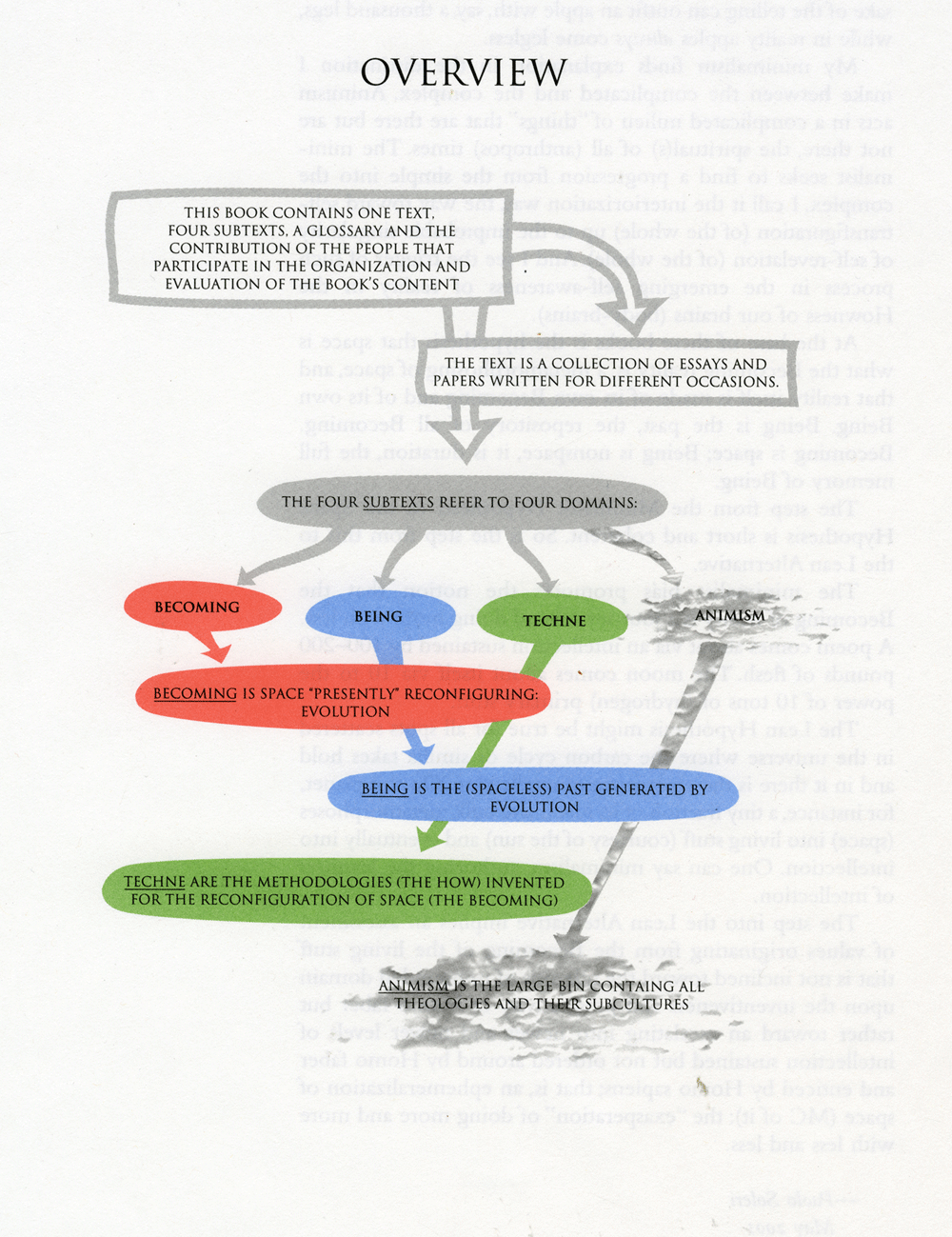
OVERVIEW THIS BOOK CONTAINS ONE TEXT. FOUR SUBTEXTS. A GLOSSARY AND TH E CONTRIBUTION OF THE PEOPLE THAT PARTICIPATE IN THE ORGANIZATION AND EVALUATION OF THE BOOK'S CONTENT THE TEXT IS A COLLECTION OF ESSAYS AND PAPERS WRITTEN FOR DIFFERENT OCCASIONS. THE FOUR SUBTEXTS REFER TO FOUR DOMAINS: BECOMING
BECOMING IS SPACE 'PRESENTLY' RECONFIGURlNG: EVOLUTION BEING IS THE (SPACELESS) PAST GENERATED BY EVOLUTION TECHNE ARE THE METHODOLOGIES (THE HOW) INVENTED FOR THE RECONFIGURATION OF SPACE (THE BECOMING) ANIMISM IS THE LARGE BIN CONTAINING ALL THEOLOGIES AND THEIR SUBCULTURES Storytelling does not entail the automatic dismissal of the values that the story might want to conveyor its exclusion from the normative and the esthetic. But storytelling becomes a dangerous activity as soon as it becomes a vehicle into the domain of animism, as I call it. For instance, a narrator for the sake of the telling can outfit an apple with, say, a thousand legs, while in reality apples always come legless. My minimalism finds explanation in the distinction I make between the complicated and the complex. Animism acts in a complicated milieu of "things" that are there but are not there, the spiritual(s) of all (anthropos) times. The minimalist seeks to find a progression from the simple into the complex. I call it the interiorization way, the way toward self-transfiguration (of the whole) up to the improbable singularity of self-revelation (of the whole). And I see the trigger of such process in the emerging self-awareness of reality in the Howness of our brains (body-brains). At the base of these books is the hypothesis that space is what the Becoming reality is, a metamorphosing of space, and that reality itself is made of its own Becoming and of its own Being. Being is the past, the repository of all Becoming. Becoming is space; Being is nonspace, it is duration, the full memory of Being. The step from the Minimalist Hypothesis to the Space Hypothesis is short and coherent. So is the step from this to the Lean Alternative. The minimalist bias promotes the notion that the Becoming of reality is a journey toward doing more with less. A poem comes about via an intellection sustained by 100-200 pounds of flesh. The moon comes about itself via 10 to the power of 10 tons of (hydrogen) primary stuff. The Lean Hypothesis might be true for all spots scattered in the universe where the carbon cycle or similia takes hold and in it there is the emergence of intellection. On this planet, for instance, a tiny fraction of its inanimate bulk metamorphoses (space) into living stuff (courtesy of the sun) and eventually into intellection. One can say minimalism, authoring the leanness of intellection. The step into the Lean Alternative implies an assessment of values originating from the Becoming of the living stuff that is not inclined toward the sclerosis of unbounded domain upon the inventiveness and productivity of Homo faber but rather toward an escalating into newer and newer levels of intellection sustained but not ordered around by Homo faber and enticed by Homo sapiens; that is, an ephemeralization of space (MC of it): the "exasperation" of doing more and more with less and less. -- Paolo Soleri May 2001
|