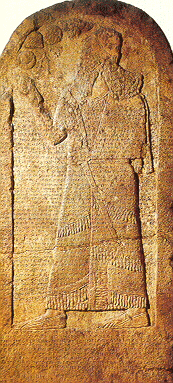
Kurkh
Monolith
The Kurkh Monolith is an Assyrian document that contains a
description of the Battle of Qarqar at the end. Today it stands in
the British Museum but it was originally found at the Kurdish
village of Kurkh (Turkish Üçtepe), near the town of Bismil in the
province of Diyarbakır, Turkey. The Monolith stands some 2.2 metres
tall, and roughly covers years one through six of the reign of
Assyrian king Shalmaneser III (859-824 BC), although the fifth year
is missing.
The Monolith
mainly deals with campaigns Shalmaneser made in western Mesopotamia
and Syria, fighting extensively with the countries of Bit Adini and
Carchemish. At the end of the Monolith comes the account of the
Battle of Qarqar, where an alliance of twelve kings fought against
Shalmaneser at the Syrian city of Qarqar. This alliance, comprising
eleven kings, was led by Irhuleni of Hamath and Hadadezer of
Damascus, describing an improbably large force[1] led by King Ahab
of Israel. The Monolith is also the first time that the Arabs make
an appearance in world history, fielding a contingent containing
dromedaries led by King Gindibu.
Scribal
errors and disputes
There are a
number of issues surrounding the written words contained in the
Monolith, mostly surrounding the text of the Battle of Qarqar. For
example, the scribe lists one city as Gu-a-a, which some scholars
believe refers to Que. However, H. Tadmor believes that this is
actually a mistake, with Gu-a-a being an incorrect spelling for Gu-bal-a-a,
that is, Byblos. Other scholars have also pointed out that it would
be more logical if Shalmaneser fought Byblos instead of Que, because
it would make better geographic sense -- since the other kings of
the area are polities to the south and west of Assyria, it might be
expected that another city-state in that area -- Byblos -- would
fight at Qarqar, rather than Que, which is in Cilicia.
Another issue
with regard to spelling is the term musri, which is Akkadian for
"march". Tadmor says that the actual Musri people had been conquered
by the Assyrians in the 11th century BC, and thus believes that this
reference to Musri must be "Egypt", although some scholars dispute
this.
Another major
error in the text is the assertion that Assyria fought "twelve
kings". Casual readers will note that the Monolith in fact lists
eleven, but some scholars have attempted to explain that there
really is a missing king, stemming from the description of "Ba'sa
the man of Bit-Ruhubi, the Ammonite". One scholar suggests that the
two entities be split into "Bit-Ruhubi" (Beth-Rehob, a state in the
Trans-Jordan) and "Ammon", one of Israel's traditional enemies.
However, "twelve kings" is a common Mesopotamian literary device for
any kind of alliance,[citation needed] so it is entirely possible
that the scribe here was using a figure of speech, rather than
miscounting.
References
1.^ Huffmon,
Herbert B. "Jezebel - the 'Corrosive' Queen" in Joyce Rilett Wood,
John E. Harvey, Mark Leuchter, eds. From Babel to Babylon: Essays on
Biblical History And Literature in Honor of Brian Peckham, T&T
Clark, 2006, ISBN 978-0-567-02892-1 p. 276
http://books.google.com/books?hl=en&lr=&id=1Lvh29qOHHoC&oi=fnd&pg=PA273&dq=%22kurkh+monolith%22&ots=bjmQrTflBj&sig=k-0DuKWDrGxYo06Jcdk5mhZG1v0#PPA276,M1