|
Home HEZEKIAH |
|
by Wikipedia (All Bible "PROOF" edited out.) Hezekiah is the common transliteration of a name more properly transliterated as "Ḥizkiyyahu." (Hebrew: חִזְקִיָּ֫הוּ or יְחִזְקִיָּ֫הוּ, Modern {{{2}}} Tiberian {{{3}}}; Greek: Ἐζεκίας, Ezekias, in the Septuagint; Latin: Ezechias). Hezekiah witnessed the forced resettlement of the northern Kingdom of Israel by Sargon's Assyrians in c 720 BCE and was king of Judah during the invasion and siege of Jerusalem by Sennacherib in 701 BCE.
The invasion of Judah by Sennacherib
and the Assyrian army was a major and well documented historical event.
Sennacherib recorded on his monumental inscription, "The Prism of
Sennacherib", how in his campaign against Hezekiah ("Ha-za-qi-(i)a-ú")
he took 46 cities in this campaign (column 3, line 19 of the Sennacherib
prism), and besieged Jerusalem ("Ur-sa-li-im-mu") with earthworks.[6]
Herodotus wrote of the invasion and acknowledges many Assyrian deaths,
which he claims were the result of a plague of mice.[7] Assyrian records show that Sennacherib was assassinated by his sons, Adrammelech and Sharezer, in 681 BCE - ie., twenty years after the invasion of Judah in 701 BCE.[10] He was succeeded by Esarhaddon as the Assyrian king. Evidence from archaeology show that Hezekiah built temples at Lachish and Arad, and allowed a high place to continue in operation at Beersheva. Archaeological evidence
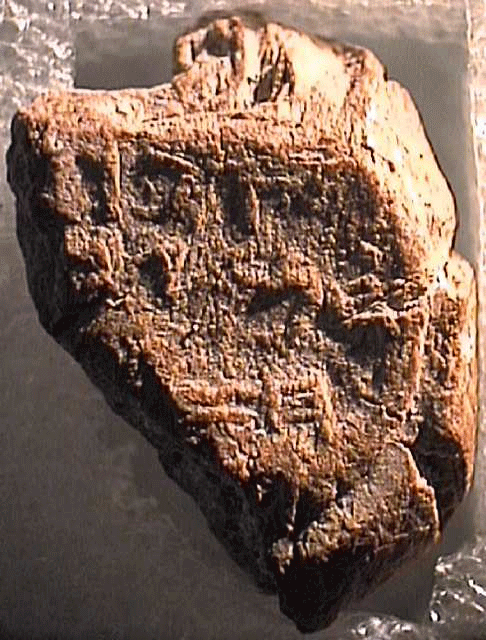
Seal One class of seal impression has been found in modern Israel relating to King Hezekiah:
Siloam Inscription
References
6.^ James B. Pritchard, ed., Ancient
Near Eastern Texts Related to the Old Testament (Princeton, NJ:
Princeton University Press, 1965) 287-288.
|