|
Home MESHA STELE |
|
by Wikipedia
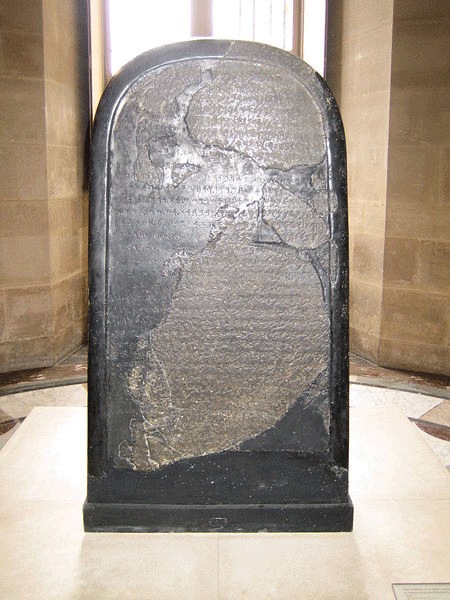
Mesha Stele in the Louvre Museum The Mesha Stele (popularized in the 19th century as the "Moabite Stone") is a black basalt stone bearing an inscription by the 9th century BC ruler Mesha of Moab. The inscription was set up about 840 BC as a memorial of Mesha's victories over "Omri king of Israel" and his son, who had been "oppressing" Moab. It bears the earliest known reference to the sacred Hebrew name of God - YHWH - and is also notable as the most extensive inscription ever recovered that refers to ancient Israel (the "House of Omri"). French scholar André Lemaire has reconstructed a portion of line 31 of the stele as "House of David".[1] The stone is 124 cm high and 71 cm wide and deep, and rounded at the top. It was discovered at the site of ancient Dibon (now Dhiban, Jordan), in August 1868, by Rev. F. A. Klein, a German missionary. Local villagers smashed the stone during a dispute over its ownership, but a squeeze (a papier-mâché impression) had been obtained by Charles Simon Clermont-Ganneau, and most of the fragments were later recovered and pieced together by him.[2] The squeeze (which has never been published) and the reassembled stele (which has been published in many books and encyclopedias) are now in the Louvre Museum. Description The stele measures 44"x27"[3]. Its 34 lines describe:
Importance The inscription has strong consistency with the historical events recorded in the Bible. The events, names, and places mentioned in the Mesha Stele correspond to those mentioned in the Bible. For example, Mesha is recorded as the King of Moab in 2 Kings 3:4: “Now Mesha king of Moab was a sheep breeder, and he had to deliver to the king of Israel 100,000 lambs and the wool of 100,000 rams.”[4] Kemosh is mentioned in numerous places in the Bible as the national god of Moab (1 Kings 11:33, Numbers 21:29 etc...).[5] The reign of Omri, King of Israel, is chronicled in 1 Kings 16[6], and the inscription records many places and territories (Nebo, Gad, ect...) that also appear in the Bible.[7] Finally, 2 Kings 3 recounts a revolt by Mesha against Israel, to which Israel responded by allying with Judah and Edom to suppress the revolt:
Some scholars have argued that an inconsistency exists between the Mesha Stele and the Bible regarding the timing of the revolt.[9] The argument rests upon the assumption that the following section of the inscription necessarily refers to Omri’s son Ahab: “Omri was the king of Israel, and he oppressed Moab for many days, for Kemosh was angry with his land. And his son replaced him; and he said, "I will also oppress Moab"…And Omri took possession of the whole land of Madaba; and he lived there in his days and half the days of his son: forty years: And Kemosh restored it in my days”. In other words, these scholars argue that the inscription indicates that Mesha’s revolt occurred during the reign of Omri’s son Ahab. Since the Bible speaks of the revolt taking place during Jehoram’s reign (Omri’s grandson), these scholars have argued that these two accounts are inconsistent. However, as other scholars have pointed out, the inscription need not necessarily refer to Omri’s son Ahab.[10] In modern English, the word “son” typically refers to a male child in relation to his parents. In the ancient Near East, however, the word was commonly used to mean male descendent.[11] Consequently, “son of Omri” was a common designation for any male descendent of Omri and would have been used to refer to Jehoram. Assuming that “son” means “descendent,” an interpretation consistent with the common use of language in the ancient Near East, the Mesha Stele and the Bible are consistent. Reconstructions of [D]VDH at line 31 and line 12 In 1994, after examining both the Mesha Stele and the paper squeeze in the Louvre Museum, the French scholar André Lemaire reported that line 31 of the Mesha Stele bears the phrase "the house of David" (in Biblical Archaeology Review [May/June 1994], pp. 30-37). Lemaire had to supply one destroyed letter, the first "D" in [D]VDH, "of [D]avid," to decode the wording. The complete sentence in the latter part of line 31 would then read, "As for Horonen, there lived in it the house of [D]avid," וחורננ. ישב. בה. בת[ד]וד. (Square brackets [ ] enclose letters or words supplied where letters were destroyed or were on fragments that are still missing.) Most scholars find that no other letter supplied there yields a reading that makes sense. After one full year, only one scholar, Baruch Margalit, attempted to supply a different letter: "m," along with several other letters in places after that, giving the reading: "Now Horoneyn was occupied at the en[d] of [my pre]decessor['s reign] by [Edom]ites." (Baruch Margalit, "Studies in NWSemitic Inscriptions," Ugarit-Forschungen 26, p. 275). Margalit's reading has not attracted any significant support in scholarly publications by 2006, although in 2001 another French scholar, Pierre Bordreuil, reported (in an essay in French) that he and a few other scholars could not confirm Lemaire's reading.[12] If Lemaire is right, there are now two early references to David's dynasty, one in the Mesha Stele (mid-9th century) and the other in the Tel Dan Stele (mid-9th to mid-8th century).[13]. In 1998, another scholar, Anson Rainey, translated a puzzling two-word phrase in line 12 of the Mesha Stele, אראל. דודה, as "its Davidic altar-hearth".[14] The identification of David in the Mesha stele remains controversial. This controversy stems partly from the fragmentary state of line 31 and partly from a tendency since the 1990s, largely among European scholars, to question or dismiss the historical reliability of the Hebrew Bible (Old Testament). In Europe, P. R. Davies, Thomas L. Thompson, and Niels P. Lemche show a strong tendency to reject biblical historicity, while André Lemaire, K. A. Kitchen, Jens Bruun Kofoed, and other European scholars are exceptions. Many scholars lean in one direction or the other but actually occupy the middle ground. The "Arabian Judah" school of Old Testament historical interpretation (Kamal Salibi) regard the Mesha stele as evidence that Omri's Kingdom of Israel was in northern Hijaz controlling trade routes including the important terminus of Taima.[citation needed] In general, North American and Israeli scholars tend to be more willing to accept the identification of the biblical King David in the Mesha stele, especially because the phrase that is usually translated "house of David," is clearly legible in the Tel Dan stele (there this phrase in line 9 appears to parallel "king of Israel" in the preceding line). The controversy over whether ancient inscriptions confirm the existence of the Biblical King David usually focuses less on the Mesha stele and more on the Tel Dan stele. Text
The text in Moabite, transcribed
into modern Hebrew letters: Translation In the original text some words run on from one line to the next. Where possible, this translation reflects this writing. Square brackets indicate reconstructed text, and dots represent missing and unreconstructed or disputed portions.
_______________ References 1. Biblical Archaeology Review [May/June 1994], pp. 30–37 2. [1] 3. 1920 World Book, Volume VI, page 3867 4. BibleGateway.com [2] 5. BibleGateway.com[3] 6. BibleGateway.com [4] 7. Driver, Samuel. (1890), Notes on the Hebrew Text of the Books of Samuel, [5] 8. BibleGateway.com [6] 9. Driver, Samuel. (1890), Notes on the Hebrew Text of the Books of Samuel, [7] 10. Davis, John. (1891), The Moabite Stone and the Hebrew Records; see also Christiananswers.net [8] 11. Ibid 12. Pierre Bordreuil, "A propos de l'inscription de Mesha': deux notes," in P. M. Michele Daviau, John W. Wevers and Michael Weigl [Eds.], The World of the Aramaeans III, pp. 158-167, especially pp. 162-163 [Sheffield, England: Sheffield Academic Press, 2001] 13. Lawrence J. Mykytiuk, _Identifying Biblical Persons in Northwest Semitic Inscriptions of 1200–539 B.C.E._, Academia Biblica series, no. 12 (Atlanta: Society of Biblical Literature, 2004), pp. 265-277 14. (Anson F. Rainey, "Mesha and Syntax," in _The Land That I Will Show You_, edited by J. Andrew Dearman and M. Patrick Graham, Supplement Series, no. 343 [Sheffield, England: Sheffield Academic Press, 2001], pp. 300-306).
|