|
Home NEBUCHADNEZZAR II |
|
by Wikipedia (All Bible "PROOF" edited out.)
Nebuchadnezzar II (c 634 – 562 BC) was a ruler of Babylon in the Chaldean Dynasty, who reigned c. 605 BC – 562 BC. Name The Akkadian name, Nabû-kudurri-uṣur, means "Oh god Nabu, preserve/defend my firstborn son". Nabu is the Babylonian deity of wisdom, and son of the god Marduk. In an inscription, Nebuchadnezzar styles himself as Nabu's “beloved” and “favourite”.[2][3] The name is often mistakenly interpreted as "O Nabu, defend my kudurru",[4] in which sense a kudurru is an inscribed stone deed of property. However, when contained in a ruler's title, kudurru approximates to "firstborn son" or "oldest son".[5] The Hebrew form is נְבוּכַדְנֶצַּר (Nəḇūḵaḏneṣṣar or Nevuchadnetsar), but is also found as נְבוּכַדְנֶאצַּר and נְבוּכַדְרֶאצַּר (Nəḇuḵaḏreṣṣar). The Greek form was Ναβουχοδονόσωρ. He is also known as Bakhat Nasar, which means "winner of the fate", or literally, "fate winner". Biography Nebuchadnezzar II was the eldest son, and successor, of Nabopolassar, who delivered Babylon from its dependence on Assyria and laid Nineveh in ruins. According to Berossus, some years before he became king of Babylon, he married Amytis of Media, the daughter or granddaughter of Cyaxares, king of the Medes, and thus the Median and Babylonian dynasties were united. Nabopolassar was intent on annexing the western provinces of Syria from Necho II (who was still hoping to restore Assyrian power), and to this end dispatched his son westward with a powerful army. In the ensuing Battle of Carchemish in 605 BC, the Egyptian army was defeated and driven back, and Syria and Phoenicia were brought under the control of Babylon. Nabopolassar died in August of that year, and Nebuchadnezzar returned to Babylon to ascend to the throne. After the defeat of the Cimmerians and Scythians, all of Nebuchadnezzar's expeditions were directed westwards, although the powerful Median empire lay to the north. Nebuchadnezzar's political marriage to Amytis of Media, the daughter of the Median king, had ensured peace between the two empires. A clay tablet,[7] now in the British Museum, states: "In the 37th year of Nebuchadnezzar, king of the country of Babylon, he went to Mitzraim (Egypt) to make war. Amasis, king of Egypt, collected [his army], and marched and spread abroad." Having completed the subjugation of Phoenicia, and a campaign against Egypt, Nebuchadnezzar set himself to rebuild and adorn the city of Babylon, and constructed canals, aqueducts, temples and reservoirs. According to Babylonian tradition, Nebuchadnezzar, towards the end of his life, prophesied the impending ruin of the Chaldean Empire (Berosus and Abydenus in Eusebius, Praeparatio Evangelica, 9.41). Nebuchadnezzar died in Babylon between the second and sixth months of the forty-third year of his reign. Construction activity
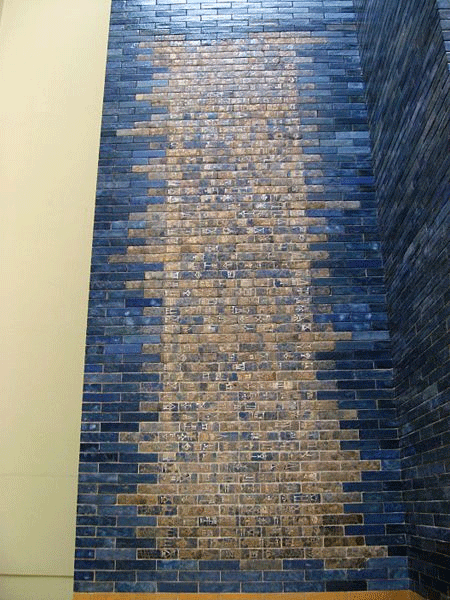
Building Inscription of King Nebuchadnezar II at the Ishtar Gate. An abridged excerpt says: "I (Nebuchadnezzar) laid the foundation of the gates down to the ground water level and had them built out of pure blue stone. Upon the walls in the inner room of the gate are bulls and dragons and thus I magnificently adorned them with luxurious splendour for all mankind to behold in awe." During the last century of Nineveh's existence, Babylon had been greatly devastated, not only at the hands of Sennacherib and Assurbanipal, but also as a result of her ever renewed rebellions. Nebuchadnezzar, continuing his father's work of reconstruction, aimed at making his capital one of the world's wonders. Old temples were restored; new edifices of incredible magnificence were erected to the many gods of the Babylonian pantheon (Diodorus of Sicily, 2.95; Herodotus, 1.183). The bridge across the Euphrates is of particular interest, in that it was supported on asphalt covered brick piers that were streamlined to reduce the upstream resistance to flow, and the downstream turbulence that would otherwise undermine the foundations. Nebuchadnezzar's construction activity was not confined to the capital; he is credited with the restoration of the Lake of Sippar, the opening of a port on the Persian Gulf, and the building of the Mede wall between the Tigris and the Euphrates to protect the country against incursions from the north. These undertakings required a considerable number of laborers; an inscription at the great temple of Marduk suggests that the labouring force used for his public works was most likely made up of captives brought from various parts of western Asia. Nebuchadnezzar is credited with the construction of the Hanging Gardens, for his sick wife Amyitis (or Amytis) to remind her of her homeland, Medis (Media) in Persia.[9] However, some scholars argue that they may have been constructed by a queen from the Assyrian city, Nineveh.[10] Interpretations of Nebuchadnezzar's actions Voltaire interprets the legacy of Nebuchadnezzar and his relationship with Amasis in a short story entitled The White Bull. _______________ Notes 1. Anton Nyström, Allmän kulturhistoria eller det mänskliga lifvet i dess utveckling, bd 2 (1901) 2. Harper, R.F. quoted in Peet, Stephen Denison (editor). 1900. “Editorial Notes,” The American Antiquarian and Oriental Journal. New York: Doubleday, vol. XXII, May and June. p. 207. 3. Lamb, Harold. 1960. Cyrus the Great. New York: Doubleday, p. 104. 4. Schrader, Eberhard. 1888. The Cuneiform Inscriptions and the Old Testament. London: Williams and Norgate, p. 48 (footnote). 5. Chicago Assyrian Dictionary sub Kudurru Ca5' 7. Elgood, Percival George. 1951. Later Dynasties of Egypt. Oxford: Basil Blackwell. p. 106. 8. Smith, William and Fuller, J.M. 1893. A Dictionary of the Bible: Comprising Its Antiquities, Biography, Geography, and Natural History. London: John Murray, vol. I, p. 314. 9. Foster, Karen Polinger (1998). "Gardens of Eden: Flora and Fauna in the Ancient Near East". Transformations of Middle Eastern Natural Environments: Legacies and Lessons. New Haven: Yale University. pp. 320–329. http://environment.yale.edu/documents/downloads/0-9/103foster.pdf. Retrieved 2007-08-11. 10. "How the Seven Wonders of the Ancient World Work". Stuff You Missed in History Class. 8.04.08
|