|
Home YIGAEL YADIN |
|
by Wikipedia
Burial Box of
Jesus' Brother Ruled a Fraud, by Thomas H. Maugh II
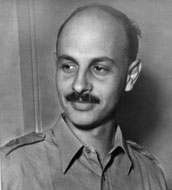
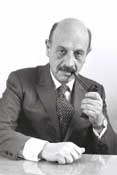
Place of birth: Jerusalem, Ottoman Empire Yigael Yadin (Hebrew: יגאל ידין, born Yigal Sukenik (Hebrew: יגאל סוקניק) on 21 March 1917, died 28 June 1984) was an Israeli archeologist, politician, and the second Chief of Staff of the Israel Defense Forces. Biography Early life and military career Yadin was born in 1917 to noted archeologist Eleazar Sukenik and educationalist and women's rights activist Hasya Feynsod Sukenik. He joined the Haganah at age fifteen and served there in a variety of different capacities. In 1946, however, he left the Haganah following an argument with its commander Yitzhak Sadeh over the inclusion of a machine gun as part of standard squad equipment. He was a university student when, in 1947, shortly before the State of Israel declared its independence, he was called back to active service by David Ben-Gurion. He was Head of Operations during Israel's War of Independence, and was responsible for many of the key decisions made during the course of that war. Yadin was appointed Chief of Staff of the IDF on 9 November 1949, following the resignation of Yaakov Dori, and served in that capacity for three years. He resigned on 7 December 1952, over disagreements with then prime minister and defense minister David Ben-Gurion about cuts to the military budget. By age thirty-five, he had completed his military career. Archaeology Upon leaving the military, he devoted himself to research and began his life's work in archeology. In 1956 he received the Israel Prize in Jewish studies[1], for his doctoral thesis on the translation of the Dead Sea Scrolls. As an archeologist, he excavated some of the most important sites in the region, including the Qumran Caves, Masada, Hazor, and Tel Megiddo. He considered the Solomonic Gate at Tel Gezer to be the highpoint of his career. He was sometimes forced to deal with the theft of important artifacts, occasionally by prominent political and military figures. In one instance, where the thefts were commonly attributed to the famous one-eyed general Moshe Dayan, he remarked: "I know who did it, and I am not going to say who it is, but if I catch him, I'll poke out his other eye too." Even as an archeologist, Yadin never completely abandoned public life. On the eve of the Six-Day War, he served as a military adviser to prime minister Levi Eshkol, and following the Yom Kippur War, he was a member of the Agranat Commission that investigated the actions that led to the war. Political career In 1976 Yadin formed the Democratic Movement for Change, commonly known by its Hebrew acronym Dash, together with Professor Amnon Rubinstein, Shmuel Tamir, Meir Amit, Meir Zorea, and many other prominent public figures. The new party seemed to be an ideal solution for many Israelis who were fed up with alleged corruption in the Alignment (the major party in Israel at the time), which included the Yadlin affair, the suicide of Housing Minister Avraham Ofer, and Leah Rabin's illegal dollar account in the United States. Furthermore, Dash was a response to the increasing sense of frustration and despair in the aftermath of the 1973 war, and the social and political developments that followed in its wake. Many people regarded Yadin, a warrior and a scholar, as the quintessential prototype of the ideal Israeli, untainted by corruption, who could lead the country on a new path. In the 1977 elections, the new party did remarkably well for its first attempt to enter the Knesset, winning 15 of the 120 seats. As a result of the election, Likud party leader Menachem Begin was able to form a coalition without Dash (or parties to its left) at first, significantly lowering the bargaining power of Dash. Dash joined the coalition after a few months. As the new Deputy Prime Minister, Yadin played a pivotal role in many events that took place, particularly the contacts with Egypt, which eventually led to the signing of the Camp David Accords and the peace treaty between Israel and its neighbor. Nevertheless, Dash itself proved to be a failure, and the party broke up into numerous splinter factions; Yadin joined the Democratic Movement, but it too split up and he sat as an independent MK for the remainder of his term. He retired from politics in 1981. Yadin was married to Carmela (née Ruppin) who worked with him throughout his career in translating and editing his books and with whom he had two daughters -- Orly and Littal. He died in 1984. The Israeli actor Yossi Yadin was his brother. Works
Sources Neil A. Silberman "A Prophet from Amongst You: The Life of Yigael Yadin, Soldier, Scholar, and Mythmaker of Modern Israel" Addison Wesley (1994). Yigael
Yadin
(1917-1984) Yigael Yadin was born in Jerusalem and joined the Haganah in 1933. He became a key figure in the Haganah leadership, was its operations officer, and helped devise and implement many of the strategies used in the War of Independence. Following the establishment of the State, he was named the second Chief of Staff of the Israel Defense Forces (IDF), and served in that capacity from 1949-1952. During his tenure, Yadin reorganized the standing army, the system of compulsory military service, and the reserves. Yadin left the army in 1952 and, himself the son of archaeologist Eliezer Sukenik, studied archeology at the Hebrew University of Jerusalem. He earned his Ph.D. in 1955 on research into one of the Dead Sea Scrolls, and for this he was awarded the Israel Prize in Jewish Studies in 1956. In the following years, Yadin continued his research in archeology and antiquities, teaching and publishing prolifically. Among his best-known works are Masada (1968) and Tefillin from Qumran (1969). In 1970 he became head of the Institute of Archeology at the Hebrew University. Yadin’s fieldwork, conducted in the 1950’s and 1960’s, encompassed many important excavations at a range of sites, including Hazor, caves of the Judean Desert, Masada, and Meggido. Employing thousands of volunteers from Israel and abroad, his vast archeological digs expanded the field tremendously. Yadin’s findings have shed light on various periods of ancient Israel, such as the Canaanite, First Temple, and Herodian periods, as well as the Bar Kokhba revolt. Perhaps his most famous contribution was his decoding and interpreting of several scrolls from the Dead Sea and the Judean Desert. Yadin also did much to make archaeology a more accessible and less exclusively esoteric field. His writing is both scholarly and of interest to more widespread audiences. He strove not only to document his archaeological findings but to place them in a cultural context and understand them as an avenue to cultural history. Yadin was also instrumental in acquiring the Dead Sea Scrolls for Israel and highlighting them in the Israel Museum’s Shrine of the Book, thus bringing these archeological treasures closer to the public. In his later life, Yadin’s career in archeology was complemented by several public posts. In 1967, he served as military advisor to Prime Minister Levi Eshkol, and following the Yom Kippur War he served on the Agranat Commission that investigated the lapses which led to the surprise attack. In 1976, Yadin formed “Dash” (Democratic Movement for Change), a new political party dedicated to electoral reform. In the elections of 1977, the party won 15 Knesset seats and joined the first Likud government. Although the party itself broke up two years later with little achievement in restructuring electoral politics, Yadin served as deputy prime minister from 1977 to 1981, following which he retired from political life, returning to his research until his death in 1984. Source: The Pedagogic Center, The Department for Jewish Zionist Education, The Jewish Agency for Israel, (c) 1997, 1998, 1999, 2000, Director: Dr. Motti Friedman, Webmaster: Esther Carciente. Photo: National Photo collection.
Excerpt from "The Voice from the
Jordan," Chapter 9: The Dead Sea Scrolls, by Juan Ruiz Minchero "In 1947, a Bedouin shepherd named Mohamed ed-Dhib, also known as The Wolf, of the Taamireh tribe, found in a cave on the northwestern shore of the Dead Sea what came to be called the Dead Sea Scrolls," said the Teacher, who went on to explain: The ancient manuscripts known as the Dead Sea Scrolls have been called by scholars "the greatest manuscript discovery of modern times. They include books of the Torah (the Pentateuch, or the first five books of the Hebrew Bible) and non-biblical texts dating from 100 B.C. to A.D. 68." Actually, they are not original manuscripts, but copies thereof made by scribes. They are a thousand years older than the oldest known Masoretic (traditional Hebrew) text of the Torah, which is the basis of the English translation of the Old Testament. The account of the details of the discovery of the first scrolls varied in later years. One version was that a runaway goat jumped into the cave on the rocky hillside. The shepherd threw in a stone and heard the sound of breaking pottery. He called another boy, and the two crawled into the cave. They saw several large pottery jars, most of them broken. Protruding from the necks of the jars were scrolls of leather wrapped in linen cloth. Although they were badly decomposed, it was possible to see that they were inscribed in a strange writing. There were seven scrolls. What could they do with their find? the shepherds wondered. Some months later the Bedouins went to Bethlehem, their traditional shopping center, to see a Christian shoemaker called Jalil Iskandar Schalim, popularly known as Kandu. They hoped that this shoemaker could make them some cheap pairs of sandals or something else out of those old leather scrolls. Kandu kept the scrolls, paying a few coins to the Bedoiuins. Then, probably in late July 1947, Kandu took the scrolls to his spiritual head, the Syrian Metropolitan Mar Athanasious Samuel, of the Syrian Orthodox Christian church, at the Monastery of St. Mark, in the Arab quarter of Jerusalem. Other 3 scrolls had also similarly reached the hands of an archaeologist of the Jerusualem's Hebrew University. Professor Eliezer Lipa Sukenic, father of Yigael Yadin, an agent of the Israeli secret service. In the 1948 independence war, Yigael Yadin was Chief of Staff of the Israeli Army, then he was archaeology professor and interim minister and vice prime minister of the State of Israel. He died on June 1948 at 67. Upon the State of Israel winning its independence, these 3 scrolls bought by his father were already at the Hebrew University. Ever since they constitute the core of the Israeli holdings of the Qumran findings. The Metropolitan took his scrolls to the American School of Oriental Research in Jerusalem for examination. Satisfied that they were genuine, the American School photographed them and announced the discovery to the world in April 1948. The Metropolitan then took his scrolls to the United States. In 1954 Professor Yigael Yadin, son of Sukenik, was lecturing in the United States on the three scrolls acquired by his father for the Hebrew University. By chance he learned that the Metropolitan was advertising the other four scrolls for sale in a New York newspaper. He purchased them for 250,000 dollars for the government of Israel. Meanwhile Bedouins were searching every cave near the first one and finding thousands of fragments, which they sold to dealers. In 1949 G. Lankester Harding, British-born director of the Department of Antiquities for Jordan, and Father Roland de Vaux, head of the French Dominican School of Archaeology in Jerusalem, took charge of exploring the caves. Hundreds of manuscripts were found, including almost all the books of the Torah. In February 1952 some Bedouins found another cave near the first one, with remains of some scrolls. This new finding triggered a systematic search of 270 caves along the range's hillside, but they found only one more cave less than a mile north of the first one. At the entrance of this third cave, there were two scrolls of copper plate hidden under stone, so badly covered wtih Paris green that it was impossible to unroll them. When at last they cold be unrolled, in 1956, it was found that they formed a set. The text is an index of 64 places where giant treasures had been hidden. The seven scrolls found in the first cave were the most important. They consisted of two scrolls of the Book of Isaiah, one complete, the other incomplete, and five scrolls of nonbiblical texts. The Dead Sea Scrolls were written during one of the most decisive periods in the history of the Jewish people, on the eve of the birth of Christianity. The tens of thousands of scroll fragments represent a great amount of new material for the study of biblical texts and the people who wrote them as well as of Jewish history after the 4th century B.C. There was a long-standing controversy over the fact that access to the scrolls was limited to a small number of scholars. This was resolved to some degree in the early 1990s when copies of the scrolls were finally published. The War of the Sons of Light Against the Sons of Darkness discusses the coming victory of the former over the Sons of Darkness. The Commentary on the Book of Habakkuk tells of the defiling of the sanctuary of God and the persecution of the Teacher of Righteousness, who was driven into exile by the Wicked Priest. Enemies called the Kittim are described as plundering and slaying. The scroll of the Thanksgiving Hymns is a collection of songs similar to the Psalms. The Book of Lamech was so fragile that seven years went by before it could be unrolled. It was assumed to be the lost Aprocryphal Book of Lamech, but it proved to be a document in Aramaic relating to the Book of Genesis. It is now called the Scroll of the Apocryphal Genesis. It describes the journeys of Abraham. One of the later discoveries, one of the most interesting was the copper scroll found in 1952. It was broken in two pieces and was too brittle to unroll. The Jordan government sent it to the Manchester College of Technology in England. Professor H.W. Wright-Baker devised a way of mountain the pieces on a spindle and cutting them into paper-thin strips through which the letters could be read. The scroll contains a long list of hiding places of treasures of enormous value. They were hidden in wells, in tombs, and near certain trees and springs. Some scholars believe the list to be imaginary or symbolic. Some others think it may be a catalog of the treasures of King Solomon's Temple, others that it lists actual treasures of the Essenes. The Solomon Temple at Jerusalem could be equated to the richest central bank in the Middle East at that time. The treasures could not be just imaginary, but actual internments of valuable temple assets being guarded against war and conquest. An eighth scroll, the longest and most complete of all, was acquired by the Israeli government during the Six-Day War in 1967. Called The Temple Scroll, it was found in 1950s. Yadin, who published a translation of the 27-foot (8-meter) scroll in 1977, dated it between the 2nd century B.C. and A.D. 70. The document establishes clear links between early Christian doctrines and the religious teachings of the Essenes. Re the Roman siege of Masada,
conducted winter-spring of 72/73 or 73/74 C.E. (ArgueWithEveryone.com, 2/1/09) I am saying that Yadin forged his findings at Masada under political pressure and was exposed by his students on the dig. Big stinking scandal in Israel. Yadin was an ex-IDF general who became an amateur archeologist. He excavated Masada and found nothing except 12 skeletons and a pile of pig bones. The Israelis gave the bones a State funeral. Months later the students on the dig brought forward their notes and photos and findings. I don't know if Yadin was a fraud. It's claimed he was under pressure from the Israeli government to promote the heroism of the siege and the 900 suicides. They were spinning the Masada Myth to promote the heroism, sacrifice and and indestructible Jewish State. Masada was a resort retreat built by Herod and well stocked with water and provisions. I expect that after they used up everything stored there, they gave up and were hauled off by the Romans. There aren't any 900 skeletal remains. There were wads of long female hair. I think they were captured and hauled off because the penalty was to cut the hair of captive women. 12 skeletons doesn't equate to 900 suicides.
|