|
Chapter 10: The
Tet Offensive and the Turnaround
Highlights of
the Period: January-April, 1968
JANUARY-FEBRUARY 1968
The enemy, on
January 31, the Tet holiday, struck at the U.S.
Embassy in Saigon and attacked scores of important towns and all
the major cities. The Joint Chiefs urged bombing closer to the
centers of Hanoi and Haiphong; President Johnson refused.
Gen. Wheeler, Chairman of the Joint Chiefs, asked Gen. Westmoreland
to specify his troop needs. Gen. Westmoreland, advised
repeatedly that a division and a half was available, requested a force
of that size. •
The Joint Chiefs-trying to force the President into mobilization,
the study says-insisted that a reserve call-up must precede any
deployment. But Secretary of Defense Robert S. McNamara approved
a 10,500-man Vietnam deployment with no call-up.
Gen. Wheeler visited Saigon in late February, and found that the
initiative was held by the enemy. He concluded that Gen. Westmoreland
needed 206,756 more men.
Clark Clifford, now the Secretary-of-Defense-designate, convened
a high-level working group for a full policy review. The initial draft
policy memorandum found the Saigon forces ineffective, and the
enemy likely to match any escalation. It urged a static "population
security"
strategy "to buy time" for the Vietnamese to take over
their own defense. It opposed any extension of the bombing as
"unproductive
or worse."
MARCH 1968
A C.I.A. study, bolstering the advocates of de-escalation among
the working group, found that the enemy could withstand a war of
attrition regardless of U.S. troop increases in the next 10 months.
Mr. Clifford's working group debated the drafters' memorandum
and developed a consensus against completely abandoning the initiative.
There was intense conflict between the military and the advocates
of de-escalation. Gen. Wheeler argued for the extension of
bombing. Assistant Secretary of Defense Paul Warnke argued
against an extension.
A revised draft, by Warnke and Assistant Secretary Phil Goulding,
went to the White House. It asked for 22,000 more men for
Vietnam and favored deferring any decision on further deployments.
It asked for a reserve call-up and no new peace initiatives, stating
that the planners were unable to reach a consensus on the question
of wider bombing.
Gen. Westmoreland welcomed the 22,000 men but repeated his
request for 206,756.
On March 5, Mr. Clifford asked Gen. Wheeler's opinion on a
602
Rusk draft favoring a halt in the bombing of most of North Vietnam;
the study "infers" that Mr. Clifford favored the Rusk plan.
Air Force Secretary Brown pressed for a step-up of the bombing
and offered three optional plans for it.
On March 10, Gen. Westmoreland's "206,000" request became
public in The New York Times, provoking a brisk debate.
Senator Eugene J. McCarthy, running as a peace candidate, edged
out President Johnson in the New Hampshire presidential primary.
On March 13, the President decided on a 30,000-man Vietnam
troop increase, with a reserve call-up of 98,451.
On March 22, Gen. Westmoreland was recalled from Vietnam to
become the Army Chief of Staff-a signal, the study says, that
the President had ruled out major escalation. Gen. Creighton W
Abrams, who would later be named to succeed Gen. Westmoreland,
visited the White House secretly.
The "Wise Men"-a council of current and former high officials met
March 25-26 at the President's request and advised de-escalation.
On March 31, President Johnson announced: "I shall not seek,
and I will not accept, the nomination of my party." He also announced
pull-back in bombing to the 20th Parallel.
APRIL 1968
On April 3, North Vietnam agreed to talks.
603
Chapter 10
The Tet Offensive and the
Turnaround
-BY E. W. KENWORTHY
Amid the shock and turmoil of the Tet offensive in February,
1968, the Pentagon study of the Vietnam war discloses,
the Joint Chiefs of Staff and Gen. William C. Westmoreland
sought to force President Lyndon B. Johnson a long way
toward national mobilization in an effort to win victory in
Vietnam.
But, the study shows, this pressure by the Joint Chiefs of
the commanding general in the field set off a last, bitter policy
debate in the Administration that culminated in the opposite
of the military's desires.
For the first time, the study explains, President Johnson
squarely faced the prospect that he had sought adamantly to
avoid during three years of steadily widening war: "A full-scale
call-up of reserves" and "putting the country economically
on a semiwar footing." And, the Pentagon study
goes on, Mr. Johnson confronted this prospect "at a time of
great domestic dissent, dissatisfaction and disillusionment about
both the purposes and the conduct of the war."
Finally the President relieved General Westmoreland of his
command in late February, and on March 31, 1968, exactly
two months after the opening blows of the Vietcong and North
Vietnamese offensive at Tet, Mr. Johnson announced his decision
to limit the American operation in Vietnam. He cut
back the bombing of North Vietnam to the 20th Parallel and
sent to South Vietnam a token troop increase: one-tenth of
the 206,000 men his generals had requested to achieve "victory."
Having announced these steps as a hopeful prelude to a
604
negotiated settlement of the war, the President, citing a wish
to ease the "partisan division" racking the country, said he
would not seek re-election.
The enemy offensive during Tet, the Lunar New Year,
began on Jan. 31 with an attack on the United States Embassy
in Saigon; for a day enemy guerrillas held the embassy compound.
The attacks spread rapidly to almost all the cities and
major towns of South Vietnam. Hue, the ancient capital of
central Vietnam, was captured and not retaken until Feb. 24
in the last days of the offensive.
On Feb. 2, three days after the initial assault, President
Johnson summoned White House reporters to the Cabinet
Room. The enemy attack, he said, had been "anticipated,
prepared for and met." Militarily, the enemy had suffered
"a complete failure." As for a "psychological victory," the
enemy's second objective, the President said that "when the
American people know the facts," they would see that here,
too, the enemy had failed.
In reply to questions, the President said that General Westmoreland
had been given "every single thing" he "believed
that he needed at this time," and that therefore no change was
contemplated in the planned level of 525,000 American soldiers
nor was there likely to be "any change of great consequence"
in strategy.
The Pentagon study, however, says that the offensive took
the White House and the Joint Chiefs "by surprise, and its
strength, length and intensity prolonged this shock."
For the President, the study makes plain, the shock and
disappointment were particularly severe, because throughout
much of 1967 he had discounted "negative analyses" of United
States strategy by the Central Intelligence Agency and the
Pentagon offices of International Security Affairs and Systems
Analysis. Instead, the study says, Mr. Johnson had seized upon
the "optimistic reports" from General Westmoreland to
counteract what many Pentagon civilians sensed was a growing
public disillusionment with the war.
As an example of an unheeded warning, the Pentagon
analyst cites at length a bombing study by the Government-subsidized
Institute for Defense Analyses that was submitted
to Secretary McNamara in mid-December, 1967. In this
study-on which Mr. McNamara was to draw heavily in his
farewell statement on defense posture to the Senate Armed
Services Committee on Feb. I-the institute said that the
bombing of North Vietnam had had "no measurable effect
on Hanoi's ability to mount and support military operations in
605
the South" and had "not discernibly weakened" Hanoi's will
to support the insurgency.
As an example of the reports that the President did heed,
the analyst cites the year-end assessment of General Westmoreland,
which was delivered on Jan. 27, four days before
the Tet offensive. The general said:
"Interdiction of the enemy's logistics train in Laos and NVN
[North Vietnam] by our indispensable air efforts has imposed
significant difficulties on him. In many areas the enemy has
been driven away from the population centers; in others he has
been compelled to disperse and evade contact, thus nullifying
much of his potential. The year ended with the enemy increasingly
resorting to desperation tactics in attempting to
achieve military/psychological victory; and he has experienced
only failure in these attempts."
New Troop Needs
A far different assessment came on Feb. 12, with the Tet
offensive at its height. General Westmoreland reported then
to the Joint Chiefs and Secretary McNamara that, as of Feb.
11, the enemy had attacked "34 provincial towns, 64 district
towns and all of the autonomous cities." This, the general said,
the enemy had been able to do while committing "only 20 to 35
per cent of his North Vietnamese forces . . . employed as
gap fillers where VC [Viet-cong] strength was apparently not
adequate to carry out his initial thrust on the cities and
towns."
The first formal reaction of the Joint Chiefs to the offensive
came on Feb. 3 when they asked Mr. McNamara to reduce
the radius of the zone in which bombing was prohibited in
Hanoi and in the port of Haiphong. In Hanoi, they sought
to cut the radius from 10 nautical miles from the city's center
to 3, and in Haiphong from 4 nautical miles to 1.5, thus
enlarging the outer "restricted" zones in which bombing of
selected targets was permitted upon Presidential approval. The
J oint Chiefs also asked that blanket authority be given to air
commanders to bomb in these outer zones.
The Joint Chiefs said in their memorandum that this extension
was necessary to reduce "the enemy capability for
waging war in the South"-a reason that the Pentagon analyst
606
dismisses as "a nonsequitur," in view of "the evident ineffectiveness
of the bombing in preventing the offensive."
Paul C. Warnke, who had succeeded the late John T.
McNaughton as Assistant Secretary of Defense for International
Security Affairs, opposed the request on the ground
that enlargement of the zones would allow strikes on "only a
couple of fixed targets not previously authorized." The President
did not approve the request.
In any event, the Pentagon analyst notes, the primary
focus of Washington's reaction to the Tet offensive was inevitably
centered on General Westmoreland's possible troop
requirements. At this point, however, the Pentagon study does
not take account of several messages between Gen. Earle G.
Wheeler, Chairman of the Joint Chiefs, and General Westmoreland.
These messages, which have been quoted verbatim
by Marvin Kalb and Elie Abel in their 1971 book "Roots of
Involvement," throw considerable light on what was to become
a matter of contention; whether the President and
General Wheeler pressed General Westmoreland to ask for
more troops or whether, as Mr. Johnson was to insist, the
President merely asked for General Westmoreland's "recommendations.
"
In the first of these cablegrams, on Feb. 3, four days after
the offensive began, General Wheeler said: "The President
asks me if there is any reinforcement or help that we can give
you."
General Westmoreland had not replied by Feb. 8, and
General Wheeler, according to the book, sent a second cablegram
then that did not mention the President: "Query: Do
you need reinforcement? Our capabilities are limited. We can
provide 82d Airborne Division and about one-half a Marine
Corps division, both loaded with Vietnam veterans. However,
if you consider reinforcements imperative, you should not be
bound by earlier agreements. United States Government is
not prepared to accept defeat in Vietnam. In summary, if you
need more troops, ask for them."
"Earlier agreements" referred to the authorized level of
525,000 troops in 1968, of whom about 500,000 had reached
South Vietnam.
That same day General Westmoreland replied, requesting
the proffered units and asking, according to the Kalb-Abel
book, that the President authorize an amphibious assault by
the marines into North Vietnam as a diversionary move. The
next day, Feb. 9, he followed up with this message:
"Needless to say, I would welcome reinforcements at
607
any time they can be made available. A. To put me in a
stronger position to contain the enemy's major campaign in
the DMZ-Quangtri-Thuathien area and to go on the offensive
as soon as his attack is spent. B. To permit me to carry
out my campaign plans despite enemy's reinforcements from
North Vietnam, which have influenced my deployment plans.
C. To offset the weakened [South] Vietnamese forces resulting
from casualties and Tet desertions. Realistically, we must assume
that it will take them at least six weeks to regain the
military posture of several weeks ago.... D. To take advantage
of the enemy's weakened posture by taking the offensive
against him."
General Wheeler responded: ". . . It occurs to me that the
deployment of the 82d Airborne Division and marine elements
might be desirable earlier than April to assist in defense
and pursuit operations. . . . Please understand that I
am not trying to sell you on the deployment of additional
forces which in any event I cannot guarantee .... However,
my sensing is that the critical phase of the war is upon us,
and I do not believe that you should refrain from asking for
what you believe is required under the circumstances."
At this point the Pentagon study turns to the issue of
troop levels. On Feb. 9, it says, Mr. McNamara asked the
Joint Chiefs to furnish plans for General Westmoreland's
emergency reinforcement. The study says that on Feb. 12,
after extensive communication with General Westmoreland,
the Joint Chiefs submitted to the Secretary three plans, all
of which they said would leave the strategic reserve in the
United States so thin as to seriously compromise the nation's
worldwide commitments.
Therefore, the Joint Chiefs recommended in their memorandum
that "a decision to deploy reinforcements to Vietnam
be deferred at this time," but that preparatory "measures be
taken now" for possible later deployment of the 82d Airborne
Division and two-thirds of a Marine division air wing team.
The Pentagon study says: "The tactic the Chiefs were
using was clear: by refusing to scrape the bottom of the
barrel any further for Vietnam, they hoped to force the
President to 'bite the bullet' on the call-up of the reserves a
step they had long thought essential, and that they were
determined would not now be avoided."
Despite the Joint Chiefs' recommendation against deployments
without calling up the reserves, the next day, Feb. 13,
Secretary McNamara approved immediate emergency deployment
of to,500 men-a brigade of the 82d Airborne
608
and a Marine regimental landing team-above the 525,000
ceiling.
The Joint Chiefs reacted immediately by sending the
Secretary a memorandum recommending a call-up of reserves
to replace and sustain the new deployment-32,OOO
Army reservists, 12,000 marines and 2,300 Navy men, a
total of 46,300 former servicemen.
Mr. McNamara's action and the Joint Chiefs' response
were only a foretaste of the struggle to come as a result of
the Tet offensive, the Pentagon study says, since General
Westmoreland was preparing to raise his sights with the full
support of the Joint Chiefs.
On Feb. 14, President Johnson went to Fort Bragg, N. C.,
to say good-by to the brigade of the 82d Airborne going to
South Vietnam. The Pentagon narrative recalls the scene:
"The experience proved for him to be one of the most
profoundly moving and troubling of the entire Vietnam war.
The men, many of whom had only recently returned from
Vietnam, were grim. They were not young men going off to
adventure but seasoned veterans returning to an ugly conflict
from which they knew some would not return. The film
clips of the President shaking hands with the solemn but
determined paratroopers on the ramps of their aircraft revealed
a deeply troubled leader. He was confronting the
men he was asking to make the sacrifice and they displayed
no enthusiasm. It may well be that the dramatic decisions of
the succeeding month and a half that reversed the direction
of American policy in the war had their genesis in those
troubled handshakes."
"A Fork in the Road"
In late February, the President sent General Wheeler to
Saigon to consult with General Westmoreland on precisely
how many more men he wanted. General Wheeler returned
on Feb. 28 and immediately delivered a written report to the
President. The report began by saying that General Westmoreland
had frustrated the enemy's objective of provoking a
general uprising. But it went on to say that the offensive
had been "a very near thing" for the allies and then ranged
in bleak fashion over the situation in Vietnam:
Despite 40,000 killed, at least 3,000 captured and per-
609
haps 5,000 disabled or dead of wounds, the North Vietnamese
and the Vietcong now had the initiative. They were
"operating with relative freedom in the countryside" and had
driven the Saigon Government forces back into a "defensive
posture around towns and cities." The pacification program
"in many places ... has been set back badly." To hold
the northernmost provinces, General Westmoreland had been
forced to send half of his American maneuver battalions
there, "stripping the rest of the country of adequate reserves"
and robbing himself of "an offensive capability. [See Document
#132.]
"Under these circumstances," General Wheeler warned,
"we must be prepared to accept some reverses."
However, once the enemy offensive is decisively defeated,
General Wheeler said, "the situation over all will be greatly
improved over the pre-Tet condition." But to accomplish this
and to "regain the initiative through offensive operations,"
General Westmoreland would require more men.
The 500,000 soldiers then in South Vietnam and the 25,000
others who had been approved for eventual deployment
under the ceiling established in the summer of 1967 were
now "inadequate in numbers," General Wheeler said.
"To contend with, and defeat the new enemy threat," he
continued, General Westmoreland "has stated requirements
for forces over the 525,000 ceiling .... The add-on requested
totals 206,756 spaces for a new proposed ceiling of 731,756."
All of the additional 206,756 soldiers were to be in the war
zone by the end of 1968. General Westmoreland wanted
roughly half of them, the study notes, as early as May 1.
"Principal forces included in the add-on are three division
equivalents, 15 tactical fighter squadrons and augmentation
for current Navy programs," General Wheeler explained.
To provide this many troops by the end of the year, the
President would have had to call up from civilian life
280,000 military reservists to replenish the strategic reserve
in the United States and to sustain the units newly sent to
Vietnam.
"A fork in the road had been reached," the Pentagon
study comments. "Now the alternatives stood out in stark
reality. To accept and meet General Wheeler's request for
troops would mean a total U.S. military commitment to SVN
[South Vietnam]-an Americanization of the war, a call-up
of reserve forces, vastly increased expenditures. To deny the
request for troops, or to attempt to again cut it to a size
which could be sustained by the thinly stretched active
610
forces, would just as surely signify that an upper limit to the
U.S. military commitment in SVN had been reached."
The issue was immediately joined at the highest level of
the Pentagon.
Clark M. Clifford, an old friend and adviser of President
Johnson and an unwavering supporter of his Vietnam policy,
had been designated to succeed Mr. McNamara as Secretary
of Defense. He was not to be sworn in until March 1, but
had begun to work at his job many days earlier. On Feb. 28,
when the Wheeler-Westmoreland report was delivered, the
President asked Mr. Clifford to gather a senior group of advisers
for a complete review of United States policy in
Vietnam.
The next day, Mr. Clifford convened what came to be
known as the Clifford Group. The principals were Mr. McNamara; Gen.
Maxwell D. Taylor, President Johnson's
personal military adviser, as he had been President Kennedy's;
Paul H. Nitze, Deputy Secretary of Defense; Henry H.
Fowler, Secretary of the Treasury; Nicholas deB. Katzenbach,
Under Secretary of State; Walt W. Rostow, the President's
adviser on national security; Richard Helms, Director
of Central Intelligence; William P. Bundy, Assistant Secretary
of State for Far Eastern Affairs; Mr. Warnke, the head of
the Pentagon's politico-military policy office, International
Security Affairs, and Philip C. Habib, Mr. Bundy's deputy.
At the first meeting of the group, the Pentagon Study says,
Mr. Clifford said that the real problem was "not whether
we should send 200,000 additional troops to Vietnam," but
whether if "we follow the present course in SVN, could it
ever prove successful even if vastly more than 200,000 troops
were sent?"
Mr. Clifford stipulated that the various papers he assigned
on United States strategy should consider four options,
ranging from granting General Westmoreland's full request
to sending him no additional troops.
"The work [of drafting papers] became so intensive," the
study states, "that it was carried out in teams within . . .
International Security Affairs."
The dominant voice in the consideration of alternatives
was the civilian hierarchy in the Pentagon. And the most
influential force there, according to the study, was Mr.
Warnke, whose young civilian assistants, including Morton
H. Halperin and Richard C. Steadman, had become disenchanted
with Vietnam policy since 1967 and were now
among the leading dissenters in the Administration. The position of the
dissenters was strengthened by intelligence estimates
from the C.I.A., which submitted papers to the
working group.
The most important of these, submitted on March 1,
suggested strongly that the most likely prospect for the future
-under any course of proposed action-was more stalemate.
These, as quoted in the Pentagon study, were the answers
it gave to questions by Mr. Clifford:
Q. What is the likely course of events in South
Vietnam over the next 10 months, assuming no
change in U.S. policy or force levels?
A. . . . It is manifestly impossible for the Communists
to drive U.S. forces out of the country. It is
equally out of the question for U.S./GVN forces to
clear South Vietnam of Communist forces.
Q. What is the likely N.V.A.lVC [North Vietnamese
Army/Vietcong] strategy over the next 10
months if U.S. forces are increased by 50,000,
by 100,000 or by 200,000?
A. We would expect the Communists to continue
the war. They still have resources available in North
Vietnam and within South Vietnam to increase their
troop strength .... Over a 10-month period the Communists
would probably be able to introduce sufficient
new units into the South to offset the U.S. maneuver
battalion increments of the various force levels given
above.
Q. What is the Communist attitude toward negotiations:
in particular how would Hanoi deal with an
unconditional cessation of U.S. bombing of NVN and
what would be its terms for a settlement?
A. The Communists probably still expect the war
to end eventually in some form of negotiations ...
they are not likely to give any serious considerations
to negotiations until this campaign has progressed far
enough for its results to be fairly clear.
If the United States ceased the bombing of North
Vietnam in the near future, the C.I.A. believed, Hanoi would
probably respond to an offer to negotiate, although the
intelligence agency warned that the North Vietnamese would
not modify their terms for a final settlement or stop fighting
in the South.
"In any talks, Communist terms would involve the
612
establishment of a new 'coalition' government," the C.I.A.
said, "which would in fact, if not in appearance, be under
the domination of the Communists. Secondly, they would
insist on a guaranteed withdrawal of U.S. forces within some
precisely defined period. . . ."
General Taylor wrote a long memorandum that went not
only to the Clifford Group but also directly to the White
House. The general was opposed to any basic change in
policy.
"We should consider changing the objective which we
have been pursuing consistently since 1954 only for the most
cogent reasons," he wrote. "There is clearly nothing to recommend
trying to do more than we are now doing at such
great cost. To undertake to do less is to accept needlessly a
serious defeat for which we would pay dearly in terms of
our worldwide position of leadership, of the political stability
of Southeast Asia and of the credibility of our pledges to
friends and allies."
General Taylor recommended against any initiative for
negotiations that might involve a halt in bombing. To this
end he proposed the withdrawal of the so-called San Antonio
formula, enunciated by President Johnson the previous
September, under which the United States would stop the
bombing of North Vietnam if Hanoi promised "prompt and
productive" talks and agreed to "not take advantage" of a
bombing cessation in a military way. The general argued
against "any thought of reducing the bombing."
Although he did not advocate any specific reinforcements
for General Westmoreland, General Taylor recommended a
build-up of the strategic reserve in the United States, thereby
aligning himself with the Joint Chiefs.
The Pentagon's Office of Systems Analysis, headed by
Dr. Alain C. Enthoven, said in a paper that "the offensive
appears to have killed the [pacification] program once and
for all." In another paper, Assistant Secretary of Defense
Enthoven painted what the study calls "a bleak picture of
American failure in Vietnam."
"While we have raised the price to NVN of aggression and
support of the VC," the paper said, "it shows no lack of
capability or will to match each new U.S. escalation. Our
strategy of 'attrition' has not worked. Adding 206,000 more
U.S. men to a force of 525,000, gaining only 27 additional
maneuver battalions and 270 tactical fighters at an added
cost to the U.S. of $10-billion per year raises the question
of who is making it costly for whom ....
613
"We know that despite a massive influx of 500,000 U.S.
troops, 1.2 million tons of bombs a year, 400,000 attack
sorties per year, 200,000 enemy K.I.A. [killed in action] in
three years, 20,000 U.S. K.I.A., etc., our control of the
countryside and the defense of the urban areas is now
essentially at pre-August 1965 levels. We have achieved
stalemate at a high commitment. A new strategy must be
sought."
The paper concluded that a shift to a military strategy of
having the United States forces protect population centers
in South Vietnam, rather than ranging the countryside on
search-and-destroy operations, would, if unchallenged by
the enemy, stabilize American casualty rates.
The Battle at Home
By the end of the first meeting on Feb. 29, the Clifford
Group had produced an initial draft memorandum for the
President. It began with a pessimistic appraisal, expressing
doubt that the South Vietnamese Army "as currently led,
motivated and influenced at the top," would buckle down to
the job of pacifying the countryside, or that the Saigon
Government "will rise to the challenge" and "move toward
a government of national union."
"Even with the 200,000 additional troops" requested by
General Westmoreland, the draft memorandum said, "we will
not be in a position to drive the enemy from SVN or to
destroy his forces," since Hanoi had always been able to maintain
from its reserve a ratio of one combat battalion to 1.5
American combat battalions. A North Vietnamese combat
battalion has some 300 men and an American combat battalion
has about 700 men.
If further escalation occurred, the draft went on, "it will
be difficult to convince critics that we are not simply destroying
South Vietnam in order to 'save' it and that we
genuinely want peace talks." It added: "This growing disaffection
accompanied, as it certainly will be, by increased
defiance of the draft and growing unrest in the cities because
of the belief that we are neglecting domestic problems, runs
great risks of provoking a domestic crisis of unprecedented
proportions. "
The memorandum concluded that the United States presence in South
Vietnam should be used "to buy the time"
during which the South Vietnamese Army and Government
"can develop effective capability." Therefore, the Clifford
Group said, General Westmoreland should be told that his
mission was to provide security to populated areas-along
what the memorandum called "the demographic frontier."
He should also be told that he was not to wage a war of
attrition against enemy forces or seek to drive them out of
the country.
This initial draft was discussed with military leaders in Mr.
Clifford's office on March 1. The meeting started an intense
battle that went on for the next three weeks, the study
says.
"General Wheeler . . . was appalled at the apparent repudiations
of American military policy in South Vietnam contained
in the I.S,A. draft memorandum," the analyst writes.
"He detected two 'fatal' flaws in the population-security
strategy" similar to the flaws found by the military in the
defensive "enclave strategy" that some had advocated in
1966.
The flaws, the Pentagon account says, were that "the proposed
strategy would mean increased fighting in or close to
the population centers and, hence, would result in increased
civilian casualties," and that "by adopting a posture of static
defense, we would allow the enemy an increased capability
of massing near population centers, especially north of Saigon."
At a formal meeting on March 3, Mr. Warnke read the
initial draft of the memorandum to the entire Clifford Group.
"The ensuing discussion," the study says, "apparently produced
a consensus that abandoning the initiative completely as
the draft memo seemed to imply could leave allied forces
and the South Vietnamese cities themselves more, not less,
vulnerable. "
There was also a sharp division on the bombing of North
Vietnam. The initial draft recommended no bombing above
present levels, and opposed proposals by the military to bomb
closer to the centers of Hanoi and Haiphong as "likely to be
unproductive or worse."
At the March 3 meeting, General Wheeler advocated an extension
of the bombing again, rather than a cutback, while
Mr. Warnke fought against expansion of the air war, the
study asserts.
Finally, Mr. Warnke and Phil G. Goulding, Assistant Secretary
of Defense for Public Affairs, were directed to write a
615
new draft that would deal only with the troop issue, recommending
a modest increase; call for "a study" of new strategic
guidance to General Westmoreland, advise against a new
initiative on negotiations and acknowledge the split on the
air war.
The new paper, a draft Presidential memorandum intended
for Mr. Johnson's approval as doctrine, was completed the
next day, March 4. "Gone was any discussion of grand
strategy," the study says. As it finally went to the White
House, the memorandum made these recommendations:
• Deployment of 22,000 more troops, of whom 60 per cent
would be combat soldiers.
• Reservation of a decision to deploy the remaining 185,000
men requested by General Westmoreland, contingent upon a
week-by-week examination of the situation.
• Approval of a reserve call-up of approximately 262,000
men, increased draft calls and extension of terms of service.
• No new peace initiative.
• A general decision on bombing policy, which the Clifford
Group had not been able to reach. "Here," the memorandum
said, "your advisers are divided: a. General Wheeler and
others would advocate a substantial extension of targets and
authority in and near Hanoi and Haiphong, mining of Haiphong,
and naval gunfire up to a Chinese buffer zone; b.
Others would advocate a seasonal step-up through the spring,
but without these added elements."
The analyst notes that both sides of the bombing argument
in the memorandum were "devoted to various kinds of
escalation. "
"The proposal that was eventually to be adopted [by the
President at the end of March], namely cutting back the
bombing to the panhandle only, was not even mentioned,
nor does it appear in any of the other drafts or papers related
to the Clifford Group's work," the study notes. The Chairman
of the Joint Chiefs and Secretary Clifford, the account emphasizes,
"differed only on the extent to which the bombing
campaign against North Vietnam should be intensified."
The study speculates at this point on why a cutback in
bombing to the 20th Parallel was not mentioned in any of
these documents.
The omission may be "misleading," the narrative says,
since the cutback "apparently was one of the principal ideas
being discussed and considered in the forums at various
levels."
"It is hard to second-guess the motivation of a Secretary
616
of Defense," the study continues, "but, since it is widely
believed that Clifford personally advocated this idea to the
President, he may well have decided that " .. to have raised
the idea of constricting the bombing below the 19th or 20th
Parallel in the memo to the President would have generalized
the knowledge of such a suggestion and invited its sharp, full
and formal criticism by the J.C.S. and other opponents of a
bombing halt. Whatever Clifford's reasons, the memo did not
contain the proposal that was to be the main focus of the
continuing debates in March and would eventually be endorsed
by the President."
"Faced with a fork in the road of our Vietnam policy,"
the study concludes, "the working group failed to seize the
opportunity to change directions. Indeed, they seemed to
recommend that we continue rather haltingly down the same
road, meanwhile consulting the map more frequently and in
greater detail to insure that we were still on the right road."
The President asked that the memorandum be sent to
General Westmoreland for his views, since the recommendations,
as the analyst says, "were a long way down the road in
meeting [his] request."
In his reply on March 8 the general welcomed the additional
22,000 men proposed as a first increment, but told
Mr. Johnson in a cablegram that he stuck by his request for
the full 206,756-man reinforcement by the end of 1968.
Mounting Pressure
The documentary record for the final rounds of the internal
policy debate now "becomes sparse," the Pentagon study
remarks, because the discussion was "carried forward on a
personal basis by the officials involved, primarily, the Secretary
of Defense and the Secretary of State."
"The decision, however," the account goes on, "had been
placed squarely on the shoulders of the President. . . . The
memorandum had recommended 'a little bit more of the
same' to stabilize the military situation, plus a level of mobilization
in order to be prepared to meet any further deterioration
in the ground situation ....
"But many political events in the first few weeks of March,
1968, gave strong indications that the country was becoming
increasingly divided over and disenchanted with the current
617
Vietnam strategy, and would no longer settle for 'more of
the same.' "
The internal maneuvering revolved around the cutback in
the bombing, first proposed, without result, by Secretary Mc-
Namara in October, 1966.
"The first appearance of the idea in the documents in
March," the study says, came in a circuitous and seemingly
casual way from Secretary of State Dean Rusk, who, as far
as the record shows, had given no support to a cutback in
bombing when it was proposed in 1967.
But now in a note to General Wheeler on March 5, Secretary
Clifford wrote that he was "transmitting for the latter's
exclusive 'information' a proposed 'statement' drafted by
Secretary Rusk," the study says.
"The statement, which was given only the status of a 'suggestion'
and therefore needed to be closely held," the study
continues, "announced the suspension of the bombing of
North Vietnam except 'in the area associated with the battle
zone.' It was presumably intended for Presidential delivery.
"Attached to the draft statement, which shows Rusk himself
as the draftee, was a list of explanatory reasons and conditions
for its adoption. Rusk noted that bad weather in northern
North Vietnam in the next few months would severely hamper
operations around Hanoi and Haiphong in any event and
the proposal did not, therefore, constitute a serious degradation
of our military position. It was to be understood that in
the event of any major enemy initiative in the South, either
against Khesanh or the cities, the bombing would be resumed.
"Further, Rusk did not want a major diplomatic effort
mounted to start peace talks. He preferred to let the action
speak for itself and await Hanoi's reaction.
"Finally, he noted that the area still open to bombing
would include everything up to and including Vinh (just
below 19 degrees) and there would be no limitations on
attacks in that zone."
Mr. Rusk was thus suggesting the 19th Parallel as the
cutoff point for bombing. Both the 19th and the 20th Parallels
had figured in the discussions in 1967.
"Clifford's views of the proposal and its explanation do
not appear in his note," the study remarks. "It can be inferred,
however, that he endorsed the idea. In any case, by the mid-
9le of March the question of a partial bombing halt became
the dominant air-war alternative under consideration in
meetings at State and Defense. It is possible that the President
618
had already indicated to Clifford and Rusk enough approval
of the idea to have focused the further deliberative efforts
of his key advisers on it."
Aware that a Presidential decision was in the making, the
advocates of all-out bombing pressed their views. On March
4, Dr. Harold Brown, the Secretary of the Air Force, sent to
Deputy Secretary of Defense Nitze a memorandum setting
forth three options for a step-up. The first was intensification
of the bombing of "remaining important targets" in North
Vietnam, and "neutralization of the port of Haiphong by
bombing and mining." The second was intensification of air
raids in the "adjoining panhandle areas" of Laos and North
Vietnam. The third involved increased air attacks in the
South as a substitute for additional ground forces.
Mr. Brown made plain his preference for the first option,
which he said would "permit bombing of military targets
without the present scrupulous concern for collateral civilian
damage and casualties." His objective was "to erode the will
of the population by exposing a wider area of NVN to
casualties and destruction."
In evaluating the effect of such a campaign, however, Mr.
Brown "was forced to admit," the study says, that it would
not "be likely to reduce NVN capability in SVN substantially
below the 1967 level," and that North Vietnam would probably
"be willing to undergo these hardships."
The study comments that Dr. Brown's proposals, while
indicating military thinking, "were never considered as major
proposals within the inner circle of Presidential advisers."
Among other major advisers, the analyst reports, Under
Secretary of State Katzenbach opposed a partial suspension
of the bombing "because he felt that a bombing halt was a
trump card that could be only used once and should not be
wasted when the prospects for a positive North Vietnamese
response on negotiations seemed so poor. He reportedly
hoped to convince the President to call a complete halt to the
air war later in the spring when prospects for peace looked
better and when the threat to [the Marine outpost at] Khesanh
had been eliminated."
Mr. Rostow, the analyst continues, apparently resisted all
suggestions for a restriction of the bombing, preferring to
keep the pressure on the North Vietnamese for a response to
the San Antonio formula."
Public pressure now began to mount on the President as
speculation grew that he was considering further escalation
in Vietnam.
619
On March 7, Senate debate on civil rights was interrupted
as several prominent Senators demanded that Congress
be consulted before any decision was made on troop increases.
On March 10, The New York Times published the first
report, from Washington, about General Westmoreland's request
for 206,000 troops. "The President was reportedly
furious at this leak," the Pentagon study says. The publication
of the troop-request figure provided a "focus" for political
debate and intensified the "sense of [public] dissatisfaction,"
the study adds.
The next day, Secretary Rusk appeared before the Senate
Foreign Relations committee, ostensibly to testify on foreign
aid. But the televised hearings turned into a two-day grilling
of the Secretary on Vietnam policy. He confirmed that an
"A to Z" policy review was being held, but refused to discuss
possible troop increases. He said it would "not be right
for me to speculate about numbers of possibilities while the
President is consulting his advisers."
Not long after the conclusion of the second day's hearings,
the returns from the Democratic primary in New Hampshire
began coming in. Senator Eugene J. McCarthy of Minnesota
-the Pentagon historian terms him an "upstart challenger"
for the Presidency-who had campaigned against President
Johnson's war policy and demanded a halt to the bombing,
was only narrowly beaten by Mr. Johnson. In fact, when
the write-in vote was finally tabulated, Mr. McCarthy had
a slight plurality over the President.
In one of the study's few discussions of domestic politics,
the analyst declares: "It was clear that Lyndon Johnson,
the master politician, had been successfully challenged, not
by an attractive and appealing vote-getter, but by a candidate
who had been able to mobilize and focus all the discontent
and disillusionment about the war."
At a White House meeting on March 13, the President decided
that, in addition to the 10,500-man emergency reinforcement
already made, 30,000 more soldiers should be
deployed to South Vietnam, an increase over the 22,000 men
recommended by the Clifford Group. There would be two
reserve call-ups to meet and sustain these deployments, one
in March and one in May. The first would support the
30,000 deployment; the second would reconstitute the strategic
reserve at seven active Army divisions.
Secretary of the Army Stanley R. Resor demurred, arguing
that no reserve call-up had been provided to sustain the
10,500 deployed by Secretary McNamara in February. He
620
urged that 13,500 more be called up for this purpose. This
plan was approved by the President.
The troop deployment plan agreed upon brought the new
ceiling to 579,000 men. To meet these requirements and fill
out the strategic reserve, there would be a total reserve call-up
of 98,451 men.
But in the fast-moving pace of the internal struggle over
Vietnam policy, even this plan would soon be abandoned.
"The President was troubled," the study declares. "In public
he continued to indicate firmness and resoluteness, but press
leaks and continued public criticism continued to compound
his problem."
On March 16, Senator Robert F. Kennedy announced that
he would seek the Democratic nomination for the Presidency.
On March 17, The New York Times, in a dispatch from
Washington that the Pentagon study terms "again amazingly
accurate," reported that the President would approve sending
35,000 to 50,000 more men to South Vietnam during the
next six months.
The next day, in the House of Representatives, 139 members-
98 Republicans and 41 Democrats-sponsored a resolution
calling for an immediate Congressional review of policy
in Southeast Asia.
That same day, in a speech at the convention of the National
Farmers Union in Minneapolis, President Johnson
said that Hanoi was seeking to "win something in Washington
that they can't win in Hue, in the I Corps or in Khesanh."
He pledged not to "tuck our tail and violate our commitments."
"Those of you who think that you can save lives by moving
the battlefield in from the mountains to the cities where the
people live have another think coming," he said.
Despite this explosion against his critics, there were indications-
some public, some known only to insiders-that the
President was weighing what the critics had been saying and
was also pondering the mood of the country.
On March 20, for example, he had a meeting-now a matter
of public record but not dealt with in the Pentagon study
-with Arthur J. Goldberg in the White House. Only five days
earlier, Mr. Goldberg, the United States representative at
the United Nations, had sent a memorandum to Mr. Johnson
recommending a halt in the bombing. It had infuriated the
President. The next day, at a meeting with his advisers, Mr.
Johnson was quoted by the press as having said: "Let's get
one thing clear. I'm telling you now I am not going to stop the
621
bombing. Now is there anybody here who doesn't understand
that?"
But now he asked Mr. Goldberg to go through his arguments
once more, and when Mr. Goldberg had finished, the
President asked him to join a meeting on March 25 of his
,Senior Informal Advisory Group--familiarly known in
Washington as the Wise Men.
Then suddenly, on March 22, the President recalled General
Westmoreland and announced that he would become
Chief of Staff of the Army. The transfer of General Westmoreland,
the Pentagon analyst says, was a signal that the
President had decided against any major escalation of the
ground war.
On March 25, Gen. Creighton W. Abrams, General Westmoreland's
deputy, flew to Washington unannounced. The
next day he and the President were closeted, and-the Pentagon
study speculates-"Mr. Johnson probably informed
him of his intentions, both with respect to force augmentations
and the bombing restraint, and his intention to designate
Abrams" as General Westmoreland's successor.
Precisely when the President decided to reduce the bombing,
the Pentagon study does not say. But it inclines to the
view that, if he was still wavering at this time, the decisive
advice was given by the Wise Men, who assembled in Washington
on March 25 and 26.
The members of the Senior Informal Advisory Group had
served in high Government posts or had been Presidential
advisers during the last 20 years. They gathered at the State
Department on March 25, six days before the President was
due to address the nation on television.
Those present were Dean Acheson, Secretary of State under
President Harry S. Truman; George W. Ball, Under Secretary
of State in the Kennedy and Johnson Administrations, now in
private business; General of the Army Omar N. Bradley,
World War II commander and later Chairman of the Joint
Chiefs; McGeorge Bundy, special assistant for national security
under Presidents Kennedy and Johnson, now president
of the Ford Foundation; Arthur H. Dean, lawyer and negotiator
of the armistice in Korea, and Douglas Dillon, banker,
Under Secretary of State under President Eisenhower and
Secretary of the Treasury under Presidents Kennedy and
Johnson.
Also present were Associate Justice Abe Fortas of the
Supreme Court; Mr. Goldberg; Henry Cabot Lodge, twice
Ambassador to South Vietnam and former representative at
622
the United Nations; John J. McCloy, High Commissioner in
West Germany under President Truman; Robert D. Murphy,
a top-ranking career diplomat, now in private business; General
Taylor; Gen. Matthew B. Ridgway, retired commander
in the Korean war, and Cyrus R. Vance, former Deputy
Secretary of Defense and trouble shooter for President Johnson.
With the exception of Mr. Ball and Mr. Goldberg, all had
been accounted hawks. Only the previous fall, with Mr. Clifford
then a participant, they had approved the President's
escalation of the air war.
The Pentagon study does not give a version of the discussions
over the two days, but simply reprints verbatim the
first public account of the meetings, by Stuart H. Loory of
The Los Angeles Times, published late in May, which the
study says "has been generally considered to be a reliable
account."
That dispatch told how the turnabout on the war by most
of the Wise Men left the President "deeply shaken."
Nor does the Pentagon account relate the story-now well
known-of how the drafts of the President's March 31 speech,
at the hands of Harry C. McPherson, who had become a
doubter of war policy, grew progressively less hawkish almost
up to the hour when Mr. Johnson spoke on television.
What is new in the Pentagon account is a cablegram from
the State Department that was sent the night before the
speech to the United States Ambassadors in Australia, New
Zealand, Thailand, Laos, the Philippines and South Korea. It
instructed them to inform the heads of governments in those
countries that the President's speech would include announcement
of a bombing cutback.
The cablegram also instructed the ambassadors to "make
clear that Hanoi is most likely to denounce the project and
thus free our hand after a short period." [See Document
#134.]
The analyst comments that it is "significant" that the cablegram
reflected Secretary Rusk's draft statement on March 5.
"It is important to note that the Administration did not
expect the bombing restraint to produce a positive Hanoi
reply," the study comments. "The fact that the President was
willing to go beyond the San Antonio formula and curtail the
air raids at a time when few responsible advisers were suggesting
that such action would produce peace talks is strong
evidence of the major shift in thinking that took place in
Washington about the war and the bombing after Tet, 1968."
623
In his speech, the President did not specifically set the
bombing limit at the 20th Parallel. This had been altered in
a final draft. Instead, he said:
'Tonight I have ordered our aircraft and our naval vessels
to make no attacks on North Vietnam, except in the area
north of the demilitarized zone where the continuing enemy
build-up directly threatens allied forward positions and where
the movements of their troops and supplies are clearly related
to that threat.
"The area in which we are stopping our attacks includes
almost 90 per cent of North Vietnam's population, and most
of its territory. Thus there will be no attacks around the
principal populated areas, or in the food-producing areas of
North Vietnam."
In the excitement over the bombing restrictions and his
astonishing epilogue-"I shall not seek, and I will not accept
the nomination of my party"-little attention was paid to his
announcement of a token troop increase-13,500 support
troops for the 10,500 February emergency contingent. Only
those privy to the internal debate would realize that the
President had reversed his decision of two weeks earlier to
send 30,000 more men.
"None of the some 200,000 troops requested by General
Westmoreland on 27 February were to be deployed," the
Pentagon study says, underscoring the turn that policy had
taken.
Contrary to the expectations of the policy makers, Hanoi
responded positively to the offer of negotiations. On April 3,
President Johnson announced that North Vietnam had declared
readiness for its representatives to meet with those of
the United States.
In an epilogue to the narrative of the events of February
and March, the study sums up the lesson of the Tet offensive,
which, the analyst believes, imposed itself finally upon President
Johnson and led him to accept the view of those civilian
advisers and the intelligence community that he had so long
resisted in his search for "victory." The analyst writes:
"In March of 1968, the choice had become clear cut. The
price for military victory had increased vastly, and there was
no assurance that it would not grow again in the future. There
were also strong indications that large and growing elements
of the American public had begun to believe the cost had already
reached unacceptable levels and would strongly protest
a large increase in that cost.
"The political reality which faced President Johnson was
624
that 'more of the same' in South Vietnam, with an increased
commitment of American lives and money and its consequent
impact on the country, accompanied by no guarantee of military
victory in the near future, had become unacceptable to
these elements of the American public. The optimistic military
reports of progress in the war no longer rang true after
the shock of the Tet offensive.
"Thus, the President's decision to seek a new strategy and
a new road to peace was based upon two major considerations:
"( 1) The conviction of his principal civilian advisers, particularly
Secretary of Defense Clifford, that the troops requested
by General Westmoreland would not make a military
victory any more likely; and
"(2) A deeply felt conviction of the need to restore unity
to the American nation."
625
KEY DOCUMENTS
Following are texts of key documents accompanying the Pentagon's
study of the Vietnam war, covering the period in early
1968 surrounding the Vietcong's Tet offensive. Except where
excerpting is specified, the documents are printed verbatim, with
only unmistakable typographical errors corrected.
# 131
Adm. Sharp's Progress Report on War
at End of 1967
Excerpts from cablegram from Adm. U. S. Grant Sharp,
commander in chief of Pacific forces, to the Joint Chiefs of
Staff, dated Jan. 1, 1968, and headed "Year-End Wrap-Up
Cable," as provided in the body of the Pentagon study.
Paragraphs in italics are the study's paraphrase or explanation.
Admiral Sharp outlined three objectives which the air campaign
was seeking to achieve: disruption of the flow of external assistance
into North Vietnam, curtailment of the [tow of supplies from
North Vietnam into Laos and South Vietnam, and destruction "in
depth" of North Vietnamese resources that contributed to the
support of the war. Acknowledging that the [tow of fraternal
communist aid into the North had grown every year of the war,
CINCPAC noted the stepped up effort in 1967 to neutralize this
assistance by logistically isolating its primary port of entry-
Haiphong. The net results, he felt, had been encouraging:
The overall effect of our effort to reduce external assistance
has resulted not only in destruction and damage to the transportation
systems and goods being transported thereon but has
created additional management, distribution and manpower problems.
In addition, the attacks have created a bottleneck at Haiphong
where inability effectively to move goods inland from the
port has resulted in congestion on the docks and a slowdown in
offlloading ships as they arrive. By October, road and rail
interdictions
had reduced the transportation clearance capacity at Haiphong to about
2700 short tons per day. An average of 4400
short tons per day had arrived in Haiphong during the year.
The assault against the continuing traffic of men and material
through North Vietnam toward Laos and South Vietnam, however,
had produced only marginal results. Success here was measured in
the totals of destroyed transport, not the constriction of the flow
of personnel and goods.
Although men and material needed for the level of combat now
prevailing in South Vietnam continue to flow despite our attacks
on LaCs, we have made it very costly to the enemy in terms of
material, manpower, management, and distribution. From 1 January
through 15 December 1967, 122,960 attack sorties were
flown in Rolling Thunder route packages I through V and in
Laos, SEA Dragon offensive operations involved 1,384 ship-days
on station and contributed materially in reducing enemy seaborne
infiltration in southern NVN and in the vicinity of the DMZ.
Attacks against the NVN transport system during the past 12
months resulted in destruction of carriers, cargo carried, and
personnel casualties. Air attacks throughout North Vietnam and
Laos destroyed or damaged 5,261 motor vehicles, 2,475 railroad
rolling stock, and 11,425 watercraft from 1 January through 20
December 1967. SEA DRAGON accounted for another 1,473
WBLC destroyed or damaged from 1 January-30 November.
There were destroyed rail-lines, bridges, ferries, railroad yards
and shops, storage areas, and truck parks. Some 3,685 land targets
were struck by Sea Dragon forces, including the destruction or
damage of 303 coastal defense and radar sites. Through external
assistance, the enemy has been able to replace or rehabilitate many
of the items damaged or destroyed, and transport inventories are
roughly at the same level they were at the beginning of the year.
Nevertheless, construction problems have caused interruptions in
the flow of men and supplies, caused a great loss of work-hours,
and restricted movement particularly during daylight hours.
The admission that transport inventories were the same at year's
end as when it began must have been a painful one indeed for
CINCPAC in view of the enormous cost of the air campaign
against the transport system in money, aircraft, and lives. As a
consolation for this signal failure, CINCP AC pointed to the extensive
diversion of civilian manpower to war related activities
as a result of the bombing.
A primary effect of our efforts to impede movement of the
enemy has been to force Hanoi to engage from 500,000 to
600,000 civilians in full-time and part-time war-related activities,
in particular for air defense and repair of the LOCs. This diversion
of manpower from other pursuits, particularly from the agricultural
sector, has caused a drawdown on manpower. The
estimated lower food production yields, coupled with an increase in
food imports in 1967 (some six times that of 1966), indicate that
agriculture is having great difficulty in adjusting to this changed
composition of the work force. The cost and difficulties of the war
627
to Hanoi have sharply increased, and only through the willingness
of other communist countries to provide maximum replacement
of goods and material has NVN managed to sustain its war effort.
To these manpower diversions C1NCPAC added the cost to
North Vietnam in 1967 of the destruction of vital resources the
third of his air war objectives:
C. Destroying vital resources:
Air attacks were authorized and executed by target systems for
the first time in 1967, although the attacks were limited to specific
targets within each system. A total of 9,740 sorties was flown
against targets on the ROLLING THUNDER target list from 1
January-15 December 1967. The campaign against the power
system resulted in reduction of power generating capability to
approximately 15 percent of original capacity. Successful strikes
against the Thau Nguyen iron and steel plant and the Haiphong
cement plant resulted in practically total destruction of these two
installations. NVN adjustments to these losses have had to be
made by relying on additional imports from China, the USSR or
the Eastern European countries. The requirement for additional
imports reduces available shipping space for war supporting supplies
and adds to the congestion at the ports. Interruptions in raw
material supplies and the requirement to turn to less efficient means
of power and distribution has degraded overall production.
Economic losses to North Vietnam amounted to more than
$130 million dollars in 1967, representing over one-half of the
total economic losses since the war began.
# 132
Wheeler's '68 Report to Johnson after
the Tet Offensive
Excerpts from memorandum from Gen. Earle G.
Wheeler to President Johnson, dated Feb. 27, 1968, and
headed "Report of Chairman, J.C.S., on Situation in Vietnam
and MACV Requirements."
1. The Chairman, JCS and party visited SVN on 23, 24 and 25
February. This report summarizes the impressions and facts developed
through conversations and briefings at MACV and with
senior commanders throughout the country.
2. SUMMARY
-The current situation in Vietnam is still developing and
fraught with opportunities as well as dangers.
-There is no question in the mind of MACV that the enemy
went all out for a general offensive and general uprising and apparently
believed that he would succeed in bringing the war
to an early successful conclusion.
-The enemy failed to achieve his initial objective but is continuing
his effort. Although many of his upits were badly hurt,
the judgement is that he has the will and the capability to continue.
-Enemy losses have been heavy; he has failed to achieve his
prime objectives of mass uprisings and capture of a large number
of the capital cities and towns. Morale in enemy units which were
badly mauled or where the men were oversold the idea of a
decisive victory at TET probably has suffered severely. However,
with replacements, his indoctrination system would seem
capable of maintaining morale at a generally adequate level.
His determination appears to be unshaken.
-The enemy is operating with relative freedom in the countryside,
probably recruiting heavily and no doubt infiltrating NVA
units and personnel. His recovery is likely to be rapid; his supplies
are adequate; and he is trying to maintain the momentum
of his winter-spring offensive.
-The structure of the GVN held up but its effectiveness has
suffered.
-The RVNAF held up against the initial assault with gratifying,
and in a way, surprising strength and fortitude. However,
RVNAF is now in a defensive posture around towns and cities
and there is concern about how well they will bear up under
sustained pressure.
-The initial attack nearly succeeded in a dozen places, and
defeat in those places was only averted by the timely reaction of
V.S. forces. In short, it was a very near thing.
-There is no doubt that the RD Program has suffered a severe
set back.
-RVNAF was not badly hurt physically-they should recover
strength and equipment rather quickly (equipment in 2-3 months
-strength in 3-6 months). Their problems are more psychological
than physical.
-V.S. forces have lost none of their pre-TET capability.
-MACV has three principal problems. First, logistic support
north of Danang is marginal owing to weather, enemy interdiction
and harassment and the massive deployment of V.S. forces into
the DMZ/Hue area. Opening Route 1 will alleviate this problem
but takes a substantial troop commitment. Second, the defensive
posture of ARVN is permitting the VC to make rapid inroads
in the formerly pacified countryside. ARVN, in its own words, is
in a dilemma as it cannot afford another enemy thrust into the
cities and towns and yet if it remains in a defensive posture
against this contingency, the countryside goes by default. MACV
is forced to devote much of its troop strength to this problem.
Third MACV has been forced to deploy 50% of all V.S. maneuver
battalions into I Corps, to meet the threat there, while stripping
the rest of the country of adequate reserves. If the enemy syn-
629
chronizes an attack against Khe Sanh/Hue-Quang Tri with an
offensive in the Highlands and around Saigon while keeping the
pressure on throughout the remainder of the country, MACV will
be hard pressed to meet adequately all threats. Under these
circumstances,
we must be prepared to accept some reverses.
-For these reasons, General Westmoreland has asked for a 3
division-I5 tactical fighter squadron force. This force would provide
him with a theater reserve and an offensive capability which
he does not now have.
3. THE SITUATION AS IT STANDS TODAY:
a. Enemy capabilities.
( 1) The enemy has been hurt badly in the populated lowlands,
is practically intact elsewhere. He committed over 67,000 combat
maneuver forces plus perhaps 25% or 17,000 more impressed
men and boys, for a total of about 84,000. He lost 40,000 killed,
at least 3,000 captured, and perhaps 5,000 disabled or died of
wounds. He had peaked his force total to about 240,000 just
before TET, by hard recruiting, infiltration, civilian impressment,
and drawdowns on service and guerrilla personnel. So he has lost
about one fifth of his total strength. About two-thirds of his
trained, organized unit strength can continue offensive action. He
is probably infiltrating and recruiting heavily in the countryside
while allied forces are securing the urban areas. (Discussions of
strengths and recruiting are in paragraphs 1, 2 and 3 of Enclosure
( 1) ). The enemy has adequate munitions, stockpiled in-country
and available through the DMZ, Laos, and Cambodia, to support
major attacks and countrywide pressure; food procurement may
be a problem. (Discussion is in paragraph 6 Enclosure (1».
Besides strength losses, the enemy now has morale and training
problems which currently limit combat effectiveness of VC guerrilla,
main and local forces. (Discussions of forces are in paragraphs
2, 5, Enclosure (1) ).
(a) I Corps Tactical Zone: Strong enemy forces in the northern
two provinces threaten Quanq Tri and Hue cities, and U.S. positions
at the DMZ. Two NVA divisions threaten Khe Sanh. Eight
enemy battalion equivalents are in the Danang-Hoi An area.
Enemy losses in I CTZ have been heavy, with about 13,000 killed;
some NVA as well as VC units have been hurt badly. However,
NVA replacements in the DMZ area can offset these losses fairly
quickly. The enemy has an increased artillery capability at the
DMZ, plus some tanks and possibly even a limited air threat in
ICTZ.
(b) II Corps Tactical Zone: The 1st NV A Division went
virtually unscathed during TET offensive, and represents a strong
threat in the western highlands. Seven combat battalion equivalents
threaten Dak To. Elsewhere in the highlands, NV A units have
been hurt and VC units chopped up badly. On the coast, the 3rd
NV A Division had already taken heavy losses just prior to the
630
offensive. The 5th NV A Division, also located on the coast, is not
in good shape. Local force strength is about 13,000 killed; some
NVA as well as coastal II CTZ had dwindled long before the offensive.
The enemy's strength in II CTZ is in the highlands where
enemy troops are fresh and supply lines short.
(c) III CTZ: Most of the enemy's units were used in the TET
effort, and suffered substantial losses. Probably the only major
unit to escape heavy losses was the 7th NVA Division. However,
present dispositions give the enemy the continuing capability of
attacking in the Saigon area with 10 to 11 combat effective battalion
equivalents. His increased movement southward of supporting
arms and infiltration of supplies has further developed his
capacity for attacks by fire.
(d) IV Corps Tactical Zone: All enemy forces were committed
in IV Corps, but losses per total strength were the lightest in the
country. The enemy continues to be capable of investing or attacking
cities throughout the area.
(2) New weapons or tactics:
We may see heavier rockets and tube artillery, additional armor,
and the use of aircraft, particularly in the I CTZ. The only new
tactiC in view is infiltration and investment of cities to create
chaos, to demoralize the people, to discredit the government,
and to tie allied forces to urban security.
b. RVNAF Capabilities:
(1) Current Status of RVNAF:
(a) Strength
-As of 31 Dec RVNAF strength was 643,116 (Regular
Forces-342,951; RF-151,376; and PF-148,789)
Date
31 Dec.
10 Feb
15 Feb.
Auth
112,435
112,435
112,435
PFD
96,667
77,000
83,935
% at Strength
86
68.5
74.7
... (d) The redeployment of forces has caused major relocations
of support forces, logistical activities and supplies.
(e) The short range solutions to the four major areas listed
above were: (a) Emergency replacement of major equipment
items and ammunition from the CONUS and (b) day-to-day emergency
actions and relocation of resources within the theater. In
summary, the logistics system in Vietnam has provided adequate
support throughout the TET offensive.
d. GVN Strength and Effectiveness:
(1) Psychological-the people in South Vietnam were handed a
psychological blow, particularly in the urban areas where the feeling
of security had been strong. There is a fear of further attacks.
(2) The structure of the Government was not shattered and
continues to function but at greatly reduced effectiveness.
(3) In many places, the RD program has been set back badly.
In other places the program was untouched in the initial stage
631
of the offensive. MACV reports that of the 555 RD cadre groups,
278 remain in hamlets, 245 are in district and province towns on
security duty, while 32 are unaccounted for. It is not clear as to
when, or even whether, it will be possible to return to the RD
program in its earlier form. As long as the VC prowl the countryside
it will be impossible, in many places, even to tell exactly
what has happened to the program.
(4) Refugees-An additional 470,000 refugees were generated
during the offensive. A breakdown of refugees is at Enclosure (7).
The problem of caring for refugees is part of the larger problem
of reconstruction in the cities and towns. It is anticipated that
the care and reestablishment of the 250,000 persons or 50,000
family units who have lost their homes will require from GVN
sources the expenditure of 500 million piasters for their temporary
care and resettlement plus an estimated 30,000 metric tons of rice.
From U.S. sources, there is a requirement to supply aluminum
and cement for 40,000 refugee families being reestablished under
the Ministry of Social Welfare and Refugee self-help program.
Additionally, the GVN/Public Works City Rebuilding Plan will
require the provision of 400,000 double sheets of aluminum, plus
20,000 tons [words illegible].
4. WHAT DOES TIlE FUTURE HOLD
a. Probable enemy strategy. (Reference paragraph 7b, Enclosure
(1). We see the enemy pursuing a reinforced offensive to
enlarge his control throughout the country and keep pressures on
the government and allies. We expect him to maintain strong
threats in the DMZ area, at Khe Sanh, in the highlands, and at
Saigon, and to attack in force when conditions seem favorable.
He is likely to try to gain control of the country's northern
provinces. He will continue efforts to encircle cities and province
capitals to isolate and disrupt normal activities, and infiltrate
them to create chaos. He will seek maximum attrition of RVNAF
elements. Against U.S. forces, he will emphasize attacks by fire on
airfields and installations, using assaults and ambushes selectively.
His central objective continues to be the destruction of the Government
of SVN and its armed forces. As a minimum he hopes to
seize sufficient territory and gain control of enough people to support
establishment of the groups and committees he proposes for
participation in an NLF dominated government.
b. MACV Strategy:
(1) MACV believes that the central thrust of our strategy now
must be to defeat the enemy offensive and that if this is done well,
the situation overall will be greatly improved over the pre-TET
condition.
(2) MACV accepts the fact that its first priority must be the
security of Government of Vietnam in Saigon and provincial
capitals. MACV describes its objectives as:
632
-First, to counter the enemy offensive and to destroy or eject
the NV A invasion force in the north.
-Second, to restore security in the cities and towns.
-Third, to restore security in the heavily populated areas of
the countryside.
-Fourth, to regain the initiative through offensive operations.
c. Tasks:
( 1) Security of Cities and Government. MACV recognizes that
U.S. forces will be required to reinforce and support RVNAF in the
security of cities, towns and government structure. At this time,
10 U.S. battalions are operating in the environs of Saigon. It is
clear that this task will absorb a substantial portion of U.S. forces.
(2) Security in the Countryside. To a large extent the VC now
control the countryside. Most of the 54 battalions formerly providing
security for pacification are now defending district or province
towns. MACV estimates that U.S. forces will be required in a number
of places to assist and encourage the Vietnamese Army to
leave the cities and towns and reenter the country. This is
especially true in the Delta.
(3) Defense of the borders, the DMZ and northern provinces.
MACV considers that it must meet the enemy threat in I Corps
Tactical Zone and has already deployed there slightly over 50%
of all U.S. maneuver battalions. U.S. forces have been thinned out
in the highlands, notwithstanding an expected enemy offensive in
the early future.
(4) Offensive Operations. Coupling the increased requirement
for the defense of the cities and subsequent reentry into the rural
areas, and the heavy requirement for defense of the I Corps
Zone, MACV does not have adequate forces at this time to resume
the offensive in the remainder of the country, nor does
it have adequate reserves against the contingency of simultaneous
large-scale enemy offensive action throughout the country.
S. FORCE REQUIREMENTS
A. Forces currently assigned to MACV, plus the residual Program
Fives forces yet to be delivered, are inadequate in numbers
to carry out the strategy and to accomplish the tasks described
above in the proper priority. To contend with, and defeat, the
new enemy threat, MACV has stated requirements for forces over
the 525,000 ceiling imposed by Program Five. The add-on requested
totals 206,756 spaces for a new proposed ceiling of
731,756, with all forces being deployed into country by the
end of CY 68. Principal forces included in the add-on are three
division equivalents, 15 tactical fighter squadrons and augmentation
for current Navy programs. MACV desires that these additional
forces be delivered in three packages as follows:
(1) Immediate Increment, Priority One: To be deployed by 1
May 68. Major elements include one brigade of the 5th Mech-
633
anized Division with a mix of one infantry, one armored and
one mechanized battalion; the Fifth Marine Division (less RLT-
26); one armored cavalry regiment; eight tactical fighter squadrons;
and a groupment of Navy units to augment on going programs.
(2) Immediate Increment, Priority Two: To be deployed as
soon as possible but prior to 1 Sep 68. Major elements include
the remainder of the 5th Mechanized Division, and four tactical
fighter squadrons. It is desirable that the ROK Light Division be
deployed within this time frame.
(3) Follow-on Increment: To be deployed by the end of CY
68. Major elements include one infantry division, three tactical
fighter squadrons, and units to further augment Navy Programs.
b. Enclosure (9) treats MACV's force requirements for CY 68
to include troop lists, and service strengths for each of the three
packages which comprise the total MACV request.
c. Those aspects of MACV's CY 68 force requirements recommendations
meriting particular consideration are:
(l) Civilianization. Approximately 150,000 Vietnamese and
troop contributing nations' civilians are currently employed by
MACV components. Program Five contains provisions to replace
12,545 military spaces by civilians during CY 68. MACV is
experiencing difficulties with the civilian program because of
curfew impositions, disrupted transportation, fear, movement of
mil~tary units which include civilians, strikes, and prospective
mobilization [rest illegible].
# 133
Orientation Memo for Clifford Telling
How Targets Are Chosen
Excerpts from memorandum from Assistant Secretary
of Defense Paul C. Warnke to Clark M. Clifford, newly appointed
Secretary of Defense, March 5, 1968, as provided
in the body of the Pentagon study.
Twice a month the Joint Staff has been revising the Rolling
Thunder Target List for the bombing of North Vietnam. The
revisions are forwarded to my office and reconciled with the prior
list. This reconciliation summary is then forwarded to your office
....
Every Tuesday and Friday the Joint Staff has been sending me
a current list of the authorized targets on the target list which
have not been struck or restruck since returning to a recommended
status. After our review, this list also is sent to your office ....
In the normal course of events, new recommendations by the
Chairman of the Joint Chiefs of Staff for targets lying within the
10 and 4 mile prohibited circles around Hanoi and Haiphong,
respectively, or in the Chinese Buffer Zone have been submitted
both to the Secretary of Defense's office and to my office in ISA.
ISA would then ensure that the State Department had sufficient
information to make its recommendation on the new proposal.
ISA also submitted its evaluation of the proposal to your office.
On occasions the Chairman would hand-carry the new bombing
proposals directly to the Secretary of Defense for his approval.
Under those circumstances, the Secretary, if he were not thoroughly
familiar with the substance of the proposal, would call ISA for an
evaluation. State Department and White House approval also were
required before the Chairman's office could authorize the new
strikes.
# 134
Cable to EnvoY8 in A8ia on Day of
John80n'8 De·e8calation Speech
Excerpts from cablegram from State Department to
United States Ambassadors in A ustralia, New Zealand,
Thailand, Laos, the Philippines and South Korea, March
31, 1968, as provided in the body of the Pentagon study.
The message announced provisions of the major speech
President Lyndon B. Johnson was to make hours later.
Paragraphs in italics are the study's paraphrase or explanation.
a. Major stress on importance of GVN and ARVN increased
effectiveness with our equipment and other support as first priority
in our own actions.
b. 13,500 support forces to be called up at once in order to
round out the 10,500 combat units sent in February.
c. Replenishment of strategic reserve by calling up 48,500 additional
reserves, stating that these would be designed to strategic
reserve.
d. Related tax increases and budget cuts already largely needed
for non-Vietnam reasons.
3. In addition, after similar consultation and concurrence,
President proposes to announce that bombing will be restricted to
targets most directly engaged in battlefield area and that this
meant that there would be no bombing north of the 20th parallel.
Announcement would leave open how Hanoi might respond, and
would be open-ended as to time. However, it would indicate that
Hanoi's response could be helpful in determining whether we
were justified in assumption that Hanoi would not take advantage
if we stopping bombing altogether. Thus, it would to this extent
foreshadow possibility of full bombing stoppage at a later point.
This cable offered the Ambassadors some additional rationale
635
for this new policy for their discretionary use in conversations with
their respective heads of government. This rationale represents
the only available statement by the Administration of some of its
underlying reasons and purposes for and expectations from this
policy decision.
a. You should call attention to force increases that would be announced
at the same time and would make clear our continued resolve.
Also our top priority to re-equipping ARVN forces.
b. You should make clear that Hanoi is most likely to denounce
the project and thus free our hand after a short period. Nonetheless,
we might wish to continue the limitation even after a formal
denunciation, in order to reinforce its sincerity and put the monkey
firmly on Hanoi's back for whatever follows. Of course, any
major military change could compel full-scale resumption at any
time.
c. With or without denunciation, Hanoi might well feel limited
in conducting any major offensives at least in the northern areas.
If they did so, this could ease the pressure where it is most
potentially serious. If they did not, then this would give us a clear
field for whatever actions were then required.
d. In view of weather limitations, bombing north of the 20th
parallel will in any event be limited at least for the next four
weeks or so--which we tentatively envisage as a maximum testing
period in any event. Hence, we are not giving up anything
really serious in this time frame. Moreover, air power now used
north of 20th can probably be used in Laos (where no policy
change planned) and in SVN.
e. Insofar as our announcement foreshadows any possibility
of a complete bombing stoppage, in the event Hanoi really
exercises reciprocal restraints, we regard this as unlikely. But in
any case, the period of demonstrated restraint would probably have
to continue for a period of several weeks, and we would have
time to appraise the situation and to consult carefully with them
before we undertook any such action.
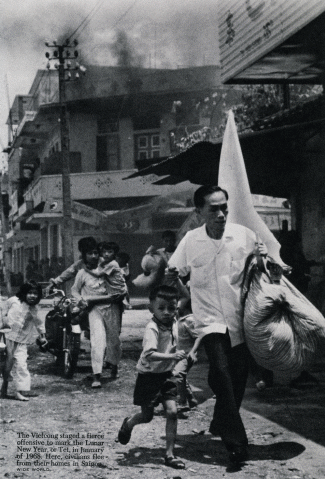
The Vietcong
staged a fierce offensive to mark the Lunar New Year, or Tet, in January
of 1968. Here, civilians flee from their homes in Saigon (Wide World).
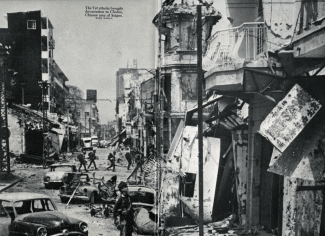
The Tet attacks brought devastation to
Cholon, Chinese area of Saigon (Wide World).
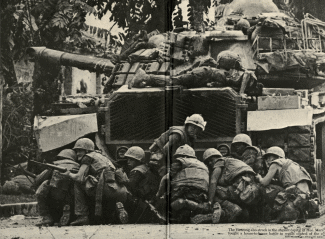
The Vietcong also struck in the ancient
capital of Hue. Marines fought a house-to-house battle to regain control
of the city (UPI Photo by Kyoichi Sawada).
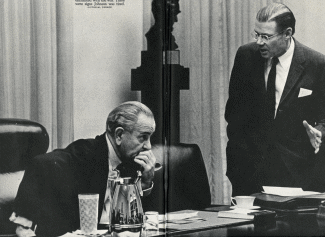
By 1968, McNamara was disenchanted with
the war. There were signs Johnson was tired (Pictorial Parade).
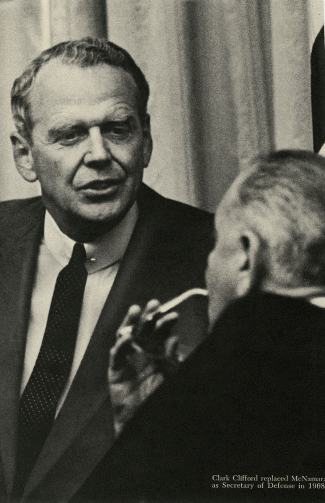
Clark Clifford replaced McNamara as
Secretary of Defense in 1968
Johnson, Westmoreland, Clifford and Rusk.
A plea for more troops for Vietnam led Johnson to reconsider his policy
(Wide World).
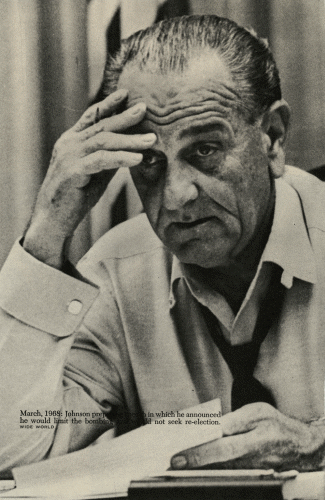
March, 1968: Johnson preparing a speech
in which he announced he would limit the bombing, and would not seek
re-election (Wide World).
Go to Next Page |


