|
THE CIA'S SECRET WAR IN TIBET -- EPILOGUE |
|
Epilogue For many of the CIA officers involved in the Tibet operation, cold war battles in Southeast Asia loomed. Roger McCarthy, the long-serving head of the Tibet Task Force, went on to serve in South Vietnam and then in Laos just as its royalist government fell to communism in 1975. Smitten by Tibet, he visited Lhasa for the first time in 1996. Said McCarthy, "I could see the sandbank where Tom and Lou jumped all those years ago." Tom Fosmire, the Hale instructor beloved by his Tibetan students, spent many years with the CIA's paramilitary campaign in Laos, which in terms of budget and duration was the largest in the agency's history. He was later in South Vietnam until its fall to communism. Another Hale trainer, Tony Poe, served brilliantly in the highlands of Laos for nearly a decade. Eventually succumbing to the pressure and isolation, he took to alcohol and was sidelined to training centers in Thailand by embarrassed superiors. Among the CIA advisers who served in India, Harry Mustakos and T. J. Thompson both had tours in Laos. Thompson would later become a world-renowned parachute designer. In 1981, he returned to Charbatia on a CIA-sanctioned trip to inspect the state of the ARC rigging facility he had helped establish two decades earlier. "Not only was the facility in great shape," he said, "but there were still some of the Tibetan riggers I trained in 1963." Ken Seifarth, who spent two tours at Chakrata, served several years at a Thai base training guerrillas headed for the war in Laos. Jim Rhyne, the Air America pilot who qualified ARC aircrews in the Helio and Twin Helio, flew for the CIA in Laos until an 85mm antiaircraft round struck his plane in January 1972 and took off his leg. Unfazed, he was flying in Laos six months later with a prosthetic limb. In 1980, still working for the agency, Rhyne flew into the Iranian desert to take soil samples at the makeshift runway later used during the ill-fated hostage rescue mission. In April 2001, he died when his biplane crashed near his home in North Carolina. Tucker Gougelmann, the senior paramilitary adviser in India, went directly to Vietnam for a final CIA tour as a key official with Phoenix, the campaign aimed at neutralizing the communist infrastructure. Retiring in Southeast Asia, he ventured to Saigon during its final months to explore business opportunities, then to evacuate his common-law Vietnamese wife and their children as communist tanks closed in during April 1975. Unable to escape, he was arrested; once his captors uncovered his earlier Phoenix involvement, he was killed in detention that June. His remains, bearing the hallmarks of torture, were returned to the United States in September 1977. David Blee, the former station chief in New Delhi, made the arrangements for Gougelmann's interment at Arlington National Cemetery. Among the Indian veterans of the Tibet project, RAW director R. N. Kao rode Indira Gandhi's skirt to great influence. In the wake of the successful Bangladesh operation, as well as the assistance RAW lent Mrs. Gandhi during her 1969 political struggles against party stalwarts, Kao was elevated to the additional post of cabinet secretary (security). When Gandhi briefly fell from power in 1977, her intelligence supremo was shunted aside, only to return as national security adviser when she regained power three years later. Although the Tibet operation was downgraded during his watch and with his concurrence, Kao would later disingenuously lay blame solely on the United States. "The Tibetans were looking for somebody to hold their finger," he later commented, "and the Americans dropped them like a hot potato."' Laloo Grewal, the first ARC manager at Charbatia, went on to become vice chief of staff of the Indian air force. Major General S.S. Uban retired as inspector general of the SFF in January 1973. [2] A deeply religious man, Uban delved into various beliefs. More than anything, he became a devotee of Baba Onkarnath, a popular Bengali mystic whose prophecies, say followers, are invariably accurate. During one sitting with Onkarnath, Uban claims that his guru predicted the Bangladesh war a year in advance. On another occasion, Uban was present when the seer was asked whether Tibet would become free. Yes, said Onkarnath confidently, Tibet would gain its independence. His audience, eager for details, pressed the Bengali for details as to when liberation would take place. To this, the prophet offered no insights. Among the Tibetan members of the CIA's covert projects, those assigned to the Special Center in Hauz Khas continued working alongside their Indian counterparts after the departure of John Bellingham. In 1975, they attempted to deploy a singleton agent without U.S. participation. Code- named "Yak," he was a native of Yatung near the Sikkimese border. On three occasions over the next year, he was dispatched back to his hometown to collect intelligence from family members. Suspected of embellishing his tales, Yak was dropped from the Special Center's payroll. Apart from this brief flirtation with running a bona fide agent, the center spent most of its time tasking and debriefing Tibetan refugees going on pilgrimages or visiting family members. This continued until late 1992, at which time the Hauz Khas villa was closed after almost three decades and Tibet operations began running out of RAW headquarters.
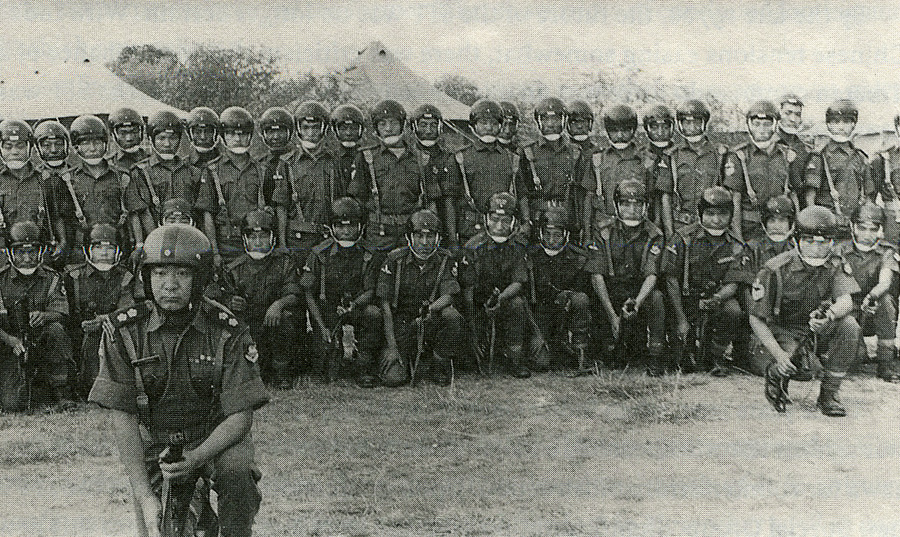
Tibetan paratroopers during the first SFF freefall course, 1976 Within the SFF, Jamba Kalden retired as its senior political leader in 1977. Much had happened to his force since the Bangladesh operation. Looking to patch over its earlier protests regarding Operation EAGLE, the CIA deployed two airborne advisers to Chakrata in the spring of 1975 to instruct the Tibetans in jumping at high altitudes. Drop zones in Ladakh, some as high as 4,848 meters above sea level, were used for these exercises. Two years later, one of the same advisers, Alex MacPherson, returned to India to test a special high-altitude chute specially designed for SFF missions. [3] Though exposed to such expanded training, the SFF was seeing less action in the field. In 1974, the unit had been guarding the border near Nepal to stem an influx of Chinese-trained insurgents. Following Kathmandu's suppression of Mustang, however, it was feared that the SFF might stage reprisal forays against the Nepalese. To prevent this, India pulled its Tibetan commandos away from the border. The following year, a second ruling prohibited the SFF from being posted within ten kilometers of the Tibet frontier. This came after a series of unauthorized incursions and cross-border shootings, including a four-hour fire fight in Ladakh during 1971 that resulted in two SFF fatalities. By the late 1970s, the future of the SFF was no longer certain. With Indo-Chinese tensions easing somewhat, there was criticism that maintenance of a Tibetan commando force was an unnecessary expense. However, the SFF was soon given a new mission: counterterrorism. Because the Tibetans were foreigners, and therefore did not have a direct stake in Indian communal politics, they were seen as an ideal, objective counterterrorist force. In 1977, RAW director Kao (who wore an additional hat as director general of security) deployed 500 SFF commandos to Sarsawa for possible action against rioters during national elections. After the elections, which went off without major incident, only sixty Tibetans were retained at Sarsawa for counterterrorist duties. Three years later, when Indira Gandhi (and Kao) returned to power, the SFF's war against terrorism received a major boost. Over 500 trainees were sent to Sarsawa for counterterrorist instruction. Upon graduation, they formed the SFF's new Special Group. Significantly, no Tibetans were incorporated into this new group within the force. The Special Group would soon see action across India. In June 1984, one of its companies was used during an abortive attack against Sikh extremists holed up in the Golden Temple in the Punjab. The temple was subsequently retaken in a bloody army operation, leading Indira Gandhi's Sikh bodyguards to assassinate the prime minister later that year. [4] The Tibetan mainstream of the SFF, meanwhile, continued to see action closer to the border. Companies from its eight battalions under the control of the director general of security rotated along the entire frontier. In 1978, three additional Tibetan battalions were raised at Chakrata; under the operational control of the Indian army, these three battalions were posted to Ladakh, Sikkim, and Doomdoomah air base in Assam. Seventeen members of the Ladakh battallion were killed while fighting Pakistani troops on the Siachen Glacier in 1986; as after the Bangladesh operation, there were protests against Dharamsala for taking losses outside of the battle to liberate the Tibetan homeland. Among the veterans of the Mustang force in Nepal, there were few winners. Baba Yeshi, the original chief, rarely strays from his house in Kathmandu. Though he sought audiences with the Dalai Lama in 1991 and 1994 -- and allegedly received forgiveness for his actions against Wangdu -- the former commander is still seen as a duplicitous traitor by the refugee community at large. Toward the other members of Mustang, the royal Nepalese government maintained a tense relationship for a decade. Continuing with its smear campaign, Kathmandu in early 1976 released reports that it had uncovered an eighteen-hole golf course and badminton courts at one of the Khampa bases. The following year, the Nepalese accused the former Tibetan warriors of continued looting and hashish smuggling. [5] Suffering the most from Kathmandu's wrath were the seven prisoners given life sentences. Not until late December 1981, with a birthday and the tenth anniversary of his coronation looming, did the king of Nepal release six from jail; the last, Lhamo Tsering, was set free five months later. All were declared persona non grata and sent to India. This put Rara, the leader of the October 1961 jeep ambush, at a loss. Having lived in Nepal for the past two decades, he preferred that kingdom over India. After stealing back across the border, he was rearrested by Nepalese authorities for violating the conditions of his release; he later died in prison. Equally harsh treatment was meted out to the Tibetan agents captured by Chinese authorities. In prison for almost two decades -- much of it in solitary confinement -- they were offered unexpected freedom in November 1978 as part of Beijing's slight softening in policy toward Tibet. The years had taken a toll. From Team S, agent Thad was still alive; his teammate Troy had been executed for bad behavior. From Team F, Taylor was released, but his partner, Jerome, had died in detention from a prolonged illness. Team V1's Terrence had his freedom, but teammate Maurice had been executed for provoking fights in jail. Irving, the agent from Team C turned in by the old lady and her son, survived his incarceration. So did Choni Yeshi, the sole survivor of the team parachuted into Amdo, and Bhusang, the only living member of the team dropped at Markham in 1961. Two others remained in detention. Amdo Tsering, the restive Muslim singleton who was supposed to collect dirt at Lop Nur, stayed behind bars because of an unrepentant attitude. Grant, the lone survivor of Team Y, was sickly and opted to stay in prison voluntarily. Not until 1996 did both finally leave their cells. Overseas, Geshe Wangyal, the Mongolian who had served as translator for the Tibet project, died in 1983 while still teaching at his New Jersey monastery. Gyalo Thondup, the key link with the CIA, had stayed away from the resistance since 1969. Not until late 1978, with the Chinese government apparently loosening its constraints on Tibet, did he rejoin the cause and lead a negotiating team to Beijing; results from this trip ultimately proved scant. Gyalo currently shuttles between residences in New Delhi and Hong Kong. The Dalai Lama has gone from strength to strength, winning the 1989 Nobel Prize for Peace and earning an enormous international audience that includes Hollywood celebrities, rock musicians, New Agers, and scores of other Westerners looking for answers in the East. His Tibet, however, has yet to be set free.
|
|