|
by Wikipedia
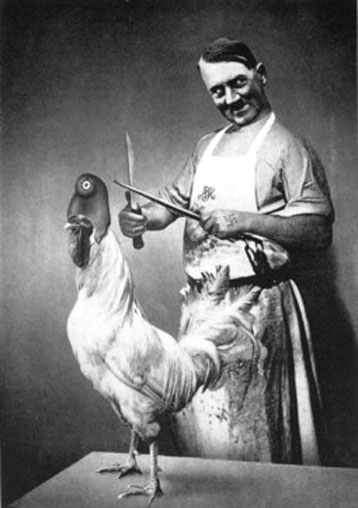
A photomontage by John Heartfield
from the May 1936 Arbeiter-Illustrierte-Zeitung, captioned "Nur keine
angst – er ist vegetarier" ("Don't be frightened – he's a vegetarian").
It shows Hitler as a butcher about to cut the throat of a French
rooster. [1]
In addition to being a teetotaler
and a non-smoker,[2] Adolf Hitler has been regarded by some as a
vegetarian.[3]
|
The whole of Germany
was swept up in this esoteric wave, and youth more than
anyone. The peculiarly nineteenth-century phenomenon,
spiritualism, and its more "scientific" variation,
Theosophy, in Germany were welded together with a
mystical concept of the Volk as a people whose
collective "soul" was more than the sum of its parts.
This Aryan "soul," Germans believed, united the
individual German to his geographical place. Every tree
and rock of German soil was holy, and spoke to the
people, shaping them and causing their creativity. The
intuitive wisdom of which the Aryans, rooted in their
land, were capable was hidden from the Jews, those
eternal wanderers, who had no organic place of their own
and, therefore, tried to usurp the fatherland of others.
On this account, the Jew was most comfortable in the
city, alienated from nature and the Volk Spiritualism
joined itself to the idea of the Volk, in that nature
emitted a vital ether, a life force, with which only the
Aryan was in touch. He alone could contact an
extrasensory world which would yield up its secrets and
give him special powers.
The new romanticism
was, above all, irrational, and this seemed to guarantee
its easy acceptance. It peddled itself as more
substantial than the discoveries of science, because
science itself did not claim to understand the dark
mysteries of the force which drove nature, whereas
Madame Blavatsky and others like her did. List,
borrowing her Theosophy, also did. Her "ancient wisdom,"
transposed by him into Germanic wisdom which had been
destroyed by Christianity, could be revived through
intuition, and would explain the essence of things.
German mystics developed an ideology, a hodgepodge of
the occult, racism, and romanticism which, while
ridiculous, went down surprisingly well with youth
hunting for certainties. Many young people, Walter Z.
Laqueur points out in Young Germany,
joined one of the
many new religious and occult sects whose prophets
grew like mushrooms in the volkisch camp
between the First and Second World War. Of such were
Mathilde Ludendorff's [the general's wife]
Tannenberg Bund, Arthur Dinter's group, the
Asgard Circle, or Gustav Muller's sect, which
believed that the human soul was an amalgamation of
three or four animal souls ("according to reliable
reports from beyond"), and that the planet Mars was
the place where man first appeared.
To children whose
fathers had been killed in the war, the leaders of these
groups became surrogates. To adolescents disturbed by a
fragmented society, they offered solidity. To students
who knew that nothing awaited them upon graduation from
school, they offered immersion in the group. To
alienated youth drifting into dreary, unfriendly cities,
they offered companionship. To young people bewildered
by the intricacies of sex, they offered the solution of
rigorous puritanism. To children who could no longer
believe in the God of their fathers, they offered a new,
modern God. To those thirsting for absolute meanings,
they provided absolute answers.
As one participant put
it (in E. Y. Hartshorne's German Youth and the Nazi
Dream of Victory):
Mysticism and
everything mystical had dominion over us. It was in
our ranks that the word Fuhrer originated,
with its meaning of blind obedience and
devotion. The word Bund arose with us, too,
with its mysterious undertone of conspiracy. And I
shall never forget how in those early days we
pronounced the word Gemeinschaft
["community"] with a trembling throaty note of
excitement, as though it hid a deep secret.
He goes on more
objectively:
The tragedy of the
appeal of this mysticism to the youth of the
post-war period was that it offered them a dreamy
haven of refuge from the pressing problems of the
day.
A significant
proportion of cultured idealistic youth was thus,
for years on end, and at the most impressionable
age, withdrawn from the tasks of their time, and
estranged. Instead of learning to see things as they
were, and freeing themselves from the dangerous
tradition of German escape-idealism, they became
victims of a deceptive mysticism which made them
easy victims for the National Socialists.
Furthermore, by yielding to the lure of this
mysticism, toward which an attitude of rational
criticism was sure to mean angry expulsion from the
"group," these boys lost all capacity for criticism.
At a time when the blind obedience of the soldier
was regarded as unworthy of rational men, they
adopted the habit of a far more sinister obedience:
the servile subordination of the mind under the yoke
of an ideology.
The divine essence, or
elan vital, or life force, or vril, was believed
to be electromagnetic --
"Theo-zoological," in Lanz's terminology. Since the
sun was the repository of this energy, it became the
fashion for German youth groups, as for occult groups
generally, to adopt the emblem of the swastika, a symbol
for the sun. The festival of the changing sun, an old
pagan ritual, was given a new occult twist by the Sera
Circle, in that the cosmic rays were thought to emit
esoteric knowledge along with warmth. List's Armanen
believed that the solar symbol held the key to an
ancient "secret science" and that by communing with the
ghostly spirits present in certain Germanic ruins,
mysterious veils of the past would be lifted. The Cosmic
Circle practiced pagan rituals intended to arouse the
life force and awaken clairvoyant powers in people of
Germanic blood. In their songs and dances, the groups
tried to recreate that primordial kinship with nature
which they supposed ancient man to have had. They
abhorred science and reason as enemies of the life of
the soul. Many of them became vegetarians and
teetotalers, for they believed that the purification of
the physical body would help the soul to see reality.
They threw over orthodox medicine for spiritual and
herbal healing, which were somehow felt to be closer to
the primal source.
--
Gods & Beasts -- The
Nazis & the Occult, by Dusty Sklar |
It has been theorized that
Hitler's diet may have been based on Richard Wagner's historical
theories[4] which connected the future of Germany with vegetarianism.[5]
Hitler believed that a vegetarian diet could both alleviate personal
health problems and bring about a spiritual regeneration.
|
As we are writing
for the aspirant to the higher life and not for the
general public, it may also be said that animal food
should be entirely avoided, if possible. No one who
kills can go very far along the path of holiness. We do
even worse than if we actually killed, for in order to
shield ourselves from the personal commission of the act
of killing, and still reap its results, we force a
fellow being, through economic necessity, to devote his
entire time to murder, thereby brutalizing him to such
an extent that the law will not allow him to act as a
juror in cases of capital crime, because his business
has so familiarized him with the taking of life.
The enlightened know
the animals to be their younger brothers and that they
will be human in the Jupiter Period. We shall then help
them as the Angels, who were human in the Moon Period,
are now helping us, and for an aspirant to high ideals
to kill -- either in person or by proxy -- is out of the
question.
Several very
important food products from animals, such as milk, cheese and
butter, may be used. These are the results of the processes
of life and require no tragedies to convert them into food. Milk,
which is an important food for the occult student, contains no
earthy matter of any consequence and has an influence upon the body
possessed by no other food.
--
The Rosicrucian
Cosmo-Conception, by Max Heindel |
Hitler as a vegetarian
According to stenographic
transcripts translated by Hugh Trevor-Roper of conversations between
Hitler and his inner circle which took place between July 1941 and
November 1944, Hitler regarded himself as a vegetarian (however, British
historian Alan Bullock argues that Hitler would not allow the use of a
tape recorder and that the written transcripts were edited by
Bormann).[6]
“ Do you know that your Führer
is a vegetarian, and that he does not eat meat because of his
general attitude toward life and his love for the world of animals?
Do you know that your Führer is an exemplary friend of animals, and
even as a chancellor, he is not separated from the animals he has
kept for years?...The Führer is an ardent opponent of any torture of
animals, in particular vivisection, and has declared to terminate
those conditions...thus fulfilling his role as the savior of
animals, from continuous and nameless torments and pain. ” --
Neugeist/Die Weisse Fahne (German magazine of the New Thought
movement)[7]
According to these transcripts
dated November 11, 1941 Hitler said, "One may regret living at a period
when it's impossible to form an idea of the shape the world of the
future will assume. But there's one thing I can predict to eaters of
meat: the world of the future will be vegetarian." On January 12, 1942,
he said, "The only thing of which I shall be incapable is to share
the sheiks' mutton with them. I'm a vegetarian, and they must spare me
from their meat."[8]
In private conversations, Hitler
often recited the benefits of eating raw vegetables, fruit, and grains,
particularly for children and soldiers. In an attempt to disgust dinner
guests and provoke them into shying away from meat, he reportedly told
graphic stories of visits he had made to a slaughterhouse in Ukraine.
Food writer Bee Wilson is of the
opinion that: "His distaste for meat knew no pity of animals." She went
on to note that: "At mealtimes he often boasted -- in graphic detail --
of a slaughterhouse he had visited in Ukraine. It amused him to spoil
carnivorous guests' appetites."[9] This idea, however, is not supported
by the BBC series The Nazis: a Warning from History. In this series an
eyewitness account tells of Hitler watching movies (which he did very
often). If ever a scene showed (even fictional) cruelty to or death of
an animal, Hitler would cover his eyes and look away until someone
alerted him the scene was over. The documentary also commented on the
German animal welfare laws that the Nazis introduced, which were
unparalleled at the time.[10]
|
At the
present stage of the evolutionary journey, everyone knows inherently
that it is wrong to kill, and man will love and protect the animals
in all cases where his greed and selfish interest does not blind him
to their rights. The law protects even a cat or a dog against
wanton cruelty. Except in "sport," that most wanton of all our
cruelties against the animal creation, it is always for the sake of
money that animals are murdered and bred to be murdered. By the
devotees of "sport" the helpless creatures are shot down to no
purpose save to bolster up a false idea of prowess upon the part of
the huntsman. It is hard to understand how people who appear
otherwise sane and kindly can, for the time, trample upon all their
gentler instincts and revert to bloodthirsty savagery, killing for
the sheer lust of blood and joy in destruction. It is certainly a
reversion to the lowest savage animal instincts, and can never be
dignified into the remotest semblance of anything "manly", even
though practiced and defended by the otherwise humane and worthy
temporary head of a mighty nation.
How much more
beautiful it would be for man to play the role of friend and
protector of the weak. Who does not love to visit Central Park in
New York City and pet, stroke and feed the hundreds of squirrels
which are running about secure in the knowledge that they will not
be molested? And who is not glad, for the sake of the squirrels, to
see the sign, "Dogs found chasing the squirrels will be shot." This
is hard on the dogs, but it is to be commended as an evidence of the
growth of the sentiment favoring the protection of the weak against
the unreasoning or merciless strong. Nothing is said on the sign
about the squirrels being injured by men, because that would be
unthinkable. So strong is the influence of the trust the little
animals repose in the kindness of man, that no one would violate it.
-- The
Rosicrucian Cosmo-Conception, by Max Heindel |
In a November, 1938 article for
the English magazine Homes & Gardens describing Hitler's mountain home,
The Berghof, Ignatius Phayrethe wrote, "A life-long vegetarian at table,
Hitler's kitchen plots are both varied and heavy in produce. Even in his
meatless diet Hitler is something of a gourmet — as Sir John Simon and
Anthony Eden were surprised to note when they dined with him in the
Chancellry at Berlin.
His Bavarian chef, Herr Kannenberg,
contrives an imposing array of vegetarian dishes, savoury and rich,
pleasing to the eye as well as to the palate, and all conforming to the
dietic standards which Hitler exacts."[11]
In his table talks, Hitler spoke
about vegetarianism on April 25, 1942 at midday, about Roman soldiers
eating fruits and cereals and the importance of raw vegetables. He
places the emphasis on scientific arguments such as naturalists'
observations and chemical efficacy.[12]
|
It may be said
generally of the solid foods we take into our system,
that fresh vegetables and ripe fruits contain the
greatest proportion of nutritious matter, and the least
of earthy substances....
Man and animal can assimilate the plants
and thus obtain the chemical compounds necessary to
sustain their bodies, and as the consciousness of the
plant kingdom is that of dreamless sleep, it offers no
resistance. It requires but little energy to assimilate
the particles thus derived, and having small
individuality of their own, the life ensouling the
particles does not seek to escape from our body as soon
as food derived from more highly developed forms,
therefore the strength derived from a diet of fruit and
vegetables is more enduring than that derived from a
meat diet, and the food supply does not require as
frequent replenishing, besides giving more strength in
proportion, because less energy is required for
assimilation.
-- The
Rosicrucian Cosmo-Conception, by Max Heindel |
In a diary entry dated April 26,
1942, Joseph Goebbels described Hitler as a committed vegetarian,
writing,
An extended chapter of our
talk was devoted by the Führer to the vegetarian question. He
believes more than ever that meat-eating is harmful to humanity. Of
course he knows that during the war we cannot completely upset our
food system. After the war, however, he intends to tackle this
problem also. Maybe he is right. Certainly the arguments that he
adduces in favor of his standpoint are very compelling.[13]
Martin Bormann, who as head of the
Party Chancellery (and private secretary to Hitler) is considered by
most historians to have been the second most powerful Nazi official in
Germany, built Hitler a large greenhouse at Berchtesgaden in order to
keep him supplied with fresh fruit and vegetables throughout the war.
Personal photographs of Bormann's children tending the greenhouse
survive, and by 2005 its foundations were among the only ruins
associated with the Nazi leadership still visible in the area.
Finally, in his personal life
Hitler showed anti-meat tendencies. Hitler disapproved of cosmetics
since they contained animal by-products. He frequently teased his
mistress Eva Braun about her habit of wearing makeup.[8] In his post-war
reminiscence The Enigma of Hitler, Belgian SS General, and friend of
Hitler's, Léon Degrelle wrote: "He could not bear to eat meat, because
it meant the death of a living creature. He refused to have so much as a
rabbit or a trout sacrificed to provide his food. He would allow only
eggs on his table, because egg-laying meant that the hen had been spared
rather than killed."[14]
The German psychoanalyst Erich
Fromm believed that Hitler's vegetarianism was a means of atoning for
the death of his half-niece Geli Raubal, as well as a means of proving
to himself and others that he was incapable of killing. [15]
Questioning Hitler's
vegetarianism
“ "Hitler was in no way an
ethical vegetarian," Berry asserts. He believes that it is important
to counter the assertions of scholars that the chief Nazi abstained
from meat "because nonvegetarians tend to use the Nazi issue to
discredit vegetarianism in general."” -- Deborah Rudacille[16]
Author Rynn Berry, a vegetarian and animal rights advocate, maintains
that although Hitler reduced the amount of meat in his diet, he never
stopped eating meat completely for any significant length of time. Berry
argues that many historians use the term 'vegetarian' incorrectly to
describe someone who simply reduced their meat consumption.[3][17]
|
Interview with Hitler's sister on
12th July 1945
Restricted
Headquarters 101st Airborne Division
101st CIS Detachment
APO 472, U.S. Army
12 July 1945
Memorandum for the Officer in Charge.
Subject: Interrogation of Frau Paula Wolff (Frl. Paula
Hitler)
"My brother did not live on a special diet in his youth.
Our mother would never have permitted that. He never
cared much about meat. I suppose that later he became a
vegetarian because of his stomach ailment." |
In
1991, upon the death of Isaac Bashevis Singer, criticism over the
omission of Singer's vegetarianism in his obituary led to a debate
regarding Hitler's alleged vegetarianism in the letters page of The New
York Times. Letter writer Carol Jochnowitz wrote: "On page 89 of The
Gourmet Cooking School Cookbook (1964), Dione Lucas, recalling her
pre-World War II stint as a hotel chef in Hamburg, Germany, states: 'I
do not mean to spoil your appetites for stuffed squab, but you might be
interested to know that it was a great favorite with Mr. Hitler, who
dined at the hotel often. Let us not hold that against a fine recipe
though.'"[18]
Author Robert Payne, in his biography of Hitler, The Life and Death of
Adolph Hitler (Praeger, 1973) theorizes that the image of Hitler as a
vegetarian ascetic was deliberately fostered by propaganda minster
Joseph Goebbels:
"Hitler's asceticism played an important part in the image he projected
over Germany. According to the widely believed legend he neither smoked
nor drank, nor did he eat meat or have anything to do with women. Only
the first was true. He drank beer and diluted wine frequently, had a
special fondness for Bavarian sausages and kept a mistress....His
asceticism was a fiction invented by Goebbels to emphasize his total
dedication, his self-control, the distance that separated him from other
men....In fact, he was remarkably self-indulgent and possessed none of
the instincts of the ascetic. His cook, an enormously fat man named
Willy Kannenberg, produced exquisite meals and acted as court jester.
Although Hitler had no fondness for meat except in the form of sausages
and never ate fish, he enjoyed caviar...." (p. 346)[19]
|
[A]s Christianity is the religion of the most advanced Race, it must be
the most advanced Religion, and because of the elimination of this
doctrine [rebirth and the law of consequence] from its public teachings, the conquest of the world
of matter is being made by the Anglo-Saxon and Teutonic races, in
which this phase has been carried furthest. As some new
addition to or change in the food of man has been made in every
Epoch to meet its conditions and accomplish its purposes, we now
find added to the food of the previous Epochs a new article -- wine.
It was needed on account of its benumbing effect upon the spiritual
principle in man, because no religion, in and of itself, could have
made man forget his nature as a spirit and have caused him to think
of himself as "a worm of the dust"... [A]fter the submergence
of Atlantis -- a continent which once existed between Europe and
America, where the Atlantic Ocean now lies -- those who escaped
destruction began to cultivate the vine and make wine, as we find
narrated in the Bible story of Noah. Noah symbolizes the remnant of
the Atlantean Epoch, which became the nucleus of the Fifth Race --
therefore our progenitors.
The active principle of
alcohol is a "spirit" and as the humanity of the earlier Epochs used
the articles of food best suited to their vehicles, so this spirit
was, in the Fifth Epoch, added to the foods previously used by
evolving humanity. It acts upon the spirit of the Fifth Epoch man,
temporarily paralyzing it, that it may know, esteem and conquer the
physical world and value it at its proper worth....
Water only had been used in the Temples, but now this is altered.
"Bacchus," a god
of wine, appears and under his sway the most advanced nations forget
that there is a higher life. None who offer tribute to the
counterfeit spirit of wine or any alcoholic liquor (the product
of fermentation and decay) can ever know anything of the higher
Self -- the true Spirit which is the very source of life. All this was
preparatory to the coming of Christ, and it is of the highest
significance that His first act was to change "water into
wine." (John ii:11.) In private He taught Rebirth
to His disciples. He not only taught them in words, but He took them
"into the mountain." This is a mystic term meaning a place of
Initiation.
***
Grape juice is a particularly wonderful
solvent. It thins and stimulates the blood, opening the
way into capillaries already dried and choked up -- if
the process has not gone too far. By a course of
unfermented grape-juice treatment, people with sunken
eyes, wrinkled skins and poor complexions become plump,
ruddy and lively. The increased permeability enables the
spirit to manifest more freely and with renewed energy.
-- The
Rosicrucian Cosmo-Conception, by Max Heindel |
In
the book, The Mind of Adolf Hitler, it is said: "If he (Hitler) does not
eat meat, drink alcoholic beverages, or smoke, it is not due to the fact
that he has some kind of inhibition or does it because he believes it
will improve his health. He abstains from these because he is following
the example of the great German, Richard Wagner, or because he has
discovered that it increases his energy and endurance to such a degree
that he can give much more of himself to the creation of the new German
Reich."[20]
The
April 14, 1996, Sunday magazine edition of The New York Times, includes
this description of Hitler's diet in an article first published on May
30, 1937, 'At Home With The Führer.' "'It is well known that Hitler is a
vegetarian and does not drink or smoke. His lunch and dinner consist,
therefore, for the most part of soup, eggs, vegetables and mineral
water, although he occasionally relishes a slice of ham and relieves the
tediousness of his diet with such delicacies as caviar ..."[19]
|
There is
absolutely no earthy matter in distilled water, nor in
rain water, snow nor hail (except what may be gathered
by contact with house-tops, etc.), but coffee, tea, or
soup made with ordinary water, no matter how long
boiled, is not purified of the earthy particles; on the
contrary, the longer they are boiled, the more heavily
charged with ash they become. Those suffering from
urinary diseases should never drink any but distilled
water.
-- The
Rosicrucian Cosmo-Conception, by Max Heindel |
Traudl Junge, who became Hitler's secretary in 1942, reported that he
"always avoided meat" but that his Austrian cook Kruemel sometimes added
a little animal broth or fat to his meals. "Mostly the Fuehrer would
notice the attempt at deception, would get very annoyed and then get
tummy ache," Junge said. "At the end he would only let Kruemel cook him
clear soup and mashed potato."[21]
In
1943, Marlene von Exner became Hitler's dietician and reportedly added
bone marrow to his soups without his knowledge because she "despised"
his vegetarian diet.[9]
There is also a question as to whether or not Hitler's state policies
supported vegetarianism. It is claimed by British Vegetarian society
that Hitler persecuted and closed German vegetarian organizations and
associations like "Vegetarier-Bund Deutschlands” (closed by Nazis in
1936). However, the Nazis imposed a blanket ban on all independent
societies and there is no evidence of hostility toward vegetarianism in
particular, which Hitler personally endorsed. "Vegetarier-Bund
Deutschlands" only started its legal activities after the Nazis lost
World War II in 1945.[22][23]
From 1936 almost until Hitler's death by suicide in 1945, Theodor Morell,
his personal physician, gave him "quack supplements" which contained
animal components.[17][24] Morell gave Hitler daily injections of
various commercially prepared tonics containing animal by-products
including Glyconorm, an injectable compound containing vitamins B1, B2
and C, cardiac muscle, adrenal gland, liver, and pancreas.
Other injected preparations contained placenta, bovine testosterone and
extracts containing seminal vesicles and prostate to combat depression.
At the time, extracts from animal glands were popularly believed to be
"elixirs of youth".[25]
_______________
Notes
1.
Kemp, Martin. The Oxford History of Western Art. Oxford University
Press. p. 435.
http://books.google.ca/books?id=95J-ppmZmt8C&pg=PA435#v=onepage&q&f=false.
2.
van der Vat, Dan (1997). The Good Nazi: The Life and Lies of Albert
Speer. Houghton Mifflin books. pp. 62. ISBN 0-395-65243-X. . See
"Hitler's Mountain Home", Homes & Gardens, Nov 1938, pp. 193-195:
"Hitler himself never smokes, nor does he take alcohol in any form." See
also: Adolf Hitler's medical health, and Smoking ban. The first tobacco
ban was imposed by the Nazi Party under direct orders from Adolf Hitler.
3.
Rudacille 2001, p. 88.
4.
Proctor 1999, p. 136. "Several of [Hitler's] biographers point to the
influence of nationalist antisemitic composer, Richard Wagner." See
also: Moore, Gregory. (2002). Nietzsche, Biology and Metaphor. Cambridge
University Press. ISBN 0-521-81230-5. pp. 155-157:
5.
Arluke & Sanders 1996, pp. 144, 150.
6.
Bullock, Alan (1993). Hitler and Stalin : Parallel Lives. Vintage. p.
679. ISBN 0-679-72994-1.
7.
Arluke & Sanders 1996, p. 148. Quoted from Wuttke-Groneberg, W. (1980).
Medizin im Nationalsozialismus. Tübingen: Schwabische Verlaggesellschaft.
8.
Hitler, Adolph; Hugh Trevor-Roper (trans.) (2000). Hitler's Table Talk:
1941-1944. Enigma Books. ISBN 1-929631-05-7.
9.
Wilson, Bee (October 9, 1998). "Mein Diat". New Statesman (London) 127
(4406): 40+. http://74.125.93.132/search?q=cache:8KlRAT7DkUIJ:www.questiaschool.com/read/5001380668%3Ftitle%3DMein%2520Diat.
Retrieved 2009-07-17.
10.
Read, Anthony (2004). The Devil's Disciples: Hitler's Inner Circle. New
York: W. W. Norton & Company. p. 327. ISBN 0-393-04800-4.
11.
Phayre, Ignatius (November 1938). "Hitler's Mountain Home". Homes &
Gardens. pp. 193–195.
12.
Hitler, A., & Cameron, Norman (2000). Hitler's Table Talk. Enigma Books.
ISBN 1-929631-05-7
13.
Goebbels, Joseph; Louis P. Lochner (trans.) (1993). The Goebbels
Diaries. Charter Books. p. 679. ISBN 0-441-29550-9.
14.
Degrelle, Léon. "The Enigma of Hitler". "Friends of Léon Degrelle"
Cultural Association. http://libreopinion.com/members/leondegrelle/theenigmaofhitler.html.
Retrieved 2007-09-18.
15.
Fromm, Erich (1992). The Anatomy of Human Destructiveness. New York:
Henry Holt and Company. pp. 450. ISBN 0-8050-1604-X.
16.
Rudacille 2001, p. 89.
17.
Berry 2004
18.
"Don't Put Hitler Among the Vegetarians; He Loved His Squab". World: USA
(New York Times). 1991-09-05. http://query.nytimes.com/gst/fullpage.html?res=9D0CE0DE1631F932A1575AC0A967958260.
Retrieved 2009-02-27.
19.
"Hitler: Neither Vegetarian Nor Animal Lover". World: USA. http://www.jewishveg.com/schwartz/revHitler.html.
Retrieved 2009-02-27.
20.
"The Mind of Adolf Hitler",Walter C. Langer, New York 1972 p.54-55
21.
"Hitler's final witness". World: Europe (BBC News). 2002-02-04. http://news.bbc.co.uk/1/hi/world/europe/1800287.stm.
Retrieved 2007-09-18.
22.
"History of the German Vegetarian Societies". International Vegetarian
Union.
http://www.ivu.org/history/societies/vbd.html. Retrieved 2007-09-18.
23.
See also: Barkas, Janet; Jan Yager (1975). The Vegetable Passion.
Scribner. ISBN 0-684-13925-1.
24.
Wilson, 1998: "His diet thereafter was free of flesh, but bolstered with
a medley of quack supplements, administered with zeal by Theodor Morell."
25.
Doyle 2005, pp. 75-82
References
Arluke, Arnold; Clinton Sanders (1996). Regarding Animals. Temple
University Press. ISBN 1-56639-441-4.
Berry, Rynn (2004). Hitler: Neither Vegetarian Nor Animal Lover.
Pythagorean Books. ISBN 0-9626169-6-6.
Doyle, D. (February 2005). "Adolf Hitler's Medical Care" (PDF). : J R
Coll Physicians Edinb. 35 (1): 75–82. PMID 15825245. Archived from the
original on 2007-07-05. http://web.archive.org/web/20070705055423/http://www.rcpe.ac.uk/publications/
articles/journal_35_1/Hitler's_medical_care.pdf. Retrieved 2007-09-18.
Proctor, Robert N. (1999). The Nazi War on Cancer. Princeton University
Press. ISBN 0-691-07051-2.
Rudacille, Deborah (2001). The Scalpel and the Butterfly: The War
Between Animal Research and Animal Protection. University of California
Press. ISBN 0-520-23154-6.
|