|
THE AGES OF GAIA: A BIOGRAPHY OF OUR LIVING EARTH |
|
Inside Cover: Viewed from the distance of the moon, the astonishing thing about the Earth, catching the breath, is that it is alive. -- Lewis Thomas THE AGES OF GAIA To the ancient Greeks the Earth was a living goddess, Gaia. This profound book replaces myth with science. Drawing on the latest developments in geology, geochemistry, evolutionary biology, and climatology, and his own path-breaking research, James Lovelock offers a new scientific synthesis in harmony with the Greek conception of the Earth as a living whole, as Gaia. Conventional science has depicted the Earth as little more than inert rock, upon which plants and animals happen to live. Lovelock's Gaia theory shows us a vastly different world, one great circuit of life from its fiery core to its outer atmosphere. "Just as the shell is part of the snail, so the rocks, the air, and the oceans are part of Gaia," Lovelock writes. In 1979 James Lovelock first sketched out this theory in his best seller, Gaia: A New Look at Life on Earth. Many scientists dismissed its implications outright; others labored mightily to refute them. Meanwhile, ordinary people all over the world embraced the Gaia theory. In less than ten years, amid great controversy, the Gaia theory has moved from the margins of scientific research to become the subject of international conferences of scientists working in many different fields. The Ages of Gaia: A Biography of Our Living Earth gives us the hard-won results of these years, and fills out the sketch of Gaia into a full picture of its history and current health. Like Rachel Carson's Silent Spring, this is a book whose message has the power to change the way we see the Earth itself, and our future on it. For James Lovelock not only tells us how the species and the material environment of Gaia have evolved in a single, indivisible, self-regulating process. He tells us, too, of the stresses -- all man-made -- which Gaia now endures. Species extinction, pollution -- especially the burning of fossil fuels and the resulting greenhouse effect, and deforestation -- all threaten Gaia's health and, ultimately, the life that we share in it. But Gaia is remarkably resilient, forever changing as life and the Earth evolve together. In this book James Lovelock holds Gaia still "long enough for us to begin to understand her and to see how fair she is." He invites us all to join in the birth of a new science, geophysiology, dedicated to preserving the Earth. Born in 1919, James Lovelock was educated at the University of London and Manchester University and holds a Ph.D. in medicine. In the United States, he has taught at Yale, the Baylor University College of Medicine, and, as a Rockefeller Fellow, at Harvard. An independent scientist, Lovelock works out of a barn-turned-laboratory at Coombe Mill in Cornwall, England. He is president of the Marine Biology Association, a fellow of the Royal Society, London, and author of Gaia: A New Look at Life on Earth. Back Cover:
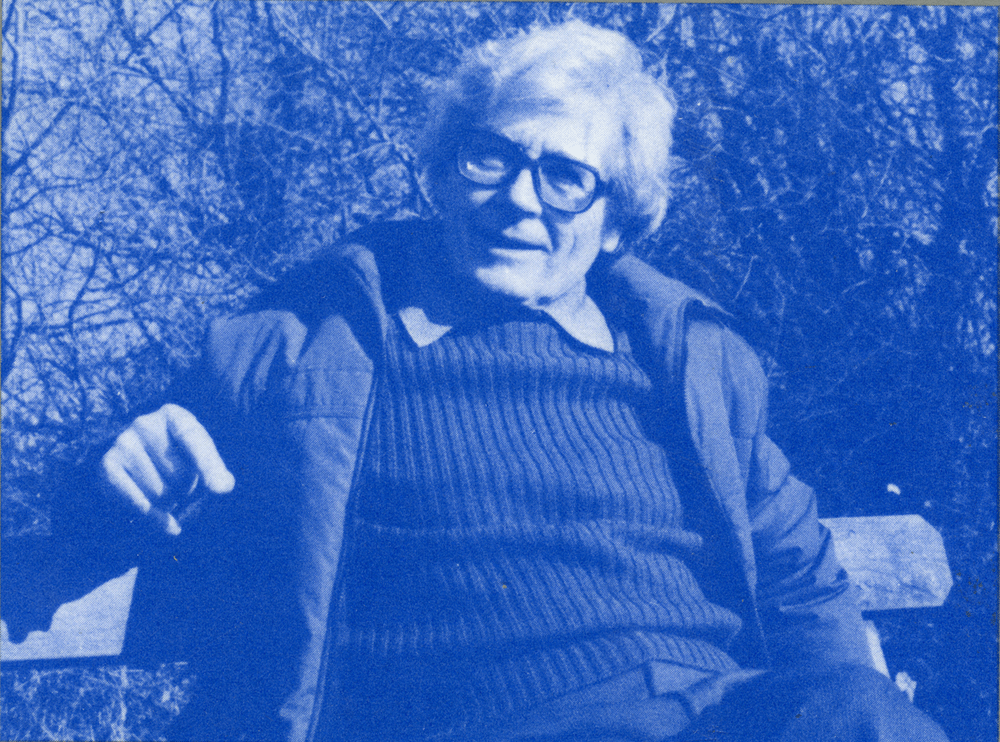
Credit: J.S. Gifford This book by James Lovelock describes a set of observations about the life of our planet which may, one day, be recognized as one of the major discontinuities in human thought. If Lovelock turns out to be as right in his view of things as I believe he is, we will be viewing the Earth as a coherent system of life, self-regulating and self-changing, a sort of immense living organism." -- Lewis Thomas, from the Foreword to The Ages of Gaia Viewed from the distance of the moon, the astonishing thing about the earth, catching the breath, is that it is alive. The photographs show the dry, pounded surface of the moon in the foreground, dead as an old bone. Aloft, floating free beneath the moist, gleaming membrane of bright blue sky, is the rising earth, the only exuberant thing in this part of the cosmos. If you could look long enough, you would see the swirling of the great drifts of white cloud, covering and uncovering the half-hidden masses of land. If you had been looking a very long, geologic time, you could have seen the continents themselves in motion, drifting apart on their crustal plates, held aloft by the fire beneath. It has the organized, self-contained look of a live creature, full of information, marvelously skilled in handling the sun. -- Lewis Thomas, The Lives of a Cell
|