|
THE PRISONER OF SAN JOSE: HOW I ESCAPED FROM ROSICRUCIAN MIND CONTROL |
|||||||||
|
TEN: Atrium 3 Initiation AMORC demands that this initiation be completed with care. This means, in this context, to follow the instructions to the letter. This is exactly what I did again and again. We are then enjoined to perform the initiation ceremony only when we have at least one hour to devote to it. The initiation must be conducted in a sanctum, even if it is only a temporary sanctum setting. These instructions explain why I was so obsessed about having my own sanctum: to fulfill the wishes of the organization. After this point, the monograph compares AMORC to religion in a very subtle way. Here, AMORC delves into the topic of "initiation," stating that the Rosicrucian initiations are not of a religious nature. AMORC enjoins the neophyte, now entering the third room of the atrium, to follow the traditional ritual presented by the Rosicrucian order. This will help to put the neophyte in resonance with his spiritual nature and also with the plane of consciousness inhabited by the ascended masters of the Rosicrucian tradition. Again, they make a point of the importance of the sanctum in the initiation process. These instructions convey the idea that members are part of the exclusive spiritual group, one whose association with the Rosicrucian masters places AMORC above most other human organizations. One consequence of this idea of the spiritual superiority of the organization is that it leads the member to think that the monographs contain Godlike, unquestionable content. This is exactly why I concluded that they were not to be studied outside of the sanctum. I copied them in my my notebook for review session when I am outside of the sanctum. In the process of reading these monographs, you quickly learn that to question their content is, in effect, to question the spiritual masters themselves and the high spiritual center of power from which these writings ultimately emanate. Therefore, slowly, step by step, the infallibility of the Rosicrucian teaching is established. The Rituals Parts of this initiation that will become "triggers" in the lives of members:
In the reading, the master of the class, who you are imagining, tells you that he or she has looked into the neophyte's heart while they are meditating and are satisfied with their progress. In other words, you imagine someone present, who is saying that they have inspected your inner consciousness and that you are now ready to proceed.
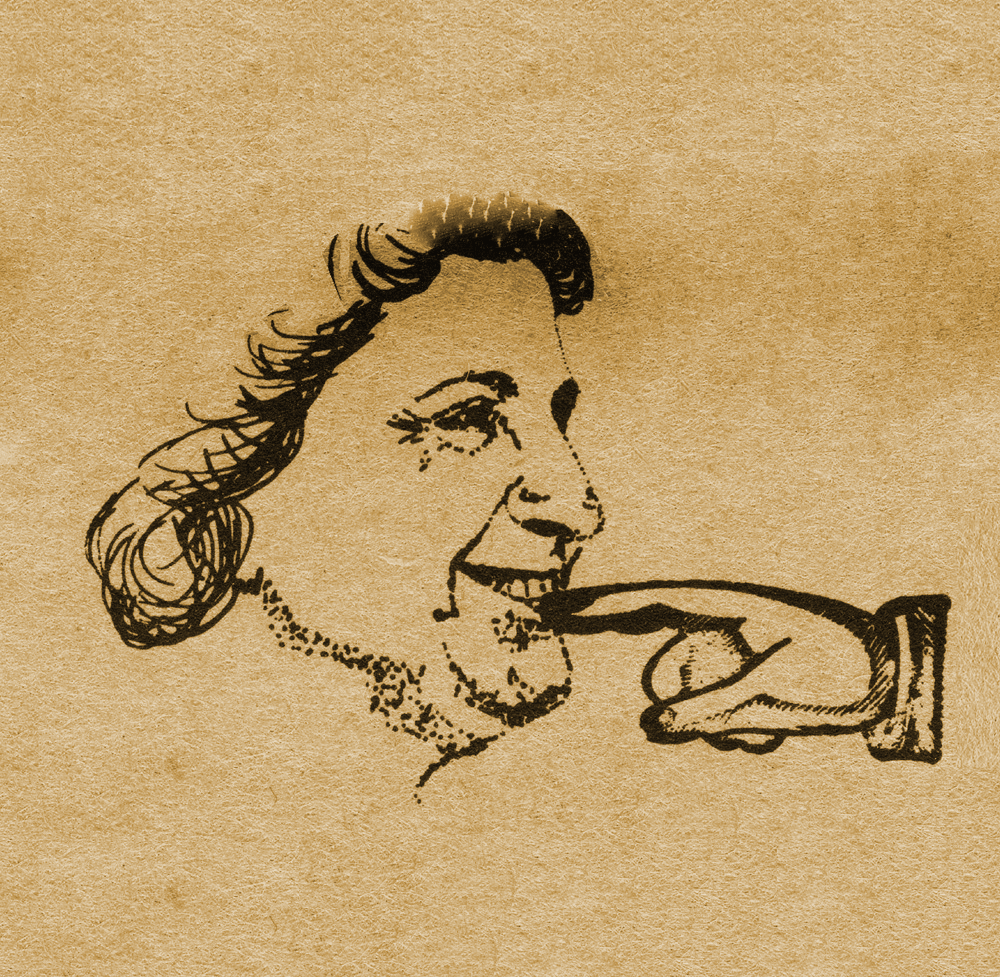
You are then enjoined to silence, placing the index finger of the right hand over the lips.
These types of injunctions build defenses against members' own heartfelt doubts, a typical way in which cults train their victims to suppress their questions and concerns. I used the term humility to justify my going to the lodge dressed like a dog and being laughed at and humiliated by everyone. By not caring what people thought, I was the better Rosicrucian. In a certain sense, by embodying this extremely compliant and all-embracing attitude of obedience, I became the perfect hardworking, tireless, and unquestioning cult member so prized in many of these organizations. Now, AMORC makes you think that you have been intentionally solicited by the organization, as though your joining was somehow predestined by your previous lifetimes and your advanced state of spirituality. This gives credence to the unique reasons why you need to give your all to the organization, a technique similar to those used by other cults. In the monograph, AMORC speaks philosophically about initiation, Rosicrucianism, and then again makes an injunction to study harder, targeting the monographs of the third atrium. It enjoins members to make each period of study a privileged moment of communion with your soul. In reality, the stress of complying with the fatiguing, time-consuming, and impractical instructions of AMORC is exactly what keeps members from having any communion with their souls. The surprising contradiction of these statements was revealed when one of AMORC's top masters (a Doctor in Psychology) carne to Miami to give a seminar. After members were emotionally aroused, crying and testifying to the greatness of AMORC for having freed them from their former religious attachments, a very powerful soror of the South Florida region addressed the membership. She had placed a ring in a metal vase and invited everyone to look into the vase. When she began to do this, I was shocked because I had an idea what she was doing. Some people involved in occult activities believe that when people are emotionally charged following period of intensive concentration, meditation, or prayer, they project a high level of energy that is transmitted to things like a piece of jewelry that they come in contact with. This kind of phenomenon relates to the work of psychic detectives who ask the police to give them a piece of clothing belonging to a missing person. This person's piece of clothing was "charged" by impressions received from the person who wore it, and the psychic picks up on this "charge" by psychometry, the practice we have already discussed. The idea is that people who practice meditation, certain types of breathing exercises, or chanting, have an aura that is highly charged with spiritual energy. This energy can be captured by objects, much as certain objects can be "charged" with static electricity. The psychic energy in these objects can be used to charge another person's energy field, adding to their power and the strength of their psychic or healing abilities. In this case, the soror was attempting to capture the energy emanating from these highly charged members into the ring. When the ring was worn later, it would convey the energy of that captured power to the wearer of the jewelry. Since the naive people in the lodge really did not know what she was doing, this was actually a way of taking advantage of them. "Charging" a ring like that was not a practice recommended by the monographs, and I was shocked that she was doing it. When she first walked by me, I did not look into the vase. She then came back and tricked me into looking into the vase. My alarmed reaction was, "My God, this is not what is taught in the Rosicrucian monographs!" I expected our seminar leader and his companion to live up to some sacred AMORC teaching standard. But what I failed to realize was that this was one of the heads of AMORC who probably wrote these monographs. In the monograph, we are now told to intone the sound om, following instructions that had been given previously on how to intone sacred sounds. Then we are told to place the index finger of our right hand on our lips. This reminds me of the practice of the nuns in elementary schools, to force children to be silent. This gesture, indeed, courts the regressive state of mind that is promoted by the organization.
Atrium 3, Monograph 1 The quotation at the beginning of this monograph is from Ralph M. Lewis, imperator of AMORC from 1939 to 1987. 1987 was an important year for me, the year when I had that painful homeless experience in a park near Eastern Parkway in Brooklyn. This was also the year when I resigned from AMORC for one or two days. The events that followed that attempt to leave sealed my enslavement process. The first part of this monograph contains a kind of an introductory letter by Christian Bernard, imperator of AMORC. His official title, from a business standpoint, was CEO, following a reorganization of the company after the departure of Gary Stewart. AMORC starts up front by stating that this third atrium contains fewer experiments than the two preceding ones. They advise you to review the important experiments in the first atrium. The remainder of this monograph addresses the subject of anthropology and the evolution of man. These are things that could be part of college course on anthropology. Following the letter by Christian Bernard, AMORC explains the symbol of two triangles and a sword, which is featured on the lower corner of each page of the monograph. The downward triangle denotes spiritual perfection, whereas the upward triangle denotes material perfection. The sword represents the fight of the mystic to defend justice and truth, implemented on the material plane of existence and on the spiritual planes. Atrium 3, Monograph 2 This monograph explains philosophically the origin of religions. This essay would be perfect for a college student majoring in divinity or a similar subject. In truth, this monograph is preparing the member to disconnect from all of his prior religious beliefs. The explanation for this is low-key but well calculated to lead members to a complete disconnection from their former religious beliefs, invariably placing members under the exclusive control of AMORC. At the end of this monograph, AMORC talks about the more evolved idea of God as a perfected consciousness, a universal intelligence, not as an animistic or anthropomorphic entity. The concept of God propounded here will progressively prepare members for a substantially different approach to God than what they were brought up to believe.
Atrium 3, Monograph 3 This monograph tries to define the various concepts of God -- monotheism, polytheism, pantheism, deism, dualism, pluralism, etc. It asks the neophyte to try to more closely investigate his own concept of deity. Atrium 3, Monograph 4 This monograph again focuses on the philosophical subject of the existence of the soul and the creation of religion. In passing, it mentions that the philosopher, Rene Descartes, was a Rosicrucian. The AMORC Illusion Here, AMORC describes the beliefs it will force members to live by: what I call the "utopian world of AMORC." Beware! The heads of AMORC do not live according to the precepts of such a utopian world! This observation was reinforced by the ring charging episode I have just described, which took place during a seminar given by a Rosicrucian doctor in psychology who had been visiting the lodge in Miami, Florida, from the headquarters in San Jose. This extraction of spiritual energy from other members for personal use is against the teachings of AMORC. But there was another flagrant misuse of spiritual energy that I observed regularly when I was guardian of the lodge. This occurred during the time when the members of the lodge were making their final exit from the lodge after the regular convocation ceremony. As guardian of the lodge, one of my duties was to make sure that members follow a ritualistic pattern when leaving the Temple after the convocation in such a way as to ensure that the final person to leave the convocation was not in a position to extract imprinted spiritual energy from the meeting place, a practice supposedly understood and forbidden by AMORC. During this exit ceremony, I began to notice that one of the members, a very educated and respected member -- in fact, one coveted by the Miami lodge for his respectability in the larger community -- would always stay to the end of the ceremony. In fact, he was making a regular effort to drain the energy of the lodge for his personal use. In order to protect the lodge, according to my understanding at the time, I would say farewell to him by giving him a special handshake designed to extract the energy he had illicitly accumulated, so that he would leave the lodge without his extra "charge" of spiritual power. I would then, as the good Rosicrucian that I was, release this energy back to the Cosmic, never using it for my personal use. I do not know, at the present moment, exactly what I think of the reality of all this. But, at the time, I was horrified to see our so-called respected leaders playing with this mystical energy for personal reasons. In its practical application section, AMORC presents an important concept that will figure in its "loaded language" inventory, the concept of spirit. Here, AMORC enjoins its students to check out how the term is used ambiguously, unclearly, in common language. Accordingly, AMORC tells members to check out the way the term is defined in a dictionary. Eventually, its "clear" Rosicrucian concept will be used to enforce the members' separation from society, to come to rest in the secure haven of AMORC. "Loaded," separational language is a key to imprisonment in a cult organization. Atrium 3, Monograph 5 Superficially, it appears that in this monograph, AMORC is treating the subject of the soul in a very objective, philosophic way. But, after a while, the monograph suggests that most likely only AMORC itself can provide the necessary experiment to prove the existence of the soul. According to AMORC, the concept of the soul -- or consciousness fully separated from the body -- can be proven by such experiences as astral or psychic projection. The best way to prove the existence of the soul is to experience yourself being initiated to its reality during a cosmic communion. AMORC further goes on to say that you can best experience the soul, in general, through out-of-body experience.
It is interesting to note that in previous versions of this monograph, the existence of such subjects is not mentioned at all until the twelfth temple degree. The terms used in relationship to out-of-body travel are now cosmic or psychic projection. Atrium 3, Monograph 6 The subject of the soul is continued. AMORC states that the teaching of the soul described in this monograph is derived from the Archives of the Order. This is the sacred knowledge that the masters of the rosy cross have transmitted through the ages. AMORC tells the readers of this monograph that it is possible that some aspects of this knowledge may offend the convictions of its readers, giving them the impression that these teachings are in opposition with what they have understood about these subjects in the past. In a seemingly unassuming way, AMORC directs its philosophical commentary to the shortcomings of religious belief. As they are asking members to be open-minded about AMORC's approach to the subject, it is clear that they are already presenting a case, based on its own merits, that will compel members to reject their religious beliefs. AMORC's criticism does not just extend toward all religious institutions. It also attacks the disciplines of psychology, philosophy, and yoga. According to AMORC, all these approaches are wrong-headed compared to AMORC's approach. Practical Application In the practical application section, AMORC asks that members reflect on their previous religious beliefs. This is clearly a way to contrast AMORC belief with other religious beliefs. Among other questions, AMORC asks whether members' beliefs were derived from the dogmas of religious education. Atrium 3, Monograph 7 AMORC contrasts its advanced teachings to the current state of science by mentioning that the "law of seven" has not yet been accepted by science. This is one of the laws that the Rosicrucians have allegedly accepted since very ancient times. The monograph then describes different cycles of life partitioned into cycles of seven years. I remember when I studied the so-called cycles of life around 1981 in Haiti. I remember saying to myself, "According to the cycles of life described in the monograph, I am already behind." Even then I was conscious that I was spending the time that could have been used to prepare my future, reading the Rosicrucian monograph. But then I concluded that I had no choice. At that point, I told myself, I had no choice, because at that point in my affiliation, I had already concluded that AMORC was my only connection to God. The Bible is quoted to reinforce AMORC's point of view. The sacred writings from all the major religions are used in the same fashion. Practical Application Members are asked to meditate on seven states of consciousness, supposedly derived from a text taken from the archives of the Rosicrucian order. Atrium 3, Monograph 8 The reincarnation doctrine is presented here for the first time on the concurrence page. You are asked here to study the doctrine of reincarnation without prejudice. The specific consequences of AMORC's interesting twist on the doctrine are quite simple. Members will now see the world as composed of members of AMORC and nonmembers. In this case, "members" means people who have been Rosicrucians in this lifetime or in a previous incarnation. Nonmembers are those who have never chosen the order.
AMORC as Savior of the World AMORC affirms, in effect, that it is in charge of the world. Members of AMORC think of themselves as belonging to an exclusive club. All the rest of the children of God are secondary citizens or outsiders. Margaret Thaler Singer, in Cults in Our Midst, points out:
AMORC continues to mention the names of Buddha, Jesus, and Moses, pointing out that their so-called miracles were simply the application of natural laws, clearly implying that AMORC will teach its members these natural laws. With this knowledge, members can accomplish the same miracles. AMORC remarks that some people confuse the doctrine of reincarnation and metempsychosis or transmigration. According to AMORC, it is impossible to be reborn in the form of animal. This monograph specifically points out two concepts: the concept of reincarnation, which means a human being born again as a human, and metempsychosis, a concept of rebirth that allows a human to be reborn as an animal. Practical Application After relating the concept of the second coming of Christ, AMORC points out that the Christian belief does not make any sense. AMORC claims that it is not their intention to attack the Christian faith, but such a dogma flies in the face of science. It is obvious, of course, that they are, indeed, attacking this Christian doctrine. The practical section continues, highlighting all the shortcomings of the Christian doctrine of the resurrection and opposing the Christian concept to the doctrine of reincarnation. Now after fully developing an antagonistic point of view toward basic Christian doctrine, the monograph asks its members to think about the Christian doctrine of resurrection. Then AMORC asks readers to consider all they have learned in this monograph and think about the concept of the resurrection in Christianity. This injunction to contemplate on this doctrine is followed by a disingenuous affirmation of their members' freedom of belief, even if their belief includes the concept of resurrection. Atrium 3, Monograph 9 This monograph gives extracts of texts on reincarnation and asks members to meditate on the subject of reincarnation. Even though the monograph has provided very convincing arguments on the subject of reincarnation, members are told again that they are free to accept or reject the concept as AMORC defines it. Among the many texts presented for meditation, the Biblical passages are also included. When AMORC wants to make a point, they can quote the Bible convincingly. Atrium 3, Monograph 10 As expected, the subject of reincarnation is stated to have been in the Rosicrucian archives for centuries. Now AMORC begins to use the technique it often uses to disguises its cultic goal. It begins to provide useful knowledge and adopts an objective, reasonable position. By presenting the idea that we must pay for our past mistakes eventually, AMORC relieves itself from assuming any responsibility for its students' failure to make positive things happen in their lives. When we encounter problems in life, AMORC asserts that this is often because at a given time in the past, we did something wrong. This is similar to the biblical idea of "As ye sow, so shall ye reap." It is also equivalent to the Hindu concept of karma. Practical Application Homework is assigned to analyze one's life in terms of karma. In a way, AMORC positions itself as a means of protecting oneself against the effects of karma. This is supported by various writings and lectures, where AMORC claims that the "Cosmic" can help forgive some of these past mistakes. Atrium 3, Monograph 11 This monograph quotes Louis Claude de Saint-Martin. The teaching of Saint-Martin is a great example of how valuable it is to question and to doubt. This is very strange because AMORC chases away people who ask questions. The monograph states that by going through karma and reincarnation, you will raise yourself to the state of "rose-croix" and will no longer have to live in the physical world.
AMORC argues that most of the bad karma we experience comes because of flawed decision making. Even when we intend to do the right thing, many times we head in the wrong direction because we fail to follow our intuition. Enter "Dr. AMORC." AMORC will teach you how to develop and follow your intuition, so you will escape the misfortune of bad karma. Do you blame me, after all my misfortune, for wanting to listen more carefully to Dr. AMORC? I was willing to do anything possible to get out of the bad karma game. Didn't AMORC promise to teach me how to create an intuitive understanding that would never fail to reveal whether I was making the right decision? Even though, admittedly, it was a step-by-step process, wasn't the end result supposed to be utterly positive? AMORC uses its own values to attack religion, society, our social system ... everything you can think of. Then they conclude their argument by reassuring us that their goal is "not to criticize our social system." But that's exactly what they do. After savagely criticizing every religion, social structure, and social organization, AMORC brings in its own mystical point of view to resolve the various issues they've been addressing. AMORC asks members to come back to this monograph and meditate on karma and reincarnation. Atrium 3, Monograph 12 A continuation of this lecture on the "I" will be reflected in the twelve temple degrees. Members will be asked to stop using I and to use we instead. Experiment: Citizens of the World The neophyte sits in the accustomed meditative position but then extends his hands, performing a ritual that combines visualization and prayer. Initiating the position with his palms up but then shifting them downward, he sends out universal love to the people of the Earth. Practical Application The neophyte is to avoid using I as much as possible, as well as phrases with me or myself, like "it seems to me" or, perhaps, "as to myself."
Atrium 3, Monograph 13 The concurrence section quotes Nicholas Roerich, a Russian mystic and painter. The subject of the cosmic masters is one of the tools that AMORC uses to present itself as the representative of God on Earth. Then you are asked to compare the concept of masters in other fields to the concept of masters in the Rosicrucian tradition. Members who agree with this argument will now place masters of the Rosicrucian tradition above any other form or application of the title. Rosicrucians are qualified to become one with the Cosmic precisely because the Rosicrucian masters have reached that state of consciousness. These cosmic masters have achieved great wisdom, and their first preoccupation is to serve humanity according to a path that a common person cannot comprehend. Some of these masters are in a human body now and accomplish their mission in individual or collective ways. Others are not in a human body and act directly from a cosmic plane. In all cases, these masters consecrate all their energy and all their powers to directing positive forces toward the Earth. Here AMORC presents itself as the representative of God on Earth. According to AMORC, the cosmic masters act permanently in the service of humanity. They work through the great white lodge, the true government of the world. In their mission, the cosmic masters receive help from the great white brotherhood. The great white brotherhood is composed of initiates, independent of religious affiliations, who have been commission by the cosmic masters (members of the great white lodge) to do their works in one of the twelve paths. We have to clarify that the initiates of the great white brotherhood need to be in a physical body to do their work well. But the cosmic masters are not in a physical body.
Since I thought of myself as an initiate serving the cause of the great white brotherhood, when I was homeless and abandoned my mother and siblings, I came to the conclusion that I had been destined to be in this state so that I could somehow serve the divine mission of the masters. The Cosmic and AMORC came first. Mother came last. By reason of its importance for the evolution of humankind, the order has a hierarchy that includes the cosmic masters. The special duty of these cosmic masters is to watch and make sure that the Rosicrucian tradition, such as AMORC, preserves itself in the structure necessary to remain aligned with the Cosmic -- that it does not compromise itself with the world. Some of these cosmic masters are working on the invisible planes. Some are on this Earth and accomplish their mission individually or collectively. In either case, they have consecrated their lives to serve humanity. The masters of AMORC on Earth are intermediaries between God and humankind. This automatically made H. S. Lewis a semi-god, fully empowered to warn his flock against criticizing his Rosicrucian teaching and risking the loss of connection to the egregore. Indeed, imperator, H. S. Lewis became infallible like the pope. Founder Lewis held his hands out to us but still warned us: "You have to deserve the privilege to see the masters ..." The Modesty/Humility Game The monograph points out that although advanced Rosicrucians may be convinced of the existence of the cosmic masters and wish to further their work, they will not persistently seek to become their disciples and receive their teachings personally. This monograph serves a dual purpose. On the one hand, it appeals to the member's patience, modesty, and humility when it comes to waiting for an encounter with the masters. On the other hand, it makes the member wary of aggressively seeking or impatiently waiting for such an encounter. This makes for docile and happy members whose wish to encounter the secret chiefs of AMORC may have to wait a very long time, if not forever. I would like to say at this point that I am not making a judgment here as to the possible existence of a secret order of Rosicrucians, now or in the past. Nor am I contending that there is nothing to the idea of spiritual advancement when using some of the tools used by AMORC or certain elements of their philosophy. After twenty-four years in the order, my personal belief is that they have used mind control techniques and labeled them meditation techniques; taken elements from different teachings they have found and fused them into a monolithic, historical artifice, a continuing tradition that never existed in the way they have claimed in these monographs; developed and promoted a kind of cosmic master oversight and affiliation with their organization, which exists most vividly but solely in the minds of the founders and perpetuators of the order and the members they have convinced. In short, I believe that the AMORC Rosicrucian order was created out of elements they have found here and there, from old books, from other organizations, and from the minds of H. Spencer Lewis and other leaders. The power of their teaching is fueled by their ability to inculcate their beliefs through hypnotically fueled suggestions based on sophisticated remote indoctrination techniques. It is supported, for those who attend lodges, by enormous peer pressure enshrined in buildings set up to inculcate members with the antiquity of their rituals and traditions. Practical Application The following exercise is a perfect example of how AMORC uses suggestion to create a sense of the reality of the cosmic masters in the minds of its members. This is a very powerful exercise. Exercise AMORC suggests that, over the next few days, the neophyte choose some kind of role model from the available inventory of wise men, masters, initiates, etc., who have earned the neophyte's respect. Then, for a time, the neophyte will make a conscious effort to imitate their virtues, ranging from consistency to tolerance, to compassion, etc. By doing this type of exercise, under the conditions that AMORC has created, the reality of the imagined "master" and the power of his "image" can be quite strong in the mind of the disciple. We can get a clue of this from the story of Carl Jung, Freud's famous student who rebelled from the sexually grounded theories of Freud and incorporated themes derived from myth, alchemy, magic, and religion into his study of the unconscious. Eventually, Jung evolved the theory of personality archetypes, which, for him, as chronicled in his autobiography, Memories, Dreams, and Reflections, created a powerful and very real presence in his life. Dr. George Boeree, a professor of psychology at Shippensburg University in Pennsylvania, writes in an essay about Carl Jung's personality theories:
Jung's psychology of the archetypes led him to very real encounters with these creations of his own unconscious in his life. Whether or not one accepts Jung's own theoretical speculations on psychology, one can easily derive some understanding of the potential of the human psyche to self-create the foundations for imagined personalities of varying types, which become very real ingredients in one's daily life and are capable, under certain conditions, of exteriorization. That is, these creations of living personalities can become players in one's nighttime dreams, in daydreaming, and even, one can easily imagine, with the full force of a positive hallucination, if the subject has reached the threshold of trance through hypnosis or an altered state of consciousness through drugs. Without in any way trying to disparage or negate the spiritual visions of man, it is possible to readily speculate that some of this spiritual phenomena may be trance induced or fueled by post-hypnotic suggestibility, developed after years of indoctrination. Many early saints in the Catholic tradition, who experienced angels and demons, also subjected themselves to prolonged periods of fasting, repeated self-flagellation, sleepless days and nights of prayer, ritualistic use of the rosary, etc. In fact, they used many of the practices used in contemporary religious cults prior to receiving these visions. Shamans, who have traditionally used hallucinogens like peyote, psychoactive mushrooms, jimson weed, etc., to help them navigate different levels of consciousness, often encounter various entities while in altered states of consciousness. No matter what your beliefs are, it is a fair question to ask: If the saints or shamans are encountering various personalities who appear to them in some tactile, visual way, does that make those entities necessarily real in an objective sense? Are the personalities they see, in fact, "phenomena" out there or products of their own self-mortifying practices or hallucinating minds? If there is a strong presence of mind control, hypnotic, and hallucinogenic substances in their day-to-day experience, the question of the reality of their apparitions must surely raise some kind of real questions in the mind of an outside observer. I am not trying to answer these questions here, but I don't think it is a bad idea to raise them.
|