|
THE REAL HISTORY OF THE ROSICRUCIANS: FOUNDED ON THEIR OWN MANIFESTOES, AND ON FACTS AND DOCUMENTS COLLECTED FROM THE WRITINGS OF INITIATED BRETHREN |
|
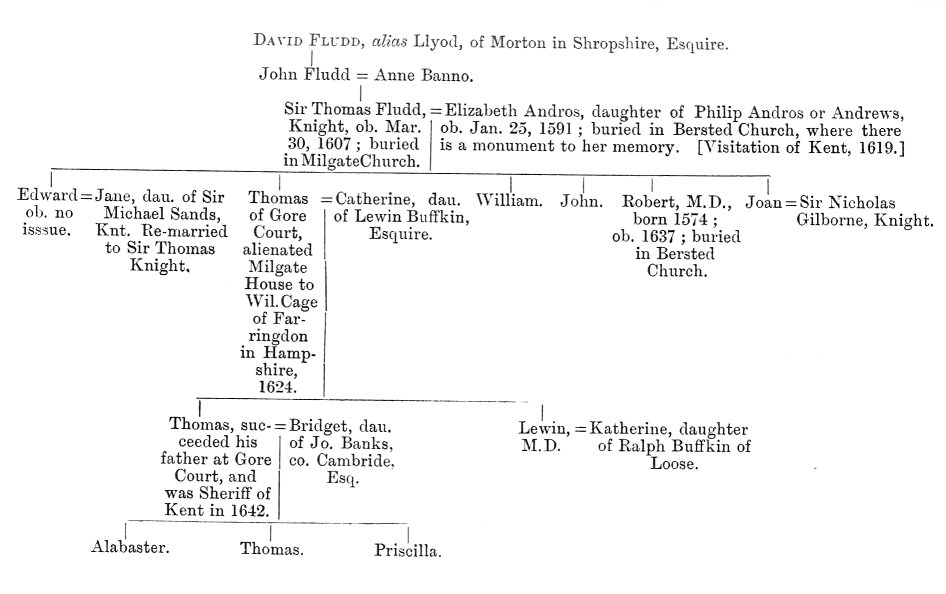
CHAPTER XI. ROSICRUCIAN APOLOGISTS: ROBERT FLUDD. THE central figure of Rosicrucian literature, towering as an intellectual giant above the crowd of souffleurs, theosophists, and charlatanic professors of the magnum opus, who, directly or otherwise, were connected with the mysterious Brotherhood, is Robertus de Fluctibus, the great English mystical philosopher of the seventeenth century, a man of immense erudition, of exalted mind, and, to judge by his writings, of extreme personal sanctity. Ennemoser describes him as one of the most distinguished disciples of Paracelsus, but refuses to number him with "those consecrated theosophists who draw all wisdom from the fountain of eternal light." He does not state his reasons for this depreciatory judgment, and the brief and inadequate notice which he gives of Fludd's system displays such a cursory acquaintance with the works in which it is developed, that it is doubtful whether he had taken pains to understand his author. I should rank the Kentish mystic second to none among the disciples of the "divine" Theophrastus, while in the profundity and extent of his learning, there can be no question that he far surpassed his master, who is said to have known little but to have divined almost everything, and who is, therefore, called divinus, in the narrower sense of that now much abused term. Robert Fludd was born at Milgate House, [1] in the parish of Bersted, Kent, during the year 1574. By his mother's side he was descended from the ancient family of Andros of Taunton in Somerset. His father, Thomas Fludd, was a representative of a Shropshire stock, and successively occupied several high positions. He was victualler of Bewick, and then of Newhaven in France; afterwards he was made Receiver of Kent, Sussex, and Surrey, and being appointed treasurer of the army sent under Lord Willoughby to Henry IV. of France, "he behaved so honourably that he was knighted, and on his return to England was made treasurer of all her Majesty's forces in the Low Countries." [2] This was in the reign of Queen Elizabeth; he was constantly a justice of the peace where he resided, and was also treasurer of the Cinque ports. "He bore for his arms--vert, a chevron between three wolves’ heads erased, argent, which coat, with his quarterings, was confirmed to him by Robert Cook, Clar., Nov. 10, 1572." [3] I have succeeded in compiling from various sources the following scanty genealogy of the Fludd family:--
Robert Flood Genealogical Tree According to this genealogy, Robert Fludd was the youngest of five sons. He was entered of St John's College in the year 1591, at the age of seventeen. Having graduated both in arts and medicine, he appears to have travelled extensively, for the space of six years, in France, Germany, Italy, and Spain. On his return to England, he was made a member of the London College of Physicians, and took his degree of Master in Arts in the year 1605. His first published work appeared in 1616, about which time he was visited by Michael Maier, by whom he was probably acquainted with the Rosicrucian controversy, and with whom he corresponded after the renowned German alchemist had returned to his own country. Fludd appears to have resided chiefly in London, then as now the great intellectual centre of England. He had a house in Fenchurch Street, according to Fuller, [4] and another in Coleman Street, where he died in the year 1637, on the 8th day of September. He was buried in the chancel of Bersted Church, under a tomb which he had previously erected--"An oblong square of dark, slate-coloured marble, occupying a large space of the chancel wall on the left as you stand before the altar, looking up the body of the small church towards the door. There is a seated half-length figure of Fludd, with his hand on a book, as if just raising his head from reading to look at you. Upon the monument are two marble books inscribed Misterium Cabalisticum and Philosophia Sacra. There were originally eight books. The inscription to his memory is as follows:-- "'VIII. Die Mensis VII. Ao Dm, M.D.C.XXXVII. O doribus vrua vaporat crypta tegit cineres nec speciosa tvos ovod mortale minvs tibi. Te committimus vnvm ingenii vivent hic monumenta tui nam tibi qui similis scribit moriturque sepulchrum pro tota eternum posteritate facit. Hoc monumentum Thomas Flood Gore Court in oram apud Cantianos armiger infoelissimam in charissimi patrin sui memoriam nexit, die Mensis Augusti M.D.C.XXXVII.'" [5] Bersted Church is situated on high ground, at a small distance south of Bersted Green. It is dedicated to the Holy Cross, and, according to Hasted, [6] is a handsome building, consisting of two aisles and two chancels, with a square beacon tower at the west end of it. This is in the Perpendicular style, and at three angles of the summit are three rude figures, said to be three dogs or bears seiant, but so defaced by time that they cannot well be distinguished. The list of Fludd's works is as follows:--
Doctor Fludd's Answer unto M. Foster, or the squesing of Parson Foster's Sponge, ordained by him for the wiping away of the weapon-salve. London, 1631. 4to.
It will be seen from this list that the Rosicrucian manifestoes found an immediate defender in Robert Fludd, that is, if the "Apologia" which bears his name is to be considered his work. There is some uncertainty on this point, but it has been disputed on insufficient grounds, As a maiden effort, it will not of course bear comparison with the dialectical skill of his mature productions, but the principles it propounds are those of the "Mosaicall Philosophy" and the "Tractatus Varii." "What was the particular occasion of his own first acquaintance with Rosicrucianism is not recorded," says Buhle. "All the books of Alchemy or other occult knowledge, published in Germany, were at that time immediately carried over to England--provided they were written in Latin; and if written in German, were soon translated for the benefit of English students. He may therefore have gained his knowledge immediately from the Rosicrucian books, but it is more probable that he acquired it from his friend Maier. . . . At all events, he must have been initiated into Rosicrucianism at an early period." By whomsoever written, the "Tractatus Apologeticus" is an exceedingly curious work, so astonishing occasionally in the nature of its arguments that it is difficult to suppose that they were put forward seriously. It was called for by Andrew Libavius’ "searching and hostile analysis" of the Rosicrucian Confession, and was written to clear the Society from the Infamiæ maculæ cast on it by the accusations then brought forward, and above all from the charges of detestable magic and diabolical superstition. It is divided into three parts, and various chapters are illustrated by appropriate quotations from the manifesto it is defending, whose underlying principles are developed and explained. The first part treats of the various departments of magical science, of the Cabala, of the Books of God, both visible and invisible, of the secret characters of Nature, and of the value of astrological portents. The second part is devoted to a lugubrious consideration of the impediments and degeneracy of the arts and sciences in modern times--de scientiarum hodierno die in scholis vigentium impedimentis. It enlarges on the urgent necessity for a reformation in Natural Philosophy, Medicine, and Alchemy. Concerning the first, the author declares it to be impossible for any one to attain to the supreme summit of the natural sciences unless he be profoundly versed in the occult meaning of the ancient philosophers, but the minute and most accurate observer who does achieve this height will not find it difficult to adapt the materials which are prepared by Nature in such a manner as to produce, by the application of actives to passives, many marvellous effects before the time ordained by Nature; and this, he adds, will be mistaken by the uninitiated for a miracle. Like others of his school, he insists on the uncertainty of à posteriori and experimental methods, to which he unhesitatingly attributes all the errors of the natural sciences. "Particulars are frequently fallible, but universals never. Occult philosophy lays bare Nature in her complete nakedness, and alone contemplates the wisdom of universals by the eyes of intelligence. Accustomed to partake of the rivers which flow from the Fountain of Life, it is unacquainted with grossness and with clouded waters." In Medicine he laments the loss of that universal panacea referred to by Hippocrates:--"But absolutely nothing remains of that one and only medicament of which Hippocrates makes mention (darkly and mystically, I admit) in several places, and still less are its operations understood, inasmuch as no one now searches with lynx-like eyes into the profound depths of true natural philosophy, to gain an accurate knowledge of its composition and its virtues." Concerning Arithmetic, he asks mournfully, and with apparent earnestness, "Which of us has, at this day, the ability to discover those true and vivific numbers whereby the elements are united and bound to one another?" And then, with regard to music, which, as he remarks, non aliter succedit Arithmeticæ quàm medicina Philosophiæ Naturali, he cries after the same fashion:--"But, good God, what is this when compared with that deep and true music of the wise, whereby the proportions of natural things are investigated, the harmonical concord and the qualities of the whole world are revealed, by which also connected things are bound together, peace established between conflicting elements, and whereby each star is perpetually suspended in its appointed place by its weight and strength, and by the harmony of its lucent spirit." It is impossible to read without a smile when the author urges the necessity for a musical reformation, on the ground that we have lost that art of Orpheus by which he moved insensible stones, and that of Arion by which the fishes were charmed. The cursory review of alchemy is equally gloomy:--"The art, also, of alchemy or chemistry is surrounded with such insoluble enigmas that we can scarcely gain anything but ignorance therefrom, and ignotum per ignotius." He enlarges on its fictitious vocabulary, and quotes Maricinus as follows:--"The magisterium of the philosophers is hidden and concealed, and wherever found is known by a thousand names; moreover, it is surrounded by symbols and is revealed to the wise alone, yet this is, notwithstanding, the one, only, and lineal way of the whole operation." Then he himself continues:--"Neither common fire, but Nature herself, neither artificial furnaces, but natural matrices, are needed in this work, which is the work of Nature only, and wherein nothing is required save the brief co-operation of her minister, by whom things natural to things also natural, and species to their congruents, are duly and accurately applied." Mathematics, optics, and astronomy he treats after the same fashion, comparing their tame and commonplace frivolities with the sublime knowledge of the ancients. The third part is entitled "De Naturæ Arcanis," and treats of the mysteries of Light, &c., developing in a small space a curious and profound philosophy. It describes God as the ens entium, eternal form, inviolable, purely igneous, without any intermixture of material, unmanifested before the creation of the universe, according to the maxim of Mercurius Trismegistus, "Monas generat molem, et in seipsum reflectit ardorem suam." Earth is defined to be a gross water, water a gross air, air a gross fire, fire a gross ether, while the ether itself is the grosser part of the empyrean, which is distinguished from the ethereal realm, and is described as a water of extreme tenuity, constituted of three parts of luminous substance to one aqueous part; it is the purest essence of all substances, and is identical with the luminiferous ether of the latest scientific hypothesis. Its place is the medium mundi, wherein is the sphæra æqualitatis, in which the sun performs its revolution. The sun itself is composed of equal parts of light and water. Light is the cause of all energies--nihil in hoc mundo peractum fuerit, sine lucis mediatione aut actu divino. "It is impossible for man to desire more complete felicity than the admirable knowledge of light and its virtues," by which the ancient magi constructed their ever-burning lamps, forced fire out of stones and wood, kindled tapers from the rays of stars, and naturally, by means of its reflections, produced many wonders in the air, such as phantom writing, and, more than all, by the true use of the lux invisibilis, made men themselves invisible. The information scattered through the various parts of the apology on the different departments of magic is also noteworthy. It distinguishes between natural, mathematical, venific, necromantic, and thaumaturgie magic. "That most occult and secret department of physics by which the mystical properties of natural substances are extracted, we term Natural Magic. The wise kings who (led by the new Star from the East) sought the infant Christ, are called Magi, because they had attained a perfect knowledge of natural things, whether celestial or sublunar. This branch of the Magi also includes Salomon, since he was versed in the arcane virtues and properties of all substances, and is said to have understood the nature of every plant from the cedar to the hyssop. Magicians who are proficient in the mathematical division construct marvellous machines by means of their geometrical knowledge; such were the flying dove of Archytas, and the brazen heads of Roger Bacon and Albertus Magnus, which are said to have spoken. Venific magic is familiar with potions, philtres, and with the various preparations of poisons; it is in a measure included in the natural division, because a knowledge of the properties of natural things is requisite to produce its results. Necromantic Magic is divided into goëtic, maleficient, and Theurgic. The first consists in diabolical commerce with unclean spirits, in rites of criminal curiosity, in illicit songs and invocations, and in the evocation of the souls of the dead. The second is the adjuration of the devils by the Virtue of Divine Names. The third pretends to be governed by good angels and the Divine Will, but its wonders are most frequently performed by evil spirits, who assume the names of God and of the angels. This department of Necromancy n can, however, be performed by natural powers, definite rites and ceremonies, whereby celestial and divine virtues are reconciled and drawn to us; the ancient Magi promulgated in their secret books many rules of this doctrine. The last species of magic is the thaumaturgie, begetting illusory phenomena; by this art the Magi produced their phantasms and other marvels." When speaking of the wonders wrought mechanically by Roger Bacon, Albertus Magnus, and Boëtius, the apologist of the Rosicrucians tells us that he himself, by his assiduity in mechanical arts, constructed a wooden bull which lowed and bellowed after the fashion of the living animal; a dragon which flapped its wings, hissed, and vomited forth fire and flames upon the bull; and a lyre which played melodies without human intervention, as well as many other things, which by the simple mathematical art, apart from natural magic, could not have been accomplished. The scientific and philosophical principles of Robert Fludd were attacked by Father Mersenne, with special reference to his belief in the Rosicrucian Society. Some twelve years had passed since the appearance of the "Tractatus Apologeticus," which he probably no longer valued. He replied to the attack in the work entitled "Sophiæ cum Moriâ Certamen," without mentioning the Rosicrucians. But the "Summum Bonum," by Joachim Fritz, which accompanied this reply, contains an elaborate defence of the Order, to which, in one of its phases, Fludd is said to have belonged. The authorship of this defence he is supposed to have disavowed. Buhle, however, points out that as "the principles, the style, the animosity towards Mersenne, the publisher, and the year, were severally the same as in the 'Sophiæ cum Moriâ Certamen' which Fludd acknowledged, there cannot be much reason to doubt that it was his." But as I am unwilling to consider that a man of Fludd's high character would be guilty of deliberate falsehood, and as it was not his habit to write either anonymously or pseudonymously, I prefer the alternative offered by the German critic when he says, "If not Fludd's, it was the work of a friend of Fludd's." In either case, his opinions are represented. On the title-page of the "Summum Bonum," there is a large Rose on which two bees have alighted, with this motto above--Dat Rosa mel apibus. The book treats of the noble art of magic, the foundation and nature of the Cabala, the essence of veritable alchemy, and of the Causa Fratrum Roseæ Crucis. It identifies the palace or home of the Rosicrucians with the Scriptural house of wisdom. Ascendamus ad montem rationabilem, et ædificemus domum Sapientiæ. The foundation of the mountain thus referred to is declared to be the Lapis angularis, the corner-stone, cut out of the mountain without hands. This stone is Christ. It is the spiritual palace which the Rosicrucians desire to reveal, and is therefore no earthly or material abode. There is a long disquisition on the significance of the Rose and the Cross, a purely spiritual interpretation being adopted. At the conclusion, the writer anticipates the question whether he himself is a brother of the Rose Cross, since he has settled all questions as to their religion and symbolism. His answer is that he least of any has deserved such a grace of God; if it have pleased God to have so ordained it, it is enough. To satisfy, however, the curiosity of his readers, he supplies them with a curious letter supposed to have emanated from the society, and which has been quaintly translated in a manuscript of the seventeenth century. This Epistle was written and sent by ye Brethren of R. C. to a certaine Germaine, a coppy whereof Dr Flud obtained of a Polander of Dantziche his friend, which he since printed in Latin at ye end of his tract, intituled, De Summo Bono. Venerable and Honourable Sr. Seeing that this will be ye first yeare of thy nativity, wee pray that
thou mayst have from ye Most High God, a most happy entrance into and
departure from out of thy life, and because thou hast hitherto been with
a good mind a constant searcher of holy philosophy, well done! Proceed,
fear God, for thus thou mayest gaine Heaven. Get to thyself the most
true knowledge, for it is God who hath found out every way; it is God
who alone is circumference and centre. But draw thee neere, listen, take
this to thee
F. T. F., in Light and C. By his talents and intellectual ability, Robert Fludd is a character so important in English Rosicrucian literature, that I propose to give a short sketch or syllabus of his singular cosmical philosophy. The substance will be taken from the "Mosaicall Philosophy," and the folio volume entitled Tractatus Varii, and it will be rendered as far as possible in the philosopher's own words. The author distinguishes in several places between the Divine σοφία, the
eternal sapience, the heavenly wisdom, which is only mystically revealed
to mankind, and the wisdom which is derived from the invention and
tradition of men. He declares the philosophy of the Grecians, or the
ethnick philosophy, to be based only on the second, and to
be terrene, animal, and diabolical, not being founded on the deific
corner-stone, namely, Jesus Christ, who is the essential substance and
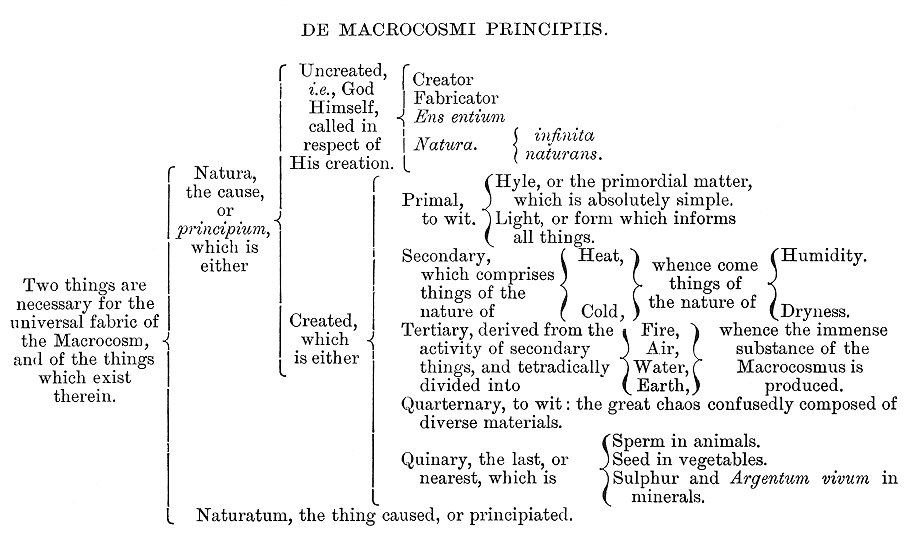
foundation of the true science. Before the spagirical separation which the Word of God, or divine Elohim, effected in the six days of creation, the heavens and earth were one deformed, rude, undigested mass, complicitly comprehended in one dark abyss, but explicitly as yet nothing. This nothing is compared by St Augustine to speech, which while it is in the speaker's mind is as nothing to the hearer, but when uttered, that which existed complicitly in animo loquentis, is explicitly apprehended by the hearer. This nihilum or nothing is not a nihilum negativum. It is the First Matter, the infinite, informal. primordial Ens, the mysterium magnum of the Paracelsists. It existed eternally in God. If God had not produced all things essentially out of Himself, they could not be rightly referred to Him. The primeval darkness is the potentia divina as light is the actus divinus--the Aleph tenebrosum and Aleph lucidum. Void of form and life, it is still a material developing from potentiality into the actual, and was informed by the Maker of the world with a universal essence, which is the Light of Moses, and was first evolved in the empyrean heaven, the highest and supernatural region of the world, the habitaculum fontis lucidi, the region not of matter but of form--form simple and spiritual beyond all imagination. There is a second spiritual heaven, participating in the clarity and tenuity of the first, of which it is the base; this is the medial heaven, called the sphæra æqualitatis and it is corporeal in respect of the former. The third heaven is the locality of the four elements. The progression of the primordial light through the three celestial spaces was accomplished during the first three days of creation. Christ the Wisdom and Word of God, by His apparition out of darkness, that is, by the mutation of the first principle from dark Aleph to light Aleph, revealed the waters contained in the profound bosom of the abyss, and animated them by the emanation of the spirit of eternal fire, and then by his admirable activity distinguished and separated the darkness from the light, the obscure and gross waters from the subtle and pure waters, disposing the heavens and spheres, as above stated, and dividing the grosser waters into sublunary elements. These elements are described as follows:--Earth is the conglomeration of the material darkness and the refuse of the heavens; Water is the more gross spirit of the darkness of the inferior heaven, nearly devoid of light; Air is the spirit of the second heaven; Fire, the spirit of the darkness of the Empyrean heaven. Fludd's theory of the Macrocosmus is enunciated in the following manner.
DE MACROCOSMI PRINCIPIIS.
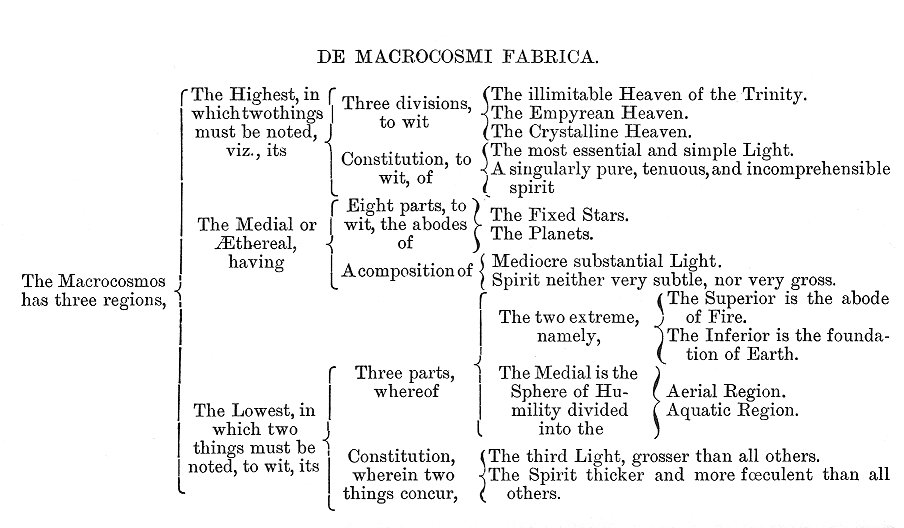
DE MACROCOSMI FABRICA. According to Fludd's philosophy, the whole universe was fashioned after the pattern of an archetypal world which existed in the Divine ideality, and was framed out of unity in a threefold manner. The Eternal Monad or Unity, without any egression from his own central profundity, compasses complicitly the three cosmical dimensions, namely, root, square, and cube. If we multiply unity as a root, in itself, it will produce only unity for its square, which being again multiplied in itself, brings forth a cube which is one with root and square. Thus we have three branches differing in formal progression, yet one unity in which all things remain potentially, and that after a most abstruse manner. The archetypal world was made by the egression of one out of one, and by the regression of that one, so emitted, into itself by emanation. According to this ideal image, or archetypal world, our universe was subsequently fashioned as a true type and exemplar of the Divine Pattern; for out of unity in his abstract existence, viz., as it was hidden in the dark chaos, or potential mass, the bright flame of all formal being did shine forth, and the Spirit of Wisdom, proceeding from them both, conjoined the formal emanation with the potential matter, so that by the union of the divine emanation of light and the substantial darkness, which was water, the heavens were made of old, and the whole world. God, according to these abstruse speculations, is that pure, catholic unity which includes and comprehends all multiplicity, and which before the objective projection of the cosmos must be considered as a transcendent entity, reserved only in itself, in whose divine puissance, as in a place without end or limit, all things which are now explicitly apparent were then complicitly contained, though in regard to our finite faculties it can only be conceived as nothing--nihil, non finis, non ens, aleph tenebrosum, the Absolute Monad or Unity. Joined to the cosmical philosophy of Robert Fludd, there is an elaborate system of spiritual evolution, and the foundation of both is to be sought in the gigantic hypotheses of the Kabbalah. His angelology is derived from the works of pseudo-Dionysius on the celestial hierarchies, and he teaches the doctrine of the pre-existence of human souls, which are derived from the vivifying emanation dwelling in the Anima Mundi, the world's spiritual vehicle, the catholic soul, which itself is inacted and preserved by the Catholic and Eternal Spirit, sent out from the fountain of life to inact and vivify all things. These mystical speculations, whatever their ultimate value, are sublime flights of an exalted imagination, but they are found, in the writings of Robert Fludd, side by side with the crudest physical theories, and the most exploded astronomical notions. He denies the diurnal revolution of the earth, and considers the light of all the stars to be derived from the one "heavenly candle" of the sun. Rejecting the natural if inadequate explanations of Aristotle and his successors, he presents the most extravagant definitions of the nature of winds, clouds, snow, &c. The last is described as a meteor which God draweth forth of His hidden treasury in the form of wool, or as a creature produced out of the air by the cold breath of the Divine Spirit to perform his will on earth. Thunder is a noise which is made in the cloudy tent or pavilion of Jehovah, lightning a certain fiery air or spirit animated by the brightness and burning from the face or presence of Jehovah. Literally interpreting the poetic imagery of Scripture, he perceives the direct interference of the Deity in all the phenomena of Nature, and denounces more rational views as "terrene, animal, and diabolical." _______________ Notes: 1. The seat of Milgat was formerly esteemed a manor. It was anciently possessed by the family of Coloigne, one of whom, Robert de Coloigne, died feifed of it in the 35th year of Edward III. In process of time his descendants came to be called Coluney, one of whom, Thomas Coluney, as appears by an old survey of Bersted, possessed it in the 14th year of Edward IV. In the beginning of the reign of Henry VII. it was become the property of the family of Stone-house, whose ancient seat was at Hazelwood, Boughton Malherbe (Philpot, p. 68). Robert Stonehouse was of Bersted, Esquire, at the latter end of Henry VIII. His son George, at the beginning of Queen Elizabeth's reign, alienated this seat to Thomas Fludd, Esquire, afterwards knighted, and who considerably improved and augmented it." One corner of this edifice is still said to remain built in the manor-house erected on its site when the old house fell into ruins.--Hasted, "History of Kent," vol. ii., pp. 486, 487. 2. Hasted's "History of Kent," vol. ii., p. 486. 3. "Visitation of County of Kent, 1574 and 1619." 4. "Worthies of Great Britain," p. 78 of the second part. 5. Hargrave Jennings, "The Rosicrucians, &c.," p. 364. 6. "History of Kent," vol. ii., p. 489.
|
 , for he who increaseth knowledge increaseth sorrow,
because that in much knowledge is much griefe, wee speake by experience.
For all worldlings, and vaine-glorious, vauntinge boasters, gorgious
men, talkers, and vaine people doe unworthily scandalize, yea, and curse
us for an unknown matter. But we wonder not that ye ungrateful world doe
persecute ye professors of ye true Arts, together with ye truth itself.
Yett for thy sake wee shall briefly answer to these questions, viz.:
What wee doe? What can wee doe? Or whether are any such as wee? In John,
therefore, wee reade that God is ye Supreme Light, and in light wee
walke, so that wee exhibit light (although in a lanthern) to ye world.
But thou man of ye world that deniest this, thou knowest not or seest
not it behoves thee
to know that in thy vile boddy Jesus dwelleth. This thou hast from ye
apostle. "And Jesus knew all their thoughts," to whom if thou adherest,
thou are at length made one spirit with Him, and being such, who
prohibeteth thee with Solomon to know as well ye wicked as good
contentions of men. And this thou mayest take from me out of ye
premises. And hence it is that wee doe not answer to all, viz., because
of the deceitfull minds of some. For whosoever are alienated from God
are contrary to us, and who is so foolish as to permit a new-come
stranger to enter into another man's house? But if thou objectest that
this union is onely to be expected in ye world to come, behold now in
this thou showest thyself for a worldling who extinguishest light by thy
ignorance. Also thou are not ashamed to make ye apostle a liar, in whom
those things are more clearly manifested in these wordes--"So that you
may be wanting in no grace, expectinge ye Revelation of our Lord Jesus
Christ." But thou sayest that this is not to be understood of this
inferiour life. What therefore does ye followinge verse intend? "Who
shall confirme you even to the end," for in the Kingdome of God there is
noe end, therefore in this temporall state will appear ye glory of ye
Lord, and Jesus glorified. If any thinge is further demanded concerning
our office, our endeavoure is to leade backe lost sheepe to ye true
sheepefold. You labore therefore in vaine, O miserable mortals, who
enter upon another way than that ye apostle wills by putinge off your
tabernacle, which way is not walked in through dyinge, but as Peter
willeth when he saith: "As Christ hath taught mee," viz., when he was
transfigured in ye mount, which laienge down, if it had not bine secret
and hidden, ye apostle had not saide, "as Jesus taught mee," neither had
ye Supreme Truth saide: "Tell this to no man," for
accordinge to ye vulgar way, vulgarly to die was known to all men from
ye beginninge of ye world. Be yee changed therefore, be yee changed from
dead stones into livinge philosophical stones. The apostle shews ye way
when he saith: "Lett the same minde be in you as is in Jesus." Also he
explains that minde in ye followinge words, viz., when as beinge in ye
form of God, he thought it no robbery to be equal to God. Behould these
things, O all you that search into ye abstruse secrets of nature! Yee
heare these matters, but you believe them not, O miserable mortals, who
doe so anxiously run into youre own ruine, but wilt thou be more happy,
O thou most miserable, wilt thou be elevated above ye circles of ye
world, O thou proud one, wilt thou command in Heaven above, this earth,
and thy darke body, O thou ambitious, will yee performe all miracles, O
yee unworthy? Know yee, therefore, ye rejected, of what nature it is,
before it is sought. But thou, O Brother, hearken! I will speake with S.
John, that thou mayest have fellowshippe with us, and indeed our
fellowshippe is with ye Father and with Jesus, and wee write unto you
that yee may rejoyce because God is light, and in Him there is no
darkness at all. But that thou mayest come unto us, behould this light,
for it is impossible for thee to see us (unless when wee will) in
another light. In this, therefore, follow us, whereby thou mayest be
made happy with us, for our most immoveable pallace is ye centre of all
things, likewise is it much obscured, because covered with many names.
Enter, enter into ye glory of God and thy own salvation, ye gates and
Schoole of Philosophicall Love, in which is taught everlastinge charity
and fraternall love, and that some resplendent and invisible castle
which is
built upon the mountaine of ye Lord, out of whose roote goeth forth a
fountaine of livinge waters, and a river of love! Drinke, drinke, and
againe drinke, that thou mayest see all hidden things, and converse with
us! Againe beware! But what? For thou knowest very well that nature
receives nothing for nutriment but that which is subtile, the thick and
fœculent is cast out as excrements. It is also well disputed by thyself,
that those who will live in ye minde, rather than in ye body, take in
nourishment by ye spirit, not by ye mouth. As for example, it is lawful
to know Heaven by Heaven, not by earth, but ye virtues of this by ye
other, and if you understand me aright, no man ascends into Heaven,
which thou seekest, except He who descended from Heaven, which thou
seekest not, enlighteneth him first. Whatsoever therefore is not from
Heaven is a false immage, and cannot be called a virtue. Therefore, O
Brother, thou canst not be better confirmed then by virtue itselfe,
which is ye Supreame Truth, which if thou wilt religiously, and with all
thy might, endeavour to follow in all thy wordes and workes, it will
confirm thee, daily more and more, for it is a fiery spirite, a
glisteninge sparke, a graine impossible, never diinge, subliminge his
own body, dwellinge in every created beeinge, sustaininge and governinge
it, gold burninge, and by Christ purged, pure in ye fire, allwaye more
glorious and pure, jubilatinge without diminution, this shall (I say)
confirme thee daily, untill (as a certaine learned man saith) thou art
made like a lion in battle, and canst take away all ye strength of ye
world, and fearest not death, nor any violence whatsoever a divellish
tyranny can invent, viz., seeinge thou art become such a one as thou
desirest, a stone and a worke. And that God may bless thy labours which
thou shalt
receive in most approved authors under a shaddow, for a wise man reads
one thinge and understands another. Art thou imperfect? Aspire after a
due perfection. Art thou foul and unclean? Purge thyself with teares,
sublime thyselfe with good manners and virtues, adorn and beautify
thyselfe with sacramentall graces! Make thy soule sublime and subtile
for ye contemplation of heavenly thinges, and conformable to angelicall
spirits, that it may vivify thy vile ashes and vulgar body, and make it
white, and render it altogether incorruptible and impassible by ye
resurrection of our Lord Jesus Christ. Doe these thinges, and thou wilt
confess that no man hath wrote more plainly then I. These thinges the
Lady Virtue hath commended should be told to thee, from (or by) whom,
accordinge to thy deserts, thou shalt hereafter be more largely taught,
these read, if thou wilt, as the apostle willeth, keepe that which is
committed to thy trust. Farewell.
, for he who increaseth knowledge increaseth sorrow,
because that in much knowledge is much griefe, wee speake by experience.
For all worldlings, and vaine-glorious, vauntinge boasters, gorgious
men, talkers, and vaine people doe unworthily scandalize, yea, and curse
us for an unknown matter. But we wonder not that ye ungrateful world doe
persecute ye professors of ye true Arts, together with ye truth itself.
Yett for thy sake wee shall briefly answer to these questions, viz.:
What wee doe? What can wee doe? Or whether are any such as wee? In John,
therefore, wee reade that God is ye Supreme Light, and in light wee
walke, so that wee exhibit light (although in a lanthern) to ye world.
But thou man of ye world that deniest this, thou knowest not or seest
not it behoves thee
to know that in thy vile boddy Jesus dwelleth. This thou hast from ye
apostle. "And Jesus knew all their thoughts," to whom if thou adherest,
thou are at length made one spirit with Him, and being such, who
prohibeteth thee with Solomon to know as well ye wicked as good
contentions of men. And this thou mayest take from me out of ye
premises. And hence it is that wee doe not answer to all, viz., because
of the deceitfull minds of some. For whosoever are alienated from God
are contrary to us, and who is so foolish as to permit a new-come
stranger to enter into another man's house? But if thou objectest that
this union is onely to be expected in ye world to come, behold now in
this thou showest thyself for a worldling who extinguishest light by thy
ignorance. Also thou are not ashamed to make ye apostle a liar, in whom
those things are more clearly manifested in these wordes--"So that you
may be wanting in no grace, expectinge ye Revelation of our Lord Jesus
Christ." But thou sayest that this is not to be understood of this
inferiour life. What therefore does ye followinge verse intend? "Who
shall confirme you even to the end," for in the Kingdome of God there is
noe end, therefore in this temporall state will appear ye glory of ye
Lord, and Jesus glorified. If any thinge is further demanded concerning
our office, our endeavoure is to leade backe lost sheepe to ye true
sheepefold. You labore therefore in vaine, O miserable mortals, who
enter upon another way than that ye apostle wills by putinge off your
tabernacle, which way is not walked in through dyinge, but as Peter
willeth when he saith: "As Christ hath taught mee," viz., when he was
transfigured in ye mount, which laienge down, if it had not bine secret
and hidden, ye apostle had not saide, "as Jesus taught mee," neither had
ye Supreme Truth saide: "Tell this to no man," for
accordinge to ye vulgar way, vulgarly to die was known to all men from
ye beginninge of ye world. Be yee changed therefore, be yee changed from
dead stones into livinge philosophical stones. The apostle shews ye way
when he saith: "Lett the same minde be in you as is in Jesus." Also he
explains that minde in ye followinge words, viz., when as beinge in ye
form of God, he thought it no robbery to be equal to God. Behould these
things, O all you that search into ye abstruse secrets of nature! Yee
heare these matters, but you believe them not, O miserable mortals, who
doe so anxiously run into youre own ruine, but wilt thou be more happy,
O thou most miserable, wilt thou be elevated above ye circles of ye
world, O thou proud one, wilt thou command in Heaven above, this earth,
and thy darke body, O thou ambitious, will yee performe all miracles, O
yee unworthy? Know yee, therefore, ye rejected, of what nature it is,
before it is sought. But thou, O Brother, hearken! I will speake with S.
John, that thou mayest have fellowshippe with us, and indeed our
fellowshippe is with ye Father and with Jesus, and wee write unto you
that yee may rejoyce because God is light, and in Him there is no
darkness at all. But that thou mayest come unto us, behould this light,
for it is impossible for thee to see us (unless when wee will) in
another light. In this, therefore, follow us, whereby thou mayest be
made happy with us, for our most immoveable pallace is ye centre of all
things, likewise is it much obscured, because covered with many names.
Enter, enter into ye glory of God and thy own salvation, ye gates and
Schoole of Philosophicall Love, in which is taught everlastinge charity
and fraternall love, and that some resplendent and invisible castle
which is
built upon the mountaine of ye Lord, out of whose roote goeth forth a
fountaine of livinge waters, and a river of love! Drinke, drinke, and
againe drinke, that thou mayest see all hidden things, and converse with
us! Againe beware! But what? For thou knowest very well that nature
receives nothing for nutriment but that which is subtile, the thick and
fœculent is cast out as excrements. It is also well disputed by thyself,
that those who will live in ye minde, rather than in ye body, take in
nourishment by ye spirit, not by ye mouth. As for example, it is lawful
to know Heaven by Heaven, not by earth, but ye virtues of this by ye
other, and if you understand me aright, no man ascends into Heaven,
which thou seekest, except He who descended from Heaven, which thou
seekest not, enlighteneth him first. Whatsoever therefore is not from
Heaven is a false immage, and cannot be called a virtue. Therefore, O
Brother, thou canst not be better confirmed then by virtue itselfe,
which is ye Supreame Truth, which if thou wilt religiously, and with all
thy might, endeavour to follow in all thy wordes and workes, it will
confirm thee, daily more and more, for it is a fiery spirite, a
glisteninge sparke, a graine impossible, never diinge, subliminge his
own body, dwellinge in every created beeinge, sustaininge and governinge
it, gold burninge, and by Christ purged, pure in ye fire, allwaye more
glorious and pure, jubilatinge without diminution, this shall (I say)
confirme thee daily, untill (as a certaine learned man saith) thou art
made like a lion in battle, and canst take away all ye strength of ye
world, and fearest not death, nor any violence whatsoever a divellish
tyranny can invent, viz., seeinge thou art become such a one as thou
desirest, a stone and a worke. And that God may bless thy labours which
thou shalt
receive in most approved authors under a shaddow, for a wise man reads
one thinge and understands another. Art thou imperfect? Aspire after a
due perfection. Art thou foul and unclean? Purge thyself with teares,
sublime thyselfe with good manners and virtues, adorn and beautify
thyselfe with sacramentall graces! Make thy soule sublime and subtile
for ye contemplation of heavenly thinges, and conformable to angelicall
spirits, that it may vivify thy vile ashes and vulgar body, and make it
white, and render it altogether incorruptible and impassible by ye
resurrection of our Lord Jesus Christ. Doe these thinges, and thou wilt
confess that no man hath wrote more plainly then I. These thinges the
Lady Virtue hath commended should be told to thee, from (or by) whom,
accordinge to thy deserts, thou shalt hereafter be more largely taught,
these read, if thou wilt, as the apostle willeth, keepe that which is
committed to thy trust. Farewell.