|
THE REAL HISTORY OF THE ROSICRUCIANS: FOUNDED ON THEIR OWN MANIFESTOES, AND ON FACTS AND DOCUMENTS COLLECTED FROM THE WRITINGS OF INITIATED BRETHREN |
|
CHAPTER XIII. ROSICRUCIAN APOLOGISTS: JOHN HEYDON. THE last of the line of apologists who has any claim on our notice is the extraordinary Royalist mystic and geomancer, John Heydon, who, in the preface to "The Holy Guide," has left us the following interesting and curious fragment of autobiography: --
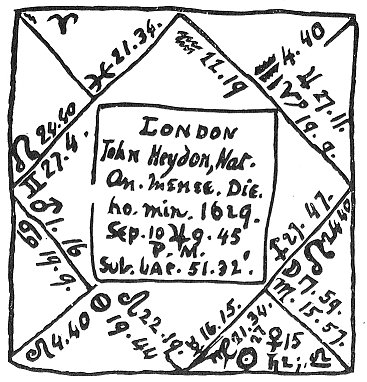
"I was descended from a noble family of London in England, being born of a complete tall stature, small limbs, but in every part proportionable, of a dark flaxen haire, it curling as you see in the Effigies, [1] and the above figures of Astrologie at the time I was born: this is also the Character of my Genius Malhitriel, and Spirit Taphza Benezelthar Thascraphimarah. I had the small pox and rickets very young--Ascendent to Conjunction, Mars, and Sol to the quartile of Saturn. I was at Tardebich in Warwickshire, neer Hewel, where my mother was borne, and there I learned, and so carefull were they to keep me to the book and from danger, that I had one purposely to attend me at school and at home. For, indeed, my parents were both of them honourably descended. They put me to learn the Latine tongue to one Mr George Linacre, the minister of the Gospel at Golton; of him I learned the Latine and Greek perfectly, and then was fitted for Oxford. But the Warrs began, and the Sun came to the body of Saturn and frustrated that design; and whereas you are pleased to stile me a noble-natured, sweet gentleman, [2] you see my nativity:--Mercury, Venus, and Saturn are strong, and by them the Dragon's head and Mars, I judge my behaviour full of rigour, and acknowledge my conversation austere. In my devotion I love to use the civility of my knee, my hat, and hand, with all those outward and sensible motions which may express or promote invisible devotion. I followed the army of the King to Edgehill, and commanded a troop of horse, but never violated any man, &c., nor defaced the memory of saint or martyr. I never killed any man wilfully, but took him prisoner and disarmed him; I did never divide myself from any man upon the difference of opinion, or was angry with his judgment for not agreeing with me in that from which, perhaps, within a few dayes, I should dissent myself. I never regarded what religion any man was of that did not question mine. And yet there is no Church in the world whose every part so squares unto my conscience, whose articles, constitutions, and customs seem so consonant unto reason, and, as it were, framed to my particular devotion as this whereof I hold my belief, the Church of England, to whose faith I am a sworn subject, and therefore in a double obligation subscribe unto her articles, and endeavour to observe her constitutions. Whatsoever is beyond, as points indifferent, I observe according to the rules of my private reason, or the humour and fashion of my devotion, neither believing this because Luther affirmed it, or disproving that because Calvin hath disfavoured it. Now as all that dye in the war are not termed souldiers, neither can I properly term all those that suffer in matters of religion martyrs. And I say, there are not many extant that in a noble way fear the face of death lesse than myselfe; yet from the moral duty I owe to the commandement of God, and the natural respects that I tender unto the conversation of my essoine and being, I would not perish upon a ceremony, politique points, or indifferency; nor is my belief of that untractable temper, as not to bow at their obstacles or connive at matters wherein there are not manifest impieties. The leaves, therefore, and ferment of all, not only civil, but religious actions, is wisdome, without which to commit ourselves to the flames is homicide, and, I fear, but to passe through one fire into another. I behold, as a champion, with pride and spirites, and trophies of my victories over my enemies, and can with patience embrace this life, yet in my best meditations do often defie death; I honour any man that contemns it, nor can I love any that is afraid of it--this makes me naturally love a souldier that will follow his captain. In my figure you may see that I am naturally bashful. Yet you may read my qualities on my countenance. About the time I travelled into Spain, Italy, Turkey, and Arabia, the Ascendent was then directed to the Trine of the Moon, Sextile of Mercury and Quartile of Venus. I studied philosophy and writ this treatise, [3] and the 'Temple of Wisdome,' &c. Conversation, age, or travell hath not been able to affront or enrage me, yet I have one part of the modesty which I have seldom discovered in another, that is (to speak truly), I am not so much afraid of Death as ashamed thereof. It is the very disgrace and ignominy of our natures, that in a moment can so disfigure us that our beloved friends stand afraid and start at us; the birds and beasts of the field that before in a naturall feare obeyed us, forgetting all allegiance, begin to prey upon us. This very thought in a storm at sea hath disposed and left me willing to be swallowed up in the abyss of waters, wherein I had perished unseen, unpitied, without wondering eyes, tears of pity, lectures of morality, and none had said;--Quantum mutatus ab illo. Not that I am ashamed of the anatomy of my parts, or can accuse Nature of playing the pupil in any part of me, or my own vitious life for contracting any shameful disease upon me, whereby I might not call myself a compleat bodyed man, free from all diseases, sound, and, I thank God, in perfect health. "I writ my 'Harmony of the World,' when they were all at discord, and saw many revolutions of kingdomes, emperours, grand signiours, and popes; I was twenty when this book was finished, but me thinks I have outlived myself, and begin to be weary of the Sun, although the Sun now applies to a Trine of Mars. I have shaken hands with delight and know all is vanity, and I think no man can live well once but he that could live twice, yet for my part I would not live over my howres past, or begin again the minutes of my dayes, not because I have lived them well, but for fear I should live them worse. At my death I mean to take a total adieu of the world, not caring for the burthen of a tombstone and epitaph, nor so much as the bare memory of my name to be found anywhere, but in the Universal Register of God. I thank God that with joy I mention it, I was never afraid of Hell, nor never grew pale at the mention of Sheol, or Tophet, &c., because I understand the policy of a pulpit, and fix my contemplations on Heaven.
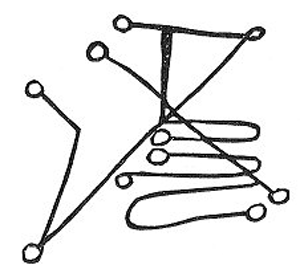
"I writ the 'Rosie Crucian Infallible Axiomata,' in foure books, and study not for my own sake only but for theirs that study not for themselves. In the Law I began to be a perfect clerk; I writ the 'Idea of the Law,' &c., for the benefit of my friends and practice in the King's Bench. I envy no man that knows more than myself, but pitty them that know lesse. For Ignorance is rude, uncivill, and will abuse any man, as we see in bayliffs, who are often killed for their impudent attempts; they'll forge a warrant and fright a fellow to fling away his money, that they may take it up; the devill, that did but buffet St. Paul, playes me thinks at Sharpe with me. To do no injury nor take none, was a principle which to my former years and impatient affection seemed to contain enough of morality, but my more settled years and Christian constitution have fallen upon severer resolutions. I hold there is no such thing as injury, and if there be, there is no such injury as revenge, and no such revenge as the contempt of an injury. There be those that will venture to write against my doctrine, when I am dead, that never durst answer me when alive. I see Cicero is abused by Cardan, who is angry at Tully for praising his own daughter; and Origanus is so impudent, that he adventures to forge a position of the heavens and calls it Cornelius Agrippa's nativity, and they say that Cornelius was borne to believe lyes and to broach them. Is not this unworthiness to write such lyes, and shew such reasons for them? His nativity I could never finde, I believe no man knows it, but by a false figure thus they scandalize him. And so they may use me, but behold the scheam of my nativity in Geomancy, and the character of my spirit Taphzabnezeltharthaseraphimarah, projected by a learned lord for the honour (? hour) of birth. Now let any astrologer, geomancer, philosopher, &c., judge my geniture; the figures are right according to the exact time of my birth, rectified by accidents and verified by the effects of directions. Now in the midst of all my endeavours, there is but one thought that dejects me--that my acquired parts mast perish with myself, nor can be legacyed amongst my dearly beloved and honoured friends. I do not fall out or contemn a man for an errour, or conceive why a difference in opinion should divide an affection; for a modest reproof or dispute, if it meet with discreet and peaceable natures, doth not infringe the laws of charity in all arguments. "When the mid heaven was directed to the Trine of the Moon, I writ another book, and entituled it, 'The Fundamental Elements of Philosophy, Policy, Government and the Laws,' &c. After this time I had many misfortunes, and yet I think there is no man that apprehends his own miseries less than myself, and no man that so nearly apprehends another's. I could lose an arm without a tear, and with few groans, methinks, be quartered into pieces, yet can I weep seriously, with a true passion, to see the merciless Rebels in England forge a debt against the King's most loyall subjects, purposely to put them in the Marshalsey, or other Houses of Hell to be destroyed in prison, or starved, or killed by the keepers, and then two or three poore old women for as many shillings shall perswade the Crowner and the people to believe the men dyed of consumptions. It is a barbarous part in humanity to add unto any afflicted parties’ misery, or endeavour to multiply in any man a passion whose single nature is already above his patience. "The Ascendent to the Quartile of Saturn, and part of Fortune to the Sextile of the Moon came next; and it is true I had loved a lady in Devonshire, but when I seriously perused my nativity, I found the seventh House afflicted, and therefore never resolve to marry; for, behold, I am a man, and I know not how: I was so proportioned 1 and have something in me that can be without me, and will be after me, and here is the misery of a man's life; he eats, drinks, and sleeps to-day that he may do so tomorrow, and this breeds diseases, which bring death, 'for all flesh is grass.' And all these creatures we behold are but the herbs of the field digested into flesh in them, or more remotely carnified in ourselves; we are devourers not onely of men but of ourselves, and that not in an allegory but a positive truth, for all this masse of flesh which we behold came in at our mouths; this frame we look upon hath been upon our trenchers, and we have devoured ourselves, and what are we? I could be content that we might raise each other from death to life as Rosie Crucians doe without conjunction, or that there were any way to perpetuate the world without this trivial and vain way of coition as Dr Brown calls it. It is the foolishest act a wise man commits all his life, nor is there anything that will more deject his cold imagination than to consider what an odd errour he hath committed. [4] Had the stars favoured me, I might have been happy in that sweet sex. "I remember also that this Quartile of Saturn imprisoned me at a messenger's house for contending with Cromwell, who maliciously commanded I should be kept close in Lambeth House, as indeed I was two years. My person he feared, and my tongue and pen offended him, because, amongst many things, I said particularly, such a day he would die, and he dyed. It is very true Oliver opposed me all his life, and made my father pay seventeen-hundred pounds for his liberty; besides, they stole, under pretence of sequestering him, two thousand pounds in jewels, plate, &c., and yet the King's noblest servants suffer upon suspition of death. "When the moon was directed to the Quartile of Sol, and the M. C. to the opposition of Sol, I was by the phanatick Committee of Safety committed to prison, and my books burnt, yet I would not entertain a base design, or an action that should call me villain, for all the riches in England; and for this only do I love and honour my own soul, and have, methinks, two arms too few to embrace myself. My conversation is like the Sun with all men, and with a friendly aspect to good and bad. Methinks there is no man bad, and the worst best, that is, while they are kept within the circle of those qualities wherein there is good. The method I should use in distributive justice I often observe in commutation, and keep a geometrical proportion in both, whereby becomming equal to others, I become unjust to myself, and suberogate in that common principle, 'Doe unto others as thou wouldst be done unto thy self'; yet I give no alms to satisfie the hunger of my brother, but to fulfil and accomplish the will and command of God. This general and indifferent temper of mine doth nearly dispose me to this noble virtue amongst those million of vices I do inherit and hold from Adam. I have escaped one and that a mortal enemy to charity, the first and father sin, not onely of man, but of the devil, Pride--a vice whose name is comprehended in a monosyllable, but in its nature not circumscribed with a world. I have escaped it in a condition that can hardly avoid it; these petty acquisitions and reputed perfections that advance and elevate the conceits of other men add no feather unto mine. And this is the observation of my life--I can love and forgive even my enemies." The materials supplied in this singular fragment of an autobiography are supplemented by a "Life of John Heydon," from the pen of Frederick Talbot, Esq., which was prefixed to "The Wise Man's Crown," and which I shall present to my readers in a compressed form, to avoid the prolixity and irrelevance of much of the original. John Heydon, the son of Francis and Mary Heydon, now of Sidmouth in Devonshire, is not basely but nobly descended. Antiquaries derive them from Julius Heydon, King of Hungary and Westphalia, that were descended from the noble family of Cæsar Heydon in Rome, and since this royal race the line runs down to the Hon. Sir Christopher Heydon of Heydon, near Northwick; Sir John Heydon, late lord-lieutenant of the king's Tower of London, and the noble Chandlers in Worcestershire of the mother's side, which line spread by marriage into Devonshire, among the Collins, Ducks, Drues, and Bears. He had one sister, named Anne Heydon, who dyed two years since, his father and mother being yet living. He was born at his father's house in Green-Arbour, London, and baptized at S. Sepulchre's, and so was his sister, both in the fifth and seventh years of the reign of King Charles I. He was educated in Warwickshire, among his mother's friends, and so careful were they to keep him and his sister from danger, and to their books, that they had one continually to wait upon them, both to the school and at home. He was commended by Mr John Dennis, his tutor in Tardebick, to Mr George Linacre, priest of Cougheton, where he learned the Latine and Greek tongues. The war at this time began to molest the universities of this nation. He was then articled to Mr Michael Petty, an attorney at Clifford's Inn, with eighty pound, that at five years’ end he should be sworn before Chief Justice Roll. Being very young, he applyed his minde to learning, and by his happy wit obtained great knowledge in all arts and sciences. Afterwards he followed the armies of the King, and for his valour commanded in the troops. When he was by these means famous for learning and arms, he travelled into Spain, Italy, Arabia, Ægypt, and Persia, gave his minde to writing, and composed, about twenty years since, "The Harmony of the World," and other books, preserved by the good hand of God in the custody of Mr Thomas Heydon, Sir John Hanmer, Sir Ralph Freeman, and Sir Richard Temple. During the tyrant's time first one had these books, then another, and at last, at the command of these honourable, learned, and valiant knights, they were printed. He wrote many excellent things, and performed many rare experiments in the arts of astromancy, geomancy, &c., but especially eighty-one--the first upon the King's death, predicted in Arabia by him to his friends; the second upon the losses of the King at Worcester, predicted at Thauris, in Persia; the third predicted the death of Oliver Cromwell in Lambeth House, to many persons of honour, mentioned in his books; the fourth he wrote of the overthrow of Lambert, and of the Duke of Albymarle his bringing again of the King to his happy countries, and gave it to Major Christopher Berkenhead, a goldsmith at the Anchor, by Fettes Lane End in Holborn; the fifth precaution or prediction he gave to his Highness the Duke of Buckingham, two months before the evil was practised, and his enemy, Abraham Goodman, lies now in the Tower for attempting the death of that noble prince; the sixth, for Count Grammont, when he was banished into England by the King of France; and he predicted, by the art of astromancy and geomancy, the King's receiving of him again into favor, and his marriage to the Lady Hamelton; the seventh, for Duke Minulaus, a peer of Germany, that, the Emperour sent to him when the Turk had an army against him, and of the death of the pope. The rest are in his books. By these monuments the name of Heydon, for the variety of his learning, was famous not onely in England, but also in many other nations into which his books are translated. He hath taught the way to happiness, the way to long life, the way to health, the way to wax young, being old; the way to resolve all manner of questions, present and to come, by the rules of astromancy and geomancy, and how to raise the dead. He is a man of middle stature, tending to tallness, a handsome straight body; an ovall, ruddy face, mixed with a clear white, his hair of a dark flaxen-brown colour, soft, and curling in rings gently at the ends of the locks; his hands and fingers long and slender, his legs and feet well proportioned, so that to look upon he is a very compleat gentleman. But he never yet cast affection on a woman, nor do I find him inclined to marry. He is very often in great ladies’ chambers, and, I believe, his modest behaviour makes them the more delighted in his company. The princes and peers, not only of England but of Spain, Italy, France, and Germany, send to him dayly, and upon every occasion he sheweth strong parts and a vigorous brain. His wishes and aimes speak him owner of a noble and generous heart; his excellent books are admired by the world of lettered men as prodigies of these later times; indeed (if I am able to judge anything), they are full of the profoundest learning I ever met withal'. if any man should question my judgement, they may read the comendations of both universities, besides the learned Thomas White and Thomas Revell, Esquires, both famous in Rome and other parts beyond sea, that have highly honoured this gentleman in their books. Yet he hath suffered many misfortunes. His father was sequestered, imprisoned, and lost two thousand pounds by Cromwell; this Oliver imprisoned this son also two years and a half, or thereabout, in Lambeth House, for he and his father's family were always for the king, and endeavoured to the utmost his restoration; and indeed the tyrant was cruel, but John Thurloe, his secretary, was kind to him, and pittied his curious youth. Joshua Leadbeater, the messenger, kept him (at his request and Mr John Bradley's) at his own house, and gave him often leave to go abroad, but being yet zealous and active for the king, he was again taken and clapt up in Lambeth House. In these misfortunes it cost him £1000 and upwards. After this, some envious villains forged actions of debt against him, and put him in prison. It seems at the beginning of these misfortunes a certain harlot would have him marry her, but denying her suit, or that he ever promised any such thing, and that he ever spake to her in his life good or evil, she devised, with her confederates, abundance of mischief against him. Many courted him to marry, but he denyed. Now there was left amongst a few old almanacks and scraps of other men's wits, collected and bequeathed unto the world by Nicholas Culpeper, his widdow, Alice Culpeper; she hearing of this gentleman that he was an heir to a great fortune, courts him by letters of love to no purpose. The next saint in order was she that calls herself the German princess; but he flies high and scorns such fowl, great beasts. The first of these two blessed birds caused Heath to arrest him, and another after him laid actions against him that he never knew or heard of. In this perplexity was he imprisoned two years, for they did desire nothing but to get money or destroy him, for fear, if ever he got his liberty, he might punish them; but he, being of a noble nature, forgave them all their malice, and scorns to revenge himself upon such pittiful things. God indeed hath done him justice, for this Heath consumes to worse then nothing; and, indeed, if I can judge or predict anything, his baudy-houses will be pawned, and he will die a miserable, diseased beggar. Heydon's mistris, when he was very young, and a clerk, desired him to lye with her; but he, like Joseph, refusing, she hated him all her life. God preserved him, although one of these three lewd women swore this gentleman practised the art magick. She told Oliver Cromwell she saw familiar spirits come and go to him in the shape of conies, and her maid swore she had often seen them in his chamber when he was abroad, and sometimes walking upon the house top in a moonshine night, and sometimes vanishing away into a wall or aire; yet she never saw him in her life, nor could she tell what manner of man he was. These stories were not credited, and for all these, and many more, afflictions and false accusations, I never saw him angry, nor did he ever arrest or imprison any man or woman in all his life, yet no client of his was ever damnyfied in his suit. He was falsly accused but lately of writing a seditious book, and imprisoned in a messenger's custody; but his noble friend, the duke of Buckingham, finding him innocent and alwaies for the king, he was discharged, and indeed this glorious duke is a very good and just judge; although some speak slightly of him, he studies the way to preserve his king and country in peace, plenty, and prosperity. It is pitty the king hath no more such brave men as he; a thousand such wise dukes as this,
would make all the enemies of the King and Christendome quake, and the Turk fly before such great generals. In all submission we humbly pray for this great prince, and leave him to his pleasure, and return to our subject. John Heydon hath purposely forsaken Spittle-Fields, and his lodgings there, to live a private life, free from the concourse of multitudes of people that daily followed him; but if any desire to be advised, let them by way of letter leave their business at his booksellers, and they shall have answer and counsel without reward, for he is neither envious nor enemie to any man; what I write is upon my own knowledge. He writes now from Hermeupolis, a place I was never at. It seems, by the word, to be the City of Mercury, and truly he hath been in many strange places, among the Rosie Crucians, and at their castles, holy houses, temples, sepulchres, sacrifices; all the world knows this gentleman studies honourable things, and faithfully communicates them to others; yet, if any traduce him hereafter, they must not expect his vindication. He hath referred his quarrel to the God of Nature; it is involved in the concernments of his truths, and he is satisfied with the peace of a good conscience. He hath been misinterpreted in his writing; with studied calumnies, they disparage his person whom they never saw, nor perhaps will see. He is resolved for the future to suffer, for he says, "God condemns no man for his patience." His enemies are forced to praise his vertue, and his friends are sorry he hath not ten thousand pounds a year. He doth not resent the common spleen; and when the world shall submit to the general tribunal, he will find his advocate where they shall find their judge. When I writ this gentleman's life, God can bear me witness, it was unknown to him, and for no private ends. I was forced to it by a strong admiration of the mistery and majesty of Nature written by this servant of God and secretary of Nature. I began his life some years since, and do set it down as I do finde it. If any man oppose this I shall answer; if you are for peace, peace be with you; if you are for war, I have been so too (Mr Heydon doth resolve never to draw sword again in England, except the King command him). Now, let not him that puts on the armour boast like him that puts it off. Gaudet patientia duris is his motto, and thus I present myself a friend to all artists, and enemy to no man. The list of Heydon's published works is as follows:--
The philosophical principles of John Heydon need hardly detain us long. That Typhon is the adversary of Beata Pulchra, that Hyle is the spirit of the cold and dry earth, that Beata Pulchra is the vivifying spirit of Nature, that the bodies of the dead rebellious angels became a fruitless and unprofitable chaos, are matters which will scarcely interest the serious student. His alchemical theories and experiments belong to the lowest dregs of this much degraded science, except in those parts which are bodily stolen from Eugenius Philalethes; [5] and all that is of value in his numerical mysticism, geomantic revelations, astromancy, and investigations of spiritual mysteries, is derived from anterior writers. His medical treatises are disfigured by his gross superstition and credulity; but the unheard of experiments and recipes which they occasionally provide make them extremely curious reading. Très rares, très curieux, et récherchés des amateurs, his books, one and all, command large prices in the market, and the republication of his marvellous Rosicrucian reveries and romances, is a venture that deserves well at the hands of all students of the byways of occultism. In John Heydon we find the names Rosicrucian, Rosicrucianism, &c., used in a general sense, and as terms to conjure with. The supposed brethren are confounded with the elder alchemists, theosophists, etc., and an irrational antiquity is gratuitously bestowed on them. The author denies that he is a member of the Fraternity, but he interprets all its secrets, and expounds all its doctrines, in an authoritative manner, and he claims personal acquaintance with various members of the Society, as will appear from the following _______________ Notes: 1. The portraits prefixed to several of John Heydon's works represent him as a young, beardless man, of an amiable but melancholy countenance. 2. This account is addressed to the high priest or grand master of the Rosicrucians, in whose presence he represents himself to be standing. 3. "The Holy Guide." 4. "I could be content that we might procreate like trees, without conjunction, or that there were any way to perpetuate the world without this trivial and vulgar way of coition: it is the foolishest act a wise man commits in all his life, nor is there anything that will more deject his cooled imagination, when he shall consider what an odd and unworthy piece of folly he hath committed. I speak not in prejudice, nor am averse from that sweet sex, but naturally amorous of all that is beautiful."--Religio Medici, pt. ii. sec. 9. 5. Compare the "Temple of Wisdome," vol. i., last pages, with the Preface to Vaughan's "Euphrates," and also with the "Occult Philosophy" of Agrippa, book iv. I shall here tell you what Rosie Crucians are, and that Moses was their Father, and he was Θεοῦ παῖς; some say they were of the order of Elias, some say the Disciples of Ezekiel; others define them to be the Officers of the Generalissimo of the World, that are as the eyes and ears of the Great King, [1] seeing and hearing all things; they are seraphically illuminated, as Moses was, according to this order of the Elements, Earth refined to Water, Water to Air, Air to Fire, so of a man to be one of the Heroes, of a Hero a Daemon, or good Genius, of a Genius a partaker of Divine things, and a companion of the holy company of unbodied Soules and immortal Angels, and according to their vehicles, a versatile, life, turning themselves, Proteus-like, into any shape. But there are yet arguments to procure Mr. Walfoord, and T. Williams, Rosie Crucians by election, and that is the miracles that were done by them in my sight; for it should seem Rosie Crucians were not only initiated into the Mosaical Theory, but have arrived also to the power of working miracles, as Moses, Elias, Ezekiel, and the succeeding Prophets did, being transported where they please, and one of these went from me to a friend of mine in Devonshire, and came and brought me an answer to London the same day, which is four dayes journey; they taught me excellent predictions of Astrology and Earthquakes; they slack the Plague in Cities; they silence the violent Winds and Tempests; they calm the rage of the Sea and Rivers; they walk in the Air; they frustrate the malicious aspect of Witches; they cure all Diseases. I desired one of these to tell me whether my Complexion were capable of the society of my good Genius? When I see you again, said he, I will tell you, which is when he pleases to come to me, for I know not where to go to him. When I saw him again, then he said, Ye should pray to God; for a good and holy man can offer no more acceptable sacrifice to God than the oblation of himself, his soul. [2] He said also, that the good Genii are as the benigne eyes of God, running to and fro in the world, with love and pity beholding the innocent endeavours of harmless and single-hearted men, ever ready to do them good, and to help them; at his going away he bid me beware of my seeming friends, who would do me all the hurt they could, and cause the Governours of the Nations to be angry with me, and set bounds to my liberty: which truly happened to me. Many things more he told me before we parted, but I shall not name them here. This Rosie Crucian Physick or Medecines, I happily and unexpectedly light upon in Arabia, which will prove a restauration of health to all that are afflicted with sickness which we ordinarily call natural, and all other diseases. These men have no small insight into the body; Walfoord, Williams, and others of the Fraternity now living, may bear up in the same likely equipage with those noble Divine Spirits their Predecessors; though the unskilfulness in men commonly acknowledges more of supernatural assistance in hot, unsettled fancies, and perplexed melancholy, than in the calm and distinct use of reason; yet for mine own part, I look upon these Rosie Crucians above all men truly inspired, and more than any that professed themselves so this sixteen hundred years, and I am ravished with admiration of their miracles and transcendant mechanical inventions, for the salving the Phænomena of the world; I may without offence, therefore, compare them with Bezaliel and Aholiab, those skilful workers of the Tabernacle, who, as Moses testifies, were filled with the Spirit of God, and therefore were of an excellent understanding to find out all manner of curious work. Nor is it any more argument that those Rosie Crucians were not inspired, because they do not say they are, then that others are inspired, because they say they are; the suppression of what so happened would argue sobriety and modesty, when as the profession of it with sober men would be suspected of some piece of melancholy and distraction, especially in these things, where the grand pleasure is the evidence and exercise of reason, not a bare belief, or an ineffable sense of life, in respect whereof there is no true Christian but he is inspired. If any more zealous pretender to prudence and righteousness, wanting either leisure or ability to examine these Rosie Crucian Medecines to the bottome, shall notwithstanding either condemn them or admire them, he hath unbecoming ventured out of his sphere, and I cannot acquit him of injustice or folly. Nor am I a Rosie Crucian, nor do I speak of spite, or hope of gain, or for any such matter; there is no cause, God knows; I envie no man, be he what he will be; I am no Physitian never was, nor never mean to be: what I am it makes no matter as to my profession. Lastly, these holy and good. men would have me know that the greatest sweet and perfection of a vertuous soul is the kindly accomplishment of her own nature, in true wisdome and divine love; and these miraculous things that are done by them are performed in order that the worth and knowledge within them may be taken notice of, and that God thereby may be glorified, whose witnesses they are; but no other happiness accrues to them, but that hereby they may be in a better capacity of making others happy. This "Apologue" forms a sort of preface to the sixth book of "The Holy Guide," which is thus entitled--
This publication is a sort of perverted version of the "Fama Fraternitatis." It represents the Rosicrucians as acknowledging the renewed church in England, and its Christian head Carolus Magnus Secundus, and warning "all learned men to take heed of the 'Aurum Chymicum Britannicum,' published by Elias Ashmole, Esquire." [3] It contains some information on English Rosicrucians, which can hardly be taken seriously even by an enthusiastic believer, but which is worth reprinting on account of the curiosity of its details. _______________ Notes: 1. This is stolen from a treatise on the Immortality of the Soul by Henry More, the Platonist, who applies it to the beneficent genii. 2. This remark is also pirated from the same treatise by Henry More. 3. A reason for this animosity will be found in the preface of Ashmole's "Way to Bliss," which states that work to have been published to prevent the issue of an imperfect copy by Heydon, which Heydon, however, denies. At this day the Rosie Crucians, that have been since Christ, say their fraternity inhabits the west of England, and they have likewise power to renew themselves and wax young again, as those did before the birth of Jesus Christ, as you may read in many books. Dr F. saith, somewhere there is a castle in the west of England, in the earth and not on the earth, and there the Rosie Crucians dwell, guarded without walls, and possessing nothing they enjoy all things. In this castle are great riches, the halls fair and rich to behold, the chambers made and composed of white marble. At the end of the hall there is a chimney, whereof the two pillars that sustain the mantle tree are of fine jasper, the mantle is of rich calcedony and the lintel is made of fine emeralds trailed with a wing of fine gold, the grapes of fine silver. All the pillars in the hall are of red calcedoine, and the pavement is of fine amber. The chambers are hanged with rich clothes, and the benches and bedsteads are all of white ivory, richly garnished with pretious stones; the beds are richly covered; there are ivory presses, whereon are all manner of birds cunningly wrought; and in these presses are gowns and robes of most fine gold, most rich mantles furred with sables, and all manner of costly garments. And there is a vault, but it is bigger then that in Germany, which is as clear as though the sun in the midst of the day had entred in at ten windows, yet it is sevenscore steps underground. And there are ten servants of the Rosie Crucians, fair young men. C. B. reports this:--"When I first came to the Society, I saw a great oven with two mouths, which did cast out great clearness, by which four young men made paste for bread, and two delivered the loaves to other two, and they sit them down upon a rich cloath of silk. Then the other two men took the loaves and delivered them unto one man by two loaves at once, and he did set them into the oven to bake. At the other mouth of the oven there was a man that drew out the white loaves and pasts, and before him was another young man that received them, and put them into baskets which were richly painted." C. B. went into another chamber, eighty-one cubits from this, and the Rosie Crucians welcomed him. He found a table ready set and the cloth laid; there stood pots of silver and vessels of gold., bordered with precious stones and pearle, and basons and ewers of gold to wash their hands. Then we went to dinner. Of all manner of flesh, fowl, and fish, of all manner of meat in the world, there they had plenty, and pots of gold, garnished with precious stones, full of wine. This chamber was made of chrystal, and painted richly with gold and azure; upon the walls were written and engraven all things past, prevent, and to come, and all manner of golden medecines for the diseased. Upon the pavement was spread abroad roses, flowers, and herbs, sweet smelling above all savours in the world; and in this chamber were divers birds flying about and singing marvellous sweetly. In this place have I a desire to live, if it were for no other reason but what the sophist sometimes applied to the mountains--Hos primum sol salutat, ultimosque deserit. Quis locum non amet, dies longiores habentem. But of this place I will not speak any more, lest readers should mistake me, so as to entertain a suspition that I am of this Order. [1] The medical and other recipes which are given on the authority of the Fraternity may be judged from the following specimens:-- The Rosie Crucians say pearl helpeth swoundings, and withstands the plague of poysons; and smarge and jacinth help the plague, and heale the wounds of venomous stings. The water of Nile makes the women of Egypt quick of conceite and fruitful: sometimes they bear seven children at a birth, and this is salt-peter-water. There is a wonderful vertue in the oyl of tobacco, in the tincture of saffron, in the flower of brimston, in quicksilver, in common salt; and coppress, molten and made a water, kills the poyson of the toadstool. Juyce of poppy and amber, which is no stone but a hard, clammy juyce, called bitumen, easeth the labour of women and the falling-sickness in children. Now for mettals, if it be true, which all men grant, that precious stones show such power and vertue of healing, what shall the mixtures of all these mettals under a fortunate constellation, made in the conversion of their own planets, do. This mixture they call electrum, sigil, telesme, saying it will cure the cramp, benumming, palsie, falling-sickness, gout, leprosie, dropsie, if it be worn on the heart-finger. Others they make to cause beauty in ladies, &c. A perfume of R. C. is compounded of the saphirick earth and the æther. If it be brought to its full exaltation, it will shine like the day-star in her fresh eastern glories. It hath a fascinating, attractive quality, for if you expose it to the open air, it will draw to it birds and beasts, and drive away evil spirits. Astrum Solis, or the R. C. mineral sun, is compounded of the æther, and a bloody, fiery-spirited earth; it appears in a gummy consistency, but with a fiery, hot, glowing complexion. It is substantially a certain purple, animated, divine salt, and cureth all manner of venereal distempers, consumptions, and diseases of the mind. We give another medecine, which is an azure or skie-coloured water, the tincture of it is light and bright, it reflects a most beautiful rainbow, and two drops of this water keeps a man healthy. In it lies a blood-red earth of great vertue. In the pages that immediately follow, I shall reprint the stories, and allegories which are to be found in the works of John Heydon, and which have reference to the Rosicrucian Order. They may be permitted to speak for themselves. It is obvious that they are devoid of historical value, but they are all excessively curious, and the piece which I have entitled, "Voyage to the Land of the Rosicrucians," and which forms the general preface to "The Holy Guide," is an interesting romantic fiction. _______________ Notes: 1. This passage is stolen from Eugenius Philalethes. Cf. p. 313 of this history. A very true Narrative of a Gentleman R. C., who hath the continual society of a Guardian Genius. [1] Oblation of itself was such a sacrifice to God, that a good and holy man could offer no greater, as appears by the acceptance of a gentleman by descent from the lynes of the Plantaginets, who was in Egypt, Italy, and Arabia, and there frequented the society of the inspired Christians, with whom he became acquainted after this manner. In England, being at a tavern in Cheap-side more to hear and better his judgment of the reputed wise than to drink wine, their discourse being of the nature and dignity of Angels, which was interrupted by a gentleman, for so he appeared, that said to another in the company--"Sir, you are not far from the Kingdome of God." At this many were silent, yet several thoughts arose; some desired this strange gentleman to stay, but he refused, and being pressed, he gave the gentleman a paper of white and yellow powder, bade him read the chapter that lay open in the Bible in his chamber, and sing such psalms; then the window flew open and the gentleman vanished. He burnt the pouder as he was bid, and there appeared a shining flye upon the Bible which he had in his hand. This vanished whilest he slept, which was then about eight in the morning, Gemini being the ascendant, and Mercury in Virgo. The gentleman conceived that this spirit had been with him all his life-time, as he gathered from certain monitory dreams and visions, whereby he was forwarned as well of several dangers as vices. Mr. Waters and two gentlemen more were at his house, and desired him to go along with them to the Exchange, and dine with them and some other merchants, which he did, and going along, one of them espied a ball of gold upon his breast shining so gloriously that it dazled the eyes of them all, and this continued all the rising of Mercury, who was then in Vergo. This spirit discovered himself to him after he had for a whole year together earnestly prayed to God to send a good angel to him, to be a guide of his life and action; also he prayed for a token that this was the will and pleasure of God, which was granted, for in a bright shining day, no cloud appearing, there fell a drop of water upon his hat, which to this day is not dry, and, I think, never will be, although it be worne in this hot weather. He prayes God to defend him and guide him in the true religion, reading two or three hours in the Holy Bible. After this, amongst many other divine dreams and visions, he once in his sleep seemed to hear the voice of God, saying to him, "I will save thy soul; I am He that before appeared unto thee." Since doth the spirit every day knock at his doore about three or four o’clock in the morning. He rising, there appeareth a child of faire stature, very comely, who gave him a book which he keepeth very well, yet letteth many see it that can prevaile with him; this book is full of divine things, such as I never red or heard of. Another time his candle did fall down upon the ground and went out, and there appeared before him something about the bignesse of a nut, round and shining, and made a noyse; he strived to take it up, but it turned like quicksilver, so that he could not handle it. Many gentlemen have been in his company when he hath been pulled by the coat, as they have seen but could not perceive who did it; sometimes his gloves, lying at one end of the table, have been brought and given him, but they see the gloves, as they thought, come of themselves. Another time, being with some merchants at dinner that were strangers to this spirit, and were abashed when they heard the noise but saw nothing, presently a paper was given to the gentleman, who read it, and so did the others. It said that he should serve God and fear nothing, for the enemies of his father which hated him should all surely die, and so should all that sought to do him hurt, and to be assured he named such a man, and said he shall die such a day, and he died. The merchants were strucken with fear, but he bid them be of good courage, for there was no hurt towards them, and, the better to assure them of it, he told the truth of the whole matter. Ever since this spirit hath been alwaies with him, and by some sensible signe did ever advertise him of things, as by striking his right eare, if he did not well, if otherwise, his left; if any danger threatened, he was foretold of it. When he began to praise God in psalms, he was presently raised and strengthened with a spiritual and supernatural power. He daily begged of God that He would teach him His will, His law, and His truth; he set one day of the week apart for reading the Scripture and meditation, with singing of Psalms all the day in his house, but in his ordinary conversation he is sufficiently merry, if he like his company and be of a cheerful minde; if he talk of any vain thing, or indiscreetly, or offer to discover any secret he is forbidden, or if he at any time would discover any inspired secret, he is forthwith admonished thereof in his eare. Every morning he is called to prayer. He often goes to meet the Holy Company at certain times, and they make resolution of all their actions. He gives almes secretly, and the more he bestows the more prosperous he is; he dares not commit any known fault, and hath by Providence of God been directed through many eminent dangers; even those that sought his life died. At another time, when he was in very great danger, upon the ascendant coming to the body of the Sun, and the conjunction of Saturn and Jupiter opposing his ascendant, he being newly gone to bed, he said that the spirit would not let him alone till he had raised him again and told him he was falsely accused, wherefore he watched and prayed all that night. The day after he escaped the hands of his persecutors in a wonderful manner--one died and the other is very sick. Then came a voice to him, saying, "Sing Qui sedit in Latibulo Altissimi." Many other passages happen to this party daily, as a hundred will testifie; but it is an endless labour to recite them all. The man is now alive, in good health, and well known among all men to be a friend to all and desirous to do good. _______________ Notes: 1. This story is another theft from the works of Henry More, who does not state that the subject of the narrative was "a gentleman R. C." John Heydon encounters the Spirit Euterpe. Walking upon the plains of Bulverton Hill to study numbers and the nature of things one evening, I could see, between me and the light, a most exquisite divine beauty, her frame neither long nor short, but a main decent stature; attired she was in thin loose silks, but so green that I never saw the like, for the colour was not earthly; in some places it was fancied with gold and silver ribbands, which looked like the sun and lyllies in the field of grass. Her head was overcast with a thin floating tiffany, which she held up with one of her hands, and looked, as it were, from under it. Her eyes were quick, fresh, and celestial, but had something of a start, as if she had been puzzled with a suddain occurrence. From her vaile did leer locks break out, like sun beams from a mist; they ran disheveld to her brest, and then returned to her cheeks in curls and rings of gold. Her hair behind her was rowled to a curious globe, with a small short spire flowered with purple and skie-colour knots. Her rings were pure intire emeralds, for she valued no metal,. and her pendants of burning carbuncles. In brief, her whole habit was youthful and flowery; it smelt like the East, and was thoroughly ayrd with rich Arabian diapasms. Whilst I admired her perfections, and prepared to make my addresses, she prevents me with a voluntary approach. Here, indeed, I expected some discourse from her, but she, looking very seriously and silently in my face, takes me by the hand and softly whispers: "My love I freely give you, and with it these tokens--mystery and signet; the one opens, the other shuts; be sure to use both with discretion. As for the mysteries of the Rosie Cross, you have my Library to peruse them all. There is not anything here but I will gladly reveal it unto you; I will teach you the virtues of numbers, of names, of angels, and genii of men. I have one precept to commend to you--you must be silent. You shall not in your writings exceed my allowance; remember that I am your love, and you will not make me a prostitute. But because I wish you serviceable to those of your own disposition, I give you an emblematical type of my sanctuary, namely, the Axiomata of the R. C., the secrets of numbers, with a full priviledge to publish it. And now I am going to the invisible region, amongst the ethereal goddesses. Let not that proverb take place with you, Out of sight, out of mind. Remember me and be happy." I asked her if she would favour me with her name. To this she replyed very familiarly, as if she had known me long before:--"My dear friend H., I have many names, but my best beloved is Euterpe. Observe in your R. C. Axiomata that the genuine time of impression of characters, names, angels, numbers, and genii of men, is when the principles are Spermade and Callado; but being once coagulated to a perfect body, the time of stellification is past. Now the R. C. in old time used strange astrological lamps, images, rings, and plates, with the numbers and names engraven, which at certain hours would produce incredible extraordinary effects. The common astrologer he takes a piece of metalls, another whining associate he helps him with a chrystal stone, and these they figure with ridiculous characters, and then expose them to the planets, not in an Alkemust, but as they dream they know not what. When this is done, all is to no purpose, but though they faile in their practice, they yet believe they understand the Axiomata of numbers well enough. Now, my beloved J. H., that you may know what to do, I will teach you by example:--Take a ripe grain of corn that is hard and drye; expose it to the sun beams in a glass or other vessell, and it will be a dry grain for ever; but if you do bury it in the earth, that the nitrous saltish moysture of the element may dissolve it, then the sun will work upon it and make it sprout to a new body. It is just thus with the common astrologer; he exposeth to the planets a perfect compacted body, and by this meanes thinkes to perform the Rosie Crucian Gamaœa, and marry the inferiour and superiour worlds. "It must be a body reduced into sperme, that the heavenly feminine moisture, which receives and retains the impress of the Astrall Agent; may be at liberty, and immediately exposed to the masculine fire of Nature. This is the ground of the Beril, but you must remember that nothing can be stellified without the joynt magnetism of three heavens--what they are you know already." When she had thus said, she took out of her bosom two miraculous medalls with numbers and names on them; they were not metalline, but such as I had never seen, neither did I conceive there was in Nature such pure and glorious substances. In my judgment, they were two magical Telesms, but she called them Saphiricks of the sun and moon. These miracles Euterpe commended to my perusal, and stopt in a mute ceremony. She lookt upon me in silent smiles, mixt with a pretty kind of sadness, for we were unwilling to part, but her hour of translation was come, and, taking, as I thought, her last leave, she past before my eyes into the ether of Nature, excusing herself as being sleepy--otherwise she had expounded them to me. I lookt, admired, and wearied myself in that contemplation; their complexion was so heavenly, their continuance so mysterious, I did not well know what to make of them. I turned aside to see if she was still asleep, but she was gone, and this did not a little trouble me. I expected her return till the day was quite spent, but she did not appear. At last, fixing my eyes on that place where she sometimes rested, I discovered certain pieces of gold, full of numbers and names, which she had left behinde her, and hard by a paper folded like a letter. These I took up, and now the night approaching, the evening star tinned in the West, when taking my last survey of her flowery pillow, I parted from it in these verses--
Thus much at this time and no more am I allowed by my mistress Euterpe to publish. Be, therefore, gentle reader, admonished, that with me you do earnestly pray to God, that it please Him to open the hearts and ears of all ill-hearing people, and to grant unto them His blessing, that they may be able to know Him in His omnipotency, with admiring contemplation of Nature, to His honour and praise, and to the love, help, comfort, and strengthening of our neighbours, and to the restoring of all the diseased by the medecines above taught. I had given you a more large account of the mysteries of Nature and the Rosie Cross, but whilst I studyed medecines to cure others, my deare sister Anne Heydon dyed, and I never heard she was sick (for she was one hundred miles from mee), which puts an end to my writings, and thus I take my leave of the world. I shall write no more; you know my books by name, and this I write that none may abuse me by printing books in my name, as Cole does Culpeper's. I return to my first happy solitudes. Voyage to the Land of the Rosicrucians. We travelled from Sydmouth for London and Spain by the south sea, taking with us victuals for twelve moneths, and had good winds from the East, though soft and weake, for five moneths’ space and more. But then the winds came about into the West, so as we could make little way, and were sometimes in purpose to turn back. Then again there arose strong and great winds from the South, with a point East, which carried us up towards the North, by which time our victuals failed us, and we gave ourselves for lost men, and prepared for death. We did lift up our hearts and voices to God, beseeching Him of His mercy that He would discover land to us, that we might not perish. The next day about evening we saw before us, towards the North, as it were thick clouds, which did put us in hope of land, knowing that part of the south sea was utterly unknown, and might have islands or continents hitherto not come to light. We bent our course thither all that evening, and in the dawning of the next day discerned a land flat and full of boscage. After an houre and a half's sayling, we entred into a good haven, the port of a faire city, not great indeed, but well built, and that gave a pleasant view from sea. We came close to shore, and offered to land, but straightwayes we saw divers people with bastons in their hands forbidding us, yet without any cryes or fierceness, but onely warning us off by signes that they made, whereupon, being not a little discomfitted, we were advising with ourselves what we should do, during which there made forth to us a small boat, with about eight persons in it, whereof one had in his hand a tipstaff of yellow cane, tipped at both ends with green, who came aboard without any shew of distrust, and drew forth a little scroule of parchment, somewhat yellower than our parchment, and shining like the leaves of writing tables, but otherwise soft and flexible, and delivered it to our foremost man. In this scroule were written in antient Hebrew, antient Greeke, good Latine of the School, and in Spanish, these words:--"Land ye not, none of you, and provide to be gone from this coast within sixteen dayes, except you have further time given you. Mean while, if you want fresh water, victual, or help for your sick, or that your ship needeth repaire, write down your wants, and you shall have that which belongeth to mercy." This scroule was signed with a stamp of cherubin's wings, not spread but hanging downwards, and by them a crosse. This being delivered, the officer returned, and left onely a servant to receive our answer. Consulting amongst ourselves, the denial of landing, and hasty warning us away, troubled us much; on the other side, to finde the people had languages, and were full of humanity, did comfort us; above all, the signe of the crosse was to us a great rejoycing and a certain presage of good. Our answer was in the Spanish tongue--that our ship was well, our sick many, and in very ill case, so that if they were not permitted to land, they ran in danger of their lives. Our other wants we set down in particular, adding that we had some little merchandize, which, if it pleased them to deale for, might supply our wants without being chargable unto them. We offered some reward in pistolet unto the servant, and a piece of crimson velvet for the officer, but he took them not, nor would scarce look upon them, and so left us in another boat which was sent for him. About three hours after there came towards us a person of place. He had a gown with wide sleaves of a kinde of water chamolot, of an excellent green colour, farre more glossie than ours. His under apparel was green azure, and so was his hat, being in the form of a turban, daintily made and not so large as Turkish turbans. The locks of his haire came below the brims of it. A reverend man was he to behold. He came in a boat partly gilt, with foure persons more, and was followed by another boat, wherein were some twenty. When he was within a flight-shot of our ship, signes were made that we should send some to meet him, which we presently did in our ship boat, sending the principall man amongst us, save one, and foure of our number with him. When we were come within six yards of their boat, they called to us to stay, and thereupon the man whom I before described stood up, and with a loud voice, in Spanish, asked, "Are ye Christians?" We answered that we were, at which he lift up his right hand towards Heaven, and drew it softly to his mouth (which is the gesture they use when they thank God), and then said, "If ye will swear by the merit of the Saviour that ye are no pirates, nor have shed blood, lawfully or unlawfully, within forty dayes past, you may have license to land." We said that we were all ready to take that oath, whereupon one of those with him, being, as it seemed, a notarie, made an entrie of this act, which done, another, after his lord had spoken a little to him, said:--"My lord would have you know that it is not of pride that he commeth not aboard your ship, but for that you declare that you have many sick amongst you, he was warned by the conservation of health that he should keep a distance." We were his humble servants, and accounted for great honour and singular humanity towards us that which had been already done, but hoped that the nature of the sickness was not infectious. So he returned, and a while after came the notary aboard, holding a fruit like an orange, but of colour between orange-tawney and scarlet, which cast a most excellent odour. He used it for a preservative against infection. He gave us our oath, "by the name of Jesus and His merits," and told us that next day, by six in the morning, we should be sent to and brought to the strangers’ house, where we should be accommodated both for our whole and our sick. When we offered him some pistolets, he smiling said he must not be twice paid for one labour. The next morning there came the same officer that came to us at first with his cane, to conduct us to the strangers’ house. "If you will follow my advice," said he, "some few will first go with me and see the place, and how it may be made convenient for you; then you may send for your sick and the rest of your number." We thanked him, and said that this care which he took of desolate strangers God would reward, and six of us went ashore with him. He led us thorow three faire streets, and all the way there were gathered some people on both sides in a row, but in so civill a fashion as if it had been not to wonder at us, but to welcome us. Divers of them as we passed put their arms a little abroad, which is their gesture when they bid any welcome. The strangers’ house is faire and spacious, built of brick, and with handsome windows, some of glass, some of a kind of cambrick oyled. He brought us into a faire parlour above staires, and then asked what number of persons we were, and how many sick? We answered that we were in all 250, whereof our sick were seventeen. He desired us to stay till he came back, which was about an houre after, and then he led us to see the chambers provided for us, being in number 250. They cast it that foure of those chambers, which were better than the rest, might receive foure of our principal men; the rest were to lodge us. The chambers were handsome, cheerful, and furnished civilly. Then he led us to a long gallery, where he showed us along one side seventeen cells, having partitions of cedar, which gallery and cells, being in all 900, were instituted as an infirmary. He told us withall that as any one sick waxed well he might be removed to a chamber, for which purpose there were set forth ten spare chambers. This done, he brought us back to the parlour, and lifting up his cane a little, as they doe when they give any command, said to us:--"Ye are to know that the custom of the land requireth that, after this day and to-morrow, which we give you for removing your people from your ship, you are to keep within doores for three dayes; do not think yourselves restrained, but rather left to your rest. You shall want nothing; there are six of our people appointed to attend you for any businesse you may have abroad." We gave him thanks with all affection and respects, and said:--"God surely is manifested in this land." We offered him also twenty pistolets, but he smiled, and said:--"What! twice paid!" and so left us. Soon after our dinner was served in, which was right good viands both for bread, meat, wine, &c., better than any diet that I have known in Europe. We had drink of three sorts, ale, beer, syder, all wholesome; wine of the grape, and another drink of grain, like our mum but more clear, and a kinde of perry, like the peare juice, made of a fruit of that countrey, a wonderfull pleasing and refreshing drink. Besides, there were brought in great store of those scarlet oranges for our sick, which were an assured remedy for sicknesse taken at sea. There was given us also a box of small grey pills which they wished our sick should take, one every night before sleeping, to hasten their recovery. The next day, after that our trouble of carriage of our men and goods out of our ship was somewhat settled, I thought good to call our company together, and said unto them;--"My dear friends, let us know ourselves, and how it standeth with us. We are cast on land, as Jonas was out of the whale's belly, when we were as buried in the deep, and now we are on land, we are but between death and life, for we are beyond both the old world and the new. Whether ever we shall see Europe God onely knoweth. A kinde of miracle hath brought us hither, and it must be little lesse that shall take us hence. Therefore in regard of our deliverance past, and danger present, let us look to God and every man reform his own wayes. We are come amongst a Christian people, full of piety and humanity. Let us not bring confusion of face upon ourselves by shewing our vices or unworthinesse, They have cloistered us for three daies; who knoweth whether it be not to take some taste of our manners and conditions, and if they find them bad to banish us straight wayes, if good to give us further time? For God's love let us so behave ourselves as we may be at peace with God and may finde grace in the eyes of this people." Our company with one voice thanked me for my good admonition, and promised to live soberly and civilly, without giving the least occasion of offence. We spent our three dayes joyfully, during which time we had every houre joy of the amendment of our sick. The morrow after our three dayes, there came to us a new man, cloathed in azure, save that his turban was white with a small red crosse at the top. He had also a tippet of fine linnen. He did bend to us a little, and put his arms broad; we saluting him in a very lowly manner. He desired to speak with some few of us, whereupon six onely stayed, and the rest avoided the room. He said: I am by office governour of this house of strangers, and by vocation a Christian priest of the Order of the Rosie Crosse, and am come to offer you my service, as strangers and chiefly as Christians. The State hath given you licence to stay on land for the space of six weeks, and let it not trouble you if your occasions ask further time, for the law in this point is not precise. Ye shall also understand that the strangers’ house is at this time rich and much afore-hand, for it hath laid up revenue these 36000 years--so long it is since any stranger arrived in this part. Therefore take ye no care; the State will defray you all the time you stay. As for any merchandize ye have brought, ye shall be well used, and have your return either in merchandize or gold and silver, for to us it is all one. If you have any other request to make, hide it not, onely this I must tell you that none of you must go above a juld, or karan (that is with them a mile and an half), from the walls of the city without especiall leave." We answered, admiring this gracious and parent-like usage, that we could not tell what to say to expresse our thanks, and his noble free offers left us nothing to ask. It seemed that we had before us a picture of our salvation in Heaven, for we that were awhile since in the jaws of death were now brought into a place where we found nothing but consolations. For the commandement laid on us, we would not faile to obey it, though it was impossible but our hearts should be enflamed to tred further upon this happy and holy ground. Our tongues should cleave to the roof of our mouth ere we should forget either his reverend person or this whole nation in our prayers. We also humbly besought him to accept us as his true servants, presenting both our persons and all we had at his feet. He said he was a priest and looked for a priest's reward, which was our brotherly love, and the good of our souls and bodies. So he went from us, not without tears of tendernesse in his eyes, and left us confused with joy and kindness, saying amongst ourselves that we were come into a land of angels. The next day, about ten of the clock, the governour came to us again, and, after salutation, said familiarly that he was come to visit us, called for a chair, and sat him down. We, being some ten of us (the rest were of the meaner sort, or else gone abroad), sat down with him, when he began thus:--"We of this island of Apanua or Chrisse in Arabia (for so they call it in their language), by means of our solitary situation, the laws of secresy which we have for our travellers, and our rare admission of strangers, know well most part of the habitable world and are ourselves unknown. Therefore, because he that knoweth least is fittest to ask questions, it is more reason, for the entertainment of the time, that ye ask me questions than that I ask you." We humbly thanked him, and answered that we conceived, by the taste we had already, that there was no worldly thing more worthy to be known than the state of that happy land, but since we were met from the several ends of the world, and hoped assuredly that we should meet one day in the Kingdome of Heaven, we desired to know (in respect that land was so remote, divided by vast, unknown seas from where our Saviour walked on earth) who was the apostle of that nation, and how it was converted to the faith. It appeared in his face that he took great contentment in this question in the first place, "for (said he) it sheweth that you first seek the Kingdome of Heaven. "About 20 years after the Ascension of our Saviour, it came to passe that there was seen by the people of Damcar, on the eastern coast of our island, within night, as it might be some mile into the sea, a great pillar of light, in form of a column or cylinder rising from the sea a great way towards Heaven. On the top was a large crosse of light, more resplendent than the body of the pillar, upon which so strange a spectacle the people of the city gathered upon the sands to wonder, and after put into a number of small boats to go neerer this marvellous sight. But when the boats were come within about 60 yards of the pillar they found themselves bound and could go no further. They stood all as in a theatre, beholding this light as an heavenly signe. There was in one of the boats one of the wise men of the Society of the Rosie Crucians, whose house or colledge is the very eye of this Kingdome, who, having awhile devoutly contemplated this pillar and crosse, fell down upon his face, then raised himself upon his knees, and, lifting up his hands to Heaven, made his prayers in this manner: "'Lord God of Heaven and earth, Thou hast vouchsafed of Thy grace to those of our order to know Thy works of creation and the secrets of them, and to discern (as far as appertaineth to the generation of men) between divine miracles, works of Nature, works of art, and impostures and illusions of all sorts. I do here acknowledge and testifie before this people, that the thing which we now see is Thy finger and a true miracle. And for as much as we learn in our books that Thou never workest miracles but to a divine and excellent end (for the laws of Nature are Thine own laws, and Thou exceedest them not but upon great cause), we most humbly beseech Thee to prosper this great signe, and to give us the interpretation and use of it in mercy, which Thou doest in some part promise by sending it unto us.' "When he had made his prayer, he presently found the boat he was in unbound, whereas the rest remained still fast. Taking that for leave to approach, he caused the boat to be softly rowed towards the pillar, but ere he came near the pillar and crosse of light brake up, and cast itself abroad into a firmament of many stars, which also soon vanished, and there was nothing left but a small ark of cedar, not wet at all with water, though it swam. In the fore-end of it grew a small green branch of palme, and when the Rosie Crucian had taken it with all reverence into his boat, it opened of itself, and there were found a book and letter, both written in fine parchment, and wrapped in suidons of linnen, the book containing all the canonical books of the Old and New Testament, according as you have them, while the Apocalypse itself, and some other books of the New Testament, not at that time written, were, nevertheless, therein. And for the letter, it was in these words: -- "'I John, a servant of the Highest and Apostle of Jesus Christ, was warned by an angell, that appeared to me in a vision of glory, that I should commit this ark to the floods of the sea. Therefore I do testifie and declare unto that people where God shall ordain this ark to come to land, that in the same day is come unto them salvation and peace and goodwill from the Father and from the Lord Jesus.' "There was also as well in the book as the letter a great miracle wrought, conform to that of the apostles in the originall gift of tongues, for there being at that time in this land Hebrews, Persians, and Indians, [1] besides the natives, every one read upon the book and the letter as if they had been written in his own language. Thus was this land saved from infidelity through the apostolicall and miraculous evangelism of S. John." Here he paused, and a messenger called him from us, so this was all that passed in that conference. The next day the same Governour came again to us immediately after dinner, and after we were set, he said:--"Well, the questions are on your part." One of our number said, after a little pause, that there was a matter we were no less desirous to know than fearful to ask, but encouraged by his rare humanity towards us, we would take the hardiness to propound it. We well observed those his former words, that this happy island was known to few, and yet knew most of the nations of the world, which we found to be true, considering they had the languages of Europe, and knew much of our state and business, yet we, notwithstanding the remote discoveries of this last age, never heard the least inkling of this island; we never heard tell of any ship of theirs that had been seen to arrive upon any shore of Europe. And yet the marvell rested not in this, for its scituation in the secret conclave of such a vast sea mought cause it, but that they should have knowledge of the languages, books, affaires of those that lye such a distance from them, was a thing we could not tell what to make of, for it seemed a propriety of divine powers and beings to be hidden to others, and yet to have others open as in a light to them. At this speech the Governour gave a gratious smile, and said that we did well to ask pardon for a question which imported as if we thought this a land of magicians, that sent forth spirits of the aire into all parts to bring them intelligence of other countries. It was answered by us in all possible humblenesse, but yet with a countenance takeing knowledge that he spake it but merrily, that we were apt enough to think there was something supernaturall in this island, but rather as angelicall than magicall; but to let his lordship know truly what made us doubtful to ask this question, was because we remembred he had given a touch in his former speech that this land had laws of secresy touching strangers. To this he said:--"You remember aright, and in that I shall say I must reserve particulars which it is not lawful to reveal, but there will be enough left to give you satisfaction. You shall understand that about three thousand years agoe, the navigation of the world (specially for remote voyages) was greater than it is now. Whether it was that the example of the Ark that saved the remnant of men front the universall deluge, gave confidence to adventure, or what it was; but such is the truth. The Phoenicians and Tyrians had great fleets, so had the Carthaginians, their colony. To ward the East the shipping of Ægypt and Palestina was likewise great. China also and America abounded in tall ships. This island had fifteen hundred of great content. At that time this land was known and frequented by ships and vessels of all the nations before named, and they had many times men of other countries that were no saylers, that came with them--as Persians, Chaldeans, Egyptians, and Grecians, so as almost all nations resorted hither, of whom we have some stirps with us at this day. Our own ships went sundry voyages. "At the same time, the inhabitants of the Holy Land did flourish. For though the narration and discription made by a great man with you, that the descendants of Neptune planted there, and of the magnificent temple, palace, city, and hill (see my Rosie Crucian Infallible Axiometa), and the manifold navigable rivers (which as so many chains environed the site and temple), and the severall degrees of ascent whereby men did climb up to the same as if it had been a Scala Cœli, be all poeticall and fabulous, yet so much is true that the said country of Judea, as well as Peru, then called Coya--Mexico, then named Tyrambel--were mighty, proud kingdomes in arms, shipping, and riches., At one time both made two great expeditions, they of Tyrambel through Judea to the Mediterrane sea, and they of Coya through the South Sea upon this our island. For the former of these, which was into Europe, the same author amongst you had some relations from his Beata (see the "Harmony of the World," lib. i., the Preface). Assuredly such a thing there was, but whether the ancient Athenians had the glory of the repulse of those forces I can say nothing; but certain it is there never came back either ship or man from that voyage. Neither had those of Coya had better fortune if they had not met with enemies of great clemency. The King of this island, by name Phroates, who was raised three times from death to life, a wise man and great warrior, knowing his own strength and that of his enemies, handled the matter so as he cut off their landforces from their ships, and entoyled both their navy and camp with a greater power than theirs, compelling them to render themselves without striking stroke. After they were at his mercy, contenting himself only with their oath that they should no more beare armes against him, he dismissed them in all safety; but the Divine revenge overtook, not long after, these proud enterprises, for within less than the space of one hundred years the island was utterly destroyed by a particular deluge or inundation, these continents then having far greater rivers and far higher mountaines to pour down waters than any part of the Old World. The inundation was not past forty foot deep in most places, so that, although it destroyed man and beast generally, yet some few wilde inhabitants of the wood escaped. Birds also escaped by flying to the high trees and woods. As for men, although they had buildings in many places higher than the waters, yet that inundation had a long continuance, whereby they of the vaile that were not drowned perished for want of food. So marvel you not at the thin population of America, nor at the rudeness of the people, younger a thousand years, at the least, then the rest of the world, for there was so much time between the universal flood and their particular inundation. The poor remnant of humane seed which remained in their mountaines peopled the country again slowly, and, being simple and savage, were not able to leave letters, arts, and civility to their posterity. Having likewise in their mountainous habitations been used (in respect of the extream cold) to cloathe themselves with skins of tygers, bears, and great hairy goates, when they came down into the valley and found the intolerable heats which are there, they were forced to begin the custome of going naked, which continueth at this day, onely they take great pride in the feathers of birds. . . . By this main accident of time we lost our traffique with the Americans, with whom, in regard they lay nearest to us, we had most commerce. As for other parts of the world, navigation did everywhere greatly decay, so that part of entercourse which could be from other nations to sayle to us hath long since ceased. But now of the cessation of intercourse which mought be by our sayling to other nations, I cannot say but our shipping for number, strength, marriners, pilots, and all things is as great as ever; and, therefore, why we should set at home I shall now give you au account by itself. There raigned in this island, about nineteen hundred years agoe, a King whose memory of all others we most adore, not superstitiously, but as a divine instrument, though a mortall man. His name was Eugenius Theodidactus (you may read this at large in our "Idea of the Law"), and we esteem him as the lawgiver of our nation. This King had a large heart, inscrutable for good, and was wholly bent to make his kingdome and people happy. He, therefore, takeing into consideration how sufficient this land was to maintain itself without any aid of the forrainer, being 5600 miles in circuit and of rare fertility in the greatest part thereof; finding also the shipping might be plentifully set on worke by fishing and by transportation from port to port, and likewise by sayling unto some small islands not farr from us, and under the Crown and laws of this State; recalling the flourishing estate wherein this land then was, though nothing wanted to this noble and heroicall intention but to give perpetuity to that which was so happily established. Amongst other fundamental) laws of this kingdome, he did ordaine the interdicts and prohibitions which we have touching entrance of strangers, doubting novelties and commixture of manners. Nevertheless, he preserved all points of humanity in making provision for the relief of strangers distressed, whereof you have tasted," at which speech we all rose up and bowed ourselves. He went on:--"That King also still desiring to joyn humanity and policy, and thinking it against humanity to detaine strangers against their will, and against policy that they should return to discover their knowledge of this state, did ordain that of the strangers permitted to land, as many at all times mought depart as would, but as many as would stay should have very good conditions, wherein he saw so farr that in so many ages since the prohibition, we have memory not of one ship that ever returned, and but of thirteen persons, at severall times, that chose to return in our bottoms. What those few may have reported abroad, I know not, but whatever they said could be taken but for a dream. For our travelling hence, our law-giver thought fit altogether to restrain it, but this restraint hath one admirable exception, preserving the good which commeth by communication with strangers, and avoiding the hurt. Ye shall understand that among the excellent acts of that King one hath the pre-eminence--the erection and institution of an Order, or Society, which we call the Temple of the Rosie Crosse, the noblest foundation that ever was upon earth, and the lanthorne of this Kingdome. It is dedicated to the study of the works and creatures of God. Some think it beareth the founder's name a little corrupted, as if it should be F. H. R. C. his house, but the records write it as it is spoken. I take it to be denominate of the King of the Hebrews, which is famous with you, and no stranger to us, for we have some parts of his works which you have lost, namely, that Rosie Crucian M which he wrote of all things past, present, or to come, and of all things that have life and motion. This maketh me think that our King finding himself to symbolize with that King of the Hebrews, honoured him with The Title of this Foundation, and I finde in ancient records this Order or Society of the Rosie Crosse is sometimes called the Holy House, and sometimes the Colledge of the Six Days’ Works, whereby I am satisfied that our excellent King had learned from the Hebrews that God had created the world and all therein within six days, and therefore he instituting that House for the finding out of the one nature of things did give it also that second name. When the King had forbidden to all his people navigation into any part not under his crown, he had, nevertheless, this ordinance, that every twelve years there should be set forth two ships appointed to severall voyages; that in either of these ships there should be a mission of three of the Fellows or Brethren of the Holy House, whose errand was to give us knowledge of the affaires and state of those countries to which they were designed, and especially of the sciences, arts, manufactures, and inventions of all the world, and withall to bring unto us books, instruments, and patterns in every kinde; that the ships after they had landed the Brethren of the Rosie Crosse should return, and that the Brethren R. C. should stay abroad till the new mission. These ships were not otherwise fraught than with store of victualls, and treasure to remaine with the Brethren for buying such things and rewarding such persons as they should think fit. Now for me to tell you how the vulgar sort of marriners are contained from being discovered at land, and how they that must be put on shore colour themselves under the name of other nations, and to what places these voyages have been designed, and what rendezvous are appointed for the new missions, and the like circumstances, I may not do it, but thus, you see, we maintain a trade, not for gold, silver, or jewels, nor any commodity of matter, but onely for God's first creature, which was light, to have light, I say, of the growth of all parts of the world." When he had said this he was silent, and so were we all, for we were astonished to hear so strange things so probably told. He perceiving that we were willing to say somewhat, but had it not ready, descended to aske us questions of our voyage and fortunes, and in the end concluded that we mought do well to think what time of stay we would demand of the State, for he would procure such time as we desired. Whereupon we all rose up and presented ourselves to kisse the skirt of his tippet, but he would not suffer us, and so took his leave. When it came once amongst our people that the State used to offer conditions to strangers that would stay, we had worke enough to get any of our men to look to our ship, and to keep them from going to the Government to crave conditions. We took ourselves now for freemen, and lived most joyfully, going abroad and seeing what was to be seen in the city and places adjacent, obtaining acquaintance with many in the city, at whose hands we found such humanity as was enough to make us forget all that was dear to us in our own countries. Continually we met with things right worthy of observation and relation, as indeed if there be a mirrour in the world worthy to hold men's eyes, it is that countrey. One day there were two of our company bidden to a feast of the fraternity, as they call it, and a most naturall, pious, and reverend custome it is, shewing that nation to be compounded of all goodnesse. It is granted to any man who shall live to see thirty persons descended of his body alive together, and all above three years old, to make this feast, which is done at the cost of the State. The Father of the fraternity, whom they call the R. C., two days before the feast taketh to him three of such friends as he liketh to chuse, and is assisted also by the governour of the city where the feast is celebrated, and all the persons of the family, of both sexes, are summoned to attend upon him. Then, if there be any discords or suits, they are compounded and appeased. Then, if any of the family be distressed or decayed, order is taken for their relief and competent means to live. Then, if any be subject to vice, they are reproved and censured. So, likewise, direction is given touching marriage and the courses of life. The governour assisteth to put in execution the decrees of the Tirsan if they should be disobeyed, though that seldome needeth, such reverence they give to the order of Nature. The Tirsan doth also then chuse one man from amongst his sons to live in house with him, who is called ever after the Sonne of the Vine. On the feast day the father, or Tirsan, commeth forth after Divine Service in to a large room, where the feast is celebrated, which room hath an half-pace at the upper end. Against the wall, in the middle of the half-pace, is a chaire placed for him, with a table and carpet before it. Over the chaire is a slate, made round or ovall, and it is of an ivie somewhat whiter than ours, like the leaf of a silver aspe, but more shining, for it is green all winter. The slate is curiously wrought of silver and silk of divers colours, broyding or binding in the ivie. It is the work of some of the daughters of the family, and is vailed over at the top with a fine net of silk and silver, but the substance of it is true ivie, whereof, after it is taken down, the friends of the family are desirous to have some leaf to keep. The Tirsan commeth forth with all his generation or linage, the males before him and the females following him, and if there be a mother from whose body the whole linage is descended, there is a traverse placed in a loft above, on the right hand of the chaire, with a privie doore and a carved window of glass, leaded with gold and blew, where she sitteth but is not seen. When the Tirsan is come forth, he sitteth down in the chaire, and all the linage place themselves against the wall, both at his back and upon the return of the hall, in order of their yeares, without difference of sex, and stand upon their feet. When he is set, the roome being alwayes full of company, but without disorder, after some pause there commeth in from the lower end of the room a Taratan, or herald, and on either side of him two young lads, whereof one carrieth a scrowle of their shining yellow parchment, and the other a cluster of grapes of gold, with a long foot or stalke. The heralds and children are cloathed with mantles of sea-water green sattin, but the herald's mantle is streamed with gold and hath a traine. Then the herald with three curtsies, or rather inclinations, commeth up as far as the half-pace, and taketh into his hand the scrowle. This is the King's charter, containing gifts of revenue and many priviledges, exemptions, and points of honour, granted to the father of the fraternity; it is stiled and directed, "To such an one, our well beloved friend and Creditour," which is a title proper only to this case, for they say the King is debtor to no man but for propagation of his subjects. The seal set to the King's charter is R. C., and the King's image embossed or mouled in gold. This charter the herald readeth aloud, the father, or Rosie Crucian, standing up, supported by two of his sons. Then the herald mounteth the half-pace and delivereth the charter into his hands, and with that there is an acclamation--"Happy are the people of Apanua!" Then the herald taketh into his hand, from the other childe, the cluster of grapes, which are daintily enamelled. If the males of the Holy Island are the greater number, the grapes are enamelled purple, with a sun set on the top. If the females prevaile, they are enamelled into a greenish yellow, with a crescent on the top. The grapes are in number as many as the descendants of the fraternity. This golden cluster the herald delivereth also to the Rosie Crucian, who presently delivereth it to that sonne formerly chosen to be in his house with him, who beareth it before his father as an ensign of honour when he goeth in publick ever after. After this ceremony, the father, or Rosie Crucian, retireth, and after some time commeth forth again to dinner, where he sitteth alone under the slate--none of his descendants sit with him, except he happ to be of the Holy House. He is served only by his own male children upon the knee; the women stand about him, leaning against the wall. The room below the half-pace hath tables on the sides for the ghests, who are served with great and comely order. Towards the end of dinner (which in their greatest feasts never lasteth above an hour and an half) there is an hymne sung, varied according to the invention of him that composeth it (for they have an excellent poesie), but the subject is alwayes the praise of Adam, Noah, and Abraham, whereof the two former peopled the world, and the last was the father of the faithfull, concluding with a thanksgiving for the nativity of our Saviour Jesus Christ, in whose birth only the births of all are blessed. Dinner being done, the R. Crucian, having withdrawne himself into a place where he maketh some private prayers, commeth forth the third time to give the blessing with all his descendants, who stand about him as at first. He calls them forth by one and by one as he pleaseth, though seldome the order of age be inverted. The person called (the table being before removed) kneeleth down before the chaire, and the father layeth his hand upon his or her head, and giveth the blessing in these words:--"Son (or daughter) of the Holy Island, thy father saith it; the man by whom thou hast breath and life speaketh the words; the blessing of the Everlasting Father, the Prince of Peace, and the Holy Spirit be upon thee, and make the dayes of thy pilgrimage good and many." If there be any of his sons of eminent merit and vertue (so they be not above two), he calleth for them again, and saith, laying his arm over their shoulders, they standing; "Sons, it is well ye are borne; give God the praise, and persevere to the end!" withall delivering to either a jewel made in the figure of an Bare of wheat, which they ever after doe wear in the front of their turban, or hat. This done, they fall to musick and dances, and other recreations. This is the full order of that Feast of the Rosie Cross. By that time six or seven dayes were spent, and I was fallen into a straight acquaintance with a merchant of that city, whose name was Nicholas Walford, and his man, Sede John Booker. He was a Jew and circumcised, for they have some few stirps of Jews yet among them, whom they leave to their own religion, which they may the better doe, because they are of a farr differing disposition from the Jews in other parts, giving unto our Saviour many high attributes, and loving the nation of Chassalonia extreamly. This man of whom I speak would ever acknowledge that Christ was born of a Virgin, and was more than man; he would tell how God made Him ruler of the Seraphims which guard His throne (read the "Harmony of the World"). They call Him also the milken way Emepht, and the Eliah of the Messiah, and many other high names, which, though they be inferior to His Divine Majesty, are farr from the language of other Jews. For the country of Apamia, the Holy Island, or Chassalonia, for it is all one place, this man would make no end of commending it, being desirous, by tradition amongst the Jews there, to have it believed that the people were of the generations of Abraham by another son, whom they call Nachoran, and that Moses by a secret Cabala (read the "Temple of Wisdome," lib. 4) ordained the Laws of Jerusalem which they now use, and that when Messiah should come and sit in His throne at Hierusalem, the King of Chassalonia should sit at his feet, whereas other kings should keep a great distance. Setting aside the Jewish dreamer, the man was wise and learned, excellently seen in the laws and customs of that nation. Amongst other discourses I told him I was much affected with the relation from some of the company of their Feast of the Fraternity, and because propagation of families proceeded from nuptial copulation, I desired to know what laws they had concerning marriage, and whether they were tyed to one wife. To this he said:--"You have reason to commend that excellent institution of the Feast of the Family. Those families that are partakers of its blessing flourish ever after in an extraordinary manner. You shall understand that there is not under the Heavens so chast a nation as this of Apamia. It is the virgin of the world. I have read in one of your books of an holy hermit that desired to see the spirit of fornication, and there appeared to him a little foule ugly æthiope. But if he had desired to see the spirit of chastitie of the Holy Island, it would have appeared in the likenesse of a faire beautiful cherubin, for there is nothing amongst mortall men more admirable than the chaste mindes of this people. There are no stewes, no dissolute houses, no curtisans. They wonder with detestation at you in Europe which permit such things; they say ye have put marriage out of office, for marriage is a remedy for unlawfull concupiscence, and naturall concupiscence seemeth as a spur to marriage; but when men have at hand a remedy more agreeable to their corrupt will, marriage is almost expulsed. And therefore there are seen with you infinite men that marry not, but choose a libertine and impure single life; and many that do marry, marry late, when the prime and strength of their years is past. When they do marry, what is marriage to them but a very bargain, wherein is sought alliance, or portion, or reputation, with some indifferent desire of issue, and not the faithfull nuptial union of man and wife that was first instituted? Neither is it possible that those who have cast away so basely so much of their strength should greatly esteeme children (being of the same matter) as chaste men doe. So likewise during marriage is the case much amended, as it ought to be, if those things were tolerated only for necessity? The haunting of dissolute places, or resort to curtizans, are no more punished in married men than in batchelors; the depraved custome of change and the delight in meretricious embracements (where sin is turned into art), make marriage a dull thing, and a kinde of imposition, or tax. They hear you defend these things as done to avoid greater evills, as advoutries, deflowering of virgins, unnaturall lust, and the like, but these vices and appetites do still remain and abound, unlawfull lusts being like a furnace; if you stopp the flames altogether, it will quench; but if you give it any vent, it will rage. As for masculine love, they have no touch of it, and yet there are not so faithfull and inviolate friendships in the world as are there. Their usual saying is, that whosever is unchaste cannot reverence himself, and that the reverence of a man's self is, next religion, the chiefest bridle of all vice." I confessed the righteousnesse of Aquanna was greater than the righteousnesse of Europe, at which he bowed his head, and went on in this manner. "They have also many wise and excellent laws touching marriage. They allow no polygamie. They have ordained that none doe intermarrie or contract until a month be past from their first interview. Marriage without consent of parents they do not make void, but they mulct it in the inheritours, for the children of such marriages are not admitted to inherit above a third their parents’ inheritance. I have read, in a book of one of your men, of a faired commonwealth, where the married couple are permitted before the contract to see one another naked. This they dislike, for they think it a scorn to give a refusall after so familiar knowledge; but because of many hidden defects in men and women's bodies, they have neare every towne a couple of pooles (which they call Adam and Eve's pooles), where it is permitted to one of the friends of the man and one of the woman to see them severally bathe naked." As we were thus in conference, there came one that seemed to be a messenger, in a rich nuke, that spake with the Jew, whereupon he turned to me and said, "You will pardon me, for I am commanded away in haste." The next morning he came to me joyfully, and said--"There is word come to the Governour of the city that one of the Fathers of the Temple of the Rosie Crosse, or Holy House, will be here this day seven-night. We have seen none of them this dozen years. His comming is in state, but the cause is secret. I will provide you and your fellows of a good standing to see his entry." I thanked him and said I was most glad of the news. The day being come, he made his entry. He was a man of middle stature and age, comely of person, and had an aspect as if he pittied men. He was cloathed in a robe of fine black cloth, with wide sleeves and a cape. His under garment was of excellent white linnen, down to the foot, with a girdle of the same, and a sindon or tippet of the same about his neck. He had gloves that were curious and set with stones, and shoes of peach-coloured velvet. His neck was bare to the shoulders; his hat was like a helmet, or Spanish montera, and his locks, of brown colour, curled below it decently. His beard was cut round and of the same colour with his haire, somewhat lighter. He was carried in a rich chariot, without wheels, litter-wise, with two horses at either end, richly trapped in blew velvet embroydered, and two footmen on each side in the like attire. The chariot was of cedar, gilt and adorned with chrystall, save that the fore-end had pannells of sapphire, set in borders of gold, and the hinder-end the like of emerauds of the Peru colour. There was also a sun of gold radiant upon the top in the midst, and on the top before a small cherub of gold with wings displayed. The chariot was covered with dotts of gold tissued upon blew. He had before him fifty attendants, young men, all in white satten loose coats to the mid legg, stockings of white silk, shoes of blew velvet, and hats of the same, with fine plumes of divers colours set round like hat-bands. Next before the chariot went two men bare-headed, in linnen garments down to the foot, girt, and shoes of blew velvet, who carried the one a crosier, the other a pastorall staff like a sheep-hooke, the crosier being of palme-wood, the pastorall staff of cedar. Horsemen he had none, as it seemed, to avoid all tumult and trouble. Behinde his chariot went all the officers and principals of the companies of the city. He sat alone upon cushions, of a kinde of excellent blew plush, and under his feet curious carpets of silk of divers colours, like the Persian but farr finer. He held up his bare hand, blessing the people in silence. The street was wonderfully well kept; the windows likewise were not crouded, but everyone stood in them as if they had been placed. When the shew was past, the Jew said to me--"I shall not be able to attend you as I would, in regard of some charge the city hath layd upon me for the entertainment of this Rosie Crucian." Three days after he came to me again, and said--"Ye are a happy man; the Father of the Temple of the Rosie Cross taketh notice of your being here, and commands me to tell you that he will admit all your company to his presence, and have private conference with one of you that ye shall choose, and for this hath appointed the day after to-morrow. And because he meaneth to give you his blessing, he hath appointed it in the forenoon." We came at our day, and I was chosen for the private accesse. We found him in a faire chamber, richly hanged, and carpeted underfoot, without any degrees to the state. He was set upon a low throne, richly adorned, and a rich cloth of state over his head, of blew sattin embroydered. He had two pages of honour, on either hand one, finely attired in white. His under garments were like that he wore in the chariot, but, instead of his gown, he had on him a mantle with a cape, of the same fine black, fastned about him. We bowed low at our entrance, and when we were come neare his chair, he stood up, holding forth his hand ungloved, in posture of blessing, and every one of us stooped down and kissed the hem of his tippet. That done, the rest departed, and I remained. Then he warned the pages forth of the roome, caused me to sit down beside him, and spake thus in the Spanish tongue: -- "God bless thee, my son; I will give thee the greatest jewel I have; I will impart unto thee, for the love of God and men, a relation of the true state of the Rosie Crosse. First, I will set forth the end of our foundation; secondly, the preparations and instruments we have for our workes; thirdly, the several functions whereto our fellows are assigned; and fourthly, the ordinances and rights which we observe. The end of our foundation is the knowledge of causes and secret motions of things, and the enlarging of the bounds of Kingdomes to the effecting of all things possible. The preparations and instruments are these. We have large caves of several depths, the deepest sunke 36,000 feet. Some are digged under great hills and mountaines, so that, if you reckon together the depths of the hill and of the cave, some are above seven miles deep. These caves we call the lower region, and we use them for all coagulations, indurations, refrigerations, and conservations of bodies. We use them likewise for the imitation of natural mines, and the production of new artificial mettalls by compositions and materials which we lay there for many years. We use them also sometimes for cureing some diseases, and for prolongation of life in hermits that choose to live there, well accomodated of all things necessary, by whom also we learn many things (read our 'Temple of Wisdome'). We have burialls in several earths, where we put diverse cements, as the Chineses do their borcellane; but we have them in greater variety, and some of them more fine. We have also great variety of composts and soyles for the making of the earth fruitfull. We have towers, the highest about half a mile in height, and some of them set upon high mountaines, so that the vantage of the hill with the tower is, in the highest of them, three miles at least. These places we call the upper region, accounting the aire between the highest places and lowest as a middle region. We use these towers, according to their severall heights and situations, for insolation, refrigeration, conservation, and the view of divers meteors--as winds, rain, snow, haile, and some of the fiery meteors also. Upon them, in some places, are dwellings of hermits, whom we visite sometimes, and instruct what to observe (Read our 'Harmony of the World'). We have great lakes, both salt and fresh, whereof we have use for the fish and fowle. We use them also for burials of some naturall bodies, for we find a difference in things buried in earth, or in aire below the earth, and things buryed in the water. We have also pooles, of which some do straine fresh water out of salt, and others by arts do turne fresh water into salt. We have also some rocks in the midst of the seas, and some bayes upon the shore, for works wherein are required the aire and vapour of the sea. We have likewise violent streams and cataracts which serve us for many motions, and engines for multiplying and enforcing winds to set on going divers other motions. "We have a number of artificiall wells and fountaines, in imitation of the natural sources; also baths tincted upon vitrioll, sulphur, steell, brasse, lead, nitre, and other minerals. Again, we have little wells for infusion of many things, where the waters take the vertue quicker and better than in vessels or basines; and amongst them we have water which we call water of Paradise, being, by that we do to it, made very soveraign for health and prolongation of life. "We have also great and spacious houses, where we imitate and demonstrate meteors--as snow, hail, raine, some artificiall raines of bodies and not of water, thunders, lightnings; also generation of bodies in the aire--as frogs, flies, and divers others. "We have certain chambers, which we call Chambers of Health, where we qualify the aire as we think good and proper for the cure of divers diseases and preservation of health. "We have also faire and large baths, of severall mixtures, for the cure of diseases and the restoring of man's body from arefaction, and others for the confirming of it in strength of sinews, vitall parts, and the very juyce and substance of the body. "We have also large and various orchards (see the epistle to the 'Harmony of the World') and gardens (wherein we do not so much respect beauty as variety of ground and soyle, proper for diverse trees and herbs), some very spacious, where trees and berries are set, whereof we make divers kindes of drinks, besides the vineyards. In these we practise likewise all conclusions of grafting and inoculating, as well of wild trees as fruit trees, which produce many effects. We make by art, in the same orchards and gardens, trees or flowers to come earlier or later than their seasons, and to beare more speedily than by their naturall course they do. We make them also by art much greater than their nature, and their fruit greater, sweeter, and of differing taste, smell, colour, and figure from their nature. Many of them we so order as they become of medicinall use. "We have also means to make divers plants rise by mixtures of earths without seeds, and to make divers plants differing from the vulgar, and to make one tree or plant turn into another. "We have also parks and enclosures of all sorts of beasts and birds, which we use not only for view or rarenesse, but likewise for dissections and tryalls, that thereby we may take light what may be wrought upon the body of man. Herein we finde many strange effects as the continuing life in them though divers parts, which you account vitall, be perished and taken forth--resuscitation of some that seem dead in appearance--and the like. We try also all poysons and other medecines upon them. By art, likewise, we make them greater or smaller than their kinde is. We make them more fruitfull, and, contrary-wise, more barren than their kinde is. We make them differ in colour, shape, activity. We have commixtures and copulations of divers kindes, which have produced many new kinds, and them not barren as the generall opinion is. We make a number of kindes of serpents, worms, flies, fishes, of putrefaction, whereof some are advanced (in effects) to perfect creatures, and have sexes and propagate. Neither do we this by chance, but know beforehand of what matter and commixture what kinde of creatures will arise. We have also particular pooles where we make trialls upon fishes. "We have also places for breed and generation of those kinds of worms and flies which are of speciall use, such as are with you your silkworms and bees. "I will not hold you long with recounting of our brew-houses, bake-houses, and kitchins, where are made divers drinks, breads, and meats, rare and of speciall effects. Wines we have of grapes, and drinks of other juyces of fruits, graines, and roots; also of mixtures with honey, sugar, manna, and fruits dryed and decocted; also of the teases or wounding of trees, and of the pulp of canes. These drinks are of several ages, some to the age or last of forty yeares. We have drinkes also brewed with severall herbs, roots, and spices, yea, with severall fleshes and white meats; some of the drinks are in effect meat and drink both, so that divers, especially in age, do desire to live with them, with little or no meat or bread. Above all we strive to have drinks of extream thin parts, to insinuate into the body without biting sharpnesse, or fretting, insomuch as some of them put upon the back of your hand, will, with a little stay, passe through to the palm and yet taste milde to the mouth. We have waters which we ripen in that fashion as they become nourishing. Breads we have of severall grains, roots, and kernels, some of flesh and fish dried with divers kindes of leavenings and seasonings so that some doe extreamly more appetite, some nourish so as divers doe live of them very long without any other meat. For meats, we have some of them so beaten, made tender, and mortified, yet without corrupting, as a weake heat of the stomach will turn them into good chylus. We have some meats also, bread and drinks, which taken by men, enable them to fast long after, and some others that make the very flesh of men's bodies sensibly more hard and tough, and their strength far more great than otherwise it would be. "We have dispensatories, or shops of medicines, wherein you may easily thinke if we have such variety of plants and living creatures, more than you have in Europe, the simples, drugs, and ingredients of medecines, must likewise be in so much the greater variety. We have them of divers ages and long fermentations; for these preparations we have not only all manner of exquisite distillations and separations, especially of gentle heats and percolations through divers strainers, but also exact formes of compositions, whereby they incorporate almost as they were naturall simples. "We have also divers mechanicall arts which you have not, and stuffs made by them, as papers, linnen, silks, tissues, dainty works of feathers of wonderfull lusture, excellent dies, and many others--shops likewise, as well for such as are not brought into vulgar use amongst us as for those that are, for you must know that of the things fore-cited many of them are grown into use throughout the kingdome, but yet if they did flow from our invention, we have of them also for paterns and principals. "We have furnaces of great diversities, fierce and quick, strong and constant, soft and milde, blowne quite dry, moist, and the like. Above all we have heats in imitation of the sun's and heavenly bodies’ heats, that pass divers inequalities, and, as it were arts, progresses and returns, whereby we produce admirable effects. Besides we have heats of dungs, and of bellies and maws of living creatures, of their bloods and bodies, of hayes and herbs layed up moist, of brine unquenched, and such like--instruments also which generate heat only by motion, places for strong insolations, places under the earth which by nature or art yeeld heat. "We have also perspective-houses where we make demonstrations of all lights and radiations, and of all colours; out of things uncoloured and transparent we can represent unto you severall colours, not in rain-bows, as it is in gemms and prismes, but of themselves single. We respect also all multiplications of light, which we carry to great distances, and make so sharpe as to discern small points and lines, all colourations of light, all delusions and deceits of the sight in figures, magnitudes, motions, colours, all demonstrations of shadows. We finde also divers means, yet unknown to you, of producing light originally from divers bodies. We procure means of seeing bodies afar off; as in the heaven, and represent things near as farr off, and things afarr off as near. We have also helps for the sight farr above spectacles and glasses, and means to see minute bodies distinctly, as the shapes and colour of small flies and wormes, observation in urine and bloods. We make artificial Rainbowes, halos, and circles about light. We represent also all manner of reflections, refractions, and multiplications of visuall beams of objects. "We have also pretious stones of all kinds, many of great beauty, and to you unknown, crystals likewise and glasses of divers kinds, amongst them some of mettals vitrificated, and other materials besides those of which you make glasse; also a number of fossiles and imperfect minerals which you have not, likewise loadstones of prodigious vertue, and other rare stones, both naturall and artificiall. We have sound-houses, where we practise and demonstrate all sounds and their generation. We have harmonies (read the 'Harmony of the World') which you have not, of quarter and lesser kindes of sounds--divers instruments of musick to you unknown, some sweeter than any you have, together with bells and rings that are dainty and sweet. (See my book of 'Geomancy and Telesmes.') We represent small sounds as great and deep, great sounds as extenuate and sharpe; we make divers tremblings and warblings of sounds which in their originall are entire. We represent and imitate all articulate sounds and letters (read my 'Cabbala, or Art, by which Moses shewed so many signs in Ægypt'), and the voices and notes of many beasts and birds. We have certain helps which, set to the ear, do further the hearing greatly. We have strange and artificiall ecchos, reflecting the voice many times, and, as it were, to sing it, some that give back the voice louder than it came, some shriller, some deeper, some rendring the voice differing in the letters, or articular sound, from that they receive. We have also means to convey sounds in trunks and pipes, in strange lines and distances. "We have also perfume houses, wherewith we joyne all practices of taste. We multiply smells which may seem strange. We imitate smells, making them breathe out other mixtures than those that give them. We make divers imitations of taste, so that they will deceive any man's tastes; and in this Temple of the Rosie Crosse we contain also a confiture-house, where we make all sweet-meats, dry and moist, and pleasant wines, milks, broaths, and sallets, in farr greater variety than you have. "We have also engine-houses, where are prepared engines and instruments for all sorts of motions. There we imitate and practise swifter motions than any you have, and make and multiply them more easily and with small force, by wheels and other means. We make them stronger than yours are, exceeding your cannons and basilisks. We represent also ordinance, instruments of warr, and engines of all kinds, likewise new mixtures and compositions of gunpouder, wild-fire burning in water and unquenchable, also fire-works of all variety, both for pleasure and use. We imitate also flights of birds; we have some degrees of flying in the aire (read the 'Familiar Spirit'). We have ships and boats for going under water, also swimming girdles and supporters. We have curious clocks and other like motions of returne, and some perpetuall motions We imitate also motions of living creatures, by images of men, beasts, birds, fishes, and serpents. We have also a great number of other various motions, strange for equality, finenesse, and subtility. "We have also a mathematicall pallace, where are represented all instruments, as well of geometry, as astronomy, geomancy, and telesmes. "We have also houses of deceits of the senses, where we represent all manner of feats of jugling, false apparitions, impostures, illusions, and their fallacies; and surely you will easily believe that we, that have so many things truly naturall which induce admiration, could in a world of particulars deceive the senses, if we would disguise those things and labour to make them seem more miraculous. But we do hate all impostures and lyes, insomuch as we have severaly forbidden it to all our brethren, under pain of ignominy and fines, that they do not show any naturall worke or thing adorned or swelling, but only pure as it is, and without all affectation or strangenesse. "These are, my son, the riches of the Rosie Crucians (read our 'Temple of Wisdome'). For the several employments and offices of our fellowes, we have twelve that sayle into forrain countries under the names of other nations, for our own we conceal; but our seal is R. C., and we meet upon a day altogether. These bring us the books, abstracts, and patterns of experiments of all other parts. These we call merchants of light. "We have three that collect the experiments in all books. These we call depredatours. We have three that collect the experiments of all mechanicall arts, liberall sciences, and practices which are not brought into arts. These we call mystery men. We have three that try new experiments, such as themselves think good. These we call pioners or miners. We have three that draw the experiments of the former foure [divisions] into titles and tables, to give the better light for the drawing of observations and of axioms out of them. These we call compliers. We have three that band themselves, looking into the experiments of their fellowes, and cast about how to draw of them things useful for man's life and knowledge, as well for works as for strange demonstration of causes, means of natural divinations, and the easie and cleare discovery of the vertues and parts of bodies. These we call dowry men or benefactors. Then, after diverse meetings and consults of our whole number, to consider of the former labours and collections, we have three that take care out of them to direct new experiments of a higher light, more penetrating into Nature than the former. These we call lamps. We have three others that doe execute the experiments so directed and report them. These we call inoculators. Lastly, we have three that raise the former discoveries by experiments into greater observations, axiomes, and aphorismes. These we call interpreters of. Nature. "We have also novices and apprentices, that the succession of the former employed men of our fraternity of the Rosie Crosse do not faile; also great numbers of servants and attendants, men and women. We have consultations which of the inventions and experiences shall be published and which not. We take all an oath of secrecy for the concealing of those which we think fit to keep secret, though some of those we doe reveale sometimes to the State. (Read our 'Temple of Wisdom.') "For our ordinances and rites we have two very long and faire galleries in the Temple of the Rosie Crosse. In one of these we place patterns and samples of all manner of the more rare and excellent inventions; in the other we place the statues of all principal inventours. There we have the statues of the discoverer of the West Indies, also the invention of ships, and the monk that was the inventour of ordinance and gunpowder; the inventours of musick, letters, printing; observations of astronomy, astromancy, and geomancy; the invention of works in mettal, of glasse, of silke of the worme; of wine, corn, and bread; the inventour of sugars, and all these by more certain tradition than you have. Then have we divers inventours of our own. Upon every invention of value we erect a statue to the inventour, and give him a liberal and honourable reward. These statues are some of brasse, some of marble and touchstone, some of cedar and other speciall woods gilt and adorned, some of iron, some of silver, some of gold, telesmatically made. "We have certain hymnes and services, which we say daily, of laud and thanks to God for His marvellous works; also formes of prayers imploring His ayde and blessing for the illumination of our labours, and the turning of them into good and holy uses. "Lastly, we have circuits or visits of divers principal cities of the kingdome, where we doe publish such news, profitable inventions, as we think good, and we doe also declare natural divinations of diseases, plagues, swarms of hurtfull creatures, scarcity, tempests, earthquakes, great inundations, comets, temperature of the year, and divers other things, and we give counsel thereupon for the prevention and remedy of them." When he had said this, he desired me to give him an account of my life, that he might report it to the Brethren of the Rosie Crosse, after which he stood up; I kneeled down, and he laid his right hand upon my head, saying, "God blesse thee, my son, and God blesse these relations which we have made! I give thee leave to publish them for the good of other nations, for we are here in God's bosome, a land unknown." And so he left me, having assigned a value of about two thousand pounds in gold for a bounty to me and my fellows, for they give great largesses where they come upon all occasions. _______________ Notes: 1. The island, notwithstanding, had been unvisited by strangers for the space of 36,000 years. See p. 354.
|