|
THE ROSICRUCIANS: THEIR RITES AND MYSTERIES |
|
PART II CHAPTER THE FIRST: HISTORY OF THE TOWER OR STEEPLE WE have asserted, in an earlier part of our book, that the pyramidal or triangular form which fire assumes in its ascent to heaven was, in the monolithic typology, used to signify the Great Generative Power. The coarse sensuality which seems inseparable from modern ideas about the worship of the pillar or upright had no place really in the solemn ancient mind, in which ideas of religion largely and constantly mingled. We must not judge the ancients by too rigid an adherence to our own prepossessions--foolish and inveterately hardened as they continually are. The adoration paid to this image of the phallus, which has persisted as an object of worship through all the ages, in all countries, was only the acknowledgment, in the ancient mind, of wonder at the seemingly accidental and unlikely, but certainly most complete and effectual, means by which the continuation of the human race is secured. The cabalistic arguers contended that 'Man' was a phenomenon; that he did not, otherwise than in his presentment, seem intended; that there appeared nothing even in the stupendous chain of organisms that seemed specially to hint his approach, or to explain his appearance (strange as this seems), according to likelihood and sequence; that between the highest of the animals and the being 'Man' there was a great gulf, and seemingly an impassable gulf; that some 'after-reason', to speak according to the means of the comprehension of man, induced his introduction into the Great Design; that, in short, 'Man' originally was not intended. There is a deep mystery underlying all these ideas, which we find differently accounted for in the various theologies. We are here only speaking some of the abstruse speculations of the old philosophers, whose, idea of creation, and of the nature of man and his destiny, differed most materially--if not wholly--from the acceptable ideas which they chose to inculcate, and which they wished to impress upon ordinary minds. Thus their deeper speculations were never committed to writing, because they did not admit of, interpretation in this way; and if so handed down or promulgated, they would have been sure to have been rejected and disbelieved, on account of the impossibility of their being believed. In indicating some of the strange notions propounded by the Sophists, and, if possible, still more remarkably by the early Christian Fathers, we desire to disclaim any participation with them. Our personal belief of these theories must not be necessarily supposed from our seeming to advocate them. There is no doubt that they were very acute and profound persons who undertook the examination and reconcilement of the philosophical systems at the introduction of Christianity.
Figs. 42-44
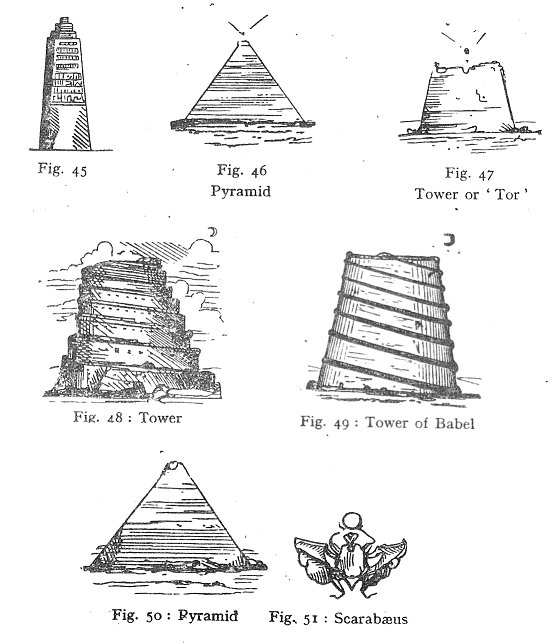
Figs. 45-51 The succeeding array of phallic figures will be found interesting, as tracing out to its progenitor or prototype that symbol which we call the 'upright'. This architectural descent we shall call the 'Genealogy of the Tower or Steeple'. The Architectural Genealogy of the 'Tower' or 'Steeple' (so to speak) is full of suggestion, and is closely connected with the story of the phallus. The insignia on the heads of the cobras in the friezes of the Egyptian Court in the Crystal Palace are coloured on the Right, White, on the Left, Red. These imply masculine and feminine ideas.
Figs. 52-54 Fig. 42 is the Winged Human-headed Lion. It comes from the Nineveh Gallery. It may be recognized as the Winged Bull, and also as the Winged 'Lion of St Mark'. The 'Lion', 'Bull', 'Eagle', 'Man', are the symbols of the Evangelists; the 'Man', or 'Angel' standing for St. Matthew, the 'Lion' for St. Mark, the 'Bull' for St. Luke, and the 'Eagle' for St. John. In these strange aspects the Evangelists figured in many ancient churches, and on most fonts. These representative forms are also said to have been the 'Four Cherubim' of the Ark of the Hebrews. Hermetically they signify the 'four elements', or the four corners or angle-points of the 'Lesser' or 'Manifested World', or the 'Microcosm' of the Cabalists.
Figs. 55, 56 Fig. 45 represents an Obelisk at Nineveh, now in the British Museum. Jacob's Pillar, the Sacred Stone in Westminster Abbey, 'Bethel', etc., 'Gilgal', have a mythic alliance with the obelisk. Regarding the pyramids the following may be advanced: Murphy, the delineator of the Alhambra, considered the Pointed Arch to be a system founded on the principle of the Pyramid. The pointed or vertical Saracenic or Gothic arch presents the form of the upper portion of the human φαλλος. The Saracenic arch denotes the union of the Linga and Yoni. In fig. 56 we have the sun rising from between the horns of Eblis (here taken for the pyramids). This is a poetical superstition of the Arabians, who therefore turn to the North to pray it contradiction to the practice of the Persians, who adore the rising sun. The Arabians avert in prayer from this malific sign of the 'horns', because the sun is seen rising from between them; and when disclosing from between these mythic pillars, the sun becomes a portent.
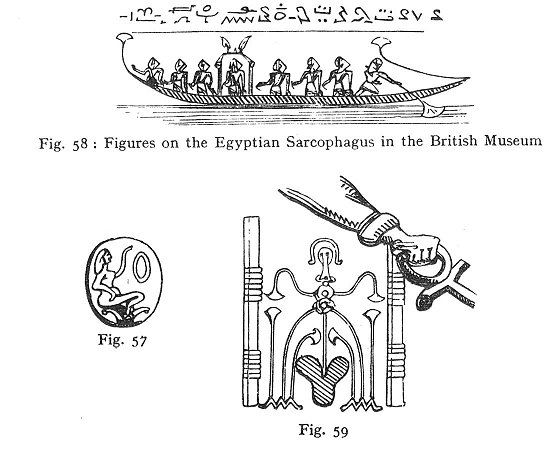
Figs 57-59 Fig. 57 is an Egyptian seal, copied by Layard (Nineveh and Babylon, p. 156). Subject: the Egyptian god Harpocrates, seated on the mythic lotus, in adoration of the Yoni, or הוה, or havah. The Druidical Circles, and single stones standing in solitary places, are all connected with the mystic speculations of the Rosicrucians. The eminences, St. Michael's Mount and Mont St.-Michel, were dedicated by the Phœnicians to the Sun-God (Hercules), as the 'Hydra' or 'Dragon-slayer'. These mounts in the Channel are secondary 'Hercules’ Pillars', similar to Calpe and Abyla.
Figs. 60-62 The Architectural Genealogy of the 'Tower' or 'Steeple' displays other phases of the alterations of the 'upright'. All towers are descendants of the biblical votive stones, and in multiplying have changed in aspect according to the ideas of the people of the country in which they were raised. This Architectural Genealogy of the 'Tower' or 'Steeple' gives many varieties. The groups on p. 244 supply new changes in the Tower or Upright, and furnish evidence how it passed into the Christian times, and became the steeple. When thus changed and reproduced, according, to the architectural ideas of the builders of the different countries. where the same memorial pillar was raised, it assumed in time the peculiarities of the Gothic or pointed style. The steeples of the churches, the figures of which we give on p. 244, indicate the gradual growth and expansion of the romantic or pointed architecture, which is generally called Gothic; and they prove how the upright, or original phallic form, was adopted and gradually mingled in Christian architecture--in reality at last becoming its dominant feature.
Figs. 63-69
Figs 70-75
Figs. 74, 77, 76, 78 Fig. 96 represents one of the Western Towers of St. Paul's Cathedral, London, which is one of the double lithoi (or obelisks), placed always in front of every temple, Christian as well as heathen. It is surmounted by the 'fir-cone' (thyrsus) of Bacchus, and the sculptured urns below it are represented as flaming with the mystic fire. The Architectural Genealogy of the 'Tower' or 'Steeple' in fig. 97, p. 246, exemplifies a parallel of growth between all the uprights, and exhibits their changes of form, and proves their reproduction through the centuries, both in the East, and more particularly in the western countries of Europe. In the lower portion of this fig. 97 we have a further outline-configuration of various towers and steeples, displaying the new character given, and the gradual variations of the 'Tower', in the first instance, and afterwards of the 'Steeple'; both being reproductions of the first idea of the lithos, upright, or phallus: the 'Idol' imitative of the 'Flame of Fire'.
figs. 79-85
Figs. 86-91 The two pillars in fig. 102 are monuments in Penrith Churchyard. These are the familiar double, 'Runic' uprights, pillars, or spires. All the minarets and towers in the East display in the peculiar curves of their summits the influence of the same phallic idea, as an attentive examination will prove. There seems to be little or no reason to doubt that the much-disputed origin of the pointed Gothic arch, or lancet-shaped arch, and the Saracenic or Moorish horseshoe arch, is the union and blending of the two generative figures, namely, the 'discus' or round, and the upright and vertical, or 'phallic', shape, as indicated in the diagrams on pp. 248, 249. These forms, in their infinite variety, are the parents of all architecture.
Figs. 92-96 The Zodiac itself is, in certain senses, a Genesis, or 'History of
Creation'. The 'Twelve Signs' may be interpreted as the 'Twelve Acts' of
the Divine Drama. Some of the Mosques in the East are surmounted with
twelve minarets, and the number twelve occurs frequently in connexion
with the theology of the Moslems.
Figs. 97, 98, 99, 102 The spectator looks to the faces of the figure marked 116. Fig. 117 is a Masonic, Mosaic, or Tesselated Pavement. (Query, whether this pavement of black and white squares is not the origin of the ancient Chess Table, or Chess-Board?) The game of Chess, with the board upon which it is played, is probably 'Masonic' in its invention.
Figs. 100, 101, 103 In old representations of the cathedral church of Notre Dame at Paris, the symbols of the masculine divinity--such as the sun and some others--are placed over the right hand, or masculine western tower, flanking the Galilee, or Great Western Porch; thus unmistakably hinting, its meaning. Over the corresponding left hand, or female tower, are placed the crescent horns of the moon, and some other indications, announcing its dedication to the female deified principle. In all Christian churches--particularly in Protestant churches, where they figure most conspicuously--the two tables of stone of the Mosaic Dispensation are placed over the altar, side by side, as a united stone, the tops of which are rounded.
Fig. 118, on p. 250, represents the separated original 'Lithoi', when united. They then form the 'Double Tables' (or 'Table') of Stone. In the 'Latter'; or 'Christian (+) 'Dispensation', the 'Ten Commandments are over the Altar', composed of the 'Law' (Five Commandments to the Right); and the 'Gospel' (Five Commandments to the Left). The ten commandments are inscribed in two groups of five' each, in columnar form. The five to the right (looking from the altar) mean the 'Law'; the five to the left mean the 'Prophets'. The right stone is masculine, the left stone is feminine. They correspond to the two disjoined pillars of stone (or towers) in the front of every cathedral, and of every temple in the heathen times.
Fig. 109, 111, 114A, 115A The pomegranate is a badge of the Plantagenets; in its form it resembles the crescent moon; it is a symbol of the female influence in nature. There is here an unexpected concurrence with the crescent moon. and star of the Orientals; for above the pomegranate--which is figured sometimes as the crescent moon in the heraldic insignia of the Plantagenets--the six-pointed star appears in the hollow of the crescent, with its points in the curvilinear or serpentine form. The crescent moon of Egypt and that of Persia is the thin sickle of the new moon reclining on her back, and seemingly with the star issuant from between her horns; which is evidently an Egyptian hint coming from the old hieroglyphic times. This mysterious crescent and star is the badge of the sect of Ali among the Mohammedans, and it plays a most important part in augurial or religious heraldry. The standards of Egypt, Persia, and Arabia are gules, or Mars, or the fiery colour. It is the ardent, or masculine, or red colour of Ali. The colours of Turkey, on the other hand, are strictly those of Mohammed, and unconsciously honour the female element in displaying the green, or the vert, or the woman's colour, or Friday colour, that of the Mohammedan Sabbath. This green is the vert, or 'Venus', of Mecca (see page 390). The Turkish standard divides party-per-pale the masculine red of the sect of Ali with the green of the Hadgi; allotting to the former the place of honour, or the dexter side of the emblazonment.
Figs. 116-118 The Christian altar is divided, as a hieroglyphic, into two halves or sides, before which the representative priest extends his hands, standing before it with his right hand (meaning the 'Law') to the right, and his left hand (meaning the 'Prophets') to the left; the first of which signifies the masculine (Jewish), and the second the feminine (Christian--because the Saviour was 'born of a woman'), mystic celestial power. Some monograms or hieroglyphic expressions, meaning the 'Salvator Mundi,' show the Roman letter 'I' (Jesus) in front, in large size; the letter 'H' (which is feminine, and Greek in its origin, meaning here 'Man, as born of Woman') much smaller; and behind, interlacing and combining the first two letters, is the single curved or cursive 'S', which stands for 'S.S.', the Holy Spirit, or the Third Person of the Trinity. The whole, in another way, is 'Jesus Hominum Salvator'. Nearly all the sacred monograms, with the intention of making the letter denoting the 'Man' prominent, present the letter 'I' large; in the heraldic language surtout, or 'over all'. The monogram of the Saviour is sometimes seen in the 'Ark', or 'vesica piscis,' which is a pointed oval figure, familiar in Gothic architecture, and shaped like a boat or a shuttle, counter-changing the letters and the closing arcs, white and black--the black occupying the left or female side according to the ideas of the Templars. The standards of these soldier-monks were white and black, either oblong or forked. There are two columns of that heavy, severe order, however grand and impressive, which distinguishes the early Norman period of architecture in England, in regard to which, though abounding in far-off hermetic suggestions, we have seen no notice in antiquarian quarters. These two columns comprise a part of the colonnade in the White Tower, or central tower, of the Tower of London. The capital of the first column is square, but it is rounded at the angles by a cut to the hypotrachelium, or base-ring, of the capital. The tops of these cuts are formed by volutes similar to the horns of the Corinthian and Ionic capitals. The male volute is to the right, and is a spiral volve, from which issues a dependent budding flower dropping seed. The volve to the left, which is a series of rings enclosing a point, is female. A twisted perpendicular, like a horn, projects from the base on this left side. The capital of the other column presents a not unusual Norman form of two truncated-tables or faces rounded below and divided in the middle. These we interpret as meaning the 'woman' and the 'man', side by side, and left and right. These glyphs in the two capitals of the columns signify 'Jachin' and 'Boaz', and stand for the 'First Man,' and the 'First Woman'. The mysterious letter 'Tau', which is the same as the Runic Hammer of Thor, and which in truth is a 'Cross,' occupies the centre-point, or, heraldically, the 'honour-point', of the first column to the right. The master-masons were celebrated in their art of concealing myths, or hinting them cautiously in the most difficult and far-off resemblances. The curious reader is referred to our illustration, figs. 119, 120. The character of the 'Head' which the Templars were charged with having worshipped in their secret 'encampments', or 'mystic lodges', has been the subject of much dispute. Some say it was the head of Proserpine, or of Isis, or of the 'Mother of Nature' presented under certain strange aspects. Others assert that the figure was male, and that of Dis or Charon, according to the classic nomenclature. The object was reputed to be a talisman, and it is called by some the head of Medusa, or the snake-haired visage, dropping blood which turned to snakes, and transforming the beholder to stone. It was this head, or one of a similar description, which was supposed to serve as the talisman or recognitive mark of the secret fraternity or society, headed by Pichegru and others, which was suppressed by Napoleon, and the members of which were tried and condemned as aiming at revolutionary objects. Why Napoleon adopted this mysterious supposed magical head, as he is said to have done, on the suppression and destruction of this revolutionary body--to which we refer elsewhere--and why he chose to place his own head in the centre-place before occupied by this imagined awe-inspiring countenance, and adopted the whole as the star of his newly founded 'Legion of Honour', it is very difficult to say. In the East there is a tradition of this insupportable magic countenance, which the Orientals assign to a 'Veiled Prophet', similar to the mysterious personage in Lalla Rookh.
|