|
UNHOLY ALLIANCE: A HISTORY OF NAZI INVOLVEMENT WITH THE OCCULT |
|
PART 2: THE BLACK ORDER
6. The Dangerous Element: The Ahnenerbe and the Cult of the SS
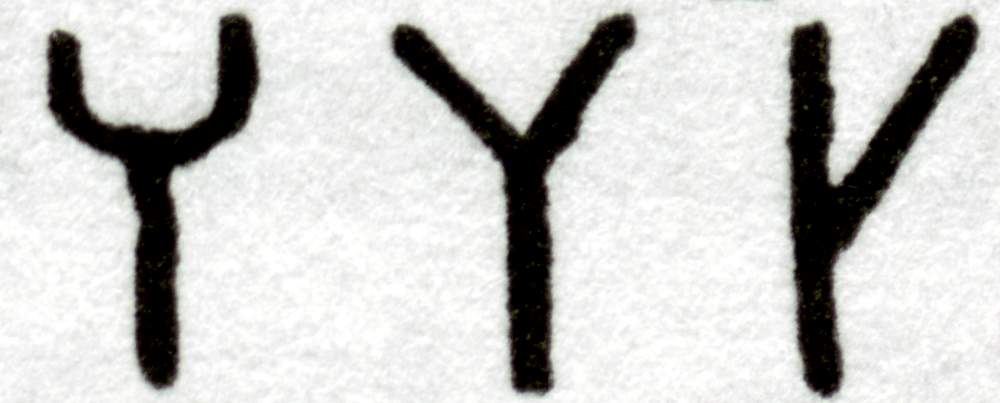
While the Gestapo was busy mopping up cultic opposition to the Third Reich, from Freemasons to astrologers to Thelemites, Himmler was fully engaged in turning the SS into the official state cult, with all the "dangerous elements" that Hider described in the above extract from his table talk concerning Freemasonry. In this chapter, we will not only review the history of this bizarre organization but we will also examine some documents of the Ahnenerbe: the Ancestral Heritage Research and Teaching Society which became incorporated entire into the SS. These documents have never before been published in the English language. Background The SS (initials that stand for Schutzstaffel or Guard Detachment) was originally intended to be Hitler's personal bodyguard. The early history of the Party was such that the SA, or Brownshirts, were really the first shock troops -- "Storm Troopers" -- of the Nazis: brutal enforcers and street gangs in uniform that intimidated the opposition and acted as a kind of private army for the Party (a type of Free Korps, such as that supported by the Thule; indeed the leader of the SA, Ernst Rohm, had been a Free Korps leader well known around Thule headquarters). As the SA grew in importance and size it became an actual threat to Hitler's complete control of the state apparatus. Elements within the Party wanted Rohm out of the way and presented Hitler with enough trumped-up evidence to warrant Rohm's arrest and speedy execution on June 30, 1934. On July 1 the entire SA was to go on a month's holiday to prove that they had no intention to overthrow the government; Hitler's advisers, however, counseled a preemptive first strike against the SA anyway. As we have seen, the bloodletting did not stop with Rohm but was extended to include a wide range of persons and organizations (both of the Left and the Right) deemed hostile to the totalitarian regime Hitler and his disciples had envisioned. It was not the first time, nor the last, that the existence of an alleged conspiracy was used as the excuse for wholesale slaughter. Before this time, the SS functioned as a kind of elite corps of pureblooded Aryan supermen. Himmler joined the SS when it was still a bodyguard unit with no more than about three hundred members and he marched with Hitler's men during the Beer Hall Putsch of 1923, carrying a flag. After he became the head of the SS in 1929, however, he began to reform it along lines that can only be described as cultic, while its membership rose from three hundred to fifty-two thousand by 1933. The very selection of the twin Sig rune as its emblem had its roots in the doctrines of List and Liebenfels. (German typewriters manufactured during the Nazi era included the twin Sig rune as one of their keys.) Even the graves of dead SS men were adorned -- not with crosses or other more traditional tombstones -- but with a German rune symbol (the "mensch" rune) made out of wood. This same rune was used on the cover of the articles of the Lebensborn society, [2] the "human stud farm" operation of the SS, thus making a curious statement about the life and death cycle as perceived by the official pagans of the Reich. Once Rohm was out of the way, however, Himmler came to a position of even greater importance. Eventually even the Secret State Police -- Geheime Staatspolizei, or Gestapo -- came under his jurisdiction, making Himmler one of the most powerful men in Nazi Germany and second only to Hitler himself in authority and enjoying the fear which the black uniforms of his elite SS aroused in the populace. While it is known that he consulted astrologers and was interested in various forms of alternative medicine, alternative science, and alternative religion, what is not generally known is the extent to which the Nazi government became committed to serious support of such practices. Nor is it generally understood just how thoroughly Himmler's eccentric ideas of race, ritual, and mysticism came to infuse the entire Nazi phenomenon, thus coalescing into one of the most dangerous cults in the world. Much of what has been written before on this subject is either unavailable in English or, worse, the stuff of such tabloid-style journalism that serious historians are forced to laugh it off as the result of wild imaginations and the woeful lack of "primary sources." We will attempt to rectify that situation as much as we can in the space allotted us, with constant reference to supporting documentation, beginning in this chapter with the strangest of all modern governmental agencies, the mysterious Ahnenerbe: The Ancestral Heritage Research and Teaching Organization. A Personal Confrontation As I was researching the Ahnenerbe in the files of the Captured German Documents Section of the National Archives, I heard the archivists discussing the current attitude of many Americans toward the Nazis. They were dismayed at the relative lack of sophistication among average Americans when it came to the Third Reich, lamenting the fact that most of us seem to get our information on world history from Hollywood. "The point of view out there is that the Nazi Party was some kind of science fiction fantasy," grumbled one man. The others murmured assent. I thought it was a remarkably perceptive statement coming from these overworked and highly intelligent custodians of one of the world's most important collections of twentieth- century knowledge, and the image stayed with me for a long time. Science fiction. That is how many of us think of the war by now, filtered as it has been through the creative eyes of filmmakers and of the producers of popular television programs for a citizenry that gets most of its information from canned news shows and made-for-TV movies. It's almost as if the Holocaust were a sideshow, something not completely relevant to the tales of Darth Vader-like SS officers in their black uniforms, jackboots, and silver flashes. In fact, how much of the Holocaust ever appeared in such popular television programs as Hogan's Heroes, for instance, which certainly did not glorify Nazism but instead made it seem ridiculous? Certainly, the Indiana Jones trilogy goes a long way toward depicting the Nazis in that "fashion," a situation Jones producer Steven Spielberg has attempted to correct with his more recent Schindler's List. Combing through the files, however, one comes away with a more complex emotional reaction. Of course, there is that perverse initial thrill when one comes across a swastika letterhead for the first time and realizes one is looking at the actual documents of the Third Reich. "My God," you say to yourself. "Here it is. I am looking at history." You realize that you are suddenly a lot closer to the Third Reich than you ever were, and it is not an entirely comfortable feeling. It is as if the printed pages were the spoor of the Beast itself; as if, in reading the lines, you become aware that you are not entirely alone in the forest. H.P. Lovecraft, the brilliant if racist father of gothic horror, depicted the infamous Necronomicon in much the same way, hinting that merely to pronounce the barbarous words would be enough to summon unimaginable evil. But then I spent many long hours of many long days in front of microfilm readers, poring over page after page of official SS documents, diaries, reports, and publications ... and slowly realized that I was becoming numb with a mystifying sense of horror, a horror that was at least partly directed toward myself. For what I saw in those pages was the spoor of the bureaucratic Beast: thousands of pages of boring correspondence, red tape, thank-you notes, official forms, polite inquiries, expense reports. It was like the contents of the file cabinets of any large corporation; like the files of any of the large corporations I had worked for in my time. I recognized the kinds of people who kept those files; I recognized their concerns, their anxieties, their hopes, their fears. I began to identify with the authors and recipients of those letters, the keepers of those files, the meticulous fillers of those forms. And then, almost surrealistically, among the thousands of pages that marched across the magnifying lens of the microfilm reader in blinding profusion, I would come across a single word, buried in a report, a letter, a requisition. Dachau. Auschwitz. Konzentrationslager. Concentration Camp.
And I would feel the breath go out of me. For I was looking at the
records of people like me; people who were working for a large,
bureaucratic organization; people who were thinkers, scholars,
academics. The men of the Ahnenerbe-SS. And as they filled out their forms, wrote their letters, and filed their reports, millions of human beings were being tortured and killed in horrible, unbelievable ways by their coworkers. What Hannah Arendt called "the banality of evil" never came home to me quite so strongly as during the days I sat before the microfilm screen as if it were a magic mirror into the past, and watched people like me make casual, passing references to the death camps. Ancestor Worship So, how to describe the Ahnenerbe? Imagine that the evening adult education program of the New School for Social Research had suddenly become an independent government agency with a budget as big as the Defense Department, with Lyndon Larouche as president and, perhaps, Elizabeth Clare Prophet as the physics chairperson. Or maybe the summer session at the University of California, Berkeley, had become militarized and all the students had immunity from prosecution for any crime they had committed, or would ever commit, and could conduct any form of independent study they liked as long as they wore their black uniforms with the silver death's head insignia at all times and swore an oath of personal loyalty to the dean. Then one might have some idea of what the Ahnenerbe was, and of the type of people it first attracted to its ranks. It was a humanities program. With guns. Some traditionally trained historians might find levity a trifle out of place in a study of one of the most heinous "academic" and "research" institutions ever created in the twentieth century, but if anything combines both unimaginable horror and sadism with a pose of sophisticated scientific method as it was applied to some of the most ridiculous and unfounded "scientific" theories ever concocted, it was Himmler's dream agency, the Ahnenerbe-SS. The roots of the Ahnenerbe are a tangled snarl of various special interests. Depending on the source consulted, it was either founded by Himmler and the Nazi "eternal pagan," ideologue Richard Walther Darre, in 1935, [3] or it had existed before that time as an independent institute and was only absorbed into the SS much later. [4] Whatever source is considered the most reliable, one thing is certain: the Ahnenerbe was not founded as an SS unit. Something calling itself the Ahnenerbe Society ("an association for clan- and heraldry-research assistance, heredity science and race-cultivation") had existed as early as 1928. [5] But on the first of July, 1935, a "Deutsches Ahnenerbe Verein" was formally established in Berlin by Heinrich Himmler and Hermann Wirth, along with some associates of Darre. [6] According to documents available to the Nuremberg Tribunal, it was formally incorporated within the SS only on April 1, 1940, even though for years previously its leadership was largely composed of both honorary and career SS officers. Indeed, according to the available records it is obvious that Wolfram Sievers already held the position of Reichsgeschaftsfuhrer, or Reich's Manager, of the Ahnenerbe with a rank of Obersturmfuhrer-SS by 1937 [7] and had been associated with the Ahnenerbe as early as August of 1935. [8] So Sievers's insistence that it only became part of the SS in 1940 is disingenuous, to say the least. In any event, the Ahnenerbe existed as an independent agency prior to its incorporation into the SS and may have had its earliest roots as a research bureau formed by a number of German intellectuals (and outright occultists, like the Atlantis buff Hermann Wirth) who had been inspired both by the works of the volkisch writers of previous years and by the exploits of a generation of romantic adventurers and amateur archaeologists and anthropologists, a generation that included Wolfram Sievers's defense witness Friederich Hielscher, and the internationally famous Swedish explorer Sven Hedin. Hedin, a native of Stockholm, left Sweden in 1885 at the age of twenty on his first trip abroad, to Baku on the Caspian Sea. From that time on, Hedin managed to visit most of Asia from the Caucasus to the South China Sea, but with a special emphasis on Tibet. In 1925 (at the age of sixty) he published a memoir of his travels -- My Life as an Explorer -- which was very well received in Europe and America, as were other travel books he had written on Tibet and China. (As previously noted, at least one of these was in Hitler's small collection of books in his early, pre-Putsch Munich apartment.) [9] Hedin's tales of trekking through snow-choked Himalayan passes in search of fabled Asian cities while both camels and guides perished in grisly profusion along the route contributed to the general fascination the public had for anything to do with the mysterious East, a fascination due at least in part to the writings of Mme. Blavatsky and her followers in the Theosophical Society, who saw the East (and particularly India and Tibet) as the repository of arcane knowledge hidden from the rest of the world for centuries. The Germans could not help but be charmed by Hedin's accounts of his adventures in Asia. In My Life as an Explorer he describes his discovery of the ancient Chinese city of Lou-lan in the Taklimakan Desert, and of the artifacts he uncovered there which included an ancient, swastika-decorated rug nearly two thousand years old along with some of the earliest examples in the world of writing on paper. What must have bothered at least some of his volkisch audience, however, was his statement that "... not a single one of our ancient Swedish runestones is older than the fragile wooden staffs and paper fragments that I found in Lou-lan." [10] Heresy! (Hedin revisited Lou-lan in 1934, at the ripe age of sixty-nine. Now, in the years since the Chinese Revolution, the entire area has become a restricted military zone where atomic testing is carried out and Lou-Ian is lost once more to the shifting desert sand.) There is evidence to suggest that the Ahnenerbe itself was formed as a private institution by several friends and admirers of Sven Hedin, including Wolfram Sievers (who would later find justice at the Nuremberg Trials) and Dr. Friedrich Hielscher who, according to the records of the Nuremberg Trial of November 1946, had been responsible for recruiting Sievers into the Ahnenerbe. [11] In fact, there was a Sven Hedin Institute for Inner Asian Research in Munich that was part of the Ahnenerbe [12] and as late as 1942 Hedin himself (then about seventy-seven years old) was in friendly communication with such important Ahnenerbe personnel as Dr. Ernst Schafer from his residence in Stockholm. [13] Moreover, on January 16, 1943, the Sven Hedin Institute for Inner Asian (i.e. Mongolian) Research and Expeditions was formally inaugurated in Munich with "great pomp," a ceremony at which Hedin was in attendance as he was awarded with an honorary doctorate for the occasion. [14] It has even been claimed that Sven Hedin and Karl Haushofer were friends, a claim that is not completely unlikely as the two had spent considerable time in the Far East during the same period: Hedin as an explorer and sometime ambassador-at-large for the Swedish government, and Haushofer as military attache for the Germans. Given Haushofer's excessive interest in political geography and his establishment of the Deutsche Akademie all over Asia (including China and India, Hedin's old stomping grounds), it would actually be odd if the two hadn't met. Later, as the Ahnenerbe was formally absorbed into the SS and made an official agency of the Reich, Hedin still maintained contact with all his old friends there even though, by 1942 and 1943, the Ahnenerbe was steeped in the blood of projects that would earn its director, Wolfram Sievers, the death sentence. Indeed, by 1941 it was already clear that Haushofer's Deutsche Akademie and Sievers's Ahnenerbe were virtually parallel organizations. Letters and newspaper clippings from that period -- including Deutsche Akademie correspondence seized after the war -- show that Dr. Walther Wiist, who was the "Humanities" chairperson at the Ahnenerbe and, with Sievers, part of its ruling administration, was also acting president of the Deutsche Akademie. [15] As the Ahnenerbe was also at this time an agency of the SS, Professor Wust -- Rektor of the University of Munich and an expert on Sanskrit, the Aryan Ur- tongue -- enjoyed the dubious distinction of the SS rank of Oberfuhrer, or Brigadier. And both organizations had made their field trips to the one place on earth whose name has become an epithet ... Dachau. [16] The Middle Point of the World Once Himmler was fully in control of the SS, he began its transformation into a pagan religious order. The headquarters for this cult was situated at the medieval castle of Wewelsburg, near the towns of Paderborn and Detmold in the German province of Westphalia, close by the site in the Teutoburg Forest where Arminius made his stand with its famous, Stonehenge-like stone monument known as Externsteine.
Contrary to the flashy show enjoyed by so many other Nazi leaders -- such as the irrepressible Goring -- Himmler kept his Order Castle extremely private. No one was allowed inside who was not expressly invited by Himmler himself; thus, only the Inner Twelve and occasionally a select general or two, a Reichsleiter, or some other official would be welcomed, but only at Himmler's convenience. Secrecy was the key element in the SS and most especially at Wewelsburg.
Underneath the dining hall with its Round Table in a sunken chamber was to be found the "realm of the dead": a circular room which contained a shallow stone well. In this well, the coat of arms of the deceased "Knight" of the Black Order was to be ceremoniously burned. [19] Each of the Inner Circle of Twelve had his own room, decorated in accordance with one of the great ancestors of Aryan majesty. In Himmler's case, his room was designed to reflect his hero, King Henry the Fowler, a Saxon king responsible for the first German "Drive to the East." Although some writers have argued that Himmler saw himself as King Henry's reincarnation, there is also testimony that he admitted to speaking with the dead king's ghost at night. In any event, Himmler created the King Heinrich Memorial Institute in 1938 in Quedlinburg as yet another boondoggle, this one devoted to the revival of the king's spiritual legacy. It was within the great dining hall with its Round Table that Himmler and his Inner Circle of Twelve Gruppenfuhrers would engage in mystic communication with the realm of the dead Teutons and perform other spiritual exercises. [20] During an investigation of the commander-in-chief of the (regular) German Army, General von Fritsch, for "serious moral offences" (a charge later found to be a mistake resulting from a similarity in name between the general and a cavalry officer), Foreign Intelligence Chief Walter Schellenberg observed Himmler and his "Round Table" involved in one of these "spiritual exercises":
SS men were discouraged from participating in Christian religious ceremonies of any kind and were actively encouraged to formally break with the Church. New religious ceremonies were developed to take the place of Christian ones; for instance, a winter solstice ceremony was designed to replace Christmas (starting in 1939 the word "Christmas" was forbidden to appear on any official SS document) and another ceremony for the summer solstice. Gifts were to be given at the summer solstice ceremony rather than at the winter solstice, and a special factory was established for the manufacture of appropriately Aryan tschochkes. (A possible, though by no means documented, cause for this switch of gift-giving to the summer solstice is the death of Hitler's mother on the winter solstice and all the grief and complex emotions this event represented for Hitler. It's understandable that Hitler -- as the Fuhrer and at least nominally in charge of the direction the new state religion would take -- would have wanted to remove every vestige of "Christmas" from the pagan winter solstice festival. As a means of denying his grief? Or as an act of defiance against the god whose birth is celebrated on that day, a god who robbed Hitler of his beloved mother? It's worthwhile to note in this context that for a national "Day of the German Mother" Hitler chose his own mother's birthday.) These ceremonies were replete with sacred fires, torchlit processions, and invocations of Teutonic deities, all performed by files of young, blond-haired, blue-eyed Aryan supermen, ceremonies that, according to my informants, had been revived in the Andean mountains (a site sacred to the Nazi Horbigerians, of whom more later), at Colonia Dignidad in the 1960s and which were still being performed there as late as my trip in 1979. (It is ironic that the establishment of Christmas on December 25 was itself an attempt of the Church to identify the birth of Jesus with the winter solstice ceremonies of the pagans since Christ was most probably not born in December at all; hence, all Himmler was doing was reinstating a holiday that the Christians themselves had usurped for their own purposes, as indeed the rune manuscript -- quoted below -- suggests. And so it goes.) Weddings and "christenings" (especially at the Lebensborn communities) were replaced by pagan SS rituals, [22] and, gradually, the entire Christian liturgical rubric was in the process of being replaced by a completely pagan version. Even the Hitler Youth were not immune. A so-called "Nazi Primer" published during the war contains many examples of pagan ideology and anti-Christian sentiment designed for its youthful readership. [23] Even the selection of Wewelsburg as the cult center was far from accidental. According to Teutonic legend, an apocalyptic battle would be fought in that area between the forces of East and West, and the Eastern hordes would be defeated by a mighty storm. Himmler -- who highly valued such old German myths -- evidently believed he would have a ringside seat at the conflagration that would consume his enemies. Paderborn and Detmold were also important archaeological sites in the view of the Ahnenerbe, for they contained important relics of Germany's ancient glory. It was even bruited about that the Nordic World-Tree -- Yggdrasil -- had its roots in that region on the border of Westphalia and Lower Saxony and might still be located, perhaps at the Externsteine site. A typescript copy of an article that appeared in a monthly called Lower Saxony in 1903/1904 was preserved in Ahnenerbe files. Devoted to this pagan cult center located in the same region as Wewelsburg, it refers to the summer solstice celebrations that took place there as late as the middle of the nineteenth century: [24]
The summer solstice festival, of course, was kept sacred by the Nazis and, as we have seen, was the occasion of the "human sacrifice" of Walther Rathenau. But to tie in this prehistoric monument to twentieth century Aryan mysticism, the author -- one A.E. Muller -- goes on to say:
Muller goes on to describe how images of a human couple seen within the form of the root of the World-Ash, Ydragsil (sic), and embraced by the Serpent, Nidhogur (the symbol of a devouring Death), were used by the Church to substantiate its own legend of the "Biblical- Babylonian legend of the first human couple, Adam and Eve, and their fall into sin as a result" of the Serpent. Muller complains that the essentially pagan iconography of the four Norns and associated images were co-opted by the Church into representing other Biblical stories and that the whole monument was exploited for the purposes of converting the pagan population of Lower Saxony to that Semitic interloper, Christianity. Concerning the cultic significance of Paderborn itself, we may refer to a letter addressed to Wolfram Sievers by one Von Motz that is to be found in the Ahnenerbe files. Dated January 29, 1937 -- from Detmold no less -- the author begins by referring to a recent issue of the official SS magazine, Das Schwarze Korps:
These are motifs which we find throughout the volkisch and occult impulses in Nazism: that the serpent, which represents Satan to Christians, was considered a sacred symbol for the Aryans; and that "Rome and Judah" shamelessly exploited the suffering of their own people by depicting them as heroes or as vanquishers of evil through their agonies (thus reinforcing weak, non-Aryan suicidal tendencies among the oppressed populations of Europe). In a related context, Himmler -- in conversations with Schellenberg -- also discussed such subjects as European witchcraft and the Holy Inquisition at length. Himmler evidently subscribed to the belief -- made popular across the Channel by British anthropologist Margaret Murray in The Witch Cult in Western Europe (1921) and The God of the Witches (1933) -- that the medieval witches burned at the stake by the Church were pagans; he particularly stressed the fact that "so much good German blood" was "stupidly destroyed" when thousands of German witches were murdered by the Inquisition. [26] If it seems odd to the reader that the man who ordered the destruction of millions of Jews and Gypsies would decry the mass murder of pagans by the Church, then he or she may be assured that they are in good company. Particularly as Himmler -- like Lanz von Liebenfels before him -- actively admired the organization, ritual, and mystique of the Church while denouncing its most cherished beliefs:
One of the books recovered from the so-called Hitler Library at Berchtesgaden after the war comes under the heading of "pagan rituals," and deserves a brief mention here. Of the some two thousand volumes that were recovered (and which are now stored in the Rare Book Room of the Library of Congress in Washington, D.C.) many were of the occult sciences. One in particular concerns us at the moment, and that is Das Buch der Psalmen Deutsch: das Gebetbuch der Ariosophen Rassen-mystiker und Antisemiten. This can be translated as The Book of German Psalms: The Prayerbook of the Ariosophist Race-Mystics and Anti-Semites. It was written by none other than our old friend, Lanz von Liebenfels, he of the Order of New Templars, and is nothing less than a hymnal of hate, a "prayerbook" that proudly calls itself "anti-Semite." To give the reader an idea of what, typically, the Ahnenerbe thought valuable and worth salvaging in the spiritual legacy of the world, one only has to glance down the list of works cited in Tod und Unsterblichkeit im Weltbild Indogermanischer Denker (Death and Immortality in the Indo-Germanic Thinker's Worldview) coauthored by R. Schrotter and Ahnenerhe Kurator Walther Wust and published in Berlin in 1938, bearing a foreword by Himmler. This official Deutsches Ahnenerbe publication contains appropriate quotations from the Vedas, the Upanishads, and the Bhagavad-Gita but doesn't stop there. It goes on to include everyone from Homer, Socrates, Plato, Cicero, Seneca, Marcus Aurelius, and Empedocles to the Eddas, Meister Eckhardt (the darling of the Pan-German mystics), Jacob Bohme, one of Dietrich Eckart's favorite philosophers Angelus Silesius and Giordano Bruno (who was burned at the stake by the Inquisition for his heretical -- mystical -- views). The collection also contains selections from Omar Khayyam and that other Persian philosopher-poet Rumi. This amounts to nothing less than a Nazi "canon" of important and accepted texts, appropriate for meditational reflection by prospective SS recruits and the general public alike. Of course, neither the Old nor the New Testament appears in the above collection. *** It was not enough for the Nazis to assume a pagan stance; they had to prove that it was historically justified. Himmler wanted nothing so much as to be able to prove to the world that his personal idiosyncracies were the stuff of reality. In order to do this, he enlisted the help of an organization that, by its very name, was devoted to restoring the ancient knowledge of the Aryan forefathers to contemporary awe: the Ahnenerbe Forschungs-und Lehrgemeinschaft: the Ancestral Heritage Research and Teaching Society. Himmler gave the Ahnenerbe official status within the Reich in 1935 (thus protecting it and its members from the spate of new laws that were designed to ban occult-related activity); in 1940 it became a formal division of the SS. With over fifty separate sections devoted to a wide range of scientific and pseudoscientific research, the Ahnenerbe became a boondoggle for Nazi scholars of every description. There was a Celtic Studies group within the Ahnenerbe; a group to study the Teutonic cult center Externsteine (near Wewelsberg), which as we have seen was believed to be the site of the famous World- Tree, Ydragsil or Yggdrasil; a group devoted to Icelandic research (as the Eddas were sacred to the Teuton myth, and since Iceland was considered to be the location of Thule itself); a group that was formed around Ernst Schafer and his Tibet expeditions; a runic studies group; a "World Ice Theory" division; an archaeological research group that scoured the earth for evidence of Aryan presence in lands as remote from Germany as the Far East and South America (an idea possibly inspired by the writings of Blavatsky and by contemporary research "proving" that the Aryan Norsemen had discovered America hundreds of years before Columbus); the list goes on and on. [28] In fact, it was just such a servant of the Ahnenerbe, SS-Obersturmfuhrer Otto Rahn, who credited the belief of some Nazis that even Latin America held promise as a land of the Aryans, a view sacred to contemporary Chilean author Miguel Serrano. In Rahn's book Lucifer's Servants he describes a Mexican legend concerning the mystical Thule:
That "ilk," of course, is the Catholic Church. Ironically, it would be Rahn's organization that would most permanently be identified with dishonoring the face of the Earth with filth and horror; for it should be remembered that this was the same organization that commissioned the infamous medical experimentation taking place at Dachau and other camps; an agenda fully consistent with the Ahnenerbe's program of "scientific" research. There has been no complete and comprehensive study of the Ahnenerbe in English so far, and we will not attempt to do so here. However, let us examine several of the separate sections of this eerie operation by studying the documents that were saved from destruction after the war. By doing so, we will find that the Ahnenerbe is really the best evidence we have that the SS was a fully constituted cult. If the SS was Himmler's pagan answer to the Jesuits -- as has been suggested many times, and by the Nazis themselves -- then the Ahnenerbe was a kind of seminary and teaching college for the future leaders of the Thousand Year Reich. The Rune Scholars Among the documents that comprise the Ahnenerbe collection at the National Archives is an undated manuscript that was evidently intended to accompany Himmler's most famous "Christmas" gift: the red clay candlestick that was to be burned on the night of the winter solstice by all faithful SS leaders. There is no space here to quote the document completely, and indeed it was meant to accompany some ninety-three illustrations which have not survived with the document. However, parts of this interesting work are worthy of translation here as they represent nothing less than a complete introduction to the subject of runes, from the point of view of a Nazi scholar working for the Ahnenerbe-SS. The document begins:
It is worthwhile to point out that the use of the word "Germania" refers to the ancient Teutonic kingdom and not to Germany proper, which is referred to as Deutschland in the original. The anonymous author then goes on for thirty-five, single-spaced pages to describe not only the candlestick itself but the whole history of the runes, and does not resist taking a few potshots at Christianity in the process. Some of this will be incomprehensible to those not well versed in runic symbols, but a few paragraphs will give one a taste of the type of scholarship-cum-ideology that is the hallmark of Ahnenerbe publications:
The hagal rune had a life of its own, of course. It became the title of a runic magazine published by Rudolf John Gorsleben, a friend of Dietrich Eckart and onetime lecturer at Thule Society headquarters in Munich and later managed by Werner von Bulow after Gorsleben's death in 1930. (Gorsleben had served during the First World War with a Turkish regiment in Arabia, and thus was probably on the receiving end of the Arab forces under that brilliant military strategist, T.E. Lawrence.) The hagal rune -- which is really an asterisk -- accumulated a wealth of mystical and magical associations under Gorsleben's "scholarship." It became the mother of all runes, as each of the individual runes could be discovered hidden within it. To Gorsleben, the hagal rune signified nothing less than a mystical diagram for attaining unity with God. [30] It is also owing to Gorsleben that we first encounter an occult tradition concerning crystals, something that is enjoying a rebirth among the New Agers of today. Later, concerning a different rune we read:
The "All-Father" is, of course, a Teutonic pagan term for God. It may be remembered that Sebottendorff's secret Order was called the Germanenorden All-Father And The Holy Grail, and that Sebottendorff's Order publication was (under the influence of Gorsleben and other Aryan cultists) entitled Runes. Further along, we find a slanting attack on the Church:
Much of the foregoing would find a respectable home in any New Age or pagan publication today. Much of it is familiar to students of mythology and the occult. But as we wind up the Odinist ferverino, we once again come crashing into a reminder of just who is writing this thesis, and why:
One can see how these "lapsed Catholics" still needed their dose of saccharin-sweet sentiments and sloppy poetry to get them through the night. The difference was the projection of the Catholic Church -- poisoned by the Jewish Satan, Jehovah, and corrupted from a pure, Aryan version of an ancient deity, Krist -- as one aspect of the enemy against which they were finally rebelling. One could offer some armchair psychology on this point, that the repressive sexual, social, and moral environment of Roman Catholicism contributed to this tremendous backlash against anything Christian; that it was necessary to deny the basic tenets of Christianity in order to wreak unspeakable havoc on the Jews; and that there were enough Catholic priests and bishops around to accommodate the Nazis -- sometimes eagerly -- that the SS must have felt they were on the right track, anyway. But if Rome was not the spiritual homeland of the Race, where were the occult secrets really being kept? The Iceland Project As we have seen, the Nazis viewed Iceland as the last surviving link to their ancestral homeland, Thule. This was an inheritance from their Ascended Master, Sebottendorff, who understood Ultima Thula, the famous destination of Pytheas in the fourth century BC, to be identical to Iceland. For them, Thule corresponded to their own Atlantis myth; while the rest of the human race might have descended from monkeys, the Nazis were convinced that the Aryan race descended from heaven. (Hence that discussion of the Mensch and Hagal runes as symbolic of a "descent from heaven" of the real "Menschen," the Aryan Man.) They believed that the Icelandic Eddas contained secret keys to their own history, and that possibly more clues still existed on that tiny republic in the form of dolmens, ancient caves, and prehistoric monuments, etc. To galvanize support for a pan-Nordic union against the subhumans, they arranged for the formation of something called the Nordic Gesellschaft, or Nordic Society: an organization headquartered in Lubeck that was a pet project of mystic race theorist Alfred Rosenberg, by now a Reichsleiter and member of Hitler's innermost circle. Year after year Rosenberg would address this society composed of members from Finland, Sweden, Norway, Denmark, and, of course, Iceland to warn them of the immediate danger to the "white race" coming from the East, and of the essential unity of the Nordic peoples -- based on race and mystic ancestry -- demanded by the combined Soviet, Jewish, and Masonic threat. To get an idea of who attended such meetings and of what was discussed, we only have to read an article in the official Nazi newspaper, Volkischer Beobachter, concerning one such event, attended by both Rosenberg and Soil-Mystic Darre (a cofounder of the Ahnenerbe):
The Nordic Gesellschaft even made the ailing Dr. Alfred Ploetz -- founder of the Institute for Race Hygiene and the Nazis' most prestigious (if rather reluctant) race theorist -- an honorary member about a year before he died. [33] Thus were the worlds of "scientific racism" or Social Darwinist eugenics and mystical Nordic paganism and anthropology linked, and to them both the political agenda of the Third Reich, which involved not only Lebensraum and a "drive to the East" but also the extermination of the indigenous populations of the Eastern countries. That Rosenberg and Darre would both attend these meetings is significant, for these men were the premiere pagans in Hider's inner circle. Where Himmler wished to surround himself with the trappings of a twentieth-century secret society based partly on the Jesuits, partly on the Masons, and partly on the Templars, Rosenberg and Darre eschewed secret societies and occult lodges for a more general, more popular state-organized pagan religion designed to replace Christianity forever. While Himmler shared these ideas to a large extent, he was not likely to be seen stumping town to town for state paganism. He wanted to conduct his rituals in secret, far from the prying eyes of the profane. Thus, while Rosenberg and Darre were doing their best to create the illusion of a pan- Nordic community, Himmler was authorizing missions to Iceland -- under Ahnenerbe auspices -- to search for pagan relics. Thus we read -- in a document addressed to the Ahnenerbe from Dr. Bruno Schweizer at Detmold, dated March 10, 1938 -- of a proposed research trip to Iceland that summer:
The following year, Dr. Schweizer proposed the creation of an Icelandic-German dictionary to help those future Nazi "researchers" in their endeavors, and was joined in this concept by other men of science. It is not known just to what extent the Icelandic people welcomed this quiet invasion of German scholars bent on performing "race measurements" on their citizens, or photographing valuable museum pieces for possible later, ah, "acquisition." Surely, the SS would have considered anything Aryan in the Icelandic museums as fair game for export, objects for further study and for research into their Aryan forebears. But Iceland -- Ultima Thule -- was not the only piece of real estate to which the Nazis associated a peculiar Aryan heritage. One of the most important was that sad and bleeding country that has not stopped hemorrhaging since the early days of the Second World War and whose destiny has become such a matter of international publicity and concern. We are speaking, of course, of Tibet. The Tibet Expedition
One of the more controversial stories circulating about the occult activities and interests of the Third Reich concerns Tibet. Much is made of the Nazi-Tibet connection in Pauwels and Bergier's Morning of the Magicians (Le matin des magiciens), a sixties international bestseller whose sometimes outrageous claims of magical forces and sinister conspiracies overshadowed a more serious message that discovers in the occult underworld of the Third Reich the seeds of a spiritual crisis about to be born. It was therefore with some skepticism that the author approached the vast microfilmed records of the Captured German Documents Section of the National Archives to see whether or not there was evidence for such a mysterious "connection," and was rewarded by the discovery that several complete rolls of microfilm -- representing hundreds of pages of documents -- record nothing but the efforts and adventures of the SS-Tibet Expedition led by that tireless promoter of Tibetology in all its forms, Dr. Ernst Schafer of the Ahnenerbe. [36] What is even more striking is that the records contain not only Schafer's personal and official correspondence, his Tibet notebooks, and his personal SS file, bur also clippings from German newspapers chronicling the "SS-Tibet Expedition" in all its glory. [37] What is compelling in these records is the day-to-day story of Schafer's struggle to get his various expeditions off the ground: searching for the funding, permissions, and support from the Nazi government that were not always forthcoming. It would seem that Schafer's primary goal in trekking through the Himalayas was more scientific in nature -- and hence of less immediate value -- than the Reich leadership was willing to accommodate. After all, much of Schafer's reporting has less to do with concerns of a military value than it does with the flora and fauna of this inaccessible land. Schafer's academic credentials were in zoology and botany, with some courses in geology, geography, and ethnology. He seems to have been marching in Sven Hedin's footsteps and was indeed for a time the head of the Sven Hedin Institute, the organization based in Munich that also became a "Reichs Institute" and eventually a separate section of the Ahnenerbe SS. [38] As mentioned earlier, the files also contain correspondence from Hedin to Schafer as late as July 27, 1942, in which Hedin signs himself as Ihr treu und aufrichtig ergebener ("Your faithful and sincerely devoted ...") [39] after forwarding greetings from his sister, to Schafer's wife, and to the Kurator of the Ahnenerbe, Dr. Wust. Schafer's SS personnel file shows one trip to East and Central Tibet from 1934-1936 and another to Tibet (the official SS-Tibet Expedition referred to in the press) from April 1938 to August 1939 ... in other words, during the period of the so-called "phony war" that predated the invasion of Poland in September of 1939. [40] Thus, we cannot rule out the hypothesis that Schafer was involved in something more than butterfly gathering in this historic (and official) trek to the Himalayas at a time of great international crisis and global tensions. To be sure, Schafer was not back in Germany two months before preparations were being made to organize a Tibetan-North Indian strike force to oust the British from their rule in India. [41] Ernst Schafer was born in Cologne (Koln) on March 14, 1910, the son of an important industrialist and director of the Phoenix Rubber Company, and attended school in Heidelberg and Gottingen before becoming part of a Tibet expedition organized by the Academy of Natural Sciences in Philadelphia in 1930, when Schafer was only twenty years old. He then became a member of the American Brooke Dolan expedition to Siberia, China, and Tibet in 1931. [42] In 1933, Hitler became chancellor of Germany and it appears as if Schafer was one of the "March violets" who got on the Nazi bandwagon after Hitler consolidated his political power that spring. His membership number in the Nazi Party was 4690995, and his personnel record shows membership in the SS as beginning in the summer of 1933, rising in rank to Untersturmfuhrer in 1936, Obersturmfuhrer in 1937, Hauptsturmfuhrer in 1938 and finally to Sturmbannfuhrer in 1942. He had also been awarded the coveted Totenkopfring, or Death's Head Ring, which was the rune-inscribed piece of SS jewelry designed by volkisch occultist Karl Wiligut (described in the following chapter on Otto Rahn), and was a member of Himmler's Personal Staff (as was Wiligut). All of this is mentioned to demonstrate that Dr. Schafer was nothing if not the ideal SS man, at least on paper. The orders raising him in rank were signed by Himmler, and his fiancee had to undergo the usual investigation of her racial background as the prospective spouse of an SS officer. (They were married -- evidently with the blessing of the Reichsfuhrer-SS -- in December of 1939, and were busy dutifully producing Aryan offspring; three daughters by 1944.) But as an academic, Schafer's published works include -- according to his SS dossier -- Berge, Buddhas und Baren (Mountains, Buddhas and Bears oh my!), Unbekanntes Tibet (Unknown Tibet), and Dach der Erde (Roof of the World). Among his articles can be found this typical one in English: "Four New Birds from Tibet" in the 1937 Proceedings of the Academy of Natural Sciences, Philadelphia. So, Ernst Schafer was also a scientist who published regularly in respected journals on his discoveries, and an explorer who emulated the master, Sven Hedin, by writing books about his travels in the mysterious East. Thus, we have established that Dr. Schafer was a man of many parts: one part SS officer and one part scholar, one part explorer and one part scientist: a Nazi Indiana Jones. Schafer was a career scientist who does not seem to have been interested only in the possible military potential of his travels in Tibet but kept meticulous notes on the religious and cultural practices of the Tibetans, from their various colorful lamaistic festivals to Tibetan attitudes toward marriage, rape, menstruation, childbirth, homosexuality (and even masturbation). For instance, in his account of Tibetan homosexuality he goes so far as to describe the various positions taken by older lamas with younger boys and then proceeds to inform his audience how homosexuality played a significant role in the higher politics of Tibet. [43] One wonders how Schafer was privy to such intimate detail of Tibetan sexual practices, and then comes across a report by SS-Obersturmfuhrer and filmmaker Ernst Krause (who was part of the SS-Tibet Expedition of 1938-39) dutifully recording his personal observation of a fifteen-year-old Lachung girl masturbating on a bridge beam. [44] (It is not known whether Krause took advantage of this opportunity to film this particular episode, but the author was startled to discover that a collection of his film clips -- silent, black and white -- have survived and may be viewed at Tibet House in New York City in VHS cassette format; certainly this is one of the most intriguing video documents of the Third Reich.) There are pages of such careful observation of the local people engaged in a variety of intimate acts that would otherwise have been performed privately had it not been for the ever-present and watchful eyes of the Master Race. Happily, not all of Schafer's observations were of the sexual habits of the Lachung and other Himalayan peoples, nor of the flora and fauna, as the following article from the Nazi Volkischer Beobachter of July 29, 1939, relates:
And an article from Der Neue Tag dated July 21, 1939, is even more informative: [46] Sacred Tibetan Scripture Acquired by the Dr. Schafer-Expedition on Nine Animal Loads Across the High-Country (SPECIAL) FRANKFURT-20 JULY The Tibet Expedition of Dr. Ernst Schafer, which during its expedition through Tibet stayed a long time in Lhasa and in the capital of the Panchen Lama, Shigatse, is presently on its return trip to Germany. Since the monsoons began unusually early, the return march of the expedition was hastened in order to secure the shipment of the precious collections. The expedition has singularly valuable scientific research results to inventory. In addition to outstanding accomplishments in the areas of geophysical and earth-magnetic research they succeeded in obtaining an extra rich ethnological collection including, along with cult objects, many articles and tools of daily life. With the help of the regent of Lhasa it was Dr. Schafer who also succeeded in obtaining the Kangschur, the extensive, 108-volume sacred script of the Tibetans, which required nine animal loads to transport. Also especially extensive are the zoological and botanical collections that the expedition has already shipped, in part, to Germany the remainder of which they will bring themselves. The zoological collection includes the total bird-fauna of the research area. Dr. Schafer was also able, for the first time, to bag a Schapi, a hitherto unknown wild goat. About 50 live animals are on the way to Germany, while numerous other live animals are still with the expedition. An extensive herbarium of all existing plants is also on its way. Furthermore, valuable geographical and earth-historical accomplishments were made. Difficulties encountered due to political tensions with the English authorities were eliminated due to personal contact between Dr. Schafer and members of the British authorities in Shangtse, so that the unimpeded return of the expedition out of Tibet with its valuable collections was guaranteed. No further mention is made of the sacred scriptures, the Kangschur, which is the core document of Tibetan Buddhism, and I have been unable to discover what happened to it after the war, though (for reasons too complex to discuss here) I suspect it wound up in a museum in Vienna. (It is worthwhile noting that nowhere in the abovementioned article does the term "SS" appear, or "Nazi." Der Neue Tag was a newspaper published in Prague, and the article was printed only two months before Blitzkrieg began. In an identical article published the following day in the Hannoversches Tageblatt -- a German newspaper -- the missing "SS" in "SS-Tibet Expedition" is faithfully restored.) Sadly, a search of other articles from the same period do not reveal the disposition of the 108 volumes of sacred scripture. An interesting aside to this story of the official SS expedition to Tibet is revealed by a list of the expedition members. They include one Dr. Bruno Beger, an anthropologist. Later, Dr. Beger would become better known as one of the scientists who -- working for Professor Hirt of the Ahnenerbe -- was involved in the collection of 115 human skeletons at Auschwitz for inclusion in a Nazi Anthropological Museum. [47] Assisted by one Dr. Fleischhacker, Beger selected the skeletons while their owners were still alive as Jewish, Polish, and Asiatic prisoners of the death camps. The "specimens" were then murdered at Natzweiler concentration camp in such a way as to avoid damaging the skeletal material and their bodies were shipped out for scientifically managed decomposition. Beger's "mentor" according to interviews with other Nazi scientists was the same Dr. Ernst Schafer, [48] and Beger even provided Schafer with a collection of Asian skulls while he was collecting over a hundred "Jewish Commissar" skulls for the Berlin Institute. Another colleague of both Beger and Schafer was the botanist, Dr. Vollmar Vareschi, whom we find at the Sven Hedin Institute in Munich when he isn't attending lectures with his friends on various pseudoscientific topics. [49] Dr. Hirt himself was also involved in the notorious study of the effects of mustard gas on yet another 150 prisoners at Natzweiler. Much has been made of this expedition, and elsewhere it has been suggested that the "earth-magnetic" and "geophysical" studies -- undertaken in the inhospitable terrain of the Himalayas during a time of the greatest international crisis -- were actually experiments conducted by order of the Reichsfuhrer-SS himself; that is, that they were bizarre scientific attempts to prove the World Ice Theory, a theory which -- had it been proven -- would have provided the Third Reich with an invaluable weapon against its enemies. The Horbiger Doctrine Among the intimidatingly vast accumulation of Ahnenerbe documents on microfilm at the Archives are manuscripts, journal articles, and newspaper clippings concerning the Welt- Eis-Lehre or World Ice Theory once popularized by Austrian engineer Hans Horbiger, [50] a favorite of both Eckart and Hitler. Horbiger's vision of a universe composed of spinning balls and particles of ice managed to account for every crank cosmological theory from Atlantis to Lemuria and obviously owed a great deal to Madame Blavatsky's idea that the Earth is far older than the geologists tell us it is, and that it once had multiple moons and -- naturlich! -- multiple root-races. Horbiger's ideas were embraced by some South American occultists of the author's acquaintance who believe to this day Horbiger's contention that the Andes Mountains were once the site of an advanced civilization since its peaks were the only land mass above sea level during one of the last great Ice Age "meltdowns" ... about six thousand years ago! Indeed, the Chilean author and Nazi mystic Miguel Serano subscribes to similar theories. [51] The details of the World Ice Theory are too tedious to go into here; suffice it to say that the concept of a universe composed of little more than ice crystals in various stages of formation and deformation corresponded neatly with volkisch instincts. After all, Nordic Man was a creature of the ice fields and thus the natural ancestor of the human race: the being most fit to rule in a universe composed entirely of snow. (Where Same will one day see Nothingness at the root of the chestnut tree and recoil in horror, Horbiger saw only sleet, and rejoiced.) Did not the ancient Nordic legends refer to the land of ice at the top of the world, the Teutonic Atlantis or Ultima Thule, as the origin of all Life? And doesn't the very whiteness of ice and snow itself suggest certain, ah, racial characteristics consonant with the divine source of the universe? It was probably no accident that Horbiger counted among his closest friends Ottocar Prohaszka, the Catholic bishop who acted as ideologue for the fanatical Nazi Arrow Cross Party of Hungary. The real value of the World Ice Theory to the Nazis -- aside from the fact that it represented an alternative, underdog science, and the Nazis were always looking for alternatives -- was its supposed utility in weather forecasting. The nation that could accurately predict the weather far into the future was obviously the nation with an edge in military strategy. One need only recall how weather patterns disrupted many Nazi campaigns -- from the freak flood that destroyed much of Rommel's materiel in North Africa to the severe winter that blocked Nazi victory in Russia -- to know how important it was for the Reich to have a corner on meteorology. For instance, a publication entitled Zur Welteismeteorologie (On World Ice Meteorology) by a Dr. E. Dinies, published by the Reichs Office for Weather Service in Berlin in 1938, quotes from Horbiger's "epic work" Glazialkosmogonie (Glacial Cosmology) and provides tables of data comparing ice temperature and air temperarure for relative humidity values. With some (perhaps unconscious?) irony, the editors of the Nazi student newspaper Rhein- ainische Studentenzeitung summed up the problem best in their lead for a series of brief articles on the World Ice Theory. Dated June 1, 1938, the lead-in reads:
And the paper goes on to compare the theories of Horbiger and his co-author Fauth to those of Galileo! In a manuscript authored by an anonymous SS-Obersturmfuhrer, we note the same attempt to put the World Ice Theory into a purely "scientific" framework, with the same unselfconscious irony:
Do we note the presence of a slight inferiority complex? Or was there some internecine conflict over the manner in which the World Ice Theory was being handled by nonscientists within the Ahnenerbe? After all, the theory was a pet project of many occultists and believers in Atlantis, including one of the founders of the Ahnenerbe, Hermann Wirth. This document, dated December 9, 1937, might have been part of the ammunition used by a faction within the World Ice department of the Ahnenerbe (probably being led by that earnest soul, Dr. Scultetus, who wanted the occultists out of the World Ice department so that he could conduct appropriately "scientific" experiments proving its validity) that eventually convinced Himmler to put the theory to the test in the frozen wastes of the Himalayas, where variations in altitude, humidity, and temperature could be meticulously recorded with the same vivid intensity that Lachung sexual practices were observed and logged and the truth -- or myth -- of the World Ice Theory established at last. Schafer returned home from Tibet in the summer of 1939. By September, the world had changed forever. And on the summer solstice of 1941 -- a date sacred to the pagan calendar, to the cultists at Paderborn, Detmold, and Externsteine, and to the memory of the sacrificial lamb, Walter Rathenau -- Hitler invaded the Soviet Union, thus ripping the veil from before the tabernacle of the Jewish-Masonic-Bolshevik cabal. Only a month later, and he was two hundred miles outside Moscow, within easy striking distance of total victory in Russia. And then -- inexplicably, astoundingly -- he decided to wait. Historians will never agree on why Hitler chose this disastrous strategy. He sent crucial divisions to Leningrad and the Ukraine while the main army waited in position for two months before moving on Moscow. It bought the Soviets all the time they needed, for in October the snow -- the politically correct, white, white snow -- began to fall. Six months later, the Nazis had lost over one million dead in the freezing wastelands outside Moscow. In summer uniforms, light boots, no winter clothing at all of any kind, the Germans lost more men to the ravages of winter than to Soviet machine guns. Out of the 162 divisions thrown against the Red Army, only eight were combat-ready in the spring of 1942. Why did Hitler wait? Because the Horbigerians -- under the auspices of the Ahnenerbe's meteorological division -- had predicted a mild winter. The Knight, Death, and the Double The SS-Tibet Expedition was not composed simply of a handful of academics who got caught up in the war, but of dedicated Nazi scientists with their own agenda; men who were constitutionally capable of using the "raw material" of the concentration camps for their own research, research which was designed to support the blatantly occult racial, anthropological, and archaeological theories of the Third Reich, specifically of Himmler's Black Order, the SS. How could otherwise sane, scientifically trained professional men become involved in such gruesome and sadistic activity? Dr. Robert J. Litton, who has spent twenty years studying the Nazi doctors, has suggested the psychological phenomenon known as "doubling," [54] a kind of splitting apart of the personality to accommodate two types of reality, the normal and the obscene. It may be safe to say that this is also a phenomenon common to many people who become involved in the occult. It is usually necessary for serious occultists to conduct themselves appropriately in the "real world" while simultaneously maintaining privately held, complex belief systems that have little in common with the beliefs of those around them. This is much more than simply believing in a different religion or belonging to an unpopular political party. Frequently, the occultist is operating with a totally different set of moral and spiritual values, a set based on an alternative view of the world. The serious occultist of, say, Germany has much more in common with the occultist of New Orleans or Bangkok than the Roman Catholic has with the Lutheran of any country. It is for this reason that occultists are frequently reviled everywhere they are found, for their secret beliefs and practices are considered heinous and inimical to the well-being of the State. In Nazi Germany, however, the State became an occult organization and the secret beliefs and practices of a select coven of deranged occultists became the official policy of the nation. Scientists, doctors, and professional people in every field found themselves "doubling" to the extent that what would be considered normal, civilized behavior in a healthy society had to be suppressed in favor of a fanatic belief in the purity of the race and the sacred mission of the Occult Messiah. Science was still expected to carry on, however, and scientists found themselves making their knowledge and method subservient to the New Religion. This might have been a bit harder to swallow had it not been for the fact that social conditions and official policies in the rest of the world seemed to favor the Nazi programs. Eugenics policies in the United States were looked upon for confirmation of the Nazi eugenics programs; prestigious American financiers such as Henry Ford wholeheartedly supported -- with cash donations -- the Nazi Party from its infancy; the wholesale slaughter of the Native American population in the United States was a practical model for the Nazi Lebensraum program and particularly for the genocide of Jews, Gypsies, and other indigenous populations of Eastern Europe; the Catholic Church supported the Party's anti- communist crusade; and the British, after all, gave us the world's first concentration camps. Therefore, it became obscenely easy for an armchair academic to suddenly find himself (and this was, remember, an exclusively male environment) encouraged to go into the "field" as it were and collect human skulls by examining their living owners in advance. All for the sake of scientific research, of course. The cult had made it easy to suspend normal modes of conduct; as in any cult, the cult leadership decides what is, and is not, moral. The cult leader is the sole interpreter of the sacred texts. Within the sex cults, for instance, the laws and taboos pertaining to sexual morality in society at large were abrogated in favor of the occult version; adultery was no longer a crime, as an example, and even so prestigious an occult ancestor as John Dee was known to have swapped wives (albeit reluctantly) with his assistant, Edward Kelley, on the advice of an Angelic being. [55] The Judeo-Christian injunctions against murder, fornication, and adultery were similarly suspended under the leadership of David Koresh, for instance, at his commune near Waco, Texas. In that environment, previous marriages were effectively "annulled" by Koresh, who saw it as his prerogative to sleep with the wives of the male members of the cult and even with their underage daughters. The relevant point to be made is that the cult allowed this activity; Koresh's moral universe was reinforced by the acquiescence of his followers and became the only real moral standard for the "chosen." In their view, the rest of the world crawled blindly through a swamp of spiritual ignorance, victim of conspiracies and evil, vested interests. The rest of the world was to be feared, for it could not allow such a beautiful creation as the (Branch Davidians, Temple of God, Nazi Party) to exist. This is the famous Fuhrerprinzip (Fuhrer Principle) in action. Perhaps, then it would be fitting to end this chapter with a quote from a song composed by some concentration camp prisoners forced to build Himmler's Grail Castle at Wewelsburg:
By 1943, some 1,285 concentration camp inmates had gained their freedom ... and were buried in the red earth of Westphalia or burned in the crematorium at Niederhagen.
|