|
THE DARK HISTORY OF THE TEMPLARS: TEMPLARS, REVOLUTIONS, MURDERS, AND THE MAFIA |
|||||||||||||||||||||||||||||||||||||||||||||||||||||||||
|
CHAPTER 3
Previous chapters have examined the Templars' secret history and how they became Masons in turn. Not that the Masons are identical copies of the Templars, but their intentions are the same -- to replace monotheistic religions like Christianity and Islam with pagan belief systems and a materialistic worldview, aggressively targeting all religious organizations. This perverse teaching, painted in the colors of mysticism and occultism, was inherited from the Templars and forms the central belief of Masonry. It reveals itself in full to the upper echelons of the order, increasing in transparency bit by bit as one advances up the ladder. Masonry's global strategy is to impose this worldview on the masses by preparing the ground in a nice sort of way -- or, in some cases, by ruthlessly eliminating any obstacles. From the 18th century on, Freemasonry's global strategy can be recognized behind the scenes of some ideological and political movements. In The Occult Conspiracy, English historian Michael Howard explains the cooperation of occultist secret societies like the Templars, Masons, Rosicrucians and Illuminati, whose long, ongoing struggle is to return the West to a pre-Christian paganism. The backcover of the book reads: It is a little known fact that for thousands of years secret societies and occult groups -- guardians of ancient esoteric wisdom -- have exercised a strong and often crucial influence on the destiny of nations. As Freemasons, Knights Templar, and Rosicrucians they affected the course of the French and American revolutions as well as the overthrow of the medieval order ... The Nazis, of course, but also the British security forces, the founding fathers of America, and the Vatican have all had a part -- for good or ill -- in the occult conspiracy. As this quote points out, the fight against religion was not fought on one front only. It extended to a wide range of neo-pagan philosophical or political movements, the Illuminati who paved the way for the French Revolution, their Bavarian brothers who were trying to realize a pan-European socialist revolution, even to the fascists who founded the Nazi Party, and the Carbonari who prepared the ground for the Italian National Front. These organizations and movements had significant ideological differences, but they also shared common aims and methods, such as applying pressure to religious organizations and ousting religion, replacing it with a materialistic or naturalistic philosophy. To this end, Freemasonry has taken different shapes ever since the 18th century, recruiting members from all different political and philosophical movements and even penetrating the Vatican, seeking to manipulate this most powerful Christian institution according to Masonic ideologies.
Another remarkable aspect of Masonry is that it's profit-orientated. Being a pagan (and therefore secular) organization, it's natural for its members to seek worldly gains rather than idealist goals. For this reason, while carrying out a seemingly philosophical struggle, Masonry has been a focus for both political and economic interests, just like the Templars -- the most influential bankers of Europe while promoting the teachings of paganism at the same time. Following chapters will examine more closely this aspect of Masonry and the role it plays in the organization's links to the Mafia. It's impossible to state exactly all that the Masons have done, for by their very nature, they are a secret society. The only way of investigating their activities is to find the tip of the Masonic iceberg, exploring as much and as deeply as possible and then guessing at the rest of the picture. We'll begin this strategy by examining their impact on the past two hundred years. The Illuminati's Plans for Revolution
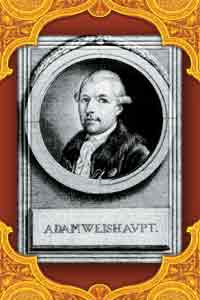
The Templars' transformation into Masons also produced a number of byproducts, the Rosicrucians being one of these. Another is the Illuminati, one of the most talked about associations in the history of occultism. Founded in Bavaria, in southern Germany, it was also known as the Bavaria Illuminati, and its mission was to bring about a secular Masonic world order by revolutionary means. Its founder was Adam Weishaupt, a professor of law. Fiercely opposed to monarchies as well as to the Church, he listed the society's goals: 1. Abolition of monarchies and all ordered governments. 2. Abolition of private property and inheritances. 3. Abolition of patriotism and nationalism. 4. Abolition of family life and the institution of marriage and the establishment of communal education of children. 5. Abolition of all religion. [49] The Encyclopedia of the Occult reveals that the Illuminati society, increasingly powerful in Germany, was practicing all Masonic rituals while preserving its own distinct identity. Weishaupt, the "Grand Master," stamped his authority on the hundreds of intellectuals who had joined the society, even though only a very few had access to Weishaupt himself. In 1780, the German Baron von Knigge, a Grand Master Mason, joined the society and increased the society's influence even further. Weishaupt and Knigge began preparations for a revolution aimed at bringing down both Church and Hapsburgs. In 1784, when the Bavarian government received intelligence about the planned revolution, the two Grand Masters quickly dissolved the Illuminati and joined ordinary Masonic lodges. As occultist historians acknowledge, some of the players of the French revolution like François-Noël Babeuf were of Illuminati origin. [50] The Illuminati was renowned for its uncompromising hostility towards religion. According to historian Michael Howard, Grand Master Weishaupt felt a "pathological hatred" against religion [51] that their planned revolution tried to realize. It never happened, but their "brothers" in France successfully carried out theirs -- in the form of the French Revolution. The French Revolution and Jacques de Molay's Revenge
You'll recall that in France, by a joint operation of the Catholic Church and the King, the Templars were arrested and their order subsequently liquidated. No doubt, one of the surviving Templars-turned-Masons' foremost ambitions was to weaken, even destroy, these two institutions. It is therefore very significant that the Masons played such a role in the birth of the French Revolution. In The Occult Conspiracy, English historian Michael Howard points to the role played by the Masonic lodges in the preparation of the revolution. Its Grand Master, Savalette de Lage, founded one of these lodges, Friends of Truth, whose political philosophy drew up the framework for the social reforms that brought about the Revolution. Another important lodge connected with Savalette de Lage was the Neuf Soeurs (Nine Sisters) -- one, which counted among its members names like Voltaire, Benjamin Franklin, John Paul Jones and was busy formulating alternative, secular systems of education and developing completely secular theories of history, literature, chemistry and medicine in opposition to the Church's. During the Revolution, the College of Apollo, founded by the lodge, was renamed the Lycée Republican. Books written within the short period of the Revolution testify to the important role Masonry had played. According to a claim widely circulated, the uprising that ignited the Revolution was planned at the Great Masonic Convention in Wilhelmsbad in 1782. One participant of this convention was Comte de Mirabeau, a leader of the revolutionaries. Upon returning to France, he immediately moved to implement in the lodges of France the decisions taken at the convention. [52] Behind the scenes, Comte Cagliostro played a leading role in the Revolution. Born in Sicily, his real name was Joseph Balsamo. A member of the Illuminati and of the classic Masonic lodges in Germany, he was chosen to be one of the agents entrusted with the mission of disseminating radical and revolutionary ideas across Europe, thus preparing the ground for the eventual French Revolution. At the end of his tour he went to France and became a Jacobin. At the Grand Masonic Congress in 1785, he received new orders for preparing for the revolution. In the same year, Cagliostro was the focal point of the Diamond Necklace Affair, making the Queen the victim of a conspiracy devised to give the impression that she had a love affair with a Cardinal. Among the people, this irreparably dented the reputations of both the Church and the Monarchy. French novelist Alexandre Dumas confirmed that this scandal was arranged by the Masons. [53] In his capacity as the lodge's agent provocateur, Cagliastro was at the center of many events leading up to the Revolution. In a letter about the coming revolution that he wrote from London to a friend in Paris in 1787, he spoke about how the Bastille would be stormed, that the Church and monarchy would be abolished and replaced by a new religion based on the principles of reason. [54] Cagliastro was no fortune teller, so the information contained in his letter more likely came from his superiors in the lodge. As Michael Howard puts it, "From 1785 to 1789 several of the Masonic lodges in France were working full time to undermine the monarchy and the established government." [55] To a great extent, the French Revolution was the making of Freemasonry. The Masons saw the Revolution as a major milestone on the way to their desired new social order, as well as an act of revenge for what the French monarchy had done to the Templars. When an agitated mob marched on the Bastille, Comte Mirabeau shouted, "The idolatry of the monarchy has received a death blow from the sons and daughters of the Order of [56] Templars." The real aim of the storming of the Bastille wasn't to free a handful of prisoners from this strategically unimportant prison. It was made a symbol of the Revolution for a different reason: This was where the Grand Master Jacques de Molay had been imprisoned for years before his execution in 1314! If one purpose of the Revolution was to avenge de Molay, then the Bastille was a priority target. [57] The role played by the Masons -- or to be more precise, the neo-Templars -- in realizing the Revolution was revealed in 1789, when the Inquisition arrested Cagliostro. He quickly confessed and told all he knew, hoping to save his life. One of the first things he told the Inquisition was that the Masons were planning revolutions right across Europe, intending to finish off what the Templars had begun: namely, to either destroy the Papacy or bring it under their control.
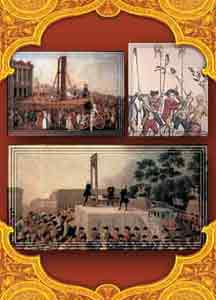
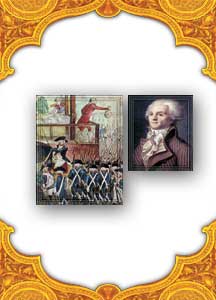
The methods used by the Masons and Illuminati to advance the revolution were equally ruthless and merciless. According to William T. Still in The New World Order: In the spring and summer of 1789, an artificial shortage of grain was created by Illuminist manipulations of the grain market. This produced a famine so intense that it brought the nation to the edge of revolt. One of the leading figures in this scheme was the Duc d'Orleans, the Grand Master of the Grand Orient lodges. The Illuminists claimed that their revolution would be "for the benefit of the bourgeoisie with the people as instruments ..." But in reality the conspirators held up the food supplies and blocked all reforms in the National Assembly to exacerbate the situation, and the populace starved ... A panic was created simultaneously around the nation. Horsemen rode from town to town telling the citizens that "brigands" were approaching and that everyone should take up arms. Citizens were instructed that the conspirators were being harbored in the larger estates, the chateaux, and that by edict of the King all should be torched. The people, obedient to their monarch, complied. Soon, the flames of destruction were burning out of control. Anarchy continued to grow as citizens began raiding and pillaging -- and not only for food. [58] With the beginning of the Revolution, the Jacobins, most of whom were also Masons, began a campaign of terror. Ten thousand royalists and church members were sent to the guillotine, drowning France in a sea of blood. The details of this time of terror and the Masonic messages they contained gives food for thought: Terror was rampant in the streets of Paris … Not surprisingly, in November 1793 a campaign against religion was inaugurated by a massacre of the priests all over France. In the cemeteries the cherished motto of the Illuminati, "Death is an eternal sleep," was posted by order of the Illuminatus "Anaxagoras" Chaumette. In the churches of Paris, Feasts of Reason were celebrated where women of easy morals were enthroned as goddesses. These were also known as "Eroterion," and were modeled on Weishaupt's plan to honor the god of Love … [59] … Toward the end of 1793, the new revolutionary Republic found itself faced with hundreds of thousands of working men for whom it could not find employment. The revolutionary leaders embarked upon a fearful new project that was to be copied by tyrants ever after, called "depopulation." The idea was to reduce France's population of twenty-five million down to either eight or sixteen million, depending on which source you believe. Maximilien Robespierre believed depopulation to be "indispensable." [60]
In France, members of the revolutionary committees in charge of the extermination toiled day and night over maps, calculating just how many heads must be sacrificed in each town. Fearful Revolutionary Tribunals tried to determine who would be killed, and a never-ending stream of victims marched to a variety of deaths. In Nantes, 500 children were killed in one butchery, and 144 poor women who sewed shirts for the army were thrown into the river. [61] This terror was the product of hostility towards the monarchy and the church by the Masons and the Illuminati, the Templars' successors.
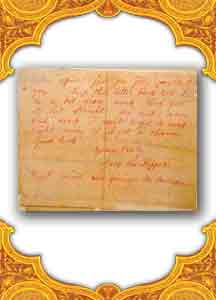
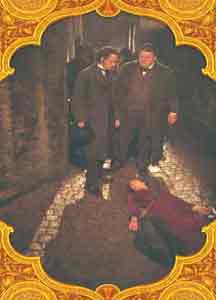
In 1796, a book entitled The Tomb of Jacques de Molay was published in France, stating that the Revolution was realized by the Freemasons, whose origins are the Order of the Templars. The following year, a Jesuit priest, Father Bamuel published his Memoires pour servir de l'histoire du Jacobinisme (Memoirs toward a History of Jacobinism), revealing that the Templars still lived on behind the front of Freemasonry and that the Revolution was of their making. The English civil war, he claims, was also a Templar conspiracy. [62] In 1808, a public requiem was held in the Church of St Paul in Paris for Jacques de Molay. The Masons attending this service were dressed exactly like medieval Templars, performed some rituals over de Molay's bones and personal belongings, then proceeded to march down the streets of Paris carrying the piebald banner of the Templars. [63] Five centuries after his execution by the King and the church in Paris, de Molay was remembered in Paris with a great ceremony. This time there was no king and no church, and blood was cheap. An Inside Account of Jack the Ripper In researching the Masons' political activities, especially their illegal ones, the infamous "Ripper" murders cannot be overlooked. These serial murders were committed in London in 1888. Over a span of nine weeks, five prostitutes were brutally murdered and their bodies disembowled, sometimes dismembered. These murders were never actually solved, and the murderer was never caught. Letters "signed" under the name of Jack the Ripper sent to the police force, shortly after these murders were committed, provided the murderer with his nickname. Who the person or people responsible for the murders is or are is still unknown.
A number of people who have investigated this mystery concluded that the murders were politically motivated and that evidence suggests that Masons were to be found behind this conspiracy.
Shortly before the time of the murders, the British monarchy was threatened with a great scandal. The eldest son of Queen Victoria, later King Edward VII was the Grand Master of the English Freemasons. Theoretically, his son, Eddy, would have become King if his grandmother and father had died before him, but Eddy had a private life incompatible with palace discipline. He was secretly visiting his painter friend Walter Sickert and his friends; and at one of these visits he met and began an affair with Annie Crook, a Catholic shop-girl of the lower classes. After some time she gave birth to his child, and they were secretly married. Sickert hired a nanny for Eddy and Annie's baby girl. Mary (or Marie) Kelly and Sickert were the witnesses at their secret wedding.
At the time, Britain was in political turmoil. Had the public learned of Eddy's marriage to a woman like Annie, it could have had far-reaching repercussions, including the abolition of the monarchy. (It was against British law for the monarch to marry a Catholic, not to mention the problems posed by her working-class background.) Such a scandal was a serious threat to anyone with an active interest in Britain's political and social systems, especially the Freemasons.
When word of all this got to Queen Victoria, she demanded that Lord Salisbury -- her Prime Minister, and a renowned Mason -- cover up this affair. Salisbury had Annie admitted to an asylum, where she was to die 32 years later. Her daughter later became Sickert's mistress and bore him a son. Marie Kelly, the witness at the marriage, became an alcoholic and prostitute and later shared this secret with three of her prostitute friends. When these women threatened to reveal Eddy's secret, Salisbury decided that this threat had to be ended and enlisted the help of Sir William Gull, physician to the Queen and a high-ranking Freemason; it was he who had declared Annie insane and sent her to the asylum. Considering his options, Gull concluded that these prostitutes constituted an unacceptable threat to the monarchy and Freemasonry and decided to kill them, one by one, according to Masonic ritual. This is how the shocking "Ripper" murders came about. Prime Minister Salisbury, the other members of government and the police force provided the cover-up, as was expected of the Masonic brotherhood. They kept this secret and admired Gull for his great sense of "responsibility." Gull sent his driver Netley to persuade Sickert to help locate and identify the four prostitutes. They were located, picked up, brutally murdered, and then their bodies mutilated and dismembered as prescribed in Masonic rites and finally disposed of at the chosen sites. This is the tally of Gull's murders: 1) On August 31, 1888, Mary Ann (Polly) Nichols was murdered by having her throat cut deeply, starting at one ear and circling her throat, and her abdomen was cut open. 2) On September 8 of the same year, Annie Chapman was murdered by having her throat cut. Her tongue protruded between her teeth and was swollen. Her abdomen was entirely opened; her small intestines were removed and placed above her right shoulder but still attached. Part of her stomach had been cut out and placed above her left shoulder. Her womb and portion of her vagina were removed. Her jewelry and coins were removed and two brass rings put on her toes. 3) On September 30, Elizabeth (Liz) Stride was murdered by having her throat cut, from one jaw to the other. 4) Also on September 30, Gull thought that he was killing his last and most important victim, Marie Kelly. Instead, by mistake he murdered Catherine (Kate) Eddowes, who went by the name of Mary Ann Kelly. Eddowes was murdered by cutting her throat from ear to ear. Her nose was completely cut off, part of her right ear was cut off, her face was mutilated with deep triangular cuts, her abdomen was completely cut open, and her intestines taken out and placed over her right shoulder. A two foot piece was removed and placed between her left arm and her body, and her left kidney and part of her womb removed and taken away. The police found a piece of her cut apron, soaked in blood, that fit the part still on her body. On the black wall above Eddowes' body was written in white chalk: "The Juwes are The men That Will not be Blamed for nothing." 5) On November 9th, Gull and his partners in crime corrected their earlier mistake by murdering Mary Kelly in her flat. Her throat was cut with the tissue severed all around, whole surface of abdomen and thighs removed and abdominal cavity emptied. Her breasts were cut off, her arms mutilated and her face hacked to the extent that it could no longer be recognized. Her womb, kidneys and one of her breasts were placed under her head, the other breast by her right foot, liver between her feet, intestines by her right side, and spleen by her left side. Skin removed from her abdomen and thighs was on a bedside table. Part of one lung was missing, as was her heart. These events led researchers to the reality behind the scenes: Had these murders not been premeditated, it would have been risky to mutilate and dismember the victims' bodies. (Stride, the third victim, refused the carriage ride, so she was murdered quickly then and there, in the middle of the street.) The only explanation for these horrific acts of slaughter is that they were ritualistic murders, committed according to Masonic ritual. All of their aspects -- cutting of the throats, removal of the heart, removal of intestines, triangular cuts, cutting off part of the victim's apron -- can be found as prescribed punishments for traitors in the books read in the lodges of Masonry. The Ripper's next victim was dumped in the district known as Mitre Square. The mitre is a Mason's tool, and the Mitre Tavern is a well-known meeting point of the Masons. What does "Juwes" mean? Some have suggested that this is a spelling error for Jews -- perhaps deliberate, intended to deflect suspicion onto some illiterate bigot. Instead, the circumstances and methods of the murders suggest that they were committed by an educated individual who would hardly make such an ignorant spelling mistake. Others who have researched these murders suggest that the word juwes stands for Jubela, Jubelo and Jubelum, the three traitors who murdered Hiram Abiff, the legendary founder of Masonry. Another unexplained detail is that the writings on the wall that the police found when they discovered the body were immediately washed off, by the order of the head of the police, Sir Charles Warren, who had never gone to a crime scene before. Incidentally, he was also a Mason. All of this suggests that this violence later to be called as the Jack the Ripper murders was actually part of a political conspiracy and committed by Masons. There is evidence that the Masons committed other murders including the famous murders of Wolfgang Amadeus Mozart and Captain William Morgan, both of whom were thought to have committed treachery against the Freemasons. In 1890, news of the death of high-ranking Mason and murder suspect Dr. Gull were circulated, but actually, he lived on under the name of "Thomas Mason" as a patient in an insane asylum, and died many years later. Sickert the painter, who knew everything, told the true story to his son Joseph. Three quarters of a century later, Joseph related the events witnessed by his father to the journalist Stephen Knight, an expert on Masonry, who then published Jack The Ripper: The Final Solution in 1976. In the ensuing controversy surrounding the book, the Freemasons vehemently denied these allegations, despite all the evidence to the contrary. The subject made headlines again in 2001 when the Hollywood blockbuster From Hell was released. In this film, the Jack the Ripper murders are retold as a story based on historical evidence, and the Masonic conspiracy behind these murders is revealed in graphic detail. This story is probably only the tip of the iceberg. Masonry is a secret society and as such, never reveals its secrets to outsiders. It is difficult to glimpse their real activities past the smokescreens, behind which much worse is hidden. Leaks in the Jack the Ripper case only illustrate what horrors this secret society is capable of. Now we'll move on beyond the iceberg's visible tip for a better idea about the whole. Propaganda Due (P-2) In March 1981, two Milanese prosecutors were investigating a fake kidnapping incident from 1979, in which an international banker disappeared. The Sicilian-born Michele Sindona was a financial adviser to the Vatican and thought to have links to the Mafia. The prosecutors made an interesting discovery: While on the run from the authorities and hiding in Palermo, Sindona suddenly traveled to Arezzo, a town 600 miles north, where he met with the textile manufacturer Licio Gelli. If a personality like Sindona leaves the safety of his hiding place to meet Licio Gelli, then this Gelli must be an important person indeed. For this reason, prosecutors ordered the investigation of Gelli. On March 17th, the investigating police officer searched this industrialist's office and found a list containing the names of 962 people. No ordinary list, it gave the names of the members of the Propaganda Due Masonic lodge -- P2, for short -- of which Gelli was the Grand Master. What was really surprising was, the list contained the names of some of the most important persons in Italy: three ministers, 43 members of parliament, 43 generals, eight admirals, secret service chiefs, hundreds of top bureaucrats and diplomats, the police commanders of Italy's four largest cities, industrialists and financiers, the editor and publisher of the newspaper Corriere della Sera and 24 other journalists and TV personalities. Michele Sindona was also listed. Another member of the lodge was banker Roberto Calvi, later to be found hanged from the Blackfriars Bridge in London, in the Masonic style of ritual execution, and only a few hundred yards away from a church that in the Middle Ages had once belonged to the Templars. As far as could be understood, every member of the P-2 had sworn loyalty to Gelli and to do anything that he might ask of them. These 962 members were grouped into 17 cells, each with its own Master. Gelli ran the lodge with such secrecy and professionalism that even the members themselves knew no one outside their own cells; only the Grand Master of each cell knew all its members.
But who was Licio Gelli, the Grand Master of the lodge? He was a militant who had fought in the Spanish Civil War on the side of the fascists, and had been a fervent supporter of Mussolini. Later, after the war, when his involvement in the torture of Italian partisans was discovered, he was forced to flee the country for Argentina, where he became a close friend of the president Juan Perón. And now here he was, the Grand Master of the P-2 Masonic lodge. These revelations shook Italy to the core. The investigation further revealed that the lodge was participating in the government affairs and was central to Italy's endless corruption scandals. With the aid of their Masonic cardinal brothers, the lodge had turned the Vatican into a money-laundering institution and the lodge was also the strongest branch of the legendary Italian Mafia. The P-2 was behind many assassinations, acts of terror like bombings and was closely linked to the contra-guerilla cell Gladio. For a long time the P-2 had been channeling CIA and Vatican funds to fascist groups in Europe and Latin America. Lodge Member Michele Sindona was later arrested on charges of the murder of an Italian lawyer, and died in prison after drinking a cup of poisoned coffee. He was not only the treasurer of the P-2, but also the investment advisor to the Vatican. Sindona was responsible for selling the Vatican's Italian assets and investing the proceeds in the U.S. He was working for the Mafia as well as the CIA and had previously channeled funds to his Yugoslavian "friends" and to the Greek military junta that came to power in 1967. The parliamentary commission investigating this affair discovered that the P-2 was an international organization influential in everything from arms trading to crude oil prices. Ligio Gelli, the dark name of banking scandals and the secret and illegal P-2 Lodge, received a prison sentence of 12 years. The P-2's Secret Lodge and Strange Rituals The P-2's political activities and murders make horrific reading, but its organizational structure and ritualistic practices are equally so. This far-from-ordinary lodge had been building in great secrecy and every member was required to maintain this secrecy when coming or going. In his book St. Peter's Banker, Italian journalist Luigi Difonzo explains the P2, based on former members' confessions, with its activities of money laundering and links to the Mafia. About the lodge's location, he has the following to say: In interviews two former members have described the oaths they took. They were taken to a compound, a Villa hidden in the Apennines in the region of Tuscany. A 12-foot wall seals the neatly manicured grounds from view. In the centre of the main courtyard stands a fountain shaped like a tree trunk. The cobra-like sculpture, with its inflated hood, watches over the compound in a protective posture, as if ready to strike. The cobra's head is twice the size of a human skull. It has a single eye, which is blue during daylight and red after nightfall, for inside the cobra's hood and behind its eye there is a closed-circuit camera that follows a visitor, invited or unwelcome, as the fountain rotates in the direction the intruder moves. The fountain-camera is controlled from a room within the villa where eight monitors, each with five stations, cover eight guest rooms, patio, pool, dining room, sitting room, and party room. Approximately ten cameras, including the one inside the cobra, have infrared lenses. All of the exterior cameras are camouflaged by the landscaping. The Villa's interior is magnificent. Every room has marble floors and is furnished with antiques. Observing the high ceilings, the finely crafted gold-leaf moldings, the portraits of Mussolini, Hitler, and Peron, the visitor experiences a feeling, a sort of living, breathing odor of danger and power that penetrates the soul and cell by cell contaminates the mind with fear. The year is 1964. [64]
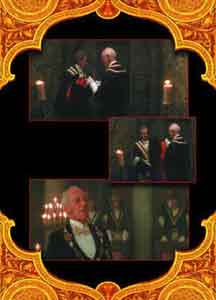
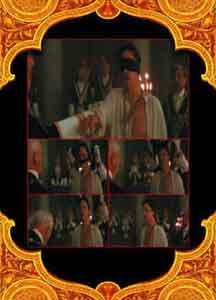
In this lodge were conducted hair-raising rituals: In the meeting room, twelve members of P-2, dressed in satin ceremonial robes and wearing black hoods reminiscent of those worn by members of the Ku Klux Klan, sit in leather chairs at a red marble conference table. They are the elite members of the Wolf Pack, Gelli's disciples -- some say his execution squad. None of the black-clad disciples knows the identity of any of his eleven brothers. Grand Master Licio Gelli is the only one who bares his face. Two Masons stand post at the entrance to the meeting room. Their faces are also covered ... They are ... personal bodyguards, some say his death squad -- former Mussolini Fascists whose job is to protect the Grand Master and kill any of the twelve disciples who betray the cause "Il Momento di Passare all" (The Time for Real Action) ... Each bodyguard carries an axe; they also bear automatic weapons. [65] In the admission ceremonies for the initiates to the P-2, which is organized like the Mafia, one could witness the lodge's merciless methods and political ideals: The ceremony begins. There is an uneven series of knocks at the door. "Your Worshipful," a disciple announces, "a pagan wishes to enter." The Grand Master strikes the table with one blow with his axe. Immediately the oversized door swings open and slams against the inner wall. Two guards escort the initiate to the center of the room where he faces the twelve Masons with his back to the grand master's throne. The Pagan, as he is called, is wearing a plain black hood and a blindfold. His identity is known to Grand Master Licio Gelli, but to no one else. He is asked one question by each of the disciples, but the Pagan does not answer, instead, one of the guards speaks for him. Once all the ritual questions about purpose and belief and reason for wanting to become a member of Propaganda Due are answered, the Pagan is turned to face the Grand Master, who asks, "Pagan, are you prepared to die in order to preserve the secrets of Propaganda Due?" The initiate now answers for himself: "I am." "Do you have the necessary quality of contempt for danger?" "I do." "Do you have the necessary quality of courage?" "I am courageous ..." "And Pagan, are you prepared to fight and perhaps face shame, even death, so that we who may become your Brothers may destroy this Government and form a Presidency?" "I am." Then the blindfold is removed. It takes a moment for the initiate's vision to clear, because this is the first time since entering the compound that he has been allowed to see light. The blindfold serves a purpose other than security. It also represents the power of P-2: "Without membership one is blind; with the help of the order, however, the way is clear." [66] P-2 and Mossad
Along with the darker sides of the P-2, the lodge had also an Israeli connection. The July 1981 issue of The Middle East International Journal established that the P-2 had close links with Israel, especially with Mossad, and that the Jewish community in Italy played an important role in this connection. In later years, Carlo de Beneditti, the second richest man in Italy, was discovered to have had a close relationship with the P-2 Lodge and also very good contacts with the Jewish communities in Europe and the U.S. The foremost names who had contact with the P-2 are Henry Kissinger, Edmond de Rothschild, and David Rockefeller. The Italian journal Panorama wrote that Ellie de Rothschild arranged the necessary amount of money for the Masonic hanging of banker Roberto Calvi, who either had or was about to "talk" against the P-2. [67] Henry Kissinger was directly involved at the top of the lodge. In Papa, Mafya, Agca (The Pope, The Mafia and Agca), Ugur Mumcu, a prominent Turkish journalist wrote, "Henry Kissinger is a member of the Monte Carlo lodge, which is the P-2's 'board of directors,' also known as the Monte Carlo Committee. All the members of this lodge are Grand Masters and Masons of the 33rd degree." [68] The alliance between the P-2 and Israel or to be more specific, with Mossad is illustrated by ex-Mossad agent Victor Ostrovsky in The Other Side of Deception, published in 1994 after his other greatly controversial book, By Way of Deception. Ostrovsky writes that Licio Gelli, P-2's Grand Master, was the ally of Mossad in Italy and that Gelli also had a close relationship with the Gladio contra-guerilla group, allied with Mossad and that Mossad used this Gelli-Gladio alliances for its arms dealings with Italy in the 1980s. [69] After P-2 - P-3? The P-2 scandal had educational value for Italy as well as other countries. Now, there was no doubt that the Masons could become an invisible government in any country and, like a Mafia organization, empty the coffers of the state. Quickly enough, Freemasonry lodges around the world were distancing themselves from the P-2 by claiming, for example, that the P-2 Lodge was an exception and not a true Freemason's lodge, that it had developed its own organization independent of Masonry, and so forth. All these statements were just attempts at erecting smoke screens around Masonry's true nature. English journalist and writer Martin Short states that P-2 was a regular lodge, founded and run according to the rules by which Masonic lodges abide. With plenty of details, he reveals the close relationship between the P-2 and the English Grand Lodge. Short states that P-2 was different from other lodges only in that it was to remain a secret lodge. In 1977 Lino Salvini, Grand Master of the Italian Grand Lodge, instructed Gelli to continue its work -- albeit in secrecy and isolated from the other Italian lodges. [70]
After the P-2 scandal exposing the Masons' links to the Mafia, their relationship continued. A legendary politician like Giulio Andreotti, often addressed as "the Godfather," had also been exposed as a Mason. The list continues, with the Social Democrat Prime Minister Bettino Craxi's connection to the Masons being revealed, along with many more at lesser levels. All this was evidence enough that the P-2 was no exception, and for this reason, the Italian media discussed whether there might be a P-3. In the last days of 1993, the Italian police caught the Mafia's boss of bosses, the legendary Salvatore Riina. He too was exposed as a Mason. The newspaper La Stampa printed excerpts of Riina's confessions in which he stated that many Italian Mafia bosses were Masons like him -- but because many judges were Masons too, the legal system didn't prevent judges from aiding their Mafia brothers instead of prosecuting them. After this revelation, Italy's highest court ruled it illegal for judges or prosecutors to be -- or become -- Masons.
In short, the P-2 is not an "exception" or "accident" as the Masons say in an attempt to cover up the scandal. On the contrary, they need these "secret and isolated lodges" to accommodate the top government officials in a country. What is an "exception" or "accident" is that the P-2 was exposed. Evidence to this effect came also at the middle of 1990's from England. Lord Nolan was appointed by the Prime Minister John Major in 1994 to lead a Committee on Standards in Public Life to investigate allegations of corruption in British politics. Realizing that Masons were at the center of the allegations, he decided to focus on their involvement in politics. The newspaper Independent's 21st January 1995 issue gave it a headline article, launching an inquiry into Freemasonry for the first time in British history. It reported that the Masons were an organization 300,000 strong, represented at the top of the police force, in the government, the House of Lords, the high court, banking, the boardrooms of the largest companies and every part of the establishment, even the Royal family! Nolan's committee also established that, just as with the P-2 in Italy, along with the ordinary English lodges there were more secretive ones. Some were very selective about where they recruited their members. One of these lodges, for example, was recruiting only from the Ministry of Defense, among high-ranking officers, and the senior management of the arms industry. A similar scandal hit the front pages in France. For years the corruption of Roland Dumas, former French Foreign Minister and Mason, had been covered up by other high-ranking government officials who were also Masons. Le Point, the French weekly magazine, exposed other cases of corruption, revealing how the Masons covered up for each other in their illegal activities. Clearly, the P-2 scandal in Italy wasn't a series of coincidences. Considering other scandals in Britain and France, it can safely be said that these weren't isolated cases. This leads to the question of whether every country has its own P-2s. _______________ Notes:
49 Eustace Mullins, The World Order: Our Secret Rulers, p.
5.
|
|||||||||||||||||||||||||||||||||||||||||||||||||||||||||












 After all these
Mason-connected corruption scandals came an attempt to clean up Italy's
political and legal institutions -- Operation Clean Hands, which didn't go
very far either: After this, media mogul Silvio Berlusconi of his Forza
Italia party was elected Prime Minister. He too had been a P-2 member and
had some interesting connections with Israel. [71]
After all these
Mason-connected corruption scandals came an attempt to clean up Italy's
political and legal institutions -- Operation Clean Hands, which didn't go
very far either: After this, media mogul Silvio Berlusconi of his Forza
Italia party was elected Prime Minister. He too had been a P-2 member and
had some interesting connections with Israel. [71]
