|
THE FRANKLIN COVER-UP -- CHILD ABUSE, SATANISM, AND MURDER IN NEBRASKA |
|
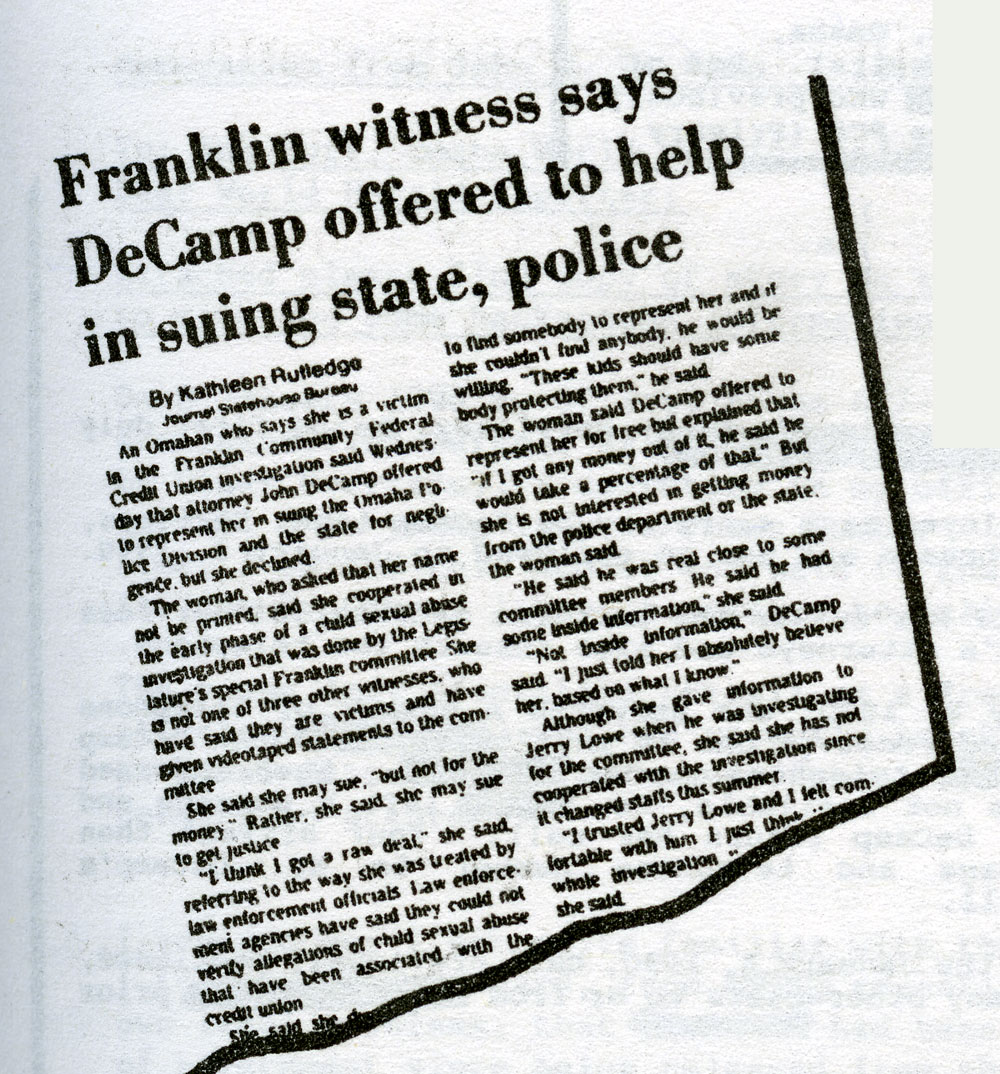
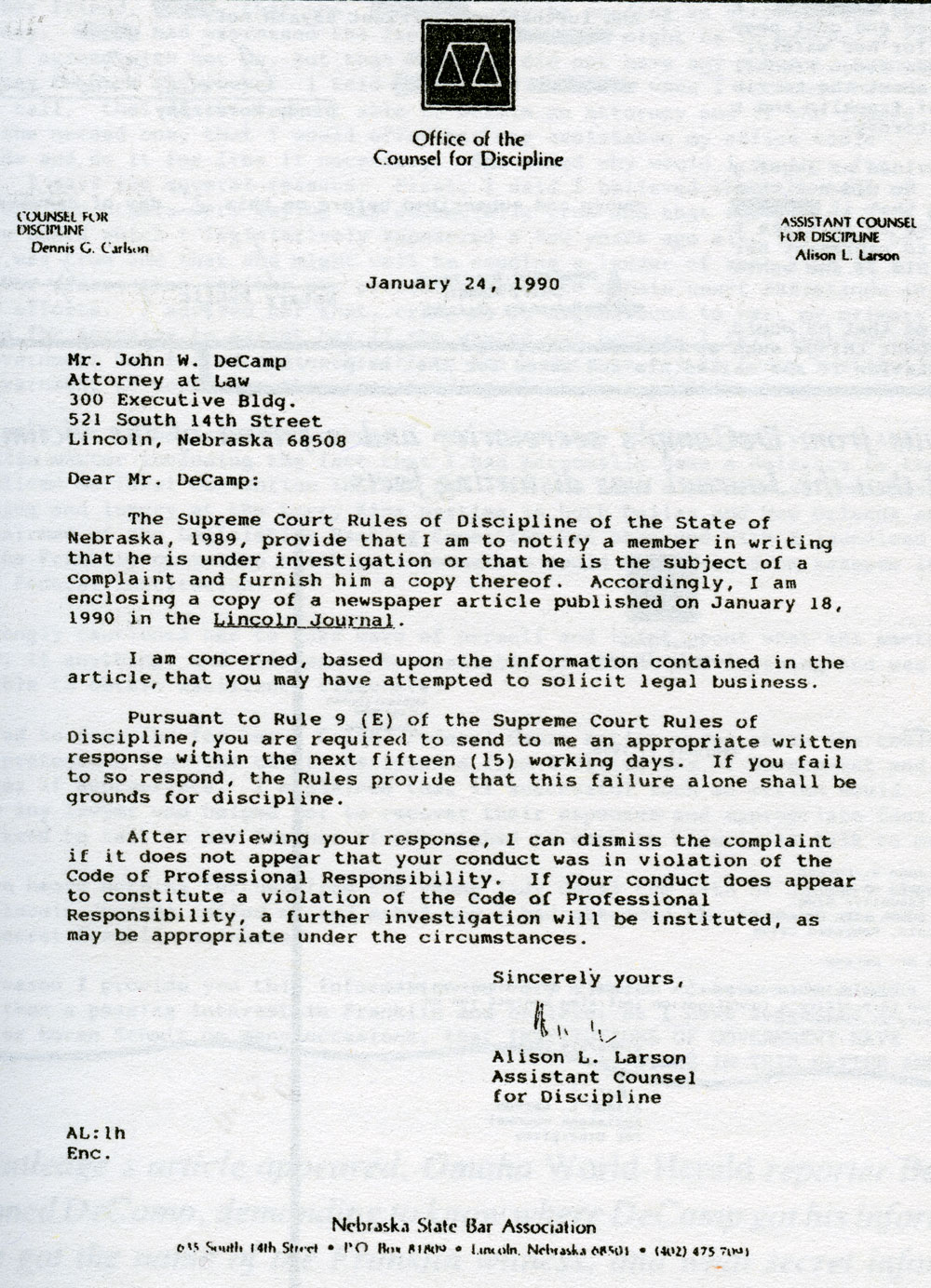
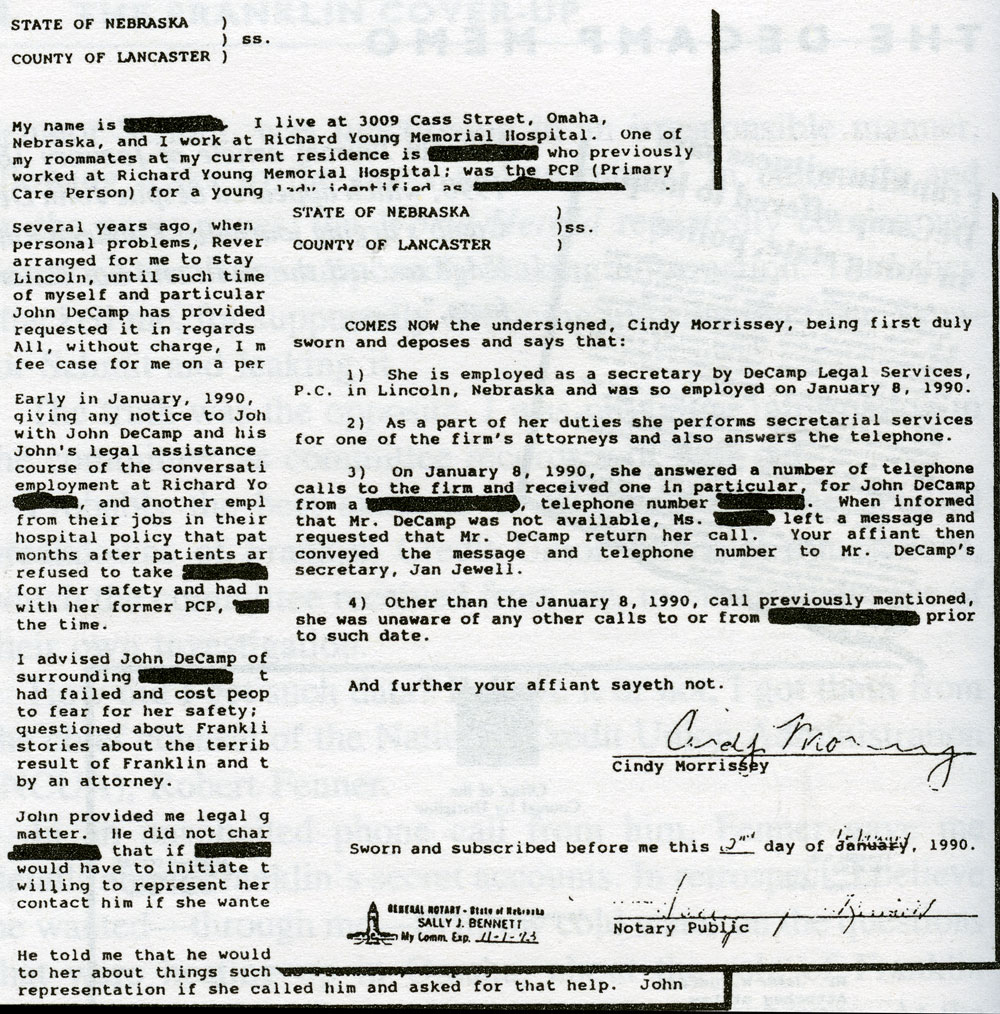
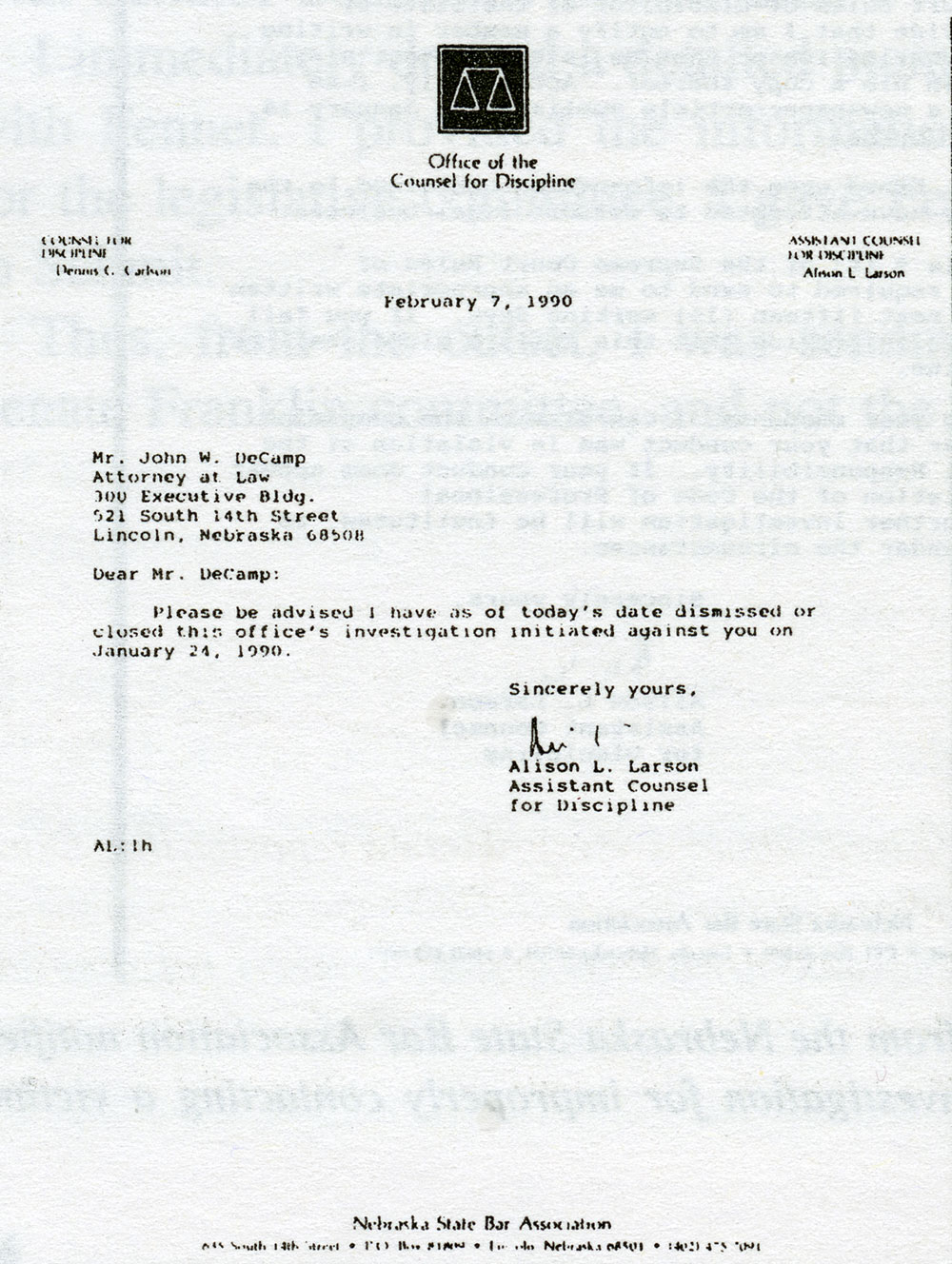
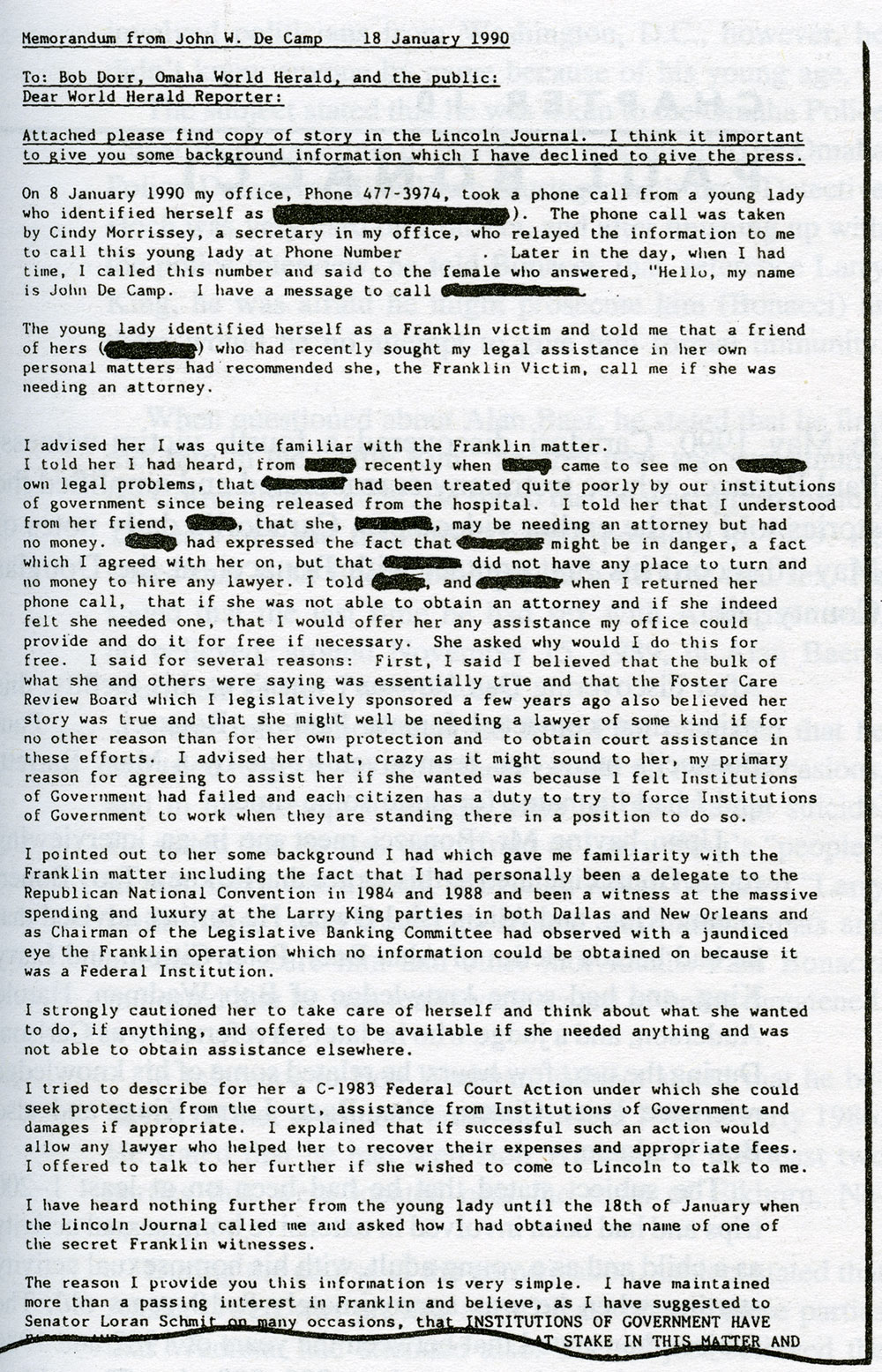
CHAPTER 9: THE DECAMP MEMO On January 18, 1990, I released a document that soon became infamous as "the DeCamp memo." For the first time, the names of prominent alleged perpetrators were public. A lot has been written about that memo, much of it full of untruths and distortions. What follows is the true story of the DeCamp memo and the events leading up to it. In the spring of 1989, after the first child abuse stories surfaced, I recommended to Senator Loran Schmit that he go directly to the FBI in Omaha to discuss the very serious allegations being made against Police Chief Robert Wadman by various individuals. This was before anybody even knew that Alisha Owen or other victim-witnesses existed and, of course, before Alisha Owen's allegations against Robert Wadman were made. This legal advice of mine to Senator Schmit was in response to his question as to how to handle things, when law enforcement officials themselves were being accused of impropriety. "Go to the highest authority you can, above the authority who is being accused," I told him. Senator Schmit insisted I go with him to this meeting, as his personal attorney. I agreed to go, but on condition that he first meet one-on-one with the regional head of the FBI, Nick O'Hara, without me present. He did meet with O'Hara for about one hour. Then I was called into the room. It was only at that time, through discussion, that I learned that the individual in question was former Omaha Police Chief Robert Wadman. In brutal language and with the most somber demeanor possible, Mr. O'Hara made it clear that probably his closest friend in the world was Police Chief Robert Wadman, and that anyone who would dare to accuse Robert Wadman of impropriety had better realize that in accusing Wadman, they were effectively taking on Nick O'Hara and the FBI. I realized instantly, that my advice to Senator Schmit may have been faulty. How could I have known in advance, that the head of the FBI and the former chief were so intimate in their business and personal relationships? There was tension in the air. I made a point of saying that I also was sure that all these accusations -- whatever they were -- had to be nonsense. I pointed out that my experience as a public official, a senator for sixteen years, made me appreciate the fact that it is easy to accuse a public official and darned difficult for one to defend himself, since the accusations are immediately put on the front page of the paper and broadcast as the lead story on the evening TV news. But, as if to make a point that both I and Senator Schmit had better understand how serious it was for anyone to come to the FBI and raise questions about Robert Wadman, O'Hara had us sit down and provide him information about ourselves, as if we were the ones being accused and investigated, proceeding exactly as one might expect the FBI to do with someone the FBI was investigating. "What's your date of birth? Where were you born? What is your exact name? Do you have any aliases?" O'Hara quizzed us. When we left the FBI offices, I said to Senator Schmit, "Wow, did I make a mistake. Anybody who dares to investigate this is going to get themselves buried by the FBI, if they start making any accusations against Wadman or anybody associated with him." I had no idea how prophetic those words were. *** It was only after Caradori's first tapes had been turned over to law enforcement agencies, that leaks of what was on them began to reach the public and became the subject of widespread discussion. Articles began to appear in the Omaha World-Herald, aimed to discredit the witnesses and intimidate any other potential child victim witnesses from testifying or coming forward with information. As the stories proliferated, Gary Caradori expressed to Senator Schmit his concern for the safety of the victim-witnesses who had allowed themselves to be taped. Schmit sought my legal advice again. "These kids need protection or they are going to end up dead, or become afraid to continue to tell the truth," the senator said. "The committee has to do something to guarantee their protection." Gary Caradori was even more vehement on the need for protection. "Unless they get into a protected environment, where Alan Baer and Larry King and Robert Wadman are not able to get to them and scare them, I can tell you the kids will fold. They will do whatever those guys order them to do. They will fold, or they will end up dead," Caradori hammered at Senator Schmit. "You have to do something to protect them." My legal advice to Senator Schmit and my direct warning to Gary Caradori at that time, in December 1989 and January 1990, was the most painful information I have ever had to provide someone. "You cannot and should not do anything to use committee funds or committee personnel to provide protection for these kids," I told Schmit. "Otherwise, you and the committee may be accused of impropriety and tampering with witnesses, and who knows what else. Painful as it is for me to tell you this, you have to find some other legal channel to provide protection for the kids. Whether that channel is the courts or a judge or whoever, it is something that either the lawyer for the kids should be doing, or some institution of government vested with the power and responsibility to do those things should be doing. But you, Senator Schmit, should not personally get involved in any way, shape or form in providing money or assistance or protection for these kids, nor should the committee, in my opinion." Senator Schmit shared his concerns with other members of the legislature, who were hearing the rumors and who had their own resources for finding out information. Key among them was Senator Jerry Chizek of Omaha, chairman of the Legislature's Judiciary Committee. He was very tight with Douglas County Sheriff Dick Roth. In early January 1990, as stories of what was involved in the Franklin case spread through the streets of Omaha, Senator Chizek took it upon himself to set up a very secret, private meeting among Senator Schmit, Sheriff Roth, a representative of the Douglas County District Court, Judge Corrigan, and himself. I was asked by Senator Chizek and Senator Schmit to attend the meeting. I was glad to come, for the purpose of providing legal guidance to Senator Schmit, so that he did not engage in trying to solve the problem of protection for the witnesses in an illegal, if well-intentioned, manner. The meeting took place in an auto body repair shop somewhere in west Omaha, on what I am sure was the coldest day of the year. For most of the afternoon, discussion centered around the essence of the rumors that were circulating about the contents of the Caradori tapes. Attention was focused on the necessity of protecting the victim witnesses who had provided testimony. Sheriff Roth had viewed the tapes. I presume others in the room also had, including Senator Schrnit. I personally had not viewed the tapes and, believe it or not, have not viewed them to this day. From the conversation on that cold January day, there was no doubt at all, that Sheriff Roth and others in the room believed in the validity and accuracy of the allegations made on the tapes. As the talks progressed, Sheriff Roth used a phrase that had special meaning to me. "I will tell you one thing," he said, "Nick O'Hara of the FBI and Robert Wadman are closer than nineteen is to twenty. Everybody in law enforcement knows that. I know it especially well. Closer than nineteen is to twenty. That makes it almost impossible to get anything done or to arrange any witness protection through the feds. I will try to help in any way possible, but I am not sure anything can or will be done. These people involved are just too powerful. They carry enough weight in this community to do what they want and get away with it." Sheriff Roth did stand up for the victims of Franklin-related child abuse, on several occasions. I know that he subsequently came under intense pressure, including from the World-Herald, to repudiate his belief that the allegations of the child victim-witnesses were true. The net result of the secret meeting with Sheriff Roth and Judge Corrigan of the Douglas County District Court was nothing. The plan was for Judge Corrigan to explain the situation, including the fact that fellow district court judges were the subject of some of the accusations, to the other dozen district court judges. Then a plan might be worked out, for witness protection under the auspices of the court. Unfortunately, that did not transpire. What Judge Corrigan did or did not do, only he knows. *** About the time of the secret meeting with Judge Corrigan and Sheriff Roth, my office received a long-distance phone call from a girl who identified herself as Loretta Smith. I returned her call. "I'm one of the Franklin victim-witnesses," she explained. "I'm the one they wrote a lot about in the Omaha World-Herald. A friend of mine told me that maybe you would help me." Having read the stories about Loretta, who was not identified by name in the World-Herald, I knew basically the story she was telling, as to her abuse and the individuals who had supposedly abused her. "I know who you are, Loretta, and if I can help you, I will," I said. " And yes, I have read about you and your story and, surprising as it might sound to you, I do believe you." We discussed ways I might help her. A couple of weeks after that phone call, reporter Kathy Rutledge of the Lincoln Journal telephoned me at night at home. She said she understood I had been in touch with Loretta Smith, and she wanted to know all about the matter. It was clear from the beginning of the conversation, by the tone of her voice and her accusatory questions, that Kathy was intent on doing a hatchet job on me. I begged Kathy Rutledge not to distort facts. She repeatedly tried to suggest that I had improperly contacted Loretta Smith. Furthermore, she kept implying that I had told Loretta that I had secret information on Franklin, which I would be trying to use improperly. I corrected Rutledge again and again. I pointed out to her that if I had done the things she was saying or implying that I did, such conduct would be a violation of legal codes of ethics and would subject me to penalties, including even revocation of my license to practice law. I urged that she not even write a story about this, for the protection of the young lady involved. If she insisted on writing a story, I said, she should at least tell the truth and not distort facts. A few days later, a lawyer working in my office, John Goc, walked into the office carrying the Lincoln Journal and talking loudly: "What are you trying to do, DeCamp, get yourself disbarred? What are you going around talking to this reporter for? When the Bar Association sees this, you can bet you'll be in trouble. I hope you have a good explanation. You're going to kill your lobbying business with this kind of story." That is approximately what John Goc said to me on January 18, 1990. I ran down to get a copy of the newspaper, knowing already what Kathy Rutledge must have done. Determined to get herself a headline story and lots of attention, she had to distort the truth. Just as I feared, every negative and distorted impression was conveyed by her story. Six days later, I would be notified by the Bar Association that I was under investigation, as a result of the Rutledge story. Even before that happened, I was confronted by Omaha World-Herald reporter Bob Dorr on the telephone, demanding that I answer questions about Franklin, such as what I knew, where I got my information, how I got the name of this Franklin witness, what secret information I had, and why I was concealing things. His drift was the same as Kathy Rutledge's questions. I determined that I could no longer keep silent. I would answer the questions of Dorr in detail in writing, so that there would be no misunderstanding or distortion possible. Or, if there was distortion nonetheless, I would have a record of what I had actually told him. My answer to Bob Dorr' s questions was the DeCamp memo. I also prepared a documented reply to the Nebraska Bar Association inquiry, to prove that the conduct related by Kathy Rutledge in her article had not occurred. I was able to submit affidavits from two employees in my office, who swore that it was Loretta Smith who contacted me, and not vice versa. I also obtained an affidavit from a friend of Loretta, who knew me and my wife from when we had helped her, on request from her minister, several years earlier, and who was the person who advised Loretta to call me. Within hours after presentation to the Bar Association of this documentation, the bar investigation was terminated. I was cleared of any impropriety or wrongdoing. The Lincoln Journal ran a second story on the matter, after the DeCamp memo was issued, in which Rutledge attempted to correct the falsehoods and deceptions in the first story. In any case, I filed a slander and defamation lawsuit against the Journal for that first story, which lawsuit is still in the courts. *** I charged in the memo, that in the Franklin case, "institutions of government have failed and thus credibility of government itself is at stake in this matter and in a very real sense, first the [legislative] committee and then the Legislature, are the court of last resort." (Emphasis in original.) I had not seen the videotapes of the victim-witnesses and I said so, but I wrote: First, as a citizen who strongly pushed for the Franklin investigation and in fact offered suggested language for the Senate Resolution which triggered the investigation, I find what is occurring by both the Press and Institutions of Government nothing short of criminal. The Press quietly and carefully covers up, either thru ignorance or artifice, while the various institutions of Government repeat the old Commonwealth/State Security game of "let the statute of limitations run" on those that should and could be immediately prosecuted and investigate and study and "ask for more information." Why? Because of the personalities involved. The World Herald and Lincoln Journal want to know where I get information on Franklin. Get serious. A reporter has to be deaf, dumb, blind and corrupt not to know the names of the personalities involved and the scope of the allegations. Stop on any street comer in Omaha; go into any coffee shop; have a drink in any bar in Omaha, or if you are lazy, walk around the Capitol Rotunda in Lincoln and simply listen to the discussions. Here is what you will learn: 1. The allegations are that the most powerful and rich public personalities of the state are central figures in the investigation. 2. That these include former Omaha World Herald Editor Harold Andersen; Larry King of the dead Franklin Credit Union; Former Omaha Police Chief Robert Wadman; Media Personality Peter Citron; Ak-Sar-Ben Financier and bluest of the bluebloods, Alan Baer, for starters. 3. That the allegations are that these individuals were some of the centerpieces in a coordinated program of Child Abuse, Drug Abuse, and abuse of their various public positions of trust and honor. 4. That prosecutors who should be prosecuting are afraid to prosecute for one reason or another and that the public itself is rapidly losing faith in its fundamental institutions of government as a result of this perceived cover-up, whether real or imagined. ... What do I personally believe. I damned well believe the allegations. Now, having said these things and reported these allegations, am I afraid of being sued by these powerful personalities. Absolutely not. Remember that rule you newspaper folk live and die by and crucify others by. If you have forgotten, let me repeat it for you: truth is a defense. And, since these are all public figures, we also know that absent any malice, and I have none, truth is definitely a defense. ... No, I do not fear a lawsuit. I fear, just like any alleged child victims in this bizarre tragedy, that the rich and the powerful will use their positions of power and control of institutions of government to shut up those who would speak out and bring things to a head. *** The DeCamp memo lit a firestorm of controversy in Omaha and statewide. On radio, TV, and in the press, it was dealt with daily for several weeks. The furor touched off by the circulation of the memo is conveyed in a March 17, 1990 Kansas City Star article, headlined "Former legislator's angry memo turns sober Nebraska on its ear": Two months ago, DeCamp sat behind his (word processing] machine and pounded out the infamous "DeCamp Memo." The piece of invective became the subject of discussion from Omaha's silk-stocking salons to the cowboy bars in the Sand Hills. He named five prominent Omaha men as "central figures" in a legislative committee's yearlong review of allegations of sexual abuse linked to the 1988 collapse of the Franklin Community Federal Credit Union. ... DeCamp's memo found its way to dozens of copy machines and quickly littered the state, spawning a swirl of gossip. In an attempt to put the rumors to rest and find the truth, the U.S. attorney called a federal grand jury last month. And next week a Douglas County grand jury in Omaha will begin hearing the allegations, including one that King flew teenagers to Kansas City in 1985 to perform sex with men in a rented room at the Westin Crown Center Hotel. Hardly modest, DeCamp takes credit for the convening of the grand juries. "If it had not been for that memo, there would not even be a grand jury investigation today," DeCamp contends. ... DeCamp had the audacity to name, among others, Harold Andersen, former publisher of the Omaha World-Herald. DeCamp left the implication that Andersen, an icon of journalism who lunches with President Bush, had a fetish for children. Said one politician, "It was like insulting God." Rumors started reaching me, that I was going to be sued by various people. Finally, a close friend of mine, who is a prominent reporter in Nebraska and whom I agreed not to name in this book, came to me privately to say that an agreement had been reached among the various individuals I had named in the memo, and others, for Peter Citron to be the one to sue me. The purpose would be to destroy me in full view of the public, and to repudiate the DeCamp memo. Truth put a crimp in that plan. Not long after the message was delivered to me, Peter Citron was charged with sex crimes involving male minors in the Omaha area. It seems that some parents, who knew their children were hanging around Peter Citron, were shocked to see him named in the DeCamp memo. They responded by asking their children, whether or not there was any truth to the allegations, with respect to Citron. One after another, the boys began to pour out the truth to their parents. The demands by parents for immediate action left the police and prosecutors no choice. They had to file charges against Peter Citron, although I rather suspect they did not want to. Citron ultimately pleaded guilty. Today he is in prison, sentenced as a mentally disordered sex offender. *** Needless to say, the World-Herald devoted many column inches to condemning the DeCamp memo as irresponsible. I cannot neglect to comment on the World-Herald's overall role in the Franklin scandal. Nebraska has only one state-wide news source. It is the Omaha World-Herald. Our small population, vast expanses, and the cost of maintaining a daily newspaper in this day and age, all guarantee that the World-Herald is the news source for this state. With that awesome power, one would think would come a corresponding measure of responsibility, to make sure Nebraskans get all sides of an issue. That they really get the news. But the World-Herald's long-standing pattern of behavior is just the opposite. If it has an editorial attitude on a story, its news coverage and every other aspect of the newspaper are mustered to accentuate the preferred side of the issue and suppress opposing views. In the case of Franklin, the paper went to new lengths. The integrity and credibility of the newspaper went on the chopping block, for the sake of suppressing the truth about Franklin and, to a high degree, the Commonwealth and State Security banking stories -- Nebraska' s three biggest scandals of the last fifty years. Why all this effort? Because, tragically, the people who control the World-Herald appear to have a strong vested interest in suppressing the truth. Whether it is Peter Citron, past publisher Harold Andersen, or underlings who have their positions only because of Andersen, their linkage to Franklin dictates that they use the best tool available, the World-Herald, to tell the public what they want them to believe. Because of its virtual monopoly as a news source, something repeated often enough by the World-Herald may attain the status of truth in the minds of those who read it. In the case of Franklin, the paper has repeated a simple theme, shaped by its top personnel -- that the Franklin sex scandal, pedophilia and drug abuse stories were trumped up. I can present certain facts, never publicly revealed before now, that exemplify the program of deception carried on by the World-Herald throughout the Franklin scandal, continuing to the present. In coverage of the DeCamp memo, and in other Franklin coverage, the impression given by the World-Herald was that the legislative committee to investigate Franklin, headed by Senator Schmit, was functioning in an irresponsible manner, allowing leaks to the press and to others. In editorials and on the news pages, the World-Herald repeatedly condemned Senator Schmit for supposedly leaking information. Then they attacked me, for supposedly obtaining information from Senator Schrnit and leaking it. The truth was the opposite. I was providing information to the committee, as committee records will bear out. Probably the best example of this would be the detailed breakdowns of Franklin Credit Union financial transactions, which committee received from me, months in advance of their own investigation. How did I get such data? Believe it or not, I got them from the chief counsel of the National Credit Union Administration (NCUA), Robert Fenner. In an unsolicited phone call from him, Fenner gave me details about Franklin's secret accounts. In retrospect, I believe he wanted -- through me -- to throw cold water on the questions that were heating up in Omaha, about the role of Franklin monies in the Iran-Contra money-laundering schemes. At the time, I asked Fenner if he wanted me to share his information with Senator Schmit, which he did. I immediately drafted a detailed memo of my conversation with Fenner. I provided the information to Senator Schmit, for the legislative committee. I gave Fenner's phone number to Schmit. Thus, from the outset, I was sending information to the Senate Franklin committee, and not the other way around.
Lincoln Journal article of January 18, 1990, which appeared despite John DeCamp's urging journalist Kathleen Rutledge to "tell the truth and not distort facts."
Six days later, this letter from the Nebraska State Bar Association notified DeCamp he was under investigation for improperly contacting a victim-witness.
Affidavits from DeCamp's secretaries and a friend of the victim-witness proved that the Journal was distorting facts.
The Bar Association cleared DeCamp
After Rutledge's article appeared, Omaha World-Herald reporter Bob Dorr telephoned DeCamp, demanding to know where DeCamp got his information, how he got the name of the Franklin witness, and what secret information he had. So that there would be no grounds for misunderstanding or distortion, DeCamp decided to answer in writing. This was the origin of the DeCamp Memo, shown here.
|