|
ROSCOE ARBUCKLE (FATTY ARBUCKLE) |
|
by Wikipedia
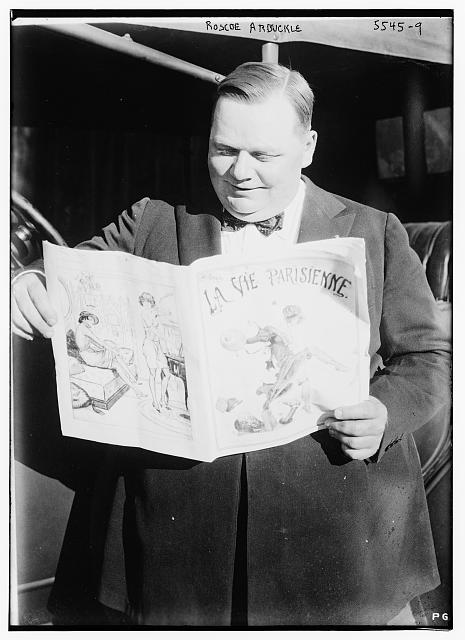
Born Roscoe Conkling Arbuckle Roscoe Conkling Arbuckle, also known as Fatty Arbuckle (March 24, 1887 – June 29, 1933), was an American silent film comedian, director, and screenwriter. Arbuckle is noted as one of the most popular actors of his era, but he is best remembered for a heavily publicized criminal prosecution that ended his career. Although he was acquitted by a jury with a written apology, the trial's scandal ruined the actor, who would not appear on screen again for another 10 years. Early life and career Born in Smith Center, Kansas, to Mollie and William Goodrich Arbuckle, he had several years of Vaudeville experience, including work at Idora Park in Oakland, California. One of his earliest mentors was comedian Leon Errol. He began his film career with the Selig Polyscope Company in July 1909. Arbuckle appeared sporadically in Selig one-reelers until 1913, moved briefly to Universal Pictures and became a star in producer-director Mack Sennett's Keystone Cops comedies. Arbuckle was also a talented singer. After Enrico Caruso heard him sing he urged the comedian to "give up this nonsense you do for a living, with training you could become the second greatest singer in the world". On August 6, 1908 he married Araminta Estelle Durfee (1889-1975), the daughter of Charles Warren Durfee and Flora Adkins. Durfee starred in many early comedy films under the name Minta Durfee, often with Arbuckle. Screen comedian
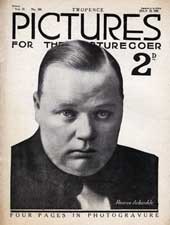
Pictures, Jul 23 1921, Roscoe "Fatty" Arbuckle on the cover Despite his massive physical size, Arbuckle was remarkably agile and acrobatic. Mack Sennett, when recounting his first meeting with Arbuckle, noted that he "skipped up the stairs as lightly as Fred Astaire"; and, "without warning went into a feather light step, clapped his hands and did a backward somersault as graceful as a girl tumbler". His comedies are noted as rollicking and fast-paced, have many chase scenes, and feature sight gags. Arbuckle was fond of the famous "pie in the face," a comedy cliché that has come to symbolize silent-film-era comedy itself. The earliest known use of this gag was in the June 1913 Keystone one-reeler A Noise from the Deep, starring Arbuckle and frequent screen partner Mabel Normand. (Note, the first known "pie in the face" on-screen is in Ben Turpin's Mr. Flip in 1909. However, the oldest known thrown "pie in the face" is Normand's). While Normand is said to have thrown the first pie on-screen, a Hollywood legend of uncertain provenance recounts that Arbuckle created this gag after encountering Pancho Villa's army on the Rio Grande during a Vaudeville appearance in El Paso. While the Arbuckles were picnicking on the river, they and Villa's men playfully threw fruit at each other across the river. Roscoe is said to have knocked one of the men off his horse with a bunch of bananas, to Pancho's extreme amusement. In 1914 Paramount Pictures made the then-unheard of offer of $1,000 a day/25% of all profits/complete artistic control to make movies with them. The movies were so lucrative and popular that in 1918 they offered Arbuckle a 3-year/$3 million contract. Arbuckle disliked his screen nickname, which he had been given because of his substantial girth. However, the name Fatty (big buster) identifies the character that Arbuckle portrayed on-screen (usually, a naive hayseed) -- not Arbuckle himself. When Arbuckle portrayed a female, the character was named "Miss Fatty" (as in the film Miss Fatty's Seaside Lovers). Hence, Arbuckle discouraged anyone from addressing him as "Fatty" off-screen. Buster Keaton Arbuckle gave Buster Keaton his first film-making work in his 1917 short, The Butcher Boy. They soon became screen partners, with deadpan Buster soberly assisting wacky Roscoe in his crazy adventures. When Arbuckle was promoted to feature films, Keaton inherited the short-subject series, which launched his own career as a comedy star. Arbuckle and Keaton's close friendship never wavered, even when Arbuckle was beset by tragedy at the zenith of his career, and through the depression and downfall that followed. In his autobiography Keaton described Arbuckle's playful nature and his love of practical jokes, including several elaborately constructed schemes the two successfully pulled off at the expense of various Hollywood studio heads and stars. Charlie Chaplin After English actor Charlie Chaplin joined Keystone Studios in 1914, Arbuckle mentored him. Chaplin's most famous character, "the Tramp", was created after Chaplin "borrowed" Arbuckle's trademark balloon pants, boots and tiny hat. The Scandal
Roscoe Conkling Arbuckle (1887-1933) At the height of his career, Arbuckle was under contract to Paramount Studios for $1 million a year -- the first multi-year/multi-million dollar deal paid by a Hollywood studio. [1] He worked tirelessly, filming three feature films simultaneously. On September 3, 1921 Arbuckle took a break from his hectic film schedule and drove to San Francisco with two friends, Lowell Sherman (an actor/director) and cameraman Fred Fischbach. The three checked into the St. Francis Hotel, [AB-1] decided to have a party, and invited several women to their suite. During the carousing, a 26-year-old aspiring actress named Virginia Rappe [Virgin Rape] became seriously ill and was examined by the hotel doctor, who concluded her symptoms were mostly caused by intoxication. Rappe died three days later of peritonitis caused by a ruptured bladder. Rappe's companion at the party, Maude Delmont, claimed before a grand jury that Arbuckle had somehow pierced Rappe's bladder while raping her. Rappe's manager Al Semnacker (at a later press conference) accused Arbuckle of using a piece of ice to simulate sex with her, which led to the injuries. By the time the story was reported in newspapers, the object had 'evolved' into being a Coca-Cola or Champagne bottle, instead of a piece of ice. In fact, witnesses testified that Arbuckle rubbed the ice on Rappe's stomach to ease her abdominal pain. Arbuckle was confident that he had nothing to be ashamed of, and denied any wrongdoing. Delmont later made a statement (incriminating Arbuckle) to the police, in an attempt to extort money from Arbuckle's attorneys; but, the matter soon spun out of her control. Roscoe Arbuckle's career is cited by many film historians as one of the great tragedies of Hollywood. His trial was a major media event and stories in William Randolph Hearst's nationwide newspaper chain were written with the intent of making Arbuckle appear guilty. The resulting scandal destroyed both his career and his personal life. Morality groups called for Arbuckle to be sentenced to death, and studio executives ordered Arbuckle's industry friends (whose careers they controlled) to not publicly speak up for him. Charlie Chaplin was in England at the time. Buster Keaton did make a public statement in support of Arbuckle, calling Roscoe one of the kindest souls he had known. Film actor William S. Hart, who never worked with Arbuckle, made public statements which presumed that Arbuckle was guilty. The prosecutor was San Francisco District Attorney Mathew Brady, who was determined to get a conviction as he was planning to use the case in his campaign to run for governor. To this end, Brady made public pronouncements of Arbuckle’s guilt, and pressured witnesses to make false statements. During the hearing and despite the judge threatening a motion to dismiss the case, Brady refused to allow the only witness accusing Arbuckle, Maude Delmont, to take the stand and testify. Delmont had a long criminal record with convictions for racketeering, bigamy, fraud and extortion. The defense had also gotten hold of a letter from Delmont admitting to a plan to extort Arbuckle. Along with Delmont’s constantly changing story, for her to testify would have ended any chance of going for trial. In his summation, the judge demolished every bit of the prosecution's evidence, and harangued Brady for producing such a flimsy case. The judge found no evidence of rape, but decided that Arbuckle could be tried for manslaughter. The first trial: What evidence the prosecution presented was often greeted with laughter from the courtroom; the spectators stood and cheered for Arbuckle after he testified. The jury returned deadlocked with a 10 - 2 not guilty verdict, and a mistrial was declared. The second trial: The same evidence was presented, but this time one of the witnesses, Zey Prevon, testified that the district attorney had forced her to lie. Another witness who claimed Arbuckle had bribed him turned out to be an escaped prisoner charged with assaulting an 8 year old girl; plus, fingerprint experts testified that the case's fingerprint evidence was faked. The defence was so convinced of an acquittal that Arbuckle was not called to testify. However, the jury interpreted the refusal to let Arbuckle testify as a sign of guilt. It returned deadlocked with a 10 - 2 guilty verdict -- another mistrial was declared. The third trial: By this time Arbuckle's films had been banned, and newspapers had been filled for seven months with alleged stories of Hollywood orgies, murder, sexual perversity and lies about Arbuckle's case. Maude Delmont was touring the country giving one-woman shows as "The woman who signed the murder charge against Arbuckle", and lecturing on the evils of Hollywood. This time, it took the jury a mere 6 minutes to return a unanimous not guilty verdict; five of those were taken to write a statement of apology. Unfortunately, public opinion had long-since been turned strongly against Arbuckle; six days after the verdict, the censorship board banned Roscoe Arbuckle from ever working in U.S. movies again. The Arbuckle case was one of four major Paramount-related scandals of the period. In 1920 Olive Thomas died after drinking a large quantity of medication meant for her husband (matinee idol Jack Pickford) which she had mistaken for water. In 1922 the murder of director William Desmond Taylor effectively ended the careers of actresses Mary Miles Minter and former Arbuckle screen partner Mabel Normand and in 1923 actor/director Wallace Reid's drug addiction resulted in his death. The scandals caused by these tragedies rocked Hollywood, leading major studios to include morality clauses in contracts. Owing to the scandal, most exhibitors declined to show Arbuckle's latest films. Ironically, one of the few feature-length films known to survive is Leap Year, one of two finished films Paramount withheld the release of, amid the scandal. It was eventually released in Europe, but was never theatrically released in the United States or Britain. Aftermath On January 27, 1925 he divorced Araminta Estelle Durfee in Paris. She had charged desertion. Arbuckle married Doris Deane on May 16, 1925. Arbuckle tried returning to moviemaking, but industry resistance to distributing his pictures lingered after his acquittal; he retreated into alcoholism. In the words of his first wife, "Roscoe only seemed to find solace and comfort in a bottle." Buster Keaton attempted to help Arbuckle by giving him work on Keaton's films. Arbuckle wrote the story for a Keaton short called "Daydreams." Arbuckle allegedly co-directed scenes in Keaton's Sherlock, Jr., but it is unclear how much of this footage remained in the film's final cut. Arbuckle also directed a number of comedy shorts under the pseudonym William Goodrich for Educational Pictures, which featured lesser-known comics of the day. He is said to have helped Bob Hope early in his career with a crucial job referral. In 1929 Doris Deane sued for divorce in Los Angeles, charging desertion and cruelty. On June 21, 1931 Roscoe married Addie Oakley Dukes McPhail (later Addie Oakley Sheldon, 1906-2003) in Erie, Pennsylvania. Shortly before this marriage, Arbuckle signed a contract with Jack Warner to star in six two-reel Vitaphone short comedies under his own name. The six Vitaphone shorts, filmed in Brooklyn, constitute the only recordings of his voice. Silent-film comedian Al St. John (Arbuckle's nephew) and actors Lionel Stander and Shemp Howard appeared with Arbuckle. The films were very successful in America, although when Warner Brothers attempted to release the first one ("Hey, Pop!") in the UK, the British film board cited the 10-year-old scandal and refused to grant an exhibition certificate. Roscoe Arbuckle had finished filming the last of the two-reelers on June 28, 1933; the next day he was signed by Warner Brothers to make a feature-length film. At last, Arbuckle's professional reputation was restored, and he was welcomed back into the world he loved. He reportedly said, "This is the best day of my life." The exhilaration may have been too much for him: he died that night of a heart attack. He was 46. He was cremated and his ashes scattered in the Pacific Ocean. William Goodrich pseudonym According to author David Yallop in The Day the Laughter Stopped (a biography of Arbuckle with special attention to the scandal and its aftermath), Arbuckle's father's full name was William Goodrich Arbuckle. A persistent but unsupported legend credited Keaton, an inveterate punster, with suggesting that Arbuckle become a director under the alias "Will B. Good." The pun being too obvious, Arbuckle adopted the more formal pseudonym "William Goodrich". Yallop's book also states that Roscoe Arbuckle was extremely large and heavy even at birth and that William Goodrich Arbuckle did not believe the child was his own offspring; this disbelief led him to name the child after a politician whom he despised: Roscoe Conkling. Legacy Many of Arbuckle's films, including the feature Life of the Party, survive only as worn prints with foreign-language inter-titles. Little or no effort was made to preserve original negatives and prints during Hollywood's first two decades. By the early 21st century some of Arbuckle's short subjects (particularly those co-starring Chaplin or Keaton) had been restored, released on DVD and even screened theatrically. Arbuckle's early influence on American slapstick comedy is widely cited. Director Kevin Connor will helm the Roscoe Arbuckle feature film, The Life of the Party, as reported by the website Dark Horizons. Preston Lacy will portray Arbuckle and Chris Kattan will play Buster Keaton. The movie is being produced by Doug Peterson and writer Victor Bardack. The 1975 James Ivory film The Wild Party has been repeatedly but incorrectly cited as a film dramatization of the Arbuckle/Rappe scandal. In fact it is loosely based on the 1920s poem by Joseph Moncure March. In this film, James Coco portrays a heavy-set silent-film comedian named Jolly Grimm whose career is on the skids, but who is desperately planning a comeback. Raquel Welch portrays his mistress, who ultimately goads him into shooting her. This film may have been inspired by misconceptions surrounding the Arbuckle scandal, yet it bears almost no resemblance to the documented facts of the case. In April and May of 2006, the Museum of Modern Art in New York City exhibited most of the surviving Arbuckle films. Filmography The Gangsters. 1913. Approx. 10 min. DIRECTED BY ROSCOE ARBUCKLE AS "WILLIAM GOODRICH" Special Delivery. 1922. With St. John,
Vernon Dent. Approx. 20 min. THE VITAPHONE SHORTS, STARRING ROSCOE ARBUCKLE Hey, Pop! 1932. With Billy Hayes. Approx.
20 min. Cultural references
See also List of United States comedy films Further reading Edmonds, Andy (January 1991). Frame-Up!:
The Untold Story of Roscoe "Fatty" Arbuckle. New York, NY: William
Morrow & Company. ISBN 0688091296. Selected coverage in The New York Times New York Times; September 12, 1921; pg.
1. "San Francisco, California; September 11, 1921. "Roscoe ("Fatty")
Arbuckle was arrested late last night on a charge of murder as a result
of the death of Virginia Rappe, film actress, after a party in
Arbuckle's rooms at the Hotel St. Francis. Arbuckle is still in jail
tonight despite efforts by his lawyers to find some way to obtain his
liberty." References ^ Charles Chaplin signed the first $1M contract. It was to deliver 8 pictures. _______________ American Buddha Librarian's Comments: [AB-1] "America Betrayed," by Rhawn Joseph, Ph.D. wrote: On September 5, 1975, after meeting with an Army Corps of Engineer general, Lynette “Squeaky” Fromme, wearing an unusual, attention-grabbing red outfit, pulled a 45-caliber pistol from beneath her coat and stuck it into the belly of President Gerald Ford as he was reaching out to shake her hand (40). She had been standing behind a rope, along with others in a cheering crowd, waiting as President Ford walked along the roped-off sidewalk of Capitol Park, shaking hands with well wishers. Although Ford had noticed her well before the fateful moment, due to her bright red garb, secret service agents did not, for reasons that have never been explained. Lynette “Squeaky” Fromme, had long been known to the FBI and Secret Service. She had been an outspoken member of the Manson murder family (40, 41), and lived close to Sacramento, where Charlie Manson was imprisoned—the city that Ford was visiting that afternoon. The FBI knew of Fromme, not just because of the Manson-connection, but as she had repeatedly called attention to herself by appealing to and threatening corporate CEO’s, several judges, as well as the commanding general of the Army Corps of Engineers, demanding that they do something to clean up the environment (40). Lynette “Squeaky” Fromme, had also been to the White House—but not as an activist or a Manson family member, but as a child. Lynette had been one of the star performers in the Westchester Lariats, a children’s dance group that performed at the White House (40). Why did she want to kill Ford? As explained by Lynette in a “History Channel” interview: “The very evening that I returned from San Francisco after speaking with the general, I saw President Ford on TV, getting off the plane in Sacramento. His visit was to address about 2000 area businessmen about enhancing their economic opportunities. Basically he was beginning his 1976 campaign.” After her visit with “the general” Lynette decided she would kill President Ford. “I simply stepped through the crowd to the President and raised the gun to his midsection between his heart and stomach at about two feet distance.” Although Ford had noticed her even before she pulled the gun, the Secret Service still did not react. Then she pulled the trigger, and yelled, “Do you believe it? It didn’t go off.” And then the Secret Service reacted. Lynette “Squeaky” Fromme was knocked to the ground and they confiscated her weapon. “Nelson Rockefeller came within a 32nd of an inch of becoming president of the United States,” said Donald Heller, an assistant U.S. attorney who prosecuted Fromme. And if Rockefeller became President, who would he have chosen to be Vice-President? The leading candidate would have been George Bush. And of course, we were told, “there was no conspiracy.” And, maybe there wasn’t. And, likewise, we were told, “there was no conspiracy,” when, 17 days later, an FBI and police informant pulled out her gun, and pointed it at President Gerald Ford. On September 22, 1975, Sarah Jane Moore aimed, and then fired. Again, the Secret Service did not react. Sarah Jane Moore was well known to the FBI. She had been recruited by them. Married five times, mother of four children, a mentally disturbed nursing school drop out, Sarah Jane Moore finally joined the Women’s Army Corps, where she may have first been recruited by the FBI. At age 42, Sara “dropped out” of society and immersed herself in the radical counter-culture lifestyle. Sara was a spy. She went “underground” at the behest of the FBI, to gain information on the terrorist organization, the “Symbionese Liberation Army” which had kidnapped Patty Hearst (42, 43). Sarah Jane Moore was still working for the FBI when she pointed and fired her standard police-issued .38 Smith and Wesson at President Gerald Ford as he left the St. Francis Hotel in San Francisco. But then the unexpected happened. As Secret Service agents stood and watched, a bystander, Oliver Sipple, grabbed Moore’s arm when he saw the gun, causing the bullet to miss Ford by just a few feet. Instead it ricocheted off a wall and wounded a cab driver. Sipple, an ex-Marine, wrestled her to the ground, and shoved his hand into the firing mechanism, which prevented her from getting off a second shot (44). Why did she do it? Sarah Jane Moore explained: “It would have elevated Nelson Rockefeller to the Presidency, and then people would see who the actual leaders of the country are.” Two months later, in November, 1975, Vice-President Nelson Rockefeller announced that he was removing himself from consideration as a possible running mate for President Ford in 1976. Ray arrived in Los Angeles on or about November 19, believing he was through with Raul. He had given up hope that Raul would get him the travel documents, and he was determined to try to get merchant seaman's papers on his own. He lived for a while in an apartment on North Serrano Street. He began looking for papers and a job, and he even placed a classified in the Los Angeles Times advertising himself as available for "culinary help." He didn't have a social security card, and because seaman's papers required fingerprints he was worried that his efforts could result in his exposure as a fugitive. He enrolled in a bartending course, took dancing lessons, and had psychological, hypnotic counseling for a period of time, spending about $800 on these activities. He also contacted a number of organizations he thought might help him to emigrate. He sent out photographs that weren't good likenesses (his face appeared fatter than it was), which later would be used by the media to accuse him of being on amphetamines. He also had plastic surgery on his nose to alter his appearance. By early December he was short of cash. He called the New Orleans number and the contact suggested he go to New Orleans. Marie Martin, a barmaid at the Sultan Club in the St. Francis Hotel, hooked him up with her cousin, Charles Stein, who wanted a ride to New Orleans and back. Before leaving Los Angeles, Ray dropped Marie Martin and Charles and Rita Stein off at the local George Wallace independent presidential campaign headquarters so they could register to vote. Soon after, Ray and Stein set off. Ray described Stein as a sort of "hippie" type. In New Orleans, Ray checked into the Provincial Motel in the Latin Quarter at Stein's suggestion. He met Raul at Le Bunny Lounge. Raul told him that they would be running guns into Mexico and that Ray could end up in Cuba. There he could book himself passage to anywhere in the world. Raul gave him $500 and said that he would contact him in Los Angeles in a few months. After returning to Los Angeles with Charlie Stein around the middle of January Ray moved into the St. Francis Hotel. On March 17, following instructions from Raul, he left for New Orleans, arriving a day late. He found that Raul had gone to Birmingham, leaving word that he would meet him at the Starlight Lounge the next day. Somehow Ray got lost on the way to Birmingham and wound up in Selma. Since it was dark by that time, he spent the night there. *** Youngblood did appear to match the description of a man who appeared at the St. Francis Hotel in Los Angeles shortly after the assassination. This man was with a James Earl Ray look-alike who appeared to have a great deal of money to throw around and who openly spoke of a second killing that was soon to take place. (Remember that during his stay in Los Angeles in late 1967 to early 1968 Ray had lived for some time at the St. Francis Hotel and was known there.) *** I TRIED TO CHECK OUT THE POSSIBLE INVOLVEMENT of an elusive character named J. C. Hardin. According to an FBI memo, in March 1968 while James was living at the St. Francis Hotel in Los Angeles a person named J. C. Hardin, who had spoken with the manager, Alan Thompson, had inquired about James. I learned that produce man Frank C. Liberto's mother's maiden name was Hardin. The fact that a Hardin had married into the Liberto family may have no bearing on the King case, of course, but I thought it should be checked out. Attorney Jim Lesar who was James's lawyer in the mid-1970s, was familiar with an interview of a former Tampa-based FBI agent, John Hartingh, who was alleged to have remarked, upon being asked about J. C. Hardin, that he was an asset of the bureau. I asked James about this matter, and he denied any knowledge of J. C. Hardin or anyone else inquiring after him at the hotel during this time. The Hardin name would come up later in our investigation in another context. *** A Memphis City Engineers analysis of the bullet's trajectory couldn't conclude whether it came from the bathroom window of the rooming house or the elevated brush area behind the rooming house. This uncertainty was due not only to confusion over Dr. King's posture but also to the fact that the medical examiner, Dr. Francisco, hadn't traced the path of the bullet in Dr. King's body. When asked about this departure from normal procedure, Francisco took the curious position that he was loathe to cause further mutilation for no good reason. The Jonestown Massacre, by Jonathan Vankin and John Whalen wrote: One final, weird note: A memo that allegedly passed between Jones and People’s Temple lawyer Mark Lane (who escaped the massacre) showed the two pondering the relocation of Grace Walden to Jonestown. Walden was a key witness to the assassination of Martin Luther King, Jr. Lane represented King’s accused assassin, James Earl Ray. When the memo turned up, Lane denied that he had discussed moving Walden. (He claims that the memo was part of an "army intelligence coverup" of the King assassination, ostensibly an attempt to discredit him and, through him, Walden.) Most of the People's Temple rank-and-file were black. Most of the leadership was white. Joyce Shaw, a former member, once mused that the mass suicide story was a coverup for "some kind of horrible government experiments, or some sort of sick, racist thing ... a plan like the Germans to exterminate blacks." In 1980, the House Permanent Select Committee on Intelligence announced that there was "no evidence" of CIA involvement at Jonestown. Gone From the Promised Land: Jonestown in American Cultural History, by John R. Hall wrote: Staff sought to turn Jonestown's situation around with the same strategy favored by its opponents: public relations. If they could just get out the truth about Jonestown, if they could just expose the conspiracy that sought to undo the community's brave venture into egalitarian socialism, perhaps all else would fall in place. The plan was to get a major writer to do a book on Jonestown. Attorney Charles Garry's assistant Pat Richartz suggested the Temple call on Don Freed, a progressive and a member of Citizens Commission of Inquiry -- a group headed by noted conspiracy theorist Mark Lane. In late August 1978 Freed journeyed to Jonestown ("New heaven, new earth," he called it in the guest book). On his return Freed linked activities against Peoples Temple with other "attempts to criminalize political people" like the Black Panthers and the Communist party of the 1950s. "The murder of Martin Luther King has echoes for Jonestown," he said. He told Richartz there would be no book, just some occasional free-lance publicity efforts. The public relations effort Freed pursued had as its centerpiece Joe Mazor, the private investigator who had worked with opponents to rescue people from Jonestown a year earlier. Freed set up a meeting at San Francisco's posh St. Francis Hotel to discuss Jonestown, inviting Mazor, Pat Richartz, and Mark Lane to engage in a freewheeling discussion of plot alternatives for a bogus movie scheme. Supposedly the group would piece together a film proposal for some interested investors. Shakespeare himself would have been impressed with the charade. The talk about a plot was a plot itself, tape recorded at that. Each of the actors read, as it were, from a script from a different play, but each script somehow grew heavy with the others' distorted perceptions as the hotel room drama unfolded. Mazor waxed eager to convince of his irreplaceable role as a for-fee consultant. At the outset he weighed in with a bombshell: he had just collected from an insurance company on bonds for fraud and forgery tied to Tim Stoen's actions in Temple property transfers. Mazor also spewed out apocryphal tales about his daring exploits as a mercenary who had crept around the edge of Jonestown during the crisis the previous September. In a brief timeout from the drama of Peoples Temple and the Concerned Relatives, those gathered in the St. Francis Hotel debated the content of the movie as a way of fleshing out the play of real life. Was John Victor Stoen really conceived by Jim Jones in Bus #7, as Mazor claimed? Had Tim Stoen really been in "deep cover" from his past associations with U.S. intelligence, Lane wondered. Did Stoen advocate fraud and intimidation as a provocateur? Was the CIA really behind it all? In the middle of history they stopped to write the end of history. How would it all turn out? Who really should be cast as the villain? Tim Stoen? Jim Jones? "I don't know who you are talking about making martyrs out of in the drama, if anyone," Mazor allowed, "but you better be careful, because it's unfolding day by day." The Hellfire Club, by Wikipedia wrote: The Hellfire Club was the popular name for what is supposed to have been an exclusive English club established by Sir Francis Dashwood which met irregularly from 1746 to around 1760 as an extension to his Society of Dilettanti. There is no evidence that they referred to themselves by this name, rather it is likely they used the names of a number of mockingly religious titles, beginning with the Brotherhood of St. Francis of Wycombe. Other titles used included the Order of Knights of West Wycombe and later, the Monks of Medmenham. Other clubs using the name "Hellfire Club" were set up throughout the 18th century, most notably the "Hell-Fire Club" founded around 1719 in London by Philip, Duke of Wharton. The members addressed each other as "Brothers" and Dashwood as "Abbot". Female "guests" (prostitutes) were "Nuns". Unlike the more determined Satanists of the 1720s the club motto was Fait ce que vouldras (Do what thou wilt) from François Rabelais, later used by Aleister Crowley. According to Horace Walpole the members' "practice was rigorously pagan: Bacchus and Venus were the deities to whom they almost publicly sacrificed; and the nymphs and the hogsheads that were laid in against the festivals of this new church, sufficiently informed the neighbourhood of the complexion of those hermits." Hellfire Woman, by David DeFeis and Jack Starr wrote:
She'll bleed you dry
|