|
CHAPTER 11: MR. BRADLAUGH'S
STRUGGLE.
And now dawned the year 1880, the memorable year in
which commenced Mr. Bradlaugh's long Parliamentary battle. After a long
and bitter struggle he was elected, with Mr. Labouchere, as member for
Northampton, at the general election, and so the prize so long fought
for was won. Shall I ever forget that election day, April 2, 1880? How
at four o'clock Mr. Bradlaugh came into the room at the "George", where
his daughters and I were sitting, flung himself into a chair with,
"There's nothing more to do; our last man is polled." Then the waiting
for the declaration through the long, weary hours of suspense, till as
the time drew near we knelt by the window listening—listening to the
hoarse murmur of the crowd, knowing that presently there would be a roar
of triumph or a howl of anger when the numbers were read out from the
steps of the Town Hall. And now silence sank, and we knew the moment had
come, and we held our breath, and then—a roar, a wild roar of joy and
exultation, cheer after cheer, ringing, throbbing, pealing, and then the
mighty surge of the crowd bringing him back, their member at last,
waving hats, handkerchiefs, a very madness of tumultuous delight, and
the shrill strains of "Bradlaugh for Northampton!" with a ring of
triumph in them they had never had before. And he, very grave, somewhat
shaken by the outpour of love and exultation, very silent, feeling the
weight of new responsibility more than the gladness of victory. And then
the next morning, as he left the town, the mass of men and women, one
sea of heads from hotel to station, every window crowded, his colours
waving everywhere, men fighting to get near him, to touch him, women
sobbing, the cries, "Our Charlie, our Charlie; we've got you and we'll
keep you." How they loved him, how they joyed in the triumph won after
twelve years of strife. Ah me! we thought the struggle over, and it was
only beginning; we thought our hero victorious, and a fiercer, crueller
fight lay in front. True, he was to win that fight, but his life was to
be the price of the winning; victory for him was to be final, complete,
but the laurel-wreath was to fall upon a grave.
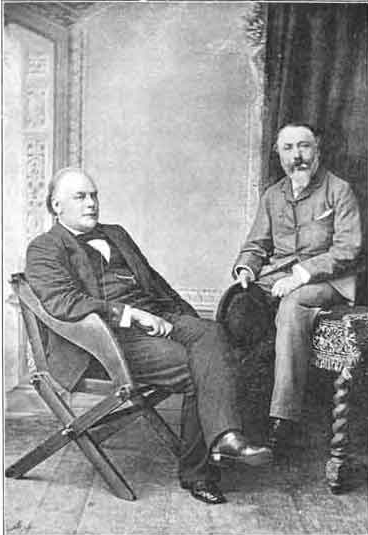
From a photograph by T. Westley, 57, Vernon
Street, Northampton.
CHARLES BRADLAUGH AND HENRY LABOUCHERE.
The outburst of anger from the more bigoted of the
Christian community was as savage as the outburst of delight had been
exultant, but we recked little of it. Was he not member, duly elected,
without possibility of assailment in his legal right? Parliament was to
meet on April 29th, the swearing-in beginning on the following day, and
Mr. Bradlaugh had taken counsel with some other Freethinking members as
to the right of Freethinkers to affirm. He held that under the Act 29
and 30 Vict. c. 19, and the Evidence Amendment Acts 1869 and 1870, the
right to substitute affirmation for oath was clear; he was willing to
take the oath as a necessary form if obligatory, but, believing it to be
optional, he preferred affirmation. On May 3rd he presented himself and,
according to the evidence of Sir Erskine May, the Clerk of the House,
given before the second Select Committee on his case, he "came to the
table and delivered the following statement in writing to the Clerk: 'To
the Right Honourable the Speaker of the House of Commons. I, the
undersigned, Charles Bradlaugh, beg respectfully to claim to be allowed
to affirm, as a person for the time being by law permitted to make a
solemn affirmation or declaration, instead of taking an oath. (Signed)
Charles Bradlaugh.' And being asked by the Clerk upon what grounds he
claimed to make an affirmation, he answered: 'By virtue of the Evidence
Amendment Acts, 1869 and 1870.' Whereupon the Clerk reported to Mr.
Speaker" the claim, and Mr. Speaker told Mr. Bradlaugh that he might
address the House on the matter. "Mr. Bradlaugh's observations were very
short. He repeated that he relied upon the Evidence Further Amendment
Act, 1869, and the Evidence Amendment Act, 1870, adding: 'I have
repeatedly, for nine years past, made an affirmation in the highest
courts of jurisdiction in this realm. I am ready to make such a
declaration or affirmation.' Substantially those were the words which he
addressed to the Speaker." This was the simple, quiet, and dignified
scene which took place in the House. Mr. Bradlaugh was directed to
withdraw, and he withdrew, and, after debate, a Select Committee was
appointed to consider whether he could make affirmation; that Committee
decided against the claim, and gave in its report on May 20th. On the
following day Mr. Bradlaugh presented himself at the table of the House
to take the oath in the form prescribed by the law, and on the objection
of Sir Henry Drummond Wolff, who submitted a motion that he should not
be allowed to take the oath, another Committee was appointed.
Before this Committee Mr. Bradlaugh stated his case,
and pointed out that the legal obligation lay on him to take the oath,
adding: "Any form that I went through, any oath that I took, I should
regard as binding upon my conscience in the fullest degree. I would go
through no form, I would take no oath, unless I meant it to be so
binding." He wrote in the same sense to the Times, saying that he
should regard himself "as bound, not by the letter of its words, but by
the spirit which the affirmation would have conveyed, had I been
permitted to use it." The Committee reported against him, and on June
23rd he was heard at the Bar of the House, and made a speech so
self-restrained, so noble, so dignified, that the House, in defiance of
all its own rules, broke out over and over again into applause. In the
debate that preceded his speech, members had lost sight of the ordinary
rules of decency, and had used expressions against myself wholly
gratuitous in such a quarrel; the grave rebuke to him who "was wanting
in chivalry, because, while I can answer for myself and am able to
answer for myself, nothing justified the introduction of any other name
beside my own to make prejudice against me," brought irrepressible
cheers. His appeal was wholly to the law. "I have not yet used—I trust
no passion may tempt me into using—any words that would seem to savour
of even a desire to enter into conflict with this House. I have always
taught, preached, and believed the supremacy of Parliament, and it is
not because for a moment the judgment of one Chamber of Parliament
should be hostile to me that I am going to deny the ideas I have always
held; but I submit that one Chamber of Parliament—even its grandest
Chamber, as I have always held this to be—had no right to override the
law. The law gives me the right to sign that roll, to take and subscribe
the oath, and to take my seat there [with a gesture towards the
benches]. I admit that the moment I am in the House, without any reason
but your own good will, you can send me away. That is your right. You
have full control over your members. But you cannot send me away until I
have been heard in my place, not a suppliant as I am now, but with the
rightful audience that each member has always had.... I am ready to
admit, if you please, for the sake of argument, that every opinion I
hold is wrong and deserves punishment. Let the law punish it. If you say
the law cannot, then you admit that you have no right, and I appeal to
public opinion against the iniquity of a decision which overrides the
law and denies me justice. I beg your pardon, sir, and that of the House
too, if in this warmth there seems to lack respect for its dignity. And
as I shall have, if your decision be against me, to come to that table
when your decision is given, I beg you, before the step is taken in
which we may both lose our dignity—mine is not much, but yours is that
of the Commons of England—I beg you, before the gauntlet is fatally
thrown, I beg you, not in any sort of menace, not in any sort of boast,
but as one man against six hundred, to give me that justice which on the
other side of this hall the judges would give me, were I pleading there
before them."
But no eloquence, no plea for justice, could stay the
tide of Tory and religious bigotry, and the House voted that he should
not be allowed to take the oath. Summoned to the table to hear the
decision communicated by the Speaker, he answered that decision with the
words firmly spoken: "I respectfully refuse to obey the order of the
House, because that order was against the law." The Speaker appealed to
the House for direction, and on a division—during which the Speaker and
Charles Bradlaugh were left together in the chamber—the House ordered
the enforcement of Mr. Bradlaugh's withdrawal. Once more the order is
given, once more the refusal made, and then the Serjeant-at-Arms was
bidden to remove him. Strange was the scene as little Captain Cosset
walked up to the member of Herculean proportions, and men wondered how
the order would be enforced; but Charles Bradlaugh was not the man to
make a vulgar brawl, and the light touch on his shoulder was to him the
touch of an authority he admitted and to which he bowed. So he gravely
accompanied his small captor, and was lodged in the Clock Tower of the
House as prisoner until the House should further consider what to do
with him—the most awkward prisoner it had ever had, in that in his
person it was imprisoning the law.
In a special issue of the National Reformer,
giving an account of the Committee's work and of Mr. Bradlaugh's
committal to the Clock Tower, I find the following from my own pen: "The
Tory party, beaten at the polls by the nation, has thus, for the moment,
triumphed in the House of Commons. The man chosen by the Radicals of
Northampton has been committed to prison on the motion of the Tory
ex-Chancellor of the Exchequer, simply because he desires to discharge
the duty laid upon him by his constituency and by the law of the land.
As this paper goes to press, I go to Westminster to receive from him his
directions as to the conduct of the struggle with the nation into which
the House of Commons has so recklessly plunged." I found him busily
writing, prepared for all events, ready for a long imprisonment. On the
following day a leaflet from my pen, "Law Makers and Law Breakers,"
appealed to the people; after reciting what had happened, it concluded:
"Let the people speak. Gladstone and Bright are for Liberty, and the
help denied them within the House must come to them from without. No
time must be lost. While we remain idle, a representative of the people
is illegally held in prison. Northampton is insulted, and in this great
constituency every constituency is threatened. On freedom of election
depends our liberty; on freedom of conscience depends our progress. Tory
squires and lordlings have defied the people and measured their strength
against the masses. Let the masses speak." But there was no need to make
appeals, for the outrage itself caused so swiftly a growl of anger that
on the very next day the prisoner was set free, and there came protest
upon protest against the high-handed action of the House. In Westminster
Hall 4,000 people gathered to cheer Mr. Bradlaugh when he came to the
House on the day after his liberation. In less than a week 200 meetings
had thundered out their protest. Liberal associations, clubs, societies,
sent up messages of anger and of demand for justice. In Trafalgar Square
there gathered—so said the papers—the largest crowd ever seen there, and
on the Thursday following—the meeting was held on Monday—the House of
Commons rescinded its resolution, refusing to allow Mr. Bradlaugh to
affirm, and admitted him on Friday, July 2nd, to take his seat after
affirmation. "At last the bitter struggle is over," I wrote, "and law
and right have triumphed. The House of Commons has, by rescinding the
resolution passed by Tories and Ultramontanes, re-established its good
name in the eyes of the world. The triumph is not one of Freethought
over Christianity, nor is it over the House of Commons; it is the
triumph of law, brought about by good men—of all shades of opinion, but
of one faith in justice—over Tory contempt of law and Ultramontane
bigotry. It is the reassertion of civil and religious liberty under the
most difficult circumstances, the declaration that the House of Commons
is the creation of the people, and not a club of the aristocracy with
the right of blackballing in its own hands."
The battle between Charles Bradlaugh and his
persecutors was now transferred to the law courts. As soon as he had
taken his seat he was served with a writ for having voted without having
taken the oath, and this began the wearisome proceedings by which his
defeated enemies boasted that they would make him bankrupt, and so
vacate the seat he had so hardly gained. Rich men like Mr. Newdegate
sued him, putting forward a man of straw as nominal plaintiff; for many
a weary month Mr. Bradlaugh kept all his enemies at bay, fighting each
case himself; defeated time after time, he fought on, finally carrying
the cases to the House of Lords, and there winning them triumphantly.
But they were won at such heavy cost of physical strength and of money,
that they undermined his strength and burdened him heavily with debt.
For all this time he had not only to fight in the law courts and to
attend scrupulously to his Parliamentary duties, but he had to earn his
living by lecturing and writing, so that his nights away from the House
were spent in travelling and his days in incessant labour. Many of his
defeated foes turned their weapons against me, hoping thus to give him
pain; thus Admiral Sir John Hay, at Wigton, used language of me so
coarse that the Scotsman and Glasgow Herald refused to
print it, and the editor of the Scotsman described it as
"language so coarse that it could have hardly dropped from a yahoo."
August 25th found me at Brussels, whither I went, with Miss Hypatia
Bradlaugh, to represent the English Freethinkers at the International
Freethought Conference. It was an interesting gathering, attended by men
of world-wide reputation, including Dr. Ludwig Büchner, a man of noble
and kindly nature. An International Federation of Freethinkers was there
founded, which did something towards bringing together the Freethinkers
of different countries, and held interesting congresses in the following
years in London and Amsterdam; but beyond these meetings it did little,
and lacked energy and vitality. In truth, the Freethought party in each
country had so much to do in holding its own that little time and
thought could be given to international organisation. For myself, my
introduction to Dr. Büchner, led to much interesting correspondence, and
I translated, with his approval, his "Mind in Animals," and the enlarged
fourteenth edition of "Force and Matter," as well as one or two
pamphlets. This autumn of 1880 found the so-called Liberal Government in
full tilt against the Irish leaders, and I worked hard to raise English
feeling in defence of Irish freedom even against attack by one so much
honoured as was Mr. Gladstone. It was uphill work, for harsh language
had been used against England and all things English, but I showed by
definite figures—all up and down England—that life and property were far
safer in Ireland than in England, that Ireland was singularly free from
crime save in agrarian disputes, and I argued that these would disappear
if the law should step in between landlord and tenant, and by stopping
the crimes of rack-renting and most brutal eviction, put an end to the
horrible retaliations that were born of despair and revenge. A striking
point on these evictions I quoted from Mr. T.P. O'Connor, who, using Mr.
Gladstone's words that a sentence of eviction was a sentence of
starvation, told of 15,000 processes of eviction issued in that one
year. The autumn's work was varied by the teaching of science classes, a
debate with a clergyman of the Church of England, and an operation which
kept me in bed for three weeks, but which, on the other hand, was
useful, for I learned to write while lying on my back, and accomplished
in this fashion a good part of the translation of "Mind in Animals."
And here let me point a moral about hard work. Hard
work kills no one. I find a note in the National Reformer in 1880
from the pen of Mr. Bradlaugh: "It is, we fear, useless to add that, in
the judgment of her best friends, Mrs. Besant has worked far too hard
during the last two years." This is 1893, and the thirteen years'
interval has been full of incessant work, and I am working harder than
ever now, and in splendid health. Looking over the National Reformer
for all these years, it seems to me that it did really fine educational
work; Mr. Bradlaugh's strenuous utterances on political and theological
matters; Dr. Aveling's luminous and beautiful scientific teachings; and
to my share fell much of the educative work on questions of political
and national morality in our dealings with weaker nations. We put all
our hearts into our work, and the influence exercised was distinctly in
favour of pure living and high thinking.
In the spring of 1881 the Court of Appeal decided
against Mr. Bradlaugh's right to affirm as Member of Parliament, and his
seat was declared vacant, but he was at once returned again by the
borough of Northampton, despite the virulence of slander directed
against him, so that he rightly described the election as "the most
bitter I have ever fought." His work in the House had won him golden
opinions in the country, and he was already recognised as a power there;
so Tory fear was added to bigoted hatred, and the efforts to keep him
out of the House were increased.
He was introduced to the House as a new member to take
his seat by Mr. Labouchere and Mr. Burt, but Sir Stafford Northcote
intervened, and after a lengthy debate, which included a speech from Mr.
Bradlaugh at the Bar, a majority of thirty-three refused to allow him to
take the oath. After a prolonged scene, during which Mr. Bradlaugh
declined to withdraw and the House hesitated to use force, the House
adjourned, and finally the Government promised to bring in an
Affirmation Bill, and Mr. Bradlaugh promised, with the consent of his
constituents, to await the decision of the House on this Bill. Meantime,
a League for the Defence of Constitutional Rights was formed, and the
agitation in the country grew: wherever Mr. Bradlaugh went to speak vast
crowds awaited him, and he travelled from one end of the country to the
other, the people answering his appeal for justice with no uncertain
voice. On July 2nd, in consequence of Tory obstruction, Mr. Gladstone
wrote to Mr. Bradlaugh that the Government were going to drop the
Affirmation Bill, and Mr. Bradlaugh thereupon determined to present
himself once more in the House, and fixed on August 3rd as the date of
such action, so that the Irish Land Bill might get through the House ere
any delay in business was caused by him. The House was then closely
guarded with police; the great gates were closed, reserves of police
were packed in the law courts, and all through July this state of siege
continued. On August 2nd there was a large meeting in Trafalgar Square,
at which delegates were present from all parts of England, and from as
far north as Edinburgh, and on Wednesday, August 3rd, Mr. Bradlaugh went
down to the House. His last words to me were: "The people know you
better than they know any one, save myself; whatever happens, mind,
whatever happens, let them do no violence; I trust to you to keep them
quiet." He went to the House entrance with Dr. Aveling, and into the
House alone. His daughters and I went together, and with some hundreds
of others carrying petitions—ten only with each petition, and the ten
rigidly counted and allowed to pass through the gate, sufficiently
opened to let one through at a time—reached Westminster Hall, where we
waited on the steps leading to the passage of the lobby.
An inspector ordered us off. I gently intimated that
we were within our rights. Dramatic order: "Four officers this way." Up
they marched and looked at us, and we looked at them. "I think you had
better consult Inspector Denning before you use violence," I remarked
placidly. They thought they had, and in a few moments up came the
inspector, and seeing that we were standing in a place where we had a
right to be, and were doing no harm, he rebuked his over-zealous
subordinates, and they retired and left us in peace. A man of much tact
and discretion was Inspector Denning. Indeed, all through this, the
House of Commons police behaved admirably well. Even in the attack they
were ordered to make on Mr. Bradlaugh, the police used as little
violence as they could. It was Mr. Erskine, the Deputy Serjeant-at-Arms,
and his ushers, who showed the brutality; as Dr. Aveling wrote at the
time: "The police disliked their work, and, as brave men, had a sympathy
for a brave man. Their orders they obeyed rigidly. This done, they were
kindness itself." Gradually the crowd of petitioners grew and grew;
angry murmurs were heard, for no news came from the House, and they
loved "Charlie," and were mostly north country men, sturdy and
independent. They thought they had a right to go into the lobby, and
suddenly, with the impulse that will sway a crowd to a single action
there was a roar, "Petition, petition, justice, justice," and they
surged up the steps, charging at the policemen who held the door.
Flashed into my mind my chief's charge, his words, "I trust to you to
keep them quiet," and as the police sprang forward to meet the crowd I
threw myself between them, with all the advantage of the position of the
top of the steps that I had chosen, so that every man in the charging
crowd saw me, and as they checked themselves in surprise I bade them
stop for his sake, and keep for him the peace which he had bade us
should not be broken. I heard afterwards that as I sprang forward the
police laughed—they must have thought me a fool to face the rush of the
charging men; but I knew his friends would never trample me down, and as
the crowd stopped the laugh died out, and they drew back and left me my
own way.
Sullenly the men drew back, mastering themselves with
effort, reining in their wrath, still for his sake. Ah! had I known what
was going on inside, would I have kept his trust unbroken! and, as many
a man said to me afterwards in northern towns, "Oh! if you had let us go
we would have carried him into the House up to the Speaker's chair." We
heard a crash inside, and listened, and there was sound of breaking
glass and splintering wood, and in a few minutes a messenger came to me:
"He is in Palace Yard." And we went thither and saw him standing, still
and white, face set like marble, coat torn, motionless, as though carved
in stone, facing the members' door. Now we know the whole shameful
story: how as that one man stood alone, on his way to claim his right,
alone so that he could do no violence, fourteen men, said the Central
News, police and ushers, flung themselves upon him, pushed and pulled
him down the stairs, smashing in their violence the glass and wood of
the passage door; how he struck no blow, but used only his great
strength in passive resistance—" Of all I have ever seen, I never saw
one man struggle with ten like that," said one of the chiefs, angrily
disdainful of the wrong he was forced to do—till they flung him out into
Palace Yard. An eye-witness thus reported the scene in the Press: "The
strong, broad, heavy, powerful frame of Mr. Bradlaugh was hard to move,
with its every nerve and muscle strained to resist the coercion. Bending
and straining against the overpowering numbers, he held every inch with
surprising tenacity, and only surrendered it after almost superhuman
exertions to retain it. The sight—little of it as was seen from the
outside—soon became sickening. The overborne man appeared almost at his
last gasp. The face, in spite of the warmth of the struggle, had an
ominous pallor. The limbs barely sustained him.... The Trafalgar Square
phrase that this man might be broken but not bent occurred to minds
apprehensive at the present appearance of him."
They flung him out, and swift, short words were there
interchanged. "I nearly did wrong at the door," he said afterwards, "I
was very angry. I said to Inspector Denning, 'I shall come again with
force enough to overcome it,' He said, 'When?' I said, 'Within a minute
if I raise my hand.'" He stood in Palace Yard, and there outside the
gate was a vast sea of heads, the men who had journeyed from all parts
of England for love of him, and in defence of the great right he
represented of a constituency to send to Parliament the man of its
choice. Ah! he was never greater than in that moment of outrage and of
triumphant wrong; with all the passion of a proud man surging within
him, insulted by physical violence, injured by the cruel wrenching of
all his muscles—so that for weeks his arms had to be swathed in
bandages—he was never greater than when he conquered his own wrath,
crushed down his own longing for battle, stirred to flame by the bodily
struggle, and the bodily injury, and with thousands waiting within sound
of his voice, longing to leap to his side, he gave the word to tell them
to meet him that evening away from the scene of conflict, and meanwhile
to disperse quietly, "no riot, no disorder." But how he suffered
mentally no words of mine may tell, and none can understand how it wrung
his heart who does not know how he reverenced the great Parliament of
England, how he honoured law, how he believed in justice being done; it
was the breaking down of his national ideals, of his pride in his
country, of his belief that faith would be kept with a foe by English
gentlemen, who with all their faults, he thought, held honour and
chivalry dear. "No man will sleep in gaol for me to-night," he said to
me that day; "no woman can blame me for her husband killed or wounded,
but—" A wave of agony swept over his face, and from that fatal day
Charles Bradlaugh was never the same man. Some hold their ideals
lightly, but his heart-strings were twined round his; some care little
for their country—he was an Englishman, law-abiding, liberty-loving, to
his heart's core, of the type of the seventeenth-century patriot,
holding England's honour dear. It was the treachery that broke his
heart; he had gone alone, believing in the honour of his foes, ready to
submit to expulsion, to imprisonment, and it was the latter that he
expected; but he never dreamed that, going alone amongst his foes, they
would use brutal and cowardly violence, and shame every Parliamentary
tradition by personal outrage on a duly-elected member, outrage more
worthy of a slum pot-house than of the great Commons House, the House of
Hampden and of Vane, the House that had guarded its own from Royal
violence, and had maintained its privileges in the teeth of kings.
These stormy scenes brought about a promise of
Government aid; Mr. Bradlaugh failed to get any legal redress, as,
indeed, he expected to fail, on the ground that the officials of the
House were covered by the House's order, but the Government promised to
support his claim to his seat during the next session, and thus
prevented the campaign against them on which we had resolved. I had
solely on my own responsibility organised a great band of people pledged
to refrain from the use of all excisable articles after a certain date,
and to withdraw all their moneys in the Savings Bank, thus seriously
crippling the financial resources of the Government. The response from
the workers to my appeal to "Stop the supplies" was great and touching.
One man wrote that as he never drank nor smoked he would leave off tea;
others that though tobacco was their one luxury, they would forego it;
and so on. Somewhat reluctantly, I asked the people to lay aside this
formidable weapon, as "we have no right to embarrass the Government
financially save when they refuse to do the first duty of a Government
to maintain law. They have now promised to do justice, and we must
wait." Meanwhile the injuries inflicted on Mr. Bradlaugh, rupturing the
sheaths of some of the muscles of the arm, laid him prostrate, and
various small fights went on during the temporary truce in the great
struggle. I turned up in the House two or three times, haled thither,
though not in person, by the people who kept Mr. Bradlaugh out, and a
speech of mine became the subject of a question by Mr. Ritchie, while
Sir Henry Tyler waged war on the science classes. Another joy was added
to life by the use of my name—which by all these struggles had gained a
marketable value—as author of pamphlets I had never seen, and this
forgery of my name by unscrupulous people in the colonies caused me a
good deal of annoyance. In the strengthening of the constitutional
agitation in the country, the holding of an International Congress of
Freethinkers in London, the studying and teaching of science, the
delivering of courses of scientific lectures in the Hall of Science, a
sharp correspondence with the Bishop of Manchester, who had libelled
Secularists, and which led to a fiery pamphlet, "God's Views on
Marriage," as retort—in all these matters the autumn months sped rapidly
away. One incident of that autumn I record with regret. I was misled by
very partial knowledge of the nature of the experiments performed, and
by my fear that if scientific men were forbidden to experiment on
animals with drugs they would perforce experiment with them on the poor
in hospitals, to write two articles, republished as a pamphlet, against
Sir Eardley Wilmot's Bill for the "Total Suppression of Vivisection." I
limited my approval to highly skilled men engaged in original
investigations, and took the representations made of the character of
the experiments without sufficient care to verify them. Hence the
publication of the one thing I ever wrote for which I feel deep regret
and shame, as against the whole trend and efforts of my life. I am
thankful to say that Dr. Anna Kingsford answered my articles, and I
readily inserted her replies in the paper in which mine had appeared—our
National Reformer—and she touched that question of the moral
sense to which my nature at once responded. Ultimately, I looked
carefully into the subject, found that vivisection abroad was very
different from vivisection in England, saw that it was in very truth the
fiendishly cruel thing that its opponents alleged, and destroyed my
partial defence of even its less brutal form.
1882 saw no cessation of the struggles in which Mr.
Bradlaugh and those who stood by him were involved. On February 7th he
was heard for the third time at the Bar of the House of Commons, and
closed his speech with an offer that, accepted, would have closed the
contest. "I am ready to stand aside, say for four or five weeks, without
coming to that table, if the House within that time, or within such time
as its great needs might demand, would discuss whether an Affirmation
Bill should pass or not. I want to obey the law, and I tell you how I
might meet the House still further, if the House will pardon me for
seeming to advise it. Hon. members have said that would be a Bradlaugh
Relief Bill. Bradlaugh is more proud than you are. Let the Bill pass
without applying to elections that have taken place previously, and I
will undertake not to claim my seat, and when the Bill has passed I will
apply for the Chiltern Hundreds. I have no fear. If I am not fit for my
constituents, they shall dismiss me, but you never shall. The grave
alone shall make me yield." But the House would do nothing. He had asked
for 100,000 signatures in favour of his constitutional right, and on
February 8th, 9th, and 10th 1,008 petitions, bearing 241,970 signatures,
were presented; the House treated them with contemptuous indifference.
The House refused to declare his seat vacant, and also refused to allow
him to fill it, thus half-disfranchising Northampton, while closing
every avenue to legal redress. Mr. Labouchere—who did all a loyal
colleague could do to assist his brother member—brought in an
Affirmation Bill; it was blocked. Mr. Gladstone, appealed to support the
law declared by his own Attorney-General, refused to do anything. An
impasse was created, and all the enemies of freedom rejoiced. Out of
this position of what the Globe called "quiet omnipotence" the
House was shaken by an audacious defiance, for on February 21st the
member it was trying to hold at arm's length took the oath in its
startled face, went to his seat, and—waited events. The House then
expelled him—and, indeed, it could scarcely do anything else after such
defiance—and Mr. Labouchere moved for a new writ, declaring that
Northampton was ready, its "candidate was Charles Bradlaugh, expelled
this House." Northampton, ever steadfast, returned him for the third
time—the vote in his favour showing an increase of 359 over the second
bye-election—and the triumph was received in all the great towns of
England with wild enthusiasm. By the small majority of fifteen in a
House of 599 members—and this due to the vacillation of the
Government—he was again refused the right to take his seat. But now the
whole Liberal Press took up his quarrel; the oath question became a test
question for every candidate for Parliament, and the Government was
warned that it was alienating its best friends. The Pall Mall Gazette
voiced the general feeling. "What is the evidence that an Oaths Bill
would injure the Government in the country? Of one thing we may be sure,
that if they shirk the Bill they will do no good to themselves at the
elections. Nobody doubts that it will be made a test question, and any
Liberal who declines to vote for such a Bill will certainly lose the
support of the Northampton sort of Radicalism in every constituency. The
Liberal Press throughout the country is absolutely unanimous. The
political Non-conformists are for it. The local clubs are for it. All
that is wanted is that the Government should pick up a little more moral
courage, and recognise that even in practice honesty is the best
policy." The Government did not think so, and they paid the penalty, for
one of the causes that led to their defeat at the polls was the disgust
felt at their vacillation and cowardice in regard to the rights of
constituencies. Not untruly did I write, in May, 1882, that Charles
Bradlaugh was a man "who by the infliction of a great wrong had become
the incarnation of a great principle"; for the agitation in the country
grew and grew, until, returned again to Parliament at the General
Election, he took the oath and his seat, brought in and carried an Oaths
Bill, not only giving Members of Parliament the right to affirm, but
making Freethinkers competent as jurymen, and relieving witnesses from
the insult hitherto put upon those who objected to swearing; he thus
ended an unprecedented struggle by a complete victory, weaving his name
for ever into the constitutional history of his country.
In the House of Lords, Lord Redesdale brought in a
Bill disqualifying Atheists from sitting in Parliament, but in face of
the feeling aroused in the country, the Lords, with many pathetic
expressions of regret, declined to pass it. But, meanwhile, Sir Henry
Tyler in the Commons was calling out for prosecutions for blasphemy to
be brought against Mr. Bradlaugh and his friends, while he carried on
his crusade against Mr. Bradlaugh's daughters, Dr. Aveling, and myself,
as science teachers. I summed up the position in the spring of 1882 in
the following somewhat strong language: "This short-lived 'Parliamentary
Declaration Bill' is but one of the many clouds which presage a storm of
prosecution. The reiterated attempts in the House of Commons to force
the Government into prosecuting heretics for blasphemy; the petty and
vicious attacks on the science classes at the Hall; the odious and
wicked efforts of Mr. Newdegate to drive Mr. Bradlaugh into the
Bankruptcy Court; all these are but signs that the heterogeneous army of
pious and bigoted Christians are gathering together their forces for a
furious attack on those who have silenced them in argument, but whom
they hope to conquer by main force, by sheer brutality. Let them come.
Free-thinkers were never so strong, never so united, never so well
organised as they are to-day. Strong in the goodness of our cause, in
our faith in the ultimate triumph of Truth, in our willingness to give
up all save fidelity to the sacred cause of liberty of human thought and
human speech, we await gravely and fearlessly the successors of the men
who burned Bruno, who imprisoned Galileo, who tortured Vanini—the men
who have in their hands the blood-red cross of Jesus of Nazareth, and in
their hearts the love of God and the hate of man."
Go to Next Page |