|
BARRED FROM THE BAR -- A HISTORY OF WOMEN AND THE LEGAL PROFESSION |
|
1. WITH A FOOT ON THEIR NECKS I ask no favors for my sex. I surrender not our claim to equality. All I ask of our brethren is that they will take their feet from off our necks and permit us to stand upright on the ground which God has designed us to occupy. -- Sarah Grimke, abolitionist leader [1] It was no less than amazing that Myra Bradwell even considered becoming a lawyer. For almost a hundred years after the American Revolution, not one single woman had been permitted to practice law. [2] Only a few worked as physicians, [3] perhaps because women had always been assigned the caretaker role -- nursing sick family members and even neighbors. But law was another matter. It was, after all, the center of power. Court decisions not only determined the guilt or innocence of those accused of crimes. The courts ruled on marriage relations, property rights, and civil disputes -- all decided by lawyers, judges, and juries, who were always male. The laws interpreted by the legal establishment were passed by the ruling bodies of the nation, from Congress to the state legislatures, all of them composed of men, most of them lawyers. Their legislation reflected and reinforced the prevailing attitudes toward women. Women did not lose their legal status in the newborn United States. They had never had any rights under the law in the first place! Throughout most of recorded history, in fact, women had been viewed as the "other," the inferior of men. [4] The famous words of Thomas Jefferson's Declaration of Independence that "all men are created equal" meant just that. Mixing flattery with insult, Jefferson had also said that American women would be "too wise to wrinkle their foreheads with politics." As president, Jefferson wrote that women's education should be limited to "the amusements of life ... dancing, drawing, and music." [5] Until 1920, except for a very brief period in New Jersey when, between 1776 and 1807, "all free inhabitants" who owned property could vote, state constitutions barred women from voting or holding office. Without the ability to select those who made the laws, they could do little to change the oppressive laws themselves. Although single women were banned from public activities such as voting, jury service, and public office, so long as they did not marry they could own and manage their own property, keep their own earnings, sign contracts, sue and be sued, and will their possessions to anyone of their choice. They were automatically deprived of all of these rights on the day they said "I do." At that point "coverture" laws applied, under which the woman became "one" with her husband, his powerless "other" half. [6] Not surprisingly, many women from wealthy families remained single, not wanting to lose all of their control and power as individuals. In those days, a husband had the right to commit his wife to an insane asylum without even a legal hearing to determine her sanity. Divorce was not a real option for women either. In the few states where divorces were legal, the husband automatically retained custody of all property, including any children. As one historian has expressed it, "Women were civilly dead and without political rights." [7] Once they were married, their life often became a cycle of pregnancy, births, and drudgery. Even their bodies no longer belonged to them. If a woman refused to give in to her husband's sexual demands, he could institute divorce proceedings or beat her, all with the law on his side. Contraception was prohibited. Although condoms had been used since the sixteenth century and were mass-produced in the 1840s, the law banned their sale. Again, it was the man's choice alone if he wished to buy some on the sly. Not until the 1930s, when the Great Depression made it almost impossible to feed large families, was birth control legalized in most states. The law also viewed rape as a violation of the rights of men, who, after all, controlled their wives' and daughters' bodies! Behind all of these decrees was the issue of property rights. If a woman became pregnant after being raped, there was no way to establish the fatherhood of the offspring. The offspring of another man could later make claims on the husband's property! The attitudes were derived from the Bible and English common law. The inferior status of women was justified by the Bible story of the "original sin" of Eve in the Garden of Eden. As England's laws evolved, the idea of husband and wife as "one" came to mean that the wife sublimated her entire self to her mate. Eventually these rules were collected and documented in Blackstone's Commentaries, required reading for all students of the law. [8] Blackstone was merely recording decisions made centuries earlier. The earliest and most revered philosophers -- Roger Bacon, Thomas Aquinas, Albertus Magnus, all of them important religious figures as well -- warned about the evildoings of witches, women in league with the devil. This fear-mongering paved the way for the Inquisition of the fifteenth, sixteenth, and seventeenth centuries, with women the favorite targets. [9] The chapter titles of Malleus Maleficarum, the instruction manual for the witch-hunters, read like a prescription for future coverture laws: "Evil Began with Eve" and "Never Allow Women to Exercise Power." [10] Given these long-enduring traditions and laws, it is amazing that women protested at all. For one thing, there were certain seeming advantages to the laws of coverture. Women traded freedom for financial support and protection. Under the male- dominant system known as patriarchy, men were required to support their families. If the man died, his widow had the legal right to one third of her husband's real estate for the rest of her life. A husband was responsible for "a crime committed by his wife in his presence, without any evidence of any complicity or knowledge on his part." [11] This, of course, placed husbands in an even more dominant position. If they could be charged with a crime committed by their wives, they had all the more reason to constantly monitor their wives' behavior! Many people incorrectly believe that women accepted their status until long after the American Revolution. But in March 1776, as the Founding Fathers drafted the Constitution, John Adams received a letter from his wife, Abigail Adams, warning him that if "particular care and attention are not paid to the ladies, we are determined to foment a rebellion, and will not hold ourselves bound to obey the laws in which we have no voice of representation." [12] Reportedly, John said, "I cannot but laugh." [13] Perhaps he laughed because the truth was that Abigail and other women of the time had little ability to "foment a rebellion." Living isolated from one another, with no organizations, women who daydreamed about even modest legal rights must have been unaware that there were others with similar forbidden ideas. Moreover, women had few vehicles for protest other than the written word. Although ninety percent of the colonial men could read and write, less than half of the women were literate. In most colonies, girls either were not educated at all or their education was inferior to that provided for boys.
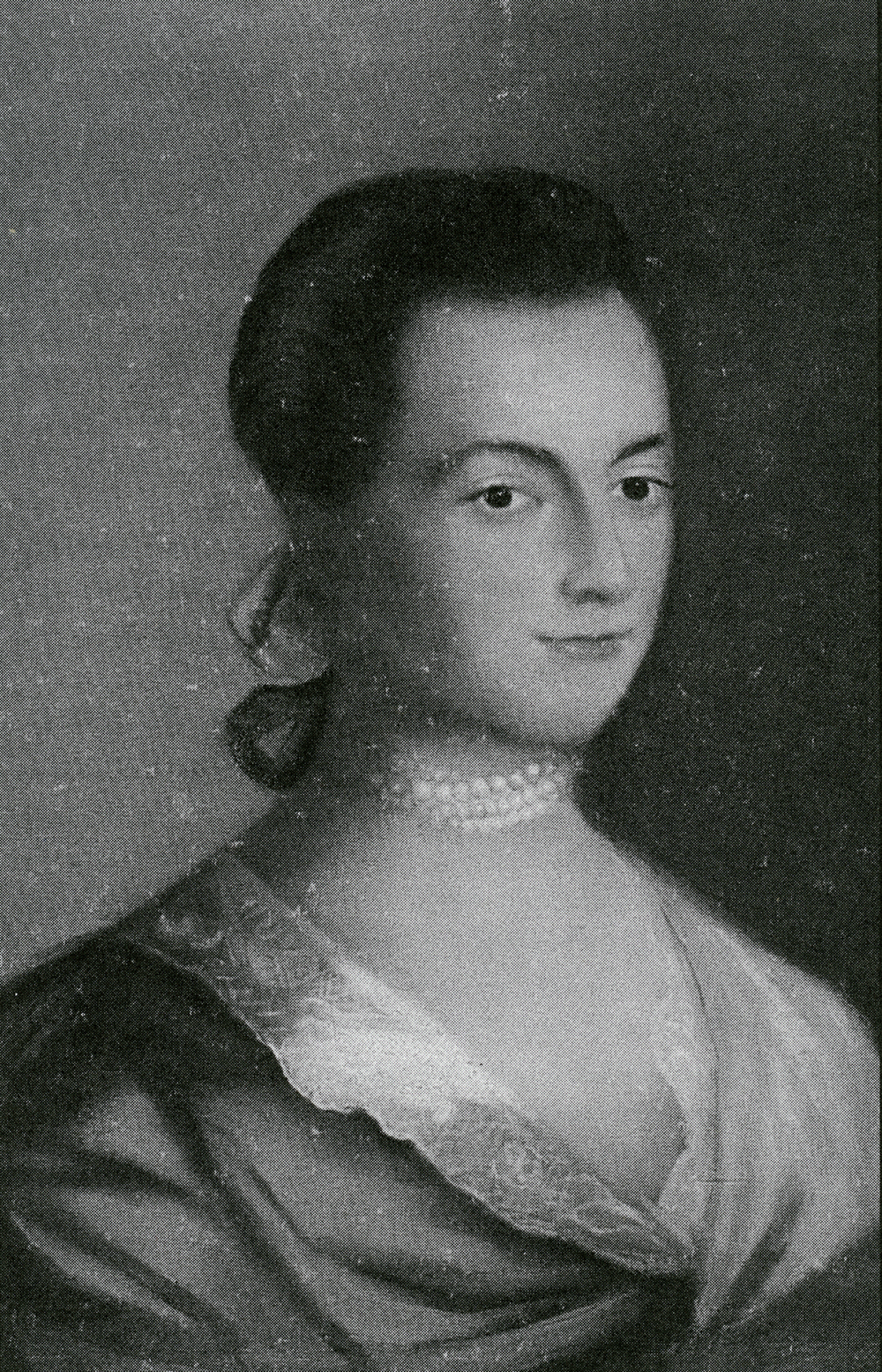
Abigail Adams warned her husband, John Adams, that if women's rights were not recognized, women were "determined to foment a rebellion, and will not hold ourselves bound to obey the laws in which we have no voice of representation." There were only a tiny handful of men who supported equal rights for women. In 1775, Tom Paine, the famed pamphleteer whose writings helped to convince thousands of men and women of the necessity of freedom from England, wrote an article on the legal status of women, describing them as robbed of freedom and will by the laws, the slaves of opinion, which rules them with absolute sway and construes the slightest appearances into guilt; surrounded on all sides by judges, who are at once tyrants and their seducers.... Who does not feel for the tender sex? [14] Apparently the Founding Fathers paid no attention to Paine's attitudes toward women. The U.S. Constitution ignored three groups that desperately needed relief -- African slaves, Native Americans, and women. The lives of most "tender" women were filled with hardship. In Philadelphia alone, 4,000 women and children worked long hours in their shabby homes spinning cloth for local merchants under the "putting out" (piecework) system. Many single or widowed women ran small shops or at-home businesses brewing beer or baking breads. In the cities, thousands of homeless people wandered the streets begging. [15] Most history books say little about the role of women during the American Revolution, but for all women, even the most sheltered, the war brought not only new hardships but new responsibilities. Women got together in Daughters of Liberty groups. Meeting in one another's homes, they formed sewing clubs to make their own clothes in order to boycott British imports. But they also involved themselves in far less "ladylike" activities. In 1777, Abigail Adams again wrote to her husband, this time describing an action carried out by a group of about a hundred women or more against a "wealthy, stingy merchant" who raised his coffee prices when tea was being boycotted. With talk accomplishing nothing, the women marched down to the warehouse, and demanded the keys, which he refused to deliver. Upon which one of them seized him by his neck and tossed him into the cart ... he delivered the keys when they tipped up the cart and discharged him; then opened the warehouse, hoisted out the coffee themselves, put it into the trunks and drove off. ... A large concourse of men stood amazed, silent spectators of the whole transaction. [16] Most women were not as daring. But during the long drawn-out war on American soil, 25,000 people -- almost 1 percent of the population of less than 3 million -- lost their lives, and many women became "deputy husbands." They took over the responsibility of running farms, handling finances, and raising children alone as their husbands went off to war, sometimes never to return. When independence was finally won, nothing would ever be the same. No doubt many women had gained not only new skills but the confidence that went with them. Disappointed that their new republic continued to deprive them of voting rights, property rights, and a public role, a handful of women circulated the writings of early feminists. These pioneers concentrated at first on pressuring the state legislatures for educational facilities for women. Clearly, women could not dream of even partial equality, let alone professional careers, if they were deprived of schooling. In their drive to obtain the right to education, they had to buck a myth prevalent in the period that women's brains were smaller than men's and therefore they were intellectually inferior. The experts of the day, all male, claimed that any effort on the part of women to try their hands at intellectual pursuits could only lead to mental breakdown. Judith Sargent Murray, born in 1751, wrote angry essays challenging these theories. Murray, the daughter of a wealthy Massachusetts ship-owner, had been only modestly educated during her childhood, while her brother had been carefully groomed to attend Harvard University. Secretly, she read and studied her brother's books, perhaps feeling more deprived and angrier each day. Murray's collected essays, On the Equality of the Sexes, were written during the Revolution but not published until 1790. Murray, obviously talking about her own family situation, agitated against the unequal education of boys and girls. [17] In the twenty years after the Revolution, dozens of female academies were opened, teaching a modified version of the basic academic subjects taught in the schools for boys, along with homemaking courses. Almost all of the students came from middle-class and wealthy homes. The literacy gap between the sexes began to close, except in the South. Woman educational reformers tried various tactics. Perhaps to reassure the male establishment or perhaps because they believed their own words, some endorsed sexual inequality in education. [18] But a few forged ahead in open defiance of traditional beliefs. In 1819, Emma Willard petitioned the New York State legislature for an endowment for a girls' school. Willard protested that "the taste of men, whatever it might happen to be, has been made into a standard for the formation of the female character." She urged the legislators to recognize that "we too are primary existences ... not the satellites of men." [19] Willard won the support of Governor De Witt Clinton for her project. Unfortunately, it was verbal support without financial backing. Refusing to accept defeat, Willard struggled for more than a year, raising money. In 1821, she founded the Troy Female Seminary, the first state-chartered institution for the education of girls, with a broader curriculum than ever had existed before. Lucy Stone, who would go on to be a leading women's rights advocate and abolitionist (opponent of slavery), was one of several outstanding graduates of Willard's school. One woman refused to accept any compromise on full equality for her sex. Frances Wright joined Robert Owen's utopian colony of New Harmony, located in rural Indiana, in 1828. In the group's newspaper, she argued that men's lives were damaged by the degradation of women. By accepting the false ideas of female inferiority, she said, they would live out their lives without a true companion. Wright also took to the lecture circuit, calling for free education for all workers. Similar arguments would not be heard again for more than a century. Until then, changes came slowly, usually only because of economic necessity. Westward expansion in the 1830s and 1840s, for instance, created a need for labor in the new territories, and women began to do "men's" jobs. As the rules for women's roles broke down, it became easier to demand equality on other scores, like education. Early in that period, Oberlin, which would become the first women's college, began its existence. It was founded as a ladies' seminary in 1833 by the leaders of a student sit-in at the Lane Seminary in Ohio when blacks and women were not permitted to enroll. It then gradually evolved into a college. From its first term, Oberlin admitted African American, as well as white, women. Lucy Stone referred to the opening of Oberlin as "the gray dawn of our morning."
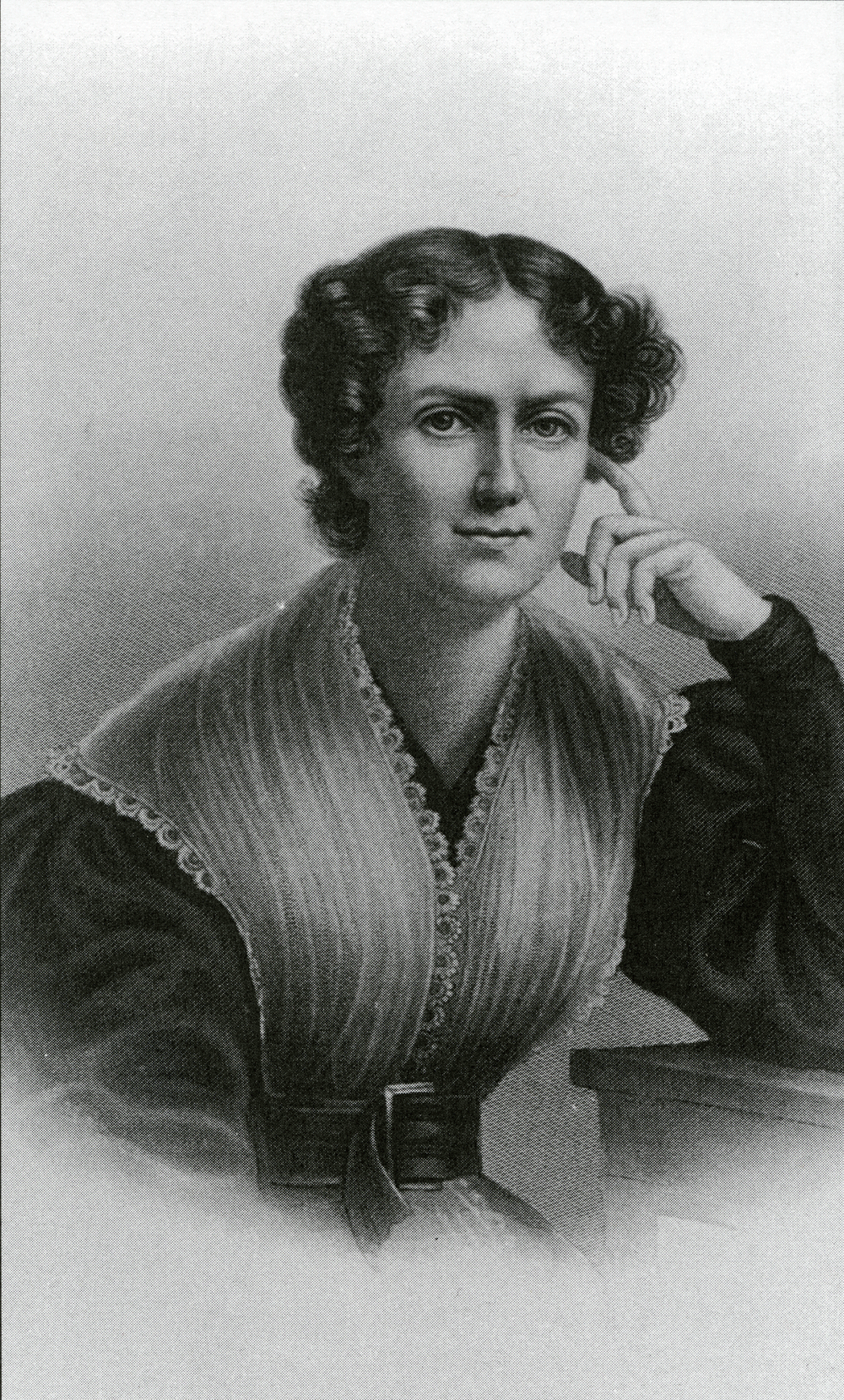
Frances Wright argued that men's lives were damaged by the degradation of women. She also called for free education for all workers. Stone was undoubtedly disappointed. The early administration of the college expressed firm agreement with the leading male educators of the day that motherhood was the "highest calling" for women. They believed that "If women became lawyers, ministers, physicians, lecturers, politicians or any sort of public character the home would suffer from neglect." [22] Stone was asked to write a commencement speech but refused the assignment when she was told it would be read by a male. [23]
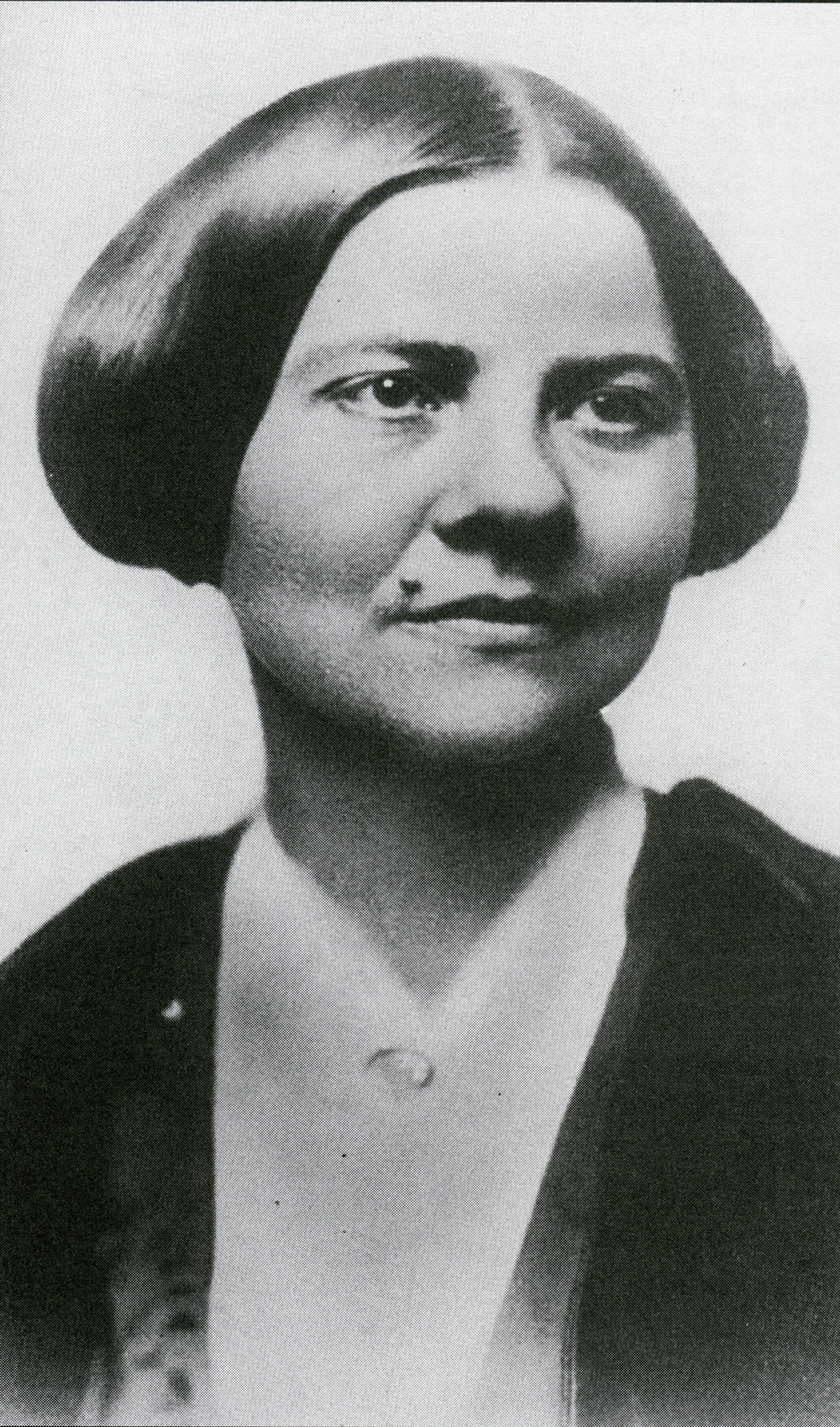
Lucy Stone, suffragist As middle and upper-class women became educated, they longed to do more than stay home embroidering and entertaining. Looking for a role in public life, many joined a growing number of societies to aid widows, orphans, the poor, and the mentally ill. Some joined religious organizations and went abroad as missionaries. They were soon to hear about the terrible lives of working women in the textile mills of New England. By 1817, factories sprang up to meet the demands of a growing population. In the mills, girls barely in their teens worked fourteen to sixteen hours a day, earning only a fourth of men's wages. These working women had little patience for ladylike behavior in the face of such crushing conditions. In Lowell, Massachusetts, working women formed the first major women's union, the Lowell Female Labor Reform Association, led from 1845 to 1846 by a young woman named Sarah Bagley. When the mill owners tried to fire leaders of the union for speaking out on their conditions, Bagley made a fearless speech unmatched in its emotion and eloquence by any of the better- educated reformers of the day: What! Deprive us, after working thirteen hours, of the poor privilege of finding fault -- of saying our lot is a hard one! ... We will make the name of him who dares to act stink with every wind, from all points of the compass. His name shall be a by-word among all laboring men, and he shall be hissed in the streets, and in all the cities of this widespread republic; for our name is legion though our oppression be great. [24] The Lowell women went door to door, circulating petitions demanding a ten-hour day to the Massachusetts legislature. Perhaps believing that women would not dare appear before their august body, the legislators invited them to present their petitions in person. The women did not win their demands. On the other hand, a few middle-class women reformers had their eyes opened to the existence of "sisters" whose lives were completely different from their own. They decided to help the working women in the struggle for reforms. The issue that evoked the most response from women was slavery. It was impossible to hide, unlike the isolated textile mills. Although the slave trade had been legally abolished in Great Britain and the United States in 1808, merchants in the port cities and slave exporters in several states were unwilling to relinquish the huge profits they received from the transport and sale of human beings. In the southern United States, there were willing and ready customers, anxious to expand their plantations. In the United States alone, there were about two million African slaves by 1830. That number doubled in the next thirty-five years. In 1831, newspapers carried the story of Nat Turner's defeated slave revolt, and in Boston, William Lloyd Garrison's antislavery weekly newspaper, The Liberator, was founded. With only a few women present, antislavery men, called abolitionists, founded the American Anti-Slavery Society in Philadelphia in 1833. Not permitted to join the organization, twenty women got together at the end of the conference and formed their own Philadelphia Female Anti-Slavery Society. Chapters were organized in New York and several New England towns. In May 1837 the first National Female Anti-Slavery Society convention took place in New York City. They turned down offers of male help because "they found they had minds of their own." [25] (Italics added.) Their founding platform called for struggle against both slavery and the inequality of women. They denounced not just slavery but all race prejudice. They called for the racial integration of churches and schools. Certainly because of their firm stand on racism, they were joined by several black women, including little-known figures like Sara Parker Remond, Charlotte Forten, Sarah Mapps Douglass, Letetia Still, Harriet and Sarah Forten, some of whom were elected as leaders. The struggle over equal participation of women in the abolitionist movement continued. In the spring of 1838, when women were permitted to participate equally with men at the New England Anti-Slavery Convention, some men resigned and later formed the male-only Massachusetts Abolition Society. There were similar splits elsewhere. Perhaps rejection by some of the men in the abolitionist groups added fuel to the fire of women's demands for equal rights. Perhaps they expected men who opposed slavery to be in the forefront of the freedom struggle for all people. Eventually the American Anti-Slavery Society voted to accept women as full members. Most of the men had come to realize that unity could make the difference between success and failure. Frederick Douglass, himself a fugitive from slavery, held unquestioned authority in the abolitionist movement. He spoke out forcefully, praising the contribution of women to the abolitionist struggle. [26] Two sisters from a South Carolina slaveholding family, Sarah and Angelina Grimke, began speaking against slavery in public in 1836, and other women followed their lead. Abolitionist women made speeches everywhere they went -- in their sewing circles, charitable groups, and literary societies. The Grimke sisters were the first to link the struggle for the emancipation of the slaves to the struggle for women's equality. In An Appeal to the Christian Women of he Southern States, Angelina Grimke urged southern women to revolt against patriarchy and male property rights by rising up against slavery and even freeing their own slaves. Her sister Sarah dared to attack the churches for using the Bible to justify the subordination of women. On Eve's responsibility for Original Sin, she shocked many by commenting that "Adam's ready acquiescence with his wife's proposal" raised questions about "that superiority in strength of mind" attributed to men. [27] Such strong talk on women's rights made some of the abolitionist men nervous. Asked to tone down her antislavery speeches, Angelina Grimke refused, insisting, If we surrender the right to speak in public this year, we must surrender the right to petition next year, and the right to write the year after, and so on. What then can woman do for the slave, when she herself is under the feet of man and shamed into silence. [28] Women were playing an increasingly important role in a rapidly growing American Anti-Slavery Society. Fearing women's participation in civic and religious affairs, many religious leaders attacked "the dangers which at present seem to threaten the female character with widespread and permanent injury." [29] Proslavery men behaved more violently toward the women in the abolitionist movement than toward the men. Even rational congressmen seemed to lose their reason when they confronted women in action who would not be kept "in their place." In 1834, for example, a group of women in the American Anti-Slavery Society initiated a very successful petition campaign to Congress against the admission of additional slave states. Going door to door in several towns, the women were often abused by jeering crowds of rowdies. The U.S. House of Representatives quickly passed the Pinckney Gag Rule, forbidding the presentation of any and all petitions to Congress! Abigail Adams would have been proud of her seventy-year-old son, John Quincy Adams. During the debate on the gag rule, the Massachusetts congressman and former U.S. president called the "departure of women from the duties of the domestic circle" a "virtue of the highest order." [30] As women fought for freedom for the slaves and equal rights for themselves, a countermovement came to the fore, called the "Cult of Domesticity" or the "Cult of True Womanhood." An outpouring of writings and speeches on women's "special" role insisted that women were "separate but equal," the guardians of the home. Those who joined the women's rights and abolitionist movements, the new preachers of domesticity insisted, were doomed to face despondency and mental disease. A virtual war of words took place, with many newspapers and magazines pushing the "cause" of domesticity. The advocates of women's rights relied on abolitionist papers to publish their views. Voting rights were seldom discussed. Movement women seemed far more concerned about their legal rights. Only gradually did they come to realize that without the vote it would be difficult to pressure legislators to change the laws. The earliest campaigns for equal rights for women centered on the issue of property rights. In 1836, six women signed a petition to the New York State legislature asking for a Married Woman's Property Law to end coverture rules on property and wages. Ernestine Rose, a recently arrived Polish Jew, drafted the proposed legislation. She worked for weeks just to collect five precious signatures. Some of the ladies said the gentlemen would laugh at them, she later commented; others, that they had rights enough. The legislature stalled until 1848 and then passed the new law. Over the next decades, other states passed similar legislation, but the repressive laws on divorce, female incarceration for "insanity," and other vital issues remained intact. Far more daring and seldom mentioned in history books was a legislative petition campaign in Massachusetts in 1840 by abolitionist women to repeal a so-called miscegenation law, forbidding sexual relations and marriages between the races. The women pointed out that the law presumably protected white women from black men but had not a word to say about black women raped by white men, a far more common occurrence. A black woman abolitionist, Lydia Maria Child, initiated the campaign, and several other black women became active in it. It took special courage for these Massachusetts women to stand in the town squares and go door to door circulating their legislative petitions. They collected more than 9,000 signatures, two thirds of them obtained from other women. Called harlots and promiscuous women, the petitioners were accused of sexual misbehavior. Year after year for a decade they presented their petitions to the legislature, not achieving victory until almost ten years later. [31] During those years dozens of women were learning the ins and outs of the law -- from the legal language of proposals for legislation to the mechanisms of getting bills passed. By 1840, the American antislavery movement included a quarter of a million people. Despite male resistance, most of the 1,350 local societies endorsed the demands for women's equality. Fifty- three delegates were elected to attend a World Anti-Slavery Convention in London, England, in June to discuss ways of ending the world slave trade. But on opening day the question of the presence of women delegates became the main issue on the agenda. The British delegates insisted that all women be excluded from the proceedings. They then proposed a compromise. Women could watch silently from a curtained-off area. Wendell Phillips, a leading white male American delegate, angrily introduced a countermotion that the women be seated as full delegates. As expected, the British won overwhelmingly. According to the later writings of a leading woman in the American movement, Elizabeth Cady Stanton, two men -- William Lloyd Garrison and Nathaniel P. Rogers -- protested by joining the women in the gallery. Stanton failed to mention another male protestor, black abolitionist Charles Redmond. The women delegates excluded from the London antislavery convention began talking about holding a convention of their own, devoted to the issue of women's rights. Eight years later, in 1848, they succeeded. In a small Methodist church in the town of Seneca Falls, New York, 300 people, including about forty men, most of them abolitionists, drafted a Declaration of Principles on women's equality with an appended list of grievances. Along with demanding the right for women to vote and to keep their own property and wages, the delegates demanded women's right to a college education, equal opportunity in employment, and entry into the professions of medicine and law. At the time of the Seneca Falls convention, seventeen-year-old Myra Bradwell was attending an exclusive female seminary. It is likely that with the other young women students she pored over the reports of the historic events in upstate New York, reading the widely publicized statement of the delegates complaining that man had endeavored, in every way that he could, to destroy her confidence in her own powers, to lessen her self-respect and to make her willing to lead a dependent and abject life.... [32] Perhaps young Myra Bradwell decided then and there that she would never "lead a dependent and abject life," that she would fight for equality for herself and all women.
|