|
BARRED FROM THE BAR -- A HISTORY OF WOMEN AND THE LEGAL PROFESSION |
|
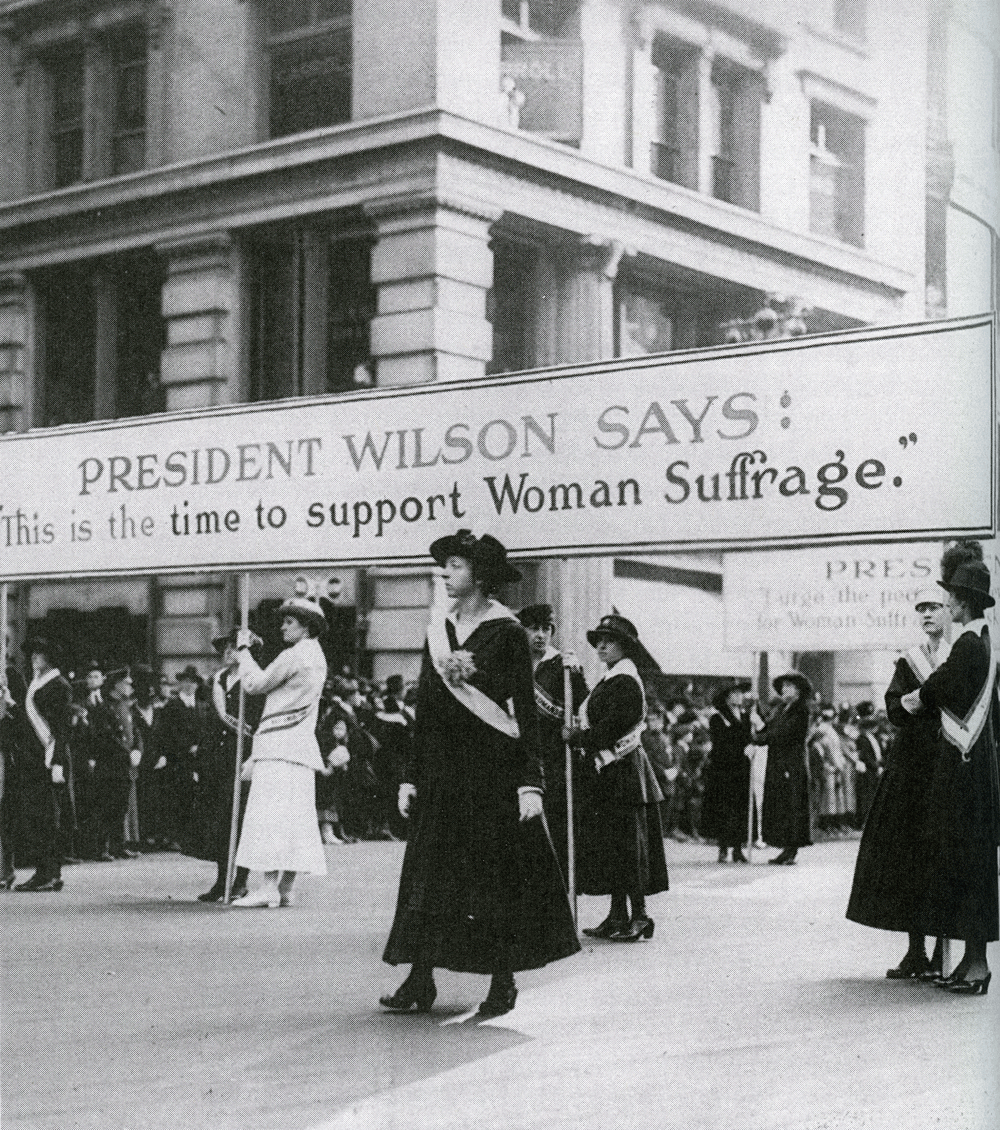
4. "RARE BIRDS" Men have accused the woman lawyer of being a failure ... because she has not grown rich in the practice of law, and that in the short space of twenty years. The man's standards again -- the acquisition of wealth and power. I would say to these accusers the aim of the woman lawyer is not so much the acquisition of money as to make an impression in the laws of this country as will benefit the whole race.... -- Attorney Mary Lilly, shortly before World War I [1] A prominent leader of the bar, Theon G. Strong, wrote in his 1914 memoirs: "It is now more than thirty years since Mrs. Lockwood was admitted, and the right of women to practice was established, but I have never yet seen a woman plead a case of any kind in court ... and I think it may be safely asserted that there is no prospect that women will be seen except as a rara avis [rare bird] in the ranks of the legal fraternity." [2] Strong's observation turned out to be all too accurate. Until the early 1960s women continued to compose only from 1 to 3 percent of the legal profession. [3] Yet despite the bleak outlook, after women won the right to vote in 1919, a few intrepid souls continued to try to practice law. They faced similar hardships to those encountered by the earliest pioneer women lawyers. Colleges accepted only token numbers of women, and jobs remained difficult to find once women passed the bar. In the first decades of the 1900s, it was still possible to take the bar examination without attending law school. Lyda Burton Conley, the first Native American woman lawyer in the United States, did just that. It was not the dream of a career that motivated her to bury her nose in dry law books but the need to educate herself for an ugly legal battle on behalf of her people. [4] Conley was a child when her tribe, the Wyandot, arrived in Kansas and were soon almost exterminated by a smallpox epidemic. Three hundred people died, including Conley's mother. The survivors buried their dead in an Indian burial ground at Huron Park. In 1904, Lyda Conley and her sister Lena learned that Congress had authorized the destruction of the Huron Park Indian Cemetery to make way for commercial buildings, a project favored by most of the influential people in Kansas City. The Conley sisters built a small shack in the burial grounds and erected a fence around the area, arming themselves and staying put. The local press nicknamed the area "Fort Conley," as fences were pulled down and the sisters quickly raised them up again. Lyda Conley later told reporters that two large American flags were always close at hand. "In the event of the troops putting in an appearance, we had decided to wrap the folds of the flag around us, and tell the boys in blue to shoot." Realizing that in the long run only legal proceedings would stop the government plan, Conley studied law books, prepared a case, and went to court. When the highest state court refused to grant an injunction to stop the bulldozers, Conley appealed to the U.S. Supreme Court, presenting a sixty-nine-page legal brief. Newspapers covered the story closely. It had all of the ingredients that made headlines: two Indian women holed up with guns; dead bodies about to be disturbed. When reporters asked Conley why she didn't hire a lawyer, she said, "No lawyer could plead for the grave of my mother as I could; no lawyer could have the heart interest in the case that I have." When they asked her if she thought she had a chance of winning, the reply came back, "If I do not then there is no cemetery in this land safe from sale." The Supreme Court refused to hear the case, but the courage of the two sisters drew so much support and attention that in 1912 the House of Representatives Indian Affairs committee banned desecration of the cemetery. Lyda Conley passed the bar in 1910, but she never earned a living from legal work. She refused to defend anyone whom she believed to be guilty, except an Indian. As the nation continued industrializing at breakneck speed, the small existing public school system could not absorb all the new immigrant children. Reformers called for "Americanization" through education, and the public school system grew rapidly. Naturally, teachers were needed. Since women were virtually barred from other professions, they crowded into short-term teacher training courses and found jobs in thousands of new schools. By 1911, women, most of them native born, composed 78 percent of all public school teachers. But only a few young immigrant women could obtain enough education to qualify as grade school teachers, let alone attend college. In 1905, among the millions of new Eastern European immigrants in New York City, more than half the young men and three quarters of the young women were employed in "manual trades." In many families, the daughters went to work in the garment shops and one or two sons attended a state university or tuition-free City College in New York City. A few evening colleges opened in some cities to accommodate full-time working men. Most men of the legal world continued to exclude women from "their" profession, but there were always a few good men who bucked the tide. [5] In 1902, Alice Dillingham was attending an all-women's college, Bryn Mawr. She listened as the dean of the New York University Law School, Clarence Ashley, urged Bryn Mawr seniors to study law. Most of the women, knowing how almost no jobs existed for them in the world of law, did not respond. Dillingham was the only recruit in her class. She graduated from NYU Law School in 1905 as class valedictorian. Six years later, in 1908, Portia Law School, the only all-women's law school in the world, opened in Boston. It started out as an evening bar examination review course taught by a male Boston attorney, Arthur W. MacLean. Portia grew quickly and was permitted to grant bachelor of law degrees to women by 1919. [6] Three quarters of Portia's students were the children and grandchildren of immigrants -- Irish, Jewish, and Italian. The rest were from poor New England families of English and Scottish descent. Other short-lived experiments with all-women's law schools were attempted, but only Portia endured. In 1915, Elizabeth Chadwick Beale was rejected by Harvard Law School despite the fact that her father, Joseph H. Beale, was a law professor there. She persuaded her father to open a law school for graduates of elite women's colleges. Twenty-five graduates of Radcliffe, Bryn Mawr, and Smith applied, and Professor Beale convinced several other law professors to take on teaching assignments. Despite its self-promotion as "the only graduate law school for women in the United States" (since Portia did not require a college degree), the school folded after one year when Elizabeth Beale married and changed her mind about studying the law. At just about the same time that Portia opened its doors, women's medical schools were closing. In a move to further "professionalize" medicine, the Carnegie Foundation hired Abraham Flexner to judge the quality of medical schools. The Flexner Report of 1910 claimed that women's institutions were no longer needed since other schools were accepting women. But this was not true. As the ranks of applicants to medical schools swelled, many women were turned away. [7] With laws varying from state to state, the standardization of law education requirements took longer than medical ones. The prejudice against female lawyers, especially trial lawyers, remained firmly in place. In 1914, a woman lawyer wrote to the editor of the New York Sun: When the girl lawyer tries her first case, the jury will smile affably upon her and so perhaps will the Judge, but there is one person who will not smile and that is the opposing counsel who objects to a woman adversary.... She knows that he is thinking that she has no place in the courtroom; if she is a good-looking girl she's out to be married; if she isn't good-looking she ought to be dead or else justifying her existence by serving in the capacity of an overworked stenographer to some dignified member of the nobler sex. Clarice Baright, a New York lawyer, was interviewed by a New York World reporter in 1916. He asked her if women lawyers won their cases by flirting. "I've never known a woman lawyer who got anything except by hard work," she retorted angrily. [8] Women trial lawyers continued to defend indigent clients who had nowhere else to turn. Tiera Farrow became famous in 1915 when her client, Clara Schweiger, during a divorce action, pulled out a gun in the courthouse and shot her husband. Farrow represented her during her subsequent murder trial, the first time a woman lawyer in Missouri ever tried a murder case. Farrow mounted an impressive defense, and Schweiger was found guilty of the lesser charge of manslaughter. As usual, the press, instead of commenting on Farrow's talents in the court, emphasized her physical appearance. One reporter wrote: Miss Tiera Farrow, young, good-looking and most feminine in appearance -- not at all the sort of person one would connect with the wrangling of attorneys and the heated debates usually attendant upon murder trials. [9] Ten years later, when Farrow and a few colleagues were teaching women's law classes in Kansas City, the Kansas City Star, apparently not checking on Farrow's legal background, commented that women have not what is loosely called a legal mind. Only a handful of women were appointed to the bench, usually in the lowest-ranking assignments as justice of the peace, temporary probate judge, or minor posts in tiny country courthouses. The few who made it into more prominent spots were almost always assigned to "women's judgeships" -- in divorce courts and juvenile courts. Women lawyers talked about struggling for more judicial appointments, but most agreed that this would not happen until they achieved some political power through the vote. But NAWSA members, demoralized by the failures of the state-by-state campaigns, had long since decided that continued education was their only recourse. After Susan B. Anthony's death in 1906, Carrie Chapman Catt took over the reins of the half-alive suffrage struggle when she returned to New York City after twenty years in England. Joining forces with Harriot Stanton Blatch, Elizabeth Cady Stanton's daughter, she formed the Equality League of Self-Supporting Women, later called the Women's Political Union. By 1908, the League had 19,000 members, including dynamic trade union leaders like Rose Schneiderman, a garment worker, and women of the burgeoning settlement house movement. They campaigned vigorously against state assemblymen opposed to suffrage. [10] In 1909, the Woman Suffrage Party, dedicated to more militant tactics, was launched. Catt decided to stick with NAWSA and build support for forthcoming referendums. At the 1910 NAWSA convention there were heated debates over tactics and strategies for victory. Many women were convinced that the referenda were useless. Women lawyers participated in the suffrage movement. In 1913, on the day before Woodrow Wilson's inauguration as president, the capital overflowed with visitors. When Wilson arrived, the streets were empty. Thousands of people were over on Pennsylvania Avenue watching a spectacular NAWSA show. Five thousand women were marching down the street. They had received a police permit for their demonstration, but when the women were threatened by hundreds of wild-eyed supporters of "femininity," the police were unable to control the fray. Federal troops were brought to the scene to reinforce the police, as the bullies continued rushing into the street to break up the columns of women marchers. Male students from Maryland Agricultural College arranged themselves single file around the marchers to form a human barrier against their attackers. The women continued to march, heads held high.
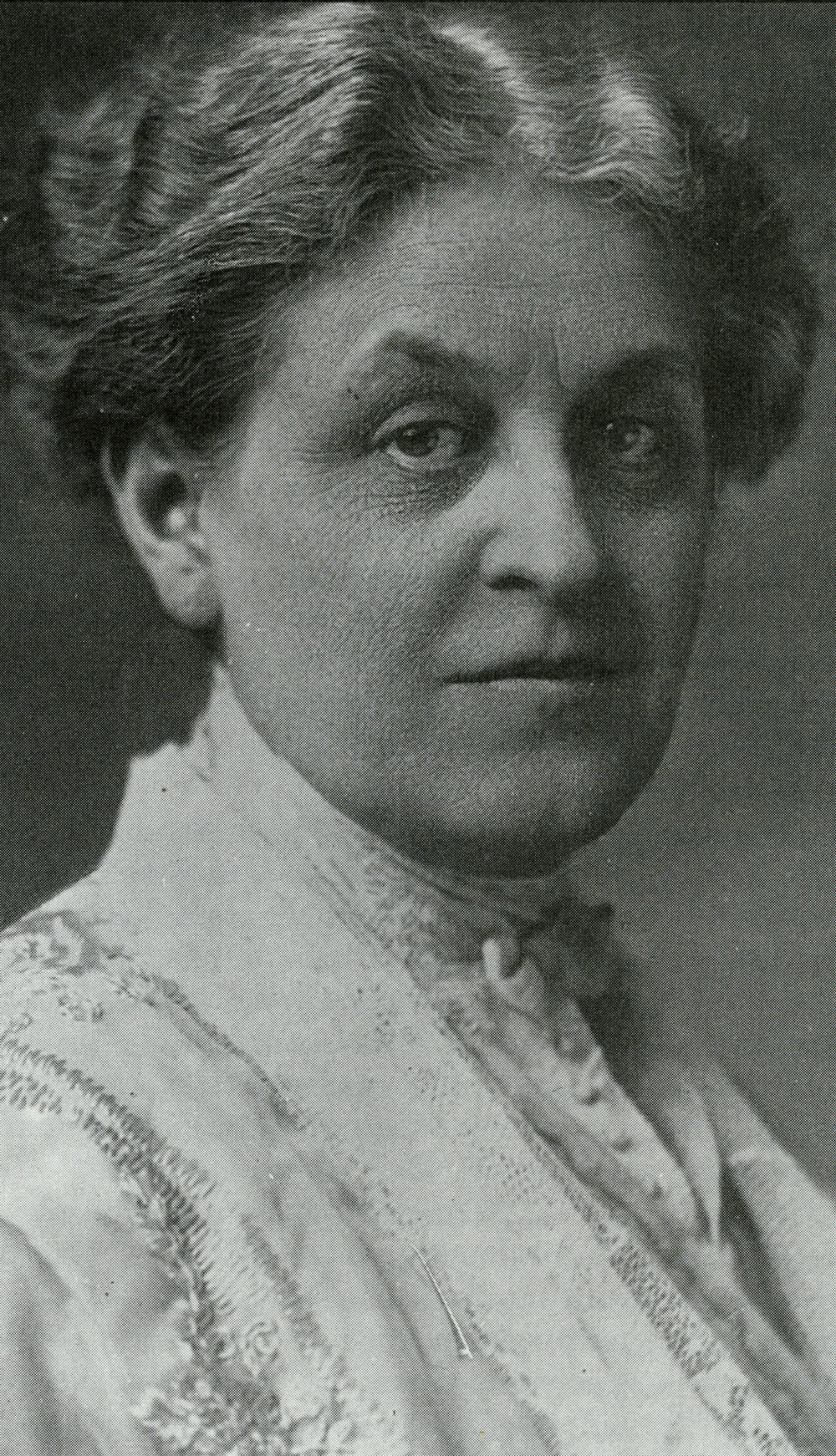
Carrie Chapman Catt was a leader of the women's suffrage struggle. One twenty-year-old woman, Katherine Robinson Everett, watched the march and heard the later speeches and decided then and there to study law when she saw all those beautiful and talented women lawyers from New York marching for suffrage.... They were so eloquent, so impressive, and they talked about using the law to deal with human rights and human problems. They made it clear that being a lawyer wasn't just a job, it was a way of bringing about important changes in society. I don't think I will ever forget the day I saw that suffrage march. [11] The public was shocked by the spectacle of men attacking women, and the Washington chief of police eventually lost his job. Dozens of delegations visited the new president with stacks of petitions urging him to back suffrage. Petitions and marches still did not win the vote. Alice Paul, a Quaker social worker who had participated in the militant British suffrage movement, returned home to the United States in 1910. A few months after the Washington march, the Congressional Union announced its formation, headed by Paul, and began publishing a weekly newspaper. NAWSA thought any talk of an all-out push for an equal rights amendment was premature. In 1914 a wealthy supporter died, leaving Catt over $2 million to be used expressly for the suffrage fight. NAWSA poured money into campaigns in Massachusetts, Pennsylvania, and New Jersey but still went down in defeat. At that point NAWSA's demoralized forces were shrinking. The Congressional Union, with far less money, stepped up their work for a constitutional amendment, with or without President Wilson's support. In time for the 1916 presidential campaign, the Congressional Union opposed the reelection of Wilson while NAWSA endorsed his candidacy. NAWSA members were elated when Wilson and his wife appeared at NAWSA's convention in September 1916. The president made no promises, but he hinted broadly about possible support for women's voting rights. The suffrage struggle was thoroughly covered in the press, but only African American-owned newspapers and a few socialist publications championed the rights of minorities. Blacks and Latinos worked at the hardest and lowest-paying jobs. Except for the rapidly growing Industrial Workers of the World (IWW), known as the "Wobblies," most unions barred them from membership. William E. B. DuBois, an African American sociologist and one of the very few black men who had earned a Ph.D., became the undisputed leader of the Niagara Movement, an early civil rights organization. After a bloody race riot in 1908 in Springfield, Illinois, DuBois called the members of his Niagara group together early in 1909. A number of prominent white leaders joined with them to form the National Association for the Advancement of Colored People (NAACP). The NAACP would take the leadership in the struggle for civil rights until the 1960s. In the early 1900s, 95 percent of the nation's almost 9 million African Americans still lived in the South, many of them tenant farmers and sharecroppers barely able to feed their families. After World War I broke out in Europe in 1914, factory owners, shut off from Europe's immigrant labor supply, sent recruiters south. African American newspapers in Chicago and New York urged black Southerners to make "the Flight Out of Egypt." From 1915 until the late 1920s a million and a half African Americans heeded their call and became part of the "Great Migration" to Detroit, Chicago, and New York City. Life in the northern cities was an improvement but no picnic. Housing and job discrimination were rigidly in place. African Americans, poorly educated and many of them skilled only in farmwork, suffered from underemployment and unemployment. Many poor whites resented the new competition for slum housing and unskilled jobs. Race riots broke out over the years in several cities, the most violent in East St. Louis. Black women worked as domestics in middle-class and wealthy homes or did piecework as seamstresses and tailors in their homes. A tiny group of better-off black women managed to attend black colleges like Howard University and one or two other schools in the East and Midwest, and even they often could get jobs only as domestics. African American women saw little point in pushing for a role in the legal profession. With white women lawyers so few and far between, after all, and black men finding the odds almost insurmountable, what chance would a black woman have? [12] The "findings" of "learned scholars" especially reinforced racism against black women. For example, Howard Washington Odum, in his much publicized Columbia University doctoral dissertation, "The Social and Mental Traits of the Negro," insisted that the "Negro woman ... fails to assist the men in a better struggle, she is inefficient and indisposed to be faithful. She is a hindrance to the saving of money and the industrial development of the family." [13] With racism on the rise in the North, the American Bar Association had actually admitted three black male lawyers by 1912, apparently because their race had not been known when they applied. The ABA quickly announced that it would be necessary to list racial categories on every application. In 1914, a popular magazine for lawyers, Case and Comment, devoted an entire issue to the "new woman lawyer." The magazine published a racist "joke" about a "mammy" wandering stupefied into a courtroom but made no reference to black women attorneys, not even to Charlotte E. Ray. In 1918, only one black woman lawyer, Gertrude E. Rush, was known to exist. More than twenty years later, in the 1940s, only fifty-seven African American women nationally were lawyers (see Chapter 6). In early 1917, with America's entry into World War I seemingly unavoidable, Carrie Chapman Catt and other leaders of NAWSA, disgusted with President Wilson's vacillation, decided to elevate the struggle for women's suffrage "to the position of a crusade for human freedom." [14] Alice Paul's Congressional Union had given up on marches and petitions and instead, in bitter cold weather, picketed outside the White House gates. NAWSA publicly criticized this tactic. On April 2, 1917, the United States declared war on Germany. World War I caused a rift in the ranks of the suffrage movement, the labor movement, and the black civil rights movement that never truly healed. Carrie Chapman Catt jumped in to support the war, believing that if women contributed to the war effort they would no longer be denied the vote. Alice Paul's forces disagreed. W. E. B. DuBois publicly supported the war, hoping that if African Americans helped "save the world for democracy," as President Wilson proclaimed, black men would be included as recipients of the new democratic spirit. [15] But black men quickly discovered that they were not welcome in the segregated armed forces. Only a few spaces were open to them in all-black army contingents, under the command of white officers. The government launched a campaign to make support for the war an issue of patriotism. War rallies were held everywhere, with pretty young women urging young men to jump up on the stage with them and volunteer to serve in the bloody conflict raging overseas. The Espionage Act of 1917 and the Sedition Act of 1918 were designed to prevent those who opposed the war from speaking out -- and to harass trade unionists, especially the Wobblies, who opposed the war as "a rich man's war." In the middle of the disputes about World War I, there was little unity when police raided union and political meetings on the Lower East Side and arrested several leaders who had not yet attained citizenship. Hasty proceedings were initiated, and many were ordered deported. On September 5, 1917, a mass sweep arrest was made on Wobbly headquarters throughout the nation. Thousands were deported. Most lawyers stayed far away from these controversial cases. But in the state of Washington, when seventy-four IWW (Wobbly) leaders were put on trial on false murder charges, Caroline Lowe joined the defense team. She had been admitted to the Kansas bar only a year earlier and was secretary of the Socialist Party's women's national committee. Despite the inflammatory atmosphere of the time, she helped to win a not-guilty verdict for the accused labor leaders and then raced off to Chicago, where over 100 Wobbly organizers, including William ("Big Bill") Haywood, the IWWs best-known and best- loved leader, had been moved for a trial that lasted five months. Once again Caroline Lowe sat at the defense table. By then the Great Red Scare (calling labor leaders "communists") had moved into high gear, and the jury's guilty verdict was no surprise. Caroline Lowe continued to fight for her labor clients, as well as immigrants threatened with deportation because of their political or antiwar beliefs. She was present to defend them at Ellis Island in New York City, saving some of them from last- minute deportations. She then rushed back to Kansas for the trial of twenty-five more Wobblies in Wichita. For the rest of her life she worked for labor causes. Conscientious objectors, socialists, and just plain folks who opposed the war were attacked on the streets and saw their homes and headquarters raided. But among the earliest victims of the wartime campaign against free speech were the women who stood in front of the White House holding banners that read "Democracy Should Begin at Home" and referring to the President as "Kaiser Wilson." The women were attacked by mobs of snarling men. On June 22, 1917, the women were arrested but their attackers were not. Since the Constitution's Bill of Rights guaranteed their right to wave any banners they cared to lift aloft, the cases against them were at first dismissed. But as the war fever escalated and the women continued to demonstrate, they were, one by one, given increasingly long jail sentences. [16] Ninety-seven of these women were sent to prison, some of them to Occoquan Workhouse in nearby Virginia, where conditions were notoriously bad. The women initiated a hunger strike to protest their illegal arrests and were force-fed, turning them into national martyrs. Among the prisoners were many professional women as well as working-class women. Carrie Chapman Catt and others in NAWSA publicly announced that their organization opposed these actions. In suffrage parades some women actually carried signs condemning the women in jail. More picketers replaced the jailed women in front of the White House and, despite NAWSA's lack of solidarity, protests poured in from around the nation as the imprisoned women grew more and more ill and skeletal. Shortly after a senator visited the Occoquan Workhouse, a report favoring women's suffrage emerged from a Senate committee. The House of Representatives scheduled a vote on the Anthony Amendment for January 10, 1918. Under a wave of public protest, the hunger strikers were freed at the end of November 1917. In March 1918 the Washington, D.C., Court of Appeals reversed their convictions. In later years the Woman's Party took credit for Congress's finally voting in favor of women's suffrage. NAWSA insisted that women's involvement in war work during the brief period of America's involvement in World War I had turned the tide. It is hard to judge exactly which approach moved more politicians -- the embarrassment caused by the women hunger strikers or the well-publicized war efforts of NAWSA women -- but all through 1917, by means of voluntary legislative action and victorious referenda, several states granted women the vote. [17] Right before the scheduled vote in the House of Representatives on January 10, 1918, President Wilson announced that he supported women's suffrage. All polls showed that the vote would be painfully close. A two-thirds majority was required in both houses of Congress to pass a constitutional amendment. Once again woman activists depended on a few good men to make the difference. Four congressional supporters of suffrage were too ill to participate in the debates, but they showed up for the vote -- one on a stretcher! The wife of Representative Hicks of New York, an ardent supporter of suffrage, died right before the final tally was taken. Hicks showed up for the count and then returned home to bury his life companion. The two-thirds majority was achieved by such a close squeak that the women watching from the gallery thought they had lost until cheers from their supporters came from the chamber below. [18] In June of 1919, the Senate also approved women's suffrage. Then, as required by the Constitution, three-fourths of the states, through legislative action or special conventions, ratified the nineteenth Amendment. On August 18, 1920, women were finally granted voting rights.
In 1918 women gained President Wilson's support for their right to vote. Despite the victory, twenty-seven law schools continued to refuse to enroll the newly enfranchised "second sex," including Columbia University and, the most resistant of all, Harvard. Yale was the exception, finally permitting a few token women to enter its law school -- one in 1918 and five in 1919. More than forty years later, Matilda Fenberg recalled the isolation of those days from the moment she registered -- when shouts of "fire, fire" rang through the halls. Fenberg graduated in 1922 and established a successful law practice in Chicago. Most people continued to have more to worry about. When World War I ended in 1919, millions were thrown out of work and wages were cut for many still clinging to their jobs. The labor movement responded with strikes. The Federal Bureau of Investigation (FBI) was created, with J. Edgar Hoover heading it up to keep check on "Reds" and labor leader "troublemakers." With job competition increasing, racism against African Americans escalated again. More than two dozen cities, including the nation's capital, experienced bloody race riots during the "Red Summer" of 1919, as police and troops once more protected white attackers. W. E. B. DuBois declared an "unbending battle against the forces of hell in our land." [19] But the government struck first. In 1920 it launched Attorney General A. Mitchell Palmer's "Red Scare." Police and FBI agents conducted surprise raids without search warrants on homes and meeting halls. In the New York State legislature, five elected Socialist members were denied their seats. Within a few weeks, not only was the Socialist Party barely in existence but a pall of silence hung over all reform movements. All of these events heartened the "nativists," those who had been ranting against immigrants since the nineteenth century. In 1920 the influential pioneer automobile manufacturer Henry Ford filled the pages of his newspaper, the Dearborn Independent, with a full-scale racist attack on Jewish Americans, especially those involved in the labor movement. Threatened by a lawsuit and a boycott of automobiles, Ford eventually apologized, but the damage had been done. Many universities, especially the elite institutions, turned away Jewish applicants, no matter how excellent their credentials. Most simply set up secret quota systems, limiting Jewish admissions to near zero. Harvard, however, publicly announced its intentions to allow fewer Jewish students into its classes. In 1924, Congress passed new immigration laws that established a quota system by country of origin. This quota system, which favored immigrants from white, Christian countries of northwestern Europe, lasted until it was eliminated by the influence of the Civil Rights Movement of the 1960s. Meanwhile, as minorities and immigrants suffered, a sizable privileged middle class developed as industrialization almost doubled and the introduction of new technologies leaped forward. Household appliances, refrigerators, stoves, even washing machines became widely available, and a so-called "new woman," considerably freed of household tasks, emerged. The advertising business expanded to push the sales of the new miracle appliances. Equating their clients' products with liberty and freedom for women, one company hailed its toaster as "The Toaster that FREED 456,000 HOMES ... from ever watching, turning or burning toast." [20] Taking advantage of the new post-suffrage "feminist" spirit, the owner of the American Tobacco Company hired a publicist, Edward Bernays, to improve the tarnished image of women who smoked cigarettes. When a consulting psychologist declared that "women regard cigarettes as symbols of freedom," [21] Bernays organized a contingent of women in the 1929 Easter Parade, who marched along "lighting their 'torches of freedom' ... as a protest against woman's inequality." [22] Within half a century, women were moving quickly toward "equality" with men in a less desired department -- lung cancer! The majority of middle-class women stayed home, keeping house and raising families with their new appliances and -- for the more affluent -- the help of black and immigrant servants. Others, however, continued to struggle for interesting and fulfilling careers, including those in the legal profession. Now that the vote had been won, there was not even a remnant of a women's rights movement to press for equality for working women. Professional organizations like the National Association of Women Lawyers had little power in the male-dominated field of law. Women lawyers lucky enough to find work continued to face barriers in all fields except for a few openings in the areas of poverty law and family law, and in a sprinkling of lower-status government jobs. The percentage of women in the legal profession grew at a snail's pace and then stopped growing completely after the stock market crash of 1929 and the subsequent ten years of the Great Depression. Without the part-time law schools then available, it would have been impossible for many men and just about all women to study for the law. Full-time schools not only cost three or four times the tuition of the part-time ones, but most working women could not find time to fulfill the requirement of a college degree from an accredited school. Even women with college educations were turned away from many of the full-time law schools. It was no secret that despite the supposed superiority of the high-priced colleges, the part-time students, so many of them immigrants and women, had to pass the same bar examinations taken by Ivy League law graduates. Leaders of the bar, most of them corporation lawyers, were upset when reports showed that the scores of the part-timers were as good or better than those of the Ivy League graduates and that the number of foreign-born lawyers was increasing. [23] They viewed the part-time schools as havens for aliens, foreign-born citizens, and U.S.-born members of ethnic minority groups, as well as women. Led by the Association of American Law Schools, the American Bar Association, and Harvard's prominent dean, Roscoe Pound, the elite fought to raise the admission requirements to the bar to such high levels that the daughters and sons of immigrants and the poor would be eliminated from the competition. Oral bar exams were added to the requirements in Massachusetts and several other states. Seeing the applicants in person made it easier to identify and eliminate the "unacceptable." The part-time law schools survived the assault. In 1934, when legal jobs were scarce during the hard economic times, the Supreme Judicial Court of Massachusetts ruled that two years of college training prior to law school were required in order to be permitted to take the bar examination. Portia and Suffolk quickly established a junior college. Until 1938, Portia remained the only all women's law school in the nation. But that year, with enrollments declining, Portia admitted men. At the school's peak, in 1929, about 30 percent of all women law students in the United States had attended Portia. Gradually the feminist-led Washington College of Law changed. In 1929 the school opened a small day session, upgraded its curriculum, and raised its tuition fees. It lost some working-class students and gained a few from the middle class who had been turned away by more prestigious institutions. In the 1929-30 academic year, its 271 students, less than half the number at Portia, came from homes in forty-two states and ten foreign countries. Only one out of three were women, most of them middle class, and very few of them second-or third-generation ethnics. Despite the changes in their own student body, Washington's administration joined Portia and Suffolk in opposing Dean Pound's efforts to eliminate the night colleges. As the Depression continued until the end of the 1930s, Portia's enrollments dropped and Washington College of Law's increased. By then the student body was three-quarters male. People could still take the bar examination in some places without law school training, but the law had become so much more complex that it was not practical to attempt it. It was extremely difficult for women with law degrees to find work. Without one it was just about impossible, and where the degree was obtained was also very important. Women who graduated from full-time coed law schools were first in line to obtain the few law-related jobs available for women. During the Depression, some women lawyers worked in the government's New Deal programs, but most were relegated to clerical jobs. Only a handful were promoted by government agencies to junior or senior attorney spots. Very few Portia women were able to earn a full-time living in the law profession. Boston University women graduates did a little better. About 150 of them worked full-time during the 1920s and 1930s, some in law offices or government jobs. Others, like Emma Fall Schofield, taught law part-time at Boston University and Portia. But the women graduates were never as successful as the men graduated from the same institution. Charlotte Slavitt's experience was fairly typical of Boston University's graduates of the twenties and thirties. The daughter of Ukrainian immigrants, she was one of only fifteen women in the school in the mid-1920s. Many of them were Jewish, some of whom were turned away by other institutions because of bias. Most Protestants stayed away from schools with high percentages of students from immigrant families. Slavitt passed the bar and moved to Chicago. Rebuffed by law firms, she opened her own office during the Depression. Most of her clients were penniless, referred to her by judges or prison inmates and guards. Slavitt barely scraped by, but she gained enormous experience. As in Charlotte Slavitt's case, defending the poor -- which was called "poverty law" -- provided the majority of jobs for women attorneys. [24] Some women certainly worked in this field because other jobs were unobtainable, but many women, then as well as later when other fields opened to them, chose this work because of their concern for social justice. Before World War I, churches, social clubs, labor's "mutual aid" societies, and a few wealthy philanthropists raised "charity" money to help those who would otherwise starve to death. From 1910 on, reformers and Progressive Party activists pushed state legislatures to provide pensions for widows with children and "general assistance" for those unable to work. By 1920, with poverty an ever-pressing and ever-growing concern, state legislatures passed hundreds of new public welfare laws and a large bureaucracy grew to administer the laws. As the Great Depression sent millions more tumbling into poverty, the number of "home relief" (welfare) recipients rose dramatically. The amount of money given to the poor was barely enough to keep the flame of life burning. President Herbert Hoover adamantly refused to involve the federal government in the problem. But his successor, Franklin Delano Roosevelt, who had won the presidency with the votes of working people, pushed Congress to appropriate $500 million for relief shortly after he took office in 1933. His administration established work programs to provide jobs. By 1934, 28 million people, more than 22 percent of the population, were dependent on these programs for their daily bread. [25] Growing numbers of people with legal problems did not have money to pay for the promised "equal justice." The system of court-appointed attorneys that Clara Foltz had innovated failed completely as fewer and fewer lawyers were willing to work for token wages. The Legal Aid Society had offered free legal assistance to poor people since the 1880s, but it did not have the facilities to deal with the expanded numbers of people needing help. In a 1919 report, "Justice and the Poor," Reginald Heber Smith, a prominent Boston attorney, had summed up the obvious: The administration of American justice is not impartial, the rich and the poor do not stand on an equality before the law, [and] the traditional method of providing justice ... has caused a gross denial of justice in all parts of the country to millions of persons. [26] In 1934, during a speech at the University of Michigan Law School, Supreme Court justice Harlan F. Stone sharply criticized the legal profession for its profound interest in corporations and lack of involvement with ordinary people. He claimed that "the learned profession of an earlier day" had become "the obsequious servant of business." [27] His much publicized speech drew the support of several law professors and lawyers. A movement for "Legal Realism" emerged, that was sharply critical of corporate law firms. Many supporters of this movement worked in New Deal agencies and pushed for the passage of the Social Security Act of 1935. Despite their work, little changed for poor defendants. The National Lawyers Guild attempted a small-scale legal services program in 1938, but the guild was never able to raise enough money to meet the increasing need. The shortage of personnel was a major problem at Legal Aid offices. The original plan had been to staff Legal Aid with young male lawyers looking for experience, but except for some Jewish law school graduates who could not find employment in law firms, most men avoided the stigma and low pay associated with poverty law. Women lawyers became the backbone of poverty law services. But even at Legal Aid societies, women almost never worked in the criminal division. Throughout the twenties and thirties, women were still seldom seen in courtrooms. Tiera Farrow was told not to take criminal law classes at Kansas City School of Law. A judge ordered Margaret Hickey to leave the courtroom when any discussion of rape took place. Women lawyers were caught in a real contradiction. It was considered improper for them to defend criminals, but "proper" areas of the law, like corporation law and the settling of estates, were maintained as a male preserve. Only a tiny group of women lawyers with male friends or relatives in high places found jobs in private law firms. In 1924, Wall Street hired a woman believed to be its first female associate, Catherine Noyes Lee, a magna cum laude graduate of NYU Law School and the daughter of a prominent judge. During the Depression, Helen L. Buttenweiser, the niece of New York's governor Herbert Lehman, found a job in a Wall Street firm but by 1937 moved to the Legal Aid Society in New York as chair of its board of directors. Although there were many women in her class of 1933, Buttenweiser later said that "people thought there had to be something terribly mannish and aggressive about you if you planned to study law." When one of the students was obviously pregnant, the professors "actually went so far as to hold a vote as to whether it was improper for a young man to be in contact with a pregnant woman." [28] Until very recent times, pregnancy was viewed as a barrier to public appearances of any kind. During one delayed murder trial in 1926, Bessie R. Geffner, the lawyer for the defense, was expecting a baby. The courtroom was hot, but she wore a large overcoat to disguise her condition. The judge noticed anyway and ordered her out of the courtroom. A small group of women lawyers ignored the unwritten rules of the game. California's Gladys Towles Root apparently agreed with the old adage that it was better to be hung for a fox than a sheep. Since women were insulted even when they dressed conservatively and behaved unaggressively in the courtroom, apparently Root decided that the best way to counter the unofficial regulations was to break all of them. Making a name for herself as a specialist in sex crimes, she defied many other courtroom codes that had nothing to do with the law. She often dyed her hair to match bright-colored garish costumes. "I should have joined a circus," she once commented. Her daring courtroom tactics and often brilliant defense work made her famous. A jingle of the time proclaimed:
Root-de-toot, toot-de-toot Root not only was an ardent feminist. She was also a firm opponent of racism. In 1931, she defended a young Filipino man prohibited by law from marrying his Caucasian girlfriend, challenging the constitutionality of the California statute. Her law firm handled more than 1,600 cases a year, winning an unusually high percentage of them. Commenting on the reactions of defeated opposing male attorneys, Root said: Many a male lawyer when defeated by a woman will blame it on that mystic factor they call feminine intuition. That is his excuse. In plain language, he faced too much perception and intelligence and logical thinking. [29] Mary Kaufman was more typical of activist women attorneys of that time. Born in 1912, she was raised in a poor family on the Lower East Side of New York and attended college during the Depression years. Her mother influenced her enormously, leading a rent strike and participating in hunger marches in the 1930s. Kaufman earned her bachelor's degree in political science at Brooklyn College -- which, like its sister school, the City College of New York (CCNY), was then tuition-free -- and then attended night classes at St. John's Law School while holding a day job at a New Deal-created Works Progress Administration (WPA) project. Admitted to the bar in 1937, she became a Lawyers Guild activist. She worked for a labor lawyer for five dollars a week and then took a job with the New York State Labor Relations Board. There, she pressed charges against companies defying labor laws or interfering with union-organizing drives. Only a handful of women were allowed to "mount the bench." Almost all of them were appointed to the juvenile courts and family courts. Often, these judges took it upon themselves to expand their work far beyond required courtroom duties. Mary Margaret Bartelme, for example, who had been encouraged to study law years earlier by Myra Bradwell, served as a circuit court judge in the juvenile court system of Cook County, Illinois. In her "spare" time, Bartelme pioneered the creation of halfway houses for teenage girls, even using her own home. They called her "suitcase Mary," because no one ever left one of her homes without a valise packed with new clothes. [30] One of the few female elected judges was Florence Ellinwood Allen, who graduated from NYU Law School in 1913. When the Nineteenth Amendment passed, Allen ran for a judgeship with the Court of Common Pleas in Cuyahoga County, Ohio, and became the first woman to win a judicial post through the ballot. When the male justices of the court attempted to limit her to divorce cases, she adamantly refused to accept this. In 1922, Allen was elected to the Ohio Supreme Court and six years later won reelection by a 350,000-vote majority. In 1934, Franklin Delano Roosevelt appointed Allen to the United States Court of Appeals for the Sixth Circuit, again a first- time achievement by a woman. According to Allen, her male colleagues were horribly upset. One even took to his bed for a few days. There was almost always protest from other judges and members of the bar when a woman was appointed to a judgeship. When Calvin Coolidge appointed Genevieve Rose Cline to the United States Customs Court in 1928, the New York Customs Bar Association put up a stiff fight against the appointment. Women remained rara avises ("rare birds") on the bench until the 1970s. Even then they were a relatively small minority. But for a brief time in 1925, because of an odd circumstance, three women made up the Texas State Supreme Court! One of the parties in a famous land dispute, Johnson v. Darr, was the organization, the "Woodmen of the World." It turned out that just about every judge in the state held a membership card in the all-male organization. When the three male justices of the Supreme Court disqualified themselves, the governor of Texas appointed the first woman lawyer in Texas, Hortense Ward, as well as Ruth Brazzil and Hattie L. Heneberg, exciting the media all over the state. After the case ended, not a single woman was appointed to a judgeship in Texas until 1934, when Sarah T. Hughes was appointed to a lower court. When Hughes was admitted to the bar in 1922, all she could find was a desk job answering the telephone and typing letters. New York City had been one of the major centers for the suffrage, social reform, and labor movements, but it remained one of the most difficult places for a job-hunting woman attorney. As the world's financial center, it hosted an elite flock of Wall Street lawyers and national corporate law offices. Clara Foltz spent ten years there offering legal assistance to poor immigrant women. When she was plunged into poverty herself, she returned to the West Coast. In 1910, at the age of sixty-one, Foltz became the first woman ever to be appointed deputy district attorney in Los Angeles. As president of the Los Angeles Votes for Women Club that year, she drafted a suffrage amendment. In 1930, still active at the age of eighty-one, she ran in the Republican Party primary for the governorship of California and polled 3,570 votes with her women's rights platform. As always, there were a few good men in positions of power who tried to help women attorneys succeed. One of them was the mayor of New York, Fiorello LaGuardia, who advanced the careers of several women attorneys during his terms in office. The women lawyers did not disappoint him. Dorothy Kenyon was especially talented. Kenyon had passed the bar examination in 1917 and worked as a researcher for the government on labor and peace issues. Like so many other women lawyers, she had often expressed unpopular views, publicly stating many times that prostitutes were unfairly prosecuted while their pimps and customers went untouched by the law. In 1936 LaGuardia named Kenyon his first deputy commissioner of licenses, and in 1939 he appointed her to a judgeship in the municipal court. Columbia University Law School, like Harvard, many of whose graduates went on to work for elite establishments, had long turned away women. One of the rejected women later insisted that Dean Harlan Fiske Stone was to blame for the stonewalling. "Everyone knew," she said, that "Harlan Stone promised women would be admitted to Columbia over his dead body." [31] Stone went on to become chief justice of the United States Supreme Court. In 1927, another Columbia Law School dean finally submitted to pressure and lifted the ban on women. There was no word of Harlan Stone's collapsing on the capital steps, but some women claimed they sent him a sarcastic telegram asking if he had. Admission was one thing, acceptance another. In Columbia's law classes, the men left empty seats around them and on a few occasions, when a woman student was called on to speak, "men stamped their feet so that her answer couldn't even be heard." [32] Harvard Law School continued to refuse to admit women all through the 1930s and 1940s. A degree from an Ivy League college like Columbia held the promise of better job possibilities. Ida Klaus, for example, from a poor family in Brownsville, Brooklyn, made connections at Columbia that she never would have found if she had attended Portia or Boston University. In 1928, while she studied and worked part-time teaching Hebrew, she also became a research assistant to a supportive professor, Herman Oliphant, who brought her to Washington, D.C., when he was given a job by Roosevelt's New Deal government in 1933. Her talents were recognized, and she was soon on the road to a long and successful career. Morris Ernst, a senior partner at a New York, City law firm dedicated to civil liberties, Greenbaum, Wolff & Ernst, hired Harriet F. Pillpel, a 1935 graduate of Columbia Law School who had ranked second in her class. At that point, the sale of contraceptives was still banned by the Comstock Law. Pillpel was assigned to Griswold v. Connecticut in 1965, a case that eventually led to the striking down of the Comstock Law under the right-to-privacy interpretation of the Constitution. It became an important precedent during the famous abortion rights case Roe v. Wade in 1973 (see Chapter 6). Pillpel drew many new clients to the firm, including birth control advocate Margaret Sanger and sexual behavior expert Alfred Kinsey, all admiring her for her work on behalf of women's reproductive rights. Prejudice against women in the professions, especially those from immigrant backgrounds, persisted. Nonetheless, quite a few managed to slip through the cracks. But for African American and Latina women, racism remained a giant barrier to advancement. [33] Although Latinas became schoolteachers, librarians, and nurses, there is no record of any Latina becoming a lawyer until 1961! Unlike African Americans who at least had a few universities concentrating on their education, Mexican Americans had nowhere to turn. They were excluded from most white campuses and for the most part attended segregated public schools. As unemployment rates skyrocketed in the 1930s, tens of thousands of Mexican immigrant workers were scapegoated for the problem. In the West and Midwest, they were herded into railroad freight cars and unceremoniously "dumped" in Mexico. Many of those deported were U.S. citizens! [34] Even after the civil rights legislation of the 1960s, when a few Latino men became lawyers, few Latinas did. Only in more recent times has this begun to change. Irma Vidal Santanella, born in 1924, is considered the pioneer Latina attorney (see Chapter 5). She did not even graduate from law school until 1961, almost a century later than the pioneer white women lawyers. [35] African American women with an interest in the law profession, despite the few pioneers of earlier times, were starting out again from ground zero. A few of them from middle-class families managed to break the barriers in the 1920s and 1930s. Many -- like Minneapolis lawyer Lena O. Smith, admitted to the Minnesota bar in 1921 -- devoted themselves to civil rights law, often through the NAACP. Sadie Tanner Mossell Alexander, born in 1898 in Philadelphia, was the daughter of the first black American law school graduate. In 1924 she enrolled in the University of Pennsylvania Law School and graduated with top honors in 1927. She did not have fond memories of her time at the school. She described the dean as "a very prejudiced man." He directed that under no circumstances was I to be admitted to the club formed by the handful of women who attended the school at the time ... so I would go home directly at twelve noon when classes were over and study alone until about six p.m. No one invited me to lunch -- neither women nor men, so I just adapted myself to what was. [36] Alexander's later work would bring her national recognition (see Chapter 5). Violette N. Anderson, a graduate of Chicago Law School in 1920, became the first black woman admitted to the bar in Illinois. She went on to be the first woman assistant city prosecutor from 1922 through 1923; the first to serve as vice president of the Cook County Bar Association; and the first black woman admitted to practice before the U.S. Supreme Court. Eunice Hunton Carter, probably the best-known of the black women attorneys of that period, earned her law degree at Fordham Law School in 1932 and was admitted to the New York bar in 1934. She considered herself lucky when district attorney William C. Dodge hired her to handle low-level prosecutions in the magistrate's (criminal) court. She had no inkling that her modest job would make her famous.
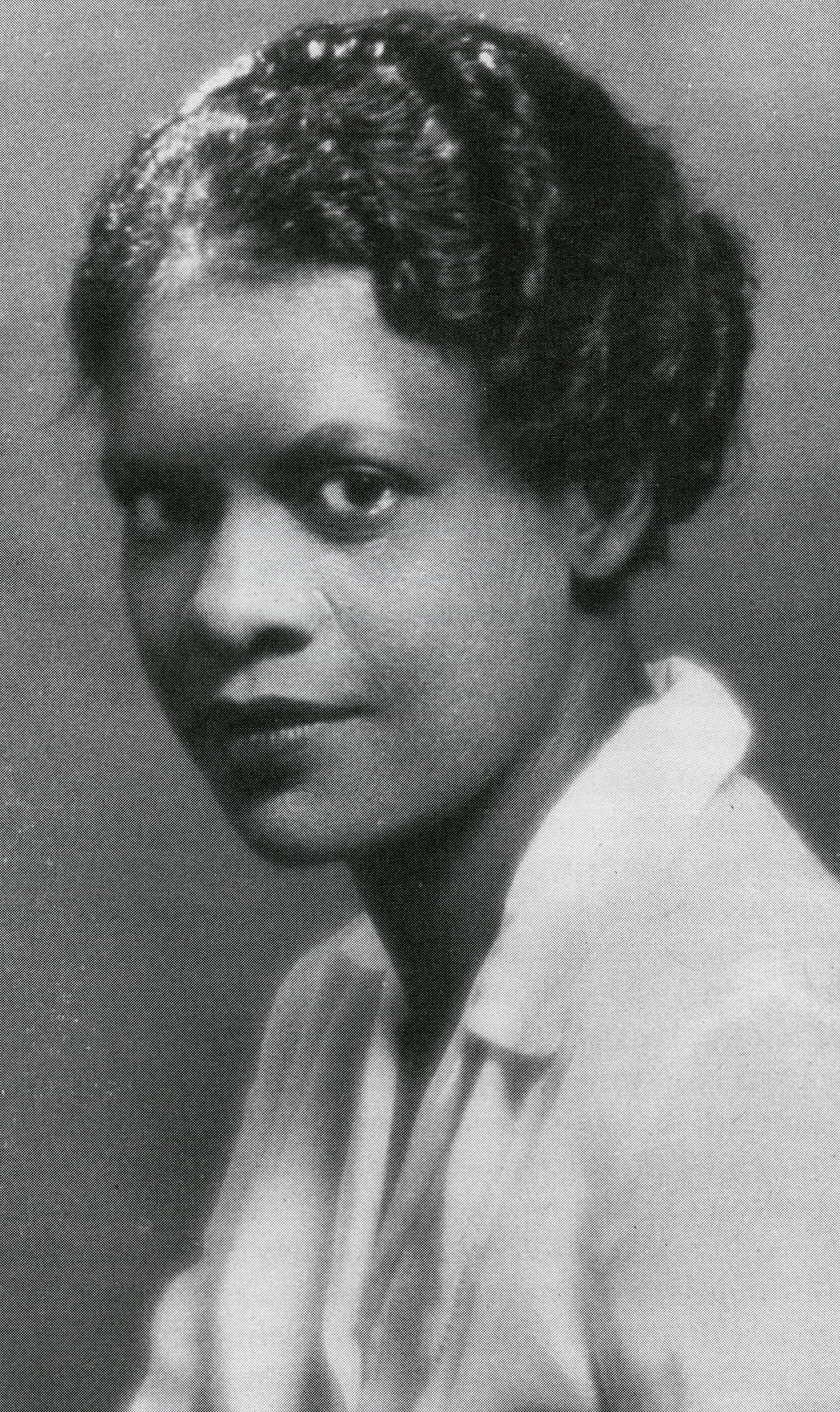
Eunice Hunton Carter, a well-known black woman attorney in the 1930s in New York Most of the cases Carter handled involved arrested prostitutes. Carter noticed a strange pattern emerging when the same bondsmen arrived to bail the women out and the same law firm sent the same lawyer, Abe Karp, to defend them. Karp was well-known as a Mafia lawyer. Carter approached Thomas E. Dewey, who had been appointed New York State special prosecutor in 1935, to look into organized crime. Dewey had planned to make loan sharks his main target. But convinced that Carter might be on the trail of something big, he hired her as the only black person and only woman on his famed "twenty against the underworld" team. A full-scale investigation turned up the fact that Carter had been more than right. The underworld took in $12 million a year on prostitution alone during the Depression years, with Charles "Lucky" Luciano, New York's Mafia leader, in charge. The subsequent trial brought Luciano's conviction. It also brought Eunice Hunton Carter an appointment as chief of Dewey's Special Sessions Bureau, supervising more than 14,000 criminal cases each year. [37] No matter how stellar their careers, black women attorneys knew that judgeships were pretty much out of their grasp. The first black woman judge in the United States was Jane Mathilda Bolin, appointed by Mayor LaGuardia as a justice in New York's Domestic Relations Court in 1939 (later called the Family Court). [38] Edith S. Sampson, born in 1901, was the first black woman to be elected to a judgeship in the United States in 1962. She was one of the few black women from a less than well-off family who advanced in the legal profession. Always working for a living while attending schools, Sampson earned her Master of Law degree in 1927 at Loyola University, and was admitted to the Illinois bar. After a long combined career in social work and law, Sampson opened her own law office in the heart of Chicago's black neighborhood. If not for later events on the world scene, she might have remained there throughout her life (see Chapter 5). When the United States entered World War II in 1941, white women lawyers were still "rare birds" and black women lawyers even rarer. But they were often the only ones there for thousands of desperate poor people in need of legal help.
|