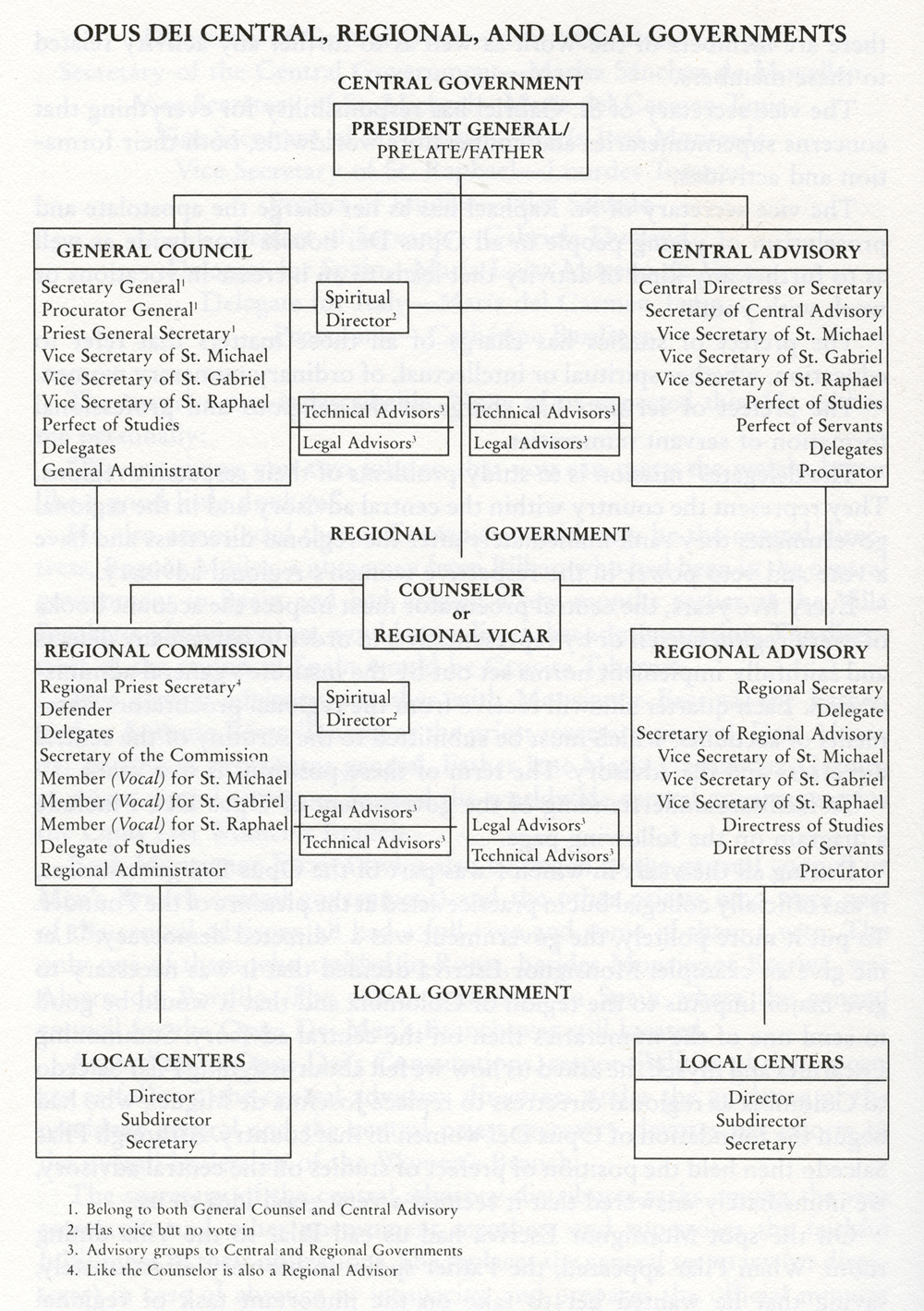
|
BEYOND THE THRESHOLD -- A LIFE IN OPUS DEI |
|
5. ROME I: THE GOLDEN CAGE Antonina, one of the Work's first numerary servants, who had been in Rome for many years, opened the door for us. Encarnita Ortega, then directress of the Villa Sacchetti administration and Mary Altozano, a numerary from Jaen, who was the subdirectress of the house, were waiting with her along with Maria Luisa Moreno de Vega. After warm greetings from each of them, we went up some granite steps to the Gallery of the Madonna, and thence by another stairway to the oratory of the Immaculate Heart of Mary to greet the Lord. I asked Encarnita Ortega if I could have a glass of water because I had not had anything to drink for nearly forty-eight hours. I will always remember that she looked at her watch and said: "It is after midnight. If you drink water now, you will not be able to go to communion tomorrow. How nice," she added, "the first thing you are going to offer up in Rome for the Father." Of course, I didn't drink water. My first impression upon crossing that threshold was of entering a medieval castle. I observed there was a great deal of stone, red tile, and iron in the construction. There was little furniture, but heavy inside shutters. They turned on the lights in the Gallery of the Madonna, named after a stained-glass window at the end so that I could see it better. On the other side of the Gallery is the ironing room, and when its lights are on, light shines in the Gallery as well. The Gallery is very pretty. Because of the number of different levels that exist in these buildings, the Gallery of the Madonna is in a cellar which has excellent natural light from a skylight in the ceiling. The floor is of red tile arranged in a zig-zag pattern with a border of soft white stone, and set off against the grey granite molding at the bottom of the wall. There is a fountain against one of the walls, made out of a genuine Roman sarcophagus. Drops of water always fall from a hippogriff's mouth, which creates a quiet, recollected atmosphere. Instructions for the house in Rome mandate permanent minor silence in the Gallery, which means that one must speak as little as possible and in a very low voice because of the proximity of the oratories. At the time I arrived, there was only one oratory for the administration, the Immaculate Heart of Mary. Antonina, Mary Carmen Sanchez Merino, and Iciar brought Tasia, the servant who came with me, to her compartment (camarilla). Encarnita Ortega and Maria Luisa Moreno de Vega brought me to my room. Climbing the steps of red tile trimmed in wood, toward the first floor of the sleeping quarters, we stopped on a big landing where there was a living room or soggiorno, whose door of iron and glass allows you to see the whole room from the outside. The room was large, with the furniture in several groupings, and very attractive. It struck me as well furnished. Encarnita pointed out a series of trompe-l'oeil drawings which decorated the walls and created optical illusions. The room had three windows to the street, which I had just seen from below. From there, they took me to my room, which was on the first floor, showing me where the showers and toilets were. Maria Luisa Moreno de Vega had her room very near mine. Our rooms formed a block of two floors whose windows opened onto a terrace, planted with several cypresses. Of course, Encarnita repeated that I had "pull" because I had come to the Father's house and what a responsibility it would be to work directly with him as one of his two female personal secretaries. Encarnita asked if I had brought anything for the Father and I said I had. I handed over the mail that Father Jose Maria Hernandez-Garnica had given me and also the money belt, explaining what had occurred in Ventimiglia. She said that I should explain everything to Don Alvaro del Portillo, when I saw him the following day. When I closed the door of my room, I saw that it was mid-sized with a greenish-black iron bed and a very pleasant flowery covering over the planks. During the next few days I realized that all the bedrooms were laid out and furnished in exactly the same way. There were two doors, one to a sink with a large mirror and light, and the other to the closet. My window was closed. I didn't know at first where it faced, but the next day, on opening it, I realized it overlooked the terrace of the cypresses. There was a niche in the wall for books, but no books, and a picture of Our Lady painted on the wall. A very simple desk and chair rounded out the decoration of the room. The floor was of red mosaic. The room was pleasant but its austerity chilled me a little. I got up when the bell rang and following the rules of all Opus Dei houses was dressed and had my bed made in thirty minutes. The light poured in when I opened the window, and it was as if that sun had filled me with optimism. Encarnita came to take me to the oratory, because the house was so big that it was easy to get lost. First there was meditation, as in every house of the Work, and then Mass. The oratory of the Immaculate Heart of Mary was very different from those I had known in Spain. It seemed rather large. There were choir seats for the numeraries and in the middle of the oratory pews on either side of the central aisle for the servant numeraries with a small organ in the middle. At the end of Mass I went to greet the numeraries and servants who lived in the house, some of them old acquaintances and others not, who waited for us in the Gallery of the Madonna. These greetings are usually very noisy, with big hugs, but Opus Dei numeraries never kiss each other. We immediately went to have breakfast. At that time the male numeraries' dining room was not yet finished, so they used ours. Because of the conflict, and in order to maintain the rule for administrations, we had breakfast in the ironing room, on a table, usually used for sewing. We used our own dining room for lunch and dinner only, because there were several turns for meals in the house. This went on for almost two years until part of the construction was complete and we could also have breakfast in the dining room intended for the administration. There were not many numeraries at Villa Sacchetti when I arrived. The local council was formed by Encarnita Ortega as directress, Mary Altozano as subdirectress, and Mary Carmen Sanchez Merino as secretary. Maria Luisa Moreno de Vega and I were informed that we would primarily work in cleaning the administration section and, then, as the Father's secretaries we would carry out the duties assigned us. At breakfast they explained that more numeraries had previously lived in Villa Sacchetti, but that the Father had just organized the Italian region of the Women's Branch, with headquarters in Rome, in a house called Marcello Prestinari after the name of the street where the apartment was located. Pilarin Navarro Rubio, one of the first members of the Women's Branch was regional secretary. Also assigned to the region of Italy were Enrica Botella, Victoria Lopez Amo, Consi Perez, Chelo Salafranca, and Maria Teresa Longo, the first Italian woman numerary. Except for Chelo whom I knew from Zurbaran, I did not know any of the others. As soon as we had finished breakfast, Encarnita arranged the things that I had brought for the Father on a silver tray and told Tasia and me to get ready because the Father was going to come to the Gallery of the Madonna to meet us. We asked how to greet him and were told that we should kiss his hand, if he offered it. Tasia and I were with Encarnita in the gallery when we heard the Father's voice as he approached through the Gallery of the Birds, so called because the walls and ceiling are decorated with birds. He and Don Alvaro paused with their backs to the stained-glass window of the Gallery of the Madonna, and he said to us with a big smile: "Pax, daughters!" We answered filled with emotion: "In aeternum, Father!" We kissed his hand, when he offered it. Don Alvaro also said Pax to us with a big smile, and again we answered, In aeternum. I had not seen Don Alvaro since the afternoon when they told me to visit him at Diego de Leon in Madrid toward the end of 1949. Although I had seen Monsignor Escriva once before in 1949, when he gave a meditation to new numeraries in the Lagasca administration in Madrid, this was the first time he spoke to me directly or personally. The Father asked us if we had had a good trip and if we had slept well. We told him we had. Addressing Tasia, he said that there was a lot of work in the house and that he hoped she would always be joyful. Then with a "God bless you, daughter," he dismissed the servant. After she left, he looked me in the eye and said: "How little did you imagine, Carmen, daughter, that you were coming to Rome!" I answered: "Truly, Father." Monsignor Escriva went on: "Do you see the Lord's plans, daughter?" "Yes, Father." He said that there was a lot of work to do and that we would talk. He asked me if I had seen Rome, and I told him I had not. Then he said to Encarnita that someone should take me to St. Peter's and show me around. He added: "It's necessary to learn Italian!" "Of course, Father." The Father inquired whether I had brought mail for Don Alvaro, and I said I had. Encarnita opened the ironing room door, and Rosalia Lopez, one of the first servant numeraries, came out with the tray with the mail and pouch. The Father indicated that they should leave it in his dining room in the Villa Vecchia. I took advantage of the Father's silence to try to tell Don Alvaro why I had had to open the money belt, but the latter did not let me continue. He made a gesture with his hand as if to tell me not to worry. The Father called for Maria Luisa. Encarnita had told her to stay in the ironing room in case the Father wanted her. She came out immediately. The Father, quite affably, told us that we would work closely with him (muy cerquica) on secretarial matters related to the Opus Dei Women's Branch worldwide. It should be clear to us that our secretarial work did not involve membership in the government, "although," he added, "Maria does belong to the government as a major superior, but you don't," he said to me. During the following days he repeated that so often, that I used to say to Maria Luisa in jest: "The Father will tell me again when he comes that you have a role in the government and I don't." We agreed that we would meet him in the secretary's office the next day after the cleaning. This very small, triangular office was the house secretary's room on the first floor of Villa Sacchetti. They assigned Maria Luisa and me this room as the most suitable place. The room had an Italian-style desk, a closet, just enough space for a couple of extra chairs. It was a room full of light near the terrace onto which our bedrooms faced. It had a little cabinet, resembling a safe, set in the wall and covered with a painting, where we kept confidential documents, duplicates of the keys to the house, especially the duplicate to the mail box. The mailman could slip letters into this box from the street. The inside box was located at the delivery entrance, and had a small metal door on the inside which could only be opened with the key which was kept in the house secretary's desk, whose duplicate was placed in the cabinet set in the wall. Our only equipment was a portable typewriter. I was very pleased with this assignment in Rome. Everything seemed like a dream, as if I had died and gone to heaven. With all respect to Muslims, I felt as though I had arrived in Mecca. I could not believe that there could be greater happiness on earth for a member of Opus Dei. The Father had spoken to me, knew who I was, and had announced that I was going to work with him. Isn't this the greatest thing to which a completely fanaticized member of Opus Dei, as I was, whose star and guide was none other than Opus Dei and Monsignor Escriva, could aspire? What I could not even have conceived of were the undercurrents that existed between people in the house and the Father and between the Father and the Holy See. If I remember correctly the subdirector Mary Altozano accompanied me to St. Peter's. She had been in Rome for more than a year, and her Italian was very good. She was very young and had entered Opus Dei almost as a child. She had an older brother who was a numerary. By chance, I had been a good friend of a cousin of hers, who was a naval doctor and whom I had met in Cartagena. We went by the circolare (trolley) to the stop closest to St. Peter's, and she pointed out the building in the Citta Leonina where the Father had lived when he arrived in Rome. From there we crossed the Colonnata, and for the first time I saw the vast Basilica of St. Peter's. I had the sense of being at the heart of the church. When we arrived at the altar of the confession, Mary said that the Father liked us to say the Creed there and we did. I soaked up everything she told me, and the grandeur of St. Peter's overwhelmed me. Mary said Pius XII used to give his blessing after the Angelus at noon, but we had to return before then so as not to be late for the Father's lunch hour, since he might have some work for me. So, we did not stay for the Pope's blessing. This strange detail reveals that under Pius XII, John XXIII, and Paul VI it was a manifestation of "good spirit" for the numerary who arrived in Rome not to insist on staying to receive the Pope's blessing but to go back to Via di Villa Sacchetti so that she would be there, if the Father called. On the circolare, I could sense how big Rome was and realized that I could not understand a word of Italian. In sum, the first day in Rome was full of varied impressions. One memory from the first day was that I kept getting lost in the house and had to wait for someone to come down the gallery to seek directions to the oratory, my room, or the dining room. Normal life, so to speak, began the second day of my stay in Rome. Encarnita was showing me the kitchen, when Antonina, the servant who usually answered the phone, approached Encarnita and whispered something. With an air of annoyance, Encarnita asked me: "To whom have you given our telephone number?" "To nobody," I answered truthfully. "We'll see who that man is who is calling you." I couldn't imagine who it could be, because I hadn't given my father or the Italian gentleman on the train any phone number, and I did not know anybody in Rome. The telephone was in the ironing room. To my great surprise, I heard the voice of the Italian gentleman from the train, delighted because he had located my telephone number and address. He wanted to come by to show me around Rome. My answer was brusque, rude, and sharp. I told him not to bother me again and hung up. I went back to Encarnita and said that it was a gentleman who was in our compartment on the train from Madrid, and I would explain everything later. The expression on her face made me think she was going to scold me. As the directress of the house, Encarnita received all the confidences of numeraries and servant numeraries, so that she had complete control of each and every one of us. Encarnita used to receive the confidences of the servants in a part of the ironing room that was on a different level, while she was sewing. Later in the ironing room, I saw that Tasia was talking to her, and I guessed that what Tasia said might give Encarnita a reason to speak to me. I did not have to wait long. Next day, without even listening to me, Encarnita launched into a great oration, saying what a bad example I had been to the servant during the trip; I had not only continually flirted with the Italian on the train, but had allowed him to take me by the arm to get me on board, and had read the pornographic magazines he had loaned me, although I knew that numeraries could not read any magazine without permission. The worst thing was that since she said everything as a fraternal correction, I could not defend myself and had to accept it all without a whimper. Naturally, I was angry that the servant had been so stupidly scandalized and had indulged in such misinterpretations. What I did not know on arrival at Villa Sacchetti was that Encarnita was the thermometer of "good spirit" in the Work, and reported everything, absolutely everything to the Father or Don Alvaro. Furthermore, since Encarnita fully shared the Father's notion that the servant numeraries were like little children, anything said by them had greater weight than anything we might say. In her correction/scolding, Encarnita said that I had barely arrived in Rome when I was already failing the Father and that she preferred not even to think of how upset the Father would be, if he knew of my behavior during the trip. When it was my turn to make my confidence, I gave my version of the trip, but I remained convinced that my truth did not change her opinion in the slightest. Instinctively, I realized that Encarnita did not totally trust me, although I did everything possible to gain her trust. Over the years I came to realize that Encarnita tended to be jealous of anyone who could overshadow her in relation to the Father. She managed to have Pilarin Navarro sent to the region of Italy as directress, so that she became the senior person in Villa Sacchetti, and the one who knew the Father best. However, since Maria Luisa and I arrived, she was no longer the only woman who saw the Father in confidence. She was no more than the directress of the house, and was not privy to the confidential matters of the secretarial office, something that she clearly disliked. The following day, Maria Luisa and I waited in the secretarial office at the time set by the Father. We prepared two chairs for him and Don Alvaro. When we heard them arrive, we stood up and the Father told us to be seated. Basically, he told us we would be in charge of writing weekly letters to the regional directresses in the countries where there were Opus Dei women. Matters of government could not be part of these letters. We should only write about the headquarters in Rome, anecdotes about the servants, and what we had heard from the Father. If any of the incoming letters dealt in any way with government, we were to let him know so he could give an appropriate response. I was assigned to write to Nisa, who was in the administration of the men's residence in Chicago; and also to Guadalupe, who was in Mexico. Maria Luisa was assigned to write to England, where Carmen Rios was regional directress, and to Spain. Maria Luisa and I wrote by turns to Chile, Argentina, Colombia, and Venezuela. Moreover, Maria Luisa wrote to Germany, where there was no Opus Dei house, although Marianne Isenberg, the first German woman numerary, and Valerie Jung lived in Bonn. Both left Opus Dei a number of years later, due mainly to the lack of tact shown by Opus Dei priests and superiors, as I will explain below. I used to write to Teddy Burke, the first Irish numerary, who had gathered several more numeraries around her in Dublin. In the first letter we had to explain our mission in Rome. The reaction of all the regional directresses was very positive, because they knew Maria Luisa and me personally. Monsignor Escriva warned us that our mission imposed the "silence of office," which meant that we could never speak to anyone about anything that we had dealt with in the secretarial room, and that consequently our work was not a topic for our weekly confidence. He also said that we would have to keep informed about everything that happened in the secretarial office, and that we both had to read all the mail, including personal letters that were directed to him, and that only when there was something out of the ordinary should we give him those letters, but otherwise, we should file them. Letters to the Father The letters to the Father deserve special mention. From the time you wrote "the letter" to Monsignor Escriva as president general requesting admission to Opus Dei, the superiors told us that it was good spirit and "the Father saw with pleasure as a manifestation of spirit of filiation" that we write him as least once a month. We had to give this letter to the directress of the house who was obligated to forward it to Monsignor Escriva through the superiors of that country without reading it. We were also told that we could write to the Father in a sealed envelope whenever we wished. When Maria Luisa Moreno de Vega and I began to read the letters to the Father from all Opus Dei women of all countries where we worked at that time, I remember perfectly that we did so with the greatest respect and we never allowed ourselves the slightest commentary about any of them. Needless to say, we handed over the letters that came in sealed envelopes -- one arrived now and then -- directly and immediately to Monsignor Escriva, who often told us to read them ourselves afterwards. Letters from the numeraries to the Father were ordinarily brief. Their contents varied but were usually speaking about the work in a new country, frequently about their interior life, about proselytism. Generally the numeraries who were superiors in a country spoke about the financial difficulties of getting started, of some misunderstanding or disagreement with the counselor of the country, or some problem of perseverance, or the difficulty in finding the first vocations. These were almost constant topics in the letters to the Father. What shone through in these letters was the degree of maturity of the numerary who wrote them. For example, when the directress of the United States wrote to the Father, she opened new horizons for us, because she made us understand how she confronted a totally new panorama of manners, customs, and lifestyles, how she had to deal with the problem of Spanish numeraries who wanted to study when they arrived in the United States as they tried to adapt to the life of a normal girl in that country. We could even feel the difficulty of the language and the distances in traveling to do apostolate. I remember the case of a numerary who became seriously ill, so that the directress had to spend hours on the train to visit her frequently in the hospital. There was a notable difference in the letters from the fanatical numeraries and those who tried to adapt quickly to the new country. My personal letters to Monsignor Escriva years later when I was in Venezuela almost always spoke of our activities in that country, of progress in apostolate, of new vocations. Other times, I spoke about the possibility and desire to have a center of studies as soon as possible, and in the last period of my stay in Venezuela about lack of support from the counselor when we dealt with the topic of the administrations. When the number of vocations began to increase in Opus Dei, the members were assured that the Father read absolutely all the letters as his principal work. It was difficult for many people to believe this, but it was our obligation to assure them. When the central government of the Women's Branch began to function in 1953, each of the assessors read the letters to the Father from the members of the region assigned to her; afterwards these letters were read by the central directress and the Women's Branch government secretary. It was a matter of their judgment and discretion whether or not to give the letter to the Father. In this first Opus Dei Women's Branch government in Rome there were some very young immature numeraries, who on occasion made fun of what a numerary wrote to the Father, which personally infuriated me. However, when I was no longer in Rome it was difficult to write the Father with spontaneity and confidentiality, and I used a sealed envelope a number of times, when I did not want my letter to be the subject of interpretation by the assessor. In reality, saying that the Father read the letters from the members was a lie that they were resolved to maintain. Monsignor Escriva and Alvaro del Portillo knew that as did all of us who had been in Rome as numeraries in the central government, including me. As a major superior, I affirmed the statement, knowing that it was a lie, a "lie required" by my superiors, including the Father. Maria Luisa Moreno de Vega and I, as the Father's secretaries, executed every instruction received from him with complete responsibility. This was a full-time job, except for some time in the morning spent cleaning the Villa Sacchetti administration, or at the end of the afternoon when the numeraries of the house went into the Villa Vecchia to clean the rooms for the Father and Don Alvaro and the vestibule which was the size of a small bull ring. We were generally absorbed in this work until the Father went to supper. Maria Luisa and I worked well together. The fact that we had been coworkers before, helped us to work as a team. Beside, Maria Luisa was a very good person, sensitive and well educated. She had attended the German School in Madrid and had complete mastery of German. My education in a French school similarly equipped me with a good command of French. We both could understand and write English. Monsignor Escriva appreciated all this. We both took learning Italian very seriously, something that our linguistic talent and strenuous effort let us accomplish in a few months without a single grammar class. In our personal relations or in our work, it never mattered that Maria Luisa was a major superior and I was not. She was very sensible and never said anything that could remotely amount to asserting her authority. There were few days on which we did not see the Father and Don Alvaro. Both came to the secretarial room or called us after lunch to go up to the Villa to go over something or other. In fact, while the Father and Don Alvaro had lunch, Maria Luisa and I would go to the kitchen so as not to make the Father wait in case he called us. At lunch and supper time, Encarnita was also in the kitchen, since she took care of the Father's meals. The Father's meals were brought up to his dining room, measured and weighed according to instructions from a physician, transmitted via Don Alvaro. We knew the Father had a special diet, but no one spoke openly of what was wrong. Unquestionably, he had diabetes, as one of Monsignor's official biographers confirmed after his death. [1] While we waited in case the Father called, we helped the numeraries in charge of the kitchen prepare the teatime snacks for the whole house. Many mornings when the Father arrived in the secretarial room, he spoke to us about future plans for the Opus Dei Women's Branch. More than once, he showed his discontent with the church, and criticized Pope Pius XII. I remember him say: "Daughters, you don't realize what is happening around you; my hands and feet are tied. This man (i.e., Pius XII] doesn't understand us; he doesn't let me move; I'm cooped up here." He gestured with his hands as if to say, "This is incomprehensible." More than once I heard Monsignor Escriva say in slightly different words that the Pope didn't let him leave Rome. One day Monsignor Escriva said to me that, in time, he would send me to France because he knew I loved that country. And, in fact, in the Villa dining room, he introduced us to Father Fernando Maycas, who was going to France as counselor, and to Father Alfonso Par, who was going to Germany as counselor, telling them that very possibly I would go as directress to France and Maria Luisa to Germany in some government role. Monsignor Escriva assigned me to take charge of the passports and residence permits for all the numeraries who lived in Villa Sacchetti. My responsibility would be to make sure that both were valid. Don Alvaro would tell me what I had to do about the residence permits. This became one of my regular duties during my stay in Rome and obliged me to go out frequently to the Roman police headquarters (Questura ramana). Our residence permits in Italy were very peculiar, because, although members of a secular institute, we availed ourselves of a law designed for members of religious congregations residing in Italy. We had to fill in a form that had previously been validated by a Vatican agency, located outside Vatican City. I prepared the forms for each case, and Don Alvaro signed them for submission to the Vatican agency. I would then bring the forms and the passports to police headquarters. The Father stressed how lucky we were not to be like "those little nuns" who had to go one by one, all confused, to arrange for their residence permits. After a few years I got to know the staff at the Questura romana, and they knew me. Once they even remarked that, given the time I had been in Italy, they could easily arrange for me to acquire Italian citizenship. I did not accept. Why would I want to be Italian, if I lived in Villa Sacchetti, the Father's house ... ? Speaking of passports, I recall two things vividly: first, immediately on arrival, the numeraries had to hand over their passports, which they did not see again until the day they left Rome or when it was necessary to renew them, and they went with me to the respective consulate. Second, there was a rather young police officer who periodically came to Villa Sacchetti to revise passports and residence permits. We had hundreds of foreigners and it was logical they they should check their information. I was in charge of meeting and speaking with him. When I told the Father about the police officer, he suggested that we should always have a bottle of Spanish brandy ready to give to that officer. On another occasion, in the secretarial room, Monsignor Escriva instructed us to take note of the things he said as we went along, "because they would be for posterity." I paid attention to what he had to say during my time in Rome. I regarded it as a special sign of trust. It never crossed my mind that this was Monsignor Escriva's campaign to start constructing his own altar. When Maria Luisa and I arrived in Rome, Encarnita Ortega was in charge of the diary of Villa Sacchetti. Shortly thereafter she passed it on to me. In all the houses of Opus Dei the custom is to keep a diary, but the diary of the house in Rome had greater significance within Opus Dei because it reflected many daily events in the life of the Founder. Encarnita instructed me that when I noticed that the Father showed obvious anger, I had to use a phrase such as "Today the Father was displeased because we did not put enough love of God in such and such task." I wrote this diary for a number of years. If, for some reason, I was not going to be able to do it on a given day, I had to notify the directress, so she could write it or assign someone else to do so. The first part of my stay in Rome was one of my most interesting periods in Opus Dei. Out of blindness, or fanaticism, I was changing into such an automaton that nothing and nobody had importance in my life except that house, the Father, and Encarnita. Everything revolved around Monsignor Escriva, whom we usually saw several times a day. Looking back, I perceive perfectly the essence of Opus Dei's sectarian character. We were absolutely overwhelmed by different types of physical work; if there was a free moment, it was to accomplish the plan of spiritual norms of life. Everything was sprinkled with the presence and indoctrination of the Founder. There was not the slightest relaxation except for a daily half hour get- together with the servants, either playing ball in the Cortile del Cipresso, a very small patio with a cypress in the middle, in summer or, in winter, chatting or singing in the ironing room, the very place where we spent the greater part of our day. We had no music and needless to say we did not listen to the radio. Villa Sacchetti was and continues to be an island in the great city of Rome, whose life is only the Work and its Founder. Everything else has no importance. If we went out, we obviously saw people and the city, but the occasions to go out were exclusively to make necessary purchases, for the house, our work, or something like shoes. It was as if we were in our own world, passing next to but without mixing with any other. I thought then I was free, because we were allowed a freedom within well defined limits. But it was not genuine Christian freedom which allows you to exercise free choice on the basis of familiarity with a situation without the bridle of "good" or "bad" spirit. Opus Dei members have only the freedom which "the good spirit of the Work" permits after consultation with their superiors, even on professional, political, and social questions. It would be interesting to know what an organization like Amnesty International would make of Opus Dei if it had the necessary access to sufficient information to make an objective analysis. We did not do any direct apostolate. That was entrusted to the Italian region. Our work was totally internal: the administration of the Father's house or Villa Vecchia and of the incipient Roman College of the Holy Cross whose construction had just started. When I arrived in Rome, the male numeraries who were students at the Roman College of the Holy Cross still lived in what was called the Pensionato. [2] Their meals were served in the administration's dining room. One day in the ironing room we heard great shouting and screams from the Father. Frightened, I thought that something very serious was happening and he was calling us. I was about to open the door from the ironing room onto the Gallery of the Madonna, when one of the senior numeraries in the house warned me quietly: "Don't go out. The Father must be correcting the architect." In fact, I heard Monsignor Escriva shout at the architect many times. First, Fernando de La Puente, and later, when he was sent back to Spain because of illness, a rather young man named Jesus Gazapo who took Fernando's job. On another occasion I witnessed the very unpleasant scene of the Father scolding Encarnita because she was nearsighted and did not want to wear glasses. Encarnita blushed to the roots of her hair and her chronic headache was worse that day. It was easy to pick out those whom the Father scolded. The kitchen often triggered Monsignor Escriva's bad temper. One of the numeraries who worked there would open the window, and odors would waft up to Villa Vecchia. The Villa Sacchetti kitchen is located in the bowels of the building. Although the architects experimented with different exhaust systems, there were always cooking odors. This exasperated Monsignor Escriva to a degree that it is difficult to describe. I saw him on occasion enter the kitchen, go straight to the open window, and slam it shut. Strangely, he did not understand that the heat in the kitchen made it unbearable, unless the windows could be open. As directress of the house, Encarnita was on the receiving end of most of his scoldings. For example, when one of the servants or one of us had forgotten a dust cloth or a rag to wax the floor in the administrated house. For whatever reason, the target of the Father's ire was ordinarily Encarnita. I always admired the manner in which Encarnita accepted abuses as "good spirit," but I realize today that rather than good spirit, Encarnita really had a morbid love for the Father. She must have considered the scoldings a sign of predilection. In fact, there was a phrase repeated among the numeraries of many countries: "Blessed are they who receive the Father's scoldings," because they were a sign that they were close to him. Monsignor Escriva certainly did not have a mild manner. Encarnita had quite a different relationship with Don Alvaro del Portillo. Alvaro was a person with whom Encarnita could speak about anything and in fact took advantage of all sorts of circumstances to do so. She would tell him that we needed money or mention the Father's health or meals, or inform him about a serious problem of some numerary or servant. How could Encarnita speak to Don Alvaro if the separation between the Men's and Women's Branches of Opus Dei is total? For instance, if he came down to the dining room for supper alone, while we cleaned the Villa Vecchia vestibule, Encarnita could speak to him for a few minutes. Other times from the directress's room by intercom, and sometimes, when the Father was leaving the Villa dining room, if Don Alvaro fell back a little, Encarnita took advantage of a few minutes to ask him or consult him about something. Monsignor Escriva had given Encarnita permission to use the familiar Spanish "tu" instead of the formal "usted," when addressing priests of the Work. The Father's tantrums terrified me, because I did not know how I might react if he were to scold me. Until now I had heard only what he had said to others. At that time, Monsignor Escriva and Don Alvaro del Portillo used to come to the ironing room after their supper. Since they came almost daily, we used to have two chairs ready for them. The numeraries who worked in the sewing section were at the front. Sometimes the servants who did ironing were on the side which faced the Cypress Courtyard, or those who were in the laundry room continued ironing and washing unless the Father specifically told them to join the group. Entering the ironing room the Father would always say Pax loud enough for all of us to hear him, and he would repeat it several times. He would enter with a characteristic gesture of his hands, a little thrust out and hanging. When he was seated, he usually crossed his hands and rested them on his lap, but he would never cross his legs, at least not in our presence. If he wore the clerical cape (manteo) he would wrap it around himself, while he looked over us saying, "Let's see. What can you tell me today, daughters?" Often there was a profound silence. Nobody dared to speak. Then he would say, "Well, if you don't have anything to tell me, I will leave." A murmur of protest would follow: "No Father, no." Unless Encarnita threw out a topic for the Father or instructed some servant to do so, the Father would address Julia, one of the first numerary servants, a Basque, who was older than most, and would say: "Well, Julia, you say something, daughter." Julia was intelligent and knew how to pick a subject that might interest Monsignor Escriva. On one of his visits to the ironing room, Monsignor Escriva announced that for the first time in the Work Mexican numerary servants were going to come to Rome. Then, addressing Maria Luisa Moreno de Vega and me, he asked us jokingly, "How come you haven't told your sisters who is going to come from Mexico?" We smiled in silence. "Daughters, your sisters have not told you because they are obliged to keep the silence of office. But, let's see, speak up! Who is coming?" Maria Luisa and I responded: "Constantina, Chabela, and Pelancho, Gabriela Duclos, Mago, and Marta, a Mexican architect; all numeraries." So, Monsignor Escriva spoke about Mexico, about the work Opus Dei was doing there, and that an estate in Montefalco had just been donated to the Work, where, "if we remain faithful," an agricultural school and farm would be started for peasant girls. At other times, Monsignor Escriva spoke to us about the progress of the construction of the Roman College of the Holy Cross and asked us to pray for Don Alvaro, who was responsible for the finances and each Saturday had to pay the workers. Many other times the conversation turned to how "smart we had to be in life"; he "did not want stupid daughters." He added: "Daughters, don't be silly like nuns." When he said this he would change his voice and with his hands pressed to his face mimic a fatuous person, which provoked great laughter among the servant numeraries and unfortunately among many ordinary numeraries as well. On one occasion, someone said that she had been to Ciampino, the international airport in Rome, and had seen a large group of Spanish nuns waiting for their mother general. When they saw her descend the steps of the plane, they began jumping up and down and shouting: "Our mother, Our mother! Here comes our mother!" Monsignor Escriva roared with laughter, saying: "how amusing, but how amusing!" As the years went by, Monsignor Escriva was received much the same way. In this regard, Monsignor Escriva told us that "nuns are stupid," adding that the only nun he visited was Sor Lucia in Portugal, "not because she had seen Our Lady, but because she loves us [Opus Dei] very much." He generally added: "She is somewhat silly, although a good woman." One of those evenings Monsignor Escriva also reported that Sor Lucia in Portugal once had said: "Don Jose Maria, you in your place and I in mine, we can also go to hell." As I mentioned above, we did not do direct apostolate in Villa Sacchetti. However, Encarnita Ortega used to go once a week to the house of the Italian region to speak to married women and do apostolate with them. That also gave the numeraries who were there the chance to speak to her and provided Encarnita the opportunity to find out what was going on in the Italian region, information she passed on to the Father or Don Alvaro. One day I asked Encarnita about the numeraries in the Italian region, especially Pilarin Navarro, who was the regional directress and one of the first women in the Work. She spoke quite harshly of Pilarin Navarro Rubio. They were from the same city, she said; Pilarin had a lot of relatives in Opus Dei, especially her brothers Emilio, a numerary who years later was ordained a priest, and Mariano, one of the first supernumeraries, who would eventually be a member of Franco's cabinet. Encarnita said that Pilarin was very proud and had had differences with the Father, because she did not have affection for him. Encarnita added bluntly that the Father did not trust Pilarin, because there was "something" about her that he did not like, and Encarnita hinted at something very serious. The Father was apprehensive during the meals that Pilarin prepared for him when she was in the kitchen, because he did not feel sure of her. Encarnita Ortega also added that the Italian region had very serious financial problems because "they had no idea of doing any apostolate" and that Maria Teresa Longo, the first Italian vocation, whose brother was also a numerary did not seem a very secure vocation. She liked Chelo Salafranca and said that she was a numerary who loved the Father very much and that she was great at doing proselytism. Oddly enough, years later Chelo Salafranca staged a rather spectacular escape from Opus Dei. Some afternoons the first two Italian supernumeraries, Mrs. Lantini and Mrs. Marchesini, would visit. They would be brought up to the ironing room where they would help us. Both had numerary sons. Mrs. Lantini was charming, wore glasses and was quite deaf. She must have been very pretty at one time. Mrs. Marchesini was cheerful, very pleasant, with hair dyed blond, chatty, and had a somewhat shrill voice. When she came on Saturdays and sang the Salve Regina with little trills, she provoked great hilarity amongst us. One day, Mrs. Marchesini commented that King George VI of England had died. All of us were more or less startled to hear the news and said: "The King of England has died?" The lady was astonished that we didn't know this. "But how could you not know? He died several days ago." Encarnita responded smartly: "I knew, but I didn't want to upset them." We did not laugh at her response until after the lady had departed. Naturally Encarnita confessed after Mrs. Marchesini left that she did not have the slightest idea that the King of England had died. That afternoon, when Monsignor Escriva and Don Alvaro came to the ironing room, we told them about the visits by Mrs. Lantini and Mrs. Marchesini, and especially about Encarnita's response concerning the death of the King of England. At that point, I am not sure which of the numeraries remarked: "So, Father, now Princess Elizabeth, who is so young, will be Queen of England." The person had not finished her sentence, when Monsignor Escriva rose violently from his chair, gathered up his cape, headed for the middle of the ironing room, shouting at the top of his lungs: "Don't speak to me about that woman! I don't want to hear you talk about her! She is the devil! The devil! Don't talk to me again about her! Understood? Well, now you know!" Slamming the ironing room door shut, he went out toward the Gallery of the Madonna. We were all still stupefied, when he returned to stick his head through the door without coming in, to repeat again: "Understood? Do not speak to me ever again about that woman!" Before he slammed the door for the second time, Don Alvaro, with his usual affability and smile, probably trying to smooth things over, looked at us and said, Pax, also departing toward the Gallery of the Madonna. Encarnita immediately told us that we should return to our work and that we should not talk about the matter. She instructed me personally not to write anything about this in the house diary. I kept wondering why Princess Elizabeth would be the devil. The explanation for what I did not understand and what impressed us all so much then became very clear to me when I left Opus Dei: Monsignor Escriva had no grasp of ecumenical spirit, contrary to what Peter Berglar (an Opus Dei supernumerary and one of Monsignor Escriva's official biographers) tries to demonstrate. [3] Monsignor Escriva's remark to His Holiness John XXIII, as reported by Berglar, is in my judgment disrespectful, to say the least. That a monarch and, to make matters worse, a woman, was head of the Church of England must have aroused indignation in Monsignor Escriva. Given this view, years later, but still during Monsignor Escriva's lifetime, Opus Dei had the cynicism to invite the Queen Mother to inaugurate Netherhall House, the Opus Dei residence in London. When I found out, I thought it would have been interesting to know the reaction of the Queen Mother and the Court of St. James if it had become known that the Founder of the group whose residence she had been invited to inaugurate had called her daughter, the Queen, a "devil" with such passion and conviction. Monsignor Escriva's reaction on this matter will never be erased from my memory. I am, therefore, astonished when Opus Dei claims that its Founder had ecumenical spirit. He did not have it ever, as can be seen in the first edition of his book, Camino (The Way), where this spirit is fundamentally absent. [4] Cleaning and Miscellaneous Jobs Cleaning was a major part of our life during this period in Rome. It is always important in every Opus Dei house, since along with cooking it is the essential part of the activities of administration. Monsignor called the work of administration "the apostolate of apostolates." He also used to add that it was like the skeleton upon which absolutely all the houses of women and men rested and that "without the women the Work would suffer an authentic collapse." When I arrived in Rome the cleaning was murder. First, every morning a group of numeraries and servants went to the Pensionato. About sixty Opus Dei male numeraries lived there. Some numeraries went to the Lateran and others to the Angelicum to do their theses in philosophy, theology, and canon law, while some stayed at the house "watching construction workers." By express order of Monsignor Escriva the workers were "never to be left alone." Since the financial situation was very shaky in those years, many of the numeraries walked to save money on transportation, and the Father used to tell us that smokers should cut their cigarettes in half so that they would last longer. We had very little time to clean the Pensionato. It was like a military operation. While the numeraries made beds, the servants did bathrooms. Although there were few bedrooms, there were many three-tiered bunks, so that making the beds was quite an operation. We could often see the Father and Don Alvaro get in or come out of Monsignor Escriva's car. His chauffeur, who also washed the Father's car, was the first Portuguese numerary. We could also see the comings and goings of male numeraries in the garden, while they waited for us to finish cleaning their living room. The printing press, which male numeraries ran, was in the Pensionato. It was located in the two smallest rooms, and we had specific instructions not to touch anything, except to empty the waste paper baskets. The cleaning of the Pensionato took place in the morning and very rapidly. Then there was the cleaning of our house by sections: the bedrooms, bathrooms, the stairs, the soggiorno, and the galleries, the servant responsible for the oratory, the sacristy, and the visitors' parlor, the servants' compartments or camarillas, the ironing and laundry rooms. Julia, the older servant, was in charge of the gardens with Chabela, the Mexican. Big cleaning projects were shared by all, such as putting red wax on the tiles of the Gallery of the Madonna, the floors of Villa Sacchetti, the stairs, the servants' compartments. The difficulty about applying the red wax was not to stain the white sandstone border and to make the tiles shine by buffing with your feet or on your knees. Every afternoon as soon as the workers left, we entered Villa Vecchia where Monsignor Escriva had his provisional rooms, his oratory, and his work space. Encarnita or, in her absence, Mary Altozano made Monsignor Escriva and Don Alvaro's beds and cleaned their rooms with another numerary and two servants. The rest of the numeraries remained in the Villa vestibule, which had a newly finished wooden floor. The wood was completely dry and rather dirty. Cleaning that floor meant applying turpentine with stiff brushes to remove all stains. The liquid had to be removed and then the wax was applied. The vestibule was immense. Finally, we all tried to put a bit of shine on the floor by buffing it with our feet. So it went afternoon after afternoon, month after month. On Sundays we had so-called extraordinary cleaning of the Retreat House, the first location of Opus Dei's Roman College of the Holy Cross at Viale Bruno Buozzi, 73. The construction workers were finishing, and it was necessary to clean everything. The main thing was to remove drops of paint and cement using razor blades discarded by the male numeraries. To get more use out of the blades, we would divide them in two. Our hands were full of cuts, because all this was done without gloves. The Procura Generalizia was finished, and this was another cleaning project done frequently but not daily. The main entrance to the Procura Generalizia is in Via di Villa Sacchetti, 30. It was built as the reception area for visitors to the president general. The Procura Generalizia consisted of a vestibule, a visitors' parlor, a small bath, an oratory, and a dining room for twelve. The French-style furniture was so delicate that we had to use white cotton gloves to dust it. Monsignor Escriva was accustomed to invite people he considered important to lunch in this dining room. He dined there several times with his physician, Dr. Carlo Faelli, and his wife. At other times, it was a cardinal or a bishop. The instructions regarding guests were clear and specific, as was also the rule that nobody should be served before the Father. Because of this, two maids attended the dining room, simultaneously serving the Father and the guest of honor. When there were guests for lunch, I used to assist Encarnita in preparing the table and the floral centerpiece, and stay with her in the pantry while the meal lasted. So, I played a fairly prominent role on many occasions. It seems that I was very efficient in matters relating to guests and in settling questions of etiquette, particularly in relation to embassies and consulates. Inconceivable as it now seems to me, this made me aware of the great confidence that Monsignor Escriva and Encarnita had in me and made me very happy. What I did not realize then was that they were using me. Not until I was out of Opus Dei, did I notice how, under the guise of "good spirit," "love of the Father and the Work," Opus Dei exploits all its members. The Father's opinion and keeping the Father happy mattered more than God. On Sundays we usually did not clean the administration to increase the numbers of those who could go over to the Retreat House or to wherever the workers might have finished. Evidently, those cleaning sessions were traced for us the previous day by Don Alvaro. Neither Monsignor Escriva nor Don Alvaro ever put in an appearance where we were cleaning. Until the Father's meal time, Encarnita put her shoulder to the wheel with the best of us. With this exercise, those of us who lived in Villa Sacchetti were thin as toothpicks, although we ate well. Encarnita, by contrast, barely ate. After the day's work, we ended up in the ironing room, where the servants ironed and went over clothing, and the numeraries did many other things. Since we were unable to cope with all the cleaning, Monsignor Escriva ordered that several more numeraries should come to the Rome administration. The Father wanted some Women's Branch central government major superiors. He requested that some of those who held positions of authority in the government should come to Rome, not as major superiors but simply as numeraries to help in the administration. The first persons to arrive were Marisa Sanchez de Movellan, Lourdes Toranzo, Pilar Salcedo, and others who had no government position in Spain, like Catherine Bardinet, Maria Jose Monterde, and Begona Mujica. In his biography of Monsignor Escriva, Peter Berglar reports a conversation between the Founder and Pilar Salcedo in 1968, when she was still an Opus Dei numerary, in which he is quoted as follows: "For me the work of a daughter who is a domestic servant is as important as the work of a daughter who has a title in the nobility." [5] That claim is false. Without involving the aristocracy, which will eventually come up, let us use one example of wealth. When Catherine Bardinet, the first French numerary, was sent to Rome, there was no other French woman. Catherine requested admission very young and her parents, owners of Bardinet liqueurs in France, were less than enthusiastic about their daughter's vocation. Catherine's contact with her family was mainly through her mother. Without wanting a complete break, her father maintained a hostile attitude. The couple wrote their daughter Catherine telling her they were going on a cruise around the Mediterranean and that they would like her to accompany them. When Catherine told us, we began to joke with her, and each time we had a heavy cleaning project, we said we were going on a cruise. Then, Encarnita explained the situation to the Father and said that when the Bardinets came to visit their daughter, they wanted to greet him. One day Encarnita announced that Catherine's parents had arrived. To our astonishment she also said that the Father would come down to our parlor to greet the Bardinets. Beyond question, "it was suitable to win over" these people, given their supposed wealth. The Father came down to the parlor with Don Alvaro and without any kind of introduction approached Monsieur Bardinet, saying, "Another fat person like me! How could we not get along well?" He gave him a warm embrace. Needless to say, Catherine Bardinet went on the cruise around the Mediterranean with her parents. Such treatment was unheard of, given the restrictions placed on dealings with our families. Not only to see them, but to go on a cruise! [6] So, respectfully I regret that I have to contradict Dr. Peter Berglar, who as a male never lived in any Opus Dei women's house. Nor, it would appear from his book, did he ever speak with any female numerary, but limited himself to information on the Women's Branch and Monsignor Escriva presented by Encarnita Ortega in Monsignor Escriva's beatification process. Berglar notwithstanding, not all numeraries were the same to Monsignor Escriva. For a number of months in 1952-53 we repaired a tapestry that the architect or some other male numerary had found in an antique shop. The tapestry was handed over to us to be washed. It was an enormous pile of rubbish, all torn, and we could not even tell what it was supposed to represent. They told us to wash it well with soap and water, and several of us set to work assisted by some of the servants. The first step was to remove a red backing, which attached to the tapestry, so that the color would not run during washing. When this was done, we found the seal of authentication. When they gave us the tapestry, they had informed us that it was attributed to Michelangelo, but until we found the seal, there was no certainty about this. There was indeed great rejoicing at our find. Because it was too big to hang in the laundry, several of us carried it out to be hung on the wall of the Cypress Courtyard. As it was drying -- a process that took several days -- we tried to guess what the picture in the tapestry might be. It was so deteriorated that nothing was clear. One very imaginative person claimed to see a little girl at the bottom of the tapestry. I only saw an arm. Meanwhile, Monsignor Escriva directed Mercedes Angles, a numerary who was extraordinarily gifted in embroidery, to devote all her time to restoring the tapestry and to tell him when she expected to be able to finish. When Mercedes began the project, she announced it would take several months. That seemed to us all like an eternity, but she was right. Mary Carmen Sanchez Merino began to help in the restoration, and eventually we all did. An enormous frame was set up in the ironing room, so that eight of us could work on the tapestry from both sides. One day, Monsignor Escriva came into the ironing room and asked Mary Carmen how the tapestry was coming. With her charming Andalusian accent, she responded: "Father, I'm still on the little rolls (panesillos)." After several months of hard work, the tapestry was finally finished and hung for posterity on the Villa Vecchia staircase wall. Then a painter touched it up. In effect, a prophet handing bread to a youth turned out to be the central figure of the tapestry. Perhaps it was based on some biblical passage; the sketch was attributed to Michelangelo. Since there was not an instant during the day to work on these things, we worked at night until after 2 A.M. To fight drowsiness, we told jokes, made up stories, and exhausted our repertories of songs. Thus, between humor and real life, song and song, at the sacrifice of our sleep and rest, we handwove all of the knotted rugs in the buildings. The rug we made for the dining room of the Procura Generaliza seemed to me like the physical embodiment of infinity. Gray, without design, it went on indefinitely. It totally covered the room. Since we worked until late at night, we were all drowsy, and for months we all confessed to the same mistake. "I fell asleep during the priest's meditation." There were so many priests in Rome during this period, that each afternoon a different one gave us the meditation, and it was easy to notice us dropping off to sleep. I remember Maria Luisa Moreno de Vega saying, "For Heaven's sake, let's wake each other up, because otherwise, one of these days, the priest is going to tiptoe out of the oratory in order not to wake us up." After more than a year, the news that we were falling asleep reached Monsignor Escriva, who, to our great surprise, instructed us to sleep eight hours a night. It is hard to understand why he had been unaware of our situation, because a normal workday did not suffice for all the tasks assigned to us. Get-togethers Our get-together or period of rest was only a half hour daily and an hour on Sunday. The female numeraries had only one get-together a day, whereas the male numeraries had two. Our get-togethers included the numerary servants. Occasionally, on Sundays some of the numeraries from the Italian region would come with two or three of the numerary servants assigned to Italy. As I have mentioned, in summer we would play some kind of basketball without a basket with the servants. Other times we chatted and told them anecdotes about some house or other. Preferred topics were events from the early days of the Work, things the Father had said, or something that had happened while we were out on errands. We never discussed current events, world politics, or anything similar. The "world" for us consisted of those countries where Opus Dei had been founded. As a special treat for those Sunday get-togethers, a selected letter from the numeraries or servant numeraries in Mexico or Chicago might be read. This was the world for Opus Dei numeraries in the central house in Rome. Matters related to poverty or world hunger, basic human social problems in other words, were never even raised. We were told more than once that such matters were the concern of religious associations. From Chicago Nisa Guzman began to send issues of Vogue, Harper's Bazaar and similar magazines from time to time, but some puritanical numerary told Encarnita that many of the models who appeared in those magazines looked like loose women. Consequently, those magazines ceased to circulate in get-togethers. By exception we were allowed to look at dresses in those magazines, if we were going to make one, but only when a number of pages had been prudently torn out. Although I tried to participate in these get-togethers, I found them quite dull. When I said this in my confidence, I was accused of being bored with the servants, of having "bad spirit." I really loved the servant numeraries, but that type of get- together did not relax me at all. They also told me that the get-together was not a time of rest, but for charity. Other times, if we were in the ironing room as usually happened in the winter, we sang songs of the Work, and it was almost a ritual that volunteers would perform some kind of regional dance. Maria Jose Monterde, who was from Zaragoza and executed the Aragonese jota very well, performed the dance for the Father several times. Monsignor Escriva was very fond of her. Fortunately, when the Mexican servants arrived, the chapaneca and the bamba were also added, which were at least entertaining because of the new rhythms. The arrival of Mexicans broadened the very limited horizon of that house as well, because new customs, other names, previously unknown events began to be mentioned. However, some of the events narrated by the Mexican servants brought fraternal corrections on the numeraries in that country, and in many instances a request for clarifications of matters that the servants had described. Servant Numeraries "Servant numeraries" was how Opus Dei initially denominated that class of members who devoted themselves to manual labor or domestic service in houses of the Work. [7] A rescript from Rome was dispatched to all regions in 1965 saying that the Father had ordered that henceforth the term servant numeraries should be replaced by that of auxiliary numeraries to designate Opus Dei servants. Accordingly, since that date, the term "servant" has been suppressed, and the usual designation within Opus Dei houses is "auxiliaries." Opus Dei numerary auxiliaries have the same obligations in their spiritual life as the numeraries as regards norms of plan of life, corporal mortification, poverty, chastity, and obedience. Just like regular members, they took cold showers each morning. The servants who waited on table were required to take a shower before putting on their black uniforms. Fundamental distinctions exist, however. Servants can never occupy positions of authority, they cannot belong to the category of inscribed members, nor work outside Opus Dei houses. Furthermore, like the male numeraries, but unlike the ordinary female numeraries, the servants sleep in regular beds with springs and mattresses. Opus Dei servants wear whatever is customary garb in the country where they live, usually a white apron over a colored uniform. When waiting on table, they put on a black uniform with white cuffs, a small white apron, and a headpiece. In some countries like Venezuela there were slight modifications: the uniform, for example, had short instead of long sleeves, and the dining room uniform, which did have long sleeves, was dark green. In Rome, on feast days or when there were guests, they usually waited on table with white gloves. In the afternoon, the servant who is concierge wears the same black uniform with cuffs and black satin apron. When the servants go out, they do not wear uniforms but dress as any other women of their social level. They usually dress well, may use makeup, and can dye their hair. They do not use makeup when they clean and very little when they wait on table. Opus Dei servants sleep in tiny individual rooms called camarillas, which have a bed, a closet, sink, and sometimes a chair. There is usually a window or half window and a picture of Our Lady. These compartments tend to be larger in buildings recently constructed by Opus Dei. In Rome, the servants' compartments formed a special block. As additions were built onto the Women's compound, the number of camarillas also increased. However, the servants' rooms are never mixed with the rooms of numeraries. Everything is smaller and separate. The auxiliaries also have dining rooms separate from the numeraries, but the food is identical to that of the rest of the house. In Rome, and some Opus Dei houses the bedding, table cloths, and towels are set off and stamped with the word servicio (servants). Like delivery people Opus Dei servants regularly enter houses of the Work by the servants' entrance. Rarely do they use the main entrance. Therefore, every Opus Dei house has its special servants' entrance, and some large houses such as the one in Rome have an additional special entrance for deliveries. Not that delivery people enter Opus Dei houses, they merely have access to a small room or counter where they leave merchandise and are usually paid. A delivery person never enters the kitchen, for example, of any Opus Dei house. The servants are never alone. "They can never be alone," according to the Founder's dictum. "They are like little children," the Founder repeated more than once, and indeed he called them "his little daughters." "Don't ever leave them alone on me!" he shouted at us at other times. "They have their mentality, and it is the only one they can have." Nevertheless, Monsignor Escriva claimed that many Opus Dei servants have better theological training than many priests and certainly better than the majority of nuns. Opus Dei servants do not go out alone ever, but in pairs, always accompanied by a numerary. This last rule can be dispensed with when they are older and have been in the Work for many years. Monsignor Escriva's obsession with never leaving the servants alone, became a torment for us. They couldn't be alone in the ironing room for five minutes. One of us always had to be with them. So, if a numerary was in the ironing room with the servants and had to go to the oratory to do her mental prayer, she notified the directress in order that another numerary, or failing that, the directress herself might come to the ironing room, while the first numerary was in the oratory. We were always with them in the house work, on excursions, and at every instant. Even during the half hour of prayer every afternoon, a numerary always had to be with the auxiliaries. They could not go to the oratory alone as we did. We read the book for their spiritual reading out loud while they worked. They did absolutely everything with us. You were required to declare in your weekly chat with the directress if you had left the servants alone for five minutes. The priests did not deliver special meditations for the servants. We had the same meditations and the same spiritual retreat as well. We were with the servants all day and did the same work except for washing and ironing clothes from the men's residence, which only they did. The essential difference was in personal relations. Both sides had to address the other with the formal "usted" instead of the familiar "tu," and they addressed us as "Miss" (Senorita) plus our first name, while we called them by their first name. The schooling of the servants was very limited. They knew how to read and write, but not much more, with the exception of Dora and Julia, the first two Opus Dei numerary servants, who were very intelligent and had worked in families of some social standing which had rubbed off enough on them to distinguish them from the rest. Curiously, the secularity which Opus Dei claimed to pioneer did not lead it to impart any general culture to its female members, whether ordinary numeraries or servants. The servants in Rome had no classes of any kind. Many desired to learn Italian but had to be content with the little we could teach them. In later years, there were "schools for domestic servants" in some countries. Also, about 1970 in Venezuela, for example, classes for auxiliary numeraries were begun, which were equivalent to elementary education. In the special centers of study for auxiliary numeraries, they received a very basic religious instruction: apologetics, liturgy, carefully adapted to their mentality. Monsignor Escriva treated them like little girls and encouraged childishness. They knew they were "the Father's little daughters" and behaved as such to the point that the immaturity of the servants in the Rome house was deplorable. It was pathetic to see how adult women acted like thirteen-year-olds as a result of their indoctrination. Needless to say, if the numeraries always were accompanied by another numerary to go to the dentist or any physician, much more so the servants. This regulation was extended to all countries where the Opus Dei has been founded. We could never reprimand auxiliaries nor could we give them fraternal corrections directly. If we saw that one of them had done something out of order, we were to tell the directress so that another servant or the directress herself could correct her in the confidence. Nor could they make fraternal corrections to us. If we did something wrong, they went to the directress, who took charge of making the appropriate correction. The Opus Dei servants in Rome at that time were all Spaniards and had the typical Spanish rural mentality of the time. Some of them with a more refined demeanor had been maids or nannies in upper middleclass households. Auxiliaries also help in farmwork or in the press, but they never abandon their household chores. According to the Founder an auxiliary could never aspire to be more than a good servant. The mentality of the Spanish auxiliaries of that period tended toward servility and was aggravated in Rome because of their childish fanaticism. If for the numeraries the whole of life revolved around Monsignor Escriva, for the servants there was no other goal nor God than "the Father." One servant who merits a few lines of her own is Rosalia Lopez. She was from a town in Castille. She was thin, a bit taller than average, with dark hair and sharp features, very small twinkling eyes, certainly not beautiful, but clean-looking. Besides being childish, she could only absorb what physically related to the Father. She had no capacity to grasp anything else. If she wanted something, she pleaded like a child. If something didn't please her, she would put on a dour face and lapse into deep silence. In many ways she considered herself the Father's "defender." She knew she was the only servant Monsignor Escriva allowed to wait on his dinner table, to which Salvador Canals Navarrete, an Opus Dei numerary priest, was invited with some frequency because he worked within the Vatican. Rosalia was so convinced that she was indispensable to the Father that she dared confront any numerary, whether the central directress or the directress of the house administration. Everyone in the house knew that Rosalia reported anything done or said to Monsignor Escriva. It would be equally true to say that Monsignor Escriva obviously utilized her to learn what visitors arrived, who went out, and so forth. To my astonishment I recall one day when Monsignor Escriva asked me about the priest who had come to visit me. As it happened, Father Rambla had come to see what could be done to establish better relations between me and my mother. Although the directress obviously knew I had had this visit, she had not said anything to Monsignor Escriva, because there was no reason to do so. Rosalia's exchanges with Monsignor Escriva were pure gossip, prompted by Monsignor Escriva himself. The game was unbelievable: there were numeraries who danced to Rosalia's tune in the hope that their name would be mentioned to the Father. By contrast, I have seen Rosalia frequently come down to the kitchen while waiting on Monsignor Escriva with crocodile tears confronting the director and even Encarnita, while she protested: "You people are going to kill the Father. You've given him oily food, and he has not been able to eat today." With a gesture of displeasure she would exhibit the little tray prepared for Monsignor Escriva as she deposited it on the kitchen table. This was after the directress or the person in charge of the kitchen or both had measured with a dropper the oil to be used in the Father's meal. Other times, Rosalia came down to the kitchen giving orders: "The Father wants to have coffee served today in the Roman College dining room." If anyone dared to ask, "Why?" she answered completely scandalized: "Miss, the Father has said so." Monsignor Escriva frequently had her sit down at his table after lunch or dinner and tell him things. It is unnecessary to add that "the things" were always administration gossip. Rosalia like to humiliate numeraries insinuating "her sources." For instance, the last time I was in Rome during 1965-66, Rosalia said to me one night: "You, Miss, forget about going back to your country. Whether you like it or not, you are going to stay in Rome." Since I had known her for years and realized that my reaction was going to be relayed to Monsignor Escriva, I simply gave her a lesson in good spirit, telling her: "Rosalia, if you know that because you heard the Father say so, never forget that what you hear while you wait on table ought not to be repeated in the administration." When Rosalia attended her annual formation course, the directress of the administration and the central women's directress had to figure out what servant "would please the Father" at meals. During the three-week courses Tasia waited on his table. Serving in the Father's dining room was the maximum privilege among auxiliaries. When houses were founded in the United States and England, Spanish servants were imported. Naturally, in the United States, they soon realized that the Spanish regime could not be followed, and observed that the ladies who frequented the house made presents to Pilar and Francisca, believing they were doing these two servants a favor. All this provoked a crisis in the lives of these two auxiliaries, with the result that they had to return to Rome. Pilar stayed in Villa Sacchetti, but Francisca had to go to the region of Italy because she was Rosalia's sister, and two sisters can never reside in the same Opus Dei house. Subsequently, Monsignor Escriva sent a note to the countries where live-in maids were not common: "In those countries where it is not the custom to have live-in maids, they should exist but not be obvious." This meant that the servants did not always wear their uniform. They were pushed behind the scenes. Because of the failure of the Spanish numerary servants in the United States, Monsignor Escriva arranged with Father Casciaro, counselor of Mexico, to have Mexican numerary servants sent to the United States. In countries where numeraries and servants perform housekeeping in centers of male members of the prelature, they receive a salary, though a very low one, but no social security. On the principle of poverty, these salaries go directly to the coffers of the house where the servants live. The servants do not receive any money. It is supposed that the numeraries who accompany them will pay for whatever purchases are made. Naturally, when they need clothes or shoes, they get them, but they do not handle any money. If a family needs financial help, the Work might send a check for a ridiculously small amount, but by virtue of their vow of poverty, the servants cannot dispose of any money. There are natives of almost all the countries where Opus Dei is established who are numerary servants, but just as Spain has provided domestic servants to the Opus Dei houses in Europe, Mexico has supplied servants to the regions of the Americas. The social structure of the world is changing rapidly, and work as a domestic servant is no longer attractive except when it is well paid and by the hour, but Opus Dei continues maintaining the old ways that benefit the institution, but which do not correspond either to Christianity or social reality. The servants and numeraries of the central house in Rome did not get any salary. Money transmitted to us through Don Alvaro as procurator general at the time paid for food and cleaning products for Opus Dei men's quarters and food for us. That was all. There existed no kinds of insurance policies in Opus Dei, which thrust any auxiliary numerary who, for any reason, left Opus Dei into grave difficulties. Annual Courses: Castelgandolfo, Villa delle Rose Annual courses are periods of formation required for all members of the Opus Dei prelature. They last from three weeks to a month. When I arrived in Rome, our annual courses took place in Castelgandolfo together with the numeraries of the region of Italy. Pius XII gave Opus Dei a little villa with a good piece of land in Castelgandolfo. It was said that the Women's Branch center of formation would be built there. When I came to Rome, there was no sign of such a building, but thirteen years later it became a reality: Villa delle Rose, the Roman College of Santa Maria, housed for many years Opus Dei vocations from around the world who came there to finish Opus Dei internal studies of philosophy and theology, and sometimes, since it was a branch of the University of Navarra in Spain, to do studies of pedagogy. Recently, the Roman College of Santa Maria is located near the Opus Dei women's headquarters in Rome at Via di Villa Sacchetti. Villa delle Rose remains as the center for pedagogical studies. Villa delle Rose was the name of the Castelgandolfo house from the beginning. It was old, ugly, and uncomfortable. The women numeraries had to sleep on the dining-room floor. I still remember that when the trolley passed, the floor vibrated. The best and most comfortable part of the house was occupied by the Men's Branch. There was usually a priest with several male numeraries, and sometimes, Monsignor Escriva came to visit. We had been told in Villa Sacchetti that we would go to Castelgandolfo by turns to do our annual course. Two weeks before I was supposed to leave, one day after the midday meal Encarnita told me that I had to go to Castelgandolfo immediately. Pilarin Navarro knew already and was waiting for me. She gave me no reason for the hurry but warned me that I had to try not to miss the bus and said that the other people would complete their course later. I went alone. When I arrived, Pilarin Navarro, directress of the region of Italy and of the special course for new Italian vocations was surprised to see me and asked: "What did you come for?" The truth is that I didn't know, and I said so. I began to wonder whether Encarnita had not told me the truth, because Pilarin Navarro had no idea I was coming. Why would she send me to Castelgandolfo so many days before the actual beginning of the annual course. Why was my departure so rushed? Always wanting to find a reason, I wondered whether I had done anything wrong and she had sent me to give me time to realize my mistakes. Yet I remembered Encarnita all smiles when she spoke to me. The whole range of possibilities passed through my mind. In the end, none seemed reasonable, so I decided to say nothing about it at all until Encarnita (due to arrive for the course for the Italian girls two days later) could explain things to me. Encarnita arrived and left on the run. I managed to reach her and ask: "What is going on? Why did you send me here?" Not only did she not answer but she said she had to leave immediately not to miss the bus in order to be on time for the Father's supper. Her smile irritated me even more. It was as if she mocked me. I was extraordinarily irritated, and so angry, realizing Opus Dei's murkiness, that the thought passed through my mind to toss everything overboard and leave Opus Dei. Consequently, the next day I wrote a letter to Monsignor Escriva seeking authorization to leave Opus Dei. I gave the sealed letter to Pilarin Navarro, who was going to Villa Sacchetti, asking her to give it to Monsignor Escriva or to Don Alvaro. That afternoon, when Father Salvador Canals came, we all passed through the confessional, and I explained what had happened and what I had done. Father Salvador, who was a very good, calm man, put me at ease and told me to rush to the phone to call Pilarin to tell her not to give my letter to anyone. That same evening, on her return from Rome, Pilarin returned my letter. Though I did not send the letter, as a result of my irritation I retreated into almost complete silence without being rude until that blessed course ended and I returned to Rome. Moreover, logically, everything was in Italian. It was still a great effort for me to speak Italian all day long, so that life was not easy on that score either. On August 15, 1952, we learned that Monsignor Escriva had consecrated Opus Dei to the Immaculate Heart of Mary in the shrine at Loreto. This consecration took place that year for the first time in all Opus Dei houses and is annually renewed on August 15. The words of the consecration are read by the director of each house in the oratory. I intended to speak to Monsignor Escriva to ask the reason that impelled Encarnita to act as she had, but I did not have time. On one occasion, when I crossed paths with Don Alvaro, he said, without further ado: "You behaved like an animal in Castelgandolfo, giving such bad example." Two days after that, the Father called me in front of Don Alvaro and Maria Luisa Moreno de Vega and gave me the biggest scolding that I can recall. As always, he shouted. He said he had found out from Encarnita how badly I had behaved on the trip from Spain, flirting with the Italian gentleman. (The kind man had helped me climb aboard the train in Ventiemiglia on my way to Rome months earlier.) I had given him the house telephone number. I had scandalized, "scandalized!" he shouted at me, that "poor servant" who was with me on the train by reading those disgusting magazines. Above all, in Castelgandolfo, I could not have given a worse example, as one of his secretaries, submerging myself in silence. Maria Luisa Moreno de Vega had no idea about my trip nor about what the servant said, nor about anything. The poor woman was dejected and serious. She suffered visibly. As the Father shouted furiously at me, Don Alvaro tried to calm him, saying: "Father, I have already told her that she behaved like an animal." "Worse than an animal!" shouted the Father. "Giving bad example to all the new vocations, she, who is one of my secretaries." When Don Alvaro tried again to soften the scolding, saying, "Father, these are already things from the day before yesterday," trying to stress how much time had elapsed, Monsignor Escriva responded: "Not at all the day before yesterday!" he shouted. "Things of yesterday." To impress on me how badly I had behaved, he said in conclusion: "And now you know. I don't intend to speak to you for two months." From there, in complete silence, Maria Luisa and I went to the secretarial room, after stopping in the oratory for a moment. On the grounds that Maria Luisa Moreno de Vega was a major superior, in which capacity an ordinary numerary like myself could speak confidently on occasions, I explained what had occurred on the train. She listened very attentively; I am convinced she believed me; and she said I ought to speak to Encarnita again to assure her that everything I had previously explained to her was true. I was really crushed and the Father spoke not a word to me for two months. Those two months seemed like an eternity. In front of everyone, Monsignor Escriva made it known that he was not speaking to me. That punishment truly caused me to shed more than one tear in my prayers. More than two months went by when, one fine day, he began to speak to me with the greatest ease, as if nothing had happened. Remembering these events nowadays, I confess my astonishment at the capacity for suffering that a person endures when he or she follows a leader blindly. I also wonder what kind of sentiments could be in Monsignor Escriva's heart when he permitted himself to play with our feelings so insensitively. Terracina: Salta di Fondi One day Monsignor Escriva called us to say that there was a house in Terracina that met the basic needs of the students of the Roman College of Holy Cross during the summer vacation where they could be close to the beach. He told us there was a small administration but that, unfortunately, it was not suitable (no conviene) that we go swimming, although we could go for walks and "wet our feet." We should offer it up to God for the Work that our brothers might be holy. There was not to be a regular administration in Terracina for the moment. Accordingly, the Father had resolved that his sister Carmen who was going to Rome could be in Terracina with one of us, for example, Enrica Botella, until the house that Opus Dei had acquired for Carmen and their brother Santiago was ready. He added that eventually the house would be for the Work. He told us that it was necessary to begin to clean that house even before the workers entered, because it was very dirty. He had decided that Encarnita and I accompanied by Dora and Rosalia should go, but that absolutely nobody in the house had to know about it. Tia Carmen We were delighted at this sign of confidence from Monsignor Escriva, since nobody knew that Tia (aunt) Carmen [8] was coming to live in Rome and absolutely nobody was aware that a house was being readied for her and Santiago. The house was on the Via degli Scipioni. At noon Don Alvaro and the Father called to tell us which afternoons we could go. The house was a villa in a lovely residential area, and we all thought that once clean, it would be very pretty. There were four of us and each one of us attacked one sector. It was quite a battle. The house was so filthy that I remember perfectly how I had to grasp a kitchen knife with both hands to scrape the tiles of the walls of a bathroom. There was a laminated layer of grime. It was unbelievable. Several months were spent on this initial cleaning, until the workers began to come. So, we went to clean Sunday mornings. I recall that one Sunday morning Monsignor Escriva and Don Alvaro came to see us and brought assorted pastries and snacks. Obviously the Father had purchased them in a bakery. Our jubilation was extreme, naturally. From time to time we saw Javi, an extremely young numerary, gilding ceilings. Javi customarily accompanied the workers to our house and was characteristically unpleasant. Years later, this youth became the Father's secretary and custos. [9] On August 7, 1955, he was ordained a priest. When Monsignor Escriva gave us the news, I remember we made a gesture almost of repugnance. Monsignor Escriva knew through Rosalia that Javi was not well regarded by any of the women numeraries. Shortly after his ordination, Monsignor informed us that that afternoon "Don Javier" would direct our meditation. This priest was Father Javier Echevarria. He was named vicar general of the Opus Dei Prelature in 1982 and elected prelate of Opus Dei on April 21, 1994, after Bishop del Portillo's death on March 23, 1994. Tia Carmen was in Terracina for several months during which a number of numeraries accompanied her. Encarnita spent more than a month there. When Tia Carmen's house was finally remodeled and redecorated, they brought her and Santiago to live in Rome. They had two servants recruited by the region of Italy and a dog named El Chato. Once Tia Carmen was installed in Rome, the Father designated a few female numeraries to visit her, so that she would always have company every afternoon. Only Encarnita Ortega and Maria Jose Monterde went from Villa Sacchetti. From the Italian region Mary Altozano, Mary Carmen Sanchez Marino, and another person whom I no longer recall, usually went. It surprised me that I could not go to her house after having struggled with all the cleaning. It surprised her, too. One day she asked me: "Tell me why you can't come to my house." I answered honestly: "Tia Carmen, they haven't told me to go." When I asked if I could go, they said that the Father hadn't said anything. She made a gesture as if to say "What a bother!" and added: "I don't understand it, after you suffered through the cleaning." I laughed and let the matter die. Tia Carmen and I got along very well. When she came to our house for lunch from time to time, she seemed smothered by people who kept kissing her and taking her by the arm. I always believed that this obsequiousness annoyed her. She and I had simple, short conversations. She felt very uncomfortable outside Spain. Although her house was very pretty, at rock bottom it was like being in a gilded cage. She could not do what she wanted, because her whole life was directly or indirectly mapped out by the Father. Yet, Monsignor Escriva did not go to see her very often, and when he went, conversation was not easy. Encarnita, who was present at more than one of these visits, told us that it was very uncomfortable to witness the silences that prevailed between Tia Carmen and the Father. Commenting about one of these visits, Monsignor Escriva told us that one day when he went to see her, Carmen was fairly disagreeable and he remarked: "Well, to everybody I am the Founder and president general of Opus Dei, and for you, who am I? Some nut?" [10]Tia Carmen retorted aggressively: "That's right, some nut." Monsignor Escriva recounted this with amusement, even laughing. I had not known Tia Carmen in the early days of Diego de Leon. I only met her in Lagasca after making my admission. Since Carmen and Santiago had no house of their own, for a long time they lived at Diego de Leon, where there were a couple of rooms for them. There are former Opus Dei male numeraries who do not have fond memories of Carmen's stay at Diego de Leon in the sense that they were all in some degree obliged to court her as the Father's sister. I saw Santiago a couple of times in Villa Sacchetti at lunch, because it must have been the Father's birthday or some festivity, but I do remember him from our brief conversations as a very different personality from Monsignor Escriva in the sense that he seemed much more straightforward to me. Personally, I always felt sorry for Carmen and Santiago because it seemed to me that they lived in a fish bowl. They didn't belong to Opus Dei and yet their lives depended on the Work. On the one hand, Monsignor Escriva made a show of being distant toward his siblings. On the other, on the grounds that they gave him all they owned to start Opus Dei -- something of which I have never seen proof and which was never explained in detail to us -- he gave them the royal treatment. Monsignor Escriva provided them with a splendid house under the pretext that when they left Rome or died the house would be turned over to the Work. He established the tradition that on Carmen's and Santiago's saints days, birthdays, Christmas, and so forth, all the regions would send them presents, which were not mere trifles. We gave with pleasure, but they got exceptional treatment solely by dint of being the Founder's sister and brother. Thus, we were greatly surprised in Venezuela, when a note arrived saying that henceforth no more presents would be sent to Santiago. (Tia Carmen had already died.) Later we found out that Santiago was about to get married. What is not true is what Andres Vazquez de Prada, one of the official Opus Dei biographers of Jose Maria Escriva, narrates about Tia Carmen in his book, when he describes how the Father's siblings went to live in Rome: "Santiago had been working in the legal profession for some time. Nor did Carmen change her occupation. She was available to help at times in matters that were not especially pleasant. When bank negotiations had to be undertaken, the Founder's sister got up her courage; she put on her finest apparel and went to get loans. The truth is that without much collateral, they greeted her with courtesy to be sure, with a 'Come in, countess.' And she overcame the obstacles." [11] If Tia Carmen were alive, she would say to Andres Vazquez de Prada with all the frankness that characterized her, that he was inventing a fairy tale, and would laugh in his face. That description is false, first, because neither Carmen nor Santiago were involved in financial affairs of the Work. Second, because Carmen did not speak Italian nor did she know any banker. Third, because although I truly loved her, I cannot say she "looked like a countess." What Carmen did do was to embroider blouses for some of us. She embroidered very well and she enjoyed it. Like any woman her age, she also liked to chat and not be left alone. She very much liked plants and had a green thumb. I would joke with her saying that she could get a flower from a dry stick, because sometimes walking along the street, she would cut a twig that protruded from a grill, plant it in her house, and get flourishing growth. More than once some of us would go with Tia Carmen to have an iced coffee. She loved to invite us or accede to our request that she invite us to a coffee shop. She didn't like changes. She hated to see new faces. In 1956, when I told her that the Father had said I was going to Venezuela, she came to lunch, and gripping my arm, said to me in a low voice: "But where is my brother's head? Now that you manage everything that has to do with the press and all is going so well, he sends you to Venezuela. He's crazy!" "Don't say that, Tia Carmen," I pleaded. "It's hard for me to go, but the Father has his reasons." She would shake her head without being convinced. When a numerary from the Women's Branch central advisory would leave for another country, it was the custom to have her picture taken to be left at the house. Since I disliked going to the photographer, I asked Tia Carmen to accompany me. She agreed. As we talked along by the Tritone she asked me what I wanted her to give me as a souvenir. "Two things," I said. "First the rosary you use every day, second, that you have a picture taken too, and give it to me." She looked at me with a very peculiar smile and said: "All right. But it will have to be taken now, just the way I am, because I'm not coming another day." At the house, I had been given the address of a photographer in that very street, but when I arrived it seemed to me that it was not the sort of place to bring Tia Carmen, so I decided on the spot to go to Luxardo nearby, a very good photographer, who took good pictures of both of us. One of my pictures stayed in Rome, and they told me to take two copies to Venezuela. Oddly, these pictures of Tia Carmen are those that remained officially in Opus Dei for posterity, since she died the following year, on June 20,1957, and I am speaking of an episode at the end of September 1956. She forgot to give me the rosary, but assured me that she would send it before I left Rome. She did. It was a very pretty rosary with silver filigree. For the sake of clarification, I should mention that the only gifts a member of Opus Dei can keep forever, for which no superior can ever ask, are those given by the Father or by Tia Carmen. However, Mercedes Morado, in a fit of rage, took it from me in May 1966, and never returned it. I was deeply affected by Tia Carmen's death. We knew she was seriously ill, because they informed all the regions that she had cancer. When I returned to Rome in October 1965, I went to visit her grave, which, by the way, could not be in a more inconvenient spot. I questioned Lourdes Toranzo, who had been with her in her last illness. Lourdes told me that Tia Carmen said again and again that she wanted to die in Spain, but that Monsignor Escriva would not permit it, and -- Lourdes went on -- they kept telling her she would stay in Rome and that she should offer it up for the Father and for the Work. Finally after much insistence, she agreed. "It was horrible," Lourdes told me, "because she did not want to stay and it was terribly difficult to convince her." The scenes that Lourdes Toranzo described in Rome with such naturalness remained etched in my mind. It made me wonder why Monsignor Escriva had been so stubborn. Why did he want to rule even over the life of his family and even refuse the wishes of a dying person. I could. never understand that cruelty and over the years I still do not understand. Does this not contradict what Vazquez de Prada assures us that Monsignor repeated [12] and that I too heard him say insistently: "I am a friend of freedom because it is a gift of God, because it is a right of the human person ... ?" Carmen did not deserve to be kept from dying where she wished. Women's Branch Central Government The Opus Dei Women's Branch central government is called the Asesoria, a term translated into English as advisory, and its members advisors. This central government was initially headquartered in an apartment at 20, Juan Bravo Street in Madrid. In 1953 Monsignor Escriva was deeply alarmed because he sensed that the central secretary, Rosario de Orbegozo, was deforming the spirit of Opus Dei, and that the young Opus Dei numerary women who composed the central government, under her sway, were acquiring a deformed spirit, especially in regard to the unity of Opus Dei. This danger he saw not only in the central government where the assessors dealt with the ecclesiastical assistants for the Women's Branch, the general secretary, and the central priest secretary, but also in the regional Spanish government, whose directress at that time was Maria Teresa Arnau. It is important to keep in mind that Monsignor Escriva's understanding of unity was monolithic. No divergence from his opinion was allowed. Dialogue does not exist in Opus Dei. You do things because they are done "just so." "Just so" means that everything is carried out according to rescripts, notes, and instructions sent by the Father. No one with "good spirit" dares to deviate a fraction of an inch when the Father gives suggestions. The problem is not exactly fear of disobedience, but a lack of unity. Everything is always based on the claim that "God wants things thus." This monolithic spirit was so imbued in every member that not to live in the Work conforming to the manner indicated by the Father would have been a serious breach against unity. To strengthen this unity, therefore, Monsignor Escriva decided that some members of the women's government, including Marisa Sanchez de Movellan, Maria Teresa Arnau, Lourdes Toranzo, and Pilar Salcedo, come to Rome as simple numeraries. As those in positions of authorities were transferred, the vacant positions were filled with others whom the Father carefully selected. Every time one of these numeraries arrived, she had a private conversation with Encarnita Ortega by order of Monsignor Escriva. The session lasted for hours and sometimes for days. We would have had to be deaf and blind to not hear the newly arrived person sob and then see her with red eyes. Frequently, she was requested to write down the matters where she did not measure up to the unity of the Work. Although we did not know the topic of these conversations, months later, we found out, because Encarnita herself commented on them to those of us who formed the central advisory, explaining that "it was providential" that those numeraries had come to Rome and that the scoldings were necessary "to cut off the evil at the root." By evil, of course, is understood "lack of unity." We must have repressed any questions we had about this procedure, reassuring ourselves that it was necessary to preserve unity. Today I am forced to recognize that it has an alarming resemblance to Stalin's tactics when he required party members to confess errors of "wrong interpretations" of Communist dogma. Making those persons feel guilty created a kind of dependence on the source of truth -- in our case, Encarnita and Monsignor Escriva. One could fill books on the topic of Opus Dei unity. In Opus Dei the theme of unity is relevant under any heading. It is discussed so frequently because it is considered the treasure of the Work. The chapter entitled "To Love Unity" in the Opus Dei book Cuadernos [13] hammers away insistently in every paragraph. "We must love the Work with passion. One of the clearest indications of this affection is to love its unity, which is its very life. Because where there is no unity, there is decomposition and death." You must "care for, watch over the unity of the Work, and be ready to defend it from any attack, if that should occur." One could never criticize, much less contradict, Monsignor Escriva, because that would have meant lack of unity. The same doctrine is applied to the counselors in the countries where Opus Dei operates. The regional directress, in principle, ought to accept the approach expressed by any of the ecclesiastical assistants, either counselor or regional priest secretary, lest she be on the brink of a fault against unity. Clearly, Encarnita was the woman numerary "with the best spirit" in the Work and, further, the one who "enjoyed the Father's complete confidence." There was a halo of sainthood around Monsignor Escriva. All his old articles of clothing from handkerchiefs to underwear were kept, and it was "an enormous piece of luck" for one of us to get anything that the Founder had used. For example, I still have a pair of very unusual desk scissors that he used until one of the points broke. Curiously, out of habit, I had them in my study until one day, a Dominican friend, Friar Jose Ramon Lopez de la Osa, who was spending some time in Santa Barbara, criticized those scissors. I said to him reproachfully: "Don't insult the scissors that used to belong to Monsignor Escriva." No more than three days had elapsed when he appeared at my house and deposited genuine paper scissors on my desk saying, "You can throw out the 'blessed' [he used a different word] scissors of the Founder." Toward the end of the summer of 1953, Monsignor Escriva called all the numerary women including the auxiliaries to the kitchen of Villa Sacchetti. Don Alvaro del Portillo was with him. When he was assured that absolutely everyone who lived in the house was there, he said he had a very important announcement to make. It was so silent you could have heard a needle drop. Monsignor Escriva informed us that he had been planning for a long time to have the Women's Branch central government "close by" (cerquica) to be able to govern in a coordinated fashion. Accordingly, in agreement with Don Alvaro, they had decided that from that day on the Women's Branch central advisory would be established in Rome. He was going to tell us who the new superiors were. The list was as follows: Directress of
Central Government -- Encarnita Ortega The surprise was indescribable. None of us expected this. He said to me personally: "We are giving you two jobs so that you can carry the weight better like a good little donkey." He also announced that as Encarnita would now be the central directress, Begona Mujica, a numerary from Bilbao who had been in the central government in Spain and had arrived a few months earlier at the Villa Sacchetti administration, would now direct that administration. The directress of the region of Spain would be Crucita Taberner. This central advisory, together with Monsignor Escriva, the Father, Father Antonio Perez-Tenessa as the priest secretary general, Don Alvaro del Portillo as procurator general, Father Jose Maria Hernandez-Garnica as priest central secretary, formed the worldwide central government for the Opus Dei Women's Branch. Both Monsignor Escriva (who also belonged to the general council or Men's Branch central government) and the other priests who were part of the central advisory all had a full vote and some of them a veto. The only one of them who resided in Rome, besides Monsignor Escriva, was Alvaro del Portillo. The others continued in Spain where the general council for the Opus Dei Men's Branch was still located. According to Opus Dei's Constitutions, responsibilities of these posts are as follows: the central advisory directress under the guidance of the president general and the central priest secretary devotes her efforts to the overall leadership of the Women's Branch. The secretary of the central advisory distributes tasks among the vice secretaries and other government members and supervises the faithful fulfillment of their obligations. She replaces the central secretary (or directress) in case of absence or incapacity, and prepares the official minutes of the central advisory meetings. The vice secretary of St. Michael has responsibility for the formation of all Opus Dei female numeraries and associates in any country where there are members of the Work as well as to further any activity related to these members. The vice secretary of St. Gabriel has responsibility for everything that concerns supernumeraries and cooperators worldwide, both their formation and activities. The vice secretary of St. Raphael has as her charge the apostolate and proselytism of young people in all Opus Dei houses worldwide as well as to further any kind of activity that leads to an increase in vocations or work with youth. The prefect of studies has charge of all those matters that refer to education, whether spiritual or intellectual, of ordinary numerary women. The prefect of servants has charge of the religious and professional formation of servant numeraries. The delegates' mission is to study problems of their respective regions. They represent the country within the central advisory and in the regional governments they rank immediately after the regional directress and have a vote and veto power in the respective women's regional advisory. Every five years, the central procurator must inspect the account books of every region herself or by representative, in order to correct any defects and faithfully implement norms set out by the institute's general administration. Each quarter she will receive from the regional procurators statements of accounts, which must be submitted to the scrutiny of the central directress and the advisory. The term of these positions is five years. To facilitate understanding of the government of Opus Dei, I include a diagram on the following page.
OPUS DEI CENTRAL, REGIONAL, AND LOCAL GOVERNMENTS During all the years in which I was part of the Opus Dei government, it was officially collegial but in practice acted at the pleasure of the Founder. To put it more politely, the government was a "directed democracy." Let me give an example: Monsignor Escriva decided that it was necessary to give major impetus to the region of Colombia and that it would be good to send one of the numeraries then on the central advisory. Summoning Encarnita and myself, he asked us how we felt about assigning Pilar Salcedo to Colombia as regional directress to replace Josefina de Miguel, who had begun the foundation of Opus Dei women in that country. Although Pilar Salcedo then held the position of prefect of studies on the central advisory, we immediately answered that it seemed a very good idea to us. On the spot Monsignor Escriva had us call Pilar to the Villa dining room. When Pilar appeared, the Father spoke to her very affectionately, saying that he wanted her to take on the important task of regional directress for Colombia, but that it was up to her to decide. He overwhelmed her with all kinds of flattery: "You know, daughter, what confidence I have in you," "I know you will do good work there, because you have spent time close to me and know how deeply the Father loves his daughters." Pilar turned red at the news, but was deeply moved by "the confidence the Father was placing in her." Naturally, she agreed to go to Colombia. Monsignor Escriva immediately called a meeting of the central advisory for that afternoon "to tell the others." When the whole central government gathered with Monsignor Escriva and Don Alvaro del Portillo in the Villa Vecchia dining room, the Father said that he had called us together to let us know that Pilar Salcedo would leave for Colombia in a few days. Praising that country, Monsignor Escriva pronounced a sentence that became famous within Opus Dei over the years: "Colombia, my daughter, is the country of emeralds. But the best emeralds are my daughters, if they are faithful to me" (si me son fieles). It is worth stressing that when Monsignor Escriva spoke about fidelity, he frequently used sentences such as "If you are faithful to me," "Be faithful to me." That is to say, I never heard him say, "Be faithful to the church." He always seemed to be more concerned with fidelity to himself than what was due God. Returning to the story of Pilar Salcedo's departure for Colombia, Monsignor Escriva added jokingly that he wanted an emerald "to use as a paperweight," and he suggested how large a stone he would like by a gesture of his hand. If my memory serves me, I believe I heard that years later they sent him the desired gem from Colombia. Obviously, the government was not authentically collegial. In a collegial system, Monsignor Escriva would have proposed that a numerary from the central government be sent to another country, giving an opportunity for everyone to ponder the pros and cons. Since Opus Dei claims that its members have the freedom to accept or refuse to go to a country which is not their own, he would have given the interested party at least a week to reflect on the proposed new assignment. A subsequent full meeting of the advisory ought to have had at least a consultative vote to express their judgment. But that is not how things were done in this case, nor when the Father sent Maria Jose Monterde as directress to Mexico, Gabriela Duclaud as directress to the United States, Lourdes Toranzo as directress to Italy, or myself as directress to Venezuela. Government at the Father's pleasure is based on number 328 of Opus Dei's Constitutions. "The Father has power over all the regions, centers, and each member and possession of the institute, which power is to be exercised according to the Constitutions." [14] Before meetings we were alerted to those matters in which Monsignor Escriva had a preference. There was voting, of course, but mostly on the issue of the permanent incorporation of a member, whether numerary or auxiliary; votes were taken on very few other issues. While a member of the central advisory, I never witnessed a single case of disagreement with the Father; I wonder what would have happened if someone had said "no" to one of his suggestions. The truth is that we spontaneously repressed possible questions, because we believed that raising an objection would have been a fault against unity. Since the advisors' house was not completed, the government meetings took place in the Villa Vecchia dining room. This dining room was familiarly called "the Father's dining room." It was never remodeled and retained the style of the original villa. It had two large windows that opened onto the garden, called Garden of the Villa Vecchia, and two doors, one of black wood which opened on to the villa vestibule, and the other, upholstered to muffle sounds, led to the administration pantry. In the center was a refectory table which could seat fourteen or fifteen persons, two armchairs and a number of high-backed chairs similarly upholstered in "cardinal" red velvet. There were no drapes or curtains on the Villa Vecchia windows, because the windows were mostly of leaded glass. The small pieces of glass cast pretty refractions into the rooms. Until the Montagnola, as the central assessors' house was called, was finished, the new assessors continued to live in rooms in Villa Sacchetti. Our cleaning duties were unaltered. The only novelty is that we spent less time in the ironing room and instead worked on what Maria Luisa Moreno de Vega and I previously had done and which was now divided among all of us as a function of government, since we were all major superiors. For many months we had two rooms in Villa Sacchetti for our work as assessors. One was the same secretarial room that Maria Luisa Moreno de Vega and I had used and that Encarnita Ortega and Marisa Sanchez de Movellan now used. The other was opposite the secretarial room and had been the bedroom of a numerary. There were two tables in the room where most of us worked. One was of normal height and the other very low. The only other furnishing was some chairs. It was uncomfortable to work at the tables because we all had to share them, but we made no mention of our discomfort. Every morning, once Encarnita and Marisa had read the mail from abroad, they gave each of us the letters from the country that corresponded with her, plus a note to guide us in our response. Included, naturally, were the letters directed personally to the Father. Encarnita frequently entered our room when she needed to comment on something, ask our opinion, or give us instructions. Monsignor Escriva frequently came to this work room with Don Alvaro and would talk to us about the spirit of Opus Dei. His greatest concern was to impart the spirit of unity as an indispensable foundation for "good spirit." This refrain may fatigue the reader, but it was the nucleus of Monsignor Escriva's doctrine regarding the internal functioning of Opus Dei. He spoke about apostolate in very general terms: "We have to carry our salt and our light to all souls." He mentioned Jesus Christ, but as preamble to speaking about Opus Dei. On the few occasions he spoke about the church, he mentioned the work Alvaro del Portillo or Salvador Canals did for the church, but he frequently conveyed the impression of the Vatican's lack of comprehension of Opus Dei. If he spoke of the Society of Jesus for any reason, he always referred to the Jesuits as "the usual ones" (los de siempre). When Monsignor Escriva was photographed with the Jesuit General Father Arrupe, the picture appeared in the Madrid daily ABC with the cupola of St. Peters in the background. Monsignor Escriva was not openly pleased, except that it showed that the Jesuits had to take Opus Dei seriously. Those were not his words, but the context made it plain. [15] On one of those visits to the office, he remarked: "I prefer a thousand times that one of my daughters should die without receiving the sacraments, rather than that they should be administered to her by a Jesuit." Frequently he talked to us about cleaning and especially about cleaning his room. He insisted that his room was simply a kind of corridor, which was true in a way. His office, however, was not simply a corridor, nor was the room where he ordered that special glass cases be constructed to keep all the donkeys and at a later stage ducks that men and women numeraries from all over the world sent him as presents. The collection was picturesque and varied. It was based on the story that one day he prayed to the Lord: "I am a poor mangy donkey" and heard an answer from heaven saying, "A donkey was my throne in Jerusalem." Hence, on occasion when he gave someone his photograph, he would inscribe "Ut iumentum" (Like a donkey). During the time that Alvaro del Portillo was Opus Dei prelate he continued the practice. There is no word yet on what the current prelate, Javier Echevarria, will do. Ducks were collected on the basis of Escriva's saying that as ducks plunge their ducklings into the water to make them learn how to swim, he sent his daughters and sons to do things they had never done before. With one expression or another, he implied very clearly that the church was indispensable, but inefficacious. He was absolutely convinced that Opus Dei was above the church, in sanctity, in doctrinal preparation, and in everything. When he spoke to us about the priests of Opus Dei, he would tell us they were "his crown." During these visits, he would leave us with the essential points of Opus Dei doctrine and repeated to us many times: "The women who come after you will envy your having known me." Opus Dei regulations clearly establish that women do not maintain friendship with any priest. However, when it was useful for public relations, he would make exceptions. For example, with relative frequency he used to send Maria Jose Monterde, who was from Zaragoza, to visit Monsignor Pedro Altabella, also from Zaragoza, who lived in Rome and had a position in the Vatican. Not only did she go to see him, but each month she took a copy of the Women's Branch internal publication called Noticias. The strange thing was that these inconsistencies seemed natural to us because they came from the Father and nobody dared to contradict him. Monsignor Escriva's many and often conflicting demands made it difficult to live in his house. A more serious inconsistency had to do with his attitude toward the servant numeraries. On the one hand, he required that we treat "our little sisters, the servants" with special care and to never leave them alone. Yet, on the other hand, he never gave them more than a few minutes of his time when visiting the ironing room, and always in the form of teaching doctrine. Whereas he loved to have get-togethers with the students of the Roman College of the Holy Cross, I never remember Monsignor Escriva coming on a regular basis to have get-togethers with the servants, quite possibly because he was bored and didn't know how to speak with them. So, I am astonished when Opus Dei biographers praise Monsignor Escriva's dealings with people of modest station in life, stressing his occasional visits to the favelas on his trips to Latin American countries. Monsignor Escriva established a protocol on how to receive visits to the house in Rome, how meals should be served and so forth. The goal was to impress the guests and encourage their future activity in Opus Dei in their country. On the occasion of the visit by a bishop, the Father told Encarnita and me that we should prepare a good meal because the bishop enjoyed eating very much. The Father's exact phrase was, "Daughters, give him enough to eat until he can touch the food with his fingers," and saying this he opened his mouth, inserting his fingers. Unquestionably, Monsignor Escriva wanted Opus Dei to be viewed as universal, but all its vocations were Spaniards except in Mexico and a little group in Ireland, without counting one Frenchwoman who was in Rome, and one Japanese woman who spent a short time in Villa Sacchetti, but who abandoned Opus Dei after having lived in an Opus Dei administration in Spain. To demonstrate this universality to bishops who visited the house, the administration would be notified that no Spaniard should be in the Gallery of the Madonna through which the visitor was to pass with Monsignor Escriva. They would station the few available non-Spanish women in strategic places, so that when the Father came by with that dignitary, Monsignor Escriva would introduce them saying, "This daughter is French. Catherine, my daughter, may God bless you." Or, "this other daughter is Mexican. Gabriela, God bless you," and so forth. Monsignor Escriva wanted a Mexican, Gabriela Duclos, and a Frenchwoman, Catherine Bardinet, on the central advisory, simply to give the group a bit of color, but never assigned them any responsible work nor did he consult them. He had innate suspicion of anything that was not Spanish, and therefore surrounded himself with Spaniards in key posts. That was obvious. Even nowadays the majority of Opus Dei key government positions are held by Spaniards. Encarnita had to make a trip to visit the European countries where the Work existed. Of course, she took the Mexican Gabriela Duclos to demonstrate in Europe and especially in Spain the Work's universality, despite the extremely expensive visa fee that Mexicans then had to pay to visit Spain. Besides, Gabriela was very docile toward her and was not going to cause any difficulties on the trip. The Opus Dei secretary general, Antonio Perez-Tenessa, had told Escriva that the Spanish region would meet the payments due for the construction in Rome, and he never failed for many years. However, at some point during 1954-56, the financial problem of the Villa Tevere construction was resolved thanks to the contractor Castelli, a friend of Don Alvaro. In some way that was never explained to us, Castelli arranged things so that Don Alvaro did not always have to be preoccupied with the construction. In fact, thanks to this gentleman the construction was brought to completion. Naturally, Opus Dei reciprocated to this person who had behaved so well toward Don Alvaro. We only found out about this when a son of the Castelli family made his first communion. Don Alvaro celebrated the Mass in the Opus Dei central house. Monsignor Escriva requested that the women prepare a sumptuous breakfast in the new dining room at the Roman College of the Holy Cross. The maids appeared in impeccable black uniforms with white gloves. The breakfast was served on the best silver. We supervised every minute detail. "That man deserves everything," the Father insisted, referring to Castelli the contractor. These stories show that my stay in Rome coincided with the foundational period of Opus Dei. I experienced the entire government reorganization, was present as the buildings grew day by day, and heard the Father instruct us as the first female numeraries under his wing. I witnessed unique events in the life of Opus Dei: the arrival at the Rome headquarters of the first numeraries and numerary servants from Mexico, the United States, Ireland, Argentina, Uruguay, and so forth; the Opus Dei silver jubilee; the foundation of the Roman College of Santa Maria; the establishment of the printing press; and almost daily contact with the Founder, Monsignor Escriva. Our government activity, consequently, was not just to legislate but to clear the ground for future numeraries. Monsignor Escriva used to call us many Sunday mornings, when there were no workers, to visit the construction site of the Retreat House with him and Don Alvaro. The Retreat House was to be the provisional site of the Roman College of the Holy Cross. I recall that on a few Sundays we went with Monsignor Escriva alone. Since we were generally cleaning at that time and we wore the required white house coats, he told us to take them off out of discretion, so as not to attract the attention of neighbors who might see us. We were able to get to know the new buildings that later on we would have to clean. There are many stories from our visits to the construction site. I will limit myself to a few. One of them concerned the water. Apparently, the neighbors registered formal complaints to municipal authorities, because our house with so many residents had a water consumption superior to that allotted per dwelling in the neighborhood. I do not know how they solved the problem, but years later I found out that the Roman College of the Holy Cross or more exactly the Retreat House, where the students of the Roman College of the Holy Cross lived, had its own unregistered well. On another occasion and in relation to the same construction, Monsignor Escriva told us in confidence that Opus Dei was about to recover the down payment for Villa Tevere. The Father told us that along with the only money he had, the former owners were given "a handful of coins" that came from his mother, with the request that the coins be kept. I subsequently heard from a very reliable source that: "One day in the Roman College of the Holy Cross, Monsignor Escriva brought out a number of ten-dollar gold pieces called eagles, which have the approximate size of dimes. Naturally, they are now worth much more than ten dollars. They were inside a cloth bag, and there is no doubt about their existence, because we touched them under the watchful eye of one of the priests who was with Monsignor Escriva. Monsignor Escriva told us that there were ten thousand dollars, that is, a thousand eagles (although he did not mention the name of the coin). He explained that they had served as a kind of security for the loan for the purchase of the villa and the land. He also said they were his mother's dowry. They had managed to pay the debt and had recovered the coins." The story does not square with Monsignor Escriva's tale of how his family had given to Opus Dei their entire fortune, nor how those golden coins were kept throughout the Spanish Civil War. On other occasions Monsignor Escriva used our visits to tell us about the Work. More than once he remarked about women's lack of sincerity and complained about how complicated they are: "You are like onions. However many layers they take away from you, there is always another one." Referring to the foundation of the Women's Branch, he used to tell us that he had not wanted women in Opus Dei and that in some very early Opus Dei document he had written: "a difference between Opus Dei and other forms of life of dedication is that it will not have women." He would add to this: "I didn't want you. I didn't want women in the Work. You can truly say it was from God." He would continue: "I began the Mass without knowing anything, and I ended by knowing everything." Truly the zenith of my fanaticism in Opus Dei was during my stay in Rome and as a member of the central government of the Women's Branch. On one hand, I undertook my duties with a deep sense of responsibility. On the other, I was very drastic in my first years in the government and very harsh in my judgments, especially toward the numeraries and superiors of the region of Italy. Region of Italy At this point, I must make a public mea culpa for my harshness toward the superiors of the Italian regional advisory, especially Pilarin Navarro Rubio, who was then regional directress. I appeared on the scene with the sword of unity unsheathed and the letter of "good spirit" and "love of the Father" on my tongue. In my fanaticism, I concluded that bad spirit prevailed, because in the get-togethers they spoke of public events like elections or about the families of numeraries instead of the Father. I was also scandalized because Pilarin Navarro argued that the maids, as they existed in Opus Dei, should be replaced by a responsible and well-remunerated staff. I passed on this information to the central advisory, which naturally scolded the superiors of the region. Pilarin Navarro was regional directress and Maria Teresa Arnau secretary of the regional advisors. The latter was one of those whom Monsignor Escriva did not want to have close to him. Why? Most probably, because she was not an attractive woman, although intelligent and dedicated. After several years in Italy as a regional advisor, she was ordered without the slightest explanation to return to Spain. Instructions were given to the Opus Dei superiors to send her to her family home. Her parents were dead, and her family was undergoing a period of financial hardship. The superiors in Spain were willing to accept her request to return to houses of the Work there, but Monsignor Escriva said this was impossible. With typical inconsistency, however, when he met her on one of his trips to Spain, he acted affectionately toward her. The two ecclesiastical assistants for the region of Italy were Father Salvador Moret as counselor and Father Salvador Canals as priest secretary. The region of Italy was very difficult and very hard. There was no money and no solidly established external apostolate. There was a house in Milan and one in Naples. I visited the women numeraries in Naples. The directress was Victoria Lopez Amo, whose goodness I remember well. In Rome there was only the apartment on Marcello Prestinari street, where the regional advisory lived. The Women's Branch was also in charge of the administration of the regional commission and Villa delle Rose in Castelgandolfo. Many married women frequented Marcello Prestinari, however, and the apostolate with them went well. The work of St. Raphael was very difficult. It had produced one vocation, Gabriella Filippone, who belonged to a prominent Abruzzi family, although they lived in Rome. The family was also wealthy. Encarnita Ortega was delighted with Gabriella, so much so that she did not rest until she brought her to the central house; she certainly was a lovely person. We discussed the possibility of a students' residence, which later became the very successful Villa delle Palme, but at the time the apostolic horizon was very cloudy. There were also two German vocations, one of them Christa, who left Opus Dei three years later, and the other was Marga, who had organized a kind of day-care center. This required special permission from the Father, because women numeraries could not hold a child, let alone hug or kiss one, because such acts stir maternal feelings which might undermine our commitment to chastity. Notwithstanding, Opus Dei publishes bulletins on the life of Monsignor Escriva, where he is shown holding children and even kissing them. At the height of my fanaticism, whatever the Father did seemed perfect to me. What Encarnita did made less sense to me. Personal relations among the advisors were good. What was clear is that Encarnita was completely in charge. She and Marisa presented us with government matters already half digested. That is, they made us see that what they suggested was better than what we thought, so we had very little independence. Encarnita had her fixations, and one of them was Pilarin Nararro. She lost no opportunity to censure Pilarin's lack of "love for the Father," sometimes subtly and at other times directly. She also stressed that Monsignor Escriva had no confidence in Pilarin. Encarnita Ortega's "reign" in Rome ended around 1965 as a consequence of the scandal provoked by her brother Gregorio. Gregorio Ortega arrived in Venezuela October 16, 1965, and was deported the following November 12, after having been detained in the suite which he occupied in the Hotel Tamanaco in Caracas. Unquestionably, Monsignor Escriva was not interested in keeping the sister of the numerary who had caused the Work so many problems. Many years later, Opus Dei sent him to Argentina as a supernumerary; he married there and died a few years ago. Encarnita was told to go to Spain to speak to her brother. Once there, they made her stay in Barcelona for several years. Then, they sent her to houses of less importance, Oviedo and Valladolid, where she recently died of cancer. The Father's trips date from this period. We did not know his whereabouts, but assumed that he might be away for a month. During the summer he vacationed in the north of Italy or sometimes in Switzerland. Many times, two numeraries and two servants were taken to attend the house where he was resting. Meanwhile, the male numeraries were at Terracina, the Opus Dei house in Saito di Fondi, and the women numeraries used the "vacations" to do special cleaning, especially in Monsignor Escriva's room. The Roman College of Santa Maria The year 1953 was important in Opus Dei history: it marked the establishment of the women's central government in Rome; it also was Opus Dei's silver jubilee. On September 8, 1953, Monsignor Escriva wrote a letter from Rome to all members on the occasion of the twenty-fifth anniversary of the foundation of Opus Dei. He celebrated in Molinoviejo. Two events changed the established routine of the central advisory: the Roman College of Santa Maria was created by Monsignor Escriva on December 12, 1953; and the Women's Branch took over the press in Rome. Some of the first vocations from almost all countries came to the Roman College of Santa Maria (Collegium Romanum Sanctae Mariae). Teddy Burke from Ireland and Pat Lind from the United States caused great sensation, because Teddy was the first Irish and Pat the first North American numerary. Pat arrived with Theresa Wilson, who was also assigned to the Roman College. In 1954 the central advisory's house was finished and turned over to us, and so we went to live there and work in the advisory offices. I designed the archives for almost all the offices; work was pleasant, we had splendid light, and there is no doubt that the physical comfort brought a more relaxed atmosphere. The so-called visitors' parlor and the oratory, which was not yet finished, were on the first floor. The soggiorno (living room) and a block of rooms for the assessors were on the second floor. On the third floor was the central directress's suite as well as several more rooms for advisors. The central advisory offices were on the fourth floor. All the rooms were well equipped with closets and showers in addition to a sink; the central directress's suite had a bedroom, full bathroom, and a rather large sitting room. There was an intercom in the central directress's room and the intercom was in the hall on the other floors. Classes for the Roman College of Santa Maria were given in La Montagnola soggiorno. A priest came after lunch to give classes in dogmatics and moral theology. There were no books, but we could take notes. It was recommended that advisors who had the time should attend classes. Then, there were classes on the spirit of the Work, its Catechism, and on administration, which the advisors taught by turns, but the greatest burden was carried by Pilar Salcedo and Lourdes Toranzo. As the number of students in the Roman College of Santa Maria increased, it became necessary to construct the buildings in Castelgandolfo at Villa delle Rose. Monsignor Escriva used to come to the Montagnola to speak to the students at the Roman College. At one of these encounters in the Montagnola living room he addressed Pat Lind, the first American female numerary, who could speak Spanish fairly well, and said: "Pat, I have just spoken to your cousin Dick." Here Monsignor Escriva explained that Dick was Pat's cousin, who had grown up with her like a brother, and who was the first male numerary from the United States and who, God willing, would be a priest. He went on to say: "He [Dick] says that he has never read that St. Thomas says that blacks have souls. What do you think?" Pat, with a smile of amusement, answered: "If my cousin says so ... " Monsignor Escriva took this answer with great guffaws, while he repeated: "How amusing! How amusing!" The truth is that in spite of being such a fanatic, I mentioned this in my confidence as a lack of charity and universality. I was rather indignant at his comments. Naturally, they told me the fault was Pat's, not the Father's. The students at the Roman College of Santa Maria worked part time on house cleaning, as their class schedule permitted. They had their get-together with the central advisory. The advisors, from the time the Roman College of Santa Maria began to function, ceased to have get-togethers with the administration of the house and the servants. The Press I: Beginnings The press, like the Roman College of Santa Maria, was a factor that greatly contributed to change the advisors' work. Toward the end of 1953 Monsignor Escriva informed us that just as "our brothers" published an internal magazine called Cronica, we had to prepare an internal magazine for the Women's Branch. He suggested as a title Noticias. Apparently this was the name of a bulletin that the first Opus Dei members put together to keep members abreast of developments. Monsignor Escriva spoke to us often and with great emphasis about work in journalism. He said "We have to cover the world with printed paper." He explained that Opus Dei journalists (men and women) could avoid erroneous information about Opus Dei. He also spoke to us about schools of journalism all over the world and that, in time, there would be one at the University of Navarra where "our people" (los nuestros), Opus Dei women and men, could study journalism. He then told us that a miniature press already existed in Rome, fun by Opus Dei male numeraries, and that we would have to take it over very soon. Not only would internal magazines be printed there but all kinds of documents and informative material, which "there was no reason to give to outsiders." Here he explained that the men were also planning another magazine that could be given to many people who did not belong to the Work, called Obras (Works). He told us that it was practically ready. As a result of all this, he instructed us to write to the regions requesting contributions for our magazine so we could begin to prepare the first issue of Noticias. He also said the male numeraries would turn over to us a Vary-Typer so that we could learn to use it. When Monsignor Escriva asked who could assume responsibility for finding a machine for our press, almost in unison everyone answered that I could. The next day I went out with Gabriella Filippone to look for "a machine for the press." Exactly what sort of machine? Ah! We didn't know and nobody told us. We began to look for good mimeograph machines, but all of them seemed very expensive to me. We made a summary of those that seemed best, and that night when the Father called me after his supper, I went up with Encarnita to the Villa dining room. Monsignor Escriva began to ask about the machines we had seen. All my life I will remember that I gave him the most stupid answer conceivable. To his question: "Did you see anything useful that you liked?" I answered: "Yes Father, I saw a green mimeograph machine." I spoke with utter assurance. Monsignor Escriva's expression was ineffable. When he was able to speak, he shouted at me: "Green! Green! Well buy it, if it serves." I bought it. The green machine arrived at the advisors' offices, still in Villa Sacchetti. When we began to use it, for weeks our voices could be heard in the corridors as we gazed at the machine: "Bad, bad, bad, bad, good!!" When Monsignor Escriva arrived and contemplated "our work of art," he asked: "How many copies does it make per minute?" We all looked at each other in defeat, and I dared to say: "Father, I don't think this is what you want," showing him the big pile of bad copies and the little pile of good ones. Monsignor Escriva looked at Don Alvaro and said to us: "We are going to put a cassock on one of your brothers so he can teach you how the press works." Directing himself to me, he instructed me, with a certain understandable annoyance, to have the green machine sent back the next day, and that within a very few days, they would turn over to us all the machinery in the Pensionato so that we could run the press by ourselves. The Father told me specifically that I would be in charge of these machines and that I should look for other numeraries to help me. He also left us an issue of Cronica to read. We began to ask ourselves what numeraries would work on the press. None of the advisors wanted to get involved. They preferred to edit the articles. In sum, they told me to propose numeraries from the administration who seemed best for this type of work. I thought of two who were extraordinarily meticulous, Elena Serrano, whom I knew well from Cordoba, and was very good at photographs, and the other Blanca Nieto, who had learned book binding in Spain. There was another numerary, Maria, a Catalonian from Vic, enthusiastic and good, whom Encarnita told me to incorporate into our group, which we did. Telephone Switchboards While we were making plans to take over the press, Don Alvaro del Portillo had told us a few days earlier that, since I spoke Italian, I would take over the telephone switchboards of the Opus Dei Procura Generalizia and the Roman College of the Holy Cross; the job was to be shared with another numerary for whom I was to search within the administration. I selected Julia Vazquez, who was on the local council of Villa Sacchetti as one of the vice directresses of the administration. Julia knew Italian fairly well, because she was in charge of house errands. The telephone switchboards and the printing press were located in the same area, at the end of the Galleria delle Anfore, so named because its walls were decorated with authentic Roman amphoras unearthed on the Opus Dei property in Terracina. Monsignor Escriva told us that many Roman amphoras along with other Roman artifacts were discovered on the property, but that they were not going to inform the Italian government about the find. Indeed, I remember seeing many amphoras at Opus Dei headquarters, when they were brought from Terracina. The gallery opened onto a large area, a kind of irregular great hall. Entering the area one encountered the telephone booths to the right and on the left a small room whose window was totally blocked, because it opened onto the men's house. The room contained an ugly, old sink where we could get water for the press operation and to wash our hands. The main offset press was at the center of this small room. Opus Dei men had already christened the machine "Catalina." There was a stairway which led to a visitors' dining room next to the entrance of the men's house at Viale Bruno Buozzi, 73. This door at the end of the stairs was one of the "communication doors," subject to the internal regulations for administrations, of which I have already spoken. Shipments of paper were left in the dining room that we had to carry to the press. There were some twenty-five steps to the press room and I hurt my back carrying heavy piles of paper. The back pain periodically recurs to this day. The windows in this large area were of translucent glass, facing on to Viale Bruno Buozzi. Since they faced the mezzanine floor of the men's house, they could only be opened to an angle of about fifteen degrees, to avoid our being seen from outside. Don Alvaro and the Father gave me instructions on how to answer outside calls and how to make the connections to the telephones of the persons whom they called. Except certain persons specified by Monsignor Escriva or Don Alvaro, when someone asked for the Father, we were always to say that he was out of Rome. Similarly, they gave us a number of printed sheets to record absolutely all the calls we received. The sheets were kept in a folder and given to Don Alvaro del Portillo after lunch and supper by the maid Rosalla Lopez, and to the rector of the Roman College of the Holy Cross, who was Father Jose Luis Massot at that time, also via the maid who waited on his table at supper. In other words, the rector kept absolute track of all the calls that any person in his house had received, whether or not the call had actually reached the person. They gave me the names of all the men who lived in the Retreat House so that I could make an alphabetical list to be kept always in the telephone booths. I prepared these lists on the Vary-Typer offset machine at the press. Consequently, both Julia Vazquez and I were informed, first, of the first and last names of all the men in the Roman College of the Holy Cross, and second, of who called Don Alvaro or Monsignor Escriva. Of course, the silence of office prevented us from speaking about anything that happened in the cabinas (Spanish for booths) or in our weekly confidence. Moreover, nobody could enter the cabinas, except the persons who did their fraternal talk with Julia or with me. Julia and I spoke Italian and we had firm orders both from Monsignor Escriva and Don Alavaro del Portillo not to answer or speak in Spanish under any circumstances. We fulfilled this order rigorously. I began work at eight in the morning and Julia relieved me after lunch around two to two-thirty in the afternoon. Meanwhile, I performed all the press work right there. During the afternoons, Julia received the confidences of the servants in her charge. We frequently spoke with the Father or with Don Alvaro for a variety of reasons. I remember one day Monsignor Escriva called at noon. He began to pray the Angelus with me on the phone, and at the end, when he should have said the ejaculatory prayer, "Sancta Maria, Spes Nostra, Sedes Sapientiae" -- since he was in the presence of men -- he stopped and said "Sancta Maria, Spes Nostra, Ancilla Domini." When I said "Ora pro nobis," he added laughing, "let them suffer" (que se aguanten). Obviously, this was a gesture of preferential treatment for the Women's Branch in the presence of men. There were no Saturdays, Sundays, feast days, or extraordinary meditations during this work in the telephone booths. They functioned until after eight at night and the installations could not be left alone. My happiest times in Rome were in the cabinas and the press. From Madrid, intelligent, with sparkling black eyes, Julia possessed an excellent sense of humor mixed with an infinite goodness and warmth. She was truly attractive, always impeccably dressed. Her fragile, slender appearance, black hair hid a very mature person. She had a kind word for everybody. You could confide in her without fear that she would report anything afterwards. She was a person of integrity. The telephones made me concentrate on something different and were a healthy escape from the rest of the house, from the tension of not knowing whether the Father would summon you or not, from the opinions of the different advisors. It isn't that I wasn't happy in Villa Sacchetti, but there were so many people that I felt suffocated. I am not comfortable in crowds and never was. The booths were an oasis of peace. I felt happy every time I closed the door and left the noise out. A very important milestone in my personal life occurred in 1954. Those of us who had not made our perpetual vows, called the "fidelity," petitioned the Father to waive the time that remained for the required five years and requested that he preside at the ceremony. (According to the Opus Dei Constitutions, all numeraries who are part of the central government, not only have to have made the fidelity, but also have to be inscribed members.) [17] To our great joy, Monsignor Escriva agreed to this. They notified us that he would wear full regalia of a domestic prelate for the fidelity of some servants who were going to take perpetual vows at about the same time, but would preside at our ceremony "wearing his old shoes." In effect, November 24, 1954, saint's day of Catherine Bardinet, Monsignor Escriva received our fidelity in Villa Sacchetti in the oratory of the Immaculate Heart of Mary. The ceremony of the fidelity involves perpetual vows of poverty, chastity, and obedience for one's whole life, according to the spirit of Opus Dei. After kissing the wooden cross and responding to the prayers set out in the book of rituals, the rings are blessed by the priest and given to the person. Monsignor Escriva told us that this blessing virtually duplicated the blessing of the rings in the marriage ceremony. The ring belongs to the member already. Mine was the first piece of jewelry I received at fifteen. It was a present from my aunt and uncle in Cordoba. It was a ring that I liked very much because they told me that it was the first present that my uncle gave to my aunt when they were engaged. I still have it. Once the ring is blessed, the priest gives it back to the person. The ceremony ends with Preces or official Opus Dei prayers. At the end Monsignor Escriva said: "I do not want to end this ceremony without saying a few words" (unas palabricas). After this he added that it filled him with emotion to think we had come to Opus Dei in "this first foundational hour." He then spoke of the importance of our fidelity to Opus Dei and that we should conserve the spirit of unity, fundamental for our perseverance in the Work of God. And he blessed us. The next step was to take the promissory oaths. Days before, Father Manuel Moreno, who was the spiritual director of the Roman College of the Holy Cross, prepared us for them. [18] These oaths are taken separately and after the ceremony of fidelity. We took the oaths in the Villa Sacchetti soggiorno. As a consequence of this perpetual commitment, the oaths involve: 1) In regard to the institute sincerely to avoid anything in deed and word which might go against the spiritual, moral, or legal unity of the institute, and to that end, exercise fraternal correction whenever necessary; 2) In regard to each and everyone of the institute's superiors a) to avoid saying anything that might diminish their reputation or detract from their authority; and similarly to repress murmuring on the part of other members; b) to exercise fraternal correction with our immediate superior. If after a prudent lapse of time, such correction has been in vain, the matter should be fully communicated to the next highest major superior or to the Father and left fully in their hands; 3) With regard to oneself always to consult with the immediate or highest major superior depending on the gravity of the case or the security or efficacy of the decision, any question -- whether professional, social or of an other kind -- even when they do not constitute direct matter of the vow of obedience, without pretending to transfer any obligation for this to one's superior. Freedom is always diminished by these oaths under penalty of perjury. Although as a prelature, Opus Dei now claims not to have vows, but commitments or contracts with the prelature, the essence is the same: only the names are different. Days later, Monsignor Escriva announced that all the advisors except Maria Luisa Moreno de Vega and myself had been named electors. [19] This omission did not bother but surprised me. I am certain that Encarnita had an important part in the decision, because she never fully trusted me. The Press II: Projects Monsignor Escriva informed us that they had already ordained Fernando Baya a deacon. Fernando Bayo a painter, now became "Don Fernando." Monsignor Escriva repeated that they had ordained him a deacon in order to let him wear the cassock so that he could come and teach us in the press. This event was an exception in Opus Dei, because there would be no deacons in the future. Monsignor Escriva further told us that an Opus Dei numerary, Remigio Abad, a student at the Roman College, "on whom we are going to put a cassock soon" (indicating that he was to be ordained a priest shortly) would come to the press to teach Blanca Nieto and two servants all about binding. We chose two numerary servants. Carmen was from the Spanish region of Galicia, and Constantina was Mexican. Both of them were extraordinarily good with their hands. The machines arrived. They were installed when we were away. Next morning we were like children with new toys. Monsignor Escriva came with "Don Fernando," repeated all the earlier statements about his ordination as a deacon, and naturally he told us to pay close attention and that we would soon learn. When we were alone with Don Fernando, who is Basque, he looked at us gripping his cassock, and said: "They've just dressed me in these skirts to teach you, so come on, learn quickly. This is what I needed in life: to leave my artist's study in Madrid to a person who doesn't know how to hold a brush and wear a cassock to work in the press with women." I laughed and said: "We are not so bad, even if we are women! For your information, I wouldn't have cared if you came without a cassock to show us how the press works." The truth is that Fernando Bayo was like an older brother. He was kind, pleasant, good-humored, with admirable practical and pedagogical talent. We all got along very well with him, and he not only taught us to master the printing presses but to love the work and take an interest in it. The work at the press delighted me. When we received the material from the men for Cronica and Obras, beyond basic, indispensable instructions, they left it up to our judgment how or where to edit the magazine. However, when we edited Noticias, the women's magazine, we had to adjust it to the taste of the central directress, in content, titles, fonts, page layout, and photographs. Encarnita came to the press and would give us orders. All of the instructions were inspired by a magazine to which my friend Francoise de Tailly subscribed for me, Plaisir de France. Encarnita wanted Noticias to imitate different page layouts in that magazine. This was no easy task, and Fernando Bayo got so sick of it that he told Encarnita off in front of us and said that by agreement with the Father he gave orders in the press and nobody else. When Encarnita left we said to him: "This is going to cost the rest of us dearly." But we were mistaken. Fernando Bayo told the Father he would not continue to work, if the women at the press could not be autonomous. Monsignor Escriva paid serious attention. One day he called us and said that he already knew that Don Fernando had scolded Encarnita. But he also said that an independent local council was to be named for the press. It was made up of me as director, Blanca Nieto as subdirector, and Elena Serrano as secretary. Although I argued with Elena in the photography laboratory, I was very fond of her because she had all the patience in the world and put up with just about anything. She knew I was fond of her, admired her, and we got along well. The three of us loved the work and put all our effort into it. There was a sense of satisfaction in this job, but some things surprised me even at the time. For example, one day Don Alvaro came and told us that, at the Father's order, it was necessary to change the punctuation and a few words on a page in the volume of the Constitutions, approved in perpetuity by the Holy See and printed in Grottaferratta. We had to find the same type of paper, color of ink, and bind the volume in exactly the same way, so that the replacement of page and the other changes would not be noticed. I wondered whether the Holy See knew about this, but assured myself that it must. Today, I am convinced that the Holy See was totally ignorant of the fact that the Constitutions that had been approved as "holy, perpetual, and inviolable" had undergone changes. Of course, I kept no record of those changes and cannot say what they were. Another strange practice was doing over pages of Noticias that had already been mailed to the various countries where we had members. Generally, the reason for this was that we wanted to touch up a photograph, perhaps someone in the photo. If the person's name appeared in the text, it was deleted and a few lines were reprinted. The corrected pages were distributed to the countries with a covering note from the central advisory simply saying, "Please, destroy such and such pages and replace them with the pages enclosed. Inform us when you have carried this out." Obviously, this is the way Opus Dei erases from its archives any persona non grata, who no longer belongs to the Work. Therefore it can be said later that "there are no records of that person in its archives." Such procedures duplicate the practices of totalitarian security forces. The difference is that Opus Dei is supposed to be an institution within the church. While I was at the press, many Opus Dei instructions ad usum nostrorum (for internal use) were printed, as were the first volumes of Construcciones (Constructions), the regulations sent from the central governments in Rome to be followed in building or remodeling Opus Dei properties. The instructions had to be followed, or one had to explain why they could not be followed. Similarly, documents like special letters were prepared to be presented to the Pope. The servants who worked in the bindery were delighted. For the first time in their lives, they did something other than cleaning. The truth is that the group assigned to the press was wonderful. Since we were in ink all day up to our ears, they made blue coveralls for us, which we found very funny since they certainly were a departure from the customary white housecoat. Don Fernando painted an image of Our Lady on the wall that was a copy of a Ghirlandaio. We began to criticize it one day. He got angry and despite our insistence did not finish it. He treated us all very well and was happy, because they had told him that as soon as he passed a few remaining courses in theology, he would be ordained a priest and would leave the press forever. We joked with him, asking whom we were going to consult if he went away. He always pointed his finger at me. During the summer of 1956 the central advisory with the approval of Monsignor Escriva organized a series of annual formation courses which were held in Villa Sacchetti. As the vice secretary of St. Michael I contributed to these courses, giving classes on the spirit of the Work that the central director assigned to me. One of the numeraries who came from Argentina to these courses was Sabina Alandes, regional directress in that country, and my old directress in Cordoba. One day as I left the press, I met her in a gallery and she said she wanted to talk to me. I stopped to chat. With all the vigor that characterized her passionate temperament she said: "I hope to God they send you away from here. You have become a lamb in this house. You don't know what goes on in the world. You need to get some fresh air, live in the real world. You're dry. I love you very much, and I don't care a bit that you're a major superior and that you riddle me with corrections. You need to know firsthand what is going on in a country and not be satisfied with all the folderol of notes and rescripts." I knew Sabina cared about me and kept what she said in the back of my mind. I never told anyone about it, because I knew she would be scolded for giving such advice. Not long afterwards, one evening Monsignor Escriva called me to come up to the Villa dining room after supper. He looked tired, but he told me he was very happy with the press and added: "Carmen, we will leave you here seven more years. But we won't keep you any longer. Then we will send you out there to work." Needless to say I went out bubbling over with happiness, and I told the story to all the women at the press. This meant the world to me, a complete Opus Dei fanatic, with extraordinary love for Monsignor Escriva, happy in my work and knowing that the Father in person had told me that I would be in Rome for seven more years. Since there is neither good nor evil that lasts a hundred years, according to a Spanish saying, my happiness hardly lasted twenty-four hours. Next day's mail brought news from the region of Venezuela, saying that after Opus Dei women had had a house there for some time, there was only one vocation, and that financial matters were shaky. Besides, Marichu Arellano, one of the first women in the Work, who was regional directress of Venezuela, was somewhat identified with Rosario de Orbebozo's "crowd." By then Monsignor Escriva had already dispatched numeraries formed by him. In Colombia, Pilar Salcedo (who was already in the country) replaced Josefina de Miguel. Maria Jose Monterde replaced Guadalupe Ortiz de Landazuri in Mexico. Gabriela Duclaud went to the United States instead of Nisa Guzman. Marisa Sanchez de Movellan was delegate in Spain. Lourdes Toranzo was regional secretary for Italy. The central advisory had practically disappeared, so much so that Monsignor Escriva asked us for a person of some stature whom he could bring from Spain to be secretary of the central advisory. As vice secretary of St. Michael, I strongly recommended Mercedes Morado, who was vice secretary of St. Gabriel in Spain. They followed my advice and Mercedes Morado came to Rome without knowing that she came to be secretary of the central advisory. The news had to be given by the Father in person. I received Mercedes well. I even told Encarnita to give her my room, which had a shower, for the duration of the annual course. Certainly, she did not treat me in the same way when I returned to Rome a decade later. That morning the mail from Venezuela made me apprehensive. I thought, the only person left is me. But then I told myself that it was foolish to worry, the Father had personally assured me the night before that I would stay in Rome seven more years. The letter from Venezuela was sent that morning to Monsignor Escriva's dining room, and I was summoned that very day. I went up with Encarnita. The Father said to me: "Look, daughter, how far was I from imagining last night that this letter was going to arrive today? But, daughter, I have no choice but to think of you for Venezuela. You know well that I wanted to leave you here, and that it causes enormous inconvenience if you should go. Think it over, daughter, and tell me tomorrow." I was troubled, but said I would think it over. When I got to the kitchen, I said to Encarnita: "I'm not going. I don't want to go to South America. France yes, but not Venezuela." I could not concentrate on anything for the rest of the day, and that night I dreamt that the whole map from Canada to Patagonia fell on top of me. The fright woke me up. During Mass and communion I thought about it seriously and made the comparison that if I had been married and my husband had had to go to any country in the world, I would have gone with him. Naturally, Encarnita followed me like a shadow, telling me not to fail the Father because of the trust he had put in me. I should realize that it was God who again asked something different in my life. Finally, after lunch, I went up to the Villa dining room and told the Father that I would go to Venezuela. Then and there the Father told Encarnita that that very afternoon Dr. Odon Moles, counselor in Venezuela, would come with Father Severino Monzo, central priest secretary, to the Villa dining room to meet us and to speak to me. First of all, I went to the press and told the local council. Never in my life had I seen sadder people. They were very fond of me. Elena Serrano was devastated. But it was most difficult to tell Fernando Bayo. That afternoon he came to solve a few problems. I told him while he watched the pages fall from "Catalina." Hearing my news, he abruptly turned off the machine. "You're not going," he shouted, "because I say so and that's it." "Don Fernando," I said, "it isn't Encarnita, it's the Father who has asked me." "Well, people can say no! How can you leave now that you've mastered everything, and I am going to be ordained in a few months? You can't leave; this is crazy!" He was furious and said he would speak to the Father immediately. The next two days he didn't appear at the press. When I called to say that we needed help, he said: "Call your directress and let her straighten things out." Finally one day he came, still angry with me. I said to him: "Look, don't take it out on me, because I'm not to blame. It's hard enough for me to leave. Please help the women who are staying." I was on the verge of tears, and he realized it. It was the last day I saw him. I called the rector of the Roman College of the Holy Cross a few days afterwards, and I said that I was going to Venezuela and wanted to say goodbye to Don Fernando. He replied that he knew I was leaving and that Don Fernando was so furious that they had sent him to Terracina to stop him from protesting. I was encouraged, however, by my meeting with Dr. Moles in the Villa dining room. He made a marvelous impression on me. His training as a psychiatrist helped him put me at ease, and his evident love for Venezuela was contagious. Monsignor Escriva told me I would not go to Venezuela alone but that I should select a numerary I wanted to help me. I chose Lola de la Rica, a Spanish numerary from Las Arenas near Bilbao, who was attending one of the annual courses of formation in Villa Sacchetti. She was in her mid-twenties, petite, slim with black hair and piercing dark eyes. She had a good education, particularly in medicine, for she was a midwife. Mature and serious with a delightful sense of humor, she had great savoir faire, perhaps as a result of her comfortable family background. From our first encounter in Rome, we felt at ease with one another. When I proposed that she go to Venezuela, she was surprised but liked the idea. With the official documents that we received from Venezuela, we arranged for our visas in Rome. Though our papers stated that Lola would teach first aid and I Italian at the Opus Dei's Etame Art and Home Economics School in Caracas, she was to be a member of the Venezuela regional advisory, and I was the new Venezuela regional directress of Opus Dei women. On September 23, 1956, we left Rome with the blessings of Monsignor Escriva and Don Alvaro. My heart was full of affection, confidence, and fidelity toward the Father and toward Opus Dei in general. I parted from Rome with all of the tablets of the law memorized, ready to fight for the unity of the Work with all my strength. Apart from this, though, the great force in my soul and bulwark of my hope was the security that come what might, the Father would always believe in me. _______________ 1. Vazquez de Prada, El fundador del Opus Dei, pp. 253-54. 2. This building was the servants' quarters when the Villa Tevere was purchased in 1947. It previously housed the Embassy of Hungary to the Vatican. 3. Peter Berglar, Opus Dei: Vida y obra del fundador Jose Maria Escriva de Balaguer (Madrid: Rialp, 1987), p. 246: "Monsignor Escriva commented how he had said to Pope John XXIII during an audience: 'In our Work, everyone, Catholic or not, has always found a cordial place; I have not learned ecumenism from Your Holiness.'" 4. Jose Maria Escriva, Camino, no. 115: "Minutes of silence. Leave them to atheists, masons, and Protestants who have their hearts dry. Catholics, sons of God, speak to Our Father who is in heaven." The Father had all copies of the first edition of Camino in Opus Dei houses burned. Subsequent editions modify nos. 115 and 145. 5. Berglar. Opus Dei, pp. 212-13. 6. Catherine Bardinet and Encarnite Ortega, both present at the encounter, told us about it. 7. Constitutions, 1950, p. 172, no. 440. 8. Monsignor Escriva established the custom for us to call his mother "la Abuela" (grandmother) and his siblings Carmen and Santiago "tios" (aunt and uncle), but since Santiago was so young, we seldom called him "uncle." 9. The Father has two custodes (plural of custos, guardian) "to watch over the spiritual and material good of the Father, who do not belong to the General Council of Opus Dei in virtue of this post. They are appointed to a five-year term by the Father himself among nine inscribed members presented to the Father by the General Council. They have their family life with the Father." This means that they accompany the Father wherever he goes. They are responsible for fraternal correction of the Father, one in regard to spiritual matters, the other in regard to material issues. See Constitutions, 1950, p. 132, no. 333. 10. In Spanish, "un cuerno," a coloquial expression; literally a "horn." 11. Vazquez de Prada, El fundador del Opus Dei, p. 262. 12. Vazquez de Prada, El fundador del Opus Dei, p. 291. 13. Cuadernos-3, p. 57. 14. Constitutions, 1950, p. 130, no. 328. 15. See Juan Arias, Un Dios para el Papa: Juan Pablo II y la Iglesia del Milenio (Madrid: Grijalbo, 1996): "... at that time [Father Arrupe remembered] the Founder of Opus Dei thought that the Jesuits did not like him, and he used to invite himself for lunch at the General House [of the Jesuits] in Rome, near the Vatican. During those meals, he [Escriva] would suddenly start crying, embracing, and kissing us" (p. 127). 16. See p. 2 of this work. 17. Inscribed members are designated by the Father. They occupy positions of authority or have tasks of formation within Opus Dei. Being an inscribed member involves promissory oaths, which are made by touching the gospels and invoking the name of Christ, swearing solemnly (1) to maintain the practice of fraternal correction, (2) not to desire positions of authority or desire to retain them, and (3) to live the virtue of poverty as in the foundational period. Constitutions, 1950, p. 26, no. 20. 18. Father Manuel Moreno was one of the many Opus Dei priests who left the priesthood. This was arranged quietly years ago. Eventually he married and became a supernumerary member. 19. Female electors have a "passive voice" in the election of the president general. They must already be inscribed members, at least thirty years of age, be in the Work and have made the fidelity at least nine years, be a proven member, have solid piety besides having performed services for the institute, have solid religious and professional culture. All of this is recorded in secret reports, given under oath as to their truth and sincerity, by the regional counselor and the local director. Naturally, Monsignor Escriva disregarded those rules when he felt like it, which is what he did on this occasion.
|