|
THE CIA AND THE CULT OF INTELLIGENCE |
|
Inside Cover This book, the first in American history to be subjected to prior government censorship, began making news even before it was written. From the time it was no more than an outline to the present, the Central Intelligence Agency has been trying to prevent its publication. To a degree, the agency has succeeded. Legal proceedings and injunctions delayed publication for close to a year. One hundred and sixty-eight passages actually censored by the agency continue to be unavailable and are thus missing from the text as published here (although nearly 200 more, first cut and then yielded up by the CIA following insistent demands by lawyers for the authors and the publishers, will be found printed in boldface type). Ironically, however, in a broader sense the agency has failed. In recent months, The CIA and the Cult of Intelligence has become more than a book, it has become a public issue of great symbolic important -- as a test of free speech and as a valuable and effective challenge to a peculiarly odious concept: the idea that any government body -- even the CIA -- should be permitted to exist beyond the reach of the Constitution and public control. *** What is the CIA really up to? What does it do, and why? No other element of the U.S. government is so lapped in mystery, no other is quite so plainly self-willed and independently powerful. And in the end, no other represents quite such a threat to our long-treasured democratic principles. There have been many books about the CIA, but never before has there been one that laid bare the facts so explicitly and with such absolute authority. Victor Marchetti spent 14 years in the CIA, much of the time as a high-ranking officer. Co-author John Marks learned about the agency and intelligence procedures while working in the State Department. Their experience and knowledge give The CIA and the Cult of Intelligence its authenticity and make incontestable its basis thesis: that an obsession with clandestine operations -- illegal, even immoral interference in the internal affairs of other countries (and in some recent cases, our own) -- has largely supplanted the agency's original and proper mission -- the overall supervision, coordination, and processing of intelligence. Many of the details reported for the first time in this book will surprise and probably shock: how, with tactics that included bombing runs by its own B-26s, the agency tried to overthrow Sukarno in 1958; how it conducted paramilitary operations against the Chinese in Tibet; its ownership and management of "proprietary organizations" ranging from airlines to radio stations -- sometimes for profit; the fact that at least one CIA guerrilla PT-boat unit was on hand the night of the famous Tonkin Gulf incident; how the CIA secretly built "a miniature Ft. Bragg" in the Peruvian jungle, and its role in the search for Che Guevara in Bolivia; and more. What surprises remain hidden in the sections censored out? Yet the real significance of The CIA and the Cult of Intelligence lies not in these revelations, startling as they may be, but in the full and wholly convincing picture it gives of a giant, costly organization running wild, altogether free from supervision and accountability. Soberly, comprehensively, the authors anatomize the Central Intelligence Agency -- its structure, its huge budgets, its functions and personnel -- and show how it has, shielded by self-serving (and frequently self-invented) rules of secrecy, built for itself a covert empire capable of stifling, with depressing efficiency, every serious attempt at outside control: by Congress, by various Presidents (who admittedly found the agency useful as a kind of private army, and still do), and by the press. There can be only one reason why the CIA tried to censor this book: it tells the truth about the CIA.
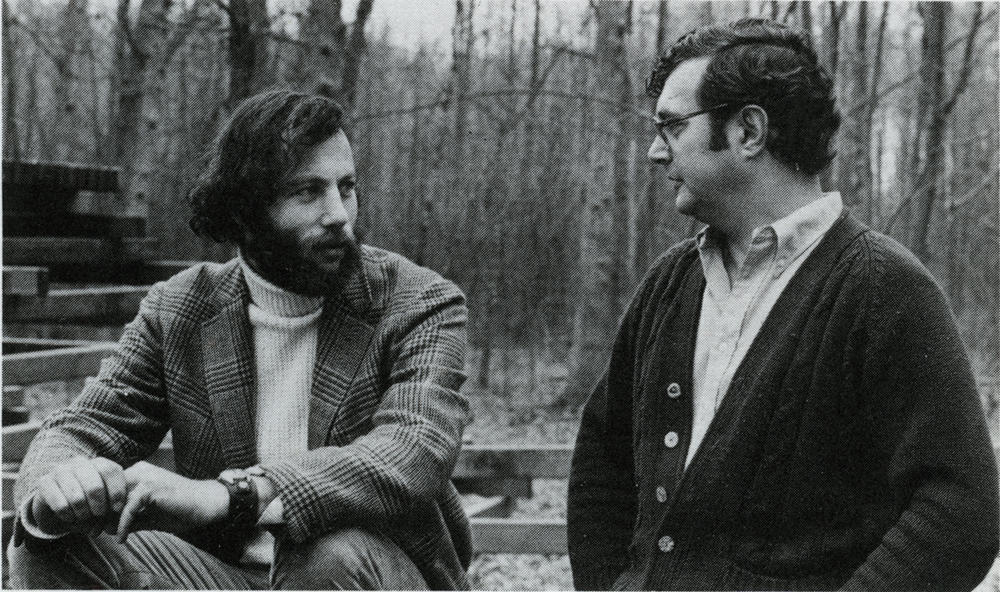
Photo by Toyo Uyeyama Biddle Victor Marchetti (at right, above) and John D. Marks joined forces on this book in the fall of 1972. Marchetti is a veteran of 14 years with the CIA -- he first entered the agency in 1955 -- where he served primarily as a Soviet military specialist, rising eventually to be executive assistant to the Deputy Director. After leaving the CIA in 1969, he wrote a novel called The Rope Dancer. Marks joined the State Department in 1966. He worked as an analyst, then as a staff assistant to the Intelligence Director before leaving, in 1970, to become executive assistant to Senator Clifford Case of New Jersey Jacket design by Robert Anthony
|