|
ON THE CONSTITUTION OF THE CHURCH AND STATE, ACCORDING TO THE IDEA OF EACH; WITH AIDS TOWARD A RIGHT JUDGMENT ON THE LATE CATHOLIC BILL |
||||||
|
APPENDIX (Referred to in page 136) MY DEAR ---, In emptying a drawer of understockings, rose-leaf bags, old (but, too many of them) unopened letters, and paper scraps, or brain fritters, I had my attention directed to a sere and ragged half-sheet by a gust of wind, which had separated it from its companions, and whisked it out of the window into the garden. -- Not that I went after it. I have too much respect for the numerous tribe, to which it belonged, to lay any restraint on their movements, or to put the Vagrant Act in force against them. But it so chanced that some after-breeze had stuck it on a standard rose-tree, and there I found it, as I was pacing my evening walk alongside the lower ivy-wall, the bristled runners from which threaten to entrap the top branch of the cherry tree in our neighbour's kitchen garden. I had been meditating a letter to you, and as I run my eye over this fly-away, tag-rag and bob-tail, and bethought me that it was a bye-blow of my own, I felt a sort of fatherly remorse, and yearning towards it, and exclaimed -- "If I had a frank for ____, this should help to make up the ounce." It was far too decrepit to travel per se -- besides that the seal would have looked like a single pin on a beggar's coat of tatters -- and yet one does not like to be stopt in a kind feeling, which, my conscience interpreted as a sort of promise to the said scrap, and therefore, (frank or no frank), I will transcribe it. A dog's leaf at the top worn off, which must have contained, I presume, the syllable V E ---------------------- RILY, quoth Demosius of Toutoscosmos, Gentleman, to Mystes the Allocosmite, thou seemest to me like an out-of-door's patient of St. Luke's, wandering about in the rain without cap, hat, or bonnet, poring on the elevation of a palace, not the House that Jack built, but the House that is to be built for Jack, in the suburbs of the City, which his cousin-german, the lynx-eyed Dr. Gruithuisen has lately discovered in the moon. But for a foolish kindness for that Phyz of thine, which whilome belonged to an old school-fellow of the same name with thee, I would get thee shipped off under the Alien Act, as a Non Ens, or Preexistent of the other World to come! -- To whom Mystes retorted -- Verily, Friend Demos, thou art too fantastic for a genuine Toutoscosmos man! and it needs only a fit of dyspepsy, or a cross in love to make an Heterocosmite of thee; this same Heteroscosmos being in fact the endless shadow which the Toutoscosmos casts at sun-set! But not to alarm or affront thee, as if I insinuated that thou wert in danger of becoming an Allocosmite, I let the whole of thy courteous address to me pass without comment or objection, save only the two concluding monosyllables and the preposition (Pre) which anticipates them. The world in which I exist is another world indeed, but not to come. It is as present as (if that be at all) the magnetic planet, of which, according to the Astronomer HALLEY, the visible globe, that we inverminate, is the case or travelling-trunk -- a neat little world where light still exists in statu perfuso, as on the third day of the Creation, before it was polarised into outward and inward, i.e. while light and life were one and the same, NEITHER existing formally, yet BOTH iminenter: and when herb, flower, and forest, rose as a vision, in proprio lucido, the ancestor and unseen yesterday of the sun and moon.
Now, whether
there really is such an elysian mundus mundulus incased in the
Macrocosm, or Great World, below the Adamantine Vault that supports the
Mother Waters, that support the coating crust of that mundus immundus on
which we, and others less scantily furnished from nature's Leggery,
crawl, delve, and nestle -- (or, shall I say the Liceum,
Well, but what is this new and yet other world? The Brain of a man that is out of his senses? A world fraught "with Castles in the air, well worthy the attention of any gentleman inclined to idealize a large property?" The sneer on that
lip, and the arch shine of that eye, Friend Demosius, would almost
justify me, though I should answer that question by retorting it in a
parody. What, quoth the owlet, peeping out of his ivy-bush at noon, with
his blue fringed eye -- curtains dropt, what is this LIGHT which is said
to exist together with this warmth, we feel, and yet is something
else? But I read likewise in that same face, as thou wert beginning to
prepare that question, a sort of mis-giving from within, as if thou wert
more positive than sure that the reply, with which you would accommodate
me, is as wise, as it is witty. Therefore, though I cannot answer your
question, I will give you a hint how you may answer it for yourself. --
1st. Learn the art and acquire the habit of contemplating things
abstractedly from their relations. I will explain myself by
an instance. Suppose a body floating at a certain height in the air, and
receiving the light so equally on all sides as not to occasion the eye
to conjecture any solid contents. And now let six or seven persons see
it at different distances and from different points of view. For A it
will be a square! for B a triangle; for C two right-angled triangles
attached to each other; for D two unequal triangles; for E it will be a
triangle with a Trapezium hung on to it; for F it will be a square with
a cross in it
Now it is evident that neither of all these is the figure itself, (which in this instance is a four-sided pyramid), but the contingent relations of the figure. Now transfer this from Geometry to the subjects of the real (i.e. not merely formal or abstract) sciences -- to substances and bodies, the materia subjecta of the Chemist, Physiologist and Naturalist, and you will gradually (that is), if you choose and sincerely will it) acquire the power and the disposition of contemplating your own imaginations, wants, appetites, passions, opinions, &c., on the same principles, and distinguish that, which alone is and abides, from the accidental and impermanent relations arising out of its co-existence with other things or beings. My second rule or maxim requires its prolegemena. In the several classes and orders that mark the scale of organic nature, from the plant to the highest order of animals, each higher implies a lower, as the condition of its actual existence -- and the same position holds good equally of the vital and organic powers. Thus, without the first power, that of growth, or what Bichat and others name the vegetive life, or productivity, the second power, that of total and locomotion (commonly but most infelicitously called irritability), could not exist -- i.e. manifest its being. Productivity is the necessary antecedent of irritability, and in like manner, irritability of sensibility. But it is no less true, that in the idea of each power the lower derives its intelligibility from the higher: and the highest must be presumed to inhere latently or potentially in the lowest, or this latter will be wholly unintelligible, inconceivable -- you can have no conception of it. Thus in sensibility we see a power that in every instant goes out of itself, and in the same instant retracts and falls back on itself: which the great fountains of pure Mathesis, the Pythagorean and Platonic Geometricians, illustrated in the production, or self-evolution, of the point into the circle.
Imagine the going-forth and the retraction as two successive acts, the result would be an infinity of angles, a growth of zig-zag. In order to the imaginability of a circular line, the extroitive and the retroitive must co-exist in one and the same act and moment, the curve line being the product. Now what is ideally true in the generations or productive acts of the intuitive faculty (of the pure sense, I mean, or Inward Vision -- the reine Anschaunug of the German Philosophers) must be assumed as truth of fact in all living growth, or wherein would the growth of a plant differ from a chrystal? The latter is formed wholly by apposition ab extra: in the former the movement ab extra is, in order of thought, consequent on, and yet comstaneous with, the movement ab intra. Thus, the specific character of Sensibility, the highest of the three powers, is found to be the general character of Life, and supplies the only way of conceiving, supplies the only insight into the possibility of, the first and lowest power. And yet even thus, growth taken as separate from and exclusive of sensibility, would be unintelligible, nay, contradictory. For it would be an act of the life, or productive form (vide Aids to Reflection, p. 68.) of the plant, having the life itself as its source, (since it is a going forth from the life), and likewise having the life itself as its object, for in the same instant it is retracted: and yet the product (i.e. the plant) exists not for itself, by the hypothesis that has excluded sensibility. For all sensibility is a self-finding; whence the German word for sensation or feeling is Empfindung, i.e. an inward finding. Therefore sensibility cannot be excluded: and as it does not exist actually, it must be involved potentially. Life does not yet manifest itself in its highest dignity, as a self-finding; but in an evident tendency thereto, or a self-seeking -- and this has two epochs, or intensities. Potential sensibility in its first epoch, or lowest intensity, appears as growth: in its second epoch, it shews itself as irritability, or vital instinct. In both, however, the sensibility must have pre-existed, (or rather pre-inhered) though as latent: or how could the irritability have been evolved out of the growth? (ex. gr. in the stamina of the plant during the act of impregnating the germen). Or the sensibility out of the irritability? (ex. gr. in the first appearance of nerves and nervous bulbs, in the lower orders of the insect realm.) But, indeed, evolution as contra-distinguished from apposition, or superinduction ab aliunde, is implied in the conception of life: and is that which essentially differences a living fibre from a thread of Asbestos, the Floscule or any other of the moving fairy shapes of animalcular life from the frost-plumes on a window pane.
Again: what has been said of the lowest power of life relatively to its highest power -- growth to sensibility, the plant to the animal -- applies equally to life itself relatively to mind.
Without the latter the
former would be unintelligible, and the idea would contradict itself.
If there had been no self-retaining power, a self-finding would
be a perpetual self-losing. Divide a second into a thousand,
or if you please, a million of parts, yet if there be an absolute chasm
separating one moment of self-finding from another, the chasm of a
millionth of a second would be equal to all time. A being that
existed for itself only in moments, each infinitely small and yet
absolutely divided from the preceding and following, would not exist
for itself at all. And if all beings were the same, or yet
lower, it could not be said to exist in any sense, any more than
light would exist as light, if there were no eyes or visual
power: and the whole conception would break up into contradictory
positions -- an intestine conflict more destructive than even that
between the two cats, where one tail alone is said to have survived the
battle. The conflicting factors of our conception would eat each
other up, tails and all. Ergo: the mind, as a self-retaining
power, is no less indispensable to the intelligibility of life as a
self- finding power, than a self-finding power, i.e. sensibility,
to a self-seeking power, i.e. growth. Again: a self-retaining mind -- (i.e.
memory, which is the primary sense of mind, and the common people in
several of our provinces still use the word in this sense) -- a self-retaining
power supposes a self-containing power, a self-conscious being.
And this is the definition of mind in its proper and distinctive
sense, a subject that is its own object -- or where A contemplant
is one and the same subject with A contemplated. Lastly (that I
may complete the ascent of powers for my own satisfaction, and
not as expecting, or in the present habit of your thoughts even wishing
you to follow me to a height, dizzy for the strongest spirit, it being
the apex of all human, perhaps of angelic knowledge to know, that it
must be: since absolute ultimates can only be seen by a
light thrown backward from the Penultimate. -- John's Gosp. i.
18.) Lastly, I say, the
self-containing power supposes a self-causing power.
Causa sui
And now, friend! for the practical rules which I promised, or the means by which you may educate in yourself that state of mind which is most favourable to a true knowledge of both the worlds that now are, and to a right faith in the world to come. I. Remember, that whatever is, lives. A thing absolutely lifeless is inconceivable, except as a thought, image, or fancy, in some other being. II. In every living form, the conditions of its existence are to be sought for in that which is below it; the grounds of its intelligibility in that which is above it. III. Accustom your mind to distinguish the relations of things from the things themselves. Think often of the latter, independent of the former, in order that you may never think of the former apart from the latter, i.e. mistake mere relations for true and enduring realities: and with regard to these, seek the solution of each in some higher reality. The contrary process leads demonstrably to Atheism, and though you may not get quite so far, it is not well to be seen travelling on the road with your face towards it. I might add a fourth rule: Learn to distinguish permanent from accidental relations. But I am willing that you should for a time take permanent relations as real things -- confident that you will soon feel the necessity of reducing what you now call things into relations, which immediately arising out of a somewhat else may properly be contemplated as the products of that somewhat else, and as the means by which its existence is made known to you. But known as what? not as a product: for it is the somewhat else, to which the product stands in the same relation as the words, you are now hearing, bear to my living soul. But if not as products, then as productive powers: and the result will be, that what you have hitherto called things will be regarded as only more or less permanent relations of things, having their derivative reality greater or less in proportion as they are regular or accidental relations; determined by the pr e-established fitness of the true thing to the organ and faculty of the percipient, or resulting from some defect or anomaly in the latter. With these
convictions matured into a habit of mind, the man no longer seeks, or
believes himself to find, true reality except in the powers of
nature; which living and actuating POWERS are made known to him, and
their kinds determined, and their forces measured, by
their proper products. In other words, he thinks of the products in
reference to the productive powers, the
Finally, what is Reason? You have often asked me; and this is my answer: --
But, alas!
FINIS.
|


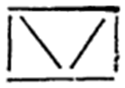
 of
the Heathen, in the Archaic Occultism and Symbology. The
three strides relate metaphysically to the descent of Spirit
into matter, of the Logos falling as a ray into the Spirit,
then into the Soul, and finally into the human physical form
of man, in which it becomes
of
the Heathen, in the Archaic Occultism and Symbology. The
three strides relate metaphysically to the descent of Spirit
into matter, of the Logos falling as a ray into the Spirit,
then into the Soul, and finally into the human physical form
of man, in which it becomes