|
PRACTICAL
CONCLUSION
THE clerisy, or
National Church, being an estate
of the realm, the Church and State with the king
as the sovereign head of both constituting the Body
Politic, the State in the large sense of the word, or
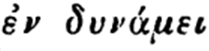
the NATION dynamically considered
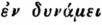
 (i.e. as an ideal, but not the less actual and
abiding, unity); and in like manner, the Nationalty
being one of the two constitutional modes or species,
of which the common wealth of the Nation consists;
it follows by immediate consequence, that of the
qualifications for the trusteeship, absolutely to be
required of the order collectively, and of every individual
person as the conditions of his admission into
this order, and of his eligibility to the usufruct or
life-interest of any part or parcel of the Nationalty,
the first and most indispensable qualification and
pre-condition, that without which all others are null
and void, -- is that the National Clergy, and every
member of the same from the highest to the lowest,
shall be fully and exclusively Citizens of the State,
neither acknowledging the authority, nor within the influence of any other State in the world
-- full and
undistracted subjects of this kingdom, and in no
capacity, and under no pretences, owning any other earthly sovereign or
visible head but the king, in
whom alone the majesty of the nation is apparent,
and by whom alone the unity of the nation in will
and indeed is symbolically expressed and impersonated.
The full extent of this first and absolutely
necessary qualification will be best seen in stating
the contrary, that is, the absolute disqualifications, the existence of
which in any individual, and in any
class or order of men, constitutionally incapacitates
such individual and class or order from being inducted
into the National Trust, and this on a principle
so vitally concerning the health and integrity
of the body politic, as to render the voluntary
transfer of the nationalty, whole or part, direct or indirect, to an order notoriously thus disqualified, a
foul treason against the most fundamental rights and interests of the realm, and of all classes of its
citizens
and free subjects, the individuals of the very
order itself, as citizens and subjects, not excepted.
Now there are two things, and but two, which
evidently and predeterminably disqualify for this
great trust: the first absolutely, and the second, which
in its collective operation, and as an attribute of the
whole class, would, of itself, constitute the greatest
possible unfitness for the proper ends and purposes
of the National Church, as explained and specified
in the preceding paragraphs, and the heaviest drawback
from the civilizing influence of the National
Clergy in their pastoral and parochial character -- the
second, I say, by implying the former, becomes likewise an absolute ground of disqualification.
It
is scarcely necessary to add, what the reader will
have anticipated, that the first absolute disqualification
is allegiance to a foreign power: the second,
the abjuration -- under the command and authority of
this power, and as by the rule of their order, its
professed Lieges (Alligati) -- of that bond, which more
than all other ties connects the citizen with his
country; winch beyond all other securities affords
the surest pledge to the state for the fealty of its citizens, and that which (when the rule is applied to
any body or class of men, under whatever name united, where the number is sufficiently great to
neutralize the accidents of individual temperament
and circumstances) enables the State to calculate
on their constant adhesion to its interests, and to rely on their faith and singleness of heart in the due
execution of whatever public or national trust might
be assigned to them. But we shall, perhaps, express
the nature of this security more adequately
by the negative. The Marriage Tie is a Bond the
preclusion of which by an antecedent obligation,
that overrules the accidents of individual character
and is common to the whole order, deprives the State
of a security with which it cannot dispense. I will
not say, though I might shelter the position under
the authority of the great Publicists and State-Lawyers of the Augustan Age, who, in the Lex
Julia Papia, enforced anew a principle common to
the old Roman Constitution with that of Sparta,
that it is a security which the State may rightfully
demand of all its adult citizens, competently circumstanced,
by positive enactment. But without the least fear of confutation, though
in the full foresight
of vehement contradiction, I do assert, that
the State may rightfully demand of any number of
its subjects united in one body or order the absence of all customs, initiative vows, covenants and bylaws
in that order, precluding the members of the said body collectively and individually from affording
this security. In strictness of principle, I might
here conclude the sentence -- though as it now stands
it would involve the assertion of a right in the state
to suppress any order confederated under laws so
anti-civic. But I am no friend to any fights that
can be disjoined from the duty of enforcing them. I therefore at once confine and complete the sentence
thus: -- The State not only possesses the right,
but is in duty bound to demand the above as a necessary condition of its entrusting to any order of
men, and to any individual as a member of a known
order, the titles, functions, and investments of the National Church. But
if any doubt could attach
to the proposition, whether thus stated, or in the
perfectly equivalent Converse, i.e. that the existence
and known enforcement of the injunction or
prohibitory by-law, before described, in any Order
or Incorporation constitutes an a priori disqualification
for the Trusteeship of the Nationalty, and
an insuperable obstacle to the establishment of
such an order, or of any members of the same as
a National Clergy -- such doubt would be removed,
as soon as the fact of this injunction, or vow exacted
and given, or whatever else it may be, by
which the members of the Order, collectively and
as such, incapacitate themselves from affording this
security for their full, faithful, and unbiased application
of a National Trust to its proper and national purposes, is
formed in conjunction with,
and aggravated by, the three following circumstances.
First, that this incapacitation originates
in, and forms part of, the allegiance of the order
to a foreign Sovereignty: Secondly, that it is
notorious, that the Canon or Prescript on which it
is grounded, was first enforced on the secular clergy universally, after
long and obstinate reluctation on their side, and on that of their natural
sovereigns on the several realms, to which us subjects they belonged; and that it is still retained in
force, and its revocation inflexibly refused, as the
direct and only adequate means of supporting that
usurped and foreign Sovereignty, and of securing
by virtue of the expatriating and insulating effect
of its operation, the devotion, and allegiance of the
order [1] to their visible Head, and Sovereign. And
thirdly, that the operation of the interdict precludes
one of the most constant and influencive ways and
means of promoting the great paramount end of a
National Church, the progressive civilization of the community. Emollit
mores nec sinit esse feros.
(i.e. as an ideal, but not the less actual and
abiding, unity); and in like manner, the Nationalty
being one of the two constitutional modes or species,
of which the common wealth of the Nation consists;
it follows by immediate consequence, that of the
qualifications for the trusteeship, absolutely to be
required of the order collectively, and of every individual
person as the conditions of his admission into
this order, and of his eligibility to the usufruct or
life-interest of any part or parcel of the Nationalty,
the first and most indispensable qualification and
pre-condition, that without which all others are null
and void, -- is that the National Clergy, and every
member of the same from the highest to the lowest,
shall be fully and exclusively Citizens of the State,
neither acknowledging the authority, nor within the influence of any other State in the world
-- full and
undistracted subjects of this kingdom, and in no
capacity, and under no pretences, owning any other earthly sovereign or
visible head but the king, in
whom alone the majesty of the nation is apparent,
and by whom alone the unity of the nation in will
and indeed is symbolically expressed and impersonated.
The full extent of this first and absolutely
necessary qualification will be best seen in stating
the contrary, that is, the absolute disqualifications, the existence of
which in any individual, and in any
class or order of men, constitutionally incapacitates
such individual and class or order from being inducted
into the National Trust, and this on a principle
so vitally concerning the health and integrity
of the body politic, as to render the voluntary
transfer of the nationalty, whole or part, direct or indirect, to an order notoriously thus disqualified, a
foul treason against the most fundamental rights and interests of the realm, and of all classes of its
citizens
and free subjects, the individuals of the very
order itself, as citizens and subjects, not excepted.
Now there are two things, and but two, which
evidently and predeterminably disqualify for this
great trust: the first absolutely, and the second, which
in its collective operation, and as an attribute of the
whole class, would, of itself, constitute the greatest
possible unfitness for the proper ends and purposes
of the National Church, as explained and specified
in the preceding paragraphs, and the heaviest drawback
from the civilizing influence of the National
Clergy in their pastoral and parochial character -- the
second, I say, by implying the former, becomes likewise an absolute ground of disqualification.
It
is scarcely necessary to add, what the reader will
have anticipated, that the first absolute disqualification
is allegiance to a foreign power: the second,
the abjuration -- under the command and authority of
this power, and as by the rule of their order, its
professed Lieges (Alligati) -- of that bond, which more
than all other ties connects the citizen with his
country; winch beyond all other securities affords
the surest pledge to the state for the fealty of its citizens, and that which (when the rule is applied to
any body or class of men, under whatever name united, where the number is sufficiently great to
neutralize the accidents of individual temperament
and circumstances) enables the State to calculate
on their constant adhesion to its interests, and to rely on their faith and singleness of heart in the due
execution of whatever public or national trust might
be assigned to them. But we shall, perhaps, express
the nature of this security more adequately
by the negative. The Marriage Tie is a Bond the
preclusion of which by an antecedent obligation,
that overrules the accidents of individual character
and is common to the whole order, deprives the State
of a security with which it cannot dispense. I will
not say, though I might shelter the position under
the authority of the great Publicists and State-Lawyers of the Augustan Age, who, in the Lex
Julia Papia, enforced anew a principle common to
the old Roman Constitution with that of Sparta,
that it is a security which the State may rightfully
demand of all its adult citizens, competently circumstanced,
by positive enactment. But without the least fear of confutation, though
in the full foresight
of vehement contradiction, I do assert, that
the State may rightfully demand of any number of
its subjects united in one body or order the absence of all customs, initiative vows, covenants and bylaws
in that order, precluding the members of the said body collectively and individually from affording
this security. In strictness of principle, I might
here conclude the sentence -- though as it now stands
it would involve the assertion of a right in the state
to suppress any order confederated under laws so
anti-civic. But I am no friend to any fights that
can be disjoined from the duty of enforcing them. I therefore at once confine and complete the sentence
thus: -- The State not only possesses the right,
but is in duty bound to demand the above as a necessary condition of its entrusting to any order of
men, and to any individual as a member of a known
order, the titles, functions, and investments of the National Church. But
if any doubt could attach
to the proposition, whether thus stated, or in the
perfectly equivalent Converse, i.e. that the existence
and known enforcement of the injunction or
prohibitory by-law, before described, in any Order
or Incorporation constitutes an a priori disqualification
for the Trusteeship of the Nationalty, and
an insuperable obstacle to the establishment of
such an order, or of any members of the same as
a National Clergy -- such doubt would be removed,
as soon as the fact of this injunction, or vow exacted
and given, or whatever else it may be, by
which the members of the Order, collectively and
as such, incapacitate themselves from affording this
security for their full, faithful, and unbiased application
of a National Trust to its proper and national purposes, is
formed in conjunction with,
and aggravated by, the three following circumstances.
First, that this incapacitation originates
in, and forms part of, the allegiance of the order
to a foreign Sovereignty: Secondly, that it is
notorious, that the Canon or Prescript on which it
is grounded, was first enforced on the secular clergy universally, after
long and obstinate reluctation on their side, and on that of their natural
sovereigns on the several realms, to which us subjects they belonged; and that it is still retained in
force, and its revocation inflexibly refused, as the
direct and only adequate means of supporting that
usurped and foreign Sovereignty, and of securing
by virtue of the expatriating and insulating effect
of its operation, the devotion, and allegiance of the
order [1] to their visible Head, and Sovereign. And
thirdly, that the operation of the interdict precludes
one of the most constant and influencive ways and
means of promoting the great paramount end of a
National Church, the progressive civilization of the community. Emollit
mores nec sinit esse feros.
And now let me conclude these preparatory Notices by compressing the sum and substance of
my argument into this one sentence. Though
many things may detract from the comparative
fitness of individuals, or of particular classes, for
the Trust and Functions of the NATIONALTY,
there are only two absolute Disqualifications: and these are,
Allegiance to a Foreign Power, or the
Acknowledgement of any other visible HEAD OF
THE CHURCH, but our Sovereign Lord the King:
and compulsory celibacy in connection with, and
in dependence on, a foreign and extra-national
head.
_______________
Notes:
1. For the fullest and ablest exposition of this
point, I refer
to the Reverend Blanco White's "Practical and Internal Evidence," and to that admirable work, "Reforma d'Italia," written
by a professed and apparently sincere Catholic, a work
which well merits translation. I know no work so well fitted to
soften the prejudices against the theoretical doctrines of the Latin
Church, and to deepen our reprobation of what it actually
and practically is, in all countries where the expediency of
keeping up appearances, as in Protestant neighbourhoods, does not operate.
Go to Next Page
|