|
FABRE'S BOOK OF INSECTS -- RETOLD FROM ALEXANDER TEIXEIRA DE MATTOS' TRANSLATION OF FABRE'S "SOUVENIRS ENTOMOLOGIQUES" |
|
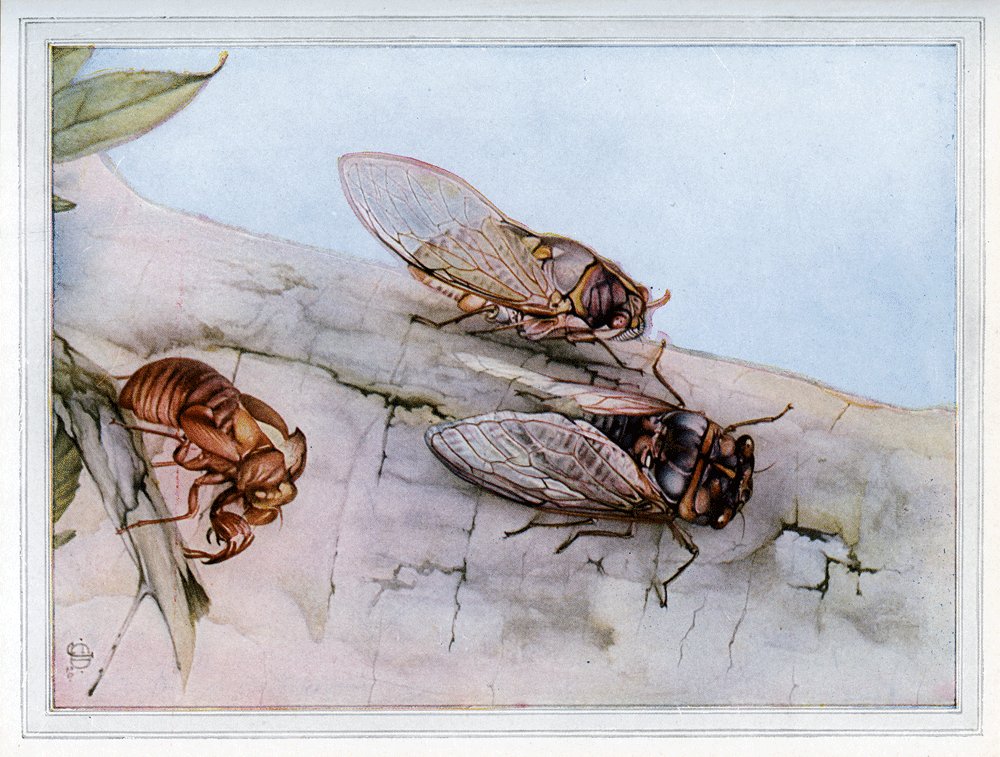
CHAPTER 3: THE CICADA I: THE CICADA AND THE ANT TO most of US the Cicada's song is unknown, for he lives in the land of the olive-trees. But every one who has read La Fontaine's "Fables" has heard of the snub the Cicada received from the Ant, though La Fontaine was not the first to tell the tale. The Cicada, says the story, did nothing but sing all through the summer, while the Ants were busy storing their provisions. When winter came he was hungry, and hurried to his neighbour to borrow some food. He met with a poor welcome. "Why didn't you gather your food in the summer?" asked the prudent Ant. "I was busy singing all the summer,'' said the Cicada. "Singing, were you?" answered the Ant unkindly. "Well, then, now you may dance!" And she turned her back on the beggar. Now the insect in this fable could not possibly be a Cicada. La Fontaine, it is plain, was thinking of the Grasshopper and as a matter of fact the English translations usually substitute a Grasshopper for the Cicada. For my village does not contain a peasant so ignorant as to imagine the Cicada ever exists in winter. Every tiller of the soil is familiar with the grub of this insect, which he turns over with his spade whenever he banks up the olive-trees at the approach of cold weather. A thousand times he has seen the grub leave the ground through a round hole of its own making, fasten itself to a twig, split its own back, take off its skin, and turn into a Cicada. The fable is a slander. The Cicada is no beggar, though it is true that he demands a good deal of attention from his neighbours. Every summer he comes and settles in his hundreds outside my door, amid the greenery of two tall plane-trees; and here, from sun- rise to sunset, he tortures my head with the rasping of his harsh music. This deafening concert, this incessant rattling and drumming, makes all thought impossible.
THE CICADA: In July, when most of the insects in my sunny country are parched with thirst, the Cicada remains perfectly cheerful It is true, too, that there are sometimes dealings between the Cicada and the Ant; but they are exactly the opposite of those described in the fable. The Cicada is never dependent on others for his living. At no time does he go crying famine at the doors of the Ant-hills. In July when most of the insects in my sunny country are parched with thirst, the Cicada remain} perfectly cheerful On the contrary, it is the Ant who, driven by hunger, begs and entreats the singer. Entreats, did I say? It is not the right word. She brazenly robs him. In July, when most of the insects in my sunny country are parched with thirst, and vainly wander round the withered flowers in search of refreshment, the Cicada remains perfectly cheerful. With his rostrum— the delicate sucker, sharp as a gimlet, that he carries on his chest ' — he broaches a cask in his inexhaustible cellar. Sitting, always singing, on the branch of a shrub, lie bores through the firm, smooth bark, which is swollen with sap. Driving his sucker through the bunghole, he drinks his fill. If I watch him for a little while I may perhaps see him in unexpected trouble. There are many thirsty insects in the neighbourhood, who soon discover the sap that oozes from the Cicada's well. They hasten up, at first quietly and discreetly, to lick the fluid as it comes out. I see Wasps, Flies, Earwigs, Rose-chafers, and above all, Ants. The smallest, in order to reach the well, slip under the body of the Cicada, who good-naturedly raises him- self on his legs to let them pass. The larger insects snatch a sip, retreat, take a walk on a neighbouring branch, and then return more eager and enterprising than before. They now become violent brigands, deter- mined to chase the Cicada away from his well. The worst offenders are the Ants. I have seen them nibbling at the ends of the Cicada's legs, tugging at the tips of his wings, and climbing on his back. Once a bold robber, before my very eyes, caught hold of a Cicada's sucker and tried to pull it out. At last, worried beyond all patience, the singer deserts the well he has made. The Ant has now attained her object: she is left in possession of the spring. This dries up very soon, it is true; but, having drunk all the sap that is there, she can wait for another drink till she has a chance of stealing another well. So you see that the actual facts are just the reverse of those in the fable. The Ant is the hardened beggar: the industrious worker is the Cicada. II: THE CICADA S BURROW I am in an excellent position to study the habits of the Cicada, for I live in his company. When July comes he takes possession of the enclosures right up to the threshold of the house. I remain master indoors, but out of doors he reigns supreme, and his reign is by no means a peaceful one. The first Cicada appear at midsummer. In the much-trodden, sun-baked paths I see, level with the ground, round holes about the size of a man's thumb. Through these holes the Cicada-grubs come up from the underground to be transformed into full-grown Cicadse on the surface. Their favourite places are the driest and sunniest; for these grubs are provided with such powerful tools that they can bore through baked earth or sandstone. When I examine their deserted burrows I have to use my pickaxe. The first thing one notices is that the holes, which measure nearly an inch across, have absolutely no rubbish round them. There is no mound of earth thrown up outside. Most of the digging insects, such as the Dor-beetles for instance, make a mole-hill above their burrows. The reason for this difference lies in their manner of working. The Dorbeetle begins his work at the mouth of the hole, so he can heap up on the surface the material he digs out: but the Cicada-grub comes up from below. The last thing he does is to make the door- way, and he cannot heap rubbish on a threshold that does not yet exist. The Cicada's tunnel runs to a depth of fifteen or six- teen inches. It is quite open the whole way. It ends in a rather wider space, but is completely closed at the bottom. What has become of the earth removed to make this tunnel? And why do not the walls crumble? One would expect that the grub, climbing up and down with his clawed legs, would make landslips and block up his own house. Well, he behaves like a miner or a railway-engineer. The miner holds up his galleries with pit-props; the builder of railways strengthens his tunnel with a casing of brickwork; the Cicada is as clever as either of them, and covers the walls of his tunnel with cement. He carries a store of sticky fluid hidden within him, with which to make this plaster. His burrow is always built above some tiny rootlet containing sap, and from this root he renews his supply of fluid. It is very important for him to be able to run up and down his burrow at his ease, because, when the time comes for him to find his way into the sunshine, he wants to know what the weather is like outside. So he works away for weeks, perhaps for months, to make a funnel with good strong plastered walls, on which he can clamber. At the top he leaves a layer as thick as one's finger, to protect him from the outer air till the last moment. At the least hint of fine weather he scrambles up, and, through the thin lid at the top, inquires into the state of the weather. If he suspects a storm or rain on the surface — matter of great importance to a delicate grub when he takes off his skin ! — he slips prudently back to the bottom of his snug funnel. But if the weather seems warm he smashes his ceiling with a few strokes of his claws, and climbs to the surface. It is the fluid substance carried by the Cicada-grub in his swollen body that enables him to get rid of the rubbish in his burrow. As he digs he sprinkles the dusty earth and turns it into paste. The walls then become soft and yielding. The mud squeezes into the chinks of the rough soil, and the grub compresses it with his fat body. This is why, when he appears at the top, he is always covered with wet stains. For some time after the Cicada-grub's first appearance above-ground he wanders about the neighbourhood, looking for a suitable spot in which to cast off his skin — a tiny bush, a tuft of thyme, a blade of grass, or the twig of a shrub. When he finds it he climbs up, and clings to it firmly with the claws of his fore-feet. His fore-legs stiffen into an immovable grip. Then his outer skin begins to split along the middle of the back, showing the pale-green Cicada within. Presently the head is free ; then the sucker and front legs appear, and finally the hind-legs and the rumpled wings. The whole insect is free now, except the extreme tip of his body. He next performs a wonderful gymnastic feat. High in the air as he is, fixed to his old skin at one point only, he turns himself over till his head is hanging downwards. His crumpled wings straighten out, unfurl, and spread themselves. Then with an almost in- visible movement he draws himself up again by sheer strength, and hooks his fore-legs on to his empty skin. This movement has released the tip of his body from its sheath. The whole operation has taken about half an hour. For a time the freed Cicada does not feel very strong. He must bathe in air and sunshine before strength and colour come to his frail body. Hanging to his cast skin by his fore-claws only, he sways at the least breath of air, still feeble and still green. But at last the brown tinge appears, and is soon general. Supposing him to have taken possession of the twig at nine o'clock in the morning, the Cicada flies away at half-past twelve, leaving his cast skin behind him. Sometimes it hangs from the twigs for months. III: THE CICADA'S MUSIC The Cicada, it appears, loves singing for its own sake. Not content with carrying an instrument called the cymbal in a cavity behind his wings, he increases its power by means of sounding-boards under his chest. Indeed, there is one kind of Cicada who sacrifices a great deal in order to give full play to his musical tastes. He carries such an enormous sounding-board that there is hardly any room left for his vital organs, which are squeezed into a tiny corner. Assuredly one must be passionately devoted to music thus to clear away one's internal organs in order to make room for a musical box! Unfortunately the song he loves so much is extremely unattractive to others. Nor have I yet discovered its object. It is usually suggested that he is calling his mate; but the facts appear to contradict this idea. For fifteen years the Common Cicada has thrust his society upon me. Every summer for two months I have these insects before my eyes, and their song in my ears. I see them ranged in rows on the smooth bark of the plane-trees, the maker of music and his mate sitting side by side. With their suckers driven into the tree they drink, motionless. As the sun turns they also turn round the branch with slow, sidelong steps, to find the hottest spot. Whether drinking or moving they never cease singing. It seems unlikely, therefore, that they are calling their mates. You do not spend months on end calling to some one who is at your elbow. Indeed, I am inclined to think that the Cicada himself cannot even hear the song he sings with so much apparent delight. This might account for the relentless way in which he forces his music upon others. He has very clear sight. His five eyes tell him what is happening to right and to left and above his head; and the moment he sees any one coming he is silent and flies away. Yet no noise disturbs him. Place yourself behind him, and then talk, whistle, clap your hands, and knock two stones together. For much less than this a bird, though he would not see you, would fly away terrified. The imperturbable Cicada gojies on rattling as though nothing were there. On one occasion I borrowed the local artillery, that is to say the guns that are fired on feast-days in the village. There were two of them, and they were crammed with powder as though for the most important rejoicings. They were placed at the foot of the plane-trees in front of my door. We were careful to leave the windows open, to prevent the panes from breaking. The Cicadae in the branches overhead could not see what was happening. Six of us waited below, eager to hear what would be the effect on the orchestra above. Bang! The gun went off with a noise like a thunderclap. Quite unconcerned, the Cicadae continued to sing. Not one appeared in the least disturbed. There was no change whatever in the quality or the quantity of the sound. The second gun had no more effect than the first. I think, after this experiment, we must admit that the Cicada is hard of hearing, and like a very deaf man, is quite unconscious that he is making a noise. IV: THE CICADA'S EGGS The Common Cicada likes to lay her eggs on small dry branches. She chooses, as far as possible, tiny stalks, which may be of any size between that of a straw and a lead-pencil. The sprig is never lying on the ground, is usually nearly upright in position, and is al- most always dead. Having found a twig to suit her, she makes a row of pricks with the sharp instrument on her chest — such pricks as might be made with a pin if it were driven downwards on a slant, so as to tear the fibres and force them slightly upwards. If she is undisturbed she will make thirty or forty of these pricks on the same twig. In the tiny cells formed by these pricks she lays her eggs. The cells are narrow passages, each one slanting down towards the one below it. I generally find about ten eggs in each cell, so it is plain that the Cicada lays between three and four hundred eggs altogether. This is a fine family for one insect. The numbers point to some special danger that threatens the Cicada, and makes it necessary to produce a great quantity of grubs lest some should be destroyed. After many observations I have discovered what this danger is. It is an extremely tiny Gnat, compared with which the Cicada is a monster. This Gnat, like the Cicada, carries a boring-tool. It is planted beneath her body, near the middle, and sticks out at right angles. As fast as the Cicada lays her eggs the Gnat tries to destroy them. It is a real scourge to the Cicada family. It is amazing to watch her calm and brazen audacity in the presence of the giant who could crush her by simply stepping on her. I have seen as many as three preparing to despoil one unhappy Cicada at the same time, standing close behind one another. The Cicada has just stocked a cell with eggs, and is climbing a little higher to make another cell. One of the brigands runs to the spot she has just left; and here, almost under the claws of the monster, as calmly and fearlessly as though she were at home, the Gnat bores a second hole above the Cicada's eggs, and places among them an egg of her own. By the time the Cicada flies away most of her cells have, in this way, received a stranger's egg, which will be the ruin of hers. A small quick-hatching grub, one only to each cell, handsomely- fed on a dozen raw eggs, will take the place of the Cicada's family. This deplorable mother has learnt nothing from centuries of experience. Her large and excellent eyes cannot fail to see the terrible felons fluttering round her. She must know they are at her heels, and yet she remains unmoved, and lets herself be victimised. She could easily crush the wicked atoms, but she is incapable of altering her instincts, even to save her family from destruction. Through my magnifying-glass I have seen the hatching of the Cicada's eggs. When the grub first appears it has a marked likeness to an extremely small fish, with large black eyes, and a curious sort of mock fin under its body, formed of the two fore-legs joined together. This fin has some power of movement, and helps the grub to work its way out of the shell, and also — a much more difficult matter — out of the fibrous stem in which it is imprisoned. As soon as this fish-like object has made its way out of the cell it sheds its skin. But the cast skin forms itself into a thread, by which the grub remains fastened to the twig or stem. Here, before dropping to the ground, it treats itself to a sun-bath, kicking about and trying its strength, or swinging lazily at the end of its rope. Its antennae now are free, and wave about; its legs work their joints; those in front open and shut their claws. I know hardly any more curious sight than this tiny acrobat hanging by the tip of its body, swinging at the least breath of wind, and making ready in the air for its somersault into the world. Sooner or later, without losing much time, it drops to the ground. The little creature, no bigger than a Flea, has saved its tender body from the rough earth by swinging on its cord. It has hardened itself in the air, that luxurious eiderdown. It now plunges into the stern realities of life. I see a thousand dangers ahead of it. The merest breath of wind could blow it on to the hard rock, or into the stagnant water in some deep cart-rut, or on the sand where nothing grows, or else on a clay soil, too tough for it to dig in. The feeble creature needs shelter at once, and must look for an underground refuge. The days are growing cold, and delays are fatal to it. It must wander about in search of soft soil, and no doubt many die before they find it. When at last it discovers the right spot it attacks the earth with the hooks on its fore-feet. Through the magnifying-glass I watch it wielding its pickaxes, and raking an atom of earth to the surface. In a few minutes a well has been scooped out. The little creature goes down into it, buries itself, and is henceforth invisible. The underground life of the undeveloped Cicada remains a secret. But we know how long it remains in the earth before it comes to the surface and becomes a full-grown Cicada. For four years it lives below the soil. Then for about five weeks it sings in the sunshine. Four years of hard work in the darkness, and a month of delight in the sun — such is the Cicada's life. We must not blame him for the noisy triumph of his song. For four years he has dug the earth with his feet, and then suddenly he is dressed in exquisite raiment, provided with wings that rival the bird's, and bathed in heat and light I What cymbals can be loud enough to celebrate his happiness, so hardly earned, and so very, very short? |