|
FABRE'S BOOK OF INSECTS -- RETOLD FROM ALEXANDER TEIXEIRA DE MATTOS' TRANSLATION OF FABRE'S "SOUVENIRS ENTOMOLOGIQUES" |
|
CHAPTER 6: A MASON-WASP I: HER CHOICE OF A BUILDING-SITE OF the various insects that like to make their home in our houses, certainly the most interesting, for her beautiful shape, her curious manners, and her wonderful nest, is a certain Wasp called the Pelopaeus. She is very little known, even to the people by whose fireside she lives. This is owing to her quiet, peaceful ways; she is so very retiring that her host is nearly always ignorant of her presence. It is easy for noisy, tiresome, unpleasant persons to make themselves famous. I will try to rescue this modest creature from her obscurity. The Pelopaeus is an extremely chilly mortal. She pitches her tent under the kindly sun that ripens the olive and prompts the Cicada's song; and even then she needs for her family the additional warmth to be found in our dwellings. Her usual refuge is the peasant's lonely cottage, with its old fig-tree shading the well in front of the door. She chooses one exposed to all the heat of summers, and if possible possessing a big fireplace in which a fire of sticks always burns. The cheerful blaze on winter evenings has a great influence upon her choice, for she knows by the blackness of the chimney that the spot is a likely one. A chimney that is not well glazed by smoke gives her no confidence: people must shiver with cold in that house. During the dog-days in July and August the visitor suddenly appears, seeking a place for her nest. She is not in the least disturbed by the bustle and movement of the household: they take no notice of her nor she of them. She examines — now with her sharp eyes, now with her sensitive antennae — the corners of the blackened ceiling, the rafters, the chimney-piece, the sides of the fireplace especially, and even the inside of the flue. Having finished her inspection and duly approved of the site she flies away, soon to return with the pellet of mud which will form the first layer of the building. The spot she chooses varies greatly, and often it is a very curious one. The temperature of a furnace appears to suit the young Pelopaeus: at least the favourite site is the chimney, on either side of the flue, up to a height of twenty inches or so. This snug shelter has its drawbacks. The smoke gets to the nests, and gives them a glaze of brown or black like that which covers the stonework. They might easily be taken for inequalities in the mortar. This is not a serious matter, provided that the flames do not lick against the nests. That would stew the young Wasps to death in their clay pots. But the mother Wasps seems to understand this: she only places her family in chimneys that are too wide for anything but smoke to reach their sides. But in spite of all her caution one danger remains. It sometimes happens, while the Wasp is building, that the approach to the half-built dwelling is barred to her for a time, or even for the whole day, by a curtain of steam or smoke. Washing-days are most risky. From morning till night the housewife keeps the huge cauldron boiling. The smoke from the hearth, the steam from the cauldron and the wash-tub, form a dense mist in front of the fireplace. It is told of the Water-Ouzel that, to get back to his nest, he will fly through the cataract under a mill-weir. This Wasp is even more daring: with her pellet of mud in her teeth she crosses the cloud of smoke and disappears behind it, where she becomes invisible, so thick is the screen. An irregular chirring sound, the song she sings at her work, alone betrays her presence. The building goes on mysteriously behind the cloud. The song ceases, and the Wasp flies back through the steam, quite un- harmed. She will face this danger repeatedly all day, until the cell is built, stored with food, and closed. Once and once only I was able to observe a Pelopaeus at my own fireside; and, as it happened, it was a washing-day. I had not long been appointed to the Avignon grammar-school. It was close upon two o'clock, and in a few minutes the roll of the drum would summon me to give a scientific lecture to an audience of wool-gatherers. Suddenly I saw a strange, agile insect dart through the steam that rose from the wash-tub. The front part of its body was very thin, and the back part was very plump, and the two parts were joined together by a long thread. It was the Pelopaus, the first I had seen with observant eyes. Being very anxious to become better acquainted with my visitor, I fervently entreated the household not to disturb her in my absence. Things went better than I dared hope. On my return she was still carrying on her mason's work behind the steam. Being eager to see the building of the cells, the nature of the provisions, and the evolution of the young Wasps, I raked the fire so as to decrease the volume of smoke, and for a good two hours I watched the mother Wasp diving through the cloud. Never again, in the forty years that followed, was my fireplace honoured with such a visit. All the further information I have gathered was gleaned on the hearths of my neighbours. The Pelopsus, it appears, is of a solitary and vagrant disposition. She nearly always builds a lonely nest, and unlike many Wasps and Bees, she seldom founds her family at the spot where she was reared herself. She is often found in our southern towns, but on the whole she prefers the peasant's smoky house to the townsman's white villa. Nowhere have I seen her so plentiful as in my village, with its tumble-down cottages burnt yellow by the sun. It is obvious that this Wasp, when she so often chooses the chimney as her abode, is not seeking her own comfort: the site means work, and dangerous work. She seeks the welfare of her family. This family, then, must require a high temperature, such as other Wasps and Bees do not need. I have seen a Pelopaeus nest in the engine-room of a silk-factory, fixed to the ceiling just above the huge boiler. At this spot the thermometer marked 120 degrees all through the year, except at night and on holidays. In a country distillery I have found many nests, fixed on anything that came to hand, even a pile of account-books. The temperature of one of these, quite close to the still, was 113 degrees. It is plain that this Wasp cheerfully endures a degree of heat that makes the oily palm-tree sprout. A boiler or a furnace she regards as the ideal home, but she is quite willing to content herself in any snug corner: a conservatory, a kitchen-ceiling, the recess of a closed window, the wall of a cottage bedroom. As to the foundation on which she fixes her nest, she is entirely indifferent. As a rule she builds her groups of cells on stonework or timber; but at various times I have seen nests inside a gourd, in a fur cap, in the hollow of a brick, on the side of a bag of oats, and in a piece of lead tubing. Once I saw something more remarkable still, in a farm near Avignon. In a large room with a very wide fireplace the soup for the farm-hands and the food for the cattle simmered in a row of pots. The labourers used to come in from the fields to this room, and devour their meal with the silent haste that comes from a keen appetite. To enjoy this half-hour comfortably they would take off their hats and smocks, and hang them on pegs. Short though this meal was, it was long enough to allow the Wasps to take possession of their garments. The inside of a straw hat was recognised as a most useful building-site, the folds of a smock were looked upon as a capital shelter; and the work of building started at once. On rising from the table one of the men would shake his smock, and another his hat, to rid it of the Wasp's nest, which was already the size of an acorn. The cook in that farmhouse regarded the Wasps with no friendly eye. They dirtied everything, she said. Dabs of mud on the ceiling, on the walls, or on the chimney-piece you could put up with; but it was a very different matter when you found them on the linen and the curtains. She had to beat the curtains every day with a bamboo. And it was trouble thrown away. The next morning the Wasps began building as busily as ever. II: HER BUILDING I sympathised with the sorrows of that farm-cook, but greatly regretted that I could not take her place. How gladly I would have left the Wasps undisturbed, even if they had covered all the furniture with mud! How I longed to know what the fate of a nest would be, if perched on the uncertain support of a coat or a curtain! The nest of the Mason-bee is made of hard mortar, which surrounds the twig on which it is built, and becomes firmly fixed to it; but the nest of the Pelopaeus Wasp is a mere blob of mud, without cement or foundations. The materials of which it is made are nothing but wet earth or dirt, picked up wherever the soil is damp enough. The thin clay of a river-bank is very suitable, but in my stony country streams are rare. I can, however, watch the builders at my leisure in my own garden, when a thin trickle of water runs all day, as it does sometimes, through the little trenches that are cut in my vegetable plots. The Pelopaeus Wasps of the neighborhood soon become aware of this glad event, and come hurrying up to take advantage of the precious layer of mud, a rare discovery in the dry season. They scrape and skim the gleaming, shiny surface with their mandibles while standing high on their legs, with their wings quivering and their black bodies upraised. No neat little house- wife, with skirts carefully tucked up out of the dirt, could be more skilful in tackling a job likely to soil her clothes. These mud-gatherers have not an atom of dirt upon them, so careful are they to tuck up their skirts in their own fashion, that is to say, to keep their whole body out of the way, all but the tips of their legs and the busy points of the mandibles with which they work. In this way a dab of mud is collected, almost the size of a pea. Taking the load in its teeth the insect flies off, adds a layer to its building, and soon returns to collect another pellet. The same method is pursued as long as the earth remains sufficiently wet, during the hottest hours of the day. But the favourite spot is the great fountain in the village, where the people come to water their mules. Here there is a constant sheet of black mud which neither the hottest sunshine nor the strongest wind can dry. This bed of mire is very unpleasant for the passers-by, but the Pelopaeus loves to gather her pellets here, amid the hoofs of the mules. Unlike some builders in clay, such as the Mason-bees, the Wasp does not improve the mud to make it into mortar, but uses it just as it is. Consequently her nests are flimsy work, absolutely unfitted to stand the changes and chances of the open air. A drop of water laid upon their surface softens the spot touched and reduces it to mud again, while a sprinkling equal to an average shower turns it to pap. They are nothing but dried slime, and become slime again as soon as they are wetted. It is plain, then, that even if the young Pelopaeus were not so chilly by nature, a shelter is indispensable for the nests, which would go to pieces at the first shower of rain. That is why this Wasp is so fond of human dwellings, and especially of the chimney. Before receiving its final coating, which covers up the details of the building, the nest has a certain beauty of its own. It consists of a cluster of cells, sometimes arranged side by side in a row — which makes it look rather like a mouth-organ — but more often grouped in layers placed one above the other. I have sometimes counted as many as fifteen cells; some nests contain only ten ; others are reduced to three or four, or even only one. In shape the cells are not far from cylinders, slightly larger at the mouth than at the base. They are a little more than an inch long, and about half an inch wide. Their delicate surface is carefully polished, and shows a series of string-like projections, running cross-wise, not unlike the twisted cords of some kinds of gold-lace. Each of these strings is a layer of the building; it comes from the clod of mud used for the coping of the part already built. By counting them you can tell how many journeys the Wasp has made in the course of her work. There are usually between fifteen and twenty. For one cell, therefore, the industrious builder fetches materials something like twenty times. The mouth of the cells is, of course, always turned upwards. A pot cannot hold its contents if it be upside down. And the Wasp's cell is nothing but a pot intended to hold the store of food, a pile of small Spiders. The cells — built one by one, stuffed full of Spiders, and closed as the eggs are laid — preserve their pretty appearance until the cluster is considered large enough. Then, to strengthen her work, the Wasp covers the whole with a casing, as a protection and defence. She lays on the plaster without stint and without art, giving it none of the delicate finishing-touches which she lavishes on the cells. The mud is applied just as it is brought, and merely spread with a few careless strokes. The beauties of the building all disappear under this ugly husk. In this final state the nest is like a great splash of mud, flung against the wall by accident. III: HER PROVISIONS Now that we know what the provision-jar is like, we must find out what it contains. The young Pelopaeus is fed on Spiders. The food does not lack variety, even in the same nest and the same cell, for any Spider may form a meal, as long as it is not too large for the jar. The Cross Spider, with three crosses of white dots on her back, is the dish that occurs oftenest. I think the reason for this is simply that the Wasp does not go far from home in her hunting-trips, and the Spider with the crosses is the easiest to find. The Spider, armed with poison-fangs, is a dangerous prey to tackle. When of fair size, she could only be conquered by a greater amount of daring and skill than the Wasp possesses. Moreover, the cells are too small to hold a bulky object. The Wasp, therefore, hunts game of moderate size. If she meets with a kind of Spider that is apt to become plump, she always chooses a young one. But, though all are small, the size of her victims varies enormously, and this variation in size leads also to variation in number. One cell will contain a dozen Spiders, while in another there are only five or six. Another reason for her choice of small Spiders is that she kills them before potting them in her cells. She falls suddenly upon her prey, and carries it off almost without pausing in her flight. The skilful paralysis practised by some insects is unknown to her. This means that when the food is stored it soon decays. Fortunately the Spiders are small enough to be finished at a single meal. If they were large and could only be nibbled here and there, they would decay, and poison the grubs in the nest. I always find the egg, not on the surface of the heap, but on the first Spider that was stored. There is no exception to this rule. The Wasp places a Spider at the bottom of the cell, lays her egg upon it, and then piles the other Spiders on the top. By this clever plan the grub is obliged to begin on the oldest of the dead Spiders, and then go on to the more recent. It always finds in front of it food that has not had time to decompose.
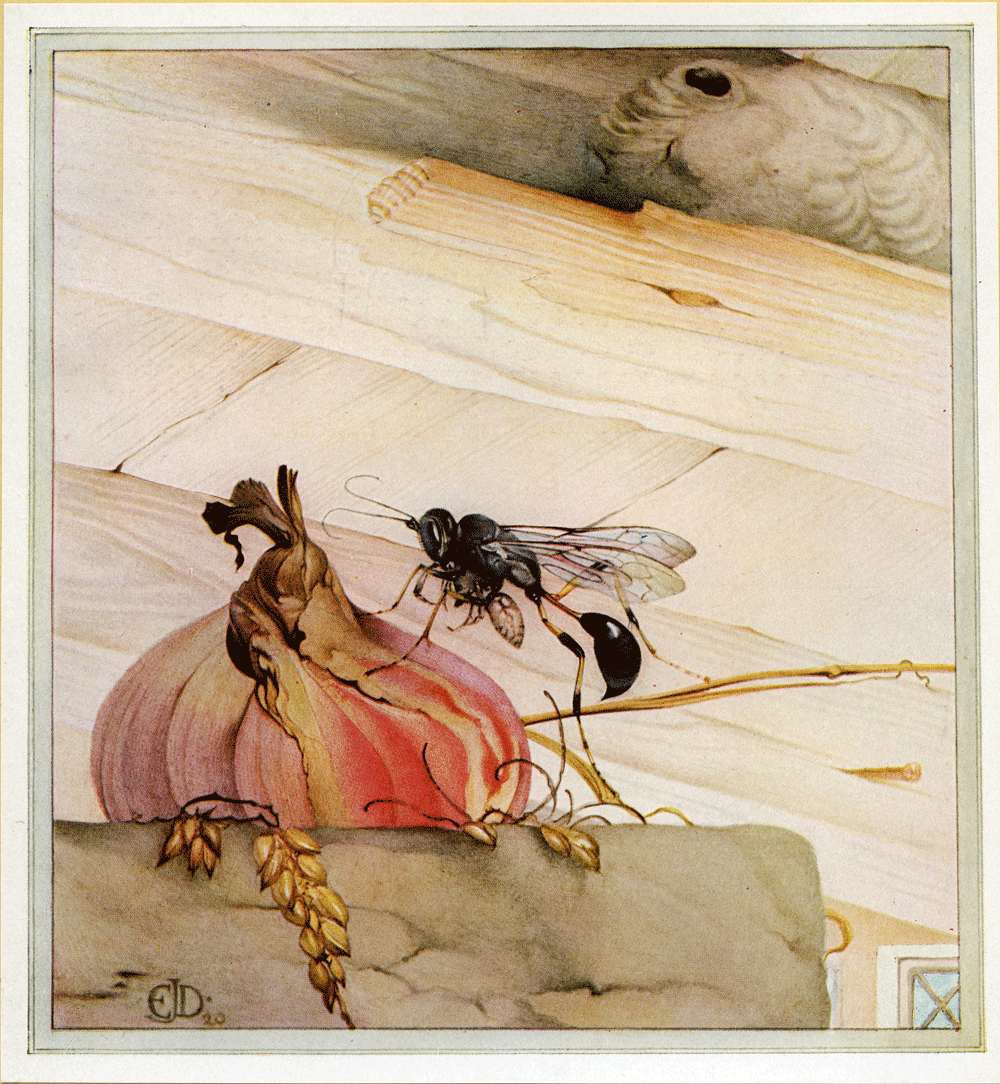
PELOPAEUS SPIRIFEX: When finished the work is amber-yellow, and rather reminds one of the outer skin of an onion The egg is always laid on the same part of the Spider, the end containing the head being placed on the plumpest spot. This is very pleasant for the grub, for the moment it is hatched it can begin eating the tenderest and nicest food in the store. Not a mouthful is wasted, however, by these economical creatures. When the meal is finished there is practically nothing left of the whole heap of Spiders. This life of gluttony lasts for eight or ten days. The grub then sets to work to spin its cocoon, a sack of pure, perfectly white silk, extremely delicate. Something more is required to make this sack tough enough to be a protection, so the grub produces from its body a sort of liquid varnish. As soon as it trickles into the meshes of the silk this varnish hardens, and becomes a lacquer of exquisite daintiness. The grub then fixes a hard plug at the base of the cocoon to make all secure. When finished, the work is amber-yellow, and rather reminds one of the outer skin of an onion. It has the same fine texture, the same colour and transparency; and like the onion skin it rustles when it is fingered. From it, sooner or later according to temperature, the perfect insect is hatched. It is possible, while the Wasp is storing her cell, to play her a trick which will show how purely mechanical her instincts are. A cell has just been completed, let us suppose, and the huntress arrives with her first Spider. She stores it away, and at once fastens her egg on the plumpest part of its body. She sets out on a second trip. I take advantage of her absence to remove with my tweezers from the bottom of the cell both the dead Spider and the egg. The disappearance of the egg must be discovered by the Wasp, one would think, if she possesses the least gleam of intelligence. The egg is small, it is true, but it lies on a comparatively large object, the Spider. What will the Wasp do when she finds the cell empty? Will she act sensibly, and repair her loss by laying a second egg? Not at all; she behaves most absurdly. What she does is to bring a second Spider, which she stores away with as much cheerful zeal as if nothing unfortunate had occurred. She brings a third and a fourth, and still others, each of whom I remove during her absence; so that every time she returns from the chase the storeroom is found empty. I have seen her persist obstinately for two days in seeking to fill the insatiable jar, while my patience in emptying it was equally unflagging. With the twentieth victim — possibly owing to the fatigue of so many journeys — the huntress considered that the pot was sufficiently supplied, and began most carefully to close the cell that contained absolutely nothing. The intelligence of insects is limited everywhere in this way. The accidental difficulty which one insect is powerless to overcome, any other, no matter what its species, will be equally unable to cope with. I could give a host of similar examples to show that insects are absolutely without reasoning power, notwithstanding the wonderful perfection of their work. A long series of experiments has forced me to conclude that they are neither free nor conscious in their industry. They build, weave, hunt, stab, and paralyse their prey, in the same way as they digest their food, or secrete the poison of their sting, without the least understanding of the means or the end. They are, I am convinced, completely ignorant of their own wonderful talents. Their instinct cannot be changed. Experience does not teach it; time does not awaken a glimmer in its unconsciousness. Pure instinct, if it stood alone, would leave the insect powerless in the face of circumstances. Yet circumstances are always changing, the unexpected is always happening. In this confusion some power is needed by the insect — as by every other creature — to teach it what to accept and what to refuse. It requires a guide of some kind, and this guide it certainly possesses. Intelligence is too fine a word for it : I will call it discernment. Is the insect conscious of what it does'? Yes, and no. No, if its action is guided by instinct. Yes, if its action is the result of discernment. The Pelopaeus, for instance, builds her cells with earth already softened into mud. This is instinct. She has always built in this way. Neither the passing ages nor the struggle for life will induce her to imitate the Mason-bee and make her nest of dry dust and cement. This mud nest of hers needs a shelter against the rain. A hiding-place under a stone, perhaps, sufficed at first. But when she found something better she took possession of it. She installed herself in the home of man. This is discernment. She supplies her young with food in the form of Spiders. This is instinct, and nothing will ever persuade her that young Crickets are just as good. But should there be a lack of her favourite Cross Spider she will not leave her grubs unfed; she will bring them other Spiders. This is discernment. In this quality of discernment lies the possibility of future improvement for the insect. IV: HER ORIGIN The Pelopaeus sets us another problem. She seeks the warmth of our fireplaces. Her nest, built of soft mud which would be reduced to pulp by damp, must have a dry shelter. Heat is a necessity to her. Is it possible that she is a foreigner? Did she come, perhaps, from the shores of Africa, from the land of dates to the land of olives? It would be natural, in that case, that she should find our sunshine not warm enough for her, and should seek the artificial warmth of the fireside. This would explain her habits, so unlike those of the other Wasps, by all of whom mankind is avoided. What was her life before she became our guest? Where did she lodge before there were any houses? Where did she shelter her grubs before chimneys were thought of? Perhaps, when the early inhabitants of the hills near Serignan were making weapons out of flints, scraping goatskins for clothes, and building huts of mud and branches, those huts were already frequented by the Pelopaeus. Perhaps she built her nest in some bulging pot, shaped out of clay by the thumbs of our ancestors; or in the folds of the garments, the skins of the Wolf and the Bear. When she made her home on the rough walls of branches and clay, did she choose the nearest spot, I wonder, to the hole in the roof by which the smoke was let out? Though not equal to our chimneys it may have served at a pinch. If the Pelopseus really lived here with the earliest human inhabitants, what improvements she has seen! She too must have profited greatly by civilisation: she has turned man's increasing comfort into her own. When the dwelling with a roof and a ceiling was planned, and the chimney with a flue was invented, we can imagine the chilly creature saying to herself: "How pleasant this is I Let us pitch our tent here." But we will go back further still. Before huts existed, before the niche in the rut, before man himself had appeared, where did the Pelopaeus build? The question does not "stand alone. Where did the Swallow and the Sparrow build before there were windows and chimneys to build in? Since the Swallow, the Sparrow, and the Wasp existed before man, their industry cannot be dependent on the works of man. Each of them must have had an art of building in the time when man was not here. For thirty years and more I asked myself where the Pelopaeus lived in those times. Outside our houses I could find no trace of her nests. At last chance, which favours the persevering, came to my help. The Serignan quarries are full of broken stones, of refuse that has been piled there in the course of centuries. Here the Fieldmouse crunches his olive-stones and acorns, or now and then a Snail. The empty Snail-shells lie here and there beneath a stone, and within them different Bees and Wasps build their cells. In searching for these treasures I found, three times, the nest of a Pelopaeus among the broken stones. These three nests were exactly the same as those found in our houses. The material was mud, as always; the protective covering was the same mud. The dangers of the site had suggested no improvements to the builder. We see, then, that sometimes, but very rarely, the Pelopaeus builds in stoneheaps and under flat blocks of stone that do not touch the ground. It was in such places as these that she must have made her nest before she invaded our houses. The three nests, however, were in a piteous state. The damp and exposure had ruined them, and the cocoons were in pieces. Unprotected by their earthen cover the grubs had perished — eaten by a Fieldmouse or another. The sight of these ruins made me wonder if my neighbourhood were really a suitable place for the Pelopaeus to build her nest out of doors. It is plain that the mother Wasp dislikes doing so, and is hardly ever driven to such a desperate measure. And if the climate makes it impossible for her to practise the industry of her forefathers successfully, I think we may conclude that she is a foreigner. Surely she comes from a hotter and drier climate, where there is little rain and no snow. I believe the Pelopaus is of African origin. Far back in the past she came to us through Spain and Italy, and she hardly ever goes further north than the olive-trees. She is an African who has become a naturalised Provencal. In Africa she is said often to nest under stones, but in the Malay Archipelago we hear of her kinswoman in houses. From one end of the world to the other she has the same tastes — Spiders, mud cells, and the shelter of a man's roof. If I were in the Malay Archipelago I should turn over the stone-heaps, and should most likely discover a nest in the original position, under a flat stone. |