|
HISTORY, SOPHIA AND THE RUSSIAN NATION |
||||||||||||||||||||||||||||
|
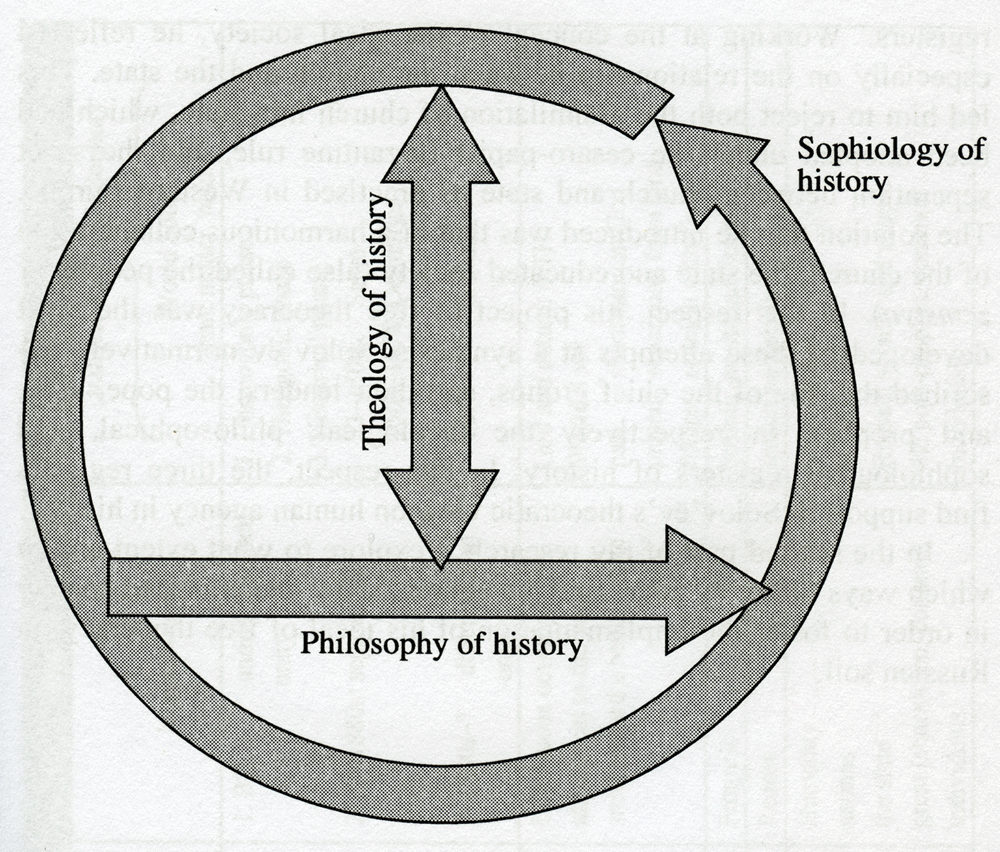
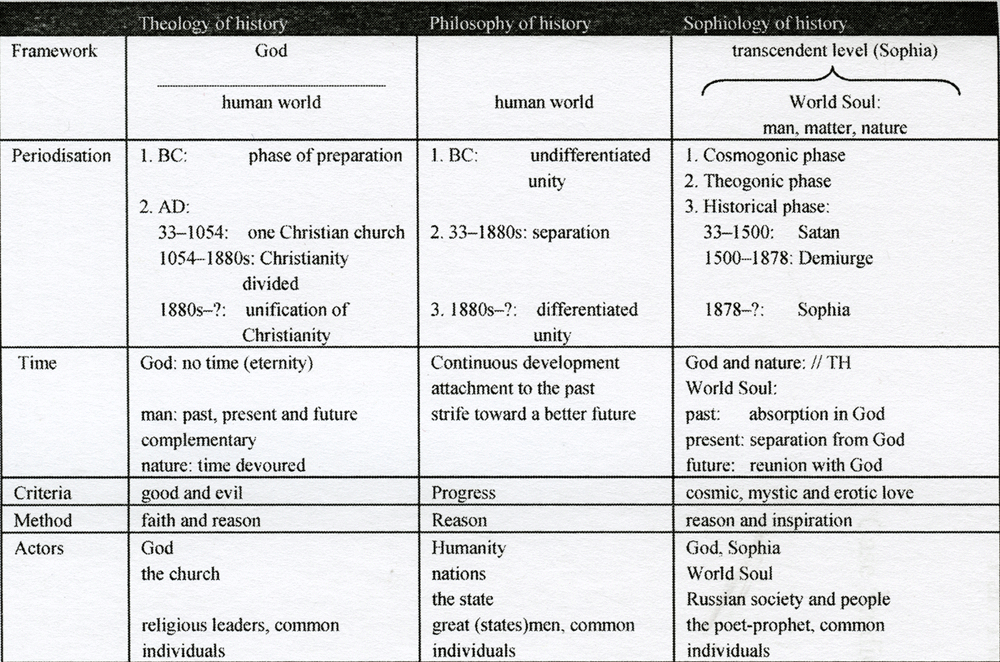
Throughout my study, I have disentangled the three registers that lie at the basis of Vladimir Solov'ev's conception of history, a synopsis of which is provided in the table below. It is relevant here to examine the results of his efforts to combine the three lines. Three modes of combination can be discerned, namely the complementation of two registers, tension, and synthesis between the three. Firstly, there are points where two registers complement each other, illustrated by three examples. A clear example of the combination of theology of history and philosophy of history is the description of the historical becoming of Bogocelovecestvo in an evolutionistic scheme. Berdjaev soundly criticised this view as deterministic; indeed Solov'ev did not leave any room for chance and arbitrariness. [1] Secondly, Solov'ev posited theology of history as providing support for sophiology of history by defining Sophia in relation to the Trinity, in order to ground Sophia in the Christian tradition. This device also met with disapproval, this time from Orthodox commentators. [2] Finally, sophiology of history leans upon two core aspects developed by philosophy of history, namely the theory of process and the universal perspective. Secondly, combining the three registers causes tension between them. For instance, Solov'ev's conception of time is ambivalent, torn between a theological understanding, according to which there is no proper time in nature but only mechanic repetition, and the philosophical and sophiological understanding on the other. The (philosophical) evolutionist understanding of natural time is made namely in terms of a positively valued process, while the freedom of nature as well as its potential of spiritualization is emphasised in sophiology of history. More importantly perhaps, his definition of time contains a contradiction with respect to the conception of God: from the theological perspective, God does not change, whereas from the sophiological perspective God is subjected to becoming. Thirdly, the three registers can be combined in a fruitful synthesis. In one significant case, sophiology of history itself is this synthesis, offering a solution to the tensions between PH and TH regarding the conception of the meaning of history and Russia's place within it. We note a clash between the theological understanding that posits the meaning of things in God, and the philosophical one that posits it in the world. The only way to combine these two standpoints is to bring God closer to the world. One way to achieve this is to do so in a pantheistic system (God is all), which Solov'ev sought to avoid. The other way -- and here lies Solov'ev's originality -- is to make sophiology central, which posits Sophia as equivalent to ideal humanity. Accordingly, the national idea is in God (divine Sophia or Providence) and is realised in the process of humanity divinising itself (earthly Sophia or World Soul). This also allows us to see the action of Sophia at the national, mainly Russian, level, through the action of the prophet Solov'ev who directs his fellow countrymen towards the concrete realisation of Sophia on earth. The synthetising function of sophiology of history can be best rendered in the following scheme:
While theology of history lays emphasis on the relationship between the upper, divine level of transcendence, philosophy of history exclusively focuses on the events of the immanent world and draws a scheme of progressive development from the origin of human history toward the future. Sophiology of history combines and supersedes these two registers in several respects. It departs from (Solov'ev's) mystic experience, which allows to get an unmediated knowledge of the divine, to grasp history in its cosmic dimension from the beginning of the universe, and to include the lower level of matter and nature in the process toward fusion with God. Another case of fruitful synthesis between the three registers is when sophiology of history is an element of this synthesis. As a matter of fact, the realisation of the ideal society in free theocracy is perhaps the field in which Soiov'ev most elaborated his synthesis of the three registers. [3] Working at the concept of the ideal society, he reflected especially on the relationship between the church and the state. This led him to reject both the assimilation of church into state, which had been adopted under the cesaro-papist Byzantine rule, and the strict separation between church and state as practised in Western Europe. The solution that he introduced was that of a harmonious collaboration of the church, the state and educated society (also called the people, or zemstvo). In this respect, his project of free theocracy was the most developed of these attempts at a synthesis. Solov'ev normatively described the role of the chief groups, and their leaders, the pope, king, and prophet, in respectively the theological, philosophical, and sophiological registers of history. In this respect, the three registers find support in Solov'ev's theocratic view on human agency in history. In the second part of my research, I explore to what extent and in which ways Solov'ev addressed the church, state, and educated society in order to foster the implementation of his ideal of free theocracy on Russian soil.
_______________ Notes: 1. Berdjaev in Russkaja ideja, referred to by Ignatow 1997, p. 14. 2. Florovsky: Solov'ev 'somehow literally left the Church' (Georges Florovsky, Ways o/Russian Theology II, Collected Works 6, p. 245. 3. The synthesis between theology of history and philosophy of history is visible in his general concept of 'Christian politics’.
|