|
THE HISTORY OF THE FABIAN SOCIETY |
|
Chapter 12: The Lessons of Thirty
Years
Breaking the spell of Marxism—A
French verdict—Origin of Revisionism in Germany—The British School of
Socialism—Mr. Ernest Barker's summary—Mill versus Marx—The Fabian
Method—Making Socialists or making Socialism—The life of propagandist
societies—The prospects of Socialist Unity—The future of Fabian
ideas—The test of Fabian success.
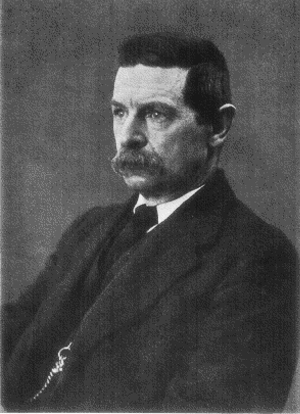
EDWARD R. PEASE, IN 1913 The Fabian Society was founded for the purpose of reconstructing Society in accordance with the highest moral possibilities. This is still the most accurate and compendious description of its object and the nature of its work. But the stage of idealism at which more than a very modest instalment of this cosmic process seemed possible within the lifetime of a single institution had passed before the chief Essayists became members, and indeed I cannot recollect that the founders themselves ever imagined that it lay within their own power to reconstruct Society; none of them was really so sanguine or so self-confident as to anticipate so great a result from their efforts, and it will be remembered that the original phrase was altered by the insertion of the words "to help on" when the constitution was actually formulated. Society has not yet been reconstructed, but the Fabians have done something towards its reconstruction, and my history will be incomplete without an attempt to indicate what the Society has already accomplished and what may be the future of its work. Its first achievement, as already mentioned, was to break the spell of Marxism in England. Public opinion altogether failed to recognise the greatness of Marx during his lifetime, but every year that passes adds strength to the conviction that the broad principles he promulgated will guide the evolution of society during the present century. Marx demonstrated the moral bankruptcy of commercialism and formulated the demand for the communal ownership and organisation of industry; and it is hardly possible to exaggerate the value of this service to humanity. But no man is great enough to be made into a god; no man, however wise, can see far into the future. Neither Marx himself nor his immediate followers recognised the real basis of his future fame; they thought he was a brilliant and original economist, and a profound student of history. His Theory of Value, his Economic Interpretation of History, seemed to them the incontestible premises which necessarily led to his political conclusions. This misapprehension would not have much mattered had they allowed themselves freedom of thought. Socialism, as first preached to the English people by the Social Democrats, was as narrow, as bigoted, as exclusive as the strictest of Scotch religious sects. "Das Kapital," Vol. I, was its bible; and the thoughts and schemes of English Socialists were to be approved or condemned according as they could or could not be justified by a quoted text. The Fabian Society freed English Socialism from this intellectual bondage, and freed it sooner and more completely than "Revisionists" have succeeded in doing anywhere else. Accepting the great principle that the reconstruction of society to be worked for is the ownership and control of industry by the community, the Fabians refused to regard as articles of faith either the economic and historic analyses which Marx made use of or the political evolution which he predicted. Socialism in England remained the fantastic creed of a group of fanatics until "Fabian Essays" and the Lancashire Campaign taught the working classes of England, or at any rate their leaders, that Socialism was a living principle which could be applied to existing social and political conditions without a cataclysm either insurrectionary or even political. Revolutionary phraseology, the language of violence, survived, and still survives, just as in ordinary politics we use the metaphors of warfare and pretend that the peaceful polling booth is a battlefield and that our political opponents are hostile armies. But we only wave the red flag in our songs, and we recognise nowadays that the real battles of Socialism are fought in committee rooms at Westminster and in the council chambers of Town Halls. It was perhaps fortunate that none of the Fabian leaders came within the influence of the extraordinary personality of Karl Marx. Had he lived a few years longer he might have dominated them as he dominated his German followers, and one or two of his English adherents. Then years would have been wasted in the struggle to escape. It was fortunate also that the Fabian Society has never possessed one single outstanding leader, and has always refrained from electing a president or permanent chairman. There never has been a Fabian orthodoxy, because no one was in a position to assert what the true faith was. Freedom of thought was without doubt obtained for English Socialists by the Fabians. How far the world-wide revolt against Marxian orthodoxy had its origin in England is another and more difficult question. In his study of the Fabian Society[43] M. Édouard Pfeiffer states in the preface that the Society makes this claim, quotes Bernard Shaw as saying to him, "The world has been thoroughly Fabianised in the last twenty-five years," and adds that he is going to examine the accuracy of it. Later he says:—
This is a French view. Germany is naturally the stronghold of Marxism, and the country where it has proved, up to a point, an unqualified success. Although the Social Democratic Party was founded as an alliance between the followers of Marx and of Lassalle, on terms to which Marx himself violently objected, none the less the leadership of the party fell to those who accepted the teaching of Marx, and on that basis by far the greatest Socialist Party of the world has been built up. Nowhere else did the ideas of Marx hold such unquestioned supremacy: nowhere else had they such a body of loyal adherents, such a host of teachers and interpreters. Only on the question of agricultural land in the freer political atmosphere of South Germany was there even a breath of dissent. The revolt came from England in the person of Edward Bernstein, who, exiled by Bismarck, took refuge in London, and was for years intimately acquainted with the Fabian Society and its leaders. Soon after his return to Germany he published in 1899 a volume criticising Marxism,[45] and thence grew up the Revisionist movement for free thought in Socialism which has attracted all the younger men, and before the war had virtually, if not actually, obtained control over the Social Democratic Party. In England, and in Germany through Bernstein, I think the Fabian Society may claim to have led the revolt. Elsewhere the revolt has come rather in deeds than in words. In France, in Italy, and in Belgium and in other European countries, a Socialist Party has grown up which amid greater political opportunities has had to face the actual problems of modern politics. These could not be solved by quotations from a German philosopher, and liberty has been gained by force of circumstances. Nevertheless in many countries, such as Russia and the United States, even now, or at any rate until very recent years, the freedom of action of Socialist parties has been impeded by excessive respect for the opinions of the Founder, and Socialist thought has been sterilised, because it was assumed that Marx had completed the philosophy of Socialism, and the business of Socialists was not to think for themselves, but merely to work for the realisation of his ideas. *** But mere freedom was not enough. Something must be put in the place of Marx. His English followers did not notice that he had indicated no method, and devised no political machinery for the transition; or if they noticed it they passed over the omission as a negligible detail. If German Socialism would not suit, English Socialism had to be formulated to take its place. This has been the life-work of the Fabian Society, the working out of the application of the broad principles of Socialism to the industrial and political environment of England. I say England advisedly, because the industrial and political conditions of Scotland are in some degree different, and the application of the principles of Socialism to Ireland has not yet been seriously attempted. But for England "Fabian Essays" and the Fabian Tracts are by general consent the best expositions of the meaning and working of Socialism in the English language. Marxian Socialism regarded itself as a thing apart. Marx had discovered a panacea for the ills of society: the old was to be cleared away and all things were to become new. In Marx's own thought evolution and revolution were tangled and alternated. The evolutionary side was essential to it; the idea of revolutionary catastrophe is almost an excrescence. But to the Marxians (of whom Marx once observed that he was not one) this excrescence became the whole thing. People were divided into those who advocated the revolution and those who did not. The business of propaganda was to increase the number of adherents of the new at the expense of the supporters of the old. The Fabians regarded Socialism as a principle already in part embodied in the constitution of society, gradually extending its influence because it harmonised with the needs and desires of men in countries where the large industry prevails. Fabian Socialism is in fact an interpretation of the spirit of the times. I have pointed out already that the municipalisation of monopolies, a typically Fabian process, had its origin decades before the Society was founded, and all that the Fabian Society did was to explain its social implications and advocate its wider extension. The same is true of the whole Fabian political policy. Socialism in English politics grew up because of the necessity for State intervention in the complex industrial and social organisation of a Great State. Almost before the evil results of Laissez Faire had culminated Robert Owen was pointing the way to factory legislation, popular education, and the communal care of children. The Ten Hours Act of 1847 was described by Marx himself as "the victory of a principle," that is, of "the political economy of the working class."[46] That victory was frequently repeated in the next thirty years, and collective protection of Labour in the form of Factory Acts, Sanitary Acts, Truck Acts, Employers' Liability Acts, and Trade Board Acts became a recognised part of the policy of both political parties. Fabian teaching has had more direct influence in promoting the administrative protection of Labour. The Fair Wages policy, now everywhere prevalent in State and Municipal employment, was, as has been already described, if not actually invented, at any rate largely popularised by the Society. It was a working-class demand, and it has been everywhere put forward by organised labour, but its success would have been slower had the manual workers been left to fight their own battle. I have said that the work of the Society was the interpretation of an existing movement, the explanation and justification of tendencies which originated in Society at large, and not in societies, Fabian or other. That work is only less valuable than the formulation of new ideas. None of the Fabians would claim to rank beside the great promulgators of new ideas, such as Owen and Marx. But the interpretation of tendencies is necessary if progress is to be sustained and if it is to be unbroken by casual reaction. In an old country like ours, with vast forces of inertia built up by ages of precedents, by a class system which forms a part of the life of the nation, by a distribution of wealth which even yet scarcely yields to the pressure of graduated taxation, legislation is always in arrear of the needs of the times; the social structure is always old-fashioned and out of date, and reform always tends to be late, and even too late, unless there are agitators with the ability to attract public attention calling on the men in power to take action. *** But this victory of a principle is not a complete victory of the principles of Socialism. It is a limitation of the power of the capitalist to use his capital as he pleases, and Socialism is much more than a series of social safeguards to the private ownership of capital. Municipal ownership is a further step, but even this will not carry us far because the capital suitable for municipal management on existing lines is but a small fraction of the whole, and because municipal control does not directly affect the amount of capital in the hands of the capitalists who are always expropriated with ample compensation. We have made some progress along another line. Supertax, death duties, and taxes on unearned increment do a little to diminish the wealth of the few: old age pensions, national insurance, and workmen's compensation do something towards mitigating the poverty of the poor. But it must be confessed that we have made but little progress along the main road of Socialism. Private ownership of capital and land flourishes almost as vigorously as it did thirty years ago. Its grosser cruelties have been checked, but the thing itself has barely been touched. Time alone will show whether progress is to be along existing lines, whether the power of the owners of capital over the wealth it helps to create and over the lives of the workers whom it enslaves will gradually fade away, as the power of our kings over the Government of our country has faded, the form remaining when the substance has vanished, or whether the community will at last consciously accept the teaching of Socialism, setting itself definitely to put an end to large-scale private capitalism, and undertaking itself the direct control of industry. The intellectual outlook is bright; the principles of Socialism are already accepted by a sensible proportion of the men and women in all classes who take the trouble to think, and if we must admit that but little has yet been done, we may well believe that in the fullness of time our ideas will prevail. The present war is giving the old world a great shake, and an era of precipitated reconstruction may ensue if the opportunity be wisely handled. *** The influence of the Fabian Society on political thought is already the theme of doctoral theses by graduates, especially in American universities, but it has not yet found much place in weightier compilation. Indeed so far as I know the only serious attempts in this country to describe its character and estimate its proportions is to be found in an admirable little book by Mr. Ernest Barker of New College, Oxford, entitled "Political Thought in England from Herbert Spencer to the Present Day."[47] The author, dealing with the early Fabians, points out that "Mill rather than Marx was their starting point," but he infers from this that "they start along the line suggested by Mill with an attack on rent as the 'unearned increment' of land," a curious inaccuracy since our earliest contribution to the theory of Socialism, Tract No. 7, "Capital and Land," was expressly directed to emphasising the comparative unimportance of Land Nationalisation, and nothing in the later work of the Society has been inconsistent with this attitude. Then Mr. Barker goes on: "Fabianism began after 1884 to supply a new philosophy in place of Benthamite Individualism. Of the new gospel of collectivism a German writer[48] has said Webb was the Bentham and Shaw the Mill.[49] Without assigning rôles we may fairly say there is some resemblance between the influence of Benthamism on legislation after 1830 and the influence of Fabianism on legislation since, at any rate, 1906.[50] In either case we have a small circle of thinkers and investigators in quiet touch with politicians: in either case we have a 'permeation' of general opinion by the ideas of these thinkers and investigators.... It is probable that the historian of the future will emphasise Fabianism in much the same way as the historian of to-day emphasises Benthamism."[51] Mr. Barker next explains that "Fabianism has its own political creed, if it is a political creed consequential upon an economic doctrine. That economic doctrine advocates the socialisation of rent. But the rents which the Fabians would socialise are not only rents from land. Rent in the sense of unearned increments may be drawn, and is drawn, from other sources. The successful entrepreneur for instance draws a rent of ability from his superior equipment and education. The socialisation of every kind of rent will necessarily arm the State with great funds which it must use.... Shaw can define the two interconnected aims of Fabianism as 'the gradual extension of the franchise and the transfer of rent and interest to the State.'" As Mr. Barker may not be alone in a slight misinterpretation of Fabian doctrine it may be well to take this opportunity of refuting the error. He says that Fabianism advocates the socialisation of rent, and in confirmation quotes Shaw's words "rent and interest"! That makes all the difference. If the term rent is widened to include all differential unearned incomes, from land, from ability, from opportunity (i.e. special profits), interest includes all non-differential unearned incomes, and thus the State is to be endowed, not with rents alone, but with all unearned incomes.[52] It is true that the Fabians, throwing over Marx's inaccurate term "surplus value," base their Socialism on the Law of Rent, because, as they allege, this law negatives both equality of income and earnings in proportion to labour, so long as private ownership of land prevails. It is also true that they have directed special attention to the unearned incomes of the "idle" landlord and shareholder, because these are the typical feature of the modern system of distribution, which indeed has come to the front since the time of Marx, and because they furnish the answer to those who contend that wealth is at present distributed approximately in accordance with personal capacity or merit, and tacitly assume that "the rich" are all of them great captains of industry who by enterprise and ability have actually created their vast fortunes.[53] Indeed we might say that we do not mind conceding to our opponents all the wealth "created" by superior brains, if they will let us deal with the unearned incomes which are received independent of the possession of any brains, or any services at all! But although we regard the case of the capitalist employer as relatively negligible, and although we prefer to concentrate our attack on the least defensible side of the capitalist system—and already the State recognises that unearned incomes should pay a larger proportion in income-tax, that property which passes at death, necessarily to those who have not earned it, should contribute a large quota to the public purse, and that unearned increment on land should in part belong to the public—that does not mean that we have any tenderness for the entrepreneur. Him we propose to deal with by the favourite Fabian method of municipalisation and nationalisation. We take over his "enterprise," his gasworks and waterworks, his docks and trams, his railways and mines. We secure for the State the profits of management and the future unearned increment, and we compensate him for his capital with interest-bearing securities. We force him in fact to become the idle recipient of unearned income, and then we turn round and upbraid him and tax him heavily precisely because his income is unearned! If there is any special tenderness in this treatment, I should prefer harshness. To me it seems to resemble the policy of the wolf towards the lamb.[54] I will proceed with quotations from Mr. Barker, because the view of a historian of thought is weightier than anything I could say. "But collectivism also demands in the second place expert government. It demands the 'aristocracy of talent' of which Carlyle wrote. The control of a State with powers so vast will obviously need an exceptional and exceptionally large aristocracy. Those opponents of Fabianism who desire something more revolutionary than its political 'meliorism' and 'palliatives' accuse it of alliance with bureaucracy. They urge that it relies on bureaucracy to administer social reforms from above; and they conclude that, since any governing class is anti-democratic, the Fabians who believe in such a class are really anti-democratic. The charge seems, as a matter of fact, difficult to sustain. Fabians from the first felt and urged that the decentralisation of the State was a necessary condition of the realisation of their aim. The municipality and other local units were the natural bodies for administering the new funds and discharging the new duties which the realisation of that aim would create. 'A democratic State,' Shaw wrote, 'cannot become a Social Democratic State unless it has in every centre of population a local governing body as thoroughly democratic in its constitution as the central Parliament.' The House of Commons he felt must develop 'into the central government which will be the organ of federating the municipalities.' Fabianism thus implied no central bureaucracy; what it demanded was partly, indeed, a more efficient and expert central government (and there is plenty of room for that), but primarily an expert local civil service in close touch with and under the control of a really democratic municipal government. It is difficult to say that this is bureaucracy or that it is not desirable. Many men who are not Fabians or Socialists of any kind feel strongly that the breathing of more vigour and interest into local politics, and the creation of a proper local civil service, are the great problems of the future. "The policy of Fabianism has thus been somewhat as follows. An intellectual circle has sought to permeate all classes, from the top to the bottom, with a common opinion in favour of social control of socially created values. Resolved to permeate all classes, it has not preached class-consciousness; it has worked as much with and through Liberal 'capitalists' as with and through Labour representatives. Resolved gradually to permeate, it has not been revolutionary: it has relied on the slow growth of opinion. Reformist rather than revolutionary, it has explained the impossibility of the sudden 'revolution' of the working classes against capital: it has urged the necessity of a gradual amelioration of social conditions by a gradual assertion of social control over unearned increment.[55] Hence Fabianism has not adopted the somewhat cold attitude of the pure Socialist Party to Trade Unions, but has rather found in their gradual conquest of better wages and better conditions for the workers the line of social advance congenial with its own principles. Again, it has preached that the society which is to exert control must be democratic, if the control is to be, as it must be, self-control: it has taught that such democratic self-control must primarily be exerted in democratic local self-government: it has emphasised the need of reconciling democratic control with expert guidance. While it has never advocated 'direct action' or the avoidance of political activity, while on the contrary, it has advocated the conquest of social reforms on the fields of parliamentary and municipal government, it has not defended the State as it is, but has rather urged the need for a State which is based on democracy tempered by respect for the 'expert.' In this way Socialism of the Fabian type has made representative democracy its creed. It has adopted the sound position that democracy flourishes in that form of state in which people freely produce, thanks to an equality of educational opportunity, and freely choose, thanks to a wide and active suffrage, their own members for their guidance, and, since they have freely produced and chosen them, give them freely and fully the honour of their trust. And thus Socialists like Mr. Sidney Webb and Mr. Ramsay Macdonald have not coquetted with primary democracy, which has always had a magnetic attraction for Socialists. The doctrine that the people itself governs directly through obedient agents—the doctrine of mandate and plebiscite, of referendum and initiative—is not the doctrine of the best English Socialism." Mr. Barker next explains that behind these ideas lies "an organic theory of society," that society is regarded as "an organic unity with a real 'general will' of its own," and after stating that "the development of Liberalism, during the last few years, shows considerable traces of Fabian influence," concludes the subject with the words "Collectivism of the Fabian order was the dominant form of Socialism in England till within the last three of four years." Of the movement of Guild Socialists and others which he deems to have replaced it I shall speak later. I have ventured to quote from Mr. Barker at some length because his summary of Fabian doctrine seems to me (with the exception noted) to be both correct and excellent, and it is safer to borrow from a writer quite unconnected with the Society an estimate of its place in the history of English political thought, rather than to offer my own necessarily prejudiced opinion of its achievements. *** But I must revert again to the Fabian "method." "Make Socialists," said Mr. Wells in "Faults of the Fabian," "and you will achieve Socialism. There is no other way"; and Mr. Wells in his enthusiasm anticipated a society of ten thousand Fabians as the result of a year's propaganda. Will Socialism come through the making of Socialists? If so, Socialism has made but little progress in England, since the number who profess and call themselves Socialist is still insignificant. The foregoing pages have shown in the words of a student of political thought how Socialism has been made in England in quite another way. We did not at the time repudiate Mr. Wells' dictum: indeed we adopted his policy, and attempted the making of Socialism on a large scale. No doubt there is a certain ambiguity in the word "Socialists." It may mean members of Socialist societies, or at any rate "unattached Socialists," all those in fact who use the name to describe their political opinions. Or it may merely be another way of stating that the existing form of society can only be altered by the wills of living people, and change will only be in the direction of Socialism, when the wills which are effective for the purpose choose that direction in preference to another. Mr. Wells himself described as a "fantastic idea" the notion that "the world may be manoeuvred into Socialism without knowing it": that "society is to keep like it is ... and yet Socialism will be soaking through it all, changing without a sign,"[56] and he at any rate meant by his phrase, "make members of Socialist societies." The older and better Fabian doctrine is set out in the opening paragraphs of Tract 70, the "Report on Fabian Policy" (1896). "THE MISSION OF THE FABIANS The object of the Fabian Society is to persuade the English people to make their political constitution thoroughly democratic and so to socialise their industries as to make the livelihood of the people entirely independent of private capitalism. The Fabian Society endeavours to pursue its Socialist and Democratic objects with complete singleness of aim. For example:— It has no distinctive opinions on the Marriage Question, Religion, Art, abstract Economics, historic Evolution, Currency, or any other subject than its own special business of practical Democracy and Socialism. It brings all the pressure and persuasion in its power to bear on existing forces, caring nothing by what name any party calls itself or what principles, Socialist or other, it professes, but having regard solely to the tendency of its actions, supporting those which make for Socialism and Democracy and opposing those which are reactionary. It does not propose that the practical steps towards Social Democracy should be carried out by itself or by any other specially organised society or party. It does not ask the English people to join the Fabian Society." In old days acting on this view of our "mission" we deliberately allowed the Society to remain small. Latterly we tried to expand, and in the main our attempt was an expensive failure. The other Socialist bodies have always used their propaganda primarily for recruiting; and they have sought to enlist the rank and file of the British people. In this they too have substantially failed, and the forty or fifty thousand members of the I.L.P. and B.S.P. are roughly no larger a proportion of the working class than the three thousand Fabians are of the middle class. If the advance of Socialism in England is to be measured by the "making of Socialists," if we are to count membership, to enumerate meetings, to sum up subscriptions, the outlook is gloomy. Thirty-four years ago a group of strong men led by Mr. H.M. Hyndman founded the Democratic Federation, which survives as the British Socialist Party, with Mr. Hyndman still to the fore; the rest have more or less dropped out, and no one has arisen to take their places. Twenty-two years ago Keir Hardie founded the Independent Labour Party: he has died since the first draft of this passage was written, and no one is left who commands such universal affection and respect amongst the members of the Society he created. Of the seven Essayists who virtually founded the Fabian Society only one is still fully in harness, and his working life must necessarily be nearing its term. It may be doubted whether a society for the propagation of ideas has the power to long outlive the inspiration of its founder, unless indeed he is a man of such outstanding personality that his followers treat him as a god. The religions of the world have been maintained by worshippers, and even in our own day the followers of Marx have held together partly because they regard his teachings with the uncritical reverence usually accorded to the prophets of new faiths. But Marxism has survived in Germany chiefly because it has created and inspired a political party, and political parties are of a different order from propagandist societies. Socialism in England has not yet created a political party; for the Labour Party, though entirely Socialist in policy, is not so in name or in creed, and in this matter the form counts rather than the fact. Europe, as I write in the early days of 1916, is in the melting-pot, and it would be foolish to prophesy either the fate of the nations now at war or, in particular, the future of political parties in Great Britain, and especially of the Labour Party. But so far as concerns the Fabian Society and the two other Socialist Societies, this much may be said: three factors in the past have kept them apart: differences of temperament; differences of policy; differences of leadership. In fact perhaps the last was the strongest. I do not mean that the founders of the three societies entertained mutual antipathies or personal jealousies to the detriment of the movement. I do mean that each group preferred to go its own way, and saw no sufficient advantage in a common path to compensate for the difficulties of selecting it. In a former chapter I have explained how a movement for a form of Socialist Unity had at last almost achieved success, when a new factor, the European War, interposed. After the war these negotiations will doubtless be resumed, and the three Socialist Societies will find themselves more closely allied than ever before. The differences of policy which have divided them will then be a matter of past history. The differences of temperament matter less and less as the general policy becomes fixed, and in a few years the old leaders from whose disputes the general policy emerged must all have left the stage. The younger men inherit an established platform and know nothing of the old-time quarrels and distrusts. They will come together more easily. If the organised propaganda of Socialism continues—and that perhaps is not a matter of certainty—it seems to me improbable that it will be carried on for long by three separate societies. In some way or other, in England as in so many other countries, a United Socialist organisation will be constituted. *** But what of the future of Fabian ideas? In a passage already quoted Mr. Barker indicates that the dominance of "Collectivism of the Fabian order" ceased three or four years ago, and he goes on to indicate that it has been replaced by an anti-state propaganda, taking various forms, Syndicalism, Guild Socialism, and the Distributivism of Mr. Belloc. It is true that Fabianism of the old type is not the last event in the history of political thought, but it is still, I venture to think, the dominant principle in political progress. Guild Socialism, whatever its worth, is a later stage. If our railways are to be managed by the Railwaymen's Union, they must first be acquired for the community by Collectivism. This is not the place to discuss the possibilities of Guild Socialism. After all it is but a form of Socialism, and a first principle of Fabianism has always been free thought. The leading Guild Socialists resigned from the Society: they were not expelled: they attempted to coerce the rest, but no attempt was made to coerce them. Guild Socialism as a scheme for placing production under the management of the producers seems to me to be on the wrong lines. The consumer as a citizen must necessarily decide what is to be produced for his needs. But I do not belong to the generation which will have to settle the matter. The elderly are incompetent judges of new ideas. Fabian doctrine is not stereotyped: the Society consists in the main of young people. The Essayists and their contemporaries have said their say: it remains for the younger people to accept what they choose, and to add whatever is necessary. Those who repudiated the infallibility of Marx will be the last to claim infallibility for themselves. I can only express the hope that as long as the Fabian Society lasts it will be ever open to new ideas, ever conscious that nothing is final, ever aware that the world is enormously complex, and that no single formula will summarise or circumscribe its infinite variety.[57] *** The work of the Fabian Society has been not to make Socialists, but to make Socialism. I think it may be said that the dominant opinion in the Society—at any rate it is my opinion—is that great social changes can only come by consent. The Capitalist system cannot be overthrown by a revolution or by a parliamentary majority. Wage slavery will disappear, as serfdom disappeared, not indeed imperceptibly, for the world is now self-conscious, not even so gradually, for the pace of progress is faster than it was in the Middle Ages, but by a change of heart of the community, by a general recognition, already half realised, that whatever makes for the more equitable distribution of wealth is good; that whatever benefits the working class benefits the nation; that the rich exist only on sufferance, and deserve no more than painless extinction; that the capitalist is a servant of the public, and too often over-paid for the services that he renders. Again, Socialism succeeds because it is common sense. The anarchy of individual production is already an anachronism. The control of the community over itself extends every day. We demand order, method, regularity, design; the accidents of sickness and misfortune, of old age and bereavement, must be prevented if possible, and if not, mitigated. Of this principle the public is already convinced: it is merely a question of working out the details. But order and forethought is wanted for industry as well as for human life. Competition is bad, and in most respects private monopoly is worse. No one now seriously defends the system of rival traders with their crowds of commercial travellers: of rival tradesmen with their innumerable deliveries in each street; and yet no one advocates the capitalist alternative, the great trust, often concealed and insidious, which monopolises oil or tobacco or diamonds, and makes huge profits for a fortunate; few out of the helplessness of the unorganised consumers. But neither the idle rich class nor the anarchy of competition is so outstanding an evil as the poverty of the poor. We aim at making the rich poorer chiefly in order to make the poor richer. Our first tract, "Why are the Many Poor?" struck the keynote. In a century of abounding wealth England still has in its midst a hideous mass of poverty which is too appalling to think of. That poverty, we say, is preventible. That poverty was the background of our thoughts when the Society was founded. Perhaps we have done a little to mitigate it: we believe we have done something to make clear the way by which it may ultimately be abolished. We do not constantly talk of it. We write of the advantages of Municipal Electricity, of the powers of Parish Councils, of the objections to the Referendum; but all the while it is that great evil which chiefly moves us, and by our success or our failure in helping on the reconstruction of society for the purpose of abolishing poverty, the work of the Fabian Society must ultimately be judged. _______________ Notes: [43] "La Société Fabienne et le Mouvement socialiste anglais contemporain." By Édouard Pfeiffer, Paris, F. Giard and E. Brière, 1911; an excellent volume but full of errors. [44] "The Fabians were the first amongst Socialists to start the movement of anti-Marxist criticism. At a period when the dogmas of the Master were regarded as sacred, the Fabians ventured to assert that it was possible to call oneself a Socialist without ever having read 'Das Kapital,' or without accepting its doctrine. In opposition to Marx, they have revived the spirit of J.S. Mill, and they have attacked Marx all along the line—the class war, the economic interpretation of history, the catastrophic method, and above all the theory of value." [45] Published in English by the Independent Labour Party in 1909 as "Evolutionary Socialism." [46] Address to the International, 1862, quoted from Spargo's "Karl Marx," p. 266. [47] Home University Library, Williams and Norgate, 1915, 1s. [48] M. Beer, "Geschichte des Socialismus in England" (Stuttgart, 1913), p. 462. Mr. Beer devotes seven pages to the Society, which he describes with accuracy, and interprets much as Mr. Barker has done. The book was written at the request of the German Social Democratic Party. [49] I quote, but do not endorse the opinion that G.B.S. markedly resembles James Mill (Mr. Barker confuses the two Mills). Beer adds "Webb was the thinker, Shaw the fighter." This antithesis is scarcely happy. The collaboration of the two is much too complicated to be summed up in a phrase. [50] But see chapter VIII for its influence before 1906; and see Appendix I. A. for a much fuller discussion of this subject. [51] The same idea is expressed by a Canadian Professor:— "It is necessary to go back to the Philosophical Radicals to find a small group of men who have exercised such a profound influence over English political thought as the little band of social investigators who organised the Fabian Society." "Socialism: a critical analysis." By O.D. Skelton, Ph.D., Professor of Economic Science, Kingston, Canada. (Constable, 1911.) p. 288. [52] Mr. Barker erroneously uses the word "increment" for "income" in several places. Unearned increment is quite another thing. [53] See "Socialism and Superior Brains: a reply to Mr. Mallock," by G.B. Shaw. Fabian Tract 146. [54] Mr. Barker emphasises the "discrimination advocated by the Fabians" in favour of profits in a later passage (p. 224) not here quoted. [55] This should read "incomes." [56] "Faults of the Fabian," p. 9. [57] See Appendix I. B.
|