Site Map

THE KEY OF THE MYSTERIES ACCORDING TO ENOCH, ABRAHAM, HERMES TRISMEGISTES AND SOLOMON

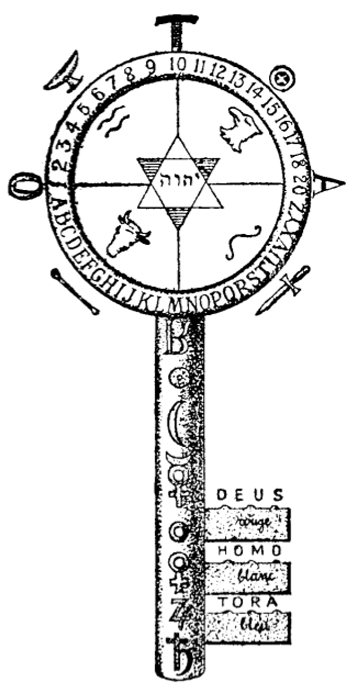
This is an elaborate symbol in the form of a barrel key. The shank is vertical and to the bottom. Three flat bits extend to the right, with three projections at the upper edge of each. There is a large circular ring at top. Down the shank, from top: “R” inverted, Sun, Moon, Mercury, circle (probably for Mars), Venus, Jupiter and Saturn. Above the top bit: “DEUS”, on that bit “rouge”. Above the middle bit: “HOMO”, on that bit “blanc”. Above the bottom bit: “TORA”, on that bit “bleu”. The ring has a “T” above the top, “A” to right and “O” to left (with the “R” on the shank, “TORA”). Outside at the upper left, a cup, upper right a Pantacle, lower right a dagger and lower left a wand. On the ring itself, the numbers from 1 to 20 arch over the top half, left to right and the Alphabet in capital letters on the lower half from left to right. Inside, the ring is quartered by horizontal and vertical diameters. The left upper quadrant has the sign of Aquarius, upper right the eagle head of Scorpio, lower right the sign of Leo and lower left the bull’s head of Taurus. In the center there is a hexagram made up of two triangles, one apex to bottom and the other to top. The outer three triangular points of the inverted triangle are shaded. In the heptagon formed in the center is HB:Yod-Heh-Vau-Heh}

“Religion says: — ‘Believe and you will understand.’ Science comes to say to you: — ‘Understand and you will believe.’

“At that moment the whole of science will change front; the spirit, so long dethroned and forgotten, will take its ancient place; it will be demonstrated that the old traditions are all true, that the whole of paganism is only a system of corrupted and misplaced truths, that it is sufficient to cleanse them, so to say, and to put them back again in their place, to see them shine with all their rays. In a word, all ideas will change, and since on all sides a multitude of the elect cry in concert, ‘Come, Lord, come!’ why should you blame the men who throw themselves forward into that majestic future, and pride themselves on having foreseen it?”

(J. De Maistre, Soirées de St. Petersbourg.)

TRANSLATOR’S NOTE

IN the biographical and critical essay which Mr. Waite prefixes to his Mysteries of Magic he says: ”A word must be added of the method of this digest, which claims to be something more than translation and has been infinitely more laborious. I believe it to be in all respects faithful, and where it has been necessary or possible for it to be literal, there also it is invariably literal.”

We agree that it is either more or less than translation, and the following examples selected at hazard in the course of half-an-hour will enable the reader to judge whether Mr. Waite is acquainted with either French or English:

“Gentilhomme” — “Gentleman.”

“The nameless vice which was reproached against the Templars.”

“Certaines circonstances ridicules et un procès en escroquerie” — “Certain ridiculous processes and a swindling lawsuit.”

“Se mêle de dogmatiser” — “Meddles with dogmatism.”

“La vie pour lui suffisait à l’expiation des plus grands crimes, puis qu’elle etait la consequence d’un arrêt de mort” — “According to him life was sufficient for the greatest crimes, since these were the result of a death sentence.”

“Vos meilleurs amis ont dû concevoir des inquiétudes” — “Your best friends have been reasonably anxious.” (The mistranslation here turns the speech into an insult.) {v}

“Sacro-sainte” — “Sacred and saintly.”

“Auriculaire” — “Index.”

“N’avez vous pas obtenu tout ce que vous demandiez, et plus que vous ne demandiez, car vous ne m’aviez pas parlé d’argent?” — ”Have you not had all and more than you wanted, and there has been no question of remuneration?” (This mistranslation makes nonsense of the whole passage.)

“Eliphas n’etait pas a la question” — “Eliphas was not under cross- examination.”

“Mauvais plaisant” — “Vicious jester.”

“Si vous n’aviez pas ... vous deviendriez” — “If you have not ... you may become.” (This mistranslation turns a compliment into an insult.)

“An awful and ineffaceable tableaux.”

“Peripeties” — ”Circumstances.”

“Il avait fait partie du clerge de Saint Germain l’Auxerrois” — “He was of the Society of St. Germain l’Auxerrois.”

“Bruit de tempete” — “Stormy sound.”

We are obliged to mention this matter, as Mr. Waite (by persistent self- assertion) has obtained the reputation of being trustworthy as an editor. On the contrary, he not only mutilates and distorts his authors, but, as demonstrated above, he is totally incapable of understanding their simplest phrases and even their commonest words. {vi}

Go to Next Page