|
THEIR KINGDOM COME -- INSIDE THE SECRET WORLD OF OPUS DEI |
|
35. Hopeless Dialogue
A FORMER HIGH-RANKING OPUS DEI MEMBER IN SPAIN BELIEVES THAT the next Crusade -- the Tenth Crusade -- will be a cybernetic one, not fought with bombs or bullets, or even Middle Eastern oil, but with the latest computer technology and electronic communications. In his view, the words of the Prophet will be drowned in the fantasies of the cyberspace revolution -- a revolution directed and Controlled by the West. When the Muslim masses -- poorly educated, semiliterate and dependent upon what their own media and mullahs tell them -- obtain unrestricted access to Western information, culture and, above all, the Good News of the Gospels, they will be liberated from the bondage of medieval tyranny which now makes them fundamentalist fodder. This view was to an extent echoed by John Paul II in early 1991 when, in response to a suggestion that development was no longer applicable to a country's state of industrialization but, today, to the strength of its banking sector and, tomorrow, its command of advanced communications systems, he smiled and noted, 'That is the thesis of Opus Dei.' [1] Radical Islamic leaders are only too aware of the threat to their authority posed by the West's mastery of communications and information-transfer technology. Satellite-beamed TV transmissions expose the true believers to Western materialism and profane images of unveiled women. While laws can restrict individual freedoms, there is no technology that can place the communications genie back in the bottle once it has escaped. One of the characteristics of a theocratic state is that in order to survive it must rigidly control the basic freedoms of its citizens, enforcing its edicts with spiritual tyranny that denies human rights. Freedom of choice is the enemy of fundamentalism in all its forms. Opus Dei's propagandists tell us that one of Escriva de Balaguer's fundamental concerns was social justice in the world. [2] He maintained that Christians have a duty not only to expose social injustice but to find solutions that better serve mankind -- i.e., their oppressed brothers or sisters 'in nations burdened with totalitarian regimes that are either anti-Christian, atheist or dominated by extreme nationalist fervour'.
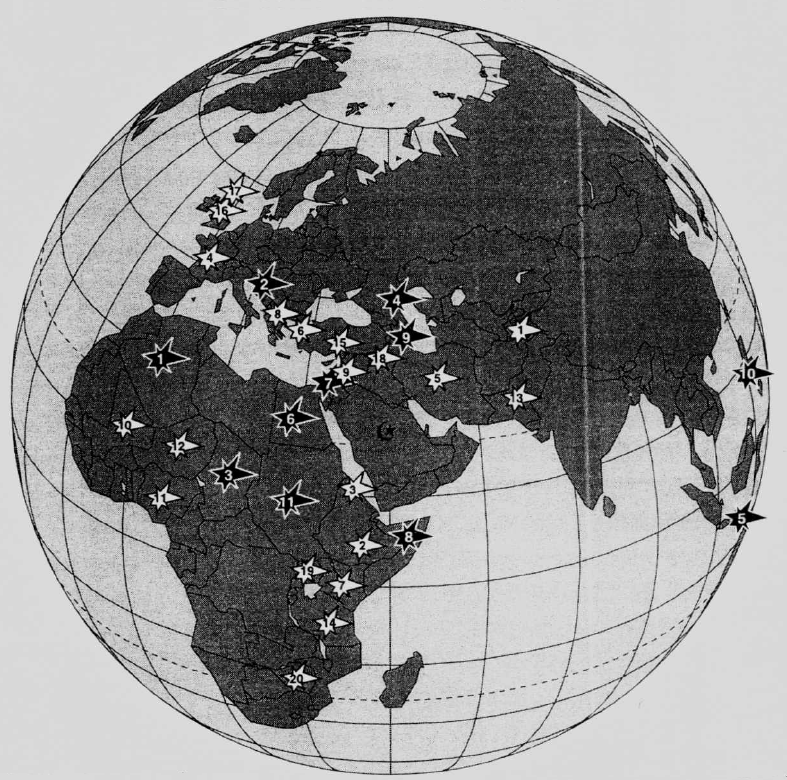
CRUSADE FLASHPOINTS Key to Hotspots
1.
Algeria
Islam's Holy Land
Saudi Arabia No churches,
Key to Confrontation Points
1. Tadjikistan This concern for social justice was said to have led to the founding by Opus Dei of its own human rights non-governmental organization (NGO) in Geneva, with UN Economic and Social Council observer status. Its task was to monitor access to basic education, as enshrined in the Helsinki Human Rights Charter. Nowhere was Opus Dei's name associated with the new NGO so that the Prelature can in no way be accused of stirring up animosity against Islamic states, the primary target of the 'access to education monitoring'. The International Organization for the Development of Free Access to Education is headed by an Opus Dei numerary but its staff includes non-Opus Dei members. One of its undertakings is the publication of a yearly report on the application of the Helsinki Charter in the field of education in all UN member states. In 1995, the Free Access to Education organization received approval from the Geneva authorities to open a summer University of Human Rights. The Free Access to Education organization is another example of Opus Dei's use of the guile of snakes and innocence of doves. The NGO's concern is not targeted at Catholic countries, to be sure, but primarily the access of Islamic women to equal-rights education. In Afghanistan, Sudan and the Yemen, for example, literacy among women is abysmally low and the local ulema -- the clergy, which is male by definition -- insists on it being kept that way. Opus Dei's Geneva NGO, therefore, is one small way of applying pressure on traditional Islamic countries to become more amenable to change. This carries with it a destabilizing component. It is part of Opus Dei's strategy' for countering Islam -- albeit the 'soft' part, but nevertheless hidden, because Opus Dei does not want to be seen, indeed cannot be seen, as an enemy of Islam. This segment of Opus Dei's strategy to shake up Islam and make it more open and less aggressive to the ways of the West emerged at the Fourth UN Conference on Women in Beijing in August 1995. Joaquin Navarro-Valls appeared on television at the opening of the conference to inform the world that there was no Vatican alliance with Islam at Beijing. Left unsaid was that it was part of Opus Dei's double-handed strategy to use women's rights to discredit traditional Islam. The need to improve education for women, the connection between poor education and poverty, and the fact that women bear the 'heavier burden' of poverty, were central to the Vatican platform at Beijing. Faced with the hostility that the obstructionist performance in Cairo had earned it, the Vatican changed tactics. Its Beijing delegation was officially headed by a liberal Harvard law professor, Mary Ann Glendon. But Navarro-Valls was also present, more as a negotiator than spokesman. When some 2,000 of the 4,500 delegates signed a petition asking the UN to withdraw the Holy See's permanent observer status, Navarro-Valls remarked nonchalantly, 'That was already decided in the twelfth century.' The twelfth century was when the Second, Third, German and Emperor's crusades were fought, marking the height of the Crusading movement. The Vatican negotiators emphasized that the Holy See's views on the role of women were quite different from those of many Muslim countries. But Rome had 'toned down' its approach, according to Navarro-Valls, because it felt the issues were 'peripheral to the main dialogue'. Instead, the Catholic thrust came from the Latin American and Philippine delegations, which, if not actually led by Opus Dei militants, all had strong Opus Dei components. But even this back-door approach risked being counter-productive. A survey conducted by Costa Rica's Arias Peace Foundation found that of the 290 Central American NGOs polled, 71 per cent described Opus Dei as an organization of religious bigots comparable to Islamic fundamentalists, 80 per cent said it did not represent the needs or aspirations of women in their countries, 51 per cent that it kept women in a subordinate position, 78 per cent that it pressured official delegations to the conference to adopt the Opus Dei stance on key issues, especially reproductive rights (e.g., forbidding contraception or the use of condoms, either as a family planning measure or in HIV/AIDS prevention programmes), and 18 per cent felt that its efforts ran counter to freedom of expression. [3] Nevertheless, there are many Christians who agree with Opus Dei's 'soft' approach. The fact that Opus Dei is known, vaguely, to be doing something to counter radical Islam earns it the sympathy of those who want a stronger Western response to the Prophet's 'crazies'. In general, the concept of Just War as a last resort against unprovoked aggression has been largely accepted by traditionalists and other right-wing groups. The fact that Opus Dei was the principal proponent of a dusted-off Just War doctrine has brought it their admiration. One of the front-line countries in the Spiritual Wars is the Philippines. With a 1990 population of 65 million, 84 per cent Catholic, the country has a vociferous Muslim minority. Its birth rate is just over 3 per cent, giving it a projected population by the end of the millennium of 90 million. Opus Dei's operations in the Philippines are important and enjoy the full backing of Cardinal Jaime L. Sin, described as the Richelieu of south-east Asia. The first Opus Dei centre was opened in Manila in 1964, after a number of Filipino students who were recruited into the Work while attending universities in the United States returned home 'with a desire to introduce Opus Dei's apostolic ideals in their country'. Their 'unavoidable duty ... to find Christian solutions to the problems of society' led them to found the Centre for Research & Communication in Manila as an institute of higher studies in business administration and economics. 'By providing at the same time the basic principles of the social teaching of the Church, it seeks to imbue human, economic and social development of the Philippines with a Christian spirit', an Opus Dei publication stated. [4] Such a concept, needless to say, clashes with radical Islam. The Spiritual Curtain in the Philippines descends somewhere south of the Jintotolo Channel which roughly divides the archipelago in two. During the 1970s about 50,000 persons were killed in sectarian conflict in the south. By the 1980s the government more or less had the situation in hand and the killings receded until 1991, when rival Muslim groups began banding together under a new organization, Abu Sayyaf, which received Libyan and Iranian support. In April 1995, they unleashed their first large-scale operation, an attack on the southern Philippine town of Ipil, on Mindanao Island, that killed 100 people and left the centre of the town of 50,000 in smouldering ruins. 'Abu Sayyaf is doing everything in its power to create a situation where Christians and Muslims will go to war ... as a prelude to setting up an Islamic state in the southern Philippines,' announced the minister of the interior, Rafel Alunan. Abu Sayyaf, he said, was part of a global network radiating from the Middle East, with tentacles extending to the United States and Asia. They have been laying the groundwork in the Philippines for at least four years, as it was an obvious staging point for expanding into other parts of south-east Asia, Alunan added. 'It's a Christian country, the only one in Asia. They have an axe to grind against Christians. These guys are a throwback to the Middle Ages. They want to see the resurgence of the Islamic Empire ... They want theocratic rule,' he said. [5] Abu Sayyaf, which means 'Father of the Executioner' in Arabic, was founded by Abdurajak Abubakar Janjalani, a Libyan-educated high-school teacher. It operates throughout the southern Philippines and has kidnapped scores of Catholic priests and missionaries. According to Alunan it is linked to an international fundamentalist organization, Harakat al lslamiya, of which very little is known. Harakat al Islamiya was said to be allied with Sheikh Omar Abdel Rahman, the blind Egyptian cleric found guilty of instigating the 1993 World Trade Center bombing, and to Ramzi Ahmed Yousef, leader of the Manhattan bombers and mastermind of a plot to kill the Pope during his January 1995 visit to Manila. US and Philippine authorities also accused Yousef of carrying out the December 1994 bombing of a Philippine Airlines flight that killed a Japanese passenger and of planning to blow up in quick succession eleven American airliners. Abu Sayyaf defectors have disclosed that Filipino recruits are sent to Pakistan and Afghanistan for religious and military training. The government claims that Abu Sayyaf has also incorporated elements of Islam's Floating Army into its tanks. A few days after the Ipil attack, Philippine intelligence was informed that four Hamas militants had entered the country to make contact with Abu Sayyaf. While Abu Sayyaf terrorists were wreaking havoc in Ipil, Muslim delegates from eighty countries gathered in Khartoum to attend a four-day meeting hosted by Dr Hassan al-Turabi's Popular Arab and Islamic Conference. It attracted delegates from the Islamic Salvation Front, the Armed Islamic Group, Hamas, Hezbollah, Islamic Jihad, Tabligh, Egypt's Muslim Brotherhood, Gama'a al-Islamiya, the US Nation of Islam and other militant groups. At the outset of the conference, Turabi accused NATO and Western intelligence agencies of 'instigating a new Crusade against Islam and against Islamic revival'. 'The West is trying to extinguish the light of Islam,' Turabi charged. But he had another design in mind. Turabi wants to restore Islam to a central role in world affairs. To do this he needed an Islamic forum that was linked neither to governments nor political persuasions. The Khartoum conference backed' him, voting to create the Islamic Popular Congress, intended to be a Vatican for the Islamic world. With the Islamic Popular Congress, Turabi argued, the followers of the Prophet would be better equipped 'to defend Islam from Western aggression'. Needless to say, the Saudis and other traditional Islamic powers did not approve, but in the restructured dynamics of the post-Cold War Islamic world leadership was escaping from the royal autocrats of the Arabian peninsula and drifting towards the more radical members of the Central Islamic Axis. This was bad news for the world of salvation. Once the conference voted in favour of the Islamic Popular Congress, Turabi could afford to talk moderation. The conference's final resolution urged co-operation with Christian fundamentalists, stating that they shared common ground with Islamic conservatives. 'The conference supports ... a dialogue with the West and recommends that Muslims try to start a debate with the Christian world to begin co-operation with people of the faith against the forces of corrupt materialism,' the statement said. Turabi was more than ever the man to watch in the Islamic world and the priests at the 'parish on the far side of the Tiber' were surely measuring him as a possible counterpart in the West's 'dialogue' with Islam. At an earlier press conference Turabi had gone directly to the heart of what he alleged was the basic malaise. 'There is a need for leading figures in the West to learn about Islam, directly ... The West cannot govern the world. There is no God called "the West",' he said. 'Humanity is very close, the means of communication are great. We should have ... dialogue. Let's talk to each other. One or two languages can serve for that communication, and let everyone contribute his own share, his own culture, to the common stock of human culture. 'My values dictate that I should dialogue even with someone who is hostile to me ... The Koran tells me, "talk to him". My religious model is the Prophet, who created the first state with a written constitution, a state established between Muslims and Jews ... And he invited the Christians and allowed them to pray inside his mosque. So my model, which I call perfect, is such that I'll do my best to talk to him who is hostile to me. If you don't want to talk to me, you'll never speak Arabic, so I will learn English, and learn French, and some German perhaps, and some Italian. He doesn't want to talk to a black man, but I'll talk to him. He doesn't want to share wealth evenly between North and South in the international economic dialogue, but I'll try to share human wealth with him, or freedom ... But, of course, if he commits aggression against me, I'll use force. I'm told in the Koran to respond exactly ...' [6] Fine, Dr Turabi, but what of the Sudanese record? When in October 1995 the German ambassador Peter Mende sought information from the authorities in Khartoum about the killing of gaoled students who took part in anti-government protests he was threatened with expulsion. Opus Dei never makes an idle threat; nor would it allow its pope to make one either. When John Paul II told his hosts in Khartoum to cease 'the terrible harvest of suffering' in the south of Sudan or risk the wrath of the God of Abraham he was not expressing a wish but a statement of force. Six months after the Pope's visit to Khartoum, a little-known interdenominational human rights organization -- Christian Solidarity International -- made an entry into the south of the country, not only bringing aid to the decimated Christian and animist communities, but also whipping up political support for south Sudanese autonomy in the neighbouring Christian states, backing a National Democratic Alliance against Khartoum and launching in Western capitals a campaign to promote the autonomist cause. After one visit to the south, Christian Solidarity's Baroness Caroline Cox, a trained nurse, reported that Sudanese troops regularly raided Dinka villages, abducting children and young women to provide labour and sexual services. Some were given Muslim names and forced to attend Koranic schools, while others were sold on the Manyiel slave market in Bahr el Ghazal province. A new Christian Sudanese newsletter, Light and Hope for Sudan, reported in July 1995 that since the beginning of the ten-year-old civil war, 'nearly 2 million have died, most from starvation and disease, and 5 million have fled their homes'. Khartoum, the newsletter said, was using starvation to facilitate 'its programme of Islamization and Arabization'. The Christian Solidarity mission called for human rights monitors to visit all areas of Sudan. Turabi made it dear that such a proposal was not on his agenda for dialogue. Christian Solidarity had, by then, highlighted the existence in southern Sudan of all the necessary elements for a 'Just War'. Weeks later the Sudanese rebels, revamped into a disciplined fighting force, launched their first major offensive since the Pope's visit to Khartoum. They wiped out an elite mechanized division, killing or capturing 7,000 government soldiers and seizing all of its equipment. Using tanks for the first time and supported -- Khartoum alleged -- by regular units of the Ugandan and Tanzanian armies, the rebels recaptured most of Western and Eastern Equitoria in spite of attacks by Iranian-piloted helicopter gunships. Within weeks the morale of the southern forces had been transformed. What had made the difference? I asked John Eibner, Christian Solidarity's Sudan operations director. 'Because they are no longer isolated,' he answered. Christian Solidarity is an interesting study in operational anonymity. Its origins and resources are untraceable. It claims that its accounts are audited by a recognized auditing firm and that the annual financial statements are available to the public. But this is not the case. The public is shown a skeleton balance sheet that is unsigned and ambiguously labelled. While purporting to be the Christian Solidarity International accounts, it appears to be those of the Swiss branch only -- and gives no indication of the direct source of its funds, only general headings. [7] Following the October 1994 murder in Algeria of two Spanish religious sisters, the Pope remarked, 'I feel it my duty to remind all men of goodwill that an authentic solution can only be reached by distancing themselves from the abyss of violence, so as to follow instead the way of dialogue ...' [8] But the Pope had really touched on the bottom line of the spiritual balance sheet when he stated in Crossing the Threshold of Hope -- the royalties from which he pledged to rebuild the destroyed churches of Croatia -- that 'Islam is not a religion of redemption ... Jesus is mentioned, but only as a prophet who prepares for the last prophet, Muhammad.' By affirming his Millennium Jubilee intention of bringing the mystery of Christian salvation to all mankind -- to 'purify the world' through Christian conversion - he sends out a contrary message to Islam that he is not interested in placing his vision of salvation -- his 'genuine religious belief' -- on an equal footing with the teachings of the Koran, which demand total submission to the word of Allah, as interpreted by the Prophet. A year after the separate calls by John Paul II and Hassan al-Turabi for a dialogue between religions, Islamic jihad had been exported to Croatia, France and Germany, with bombings and terrorist threats. Algeria's outlawed Armed Islamic Group in a message carried on Internet from an address in San Diego, California, boasted that 'with pride and strength our jihad has made military hits in the heart of France ... in its largest cities. Let it be our promise that we will disturb your sleep, and tear [you] up, and Islam will conquer France.' 'We are at war,' declared French interior minister Jean-Louis Debre, after the eighth 1995 bomb attack had spread fear and suspicion. 'It is the war of modern times, and I tell you that the government is determined to win that war and will make no concessions,' he said. After the German police broke up an Islamic arms network by arresting nine people, Abdelkhadar Sahraoui, supposedly a neutral Algerian businessman living in exile, warned on German TV, 'If we see that you are neo-colonialists, that you want to destroy our people, that you want not partnership but domination in the Mediterranean, then we will fight you.' Either the Pope and Turabi had not heard the other's call for dialogue or they lacked sincerity. The Iranians, on the other hand, felt no need for dialogue, and this in spite of their opportunistic alliance with the Vatican during the 1994 UN Population Conference. The Iranians had an altogether more straightforward approach. 'Christianity is truly lacking in divine and religious spirituality, and is an arid and useless movement,' Ayatollah Ahmed Jannati, the country's second-ranking religious figure, announced, reflecting the radical mood that transfixed his country. Christianity, he said, had created a centralized power in the person of the Pope, whom all Catholics are obliged to follow. 'Through this system they have maintained that lifeless corpse, while Islam possesses so much spirituality, so much depth, with such strength for administering the world.' [9] As Ayatollah Jannati pointed out, you can't dialogue with a corpse. With its unbending dogmatism, Opus Dei has been credited by its supporters with putting life back into the Church and accused by others of polarizing the Church. Many Catholics, however, do not want to know about the Curial battles between Progressives and Conservatives, or between the Rome party and the Ostpolitikers. They want to worship in peace and with confidence in their pope. But as the Millennium Jubilee approaches, this may no longer be possible. The 'smart and obstinate' work of the Pope's secret warriors risks bringing about a polarization of religions. It was Turabi who first drew attention to it. 'Islamic renaissance has reminded some Christians who have been oblivious to religion that they have to define themselves in contrast to this phenomenon. They say they are Christians, even if they are not necessarily very religious. But the danger is that some people may try to exploit religion ... for their own economic and political interests, [and) try to mobilize Christianity against the Islamic renaissance. That's why I think we need to communicate.' [10] _______________ Notes: 1. Le Monde Diplomatique, Paris, January 1995. 2. 'Centre for Research and Communication, Manila', Opus Dei Newsletter No. 9, published by the Office of the Vice-Postulator of Opus Dei in Britain, p. 10. 3. 'Central American Women -- Fundamentalist Bulwark', Inter Press Service, 4 September 1995. 4. Opus Dei Newsletter No. 9, Op. cit., p. 11. 5. Alistair McIntosh, 'Extremists Want Philippine Religious War', Reuters, 8 April 1995. 6. Dr Hassan al-Turabi press conference, Inter-Religious Dialogue Conference, Khartoum, 8-10 October 1994, downloaded from Internet, 'Contemporary Islamic Political Views'. from: [email protected]. 7. Christian Solidarity International, headquartered in Zurich with antennae in 21 countries, claims to help 'persecuted Christians of any denomination in any country, by prayer, campaigning and practical action'. It has NGO status with the UN in Geneva, and is active in such spiritual hot spots as Nagorno Karabakh, Armenia, Bosnia, Iraq and Pakistan. It claims that 90 to 95 per cent of its income comes from individual donors, the remainder from churches, foundations, businesses and governments. It is headed by a Reform pastor, Dr Hans Jueg Stuckelberger. 8. 'We cannot kill others in the name of God', L'Osservatore Romano, 2 November 1994. 9. 'Christianity dead, says Iran cleric', Reuters, 2 December 1994. 10. Dr Hassan al-Turabi press conference, Khartoum, 8-10 October 1994.
|