|
CRITICAL ISSUES IN POLICING SERIES: MANAGING MAJOR EVENTS: BEST PRACTICES FROM THE FIELD |
|||||||||
|
This report is the 17th in the “Critical Issues in Policing” series that the Police Executive Research Forum has produced with support from the Motorola Solutions Foundation. On issues ranging from police use of force to gangs, guns, and violent crime reduction, the Critical Issues series has aimed to bring the most current information and guidance from leading police practitioners to the field of law enforcement across the nation. In this report, we take on the issue of policing major events—both planned events, such as major political demonstrations, and unplanned events, such as natural disasters and acts of terrorism. Once again, PERF is grateful to all of the police chiefs and other officials who contributed to this effort. Many of you agreed to be interviewed by PERF staffers, and you helped steer us in the right directions as we developed the agenda for our Executive Session on Managing Major Events. And thanks to everyone who took the time to travel to Washington, D.C. for the Executive Session (see the Appendix at the end of this report for a list of participants). As always, PERF could not undertake these meetings and write our reports on the critical issues in policing if we did not have the strong support and contributions of our members and other law enforcement leaders who willingly share their knowledge and expertise. Thanks also go to Motorola Solutions and the Motorola Solutions Foundation, whose support over the last 20 years has made it possible for PERF to conduct the research and produce the publications in the Critical Issues series. We are grateful to Greg Brown, Chairman and CEO of Motorola Solutions; Gene Delaney, Executive Vice President, Product and Business Operations; Mark Moon, Senior Vice President, Sales and Field Operations; Karen Tandy, Senior Vice President of Public Affairs; Rick Neal, Vice President, Government Strategy and Business Development; and Matt Blakely, Director of the Motorola Solutions Foundation. Finally, I’d like to thank the PERF staff members who worked on this project. Tony Narr, PERF’s Director of Management Education, and PERF Chief of Staff Andrea Luna provided overall leadership and management of the project. Research Associate Shannon McFadden, Project Assistant Jacob Berman, and PERF Fellow Jennifer Evans, who recently returned to her position as a captain in the Houston Police Department, conducted interviews of police leaders and laid the groundwork for the Executive Session, and conducted all of the behind- the-scenes work to ensure that the Executive Session ran smoothly. Dan Kanter also conducted research and played a key role assisting Shannon McFadden and Tony Narr in drafting this report. Communications Director Craig Fischer superbly edited the report and managed the myriad details associated with its production, and PERF’s graphic designer, Dave Williams, contributed his excellent design skills and close attention to detail in producing the report. Frankly, we sometimes are gratified and a bit surprised when the most experienced police chiefs—the very people we call upon to share their wisdom for Critical Issues projects—tell us at the end of an Executive Session that they learned a great deal from the meeting. That tells us that there is a need for greater information-sharing among police executives, and that is what we hope to accomplish with reports like this one. I hope you will find this report informative and interesting. Chuck Wexler
Introduction One of the most important challenges facing police executives is the need to prepare their departments for major events—everything from large-scale political protest marches and sporting events to natural disasters and acts of terrorism. To some extent, this is an issue that tends to affect departments serving larger cities, as these sites are most often chosen to host major events such as the Olympics or a national political convention. However, police departments in any size jurisdiction can suddenly be called upon to respond to an earthquake, a flood, or an act of terrorism. And often, when cities or other jurisdictions host events such as a visit from the President, they need to work cooperatively with other local agencies to develop a large enough police presence to meet the demands of the event, and to coordinate travel and multiple events that may occur across jurisdictional lines. Managing major events requires police chiefs to have a good sense of vision, an ability to look into the future and imagine the types of disasters or other events that might occur in their jurisdiction. Police agencies are always busy with the daily press of responding to calls for service, investigating crimes, and solving crime and disorder problems. So it requires a certain amount of far-sightedness to find time to prepare for events that might never occur, but which could cause tremendous devastation, and to realize that the devastation could be made worse if the police are unprepared for it. PERF’s “Critical Issues in Policing” series was created to focus on issues like this. We understand that police agencies’ planning for major events is an enormous topic. Entire books could be written about various subtopics, such as crowd control techniques, police training programs for major events, or the use of social media to communicate with the public during a crisis. So this report is not a comprehensive study of all of the aspects of policing major events. Rather, this report aims to explore some of the key issues that have proved important or difficult in the real world of policing. PERF’s approach to this project, as with many other PERF initiatives, is to bring police practitioners together to discuss the issues they have encountered, the approaches that they have tried and have found either useful or unhelpful, and the lessons they have learned. More specifically, PERF identified scores of police executives who have had experience dealing with natural disasters, major sporting events such as the Olympics, national political conventions, and other major events. We invited these leaders to participate in an Executive Session at the Newseum in Washington, D.C. in November 2010, where they discussed the most critical issues they encountered and their approaches to solving the problems they faced. The bulk of this report consists of quotations from that Executive Session. Starting on the next page, police executives, in their own words, will share their collective knowledge and wisdom about managing major events. [1] Most chapters of the report conclude with recommendations and lessons learned from the discussions.
CHAPTER 1: Planning for Disasters New Orleans Deputy
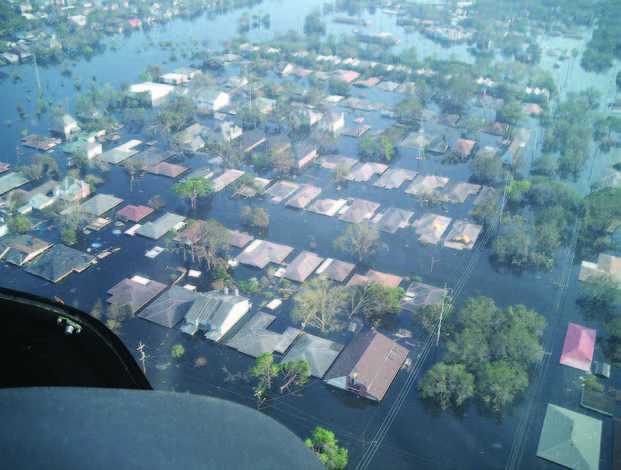
Police Chief Kirk Bouyelas: When Hurricane Katrina hit in 2005, we did have plans in place, but the plans were insufficient. We simply did not have enough resources to manage such a large scale event like Katrina. To mention just one huge issue at the starting point: The levies broke; the streets flooded; our cars were rendered inoperable; and we had to get around by boat. But the department only had approximately 12 boats, and that simply was not enough.
New Orleans Deputy Chief Kirk Bouyelas Another major problem was the collapse of our communication system. Our communications infrastructure was well above the floodwaters. However, debris and glass shards coming off the surrounding buildings severed a water line that served to cool the generators and other electrical equipment. So we lost communication, and basically ended up with individual groups of officers who were operating independently of one another. That went on for days, and it created a lot of problems. Communication is critical in this type of event, and without it our efforts were not unified. Moreover, even if the communications system hadn’t been disabled by the hurricane, we still would have had some communication issues, because a lot of officers’ radios became inoperable after getting wet. We also had scores of police officers who came in from other areas of the country, and we had major interoperability issues. We tried to pair up out-of-town officers with our officers, but that proved to be rather challenging too.
After the Katrina disaster, we rewrote our emergency preparedness plan. We tested that plan with Hurricane Gustav in 2008, and it worked much better than the old plan. Key to that plan was the successful evacuation of the vast majority of residents. We’ve also changed several protocols based on the lessons learned during Katrina. One thing we do differently is the pre-staging of needed resources. We deploy “PODS” now—anticipated Points of Distribution for emergency supplies. So it’s much easier to get supplies out to the troops when they need them. We’ve also centralized our response and fully integrated NIMS (National Incident Management System). Before Katrina, the district commanders were in their districts, and the special operations people were scattered about. Now we bring everybody to several central locations which are tactically located and stage everything out of those locations. Training is also a big part of what we do now. We did not do a good job of disaster training prior to Katrina. Now we have yearly tabletop exercises, and all of the command staff participates. We’ve also incorporated disaster preparation into the in-service training given to our officers. Former FEMA
Director R. David Paulison: Dave Paulison was appointed director of the Federal Emergency Management Agency in September 2005, replacing the embattled Michael Brown in the aftermath of the Hurricane Katrina disaster.
Former FEMA Director Dave Paulison I think the biggest change since Hurricane Katrina is a renewed commitment on the part of the federal government to being proactive instead of reactive. During Katrina, we lacked buses and supplies to evacuate people. The emergency management community didn’t have evacuation plans in place or shelters. We didn’t have plans to take care of people in wheelchairs, the elderly, or anyone else who could need special assistance to leave the city. We also did not have adequate communication between the states. When we reversed the flow of traffic on a highway, the whole system backed up once traffic crossed into another state.
Those experiences taught us to be much more proactive from the federal side. We need to have hundreds, if not thousands, of ambulances and adequate evacuation equipment prepositioned. Both federal and state governments need to work with the local communities to ensure that shelters are in place and evacuation plans are made. Today, New Orleans is light years ahead of where they were at Katrina. They have done an outstanding job applying the lessons learned. When Hurricane Gustav hit New Orleans in 2008, the improvements in preparedness were evident. Nobody had to use the Superdome as an emergency shelter; there was no one in the street. We used the military to evacuate bedridden people out of hospitals into Houston. Buses were there to transport people to shelters. It was a tremendously effective system in which the local agencies, the parishes, the state, and the federal government all worked as a team. One way to think about it is to realize that if your system is ready to respond to an event, and if you have an all-hazards approach, emergencies like the bridge collapse in Minneapolis may happen suddenly and unexpectedly, but there really are no “unplanned” events. FEMA offers a course at our Emergency Management Institute in Emmitsburg, Maryland, called the Integrated Emergency Management Course. It is a four-day course to assess a city’s specific emergency management needs and create a customized plan for that city. All the decision-makers from a city should be present, including the mayor, the police chief, fire, EMS personnel, and others who make decisions in a crisis. The course will take up to 70 people from a city. Oklahoma City went through the course right before the 1995 bombing. New Orleans went through it recently. It’s a tremendous course. Minneapolis Deputy
Police Chief Rob Allen: Chief Rob Allen discussed the Minneapolis Police Department’s response to the collapse of the Interstate 35 bridge in Minneapolis in August 2007. Thirteen people died in the incident, and 150 were taken to hospitals, 50 with critical injuries. The bridge collapsed at 6:05 p.m., during the evening rush hour; approximately 120 vehicles were on the bridge at the time.
Minneapolis Deputy Police Chief Rob Allen With unplanned events, the challenges are that they can happen very suddenly, you have to be able to adapt to changing circumstances, and initially you may not even know exactly what you are dealing with. At first we didn’t know whether the bridge collapse was merely a failure of infrastructure or an act of terrorism. So in addition to being a rescue and recovery event, it also was a large investigative event. It’s important to have relationships with the immediately adjacent police departments and other emergency response agencies that can send personnel to the scene quickly. I called the St. Paul Police Department, and we didn’t need to start at square one because we had an existing relationship, so everyone knew what capabilities the other agencies had. They just asked, “What do you need?” We didn’t have all the resources we needed pre-staged before the bridge collapse. But we did get some important help because of some pre- planning with Target Corporation, which is headquartered in Minneapolis. During the Hurricane Katrina disaster in 2005, Minneapolis had sent a task force of about 80 of our officers down to New Orleans to help. And when our people came back home, some people at Target Corporation said they wanted to meet with us about it. So we met, and the Target officials asked, “What types of supplies did you need to sustain yourselves when you were in New Orleans? What were the types of things that your officers needed that would have been challenging to get otherwise?” So Target took it upon themselves to put together a semi-trailer truck, which they parked on a campus just north of Minneapolis, filled with pallets of water, Gatorade, food, tables, chairs, flashlights, batteries, generators, safety glasses, gloves, vests, sunscreen, and other supplies. When the bridge collapsed in Minneapolis, Target Corporation called and about 40 minutes later I had that semi truck on the scene with all that equipment. We never saw a bill for it.
CHAPTER 2: A “Softer” Approach to Crowd Management: The Vancouver Model Vancouver
Deputy Chief Doug LePard: We really have to thank our friends the Brits for the evolution of our crowd control tactics. They have a lot of experience dealing with hooligans at soccer games, and we were fortunate enough to have hired quite a few British police officers in the last 10 years, some of whom brought high-level crowd control skills, and they also had the contacts with trainers in Britain. We began changing our training, sending our Public Order Commanders to the UK, and also bringing British trainers to Vancouver to assist the Vancouver Police Department in training our members in a new style of crowd management, which was great preparation for the Winter Olympics.
Vancouver, BC Deputy Chief Doug LePard With their input, we started developing what we call our “meet and greet” strategy. Instead of using riot officers in Darth Vader outfits, we aim to be totally engaged with the crowd. We were out there high- fiving, shaking hands, asking people how they’re doing, and telling the crowd that “We are here to keep you safe.” We have found that this creates a psychological bonding with the crowd that pays real dividends. It is very difficult to fight the police if you’ve just been friendly with some individual officers. We police about 300 protests a year; Vancouver is a protest city, so we have extensive experience with crowd management. But the Olympics were something new for us in terms of the size of the event. The scale of the Olympics is hard for people to imagine, because it’s not a one-day event, it’s a 17-day event. It’s like having 17 consecutive Super Bowls. When you’re planning a big event, especially for a medium-size department like ours of about 1,300 police officers, you need a long planning period because there are so many things that need to be put in place. For example, we decided to double the size of our mounted squad and increase the number of people who could do motorcycle escorts of VIPs. But you can’t just put an officer on a horse or a motorcycle the week before. We had to buy the horses, train the horses, and train the officers to ride the horses or handle the motorcycles at a very high level of proficiency, and teach them crowd control tactics. At the 2010 Winter Olympics, the activists were out in full force; they came from all over the place. It’s worth remembering that most protesters are peaceful; only a very small number are criminals and agitators who smash windows, vandalize the corporate buildings, and so on. Our goal was to communicate this message to the bulk of the protesters: “We’re your friends. We are here to protect your right to protest. We will stand in harm’s way to protect your right to protest.” On opening night we did have to draw a line in the sand, because the anarchists wanted to get into the opening ceremony, and we said there’s not a chance of that happening. The situation became fairly violent. Protesters were heaving barricades and rocks and sticks, and some were actually throwing marbles under the horses to try to cause them to lose their footing. They were spitting in the police officers’ faces—and remember, the officers were wearing soft uniforms with no helmets. In short, the protesters were doing everything they could to provoke a harsh response from the police—but they did not get it. After that incident on opening night, the media coverage became much more favorable. Reporters were saying, “Look at the abuse the police have put up with and the restraint they’ve shown, and they managed to defuse this.” A couple police officers were injured, but no protesters were injured or arrested. The next day, the protesters staged a mini-riot and broke some windows, and we did deploy some cops in riot gear. But by then, there were only about 100 “black bloc” protesters [people who wear black clothing, scarves, ski masks, or other face-concealing items] plus about 100 peaceful protesters. The peaceful protesters didn’t want to be a part of what they had seen the night before. The crowds were totally with us. We made seven arrests that day and more later, and when we started making the arrests, the crowds were chanting “Go VPD, go VPD,” because we had built that credibility. After that, the violent groups were spent. A lot of them had booked hotel rooms only for a couple days, so they had to go back where they came from. Part of our crowd control unit deployment is an evidence-gathering team, so that when we make arrests, we can ensure that we have proper documentation. This team was outfitted with a video camera on a pole, which they used to film as much as they could. We also assigned detectives to our crowd control unit, and they were responsible for coordinating all the reports and ensuring the quality of the investigative reports. They didn’t go home until those reports were done right. So no one could say, “We don’t know why those guys are in jail or who did what,” because the detectives were there to make sure that everything was done right. Another thing I should mention is that we don’t call it a “riot squad” anymore. Now it’s the “crowd control unit.” The name helps to send a message about how we view the function of this unit. After those first few days, our main job became managing celebratory crowds. These were outbursts of patriotism among happy people, so in that sense it’s an easier job for us. Still, it’s a big task to manage crowds of hundreds of thousands of people coming into the entertainment zone. The streets were packed so densely that people literally could not move, and the intersections clogged up. Our crowd management units were out in force in soft gear. They are very well trained to maintain a high level of visibility, and they were engaged with the public. We very much won the crowds over. We were part of the celebration. The news media gave us good marks in their editorials, saying things like the Vancouver Police Department deserved a gold medal for policing the Olympics. We had no lawsuits brought against us after the Games. The British Columbia Civil Liberties Association (BCCLA) had about 300 “legal observers” in bright orange shirts videotaping us, and afterwards, the head of the BCCLA, to his credit, said that the observers didn’t witness a single incident of civil rights abuse. We had one formal complaint, and that was from a woman who was upset that we wouldn’t let her into a popular tourist exhibit after hours. That was the only complaint that we had. There were some instigators who tried to spread the word that the police were going to sweep the streets of homeless people and restrict protesters to designated “protest pens,” and the news media coverage included these allegations. But we just kept proactively going to the public in a non-offensive way to explain what we were really doing. We kept telling everyone, “We aren’t going to sweep the streets of homeless people or protesters. We will protect your right to protest and you can protest anywhere you like outside the venues. We are here to protect you.” We had our homeless coordinator out there well before the Games started. Very few of the homeless had to move because of the fence lines. We were working with the homeless to get them into housing and to create a relationship with them. So none of those accusations came to pass. It was really a credit to our crowd control unit members, who put up with an incredible amount of abuse during the first days. Their patience and restraint served as credits in the “credit jar,” and the end result was that the policing of the 2010 Winter Olympics was a big success story. New Orleans
Deputy Police Chief Kirk Bouyelas: We look at Mardi Gras as an annual pre-planned disaster [laughter]. Presently, we are at about 1,500 total sworn officers. We’re down a couple hundred from where we were prior to Hurricane Katrina. And while we do bring in some State Troopers for Mardi Gras, we use every single police officer in the department for some type of Mardi Gras mission. Mardi Gras has two distinct components: the parades, which are a family event and much easier to police; and the French Quarter, which is seen as an “adult event” and is much harder to police because of the large crowds, drinking and general atmosphere. For managing the French Quarter, one of the things we’ve found is that vehicles and pedestrians don’t mix. You have to take the vehicles out of the equation, so everything becomes a pedestrian walkway. That’s why we block off traffic in the French Quarter every year. We deploy officers on walking beats, and we use bicycles, scooters, horses, and just recently, some Segways. EMS is another critical component of what we do, because people in the crowds sometimes need medical services. People may fall, get into a scuffle or have some type of medical condition. We have EMS personnel deployed on bicycles and in golf carts. They also work with officers and we find that it’s much easier for them to navigate through the crowds that way. The aspect of our event management strategy that has made Mardi Gras and other large events a success is our interaction with the crowds. For the most part, people are out there to have a good time, so we don’t use a heavy-handed approach. While we prepare for the worst and do actively stage riot gear, etc., we don’t deploy it unless the need arises. We prefer to use a combination of plainclothes officers and uniformed officers in the crowd. Engaging the crowd is a huge asset and proven strategy for us. And we also employ a lot of discretion. If someone is not infringing on the good times of another person, then we don’t take the heavy-handed approach and enforce minor infractions. If people get into a scuffle, we try to break it up and separate them. During Mardi Gras, arrests are a last resort for us.
CHAPTER 3: Policing Sporting Events and Celebratory Crowds Preparing for the Aftermath of Game 7 of the NBA Finals In 2010, the Boston Celtics and the Los Angeles Lakers met in the National Basketball Association Finals. The series culminated in a winner-take-all Game 7 at the Staples Center in downtown Los Angeles. Police in Los Angeles as well as Boston had to be prepared for large celebratory crowds as well as the possibility of disturbances or riots. LAPD Deputy Chief Patrick Gannon and Boston Superintendent-in-Chief Dan Linskey shared their experiences from that night and the lessons they have learned managing crowds after major sporting events. LAPD Deputy Chief Patrick Gannon: During Game 7, I was in a command post a few blocks away from the Staples Center. The Lakers have had a lot of success over the last few years, so we’ve had a lot of practice dealing with celebratory crowds. The weeks leading up to the Finals are always a test for us, because we have to get our deployment strategy straight going into this type of event. We deploy approximately 500 officers around the Staples Center and the surrounding neighborhoods to deal with a championship game. In 2010, in addition to those 500 officers, we also brought up seven mobile field forces.
Los Angeles Deputy Chief Patrick Gannon I was actually rooting for the Celtics to win, because if the Lakers lose a championship game, then the aftermath is a non-issue in Los Angeles. That has generally been the rule. People are disappointed, but no one riots. Our problem comes when the Lakers win. In those cases, the problem isn’t the 20,000 or so fans coming out of the Staples Center. They are generally just trying to get to their cars so they can go home. However, there is a large entertainment complex right across the street from the Staples Center that attracts a lot of people. When the games get into the fourth quarter and it appears the Lakers are going to win, we get a tremendous influx of people from surrounding neighborhoods and other parts of the city and the county to take part in the celebration, and that’s what has created the problems for us. Boston Superintendent in Chief Daniel Linskey: Boston’s history of managing championship celebrations has not been good. Some careers in the Police Department have been damaged because the department did not order enough resources or because of violent incidents in the crowd. In 2004, a woman who was not involved in any of the bottle-or rock- throwing was killed by a less-lethal weapon.
Boston Superintendent-in-Chief Daniel Linskey Given that history with major sporting events, it was interesting to have the Red Sox go to the World Series, the Patriots go to the Super Bowl, and the Celtics win the NBA Finals as soon as I took this job. I’m still here, so I guess I did OK. We have gotten much better at crowd control. Our planning staff went to the cops on the street and asked what they needed. That’s how we developed our plan. We are still refining and improving. Just like in Los Angeles, the fans coming out of the TD Garden arena aren’t a problem. However, all the downtown entertainment centers are packed with people, and suddenly there are tens of thousands of people who want to stand in the streets and celebrate. They want to be near the event. We’ve urged bars to close up their windows. We also clear the streets at halftime to prevent loitering outside. It’s crucial to have police officers who can talk to the crowd and don’t get nervous. I had a sergeant with only 12 officers clear a Red Sox celebration of 15,000 drunk, hollering college kids, simply by having conversations with them and encouraging them to go home. If you treat people with respect, they can be the eyes and ears for police in case people start throwing bottles and rocks. The crowd begins to police itself. And that sergeant did more than a public order platoon could in terms of moving that crowd. Once the turtle gear comes out, it puts the crowd in the mindset that there’s going to be a fight, and then everyone gathers around to either participate or watch the fight. One of the signs that a crowd is getting out of hand is the presence of fire. As soon as they start lighting things on fire, you have to get a handle on it quickly, because it’s almost like it triggers a primeval instinct. People just start going wild and it builds. We learned an important lesson about combating fires from the first Patriots Super Bowl in 2002. Someone pulled a fire alarm, but the streets were filled with 20,000 people. The fire department pulled up in a truck and I told them, “You can’t go down there, and if you do, I won’t be able to get you out.” And they said, “No, we have to go; this is what we do.” Needless to say, after the truck pulled into the crowd, I got a call saying that the crowd was trying to flip the truck over. And it turned out that there was no fire; it was a false fire alarm. So now we have embedded fire units. Often you don’t need a big truck to come in. A chief with a fire extinguisher can put a small fire out, and that calms down the crowd. After that, you can talk to people about moving along and grab the guy who started the fire.
LAPD Deputy Chief Patrick Gannon: I agree with Dan about the fire units. That is exactly the tactic we were able to use. And we were able to train some police officers in fire suppression. You have to be proactive. We actually had officers with fire extinguishers assigned to our suppression team to put out small fires and make quick arrests. They infiltrate the crowd with undercover officers, with uniformed support off to the side, ready to go in and grab the agitators as they throw bottles or rocks. As soon as you take that kind of proactive action, it takes all of the bravado out of the crowd. Crowds celebrating a sporting event are different from political demonstrators. You need to be proactive. If you just line up police officers as a wall against the crowd during a sports celebration, you’re going to have problems. Chicago
Assistant Deputy
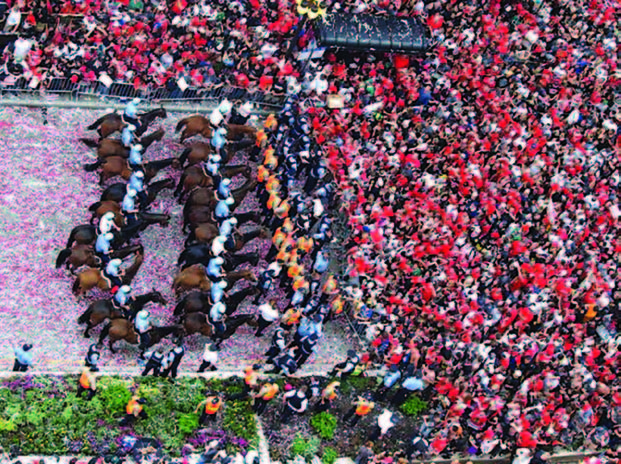
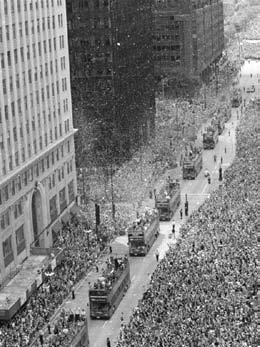
Superintendent Steve Georgas: This is an overhead picture of the rally celebrating the Chicago Blackhawks’ Stanley Cup victory in 2009. The parade started at the United Center and went down Washington Boulevard to Michigan Avenue, where it ended at the Chicago River with a rally at the stage. From a public safety standpoint, we argued to host this in Grant Park, Millennium Park or Butler Field. We asked, “Why are we doing this in a canyon of buildings?”
Chicago Asst. Deputy Superintendent Steve Georgas About 1.2 or 1.3 million people attended the rally, and because we were limited on where we could get resources, we ended up policing it with only about 450 officers and 20 horses. Thankfully, we got through it, but we felt lucky that we didn’t have a disaster such as a mass stampede or a child being crushed in the crowd. Eventually we had no choice but to let the crowd take the streets to release the pressure of the crowd wedged in between the iron barricades and the buildings. Many cities are talking about disbanding their mounted patrol for budgetary reasons. These pictures are worth a thousand words. The TV coverage of the horses moving in and managing the crowd was priceless. Mounted patrols are the greatest thing for this kind of event.
Rally celebrating the Chicago Blackhawks’ Stanley Cup victory in 2009
CHAPTER 4: A Candid Assessment of the National Incident Management System The National Incident Management System (NIMS) is a nationally used framework for governmental and nongovernmental agencies to coordinate their response to unplanned events. NIMS was developed in 2004 and has been adopted by federal agencies for use in incident management and disaster prevention. The federal government also recommends its use for all municipalities and public safety agencies. Washington, D.C. Metropolitan Police Chief Cathy Lanier: We use NIMS in Washington. It’s a good system. It clarifies roles, which is especially helpful when you’re managing multiple sites and multiple incidents. But I think it has to be adapted to your law enforcement agency. You have to employ it with some additional elements. For example, we need a component for processing intelligence.
Washington, DC MPD Chief Cathy Lanier Minneapolis Deputy Chief Rob Allen: I think NIMS works really well for unplanned events. We used it when the I-35 bridge collapsed in 2007. However, I agree that it needs to be modified for law enforcement. The fact that it does not include an investigations branch drives me crazy, so we created one. Many major events have investigative components, so for us that was a sensible reform. We found that NIMS is not always the last word during the Republican National Convention in 2008. When the Secret Service came in to organize the convention as a National Special Security Event (NSSE), they told us that they have their own way of doing things for NSSEs. Secret Service Deputy Assistant Director David O’Connor: I won’t argue with you on that. We’ve found that NIMS is geared toward helping agencies react to a situation. But when we’re managing an NSSE, the whole planning phase—the months and months of round tables and everything else we do—is designed to prevent ever having to be reactive to an event. For us, it’s all about prevention. St. Paul, Minnesota Senior Commander Joe Neuburger: I think the Secret Service does use something like NIMS; they just call it “Subcommittees” and it evolves into NIMS. However, the one comment that I have for the Secret Service is that it doesn’t have logistics as one of its subcommittees. We ended up playing catch-up on logistics at the Republican convention in 2008. For example, we know that if you don’t have bullets and beans, then you can’t arm and feed your soldiers. If you don’t have available water and a functional break system, police officers can’t stay on post indefinitely. If we had had a logistics section early on in our planning, we could have dealt with issues like that. Philadelphia Commissioner Charles Ramsey: I think NIMS is a very good framework as you begin your planning. It’s a valuable checklist that you can use for plans, logistics, and operational planning, or even investigative capacity. We’ve been able to fold investigations into operations, so if that’s something you need, then that’s where it fits. You have to flesh it out. It’s not going to be perfect. It’s going to be driven by the particular event and what the needs are, but NIMS is a useful start. If you’re in a jurisdiction that handles a lot of these major events, you’ll already know much of what NIMS covers. But there are a lot of jurisdictions where the local public safety agencies don’t often encounter these situations, and NIMS can be very valuable for them. And it’s the little stuff that kills you when managing these events. How do you feed your people on post? It’s not like you can give everyone a half-hour break when you’re in the middle of a protest. It just doesn’t work that way. So you’ve got to figure things like that out, and when you go through NIMS and ask the right questions, you start to prepare in an entirely different way. So I think it’s a good framework. It’s not perfect, but nothing is. You have to adjust it to make it fit your particular needs. Former FEMA Director Dave Paulison: Commissioner Ramsey really nailed it. Down in Miami we get the Super Bowl about every four years, and we always use the NIMS system to plan for it. It helps ensure that you don’t forget anything. It’s very organized. Having NIMS and using it on a regular basis make it easier to plan for an event or respond to a catastrophe. During Hurricane Katrina when I took over FEMA, one of the things that I found out was that the federal government did not have any system for sharing information between Cabinet Secretaries. That was one of the major failures, and it was reflected from top to bottom. At the federal level we had a lot of resistance to implementing NIMS from some of those Cabinet members. It finally took President Bush to put his foot down and say, “We’re going to put this in place.” Washington, D.C. MPD Chief Cathy Lanier: I actually think NIMS is most important for planning, not just response. The subcommittee issue is right on point. For the Secret Service during the Inauguration and the 18 months of planning for it, we set it up so that each of our subcommittees reports out its needs to the NIMS coordinators for planning, logistics, and operations. So the subcommittees work as they’ve always worked; there’s no need to change that. It works well because when we go into our operations on game day, the commanders and key people running those operations have been involved in the planning all along. So I actually think it’s more effective for planning than for just reacting to a major incident. Detroit Chief Ralph Godbee: I agree with Cathy and Chuck Ramsey. In Detroit we hosted the World Series, Super Bowl, and All-Star Game during a short span in 2005. NIMS was critical for our planning process, especially for the Super Bowl. To use a sports adage, the way you practice is the way you play. It was a template for us. It showed us how to bring all the resources to the table. When you need to adjust barricades, it’s very helpful to have someone from public works sitting with you in the command post. I ran a command post as a deputy chief and I really don’t think we could have gotten through all of the minor issues if we hadn’t had that NIMS model in place. The practice exercises that you do with major stakeholders and resources are another important planning component. The more you do your emergency exercises within the NIMS system, the better prepared you are when unplanned events occur. Even within planned events, you have unplanned events. Just mapping out those contingencies and playing the “what if ” game really helped us get through some major events without incident. Los Angeles Captain Philip Fontanetta: NIMS has resource typing, which standardizes the terminology for different resources such as air support, mobile forces, bomb squads, and dive teams. This is particularly helpful for mutual aid, because if you request a Type 1 mobile field force, you know you’re going to get the elements you need, such as less-lethal munitions and tear gas capability. You know the package someone’s going to give you, so instead of getting 50 police officers with wooden sticks and riot helmets, you get a functional crowd control squad. Resource typing is a useful tool for when you’re requesting mutual aid.
Los Angeles Capt. Philip Fontanetta University of Wisconsin Chief Sue Riseling: Obviously our scale is very different because there’s no agency in Wisconsin outside of Milwaukee that can deal with major events on its own. So if we have an event like a Presidential visit or a visiting foreign dignitary, we have to take advantage of mutual aid. NIMS gives us a common nomenclature that we all understand. As Captain Fontanetta said, we all know that when we ask for something specific, we’re going to get what we asked for. That’s a great help. NIMS is also helpful regarding communications with non-law enforcement agencies. We have an emergency operations center that includes our transportation people, our folks who run the network and information systems, our public works people, and they all know NIMS. So if you go to the Director of Housing, he’s in the NIMS system and he knows exactly what to plug in and what his role is. NIMS has given us a vocabulary and a way of talking and organizing ourselves when planning events. We’ve proliferated NIMS not only through our law enforcement and fire service, but throughout the institution, the city, and our county.
CHAPTER 5: Working with Multiple Agencies: Who’s in Charge? Often, multiple public safety agencies— each with their own personnel, policies, and vocabulary— must work together seamlessly to manage an event. Participants at PERF’s summit shared their advice and experiences on coordinating with partner agencies. Atlanta
Chief George Turner: The biggest challenge I see in our city is that we have multiple joint operations centers in our city during an event. The city of Atlanta also resides in a county, so there is a joint Atlanta-Fulton County Emergency Management System. There is the Georgia Emergency Management System. And then there’s the event operations center. So where are the decisions being made?
Atlanta Chief George Turner Philadelphia
Commissioner Charles Ramsey: I think you have to define the question as who’s in charge of what. Responsibilities need to be very clear. As an example, if you want to use a particular street, you have to know who is in charge of maintaining that street so it doesn’t become overwhelmed with people. A specific agency must have that responsibility, and all the agencies working along with them to clear that street should fall under the responsible agency’s chain of command. I think that part of the problem is that people like the idea of appointing a czar, a single person who has enormous authority over everything. But that’s not how things work in reality. It’s really about who is in charge of what. Even if there is more than one operation center, as long as they are connected and there is a good flow of information and clarity in terms of each operation center’s mission, then you should be fine. You need to know who is the “go-to person” if there is a problem with the phone system, or the streets, or any given contingency. The roles need to be clarified. I think that’s what is missing sometimes in the planning process. That’s also where egos and turf get involved, but you’ve got to be clear on those responsibilities. U.S. Secret
Service Deputy Assistant Director David O’Connor: This is an issue we have a lot of experience with in Washington, D.C. The key for us, especially during the 2009 Presidential Inauguration, was that the Multiagency Command Center (MAC) included everything—every relevant agency plus the phone company, the water, electricity, and cable utilities, etc. There were senior representatives who had to be involved in all of the planning phases and report to the chief. Our Director and the FBI are all in the MAC. Everyone is co- located, so all the information is brought into one location.
U.S. Secret Service Dep. Asst. Director David O’Connor Like Chief Turner, we have to deal with the question of, “Who is in charge?” That’s the first question a Senator will ask when Senate Sergeant at Arms Terry Gainer, MPD Chief Cathy Lanier, and I testify together before Congress. The reality is that if we’re at the Capitol, then the Capitol Police and Sergeant at Arms are in charge. If we’re in metropolitan D.C., there are clearly defined roles for MPD. But everything is dependent upon the relationships that have been formed in advance of an event. If you haven’t established those relationships and that ability to work together through table top exercises, then you’re in trouble. U.S. Capitol
Police Chief Phillip Morse: During the 2009 Inauguration, there were many different events and venues that required multiple jurisdictions within the District of Columbia to provide security and first responders.
U.S. Capitol Police Chief Phillip Morse The biggest challenge at this type of large event is getting the information down to the people who have to execute the plan when unexpected changes occur. How do you reach out to the officers and first responders on the street, who are probably from 15 different police agencies, none of whom have the same types of radio communications? For example, our original plan was that 1.8 million people would fit on the lawn of the National Mall, but the reality was that overflow blocked egress and access on streets around the Mall. So when you are executing a plan but it changes, who is going to get the information about those changes down to the officers in real time? It can be difficult, especially if you’re not all under the same communications system, and not under a single command that’s able to disseminate the information through the single communication system simultaneously.
Charlotte-Mecklenburg, NC Chief Rodney Monroe: I spent the majority of my career in Washington, D.C., where I helped oversee and manage the Million Man March and a Presidential Inauguration. I know that there is an overarching command center, but when you have those much smaller command centers on the ground, they can expedite the decision-making process. If the focus is one central command, there’s a delay in relaying directions to ground forces.
Charlotte-Mecklenburg, NC Chief Rodney Monroe I believe that someone in control should be on the ground, so they can assess the situation up close. Seeing and hearing the tenor of the crowd and determining the crowd’s attitude regarding a situation gives you a better opportunity to determine the best tactical method to deploy. New York
City Assistant Chief Harry Wedin: During the 2004 Republican National Convention, there were multiple command centers. We used fusion centers, but we made clear that everything had to go through the Multiagency Command Center. We had a representative in every command center from NYPD to make sure that the MAC was involved in every decision. And every decision would come from the MAC, from the deployment of personnel to moving personnel around to handling any incidents. We follow that rule all the time. If people start making independent decisions from different command centers, then nothing is coordinated and it becomes a big mess. We have found that once all information and decision-making comes through the MAC, it works.
New York City Asst. Chief Harry Wedin
_______________ Notes: 1. Other resources on this topic provide detailed checklists and guidelines, such as the COPS Office’s Planning and Managing Security for Major Special Events: Guidelines for Law Enforcement (2007). http://www.cops.usdoj.gov/files/ric/ Publications/e07071299_web.pdf.
|