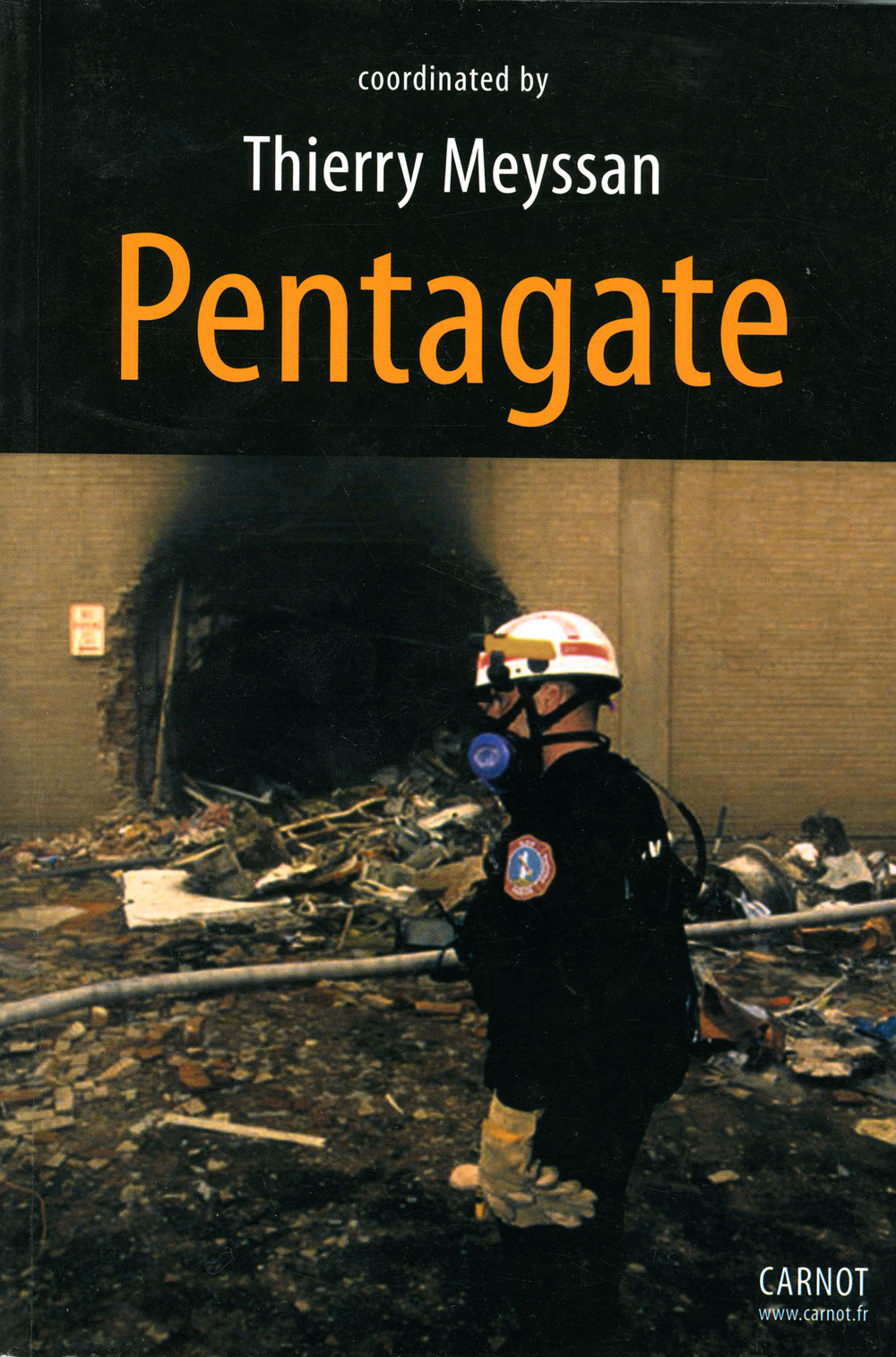
|
coordinated by
Thierry Meyssan, © 2002 by
Carnot Publishing
"In the councils of government, we must guard against
the acquisition of unwarranted influence, whether sought or unsought, by
the military-industrial complex. The potential for the disastrous
rise of misplaced power exists and will persist. We must never
lest the weight of this combination endanger our liberties or democratic
processes. We should take nothing for granted. Only an alert
and knowledgeable citizenry can compel the proper meshing of the huge
industrial and military machinery of defense with our peaceful methods
and goals, so that security and liberty may prosper together." --
President Eisenhower's Farewell Address, 17 January 1961
|
Several experts have tried to explain the official version. This version in its entirety is quite
complex and deserves to be studied attentively.
-- The absence of debris from the Boeing is
explained by the fact that the plane was pulverized
when it crashed into this particularly resistant building. "The impact released extreme energy, causing
the pulverization of the aircraft," explained an anonymous expert consulted by Le Monde. [6] "The shock
was such that the plane was literally pulverized,"
commented yet another anonymous specialist quoted
by Liberation. [7]
-- The disappearance of the parts of the plane
that are particularly resistant, such as the jet engines
or the brakes, is explained by the fact that the aircraft
had totally melted (with the exception, however, of a
beacon and the black boxes found three days later [8]).
"As opposed to cars, planes are above all composed
of aluminum, which starts to liquefy towards 1,050°
F and the structures of the aircraft melted," analyzed
Le Monde. [9] This was confirmed by Liberation:
"Much of the plane's debris also melted in the intense heat." [10]
-- As for the absence of one hundred tons of
melted metal, this is explained by the fact that the fire
attained temperatures above 4,500° F, thus causing
the evaporation of the plane's materials (but not
those of the building, nor those of the beacon and the
black boxes). "Depending on what caused it, the
materials that feed it, its exposure to oxygen and its
duration, a fire of this magnitude could release heat
of between 3,000 and 4,500° F," another specialist
stated. "The heat released by the fire during 24 hours
thus leads us to understand that the greater part of
the plane's remains were destroyed." [11]
-- The presence of the last hole with a seven
foot diameter is explained by the fact that, despite all
these ordeals, the nose of the plane continued its mad
course through three buildings. That is the conclusion reached by the head of the Pentagon's renovation operation.
According to the official version, the
damages could thus have been produced by a
Boeing 757-200. For that to have occurred, the
plane was capable of disintegrating when it made
impact with the Pentagon's facade, of melting once
it was inside the building, of evaporating at 4,500°
F and nevertheless perforating two other buildings
to create that hole of seven feet in diameter... [12]
-- Pentagate, by Thierry
Meyssan |
Title page photograph by: Department of Defense (DoD), All
Hands, US Navy
Other pictures: DoD, Tech. Sgt Cedric H. Rudisill; source
www.geoffmetcalf.com; US Marine Corps, Cpl. Jason Ingersoll; US Army,
Sgt. Carmen L. Burgess; Jim Garamone, American Forces Press Service (see
Photo section). Library of Congress Cataloging-in-Publication
Data: Meyssan, Thierry. The Pentagate / by Thierry Meyssan.
p.cm.
Includes bibliographical references.
ISBN 1-59209-028-1
DISCLAIMER:
This publication contains the opinions and ideas of its authors.
It is intended to provide helpful and informative material
on the subject matter covered. It is sold with the understanding that
the author and publisher are not engaged in rendering professional
services in the book. If the reader requires personal assistance or
advice, a competent professional should be consulted.
The author and publisher specifically disclaim any responsibility for
any liability, loss, or risk, personal or otherwise, which is incurred
as a consequence, directly or indirectly, of the use and application of
any of the contents of this book.
|
"The
speed, the maneuverability, the way that he turned, we all
thought in the radar room, all of us experienced air traffic
controllers, that that was a military plane." [19]
-- Pentagate, by Thierry
Meyssan |
Table of
Contents
|