|
THE RELIGION OF THE ARYO-GERMANIC FOLK: ESOTERIC AND EXOTERIC |
|
Part 2
Every self [Ichheit], especially every human self, creates its
own
"Garmic chain" (chain of causality), which it cannot escape. But
this self
is in a position to guide its Garma (destiny) toward its best goals
as it
always -- like Freya and Forsetti -- maintains a balance
But the individual ego [Ich], as an individuality, is caught up in
Garmic chains other than its own; for no self [Ichheit] stands
alone, but
rather it is only part of a group. Groups join together to form
larger
circles and so forth until they encompass everything generally. The
next
set of groups to which the individual ego is subordinated is that of
the
family, then the tribe, then the community [Gemeinde], the people
[Volk], the state, the race, humanity, the earth, the solar system,
the next
higher systems of the central sun, and so forth -- who can say to
what
levels!? -- until one reaches the All-Father himself. If Wuotanism
only
takes us to the Sun
If the self in question is therefore born into, for example, a royal
family, then the Garma of this family will influence his individual Garma,
just as his Garma will in return influence that of the family. If
that royal
family perhaps even loses its position of power through the fault of
this
individual and descends during the course of ages to an
insignificant level,
then the Garma of that self, incorporated within that family, will
be
influenced over time in such a way that the selves [Ichheilen] born
at the
time of this nadir will also have their sphere of power reduced.
Since,
however, each self is, as a rule, reborn into its own family, [22]
and since it
cannot escape from the circle in which it is incorporated, it is
true that
every self was -- as an essence (personality) -- its own ancestor just
as it
will be its own descendent. In this way it realizes its own Garma, in
the
good or bad sense, in the course of subsequent rebirths. ("The sins
of the
fathers avenge themselves on their descendants to the seventh
generation." [paraphrased from Genesis 34.7]) But their virtues are also
credited to an equal degree, for Freya and Forsetti hold the scales
Now since every self possesses this inner voice, more or less developed in a way corresponding to the level of its own development, it is also true that every self may seek a direct connection through this voice with the Godhead itself, which is therefore not outside of the heart, not "up there beyond the vault of stars," but rather within the self, in its own heart, and this awareness is called "the inwardness of God" [Gottinnerlichkeit]. Those fortunate ones who know how to find God within themselves no longer need a intercessor, or priest, they have arrived at a stage of "self-priesthood," their heart is the tabernacle in which they carry God contained within themselves. Their whole being [Ich] is the sanctuary [Halgadom] of the Godhead itself, and their whole lives are self-sacrifices which they dedicate to the God within and thereby also dedicate themselves directly to the All-Father himself. Therefore our ancient ancestors called this "inwardness of God," and the self-evolving self- sanctification [Selbstweihe] developing out of it, by its correct name: Wihinei, i.e. "the inward sanctification," while it is otherwise called by its Latin name: religion. But religion means "reconnection (with God)," which indicates a condition in which the original "inwardness of God" is obscured. This inwardness is already seen as something which has been lost, while the concept Wihinei presupposes the full possession of the inwardness of God and thus indicates a higher ethical concept. The concept of self [Ichheit] (individuality) always remains the same from the beginning of the First Logos forward to the dissolution of the spirit and the cessation of time and space. This is in contrast to the concept of the essence [Wesenheit] (personality), which is temporarily bounded by life and death -- and thus the concept of self obviously indicates the complete exclusion of a condition of destruction and amends the concept of death accordingly, such that "death" is merely life in the primeval state [Urstand] and only means a cessation of the essence or substance [Wesenheit]. Now since, however, every self, as soon as it is reborn, creates a new substance (personality) as a phenomenological form according to its lower or higher Garmic development, it has actually prepared for itself the conditions for its new life in a human body on the basis of its own thought, feeling, speech, action and inaction in previous lives in human bodies. So the self continues the fulfillment of its special position according to the degree of its development in these newly begun human lives, i.e. it begins this activity at the level where it was interrupted in its last life. In order to make this more understandable by means of an example, in accordance with the law of homogeneity let's take a painter. He is conceiving of a plan for a picture. He lies down to sleep at night, after he has undressed (died), that night he dreams of his planned work (preparation in the primeval state) and rises early in the morning (is reborn) and gets right to work. He draws the initial sketch on the canvas, primes it, etc. The evening comes and he once more goes to bed after he has laid aside his raiment (substance, personality) and goes to sleep (dies) once again. Once more he awakens (is reborn) in order to continue his work where he had left off the day before. Thus many days (lives in human bodies) pass, and just as many nights (primeval states), but the work gradually continues to move toward its completion. Many more days and nights pass, but finally his work -- let's say on the seventieth day -- is finished and he receives a good price for it. Is being born and dying really so different from getting up in the morning and going to sleep at night? We see in the history of inventions how many centuries it it took before the discovery of the power of steam could be turned into steam-machines, locomotives and steamships. There were enormous intervals, spanning centuries, between the individual experiments and the time when completed inventions could come into general use. Is this any different from the example of the painter and his picture? How many rebirths did, for example, the self of Vasco de Garay, who traveled on the Danube for the first time by means of a steamboat in 1543, have to go through before it once more traveled by steamer on the Seine as Robert Fulton on the 9th of February 1803? What courses of development did this self have to undertake in the past and what lies ahead of it still? For, that there exists a connection through reincarnation between Garay and Fulton cannot be rejected out of hand. If, through recognition of the necessity of rebirth, certainty has now been gained [24] concerning the continuation of life in death beyond the grave, then the no-less understandable certainty follows that without acceptance of rebirth or reincarnation there could be no development in the story of mankind, as this would otherwise always stall out in the stages of initial advances, if there was no rebirth, and every newly created self would have to start over from the beginning. It would be like a tangled mess of almost countless individual beginnings instead of an organically constituted evolution with conscious aims and certainties consisting of a harmonious cooperation of numerous selves who form the warp and woof of the Nornic fabric on the loom of the raiment of the ages in order to make the Nornic weave-work possible. As with every weave-work sometimes the thread (sell) runs on top, visible (as the essence in a human body) then once more underneath (in the primeval state, in death) and invisible, only to reemerge visibly once more and thus contribute its part to the pattern of the whole. If one were to pull just one thread out of a tapestry -- e.g. out of a Gobelin [25] -- the whole work of art would be ruined, but yet again, how difficult it is to trace a single thread the whole way through when one looks at the entire work! It appears insignificant, yet it is precisely in this way that individual selves behave within the All -- they seem to disappear in the All, and yet the All would no longer be the All if just one of them were to be lacking. In the Law of Garma the highest form of justice belonging to the ruling -- and this should be emphasized -- the consciously ruling deity is both concealed and established. Every self [Ichheit] has to bear the same mission, the same path, the same measure of suffering and joy, which is doled out among all its many reincarnations. It is therefore more than shortsighted to compare in a correlative manner the life-conditions of one's contemporaries and from this comparison draw any conclusions from the results. In every individual substantive life of those now living only one phase of rebirth is visible, and we are in no way able to get even the smallest overview of the whole chain of rebirths. Such a judgment would be as nonsensical as if one were to cut out a pea-sized piece from each painting in a large collection of thousands of paintings and thoroughly mix up all the little pieces and then venture to make a judgment on the value of the art of painting from the resulting montage. None of us is in a position to evaluate correctly the self [Ichheit] of another by observing its present life, no matter how well-known it is to us. This is because at best we can only know a large part -- and not even the entirety -- of its mask, of its outer substance, but nothing of its inner self which remains its own innermost property and the secret of each individual self. We can therefore hardly recognize the traits emerging from this self's Garmic developmental process, but the hidden threads of the earlier and incidental Garmic reflections cannot be recognized at all. Indeed the least of us will have their self- knowledge so submerged that they will only know their own Garma. The comforts life offers them they accept as a given, the discomforts, which they rightly know in most cases to be their own fault, are rejected with moans and laments as undeserved accidents and they blame the deity for being unjust. Indeed undeserved accidents actually do occur often enough in this life, just as completely unearned strokes of luck do, but these are actually rooted in the Garma from earlier lives in human bodies, as a result of actions whose roots only very rarely become conscious, which, however, always follow Garmic laws and therefore accord with the perfect justice of the consciously ruling deity. Furthermore, it should be considered that our ancient ancestors, especially those belonging to the early stages of humanity, lived in less than enviable conditions that are hardly comparable to our lives today, and that we ourselves are in large measure establishing, or at least preparing the way for, the improvement of the living conditions of our descendants, without ourselves benefiting from this improvement. This would constitute a limitation of the pleasures of life for the ancestors in relation to the dependents if it were not the case that the ancestors were their own descendants in that without exception all selves live through all ages with only brief interruptions which they spend in the primeval state. The length of time for the stay of the self in the primeval state [Urstand] after the death of the substance (personality) should, according to the law of homogeneity, last about as long as the length of life in the human body, for day and night are almost in balance, although on average the day exceeds the length of night. But now the question of what the self does in the primeval state, and what it can expect there, must be answered. To be able to answer this question we must go back in more detail to the foundational heptads and the nine abodes of the gods. As to how the All (everything) evolved from the One and nevertheless remains One, i.e. the All-one (whence the misunderstood and misused saying "Everything is One"), and subsequently formed the polyvalent-polyunified poly-unity [26] and in a further intensification the all-valent-all-unified all-unity, [27] has already been alluded to in these discussions, but they should be even more soundly explained. The series of stages for this is as follows: The monad: i.e. Surtur the Great Spirit, Holy Spirit.
[The dyads.] The "bifurcated bi-unified Bi-unity": The revealed god,
All-Father, the World-Spirit
The triads: "trifurcated triunified Tri-unity": The Three-Gods: Wuotan, Will, We; Har, Jafnhar, Thridri; Wuotan, Donar, Loki; Freya, Frauwa, Frigga; Urda, Verdandi, Skuld. The "three-things": Yggdrasil with the three wells, three roots, three branches (3 x 3, see below concerning nine), arising, becoming, transition; past, present, future (time); height, width, depth (space); three holy times, etc. [28] The tetrads: The first four known elements: fire (Muspellsheim), water (Adhumbla), air (Niflheim), earth (Ymir). The four ages: the golden, the silver, the bronze and the iron. The four conditions of the self [Ichheit] as an essence: arising (birth), becoming (life in a human body), transition (death), preparation for a new arising (death, life in the primeval state). The four dwarves of the quarters of heaven: Austri, Sudri, Vestri, Nordri (east, south, west and north), and many other tetrads, such as: four brothers, four women, four heads, four horns (corners) of heaven, four harts, four streams of milk, four oxen, four bulls, four gates, etc. The pentads: The holy Fem (five), the five known elements (fire, water, air, earth, ether or aether), the five recognized senses (for, in fact, there are seven), [29] the pentagram, the five brothers, the five maidens, the five men, the five nights, the five sons, the five winters, etc. The hexads: The hexagram (six-star), the sixth day (sextac). The heptads: the seven rays of light (rainbow), seven fires, seven tones, seven goddesses of love, the seven gods, Sibia, seven years, seven senses, seven months, seven weeks, seven days, seven nights, seven winters, seven worlds, seven rounds, seven races, seven heavens, seven underworlds, seven she- eagles [Adlerininnen], seven half-years, seven kings, seven maidens, seven electors, seven halls, seven sisters, seven brothers, seven sons, seven springs, seven mountains, seven oaks, seven planets, seven- stared constellation, to swear an oath before seven [besiebenen]. The octads: The high holy eight [Acht]-tribunal. Eight eyes, eight brothers, eight nobles, eight feet, eight knaves, eight salmons, eight men, eight nights, eight days, eight resting places [Rasten], eight rings, eight sisters, eight parts, eight winters, etc. The enneads: The nine divine worlds, the nine mothers of Heimdall, the nine valkyries, the nine wave-maidens (nixes), the nine branches, nine main songs, nine magical songs, nine kettles, nine knaves, nine maidens, nine-man work, nine feet wide, nine moons, nine nights, nine days, nine months, nine resting places [Rasten], nine realms, nine giant-daughters, nine palaces, nine steps, nine sisters, nine daughters, nine worlds, nine winters, nine wolves, etc.
The decad is only known to the great secret tribunal [Acht] of
Armanism and signifies the creator or divine provider (Gibor-altar).
It is
formed from the three-gods and the seven-gods (3 + 7 = 10), which
together make One, the One. Its sign is
As is virtually self-evident from this brief summary of the first ten words for numerals, these did not originate from dry numerical values, but rather have their origin in the developmental representation of the great evolutionary process (cosmogony), and signify the evolutionary stages of this process with very precise concepts, which only later become numerical values. And this knowledge is also the basis of the secret science of numerical symbolism. From this standpoint let us take a look at the interpretation of the words for numerals we have already introduced:
One [ein] en, een, einn, ains, an derived from
ei, ai = sun,
therefore
also "oath," "aiter-nettle," "egg," etc. The sun is the symbol of
the
"spiritual sun as God," and as such it is the epitome of the
One,
and thus
once more the egg, as the world-egg, is the symbol of creation. Thus
the One was developed as a numerical value from the concept of the
revealed One, from its symbol -- the one visible sun. The written
sign for
this numerical value is the Is-rune: "
As we have already shown, the symbol of zero is likewise derived
from the holy-sign of the circle, which symbolizes the unrevealed
God,
and also the other numerical symbols -- falsely called "Arabic" --
were
developed from the circle combined with the sign of multiplication,
the gibor-rune:
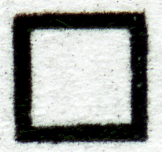
Two (2, II) masculine twai, twegen, zwene, zween; feminine twos, two, zwo; neuter twa, tu, zwei, only in New High German did the neuter form assert itself over all other genders. Since the primeval words ta, za, and sa are equivalent in meaning, it becomes self-explanatory as to how in many other words there is a sound change form t to z. Ta, za, tu, etc., means "to make, do" and therefore the sense of "doing, making, creating, shaping" still underlies the number two in the secret language of the high secret tribunal [Acht]. The concept "two," before it ever indicated a number, was therefore one of creativity and of the creator in its bisexual (androgynous) manifestation and later was transferred to the godhead divided into a masculine and feminine side to be reunited sexually -- the bifidic-biune- duo-unity, and from this conceptual model the numerical value was only later developed. Three (3, III) thri, dri, threis = turning, winding . . It was already mentioned above in connection with the three-gods: Har, Jafnhar and Thridi, that the "thri," in the name Thridi, does not mean the "third" but rather the "turner," the transformer (toward new arising), for dri or thri relates to revolving [Drehung] as this precedes becoming and as it governs all of creation. (Turning in the storm clouds, in boiling water, in clouds of steam and smoke, in the stars, etc.) Turning is at the beginning of all of life and all of doing, therefore those gods were called thri-, dre- or Three-Gods and it was only out of this conceptual framework that here too the numerical value was developed, for these thri-gods always formed the basis of that number. For this reason the creative force of thri, or turning, is always esoterically hidden behind the numeral three, something which has been preserved to the present-day in the high secret tribunal [Acht] and its secret script (hieroglyphics); e.g. in architectural symbolism and heraldry. Four (4, IIII, IV) fyr, viur, vier = fire, Ur-fire (Urfyr) god in fire; but since the Urfyr is the spiritual sun itself, the Ur-light, it once again points to God, from whom, as the First Logos, the four Ur- elements emerged, the first of which is in fact this very fire. It no longer needs to be repeated that the numeral "four," and its predecessors and subsequent number-words were all actually developed from these concepts, and likewise that the high secret tribunal [Acht] even today still firmly maintains the original meanings of the words in their secret script embodied in the symbolism of architecture, heraldry, etc. For this reason therefore such references can be dispensed with in what follows. Four also constitutes the square, which along with the circle is known as the most perfect figure, and as the rectangle (Fyroge) is a symbolic secret sign of the all-seeing godhead.
Five (5, V) fem, fim, fimf, funf, fnf.
Fem means that which is
homogeneous, therefore even today it indicates the guild or
corporation
in the Dutch word veem. It had its origin in the five correlated
fingers of
the hand, in the correlated five senses that form man and it
signified the
elven cross or the witches' foot [Drudenfuss] also signified by the
pentagram (femsteor)
Six (6, VI) seks, sehs, saihs, sex is perfected creation, the Third
Logos, and therefore this word indicates procreation, both divine
and
human. The word se-ask or se-aks, that is formed from a combination
of
the Ur-words se = "sun" and ask or ahs = "arising or causing to
arise
(generate)," therefore this means: 1) the arising of the sun or
creation of
the world and 2) generated by the sun, i.e. a) creation of the
macrocosm,
and b) that of the microcosm or of humanity, which regenerates
itself. It
is of mystical importance that six, seen as a number, is the first
perfect
number: It can always be divided in equal ways, when one takes 2 x
3;
half of the diameter of a circle divides that circle into six parts,
the entire
diameter into three parts; therefore the circle encompasses either
an
equilateral triangle
It is especially important, and to be decisively emphasized right here, that neither in Armanism nor in Wuotanism are all of these references to holy-signs indicating "sex" (sexuality) to be understood in an erotic, sexual sense, for phallolatry, as developed among the oriental as well as Greco-Roman cults, was unknown to the Aryo-Germanics. [32] To them all sexual processes were exalted divine mysteries, thus the high veneration of women, thus the strict marriage laws, but thus also the open and honorable cultivation of sexual religious festivals, because these were still perfectly free of all lustful eroticism among the Aryo-Germanics. The often used characterization of this holy-sign of the "high secret sex" as a "secret phallic sign" is a misunderstanding if it were to be connected to phallolatry, but it would be perfectly correct if this characterization is used in the mystical sense connected to procreation in the cosmos and in humanity. Only when Wuotanism transitioned into Christianity did that "high secret sex" descend into the phallolatry of the witches' sabbath, about which more is discussed in the book Der Ubergang vom Wuotanismus zum Christientum. [33] Also here there is no more than the need for a brief mention that only later did the numeral develop out of the deeper meaning of the "sex" and that in heraldry, etc., all things in groups of six (six rods, six bulls, six arrows, six heads, etc.) all symbolically refer to the "sex," not to the numeral "six."
Seven (7, VII) sibun, formed from the Ur-words
si = sun and bun =
turn, play, change. Sibun therefore means "the shimmering-colored
sunlight
(in the seven colors of the rainbow)." According to the laws of
homology, not only are light and sound seven-parted/seven-unified
[siebenspaltig-siebeneinig], but rather so too are all
manifestations of the
powers of the godhead in perceptible nature, and therefore as a
numerical
value in arithmetic and mathematics the Seven also has to
demonstrate
the same characteristics. The Seven (sibun) is formed from
the Three
Eight (8, VIII) aha, ahtau, ahton, ahto, ahta, aht, ahte (aha =
mind; ahma [om] = spirit; ahjan = to believe; aht = the
Acht, i.e.
lawlessness; aht = to pay heed, etc.). Indeed, the expression often used in this
book,
"high secret Acht," and the many other code-words developed from the
Ur-word ak, ag, ah, already show that the numerical concept was
attached to "eight" only at a very late time. Speaking mystically,
and not
mathematically, 2 x 4 = 8, i.e. eight originates from the
combination of
the biunity with the tetrad. The biunity is father-mother and the
tetrad
[Vierheit] is the Fyrheit [fourfoldedness -- fiery-ness], that
constitutes the
elements evolved out of the fire -- or Urfyr. These elements are set
into
motion (ag, ak, ah) by the divine generative power (creation) and
this
movement leads to becoming and transformation, therefore this
process
should be given special heed [Acht]. To this is also connected the
Ur-word h'ag, which we still have in an unaltered from in the concept
"Haag" [hedge], which is signified by the hag-rune
Nine (9, IX) niun, compounded from niu = new and un = the One, the Great, the All-One (the comprehensive One), therefore: the "New One." This New-One is, seen mythically and not mathematically, viewed as the one born from 3 x 3, the Third Logos, that God which is revealed in Man. For this reason the New-One signifies Man himself, and therefore the number nine is the number of mankind as well as being the thrice-holy number, because it contains a threefold arising (beginning), a threefold becoming (middle) and a threefold transformation (end). As the holy, or thrice-holy, number of Humanity, nine throws a clarifying light on the nine worlds or divine abodes, which are as follows:
Refraining from getting into more details on the meanings of the words, there are other enneads to be considered: these include the nine mothers of Heimdall, who actually correspond to the nine abodes, or the nine valkyries and other groups of nine things. Likewise the world ash,Yggdrasil, with its three roots, three springs and three branches, is to be provisionally referred to as an example of the inaccessibly high symbol of the high-holy threefold Tri-unity. Now, if the New-One is the God-Man himself in an esoteric-mystical interpretation, and if the thrice-holy nine is the hallowed number of perfected man, then the number ten is the Godhead itself, as we already showed above. Much more about number symbolism here world lead us too far afield, nevertheless we should, when the opportunity arises, take the meanings of such symbolism into account in the context of the present work. The question does, however, come up as to what exactly gives rise to the self (the unembodied soul) in the primeval condition [Urstand], and what it has to do there.
First of all it must be shown that the human being is more than
merely the spirit-body duality and that it is actually a
self-contained
heptad [sevenfoldedness] and thus a spirit-soul =
These seven parts are closely connected to, but not inseparable from, one another, and are actually layered one over the other like the structure of an onion. The physical body provides the outer form of appearance, the substance of every self, but the other more subtle bodies cross the boundaries of the physical body and only become visible under special circumstances, and thus they sometimes become visible as the aura. Upon death the self casts off the physical body, which it leaves with the ethereal body, but it still possesses life, the instinctive body and all psychic characteristics. Yet even during the time when the self possesses a physical body it sometimes separates itself from that body. This usually occurs unconsciously during sleep when it hovers above the sleeping body like a light mist. Such separation can also occur due to darker causes (psychic doubles [Doppelganger]) in somnambulistic states, etc. Sometimes, however, this can also also be caused by means of conscious willed effort. But the self does not yet slough off the substance (personality) along with the physical body, whether consciously or unconsciously, in life or upon death. The life-force slowly continues along its further transformations through the four upper or lower divine abodes. What the self immediately loses upon death, however, is the physical body and with it only the outer form of the substance (personality).
The folk belief of Wuotanism appoints to every self two protective
spirits -- fylgjur, following spirits -- which urge the self to choose
the
right- or left-hand path, while the conscience -- either the guardian
of the
gods, Heimdall, or the judge of the gods, Forsetti -- passes
judgment.
These are the
In the upper realm as regards the nine abodes of the gods we have Mannaheim, the homeland of men or the world of humans, standing as the fifth in the series, holding the middle position between 4. Wanaheim and 6. Jotunheim, between 3. Asaheim and 7. Darkalf-world, between 2. Alfheim and 8. Helheim, and finally between 1. Muspellsheim and 9. Niflheim. But now, according to how the self conducts itself in life, whether the spiritual soul or the human soul overcame the other, the spirit itself will show the way -- as its own judge of the dead [Totenrichter) for the disembodied soul -- toward either Wanaheim or Jotunheim, i.e. toward higher spiritualization or toward lower materialization. This is neither reward nor punishment, but rather Garma, conditioned by the self's own will. As the now disembodied self enters into a circle of spiritual forces -- be this in Wanaheim or Jotunheim -- it takes on those spiritual energies corresponding to the desires, inclinations and habits which it used to form its ideas and its desired and willed goals as spiritual conceptions in its last physical life. If these desired and willed goals were truly and deeply directed toward spiritual things such as art, science, ethics, etc., the self in question moves on into Wanaheim and there it leads a joyous spiritual life in the circle of those blessed spirits into whose orbit it brought its desires and longings -- for all illusion and hypocrisy remain with the soulless body in the grave -- and these (often unfulfilled) longings and strivings which prevailed in the previous human life are intensified in those spheres. But if this desire, striving and longing was directed toward material pleasure, material possessions, money and property in the previous life, the disembodied self will find others like itself in Jotunheim. Its appetitive body increases, but the means by which this appetite can be quelled are missing and so the soul suffers the torment of longing and remains bound with a thousand chains to the corporeal world. Since, however, these divine abodes are not to the found outside our terrestrial plane of humanity as geographical or topographical areas, but rather they are situated in the midst of our world the blessed spirits hover around in their astral bodies in the vicinity of their loved ones left behind on earth as good spirits and carry out familiar interactions with loved ones in that they provide them with good, kind thoughts and give them comfort, while those unhappy spirits, [35] likewise in their astral bodies, seek to satisfy their appetites. They hold up in dens of iniquity where those appetites are indulged which correspond to their longings, and they even temporarily, for shorter or longer periods of time, take possession of the physical bodies of weak selves in order to satisfy their lusts in the physical bodies of such selves -- lusts which were at first so delicious, but which have now become curses. This is that spiritual phenomenon of disease which we call delirium, [36] but which would be far more accurately characterized as possession. Whoever occasionally visits certain places will be able to confirm the fact -- otherwise inexplicable -- that in that place there seems to be a rather strange fluidium in the air. This seizes him like a frenzy and involuntarily motivates him to actions and excesses, or at least tempts him in directions he would not normally entertain, and this frenzy leaves him again as soon as he no longer breathes that air, i.e. leaves the place in question. [37] But gradually the astral body fades and after it evaporates the self commences its migration toward the next divine world, i.e. either to Asaheim or Darkalf-heim, whichever is necessary. There similar processes are undergone until the self sheds the body of life, i.e. that body which still connects it materially to the human world. Only then does the animalistic life really cease, but the appetites remain and increase the torments as they now become more difficult to satisfy, while the satisfaction of the appetites toward spiritual properties are eased considerably, and thus afford blessed joys. Still clothed with the appetitive body, burdened by the final bonds to humanity, the soul enters Alfheim, or Half-world, whichever is appropriate to its progress. Only completely free spirits make it to Muspellsheim, while on the other hand completely fettered spirits go to Niflheim. From neither of these two divine worlds is there any further return to the human world by way of rebirth. In both places spirits remain in a fully conscious state until creation is renewed in the next cycle. The one in blessed remembrance and spiritual enjoyment, the other in a condition of torment and regret. But it is not hopeless, for they too can look forward to salvation in the next cycle, yet they have to seek to make their way once more from below upwards through all the levels of matter, struggling upward to attain a future human level, which they will inevitably obtain, even if it is at the end of time and space! The disembodied souls in the other planes are reborn and in fact they will be born into definite circles where they manifest their inclinations and can see their wishes fulfilled, attracting things of equivalent value to themselves and repelling things unlike themselves, all according to their desires and inclinations working much like an electrical current. But the stronger the bonds of longing that fetter the disembodied self to the material world are, the harder its ascension into the spiritual planes up above Wanaheim is, and the longer it takes to complete the passage to Alfheim, where the longing for reincarnation -- despite all the spiritual joys felt in the realms above -- can still be felt quite strongly. The self then does not cross the last threshold to Muspellsheim, but rather is caused to turn back to strive for renewed incarnation on the earth. So the soul returns to Asaheim if it is not able to shed the appetitive body completely; or to Svartalfheim, if it only perceives a limited spiritual longing, to clothe itself anew with the body of life. Thus the urge toward rebirth grows and the soul quickly hurries through Asaheim or Svartalfheim to enter into Wanaheim or Jotunheim where it will be provided with a new astral body in preparation for rebirth on the earth. Now if the upper divine worlds and the three lower worlds provide the appetitive body, the life-body and the astral body in equal measure to the soul as it presses toward rebirth, the ones provided by the upper divine worlds are nevertheless the more perfect and more noble because the soul returning to human existence would have enjoyed a much higher preparation in the upper divine worlds than is possible in the more material divine planes. Also, a self returning out of the upper divine worlds is much more clear and self-assured, and conscious of its own divinity and therefore more or less in a position to guide its own rebirth into humanity and to chose its own parents -- ones compatible with it and ones with whom it will have a favorable relationship. This is something that the deluded selves pressing forth out of the lower divine realms toward rebirth unconsciously leave to outer circumstances. The saying: "He was unfortunate in his choice of parents" rests upon the recognition of ancient folk-wisdom, even if it is -- like all other genuine and ancient sayings -- misunderstood and used in a nonsensical way. But only that self which has broken the cycle of rebirths and become a "free spirit" and who rests within God in Muspellsheim -- only such a self has broken every bond which binds it to humanity, for it has shed the appetitive body whereby it has attained complete freedom. Of course, it can, as a matter of free will, return to earth in order to complete some special mission. But afterwards it directs its development -- uninfluenced by appetite and desire, and simply fulfilled by its exalted mission -- toward rebirth in a human body. This is done in complete spiritual clarity, conscious of self and God, and it is then born on the earth as a "godman" distinguished by special characteristic circumstances. Those families into which such god-men are born can expect all sorts of good fortune; but the god-man himself has to fulfill his mission, even if he is not allowed to have immediate success, and he dies in his youth as a martyr. Both Armanism and Wuotanism call such god-men "sons of the sun." At the moment of conception the self enters the human plane and in the womb begins to construct its own physical body -- the mask of his essence (personality) -- after it has already begun the initial origins of the essence with the formation of the life-body as well as the astral body. But since the self had shed first its physical body, and then slowly all the other layers or bodies after its last death, and only brings with it the remnants of the appetitive body from its last incarnation into the new one, it also forfeited all personal or essential memories associated with these shells, and only the instincts from earlier incarnations remain as dark impulses to act in decisive ways on its further development in its renewed human body. This constitutes the innate "good or evil gifts" of the newborn. But those spiritual treasures the self brings along from the upper divine worlds are called "talents" or at a higher level -- "genius." These nine divine worlds are not to be conceived of as spatially defined extraterrestrial localities above or below the earth, although esoterically in terms of Armanism such images are used in a symbolic language. What is actually being conveyed by this imagery are spiritual-fluidic circles, whose guides are the very spiritual entities we call gods, angels, saints, etc. Additionally, each of these circles is once more a multiune/multi-fidic poly-unity [viel-einig-vielspaltige Viel-Einheit] appearing integrated with subordinate circles, while at the same time they are connected to greater spheres of power and higher rings of spirituality. All of these spiritual rings, or divine worlds, live and interweave among us on the human plane itself, just as the human plane exists and functions in the midst of the animal, vegetable and mineral realms, and just as humans influence these things, humanity is influenced by these spiritual circles -- perhaps even guided by them. But Wuotanism has other homes of spirits and of the dead which correspond to the Armanic ideas just outlined, if one knows how to interpret the meanings. Thus the Wal (i.e. the harvest of the dead) is divided between Wuotan and Freya; each receives one half; that is, Wuotan receives the disembodied soul and Freya the disensouled body. The manner in which Wuotan and Lady Saga prepare their souls for rebirth has already been discussed previously. But Wuotanism recognizes two realms of the dead: Thrudheim (corresponding to Armanic Wanaheim) and Walhall (corresponding to Armanic Alfheim). Additionally, there are Hel-heim and Niflheim, while the intermediate links are lacking. Freya's realm of the dead, Volkwang is Manaheim, or Fridhof [court of peace = Friedhof 'cemetery] itself. It is only a heroic death which enables one to enter Walhall. This too is correct from an Armanic perspective because the hero (i.e. one who is active in life) will only have a brief stay in Wanaheim and Asaheim, arriving quickly in Alfheim (WaIhall) there to attain his perfection -- at least as far as possible. Thralls [Knechte] [38] remain for the longest time in Wanaheim (Thrudheim) and rush through the upper realms in the semi-intoxicated state, if they reach them at all, and are almost immediately reborn without having gained the advantages offered by the upper divine abodes. Those who die a "straw death" go to Hel-heim. This is mistakenly thought to refer to those who die of natural causes in their beds, but a "straw death" actually indicates a meaningless death after a uselessly wasted and pointless life. This gives the matter a whole different meaning. Those who dread a straw death were useless slackers, they contributed nothing to the development of the world, these were those "who were not hot and not cold, and who are therefore to be condemned." Thus they will come again in order to become either hot or cold -- which their Garma will force them to do by their own self-created sufferings. However, those who go to Niflheim, into the Hall of Serpents and to Nidhoggr (Neidhagen [= envy-enclosure]) the swallower of corpses are the evil-ones who will not be reborn. This is because the corpse-swallower wastes their bodies, and thereby cuts off any possibility of their return. They remain in that place of terror until the renewal of the world to work themselves painstakingly back up out of the fixed material realm to the level of humanity and human dignity. During this time, however, they retain awareness of their previous humanity. These are those who have committed sin against the Holy Spirit, a sin which -- according to Catholic dogma -- even the pope is unable to forgive, despite his "power of the keys." The anthropoid apes, the manlike apes, constitute that serpentine hall of Nidhoggr, hence that desire of these bestial men to breed with human women. However, these hybrids are infertile due to the intervention of a higher will. [39] However, as concerns the Wuotanistic promises regarding the life of the disembodied souls in the different divine realms, these are to be obtained in the next life in a human body after death and after the next rebirth, for the self which makes its way through the divine worlds in a conscious and un- benumbed state as far as Asaheim earns a reincarnation in renewed human form conditioned in such a way that in the renewed human life all of those promises will be fulfilled that are promised to the Einherjar in Walhall. Likewise in the next human life the promises for all of those who prepare their souls for their next reincarnation in other divine abodes will be fulfilled. They become thralls on the earth, i.e. people who are not spiritually free, and trudge along under their yokes gnashing their teeth, or they live a lowly Phaeacian life with a Hel-bound spirit until necessity turns them into either heroes or criminals and determines that the path of their souls goes either to the right toward Wanaheim, or to the left toward Jotunheim. But no self is lost, no soul, not the most infinitesimally small atomic particle throughout all of its millions of years of evolution -- for all, all without exception, will be integrated at the end of space and time into the Great Spirit of Salvation and become one with it in order to cultivate remembrance in the Great Contemplation as the All-One-Ego [All-Ein-Ich], until after this has been assimilated, brings about a new "Let there be!" *** Only after all of this has been said does it become possible to render as conceivable the incomparably magnificent symbol of the Aryo-Germanic world-tree, Yggdrasil. Yet here too the name itself in its three-leveled reading should be made the basis of the interpretation. [40] The conceptual and proper name "Yggdrasil" is broken up into three Ur-words: ig, dra and sil, which have the following meanings according to the three levels governing the ordering of words: I. Level of Arising: ig = "I" as creator, generator, provider (uig, wig =) sacrality [Weihe] -- dra (thri, dri) = turning, generation . -- sil (sal) = salvation (drasil = spinning, flickering fire, Ur-fire). II. Level of Being: ig (uig, wig) = viking -- dra = drag, carry -- sil = law, column [Saule] -- drasil = bearer, horse. III. Level of Passing Away: ig = terror, death -- dra = destiny (dragon) -- sil = target [Ziel], end. (Drasil = wood). From this are derived the three conceptual interpretations of the word and name Yggdrasil (ig-dra-sil): I. "I, the creator, generating salvation." II. "Bearer of the fight of the spirit," "War-tree" and "War-horse." III. "The aim of the terror of destruction." "Wood of terror." The world-ash Yggdrasil is the tree of life of the Aryan people (the Fifth Root Race), it describes their purpose in coming into being, their sacral fire. [41] However, this tree lives or evolves as something tantamount to the entirety of humanity, as we think of its existence and power, and thus it is the bearer of the struggle -- iconically as the warhorse -- of humanity. And finally it will become the "wood of terror" by which humanity shall pass away. It is also the wind-cold tree sung about in Wuotan's runic song. [42] And in this way the designation as "world-ash" is meaningful -- for ash is the Ur-word ask, and in the three levels this means: 1. arising, 2. the ash [tree], and 3. ashes (remnants of fire). Thus the Ur-father of humanity is called Ask (arising) and man-ask, "the arisen man" or the "moon arisen" (he who has his origins on the moon) and is the origin of our conceptual term for mankind [Mensch].
The main sanctuary [Halgadom] of the gods, and their most holy
stead, is near the world-ash, Yggdrasil, the best and greatest of
all trees
because its branches spread out over the whole world and reach up
over
the top of heaven. The tree has three roots: the first reaches up to
the
Ases, the second to the rime-thurses or frost-giants where
ginnungagap once was, and the third root sinks down to Niflheim to the smoking
kettle (Hvergelmir), i.e. to the ancient well of the primeval world
where Nidhoggr (the one that crouches low, who foments envy), the giant
serpent, gnaws on the root from below. At the second root, which
reaches to the frost-giants, there exists the well of Mimir
(memory), who
each morning drinks from the Gjallarhorn (gi =give; all = all;
ar =
Armanism considered this magnificent image [43] from two perspectives: one from that of the All in the great world (macrocosm) and on from that of the All in the small world (microcosm), since as has been repeatedly shown, the law of similitude [Gleichartigkeit) (analogy) is prevalent everywhere. That the world-tree soars up over heaven is self-evident since it is itself the All; but the tree of mankind also reaches far out above the earth, as the cosmology of the Aryo-Germanic peoples has shown. In Wuotanism the stars are thought of as golden fruits (hence the golden nuts on the Yule-tide tree). The clouds are seen as the leaves and branches from which the dew that feeds the bees falls down to earth. In a similar way the other symbols are conceived of as literal realities in Wuotanism. "This is different in Armanism. The first of the three roots reaches to the gods, the spiritual rulers; the second to the giants, the material rulers; the third to the realm of transformation -- the realm of death. Here again it is a matter of the primeval three: arising, becoming and transformation. The world-tree, just like the tree of humanity, encompasses spirit and matter, light and darkness, heaven and earth, gods and men, good and evil at the same time. At the first root is Urda's well, the origin of the causeless cause, and of the Garmic web spinning out of it (i.e. the chain of causality). For this reason it is said elsewhere that this root reaches not only to the gods, but to the true men (the god-men, the "newly integrated men" [Neueinen]). "This means that the gods are the guides and judges of the world, and this is the role they also play within those men whose spirit is like that of the gods. Every day the tree is moistened by the white (i.e. holy) water from the well of arising, from spirit and matter (living water and living earth). Upon this water swim the holy swans who perceive the sun -- the consciousness of the divine. The second root goes into the material world, but it is precisely there that the well of wisdom springs up -- the burn (= well) of knowledge -- to which Wuotan (the earth-spirit) himself goes and gives his eye as a pledge in order to be able to drink wisdom from it. "Do you know what that means?" asks the Vala in the Voluspa. And we answer, "Yes, we know!" In the constant transformation from arising to becoming and out beyond this to passing away, to a new arising and a new becoming, in which Wuotan continues in an uninterrupted evolutionary process -- just as the All (macrocosm) and every individual self (microcosm) consistently remains the same ego [Ich] -- this ego was from the beginning of time bound inseparably and unalterably to certain spiritual and physical realities in a biune-bifidic biunity [beideinig-zwiespaltige Zwei-Einheit). Thus Wuotan appears before our eyes as the reflection of the All as an individual self: "He consecrates himself, consecrated to himself," he consecrates himself -- as a self-sacrificer to himself as a self-sacrifice -- to the passing away in order to arise anew. The nearer he feels to the point in time for this passing away toward a new arising -- his death -- the clearer the knowledge grows in him about the secret of life which is an eternal arising and passing away, a constant transformation, an eternal return [ewige Wiederkehr] -- a life of constant cycle of being born and dying. "This knowledge completely arises in him only at that twilight-moment in which he is sinking (dying) into the Ur out of which he will once more arise, and in this twilight-moment (death) he gives his eye as a pledge in exchange for elevated knowledge. However, this eye remains his property -- even if it has been pawned. He will reclaim it upon his rebirth out of the Ur. For this one is is his physical body, while his other eye, which he retains and takes with him into the Ur, is his spiritual body, his soul. The one physical eye, that is, the physical body itself, is only temporarily lost in the transitional phase of death, but it nevertheless remains his own, and is reunified with his other (spiritual) eye at the moment of his return out of the Ur -- upon his rebirth. This latter is his spiritual body (the soul), but the primeval knowledge gained from Mimir's well [44] also remains his property upon his rebirth, i.e. the property of the All. It is the sum of the experience (Gjallar) of thousands upon thousands of ages which is preserved and inherited -- unconsciously through the mind and consciously through language and writing. Thus the knowledge of Wuotan, and that of each individual self, is increased by means of the drink from Mimir's well [45] using the Gjallarhorn, he enriches it through his questions to the Wala [46] (Lady of Death, Totenwal, Helja), as well as through his dialog with Mimir's head. [47] It only appears that he is separating himself from the material world, from humanity, to which he also belongs in what appears to be physical nonexistence, for he constitutes a biune-bifidic biunity as something both spiritual and physical. He cannot separate his own physical day-life from his psychosomatic night-life -- a life which only appears to be nonexistence. There he gains primeval knowledge of his eternal life, which guides him in eternal change through the transformations from arising, becoming, transforming, passing away, and arising anew though all eternity. Through this knowledge he became wise and found both the science surrounding the fate of the world by his own life being consecrated to death, and the solution to the riddle of the cosmos, which -- as it says in the "Runatals thattr Odins" -- "he will never ever reveal to a woman or a girl." And since Wuotan is himself in fact also the All at the same time -- as every self is also simultaneously the not-self, i.e. the All-Unified-Self (community = all-one-self) -- each individual self, each person, makes the same transformations through the same levels of knowledge. All individual storehouses of knowledge and solutions to problems (not mere dead memorized data!) are thus evaluated. Such storehouses are not lost upon death, but rather are preserved in death and once more brought back to the world of men upon the next reincarnation. People call these spiritual storehouses that the reborn individuals bring to the earth "natural abilities," "talent" or "innate genius," which has already been established and discussed above. But just as the unrevealed God is only able to reveal himself in matter and become the world-spirit (First Logos), and just as the revealed God has to activate himself in creation generatively (Second Logos), in order to come to a a vision and knowledge of himself, and finally just as the human spirit (Third Logos) had to attain [48] this through an apparent descent from divinity for the sake of awareness of divinity itself, i.e. his own selfhood, so too the human being can only rediscover the divinity within himself (the divine inwardness) after he has lost it, after he has searched for God unsuccessfully outside himself "up there in heaven," in temples and churches finally only to rediscover his God within his own heart on the painful detour through atheism -- and this time he does so in a way that God will never again be lost. And here we recognize in the world-ash, Yggdrasil -- the imagematic tree of knowledge -- the holy tree Zampuh of Tibetan myth, the Assyrian tree of life, and the other similar trees in Indian, Persian and other mythologies. Thus we find our way back to Yggdrasil again. But given that the third root of the world-, divine-, or mankind-tree reaches down to Hel in Helheim and then deeper down to Niflheim, then this indicates that everything material -- even in time and space reaches its end as soon as the revealed God is himself transformed into the unrevealed Great Spirit of Salvation [Heilsgeist] through the dissolution of matter into spirit, and he once more becomes Surtur. Yet to be interpreted are the eagle, the hawk and the squirrel. The eagle [Aar] is the spiritual sun as God. The hawk [Habicht] "Vedfolnir" (high-flying) is the completely liberated selfhood that is no longer forced to be reincarnated. This is already indicated in the German word Habicht, derived from habuh, habih, from heben [heave, lift] and haben [have]. Thus this means: "I have, I grasp," i.e. the self has grasped the divine sun and sloughed off the material fetters and is thus freed from any additional incarnation -- it has become the equivalent of the Godhead. The squirrel, Ratatoskr, which conveys the words of dissension back and forth between the eagle (divine sun, spirituality) and the serpent, Nidhoggr (decimater, materiality, matter) is the stirrer of discord between the spiritual and material, heavenly and earthly, good and evil. It is the constant oscillation of the divine likeness, which becomes visible in the iridescent mirror of materiality in an ever-changing form of appearances, it is -- in short -- doubt itself. For this reason it is called Ratatoskr, "gnawing tooth." The four (fyr [= 'fire']) harts are the beasts of the dead (hart = heorot, heort, heort, hert, hirz, i.e. he = law, marriage, or = descendants, rot = right). Therefore heorot, or hart, indicates: Marriage or the law brings descendants and these bring the right or death, i.e. arising, becoming, transforming. These therefore gnaw off the buds of the tree, i.e. bring death. But from their horns [Geweihe] [49] drips the dew of rebirth; from death new life blooms. The serpent, Nidhoggr, is the Midgard-serpent itself, which encompasses the entirety of the world of men, i.e. material world. Finally, the monstrous number of worms that nourish themselves on the root marrow of marriage [Ehe] are easily recognized as the purely material passions of humanity which work at cross purposes to the purely spiritual strivings at the tree-top. Despite this the Norns pour the white water of life over the ash every day. This world-tree will also lose all of its branches at the time of the destruction of the Aryan world -- the Fifth Root Race -- and only the trunk -- in the form of a cross! -- will remain standing. And only when a new world blooms forth (the Sixth Root Race) will it once more turn green in renewed greatness and glory. According to the few examples which we have been able to offer in narrow confines of this little book, it may be seen to have been proven that the Aryo-Germanic Armanen or Semanen, [50] were moved to perfect heights of an all-encompassing science. Over the course of uncounted millennia they had discovered and developed an incomparably and unattainably grand epistemology of the divine (theognosis) as well as the doctrine of the origin of the cosmos (cosmogony) and a knowledge of humanity (anthropognosis) based upon it, and therefore they were ultimately able to elaborate such overwhelmingly magnificent poetic images. The fall of their schools into ruins was necessitated by the brazen law of arising, becoming and transformation toward a new arising. [51]) Their teaching was complete, they themselves had outlived it and decay set in. This decay was, however, merely a death and not a destruction and so according to the same natural laws, a rebirth has to follow this death, and so it will. But this will be the rebirth of the same self [Ichheit] but in another, renewed, essence [Wesenheit]. This belongs to the future, and in this future we hope only for the best for the Aryo-Germanic world, whose apostles already walk among us. [52] That these Armanen and Semanen, who were thoroughly schooled in a scientific manner, and who were also investigating, working and teaching in an equally scientific manner, also knew and practiced astrology is also conceivable with no additional evidence. This is true even if some of the attestations sound mythical. But it is just this mythic quality which is the best proof of the great antiquity of this science. Wuotan -- it is said -- is the Father of Ages; the twelve divine fortresses enumerated in the "Griminismal" are the twelve signs of the Zodiac to which Wuotan's twelve month-names are linked. as these are in turn linked to the Twelve-Gods of the months themselves. The doubt as to whether Wuotanism or Armanism could have possessed within its Asedoctrine such a great deal of knowledge about astronomy disappears in the face of the fact that the same things are testified to for a tribe which is called "the wisest of all the bards [Barden]. [53] Jordanes often speaks of the great priestly learnedness of the Goths (Hist. ch. V) and among the kinds of knowledge which at the time were considered as belonging to theology he expressly counts "the teaching of the twelve signs of heaven and the course of the planets" (ch. XI [69]). The Goths knew 346 stars by their own names. In Iceland there lived a man who was so experienced in astronomy, both through what he had learned from books and his own observations, that the establishment of the Christian reckoning of years was based upon his findings. His name was Oddi and he lived around the year 1000. Later he was called Stjornu-Oddi (Star-Oddi). The seven days of the week were named, as has been shown, after the Aryo-Germanic divinities, something that Jon Ogmundarson, the first bishop of Holar in Iceland (1105), reproved and he futilely banned these names "as evil remnants of heathen custom." No less important to them was the "sidereal," or great cosmic year (Annus magnus), known from those calculations which revealed to them that this Year always had its inception when all seven planets were found together at the same time in a single solar house (sign of the Zodiac). It is extremely instructive to examine the meaning of the mystical number patterns found in the Edda and elsewhere which, however, for the most part usually go unnoticed. One example of this will suffice for our present purposes, since we have already interpreted the simple numbers one through ten. But this one additional example deserves its own special study. In the divine Eddic lay Grimnismal 23 the following strophe occurs:
The calculation is simple: 500 + 4 x 10 x 800 = 432,000. If we consider that Wuotan is thought of as a god of time in this ring, then those 432,000 Einherjar indicate years, which is confirmed by one of the many interpretations of the name, i.e. ein = one, her, har = year, riar = generator, or "generated single years." But what do the 432,000 years mean? The interpretation based on our Aryo-Germanic traditions, which flow but sparingly, but which nevertheless supply all the information we ever need, would lead us too far astray here, and due to our limited space we recommend H. P. Blavatsky's Secret Doctrine which gives a summary of the most important numbers having to do with years in which the mystical number 4320 forms the basis. [54] We already saw above that numbers have a mystical meaning which are basically different from their values in arithmetic, and each of the individual concepts of the simple number-words symbolizes within itself the greatest secrets of nature. Whether one takes the Four separate from the others, or the Three unto itself, or both all together resulting in Seven, or all three together which gives the Nine, concepts always appear on the surface of images which indicate and explain the most holy and concealed processes in regularly circulating (periodic) segments of time (cycles). These processes make their very specific influences felt -- even in the layers of time. These are influences which again come to be expressed in very specific numerical correspondences. These regularly recurring layers and cycles of time and events, similar to the earthly year, all of which also, like the seasons of the year, have their developmental segments that indicate arising, becoming, transforming and passing away to a new beginning are called "rings" and "circles" in the Edda and are connected to mystical numbers mystically concealed. But there is not enough space in this work to clarify all this and this line of argumentation would also in and of itself exceed the aim of our book. Therefore, these numbers relating to yearly cycles are given here according to H. P. Blavatsky: "Such a ring or circle (cycle) comprises 4320 years, and such a cycle came to an end in the year 1897; therefore there is now a new age coming into force, one which is installing a new form of development." A Kali-Yuga comprises 432,000 years and that is the same number that designated the number of Einherjar above and which corresponds to that which is usually referred to as an Aeon and therefore here indicates the Aeon of Wuotanism. [55] A Maha-Yuga, a great era, has 4,320,000 years and comprises a segment of creation. A Day of Brahma is indicated there as having 4,320,000,000 years and a Night of Brahma has the same length. This means that the length of time for creation (materialization of the spirit) is 4,320,000,000 years and the time for the dissolution of matter into spirit (Surtur) has the same duration before a new cycle begins. Taken together the Day and Night of Brahma take 8,640,000,000 years, and if this enormous number is multiplied by 365 we arrive at the number for the Year of Brahma expressed in terms of terrestrial years. And a Century of Brahma (311,040,000,000,000 terrestrial years) produces the magnificent time span called the Maha Kalpa or the Age of Brahma. From this series of enormous numbers, which are cited here according to H. P. Blavatsky, one more may be introduced which indicates the age of humanity up to the year 1910: The years of our reckoning of time stand at exactly 18,618,751 terrestrial years, while the cosmic development of our solar system began exactly 1,955,884,710 earth-years ago, and therefore 2,364,411,590 years will be needed before there will be a return into the Ur. From these enormous numbers, which find expression in our solar system where the solar spirit -- All- Father -- is enthroned, everything goes into even higher regions. For as we said above, Wuotanism characterizes the solar spirit as All-Father, while Armanism shifts the idea of the All-Father to being a cosmic spirit far above the solar spirit, far above the central-star spirit in incalculable levels of quantity out into the most inconceivably magnificent heights, and characterizes it only as the One which has no name that human tongues can speak or that human minds are able to comprehend. In the mysteries this name is called the "lost master-word" or the "lost name," a name which the master is supposed to seek after, for this name would give him all the power of the divinity itself. The content of this name is, however, the vibrational law in the full volume of the septad up and down the scale without beginning and without end. If a master, in imitation of Wuotan the "transformer" [wandler] (not the "wanderer" [wanderer]), slowly but surely acquires knowledge through constant transformation (being born, living, dying, entering the primeval state, and being reborn), through constant pledging of his one eye in the cycle of immeasurable spans of time, and through all of this finds the lost name of the divinity, then he himself becomes the hawk that sits between the two eyes of the eagle, then he will no longer be reborn, for then he will have found the lost master-word, and then he himself will have become God. But the "lost master-word" is also incommunicable. The one who has found it -- and it has been found many times already! -- cannot communicate it to any of his brothers, for each one must seek it for himself -- each one along his own self-chosen path, for it is on this path he will find it. This is because it is inevitable for him to find it for he was sent forth with the expressed purpose of finding it. If one surveys the great artistic construction of the Aryo-Germanic Wihinei and then unifies it into a sort of focused single ray, it will be surprising in its overwhelming simplicity -- one that can be summarized in a few sentences which not only make it possible for each man, in every life-situation, and in every profession, to lead his life according to Wihinei but actually motivate him in this direction so that he will find the shortest transformative path to find the "lost master-word" -- or his own divinity. These few sentences are easily derived from the concepts surrounding the simple series of numbers which we discussed in some detail above and each of which results from each of the others conditioned by unconscious memory of numerous earlier incarnations. These sentences read: 1. Recognize God in Thy Self, and Man in Thy Essence, work for the Recognition of this through Word and Example for others, but do not force this Recognition onto others. 2. Recognize the All-One-Self [All-Ein-Ichheit] in Thyself and Thy fellow men; deal with others as Thou wishest they would want to deal with Thee. 3. Do not neglect Thy Spirit for the sake of Thy Body, nor Thy Body for the sake of Thy Spirit, thus Thou shalt always remain in balance, in that each of these supports the other and the God within Thee holds the guiding hand. 4. Always listen to and follow Thy inner Voice and do what it advises Thee to do, and thus wilt Thou always know what Thou hast to do and Thou wilt strive toward the Good and avoid Evil. 5. Let not Thy Heart vacillate and trust in the God within more than in the advice of strangers, for Thou alone canst know what guides Thee toward Salvation, for Thou art Thine own Judge. 6. Recognize Thy duties as a human being to aid other selves toward Rebirth, as Thy parents helped Thee to Rebirth; facilitate these reincarnated Selves in Thy children as much as possible, that they may reach their goals through good upbringing and education and avoid misusing or squandering the creative force entrusted to Thee. 7. Recognize that Thou hast been born into a Ring, be this Ring the Family, Community, Folk, State, etc., in order to work for the benefit of this Ring. Fulfill this Duty in complete devotion, but also demand the rights guaranteed to Thee, so that the balance will never be disturbed. 8. Respect the Law and Contracts, always be truthful and without guile. 9. Preserve Thy dignity as a human being in small things and great; always be calm, cheerful and joyous; bear with patience and dignity the suffering that is placed upon Thee and be not arrogant in times of luck, enjoy whatever pleasures life offers Thee, for enjoyment is Thy right, but steadfastly renounce whatever withholds it from Thee, because it is occasioned by Thy self-created Garma by means of Thine own will. 10. Let the God in Thee govern; be strict with Thyself, though not in an ascetic manner, but be kind to others without weakness, and await death in quiet dignity as Thy friend who is kindly bringing Thee to Thy further evolution, perfection and happiness Thou hast been striving for. Only a little more remains to be said. The Armanic Wihinei knew neither dogmas nor commandments, it also did not support blind faith, but rather it required knowledge. What each person recognized as being true was made manifest in his life, and he delved further within where he became aware of his own revelation through intuitive recognition. For this reason the Aryo-Germanics were confident, calm and inclined toward the enjoyment of life, for they did not fear death, as they knew that it was merely a brief span of time -- similar to an invigorating sleep during the night -- meant to impart renewed life once more. They knew that they would be their own descendants. For this reason they established families and estates for, by preparing for the future, they were actually providing for themselves. Therefore they exercised loyalty and maintained this loyalty to the death, for they knew what they were creating for themselves through this loyalty both in the primeval state [Urstand] and in the next incarnate life. Ultimately it is for this reason that they held women and marriage in such high, divine reverence and issued such strict laws against mixed marriages and bastardization, since they also recognized that the strength of the race was founded only on its unity and purity. Dark times have come, but in spite of this we have not yet reached a twilight of the gods [Gotterdammerung] and even today we have no reason for doubt-filled pessimism, for the Wihinei of the Aryo-Germanics is too deep -- even if unconscious and latent -- rooted in every Aryo-Germanic soul and it awaits only the call to awaken which will and must catch fire in order to instill the flame of inspiration in the Aryo-Germanic sensibility, when -- to use an old skaldic formula -- the right word rings out at the right time in the right place. Vienna, Ostarmond 00001910 Guido List
|