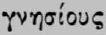
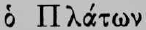
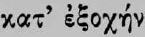
|
THE WORLD AS WILL AND REPRESENTATION |
|
THIRD BOOK: THE WORLD AS REPRESENTATION. SECOND ASPECT The Representation Independent of the Principle of Sufficient Reason: The Platonic Idea: The Object of Art
30. In the first book the world was shown to be mere representation, object for a subject. In the second book, we considered it from its other side, and found that this is will, which proved to be simply what this world is besides being representation. In accordance with this knowledge, we called the world as representation, both as a whole and in its parts, the objectivity of the will, which accordingly means the will become object, i.e., representation. Now we recall further that such objectification of the will had many but definite grades, at which, with gradually increasing distinctness and completeness, the inner nature of the will appeared in the representation, in other words, presented itself as object. In these grades we recognized the Platonic Ideas once more, namely in so far as such grades are just the definite species, or the original unchanging forms and properties of all natural bodies, whether organic or inorganic, as well as the universal forces that reveal themselves according to natural laws. Therefore these Ideas as a whole present themselves in innumerable individuals and in isolated details, and are related to them as the archetype is to its copies. The plurality of such individuals can be conceived only through time and space, their arising and passing away through causality. In all these forms we recognize only the different aspects of the principle of sufficient reason that is the ultimate principle of all finiteness, of all individuation, and the universal form of the representation as it comes to the knowledge of the individual as such. On the other hand, the Idea does not enter into that principle; hence neither plurality nor change belongs to it. While the individuals in which it expresses itself are innumerable and are incessantly coming into existence and passing away, it remains unchanged as one and the same, and the principle of sufficient reason has no meaning for it. But now, as this principle is the form under which all knowledge of the subject comes, in so far as the subject knows as an individual, the Ideas will also lie quite outside the sphere of its knowledge as such. Therefore, if the Ideas are to become object of knowledge, this can happen only by abolishing individuality in the knowing subject. The more definite and detailed explanation of this is what will now first concern us. 31. First of all, however, the following very essential remark. I hope that in the preceding book I have succeeded in producing the conviction that what in the Kantian philosophy is called the thing-in-itself, and appears therein as so significant but obscure and paradoxical a doctrine, is, if reached by the entirely different path we have taken, nothing but the will in the sphere of this concept, widened and defined in the way I have stated. It appears obscure and paradoxical in Kant especially through the way in which he introduced it, namely by inference from what is grounded to what is the ground, and it was considered to be a stumbling-block, in fact the weak side of his philosophy. Further, I hope that, after what has been said, there will be no hesitation in recognizing again in the definite grades of the objectification of that will, which forms the in-itself of the world, what Plato called the eternal Ideas or
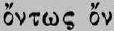
unchangeable forms ( Now if for us the will is the
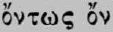
thing-in-itself, and the Idea is the immediate objectivity of that will at a definite grade, then we find Kant's thing-in-itself and Plato's Idea, for him the only
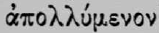
In order to bring Kant's expression even closer to Plato's, we might also say that time, space, and causality are that arrangement of our intellect by virtue of which the one being of each kind that alone really exists, manifests itself to us as a plurality of homogeneous beings, always being originated anew and passing away in endless succession. The apprehension of things by means of and in accordance with this arrangement is immanent; on the other hand, that which is conscious of the true state of things is transcendental. We obtain this in abstracto through the Critique of Pure Reason, but in exceptional cases it can also appear intuitively. This last point is my own addition, which I am endeavouring to explain in the present third book. If Kant's teaching, and, since Kant's time, that of Plato, had ever been properly understood and grasped; if men had truly and earnestly reflected on the inner meaning and content of the teachings of the two great masters, instead of lavishly using the technical expressions of the one and parodying the style of the other, they could not have failed long ago to discover how much the two great sages agree, and that the true significance, the aim, of both teachings is absolutely the same. Not only would they have refrained from constantly comparing Plato with Leibniz, on whom his spirit certainly did not rest, or even with a well-known gentleman still living, [5] as if they wanted to mock at the manes of the great thinker of antiquity, but in general they would have gone much farther than they did, or rather would not have fallen behind so shamefully as they have done in the last forty years. They would not have allowed themselves to be led by the nose, today by one braggart tomorrow by another, and would not have opened with philosophical farces the nineteenth century that announced itself so importantly in Germany. These were performed over Kant's grave (just as was done sometimes by the ancients at the funeral rites of their dead), and occasioned the well-merited ridicule of other
nations, for such things least suit the serious and even solid German. But so small is the real public of genuine philosophers, that even followers who understand are brought to them only sparingly by the centuries.
Men followed words, such words as "representations a priori," "forms of perceiving and thinking known independently of experience," "primary concepts of the pure understanding," and so on. They now asked whether Plato's Ideas, which were also primary concepts and which, moreover, were supposed to be reminiscences from a prenatal perception of truly existing things, were in some way the same thing as Kant's forms of intuition and thought, residing a priori in our consciousness. As there was a slight resemblance in the expression of these two entirely different doctrines, the Kantian doctrine of forms, limiting the knowledge of the individual to the phenomenon, and the Platonic doctrine of Ideas, the knowledge of which expressly denies those very forms, these doctrines, in this respect diametrically opposite, were carefully compared, and men deliberated and disputed over their identity. Ultimately, they found that they were not the same, and concluded that Plato's doctrine of Ideas and Kant's critique of reason had no agreement at all. But enough of this. [7] 32. It follows from our observations so far that, in spite of all the inner agreement between Kant and Plato, and of the identity of the aim that was in the mind of each, or of the world-view that inspired and led them to philosophize, Idea and thing-in-itself are not for us absolutely one and the same. On the contrary, for us the Idea is only the immediate, and therefore adequate, objectivity of the thing-in-itself, which itself, however, is the will -- the will in so far as it is not yet objectified, has not yet become representation. For, precisely according to Kant, the thing-in-itself is supposed to be free from all the forms that adhere to knowledge as such. It is merely an error of Kant (as is shown in the Appendix) that he did not reckon among these forms, before all others, that of being-object-for-a-subject; for this very form is the first and most universal of all phenomenon, i.e., of all representation. He should therefore have expressly denied being-object to his thing-in-itself, for this would
have protected him from that great inconsistency which was soon discovered. On the other hand, the Platonic Idea is necessarily object, something known, a representation, and precisely, but only, in this respect is it different from the thing-in-itself. It has laid aside
merely the subordinate forms of the phenomenon, all of which we include under the principle of sufficient reason; or rather it has not yet
entered into them. But it has retained the first and most universal form, namely that of the representation in general, that of being object for a subject. It is the forms subordinate to this (the general expression of which is the principle of sufficient reason) which
multiply the Idea in particular and fleeting individuals, whose number in respect of the Idea is a matter of complete indifference. Therefore the principle of sufficient reason is again the form into which the Idea enters, since the Idea comes into the knowledge of the subject as individual. The particular thing, appearing in accordance with the principle of sufficient reason, is therefore only an indirect
objectification of the thing-in-itself (which is the will). Between it and the thing-in-itself the Idea still stands as the only direct objectivity of
the will, since it has not assumed any other form peculiar to knowledge as such, except that of the representation in general, i.e., that of
being object for a subject. Therefore, it alone is the most adequate
objectivity possible of the will or of the thing-in-itself; indeed it is even the whole thing-in-itself, only under the form of the representation. Here lies the ground of the great agreement between Plato and Kant, although in strict accuracy that of which they both speak is not the same. The particular things, however, are not an entirely adequate objectivity of the will, but this is obscured in them by those forms, whose common expression is the principle of sufficient reason, but which are the condition of knowledge such as is possible to the
individual as such. If it is permitted to infer from an impossible presupposition, we should in fact no longer know particular things, or events, or change, or plurality, but apprehend only Ideas, only the grades of objectification of that one will, of the true thing-in-itself,
in pure unclouded knowledge. Consequently, our world would be a nunc stans, [8] if we were not, as subject of knowledge, at the same time individuals, in other words, if our perception did not come about through the medium of a body, from whose affections it starts. This body itself is only concrete willing, objectivity of will; hence it is
an object among objects, and as such comes into the knowing consciousness in the only way it can, namely in the forms of the principle of sufficient reason. Consequently, it presupposes and thus introduces time and all the other forms expressed by that principle. Time is merely the spread-out and piecemeal view that an individual being has of the Ideas. These are outside time, and consequently eternal. Therefore Plato says that time is the moving image of eternity:
33. Now since as individuals we have no other knowledge than that which is subject to the principle of sufficient reason, this form, however, excluding knowledge of the Ideas, it is certain that, if it is possible for us to raise ourselves from knowledge of particular things to that of the Ideas, this can happen only by a change taking place in the subject. Such a change is analogous and corresponds to that great change of the whole nature of the object, and by virtue of it the subject, in so far as it knows an Idea, is no longer individual. We remember from the previous book that knowledge in general itself belongs to the objectification of the will at its higher grades. Sensibility, nerves, brain, just like other parts of the organic being, are only an expression of the will at this grade of its objectivity;
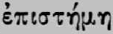
hence the representation that arises through them is also destined to serve the will as a means ( Now as a rule, knowledge remains subordinate to the service of the will, as indeed it came into being for this service; in fact, it sprang from the will, so to speak, as the head from the trunk. With the animals, this subjection of knowledge to the will can never be eliminated. With human beings, such elimination appears only as an exception, as will shortly be considered in more detail. This distinction between man and animal is outwardly expressed by the difference in the relation of head to trunk. In the lower animals both are still deformed; in all, the head is directed to the ground, where the objects of the will lie. Even in the higher animals, head and trunk are still far more one than in man, whose head seems freely set on to the body, only carried by the body and not serving it. This human superiority is exhibited in the highest degree by the Apollo Belvedere. The head of the god of the Muses, with eyes looking far afield, stands so freely on the shoulders that it seems to be wholly delivered from the body, and no longer subject to its cares. 34. As we have said, the transition that is possible, but to be regarded only as an exception, from the common knowledge of particular things to knowledge of the Idea takes place suddenly, since knowledge tears itself free from the service of the will precisely by the subject's ceasing to be merely individual, and being now a pure will-less subject of knowledge. Such a subject of knowledge no longer follows relations in accordance with the principle of sufficient reason; on the contrary, it rests in fixed contemplation of the object presented to it out of its connexion with any other, and rises into this. To be made clear, this needs a detailed discussion, and the reader must suspend his surprise at it for a while, until it has vanished automatically after he has grasped the whole thought to be expressed in this work. Raised up by the power of the mind, we relinquish the ordinary way of considering things, and cease to follow under the guidance of the forms of the principle of sufficient reason merely their relations to one another, whose final goal is always the relation to our own will. Thus we no longer consider the where, the when, the why, and the whither in things, but simply and solely the what. Further, we do not let abstract thought, the concepts of reason, take possession of our consciousness, but, instead of all this, devote the whole power of our mind to perception, sink ourselves completely therein, and let our whole consciousness be filled by the calm contemplation of the natural object actually present, whether it be a landscape, a tree, a rock, a crag, a building, or anything else. We lose ourselves entirely in this object, to use a pregnant expression; in other words, we forget our individuality, our will, and continue to exist only as pure subject, as clear mirror of the object, so that it is as though the object alone existed without anyone to perceive it, and thus we are no longer able to separate the perceiver from the perception, but the two have become one, since the entire consciousness is filled and occupied by a single image of perception. If, therefore, the object has to such an extent passed out of all relation to something outside it, and the subject has passed out of all relation to the will, what is thus known is no longer the individual thing as such, but the Idea, the eternal form, the immediate objectivity of the will at this grade. Thus at the same time, the person who is involved in this perception is no longer an individual, for in such perception the individual has lost himself; he is pure will-less, painless, timeless subject of knowledge. This, which for the moment is so remarkable (which I well know confirms the saying, attributed to Thomas Paine, that du sublime au ridicule il n'y a qu'un pas [Google translate: the sublime to the ridiculous there is only one step]), [10] will gradually become clearer and less surprising through what follows. It was this that was in Spinoza's mind when he wrote: Mens aeterna est, quatenus res sub aeternitatis specie concipit [Google translate: The mind is eternal, so far as it conceives things under the species of eternity] (Ethics, V, prop. 31, schol.). [11] Now in such contemplation, the particular thing at one stroke becomes the Idea of its species, and the perceiving individual becomes the pure subject of knowing. The individual, as such, knows only particular things; the pure subject of knowledge knows only Ideas. For the individual is the subject of knowledge in its relation to a definite particular phenomenon of will and in subjection thereto. This particular phenomenon of will is, as such, subordinate to the principle of sufficient reason in all its forms; therefore all knowledge which relates itself to this, also follows the principle of sufficient reason, and no other knowledge than this is fit to be of any use to the will; it always has only relations to the object. The knowing individual as such and the particular thing known by him are always in a particular place, at a particular time, and are links in the chain of caUSe6and effects. The pure subject of knowledge and its correlative, the Idea, have passed out of all these forms of the principle of sufficient reason. Time, place, the individual that knows, and the individual that is known, have no meaning for them. First of all, a knowing individual raises himself in the manner described to the pure subject of knowing, and at the same time raises the contemplated object to the Idea; the world as representation then stands out whole and pure, and the complete objectification of the will takes place, for only the Idea is the adequate objectivity of the will. In itself, the Idea includes object and subject in like manner, for these are its sole form. In it, however, both are of entirely equal weight; and as the object also is here nothing but the representation of the subject, so the subject, by passing entirely into the perceived object, has also become that object itself, since the entire consciousness is nothing more than its most distinct image. This consciousness really constitutes the whole world as representation, since we picture to ourselves the whole of the Ideas, or grades of the will's objectivity, passing through it successively. The particular things of all particular times and spaces are nothing but the Ideas multiplied through the principle of sufficient reason (the form of knowledge of the individuals as such), and thus obscured in their pure objec~ivity. When the Idea appears, subject and object can no longer be distinguished in it, because the Idea, the adequate objectivity of the will, the real world as representation, arises only when subject and object reciprocally fill and penetrate each other completely. In just the same way the knowing and the known individual, as things-in-themselves, are likewise not different. For if we look entirely away from that true world as representation, there is nothing left but the world as will. The will is the "in-itself" of the Idea that completely objectifies it; it is also the "in-itself" of the particular thing and of the individual that knows it, and these two objectify it incompletely. As will, outside the representation and all its forms, it is one and the same in the contemplated object and in the individual who soars aloft in this contemplation, who becomes conscious of himself as pure subject. Therefore in themselves these two are not different; for in themselves they are the will that here knows itself. Plurality and difference exist only as the way in which this knowledge comes to the will, that is to say, only in the phenomenon, by virtue of its form, the principle of sufficient reason. Without the object, without the representation, I am not knowing subject, but mere, blind will; in just the same way, without me as subject of knowledge, the thing known is not object, but mere will, blind impulse. In itself, that is to say outside the representation, this will is one and the same with mine; only in the world as representation, the form of which is always at least subject and object, are we separated out as known and knowing individual. As soon as knowledge, the world as representation, is abolished, nothing in general is left but mere will, blind impulse. That it should obtain objectivity, should become representation, immediately supposes subject as well as object; but that this objectivity should be pure, complete, adequate objectivity of the will, supposes the object as Idea, free from the forms of the principle of sufficient reason, and the subject as pure subject of knowledge, free from individuality and from servitude to the will. Now whoever has, in the manner stated, become so absorbed and lost in the perception of nature that he exists only as purely knowing subject, becomes in this way immediately aware that, as such, he is the condition, and hence the supporter, of the world and of all objective existence, for this now shows itself as dependent on his existence. He therefore draws nature into himself, so that he feels it to be only an accident of his own being. In this sense Byron says:
But how could the person who feels this regard himself as absolutely perishable in contrast to imperishable nature? Rather will he be moved by the consciousness of what the Upanishad of the Veda expresses: Hae omnes creaturae in totum ego sum, et praeter me aliud (ens) non est [Google translate: I am into the whole, all these creatures, and beside me else (being) is not]. (Oupnek'hat [ed. Anquetil Duperron, 2 vols., Paris, 1801-2], I, 122.) [13] 35. In order to reach a deeper insight into the nature of the world, it is absolutely necessary for us to learn to distinguish the will as thing-in-itself from its adequate objectivity, and then to distinguish the different grades at which this objectivity appears more distinctly and fully, i.e., the Ideas themselves, from the mere phenomenon of the Ideas in the forms of the principle of sufficient reason, the restricted method of knowledge of individuals. We shall then agree with Plato, when he attributes actual being to the Ideas alone, and only an apparent, dreamlike existence to the things in space and time, to this world that is real for the individual. We shall then see how one and the same Idea reveals itself in so many phenomena, and presents its nature to knowing individuals only piecemeal, one side after another. Then we shall also distinguish the Idea itself from the way in which its phenomenon comes into the observation of the individual, and shall recognize the former as essential, and the latter as inessential. We intend to consider this by way of example on the smallest scale, and then on the largest. When clouds move, the figures they form are not essential, but indifferent to them. But that as elastic vapour they are pressed together, driven off, spread out, and tom apart by the force of the wind, this is their nature, this is the essence of the forces that are objectified in them, this is the Idea. The figures in each case are only for the individual observer. To the brook which rolls downwards over the stones, the eddies, waves, and foam-forms exhibited by it are indifferent and inessential; but that it follows gravity, and behaves as an inelastic, perfectly mobile, formless, and transparent fluid, this is its essential nature, this, if known through perception, is the Idea. Those foam-forms exist only for us so long as we know as individuals. The ice on the window-pane is formed into crystals according to the laws of crystallization, which reveal the essence of the natural force here appearing, which exhibit the Idea. But the trees and flowers formed by the ice on the window-pane are inessential, and exist only for us. What appears in clouds, brook, and crystal is the feeblest echo of that will which appears more completely in the plant, still more completely in the animal, and most completely in man. But only the essential in all these grades of the will's objectification constitutes the Idea; on the other hand, its unfolding or development, because drawn apart in the forms of the principle of sufficient reason into a multiplicity of many-sided phenomena, is inessential to the Idea; it lies merely in the individual's mode of cognition, and has reality only for that individual. Now the same thing necessarily holds good of the unfolding of that Idea which is the most complete objectivity of the will. Consequently, the history of the human race, the throng of events, the change of times, the many varying forms of human life in different countries and centuries, all this is only the accidental form of the phenomenon of the Idea. All this does not belong to the Idea itself, in which alone lies the adequate objectivity of the will, but only to the phenomenon. The phenomenon comes into the knowledge of the individual, and is just as foreign, inessential, and indifferent to the Idea itself as the figures they depict are to the clouds, the shape of its eddies and foam-forms to the brook, and the trees and flowers to the ice. To the man who has properly grasped this, and is able to distinguish the will from the Idea, and the Idea from its phenomenon, the events of the world will have significance only in so far as they are the letters from which the Idea of man can be read, and not in and by themselves. He will not believe with the general public that time may produce something actually new and significant; that through it or in it something positively real may attain to existence, or indeed that time itself as a whole has beginning and end, plan and development, and in some way has for its final goal the highest perfection (according to their conceptions) of the latest generation that lives for thirty years. Therefore just as little will he, with Homer, set up a whole Olympus full of gods to guide the events of time, as he will, with Ossian, regard the figures of the clouds as individual beings. For, as we have said, both have just as much significance with regard to the Idea appearing in them. In the many different forms and aspects of human life, and in the interminable change of events, he will consider only the Idea as the abiding and essential, in which the will-to-live has its most perfect objectivity, and which shows its different sides in the qualities, passions, errors, and excellences of the human race, in selfishness, hatred, love, fear, boldness, frivolity, stupidity, slyness, wit, genius, and so on. All of these, running and congealing together into a thousand different forms and shapes (individuals), continually produce the history of the great and the small worlds, where in itself it is immaterial whether they are set in motion by nuts or by crowns. Finally, he will find that in the world it is the same as in the dramas of Gozzi, in all of which the same persons always appear with the same purpose and the same fate. The motives and incidents certainly are different in each piece, but the spirit of the incidents is the same. The persons of one piece know nothing of the events of another, in which, of course, they themselves performed. Therefore, after all the experiences of the earlier pieces, Pantaloon has become no more agile or generous, Tartaglia no more conscientious, Brighella no more courageous, and Columbine no more modest. Suppose we were permitted for once to have a clear glance into the realm of possibility, and over all the chains of causes and effects, then the earth-spirit would appear and show us in a picture the most eminent individuals, world-enlighteners, and heroes, destroyed by chance before they were ripe for their work. We should then be shown the great events that would have altered the history of the world, and brought about periods of the highest culture and enlightenment, but which the blindest chance, the most insignificant accident, prevented at their beginning. Finally, we should see the splendid powers of great individuals who would have enriched whole world-epochs, but who, misled through error or passion, or compelled by necessity, squandered them uselessly on unworthy or unprofitable objects, or even dissipated them in play. If we saw all this, we should shudder and lament at the thought of the lost treasures of whole periods of the world. But the earth-spirit would smile and say: "The source from which the individuals and their powers flow is inexhaustible, and is as boundless as are time and space; for, just like these forms of every phenomenon, they too are only phenomenon, visibility of the will. No finite measure can exhaust that infinite source; therefore undiminished infinity is still always open for the return of any event or work that was nipped in the bud. In this world of the phenomenon, true loss is as little possible as is true gain. The will alone is; it is the thing-in-itself, the source of all those phenomena. Its self-knowledge and its affirmation or denial that is then decided on, is the only event in-itself." [14] 36. History follows the thread of events; it is pragmatic in so far as it deduces them according to the law of motivation, a law that determines the appearing will where that will is illuminated by knowledge. At the lower grades of its objectivity, where it still acts without knowledge, natural science as etiology considers the laws of the changes of its phenomena, and as morphology considers what is permanent in them. This almost endless theme is facilitated by the aid of concepts that comprehend the general, in order to deduce from it the particular. Finally, mathematics considers the mere forms, that is, time and space, in which the Ideas appear drawn apart into plurality for the knowledge of the subject as individual. All these, the common name of which is science, therefore follow the principle of sufficient reason in its different forms, and their theme remains the phenomenon, its laws, connexion, and the relations resulting from these. But now, what kind of knowledge is it that considers what continues to exist outside and independently of all relations, but which alone is really essential to the world, the true content of its phenomena, that which is subject to no change, and is therefore known with equal truth for all time, in a word, the Ideas that are the immediate and adequate objectivity of the thing-in-itself, of the will? It is art, the work of genius. It repeats the eternal Ideas apprehended through pure contemplation, the essential and abiding element in all the phenomena of the world. According to the material in which it repeats, it is sculpture, painting, poetry, or music. Its only source is knowledge of the Ideas; its sole aim is communication of this knowledge. Whilst science, following the restless and unstable stream of the fourfold forms of reasons or grounds and consequents, is with every end it attains again and again directed farther, and can never find an ultimate goal or complete satisfaction, any more than by running we can reach the point where the clouds touch the horizon; art, on the contrary, is everywhere at its goal. For it plucks the object of its contemplation from the stream of the world's course, and holds it isolated before it. This particular thing, which in that stream was an infinitesimal part, becomes for art a representative of the whole, an equivalent of the infinitely many in space and time. It therefore pauses at this particular thing; it stops the wheel of time; for it the relations vanish; its object is only the essential, the Idea. We can therefore define it accurately as the way of considering things independently of the principle of sufficient reason, in contrast to the way of considering them which proceeds in exact accordance with this principle, and is the way of science and experience. This latter method of consideration can be compared to an endless line running horizontally, and the former to a vertical line cutting the horizontal at any point. The method of consideration that follows the principle of sufficient reason is the rational method, and it alone is valid and useful in practical life and in science. The method of consideration that looks away from the content of this principle is the method of genius, which is valid and useful in art alone. The first is Aristotle's method; the second is, on the whole, Plato's. The first is like the mighty storm, rushing along without beginning or aim, bending, agitating, and carrying everything away with it; the second is like the silent sunbeam, cutting through the path of the storm, and quite unmoved by it. The first is like the innumerable violently agitated drops of the waterfall, constantly changing and never for a moment at rest; the second is like the rainbow silently resting on this raging torrent. Only through the pure contemplation described above, which becomes absorbed entirely in the object, are the Ideas comprehended; and the nature of genius consists precisely in the preeminent ability for such contemplation. Now as this demands a complete forgetting of our own person and of its relations and connexions, the gift of genius is nothing but the most complete objectivity, i.e., the objective tendency of the mind, as opposed to the subjective directed to our own person, i.e., to the will. Accordingly, genius is the capacity to remain in a state of pure perception, to lose oneself in perception, to remove from the service of the will the knowledge which originally existed only for this service. In other words, genius is the ability to leave entirely out of sight our own interest, our willing, and our aims, and consequently to discard entirely our own personality for a time, in order to remain pure knowing subject, the clear eye of the world; and this not merely for moments, but with the necessary continuity and conscious thought to enable us to repeat by deliberate art what has been apprehended, and "what in wavering apparition gleams fix in its place with thoughts that stand for ever!" [15] For genius to appear in an individual, it is as if a measure of the power of knowledge must have fallen to his lot far exceeding that required for the service of an individual will; and this superfluity of knowledge having become free, now becomes the subject purified of will, the clear mirror of the inner nature of the world. This explains the animation, amounting to disquietude, in men of genius, since the present can seldom satisfy them, because it does not fill their consciousness. This gives them that restless zealous nature, that constant search for new objects worthy of contemplation, and also that longing, hardly ever satisfied, for men of like nature and stature to whom they may open their hearts. The common mortal, on the other hand, entirely filled and satisfied by the common present, is absorbed in it, and, finding everywhere his like, has that special ease and comfort in daily life which are denied to the man of genius. Imagination has been rightly recognized as an essential element of genius; indeed, it has sometimes been regarded as identical with genius, but this is not correct. The objects of genius as such are the eternal Ideas, the persistent, essential forms of the world and of all its phenomena; but knowledge of the Idea is necessarily knowledge through perception, and is not abstract. Thus the knowledge of the genius would be restricted to the Ideas of objects actually present to his own person, and would be dependent on the concatenation of circumstances that brought them to him, did not imagination extend his horizon far beyond the reality of his personal experience, and enable him to construct all the rest out of the little that has come into his own actual apperception, and thus to let almost all the possible scenes of life pass by within himself. Moreover, the actual objects are almost always only very imperfect copies of the Idea that manifests itself in them. Therefore the man of genius requires imagination, in order to see in things not what nature has actually formed, but what she endeavoured to form, yet did not bring about, because of the conflict of her forms with one another which was referred to in the previous book. We shall return to this later, when considering sculpture. Thus imagination extends the mental horizon of the genius beyond the objects that actually present themselves to his person, as regards both quality and quantity. For this reason, unusual strength of imagination is a companion, indeed a condition, of genius. But the converse is not the case, for strength of imagination is not evidence of genius; on the contrary, even men with little or no touch of genius may have much imagination. For we can consider an actual object in two opposite ways, purely objectively, the way of genius grasping the Idea of the object, or in the common way, merely in its relations to other objects according to the principle of sufficient reason, and in its relations to our own will. In a similar manner, we can also perceive an imaginary object in these two ways. Considered in the first way, it is a means to knowledge of the Idea, the communication of which is the work of art. In the second case, the imaginary object is used to build castles in the air, congenial to selfishness and to one's own whim, which for the moment delude and delight; thus only the relations of the phantasms so connected are really ever known. The man who indulges in this game is a dreamer; he will easily mingle with reality the pictures that delight his solitude, and will thus become unfit for real life. Perhaps he will write down the delusions of his imagination, and these will give us the ordinary novels of all kinds which entertain those like him and the public at large, since the readers fancy themselves in the position of the hero, and then find the description very "nice." [16] As we have said, the common, ordinary man, that manufactured article of nature which she daily produces in thousands, is not capable, at any rate continuously, of a consideration of things wholly disinterested in every sense, such as is contemplation proper. He can direct his attention to things only in so far as they have some relation to his will, although that relation may be only very indirect. As in this reference that always demands only knowledge of the relations, the abstract concept of the thing is sufficient and often even more appropriate, the ordinary man does not linger long over the mere perception, does not fix his eye on an object for long, but, in everything that presents itself to him, quickly looks merely for the concept under which it is to be brought, just as the lazy man looks for a chair, which then no longer interests him. Therefore he is very soon finished with everything, with works of art, with beautiful natural objects, and with that contemplation of life in all its scenes which is really of significance everywhere. He does not linger; he seeks only his way in life, or at most all that might at any time become his way. Thus he makes topographical notes in the widest sense, but on the consideration of life itself as such he wastes no time. On the other hand, the man of genius, whose power of knowledge is, through its excess, withdrawn for a part of his time from the service of his will, dwells on the consideration of life itself, strives to grasp the Idea of each thing, not its relations to other things. In doing this, he frequently neglects a consideration of his own path in life, and therefore often pursues this with insufficient skill. Whereas to the ordinary man his faculty of knowledge is a lamp that lights his path, to the man of genius it is the sun that reveals the world. This great difference in their way of looking at life soon becomes visible even in the outward appearance of them both. The glance of the man in whom genius lives and works readily distinguishes him; it is both vivid and firm and bears the character of thoughtfulness, of contemplation. We can see this in the portraits of the few men of genius which nature has produced here and there among countless millions. On the other hand, the real opposite of contemplation, namely spying or prying, can be readily seen in the glance of others, if indeed it is not dull and vacant, as is often the case. Consequently a face's "expression of genius" consists in the fact that a decided predominance of knowing over willing is visible in it, and hence that there is manifested in it a knowledge without any relation to a will, in other words, a pure knowing. On the other hand, in the case of faces that follow the rule, the expression of the will predominates, and we see that knowledge comes into activity only on the impulse of the will, and so is directed only to motives. As the knowledge of the genius, or knowledge of the Idea, is that which does not follow the principle of sufficient reason, so, on the other hand, the knowledge that does follow this principle gives us prudence and rationality in life, and brings about the sciences. Thus individuals of genius will be affected with the defects entailed in the neglect of the latter kind of knowledge. Here, however, a limitation must be observed, that what I shall state in this regard concerns them only in so far as, and while, they are actually engaged with the kind of knowledge peculiar to the genius. Now this is by no means the case at every moment of their lives, for the great though spontaneous exertion required for the will-free comprehension of the Ideas necessarily relaxes again, and there are long intervals during which men of genius stand in very much the same position as ordinary persons, both as regards merits and defects. On this account, the action of genius has always been regarded as an inspiration, as indeed the name itself indicates, as the action of a superhuman being different from the individual himself, which takes possession of him only periodically. The disinclination of men of genius to direct their attention to the content of the principle of sufficient reason will show itself first in regard to the ground of being, as a disinclination for mathematics. The consideration of mathematics proceeds on the most universal forms of the phenomenon, space and time, which are themselves only modes or aspects of the principle of sufficient reason; and it is therefore the very opposite of that consideration that seeks only the content of the phenomenon, namely the Idea expressing itself in the phenomenon apart from all relations. Moreover, the logical procedure of mathematics will be repugnant to genius, for it obscures real insight and does not satisfy it; it presents a mere concatenation of conclusions according to the principle of the ground of knowing. Of all the mental powers, it makes the greatest claim on memory, so that one may have before oneself all the earlier propositions to which reference is made. Experience has also confirmed that men of great artistic genius have no aptitude for mathematics; no man was ever very distinguished in both at the same time. Alfieri relates that he was never able to understand even the fourth proposition of Euclid. Goethe was reproached enough with his want of mathematical knowledge by the ignorant opponents of his colour theory. Here, where it was naturally not a question of calculation and measurement according to hypothetical data, but one of direct knowledge by understanding cause and effect, this reproach was so utterly absurd and out of place, that they revealed their total lack of judgement just as much by such a reproach as by the rest of their Midas-utterances. The fact that even today, nearly half a century after the appearance of Goethe's colour theory, the Newtonian fallacies still remain in undisturbed possession of the professorial chair even in Germany, and that people continue to talk quite seriously about the seven homogeneous rays of light and their differing refrangibility, will one day be numbered among the great intellectual peculiarities of mankind in general, and of the Germans in particular. From the same above-mentioned cause may be explained the equally well-known fact that, conversely, distinguished mathematicians have little susceptibility to works of fine art. This is expressed with particular naivety in the well-known anecdote of that French mathematician who, after reading Racine's Iphigenia, shrugged his shoulders and asked: Qu'est-ce que cela prouve? [17] Further, as keen comprehension of relations according to the laws of causality and motivation really constitutes prudence or sagacity, whereas the knowledge of genius is not directed to relations, a prudent man will not be a genius insofar as and while he is prudent, and a genius will not be prudent insofar as and while he is a genius. Finally, knowledge of perception generally, in the province of which the Idea entirely lies, is directly opposed to rational or abstract knowledge which is guided by the principle of the ground of knowing. It is also well known that we seldom find great genius united with preeminent reasonableness; on the contrary, men of genius are often subject to violent emotions and irrational passions. But the cause of this is not weakness of the faculty of reason, but partly unusual energy of that whole phenomenon of will, the individual genius. This phenomenon manifests itself through vehemence of all his acts of will. The cause is also partly a preponderance of knowledge from perception through the senses and the understanding over abstract knowledge, in other words, a decided tendency to the perceptive. In such men the extremely energetic impression of the perceptive outshines the colourless concepts so much that conduct is no longer guided by the latter, but by the former, and on this very account becomes irrational. Accordingly, the impression of the present moment on them is very strong, and carries them away into thoughtless actions, into emotion and passion. Moreover, since their knowledge has generally been withdrawn in part from the service of the will, they will not in conversation think so much of the person with whom they are speaking as of the thing they are speaking about, which is vividly present in their minds. Therefore they will judge or narrate too objectively for their own interests; they will not conceal what it would be more prudent to keep concealed, and so on. Finally, they are inclined to soliloquize, and in general may exhibit several weaknesses that actually are closely akin to madness. It is often remarked that genius and madness have a side where they touch and even pass over into each other, and even poetic inspiration has been called a kind of madness; amabilis insania, as Horace calls it (Odes, iii, 4); and in the introduction to Oberon Wieland speaks of "amiable madness." Even Aristotle, as quoted by Seneca (De Tranquillitate Animi, xv, 16 [xvii, 10]), is supposed to have said: Nullum magnum ingenium sine mixtura dementiae fuit. [18] Plato expresses it in the above mentioned myth of the dark cave (Republic, Bk. 7) by saying that those who outside the cave have seen the true sunlight and the things that actually are (the Ideas), cannot afterwards see within the cave any more, because their eyes have grown unaccustomed to the darkness; they no longer recognize the shadow-forms correctly. They are therefore ridiculed for their mistakes by those others who have never left that cave and those shadow-forms. Also in the Phaedrus (245 A), he distinctly says that without a certain madness there can be no genuine poet, in fact (249 D) that everyone appears mad who recognizes the eternal Ideas in fleeting things. Cicero also states: Negat enim sine furore Democritus quemquam poetam magnum esse posse; quod idem dicit Plato (De Divinatione, i, 37). [19] And finally, Pope says:
Particularly instructive in this respect is Goethe's Torquato Tasso, in which he brings before our eyes not only suffering, the essential martyrdom of genius as such, but also its constant transition into madness. Finally, the fact of direct contact between genius and madness is established partly by the biographies of great men of genius, such as Rousseau, Byron, and Alfieri, and by anecdotes from the lives of others. On the other hand, I must mention having found, in frequent visits to lunatic asylums, individual subjects endowed with unmistakably great gifts. Their genius appeared distinctly through their madness which had completely gained the upper hand. Now this cannot be ascribed to chance, for on the one hand the number of mad persons is relatively very small, while on the other a man of genius is a phenomenon rare beyond all ordinary estimation, and appearing in nature only as the greatest exception. We may be convinced of this from the mere fact that we can compare the number of the really great men of genius produced by the whole of civilized Europe in ancient and modern times, with the two hundred and fifty millions who are always living in Europe and renew themselves every thirty years. Among men of genius, however, can be reckoned only those who have furnished works that have retained through all time an enduring value for mankind. Indeed, I will not refrain from mentioning that I have known some men of decided, though not remarkable, mental superiority who at the same time betrayed a slight touch of insanity. Accordingly, it might appear that every advance of the intellect beyond the usual amount, as an abnormality, already disposes to madness. Meanwhile, however, I will give as briefly as possible my opinion about the purely intellectual ground of the kinship between genius and madness, for this discussion will certainly contribute to the explanation of the real nature of genius, in other words, of that quality of the mind which is alone capable of producing genuine works of art. But this necessitates a brief discussion of madness itself. [21] A clear and complete insight into the nature of madness, a correct and distinct conception of what really distinguishes the sane from the insane, has, so far as I know, never yet been found. Neither the faculty of reason nor understanding can be denied to the mad, for they talk and understand, and often draw very accurate conclusions. They also, as a rule, perceive quite correctly what is present, and see the connexion between cause and effect. Visions, like the fancies of an overwrought brain, are no ordinary symptom of madness; delirium falsifies perception, madness the thoughts. For the most part, mad people do not generally err in the knowledge of what is immediately present; but their mad talk relates always to what is absent and past, and only through these to its connexion with what is present. Therefore, it seems to me that their malady specially concerns the memory. It is not, indeed, a case of memory failing them entirely, for many of them know a great deal by heart, and sometimes recognize persons whom they have not seen for a long time. Rather is it a case of the thread of memory being broken, its continuous connexion being abolished, and of the impossibility of a uniformly coherent recollection of the past. Individual scenes of the past stand out correctly, just like the individual present; but there are gaps in their recollection that they fill up with fictions. These are either always the same, and so become fixed ideas; it is then a fixed mania or melancholy; or they are different each time, momentary fancies; it is then called folly, fatuitas. This is the reason why it is so difficult to question a mad person about his previous life-history when he enters an asylum. In his memory the true is I for ever mixed up with the false. Although the immediate present is correctly known, it is falsified through a fictitious connexion with an imaginary past. Mad people therefore consider themselves and others as identical with persons who live merely in their fictitious past. Many acquaintances they do not recognize at all, and, in spite of a correct representation or mental picture of the individual actually present, they have only false relations of this to what is absent. If the madness reaches a high degree, the result is a complete absence of memory; the mad person is then wholly incapable of any reference to what is absent or past, but is determined solely by the whim of the moment in combination with fictions that in his head fill up the past. In such a case, we are then not safe for one moment from ill-treatment or murder, unless we constantly and visibly remind the insane person of superior force. The mad person's knowledge has in common with the animal's the fact that both are restricted to the present; but what distinguishes them is that the animal has really no notion at all of the past as such, although the past acts on it through the medium of custom. Thus, for instance, the dog recognizes his former master even after years, that is to say, it receives the accustomed impression at the sight of him; but the dog has no recollection of the time that has since elapsed. On the other hand, the madman always carries about in his faculty of reason a past in the abstract, but it is a false past that exists for him alone, and that either all the time or merely for the moment. The influence of this false past then prevents the use of the correctly known present which the animal makes. The fact that violent mental suffering or unexpected and terrible events are frequently the cause of madness, I explain as follows. Every such suffering is as an actual event always confined to the present; hence it is only transitory, and to that extent is never excessively heavy. It becomes insufferably great only in so far as it is a lasting pain, but as such it is again only a thought, and therefore resides in the memory. Now if such a sorrow, such painful knowledge or reflection, is so harrowing that it becomes positively unbearable, and the individual would succumb to it, then nature, alarmed in this way, seizes on madness as the last means of saving life. The mind, tormented so greatly, destroys, as it were, the thread of its memory, fills up the gaps with fictions, and thus seeks refuge in madness from the mental suffering that exceeds its strength, just as a limb affected by mortification is cut off and replaced with a wooden one. As examples, we may consider the raving Ajax, King Lear, and Ophelia; for the creations of the genuine genius, to which alone we can here refer, as being generally known, are equal in truth to real persons; moreover, frequent actual experience in this respect shows the same thing. A faint analogy of this kind of transition from pain to madness is to be found in the way in which we all frequently try, as it were mechanically, to banish a tormenting memory that suddenly occurs to us by some loud exclamation or movement, to turn ourselves from it, to distract ourselves by force. Now, from what we have stated, we see that the madman correctly knows the individual present as well as many particulars of the past, but that he fails to recognize the connexion, the relations, and therefore goes astray and talks nonsense. Just this is his point of contact with the genius; for he too leaves out of sight knowledge of the connexion of things, as he neglects that knowledge of relations which is knowledge according to the principle of sufficient reason, in order to see in things only their Ideas, and to try to grasp their real inner nature which expresses itself to perception, in regard to which one thing represents its whole species, and hence, as Goethe says, one case is valid for a thousand. The individual object of his contemplation, or the present which he apprehends with excessive vividness, appears in so strong a light that the remaining links of the chain, so to speak, to which they belong, withdraw into obscurity, and this gives us phenomena that have long been recognized as akin to those of madness. That which exists in the actual individual thing, only imperfectly and weakened by modifications, is enhanced to perfection, to the Idea of it, by the method of contemplation used by the genius. Therefore he everywhere sees extremes, and on this account his own actions tend to extremes. He does not know how to strike the mean; he lacks cool-headedness, and the result is as we have said. He knows the Ideas perfectly, but not the individuals. Therefore it has been observed that a poet may know man profoundly and thoroughly, but men very badly; he is easily duped, and is a plaything in the hands of the cunning and crafty. [22] 37. Now according to our explanation, genius consists in the ability to know, independently of the principle of sufficient reason, not individual things which have their existence only in the relation, but the Ideas of such things, and in the ability to be, in face of these, the correlative of the Idea, and hence no longer individual, but pure subject of knowing. Yet this ability must be inherent in all men in a lesser and different degree, as otherwise they would be just as incapable of enjoying works of art as of producing them. Generally they would have no susceptibility at all to the beautiful and to the sublime; indeed, these words could have no meaning for them. We must therefore assume as existing in all men that power of recognizing in things their Ideas, of divesting themselves for a moment of their personality, unless indeed there are some who are not capable of any aesthetic pleasure at all. The man of genius excels them only in the far higher degree and more continuous duration of this kind of knowledge. These enable him to retain that thoughtful contemplation necessary for him to repeat what is thus known in a voluntary and intentional work, such repetition being the work of art. Through this he communicates to others the Idea he has grasped. Therefore this Idea remains unchanged and the same, and hence aesthetic pleasure is essentially one and the same, whether it be called forth by a work of art, or directly by the contemplation of nature and of life. The work of art is merely a means of facilitating that knowledge in which this pleasure consists. That the Idea comes to us more easily from the work of art than directly from nature and from reality, arises solely from the fact that the artist, who knew only the Idea and not reality, clearly repeated in his work only the Idea, separated it out from reality, and omitted all disturbing contingencies. The artist lets us peer into the world through his eyes. That he has these eyes, that he knows the essential in things which lies outside all relations, is the gift of genius and is inborn; but that he is able to lend us this gift, to let us see with his eyes, is acquired, and is the technical side of art. Therefore, after the account I have given in the foregoing remarks of the inner essence of the aesthetic way of knowing in its most general outline, the following more detailed philosophical consideration of the beautiful and the sublime will explain both simultaneously, in nature and in art, without separating them further. We shall first consider what takes place in a man when he is affected by the beautiful and the sublime. Whether he draws this emotion directly from nature, from life, or partakes of it only through the medium of art, makes no essential difference, but only an outward one. 38. In the aesthetic method of consideration we found two inseparable constituent parts: namely, knowledge of the object not as individual thing, but as Platonic Idea, in other words, as persistent form of this whole species of things; and the self-consciousness of the knower, not as individual, but as pure, will-less subject of knowledge. The condition under which the two constituent parts appear always united was the abandonment of the method of knowledge that is bound to the principle of sufficient reason, a knowledge that, on the contrary, is the only appropriate kind for serving the will and also for science. Moreover, we shall see that the pleasure produced by contemplation of the beautiful arises from those two constituent parts, sometimes more from the one than from the other, according to what the object of aesthetic contemplation may be. All willing springs from lack, from deficiency, and thus from suffering. Fulfilment brings this to an end; yet for one wish that is fulfilled there remain at least ten that are denied. Further, desiring lasts a long time, demands and requests go on to infinity; fulfilment is short and meted out sparingly. But even the final satisfaction itself is only apparent; the wish fulfilled at once makes way for a new one; the former is a known delusion, the latter a delusion not as yet known. No attained object of willing can give a satisfaction that lasts and no longer declines; but it is always like the alms thrown to a beggar, which reprieves him today so that his misery may be prolonged till tomorrow. Therefore, so long as our consciousness is filled by our will, so long as we are given up to the throng of desires with its constant hopes and fears, so long as we are the subject of willing, we never obtain lasting happiness or peace. Essentially, it is all the same whether we pursue or flee, fear harm or aspire to enjoyment; care for the constantly demanding will, no matter in what form, continually fills and moves consciousness; but without peace and calm, true well-being is absolutely impossible. Thus the subject of willing is constantly lying on the revolving wheel of Ixion, is always drawing water in the sieve of the Danaids, and is the eternally thirsting Tantalus. When, however, an external cause or inward disposition suddenly raises us out of the endless stream of willing, and snatches knowledge from the thraldom of the will, the attention is now no longer directed to the motives of willing, but comprehends things free from their relation to the will. Thus it considers things without interest, without subjectivity, purely objectively; it is entirely given up to them in so far as they are merely representations, and not motives. Then all at once the peace, always sought but always escaping us on that first path of willing, comes to us of its own accord, and all is well with us. It is the painless state, prized by Epicurus as the highest good and as the state of the gods; for that moment we are delivered from the miserable pressure of the will. We celebrate the Sabbath of the penal servitude of willing; the wheel of Ixion stands still. But this is just the state that I described above as necessary for knowledge of the Idea, as pure contemplation, absorption in perception, being lost in the object, forgetting all individuality, abolishing the kind of knowledge which follows the principle of sufficient reason, and comprehends only relations. It is the state where, simultaneously and inseparably, the perceived individual thing is raised to the Idea of its species, and the knowing individual to the pure subject of will-less knowing, and now the two, as such, no longer stand in the stream of time and of all other relations. It is then all the same whether we see the setting sun from a prison or from a palace. Inward disposition, predominance of knowing over willing, can bring about this state in any environment. This is shown by those admirable Dutchmen who directed such purely objective perception to the most insignificant objects, and set up a lasting monument of their objectivity and spiritual peace in paintings of still life. The aesthetic beholder does not contemplate this without emotion, for it graphically describes to him the calm, tranquil, will-free frame of mind of the artist which was necessary for contemplating such insignificant things so objectively, considering them so attentively, and repeating this perception with such thought. Since the picture invites the beholder to participate in this state, his emotion is often enhanced by the contrast between it and his own restless state of mind, disturbed by vehement willing, in which he happens to be. In the same spirit landscape painters, especially Ruysdael, have often painted extremely insignificant landscape objects, and have thus produced the same effect even more delightfully. So much is achieved simply and solely by the inner force of an artistic disposition; but that purely objective frame of mind is facilitated and favoured from without by accommodating objects, by the abundance of natural beauty that invites contemplation, and even presses itself on us. Whenever it presents itself to our gaze all at once, it almost always succeeds in snatching us, although only for a few moments, from subjectivity, from the thraldom of the will, and transferring us into the state of pure knowledge. This is why the man tormented by passions, want, or care, is so suddenly revived, cheered, and comforted by a single, free glance into nature. The storm of passions, the pressure of desire and fear, and all the miseries of willing are then at once calmed and appeased in a marvellous way. For at the moment when, torn from the will, we have given ourselves up to pure, will-less knowing, we have stepped into another world, so to speak, where everything that moves our will, and thus violently agitates us, no longer exists. This liberation of knowledge lifts us as wholly and completely above all this as do sleep and dreams. Happiness and unhappiness have vanished; we are no longer the individual; that is forgotten; we are only pure subject of knowledge. We are only that one eye of the world which looks out from all knowing creatures, but which in man alone can be wholly free from serving the will. In this way, all difference of individuality disappears so completely that it is all the same whether the perceiving eye belongs to a mighty monarch or to a stricken beggar; for beyond that boundary neither happiness nor misery is taken with us. There always lies so near to us a realm in which we have escaped entirely from all our affliction; but who has the strength to remain in it for long? As soon as any relation to our will, to our person, even of those objects of pure contemplation, again enters consciousness, the magic is at an end. We fall back into knowledge governed by the principle of sufficient reason; we now no longer know the Idea, but the individual thing, the link of a chain to which we also belong, and we are again abandoned to all our woe. Most men are almost always at this standpoint, because they entirely lack objectivity, i.e., genius. Therefore they do not like to be alone with nature; they need company, or at any rate a book, for their knowledge remains subject to the will. Therefore in objects they seek only some relation to their will, and with everything that has not such a relation there sounds within them, as it were like a ground-bass, the constant, inconsolable lament, "It is of no use to me." Thus in solitude even the most beautiful surroundings have for them a desolate, dark, strange, and hostile appearance. Finally, it is also that blessedness of will-less perception which spreads so wonderful a charm over the past and the distant, and by a self-deception presents them to us in so flattering a light. For by our conjuring up in our minds days long past spent in a distant place, it is only the objects recalled by our imagination, not the subject of will, that carried around its incurable sorrows with it just as much then as it does now. But these are forgotten, because since then they have frequently made way for others. Now in what is remembered, objective perception is just as effective as it would be in what is present, if we allowed it to have influence over us, if, free from will, we surrendered ourselves to it. Hence it happens that, especially when we are more than usually disturbed by some want, the sudden recollection of past and distant scenes flits across our minds like a lost paradise. The imagination recalls merely what was objective, not what was individually subjective, and we imagine that that something objective stood before us then just as pure and undisturbed by any relation to the will as its image now stands in the imagination; but the relation of objects to our will caused us just as much affliction then as it does now. We can withdraw from all suffering just as well through present as through distant objects, whenever we raise ourselves to a purely objective contemplation of them, and are thus able to produce the illusion that only those objects are present, not we ourselves. Then, as pure subject of knowing, delivered from the miserable self, we become entirely one with those objects, and foreign as our want is to them, it is at such moments just as foreign to us. Then the world as representation alone remains; the world as will has disappeared. In all these remarks, I have sought to make clear the nature and extent of the share which the subjective condition has in aesthetic pleasure, namely the deliverance of knowledge from the service of the will, the forgetting of oneself as individual, and the enhancement of consciousness to the pure, will-less, timeless subject of knowing that is independent of all relations. With this subjective side of aesthetic contemplation there always appears at the same time as necessary correlative its objective side, the intuitive apprehension of the Platonic Idea. But before we turn to a closer consideration of this and to the achievements of art in reference to it, it is better to stop for a while at the subjective side of aesthetic pleasure, in order to complete our consideration of this by discussing the impression of the sublime, which depends solely on it, and arises through a modification of it. After this, our investigation of aesthetic pleasure will be completed by a consideration of its objective side. But first of all, the following remarks appertain to what has so far been said. Light is most pleasant and delightful; it has become the symbol of all that is good and salutary. In all religions it indicates eternal salvation, while darkness symbolizes damnation. Ormuzd dwells in the purest light, Ahriman in eternal night. Dante's Paradise looks somewhat like Vauxhall in London, since all the blessed spirits appear there as points of light that arrange themselves in regular figures. The absence of light immediately makes us sad, and its return makes us feel happy. Colours directly excite a keen delight, which reaches its highest degree when they are translucent. All this is due to the fact that light is the correlative and condition of the most perfect kind of knowledge through perception, of the only knowledge that in no way directly affects the will. For sight, unlike the affections of the other senses, is in itself, directly, and by its sensuous effect, quite incapable of pleasantness or unpleasantness of sensation in the organ; in other words, it has no direct connexion with the will. Only perception arising in the understanding can have such a connexion, which then lies in the relation of the object to the will. In the case of hearing, this is different; tones can excite pain immediately, and can also be directly agreeable sensuously without reference to harmony or melody. Touch, as being one with the feeling of the whole body, is still more subject to this direct influence on the will; and yet there is a touch devoid of pain and pleasure. Odours, however, are always pleasant or unpleasant, and tastes even more so. Thus the last two senses are most closely related to the will, and hence are always the most ignoble, and have been called by Kant the subjective senses. Therefore the pleasure from light is in fact the pleasure from the objective possibility of the purest and most perfect kind of knowledge from perception. As such it can be deduced from the fact that pure knowing, freed and delivered from all willing, is extremely gratifying, and, as such, has a large share in aesthetic enjoyment. Again, the incredible beauty that we associate with the reflection of objects in water can be deduced from this view of light. That lightest, quickest, and finest species of the effect of bodies on one another, that to which we owe also by far the most perfect and pure of our perceptions, namely the impression by means of reflected light-rays, is here brought before our eyes quite distinctly, clearly, and completely, in cause and effect, and indeed on a large scale. Hence our aesthetic delight from it, which in the main is entirely rooted in the subjective ground of aesthetic pleasure, and is delight from pure knowledge and its ways. [28] 39. All these considerations are intended to stress the subjective part of aesthetic pleasure, namely, that pleasure in so far as it is delight in the mere knowledge of perception as such, in contrast to the will. Now directly connected with all this is the following explanation of that frame of mind which has been called the feeling of the sublime. It has already been observed that transition into the state of pure perception occurs most easily when the objects accommodate themselves to it, in other words, when by their manifold and at the same time definite and distinct form they easily become representatives of their Ideas, in which beauty, in the objective sense, consists. Above all, natural beauty has this quality, and even the most stolid and apathetic person obtains therefrom at least a fleeting, aesthetic pleasure. Indeed, it is remarkable how the plant world in particular invites one to aesthetic contemplation, and, as it were, obtrudes itself thereon. It might be said that such accommodation was connected with the fact that these organic beings themselves, unlike animal bodies, are not immediate object of knowledge. They therefore need the foreign intelligent individual in order to come from the world of blind willing into the world of the representation. Thus they yearn for this entrance, so to speak, in order to attain at any rate indirectly what directly is denied to them. For the rest, I leave entirely undecided this bold and venturesome idea that perhaps borders on the visionary, for only a very intimate and devoted contemplation of nature can excite or justify it. [24] Now so long as it is this accommodation of nature, the significance and distinctness of its forms, from which the Ideas individualized in them readily speak to us; so long as it is this which moves us from knowledge of mere relations serving the will into aesthetic contemplation, and thus raises us to the will-free subject of knowing, so long is it merely the beautiful that affects us, and the feeling of beauty that is excited. But these very objects, whose significant forms invite us to a pure contemplation of them, may have a hostile relation to the human will in general, as manifested in its objectivity, the human body. They may be opposed to it; they may threaten it by their might that eliminates all resistance, or their immeasurable greatness may reduce it to nought. Nevertheless, the beholder may not direct his attention to this relation to his will which is so pressing and hostile, but, although he perceives and acknowledges it, he may consciously turn away from it, forcibly tear himself from his will and its relations, and, giving himself up entirely to knowledge, may quietly contemplate, as pure, will-less subject of knowing, those very objects so terrible to the will. He may comprehend only their Idea that is foreign to all relation, gladly linger over its contemplation, and consequently be elevated precisely in this way above himself, his person, his willing, and all willing. In that case, he is then filled with the feeling of the sublime; he is in the state of exaltation, and therefore the object that causes such a state is called sublime. Thus what distinguishes the feeling of the sublime from that of the beautiful is that, with the beautiful, pure knowledge has gained the upper hand without a struggle, since the beauty of the object, in other words that quality of it which facilitates knowledge of its Idea, has removed from consciousness, without resistance and hence imperceptibly, the will and knowledge of relations that slavishly serve this will. What is then left is pure subject of knowing, and not even a recollection of the will remains. On the other hand, with the sublime, that state of pure knowing is obtained first of all by a conscious and violent tearing away from the relations of the same object to the will which are recognized as unfavourable, by a free exaltation, accompanied by consciousness, beyond the will and the knowledge related to it. This exaltation must not only be won with consciousness, but also be maintained, and it is therefore accompanied by a constant recollection of the will, yet not of a single individual willing, such as fear or desire, but of human willing in general, in so far as it is expressed universally through its objectivity, the human body. If a single, real act of will were to enter consciousness through actual personal affliction and danger from the object, the individual will, thus actually affected, would at once gain the upper hand. The peace of contemplation would become impossible, the impression of the sublime would be lost, because it had yielded to anxiety, in which the effort of the individual to save himself supplanted every other thought. A few examples will contribute a great deal to making clear this theory of the aesthetically sublime, and removing any doubt about it. At the same time they will show the difference in the degrees of this feeling of the sublime. For in the main it is identical with the feeling of the beautiful, with pure will-less knowing, and with the knowledge, which necessarily appears therewith, of the Ideas out of all relation that is determined by the principle of sufficient reason. The feeling of the sublime is distinguished from that of the beautiful only by the addition, namely the exaltation beyond the known hostile relation of the contemplated object to the will in general. Thus there result several degrees of the sublime, in fact transitions from the beautiful to the sublime, according as this addition is strong, clamorous, urgent, and near, or only feeble, remote, and merely suggested. I regard it as more appropriate to the discussion to adduce first of all in examples these transitions, and generally the weaker degrees of the impression of the sublime, although those whose aesthetic susceptibility in general is not very great, and whose imagination is not vivid, will understand only the examples, given later, of the higher and more distinct degrees of that impression. They should therefore confine themselves to these, and should ignore the examples of the very weak degree of the above-mentioned impression, which are to be spoken of first. Just as man is simultaneously impetuous and dark impulse of willing (indicated by the pole of the genitals as its focal point), and eternal, free, serene subject of pure knowing (indicated by the pole of the brain), so, in keeping with this antithesis, the sun is simultaneously the source of light, the condition for the most perfect kind of knowledge, and therefore of the most delightful of things; and the source of heat, the first condition of all life, in other words, of every phenomenon of the will at its higher grades. Therefore what heat is for the will, light is for knowledge. For this reason, light is the largest diamond in the crown of beauty, and has the most decided influence on the knowledge of every beautiful object. Its presence generally is an indispensable condition; its favourable arrangement enhances even the beauty of the beautiful. But above all else, the beautiful in architecture is enhanced by the favour of light, and through it even the most insignificant thing becomes a beautiful object. Now if in the depth of winter, when the whole of nature is frozen and stiff, we see the rays of the setting sun reflected by masses of stone, where they illuminate without warming, and are thus favourable only to the purest kind of knowledge, not to the will, then contemplation of the beautiful effect of light on these masses moves us into the state of pure knowing, as all beauty does. Yet here, through the faint recollection of the lack of warmth from those rays, in other words, of the absence of the principle of life, a certain transcending of the interest of the will is required. There is a slight challenge to abide in pure knowledge, to turn away from all willing, and precisely in this way we have a transition from the feeling of the beautiful to that of the sublime. It is the faintest trace of the sublime in the beautiful, and beauty itself appears here only in a slight degree. The following is an example almost as weak. Let us transport ourselves to a very lonely region of boundless horizons, under a perfectly cloudless sky, trees and plants in the perfectly motionless air, no animals, no human beings, no moving masses of water, the profoundest silence. Such surroundings are as it were a summons to seriousness, to contemplation, with complete emancipation from all willing and its cravings; but it is just this that gives to such a scene of mere solitude and profound peace a touch of the sublime. For, since it affords no objects, either favourable or unfavourable, to the will that is always in need of strife and attainment, there is left only the state of pure contemplation, and whoever is incapable of this is abandoned with shameful ignominy to the emptiness of unoccupied will, to the torture and misery of boredom. To this extent it affords us a measure of our own intellectual worth, and for this generally the degree of our ability to endure solitude, or our love of it, is a good criterion. The surroundings just described, therefore, give us an instance of the sublime in a low degree, for in them with the state of pure knowing in its peace and all-sufficiency there is mingled, as a contrast, a recollection of the dependence and wretchedness of the will in need of constant activity. This is the species of the sublime for which the sight of the boundless prairies of the interior of North America is renowned. Now let us imagine such a region denuded of plants and showing only bare rocks; the will is at once filled with alarm through the total absence of that which is organic and necessary for our subsistence. The desert takes on a fearful character; our mood becomes more tragic. The exaltation to pure knowledge comes about with a more decided emancipation from the interest of the will, and by our persisting in the state of pure knowledge, the feeling of the sublime distinctly appears. The following environment can cause this in an even higher degree. Nature in turbulent and tempestuous motion; semi-darkness through threatening black thunder-clouds; immense, bare, overhanging cliffs shutting out the view by their interlacing; rushing, foaming masses of water; complete desert; the wail of the wind sweeping through the ravines. Our dependence, our struggle with hostile nature, our will that is broken in this, now appear clearly before our eyes. Yet as long as personal affliction does not gain the upper hand, but we remain in aesthetic contemplation, the pure subject of knowing gazes through this struggle of nature, through this picture of the broken will, and comprehends calmly, unshaken and unconcerned, the Ideas in those very objects that are threatening and terrible to the will. In this contrast is to be found the feeling of the sublime. But the impression becomes even stronger, when we have before our eyes the struggle of the agitated forces of nature on a large scale, when in these surroundings the roaring of a falling stream deprives us of the possibility of hearing our own voices. Or when we are abroad in the storm of tempestuous seas; mountainous waves rise and fall, are dashed violently against steep cliffs, and shoot their spray high into the air. The storm howls, the sea roars, the lightning flashes from black clouds, and thunder-claps drown the noise of storm and sea. Then in the unmoved beholder of this scene the twofold nature of his consciousness reaches the highest distinctness. Simultaneously, he feels himself as individual, as the feeble phenomenon of will, which the slightest touch of these forces can annihilate, helpless against powerful nature, dependent, abandoned to chance, a vanishing nothing in face of stupendous forces; and he also feels himself as the eternal, serene subject of knowing, who as the condition of every object is the supporter of this whole world, the fearful struggle of nature being only his mental picture or representation; he himself is free from, and foreign to, all willing and all needs, in the quiet comprehension of the Ideas. This is the full impression of the sublime. Here it is caused by the sight of a power beyond all comparison superior to the individual, and threatening him with annihilation. The impression of the sublime can arise in quite a different way by our imagining a mere magnitude in space and time, whose immensity reduces the individual to nought. By retaining Kant's terms and his correct division, we can call the first kind the dynamically sublime, and the second the mathematically sublime, although we differ from him entirely in the explanation of the inner nature of that impression, and can concede no share in this either to moral reflections or to hypostases from scholastic philosophy. If we lose ourselves in contemplation of the infinite greatness of the universe in space and time, meditate on the past millennia and on those to come; or if the heavens at night actually bring innumerable worlds before our eyes, and so impress on our consciousness the immensity of the universe, we feel ourselves reduced to nothing; we feel ourselves as individuals, as living bodies, as transient phenomena of will, like drops in the ocean, dwindling and dissolving into nothing. But against such a ghost of our own nothingness, against such a lying impossibility, there arises the immediate consciousness that all these worlds exist only in our representation, only as modifications of the eternal subject of pure knowing. This we find ourselves to be, as soon as we forget individuality; it is the necessary, conditional supporter of all worlds and of all periods of time. The vastness of the world, which previously disturbed our peace of mind, now rests within us; our dependence on it is now annulled by its dependence on us. All this, however, does not come into reflection at once, but shows itself as a consciousness, merely felt, that in some sense or other (made clear only by philosophy) we are one with the world, and are therefore not oppressed but exalted by its immensity. It is the felt consciousness of what the Upanishads of the Vedas express repeatedly in so many different ways, but most admirably in the saying already quoted: Hae omnes creaturae in totum ego sum, et praeter me aliud (ens) non est (Oupnek'hat, Vol. I, p. 122). [25] It is an exaltation beyond our own individuality, a feeling of the sublime. We receive this impression of the mathematically sublime in quite a direct way through a space which is small indeed as compared with the universe, but which, by becoming directly and wholly perceptible to us, affects us with its whole magnitude in all three dimensions, and is sufficient to render the size of our own body almost infinitely small. This can never be done by a space that is empty for perception, and therefore never by an open space, but only by one that is directly perceivable in all its dimensions through delimitation, and so by a very high and large dome, like that of St. Peter's in Rome or of St. Paul's in London. The feeling of the sublime arises here through our being aware of the vanishing nothingness of our own body in the presence of a greatness which itself, on the other hand, resides only in our representation, and of which we, as knowing subject, are the supporter. Therefore, here as everywhere, it arises through the contrast between the insignificance and dependence of ourselves as individuals, as phenomena of will, and the consciousness of ourselves as pure subject of knowing. Even the vault of the starry heavens, if contemplated without reflection, has only the same effect as that vault of stone, and acts not with its true, but only with its apparent, greatness. Many objects of our perception excite the impression of the sublime; by virtue both of their spatial magnitude and of their great antiquity, and therefore of their duration in time, we feel ourselves reduced to nought in their presence, and yet revel in the pleasure of beholding them. Of this kind are very high mountains, the Egyptian pyramids, and colossal ruins of great antiquity. Our explanation of the sublime can indeed be extended to cover the ethical, namely what is described as the sublime character. Such a character springs from the fact that the will is not excited here by objects certainly well calculated to excite it, but that knowledge retains the upper hand. Such a character will accordingly consider men in a purely objective way, and not according to the relations they might have to his will. For example, he will observe their faults, and even their hatred and injustice to himself, without being thereby stirred to hatred on his own part. He will contemplate their happiness without feeling envy, recognize their good qualities without desiring closer association with them, perceive the beauty of women without hankering after them. His personal happiness or unhappiness will not violently affect him; he will be rather as Hamlet describes Horatio:
For, in the course of his own life and in its misfortunes, he will look less at his own individual lot than at the lot of mankind as a whole, and accordingly will conduct himself in this respect rather as a knower than as a sufferer. 40. Since opposites throw light on each other, it may here be in place to remark that the real opposite of the sublime is something that is not at first sight recognized as such, namely the charming or attractive. By this I understand that which excites the will by directly presenting to it satisfaction, fulfilment. The feeling of the sublime arose from the fact that something positively unfavourable to the will becomes object of pure contemplation. This contemplation is then maintained only by a constant turning away from the will and exaltation above its interests; and this constitutes the sublimity of the disposition. On the other hand, the charming or attractive draws the beholder down from pure contemplation, demanded by every apprehension of the beautiful, since it necessarily stirs his will by objects that directly appeal to it. Thus the beholder no longer remains pure subject of knowing, but becomes the needy and dependent subject of willing. That every beautiful thing of a cheering nature is usually called charming or attractive is due to a concept too widely comprehended through want of correct discrimination, and I must put it entirely on one side, and even object to it. But in the sense already stated and explained, I find in the province of art only two species of the charming, and both are unworthy of it. The one species, a very low one, is found in the still life painting of the Dutch, when they err by depicting edible objects. By their deceptive appearance these necessarily excite the appetite, and this is just a stimulation of the will which puts an end to any aesthetic contemplation of the object. Painted fruit, however, is, admissible, for it exhibits itself as a further development of the flower, and as a beautiful product of nature through form and colour, without our being positively forced to think of its edibility. But unfortunately we often find, depicted with deceptive naturalness, prepared and served-up dishes, oysters, herrings, crabs, bread and butter, beer, wine, and so on, all of which is wholly objectionable. In historical painting and in sculpture the charming consists in nude figures, the position, semi-drapery, and whole treatment of which are calculated to excite lustful feeling in the beholder. Purely aesthetic contemplation is at once abolished, and the purpose of art thus defeated. This mistake is wholly in keeping with what was just censured when speaking of the Dutch. In the case of all beauty and complete nakedness of form, the ancients are almost always free from this fault, since the artist himself created them with a purely objective spirit filled with ideal beauty, not in the spirit of subjective, base sensuality. The charming, therefore, is everywhere to be avoided in art. There is also a negatively charming, even more objectionable than the positively charming just discussed, and that is the disgusting or offensive. Just like the charming in the proper sense, it rouses the will of the beholder, and therefore disturbs purely aesthetic contemplation. But it is a violent non-willing, a repugnance, that it excites; it rouses the will by holding before it objects that are abhorrent. It has therefore always been recognized as absolutely inadmissible in art, where even the ugly can be tolerated in its proper place so long as it is not disgusting, as we shall see later. 41. The course of our remarks has made it necessary to insert here a discussion of the sublime, when the treatment of the beautiful has been only half completed, merely from one side, the subjective. For it is only a special modification of this subjective side which distinguishes the sublime from the beautiful. The difference between the beautiful and the sublime depends on whether the state of pure, will-less knowing, presupposed and demanded by any aesthetic contemplation, appears of itself, without opposition, by the mere disappearance of the will from consciousness, since the object invites and attracts us to it; or whether this state is reached only by free, conscious exaltation above the will, to which the contemplated object itself has an unfavourable, hostile relation, a relation that would do away with contemplation if we gave ourselves up to it. This is the distinction between the beautiful and the sublime. In the object the two are not essentially different, for in every case the object of aesthetic contemplation is not the individual thing, but the Idea in it striving for revelation, in other words, the adequate objectivity of the will at a definite grade. Its necessary correlative, withdrawn like itself from the principle of sufficient reason, is the pure subject of knowing, just as the correlative of the particular thing is the knowing individual, both of which lie within the province of the principle of sufficient reason. By calling an object beautiful, we thereby assert that it is an object of our aesthetic contemplation, and this implies two different things. On the one hand, the sight of the thing makes us objective, that is to say, in contemplating it we are no longer conscious of ourselves as individuals, but as pure, will-less subjects of knowing. On the other hand, we recognize in the object not the individual thing, but an Idea; and this can happen only in so far as our contemplation of the object is not given up to the principle of sufficient reason, does not follow the relation of the object to something outside it (which is ultimately always connected with relations to our own willing), but rests on the object itself. For the Idea and the pure subject of knowing always appear simultaneously in consciousness as necessary correlatives, and with this appearance all distinction of time at once vanishes, as both are wholly foreign to the principle of sufficient reason in all its forms. Both lie outside the relations laid down by this principle; they can be compared to the rainbow and the sun that take no part in the constant movement and succession of the falling drops. Therefore if, for example, I contemplate a tree aesthetically, Le., with artistic eyes, and thus recognize not it but its Idea, it is immediately of no importance whether it is this tree or its ancestor that flourished a thousand years ago, and whether the contemplator is this individual, or any other living anywhere and at any time. The particular thing and the knowing individual are abolished with the principle of sufficient reason, and nothing remains but the Idea and the pure subject of knowing, which together constitute the adequate objectivity of the will at this grade. And the Idea is released not only from time but also from space; for the Idea is not really this spatial form which floats before me, but its expression, its pure significance, its innermost being, disclosing itself and appealing to me; and it can be wholly the same, in spite of great difference in the spatial relations of the form. Now since, on the one hand, every existing thing can be observed purely objectively and outside all relation, and, on the other, the will appears in everything at some grade of its objectivity, and this thing is accordingly the expression of an Idea, everything is also beautiful. That even the most insignificant thing admits of purely objective and will-less contemplation and thus proves itself to be beautiful, is testified by the still life paintings of the Dutch,
already mentioned in this connexion in para. 38. But one thing is more beautiful than another because it facilitates this purely objective contemplation, goes out to meet it, and, so to speak, even compels it, and then we call the thing very beautiful. This is the case partly because, as individual thing, it expresses purely the Idea of its species through the very distinct, clearly defined, and thoroughly significant relation of its parts. It also completely reveals that Idea through the
completeness, united in it, of all the manifestations possible to its species, so that it greatly facilitates for the beholder the transition from the individual thing to the Idea, and thus also the state of pure
contemplation. Sometimes that eminent quality of special beauty in an object is to be found in the fact that the Idea itself, appealing to us from
the object, is a high grade of the will's objectivity, and is therefore most significant and suggestive. For this reason, man is more beautiful than all other objects, and the revelation of his inner nature is the highest aim of art. Human form and human expression are the most important object of plastic art, just as human conduct is the most important object of poetry. Yet each thing has its own characteristic beauty, not only everything organic that manifests itself in the unity of an individuality, but also everything inorganic and formless, and even every manufactured article. For all these reveal the Ideas through which the will objectifies itself at the lowest grades; they sound, as it were, the deepest, lingering bass-notes of nature. Gravity, rigidity, fluidity, light, and so on, are the Ideas that express
themselves in rocks, buildings, and masses of water. Landscape-gardening and architecture can do no more than help them to unfold their qualities distinctly, perfectly, and comprehensively. They give them the opportunity to express themselves clearly, and in this way invite and facilitate aesthetic contemplation. On the other hand, this is achieved in a slight degree, or not at all, by inferior buildings and localities neglected by nature or spoiled by art. Yet these universal basic Ideas of nature do not entirely disappear even from them. Here too they address themselves to the observer who looks for them, and even bad buildings and the like are still capable of being aesthetically
contemplated; the Ideas of the most universal properties of their material are still recognizable in them. The artificial form given to them, however, is a means not of facilitating, but rather of hindering,
aesthetic contemplation. Manufactured articles also help the expression of Ideas, though here it is not the Idea of the manufactured articles that speaks from them, but the Idea of the material to which this artificial form has been given. In the language of the scholastics this can be very conveniently expressed in two words; thus in the
manufactured article is expressed the Idea of its forma substantialis, not that of its forma accidentalis; the latter leads to no Idea, but only to a human conception from which it has come. It goes without saying that by manufactured article we expressly do not mean any work of plastic art. Moreover, by forma substantialis the scholastics in fact understood what I call the grade of the will's objectification in a thing. We shall return once more to the Idea of the material when we consider architecture. Consequently, from our point of view, we cannot agree with Plato when he asserts (Republic, X [596 ff.], pp. 284-285, and Parmenides [130 ff.], p. 79, ed. Bip.) that table and chair express the Ideas of table and chair, but we say that they express the Ideas already expressed in their mere material as such. However,
according to Aristotle (Metaphysics, xii, chap. 3), Plato himself would have allowed Ideas only of natural beings and entities:
42. I return to our discussion of the aesthetic impression. Knowledge of the beautiful always supposes, simultaneously and inseparably, a purely knowing subject and a known Idea as object. But yet the source of aesthetic enjoyment will lie sometimes rather in the apprehension of the known Idea, sometimes rather in the bliss and peace of mind of pure knowledge free from all willing, and thus from all individuality and the pain that results therefrom. And in fact, this predominance of the one or the other constituent element of aesthetic enjoyment will depend on whether the intuitively grasped Idea is a higher or a lower grade of the will's objectivity. Thus with aesthetic contemplation (in real life or through the medium of art) of natural beauty in the inorganic and vegetable kingdoms and of the works of architecture, the enjoyment of pure, will-less knowing will predominate, because the Ideas here apprehended are only low grades of the will's objectivity, and therefore are not phenomena of deep significance and suggestive content. On the other hand, if animals and human beings are the object of aesthetic contemplation or presentation, the enjoyment will consist rather in the objective apprehension of these Ideas that are the most distinct revelations of the will. For these exhibit the greatest variety of forms, a wealth and deep significance of phenomena; they reveal to us most completely the essence of the will, whether in its violence, its terribleness, its satisfaction, or its being broken (this last in tragic situations), finally even in its change or self-surrender, which is the particular theme of Christian painting. Historical painting and the drama generally have as object the Idea of the will enlightened by full knowledge. We will now go over the arts one by one, and in this way the theory of the beautiful that we put forward will gain in completeness and distinctness. 43. Matter as such cannot be the expression of an Idea. For, as we found in the first book, it is causality through and through; its being is simply its acting. But causality is a form of the principle of sufficient reason; knowledge of the Idea, on the other hand, essentially excludes the content of this principle. In the second book we also found matter to be the common substratum of all individual phenomena of the Ideas, and consequently the connecting link between the Idea and the phenomenon or the individual thing. Therefore, for both these reasons, matter cannot by itself express an Idea. This is confirmed a posteriori by the fact that of matter as such absolutely no representation from perception is possible, but only an abstract concept. In the representation of perception are exhibited only the forms and qualities, the supporter of which is matter, and in all of which Ideas reveal themselves. This is also in keeping with the fact that causality (the whole essence of matter) cannot by itself be exhibited in perception, but only a definite causal connexion. On the other hand, every phenomenon of an Idea, because, as such, it has entered into the form of the principle of sufficient reason, or the principium individuationis, must exhibit itself in matter as a quality thereof. Therefore, as we have said, matter is to this extent the connecting link between the Idea and the principium individuationis, which is the individual's form of knowledge, or the principle of sufficient reason. Therefore Plato was quite right, for after the Idea and its phenomenon, namely the individual thing, both of which include generally all the things of the world, he put forward matter only as a third thing different from these two (Timaeus [48-9], p. 345). The individual, as phenomenon of the Idea, is always matter. Every quality of matter is also always phenomenon of an Idea, and as such is also susceptible of aesthetic contemplation, i.e., of knowledge of the Idea that expresses itself in it. Now this holds good even of the most universal qualities of matter, without which it never exists, and the Ideas of which are the weakest objectivity of the will. Such are gravity, cohesion, rigidity, fluidity, reaction to light, and so on. Now if we consider architecture merely as a fine art and apart from its provision for useful purposes, in which it serves the will and not pure knowledge, and thus is no longer art in our sense, we can assign it no purpose other than that of bringing to clearer perceptiveness some of those Ideas that are the lowest grades of the will's objectivity. Such Ideas are gravity, cohesion, rigidity, hardness, those universal qualities of stone, those first, simplest, and dullest visibilities of the will, the fundamental bass-notes of nature; and along with these, light, which is in many respects their opposite. Even at this low stage of the will's objectivity, we see its inner nature revealing itself in discord; for, properly speaking, the conflict between gravity and rigidity is the sole aesthetic material of architecture; its problem is to make this conflict appear with perfect distinctness in many different ways. It solves this problem by depriving these indestructible forces of the shortest path to their satisfaction, and keeping them in suspense through a circuitous path; the conflict is thus prolonged, and the inexhaustible efforts of the two forces become visible in many different ways. The whole mass of the building, if left to its original tendency, would exhibit a mere heap or lump, bound to the earth as firmly as possible, to which gravity, the form in which the will here appears, presses incessantly, whereas rigidity, also objectivity of the will, resists. But this very tendency, this effort, is thwarted in its immediate satisfaction by architecture, and only an indirect satisfaction by roundabout ways is granted to it. The joists and beams, for example, can press the earth only by means of the column; the arch must support itself, and only through the medium of the pillars can it satisfy its tendency towards the earth, and so on. By just these enforced digressions, by these very hindrances, those forces inherent in the crude mass of stone unfold themselves in the most distinct and varied manner; and the purely aesthetic purpose of architecture can go no farther. Therefore the beauty of a building is certainly to be found in the evident and obvious suitability of every part, not to the outward arbitrary purpose of man (to this extent the work belongs to practical architecture), but directly to the stability of the whole. The position, size, and form of every part must have so necessary a relation to this stability that if it were possible to remove some part, the whole would inevitably collapse. For only by each part bearing as much as it conveniently can, and each being supported exactly where it ought to be and to exactly the necessary extent, does this play of opposition, this conflict between rigidity and gravity, that constitutes the life of the stone and the manifestations of its will, unfold itself in the most complete visibility. These lowest grades of the will's objectivity distinctly reveal themselves. In just the same way, the form of each part must be determined not arbitrarily, but by its purpose and its relation to the whole. The column is the simplest form of support, determined merely by the purpose or intention. The twisted column is tasteless; the four-cornered pillar is in fact less simple than the round column, though it happens to be more easily made. Also the forms of frieze, joist, arch, vault, dome are determined entirely by their immediate purpose, and are self-explanatory therefrom. Ornamental work on capitals, etc., belongs to sculpture and not to architecture, and is merely tolerated as an additional embellishment, which might be dispensed with. From what has been said, it is absolutely necessary for an understanding and aesthetic enjoyment of a work of architecture to have direct knowledge through perception of its matter as regards its weight, rigidity, and cohesion. Our pleasure in such a work would suddenly be greatly diminished by the disclosure that the building material was pumice-stone, for then it would strike us as a kind of sham building. We should be affected in almost the same way if we were told that it was only of wood, when we had assumed it to be stone, just because this alters and shifts the relation between rigidity and gravity, and thus the significance and necessity of all the parts; for those natural forces reveal themselves much more feebly in a wooden building. Therefore, no architectural work as fine art can really be made of timber, however many forms this may assume; this can be explained simply and solely by our theory. If we were told clearly that the building, the sight of which pleased us, consisted of entirely different materials of very unequal weight and consistency, but not distinguishable by the eye, the whole building would become as incapable of affording us pleasure as would a poem in an unknown language. All this proves that architecture affects us not only mathematically, but dynamically, and that what speaks to us through it is not mere form and symmetry, but rather those fundamental forces of nature, those primary Ideas, those lowest grades of the will's objectivity. The regularity of the building and its parts is produced to some extent by the direct adaptation of each member to the stability of the whole; to some extent it serves to facilitate a survey and comprehension of the whole. Finally regular figures contribute to the beauty by revealing the conformity to law of space as such. All this, however, is only of subordinate value and necessity, and is by no means the principal thing, for symmetry is not invariably demanded, as even ruins are still beautiful. Now architectural works have a quite special relation to light; in full sunshine with the blue sky as a background they gain a twofold beauty; and by moonlight again they reveal quite a different effect. Therefore when a fine work of architecture is erected, special consideration is always given to the effects of light and to the climate. The reason for all this is to be found principally in the fact that only a bright strong illumination makes all the parts and their relations clearly visible. Moreover, I am of the opinion that architecture is destined to reveal not only gravity and rigidity, but at the same time the nature of light, which is their very opposite. The light is intercepted, impeded, and reflected by the large, opaque, sharply contoured and variously formed masses of stone, and thus unfolds its nature and qualities in the purest and clearest way, to the great delight of the beholder; for light is the most agreeable of things as the condition and objective correlative of the most perfect kind of knowledge through perception. Now since the Ideas, brought to clear perception by architecture, are the lowest grades of the will's objectivity, and since, in consequence, the objective significance of what architecture reveals to us is relatively small, the aesthetic pleasure of looking at a fine and favourably illuminated building will lie not so much in the apprehension of the Idea as in the subjective correlative thereof which accompanies this apprehension. Hence this pleasure will consist preeminently in the fact that, at the sight of this building, the beholder is emancipated from the kind of knowledge possessed by the individual, which serves the will and follows the principle of sufficient reason, and is raised to that of the pure, will-free subject of knowing. Thus it will consist in pure contemplation itself, freed from all the suffering of will and of individuality. In this respect, the opposite of architecture, and the other extreme in the series of fine arts, is the drama, which brings to knowledge the most significant of all the Ideas; hence in the aesthetic enjoyment of it the objective side is predominant throughout. Architecture is distinguished from the plastic arts and poetry by the fact that it gives us not a copy, but the thing itself. Unlike those arts, it does not repeat the known Idea, whereby the artist lends his eyes to the beholder. But in it the artist simply presents the object to the beholder, and makes the apprehension of the Idea easy for him by bringing the actual individual object to a clear and complete expression of its nature. Unlike the works of the other fine arts, those of architecture are very rarely executed for purely aesthetic purposes. On the contrary, they are subordinated to other, practical ends that are foreign to art itself. Thus the great merit of the architect consists in his achieving and attaining purely aesthetic ends, in spite of their subordination to other ends foreign to them. This he does by skilfully adapting them in many different ways to the arbitrary ends in each case, and by correctly judging what aesthetically architectural beauty is consistent and compatible with a temple, a palace, a prison, and so on. The more a harsh climate increases those demands of necessity and utility, definitely determines them, and inevitably prescribes them, the less scope is there for the beautiful in architecture. In the mild climate of India, Egypt, Greece, and Rome, where the demands of necessity were fewer and less definite, architecture was able to pursue its aesthetic ends with the greatest freedom. Under a northern sky these are greatly curtailed for architecture; here, where the requirements were coffers, pointed roofs, and towers, it could unfold its beauty only within very narrow limits, and had to make amends all the more by making use of embellishments borrowed from sculpture, as can be seen in Gothic architecture. In this way architecture is bound to suffer great restrictions through the demands of necessity and utility. On the other hand, it has in these a very powerful support, for with the range and expense of its works and with the narrow sphere of its aesthetic effect, it certainly could not maintain itself merely as a fine art unless it had at the same time, as a useful and necessary profession, a firm and honourable place among men's occupations. It is the lack of this that prevents another art from standing beside architecture as a sister art, although, in an aesthetic respect, this can be quite properly coordinated with architecture as its companion; I am referring to the artistic arrangement of water. For what architecture achieves for the Idea of gravity where this appears associated with rigidity, is the same as what this other art achieves for the same Idea where this Idea is associated with fluidity, in other words, with formlessness, maximum mobility, and transparency. Waterfalls tumbling, dashing, and foaming over rocks, cataracts softly dispersed into spray, springs gushing up as high columns of water, and clear reflecting lakes reveal the Ideas of fluid heavy matter in exactly the same way as the works of architecture unfold the Ideas of rigid matter. Hydraulics as a fine art finds no support in practical hydraulics, for as a rule the ends of the one cannot be combined with those of the other. Only by way of an exception does this come about, for example, in the Cascata di Trevi in Rome. [28] 44. What the two arts just mentioned achieve for these lowest grades of the will's objectivity is achieved to a certain extent for the higher grade of vegetable nature by artistic horticulture. The landscape-beauty of a spot depends for the most part on the multiplicity of the natural objects found together in it, and on the fact that they are clearly separated, appear distinctly, and yet exhibit themselves in fitting association and succession. It is these two conditions that are assisted by artistic horticulture; yet this art is not nearly such a master of its material as architecture is of its, and so its effect is limited. The beauty displayed by it belongs almost entirely to nature; the art itself does little for it. On the other hand, this art can also do very little against the inclemency of nature, and where nature works not for but against it, its achievements are insignificant. Therefore, in so far as the plant world, which offers itself to aesthetic enjoyment everywhere without the medium of art, is an object of art, it belongs principally to landscape-painting, and in the province of this is to be found along with it all the rest of nature-devoid-of-knowledge. In paintings of still life and of mere architecture, ruins, church interiors, and so on, the subjective side of aesthetic pleasure is predominant, in other words, our delight does not reside mainly in the immediate apprehension of the manifested Ideas, but rather in the subjective correlative of this apprehension, in pure will-less knowing. For since the painter lets us see the things through his eyes, we here obtain at the same time a sympathetic and reflected feeling of the profound spiritual peace and the complete silence of the will, which were necessary for plunging knowledge so deeply into those inanimate objects, and for comprehending them with such affection, in other words with such a degree of objectivity. Now the effect of landscape-painting proper is on the whole also of this kind; but because the Ideas manifested, as higher grades of the will's objectivity, are more significant and suggestive, the objective side of aesthetic pleasure comes more to the £rent, and balances the subjective. Pure knowing as such is no longer entirely the main thing, but the known Idea, the world as representation at an important grade of the will's objectification, operates with equal force. But an even much higher grade is revealed by animal painting and animal sculpture. Of the latter we have important antique remains, for example, the horses in Venice, on Monte Cavallo, in the Elgin Marbles, also in Florence in bronze and marble; in the same place the ancient wild boar, the howling wolves; also the lions in the Venice Arsenal; in the Vatican there is a whole hall almost filled with ancient animals and other objects. In these presentations the objective side of aesthetic pleasure obtains a decided predominance over the subjective. The peace of the subject who knows these Ideas, who has silenced his own will, is present, as indeed it is in any aesthetic contemplation, but its effect is not felt, for we are occupied with the restlessness and impetuosity of the depicted will. It is that willing, which also constitutes our own inner nature, that here appears before us in forms and figures. In these the phenomenon of will is not, as in us, controlled and tempered by thoughtfulness, but is exhibited in stronger traits and with a distinctness verging on the grotesque and monstrous. On the other hand, this phenomenon manifests itself without dissimulation, naively and openly, freely and evidently, and precisely on this rests our interest in animals. The characteristic of the species already appeared in the presentation of plants, yet it showed itself only in the forms; here it becomes much more significant, and expresses itself not only in the form, but in the action, position, and deportment, though always only as the character of the species, not of the individual. This knowledge of the Ideas at higher grades, which we receive in painting through the agency of another person, can also be directly shared by us through the purely contemplative perception of plants, and by the observation of animals, and indeed of the latter in their free, natural, and easy state. The objective contemplation of their many different and marvellous forms, and of their actions and behaviour, is an instructive lesson from the great book of nature; it is the deciphering of the true signatura rerum. [29] We see in it the manifold grades and modes of manifestation of the will that is one and the same in all beings and everywhere wills the same thing. This will objectifies itself as life, as existence, in such endless succession and variety, in such different forms, all of which are accommodations to the various external conditions, and can be compared to many variations on the same theme. But if we had to convey to the beholder, for reflection and in a word, the explanation and information about their inner nature, it would be best for us to use the Sanskrit formula which occurs so often in the sacred books of the Hindus, and is called Mahavakya, i.e., the great word: "Tat tvam asi," which means "This living thing art thou." 45. Finally, the great problem of historical painting and of sculpture is to present, immediately and for perception, the Idea in which the will reaches the highest degree of its objectification. The objective side of pleasure in the beautiful is here wholly predominant, and the subjective is now in the background. Further, it is to be observed that at the next grade below this, in other words, in animal painting, the characteristic is wholly one with the beautiful; the most characteristic lion, wolf, horse, sheep, or ox is always the most beautiful. The reason for this is that animals have only the character of the species, not an individual character. But in the manifestation of man the character of the species is separated from the character of the individual. The former is now called beauty (wholly in the objective sense), but the latter retains the name of character or expression, and the new difficulty arises of completely presenting both at the same time in the same individual. Human beauty is an objective expression that denotes the will's most complete objectification at 'the highest grade at which this is knowable, namely the Idea of man in general, completely and fully expressed in the perceived form. But however much the objective side of the beautiful appears here, the subjective still always remains its constant companion. No object transports us so rapidly into purely aesthetic contemplation as the most beautiful human countenance and form, at the sight of which we are instantly seized by an inexpressible satisfaction and lifted above ourselves and all that torments us. This is possible only because of the fact that this most distinct and purest perceptibility of the will raises us most easily and rapidly into the state of pure knowing in which our personality, our willing with its constant pain, disappears, as long as the purely aesthetic pleasure lasts. Therefore, Goethe says that "Whoever beholds human beauty cannot be infected with evil; he feels in harmony with himself and the world." Now, that nature succeeds in producing a beautiful human form must be explained by saying that the will at this highest grade objectifies itself in an individual, and thus, through fortunate circumstances and by its own power, completely overcomes all the obstacles and opposition presented to it by phenomena of the lower grades. Such are the forces of nature from which the will must always wrest and win back the matter that belongs to them all. Further, the phenomenon of the will at the higher grades always has multiplicity in its form. The tree is only a systematic aggregate of innumerably repeated sprouting fibres. This combination increases more and more the higher we go, and the human body is a highly complex system of quite different parts, each of which has its vita propria, a life subordinate to the whole, yet characteristic. That all these parts are precisely and appropriately subordinated to the whole and coordinated with one another; that they conspire harmoniously to the presentation of the whole, and there is nothing excessive or stunted; all these are the rare conditions, the result of which is beauty, the completely impressed character of the species. Thus nature: but how is it with art? It is imagined that this is done by imitating nature. But how is the artist to recognize the perfect work to be imitated, and how is he to discover it from among the failures, unless he anticipates the beautiful prior to experience? Moreover, has nature ever produced a human being perfectly beautiful in all his parts? It has been supposed that the artist must gather the beautiful parts separately distributed among many human beings, and construct a beautiful whole from them; an absurd and meaningless opinion. Once again, it is asked, how is he to know that just these forms and not others are beautiful? We also see how far the old German painters arrived at beauty by imitating nature. Let us consider their nude figures. No knowledge of the beautiful is at all possible purely a posteriori and from mere experience. It is always, at least partly, a priori, though of quite a different kind from the forms of the principle of sufficient reason, of which we are a priori conscious. These concern the universal form of the phenomenon as such, as it establishes the possibility of knowledge in general, the universal how of appearance without exception, and from this knowledge proceed mathematics and pure natural science. On the other hand, that other kind of knowledge a priori, which makes it possible to present the beautiful, concerns the content of phenomena instead of the form, the what of the appearance instead of the how. We all recognize human beauty when we see it, but in the genuine artist this takes place with such clearness that he shows it as he has never seen it, and in his presentation he surpasses nature. Now this is possible only because we ourselves are the will, whose adequate objectification at its highest grade is here to be judged and discovered. In fact, only in this way have we an anticipation of what nature (which is in fact just the will constituting our own inner being) endeavours to present. In the true genius this anticipation is accompanied by a high degree of thoughtful intelligence, so that, by recognizing in the individual thing its Idea, he, so to speak, understands nature's half-spoken words. He expresses clearly what she merely stammers. He impresses on the hard marble the beauty of the form which nature failed to achieve in a thousand attempts, and he places it before her, exclaiming as it were, "This is what you desired to say!" And from the man who knows comes the echoing reply, "Yes, that is it!" Only in this way was the Greek genius able to discover the prototype of the human form, and to set it up as the canon for the school of sculpture. Only by virtue of such an anticipation also is it possible for all of us to recognize the beautiful where nature has actually succeeded in the particular case. This anticipation is the Ideal; it is the Idea in so far as it is known a priori, or at any rate half-known; and it becomes practical for art by accommodating and supplementing as such what is given a posteriori through nature. The possibility of such anticipation of the beautiful a priori in the artist, as well as of its recognition a posteriori by the connoisseur, is to be found in the fact that artist and connoisseur are themselves the "in-itself" of nature, the will objectifying itself. For, as Empedocles said, like can be recognized only by like; only nature can understand herself; only nature will fathom herself; but also only by the mind is the mind comprehended. [30] The opinion is absurd, although expressed by Xenophon's Socrates (Stobaeus, Florilegium, ii, p. 384), that the Greeks discovered the established ideal of human beauty wholly empirically by collecting separate beautiful parts, uncovering and noting here a knee, and there an arm. It has its exact parallel in regard to the art of poetry, namely the assumption that Shakespeare, for example, noted, and then reproduced from his own experience of life, the innumerable and varied characters in his dramas, so true, so sustained, so thoroughly and profoundly worked out. The impossibility and absurdity of such an assumption need not be discussed. It is obvious that the man of genius produces the works of poetic art only by an anticipation of what is characteristic, just as he produces the works of plastic and pictorial art only by a prophetic anticipation of the beautiful, though both require experience as a schema or model. In this alone is that something of which they are dimly aware a priori, called into distinctness, and the possibility of thoughtful and intelligent presentation appears. Human beauty was declared above to be the most complete objectification of the will at the highest grade of its knowability . It expresses itself through the form, and this resides in space alone, and has no necessary connexion with time, as movement for example has. To this extent we can say that the adequate objectification of the will through a merely spatial phenomenon is beauty, in the objective sense. The plant is nothing but such a merely spatial phenomenon of the will; for no movement, and consequently no relation to time (apart from its development), belong to the expression of its nature. Its mere form expresses and openly displays its whole inner being. Animal and man, however, still need for the complete revelation of the will appearing in them a series of actions, and thus that phenomenon in them obtains a direct relation to time. All this has already been discussed in the previous book; it is connected with our present remarks in the following way. As the merely spatial phenomenon of the will can objectify that will perfectly or imperfectly at each definite grade -- and it is just this that constitutes beauty or ugliness| -- so also can the temporal objectification of the will, i.e., the action, and indeed the direct action, and hence the movement, correspond purely and perfectly to the will which objectifies itself in it, without foreign admixture, without superfluity, without deficiency, expressing only the exact act of will determined in each case; or the converse of all this may occur. In the first case, the movement occurs with grace; in the second, without it. Thus as beauty is the adequate and suitable manifestation of the will in general, through its merely spatial phenomenon, so grace is the adequate manifestation of the will through its temporal phenomenon, in other words, the perfectly correct and appropriate expression of each act of will through the movement and position that objectifies it. As movement and position presuppose the body, Winckelmann's expression is very true and to the point when he says: "Grace is the peculiar relation of the acting person to the action." (Werke, Vol. I, p. 258.) It follows automatically that beauty can be attributed to plants, but not grace, unless in a figurative sense; to animals and human beings, both beauty and grace. In accordance with what has been said, grace consists in every movement being performed and every position taken up in the easiest, most appropriate, and most convenient way, and consequently in being the purely adequate expression of its intention or of the act of will, without any superfluity that shows itself as unsuitable meaningless bustle or absurd posture; without any deficiency that shows itself as wooden stiffness. Grace presupposes a correct proportion in all the limbs, a symmetrical, harmonious structure of the body, as only by means of these are perfect ease and evident appropriateness in all postures and movements possible. Therefore grace is never without a certain degree of beauty of the body. The two, complete and united, are the most distinct phenomenon of the will at the highest grade of its objectification. As mentioned above, it is one of the distinguishing features of mankind that therein the character of the species and that of the individual are separated so that, as was said in the previous book, each person exhibits to a certain extent an Idea that is wholly characteristic of him. Therefore the arts, aiming at a presentation of the Idea of mankind, have as their problem both beauty as the character of the species, and the character of the individual, which is called character par excellence. Again, they have this only in so far as this character is to be regarded not as something accidental and quite peculiar to the man as a single individual, but as a side of the Idea of mankind, specially appearing in this particular individual; and thus the presentation of this individual serves to reveal this Idea. Therefore the character, although individual as such, must be comprehended and expressed ideally, in other words, with emphasis on its significance in regard to the Idea of mankind in general (to the objectifying of which it contributes in its own way). Moreover, the presentation is a portrait, a repetition of the individual as such, with all his accidental qualities. And as Winckelmann says, even the portrait should be the ideal of the individual. That character, to be comprehended ideally, which is the emphasis of a particular and peculiar side of the Idea of mankind, now manifests itself visibly, partly through permanent physiognomy and bodily form, partly through fleeting emotion and passion, the reciprocal modification of knowing and willing through each other; and all this is expressed in mien and movement. The individual always belongs to humanity; on the other hand, humanity always reveals itself in the individual, and that with the peculiar ideal significance of this individual; therefore beauty cannot be abolished by character, or character by beauty. For the abolition of the character of the species by that of the individual would give us caricature, and the abolition of the character of the individual by that of the species would result in meaninglessness. Therefore, the presentation that aims at beauty, as is done mainly by sculpture, will always modify this (Le., the character of the species) in some respect by the individual character, and will always express the Idea of mankind in a definite individual way, emphasizing a particular side of it. For the human individual as such has, to a certain extent, the dignity of an Idea of his own; and it is essential to the Idea of mankind that it manifest itself in individuals of characteristic significance. Therefore we find in the works of the ancients that the beauty distinctly apprehended by them is expressed not by a single form, but by many forms bearing various characters. It is always grasped, so to speak, from a different side, and is accordingly presented in one manner in Apollo, in another in Bacchus, in another in Hercules, and in yet another in Antinous. In fact, the characteristic can limit the beautiful, and finally can appear even as ugliness, in the drunken Silenus, in the Faun, and so on. But if the characteristic goes so far as actually to abolish the character of the species, that is, if it extends to the unnatural, it becomes caricature. But far less than beauty can grace be interfered with by what is characteristic, for the expression of the character also demands graceful position and movement; yet it must be achieved in a way that is most fitting, appropriate, and easy for the person. This will be observed not only by the sculptor and painter, but also by every good actor, otherwise caricature appears here also as grimace or distortion. In sculpture beauty and grace remain the principal matter. The real character of the mind, appearing in emotion, passion, alternations of knowing and willing, which can be depicted only by the expression of the face and countenance, is preeminently the province of painting. For although eyes and colour, lying outside the sphere of sculpture, contribute a great deal to beauty, they are far more essential for the character. Further, beauty unfolds itself more completely to contemplation from several points of view; on the other hand, the expression, the character, can be completely apprehended from a single viewpoint. Since beauty is obviously the chief aim of sculpture, Lessing tried to explain the fact that the Laocoon does not cry out by saying that crying out is incompatible with beauty. This subject became for Lessing the theme, or at any rate the starting-point, of a book of his own, and a great deal has been written on the subject both before and after him. I may therefore be permitted incidentally to express my opinion about it here, although such a special discussion does not really belong to the sequence of our argument, which throughout is directed to what is general. 46. It is obvious that, in the famous group, Laocoon is not crying out, and the universal and ever-recurring surprise at this must be attributable to the fact that we should all cry out in his place. Nature also demands this; for in the case of the most acute physical pain and the sudden appearance of the greatest bodily fear, all reflection that might induce silent endurance is entirely expelled from consciousness, and nature relieves itself by crying out, thus expressing pain and fear at the same time, summoning the deliverer and terrifying the assailant. Therefore Winckelmann regretted the absence of the expression of crying out; but as he tried to justify the artist, he really made Laocoon into a Stoic who considered it beneath his dignity to cry out secundum naturam, [31] but added to his pain the useless constraint of stifling its expression. Winckelmann therefore sees in him "the tried spirit of a great man writhing in agony, and trying to suppress the expression of feeling and to lock it up in himself. He does not break out into a loud shriek, as in Virgil, but only anxious sighs escape him," and so on. (Werke, Vol. vii, p. 98; the same in more detail in Vol. vi, pp. 104 seq.) This opinion of Winckelmann was criticized by Lessing in his Laocoon, and improved by him in the way mentioned above. In place of the psychological reason, he gave the purely aesthetic one that beauty, the principle of ancient art, does not admit the expression of crying out. Another argument he gives is that a wholly fleeting state, incapable of any duration, should not be depicted in a motionless work of art. This has against it a hundred examples of excellent figures that are fixed in wholly fleeting movements, dancing, wrestling, catching, and so on. Indeed, Goethe, in the essay on the Laocoon which opens the Propylaen (p. 8) considers the choice of such a wholly fleeting moment to be absolutely necessary. In our day, Hirt (Horae, 1797, tenth St.), reducing everything to the highest truth of the expression, decided the matter by saying that Laocoon does not cry out because he is no longer able to, as he is on the point of dying from suffocation. Finally, Femow (Romische Studien, Vol. I, pp. 426 seq.) weighed and discussed all these three opinions; he did not, however, add a new one of his own, but reconciled and amalgamated all three. I cannot help being surprised that such thoughtful and acute men laboriously bring in far-fetched and inadequate reasons, and resort to psychological and even physiological arguments, in order to explain a matter the reason of which is quite near at hand, and to the unprejudiced is immediately obvious. I am particularly surprised that Lessing, who came so near to the correct explanation, completely missed the point. Before all psychological and physiological investigation as to whether Laocoon in his position would cry out or not (and I affirm that he certainly would), it has to be decided as regards the group that crying out ought not to be expressed in it, for the simple reason that the presentation of this lies entirely outside the province of sculpture. A shrieking Laocoon could not be produced in marble, but only one with the mouth wide open fruitlessly endeavouring to shriek, a Laocoon whose voice was stuck in his throat, vox faucibus haesit. [32] The essence of shrieking, and consequently its effect on the onlooker, lies entirely in the sound, not in the gaping mouth. This latter phenomenon that necessarily accompanies the shriek must be motivated and justified first through the sound produced by it; it is then permissible and indeed necessary, as characteristic of the action, although it is detrimental to beauty. But in plastic art, to which the presentation of shrieking is quite foreign and impossible, it would be really foolish to exhibit the violent medium of shrieking, namely the gaping mouth, which disturbs all the features and the rest of the expression, since we should then have before us the means, which moreover demands many sacrifices, whilst its end, the shrieking itself together with its effect on our feelings, would fail to appear. Moreover there would be produced each time the ridiculous spectacle of a permanent exertion without effect. This could actually be compared to the wag who, for a joke, stopped up with wax the horn of the sleeping night watchman, and then woke him up with the cry of fire, and amused himself watching the man's fruitless efforts to blow. On the other hand, where the expression of shrieking lies in the province of dramatic art, it is quite admissible, because it serves truth, in other words, the complete expression of the Idea. So in poetry, which claims for perceptive presentation the imagination of the reader. Therefore in Virgil Laocoon cries out like an ox that has broken loose after being struck by an axe. Homer (Iliad, xx, 48-53) represents Ares and Athene as shrieking horribly without detracting from their divine dignity or beauty. In just the same way with acting; on the stage Laocoon would certainly have to cry out. Sophocles also represents Philoctetes as shrieking, and on the ancient stage he would certainly have done so. In quite a similar case, I remember having seen in London the famous actor Kemble in a piece called Pizarro, translated from the German. He played the part of the American, a half-savage, but of very noble character. Yet when he was wounded, he cried out loudly and violently, and this was of great and admirable effect, since it was highly characteristic and contributed a great deal to the truth. On the other hand, a painted or voiceless shrieker in stone would be much more ridiculous than the painted music that is censured in Goethe's Propylaen. For shrieking is much more detrimental to the rest of the expression and to beauty than music is; for at most this concerns only hands and arms, and is to be looked upon as an action characterizing the person. Indeed, to this extent it can be quite rightly painted, so long as it does not require any violent movement of the body or distortion of the mouth; thus for example, St. Cecilia at the organ, Raphael's violinist in the Sciarra Gallery in Rome, and many others. Now since, on account of the limitations of the art, the pain of Laocoon could not be expressed by shrieking, the artist had to set in motion every other expression of pain. This he achieved to perfection, as is ably described by Winckelmann (Werke, Vol. vi, pp. 104 seq.), whose admirable account therefore retains its full value and truth as soon as we abstract from the stoical sentiment underlying it. [33] 47. Because beauty with grace is the principal subject of sculpture, it likes the nude, and tolerates clothing only in so far as this does not conceal the form. It makes use of drapery, not as a covering, but as an indirect presentation of the form. This method of presentation greatly engrosses the understanding, since the understanding reaches the perception of the cause, namely the form of the body, only through the one directly given effect, that is to say, the arrangement of the drapery. Therefore in sculpture drapery is to some extent what foreshortening is in painting. Both are suggestions, yet not symbolical, but such that, if they succeed, they force the understanding immediately to perceive what is suggested, just as if it were actually given. Here I may be permitted in passing to insert a comparison relating to the rhetorical arts. Just as the beautiful bodily form can be seen to the best advantage with the lightest clothing, or even no clothing at all, and thus a very handsome man, if at the same time he had taste and could follow it, would prefer to walk about almost naked, clothed only after the manner of the ancients; so will every fine mind rich in ideas express itself always in the most natural, candid, and simple way, concerned if it be possible to communicate its thoughts to others, and thus to relieve the loneliness that one is bound to feel in a world such as this. Conversely, poverty of mind, confusion and perversity of thought will clothe themselves in the most far-fetched expressions and obscure forms of speech, in order to cloak in difficult and pompous phrases small, trifling, insipid, or commonplace ideas. It is like the man who lacks the majesty of beauty, and wishes to make up for this deficiency by clothing; he attempts to cover up the insignificance or ugliness of his person under barbaric finery, tinsel, feathers, ruffles, cuffs, and mantles. Thus many an author, if compelled to translate his pompous and obscure book into its little clear content, would be as embarrassed as that man would be if he were to go about naked. 48. Historical painting has, besides beauty and grace, character as its principal object; by character is to be understood in general the manifestation of the will at the highest grade of its objectification. Here the individual, as emphasizing a particular side of the Idea of mankind, has peculiar significance, and makes this known not by mere form alone; on the contrary, he renders it visible in mien and countenance by action of every kind, and by the modifications of knowing and willing which occasion and accompany it. Since the Idea of mankind is to be exhibited in this sphere, the unfolding of its many-sidedness must be brought before our eyes in significant individuals, and these again can be made visible in their significance only through many different scenes, events, and actions. Now this endless problem is solved by historical painting, for it brings before our eyes scenes from life of every kind, of great or trifling significance. No individual and no action can be without significance; in all and through all, the Idea of mankind unfolds itself more and more. Therefore no event in the life of man can possibly be excluded from painting. Consequently, a great injustice is done to the eminent painters of the Dutch school, when their technical skill alone is esteemed, and in other respects they are looked down on with disdain, because they generally depict objects from everyday life, whereas only events from world or biblical history are regarded as significant. We should first of all bear in mind that the inward significance of an action is quite different from the outward, and that the two often proceed in separation from each other. The outward significance is the importance of an action in relation to its consequences for and in the actual world, and hence according to the principle of sufficient reason. The inward significance is the depth of insight into the Idea of mankind which it discloses, in that it brings to light sides of that Idea which rarely appear. This it does by causing individualities, expressing themselves distinctly and decidedly, to unfold their peculiar characteristics by means of appropriately arranged circumstances. In art only the inward significance is of importance; in history the outward. The two are wholly independent of each other; they can appear together, but they can also appear alone. An action of the highest significance for history can in its inner significance be very common and ordinary. Conversely, a scene from everyday life can be of great inward significance, if human individuals and the innermost recesses of human action and will appear in it in a clear and distinct light. Even in spite of very different outward significance, the inward can be the same; thus, for example, it is all the same as regards inward significance whether ministers dispute about countries and nations over a map, or boors in a beer-house choose to wrangle over cards and dice; just as it is all the same whether we play chess with pieces of gold or of wood. Moreover, the scenes and events that make up the life of so many millions of human beings, their actions, their sorrows, and their joys, are on that account important enough to be the object of art, and by their rich variety must afford material enough to unfold the many-sided Idea of mankind. Even the fleeting nature of the moment, which art has fixed in such a picture (nowadays called genre painting), excites a slight, peculiar feeling of emotion. For to fix the fleeting world, which is for ever transforming itself, in the enduring picture of particular events that nevertheless represent the whole, is an achievement of the art of painting by which it appears to bring time itself to a standstill, since it raises the individual to the Idea of its species. Finally, the historical and outwardly significant subjects of painting often have the disadvantage that the very thing that is significant in them cannot be presented in perception, but must be added in thought. In this respect the nominal significance of the picture must generally be distinguished from the real. The former is the outward significance, to be added, however, only as concept; the latter is that side of the Idea of mankind which becomes evident for perception through the picture. For example, Moses found by the Egyptian princess may be the nominal significance of a picture, an extremely important moment for history; on the other hand, the real significance, that which is actually given to perception, is a foundling rescued from its floating cradle by a great lady, an incident that may have happened more than once. The costume alone can here make known to the cultured person the definite historical case; but the costume is of importance only for the nominal significance; for the real significance it is a matter of indifference, for the latter knows only the human being as such, not the arbitrary forms. Subjects taken from history have no advantage over those which are taken from mere possibility, and are thus to be called not individual, but only general. For what is really significant in the former is not the individual, not the particular event as such, but the universal in it, the side of the Idea of mankind that is expressed through it. On the other hand, definite historical subjects are not on any account to be rejected; only the really artistic view of such subjects, both in the painter and in the beholder, concerns never the individual particulars in them, which properly constitute the historical, but the universal that is expressed in them, namely the Idea. Only those historical subjects are to be chosen in which the main thing can actually be shown, and has not to be merely added in thought; otherwise the nominal significance is too remote from the real. What is merely thought in connexion with the picture becomes of the greatest importance, and interferes with what is perceived. If, even on the stage, it is not right for the main incident to take place behind the scenes (as in French tragedy), it is obviously a far greater fault in the picture. Historical subjects have a decidedly detrimental effect only when they restrict the painter to a field chosen arbitrarily, and not for artistic but for other purposes. This is particularly the case when this field is poor in picturesque and significant objects, when, for example, it is the history of a small, isolated, capricious, hierarchical (i.e., ruled by false notions), obscure people, like the Jews, despised by the great contemporary nations of the East and of the West. Since the great migration of peoples lies between us and all the ancient nations, just as between the present surface of the earth and the surface whose organisms appear only as fossil remains there lies the former change of the bed of the ocean, it is to be regarded generally as a great misfortune that the people whose former culture was to serve mainly as the basis of our own were not, say, the Indians or the Greeks, or even the Romans, but just these Jews. But it was a particularly unlucky star for the Italian painters of genius in the fifteenth and sixteenth centuries that, in the narrow sphere to which they were arbitrarily referred for the choice of subjects, they had to resort to miserable wretches of every kind. For the New Testament, as regards its historical part, is almost more unfavourable to painting than is the Old, and the subsequent history of martyrs and doctors of the Church is a very unfortunate subject. Yet we have to distinguish very carefully between those pictures whose subject is the historical or mythological one of Judaism and Christianity, and those in which the real, i.e., the ethical, spirit of Christianity is revealed for perception by the presentation of persons full of this spirit. These presentations are in fact the highest and most admirable achievements of the art of painting, and only the greatest masters of this art succeeded in producing them, in particular Raphael and Correggio, the latter especially in his earlier pictures. Paintings of this kind are really not to be numbered among the historical, for often they do not depict any event or action, but are mere groups of saints with the Saviour himself, often still as a child with his mother, angels, and so on. In their countenances, especially in their eyes, we see the expression, the reflection, of the most perfect knowledge, that knowledge namely which is not directed to particular things, but which has fully grasped the Ideas, and hence the whole inner nature of the world and of life. This knowledge in them, reacting on the will, does not, like that other knowledge, furnish motives for the will, but on the contrary has become a quieter of all willing. From this has resulted perfect resignation, which is the innermost spirit of Christianity as of Indian wisdom, the giving up of all willing, turning back, abolition of the will and with it of the whole inner being of this world, and hence salvation. Therefore, those eternally praiseworthy masters of art expressed the highest wisdom perceptibly in their works. Here is the summit of all art that has followed the will in its adequate objectivity, namely in the Ideas, through all the grades, from the lowest where it is affected, and its nature is unfolded, by causes, then where it is similarly affected by stimuli, and finally by motives. And now art ends by presenting the free self-abolition of the will through the one great quieter that dawns on it from the most perfect knowledge of its own nature. [34] 49. The truth which lies at the foundation of all the remarks we have so far made on art is that the object of art, the depiction of which is the aim of the artist, and the knowledge of which must consequently precede his work as its germ and source, is an Idea in Plato's sense, and absolutely nothing else; not the particular thing, the object of common apprehension, and not the concept, the object of rational thought and of science. Although Idea and concept have something in common, in that both as unities represent a plurality of actual things, the great difference between the two will have become sufficiently clear and evident from what was said in the first book about the concept, and what has been said in the present book about the Idea. I certainly do not mean to assert that Plato grasped this difference clearly; indeed many of his examples of Ideas and his discussions of them are applicable only to concepts. However, we leave this aside, and go our way, glad whenever we come across traces of a great and noble mind, yet pursuing not his footsteps, but our own aim. The concept is abstract, discursive, wholly undetermined within its sphere, determined only by its limits, attainable and intelligible only to him who has the faculty of reason, communicable by words without further assistance, entirely exhausted by its definition. The Idea, on the other hand, definable perhaps as the adequate representative of the concept, is absolutely perceptive, and, although representing an infinite number of individual things, is yet thoroughly definite. It is never known by the individual as such, but only by him who has raised himself above all willing and all individuality to the pure subject of knowing. Thus it is attainable only by the man of genius, and by him who, mostly with the assistance of works of genius, has raised his power of pure knowledge, and is now in the frame of mind of the genius. Therefore it is communicable not absolutely, but only conditionally, since the Idea, apprehended and repeated in the work of art, appeals to everyone only according to the measure of his own intellectual worth. For this reason the most excellent works of any art, the noblest productions of genius, must eternally remain sealed books to the dull majority of men, and are inaccessible to them. They are separated from them by a wide gulf, just as the society of princes is inaccessible to the common people. It is true that even the dullest of them accept on authority works which are acknowledged to be great, in order not to betray their own weakness. But they always remain in silence, ready to express their condemnation the moment they are allowed to hope that they can do so without running the risk of exposure. Then their long-restrained hatred of all that is great and beautiful and of the authors thereof readily relieves itself; for such things never appealed to them, and so humiliated them. For in order to acknowledge, and freely and willingly to admit, the worth of another, a man must generally have some worth of his own. On this is based the necessity for modesty in spite of all merit, as also for the disproportionately loud praise of this virtue, which alone of all its sisters is always included in the eulogy of anyone who ventures to praise a man distinguished in some way, in order to conciliate and appease the wrath of worthlessness. For what is modesty but hypocritical humility, by means of which, in a world swelling with vile envy, a man seeks to beg pardon for his excellences and merits from those who have none? For whoever attributes no merits to himself because he really has none, is not modest, but merely honest. The Idea is the unity that has fallen into plurality by virtue of the temporal and spatial form of our intuitive apprehension. The concept, on the other hand, is the unity once more produced out of plurality by means of abstraction through our faculty of reason; the latter can be described as unitas post rem, and the former as unitas ante rem. Finally, we can express the distinction between concept and Idea figuratively, by saying that the concept is like a dead receptacle in which whatever has been put actually lies side by side, but from which no more can be taken out (by analytical judgements) than has been put in (by synthetical reflection). The Idea, on the other hand, develops in him who has grasped it representations that are new as regards the concept of the same name; it is like a living organism, developing itself and endowed with generative force, which brings forth that which was not previously put into it. Now it follows from all that has been said that the concept, useful as it is in life, serviceable, necessary, and productive as it is in science, is eternally barren and unproductive in art. The apprehended Idea, on the contrary, is the true and only source of every genuine work of art. In its powerful originality it is drawn only from life itself, from nature, from the world, and only by the genuine genius, or by him whose momentary inspiration reaches the point of genius. Genuine works bearing immortal life arise only from such immediate apprehension. Just because the Idea is and remains perceptive, the artist is not conscious in abstracto of the intention and aim of his work. Not a concept but an Idea is present in his mind; hence he cannot give an account of his actions. He works, as people say, from mere feeling and unconsciously, indeed instinctively. On the other hand, imitators, mannerists, imitatores, servum pecus, [35] in art start from the concept. They note what pleases and affects in genuine works, make this clear to themselves, fix it in the concept, and hence in the abstract, and then imitate it, openly or in disguise, with skill and intention. Like parasitic plants, they suck their nourishment from the works of others; and like polyps, take on the colour of their nourishment. Indeed, we could even carry the comparison farther, and assert that they are like machines which mince very fine and mix up what is put into them, but can never digest it, so that the constituent elements of others can always be found again, and picked out and separated from the mixture. Only the genius, on the other hand, is like the organic body that assimilates, transforms, and produces. For he is, indeed, educated and cultured by his predecessors and their works; but only by life and the world itself is he made directly productive through the impression of what is perceived; therefore the highest culture never interferes with his originality. All imitators. all mannerists apprehend in the concept the essential nature of the exemplary achievements of others; but they can never impart inner life to a work. The generation, in other words the dull multitude of any time, itself knows only concepts and sticks to them; it therefore accepts mannered works with ready and loud applause. After a few years, however, these works become unpalatable, because the spirit of the times, in other words the prevailing concepts, in which alone those works could take root, has changed. Only the genuine works that are drawn directly from nature and life remain eternally young and strong, like nature and life itself. For they belong to no age, but to mankind; and for this reason they are received with indifference by their own age to which they disdained to conform; and because they indirectly and negatively exposed the errors of the age, they were recognized tardily and reluctantly. On the other hand, they do not grow old, but even down to the latest times always make an ever new and fresh appeal to us. They are then no longer exposed to neglect and misunderstanding; for they now stand crowned and sanctioned by the approbation of the few minds capable of judging. These appear singly and sparingly in the course of centuries, [36] and cast their votes, the slowly increasing number of which establishes the authority, the only judgement-seat that is meant when an appeal is made to posterity. It is these successively appearing individuals alone; for the mass and multitude of posterity will always be and remain just as perverse and dull as the mass and multitude of contemporaries always were and always are. Let us read the complaints of the great minds of every century about their contemporaries; they always sound as if they were of today, since the human race is always the same. In every age and in every art affectation takes the place of the spirit, which always is only the property of individuals. Affectation, however, is the old, cast-off garment of the phenomenon of the spirit which last existed and was recognized. In view of all this, the approbation of posterity is earned as a rule only at the expense of the approbation of one's contemporaries, and vice versa. [37] 50. Now, if the purpose of all art is the communication of the apprehended Idea, and this Idea is then grasped by the man of weaker susceptibility and no productive capacity through the medium of the artist's mind, in which it appears isolated and purged of everything foreign; further, if starting from the concept is objectionable in art, then we shall not be able to approve, when a work of art is intentionally and avowedly chosen to express a concept; this is the case in allegory. An allegory is a work of art signifying something different from what it depicts. But that which is perceptive, and consequently the Idea as well, expresses itself immediately and completely, and does not require the medium of another thing through which it is outlined or suggested. Therefore that which is suggested and represented in this way by something quite different is always a concept, because it cannot itself be brought before perception. Hence through the allegory a concept is always to be signified, and consequently the mind of the beholder has to be turned aside from the depicted representation of perception to one that is quite different, abstract, and not perceptive, and lies entirely outside the work of art. Here, therefore, the picture or statue is supposed to achieve what a written work achieves far more perfectly. Now what we declare to be the aim of art, namely presentation of the Idea to be apprehended only through perception, is not the aim here. But certainly no great perfection in the work of art is demanded for what is here intended; on the contrary, it is enough if we see what the thing is supposed to be; for as soon as this is found, the end is reached, and the mind is then led on to quite a different kind of representation, to an abstract concept which was the end in view. Allegories in plastic and pictorial art are consequently nothing but hieroglyphics; the artistic value they may have as expressions of perception does not belong to them as allegories, but otherwise. That the Night of Correggio, the Genius of Fame of Annibale Carracci, and the Goddesses of the Seasons of Poussin are very beautiful pictures is to be kept quite apart from the fact that they are allegories. As allegories, they do not achieve more than an inscription, in fact rather less. Here we are again reminded of the above-mentioned distinction between the real and the nominal significance of a picture. Here the nominal is just the allegorical as such, for example, the Genius of Fame. The real is what is actually depicted, namely a beautiful winged youth with beautiful boys flying round him; this expresses an Idea. This real significance, however, is effective only so long as we forget the nominal, allegorical significance. If we think of the latter, we forsake perception, and an abstract concept occupies the mind; but the transition from the Idea to the concept is always a descent. In fact, that nominal significance, that allegorical intention, often detracts from the real significance, from the truth of perception. For example, the unnatural light in Correggio's Night, which, although beautifully executed, has yet a merely allegorical motive and is in reality impossible. When, therefore, an allegorical picture has also artistic value, that is quite separate from and independent of what it achieves as allegory. Such a work of art serves two purposes simultaneously, namely the expression of a concept and the expression of an Idea. Only the latter can be an aim of art; the other is a foreign aim, namely the trifling amusement of causing a picture to serve at the same time as an inscription, as a hieroglyphic, invented for the benefit of those to whom the real nature of art can never appeal. It is the same as when a work of art is at the same time a useful implement, where it also serves two purposes; for example, a statue that is at the same time a candelabrum or a caryatid; or a bas-relief that is at the same time the shield of Achilles. Pure lovers of art will not approve either the one or the other. It is true that an allegorical picture can in just this quality produce a vivid impression on the mind and feelings; but under the same circumstances even an inscription would have the same effect. For instance, if the desire for fame is firmly and permanently rooted in a man's mind, since he regards fame as his rightful possession, withheld from him only so long as he has not yet produced the documents of its ownership; and if he now stands before the Genius of Fame with its laurel crowns, then his whole mind is thus excited, and his powers are called into activity. But the same thing would also happen if he suddenly saw the word "fame" in large clear letters on the wall. Or if a person has proclaimed a truth that is important either as a maxim for practical life or as an insight for science, but has not met with any belief in it, then an allegorical picture depicting time as it lifts the veil and reveals the naked truth will affect him powerfully. But the same thing would be achieved by the motto "Le temps decouvre la verite." [38] For what really produces the effect in this case is always only the abstract thought, not what is perceived. If, then, in accordance with the foregoing, allegory in plastic and pictorial art is a mistaken effort, serving a purpose entirely foreign to art, it becomes wholly intolerable when it leads one so far astray that the depicting of forced and violently far-fetched subtleties degenerates into the silly and absurd. Such, for example, is a tortoise to suggest feminine seclusion; the downward glance of Nemesis into the drapery of her bosom, indicating that she sees what is hidden; Bellori's explanation that Annibale Carracci clothed voluptuousness in a yellow robe because he wished to indicate that her pleasures soon fade and become as yellow as straw. Now, if there is absolutely no connexion between what is depicted and the concept indicated by it, a connexion based on subsumption under that concept or on association of Ideas, but the sign and the thing signified are connected quite conventionally by positive fixed rule casually introduced, I call this degenerate kind of allegory symbolism. Thus the rose is the symbol of secrecy, the laurel the symbol of fame, the palm the symbol of victory, the mussel shell the symbol of pilgrimage, the cross the symbol of the Christian religion. To this class also belong all indications through mere colours, such as yellow as the colour of falseness and blue the colour of fidelity. Symbols of this kind may often be of use in life, but their value is foreign to art. They are to be regarded entirely as hieroglyphics, or like Chinese calligraphy, and are really in the same class as armorial bearings, the bush that indicates a tavern, the key by which chamberlains are recognized, or the leather signifying mountaineers. Finally, if certain historical or mythical persons or personified conceptions are made known by symbols fixed on once for all, these are properly called emblems. Such are the animals of the Evangelists, the owl of Minerva, the apple of Paris, the anchor of hope, and so on. But by emblems we often understand those symbolical, simple presentations elucidated by a motto which are supposed to illustrate a moral truth, of which there are large collections by J. Camerarius, Alciati, and others. They form the transition to poetical allegory, of which we shall speak later. Greek sculpture appeals to perception, and is therefore aesthetic; Indian sculpture appeals to the concept, and is therefore symbolical. This opinion of allegory, based on our consideration of the inner nature of art and quite consistent with it, is directly opposed to Winckelmann's view. Far from explaining allegory, as we do, as something quite foreign to the aim of art and often interfering with it, he speaks everywhere in favour of it; indeed (Werke, Vol. i, pp. 55 seq.), he places art's highest aim in the "presentation of universal concepts and non-sensuous things." It is left to everyone to assent either to one view or to the other. With these and similar views of Winckelmann concerning the real metaphysics of the beautiful, the truth became very clear to me that a man can have the greatest susceptibility to artistic beauty and the most correct opinion with regard to it, without his being in a position to give an abstract and really philosophical account of the nature of the beautiful and of art. In the same way, a man can be very noble and virtuous, and can have a very tender conscience that weighs decisions accurately in particular cases, without being on that account in a position to ascertain philosophically, and explain in the abstract, the ethical significance of actions. But allegory has an entirely different relation to poetry from that which it has to plastic and pictorial art; and although it is objectionable in the latter, it is quite admissible and very effective in the former. For in plastic and pictorial art allegory leads away from what is given in perception, from the real object of all art, to abstract thoughts; but in poetry the relation is reversed. Here the concept is what is directly given in words, and the first aim is to lead from this to the perceptive, the depiction of which must be undertaken by the imagination of the hearer. If in plastic and pictorial art we are led from what is immediately given to something else, this must always be a concept, because here only the abstract cannot be immediately given. But a concept can never be the source, and its communication can never be the aim, of a work of art. On the other hand, in poetry the concept is the material, the immediately given, and we can therefore very well leave it, in order to bring about something perceptive which is entirely different, and in which the end is attained. Many a concept or abstract thought may be indispensable in the sequence and connexion of a poem, while in itself and immediately it is quite incapable of being perceived. It is then often brought to perception by some example to be subsumed under it. This occurs in every figurative expression, in every metaphor, simile, parable, and allegory, all of which differ only by the length and completeness of their expression. Therefore similes and allegories are of striking effect in the rhetorical arts. How beautifully Cervantes says of sleep, in order to express that it withdraws us from all bodily and mental suffering: "It is the mantle that covers the whole person." How beautifully Kleist expresses allegorically the thought that philosophers and men of science enlighten the human race, in the verse [Der Fruhling):
How strongly and graphically Homer describes the fatal and pernicious Ate, when he says: "She has tender feet, for she walks not on the hard ground, but only on the heads of men." (Iliad, xix, 91.) How very effective the fable of Menenius Agrippa about the stomach and limbs was when it was addressed to the Roman people who had quitted their country! How beautifully is a highly abstract philosophical dogma expressed by Plato's allegory of the cave at the beginning of the seventh book of the Republic, which we have already mentioned. The fable of Persephone is also to be regarded as a profound allegory of philosophical tendency, for she falls into the underworld through tasting a pomegranate. This becomes particularly illuminating in the treatment of this fable which Goethe introduced as an episode in the Triumph der Empfindsamkeit, which is beyond all praise. Three fairly long allegorical works are known to me; one open and avowed, is the incomparable Criticon of Balthasar Gracian. It consists of a great rich web of connected and highly ingenious allegories, serving here as bright clothing for moral truths, and to these he thus imparts the greatest perceptiveness, and astonishes us with the wealth of his inventions. Two, however, are concealed allegories, Don Quixote and Gulliver's Travels. The first is an allegory of the life of every man who, unlike others, will not be careful merely for his own personal welfare, but pursues an objective, ideal end that has taken possession of his thinking and willing; and then, of course, in this world he looks queer and odd. In the case of Gulliver, we need only take everything physical as spiritual or intellectual, in order to observe what the "satirical rogue," as Hamlet would have called him, meant by it. Therefore, since the concept is always what is given in the poetical allegory, and tries to make this perceptive through a picture, it may sometimes be expressed or supported by a painted picture. Such a picture is not for this reason regarded as a work of pictorial art, but only as an expressive hieroglyph, and it makes no claims to pictorial, but only to poetic, worth. Of such a kind is that beautiful allegorical vignette of Lavater, which must have so heartening an effect on every champion of truth: a hand holding a light is stung by a wasp, while in the flame above, gnats are being burnt; underneath is the motto:
To this class belongs also the gravestone with the blown-out, smoking candle and the encircling inscription:
Finally, of this kind is an old German genealogical tree on which the last descendant of a very ancient family expressed the determination to live his life to the end in complete continence and chastity, and thus to let his race die out. This he did by depicting himself at the root of the tree of many branches, clipping it above himself with a pair of shears. In general, the above-mentioned symbols, usually called emblems, which might also be described as short painted fables with an expressed moral, belong to this class. Allegories of this kind are always to be reckoned among the poetical and not the pictorial, and as being justified in precisely this way. Here the pictorial execution also is always a matter of secondary importance, and no more is demanded of it than that it depict the thing conspicuously. But in poetry, as in plastic and pictorial art, the allegory passes over into the symbol, if there is none but an arbitrary connexion between what is presented in perception and what is expressed by this in the abstract. Since everything symbolical rests at bottom on a stipulated agreement, the symbol has this disadvantage among others, that its significance is forgotten in the course of time, and it then becomes dumb. Indeed, who would guess why the fish is the symbol of Christianity, if he did not know? Only a Champollion, for it is a phonetic hieroglyphic through and through. Therefore as a poetical allegory the Revelation of John stands roughly in the same position as the reliefs with Magnus Deus sol Mithra, which are still always being explained. [39] 51. If with the foregoing observations on art in general we turn from the plastic and pictorial arts to poetry, we shall have no doubt that its aim is also to reveal the Ideas, the grades of the will's objectification, and to communicate them to the hearer with that distinctness and vividness in which they were apprehended by the poetical mind. Ideas are essentially perceptive; therefore, if in poetry only abstract concepts are directly communicated by words, yet it is obviously the intention to let the hearer perceive the Ideas of life in the representatives of these concepts; and this can take place only by the assistance of his own imagination. But in order to set this imagination in motion in accordance with the end in view, the abstract concepts that are the direct material of poetry, as of the driest prose, must be so arranged that their spheres intersect one another, so that none can continue in its abstract universality, but instead of it a perceptive representative appears before the imagination, and this is then modified further and further by the words of the poet according to his intention. Just as the chemist obtains solid precipitates by combining perfectly clear and transparent fluids, so does the poet know how to precipitate, as it were, the concrete, the individual, the representation of perception, out of the abstract, transparent universality of the concepts by the way in which he combines them. For the Idea can be known only through perception, but knowledge of the Idea is the aim of all art. The skill of a master in poetry as in chemistry enables one always to obtain the precise precipitate that was intended. The many epithets in poetry serve this purpose, and through them the universality of every concept is restricted more and more till perceptibility is reached. To almost every noun Homer adds an adjective, the concept of which cuts, and at once considerably diminishes, the sphere of the first concept, whereby it is brought so very much nearer to perception; for example:
And
precipitates from a few concepts before the imagination the delight of the southern climate. Rhythm and rhyme are quite special aids to poetry. I can give no other explanation of their incredibly powerful effect than that our powers of representation have received from time, to which they are essentially bound, some special characteristic, by virtue of which we inwardly follow and, as it were, consent to each regularly recurring sound. In this way rhythm and rhyme become a means partly of holding our attention, since we more willingly follow the poem when read; and partly through them there arises in us a blind consent to what is read, prior to any judgement, and this gives the poem a certain emphatic power of conviction, independent of all reason or argument. In virtue of the universality of the material, and hence of the concepts of which poetry makes use to communicate the Ideas, the range of its province is very great. The whole of nature, the Ideas of all grades, can be expressed by it, since it proceeds, according to the Idea to be communicated, to express these sometimes in a descriptive, sometimes in a narrative, and sometimes in a directly dramatic way. But if, in the presentation of the lower grades of the will's objectivity, plastic and pictorial art often surpasses poetry, because inanimate, and also merely animal, nature reveals almost the whole of its inner being in a single well-conceived moment; man, on the other hand, in so far as he expresses himself not through the mere form and expression of his features and countenance, but through a chain of actions and of the accompanying thoughts and emotions, is the principal subject of poetry. In this respect no other art can compete with poetry, for it has the benefit of progress and movement which the plastic and pictorial arts lack. Revelation of that Idea which is the highest grade of the will's objectivity, namely the presentation of man in the connected series of his efforts and actions, is thus the great subject of poetry. It is true that experience and history teach us to know man, yet more often men rather than man; in other words, they give us empirical notes about the behaviour of men towards one another. From these we obtain rules for our own conduct rather than a deep insight into the inner nature of man. This latter, however, is by no means ruled out; yet, whenever the inner nature of mankind itself is disclosed to us in history or in our own experience, we have apprehended this experience poetically, and the historian has apprehended history with artistic eyes, in other words, according to the Idea, not to the phenomenon; according to its inner nature, not to the relations. Our own experience is the indispensable condition for understanding poetry as well as history, for it is, so to speak, the dictionary of the language spoken by both. But history is related to poetry as portrait-painting to historical painting; the former gives us the true in the individual, the latter the true in the universal; the former has the truth of the phenomenon and can verify it therefrom; the latter has the truth of the Idea, to be found in no particular phenomenon, yet speaking from them all. The poet from deliberate choice presents us with significant characters in significant situations; the historian takes both as they come. In fact, he has to regard and select the events and persons not according to their inner genuine significance expressing the Idea, but according to the outward, apparent, and relatively important significance in reference to the connexion and to the consequences. He cannot consider anything in and by itself according to its essential character and expression, but must look at everything according to its relation, its concatenation, its influence on what follows, and especially on its own times. Therefore he will not pass over a king's action, in itself quite common and of little significance, for it has consequences and influence. On the other hand, extremely significant actions of very distinguished individuals are not to be mentioned by him if they have no consequences and no influence. For his considerations proceed in accordance with the principle of sufficient reason, and apprehend the phenomenon of which this principle is the form. The poet, however, apprehends the Idea, the inner being of mankind outside all relation and all time, the adequate objectivity of the thing-in-itself at its highest grade. Even in that method of treatment necessary to the historian, the inner nature, the significance of phenomena, the kernel of all those shells, can never be entirely lost, and can still be found and recognized by the person who looks for it. Yet that which is significant in itself, not in the relation, namely the real unfolding of the Idea, is found to be far more accurate and clear in poetry than in history; therefore, paradoxical as it may sound, far more real, genuine, inner truth is to be attributed to poetry than to history. For the historian should accurately follow the individual event according to life as this event is developed in time in the manifold tortuous and complicated chains of reasons or grounds and consequents. But he cannot possibly possess all the data for this; he cannot have seen all and ascertained everything. At every moment he is forsaken by the original of his picture, or a false picture is substituted for it; and this happens so frequently, that I think I can assume that in all history the false outweighs the true. On the other hand, the poet has apprehended the Idea of mankind from some definite side to be described; thus it is the nature of his own self that is objectified in it for him. His knowledge, as was said above in connexion with sculpture, is half a priori; his ideal is before his mind, firm, clear, brightly illuminated, and it cannot forsake him. He therefore shows us in the mirror of his mind the Idea purely and distinctly, and his description down to the last detail is as true as life itself. [41] The great ancient historians are therefore poets in the particulars where data forsake them, e.g., in the speeches of their heroes; indeed, the whole way in which they handle their material approaches the epic. But this gives their presentations unity, and enables them to retain inner truth, even where outer truth was not accessible to them, or was in fact falsified. If just now we compared history to portrait-painting, in contrast to poetry that corresponded to historical painting, we find Winckelmann's maxim, that the portrait should be the ideal of the individual, also followed by the ancient historians, for they depict the individual in such a way that the side of the Idea of mankind expressed in it makes its appearance. On the other hand, modem historians, with few exceptions, generally give us only "an offal-barrel and a lumber-garret, or at the best a Punch-and-Judy play." [42] Therefore, he who seeks to know mankind according to its inner nature which is identical in all its phenomena and developments, and thus according to its Idea, will find that the works of the great, immortal poets present him with a much truer and clearer picture than the historians can ever give. For even the best of them are as poets far from being the first, and also their hands are not free. In this respect we can illustrate the relation between historian and poet by the following comparison. The mere, pure historian, working only according to data, is like a man who, without any knowledge of mathematics, investigates by measurement the proportions of figures previously found by accident, and therefore the statement of these measurements found empirically is subject to all the errors of the figure as drawn. The poet, on the contrary, is like the mathematician who constructs these ratios a priori in pure intuition or perception, and expresses them not as they actually are in the drawn figure, but as they are in the Idea that the drawing is supposed to render perceptible. Therefore Schiller [An die Freunde] says:
In regard to knowledge of the inner nature of mankind, I must concede a greater value to biographies, and particularly to autobiographies, than to history proper, at any rate to history as it is usually treated. This is partly because, in the former, the data can be brought together more accurately and completely than in the latter; partly because, in history proper, it is not so much men that act as nations and armies, and the individuals who do appear seem to be so far off, surrounded by such pomp and circumstance, clothed in the stiff robes of State, or in heavy and inflexible armour, that it is really very difficult to recognize human movement through it all. On the other hand, the truly depicted life of the individual in a narrow sphere shows the conduct of men in all its nuances and forms, the excellence, the virtue, and even the holiness of individuals, the perversity, meanness, and malice of most, the profligacy of many. Indeed, from the point of view we are here considering, namely in regard to the inner significance of what appears, it is quite immaterial whether the objects on which the action hinges are, relatively considered, trifling or important, farmhouses or kingdoms. For all these things are without significance in themselves, and obtain it only in so far as the will is moved by them. The motive has significance merely through its relation to the will; on the other hand, the relation that it has as a thing to other such things does not concern us at all. Just as a circle of one inch in diameter and one of forty million miles in diameter have absolutely the same geometrical properties, so the events and the history of a village and of a kingdom are essentially the same; and we can study and learn to know mankind just as well in the one as in the other. It is also wrong to suppose that autobiographies are full of deceit and dissimulation; on the contrary, lying, though possible everywhere, is perhaps more difficult there than anywhere else. Dissimulation is easiest in mere conversation; indeed, paradoxical as it may sound, it is fundamentally more difficult in a letter, since here a man, left to his own devices, looks into himself and not outwards. The strange and remote are with difficulty brought near to him, and he does not have before his eyes the measure of the impression made on another. The other person, on the contrary, peruses the letter calmly, in a mood that is foreign to the writer, reads it repeatedly and at different times, and thus easily finds out the concealed intention. We also get to know an author as a man most easily from his book, since all those conditions have there an even stronger and more lasting effect; and in an autobiography it is so difficult to dissimulate, that there is perhaps not a single one that is not on the whole truer than any history ever written. The man who records his life surveys it as a whole; the individual thing becomes small, the near becomes distant, the distant again becomes near, motives shrink and contract. He is sitting at the confessional, and is doing so of his own free will. Here the spirit of lying does not seize him so readily, for there is to be found in every man an inclination to truth which has first to be overcome in the case of every lie, and has here taken up an unusually strong position. The relation between biography and the history of nations can be made clear to perception by the following comparison. History shows us mankind just as a view from a high mountain shows us nature. We see a great deal at a time, wide stretches, great masses, but nothing is distinct or recognizable according to the whole of its real nature. On the other hand, the depicted life of 'the individual shows us the person, just as we know nature when we walk about among her trees, plants, rocks, and stretches of water. Through landscape-painting, in which the artist lets us see nature through his eyes, the knowledge of her Ideas and the condition of pure, will-less knowing required for this are made easy for us. In the same way, poetry is far superior to history and biography for expressing the Ideas that we are able to seek in both. For here also genius holds up before us the illuminating glass in which everything essential and significant is gathered together and placed in the brightest light; but everything accidental and foreign is eliminated. [43] The expression of the Idea of mankind, which devolves on the poet, can now be carried out in such a way that the depicted is also at the same time the depicter. This occurs in lyric poetry, in the song proper, where the poet vividly perceives and describes only his own state; hence through the object, a certain subjectivity is essential to poetry of this kind. Or again, the depicter is entirely different from what is to be depicted, as is the case with all other kinds of poetry. Here the depicter more or less conceals himself behind what is depicted, and finally altogether disappears. In the ballad the depicter still expresses to some extent his own state through the tone and proportion of the whole; therefore, though much more objective than the song, it still has something subjective in it. This fades away more in the idyll, still more in the romance, almost entirely in the epic proper, and finally to the last vestige in the drama, which is the most objective, and in more than one respect the most complete, and also the most difficult, form of poetry. The lyric form is therefore the easiest, and if in other respects art belongs only to the true genius who is so rare, even the man who is on the whole not very eminent can produce a beautiful song, when in fact, through strong excitement from outside, some inspiration enhances his mental powers. For this needs only a vivid perception of his own state at the moment of excitement. This is proved by many single songs written by individuals who have otherwise remained unknown, in particular by the German national songs, of which we have an excellent collection in the Wunderhorn, and also by innumerable love-songs and other popular songs in all languages. For to seize the mood of the moment, and embody it in the song, is the whole achievement of poetry of this kind. Yet in the lyrics of genuine poets is reflected the inner nature of the whole of mankind; and all that millions of past, present, and future human beings have found and will find in the same constantly recurring situations, finds in them its corresponding expression. Since these situations, by constant recurrence, exist as permanently as humanity itself, and always call up the same sensations, the lyrical productions of genuine poets remain true, effective, and fresh for thousands of years. If, however, the poet is the universal man, then all that has ever moved a human heart, and all that human nature produces from itself in any situation, all that dwells and broods in any human breast -- all these are his theme and material, and with these all the rest of nature as well. Therefore the poet can just as well sing of voluptuousness as of mysticism, be Anacreon or Angelus Silesius, write tragedies or comedies, express the sublime or the common sentiment, according to his mood and disposition. Accordingly, no one can prescribe to the poet that he should be noble and sublime, moral, pious, Christian, or anything else, still less reproach him for being this and not that. He is the mirror of mankind, and brings to its consciousness what it feels and does. Now if we consider more closely the nature of the lyric proper, and take as examples exquisite and at the same time pure models, not those in any way approximating to another kind of poetry, such as the ballad, the elegy, the hymn, the epigram, and so on, we shall find that the characteristic nature of the song in the narrowest sense is as follows. It is the subject of the will, in other words, the singer's own willing, that fills his consciousness, often as a released and
satisfied willing (joy), but even more often as an impeded willing (sorrow), always as emotion, passion, an agitated state of mind. Besides this, however, and simultaneously with it, the singer, through the sight of surrounding nature, becomes conscious of himself as the subject of pure, will-less knowing, whose unshakable, blissful peace now appears in contrast to the stress of willing that is always restricted and
needy. The feeling of this contrast, this alternate play, is really what is
expressed in the whole of the song, and what in general constitutes the lyrical state. In this state pure knowing comes to us, so to speak, in order to deliver us from willing and its stress. We follow, yet only for a few moments; willing, desire, the recollection of our own personal aims, always tears us anew from peaceful contemplation; but yet again and again the next beautiful environment, in which pure, will-less knowledge presents itself to us, entices us away from willing. Therefore in the song and in the lyrical mood, willing (the personal interest of the aims) and pure perception of the environment that
presents itself are wonderfully blended with each other. Relations between the two are sought and imagined; the subjective disposition, the affection of the will, imparts its hue to the perceived environment, and this environment again imparts in the reflex its colour to that
disposition. The genuine song is the expression or copy of the whole of this mingled and divided state of mind. In order to make clear in examples this abstract analysis of a state that is very far from all abstraction, we can take up any of the immortal songs of Goethe. As specially marked out for this purpose I will recommend only a few; The Shepherd's Lament, Welcome and Farewell, To the Moon, On the Lake, Autumnal Feelings; further the real songs in the Wunderhorn are excellent examples, especially the one that begins: "O Bremen, I must leave you now." As a comical and really striking parody of the lyric character, a song by Voss strikes me as remarkable. In it he describes the feelings of a drunken plumber, falling from a tower, who in passing observes that the clock on the tower is at half past eleven, a remark quite foreign to his condition, and hence belonging to will-free knowledge. Whoever shares with me the view expressed of the lyrical state of mind will also admit that this is really the perceptive and poetical knowledge of that principle, which I advanced in my essay On the Principle of Sufficient Reason, and which I have also mentioned in this work, namely that the identity of the subject of knowing with the subject of willing can be called the miracle
This is why the youth clings so much to the perceptive and outward side of things; this is why he is fit only for lyrical poetry, and only the mature man for dramatic poetry. We can think of the old man as at most an epic poet, like Ossian or Homer, for narration is characteristic of the old. In the more objective kinds of poetry, especially in the romance, the epic, and the drama, the end, the revelation of the Idea of mankind, is attained especially by two means, namely by true and profound presentation of significant characters, and by the invention of pregnant situations in which they disclose themselves. For it is incumbent on the chemist not only to exhibit purely and genuinely the simple elements and their principal compounds, but also to expose them to the influence of those reagents in which their peculiar properties become clearly and strikingly visible. In just the same way, it is incumbent on the poet not only to present to us significant characters as truly and faithfully as does nature herself, but, so that we may get to know them, he must place them in those situations in which their peculiar qualities are completely unfolded, and in which they are presented distinctly in sharp outline; in situations that are therefore called significant. In real life and in history, situations of this nature are only rarely brought about by chance; they exist there alone, lost and hidden in the mass of insignificant detail. The universal significance of the situations should distinguish the romance, the epic, and the drama from real life just as much as do the arrangement and selection of the significant characters. In both, however, the strictest truth is an indispensable condition of their effect, and want of unity in the characters, contradiction of themselves or of the essential nature of mankind in general, as well as impossibility of the events or improbability amounting almost to impossibility, even though it is only in minor circumstances, offend just as much in poetry as do badly drawn figures, false perspective, or defective lighting in painting. For in both poetry and painting we demand a faithful mirror of life, of mankind, of the world, only rendered clear by the presentation, and made significant by the arrangement. As the purpose of all the arts is merely the expression and presentation of the Ideas, and as their essential difference lies only in what grade of the will's objectification the Idea is that we are to express, by which again the material of expression is determined, even those arts that are most widely separated can by comparison throw light on one another. For example, to grasp completely the Ideas expressing themselves in water, it is not sufficient to see it in the quiet pond or in the evenly-flowing stream, but those Ideas completely unfold themselves only when the water appears under all circumstances and obstacles. The effect of these on it causes it to manifest completely all its properties. We therefore find it beautiful when it rushes down, roars, and foams, or leaps into the air, or falls in a cataract of spray, or finally, when artificially forced, it springs up as a fountain. Thus, exhibiting itself differently in different circumstances, it always asserts its character faithfully; it is just as natural for it to spirt upwards as to lie in glassy stillness; it is as ready for the one as for the other, as soon as the circumstances appear. Now what the hydraulic engineer achieves in the fluid matter of water, the architect achieves in the rigid matter of stone; and this is just what is achieved by the epic or dramatic poet in the Idea of mankind. The common aim of all the arts is the unfolding and elucidation of the Idea expressing itself in the object of every art, of the will objectifying itself at each grade. The life of man, as often seen in the world of reality, is like the water as seen often in pond and river; but in the epic, the romance, and the tragedy, selected characters are placed in those circumstances in which all their characteristics are unfolded, the depths of the human mind are revealed and become visible in extraordinary and significant actions. Thus poetry objectifies the Idea of man, an Idea which has the peculiarity of expressing itself in highly individual characters. Tragedy is to be regarded, and is recognized, as the summit of poetic art, both as regards the greatness of the effect and the difficulty of the achievement. For the whole of our discussion, it is very significant and worth noting that the purpose of this highest poetical achievement is the description of the terrible side of life. The unspeakable pain, the wretchedness and misery of mankind, the triumph of wickedness, the scornful mastery of chance, and the irretrievable fall of the just and the innocent are all here presented to us; and here is to be found a significant hint as to the nature of the world and of existence. It is the antagonism of the will with itself which is here most completely unfolded at the highest grade of its objectivity, and which comes into fearful prominence. It becomes visible in the suffering of mankind which is produced partly by chance and error; and these stand forth as the rulers of the world, personified as fate through their insidiousness which appears almost like purpose and intention. In part it proceeds from mankind itself through the self-mortifying efforts of will on the part of individuals, through the wickedness and perversity of most. It is one and the same will, living and appearing in them all, whose phenomena fight with one another and tear one another to pieces. In one individual it appears powerfully, in another more feebly. Here and there it reaches thoughtfulness and is softened more or less by the light of knowledge, until at last in the individual case this knowledge is purified and enhanced by suffering itself. It then reaches the point where the phenomenon, the veil of Maya, no longer deceives it. It sees through the form of the phenomenon, the principium individuationis; the egoism resting on this expires with it. The motives that were previously so powerful now lose their force, and instead of them, the complete knowledge of the real nature of the world, acting as a quieter of the will, produces resignation, the giving up not merely of life, but of the whole will-to-live itself. Thus we see in tragedy the noblest men, after a long conflict and suffering, finally renounce for ever all the pleasures of life and the aims till then pursued so keenly, or cheerfully and willingly give up life itself. Thus the steadfast prince of Calderon, Gretchen in Faust, Hamlet whom his friend Horatio would gladly follow, but who enjoins him to remain for a while in this harsh world and to breathe in pain in order to throw light on Hamlet's fate and clear his memory; also the Maid of Orleans, the Bride of Messina. They all die purified by suffering, in other words after the will-to-live has already expired in them. In Voltaire's Mohammed this is actually expressed in the concluding words addressed to Mohammed by the dying Palmira: "The world is for tyrants: live!" On the other hand, the demand for so-called poetic justice rests on an entire misconception of the nature of tragedy, indeed of the nature of the world. It boldly appears in all its dulness in the criticisms that Dr. Samuel Johnson made of individual plays of Shakespeare, since he very naively laments the complete disregard of it; and this disregard certainly exists, for what wrong have the Ophelias, the Desdemonas, and the Cordelias done? But only a dull, insipid, optimistic, Protestant-rationalistic, or really Jewish view of the world will make the demand for poetic justice, and find its own satisfaction in that of the demand. The true sense of the tragedy is the deeper insight that what the hero atones for is not his own particular sins, but original sin, in other words, the guilt of existence itself:
as Calderon [La Vida es Sudio] frankly expresses it. I will allow myself only one observation more closely concerning the treatment of tragedy. The presentation of a great misfortune is alone essential to tragedy. But the many different ways in which it is produced by the poet can be brought under three typical characteristics. It can be done through the extraordinary wickedness of a character, touching the extreme bounds of possibility, who becomes the author of the misfortune. Examples of this kind are Richard III, Iago in Othello, Shylock in The Merchant of Venice, Franz Moor, the Phaedra of Euripides, Creon in the Antigone, and others. Again, it can happen through blind fate, i.e., chance or error; a true model of this kind is the King Oedipus of Sophocles, also the Trachiniae; and in general most of the tragedies of the ancients belong to this class. Examples among modern tragedies are Romeo and Juliet, Voltaire's Tancred, and The Bride of Messina. Finally, the misfortune can be brought about also by the mere attitude of the persons to one another through their relations. Thus there is no need either of a colossal error, or of an unheard-of accident, or even of a character reaching the bounds of human possibility in wickedness, but characters as they usually are in a moral regard in circumstances that frequently occur, are so situated with regard to one another that their position forces them, knowingly and with their eyes open, to do one another the greatest injury, without anyone of them being entirely in the wrong. This last kind of tragedy seems to me far preferable to the other two; for it shows us the greatest misfortune not as an exception, not as something brought about by rare circumstances or by monstrous characters, but as something that arises easily and spontaneously out of the actions and characters of men, as something almost essential to them, and in this way it is brought terribly near to us. In the other two kinds of tragedy, we look on the prodigious fate and the frightful wickedness as terrible powers threatening us only from a distance, from which we ourselves might well escape without taking refuge in renunciation. The last kind of tragedy, however. shows us those powers that destroy happiness and life, and in such a way that the path to them is at any moment open even to us. We see the greatest suffering brought about by entanglements whose essence could be assumed even by our own fate, and by actions that perhaps even we might be capable of committing, and so we cannot complain of injustice. Then, shuddering, we feel ourselves already in the midst of hell. In this last kind of tragedy the working out is of the greatest difficulty; for the greatest effect has to be produced in it with the least use of means and occasions for movement, merely by their position and distribution. Therefore even in many of the best tragedies this difficulty is evaded. One play, however, can be mentioned as a perfect model of this kind, a tragedy that in other respects is far surpassed by several others of the same great master; it is Clavigo. To a certain extent Hamlet belongs to this class, if, that is to say, we look merely at his relation to Laertes and to Ophelia. Wallenstein also has this merit. Faust is entirely of this kind, if we consider merely the event connected with Gretchen and her brother as the main action; also the Cid of Comeille, only that this lacks the tragic conclusion, while, on the other hand, the analogous relation of Max to Thecla has it. [45] 52. We have now considered all the fine arts in the general way suitable to our point of view. We began with architecture, whose aim as such is to elucidate the objectification of the will at the lowest grade of its visibility, where it shows itself as the dumb striving of the mass, devoid of knowledge and conforming to law; yet it already reveals discord with itself and conflict, namely that between gravity and rigidity. Our observations ended with tragedy, which presents to us in terrible magnitude and distinctness at the highest grade of the will's objectification that very conflict of the will with itself. After this, we find that there is yet another fine art that remains excluded, and was bound to be excluded, from our consideration, for in the systematic connexion of our discussion there was no fitting place for it; this art is music. It stands quite apart from all the others. In it we do not recognize the copy, the repetition, of any Idea of the inner nature of the world. Yet it is such a great and exceedingly fine art, its effect on man's innermost nature is so powerful, and it is so completely and profoundly understood by him in his innermost being as an entirely universal language, whose distinctness surpasses even that of the world of perception itself, that in it we certainly have to look for more than that exercitium arithmeticae occultum nescientis se numerare animi which Leibniz took it to be. [46] Yet he was quite right, in so far as he considered only its immediate and outward significance, its exterior. But if it were nothing more, the satisfaction afforded by it would inevitably be similar to that which we feel when a sum in arithmetic comes out right, and could not be that profound pleasure with which we see the deepest recesses of our nature find expression. Therefore, from our standpoint, where the aesthetic effect is the thing we have in mind, we must attribute to music a far more serious and profound significance that refers to the innermost being of the world and of our own self. In this regard the numerical ratios into which it can be resolved are related not as the thing signified, but only as the sign. That in some sense music must be related to the world as the depiction to the thing depicted, as the copy to the original, we can infer from the analogy with the remaining arts, to all of which this character is peculiar; from their effect on us, it can be inferred that that of music is on the whole of the same nature, only stronger, more rapid, more necessary and infallible. Further, its imitative reference to the world must be very profound, infinitely true, and really striking, since it is instantly understood by everyone, and presents a certain infallibility by the fact that its form can be reduced to quite definite rules expressible in numbers, from which it cannot possibly depart without entirely ceasing to be music. Yet the point of comparison between music and the world, the regard in which it stands to the world in the relation of a copy or a repetition, is very obscure. Men have practised music at all times without being able to give an account of this; content to understand it immediately, they renounce any abstract conception of this direct understanding itself. I have devoted my mind entirely to the impression of music in its many different forms; and then I have returned again to reflection and to the train of my thought expounded in the present work, and have arrived at an explanation of the inner essence of music, and the nature of its imitative relation to the world, necessarily to be presupposed from analogy. This explanation is quite sufficient for me, and satisfactory for my investigation, and will be just as illuminating also to the man who has followed me thus far, and has agreed with my view of the world. I recognize, however, that it is essentially impossible to demonstrate this explanation, for it assumes and establishes a relation of music as a representation to that which of its essence can never be representation, and claims to regard music as the copy of an original that can itself never be directly represented. Therefore, I can do no more than state here at the end of this third book, devoted mainly to a consideration of the arts, this explanation of the wonderful art of tones which is sufficient for me. I must leave the acceptance or denial of my view to the effect that both music and the whole thought communicated in this work have on each reader. Moreover, I regard it as necessary, in order that a man may assent with genuine conviction to the explanation of the significance of music here to be given, that he should often listen to music with constant reflection on this; and this again requires that he should be already very familiar with the whole thought which I expound. The (Platonic) Ideas are the adequate objectification of the will. To stimulate the knowledge of these by depicting individual things (for works of art are themselves always such) is the aim of all the other arts (and is possible with a corresponding change in the knowing subject). Hence all of them objectify the will only indirectly, in other words, by means of the Ideas. As our world is nothing but the phenomenon or appearance of the Ideas in plurality through entrance into the principium individuationis (the form of knowledge possible to the individual as such), music, since it passes over the Ideas, is also quite independent of the phenomenal world, positively ignores it, and, to a certain extent, could still exist even if there were no world at all, which cannot be said of the other arts. Thus music is as immediate an objectification and copy of the whole will as the world itself is, indeed as the Ideas are, the multiplied phenomenon of which constitutes the world of individual things. Therefore music is by no means like the other arts, namely a copy of the Ideas, but a copy of the will itself, the objectivity of which are the Ideas. For this reason the effect of music is so very much more powerful and penetrating than is that of the other arts, for these others speak only of the shadow, but music of the essence. However, as it is the same will that objectifies itself both in the Ideas and in music, though in quite a different way in each, there must be, not indeed an absolutely direct likeness, but yet a parallel, an analogy, between music and the Ideas, the phenomenon of which in plurality and in incompleteness is the visible world. The demonstration of this analogy will make easier, as an illustration, an understanding of this explanation, which is difficult because of the obscurity of the subject. I recognize in the deepest tones of harmony, in the ground-bass, the lowest grades of the will's objectification, inorganic nature, the mass of the planet. It is well known that all the high notes, light, tremulous, and dying away more rapidly, may be regarded as resulting from the simultaneous vibrations of the deep bass-note. With the sounding of the low note, the high notes always sound faintly at the same time, and it is a law of harmony that a bass-note may be accompanied only by those high notes that actually sound automatically and simultaneously with it (its sons harmoniques) [47] through the accompanying vibrations. Now this is analogous to the fact that all the bodies and organizations of nature must be regarded as having come into existence through gradual development out of the mass of the planet. This is both their supporter and their source, and the high notes have the same relation to the ground-bass. There is a limit to the depth, beyond which no sound is any longer audible. This corresponds to the fact that no matter is perceivable without form and quality, in other words, without the manifestation of a force incapable of further explanation, in which an Idea expresses itself, and, more generally, that no matter can be entirely without will. Therefore, just as a certain degree of pitch is inseparable from the tone as such, so a certain grade of the will's manifestation is inseparable from matter. Therefore, for us the ground-bass is in harmony what inorganic nature, the crudest mass on which everything rests and from which everything originates and develops, is in the world. Further, in the whole of the ripienos that produce the harmony, between the bass and the leading voice singing the melody, I recognize the whole gradation of the Ideas in which the will objectifies itself. Those nearer to the bass are the lower of those grades, namely the still inorganic bodies manifesting themselves, however, in many ways. Those that are higher represent to me the plant and animal worlds. The definite intervals of the scale are parallel to the definite grades of the will's objectification, the
definite species in nature. The departure from the arithmetical correctness of the intervals through some temperament, or produced by the selected key, is analogous to the departure of the individual from the type of the species. In fact, the impure discords, giving no definite interval, can be compared to the monstrous abortions between two species of animals, or between man and animal. But all these bass-notes and ripienos that constitute the harmony, lack that sequence and continuity of progress which belong only to the upper voice that sings the melody. This voice alone moves rapidly and lightly in modulations and runs, while all the others have only a slower movement without a connexion existing in each by itself. The deep bass moves most ponderously, the representative of the crudest mass; its rising and falling occur only in large intervals, in thirds, fourths, fifths, never by one tone, unless it be a bass
transposed by double counterpoint. This slow movement is also physically essential to it; a quick run or trill in the low notes cannot even be imagined. The higher ripienos, running parallel to the animal world, move more rapidly, yet without melodious connexion and significant progress. The disconnected course of the ripienos and their
determination by laws are analogous to the fact that in the whole irrational world, from the crystal to the most perfect animal, no being has a really connected consciousness that would make its life into a significant whole. No being experiences a succession of mental developments, none perfects itself by training or instruction, but at any time everything exists uniformly according to its nature, determined by a fixed law. Finally, in the melody, in the high, singing, principal voice, leading the whole and progressing with unrestrained freedom, in the uninterrupted significant connexion of one thought from beginning to end, and expressing a whole, I recognize the highest grade of the will's objectification, the intellectual life and endeavour of man. He alone, because endowed with the faculty of reason, is always looking before and after on the path of his actual life and of its innumerable possibilities, and so achieves a course of life that is intellectual, and is thus connected as a whole. In keeping with this, melody alone has significant and intentional connexion from beginning to end. Consequently, it relates the story of the intellectually enlightened will, the copy or impression whereof in actual life is the series of its deeds. Melody, however, says more; it relates the most secret history of the intellectually enlightened will, portrays every agitation, every effort, every movement of the will, everything which the faculty of reason summarizes under the wide and negative concept of feeling, and which cannot be further taken up into the abstractions of reason. Hence it has always been said that music is the language of feeling and of passion, just as words are the language of reason. Plato explains it as
Now the nature of man consists in the fact that his will strives, is satisfied, strives anew, and so on and on; in fact his happiness and well-being consist only in the transition from desire to satisfaction, and from this to a fresh desire, such transition going forward rapidly. For the non-appearance of satisfaction is suffering; the empty longing for a new desire is languor, boredom. Thus, corresponding to this, the nature of melody is a constant digression and deviation from the keynote in a thousand ways, not only to the harmonious intervals, the third and dominant, but to every tone, to the dissonant seventh, and to the extreme intervals; yet there always follows a final return to the keynote. In all these ways, melody expresses the many different forms of the will's efforts, but also its satisfaction by ultimately finding again a harmonious interval, and still more the keynote. The invention of melody, the disclosure in it of all the deepest secrets of human willing and feeling, is the work of genius, whose effect is more apparent here than anywhere else, is far removed from all reflection and conscious intention, and might be called an inspiration. Here, as everywhere in art, the concept is unproductive. The composer reveals the innermost nature of the world, and expresses the profoundest wisdom in a language that his reasoning faculty does not understand, just as a magnetic somnambulist gives information about things of which she has no conception when she is awake. Therefore in the composer, more than in any other artist, the man is entirely separate and distinct from the artist. Even in the explanation of this wonderful art, the concept shows its inadequacy and its limits; however, I will try to carry out our analogy. Now, as rapid transition from wish to satisfaction and from this to a new wish are happiness and well-being, so rapid melodies without great deviations are cheerful. Slow melodies that strike painful discords and wind back to the keynote only through many bars, are sad, on the analogy of delayed and hard-won satisfaction. Delay in the new excitement of the will, namely languor, could have no other expression than the sustained keynote, the effect of which would soon be intolerable; very monotonous and meaningless melodies approximate to this. The short, intelligible phrases of rapid dance music seem to speak only of ordinary happiness which is easy of attainment. On the other hand, the allegro maestoso in great phrases, long passages, and wide deviations expresses a greater, nobler effort towards a distant goal, and its final attainment. The adagio speaks of the suffering of a great and noble endeavour that disdains all trifling happiness. But how marvellous is the effect of minor and major! How astonishing that the change of half a tone, the entrance of a minor third instead of a major, at once and inevitably forces on us an anxious and painful feeling, from which we are again delivered just as instantaneously by the major! The adagio in the minor key reaches the expression of the keenest pain, and becomes the most convulsive lament. Dance music in the minor key seems to express the failure of the trifling happiness that we ought rather to disdain; it appears to speak of the attainment of a low end with toil and trouble. The inexhaustibleness of possible melodies corresponds to the inexhaustibleness of nature in the difference of individuals, physiognomies, and courses of life. The transition from one key into quite a different one, since it entirely abolishes the connexion with what went before, is like death inasmuch as the individual ends in it. Yet the will that appeared in this individual lives on just the same as before, appearing in other individuals, whose consciousness, however, has no connexion with that of the first. But we must never forget when referring to all these analogies I have brought forward, that music has no direct relation to them, but only an indirect one; for it never expresses the phenomenon, but only the inner nature, the in-itself, of every phenomenon, the will itself. Therefore music does not express this or that particular and definite pleasure, this or that affliction, pain, sorrow, horror, gaiety, merriment, or peace of mind, but joy, pain, sorrow, horror, gaiety, merriment, peace of mind themselves, to a certain extent in the abstract, their essential nature, without any accessories, and so also without the motives for them. Nevertheless, we understand them perfectly in this extracted quintessence. Hence it arises that our imagination is so easily stirred by music, and tries to shape that invisible, yet vividly aroused, spirit-world that speaks to us directly, to clothe it with flesh and bone, and thus to embody it in an analogous example. This is the origin of the song with words, and finally of the opera. For this reason they should never forsake that subordinate position in order to make themselves the chief thing, and the music a mere means of expressing the song, since this is a great misconception and an utter absurdity. Everywhere music expresses only the quintessence of life and of its events, never these themselves, and therefore their differences do not always influence it. It is just this universality that belongs uniquely to music, together with the most precise distinctness, that gives it that high value as the panacea of all our sorrows. Therefore, if music tries to stick too closely to the words, and to mould itself according to the events, it is endeavouring to speak a language not its own. No one has kept so free from this mistake as Rossini; hence his music speaks its own language so distinctly and purely that it requires no words at all, and therefore produces its full effect even when rendered by instruments alone. As a result of all this, we can regard the phenomenal world, or nature, and music as two different expressions of the same thing; and this thing itself is therefore the only medium of their analogy, a knowledge of which is required if we are to understand that analogy. Accordingly, music, if regarded as an expression of the world, is in the highest degree a universal language that is related to the universality of concepts much as these are related to the particular things. Yet its universality is by no means that empty universality of abstraction, but is of quite a different kind; it is united with thorough and unmistakable distinctness. In this respect it is like geometrical figures and numbers, which are the universal forms of all possible objects of experience and are a priori applicable to them all, and yet are not abstract, but perceptible and thoroughly definite. All possible efforts, stirrings, and manifestations of the will, all the events that occur within man himself and are included by the reasoning faculty in the wide, negative concept of feeling, can be expressed by the infinite number of possible melodies, but always in the universality of mere form without the material, always only according to the in-itself, not to the phenomenon, as it were the innermost soul of the phenomenon without the body. This close relation that music has to the true nature of all things can also explain the fact that, when music suitable to any scene, action, event, or environment is played, it seems to disclose to us its most secret meaning, and appears to be the most accurate and distinct commentary on it. Moreover, to the man who gives himself up entirely to the impression of a symphony, it is as if he saw all the possible events of life and of the world passing by within himself. Yet if he reflects, he cannot assert any likeness between that piece of music and the things that passed through his mind. For, as we have said, music differs from all the other arts by the fact that it is not a copy of the phenomenon, or, more exactly, of the will's adequate objectivity, but is directly a copy of the will itself, and therefore expresses the metaphysical to everything physical in the world, the thing-in-itself to every phenomenon. Accordingly, we could just as well call the world embodied music as embodied will; this is the reason why music makes every picture, indeed every scene from real life and from the world, at once appear in enhanced significance, and this is, of course, all the greater, the more analogous its melody is to the inner spirit of the given phenomenon. It is due to this that we are able to set a poem to music as a song, or a perceptive presentation as a pantomime, or both as an opera. Such individual pictures of human life, set to the universal language of music, are never bound to it or correspond to it with absolute necessity, but stand to it only in the relation of an example, chosen at random, to a universal concept. They express in the distinctness of reality what music asserts in the universality of mere form. For, to a certain extent, melodies are, like universal concepts, an abstraction from reality. This reality, and hence the world of particular things, furnishes what is perceptive, special, and individual, the particular case, both to the universality of the concepts and to that of the melodies. These two universalities, however, are in a certain respect opposed to each other, since the concepts contain only the forms, first of all abstracted from perception, so to speak the stripped-off outer shell of things; hence they are quite properly abstracta. Music, on the other hand, gives the innermost kernel preceding all form, or the heart of things. This relation could very well be expressed in the language of the scholastics by saying that the concepts are the universalia post rem, but music gives the universalia ante rem, and reality the universalia in re. Even other examples, just as arbitrarily chosen, of the universal expressed in a poem could correspond in the same degree to the general significance of the melody assigned to this poem; and so the same composition is suitable to many verses; hence also the vaudeville. But that generally a relation between a composition and a perceptive expression is possible is due, as we have said, to the fact that the two are simply quite different expressions of the same inner nature of the world. Now when in the particular case such a relation actually exists, thus when the composer has known how to express in the universal language of music the stirrings of will that constitute the kernel of an event, then the melody of the song, the music of the opera, is expressive. But the analogy discovered by the composer between these two must have come from the immediate knowledge of the inner nature of the world unknown to his faculty of reason; it cannot be an imitation brought about with conscious intention by means of concepts, otherwise the music does not ·express the inner nature of the will itself, but merely imitates its phenomenon inadequately. All really imitative music does this; for example, The Seasons by Haydn, also many passages of his Creation, where phenomena of the world of perception are directly imitated; also in all battle pieces. All this is to be entirely rejected. The inexpressible depth of all music, by virtue of which it floats past us as a paradise quite familiar and yet eternally remote, and is so easy to understand and yet so inexplicable, is due to the fact that it reproduces all the emotions of our innermost being, but entirely without reality and remote from its pain. In the same way, the seriousness essential to it and wholly excluding the ludicrous from its direct and peculiar province is to be explained from the fact that its object is not the representation, in regard to which deception and ridiculousness alone are possible, but that this object is directly the will; and this is essentially the most serious of all things, as being that on which all depends. How full of meaning and significance the language of music is we see from the repetition signs, as well as from the Da capo which would be intolerable in the case of works composed in the language of words. In music, however, they are very appropriate and beneficial; for to comprehend it fully, we must hear it twice. In the whole of this discussion on music I have been trying to make it clear that music expresses in an exceedingly universal language, in a homogeneous material, that is, in mere tones, and with the greatest distinctness and truth, the inner being, the
in-itself, of the world, which we think of under the concept of will, according to its most distinct manifestation. Further, according to my view and contention, philosophy is nothing but a complete and accurate repetition and expression of the inner nature of the world in very general concepts, for only in these is it possible to obtain a view of that entire inner nature which is everywhere adequate and applicable. Thus whoever has followed me and has entered into my way of thinking will not find it so very paradoxical when I say that, supposing we succeeded in giving a perfectly accurate and complete explanation of music which goes into detail, and thus a detailed repetition in concepts of what it expresses, this would also be at once a sufficient repetition and explanation of the world in concepts, or one wholly corresponding thereto, and hence the true philosophy. Consequently, we can parody in the following way the above-mentioned saying of Leibniz, in the sense of our higher view of music, for it is quite correct from a lower point of view: Musica est exercitium metaphysices occultum nescientis se philosophari animi. [50] For scire, to know, always means to have couched in abstract concepts. But further, in virtue of the truth of the saying of Leibniz, corroborated in many ways, music, apart from its aesthetic or inner significance, and considered merely externally and purely empirically, is nothing but the means of grasping, immediately and in the concrete, larger numbers and more complex numerical ratios that we can otherwise know only indirectly by comprehension in concepts. Therefore, by the union of these two very different yet correct views of music, we can now arrive at a conception of the possibility of a philosophy of numbers, like that of Pythagoras and of the Chinese in the I Ching, and then interpret in this sense that saying of the Pythagoreans quoted by Sextus Empiricus (Adversus Mathematicos, Bk. vii [§ 94]):
I might still have much to add on the way in which music is perceived, namely in and through time alone, with absolute exclusion of space, even without the influence of the knowledge of causality, and thus of the understanding. For the tones make the aesthetic impression as effect, and this without our going back to their causes, as in the case of perception. But I do not wish to make these remarks still more lengthy, as I have perhaps already gone too much into detail with regard to many things in this third book, or have dwelt too much on particulars. However, my aim made it necessary, and will be the less disapproved of, if the importance and high value of art, seldom sufficiently recognized, are realized. According to our view, the whole of the visible world is only the objectification, the mirror, of the will, accompanying it to knowledge of itself, and indeed, as we shall soon see, to the possibility of its salvation. At the same time, the world as representation, if we consider it in isolation, by tearing ourselves from willing, and letting it alone take possession of our consciousness, is the most delightful, and the only innocent, side of life. We have to regard art as the greater enhancement, the more perfect development, of all this; for essentially it achieves just the same thing as is achieved by the visible world itself, only with greater concentration, perfection, intention, and intelligence; and therefore, in the full sense of the word, it may be called the flower of life. If the whole world as representation is only the visibility of the will, then art is the elucidation of this visibility, the camera obscura which shows the objects more purely, and enables us to survey and comprehend them better. It is the play within the play, the stage on the stage in Hamlet. The pleasure of everything beautiful, the consolation afforded by art, the enthusiasm of the artist which enables him to forget the cares of life, this one advantage of the genius over other men alone compensating him for the suffering that is heightened in proportion to the clearness of consciousness, and for the desert loneliness among a different race of men, all this is due to the fact that, as we shall see later on, the in-itself of life, the will, existence itself, is a constant suffering, and is partly woeful, partly fearful. The same thing, on the other hand, as representation alone, purely contemplated, or repeated through art, free from pain, presents us with a significant spectacle. This purely knowable side of the world and its repetition in any art is the element of the artist. He is captivated by a consideration of the spectacle of the will's objectification. He sticks to this, and does not get tired of contemplating it, and of repeating it in his descriptions. Meanwhile, he himself bears the cost of producing that play; in other words, he himself is the will objectifying itself and remaining in constant suffering. That pure, true, and profound knowledge of the inner nature of the world now becomes for him an end in itself; at it he stops. Therefore it does not become for him a quieter of the will, as we shall see in the following book in the case of the saint who has attained resignation; it does not deliver him from life for ever, but only for a few moments. For him it is not the way out of life, but only an occasional consolation in it, until his power, enhanced by this contemplation, finally becomes tired of the spectacle, and seizes the serious side of things. The St. Cecilia of Raphael can be regarded as a symbol of this transition. Therefore we will now in the following book turn to the serious side. _______________ Notes: 1. ''Truly being." [Tr.] 2. "A mere thinking by means of irrational sense perception." [Tr.] 3. "In itself always in the same way." [Tr.] 4. "Always being, and never either arising or passing away." [Tr.] 5. F. H. Jacobi. 6. "Many are rod-bearers, yet few become Bacchantes." [Tr.] "Philosophy has fallen into contempt, because people are not engaged in it to the extent that it merits; for not spurious, but genuine, philosophers should devote themselves to it." [Tr.] 7. See, for example, Immanuel Kant, ein Denkmal, by Fr. Bouterweck, p. 49; and Buhle's Gesclticltte der Philosophie, Vol. 6, pp. 802-815, and 823. 8. "Persisting in the present." [Tr.] 9. Cf. chap. 29 of volume 2. 10. "From the sublime to the ridiculous is but a step." [Tr.] 11. "The mind is eternal in so far as it conceives things from the standpoint of eternity." [Tr.] I also recommend what he says ibid., 1. II, prop. 40, schol. 2, and 1. V, prop. 25-38, about the cognitio tertii generis, sive intuitiva, in illustration of the method of cognition we are here considering, and most particularly prop. 29, schol.; prop. 36, schol.; and prop. 38 demonstr. et schol. 12. [Childe Harold's Pilgrimage, III, Ixxv.-Tr.] 13. "I am all this creation collectively, and besides me there exists no other being." [Tr.] Cf. chap. 30 of volume 2. 14. This last sentence cannot be understood without some acquaintance with the following book. 15. Goethe's Faust, Bayard Taylor's translation. [Tr.] 16. The word used by Schopenhauer is "gemutlich." [Tr.] 17. "What does all that prove?" [Tr.] 18. "There has been no great mind without an admixture of madness." [Tr.] 19. "For Democritus asserts that there can be no great poet without madness; and Plato says the same thing." [Tr.] 20. From Dryden's Absalom and Achitophel, I, 163; not from Pope as attributed by Schopenhauer. [Tr.] 21. Cf. chap. 31 of volume 2. 22. Cf. chap. 32 of volume 2. 23. Cf. chap. 33 of volume 2. 24. I am now all the more delighted and surprised, forty years after advancing this thought so timidly and hesitatingly, to discover that St. Augustine had already expressed it: Arbusta formas suas varias, quibus mundi hujus visibilis structura formosa est, sentiendas sensibus praebent; ut, pro eo quod NOSSE non possunt, quasi INNOTESCERE velle videantur. (De Civitate Dei, xi, 27.) "The trees offer to the senses for perception the many different forms by which the structure of this visible world is adorned, so that, because they are unable to know, they may appear, as it were, to want to be known." [Tr.] 25. "I am all this creation collectively, and besides me there exists no other being." [Tr.] 26. "Plato taught that there are as many Ideas as there are natural things." [Tr.] 27. "But they define Idea as a timeless prototype of natural things. For most of Plato's followers do not admit that there are Ideas of products of art, e.g., of shields or lyres, or of things opposed to nature like fever or cholera, or even of individuals like Socrates and Plato, or even of trifling things like bits and chips, or of relations such as being greater or being taller; for the Ideas are the eternal thoughts of God which are in themselves complete." [Tr.] 28. Cf. chap. 35 of volume 2. 29. Jacob Bohme in his book De Signatura Rerum, chap. I, §§ 15, 16, 17, says: "And there is no thing in nature that does not reveal its inner form outwardly as well; for the internal continually works towards revelation ... Each thing has its mouth for revelation. And this is the language of nature in which each thing speaks out of its own property, and always reveals and manifests itself ... For each thing reveals its mother, who therefore gives the essence and the will to the form." 30. The last sentence is the translation of il n'y a que l'esprit qui sente l'esprit of Helvetius. There was no need to mention this in the first edition. But since then, the times have become so degraded and crude through the stupefying influence of Hegel's sham wisdom, that many might well imagine here an allusion to the antithesis between "spirit and nature." I am therefore compelled to guard myself expressly against the interpolation of such vulgar philosophemes. 31. "In accordance with nature." [Tr.] 32. Virgil, Aeneid, xii, 868. [Tr.] 33. This episode has its supplement in chap. 36 of volume 2. 34. This passage presupposes for its comprehension the whole of the following book. 35. "Imitators, the slavish mob." [Tr.] 36. Apparent rari, nantes in gurgite vasto. ("Singly they appear, swimming by in the vast waste of waves." Virgil, Aeneid, i. 118. [Tr.]) 37. Cf. chap. 34 of volume 2. 38. "Time discloses the truth." [Tr.] 39. Cf. chap. 36 of volume 2. 40. "Into the ocean sank the sun's glittering orb, drawing dark night over the bountiful earth." Iliad, viii, 485-6 [Tr.] 41. It goes without saying that everywhere I speak exclusively of the great and genuine poet, who is so rare. I mean no one else; least of all that dull and shallow race of mediocre poets, rhymesters, and devisers of fables which flourishes so luxuriantly, especially in Germany at the present time; but we ought to shout incessantly in their ears from all sides:
["Neither gods, nor men, nor even advertising pillars permit the poet to be a mediocrity." Horace, Ars Poetica, 372-3. Tr.] It is worth serious consideration how great an amount of time -- their own and other people's -- and of paper is wasted by this swarm of mediocre poets, and how injurious their influence is. For the public always seizes on what is new, and shows even more inclination to what is perverse and dull, as being akin to its own nature. These works of the mediocre, therefore, draw the public away and hold it back from genuine masterpieces, and from the education they afford. Thus they work directly against the benign influence of genius, ruin taste more and more, and so arrest the progress of the age. Therefore criticism and satire should scourge mediocre poets without pity or sympathy, until they are induced for their own good to apply their muse rather to read what is good than to write what is bad. For if the bungling of the meddlers put even the god of the Muses in such a rage that he could flay Marsyas, I do not see on what mediocre poetry would base its claims to tolerance. 42. From Goethe's Faust, Bayard Taylor's translation. [Tr.] 43. Cf. chap. 38 of volume 2. 44. "Par excellence." [Tr.] 45. Cf. chap. 37 of volume 2. 46. Leibniz' Letters, Kortholt's edition, ep. 154. "An unconscious exercise in arithmetic in which the mind does not know it is counting." [Tr.] 47. "Harmonics." [Tr.] 48. "The movement of the melody which it imitates, when the soul is stirred by passions." [Tr.] 49. "How is it that rhythms and melodies, although only sound, resemble states of the soul?" [Tr.] 50. "Music is an unconscious exercise in metaphysics in which the mind does not know it is philosophizing." [Tr.] 51. "All things are similar to number." [Tr.] 52. Cf. chap. 39 of volume 2.
|