|
THE WORLD AS WILL AND REPRESENTATION |
|
SUPPLEMENTS TO THE SECOND BOOK.
CHAPTER XVIII: On the Possibility of Knowing the Thing-in-Itself [1] In 1836, under the title Ueber den Willen in der Natur (second edition, 1854), I already published the really essential supplement to this book, which contains the most characteristic and important step of my philosophy, namely the transition from the phenomenon to the thing-in-itself, given up by Kant as impossible. We should make a great mistake if we tried to regard the statements of others, with which I have there associated my explanations, as the real and proper material and subject of that work, a work small in volume but important as regards its contents. On the contrary, those statements are merely the occasion from which I have started, and I have there discussed that fundamental truth of my teaching with greater distinctness than anywhere else, and brought it down to the empirical knowledge of nature. This has been done most exhaustively and stringently under the heading "Physical Astronomy"; so that I cannot hope ever to find a more correct and accurate expression of that core of my philosophy than what is there recorded. Whoever wishes to know my philosophy thoroughly and investigate it seriously must first take that chapter into consideration. Therefore all that is said in that small work would in general constitute the main subject-matter of the present supplements, if it had not to be excluded as having preceded them; whereas I here assume it to be known, since otherwise what is best would be missing. First of all, I will make a few preliminary observations from a more general point of view as to the sense in which we can speak of a knowledge of the thing-in-itself, and of the necessary limitation of this sense. What is knowledge? It is above all else and essentially representation. What is representation? A very complicated physiological occurrence in an animal's brain, whose result is the consciousness of a picture or image at that very spot. Obviously the relation of such a picture to something entirely different from the animal in whose brain it exists can only be a very indirect one. This is perhaps the simplest and most intelligible way of disclosing the deep gulf between the ideal and the real. This is one of the things of which, like the earth's motion, we are not immediately aware; the ancients, therefore, did not notice it, just as they did not observe the earth's motion. On the other hand, once first demonstrated by Descartes, it has ever since given philosophers no rest. But after Kant had at last shown most thoroughly the complete diversity of the ideal and the real, it was an attempt as bold as it was absurd, yet quite correctly calculated with regard to the power of judgement of the philosophical public in Germany and thus crowned with brilliant success, to try to assert the absolute identity of the two by dogmatic utterances referring to a so-called intellectual intuition. On the contrary, a subjective and an objective existence, a being for self and a being for others, a consciousness of one's own self and a consciousness of other things, are in truth given to us immediately, and the two are given in such a fundamentally different way that no other difference compares with this. About himself everyone knows directly, about everything else only very indirectly. This is the fact and the problem. On the other hand, it is no longer the essential point here, but one of secondary importance, whether, through further processes in the interior of the brain, universal concepts (universalia) are abstracted from the representations or pictures of perception that have arisen in the brain, for the purpose of further combinations, whereby knowledge becomes rational, and is then called thinking. For all such concepts borrow their contents only from the representation of perception, which is therefore primary knowledge, and thus is alone taken into consideration when we investigate the relation between the ideal and the real. Accordingly, it is evidence of a complete ignorance of the problem, or at any rate it is very inept, to want to describe this relation as that between being and thinking. In the first place, thinking has a relation only to perceiving, but perceiving has a relation to the being-in-itself of what is perceived, and this last is the great problem with which we are here concerned. On the other hand, empirical being, as it lies before us, is simply nothing but being-given in perception; but the relation of this to thinking is no riddle, for the concepts, and hence the immediate material of thinking, are obviously abstracted from perception, as no reasonable person can doubt. Incidentally, we can see how important the choice of expressions in philosophy is from the fact that the inept expression censured above, and the misunderstanding that has arisen from it, have become the foundation of the whole Hegelian pseudo-philosophy that has engrossed the attention of the German public for twenty-five years. But if it should be said that "perception is already knowledge of the thing-in-itself, for it is the effect of that which exists outside
us, and as this acts, so it is; its action is just its being"; then to this
we reply: (l) that the law of causality, as has been sufficiently proved, is of subjective origin, as is also the sensation of the senses from which the perception comes; (2) that time and space, in which the object presents itself, are likewise of subjective origin; (3) that, if the being of the object consists merely in its acting, this means that it consists merely in the changes produced by it in others;
consequently, itself and in itself it is nothing at all. Only of matter is it true, as I have said in the text and discussed in the essay On the Principle of Sufficient Reason at the end of § 21, that its being
consists in its acting, that it is through and through only causality, and thus is causality itself objectively perceived, but that it is thus
nothing in itself ( Locke had denied knowledge of things as they are in themselves to the senses; but Kant denied it also to the perceiving understanding. Under this name I embrace here what he calls pure sensibility and the law of causality that brings about empirical perception, in so far as this law is given a priori. Not only are both right, but it can also be seen quite directly that there is a contradiction in the assertion that a thing is known according to what it is in and by itself, in other words, outside our knowledge. For, as I have said, all knowing is essentially a making of representations; but my making of representations, just because it is mine, can never be identical with the being-in-itself of the thing outside me. The being in and by itself of every thing must necessarily be subjective. But in the representation of another, it exists just as necessarily as something objective, a difference that can never be entirely reconciled. For through this the whole mode of its existence is fundamentally changed; as something objective, it presupposes a foreign subject, and exists as the representation of that subject; moreover, as Kant has shown, it has entered forms foreign to its own nature, just because they belong to that foreign subject whose knowledge becomes possible only through them. If, absorbed in this reflection, I perceive, let us say, lifeless bodies of easily observable size and regular comprehensible form, and then attempt to conceive this spatial existence in its three dimensions as their being-in-itself, and consequently as the existence that is subjective to the things, then I at once feel the impossibility of the thing, since I can never think of those objective forms as the being that is subjective to the things. On the contrary, I become directly conscious that what I represent there is a picture or image, brought about in my brain and existing only for me as the knowing subject, and that this picture cannot constitute the ultimate, and therefore subjective, being-in-and-by-itself of even these lifeless bodies. On the other hand, I cannot assume that even these lifeless bodies exist simply and solely in my representation, but as they have unfathomable properties, and, by virtue of these, activity, I must concede them a being-in-itself of some kind. But this very inscrutability of the properties, pointing as it certainly does on the one hand to something existing independently of our knowledge, on the other hand gives the empirical proof that, because our knowledge consists only in the framing of representations by means of subjective forms, such knowledge always furnishes mere phenomena, not the being-in-itself of things. From this it can be explained that in all we know, a certain something remains hidden from us as being quite unfathomable, and we must confess that we are unable to understand even the commonest and simplest phenomena. For not merely do the highest productions of nature, namely living beings, or the complicated phenomena of the inorganic world remain inscrutable to us, but even every rock-crystal, even iron pyrites, are, by virtue of their crystallographical, optical, chemical, and electrical properties, an abyss of incomprehensibilities and mysteries for our searching consideration and investigation. This could not be so if we knew things as they are in themselves; for then at any rate the simpler phenomena, the path to whose properties was not barred to us by ignorance, would of necessity be thoroughly intelligible to us, and their whole being and inner nature could not fail to pass over into knowledge. Therefore it lies not in the defectiveness of our acquaintance with things, but in the very nature of knowledge itself. For if our perception, and thus the whole empirical apprehension of the things that present themselves to us, is already determined essentially and principally by our cognitive faculty and by its forms and functions, then it must be that things exhibit themselves in a manner quite different from their own inner nature, and that therefore they appear as through a mask. This mask enables us always merely to assume, never to know, what is hidden beneath it; and this something then gleams through as an inscrutable mystery. Never can the nature of anything pass over into knowledge wholly and without reserve; but still less can anything real be constructed a priori, like something mathematical. Therefore the empirical inscrutability of all the beings of nature is an a posteriori proof of the ideality, and merely phenomenal actuality, of their empirical existence. In consequence of all this, on the path of objective knowledge, thus starting from the representation, we shall never get beyond the representation, i.e., the phenomenon. We shall therefore remain at the outside of things; we shall never be able to penetrate into their inner nature, and investigate what they are in themselves, in other words, what they may be by themselves. So far I agree with Kant. But now, as the counterpoise to this truth, I have stressed that other truth that we are not merely the knowing subject, but that we ourselves are also among those realities or entities we require to know, that we ourselves are the thing-in-itself. Consequently, a way from within stands open to us to that real inner nature of things to which we cannot penetrate from without. It is, so to speak, a subterranean passage, a secret alliance, which, as if by treachery, places us all at once in the fortress that could not be taken by attack from without. Precisely as such, the thing-in-itself can come into consciousness only quite directly, namely by it itself being conscious of itself; to try to know it objectively is to desire something contradictory. Everything objective is representation, consequently appearance, in fact mere phenomenon of the brain. Kant's principal result may be summarized in its essence as follows: "All concepts which do not have as their basis a perception in space and time (sensuous perception), or in other words, have not been drawn from such a perception, are absolutely empty, that is to say, they give us no knowledge. But as perception can furnish only phenomena, not things-in-themselves, we too have absolutely no knowledge of things-in-themselves." I admit this of everything, but not of the knowledge everyone has of his own willing. This is neither a perception (for all perception is spatial), nor is it empty; on the contrary, it is more real than any other knowledge. Further, it is not a priori, like merely formal knowledge, but entirely a posteriori; hence we are unable to anticipate it in the particular case, but in this are often guilty of error concerning ourselves. In fact, our willing is the only opportunity we have of understanding simultaneously from within any event that outwardly manifests itself; consequently, it is the one thing known to us immediately, and not given to us merely in the representation, as all else is. Here, therefore, lies the datum alone capable of becoming the key to everything else, or, as I have said, the only narrow gateway to truth. Accordingly, we must learn to understand nature from ourselves, not ourselves from nature. What is directly known to us must give us the explanation of what is only indirectly known, not conversely. Do we understand, let us say, the rolling away of a ball when it has received an impulse more thoroughly than we understand our own movement when we have perceived a motive? Many may think so, but I say that the reverse is the case. However, we shall arrive at the insight that in both the occurrences just mentioned what is essential is identical, although identical in the same way as the lowest audible note of harmony is identical with the note of the same name ten octaves higher. Meanwhile it is to be carefully noted, and I have always kept it in mind, that even the inward observation we have of our own will still does not by any means furnish an exhaustive and adequate knowledge of the thing-in-itself. It would do so if it were a wholly immediate observation. But such observation is brought about by the will, with and by means of corporization, providing itself also with an intellect (for the purpose of its relations with the external world), and then through this intellect knowing itself in self-consciousness (the necessary reverse of the external world); but this knowledge of the thing-in-itself is not wholly adequate. In the first place, such knowledge is tied to the form of the representation; it is perception or observation, and as such falls apart into subject and object. For even in self-consciousness, the I is not absolutely simple, but consists of a knower (intellect) and a known (will); the former is not known and the latter is not knowing, although the two flow together into the consciousness of an I. But on this very account, this I is not intimate with itself through and through, does not shine through so to speak, but is opaque, and therefore remains a riddle to itself. Hence even in inner knowledge there still occurs a difference between the being-in-itself of its object and the observation or perception of this object in the knowing subject. But the inner knowledge is free from two forms belonging to outer knowledge, the form of space and the form of causality which brings about all sense-perception. On the other hand, there still remains the form of time, as well as that of being known and of knowing in general. Accordingly, in this inner knowledge the thing-in-itself has indeed to a great extent cast off its veils, but still does not appear quite naked. In consequence of the form of time which still adheres to it, everyone knows his will only in its successive individual acts, not as a whole, in and by itself. Hence no one knows his character a priori, but he becomes acquainted with it only by way of experience and always imperfectly. Yet the apprehension in which we know the stirrings and acts of our own will is far more immediate than is any other. It is the point where the thing-in-itself enters the phenomenon most immediately, and is most closely examined by the knowing subject; therefore the event thus intimately known is simply and solely calculated to become the interpreter of every other. For in the case of every emergence of an act of will from the obscure depths of our inner being into the knowing consciousness, there occurs a direct transition into the phenomenon of the thing-in-itself that lies outside time. Accordingly, the act of will is indeed only the nearest and clearest phenomenon of the thing-in-itself; yet it follows from this that, if all the other phenomena could be known by us just as immediately and intimately, we should be obliged to regard them precisely as that which the will is in us. Therefore in this sense I teach that the inner nature of every thing is will, and I call the will the thing-in-itself. In this way, Kant's doctrine of the inability to know the thing-in-itself is modified to the extent that the thing-in-itself is merely not absolutely and completely knowable; that nevertheless by far the most immediate of its phenomena, distinguished toto genere from all the rest by this immediateness, is its representative for us. Accordingly we have to refer the whole world of phenomena to that one in which the thing-in-itself is manifested under the lightest of all veils, and still remains phenomenon only in so far as my intellect, the only thing capable of knowledge, still always remains distinguished from me as the one who wills, and does not cast off the knowledge-form of time, even with inner perception. Accordingly, even after this last and extreme step, the question may still be raised what that will, which manifests itself in the world and as the world, is ultimately and absolutely in itself; in other words, what it is, quite apart from the fact that it manifests itself as will, or in general appears, that is to say, is known in general. This question can never be answered, because, as I have said, being-known of itself contradicts being-in-itself, and everything that is known is as such only phenomenon. But the possibility of this question shows that the thing-in-itself, which we know most immediately in the will, may have, entirely outside all possible phenomenon, determinations, qualities, and modes of existence which for us are absolutely unknowable and incomprehensible, and which then remain as the inner nature of the thing-in-itself, when this, as explained in the fourth book, has freely abolished itself as will, has thus stepped out of the phenomenon entirely, and as regards our knowledge, that is to say as regards the world of phenomena, has passed over into empty nothingness. If the will were positively and absolutely the thing-in-itself, then this nothing would be absolute, instead of which it expressly appears to us there only as a relative nothing. I now proceed to supplement by a few relevant observations the establishment, given in our second book as well as in the work On the Will in Nature, of the doctrine that what makes itself known in the most immediate knowledge as will is precisely that which objectifies itself at different grades in all the phenomena of this world. I shall begin by producing a series of psychological facts proving first of all that in our own consciousness the will always appears as the primary and fundamental thing, and throughout asserts its
preeminence over the intellect; that, on the other hand, the intellect generally turns out to be what is secondary, subordinate, and
conditioned. This proof is the more necessary as all philosophers before me, from the first to the last, place the true and real inner nature or kernel of man in the knowing consciousness. Accordingly, they have conceived and explained the I, or in the case of many of them its transcendent hypostasis called soul, as primarily and essentially knowing, in fact thinking, and only in consequence of this, secondarily and derivatively, as willing. This extremely old, universal, and fundamental error, this colossal
The first consequence of their common fundamental error, which is very inconvenient to all these philosophers, is that, since in death the knowing consciousness obviously perishes, either they must admit death to be the annihilation of man, against which our inner nature revolts, or resort to the assumption of a continued existence of the knowing consciousness. For this a strong faith is required, since everyone's own experience has abundantly demonstrated to him the complete and general dependence of the knowing consciousness on the brain, and one can just as easily believe in a digestion without a stomach as in a knowing consciousness without a brain. My philosophy alone leads us out of this dilemma; in the first place it puts man's real inner nature not in consciousness, but in the will. This will is not essentially united with consciousness, but is related to consciousness, in other words to knowledge, as substance to accident, as something illuminated to light, as the string to the sounding-board; it comes into consciousness from within just as the corporeal world comes from without. Now we can grasp the indestructibility of this real kernel and true inner being that is ours, in spite of the obvious extinction of consciousness in death and its corresponding non-existence before birth. For the intellect is as fleeting and as perishable as is the brain, and is the brain's product, or rather its activity. But the brain, like the whole organism, is the product or phenomenon of, in short a secondary thing to, the will, and it is the will alone that is imperishable. CHAPTER XIX: On the Primacy of the Will in Self-Consciousness [1] The will, as the thing-in-itself, constitutes the inner, true, and indestructible nature of man; yet in itself it is without consciousness. For consciousness is conditioned by the intellect, and the intellect is a mere accident of our being, for it is a function of the brain. The brain, together with the nerves and spinal cord attached to it, is a mere fruit, a product, in fact a parasite, of the rest of the organism, in so far as it is not directly geared to the organism's inner working, but serves the purpose of self-preservation by regulating its relations with the external world. On the other hand, the organism itself is the visibility, the objectivity, of the individual will, its image, as this image presents itself in that very brain (which in the first book we learned to recognize as the condition of the objective world in general). Therefore, this image is brought about by the brain's forms of knowledge, namely space, time, and causality; consequently it presents itself as something extended, successively acting, and material, in other words, operative or effective. The parts of the body are both directly felt and perceived by means of the senses only in the brain. In consequence of this, it can be said that the intellect is the secondary phenomenon, the organism the primary, that is, the immediate phenomenal appearance of the will; the will is metaphysical, the intellect physical; the intellect, like its objects, is mere phenomenon, the will alone is thing-in-itself. Then, in a more and more figurative sense, and so by way of comparison, it can be said that the will is the substance of man, the intellect the accident; the will is the matter, the intellect the form; the will is heat, the intellect light. We will now first of all verify, and at the same time elucidate, this thesis by the following facts appertaining to the inner life of man. Perhaps, on this occasion, more will be gained for knowledge of the inner man than is to be found in many systematic psychologies. 1. Not only the consciousness of other things, i.e., the apprehension of the external world, but also self-consciousness, as already mentioned, contains a knower and a known, otherwise it would not be a consciousness. For consciousness consists in knowing, but knowing requires a knower and a known. Therefore self-consciousness could not exist if there were not in it a known opposed to the knower and different therefrom. Thus, just as there can be no object without a subject, so there can be no subject without an object, in other words, no knower without something different from this that is known. Therefore, a consciousness that was through and through pure intelligence would be impossible. The intelligence is like the sun that does not illuminate space unless an object exists by which its rays are reflected. The knower himself, precisely as such, cannot be known, otherwise he would be the known of another knower. But as the known in self-consciousness we find exclusively the will. For not only willing and deciding in the narrowest sense, but also all striving, wishing, shunning, hoping, fearing, loving, hating, in short all that directly constitutes our own weal and woe, desire and
disinclination, is obviously only affection of the will, is a stirring, a modification, of willing and not-willing, is just that which, when it operates outwards, exhibits itself as an act of will proper. [2] But in all
knowledge the known, not the knower, is the first and essential thing, inasmuch as the former is the
2. But in order not merely to describe consciousness figuratively, but to know it thoroughly, we have first to find out what exists in every consciousness in the same manner, and what therefore will be, as the common and constant element, that which is essential. We shall then consider what distinguishes one consciousness from another, and this accordingly will be the accidental and secondary element. Consciousness is known to us positively only as a property of animal nature; consequently we may not, indeed we cannot, think of it otherwise than as animal consciousness, so that this expression is in fact tautological. Therefore what is always to be found in every animal consciousness, even the most imperfect and feeblest, in fact what is always its foundation, is the immediate awareness of a longing, and of its alternate satisfaction and non-satisfaction in very different degrees. To a certain extent we know this a priori. For amazingly varied as the innumerable species of animals may be, and strange as some new form of them, never previously seen, may appear to us, we nevertheless assume beforehand with certainty its innermost nature as something well known, and indeed wholly familiar to us. Thus we know that the animal wills, indeed even what it wills, namely existence, well-being, life, and propagation. Since we here presuppose with perfect certainty an identity with ourselves, we have no hesitation in attributing to it unchanged all the affections of will known to us in ourselves; and we speak positively and plainly of its desire, aversion, fear, anger, hatred, love, joy, sorrow, longing, and so on. On the other hand, as soon as we come to speak of phenomena of mere knowledge, we run into uncertainty. We do not venture to say that the animal conceives, thinks, judges, or knows; we attribute to it with certainty only representations in general, since without these its will could not be stirred or agitated in the ways previously mentioned. But as regards the animals' definite way of knowing, and its precise limits in a given species, we have only indefinite concepts, and make conjectures. Therefore understanding between us and them is often difficult, and is brought about ingeniously only in consequence of experience and practice. Here, then, are to be found distinctions of consciousness. On the other hand, longing, craving, willing, or aversion, shunning, and not-willing, are peculiar to every consciousness; man has them in common with the polyp. Accordingly, this is the essential and the basis of every consciousness. The difference of its manifestations in the various species of animal beings depends on the different extension of their spheres of knowledge in which the motives of those manifestations are to be found. Directly from our own nature we understand all the actions and attitudes of animals that express stirrings and agitations of the will; and so to this extent we sympathize with them in many different ways. On the other hand, the gulf between us and them arises simply and solely from a difference of intellect. The gulf between a very intelligent animal and a man of very limited capacity is possibly not much greater than that between a blockhead and a genius. Therefore here also, the resemblance between them in another aspect, springing from the likeness of their inclinations and emotions and again assimilating both, sometimes stands out surprisingly, and excites astonishment. This consideration makes it clear that in all animal beings the will is the primary and substantial thing; the intellect, on the other hand, is something secondary and additional, in fact a mere tool in the service of the will, which is more or less complete and complicated according to the requirements of this service. Just as a species of animals appears equipped with hoofs, claws, hands, wings, horns, or teeth according to the aims of its will, so is it furnished with a more or less developed brain, whose function is the intelligence requisite for its continued existence. Thus the more complicated the organization becomes in the ascending series of animals, the more manifold do its needs become, and the more varied and specially determined the objects capable of satisfying them, consequently the more tortuous and lengthy the paths for arriving at these, which must now all be known and found. Therefore, to the same extent, the animal's representations must also be more versatile, accurate, definite, and connected, and its attention more eager, more continuous, and more easily roused; consequently its intellect must be more developed and complete. Accordingly we see the organ of intelligence, the cerebral system, together with the organs of sense, keep pace with an increase of needs and wants, and with the complication of the organism. We see the increase of the representing part of consciousness (as opposed to the willing part) bodily manifesting itself in the ever-increasing proportion of the brain in general to the rest of the nervous system, and of the cerebrum to the cerebellum. For (according to Flourens) the former is the workshop of representations, while the latter is the guide and regulator of movements. But the last step taken by nature in this respect is disproportionately great. For in man not only does the power of representation in perception, which hitherto has existed alone, reach the highest degree of perfection, but the abstract representation, thinking, i.e., reason (Vernunft) is added, and with it reflection. Through this important enhancement of the intellect, and hence of the secondary part of consciousness, it obtains a preponderance over the primary part in so far as it becomes from now on the predominantly active part. Thus, whereas in the case of the animal the immediate awareness of its satisfied or unsatisfied desire constitutes by far the principal part of its consciousness, and indeed the more so the lower the animal stands, so that the lowest animals are distinguished from plants only by the addition of a dull representation, with man the opposite is the case. Intense as his desires may be, more intense even than those of any animal and rising to the level of passions, his consciousness nevertheless remains continuously and predominantly concerned and engrossed with representations and ideas. Undoubtedly this is mainly what has given rise to that fundamental error of all philosophers, by virtue of which they make thinking the essential and primary element of the so-called soul, in other words, of man's inner or spiritual life, always putting it first, but regard willing as a mere product of thinking, and as something secondary, additional, and subsequent. But if willing resulted merely from knowing, how could the animals, even the lowest of them, manifest a will that is often so indomitable and vehement, in spite of such extremely limited knowledge? Accordingly, since that fundamental error of the philosophers makes, so to speak, the accident into the substance, it leads them on to wrong paths from which there is no longer a way out. Therefore that relative predominance of the knowing consciousness over the desiring, and consequently of the secondary part over the primary, which appears in man, can in certain abnormally favoured individuals go so far that, in moments of supreme enhancement, the secondary or knowing part of consciousness is entirely detached from the willing part, and passes by itself into free activity, in other words, into an activity not stimulated by the will, and therefore no longer serving it. Thus the knowing part of consciousness becomes purely objective and the clear mirror of the world, and from this the conceptions of genius arise, which are the subject of our third book. 3. If we descend through the series of grades of animals, we see the intellect becoming weaker and weaker and more and more imperfect; but we certainly do not observe a corresponding degradation of the will. On the contrary, the will everywhere retains its identical nature, and shows itself as a great attachment to life, care for the individual and for the species, egoism and lack of consideration for all others, together with the emotions springing therefrom. Even in the smallest insect the will is present complete and entire; it wills what it wills as decidedly and completely as does man. The difference lies merely in what it wills, that is to say, in the motives; but these are the business of the intellect. As that which is secondary and tied to bodily organs, the intellect naturally has innumerable degrees of perfection, and in general is essentially limited and imperfect. The will, on the other hand, as that which is original and the thing-in-itself, can never be imperfect, but every act of will is wholly what it can be. By virtue of the simplicity belonging to the will as the thing-in-itself, as the metaphysical in the phenomenon, its essential nature admits of no degrees, but is always entirely itself. Only its stimulation or excitement has degrees, from the feeblest inclination up to passion, and also its excitability, and thus its vehemence, from the phlegmatic to the choleric temperament. On the other hand, the intellect has not merely degrees of excitement, from sleepiness up to the mood and inspiration, but also degrees of its real nature, of the completeness thereof; accordingly, this rises gradually from the lowest animal which perceives only obscurely up to man, and in man again from the blockhead to the genius. The will alone is everywhere entirely itself, for its function is of the greatest simplicity: for this consists in willing and in not-willing, which operates with the greatest ease and without effort, and requires no practice. On the other hand, knowing has many different functions, and never takes place entirely without effort, which it requires for fixing the attention and making the object clear, and at a higher degree, also for thinking and deliberation; it is therefore capable of great improvement through practice and training. If the intellect holds out to the will something simple and perceptible, the will at once expresses its approval or disapproval. This is the case even when the intellect has laboriously pondered and ruminated, in order finally to produce from numerous data by means of difficult combinations the result that seems most in agreement with the interests of the will. Meanwhile, the will has been idly resting; after the result is reached~ it enters, as the sultan does on the divan, merely to express again its monotonous approval or disapproval. It is true that this can turn out different in degree, but in essence it remains always the same. This fundamentally different nature of the will and the intellect, the simplicity and originality essential in the former in contrast to the complicated and secondary character of the latter, become even clearer to us when we observe their strange interplay within us, and see in a particular case how the images and ideas arising in the intellect set the will in motion, and how entirely separated and
different are the roles of the two. Now it is true that we can already observe this in the case of actual events that vividly excite the will, whereas primarily and in themselves they are merely objects of the intellect. But, to some extent, it is not so obvious here that this reality as such primarily exists only in the intellect; and again, the change generally does not occur as rapidly as is necessary, if the thing is to be easily seen at a glance, and thus really comprehensible. On the other hand, both these are the case if it is mere ideas and fantasies that we allow to act on the will. If, for example, we are alone, and think. over our personal affairs, and then vividly picture to ourselves, say, the menace of an actually present danger, and the possibility of an unfortunate outcome, anxiety at once compresses the heart, and the blood ceases to flow. But if the intellect then passes to the possibility of the opposite outcome, and allows the imagination to picture the happiness long hoped-for as thereby attained, all the pulses at once quicken with joy, and the heart feels as light as a feather, until the intellect wakes up from its dream. But then let some occasion lead the memory to an insult or injury suffered long ago, and anger and resentment at once storm through the breast that a moment before was at peace. Then let the image of a long-lost love arise, called up by accident, with which is
connected a whole romance with its magic scenes, and this anger will at once give place to profound longing and sadness. Finally, if there occur to us some former humiliating incident, we shrivel up, would like to be swallowed up, blush with shame, and often try to divert and distract ourselves forcibly from it by some loud exclamation, scaring away evil spirits as it were. We see that the intellect strikes up the tune, and the will must dance to it; in fact, the
intellect causes it to play the part of a child whom its nurse at her pleasure puts into the most different moods by chatter and tales
alternating between pleasant and melancholy things. This is due to the fact that the will in itself is without knowledge, but the understanding associated with it is without will. Therefore the will behaves like a body that is moved, the understanding like the causes that set it in motion, for it is the medium of motives. Yet with all this, the primacy of the will becomes clear again when this will, that becomes, as we have shown, the sport of the intellect as soon as it allows the intellect to control it, once makes its supremacy felt in the last resort. This it does by prohibiting the intellect from having certain representations, by absolutely preventing certain trains of thought from arising, because it knows, or in other words experiences from the self-same intellect, that they would arouse in it any one of the emotions previously described. It then curbs and restrains the intellect, and forces it to turn to other things. However difficult this often is, it is bound to succeed the moment the will is in earnest about it; for the resistance then comes not from the intellect, which always remains indifferent, but from the will itself; and the will has an inclination in one respect for a representation it abhors in another. Thus the representation is in itself interesting to the will, just because it excites it. At the same time, however, abstract knowledge tells the will that this representation will cause it a shock of painful and unworthy emotion to no purpose. The will then decides in accordance with this last knowledge, and forces the intellect to obey. This is called "being master of oneself'; here obviously the master is the will, the servant the intellect, for in the last instance the will is always in command, and therefore constitutes the real core, the being-in-itself, of man. In this respect
The relation of the will to the intellect here described can further be recognized in the fact that the intellect is originally quite foreign to the decisions of the will. It furnishes the will with motives; but only subsequently, and thus wholly a posteriori, does it learn how these have acted, just as a man making a chemical experiment applies the reagents, and then waits for the result. In fact, the intellect remains so much excluded from the real resolutions and secret decisions of its own will that sometimes it can only get to know them, like those of a stranger, by spying out and taking unawares; and it must surprise the will in the act of expressing itself, in order merely to discover its real intentions. For example, I have devised a plan, but I still have some scruple regarding it; on the other hand, the feasibility of the plan, as regards its possibility, is completely
uncertain, since it depends on external circumstances that are still undecided. Therefore at all events it is unnecessary for the present to come to a decision about it, and so for the time being I let the matter rest. Now I often do not know how firmly I am already attached in secret to this plan, and how much I desire that it be carried into effect, in spite of the scruple; in other words, my intellect does not know this. But only let a favourable report reach me as to its
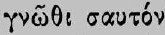
feasibility, and at once there arises within me a jubilant, irresistible gladness, diffused over my whole being and taking permanent possession of it, to my own astonishment. For only now does my intellect learn how firmly my will had already laid hold of the plan, and how entirely it was in agreement therewith, whereas the intellect had still regarded it as entirely problematical and hardly a match for that scruple. Or in another case, I have entered very eagerly into a mutual obligation that I believe to be very much in accordance with my wishes. As the matter progresses, the disadvantages and hardships make themselves felt, and I begin to suspect that I even repent of what I pursued so eagerly. However, I rid myself of this suspicion by assuring myself that, even if I were not bound, I should continue on the same course. But then the obligation is unexpectedly broken and dissolved by the other party, and I observe with astonishment that this happens to my great joy and relief. We often do not know what we desire or fear. For years we can have a desire without admitting it to ourselves or even letting it come to clear consciousness, because the intellect is not to know anything about it, since the good opinion we have of ourselves would inevitably suffer thereby. But if the wish is fulfilled, we get to know from our joy, not without a feeling of shame, that this is what we desired; for example, the death of a near relation whose heir we are. Sometimes we do not know what we really fear, because we lack the courage to bring it to clear consciousness. In fact, we are often entirely mistaken as to the real motive from which we do or omit to do something, till finally some accident discloses the secret to us, and we know that our real motive was not what we thought of it as being, but some other that we were unwilling to admit to ourselves, because it was by no means in keeping with our good opinion of ourselves. For example, as we imagine we omit to do something for purely moral reasons; yet we learn subsequently that we were deterred merely by fear, since we do it as soon as all danger is removed. In individual cases this may go so far that a man does not even guess the real motive of his action, in fact does not regard himself as capable of being influenced by such a motive; yet it is the real motive of his action. Incidentally, we have in all this a confirmation and illustration of the rule of La Rochefoucauld: "L'amour-propre est plus habile que le plus habile homme du monde,'' [6] in fact even a commentary on the Delphic
All these facts are evidence of the complete difference between the will and the intellect, and demonstrate the former's primacy and the latter's subordinate position. 4. The intellect grows tired; the
will is untiring. After continuous work with the head, we feel fatigue of the brain, just as we feel fatigue bf the arm after continuous bodily work. All knowing is associated with effort and exertion; willing, on the contrary, is our very nature, whose manifestations occur without any weariness and entirely of their own accord. Therefore, if our will is strongly
excited, as in all emotions such as anger, fear, desire, grief, and so on, and we are then called upon to know, perhaps with the intention of correcting the motives of those emotions, then the violence we must do to ourselves for this purpose is evidence of the transition from the original, natural activity proper to us to the activity that is
derived, indirect, and forced. For the will alone is
This consideration, therefore, also shows us the will as something original and thus metaphysical, but the intellect as something secondary and physical. For as such the intellect, like everything physical, is subject to vis inertiae, [11] and is therefore active only when it is put in motion by something else, by the will; and this will rules it, guides it, incites it to further effort, in short imparts to it the activity that is not originally inherent in it. Therefore it willingly rests as soon as it is allowed to do so, and often declares itself to be indolent and disinclined to activity. Through continued effort it becomes tired to the point of complete dulness; it is exhausted just as the voltaic pile is through repeated shocks. Therefore all continuous mental work requires pauses and rest, otherwise stupidity and incapacity are the result. Of course these are at first only temporary; but if this rest is constantly denied to the intellect, it becomes excessively and perpetually strained. The consequence is that it becomes permanently dull, and in old age this dulness can pass into complete incapacity, childishness, imbecility, and madness. It is not to be ascribed to old age in and by itself, but to long-continued tyrannical overstraining of the intellect or the brain, when these disorders appear in the last years of life. From this can be explained the fact that Swift became mad, Kant childish, Sir Walter Scott, and also Wordsworth, Southey, and many of less eminence, dull and incapable. Goethe to the end remained clear, and mentally vigorous and active, because he, who was always a man of the world and a courtier, never pursued his mental occupations with self-compulsion. The same holds good of Wieland and the ninety-one-year-old Knebel, as well as Voltaire. But all this proves how very secondary and physical the intellect is, what a mere tool it is. For this reason it needs, for almost a third of its life, the entire suspension of its activity in sleep, in resting the brain. The intellect is the mere function of the brain, which therefore precedes it just as the stomach precedes digestion, or as bodies precede their impact, and together with which it flags and becomes exhausted in old age. The will, on the contrary, as thing-in-itself, is never indolent, is absolutely untiring. Its activity is its essence; it never ceases to will, and when, during deep sleep, it is forsaken by the intellect, and is therefore unable to act outwardly from motives, it is active as vital force, looks after the inner economy of the organism with the less interruption, and, as vis naturae medicatrix, [12] again sets in order the irregularities that had found their way into it. For it is not, like the intellect, a function of the body, but the body is its function; therefore ordine rerum it is prior to that body, as it is the metaphysical substratum of that body, the in-itself of that body's phenomenal appearance. For the duration of life it communicates its indefatigability to the heart, that primum mobile of the organism, which has therefore become its symbol and synonym. Moreover it does not disappear in old age, but still goes on willing what it has willed. It becomes, in fact, firmer and more inflexible than it was in youth, more irreconcilable, implacable, self-willed, and intractable, because the intellect has become less responsive and susceptible. Therefore we can perhaps get the better of a person in old age only by taking advantage of the weakness of his intellect. The usual weakness and imperfection of the intellect, as shown in the want of judgement, narrow-mindedness, perversity, and folly of the great majority, would also be quite inexplicable if the intellect were not something secondary, adventitious, and merely instrumental, but the immediate and original essence of the so-called soul, or in general of the inner man, as was formerly assumed by all philosophers. For how could the original inner nature err and fail so frequently in its immediate and characteristic function? That which is actually original in human consciousness, namely willing, goes on all the time with perfect success; every being wills incessantly, vigorously, and decidedly. To regard the immoral element in the will as an imperfection of it would be a fundamentally false point of view; on the contrary, morality has a source that really lies beyond nature; hence it is in contradiction with the utterances of nature. For this reason, morality is directly opposed to the natural will, which in itself is absolutely egoistic; in fact, to pursue the path of morality leads to the abolition of the will. On this point I refer to our fourth book and to my essay On the Basis of Morality. 5. That the will is what is real and essential in man, whereas the intellect is only the secondary, the conditioned, and the produced, becomes clear from the fact that the intellect can fulfil its function quite properly and correctly only so long as the will is silent and pauses. On the other hand, the function of the intellect is disturbed by every observable excitement of the will, and its result is falsified by the will's interference; but the converse, namely that the intellect is in a similar manner a hindrance to the will, does not hold. Thus the moon cannot produce any effect when the sun is in the heavens; yet the moon in the heavens does not prevent the sun from shining. A great fright often deprives us of our senses to such an extent that we become petrified, or do the most preposterous things; for example, when a fire has broken out, we run right into the flames. Anger makes us no longer know what we do, still less what we say. Rashness, for this reason called blind, makes us incapable of carefully considering the arguments of others, or even of picking out and putting in order our own. Joy makes us inconsiderate, thoughtless, and foolhardy; desire acts in almost the same way. Fear prevents us from seeing and seizing the resources that still exist, and are often close at hand. Therefore equanimity, composure, and presence of mind are the most essential qualifications for overcoming sudden dangers, and also for contending with enemies and opponents. Composure consists in the silence of the will, so that the intellect can act; presence of mind consists in the undisturbed activity of the intellect under the pressure of events that act on the will. Therefore composure is the condition of presence of mind, and the two are closely related; they are rare, and exist always only in a limited degree. But they are of inestimable advantage, because they allow of the use of the intellect just at those times when we are most in need of it; and in this way they confer decided superiority. He who does not possess them knows what he ought to have done or said only after the opportunity has passed. It is very appropriately said of him who is violently moved, in other words whose will is so strongly excited as to destroy the purity of the intellect's function, that he is disarmed; [13] for the correct knowledge of circumstances and relations is our defence and weapon in the conflict with events and people. In this sense, Balthasar Gracian says: Es la pasion enemiga declarada de la cordura (Passion is the declared enemy of prudence). Now if the intellect were not something completely different from the will, but, as has hitherto been supposed, knowing and willing were radically one, and were equally original functions of an absolutely simple substance, then with the rousing and heightening of the will, in which emotion consists, the intellect also would of necessity be heightened. But, as we have seen, it is rather hindered and depressed by this; and for this reason, the ancients called emotion animi perturbatio. The intellect is really like the mirror-surface of water, the water itself being like the will; the agitation of the water therefore destroys at once the purity of that mirror and the distinctness of its images. The organism is the will itself, embodied will, in other words, will objectively perceived in the brain. For this reason many of its functions, such as respiration, blood circulation, bile secretion, and muscular force, are enhanced and accelerated by the pleasant, and generally robust, emotions. The intellect, on the other hand, is the mere function of the brain, which is nourished and sustained by the organism only parasitically. Therefore every perturbation of the will, and with it of the organism, must disturb or paralyse the function of the brain, a function existing by itself, and knowing no other needs than simply those of rest and nourishment. But this disturbing influence of the will's activity on the intellect can be shown not only in the perturbations produced by the emotions, but also in many other more gradual, and therefore more lasting, falsifications of thought through our inclinations and tendencies. Hope makes us regard what we desire, and fear what we are afraid of, as being probable and near, and both magnify their object. Plato (according to Aelian, Variae Historiae, 13, 28) has very finely called hope the dream of him who is awake. Its nature lies in the fact that the will, when its servant, the intellect, is unable to produce the thing desired, compels this servant at any rate to picture this thing to it, and generally to undertake the role of comforter, to pacify its lord and master, as a nurse does a child, with fairy-tales, and to deck these out so that they obtain an appearance of verisimilitude. Here the intellect is bound to do violence to its own nature, which is aimed at truth, since it is compelled, contrary to its own laws, to regard as true things that are neither true nor probable, and often scarcely possible, merely in order to pacify, soothe, and send to sleep for a while the restless and unmanageable will. We clearly see here who is master and who is servant. Indeed, many may have made the observation that, if a matter of importance to them admits of several courses of development, and they have brought all these into one disjunctive judgement that in their opinion is complete, the outcome is nevertheless quite different and wholly unexpected by them. But possibly they will not have noticed that this result was then almost always the one most unfavourable to them. This can be explained from the fact that, while their intellect imagined that it surveyed the possibilities completely, the worst of all remained quite invisible to it, because the will, so to speak, kept this covered with its hand; in other words, the will so mastered the intellect that it was quite incapable of glancing at the worst case of all, although, this case was the most probable, since it actually came to pass. However, in decidedly melancholy dispositions, or those which have grown wiser through like experience, the process is indeed reversed, since apprehension and misgiving in them play the part formerly played by hope. The first appearance of a danger puts them into a state of groundless anxiety. If the intellect begins to investigate matters, it is rejected as incompetent, in fact as a deceptive sophist, because the heart is to be believed. The heart's timidity and nervousness are now actually allowed to pass as arguments for the reality and magnitude of the danger. So then the intellect is not at all allowed to look for counter-arguments that it would soon recognize if left to itself, but is forced to picture to them at once the most unfortunate issue, even when it itself can conceive this as scarcely possible:
Love and hatred entirely falsify our judgement; in our enemies we see nothing but shortcomings, in our favourites nothing but merits and good points, and even their defects seem amiable to us. Our advantage, of whatever kind it may be, exercises a similar secret power over our judgement; what is in agreement with it at once seems to us fair, just, and reasonable; what runs counter to it is presented to us in all seriousness as unjust and outrageous, or inexpedient and absurd. Hence so many prejudices of social position, rank, profession, nationality, sect, and religion. A hypothesis, conceived and formed, makes us lynx-eyed for everything that confirms it, and blind to everything that contradicts it. What is opposed to our party, our plan, our wish, or our hope often cannot possibly be grasped and comprehended by us, whereas it is clear to the eyes of everyone else; on the other hand, what is favourable to these leaps to our eyes from afar. What opposes the heart is not admitted by the head. All through life we cling to many errors, and take care never to examine their ground, merely from a fear, of which we ourselves are unconscious, of possibly making the discovery that we have so long and so often believed and maintained what is false. Thus is our intellect daily befooled and corrupted by the deceptions of inclination and liking. This has been finely expressed by Bacon in the following words: Intellectus LUMINIS SICCI non est; sed recipit infusionem a voluntate et affectibus: id quod generat ad quod vult scientias: quod enim mavult homo, id potius credit. Innumeris modis, iisque interdum imperceptibilibus, affectus intellectum imbuit et inficit (Novum Organum, I, 49). [14] Obviously, it is also this that opposes all new fundamental views in the sciences and all refutations of sanctioned errors; for no one will readily see the correctness of that which convicts him of incredible want of thought. From this alone can be explained the fact that the truths of Goethe's colour theory, so clear and simple, are still denied by the physicists; and thus even he had to learn from experience how much more difficult is the position of one who promises people instruction rather than entertainment. It is therefore much more fortunate to have been born a poet than a philosopher. On the other hand, the more obstinately an error has been held, the more mortifying does the convincing proof subsequently become. With a system that is overthrown, as with a beaten army, the most prudent is he who runs away from it first. A trifling and ridiculous, but striking example of the mysterious and immediate power exercised by the will over the intellect is that, when doing accounts, we make mistakes more frequently to our advantage than to our disadvantage, and this indeed without the least intention of dishonesty, but merely through the unconscious tendency to diminish our debit and increase our credit. Finally, the fact is also relevant here that, in the case when any advice is to be given, the slightest aim or purpose in the adviser generally outweighs his insight, however great this may be. Therefore we dare not assume that he speaks from insight when we suspect intention. How little absolute sincerity is to be expected, even from persons otherwise honest, whenever their interest in any way bears on a matter, can be judged from the fact that we so often deceive ourselves where hope bribes us, or fear befools us, or suspicion torments us, or vanity flatters us, or a hypothesis infatuates and blinds us, or a small purpose close at hand interferes with one greater but more distant. In these we see the direct, unconscious, and disadvantageous influence of the will on knowledge. Accordingly it ought not to surprise us if, when advice is asked, the will of the person asked immediately dictates the answer, even before the question could penetrate to the forum of his judgement. Here I wish to point out in a word what is fully discussed in the following book, namely that the most perfect knowledge, the purely objective apprehension of the world, that is, the apprehension of the genius, is conditioned by a silencing of the will so profound that, so long as it lasts, even the individuality disappears from consciousness, and the man remains pure subject of knowing, which is the correlative of the Idea. The disturbing influence of the will on the intellect, as all these phenomena prove, and, on the other hand, the intellect's frailty and feebleness, by virtue of which it is incapable of operating correctly whenever the will is in any way set in motion, give us yet another proof that the will is the radical part of our real nature, and acts with original force, whereas the intellect, as something adventitious and in many ways conditioned, can act only in a secondary and conditional manner. There is no immediate disturbance of the will by knowledge, corresponding to the disturbance and clouding of knowledge by the will which has been discussed; in fact, we cannot really form any conception of such a thing. No one will try to explain it by saying that falsely interpreted motives lead the will astray, for this is a fault of the intellect in its own function. This fault is committed purely within the province of the intellect, and its influence on the will is wholly indirect. It would be more plausible to attribute irresolution to this, as in its case, through the conflict of the motives presented by the intellect to the will, the latter is brought to a standstill, and is therefore impeded. But on closer consideration it becomes very clear that the cause of this hindrance is to be sought not in the activity of the intellect as such, but simply and solely in the external objects brought about by this activity. The objects stand for once precisely in such a relation to the will, which is here interested, that they pull it in different directions with nearly equal force. This real cause acts merely through the intellect as the medium of motives, although, of course, only on the assumption that the intellect is keen enough to comprehend the objects and their manifold relations exactly. Indecision as a trait of character is conditioned just as much by qualities of the will as by those of the intellect. It is, of course, not peculiar to extremely limited minds, because their feeble understanding does not enable them to discover so many different qualities and relations in things. Moreover, their understanding is so little fitted for the effort of reflecting on and pondering over those things, and so over the probable consequences of each step, that they prefer to decide at once in accordance with the first impression or some simple rule of conduct. The converse of this occurs in the case of people of considerable understanding. Therefore, whenever these have in addition a tender care for their own well-being, in other words, a very sensitive egoism that certainly does not want to come off too badly and wants to be always safe and secure, this produces at every step a certain uneasiness, and hence indecision. Therefore this quality points in every way to a want not of understanding, but of courage. Yet very eminent minds survey the relations and their probable developments with such rapidity and certainty that, if only they are supported by some courage, they thus acquire that quick peremptoriness and resoluteness which fits them to play an important role in world affairs, provided that times and circumstances afford the opportunity for so doing. The only decided, direct hindrance and disturbance that the will can suffer from the intellect as such, may indeed be quite exceptional. This is the consequence of an abnormally predominant development of the intellect, and hence of that high endowment described as genius. Such a gift is indeed a decided hindrance to the energy of the character, and consequently to the power of action. Therefore it is not the really great minds that make historical characters, since such characters, capable of bridling and governing the mass of mankind, struggle with world-affairs. On the contrary, men of much less mental capacity are suitable for this, when they have great firmness, resolution, and inflexibility of will, such as cannot exist at all with very high intelligence. Accordingly, with such high intelligence a case actually occurs where the intellect directly impedes the will. 6. In contrast to the obstacles and hindrances mentioned, which the intellect suffers from the will, I wish now to show by a few examples how, conversely, the functions of the intellect are sometimes aided and enhanced by the incentive and spur of the will, so that here also we may recognize the primary nature of the one and the secondary nature of the other, and that it may become clear that the intellect stands to the will in the relation of a tool. A powerfully acting motive, such as a yearning desire or pressing need, sometimes raises the intellect to a degree of which we had never previously believed it capable. Difficult circumstances, imposing on us the necessity of certain achievements, develop entirely new talents in us, the germs of which had remained hidden from us, and for which we did not credit ourselves with any capacity. The understanding of the stupidest person becomes keen when it is a question of objects that closely concern his willing. He now observes, notices, and distinguishes with great subtlety and refinement even the smallest circumstances that have reference to his desires or fears. This has much to do with that cunning of half-witted persons which is often observed with surprise. For this reason, Isaiah rightly says: vexatio dat intellectum, [15] which is therefore also used as a proverb: akin to it is the German proverb "Die Not ist die Mutter der Kunste" (Necessity is the mother of the arts); the fine arts, however, must form an exception, since the kernel of every one of their works, namely the conception, must result from a perfectly will-less, and only thus a purely objective, perception, if they are to be genuine. Even the understanding of animals is considerably enhanced through necessity, so that in difficult cases they achieve things at which we are astonished. For example, almost all of them reckon that it is safer not to run away when they believe they are not seen; thus the hare lies still in the furrow of the field and lets the hunter pass close to it; if insects cannot escape, they pretend to be dead, and so on. We become more closely acquainted with this influence from the special story of the wolf's self-training under the spur of the great difficulty of its position in civilized Europe, to be found in the second letter of Leroy's excellent book Lettres sur l'intelligence et la perfectibilite des animaux. Immediately afterwards, in the third letter, there follows the high school of the fox; in an equally difficult position, he has far less physical strength, but in his case greater understanding compensates for this. Yet this understanding reaches the high degree of cunning, which distinguishes him especially in old age, only through constant struggle with want on the one hand and danger on the other, and thus under the spur of the will. In all these enhancements of the intellect, the will plays the part of the rider urging his horse with the spur beyond the natural measure of its strength. In just the same way, memory is enhanced by pressure of the will. Even when otherwise weak, it preserves completely what is of value to the ruling passion. The lover forgets no opportunity favourable to him, the man of ambition no circumstance that suits his plans, the miser never forgets the loss he has suffered, the proud man never forgets an injury to his honour, the vain person remembers every word of praise and even the smallest distinction that falls to his lot. This also extends to the animals; the horse stops at the inn where it was once fed a long time ago; dogs have an excellent memory for all occasions, times, and places that have afforded them dainty morsels, and foxes for the various hiding-places in which they have stored their plunder. An examination of ourselves gives us an opportunity for finer observations in this respect. Through an interruption or disturbance, what I was just thinking about, or even the news that I have just come to hear, sometimes slips entirely from my memory. Now, if the matter had in any way a personal interest, however remote, there remains the after-effect of the impression thus made by it on the will. Thus I am still quite conscious how far it affected me agreeably or disagreeably, and also of the special way in which this happened, thus whether, although in a feeble degree, it offended me, or made me anxious, or irritated me, or grieved me, or else produced the opposite of these affections. Hence the mere relation of the thing to my will has been retained in the memory, after the thing itself has vanished from me; and this relation in turn often becomes the clue for returning to the thing itself. The sight of a person sometimes affects us in an analogous way, since only in general do we remember having had something to do with him, without knowing where, when, and what it was, or who he is. On the other hand, the sight of him still recalls pretty accurately the feeling or frame of mind formerly roused in us by our dealings with him, that is, whether it was agreeable or disagreeable, and to what degree and in what way it was so. Therefore the memory has preserved merely the approval or disapproval of the will, not what called it forth. We might call that which is the foundation of this course of events the memory of the heart; this is much more intimate than that of the head. Yet at bottom the connexion of the two is so far-reaching that, if we reflect deeply on the matter, we shall reach the conclusion that memory in general requires the foundation of a will as a point of contact, or rather as a thread on which the recollections range themselves, and which holds them firmly together, or that the will is, so to speak, the ground on which the individual recollections stick, and without which they could not be fixed. We shall therefore reach the conclusion that a memory cannot really be conceived in a pure intelligence, in other words in a merely knowing and absolutely will-less being. Accordingly, the above-mentioned enhancement of the memory through the spur of the ruling passion is only the higher degree of what takes place in all retention and recollection, since its basis and condition is always the will. Hence in all this also, it becomes clear how very much more intimate to us the will is than the intellect. The following facts may also serve to confirm this. The intellect often obeys the will; for example, if we wish to remember something, and after some effort succeed; as also if we wish to think over something accurately and deliberately, and in many such cases. Again, the intellect sometimes refuses to obey the will, e.g., when we strive in vain to fix on something, or vainly demand back from the memory something entrusted to it. The anger of the will towards the intellect on such occasions makes its relation to the intellect and the difference between the two very easy to recognize. Indeed the intellect, vexed by this anger, officiously supplies what was asked of it sometimes hours later, or even on the following morning, quite unexpectedly and at the wrong time. On the other hand, the will, properly speaking, never obeys the intellect, but the intellect is merely the cabinet council of that sovereign. It lays before the will all kinds of things, and in accordance with these the will selects what is in conformity with its true nature, although in doing so it determines itself with necessity, because this inner nature is firm and unchangeable, and the motives now lie before it. For this reason, no system of ethics which would mould and improve the will itself is possible. For all teaching affects only knowledge, and knowledge never determines the will itself, in other words, the fundamental character of willing, but merely its application to the circumstances in question. Rectified knowledge can modify conduct only in so far as it demonstrates more accurately and enables one to judge more correctly the objects of the will's choice which are accessible to the will. In this way the will estimates more correctly its relation to things, sees more distinctly what it wills, and in consequence is less subject to error in its choice. Over willing itself, however, over its main tendency or fundamental maxim, the intellect has no power. To believe that knowledge really and radically determines the will is like believing that the lantern a man carries at night is the primum mobile of his steps. He who, taught by experience or by the exhortations of others, recognizes and deplores a fundamental defect in his character, firmly and honestly forms the resolution to improve himself and to get rid of the defect; but in spite of this, the defect obtains full play on the very next occasion. New regrets, new resolutions, new transgressions. When this is gone through several times, he becomes aware that he cannot mend his ways, that the defect lies in his nature and personality, is in fact identical with these. He will then disapprove of and condemn his nature and personality; he will have a painful feeling that may rise to qualms of conscience; but change these he cannot. Here we see distinctly separated that which condemns and that which is condemned. We see the former as a merely theoretical faculty, picturing and presenting the praiseworthy and therefore desirable course of life, and the other as something real and unalterably present, taking quite a different course, in spite of the former. Then again, we see the former left behind with useless and ineffective complaints about the nature of the latter, with which it again identifies itself through this very grief and distress. Will and intellect here separate out very distinctly; but the will shows itself as that which is the stronger, the invincible, the unalterable, the primitive, and at the same time the essential, that on which everything depends, since the intellect deplores the will's defects, and finds no consolation in the correctness of the knowledge as its own function. Therefore the intellect shows itself as entirely secondary, now as the spectator of another's deeds, accompanying them with ineffective praise or blame, now as determinable from without, since, enlightened by experience, it draws up and modifies its precepts. Special illustrations of this subject are found in the Parerga, Vol. II, § 118. Accordingly, a comparison of our way of thinking at different periods of our life will present us with a strange mixture of constancy and inconstancy. On the one hand, the moral tendency of the man in his prime and of the old man is still the same as was that of the boy. On the other hand, much has become so strange to him that he no longer knows himself, and wonders how he was once able to do or say this or that. In the first half of life, to-day often laughs at yesterday, in fact even looks down on it with contempt; in the second half, on the other hand, it looks back on it more and more with envy. On closer investigation, however, it will be found that the changeable element was the intellect with its functions of insight and knowledge. These every day assimilate fresh material from outside, and present a constantly altered system of ideas, whereas the intellect itself rises and sinks with the rise and decline of the organism. On the other hand, the will, the very basis of the organism, and thus the inclinations, passions, emotions, character, show themselves as that which is unalterable in consciousness. Yet we must take into account the modifications depending on the physical capacities for enjoyment, and thus on age. For example, the keen desire for sensual pleasure will appear in boyhood as a fondness for dainties, in youth and manhood as a tendency to voluptuousness, and in old age once more as a fondness for dainties. 7. If, as is generally assumed, the will proceeded from knowledge as its result or product, then where there is much will there would necessarily be much knowledge, insight, and understanding. This, however, is by no means the case; on the contrary, we find in many men a strong, i.e., decided, resolute, persistent, inflexible, obstinate, and vehement will associated with a very feeble and incompetent understanding. Thus whoever has dealings with them is reduced to despair, since their will remains inaccessible to all arguments and representations, and is not to be got at, so that it is, so to speak, hidden in a sack out of which it wills blindly. Animals have less understanding by far in spite of a will that is often violent and stubborn. Finally, plants have mere will without any knowledge at all. If willing sprang merely from knowledge, our anger would inevitably be exactly proportionate to its cause or occasion in each case, or at any rate to our understanding thereof, since it too would be nothing more than the result of the present knowledge. But it very rarely turns out like this; on the contrary, anger usually goes far beyond the occasion. Our fury and rage, the furor brevis, often with trifling occasions and without error in regard to them, are like the storming of an evil demon, which, having been shut up, only waited for the opportunity to dare to break loose, and now rejoices at having found it. This could not be the case if the ground of our true nature were a knower, and willing were a mere result of knowledge; for how could anything come into the result which did not lie in the elements thereof? The conclusion cannot contain more than is contained in the premisses. Thus here also the will shows itself as an essence which is entirely different from knowledge, and makes use of knowledge merely for communication with the outside world. But then it follows the laws of its own nature without taking from knowledge anything more than the occasion. The intellect, as the will's mere tool, is as different from it as is the hammer from the smith. So long as the intellect alone is active in a conversation, that conversation remains cold; it is almost as though the man himself were not there. Moreover, he cannot then really compromise himself, but can at most make himself ridiculous. Only when the will comes into play is the man really present; he now becomes warm, in fact matters often become hot. It is always the will to which we ascribe the warmth of life; on the other hand, we speak of the cold understanding, or to investigate a thing coolly, in other words, to think without the influence of the will. If we attempt to reverse the relation, and consider the will as the tool of the intellect, it is as if we were to make the smith the tool of the hammer. Nothing is more tiresome and annoying than when we argue with a person with reasons and explanations, and take all the trouble to convince him, under the impression that we have to deal only with his understanding, and then finally discover that he will not understand; that we therefore had to deal with his will, which pays no heed to the truth, but brings into action wilful misunderstandings, chicaneries, and sophisms, entrenching itself behind its understanding and its supposed want of insight. Then he is of course not to be got at in this way, for arguments and proofs applied against the will are like the blows of a concave mirror's phantom against a solid body. Hence the oft-repeated saying: Stat pro ratione voluntas. [16] Proofs enough of what has been said are furnished by ordinary, everyday life; but unfortunately they are also to be found on the path of the sciences. Acknowledgement of the most important truths, of the rarest achievements, will be expected in vain from those who have an interest in not allowing them to be accepted. Such an interest springs either from the fact that such truths contradict what they themselves teach every day, or from their not daring to make use of it and afterwards teach it; or, even if all this is not the case, they do not acknowledge such truths, because the watchword of mediocrities will always be: Si quelqu'un excelle parmi nous, qu'il aille exceller ailleurs, [17] as Helvetius has delightfully rendered the saying of the Ephesians in Cicero (Tusc. v, c. 36); or as a saying of the Abyssinian Fit Arari has it: "Among quartzes the diamond is outlawed." Therefore whoever expects from this always numerous band a just appreciation of his achievements will find himself very much deceived; and perhaps for a while he will not be able to understand their behaviour at all, until at last he finds out that, whereas he appealed to knowledge, he had to do with the will. Thus he finds himself entirely in the position above described; in fact, he is really like the man who brings his case before a court all of whose members are bribed. In individual cases, however, he will obtain the most conclusive proof that he was opposed by their will and not by their insight, when one or the other of them makes up his mind to plagiarize. He will then see with astonishment what shrewd judges they are, what an accurate judgement they have of the merit of others, and how well they are able to discover the best, like sparrows that never miss the ripest cherries. The opposite of the will's victorious resistance to knowledge which I here describe, is seen when, in expounding our arguments and proofs, we have on our side the will of the persons addressed. All are then equally convinced, all arguments are striking, and the matter is at once as clear as daylight. Popular speakers know this. In the one case as in the other, the will shows itself as that which has original force, against which the intellect can do nothing. 8. But now we will take into consideration the individual qualities, the merits and defects of the will and character on the one hand, and of the intellect on the other, in order to bring out clearly in their relation to each other and their relative worth the complete difference of the two fundamental faculties. History and experience teach that the two appear quite independently of each other. That the greatest eminence of mind is not easily found combined with an equal eminence of character is sufficiently explained from the extraordinary rarity of both, whereas their opposites are generally the order of the day; hence we daily find these opposites in combination. But we never infer a good will from a superior mind, or the latter from the former, or the opposite from the opposite; but every unprejudiced person accepts them as wholly separate qualities, whose existence, each by itself, is to be determined through experience. Great narrowness of mind can coexist with great goodness of heart, and I do not believe that Balthasar Gracian is right in saying (Discreto, p. 406): No hay simple que no sea malicioso (There is no simpleton who is not malicious), although he has on his side the Spanish proverb: Nunca La necedad anduvo sin malicia (Stupidity is never without malice). Yet it may be that many a stupid person becomes malicious for the same reason that many a hunchback does, namely from irritation at the slight he has suffered from nature; for he imagines he can occasionally make up for what he lacks in understanding through malicious tricks, seeking in this a brief triumph. Incidentally, it is easy to understand from this why almost everyone readily becomes malicious in the presence of a very superior mind. Again, stupid people very often have a reputation for special kindness of heart; yet this is so rarely confirmed, that I could not help wondering how they obtained such a reputation, until I could flatter myself that I had found the key to it in what follows. Moved by a secret inclination, everyone likes best to choose for his most intimate acquaintance someone to whom he is a little superior in understanding, for only with such a person does he feel at ease, since according to Hobbes, omnis animi voluptas, omnisque alacritas in eo sita est, quod quis habeat, quibuscum conjerens se, possit magnifice sentire de se ipso (De Cive, I, 5). [18] For the same reason, everyone avoids a person who is superior to him; and therefore Lichtenberg quite rightly observes that "To certain persons a man of mind is a more odious creature than the most pronounced rogue." [18a] Likewise, Helvetius says: Les gens mediocres ont un instinct sur et prompt pour conna'itre et fuir les gens d'esprit; [19] and Dr. Johnson assures us that "There is nothing by which a man exasperates most people more, than by displaying a superior ability of brilliancy in conversation. They seem pleased at the time; but their envy makes them curse him at their hearts." (Boswell; aet. anno 74). To bring to light even more relentlessly this truth so generally and carefully concealed, I quote the expression of it by Merck, the celebrated friend of Goethe's youth, from his narrative Lindor: "He possessed talents given to him by nature and acquired by him through knowledge, and these enabled him at most parties to leave the worthy members of them far behind. If, at the moment of delight in seeing an extraordinary man, the public swallows these excellent points without actually putting at once a bad construction on them, nevertheless a certain impression of this phenomenon is left behind. If this impression is often repeated, it may on serious occasions have unpleasant consequences in the future for the person guilty of it. Without anyone consciously taking particular notice of the fact that on this occasion he was insulted, on the quiet he is not unwilling to stand in the way of this man's advancement." Therefore, on this account, great mental superiority isolates a person more than does anything else, and makes him hated, at any rate secretly. Now it is the opposite that makes stupid people so universally liked, especially as many a person can find only in them what he is bound to look for in accordance with the above-mentioned law of his nature. Yet no one will confess to himself, still less to others, this real reason for such an inclination; and so, as a plausible pretext for it, he will impute to the person of his choice a special goodness of heart, which, as I have said, actually exists very rarely indeed, and only accidentally in combination with weakness of intellect. Accordingly, want of understanding is by no means favourable or akin to goodness of character. On the other hand, it cannot be asserted that great understanding is so; on the contrary, there has never really been any scoundrel without such understanding. In fact, even the highest intellectual eminence can coexist with the greatest moral depravity. An example of this was afforded by Bacon. Ungrateful, filled with lust for power, wicked and base, he ultimately went so far that, as Lord Chancellor and the highest judge of the realm, he frequently allowed himself to be bribed in civil actions. Impeached before his peers, he pleaded guilty, was expelled from the House of Lords, and condemned to a fine of forty thousand pounds and to imprisonment in the Tower. (See the review of the new edition of Bacon's works in the Edinburgh Review, August 1837.) For this reason Pope calls him "the wisest, brightest, meanest of mankind" (Essay on Man, iv, 282). A similar example is afforded by the historian Guicciardini, of whom Rosini says in the Notizie Storiche, drawn from good contemporary sources and given in his historical novel Luisa Strozzi: Da coloro che pongono l'ingegno e il sapere al di sopra di tutte le umane qualita, questo uomo sara riguardato come fra i piu grandi del suo secolo: ma da quelli che reputano la virtu dovere andare innanzi a tutto, non potra esecrarsi abbastanza la sua memoria. Esso fu il piu crudele fra i cittadini a perseguitare, uccidere e confinare, etc. [20] Now if it is said of one person that "he has a good heart, though a bad head," but of another that "he has a very good head, yet a bad heart," everyone feels that in the former case the praise far outweighs the blame, and in the latter the reverse. Accordingly we see that, when anyone has done a bad deed, his friends and he himself try to shift the blame from the will on to the intellect, and to make out the faults of the heart to be faults of the head. They will call mean tricks erratic courses; they will say it was mere want of understanding, thoughtlessness, levity, folly; in fact, if need be, they will plead a paroxysm, a momentary mental derangement, and if it is a question of a grave crime, even madness, merely in order to exonerate the will from blame. In just the same way, when we ourselves have caused a misfortune or injury, we most readily impeach our stultitia before others and before ourselves, merely in order to avoid the reproach of malitia. Accordingly, in the case of an equally unjust decision of the judge, the difference is immense whether he made a mistake or was bribed. All this is evidence enough that the will alone is the real and essential, the kernel of man, and the intellect merely its tool, which may always be faulty without the will being concerned. The accusation of want of understanding is, at the moral judgement-seat, no accusation at all; on the contrary, it even gives privileges. In just the same way, before the courts of the world, it is everywhere sufficient, in order to exonerate an offender from all punishment, for the guilt to be shifted from his will to his intellect, by demonstrating either unavoidable error or mental derangement. For then it is of no more consequence than if hand or foot had slipped contrary to the will. I have discussed this fully in the Appendix "On Intellectual Freedom" to my essay On the Freedom of the Will, and to this I refer so as not to repeat myself. Everywhere those who promote the appearance of any piece of work appeal, in the event of its turning out unsatisfactorily, to their good will, of which there was no lack. In this way they believe they safeguard the essential, that for which they are properly responsible, and their true self. The inadequacy of their faculties, on the other hand, is regarded by them as the want of a suitable tool. If a person is stupid, we excuse him by saying that he cannot help it; but if we attempted to excuse in precisely the same way the person who is bad, we should be laughed at. And yet the one quality, like the other, is inborn. This proves that the will is the man proper, the intellect its mere tool. Therefore it is always only our willing that is regarded as dependent on us, in other words, the expression of our real inner nature, for which we are therefore made responsible. For this reason it is absurd and unjust when anyone tries to take us to task for our beliefs, and so for our knowledge; for we are obliged to regard this as something that, although it rules within us, is as little within our power as are the events of the external world. Therefore here also it is clear that the will alone is man's own inner nature; that the intellect, on the other hand, with its operations which occur regularly like the external world, is related to the will as something external, as a mere tool. High intellectual faculties have always been regarded as a gift of nature or of the gods; thus they have been called Gaben, Begabung, ingenii dotes, gifts (a man highly gifted), and have been regarded as something different from man himself, as something that has fallen to his lot by favour. On the other hand, no one has ever taken the same view with regard to moral excellences, though they too are inborn; on the contrary, these have always been regarded as something coming from the man himself, belonging to him essentially, in fact constituting his own true self. Now it follows from this that the will is man's real inner nature, while the intellect, on the other hand, is secondary, a tool, an endowment. In accordance with this, all religions promise a reward beyond this life in eternity for excellences of the will or of the heart, but none for excellences of the head, of the understanding. Virtue expects its reward in the next world; prudence hopes for it in this; genius neither in this world nor in the next; for it is its own reward. Accordingly the will is the eternal part, the intellect the temporal. Association, community, intercourse between persons is based as a rule on relations concerning the will, rarely on such as concern the intellect. The first kind of community may be called the material, the other the formal. Of the former kind are the bonds of family and relationship, as well as all connexions and associations that rest on any common aim or interest, such as that of trade, profession, social position, a corporation, party, faction, and so on. With these it is a question merely of the disposition, the intention, and there may exist the greatest diversity of intellectual faculties and of their development. Therefore everyone can not only live with everyone else in peace and harmony, but co-operate with him and be allied to him for the common good of both. Marriage also is a union of hearts, not of heads. Matters are different, however, with merely formal community that aims only at an exchange of ideas; this requires a certain equality of intellectual faculties and of culture. Great differences in this respect place an impassable gulf between one man and another; such a gulf lies, for example, between a great mind and a blockhead, a scholar and a peasant, a courtier and a sailor. Therefore such heterogeneous beings have difficulty in making themselves understood, so long as it is a question of communicating ideas, notions, and views. Nevertheless, close material friendship can exist between them, and they can be faithful allies, conspirators, and persons under a pledge. For in all that concerns the will alone, which includes friendship, enmity, honesty, fidelity, falseness, and treachery, they are quite homogeneous, formed of the same clay, and neither mind nor culture makes any difference to this; in fact, in this respect. the uncultured man often puts the scholar to shame, and the sailor the courtier. For in spite of the most varied degrees of culture there exist the same virtues and vices, emotions and passions; and although somewhat modified in their expression, they very soon recognize one another, even in the most heterogeneous individuals, whereupon those who are like-minded come together, and those of contrary opinion show enmity to one another. Brilliant qualities of the mind earn admiration, not affection; that is reserved for moral qualities, qualities of character. Everyone will much rather choose as his friend the honest, the kind-hearted, and even the complaisant, easy-going person who readily concurs, than one who is merely witty or clever. Many a man will be preferred to one who is clever, even through insignificant, accidental, and external qualities that are exactly in keeping with the inclinations of someone else. Only the man who himself possesses great intellect will want a clever man for his companion; on the other hand, his friendship will depend on moral qualities, for on these rests his real estimation of a person, in which a single good trait of character covers up and effaces great defects of understanding. The known goodness of a character makes us patient and accommodating to weaknesses of understanding as well as to the obtuseness and childishness of old age. A decidedly noble character, in spite of a complete lack of intellectual merits and culture, stands out as one that lacks nothing; on the other hand, the greatest mind, if tainted by strong moral defects, will nevertheless always seem blameworthy. For just as torches and fireworks become pale and insignificant in the presence of the sun, so intellect, even genius, and beauty likewise, are outshone and eclipsed by goodness of heart. Where such goodness appears in a high degree, it can compensate for the lack bf those qualities to such an extent that we are ashamed of having regretted their absence. Even the most limited understanding and grotesque ugliness, whenever extraordinary goodness of heart has proclaimed itself as their accompaniment, become transfigured, as it were, enwrapped in rays of a beauty of a more exalted kind, since now a wisdom speaks out of them in whose presence all other wisdom must be reduced to silence. For goodness of heart is a transcendent quality; it belongs to an order of things reaching beyond this life, and is incommensurable with any other perfection. Where it is present in a high degree, it makes the heart so large that this embraces the world, so that everything now lies within it, no longer outside. For goodness of heart identifies all beings with its own nature. It then extends to others the boundless indulgence that everyone ordinarily bestows only on himself. Such a man is not capable of becoming angry; even when his own intellectual or physical defects have provoked the malicious sneers and jeers of others, in his heart he reproaches himself alone for having been the occasion of such expressions. He therefore continues, without imposing restrictions on himself, to treat those persons in the kindest manner, confidently hoping that they will turn from their error in his regard, and will recognize themselves also in him. What are wit and genius in comparison with this? What is Bacon? A consideration of the estimation of our own selves leads also to the same result that we have here obtained from considering our estimation of others. How fundamentally different is the self-satisfaction which occurs in a moral respect from that which occurs in an intellectual! The former arises from our looking back on our conduct and seeing that we have practised fidelity and honesty with heavy sacrifices, that we have helped many, forgiven many, have been better to others than they have been to us, so that we can say with King Lear: "I am a man more sinn'd against than sinning"; and it arises to the fullest extent when possibly even some noble deed shines in our memory. A profound seriousness will accompany the peaceful bliss that such an examination affords us; and if we see others inferior to us in this respect, this will not cause us any rejoicing; on the contrary, we shall deplore it and sincerely wish that they were as we are. How entirely differently, on the other hand, does the knowledge of our intellectual superiority affect us! Its ground-bass is really the above-quoted saying of Hobbes: Omnis animi voluptas, omnisque alacritas in eo sita est, quod quis habeat, quibuscum conferens se, possit magnifice sentire de se ipso. [21] Arrogant, triumphant vanity, a proud, scornful, contemptuous disdain of others, inordinate delight in the consciousness of decided and considerable superiority, akin to pride of physical advantages -- this is the result here. This contrast between the two kinds of self-satisfaction shows that the one concerns our true inner and eternal nature, the other a more external, merely temporal, indeed scarcely more than a mere physical advantage. In fact, the intellect is a mere function of the brain; the will, on the contrary, is that whose function is the whole man, according to his being and inner nature. If, glancing
outwards, we reflect that
The complete difference between mental and moral qualities shows itself lastly in the fact that the intellect undergoes extremely important changes with time, whereas the will and character remain untouched thereby. The new-born child has as yet no use at all for its understanding; yet it acquires this within the first two months to the extent of perceiving and apprehending things in the external world, a process I have more fully explained in the essay Ueber das Sehn und die Farben (p. 10 of the second edition). The development of reason (Vernunft) to the point of speech, and hence of thought, follows this first and most important step much more slowly, generally only in the third year. Nevertheless, early childhood remains irrevocably abandoned to silliness and stupidity, primarily because the brain still lacks physical completeness, which is attained, as regards both size and texture, only in the seventh year. But for its energetic activity the antagonism of the genital system is still required; hence that activity begins only with puberty. Through this, however, the intellect has then attained only the mere capacity for its psychic development; the capacity itself can be acquired only through practice, experience, and instruction. Therefore, as soon as the mind has been delivered from the silliness of childhood, it falls into the snares of innumerable errors, prejudices, and chimeras, sometimes of the absurdest and crassest kind. It wilfully and obstinately sticks firmly to these, till experience gradually rescues it from them; many also are imperceptibly lost. All this happens only in the course of many years, so that we grant to the mind its coming of age soon after the twentieth year, but put full maturity, years of discretion, only at the fortieth. But while this psychic development, resting on help from outside, is still in process of growth, the inner physical energy of the brain is already beginning to sink again. So, on account of this energy's dependence on blood-pressure and on the pulse's effect on the brain, and thus again on the preponderance of the arterial system over the venous, as well as on the fresh delicacy or softness of the brain-filaments, and also through the energy of the genital system, such energy has its real culminating point at about the thirtieth year. After the thirty-fifth year a slight decrease of this physical energy is already noticeable. Through the gradually approaching preponderance of the venous over the arterial system, as well as through the consistency of the brain-filaments which is always becoming firmer and drier, this decrease of energy occurs more and more. It would be much more noticeable if the psychic improvement through practice, experience, increase of knowledge, and the acquired skill in handling this did not counteract it. Fortunately, this antagonism lasts to an advanced age, since the brain can be compared more and more to a played-out instrument. But yet the decrease of the intellect's original energy, which depends entirely on organic conditions, continues, slowly it is true, but irresistibly. The faculty of original conception, the imagination, the suppleness, plasticity, and memory become noticeably more feeble; and so it goes on, step by step, downwards into old age, which is garrulous, without memory, half-unconscious, and finally quite childish. On the other hand, the will is not simultaneously affected by all this growth, development, change, and alteration, but from beginning to end is unalterably the same. Willing does not need to be learnt like knowing, but succeeds perfectly at once. The new-born child moves violently, screams and cries; it wills most vehemently, although it does not yet know what it wills. For the medium of motives, the intellect, is still quite undeveloped. The will is in the dark concerning the external world in which its objects lie; and it rages like a prisoner against the walls and bars of his dungeon. Light, however, gradually comes; at once the fundamental traits of universal human willing, and at the same time their individual modification that is here to be found, show themselves. The character, already emerging, appears, it is true, only in feeble and uncertain outline, on account of the defective functioning of the intellect that has to present it with motives. But to the attentive observer the character soon announces its complete presence, and this soon becomes unmistakable. The traits of character make their appearance, and last for life; the main tendencies of the will, the easily stirred emotions, the ruling passion express themselves. Therefore events at school are for the most part related to those of the future course of life, as the dumb-show in Hamlet, preceding the play to be performed at court and foretelling its contents in the form of pantomime, is to the play itself. However, it is by no means possible to predict the future intellectual capacities of the man from those appearing in the boy. On the contrary, ingenia praecocia, youthful prodigies, as a rule become blockheads; genius, on the other hand, is often in childhood of slow conception, and comprehends with difficulty, just because it comprehends deeply. Accordingly, everyone relates with a laugh and without reserve the follies and stupidities of his childhood; e.g., Goethe, how he threw all the kitchen-utensils out of the window (Poetry and Truth, Vol. i, p. 7); for we know that all this concerns only what is changeable. On the other hand, a prudent man will not favour us with the bad features, the malicious and treacherous tricks, of his youth, for he feels that they still bear witness to his present character. It has been reported to me that when Gall, the phrenologist and investigator of man, had to form an association with someone as yet unknown to him, he got him to speak of his youthful years and tricks, in order, if possible, to discover from these the traits of his character, because this was bound to be still the same. On this rests the fact that, while we are indifferent to, and indeed look back with smiling satisfaction on, the follies and want of understanding of our youthful years, the bad features of character of that period, the malicious actions and misdeeds committed at the time, exist even in advanced age as inextinguishable reproaches, and disturb our conscience. Therefore, just as the character now appears complete, so it remains unaltered right into old age. The assaults of old age, gradually consuming the intellectual powers, leave the moral qualities untouched. Goodness of heart still makes the old man honoured and loved, when his head already shows the weaknesses that are beginning to bring him to his second childhood. Gentleness, patience, honesty, truthfulness, unselfishness, philanthropy, and so on are maintained throughout life, and are not lost through the weakness of old age. In every clear moment of the decrepit old man, they stand out undiminished, like the sun from the winter clouds. On the other hand, malice, spite, avarice, hardheartedness, duplicity, egoism, and baseness of every kind remain undiminished to the most advanced age. We would not believe anyone, but would laugh at him, if he were to say that "In former years I was a malicious rogue, but now I am an honest and noble-minded man." Therefore Sir Walter Scott, in The Fortunes of Nigel, has shown very beautifully how, in the case of the old moneylender, burning greed, egoism, and dishonesty are still in full bloom, like the poisonous plants in autumn, and still powerfully express themselves, even after the intellect has become childish. The only alterations that take place in our likings and inclinations are those that are direct consequences of a decrease in our physical strength, and therewith in our capacities for enjoyment. Thus voluptuousness will make way for intemperance, love of splendour for avarice, and vanity for ambition, like the man who, before he had a beard, stuck on a false one, and who will later on dye brown his own beard that has become grey. Therefore, while all the organic forces, muscular strength, the senses, memory, wit, understanding, genius, become worn out and dull in old age, the will alone remains unimpaired and unaltered; the pressure and tendency of willing remain the same. Indeed, in many respects the will shows itself even more decided in old age, e.g., in its attachment to life, which, as we know, grows stronger; also in its firmness and tenacity with regard to what it has once seized, in obstinacy. This can be explained from the fact that the susceptibility of the intellect to other impressions, and thus the excitability of the will through motives that stream in on it, have grown weaker. Hence the implacability of the anger and hatred of old people:
From all these considerations it is unmistakable to our deeper glance that, while the intellect has to run through a long series of gradual developments, and then, like everything physical, falls into decline, the will takes no part in this, except in so far as it has to contend at first with the imperfection of its tool, the intellect, and ultimately again with its worn-out condition. The will itself, however, appears as something finished and perfect, and remains unchanged, not subject to the laws of time and of becoming and passing away in time. In this way it makes itself known as something metaphysical, as not itself belonging to the world of phenomena. 9. The universally used and generally very well understood expressions heart and head have sprung from a correct feeling of the fundamental distinction in question. They are therefore significant and to the point, and are found again and again in all languages. Nec cor nec caput habet, [23] says Seneca of the Emperor Claudius (Ludus de morte Claudii Caesaris, c. 8). The heart, that
primum mobile of animal life, has quite rightly been chosen as the symbol, indeed the synonym, of the will, the primary kernel of our phenomenon; and it denotes this in contrast with the intellect which is exactly identical with the head. All that which is the business of the will in the widest sense, such as desire, passion, joy, pain, kindness, goodness, wickedness, and also that which is usually understood by the term "Gemut" (disposition, feeling), and what Homer expresses by
A certain feeling of the true relation between will, intellect, and life is also expressed in the Latin language. The intellect is mens,
10. On what does the identity of the person depend? Not on the matter of the body; this becomes different after a few years. Not on the form of the body, which changes as a whole and in all its parts, except in the expression of the glance, by which we still recognize a man even after many years. This proves that, in spite of all the changes produced in him by time, there yet remains in him something wholly untouched by it. It is just this by which we recognize him once more, even after the longest intervals of time, and again find the former person unimpaired. It is the same with ourselves, for, however old we become, we yet feel within ourselves that we are absolutely the same as we were when we were young, indeed when we were still children. This thing which is unaltered and always remains absolutely the same, which does not grow old with us, is just the kernel of our inner nature, and that does not lie in time. It is assumed that the identity of the person rests on that of consciousness. If, however, we understand by this merely the continuous recollection of the course of life, then it is not enough. We know, it is true, something more of the course of our life than of a novel we have formerly read, yet only very little indeed. The principal events, the interesting scenes, have been impressed on us; for the rest, a thousand events are forgotten for one that has been retained. The older we become, the more does everything pass us by without leaving a trace. Great age, illness, injury to the brain, madness, can deprive a man entirely of memory, but the identity of his person has not in this way been lost. That rests on the identical will and on its unalterable character; it is also just this that makes the expression of the glance unalterable. In the heart is the man to be found, not in the head. It is true that, in consequence of our relation to the external world, we are accustomed to regard the subject of knowing, the knowing I, as our real self which becomes tired in the evening, vanishes in sleep, and in the morning shines more brightly with renewed strength. This, however, is the mere function of the brain, and is not our real self. Our true self, the kernel of our inner nature, is that which is to be found behind this, and which really knows nothing but willing and not-willing, being contented and not contented, with all the modifications of the thing called feelings, emotions, and passions. This it is which produces that other thing, which does not sleep with it when it sleeps, which also remains unimpaired when that other thing becomes extinct in death. On the other hand, everything related to knowledge is exposed to oblivion; even actions of moral significance sometimes cannot be completely recalled by us years after, and we no longer know exactly and in detail how we behaved in a critical case. The character itself, however, to which the deeds merely testify, we cannot forget; it is still exactly the same now as then. The will itself, alone and by itself, endures; for it alone is unchangeable, indestructible, does not grow old, is not physical but metaphysical, does not belong to the phenomenal appearance, but to the thing itself that appears. How the identity of consciousness, so far as it goes, depends on the will, I have already shown in chapter 15; therefore I need not dwell on it here. 11. Incidentally, Aristotle says in the book on the comparison of the desirable: "To live well is better than to live" ( 12. On the other hand, nothing more clearly demonstrates the intellect's secondary, dependent, and conditioned nature than its periodical intermission. In deep sleep all knowing and forming of representations entirely ceases; but the kernel of our true being, its metaphysical part, necessarily presupposed by the organic functions as their primum mobile, never dares to pause, if life is not to cease; moreover, as something metaphysical, and consequently incorporeal, it needs no rest. Therefore the philosophers who set up a soul, i.e., an originally and essentially knowing being, as this metaphysical kernel, saw themselves forced to the assertion that this soul is quite untiring in its representing and knowing, and consequently continues these even in the deepest sleep; only after waking up we are left with no recollection of this. However, the falsity of this assertion was easy to see, as soon as that soul had been set aside in consequence of Kant's teaching. For sleep and waking show the unprejudiced mind in the clearest manner that knowing is a secondary function, and is conditioned by the organism, just as is any other function. The heart alone is untiring, because its beating and the circulation of the blood are not conditioned directly by the nerves, but are just the original expression of the will. All other physiological functions, governed merely by the ganglionic nerves that have only a very indirect and remote connexion with the brain, also continue in sleep, although the secretions take place more slowly. Even the beating of the heart, on account of its dependence on respiration which is conditioned by the cerebral system (medulla oblongata), becomes a little slower with this. The stomach is perhaps most active in sleep; this is to be ascribed to its special consensus with the brain that is now resting from its labours, such consensus causing mutual disturbances. The brain alone, and with it knowledge, pause completely in deep sleep; for it is merely the ministry of foreign affairs, just as the ganglionic system is the ministry of home affairs. The brain with its function of knowing is nothing more than a guard mounted by the will for its aims and ends that lie outside. Up in the watch-tower of the head this guard looks round through the windows of the senses, and watches the point from which mischief threatens and advantage is to be observed, and the will decides in accordance with its report. This guard, like everyone engaged on active service, is in a state of close attention and exertion, and therefore is glad when it is again relieved after discharging its duties of watching, just as every sentry likes to be withdrawn from his post. This withdrawal is falling asleep, which for that reason is so sweet and agreeable, and to which we are so ready to yield. On the other hand, being roused from sleep is unwelcome, because it suddenly recalls the guard to its post. Here we feel generally the reappearance of the hard and difficult diastole after the beneficent systole, the separation once more of the intellect from the will. On the other hand, a so-called soul that was originally and radically a knowing being would of necessity on waking up feel like a fish put back into water. In sleep, where only the vegetative life is carried on, the will alone operates according to its original and essential nature, undisturbed from outside, with no deduction from its force through activity of the brain and the exertion of knowing. Knowledge is the heaviest organic function, but is for the organism merely a means, not an end; therefore in sleep the whole force of the will is directed to the maintenance, and where necessary to the repair, of the organism. For this reason, all healing, all salutary and wholesome crises, take place in sleep, since the vis naturae medicatrix [27] has free play only when it is relieved of the burden of the function of knowledge. Therefore the embryo, that still has to form the body, sleeps continuously, and so for the greatest part of its time does the new-born child. In this sense Burdach (Physiologie, vol. III, p. 484) quite rightly declares sleep to be the original state. With regard to the brain itself, I account in more detail for the necessity of sleep
through a hypothesis that appears to have been advanced first in Neumann's book Von den Krankheiten des Menschen, 1834, vol. IV, § 216. This is that the nutrition of the brain, and hence the renewal of its substance from the blood, cannot take place while we are awake, since the highly eminent, organic function of knowing and thinking would be disturbed and abolished by the function of nutrition, low and material as it is. By this is explained the fact that sleep is not a purely negative state, a mere pausing of the brain's activity, but exhibits at the same time a positive character. This is seen from the fact that between sleep and waking there is no mere difference of degree, but a fixed boundary which, as soon as sleep intervenes, declares itself through
dream-apparitions that are completely heterogeneous from our immediately preceding thoughts. A further proof of this is that, when we have dreams that frighten us, we try in vain to cry out, or to ward off attacks, or to shake off sleep, so that it is as if the connecting link between the brain and the motor nerves, or between the cerebrum and the cerebellum (as the regulator of movements), were abolished; for the brain remains in its isolation, and sleep holds us firmly as with brazen claws. Finally, the positive character of sleep is seen in the fact that a certain degree of strength is required for sleeping; therefore too much fatigue as well as natural weakness prevent us from seizing it, capere somnum. This can be explained from the fact that the process of nutrition must be introduced if sleep is to ensue; the brain must, so to speak, begin to take nourishment. Moreover, the increased flow of blood into the brain during sleep can be explained by the process of nutrition, as also the instinctively assumed position of the arms, which are laid together above the head because it promotes this process. This is also why children require a great deal of sleep, as long as the brain is still growing; whereas in old age, when a certain atrophy of the brain, as of all parts, occurs, sleep becomes scanty; and finally why excessive sleep produces a certain dulness of consciousness, in consequence of a temporary hypertrophy of the brain, which, in the case of habitual excess of sleep, can become permanent and produce imbecility:
This last consideration is related to the theme of the following chapter, to which it therefore makes the transition; yet there is still the following observation connected with it. In magnetic somnambulism consciousness is doubled; two ranges of knowledge arise, each continuous and coherent in itself, but quite separate from the other; the waking consciousness knows nothing of the somnambulent. But in both the will retains the same character, and remains absolutely identical; it expresses the same inclinations and disinclinations in both. For the function can be doubled, but not the true being-in-itself. CHAPTER XX: Objectification of the Will in the Animal Organism [1] By objectification I understand self-presentation or self-exhibition in the real corporeal world. But this world itself, as was fully shown in the first book and its supplements, is throughout conditioned by the knowing subject, by the intellect; consequently it is absolutely inconceivable as such outside the knowledge of this knowing subject. For primarily it is only representation of perception, and as such is a phenomenon of the brain. After its elimination, the thing-in-itself would remain. That this is the will is the theme of the second book; and it is there first of all demonstrated in the human and animal organism. The knowledge of the external world can also be described as the consciousness of other things as distinct from self-consciousness. Now after finding in self-consciousness the will as its real object or substance, we shall, with the same purpose, take into consideration the consciousness of other things, hence objective knowledge. Here my thesis is this: that which in self-consciousness, and hence subjectively, is the intellect, presents itself in the consciousness of other things, and hence objectively, as the brain; and that which in self-consciousness, and hence subjectively, is the will, presents itself in the consciousness of other things, and hence objectively, as the entire organism. I add the following supplements and illustrations to the proofs in support of this proposition which have been furnished in our second book and in the first two chapters of the essay On the Will in Nature. Nearly all that is necessary for establishing the first part of this thesis has already been stated in the preceding chapter, since in the necessity for sleep, the changes through age, and the difference of anatomical conformation, it was demonstrated that the intellect, being of a secondary nature, is absolutely dependent on a single organ, the brain, and that it is the function of the brain, just as grasping is the function of the hand; consequently, that it is physical like digestion, not metaphysical like the will. Just as good digestion requires a healthy, strong stomach, or athletic prowess muscular, sinewy arms, so extraordinary intelligence requires an unusually developed, finely formed brain, conspicuous for its fine texture, and animated by an energetic and vigorous pulse. The nature of the will, on the other hand, is not dependent on any organ, and is not to be prognosticated from any. The greatest error in Gall's phrenology is that he sets up organs of the brain even for moral qualities. Head injuries with loss of brain-substance have as a rule a very detrimental effect on the intellect; they result in complete or partial imbecility, or forgetfulness of language permanent or temporary, though sometimes of only one language out of several that were known; sometimes again only of proper names, and likewise the loss of other knowledge that had been possessed, and so on. On the other hand we never read that, after an accident of this kind, the character has undergone a change; that the person has possibly become morally worse or better, or has lost certain inclinations or passions, or has even assumed new ones; never. For the will does not have its seat in the brain; moreover, as the metaphysical, it is the prius of the brain, as well as of the whole body, and therefore cannot be altered through injuries to the brain. According to an experiment made by Spallanzani and repeated by Voltaire, [2] a snail that has had its head cut off remains alive, and after a few weeks a new head grows, together with horns. With this head consciousness and representation appear again, whereas till then the animal exhibited through unregulated movements mere blind will. Therefore we here find the will as the substance that persists, but the intellect conditioned by its organ, as the changing accident. It can be described as the regulator of the will. Perhaps it was Tiedemann who first compared the cerebral nerve-system to a parasite (Tiedemann and Treviranus' Journal fur Physiologie, Vol. I, p. 62). The comparison is striking and to the point, in so far as the brain, together with the spinal cord and nerves attached to it, is, so to speak, implanted in the organism and nourished by it, without on its part directly contributing anything to the maintenance of the organism's economy. Therefore life can exist without a brain, as in the case of brainless abortions, and of tortoises that still live for three weeks after their heads have been cut off; only the medulla oblongata, as the organ of respiration, must be spared. A hen also lived for ten months and grew, after Flourens had cut away the whole of its cerebrum. Even in the case of man, the destruction of the brain does not produce death directly, but only through the medium of the lungs and then of the heart (Bichat, Sur la vie et la mort, Part II, art. 11, § 1). On the other hand, the brain controls the relations with the external world; this alone is its office, and in this way it discharges its debt to the organism that nourishes it, since the latter's existence is conditioned by the external relations. Accordingly the brain alone, of all parts, requires sleep, because its activity is entirely separate from its maintenance; the former merely consumes strength and substance, the latter is achieved by the remainder of the organism as the nurse of the brain. Therefore, since its activity contributes nothing to its existence, that activity becomes exhausted, and only when this pauses in sleep does the brain's nourishment go on unhindered. The second part of our above-stated thesis will require a more detailed discussion, even after all that I have already said about it in the works mentioned. I have already shown in chapter 18 that the thing-in-itself, which must be the foundation of every phenomenon and so of our own also, casts off in self-consciousness one of its phenomenal forms, space, and retains only the other, time. For this reason it makes itself known here more immediately than anywhere else, and we declare it to be will in accordance with this most undisguised phenomenon of it. But no enduring substance, such as matter, can exhibit itself in mere time alone, since such a substance, as was shown in § 4 of volume one, becomes possible only through the intimate union of space with time. Therefore in self-consciousness the will is not perceived as the permanent substratum of its emotions and impulses, and therefore not as enduring substance; merely its individual acts, stirrings, and states, such as resolves, desires, and emotions, are known successively and, during the time they last, immediately, yet not by way of perception. Accordingly the knowledge of the will in self-consciousness is not a perception of it, but an absolutely immediate awareness of its successive impulses or stirrings. On the other hand we have the knowledge that is directed outwards, brought about by the senses, and perfected in the understanding. Besides time, this knowledge has space also for its form, and it connects these two in the most intimate way through the function of the understanding, causality, whereby exactly it becomes perception. The same thing that in inner immediate apprehension was grasped as will, is perceptibly presented to this outwardly directed knowledge as organic body. The individual movements of this body visibly present to us the acts, its parts and forms visibly present the permanent tendencies, the basic character, of the individually given will. In fact the pain and comfort of this body are absolutely immediate affections of this will itself. We first become aware of this identity of the body with the will in the individual actions of the two, for in these what is known in self-consciousness as immediate, real act of will exhibits itself outwardly, at the same time and unseparated, as movement of the body; and everyone perceives at once from the instantaneous appearance of the motives the appearance, equally instantaneous, of his resolves of will in an equal number of actions of his body which are copied as faithfully as are these last in that body's shadow. From this there arises for the unprejudiced person in the simplest manner the insight that his body is merely the outward appearance of his will, in other words, the mode and manner in which his will exhibits itself in his perceiving intellect, or his will itself under the form of the representation. Only when we forcibly deprive ourselves of this original and simple information are we able for a short time to marvel at the process of our own bodily action as a miracle. This miracle then rests on the fact that there is actually no causal connexion between the act of will and the action of the body, for they are directly identical. Their apparent difference arises solely from the fact that one and the same thing is here apprehended or perceived under two different modes of knowledge, the outer and the inner. Thus actual willing is inseparable from doing, and, in the narrowest sense, that alone is an act of will which is stamped as such by the deed. On the other hand, mere resolves of the will, until they are carried out, are only intentions, and therefore a matter of the intellect alone. As such, they have their place merely in the brain, and are nothing more than the completed calculations of the relative strength of the different opposing motives. It is true, therefore, that they have great probability, but never infallibility. Thus they may prove false not only through an alteration in the circumstances, but also through the possibility that the estimate of the respective effect of the motives on the will proper may be inaccurate. This then shows itself by the deed's not being true to the intention; hence no resolve is certain before the carrying out of the deed. Therefore the will itself is active only in real action, consequently in muscular action, hence in irritability; thus the will proper objectifies itself therein. The cerebrum is the place of motives, and through these the will here becomes free choice (Willkur), in other words, more closely determined by motives. These motives are representa tions, and, on the occasion of external stimuli of the sense-organs, these representations arise by means of the brain's functions, and are elaborated into concepts, and then into resolves. When it comes to the real act of will, these motives, whose factory is the cerebrum, act through the medium of the cerebellum on the spinal cord and the nerves that issue from it; these nerves then act on the muscles, yet merely as stimuli of their irritability. For galvanic, chemical, and even mechanical stimuli can also effect the same contraction that is produced by the motor nerve. Thus what was motive in the brain acts as mere stimulus when it reaches the muscle through the nerves. Sensibility in itself is quite incapable of contracting a muscle; only the muscle itself can do this, its ability to do so being called irritability, in other words, susceptibility to stimulus. This is an exclusive property of the muscle, just as sensibility is an exclusive property of the nerve. The nerve indeed gives the muscle the occasion for its contraction; but it is by no means the nerve which in some mechanical way might contract the muscle; on the contrary, this takes place simply and solely by virtue of irritability, which is a power of the muscle itself. Apprehended from without, this is a qualitas occulta, and only self-consciousness reveals it as the will. In the causal chain here briefly set forth, from the impression of the motive lying outside up to the contraction of the muscle, the will does not in some way come in as the last link of the chain, but is the metaphysical substratum of the irritability of the muscle. Therefore it plays exactly the same role here as is played by the mysterious forces of nature which underlie the course of events in a physical or chemical causal chain. As such, these forces are not themselves involved as links in the causal chain, but impart to all its links the capacity to act; this I have explained at length in § 26 of volume one. We should therefore attribute to the contraction of the muscle a mysterious natural force of this kind, were this contraction not disclosed to us through an entirely different source of knowledge, namely self-consciousness, as will. Hence, as we said above, if we start from the will, our own muscular movement seems to us a miracle, since certainly a strict causal chain extends from the external motive up to the muscular action; yet the will itself is not included as a link in the chain, but, as the metaphysical substratum of the possibility of the muscle's actuation through brain and nerve, it is the foundation of the muscular action in question. This action, therefore, is really not its effect, but its phenomenal appearance. As such, it appears in the world of representation, whose form is the law of causality, a world entirely different from the will-in-itself. If we I start from the will, this phenomenal appearance looks like a miracle to the person who attentively reflects; but to the one who investigates more deeply, it affords the most direct verification of the great truth that what appears in the phenomenon as body and as action of the phenomenon, is in itself will. Now if, say, the motor nerve leading to my hand is severed, my will can no longer move it. But this is not because the hand has ceased to be, like every part of my body, the objectivity, the mere visibility, of my will, or in other words, because the irritability has vanished, but because the impression of the motive, in consequence of which alone I can move my hand, cannot reach it and act on its muscles as a stimulus, for the line connecting it with the brain is broken. Hence in this part my will is really deprived only of the impression of the motive. The will objectifies itself directly in irritability, not in sensibility. To prevent all misunderstandings on this important point, particularly those that arise from physiology pursued in a purely empirical way, I will explain the whole course of events somewhat more thoroughly. My teaching asserts that the whole body is the will itself, exhibiting itself in the perception of the brain; consequently as having entered the knowledge-forms of the brain. From this it follows that the will is everywhere equally and uniformly present in the whole body, as is also demonstrably the case, for the organic functions are just as much its work as are the animal functions. But how are we to reconcile this with the fact that the arbitrary and voluntary actions, those most undeniable expressions of the will, obviously come from the brain, and reach the nerve fibres only through the spinal cord, those fibres finally setting the limbs in motion, and the paralysis or severing of them destroying the possibility of arbitrary or voluntary movement? According to this, one would think that the will, like the intellect, had its seat in the brain, and, also like the intellect, was a mere function of the brain. Yet this is not so; but the whole body is and remains the presentation of the will in perception, and hence the will itself objectively perceived by virtue of the brain's functions. But in the case of acts of will, that process rests on the fact that the will, which manifests itself, according to my teaching, in every phenomenon of nature, even of vegetable and inorganic nature, appears in the human and animal body as a conscious will. But a consciousness is essentially something uniform and united, and therefore always requires a central point of unity. As I have often explained, the necessity of consciousness is brought about by the fact that, in consequence of an organism's enhanced complication and thus of its more manifold and varied needs, the acts of its will must be guided by motives, no longer by mere stimuli, as at the lower stages. For this purpose it had now to appear furnished with a knowing consciousness, and so with an intellect as the medium and place of the motives. When this intellect is itself objectively perceived, it exhibits itself as the brain with its appendages, the spinal cord and the nerves. Now it is the intellect in which the representations arise on the occasion of external impressions, and such representations become motives for the will. In the rational intellect, however, they undergo besides this a still further elaboration through reflection and deliberation. Therefore such an intellect must first of all unite in one point all impressions together with their elaboration through its functions, whether for mere perception or for concepts. This point becomes, as it were, the focus of all its rays, so that there may arise that unity of consciousness which is the theoretical ego, the supporter of the whole consciousness. In this consciousness itself, the theoretical ego presents itself as identical with the willing ego, of which it is the mere function of knowledge. That point of unity of consciousness, or the theoretical ego, is exactly Kant's synthetic unity of apperception on which all representations are ranged as pearls on a string, and by virtue of which the "I think," as the thread of the string of pearls, "must be capable of accompanying all our representations." [*] Therefore this meeting-point of the motives, where their entrance into the uniform focus of consciousness takes place, is the brain. Here in the nonrational consciousness they are merely perceived; in the rational consciousness they are elucidated through concepts, and so are first of all thought in the abstract and compared; whereupon the will decides in accordance with its individual and unalterable character. Thus the resolve follows, which then sets the external limbs in motion by means of the cerebellum, the spinal cord, and the nerve fibres. For although the will is quite directly present in these, since they are its mere phenomenon, yet where it has to move according to motives or even according to reflection, it needed such an apparatus for the apprehension and elaboration of representations into such motives, in conformity with which its acts here appear as resolves. In just the same way, the nourishment of the blood through chyle requires a stomach and intestines in which this is prepared, and then flows as such into the blood through the thoracic duct. This duct plays here the part played in the other case by the spinal cord. The matter may be grasped most simply and generally as follows: the will is immediately present as irritability in all the muscular fibres of the whole body, as a continual striving for activity in general. But if this striving is to realize itself, and thus manifest itself as movement, then this movement, precisely as such, must have some direction; but this direction must be determined by something, in other words, it requires a guide; this guide is the nervous system. For to mere irritability, as it lies in the muscular fibre and in itself is pure will, all directions are alike; hence it does not decide on a direction, but behaves like a body drawn equally in all directions; it remains at rest. With the intervention of nervous activity as motive (or in the case of reflex movements as stimulus), the striving force, i.e., the irritability, receives a definite direction, and then produces the movements. But those external acts of will, which require no motives, and so no elaboration of mere stimuli into representations in the brain, such representations giving rise to motives, but which follow immediately on mere stimuli, mostly inner stimuli, are the reflex movements coming from the mere spinal cord, as, for example, spasms and convulsions. In these the will acts without the brain taking any part. In an analogous way, the will carries on organic life likewise on a nerve stimulus that does not come from the brain. Thus the will appears in every muscle as irritability, and consequently is of itself in a position to contract this muscle, yet only in general. For a definite contraction to ensue at a given moment, a cause is needed, as everywhere, which in this case must be a stimulus. Everywhere this stimulus is given by the nerve that enters the muscle. If this nerve is connected with the brain, the contraction is a conscious act of will; in other words, it takes place from motives that, in consequence of external impression, have arisen in the brain as representations. If the nerve is not connected with the brain, but with the sympathicus maximus, the contraction is involuntary and unconscious, and thus an act serving organic life; and the nerve-stimulus for it is occasioned by inner impression, e.g., by the pressure on the stomach of food that has been ingested, or by the chyme on the intestines, or by the inflowing blood on the walls of the heart. Accordingly, it is the process of digestion in the stomach, or peristaltic movements, or beating of the heart, and so on. But if we go back a step farther with this process, we find that the muscles are the product and work of the blood's solidification; in fact they are, to a certain extent, only blood that has become congealed, or as it were clotted or crystallized, since they have assimilated its fibrin (cruor) and pigment almost unchanged (Burdach, Physiologie, Vol. V, p. 686). But the force that formed the muscle from the blood cannot be assumed to be different from the force which subsequently moves this muscle as irritability through nerve-stimulus supplied by the brain. In this case, the force then announces itself to self-consciousness as what we call will. Moreover, the close connexion between the blood and irritability is shown also by the\ fact that where, on account of the defective nature of the lesser blood circulation, a part of the blood goes back unoxidized to the heart, irritability is at once extraordinarily feeble, as in the amphibians. The movement of the blood, like that of the muscle, is also independent and original; it does not even require, like irritability, the influence of the nerve, and is independent of the heart also. This is shown most clearly by the return of the blood through the veins to the heart; for in this case it is not propelled by a vis a tergo, [3] as in arterial circulation; and all the other mechanical explanations also, such as a force of suction of the heart's right ventricle, are quite inadequate. (See Burdach's Physiologie, Vol. IV, § 763, and Rosch, Ueber die Bedeutung des Bluts, p. 11 seq.) It is remarkable to see how the French, who know of nothing but mechanical forces, are at variance with one another with insufficient grounds on both sides, and how Bichat ascribes the flowing back of the blood through the veins to the pressure of the walls of the capillary vessels, whereas Magendie ascribes it to the ever-acting impulse of the heart. (Precis de physiologie by Magendie, vol. II, p. 389.) That the movement of the blood is also independent of the nervous system, at any rate of the cerebral nervous system, is shown by foetuses, which are (according to Muller's Physiologie) without brain or spinal cord, but yet have blood circulation. And Flourens also says: Le mouvement du caeur, pris en soi, et abstraction faite de tout ce qui n'est pas essentiellement lui, comme sa duree, sa regularite, son energie, ne depend ni immediatement, ni coinstantanement, du systeme nerveux central, et consequemment c'est dans tout autre point de ce systeme que dans les centres nerveux eux-memes, qu'il faut chercher le principe primitif et immediat de ce mouvement [4] (Annales des sciences naturelles, by Audouin et Brongniard, 1828, Vol. 13). Cuvier also says: La circulation survit a la destruction de tout l'encephale et de toute la moelle epiniaire [5] (Memoires de l'academie des sciences, 1823, Vol. 6; Histoire de l'academie, by Cuvier, p. cxxx). Cor primum vivens et ultimum moriens, [6] says Haller. The beating of the heart ultimately ceases in death. The blood has made the vessels themselves, for it appears in the ovum before they do; they are only its paths, voluntarily taken, then rendered smooth, and finally by degrees condensed and closed up; this is taught by Caspar Wolff, Theorie der Generation, § § 30-35. The motion of the heart, inseparable from that of the blood, although occasioned by the necessity of sending blood into the lung, is also an original motion, in so far as it is independent of the nervous system and of sensibility, as is fully shown by Burdach. "In the heart," he says, "there appears with the maximum of irritability a minimum of sensibility" (op. cit., § 769). The heart belongs to the muscular system as well as to the blood or vascular system; here, once again, it is clear that the two are closely related, are in fact one whole. Now as the metaphysical substratum of the force moving the muscle, and thus of irritability, is the will, this will must also be the metaphysical substratum of that force which underlies the movement and formation of the blood by which the muscle has been produced. The course of the arteries, moreover, determines the shape and size of all the limbs; consequently, the whole form of the body is determined by the course of the blood. Therefore, just as the blood nourishes all the parts of the body, so, as the primary fluid of the organism, it has produced and formed these parts originally out of itself; and the nourishment of the parts, which admittedly constitutes the principal function of the blood, is only the continuation of that original formation of them. This truth is found thoroughly and admirably explained in the abovementioned work of Rosch, Ueber die Bedeutung des Bluts (1839). He shows that it is the blood that is the first thing to be vivified or animated, and that it is the source of both the existence and the maintenance of all the parts. He shows also that all the organs have been separated out from it by secretion, and simultaneously with them, for the guidance of their functions, the nervous system. This system appears now as plastic, arranging and guiding the life of the particular parts within, now as cerebral, arranging and controlling the relation to the external world. "The blood," he says on page 25, "was flesh and nerve at the same time; and at the same moment when the muscle was detached from it, the nerve, separated in like manner, remained opposed to the flesh." It goes without saying that, before those solid parts are separated out from the blood, it has also a character somewhat different from what it has subsequently. It is then, as Rosch describes it, the chaotic, animated, mucous, primary fluid, an organic emulsion, so to speak, in which all the subsequent parts are contained implicite; moreover, at the very beginning it has not the red colour. This disposes of the objection that might be raised from the fact that the brain and spinal cord begin to form before the circulation of the blood is visible, or the heart comes into existence. In this sense, Schultz also says (System der Cirkulation, p. 297): "We do not believe that Baumgartner's view, according to which the nervous system is formed before the blood, can be maintained, for Baumgartner reckons the origin of the blood only from the formation of the vesicles, whereas in the embryo and in the series of animals, blood already appears much earlier in the form of pure plasma." The blood of invertebrates, however, never assumes the red colour; yet we do not on that account deny that they have blood, as does Aristotle. It is worth noting that, according to the account of Justinus Kerner (Geschichte zweier Somnambulen, p. 78) a somnambulist with a very high degree of clairvoyance says: "I am as deep within myself as ever a person can be led into himself; the force of my earthly life seems to me to have its origin in the blood. In this way the force is communicated through circulation in the veins by means of the nerves to the whole body, and the noblest part of this above itself to the brain." From all this it follows that the will objectifies itself most immediately in the blood as that which originally creates and forms the organism, perfects and completes it through growth, and afterwards continues to maintain it both by the regular renewal of all the parts and by the extraordinary restoration of. such as happen to be injured. The first products of the blood are its own vessels, and then the muscles, in the irritability of which the will makes itself known to self-consciousness; also with these the heart, which is at the same time vessel and muscle, and is therefore the true centre and primum mobile of all life. But for individual life and continued existence in the external world, the will requires two subsidiary systems, one to govern and order its inner and outer activity, and the other constantly to renew the mass of the blood; it thus requires a controller and a sustainer. Therefore the will creates for itself the nervous and the intestinal systems. Hence the functiones animales and the functiones naturales are associated in a subsidiary way with the functiones vitales, which are the most original and essential. Accordingly, in the nervous system the will objectifies itself only in an indirect and secondary way, in so far as this system appears as a mere subsidiary organ, a contrivance or arrangement, by means of which the will arrives at a knowledge of those causes or occasions, partly internal and partly external, on which it has to express itself in accordance with its aims. The internal occasions are received by the plastic nervous system, hence by the sympathetic nerve, that cerebrum abdominale, as mere stimuli, and the will reacts to them on the spot without the brain's being conscious of the fact. The ex ternal occasions are received by the brain as motives, and the will reacts to them through conscious actions directed outwards. Consequently, the whole nervous system constitutes, so to speak, the antennae of the will, which it extends and spreads inwards and outwards. The nerves of the brain and the spinal cord are divided at their roots into sensory and motor. The sensory nerves receive information from outside, which is then collected in the central seat of the brain and elaborated there; from it representations arise primarily as motives. The motor nerves, however, like couriers, inform the muscle of the result of the brain-function; this result, as stimulus, acts on the muscle, whose irritability is the immediate phenomenon of the will. Presumably the plastic nerves are likewise divided into sensory and motor, although on a subordinate scale. We must think of the role played by the ganglia in the organism as a diminutive brain-role, so that the one becomes the elucidation of the other. The ganglia lie wherever the organic functions of the vegetative system require supervision. It is as if the will were not able to manage there with its direct and simple action, in order to carry its aims into effect, but needed some guidance and hence control of this action; just as when in a business a man's own memory is not sufficient, but he must at all times take notes of what he does. For this purpose, mere knots of nerves are sufficient for the interior of the organism, just because everything goes on within the organism's own sphere. But for the exterior a very complicated arrangement of the same kind was required. This is the brain, with its tentacles or feelers, the nerves of sense that it stretches and extends into the external world. Even in the organs communicating with this great nerve centre, however, the matter need not in very simple cases be brought before the highest authority, but a subordinate one is sufficient to decide what is necessary. Such an authority is the spinal cord, in the reflex movements discovered by Marshall Hall, such as sneezing, yawning, vomiting, the second part of swallowing, and so on. The will itself is present in the whole organism, for this is its mere visibility. The nervous system exists everywhere, merely in order to make possible a direction of the will's action by a control thereof, to serve, so to speak, as a mirror for the will, so that it may see what it does, just as we make use of a mirror when shaving. In this way, small sensoria, namely the ganglia, arise in the interior for special and therefore simple functions, but the chief sensorium, the brain, is the great and cunningly devised apparatus for the complicated and varied functions that relate to the ceaselessly and irregularly changing external world. Wherever in the organism the nerve-threads run together into a ganglion, there, to a certain extent, an animal exists on its own and is complete and isolated. By means of the ganglion it has a kind of feeble knowledge; but the sphere of that knowledge is limited to the parts from which these nerves directly come. But what actuates these parts to such quasi-knowledge is obviously will; indeed, we are quite unable even to conceive it otherwise. On this rest the vita propria of each part, and in the case of insects, that have, instead of the spinal cord, a double cord of nerves with ganglia at regular intervals, the ability of each part to live for days after it has been severed from the head and the rest of the trunk; finally, those actions also that in the last resort do not receive their motives from the brain, i.e., instinct and mechanical skill. Marshall Hall, whose discovery of reflex movements I mentioned above, has really given us here the theory of involuntary movements. Some of these are normal or physiological, such as the closing of the body's places of ingress and egress, e.g. of the sphincteres vesicae et ani (coming from the nerves of the spinal cord), the closing of the eyelids in sleep (from the fifth pair of nerves), of the larynx (from N. vagus) when food passes it or carbonic acid tries to enter; then swallowing from the pharynx, yawning, sneezing, respiration, wholly in sleep, partially when we are awake; finally, erection, ejaculation, and also conception, and many more. Some again are abnormal or pathological, such as stuttering, hiccoughing, vomiting, as also cramps and convulsions of every kind, especially in epilepsy, tetanus, hydrophobia and otherwise; finally, the jerkings and twitchings produced by galvanic or other stimuli, and taking place without feeling or consciousness in paralysed limbs, that is to say, limbs put out of touch with the brain; likewise the twitchings of decapitated animals; and finally, all the movements and actions of children born without brains. All spasms and convulsions are a rebellion of the nerves of the limbs against the sovereignty of the brain; the normal reflex movements, on the other hand, are the legitimate autocracy of the subordinate officials. All these movements are therefore involuntary, because they do not come from the brain, and thus take place not on motives, but on mere stimuli. The stimuli occasioning them extend only to the spinal cord or the medulla oblongata, and from there the reaction immediately takes place which brings about the movement. The spinal cord has the same relation to these involuntary movements as the brain has to motive and action; and what the sentient and voluntary nerve is for the latter, the incident and motor nerve is for the former. That in the one as in the other what really moves is nevertheless the will, is brought all the more clearly to light, as the involuntarily moved muscles are for the most part the same as those which are moved from the brain in other circumstances in the voluntary actions where their primum mobile is intimately known to us through self-consciousness as will. Marshall Hall's excellent book On the Diseases of the Nervous System is very well calculated to bring out clearly the difference between free choice (Willkur) and will, and to confirm the truth of my fundamental teaching. To illustrate all that has been said here, let us now call to mind the origination of an organism highly accessible to our observation. Who makes the little chicken in the egg? Some power and skill coming from outside and penetrating the shell? No! The little chicken makes itself, and the very force that carries out and perfects this task, so inexpressibly complicated, so well calculated and fitted for the purpose, breaks through the shell as soon as it is ready, and performs the external actions of the chicken under the name of will. It could not achieve both at once; previously, concerned with the elaboration of the organism, it had no attention directed outwards. But after the elaboration of the organism is completed, attention directed outwards now appears under the guidance of the brain and its tentacles or feelers, namely the senses, as a tool prepared
beforehand for this purpose. The service of this tool begins only when it wakes in self-consciousness as intellect; this is the lantern of the will's steps, its
We became acquainted previously with the cerebral nervous system as a subsidiary organ of the will, in which therefore the will objectifies itself in a secondary way. Hence the cerebral system, although it takes no direct part in the sphere of the vital functions of the organism, but only guides its relations to the outer world, nevertheless has the organism as its basis, and is nourished by it as a reward for its services; thus the cerebral or animal life is to be regarded as the product of the organic. As this is the case, the brain and its functions, thus knowledge, and hence the intellect, belong in an indirect and secondary way to the phenomenon of the will. The will also objectifies itself therein, and that indeed as will to perceive or to apprehend the external world, hence as a will-to-know. Therefore, however great and fundamental in us is the difference between willing and knowing, the ultimate substratum of the two nevertheless remains the same, namely the will as the being-in-itself of the whole phenomenon. But knowing, and thus the intellect, presenting itself in self-consciousness wholly as the secondary element, is to be regarded not merely as the will's accident, but also as its work; knowledge is thus by a roundabout way traceable again to the will. Just as the intellect presents itself physiologically as the function of an organ of the body, so is it to be regarded metaphysically as a work of the will, the objectification or visibility of which is the whole body. Therefore the will-to-know, objectively perceived, is the brain, just as the will-to-walk, objectively perceived, is the foot; the will-to-grasp, the hand; the will-to-digest, the stomach; the will-to-procreate, the genitals, and so on. This whole objectification, of course, exists ultimately only for the brain, as its perception; in such perception the will exhibits itself as organized body. But in so far as the brain knows, it is not itself known, but is the knower, the subject of all knowledge. But in so far as it is known in objective perception, that is to say, in the consciousness of other things, and thus secondarily, it belongs, as organ of the body, to the objectification of the will. For the whole process is the self-knowledge of the will; it starts from and returns to the will, and constitutes what Kant called the phenomenon as opposed to the thing-in-itself. Therefore what becomes known, what becomes representation, is the will; and this representation is what we call the body. As something spatially extended and moving in time, the body exists only by means of the brain's functions, hence only in the brain. On the other hand, what knows, what has that representation, is the brain; yet this brain does not know itself, but becomes conscious of itself only as intellect, in other words as knower, and thus only subjectively. That which, seen from within, is the faculty of knowledge, is, seen from without, the brain. This brain is a part of that body, just because it itself belongs to the objectification of the will; thus the will's will-to-know, its tendency towards the external world, is objectified in the brain. Accordingly the brain, and hence the intellect, is certainly conditioned directly by the body, as the body again is by the brain, yet only indirectly, namely as something spatial and corporeal, in the world of perception, but not in itself, in other words, as will. Thus the whole is ultimately the will that itself becomes representation; it is the unity that we express by I. In so far as the brain is represented -- thus in the consciousness of other things, and consequently secondarily -- it is only representation. In itself, however, and in so far as it represents, it is the will, for this is the real substratum of the whole phenomenon; its will-to-know objectifies itself as brain and brain-functions. We can regard the voltaic pile as a comparison, imperfect it is true, yet to some extent illustrating the inner nature of the human phenomenon, as we consider it. The metals together with the fluid would be the body; the chemical action, as the basis of the whole operation, the will, and the resultant electric tension producing shock and spark the intellect. However, omne simile claudicat. [8] Quite recently, the physiatric standpoint has at last asserted itself in pathology. Seen from this standpoint, diseases are themselves a healing process of nature, which she introduces in order to eliminate some disorder that has taken root in the organism by overcoming its causes. Here in the decisive struggle, in the crisis, nature either gains the victory and attains her end, or else is defeated. This view obtains its complete rationality only from our standpoint, which enables us to see the will in the vital force that here appears as vis naturae medicatrix. [9] In the healthy state, the will lies at the foundation of all organic functions; but with the appearance of disorders that threaten its whole work, it is vested with dictatorial power, in order to subdue the rebellious forces by quite extraordinary measures and wholly abnormal operations (the disease), and to lead everything back on to the right track. On the other hand, it is a gross misconception to say that the will itself is sick, as Brandis repeatedly has it in the passage of his book Ueber die Anwendung der Kalte, which I have quoted in the first part of my essay On the Will in Nature. I ponder over this, and at the same time observe that Brandis in his earlier book, Ueber die Lebenskraft, of 1795, betrayed no inkling that this force is in itself the will. On the contrary, he says on p. 13: "Vital force cannot possibly be the inner nature that we know only through our consciousness, as most movements occur without our consciousness. The assertion that this inner nature, of which the only characteristic known to us is consciousness, also affects the body without consciousness, is at least quite arbitrary and unproven"; and on p. 14: "Haller's objections to the opinion that all living movement is the effect of the soul are, I believe, irrefutable." Further, I bear in mind that he wrote his book, Ueber die Anwendung der Kalte, in his seventieth year, at an age when as yet no one has conceived original and fundamental ideas for the first time; and that in this book the will appears decidedly all at once as vital force. Further, I take into account the fact that he makes use of my exact expressions "will and representation," but not of the expressions "appetitive faculty" and "cognitive faculty" which elsewhere are much more common. When I reflect on all these points, I am now convinced, contrary to my previous assumption, that he borrowed his fundamental idea from me, and, with the usual honesty prevailing in the learned world at the present day, said nothing about it. The particulars about this are found in the second (and third) edition of the work On the Will in Nature, p. 14. Nothing is more calculated to confirm and illustrate the thesis that engages our attention in the present chapter than Bichat's justly celebrated book Sur la vie et la mort. His reflections and mine mutually support each other, since his are the physiological commentary on mine, and mine the philosophical commentary on his; and we shall be best understood by being read together side by side. This refers particularly to the first half of his work entitled Recherches physiologiques sur la vie. He makes the basis of his explanations the contrast between organic and animal life, corresponding to mine between will and intellect. He who looks at the sense, not at the words. will not be put out by Bichat's ascribing the will to animal life, for by this, as usual, he understands merely conscious, free choice. This certainly proceeds from the brain, where, however, as shown above, it is not as yet an actual willing, but the mere deliberation on and estimation of the motives whose conclusion or product ultimately appears as an act of will. All that I ascribe to the will proper he attributes to organic life, and all that I conceive as intellect is with him the animal life. For him animal life has its seat only in the brain together with its appendages; and organic life in the whole of the rest of the organism. The general mutual opposition in which he shows the two corresponds to the contrast existing with me between will and intellect. As anatomist and physiologist, he starts from the objective, in other words, from the consciousness of other things; as philosopher, I start from the subjective, from self-consciousness; it is a pleasure to see how, like the two voices in a duet, we advance in harmony with each other, although each of us has something different to say. Therefore anyone who wants to understand me should read him, and anyone who wants to understand him more thoroughly than he understood himself, should read me. For in article 4 Bichat shows us that organic life begins before and ends after animal life; consequently, as the latter rests in sleep, the former has nearly twice as long a duration. And in articles 8 and 9, he shows that organic life performs everything perfectly at once and automatically; animal life, on the other hand, requires long practice and education. But he is most interesting in the sixth article, where he shows that animal life is restricted entirely to the intellectual operations, and therefore takes place coldly and indifferently, whereas the emotions and passions have their seat in organic life, although the occasions for these lie in animal, i.e., cerebral life. Here he has ten valuable pages which I should like to copy out in full. On page 50 he says: Il est sans doute etonnant, que les passions n'ayent jamais leur terme ni leur origine dans les divers organes de la vie animale; qu'au contraire les parties servant aux fonctions internes, soient constamment affectees par elles, et meme les determinent suivant l'etat ou elles se trouvent. Tel est cependant ce que la stricte observation nous prouve. Je dis d'abord que l'effet de toute espece de passion, constamment etranger a la vie animale, est de faire naitre un changement, une alteration quelconque dans la vie organique. [10] Then he explains how anger acts on the blood circulation and the beating of the heart; then how joy acts, and lastly how fear; next, how the lungs, the stomach, the intestines, liver, glands, and pancreas are affected by these and kindred emotions, and how grief and affliction impair nutrition; then how animal, in other words, brain-life remains untouched by all this, and calmly continues its course. He refers also to the fact that, to indicate intellectual operations, we put our hand to our head, whereas we lay our hand on the heart, stomach, or intestines when we wish to express love, joy, sadness, or hatred. He remarks that a person would inevitably be a bad actor who, when he spoke of his grief, touched his head, and, when he spoke of his mental exertion, touched his heart. He also says that, whereas the learned represent the so-called soul as residing in the head, ordinary people always describe by the right expressions the clearly felt difference between intellect and affections of the will. Thus, for example, we speak of a capable, shrewd, and fine head, but of a good heart, a heart full of feeling; and we say that "his blood boils with anger," "anger stirs up my bile," "my stomach leaps for joy," "jealousy poisons my blood," and so on. Les chants sont le langage des passions, de la vie organique, comme la parole ordinaire est celui de l'entendement, de la vie animale: la declamation tient le milieu, elle anime la langue froide du cerveau, par la langue expressive des organes interieurs, du caeur, du foie, de l'estomac etc. [11] His result is that la vie organique est le terme ou aboutissent, et le centre d'ou partent les passions. [12] Nothing is better calculated than this admirable and thorough book to confirm and bring out clearly that the body is only the will itself embodied (Le., perceived by means of the brainfunctions, time, space, and causality). From this it follows that the will is primary and original, but that the intellect, on the other hand, as mere brain-function, is secondary and derived. But in Bichat's train of thought, the most admirable, and to me most gratifying, thing is that this great anatomist actually gets so far on the path of his purely physiological investigations as to explain the unalterable nature of the moral character. This he does by saying that only animal life, and hence the function of the brain, is subject to the influence of education, practice, culture, and habit; but the moral character belongs to organic life, in other words, to all the other parts, incapable of modification from outside. I cannot refrain from quoting the passage: it is in article 9, § 2. Telle est donc la grande difference des deux vies de l'animal (cerebral or animal and organic life) par rapport a l,inegalite de perfection des divers systemes de fonctions, dont chacune resulte; savoir, que dans l'une la predominance ou l'inferiorite d'un systeme, relativement aux autres, tient presque toujours a l'activite ou a l'inertie plus grandes de ce systeme, a l'habitude d'agir ou de ne pas agir; que dans l'autre, au contraire, cette predominance ou cette inferiorite sont immediatement liees a la texture des organes, et jamais a leur education. Voila pourquoi le temperament physique et le CARACTERE MORAL ne sont point susceptibles de changer par l'education, qui modifie si prodigieusement les actes de la vie animale; car, comme nous l'avons vu, tous deux APPARTIENNENT A LA VIE ORGANIQUE. Le caractere est, si je puis m'exprimer ainsi, la physionomie des passions; le temperament est celle des fonctions internes; or les unes et les autres etant toujours les memes, ayant une direction que l'habitude et l'exercice ne derangent jamais, il est manifeste que le temperament et le caractere doivent etre aussi soustraits a l'empire de l'education. Elle peut moderer l'influence du second, perfectionner assez le jugement et la reflexion, pour rendre leur empire superieur au sien, fortifier la vie animale, afin qu'elle resiste aux impulsions de l'organique. Mais vouloir par elle denaturer le caractere, adoucir ou exalter les passions dont il est l'expression habituelle, agrandir ou resserrer leur sphere, c'est une entreprise analogue a celle d'un medecin qui essaierait d'elever ou d'abaisser de quelques degres, et pour toute la vie, la force de contraction ordinaire au caeur dans l'etat de sante, de precipiter ou de ralentir habituellement le mouvement naturel aux arteres, et qui est necessaire a leur action etc. Nous observerions a ce medecin, que la circulation, la respiration etc. ne sont point sous le domaine de la volonte (free choice), qu'elles ne peuvent etre modifiees par l'homme, sans passer a l'etat maladif etc. Faisons la meme observation a ceux qui croient qu'on change le caractere, et par-la meme LES PASSIONS, puisque celles-ci sont UN PRODUIT DE L'ACTION DE TOUS LES ORGANES INTERNES, ou qu'elles y ont au moins specialement leur siege. [13] The reader familiar with my philosophy can imagine how great was my delight when I discovered, so to speak, the proof of my own conclusions in those obtained in an entirely different field by this distinguished man who was snatched from the world at so early an age. A special proof of the truth that the organism is the mere visibility of the will is given to us also by the fact that, if dogs, cats, domestic cocks, and in fact other animals, bite when most violently angry, the wound can be fatal; in fact, coming from a dog, it can produce hydrophobia in the person bitten, without the dog being mad or afterwards becoming so. For extreme anger is only the most decided and vehement will to annihilate its object. This appears here in the fact that the saliva then assumes instantaneously a pernicious force which is, to a certain extent, magically effective, and which proves that will and organism are indeed one. This is also evident from the fact that violent anger can rapidly impart so pernicious a quality to the mother's milk that the infant at once dies in convulsions (Most, Ueber sympathetische Mittel, p. 16). *** NOTE ON WHAT IS SAID ABOUT BICHAT. As shown above, Bichat cast a deep glance into human nature, and, in consequence, gave an exceedingly admirable explanation that is one of the most profoundly conceived works in the whole of French literature. Now, sixty years later, M. Flourens suddenly appears with a polemic against it in his De la vie et de l'intelligence. He has the effrontery summarily to declare false all that Bichat brought to light on this subject, one quite peculiarly his own. And what does he bring against him? Counter-arguments? No, counterassertions14 and authorities that are indeed as inadmissible as they are strange, namely Descartes -- and Gall! By conviction M. Flourens is a Cartesian, and for him, even in the year 1858, Descartes is "le philosophe par excellence." Now Descartes was certainly a great man, yet only as a pioneer; in the whole of his dogmas, on the other hand, there is not a word of truth, and to appeal to these as authorities at this time of day is positively absurd. For in the nineteenth century a Cartesian is in philosophy what a fol1ower of Ptolemy would be in astronomy, or a follower of Stahl in chemistry. But for M. Flourens the dogmas of Descartes are articles of faith. Descartes taught that les volontes sont des pensees, [15] therefore it is so, although everyone feels within himself that willing and thinking differ from each other as white from black. Therefore, in chapter 19 above, I have been able to demonstrate and elucidate this fully and thoroughly, and always under the guidance of experience. But first of all there are, according to Descartes, the oracle of M. Flourens, two fundamentally different substances, body and soul. Consequently, as an orthodox Cartesian, M. Flourens says: Le premier point est de separer, meme par les mots, ce qui est du corps de ce qui est de l'ame (i, 72). [16] Further, he informs us that this ame reside uniquement et exclusivement dans le cerveau [17] (ii, 137); from here, according to a passage of Descartes, it sends the spiritus animales as couriers to the muscles, yet it itself can be affected by the brain alone. The passions, therefore, have their seat (siege) in the heart, as that which is altered by them; yet they have their place (place) in the brain. Thus does the oracle of M. Flourens actually speak; he is so much edified by it, that he even repeats it mechanically twice over (ii, 33 and ii, 135) for an unfailing triumph over the ignorant Bichat, who knows neither soul nor body, but merely an animal life and an organic life. He then patronizingly informs Bichat that we must thoroughly distinguish the parts where the passions have their seat (siegent) from those which they affect. Accordingly, the passions act in one place, while they are in another. Corporeal things usually act only where they are, but with an immaterial soul the case may be different. What in general can he and his oracle have really pictured to themselves by this distinction of place and siege, sieger and affecter? The fundamental error of M. Flourens and of his Descartes really springs from the fact that they confuse the motives or occasions of the passions, which certainly lie as representations in the intellect, i.e., the brain, with the passions themselves, that, as stirrings of the will, lie in the whole body; and this (as we know) is the perceived will itself. As I have said, the second authority of M. Flourens is Gall. At the beginning of this twentieth chapter (and indeed even in the earlier edition) I did say, of course, that "the greatest error in Gall's phrenology is that he sets up organs of the brain even for moral qualities." But what I censure and reject is precisely what M. Flourens praises and admires, for he bears in his heart Descartes' doctrine that les volontes sont des pensees. Accordingly, he says on p. 144: Le premier service que Gall a rendu a la PHYSIOLOGIE (?) a ete de ramener le moral a l'intellectuel, et de faire voir que les facultes morales et les facultes intellectuelles sont des facultes du meme ordre, et de les placer toutes, autant les unes que les autres, uniquement et exclusivement dans le cerveau. [18] To a certain extent my whole philosophy, and especially chapter 19 of this volume, consists in the refutation of this fundamental error. M. Flourens, on the other hand, is never tired of extolling this as a great truth and Gall as its discoverer; e.g., on p. 147: Si j'en etais a classer les services que nous a rendu Gall, je dirais que le premier a ete de ramener les qualites morales au cerveau..... p. 153: Le cerveau seul est l'organe de l'ame, et de l'ame dans toute la plenitude de ses fonctions (we see the Cartesian simple soul always in the background, as the kernel of the matter); il est le siege de toutes les facultes morales, comme de toutes les facultes intellectuelles.... Gall a ramene Ie MORAL a L'INTELLECTUEL, il a ramene les qualites morales au meme siege, au meme organe, que les facultes intellectuelles. [19] Oh, how ashamed of ourselves Bichat and I must be in the presence of such wisdom! But, seriously speaking, what can be more depressing, or rather more shocking, than to see the true and profound rejected, and the false and absurd praised and commended? What is more disheartening than to live to see important truths that have been deeply concealed and gained with difficulty at a late hour once more tom down, and to see the old, stale, recently overthrown error put once more in their place; in fact to be reduced to the fear that, through such a procedure, the very difficult advances in human knowledge will again be turned into steps in the reverse direction? But let us calm ourselves, for magna est vis veritatis et praevalebit. [20] M. Flourens is unquestionably a man of much merit, but he has acquired it principally on the path of experiment. But these most important truths cannot be drawn from experiment, but only from meditation and penetration. Thus by his meditation and profound insight Bichat brought to light a truth which is one of those that remain inaccessible to the experimental efforts of M. Flourens, even if he, as a genuine and consistent Cartesian, tortures a hundred more animals to death. But he should have observed and thought something about this before it was too late: "Take care, my friend; it burns." Now the audacity and self-conceit, such as are imparted only by superficiality combined with a false presumption, with which M. Flourens nevertheless undertakes to refute a thinker like Bichat by mere counter-assertions, old women's conclusions, and futile authorities, even to reprimand and admonish him, indeed almost to scoff at him, have their origin in the business of the Academy and its fauteuils or seats, Enthroned on these, and greeting one another as illustre confrere, [21] the gentlemen cannot possibly help putting themselves on an equality with the best who have ever lived, regarding themselves as oracles, and decreeing accordingly what shall be false and what true. This impels and entitles me to say quite plainly for once that the really superior and privileged minds, who are born now and then for the enlightenment of the rest, and among whom Bichat certainly belongs, are so "by the grace of God." Accordingly, they are related to the Academies (in which they have generally occupied only the forty-first fauteuil) [22] and to their illustres confreres as princes by birth are to the numerous representatives of the people chosen from the mob. Therefore a secret awe should warn these gentlemen of the Academy (who always exist by the score) before they pick a quarrel with such a man -- unless they have the most valid reasons to offer, not mere counter-assertions and appeals to placita of Descartes; at the present day this is positively ludicrous. CHAPTER XXI: Retrospect and More General Consideration If the intellect were not of a secondary nature, as the two preceding chapters show, then everything that takes place without it, in other words, without intervention of the representation, such, for example, as generation, procreation, the development and preservation of the organism, the healing of wounds, the restoration or vicarious repair of mutilated parts, the salutary crisis in diseases, the works of animal mechanical skill, and the activity of instinct in general, would not turn out so infinitely better and more perfect than what takes place with the aid of the intellect, namely all the conscious and intended achievements and works of men. Such works and achievements, when compared with those others, are mere botching and bungling. Generally, nature signifies that which operates, urges, and creates without the intervention of the intellect. That this is really identical with what we find in ourselves as will is the sole and exclusive theme of this second book, as also of the essay On the Will in Nature. The possibility of this fundamental knowledge rests on the fact that the same thing is immediately illuminated in us by the intellect, here appearing as self-consciousness; otherwise we should just as little arrive at a fuller knowledge of it in ourselves as outside ourselves, and we should have to stop for ever in the presence of inscrutable natural forces. We have to think away the assistance of the intellect, if we wish to comprehend the true essence of the will-in-itself, and thus, as far as possible, to penetrate into nature's inner being. Incidentally, for this reason, my direct antipode among the philosophers is Anaxagoras; for he arbitrarily assumed a
From the time of Socrates down to our own, we find that a principal subject of the interminable disputations of philosophers is that ens rationis called soul. We see most of them assert its immortality, which means its metaphysical nature; yet we see others, supported by facts that incontestably show the intellect's complete dependence on bodily organs, unweariedly maintain the opposite. By all and above all, that soul was taken to be absolutely simple; for precisely from this were its metaphysical nature, its immateriality, and its immortality demonstrated, although these by no means necessarily follow from it. For although we can conceive the destruction of a formed body only through its decomposition into its parts, it does not follow from this that the destruction of a simple substance or entity, of which, moreover, we have no conception, may not be possible in some other way, perhaps by its gradually vanishing. I, on the other hand, start by doing away with the presupposed simplicity of our subjectively conscious nature or of the ego, since I show that the manifestations from which this simplicity was inferred have two very different sources, and that in any case the intellect is physically conditioned, the function of a material organ, and therefore dependent on it; and that without such an organ it is just as impossible as it is to grasp without a hand. Accordingly with me the intellect belongs to the mere phenomenon, and therefore shares its fate; the will, on the contrary, is tied to no special organ, but is everywhere present, is everywhere that which really moves and forms, and consequently conditions, the whole organism. In fact, the will constitutes the metaphysical substratum of the whole phenomenon, and thus is not, like the intellect, a posterius, but the prius, of the phenomenon; the phenomenon depends on it, not it on the phenomenon. The body, however, is reduced even to a mere representation, since it is only the way in which the will exhibits itself in the perception of the intellect or brain. On the other hand, the will, which appears as one of the last results in all previous systems, so different in other respects, is with me the very first. As mere function of the brain, the intellect is affected by the destruction of the body; the will, on the contrary, is by no means so affected. From this heterogeneity of the two, together with the secondary nature of the intellect, it is easy to understand that, in the depths of his self-consciousness, man feels himself to be eternal and indestructible; but that nevertheless he can have no memory, either a parte ante or a parte post, [1] beyond the duration of his life. I do not want to anticipate here the discussion of the true indestructibility of our inner nature, which has its place in the fourth book; I wish only to indicate the place with which it is connected. But in an expression certainly one-sided yet from our point of view true, the body is called a mere representation. This is due to the fact that an existence in space as something extended and in time as something changing, yet more closely determined in both by the causal nexus, is possible only in the representation. For those determinations together rest on the forms of the representation, and hence in a brain, in which such an existence accordingly appears as something objective, in other words as foreign. Therefore even our own body can have this kind of existence only in a brain. For the knowledge I have of my body as extended, as filling space, and as movable, is merely indirect; it is a picture in my brain which is brought about by means of the senses and the understanding. The body is given to me directly only in muscular action and in pain or pleasure, both of which primarily and immediately belong to the will. But bringing together these two different kinds of knowledge of my own body afterwards gives me the further insight that all other things, which have also the aforesaid objective existence that is primarily only in my brain, that all other things, I say, are not therefore absolutely non-existent apart from this brain, but that they too in themselves must ultimately be what makes itself known to self-consciousness as will. CHAPTER XXII: Objective View of the Intellect [1] There are two fundamentally different ways of considering the intellect, which depend on the difference of point of view; and much as they are in consequence opposed to each other, they must yet be brought into agreement. One is the subjective way, which, starting from within, and taking consciousness as what is given, shows us by what mechanism the world exhibits itself in this consciousness, and how from materials furnished by the senses and the understanding the world is built up in it. We must regard Locke as the originator of this method of consideration; Kant brought it to an incomparably higher perfection, and our first book, together with its supplements, is devoted to this method. The opposite to this way of considering the intellect is the objective method. Starting from outside, it takes as its object not our own consciousness, but the beings that are given in external experience, and are conscious of themselves and the world. It then investigates what relation their intellect has to their other qualities, how this intellect has become possible, how it has become necessary, and what it achieves for them. The standpoint of this method of consideration is the empirical; it takes the world and the animal beings in it as absolutely given, since it starts from them. Accordingly, it is primarily zoological, anatomical, physiological, and becomes philosophical only through connexion with that first method of consideration, and from the higher point of view obtained thereby. We are indebted to zootomists and physiologists, mostly French, for the only foundation to it hitherto given. In particular, Cabanis is to be mentioned here; his excellent work, Des rapports du physique au moral, is a pioneer work on the path of physiology for this method of consideration. The celebrated Bichat was a contemporary of his, but his theme was much more comprehensive. Even Gall may be mentioned here, although his principal aim was missed. Ignorance and prejudice have brought the accusation of materialism against this method of consideration, because, adhering simply to experience, it does not know the immaterial substance, namely soul. The most recent advances in the physiology of the nervous system by Sir Charles Bell, Magendie, Marshall Hall, and others have also enriched and corrected the subject-matter of this method of consideration. A philosophy like the Kantian, that entirely ignores this point of view for the intellect, is one-sided, and therefore inadequate. It leaves an immense gulf between our philosophical and physiological knowledge, with which we can never be satisfied. Although what I have said in the two preceding chapters on the life and activity of the brain belongs to this method of consideration, and in the same way all the explanations given under the heading "Physiology of Plants" in the essay On the Will in Nature, and also a part of those to be found under the heading "Comparative Anatomy" are devoted to it, the following statement of its results in general will certainly not be superfluous. We shall become most vividly aware of the glaring contrast between the two methods of considering the intellect which in the above remarks are clearly opposed, if we carry the matter to the extreme, and realize that what the one as reflective thought and vivid perception immediately takes up and makes its material, is for the other nothing more than the physiological function of an internal organ, the brain. In fact, we are justified in asserting that the whole of the objective world, so boundless in space, so infinite in time, so unfathomable in its perfection, is really only a certain movement or affection of the pulpy mass in the skull. We then ask in astonishment what this brain is, whose function produces such a phenomenon of all phenomena. What is this matter that can be refined and potentiated to such a pulpy mass, that the stimulation of a few of its particles becomes the conditional supporter of the existence of an objective world? The dread of such questions drove men to the hypothesis of the simple substance of an immaterial soul, which merely dwelt in the brain. We say fearlessly that this pulpy mass, like every vegetable or animal part, is also an organic structure, like all its humbler relations in the inferior dwelling-place of our irrational brothers' heads, down to the humblest that scarcely apprehends. Nevertheless, that organic pulpy mass is nature's final product, which presupposes all the rest. In itself, however, and outside the representation, the brain too, like everything else, is will. To-exist-for-another is to-be-represented; being-in-itself is to will. Precisely to this is due the fact that, on the purely objective path, we never attain to the inner nature of things, but if we attempt to find their inner nature from outside and empirically, this inner always becomes an outer in our hands; the pith of the tree as well as its bark; the heart of the animal as well as its hide; the white and the yolk of an egg as well as its shell. On the subjective path, however, the inner nature is at every moment accessible to us, for we find it as the will primarily within ourselves; and with the clue of the analogy with our own inner nature, it must be possible for us to unravel the rest, since we attain to the insight that a being-in-itself, independent of being known, that is, of exhibiting itself in an intellect, is conceivable only as a willing. Now if in the objective comprehension of the intellect we go back as far as we can, we shall find that the necessity or need of knowledge in general arises from the plurality and separate existence of beings, from individuation. For let us imagine that there exists only a single being, then such a being needs no knowledge, because there would not then exist anything different from that being itself, -- anything whose existence such a being would therefore have to take up into itself only indirectly through knowledge, in other words, through picture and concept. It would already itself be all in all; consequently there would remain nothing for it to know, in other words, nothing foreign that could be apprehended as object. On the other hand, with the plurality of beings, every individual finds itself in a state of
isolation from all the rest, and from this arises the necessity for knowledge. The nervous system, by means of which the animal individual first of all becomes conscious of itself, is bounded by a skin; yet in the brain raised to intellect, it crosses this boundary by means of its form of knowledge, causality, and in this way perception arises for it as a consciousness of other things, as a picture or image of beings in space and time, which change in accordance with causality. In this sense it would be more correct to say "Only the different is known by the different," than, as Empedocles said, "Only the like is known by the like," which was a very indefinite and ambiguous proposition; although points of view may well be expressed from which it is true; as, for instance, that of Helvetius, when he observes beautifully and strikingly: Il n'y a que l'esprit qui sente l'esprit:
c'est une corde qui ne fremit qu'a l'unison; [2] this corresponds to Xenophanes'
For the objective consideration, the brain is the efflorescence of the organism; therefore only where the organism has reached its highest perfection and complexity does the brain appear in its greatest development. But in the preceding chapter we recognized the organism as the objectification of the will; hence the brain, as part of the organism, must belong to this objectification. Further, from the fact that the organism is only the visibility of the will, and thus in itself is this will, I have deduced that every affection of the organism simultaneously and immediately affects the will, in other words, is felt pleasantly or painfully. Yet through the enhancement of sensibility, with the higher development of the nervous system, there arises the possibility that in the nobler, i.e., objective, sense-organs (sight and hearing), the extremely delicate affections appropriate to them are felt without affecting the will immediately and in themselves, in other words, without being painful or pleasant; and that in consequence they appear in consciousness as in themselves indifferent, merely perceived, sensations. But in the brain this enhancement of sensibility reaches such a high degree that on received sense-impressions there even occurs a reaction. This reaction does not come directly from the will, but is primarily a spontaneity of the function of understanding, a function that makes the transition from the directly perceived sensation of the senses to the cause of this sensation. In this way there arises the perception or intuition of an external object, since here the brain simultaneously produces the form of space. We can therefore regard as the boundary between the world as will and the world as representation, or even as the birth-place of the latter, the point where, from the sensation on the retina, still a mere affection of the body and to that extent of the will, the understanding makes the transition to the cause of that sensation. The understanding projects the sensation, by means of its form of space, as something external and different from its own person. But with man the spontaneity of the brain's activity, conferred of course in the last instance by the will, goes farther than mere perception and immediate apprehension of causal relations. It extends to the formation of abstract concepts from those perceptions, and to operating with them, in other words, to thinking, as that in which man's reason (Vernunft) consists. The ideas, therefore, are farthest removed from the affections of the body, and since this body is the objectification of the will, these can pass at once into pain through intensification, even in the organs of sense. In accordance with what we have said, representation and idea can also be regarded as the efflorescence of the will, in so far as they spring from the highest perfection and enhancement of the organism; but, in itself and apart from the representation, this organism is the will. In my explanation, the existence of the body certainly presupposes the world of representation, in so far as it also, as body or real object, is only in this world. On the other hand, the representation itself just as much presupposes the body, for it arises only through the function of an organ of the body. That which lies at the foundation of the whole phenomenon, that in it which alone is being-in-itself and is original, is exclusively the will; for it is the will which, through this very process, assumes the form of the representation, in other words, enters into the secondary existence of an objective world, the sphere of the knowable. The philosophers before Kant, with few exceptions, attempted from the wrong side to explain how our knowledge comes about. They started from a so-called soul, an entity whose inner nature and peculiar function consisted in thinking, indeed quite specially in abstract thinking, with mere concepts; and these belonged to it the more completely the farther they lay from all perceptibility. (Here I request the reader to look up the note at the end of § 6 in my essay On the Basis of Morality.) This soul is supposed to have come into the body in some inconceivable way, and there suffers only disturbances in its pure thinking first from sense-impressions and perceptions, still more from the desires that these excite, and finally from the emotions, in fact the passions, into which these desires develop. On the other hand, this soul's own and original element is said to be pure, abstract thinking; left to this, it has only universals, inborn concepts, and aeternae veritates for its objects, and leaves everything of perception lying far below it. Hence arises the contempt with which even now "sensibility" and the "sensible" or "sensuous" are referred to, and are even made by the professors of philosophy the chief source of immorality; whereas because the senses, in combination with the a priori functions of the intellect, produce perception, it is precisely these that are the pure and innocent source of all our knowledge, from which all thinking first borrows its contents. We might really suppose that, in speaking of sensibility, these gentlemen always thought only of the pretended sixth sense of the French. Therefore, as previously stated, in the process of knowledge, its ultimate product, namely abstract thinking, was made the first and original thing, and accordingly, as I have said, the matter was tackled from the wrong end. According to my account, the intellect springs from the organism, and thus from the will, and so without this could not exist. Without the will, it would find no material and nothing to occupy it, since everything knowable is just the objectification of the will. But not only is perception of the external world, or the consciousness of other things, conditioned by the brain and its functions, but so is self-consciousness also. The will in itself is without consciousness, and in the greatest part of its phenomena remains so. The secondary world of the representation must be added for the will to become conscious of itself, just as light becomes visible only through the bodies that reflect it, and otherwise loses itself ineffectually in darkness. Since the will, for the purpose of comprehending its relations with the external world, produces in the animal individual a brain, the consciousness of itself first arises in this by means of the subject of knowledge, and this subject comprehends things as existing and the I or ego as willing. Thus the sensibility, enhanced to the highest degree in the brain and yet spread through its different parts, must first of all bring together all the rays of its activity, concentrate them, so to speak, in a focus; yet this focal point lies not without, as with concave mirrors, but within, as with convex. With this point, sensibility first of all describes the line of time on which everything represented by it must exhibit itself, and which is the first and most essential form of all knowing, or the form of the inner sense. This focal point of the whole activity of the brain is what Kant called the synthetic unity of apperception. [*] Only by means of this does the will become conscious of itself, since this focus of the brain's activity, or that which knows, apprehends itself as identical with its own basis from which it has sprung, i.e., with what wills, and thus arises the ego. Nevertheless, this focus of brain-activity remains primarily a mere subject of knowing, and, as such, capable of being the cold and indifferent spectator, the mere guide and counsellor of the will, and also of comprehending the external world purely objectively, regardless of the will and of its weal or woe. But as soon as it is directed inwards, it recognizes the will as the basis of its own phenomenon, and therefore merges with this will into the consciousness of an ego. That focus of brain-activity (or the subject of knowledge) is indeed, as an indivisible point, simple, yet it is not on that account a substance (soul), but a mere condition or state. That of which it itself is a state or condition can be known by it only indirectly, through reflection as it were. But the cessation of the state or condition cannot be regarded as the annihilation of that of which it is a state or condition. This knowing and conscious ego is related to the will, which is the basis of its phenomenal appearance, as the image in the focus of the concave mirror is to that mirror itself; and, like that image, it has only a conditioned, in fact, properly speaking, a merely apparent reality. Far from being the absolutely first thing (as Fichte taught, for example), it is at bottom tertiary, since it presupposes the organism, and the organism presupposes the will. I admit that everything said here is really only metaphor and figure of speech, in part even hypothetical; but we stand at a point which thoughts and ideas, much less proofs, scarcely reach. I therefore ask the reader to compare it with what I have set forth at length on this subject in chapter 20. Now, although the true being-in-itself of every existing thing consists in its will, and knowledge together with consciousness is added only as something secondary at the higher stages of the phenomenon, we find nevertheless that the difference placed between one being and another by the presence and different degree of consciousness and intellect is exceedingly great, and has important results. We must picture to ourselves the subjective existence of the plant as a weak analogue, a mere shadow of comfortable and uncomfortable feeling; and even in this extremely weak degree, the plant knows only of itself, not of anything outside it. On the other hand, even the lowest animal that stands next to it is induced by enhanced and more definitely specified needs to extend the sphere of its existence beyond the limit of its own body. This takes place through knowledge. It has a dull perception of its immediate surroundings out of which motives for its action arise for the purpose of its maintenance and support. Accordingly, the medium of motives appears in this way, and this is -- the world standing out objectively in time and space, the world as representation, however feeble, dull, and dimly dawning this first and lowest specimen of it may be. Yet it is marked more and more distinctly, more and more widely and deeply, in proportion as the brain is more and more perfectly produced in the ascending series of animal organizations. But this enhancement of brain-development, and hence of the intellect and of the clearness of the representation, at each of these ever higher stages, is brought about by the ever-increasing and more complicated need of these phenomena of the will. This need must always first give rise to it, for without need or want nature (in other words, the will objectifying itself therein) produces nothing, least of all the most difficult of her productions, a more perfect brain, in consequence of her lex parsimoniae: Natura nihil agit frustra et nihil facit supervacaneum. [4] She has equipped every animal with the organs necessary for its maintenance and support, with the weapons necessary for its conflict, as I have explained at length in the work On the Will in Nature under the heading "Comparative Anatomy." Therefore by the same standard, she has imparted to each the most important of the organs directed outwards, namely the brain with its function, i.e., the intellect. Thus the more complicated its organization became through higher development, the more manifold and specially determined became its needs; consequently, the more difficult and dependent on opportunity became the procuring of what satisfies them. Therefore, a wider range of vision, a more accurate comprehension, a more correct distinction of things in the external world in all their circumstances and relations were here required. Accordingly, we see the powers of representation and their organs, brain, nerves, and organs of sense, appear more and more perfect, the higher we ascend in the scale of animals; and in proportion as the cerebral system develops, does the external world appear in consciousness ever more distinct, many-sided, and complete. The comprehension of the world now demands more and more attention, and ultimately to such an extent that at times its relation to the will must be momentarily lost sight of, so that it may occur the more purely and correctly. This quite definitely appears first in the case of man; only with him does a pure separation of knowing from willing occur. This is an important point that I merely touch on here, to indicate its place, so as to be able to take it up again later on. But this last step in extending and perfecting the brain, and thus increasing the powers of knowledge, is taken by nature, like all the rest, merely in consequence of the increased needs, and hence in the service of the will. What this will aims at and attains in man is indeed essentially the same as, and not more than, what its goal is in the animal, nourishment and propagation. But through the organization of man the requirements for the attainment of that goal were so greatly increased, enhanced, and specified, that an incomparably more important enhancement of the intellect than that offered by previous stages was necessary, or at any rate was the easiest means of attaining the end. But as the intellect, in consequence of its very essence, is a tool of exceedingly varied and extensive uses, and is equally applicable to the most heterogeneous aims and objects, nature, true to her spirit of parsimony, could now meet through it alone all the demands of the wants and needs that had become so manifold. Therefore she sent man forth without clothing, without natural weapons of defence or of attack, indeed with relatively little muscular strength, great weakness, and little endurance against adverse influences and deficiencies. This she did in reliance on that one great tool, for which she had to retain only the hands of the next stage below him, the ape. But through the preponderating intellect that here appears, not only are the comprehension of the motives, their multiplicity and variety, and generally the horizon of the aims infinitely increased, but the distinctness with which the will is conscious of itself is also enhanced in the highest degree, in consequence of the clearness of the whole consciousness which has come about. This clearness, supported by the capacity for abstract knowledge, now reaches complete reflectiveness. But in this way, as also through the vehemence of the will, necessarily presupposed as the supporter of so enhanced an intellect, there appeared a heightening of all the emotions, indeed the possibility of passions, which, in the proper sense, are unknown to the animal. For the vehemence of the will keeps pace with the enhancement of the intelligence, just because in reality this enhancement always springs from the will's increased needs and more pressing demands; but in addition to this, the two mutually support each other. Thus the vehemence of the character is connected with greater energy of heart-beat and of blood circulation, which physically heightens the activity of the brain. On the other hand, clearness of intelligence again heightens the emotions produced through external circumstances by means of the more lively apprehension of them. Therefore young calves, for example, calmly allow themselves to be packed into a cart and dragged off; but young lions, if only separated from their mother, remain permanently restless and roar incessantly from morning till night; children in such a situation would cry and worry themselves almost to death. The liveliness and impetuosity of the ape are connected precisely with its greatly developed intelligence. It depends precisely on this reciprocal relationship that man is generally capable of much greater sorrows than is the animal, but also of greater joy in satisfied and happy emotions. In just the same way, enhanced intellect makes him more susceptible to boredom than the animal; but, if it is individually very complete, it also becomes a perennial source of diversion and entertainment. Thus on the whole, the phenomenal appearance of the will in man is related to that in the animal of a higher species as a note that is struck is to its fifth pitched two or three octaves lower. But even between the different species of animals, the differences of intellect and therefore of consciousness are great and endlessly graduated. The mere analogue of consciousness, which we must ascribe to the plant, will be related to the still far duller subjective inner being of an inorganic body in much the same way as the consciousness of the lowest animal is related to this quasi-consciousness of the plant. We can picture to ourselves the innumerable gradations in degree of consciousness from the illustration of the different velocity of points on a disc which are situated at different distances from the centre. But the most correct, and indeed, as our third book teaches, the natural illustration of that gradation is afforded by the musical scale in its whole range from the lowest audible note to the highest. But it is the degree of consciousness that determines the degree of a being's existence. For all immediate existence is subjective; objective existence is present in the consciousness of another, and hence is only for this other; consequently it is quite indirect. Through the degree of consciousness beings are as different as through the will they are alike, in so far as this will is what is common to them all. However, what we have now considered as between plant and animal, and again between the different species of animals, also occurs between one man and another. Thus what is secondary, namely the intellect, here sets up, by means of the clearness of consciousness and the distinctness of knowledge dependent on it, a fundamental and immeasurably great difference in the whole mode, and thus in the degree, of existence. The higher the consciousness has risen, the more distinct and connected are the thoughts and ideas, the clearer the perceptions, the deeper and profounder the sensations. In this way everything gains more depth: emotion, sadness, joy, and sorrow. Ordinary shallow minds are not even capable of real joy; they live on in dull insensibility. Whereas one man's consciousness presents to him only his own existence, together with the motives that must be apprehended for the purpose of sustaining and enlivening it, in a bare and inadequate apprehension of the external world, to another person his own consciousness is a camera obscura in which the macrocosm exhibits itself:
The difference of the whole mode of existence established between one man and another by the extremes of gradation of intellectual abilities is so great, that that between a king and an artisan seems small by comparison. Here also, as in the case of animal species, a connexion can be shown between the vehemence of the will and the enhancement of the intellect. Genius is conditioned by a passionate temperament, and a phlegmatic genius is inconceivable. It seems that an exceedingly vehement and hence strongly desiring will must exist, if nature is to provide an abnormally heightened intellect as appropriate to it, whilst the merely physical account of this points to the greater energy with which the arteries of the head move the brain and increase its turgescence. But the quantity, quality, and form of the brain itself are of course the other and incomparably rarer condition of genius. On the other hand, phlegmatic persons are as a rule of very moderate mental powers, and so the northern, cold-blooded, and phlegmatic nations are in general noticeably inferior in mind to the southern, vivacious, and passionate races; although, as Bacon has most strikingly observed, [6] when once a northerner is highly gifted by nature, he can reach a degree never attained by a southerner. Accordingly, it is as absurd as it is common to take the great minds of the different nations as the standard for comparing those nations' mental powers; for this is equivalent to trying to establish the rule through the exceptions. On the contrary, it is the great majority of every nation that we have to consider; for one swallow does not make a summer. It has still to be observed here that the very passionateness that is a condition of genius, and is bound up with the genius's vivid apprehension of things, produces in practical life, where the will comes into play, especially in sudden emergencies, so great an excitement of the emotions that it disturbs and confuses the intellect. The phlegmatic man, on the other hand, still retains the full use of his mental powers, although these are much more limited; and then he achieves far more with these than the greatest genius can. Accordingly, a passionate temperament is favourable to the original quality of the intellect; but a phlegmatic one is favourable to its use. Therefore genius proper is only for theoretical achievements, for which it can choose and bide its time. This time will be precisely when the will is entirely at rest, and no wave disturbs the clear mirror of the world-view. Genius, on the other hand, is unqualified and unserviceable for practical life, and is therefore often unlucky and unhappy. Goethe's Tasso is written in this sense. Now just as genius proper rests on the absolute strength and vigour of the intellect, which must be paid for by a correspondingly excessive vehemence of disposition, so great preeminence in practical life, which makes generals and statesmen, rests on the relative strength of the intellect, on the highest degree of it which can be attained without too great an excitability of the emotions, together with too great a vehemence of character, and which therefore holds its own even in the storm. Here great firmness of will and imperturbability of mind, together with a capable and fine understanding, are sufficient; and what goes beyond this has a detrimental effect, for too great a development of intelligence stands right in the way of firmness of character and resoluteness of will. Accordingly this kind of eminence is not so abnormal, and is a hundred times less rare than that other; and so we see great generals and great ministers appear at all times, whenever external circumstances are favourable to their activity. On the other hand, great poets and philosophers are centuries in coming; yet humanity may rest content with even this rare appearance of them, for their works remain, and do not exist merely for the present, as do the achievements of those others. It is also wholly in accordance with the above-mentioned law of the parsimony of nature that she bestows intellectual eminence generally on extremely few, and genius only as the rarest of all exceptions. She equips the great mass of the human race, however, with no more mental powers than are required for the maintenance of the individual and the species. For the great needs of the human race are constantly increased by their very satisfaction, and make it necessary for the large majority to spend their lives in rough physical and wholly mechanical work. For what would be the use to such persons of a lively mind, a glowing imagination, a subtle understanding, or a profound and penetrating discrimination? Such qualities would merely make them misfits and unhappy. Nature has therefore dealt with the most precious of all her productions in the least extravagant way. In order not to judge unfairly, we should also definitely settle our expectations of the mental achievements of people generally from this point of view. For example, as even scholars have, as a rule, become such merely through external causes, we should regard them primarily as men who are really destined by nature for farming and wood-cutting. In fact, even professors of philosophy should be estimated according to this standard, and then their achievements will be found to come up to all reasonable expectations. It is noteworthy that in the south, where the cares of life weigh less heavily on the human race and more leisure is given it, the mental faculties even of the mob at once become more active and acute. Physiologically, it is remarkable that the preponderance of the mass of the brain over that of the spinal cord and nerves, which according to Sommering's clever discovery affords the true and closest measure of the degree of intelligence both in animal species and in individual men, at the same time increases the direct mobility, the agility, of the limbs. For through the great inequality of the relation, the dependence of all the motor nerves on the brain becomes more decided. In addition to this, we have the fact that the cerebellum, that primary controller of movement, shares the qualitative perfection of the cerebrum. Therefore through both, all arbitrary movements gain greater facility, rapidity, and manageableness; and through the concentration of the starting-point of all activity there arises what Lichtenberg praises in Garrick, namely that "he appeared wholly present in the muscles of his body." Heaviness in the movement of the body, therefore, indicates heaviness in the movement of thoughts and ideas; and it is regarded as a sign of dulness and stupidity both in individuals and in nations, just as are flabbiness of the facial features and feebleness of the glance. Another symptom of the physiological facts of the case referred to is the circumstance that many people have at once to stand still, as soon as their conversation with anyone accompanying them begins to have some connexion. For as soon as their brain has to link a , few ideas together, it no longer has as much force left over as is I required to keep the legs in motion through the motor nerves; with them everything is so fine and close-cut. The result of the whole of this objective consideration of the intellect and of its origin is the fact that it is designed for comprehending those ends on the attainment of which depend individual life and its propagation. But such an intellect is by no means destined to interpret the inner essence-in-itself of things and of the world, which exists independently of the knower. What susceptibility to light, in consequence of which it guides its growth in the direction of the light, is to the plant is the same in kind as knowledge to the animal, in fact even to man, although it is enhanced in degree in proportion as the needs of each of these beings demand. With all of them, perception or apprehension remains a mere awareness of their relation to other things, and is by no means intended to present once again the true, absolutely real inner nature of these things in the consciousness of the knower. On the contrary, as springing from the will, the intellect is designed for the will's service, and hence for the comprehension of motives; to this it is adapted, and so it is thoroughly practical in tendency. This also holds good in so far as we conceive the metaphysical significance of life as ethical; for in this sense too, we find man a knower only with a view to his conduct. Such a faculty of knowledge, existing exclusively for practical ends, will by its nature always comprehend only the relations of things to one another, not their inner nature as it is in itself. But to regard the complex of these relations as the inner being of the world, which exists absolutely and in itself, and the manner in which they necessarily exhibit themselves according to laws preformed in the brain as the eternal laws of the existence of all things, and then to construct ontology, cosmology, and theology on this pattern -- all this was really the ancient fundamental error, which Kant's teaching brought to an end. Here, then, our consideration of the intellect, objective and thus for the most part physiological, meets his transcendental consideration; in fact, in a sense, it even appears as an a priori insight into it, since, from an external standpoint that we have taken, our objective consideration enables us to know genetically, and thus as necessary, what the transcendental consideration, starting from facts of consciousness, presents only as a matter of fact. For in consequence of our objective consideration of the intellect, the world as representation, as it exists extended in space and time and continues to move regularly according to the strict rule of causality, is primarily only a physiological phenomenon, a function of the brain that brings this about on the occasion of certain external stimuli, it is true, but yet in accordance with its own laws. Accordingly, it is already a matter of course that what goes on in this function itself, and consequently through it and for it, cannot possibly be regarded as the quality or nature of things-in-themselves that exist independently of and are entirely different from it; but primarily exhibits merely the mode and manner of this function itself. This can always receive only a very minor modification through that which exists wholly independent of it, and as stimulus sets it in motion. Accordingly, just as Locke claimed for the organs of sense all that comes into perception or apprehension by means of sensation, in order to deny it to things-in-themselves, so Kant, with the same purpose and pursuing the same path, showed everything that makes real perception possible, namely space, time, and causality, to be brain-function. He refrained, however, from using this physiological expression, to which our present method of consideration necessarily leads us, coming as it does from the op posite, the real side. On his analytical path, Kant reached the result that what we know is mere phenomena. What this puzzling expression really means becomes clear from our objective and genetic consideration of the intellect. The phenomena are the motives for the purposes and aims of an individual will, as they exhibit themselves in the intellect produced by the will for this purpose (this intellect itself appears objectively as brain); and when they are comprehended as far as we can follow their concatenation, they furnish in their continuity and sequence the world extending itself in time and space, which I call the world as representation. Moreover, from our point of view, the objectionable element to be found in the Kantian doctrine disappears. This element arises from the fact that, since the intellect knows mere phenomena instead of things as they are in themselves, and in fact in consequence of them is led astray into paralogisms and unfounded hypostases by means of "sophistications, not of persons but of reason itself, from which even the wisest cannot rid himself, and when perhaps after much effort he is able to prevent error, he can never get rid of the delusion that incessantly worries and mocks him" -- this element, I say, makes it appear as if our intellect were intentionally designed to lead us into error. For the objective view of the intellect here given, which contains a genesis of it, makes it conceivable that, being destined exclusively for practical ends, the intellect is the mere medium of motives. Consequently, it fulfils its mission by correctly presenting these, and if we undertake to construct the true nature of things-in-themselves from the complex and conformity to law of the phenomena that objectively present themselves to us here, it is done at our own peril and on our own responsibility. Thus we have recognized that the inner force of nature, originally without knowledge and working in the dark, which, if it has worked its way up to self-consciousness, reveals itself thereto as will, reaches this stage only by the production of an animal brain and of knowledge as the function thereof, whereupon there arises in this brain the phenomenon of the world of perception. But to declare this mere brain-phenomenon, with the conformity to law that invariably belongs to its functions, to be the objective being-in-itself of the world and of the things in it -- a being-in itself that exists independently of this phenomenon, before it and after it-is obviously a leap that nothing warrants us in taking. From this mundus phaenomenon, however, from this perception arising under such a variety of conditions, all our concepts are drawn; they have all their content only from it, indeed only in relation to it. Therefore, as Kant says, they are only for immanent, not for transcendent use; in other words, these concepts of ours, this first material of thinking, and so still more the judgements resulting from their combination, are unsuitable for the task of reflecting on the inner essence of things-in-themselves and on the true connexion of the world and of existence. Indeed, to undertake this is analogous to expressing the cubical contents of a body in square inches. For our intellect, originally intended only to present to an individual will its paltry aims, accordingly comprehends mere relations of things, and does not penetrate to their inner being, their true nature. Accordingly it is a mere superficial force, clinging to the surface of things, and grasping mere species transitivae, [7] not their true being. The result is that we cannot understand and grasp a single thing, even the simplest and smallest, through and through, but in everything there is something left over that remains entirely inexplicable to us. Just because the intellect is a product of nature, and is therefore adapted only for her aims and ends, the Christian mystics have very aptly called it the "light of nature," and have kept it within bounds; for nature is the object to which it alone is the subject. The idea from which the Critique of Pure Reason sprang is really at the root of this expression. That we cannot comprehend the world on the direct path, in other words, through the uncritical, direct application of the intellect and its data, but are ever more deeply involved in insoluble riddles when we reflect on it, points to the fact that the intellect, and so knowledge itself, is already something secondary, a mere product. It is brought about by the development of the inner being of the world, which consequently till then preceded it; and it finally appeared as a breaking through into the light from the obscure depths of the striving without knowledge, and the true nature of such striving exhibits itself as will in the self-consciousness that simultaneously arises in this way. That which precedes knowledge as its condition, whereby that knowledge first of all became possible, and hence its own basis, cannot be immediately grasped by knowledge, just as the eye cannot see itself. On the contrary. the relations that exhibit themselves on the surface of things between one being and another are its sole concern, and are so only by means of the apparatus of the intellect, that is, its forms, time, space. causality. Just because the world has made itself without the aid of knowledge, its whole inner being does not enter into knowledge, but knowledge presupposes the existence of the world, and for this reason the origin of the world's existence does not lie within the province of knowledge. Accordingly, knowledge is limited to the relations between existing things, and is thus sufficient for the individual will, for whose service alone it arose. For, as has been shown, the intellect is conditioned by nature, resides therein, belongs thereto, and therefore cannot be set up in opposition to nature as something entirely foreign to it, in order thus to assimilate absolutely, objectively, and thoroughly nature's whole inner essence. With the help of good fortune, the intellect can understand everything in nature, but not nature itself, at any rate not immediately. However discouraging for metaphysics this essential limitation of the intellect may be, resulting as it does from the intellect's nature and origin, there is yet another very consoling side to it. It deprives the direct utterances of nature of their unconditional validity, in the assertion of which naturalism proper consists. Thus nature presents to us every living thing as arising out of nothing, and, after an ephemeral existence, returning for ever into nothing again; and she seems to take a delight in ceaselessly creating afresh, in order to be able ceaselessly to destroy. On the other hand, she is unable to bring to light anything lasting or enduring. Accordingly we have to recognize matter as the only permanent thing, as that which never originated and never passes away, which brings forth everything from its womb; for this reason, its name seems to have come from mater rerum. Along with matter we have to recognize, as the father of things, form, which, just as fleeting as matter is permanent, really changes every moment, and can maintain itself only so long as it clings parasitically to matter (now to one part thereof, now to another). But when once form entirely loses its hold, it ceases to exist, as is testified by the palaeotherium and the ichthyosaurus. If we consider all this, we must indeed recognize it as the direct and genuine utterance of nature; but, on account of the origin of the intellect previously explained, and of the nature of the intellect that results from this origin, we cannot grant an unconditional truth to this utterance, but in general only a conditional, which Kant has strikingly indicated as such by calling it the phenomenon as opposed to the thing-in-itself. If, in spite of this essential limitation of the intellect, it becomes possible in a roundabout way, by means of widely pursued reflection and by the ingenious connexion of outwardly directed objective knowledge with the data of self-consciousness, to arrive at a certain understanding of the world and the inner essence of things, this will nevertheless be only a very limited, entirely indirect, and relative understanding, a parabolic translation into the forms of knowledge, hence a quadam prodire tenus, [8] which must leave many problems still unsolved. On the other hand, the fundamental mistake of the old dogmatism in all its forms, which Kant destroyed, was that it started absolutely from knowledge, i.e., from the world as representation, in order to deduce and construct being in general from the laws of knowledge. Such dogmatism took that world of the representation, together with its laws, to be something positively existing and absolutely real; whereas the whole existence of that world is fundamentally relative, and a mere result or phenomenon of the true being-in-itself that lies at its root; or in other words, dogmatism constructed an ontology where it had material only for a dianoiology. Kant discovered the subjectively conditioned, and thus positively immanent, nature of knowledge, in other words, its unsuitability for transcendent use, from this knowledge's own conformity to law. He therefore very appropriately called his teaching the Critique of Reason. He carried this out partly by showing the considerable and universally a priori portion of all knowledge, which, as being absolutely subjective, vitiates all objectivity; and partly by ostensibly proving that the principles of knowledge, taken as purely objective, led to contradictions when followed out to the end. But he had too hastily assumed that, apart from objective knowledge, in other words, apart from the world as representation, nothing is given to us except perhaps conscience. From this he constructed the little of metaphysics that still remained, namely moral theology, to which, however, he granted positively only a practical, certainly not a theoretical, validity. He had overlooked the fact that, although objective knowledge, or the world as representation, certainly affords nothing but phenomena, together with their phenomenal connexion and regressus, our own inner being nevertheless belongs of necessity to the world of things-in-themselves, since this inner being must be rooted in such a world. From this, however, even if the root cannot be directly brought to light, it must yet be possible to lay hold of some data for explaining the connexion between the world of phenomena and the being-in-itself of things. Here, therefore, lies the path on which I have gone beyond Kant and the limit he set. But in doing this, I have always stood on the ground of reflection, consequently of honesty, and hence without the vain pretension of intellectual intuition or absolute thought that characterizes the period of pseudo-philosophy between Kant and myself. In his proof of the inadequacy of rational knowledge for fathoming the inner nature of the world, Kant started from knowledge as a fact furnished by our consciousness; thus in this sense, he proceeded a posteriori. In this chapter, however, as well as in my work On the Will in Nature, I have tried to show what knowledge is according to its essence and origin, that is, something secondary destined for individual ends. From this it follows that knowledge is bound to be inadequate for fathoming the true nature of the world; and so to this extent I have reached the same goal a priori. But we do not know anything wholly and completely until we have gone right round it, and have arrived back at the starting-point from the other side. Therefore, in the case of the important fundamental knowledge considered here, we must also go not merely from intellect to knowledge of the world, as Kant did, but also, as I have undertaken to do here, from the world, taken as given, to the intellect. Then in the wider sense this physiological consideration becomes the supplement to that ideological, as the French say, or more accurately transcendental, consideration. In order not to break the thread of the discussion, I have in the above remarks postponed the explanation of one point I have touched on. This was that, in proportion as the intellect appears more and more developed and complete in the ascending series of animals, knowing is more and more distinctly separated from willing, and thereby becomes purer. What is essential on this point is to be found in my work On the Will in Nature under the heading "Physiology of Plants" (pp. 68-72 of the second edition), and to that I refer, in order to avoid repetition; here I add only a few remarks. Since the plant possesses neither irritability nor sensibility, but in it the will objectifies itself only as plasticity or reproductive force, it has neither muscle nor nerve. At the lowest stages of the animal kingdom, in the zoophytes, especially the polyps, we are still unable to recognize distinctly the separation of these two constituent parts, yet we assume their existence, although in a state of fusion, since we perceive movements occurring, not on mere stimuli like those of the plant, but on motives, in other words, in consequence of a kind of perception or apprehension. Now in the ascending series of animals, the nervous and muscular systems separate ever more distinctly from each other, till in the vertebrates, and most completely in man, the nervous system is divided into an organic and a cerebral nervous system. This cerebral nervous system, again, is developed to the extremely complicated apparatus of the cerebrum and cerebellum, the spinal cord, cerebral and spinal nerves, sensory and motor nerve-fascicles. Of these only the cerebrum, together with the sensory nerves attached to it, and the posterior spinal nerve-fascicles are intended to take up the motives from the external world. All the other parts, on the other hand, are intended only to transmit the motives to the muscles in which the will directly manifests itself. Bearing the above separation in mind, we see the motive separated to the same extent more and more distinctly in consciousness from the act of will it calls forth, as is the representation from the will. Now in this way the objectivity of consciousness is constantly increasing, since in it the representations exhibit themselves more and more distinctly and purely. However, the two separations are really only one and the same, considered here from two sides, the objective and the subjective, or first in the consciousness of other things and then in self-consciousness. On the degree of this separation ultimately depend the difference and gradation of the intellectual abilities between the various species of animals, as well as between individual human beings; hence it gives the standard for their intellectual perfection. For on it depends clearness of consciousness of the external world, the objectivity of perception. In the passage referred to above, I have shown that the animal perceives things only in so far as they are motives for its will, and that even the most intelligent animals scarcely go beyond this limit, since their intellect is still too firmly attached to the will from which it has sprung. On the other hand, even the stupidest person comprehends things to some extent objectively, since he recognizes in them not merely what they are with reference to him, but also something of what they are with reference to themselves and other things. Yet in the case of very few does this reach such a degree that they are able to examine and judge of anything purely objectively, but their goal is "This must I do, this must I say, this must I believe"; and on every occasion their thinking hurries in a straight line to this goal where their understanding at once finds welcome relaxation. For thinking is as intolerable to the feeble head as lifting a load is to the weak arm; both hasten to put it down. The objectivity of knowledge, and above all of knowledge of perception, has innumerable degrees, depending on the energy of the intellect and its separation from the will. The highest degree is genius, in which the comprehension of the external world becomes so pure and objective that to it even more is directly revealed in the individual things than these things themselves, namely the true nature of their whole species, i.e., their Platonic Idea. This is conditioned by the fact that the will here vanishes entirely from consciousness. This is the point where the present consideration, starting from physiological foundations, is connected with the subject of our third book, the metaphysics of the beautiful. Really aesthetic comprehension, in the higher degree peculiar only to genius, is fully considered there as the state or condition of pure, that is to say wholly will-less, knowledge, which on this account is completely objective. In accordance with what has been said, the enhancement of intelligence from the dullest animal consciousness to that of man is a progressive loosening of the intellect from the will, which appears complete, although only by way of exception, in genius. Genius can therefore be defined as the highest degree of the objectivity of knowledge. The condition for this, which exists so rarely, is a decidedly greater measure of intelligence than is required for the service of the will which constitutes its foundation. Accordingly, it is only this surplus or excess becoming free that really and truly becomes aware of the world, in other words, comprehends it perfectly objectively, and then paints, writes poetry, and thinks in accordance with this comprehension. CHAPTER XXIII: On the Objectification of the Will in Nature without Knowledge [1] The first step in
the fundamental knowledge of my metaphysics is that the will we find within us does not, as philosophy previously assumed, proceed first of all from knowledge; that it is not, in fact, a mere modification of knowledge, and thus something secondary, derived, and, like knowledge itself, conditioned by the brain; but that it is the prius of knowledge, the kernel of our true being. The will is that primary and original force itself, which forms and
maintains the animal body, in that it carries out that body's unconscious as well as conscious functions. Paradoxical as it appears to many even now that the will-in-itself is without knowledge, yet the
scholastics already recognized and saw it to some extent, for Jul. Caes. Vaninus (that well-known victim of fanaticism and priestly wrath), who was thoroughly versed in their philosophy, says in his Amphitheatrum, p. 181; Voluntas potentia caeca est, ex scholasticorum opinione. [2] Further, it is the same will that in the plant forms the bud, in order to develop from it leaf or flower; in fact the regular form of the crystal is only the trace of its momentary striving left behind. Generally, as the true and only
As my essay On the Will in Nature is specially devoted to the subject of this chapter, and furnishes the evidence of unprejudiced empiricists for this principal point of my teaching, I have here to add only a few supplementary remarks to what was said in that work; and these are therefore strung together somewhat piecemeal. First, therefore, in regard to plant life; I draw attention to the remarkable first two chapters of Aristotle's work on plants. As is so often the case with Aristotle, what is most interesting in them are the opinions of the earlier and profounder philosophers he quotes. There we see that Anaxagoras and Empedocles quite rightly taught that plants have the motion of their growth by virtue of their
indwelling desire ( I cannot refrain from giving here the saying of an excellent biologist of our own time who fully agrees with my teaching: G. R. Treviranus, who in his work Ueber die Erscheinungen und Gesetze des organischen Lebens (1832, Vol. II, Part 1, p. 49), says: "A form of life is, however, conceivable where the effect of the external on the internal gives rise to mere feelings of inclination and aversion, and in consequence of these to cravings or desires. Such a form is plant life. In the higher forms of animal life the external is felt as something objective." Here Treviranus speaks from a pure and unprejudiced comprehension of nature, and is as little aware of the metaphysical importance of his utterance as he is of the contradictio in adjecto that lies in the concept of something "felt as objective," a thing that he even works out at great length. He does not know that all feeling is essentially subjective, and that everything objective is perception, and consequently a product of the understanding. But this does not detract from the truth and importance of his statement. Indeed, the truth that the will can exist without knowledge is apparent, we might say palpably recognizable, in plant life. For in it we see a decided striving, determined by needs, modified in many different ways, and adapting itself to the variety of circumstances -- yet clearly without knowledge. And just because the plant is without knowledge, it ostentatiously displays its organs of generation in complete innocence; it knows nothing of them. On the other hand, as soon as knowledge appears in the series of beings, the genitals are shifted to a concealed spot. But man, with whom this is less the case, covers them up deliberately; he is ashamed of them. Primarily, therefore, the vital force is identical with the will; but so also are all the other forces of nature, though this is less apparent. Therefore, if we find the recognition of a desire, in other words of a will, as the basis of plant life expressed at all times with more or less distinctness of conception, then the reference of the forces of inorganic nature to the same foundation is rarer to the extent that their remoteness from our own inner being is greater. In fact, the boundary between the organic and the inorganic is the most sharply drawn in the whole of nature, and is probably the only one admitting of no transitions, so that here the saying Natura non facit saltus [4] seems to meet with an exception. Although many crystallizations display an external form resembling the vegetable, yet even between the smallest lichen, the lowest fungus, and everything inorganic there remains a fundamental and essential difference. In the inorganic body the essential and permanent element, that on which its identity and integrity rest, is the material, is matter; the inessential and changeable, on the other hand, is the form. With the organic body the case is the very opposite; for its life, in other words its existence as something organic, consists simply in the constant change of the material with persistence of the form; thus its essence and identity lie in the form alone. Therefore the inorganic body has its continued existence through repose and isolation from external influences; only in this way is its existence preserved; and if this state or condition is perfect, such a body lasts for ever. On the other hand, the organic body has its continued existence precisely through incessant movement and the constant reception of external influences. As soon as these cease, and movement in it comes to a standstill, it is dead, and thus ceases to be organic, although the trace of the organism that existed still for a while continues. Accordingly, the talk, so fashionable in our day, of the life of the inorganic, and even of the globe, and that this globe as well as the planetary system is an organism, is absolutely inadmissible. The predicate life belongs only to what is organic. However, every organism is organic through and through, is so in all its parts, and nowhere are these, even in their smallest particles, composed by aggregation from what is inorganic. Therefore, if the earth were an organism, all mountains and rocks and the whole interior of their mass would necessarily be organic. Properly speaking, therefore, absolutely nothing inorganic would exist; consequently, the whole conception of the inorganic would be wanting. On the other hand, an essential point of my teaching is that the phenomenal appearance of a will is as little tied to life and organization as it is to knowledge, and that therefore the inorganic also has a will, whose manifestations are all its fundamental qualities that are incapable of further explanation; although the trace of such an idea is to be found far more rarely in the writers who have preceded me than is that of the will in plants, where such a will is still without knowledge. In the formation of the crystal we see, as it were, a tendency to life, an attempt thereat, though it does not attain to it, because the fluidity of which, like a living thing, it consists at the moment of that movement, is not enclosed in a skin, as with a living thing is always the case; accordingly, it does not have vessels in which that movement could continue, nor does anything separate it from the outside world. Therefore, coagulation at once seizes that momentary movement, of which only the trace remains as crystal. Even Goethe's Elective Affinities, as its title itself indicates, although he was unaware of this, has as its foundation the idea that the will, which constitutes the basis of our own inner being, is the same will that manifests itself in the lowest, inorganic phenomena; for this reason, the conformity to law of both phenomena exhibits a complete analogy. Mechanics and astronomy really show us how this will conducts itself in so far as it appears at the lowest stage of its phenomenon merely as gravity, rigidity, and inertia. Hydraulics shows us the same thing where rigidity is abolished, and the fluid material is abandoned without restraint to its prevailing passion, gravity. In this sense, hydraulics can be conceived as a description of the character of water, in that it states for us the manifestations of will to which water is moved by gravity. These always correspond exactly to the external influences, for in the case of all non-individual modes of existence, no particular character exists along with the general one; thus they can easily be referred to fixed fundamental characteristics, which we call laws, and learn by observing the experience of water. These laws state exactly how water will behave in different circumstances of every kind by reason of its weight, the unconditioned mobility of its parts, and its want of elasticity. Hydrostatics teaches how it is brought to rest through gravity; hydrodynamics, how it is set in motion. This last has to take into consideration also the hindrances that adhesion opposes to the will of the water; the two together constitute hydraulics. In the same way, chemistry teaches us how the will behaves when the inner qualities of the elements obtain free play through the bringing about of a state of fluidity. There now appear that wonderful seeking and shunning, separating and combining, the giving up of one thing in order to seize another, that is testified by every precipitate, and all this is expressed as elective affinity (an expression borrowed entirely from the conscious will). But anatomy and physiology enable us to see how the will behaves, in order to bring about the phenomenon of life and maintain it for a while. Finally, the poet shows us how the will conducts itself under the influence of motives and of reflection. Therefore he generally exhibits it in the most perfect of its phenomena, rational beings, whose character is individual, and whose actions and sufferings he presents as drama, epic, romance, and so on. The more correct, the more strictly in accordance with the laws of nature, the presentation of his characters proves to be, the greater is his fame; hence Shakespeare stands at the head. The point of view here adopted corresponds at bottom to the spirit in which Goethe pursued and loved the natural sciences, although he was not conscious of the matter in the abstract. I know this from his personal statements even more than it appears from his works. If we consider the will where no one denies it, namely in knowing beings, we find everywhere, as its fundamental effort, the self-preservation of every being: Omnis natura vult esse conservatrix sui. [5] But all manifestations of this fundamental effort can always be traced back to a seeking or pursuing, an avoiding, shunning, or fleeing, according to the occasion. This can still be demonstrated even at the lowest of all the stages of nature, and hence of the objectification of the will, namely where bodies still act only as bodies in general, that is, where they are the objects of mechanics, and are considered merely according to their manifestations of impenetrability, cohesion, rigidity, elasticity, and weight. Here also the seeking shows itself as gravitation, the fleeing as reception of motion; and the mobility of bodies by pressure or impact, which constitutes the basis of mechanics, is at bottom a manifestation of the effort after self-preservation which dwells also in them. Since as bodies they are impenetrable, this is the sole means of preserving their cohesion, and so their continued existence in each case. The body that is pushed or pressed would be pulverized by what pushes or presses it, if it did not withdraw itself from its power through flight, in order to preserve its cohesion; and where it is deprived of flight, this actually happens. In fact, we can regard elastic bodies as the more courageous, which try to repel the enemy, or at least to deny him further pursuit. Thus we see in the only secret which (apart from gravity) is left by mechanics, which is otherwise so clear, namely the communicability of motion, a manifestation of the will's fundamental effort in all its phenomena, the impulse to self-preservation, which shows itself as the essential element even at the lowest stage. In inorganic nature the will objectifies itself primarily in the universal forces, and only by their means in the phenomena of individual things brought about by causes. In § 26 of volume one I adequately explained the relation between cause, force of nature, and will as thing-in-itself. It is seen from this that metaphysics never interrupts the course of physics, but only takes up the thread where physics leaves it, that is, at the original forces in which all causal , explanation has its limits. Only here begins the metaphysical explanation from the will as thing-in-itself. In the case of every physical phenomenon, every change of material things, its cause is first of all to be indicated, and this is just such a particular change appearing immediately before it. Then the original force of nature, by virtue of which this cause was capable of acting, is to be indicated; and the will is to be recognized primarily as this force's being-in-itself, in contrast to its phenomenon. Yet the will proclaims itself just as directly in the fall of a stone as in the action of man. The difference is only that its particular manifestation is brought about in the one case by a motive, in the other by a mechanically acting cause, e.g., the removal of the stone's support, yet in both cases with equal necessity; and that in the one case it depends on an individual character, in the other on a universal force of nature. This identity of what is fundamentally essential even becomes obvious when, for instance, we attentively observe a body that has lost its equilibrium. By virtue of its special shape, it rolls backwards and forwards for a long time, till it again finds its centre of gravity; a certain appearance of life then forces itself on us, and we feel directly that something analogous to the basis of life is active here also. This, of course, is the universal force of nature, which, in itself identical with the will, becomes here, so to speak, the soul of a very brief quasi-life. Thus what is identical in the two extremes of the will's phenomenon makes itself faintly known even to direct perception, since this raises a feeling in us that here also something entirely original, such as we know only from the acts of our own will, attains directly to the phenomenon. We can arrive at an intuitive knowledge of the existence and activity of the will in inorganic nature in quite a different and majestic way, if we carefully study the problem of the three bodies, and therefore become somewhat more accurately and specially acquainted with the course of the moon round the earth. Through the different combinations produced by the constant change of the position of these three heavenly bodies relative to one another, the course of the moon is now accelerated, now retarded, and now approaches, now recedes from the earth. Again, this is different at the perihelion of the earth from what it is at the aphelion; and all this together introduces such an irregularity into the moon's course, that it acquires a really capricious appearance, since even Kepler's second law no longer remains constantly valid, but the moon sweeps out unequal areas in equal times. The consideration of this course is a small and separate chapter of celestial mechanics. Such mechanics differs from the terrestrial in a sublime way by the absence of all impact and pressure, and hence of the vis a tergo [6] which appears so intelligible to us, and even of the actually completed case, since besides the vis inertiae [7] it knows no other moving and directing force but gravitation, that longing of bodies for union which emerges from their true inner being. Now if in this given case we picture to ourselves down to the smallest detail the working of gravitation, we recognize distinctly and directly in the force that moves here just that which is given to us in self-consciousness as will. For the alterations in the course of the earth and the moon, according as one of them is by its position now more, now less exposed to the sun's influence, have an obvious analogy to the influence of newly appearing motives on the will, and to the modifications of our action according to them. The following is an illustrative example of another kind. Liebig (Chemie in Anwendung aut Agrikultur, p. 501), says: "If we bring damp copper into air containing carbonic acid, the affinity of the metal for the oxygen of the air is raised by contact with this acid to such a degree that the two combine with each other. The surface of the copper is covered with green carbonic oxide of copper. But two bodies which have the capacity to combine assume opposite states of electricity the moment they come in contact with each other. Therefore, if we touch the copper with iron by arousing a particular state of electricity, the capacity of the copper to enter into combination with the oxygen is destroyed; even under the above conditions it remains bright." The fact is well known and of use in technology. I quote it, in order to say that here the will of the copper, claimed and preoccupied by the electrical opposition to the iron, leaves unused the opportunity that presents itself for its chemical affinity for oxygen and carbonic acid. Accordingly, it behaves exactly as the will does in a person who abstains from an action to which he would otherwise feel moved, in order to perform another to which he is urged by a stronger motive. In volume one I have shown that the forces of nature lie outside the chain of causes and effects, since they constitute their universal condition, their metaphysical foundation. They therefore prove to be eternal and omnipresent, in other words independent of time and space. Even in the undisputed truth that the essential point of a cause, as such, consists in its producing at any future time the same effect as it does now, there is already contained the fact that there lies in the cause something independent of the course of time, something outside all time; this is the force of nature that manifests itself therein. We can even convince ourselves, to a certain extent empirically and as a matter of fact, of the mere ideality of this form of our perception by fixing our eye on the powerlessness of time in face of the forces of nature. For example, if by some external cause a planet is put into a rotatory motion, this will go on for ever if no new cause comes along to stop it. This could not be so if time were something in itself, and had an objective, real existence; for then it would inevitably produce some effect. Therefore we here see that the forces of nature, which manifest themselves in that rotation, and when once it is begun continue it for ever, without themselves growing weary or dying out, prove to be eternal or timeless, and thus positively real and existing in themselves. On the other hand, we see time as something that consists in the mode and manner in which we apprehend that phenomenon, since it exerts no power and no influence on the phenomenon itself; for that which does not act, likewise does not exist. We have a natural tendency to explain, whenever possible, every natural phenomenon mechanically, doubtless because mechanics calls in the assistance of the fewest original, and therefore inexplicable, forces, and again because it contains much which is a priori knowable and therefore depends on the forms of our intellect. That which is a priori knowable, precisely as such, carries with it the highest degree of intelligibility and clearness. However, in the Metaphysical Rudiments of Natural Science, Kant traces mechanical activity itself back to a dynamic activity. On the other hand, the application of mechanical hypotheses of explanation beyond the demonstrably mechanical, to which acoustics, for example, still belongs, is entirely unjustified, and I shall never believe that even the simplest chemical combination, or even the difference of the three states of aggregation, will ever be capable of mechanical explanation, much less the properties of light, heat, and electricity. These will always admit of only a dynamic explanation, in other words, of one that explains the phenomenon from original forces entirely different from those of impact, pressure, weight, and so on, and thus of a higher order, that is to say, most distinct objectifications of the will that attains to visibility in all things. I am of the opinion that light is neither an emanation nor a vibration; both views are akin to that which explains transparency from pores, the obvious falsity of which proves that light is not amenable to any mechanical laws. To obtain the most direct conviction of this, we need only look at the effects of a strong gale, which bends, upsets, and scatters everything, but during which a ray of light shooting down from a gap in the clouds stands out entirely unmoved and is firmer than a rock. Thus it directly proclaims that it belongs to an order of things other than the mechanical; it stands there motionless like a ghost. But the constructions of light from molecules and atoms which have come from the French are a revolting absurdity. We can regard as a flagrant expression of this absurdity, as of the whole atomistic theory in general, an article by Ampere, otherwise so clear-sighted, on light and heat to be found in the issue of the Annales de chimie et de physique for April 1835. There the solid, fluid, and elastic consist of the same atoms, and all differences spring solely from their aggregation. In fact, it is said that space is infinitely divisible, but not matter, because, if the division has been carried as far as the atoms, further division must fall into the spaces between the atoms! Light and heat, then, are vibrations of atoms; sound, on the other hand, is a vibration of the molecules compounded from the atoms. But in truth the atoms are a fixed idea of French savants, who therefore talk about them just as if they had seen them. Besides, we cannot help marvelling that such a matter-of-fact nation, holding such empirical views, as the French, can stick so firmly to a wholly transcendent hypothesis that soars beyond all possibility of experience, and confidently build on it at random. This is just a consequence of the backward state of the metaphysics which they avoid so much, and which is poorly represented by M. Cousin. In spite of his good will, this man is superficial and very scantily endowed with power of judgement. Fundamentally they are still followers of Locke through the earlier influence of Condillac. To them, therefore, the thing-in-itself is really matter, from whose fundamental properties, such as impenetrability, form, shape, hardness, and the other primary qualities, everything in the world must be ultimately capable of explanation. They will not be talked out of this, and their tacit assumption is that matter can be moved by mechanical forces alone. In Germany Kant's teaching has prevented the continuance of the absurdities of the atomistic and purely mechanical physics, although even here, at the present moment, such views prevail. This is a consequence of the shallowness, lack of culture and of knowledge brought about by Hegel. It is undeniable, however, that not only the obviously porous nature of natural bodies, but also two special doctrines of modern physics, have apparently supported the atomic mischief. Thus Hauy's crystallography, which traces every crystal back to its kernel-form that is something ultimate, yet only relatively indivisible; and Berzelius's doctrine of chemical atoms, which are nevertheless mere expressions of the ratios of combination, and thus only arithmetical quantities, and at bottom nothing more than counters. On the other hand, Kant's thesis in the second antinomy, set up, of course, only for dialectical purposes and in defence of atoms, is, as I have demonstrated in the criticism of his philosophy, a mere sophism; and our understanding itself certainly does not lead us necessarily to the assumption of atoms. For I am not obliged to think of the slow but constant and uniform motion of a body, which occurs in my presence, as consisting of innumerable motions that are absolutely rapid, but are broken off and interrupted by just as many absolutely short moments of rest. On the contrary, I know quite well that the stone that is thrown flies more slowly, of course, than the projected bullet, but that on its path it does not rest for a moment. In just the same way, I am no more obliged to think of the mass of a body as consisting of atoms and of the spaces between them, in other words, of absolute density and absolute vacuum, but I comprehend without difficulty those two phenomena as constant continua, one of which uniformly fills time, and the other space. But just as one motion can be quicker than another, in other words, run through more space in equal time, so can one body be specifically heavier than another, in other words, contain more matter in equal space. In both cases, the difference depends on the intensity of the operating force, for Kant (after the example of Priestley) has quite rightly reduced matter to forces. But even if we did not admit as valid the analogy here set up, but tried to insist that the difference of specific gravity can always have its ground only in porosity, then this assumption would still not lead to atoms, but only to a perfectly dense matter unequally distributed in different bodies. Therefore this matter could certainly not be further compressed, where pores no longer run through it, yet, like the space it fills, it would always remain infinitely divisible. For the fact that it would be without pores certainly does not mean that no possible force could do away with the continuity of its spatial parts. It is an entirely arbitrary assertion to say that this is everywhere possible only by extending the already existing interstices. The assumption of atoms rests on the two phenomena mentioned, namely the difference of the specific gravity of bodies, and that of their compressibility, as both are conveniently explained by the assumption of atoms. But then both would also have to be present in equal measure; which is by no means the case. Water, for instance, has a far lower specific gravity than have all the metals properly so called; it would therefore necessarily have fewer atoms and greater interstices between them, and so would inevitably be very compressible; but it is almost entirely incompressible. The defence of atoms could be conducted by our starting from porosity and saying something like this: all bodies have pores, and so too have all the parts of a body; if this were continued to infinity, then there would ultimately be nothing left of a body but pores. The refutation would be that what remained would certainly have to be assumed as without pores, and to this extent as absolutely dense, yet still not on that account as consisting of absolutely indivisible particles or atoms. Nevertheless it would be absolutely incompressible, but not absolutely indivisible; for we should have to try to assert that the division of a body is possible only by penetrating into its pores; but this is entirely unproved. Yet if we assume it, then, of course, we have atoms, in other words, absolutely indivisible bodies, that is, bodies with such strong cohesion of their spatial parts that no possible power can separate them. But then we can just as well assume such bodies to be large as small, and an atom might be as large as an ox, if only it resisted every possible attack. Imagine two extremely heterogeneous bodies rendered entirely free from all pores by compression, say by means of hammering or by pulverization; would their specific gravity then be the same? This would be the criterion of dynamics. Matter was discussed in chapter 4 of the supplements to the first book, when we were considering that part of our knowledge of which we are a priori conscious. Yet it could be considered there only from a one-sided point of view, because we had in mind its relation merely to the forms of the intellect, not to the thing-in-itself. Consequently we investigated it only from the subjective side, in so far as it is our representation, and not from the objective side, according to what it may be in itself. In the first respect, our conclusion was that it is activity in general, conceived objectively yet without further definition; therefore it occupies the position of causality in the table of our a priori knowledge given in that chapter. For what is material is that which acts (the actual) in general, apart from the specific nature of its acting. Therefore, merely as such, matter is not an object of perception, but only of thinking, and is thus really an abstraction. On the other hand, it occurs in perception only in combination with form and quality, as body, in other words, as a quite definite mode of acting. Only by abstracting from this closer determination do we think of matter as such, that is to say, as separated from form and quality. Consequently, under matter we think of acting positively and in general, and hence of activity in the abstract. We then comprehend the more closely determined acting as the accident of matter; only by means of this accident does matter become perceptible, in other words, exhibit itself as body and object of experience. Pure matter, on the other hand, which alone, as I have shown in the Criticism of the Kantian Philosophy, constitutes the actual and legitimate content of the concept substance, is causality itself, thought of objectively, consequently as in space, and therefore as filling space. Accordingly, the whole essence of matter consists in acting; only through this does it fill space and endure in time; it is through and through pure causality. Therefore wherever there is action there is matter, and the material is in general that which acts. But causality itself is the form of our understanding, for we are conscious of it a priori, just as we are of space and time. Therefore matter, so far and up to this point, belongs also to the formal part of our knowledge, and is accordingly the understanding's form of causality itself, a form that is combined with space and time, and thus objectified, in other words, conceived as that which fills space. (The fuller explanation of this doctrine is found in the second edition of the essay On the Principle of Sufficient Reason, p. 77.) So far, however, matter is, properly speaking, not the object but the condition of experience, just as is the pure understanding itself, whose function to this extent it is. Of pure matter, therefore, there is only a concept, no perception; it enters into every external experience as a necessary constituent part thereof; yet it cannot be given in any experience; on the contrary, it is only thought, and thought indeed as what is absolutely inert, inactive, formless, and without qualities, but is nevertheless the supporter of all forms, qualities, and effects. Accordingly, of all fleeting phenomena, and so of all the manifestations of natural forces and all living beings, matter is the permanent substratum, necessarily produced by the forms of our intellect, in which the world as representation exhibits itself. As such, and as having sprung from the forms of the intellect, its behaviour towards those phenomena themselves is one of absolute indifference, that is to say, it is just as ready to be the supporter of one natural force as of another, whenever under the guidance of causality the conditions for this have appeared. On the other hand, matter itself, just because its existence is really only formal, in other words, is grounded in the intellect, must be conceived as that which under all that change endures and persists absolutely, hence as that which is without beginning and end in time. This is why we cannot give up the idea that anything can come out of anything, for example gold out of lead, since this would merely require that we should find out and bring to pass the intermediate states that matter, in itself indifferent, would have to pass through on that path. For a priori, we can never see why the same matter that is now the supporter of the quality lead might not one day become the supporter of the quality gold. Matter, as what is merely thought a priori, is indeed distinguished from the a priori intuitions or perceptions proper by the fact that we are able to think it away entirely, but space and time we are never able to think away. But this means simply that we can form a mental picture or representation of space and time even without matter. For the matter that is once put into them, and is accordingly conceived as existing, can no longer be absolutely thought away by us, in other words, pictured by us as having vanished and been annihilated; on the contrary, we can always picture it only as moved into another space. Therefore to this extent matter is connected with our faculty of knowledge just as inseparably as are space and time themselves. Yet the difference that matter must first be voluntarily posited as existing, in itself indicates that it does not belong so entirely and in every respect to the formal part of our knowledge as do space and time, but that simultaneously it contains an element that is given only a posteriori. In fact, it is the point of connexion of the empirical part of our knowledge with the pure and a priori part, and consequently the special and characteristic foundation-stone of the world of experience. Only where all a priori assertions cease, and consequently in the entirely empirical part of our knowledge of bodies, hence in their form, quality, and definite mode of acting, does that will reveal itself which we have already recognized and established as the being-in-itself of things. But these forms and qualities always appear only as properties and manifestations of that matter, whose existence and essence depend on the subjective forms of our intellect; in other words, they become visible only in it, and so by means of it. For whatever exhibits itself to us is always only matter acting in some specially determined way. Every definite mode of acting of given bodies results from the inner properties of such matter, properties incapable of further explanation; and yet matter itself is never perceived, only those effects and the definite properties that underlie them. After the separation and setting aside of those properties, matter, as what still remains over, is necessarily added by us in thought; for, in accord with the explanations given above, it is objectified causality itself. Consequently, matter is that whereby the will, which constitutes the inner essence of things, enters into perceptibility, becomes perceptible or visible. Therefore in this sense matter is the mere visibility of the will, or the bond between the world as will and the world as representation. It belongs to the latter in so far as it is the product of the intellect's functions; to the former, in so far as that which manifests itself in all material beings, i.e., in phenomena, is the will. Therefore, every object as thing-in-itself is will, and as phenomenon is matter. If we could divest any given matter of all properties that come to it a priori, in other words, of all the forms of our perception and apprehension, we should be left with the thing-in-itself, that which, by means of those forms, appears as the purely empirical in matter, but would then itself no longer appear as something extended and acting; that is to say, we should no longer have before us any matter, but the will. This very thing-in-itself, or the will, by becoming the phenomenon, by entering the forms of our intellect, appears as matter, that is to say, as the supporter, itself invisible but necessarily assumed, of properties visible only through it. Therefore in this sense, matter is the visibility of the will. Accordingly, Plotinus and Giordano Bruno were right, not in their sense only but also in ours, when they made the paradoxical statement already mentioned in chapter 4, that matter itself is not extended, and consequently is incorporeal. For space, which is our form of intuition or perception, endows matter with extension, and corporeality consists in acting, and acting depends on causality, consequently on the form of our understanding. On the other hand, every definite quality or property, and thus everything empirical in matter, even gravity, rests on that which becomes visible only by means of matter, on the thing-in-itself, on the will. But gravity is the lowest of all the grades of the will's objectification; it therefore shows itself in all matter without exception; thus it is inseparable from matter in general. Yet, just because it is already manifestation of will, it belongs to knowledge a posteriori, not to knowledge a priori. Therefore, we can perhaps picture matter to ourselves without weight, but not without extension, force of repulsion, and persistence; for it would then be without impenetrability, and consequently without space-occupation, that is to say, without the power of acting. But the essence of matter, as such, consists precisely in acting, that is to say, in causality in general; and causality rests on the a priori form of our understanding, and therefore cannot be thought away. Accordingly, matter is the will itself, yet no longer in itself, but in so far as it is perceived, that is to say, assumes the form of the I objective representation; thus what objectively is matter, subjectively is will. Wholly in keeping with this, as was shown above, our body is only the visibility, the objectivity of our will; and in just the same way, each body is the objectivity of the will at one of its stages. As soon as the will exhibits itself to objective knowledge, it enters into the intellect's forms of perception, into time, space, and causality. But it at once stands out as a material object by virtue of these forms. We can picture to ourselves form without matter, but not matter without form, because matter, divested of form, would be the will itself. The will, however, becomes objective only by entering our intellect's mode of perception, and therefore only by means of the assumption of form. Space is the perception-form of matter, because space is the substance (Stoff) of mere form, but matter can appear only in the form. Since the will becomes objective, that is to say, passes over into the representation, matter is the universal substratum of this objectification, or rather the objectification itself taken in the abstract, that is, apart from all form. Matter is accordingly the visibility of the will in general, whereas the character of its definite phenomena has its expression in form and quality. Hence that which in the phenomenon, in other words for the representation, is matter, is in itself will. Therefore, under the conditions of experience and perception, everything holds good of it that holds good of the will in itself, and it gives again in the image of time all the relations and properties of the will. Accordingly it is the substance of the world of perception, just as the will is the being-in-itself of all things. The shapes and forms are innumerable: matter is one, just as the will is one in all its objectifications. Just as the will never objectifies itself as something general, in other words, as will absolutely, but always as something particular, that is to say, under special determinations and a given character, so matter never appears as such, but always in combination with some particular form and quality. In the phenomenon or objectification of the will, matter represents the totality and entirety of the will, the will itself that in all things is one, just as matter in all bodies is one. Just as the will is the innermost kernel of all phenomenal beings, so is matter the substance left over after the elimination of all accidents. Just as the will is the absolutely indestructible in all that exists, so is matter that which is imperishable in time and endures through all changes. That matter by itself, separated from form, cannot be perceived or represented, rests on the fact that, in itself and as that which is the purely substantial of bodies, it is really the will itself. But the will cannot be apprehended objectively or perceived in itself, but only under all the conditions of the representation, and thus only as phenomenon. Under these conditions, however, it exhibits itself forthwith as body, that is, as matter clothed in form and quality; but form is conditioned by space, and quality or activity by causality; and so both rest on the functions of the intellect. Matter without them would be just the thing-in-itself, i.e., the will itself. Therefore, as has been said, Plotinus and Giordano Bruno could only be brought on the completely objective path to the assertion that matter in and by itself is without extension, consequently without spatiality, and hence without corporeality. Therefore, since matter is the visibility of the will, and every force in itself is will, no force can appear without a material substratum, and conversely no body can exist without forces dwelling in it which constitute its quality. Thus a body is the union of matter and form which is called substance (Stoff). Force and substance are inseparable, because at bottom they are one; for, as Kant has shown, matter itself is given to us only as the union of two forces, that of expansion and that of attraction. Therefore there exists no opposition between force and substance; on the contrary, they are precisely one. Led by the course of our consideration to this standpoint and having arrived at this metaphysical view of matter, we shall readily confess that the temporal origin of forms, shapes, or species cannot reasonably be sought elsewhere than in matter. At one time they must have burst forth from matter, just because it is the mere visibility of the will that constitutes the being-in-itself of all phenomena. Since the will becomes phenomenon, that is to say, objectively exhibits itself to the intellect, matter, as its visibility, assumes form by means of the functions of the intellect. Therefore the scholastics said: Materia appetit formam. [1] That such was the origin of all forms of living things is not to be doubted; we cannot even conceive it otherwise. But whether even now, as the paths to perpetuating the forms are open, and are secured and maintained by nature with I boundless care and eagerness, generatio aequivoca takes place, is to be decided only by experience, especially since the saying natura nihil facit frustra [2] might be used as a valid argument against it with reference to the paths of regular propagation. Yet, despite the most recent objections to it, I regard generatio aequivoca as extremely probable at very low stages, and above all in the case of entozoa and epizoa, particularly those which appear in consequence of special cachexia of the animal organisms. For the conditions for their life occur only by way of exception; thus their form cannot propagate itself in the regular way, and therefore has to arise anew when the opportunity offers. Therefore, as soon as the conditions for life of epizoa have appeared, as a result of certain chronic diseases or cachexia, there arise according to them, entirely automatically and without any egg, pediculus capitis, or pubis, or corporis, however complicated the structure of these insects may be. For the putrefaction of a living animal body affords material for higher productions than those of hay in water, which gives rise only to infusoria. Or do we prefer to think even that the eggs of the epizoa are constantly floating about in the air full of hope? (Terrible thought!) Let us rather call to mind the disease of phthiriasis, which is found even now. An analogous case occurs when, through special circumstances, the life-conditions appear for a species that was till then foreign to the locality. Thus in Brazil, August Saint-Hilaire, after the burning of a primeval forest, saw a number of plants grow up out of the ashes, as soon as they had become cool; and far and wide this species of plant was not to be found. Quite recently, Admiral Petit-Thouars informed the Academie des Sciences that on the newly forming coral islands in Polynesia a soil is being gradually deposited, now dry, now lying in water. Vegetation at once takes possession of this soil, producing trees that are quite exclusively peculiar to these islands (Comptes Rendus, 17 Jan. 1859, p. 147). Wherever putrefaction occurs, mould, fungi, and, in liquids, infusoria appear. The assumption, now in favour, that spores and eggs of the innumerable species of all those kinds of animal are floating everywhere in the air, waiting long years for a favourable opportunity, is more paradoxical than that of generatio aequivoca. Putrefaction is the decomposition of an organic body first into its more immediate chemical constituents. Now since in all living beings these are more or less of the same nature, the omnipresent will-to-live can at such a moment take possession of them, in order, according to the circumstances, to produce new beings from them. Forming and shaping themselves appropriately, in other words, objectifying the will's volition in each case, these new beings cbagulate out of the chemical constituents just as the chicken does out of the fluid part of the egg. But if this does not take place, the putrefying substances are decomposed into their more remote constituent parts which are the chemical elements, and they then pass over into the great circulation of nature. The war that has been waged for the last ten or fifteen years against generatio aequivoca, with its premature shouts of victory, was the prelude to the denial of vital force, and is related thereto. But let us not be deceived by dogmatic utterances and brazen assurances that these matters are decided, settled, and generally admitted. On the contrary, the entire mechanical and atomistic view of nature is approaching bankruptcy, and its advocates have to learn that something more is concealed behind nature than thrust and counter-thrust. The reality of generatio aequivoca and the unreality of the fantastic assumption that everywhere and always in the atmosphere billions of seeds of all possible fungi and eggs of all possible infusoria are floating about, until first one and then another by chance finds the medium suitable to it, have been thoroughly and triumphantly demonstrated quite recently (1859) by Pouchet before the French Academy, to the great annoyance of its other members. Our astonishment at the idea of the origination of forms from matter is at bottom like that of the savage who looks in a mirror for the first time, and marvels at his own image facing him. For our own inner nature is the will, the mere visibility whereof is matter. Yet matter never appears otherwise than with the visible, that is to say, under the veil of form and quality; therefore it is never immediately apprehended, but is always only added in thought as that which is identical in all things under every variety of quality and form, as that which is precisely substantial, properly speaking, in all of them. For this reason, it is rather a metaphysical than a merely physical principle of explanation of things, and to represent all beings as springing from it is really equivalent to explaining them by something that is very mysterious. This is recognized as such by all except those who confuse undertaking something with understanding it. In truth, the ultimate and exhaustive explanation of things is by no means to be looked for in matter; but of course the temporal origin of both inorganic forms and organic beings is certainly to be sought in it. But it seems that the original generation of organic forms, the production of the species themselves, is almost as difficult for nature to effect as for us to comprehend. This is indicated by nature's entirely extravagant provision for the maintenance of the species that now exist. Yet on the present surface of this planet the will-to-live has played through the scale of its objectification three times, quite independently of one another, in a different mode, but also in very varied perfection and completeness. Thus, as is well known, the Old World, America, and Australia have each its own characteristic series of animals, independent of and entirely different from those of the other two. On each of these great continents the species are different in every way; but yet they have a thorough analogy with one another which runs parallel through them, since all three belong to the same planet; therefore the genera are for the most part the same. In Australia this analogy can be followed only very imperfectly, since its fauna is very poor in mammalia, and has neither beasts of prey nor apes. On the other hand, between the Old World and America this analogy is obvious, in fact in such a way that in mammalia America shows always the worse analogue, but in birds and reptiles the better. Thus it certainly has the advantage in the condor, the macaw, the humming-bird, and in the largest amphibians and reptiles; on the other hand, it has, for example, only the tapir instead of the elephant, the puma instead of the lion, the jaguar instead of the tiger, the llama instead of the camel, and only long-tailed monkeys instead of apes proper. It may be concluded from this last defect that in America nature was unable to rise to the production of man; for even from the nearest stage below man, namely the chimpanzee and the orang-utan or pongo, the step to man was exceedingly great. In keeping with this, we find that the three races of men, which on physiological as well as on linguistic grounds are not to be doubted and are equally original, namely the Caucasian, the Mongolian, and the Ethiopian, are at home only in the Old World. America, on the other hand, is populated by a mixed or climatically modified Mongolian race that must have come over from Asia. On the surface of the earth which immediately preceded the present surface, nature in places got as far as apes, but not as far as man. From this standpoint of our consideration, which enables us to recognize matter as the immediate visibility of the will appearing in all things, and even regards matter as the origin of things for the merely physical investigation that follows the guidance of time and causality, we are easily led to the question whether, even in philosophy, we could not just as well start from the objective as from the subjective side, and accordingly set up as the fundamental truth the proposition: "In general there is nothing but matter and the forces inherent in it." But with these "inherent forces," here spoken of so readily, it must at once be remembered that to assume them reduces every explanation to a wholly incomprehensible miracle, and then lets it stop at this, or rather begin from it. For every definite and inexplicable force of nature, lying at the root of the different kinds of effects of an inorganic body, no less than the vital force that manifests itself in every organic body, is indeed such an incomprehensible miracle. I have fully explained this in chapter 17, and have there shown that physics can never be set on the throne of metaphysics, just because it leaves the assumption mentioned, and also many others, quite untouched. In this way it renounces at the outset the claim to give the ultimate explanation of things. Further, I must remind the reader of the proof of the inadmissibility of materialism given towards the end of chapter 1, in so far as materialism, as stated in that chapter, is the philosophy of the subject who forgets himself in his calculation. But all these truths rest on the fact that everything objective, everything external, as it is always only something apprehended, something known, always remains only indirect and secondary; and thus it can never possibly become the ultimate ground of the explanation of things or the starting-point of philosophy. Thus philosophy necessarily requires for its starting-point that which is absolutely immediate; but obviously such an absolutely immediate thing is only that which is given to self-consciousness, that which is within, the subjective. It is therefore a most eminent merit of Descartes that he was the first to make philosophy start from self-consciousness. This path the genuine philosophers, particularly Locke, Berkeley, and Kant, have since continued to follow, each in his own way; and in consequence of their investigations, I was led to recognize and make use not of one, but of two wholly different I data of immediate knowledge in self-consciousness, the representation and the will. By the combined application of these we go farther in philosophy, to the same extent that we can achieve more in an algebraical problem when two known quantities are given instead of only one. In agreement with what has been said, the inevitably false element in materialism consists primarily in its starting from a petitio
principii, a which, more closely considered, proves to be even a
Here it inevitably becomes atomism, as happened to it in its childhood at the hands of Leucippus and Democritus, and as happens to it again now that it has reached its second childhood through age; thus at the hands of the French, because they have never known the Kantian philosophy, and of the Germans, because they have forgotten it. In fact, it behaves even more strangely in its second childhood than in its first; not merely are solid bodies said to consist of atoms, but also fluids, water, even air, gases, and light. This last is said to be the undulations of a wholly hypothetical and entirely undemonstrated ether consisting of atoms, and colours are said to be caused by their varying velocity. This is a hypothesis that starts, like Newton's seven-colour hypothesis of old, from an analogy with music which is quite arbitrarily assumed and then forcibly carried through. One must really be credulous to an unheard-of extent, to allow oneself to be persuaded that the infinitely varied ether-vibrations, arising from the endless variety and multiplicity of coloured surfaces in this many-coloured world, could constantly, each at a different speed, run through one another in all directions, and cross one another everywhere, without disturbing one another, but would, on the contrary, through such tumult and confusion produce the profoundly peaceful aspect of illuminated nature and art. Credat Judaeus Apella! [5] The nature of light is certainly a mystery, but it is better to confess this than to bar the way to future knowledge by bad theories. That light is something quite different from a merely mechanical movement, undulation, or vibration and tremor, indeed that it is material, is shown by its chemical effects, a beautiful series of which was recently laid before the Academie des Sciences by Chevreul, who caused sunlight to act on materials of different colours. The most beautiful thing here is that a white roll of paper which has been exposed to sunlight produces the same effects, in fact does so even after six months, if during this time it has been kept in a firmly closed metal tube. Has the tremor, then, paused for some six months, and does it join in again a tempo? (Comptes Rendus of 20 December 1858.) This whole ether-atom-tremor-hypothesis is not only a chimera, but in crude clownishness equals Democritus at his worst; yet it is shameless enough to give itself out at the present day as an established fact. The result of all this is that this hypothesis is repeated mechanically and in an orthodox manner, and believed in as gospel by a thousand stupid scribblers of all branches of knowledge, who know nothing of such things. But the doctrine of atoms in general goes even farther; and soon it will be a case of Spartam, quam nactus es, orna! [6] Different perpetual motions, revolving, vibrating, and so on, are then ascribed to all the atoms according to their function. Similarly, each atom has its atmosphere of ether, or something else, and whatever other fancies of this kind there are. The fancies of Schelling's philosophy of nature and of its followers were indeed often ingenious, lively, or at any rate witty; but these other fancies are dull, crude, clumsy, insipid, paltry, and clownish. They are the offspring of minds incapable, in the first place, of conceiving any reality other than a fabulous matter devoid of qualities, a matter that would thus be an absolute object, an object without subject, and, in the second place, of conceiving any activity other than motion and impact. These two things alone are intelligible to them, and their a priori assumption is that everything runs back to these; for these are their thing-in-itself. To attain this goal, vital force is reduced to chemical forces (insidiously and unjustifiably called molecular forces), and all processes of inorganic nature are reduced to mechanism, to thrust and counter-thrust. And so in the end, the whole world with all the things in it would be merely a mechanical conjuring-trick, like the toys driven by levers, wheels, and sand, which represent a mine or the work on a farm. The source of the evil is that, through the large amount of hand-work in experimenting, the head-work of thinking has got out of practice. Crucibles and voltaic piles are supposed to take over the functions of thinking; hence the deep aversion to all philosophy. But the case could also be presented in such a way as this by saying that materialism, as it has appeared hitherto, has failed, merely because it has not adequately known the matter out of which it thought to construct the world, and has therefore dealt not with matter itself, but with a false conception of it devoid of qualities. On the other hand, if instead of this materialism had taken the actual and empirically given matter (in other words, material substance or rather substances), endowed as it is with all the physical, chemical, electrical properties, and also with properties spontaneously producing life out of matter itself, hence the true mater rerum, from the obscure womb of which all phenomena and forms come forth to fall at some time back into it again, then from this, that is to say, from matter fully comprehended and exhaustively known, a world could have been constructed of which materialism need not have been ashamed. Quite right: only the trick would then have consisted in our putting the quaesita in the data, since we should take as given, and make the starting-point of the deductions, ostensibly mere matter, but actually all the mysterious forces of nature that cling to it, or more correctly, that become visible to us by its means; much the same as when we understand by the word dish that which lies on it. For actually matter is for our knowledge merely the vehicle of the qualities and natural forces that appear as its accidents; and just because I have traced these back to the will, I call matter the mere visibility of the will. Stripped of all these qualities, however, matter remains behind as that which is devoid of qualities, the caput mortuum of nature, out of which nothing can honestly be made. On the other hand, if, in the manner mentioned, we leave to it all those qualities, we have committed a concealed petitio principii, since we have caused the quaesita to be given to us in advance as data. What is brought about by this will no longer be a materialism proper, but mere naturalism, that is to say, an absolute system of physics, which, as shown in chapter 17, can never occupy and fill the place of metaphysics, just because it begins only after so many assumptions, and so never once undertakes to explain things from the very bottom. Therefore mere naturalism is based essentially on nothing but qualitates occultae, and we can never get beyond these, except, as I have done, by calling in the aid of the subjective source of knowledge. This, then, naturally leads to the long and toilsome roundabout way of metaphysics, since it presupposes the complete analysis of self-consciousness and of the intellect and will that are given in it. However, to start from the objective, the basis of which is external perception, so distinct and comprehensible, is a path that is so natural, and presents itself of its own accord to man, that naturalism, and consequently materialism, because it cannot satisfy as not being exhaustive, are systems to which speculative reason must necessarily come, in fact before everything else. We therefore see naturalism appear at the very beginning of the history of philosophy in the systems of the Ionic philosophers, and then materialism in the teaching of Leucippus and Democritus; and indeed even later we see them always renewed from time to time. CHAPTER XXV: Transcendent Considerations on the Will as Thing-in-Itself The merely
empirical consideration of nature already recognizes a constant transition from the simplest and most necessary manifestation of some universal force of nature up to the life and consciousness of man, through easy gradations and with merely relative, indeed often vague and indefinite, boundaries. Reflection, following this view and penetrating into it somewhat more deeply, is soon led to the conviction that in all these phenomena the inner essence, that which manifests itself, that which appears, is one and the same thing standing out more and more distinctly. Accordingly, that which exhibits itself in a million forms of endless variety and diversity, and thus performs the most variegated and grotesque play without beginning and end, is this one essence. It is so closely concealed behind all these masks that it does not recognize itself again, and thus often treats itself harshly. Therefore the great doctrine of the
Now let us call to mind a truth whose fullest and most thorough proof is found in my essay On the Freedom of the Will, namely that, by virtue of the absolutely universal validity of the law of causality, the conduct or action of all beings in this world appears always strictly necessitated by the causes that in each case call it forth. It makes no difference in this respect whether such conduct or action has been called forth by causes in the narrowest sense of the word, or by stimuli, or finally by motives, since these differences refer only to the degree of susceptibility of the different kinds of beings. We must have no illusion on this point: the law of causality knows of no exceptions, but everything, from the movement of a mote in a sunbeam to the well-considered action of man, is subject to it with equal strictness. Therefore, in the whole course of the world, a mote in a sunbeam could never describe any line in its flight other than the one it has described, nor could a man ever act in any way different from that in which he has acted. No truth is more certain than this, namely that all that happens, be it great or small, happens with complete necessity. Consequently, at every given moment of time the whole state or condition of all things is firmly and accurately determined by the state or condition that has just preceded it; and so it is with the stream of time back to infinity and on to infinity. Consequently, the course of the world is like that of a clock after it has been put together and wound up; hence, from this undeniable point of view, it is a mere machine, whose purpose we do not see. Even if we were to assume a first beginning, quite without justification and also despite all conceivability with its conformity to law, nothing would be essentially changed thereby. For the first condition of things arbitrarily assumed would have irrevocably determined and fixed at their origin the condition immediately following it, as a whole and down to the smallest detail; this state again would have determined the next following, and so on per saecula saeculorum. For the chain of causality with its universal strictness -- that brazen bond of necessity and fate -- produces every phenomenon irrevocably and unalterably, just as it is. The difference would be merely that, in the case of the one assumption, we should have before us a piece of clockwork once wound up, in the case of the other a perpetuum mobile; but the necessity of the course would remain the same. In the essay already quoted, I have irrefutably proved that man's action can form no exception, since I have shown how it results every time with strict necessity from two factors, his character and the motives that present themselves. The character is inborn and unalterable, the motives are necessarily produced under the guidance of causality by the strictly determined course of the world. Accordingly, from one point of view, which we cannot possibly avoid, because it is established by world-laws valid objectively and a priori, the world with everything in it appears as a purposeless, and therefore incomprehensible, play of an eternal necessity, an unfathomable and inexorable
In short, determinism stands firm; for fifteen hundred years attempts to undermine it have been made in vain. They have been urged by certain queer ideas which we know quite well, but dare not call entirely by their name. In consequence of it, however, the world becomes a puppet show worked by wires (motives) without its even being possible to see for whose amusement. If the piece has a plan, then a fate is the director; if it has no plan, blind necessity is the director. There is no escape from this absurdity other than the knowledge that the being and essence of all things are the phenomenon of a really free will that knows itself precisely in them; for their doing and acting are not to be delivered from necessity. To save freedom from fate or chance, it had to be transferred from the action to the existence. Accordingly, as necessity belongs only to the phenomenon, not to the thing-in-itself, in other words, not to the true nature of the world, so also does plurality; this is sufficiently explained in § 2S of volume one. Here I have to add merely a few remarks confirming and illustrating this truth. Everyone knows only one being quite immediately, namely his own will in self-consciousness. He knows everything else only mediately, and then judges it by analogy with that one being; according to the degree of his power of reflection, this analogy is carried further. Even this springs ultimately and fundamentally from the fact that there is really only one being; the illusion of plurality (Maya), resulting from the forms of external, objective apprehension, could not penetrate right into the inner, simple consciousness; hence this always meets with only one being. We contemplate perfection in the works of nature, which can never be sufficiently admired, and which, even in the lowest and smallest organisms, e.g., fertilizing parts of plants or the internal structure of insects, is carried out with such infinite care and unwearied labour, as though the work of nature before us had been her only one, on which she was therefore able to lavish all her skill and power. Nevertheless, we find the same thing repeated an infinite number of times in each one of innumerable individuals of every kind, and no less carefully perfected in the one whose dwelling-place is the loneliest and most neglected spot to which no eye has yet penetrated. We now follow out the combination of the parts of every organism as far as we can; and yet we never come across anything that is quite simple and therefore ultimate, not to mention anything that is inorganic. Finally, we lose ourselves in estimating the appropriateness of all those parts of the organism for the stability of the whole, by virtue of which every living thing is perfect and complete in and by itself. At the same time, we reflect that each of these masterpieces, itself of short duration, has already been produced afresh an infinite number of times, and that nevertheless each specimen of its kind, every insect, every flower, every leaf, still appears just as carefully perfected as was the first of its species. We therefore observe that nature by no means wearies or begins to bungle, but that with equally patient master-hand she perfects the last as the first. If we bear all this in mind, we become aware first that all human art or skill is completely different, not merely in degree but in kind, from the creation of nature, and also that the operating, original force, the natura naturans, [4] is immediately present whole and undivided in each of its innumerable works, in the smallest as in the largest, in the last as in the first. From this it follows that the natura naturans, as such and in itself, knows nothing of space and time. Further, we bear in mind that the production of those hyperboles of all the works of skill nevertheless costs nature absolutely nothing, so that, with inconceivable prodigality, she creates millions of organisms that never reach maturity. Every living thing is unsparingly exposed to a thousand different hazards and chances; on the other hand, if favoured by accident or directed by human purpose, it readily affords millions of specimens of a kind of which there was hitherto only one; consequently, millions cost her no more effort than one. All this leads to the insight that the plurality of things has its root in the subject's manner of knowledge, but is foreign to the thing-in-itself, to the inner primary force manifesting itself in things; consequently, that space and time, on which rests the possibility of all plurality, are mere forms of our perception or intuition. In fact, even that wholly inconceivable ingenuity of structure, associated with the most reckless prodigality of the works on which it has been lavished, at bottom springs only from the way in which we apprehend things, since, when the simple and indivisible original striving of the will as thing-in-itself exhibits itself as object in our cerebral knowledge, it must appear as an ingenious concatenation of separate parts, as means and ends of one another, carried out with exceeding perfection. The unity of that will here alluded to, which lies beyond the phenomenon, and in which we have recognized the inner being of the phenomenal world, is a metaphysical unity. Consequently, knowledge of it is transcendent; that is to say, it does not rest on the functions of our intellect, and is therefore not to be really grasped with them. The result is that this unity opens to the consideration an abyss whose depth no longer grants an entirely clear and systematically connected insight, but only isolated glances that enable us to recognize this unity in this or that relation of things, now in the subjective, now in the objective. In this way new problems are again raised, and I do not undertake to solve all these, but rather appeal here to the words est quadam prodire tenus, [5] more concerned not to set up anything false or arbitrarily invented than to give a thorough account of everything; at the risk of furnishing here only a fragmentary statement. If we picture to ourselves and clearly go over in our minds the very ingenious theory of the origin of the planetary system, advanced first by Kant and later by Laplace, whose correctness can scarcely be doubted, we see the lowest, crudest, and blindest forces of nature, bound to the most rigid conformity to law, bring about the fundamental framework of the world, the future dwelling-place suitably adapted for innumerable living beings. This they do by means of their conflict in one and the same given matter and of the accidental consequences this conflict produces. This framework of the world is produced as a system of order and harmony at which, the more distinctly and accurately we learn to understand it, the more are we astonished. For example, we see that every planet with its present velocity can maintain itself only exactly where it has its place, since: if it were brought nearer to the sun it would inevitably fall into it, or if placed farther from it would necessarily flyaway from it. Conversely, if we take its place as given, it can remain there only with its present velocity and with no other, since by going more rapidly it would inevitably fly away from the sun, and by going more slowly it would necessarily fall into it; hence we see that only one definite place is suitable to each definite velocity of a planet. We then see this problem solved by the fact that the same physical cause, necessarily and blindly operating, which assigned it its place, at the same time and precisely in this way imparted to it the exact velocity suitable to this place alone, in consequence of the natural law that a body moving in a circle increases its velocity in proportion as that circle becomes smaller. Moreover, we understand finally how an endless duration is assured to the whole system by the fact that all the mutual disturbances that inevitably occur in the course of the planets must in time adjust themselves again. We then see how precisely the irrationality of the periods of revolution of Jupiter and Saturn in respect to each other prevents their mutual perturbations from repeating themselves at one spot, whereby they would become dangerous. The result of this irrationality is that, appearing rarely and always at a different place, such perturbations must again balance each other; this is comparable to the dissonances in music which resolve themselves once more into harmony. By means of such considerations, we recognize a suitability and perfection such as could have been brought about only by the freest arbitrary will guided by the most searching understanding and the keenest and most acute calculation. And yet, under the guidance of that cosmogony of Laplace which is so well thought out and so accurately calculated, we cannot refrain from seeing that wholly blind forces of nature, acting according to immutable natural laws, could, through their conflict and in their purposeless play with one another, produce nothing but just this fundamental framework of the world, which is equal to the work of a hyperbolically enhanced combination. Instead of dragging in here, after the manner of Anaxagoras, the aid of an intelligence, known to us from animal nature alone and calculated only for such a nature, an intelligence that, coming from outside, had cunningly made use of the forces of nature and their laws once existing and given, in order to carry out its aims that are really foreign to these -- we recognize in those lowest natural forces themselves that same one will, which has its first manifestation in them. Already striving towards its goal in this manifestation and through its original laws themselves, the will works towards its final aim; and therefore everything that happens according to blind laws of nature must serve and be in keeping with this aim. Indeed, it cannot turn out otherwise, in so far as everything material is nothing but the phenomenon, the visibility, the objectivity of the will-to-live, which is one. Thus the lowest natural forces themselves are already animated by this same will that afterwards, in individual beings endowed with intelligence, marvels at its own work; just as in the morning the somnambulist is astonished at what he did in his sleep; or, more correctly, like one who is astonished at his own form when he sees it in the mirror. This unity, here demonstrated, of the accidental with the intentional, of the necessary with the free, by virtue of which the blindest chances, resting on universal laws of nature, are, so to speak, the keys on which the world-spirit plays its melodies so fraught with meaning -- this unity, as I have said, is an abyss for our consideration into which not even philosophy can throw a full light, but only a glimmer. I now turn to a subjective consideration that belongs here; yet I can give even less distinctness to it than to the objective consideration just discussed, for I shall be able to express it only by image and simile. Why is our consciousness brighter and more distinct the farther it reaches outwards, so that its greatest clearness lies in sense perception, which already half belongs to things outside us; and, on the other hand, becomes more obscure as we go inwards, and leads, when followed to its innermost recesses, into a darkness in which all knowledge ceases? Because, I say, consciousness presupposes individuality; but this belongs to the mere phenomenon, since, as the plurality of the homogeneous, it is conditioned by the forms of the phenomenon, time and space. On the other hand, our inner nature has its root in what is no longer phenomenon but thing-in-itself, to which therefore the forms of the phenomenon do not reach; and in this way, the chief conditions of individuality are wanting, and distinct consciousness ceases therewith. In this root-point of existence the difference of beings ceases, just as that of the radii of a sphere ceases at the centre. As in the sphere the surface is produced by the radii ending and breaking off, so consciousness is possible only where the true inner being runs out into the phenomenon. Through the forms of the phenomenon separate individuality becomes possible, and on this individuality rests consciousness, which is on this account confined to phenomena. Therefore everything distinct and really intelligible in our consciousness always lies only outwards on this surface of the sphere. But as soon as we withdraw entirely from this, consciousness forsakes us -- in sleep, in death, and to a certain extent also in magnetic or magic activity; for all these lead through the centre. But just because distinct consciousness, as being conditioned by the surface of the sphere, is not directed towards the centre, it recognizes other individuals certainly as of the same kind, but not as identical, which, however, they are in themselves. Immortality of the individual could be compared to the flying off at a tangent of a point on the surface; but immortality, by virtue of the eternity of the true inner being of the whole phenomenon, is comparable to the return of that point on the radius to the centre, whose mere extension is the surface. The will as thing-in-itself is entire and undivided in every being, just as the centre is an integral part of every radius; whereas the peripheral end of this radius is in the most rapid revolution with the surface that represents time and its content, the other end at the centre where eternity lies, remains in profoundest peace, because the centre is the point whose rising half is no different from the sinking half. Therefore, it is said also in the Bhagavad-Gita: Baud distributum animantibus, et quasi distributum tamen insidens, animantiumque sustentaculum id cognoscendum, edax et rursus genitale (xiii, 16, trans. Schlegel). [6 ]Here, of course, we fall into mystical and metaphorical language, but it is the only language in which anything can be said about this wholly transcendent theme. Thus even this simile also may pass, that the human race can be figuratively represented as an animal compositum, a form of life of which examples are furnished by many polyps, especially those that swim, such as Veretillum, Funiculina, and others. Just as in the case of these, the head portion isolates each individual animal, but the lower portion with the common stomach combines them all into the unity of one life process, so the brain with its consciousness isolates human individuals. On the other hand, the unconscious part, namely the vegetative life with its ganglionic system, into which brain consciousness disappears in sleep, like the lotus nightly submerged in the flood, is a common life of all. By means of it they can even communicate in exceptional cases, as occurs, for example, when dreams are directly communicated, the thoughts of the mesmerizer pass over into the somnambulist, and finally in the magnetic or generally magical influence coming from intentional willing. Thus, when such an influence takes place, it is toto genere different from any other that takes place through the influxus physicus, since it is a real actio in distans, which the will, proceeding indeed from the individual, nevertheless performs in its metaphysical capacity as the omnipresent substratum of the whole of nature. It might also be said that, just as in generatio aequivoca, sometimes and by way of exception there appears a feeble remnant of the will's creative power that has done its work in the existing forms of nature and in these is extinguished, so by way of exception there can become active in such magical influences a surplus, so to speak, of the will's original omnipotence that completes its work, and is used up in the production and maintenance of the organism. I have spoken at length of this magical property of the will in the essay On the Will in Nature; and here I gladly pass over considerations that of necessity refer to uncertain facts, which cannot, however, be entirely ignored or denied. CHAPTER XXVI: On Teleology [1] The universal suitability of organic nature relating to the continued existence of every being, together with the appropriateness of organic nature to inorganic, cannot be easily associated with any philosophical system except that which makes a will the basis of every natural being's existence, a will that accordingly expresses its true being and tendency not merely in the actions, but also in the form and shape, of the organism that appears. In the preceding chapter I merely hinted at the account of this subject which our line of thought suggests, having already discussed it in the passage of volume one referred to below, and with special clearness and fullness in the essay On the Will in Nature under the heading "Comparative Anatomy." To this I now add the following remarks. The astonished admiration that usually seizes us when we contemplate the endless appropriateness in the structure of organic beings, rests at bottom on the certainly natural yet false assumption that that agreement or harmony of the parts with one another, with the whole of the organism, and with its aims in the external world, as we comprehend and judge of it by means of knowledge, and thus on the path of the representation, has also come into being on the same path; hence that, as it exists for the intellect, it was also brought about through the intellect. We, of course, can bring about something regular and conforming to law, such as is, for example, every crystal, only under the guidance of the law and the rule; in just the same way, we can bring about something appropriate and to the purpose only under the guidance of the concept of an end or aim. We are in no way justified, however, in imputing this limitation of ours to nature; for nature herself is a prius of all intellect, and, as was stated in the previous chapter, her acting differs from ours in its whole manner. She achieves without reflection, and without conception of an end, that which appears so appropriate and so deliberate, because she does so without representation, which is entirely of secondary origin. Let us first consider that which is merely regular, not yet fitted for an end. The six equal radii of a snowflake separating out at equal angles are not measured beforehand by any knowledge; on the contrary, it is the simple tendency of the original will thus exhibiting itself for knowledge, when knowledge supervenes. Now just as the will here brings about the regular figure without mathematics, so does it bring about without physiology the form that is organic and organized with supreme suitability. The regular form in space exists only for perception, the perception-form of which is space; so the appropriateness of the organism exists merely for our knowing faculty of reason, the reflection of which is tied to the concepts of end and means. If a direct insight into the working of nature were possible, we should of necessity recognize that the abovementioned teleological astonishment was analogous to what that savage, whom Kant mentions in his explanation of the ludicrous, felt, when he saw froth irresistibly gushing out of a newly-opened bottle of beer. He expressed his astonishment not at the froth coming out, but at how anyone could have put it into the bottle. For we too assume that the appropriateness of the products of nature has entered on the path on which it comes out for us. Therefore our teleological astonishment can also be compared to that which the first products of the art of printing excited in those who considered them on the supposition that they were works of the pen, and accordingly resorted to the assumption of a devil's assistance in order to explain them. For, let it be said here once more, it is our intellect that by means of its own forms, space, time, and causality, apprehends as object the act of will, in itself metaphysical and indivisible, and exhibiting itself in the phenomenon of an animal; it is our intellect which first produces the plurality and variety of the parts and their functions, and is then struck with amazement at their perfect agreement and conspiracy that result from the original unity; here, then, in a sense, it admires its own work. If we give ourselves up to the contemplation of the inexpressibly and infinitely ingenious structure of any animal, be it only the commonest insect, and lose ourselves in admiration of it, and it then occurs to us that nature recklessly exposes this exceedingly ingenious and highly complicated organism daily and in thousands to destruction by accident, animal rapacity, and human wantonness, this immense prodigality fills us with amazement. But this amazement rests on an amphiboly of the concepts, since we have in mind here the human work of art which is brought about through the agency of the intellect and by overcoming a foreign and resistant material, and in consequence certainly costs much trouble. On the other hand, nature's works, however ingenious, cost her absolutely no trouble, since here the will to work is the work in itself, for, as already stated, the organism is merely the visibility of the will here existing, which is brought about in the brain. In consequence of the constitution of organic beings which has been explained, teleology, as the assumption of the suitability of every part, is a perfectly safe guide when we consider the whole of organic nature. On the other hand, in a metaphysical regard, for the explanation of nature beyond the possibility of experience, it can be looked upon as valid only in a secondary and subsidiary manner for confirming principles of explanation established in a different way; for then it belongs to those problems of which an account is to be given. Accordingly, if in an animal a part is found for which we do not see any purpose, we must never venture to presume that nature has produced it aimlessly, perhaps in play and out of mere caprice. At the most, something of the kind could be conceived as possible on the assumption of Anaxagoras that nature had obtained her disposition and structure by means of an organizing and regulating understanding that serves as such a foreign arbitrary will, but not on the assumption that the being-in-itself (in other words, outside our representation) of every organism is simply and solely its own will. For then the existence of every part is conditioned by the fact that, in some way, it serves the will that here underlies it, expresses and realizes some tendency in it, and consequently contributes somehow to the maintenance of this organism. For, apart from the will manifesting itself in it, and apart from the conditions of the external world under which this has voluntarily undertaken to live, and for the conflict with which, therefore, its whole form and structure are already intended, nothing can have had any influence on it, and have determined its form and parts, hence no arbitrary power, no caprice. For this reason, everything in it must be suitable for the purpose; therefore, final causes (causae finales) are the clue to the understanding of organic nature, just as efficient causes (causae efficientes) are to that of inorganic nature. It is due to this that, if in anatomy or zoology we cannot find the end or aim of an existing part, our understanding receives therefrom a shock similar to that which in physics must be given by an effect whose cause remains concealed. We assume as necessary both this cause and that part, and therefore go on looking for it, however often this may have been done in vain. This is so, for instance, as regards the spleen, concerning the purpose of which men never cease to invent hypotheses, until some day one of these proves to be correct. It is just the same with the large, spiral-formed teeth of the babirussa, the horn-shaped excrescences of a few caterpillars, and other things of this kind. Negative cases we also judge according to the same rule; for example, that in a class on the whole so uniform as that of the saurians, so important a part as the bladder is present in many species, while in others it is missing; likewise that dolphins and some cetacea related to them are entirely without olfactory nerves, whereas the remaining cetacea and even fishes have them; this must be determined by some reason or ground. Actual isolated exceptions to this universal law of suitability in organic nature have certainly been discovered, and with great astonishment; yet the words exceptio firmat regulam [2] find application in those cases, since an account of them can be given in a different way. Thus it is that the tadpoles of the Surinam toad have tails and gills, although they do not swim like all other tadpoles, but await their metamorphosis on the mother's back; that the male kangaroo has a rudiment of the bone which in the female carries the pouch; that even male mammals have nipples; that Mus typhlus, a rat, has eyes, although tiny ones, without an opening for them in the outer skin, which, covered with hair, therefore passes over them; and that the mole of the Apennines and also two kinds of fish, namely Murena caecilia and Gastrobranchus caecus, are in the same case; Proteus anguinus is of the same kind. These rare and surprising exceptions to the rule of nature, otherwise so rigid, these contradictions with herself into which she falls, must be explained from the inner connexion the different kinds of her phenomena have with one another, by virtue of the unity of that which manifests itself in them. In consequence of such connexion, nature must suggest something in one phenomenon, merely because another connected therewith actually has it. Accordingly, the male animal has a rudiment of an organ which in the female is actually present. As the difference of the sexes here cannot abolish the type of the species, so the type of a whole class, of the amphibians for instance, asserts itself where in a particular species (Surinam toad) one of its determinations becomes superfluous. Still less can nature allow a determination (eyes) belonging to the type of a whole fundamental class (Vertebrata), to vanish entirely without a trace, even if it should atrophy in a particular species as being superfluous (Mus typhlus). On the contrary, here also she must indicate, at least in a rudimentary way, what she carries out in all the rest. Even from this point of view it can be seen to a certain extent on what rests that homology in the skeleton firstly of mammals and in a wider sense of all vertebrates, which has been discussed at such length, especially by Richard Owen in his Osteologie comparee. By virtue of this homology, for example, all mammals have seven cervical vertebrae; every bone of the human hand and arm finds its analogue in the fin of the whale; the skull of the bird in the egg has precisely as many bones as has that of the human foetus, and so on. Thus all this points to a principle that is independent of teleology. Yet this principle is the foundation on which teleology builds, or the material given in advance for its works, and is just what Geoffroy Saint-Hilaire has explained as the "anatomical element." It is the unite de plan, [3] the primary and basic type of the higher animal world, the arbitrarily chosen key, so to speak, on which nature here plays her tune. The difference between the efficient cause
(causa efficiens) and the final cause (causa finalis) has been correctly described by
Aristotle (De partibus animalium, I, 1) in these words:
It is in conformity with this that, in the investigation of
organic nature, we are referred entirely to final causes; we look for these everywhere, and explain everything from them. The efficient causes, on the other hand, here occupy only quite a subordinate position as the mere tools of the final causes, and, just as in the case of the arbitrary movement of the limbs which is admittedly produced by external motives, they are assumed rather than demonstrated. With the explanation of the physiological functions, we certainly look about for efficient causes, though for the most part in vain. But with the explanation of the origin of the parts we no longer look for them at all, but are satisfied with the final causes alone. At most, we have here some such general principle as that the larger a part is to be, the stronger must be the artery that supplies it with blood; but we know absolutely nothing of the really efficient causes that bring about, for example, the eye, the ear, or the brain. In fact, even with the explanation of the mere functions, the final cause is far more important and to the point than is the efficient cause. Therefore, if the former alone is known, we are generally speaking instructed and satisfied; while the efficient cause by itself gives us little help. For example, if we actually knew the efficient cause of blood circulation -- for we really do not, and are still looking for it -- this would afford us little help without the final cause, namely that the blood must go into the lungs for oxidation, and flow back again for the purpose of nutrition. On the other hand, by the final cause, even without the efficient cause, we are greatly enlightened. For the rest, as I have said, I am of opinion that blood circulation has no really efficient cause at all, but that the will is just as directly active in it as it
is in muscular movement, where motives determine it by means of
nerve-conduction. Therefore here also the movement is immediately called into existence by the final cause, that is, by the need for oxidation in the lungs, that need here acting on the blood to a certain extent as motive, yet in such a way that the mediation of knowledge is wanting, since everything takes place in the interior of the organism. The so-called metamorphosis of plants, an idea lightly sketched by Caspar Wolff, which, under this hyperbolic title, Goethe pompously and with solemn delivery expounds as his own production, belongs to those explanations of the organic from the efficient cause. At bottom,
however, he merely states that nature does not in the case of every production begin at the beginning and create out of nothing, but continuing to write, so to speak, in the same style, she adds on to what exists, makes use of previous forms, develops them and raises them to a higher power, to carry her work farther, just as she has done in the ascending series of animals, entirely in accordance with the rule: Natura non facit saltus, et quod commodissimum in omnibus suis operationibus sequitur (Aristotle, De Incessu Animalium, c. 2 and 8). [5] In fact, to explain the blossom by demonstrating in all its parts the form of the leaf seems to me almost like explaining the structure of a house by showing that all its parts, storeys, balconies, and attics are composed only of bricks and are a mere repetition of the original unity of the brick. And not much better, yet much more problematical, seems the explanation of the skull from the vertebrae, though here too it is self-evident that the case or covering of the brain will not be absolutely different and entirely disparate from the case or covering of the spinal cord, of which it is the continuation and
terminal knob, but that it will rather be a continuation in the same manner. This whole method of consideration belongs to the abovementioned homology of Richard Owen. But the following explanation of the true nature of the flower from its final cause, attributable to an Italian whose name has slipped my memory, seems to me to give a much more satisfactory account. The aim of the corolla is (1) protection of the pistil and of the stamens; (2) by its means the refined saps are prepared which are concentrated in the pollen and germen; (3) from the glands of its base is separated the essential or volatile oil which, often as a fragrant vapour surrounding anthers and pistil, protects it to some extent from the influence of damp air. It is also one of the advantages of final causes that every efficient cause ultimately rests always on something mysterious and inscrutable, a force of nature, i.e., a qualitas occulta, and can therefore give only a relative explanation, whereas the final cause, within its
province, furnishes a satisfactory and complete explanation. We are entirely satisfied, of course, only when we know simultaneously and yet separately the two, namely the efficient cause, also called by
Aristotle
For the rest, if anyone wishes to misuse the external appropriateness that always remains ambiguous, as I have said, for physico-theological demonstrations, as is still done at the present day, though it is to be hoped only by Englishmen, then there are in this class enough examples in contrarium, thus ateleologies, to upset his conception. One of the strongest is presented to us by the fact that seawater is undrinkable, in consequence of which man is nowhere more exposed to the danger of dying of thirst than in the very midst of the largest mass of water of his planet. Let us ask our Englishman: "For what purpose need the sea be salt?" In inorganic nature, the final causes withdraw entirely into the background, so that an explanation given from them alone is no longer valid; on the contrary, the efficient causes are indispensable. This depends on the fact that the will, objectifying itself in inorganic nature, no longer appears here in individuals who by themselves constitute a whole, but in natural forces and their action. In this way, end and means are too widely separated for their relation to be clear, and for us to be able to recognize in them a manifestation of will. This already occurs in a certain degree even in organic nature, namely where the appropriateness is an external one, where the end lies in one individual, the means in another. Yet here also it still remains unquestionable, so long as the two belong to the same species; in fact, it then becomes the more striking. Here may be reckoned first of all the mutually adapted organization of the genitals of the two sexes; and then also much that assists procreation, for example, in the case of Lampyris noctiluca (the glow-worm) the circumstance that only the male, which does not emit light, has wings to enable it to seek out the female; on the other hand, as they come out only in the evening, the wingless female possesses phosphorescent light, so that she can be found by the male. Yet in the case of Lampyris italica, both sexes emit light, which is an instance of the natural luxury of the south. However, a striking, because quite special, example of the kind of appropriateness here discussed is afforded by the fine discovery, made by Geoffroy Saint-Hilaire in the last years of his life, of the more exact nature of the sucking apparatus of the cetacea. Thus, as all sucking demands the activity of respiration, it can take place only in the respirable medium itself, but not under water, where the suckling of the whale nevertheless hangs on to the mother's teats. To meet this, the whole mammary apparatus of the cetacea is so modified that it has become an injection-organ; and, placed in the suckling's mouth, it squirts the milk into it without the young having to suck. On the other hand, where the individual which affords essential help to another belongs to an entirely different species, even another kingdom of nature, we shall doubt this external appropriateness just as we do in the case of inorganic nature, unless the maintenance of the species obviously depends on it. This, however, is the case with many plants, whose fertilization takes place only by means of insects that either bear the pollen to the stigma or bend the stamens to the pistil. The common barberry, many kinds of iris, and Aristolochia clematitis cannot fertilize themselves at all without the help of insects. (C. C. Sprengel, Entdecktes Geheimniss etc., 1793; Wildenow, Grundriss der Krauterkunde, 353.) In the same case are very many dioecia, monoecia, and polygamia, for example cucumbers and melons. The mutual support that plant and insect worlds receive from each other is admirably described in Burdach's large Physiologie, Vol. I, § 263. Very beautifully he adds: "This is no mechanical assistance, no makeshift, as though nature had formed the plants yesterday, and thus made a mistake which through the insect she tried to correct today; on the contrary, it is a more deep-lying sympathy between plant and animal worlds. The identity of the two ought to be revealed. Children of one mother, the two ought to subsist with and through each other." And farther on: "But the organic world is in such a sympathy even with the inorganic," and so on. A proof of this consensus naturae is also given by the observation, communicated in volume 2 of the Introduction into Entomology by Kirby and Spence, that the insect eggs that hibernate attached to the branches of the trees that serve as nourishment for their larvae, are hatched at the very time when the branch buds; thus for example, the aphis of the birch a month earlier than that of the ash; similarly that the insects of perennial plants hibernate on these as eggs, but since those of mere annuals cannot do this, they hibernate in the pupal state. Three great men have entirely rejected teleology or the explanation from final causes; and many small men have echoed them. These are Lucretius, Bacon, and Spinoza. In the case of all three we know clearly enough the source of this aversion, namely that they regarded teleology as inseparable from speculative theology. But they entertained so great a fear of theology (which Bacon indeed prudently tries to conceal), that they wanted to give it a wide berth. We also find Leibniz labouring entirely under that prejudice, since with characteristic naivety he expresses it as something self-evident in his Lettre a M. Nicaise (Spinoza, Opera, ed. Paulus, Vol. II, p. 672): Les causes finales, ou ce qui est LA MEME CHOSE, la considera tion de la sagesse divine dans l'ordre des choses. [8] (The devil also, meme chose!) Indeed, we find at the same point of view even Englishmen of the present day, namely the Bridgewater Treatise men. Lord Brougham, and so on. In fact, even Richard Owen in his Osteologie comparee thinks exactly as Leibniz does, and I have already censured this in my first volume. To all these teleology is at once also theology, and at every appropriateness or suitability they recognize in nature, instead of thinking and learning to understand nature, they at once break out into a childish cry of "Design! design!" They then strike up the refrain of their old women's philosophy, and stop their ears against all rational arguments such as the great Hume advanced against them. [9] Ignorance of the Kantian philosophy, which now after seventy years is a real disgrace to Englishmen of learning, is mainly responsible for the whole of this miserable and pitiful state of the English. Again, this ignorance depends, at any rate to a great extent, on the deplorable influence of that infamous English clergy, with whom stultification of every kind is a thing after their own hearts, so that they may be able still to keep the English nation, otherwise so intelligent, labouring under the most degrading bigotry. Therefore, inspired by the basest obscurantism, they oppose public instruction, the investigation of nature, in fact the advancement of all human knowledge in general, with all their might. They do this by means of their connexions, as well as by means of their scandalous, unwarrantable wealth that increases the misery of the people. Their influence extends even to university scholars and authors, who accordingly (e.g., Thomas Brown, On Cause and Effect) resort to suppressions and distortions of every kind, simply in order not to oppose, be it only remotely, that "cold superstition" (as Puckler very happily describes their religion), or the current arguments in its favour. On the other band, as the three great men we are discussing lived long before the dawn of the Kantian philosophy, their fear of teleology, on account of its origin, is pardonable; yet even Voltaire regarded the physico-theological proof as irrefutable. But to go into this somewhat more fully; first of all, the polemic of Lucretius (iv, 824-858) against teleology is so crass and crude, that it refutes itself and convinces us of the opposite. But as to Bacon (De Augmentis Scientiarum, III, 4), in the first place he makes no distinction, with reference to the use of final causes, between organic and inorganic nature (which is the very main point in question), since, in his examples of them, he mixes the two together. He then banishes final causes from physics to metaphysics; but for him, as for many even at the present day, metaphysics is identical with speculative theology. He therefore regards final causes as inseparable from this, and goes so far in this respect as to blame Aristotle, because that philosopher made vigorous use of final causes (a thing which in a moment I shall specially praise), yet without ever connecting them with speculative theology. Finally, Spinoza (Ethics, I, prop. 36, appendix) makes it very clear that he identifies teleology so entirely with physicotheology, against which he expresses himself with bitterness, that he explains: Natura nihil frustra agere: hoc est, quod in usum hominum non sit; similarly: Omnia naturalia tanquam ad suum utile media considerant, et credunt aliquem alium esse, qui illa media paraverit; and also: hinc statuerunt, Deos omnia in usum hominum fecisse et dirigere. [10] On this he then bases his assertion: Natura finem nullum sibi praefixum habere et omnes causas finales nihil nisi humana esse figmenta. [11] He was merely concerned with barring the way to theism; but he had quite rightly recognized the physico-theological proof as its strongest weapon. But it was reserved for Kant actually to refute this proof, and for me to give the correct explanation of its subject-matter; in this way I have satisfied the maxim Est enim verum index sui et falsi. [12]But Spinoza did not know how to help himself except by the desperate stroke of denying teleology itself, thus denying the appropriateness or suitability in the works of nature, an assertion whose monstrous character is at once apparent to anyone who has in any way acquired a more accurate knowledge of organic nature. This limited viewpoint of Spinoza, together with his complete ignorance of nature, is sufficient evidence of his total incompetence in this matter, and of the silliness of those who, on his authority, think they must judge disdainfully of final causes. Aristotle, who here shows his brilliant side, contrasts very
advantageously with these philosophers of modern times. Without prejudice he goes to nature, knows nothing of a physico-theology, such a thing never entered his head, and has never looked at the world to see whether it was something made. In his heart, he is free from all this, for he advances hypotheses (De Generatione Animalium, iii, 11) on the origin of animals and human beings without running into the physico-theological train of thought. He always says
CHAPTER XXVII: On Instinct and Mechanical Tendency It is as if, in the mechanical tendencies of animals, nature had wished to supply the investigator with an illustrative commentary on her works according to final causes and the admirable appropriateness of her organic productions which is thus brought about. For these mechanical tendencies show us most clearly that creatures can work with the greatest decision and certainty towards an end they do not know, of which, indeed, they have no notion. Such, for instance, is the bird's nest, the spider's web, the ant-lion's pitfall, the very ingenious beehive, the marvellous termite structure, and so on, at any rate for those individual animals that carry out such things for the first time; for neither the form of the work that is to be completed nor its use can be known to them. But it is precisely in this way that organizing nature works; for this reason, I gave in the previous chapter the paradoxical explanation of the final cause, namely that it is a motive that acts without being known. And just as in working from mechanical tendency what is active therein is obviously and admittedly the will, so also it is really the will that is active in the working of organizing nature. It might be said that the will of animal creatures is set in motion in two different ways, either by motivation or by instinct, and hence from without or from within, by an external occasion or by an inner impulse; the former is explicable, because it lies without, before us, the latter is inexplicable, because it is merely internal. More closely considered, however, the contrast between the two is not so sharp; in fact, ultimately it runs back to a difference of degree. The motive also acts only on the assumption of an inner impulse, that is to say, of a definite disposition or quality of the will, called its character. The motive in each case gives this only a decided direction; individualizes it for the concrete case. In just the same way, although instinct is a decided impulse of the will, it does not act entirely from within, like a spring, but it too waits for an external circumstance necessarily required for this action, and that circumstance determines the moment of the instinct's manifestation. Such is the season of the year for the migratory bird; the fertilization that has occurred and the material at its disposal, for the bird building its nest. For the bee it is, for beginning the structure, the basket or the hollow tree, and for the operations that follow, many circumstances that appear individually. For the spider it is a suitable and convenient corner; for the caterpillar, the suitable leaf; for the egg-laying insect, the place, in most cases very specially determined and often unusual, where the larvae on being hatched will at once find their nourishment; and there are other instances. It follows from this that, in works of mechanical tendency, the instinct is active in the first place, yet the intellect of these animals is also active in a subordinate way. Thus the instinct gives the universal, the rule; the intellect gives the particular, the application, since it directs the detail of the execution in which the work of these animals therefore obviously adapts itself to the circumstances in each case. In accordance with all this, the difference between instinct and mere character is to be settled by saying that instinct is a character set in motion only by a quite specially determined motive, and therefore the action resulting from it proves to be always of exactly the same kind; whereas the character, as possessed by every animal species and every human individual, is certainly also a permanent and unalterable quality of will. Yet this quality can be set in motion by very different motives, and adapts itself to them. For this reason the action resulting from it can, according to its material quality, turn out very different, yet it will always bear the stamp of the same character. It will therefore express and reveal this character; consequently, for the knowledge of this, the material quality of the action in which the character appears is essentially a matter of indifference. Accordingly, we might declare instinct to be an excessively one-sided and strictly determined character. It follows from this statement that to be determined by mere motivation presupposes a certain width of the sphere of knowledge, and consequently a more perfectly developed intellect. It is therefore peculiar to the higher animals, and quite specially to man. On the other hand, to be determined by instinct demands only as much intellect as is necessary to apprehend the one quite specially determined motive that alone and exclusively becomes the occasion for the instinct's manifestation. For this reason, it occurs in the case of an extremely limited sphere of knowledge, and therefore, as a rule and in the highest degree, only in the case of animals of the inferior classes, particularly insects. Accordingly, as the actions of these animals require only an extremely simple and limited motivation from outside, the medium of this, the intellect or brain, is developed in them only feebly, and their external actions are for the most part under the same guidance as are the internal physiological functions occurring on mere stimuli, hence as is the ganglionic system. In them, therefore, this is developed to an exceedingly high degree; their principal nerve-stem runs in the form of two cords under the belly, and with every limb of the body these form a ganglion often only a little inferior in size to the brain. According to Cuvier, this nerve-stem is an analogue not so much of the spinal cord as of the great sympathetic nerve. As a result of all this, instinct and guidance through mere motivation stand in a certain antagonism, in consequence of which the former reaches its maximum in insects, the latter in man. The actuation of all the other animals lies between the two in many different gradations, according as the cerebral or the ganglionic system is predominantly developed in each. If we regard the instinctive actions and skilful operations of insects as coming only from the brain, and try to explain them accordingly, we run into absurdities, in that we then apply a false key, because they are directed mainly from the ganglionic system. But the same circumstance gives to their actions a remarkable similarity to those of somnambulists. Indeed, this is also explained from the fact that, instead of the brain, the sympathetic nerve has taken over the direction of the external actions as well. Accordingly, insects are to a certain extent natural somnambulists. Things that we cannot get at directly must be made intelligible to us through an analogy. The one just touched on will achieve this in a high degree, if we make use here of the fact that in Kieser's Tellurismus (Vol. II, p. 250) a case is mentioned "where the order of the mesmerizer to the somnambulist to perform a definite action in the waking state was carried out by her when she had woken up, without her clearly recalling the order." Thus to her it was as though she had to perform that action without really knowing why. This certainly has the greatest resemblance to what happens in the case of the mechanical tendencies in insects. The young spider feels as if it had to spin its web, although it neither knows nor understands its purpose. Here we are also reminded of the daemon of Socrates, by virtue of which he had the feeling that he must leave undone an action expected of him or lying near him, without his knowing why; for his prophetic dream about it was forgotten. We have quite well-authenticated cases analogous to this in our own day; I therefore call these to mind only briefly. One person had booked his passage in a ship, but when it was about to sail he positively would not go on board, and was not aware of any ground or reason; the ship went down. Another goes with companions to a powder-magazine; when he arrives in its vicinity, he absolutely refuses to go any farther, but quickly turns round; he is seized with fear without knowing why; the magazine blew up. A third person at sea feels induced one evening, without any ground or reason, not to undress. He lies down in his clothes and boots, and even with his spectacles on. In the night the ship catches fire, and he is one of the few who are saved in the boat. All this depends on the dull after-effect of forgotten fatidical dreams, and gives us the key to an analogous understanding of instinct and mechanical tendencies. On the other hand, as I have said, the mechanical tendencies of insects reflect much light on the working of the will-without-knowledge in the inner mechanism of the organism and its formation. For we can see quite easily and naturally in the ant-hill or in the beehive the picture of an organism explained and brought to the light of knowledge. In this sense, Burdach says (Physiologie, Vol. II, p. 22): "The formation and laying of the eggs is thequeen's part; the insemi nation and care for their development fall to the workers; in the former the ovary, in the latter the uterus, have, so to speak, become individual." In the insect society, as in the animal organism, the vita propria of each part is subordinated to the life of the whole, and the care for the whole precedes that for the particular or specific existence; the latter, in fact, is willed only conditionally, the former unconditionally. Therefore the individuals are occasionally even sacrificed to the whole, just as we have a limb removed in order to save the whole body. Thus, for example, if the way is barred to a column of ants by water, the foremost ants boldly throw themselves in, until their corpses have been heaped up into a dam for those that follow. When the drones have become useless, they are stung to death. Two queens in the hive are surrounded, and must fight with each other until one of them loses its life. The mother-ant bites off her own wings after the business of impregnation is over; they would be only a hindrance to her in the actual business of tending under the earth the new family she is to start. (Kirby and Spence, Vol. I.) The liver will do nothing more than secrete bile for the service of digestion; in fact, it exists merely for this purpose, and every other part is just the same. So also the workers will do nothing more than collect honey, separate wax, and build cells for the brood of the queen; the drones will do nothing more than fertilize, the queen nothing more than lay eggs. Thus all the parts work merely for the continued existence of the whole, which alone is the unconditional aim or end, exactly like the parts of the organism. The difference is merely that in the organism the will acts quite blindly in its primary and original nature; on the other hand, in the insect society the thing goes on in the light of knowledge. But a decided co-operation and even some choice are left to this knowledge only in the accidents of detail, where it gives assistance and adapts to the circumstances what is to be carried out. The insects, however, will the end as a whole without knowing it, just as organic nature works according to final causes. Even the choice of the means as a whole is not left to their knowledge, but only the more detailed ordering of these separately. Yet just on this account their action is by no means mechanical, and this becomes most clearly visible when we put obstacles in the way of their movements. For example, the caterpillar spins itself in leaves without knowing the purpose; but if we destroy the web, it skilfully mends it. To begin with, bees adapt their hive to circumstances as they find them, and subsequent mishaps, such as intentional destruction, are remedied by them in the way most suitable to the particular case. (Kirby and Spence, Introduction to Entomology; Huber, Des abeilles.) Such things excite our admiration, because the apprehension of the circumstances and the adaptation to them are obviously a matter of knowledge, whereas we credit them once for all with the most ingenious foresight for the coming generation and the remote future, well knowing that in this they are not guided by knowledge; for a foresight of this kind proceeding from knowledge demands a brain-activity raised to the level of the faculty of reason. On the other hand, even the intellect of the lower animals is equal to modifying and arranging the individual case according to existing or supervening circumstances, since, guided by instinct, it has only to fill up the gaps left thereby. Thus we see ants drag away their larvae as soon as the place becomes too damp, and again as soon as it becomes too dry. They do not know the purpose of this; hence in this they are not guided by knowledge, but the choice of the moment when the place is no longer suitable for the larvae, and the choice of another place to which they then bring them, are left to their knowledge. Here I wish to mention a fact that someone related to me verbally from his own experience, although I have since found that Burdach quotes it as coming from Gleditsch. To test the burying-beetle (Necrophorus vespillo), the former had tied a dead frog lying on the ground to a string fastened at the upper end to a stick inserted obliquely in the ground. After several burying-beetles had, according to their custom, undermined the frog, it could not sink into the ground, as they expected; after much perplexed running about, they also undermined the stick. In the organism, we find the healing power of nature analogous to this assistance rendered to instinct, and to that repairing of the works of mechanical tendency. This healing power not only closes up and heals wounds, thus replacing even bone and nerve substance, but also, if a connexion is interrupted through loss of a vein branch or nerve branch, opens a new connexion by means of an enlargement of other veins or nerves, possibly even by pushing out new branches. Further, it causes another part or function to take the place of one that is diseased; on the loss of an eye, it sharpens the other, and on the loss of one sense, it sharpens all the rest. Sometimes it closes even an intestinal wound, in itself fatal, by adhesion of the mesentery or the peritoneum; in short, it tries to cope with every injury and disturbance in the most ingenious manner. On the other hand, if the injury is quite incurable, it expedites death, and indeed the more so the higher the species, thus the more sensitive the organism. Even this has its analogue in the instinct of insects; thus wasps who have reared their larvae throughout the whole summer with great trouble and labour on the produce of their plundering, but then see the last generation of these face starvation in October, sting them to death. (Kirby and Spence, Vol. I, p. 374.) In fact, even stranger and more special analogies may be found; for example, if the female bumble-bee (Apis terrestris, bombylius) lays eggs, the working bumble-bees are seized with an urge to devour them. This lasts from six to eight hours, and is satisfied, unless the mother keeps them off, and carefully guards the eggs. After this time, however, the working bumble-bees show absolutely no desire to eat the eggs, even when they are offered to them. On the contrary, they now become the zealous fosterers and sustainers of the larvae that are being hatched. This may be taken quite naturally as an analogue of children's complaints, especially of teething, where it is just the future nourishers of the organism that make on it an attack that so frequently costs it its life. The consideration of all these analogies between organic life and instinct, together with the mechanical tendency of the lower animals, serves to strengthen more and more the conviction that the will is the basis of the one as of the other, since here it also shows the subordinate role of knowledge in the working of the will, a role that is sometimes more restricted, sometimes less, and sometimes entirely wanting. But in yet another respect instincts and the animal organization mutually illustrate each other, namely through the anticipation of the future which appears in both. By means of instincts and mechanical tendencies, animals provide for the satisfaction of needs they do not yet feel, indeed not only their own needs, but even those of their future offspring. Hence they work for a purpose still unknown to them. As I have illustrated in my work On the Will in Nature, p. 45 (second edition) by the example of the Bombex, this goes to the extent that they pursue and kill in advance the enemies of their future eggs. In just the same way, we see in the whole corporization of an animal its future needs, its prospective aims, anticipated by the organic implements for their attainment and satisfaction. From this there results that perfect fitness of every animal's structure to its mode of life, that equipping of it with the weapons necessary for it to attack its prey and to ward off its enemies, and that calculation of its whole shape and form with regard to the element and environment in which it has to appear as a pursuer. I have fully described this in my work On the Will in Nature under the heading "Comparative Anatomy." All these anticipations, appearing in instinct as well as in the organization of animals, could be brought under the concept of knowledge a priori, if a knowledge in general were the basis of them. But this, as I have shown, is not the case; their origin lies deeper than the sphere of knowledge, namely in the will as the thing-in-itself. This as such remains free even from the forms of knowledge; therefore with reference to it time has no significance, and consequently the future is just as near to it as the present. CHAPTER XXVIII: Characterization of the Will-to-Live [1] Our second book ends with the question as to the aim and purpose of this will that has proved to be the inner nature of all things in the world. The following remarks serve to supplement the answer to this question which is given there in general terms, since they explain the character of that will in general. Such a characterization is possible, since we have recognized as the inner being of the world something thoroughly actual and empirically given. On the other hand, the name "world-soul," by which many have expressed that inner being, gives, instead of this, a mere ens rationis. For "soul" signifies an individual unity of
consciousness which obviously does not belong to that inner being; and generally, since the concept "soul" supposes knowing and willing to be in inseparable connexion, and yet independent of the animal organism, it is not to be justified, and therefore not to be used. The word should never be applied except in a metaphorical sense, for it is by no means as simple and natural as
Even much more unsuitable is the method of expression of the so-called pantheists; their whole philosophy consists principally in their giving the title "God" to the inner nature of the world which is unknown to them, and by this they imagine they have achieved a great deal. Accordingly, the world would be a theophany. But let us merely look at it; this world of constantly needy creatures who continue for a time merely by devouring one another, pass their existence in anxiety and want, and often endure terrible afflictions, until they fall at last into the arms of death. He who has this clearly in view will allow that Aristotle is right when he says:
Every glance at the world, to explain which is the task of the philosopher, confirms and establishes that the will-to-live, far from being an arbitrary hypostasis or even an empty expression, is the only true description of the world's innermost nature. Everything presses and pushes towards existence, if possible towards organic existence, i.e., life, and then to the highest possible degree thereof. In animal nature, it then becomes obvious that will-to-live is the keynote of its being, its only unchangeable and unconditioned quality. Let us consider this universal craving for life, and see the infinite eagerness, ease, and exuberance with which the will-to-live presses impetuously into existence under millions of forms everywhere and at every moment by means of fertilizations and germs, and indeed, where these are lacking, by means of generatio aequivoca, seizing every opportunity, greedily grasping for itself every material capable of life; and then again, let us cast a glance at its awful alarm and wild rebellion, when in any individual phenomenon it is to pass out of existence, especially where this occurs with distinct consciousness. Then it is precisely the same as if in this single phenomenon the whole world were to be annihilated for ever; and the entire inner nature of a living being thus threatened is at once transformed into the most desperate struggle against, and resistance to, death. Let us see, for example, the incredible anxiety of a person in danger of his life, the quick and serious sympathy of every witness to this, and the boundless rejoicing after he has been saved. Look at the rigid terror with which a sentence of death is heard, the profound dread with which we view the preparations for carrying it out, and the heartrending pity that seizes us at the execution itself. We might then imagine that it was a question of something quite different from merely a few years less of an empty, sad existence embittered by worries and troubles of every kind, and always uncertain. On the contrary, we could not fail to be amazed that it should be of any consequence whether a person reached a few years earlier the place where after an ephemeral existence he has to be for billions of years. Therefore in such phenomena it becomes evident that I have rightly declared the will-to-live to be that which is incapable of further explanation, but is the basis of every explanation; and that, far from being an empty-sounding word, like the Absolute, the infinite, the idea, and other similar expressions, it is the most real thing we know, in fact the kernel of reality itself. But if we abstract for a while from this interpretation that is drawn from our inner being, and confront nature as strangers, in order to comprehend her objectively, we find that, from the grade of organic life upwards, she has only one purpose, namely that of maintaining all the species. She works towards this through the immense surplus of seeds and germs, through the pressing intensity of the sexual impulse, through the eagerness of this impulse to adapt itself to all circumstances and opportunities, even to the production of bastards, and through that instinctive maternal affection whose strength is so great that in many kinds of animals it outweighs self-love, so that the mother sacrifices her own life in order to save that of her young. On the other hand, the individual has for nature only an indirect value, in so far as it is a means for maintaining the species. Apart from this, its existence is a matter of indifference to nature; in fact, nature herself leads it to destruction as soon as it ceases to be fit for that purpose. For what purpose the individual exists is therefore clear; but for what purpose does the species itself exist? This is a question to which nature makes no reply, when she is considered merely objectively. For when we contemplate her, we try in vain to discover a purpose for this restless bustle and activity, this impetuous pressing into existence, this anxious care for the maintenance of species. The strength and time of individuals are consumed in the effort to procure sustenance for themselves and their young, and they are only just sufficient, sometimes even quite insufficient, for this. But although, here and there, a surplus of strength, and thus of ease and comfort -- and of knowledge also in the case of the one rational species -- remains, this is much too insignificant to be capable of being regarded as the end and purpose of that whole process of nature. Thus regarded purely objectively, and even as extraneous to us, the whole thing looks just as if nature were concerned only that, of all her (Platonic) Ideas, i.e., permanent forms, none should be lost. Accordingly, it looks as if she had so thoroughly satisfied herself in the fortunate invention and combination of these Ideas (for which the three preceding animal populations of the earth's surface were the preliminary practice), that her only concern now was that anyone of these fine fancies might be lost, in other words, that any one of those forms might disappear from time and the causal series. For the individuals are fleeting, like the water in the stream; the Ideas, on the other hand, are permanent, like its eddies; only the drying up of the water would destroy these. We should have to stop at this puzzling view if nature were given to us only from outside, and thus merely objectively; we should have to accept it as it is comprehended by knowledge, also as sprung from knowledge, i.e., in the sphere of the representation, and accordingly should have to keep to this sphere when unravelling nature. But the case is otherwise, and a glance into the interior of nature is certainly granted to us, in so far as this is nothing but our own inner being. It is precisely here that nature, having arrived at the highest stage up to which her activity could work, is immediately found in self-consciousness by the light of knowledge. Here the will shows itself to us as something toto genere different from the representation, in which nature stood out, unfolded to all her (Platonic) Ideas. It now gives us at one stroke the explanation that was never to be found on the merely objective path of the representation. Therefore the subjective here gives the key to the explanation of the objective. In order to recognize, as something original and unconditioned, that exceedingly strong tendency of all animals and human beings to maintain life and continue it as long as possible -- a tendency that was described above as the characterization of this subjective, or of the will -- we are still required to make it clear that this tendency is by no means the result of any objective knowledge of the value of life, but is independent of all knowledge; or, in other words, that those beings exhibit themselves not as drawn from the front, but as driven from behind. With this purpose, we first of all review the immense series of animals, and consider the infinite variety of their forms, as they exhibit themselves always differently modified, according to the element and mode of life. At the same time we reflect on the unattainable ingenuity of their structure and mechanism, carried out in each individual with equal perfection. Finally, we take into consideration the incredible expenditure of strength, skill, shrewdness, and activity every animal has to undertake incessantly throughout its life. Going into the matter more closely, for example, we contemplate the restless industry of wretched little ants, the marvellous and ingenious diligence of bees, or observe how a single burying-beetle (Necrophorus vespillo) buries a mole forty times its own size in two days, in order to lay its eggs in it, and to ensure nourishment for the future offspring (Gleditsch, Physik. Bot. Oekon., Art. III, 220). In this connexion, we call to mind how in general the life of most insects is nothing but a restless labour for preparing nourishment and dwelling for the future offspring that will come from their eggs. After the offspring have consumed the nourishment and have turned into the chrysalis stage, they enter into life merely to begin the same task again from the beginning. We then reflect how, in a similar manner, the life of birds is taken up with their distant and wearisome migration, then with the building of the nest and the procuring of food for the offspring, and how these themselves have to play the same role in the following year; and thus all work constantly for the future that afterwards becomes bankrupt. If we consider the foregoing, we cannot help looking round for the reward of all this skill and exertion, for the end or aim which the animals have before their eyes, and to which they aspire so restlessly; in short, we cannot help asking what comes of all this, and what is attained by animal existence that demands such immense preparations. And there is nothing to show but the satisfaction of hunger and sexual passion, and in any case a little momentary gratification, such as falls to the lot of every individual animal, now and then, between its endless needs and exertions. If we put the two together, the inexpressible ingenuity of the preparations, the untold abundance of the means, and the inadequacy of what is thus aimed at and attained, we are driven to the view that life is a business whose returns are far from covering the cost. This becomes most evident in many animals of a particularly simple mode of life. For example, consider that indefatigable worker the mole; to dig strenuously with its enormous shovel-paws is the business of its whole life; permanent night surrounds it; it has its embryo eyes merely to avoid the light. It alone is a true animal nocturnum, not cats, owls, and bats which see by night. What does it attain by this course of life that is full of trouble and devoid of pleasure? Nourishment and procreation, that is, only the means for continuing and beginning again in the new individual the same melancholy course. In such examples it becomes clear that the cares and troubles of life are out of all proportion to the yield or profit from it. The consciousness of the world of perception, however, gives an appearance of objective worth of existence to the life of those animals that see, although such consciousness is with them entirely subjective and limited to the influence of motives. The blind mole, however, with its perfect organization and restless activity, limited to the alternation of insect larvae and starvation, makes obvious the disproportion of the means to the end. In this respect, the consideration of the animal world left to itself in countries uninhabited by human beings is also particularly instructive. A fine picture of such a world, and of the sufferings nature herself prepares for it without the interference of man, is given by Humboldt in his Ansichten der Natur, second edition, pp. 30 seq.; nor does he neglect on page 44 to cast a glance at the analogous suffering of the human race, always and everywhere at variance with itself. But the futility and fruitlessness of the struggle of the whole phenomenon are more readily grasped in the simple and easily observable life of animals. The variety and multiplicity of the organizations, the ingenuity of the means by which each is adapted to its element and to its prey, here contrast clearly with the absence of any lasting final aim. Instead of this, we see only momentary gratification, fleeting pleasure conditioned by wants, much and long suffering, constant struggle, bellum omnium, everything a hunter and everything hunted, pressure, want, need, and anxiety, shrieking and howling; and this goes on in saecula saeculorum, or until once again the crust of the planet breaks. Junghuhn relates that in Java he saw an immense field entirely covered with skeletons, and took it to be a battle-field. However, they were nothing but skeletons of large turtles five feet long, three feet broad, and of equal height. These turtles come this way from the sea, in order to lay their eggs, and are then seized by wild dogs (Canis rutilans); with their united strength, these dogs lay them on their backs, tear open their lower armour, the small scales of the belly, and devour them alive. But then a tiger often pounces on the dogs. Now all this misery is repeated thousands and thousands of times, year in year out. For this, then, are these turtles born. For what offence must they suffer this agony? What is the point of this whole scene of horror? The only answer is that the will-to-live thus objectifies itself. [*] Let us fully consider it, and comprehend it in all its objectifications, and we shall then arrive at an understanding of its true nature and of the world; but we shall not do so, if we frame general concepts and build houses of cards out of these. Comprehending the great drama of the objectification of the will-to-live and the characterization of its true nature certainly demands a somewhat more accurate consideration and greater thoroughness than simply disposing of the world by attributing to it the name of God, or, with a silliness such as only the German Fatherland offers and is able to delight in, by explaining that it is the "Idea in its being otherwise." The simpletons of my time have for twenty years found in this their unutterable delight. According to pantheism or Spinozism, of which those systems of our century are mere travesties, all this of course actually reels itself off without end, straight on through all eternity. For then the world is a God, ens perfectissimum; that is to say, there can be nothing better, nor can anything better be conceived. Hence there is no need of deliverance from it, consequently there is none; but no one has the remotest idea why the whole tragi-comedy exists, for it has no spectators, and the actors themselves undergo endless worry and trouble with little and merely negative enjoyment. Let us now add a consideration of the human race; the matter indeed becomes more complicated, and assumes a certain seriousness of aspect, yet the fundamental character remains unchanged. Here too life by no means presents itself as a gift to be enjoyed, but as a task, a drudgery, to be worked through. According to this we see, on a large scale as well as on a small, universal need, restless exertion, constant pressure, endless strife, forced activity, with extreme exertion of all bodily and mental powers. Many millions, united into nations, strive for the common good, each individual for his own sake; but many thousands fall a sacrifice to it. Now senseless delusion, now intriguing politics, incite them to wars with one another; then the sweat and blood of the great multitude must flow, to carry through the ideas of individuals, or to atone for their shortcomings. In peace industry and trade are active, inventions work miracles, seas are navigated, delicacies are collected from all the ends of the earth, the waves engulf thousands. All push and drive, some plotting and planning, others acting; the tumult is indescribable. But what is the ultimate aim of it all? To sustain ephemeral and harassed individuals through a short span of time, in the most fortunate case with endurable want and comparative painlessness, yet boredom is at once on the lookout for this; then the propagation of this race and of its activities. With this evident want of proportion between the effort and the reward, the will-to-live, taken objectively, appears to us from this point of view as a fool, or taken subjectively, as a delusion. Seized by this, every living thing works with the utmost exertion of its strength for something that has no value. But on closer consideration, we shall find here also that it is rather a blind urge, an impulse wholly without ground and motive. As was discussed in § 29 of volume 1, the law of motivation extends only to particular actions, not to willing as a whole and in general. It depends on this that, if we conceive the human race and its activities as a whole and universally, it does not present itself to us, as when we have in view individual actions, like a puppet-show, the dolls of which are pulled by external strings in the ordinary way. On the contrary, from this point of view, it presents itself as puppets that are set in motion by an internal clockwork. For if we compare, as was done just now, the restless, serious, and laborious efforts of men with what they get from them, in fact with what they ever can get, the disproportion we have pointed out becomes apparent, since we recognize that what is to be attained, taken as motive power, is wholly inadequate to explain that movement and that restless activity. Thus, what are a short postponement of death, a small alleviation of need and want, a deferment of pain, a momentary satisfaction of desire, with the frequent and certain victory of death over them all? Taken as actual causes of movement of the human race, what could such advantages achieve? This human race is innumerable through its being constantly renewed; it is incessantly astir, pushes, presses, worries, struggles, and performs the whole tragi-comedy of world-history. In fact, what says more than anything else, everyone perseveres in such a mock existence as long as he possibly can. Obviously, all this is not to be explained, if we look for the moving causes outside the figures, and conceive the human race as striving, in
consequence of a rational reflection or of something analogous thereto (as pulling strings), after the good things which are presented to it and whose attainment would be an adequate reward for its restless efforts and troubles. If the matter were taken thus, everyone would rather have said long ago Le jeu ne vaut pas la chandelle, [3] and would have passed out. On the contrary, everyone guards and protects his life like a precious pledge entrusted to him under a heavy
responsibility, under infinite care and daily necessity; and under these life is just tolerable. Naturally, he does not see the why and the wherefore, the reward for this, but has accepted the value of that pledge in good faith and on trust without looking into it; and he does not know in what this value consists. Therefore I have said that those puppets are not pulled from outside, but that each of them bears in itself the clockwork from which its movements result. This is the will-to-live manifesting itself as an untiring mechanism, as an
irrational impulse, which does not have its sufficient ground or reason in the external world. It holds the individuals firmly on this scene, and is the primum mobile of their movements; whereas the external objects, the motives, determine merely the direction of these movements in the particular case, otherwise the cause would not be in any way appropriate to the effect. For, just as every manifestation of a force of nature has a cause, but the force of nature itself has none, so has every individual act of will a motive, but the will in general, none; in fact, at bottom these two are one and the same. The will, as the metaphysical, is everywhere the boundary-stone of every investigation, beyond which this cannot go anywhere. From the original and unconditioned nature of the will, which has been demonstrated, it is easy to explain that man loves above everything else an existence which is full of want, misery, trouble, pain, anxiety, and then again full of boredom, and which, were it pondered over and considered purely objectively, he would of necessity abhor; and that he fears above everything else the end of this existence, which is nevertheless for him the one and only thing certain. [4] Accordingly, we often see a miserable figure, deformed and bent with age, want, and disease, appeal to us from the bottom of his heart for help for the prolongation of an existence, whose end would necessarily appear as altogether desirable, if it were an objective judgement that was the determining factor. Therefore, instead of this, it is the blind will appearing as the tendency to life, the love of life, vital energy; it is the same thing that makes the plant grow. This vital energy can be compared to a rope, stretched above the puppet-show of the world of men, on which the puppets hang by means of invisible threads, while they are only apparently supported by the ground beneath them (the objective value of life). But if once this rope becomes weak, the puppet sinks; if it breaks, the puppet must fall, for the ground under it supports it only in appearance; in other words, the weakening of that love of life shows itself as hypochondria, spleen, melancholy; the complete exhaustion of that love of life shows itself as an
inclination to suicide. This then occurs on the slightest occasion, in fact on one that is merely imaginary, since the person, so to speak, now picks a quarrel with himself, in order to shoot himself dead, as many a person does to another for a similar purpose; in fact, in an
emergency, suicide is resorted to without any special occasion. (Proofs of this are found in Esquirol, Des maladies mentales, 1838.) And as it is with the persistence in life, so is it also with its action and
movement. This is not something freely chosen; but whereas everyone would really like to rest, want and boredom are the whips that keep the top spinning. Therefore the whole and each individual bear the stamp of a forced condition. Since everyone is inwardly indolent and longs for rest, but must nevertheless go forward, he is like his planet, that does not fall into the sun only because a force driving it forward does not allow this to happen. Thus everything is in permanent tension and forced movement, and the course of the world goes on, to use an expression of Aristotle (De Coelo, ii, 13),
From all these considerations it thus becomes clear to us that the will-to-live is not a consequence of the knowledge of life, is in no way a conclusio ex praemissis, and in general is nothing secondary. On the contrary, it is that which is first and unconditioned, the premiss of all premisses, and for this reason that from which philosophy has to start, since the will-to-live does not appear in consequence of the world, but the world appears in consequence of the will-to-live. I need hardly draw attention to the fact that the considerations with which we here conclude the second book point forcibly to the serious theme of the fourth. In fact, they would pass directly into that fourth book, if my architectonics did not make it necessary for our third book with its bright and fair contents to come in between as a second consideration of the world as representation. The conclusion of this third book, however, points once more in the same direction. _______________ Notes: Chapter XVIII 1. This chapter refers to § 18 of volume 1. 2. "Matter is a lie and yet true." [Tr.] 3. "The first false step." "Confusion of the earlier with the later, or of ground with consequent." [Tr.] Chapter XIX 1. This chapter refers to § 19 of volume 1. 2. It is remarkable that Augustine already knew this. Thus in the fourteenth book De Civitate Dei, c. 6, he speaks of the affectiones animi that in the previous book he brought under four categories, namely cupiditas, timor, laetitia, tristitia, and he says: voluntas est quippe in omnibus, imo omnes nihil aliud, quam voluntates sunt: nam quid est cupiditas et laetitia, nisi voluntas in eorum consensionem, quae volumus? et quid est metus atque tristitia, nisi voluntas in dissensionem ab his, quae nolumus? "In them all [desire, fear, joy, sadness] the will is to be found; in fact they are all nothing but affections of the will. For what are desire and joy but the, will to consent to what we want? And what are fear and sadness but the will not to consent to what we do not want?" [Tr.] 3. "Prototype"; "copy," "ectype." [Tr.] 4. "Par excellence." [Tr.] 5. "The principal faculty" (a Stoic term). [Tr.] 6. "Self-esteem is cleverer than the cleverest man of the world." [Tr.] 6a. "Know yourself." [Tr.] 7. "Self-moving"; "untiring and not growing old for ever." [Tr.] 8. "All these passions which follow one another so rapidly and are portrayed with such ingenuousness on the mobile features of children. Whereas the feeble muscles of their arms and legs are as yet scarcely able to perform a few undecided movements, the muscles of the face already express by distinct movements almost the whole range of general emotions peculiar to human nature; and the attentive observer easily recognizes in this picture the characteristic features of the future man." [Tr.] 9. "With much composure." [Tr.] 10. "Madness without delirium." [Tr.] 11. "Force of inertia." [Tr.] 12. "The healing power of nature." [Tr.] 13. The German word "entrustet" also means "in anger." [Tr.] 14. "The intellect is no light that would burn dry (without oil), but receives its supply from the will and from the passions; and this produces knowledge according as we desire to have it. For man prefers most of all to believe what he would like to. Passion influences and infects the intellect in innumerable ways that are sometimes imperceptible." [Tr.] 15. "Vexation bestows intellect." Isa. 28: 19, Vulg. [Tr.] 16. "My will [to do something] is my reason [for doing it]." [Tr.] 17. "If anyone makes his mark among us, let him go and do so elsewhere." [Tr.] 18. "All the delights of the heart and every cheerful frame of mind depend on our having someone with whom we can compare ourselves and think highly of ourselves." [Tr.] 18a. [Vermischte Schriften, Gottingen, 1844, Vol. 2, p. 177. -- Tr.] 19. "Mediocrities have a sure and ready instinct for discovering and avoiding persons of intellect." [De L'Esprit, Disc. II, chap. 3.-Tr.] 20. "By those who place mind and learning above all other human qualities, this man will be reckoned among the greatest of his century. But by those who think that virtue should take precedence of everything else, his memory can never be sufficiently execrated. He was the cruellest of the citizens in persecuting, putting to death, and banishing." [Tr.] 21. See note 18, p. 227. [Tr.] 22. "Life is short, art is long." [Hippocrates, Aphorismata, I, 1. Tr.] 23. "He has neither heart nor head." [Tr.] 24. "The beloved heart." [Iliad, V, 250. -- Tr.] 25. "Affairs of the heart." [Tr.] 26. The Times, 18 October, 1845; from the Athenaeum. 27. "The healing power of nature." [Tr.] 28. "Even copious sleep is a burden and a misery." [Tr.] 29. Bayard Taylor's translation. [Tr.] Chapter XX 1. This chapter refers to § 20 of volume 1. 2. Spallanzani, "Risultati di esperienze sopra la riproduzione della testa nelle lumache terrestri," in the Memorie di matematica e fisica della Societa Italiana, vol. I, p. 581. -- Voltaire, Les Colimacons du reverend pere l'escarbotier. * Cf. chap. 22. 3. "A force impelling from behind." [Tr.] 4. "The movement of the heart, taken by itself and apart from all that is not essential to it, as for example its duration, its regularity, and its vigour, does not depend either directly or indirectly on the central nervous system. Consequently the original and immediate principle of this movement must be sought at a point in this system quite different from the nerve-centres themselves." [Tr.] 5. "The circulation survives the destruction of the entire brain and of the whole spinal cord." [Tr.] 6. "The heart is that which is the first to live and the last to die." [Tr.] 7. "Principal faculty" [from the Stoics. Tr.]. 8. "No comparison runs exactly on all fours." [Tr.] 9. "Healing power of nature." [Tr.] 10. "It is undoubtedly astonishing that the passions never have either their end or their origin in the various organs of animal life. On the contrary, those parts that serve the internal functions are constantly affected by them and even determine them according to the state in which they happen to be. And yet this is what strict observation demonstrates to us. In the first place, I assert that the effect of all kinds of passion is permanently foreign to animal life, and consists in bringing about a change, some kind of alteration in organic life." [Tr.] 11. "Songs are the language of the passions, of organic life, just as the ordinary spoken word is the language of the understanding, of animal life. Declamation holds the mean; it animates the cold language of the brain through the expressive language of the internal organs, the heart, the liver, the stomach, and so on." [Tr.] 12. "Organic life is the final point where the passions end, and the centre from which they start." [Tr.] 13. "This, then, is the great difference in the two lives of the animal with regard to the inequality of the perfection of the different systems of functions from which each results. Thus in the one the predominance or inferiority of a system, relatively to others, depends almost always on the greater or lesser activity or inertia of that system, on the habit of acting or of not acting. In the other, on the contrary, this predominance or inferiority is directly connected with the texture of the organs and never with their training. This is the reason why the physical constitution and the moral character are not at all susceptible of a change through training, which modifies so extraordinarily the actions of animal life; for, as we have seen, the two belong to organic life. The character is, if I may so express myself, the physiognomy of the passions; the constitution that of the internal functions. Now as both always remain the same and have a tendency that can never be upset by habit or exercise, it is clear that the constitution and the character must also remain withdrawn from the influence of training. This can certainly moderate the influence of the character, can appreciably perfect judgement and reflection, in order to render their influence superior to that of the character. Moreover, it can strengthen animal life so that this resists the impulses of organic life. But to try through training to alter the nature of the character, to allay or enhance the passions of which the character is the regular expression, to widen or restrict their sphere, is an undertaking somewhat similar to that of a physician who would attempt to raise or to lower by several degrees, and for the whole of life, the force of contraction peculiar to the heart in a healthy state; to accelerate or to retard permanently the motion natural to the arteries and necessary for their action. We should point out to this physician that circulation, respiration, and so on are certainly not under the control of free choice, and that they cannot be modified by man without his falling into a morbid state, and so on. We can make the same observations to those who think that the character, and through this even the passions, can be changed. For these are a product of the action of all the internal organs, or at any rate have their special seat there." [Tr.] 14. "Tout ce qui est relatif a l'entendement appartient a la vie animale," dit Bichat, et jusque-la point de doute; "tout ce qui est relatif aux passions appartient a la vie organique" -- et ceci est absolument faux. ('All that relates to the understanding belongs to animal life,' says Bichat, and so far he is undoubtedly right; 'all that relates to the passions belongs to organic life' -- and this is absolutely untrue. [Tr.]) Indeed? -- decrevit Florentius magnus. ("Thus has the great Flourens decreed." Tr.) 15. "Acts of will are thoughts." [Tr.] 16. "The first thing is to separate, even in words, what belongs to the body from what belongs to the soul." [Tr.] 17. "This soul resides uniquely and exclusively in the brain." [Tr.] 18. "The first service rendered by Gall to physiology was to reduce the moral to the intellectual, and to show that moral and intellectual faculties are faculties of the same order, and to place them all, moral as well as intellectual, uniquely and exclusively in the brain." [Tr.] 19. "If I had to enumerate the services rendered to us by Gall, I would say that the first was to reduce moral qualities to the brain .... The brain alone is the organ of the soul, and of the soul in all the fulness of its functions; ... it is the seat of all the moral as well as of all the intellectual faculties ... Gall has reduced the moral to the intellectual; he has traced moral qualities to the same seat, the same organ, as intellectual faculties." [Tr.] 20. "Great is the power of truth, and it will prevail." [Tr.] 21. "Illustrious colleague." [Tr.] 22. The French Academy has only forty seats. [Tr.] Chapter XXI 1. "On the side of the past or of the future." [Tr.] Chapter XXII 1. This chapter refers to the last half of § 27 of volume 1. 2. ''The mind alone is capable of understanding the mind; it is a string that vibrates only in harmony with another." [Tr.] 3. "One must be a sage to recognize a sage." [Tr.] * Cf. p. 251. 4. "Law of parsimony: Nature does nothing in vain, and creates nothing superfluous." [Tr.] 5. From Goethe's Miscellaneous Poems. [Tr.] 6. De Augmentis Scientiarum, Bk. vi, c. 3. 7. '''Fleeting phenomena" [an expression of the scholastics. Tr.]. 8. "Advance up to a certain limit." [Tr.] Chapter XXIII 1. This chapter refers to § 23 of volume 1. 2. "According to the view of the scholastics, the will is a blind power." [Tr.] 3. "Plants are nourished, because they have a faculty of nourishing." [Tr.] 4. "Nature makes no jumps." [Law of continuity first propounded by Aristotle. Tr.] 5. "Every being in nature endeavours to preserve itself." [Tr.] 6. "Force impelling from behind." [Tr.] 7. "Force of inertia." [Tr.] Chapter XXIV 1."Matter strives for form." [Tr.] 2. "Nature does nothing in vain." [Tr.] 3. "Begging of the question." [Tr.] 4. "A first false step" (in the premiss of a syllogism). [Tr.] 5. "The Jew Apella may believe it!" [Horace, Satires, I, v, 100. Tr.] 6. "Sparta is the place you belong to; be a credit to it!" [Tr.] Chapter XXV 1. "One and all" [Tr.] 2. "Compulsion, necessity." [Tr.] 3. "Being by and of itself." [Tr.] 4. "Creative nature." [Tr.] 5. "Advance up to a certain limit." [Tr.] 6. "Undivided it dwells in beings, and yet as it were divided; it is to be known as the sustainer, annihilator, and producer of beings." [Tr.] Chapter XXVI 1. This and the following chapter refer to § 28 of volume 1. 2. "The exception confirms the rule." [Tr.] 3. "Unity of plan." [Tr.] 4. "There are two kinds of causes, the final cause and the necessary efficient cause; and in what we have to say we must take both into consideration as much as possible." [Tr.] 5. "Nature makes no leaps, and in all her operations follows the most convenient path." [Tr.] 6. "The cause from necessity." [Tr.] 7. "The cause with a view to the better." [Tr.] 8. "The final causes, or what is the same thing, the consideration of the divine wisdom in the order of things." [Tr.] 9. Incidentally, it should here be noted that, to judge from German literature since Kant, we should be obliged to think that the whole of Hume's wisdom consisted in his palpably false scepticism with regard to the law of causality, as this alone is discussed everywhere. To know Hume, we must read his Natural History of Religion and the Dialogues on Natural Religion. There we see him in his greatness, and these, together with Essay 20 On National Character, are the works on account of which -- I can think of nothing better to say for his fame -- he is hated above all by the English clergy even at the present day. 10. "Nature does nothing in vain, in other words, that does not serve the purpose of mankind; . . . they regard all natural things as a means for their benefit, and believe that there is another who has prepared these means; . . . from this they have concluded that the gods have created and directed everything for the benefit of mankind." [Tr.] 11. "Nature has not set herself an aim or end, and all final causes are nothing more than human fictions and inventions." [Tr.] 12. "For the true bears evidence of itself and of the false." [Tr.] 13. "We see that nature does nothing in vain." [Tr.] 14. "Nature does nothing superfluous and nothing in vain .... Nature does everything for the sake of an end. . . . But everywhere we say that this is done for the sake of that, where an end or aim is visible in which the movement terminates, so that it is clear that there is something we call nature. . . . For the body is an instrument; for each of its parts serves an end, and so also does the whole." [Tr.] 15. "Nature does nothing in vain, but always that which is the best of what is possible for each animal species." [Tr.] Chapter XXVIII 1. This chapter refers to § 29 of volume 1. 2. "Nature is not divine, but demon-like." [Tr.] * In the Siecle of 10 April 1859 there is a very finely written story of a squirrel that was magically drawn by a snake right into its jaws: "Un voy ageur qui vient de parcourir plusieurs provinces de l'ile de Java cite un exemple remarquable du pouvoir fascinateur des serpens. Le voyageur dont il est question commencait a gravir le Junjind, un des monts appeles par les Hollandais Pepergebergte. Apres avoir penetre dans une epaisse foret, il apercut sur les branches d'un kijatile un ecureuil de Java a tete blanche, folatrant avec la grace et l'agilite qui distinguent cette charmante espece de rongeurs. Un nid spherique, forme de brins flexibles et de mousse, place dans les parties les plus elevees de l'arbre, a l'enfourchure de deux branches et une cavite dans le tronc, semblaient les points de mire de ses yeux. A peine s'en etait-il eloigne qu'il y revenait avec une ardeur extreme. On etait dans le mois de juillet et probablement l'ecureuil avait en haut ses petits, et dans le bas le magasin a fruits. Bientot il fut comme saisi d'effroi, ses mouvemens devinrent desordonnes, on eut dit qu'il cherchait toujours a mettre un obstacle entre lui et certaines parties de l'arbre: puis il se tapit et resta immobile entre deux branches. Le voyageur eut le sentiment d'un danger pour l'innocente bete, mais il ne pouvait deviner lequel. Il approcha, et un examen attentif lui fit decouvrir dans un creux du tronc une couleuvre lien, dardant ses yeux fixes dans la direction de l'ecureuil .... Notre voyageur trembla pour le pauvre ecureuil. -- L'appareil destine a la perception des sons est peu parfait chez les serpens et ils ne paraissent pas avoir l'ouie tres fine. La couleuvre etait d'ailleurs si attentive a sa proie qu'elle ne semblait nullement remarquer la presence d'un homme. Notre voyageur, qui etait arme, aurait donc pu venir en aide a l'infortune rongeur en tuant le serpent. Mais la science l'emporta sur la pitie, et il voulut voir quelle issue aurait le drame. Le denoument fut tragique. L'ecureuil ne tarda point a pousser un cri plaintif qui, pour tous ceux qui le connaissent, denote le voisinage d'un serpent. Il avanfa un peu, essaya de reculer, revint encore en avant, tacha de retourner en arriere, mais s'approcha toujours plus du reptile. La couleuvre, roulee en spirale, la tete au-dessus des anneaux, et immobile comme un morceau de bois, ne le quittait pas du regard. L'ecureuil, de branche en branche, et descendant toujours plus bas, arriva jusqu'a la partie nue du tronc. Alors le pauvre animal ne tenta meme plus de fuir le danger. Attire par une puissance invincible, et comme pousse par le vertige, il se precipita dans la gueule du serpent, qui s'ouvrit tout a coup demesurement pour le recevoir. Autant la couleuvre avait ete inerte jusque la, autant elle devint active des qu'elle fut en possession de sa proie. Deroulant ses anneaux et prenant sa course de bas en haut avec une agilite inconcevable, sa reptation la porta en un clin d'aeil au sommet de l'arbre ou elle alla sans doute digerer et dormir." ["A traveller, who recently journeyed through several provinces of the island of Java, quotes a remarkable instance of the fascinating power of snakes. The traveller in question began to ascend the Junjind, one of the mountains called Pepergebergte by the Dutch. After he had penetrated the dense jungle, he noticed on the branches of a kijatile a Javanese squirrel with a white head. It was sporting and frisking about with the grace and agility that distinguish this charming species of rodents. A spherical nest, formed of flexible twigs and moss and set in the higher part of the tree at the fork of two branches, and a cavity in the trunk, seemed to be the two goals of its eyes. No sooner was it at a distance from them than it returned to them with the greatest eagerness. It was the month of July, and probably the squirrel had its young in the nest and its storehouse of fruit in the cavity. Suddenly it appeared to be seized with terror and its movements became irregular; it was as if it were trying always to place an obstacle between itself and certain parts of the tree. Finally it crouched and remained motionless between two branches. The traveller had the impression that danger threatened the innocent little animal, but he could not tell what was the nature of the peril. He approached, and a careful examination enabled him to discover in a hollow of the trunk a ribbon snake fixing its eyes in the direction of the squirrel. . . . Our traveller trembled for the poor little squirrel. The mechanism intended for the hearing of sounds is little developed in snakes, and they do not appear to have a very fine sense of hearing. Moreover, the snake was so preoccupied with its prey that it did not appear at all to notice the presence of a human being. Our traveller, who was armed, could have come to the assistance of the unfortunate rodent and killed the snake. But science was stronger than pity, and he wanted to see how the drama would end. The outcome was tragic. The squirrel certainly did not fail to utter a plaintive cry which, for all who know it, indicates the presence of a snake. It went forward a step, attempted to retreat, went forward again, and tried to turn back, but came ever nearer to the reptile. The snake, coiled up and with its head above its coils, was as motionless as a piece of wood, and did not take its eyes off the squirrel. The squirrel descended from branch to branch until it reached a bare part of the trunk. The poor animal now made no further attempt to avoid the danger. Attracted by an invincible power and seized as it were by dizziness, it rushed headlong into the jaws of the snake which were suddenly opened as wide as possible in order to receive it. Up till then the snake had been quite motionless, but now it became just as active as soon as it was in possession of its prey. Uncoiling itself and pursuing its course upwards with incredible agility, it reached the top of the tree in an instant, where no doubt it digested its prey and went to sleep." Tr.] In this example we see what spirit animates nature, since it reveals
itself in this, and how very true is the above-quoted saying of Aristotle. This
story is important not merely in a magic regard, but also as an argument for pessimism. That an animal is suddenly attacked and devoured by another is bad, yet we can reconcile ourselves to this; but that such a poor
innocent squirrel, sitting by its nest with its young, is compelled, step by
step, reluctantly, struggling with itself and lamenting, to approach the snake's wide, open jaws and hurl itself consciously into these, is so revolting and
atrocious, that we feel how right Aristotle is in saying
3. "The game is not worth the candle." [Tr.] 4. Augustine, The City of God, xi, c. 27, deserves to be compared as an interesting commentary on what is said here. 5. "Not naturally, but violently." [Tr.]
|