|
THE SEVEN CREATIVE PRINCIPLES |
|
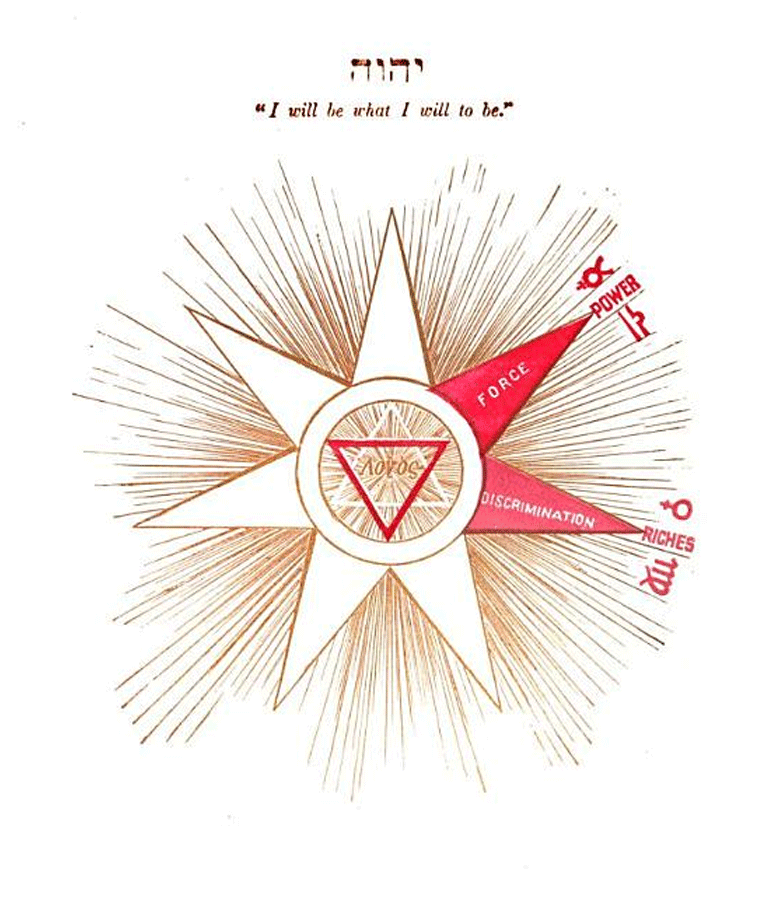
THIRD LECTURE. DISCRIMINATION. THE SECOND OF THE SEVEN CREATIVE PRINCIPLES. In our last lecture we considered the subject of world building, under the leadership of the first principle of the seven creatives, — Force. We called your attention to the fact that this force, being negative, called into existence a sphere, not by itself alone; for it is impossible for us to consider these seven principles, in their operation in the world, entirely separate one from another, as they work together, and no one of them can work entirely independent of the other. They are united together in their action, as literally in all their workings, as they are in the diagram of the star that represents them. Therefore, all through the consideration of these principles we are forced to take each of the seven as a head, controller, and subjugator, we may say, of the other principles, that are acting jointly with it. These seven principles are the foundation and means by which the multifarious conditions that we see in the world arise into objective existence; and, as the mind scans the vast world-radius and workings of these principles in their successive stages, we are lost, and feel like turning away as from a task beyond the possibility of human intelligence; but, having before us a diagram which is the formula that expresses these principles, we are enabled to take up each, and trace them in their creative workings. In the operation of this second principle, discrimination, which is the subject for consideration in this lecture, we observe that it is, in itself, first, the manifestation of the polarizing principle. We are told that even atoms have polarity, and that polarity gives them the nature of attraction and repulsion, which is the manifest action of discrimination. This polarization will be seen in its first phase of operation by taking two needles, polarize them with a magnet, and then lay the positive pole of one to the positive pole of the other, on a piece of paper, and they will immediately fly apart; reverse them, turning the negative pole of one to the positive pole of the other, and they will come together. Here is the first manifestation of the law of discrimination, — a principle in nature that discriminates as to the relation of atom to atom. This principle is not only found in the atom, but it is the prime factor in all formation; but, of course, without the third principle united with it, it would only build together the atoms of matter, not in the form of molecules, or even in the form of vegetation, but it would simply build together in a straight line, which line might continue on and on eternally. We know that we can take a bar-magnet, cut it in two as many times as we please, and every piece will still be a magnet, having positive and negative poles which would come together just as it was cut apart, in the same direction, one to the other. That is to say, none of the pieces could be turned around and put back in place and adhere; but if the pieces were all kept in the same direction, and then put together they would cohere by the power of the magnetism that was within them; but take the pieces and turn them about hither and thither, and then put them together; some of them would be repelled, and some would fly together. This law of discrimination is found operative at the very base of material formation. It would be unwise in us, at this time, to attempt to trace this law further in the building processes of nature, because, in so doing, we should have to intrude upon our next lesson; therefore we will endeavor, in this lecture, to regard it in its more fully-developed phase, where it will be useful to us; and its growing process and building powers will be considered under the law of order, in the lecture on the third principle. We find, in our relations to each other, that the same principle of discrimination is operative between man and man, also between beasts, birds, insects, and with every thing that has life; it is observed that discrimination is manifested in a natural attraction and natural repulsion. These principles of attraction and repulsion in matter are but the same conditions or the same principles that we see operative in the relations of mind. As from mind all things came, into mind all things return; therefore we can logically and reasonably trace this action in animate nature, as we call it, from the inanimate and gross element to the thought and will of man, and find that our thoughts, feelings, and emotions are controlled by exactly the same principles. This principle of discrimination is the principle that keeps in purity all things that are. Were it not for this principle we would have nothing distinct. There would be no gold, silver, iron, vegetable or animal formations; there would be nothing but a formless mass brought together with all qualities intermixed. You must readily see that, without this principle of discrimination, there could be nothing but chaos. This principle is active in everything that is, whether it has or has not animate life. This is the cause of our pronouncing so many things in the lower order of nature as being bad, and accounts for a feeling of antagonism; for instance, we want to kill snakes, lizards, and all reptiles; in fact, there is a natural repulsion to all things below us, otherwise we should absorb their qualities and descend to their level. Many who have begun to think and observe these laws of mind have concluded, because of this strong repulsion and attraction, that those persons that they were repelled from must, of necessity, be evil; that there must be something about them that was bad, or else they would not be so repelled by their presence. The ignorance of the law of discrimination leads them to this conclusion; but we must not be too hasty, but should remember that while such persons may be evil to them, and doubtless are, that they are no more evil in the aggregate than they themselves. Perchance they may be superior persons in every way, and yet this repulsion be felt; in fact, there are few persons in the ordinary walks of life, who, if they should meet a man possessed of the attainments of some of the grand masters that we read of in the works of antiquity, but what, as soon as they should come into their presence, would feel a repulsion, and shrink away from them. We might very readily imagine that the person was evil, and do often so imagine. When people on the present plane of life find a man or woman that is really, in all their characteristics, superior to themselves, they do not understand them, and feel repelled. They see that such persons are self-possessed, and at once imagine evil concerning them; multifarious evil conjectures arise in their minds, until, perchance, it may even seem proper to do them violence, or subject them to the law for imprisonment. The Nazarene implied this when he said, "Ye are not of this world; if you were of this world, the world would love its own; but ye are not, therefore the world hates you." Therefore, when we come to consider this law of discrimination, we find that, often we meet persons that at first sight hate us, that are possibly even malignant, and seek every opportunity to bring us into condemnation, and to provoke us to do something that will put us in their power; why do they do it? Is it because they are vicious and bad? Not at all. It is because they are themselves on a low plane of life; they love that plane of life, and, as soon as one with a higher nature comes into their atmosphere, they feel that there is something in them that is breaking up and interfering with their plans of life, which is, in a measure, true, and they at once begin to antagonize them, and to seek for some grounds of condemnation; and we know how prolific the imagination is when people get the idea that there is something bad in another, how easy it is to distort some of the best acts of life, and transform them into appearance of a desperate character. We must expect these things in life, because of the potent factors in the workings of creation. This is one of the causes (there are many others however) that induced all the ancients, who made great attainments in the mastery over self and in controlling the power of the elements, to seek isolation from the world; they retired into the wilderness, into caves where they could be separated from their fellows, where they could be free from those antagonisms from which they would otherwise have to suffer, and this was well on their part; but we believe that the conditions are not so adverse to-day. We have reasons now to believe that there are a great many people, who have become so fully unfolded in their interior or higher nature, that they are ready and anxious to let go of this lower nature, — this lower condition of life, — and step upon a higher plane of being. This principle has developed in them a discrimination between right and wrong, between error and truth, between the descending currents of involution, and the ascending currents of evolution, to which all things are subject. And ever in our physical bodies these two currents, of necessity, continue their action, and will so do whilst we remain in the flesh. In fact, I doubt there ever coming a time, in all the stages of progress that we may make in the ages to come, that these two currents will not be active in our bodies. The descending currents of involution are by virtue of prayer. What is prayer? The very act in itself, calls out, as a prime factor, the law of discrimination; You desire. Desire what? You discriminate even in your desire. You desire something, not everything. You are, then, like the needle that points to the pole. You at once concentrate all your thoughts, all your desire, on whatever object you determine. If you desire knowledge of the cause-world, you begin by reaching out to the great centre of cause. You formulate an idea of what that centre is, what its nature is, what its qualities are, and, after you have formulated the idea of the nature and qualities of that first great cause, you then centre or polarize the magnets of your desire upon that central source. You desire to have the knowledge of that infinite mind. That desire then becomes a powerful magnet, which reaches out into the spheres above, and lays hold upon the substance of its desire, and brings it down and incorporates it into your being; it is aspiration that goes out and gathers the substance that it needs and incorporates it into the very centre of being. It is the law known and acted upon by the Sages. It is said in "Yoga Philosophy" that if we concentrate our mind on the north polar star, we obtain knowledge of Astronomy; on the sun, Spiritual Wisdom; on the moon, knowledge of Earth; if on the palm of the hand, knowledge of future events, etc. The response does not come into the head first, neither into the reason, but into the centre of the love-nature; for Love is the magnet, and, unless we cultivate the law of love, we shall never acquire the magnetic power that will enable us to reach out and gather the things we need. Love is the only power in the world. In our previous discourse upon the first of the seven principles (Force), we told you that it was negative, feminine in its nature; and we now tell you that the feminine or the nature of the female is, externally, love; while the interior of man is negative, feminine in its character, and thus love in its operation. Love, then, without the activity of this principle of discrimination, would become a force that would gather around it all kinds of useless elements, and make up a heterogeneous mass of confused ideals. It would, in practice, amount to evil obstructions; but, loving, we must have a definite idea of what we love. Here is where Our Mother Church has made a great mistake. It has taught us that we are to love every person; love your enemies, love the wicked as well as good, but we must discriminate in our love between loving the man, the person and the divine principle that animates him. "We know that all life is good; that this animating principle, wherever it is found, let it be in man, in your brother, your loved companion, or in the most loathsome serpent that is creeping in the swamps, that life is good; it is a part of the infinite, and must, of necessity, be good. It is the animating principle. We call it by a variety of names, but it is the spirit that animates all being. Now, we discriminate in our love. We love what? The good! God is good! God is the only good! — the only good that maintains, supports, and sustains all things. But now we are speaking of absolute good. There is absolute good, which is spirit; there is relative good, which is a condition of usefulness. It is necessary for us here to make a fine point of discrimination. Anything that is useful to assist one in accomplishing their object is regarded as good; but anything that hinders or obstructs one's plan or design is considered evil. This, however, is but relative good and relative evil. In the broad sense there is no such thing as absolute evil, but there is such a thing as absolute good. Let us consider this principle of discrimination in its relation to prayer, which is the love-principle turned towards one's highest ideal of God, or good, with the desire to receive that we stand in need of; we thus draw down and incorporate in ourselves the substance of things desired. Now, as to the result. At first it enters the interior of our being, the love-nature. It takes form in the essences of our life, is carried up to the brain, formulated into thought by the power of reason, and thus the inspiration becomes to us a revelation. For then that which we have inspired from the higher spheres through the action and aspiration of our love, entering into our life, forms itself into reason, and, being a thought-form, stands out before us in its image, in the exact form of the principle of which it is the expression. Now, this is inspiration, and revelation is its consequent result. The receiving is the inspiration, the formation in the intellect is the revelation, and it is thus that we gather to ourselves something that we did not possess before, something higher, some thing grander than we had. That which we before loved and clung to we now hate because we have no more use for it. In its relation to this higher and grander it becomes evil; and, because of discrimination, we repel it from us, we spurn it, we say it is error, we must break that habit; if persevered in it will bring inconvenience, disease, and suffering. The new revelation that has been made to our mind, by the law of discrimination says: "Repel!" From this state comes the mental condition that promotes the work of evolution. The incoming of a higher condition produces a spontaneous unfoldment of mind. Now, what is it that is involved in our nature? It is the thought-crystallization of former expressions; and, when we repel and throw them off, they go down into a lower plane where they are drawn in, insphered and become a part of the lower elements, and make room for the new and higher conditions in ourselves. It is well known that vegetation feeds on that which human life throws off. And the animal world also feeds mentally from the thought-potency that the human mind exhales; so that these very principles that are today a part of our soul-life, and which would otherwise go with us into another stage of being, may be, and should be, thrown off, and go down into the lower stages of being. In other words, the lower stages of existence aspire towards us. They seek and reach up to us as we do to that which is above, — to God. They feed from the overflow of our nature as we from the infinite essence. That is the law of involution; the flowing down of the surplus elements, through us, to the very lowest stages of being. They are, when once disintegrated, scattered as it were, torn to pieces, and every part scattered to its place. The law of discrimination, it is thus perceived, works most diligently in nature. As these elements descend indiscriminately, this principle of discrimination causes each to take just what part it needs, and to repel all beside, exactly as does the little seed in its process of germination and growth. We, perchance, take two seeds, one whose nature is bitter, the other sweet, make a hole in the ground, drop those two tiny seeds into it; they lie side by side, the same moisture softens and expands, the same sunlight warms them, they germinate, they grow up side by side. Their stalks at once begin to draw away from each other, and we can scarcely find two such seeds but what, when their stalks come up through the ground, would be some distance apart, as far apart as they can well get, for they are repelled each by the other. Their roots are all mingled together, drawing their sustenance from the same earth and the same sun; one repels all the bitter elements, and attracts all the sweet; the other attracts all the bitter and repels all the sweet. They grow up together, and each maintains its own nature, regardless of the fact that they were germinated side by side, regardless of the fact that their roots were interwoven and they are drawing their sustenance from the same fountain in every particular. So this principle of discrimination has relation to the law of involution, and even the effete elements that are thrown out from our bodies, even the thought-potencies, which are elements, as I have shown you previously, are carried down to the lower plane of being, where each thing in its order attracts parts of it, takes it up, scatters it, builds new organisms, and, as these new organisms are built, they begin the work of aspiration, which is the factor in evolution. Observe the plant come out of the ground; two little leaves; then, right out from the centre of these two, comes another, and thus the plant grows from the interior. Finally, the first two leaves die and fall back to the earth to nourish other plants. They grow and unfold from the centre; from the innermost they grow out and become the outermost, and then in turn they fall off, and out from the innermost again come others. Such is the expression of our life, if we are as active and as diligent, intellectually and spiritually, as the vegetable kingdom below us, and we certainly should be. The mind that is not active, desiring knowledge, desiring wisdom and understanding, expanding to its uttermost power to obtain knowledge, to obtain understanding of all that is around it, is not doing as well as the humble growing plant. All life is growing by force of circumstances, and these aspiring, and these descending elements become to us an incentive to reach out, to aspire to something better and better, therefore, from this interior consciousness, we are constantly discriminating between elements and conditions that we have already attained, that have served their purpose, and those which we are still reaching out for and desiring to secure. Then let us learn this lesson from the plant, never to stop growing, so long as life and opportunity remains. What we know to-day should not satisfy us tomorrow. I can say for myself that there is no pleasure, worthy of the name of pleasure, that is obtainable through any other means than through the procuring of knowledge. We talk about pleasurable sensations; if we discriminate accurately we will discover that many sensations are at the expense of our life, and not in reality pleasure, but rather a form of pain. It is only the ideal that gives pleasure. When we are imbued with a knowledge of the cause-world, and begin to reach out and inspire from that great fountain of knowledge, our appetite is spoiled for that which the world calls pleasure, — the pleasure of the senses; we then find no true pleasure save in thinking the thoughts of the Infinite. The thoughts of the Infinite express themselves in nature in the workings of the seven creative principles, first, in their primitives, and fully in their ultimates. We find that the angel, in his revelation to John, 5, 12; named the ultimates of the seven creative principles in the following language. "Worthy is the Lamb that was slain to receive 1st, Power; 2d, Riches; 3d, Wisdom; 4th, Strength; 5th, Honor; 6th, Glory; 7th, Blessing." These thoughts of God are the true Riches. We find that all sensations in the incidents of life, that which the world calls pleasure, is rather the exhaust, the wasting of the life-element. Whilst this is going on there is sensation, and we imagine it is pleasure; whereas, if we discriminate accurately and carefully, we find it is pain. It is the working of death and destruction; but, when we are carrying this life-force up to the higher stage of transmutation, by virtue of conquering the lower passions, conquering all waste in the line of sensations and the generative energies, we turn it up to the brain and mature it there, forming thoughts and sending them forth to do our will, through which means life is matured more perfectly, and our senses are made finer, the workings of these senses become so harmonious that they are to us like the most delightful music, like the music of the spheres. We will find our higher thoughts are extremely pleasurable, when in accord with this law of inspiration that is ever active in us; that is the power of our being; that gave us birth; whose power, as we have shown you, is that love that reaches out and lays hold on the life of the infinite and perfect Soul, drawing it down into the centre of our being, where it fills our whole nature, thrilling it and animating it from centre to circumference. And, when it is called up to the brain, oh, what pictures it makes in our intellect! what thoughts of a perfect being! Think of it, the thoughts of the perfect thinker! Why perfect? Because the law of discrimination has done its perfect work! Every line of demarcation has been distinctly made; all unfit elements have been eliminated, it has rejected all that was unfit and impure, and has selected the purest and finest of all things in nature; therefore it is filled with the true riches, the life of the Infinite Soul. |