|
WOMEN AND SPANISH FASCISM -- THE WOMEN'S SECTION OF THE FALANGE 1934-1959 |
|
1: Starting the Revolution: SF’s programme for all women The Nationalist victory of 1939 sealed the defeat not only of the democratic structures of the Second Republic but also of the moral and cultural beliefs on which it was founded. In its determination to eradicate the recent past, the regime continued to insist that the Civil War had been a ‘Crusade’. The Republic was cast as the ‘anti-Spain’ and its supporters demonized, especially the organized working classes and those who sought to reform the Army and weaken the power of the Catholic Church. The ‘New State’ sought to return Spain to the spiritual and patriotic values of its Golden Age, within which the economic interests of the privileged and powerful would be safeguarded. Central to the regime’s determination to turn back the clock was its focus on the lives of women. The foundations of patriarchal society were perceived to have been undermined by the emancipating legislation of the Second Republic. But it was not only the female vote and the Republic’s divorce law which were cited as causes of the breakdown of the old order. Improved social legislation and changes to the Civil Code had given women more rights in the workplace and within the family structure, challenging the traditional authority of the male. [1] The regime’s attempts to restore gender divisions by returning women to the home were made for ideological reasons, ignoring the reality that paid female employment was helpful for the national economy and a financial necessity for many women. There was a parallel in Nazi Germany and Fascist Italy, where employment legislation was intended to discourage women from many areas of work and gross inequalities in wages ensured that women could not attain parity with men. [2] The justification by both regimes was the perceived demographic problem caused by high infant mortality and the declining birth rate. In these circumstances, it was argued, the workplace (especially in an urban environment) was unsuitable for women. But in addition to legislation, the Franco regime -- again in common with Germany and Italy -- used women themselves to drive home its reactionary message to the whole of the female population. [3] The role of Sección Femenina (SF) was both to intervene in the lives of other women to ensure their compliance with the regime’s social and political aims and themselves serve as exemplars of traditional gender roles. The roles were interconnected. Understood by SF members as the ‘Falangist Revolution’, its work with girls and adult women was designed to underline the importance of the family, reinforce patriarchal authority and bring rudimentary welfare and health care to the population at large. There was, however, an essential contradiction between SF’s advocacy of traditional gender roles for unaffiliated women and the personal qualities and lifestyle required of the bearers of that message. Its elites were to be the conveyors of political dogma but different in every way from feminist politicians of the Second Republic. This chapter traces the origins of the gender politics of the regime which elite members transmitted to others. Relatedly, it examines the ways found by SF to interpret its mandate and the ensuing ambiguities and contradictions as it sought to model itself on the equivalent women’s organizations of Germany and Italy. The context for SF’s intervention was, as Michael Richards has stated, the ideological construction of Spain as a ‘natural entity’, contaminated and sick following recent political failures. [4] Within this vision, early post-war propaganda cast SF workers as both do-gooders and avenging angels. Amidst the appalling social and economic conditions of the early post-war period, the rhetoric of the ‘reconquest of the home’ [5] could be read as an appeal to patriotic duty. In the cause of national regeneration, SF prepared to intervene directly into the lives of the female population, in the knowledge that its elite members (mandos) were part of a minority ‘whose first steps will not be understood by the masses’. [6] The relief programmes of the war years, such as the feeding of the poor and the care of orphan children, continued and acquired a specific propaganda function. There was enormous political capital in the vision of women entering newly ‘liberated’ provinces. Headlines such as ‘Campaign to disinfect Madrid from the misery left by Marxism’ referred as much to the need for political as for actual decontamination. [7] Against the claim that the citizens of Madrid were almost all infected with parasites, the perceived remedy was medical inspections together with registration of affected houses and people. The women of SF were to be frontline workers in the cleansing of Spain, their brooms and disinfectant the external embodiment of a moral and spiritual campaign. Falangist nurses would be ‘immunizing the spirit of Spaniards from unhealthy doctrines’. [8] Meanwhile, mobilized women in the laundries and workshops of the rearguard were ‘helping to bring about the principle which is stamped on the walls of shower compartments for the soldiers of Franco which says “Clean bodies, clean clothes, clean souls”. [9] After the war, too, teams of SF health workers supplied soap, white-wash and cleaning materials to poor areas and as a former staff member recalls: ‘It deloused a lot of children.’ [10] SF’s identification with the rhetoric of ‘cleansing the nation’ went deep. Paralleling the government’s ‘redemption of sentences’ (Redención de Penas) system, whereby political prisoners could redeem part of their sentence through hard labour, SF started a domestic school in the women’s prison in Madrid. Selected inmates were taught politics, religion and domestic subjects for five hours daily over one year. Those deemed to have passed the course had their sentences reduced by the same period. [11] While SF capitalized on the ideological base for improved hygiene, its programmes also echoed government concern about domestic issues which pre-dated the Second Republic. The importance of cleanliness to public health in general was well documented, and its relevance to the health of infants and mothers had been a cause of concern for many years. Spain’s infant mortality record was poor, and in the fight to stem tuberculosis it was recognized that clean, airy houses were essential to stop the spread of infection. Government Health Department statistics of 1932, for example, painted a depressing picture of a high incidence of tuberculosis and infant mortality. Even more striking was the number of deaths from enteric disorders, a marker of the state of public health and hygienic conditions generally. [12] In the same years, however, domestic issues were coming to the fore in the context of a changing representation of the home in the popular press and women’s magazines. Danièle Bussy Genevois comments how a petty bourgeois ideal of a comfortable, spotless and uncluttered space was projected increasingly as an area in which moral control could be exercised. [13] The housewife was being helped, via domestic appliances and gadgets, to entertain more and have a less closed role within the home. In this context, domestic skills were an enabling tool, allowing the housewife more control over her environment. SF’s publications (the journals Revista ‘Y’ and Medina, for example) were able to capitalize on this trend, blending political articles with a mix of recipes, suggestions for interior design and photographs of ideal homes. Domestic expertise was thereby able to be presented as necessary and desirable. It became the cornerstone of post-war SF educational programmes and was the primary area of control for SF staff members. Unlike the health and welfare programmes, it needed no male intervention or guidance. Elite members would be exemplars of housewifely perfection themselves and teachers to the wider female population. Post-war programmes were an extension of the voluntary courses started in 1937. They began in earnest three years later with the opening of the first SF domestic school (escuela de hogar) in Madrid, offering evening classes to married women and day-time courses for servants, nannies and nursery nurses. [14] As the network of these schools was extended throughout Spain, women were offered domestic training to equip them for the extremely difficult post-war economic circumstances. Members were told at the 1940 national conference: We must focus on a diet which … allows the body to operate in the most efficient way and which is appropriate to the economic circumstances of the individual…. This is the work started by the Sección Femenina…. In the domestic school, where a food policy already exists in outline, we will put our idea into action. [15] SF’s role as the national manager of domestic efficiency increased when house-craft was introduced into the school curriculum and made a compulsory subject in both State and private schools in 1946. The role was further highlighted with the introduction of a period of compulsory social service for unmarried women, in which domestic education played a central part. Social service dated from 1937, when it had been devised by the head of the Falangist welfare department. Mercedes Sanz Bachiller, the widow of one of the earliest Civil War victims, Onésimo Redondo, had started Social Aid (Auxilio Social) in Valladolid as a response to the nutritional and welfare problems of the old, the sick and children orphaned by the war. [16] Much to the displeasure of Pilar, who would have preferred all such initiatives to be the responsibility of SF, it became the body through which aid to the newly conquered provinces was channelled. Pilar and Mercedes were soon rivals, with the social service scheme at the heart of the dispute. Mercedes’ original intention in establishing the scheme, however, had nothing to do with the relationship between Social Aid and SF. She had seen the potential of a female equivalent of military service which would ensure a ready supply of unpaid help to the war effort. Single women of between seventeen and thirty-five years of age were to work without payment for a period of six months in the service of Spain, receiving a certificate of service in acknowledgement. In the post-war years, the currency of this certificate became greater, as it became necessary for entry to the professions, government employment and even to obtain a passport or driving licence. During the Civil War, the scheme was at its simplest, consisting of unpaid work in welfare institutions such as orphanages and a training course carried out in the Social Aid residences (residencias-hogares). [17] But in 1939, when the scheme was taken over by SF, the taught element was standardized to follow on from SF’s existing training programmes and took place in its domestic schools and local headquarters. Its content was largely domestic subjects. [18] Social service was arguably the most wide-reaching example of SF intervention into women’s lives. Its training course was effectively a re-stating and continuation of the material that was being progressively introduced into secondary schooling programmes -- namely domestic education, politics and physical education. It was the vehicle for SF to realize its task of ‘the total education of the woman’ as directed by Franco at the end of the war. [19] What had started as a coordinated response to a national emergency very quickly became a tool for political persuasion. Women were to be drawn, via SF teachings, ‘to their daily tasks, to their children, to the kitchen, the house and the vegetable garden’. [20] As SF’s most ambitious attempt to mobilize unaffiliated women, social service was unsuccessful. Its element of compulsion was widely resented after the war, and despite the increasing regulations and controls governing the scheme, only a minority of women were ever recorded as completing it in any one year. [21] The irony was that it was likely to be the neediest women who were affected, because social service was a requirement for many jobs, particularly in the State sector. Women who were better-off, not at university and not intending to work, could avoid it with few consequences. [22] But other SF programmes were also intrusive. Its health programmes gave form to what Mary Nash has described as twentieth-century society’s increasingly critical opinion of women’s ability to cope as mothers without the intervention of medical experts. [23] In this, the Francoist State was reflecting concerns about the health of the nation that went back to the dictatorship of General Primo de Rivera. Worries about population, birth rate and mortality rates ran alongside a wider debate about so-called ‘racial hygiene’. Differing theoretical models of how future generations might be healthier and live longer were being discussed in various European countries. In Spain, as early as the 1920s, the king’s physician, Gregorio de Marañón, had put forward ideas of how health -- and particularly maternal and infant health -- could be improved. He recognized the problems of multiple childbirth and premature ageing of the mother, quoting a figure of 46 per cent infant mortality from 1,534 families in the area of his own hospital. [24] The writings of Marañón were followed in 1928 and again in 1933 by national conferences debating the health of the nation and (among other things) the responsibility of women in this regard. [25] All could agree that motherhood should be undertaken responsibly, but there were varying definitions of ‘conscious maternity’ (maternidad consciente). In the 1920s and 1930s, it was for many inseparable from the promotion of birth control and came to be part of the wider political debate about the rights and role of women in society. But Marañón declared birth control ‘an attack against society and a sin’ and advocated abstinence as the way to control family size. [26] For him, ‘conscious maternity’ was a question of educating the woman for her future role and breaking with the traditional preparation for motherhood ‘learning at home, at the side of her ignorant, heroic mother the elementary rules of household management’. [27] Some of Marañón’s recommendations -- breastfeeding, the avoidance of foreign nannies and the necessity for women to avoid the workplace -- were echoed ten years later in the childcare manuals of SF. More significantly, his faith in the efficacy of education squared with SF’s own view. Women were to be made responsible for themselves, no longer Marañón’s ‘passive mother, resigned and fanatical, the victim of her own generous instinct’. [28] Marañón was not alone in believing that improved childcare and maternal education would substantially reduce infant mortality and improve public health in general. The theme was taken up by medical experts on the Nationalist side and from Germany and Italy as part of a larger debate on the perceived racial inheritance of Spain. A psychiatrist who spoke frequently in Nationalist circles, Antonio Vallejo Nágera, had set out his vision of the degeneration of Spain in apocalyptic terms shortly after the election of the Popular Front government in February 1936. ‘Regeneration’ was the antithesis of values or beliefs connected to the ‘democratic and Marxist virus’ of the Second Republic. Implicit was the idea of commitment and sacrifice as a patriotic duty. [29] ‘The regeneration of the masses requires the self-regeneration of the individual. The self-improvement of many will in the end regenerate the immense majority.’ [30] During the war and in the early 1940s, eugenic theory was more precisely defined. Vallejo Nágera, for example, believed that the individual possessed inherited qualities, some from the family and others unique to the race. National virtues such as chivalry, steadfastness and spirituality were at the heart of Spanish identity and constituted hispanidad (Spanishness). [31] This was the ‘genotype’ of the nation, the mix of genetic and racial characteristics that had been in danger of extinction since foreign influences (extranjerización) had permeated the country in the shape of liberal ideas and parliamentary democracy. But the individual was also a product of nurture and environment. The mix between these factors and genetic inheritance was, in eugenic terms, the ‘phenotype’ and it was this that could be altered. Spain had degenerated, went the theory, because of alien influences on the phenotype ‘first sown by the Jews, then the moriscos, [32] later by the influence of foreign encyclopaedists and rationalists’. [33] These had bred negative personality traits, such as malice, resentment and an inferiority complex, now the cause of Spain’s ills and extinguishable only by moral rearmament with the values of the Golden Age as the model: It is not merely a question of returning to the human values of the fifteenth or sixteenth centuries. It is a matter of putting them back into the thoughts, habits and conduct of the nation, with the aim of morally healing the environment in such a way that the phenotype may be strengthened and the genotype does not degenerate. [34] This was so-called ‘conductivist’ (or positive) eugenics and differed from the ‘geneticist’ theory which preached selection of the fittest on racial grounds. Measures such as the sterilization of psychopaths or mental defectives adopted in Nazi Germany were rejected by Spanish eugenicists as fundamentally anti-Catholic. As Vallejo Nágera said: ‘Catholic doctors have been opposed to eugenic sterilization for moral reasons, in accordance with instructions from the Church.’ [35] In its place was a belief in religion and patriotism as the keys to national regeneration: ‘A nation which wishes to be regenerated should look to encourage the practice of religion…. Religiosity and patriotism automatically heal the environment; they engender high aspirations, they promote the cultivation of virtues and they destroy vice.’ [36] The Francoist response to the eugenics debate was the passing of a series of welfare and health measures, which developed progressively from the Civil War into the 1940s. The promotion of the family was central to all its policies. As Valleja Nágera claimed: ‘The regeneration of the race must be founded necessarily on the regeneration of the family.’ [37] The introduction of measures in support of the family and maternal and infant welfare gave both a context and a justification for the interventionist approach of SF and its education programmes. The first and most significant piece of government legislation was the 1938 Labour Charter (Fuero del Trabajo). It proclaimed the primacy of the family unit as the ‘natural cell and foundation of society’ and pledged to help country workers and their communities. [38] As well as promising enhanced social insurance payments by the State for certain groups of workers, it made provision to remove married women from the workplace. Work was prejudicial to women’s health and therefore to the health of the nation. As one of the SF’s medical experts wrote, it could be considered ‘a real social plague, as much as tuberculosis or other illnesses’. [39] Other legislation was soon in place after the war to combat infant mortality and promote large families by means of campaigns, propaganda and medical intervention. From 1940, the government introduced cash awards for the largest families and for those with the greatest number of surviving children. [40] Marriage loans were introduced in 1941, available to women under twenty-five who were prepared to give up their jobs. [41] And in the same year, the Law of Infant and Maternal Health established the need for existing medical services to work closely with the National Movement, and in matters of infant and maternal health for there to be cooperation with SF and Social Aid in particular. SF was ideally placed to respond to the welfare legislation with the creation of its national team of health workers (Cuerpo de divulgación) in 1941. These were SF’s front-line troops against infant mortality, advising on hygiene and childcare, working with rural doctors and giving information on State welfare provision. [42] The divulgadoras were always local village women. This helped to make their work more acceptable in the community and they made a direct contribution to eugenic policy. Their duties were to remind women considering marriage of the need to choose a healthy partner and explain the advisability of prenuptial examinations. They were to warn pregnant women of the illegality and danger of abortion and of the need for professional medical advice rather than the attentions of the local herbalist or wise woman. 43 The contribution of the work of divulgadoras to State welfare policy was constantly restated. According to Pilar, each had the ‘important mission of educating between ten and twelve thousand women’. [44] The Minister of the Interior, Ramón Serrano Suñer, endorsed the interventionist nature of their role at the 1940 SF conference: ‘You must also use your visits to collect a wide range of information … which will be used for the correction of our welfare census.’ [45] But he also recognized their stabilizing potential in poor rural communities: ‘You will ensure that the sub-human rooms lived in by more than half of all Spaniards are replaced with happy houses, where there is neither tuberculosis nor hatred.’ [46] Thus far, SF could be considered as having carried out national policy. Even allowing for its interventionist methods, it was merely reflecting the Nationalist concern on how to build the ‘New State’. Its programmes were a mixture of reactionary ideas based on the premise of returning women to the home and policies deriving from the ‘medicalization’ of maternity and childcare. But control of the female population through direct intervention had to be accompanied by a willingness by unaffiliated women to put ideas into practice. Thus in SF’s ‘Revolution’, there was a presumption that women, once educated and enthused to participate, would understand the value of its own, female networks. This had already been seen during the Civil War. In 1938, following their national conference, the idea came to members of helping country families in household and rural tasks in the absence of their menfolk at the front. The plan was to organize teams of women members who would go in groups to villages and stay in households during harvest time or at other busy times of the year. [47] This experience prompted the SF national team to develop the department of Town and Country (Hermandad de la Ciudad y el Campo), which built on the idea that organized cooperation between town and country dwellers to improve working life would benefit both types of community. It established a range of courses for rural women in agricultural and craft skills and became the link with the Falangist syndical organization. Here, a network of ‘link members’ (enlaces) was officially recognized and the fact that women had comparable representation in the workplace with men was deemed important by SF. [48] The enlaces organized the social service programme for women workers and also promoted government labour legislation and SF’s welfare and leisure facilities. The appointment of enlaces typified one of SF’s greatest ambiguities, namely its attitude to paid female employment. As in Germany and Italy, there was the recognition that women’s work contributed to the national economy but that it should not threaten the male status quo. [49] For this reason, SF’s encouragement of women to help other women become financially better off via rural regeneration schemes was uncontroversial. As with its programmes of domestic management, the aim was to improve the national economy by well-run homes and higher family incomes. For many countrywomen, the impact of SF programmes was to make existing (unpaid) work on farms and smallholdings more productive or enable them to access a separate source of income. But SF’s intervention in the State syndical system suggested that it was actively promoting paid female employment. This was a far cry from the view in many Catholic circles that women should remain in the closed atmosphere of the home. As in Germany and Italy, attempts to remove women from the workplace were problematical, since it was the case that the cheapness of their labour contributed substantially to the profits of bosses and factory owners. Ideologically, SF was caught between the parallel but contradictory aims of restoring women to domesticity while promoting and restating their essential role in contributing to the national economy. In its attempts to reconcile the two viewpoints, SF presented the home versus work debate as pragmatism. It was acknowledged that despite the desirability of a wholly domestic role for women, this was not always feasible. For many war widows and single women as well as women struggling in poverty, paid work was a financial necessity. This had been recognized by the Social Aid organization, which had opened day nurseries and crèches. These enabled the poorest single parents to earn a living at the same time as ensuring that vulnerable children’s health was being monitored. By the end of the war, this policy was coming under criticism from sectors of the regime who believed that encouraging women to work in whatever circumstances was against the spirit if not the letter of the Labour Charter. SF was not included in the criticism as it did not actually own the nurseries and crèches but merely provided staff. As the women workers were largely volunteers, serving for patriotic reasons, there was no obvious conflict of interests but it highlighted both the force of traditional opinion and SF’s distance from that point of view. SF journals of the 1940s described work as a financial necessity for the unfortunate and otherwise the recourse of those women unlucky enough to stay single. ‘No truly sensitive woman goes from preference to the office or workshop. She fulfils her human mission and does whatever life or the State requires her to do, but always yearns for home.’ [50] Particularly in the immediate post-war period, women’s decision to work could also be presented by SF as a patriotic response to the needs caused by the Civil War: They resolved to be the ones who, by personal effort, would guide the ship to port. With God’s help, no-one in their house would die of hunger, the poor old folk, weighed down with pain and illness, could live in peace to the end of their days and their younger brothers and sisters would go on with their studies. [51] In this sense, work was one of the means by which some women were enabled to achieve their natural goal: a home. It was acceptable principally as a short-term measure which contributed to the long-term well-being of the family, rather than as an end in itself. Alternative strategies such as thrift and resourcefulness featured regularly in SF journals and were presented as modern, acquirable skills. Work and study were defensible as long as they did not compromise women’s domestic efficiency, described euphemistically as the loss of ‘essential values and the knowledge of their destiny’. [52] The path would be a narrow one. While accepting that there could be no return to pre-war economic circumstances, a way had to be found of detaching work from connotations of female independence and a removal from the domestic sphere. ‘Let us not close our eyes to reality, because as long as we see it and recognize it, we will to a certain extent be able to limit it’ said a male speaker at the 1939 SF conference, referring to the growing numbers of working women in countries involved in the First World War. [53] Damage limitation in that sense would be the SF’s objective and was another reason for emphasizing the domestic programmes. These would render the mass of the female population less vulnerable to whatever negative influences were brought to bear in the workplace. Yet SF’s stance had its contradictions. From an early date its journals held employment information suggesting that work could be the realization of ambition and an end in itself. Articles praised certain professions as well as commending the personal qualities of the individual who had achieved success. A woman studying for a doctorate in law was described as ‘simply a woman who, above all, has an ambition to be something, to arrive’. [54] There were some surprising inclusions in the list of so-called ‘approved’ professions. As well as promoting traditionally female areas such as teaching, childcare and nursing, the journal Revista ‘Y’ at various times carried articles on telephonists, metro workers, waitresses, beauticians and careers in the media. In September 1938, it advertised the newly formed Nationalist film company, CIFESA, inviting young women to train for stardom. A later article asked the question: ‘Have you ever considered the possibility of becoming a radio, theatre or cinema artiste?’ [55] This was not typical, however. The more frequent message in Revista ‘Y’ was the importance of domesticity and the projection of SF’s educational programmes as different, modern and in every way better than anything preceding them. There were regular features about the courses themselves and the SF departments which organized them. A management framework for delivering courses to unaffiliated women had been started in 1938, with the creation of the department of Culture and Training of leaders (Departamento de Cultura y Formación de Jerarquías). This oversaw the teaching of politics, religion and domestic subjects and by 1945 had expanded to become two distinct departments. The department of Training (Formación) dealt with what SF considered to be the bedrock of national-syndicalism, namely politics and religion, whereas Culture (Cultura) was concerned with domestic education, literacy, music and folklore. The Training department produced national-syndicalism textbooks for members and the unaffiliated, together with the course materials on religion used in all staff training programmes. The department of Culture was also responsible for the running of SF’s domestic schools as well as the literacy schools (escuelas de formación), which were set up to provide basic reading and writing skills, especially in rural areas. The programmes in these teaching centres were consistently represented by Pilar as Falangist responses to national problems: ‘We must try and give young people, as José Antonio also used to say, “full and clear understanding in their soul which gives them solutions to practical problems”.’ [56] For women, this meant largely domestic skills within a political and religious framework, but they were to be acquired within the Falangist spirit of enthusiasm and commitment. This was no doubt empty rhetoric to the unaffiliated women and girls obliged to follow cookery, childcare and physical education courses. Nonetheless, it offered a measure of encouragement, at least within SF journals, for other forms of female endeavour: Become artists yourself, forget forever all those stupid prejudices of a regrettable time in the past. ‘She doesn’t know how to play music’ used to be said ironically as a compliment. No, if you have a feeling for music, if you have a talent for it, play the piano, don’t ever stop. [57] More controversial was SF’s encouragement of sport and physical education and, as in the home versus work debate, involved the organization in promoting innovation while distancing itself from any charge of feminism. With its belief in female participation and involvement, SF was countering head on what it termed the ‘atavistic attitude of the Celtiberian male’, [58] namely the perception that women’s traditional passivity and isolation should not be challenged. In its belief that physical education would improve women’s health and well-being, SF was struggling against the ‘collective pre-existing mentality based on old-fashioned ideas and false concepts’. [59] SF was not the first, however, to recognize the importance of women’s sport. Pilar’s claim that before 1939 sport and physical education were considered improper and that the extent of participation was tennis and a little hockey was largely, but not completely true. [60] There was some female competitive sport, as reported in women’s magazines from 1930. [61] Facilities were doubtless poor in rural areas and the example of the Barcelona women’s sports club may well have been unrepresentative, but the club’s aim of creating ‘a generation of strong, healthy women who will not be afraid to face the battleground of life’ was close to SF’s own objectives. [62] There were at least a number of women who took part in professional sport and others who enjoyed it as a recreational activity or saw it as a health and beauty aid. The need to disassociate sport from connotations of feminism led Pilar to reconstruct it as less to do with leisure than as part of the drive to improve women’s health. This was in line with the vision presented in the Falangist press of sport as disciplined, State-controlled and having eugenic benefits: The vision of anarchic, vociferous and empassioned sport, which used to be perennial, disappeared some time ago. The Falange has given it a hierarchical meaning and a systematic organization which both horizontally and vertically has prevented it from being practised as a matter of free will. It has been given over to the … State, which has gladly accepted its role as the overseer of sport, seeing it as essential to its policy of educating young people and improving the race. [63] But as with female education and employment, SF was treading a fine line. Distancing its new programmes from the Second Republic and identifying with overall Francoist policy did not make the organization immune from criticisms, particularly from the Church. Pilar’s strategy was to delegate the main decisions for SF’s physical education programme to an appointed adviser. Luis Agosti was a doctor and had been the national javelin champion before the war. In common with SF’s religious adviser, he was an establishment figure and an expert in his field. Norms for the detail of how to introduce physical education were based on his advice and his manual in 1948 was quickly adopted as the definitive authority on the subject. Physical Education became a fully fledged department with its own permanent staff and, as in the case of domestic education, SF was given a mandate to implement teaching in all State and private schools. [64] Under Agosti, SF sport and physical education programmes became both spectator events and a statement of adhesion to the regime. [65] The patriotic interpretation of rhythmic exercises included national songs and these were often performed in massive displays, reminiscent of Nazi rallies, held regionally and nationally on a regular basis. Indeed, the SF’s collective biography states that at meetings where physical education policy was being formulated, German sporting films and in particular the ‘Olympiad’ of Leni Riefenstahl, were often shown. [66] Riefenstahl’s films are described as masterpieces that drew the attention of the audience to the cult of physical beauty. [67] The parallel with the SF public displays of the early 1940s is striking. A further parallel with Germany was the link made by SF between female fitness and maternal health. As explained by the first national head of SF’s Youth Wing: ‘The mission of maternity requires and demands greater physical attention. This is sufficient explanation for the need for female physical education.’ [68] The SF press made an even more explicit connection between the regime’s pro-natalism and the policies of Nazi Germany: The mother must be considered the most important citizen of the State. These were the words written by Hitler in his fundamental programme and … we all know how important it is for our country in these times to produce a large number of healthy children from strong mothers … but we must ensure that the harvest is not only plentiful but healthy, and for the fruit not to be contaminated we must start with the tree. [69] This belief was reflected in the SF programme of rhythmic exercises and at least some of the original intent remained throughout the regime. An exercise in an early edition of the magazine Revista ‘Y’ under the heading of ‘Physical Culture’, described as essential to avoid painful childbirth, is similar to routines in an SF school textbook published twenty-six years later. [70] SF, too, shared Nazi Germany’s vision of physical education as a form of social control. There was admiration for the way that the German women’s and girls’ organizations promoted social cohesion and respect. These were aims dear to SF which, unlike the rest of the National Movement, had established itself as keen to obliterate the differences between the winners and losers of the Civil War. Nazi Germany set great store by residential camps and other communal ventures, and mandos visiting these projects were impressed: I have lived among all the girls of the B.D.M. [71] in different leaders’ schools and I have never been able to find out the social background of any of them: they have the same uniform, the same simple, clean hairstyle, the same cold shower, the same posture and manners at table, the same conversation about politics or history. [72] But amongst the BDM, the openness extended to an acceptance of the physicality of close communal living. A former mando visiting Germany recalls her distaste at seeing ‘fifty sirens’ showering together openly in an immense communal washroom. [73] The contrast with the corresponding Spanish institution could hardly have been greater. In the recollection of a former summer camp leader, Pilar Primo de Rivera gave the following instructions during an inspection visit: ‘It’s up to you to make sure the girls wash properly and that when they get undressed … that they’re modest about it…. You must see that they wash themselves thoroughly and that they don’t lose their sense of shame.’ [74] This epitomized a fundamental difference between Falangism and Nazism. Catholic insistence on female modesty did not sit easily with general encouragement for girls and women to be active sporting participants and there was repugnance at the idea that the female body in itself could be glorified. There was also a genuine belief that sport had a spiritual dimension, which could easily be lost: We must take great care with our religious training: unfortunately, some people have exploited the attractions of physical education, presenting it to the unwary as the supreme goal of existence and developing … a mistaken love of sport, the open air and Nature. Not only have they not raised the spiritual tone of the individual whose only end is God, but they have also extinguished religious life in their soul. [75] There was a specific concern that sports clothing should not be provocative and a general determination to remove sport from any criticism of celebrating the female body. Pilar Primo de Rivera solved the first problem by requiring SF’s religious adviser to take responsibility for all matters concerning the dress code. The second point was more difficult. Catholic insistence on modesty required SF to make so many compromises regarding female sport that its final, agreed representation had no more than a fascist veneer. From an early enthusiasm for all forms of sport in the interests of women’s health, SF soon advocated a restricted and specialist range of activities and the rejection of individual competitive sport of all kinds. Some sports were discounted as being unfeminine (wrestling, football, rowing) or elitist (sailing, riding). [76] This left basketball, handball and swimming as SF’s preferred team activities. In place of competitive individual events was the idea of individual competence, tested against a set standard and rewarded with an emblem. [77] Agosti’s manual made clear SF’s opposition to competition, unless it was team based. Athletics, however, was perceived to have special dangers: Competitive athletics require qualities which are completely opposed to the female constitution (muscular power, contractile speed, considerable resistance to fatigue) … there have been various cases of female athletics champions who have had problems in determining their gender. One such incident happened not long ago in Spain. [78] There was a further veto on professionalism in sport: ‘Professional sport can have one purpose only and that is propaganda. This apart, all its consequences are harmful and it must be opposed.’ [79] This apparently cancelled out the possibility of women’s pelota teams, a significant decision in the light of the latter’s undoubted propaganda value as a sport unique to Spain: Our repugnance for professional sport is so great that the fact that this possibility even exists in women’s pelota has caused us to drop it from sports chosen for the Sección Femenina, despite the enormous attraction it has for us firstly as a sport of truly Spanish character and also for its undoubted merits from the point of view of physical education. [80] But SF found a more effective propaganda tool with its encouragement and promotion of folk dance and singing (coros y danzas). This was good exercise and had a cultural and nationalistic dimension. Not only did women and girls perform for the various SF competitive events: from 1940 the newly formed team of divulgadoras was instructed to recoup folklore as part of its work in villages. [81] The songs and dances were collected nationally and subsequently published. From this came the development of choir and dance teams organized locally and regionally to compete in championships much as any sports team and also available for public displays of patriotism. The philosophy of coros y danzas was in line with José Antonio’s desire to see the villages of Spain dignified and rural traditions valued. Physical fitness could be combined with cultural heritage and an identification with aspects of national identity. Nonetheless, despite its propaganda value to the regime, female physical education continued to draw criticism. This was commonly from teaching nuns who were obliged to accept the presence of SF staff when the subject became compulsory. Even the seemingly uncontroversial coros y danzas attracted the wrath of sectors of the Church. In Seville, for example, Cardinal Segura banned all dancing in his diocese, including the SF festival. Elsewhere, a former teacher recalls having to apply to the bishop, since the parish priest had refused permission for the customary end-of-course dance display in a village where the SF travelling school had been operating. [82] The difficulties with physical education epitomized SF’s problems in implementing the Falangist Revolution. All its programmes were consistent with Falangist doctrine and their rationale was the regeneration and economic improvement of post-war Spain. But the task was enormous and needed both operational efficiency and public support. SF believed it had found the former with the organizational features borrowed from Germany. 83 Judging from the frequent number of fact-finding visits reported in Arriba and the SF press, mandos felt they had much to learn. [84] SF based its hierarchical structure on the Nazi women’s organization, with departments and sub-sections in parallel areas. Many activities, including summer camps and the uniforms worn there, were a copy of those seen in Germany. These similarities made it difficult for SF to reinvent itself at the point where the regime wished to distance itself from the Axis and the events of the Second World War. Doctrinally, the important influence on the development and management of SF programmes was not Nazi Germany but the Catholic Church. Nonetheless, SF’s strict rules, uniforms and the revolutionary thrust of its political message -- all of which reflected the German and Italian women’s organizations -- continued unreformed until the mid-1950s, when training plans were updated and routines gradually modified. The early style was doubtless helpful in the war situation to bring cohesion to the diverse programmes, but, in the words of one former mando, SF ‘was perhaps a bit dictatorial’. [85] SF’s vigorous implementation of its programmes highlighted the differences with other sectors of the regime, especially the Catholic Church. Both were incontrovertibly in support of the Nationalist cause, but the dynamism which SF’s elites wished to instill in the female population did not sit easily with traditional Catholic virtues of modesty and self-effacement. In this sense, the social control achieved by SF through its programmes for the unaffiliated made relations with the Church more difficult. The domestic and literacy schools, social service and the expanded school curriculum with its physical education lessons were proof of SF’s commitment to the Revolution. [86] But equipping women to be good mothers and become physically fitter was controversial. Women were being invited to emerge from the home -- even if only to return there as better domestic managers. In the process of developing its programmes, SF had to contend with grey areas, such as the question of paid employment and the acceptability of higher education for women. The answers it found and the compromises it made in the process were indicative of the situations it was to face in the years ahead.
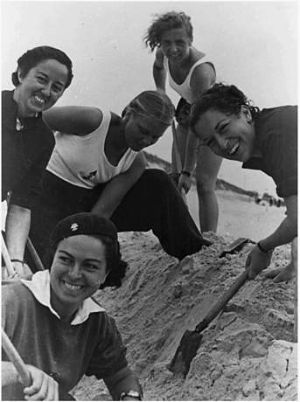
Plate 1.1 Youth Congress, Vienna, 1942. Pilar Primo de Rivera (left) and Julia Alcántara (right). Source: J. Alcántara.
Plate 1.2 SF visit to camp at Aumrüm, Germany, 1938. Pepa Chávarri (tennis champion), M. Luisa Vázquez de Parga and Julia Alcántara. Source: J. Alcántara.
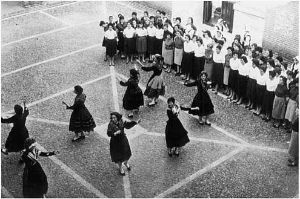
Plate 1.3 Dance display, La Mota. Source: A. Ortolá.
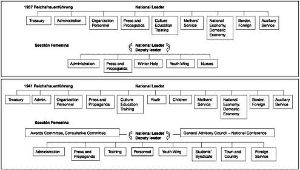
Figure 1.1 Departmental structure of the women’s organizations of Germany and Spain, 1937 and 1941. Sources: J. Stephenson, The Nazi Organization of Women, London: Croom Helm, 1981, Appendices 2 and 3. SF de FET y las JONS, Consejos nacionales (libroprimero), Madrid: SF de FET y de las JONS, n.d., p. 13. SF de FET y las JONS, Consejos nacionales (libro
|