|
MORALS AND DOGMA |
|
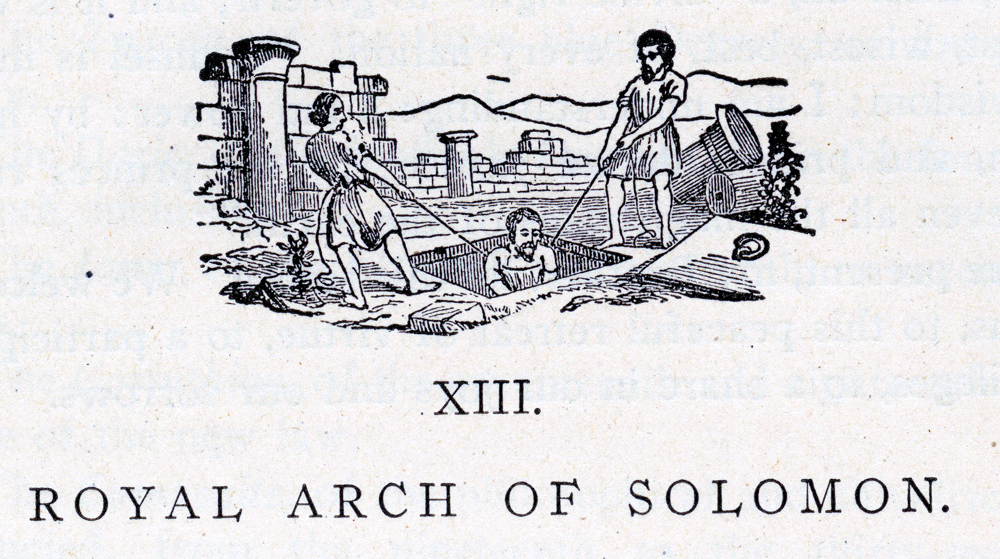
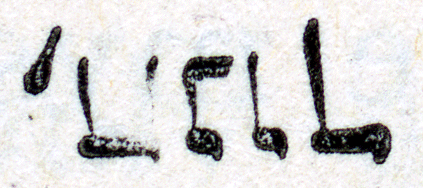
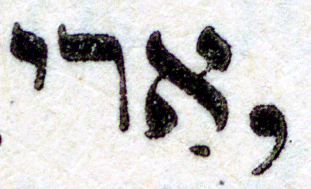
XIII. ROYAL ARCH OF SOLOMON. WHETHER the legend and history of this Degree are historically true, or but an allegory, containing in itself a deeper truth and a profounder meaning, we shall not now debate. If it be but a legendary myth, you must find out for yourself what it means. It is certain that the word which the Hebrews are not now permitted to pronounce was in common use by Abraham, Lot, Isaac, Jacob, Laban, Rebecca, and even among tribes foreign to the Hebrews, before the time of Moses; and that it recurs a hundred times in the lyrical effusions of David and other Hebrew poets. We know that for many centuries the Hebrews have been forbidden to pronounce the Sacred Name; that wherever it occurs, they have for ages read the word Adonaï instead; and that under it, when the masoretic points, which represent the vowels, came to be used, they placed those which belonged to the latter word. The possession of the true pronunciation was deemed to confer on him who had it extraordinary and supernatural powers; and the Word itself, worn upon the person, was regarded as an amulet, a protection against personal danger, sickness, and evil spirits. We know that all this was a vain superstition, natural to a rude people, necessarily disappearing as the intellect of man became enlightened; and wholly unworthy of a Mason. It is noticeable that this notion of the sanctity of the Divine Name or Creative Word was common to all the ancient nations. The Sacred Word HOM was supposed by the ancient Persians (who were among the earliest emigrants from Northern India) to be pregnant with a mysterious power; and they taught that by its utterance the world was created. In India it was forbidden to pronounce the word AUM or OM, the Sacred Name of the One Deity, manifested as Brahma, Vishna, and Seeva. These superstitious notions in regard to the efficacy of the Word, and the prohibition against pronouncing it, could, being errors, have formed no part of the pure primitive religion, or of the esoteric doctrine taught by Moses, and the full knowledge of which was confined to the Initiates; unless the whole was but an ingenious invention for the concealment of some other Name or truth, the interpretation and meaning whereof was made known only to the select few. If so, the common notions in regard to the Word grew up in the minds of the people, like other errors and fables among all the ancient nations, out of original truths and symbols and allegories misunderstood. So it has always been that allegories, intended as vehicles of truth, to be understood by the sages, have become or bred errors, by being literally accepted. It is true, that before the masoretic points were invented (which was after the beginning of the Christian era), the pronunciation of a word in the Hebrew language could not be known from the characters in which it was written. It was, therefore, possible for that of the name of the Deity to have been forgotten and lost. It is certain that its true pronunciation is not that represented by the word Jehovah; and therefore that that is not the true name of Deity, nor the Ineffable Word. The ancient symbols and allegories always had more than one interpretation. They always had a double meaning, and sometimes more than two, one serving as the envelope of the other. Thus the pronunciation of the word was a symbol; and that pronunciation and the word itself were lost, when the knowledge of the true nature and attributes of God faded out of the minds of the Jewish people. That is one interpretation--true, but not the inner and profoundest one. Men were figuratively said to forget the name of God, when they lost that knowledge, and worshipped the heathen deities, and burned incense to them on the high places, and passed their children through the fire to Moloch. Thus the attempts of the ancient Israelites and of the Initiates to ascertain the True Name of the Deity, and its pronunciation, and the loss of the True Word, are an allegory, in which are represented the general ignorance of the true nature and attributes of God, the proneness of the people of Judah and Israel to worship other deities, and the low and erroneous and dishonoring notions of the Grand Architect of the Universe, which all shared except a few favored persons; for even Solomon built altars and sacrificed to Astarat, the goddess of the Tsidunim, and Malcūm, the Aamūnite god, and built high places for Kamūs, the Moabite deity, and Malec the god of the Beni-Aamūn. The true nature of God was unknown to them, like His name; and they worshipped the calves of Jeroboam, as in the desert they did that made for them by Aarūn. The mass of the Hebrews did not believe in the existence of one only God until a late period in their history. Their early and popular ideas of the Deity were singularly low and unworthy. Even while Moses was receiving the law upon Mount Sinai, they forced Aaron to make them an image of the Egyptian god Apis, and fell down and adored it. They were ever ready to return to the worship of the gods of the Mitzraim; and soon after the death of Joshua they became devout worshippers of the false gods of all the surrounding nations. "Ye have borne," Amos, the prophet, said to them, speaking of their forty years' journeying in the desert, under Moses, "the tabernacle of your Malec and Kaiūn your idols, the star of your god, which ye made to yourselves." Among them, as among other nations, the conceptions of God formed by individuals varied according to their intellectual and spiritual capacities; poor and imperfect, and investing God with the commonest and coarsest attributes of humanity, among the ignorant and coarse; pure and lofty among the virtuous and richly gifted. These conceptions gradually improved and became purified and ennobled, as the nation advanced in civilization--being lowest in the historical books, amended in the prophetic writings, and reaching their highest elevation among the poets. Among all the ancient nations there was one faith and one idea of Deity for the enlightened, intelligent, and educated, and another for the common people. To this rule the Hebrews were no exception. Yehovah, to the mass of the people, was like the gods of the nations around them, except that he was the peculiar God, first of the family of Abraham, of that of Isaac, and of that of Jacob, and afterward the National God; and, as they believed, more powerful than the other gods of the same nature worshipped by their neighbors--"Who among the Baalim is like unto thee, O Yehovah?"--expressed their whole creed. The Deity of the early Hebrews talked to Adam and Eve in the garden of delight, as he walked in it in the cool of the day; he conversed with Kayin; he sat and ate with Abraham in his tent; that patriarch required a visible token, before he would believe in his positive promise; he permitted Abraham to expostulate with him, and to induce him to change his first determination in regard to Sodom; he wrestled with Jacob; he showed Moses his person, though not his face; he dictated the minutest police regulations and the dimensions of the tabernacle and its furniture, to the Israelites; he insisted on and delighted in sacrifices and burnt-offerings; he was angry, jealous, and revengeful, as well as wavering and irresolute; he allowed Moses to reason him out of his fixed resolution utterly to destroy his people; he commanded the performance of the most shocking and hideous acts of cruelty and barbarity. He hardened the heart of Pharaoh; he repented of the evil that he had said he would do unto the people of Nineveh; and he did it not, to the disgust and anger of Jonah. Such were the popular notions of the Deity; and either the priests had none better, or took little trouble to correct these notions; or the popular intellect was not enough enlarged to enable them to entertain any higher conceptions of the Almighty. But such were not the ideas of the intellectual and enlightened few among the Hebrews. It is certain that they possessed a knowledge of the true nature and attributes of God; as the same class of men did among the other nations--Zoroaster, Menu, Confucius, Socrates, and Plato. But their doctrines on this subject were esoteric; they did not communicate them to the people at large, but only to a favored few; and as they were communicated in Egypt and India, in Persia and Phœnicia, in Greece and Samothrace, in the greater mysteries, to the Initiates. The communication of this knowledge and other secrets, some of which are perhaps lost, constituted, under other names, what we now call Masonry, or Free or Frank-Masonry. That knowledge was, in one sense, the Lost Word, which was made known to the Grand Elect, Perfect, and Sublime Masons. It would be folly to pretend that the forms of Masonry were the same in those ages as they are now. The present name of the Order, and its titles, and the names of the Degrees now in use, were not then known. Even Blue Masonry cannot trace back its authentic history, with its present Degrees, further than the year 1700, if so far. But, by whatever name it was known in this or the other country, Masonry existed as it now exists, the same in spirit and at heart, not only when Solomon builded the temple, but centuries before--before even the first colonies emigrated into Southern India, Persia, and Egypt, from the cradle of the human race. The Supreme, Self-existent, Eternal, All-wise, All-powerful, Infinitely Good, Pitying, Beneficent, and Merciful Creator and Preserver of the Universe was the same, by whatever name he was called, to the intellectual and enlightened men of all nations. The name was nothing, if not a symbol and representative hieroglyph of his nature and attributes. The name AL represented his remoteness above men, his inaccessibility; BAL and BALA, his might; ALOHIM, his various potencies; IHUH, existence and the generation of things. None of his names, among the Orientals, were the symbols of a divinely infinite love and tenderness, and all-embracing mercy. As MOLOCH or MALEK he was but an omnipotent monarch, a tremendous and irresponsible Will; as ADONAÏ, only an arbitrary LORD and Master; as AL Shadaï, potent and a DESTROYER. To communicate true and correct ideas in respect of the Deity was one chief object of the mysteries. In them, Khūrūm the King, and Khūrūm the Master, obtained their knowledge of him and his attributes; and in them that knowledge was taught to Moses and Pythagoras. Wherefore nothing forbids you to consider the whole legend of this Degree, like that of the Master's, an allegory, representing the perpetuation of the knowledge of the True God in the sanctuaries of initiation. By the subterranean vaults you may understand the places of initiation, which in the ancient ceremonies were generally under ground. The Temple of Solomon presented a symbolic image of the Universe; and resembled, in its arrangements and furniture, all the temples of the ancient nations that practised the mysteries. The system of numbers was intimately connected with their religions and worship, and has come down to us in Masonry; though the esoteric meaning with which the numbers used by us are pregnant is unknown to the vast majority of those who use them. Those numbers were especially employed that had a reference to the Deity, represented his attributes, or figured in the frame-work of the world, in time and space, and formed more or less the bases of that frame-work. These were universally regarded as sacred, being the expression of order and intelligence, the utterances of Divinity Himself. The Holy of Holies of the Temple formed a cube; in which, drawn on a plane surface, there are 4+3+2=9 lines visible, and three sides or faces. It corresponded with the number four, by which the ancients presented Nature, it being the number of substances or corporeal forms, and of the elements, the cardinal points and seasons, and the secondary colors. The number three everywhere represented the Supreme Being. Hence the name of the Deity, engraven upon the triangular plate, and that sunken into the cube of agate, taught the ancient Mason, and teaches us, that the true knowledge of God, of His nature and His attributes, is written by Him upon the leaves of the great Book of Universal Nature, and may be read there by all who are endowed with the requisite amount of intellect and intelligence. This knowledge of God, so written there, and of which Masonry has in all ages been the interpreter, is the Master Mason's Word. Within the Temple, all the arrangements were mystically and symbolically connected with the same system. The vault or ceiling, starred like the firmament, was supported by twelve columns, representing the twelve months of the year. The border that ran around the columns represented the zodiac, and one of the twelve celestial signs was appropriated to each column. The brazen sea was supported by twelve oxen, three looking to each cardinal point of the compass. And so in our day every Masonic Lodge represents the Universe. Each extends, we are told, from the rising to the setting sun, from the South to the North, from the surface of the Earth to the Heavens, and from the same to the centre of the globe. In it are represented the sun, moon, and stars; three great torches in the East, West, and South, forming a triangle, give it light; and, like the Delta or Triangle suspended in the East, and inclosing the Ineffable Name, indicate, by the mathematical equality of the angles and sides, the beautiful and harmonious proportions which govern in the aggregate and details of the Universe; while those sides and angles represent, by their number, three, the Trinity of Power, Wisdom, and Harmony, which presided at the building of this marvellous work, These three great lights also represent the great mystery of the three principles, of creation, dissolution or destruction, and reproduction or regeneration, consecrated by all creeds in their numerous Trinities. The luminous pedestal, lighted by the perpetual flame within, is a symbol of that light of Reason, given by God to man, by which he is enabled to read in the Book of Nature the record of the thought, the revelation of the attributes of the Deity. The three Masters, Adoniram, Joabert, and Stolkin, are types of the True Mason, who seeks for knowledge from pure motives, and that he may be the better enabled to serve and benefit his fellow-men; while the discontented and presumptuous Masters who were buried in the ruins of the arches represent those who strive to acquire it for unholy purposes, to gain power over their fellows, to gratify their pride, their vanity, or their ambition. The Lion that guarded the Ark and held in his mouth the key wherewith to open it, figuratively represents Solomon, the Lion of the Tribe of Judah, who preserved and communicated the key to the true knowledge of God, of His laws, and of the profound mysteries of the moral and physical Universe. ENOCH [ The legend of this Degree is thus, partially, interpreted. It is of little importance whether it is in anywise historical. For its value consists in the lessons which it inculcates, and the duties which it prescribes to those who receive it. The parables and allegories of the Scriptures are not less valuable than history. Nay, they are more so, because ancient history is little instructive, and truths are concealed in and symbolized by the legend and the myth. There are profounder meanings concealed in the symbols of this Degree,
connected with the philosophical system of the Hebrew
Kabalists, which you will learn hereafter, if you should be so fortunate
as
to advance. They are unfolded in the higher Degrees. The lion [ It is not enough for a people to gain its liberty. It must secure it. It must not intrust it to the keeping, or hold it at the pleasure, of any one man. The keystone of the Royal Arch of the great Temple of Liberty is a fundamental law, charter, or constitution; the expression of the fixed habits of thought of the people, embodied in a written instrument, or the result of the slow accretions and the consolidation of centuries; the same in war as in peace; that cannot be hastily changed, nor be violated with impunity, but is sacred, like the Ark of the Covenant of God, which none could touch and live. A permanent constitution, rooted in the affections, expressing the will and judgment, and built upon the instincts and settled habits of thought of the people, with an independent judiciary, an elective legislature of two branches, an executive responsible to the people, and the right of trial by jury, will guarantee the liberties of a people, if it be virtuous and temperate, without luxury, and without the lust of conquest and dominion, and the follies of visionary theories of impossible perfection. Masonry teaches its Initiates that the pursuits and occupations of this life, its activity, care, and ingenuity, the predestined developments of the nature given us by God, tend to promote His great design, in making the world; and are not at war with the great purpose of life. It teaches that everything is beautiful in its time, in its place, in its appointed office; that everything which man is put to do, if rightly and faithfully done, naturally helps to work out his salvation; that if he obeys the genuine principles of his calling, he will be a good man: and that it is only by neglect and non-performance of the task set for him by Heaven, by wandering into idle dissipation, or by violating their beneficent and lofty spirit, that he becomes a bad man. The appointed action of life is the great training of Providence; and if man yields himself to it, he will need neither churches nor ordinances, except for the expression of his religious homage and gratitude. For there is a religion of toil. It is not all drudgery, a mere stretching of the limbs and straining of the sinews to tasks. It has a meaning and an intent. A living heart pours life-blood into the toiling arm; and warm affections inspire and mingle with man's labors. They are the home affections. Labor toils a-field, or plies its task in cities, or urges the keels of commerce over wide oceans; but home is its centre; and thither it ever goes with its earnings, with the means of support and comfort for others; offerings sacred to the thought of every true man, as a sacrifice at a golden shrine. Many faults there are amidst the toils of life; many harsh and hasty words are uttered; but still the toils go on, weary and hard and exasperating as they often are. For in that home is age or sickness, or helpless infancy, or gentle childhood, or feeble woman, that must not want. If man had no other than mere selfish impulses, the scene of labor which we behold around us would not exist. The advocate who fairly and honestly presents his case, with a feeling of true self-respect, honor, and conscience, to help the tribunal on towards the right conclusion, with a conviction that God's justice reigns there, is acting a religious part, leading that day a religious life; or else right and justice are no part of religion. Whether, during all that day, he has once appealed, in form or in terms, to his conscience, or not; whether he has once spoken of religion and God, or not; if there has been the inward purpose, the conscious intent and desire, that sacred justice should triumph, he has that day led a good and religious life, and made a most essential contribution to that religion of life and of society, the cause of equity between man and man, and of truth and right action in the world. Books, to be of religious tendency in the Masonic sense, need not be books of sermons, of pious exercises, or of prayers. What-ever inculcates pure, noble, and patriotic sentiments, or touches the heart with the beauty of virtue, and the excellence of an up-right life, accords with the religion of Masonry, and is the Gospel of literature and art. That Gospel is preached from many a book and painting, from many a poem and fiction, and review and newspaper; and it is a painful error and miserable narrowness, not to recognize these wide-spread agencies of Heaven's providing; not to see and welcome these many-handed coadjutors, to the great and good cause. The oracles of God do not speak from the pulpit alone. There is also a religion of society. In business, there is much more than sale, exchange, price, payment; for there is the sacred faith of man in man. When we repose perfect confidence in the integrity of another; when we feel that he will not swerve from the right, frank, straightforward, conscientious course, for any temptation; his integrity and conscientiousness are the image of God to us; and when we believe in it, it is as great and generous an act, as when we believe in the rectitude of the Deity. In gay assemblies for amusement, the good affections of life gush and mingle. If they did not, these gathering-places would be as dreary and repulsive as the caves and dens of outlaws and robbers. When friends meet, and hands are warmly pressed, and the eye kindles and the countenance is suffused with gladness, there is a religion between their hearts; and each loves and worships the True and Good that is in the other. It is not policy, or self-interest, or selfishness that spreads such a charm around that meeting, but the halo of bright and beautiful affection. The same splendor of kindly liking, and affectionate regard, shines like the soft overarching sky, over all the world; over all places where men meet, and walk or toil together; not over lovers' bowers and marriage-altars alone, not over the homes of purity and tenderness alone; but over all tilled fields, and busy workshops, and dusty highways, and paved streets. There is not a worn stone upon the sidewalks, but has been the altar of such offerings of mutual kindness; nor a wooden pillar or iron railing against which hearts beating with affection have not leaned. How many soever other elements there are in the stream of life flowing through these channels, that is surely here and everywhere; honest, heartfelt, disinterested, inexpressible affection. Every Masonic Lodge is a temple of religion; and its teachings are instruction in religion. For here are inculcated disinterestedness, affection, toleration, devotedness, patriotism, truth, a generous sympathy with those who suffer and mourn, pity for the fallen, mercy for the erring, relief for those in want, Faith, Hope, and .Charity. Here we meet as brethren, to learn to know and love each other. Here we greet each other gladly, are lenient to each other's faults, regardful of each other's feelings, ready to relieve each other's wants. This is the true religion revealed to the ancient patriarchs; which Masonry has taught for many centuries, and which it will continue to teach as long as time endures. If unworthy passions, or selfish, bitter, or revengeful feelings, contempt, dislike, hatred, enter here, they are intruders and not welcome, strangers uninvited, and not guests. Certainly there are many evils and bad passions, and much hate and contempt and unkindness everywhere in the world. We cannot refuse to see the evil that is in life. But all is not evil. We still see God in the world. There is good amidst the evil. The hand of mercy leads wealth to the hovels of poverty and sorrow. Truth and simplicity live amid many wiles and sophistries. There are good hearts underneath gay robes, and under tattered garments also. Love clasps the hand of love, amid all the envyings and distractions of showy competition; fidelity, pity, and sympathy hold the long night-watch by the bedside of the suffering neighbor, amidst the surrounding poverty and squalid misery. Devoted men go from city to city to nurse those smitten down by the terrible pestilence that renews at intervals its mysterious marches. Women well-born and delicately nurtured nursed the wounded soldiers in hospitals, before it became fashionable to do so; and even poor lost women, whom God alone loves and pities, tend the plague-stricken with a patient and generous heroism. Masonry and its kindred Orders teach men to love each other, feed the hungry, clothe the naked, comfort the sick, and bury the friendless dead. Everywhere God finds and blesses the kindly office, the pitying thought, and the loving heart. There is an element of good in all men's lawful pursuits and a divine spirit breathing in all their lawful affections. The ground on which they tread is holy ground. There is a natural religion of life, answering, with however many a broken tone, to the religion of nature. There is a beauty and glory in Humanity, in man, answering, with however many a mingling shade, to the loveliness of soft landscapes, and swelling hills, and the wondrous glory of the starry heavens. Men may be virtuous, self-improving, and religious in their employments. Precisely for that, those employments were made. All their social relations, friendship, love, the ties of family, were made to be holy, They may be religious, not by a kind of protest and resistance against their several vocations; but by conformity to their true spirit. Those vocations do not exclude religion; but demand it, for their own perfection. They may be religious laborers, whether in field or factory; religious physicians, lawyers, sculptors, poets, painters, and musicians. They may be religions in all the toils and in all the amusements of life. Their life may be a religion; the broad earth its altar; its incense the very breath of life; its fires ever kindled by the brightness of Heaven. Bound up with our poor, frail life, is the mighty thought that spurns the narrow span of all visible existence. Ever the soul reaches outward, and asks for freedom. It looks forth from the narrow and grated windows of sense, upon the wide immeasurable creation; it knows that around it and beyond it lie outstretched the infinite and everlasting paths. Everything within us and without us ought to stir our minds to admiration and wonder. We are a mystery encompassed with mysteries. The connection of mind with matter is a mystery; the wonderful telegraphic communication between the brain and every part of the body, the power and action of the will. Every familiar step is more than a story in a land of enchantment. The power of movement is as mysterious as the power of thought. Memory, and dreams that are the indistinct echoes of dead memories are alike inexplicable. Universal harmony springs from infinite complication. The momentum of every step we take in our dwelling contributes in part to the order of the Universe. We are connected by ties of thought, and even of matter and its forces, with the whole boundless Universe and all the past and coming generations of men. The humblest object beneath our eye as completely defies our scrutiny as the economy of the most distant star. Every leaf and every blade of grass holds within itself secrets which no human penetration will ever fathom. No man can tell what is its principle of life. No man can know what his power of secretion is. Both are inscrutable mysteries. Wherever we place our hand we lay it upon the locked bosom of mystery. Step where we will, we tread upon wonders. The sea-sands, the clods of the field, the water-worn pebbles on the hills, the rude masses of rock, are traced over and over, in every direction, with a hand-writing older and more significant and sublime than all the ancient ruins, and all the overthrown and buried cities that past generations have left upon the earth; for it is the handwriting of the Almighty. A Mason's great business with life is to read the book of its teaching; to find that life is not the doing of drudgeries, but the hearing of oracles. The old mythology is but a leaf in that book; for it peopled the world with spiritual natures; and science, many-leaved, still spreads before us the same tale of wonder. We shall be just as happy hereafter, as we are pure and up-right, and no more, just as happy as our character prepares us to be, and no more. Our moral, like our mental character, is not formed in a moment; it is the habit of our minds; the result of many thoughts and feelings and efforts, bound together by many natural and strong ties. The great law of Retribution is, that all coming experience is to be affected by every present feeling; every future moment of being must answer for every present moment; one moment, sacrificed to vice, or lost to improvement, is forever sacrificed and lost; an hour's delay to enter the right path, is to put us back so far, in the everlasting pursuit of happiness; and every sin, even of the best men, is to be thus answered for, if not according to the full measure of its ill-desert, yet according to a rule of unbending rectitude and impartiality. The law of retribution presses upon every man, whether he thinks of it or not. It pursues him through all the courses of life, with a step that never falters nor tires, and with an eye that never sleeps. If it were not so, God's government would not be impartial; there would be no discrimination; no moral dominion; no light shed upon the mysteries of Providence. Whatsoever a man soweth, that, and not something else, shall he reap. That which we are doing, good or evil, grave or gay, that which we do to-day and shall do to-morrow; each thought, each feeling, each action, each event; every passing hour, every breathing moment; all are contributing to form the character, according to which we are to be judged. Every particle of influence that goes to form that aggregate,--our character,--will, in that future scrutiny, be sifted out from the mass; and, particle by particle, with ages perhaps intervening, fall a distinct contribution to the sum of our joys or woes. Thus every idle word and idle hour will give answer in the judgment. Let us take care, therefore, what we sow. An evil temptation comes upon us; the opportunity of unrighteous gain, or of unhallowed indulgence, either in the sphere of business or pleasure, of society or solitude. We yield; and plant a seed of bitterness and sorrow. To-morrow it will threaten discovery. Agitated and alarmed, we cover the sin, and bury it deep in falsehood and hypocrisy. In the bosom where it lies concealed, in the fertile soil of kindred vices, that sin dies not, but thrives and grows; and other and still other germs of evil gather around the accursed root; until, from that single seed of corruption, there springs up in the soul all that is horrible in habitual lying, knavery, or vice. Loathingly, often, we take each downward step; but a frightful power urges us onward; and the hell of debt, disease, ignominy, or remorse gathers its shadows around our steps even on earth; and are yet but the beginnings of sorrows. The evil deed may be done in a single moment; but conscience never dies, memory never sleeps; guilt never can become innocence; and remorse can never whisper peace. Beware, thou who art tempted to evil! Beware what thou layest up for the future! Beware what thou layest up in the archives of eternity! Wrong not thy neighbor! lest the thought of him thou injurest, and who suffers by thy act, be to thee a pang which years will not deprive of its bitterness! Break not into the house of innocence, to rifle it of its treasure; lest when many years have passed over thee, the moan of its distress may not have died away from thine ear! Build not the desolate throne of ambition in thy heart; nor be busy with devices, and circumventings, and selfish schemings; lest desolation and loneliness be on thy path, as it stretches into the long futurity! Live not a useless, an impious, or an injurious life! for bound up with that life is the immutable principle of an endless retribution, and elements of God's creating, which will never spend their force, but continue ever to unfold with the ages of eternity. Be not deceived! God has formed thy nature, thus to answer to the future. His law can never be abrogated, nor His justice eluded; and forever and ever it will be true, that "Whatsoever a man soweth, that also he shall reap."
|