|
MORALS AND DOGMA |
|
XXIII. CHIEF OF THE TABERNACLE. AMONG most of the Ancient Nations there was, in addition to their public worship, a private one styled the Mysteries; to which those only were admitted who had been prepared by certain ceremonies called initiations. The most widely disseminated of the ancient worships were those of Isis, Orpheus, Dionusos, Ceres and Mithras. Many barbarous nations received the knowledge of the Mysteries in honor of these divinities from the Egyptians, before they arrived in Greece; and even in the British Isles the Druids celebrated those of Dionusos, learned by them from the Egyptians. The Mysteries of Eleusis, celebrated at Athens in honor of Ceres, swallowed up, as it were, all the others. All the neighboring nations neglected their own, to celebrate those of Eleusis; and in a little while all Greece and Asia Minor were filled with the Initiates. They spread into the Roman Empire, and even beyond its limits, "those holy and august Eleusinian Mysteries," said Cicero, "in which the people of the remotest lands are initiated." Zosimus says that they embraced the whole human race; and Aristides termed them the common temple of the whole world. There were, in the Eleusinian feasts, two sorts of Mysteries, the great, and the little. The latter were a kind of preparation for the former; and everybody was admitted to them. Ordinarily there was a novitiate of three, and sometimes of four years. Clemens of Alexandria says that what was taught in the great Mysteries concerned the Universe, and was the completion and perfection of all instruction; wherein things were seen as they were, and nature and her works were made known. The ancients said that the Initiates would be more happy after death than other mortals; and that, while the souls of the Profane on leaving their bodies, would be plunged in the mire, and remain buried in darkness, those of the Initiates would fly to the Fortunate Isles, the abode of the Gods. Plato said that the object of the Mysteries was to re-establish the soul in its primitive purity, and in that state of perfection which it had lost. Epictetus said, "whatever is met with therein has been instituted by our Masters, for the instruction of man and the correction of morals." Proclus held that initiation elevated the soul, from a material, sensual, and purely human life, to a communion and celestial intercourse with the Gods; and that a variety of things, forms, and species were shown Initiates, representing the first generation of the Gods. Purity of morals and elevation of soul were required of the Initiates. Candidates were required to be of spotless reputation and irreproachable virtue. Nero, after murdering his mother, did not dare to be present at the celebration of the Mysteries: and Antony presented himself to be initiated, as the most infallible mode of proving his innocence of the death of Avidius Cassius. The Initiates were regarded as the only fortunate men. "It is upon us alone," says Aristophanes, "shineth the beneficent day-star. We alone receive pleasure from the influence of his rays; we, who are initiated, and who practise toward citizen and stranger every possible act of justice and piety." And it is therefore not surprising that, in time, initiation came to be considered as necessary as baptism afterward was to the Christians; and that not to have been admitted to the Mysteries was held a dishonor. "It seems to me," says the great orator, philosopher, and moralist, Cicero, "that Athens, among many excellent inventions, divine and very useful to the human family, has produced none comparable to the Mysteries, which for a wild and ferocious life have substituted humanity and urbanity of manners. It is with good reason they use the term initiation; for it is through them that we in reality have learned the first principles of life; and they not only teach us to live in a manner more consoling and agreeable, but they soften the pains of death by the hope of a better life hereafter." Where the Mysteries originated is not known. It is supposed that they came from India, by the way of Chaldæa, into Egypt, and thence were carried into Greece. Wherever they arose, they were practised among all the ancient nations; and, as was usual, the Thracians, Cretans, and Athenians each claimed the honor of invention, and each insisted that they had borrowed nothing from any other people. In Egypt and the East, all religion, even in its most poetical forms, was more or less a mystery; and the chief reason why, in Greece, a distinct name and office were assigned to the Mysteries, was because the superficial popular theology left a want unsatisfied, which religion in a wider sense alone could supply. They were practical acknowledgments of the insufficiency of the popular religion to satisfy the deeper thoughts and aspirations of the mind. The vagueness of symbolism might perhaps reach what a more palpable and conventional creed could not. The former, by its indefiniteness, acknowledged the abstruseness of its subject; it treated a mysterious subject mystically; it endeavored to illustrate what it could not explain; to excite an appropriate feeling, if it could not develop an adequate idea; and made the image a mere subordinate conveyance for the conception, which itself never became too obvious or familiar. The instruction now conveyed by books and letters was of old conveyed by symbols; and the priest had to invent or to perpetuate a display of rites and exhibitions, which were not only more attractive to the eye than words, but often to the mind more suggestive and pregnant with meaning. Afterward, the institution became rather moral and political, than religious. The civil magistrates shaped the ceremonies to political ends in Egypt; the sages who carried them from that country to Asia, Greece, and the North of Europe, were all kings or legislators. The chief magistrate presided at those of Eleusis, represented by an officer styled King: and the Priest played but a subordinate part. The Powers revered in the Mysteries were all in reality Nature-Gods; none of whom could be consistently addressed as mere heroes, because their nature was confessedly super-heroic. The Mysteries, only in fact a more solemn expression of the religion of the ancient poetry, taught that doctrine of the Theocracia or Divine Oneness, which even poetry does not entirely conceal. They were not in any open hostility with the popular religion,. but only a more solemn exhibition of its symbols; or rather a part of itself in a more impressive form. The essence of all Mysteries, as of all polytheism, consists in this, that the conception of an unapproachable Being, single, eternal, and unchanging, and, that of a God of Nature, whose manifold power is immediately revealed to the senses in the incessant round of movement, life, and death, fell asunder in the treatment, and were separately symbolized. They offered a perpetual problem to excite curiosity, and contributed to satisfy the all-pervading religious sentiment, which if it obtain no nourishment among the simple and intelligible, finds compensating excitement in a reverential contemplation of the obscure. Nature is as free from dogmatism as from tyranny; and the earliest instructors of mankind not only adopted her lessons, but as far as possible adhered to her method of imparting them. They attempted to reach the understanding through the eye; and the greater part of all religious teaching was conveyed through this ancient and most impressive mode of "exhibition" or demonstration. The Mysteries were a sacred drama, exhibiting some legend significant of Nature's change, of the visible Universe in which the divinity is revealed, and whose import was in many respects as open to the Pagan, as to the Christian. Beyond the current traditions or sacred recitals of the temple, few explanations were given to the spectators, who were left, as in the school of nature, to make inferences for themselves. The method of indirect suggestion, by allegory or symbol, is a more efficacious instrument of instruction than plain didactic language; since we are habitually indifferent to that which is acquired without effort: "The initiated are few, though many bear the thyrsus." And it would have been impossible to provide a lesson suited to every degree of cultivation and capacity, unless it were one framed after Nature's example, or rather a representation of Nature herself, employing her universal symbolism instead of technicalities of language, inviting endless research, yet rewarding the humblest inquirer, and disclosing its secrets to every one in proportion to his preparatory training and power to comprehend them. Even if destitute of any formal or official enunciation of those important truths, which even in a cultivated age it was often found inexpedient to assert except under a veil of allegory, and which moreover lose their dignity and value in proportion as they are learned mechanically as dogmas, the shows of the Mysteries certainly contained suggestions if not lessons, which in the opinion not of one competent witness only, but of many, were adapted to elevate the character of the spectators. enabling them to augur something of the purposes of existence, as well as of the means of improving it, to live better and to die happier. Unlike the religion of books or creeds, these mystic shows and performances were not the reading of a lecture, but the opening of a problem, implying neither exemption from research, nor hostility to philosophy: for, on the contrary, philosophy is the great Mystagogue or Arch-Expounder of symbolism: though the interpretations by the Grecian Philosophy of the old myths and symbols were in many instances as ill-founded, as in others they are correct. No better means could be devised to rouse a dormant intellect, than those impressive exhibitions, which addressed it through the imagination: which, instead of condemning it to a prescribed routine of creed, invited it to seek, compare, and judge. The alteration from symbol to dogma is as fatal to beauty of expression, as that from faith to dogma is to truth and wholesomeness of thought. The first philosophy often reverted to the natural mode of teaching; and Socrates, in particular, is said to have eschewed dogmas, endeavoring, like the Mysteries, rather to awaken and develop in the minds of his hearers the ideas with which they were already endowed or pregnant, than to fill them with ready-made adventitious opinions. So Masonry still follows the ancient manner of teaching. Her symbols are the instruction she gives; and the lectures are but often partial and insufficient one-sided endeavors to interpret those symbols. He who would become an accomplished Mason, must not be content merely to hear or even to understand the lectures, but must, aided by them, and they having as it were marked out the way for him, study, interpret, and develop the symbols for himself. The earliest speculation endeavored to express far more than it could distinctly comprehend; and the vague impressions of the mind found in the mysterious analogies of phenomena their most apt and energetic representations. The Mysteries, like the symbols of Masonry, were but an image of the eloquent analogies of Nature; both those and these revealing no new secret to such as were or are unprepared, or incapable of interpreting their significance. Everywhere in the old Mysteries, and in all the symbolisms and ceremonial of the Hierophant was found the same mythical personage, who, like Hermes, or Zoroaster, unites Human Attributes with Divine, and is himself the God whose worship he introduced, teaching rude men the commencements of civilization through the influence of song, and connecting with the symbol of his death, emblematic of that of Nature, the most essential consolations of religion. The Mysteries embraced the three great doctrines of Ancient Theosophy. They treated of God, Man, and Nature. Dionusos, whose Mysteries Orpheus is said to have founded, was the God of Nature, or of the moisture which is the life of Nature, who prepares in darkness the return of life and vegetation, or who is himself the Light and Change evolving their varieties. He was theologically one with Hermes, Prometheus, and Poseidon. In the Egean Islands he is Butes, Dardanus, Himeros, or Imbros. In Crete he appears as Iasius or Zeus, whose worship remaining unveiled by the usual forms of mystery, betrayed to profane curiosity the symbols, which, if irreverently contemplated, were sure to be misunderstood. In Asia he is the long-stoled Bassareus coalescing with the Sabazius of the Phrygian Corybantes: the same with the mystic Iacchus, nursling or son of Ceres, and with the dismembered Zagreus, son of Persephoné. In symbolical forms the Mysteries exhibited THE ONE, of which THE MANIFOLD is an infinite illustration, containing a moral lesson, calculated to guide the soul through life, and to cheer it in death. The story of Dionusos was profoundly significant. He was not only creator of the world, but guardian, liberator, and Savior of the soul. God of the many-colored mantle, he was the resulting manifestation personified, the all in the many, the varied year, life passing into innumerable forms. The spiritual regeneration of man was typified in the Mysteries by the second birth of Dionusos as offspring of the Highest; and the agents and symbols of that regeneration were the elements that affected Nature's periodical purification--the air, indicated by the mystic fan or winnow; the fire, signified by the torch; and the baptismal water, for water is not only cleanser of all things, but the genesis or source of all. These notions, clothed in ritual, suggested the soul's reformation and training, the moral purity formally proclaimed at Eleusis. He only was invited to approach, who was "of clean hands and ingenuous speech, free from all pollution, and with a clear conscience." "Happy the man," say the initiated in Euripides and Aristophanes, "who purifies his life, and who reverently consecrates his soul in the thiăsos of the God. Let him take heed to his lips that he utter no profane word; let him be just and kind to the stranger, and to his neighbor; let him give way to no vicious excess, lest he make dull and heavy the organs of the spirit. Far from the mystic dance of the thiăsos be the impure, the evil speaker, the seditious citizen, the selfish hunter after gain, the traitor; all those, in short, whose practices are more akin to the riot of Titans than to the regulated life of the Orphici, or the Curetan order of the Priests of Idæan Zeus." The votary, elevated beyond the sphere of his ordinary faculties, and unable to account for the agitation which overpowered him, seemed to become divine in proportion as he ceased to be human; to be a dæmon or god. Already, in imagination, the initiated were numbered among the beatified. They alone enjoyed the true life, the Sun's true lustre, while they hymned their God beneath the mystic groves of a mimic Elysium, and were really renovated or regenerated under the genial influence of their dances. "They whom Proserpina guides in her mysteries," it was said, "who imbibed her instruction and spiritual nourishment, rest from their labors and know strife no more. Happy they who witness and comprehend these sacred ceremonies! They are made to know the meaning of the riddle of existence by observing its aim and termination as appointed by Zeus; they partake a benefit more valuable and enduring than the grain bestowed by Ceres; for they are exalted in the scale of intellectual existence, and obtain sweet hopes to console them at their death." No doubt the ceremonies of initiation were originally few and simple. As the great truths of the primitive revelation faded out of the memories of the masses of the People, and wickedness became rife upon the earth, it became necessary to discriminate, to require longer probation and satisfactory tests of the candidates, and by spreading around what at first were rather schools of instruction than mysteries, the veil of secrecy, and the pomp of ceremony, to heighten the opinion of their value and importance. Whatever pictures later and especially Christian writers may draw of the Mysteries, they must, not only originally, but for many ages, have continued pure; and the doctrines of natural religion and morals there taught, have been of the highest importance; because both the most virtuous as well as the most learned and philosophic of the ancients speak of them in the loftiest terms. That they ultimately became degraded from their high estate, and corrupted, we know. The rites of initiation became progressively more complicated. Signs and tokens were invented by which the Children of Light could with facility make themselves known to each other. Different Degrees were invented, as the number of Initiates enlarged, in order that there might be in the inner apartment of the Temple a favored few, to whom alone the more valuable secrets were entrusted, and who could wield effectually the influence and power of the Order. Originally the Mysteries were meant to be the beginning of a new life of reason and virtue. The initiated or esoteric companions were taught the doctrine of the One Supreme God, the theory of death and eternity, the hidden mysteries of Nature, the prospect of the ultimate restoration of the soul to that state of perfection from which it had fallen, its immortality, and the states of reward and punishment after death. The uninitiated were deemed Profane, unworthy of public employment or private confidence, sometimes proscribed as Atheists, and certain of ever-lasting punishment beyond the grave. All persons were initiated into the lesser Mysteries; but few attained the greater, in which the true spirit of them, and most of their secret doctrines were hidden. The veil of secrecy was impenetrable, sealed by oaths and penalties the most tremendous and appalling. It was by initiation only, that a knowledge of the Hieroglyphics could be obtained, with which the walls, columns, and ceilings of the Temples were decorated, and which, believed to have been communicated to the Priests by revelation from the celestial deities, the youth of all ranks were laudably ambitious of deciphering. The ceremonies were performed at dead of night, generally in apartments under-ground, but sometimes in the centre of a vast pyramid, with every appliance that could alarm and excite the candidate. Innumerable ceremonies, wild and romantic, dreadful and appalling, had by degrees been added to the few expressive symbols of primitive observances, under which there were instances in which the terrified aspirant actually expired with fear. The pyramids were probably used for the purposes of initiation, as were caverns, pagodas, and labyrinths; for the ceremonies required many apartments and cells, long passages and wells. In Egypt a principal place for the Mysteries was the island of Philæ on the Nile, where a magnificent Temple of Osiris stood, and his relics were said to be preserved. With their natural proclivities, the Priesthood, that select and exclusive class, in Egypt, India, Phœnicia, Judea and Greece, as well as in Britain and Rome, and wherever else the Mysteries were known, made use of them to build wider and higher the fabric of their own power. The purity of no religion continues long. Rank and dignities succeed to the primitive simplicity. Unprincipled, vain, insolent, corrupt, and venal men put on God's livery to serve the Devil withal; and luxury, vice, intolerance, and pride depose frugality, virtue, gentleness, and humility, and change the altar where they should be servants, to a throne on which they reign. But the Kings, Philosophers, and Statesmen, the wise and great and good who were admitted to the Mysteries, long postponed their ultimate self-destruction, and restrained the natural tendencies of the Priesthood. And accordingly Zosimus thought that the neglect of the Mysteries after Diocletian abdicated, was the chief cause of the decline of the Roman Empire; and in the year 364, the Proconsul of Greece would not close the Mysteries, notwithstanding a law of the Emperor Valentinian, lest the people should be driven to desperation, if prevented from performing them; upon which, as they believed, the welfare of mankind wholly depended. They were practised in Athens until the 8th century, in Greece and Rome for several centuries after Christ; and in Wales and Scotland down to the 12th century. The inhabitants of India originally practised the Patriarchal religion. Even the later worship of Vishnu was cheerful and social; accompanied with the festive song, the sprightly dance, and the resounding cymbal, with libations of milk and honey, garlands, and perfumes from aromatic woods and gums. There perhaps the Mysteries commenced; and in them, under allegories, were taught the primitive truths. We cannot, within the limits of this lecture, detail the ceremonies of initiation; and shall use general language, except where something from those old Mysteries still remains in Masonry. The Initiate was invested with a cord of three threads, so twined as to make three times three, and called zennar. Hence comes our cable-tow. It was an emblem of their tri-une Deity, the remembrance of whom we also preserve in the three chief officers of our Lodges, presiding in the three quarters of that Universe which our Lodges represent; in our three greater and three lesser lights, our three movable and three immovable jewels, and the three pillars that support our Lodges. The Indian Mysteries were celebrated in subterranean caverns and grottos hewn in the solid rock; and the Initiates adored the Deity, symbolized by the solar fire. The candidate, long wandering in darkness, truly wanted Light, and the worship taught him was the worship of God, the Source of Light. The vast Temple of Elephanta, perhaps the oldest in the world, hewn out of the rock, and 135 feet square, was used for initiations; as were the still vaster caverns of Salsette, with their 300 apartments. The periods of initiation were regulated by the increase and decrease of the moon. The Mysteries were divided into four steps or Degrees. The candidate might receive the first at eight years of age, when he was invested with the zennar. Each Degree dispensed something of perfection. "Let the wretched man," says the Hitopadesa, "practise virtue, whenever he enjoys one of the three or four religious Degrees; let him be even-minded with all created things, and that disposition will be the source of virtue." After various ceremonies, chiefly relating to the unity and trinity of the Godhead, the candidate was clothed in a linen garment without a seam, and remained under the care of a Brahmin until he was twenty years of age, constantly studying and practising the most rigid virtue. Then he underwent the severest probation for the second Degree, in which he was sanctified by the sign of the cross, which, pointing to the four quarters of the compass, was honored as a striking symbol of the Universe by many nations of antiquity, and was imitated by the Indians in the shape of their temples. Then he was admitted to the Holy Cavern, blazing with light, where, in costly robes, sat, in the East, West, and South, the three chief Hierophants, representing the Indian tri-une Deity. The ceremonies there commenced with an anthem to the Great God of Nature; and then followed this apostrophe: "O mighty Being! greater than Brahma! we bow down before Thee as the primal Creator! Eternal God of Gods! The World's Mansion! Thou art the Incorruptible Being, distinct from all things transient! Thou art before all Gods, the Ancient Absolute Existence, and the Supreme Supporter of the Universe! Thou art the Supreme Mansion; and by Thee, O Infinite Form, the Universe was spread abroad." The candidate, thus taught the first great primitive truth, was called upon to make a formal declaration, that he would be tract-able and obedient to his superiors; that he would keep his body pure; govern his tongue, and observe a passive obedience in receiving the doctrines and traditions of the Order; and the firmest secrecy in maintaining inviolable its hidden and abstruse mysteries. Then he was sprinkled with water (whence our baptism); certain words, now unknown, were whispered in his ear; and he was divested of his shoes, and made to go three times around the cavern. Hence our three circuits; hence we were neither barefoot nor shod: and the words were the Pass-words of that Indian Degree. The Gymnosophist Priests came from the banks of the Euphrates into Ethiopia, and brought with them their sciences and their doctrines. Their principal College was at Meroe, and their Mysteries were celebrated in the Temple of Amun, renowned for his oracle. Ethiopia was then a powerful State, which preceded Egypt in civilization, and had a theocratic government. Above the King was the Priest, who could put him to death in the name of the Deity. Egypt was then composed of the Thebaid only. Middle Egypt and the Delta were a gulf of the Mediterranean. The Nile by degrees formed an immense marsh, which, afterward drained by the labor of man, formed Lower Egypt; and was for many centuries governed by the Ethiopian Sacerdotal Caste, of Arabic origin; afterward displaced by a dynasty of warriors. The magnificent ruins of Axoum, with its obelisks and hieroglyphics, temples, vast tombs and pyramids, around ancient Meroe, are far older than the pyramids near Memphis. The Priests, taught by Hermes, embodied in books the occult and hermetic sciences, with their own discoveries and the revelations of the Sibyls. They studied particularly the most abstract sciences, discovered the famous geometrical theorems which Pythagoras afterward learned from them, calculated eclipses, and regulated, nineteen centuries before Cæsar, the Julian year. They descended to practical investigations as to the necessities of life, and made known their discoveries to the people; they cultivated the fine arts, and inspired the people with that enthusiasm which produced the avenues of Thebes, the Labyrinth, the Temples of Karnac, Denderah, Edfou, and Philæ, the monolithic obelisks, and the great Lake Moeris, the fertilizer of the country. The wisdom of the Egyptian Initiates, the high sciences and lofty morality which they taught, and their immense knowledge, excited the emulation of the most eminent men, whatever their rank and fortune; and led them, despite the complicated and terrible trials to be undergone, to seek admission into the Mysteries of Osiris and Isis. From Egypt, the Mysteries went to Phœnicia, and were celebrated at Tyre. Osiris changed his name, and become Adoni or Dionusos, still the representative of the Sun; and afterward these Mysteries were introduced successively into Assyria, Babylon, Persia, Greece, Sicily, and Italy. In Greece and Sicily, Osiris took the name of Bacchus, and Isis that of Ceres, Cybele, Rhea and Venus. Bar Hebraeus says: "Enoch was the first who invented books and different sorts of writing. The ancient Greeks declare that Enoch is the same as Mercury Trismegistus [Hermes], and that he taught the sons of men the art of building cities, and enacted some admirable laws. . . He discovered the knowledge of the Zodiac, and the course of the Planets; and he pointed out to the sons of men, that they should worship God, that they should fast, that they should pray, that they should give alms, votive offerings, and tenths. He reprobated abominable foods and drunkenness, and appointed festivals for sacrifices to the Sun, at each of the Zodiacal Signs." Manetho extracted his history from certain pillars which he discovered in Egypt, whereon inscriptions had been made by Thoth, or the first Mercury [or Hermes], in the sacred letters and dialect: but which were after the flood translated from that dialect into the Greek tongue, and laid up in the private recesses of the Egyptian Temples. These pillars were found in subterranean caverns, near Thebes and beyond the Nile, not far from the sounding statue of Memnon, in a place called Syringes; which are described to be certain winding apartments underground; made, it is said, by those who were skilled in ancient rites; who, foreseeing the coming of the Deluge, and fearing lest the memory of their ceremonies should be obliterated, built and contrived vaults, dug with vast labor, in several places. From the bosom of Egypt sprang a man of consummate wisdom, initiated in the secret knowledge of India, of Persia, and of Ethiopia, named Thoth or Phtha by his compatriots, Taut by the Phœnicians, Hermes Trismegistus by the Greeks, and Adris by the Rabbins. Nature seemed to have chosen him for her favorite, and to have lavished on him all the qualities necessary to enable him to study her and to know her thoroughly. The Deity had, so to say, infused into him the sciences and the arts, in order that he might instruct the whole world. He
invented many things necessary for the uses of life, and gave them
suitable names; he taught men how to write down their thoughts and
arrange their speech; he instituted the ceremonies to be observed in the
worship of each of the Gods; he observed the course of the stars; he
invented music, the different bodily exercises, arithmetic, medicine,
the art of working in metals, the lyre with three strings; he regulated
the three tones of the voice, the sharp, taken from autumn, the
grave from winter, and the middle from spring, there being
then but three seasons. It was he who taught the Greeks the mode of
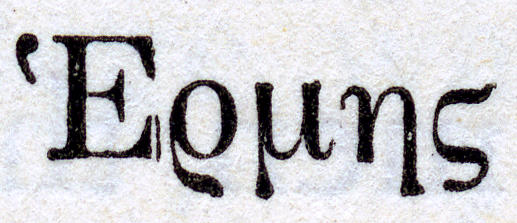
interpreting terms and things, whence they gave him the name of Ἑρμης
In Egypt he instituted hieroglyphics: he selected a certain number of persons whom he judged fitted to be the depositaries of his secrets, of such only as were capable of attaining the throne and the first offices in the Mysteries; he united them in a body, created them Priests of the Living God, instructed them in the sciences and arts, and explained to them the symbols by which they were veiled. Egypt, 1500 years before the time of Moses, revered in the Mysteries ONE SUPREME GOD, called the ONLY UNCREATED. Under Him it paid homage to seven principal deities. It is to Hermes, who lived at that period, that we must attribute the concealment or veiling [velation] of the Indian worship, which Moses unveiled or revealed, changing nothing of the laws of Hermes, except the plurality of his mystic Gods. The Egyptian Priests related that Hermes, dying, said: "Hitherto I have lived an exile from my true country: now I return thither. Do not weep for me: I return to that celestial country whither each goes in his turn. There is God. This life is but a death." This is precisely the creed of the old Buddhists of Samaneans, who believed that from time to time God sent Buddhas on earth, to reform men, to wean them from their vices, and lead them back into the paths of virtue. Among the sciences taught by Hermes, there were secrets which he communicated to the Initiates only upon condition that they should bind themselves, by a terrible oath, never to divulge them, except to those who, after long trial, should be found worthy to succeed them. The Kings even prohibited the revelation of them on pain of death. This secret was styled the Sacerdotal Art, and included alchemy, astrology, magism [magic], the science of spirits, etc. He gave them the key to the Hieroglyphics of all these secret sciences, which were regarded as sacred, and kept concealed in the most secret places of the Temple. The great secrecy observed by the initiated Priests, for many years, and the lofty sciences which they professed, caused them to be honored and respected throughout all Egypt, which was regarded by other nations as the college, the sanctuary, of the sciences and arts. The mystery which surrounded them strongly excited curiosity. Orpheus metamorphosed himself, so to say, into an Egyptian. He was initiated into Theology and Physics. And he so completely made the ideas and reasonings of his teachers his own, that his Hymns rather bespeak an Egyptian Priest than a Grecian Poet: and the was the first who carried into Greece the Egyptian fables. Pythagoras, ever thirsty for learning, consented even to be circumcised, in order to become one of the Initiates: and the occult sciences were revealed to him in the innermost part of the sanctuary. The Initiates in a particular science, having been instructed by fables, enigmas, allegories, and hieroglyphics, wrote mysteriously whenever in their works they touched the subject of the Mysteries, and continued to conceal science under a veil of fictions. When the destruction by Cambyses of many cities, and the ruin of nearly all Egypt, in the year 528 before our era, dispersed most of the Priests into Greece and elsewhere, they bore with them their sciences, which they continued to teach enigmatically, that is to say, ever enveloped in the obscurities of fables and hieroglyphics; to the end that the vulgar herd, seeing, might see nothing, and hearing, might comprehend nothing. All the writers drew from this source: but these Mysteries, concealed under so many unexplained envelopes, ended in giving birth to a swarm of absurdities, which, from Greece, spread over the whole earth. In the Grecian Mysteries, as established by Pythagoras, there were three Degrees. A preparation of five years' abstinence and silence was required. If the candidate was found to be passionate or intemperate, contentious, or ambitious of worldly honors and distinctions, he was rejected. In his lectures, Pythagoras taught the mathematics, as a medium whereby to prove the existence of God from observation and by means of reason; grammar, rhetoric, and logic, to cultivate and improve that reason, arithmetic, because he conceived that the ultimate benefit of man consisted in the science of numbers, and geometry, music, and astronomy, because he conceived that man is indebted to them for a knowledge of what is really good and useful. He taught the true method of obtaining a knowledge of the Divine laws of purifying the soul from its imperfections, of searching for truth, and of practising virtue; thus imitating the perfections of God. He thought his system vain, if it did not contribute to expel vice and introduce virtue into the mind. He taught that the two most excellent things were, to speak the truth, and to render benefits to one another. Particularly he inculcated Silence, Temperance, Fortitude, Prudence, and Justice. He taught the immortality of the soul, the Omnipotence of God, and the necessity of personal holiness to qualify a man for admission into the Society of the Gods. Thus we owe the particular mode of instruction in the Degree of Fellow-Craft to Pythagoras; and that Degree is but an imperfect reproduction of his lectures. From him, too, we have many of our explanations of the symbols. He arranged his assemblies due East and West, because he held that Motion began in the East and proceeded to the West. Our Lodges are said to be due East and West, because the Master represents the rising Sun, and of course must be in the East. The pyramids, too, were built precisely by the four cardinal points. And our expression, that our Lodges extend upward to the Heavens, comes from the Persian and Druidic custom of having to their Temples no roofs but the sky. Plato developed and spiritualized the philosophy of Pythagoras.Even Eusebius the Christian admits, that he reached to the vestibule of Truth, and stood upon its threshold. The Druidical ceremonies undoubtedly came from India; and the Druids were originally Buddhists. The word Druidh, like the word Magi, signifies wise or learned men; and they were at once philosophers, magistrates, and divines. There was a surprising uniformity in the Temples, Priests, doctrines, and worship of the Persian Magi and British Druids. The Gods of Britain were the same as the Cabiri of Samothrace. Osiris and Isis appeared in their Mysteries, under the names of Hu and Ceridwen; and like those of the primitive Persians, their Temples were enclosures of huge unhewn stones, some of which still remain, and are regarded by the common people with fear and veneration. They were generally either circular or oval. Some were in the shape of a circle to which a vast serpent was attached. The circle was an Eastern symbol of the Universe, governed by an Omnipotent Deity whose centre is everywhere, and his circumference nowhere: and the egg was an universal symbol of the world. Some of the Temples were winged, and some in the shape of a cross; the winged ones referring to Kneph, the winged Serpent-Deity of Egypt; whence the name of Navestock, where one of them stood. Temples in the shape of a cross were also found in Ireland and Scotland. The length of one of these vast structures, in the shape of a serpent, was nearly three miles. The grand periods for initiation into the Druidical Mysteries, were quarterly; at the equinoxes and solstices. In the remote times when they originated, these were the times corresponding with the 13th of February, 1st of May, 19th of August, and 1st of November. The time of annual celebration was May-Eve, and the ceremonial preparations commenced at midnight, on the 29th of April. When the initiations were over, on May-Eve, fires were kindled on all the cairns and cromlechs in the island, which burned all night to introduce the sports of May-day. The festival was in honor of the Sun. The initiations were performed at midnight; and there were three Degrees. The Gothic Mysteries were carried Northward from the East, by Odin; who, being a great warrior, modelled and varied them to suit his purposes and the genius of his people. He placed over their celebration twelve Hierophants, who were alike Priests, Counsellors of State, and Judges from whose decision there was no appeal. He held the numbers three and nine in peculiar veneration, and was probably himself the Indian Buddha. Every thrice-three months, thrice-three victims were sacrificed to the tri-une God. The Goths had three great festivals; the most magnificent of which commenced at the winter solstice, and was celebrated in honor of Thor, the Prince of the Power of the Air. That being the longest night in the year, and the one after which the Sun comes Northward, it was commemorative of the Creation; and they termed it mother-night, as the one in which the creation of the world and light from the primitive darkness took place. This was the Yule, Juul, or Yeol feast, which afterward became Christmas. At this feast the initiations were celebrated. Thor was the Sun, the Egyptian Osiris and Kneph, the Phœnician Bel or Baal. The initiations were had in huge intricate caverns, terminating, as all the Mithriac caverns did, in a spacious vault, where the candidate was brought to light. Joseph was undoubtedly initiated. After he had interpreted Pharaoh's dream, that Monarch made him his Prime Minister, let him ride in his second chariot, while they proclaimed before him, ABRECH! and set him over the land of Egypt. In addition to this, the King gave him a new name, Tsapanat-Paänakh, and married him to Asanat, daughter of Potai Parang, a Priest of An or Hieropolis, where was the Temple of Athom-Re, the Great God of Egypt; thus completely naturalizing him. He could not have contracted this marriage, nor have exercised that high dignity, without being first initiated in the Mysteries. When his Brethren came to Egypt the second time, the Egyptians of his court could not eat with them, as that would have been abomination, though they ate with Joseph; who was therefore regarded not as a foreigner, but as one of themselves: and when he sent and brought his brethren back, and charged them with taking his cup, he said, "Know ye not that a man like me practises divination?" thus assuming the Egyptian of high rank initiated into the Mysteries, and as such conversant with the occult sciences. So also must Moses have been initiated: for he was not only brought up in the court of the King, as the adopted son of the King's daughter, until he was forty years of age; but he was instructed in all the learning of the Egyptians, and married afterward the daughter of Yethrū, a Priest of An likewise. Strabo and Diodorus both assert that he was himself a Priest of Heliopolis. Before he went into the Desert, there were intimate relations between him and the Priesthood; and he had successfully commanded, Josephus informs us, an army sent by the King against the Ethiopians. Simplicius asserts that Moses received from the Egyptians, in the Mysteries, the doctrines which he taught to the Hebrews: and Clemens of Alexandria and Philo say that he was a Theologian and Prophet, and interpreter of the Sacred Laws. Manetho, cited by Josephus, says he was a Priest of Heliopolis, and that his true and original (Egyptian) name was Asersaph or Osarsiph. And in the institution of the Hebrew Priesthood, in the powers and privileges, as well as the immunities and sanctity which he conferred upon them, he closely imitated the Egyptian institutions; making public the worship of that Deity whom the Egyptian Initiates worshipped in private; and strenuously endeavoring to keep the people from relapsing into their old mixture of Chaldaic and Egyptian superstition and idol-worship, as they were ever ready and inclined to do; even Aharūn, upon their first clamorous discontent, restoring the worship of Apis; as an image of which Egyptian God he made the golden calf. The Egyptian Priests taught in their great Mysteries, that there was one God, Supreme and Unapproachable, who had conceived the Universe by His Intelligence, before He created it by His Power and Will. They were no Materialists nor Pantheists; but taught that Matter was not eternal or co-existent with the great First Cause, but created by Him. The early Christians, taught by the founder of their Religion, but in greater perfection, those primitive truths that from the Egyptians had passed to the Jews, and been preserved among the latter by the Essenes, received also the institution of the Mysteries; adopting as their object the building of the symbolic Temple, preserving the old Scriptures of the Jews as their sacred book, and as the fundamental law, which furnished the new veil of initiation with the Hebraic words and formulas, that, corrupted and disfigured by time and ignorance, appear in many of our Degrees. Such, my Brother, is the doctrine of the first Degree of, the Mysteries, or that of Chief of the Tabernacle, to which you have now been admitted, and the moral lesson of which is, devotion to the service of God, and disinterested zeal and constant endeavor for the welfare of men. You have here received only hints of the true objects and purposes of the Mysteries. Hereafter, if you are permitted to advance, you will arrive at a more complete understanding of them and of the sublime doctrines which they teach. Be content, therefore, with that which you have seer and heard, and await patiently the advent of the greater light.
_______________ NOTES: *An Egyptian word, meaning, "Bow down."
|