|
ASGARD AND THE GODS: THE TALES AND TRADITIONS OF OUR NORTHERN ANCESTORS |
|
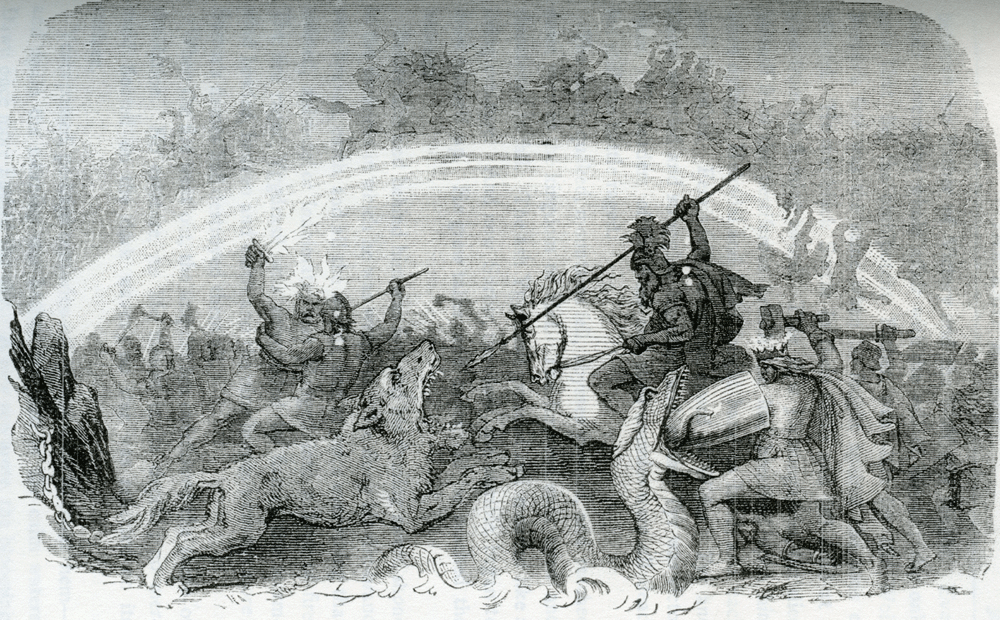
PART FOURTEENTH: RAGNARÖK THE TWILIGHT OF THE GODS The Fimbul-Winter ― 296, The Last Battle ― 298, Surtur flings his fire-brands over the nine worlds ― 301, Renewal of the World ― 301, Lif and Lifthrasir ― The tempter, the author of evil, was firmly bound to the cold rock, but the evil seed he had sown grew and flourished, and even the gods, the moral powers, whose duty it was to uphold universal law, were no longer pure and free from guilt; the wholesome bonds of law were broken, and the destruction of the world approached. Neither truth nor faith was to be found in heaven or on earth, and love, which had formerly bound friends, parents, children, brothers and sisters to each other, had lost its power. Self-seeking, self-interest and grasping covetousness became the guiding principles of life; murder, incendiarism and bloodshed were everywhere to be found. The sun still continued its course through the heavens, but it shone mistily as through a veil, and gave no warmth in summer. Winter set in early, and it was a Fimbul-Winter, a winter of horrors. The snow-storms were such as had never been known before, and the frost was terribly hard. Many houses and villages were buried in the snow, and their inhabitants perished. The Fimbul-Winter seemed as if it would never end; it lasted for three years, without any summer to break its fury. Trees and bushes, grass and plants perished, men died of cold and hunger, and yet they did not cease from their lies and murders and other deeds of violence. Meanwhile Fenris’s children, the wolves, grew into horrible monsters, for the old giantess in the forest fed them with marrow taken from the bones of murdered perjurers and breakers of the marriage bond, and gave them to drink of the blood of dead poisoners, parricides and fratricides, and there was abundance of such food. Wala, the prophetess, was asked what all this meant, and she said, that the sun, moon and Mother Earth were sorrowing over the fall of man, that the wolves and other hostile powers would soon be free, and then the destruction of the universe would begin. Many signs and wonders were to be seen during that time, as we read in the Lay of Wala. The glory of the sun was darkened, wicked Idises were seen flying through the air, Fjalar, the bright-red cock of Asgard, crowed loudly, the dark-red cock in Helheim answered him, and all in the Upper-world heard their crowing. The great wolves Skiöll and Hati rushed up to attack the sun and moon; they seized and swallowed them, and now darkness reigned in heaven and earth. Then the earth itself shook to its very foundations, and all chains were broken. Thus it happened that Loki was set free, that his horrible son Fenris was able to shake off his bonds and hasten with his children to join his father, and that Garm, Hel’s dog, could rise out of the Gnypa cave with the other dark followers of the goddess, to take their share in the work of destruction. The sea was stirred to its depths and overflowed the land. Out of its abyss the Midgard-snake reared her frightful head, and flung herself about with a giant’s rage, so much did she long for the struggle to begin. Heimdal then blew a loud blast on the Giallarhorn that sounded through all the homes, wakening Ases and Einheriar, and warning them to prepare for the Last Battle. Odin mounted Sleipnir as soon as he was armed, and rode away to Mimir’s Well. The World-Ash was rustling and trembling in the storm, its leaves were falling rapidly, and its roots threatened to snap. The Norns were seated beside it, their heads hidden in their veils. Odin whispered to Mimir’s head; no one heard what he said or how he was answered. Meanwhile Thrym, the king of the Jotuns, was steering his ship from the east over the everlasting sea. The Hrimthurses, armed with clubs and javelins, were on board. At the same time, Nagelfari, the ship of death, was set afloat, and was borne along on the waves. It was built of the nails of the dead which love had not caused to be cut. Love had died in the parricidal wars that prevailed, and the last offices were therefore denied to the dead. Loki steered the vessel. With him were Surtur, swinging his flaming sword, whose blade shone brighter than the sun, and all the sons of Muspel dressed in fiery armour, which blinded all who looked at it. They landed, mounted the horses they had brought with them, and galloped over the bridge Bifröst, which broke under their weight. Loki led his hosts to the plain of Wigrid, that measured a hundred miles on every side. Odin also went there, accompanied by his brave Ases and heroes. Once more the Giallarhorn was sounded, and then the Last Battle began. The Wolf howled, the Snake hissed and spat out poison, which filled and infected the air. The sons of Muspel, under Surtur’s guidance, rushed on their enemies like flames of fire. The Einheriar, headed by Freyer, withstood them bravely, and they fell back. Thor fought gallantly, and slew numbers of the Hrimthurses and other monsters. Odin sought out the Fenriswolf, and the battle between them began.
Ragnarok, The Last Battle No seer or bard has made known to us how that terrible struggle between the Father of Victory and the Wolf was fought. Even Wala covers the whole affair with the veil of silence; she only says that he, the omnipotent Father, was slain by the Wolf. Freyer’s fate was the same when he fought against the sons of Muspel. He met black Surtur in their ranks and fell dead at a blow from his flaming sword. Thor slew Jormungander, but died himself from the pestiferous breath she had breathed upon him when dying. Heimdal and Loki fought hand to hand, and each slew the other. Fenris fell under the sword of Widar. Tyr and Garm wrestled and struggled together, and at last Tyr was victorious. The leaders of the Ases and their enemies were all dead, but still the battle raged. The earth quaked, mountains fell, abysses yawned, and reached down even to the kingdom of Hel. The heavens split open and threatened to fall. The ash Yggdrasil groaned and moaned like a living creature. And now Surtur, the dark, the terrible, began to draw himself up. He grew taller and taller, till he reached the heavens. Before him and behind him was fire, and his flaming sword shone in the darkness in which he was wrapped. He flung his firebrand over heaven, earth, and all the worlds, and at once everything that existed, animate or inanimate, was plunged into a lake of fire. The fire raged, Yggdrasil was surrounded by flames, the storm-wind howled, heaven and earth and the nine homes were no more; Surtur’s flames had destroyed them all. When the fire went out, the unquiet sea overflowed the scene of desolation. No creature, no life, moved in its depths; no mermaid floated on the dark waves; no star was reflected on its surface. Years passed, perhaps centuries ― there was none to count them ― and again the morning star bathed its head in the calm waters. Dawn once more flushed the sky. A new sun arose, the blooming, glowing child of the old. At length a new earth appeared above the waters. At first it was bare and desolate, but the rays of the sun touched it, and soon it was covered with grass and herbs and the well-flavoured leek. Trees and shrubs grew up, and flowers of various colours filled the air with their perfume. In the quiet valley where the Fountain of Urd had flowed of old, and where Odin used to talk with Mimir about the past and the riddles of the future, a youth and a maiden, Lif and Lifthrasir, came out of Hoddmimir’s wood. They were beautiful and loving, pure and innocent as the sweet flowerets around them, and, like them, they had been awaked out of a long dream by the rays of the sun. They had hidden themselves in the wood in the olden days and had lived on dew. Then they had fallen asleep, and were sunk in childhood’s dreams while the Last Battle raged. Allfather had preserved them from Surtur’s flames by a last miracle. Ignorant of the terrors that threatened them, as a sleeping child borne in its mother’s arms out of a burning house, they had rested safely in the arms of Allfather, and now they looked in astonishment at the new fair world in which they found themselves. They were very happy. There was abundance of fruit; the fields were full of yellow corn ripe for the harvest, which no human hand had sown, and the vines were laden with grapes. Animals of all kinds were grazing in the fat pastures, and many-hued snakes glided harmlessly in the grass, but none of Fenrir’s race were to be seen. Lif and Lifthrasir built themselves a roomy dwelling, and saw children and grandchildren grow up about them, and then make new homes for themselves. From these are descended the numerous races of men that inhabit the earth.
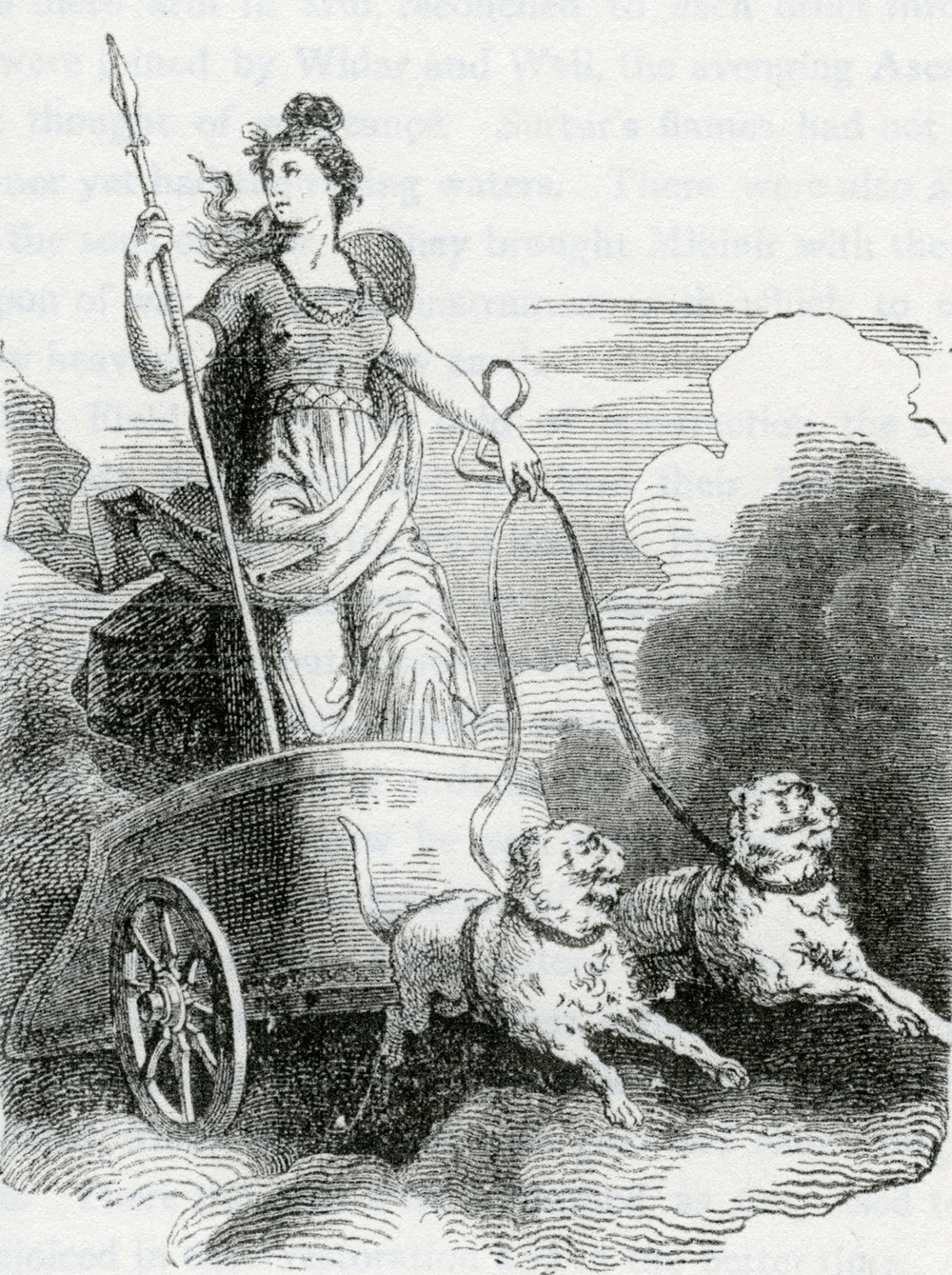
Freya in Her Chariot Over the place where Asgard’s glorious palaces had stood was a wide plain. This was the Field of Ida, and it was far more beautiful than the green home of the gods. There the holy Ases were assembled; for they, like the world, had been purified by fire, and were now fitted to dwell in Ida in eternal peace. The bonds of Hel could bind them no more, for the kingdom of evil had passed away, and night had been changed into day. Baldur and Hödur walked there arm in arm, reconciled to each other through love. They were joined by Widar and Wali, the avenging Ases, who no longer thought of vengeance. Surtur’s flames had not destroyed them, nor yet had the raging waters. There were also Magni and Modi, the sons of Thor. They brought Miölnir with them, not as a weapon of war, but as the instrument with which to consecrate the new heavens and the new earth. On the Field of Ida, the field of resurrection, the sons of the highest gods assembled, and in them their fathers rose again. They talked together of the Past and the Present, and remembered the wisdom and prophecies of their ancestors which had all been fulfilled. Near them, but unseen by them, was the strong, the mighty One who rules all things, makes peace between those who are angry with each other, and ordains the eternal laws that govern the world. They all knew he was there, they felt his presence and his power, but were ignorant of his name. At his command the new earth rose out of the waters. To the south, above the Field of Ida, he made another heaven called Audlang, and further off, a third, known as Widblain. Over Gimil’s cave a wondrous palace was erected, which was covered with gold and shone brighter than the sun. There the gods were enthroned as they used to be, and they rejoiced in their restoration and in the better time. From Gimil’s heights they looked down upon the happy descendants of Lif and signed to them to climb up higher, to rise in knowledge and wisdom, in piety and in deeds of love, step by step, from one heaven to another, until they were at last fit to be united to the divinities in the house of Allfather. This was what our forefathers believed about Ragnarök, the Twilight of the gods or the Divine judgment; it was no contemptible faith, and in our opinion it deserves more reverence than the teaching of the Greeks and Romans, whose gods eternally drank nectar and ambrosia on the heights of Olympos, while mortal men descended into dark Hades, or perhaps to the Elysian Fields. Ragnarök means the Darkening of the Regin, i.e., of the gods, hence the Twilight of the Gods; some, however, explain the word Rök to mean judgment, i.e., of the gods. The gods sinned, evil gained the upper-hand amongst gods and men, and when the god of holiness and righteousness was taken away, they all sank into a deep abyss of guilt; murder, fratricide and convulsions of nature portended the destruction of the universe. Ragnarök followed. Then a new and more beautiful world appeared, in which Ases and men, purified by fire, could now live in peace and goodwill. It is true that in the Younger Edda and in the Lay of Wala we find allusions to places of punishment in the realms of Hel; but, in our opinion, these descriptions have been introduced from other poems and are at variance with the leading idea which we have just given. The Aryans, like all other people living in a state of nature, had at first a vague indefinite consciousness of God; they felt that there was a Being who had created everything and who guided and governed the universe. In the ancient records, in which this idea had already grown dim, this Being was called Zerwana-Akarana, i.e., everlasting time and immeasurable space, and was perhaps essentially Eternity. According to later concepts this Being took no part in the direction of the world or in the doings of man. Two other beings, Ormuzd (Ahura-Mazda) and Ahriman (Agramainyus) fought for the supreme power; but neither they nor their spiritual hosts entered into personal collision with each other; instead of this, they sought to bring the human spirit and earthly things under their dominion: the latter by cunningly planned temptations, icy cold snow-storms and darkness; and the former by good deeds, fine weather, and especially by the light that conquers darkness and evil. At the end of days Ormuzd and all the righteous were to enjoy blessedness and peace, while Ahriman had to undergo a painful purification by fire before he could attain a similar condition. The modern theory is that the belief in Zerwana-Akarana, and the dogmas respecting the end of the world and the purification of Agramainyus are of later origin, and that they first arose through the influence of the Western Iranian and Semitic races; but traces of these beliefs are to be found in the Zend-Avesta of Zoroaster and in the Indic Vedas, and the relationship with the Norse belief in Allfather, the Last Battle, and the Renewal of the World, seems to be founded on this Aryan belief. We must allow something for the influence of Christianity on the Germanic races especially with regard to Ragnarök, and the Resurrection of the world, the Ases and men, and also in reference to Allfather, to the description of the realm of Hel, and of the places of reward and punishment. It is a mistake to deny this influence, to make so much of the fact that the heathen had a foreboding of the existence of the one God, that the Edda possessed a water-hell and the Christian myth a hell of fire, and lastly to maintain that a knowledge of the Christian faith was impossible to the Scandinavians. Why may not the indefinite foreboding, the misty conception of something divine, have first received a distinct form in the consciousness of the heathen through Christian influence? And if the Teutons had ever heard of the Christian idea of punishment in hell, would they not have conceived this hell after their own fashion and according to the conditions, climatic and other, that surrounded them? We have already shown how not only the Germans, but also the Scandinavians, early came in contact with Christianity, and this was the case even before the Wiking raids of the ninth and tenth centuries. The Jutes, and perhaps the Danes and Norwegians as well, went to Christian Britain in the fifth century and conquered it after a struggle that lasted for a hundred years. There these wild people were brought into contact with the Britons and even with their Christian priests, who gladly told the warlike and musical skalds about their own faith. These seeds of a purer religion took form and life in the poems of the skalds, which however retained their old Northern colouring and were not changed into hymns of victory in a foreign faith. The myths exist in the present like the stately ruins of a past time, which are no longer suitable for the use of man. Generations come and go, their views, actions and modes of thought change; and yet as the poet says:
Thousands of years ago our ancestors prayed to Waruna, i.e. the Father in heaven; thousands of years later the Romans entered their sanctuary and worshipped Jupiter, the Father of heaven, while the Germanic races worshipped Allfather. We, after the lapse of centuries, now turn in all our sorrows and necessities to Our Father which is in heaven. Other thousands of years may pass, and we shall not have grown beyond this central point of religion. But as everything that our forefathers added to this has passed away, so the systems that we have built up round it may also pass away. No man ever yet has seen the full truth, or can see it. “For now we see through a glass darkly, but then face to face.” This “then” can never be on earth.
LAY OF WALA We here annex one of the most interesting poems of the Elder Edda, the Woluspa or Lay of Wala, the prophetess. It is the translation given in Pfeiffer’s “Visit to Iceland,” and we think it will be of value to our readers.
|