|
ASGARD AND THE GODS: THE TALES AND TRADITIONS OF OUR NORTHERN ANCESTORS |
|
PART SIXTH: THE WANES
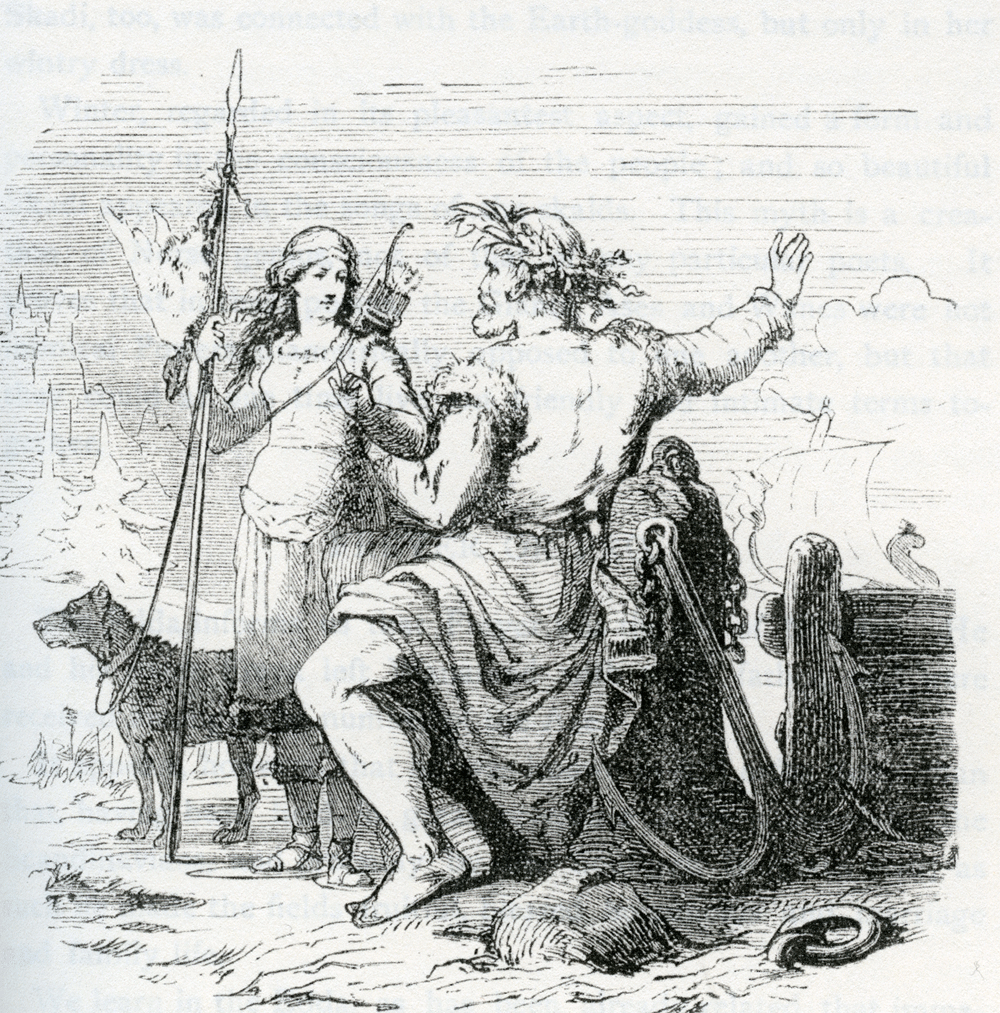
xi. Niörder and Skadi ― 183 Disunion had shown itself amongst the gods, as on earth amongst men, for the sake of power and gold. The Wanes came up against Asgard in numbers like the stars of heaven, and crowded over the broken wall into the holy precincts. The Ases had no Einheriar to help them as yet, for this was the first war which was to decide the government of the world. Spears hurtled through the air, swords rattled against helmets and coats-of-mail. The fallen warriors felt the pang of their wounds, but not the agony of death, for the wounds soon closed again, and they stood up anew to do battle with the foe. Weapons did not suffice; the warriors broke off pieces of rock and the tops of mountains, tore pines and oaks up by their roots and flung them at each other. Thunder rolled; the sun hid its face; universal destruction threatened to overwhelm the world, and the Jotuns looked on at the battle with delight, holding themselves ready to fall upon both victor and vanquished, and complete the work of destruction. Then Allfather appeared, mighty and glorious, wearing his golden helmet, and swinging the spear of death, and commanded that there should be a truce. The fiery warriors obeyed his behest; they bowed their stubborn heads, and lowered their uplifted weapons, as they listened to the words of the King: “Let there be peace henceforth in heaven and upon earth, and let a treaty be made between the divine Powers, that neither may in future interfere with the province of the other, but that each race of gods may do its utmost for the weal and happiness of mortal men, who offer sacrifices and gifts as be seems them.” In this way a Milton would probably have described the conclusion of the battle of the gods; but the Edda, in addition to this, relates how the Ases and Wanes each gave hostages to the other in token of good faith. Hönir, Odin’s brother, who had in the olden time given man mind and senses, was sent to the Wanes, who in their turn made over to the Ases Niörder, the unspotted Prince of men, with his children Freyer and Freya, who were held in equal reverence with himself. The wise Mimir accompanied Hönir to Wanaheim. But the Wanes slew him and sent his head to the Ases. Odin, however, restored it to life with his magic runes, that it might always confer with him about the Past and the riddles of the Future, as in the old time when after pledging his eye to Mimir he was permitted to drink of the fountain of wisdom. He did not return evil with evil, but included Niörder and his children amongst the ranks of the Ases, so that they lived in honour whilst the rest of their race were almost entirely forgotten. The Wanes, of whose worship but few and uncertain traces remain in German traditions, are supposed to have been the gods of feeling and of the senses. Professor Simrock has shown that very probably that they were not essentially different from the Ases, but that they were worshipped by other tribes than the Ases, presumably by those of the Suevi, who were dwellers by the sea, for the Aestyer and especially the Suiones, Suevian tribes, principally adored Freyer, Freya, and Niörder. It is also supposed that they may have been the gods of tribes which had been forced back and partially subjected to the conqueror, who at length threw off the yoke of the victor and in renewed battle broke down part of the fortifications of Asgard, but afterwards came to reasonable terms with the enemy. This uncertain hypothesis would quite, explain the war with the Wanes, and show it to have been a war of races. Some writers explain the Wanes to have been the priestly class and the war to have been a struggle between ecclesiastical and temporal power, such as raged between Pope and Kaiser all through the middle ages, and which is perhaps not even yet at an end. This cannot be called an altogether unjustifiable hypothesis, for in the Edda we find many references to the wise Wanes, and wisdom could not well be an attribute of the gods of sensuous impulse, whilst it might quite easily be found amongst the priests. So much only is certain, however, that with the exception of the three Wanes received into Asenheim, no other gods of that race take part in any of the mythical occurrences. It was not supposed that Wanaheim would disappear in the universal destruction of nature; for when the world was to be renewed, Hönir would be allowed to choose whether he would enter the blessed Gimil, or remain in Wanaheim. NIÖRDER AND SKADI The Prince of men, as Niörder was called, was, according to tradition, tall and stately and of matchless beauty. He was as famous for his wisdom and goodness as for his wealth. Therefore he listened to those who prayed him to bless their labours, especially attending to those who were engaged in seafaring and mercantile pursuits. He lived at Noatun (seaport), where he delighted to hear the dash of the waves and the song of swans. The swan, which only sings when it is dying, was looked upon as the bird of the Underworld divinities. Hence Niörder seems to have had some connection with them. Moreover, he was regarded as the ruler of the calm, peaceful ocean. When wild Ögir excited the sea to rise foaming and dashing against the ships, threatening to engulf them, Niörder calmed its fury with magic spells, and sent a favourable wind to the assistance of the mariners. He did not wear Ögir’s helmet, of which all living creatures were afraid, but a hat trimmed with shells, above which waved a heron’s plume. A sea-green tunic clothed his slender figure, leaving the lower part of his well-formed legs uncovered. To this circumstance he owed his marriage to his second wife, beautiful Skadi. His residence in Asenheim had separated him from his first wife Nerthus, Mother Earth, who was also his sister, and he therefore lived unmarried in remote Noatun, until he was wed to Skadi. Then, as we have already told, gentle Iduna was stolen away, was set free by Loki, and the storm-giant Thiassi was slain by the Ases. After this, Skadi, the giant’s warlike daughter, armed herself in her native Thrymheim with helmet and chain-mail, with spear and deadly arrows, and appeared before Asgard demanding vengeance. She looked gloriously beautiful in her shining armour, and the Ases did not wish to fight with the noble maiden, whose wrath seemed just in their eyes. They offered her expiation for her father’s death, but she would not listen to their friendly words; she raised her spear to hurl it at one of those who had been accomplice in his death. Then cunning Loki came forward, bowed low before her, and sprang now to the right hand, now to the left, and then danced backwards and forwards, while a long-horned, long-bearded goat made the same movements behind him, for he had fastened the creature to himself with an invisible cord. When at length he threw himself on his knees before her like a lover, and the goat, bleating mournfully, followed his example, Skadi burst into a fit of laughter. Her anger passed away, and she allowed herself to listen to terms. Meanwhile it had grown dark, and Odin said, as he pointed to the sky, ― “Look, there are thy father’s eyes which I have placed in the firmament of heaven that they may henceforth look down upon thee as stars. As for thee, thou shalt become one of us, and shalt choose thyself a husband from amongst us, but thine eyes must be so covered with a veil that thou mayest only see the feet of the assembled gods.” She gazed about her in astonishment, and as she did so, her eyes fell upon Baldur, who stood before her in his divine beauty, for he shone amongst the Ases like the morning star amongst the paling stars of night. She hoped to recognise him even if she only saw the hem of his garment. Her eyes were then partially bandaged, and the gods formed a circle round her. She looked around her on the ground, and perceived amongst them a foot of remarkable beauty. “I choose thee,” she said, “thou art Baldur.” She tore the bandage from her eyes, and ― it was not Baldur, it was Niörder whom she had chosen; and he was slender, stately, gentle and pleasant to look upon. The word was spoken; the choice was made; the marriage was solemnized with much pomp. The great huntress found her life with her husband in heavenly Asgard a very happy one. The golden wood Glasir was full of melody as she walked through it; the Einheriar rose from their seats when she entered Walhalla; the goddesses gave her ornaments to wear, and the Ases delighted in doing her honour. Thus the honeymoon passed, and then she followed her husband to Noatun, his castle by the sea. She liked the life she led there at first, but soon she began to long for her native Thrymheim, for the sounds of the forests, in which she had been accustomed to hunt, and the frozen meres on which she used to skate. She hated to hear the beat of the waves upon the shore, the groans and barking of the seals, and to see the fish leap; while the hoarse cries of the gulls often wakened her out of her sleep. She could bear it no longer, and told her husband she must either go back to Thrymheim or she must die. Niörder listened to her kindly, and proposed that he should spend nine nights with her at Thrymheim, and that she should then live three nights with him at Noatun, and so on until Ragnarok should come. She gladly consented, and this plan of life was kept up for some time to the satisfaction of both. But in course of time Niörder himself grew weary of Thrymheim. The howling of the wolves, the bellowing of the buffaloes, and the growling of the bears were as hateful to him as the noises of the seaside were to his wife. They therefore had themselves set free from the marriage tie, and each dwelt in his and her own land. Niörder was patron of the fisheries, and also of ships and trade. Skadi continued to hunt as before, and ruled with her bow and arrows over the beasts and birds that lived in the forest. Some time after her separation from Niörder, she married wintry Uller, who was much better suited to her in character.
Niorder and Skadi on their Way to Noatun Simrock rightly maintains with regard to the origin and interpretation of this myth, that Niörder was a beneficent summer god, who helped the harvest to ripen, and was the giver of material well-being, who taught men how to cultivate the vine and other kinds of husbandry. He was perhaps the masculine counterpart of the Earth-goddess Nerthus, who, probably, was both his wife and his sister in Wanaland. As he was also interested in commercial undertakings and voyages, the Edda shows him to have been essentially the ruler of the sea and peace-maker with the storms. Skadi, too, was connected with the Earth-goddess, but only in her wintry dress. Winter, regarded in its pleasantest aspect, gained a form and personality in the consciousness of the people; and so beautiful Skadi appeared in the songs of the skalds. This myth is a creation of Norse genius, not of that of any particular poets. It proves that in these poems, the Giants, Ases and Wanes were not inimical Powers diametrically opposed to one another, but that they could at one time live on friendly and intimate terms together. FREYER OR FRO The Edda informs us that Freyer was the son of Niörder. He and his sister Freya left Wanaland with their father, and were received amongst the number of the Ases. It appears, however, that he was known in still older times than that, having been held in great reverence as the sun-god by the Scandinavians, and probably by the Southern Germans also; as such he made the fields fruitful, blessed households and marriage and family life. We learn in the Edda, as has been already related, that immediately before the wager between Loki and the dwarf Brock, Freyer received the ship Skidbladnir, which could sail in any wished-for direction, and which, when no longer wanted, could be folded up and put in the pocket. And then he was given the boar Gullinbursti, one of the three works of art made by Sindri, brother of Brock; this boar drew the god’s chariot, and was at times ridden by him; it would bear him through woods and over meadows, its golden bristles rendering the darkest night as light as day. In the ship we recognise the clouds, which always have a favourable wind when they scurry across the sky, and in the boar we see the sun’s golden light. Blodhughofi, a horse swift as the wind, was at his command whenever he rode to join the council of the Ases. Yule-tide, which was sacred to this god, takes its name from the wheel of the sun, for jul or giuli, means wheel (hveohl). This festival, for which the sun-god awakes and lights up his wheel once more, was kept by all the Teutonic races. The special dish that appeared at these feasts was a boar’s head, such as is still seen on the dinner tables at Christmas time in the University of Oxford. To Freyer was awarded the Home of the Light-Elves by the gods as a fit gift on his cutting his first tooth, for the god of sunshine and fruitful harvests must necessarily rule over the kingdom of the Light-Elves. According to one legend, Freyer once took a human form, and ruled over Sweden under the name of Fiölnir. At the invitation of King Frodi, he went to Hledra (Zealand), to take part in a great feast prepared in his honour. When there, he fell into an enormous butt of mead, and was drowned, in like manner as the sun-god sinks every evening into the rosy waves of the sea. He appeared amongst the Danes as Fridleif (peace-giver), the son or grandson of Hadding, and governed the people with a strong hand. In vain he sent messengers to ask for the hand of fair Freygerda, King Amund’s daughter. As Amund received his offer with scorn, Fridleif organized an expedition to force him to consent to the marriage. One evening as the lover sat thinking beside a pond in a wood, he heard the swans singing to the murmuring waters
Scarcely was the song ended, when Fridleif perceived a giant taller than the highest tree preparing to throw his stone club at him. The battle immediately began; and Fridleif first hewed off one of the monster’s legs, and then, when he had fallen to the ground, his three heads. The victor found Freygerda and a great treasure of gold hidden away in the cave the Jotun had inhabited. Soon afterwards Fridleif married the princess, and on his way home the hero succeeded in killing a terrible dragon, in whose cavern he discovered a still greater hoard of gold. A son was born of this marriage named Frodi. He succeeded his father on the Danish throne, and bestowed blessings upon his people, such as only a god can give to mortal man. So great was the public safety in his reign that the king had golden chains and jewels kept day and night in the open air, and no one dared to touch them. The traveller then always found a hearty welcome throughout the kingdom, for there was no lack of food in the country: the fields bore double harvests, and the king was ever willing to relieve want wherever his help was needed. This peaceful state was accounted by all as the greatest of blessings, and in honour of Frodi was ever afterwards called the Peace of Frodi. The king felt very happy, whether drinking sweet mead upon his high throne in the hall of his fathers, or making inroads upon the neighbouring tribes, followed by his retainers. [1] Among his treasures were two quern stones; nothing much to look at, simply two common mill stones in appearance, and no ne who did not know what they could do would think of taking any notice of them. Nevertheless, these quern stones were of more worth than anything that King Frodi had, for they could produce anything that the grinder of the quern or handmill wished for. They would bring gold, silver, precious stones, anything and everything; and besides this they could grind love, joy, peace; therefore it is not too much to say that these stones were worth more than all the treasures of the king put together. At least they would have been if he could have made use of them, but they were so heavy that few could be found to turn the quern, and just at the time of which I am speaking there was no one at all in the land of Gotland able to work away at the quern handle. Now the more King Frodi pondered over his wonderful quern stones, the greater became his desire to use them, and he sought throughout the land from north to south, from east to west, if perchance he might find some one strong enough to help him in his need. But all to no purpose, and he was utterly in despair when, by good luck, he happened to go on a visit to the King of Sweden, and to hear of two slave-women of great size and strength. “Surely,” thought Frodi, “these are just the women to grind at my quern Grotti” (for so it was called), and he asked the king to be allowed to see them. So the king ordered the slaves to be brought before Frodi, and when Frodi saw them his spirits rose, for certainly Menia and Fenia were strong-looking women. They were eight feet in height, and broader across the shoulders than any of Frodi’s warriors, and the muscles of their arms stood out like cords. And they lifted heavy weights, threw heavy javelins, and did so many feats of strength that Frodi felt quite sure that they would be able to turn the quern handle. “I will buy these slaves,” said he, “and take them with me to Gotland.” Menia and Fenia stood with their arms folded and their proud heads bowed down, whilst Frodi counted out the gold to the seller. They were slaves; with money had they been bought, with money were they sold again. What cared Frodi who was their father, or how they had come into the land of Sweden? And he took them home with him and bade them grind at the quern. Now he should be able to test the power of the wonderful stones. “Grind, grind, Menia and Fenia, let me see whether ye have strength for the work.” So spake King Frodi, and the huge women lifted the heavy stones as though they had been pebbles. “What shall we grind?” asked the slaves. “Gold, gold, peace and wealth for Frodi.” Gold! gold! the land was filled with riches. Treasure in the king’s palace, treasure in the coffers of his subjects ― gold! gold! There were no poor in the land, no beggars in the streets, no children crying for bread. All honour to the quern stones! Peace! peace! no more war in the land, Frodi is at peace with every one. And more than that, there was peace in all countries where Frodi’s name was known, even to the far south; and everyone talked of Frodi’s Peace. Praise be to the quern stones! Wealth! yes, everything went well. Not one of the counsels of King Frodi failed. There was not a green field that did not yield a rich crop; not a tree but bent beneath its weight of fruit; not a stream that ran dry; not a vessel that sailed from the harbours of Gotland that came not back, after a fair voyage, in safety to its haven. There was good luck everywhere. “Grind on, grind on, Menia and Fenia! good fortune is mine,” said King Frodi. And the slaves ground on, “When shall we rest, when may we rest, King Frodi? It is weary work toiling day and night.” “No longer than whilst the cuckoo is silent in the spring.” Never ceasing is the cry of the cuckoo in the groves; may we not rest longer?” “Not longer,” answered King Frodi, “than whilst the verse of a song is sung.” “That is but little! “ sighed Menia and Fenia, and they toiled on. Their arms were weary, and their eyes heavy, they would fain have slept; but Frodi would not let them have any sleep. They were but slaves who must obey their master, so they toiled on, still grinding peace and wealth to Frodi ―
Thus sang the two giant women; then they begged again, “Give us rest, O Frodi!” But still Frodi answered, “Rest whilst the verse of a song is sung, or as long as the cuckoo is silent in the spring.” No longer would the king give them. Yet Frodi was deemed a good king, but gold and good luck were hardening his heart. Menia and Fenia went on grinding and their wrath grew deeper and deeper, and thus at last they spoke. First said Fenia, “Thou wert not wise, O Frodi. Thou didst buy us because like giants we towered above the other slaves, because we were strong and hardy and could lift heavy burdens.” And Menia took up the wail: “Are we not of the race of the mountain giants? Are not our kindred greater than thine, O Frodi? The quern had never left the grey fell but for the giants’ daughters. Never, never should we have ground as we have done, had it not been that we remembered from what race we sprang.” Then answered Menia: “Nine long winters saw us training to feats of strength, nine long winters of wearisome labour. Deep down in the earth we toiled and toiled until we could move the high mountain from its foundations. We are weird women, O Frodi. We can see far into the future. Our eyes have looked upon the quern before. In the giants’ house we whirled it until the earth shook, and hoarse thunder resounded through the caverns. Thou art not wise, O Frodi. O Frodi thou art not wise!” But Frodi heard them not; he was sleeping the sweet sleep that the quern stones had ground for him. “Strong are we indeed,” laughed Fenia, sorrowfully, “strong to contend with the puny men. We, whose pastime in Sweden was to tame the fiercest bears, so that they ate from our hands. We who fought with mighty warriors and came off conquerors. We who helped one prince and put down another. Well we fought, and many were the wounds we received from sharp spears and flashing swords. Frodi knows not our power, or he would scarce have brought us to his palace to treat us thus. Here no one has compassion upon us. Cold are the skies above us, and the pitiless wind beats upon our breast. Cold is the ground on which we stand, and the keen frost bites our feet. Ah, there are none to pity us. No one cares for the slaves. We grind for ever an enemy’s quern, and he gives us no rest. Grind, grind; I am weary of grinding; I must have rest.” “Nay,” returned Menia, “talk not of rest until Frodi is content with what we bring him.” Then Fenia started: “If he gives us no rest, let us take it ourselves. Why should we any longer grind good for him who only gives us evil? We can grind what we please, let us revenge ourselves.” Then Menia turned the handle quicker than ever, and in a wild voice she sang:
Then called Fenia in a voice of thunder through the midnight air: “Frodi, Frodi, awake, awake! Wilt thou not listen to us? Have mercy and let us rest our weary limbs.” But all was still, and Frodi gave no answer to the cry. “Nay,” answered Menia. “He will not hearken. Little he cares for the worn-out slaves. Revenge, revenge!” And Frodi slept, not dreaming of the evil that was coming upon him. And again Fenia shouted: “Frodi, Frodi, awake! The beacon is blazing. Danger is nigh. Wilt thou not spare?” But Frodi gave no answer, and the giant women toiled on. “O Frodi, Frodi, we cannot bear our weariness.” And still no answer came. “Frodi, Frodi, danger is nigh thee. Well-manned ships are gliding over the sea. It is Mysinger who comes, his white sail flutters in the wind. His flag is unfurled. Frodi, Frodi, awake, awake! thou shalt be king no longer.” And as the giant women ground, the words they spake came to pass; they were grinding revenge for themselves, and brought the enemy nearer and nearer. “Ho! hearken to the herald! Frodi, Frodi, the town is on fire. The palaces will soon be ruined heaps. Grind, Menia, ever more swiftly, until we grind death to Frodi.” And Menia and Fenia ground and ground till Mysinger and his followers landed from the ships. They ground until they had reached the palace. “To arms, to arms,” shouted the warders, but it was too late. The Gotlanders armed themselves; but who could stand against the army that the slave women were grinding against them? Not long did the struggle last. Frodi and his Gotlanders fought bravely, but the sea-king and his allies were mightier, for the giantesses were in giant mood, and turned the handle faster and faster, until down fell the quern stones. Then sank Frodi pierced with wounds, and the fight was over. The army that Menia and Fenia had ground to help Mysinger vanished, and Mysinger and his men alone were left conquerors on the bloody field. They loaded their ships with treasure, and Mysinger took with him, Menia, Fenia, and the quern stones. But, alas! Mysinger was no wiser than King Frodi had been. Gold, however, was not his first thought; he had enough of that, but he wanted something else that just then was more to him than gold. There was no salt on board the sea-king’s vessels; so he said, “Grind salt.” And Menia and Fenia ground salt for Mysinger. At midnight they asked if they had ground enough. And Mysinger bade them grind on. And so they ground and ground until the ship was so heavy with salt that it sank, and the sea-king and all his men were drowned. Where the quern stones went down there is to this day a great whirlpool, and the water’s of the sea have been salt ever since.
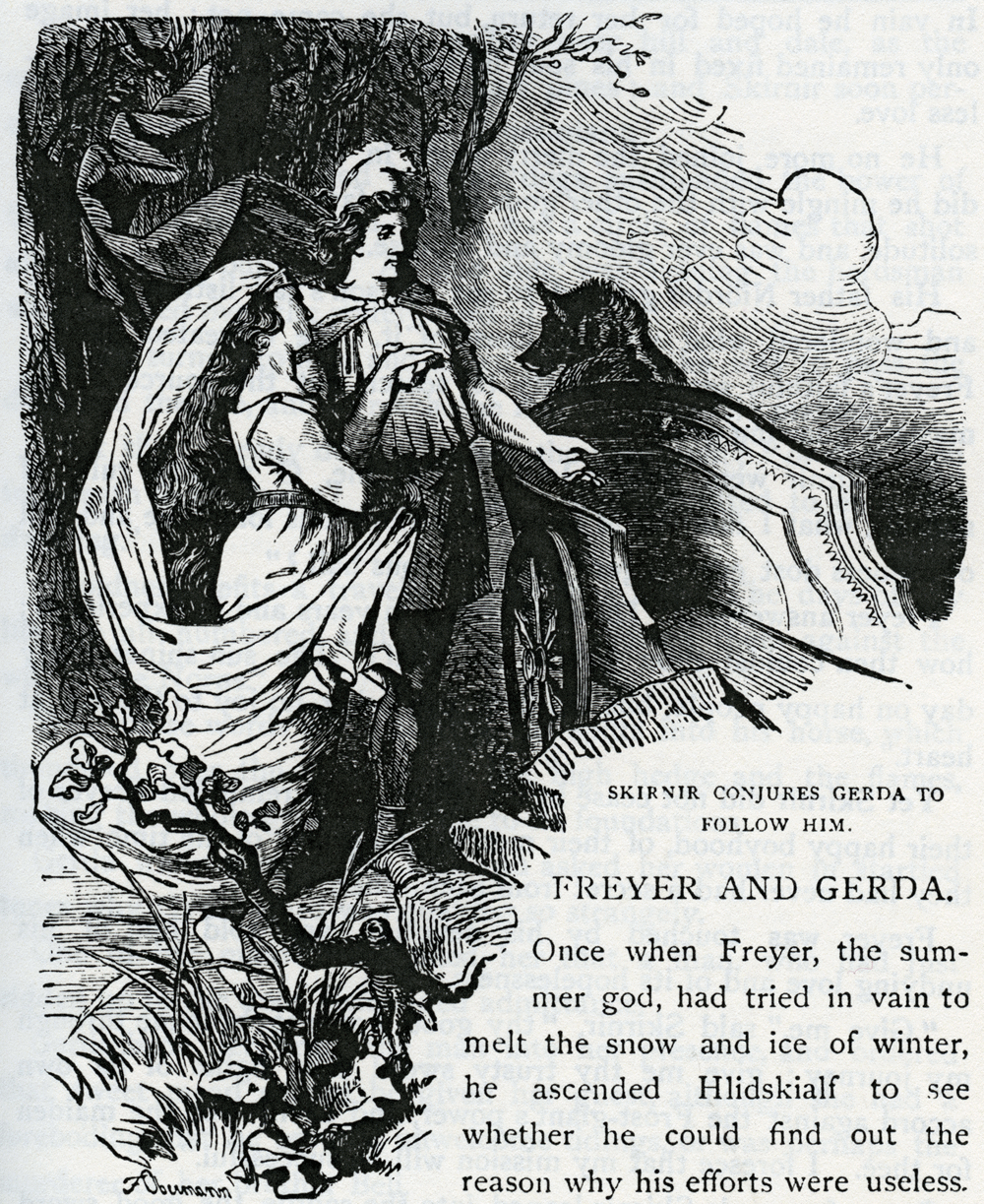
Skirnir Conjures Gerda to Follow Him FREYER AND GERDA Once when Freyer, the summer god, had tried in vain to melt the snow and ice of winter, he ascended Hlidskialf to see whether he could find out the reason why his efforts were useless. He looked towards the east, the west and the south; at last he turned to the north, and there he saw a maiden, taller and more beautiful than any he had ever before beheld. Her arms shone like the radiant beams of the sun, and heaven and earth were resplendent with her beauty. But the vision did not last long, for she opened the door of her dwelling, and soon had disappeared. In vain he hoped for her return, but she came not; her image only remained fixed in his soul, filling it with the pangs of hopeless love. He no more joined the merry feasts in Odin’s joyous hall, nor did he mingle with the other gods in their familiar talk; he sought solitude, and was ever gloomy and morose. His father Niörder grieved to see his son’s sad listless manner, and wondered what was the cause of it. He entreated Skirnir, Freyer’s faithful servant, wisely to search out the source of his master’s gnawing grief. So Skirnir went to his lord: “Tell me, O mighty ruler of nations, what I fain would know, why thou thus lonesome and full of sadness dost ever linger in the spacious hall?” Freyer answered: “Thou art young in years and in experience; how then couldst thou fathom my grief? The sun shines every day on happy people, but his light can bring no joy to the sad at heart.” Yet Skirnir did not cease in his efforts. He reminded Freyer of their happy boyhood, of their merry games, and of the time when they had never had a secret from each other. Freyer was touched by his devotion and told him of his undying love and of its hopelessness. “Give me,” said Skirnir, “thy good horse to bear me through my journey; give me thy trusty sword that fights of its own accord against the Frost-giant’s power, and I will woo the maiden for thee. I foresee that my mission will be successful.” Soon afterwards Skirnir leaped into the saddle, the good sword at his side. “Up,” he cried, “haste thee, Red horse, on thy way over the steep mountain, for darkness approaches, that time which brings help and comfort to the Jotuns. But we shall make our journey safely if only we can escape the clutches of the giant.” The good horse galloped swiftly over hill and dale, as the eagle flies over the tops of the tall pines; and Skirnir soon perceived the wide demesne of the Frost-giant. A high hedge, guarded by fierce dogs, surrounded the bower of the beautiful maiden, and within was a circle of flames that shot all round the building. At one side was leaning the herdsman who watched over the stately herd of cattle. Skirnir turned to him and asked him how he was to pass the dogs and the fire, and so reach the hall of the noble maiden. “Art thou already dead?” asked the herdsman; “or dost thou feel death in thy heart? No living man is permitted to enter the dwelling.” “Boldness befits a traveller better than fear. The days of my life are all numbered, and no one can shorten them against the will of the Norns.” With these words Skirnir drove his spurs into his horse, which thundered over the fierce dogs, the high hedge and the flames, making the whole grange tremble to its foundations. Gerda was sitting in her hall, and asked her women in startled tones why Gymirsgard was quaking so strangely. One of her maidens informed her that a man, who had just ridden up to the door, demanded admittance. Gerda bade her bring the man into her presence, and ordered that sweet mead should be given her guest, although she had a foreboding that he brought unwelcome tidings, or was perhaps the murderer of her brother Beli. When the stranger had drunk of the mead offered him, she asked, ― “Art thou an Elf, or an Ase, or one of the wise Wanes, that thou, mad, rider that thou art, hast dared to force thy way through Wafurlogi and thus enter our halls?” “I am no Elf, nor yet am I an Ase, nor do I belong to the race of wise Wanes,” replied the stranger. “I bring thee eleven apples of pure gold as a bridal gift, in order that thou mayst own that there is none so dear to thee as Freyer, who yearns for thy love in return.” But she answered: “I will not take thy golden apples, nor shall bonds of union ever link my fate to that of thy master, Freyer. “Then I, will add the golden ring that the Dwarfs made,” he continued; “that ring from which eight new ones drop each ninth night.” “Gymir’s daughter needs no golden rings,” she replied; “her father’s treasures are enough for her.” “Look, proud maiden,” he cried in anger, “look at the shining sword in my right hand; with it will I strike if thou dost still refuse him.” “Neither will I submit to force,” she answered unabashed, “nor will I accept the love of any man; and I know that Gymir is armed and ready to punish thy daring.” Then Skirnir rose from his seat in wrath, and replied to her in these words “Maiden, seest thou this sword in my hand? With it I shall slay the old Jotun, thy father, if he dares offer me battle. But thee I shall conquer by means of my magic wand. Hearken to the words which I trace in runic staves:
Skirnir ceased and took his knife to cut the runes from the magic wand on which they were carved. Gerda cried shudderingly: “Turn away the fulfilment of thy curse, O hero! Take from my hand this icy cup filled with old mead! I never thought that it had been my lot to love one of the Ases’ race. Listen to the words I speak most grudgingly,
Overjoyed at his success, Skirnir mounted his horse, and hastened to tell his master the good news.
Freyer met Gerda at the appointed time in the grove Barri, and their wedding was solemnized, wakening the earth out of winter’s sleep, and dressing her in bridal raiment of spring blossoms. This, as the poem teaches us, happens every year; the bright god of summer slays Beli, the snow-covered giant of wintry storms, and woos fair Gerda, the Earth, who, herself of the race of giants, is held in bonds of ice by her father Gymir. Gymir was the same as Hymir, the Frost-giant conquered by Thor; he was also related to Ogir, god of the blustering, wintry sea. Freyer gives his good sword, the ray of sunshine, to his servant Skirnir, that he may force the unwilling Gerda to become his bride. The messenger, in the oldest tradition the god himself, offers the unwilling maiden the golden ring from which eight other rings drop ach ninth night, even as the corn that is sown late in autumn grows and ripens in nine months. He threatens the hardhearted girl with runes which he carves on a magic wand, and which his curse makes powerful for evil. His curse dooms her to marry Hrimgrimnir, or be buried alone under the ice of winter. Just as he is about to cut off the runes, that his curse may be fulfilled, fair Gerda yields to necessity and marries Freyer. Skirnir’s journey is one of the most beautiful poems of the Edda, and certainly the ideas to which it gave rise in the mind of the poet are no less interesting. They are to be met with in other myths, and they also occur in fairy-tales and the heroic epics; as, for instance, in the story of the Sleeping Beauty in the Wood, who is kept in the bondage of slumber by the chill embrace of winter, and wakened to new life by the warm kiss of the sun-prince. A similar tale is current in Denmark. Young Swendal was playing with a ball, and the ball flew out of his hands far away into the ladies’ chamber. He went after it; he came back again with love in his heart, for he had seen there a lovely damsel, whose picture had fixed itself upon his soul. Hark! he heard voices calling to him; he thought it was his sister and his step-mother. “Hark ye, young Swendal,” they said; “fling not thy ball at me; fling it rather at the fair maiden whom thou dost love. Nor shalt thou longer have peace or sleep, until thou hast released the blooming girl, lying oppressed by heavy grief.” No sooner had he heard the words than he donned his furcloak, and entered the chamber where the court was assembled. He told them he would go into the mountains to ask his mother what he was to do, that he might free the grieving maiden They praised his errand, and he set out, and reached the mountain where his mother had been slumbering peacefully for many a year. As he entered, the walls and marble boulders burst asunder, the earth opened, and a voice cried out “Who is it that wakens the weary sleeper? Can I not rest in peace beneath the dark ground?” “Mother,” he answered, “it is thy son that comes to seek thy counsel, as they told me that no longer should I have peace or sleep until I should release the blooming maiden who has suffered thraldom this many a long day.” Thereupon the voice spake,― “Take, then, thy mother’s last gifts, young Swendal, and set out that thou mayst find that which thy heart is yearning for.” And suddenly there lay before him a sword, and without there neighed a noble steed. It was the sword that ever carries victory with it, and the stallion that gallops over land and sea, and never wearies ! Young Swendal girt the sword around his waist, mounted the steed, and rode away over the vast ocean, through green woodlands beyond, until he reached the castle where the maiden was imprisoned and endured her bitter fate. He begged admittance of the surly keeper that sat outside the gate, promising him courtly honours when he should be king. The keeper replied morosely that the gate was of steel and the walls of solid marble, and inside a fierce lion and a grim bear kept watch, to tear to pieces any intruding stranger, unless it were young Swendal. When the rider heard these words, his heart gladdened, and, setting deep the spurs into his noble steed, he leaped right into the court-yard. The ferocious beasts crouched humbly at his feet, and the lime-tree with its golden leaves bent to the ground before him for he was the long-awaited master. The longing maiden heard the tinkling of the rider’s spurs, and awoke from her death-like slumber. Her heart was filled with the thought of her bold redeemer; she ran to the gate and sank into the arms of young Swendal. FREYA, FREA, OR FROUWA Through the shady forest once strode a powerful young huntsman. His eyes beamed with the fire of his soul, and his strong manly frame was clad in a light hunting dress, decked with eagle’s feathers; his broad, trusty sword clanked in its sheath as he went, and in his right hand he bore a spear. Several attendants followed him, and two large greyhounds sprang round him with mighty bounds. Suddenly they stopped, threw back their heads and began barking loudly, then disappeared in the dense bushes hard by. A loud, fearful roar came out from where the hounds had entered the underwood, and the bushes creaked and groaned, as though trampled under the foot of some enormous giant, and a monstrous wild ox of untold proportions rushed out, chasing the hounds. As soon as it reached the open space where the huntsman and his followers stood, it lowered its monstrous head, and, catching one of the dogs round the neck in its rounded horns, hurled it high into the sky. But at the same moment the huntsman’s spear hissed through the air, and entered deep into the ox’s fleshy neck. The monster turned fiercely towards its new opponent, but the huntsman did not budge from his place. All would have thought him lost, so unequal did the chances seem, so terrible did the giant ox appear. Calm and collected, the bold youth awaited the onslaught of the monster, then seized it by the horns, and, straining his whole strength into his shoulders, with superhuman power, overthrew it on its back. Before it could rise again the huntsman’s foot pressed heavily upon its throat, and soon his trusty sword put an end to the battle, a stifled roar telling that the life flame of the monstrous ox had at length gone out. The huntsman’s followers had not shared in the fight, for they knew their master and his mighty strength, and had no fear for the result. They now went silently to their work, took off the wild ox’s skin from his steaming carcase, and bore it to their master’s castle. He, however, laid himself down under the shade of an oak-tree close by, and sank into a deep reverie. A rustling sound in the neighbouring ferns woke him from his dreams, and, when he looked up, the tall figure of a woman stood before him, encircled by an unearthly shimmering light. A snowy, trailing garment, bound by a golden girdle, draped her wondrous limbs; her flaxen locks shone through the transparent web that covered her head, and rich golden ornaments decked her neck and shoulders. The young noble gazed in wonderment at his unknown visitor; he knew not whether he was awake or whether he still slept, or whether the figure was but a creation of his own unconscious mind. But the more he looked at it the clearer did it become. It did not vanish; it was full of life. “Hero of the Wolsings,” Freya began, and her voice sounded not of the earth, but rang clear as a silver bell: “offspring of the Wolsing race, why dost thou discolour thy blade with mere ox blood? Rather should it be tinged with the dragon’s blood, he that lurks in Asgard’s holy groves, and drains the mind and marrow of mankind with eager jaws. Dost thou not hear his coils rattle? dost thou not see the ramparts he has erected? Go thou, brave youth, and slay with thy strong arm the bane of Asgard that defies the holy gods. Wodan ensures thee victory. A life ended in glory is a life lived long enough.” The noble youth hearkened to her words in silent rapture, for she gave utterance to what he had long craved to accomplish. He looked up to the eagle as it hovered above his head on out-spread wings; but turning his eyes again to the vision of the fair woman, to! she had vanished out of sight! No longer did he doubt, Freya herself or one of her maidens had brought to him great Wodan’s behest. He forthwith sped through the wood to the Meeting of the Wise Men, and related all that he had heard and seen, and the task that had been set him. The men struck their shields in token of approval, and the quiet wood resounded again with the clash. The crowd dispersed; each man returned to his native hamlet, and gathered together all the youths fit for war. In the third night they assembled, and, led by the youthful hero, fell upon the host of the Roman intruders, who were defeated in a bloody struggle that lasted three days. Thus was the Roman dragon, the bane of Asgard, slain, and the people delivered by the hero, Arminius. Such was the conception of Freya among the Teutonic tribes. She was the mighty goddess who sat by the side of Wodan on the high throne above the worlds, ruling over heaven and earth, guiding the fate of nations, allotting the issue of battles. Together with the Walkyries, or at their head, she hovered over the battlefield, and bestowed victory or a glorious death on the heroes. She shared the fallen warriors with her spouse, great Wodan, and led those of her portion to Folkwang (folk-meadow) and to her radiant hall, Sessrumnir (room of seats), where she dealt out to them the inspiring mead. It seems also that she was more especially worshipped as Mother-Earth, being identical with Nerthus, the Jörd (Earth) of Scandinavia, who drove among the people in her sacred chariot, adorning the earth with fresh green, with blossoms and blades, making the seeds to thrive, and blessing the fruits of the field. The Scandinavian myths made a decided distinction between Freya and Frigg. They held Frigg to be the highest amongst the goddesses, whilst to Freya the second place was given; nor was she looked upon as the wife of Odin. She was the daughter of the Wanegod, Niörder, and sister of loving Freyer, who each year marries fair Gerda. As goddess of beauty and love, she blesses all lovers who turn to her with prayers and sacrifices; but when marriage was solemnized it was great Frigg whom the husband and wife were bound to invoke. The South German races knew of no such distinction between the goddesses; so they regarded Friday, the day dedicated to Freya, as the fittest for a wedding, and this custom was not given Up until the Christian priests convinced the people that the day on which the Saviour was crucified must necessarily be an unlucky one. Yet they could not change the name of Friday, which still remains to this day. At the time of King Harald lived Rerir, son of Thorkill the Redbeard. In all his warlike strength he strove against the king; but the battle went against him, and he sought shelter on a lonely isle. Helga was his love; but her father, the king’s chief warrior and his faithful vassal, despised the poor houseless outcast. Rerir, full of longing to behold once more his loved Helga, built a small, strong boat, and boldly landed near the castle where she dwelt with her father. She stood upon the beach, wistfully looking over the bounding billows, which suddenly tossed at her feet a tiny craft; Rerir leapt upon the shore, and stood by her side. Tearfully she told him how her cruel father was about to force her into a marriage with a noble of the court, yet vowed to him that none but he should ever have her love.
Trembling, yet half-willing, she refused to go with him. Rerir, full of grief and deadly pale, sank broken-hearted to her feet, entreating her again in passionate words. No longer could she bear to look upon the anguish that she gave her loved one, no longer could she withstand his glowing words that spake of rapture shared by each
Freya always bears the radiant necklace Brisingamen, the sparkling jewels of the heavens, the gaily-coloured flowers of spring, when regarded as the goddess of nature and ruler of the world, or as Mother Earth. When the skalds dethroned her from her lofty height, humanizing her nature and her attributes, the myth arose which told how the necklace was gained. Four skilful dwarfs made it, according to the legend, in their underground smithy, and worked into it the most costly jewels that the earth produced, so that it glanced and glittered like the sun herself. [2] But Freya chanced to see it, and her eyes were almost blinded at its wondrous splendour. In exchange for it the dwarfs asked nothing but er grace, which she extended to them, and thus gained the necklace. The goddess of beauty and love was described as a maiden in the Northern poems; yet there is a myth according to which she was married to Odur, a scion of divine ancestry. She lived happily with him, and several lovely daughters blessed their union. But Freya was to learn that happiness is not eternal; for Odur left her, and with him all joy and gladness passed out of her life. All Nature sorrowed with her; the flowers withered and faded, the leaves fell from the trees, the earth looked waste and gloomy. Freya moaned and wept day and night; her tears shone like golden drops of dew in the Autumn sunshine. And so she spent the long winter miserable and alone in her deserted hall. Then she could bear it no longer; she set out in search of her lost spouse, and wandered far and wide through distant lands and amongst strange nations. She sought her lover diligently, and found him at last in the evergreen fields where the golden fruit ripens and the myrtle blooms. She clasped him lovingly in her arms, and tears of joy, golden as the blaze of the new spring sun, fell from her eyes when he returned her love with love. On their arrival home again on their native earth, they were received with the thousand-voiced song of birds; and the many-coloured flowers and leafy trees whispered of love and of summer time. The beautiful goddess strove with all the force of love to keep her husband by her side, that he should never leave her again; but all in vain, for when Virgo sank after the autumnal equinox, he once more left her and again wandered to the far country in the unknown distance. In the Fiölswinn Lay the same idea underlies the whole poem. Menglada (jewel-gladness) awaits her bridegroom in her castle, which is guarded by grim wolf-hounds and encircled by a wall of fire. A watchman, Fiölswider (much-knower), stands at the entrance, and sees a stranger coming in the distance. He approaches, and seeks admittance. The watchman cries ― “This is no place for beggars; seek thou the damp and foggy highway, and begone.” To which the wanderer makes answer ― “What monster art thou, that guards the entrance; of what race canst thou be, who refusest hospitality to the weary traveller?” “Fiölswider is my name, in that I am wise in cautious counsel. Therefore canst thou not enter this castle.” The wanderer cast a longing look towards the castle-window, and replied ― “Unwillingly do I turn my eyes away, having once seen what I seek. Here, where a glowing belt girds golden halls, could I find peace.” Then the watchman demands of him his name and race, and hears that he is Windkald (wind-cold), son of Warkald (spring-cold). The stranger asks who is the owner of the castle, and is informed that it belongs to Menglada; he asks what is the girdle that surrounds the castle like a wall of flame, and whether there is no way to tame the grim wolf-dogs that sit on guard; he asks, too, of the mountain on which the castle stands, of the nine maidens who sit before Menglada’s knee, and whether no man can enter the golden hall and go to her. To all his questions he receives enigmatical replies, but to the last the watchman says that none can ever cross the threshold but young Swipdager, the expected bridegroom. Thereupon he cries out ―
“Throw open the gates, make way for the expected one! The watchman hastens to the hall of Menglada, and tells her that a man has come who calls himself Swipdager, whom the wolf-dogs have joyfully greeted, before whom the castle gates have flung themselves wide open. “May shining ravens tear out thine eyes if thou hast lied to me that my long awaited lover has at last returned!” cries the maiden joyously, and hurries towards the entrance. As soon as her eyes alight upon the stranger, she knows him as her lover, and flings her arms around him. “Whither hast thou been? whence hast thou come? what art thou called out there?” He tells her that he has come upon the wind-cold (Windkald) way, that the unalterable word of the Norns had taken him thither and borne him thence. And she responded ― “Welcome art thou back again! my wish is fulfilled. Long have I sat on the high hill, looking for thee by day, looking for thee by night. All that I longed for has at length come to pass, for thou art here again at my side.”
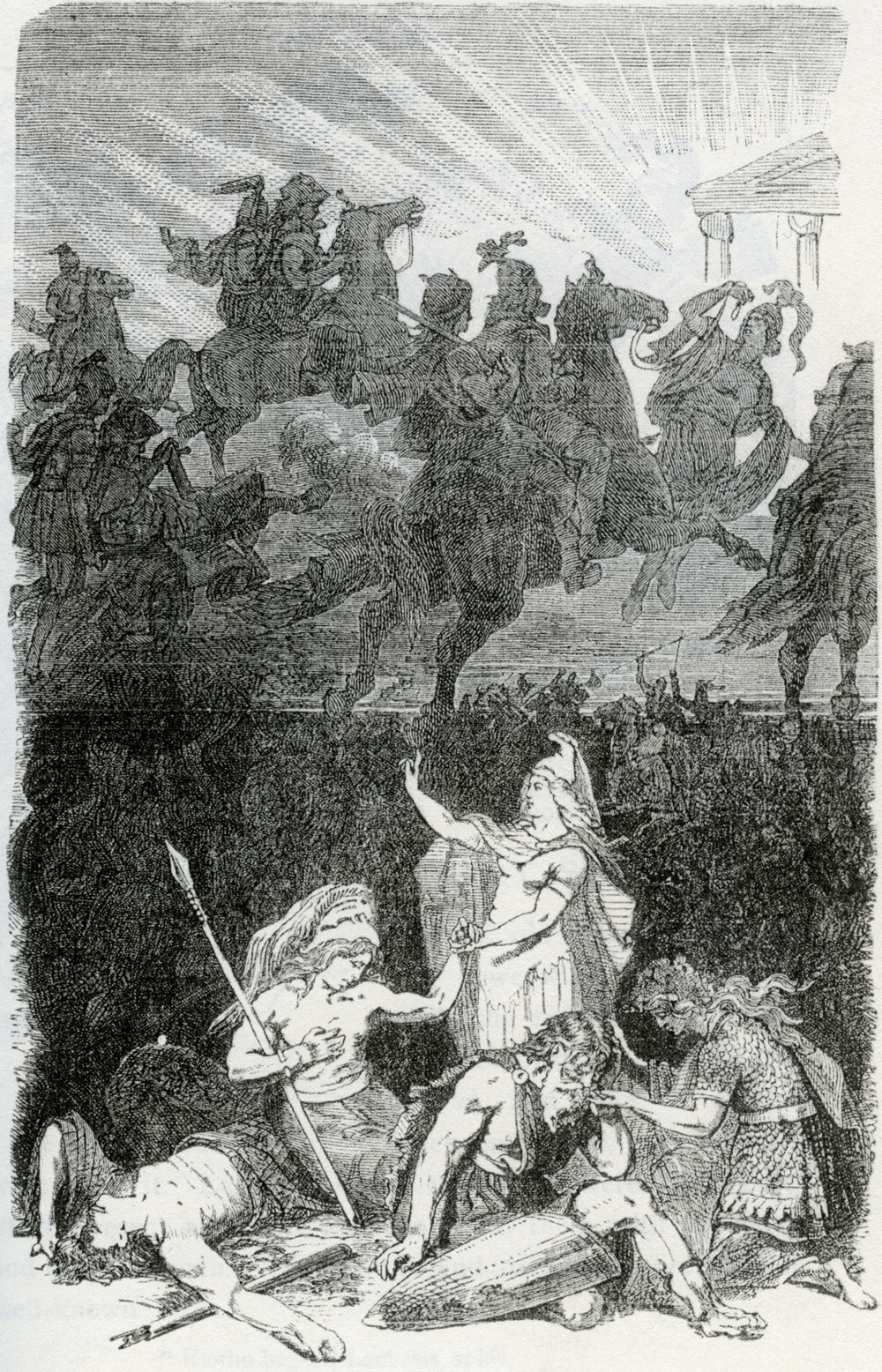
Walkyries Conducting the Fallen Heroes to Walhalla _______________ Notes: 1. The following legend is quoted from the charming book, entitled, “Wonderful Stories from Northern Lands,” by Julia Goddard (London: Longmans, 1871). 2. See note on page 24.
|