|
FIRE & ICE: MAGICAL TEACHINGS OF GERMANY'S GREATEST SECRET OCCULT ORDER |
|
Notes
Introduction
(1) See Ellic Howe's article in: Richard Cavendish, Encyclopedia of the Unexplained (New York: McGraw Hill, 1974), pp. 91-92, and Francis King, Sexuality, Magic, and Perversion (London: Spearman, 1971), pp. 115-121.
(2) Howe, in: Cavendish, Encyclopedia of the Unexplained, pp. 91-92; and Adolf Hemberger, Organisationsformen, Rituale, Lehren und magische Thematik der freimauerischen und freimauerartigen Biindeim deutschen Sprachraum Mitteleuropas. Teil I: Der mystisch-magische Orden Fraternitas Saturni (Frankfurt/Main: the author, 1971). This latter work is hereafter cited as: Der mystisch-magische Orden FS.
(3) Hans-Jürgen Glowka, Deutsche Okkultgruppen 1875-1937 (Munich: ARW, 1981), pp. 69-77; F. W. Lehmberg, Magische Sonderdrucke und Interna der Fraternitas Saturni (Munich: ARW, 1980); Friedrich- Wilhelm Haack, Die Fraternitas Saturni als Beispiel fur einen arkan-mystagogenen Geheimorden des 20. Jahrhunderts (Munich: ARW, 1977) Aythos, Die Fraternitas Saturni: Einesatum-magische Loge (Munich: ARW, 1979). For a full discussion of how these documents came to be published, see Chapter 1, p. 31.
Chapter 1
(1) Hemberger, Der mystisch-magische Orden FS, p. 166.
(2) See note 7 below for a more complete treatment of Wronski's possible role in the history of the FS.
(3) The best treatments of Ariosophy are by Nicholas Goodrick-Clarke, The Occult Roots of Nazism (Wellingborough, UK: Aquarian Press, 1985), and James Webb, The Occult Establishment (LaSalle, IL: Open Court, 1976), pp. 275-344.
(4) Aythos, Die Fraternitas Saturni, p. 3.
(5) Hemberger, Der mystisch-magische Orden FS, p. 29.
(6) Hemberger, Der mystisch-magische Orden FS, p. 29.
(7) For further details on Hoëne-Wronski, see James Webb, The Occult Underground (LaSalle, IL: Open Court, 1974), pp. 248-258, and Thomas A. Williams, Eliphas Levi: Master of Occultism (University, AL: University of Alabama Press, 1975), pp. 66- 69.
(8) Webb, The Occult Underground, p. 257, and Williams, Eliphas Levi, p. 66.
(9) Certainly the most reliable discussion of the doubtful German origins of the Golden Dawn is offered by Ellic Howe in his The Magicians of the Golden Dawn (York Beach, ME: Samuel Weiser, 1978), pp. 1 - 33. See also Ithell Colquoun, Sword of Wisdom: MacGregor Mathers and the Golden Dawn (G.P. Putnam's Sons, 1975), pp. 75-131; et passim.
(10) See pp. 7ff. below.
(11) See Webb, The Occult Establishment, pp. 275ff.; et passim, and Goodrick-Clarke, The Occult Roots of Nazism.
(12) The best general discussion of these organizations is provided by Karl Frick in his book Die Erleuchteten (Graz: Akademische Druck und Verlags-Anstalt, 1973).
(13) See Glowka, Deutsche Okkultgruppen, p. 92.
(14) Franz Bardon, Frabato: Ein okkulter Roman (Wuppertal: Dieter Rüggeberg, 1979). There is an English translation of this, also by Rüggeberg, published in 1982.
(15) Glowka, Deutsche Okkultgruppen, p. 68.
(16) On the history of Monte Verita and the interconnections of various figures there, cf. Webb, The Occult Establishment, 59-61.
(17) On the history of the O.T.O., see Ad Verbatim, "An Introduction to the History of the O.T.O" in The Equinox, Vol. III, No. 10 (Thelema Publications, 1986), pp. 87-99, J. Gordon Melton, "Thelemic Magick in America" in: Joseph H. Fichtner, ed., Alternatives to American Mainline Churches (Barrytown, NY: Unification Theological Seminary, 1983), pp. 67-87; ebb, The Occult Establishment, pp. 59-61, et passim; Francis King, The Secret Rituals of the O.T.O. (New York: Samuel Weiser, 1973), pp. 9-35; King, Sexuality, Magic, and Perversion, pp. 96-114; and Benjamin Walker, Tantrism (Wellingborough, UK: Aquarian Press, 1982), pp. 109-112.
(18) John Symonds, The Great Beast: The Life and Magick of Aleister Crowley (Frogmore, UK: Mayflower, 1973), p. 179.
(19) A typescript of a "Statement of relations between myself, Aleister Crowley, and Heinrich Tränker (1925)," is printed in Aythos, Die Fraternitas Saturni.
(20) See Howe, The Magicians of the Golden Dawn, pp. 1-25.
(21) Howe, The Magicians of the Golden Dawn, p. 7.
(22) For a detailed study of the history of the Theosophical Society see Bruce F. Campbell, Ancient Wisdom Revived (Berkeley, CA: University of California Press, 1980).
(23) For an in-depth look at the history of Ariosophy and the lives of its major proponents, see Goodrick-Clarke, Tne Occult Roots of Nazism, passim.
(24) For a general history of runes, see Ralph Elliott, Runes: An Introduction (Manchester, UK: Manchester University Press, 1959); and for an in-depth look at the magical usage of runes see Stephen Flowers, Runes and Magic (New York: Peter Lang, 1986). But for a practical occult study see the works of Edred Thorsson, Futhark: A Handbook of Rune Magic (York Beach, ME: Samuel Weiser, 1984), and Runelore: A Handbook of Esoteric Runology (York Beach, ME: Samuel Weiser, 1987).
(25) This work has been translated and introduced by Stephen E. Flowers as The Secret of the Runes (Rochester, VT: Inner Traditions, 1988).
(26) Spiesberger's published works that concentrate on rune-magical aspects are Runenmagie (Berlin: Schikowski, 1955), and Runenexerzitien fur Jedermann (Freiburg/Breisgau: Bauer, 1958).
(27) For a study of the revival of interest in astrology during the early twentieth century in Germany, see Ellic Howe, Astrology in the Third Reich (Wellingborough, UK: Aquarian Press, 1984).
(28) The events of the "Weida Conference" are reported by Hemberger, Der mystisch- magische Orden FS, pp. 29-30; Aythos, Die Fraternitas Saturni, p. 4; Symonds, The Great Beast, pp. 391-392, 396-397; Aleister Crowley in: Aythos, "Statement of relations between myself, Aleister Crowley, and Heinrich Tränker (1925) [5 pp. typescript]; and Eugen Grosche (Gregorius) in: Haack, Die Fraternitas Saturni, pp. 20- 25.
(29) This is according to Gregorius' account of things; see Haack, Die Fraternitas Saturni, p. 22.
(30) Symonds, The Great Beast, pp. 41 Off.
(31) See Hemberger, Der mystisch-magische Orden FS, p. 30, and Aythos, Die Fraternitas Saturni, p. 3.
(32) See Haack, Die Fraternitas Saturni, p. 28, and Hemberger, Der mystisch-magische Orden FS, p. 30.
Chapter 2
(1) See also the book by Gregor A. Gregorius, Die magische Erweckung der Chakra im Ätherkörper des Menschen (Freiburg/Breisgau: Bauer, 1953), a version of which was published in the May 1951 issue of the Blätter.
(2) This theme is extensively dealt with in Magischer Brief 1 (1925); see Gregor A. Gregorius, Magische Briefe (Berlin: Schikowski, 1980).
(3) The practice of pendulum magic was the theme of Magischer Brief 5 (1926). A new edition of this was also issued: Gregor A. Gregorius, Pendelmagie: Handbuch der praktischen Pendellehre (Berlin: Schikowski, 1955).
(4) Satanistische Magie was the title of Magischer Brief 7 (1926), which was reprinted as Gregorius, Satanische Magie (Berlin: Schikowski, 1983). For the full implications of what is meant by "Satanic," see note (11) below.
(5) On the various Gnostic sects, see Benjamin Walker, Gnosticism: Its History and Influence (Wellingborough, UK: Aquarian Press, 1983), pp. 133-160.
(6) The most extensive surveys of the ancient forms of Gnosticism are those of Hans Jonas, The Gnostic Religion (Boston: Beacon Press, 1963, 2nd ed.) and Kurt Rudolph, Gnosis: The Nature and History of Gnosticism (San Francisco: Harper and Row, 1987); while perhaps the book by Walker, Gnosticism, remains the most convenient.
(7) These general descriptions can be found in any textbook of astrology, most of which are ultimately derived from Ptolemy's Tetrabiblos (London: Heinemann, 1940).
(8) Hemberger, Der mystisch-magische Orden FS, p. 243.
(9) Hemberger, Der mystisch-magische Orden FS, p. 245.
(10)
See Hemberger, Der mystisch-magische
Orden, FS, p. 245.
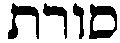
Sorath (Hebrew
(11) The relationship between the entities called Lucifer and Satan, as seen in the FS doctrine, is made quite clear in the figure illustrating the composite nature of the Saturnian sphere on p. 60. Satan is merely the "lower octave" of the Saturnian sphere, of which Lucifer, the Light-Bearer, is the "higher octave." This is a purely (neo-)Gnostic viewpoint and has little or nothing to do with Judeo-Christian understandings of the names involved.
(12) Aythos, Die Fraternitas Saturni, p. 43.
(13) Hemberger, Der mystisch-magische Orden FS,p. 162-163.
(14) Hemberger, Der mystisch-magische Orden FS, p. 163. Note the Nietzschean imagery and terminology here. Friedrich Nietzsche outlined his Apollonian/ Dionysian thesis in The Birth of Tragedy, a convenient edition of which is translated by W. Kaufman (New York: Vintage, 1967).
(15) Aythos, Die Fraternitas Saturni, p. 43.
(16) These descriptions are taken from Hemberger, Der mystisch-magische Orden FS, p. 162.
(17) These terms are discussed by Hemberger, Der mystisch-magische Orden FS, p. 11.
(18) Hemberger, Der mystisch-magische Orden FS, p. 29.
(19) These aims are outlined by Aythos, Die Fraternitas Saturni, p. 6.
(20) Aythos, Die Fraternitas Saturni, pp. 25-26.
(21) Aythos, Die Fraternitas Saturni, p. 20.
(22) Aythos, Die Fraternitas Saturni, pp. 26-27.
(23) See Hemberger, Der mystisch-magische Orden FS, p. 3.
(24) Hemberger, Der mystisch-magische Orden FS, p. 249.
(25) Aythos, Die Fraternitas Saturni, pp. 27-28.
(26) Aythos, Die Fraternitas Saturni, p. 31.
(27) Aythos, Die Fraternitas Saturni, p. 28.
(28) It is virtually impossible to criticize the doctrines of the FS from the perspective of the teachings of archaic Gnostic sects, as they themselves were disparate and even encouraged the practice of wild speculation and doctrinal innovation. Again the most convenient source materials on Gnosticism available in English are: Walker, Gnosticism, Rudolph, Gnosis, and Jonas, The Gnostic Religion. Also of interest here are Jean Doresse, The Secret Books of the Egyptian Gnostics (Rochester, VT: Inner Traditions, 1986), and James M. Robinson, ed., The Nag Hammadi Library (San Francisco: Harper and Row, 1981).
(29) Louis Pauwels and Jacques Bergier, trans. R. Myers (New York: Avon, 1968), pp. 223ff.
(30) Hemberger, Der mystisch-magische Orden FS, p. 244.
(31) See Jean I. Young, trans., The Prose Edda (Berkeley, CA: University of California Press, 1954), pp. 32ff., and esoteric commentary by Thorsson, Runelore, pp. 143ff.
(32) Hemberger, Der mystisch-magische Orden FS, p. 179.
(33) See Hemberger, Der mystisch-magische Orden FS, p. 176. The FS doctrines on this subject are a synthesis of H. P. Blavatsky's theosophy as outlined in her The Secret Doctrine (Pasadena, CA: Theosophical University Press, 1970 [orig. published 1888]), and the theories of Hans Hörbiger.
(34) Hemberger, Der mystisch-magische Orden FS, p. 252.
(35) Hemberger, Der mystisch-magische Orden FS, p. 243.
(36) Gregor A. Gregorius, "Das göttliche und negative Prinzip" in: Blätter (March, 1954) p. 7, and Hemberger, Der mystisch-magische Orden FS, p. 175.
(37) Hemberger, Der mystisch-magische Orden FS, pp. 243, 252.
(38) In other words there is a complex of three parallel dimensions, all occupying the same "space."
(39) Hemberger, Der mystisch-magische Orden FS, p. 176
(40) Hemberger, Der mystisch-magische Orden FS, pp. 176-177.
(41) Gregor A. Gregorius, Magia Cosmosophica (= Magischer Brief No. 9), p. 10.
(42) For a convenient look at the Gnostic doctrine of aeons, see Jonas, The Gnostic Religion, pp. 51 - 54, Walker, Gnosticism, pp. 32-34, or Rudolph, Gnosis, pp. 67-87.
(43) Aythos, Die Fraternitas Saturni, p. 29.
(44) Aythos, Die Fraternitas Saturni, p. 30.
(45) Aythos, Die Fraternitas Saturni, pp. 46-48.
(46) Gregor A. Gregorius, "Mephistopheles oder Lucifer?" in: Blätter (April, 1953), pp. l- ,and Hemberger, Der mystisch-magische Orden FS, p. 34.
(47) See, for example, in his Satanische Magie, pp. 33ff. On the Barbelo-Gnostics in general, and the situation with pre- or non-Christian Gnostics, see Rudolph, Gnosis, pp. 247ff.; 285ff., and Walker, Gnosticism, pp. 150-158.
(48) Hemberger, Der mystisch-magische Orden FS, p. 249.
(49) Hemberger, Der mystisch-magische Orden FS, p. 249.
(50) See Gregorius in: Blätter (August, 1952), p. l.
(51) Aythos, Die Fraternitas Saturni, pp. 30-32.
(52) See Gregorius as cited by Hemberger, Der mystisch-magische Orden FS, pp. 85-86.
(53) This is discussed by Gregorius in an article entitled "Das Chrestos-Prinzip als esoterische Basis" in: Blätter (March, 1954).
(54) On the octave structures of Saturn, see Hemberger, Der mystisch-magische Orden FS, pp. 34 and 250, and Gregorius in his article "Mephistopheles oder Lucifer?" in Blätter (April, 1953), pp. 1-7.
(55) See Hemberger, Der mystisch-magische Orden FS, p. 96.
(56) Hemberger Der mystisch-magische Orden FS, pp. 84-85.
(57) This is the first and most strongly alluded to in Liber AL vel Legis (The Book of the Law) I:49: "Abrogated are all rituals, all ordeals, all words and signs. Ra-Hoor-Khuit hath taken his seat in the East at the Equinox of the Gods; and let Asar be with Isa, who also are one. But they are not of me. Let Asar be the adorant, Isa the sufferer; Hoor in his secret name and splendor is the Lord initiating." Upon this Crowley himself commented: "The Formula of the New Aeon recognizes Horus, the Child crowned and conquering, as God." See Aleister Crowley, The Law is for All (Phoenix, AZ: Falcon Press, 1985), p. 106.
(58) See, for example, King, Sexuality, Magic, and Perversion, pp. 115-119, or Howe, "German Occult Groups," pp. 91-92.
(59) See the bibliography in the 1927 Sexual Magie (= Magischer Brief 8), reprinted in Magische Briefe (Berlin: Schikowski, 1980), for some idea of the scope of this FS "sexology." In the 1920s Berlin, where Gregorius lived, was the center of the developing science of sexology; see Erwin J. Haeberle, ed., The Birth of Sexology ([?]: World Association for Sexology, 1983).
(60) For some idea of the doctrines and structure of the O.T.O., which has established the standard of sex-magical practice, see King, The Secret Rituals of the O.T.O., and King, Sexuality, Magic, and Perversion. Aleister Crowley's own few explicit works dedicated to this are conveniently available, bound together as Liber Agape/De Arte Magica, ed. Ray Sherwin (East Morton, UK: Kadath Press, 1986). An alternate system, also made popular through publication, is that presented by Louis T. Culling, A Manual of Sex Magick (St. Paul, MN: Llewellyn Publications, 1971).
(61) As mentioned before, Gregorius devoted a whole study, Die magische Erweckung der Chakra im Ätherkörper des Menschen, to this topic in 1953.
(62) See Rudolph, Gnosis, pp. 71-87; Jonas, The Gnostic Religion, passim; and Walker, Gnosticism, pp. 28-69.
(63) For a convenient presentation of the myths surrounding Lilith, see Barbara Koltuv, The Book of Lilith (York Beach, ME: Nicholas-Hays, 1986).
(64) See the discussion of Hemberger, Der mystischmagische Orden FS, pp. 176-177.
(65) Gregorius, Blätter (December, 1961), p. 18, cited by Hemberger in Der mystisch-magische Orden FS, p. 112.
(66) A prosaic but accurate translation would be: "A woman who is not afraid of the night or death is worthy and will be initiated."
(67) See Hemberger, Der mystisch-magische Orden FS, pp. 113-115.
(68) (Haar, Germany: Akasha, 1986).
(69) See Aleister Crowley, Eight Lectures on Yoga (Dallas, TX: Sangreal, 1972), pp. 9-13.
(70) Crowley, Eight Lectures on Yoga, p. 13.
(71) This translation is the one used in translations of correspondence between Gregorius and Crowley; see Aythos, Die Fraternitas Saturni, p. 2 of Gregorius' letter to Master Therion dated 27° (1926); perhaps "Love without Pity," or "Pityless Love" would be more poetic.
(72) See Walther Kaufman, The Portable Nietzsche (New York: Viking, 1954), pp. 200- 202.
(73) "I am perplexed... "are reportedly Crowley's last words, see Symonds, The Great Beast, p. 454. For an illuminated interpretation of these facts, see Michael A. Aquino, The Book of Coming Forth By Night: Analysis and Commentary (San Francisco: Temple of Set [Privately Published], 1985), pp. 17-18.
Chapter 3
(1) Hemberger, Der mystisch-magische Orden FS, p. 243.
(2) Hemberger, Der mystisch-magische Orden FS, p. 251. See also the concept of the "Absolute" promulgated by Hoëne-Wronski as discussed by James Webb, The Occult Underground (LaSalle, IL: Open Court, 1974) p. 258.
(3) This is the title of a poem by Gregorius written in 1943, but first published in 1955 in Blätter No. 60, see p. 62 above.
(4) Hemberger, Der mystisch-magische Orden FS, p. 250.
(5) Hemberger, Der mystisch-magische Orden FS, p. 113.
(6) Karl Spiesberger, Magische Einweihung (Berlin: Schikowski, 1978) and Magische Praxis (Berlin: Schikowski, 1978). These volumes were previously published under the title Hermetisches ABC by Bauer in 1964.
(7) These were published by Hemberger, Der mystisch-magische Orden FS, pp. 195-197; and in Die Fraternitas Saturni Aythos prints the entire document entitled the "Rule of the Rightful-Illuminated- Secret Ritual and Magical Lodge/Grand Lodge FRATERNITAS SATURNI," which came into effect under Gregorius in April of 1963.
(8) For a treatment of these "study circles," see Hemberger, Der mystisch-magische Orden FS, p. 169.
Chapter 4
(1) One general picture of FS training techniques and elements can be seen in the two- olume Hermetisches ABC by Karl Spiesberger (Fra. Eratus). This work was later retitled Magische Einweihung (vol. I) and Magische Praxis (vol. II) and is published by Schi kowski. This program was originally set up within the FS and later re-edited by Eratus.
(2) The classic text for vocalic breathing is that by B.M. Leser-Lasario: Lehrbuch der Original-Gebarden- Atmung (Gettenbach/Gelnhausen: Lebensweiser-Verlag, 1931).
(3) This odic force is much discussed in FS literature. The term was coined by Karl von Reichenbach (see The Odic Force [New York: University, 1968], pp. 92-93), who defined the force as a "power penetrating all matter and space" and who derived the name from the name of the Norse god Od-in—which he thought of as the "All-transcending."
(4) In Faust's magical work he began with the contemplation of the Earth-Spirit; see J.W. von Goethe, Faust, trans. C.E. Passage (Indianapolis: Bobbs-Merrill, 1965), pp. 22-24.
(5) See Hemberger, Der mystisch-magische Orden FS, pp. 243-244; 253.
(6) These are available in old reprint series such as Das Kloster, J. Scheible, ed. (Stuttgart: J. Scheible, 1845-1849).
(7) See S. Angus, The Mystery Religions (New York: Dover, 1975), pp. 76ff.; 135ff.
(8) Hemberger, Der mystisch-magische Orden FS, p. 243.
(9) See especially Hemberger, Der mystischmagische Orden FS, pp. 23-27 for printed material derived from Gregorius' own occult novel, Exorial: Der Roman eines dämonischen Wesens (Berlin-Grünewald: Winkler, 1960).
(10) For details on FS rings, see Hemberger, Der mystisch-magische Orden FS, pp. 218- 220 and Lehmberg, Magische Sonderdrucke, passim.
(11) See Hemberger, Der mystisch-magische Orden FS, p. 121.
(12) See Hemberger, Der mystisch-magische Orden FS, pp. 23-27; 90, and Gregorius, Satanische Magie, pp. 29ff.
(13) This is also recorded by Hemberger, Der mystisch-magische Orden FS, pp. 23-24.
(14) These four "Egyptian tests" were supposed initiatory trials based on the four elements Earth, Water, Air and Fire. It is from Mozart's The Magic Flute that this Masonic tradition seems to have had its greatest impact on the lore of the FS.
(15) These are outlined by Hemberger, Der mystisch-magische Orden FS, pp. 90-91.
(16) Hemberger, Der mystisch-magische Orden FS, pp. 95-103.
(17) Hemberger, Der mystisch-magische Orden FS, pp. 99-100.
(18) See Hemberger, Der mystisch-magische Orden FS, pp. 96-99 for a description of this.
(19) Albert Pike (1809-1891) was Grand Commander of the Ancient and Accepted Scottish Rite in Charleston, SC, and was reputed to have established a Luciferian agenda centered in a Palladian Order within the AASR. The dubious source for most of this is the swarm of anti-Masonic literature produced on the European continent in the late 1800s. See Webb, The Occult Underground, pp. 144-147, and H.T.F. Rhodes, The Satanic Mass (Secaucus, NJ: Citadel, 1954), pp. 186ff. On the Nobel Prize-winning poet Giosué Carducci and his "Hymn to Satan," see Gerhard Zacharias, The Satanic Cult, trans. C. Trollope (London: George Allen and Unwin, 1980), pp. 125-132.
(20) On the general nature of the Saturnian eucharist, see Hemberger, Der mystisch- agische Orden FS, pp. 102-103.
(21) These are outlined by Hemberger, Der mystisch-magische Orden FS, p. 108.
(22) This mysterious unnamed substance could be an extract of mandrake or damiana. This is based on the correspondence between these herbs and the Moon in Crowley's 777. See The Qabalah of Aleister Crowley (New York: Samuel Weiser, 1973), p. 98.
(23) Hemberger only briefly discusses these aspects; see Der mystisch-magische Orden FS, pp. 146-147.
(24) See Bardon, Frabato, passim.
(25) The only ritual of this order ever published for public view is the Elektrische Vorspiele (Electrical Preludes) in Anton LaVey's Satanic Rituals (New York: Avon, pp. 106-130).
(26) (London: Spearman, 1971), pp. 116-119.
(27) This ritual is described by Hemberger, Der mystisch-magische Orden FS, pp. 109- 10. For a discussion of the more traditional forms of the "Five-M Rite" (Sanskrit: pahcha-makara), see Walker, Tantrism, pp. 65-66, Francis King, Tantra For Westerners (New York: Destiny, 1986), pp. 14-15, et passim, or for another version of the ritual adopted for "Westerners," see Omar Garrison, Tantra: The Yoga of Sex (New York: Julian Press, 1964), pp. 103-118.
(28) Versions of this practice described by Gregorius are given by Hemberger, Der mystisch-magische Orden FS, pp. 110-112 and by Gregorius, Sexual Magie (=Magischer Brief No. 8), pp. 91-96.
(29) The chandara chakra (not one of the seven "major" chakras), is located above and to the left of the navel, see Andre van Lysebeth, Pranayama: The Yoga of Breathing (London: Unwin, 1979), p. 216.
(30) See Hemberger, Der mystisch-magische Orden FS, p. 112. Hemberger also makes reference to the occult novel Alraune by Hanns Heinz Ewers in this whole context. There is an English translation of this work by Guy Endor (New York: John Day, 1929).
(31) (London: Spearman, 1971), pp. 116-119.
(32) This kind of working, also referred to as creating a homunculus, is outlined in a section of Aleister Crowley's "Secret Instruction of the Ninth Degree" (O.T.O.) called "Of the Homunculus," printed by King, The Secret Rituals of the O. T. O., pp. 231 - 239. This is also outlined in Culling's A Manual of Sex Magick, pp. 71-92.
|