|
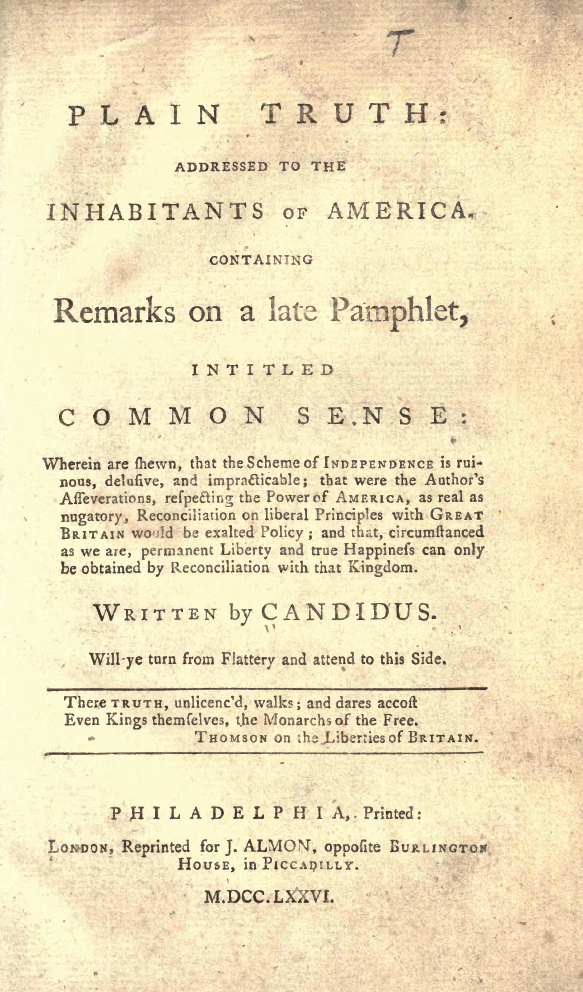
Site Map PLAIN TRUTH, ADDRESSED TO THE INHABITANTS OF AMERICA, CONTAINING REMARKS ON A LATE PAMPHLET, INTITLED COMMON SENSE |
|
by Candidus (James Chalmer)
Wherein are shewn,
that the Scheme of INDEPENDENCE is ruinous, delusive, and impracticable;
that were the Author's Asseverations, respecting the Power of
AMERICA, as real as nugatory, Reconciliation on liberal Principles with
GREAT BRITAIN would be exalted Policy; and that, circumstanced as we
are, permanent Liberty and true Happiness can only be obtained by
Reconciliation with that Kingdom. TO JOHN DICKINSON, ESQUIRE. ALTHOUGH I have not the honor to be known to you, I am not unacquainted with your native candor and unbounded benevolence. As happy as obscure, I am indeed a stranger to the language of adulation: flattery I detest; virtue I respect. Be not offended, Sir, if I remark that your character is contemplated with profound veneration by the friends of the Constitution. Those abilities which you so illustriously displayed in defence of the Constitution, they now supplicate you to exert, in saving it from impending ruin, under the Syren form of delusive Independence. Step then forth; exert those talents with which heaven has endowed you; and cause the parent and her children to embrace, and be foes no more. Arduous as this extraordinary talk may seem, perhaps your virtue and talents may yet effect it. Your endeavors to stop the effusion of blood, of torrents of blood, is worthy of your acknowledged humanity even the honest attempt, upon recollection, will afford you ineffable satisfaction. My presuming to inscribe to you the following crude remarks is to remind you, Sir, what your distressed country expects, nay loudly demands from your extensive capacity. I beg you will forgive this temerity; and that you may long enjoy the fruits of your exalted virtue, and remain an honor to your country, and to mankind, is the ardent wish of, SIR, INTRODUCTION. If indignant at the doctrine contained in the pamphlet intitled Common Sense, I have expressed myself, in the following observations, with some ardor, I entreat the reader to impute my indignation to honed zeal against the author's insidious tenets. Animated and impelled by every inducement of the human heart, I love, and (if I dare to express myself) I adore my country. Passionately devoted to true liberty, I glow with the purest flame of patriotism. Silver'd with age as I am, if I know myself, my humble sword shall not be wanting to my country (if the most honorable terms are not tendered by the British nation); to whose sacred cause I am most fervently devoted. The judicious reader will not impute my honest, though bold remarks, to unfriendly designs against my children -- against my country; but to abhorrence of independency, which, if effected, would inevitably plunge our once pre-eminently envied country into ruin, horror, and desolation. PLAIN PLAIN TRUTH: I HAVE now before me the pamphlet intitled Common Sense; on which I shall remark with freedom and candour. It may not be improper to remind my reader, that the investigation of my subject demands the utmost freedom of enquiry; I therefore entreat his indulgence, and that he will carefully remember, that intemperate zeal is as injurious to liberty, as a manly discussion of facts is friendly to it. "Liberty, says the great Montesquieu, is a right of doing whatever the laws permit; and if a citizen could do what they forbid, he would no longer be possessed of liberty, because all his fellow citizens would have the same power." In the beginning of his pamphlet the author asserts, that society in every state is a blessing. This in the sincerity of my heart I deny; for it is supreme misery to be associated with those who, to promote their ambitious purposes, flagitiously [wickedly] pervert the ends of political society. I do not say that our author is indebted to Burgh's Political Disquisitions, or to Rousseau's Social Compact for his definition on government, and his large tree; although I wish he had favoured his reader with the following extract from that sublime reasoner: " To investigate those conditions of society which may best answer the purpose of nations, would require the abilities of some superior intelligence, who should be witness to all the passions of men, but be subject itself to none, who should have no connections with human nature, but should have a perfect knowledge of it: a being, in short, whose happiness should be independent of us, and who would nevertheless employ itself about us. It is the province of Gods to make laws for men." With the utmost deference to the celebrated Rousseau, I cannot indeed imagine, that laws even so constructed, would materially benefit our imperfect race, unless Omniscience deigned previously to exalt our nature. The judicious reader will therefore perceive, that malevolence only is requisite to declaim against, and arraign the most perfect governments. Our political quack avails himself of this trite expedient, to cajole the people into the most abject flattery, under the delusive name of independence. His first indecent attack is against the English constitution, which, with all its imperfections, is, and ever will be, the pride and envy of mankind. To this panegyric involuntarily our author subscribes, by granting individuals to be safer in England, than in any other part of Europe. He indeed insidiously attributes this pre-eminent excellency to the constitution of the people, rather than to our excellent constitution: to such contemptible subterfuge is our author reduced. I would ask him, why did not the constitution of the people afford them superior safety, in the reign of Richard the third, Henry the eighth, and other tyrannic princes? Many pages might indeed be filled with encomiums bestowed on our excellent constitution by illustrious authors of different nations. This beautiful system (according to Montesquieu) our constitution is a compound of monarchy, aristocracy, and democracy. But it is often said, that the sovereign, by honours and appointments, influences the commons. The profound and elegant Hume agitating this question, thinks, to this circumstance, we are in part indebted for our supreme felicity; since, without such controul in the crown, our constitution would immediately degenerate into democracy; a government which, in the sequel, I hope to prove ineligible. Were I asked marks of the best government, and the purpose of political society, I would reply, the encrease, preservation, and prosperity of its members; in no quarter of the globe are those marks so certainly to be found, as in Great Britain and her dependencies. After our author has employed several pages to break the mounds of society by debasing monarchs, he says, "the plain truth is, that the antiquity of English monarchy will not bear looking into." Hume, treating of the original contract, has the following melancholy, but sensible observation; "yet reason tells us, that there is no property in durable objects, such as lands and houses, when carefully examined, in passing from hand to hand, but must in some period have been founded on fraud and injustice. The necessities of human society, neither in private or public life, will allow of such an accurate enquiry; and there is no virtue or moral duty, but what may, with facility, be refined away, if we indulge a false philosophy, in sifting and scrutinizing, by every captious rule of logic, in every light or position in which it may be placed." Say, ye votaries of honour and truth, can we adduce a stronger proof of our author's turpitude, than his quoting the anti-philosophical story of the Jews, to debate monarchy and the best of monarchs. Briefly examining the story of this contemptible race, more barbarous than our savages, we find their history a continued succession of miracles, astonishing our imaginations, and exercising our faith. After wandering forty years in horrid desarts, they are chiefly condemned to perish for their perverseness, although under the immediate dominion of the king of heaven. At length they arrive in the sterile country of Palestine, which they conquer by exterminating the inhabitants, and warring like demons. The inhabitants of the adjoining regions justly, therefore, held them in detestation, and the Jews finding themselves constantly abhorred, have ever since hated all mankind. This people, as destitute of arts and industry as humanity, had not even in their language a word expressive of education. We might indeed remind our author, who so readily drags in the Old Testament to support his sinister measures, that we could draw from that source many texts favourable to monarchy, were we not conscious that the Mosaic law gives way to the gospel dispensation. The reader no doubt will be gratified by the following extract from a a most primitive Christian: "Christianity is a spiritual religion, relative only to celestial objects. The Christian's inheritance is not of this world. He performs his duty it is true, but this he does with a profound indifference for the good or ill success of his endeavours: provided he hath nothing to reproach himself, it is of little consequence to him whether matters go well or ill here below. If the state be in a flourishing condition, he can hardly venture to rejoice in the public felicity, lest he should be puffed up with the inordinate pride of his country's glory. If the state decline, he blesses the hand of God, that humbles his people to the dust." Having defined the best government, I will humbly attempt to describe good kings by the following unerring rule. The best princes are constantly calumniated by the envenomed tongues and pens of the most worthless of their subjects. For this melancholy truth, do I appeal to the testimony of impartial historians, and long experience. The noble impartial historian Sully, speaking of the almost divine Henry the fourth of France, says, "Thus was this god-like prince represented (by the discontented of these days) almost throughout his whole kingdom, as a furious and implacable tyrant: they were never without one set of arguments to engage his catholic nobility in a rebellion against him; and another to sow sedition among his protestant officers and gentry." Hume says, that the cruel unrelenting tyrant, Philip the second of Spain, with his infernal inquisition, was not more destested by the people of the Netherlands, than was the humane Charles with his inoffensive liturgy, by his mutinous subjects. The many unmerited insults offered to our gracious sovereign by the unprincipled Wilkes, and others down to this late author, will for ever disgrace humanity. For he says, "that monarchy was the most prosperous invention the devil ever set on foot for the promotion of idolatry. It is the pride of kings which throws mankind into confusion: in short, continues this author, monarchy and succession have laid not this or that kingdom only, but the world in blood and ashes." How deplorably wretched the condition of mankind, could they believe such execrable flagitious jargon! Unhappily indeed, mankind in every age are susceptible of delusion; but surely our author's poison carries its antidote with it. Attentive to the spirit of his publication, we fancy ourselves in the barbarous fifteenth century; in which period our author would have figured with his " Common Sense" -- and blood will attend it. After his terrible anathema against our venerable constitution and monarchy, let us briefly examine a democratical state; and see whether or not it is a government less sanguinary. This government is extremely plausible and indeed flattering to the pride of mankind. The demagogues therefore, to seduce the people into their criminal designs, ever hold up democracy to them; although conscious it never did, nor ever will answer in practice. If we believe a great author, "there never existed, nor ever will exist a real democracy in the world." If we examine the republics of Greece and Rome, we ever find them in a state of war domestic or foreign. Our author therefore makes no mention of these ancient states. "When Alexander ordered all the exiles to be restored throughout all the cities, it was found that the whole amounted to twenty thousand, the remains probably of still greater slaughters and massacres. What an astonishing number in so narrow a country as ancient Greece? and what domestic confusion, jealousy, partiality, revenge, heart-burnings must tear those cities, where factions were wrought up to such a degree of fury and despair?" Appian's history of the civil wars of Rome contains the most frightful picture of massacres, proscriptions, and forfeitures that ever were presented to the world. The excellent Montesquieu declares, "that a democracy supposes the concurrence of a number of circumstances rarely united; in the first place, it is requisite that the state itself should be of small extent, so that the people might be easily assembled and personally known to each other: secondly, the simplicity of their manners should be such as to prevent a multiplicity of affairs, and perplexity in discussing them: and thirdly, there should subsist a great degree of equality between them, in point of right and authority: lastly, there should be little or no luxury, for luxury must either be the effect of wealth, or it must make it necessary; it corrupts at once, both rich and poor: the one, by the possession, and the other, by the want of it." To this may be added, continues the same author, "that no government is so subject to civil wars, and intestine commotions, as that of the democratical or popular form; because no other tends to strongly and to constantly to alter, nor requires to much vigilance and fortitude to preserve it from alteration. It is indeed, in such a constitution particularly, that a citizen should always be armed with fortitude and constancy, and should every day, in the sincerity of his heart, guard against corruption, arising either from selfishness in himself, or in his compatriots; for if it once enters into public transactions, to root it out afterwards would be miraculous. Our author asserts, that Holland and Switzerland are without wars domestic or foreign. About a century ago, Holland was in a few weeks over-run by the arms of France, and almost miraculously saved by the gallantry of her Prince of Orange, so celebrated afterwards by the name of William the third. Almost from that period, until the treaty of Utrecht, Holland was a principal in wars, the most expensive and bloody, ever waged by human kind: the wounds she then received were unhealed in 1744, when reluctantly roused from her pacific lethargy, she was dragged into war; and losig her impregnable Bergen-op-zoom, and Maeftricht, was again on the brink of becoming a province to France, when happily liberated by the British Nation. In the war of 1756, Holland, continually insulted in the capture of her ships by our cruisers, preferred a humiliating neutrality. If victory indeed had not crowned the British banners, the Dutch in indubitably would have assisted their natural allies, in whatever quarter of the globe attacked; for it is incontestibly true, that the existence of Holland, as a state, depends, and invariably will depend, on the prosperity of Great Britain. Since the murder of Barnevelt, and the immortal Dewits, by the deluded furious people, Holland hath too often been convulsed by anarchy, and torn by party. Unfortunately alas! for the cause of humanity, the rugged and incult deserts of Switzerland preclude not ambition, sedition, and anarchy. Her bleak and barren mountains do not to effectually secure precarious liberty, as daily vending her sons to the adjoining nations, particularly to France, by whom the Thirteen Cantons could be subjected in as many days, did that court meditate so senseless and delusive an object. Nugatory indeed, if we consider, that France derives more substantial advantage from the present state of Switzerland, than if she exhausted herself, to maintain numerous battalions, to bridle the Cantons. A moment let us suppose, that our author's asseverations of Holland and Switzerland are as real as delusive: his inferences do not flow from his premises; for their superior advantages do not arise from their popular government, but from circumstances of peculiar local felicity, obliging the princes of Europe to defend them from the omnipotent land force, if I may so speak, of France. After impotently attacking our sovereign and the constitution, he contradicts the voice of all mankind, by declaring, that America "would have flourished as much, and probably much more, had no European power taken any notice of her." If he means, that had this continent been unexplored, the original inhabitants would have been happier, for once I agree with him. Previous to the settlement of these provinces by our ancestors, the kingdom of France was convulsed by religious phrenzy. This, and Sebastian Cabot's prior discovery, perhaps, happily afforded the people of England an opportunity of locating these provinces. At length, peace being restored to France by her hero, Henry the Fourth, his nation in turn were seized with the rage of colonizing. Finding the English claimed the provinces on the Atlantic, they appropriated the snow banks of Canada, which we dare not suppose they would have preferred to these fertile provinces, had not the prior occupancy and power of England interfered. I hope it will not be denied, that the notice taken of us at this time by an European power, was rather favourable for us. Certain it is, had not England then taken notice of us, these delectable provinces would now appertain to France; and the people of New England, horrid to think, would now be counting their beads. Some years after the aera in question, the civil wars intervening in England, afforded to the Swedes and Dutch a footing on this continent. Charles the second being restored, England reviving her claim, rendered abortive the Swedish pretensions, and by conquest, and granting Surinam to the Dutch, procured the cession of their usurpation, now New York. I do indeed confess my incapacity to discern the injury sustained by this second notice taken of us by an European power;" in default of which intervention, the Swedes, to this hour, would have retained their settlement, now the famed Pennsylvania; and the Dutch, consequently, had retained theirs. Some time after this period, the people of New England were employed in framing and executing laws, so intolerant and sanguinary, that to us they seem adapted for devils, and not men. Indeed it is worthy of note, that the inhabitants of Jamaica, Barbadoes, and Virginia, at that very time, enacted laws, breathing the spirit of humanity, and such as men could bear. Soon after the period in question arrived the great and good William Penn, with his philosophic people called Quakers, together with toleration, industry, and permanent credit. The people of England, encouraged by the extension of their laws and commerce to those colonies, powerfully assisted our merchants and planters, insomuch, that our settlements encreased rapidly, and throve apace. It may be affirmed, that from this period, until the present unhappy hour, no part of human kind ever experienced more perfect felicity. Voltaire indeed says, that if ever the golden age existed, it was in Pennsylvania. France, disgusted with the unhappy situation of her American Colonies, had long meditated the conquest of one of our middle provinces: to accomplish this purpose, she extended a line of forts on our frontiers, and actually fortified the place now called Pittsburgh. Justly alarmed by these encroachments, in the hour of our distress we called aloud on Great Britain for assistance, nor was she deaf to our cries. The English ministry, after in vain exhausting all the arts of negociation, declared war against France. After spilling torrents of blood, after expending one hundred and ninety millions of their dollars, and four or five millions of ours, they gloriously reduced the French Settlements. Surely it will not be said, that this last notice taken of us by the people of England, was injurious to us? Our enemies indeed alledge, that this last intervention by bloating us with pride, will eventually ruin us, and render the people of Britain objects of derision, for lavishing their blood and treasure in defence of provinces; "a match not only for Europe (according to our author) but for the world." -- Our author next remarks, "that the commerce by which she hath enriched herself, are the necessaries of life, and will always have a market while eating is the custom of Europe." I reply, that our exporting grain is as it were of yesterday; that the recent demand was principally occasioned by the distractions in Poland, and other parts of Europe, and probably will totally or partly fail, soon as the fertile country of Poland, and more fertile Ukraine, shall again become cultivated. I believe the Europeans did eat before our merchants exported our grain, and perhaps will eat when they cease to export it. I deny, that this momentary commerce hath enriched us; and I could adduce numberless melancholy proofs of the contrary. I shall only remark, that in the most fertile and delectable wheat country in America, bounded by Chesopeak-bay, and almost adjoining that of Delaware, a tract of the best wheat land, ten years ago, would hardly have exceeded a guinea and a half per acre; indeed in 1773, such land, covered with wood, would scarcely have sold for four guineas an acre; an undoubted proof of want of people, industry, and wealth; particularly so, if we consider that one crop of corn and wheat on such land, judiciously cultivated, would actually repay the supposed price. Our author asserts, "that our present numbers are sufficient to repel the force of all the world; that the Continent hath at this time the largest disciplined army of any power under heaven; that the English navy is only worth three millions and a half sterling," which, in effect, would reduce it to thirty-five ships of the line, twenty ships of forty guns, twenty of thirty-fix, and eight of twenty guns." That if America had only a twentieth part of this force, she would be by far an over-match for Britain: that independence is necessary, because France and Spain cannot assist us until such an event." He also affirms, "that Great Britain cannot govern us; and that no good can arise from a reconciliation with her." I shall humbly endeavour to shew, that our author shamefully misrepresents facts, is ignorant of the true state of Great Britain and her Colonies, utterly unqualified for the arduous talk he has presumptuously assumed, and ardently intent on seducing us to that precipice on which himself stands trembling. To elucidate my strictures, I must with fidelity expose the circumstances of Great Britain and her Colonies. If, therefore, in the energy of description, I unfold certain bold and honed truths with simplicity, the judicious reader will remember, that a true knowledge of our situation is as essential to our safety as ignorance thereof may endanger it. In the English provinces, exclusive of negroe and other slaves, we have one hundred and fifty thousand or one hundred and seventy thousand men capable of bearing arms. If we deduct the people called Quakers, Anabaptists, and other religionists averse to arms, a considerable part of the emigrants, and those having a grateful predilection for the ancient constitution and parent state, we shall certainly reduce the first number to fifty or seventy thousand men. Now, admitting those equal to the Roman legions, can we suppose them capable of defending against the power of Britain, a country nearly twelve hundred miles extending on the ocean? Suppose our troops assembled in New England, if the Britains see not fit to assail them, they haste to and desolate our other provinces, which eventually would reduce New England. If, by dividing our forces, we pretend to defend our provinces, we also are infallibly undone. Our most fertile provinces, filled with unnumbered domestic enemies, slaves, interfered by navigable rivers, everywhere accessible to the fleets and armies of Britain, can make no defence. If, without the medium of passion and prejudice, we view our other provinces, half armed, destitute of money and a navy, we must confess, that no power ever engaged potent antagonists under such peculiar circumstances of infelicity. In the better days of Rome, she permitted no regular troops to defend her. Men destitute of property she admitted not into her militia (her only army). I have been extremely concerned at the separation of the Connecticut men from our army; it augured not an ardent enthusiasm for liberty and glory. We still have an army before Boston, and I should be extremely happy to hear substantial proofs of their glory: I am still hopeful of great things from our army before Boston when joined by the regiments now forming, which want of bread will probably soon fill. Notwithstanding the predilection I have for my countrymen, I remark with grief, that hitherto our troops have displayed but few marks of Spartan or Roman enthusiasm. In the sincerity of my heart I adjure the reader to believe, that no person is more sensibly afflicted by hearing the enemies of America remark, that no general ever fell singly and so inglorioufly unrevenged before the inauspicious affair of Quebec. I am under no doubt, however, that we shall become as famed for martial courage as any nation ever the sun beheld. Sanguine as I am, respecting the virtue and courage of my countrymen, depending on the history of mankind since the Christian aera, I cannot however imagine, that zeal for liberty will animate to such glorious efforts of heroism, as religious enthusiasm has often impelled its votaries to perform. If the cruel unrelenting tyrant Philip the second of Spain had never attempted to introduce into the Low Countries the infernal Tribunal of the Inquisition, it is most probable, that the present States of Holland would to this time have remained provinces to Spain, and patiently paid the fiftieth penny and other grievous exactions. Certain it is, that the fanatics of Scotland and people of England had never armed against the first Charles, if religious enthusiasm had not more powerfully agitated their minds than zeal for liberty; the operations of which on the human mind hath, since the aera in question, ever been more languid than the former most powerful passion. These hardy assertions are supported as well by notorious facts, as by the learned Hume and other judicious historians. I cannot here omit remarking the inconsistency of human nature. The Scotch, the most furious enthusiasts then in Europe, were slaughtered like sheep by Cromwell at Dunbar, where their formidable army hardly made any refinance, if we except that made by a handful of loyalists, destitute of that passion. Certain it is, that these enthusiasts were often cut in pieces by their countryman the gallant marquis of Montrose, whose troops (Highlanders and other loyalists) held Presbyterianism in contempt. With the utmost deference to the honorable Congress, I do not view the most distant gleam of aid from foreign powers. The princes alone capable of succouring us are the Sovereigns of France and Spain. If, according to our Author, we possess an eighth part of the habitable globe, and actually have a check on the West India commerce of England, the French indigo and other valuable West India commodities, and the Spanish galeons, are in great jeopardy from our power. The French and Spaniards are therefore wretched politians, if they do not assist England in reducing her colonies to obedience. -- Plensantry apart, can we be so deluded to expect aid from those princes, which, inspiring their subjects with a relish for liberty, might eventually shake their arbitrary thrones -- Natural avowed enemies to our sacred cause, will they cherish, will they support the flame of liberty in America, ardently intent on extinguishing its latent dying sparks in their respective dominions? Can we believe, that those princes will offer an example so dangerous to their subjects and colonies, by aiding these provinces to independence? If independent, aggrandized by infinite numbers from every part of Europe, this continent would rapidly attain power astonishing to imagination. Soon, very soon, would we be conditioned to conquer Mexico, and all their West India settlements, which to annoy, or possess, we indeed are most happily situated. Simple and obvious as these truths are, can they be unknown to the people and princes of Europe? Be it however admitted, that those princes, unmindful of the fatal policy of Richlieu's arming Charles's subjects against him, and the more fatal policy of Lewis the fourteenth permitting our glorious deliverer to effect the Revolution: I say, be it admitted that those princes, regardless of future consequences and the ineptitude of the times, are really disposed to succour us; say, ye friends of liberty and mankind, would no danger accrue from an army of French and Spaniards in the bosom of America? Would you not dread their junction with the Canadians and Savages, and with the numerous Roman Catholics dispersed throughout the Colonies? Let us now briefly view the pre-eminently envied state of Great Britain. If we regard the power of Britain, unembarrassed with continental connexions and the political balance, we may justly pronounce her what our author does America, "A match for all Europe." Amazing were the efforts of England in the war of Queen Ann, when little benefited by colony commerce, and ere she had availed herself of the courage, good sense, and numbers of the people of Scotland and Ireland. That England then prescribed laws to Europe, will be long remembered. Last war her glory was, if possible, more eminently exalted: in every quarter of the globe did victory hover round her armies and navies, and her same reechoed from pole to pole: at present Great Britain is the umpire of Europe. It is not exaggeration to affirm, that the Russians principally are indebted for their laurels to her power, which alone retained France from preventing the ruin of her ancient faithful ally the Ottoman Porte. Superfluous it were to enumerate her powerful alliances, or mention her immense resources: her raising the incredible sums of eighteen, nineteen, and twenty-two millions sterling for the service of the years 1759, 60, and 61, was more astonishing to Europe than the victories of her fleets and armies. The annual rents of the kingdom of England only, many years ago, amounted to thirty-three millions sterling. Thirty-five millions bushels of wheat are annually produced in that kingdom, and perhaps as many bushels of other grain. Twelve millions of fleeces of wool are there yearly shorn. In short, the kingdom is a perfect beehive in numbers and industry; and is said to contain more industry, consequently more wealth, than all the rest of Europe. The famed Hume says, "I should as soon dread, that all our rivers and springs mould be exhausted, as that money should abandon a kingdom, where there are people and industry." The British navy, at the close of the last war, consisted of nearly two hundred ships of the line, and one hundred large frigates, and about one hundred smaller frigates, or other armed vessels. Since the peace, I believe, the navy has been most vigilantly preserved by lord Sandwich, (said to be as equal to that arduous department as any man in Europe). Since the war, several capital ships have annually been built; and it is most certain, that on six months notice Great Britain could equip fleets, sufficiently formidable, to contend with all the naval force that could or would act against her. The immense quantity of naval and other stores, in the different arsenals, with the royal navy, [1] cannot at this time be worth less than twenty millions sterling. The island of Great Britain, between six and seven hundred miles in length, and upwards of two thousand miles in circumference, and being every where indented with harbours, forms (with other causes) such nurseries of seamen as the world cannot produce. Let us now examine our author's account of the navy of Great Britain. "It is, says he, worth no more than three millions and a half sterling." This in effect will reduce it to ten second rate ships of war, ten third rate, fifteen fourth rate, ten ships of forty guns, ten of thirty-six, and eight of twenty." If America, says he, had only a twentieth part of the naval force of Britain, she would be by far an over-match for her; because, as we neither have or claim any foreign dominion, our whole force would be employed on our own coast; where we should in the long-run have two to one the advantage of those who had three or four thousand miles to sail over before they could attack us, and the same distance to return, in order to refit and recruit. And although Britain by her fleet hath a check over our trade to Europe, we have as large a one over her trade to the West Indies, which, by laying in the neighbourhood of the Continent, lies entirely at its mercy." Were it lawful to joke on so serious an occasion, I would remind the reader of our author's modesty, in saying, "that we claim no foreign dominion;" since we have the most numerous and best disciplined army under the heaven, and a navy sufficiently strong to combat that of Great Britain; for our present naval armament compose a fleet more than equal to a twentieth part of the British navy (according to our author's estimation). Notwithstanding our author's delicacy, relying on the well known utility of melasses to the New-England governments, I hope they will order admiral Manly to seize Jamaica and the other West India islands. The admiral cannot be at a loss for men; since, according to our author, "a few social sailors will soon instruct a sufficient number of active land-men in the common work of a ship." I do indeed confess, that the British ships of war are constantly equipt altogether with very social sailors; and as constantly drub the French ships, double mann'd with active land men, tho' sufficiently instructed by a few social sailors. The reader will perceive, that our author has humbled the naval power of Britain with more facility than France and Spain could have done; and has also expelled her from our ports with happier success than did Spain, who was compelled to yield her Gibraltar and Portmahon for the conveniency of her fleets and commerce. We must indeed allow, that Spain, tho' possessed of Mexico and Peru, cannot maintain the most numerous and best disciplined army under heaven, nor equip a navy fit to contend with the fleets of Britain. It must also be confessed, that he makes Great Britain very favourably dispose of her humbled navy, by employing nineteen parts of it in the Mediterranean, Asia, Africa, and I know not where; when he knows we have so great a check on her West India trade, a commerce of the last importance to her. I would blush for poor human nature, did I imagine that any man, other than a bigot, could believe these ridiculous stories, these arrant gasconades, respecting our numerous and best disciplined army under heaven, about our navy, and a few social sailors, and that France and Spain will not assist us (who by-the-by, according to our author, are able to conquer them) until playing upon words, we declare ourselves independent. Can a reasonable being for a moment believe that Great Britain, whose political exigence depends on our constitutional obedience, who but yesterday made such prodigious efforts to save us from France, will not exert herself as powerfully to preserve us from our frantic schemes of independency? Can we a moment doubt, that the sovereign of Great Britain and his ministers, whose glory as well as personal safety depends on our obedience, will not exert every nerve of the British power to save themselves and us from ruin? "Much, says our author, has been said of the strength of Britain and the Colonies, that in conjunction they might bid defiance to the world; but this is mere presumption; the fate of war is uncertain." Excellent reasoning, and truly confident with our author! We of ourselves are a match for Europe, nay for the world; but in junction with the most formidable power on earth, why then the matter is mere presumption; the fate of war is uncertain. It is indeed humiliating to consider that this author should vamp up a form of government for a considerable part of mankind; and in case of its succeeding, that he probably would be one of our tyrants, until we prayed some more illustrious tyrant of the army to spurn him to his primeval obscurity; from all his ill-got honours flung, turned to that dirt from whence he sprung. "A government of our own is our natural right," says our author. "Had right decided, and not fate the cause, Rome had preserved her Cato and her laws." Unfortunately for mankind, those are fine founding words, which seldom or ever influence human affairs; if they did, instead of appropriating the vacant lands to schemes of ambition, we must instantly deputize envoys to the Indians, praying them to re-enter their former possessions, and permit us quietly to depart to the country of our ancestors, where we would be welcome guests. But, continues our author, "what have we to do with setting the world at defiance? our plan is commerce, and that well attended to, will secure us the peace and friendship of all Europe; because it is the interest of all Europe to have America a free port, her trade will always be her protection, and her barrenness of gold and silver will secure her from invaders." I am perfectly satisfied, that we are in no condition to set the world at defiance, that commerce and the protection of Great Britain will secure us peace, and the friendship of all Europe: but I deny, that it is the interest of all Europe to have America a free port, unless they are desirous of depopulating their dominions. His assertions, that barrenness of gold and silver will secure us from invaders, is indeed highly pleasant: have we not a much better security from invasions? viz. the most numerous and best disciplined army under heaven; or has our author already disbanded them? Pray how much gold and silver do the mines of Flanders produce? and what country so often has seen its unhappy fields drenched with blood, and fertilized with human gore? The princes of Europe have long dreaded the emigration of their subjects to America; and we are sensible, that the king of Prussia is said more than once to have hanged newlanders, or those who seduced his subjects to emigrate. I also humbly apprehend, that Britain is a part of Europe. Now, old gentleman, as you have clearly shewn, that we have a check upon her West India trade, is it her interest to give us a greater check upon it, by permitting America (as you express it) to become a free port? can we suppose it to be her interest to lose her valuable commerce to the Colonies, which effectually she would do, by giving up America to become your free port? if therefore it is the interest of all Europe to have America a free port, the people of Britain are extremely simple to expend so many millions sterling to prevent it. "It is repugnant to the nature of things, to all examples from former ages, to suppose that this Continent can long remain subject to any external power." Antiquity affords us no ecclaircissement [enlightenment] reflecting the future government of America. Rome, situated in a steril corner of Italy, long, long retained the then world in chains, and probably had maintained her dominion longer, had not the Cross, removing the empire to Byzantium, weakened the eagles, and in turn justly been destroyed by the Barbarians. I see no reason to doubt, that Great Britain may not long retain us in constitutional obedience. Time, the destroyer of human affairs, may indeed end her political life by a gentle decay; like Rome, she may be constrained to defend herself from the Huns and Alaricks of the north. Ingratefully should we endeavour to precipitate her political demise; she will devise every expedient to retain our obedience, and rather than fail, will participate those provinces amongst the potent states of Europe. "The authority of Great Britain over this continent is a form of government which sooner or later must have an end." This I have granted; and I add, that a million of revolutions may happen on this continent, for every one of which I am not indeed so over felicitous as our Phoenix of whims, the author of Common Sense." The Colonies have manifested such a spirit of good order and obedience to continental government, as is sufficient to make every person happy on that head." What is this union so highly vaunted of? whence the marching and counter-marching through almost every province to disarm those denominated tories? -- I perfectly agree, that glorious is our union -- I execrate those who say, it has been cemented by every species of fraud and violence; yet notwithstanding I dread its fragility, were an army of Britons in the middle of our country. As the author of Common Sense is now in the grand monde, and cannot be acquainted with the language of many people in the provinces, I will communicate the general purport of their discourse. "We, say they, do not see through the wisdom of the present times. We remember with unfeigned gratitude the many benefits derived through our connections with Great Britain, by whom but yesterday we were emancipated from slavery and death. We are not indeed unaware, that Great Britain is uniformly reproached with defending us from interested motives. In like manner, however, may every ingrate reproach his benefactor; since all benefactions may be said to flow from no purer fountain. With predilection we view our parent state, and willfully contemplate on our late felicity, almost realizing that state of old, so beautifully feigned by the poets. We venerate the constitution, which with all its imperfections (too often exaggerated) we apprehend almost approaches as near to perfection as human kind can bear. We shudder at the idea of arming with more virulence, more unremitting ardour, against the parent state than against France; by whom our rights, civil as well as religious, certainly were more imminently endangered. With horror we reflect on the former civil wars, when every crime, odious and baneful to human nature, were alternately perpetrated by the soldiers, particularly by the Independents." "Every quiet method of peace has been ineffectual: our prayers have been rejected with disdain." I do not indeed agree with the people of England in saying, that those who so successfully laboured to widen the breach defired nothing less than peace. That they who shortly were to command the most numerous and best disciplined army under heaven, and a navy fit to contend with the fleets of England, imagining the time had found us, disdained to be just. I highly venerate a majority of the Delegates: I have not indeed the honour of knowing all the worthy members; however, I with the gentlemen of the Congress, ere they entered on their important charge, had been better acquainted with the strength of our friends in parliament. I sincerely lament that the King did not receive the last excellent petition from the Congress; and I as sincerely wish that the gentlemen of the Congress had not addressed themselves, at that juncture, to the people of Ireland. "As to government matters," (continues our author) "it is not in the power of Britain to do this continent justice: the business of it will soon be too weighty and intricate to be managed with any tolerable degree of convenience by a power so very distant from us, and so very ignorant of us; for if they cannot conquer us, they cannot govern us. The difference between Pennsylvania and Connecticut, respecting some unlocated lands, shews the insignificance of a British government, and fully proves, that nothing but continental authority can regulate continental matters." Until the present unhappy period, Great Britain has afforded to all mankind the most perfect proof of her wise, lenient, and magnanimous government of the Colonies -- the proofs to which we already have alluded, viz. our supreme felicity and amazing increase. Than the affair of the Connecticut invaders, Omnipotence only could grant us stronger reasons for praying a continuance of our former beneficent government. Most certainly every dispassionate person, as well as the plundered Pennsylvanians, must confess, that the arm of Great Britain alone detained those free-booters aforesaid from seizing the city of Philadelphia, to which without all doubt they have as just a claim as to those fertile regions in Pennsylvania which they surreptitiously have possessed themselves of. In wrath to mankind, should heaven permit our author's new-fangled government to exist, I, as a friend to Pennsylvanians, advise them to explore new settlements, and avoid the cruel mortification of being expelled by the Saints from their delicious abodes and pleaslng fields. -- "But (says the author) the most powerful argument is, that nothing but independence (that is, a continental form of government) can keep the peace of the continent, and preserve it inviolate from civil wars. I dread the event of a reconciliation now with Britain, as it is more than probable it will be followed by revolt somewhere; the consequences of which may be far more fatal than all the malice of Britain. Thousands are already ruined by British barbarity, thousands more will probably share the same fate. These men have other feelings than those who have nothing suffered; all they now possess is liberty; what they before enjoyed is sacrificed to its service, and having nothing more to lose, they disdain all submission." Here we cannot mistake our author's meaning, that if one or more of the middle or southern Colonies reconcile with Great Britain, they will have war to sustain with New England, "the consequences of which may be more detrimental than all the malice of Britain." This terrible denunciation, fortunately for such Colonies, is as futile as its author. Should Great Britain re-establish her authority in the said Colonies by negotiation, surely it is not temerity to add, that the weight of Britain, in the scales of those provinces, would preponderate against the power of New England. If Britain mould reduce the Colonies by arms (which may heaven avert!) the New England provinces will have as little inclination as ability to disturb the peace of their neighbours. I do indeed most sincerely compassionate those unhappy men who are ruined by our unfortunate distractions. I do fervently pray, that Britain and the Colonies may most effectually consider their peculiar infelicity: such attention will do infinite honour to the parent state, who cannot view them as enemies, but as men unhappily irritated by the impolitic measures of Great Britain. "The diminution of trade affords an army, and the necessities of an army create a new trade" (so says our author). I am surprized the ministry, so often reproached with ruining the commerce of Britain, never urged (what was never thought or said before) our author's excellent axiom, "that the diminution, &c." Certain it is, the minority had replied, since the commencement of this century, the diminution of the commerce of France hath afforded her nearly one million of soldiers; but the necessities of this prodigious number of troops created her so bad a commerce, that she hath twice proved bankrupt since, and more than once experienced the miseries of famine. "If premiums (says our author) were to be given to merchants to build and employ in their service ships mounted with 20, 30, 40, or 50 guns, the premiums to be in proportion to the loss of bulk to the merchants; fifty or sixty of those ships, with a few guard ships on constant duty, would keep up a sufficient navy, and that without burdening ourselves with the evil so loudly complained of in England, of suffering their fleets in time of peace to lie rotting in their docks." -- Yield the palm of ingenuity to our author, ye De Wits, Colberts, Pelhams, and Pitts. He hath outdone ye by constructing a beautiful navy, alas! on paper only. -- First, no nation in Europe depends on such ships for her defence. Secondly, such ships would be unfit to contend with capital ships. Thirdly, in the hour of danger, these ships on their voyage or return would alternately be taken by an active enemy, Lartly, six times as many such ships would be unequally matched with that part of the naval power of Great Britain, which she actually could spare to combat on our coasts. This cannot be thought exaggeration, if we consider that the British navy, last war, carried about seventeen thousand guns, and upwards of ninety-five thousand social seamen. "No country (says our author) is so happily situated, or internally capable of raising a fleet as America. Tar, timber, iron, and cordage, are her natural produce." He speaks of forming a fleet as if he could do it by his fiat. A third rate ship of the line fitted for sea is allowed to cost 74,000 l. sterling, which at the present exchange is about 129,000 l. Now as labour, sail cloth, cordage, and other requisites are dearer than in Europe, we may reasonably suppose the advanced price at twenty-five per cent, which makes the amount 154,000 l. We must next suppose our navy equal to that of France, which consists of sixty-four ships of the line (fifty gun ships inclusive) twenty-five frigates, with ships of inferior force. In case of independence, we cannot admit a smaller naval force. Indeed, when joined to the fleets of France and Spain, the navies so united, and navigated principally by landsmen, instructed by a few social sailors, will be vastly inferior to the squadrons of Britain. The amount therefore of such a navy will only require the trifling sum of 12,625,000 l. currency, which I am very willing to believe we can spare, being scarcely one fourth the value of our property real and personal. With excellent management, our navy would last eight, nine, or ten years: we therefore would find it extremely convenient to rebuild it constantly at the expiration of that term: of this there cannot be a doubt, when we remember with our author, "that ship-building is America's greatest pride. The vast empire of Russia is almost shut out from the sea, wherefore her boundless forces, her tar, iron, and cordage, are only articles of commerce." I reply, that Russia containing ten times our numbers, is destitute of industry and commerce. She has ports sufficient to build and contain a navy to subdue the world. Destitute, as we have remarked, of industry and commerce, her navy is inconsiderable; and being equipt with landsmen, cannot figure against ships navigated by social sailors. Who can doubt the ability of Spain to build a navy as formidable as that permitted to Great Britain (by the author of Common Sense). In her island of Cuba, possessed of an immensity of fine cedar, she might construct a navy as formidable as that of Great Britain, but to what purpose, other than to adorn the triumph of her enemies; unless she could arm her ships otherwise than by active landsmen, instructed by a few social sailors. Our author says, "that the Terrible, Capt. Death stood the hottest engagement of any ship last war, yet had not twenty sailors on board," (though her compliment of men was upwards of two hundred). We do indeed confess ourselves doubtful on this head, and therefore wish our author had produced his authority. We do apprehend, that naval actions very generally depend on seamanship, that is, on dextrously working the ship during the combat. Now the judicious reader will remember, that ships of war in engagement cannot be navigated by a few social sailors, nor even by a bare competency, unless such sailors are more invulnerable than was the great Achilles. "Were the continent (says our author) crowded with inhabitants, her sufferings under the present circumstances would be intolerable, the more sea ports we had, the more we should have both to defend, and to lose." This is rather incomprehensible; I cannot imagine, that we would be less formidable with ten times our present numbers; if at present we can defend one sea-port, surely, with ten times as many inhabitants, we could equally defend ten. If with our present numbers, we are a match for the world, consequently with ten times as many, we would be a match for ten worlds, which would indeed be prodigious! "The infant state of the Colonies, as it is called, so far from being against, is an argument in favour of independence." This assertion is as absurd, as if he had maintained, that twenty is inferior in number to two. "But the injuries and disadvantages we sustain by that connection, are without number, and our duty to mankind at large, as well as to ourselves, instruct us to renounce the alliance. Because any submission to, or dependence upon Great Britain, tends directly to involve this continent in European wars and quarrels. As Europe is our market for trade, we ought to form no political connection with any part of it." Innumerable are the advantages of our connection with Britain; and a just dependence on her is a fare way to avoid the horrors and calamities of war. Wars in Europe will probably than heretofore become less frequent; religious rancour, which formerly animated princes to arms, is succeeded by a spirit of philosophy extremely friendly to peace. The princes of Europe are or ought to be convinced by sad experience, that the objects of conquest, are vastly inadequate to the immense charge of their armaments. Prudential motives, therefore, in future, will often dictate negotiation, instead of war. Be it however admitted, that our speculations are nugatory, and that as usual, we are involved in war; in this case we really do not participate a twentieth part of the misery and hardships of war, experienced by the other subjects of the empire. As future wars will probably be carried on by Britain in her proper element, her success will hardly be doubtful; nor can this be thought audacity, if we remember the great things effected by Britain in her naval wars, then secondary objects to her Germanic connections, to which she now politically seems indifferent. Our sailors navigating our vessels to the West Indies during war, are exempted from impressment; and if our trade to any part of Europe is then stagnated, it flows with uncommon rapidity in the West Indies; nor is the object of captures inconsiderable. Our author surely forgets, that when independent, we cannot trade with Europe, without political connections, and that all treaties made by England or other commercial states are, or ought to be, ultimately subservient to their commerce. "But (says our author) admitting that matters were now made up what would be the event? I answer, the ruin of the continent, and that for several reasons." Reconciliation would conduct us to our former happy state. The happiness of the governed is without doubt the true interest of the governors; and if we aim not at independence, there cannot be a doubt of receiving every advantage relative to laws and commerce that we can desire. Montesquieu speaking of the people of England says, "They know better than any people on earth, how to value at the same time these three great advantages, religion, liberty, and commerce." "It is a matter worthy of observation, that the more a country is peopled, the smaller their armies are." This indeed would be worthy of observation, did not daily experience controvert it. The armies of Russia, France, Austria, England, and Prussia, are certainly more numerous than those of Spain, Sweden, Denmark, Portugal, and Sardinia. Now, the first five states contain nearly sixty millions, and the last kingdoms do not contain fourteen millions of people. "In military numbers, the ancients far exceeded the moderns, and the reason is evident, for trade being the consequences of population, men become too much absorbed thereby to attend to any thing else; commerce diminishes the spirit both of patriotism, and military defence." Every man of sense now rejects the fabulous numbers of the army of Xerxes, and other fabled armies of antiquity. The ancient armies did not exceed in numbers the armies of the moderns. If so, their states had been desolated by the horrid carnage of their battles, arising from the military spirit of defence, from the nature of their arms, and the arrangement of their armies, which permitted the combatants to buckle together, who seldom gave quarter. The Roman armies never exceeded twenty-five legions, which, including auxiliaries, did not exceed two hundred and fifty thousand, a number greatly inferior to the armies of France or perhaps Britain during war. Notwithstanding my ardour for liberty, I do most fervently pray, that we may never exchange the spirit of commerce for that of military defence, even at the price of augmenting our armies. Let us hear the testimony of Montesquieu in favour of commerce: "Commerce, says he, is a cure for the most destructive prejudices; for it is almost a general rule, that wherever we find agreeable manners, there commerce flourishes. Let us not be astonished then, if our manners are now less savage than formerly. Commerce has every where diffused a knowledge of all nations; these are compared one with another, and from this comparison arise the greatest advantages. Peace is the natural effect of trade, &c." The Athenian people, perhaps the most respectable of antiquity, did not long possess a commercial spirit, but were almost continually afflicted by this spirit of military defence. The common people in effect distributed the public revenues amongst themselves, while the rich were in a state of oppression. According to Lysius the orator and others, it was their custom, when in want of Money, to put to death some of the rich citizens, as well as strangers, for the sake of the forfeiture. In short, could we enumerate the infinite train of misfortunes inflicted on mankind in every clime and age by this self-same spirit of military defence, our readers would surely join us in opinion, that commerce has most happily humanized mankind. I am not unaware, that there are many declamations against commerce; these I have ever regarded as trials of wit, rather than serious productions. Our author's antipathy, and extreme aversion to commerce, is easily accounted for. If his independence takes place, I do aver, that commerce will be as useless as our searching for the philosopher's stone. "And history (says he) sufficiently informs us, that the bravest achievements were always accomplished in the non-age of a nation." The Greeks in their early state were pirates, and the Romans robbers, and both warred in character. "Their glorious actions were performed (if I may to express myself) in the manhood of their empire. Carthage, Greece, Afia, Spain, Gaul, and Britain, were not indeed conquered during the non-age of the republic. Agincourt, Cressy, Oudenard, Ramillies, Blenheim, Dettingen, and Minden, surely were not fought in the infancy of the English empire. "With the encrease of commerce, England has lost her spirit." This is really a curious discovery; who is unacquainted, that the English are the lords and factors of the universe, and that Britain joins to the commerce of Tyre, Carthage and Venice, the discipline of Greece, and the fire of old Rome? "The city of London, submits to continued insults, with the patience of a coward. The more men have to lose, the less willing they are to venture, and submit to courtly power with the trembling duplicity of a spaniel." That an inconsiderable part of the people in London submit to a person not very honourably distinguished in the world is certain; but that the city of London submits to continued insults is certainly a mistake. I suppose our author means, that by submitting to the best laws on earth, they submit to continued insults. The rich, whom he so very honourably distinguishes, can be at no loss for his meaning. An agrarian law would perhaps be convenient for himself and his independents. It may not however be amiss to remind him of that, which in the multiplicity of his projects he may have forgot, viz. that the richest part of the community will always be an overmatch for the poorest part. "It may be difficult (says our author) if not impossible, to form this continent into a government half a century hence." Here I humbly apprehend our author's meaning is truly conspicuous. This Continent fifty years hence infallibly will be richer and much better peopled than at present; consequently abler to affect a revolution. But, alas! ere that period our author will be forgotten: impelled therefore by his villainous ambition, he would rather precipitate his country into every species of horror, misery, and desolation, than forego his fancied protectorship. "But if you have (says our author) and still can shake hands with the murderers, then are ye unworthy the name of husband, father, friend, or lover; and, whatever may be your rank or title in life, you have the heart of a coward and the spirit of a sycophant, &c. To talk of friendship with those in whom our reason forbids us to have faith, and our affections wounded through a thousand pores instructs us to detest, is madness and folly." Ye that are not drunk with fanaticism answer me. Are these words dictated by peace, or base foul revenge, the constant attendant on cowards and sycophants? Does our author, so perfectly versed in scripture, mean to conduct us to peace or desolation? Or is he fit to legislate for men or devils? Nations after desolating each other (happily for mankind) forgive, forget, and reconcile; like individuals who quarrel, reconcile, and become friends. Following the laudable example of the Congress, we lately have most readily shaken hands with our inveterate enemies the Canadians, who have scalped nearly as many of our people as the British troops have done: Why therefore may we not forgive and reconcile? -- By no means: it blasts our author's ambitious purposes. The English and Scotch, since the first Edward's time, have alternately slaughtered each other (in the field of Bannockburn more men fell than are now in the New England provinces) to the amount of several hundred thousand, and now view each other as subjects; despising the efforts of certain turbulent spirits, tending to rekindle the ancient animosity. Many of the unhappy men, criminally engaged with the Pretender, reconciled by humane treatment to that family against whom they rebelled, served in their armies a few years after. Indeed the conduct of the Canadians to our troops as effectually illustrates our doctrine as it reprobates the anti-Christian diabolical tenets of our Author. "The unwarrantable stretch likewise which that house made in their last sitting, to gain an undue authority over the Delegates of that province, ought to warn the people at large, how they trust power out of their own hands. A set of instructions for the Delegates were put together, which, in point of sense and business, would have dishonored a school-boy, and after being approved by a few, a very few, without doors, were carried into the house, and here passed in behalf of the whole Colony. Whereas, did the whole Colony know with what ill will that house hath entered on some necessary measures, they would not hesitate a moment to think them unworthy of such a trust." This very insidious charge we cannot read without indignation. If the Pennsylvanians had happily adhered to their virtuous resolves, it is more than probable, that a constitutional reconciliation had ere now taken place. Unfortunately rescinding their opinions, they perhaps adopted the sentiments of certain persons, by no means superior in virtue and knowledge. Those not inebriated with independency will certainly allow, that the instructions to their delegates were dictated by the true spirit of peace, justice, and exalted policy. If inspiration had dictated those resolves, obnoxious as they are to independency, our author had reprobated them. How dare the author of Common Sense say, "that they attempted to gain an undue authority over the delegates of their province?" Who so proper to instruct them as those chosen by the people? Not in the hour of passion, riot, and confusion, but in the day of peace and tranquil reflection. The gentleman whom our author impotently attacks in this and other innuendos, will be long revered by his grateful countrymen and the friends of mankind, as well for his true patriotism and extensive abilities as his unbounded benevolence. Would we profit by the unhappy examples of our ancestors (which, alas! mankind too seldom do) let us remember the fate of those illustrious patriots of the first Charles's time: allied at first with the independents, they did not suspect those execrable hyprocrites of the horrid design of destroying the king and constitution: when they saw through their abominable views, it was too late to save the king and kingdom; for the independents had seized the sovereignty. Soon as they were firmly possessed of power, they persecuted those illustrious patriots with more unrelenting virulence than the professed advocates of arbitrary power. Every virtuous Pennsylvanian must be fired with indignation at the insidious attack made by this independent on the respectable assembly of his province. Indeed the assembly of Pennsylvania in this unworthy treatment have a sure earnest of their future expectations. -- "It is the custom of nations (says our author) when any two are at war, for some other powers, not engaged in the quarrel, to step in as mediators, and bring about the preliminaries of a peace. But while America calls herself the subject of Britain, no power, however well disposed she may be, can offer her mediation: wherefore, in our present state, we may quarrel on for ever." Nations, like individuals, in the hour of passion attend to no mediation; but when heartily drubbed, and tired of war, are very readily reconciled, without the intervention of mediators; by whom belligerents were never reconciled until their interests or passions dictated the pacification. If we may use our author's elegant language, mediation is "farcical." I grant, however, that the idea of our forcing England by arms to treat with us is brilliant. "It is unreasonable (continues our author) to suppose, that France and Spain will give us any kind of assistance, if we mean only to make use of that assistance for the purpose of repairing the breach, and strengthening the connexion between Britain and America; because those powers would be sufferers by the consequences." Considering "we have the most numerous and best disciplined army under heaven, and a fleet fit to contend with the navy of Britain," we must suppose our author's brain affected by dwelling constantly on his beloved independency, else he would not have the imbecility to require the assistance of France and Spain. The manner of his prevailing on France and Spain to assist us is also a strong proof of his insanity? Did those powers hesitate to succour the Scotch rebels in 1745, because they did not declare themselves independent? it then was their interest to create a diversion, alas! too serious in the sequel for the deluded rebels in that kingdom: and were they now interested in aiding us, they undoubtedly would do it in spite of quibbles. In such case, ere this time their armies and navies had joined us without interruption: for we must confess, that the efforts of Britain hitherto would not have precluded the republic of Genoa from aiding us. Suppose our author had a son, or an apprentice, eloped to his intimate acquaintance, and desired to enter into his service. If this person replied to the youth, I know your apprenticeship is unexpired; notwithstanding, declare yourself a free man, and I will hire and protect you. I demand, would such odious, ridiculous duplicity render our supposed person less criminal in the eyes of our author, or render the example less dangerous to his own apprentice? "Were a manifesto (says our author) dispatched to foreign courts, &c." This also is a conclusive proof of our author's maniacum delirium. Our author challenges the warmest advocate for reconciliation to shew a single advantage this continent can reap by being connected with Great Britain. I repeat the challenge. Not a single advantage is derived: our corn will fetch its price in any market in Europe." Were the author's assertions, respecting our power, as real as delusive, a reconciliation on liberal principles with Great Britain would be most excellent policy. I wave familiarity of manners, laws, and customs, most friendly indeed to perpetual alliance. The greatest part of our plank, staves, shingles, hoops, corn, beef, pork, herrings, and many other articles, could find no vent but in the English islands: the demand for our flour would also be considerably lessened. The Spaniards have no demand for these articles, and the French little or none. Britain would be a principal mart for our lumber, part of our grain, naval stores, tobacco, and many other articles, which perhaps are not generally wanted in any kingdom in Europe. If it is suggested, that the English, islands, impelled by necessity, would trade with us, I reply, that it is not uncommon to see English flour for sale in those islands, as our merchants have more than once found to their cost. Since 1750 flour hath sold in the islands at ten and twelve per cent, the price being reduced by flour from England. Britain is also better calculated to supply us with woollen goods, and other necessary articles, than any kingdom in Europe. Should a separation ensue, Britain will open an extensive commerce to the Baltick and Russia for all, or many of the commodities she now receives from us; the Russians, since their last glorious treaty with the Port, can now export the commodities of their most fertile Ukraine through the Mediterranean; until that period they were constrained to carry their hemp eight or nine hundred miles to the Baltick; whence, by a long and dangerous navigation, it reached the different ports in the Atlantic. I need not inform the reader that such immense land carriage precluded the subjects of Russia from raising wheat, which generally sold in the Ukraine for ten-pence per bushel, as did rye at five-pence in that extensive region, than which no country on earth is more happily adapted for that grain: the British nation, pre-eminently distinguished for industry and enterprize, will establish factories in the provinces of Russia, and animate those people to emulate our productions, which they will transport by the Mediterranean to the ports of Europe and the West Indies. -- By these means, and the culture of Poland, our grain would probably be reduced to its pristine price, two shillings and six-pence. As our author is so violently bent against reconciliation, he must either suppose a constant war with the incensed power of England, or admit that he is a proper inhabitant of the domains of Ariosto (the world in the moon); now, admitting "we have the most numerous and best disciplined army under heaven, and a navy formidable for that of England;" pray what are our resources to pay such considerable armaments? although I do not wish to mortify my countrymen, I must acknowledge, that the neat proceeds of all our produce is inadequate to that end: our author allows "that we have a considerable check on the West India commerce of Britain, and that Great Britain has a considerable check upon our European trade." In case Great Britain insults therefore our European bound ships, we have only to order our admirals to seize their West Indiamen. Unfortunately, the Algerines and other piratical states of Africa have no West-India commcrce; and not having the clearest distinctions of thine and mine, will be apt to seize our vessels. Our author affirms, "that our trade will always be our protection." I therefore crave his pardon, and shall believe, that the sight of our grain, and smell of the New England codfish, will effectually serve as a Mediterranean pass to the piratical rovers. I do humbly confess my suspicions, least Portugal, extremely dependent on Great Britain, may not insult us. When independent, we no doubt will receive strong proofs of friendship from France and Spain; nevertheless, with the utmost humility I imagine, could we seize Gibraltar or Portmahon, and there station a formidable squadron of capital ships, we might as effectually protect our commerce, as our trade will protect us: the author of Common Sense confidently affirms, "that our trade will always be its protection." I cannot imagine that his purse or watch would effectually protect him on Hounslow or Blackheath from footpads or highwaymen. Hitherto we have treated of reconciliation on the principles of our being as potent as Great Britain. Let us now consider our army nearly as I have stated it, and our navy as an object by no means sublunary. It now behoves us well to consider, whether it were better to enter the harbour of peace with Great Britain, or plunge the ship into all the horrors of war -- of civil war. As peace and a happy extension of commerce are objects infinitely better for Great Britain, than war and a diminution of her commerce, it therefore is her interest to grant us every species of indulgence, confident with our constitutional dependence; should war continue, there can be no doubt of the annihilation of our ships, ports, and commerce by Great Britain. The king's ships now in New England unhappily are more than sufficient to ruin the ports and commerce of these provinces; New York is already secured; and I should be extremely grieved to hear that a small armament were destined against Philadelphia. In the opinion of the best officers of the navy, Philadelphia is accessible to a few forty and fifty gun ships, in despite of our temporary expedients to fortify the river Delaware. If such opinion is groundless, the ministry by their imbecility have befriended us, since by guarding the river Delaware with a few frigates only, they had precluded us from arming our vessels and strengthening the river Delaware. I would remind our author of the constant language and apparent purport of all ranks in oppositionto Great Britain: "we have (say they) been the happiest people on earth, and would continue to be so, should Great Britain renounce her claim of taxation; we have no sinister views, we claim not independence; no! perish the thought;'' such I believe also was the tenor of the petitions from the congress to his majesty. Now I would ask every man of sentiment it, what opinion our friends in Great Britain, nay the whole world will entertain of us, if ingratefully and madly adopting our author's frantic schemes, we reject reasonable terms of reconciliation? will they not most assuredly believe that our popular leaders have by infinite art deluded the unwary people into their pre-concerted schemes, on supposition that the time had found us? those acquainted with Britain must confess, that the minority in parliament hitherto have been our main prop: now independency for ever annihilates this our best resource. Let us admit a part of the minority, republicans, or what is more probable, bent on removing the present ministry from their power, our author's schemes annihilates all their consequence, all their opposition. In case of our independence, should a Barre, or Burke, patronize our government, such patrons would infallibly participate the fate of the great and good De Witts, be torn in pieces by the furious people. -- If my remarks are founded on truth, it results that the time hath not found us; that independency is inexpedient, ruinous, and impracticable, and that reconciliation with Great Britain on good terms is our sole resource; it is this alone will render us respectable; it is this alone will render us numerous; it is this only will make us happy. I shall no longer detain my reader, but conclude with a few remarks on our author's scheme: the people of those colonies would do well to consider the character, fortune, and designs of our author and his independents; and compare them with those of the most amiable and venerable personages in and out of the congress, who abominate such nefarious measures; I would humbly observe, that the specious science of politics is of all others the most delusive. Soon after the Revolution the ablest statesmen in England and other parts of Europe confidently predicted national ruin, infallible ruin, soon as the public debt exceeded fifty millions sterling: the nation, now indebted nearly thrice that sum, is not arrived at the zenith of her credit and power. It is perhaps possible to form a specious system of government on paper which may seem practicable, and to have the consent of the people; yet it will not answer in practice, nor retain their approbation upon trial: "all plans of government (says Hume) which suppose great reformation in the manners of mankind, are merely imaginary." The fabricators of independency have too much influence to be entrusted in such arduous and important concerns; this reason alone were sufficient, at present, to deter us from altering the constitution: it would be as inconsistent in our leaders in this hour of danger to form a government, as it were for a colonel, forming his battalion in the face of an enemy, to stop to write an essay on war. This author's Quixotic system is really an insult to our understanding; it is infinitely inferior to Hume's idea of a perfect commonwealth, which, notwithstanding his acknowledged greatness of genius, is still reprehensible: it is not our business to examine in what manner this Author's associates acquired their knowledge in national affairs; but we may predict, that his scheme of independency would soon, very soon, give way to a government imposed on us by some Cromwell of our armies: nor is this sentiment unnatural, if we are attentive to constant experience and human nature: the sublime Montesquieu, so aptly quoted by the congress, unhappily corroborates our doctrine, "from (says he) a manner of thinking that prevails amongst mankind, they set a higher value upon courage than timorousness; on activity than prudence; on strength than counsel. Hence, the army will ever despite a senate, and respect their own officers; they will naturally slight the order sent them by a body of men whom they look upon as cowards, and therefore unworthy to command them; so that as soon as the army depends on the legislative body, it becomes a military one;" and if the contrary has ever happened, it has been owing to some extraordinary circumstances, such as Holland being able to drown her garrisons, and the Venetians having it in their power to compel their troops to obedience by the vicinity of the European armies; resources to which we for ever must be strangers. If independence takes place, the New England men by their consequence therein will assume a superiority impatiently to be borne by the other colonies. Notwithstanding our author's fine words about toleration, ye sons of peace and true Christianity, believe me, it were folly supreme, madness to expect angelic toleration from New England, where she has constantly been detested, persecuted, and execrated; even in vain would our author, or our Cromwell, cherish toleration; for the people of New England, not yet arrived in the seventeenth or eighteenth century, would reprobate her. -- It is more than probable to suppose that the New England governments would have no objection to an Agrarian law; nor is it unreasonable to suppose that such division of property would be very agreeable to the soldiers ; indeed their general could not, perhaps, with safety to his existence as a general, refuse them so reasonable a gratification, particularly, as he will have more than one occasion for their services; let us, however, admit that our general and troops, contradicting the experience of ages, do not assume the sovereignty. Released from foreign war, we would probably be plunged into all the misery of anarchy and intestine war. Can we suppose that the people of the south would submit to have the seat of empire at Philadelphia, or in New England? or that the people oppressed by a change of government, contrasting their misery with their former happy state, would not invite Britain to re-assume the sovereignty? A failure of commerce precludes the numerous tribe of planters, farmers and others, from paying their debts contracted on the faith of peace and commerce. They cannot, nor perhaps ought not to pay their debts. A war will ensue between the creditors and their debtors, which will eventually end in a general spunge or abolition of debts, which has more than once happened in other states occasions similar. Ye respectable descendants of the planters from Holland and Switzerland, who acknowledge, that your fathers have instructed you to felicitate yourselves in existing under the benign British government, and have taught you to execrate the government of Holland and other popular states, where the unhappy people, unacquainted with trial by jury and other peculiar felicities of British subjects, are (to use the significant language of your fathers) under the harrow of oppressive Demagogues. Do ye possess the wisdom to continue your happiness by a well regulated connection with Britain? Volumes were insufficient to describe the horror, misery, and desolation awaiting the people at large in the Syren form of American independence. In short, I affirm that it would be most excellent policy in those who wish for true liberty, to submit by an advantageous reconciliation to the authority of Great Britain; "to accomplish in the long run, what they cannot do by hypocrisy, fraud, and force in the short one." Independence and slavery are synonymous terms. FINIS
The following Publication by RATIONALIS, is printed in this size for the convenience of those Gentlemen who choose to bind it with other Pamphlets, in an Octavo Volume. The Republican
Spirit is indeed at bottom as ambitious as the monarchical. THE town has been lately amused with a new political pamphlet, intitled Common Sense. This piece, though it has taken a popular name, and implies that the contents are obvious, and adapted to the understandings of the bulk of the people, is to far from meriting the title it has attained, that in my opinion it holds principles equally inconsistent with learned and common sense. I know not the author, nor am I anxious to learn his name or character; for the book, and not the writer of it, is to be the subject of my animadversions. It is the glory of a free country to enjoy a free press, and of this, that the sentiments and opinions of the meanest, equally with those of the greatest, are brought to view; for we know by frequent instances, that the rich and high born are not the monopolizers of wisdom and virtue; on the contrary, these qualities are oftner to be found among the middling class in every country, who, being less dissipated and debauched than those who are usually called their betters, apply themselves with more industry to the culture of their understandings, and in reality become better acquainted with the true interests of the society in which they live. But to my great grief I have too often seen instances of persons in every class of life, whose publications, at the same time they have reflected honour on the parts and genius of the authors, have been to shamefully wanting in candour as to attempt, by the cadence of words, and force of stile, a total perversion of the understanding. The pamphlet in question seems to be plainly calculated to induce a belief of three things: 1ft. That the English form of government has no wisdom in it, and that it is by no means so constructed as to produce the happiness of the people, which is the end of all good government. 2d. That monarchy is a form of government inconsistent with the will of God. 3d. That now is the time to break off all connexion with Great Britain, and to declare an independence of the Colonies. It must be obvious to every impartial eye, that the author reasons from the abuses of, against the benefits derived from, the English constitution; and after reciting these abuses concludes very unfairly, that " it is incapable to produce what it seems to promise." -- For if an argument of this sort is to be received, it will prove perhaps rather more than the author would chuse -- it would even prove that the Jewish theocracy was quite as improper, and as incapable to produce what it aimed at, as the reprobated English government. The records of sacred history informs us, that the law was given to the people from God. and that the great Jehovah himself condescended to call them his chosen people. He signally interposed in their behalf in bringing them out of bondage, in preserving them from the rage of Pharaoh's army, and seating them in a land flowing with milk and honey, under his immediate government and laws, "written with his own finger." "And he will love thee and bless thee, and multiply thee: he will also bless the fruit of thy womb and the fruit of thy land, thy corn and thy wine, and thy oil; the increase of thy kine, and the flocks of thy sheep, in the land which he sware unto thy fathers to give thee." Deut. vii. 13. "Thou shalt be blessed above all people; there shall not be male or female barren among you, or among your cattle." Deut. vii. 14. But what effects did all these extraordinary favours and promises of the Deity himself produce upon that wicked, perverse, stiff- necked people? Moses tells them, "From the day that thou didst depart out of the land of Egypt until ye came unto this place, ye have been rebellious against the Lord." Deut. ix. 7. "You have been rebellious against the Lord from the day that I knew you." Deut. ix. 24. Profane as well as sacred history informs us of the ineffectuality of the best governments and the wisest laws among a corrupt, degenerate people. It does not regularly follow, that if the people are not happy under an excellent form of civil polity, that the fault is in the government, it may be owing to the corruption of the people; and this I take to be the case in Great Britain at this day. When the British parliament is properly balanced, and each branch of the legislature faithfully executes its duty, I think I am safe in affirming there was never yet a form of government in the world so well calculated for the happiness of a free people as this, and yet we are told by the author of the pamphlet, that the "prejudice of Englishmen in favour of King, Lords, and Commons arises as much or more from national pride than reason." The world has already seen numberless instances of fine-spun political theories, which, like the quackeries of mountebank doctors, are to cure all the political evils to which human nature is liable. -- But when the experiment is made, they become astonished at the ill success of their boasted schemes -- they find a thousand little passions and interests continually interfering with their designs, and at length retire again to their closets, chagrined they had not thought it necessary to study the great volume of human nature, before they ventured to say what was the best for mankind. The author, after venting his spleen against the English form of government, comes next to consider the subject of monarchy and hereditary succession; in treating which he plainly discovers the utmost prepossession in favour of a republic. I shall not follow him through his scripture quotations, which he has so carefully garbled to answer his purpose, but beg leave to oppose some authorities to it. The celebrated Trenchard, in No. 60, of Cato's Letters, says, "there is no government now upon earth, which owes its formation or beginning to the immediate revelation of God, or can derive its existence from such revelation: it is certain, on the contrary, that the rise and institution, or variation of government, from time to time, is within the memory of men or of histories; and that every government which we know at this day in the world, was established by the wisdom and force of mere men, and by the concurrence of causes evidently human." "Nor has God by any revelation nominated magistrates, shewed the nature or extent of their powers, or given a plan of civil polity for mankind." (Hutcheson's Moral Philosophy, p. 272.) "There being no natural or divine law for any form of government, or that one person rather than another should have the sovereign administration of affairs, or have power over many thousand different families who are by nature all equal, being of the same rank, promiscuously born to the same advantages of nature, and to the use of the same common faculties, therefore mankind, is at liberty to choose what form of government they like." "God's providence or permission suffered his own peculiar people the Jews to be under divers governments at divers times; as first under patriarchs, Abraham, Isaac, and Jacob, &c. then under judges, Othniel, Ehud, and Gideon; then under high priests, Eli and Samuel; then under kings, Saul, David, and the rest; then under captains and high priests again, as Zorobabel, Judas Maccabeus, and his brethren; and the government was lastly taken from them, and they brought under the power of Rome. And that God permits such magistrate or magistrates as the community thinks fit to approve, is plain by the testimony of Holy Scriptures; when God said to Solomon, "By me kings rule, even all the judges of the earth." Prov. viii. 16. "When the sons of Samuel were judges over Israel, they took bribes and perverted judgment, therefore the elders of Israel desired Samuel to make them a king; and though the elders are only mentioned to have asked a king of Samuel, they seem to have been deputed from the whole congregation; for God said unto Samuel, "Hearken to the voice of the people in all that they say unto thee." I Sam. viii. 4, 7. "And Samuel told the people the manner of the kingdom, and wrote it in a book, and laid it up before the Lord. I Sam. x. 25. It is plain the manner of the kingdom signifies the constitution of the government, by which was meant the conditions on which Saul was to be king, and they his subjects; for though God had given him the crown, it was to rule the people according to justice and laws." "After the battle between Saul and the Ammonites, Samuel said to the people, Come, let us go to Gilgal; and there they made Saul king before the Lord, I Sam. xi. 1, 5, 6, 7, 14, 15. Now therefore behold the king, whom ye have chosen, and behold the Lord hath set a king over you." I Sam. xii. 13. These latter quotations are taken from the great Lord Somers's book called "the Judgment of whole Kingdoms and Nations concerning the Rights of Kings and the People." This nobleman was Lord high chancellor of England in King William's reign, and was remarkable for his revolution principles, great learning, and unshaken integrity in public and private life. It does therefore from the foregoing testimonies appear, that monarchy (especially a limited one, such as that of England) is not inconsistent with the Holy Scriptures, as is set forth in said pamphlet, but that it is as pleasing to the Almighty, if agreeable to the people, as any other form of government, even the author's beloved republic. The writer next proceeds to inform his readers of the numerous wars and scenes of blood acted in England under their kings, and asserts, that "Monarchy and succession have laid the world in blood and ashes. It is a form of government which the word of God bears testimony against, and blood will attend it." Here are bold assertions indeed. To the latter part I have already endeavoured to make some reply, to far as he asserts it is contrary to the word of God; but will the author's candour permit him to inform his reader of the infinite distractions and mischiefs which have happened in the ancient and modern republics? -- Under this form there are always two parties, which divide the whole body of the people, and an eternal warfare subsists between them for power. The contest is dreadful enough, but whichfoever party prevails, there is no rod heavy enough, no sword sufficiently sharp, to punish those whom they have subdued. -- It then becomes a many-headed monster, a tyranny of many. Let any man read with an unprejudiced eye the accounts which historians give us of the famous Grecian Commonwealths, and I will venture to speak for him, that he will not bestow great commendations on them. -- The Athenians, a wise and polished people, very often banished their best citizens from an apprehension of their power -- a glorious reward for a virtuous citizen, who, as was the case in more instances than one, had preserved his country from destruction. In the latter times of the Carthaginian and Roman republics, what constant scenes of blood and devastation does history present to us the multitude in a perpetual ferment like the ocean in a storm -- in a storm, did I say? like the waters of the sea, agitated by a dreadful whirlwind, nothing but the fury of one party encountering the rage of another. -- Every trace of humanity being thus lost, men change their natures and become as fierce and savage as wolves and tygers. But let us descend nearer to modern times -- let us look for happiness and security in the republic of Holland, so often mentioned, and so little known -- let us recollect the fate of the two brothers, Cornelius and John de Wit, Dutch ministers, who were massacred by the people in the year 1672. Holland itself, from being a republic, is become a downright aristocracy. Liberty did not continue long in that country, notwithstanding the blood and treasure that were expended to acquire it. The people, so far from being free, have had no voice for many years past in the election of persons to represent them in the States-General, nor have they any thing to do in the forming of laws by which they are to be governed. Whenever one of them dies, the vacancy is filled up without any interference of the people, and this important change was made in the state, because of the intolerable feuds and animosities which attended the elections of representatives. Had they been to have chosen a king, what dangerous and definitive tumults must it have produced? Founded on the woeful experience of ages, it is now become a general fixed opinion, that hereditary is preferable to elective monarchy, on account of the terrible disorders, outrages, and confusion which usually attend the election of a king; a pregnant instance of which, in our times, is the kingdom of Poland. In our own history, we see what was the effect of the much wished for Commonwealth, after the death of the tyrant Charles -- it did not produce liberty -- it presently ended in arbitrary power. The moment almost after the reins of government fell from Charles's hands, Cromwell took them up, and governed the nation with absolute sway. I cannot agree with the author of the pamphlet in opinion, that this is the time to declare an independence of he Colonies: this ought to be the dernier resort of America. Let us not yet lose sight of the primary object of the dispute, namely, a safe, honourable, and lasting reconciliation with Great Britain, until we are under a necessity of doing it. If an advantageous accommodation can be had, and a free constitution for this country be established on mutual agreement and compact, it will be better and happier for us. But if justice is still denied us, and we are to contend for liberty by arms, we will meet them in the field, and try our manhood against them, even to spilling the blood of every brave man we have. Should the ministry have recourse to foreign aid, we may possibly follow their example and, if it be essential then to our safety to declare an independence, I would willingly embrace the necessity. RATIONALIS. _______________ Notes: 1. Seventeen capital ships were built from 1763 until 1771. |