by Amy Goodman
Democracy Now
APRIL 27, 2021
https://www.democracynow.org/2021/4/27/ ... an_remains
GUESTS
Mike Africa Jr.: second-generation MOVE member and host of the podcast On a Move with Mike Africa Jr.
LINKS
Mike Africa Jr. on Twitter
MikeAfricaJr.com
"On a Move with Mike Africa Jr."
Image Credit: Coursera
Outrage is growing in Philadelphia after explosive revelations that the University of Pennsylvania and Princeton University have been in possession of remains thought to belong to two children who were among 11 people killed in the 1985 police bombing of the Philadelphia home of the radical, Black liberation and anti-police-brutality group MOVE. We show an excerpt of a training video — now removed from the internet — by an anthropologist at the University of Pennsylvania and Princeton University who has been using the bones of at least one of the young bombing victims for the past 36 years — without the knowledge or consent of the families — and get response from a MOVE family member. “It makes you wonder: What else do they have?” says Mike Africa Jr., a second-generation MOVE member who grew up with the children whose remains have now been located. “What else are they covering up? What else are they lying about?”
Transcript
This is a rush transcript. Copy may not be in its final form.
AMY GOODMAN: This is Democracy Now!, democracynow.org, The Quarantine Report. I’m Amy Goodman, with Juan González. If you’d like to get our daily email digest, go to — send the word “democracynow” — one word — to 66866. That’s “democracynow,” text it to 66866.
We turn now to shocking revelations that two Ivy League schools — the University of Pennsylvania and Princeton University — have been in possession of bones thought to belong to children who were killed in the 1985 police bombing of the Philadelphia home of the radical, Black liberation, anti-police-brutality group MOVE.
In a minute, we’ll show you video of the remains being used in an online teaching course, and get response from Mike Africa Jr. But first, we go back to that day, May 13, 1985, when the Philadelphia police killed six adults and five children, destroyed over 60 homes, burning an entire block to the ground by bombing the MOVE house. In a 2010 interview on Democracy Now!, Ramona Africa, the sole adult survivor of the 1985 attack, described what happened after the bomb was dropped on their house.
RAMONA AFRICA: In terms of the bombing, after being attacked the way we were, first with four deluge hoses by the fire department and then tons of tear gas, and then being shot at — the police admit to shooting over 10,000 rounds of bullets at us in the first 90 minutes — there was a lull. You know, it was quiet for a little bit. And then, without any warning at all, two members of the Philadelphia Police Department’s bomb squad got in a Pennsylvania State Police helicopter and flew over our home and dropped a satchel containing C4, a powerful military explosive that no municipal police department has. They had to get it from the federal government, from the FBI. And without any announcement or warning or anything, they dropped that bomb on the roof of our home.
Now, at that point, we didn’t know exactly what they had done. We heard the loud explosion. The house kind of shook. But it never entered my mind that they dropped a bomb on us. But the bomb did in fact ignite a fire. And not long after that, it got very, very hot in the house, and the smoke was getting thicker. At first we thought it was tear gas. But as it got thicker, it became clear that this wasn’t tear gas, that this was something else. And then we could hear the trees outside of our house crackling and realized that our home was on fire. And we immediately tried to get our children, our animals, our dogs and cats, and ourselves out of that blazing inferno.
AMY GOODMAN: That’s Ramona Africa describing the police bombing of the MOVE house in Philadelphia in 1985. In November, the Philadelphia City Council formally apologized for the police bombing, which killed six adults and five children and destroyed the surrounding 60 homes.
Memories of the attack that killed the 11 people were resurfaced last week, when the University of Pennsylvania and Princeton University acknowledged that for the past 36 years anthropologists have been using the bones of at least one of the bombing victims, 14-year-old Tree Africa.
In a video course posted online called “Real Bones: Adventures in Forensic Anthropology,” Penn Museum curator Janet Monge, a visiting Princeton University professor, holds bones thought to be of Tree Africa. The video is no longer available for public viewing, but anyone who already registered for the course can still access it. Democracy Now! obtained a copy from the Africa family. This is a clip.
JANET MONGE: This is one of these cases where the material has some flesh on it, which, you know, is not uncommon, actually, in forensics, in forensic anthropology. In this case, there is some soft tissue which is actually remaining. And the bones were actually burned, as well. So, it’s got quite a complicated history.
So, I’ll pick up just for a moment and show you that this is really the tissue which is present on the specimen. It’s not a lot, but absolutely it’s there. This is the tendon that goes to rectus femoris, that’s actually intact, and it’s there. The femur is with much less tissue associated with it, but you still have in the fovea capitis the anchoring ligament which is present in the head of the femur.
The bones are, I mean, we would say, like, juicy, you know, meaning that you can tell that they are of a recently deceased individual. They have a lot of sort of sheen to them. At least this one does. And that is because, of course, there’s still marrow in the marrow cavity, and it’s sort of leaching basically out and into the bone, so it gives that kind of slick sort of appearance. If you smell it, it doesn’t actually smell bad, but it smells like just kind of greasy, like in older-style grease.
AMY GOODMAN: Since this video was reported on last week, the Penn Museum and the University of Pennsylvania have apologized to the Africa family for allowing human remains recovered from the MOVE house to be used for research and teaching and for retaining the remains for far too long.
The bones are reportedly now in the possession of Alan Mann, a professor emeritus at Princeton, who apparently received them from the Philadelphia Medical Examiner’s Office for forensic analysis in 1985. Mann told the outlet Inside Higher Education he’s working to return, quote, “the upper end of a thigh bone and a small part of one pelvic bone” to the examiner’s office and that he was, quote, “sorry to learn that there is a perception that what I did with the MOVE human remains was wrong,” he said. The Medical Examiner’s Office has said that if the remains are returned to their office, they would attempt to locate next of kin to claim them.
This controversy comes as the Penn Museum just apologized last week for holding more than 1,000 stolen skulls of enslaved people in its Morton Collection. Samuel Morton was a 19th century white supremacist researcher who directed workers to pull the bones from unmarked graves.
For more, we go to Philadelphia, where we’re joined by Mike Africa Jr., a second-generation-born MOVE member and host of the podcast On a Move with Mike Africa Jr. He’s the co-author of the upcoming book, Fifty Years ona Move, out next month.
Mike, welcome back to Democracy Now! We offer you our condolences on this news about the remains of two MOVE children, it’s believed, not only Tree Africa, but Delisha Africa, as well. Can you explain how you found out about this, and what you are demanding right now?
MIKE AFRICA JR.: Thanks for having me, Amy. I found out about this because a friend called me and told me that they heard about it. And when they told me, I was, shortly after, contacted by a local reporter, who was about to release a story about it.
JUAN GONZÁLEZ: Hello?
AMY GOODMAN: And that was the —
JUAN GONZÁLEZ: Mike, can you hear me?
AMY GOODMAN: Yes. Go ahead, Juan.
JUAN GONZÁLEZ: Mike, I wanted to ask you — you knew Tree Africa and Delisha Africa. You were friends with them. What do you remember about them?
MIKE AFRICA JR.: You know, we spent years together in Virginia. See, back in the day, in the ’70s, when the confrontational atmosphere in Philadelphia was extreme for MOVE, members of the organization, John Africa sent the children to a place in Virginia to get away from this confrontational atmosphere, so Tree and Delisha and many other children were sent there. And when I was born in the jail, after I was born, my grandmother took me to Virginia, too, to be away from the crime and violence. And so, we were there together for years.
And then, when the house in Virginia was raided, too, and we were taken, all of us were put in an abusive orphanage, where we spent 11 days with our hair being combed out of our scalp. Some of us were pushed down steps. It was very, very abusive. And we were rescued from that situation, and we were brought back to Philadelphia, where we were reunited with other members of the organization. And we were living together. We were always together. And then we, you know, bounced around from house to house.
All of us — all of us were, I guess, unconventional orphans. Like, we were all together because all of our parents were in prison. Tree’s mother was in prison. Delisha’s, both her parents were in prison. And, of course, my parents were in prison, too. Delisha’s father is Delbert Africa. He’s best known for the beating he took from police on August 8th, 1978, where they kicked him and lifted him up off the ground with blows to his body as he was on the ground trying to cover his defenseless body.
And so, Tree and Delisha, I knew them both. Tree was the oldest of all the kids. She was very kind, and she was very responsible, and she was always being called on to help with the other kids because she was the oldest. And Delisha was like — she was like our little general. You know, she was like our leader almost. A lot of things went through her. As children, a lot of things, decisions that were made, the simple decisions, like how to sneak some cooked food that we weren’t really supposed to be eating, you know, came from her. And she was very, very, very strong and very clear-visioned. And, you know, we had our own plans that we wanted to do when we got older, and we’d talk about these things together.
And to know that this is happening now after all these years, and we’re so close to what happened May 13th, another anniversary gone by where we think about our families, is just devastating.
JUAN GONZÁLEZ: And I wanted to ask you — I was a young reporter in Philadelphia during the 1985 MOVE bombing. I was there that day, most of the day spent with my good friend and fellow colleague at the Philadelphia Daily News, Linn Washington, as we were covering that event. We were astonished, as in the — late in the afternoon, as we saw the helicopter, that Pam Africa described, descending over the house, suddenly dropping the bomb. And what astonished us most was not only the bomb and the fire, but that then the fire trucks, for more than an hour, would not turn any water on. They would let the house burn to force everyone out of the house. And then, of course, as they came out, we later learned, police attempted to shoot them down as the people came out the burning house. I’m wondering your reaction to, more than 30 years later, an apology by the Philadelphia City Council, but yet no one has ever been held accountable or was ever indicted for what happened there that day.
MIKE AFRICA JR.: Yeah. You know, the apology came from a city councilwoman by the name of Jamie Gauthier, who put that apology in because we asked — I asked her to. And I asked her to because, you know, there is still a lot of unresolved issues here with our family and close members of our family, close supporters of our family, who are still involved in these unjust situations, people like Mumia Abu-Jamal.
And now that we found out that these — that the Penn and Princeton have the remains of our family, you know, it makes you wonder: What else do they have? What else are they covering up? What else are they lying about?
I mean, to have an apology is valuable, because that’s kind of like an admission. And we’re going to use that to flush out more, to prove the more injustices. And, you know, the system is controlled by pressure. John Africa said the system is controlled by pressure. And if you don’t keep the pressure on, they will do whatever they want to do. They’re not going to return the thousand skulls that they have. They’re not going to just stop killing people, unless they are pressured. And we have to find a way to apply that pressure. So, I don’t think the apology is a bad thing. I think it’s a good thing.
AMY GOODMAN: This so — Mike, this so reminds me of Henrietta Lacks, the African American woman whose cancer cells are the source of the HeLa cell line, the first immortalized human cell line, one of the most important cell lines in medical research. At the time that she was dying, she never knew they were using her cancer cells. Her family, for years, did not know this. And now we see that these bones of the children of the MOVE bombing, one child, two children — as you said, you don’t know what happened to the remains of the 11 people killed in the MOVE house. But you also mentioned Mumia Abu-Jamal, in prison for life in Pennsylvania. We’ve just gotten word in the last days that he has survived serious open-heart surgery. Do you know about his condition, that he has congestive heart failure? And what are the causes of this?
MIKE AFRICA JR.: Yeah, I mean, what’s happening with Mumia’s health situation, it definitely is not just because he’s 67 years old. You know, many members of the organization and other people that are victims of the mass incarceral system in Pennsylvania and around the country are — they’re coming down with all kind of illnesses because of the treatment and the way that the system itself is set up to give them poor medical care and very, very low-quality food. You know, so, that’s just another issue. And that’s why it’s important to expose these injustices, so that we can use this exposure to get the people — arm the people with information, so that the people can use the information to pressure the system.
You know, we definitely want an investigation, as a collateral descendant of some of the people in the house May 13th. John Africa was my granduncle. And, you know, I don’t trust the Penn Museum. I don’t trust Princeton. I definitely want to say that there is more to come with this. From my point of view, from where I’m standing, I feel that there needs to be done — there needs to be accountability, because the reaction, the people — Penn’s reaction to this is totally unprofessional, making an apology through a statement through someone else. And, you know, the whole thing just is egregious. People are suffering and have been suffering for over 36 years just because of the bombing, but —
AMY GOODMAN: You’re calling for the bones back?
MIKE AFRICA JR.: The bones to the children —
AMY GOODMAN: We have five seconds.
MIKE AFRICA JR.: That will be decided by their parents.
AMY GOODMAN: Mike Africa, I want to thank you so much. I’m Amy Goodman, with Juan González.
Statistics: Posted by admin — Wed Apr 28, 2021 12:19 am
]]>
[Pennsylvania Supreme Court Justice Bruce Kaufmann] You are aware that the mayor has testified that at approximately 6:00 on the evening of May 13, he ordered that the fire be put out.
[Fire Commissioner William Richmond] I heard the testimony, yes, sir.
[Commission Counsel William B. Lytton, Esq.] Do you know whether or not there had been any order to put the fire out?
[Police Commissioner Gregore Sambor] Yes, sir.
[Commission Counsel William B. Lytton, Esq.] Did you convey that order to anyone else?
[Police Commissioner Gregore Sambor] Yes, sir.
[Commission Counsel William B. Lytton, Esq.] To whom?
[Police Commissioner Gregore Sambor] The fire commissioner was still there.
[Commission Counsel William B. Lytton, Esq.] Question: To whom? Answer: The fire commissioner was still there.
[Fire Commissioner William Richmond] Those responses were Commissioner Sambor, sir?
[Commission Counsel William B. Lytton, Esq.] Yes, sir.
[Fire Commissioner William Richmond] I categorically deny that. I had no knowledge of an order to extinguish that fire.
***
[Stakeout Squad Video]
[Police Officer] They won’t call the police commissioner a motherfucker anymore.
[Police Officer] Why didn’t you fucking blow them out of there, Bill?
[Police Officer] I’m hearing something.
[Police Officer] That’s water. They’re hitting 17 and 19.
[Police Officer] Yeah, they’re trying to keep the fire contained to the MOVE house.
***
[William H. Brown, III] Was there any smoke or tear gas in the garage when you were down there? Or was there tear gas?
[Michael Moses Ward] It was smoke and tear gas.
[William H. Brown, III] Smoke and tear gas? Did it bother you? Did it burn your eyes or anything?
[Michael Moses Ward] Mm-hmm.
[William H. Brown, III] And what did you all do?
[Michael Moses Ward] We was under the blanket with our heads.
[William H. Brown, III] Were all the kids under blankets?
[Michael Moses Ward] Mm-hmm.
[William H. Brown, III] Where were the women?
[Michael Moses Ward] Under blankets.
[William H. Brown, III] They were under blankets? Now, you said the blankets were wet.
[Michael Moses Ward] Mm-hmm.
[William H. Brown, III] How did the blankets get wet?
[Michael Moses Ward] ‘Cause we had ‘em in the bucket. Bucket of water.
***
[Pennsylvania Supreme Court Justice Bruce Kaufmann] Isn’t it true, Commissioner Sambor and Fire Commissioner Richmond, that you in effect made a decision to use fire as a weapon in this instance?
[Police Commissioner Gregore Sambor] Absolutely not, sir.
[Pennsylvania Supreme Court Justice Bruce Kaufmann] Well, you made a decision to let that fire burn until the bunker was destroyed. Isn’t that right?
[Police Commissioner Gregore Sambor] When you talk about a weapon, you talk about a weapon as being used against probably individuals, and that was never a consideration, nor would I ever use it as a consideration.
[Pennsylvania Supreme Court Justice Bruce Kaufmann] Well, Fire Commissioner Richmond, what did you understand the police commissioner was asking you to do?
[Fire Commissioner William Richmond] I would respond in the same way, Justice Kaufmann. There is no one that I know in city government that would intentionally go out there to burn those people like that. There’s no one that I know of could do that.
Without a scintilla of factual support, the majority of this commission has accused the mayor, the former managing director, the former police commissioner, and the fire commissioner of racism. I fear that this unfounded accusation will prove needlessly divisive and will profoundly undermine the commission's credibility.
I have joined with the majority in virtually all of their factual findings, abundantly supported by the evidence, relating to failures of leadership and errors of judgment. Although I deeply respect the sincerity of their beliefs, I cannot join the majority in this exceptionally inflammatory accusation based on nothing but surmise, conjecture, speculation and suspicion. Mayor Goode may have his shortcomings, but I simply do not believe that he is a racist. Nor do I believe that race was a factor in any of the decisions which he made on or leading up to May 13. The same is true of former Managing Director Brooks, former Police Commissioner Sambor and Fire Commissioner Richmond.
On May 13, 1985, a black mayor and a black managing director were responsible for the city's operation against a black terrorist group holding a black neighborhood hostage. The tragic events of that day were caused, purely and simply, by incompetence, bad judgment and other errors. These inadequacies know no racial boundaries and, unfortunately, would have resulted in the same tragedy wherever the site of resistance may have been located. Any conclusion that the decisions of that day were racially motivated is offensive, and I will have no part of it. This is particularly true when not a shred of evidence has been produced to substantiate any such extreme conclusion. Indeed, Councilman Lucien Blackwell, who represents the district in which 6221 Osage Ave. is located, testified before this commission that he did not believe that the tragedy had racial overtones....
I have joined with the majority in condemning the decisions to allow the bunker to be built, to permit the dropping of the bomb, and to let the fire burn. I deplore racism in any form, and would also join with the majority's conclusion on that subject if it were supported by the evidence presented to this commission. But there is no such evidence. The words "racism" and ''bigotry" are too easily used today. The mere fact that a decision may adversely affect one ethnic group more than another does not, per se, mean the decision maker is a racist or a bigot. Yet, it is plain that the majority's conclusion that the decisions of the mayor and his top aides were affected by the race is based on nothing more than the fact that the MOVE confrontation tragically affected a black neighborhood. Accordingly, I feel compelled to express my emphatic disapproval of the majority's unsupported conclusion that these decisions would not have been made in the same way if the confrontation had occurred in a comparable white neighborhood.
-- One Member Disagrees: The Commission Members Were Unanimous in All But Three of the Panel's Findings. Former State Supreme Court Justice Bruce W. Kaufmann was the Dissenter in All Three Areas, by Daily News
***
6. “I am trying to imagine what would make me turn back and run into the fire.” – Reverend Paul Washington
[AS NIGHT FELL, ATTENTION TURNED TO EVENTS IN THE ALLEY BEHIND THE MOVE HOUSE.]
[Commission Counsel William B. Lytton, Esq.] You were aware in 1978, I assume, that a situation had developed involving certain police officers and Delbert Africa?
[Police Commissioner Gregore Sambor] Yes, sir.
[Commission Counsel William B. Lytton, Esq.] Did you give any instructions as to whether or not the officers who were specifically involved in that altercation should or should not be included in the operation for May 13, 1985?
[Police Commissioner Gregore Sambor] I did not.
[Black Man] Weren’t you concerned that there might be some revenge motive which may take the police action beyond the legal limits?
[Ed Rendell, Philadelphia District Attorney] I think there’s no question there was, at least on the part of some policemen, residual anger towards MOVE organization or members thereof – No question about that.
[TESTIMONY OF OFFICERS TERRANCE MULVIHILL AND LAWRENCE D’ULISSE]
[Commission Counsel William B. Lytton, Esq.] Would the court reporter please swear in the witnesses?
[Court Reporter] Do you solemnly swear to tell the truth, the whole truth and nothing but the truth so help you God?
[Officers Terrance Mulvihill and Lawrence D’Ulisse] I do.
[White Man] Officer D’Ulisse, I understand that in 1978, you were present on August 8 during an altercation that occurred with Delbert Orr Africa.
[Officer Lawrence D’Ulisse] Yes.
[White Man] And Officer Mulvihill?
[Attorney Robert Mozenter] [Interrupting] What does that have to do with May the 13th? The officer was tried and found not guilty of that offense.
[White Man] That was going to be my next statement, Mr. Mozenter. Officer, we understand that you were charged in connection with that case, and also we understand that there was a direct verdict by Judge DiBona of not guilty in that case. Is that correct?
[Officer Terrance Mulvihill] That’s correct.
***
[Pete Kane, 10 Cameraman] Stakeout police have just taken position. There must be movement somewhere in the Osage, and they’re all scattering between 62nd and Osage and 63rd. They’re running around like something’s going on around here.
[Larry, Reporter] These are live pictures. They are looking for something there.
[Pete Kane, 10 Cameraman] You can hear hollering. Where it was coming from, Larry, I don’t know.
***
[Michael Moses Ward] When the fire got real heavy, when we smelled all that smoke, and we couldn’t breathe, then that’s when we started yelling that “kids coming out,” and then they opened the garage door and opened the cellar window.
[William H. Brown, III] What did you say? What did you yell?
[Michael Moses Ward] We were saying, “We wanna come out!”
[William H. Brown, III] “We wanna come out”? And what did the other children do? Did they do the same thing?
[Michael Moses Ward] Yeah.
[William H. Brown, III] Were any of the children crying?
[Michael Moses Ward] Yeah. We all was.
***
[Black Woman] Why had you all gone to the back alley?
[Officers Terrance Mulvihill and Lawrence D’Ulisse] To prevent the escape of MOVE members.
[Black Woman] Well, what did you expect to find in that alley, the reason why you took a machine gun back there?
[Officer Terrance Mulvihill] I had no idea what to expect in the alley.
[THERE WAS NO CAMERA WITH A DIRECT VIEW OF THE ALLEY.]
[TESTIMONY OF OFFICERS WILLIAM J. TRUDEL, SGT. DONALD GRIFFITHS, AND MARCUS BARIANA]
[Court Reporter] Do you solemnly swear to tell the truth and nothing but the truth so help you God?
[Officers William J. Trudel, Sgt. Donald Griffiths, and Marcus Bariana] I do.
[Commission Counsel William B. Lytton, Esq.] Your vantage point was to the back of 6221. Is that correct?
[Officer Sgt. Donald Griffiths] Yes.
[Commission Counsel William B. Lytton, Esq.] All right. Was there any time that you observed either with your eyes or your ears people attempting to come out of that house?
[Officer Sgt. Donald Griffiths] I heard a female scream, “Don’t shoot. We’re coming out.” At that time, Officer Trudel, who was at the rear window – Officer Trudel said, “They’re coming out.”
[Larry, Reporter] If you look carefully, by the way – If you can take a look so I can point to the monitor here, right here is a line of stakeout squad officers, and they seem to be lined up at the ready waiting for something to happen. They seem to be waiting for something to come out of that house.
***
[William H. Brown, III] You said that Rad tried to take Tomaso out?
[Michael Moses Ward] Mm-hmm. He was on his knees, and he had Tomaso around his stomach like that.
[William H. Brown, III] On his knees? Was he crawling along the garage floor?
[Michael Moses Ward] Rad was.
[CONRAD “RAD” AFRICA, 1976]
[TOMASO AFRICA, 1976]
***
[Officer William J. Trudel] Now, when they did come out, I see the smaller child come out, and then an adult male come out right behind them.
[Commission Counsel William B. Lytton, Esq.] Yeah.
[Officer William J. Trudel] And he stood up and aimed a rifle up in the direction of Officer Bariana’s position and fired, like four or five quick shots.
***
[William H. Brown, III] Did Conrad have a rifle or a gun when he went out the garage door?
[Michael Moses Ward] Mm-mmm. [No.]
[William H. Brown, III] What did he use to open the bolt on the door?
[Michael Moses Ward] A big monkey wrench.
***
[Commission Counsel William B. Lytton, Esq.] Are you certain it was a rifle and not a monkey wrench or something of that nature?
[Officer William J. Trudel] No, sir. When this – I know a rifle, believe me. And when this male pointed this rifle up I – In other words, I could hear sound and see muzzle flashes.
***
[William H. Brown, III] Now, you say that some shooting started. Did you hear shooting?
[Michael Moses Ward] It was a – [imitating gunfire]. Like it was just going after – Like it was going – bullets were going after each other. Like –
[William H. Brown, III] Bullets were going one right after the other [imitating gunfire]. Something like that?
[Michael Moses Ward] Yeah.
***
[Commission Counsel William B. Lytton, Esq.] Sergeant Griffiths, could you just by rapping on the table indicate the sound the best you can recall of those shots?
[Officer Sgt. Donald Griffiths] It was not automatic fire, if that’s what you’re asking.
[Commission Counsel William B. Lytton, Esq.] Okay, could you just try and indicate for me what it sounded like?
[Officer Sgt. Donald Griffiths] [Tapping three times]
[Commission Counsel William B. Lytton, Esq.] Did you ever fire your weapons after the bomb was dropped, Officer Mulvihill?
[Officer Terrance Mulvihill] No, sir.
[Commission Counsel William B. Lytton, Esq.] Officer D’Ulisse?
[Officer Lawrence D’Ulisse] No, sir.
***
[Michael Moses Ward] He had two officers taking him out, and then they started shooting again, and then they brought him back in, and then they locked the thing back up.
***
[Commission Counsel William B. Lytton, Esq.] Did you see the child actually go back into the house?
[Officer William J. Trudel] I believe the child went back into the house.
[Commission Counsel William B. Lytton, Esq.] All right.
[Reverend Paul Washington] Do you have any idea why that person may have gone back into the fire?
[Officer Lawrence D’Ulisse] My own idea? What I think?
[Reverend Paul Washington] Yes.
[Officer Lawrence D’Ulisse] I just think they went back into that fire sort of to regroup.
[Reverend Paul Washington] Well, just as a human being myself, I’m just trying to imagine myself in that situation, and behind me there’s a raging inferno, and in front of me there are people who are saying “come on out.” I’m trying to imagine what would cause me to turn back and run into the fire.
[Officer Lawrence D’Ulisse] I don’t think we said anything other than come down to us. Come on down with your hands up – the normal police jargon for calling the suspects to come down.
[Reverend Paul Washington] Mm-hmm. I’m just saying that I’m trying to put myself in that person’s skin.
[Officer Lawrence D’Ulisse] Sir, I don’t think you ever could. These were MOVE members.
[Reverend Paul Washington] Well, you see, I knew a lot of those people as individuals and as human beings. A lot of people know MOVE from what they may have seen. But I had a lot of dealings with them, and I knew them to be more than MOVE people. I knew many of them by name, as human beings. It’s probably a rhetorical question. I don’t think you – From the way you’ve responded, I don’t think you can answer that.
[Officer Lawrence D’Ulisse] No, sir.
***
[William H. Brown, III] And then what happened to Tomaso?
[Michael Moses Ward] Rhonda was going like this on his back. [Tapping]
[William H. Brown, III] Rhonda had Tomaso?
[Michael Moses Ward] Mm-hmm.
[William H. Brown, III] And she was hitting him on his back? Was he crying then?
[Michael Moses Ward] [Shakes his head no]
[William H. Brown, III] He had stopped crying? Did you hear him cry anymore after she was trying to pat him and hit him on his back?
[Michael Moses Ward] Only one time.
[William H. Brown, III] And then what happened?
[Michael Moses Ward] He stopped.
[William H. Brown, III] He stopped? And then what happened?
[Michael Moses Ward] I didn’t hear nobody, and I just ran out of there.
***
[Sirens Wailing]
[Harvey Clarke, Reporter] Oh, my goodness. Well, Larry, the flames are probably now leaping, um -- uh, 10 stories high. It just looked like something was completely engulfed. What you're seeing now --
[Larry] You're telling me that the flames are now leaping high?
[Officers James Berghaier and Tommy Mellor witnessed the only two survivors exiting the building.]
***
[Officer James Berghaier] I remember Ramona coming from the rear of the MOVE yard over the fence and down. She had started to walk down, stopped. And she would wave with her hand like this.
And then I see Birdie. The way I describe it, it looked like he literally came through the fire. There was a board on fire there, and he hopped over that and he started coming down.
***
[William H. Brown, III] What did you see when you first ran out of the house?
[Michael Moses Ward] I saw fire and stuff.
[William H. Brown, III] You saw fire? Where did you see the fire?
[Michael Moses Ward] The tree was on fire, and the house was.
[William H. Brown, III] And the house was on fire? How about on the ground? Was anything on the ground on fire?
[Michael Moses Ward] [Nods his head yes] The pieces of the tree was falling down.
[William H. Brown, III] Pieces of fire from the tree were falling down? Did the adults tell you what to do if you all got out of the house?
[Michael Moses Ward] They told us to stay together.
***
[Officer James Berghaier] Ramona’s up top.
[Commission Counsel William B. Lytton, Esq.] She’s on the walkway, the elevated walkway?
[Officer James Berghaier] That’s right. Birdie’s in the driveway. Now, as they’re coming down, Ramona’s a little bit in the front. But at one time does Ramona stop, and she goes over to the railing and reached over and tried to pick Birdie up. He got, I believe, one foot, maybe two – I don’t know – on the bottom of the concrete wall where the fence meets -- Okay? And she either let go or slipped or whatever. But Birdie fell back. He went back. And I remember he didn’t get a chance to put his hands down to break his fall. The impression I was left with – He landed square on his head.
[Officer Tommy Mellor] If you’re watching somebody or somebody falls, and you hear a thud, you can almost feel it. That’s the same sensation I think we all got – that we knew Birdie was hurt at this time. It was an actual feeling. We could all feel it.
***
[Michael Moses Ward] That’s when I fell and then I fainted.
[Helicopter Whirring]
[Live from Chopper 6]
***
[Officer James Berghaier] I remember Birdie just laying there, not doing anything. I said, “Tommy, here. Take my shotgun.” I said, “I’m gonna go get the kid.” And I remember him saying to me, “I’ll cover you.”
[Commission Counsel William B. Lytton, Esq.] Officer Mellor saying that?
[Officer James Berghaier] That’s right. At one point did I start out to get Birdie, and that’s the first time, I realized Officer [Michael] Tursi was behind me. He grabbed my left shoulder. He said, “Don’t go out there, Jim. It’s a trap.”
[Commission Counsel William B. Lytton, Esq.] What was your concern, Officer?
[Officer Michael Tursi] I don’t know how to explain it other than a sixth sense or something that there was something wrong in the way Ramona went down. I just felt something was incorrect or not right about that situation. I stopped him from going out right at that time. That’s all.
[Officer James Berghaier] I was scared to death. I just didn’t wanna let that kid lay there like that.
[Commission Counsel William B. Lytton, Esq.] So what did you do?
[Officer James Berghaier] My priorities at that time were the kid. We’re trying to say to him, “Son, come over here. Come over here.” We’re trying to get him to come to us. This is the result of Officer Tursi saying be careful. “It’s not right,” or something to that effect. “It doesn’t feel right.” Inadvertently, Birdie gets up. I remember him taking a few steps and he went down in the water.
[Commission Counsel William B. Lytton, Esq.] He fell?
[Officer James Berghaier] I interpreted it as a fall or stumble or whatever. As soon as he went down in the water, at the same time that I seen that, Officer Tursi is right with me. I said, “Mike, I’m getting the kid,” and he said “I got you covered.” I remember I went in underneath with my right hand, and I scooped him underneath his left arm.
[Commission Counsel William B. Lytton, Esq.] Was his head submerged under the water?
[Officer James Berghaier] I don’t remember. As soon as he hit the water, I went. I remember as soon as I scooped him up, he said to me, “Don’t shoot me. Don’t shoot me.”
***
[William H. Brown, III] When the police got you after you finally got out, did they ask you anything about whether or not there were any kids still in the house, or were there any other grown-ups still in the house?
[Michael Moses Ward] Yeah.
[William H. Brown, III] You said there were other kids still there?
[Michael Moses Ward] Mm-hmm.
[William H. Brown, III] Do you remember who it was who was still in the house?
[Michael Moses Ward] Tree, Netta, Tomaso and Melissa, Phil, and the big people were Theresa, Rhonda, Paul, Nick, and Rad and C.K.
[MICHAEL’S MOTHER, RHONDA HARRIS WARD AFRICA, WAS ONE OF ELEVEN PEOPLE KILLED IN THE FIRE.]
[Sirens Wailing]
EPILOGUE
[Male Pro-Police Reporter] Ramona Africa, the MOVE spokesperson in recent weeks, is in police custody tonight. She was captured outside the MOVE compound sometime after the massive fire broke out there this afternoon.
[RAMONA AND MICHAEL WERE THE ONLY PEOPLE TO ESCAPE THE FIRE ALIVE.]
[Female Reporter] The child being treated here at Children’s is suffering from second- and third-degree burns on his arms and legs. All officials know at this point about his identity is that his last name is Africa.
[Male Reporter] All night long, an increasing number of firemen have been trying to battle what is now a six-alarm blaze.
[Chris Wagner, 6 Live] There’s a lot more water being trained on it, but it looks as though this is going to burn for a long, long time.
[Mayor Wilson Goode] We had a difficult problem. We made a difficult decision. It did not turn out as we intended. As we face the coming days, I ask your prayers for our city, for the homeless families and for the families of those who’ve lost lives.
[Wilson Goode left politics to become a minister in 1991.]
[The City of Philadelphia paid to rebuild the neighborhood, but the new houses were condemned in 2000 due to shoddy construction.]
***
[Laverne Sims, Former MOVE member] In the beginning, MOVE people were the most happiest bunch of people you could ever know. We were a family – peaceful, loving. And in the beginning, MOVE was harassed a great deal. We were beat many, many times. [Voice cracking] We were jailed many, many times. And I’m talking about a people who had feelings – [Crying] – who are no different than you or I.
Children died May 13, 1985:
Katricia Dotson / Tree Africa
Zanetta Dotson / Netta Africa
Phil Phillips / Phil Africa
Delitia Orr / Melissa Africa
Tomaso Levino / Tomaso Africa
MOVE Members died May 13, 1985:
Raymond Foster Africa
Conrad Hampton Africa
Frank James Africa
Rhonda Harris Ward Africa
Theresa Brooks Africa
Vincent Leapheart / John Africa
[LAVERNE SIMS AND LOUISE JAMES ARE NO LONGER AFFILIATED WITH MOVE.]
***
[RAMONA AFRICA REPRESENTED HERSELF IN COURT]
[PRISON RELEASE PRESS CONFERENCE, 1992]
[Ramona Africa] If the system can convict me of riot and conspiracy in a blatant situation like that where it’s obvious to everybody – the whole world – that I did not riot, then it should not be hard to imagine at all why and how this system convicted nine people of murdering one cop. It’s the same thing – that the system had one intention in both confrontations – to either kill MOVE people, or to put us in prison as long as possible. It’s just that simple.
On August 8, 1978, after a brutal police assault on MOVE during which their home in the Powelton Village section of West Philadelphia was destroyed, nine members of the organization were arrested for allegedly killing James Ramp, a police officer. These "suspects" were in the basement of their home at the time of the shooting; Ramp, who was facing the house on the street above them, was shot from the back. Several MOVE sympathizers were arrested too but released after agreeing to renounce their ties to MOVE. Convicted and sentenced (30-100 years each) in a trial marked by blatant racial and political bias, the "MOVE 9" remain incarcerated in Pennsylvania prisons. They, and growing numbers of supporters across the country, continue to maintain their innocence.
-- Death Blossoms: Reflections From a Prisoner of Conscience, by Mumia Abu-Jamal
[RAMONA AND MOVE ARE STILL FIGHTING FOR THE RELEASE OF THE MEMBERS IMPRISONED IN 1978.]
***
[Reverend Paul Washington] Was it like being in a war?
[Officer James Berghaier] There’s just too many things are going on, to sit here and just say how you felt. We felt – I thought about the kids in the house. I thought about my kids. I thought about a lot of things. But to sit here – I don’t know. I couldn’t answer that.
[Reverend Paul Washington] Mm-hmm.
Blessed are they who are persecuted for righteousness' sake; for theirs is the kingdom of heaven...
IT DOES NOT TAKE a biblical scholar to see that the righteous have indeed been persecuted throughout history. The "meek" may well one day "inherit the earth," yet for the last few millennia it has been the exclusive property of those in power, whilst the meek have inherited the grave.
American history provides plenty to illustrate the point: as an unsurpassed disinheritor of aboriginal peoples, it is an imperialistic nation-state composed primarily of stolen or forcibly seized territories. Were the so-called founding fathers meek, that they should inherit this piece of earth?
Central to the question is the proposition that America is a Christian nation -- a nation composed of men and women eager to be persecuted for righteousness' sake. If this be so, then it is Christian to wipe out whole native peoples and commend their ravaged remnants to barren reservations; it is Christian to steal millions of people from their overseas homelands and hold them in bondage for centuries; it is Christian to cast thousands of Japanese into concentration camps and to seize their properties on the pretext of that magical word "security." If it is really so, then it is Christian to vaporize hundreds of thousands of fellow humans by dropping an atomic bomb on them, as a global "demonstration" of power; Christian to cage millions and execute thousands; Christian to devise a socio-economic system that marginalizes the weak, the awkward, the inarticulate, the downtrodden poor. Or are we to conclude that perhaps America is not a Christian nation after all?
For those faceless, nameless black, brown, and yellow millions who have been savaged by America, it might even appear that the course of its history has been guided by some demonic orientation. Instead of Christ, perhaps Dracula should be substituted for this nation's guiding god -- for has it not sucked the blood of the planet's other peoples for two centuries? Does it not do so now?
Where is the God of the poor, the powerless, the damned, the crushed? Where, in national political life, is even one voice of Christ-like compassion heard?
The Roman historian Tacitus described the first Christians as a "sect" who entered his city "clad in filthy gabardines" and "smelling of garlic," a people of poverty, the salt of the earth. How, we must ask, did they come from that to this: from a tribe of the lowly to the vampires of the planet?
In order to trace the devolution, we must begin by admitting that a second crucifixion of Christ has taken place, not by a second Roman empire, but by the very men and women who bear his name: his Church.
-- Death Blossoms: Reflections From a Prisoner of Conscience, by Mumia Abu-Jamal
[Black Man] I am, uh – I’ve, uh, been sitting here listening for many days, and I’ve read scores of pages of reports and testimony. And it has all been – all of it – uh, very depressing, and very discouraging, except what I’ve read about Officer Berghaier and what I’ve heard from Officer Berghaier. And if there’s any hope in this whole sorry situation, it’s because of that officer, and I wanna thank him.
[Officer James Berghaier] Thank you, sir.
[AFTER HIS TESTIMONY, “NIGGER LOVER” WAS WRITTEN ON JAMES BERGHAIER’S POLICE LOCKER. DIAGNOSED WITH POST-TRAUMATIC STRESS DISORDER, HE LEFT THE FORCE IN 1987.]
***
[William H. Brown, III] I think you’ve done such a good job. I’m gonna stop my questions now, and I wanna thank you for taking all this time to come in here and chat with us. That will bring a smile to your face, won’t it? And I wanna thank your dad, Mr. Ward. Thank you very much for your cooperation.
[Andino Ward] You’re quite welcome.
[William H. Brown, III] And Mr. Shrager, of course.
[Attorney David Shrager] Thank you.
[William H. Brown, III] This will conclude this deposition of testimony of Michael, uh, Ward.
[MICHAEL BEGAN LIVING WITH HIS FATHER, WHO HAD BEEN SERVING OVERSEAS IN THE MILITARY. HE BECAME A LONG-HAUL TRUCK DRIVER.]
***
[William H. Brown, III] As of today, you the people have all the principal facts which tell the story of the Osage Avenue tragedy. Rarely has any community ever subjected itself to a public self-appraisal, as painful and necessary as this has been. But we believe that this process is absolutely necessary to prevent such a terrible thing from ever happening again.
At least six officers, concerned about the possibility of criminal charges, refused to testify before the MOVE commission last fall. Others bucked the sentiment of the department and testified.... [e.g.] Berghaier and Sgt. Albert Revel, who testified despite pressure from his peers.
-- Post-Siege Mentality: How MOVE Changed Us, by Debbie M. Price
And now I declare these public hearings to be in recess until further notice.
[IN ITS FINAL REPORT, THE COMMISSION CONCLUDED THAT CITY OFFICIALS AND POLICE WERE NEGLIGENT IN THEIR ACTIONS. NO CRIMINAL CHARGES WERE EVER FILED.]
A Call to Action
The choice, as every choice, is yours:
to fight for freedom or be fettered,
to struggle for liberty or be satisfied with slavery,
to side with life or death.
Spread the word of life far and wide.
Talk to your friends, read, and open your eyes --
even to doorways of perception you feared
to look into yesterday.
Hold your heart open to the truth.
-- Death Blossoms: Reflections From a Prisoner of Conscience, by Mumia Abu-Jamal
***
LET THE FIRE BURN
IN MEMORY OF MICHAEL MOSES WARD, 1971-2013
DIRECTED AND PRODUCED BY JASON OSDER
EDITED BY NELS BANGERTER
EXECUTIVE PRODUCER: ANDREW HERWITZ
ORIGINAL MUSIC BY CHRISTOPHER MANGUM
ASSOCIATE PRODUCER: JOHN ALDRICH
COLORIST: ROBBIE CARMAN
SOUND DESIGN: CHERYL OTTENRITTER AND RICHARD SHAPIRO
RE-RECORDING MIXER: CHERYL OTTENRITTER
ONLINE EDITOR: MICHAEL KAHN
LEGAL SERVICES: DONALDSON AND CALLIF
SPECIAL THANKS:
MICHAEL BOYETTE, RANDI BOYETTE, DOUG BLOCK SANDRA DICKSON, ERICA GINSBERG, JEREMY GUYRE, DEAN HAMER, KERRIC HARVEY, MATTHEW HINDMAN, MICHAEL LERMAN, ALEX ROLDAN
RESEARCH ASSISTANTS: ANDREA VITTORIO, CLARA PAK
INTERNS: RYDER HASKE, STEPHANIE PHOEBUS, RALSTON SMITH
ADDITIONAL PRODUCTION: DARRYL PUGH
ADDITIONAL RESEARCH: ROSEMARY ROTONDI
TRANSFERS AND DUPLICATIOINS: JEFF SLAUZSIS
ORIGINAL SCORE PERFORMED BY: THE SOFIA METROPOLITAN SYMPHONY ORCHESTRA, CHRISTOPHER MANGUM, CONDUCTOR
ADDITIONAL MUSICIANS: BRUNO NASTA – VIOLA, MARCIO BOTELHO – CELLO
ADDITIONAL MUSIC: GNOSSIENNE NO. 5, WRITTEN BY ERIK SATIE, 1889, PERFORMED BY EMILY WHITE
FOOTAGE PROVIDED BY: 7ABC PHILADELPHIA; ABC NEWS; CBS3 PHILADELPHIA; NBC10 PHILADELPHIA, WGBH BOSTON; WHYY PHILADELPHIA PUBLIC TELEVISION; TEMPLE UNIVERSITY; KAREN POMER
PHOTO CREDITS: THE ASSOCIATED PRESS; THE PHILADELPHIA INQUIRER; THE PHILADELPHIA DAILY NEWS
THANK YOU: RAMONA AFRICA; STEPHANIE BALDWIN; JAMES BERGHAIER; CHARLES BOWSER; WILLIAM BROWN III, CATHERINE CARMAN; HARVEY CLARKE; DREXEL UNIVERSITY; TRACI DRUMMOND; KRISTIN FEELY; JEFFREY FOOT; BRENDA GALLOWAY-WRIGHT; DOROTHY GILLIAM; MILTON GINSBERG; MEGAN GLASS; KRISTIE GONZALES; DAVE GORRIE; BLAINE GRABOYES; KIMBERLY GROSS; CINDIE HURLEY; JASON ISHIKAWA; CHITHRA JEYRAM; PHIL KATZ; ERICK LEE; CARA MERTES; MHARLYN MERRITT; SAIRA MOHAMED; IAN OLDS; JOHN OTTENRITTER; BARBARA OSDER AND MURRAY RAPOPORT; JOHN PETIT; THOM POWERS; TEMPLE UNIVERSITY URBAN ARCHIVE; RAHDI TAYLOR; RAHUL READY; RACHEL RAKES; ROXANNE RUSSELL; JUAN SALVO; FRANK SESNO; MIKE SHANAHAN; SHRAGER, SPIVEY & SACHS, LLP.; ROBIN WAGER-PACIFIC; MICHAEL MOSES WARD
SUPPORTED BY SCHOOL OF MEDIA & PUBLIC AFFAIRS; SUNDANCE INSTITUTE
COPYRIGHT 2013 BY JASON OSDER AND THE GEORGE WASHINGTON UNIVERSITY
Statistics: Posted by admin — Mon Jun 22, 2015 4:58 am
]]>
[Michael Moses Ward] We used to play on the roof.
[William H. Brown, III] You used to play on the roof a lot?
[Michael Moses Ward] A lot of times.
[William H. Brown, III] Now, you said something about a bunker.
[Michael Moses Ward] Mm-hmm.
[William H. Brown, III] How many bunkers were there on the roof?
[Michael Moses Ward] Two.
[William H. Brown, III] Two? And do you know what they were made of?
[Michael Moses Ward] Tree wood, and regular wood, and then we put steel on it, and then we put plyboard on it.
[William H. Brown, III] What kind of holes did they have in the bunkers?
[Michael Moses Ward] Like the bunker was halfway over the roof like this, and you could look down. You could see up the street in the – all over.
[William H. Brown, III] Do you know what those holes were for?
[Michael Moses Ward] They said for shooting holes.
***
[THE COMMISSION BROUGHT IN A MODEL OF OSAGE AVENUE TO HELP CLARIFY WITNESSES’ TESTIMONY]
[Fire Commissioner William Richmond] That bunker you see there is kind of a toyish-looking thing, and I will tell you on Osage Avenue, it commanded the scene. It overlooked and overpowered anything you may – you can imagine. It was awesome.
***
[Police Provocateur] There’s been talk that there are explosives in this house. Uh, is there any truth to that?
[Ramona Africa, MOVE member] That’s only people’s, you know, hallucination, because they have not been inside this house. So they would not know what is in this house. What is in this house is the strategy of John Africa that is very explosive.
[Police Provocateur] Is it a confrontation?
[Ramona Africa, MOVE member] It most certainly is a confrontation, one strategized by John Africa years and years and years ago.
***
[Commission Counsel William B. Lytton, Esq.] Commissioner, could you tell us what the lessons were that you felt were learned in the 1978 confrontation from your point of view?
[Police Commissioner Gregore Sambor] From my point of view, sir, was that MOVE was a group who was bent by virtue of their dogma and by their actions of destroying civilized activity and ability to live in a neighborhood peacefully.
***
[POLICE ADMINISTRATION BUILDING]
[Female Pro-Police Reporter] Tonight, there are growing concerns about the controversial group, MOVE. City officials met today for the second straight day to discuss strategy.
[Male Pro-Police Reporter] Sources reveal that Philadelphia District Attorney has now prepared the warrants that are legally necessary to evict MOVE members from their home. Once those warrants are signed by a judge, action by police to evict MOVE could come at pretty much any time.
[The city’s case for eviction was based in part on information from two confidential informants – Louise James and LaVerne Sims.]
***
[Commission Counsel William B. Lytton, Esq.] Do you know a police officer by the name of Delores Thompson?
[Louise James, Former MOVE member] Yes, I do.
[Commission Counsel William B. Lytton, Esq.] Do you recall telling her that your son Frank was ordered to attack you, that you were beaten until you started to vomit violently, that Frank then placed a pillow over your face and asked John Africa if he wanted you to be cycled or killed, and that John Africa replied, “Not at this time”?
[Louise James, Former MOVE member] Did she tell you that I said that?
[Commission Counsel William B. Lytton, Esq.] I have her report of that conversation, Mrs. James.
[Louise James, Former MOVE member] Okay. Well, if she – were you satisfied with what she said?
[Commission Counsel William B. Lytton, Esq.] I’m asking you.
[Louise James, Former MOVE member] Okay. I heard rumors to the effect that my son had beaten me. I’ve also heard rumors to the effect that Wilson Goode put his wife’s jaw on a pulley, that he beat the hell out of her. Will you ask Mayor Goode that when he comes in here if he in fact beat his wife? And if not, why not? If it is relevant that my son beat me or whether or not he did beat me, then I would say it is just as relevant for you to ask Wilson Goode when he comes in here, “Did he beat his wife?” I don’t think you’re gonna ask him that. I really don’t. But you should, if you feel that it is relevant.
[Laverne Sims, Former MOVE member] Mr. Lytton, I just want to make it clear in my mind so that I understand. Am I to assume that the bomb was dropped on MOVE people because Frank beat his mother?
[Commission Counsel William B. Lytton, Esq.] Ma’am, we’re trying to find out what happened, and we’ll continue asking questions.
[Laverne Sims, Former MOVE member] Oh. Okay.
[D.A. RENDELL PURSUED CHARGES OF DISORDERLY CONDUCT, PAROLE VIOLATION, CRIMINAL CONSPIRACY, AND TERRORISTIC THREATS. ON MAY 12, 1985, POLICE BEGAN TO EVACUATE OSAGE AVE. AND THE SURROUNDING AREA.]
***
[Harvey Clarke, Reporter] Of course, on Mother’s Day, the evacuation has been slow. People had plans for today. A few had decided that they’d stay and not evacuate. But police have now apparently advised those people that they think it’s best that they leave.
[Black Man] I hope that it’s resolved quickly, and have all confidence that the mayor’s going to be doing the right thing.
PEOPLE SAY they don't care about politics; they're not involved or don't want to get involved, but they are. Their involvement just masquerades as indifference or inattention. It is the silent acquiescence of the millions that supports the system. When you don't oppose a system, your silence becomes approval, for it does nothing to interrupt the system. People use all sorts of excuses for their indifference. They even appeal to God as a shorthand route for supporting the status quo. They talk about law and order. But look at the system, look at the present social "order" of society. Do you see God? Do you see law and order? There is nothing but disorder, and instead of law there is only the illusion of security. It is an illusion because it is built on a long history of injustices: racism, criminality, and the enslavement and genocide of millions. Many people say it is insane to resist the system, but actually, it is insane not to.
-- Death Blossoms: Reflections From a Prisoner of Conscience, by Mumia Abu-Jamal
[Earl Watkins] I wouldn’t mind staying myself, you see. But I was told to leave, just ‘cause he don’t know what the extent of this is going to be, you know.
[Male Reporter] What do you think?
[Earl Watkins] I think – believe it or not, I think you’ll have to kill all of them.
Black Americans have always aspired to succeed like White Americans but they have always been aware of the obstacles facing them because of their status or race (Ferman, Kornbluh and Miller, 1968; Myrdal, 1944; Ogbu, 1978; Rowan, 1967; Sochen, 1972). Another obstacle is the "burden of 'acting White.'" Before and after emancipation, as well as after the civil rights movement, they responded to this obstacle with one of the five culturally patterned strategies or copings described earlier: assimilation, accommodation without assimilation, ambivalence, resistance of opposition and encapsulation. Clearly, resistance or opposition has always been just one of the coping responses. It is probably by no means the most prevalent coping strategy during any of the periods.
-- Collective Identity and the Burden of "Acting White" in Black History, Community, and Education, by John U. Ogbu
[Casey, Female Reporter] And neighbors have been told by police not to return to their homes for 24 hours. That’s 10:00 tomorrow night. Now, what will happen between now and then remains to be seen. Charles.
[Charles, Reporter] And, Casey, some of the neighbors, as they were leaving, said to me that as they were going, leaving the neighborhood, the MOVE people were sitting out in front of the MOVE house, the children in hand. Perhaps that was a subtle or not-so-subtle indication of what’s happening here.
***
[Commission Counsel William B. Lytton, Esq.] Did you consider, sir, that at least in 1978, the members of the MOVE organization who were at the Powelton Village house had used their children, uh, as if they were hostages?
[Police Commissioner Gregore Sambor] No, sir, I did not.
[Commission Counsel William B. Lytton, Esq.] You’ve said they came out holding their children up as shields. Uh, I’m not an expert in police science, but I think to the layman, that might suggest that they were using their children as a hostage. That’s why I’m asking you why you did not consider that.
[Police Commissioner Gregore Sambor] They were using them simply as a ploy, and using that philosophy, that feeling that we had for the sanctity of children and everyone else, to our disadvantage.
***
[Louise James, Former MOVE member] I do not want to wake up tomorrow morning and find myself short one son, because if this thing kicks off, you’re going to have bodies strewn every which way. You’re going to have children killed, and you’re going to have adults killed. I am very much afraid you’re going to have blood-soaked streets.
***
[Ed Rendell, Philadelphia District Attorney] Every one of us knew that there was an extraordinarily high likelihood that someone was going to die. We didn’t know whether it was going to be a policeman. We didn’t know whether it was going to be a fireman. We didn’t know whether it was going to be a MOVE member. The worse dread of all was that it was going to be a child or a neighbor or a bystander. I don’t know if anyone on this panel has ever had the responsibility of saying “go” to a plan that you know is going to cost human lives. Until you’ve done that, it’s very difficult to gauge whether the city officials were right or wrong in what they did.
The sadistic aggressive personality (see my categorization in Character Disturbance) is a most unique aggressive personality sub-type. All of the aggressive personalities hurt people. That’s because in their relentless, thoughtless, and undisciplined pursuit of their self-serving agendas, they’re quite willing to run over those whom they perceive as standing in their way. They’ll do whatever it takes to “win,” secure the dominant position, or get something they want. Still, for most of the aggressive personalities, causing pain and injury to others is not their primary objective. Triumph is their ultimate aim, even if someone has to get hurt in the process. Sadistic-aggressive personalities, however, are primarily interested in hurting, degrading, demeaning, and inflicting agony upon others. And making someone else grovel is not only the major way sadists secure the dominant position their relationships but also an activity they truly enjoy.
-- Demeaning as a Lifestyle: The Sadistic Aggressive, by Dr. Simon
***
[William H. Brown, III] Did you all have meetings where you would discuss what to do if the police came?
[Michael Moses Ward] Mm-mmm. Not us.
[William H. Brown, III] Not the children? How about the adults? How about the grown-ups?
[Michael Moses Ward] They were to be upstairs by theirself when they had their meetings.
[William H. Brown, III] When they had their meetings? How often would they have their meetings?
[Michael Moses Ward] A lot of times.
[William H. Brown, III] A lot of times? Did you ever sit in on – Were you ever in any of their meetings? Did you ever know what went on in those meetings?
[Michael Moses Ward] Mm-mmm.
[William H. Brown, III] What is a confrontation? Do you know?
[Michael Moses Ward] Like it was.
[William H. Brown, III] But what happens when you have a confrontation?
[Michael Moses Ward] When the cops come and stuff.
***
4. “It’s like another – another Vietnam out here.” – Harvey Clark, WCAU
[May 13, 1985 – 3:30 A.M.]
[Reverend Paul Washington] What did you believe they might have had by way of firearms in that house?
[William Stewart, Philadelphia Police] We were led to believe that they had automatic firearms. Shotguns. I guess just as well as equipped as we were.
[Reverend Paul Washington] Mm-hmm. And so based on what you believed they had, then you went prepared to match?
[William Stewart, Philadelphia Police] To match or better than.
[Reverend Paul Washington] Or to have superior?
[William Stewart, Philadelphia Police] That’s correct, sir.
***
[Dennis Woltering, Pro-Police Reporter] We interrupt regular programming for this special report. I’m Dennis Woltering with Harvey Clarke at 62nd and Vine, where authorities continue preparations for an apparent confrontation with the radical group, MOVE. Let me tell you what’s happened so far this morning. About two hours ago, about 3:30 a.m., utility crews moved into the area, shut off gas and electricity. SWAT teams have been converging on the area. You can see a fire truck behind me with a deluge gun pointed back that way. It’s aimed, apparently, at the MOVE house. It looks like the scene is set.
[POLICE COMMISSIONER SAMBOR HAD PREPARED AN ANNOUNCEMENT FOR THE PEOPLE INSIDE THE HOUSE. IT BEGAN, “ATTENTION, MOVE, THIS IS AMERICA.”]
***
[Police Commissioner Gregore Sambor] I got on my stomach, and with the bullhorn, I read the message. And to be quite frank, I was sweating it out.
***
[William H. Brown, III] What did Commissioner Sambor say, do you know?
[Michael Moses Ward] He was telling them to come out.
[William H. Brown, III] Did you hear him saying that?
[Michael Moses Ward] [Nods his head yes.]
***
[MOVE woman over loudspeaker] You’ve been persecuting this family for seventeen goddamn years. You’ve been locking us up when you know we ain’t guilty. Let our people go. Y’all gonna let our people go.
***
[Black Man] What was the response of the MOVE organization when you read the arrest warrant that they vacate the premises?
[Police Commissioner Gregore Sambor] That they would not surrender.
[Black Man] Can you tell us what else they said?
[Police Commissioner Gregore Sambor] That they would kill us all.
[Black Man] And what else did they say?
[Police Commissioner Gregore Sambor] Uh, they said that, uh – that all of our wives would be widows.
[Black Man] And what else did they say about your wives?
[Police Commissioner Gregore Sambor] They said that our wives would be sleeping with other men before the end of the day.
[Black Man] Did they describe what other kind of men?
[Police Commissioner Gregore Sambor] Yes, sir.
[Black Man] Would you tell us?
[Police Commissioner Gregore Sambor] They said that our wives would be sleeping with black men before the end of the day.
[Loudon] You're lying.
[Nikki] How do you know?
[Loudon] Your lips are moving.
-- Who's That Girl?, directed by James Foley, starring Madonna
[Black Man] Do you recall what your reaction was to those statements?
[Police Commissioner Gregore Sambor] I accepted it, sir, as some of their rhetoric and attempts to incite the police and myself to precipitous action.
***
[Harvey Clarke, Reporter] The police went in about five minutes to 6:00. Just four minutes ago, they pumped tear gas in which is in the area. The police began a deluge, which you can see here. That water’s actually being pumped in about, probably, 50 yards into the MOVE compound.
[Female Reporter] As you can see up the street, Tom, if you just pan up there, it’s a very surreal kind of scene. Very calm men standing around as the cloud of tear gas, the haze, kind of begins to lift.
Here comes some more tear gas down Addison Street. This apparently has expanded to include the entire square block. Perhaps when the cloud clears, we’ll know a little bit more.
***
[Commission Counsel William B. Lytton, Esq.] What was the plan for May 13, 1985?
[Sgt. Albert Revel, Philadelphia Police] The tactical plan, as I understood it, was to remove the MOVE people – all the people – from the house safely. That was the objective. It was to be done by causing a diversion on the roof, inserting the insertion teams on either side of the properties, and by then inducing an amount of C.S. gas in a sufficient concentration to make those people come out of the house.
Rifts developed in the department. Some supported Sambor; some did not. There were those who believed the department had been made a scapegoat, and those who resented the public praise given by MOVE commission members to Berghaier and Sgt. Albert Revel, who testified despite pressure from his peers. Fellow officers were heard calling Revel "Sgt. Reveal." Berghaier has been ostracized.
-- Post-Siege Mentality: How MOVE Changed Us, by Debbie M. Price
***
[Harvey Clarke, Reporter] The police presence here is not like it was the last time. This is being handled almost entirely by the stakeout unit.
[Gunshot]
[Harvey Clarke, Reporter] There may have just been a gunshot. The gunshots are starting right now.
[Gunfire]
[Harvey Clarke, Reporter] It sounds like automatic fire, Steve. There’s quite a bit of it. We can’t tell, Steve, at this point, exactly where the gunfire is coming from.
[Men Chattering]
[Harvey Clarke, Reporter] Okay, Steve, at this point we’re being forced to leave our position. We’ll get back to you as soon as we can.
[Male Black Reporter] Let’s go.
[Steve, Reporter] The police are now moving Harvey Clarke.
***
[Commission Counsel William B. Lytton, Esq.] Who shot first?
[Police Commissioner Gregore Sambor] They did.
[Commission Counsel William B. Lytton, Esq.] How do you know?
[Police Commissioner Gregore Sambor] Because I was there.
[Commission Counsel William B. Lytton, Esq.] I understand that. Did you see muzzle fire? I’m just trying to determine how you have that knowledge.
[Police Commissioner Gregore Sambor] No, sir, I did not. But one of the other teams reported that they were receiving hostile fire.
[Commission Counsel William B. Lytton, Esq.] Did it sound like automatic fire to you?
[Police Commissioner Gregore Sambor] It did. Yes, sir.
[Commission Counsel William B. Lytton, Esq.] And I take it you’re familiar with the sound of automatic weapons fire.
[Police Commissioner Gregore Sambor] I’ve heard automatic – Yes, sir.
[Black Reporter] Pat, as you can see, we have reestablished our live signal. Tremendous bursts of gunfire have rang out in the area of the 6200 block of Osage Avenue. Walt Hunter has joined me. And, Walter, what have you learned?
[Walt Hunter, Reporter] We have heard several popping sounds here, indicating that gunfire is getting much, much closer. But we don’t know if the guns you’re hearing are police guns, MOVE guns or other guns. About the only thing we can confirm for you at this point is that clearly, based on the nature of the shoot-out we’re seeing here this morning, MOVE did have some weaponry either in the house or nearby.
***
[POLICE LATER RECOVERED FOUR GUNS FROM THE DEBRIS OF THE MOVE HOUSE. NONE WERE CAPABLE OF AUTOMATIC FIRE.]
[Commission Counsel William B. Lytton, Esq.] As you know, Commissioner, there were no automatic weapons found in the MOVE house. Do you know whether or not the automatic weapons fire you heard was in fact from police officers?
[Police Commissioner Gregore Sambor] The firing, as initiated by MOVE, uh, was, apparently automatic fire, and I cannot explain it. But I do not believe for one minute that it was the police that were firing at that time.
[Ed Rendell, Philadelphia District Attorney] Once the MOVE members started firing, their status changed radically in the eyes of the law. They at that point became forcible felons, and there’s a whole different set of laws as to the apprehension and the amount of force that can be used in the apprehension of and the prevention of the escape of forcible felons.
[Commission Chairman William H. Brown, III] Including the children?
[Ed Rendell, Philadelphia District Attorney] No. That’s as to the adults.
***
[Michael Moses Ward] We went downstairs.
[William H. Brown, III] Did the adults tell you to go downstairs?
[Michael Moses Ward] [Nods his head yes.]
[Michael Moses Ward] And where did you go when you went downstairs?
[Michael Moses Ward] The garage.
[William H. Brown, III] Into the garage? [Nods his head yes.]
[William H. Brown, III] But where were the men?
[Michael Moses Ward] They were upstairs.
[William H. Brown, III] Do you know what they were doing?
[Michael Moses Ward] [Nods his head no.]
[THREE WOMEN, FOUR MEN, AND SIX CHILDREN WERE IN THE HOUSE DURING THE RAID.]
***
[Black Woman with Pearls] Now, we know that the children wasn’t doing any shooting. Did you feel that their rights –
[Police Commissioner Gregore Sambor] [Interrupting her] I did not know that the children were not shooting
[Black Woman with Pearls] What – Would you say that if we had children in there four, five, six years old that they would have been using any type of weapons?
[Police Commissioner Gregore Sambor] To my knowledge, there was only one that young.
***
[Walt Hunter, Reporter] We would like to tell you that the shoot-out is over. We cannot say that definitively. We can say there’s been at least a 15- or 20-minute break in the gunfights. Here comes a police car racing in right now at this moment. This is a highway patrol car racing into the scene. We don’t know what this signifies. We’d like to tell you it’s over. We really can’t right now. There has been a pause. There are indications that what has been a tremendous gunfight is over.
Looking in the trunk of this car right here –
[Gunfire]
[Walt Hunter, Reporter] There’s more gunfire right now. We’re gonna crouch down.
[Black Reporter] As you were about to say, the police are unloading as you can see right now. The police are unloading Winchester cartridge shells from the back of a highway patrol car.
***
[Commission Counsel William B. Lytton, Esq.] Do you know how many rounds were fired that day?
[Police Commissioner Gregore Sambor] No, sir. But I will say that, uh – uh, we ran out. Uh, we did not anticipate, uh, the extent of the confrontation, uh, and ran out. Uh, I don’t know what time it was, but it was some time in the morning.
***
[Black Woman] What’s happening is, it’s a shoot-out. Oh, man, and those kids and all that –
[Gunshots]
[Black Male Reporter] The gunfire is as close as it’s been since the shoot-out happened this morning. Let’s – let’s come closer. Let’s come closer and use – and crouch down behind the Eyewitness News truck.
[Woman] Oh, my God!
[Man] Get down, lady. Get down. Yeah.
[Gunfire Continues]
[POLICE USED TEN THOUSAND ROUNDS OF AMMUNITION ON MAY 13.]
[Man] Stay in the house. Stay inside.
[Black Girl] I heard shots being fired, and cops was in the alleyway. They was like, “Get in the house. Don’t come out.” I was very, very frightened.
[Black Man] You supposed to nip something in the bud. If you see something’s coming, you’re supposed to sit down and try to iron it out before something like this comes to this stage.
[Black Woman] It’s war. This is war. I’ve never seen it, but I’ve lived through it today.
[Harvey Clarke, Reporter] This woman [Louise James] – We can’t determine whether she is a relative of one of the MOVE members or not. It appeared that things had gotten calm. And then as you heard, about a minute and a half ago, another burst of gunfire.
[Walt Hunter, Reporter] This woman [Louise James] is now being taken into police custody. You’re watching it live. They are restraining her. She is hysterical and is clearly upset about what’s going on in there. Just trying to get her out of the danger area where we are on the fringes right now.
***
[Commission Counsel William B. Lytton, Esq.] Did you have a concern that the people inside of that house might be in physical danger or that their lives might be in danger?
[Louise James, Former MOVE member] Concern? We knew it.
[Commission Counsel William B. Lytton, Esq.] Miss –
[Louise James, Former MOVE member] We – Excuse me. We had – You had 200 boot-kicking, Gestapo-oriented cops out there that day. You had, that day, a police officer by the name of Mulvihill who was in the 1978, uh, tragedy, who was, in fact, one of the officers who stomped and kicked and beat and bludgeoned and shot and helmeted and kicked some more my brother, Delbert Africa.
[Commission Counsel William B. Lytton, Esq.] So as I understand your testimony, you were concerned that there may be physical harm to the people inside that house, is that correct?
[Louise James, Former MOVE member] Would you turn up your hearing aid, please?
[Commission Counsel William B. Lytton, Esq.] I can hear you fine, Mrs. James. My question is –
[Louise James, Former MOVE member] Well, then if you can hear me fine, if you don’t have a hearing aid, I suggest you get one.
[Commission Counsel William B. Lytton, Esq.] Well, because –
[Louise James, Former MOVE member] Excuse me!
[Commission Counsel William B. Lytton, Esq.] Yes, ma'am.
[Louise James, Former MOVE member] To ask me “were we concerned” is complete insanity!
[Police Commissioner Gregore Sambor] By virtue of the fact that MOVE had construction on the roof that was commonly referred to as the bunker, that gave them complete command of the Osage Avenue, access over the roofs – they were in an enviable tactical position.
***
[Male Reporter] The water cannon used during the MOVE standoff today shoots an estimated 1,000 gallons of water a minute. Sources say the purpose of the water is threefold – First, to disorient the people inside the house. Secondly, the water increases humidity which makes tear gas more effective. Thirdly, the powerful water pressure could cause the house to collapse.
***
[Fire Commissioner William Richmond] If that plan relied solely on the ability of our equipment to knock the bunker off, they knew very clearly up front that we could not guarantee that, sir.
***
[Vernon Odom, 6 Live Action Cam] [4:06 P.M.] Chris, I saw Police Commissioner Gregore Sambor about 45 minutes ago, and he described his men as, quote, “taking a break now.” They’re obviously somewhat startled by the way that MOVE’s building at 62 and Osage was fortified and able to take the water barrage and the bullets that flew in there this morning. Thousands of rounds spun off.
[Harvey Clarke, Reporter] Larry, for the first time, it’s been quiet for several hours here. The police helicopter did go back up, and I guess they wanted to take a look at the top of the bunker. We had reports – [WCAU Remote Camera] What you see in front there, the yellow tarp is the front of that building, and we were told that that bunker was destroyed. But it appears that it’s still there.
[Larry, Reporter] Okay, Harvey. They stopped the snorkel gun now. There’s no water on that roof.
[Harvey Clarke, Reporter] For some time the water has been turned off.
[Male Reporter] At City Hall this afternoon, Mayor Goode appeared publicly for the first time since the siege began. Goode said he’s committed to removing MOVE from the structure.
[Mayor Wilson Goode] We intend to evict from the house. We intend to evacuate from the house, and we intend to seize control of the house.
[Female Reporter] How will do you that?
[Mayor Wilson Goode] We will do it by any means necessary.
***
[Chris Wagner, 6 Live] Something is starting to happen. There is a big – The fire engine has fired up again. Its engine is on for the first time all afternoon. We just saw some police officers behind us have their hands over their ears. We don’t know why. We can’t hear anything at this point. I must say that this tiny little flurry of activity is really the first bit of activity that there’s been here all afternoon. It’s been very quiet. Police say that they have a plan. They say it will be implemented shortly. We will tell you what it is when it happens. Reporting live from 62nd and Delancey, this is Chris Wagner, Channel 6 Action News.
[AT ABOUT 5 P.M., A MEMBER OF THE POLICE BOMB SQUAD SUGGESTED USING THE HELICOPTER TO DROP AN EXPLOSIVE ONTO MOVE’S ROOF.]
***
[Black Woman with Pearls] This device that was used – You’re calling it a device. I’m calling it a bomb. But did it ever occur to you that this might have been a dangerous device to use in a residential neighborhood?
[Police Commissioner Gregore Sambor] Yes, ma’am.
[Black Woman with Pearls] It did occur to you?
[Police Commissioner Gregore Sambor] Yes, ma’am.
[Commission Counsel William B. Lytton, Esq.] By not vetoing it, did you approve the plan to use an explosive on the roof?
[Mayor Wilson Goode] I think that I was fully aware that it would, in fact, be used, and it is my view that you can regard that as an approval of using the explosive on the roof, yes.
[Trooper Richard Reed, Helicopter Pilot] I came in at an angle about like this, and I put the helicopter right there in a 10-15 foot hover above the roof. And I was right on the left-hand side of the helicopter right here. Onto this corner is where I finally came to a stop.
[POLICE LOADED A SATCHEL WITH FOUR POUNDS OF TOVEX AND C-4 PLASTIC EXPLOSIVE ON A FORTY-FIVE SECOND FUSE.]
***
[William H. Brown, III] You were down in the garage, is that right?
[Michael Moses Ward] We was down there for a while, and then everybody came down.
[William H. Brown, III] All the men came down?
[Michael Moses Ward] That’s when the big bomb went off. It shook the whole house up.
***
[EXPLOSION]
[Chris Wagner, 6 Live] [5:27 P.M.] Police say there has just been a huge explosion here. We don’t know what it means, but it just shook the whole place. Debris flew all over the place. I don’t know what that explosion was. All I can tell you is that it was a huge blast.
[Harvey Clarke, Reporter] Get a shot with me. Get a sh –
[Larry, Reporter] Harvey, can you hear us?
[Harvey Clarke, Reporter] At this point, I really can’t tell you very much. There was about a 15-second delay, then an explosion.
[Walt Hunter, Reporter] Perhaps the most frightening thing here is that police do say that six to eight children are believed to be inside the MOVE house.
[Chris Wagner, 6 Live] As soon as we find out what the explosion is, we will try to tell you. At this point, I simply do not know.
***
[Commission Counsel William B. Lytton, Esq.] After the explosion, you saw that the bunker was still there.
[Police Commissioner Gregore Sambor] Yes, sir.
[Commission Counsel William B. Lytton, Esq.] Did you observe any smoke or fire on the roof?
[Police Commissioner Gregore Sambor] I did not.
[Commission Counsel William B. Lytton, Esq.] And –
[Police Commissioner Gregore Sambor] I did hear over the radio that there was none.
***
[TWO MINUTES AFTER THE BOMB]
***
5. “There was a decision to let the fire burn.” – Mayor Wilson Goode
[Fire Commissioner William Richmond] It’s easy to equate explosions and explosive materials with fire. But that’s not necessarily so. ‘Cause I think we’ve all seen buildings demolished, and it’s used all the time in mining. So I don’t think you can just logically conclude if you’re going to have an explosion, you’re going to have a fire.
***
[Harvey Clarke, Reporter] There’s no more smoke. And at this point, looking over my shoulder, the water barrage appears to have ended again.
[FIVE MINUTES AFTER THE BOMB]
[FIFTEEN MINUTES AFTER THE BOMB]
[Larry, Reporter] Okay, there is a new development at the MOVE building, 62nd and Osage. We’ll go live right away to Harvey Clarke at the scene. What’s going on, Harvey?
[Harvey Clarke, Reporter] Larry, behind me you can probably see right now – We’ll push and try to get a little tighter shot of it – that the satchel charge, or whatever – the explosive or bomb that was dropped on the MOVE compound just a few minutes ago, has apparently started a serious fire. But the two deluge guns or sprinklers that they’ve been pumping water in from Pine Street are not active now.
***
[Police Commissioner Gregore Sambor] I wanted to get the bunker. I wanted to be able to somehow have tactical superiority without sacrificing any lives, if it were at all possible.
[Fire Commissioner William Richmond] Commissioner Sambor said to me – He said, “Let’s let the bunker burn to eliminate that high ground advantage and the tactical advantage of the bunker.” And I said, “Yeah, okay.”
[Police Commissioner Gregore Sambor] It was not an order. In essence, in communication – I communicated to him that I would like to let the fire burn.
***
[25 MINUTES AFTER THE BOMB]
[Dennis Woltering, Pro-Police Reporter] Larry, this is becoming a very emotional scene. With me is Janice Walker. She lives at 6217 Osage, just two doors from the MOVE house.
[Janice Walker] Yes.
[Dennis Woltering, Pro-Police Reporter] And you’re afraid that your house may be on fire.
[Janice Walker] I’m sure it’s just destroyed, and it’s just not fair. We’ve been there over 20 years, and we didn’t have to have to go through this.
[Black Man] We only left with a few odds and ends, you know, for the night. We had no idea it was gonna be this devastating.
[Black Man] You’ve got innocent people that live around there on Osage Avenue, and they just, you know – Their properties have just gone up in smoke.
[Clarisse] [Laughs] Tell me, that number you all wear, what's it mean?
[Montag] Oh, Fahrenheit 451.
[Clarisse] Why 451 rather than 813 or 121?
[Montag] Fahrenheit 451 is the temperature at which book paper catches fire and starts to burn.
[Clarisse] I'd like to ask you something else, only I don't really dare.
[Montag] Go ahead.
[Clarisse] Is it true that a long time ago firemen used to put out fires and not burn books?
[Montag] [Laughs] Really, your uncle is right. You are light in the head. "Put fires out"? Who told you that?
[Clarisse] Oh, I don't know. Someone. But is it true?
[Montag] Oh, what a strange idea. Houses have always been fireproof.
[Clarisse] Ours isn't.
[Montag] Well, then, it should be condemned one of these days. It has to be destroyed, and you will have to move to a house that is fireproof.
-- Fahrenheit 451, directed by Francois Truffaut
***
[MAYOR GOODE WAS WATCHING ON TV FROM HIS OFFICE IN CITY HALL.]
[Mayor Wilson Goode] I saw initially a small fire on the roof. I saw what appeared to be some water coming in. I determined later that that was not water at all, but was basically the kind of snow on my television screen. And after about five minutes of watching that, I gave what was my first order of the day which was “put the fire out.”
Where Mayor Goode Got His Television Set
[Miss Marlowe] I said vintage champagne. Did you hear me? Vintage champagne. Now, go get some.
[Nurse] Yes, Miss Marlowe.
[Jerome Littlefield] Oh, you shouldn't be drinking on the job. I know everyone has bad habits. Try licorice. It's better for you.
[Nurse] You better get in there and fix her TV before she explodes.
[Jerome Littlefield] Yes, I certainly will. Watch out ...
Door.
Did you want me to fix your set?
[Miss Marlowe] It's about time. Look at that TV set.
[Jerome Littlefield] Oh. Well, there's nothing really terribly wrong. It's ...
[Miss Marlowe] I'm here for a rest.
To cure my exposed nerves ...
[Jerome Littlefield] This is a minor adjustment.
[Miss Marlowe] To forget about my fifth husband.
[Jerome Littlefield] Yes.
[Miss Marlowe] To prepare for my sixth elopement.
[Jerome Littlefield] It's gonna be a nice trip.
[Miss Marlowe] But inasmuch as I only pay $75 a day ...
[Jerome Littlefield] Its expensive.
[Miss Marlowe] for this room ...
[Jerome Littlefield] And no green stamps.
[Miss Marlowe] I guess I can't expect the TV set in this only $75-a-day room ...
[Jerome Littlefield] This TV set is a minor ...
[Miss Marlowe] to be in working condition!!!
[Jerome Littlefield] Well, I don't really think it's a problem.
I just have to make a minor adjustment and ...
[Miss Marlowe] Well, fix it!
[Jerome Littlefield] Yes, I was on ... When you yelled.
It's just a very, very minor detail, and adjusting the back will fix the snow.
You'll see. The snow is terrible. It'll be just ... I'm gonna get in the set and fix the snow. Because it ...
That's all. It's just a small, minor adjustment. I mean, I'm gonna open and adjust. So ... Because the snow ... That doesn't help you get a ...
It never snows in California, but ...
it's cold.
[Miss Marlowe] [screaming and screaming]
[Jerome Littlefield] I can't stop it. Where's the button?
How do you ...? The plug. I can't stop it. Where's the plug? I can't stop it! Where's the plug?
It's snowing. I'll pull the plug.
[Miss Marlowe] What are you doing? [Screaming and screaming] What are you doing? [Screaming and screaming] What are you doing?
[Nurse Higgins] Get out here!
[Jerome Littlefield] Nurse Higgins!
[Nurse Higgins] You are an absolute nincompoop!
Shut that off!
[Miss Marlowe] [Screaming and screaming]
-- Jerry Lewis as The Disorderly Orderly, directed by Frank Tashlin
Statistics: Posted by admin — Mon Jun 22, 2015 4:57 am
]]>
[MOVE: CONFRONTATION IN PHILADELPHIA, TEMPLE UNIVERSITY STUDENT FILM, 1980]
[Narrator] On May 20, 1977, MOVE brandished weapons from their Powelton Village headquarters platform saying, “No longer will we be beaten or intimidated by the police without a like response.”
***
[Commission Counsel William B. Lytton, Esq.] To your knowledge, did any of the members of the MOVE organization ever possess any weapons?
[Laverne Sims, Former MOVE member] Not to my knowledge.
[Louise James, Former MOVE member] Nor mine.
[Commission Counsel William B. Lytton, Esq.] Have you ever seen the pictures of May 20, 1977, at Powelton Village, where people are carrying what appear, at least, to be weapons?
[Laverne Sims, Former MOVE member] Mm-hmm. Yes, I have.
[Louise James, Former MOVE member] Yes.
[Commission Counsel William B. Lytton, Esq.] Were those members of the MOVE organization?
[Laverne Sims and Louise James, Former MOVE members] Yes, they were.
[Commission Counsel William B. Lytton, Esq.] Were they weapons?
[Laverne Sims, Former MOVE member] I don’t know. I don’t want anyone to think that I’m insulting their intelligence, but when you have anything like that, regardless to what it looks like, if it is found inside of the house or not found inside the house and it is brought out and it is found to be inoperable, it is found not to work at all, as far as I’m concerned, it’s not a weapon. [Pointing to microphone] This can be a weapon. This can be a weapon. But I’m talking about to the point of a weapon that can fire. It’s just like you said – "What appeared to be weapons."
[MOVE’S GUNS WERE SEIZED DURING A POLICE RAID AND FOUND TO BE INCAPABLE OF FIRING.]
[Crisis Negotiator Bennie Swans] In my view, it seemed to suggest a turning point. It was the point which it became clear that MOVE, in fact, could become a violent organization. Uh, would, in fact, fight, would, in fact, use weapons in order to accomplish their mission.
Attribution theorists have discussed the conditions under which a specific behavior of a target will be judged correspondent to the underlying disposition of the actor and will lead to the expectation of disposition-related behaviors in the future. Implicit personality theorists (see Schneider, 1973, for a review) have pointed out the possibility of a related but different process that can create expectations for new classes of behavior to be exhibited by the target person. Following ordinary attribution processes, a perceiver may infer a trait or disposition of the target person. In the perceiver's naive theory of personality, this trait will be connected to other traits, and so the perceiver expects the target to exhibit behaviors dispositionally related to those inferred traits as well. Obviously these expectations of behavior stemming from inferred traits can be different depending on the implicit personality theory of the perceiver. Furthermore, depending on how appropriate the perceiver's implicit personality theory is for the target person, these inferences may lead to inaccurate expectancies regarding the future behavior of the target.....
If the target believes that situational factors or dispositional attributes of the perceiver were responsible for the perceiver's action, the response may be quite different than if the target had decided that it was something about himself or herself that evoked the perceiver's action. The target's response is likely to be coordinated to that of the perceiver if situational forces or the perceiver's dispositions have been identified as causal. Both the original situational forces and the perceiver are still present. In these cases the target is likely to reciprocate the perceiver's action. Approach behavior from the perceiver will lead to reciprocal approach behavior from the target; avoidance behavior will produce avoidance response. If the perceiver has behaved competitively, as in the S.C. Jones and Panitch (1971) and Snyder and Swann (1978) studies involving a game situation, then the target responds competitively. If the perceiver behaves in a friendly, sociable manner, as did the male subjects who were led to believe that they were conversing with a physically attractive female did in a study by Snyder et al. (1977), then the target responds in a sociable manner. It is important to recognize that in each of the above studies, the target's reciprocation of the perceiver's behavior confirmed the perceiver's expectancy. In the first two studies, the target did act, as the perceiver expected, in either a hostile or a nonhostile manner. In the Snyder et al. study, the ostensibly physically attractive female did objectively behave (as scored by judges blind to experimental condition) in a more sociable manner than the ostensibly unattractive female -- just as the male perceiver's stereotype of "what is beautiful is good" led him to expect (cf. Dion, Berscheid, & Walster, 1972)....
This fundamental attribution error, as Ross (1977) has termed observers' tendency to overestimate the role of dispositional factors and to underestimate the causal significance of situational forces, has implications for the manner in which our perceiver will view the target's response. The perceiver is likely to underestimate the role of his or her own earlier action (e.g., negative nonverbal behavior or friendly conversational demeanor) in determining the target's response. Instead, the perceiver is apt to conclude that the target's behavior was due to, and is an accurate reflection of, the target's disposition. The target is in fact incompetent for the job, friendly and sociable, aloof and hostile, or whatever in the eyes of the perceiver....
Of course, many behaviors by the target will not be easily classifiable as confirming or disconfirming of the perceiver's expectancy in any objective sense. Many actions are ambiguous and open to varied interpretation. A great deal of research suggests that ambiguous behaviors tend to be perceived in a biased manner. For example, Hastorf and Cantril (1954) found that Dartmouth and Princeton students viewed infractions during a football game between their two teams very differently. Duncan (1976) found that an ambiguous shove was rated as more violent by white subjects when a black performed the act than when a white did. The interpretation placed on such ambiguous behaviors is usually consistent with the perceiver's initial expectation.
Additional evidence for biased perception processes is provided by an interesting series of experiments by Zadny and Gerard (1974). The findings suggest the operation of an information screening process during the observation of an actor. Intentions earlier ascribed to the actor apparently simplify observation by limiting the actions that are processed. Intent- consistent actions are better recorded and, consequently, better remembered. For example, after being told that an actor was either a psychology, chemistry, or music major, observers witnessed a skit involving the actor. Elements in the skit appropriate to the actor's purported major were better recalled by all three observer groups than inappropriate elements (see also Bruner. 1957). The implication is that informational selectivity will lead our perceiver to process and recall best those elements of the target's ambiguous action that are congruent with his or her expectancy. (See also Snyder & Frankel, 1976. As a result of such biased perception processes, the perceiver is likely to believe that his or her expectancy has been confirmed....
If the perceiver is in a position of power over the target, then his or her actions can affect the life chances of the target, causing over the long term some very real changes in the target person that are finally consistent with the originally erroneous perceptions of the perceiver. The child assigned to a slow reading group may have less opportunities to learn high-level reading skills (Rist, 1970). Mental hospital patients, the normality of their actions unnoticed or distorted by the custodial staff, may continue to be confined to the mental hospital (Rosenhan, 1973) A black person, denied a job because responses to the unconscious distancing behavior of the interviewer were perceived by that interviewer as signaling hostility, may become hostile after a series of such rebuffs.
-- Expectancy Confirmation Processes Arising in the Social Interaction Sequence, by John M. Darley & Russell H. Fazio
DISCUSSION
Modern American police interrogations are theory-driven social influence events, founded upon a presumption of guilt, that sometimes draw false confessions from innocent people. Police justify their use of powerful techniques by claiming that they can make accurate initial judgments of truth and deception -- judgments that determine whether to proceed (Inbau et al., 2001; Vessel, 1998). The problem is, trained law enforcement investigators are not reliably more accurate than the average person -- and often fail to exceed chance level performance despite high levels of confidence (DePaulo & Pfeifer, 1986; Ekman & O'Sullivan, 1991) -- a pattern of results also found when judgments were made from mock crime interrogations (Kassin & Fong, 1999; Meissner & Kassin, 2002). Thus, the pivotal decision to interrogate a suspect is based on prejudgments of guilt confidently made but frequently in error.
In light of the profound risks associated with modern police interrogations, we developed a laboratory paradigm to examine the process. By independently varying interrogators' beliefs and suspects' actual guilt or innocence, we tested the hypothesis that interrogator expectations would trigger a range of behavioral confirmation effects, ultimately biasing perceptions of guilt. The results strongly supported this hypothesis. Interrogators with guilty expectations chose more guilt-presumptive questions, used more techniques in their interrogation (including the presentation of false evidence and promises of leniency), and were more likely to see suspects in incriminating terms, exhibiting a 23% increase in guilty judgments relative to those with innocent expectations. The suspect's actual guilt or innocence had a paradoxical and particularly disturbing effect on interrogators, leading them to exert the most pressure on innocent suspects. In short, a presumption of guilt triggered aggressive interrogations, which constrained the behavior of suspects and led others to infer their guilt -- thus confirming the initial presumption.
When coupled with the finding that police investigators do not judge truth and deception at high levels of accuracy, despite confidence, the results also suggest that cognitive confirmation biases may exacerbate the problem -- that erroneous prejudgments of guilt color the information gathering process such that plausible denials are discounted or misinterpreted. One would hope that erroneous prior expectations would not blind interrogators to contradictory evidence in the form of forceful and plausible assertions of innocence. However, our study suggests otherwise, as does other research showing that suspicion impedes the detection of truths and lies (Burgoon, Buller, Ebesu, & Rockwell, 1994).
Turning from the perceivers to their targets, results showed that suspects played an all-too-predictable role in the behavioral confirmation process. Paralleling Snyder and Swann's observation that a confirmatory approach to questioning constrains a target's response options, suspects in the guilty expectations condition became noticeably more defensive. It is not clear what aspects of their behavior gave rise to this impression. But it is not hard to imagine, as our results suggest, that people trapped in coercive interrogations may well look away, slouch, sigh in despair, or exhibit other cues that trained police regard as indicators of guilt (Inbau et al., 2001).
Remarkably, whatever suspects did to be perceived as defensive, those who were presumed guilty by interrogators later tended to be judged as such by neutral observers. By neglecting to account sufficiently for the way in which the suspect's behavior was shaped by the interrogative situation, observers thus committed the fundamental attribution error, or correspondence bias (Gilbert & Malone, 1995; Jones, 1990; Ross, 1977). Even the interrogators failed to account for the impact of their own behavior, a result that resembles the Gilbert and Jones (1986) finding that perceivers inferred an actor's true attitude from the position espoused in a low-choice speech even when they had personally assigned the actor to assert that position.
Particularly disturbing was the effect of innocence on the perceiver-target interaction. According to neutral observers, innocent suspects told plausible denial stories. Yet these suspects brought out the worst in the guilt-presumptive interrogators (consistently, by everyone's account, this cell produced the most pressure-filled interviews). Interrogators who approached the task with a guilty base-rate expectation never stopped to reevaluate this belief -- even when paired with innocent suspects who issued plausible denials. Rather, it appears that they interpreted the denials as proof of a guilty person's resistance -- and redoubled their efforts to elicit a confession.
While it is significant that interrogator expectations biased the selection of questions, the use of techniques, the pressure exerted, and the reactive behavior of suspects, the most devastating possible effect is on the judgments of observers who, in the criminal justice setting, represent trial judges, lawyers, and jurors. The impressions formed by observers -- who were not privy to the variations in suspect status or interrogator expectations -- supported the hypothesis that beliefs can transform important outcomes in the interrogation room. Two interesting results were obtained from the observers. First, they were able to distinguish interrogators with guilty and innocent expectations and detect differences in their behavior. Listening to interrogators who -- unbeknownst to them -- had been armed with guilty expectations, observers "heard" a presumption of guilt and perceived greater effort and more pressure to get a confession (they were able to make these distinctions even when listening to tapes that contained only the suspects). Second, observers saw the innocent suspects as having told the more plausible denial stories, suggesting that there were detectable narrative cues indicative of guilt and innocence -- cues apparently missed by the interrogators themselves.
Most importantly, the observer data indicated that suspects had behaviorally confirmed the prior beliefs of their interrogators. Observers rated suspects in the guilty expectations condition as more defensive than those in the innocent expectations condition. By a 10% margin, they also tended to judge more of them guilty. Although not quite significant, this latter tendency suggests the possibility of a far-reaching influence of interrogator expectations on the final link in the behavioral confirmation process. As noted earlier, this result is also consistent with the fundamental attribution error, as observers did not sufficiently adjust their judgments of suspects for the social pressures they knew to be present in the situation.
-- Behavioral Confirmation in the Interrogation Room: On the Dangers of Presuming Guilt, by Saul M. Kassin, Christine C. Goldstein, and Kenneth Savitsky
***
[Mayor Frank Rizzo] They named the game. And I assure you, they lose.
[Delbert Africa] We’ll do what’s necessary.
[Police Provocateur] What is that?
[Delbert Africa] The strategy of John Africa.
[Police Provocateur] What is that?
[Delbert Africa] Our only defense.
[Police Provocateur] What is that?
[Delbert Africa] The strategy of John Africa.
[Police Provocateur] You aren’t tellin’ me anything. You’re just saying “the strategy of John Africa.”
[Delbert Africa] Hey, I wouldn’t tell my strategy to you.
[Crowd Laughing]
[IN LATE 1977, MAYOR RIZZO ORDERED POLICE TO BARRICADE MOVE HEADQUARTERS]
[MOVE woman] We ain’t talkin’ about hurtin’ nobody’s religion. We ain’t talkin’ about killin’ off nobody’s religion. Rizzo is talkin’ about religious persecution. Don’t question the person tellin’ the truth. Question the person that’s tellin’ the lie.
[Crowd] All right!
[MOVE SUPPORTERS DEFIED RIZZO’S BLOCKADE TO DELIVER FOOD AND SUPPLIES]
***
[Mayor Frank Rizzo] Only in a democracy could they get away with what they’re getting away with. If they were in the countries that they represent, like some of the others that were here – the Stokely Carmichaels, the Cleavers – that all ran to Cuba, Red China, Africa, you name it – but they were very anxious to get back here, because they couldn’t do what they do in this country in the countries whose doctrine they represent. And that’s what’s wrong with this country. We’re backing off too much.
[Chattering]
[Powelton Village Resident] People are people regardless of their color, their skin, their religion, their race or nothin’. They’re still people. They can bleed. They can die. They can catch diseases. We can all go through the same situations. It’s unnecessary for all of that. I really think it’s unnecessary. And it’s all going to boil down to a bunch of people getting hurt and killed over nothin’. Over nothin’ that doesn’t really make any sense.
***
[AUGUST 8, 1978, 3:30 A.M./4:00 A.M.]
[Male Pro-Police Reporter] At 6:10 a.m., Mayor Rizzo finally, after 15 months of confrontation, used the force he threatened all along.
[Mayor Frank Rizzo] The police will be in there to drag them out by the backs of their necks. They’re going to be taken by force if they resist.
[MOVE Man] If police come in there with their hands, we’ll use our hands. If they come in here with clubs, we’ll use clubs. But if they come in here shootin’ and killin’ our women and children and our men, we will shoot back in defense of our lives.
[Mayor Frank Rizzo] I’ve learned one thing as a policeman. You never underestimate your opponent. You always get in there faster, with more than is necessary, and you overpower them.
[MOVE woman on megaphone] You sons of bitches are goddamn motherfuckers. Goddamn motherfucking pigs, goddamn it. I’m saying come on with it motherfuckers, we’ll shit on you goddamn fools.
***
[PHILADELPHIA POLICE DEBRIEF FILM]
[Police Narrator] Stakeout personnel, using body shields, cover firemen as they position a portable deluge gun closer to the compound.
[Helicopter Whirring]
[Gunfire]
[Man Shouts] Shots have been fired!
[Police Narrator] Officers and firemen are wounded by gunfire. First deluge gun goes out of control.
[Gunfire Continues]
[Police Narrator] Other officers and firemen move in to pull the wounded personnel out of the line of fire. Officer Ramp, shown here lying on his back, has now been mortally wounded. Officer Hesson, also wounded, crawls over and attempts to shield Officer Ramp.
[OFFICER JAMES RAMP WAS KILLED IN THE SHOOTOUT. FOUR OTHER POLICE AND FIVE FIREFIGHTERS WERE INJURED.]
***
[Reverend Audrey Bronson] Mr. Rendell, um, did you consider the MOVE organization to be a terrorist group?
AS IN ANTIQUITY, the black church was born in the womb of oppression, and its adherents labored under the heel of slavery. In a climate of general repression, blacks (even so-called "freed" slaves) were prohibited from a wide range of jobs and crafts.
One area begrudgingly allowed them was that of preacher. It was a useful allowance, for an obeisant minister -- especially one who believed in the efficacy of long-suffering over rebellion -- could exercise tremendous influence over his fellow captives and save his white "Massa" countless difficulties. Vestiges of the same attitude can be seen in a recent controversy that surfaced during Christine Todd Whitman's first gubernatorial campaign in New Jersey: GOP strategists allegedly donated considerable sums to black preachers, who in turn promised to urge their congregations to refrain from voting. (The ministers in question, of course, vociferously denied all knowledge of this.)
-- Death Blossoms: Reflections From a Prisoner of Conscience, by Mumia Abu-Jamal
[Ed Rendell, Philadelphia District Attorney] They had demonstrated a past history of violence. Uh, they had demonstrated a willingness to use violence, force, or the threat of violence or force to achieve their objectives. It was almost difficult, if not well nigh impossible, to deal with them on any rational basis, that their stated goals as a group that was a back-to-nature group were, frankly, a bunch of bull. People who have killed one person, injured several others, people who threaten to blow up people’s houses, people who threaten to shoot and kill neighbors, police, elected officials – I think that’s a pretty adequate description of the word “terrorist.”
The literature review provided evidence that Black and White cultural and dialect frames of reference are different and oppositional. For example, both Smitherman (1977, p. 75) and Boykin (1986, p. 63) describe Black culture as characterized by spirituality, harmony with nature, and being "in time" rather than "on time." Boykin (1986, p. 63) adds other areas in which Black and White cultures are also oppositional. For example, Blacks use more organic metaphors, have more preference for expressive movement, place more emphasis on inter- connectedness, and have a richer oral tradition.
-- Collective Identity and the Burden of "Acting White" in Black History, Community, and Education, by John U. Ogbu
***
[Ed Rendell, Philadelphia District Attorney] With every step of the way, including the final act today, the police used commendable restraint, uh, and it was done for many reasons. Most of all because of the children who are present today.
[Pat Warren, Action 6 News] There had been much concern on the part of many people that the police would make a violent assault on the MOVE members. As it turned out, the police acted with precision and restraint.
OBJECTIVITY IN JOURNALISM is an illusion, a hollow word, yet it becomes so real to its perpetrators, who have been poisoned with the lie from the first day of journalism school, that they end up not only believing in it, but letting it form the whole foundation of their profession. It's always been a great ideal, but in reality it's a misguided belief. And they end up using it to justify everything they do.
When you look at the news today -- I'm talking now about national network newscasts -- it is astounding that what used to make the local news, if that, is now considered as having national importance. Local crime stories, especially the most lurid ones, become national news stories not because of anything extraordinary about them, but because that is the stuff that sells. It's the old jingle: "If it bleeds, it leads." They don't feed the public pieces that stimulate intelligent thought, pieces that might make people talk or even ask questions about the fundamental relationships of power, rank, and status in this country. They're more interested in sensation.
It's almost as if the average newscast has been reduced and molded to fit Hard Copy or some other such show like that. The end product is trash, but it is trash that has been carefully designed to attract you emotionally, to touch you sensationally, to get you looking (but not thinking). It doesn't provoke you or encourage you to question the fundamentals. The real issues behind a story are often ignored. They're not considered important enough to be raised. That's why many people -- not only MOVE, but other groups who are misunderstood and misrepresented -- share MOVE's "f.t.p." attitude toward the media: Fuck the press!
By the seventies, people began to admit that the media was in the hip-pocket of big business. Well, today the media is big business. The major media organizations are not just controlled by it -- they are part of it. Many of them are owned by huge multinational corporations. And if you think they don't control what comes over the air, you're in for a surprise. If I control your paycheck, I tell you what to say and what not to say.
When Rizzo was mayor, he was always taking the Philadelphia media to task and -- especially during the time of the 1978 MOVE confrontation -- accusing them of stirring things up with their advocacy journalism. They lacked objectivity, he complained. Well, Rizzo was right on one count, because, as I said earlier, journalistic "objectivity" is non-existent. Who's objective? But as far as the slant of their advocacy goes, I don't know who Rizzo thinks they were advocating. It sure wasn't MOVE.
Neither the brutal police assault on the MOVE compound in August 1978 nor the bombing of their new compound in May 1985 -- in which eleven of their members were killed, and a whole neighborhood was destroyed -- could ever have happened without the media. It was in their interest to create the fires of carnage and hatred, and feed those fires. The media built the scaffolding around the MOVE standoff, and the information they disseminated became the catalyst for the final conflagration. The next step after that was for them to whitewash the whole thing to save face for the "investigative" commission.
The frightening thing is that the press's involvement in the MOVE debacle was in no way unique; it is instructive for the present, the future, and for any number of contexts and loci, not just racist Philadelphia. Don't forget -- two things always define the media's perspective: money and power. And the resulting "blindness" is therefore often willful.
I remember being down in Philadelphia at my petition hearing in the fall of 1995 -- I was being shuttled back to the prison, and the sheriff had turned the radio on. The newscaster was announcing that ABC had just been acquired by the Disney Corporation. I laughed. I was in the back of the van laughing and laughing and thinking to myself that it won't be long before they have Mickey Mouse and Donald Duck on the evening news.
On a deeper level, of course, it's no laughing matter. When the power of the press is exercised in concert with the political machinery that is in place today -- I'm talking about the right wing shift in American politics -- what you have is a dangerous, malevolent concoction. It might sound paranoid, but that's what you have.
Just recently there's been considerable controversy about the planes that were shot down over Cuba. The alternative press is asking some interesting questions, but what about the mainstream media? There's a whole history to this incident that is being withheld by the government and the press. I can't help wondering about the fact that when Cuba was the whorehouse of the Caribbean -- when it was a Mafia safe-haven -- you didn't hear anybody talking about invading Cuba or changing the government. It was only when a government of the Cubans' own choice rose to power and said that they were no longer willing to be our whorehouse -- "We are an independent sovereign country, and we will have the government we want, not the government you want" -- that our government began plotting to kill President Castro and to destroy Cuba through an economic blockade that, according to international law, amounted to an act of war. Has our government, our press, acted on the right side of history? Have they stood on the right side of fundamental justice?
Cuba's only one of many examples. Fundamentally, the United States Government has allied itself for decades with some of the darkest forces in history for the sake of economic gain, for political self-interest, for the protection of the status quo. And it continues to do so, domestically as well. That's why we have the likes of David Duke running for governor and the likes of Pat Buchanan running for President (in spite of having Klansmen on his staff). It's why everybody is talking about welfare queens and slamming the poor. It is also why the safest political platform of the decade is based on promises of "getting tough on crime." Their line is that it's okay to despise the poor, because they have it "too good" anyway. Besides, they claim, it's the poor, the minorities who are causing a rise in violent crime: "What we need is more executions. What we need to do is start chopping people's heads off ... " The level of political discourse in our country is anti-life. And the press is not innocent.
-- Death Blossoms: Reflections From a Prisoner of Conscience, by Mumia Abu-Jamal
[Male Reporter] When one of the MOVE members came out of the window with a cartridge case in one hand, a clip and with a knife in the other, he was hit on the top of the head with a steel helmet and was taken into custody. That’s what you’re referring to.
[Shouting]
[Man 1] He’s hittin’ him. He’s hittin him. HIttin’ him on the head. Kickin’ him on the head!
[Man 2] I have no idea. I couldn’t see.
[Man 3] Cops, you’re makin’ a mistake doin’ that.
[Man 2] Your ass they are.
[Ed Rendell, Philadelphia District Attorney] The police probably would have been legally within their rights to have killed all of the 12 people in that basement.
[Female Reporter] Do you believe this is a symbolic gesture, tearing their house down at this point, the very day of the shootout?
[Male Reporter] I think behind it is the question we gotta ask is why.
[MOVE MEMBERS BELIEVED THERE WAS A POLICE COVER-UP AND THAT OFFICER RAMP WAS ACTUALLY KILLED BY FRIENDLY FIRE.]
[Male Reporter] There’s a suspicion that some shots had come from elsewhere. Walt Hunter from WCAU, by the way, swears that a shot was fired going in this direction.
[POLICE RECOVERED A CACHE OF WORKING FIREARMS FROM THE MOVE HOUSE.]
[MOVE man] People who know us know that we’re not terrorists. We fight cops because they’re dirty. They’re filthy. They’re criminal.
What is Police Misconduct?
Police misconduct encompasses illegal or unethical actions or the violation of individuals' constitutional rights by police officers in the conduct of their duties. Examples of police misconduct include police brutality, dishonesty, fraud, coercion, torture to force confessions, abuse of authority, and sexual assault, including the demand for sexual favors in exchange for leniency. Any of these actions can increase the likelihood of a wrongful conviction.
Police misconduct statistics gathered by the Cato Institute's National Police Misconduct Reporting Project confirm that around 1% of all police officers commit police misconduct in a given year and that the consequences of such misconduct are grim. Keith Findley from the Wisconsin Innocence Project conducted a study and found that police misconduct was a factor in as many as 50% of wrongful convictions involving DNA evidence.
At times, police misconduct is systematic. In one such case, Former Chicago Police Commander Jon Burge was arrested on federal obstruction of justice and perjury charges for allegedly lying about whether he and other officers under his command participated in torture and physical abuse of suspects in police custody dating back to the 1980s. On more than one occasion, Burge participated in the torture and physical abuse of persons in police custody in order to obtain confessions and Burge was aware that detectives he supervised engaged in torture and physical abuse of people in police custody. On one specific occasion, in order to coerce a confession, the police officers placed a plastic bag over the suspect’s head until he lost consciousness. He was fired from the police department in 1993 and was later convicted in federal court for perjury connected to a civil lawsuit flied against the city.
Four of Burge’s victims of torture, who were on death row because of their coerced confessions, were granted innocence pardons by the governor after Burge’s police misconduct was brought to light. In all, there were 14 documented cases where death sentences were based on confessions involving allegations of torture.
In most police misconduct cases, the misconduct is more subtle than torture. Often times police simply push the envelope in order to obtain a witness statement. In the case of Timothy Atkins, Atkins was convicted after a witness, Denise Powell, testified that Atkins had confessed to the crime. After Atkins was incarcerated for more than two decades, the California Innocence Project presented evidence that Powell was pressured by police to testify. When reversing Atkins’ conviction, the judge held that the officers who interviewed Powell threatened her with jail if she did not provide information about the case.
Like prosecutors, police officers are tasked with making our society safe. Sometimes their zeal leads them to cross the line and use the power of their badges to make a case that otherwise would not be triable. Especially when a brutal and senseless crime occurs, the zeal to see justice done can actually lead to great injustice. Other officers are often reluctant to report police misconduct because of the loyalty they feel for their fellow officers. The proliferation of cell phone cameras have allowed citizens to record and report police misconduct. Although, in the past, most police misconduct stories were assumed to be false, now, a quick search on Youtube.com results in hundreds of videos exposing incidents of police misconduct. One example of a compilation of news and amateur video about the problems inherent in this system is BrasscheckTV's Youtube page.
Even now, however, actually making a report of police misconduct can be a challenge for the average citizen, largely because when reporting police misconduct a person has to make the report to the agency being complained about. In many cities, a citizen's review board will review complaints against police officers. Reforms and close monitoring are required to ensure that police misconduct is discovered quickly and that innocent persons are not falsely accused.
-- Police Misconduct, by California Innocence Project
[Mayor Frank Rizzo] The sad part of it is that this incident is not yet over. There will still be misguided voices in the community seeking clemency for these criminals.
[MOVE members] Long live MOVE! Long live revolution! Long live John Africa!
[Woman] It’s the MOVE organization.
[Man] What they should have done is shot that goddamn bum, and then there would have been no trouble today.
[NINE MOVE MEMBERS WERE PROSECUTED FOR THE MURDER OF OFFICER RAMP. THEY WERE SENTENCED TO PRISON TERMS FROM 30 TO 100 YEARS. DISTRICT ATTORNEY RENDELL BROUGHT CHARGES AGAINST THREE OF THE OFFICERS WHO BEAT DELBERT AFRICA.]
[Man] What they should have done is shot that goddamn bum, and then there would have been no trouble today.
[THE OFFICERS WERE FOUND NOT GUILTY]
[Mayor Frank Rizzo] This police department in Philadelphia could invade Cuba and win. What I’m saying, Tom Snyder, is that we are now trained and equipped to fight wars.
[Crowd Chanting] Four more years, hell no! No more Rizzo! Got to go! Four more years, hell no! No more Rizzo! Got to go!
***
[WILSON GOODE WAS ELECTED IN NOVEMBER 1983 AND BECAME THE FIRST BLACK MAYOR OF PHILADELPHIA.]
[Crowd cheering]
[Mayor Wilson Goode] All of us, from all neighborhoods, from all walks of life, can solve the problem facing our city.
According to Davis and Watson (1985, p. 89), mentoring is limited by a lack of structural opportunity. They note that, "In the early 60's ... Blacks always had a 'godfather' or corporate mentor who would look out for them. But that did not mean that the mentor would help Black employees rise through the ranks" (Davis and Watson 1985, p. 29-30).
-- Collective Identity and the Burden of "Acting White" in Black History, Community, and Education, by John U. Ogbu
***
[JOHN AFRICA WAS ARRESTED IN 1979 FOR A FIREARMS VIOLATION. HE REPRESENTED HIMSELF IN COURT AND WAS FOUND NOT GUILTY.]
[Police Provocateur] Leapheart was asked how he felt when the verdict was read.
[John Africa] Nothing. I was asleep.
[Police Provocateur] What are your plans in terms of staying in Philadelphia and trying to continue the MOVE cult?
[John Africa] It’s not a cult. It’s an organization.
[BY 1984, MOVE HAD SET UP A NEW HEADQUARTERS IN THE PHILADELPHIA TOWNHOUSE OF LOUISE JAMES.]
[Novella Williams, Community Activist] When you appear to be different, you become angry, and you will do things out of the norm.
***
3. “What is in this house is the strategy of John Africa that is very explosive.” – Ramona Africa
[William H. Brown, III] Did you ever think about leaving MOVE?
[Michael Moses Ward] Yeah.
[William H. Brown, III] Uh, when was that?
[Michael Moses Ward] A long time ago.
[William H. Brown, III] A long time ago? Why did you want to leave MOVE?
[Michael Moses Ward] ‘Cause we couldn’t do what other kids do.
[William H. Brown, III] You couldn’t do what the other kids did? Uh, what were the other children allowed to do who were outside of MOVE that you couldn’t do?
[Michael Moses Ward] Uh, play with toys and stuff, and ride bikes and watch TV.
[William H. Brown, III] Did you tell anyone that you wanted to leave?
[Michael Moses Ward] [Nods his head yes.]
[William H. Brown, III] Who’d you tell?
[Michael Moses Ward] Oh, we told – we told each other.
[FROM THEIR NEW HEADQUARTERS, MOVE FOCUSED ON GETTING THEIR CONVICTED MEMBERS OUT OF PRISON.]
***
[George Draper, Police Civil Affairs Officer] This is a blue-collar neighborhood. And any given summer day you have the children, uh, playing in the streets. You have a mother maybe sitting on the steps. Neighbors talking to each other. And all of a sudden, on their loudspeaker, you’d hear a voice would come out and say, “You motherfuckers. What the fuck are you doin’ out here now? Do you know what’s going on here? You son of a bitches around here fuckin’ everybody up. What the fuck is goin’ on? Anything that was vile, they would go into it. “We gonna fuck you up. We gonna come after you mothers. All you greedy-ass motherfuckers. Get the fuck on down here."
Some Black professionals in the corporations, according to Taylor (1973; p. 13), find that it is in their best interest to embrace, overtly the behaviors of Whites. He goes on to say that "the flight into the White role behavior is ... at a high cost." This is because for a minority person to be accepted into the top echelons of the corporations, he or she (the minority professional) must "think, manage, behave like a majority group member and be White except in external appearance." (Taylor, 1973; pp. 16-17). Campbell concluded from her study of Black female executives that they are forced to pull away from their Black cultural identity, and to consciously modify their speech, their laughter, their walk, their mode of dress and their choice of car to conform to mainstream requirements. Thus, as Black executive women move up, they become isolated from those in their old world (Campbell, 1982; pp. 68-69, 70). Davis and Watson (1985) repeatedly mention the "phenomenal estrangement of corporate Blacks" from Black cultural traditions from their own families and communities, and even from their own pre-corporate life styles, ways of dressing, and sense of humor (see also Baker, 1987; Mitchell, 1982).
-- Collective Identity and the Burden of "Acting White" in Black History, Community, and Education, by John U. Ogbu
[Carrie Foskey, Pious Osage Ave. Resident] The filth – it was – it was – unbelievable that something like this could be in someone’s mind.
Cultural and linguistic assimilation: Some Black people, after emancipation, chose to assimilate in culture and language. They tried very hard to emulate White people in behavior, speech and thought because they believed that their chances of success in education, employment in the corporate economy and in being socially accepted by White people would be better if they abandoned Black frames of reference and emulated White people. Becknell (1987) has described some techniques such Blacks used to assimilate: they straightened their hair with scalp-brushing chemicals because Black people's hair was stigmatized as "bad;" bleached their skin to look more White; some even stopped drinking coffee because coffee made a person "black;" pinched their nose to make it more pointed instead of flat; learned to talk like White people, including going for special coaching to talk more "properly;" distanced themselves socially from other Black people; and joined White churches.
-- Collective Identity and the Burden of "Acting White" in Black History, Community, and Education, by John U. Ogbu
Why Would a Watermelon Be Delivered in a Plain, Brown Wrapper? -- Vignette From "Moms Mabley," directed by Whoopi Goldberg -- Little Movie
[Harry Belafonte, Artist, Activist] One of the things that I think we became very much aware of in the upheaval of the Civil Rights movement: it was the full realisation of how much all of America, but in particular White America, did not know why they were prejudiced. They came with mythology and tales. And one of the things we had to do was to educate. I put on several shows, and one of them was called "A Time for Laughter," because if we could not laugh at ourselves in a way that was translatable for White folks, they would not see the dimension of our humanity.
[Sidney Poitier, "A Time For Laughter," 1967] The price of integration has frightened an awful lot of people -- even some of us. But not for the same reasons. It has been said, "What does it matter if a man gains the whole world and loses his soul?" Hmm? As seen by the Negro humorist, integration does have its ... hangups!
[Kiss, kiss, kiss, kiss]
[Godfrey Cambridge/Mr. Grammarson] Your idea of taking the train was much better!
[Diana Sands/Mumzi] Yeeesss.
[Godfrey Cambridge/Mr. Grammarson] Oh, I'm so glad I don't have to drive through Harlem.
[Diana Sands/Mumzi] Ohhhh!
[Godfrey Cambridge/Mr. Grammarson] Those people! Yecch!
[Diana Sands/Mumzi] Yes, dear, they ARE a problem!
[Godfrey Cambridge/Mr. Grammarson] They CERTAINLY are! And then, Mumzi, I had this most incredible experience on the train! I sat down next to this distinguished lady, and as I sat down next to her she went, "Huh! Niggers!"
And I said, "Where?! Where?!
[Harry Belafonte, Artist, Activist] If you get people to laugh, you might find a deeper humanity to what it is we're trying to say. But we've seduced you with humor rather than with tragedy. And I think nobody did that better than all the artists I called upon to come into this show, which was to take the most serious Civil Rights situations, give them to the humorist: Red Fox, Moms Mabley, Godfrey Cambridge, and all of the others, and say, "Look. Here is the situation: Get off and improvise."
[Diana Sands/Mumzi] Ding-a-ling!
[Godfrey Cambridge/Mr. Grammarson] Hoo, hoo! Let's come!
[Diana Sands/Mumzi] Ding-a-ling-a-ling-a-ling! Ding-a-ling-a-ling!
[Moms Mabley/Peola] Why don't somebody answer that bell?
[MOMS' TELEVISION DEBUT, 1967]
[Godfrey Cambridge/Mr. Grammarson] Who is that?!
[Diana Sands/Mumzi] That's Peola, dear.
[Moms Mabley/Peola] Ow! What's that?!
[Diana Sands/Mumzi] Peola! That is the man of the house, Mr. Grammarson.
[Moms Mabley/Peola] Oh, excuse me!
[Godfrey Cambridge/Mr. Grammarson] Pleased to meet you, Peola!
[Moms Mabley/Peola] Same thing him.
[Diana Sands/Mumzi] Uh, now, Peola -- Peola, you just trot along and bring Mr. Grammarson his tranquilizers.
[Moms Mabley/Peola] Goin' to get 'em!
[Godfrey Cambridge/Mr. Grammarson] Uh, Peola!
[Harry Belafonte, Artist, Activist] I loved her to pieces. When I called and told her she was doing my show, she got very emotional. When I gave her the platform to come, it was one of the first times that the universe was beginning to open up to give her an opportunity to be recognized more fully in a much broader demographic for who she was.
[Moms Mabley/Peola] Whatcha got there, Grammarson?
[Godfrey Cambridge/Mr. Grammarson] Uh, my bowling ball!
[Moms Mabley/Peola] I ain't never seen an oblong bowling ball before.
[Godfrey Cambridge/Mr. Grammarson] You haven't?
[Moms Mabley/Peola] No, I haven't! Give it here. I'll ice it and slice it for ya.
Ooooh, Watermelon Man!
[Godfrey Cambridge/Mr. Grammarson] Ohhhhhh, Mumzi! Now everyone will know we're colored!
[Diana Sands/Mumzi] Yes, yes, yes.
-- Why Would a Watermelon Be Delivered in a Plain, Brown Wrapper? -- Vignette from "Moms Mabley," directed by Whoopi Goldberg
[Lloyd Wilson, Next-door neighbor] It’s one thing to be two blocks away and hear it. But to live right next door, full blast in our bedroom. I watched my wife many nights lay there in that bed and cry. Wasn’t nothin’ else she could do. I think that, uh, what we really hoped for, was that some kind of way the city would find a way to deal with that situation.
The accommodative slave (toms, servile Negro), for e.g., accepted his place as defined by Whites; and behaved and talked according to the White definition. The rebellious slave or "bad Negro" defied the law and the ritual of non-reciprocal social interaction.
-- Collective Identity and the Burden of "Acting White" in Black History, Community, and Education, by John U. Ogbu
***
[MOVE PHYSICAL TRAINING]
***
[Laverne Sims, Former MOVE member] The only thing that was happening is that MOVE was taking a stand against the injustice that has been dropped on them by this administration and the Rizzo administration. MOVE’s principle has never changed. MOVE’s mood – I’m talking about bitterness now – did change.
[Shouting Through Megaphone, Indistinct]
[Crisis Negotiator Bennie Swans] They made, in my view, a conscious decision, to aggravate residents to the point was that the residents would, in fact, demand for the city to take actions to provide them with relief. And in that regard, the city would be forced into doing one of two things – to engage in confrontation or to engage in compromise.
An important clue as to how Black Americans interpret the adoption of White cultural and language frames of reference or "acting White" for professional success comes from a description in Black Rage of the dilemma of successful Black Professionals in White business. As the authors put it:
The only way out, if indeed it can be so considered, is a poor one at best and the price paid for success is terribly high. We speak of those Negroes who make it by emulating the White man.. They accept as a fact that Negroes are not so smart as White people and decided to reject their blackness and, insofar as possible, embrace whiteness. They identify with White men in every way and add to that contempt for black people. In the process they gain some of the "White man's magic." They acquire some of the superior qualities they attribute to him. They may as a result feel more competent, but it is a direct function of the feeling that "other Negroes" are incompetent. In this way they develop a contempt for themselves, because, however much they avoid it, they remain black, and there are things about themselves that will yet remind them of their blackness and those reminders will evoke feeling of self hatred and self-depreciation (Grier and Cobbs, 1968; Emphasis added).
-- Collective Identity and the Burden of "Acting White" in Black History, Community, and Education, by John U. Ogbu
[Clifford Bond, Osage Ave. Resident] There were a lot of hostility between those two entities. I think it must be researched why the hostility was there.
[William H. Brown, III] Which two entities, Mr. Bond?
[Clifford Bond, Osage Ave. Resident] Uh, the city of Philadelphia and the MOVE organization. And as a pawn, we were caught inbetween. And nobody, frankly, gave a damn.
***
[THE NEIGHBORS FILED COMPLAINTS AGAINST MOVE, CITING HARASSMENT, SANITATION ISSUES, AND CHILD NEGLECT.]
[Wilson Goode, Mayor of Philadelphia] I met with 15 residents, uh, of Osage Avenue on Memorial Day, 1984. At that meeting, I said to them that I will research as to whether or not there is a legal basis uh, for the city to do something about the problem that you have brought to us. But also pointed out to them that the mayor does not have the authority because he does not like, or the neighbors do not like, the way someone live, to simply go in and evict the people from their house. We don’t have those kinds of options in this democracy.
[Siren Wailing]
[May 3, 1984]
[Male Pro-Police Reporter] Today, more than three dozen Philadelphia policemen surrounded the building after a MOVE member was spotted on the roof wearing a hooded mask and carrying a shotgun. That standoff lasted less than two hours. Police did not enter the house, and no arrests were made. In the last several weeks, their actions have escalated tensions in the neighborhood, leading to tonight’s situation.
***
[Clifford Bond, Osage Ave. Resident] When the individual was on the roof with the mask and the shotgun, my daughter was in our picture window. And she said, “Daddy, what is the man doing on top of the roof with a gun?” And I didn’t have an answer. She asked, “Isn’t that against the law?” And I said yes. Well, I don’t know how you can say that for a certain group of people, the law applies, and then another group of people that same law doesn’t apply. I think we were in the law on an equal basis, if I’m correct.
Black fear and experience of physical violence also promoted their sense of oppositional collective identity and group loyalty. Group loyalty was also necessary because White violence was often indiscriminate.
-- Collective Identity and the Burden of "Acting White" in Black History, Community, and Education, by John U. Ogbu
[Cassandra Carter, Neighbor of MOVE] You would see them dragging logs from the park up the street. You could see that the line in the street from, I guess, the oil out of the trees that they would drag up.
[George Draper, Police Civil Affairs Officer] Wood would be stacked up in front of the house at 6221. There was so much of it, that we requested that they do something with it.
[Commission Counsel William B. Lytton, Esq.] What was the response to that request?
[George Draper, Police Civil Affairs Officer] They responded and put it on top of the roof.
MAH: What would you say to the critics of MOVE and to people in the neighborhoods where they lived who have said that they were a disruption, a nuisance; that they were dirty, that they were noisy, that they were constantly proselytizing to the neighborhood and violating their neighbors' right to live in peace?
MAJ: I would say this -- and assume for the sake of argument that all of those criticisms were absolutely true: How noisy is a bomb? How disruptive is the destruction of sixty-one houses by fire? How alienating is massacre and mass murder? Because that's what the city gave people who said: "These MOVE nuts are a pain in our ass."
AH: Of course we're talking about the bombing of the MOVE house on Osage Avenue in Philadelphia in 1985.
MAJ: Yes. On May 13, 1985, the city of Philadelphia literally shot tens of thousands of rounds into that house on Osage Avenue, and dropped a bomb, and let the fire burn for ten or twelve hours. And it consumed sixty-one houses, at last count. Was that disruptive of their neighborhood rights? Was that disruptive of life itself? Was that disturbing? I think that many people found themselves suckered by a political and police system that used neighborhood conflict and intensified it into urban war and almost Armageddon. I've lived in several parts of that city and in other cities. I've had neighbors who were pains in the ass -- I've had people play their music, and no matter what you said, you couldn't get them to turn it down, not unless you wanted to go down there and get into a fistfight or something. In many neighborhoods, in southwest Philadelphia today, you can't stick your head out the door without hearing submachine gun fire. Is that disruptive? Is the neighborhood alarmed when some drug-addicted punk pulls out an Uzi and shoots at a competitor? You got crack dealing, you got prostitution -- you have all the ills of society. But you know what you don't have? You don't have the government come down as if in a war as they did on May 13, 1985. You don't have that. Unless you have MOVE rebels and revolutionaries in their homes.
-- Death Blossoms: Reflections From a Prisoner of Conscience, by Mumia Abu-Jamal
Statistics: Posted by admin — Mon Jun 22, 2015 4:57 am
]]>
Screenplay:
LET THE FIRE BURN
[transcribed from the movie by Tara Carreon]
School of Media & Public Affairs
The George Washington University
SUNDANCE INSTITUTE
This film was supported by the Sundance Institute Documentary Film Program
The Film Sales Company
[Objects Rustling]
[Deposition of Michael Moses Ward, October 1985]
[William H. Brown, III] Michael, uh, you remember me from the last time you and I talked? About a week ago? You see this camera? You’re going to have to say “yes” … so that camera can take down everything you say. Because that camera can’t take down something when you shake your head. Can you say “yes” for us? Let me hear you say, “yes.”
[Michael Moses Ward] Yes.
[William H. Brown, III] That’s pretty good. How about a little bit louder than that?
[Michael Moses Ward] Yes.
[William H. Brown, III] And we talked about what happened on the 13th of May? You remember that?
[Michael Moses Ward] Yeah.
[William H. Brown, III] Now, Michael, do you know what it is to, uh – to tell the truth about things?
[Michael Moses Ward] [Nods head yes]
[William H. Brown, III] You’re gonna have to say yes. You can’t shake your head.
[Michael Moses Ward] Yes.
[William H. Brown, III] Okay. What does it mean when you have to tell the truth about things?
[Michael Moses Ward] Don’t lie.
[William H. Brown, III] Don’t lie. That’s right. And do you know what happens to people who lie? Hmm?
[Michael Moses Ward] Yeah.
[William H. Brown, III] What happens to them?
[Michael Moses Ward] They get hurt.
[William H. Brown, III] They get hurt.
***
[Sirens Wailing]
[Philadelphia, May 13, 1985]
[Horns Honking]
[Male Reporter] Yes, the big story on Action News tonight is the effort to evict MOVE from its house on the 6200 block of Osage Avenue.
The effort has turned into a disaster.
[Female Reporter] The fire is now five-alarm, still raging out of control as you can see.
[Male Reporter] An unknown number of heavily-armed MOVE members continue at large, possibly roaming the alleyways.
[Male Reporter] Going in, everybody knew that MOVE would resist anything.
[Ramona Africa, MOVE] While the police will say that they come here to arrest people, we have done nothing wrong.
[City Councilman Lucien Blackwell] We do not want policemen killed. We do not want people in the house killed.
[Male Reporter] Fellow officer, James Ramp, was killed seven years ago. They will never forget that.
[Male Reporter] Okay. This is unconfirmed. We’ve got to emphasize this is unconfirmed. But Channel 10 technician, Fran Hardy reports …
[Chris Wagner, 6 Live] An incendiary device was dropped out of that helicopter. Nobody around here has ever seen anything like this.
[Female Reporter] We expect that maybe 60, perhaps more, homes have gone up in flames.
[Mayor Wilson Goode] I stand fully accountable for the actions that took place tonight.
[Male Reporter] How did an attempt to arrest MOVE members become an inferno that killed 11 people, and destroyed 61 homes?
[Ed Rendell, Philadelphia District Attorney] You can call the group reactionists, revolutionaries, terrorists.
The word revolution means transformation; it means change. When one considers from any objective perspective the condition of African-American people in this country -- if you didn't find the need to change that condition for the better, then your interest was to keep things as they were, to preserve the status quo. If you look at the condition of African-Americans today, we're at the bottom of every social indicator -- in terms of educational attainment, in terms of work income, in terms of our life expectancy, in terms of our health. Every indicator of social well-being and status. Why are we at the bottom of those lists? I would say that it isn't a reality that could be isolated in 1970. It is a reality that continues to this day. Revolution is a necessity. Change is necessary -- to change a situation that is deadly to us.
-- Death Blossoms: Reflections From a Prisoner of Conscience, by Mumia Abu-Jamal
[Mayor Wilson Goode] That was a decision – to let the fire burn.
[TV 12 WHYY, Wilmington, Philadelphia]
[Tape Whirring]
[Stops]
***
[Chattering]
[Philadelphia Special Investigation Commission, October 1985 – 5 months after the fire.]
Men of the Cloth
Pam Africa, minister and disciple of the teaching of John Africa, tells the true tale of a meeting between the latter and a man of the cloth behind the old headquarters of the MOVE Organization in the Powelton Village section of West Philadelphia.
The scene: a man, middle-aged, bearded, booted and blue-jeaned, is called to the back door by the leader of a small group from a nearby church. Though both are black, they present a fascinating tableau of difference. The one wears a T-shirt, sweat soaking his breast; the other is impeccably dressed in silk suit and tie, the only touch missing is coattails. The one's hair is rough, gray-fringed, uncombed, and hanging like ropes to his shoulders; the other's is pomaded, greased and brushed smooth -- the head of a preacher-man.
The air is thick and charged with controversy, for the city is threatening to remove MOVE from their property and the neighborhood after a series of highly publicized confrontations with the police that has left several MOVE men and women beaten and bloody, and one MOVE baby dead.
"So, you're sayin', all I gotta do is pray, and everything will be all right?"
"That's what I'm saying, brotha."
"If I pray, the cops will stop beatin' up my people?"
"Yes! That's what I'm saying, brotha."
"If I pray the cops will stop killin' us?"
"Yes! Pray -- in Jesus name, brother -- 'cause the Bible say, 'Ask, and it shall be given unto you.' That's it, brother."
"And if I pray, our people will truly be free?"
"Uh-huh. Yessir, brother!"
"Well, c'mon, Reverend. Let's pray then."
John Africa drops to his knees, oblivious of the soft mud already staining his jeans.
"Whoa! Whatcha doin', brotha?"
"You said we needa pray, right?"
"Uhh ... uhh ... "
"Come on, Rev, pray with me, okay?"
"I ... I ... I meant, pray in the church."
"Why, Reverend? Ain't God out here in the open air, ain't God all around us? Come on! Let's kneel down here on God's earth and pray."
At this point the Reverend backs up, and John Africa says, "What's the matter? I thought you said we should pray. Well, come on down here and pray with me."
The Reverend continues to stand there, staring. John Africa asks again, "What's the matter, man? That suit you got on more important than God? I thought you said you believed in God. This dirt is God, so why don't you kneel down here and pray with me?"
"Well, uh ... excuse me, brotha, but I gotta be getting back to my church."
At this point the people standing around the two men begin to speak: "You see that! That man is down there on his knees in the dirt; he got to be for real. That Reverend ain't nothin' but a phoney. He scared he gonna dirty his suit. He talkin' 'bout how he believe in God. He don't believe in nothin' but that suit."
One woman comments to another, "That preacher's a hypocrite. See, that's why I don't go to church, cuz I don't believe in them preachers, cuz they ain't nothin' but liars; they ain't for real. That man there kneelin' in the dirt is for real."
John Africa goes on, "You don't wanna pray with me, then, Rev?"
"I gotta go, man, uhh ... I'm sorry."
"Why you leavin', Rev?"
The dashing preacher beats a hasty retreat from the muddy yard, more intent, it seems, on saving silk than souls ...
Several years later, and several miles westward, the city would torch MOVE's home and headquarters with a helicopter-borne firebomb, incinerating John Africa and ten other "longhairs" (some of them women and children) in a massacre plotted to take place on Mother's Day.
The scene: smoldering remains of an entire neighborhood, only hours before the site of a blistering, billowing inferno. Philadelphia's men of the cloth have gathered once again, though only to examine the carnage -- not to weep for the fallen, nor to pray for the dead.
They have come bedecked in robes and collars, the purpose of their gathering to pray in support of the mayor of a city that has bombed its own citizens, and obliterated, incinerated, and dismembered its own babies.
The police commissioner, the fire chief, the mayor, and his officers are almost to a man "Christian" -- Baptists or Catholics, most of them -- religious people. Yet these men who have gathered to pray are not only churchgoers. They are ministers, pastors, priests! Aside from praying, though, it seems that they mean to do little. Why should they? They've just winked at a full-scale war waged over mere misdemeanors: at the deaths of eleven people blasted by a sky-bomb, the destruction of dozens of homes, and the permanent scarring of a neighborhood.
And so they pray and leave for home, their duties fulfilled. Men of the cloth, yes. But men of the spirit?
-- Death Blossoms: Reflections From a Prisoner of Conscience, by Mumia Abu-Jamal
[Commission Chairman William H. Brown, III] On May 13, 1985, years of conflict between the city of Philadelphia, and a small, urban group known as MOVE, ended in a violent, daylong encounter between the groups’ members and the Philadelphia police. It was one of the most devastating days in the modern history of the city. Before we call the first witness, I want to tell you about this special commission. We are men and women, black and white, guided by our own attitudes and beliefs. What we hope to accomplish is to begin healing the wounds caused by the failure to resolve conflicting lifestyles in a peaceful way.
***
1. “It’s not a cult, it’s an organization.” – MOVE Founder John Africa
The Wisdom of John Africa
... You judges are confusing God's right of self-defense with your way of legal destruction because you are confused about the meaning of right, the purpose of defense, the existence of true freedom, the law of God. A person's defense is a God-given power that must not be tampered with; this is God's law ...
-- John Africa, The Judges' Letter
UNTRAINED, UNTAUGHT, AND UNTAMED, John Africa attracted a wide range of people to a small room in West Philadelphia; men and women who had one thing in common: need. Their needs were as various as were their personalities. Some sought a respite from the social storms that raged across America in the late sixties; some, answers to the Great Questions that plagued their minds; others sought the healing of denatured, weakened bodies; still others the security of a family to replace their shattered birth-families. In a sense, all of them sought that most illusive of quarries -- Truth.
All found their various needs addressed, answered, and met in one way or another by this most remarkable of men. For John Africa was a man blessed with shimmering wisdom, enormous patience, and powerful passions.
He did what healers do: he healed. He did what teachers do: he taught. He did what carpenters do: he built. Using neither nails nor lumber, he constructed from the fabric of the heart a tightly knit, cohesive body of brothers and sisters called MOVE. [1]
Bold beyond belief, and so fearless they seemed reckless, these men and women burned with the zeal of a new, rebellious faith, and spread the revolutionary teaching of John Africa far and wide. Living as they did in a land of un-freedom -- in a city whose past may well be marked by a legacy of free thought, but whose present stands on the legs of repression -- it was only natural that they were labeled public enemies even as they fought for freedom. It was predictable that their path should take them into the eye of the storm.
Yet nothing could stop them as they confronted and battled the forces of the State: not broken bones, not police bullets, not jail cells, not government bombs. Not even death -- witness the urban holocaust of May 13, 1985, when Philadelphia police and federal government agents massacred eleven MOVE men, women, and children. Despite this premeditated mass murder, MOVE is still alive and well, still spreading its teaching -- and still doing what its founder-carpenter did: building.
Bombs have not stopped them. Nine hundred years in cages have not stopped them. [2] Repeated acts of police-sponsored terrorism have not intimidated them. After such remarkable resilience, the question must be asked, "How?" Who united this disparate group of people; what inspired these ordinary folks to feats of extraordinary commitment in the face of the most repressive government assaults in contemporary history? The answer can only be, "John Africa." Consider his words:
... It is past time for all poor people to release themselves from the deceptive strangulation of society, realize that society has failed you; for to attempt to ignore this system of deception now is to deny you the need to protest this failure later. The system has failed you yesterday, failed you today, and has created the conditions for failure tomorrow ...
The brave and beautiful men and women of MOVE took these words and translated them into action. They knew them to contain power, wisdom, and a shattering truth.
_______________
Notes:
1. Not an acronym, the name MOVE simply expresses it's members' belief that life is movement; that all things exist "on a move."
2. On August 8, 1978, after a brutal police assault on MOVE during which their home in the Powelton Village section of West Philadelphia was destroyed, nine members of the organization were arrested for allegedly killing James Ramp, a police officer. These "suspects" were in the basement of their home at the time of the shooting; Ramp, who was facing the house on the street above them, was shot from the back. Several MOVE sympathizers were arrested too but released after agreeing to renounce their ties to MOVE. Convicted and sentenced (30-100 years each) in a trial marked by blatant racial and political bias, the "MOVE 9" remain incarcerated in Pennsylvania prisons. They, and growing numbers of supporters across the country, continue to maintain their innocence.
-- Death Blossoms: Reflections From a Prisoner of Conscience, by Mumia Abu-Jamal
[Man] Six, five, four, three –
[Tone]
[MOVE documentary, 1976 – WPVI]
[Narrator] This is MOVE, the people in an organization that admits to being totally revolutionary. For the past four years they have lived in the Powelton Village area of West Philadelphia, often running into conflicts with police. Their personal appearance has brought stares and some expressions of disapproval from the community. But it’s what they do that counts, not how they look. In everything, from work habits to child raising, MOVE is revolutionary.
[Delbert Africa, Former Black Panther] Uh, I was indoctrinated with a philosophy in the Panthers that revolution only meant picking up a gun and going out and murdering somebody. I never thought that revolution consisted of revolutionizing myself to get away from the things that caused me to wanna revolt.
[Narrator] MOVE does not believe in technology. They use a wood-burning stove for heat, and they have no electricity. But they do have cars, and they have a telephone. Why? All the answers are in the guidelines, their bible left by John Africa.
***
[TESTIMONY OF FORMER MOVE MEMBERS]
[Commission Counsel William B. Lytton, Esq.] Miss Sims, can you describe for me what the philosophy of MOVE was? What did John Africa teach with regard to the society in which you found yourself living?
[Laverne Sims, Former MOVE member] You’re asking what was being taught?
[Commission Counsel William B. Lytton, Esq.] Yes, ma’am.
[Laverne Sims, Former MOVE member] Okay. Um, the absolute truth. We were being taught about this system. The corruption in this system. But mainly, it was just the absolute truth.
[Louise James, Former MOVE member] What John Africa did was expose the lie in the system. Uncover it.
[Commission Counsel William B. Lytton, Esq.] Could you describe what you mean by the word “the system,” please?
[Louise James, Former MOVE member] The system. The establishment. You.
And what of a circumstance in which the status quo is unfair or oppressive? Such can be said to have given rise to a community of resistance, known as the MOVE Organization, which, in the words of its legendary founder John Africa, has as its raison d'etre total liberation:
The MOVE organization is a powerful family of revolutionaries, fixed in principle, strong in cohesion, steady as the foundation of a massive tree. A people totally equipped with the profound understanding of simple assertion, collective commitment, unbending direction.
While the so-called educators talk of love, mouth the necessity for peace, we live peace, assert the power of love, comprehend the urgency of freedom. The reformed world system cannot teach love while making allowances for hate, peace while making allowances for war, freedom while making allowances for the inconsistent shackles of enslavement. For to make allowances for sickness is to be unhealthy; to make concessions with slavery is to be enslaved; to compromise with the person of compromise is to be as the person you are compromising with. [1]
John Africa founded and forged a remarkable family, a small but potent community of resistance that took Life as its creed and fought to protect the lives of all the living, even animals like dogs and cats.
Everyone is born into the family of their flesh; here was one of choice, commitment, and faith. It was a family embattled, but a family nonetheless. It lives, grows, and thrives today. Long live John Africa's revolutionary family!
-- Death Blossoms: Reflections From a Prisoner of Conscience, by Mumia Abu-Jamal
***
[Frank Rizzo 1976 Campaign Ad] Philadelphia is a tortured city. Trash piles up at the curbline. Kids are afraid to walk to school. Abandoned homes pockmark the ghetto. Philadelphia needs a strong man for a tough job. Philadelphia needs Frank Rizzo as mayor. PAID FOR BY RIZZO FOR MAYOR CAMPAIGN COMMITTEE]
[Mayor Frank Rizzo] A small, vocal minority among us seeks to destroy the heritage of 1776. We must be ever-vigilant that this minority does not impose its philosophy on the unwilling majority of Americans.
***
[Narrator] In their vigilant effort to maintain close contact with mother Earth, the MOVE members are breaking up the cement of the sidewalk around their property.
[Male Provocateur] But you have to have some kind of standard for your organization here.
[MOVE man] Yeah, life.
[Male Provocateur] But you are not animals. I mean –
[MOVE man] Why not?
[Male Provocateur] I don’t want to be personal.
[MOVE man] Wait a minute. Why not? Yes, we are. We are animals, because our reference is no different than the reference of animals. There’s only one reference, and that’s life. That’s what MOVE is about. Life. Truth. That’s our religion. I’m saying this is what we’re taught by our founder, John Africa.
[Delbert Africa, Former Black Panther] We see John Africa in the same way that people saw Jesus Christ, because of his carpentry, because of his simple way of living, and so forth. Now, we know that John Africa is a man who can explain Jesus Christ.
***
[Louise James, Former MOVE member] When Reverend Audrey Bronson wants to practice her religion, nobody beats her up. But when MOVE wanted to practice their religion, people started talking about, uh, “It’s not done that way.” There are Catholics and Methodists, evangelists, theologians, you name it. We were the religion of life. Where is it written that we could not have a religion of our own?
Whereas some doubts have arisen whether children that are slaves by birth, and by the charity and pity of the owners made partakers of the blessed sacrament of baptism, should by virtue of their baptism be made free, it is enacted that baptism does not alter the condition of the person as to his bondage or freedom; masters freed from this doubt may more carefully propagate Christianity by permitting slaves to be admitted to that sacrament.
-- Statutes at Large of Virginia. Act III (1667)
For centuries in America, the term "Christian" has been virtually synonymous with "white." It was used not so much to distinguish believers from unbelievers, but civilized, light-skinned colonists from uncivilized, dark-skinned natives -- the so-called primitive Africans, savage Indians, and other such heathen. It was a convenient spiritual underpinning for the sociopolitical economic order, that is, the "order" of white supremacy and domination. In such a context, the conversion of a non-white to the dominant, European faith meant next to nothing, for what did it matter what faith lived in the heart of a man, if his skin remained black or red?
Virginia's Act of 1667 was no anomaly. A similar act became law shortly afterward in South Carolina, and in another colony, an act passed in 1690 declared quite openly that "no slave shall be free by becoming a Christian." And so, new generations of Christians were baptized, and new generations of preachers, holding them in the thrall of a system that made reading the Scriptures for themselves a capital crime, continued to intone submission: "Slaves, obey your masters."
What did "Christianity" mean to those tens and hundreds of thousands of men, women, and children brought to our shores in shackles from the west coast of Africa? What did it mean to those hardy survivors of the dreaded Middle Passage who were forced to learn a new, foreign language and forbidden to speak their own tongue under threat of the lash? No less important, what does it mean today, to their great grandchildren, now legally free to practice the religion of their choice?
Should Afro-Americans praise the god of men who brought their forebears here in fetid, feverish holds? A god whose people wiped out all but the last vestiges of a native population? A god of invaders and slavemasters? Should anyone?
Formed in the age of Roman imperial supremacy and Palestinian servitude, Christianity became, in America, the faith of the slavemaster, the alleged belief of the rich, the protector of the propertied. For the slave, though, it was more farce than faith; in his eyes what was truly worshipped by all was wealth.
Indeed, "Christianity" became cultural shorthand for the status quo, the existing system of naked, race-based oppression. The fiction that the Euro-American conquest of the New World was motivated by efforts to "convert" indigenous peoples, or that African slavery was necessitated by a desire to bring "the gospel" to the "natives" is rebuffed by the hand of history. One need only examine the past five centuries from a native perspective -- centuries that brought devastating disease, bloody persecution, rampant alcoholism, and ultimately, confinement in concentration camp-like reservations -- to understand why the god of the pale-faced invaders seemed less a Great Spirit of goodness than a demon of destruction.
We have already seen above that even conversion had no real impact on the convert's state of bondage. As generations yet unborn were to remark, with a truth that resonated equally well for one of African descent as for the native American: "When the Europeans came, they had their Bible and we had our land; now, they have our land, and we have their Bible."
Did the native or the slave really expect his master to sacrifice property and power on the altar of piety? The story of the Cherokee, derisively referred to as the "White Indians," reveals a disturbing answer. [1]
In religion, education, cultural and political life, and even architecture, the Eastern Cherokee adopted European forms of life to a far greater degree than any other tribe in North America. By the early 1800s, they were building wood and brick homes; they also founded a capital, New Echota, organized a Cherokee Supreme Court, and published a newspaper in an alphabet developed by their famed linguist Sequoyah, a.k.a. George Gist.
Baptist and Moravian churches converted significant numbers to their faiths. The Cherokee were, relatively speaking at least, a wealthy people, with successful crafts and farming operations and hundreds of thousands of head of cattle, horses, and mules. So similar were they to whites that they owned a population of several thousand black slaves. Here was a tribe that was by all measurements a "civilized" tribe: it was Christian, literate, propertied, and law-abiding.
Cherokee "progress" did not come without a cost. Aside from the fact that it meant the destruction and replacement of their own indigenous culture by a European replica, it fueled the resentment of a white economic elite driven by supremacist and expansionist goals. In addition, poorer colonists agitated against their "red" competitors, and the government intervened. Before long, the Cherokee became victims of the same white greed that was to destroy every other native tribe.
Legal victory brought new hopes to the Cherokee in 1832, when they brought suit in the Supreme Court and won a judgment against Georgia, whose "Indian statutes" were declared unconstitutional and thus unenforceable. In Worcester & Butler v. Georgia (1832) the Court held:
The Cherokee Nation then, is a distinct community, occupying its own territory, with boundaries accurately described, in which the laws of Georgia can have no force, and which the citizens of Georgia have no right to enter but with the assent of the Cherokees themselves or in conformity with treaties and the Acts of Congress.
Yet President Andrew "Indian Killer" Jackson refused to follow the ruling and was quoted by journalist Horace Greeley as saying, "[Chief Justice] John Marshall has made his decision; let him enforce it now if he can."
Apparently he couldn't. Already the same year, large tracts of Cherokee ancestral lands were surveyed, divided up, and assigned to white settlers by lottery. By the end of the decade, Georgia's entire Cherokee population was decimated. Evicted from their lands under force of martial "law," whole settlements were marched off to faraway Oklahoma under military escort, straggling along a wintry Trail of Tears whose hardships cost them (and their black slaves, though these were never deemed important enough to count) thousands of lives.
"Civilized" and "Christianized," the Cherokee still lost everything dear to them -- their ancestral grounds, their homes and livestock, their children, their women, their elderly, their sick -- all because other "Christians" wanted their land. Yet to white minds this unholy program of "resettlement" entailed no losses: it was simply another step in building the foundation on which the very existence of most southern and western states rests.
Today, the Cherokee exist only as a remnant of the past, their reservations an attraction for passing tourists. As for the descendants of Virginia's Christian slaves, they are now free, but the vast majority are still dutifully Christian. True, their churches have remained distinct from white churches in many ways. But those cultural trappings aside, one is tempted to wonder whether the black church doesn't carry the selfsame mission as its white counterpart -- and whether the vision that guides it isn't the same.
Certainly there have been men and women in every generation who have raised their voices to rouse their fellow brethren from stultifying slumber. In the fifties and sixties, one of the more notable of these, Dr. Martin Luther King, Jr., brought a new vitality to a church that up till then had largely sought the solace of martyred silence.
King's church was crippled not only by white supremacist terrorism, however. Equally crippling was its own counsel of quietude. Even in the face of naked injustice, there were clergymen -- most white, but some black -- who sought to emasculate his message: "Slow down!" "Hush, don't create such a stir!" "Wait for the right time." In a time of unprecedented struggle against the beast of American apartheid, they chose to stand firm in support of the status quo, to sprinkle on the meek and the dissatisfied alike the unholy holy water of centuries.
King's legacy lives on, but it has been twisted. His name and his words have become tools in the hands of the cleverest amongst his enemies to attack, belittle, and deny the very people he sought to serve. His dreams -- eloquently set to paper in speeches or essays such as Letter from a Birmingham Jail -- have been transformed, in the mouths of the powerful, into nightmarish excuses for new chapters of negrophobia, and into attacks on those few, limited, forward steps such as affirmative action, which -- if it did nothing else -- was at least able to open doors previously sealed by judicial decree.
In our own time, Jean-Bertrand Aristide has noted how Haiti's history has been marked by two imperialisms, political and religious, and how the second has resulted in the development of a theology that serves only to zombify the spirit of the people in order to further subjugate them.
Jesuit scholar Ignacio Martin-Bara has used the Latin-American context -- in particular the bitter milieu of countries scarred by recurring civil strife -- to similarly illustrate the continuing use of religion as a weapon of psychological warfare against the poor and oppressed. [2] Writing of the dueling purposes of the evangelical church and the Christian base communities in Brazil, he points out that whereas the latter have "gradually assumed a critical tendency" that questions the existing social order, the former has retained a "pentecostal posture of submission, marginalizing its converts and driving them away from any form of protest." He goes on:
[In] the banana plantation zones of Guapiles, Costa Rica, where aggressive labor unions have traditionally held sway ... the "Christians" (as they call themselves) not only do not join political or labor organizations but also oppose the struggles of working people and frequently work as scabs or strikebreakers. These "Christians" have become the banana bosses' trusted workers, and the bosses throw all their support behind the local evangelical churches and pressure their workers to join them.
-- Writings for a Liberation Theology, 142
Clearly, no matter how long ago the stone of white religious hypocrisy was cast into the waters of black and native consciousness, we still live in its ever-widening ripples.
At root, the message of the Bible is one of liberation. In the Old Testament it is exemplified by the exodus of the Jewish slaves from Egyptian bondage; in the New, by the coming of a Messiah who (it is promised) will save his people from the yoke of oppression.
Until those who today call themselves "Christians" acknowledge the carnage that has been carried out in his name, it is hard to see how they cannot but continue to commit deeds of devastation and evil. In his name they go on fighting wars of avarice, campaigns of greed, legalized land-theft, and regulated robbery; they go on firing their holy hatreds against the rest of the world. In the very shadow of the cross, they continue to pillage and rape. And in the name of one who, they claim, came "to set captives free," they continue to enslave.
-- Death Blossoms: Reflections From a Prisoner of Conscience, by Mumia Abu-Jamal
[Commission Counsel William B. Lytton, Esq.] Your brother, Vincent Leapheart was John Africa, is that correct?
[Laverne Sims, Former MOVE member] My brother, Vincent Leapheart, was my brother. John Africa was the founder of the MOVE organization.
[Commission Counsel William B. Lytton, Esq.] And they were one and the same?
[Laverne Sims, Former MOVE member] I said my brother was my brother.
[Commission Counsel William B. Lytton, Esq.] And they were one and the same?
[Laverne Sims, Former MOVE member] I said my brother was my brother. And I said John Africa was the founder of the MOVE organization. John Vincent Leapheart is my brother.
Luster tells us that among Black women (and many were parents) who were attending a community school in San Francisco to get their GED, that the biggest opposition was against speaking standard English:
There is a continual delineation and reinforcement of behaviors, practices, and attitudes that are "Black" (and appropriate) versus those that are "White" (and inappropriate) ... "Acting White" is an acknowledged and identifiable practice within the community. The women who were both observed for more than a year and then interviewed consider "speaking proper" or using the Standard English is an attempt to disassociate oneself from the race; an attempt to demonstrate superiority, an act of betrayal. It angered and disgusted the community. The women consciously resisted learning and using the Standard English because it would mean accepting what the White society defines as "right" or "White" to replace what the same White society defines as "wrong" or "Black." (Luster, 1992, p. 202)
-- Collective Identity and the Burden of "Acting White" in Black History, Community, and Education, by John U. Ogbu
[Attorney David Shrager] When Michael [Moses Ward, aka Birdie Africa] was about two years of age, he was taken by his mother to a residence occupied by members of an organization called MOVE. And Michael was subsequently given the name of Birdie Africa. Michael Ward was, of course, no more a member of MOVE than a child of Republican or Democratic parents would be styled by a particular party label. He was throughout, an absolutely innocent, guiltless, and under the circumstances, vulnerable child and youngster.
***
[MOVE Children Singing] I will not hallucinate, fantasize, speculate about my direction, and ain’t gonna allow you to do so. Unless you are asking me to believe in that which is believable, have faith in that which is faithful, trust in that which is trustworthy. Our religion is non-compromising to the conception of insane speculation! Long live John Africa!
[Sue Africa] Now, when you go to school and you embrace that education, the very first thing you are taught in school is separation, is categorization, alienation, conflict. You’re taught black, white, blue, green. Up, down, back, forth. Taught, uh, Protestant, Catholic. Taught Yale, Harvard. Conflict. War.
You know, if a child does not know that he is black and I am white, if he is not taught that categorization, if he is not taught that separation, in the place of that, all he can gravitate to, all he can know is harmony, is unity, is love.
[Conrad Africa] [shows children a lemon] What is this?
[MOVE Children] Life!
[Conrad Africa] [Points at the camera] What is that?
[MOVE Children] Technology.
[Conrad Africa] What’ll it to do you?
[MOVE children] Hurt.
[Conrad Africa] Can you eat it?
[Michael Moses Ward, age 4 (1976)] No.
[MOVE children] Life! Life!
***
[William H. Brown, III] Did you like raw food?
[Michael Moses Ward] Some of it.
[William H. Brown, III] Some of it? What did you like particularly?
[Michael Moses Ward] Watermelon, mangoes, and sweet potatoes and onions.
[William H. Brown, III] And onions. Did you all eat any meat at all?
[Michael Moses Ward] Only one time we ate raw chicken.
[William H. Brown, III] Why would the adults eat cooked food and the children not eat cooked food? Do you know?
[Michael Moses Ward] They said they wasn’t used to raw food.
[William H. Brown, III] They weren’t used to raw food and the children were used to raw food?
[Michael Moses Ward] [Nods his head yes]
***
[Conrad Africa] These kids do not have any skin condition that is normally associated with so-called malnutrition. Their stomachs are full like that because they eat all the time.
***
[William H. Brown, III] Were you all ever punished for taking the food or anything?
[Michael Moses Ward] Sneaking cooked food?
[William H. Brown, III] Yeah. Did they punish you when you –
[Michael Moses Ward] They had meetings on us.
[William H. Brown, III] They had meetings? Would they ever hit the children?
[Michael Moses Ward] [Nods head no]
[William H. Brown, III] Uh, so you didn’t get any spankings or anything like that?
[Michael Moses Ward] They didn’t believe in spanking.
[William H. Brown, III] They didn’t believe in spankings. I see. Did you, uh – When they would holler at the children, what would the children do?
[Michael Moses Ward] Cry.
[William H. Brown, III] They would cry? Did they ever holler at you?
[Michael Moses Ward] Yes.
[William H. Brown, III] Did you cry when you were hollered at?
[Michael Moses Ward] Yeah.
[William H. Brown, III] Did they – did they say they loved you?
[Michael Moses Ward] Yeah.
[William H. Brown, III] Did you love them?
[Michael Moses Ward] [Nods his head yes.]
***
2. “I think that’s a pretty adequate description of the word ‘terrorist’” – District Attorney Ed Rendell
[Crisis Negotiator Bennie Swans] I came in contact with MOVE back in 1974. We had a number of rap sessions with youngsters in terms of trying to offer a different point of view.
[Commission Counsel William B. Lytton, Esq.] Did they appear to you to be violent at all?
[Crisis Negotiator Bennie Swans] No, it basically appeared to be a progressive, uh, political organization pretty much concerned about the issues that impacted on the black community.
[Commission Counsel William B. Lytton, Esq.] Officer Cresse, was there any indication that you were aware of that, uh, the MOVE members were potentially violent?
[John Cresse, Philadelphia Police] Other than being, uh, vocal, no sir.
***
[Shouting]
[Delbert Africa] They can put out weird things, like you can hear me use profanity. But is it possible to describe a maniac, a profane, obscene, pornographic freak without using profane words? Motherfuckers!
[Cheering]
***
[Commission Counsel William B. Lytton, Esq.] Do you have information concerning how many arrests occurred involving MOVE?
[John Cresse, Philadelphia Police] There was 141 demonstrations. There was 97 court cases. There was eight meetings, and there was 193 arrests.
[MOVE COURTROOM REHEARSAL]
[MOVE man] I have just as much right, and my brother got just as much right to speak as you. So what you doin’ arrogantly gaveling us down?
[MOVE man as mock judge] This is not a forum for your political views.
[MOVE man] What is it?
[MOVE man as mock judge] Do you understand that?
[MOVE man] Do you understand that I was brought here because of my beliefs, because of my views?
[MOVE woman as prosecutor] I object. I think the witness, at this point, is badgering the judge.
***
[Laverne Sims, Former MOVE member] They were in fact telling the truth in the courtroom, and because the judge could not dispute it, because the judge had went to Harvard and Yale and Cornell to learn what law was. They could not understand how a people could stand there, looking as they did, but yet knowing more, in fact, than they did. And this called for many contempts, many beatings in the courtroom. And it was like a repeat over and over again.
[Commission Counsel William B. Lytton, Esq.] Officer Cresse, directing your attention to approximately March 30 of 1976, what, if anything, occurred during that time period with regard to MOVE.
[John Cresse, Philadelphia Police] Twenty-four-hour surveillance was established at the MOVE compound at 309 North 33rd Street.
[Commission Counsel William B. Lytton, Esq.] Around the same time, was there any, um, situation that arose with regard to an infant?
[John Cresse, Philadelphia Police] Yes, sir.
[Commission Counsel William B. Lytton, Esq.] Could you describe that, sir?
[John Cresse, Philadelphia Police] Okay. [Consults with his attorney] [inaudible] Just bear with me, please.
***
[MOVE MEMBERS RE-ENACTED THE INCIDENT FOR THE 1976 WPVI DOCUMENTARY]
[Papers Shuffling]
[Chattering]
[Horn Honks]
[Narrator] On March 28 of this year, at about 4:00 in the morning, some MOVE members were returning from one of many sentences in the city jail. The MOVE people say they weren’t making a lot of noise. But someone in the neighborhood complained to the police. What happened next is the beginning of a controversy that has yet to be investigated. Somehow an argument led to a scuffle. Police reinforcements were quickly on the scene, and MOVE put up resistance. By the time it was over, six policemen reported injuries, six members of MOVE were arrested, and later it was found that three-week-old Life Africa, one of the MOVE babies, was dead.
[Pam Africa] [Screams]
[JANINE’S BABY WAS KILLED THIS MORNING BY THE COPS!!!]
Late in the evening of May 9, 1974, two pregnant MOVE women, Janet and Leesing Africa, were taking a short walk to the corner store to get something to eat. They were stopped and questioned by police officers who became abusive and slammed Janet stomach-first against a police car. The two were subjected to a very rough handling and jailed overnight without food or water. Both women lost their babies due to miscarriages. MOVE immediately began demonstrating at the 18th District police station where the incident occurred.
By 1975, clashes between MOVE and the police reached increasingly brutal proportions, though the city denied it's role in any abusive handling. Members at demonstrations were getting beaten bloody on a regular basis, yet MOVE's deep commitment only led to more determined protests. On April 29, 1975 a MOVE demonstration against ill-treatment of jailed members at the police administration building led to several arrests. Alberta Africa, who was pregnant, was dragged from a holding cell, held spread-eagle by four officers and repeatedly kicked in the stomach and vagina by a matron named Robins, suffering a miscarriage as a result.
Despite police violence against MOVE individuals who had not even been born, many MOVE mothers did bear children, and did so naturally, without drugs or medical assistance, in accordance with JOHN AFRICA's teachings. Sue Africa, in spite of several police beatings throughout her pregnancy, had a son, Tomes, born at the 33rd street headquarters on August 4, 1975. Janine Africa's baby, Life Africa was born on March 8, 1976 but murdered by police less than a month later. (Tomes was later murdered by the city May 13, 1985.)
MOVE BABY MURDERED
On March 28, 1976, seven jailed MOVE members were released late in the evening and arrived home after midnight. Officers in at least ten police cars and wagons pulled up in front of the 33rd Street house and said MOVE was creating a disturbance. When Chuck Africa told police to leave MOVE alone, officer Daniel Palermo grabbed him and began to beat him as other cops pulled out nightsticks and set upon MOVE members. Six MOVE men were arrested and beaten so viciously they suffered fractured skulls, concussions and chipped bones. Robert Africa was struck over the head with a nightstick that broke in two from the force of the blow. Janine Africa was trying to protect her husband Phil Africa, when she was grabbed by a cop, thrown to the ground with 3-week-old Life Africa in arms, and stomped until she was nearly unconscious. The baby's skull was crushed.
The next morning, MOVE notified the media that the police had brutally attacked them and that a baby had been murdered. An officer's hat and the broken nightstick were displayed outside MOVE headquarters. Police denied that any beatings took place or that a baby was killed. and claimed that the baby probably never existed because there was no birth certificate. They then arrested the member who had shown the hat and nightstick to the press, on charges of receiving stolen property. To prove the death to a skeptical media, MOVE invited the press and local politicians to dinner at their headquarters. Those accepting the invitation included city councilmen Joseph Coleman and Lucien Blackwell, and Blackwell's wife, Jannie. After the meal, the guests were shown the baby's body. (Jannie Blackwell herself was later elected to city council in 1991.)
MOVE's column in the Philadelphia Tribune, which had documented the birth of Life Africa 3 weeks earlier, ran a series of pieces covering the March 28th attack. Interviews with several neighbors who had witnessed the incident were featured. Yet no charges were filed against the officers involved in the baby's murder. Instead the District Attorney's office pursued prosecution of the six MOVE members arrested that night. MOVE was prepared to present evidence of a long-standing Rizzo-directed campaign of harassment that culminated in the death of Life Africa.
But before all the testimony could be presented, Judge Merna Marshall dismissed the case, thereby thwarting the chance to prove a citywide conspiracy against MOVE in a court of law. Dismissing felony charges of aggravated assault on cops was virtually unheard of in Philadelphia.
The day after the March 28, 1976 police attack
--
Joseph Coleman, Lucien Blackwell and his wife Jannie are shown the body of Life Africa, April 2, 1976
-- 25 Years on the MOVE, byangelfire.com/ga/dregeye/move
***
[City Councilman Lucien Blackwell] We went upstairs to inquire reporters there. And we saw – we were led into a dark room, and we saw what appeared to be the remains of a baby. And it was their contention that this baby had been killed in a police raid. Subsequent to that, I introduced the resolution to the city council, calling for an investigation. It never took place. And I felt at that time that the MOVE people were being harassed, and that it was a racial problem. Shortly thereafter, I received some letters from the people who live on 32nd and Pearl Street. And they indicated that they were displeased with MOVE, and they wanted to meet me. And I went to the meeting expecting to see mostly Caucasian people complaining about MOVE. And I was surprised when I entered the home that most of the people there were – were black people, just ordinary black people. And for the first time I realized that it was not a racial problem with MOVE, but that it was something else that I just did not understand. And then I learned that unless you did everything that they wanted you to do, uh, you were an enemy.
Oppositional Collective Identity
One indicator of a sense of collective identity among contemporary Black Americans is the frequency that Black authors cite the passage about "double consciousness" from DuBois' (1982/1903) Souls of Black Folks. In the second half of the 20th century, a number of events have reinforced this double consciousness. Among them are the civil rights mobilization, the Black Power Movement and the Black Muslim Movement. As noted earlier, the Black Power Movement was particularly important in reinforcing the oppositional collective identity. Its ideology and tactics removed the stigma attached to being Black and increased race pride and provided an appealing slogan "Black is Beautiful." These practices removed the fear, shame and stigma as well as the social costs of being Black for those who wanted to express the outward symbols of Black collective identity. They began to display openly what they had always felt covertly, namely, that they were proud to be Black. The new public and psychological acknowledgement and the expression of Black collective identity have not been limited to activists or poor Blacks. They have reached every segment of the Black America. They have permeated the works of Black artists, performers and scholars (Becknell, 1987). They have been embraced by Black professionals and the Black middle class in general.
This development was taking place during my ethnographic research in Stockton, California, 1968 and 1970, the hey day of the movement. Thus, I had a chance to observe identity transformations among both poor and middle-class Blacks first-hand. The transformation included shifts in identity labels from "Negro" to "Colored" to "Black;" changes in identity symbols, such as from processed to natural hair style; and changes in organizational membership, such as Black teachers in Stockton who refusal to join Black Teachers' Alliance in 1969 (because the term Black was bad and militant) to 100% membership by the same teachers in the Black Teachers' Alliance in 1972. The changes continued. During my research in Oakland in the early 1990s, a conference was organized in New Orleans by Blacks to change their collective identity label to African Americans. We also studied the response to this label change by Blacks in Oakland.
The strongest evidence of oppositional collective identity among contemporary Black Americans is linguistic. For example, Blacks use positive labels among themselves, such as "soul" (implying eternity, spirituality and transcendence); "brother and sister" (implying some of the closest of kin) and "bloods" (referring to the very stuff of life). In contrast, they label White people, particularly White men, "Ofays" (i.e., enemies, foes). According to Johnson (1972, p. 172), Blacks have only one positive label for White men, namely, "blue-eyed soul brother" which was usually reserved for "hippies" in the 1960s.
***
The belief that adopting White attitudes, behaviors and communication style as a one-way assimilation or abandonment of Black identity and frames of reference leads to social sanctions against potential assimilation. Accommodators without assimilation are also potential targets of sanctions. Other Blacks are opposed to individuals in these categories who are perceived as trying to behave or talk like Whites in certain situations because such individuals are seen not merely as "acting White" but also as trying to betray the cause of Black people or trying to "join the enemy." The sanctions are both psychological and social.
Psychologically, some individuals trying to 'act White' may experience psychological stress or what DeVos (1967) calls affective dissonance. That is, because individual Blacks share the group's sense of oppositional racial identity the would-be assimilationists may feel that by behaving or talking like White people they are, indeed, abandoning or betraying their own people.
There was evidence in the literature of both psychological and social sanctions against "acting White." Some Black professionals not only fear that they are being co-opted by the White world, but also experience social pressures from the Black community. Take the case of Mitchell (1983, p. 22-23). Reflecting on her position as a Black professor at a major research university, she describes the dilemma for Black academics: "the Black community rates service to the community high and research low ... also the type of research that the community regards as worthwhile is that which advocates change, helps to get money and speaks in plain language." In contrast, the university regards this type of research as particularistic and subjective.
The sanctions experienced most commonly by Blacks striving for academic and professional success are (a) accusation of Uncle Tomism or disloyalty to the Black cause or Black community (Petroni, 1970, p. 263); (b) threat of personal embarrassment and humiliation (Mitchell, 1983, p. 22- 23); and (c) fear of losing friends and/or a sense of community (Abdul-Jabba and Knobles, 1983; Labov, 1972; Weis, 1985). The individual also feels the need to perform a social cost/benefit analysis of his or her chances for making it (Davis and Watson, 1985, p. 51; Mitchell, 1982, p. 35). He or she may experience intense frustration and the perception of a closing down of options (Davis and Watson, 1985, p. 74). In some cases, the latter has led to suicide, while some individuals suffer from self-doubts, guilt, alienation and paranoia (Luster, 1992)....
Contemporary Blacks who must "act White" for whatever reason know full well that their behavior is not endorsed by the community. There are cultural ways of handling or shielding them from the social sanctions. The strategies found in both the literature and my ethnographic studies include the following:
Camouflaging: Involvement in the Black Struggle This requires activities that give other Blacks the impression that one is for Black people, not for White people. Active participation in the civil rights struggle is a good way to camouflage. Middle class Blacks are expected to be involved in the collective struggle against White oppression. They have to demonstrate their concern for and loyalty to the "race" through "the struggle" to be accepted as good role models for Black youth. Some Black professionals I interviewed reported that they were accused on many occasions of not being for the race because they were "not involved".
-- Collective Identity and the Burden of "Acting White" in Black History, Community, and Education, by John U. Ogbu
Statistics: Posted by admin — Mon Jun 22, 2015 4:57 am
]]>
directed by Jason Osder
© 2013 by Jason Osder and The George Washington University
NOTICE: THIS WORK MAY BE PROTECTED BY COPYRIGHT
YOU ARE REQUIRED TO READ THE COPYRIGHT NOTICE AT THIS LINK BEFORE YOU READ THE FOLLOWING WORK, THAT IS AVAILABLE SOLELY FOR PRIVATE STUDY, SCHOLARSHIP OR RESEARCH PURSUANT TO 17 U.S.C. SECTION 107 AND 108. IN THE EVENT THAT THE LIBRARY DETERMINES THAT UNLAWFUL COPYING OF THIS WORK HAS OCCURRED, THE LIBRARY HAS THE RIGHT TO BLOCK THE I.P. ADDRESS AT WHICH THE UNLAWFUL COPYING APPEARED TO HAVE OCCURRED. THANK YOU FOR RESPECTING THE RIGHTS OF COPYRIGHT OWNERS.
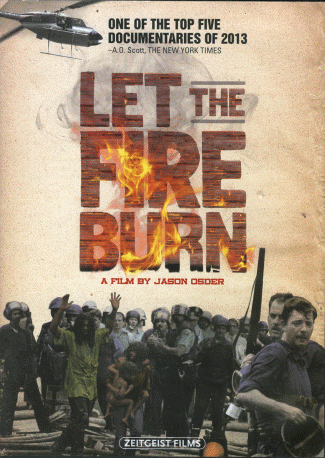
CLICK HERE TO SEE "LET THE FIRE BURN" -- ILLUSTRATED SCREENPLAY
[Pete Kane, 10 Cameraman] You can hear hollering. Where it was coming from, Larry, I don’t know.
[Michael Moses Ward] When the fire got real heavy, when we smelled all that smoke, and we couldn’t breathe, then that’s when we started yelling that “kids coming out,” and then they opened the garage door and opened the cellar window.
[William H. Brown, III] What did you say? What did you yell?
[Michael Moses Ward] We were saying, “We wanna come out!”
[William H. Brown, III] “We wanna come out”? And what did the other children do? Did they do the same thing?
[Michael Moses Ward] Yeah.
[William H. Brown, III] Were any of the children crying?
[Michael Moses Ward] Yeah. We all was.
[Black Woman] Why had you all gone to the back alley?
[Officers Terrance Mulvihill and Lawrence D’Ulisse] To prevent the escape of MOVE members.
[Black Woman] Well, what did you expect to find in that alley, the reason why you took a machine gun back there?
[Officer Terrance Mulvihill] I had no idea what to expect in the alley.
[Commission Counsel William B. Lytton, Esq.] Your vantage point was to the back of 6221. Is that correct?
[Officer Sgt. Donald Griffiths] Yes.
[Commission Counsel William B. Lytton, Esq.] All right. Was there any time that you observed either with your eyes or your ears people attempting to come out of that house?
[Officer Sgt. Donald Griffiths] I heard a female scream, “Don’t shoot. We’re coming out.” At that time, Officer Trudel, who was at the rear window – Officer Trudel said, “They’re coming out.”
[Larry, Reporter] If you look carefully, by the way – If you can take a look so I can point to the monitor here, right here is a line of stakeout squad officers, and they seem to be lined up at the ready waiting for something to happen. They seem to be waiting for something to come out of that house.
[William H. Brown, III] You said that Rad tried to take Tomaso out?
[Michael Moses Ward] Mm-hmm. He was on his knees, and he had Tomaso around his stomach like that.
[William H. Brown, III] On his knees? Was he crawling along the garage floor?
[Michael Moses Ward] Rad was.
[Officer William J. Trudel] Now, when they did come out, I see the smaller child come out, and then an adult male come out right behind them.
[Commission Counsel William B. Lytton, Esq.] Yeah.
[Officer William J. Trudel] And he stood up and aimed a rifle up in the direction of Officer Bariana’s position and fired, like four or five quick shots.
[William H. Brown, III] Did Conrad have a rifle or a gun when he went out the garage door?
[Michael Moses Ward] Mm-mmm. [No.]
[William H. Brown, III] What did he use to open the bolt on the door?
[Michael Moses Ward] A big monkey wrench.
[Commission Counsel William B. Lytton, Esq.] Are you certain it was a rifle and not a monkey wrench or something of that nature?
[Officer William J. Trudel] No, sir. When this – I know a rifle, believe me. And when this male pointed this rifle up I – In other words, I could hear sound and see muzzle flashes.
[William H. Brown, III] Now, you say that some shooting started. Did you hear shooting?
[Michael Moses Ward] It was a – [imitating gunfire]. Like it was just going after – Like it was going – bullets were going after each other. Like –
[William H. Brown, III] Bullets were going one right after the other [imitating gunfire Something like that?
[Michael Moses Ward] Yeah.
[Commission Counsel William B. Lytton, Esq.] Sergeant Griffiths, could you just by rapping on the table indicate the sound the best you can recall of those shots?
[Officer Sgt. Donald Griffiths] It was not automatic fire, if that’s what you’re asking.
[Commission Counsel William B. Lytton, Esq.] Okay, could you just try and indicate for me what it sounded like?
[Officer Sgt. Donald Griffiths] [Tapping three times]
[Commission Counsel William B. Lytton, Esq.] Did you ever fire your weapons after the bomb was dropped, Officer Mulvihill?
[Officer Terrance Mulvihill] No, sir.
[Commission Counsel William B. Lytton, Esq.] Officer D’Ulisse?
[Officer Lawrence D’Ulisse] No, sir.
[Michael Moses Ward] He had two officers taking him out, and then they started shooting again, and then they brought him back in, and then they locked the thing back up.
[Commission Counsel William B. Lytton, Esq.] Did you see the child actually go back into the house?
[Officer William J. Trudel] I believe the child went back into the house.
[Commission Counsel William B. Lytton, Esq.] All right.
[Reverend Paul Washington] Do you have any idea why that person may have gone back into the fire?
[Officer Lawrence D’Ulisse] My own idea? What I think?
[Reverend Paul Washington] Yes.
[Officer Lawrence D’Ulisse] I just think they went back into that fire sort of to regroup.
[Reverend Paul Washington] Well, just as a human being myself, I’m just trying to imagine myself in that situation, and behind me there’s a raging inferno, and in front of me there are people who are saying “come on out.” I’m trying to imagine what would cause me to turn back and run into the fire.
[Officer Lawrence D’Ulisse] I don’t think we said anything other than come down to us. Come on down with your hands up – the normal police jargon for calling the suspects to come down.
[Reverend Paul Washington] Mm-hmm. I’m just saying that I’m trying to put myself in that person’s skin.
[Officer Lawrence D’Ulisse] Sir, I don’t think you ever could. These were MOVE members.
[Reverend Paul Washington] Well, you see, I knew a lot of those people as individuals and as human beings. A lot of people know MOVE from what they may have seen. But I had a lot of dealings with them, and I knew them to be more than MOVE people. I knew many of them by name, as human beings. It’s probably a rhetorical question. I don’t think you – From the way you’ve responded, I don’t think you can answer that.
[Officer Lawrence D’Ulisse] No, sir.
[William H. Brown, III] And then what happened to Tomaso?
[Michael Moses Ward] Rhonda was going like this on his back. [Tapping]
[William H. Brown, III] Rhonda had Tomaso?
[Michael Moses Ward] Mm-hmm.
[William H. Brown, III] And she was hitting him on his back? Was he crying then?
[Michael Moses Ward] [Shakes his head no]
[William H. Brown, III] He had stopped crying? Did you hear him cry anymore after she was trying to pat him and hit him on his back?
[Michael Moses Ward] Only one time.
[William H. Brown, III] And then what happened?
[Michael Moses Ward] He stopped.
[William H. Brown, III] He stopped? And then what happened?
[Michael Moses Ward] I didn’t hear nobody, and I just ran out of there.
[Sirens Wailing]\
-- Let the Fire Burn, directed by Jason Osder
Statistics: Posted by admin — Mon Jun 22, 2015 4:55 am
]]>