[Claude Lanzmann] [Laughing assentingly, perhaps cynically]
[Benjamin Murmelstein] I'm just thinking that I'm 70 years old now. 70, according to the Bible, is the span of a human life. Anything over that is no longer the rule but the exception. Sooner or later, the problem of the Jewish Elder will be solved ...
and the dinosaur will vanish.
James Webb in his overview of the rise of occultism in the nineteenth century defined the movement as the "flight from reason" and the refuge of outmoded beliefs. [2] This latter comment is certainly true, though incomplete. Occultism in all ages has in fact been the trash heap of outmoded science and beliefs. Mesmerism and animal magnetism in the nineteenth century were pseudo-science, but they would have been regarded as true science in the days of Sir Kenelm Digby's experiments with "weapon salve" and the like in the seventeenth century. Occultism, however, is really much more than that, and the notion that it is merely a collection of dated science and a rejection of reason fails to do justice to what I believe is the real motivation driving it.
Behind the apparent credulity of occultists about the marvelous is really a more positive motivating force, a search for something rather than simply a flight from the everyday world. It is the something sought that really distinguishes the occult mentality and makes the historical study of occultism a study of one of the constants of human nature rather than a catalog of eccentricities. The fundamental notion underlying the congeries of things categorized as "occultism" is the belief that the world of everyday life is only a small part of the real world. The real world is at once vaster and more coherent, hierarchically organized, and meaningful, with intricate patterns of correspondences and relationships, and it unfolds under the dominion of its own occult ("hidden") rules and rulers. It is above all a world in which humans are no mere accident of history, economics or evolution but rather are, at least potentially, central figures in the unfolding of the cosmic drama. Humans, in other words, have within themselves the possibility of transformation, of awakening and taking up their rightful place in the world of true reality. [3]
On one level this conviction is simply an expression of the sociological truism that certain beliefs permit everyday people, the lowly, ignored and powerless, to dress up and pretend that they are secretly great figures in a cosmic drama played out beyond the ken of their neighbors. But again, while this is certainly true to some extent of occultism, it doesn't really do justice to the underlying conviction that there is more to life than meets the eye of the skeptical and that a way exists to experience the greater world and play a part in it.
This belief, of course, is constantly subject to attack and disappointment as events falsify expectation, but disappointment almost never leads to rejection of the underlying belief, which is nonfalsifiable and hence not really the subject of discourse. However, disappointment in expectations does have consequences. Certain mechanisms may be perceived at work in this book and in occultism in general, mainly defense mechanisms having to do with the reluctance of intractable everyday reality to conform to the occultist's expectations. The "guru" is revealed as merely human; the projection of the philosopher's stone fails; the medium's message is discovered to be plagiarized or simply a rehashing of platitudes. Disappointed expectations are a constant of occult life, but, despite this, hope rarely fades for the occultist, though its object frequently changes as the occultist is buffeted by the hard facts of everyday life and his goals recede from his grasp. The Reverend William Alexander Ayton (1816-1909), who figures in these pages in various guises, is exemplary of the type. In the last quarter of the nineteenth century he was a quiet, undistinguished elderly vicar living near Oxford, but in his heart was an unquenchable desire for occult realization and transformation. He spent his entire life wavering between hope for that realization and fear that it would be deferred to the next life. He was vastly learned in the literature of alchemy and had early on become a member of every group promising secret wisdom. When the Hermetic Brotherhood of Luxor (H.B. of L) -- a mail-order organization that taught Randolph's techniques of sexual magic and the use of the magic mirror after his death -- appeared, Ayton embraced it heart and soul, precisely because it promised practical means of realizing his dreams. He was devastated in 1886 when one of the leaders of the group proved to be a felon convicted of petty mail fraud. In the face of this crushing blow. however, Ayton did not even consider the possibility that his occult beliefs themselves might be delusions. The blame he felt was his own, the consequence of his (supposedly) dissolute life among the demi-mondaines around Drury Lane and Covent Garden during the Regency, and he reconciled himself to the impossibility of occult realization during this life and swore off occult societies altogether. Two years later, however, with unabated enthusiasm he became one of the early members of the Order of the Golden Dawn, giving unquestioned credence to the new revelations and undivided loyalty to yet another set of hidden masters. In the same way, the eighteenth-century alchemist, to take another example, was almost never tempted to renounce his belief in alchemy because of failure. If he failed, it was because he himself lacked some crucial bit of technical knowledge, but he never doubted that the knowledge in fact existed somewhere -- usually as the closely held secret of mysterious adepts. [4]
One universal defense against or consequence of disappointment is what the Germans felicitously call "Randvolkeridealizierung," the idealization of peripheral peoples. As it becomes inescapably clear to the individual seeker that he or she does not possess the truth or the key to obtain it, the source of the wisdom is made to recede spatially. As the bounds of the known world widened, the search of necessity led ever farther afield. The Greeks had Pythagoras and Plato seek out the wisdom of the East in Egypt; Christian Rosenkreuz, the eponymous ancestor of the Rosicrucians, had to venture to Arabia and Fez; Swedenborg in the eighteenth century and Madame Blavatsky and others in the nineteenth advised that the lost word was to be sought in Tibet and Tartary; and today the search must be made in the hidden realms of Agartha and Shamballa. Randolph appealed to this exoticism in tracing his teachings to the Near East, peopled in the popular mind with wandering dervishes and sufis.
The temporal corollary of this spatial recession of the wisdom of the East is that true wisdom is always primordial wisdom, originating and existing in its purest state in the lost golden age and descending to modern man through the unbroken chain of initiates. Randolph, like the other occultists of all ages, carefully recited the chain of prisci theologi (Melkhizedek, Zoroaster, Hermes, etc.) reaching back to the beginning whose teachings he embodied and revealed to the nineteenth century -- though Randolph like others of his contemporaries had the additional task of trying to reconcile this primordial wisdom with the then-current faith in the march of progress. Coupled with this belief in the secret transmission of wisdom from master to pupil was the idea, especially prevalent in the nineteenth century, that all of the apparently disparate remnants of mythology and antique lore were once, in some lost golden age, coherent and unified, and that their unity could yet be recovered by apprehending the lost key. In the nineteenth century it was generally agreed that this key was cosmic phallicism, the universal concern of practical and bookish occultists alike.
The corollary to this belief that the secret of reality is removed in space and time is the conviction that it is not only distant but is actually hidden -- kept pure by secret masters and superieurs inconnus, unknown superiors -- and revealed only to the worthy after long testing and travail. The mythology of occultism, alchemy, Rosicrucianism, Theosophy, and the like abounds with apparently chance encounters of earnest seekers with mysterious adepts eager to impart the secret wisdom. Sieur Paul Lucas's meeting in Broussa in 1700 with a dervish, a member of the cabal of seven who lived for centuries and met secretly every twenty years, became a commonplace of later occultism, as did Heinrich Jung-Stilling's unnamed esoteric group that convened "in Egypt, on Mount Sinai, in the Monastery of Canobin, and under the Temple at Jerusalem" -- a meeting Randolph claimed he was to attend. [5]
One consequence of all this is a sort of universal occult paranoia. If there are good secret masters, why not bad? Randolph and the other occultists of the time had to grapple with competing Brotherhoods of Light and Darkness, struggling behind the scenes for the realization of their conflicting occult designs! In the late nineteenth century, in the face of the dominant Theosophy expounded by Madame Blavatsky, the expression of this competition was thought to be the struggle between "Western" occultism (embodied in Randolph, which held that the goal of life was individualization and perpetual progress through the celestial spheres, and taught that man should actively pursue that goal through "magic") and Theosophy, or "Eastern" occultism (which taught that the goal was impersonal "nirvana" and that practical occultism and magic were fatal errors). These secret masters revealed themselves to the faithful both "astrally" (or in dreams or visions or the equivalent) and physically, and it is in the latter mode that they present a serious problem for the historian. It is one thing to relate that Randolph encountered Thotmor, "the Imperial Lord of the Imperial Order of Rosicrucia," in the "soul world." This is simply a vision, like Joan of Arc's, and as such it has a recognized place in biography. It is quite another matter to deal historically with the supposed earthly extensions and secret societies presided over by these creatures of vision -- by Thotmor or the adepts of the Inner Circle of the H.B. of L. The problem is central to Randolph's work because of his conviction that the Rosicrucian hierarchy "extended on both sides of the grave," but it is historically insoluble, and I cannot pretend to have resolved that enigma here.
The constant background of any study of Randolph and his work is this pervasive occult conspiracy theory that began to be widely accepted at the end of the nineteenth century. The theory denied accident in the growth and development of movements such as spiritualism and occultism and sought (and still seeks) its universal explanation of events in the operation of the "hidden hand," the work of the mysterious brotherhoods and unknown superiors on both sides of the grave that, by hypothesis, direct the revelation of the ancient secret doctrine to modern men. Randolph figures prominently in these theories, and to a large extent he invited the speculation by his efforts to provide a suitably exalted genealogy for his Rosicrucians in obscure Near Eastern secret orders (while at the same time disclaiming such derivation in order to emphasize his own creativity and originality).
The myth of Randolph's work as the opening salvo in the war of the occult brotherhoods against the materialism of the nineteenth century and the inanities of contemporary spiritualism is derived ultimately from the H.B. of L. as it took up his sexual magic after his death. [8] In its version of events, Randolph, Emma Hardinge Britten (a prolific writer of spiritualist works and the "editor" of the teachings of the adept "Louis"), and the mysterious Madame Blavatsky, one of the founders of the Theosophical Society, were all simply stalking horses, originally sent forth by the secret masters behind the H.B. of L to transform society by showing the poverty of materialism and demonstrating the existence of the invisible world. Behind the facts of Randolph's life and work, then, both in his own view and in that of many of his contemporaries, lies this hidden hand, and its presence must be borne in mind in what follows -- always with the caution that, in making Randolph, Britten and Blavatsky the agents or tools of the hidden hand contemporary occult mythographers never lost sight of the fact that all of them were merely tools, and flawed tools at that, of the inaccessible hidden masters. They were "half-initiated" or failed initiates, not masters themselves, chosen faut de mieux, and even their faults were convenient for the mythographers as the means of insulating the masters from the apparent errors of the movements they supposedly inspired.
Although the truth or falsity of the claims of the hidden hand conspiracy school is by definition a question that cannot be resolved by the historian, the reader will find a surprising consonance in the ideas and practices advocated by those supposed to be the hidden hand's agents in the nineteenth century -- a consonance that the skeptical will more readily explain as simple, unacknowledged borrowing by subsequent occultists.
A second defense or consequence of disappointment and failure in occultism is the retreat to even more nonfalsifiable and indeterminate goals, usually an amorphous mysticism. Disabused of expectations at every turn, frustrated occultists have often turned to the mystical. A good example of this is provided by the life of Paul Sedir (Yvon Le Loup) a central figure in the occult revival in France in the 1890s that centered on the teachings of the H.B. of L. Sedir (his occult name) is an anagram of desir and is emblematic of his overwhelming desire to realize the marvelous -- a desire, however, that was never fulfilled. In a letter to the Echo du Merveilleux in 1910, Sedir confessed:With my companions I have made the circuit of all the esoterisms and explored all the crypts with the most fervent sincerity, with the strongest hope of success. But none of the certainties thus gained has seemed to me certitude. Rabbis have given me unknown manuscripts; alchemists have admitted me to their laboratories; sufis, Buddhists, Taoists have admitted me into the abodes of their gods; a Brahman allowed me to copy his tables of mantras, and a yogi gave me the secrets of contemplation. But, one evening, everything these admirable men had taught me became in my eyes like the mist that arises at twilight from the over-heated earth."
The new revelation was the Christian mysticism of the "Maitre Philippe," a miraculous healer, in whose powers Sedir found comfort for the longings left unsatisfied by occultism.
Another defense of the frustrated or disappointed occultist consists of a retreat to what might be considered lesser but more achievable or more tangible goals -- to "phenomena" and to an arid antiquarianism. As in religion generally, occultism has always had its original visionaries, men and women who have themselves had some compelling vision of reality. Randolph himself clearly was such a person. Dependent upon these visionaries there have always been the epigoni, the followers, who believe in the possibilities expounded by the visionary teacher but who do not themselves share the transforming experience. The relationship between Plotinus and his student Porphyry is illustrative. Plotinus, as Porphyry relates, rose to the direct and immediate experience of the one reality four times in his life. Porphyry himself, however, was deprived of the experience, though he was convinced of its reality, and, in despair after years of study with Plotinus, attempted to kill himself. After Plotinus's death, he increasingly turned to the evocations and wonders of Chaldean theurgy for comfort. [10] Similarly, in the nineteenth century, almost all occultists arose originally from the ranks of spiritualism. This movement, in contrast to occultism, was almost entirely an indirect, derivative, and secondhand phenomenon in which the true believer listened passively to revelations of the beauties of the afterlife from the lips of entranced mediums. Occultism promised direct experience, and this promise that lured converts from spiritualism, but in the face of disappointed expectations it was to the tangible wonders of spiritualism (table turning, Ouija boards, and mediumship) and to trivial magic that occultists very often returned for positive reinforcement and comfort. [11] Other occultists retreated in the face of disappointment into antiquarianism and systematization, satisfied of necessity with adding learned footnotes and an ordered framework to the experiences of others and with educing hopeful instances of the marvelous through the ages. Such antiquarianism is more a confession of failure than a sign of vitality.
Randolph himself was beyond doubt an original and a visionary, and the strength of that vision sets him apart from his contemporaries -- and largely from his followers. Randolph's great contribution to the transformation of passive spiritualism and mesmerism into the active occultism of the last quarter of the nineteenth century lay precisely in the fact that he offered his readers and followers a variety of practical methods (drugs, sexual magic, and the magic mirror) that would enable them to experience for themselves the truths he taught -- or, perhaps more accurately, to elevate themselves to the transcendental plane from which they could themselves directly learn those truths. In this respect, Randolph resembles far more closely a "guru" of the 1960s than he does the majority of his bookish contemporaries.
These mechanisms of occult transformation are fairly clear, as is the fact that the world of the occultists seems to provide a home for more than its fair share of charlatanism, crack-pot ideas, and (frequently) outright mercenary frauds -- failings which Randolph himself occasionally shared as he struggled to survive in the hard world. However, none of this negates the universality of the drive that impels occultists to seek release from the world of diminished reality or detracts from the creativity (and frequent beauty) of their response to their perceived predicament. [12] Occultism is a very human phenomenon, and Randolph was instrumental in the major transformation that overtook occultism in the second half of the nineteenth century.
-- Excerpt from Preface of "Paschal Beverly Randolph: A Nineteenth-Century Black American Spiritualist, by John Patrick Deveney
The freeway will be open for cars.
[Claude Lanzmann] I don't wish that.
[Benjamin Murmelstein] In our conversation, I have already told you ...
I have the blood of an adventurer. I have never backed down in my life, especially when it had to do with my public functions, I've never backed away from danger. And you're the final danger to come my way, I hope.
But I'm not afraid of you either.
[Claude Lanzmann] But you're a tiger.
LE DERNIER DES INJUSTES
UN FILM DE CLAUDE LANZMANN
PRODUIT PAR DAVID FRENKEL, JEAN LABADIE, DANNY KRAUSZ
IMAGE: WILLIAM LUBTCHANSKY, CAROLINE CHAMPETIER A.F.C.
CHEF MONTEUSE: CHANTAL HYMANS
SON: ANTOINE BONFANTI, MANUEL GRANDPIERRE, ALEXANDER KOLLER
ASSISTANTE MISE EN SCENE: LAURA KOEPPEL
Statistics: Posted by admin — Thu Jul 02, 2015 5:51 am
]]>
[Benjamin Murmelstein] Unfortunately, yes. We learned all that later. They picked men from the last convoy. We didn't know why. They were taken to the Small Fortress. There, they waited until the urns arrived.
They worked all night emptying the urns into the Elbe.
[Claude Lanzmann] So the Nazis first wanted ...
[Benjamin Murmelstein] To get rid of the ashes, then the ghetto.
[Claude Lanzmann] Then, the ghetto.
[Benjamin Murmelstein] That's your answer.
I didn't have the right to start crying with those women.
It wasn't megalomania that obliged me to identify with the ghetto. Saving myself and saving the ghetto was more or less the same thing.
Nor can it be claimed that the WZO collaborated to save Jewish lives. After the 1938 Kristalnacht pogrom, London, hoping to ease pressure for increased Jewish immigration into Palestine, proposed that thousands of children be taken into Britain. But David Ben-Gurion, later Israel's first Prime Minister in 1948, denounced the plan on December 7, 1938:"If I knew that it would be possible to save all the children in Germany by bringing them over to England, and only half of them by transporting them to Eretz Yisrael, then I would opt for the second alternative. For we must weigh not only the life of these children, but also the history of the People of Israel."
Five days later he warned the WZO Executive:"If Jews will have to choose between the refugees, saving Jews from concentration camps, and assisting a national museum in Palestine, mercy will have the upper hand and the whole energy of the people will be channelled into saving Jews from various countries. Zionism will be struck off the agenda not only in world public opinion, in Britain and the United States, but elsewhere in Jewish public opinion. If we allow a separation between the refugee problem and the Palestinian problem, we are risking the existence of Zionism."
-- A Nazi Travels to Palestine and Tells About It In the Assault, by Lenni Brenner
[Claude Lanzmann] Everything was ...
[Benjamin Murmelstein] One implied the other.
[Claude Lanzmann] You ...
[Benjamin Murmelstein] Me and the ghetto. If it were in their interest to keep the ghetto, I was saved because I had to show it.
LastoftheUnjust05
[Claude Lanzmann] This is a very interesting question. Were you acting to save the ghetto or to save yourself?
[Benjamin Murmelstein] My God, you can't present things in that way. Of course, I was thinking of saving the ghetto. At times, they told me, "You're staying here for now." But I knew that after the visit, they would get rid of me. I did my job all the same.
And I didn't think of myself.
That said, I don't claim to have been ready to sacrifice myself and never to have thought of myself. That would be a lie. No, I thought of myself. I've already told you that. Why am I the only Elder who survived?
Because, like Scheherazade, I told stories. The ghetto needed to be restored so the story could be told.
[Claude Lanzmann] You told stories over and over.
[Benjamin Murmelstein] That's right. And when the thread of the stories was broken by the October convoys, after the first embellishment, we had to mend it, even if that meant working 70 hours a week. It was mended and the story could be told.
[Claude Lanzmann] A new embellislhment.
[Benjamin Murmelstein] The second.
[Claude Lanzmann] Do you consider yourself a hero?
[Benjamin Murmelstein] I'll tell you how I see it. I did things that others didn't do, but that doesn't make me a hero. I'm not mad. The tightrope walker who does his circus act ...
works with a net that his audience cannot see. I made some very dangerous moves ...
but never without a net. On October 5, '44, I said, "I won't prepare the convoys, do it yourselves. I'm not doing the lists." I told them that I wouldn't draw up lists.
I knew very well that they couldn't do anything to me.
Because I was the last.
Not yet the last of the unjust but the last of the guards. They had eliminated them all: Eppstein, Edelstein, Zucker. There was no one left.
If they had eliminated me, they'd have been helpless and unable to manage the ghetto. They were obliged to tolerate that. Of course, there was a risk ...
[Claude Lanzmann] They couldn't have managed alone.
[Professor Thomas Miller] [Standing and interrupting] Mr. Arendt. You're avoiding the most important part of the controversy. You claimed that less Jews would have died if their leaders hadn't cooperated.
[Hannah Arendt] This issue came up in the trial. I reported on it, and I had to clarify the role of those Jewish leaders, who participated directly in Eichmann's activities.
[Professor Thomas Miller] You blame the Jewish people for their own destruction. [Sits down angrily]
[Hannah Arendt] [Shouting] I never blamed the Jewish people! Resistance was impossible. But perhaps there is something in between resistance and cooperation. And only in that sense do I say that maybe some of the Jewish leaders might have behaved differently.
-- Hannah Arendt, directed by Margarethe von Trotta
[Benjamin Murmelstein] No.
They couldn't have managed alone. This was Theresienstadt, they could destroy it but that was out of the question.
We were weaving the thread of the story. I counted on that.
Defects of the Grade. -- While the MEMPHIS version of the ROSE-CROIX Grade is not without features of interest, its prolonged recitations are fatal to that dramatic element which is so essential to symbolism, presented in the guise of Ritual; its melange of philosophies, represented by inchoate extracts, and its chips of doctrinal thought from a variety of religious sources result in an eclecticism of the most vague and uncritical kind. In a word, it is a product of its period and is without much title to consideration at this day, while on the historical side its inventions are of the clumsiest order. The hand of the rogue in history should at least be a skilful hand.
-- The Ancient and Primitive Rite of Memphis and Misraim, Extracts from "A New Encyclopaedia of Freemasonry," by Arthur Edward Waite
Another secret about the ghetto. Only because it's you. I won't say, "Keep it to yourself," as your goal is to tell the story. A few days earlier, I had completed a project.
A speech that could possibly be read during the visit by the International Red Cross. The speech had to be presented to Himmler for him to authorize it. Just imagine it: an Elder of the Jews who has been prepared, in a way, for a visit by the International Red Cross, cannot be killed just like that.
Of course, it was risky all the same. The position of Jewish Elder was never without danger. I've always thought that where I was concerned, they had two possibilities: either gas me or present me to the Red Cross. They had the choice. It wasn't the one and the other, but the one or the other. In the end, they couldn't decide. They gave up.
[Claude Lanzmann] That's quite a choice: the gas chamber or the Red Cross.
[Benjamin Murmelstein] That's right.
LastoftheUnjust06
[Claude Lanzmann] But you had a taste for power, didn't you?
[Benjamin Murmelstein] It wasn't a matter of power. More a matter of the lack of power!
[Claude Lanzmann] It's an interesting question. Power and the lack of power.
[Benjamin Murmelstein] It was power without power. The challenge was to accomplish something without any real power. The questions of power, only an outsider could see the Elder of the Jews as having any power.
On seeing that he went every day to the Kommandantur perhaps. As if that was pleasant!
[Claude Lanzmann] Yeah. Could you describe your relations with the ghetto commander?
[Benjamin Murmelstein] Rahm.
[Claude Lanzmann] Were you under his orders?
[Benjamin Murmelstein] I'll be very honest, but you must let me speak. Because ...
[Claude Lanzmann] Yeah, yeah.
[Benjamin Murmelstein] Thank you. I was practically the only Jew -- there was one other whom I won't name -- who was allowed to sit in Eichmann's presence.
You're going to say, "That proves it! Traitor! Collaborator! What were your relations?" The reasons were purely pragmatic, not honorific. I reported to Eichmann because he had obliged me to give him correspondence lessons. (in Vienna, in 1938 and 1939) I had to stand in front of his desk. He sat, the Jew stood. I found myself standing there, looking down at him, so he stood up. But that obliged him to spend a long time standing. So, in the end, he decided to send for a chair for me. The guard at the door was Scharfuhrer Rahm. That was his title at the time. Scharfuhrer Rahm. "Bring a chair for Murmelstein, Herr Rahm."
[Claude Lanzmann] "A chair for Murmelstein, Herr Rahm."
[Benjamin Murmelstein] "A chair for Murmelstein, Herr Rahm." The years passed. That was in '38 or '39 in Vienna. In 1944 ...
Rahm had become an Obersturmfuhrer, and Murmelstein was the deputy Elder of the Jews in Theresienstadt, in charge of embellishing the town. But he never got over the complex ...
of having had to bring me a chair. Never. That was something that remained there between us.
[Claude Lanzmann] The complex of the chair.
[Benjamin Murmelstein] The complex of being allowed to sit.
[Claude Lanzmann] She's so beautiful.
[Benjamin Murmelstein] It's a Czech face. You have a young Czech girl there.
[Claude Lanzmann] Yes, but a beauty.
[Benjamin Murmelstein] Yeah!
[Claude Lanzmann] She's ready to leave on the convoy to Auschwitz.
[Benjamin Murmelstein] For the East.
[Claude Lanzmann] Yes, for the East. But today we know what Auschwitz was.
[Benjamin Murmelstein] Yes, today we know. Today we know.
[Claude Lanzmann] And you knew absolutely nothing about ...
[Benjamin Murmelstein] Listen ...
[Claude Lanzmann] Chelmno, Sobibor?
[Benjamin Murmelstein] About Chelmno and Sobibor, nothing at all.
[Claude Lanzmann] Auschwitz?
[Benjamin Murmelstein] Auschwitz? We knew Birkenau.
For us, Birkenau was a family ghetto, I already told you that.
Let's leave it at that. Everything else you mention was thought out later. Please, it's true. When the Bialystok children ...
[Claude Lanzmann] What's that story?
[Benjamin Murmelstein] In 1943, there was a plan to send Jewish children from Poland to England and Palestine and exchange them for German civilians from the Middle East. Those children arrived. We weren't told who they were or where they were from. We had to house them. We weren't supposed to talk to them. Those who spoke to them had to be isolated from the ghetto.
The doctor, the nurse and the cooks had to be isolated from the ghetto. It turned out that they needed washing for reasons of hygiene. With some difficulty, we obtained permission to wash them. That was when one child lost her identity card that was marked "Bialystok." As we washed them, something happened that we can explain today.
We didn't understand it at the time.
When the children saw the showers, they cried out, "Gas!"
[Claude Lanzmann] Gas?
[Benjamin Murmelstein] They cried, "Gas!" It's true, they cried, "Gas!" The Bialystok children cried "Gas" on seeing the showers.
[Claude Lanzmann] In Bialystok, they knew.
[Benjamin Murmelstein] Apparently, they knew something. But please ...
[Claude Lanzmann] In '43?
[Benjamin Murmelstein] That was in '43. Once they had been deloused, the children returned to the huts. Several children fell sick with a contagious disease. I still don't know what disease it was. The children were isolated in an infirmary ward with a doctor and a nurse. That was a mistake. We should have lifted isolation and sent in our doctors to run tests and analyze the situation to find out what it was. Instead of that, a doctor made sure that I couldn't help. Burger was very strict. Eppstein made sure we respected Burger's directives. And Burger solved the problem in his own way. One fine day, we found the ward empty. No more sick children, no more nurse, no more doctor. The next day, some coffins appeared at the crematorium.
The same number of coffins as the number of people missing. It was obvious what had happened. Burger had dealt with the epidemic in his own way.
[Claude Lanzmann] His own way.
[Benjamin Murmelstein] The healthy children who were left, we were told, were supposed to go abroad. We were supposed to provide them with chaperones. Personally, Eppstein didn't want to choose them.
He asked for volunteers. A Jewish youth worker from Vienna, Aaron Menczer, volunteered, as did Kafka's sister.
The sister of the writer Kafka, Ottla Kafka, volunteered.
They accompanied the children, supposedly to the West. We know today that the convoy didn't go west but east.
And that's where the story ended. Another ...
[Claude Lanzmann] And the sister, Ottla Kafka ...
[Benjamin Murmelstein] Menczer and Ottla Kafka perished with the children in Auschwitz. The children had only just left when the Danes arrived.
Interestingly, they visited a recently disinfected hut. When they were led in, you could still smell the disinfection gas. They too panicked and cried, "Gas!" They thought they were being led ...
[Claude Lanzmann] From Denmark?
[Benjamin Murmelstein] What? No, Danish Jews.
[Claude Lanzmann] From Denmark?
[Benjamin Murmelstein] Yes. Apparently, in 1943, they knew something in Denmark.
LastoftheUnjust07
[Benjamin Murmelstein] Edelstein was arrested, and we know what happened. I needed to figure out why he had been arrested.
He was arrested because he hadn't dared to say no. We had to say no, that we wouldn't pick anyone to make them leave. That had to be the Jews' principle.
You want to deport the Jews? We can't stop you. But choose them yourselves. The Nazis only cared about precise figures.
Previously, the Jewish Elders drew up all the lists. Therefore, they eased their conscience. Of course, things degenerated and led to corruption. Dispensations were granted for friends, for family reasons, for money ...
for sexual needs, for every possible reason. All kinds of things. But ...
[Claude Lanzmann] For sexual reasons too?
[Benjamin Murmelstein] Yes. All kinds of things. There's a book by Bashevis Singer, a novel, The Friends. In it, he writes, "When they say in a hundred years that the inhabitants of the ghettos were saints, there will be no greater lie." I would add: they were martyrs, but not every martyr is a saint. They were martyrs but not saints. So Edelstein applied this system to excess. He thus made friends and supporters. He said yes to everyone. When a promise wasn't kept, the person he made it to ...
was simply deported and no one bothered.
Due to his active role in the deportations and his iron rule, Rumkowski's behavior remains a topic of bitter debate.
Some historians and writers see him as a traitor and as a Nazi collaborator. In all his activities, Rumkowski displayed great zeal and organisational ability, becoming increasingly dictatorial. Rumkowski attempted to comply with Nazi demands and set up a model ghetto, overcoming opposition therein with the aid of Nazi intervention. His rule, unlike the leaders of other ghettos, was marked with abuse of his own people. He and his council had a comfortable food ration, and their own special shops. He was known to get rid of those he personally disliked by sending them to the camps. Additionally, he sexually abused vulnerable girls under his charge. Failure to succumb to his abuse meant death to the girl, as Lucille Eichengreen, who claims to have been abused by him for months as a young woman working in his office, testifies to:
"I felt disgusted and I felt angry, I ah, but if I would have run away he would have had me deported, I mean that was very clear."
-- Chaim Rumkowski, by Wikipedia
[Claude Lanzmann] But there were transports to the East.
[Benjamin Murmelstein] Yes.
[Claude Lanzmann] The people didn't know at the time ...
[Benjamin Murmelstein] People knew there was a ghetto for families in Birkenau. that's all they had been told. Perhaps you know ...
[Claude Lanzmann] The "Czech families camp?"
[Benjamin Murmelstein] The ghetto for Czech families in Birkenau. You know that the people of the September convoy were held for six months just to write cards to their relatives and friends in Theresienstadt. Everything possible ... With Freddy Hirsch, with Janowitz, with the goal of spreading the illusion in Theresienstadt that Birkenau was a subsidiary of Theresienstadt. So it's, but I wanted to tell you ...
[Claude Lanzmann] Yes, but ... Just a second. People didn't know what Birkenau was?
[Benjamin Murmelstein] No.
[Claude Lanzmann] But people were afraid of extermination.
[Benjamin Murmelstein] They knew that. It was the East. They knew. It was the East. They knew in Theresienstadt that it was bad, but that in the East it was worse than in Theresienstadt. They knew. But all the stories told after, the man who claimed to know, yet who had learned it all from novels ...
I'll tell you this and I swear it's true, we learned the truth about Auschwitz from the Slovaks. Because in '44, in summer '44, escapees from Auschwitz arrived in Slovakia. They ...
[Claude Lanzmann] Rudolf Vrba.
[Benjamin Murmelstein] The names ... You're young, you can remember names. They described everything.
We were finally convinced in April '45, when Auschwitz evacuees arrived among us and confirmed it.
There were signs, but we refused to see them. All that should have alerted us.
But, I admit it, we didn't take it seriously.
Nor can it be claimed that the WZO collaborated to save Jewish lives. After the 1938 Kristalnacht pogrom, London, hoping to ease pressure for increased Jewish immigration into Palestine, proposed that thousands of children be taken into Britain. But David Ben-Gurion, later Israel's first Prime Minister in 1948, denounced the plan on December 7, 1938:"If I knew that it would be possible to save all the children in Germany by bringing them over to England, and only half of them by transporting them to Eretz Yisrael, then I would opt for the second alternative. For we must weigh not only the life of these children, but also the history of the People of Israel."
Five days later he warned the WZO Executive:"If Jews will have to choose between the refugees, saving Jews from concentration camps, and assisting a national museum in Palestine, mercy will have the upper hand and the whole energy of the people will be channelled into saving Jews from various countries. Zionism will be struck off the agenda not only in world public opinion, in Britain and the United States, but elsewhere in Jewish public opinion. If we allow a separation between the refugee problem and the Palestinian problem, we are risking the existence of Zionism."
-- A Nazi Travels to Palestine and Tells About It In the Assault, by Lenni Brenner
Remember that a Jewish Council was a "democratic body" where we voted. Each man voted according to his interests.
Each one had his list of proteges, you understand? For each child that left, one of the proteges on the Jewish Council's list stayed. You understand? And I couldn't, without any authority ...
I was the evil one, the bad one, the one hated and feared, there was nothing I could do. The only thing I could do was ...
the people who hated and dreaded me, on the departure of the first 5,000 people in October didn't dare to cause the usual trouble because I sent for them and told them, anyone who takes a name off the list will go instead. You can do that.
You can remove a name. But yours will go in its place. Otherwise, remove nothing. Or you go in their place. Love of one's fellow man didn't go that far.
LastoftheUnjust08
An Elder of the Jews can be condemned. In fact, he must be condemned. But he can't be judged. Because one cannot take his place. Condemned, yes. For an Elder of the Jews is among those executed. If he doesn't poison himself. An Elder of the Jews, after the war ...
is like a dinosaur on a freeway. Put a dinosaur on a modern freeway. All the lights and road signs will be lost. A Jewish Elder is like that after the war. He clashes with everyone, with the Germans and the Jews. The Germans had destroyed all the documents that contained clues as to their guilt. The Elder of the Jews knew more than all the documents. And when one is left ...
[Claude Lanzmann] Yes, but you're the only Jewish Elder who survived. Don't you see a deep meaning in that?
[Benjamin Murmelstein] It's absurd.
[Claude Lanzmann] It's absurd. Yes, but there are people In Israel, like Gershom Scholem, for example, who thought and wrote ...
that Murmelstein deserved to be hanged by the Jewish people.
[Benjamin Murmelstein] You see, a long time ago Mrs. Arendt's reply to a letter that I wrote to her was published in the Neue Zuricher Zeitung. And then I replied to it in the same paper. Do you want to know what I think of it?
[Claude Lanzmann] Yes!
[Benjamin Murmelstein] You see, I could ...
[Claude Lanzmann] Is it one of the reasons why you've never been to Israel?
[Benjamin Murmelstein] No, it's not that but you see, no, I told you the reason why. It was simple because ...
I considered that Israel wasn't competent to try me. Israel would have been competent if they had done it right away. But after they had handed me over to the Czechs, hoping that they would hang me, and after the Czechs had said that there was nothing against me, I had no desire to start all over again. But where Scholem is concerned, by dear friend, I hope you don't mind me calling you "dear friend." It's just a manner of speaking.
[Claude Lanzmann] I hope it's not just a manner of speaking!
[Benjamin Murmelstein] That's how it is! Scholem is a great scholar. 40 years ago, I published a "History of the Jews." At the time, he was still called Gerhard Scholem. And I wrote in the introduction that the works of Gerhard Scholem allowed for an entirely new approach to certain assessments of Jewish history.
[Claude Lanzmann] Oh, yeah?
[Benjamin Murmelstein] I haven't changed my opinion. He is a very great scholar. I would even say that I compare him ...
to Sigmund Freud. A flattering comparison. Sigmund Freud was certainly a great man. One of the greatest Jews who ever lived. But Freud, who was such an expert in medicine and psychoanalysis, ventured into the field of Bible scholarship ...
and wrote a total stupidity about Moses.
Let us start from the assumption that Moses was an aristocratic and prominent man, perhaps in fact a member of the royal house, as the legend says of him. He was undoubtedly aware of his great capacities, ambitious and energetic; he may even have played with the notion of one day being the leader of his people, of becoming the kingdom's ruler. Being close to the Pharaoh, he was a convinced adherent of the new religion, whose basic thoughts he had made his own. When the king died and the reaction set in, he saw all his hopes and prospects destroyed; if he was not prepared to abjure all the convictions that were so dear to him, Egypt had nothing more to offer him -- he had lost his country. In this predicament he found an unusual solution. Akhenaten the dreamer had alienated his people and let his empire fall to pieces. The more energetic nature of Moses was more at home with the plan of founding a new kingdom, of finding a new people to whom he would present for their worship the religion which Egypt had disdained. It was, we can see, a heroic attempt to combat destiny, to compensate in two directions for the losses in which Akhenaten's catastrophe had involved him. Perhaps he was at that time Governor of the frontier province (Goshen) in which certain Semitic tribes had settled (perhaps as early as in the Hyksos period). These he chose to be his new people -- a historic decision. He came to an agreement with them, put himself at their head and carried the Exodus through 'by strength of hand'....
The Jews with whom he departed from his country were to serve him as a superior substitute for the Egyptians he had left behind. On no account must the Jews be inferior to them. He wished to make them into a 'holy nation', as is expressly stated in the Biblical text, and as a mark of this consecration he introduced among them too the custom which made them at least the equals of the Egyptians [circumcision]. And he could only welcome it if they were to be isolated by such a sign and kept apart from the foreign peoples among whom their wanderings would lead them, just as the Egyptians themselves had kept apart from all foreigners.
Later on, however, Jewish tradition behaved as though it were put at a disadvantage by the inference we have been drawing. If it were to be admitted that circumcision was an Egyptian custom introduced by Moses, that would be almost as much as to recognize that the religion delivered to them by Moses was an Egyptian one too. There were good reasons for denying that fact, so the truth about circumcision must also be contradicted....
We will borrow from Sellin his hypothesis that the Egyptian Moses was murdered by the Jews and the religion he had introduced abandoned. This allows us to spin our threads further without contradicting the authentic findings of historical research .... But we shall certainly not be going wrong if we assume, with the majority of the authorities, that only a fraction of what was later to be the Jewish people had experienced the events in Egypt. In other words, the tribe that returned from Egypt joined up later, in the stretch of country between Egypt and Canaan, with other kindred tribes, which had been settled there for a considerable time. This union, from which sprang the people of Israel, found expression in the adoption of a new religion, common to all the tribes, the religion of Yahweh -- an event which, according to Eduard Meyer, took place under Midianite influence at Kadesh....
There can be no doubt that very different elements came together in the construction of the Jewish people; but what must have made the greatest difference among these tribes was whether they had experienced or not the sojourn in Egypt and what followed it. Having regard to this point, we may say that the nation arose out of a union of two component parts; and it fits in with this that, after a short period of political unity, it split into two pieces -- the kingdom of Israel and the kingdom of Judah .... our knowledge of those times is too uncertain to allow us to assert that the settled tribes were once more to be found together in the Northern Kingdom and those who had returned from Egypt in the Southern Kingdom; but here too the later split cannot have been unrelated to the earlier joining up. The former Egyptians were probably fewer in numbers than the others, but showed themselves culturally the stronger. They exercised a more powerful influence on the further evolution of the people, because they brought along with them a tradition which the others lacked ....
Perhaps they brought something else with them more tangible than a tradition. One of the greatest enigmas of Jewish prehistory is that of the origin of the Levites. They are traced back to one of the twelve tribes of Israel -- that of Levi -- but no tradition has ventured to say where that tribe was originally located or what portion of the conquered land of Canaan was allotted to it. They filled the most important priestly offices, but they were distinct from the priests. A Levite is not necessarily a priest; nor is it the name of a caste. Our hypothesis about the figure of Moses suggests an explanation. It is incredible that a great lord, like Moses the Egyptian, should have joined this alien people unaccompanied. He certainly must have brought a retinue with him -- his closest followers, his scribes, his domestic servants. This is who the Levites originally were. The tradition which alleges that Moses was a Levite seems to be a clear distortion of the fact: the Levites were the followers of Moses. This solution is supported by the fact which I have already mentioned in my earlier essay that it is only among the Levites that Egyptian names occur later. It is to be presumed that a fair number of these followers of Moses escaped the catastrophe which descended on him himself and the religion he founded. They multiplied in the course of the next generations, became fused with the people they lived among, but remained loyal to their master, preserved his memory and carried out the tradition of his doctrines. At the time of the union with the disciples of Yahweh they formed an influential minority, culturally superior to the rest ....
What happened at Kadesh was a compromise, in which the share taken by the tribes of Moses is unmistakable.
Here we may once again call on the evidence afforded by circumcision, which has repeatedly been of help to us, like, as it were, a key-fossil. This custom became obligatory in the Yahweh religion as well and, since it was indissolubly linked with Egypt, its adoption can only have been a concession to the followers of Moses, who -- or the Levites among them -- would not renounce this mark of their holiness. So much of their old religion they wished to rescue, and in return for it they were prepared to accept the new deity and what the priests of Midian told them about it ....
As we know, critical Biblical research supposes that the Hexateuch has two documentary sources. These are distinguished as J and E, because one of them uses 'Jahve [Yahweh]' as the name of God and the other 'Elohim': 'Elohim', to be sure, not 'Adonai'. But we may bear in mind a remark by one of our authorities: 'The different names are a clear indication of two originally different gods.'
We brought up the retention of circumcision as evidence for the fact that the founding of the religion at Kadesh involved a compromise. We can see its nature from the concordant accounts given by J and E .... Since the followers of Moses attached so much value to their experience of the Exodus from Egypt, this act of liberation had to be represented as due to Yahweh, and the event was provided with embellishments which gave proof of the terrifying grandeur of the volcano god -- such as the pillar of smoke [cloud] which changed at night into a pillar of fire and the storm which laid bare the bed of the sea for a while, so that the pursuers were drowned by the returning waters. This account brought the Exodus and the founding of the religion close together, and disavowed the long interval between them. So, too, the law-giving was represented as occurring not at Kadesh but at the foot of the Mount of God, marked by a volcanic eruption. This account, however, did grave injustice to the memory of the man Moses; it was he and not the volcano god who had liberated the people from Egypt. So a compensation was owing to him, and it consisted in the man Moses being transferred to Kadesh or to Sinai-Horeb and put in the place of the Midianite priests. We shall find later that this solution satisfied another imperatively pressing purpose. In this manner a mutual agreement, as it were, was arrived at: Yahweh, who lived on a mountain in Midian, was allowed to extend over into Egypt, and, in exchange for this, the existence and activity of Moses were extended to Kadesh and as far as the country east of the Jordan. Thus he was fused with the figure of the later religious founder, the son-in-law of the Midianite Jethro, and lent him his name of Moses .... We are, I think, justified in separating the two figures and in assuming that the Egyptian Moses was never at Kadesh and had never heard the name of Yahweh, and that the Midianite Moses had never been in Egypt and knew nothing of Aten. In order to solder the two figures together, tradition or legend had the task of bringing the Egyptian Moses to Midian ....
Once again I am prepared to find myself blamed for having presented my reconstruction of the early history of the people of Israel with too great and unjustified certainty. I shall not feel very severely hit by this criticism, since it finds an echo in my own judgement. I know myself that my structure has its weak spots, but it has its strong points too. On the whole my predominant impression is that it is worth while to pursue the work in the direction it has taken ....
As we have said, with the setting-up of the new god, Yahweh, at Kadesh, it became necessary to do something to glorify him. It would be more correct to say: it became necessary to fit him in, to make room for him, to wipe out the traces of earlier religions. This seems to have been achieved with complete success as regards the religion of the resident tribes: we hear nothing more of it. With those returning from Egypt it was not such an easy matter; they would not let themselves be deprived of the Exodus, the man Moses or circumcision. It is true that they had been in Egypt, but they had left it, and thenceforward every trace of Egyptian influence was to be disavowed. The man Moses was dealt with by shifting him to Midian and Kadesh, and by fusing him with the priest of Yahweh who founded the religion. Circumcision, the most suspicious indication of dependence on Egypt, had to be retained but no attempts were spared to detach the custom from Egypt -- all evidence to the contrary. It is only as a deliberate denial of the betraying fact that we can explain the puzzling and incomprehensibly worded passage in Exodus, according to which on one occasion Yahweh was angry with Moses because he had neglected circumcision, and his Midianite wife saved his life by quickly carrying out the operation. We shall presently come across another invention for making the uncomfortable piece of evidence harmless. The fact that we find signs of efforts being made to deny explicitly that Yahweh was a new god, alien to the Jews, can scarcely be described as the appearance of a fresh tendentious purpose: it is rather a continuation of the former one. With this end in view the legends of the patriarchs of the people -- Abraham, Isaac and Jacob -- were introduced. Yahweh asserted that he was already the god of these forefathers; though it is true that he himself had to admit that they had not worshipped him under that name. He does not add, however, what the other name was.
And here was the opportunity for a decisive blow against the Egyptian origin of the custom of circumcision: Yahweh, it was said, had already insisted on it with Abraham and had introduced it as the token of the covenant between him and Abraham ....
The god Yahweh, to whom the Midianite Moses then presented a new people, was probably in no respect a prominent being. A coarse, narrow-minded, local god, violent and bloodthirsty, he had promised his followers to give them 'a land flowing with milk and honey' and urged them to exterminate its present inhabitants 'with the edge of the sword'. It is astonishing how much remains, in spite of all the revisions of the Biblical narratives, that allows us to recognize his original nature. It is not even certain that his religion was a genuine monotheism, that it denied the divinity of the deities of other peoples. It was enough probably that his people regarded their own god as more powerful than any foreign god .... The Egyptian Moses had given to one portion of the people a more highly spiritualized notion of god, the idea of a single deity embracing the whole world, who was not less all-loving than all-powerful, who was averse to all ceremonial and magic and set before men as their highest aim a life in truth and justice .... The god Yahweh had arrived at undeserved honour when, from the time of Kadesh onwards, he was credited with the deed of liberation which had been performed by Moses; but he had to pay heavily for this usurpation. The shadow of the god whose place he had taken became stronger than himself; by the end of the process of evolution, the nature of the forgotten god of Moses had come to light behind his own. No one can doubt that it was only the idea of this other god that enabled the people of Israel to survive all the blows of fate and that kept them alive to our own days.
It is no longer possible to estimate the share taken by the Levites in the final victory of the Mosaic god over Yahweh. They had taken the side of Moses in the past, when the compromise was reached at Kadesh, in a still live memory of the master whose retinue and compatriots they had been. During the centuries since then they had become merged with the people or with the priesthood, and it had become the main function of the priests to develop and supervise the ritual, and besides this to preserve the holy writ and revise it in accordance with their aims. But was not all sacrifice and all ceremonial at bottom only magic and sorcery, such as had been unconditionally rejected by the old Mosaic teaching? Thereupon there arose from among the midst of the people an unending succession of men who were not linked to Moses in their origin but were enthralled by the great and mighty tradition which had grown up little by little in obscurity: and it was these men, the Prophets, who tirelessly preached the old Mosaic doctrine -- that the deity disdained sacrifice and ceremonial and asked only for faith and a life in truth and justice (Ma'at). The efforts of the Prophets had a lasting success; the doctrines with which they re-established the old faith became the permanent content of the Jewish religion. It is honour enough to the Jewish people that they could preserve such a tradition and produce men who gave it a voice -- even though the initiative to it came from outside, from a great foreigner.
-- Moses and Monotheism, by Sigmund Freud
Weizmann, the prestigious scientist and President of the WZO, who was well connected in London, did next to nothing for German Jewry. He had never liked them, nor did he have any sympathy for their defence efforts against anti-Semitism. As early as 18 March 1912 he had actually been brazen enough to tell a Berlin audience that 'each country can absorb only a limited number of Jews, if she doesn't want disorders in her stomach. Germany already has too many Jews.’ In his chat with Balfour, in 1914, he went further, telling him that 'we too are in agreement with the cultural anti-Semites, in so far as we believed that Germans of the Mosaic faith are an undesirable, demoralizing phenomena’.
-- Zionism in the Age of the Dictators: A Reappraisal, by Lenni Brenner
Statistics: Posted by admin — Thu Jul 02, 2015 4:36 am
]]>
They thought that I'd be neutralized. They were sure of that. The first few weeks, I was at a total loss. I'll give you an example of the way in which political problems could arise. Vienna and Cologne brought lice to Theresienstadt. Why? Some convoys waited for months before leaving. They brought lice with them.
When someone had lice, he was taken to an old barrack, and he was left to croak there with the others. I sent for a certain Dr. Pick, an expert in delousing. He wasn't sure whether to come or not. But he quickly understood that you don't joke with me.
So he came and I told him, "You're a delousing expert, and you get rid of them by letting people croak? Can't we set up a delousing station?" He said, "Maybe." I told him, "If you can't do it, I'll find someone else." Dr. Pick explained that the difficulty lay in the fact that no place had been set aside for delousing. A sanitary place reserved for that. Without it, people caught lice again. So I went to the technical department, my second department. I asked, "What are we doing with the attics?" "We're keeping them vacant for now to make favored accommodation." I said, "From today on, no more favored accommodation without my authorization. If you do that, Edelstein or not Edelstein, I'll grab you by the neck, drag you from your desk, and you'll never come back. Without my signature, there won't be any favored accommodation." "What do we do with the attics?" "I'm going to tell you. You don't like it? Then resign.
I'm in charge here." Then I drew up the plans with him to prepare the attics to house old people. And people ...
[Claude Lanzmann] Were there a lot of old people?
[Benjamin Murmelstein] Yes, several thousand old people. We started by moving the old people with lice to the attics that had been renovated. They slept in clean beds and we sent nurses to tend to them. It became clear that the technical and health departments were highly political areas. The delousing facility in the Jagerkaserne functioned perfectly. In Theresienstadt, those who weren't indispensable were in danger.
I had a bad reputation. They said I was a bigmouth and mean. Pick wanted to convince me of his talents, of which he had many. He knew a lot. He was an expert. He built a model delousing station. And it worked. But I made my first enemies. Those who were expected to move into the attic apartments went around complaining about me.
There was also discord and anger, "Machloike" in Yiddish, with Eppstein. He had allocated attic apartments and I had blocked that.
I had requisitioned them for the old people. This led to arguments.
But the old were taken care of. They no longer slept on the floor, but in beds with clean sheets, cared for by nurses.
Subsequently, the health department became highly political. A typhus epidemic broke out. Eichmann came rushing to Theresienstadt. But he didn't summon me.
My colleagues made sure that he didn't. The health department was me. If anything had to be justified, I was there to take responsibility.
They kept the honor of speaking to Eichmann for themselves. They didn't want me to see Eichmann. They were afraid I would get on with him...
and, because of our past relations, would complain about them.
[Claude Lanzmann] Past relations?
[Benjamin Murmelstein] That's right. They feared, wrongly, that I would --
I never called Eichmann to settle scores with other Jews. That was my rule. They came back and told me, as an order from Eichmann ...
[Claude Lanzmann] Who? Edelstein?
[Benjamin Murmelstein] And Eppstein. They went together, keeping an eye on each other, so as to be able to testify once the war would be over.
For them, it was a nightmare that the war would end one day and that they'd have to say what they had done or not, what they had said or not. They were each other's witness. I went alone because I didn't think of that day.
I thought, "Today's the day when something must occur." Which would happen.
[Claude Lanzmann] That's surprising. Only today?
[Benjamin Murmelstein] Only today. Something could only happen to me. Then, I had to think of the community. That was more important. We would see what would happen to me. I was simply thinking of a way to find a solution. So they went off together, they came back and they told me, "Eichmann sends word that if the typhus epidemic isn't halted, the ghetto will be burned. You're considered responsible.
There are Aryans near here and if the ghetto is a risk, it will be burned." They said, "You're responsible."
What solidarity! I sent for Munk the head of sanitary services. "Did you hear that?" "Yes," he said. I told him, "You haven't come to see me before because you had orders not to work with me. But I'm warning you, if they hang me or send me to Auschwitz" -- at the time, we said Birkenau, we didn't know Auschwitz -- "because of the typhus epidemic, you'll go two days before me.
I'm warning you." He told me, "We need to start a vaccination program. But people refuse the shots. They're undisciplined. I told him, "Let me think. Come back later or this evening. I'll tell you what to do." He said, "What do you hope to do? You know what Jews are like. They're afraid of vaccination." I told him to come back and we talked about it again. We hired a hygiene expert who was there. And we decided on a very simple thing. People had ration cards. Every day, when they came for their meal, a coupon was torn off their card. A monthly card with a coupon for each day. I said, "Anyone who doesn't have a vaccination stamp on their card will not get to eat."
[Claude Lanzmann] You decided on that?
[Benjamin Murmelstein] Together. Not me personally. The idea came to us all. And I approved it. I was accused of trying to starve people.
No, I refused to let them die of typhus. It had to be eradicated. I said, "As of tomorrow, we declare no more new cases of typhus. As of tomorrow, we note: diarrhea." I halted the reports.
[Claude Lanzmann] Diarrhea.
[Benjamin Murmelstein] We wrote that down instead.
[Claude Lanzmann] That was progress.
[Benjamin Murmelstein] Yes, we just noted "diarrhea." Typhus disappeared from the world. You have to defeat the enemy with his own weapons.
Lies, in Theresienstadt, had more value that elsewhere. The people had to know that I was following it all closely. I'd go into the kitchens, I'd watch what was going on. The cooks were real characters. But if someone dared to reprimand them in front of others, they'd soon pipe down. If they were told they'd be fired from a job that allowed them to eat, they'd be scared. And so the people were obliged to get vaccinated.
And, within three weeks, the epidemic started to die down. And we discovered that the source of the epidemic was one of the cooks. The epidemic was halted.
I had a reputation as a mean man. I was accused of depriving the people of food.
LastoftheUnjust03
[Claude Lanzmann] It's very hard to understand, I think. Why did you take the decision to accept the responsibility of embellishing the town? After all, it was a farce, serving Nazi propaganda, wasn't it?
[Benjamin Murmelstein] You're right. You're playing the prosecutor. I agreed to do it for two reasons. I thought, if they give me wood for beds, cupboards and tables, I'll take it. If they give me glass for the windows, I'll take it. I'll use all that. If we need to renovate the old people's rooms, I'll do it. You read me something about Adler referring to Falstaff. I'd compare myself to another classical literary character.
Neither Roland from Orlando Furioso ...
Ruggiero Rescuing Angelica by Gustave Doré.
Orlando Furioso (The Frenzy of Orlando, more literally Raging Roland) (in Italian furioso is seldom capitalized) is an Italian epic poem by Ludovico Ariosto which has exerted a wide influence on later culture. The earliest version appeared in 1516, although the poem was not published in its complete form until 1532. Orlando Furioso is a continuation of Matteo Maria Boiardo's unfinished romance Orlando Innamorato ("Orlando in Love", published posthumously in 1495). Orlando is the Christian knight known in English as Roland. The action takes place against the background of the war between Charlemagne's Christian paladins and the Saracen army that is attempting to invade Europe. The poem is about war and love and the romantic ideal of chivalry. It mixes realism and fantasy, humor and tragedy.[1] The stage is the entire world, and it also includes a trip to the moon. The large cast of characters include Christians and Saracens, soldiers and sorcerers, and fantastic creatures including a gigantic sea monster called the orc and a flying horse called the hippogriff. Many themes are interwoven in its complicated episodic structure, but the most important are the paladin Orlando's unrequited love for the pagan princess Angelica, which drives him mad....
The English knight Astolfo journeys to Ethiopia on the hippogriff to find a cure for Orlando's madness.
He flies up to the moon (in Elijah's flaming chariot no less) where everything lost on earth is to be found, including Orlando's wits. He brings them back in a bottle and makes Orlando sniff them, thus restoring him to sanity. (At the same time Orlando falls out of love with Angelica, as the author explains that love is itself a form of insanity.)...
Orlando Furioso is mentioned among the romances in Don Quixote. Among the interpolated stories within Don Quixote is a retelling of a tale from canto 43 regarding a man who tests the fidelity of his wife.
-- Orlando Furioso, by Wikipedia
nor El Cid.
Rodrigo Díaz de Vivar (c. 1043 – 1099) was a Castilian nobleman and military leader in medieval Spain. He was called El Cid (the Lord) by the Moors and El Campeador (the Champion) by Christians. He is the otherwise real but made legendary national hero of Castile. He was born in Vivar del Cid, a town near the city of Burgos.
Born a member of the minor nobility, El Cid was brought up at the court of King Ferdinand the Great and served in the household of Ferdinand's son Sancho. He rose to become commander and the royal standard-bearer (armiger regis) of Castile upon Sancho's ascension in 1065. He went on to lead the Castilian military campaigns against Sancho's brothers, the rulers of the kingdoms of Leon and Galicia as well as against the Muslim kingdoms in Andalusia. He became famous for his military prowess in these campaigns, and helped enlarge Castilian territory at the expense of the Muslims while driving Sancho's brothers from their thrones. This, however, ended up putting him in a difficult position when suddenly, in 1072, Sancho was murdered and with no legitimate issue, leaving his recently ousted brother, Alfonso, as his only heir and ruler of the reunified empire. Although El Cid continued to serve the crown in the person of Alfonso, who was now Emperor of Spain, he lost his status in court and was held in suspicion. Finally, in 1081, he was ordered into exile.
Rodrigo Díaz found work fighting for the Muslim rulers of Zaragoza, whom he protected from the domination of Aragon and Barcelona, further bolstering his military record and reputation as a leader. He was also victorious in battles against the Muslim rulers of Lérida and their Christian allies, as well as against a large Christian army under King Sancho Ramírez of Aragon. In 1086, Alfonso was defeated by Almoravids from North Africa, and he overcame his antagonism to talk de Vivar into fighting for him again. Over the next several years El Cid set his sights on the kingdom-city of Valencia, operating more or less independently of Alfonso while politically supporting the Banu Hud and other Muslim dynasties opposed to the Almoravids. He gradually increased his control over Valencia; the Islamic ruler, al-Qadir, became his tributary in 1092. However, the Almoravids instigated an uprising that resulted in the death of al-Qadir – he responded by laying siege to the city. Valencia finally fell in 1094 and El Cid established an independent principality in the eastern Mediterranean coast of Spain. He ruled over a pluralistic state with the popular support of both Christians and Muslims.
The final years of El Cid were spent in fighting the Almoravid Berbers. He inflicted the first major defeat on them in 1094 in the plains of Caurte outside Valencia and continued resisting them until his death. Although El Cid himself remained undefeated in Valencia, he suffered a tragedy when his only son and heir, Diego Rodríguez, died fighting against the Almoravids in the service of Alfonso in 1097. After El Cid's death in 1099, his wife, Jimena Díaz, succeeded him as ruler of Valencia, but she had to surrender the principality to the Almoravids in 1102.
-- El Cid, by Wikipedia
Do you know who?
Sancho Panza!
x
Don Quixote Eichmann and Sancho Panza Murmelstein, by Tara Carreon
Sancho Panza [ˈsantʃo ˈpanθa] is a fictional character in the novel Don Quixote written by Spanish author Don Miguel de Cervantes Saavedra in 1605. Sancho acts as squire to Don Quixote, and provides comments throughout the novel, known as sanchismos, that are a combination of broad humour, ironic Spanish proverbs, and earthy wit. "Panza" in Spanish means "belly" (cf. English "paunch," Italian "pancia", several Italian dialects "panza").
Before a fit of madness turned Alonso Quijano into Don Quixote, Sancho Panza was indeed his servant. When the novel begins Sancho has been married for a long time to a woman named Teresa Cascajo[1] and has a daughter, María Sancha (also named Marisancha, Marica, María, Sancha and Sanchica), who is said to be old enough to be married. Sancho's wife is described more or less as a feminine version of Sancho, both in looks and behaviour. When Don Quixote proposes Sancho to be his squire, neither he nor his family strongly oppose it.
Sancho is illiterate and proud of it but by influence of his new master he develops considerable knowledge about some books. Sancho instead provides the earthly wisdom of Spanish proverbs, surprising his master. During the travels with Don Quixote he keeps contact with his wife by dictating letters addressed to her.
Sancho Panza offers interpolated narrative voice throughout the tale, a literary convention invented by Cervantes. Sancho Panza is precursor to "the sidekick," and is symbolic of practicality over idealism. Sancho is the everyman, who, though not sharing his master's delusional "enchantment" until late in the novel, remains his ever-faithful companion realist, and functions as the clever sidekick. Salvador de Madariaga detected that, as the book progresses, there is a "Quixotization" of Sancho and a "Sanchification" of Don Quixote, so much that, when the knight recovers sanity on his deathbed, it is Sancho who tries to convince him to become pastoral shepherds.
In the novel, Don Quixote comments on the historical state and condition of Aragón and Castilla, which are vying for power in Europe. Sancho Panza represents, among other things, the quintessentially Spanish brand of skepticism of the period.
Sancho obediently follows his master, despite being sometimes puzzled by Quixote's actions. Riding a donkey, Dapple, he helps Quixote get out of various conflicts while looking forward to rewards of aventura that Quijote tells him of.
-- Sancho Panza, by Wikipedia
[Benjamin Murmelstein] He's pragmatic and calculating while others are tilting at windmills. He's a calculating realist with both feet on the ground.
That was a minor digression.
Say hello to Adler from me. He can correct the third edition.
The WZO was not interested in fighting the Nazis, and every defence of the Ha'avara scheme demonstrated that. Selig Brodetsky, one of the members of the Zionist Executive and later, in 1939, the President of the British Board of Deputies, rebuked the world for scorning them:
Congress had risen to a level to which few Jewish bodies could have risen. It was a very easy thing to use violent words, to organise meetings, to call boycotts, but it was a far more difficult thing to speak calmly and use cool reasoning. It was said that the decisions concerning Germany were too weak. No! Non-Jews could afford to use strong words, but Jews could not.
It was not the Zionists who were the traitors, it was everyone else that was out of step -- or so at least Moshe Beilenson, a leading Labour Zionist, would have had the world believe. This had not been his first effort at collaboration with Fascism. In 1922 he had been one of the delegation that pledged Italian Zionism's loyalty to Mussolini. Now he tried to present a theoretical defence of the Nazi pact:
after the Ghetto walls had been overthrown, our main weapon for the defense of our lives and our rights was the protest… All our protests in the course of decades did not succeed in destroying the reign of persecution not only in the vast empire of the Tsars, but even in the relatively tiny Rumania…
The Congress did not 'betray'; it triumphed. It was not 'afraid'; on the contrary, it had the courage to initiate a new Jewish statesmanship… Verily, the Eighteenth Congress had the courage to destroy the assimilationist tradition whose chief characteristic is a reliance on others and appeals to others… For generations we fought by means of protests. Now we have another weapon in our hand, a strong, trusty and sure weapon: the visa to Palestine.
-- Zionism in the Age of the Dictators: A Reappraisal, by Lenni Brenner
Personally, I thought the following:
Eichmann wanted to make something of Theresienstadt. If we could bring him to show Theresienstadt to someone, that would be an anchor. Theresienstadt could no longer vanish.
That meant we had to prostitute ourselves and play along with the farce until Theresienstadt was shown. Then it could no longer vanish. It was a safety factor. In the ghetto, there was a second aspect to the town's embellishment. Theatrical performances, film screenings, etc. I wasn't in charge of all that. Leisure activities were organized by Eppstein.
He liked to play the part of a sort of "serenissimus," a prince of the Middle Ages ...
a patron of the arts surrounded by his court, artists, etc. I stayed out of all that. But I took things in hand where work matters were concerned. And even after the visit of the Danish Red Cross, I kept on working on the town's embellishment. And again after October. I believe the ghetto kept going above all thanks to embellishment.
[Claude Lanzmann] But it was all a smokescreen for the Danish Red Cross.
[Benjamin Murmelstein] First Danish, then International. At that time, in Germany, carriages were closed off with boards because there was no glass. Yet we obtained 1,000 m2 of glass. In '44, we had 5,000 m3 of wood for our work.
We had to renovate the old peoples' rooms, the young people's hostels. Yes, it was propaganda, and that suited me because they had to show us. If they hid us, they could kill us. If they showed us, they couldn't. Logical!
That was my logic and I hope that my logic was right.
x
The Chinese have a phrase, "Masquerading as a swine to kill the tiger." This refers to an ancient hunting technique in which the hunter clothes himself in the hide and snout of a pig, and mimics its grunting. The mighty tiger thinks a pig is coming his way, and lets it get close, savoring the prospect of an easy meal. But it is the hunter who has the last laugh.
Masquerading as a swine works wonders on those who, like tigers, are arrogant and overconfident: The easier they think it is to prey on you, the more easily you can turn the tables. This trick is also useful if you are ambitious yet find yourself low in the hierarchy: Appearing less intelligent than you are, even a bit of a fool, is the perfect disguise. Look like a harmless pig and no one will believe you harbor dangerous ambitions. They may even promote you since you seem so likable, and subservient. Claudius before he became emperor of Rome, and the prince of France who later became Louis XIII, used this tactic when those above them suspected they might have designs on the throne. By playing the fool as young men, they were left alone. When the time came for them to strike, and to act with vigor and decisiveness, they caught everyone off-guard.
Intelligence is the obvious quality to downplay, but why stop there? Taste and sophistication rank close to intelligence on the vanity scale; make people feel they are more sophisticated than you are and their guard will come down. As Arnold and Slack knew, an air of complete naivete can work wonders. Those fancy financiers were laughing at them behind their backs, but who laughed loudest in the end? In general, then, always make people believe they are smarter and more sophisticated than you are. They will keep you around because you make them feel better about themselves, and the longer you are around, the more opportunities you will have to deceive them.
Image:
Death is the opossum’s natural habitat. It has a lifespan of only two to four years, unusual for a mammal of its size. Its success in North America as the only non-placental mammal depends largely on its opportunistic, omnivorous diet, its near immunity to snake venom, and its ability to pop out up to 13 little opossumplings at a time. The semi-prehensile tail (not strong enough to hang from as an adult, but still useful for climbing) is unique to animals north of Mexico, and both the pouch and the bifurcated genitalia common to marsupials is unheard of for any other North American mammal. But the real ace up their sleeve is their penchant for histrionic fainting. It’s called “playing possum,” but there’s nothing playful about it. When presented with extreme danger, an involuntary set of physiological changes takes place in the opossum, starting with the loss of consciousness. Their teeth are bared and mouth foams in a facsimile of the dead man’s grin, and they effect the stiffness of rigor mortis. Now, you would think that fainting in front of a predator would simply save it the work of killing you, turning you into furry fast food. But the possum puts a convincing final touch on its death throes: a musk emitted from its anal gland that makes him smell like he’s decomposing. If the skunk’s putrid scent is enough to deter most predators, why does the opossum bother with the whole pseudocidal ruse? Because many animals have taboos surrounding death, too. Let’s pretend you are a great horned owl, which has no real sense of smell and therefore no problem picking off an angry skunk. You see an opossum, apparently dead, curled below a tree. How long has it been dead? Like, a day? You can deal with day-old possum. But what if it’s been, like, two weeks? How long has this Chinese food been sitting in the fridge? Better to just throw the whole thing out rather than risk a night driving the porcelain schoolbus. There’s a better name for this phenomenon: Thanatosis. It’s a form of self-mimesis; instead of mimicking another creature, the animal mimics the dead version of itself. The act of feigning death isn’t limited to opossums: Beetles, wasps, and crickets will do it, and the Eastern Hognose Snake put on a particularly dramatic death display, turning over and releasing that scent of putrefaction from its cloaca. Hognose snakes don’t just play possum to avoid predators; if a female is being wooed by an unwelcome suitor, she may fake her own death just to lose the creep. (Sort of an extreme version of, “Not tonight, I have a headache.”) Ironically, the animal that can stay unconscious and “dead” the longest has the best chance of survival. Unless, of course, your predator happens to be an oncoming truck.
The quickest way out of a bad date.
-- Pseudocidal Tendencies, by The Quantum Biologist, http://quantumbiologist.wordpress.com/2 ... endencies/
The Opossum. In playing dead, the opossum plays stupid. Many a predator has therefore left it alone. Who could believe that such an ugly, unintelligent, nervous little creature could be capable of such deception?
[Claude Lanzmann] I had a very hard time finding you, and I'm glad I have. Many people told me, "Murmelstein is dead," or "Murmelstein must be very, very old."
[Benjamin Murmelstein] He is!
[Claude Lanzmann] No.
[Benjamin Murmelstein] He is. I'll tell you something. Those who told you that were right. There's an old proverb from the Talmud that says, "A poor man is just like a dead man." If that's what you understood, you weren't wrong.
-- The Last of the Unjust, directed by Claude Lanzmann -- Illustrated Screenplay
Authority:
Know how to make use of stupidity: The wisest man plays this card at times. There are occasions when the highest wisdom consists in appearing not to know -- you must not be ignorant but capable of playing it. It is not much good being wise among fools and sane among lunatics. He who poses as a fool is not a fool. The best way to be well received by all is to clothe yourself in the skin of the dumbest of brutes. (Baltasar Gracian, 1601-1658)
-- Law 21. Play a Sucker to Catch a Sucker -- Seem Dumber Than Your Mark, Law 21 from "The 48 Laws of Power," by Robert Greene


[Claude Lanzmann] They wanted to show that the Jews were well ...
[Benjamin Murmelstein] That they were treating us well?
[Claude Lanzmann] Yeah.
[Benjamin Murmelstein] That's what they wanted to show, but let me tell you something. I didn't play along with their comedy. Embellishment also led to the film that was shot in '44. After the screening, Gunther asked me what I thought of the film. I told him, "Very bad. It shows Theresienstadt as a town full of singing. I can see why it didn't show the elderly dying.
But it was absurd to show a camp where all people did was sing. Who could believe it? Of course, embellishment has its good side. I've already stressed its utilitarian aspect. But it also resulted in a convoy of people with tuberculosis to rid Theresienstadt of them.
rid
transitive verb. 1: archaic : save, rescue. 2: to make free : relieve, disencumber <rid the complexion of blemishes> <be rid of worries> <get rid of that junk>
Origin of RID: Middle English ridden to clear, probably from Old English *ryddan; akin to Old High German riutan to clear land, Old Norse rythja
First Known Use: 13th century
-- Rid, by Merriam Webster
They didn't fit in with the setting. That was the price to pay.
The embellishment of the town resulted in a convoy to evacuate the handicapped, the crippled, etc.
evacuate
transitive verb. 1: to remove the contents of : empty; 2: to discharge from the body as waste : void; 3: to remove something (as gas or water) from especially by pumping; 4a : to remove especially from a military zone or dangerous area; b : to withdraw from military occupation of; c : vacate <were ordered to evacuate the building>
intransitive verb. 1: to withdraw from a place in an organized way especially for protection; 2: to pass urine or feces from the body
Origin of EVACUATE: Middle English, to draw off morbid humors, from Latin evacuatus, past participle of evacuare to empty, from e- + vacuus empty
First Known Use: 15th century
-- Evacuate, by Merriam Webster
They stuck out. That too was the embellishment of the town. But that is something that I was not responsible for. I was not involved in that. I was in charge of the purely technical side of building. But I must admit that in that area, the responsibility is still mine today.
Confession often benefits the confessor. Confession has been described as "a pillar of mental health" because of its ability to relieve anxieties associated with keeping secrets. Confessors are more likely to confess when the expected benefits outweigh its marginal costs (when the benefit of the offense to them is high, the cost to the victim is low, and the probability of information leakage is high). Social confessions may be undertaken to relieve feelings of guilt or seek forgiveness from a wronged party, but they may also serve to create social bonds between the confessor and the person to whom they are speaking, and may prompt the listener to reply with confessions of their own. A person may therefore confess wrongdoing to another person as a means of creating such a social bond, or of extracting reciprocal information from the other person. A confession may even be made in a self-aggrandizing manner, as a way for the confessor to claim credit for a misdeed for the purpose of eliciting a reaction to that claim.
-- Confession, by Wikipedia
And I must stress, so that people know what was due to me, the circus that took place on the occasion of the first visit. The shepherdess with her flock, the bread handed out with white gloves and all that fuss. It was crazy. I had nothing to do with the staging of all that. I wasn't responsible for it.
This phrase originates from Rome in Satire X of the Roman satirical poet Juvenal (circa A.D. 100). In context, the Latin panem et circenses (bread and circuses) identifies the only remaining cares of a Roman populace which no longer cares for its historical birthright of political involvement. Here Juvenal displays his contempt for the declining heroism of contemporary Romans. Roman politicians passed laws in 140 B.C. to keep the votes of poorer citizens, by introducing a grain dole: giving out cheap food and entertainment, "bread and circuses", became the most effective way to rise to power.… Already long ago, from when we sold our vote to no man, the People have abdicated our duties; for the People who once upon a time handed out military command, high civil office, legions — everything, now restrains itself and anxiously hopes for just two things: bread and circuses
-- Juvenal, Satire 10.77–81
Juvenal here makes reference to the Roman practice of providing free wheat to Roman citizens as well as costly circus games and other forms of entertainment as a means of gaining political power.
-- Bread and Circuses, by Wikipedia
A
ll the petitions, then, for which Piety enjoins us to daub wax on the knees of gods, [Wax tablets containing prayers.] are either idle or mischievous. Some men are overthrown by their very greatness because it cannot escape the envy of Power: they are overwhelmed by the long and grand record of their own honours. Down their statues come, and go after the tugging rope. The very chariot wheels [Of the triumphal statues.] are smashed by the smiting axe, and the innocent horses have their legs broken. Already the flames are hissing; forge and bellows are melting the head once worshipped by the people. Sejanus is one crackling mass! [The favourite and minister of Tiberius.] Presently the face which ranked second in all the world is manufactured into jugs, foot-pans, frying-pans, and chamber-pots. Put up the laurel-boughs over your doorways! chalk the big ox white, and lead him to the Capitol! Sejanus is being dragged away by the Hook! It is a sight to see, and the joy is universal.
"What lips he had! and what a face!" cries some one. "If you believe me, I never liked the man. But tell me what charge overthrew him? who was the informer? what the evidence? who the witness?" [Conversation between two time-servers after the fall of Sejanus.]
"No such thing," it is answered. "A long and rambling letter came from Capreae." [Where Tiberius was living in seclusion.]
"I am glad of it, and that is enough for me."
Does one ask what the spawn of Remus say about it? [The lower orders of Rome.] Why, they follow Fortune's lead, and curse the fallen — that is the way of them. All the same, if Nortia had prospered her Tuscan, [An Etruscan goddess. Reference to the origin of Sejanus.] and if the old ruler had been caught napping, in that very hour the Roman People would have hailed Sejanus as their Augustus. It is a long time, dated from the day when votes were first withdrawn from the market, since the People shook off public spirit. [When Tiberius deprived the people of the right of electing magistrates.] Once the dispenser of authority, office, and commands, it renounces its pretensions and sets its heart anxiously on two things only — food and pageants free.
"I hear that there will be many deaths."
"No doubt about it. There is room enough in the furnace. At the Mars altar I met my friend Brutidius looking rather pale. I am much afraid that our Ajax, if he is beaten, will take revenge on weak supporters." [i.e., if Tiberius fails to secure the conviction of the other persons involved in the conspiracy.] [Another conversation (before the fall of Sejanus) as to impending trials.]
"Then let us run in haste, and trample Caesar's enemy while he is prostrate on the bank. But let the slaves see it done, lest one of them should deny it and drag his terrified master with neck throttled into the claws of Justice."
Such were the comments on Sejannus; such the furtive murmurs of the crowd. Do you then covet the levees of Sejannus? Would you be as rich as he was? and able to set one man in the chair of office and another at the head of armies? Be guardian to a ward [Tiberius] like the Caesar perched with his pack of Chaldeans on Capraea's cliffs? You wish, no doubt (and why should you not wish?), to command the pikes and cohorts, the knights-at-arms, and the imperial guard. Even those who have not not the will would have the power, of inflicting death on their fellows. Yet what distinction or what success is worth the winning, if the meed of pleasure is to bring an equal meed of woe? Would you wear the state robe which once decked yonder draggled corpse? would you not rather be a High Mightiness at Fidenae or Gabii to adjudicate on the imperial standard, and to break up swindling measures like the shabby magistrate at depopulated Ulubrae?
So, then, you admit that Sejanus mistook the right objects of desire? Wishing for too much honour and demanding too much wealth, he was building a tower of many stories only to lengthen the fall — the fearful force of that downward impetus. What overthrew a Crassus, a Pompeius, and him who brought the Romans in submission to his lash? [Julius Caesar.] What but scrambling and pushing for the topmost place? what but the cruel kindness of the gods in hearkening to ambition's prayers? Yes, few are the kings started on their downward road to Pluto without murder and violence, few despots by a bloodless death....
So much stronger is the thirst for glory than for Merit! Who, indeed, woos Merit for its own sake if its rewards are taken away? And yet a country has ere now been ruined for one or two men's ambition, for the lust after honours and inscriptions that will only be fastened upon stones which mount guard over the ashes but are not strong enough to hold together against the tough malice of a wild fig-tree's fibres. Verily there is a last day even for the tomb....
Only death discovers the littleness of human bodies.
-- Satire X from "The Sixteen Satires of Juvenal, by S.H. Jeyes, M.A.
[Claude Lanzmann] Who was responsible?
[Benjamin Murmelstein] Just check who was the Jewish Elder in June '44 to see who was responsible. It wasn't me.
[Claude Lanzmann] Eppstein?
LastoftheUnjust04
[Benjamin Murmelstein] I don't know. You'll have to check. That's how it was: after the October convoys, the ghetto was a mass of rubble. A mass of rubble. The rooms were lit around the clock, the streets were full of manure, the sick fell from their beds, water dripped from the taps and no one could stop it. People didn't care about anything. Everything was falling apart.
I decided to bring some order so that the Nazis would want to keep the ghetto.
I established a 70-hour week. I made the people work.
[Claude Lanzmann] The women too?
[Benjamin Murmelstein] The women too. There were female sentries.
Imagine hearing sobbing on the main square at 2:00 a.m. You go over to the spot where the sobs are coming from and you find a woman from the ghetto ...
who is crying near the potatoes because she is afraid.
There was no other solution. But one must ... people ...
[Claude Lanzmann] That was your policy? Survival through ...
[Benjamin Murmelstein] Work! Restoring the ghetto. Because if it wasn't restored ...
[Claude Lanzmann] That was Rumkowski's policy, Gens' policy ...
In his memoirs, Yehuda Leib Gerst described Rumkowski as a complex person: "This man had sickly leanings that clashed. Toward his fellow Jews, he was an incomparable tyrant who behaved just like a Führer and cast deathly terror to anyone who dared to oppose his lowly ways. Toward the perpetrators, however, he was as tender as a lamb and there was no limit to his base submission to all their demands, even if their purpose was to wipe us out totally. Either way, he did not properly understand his situation and positing and their limits."...
Rumkowski was described as "...an aggressive, domineering (person), thirsty for honor and power, raucous, vulgar and ignorant, impatient (and) intolerant, impulsive and lustful. On the other hand, he is portrayed as a man of exceptional organizational prowess, quick, very energetic, and true to tasks that he set for himself."...
The Germans authorized Rumkowski as the "sole figure authority in managing and organizing internal life in the ghetto". In addition, Rumkowski gained power because of his domineering personality, and the lack of a forceful council. Biebow, at first, gave Rumkowski full power in organizing the ghetto, as long as it did not interfere with his main objectives: complete order, confiscation of Jewish property and assets, coerced labor, and his own personal gain. Their relationship seemed to work effectively. Rumkowski had leeway to organize the ghetto according to his fashion, believing he was creating a better ghetto life, while Biebow sat back, reaped rewards, and had Rumkowski do all the dirty work. In trying to keep Biebow happy, he obeyed every order with little inquiry, and provided him with gifts and personal favors. Of his willingness to cooperate with the German authorities, Rumkowski is said to have boasted in a speech, "My motto is always to be at least ten minutes ahead of every German demand." He believed that by staying ahead of German thinking, he could keep them satisfied and preserve the Jews....
He admitted to being a "Communist and a Fascist."
-- Chaim Rumkowski, by Wikipedia
Gens established the Ghetto police force, and made it into an orderly and disciplined body, and the Germans used this force to assist in the Aktionen that took place in the Ghetto from September to December 1941, in which tens of thousands of Jews were murdered. Gens and his police force had participated in the deportation of Jews to Ponary.
Ghetto chronicler Mendel Balberyszski recorded that Gens told him after the so-called "Old People's Aktion" in July 1942, in which some 84 elderly people were murdered:
"I have no connection with the purge of the elderly. It was an old debt which the Judenrat owed them. They wanted several hundred people, and it was with great difficulty that the `price' was reduced to 100 aged…"
On occasions he had stood at the ghetto gate and personally selected those who were to live and those who were to die. In the Gelbschein Aktionen that took place between 24 October 1941 and 3 November 1941, Gens himself had checked the papers of the Jews as they passed before him, three blue cards to one yellow card....
His direct contact with the German authorities, bypassing the Judenrat, added to his prestige among the Jews in the Ghetto....
Gens did not easily tolerate autonomous activity within the ghetto. He was especially eager to receive the approval of the intelligentsia for his policies, even when this involved the sacrifice of thousands of Jewish lives. He eagerly accepted the appointment of intellectuals to positions on the Judenrat staff in order to ensure them some sort of livelihood and a modicum of security.
In an attempt to appear not simply a policeman, but an enlightened intellectual, Gens formed a "club" in his home for discussion and debate between a select group of invited guests. Gens' desire to emerge from the war not only as the saviour of the remnant of Vilna Jewry but as custodian of its cultural heritage, continued to the end....
In July 1942 the Germans dismissed the Judenrat and appointed Gens as head of the Ghetto Administration and sole representative of the Ghetto (Ghettovorsteher), thereby making official his de facto position.
Gens promoted the idea of “work for life,” meaning that the survival of the Ghetto’s depended on their work and productivity. He believed that efforts had to be made to gain time and keep the Ghetto in existence until the Germans were defeated, and that this could be achieved by working for the German war effort....
Gens' belief that if the Ghetto were productive its Jews would be saved proved baseless.
-- Jacob Gens, by Stefan Lundberg and Carmelo Lisciotto
[Benjamin Murmelstein] I don't know ...
[Claude Lanzmann] It was the policy of every Elder.
[Benjamin Murmelstein] I don't know. I don't know the other Elders. I knew that Theresienstadt was a showcase. If we made it worthy of being seen, we would preserve it.
I don't know what Rumkowski or Gens' policy was. I don't know if Lodz was visited or if Vilnius was visited, but Theresienstadt was visited. And Theresienstadt was an object of propaganda. And it had to be presented as an object of propaganda. You understand? And that's why I made the people work. To restore some order.
The people had lost all desire to live. I remember that we burned refuse because we couldn't evacuate it. One day when I was with Rahm in a yard ...
we saw a man getting ready to burn a brand-new coat. Rahm saw red and wanted to kill the man, saying it was sabotage.
I said, "No. It's a psychosis. You're the one who led them to this. This man is working like an automaton. He doesn't realize that the coat is new. It's not destructive anger. He doesn't notice a thing. He's no longer living. But those people had to be kept alive.
Priam might have gone down to the shades of his ancestors in honour and glory, as king of the grand old Troy, with Hector and his brothers to support his bier amid the wailing of noble women, with Cassandra to lead the strain of sorrow and Polyxena to rend her raiment, if only he had died at another time before Paris had laid the stocks for his desperate cruisers. What then did he profit by length of days? He saw his fortunes overturned, and all Asia falling before fire and sword. That was the hour when the palsied warrior flung aside his turban to bear arms, and tumbled before great Jupiter's altar — like a worn-out ox, long ago scorned by the graceless plough, submitting a lean and wretched neck to the farmer's knife.
-- Satire X from "The Sixteen Satires of Juvenal, by S.H. Jeyes, M.A.
So I took the responsibility of canceling the hour-long march ...
and introduced free time. In short, I gave them their evenings. I took the responsibility of authorizing outings from 8 to 10 p.m. I authorized free time. I assumed the responsibility for births. I removed that taboo. At the time when I accompanied Eppstein to the Kommandantur, when two of us would go so as to have a witness, I had observed that the commander, while not expressly authorizing births, did not forbid them either. He would say, "You must be aware of your responsibilities." Eppstein had always taken this to mean that he should prevent births.
It was highly problematic. I put an end to that situation by telling Burger, "Obersturmfuhrer, we assume responsibility for births." From that point on people were no longer harassed. After October '44, there were 13 births in the ghetto. The rations were abundant ...
[Claude Lanzmann] These people born in the ghetto, did they survive?
[Benjamin Murmelstein] Those born after October, yes. Before that ...
[Claude Lanzmann] October '44.
[Benjamin Murmelstein] For all those born before October '44 ...
the SS ordered their elimination.
[Claude Lanzmann] There's one thing that troubles me.
On listening to you talk about Theresienstadt, one doesn't have the impression that it was a place where misfortune reigned, a place of suffering where thousands of people died, and a stop on the way to Auschwitz for thousands more.
Anyone would think you feel nothing as you talk about Theresienstadt.
[Benjamin Murmelstein] After October ...
[Claude Lanzmann] You focused on the organizational aspects.
[Benjamin Murmelstein] It was the only way ...
[Claude Lanzmann] It was hell.
[Benjamin Murmelstein] Listen, I've already told you that.
If, during an operation, a surgeon starts crying over his patient, he kills him. You don't get very far by weeping or wavering.
First Dealings with the Nazis
Certainly the WZO was quite prepared to try and use the Nazis for their own purposes. The first overtures to the Nazis were made independently in 1933 by one Sam Cohen, the owner of Ha Note'a Ltd, a Tel Aviv citrus export firm. Even under Chancellor Bruning the German government had put a flight tax on capital leaving the country and Cohen had proposed that Zionist emigres be allowed to avoid the tax by purchasing goods in Germany which would later be turned back into cash after sale in Palestine. Bruning had no interest in the idea, but in 1933 Cohen, on his own, presented the plan again. The Nazis were already worried about the effect even the spontaneous and lamentably organised boycott was having on their balance of trade, and Heinrich Wolff, the German Consul in Jerusalem, quickly grasped just how useful Cohen's proposition could be. He wrote to his ministry: 'In this way it might be possible to wage a successful campaign against the Jewish boycott of Germany. It might be possible to make a breach in the wall.'
The Jews, he argued, would be put in a quandary. Further boycott would be seen as imposing problems on emigrants seeking to find new homes for themselves in Palestine or elsewhere. Because of his location, Wolff was one of the first Germans to perceive the growing importance of Palestine in the Jewish equation, and in June he wrote again to Berlin:Whereas in April and May the Yishuv was waiting boycott instructions from the United States, it now seems that the situation has been transformed. It is Palestine which now gives the instructions… It is important to break the boycott first and foremost in Palestine, and the effect will inevitably be felt on the main front, in the United States.
In early May 1933 the Nazis signed an agreement with Cohen for one million Reichmarks ($400,000) of Jewish wealth to be shipped to Palestine in the form of farm machinery. At this point the WZO intervened. The Depression had badly affected donations and in March 1933 they had desperately cabled to their followers in America pleading that if funds were not forthcoming immediately, they were heading for imminent financial collapse. Now Menachem Ussischkin, head of the Jewish National Fund, got Cohen to arrange for the release of frozen JNF monies in Germany via Ha Note'a. The bait for the Nazis was that the cash was needed to buy land for the Jews whom Hitler would be pushing out. Cohen also assured Heinrich Wolff that he would operate 'behind the scenes, at a forthcoming Jewish conference in London to weaken or defeat any boycott resolution’. Dr Fritz Reichert, the Gestapo's agent in Palestine, later wrote to his headquarters reminding them of the affair:The London Boycott Conference was torpedoed from Tel Aviv because the head of the Transfer in Palestine, in close contact with the consulate in Jerusalem, sent cables to London. Our main function here is to prevent, from Palestine, the unification of world Jewry on a basis hostile to Germany… It is advisable to damage the political and economic strength of Jewry by sowing dissension in its ranks.
Sam Cohen was soon superseded in these delicate negotiations by Labour Zionist, Chaim Arlosoroff, the Political Secretary of the Jewish Agency, the WZO's Palestine centre. Arlosoroff was keenly aware of the movement's problems. In 1932 he had concluded that they had failed to attract enough immigrants to overcome the Arabs' numbers and they were not drawing enough Jewish capital. Hitler in power would mean war within ten years. To survive in Palestine and solve the Jewish problem in that period meant swift and vigorous action. Now, he thought, he had the way for Zionism to solve its difficulties: with Britain's agreement, they could get both the immigrants and the capital needed through extending Cohen's project. In an article in the Rundschau and elsewhere, he coldly explained that this could only be done in complete co-operation with Berlin:Naturally, Germany cannot expose herself to the risk of upsetting her currency and exchange balance in order to meet the Jews, but a way out can be found to adjust these different interests… It would be worth while, leaving all sentimentalities out of the question, to reach such an agreement with Germany.
-- Zionism in the Age of the Dictators: A Reappraisal, by Lenni Brenner
I'll give you an example. There's no worse memory than that of cleaning the crematorium. Not the oven itself, the place where the urns were kept. After the October convoys, after the end of the convoys, the order was given to remove the urns from the place where they were kept. So ...
[Claude Lanzmann] What was in those urns?
[Benjamin Murmelstein] The ashes of the dead. All the dead in Theresienstadt ended up there. That was a very bad sign. The people weren't aware of it. But I had heard Mohs say ...
"As long as the Columbarium ..." -- where the urns were stored --
"As long as the Columbarium stands, Theresienstadt will stand." And now they were emptying it.
[Claude Lanzmann] Why connect the two things?
[Benjamin Murmelstein] The Ancient Romans said ...
"As long as the Coliseum stands, Rome will stand."
The same for Theresienstadt and its Columbarium. It was logical: to wipe out Theresienstadt, they had to wipe out the Columbarium that allowed the dead to be counted. It was logical.
The last mention from antiquity of the statue [of Nero] is the reference in the Chronography of 354. Today, nothing remains of the Colossus of Nero save for the foundations of the pedestal at its second location near the Colosseum. It was possibly destroyed during the Sack of Rome in 410, or toppled in one of a series of fifth-century earthquakes, and its metal scavenged. However, it is also possible that the statue was still standing during the Middle Ages, because a preserved medieval poem says: As long as the Colossus stands, Rome will stand, when the Colossus falls, Rome will also fall....
Bede (c. 672–735) wrote a famous epigram celebrating the symbolic significance of the statue, Quandiu stabit coliseus, stabit et Roma; quando cadit coliseus, cadet et Roma; quando cadet Roma, cadet et mundus ("as long as the Colossus stands, so shall Rome; when the Colossus falls, Rome shall fall; when Rome falls, so falls the world"). This is often mistranslated to refer to the Colosseum rather than the Colossus (as in, for instance, Byron's poem Childe Harold's Pilgrimage). However, at the time that Bede wrote, the masculine noun coliseus was applied to the statue rather than to what was still known as the Flavian Amphitheatre.
-- Colossus of Nero, by Wikipedia
Construction of the Colosseum began under the rule of the Emperor Vespasian in around 70–72 AD, funded by the spoils taken from the Jewish Temple after the Siege of Jerusalem....
According to a reconstructed inscription found on the site, "the emperor Vespasian ordered this new amphitheatre to be erected from his general's share of the booty." This is thought to refer to the vast quantity of treasure seized by the Romans following their victory in the Great Jewish Revolt in 70 AD....
The Colosseum underwent several radical changes of use during the medieval period. By the late 6th century a small church had been built into the structure of the amphitheater, though this apparently did not confer any particular religious significance on the building as a whole. The arena was converted into a cemetery....
Severe damage was inflicted on the Colosseum by the great earthquake in 1349, causing the outer south side, lying on a less stable alluvial terrain, to collapse. Much of the tumbled stone was reused to build palaces, churches, hospitals and other buildings elsewhere in Rome. A religious order moved into the northern third of the Colosseum in the mid-14th century and continued to inhabit it until as late as the early 19th century.
-- Colosseum, by Wikipedia
At the end of 66, conflict broke out between Greeks and Jews in Jerusalem and Caesarea. According to the Talmud, Nero went to Jerusalem and shot arrows in all four directions. All the arrows landed in the city. He then asked a passing child to repeat the verse he had learned that day. The child responded, "I will lay my vengeance upon Edom by the hand of my people Israel" (Ez. 25,14). Nero became terrified, believing that God wanted the Temple in Jerusalem to be destroyed, but would punish the one to carry it out. Nero said, "He desires to lay waste His House and to lay the blame on me," whereupon he fled and converted to Judaism to avoid such retribution. Vespasian was then dispatched to put down the rebellion.
The Talmud adds that the sage Reb Meir Baal HaNess, a prominent supporter of the Bar Kokhba rebellion against Roman rule, was a descendant of Nero.
Roman and Greek sources nowhere report Nero's alleged trip to Jerusalem or his alleged conversion to Judaism. There is also no record of Nero having any offspring who survived infancy: his only recorded child, Claudia Augusta, died aged 4 months...
Christian writer Tertullian (c. 155–230) was the first to call Nero the first persecutor of Christians. He wrote, "Examine your records. There you will find that Nero was the first that persecuted this doctrine". Lactantius (c. 240–320) also said that Nero "first persecuted the servants of God", as does Sulpicius Severus. However, Suetonius writes that, "since the Jews constantly made disturbances at the instigation of Chrestus, he [emperor Claudius] expelled them from Rome" ("Iudaeos impulsore Chresto assidue tumultuantis Roma expulit"). These expelled "Jews" may have been early Christians, although Suetonius is not explicit. Nor is the Bible explicit, calling Aquila of Pontus and his wife, Priscilla, both expelled from Italy at the time, "Jews".
-- Nero, by Wikipedia
[Claude Lanzmann] One urn was one body?
[Benjamin Murmelstein] Yes. I had to use old women to do this job. And they spent their time reading the names in the night, by candlelight.
They were looking for their husband's names. One of them ...
[Claude Lanzmann] They knew they were dead.
[Benjamin Murmelstein] They wanted to keep the ashes.
[Claude Lanzmann] To save them.
[Benjamin Murmelstein] Yes. One day, Haindl brought me a woman who had found her husband's urn. She wanted to keep the ashes. That was terrible. What can you do in such a situation? I focused on the idea that the ghetto shouldn't disappear, that everything had to be done to prevent that.
I established the 70-hour week. With Prochnik, I looked for ways to have the ghetto visited, for people to take an interest in it. What good would crying have done?
[Claude Lanzmann] What became of the ashes?
[Benjamin Murmelstein] They were thrown in the Elbe. By a group of deportees who had been brought to the Small Fortress for that. We learned that later.
Statistics: Posted by admin — Thu Jul 02, 2015 4:36 am
]]>
[Claude Lanzmann] How did the Jews stand? To attention?
[Benjamin Murmelstein] No, we formed a circle around him. We formed a circle. He was in the middle. I was the first ...
[Claude Lanzmann] How many people?
[Benjamin Murmelstein] All the people from my train, several hundred people. Imagine it, the tribunal couldn't prove something that had taken place in front of hundreds of people. And after that ...
someone wrote that he was "a banal little man." That literary gem was presented in the official indictment in Jerusalem, and it allowed him to appear in such a light.
He was a demon.
[Man at Restaurant] "If you would like to learn what behooves one,
you have only to ask a noble lady ..."
[Hannah Arendt and Kurt Blumenfeld] [Laughing]
[Man at Restaurant] My father was a tailor in Berlin.
He always quoted Faust as he shaved.
Mephistopheles was his favorite.
[Hannah Arendt and Kurt Blumenfeld] [Laughing]
[Kurt Blumenfeld (1884-1963)] "Blood is a very special juice."
Eichmann.
[Hannah Arendt] Eichmann is no Mephistopheles.
-- Hannah Arendt, directed by Margarethe von Trotta
[Benjamin Murmelstein] Do you know what he said to me after his speech when he took us to one side? I asked, "How are we supposed to do this? What do we do? There are people living here. "Just kick the Polish peasant's ass." Forgive the expression, but he spoke like that. "Then move into his house."
[Claude Lanzmann] He said that?
[Benjamin Murmelstein] His very words. His very words. And so we built the camp. That was how the migrant settlement came about. The people that were needed to build the camp stayed in Zarzecze. The others were taken under escort a few kilometers further away. They were told, "Just go a little further. Find a place where you want to live. Take the houses, cross the border, go where you want."
Someone fired into the air, or not into the air, to frighten them. That solved the problem. And when the escort made a mistake, a group was chased into a marsh. Nothing could be done. This isn't the Final Solution. It's the Final Solution as a sacrifice, as the result of appalling disorganization. The Germans were concealing the truth from other countries. Nisko was masquerading as a resettlement operation. Why was I ...
[Claude Lanzmann] This was not resettlement?
[Benjamin Murmelstein] Certainly not. If you read the documents that were found in the Gestapo offices in Mahrisch-Ostrau in 1965, you'll find instructions concerning the press. The press was to be told that it was a resettlement plan supported by the Jewish organizations, with Jewish officials taking part in it. If possible, the Jews should handle the whole departure process. It was to take place in such a way that the Jews deported themselves. It was supposed to be self-deportation. We didn't know that at the time. That's clear now from the documents.
In addition to being a day of terrorism, 9/11 was also a day of military and civilian maneuvers. These may turn out to have been more closely connected than many people might think. Let us recall a recent coup d'etat of US history, that of March 30, 1981. On that day John Hinckley Jr. attempted to assassinate President Reagan. Scott Hinckley, the elder brother of the would-be assassin, was a personal friend of Neil Bush, the son of the Vice President who would have assumed the presidency if Reagan had died that day. George H. W. Bush presided over a cabinet meeting that same day which declared it to be the official policy of the US government that Hinckley was a lone assassin who had acted by himself, without any accomplices. But the question of the close relations between the Bush and Hinckley families has never been cleared up. (Tarpley 1992)
The aspect of the attempted assassination of Reagan which concerns us here is the fact that the shooting had occurred on the eve of two important maneuvers, one military and one civilian. As I described these events in my 1992 Unauthorized Biography of Bush the elder;
Back at the White House, the principal cabinet officers had assembled in the situation room and had been running a crisis management committee during the afternoon. Haig says he was at first adamant that a conspiracy, if discovered, should be ruthlessly exposed: "It was essential that we get the facts and publish them quickly. Rumor must not be allowed to breed on this tragedy. Remembering the aftermath of the Kennedy assassination, I said to Woody Goldberg, 'No matter what the truth is about this shooting, the American people must know it.'" But the truth has never been established. Defense Secretary Caspar Weinberger's memoir of that afternoon reminds us of two highly relevant facts. The first is that a "NORAD [North American Air Defense Command] exercise with a simulated incoming missile attack had been planned for the next day." Weinberger agreed with General David Jones, the chairman of the Joint Chiefs of Staff, that this exercise should be cancelled. Weinberger also recalls that the group in the Situation Room was informed by James Baker that "there had been a FEMA [Federal Emergency Management Administration] exercise scheduled for the next day on presidential succession, with the general title 'Nine Lives.' By an immediate consensus, it was agreed that exercise should also be cancelled." (Tarpley 1992, Chapter -XVII -- The Attempted Coup D'Etat of March 30, 1981)
The FEMA exercise was much more than an uncanny coincidence -- that a presidential succession exercise was planned for the day after a real presidential succession was supposed to take place. It is very unlikely that Hinckley acted alone, and it is likely that whoever prodded him to act when he did could well have been aware of the upcoming presidential succession exercise. This suggests that we need to think about the ways in which military maneuvers which seem to be coincidental and routine events can prepare and promote other types of actions, including important terrorist attacks.
Military exercises come in two varieties -- there are the field exercises or live-fly exercises, war games in which real tanks or real planes move around in the fields or the sky. There are also staff exercises, which mainly involve officers assigned to the headquarters, who move markers in a sandbox, map grid, or computer screen.
The classic use of war games has been to prepare a sneak attack. The aggressor army announces that it is holding its summer maneuvers near the border of the target state. The deployment takes place under the cover of press releases announcing that these are merely maneuvers. When the troops are in position, they receive an order for a real attack. If field exercises can be used for fooling the adversary, then staff exercises are more useful for deceiving ones own side. In December 1975, in the wake of the US defeat in Vietnam, when the Pentagon was smarting from the reverse and looking for ways to redress the balance, there were certain circles in NATO who considered using the staff exercise HILEX 75 to set up a confrontation with the Warsaw Pact in Europe. Staff officers of countries who were not party to that plan were told not to be alarmed by the war preparations they saw; after all, those were only part of a staff exercise. Fortunately, due to the efforts of a network of alert citizens in a number of NATO countries, word got out about the really explosive potential of HILEX 75, and the confrontation option was abandoned. But these are at least two models of how maneuvers can be used for deception that we should keep in mind; there are more.
Staff exercises or command exercises are perfect for a rogue network which is forced to conduct its operations using the same communications and computer systems used by other officers who are not necessarily party to the illegal operation, coup or provocation as it may be. A putschist officer may be working at a console next to another officer who is not in on the coup, and who might indeed oppose it if he knew about it. The putschist's behavior is suspicious: what the hell is he doing? The loyal officer looks over and asks the putschist about it. The putschist cites a staff maneuver for which he is preparing. The loyal officer concludes that the putschist's activities are part of an officially sanctioned drill, and his suspicions are allayed. The putschist may even explain that participation in the staff exercise requires a special security clearance which the loyal officer does not have. The conversation ends, and the putschist can go on with his treasonous work.
-- 9-11 Synthetic Terrorism Made in USA, by Webster Griffin Tarpley
[Benjamin Murmelstein] Eichmann's speech in Nisko, or more precisely in Zarzecze, was of course already a hint of the Final Solution that would be implemented later. At that time, there was one door left open to the Jews if they were young and in good health. That was the Russian border. The Russian army had orders to let them through. Who gave those orders? I have no idea. But the fact is that any Jews who wanted to cross the border encountered no difficulties at all. The Russians, especially at the beginning, always helped people. They welcomed them with understanding.
[Claude Lanzmann] When Benjamin Murmelstein talks here about the Russian border, he means the demarcation line between the area of Poland occupied by the Germans after their invasion and that taken by the Red Army when it entered Poland on September 17, 1939, a division of the territory outlined by the Molotov-Rippentrop pact of August 23, 1939.
[Benjamin Murmelstein] But, for us, there was the problem of the elderly. Those who could no longer cross the border.
[Claude Lanzmann] Were there old people?
[Benjamin Murmelstein] I don't have the statistics, but there were people who couldn't undertake long marches. There were people chased off with their luggage who dropped it because they couldn't carry it. I saw them lying in the forest. Exhausted, lying there. They were left behind. That image is still with me now. But something else still with me is above all the conviction that old people must never be deported. In Nisko, there were no death convoys at that time for those who were in good health and who were young, who could work and walk a long way. But it was a death march for the old. That is why the conviction that old people must never be deported took root within me.
[Claude Lanzmann] How long did you stay in Nisko?
[Benjamin Murmelstein] If I add it all up, with the break of ten days in Lublin, the journey, etc., around 25 days. I returned to Vienna, and no one wanted to believe that the operation was adjourned, that the operation was adjourned, because a convoy had just been assembled to go there. People had been gathered in a holding camp, and they weren't let out. That was when I got back in November.
The people weren't released until January. It wasn't until January that they were freed. The Jews were gathered in a holding camp, in an old school, in order to be transported to Nisko, whereas I knew that Nisko ...
[Claude Lanzmann] They stayed in holding camps in Vienna and Prague?
[Benjamin Murmelstein] In Vienna. I don't know about Prague. In Vienna, they were in a holding camp and we were unable to get them released. I was devastated. Sturmbannfuhrer Eichmann told me, "Don't meddle in what doesn't concern you. I have orders." Perhaps he was still hoping for a power struggle. In the Mahrisch-Ostrau papers, there's a memo where Eichmann says, "Another convoy must be organized ...
to maintain the prestige of the Gestapo." A new convoy was supposed to maintain the prestige of the Gestapo. In any case, Nisko vanished.
[Le pont Charles, a Prague, sur la Vltava. The Charles Bridge in Prague over the Vltava.]
[Le cimetierejuif de Prague. The Jewish cemetery in Prague.]
[La Synagogue du Golem. The Golem's Synagogue.]
The most famous golem narrative involves Judah Loew ben Bezalel, the late 16th century rabbi of Prague, also known as the Maharal, who reportedly created a golem to defend the Prague ghetto from antisemitic attacks and pogroms. Depending on the version of the legend, the Jews in Prague were to be either expelled or killed under the rule of Rudolf II, the Holy Roman Emperor. To protect the Jewish community, the rabbi constructed the Golem out of clay from the banks of the Vltava river, and brought it to life through rituals and Hebrew incantations. The Golem was called Josef and was known as Yossele. It was said that he could make himself invisible and summon spirits from the dead. The only care required of the Golem was that he can't be alive on the day of Sabbath (Saturday). Rabbi Loew deactivated the Golem on Friday evenings by removing the shem before the Sabbath began, so as to let it rest on Sabbath. One Friday evening Rabbi Loew forgot to remove the shem, and feared that the Golem would desecrate the Sabbath. A different story tells of a golem that fell in love, and when rejected, became the violent monster seen in most accounts. Some versions have the golem eventually going on a murderous rampage.
The rabbi then managed to pull the shem from his mouth and immobilize him in front of the synagogue, whereupon the golem fell in pieces. The Golem's body was stored in the attic genizah of the Old New Synagogue, where it would be restored to life again if needed. According to legend, the body of Rabbi Loew's Golem still lies in the synagogue's attic. When the attic was renovated in 1883, no evidence of the Golem was found. Some versions of the tale state that the Golem was stolen from the genizah and entombed in a graveyard in Prague's Žižkov district, where the Žižkov Television Tower now stands. A recent legend tells of a Nazi agent ascending to the synagogue attic during World War II and trying to stab the Golem, but he died instead. A film crew who visited and filmed the attic in 1984 found no evidence either. The attic is not open to the general public.
-- Golem, by Wikipedia
[Claude Lanzmann] Thomas Fritta Haas ... That's incredible, he's the son of that genius of an illustrator that we saw in Theresienstadt, Fritta. Deported to Auschwitz with another genius, Leo Haas. But Fritta died in Auschwitz shortly after his arrival and Haas survived. He adopted Fritta's son, Thomas, who was three at the time. Seeing this here is very overwhelming. Pasternak. These are great names of Ashkenazi Jews. This is what the Nazis destroyed. It's magnificent ...
the Golem's Synagogue. The Old New Synagogue. A real jewel.
TEREZIN
MAJDANEK
LUBLIN
CHRISTIANSTADT
WARSZAWA
NISKO
IZBICA
RIGA
OSWIECIM
TREBLINKA
ZAMOSC
KAUFERING
MALY TROSTINEC
CHELMNO
tODZ
SCHWARZHEIDE
MINSK
SACHSENHAUSEN
MAUTHAUSEN
SZTUTOWO
[Claude Lanzmann] The walls of the Pinkas Synagogue in Prague. There are so many names here, pressed up against each other. We're close to illegibility in fact. Then, all of a sudden, they become legible.
Some names stand out.
The Czech Jews had wanted to believe in the reality of the model ghetto. Since they above all feared deportation to the East, Poland, the Baltic States, Belarus, Ukraine ...
the fact that Theresienstadt was located in the heart of Bohemia and just 80 kilometers from Prague, the capital, where they had lived for centuries, reassured them, silenced their fears, and filled them with the mad hope that they might see out the war in the land where they had been born. They soon lost their illusions and realized in just two months that Theresienstadt, with its so-called "autonomous administration," would in fact be nothing more than a concentration camp of the worst kind. For all their fine talk of "organization," their catch-all slogan, the Nazis never stopped creating its exact opposite: chaos, which ruled unrivalled, throughout the existence of the ghetto, with a few periods of remission that fueled hopes of a possible return to normality. Just two months after the inauguration of the "model ghetto," Eichmann and his men launched the deportations to Auschwitz and other death camps in the East. To preempt the reactions of the Jews who realized to which extent they had been lied to ...
the Germans installed a systematic reign of terror. The hangings at the Aussiger Barrack on January 10, 1942, the day after the first convoy to Riga, paralyzed the Jews. Death became the punishment for the most trivial faults. People were hung for next to nothing. The noose, or the threat it represented, appeared as the supreme method for reeducation.
The hangings illustrate, in the clearest and most revolting way possible, the true nature of Theresienstadt ...
where deception and raw violence attained unprecedented heights. The Jewish Council, presided by the Elder Edelstein, was forced to attend the January hangings alongside the Nazis. Edelstein was given four hours to find a hangman and threatened with the noose himself if he found no one. Edelstein obeyed, his knees trembling. This did not prevent him from being murdered two years later at Auschwitz, in the manner described in the opening text of this film.
However, his understandable lack of heroism perhaps sealed the fate of Theresienstadt on that day: a single ruler would henceforth reign supreme over the "model ghetto" and all its souls: fear. it's fairly incredible what is happening here for me.
You know, this place in the Ustecky, or Aussiger Barrack, or Kazerne in Theresienstadt, was a dead place, and also a place of death. Yet it has suddenly come to life for me. So, a gallows was erected here during the night. Erected by the SS officers. And a group of prisoners dug the graves in which they would bury those who had been hanged. Let's get to the point now. For the poor Czech Jews interned here in the Sudeten Barrack, the place where they had been held since their arrival in Theresienstadt, everything was quite simply forbidden. Passing on a letter, attempting to talk to a wife or daughter, removing the star to enter a Czech store, as there were still Czech stores in Theresienstadt, were subject to the worst punishment, in short the death penalty. The death penalty was the only penalty. Since they were afraid of a Jewish revolt because of the deportation formulated by the Nazi lie, they decided to heighten terror with further terror by hanging men.
So they ordered the Jewish Elder, Jakob Edelstein, the Judenalteste, to find a hangman, telling Edelstein at 4:00 a.m., "If you haven't found someone by 8 or 9 o'clock, you will be hanged yourself." So the poor Edelstein was even more terrified, understandably, and decided to turn to butchers.
For God gave us not a spirit of fearfulness; but of power and love and discipline.
-- 2 Timothy 1:7 ASV
Of David. The LORD is my light and my salvation -- whom shall I fear? The LORD is the stronghold of my life -- of whom shall I be afraid?
-- Psalm 27:1
Be strong and courageous. Do not fear or be in dread of them, for it is the Lord your God who goes with you. He will not leave you or forsake you.”
-- Deuteronomy 31:6 ESV
Be watchful, stand firm in the faith, act like men, be strong.
-- 1 Corinthians 16:13 ESV
The wicked flee when no one pursues, but the righteous are bold as a lion.
-- Proverbs 28:1 ESV
And not frightened in anything by your opponents. This is a clear sign to them of their destruction, but of your salvation, and that from God.
-- Philippians 1:28 ESV
Finally, be strong in the Lord and in the strength of his might. Put on the whole armor of God, that you may be able to stand against the schemes of the devil. For we do not wrestle against flesh and blood, but against the rulers, against the authorities, against the cosmic powers over this present darkness, against the spiritual forces of evil in the heavenly places. Therefore take up the whole armor of God, that you may be able to withstand in the evil day, and having done all, to stand firm. Stand therefore, having fastened on the belt of truth, and having put on the breastplate of righteousness.
-- Ephesians 6:10-18 ESV
Why a butcher when there's no blood at a hanging? Anyhow, he found three and they all refused. In the end, he found a certain Fischer from the morgue in Brunn, and Fischer agreed to do it as long as he was given a glass of rum and also some chewing tobacco. So they gave him the rum and the chewing tobacco and the hanging began. It began in the presence of the Council, in the presence of Edelstein who was shaking like a leaf. He was a good Zionist bureaucrat, not at all prepared for such horrors. The executions were motivated in the following manner and were announced here.
"Order number 21, dated January 8, 1942: several inhabitants of the ghetto were arrested while trying to deliver letters covertly." Just imagine it. "This act is in violation of martial law, and so the culprits face the death penalty. The sentence read before execution was the following, "On the orders of the head of security for Bohemia-Moravia, the accused are sentenced to death by hanging for endangering the honor of the Reich." Solely for the honor of the Reich. Such grandiloquence. Nazi grandiloquence. Totally abject.
As usual, when bastards and executioners hang men, they know full well that killing is a very grave and scandalous act. So they find ways to deal with it. As in the photos taken in Russia. They make coarse jokes, laugh, try to mask the horror that they feel at their own deeds by joking and insulting those that they are about to kill. The two Nazi chiefs of Theresienstadt at the time were Siegfried Seidl and his assistant, an absolute swine, Karl Bergl. Bergl insulted one of the young men who was about to climb the ladder to the gallows to be hanged. He said to him, "Move it, you coward." The young man calmly replied, "No, I'm not a coward, I'm an innocent man."
And he put the noose around his neck himself and jumped and the rope snapped. So the hangman, Mr. Fischer, said, "Listen, pardon him. I'm not a professional hangman. But I know that's what's done." But Mr. Seidl, the Nazi chief at Theresienstadt, refused.
Edelstein knew that if he had opposed the first hangings, even in a suicidal manner ...
the fate of Theresienstadt might have been different, but we can understand that Bergl's threat carried a great deal of weight when he told him, "You'll be hanged yourself if you don't find a hangman." In any case, he showed courage during the second hangings. He refused to attend them. But during the following day, even though the Nazis had imposed a curfew in Terezin, all the heads of the rooms in the Sudeten Barrack were brought together and, in front of the Nazi, Bergl, Edelstein, trembling, told all of them that the punishment had been carried out, and he begged them all, the heads of the rooms, to ensure that the German orders were obeyed in order to avoid further hangings. And the Kaddish, the prayer for the dead, was recited in all the rooms of the Sudeten Barrack.
There ... It's a sinister place of unforgettable beauty.
[Cantor Shmuel Barzilai] [Singing Le Kaddish, la priere des morts, pour les martyrs de la deuxieme guerre mondiale et les combattants Juifs viennois tombes au cours de la premiere. The Kaddish, the prayer for the dead, for the martyrs of World War II and the fighters of World War I.]
[Claude Lanzmann] [Reading a speech given by Paul Eppstein, the second Elder of the Jews in the ghetto on September 18 or 19, 1944, to celebrate the Jewish New Year.] "Theresienstadt will only ensure its survival by embarking upon a radical work effort. No talking, only work. No speculation. It's as if we were on a ship waiting to reach port but that cannot enter the bay because a barrier of mines is blocking its route. Only the ship's captain knows the narrow passageway that leads to the harbor. He must not pay attention to the misleading lights and signals that are sent to him from shore. The ship must stay where it is and await orders. You must trust your captain who does everything humanly possible to ensure the safety of our existence. Let us begin the new year with seriousness and confidence, and the strong desire to keep going and to do our duty."
The words that I have just read beneath the gallows in front of the long execution wall in the Small Fortress, the Kleine Festung in Theresienstadt, are from the speech given by Paul Eppstein, the second Elder of the Jews in the ghetto on September 18 or 19, 1944, to celebrate the Jewish New Year. It is in fact a speech of extreme gravity and great courage. Because the Germans were not mistaken.
Eppstein was executed on this very spot exactly eight days after making this speech, the last speech that he ever gave. Not only as the Elder of the Jews ...
but the very last speech in his whole life. If we look at these lines in detail, and read between them, we discover that all the metaphors and the symbols -- the ship, the mines, etc. -- indicate that he was aware, in a way, of the fate that awaited him.
Let us not forget that this was in September 1944. The Germans knew that they had lost the war. The Allies were advancing on all fronts, in the East and the West, Paris had been liberated on August 25, the Red Army had liberated Lublin Majdanek on July 24. Rebellions were increasingly numerous. Warsaw in July, 1944, Slovakia in August '44, and two parachutists, not yet Israeli as the State of Israel didn't exist, but from the Jewish National Homeland, Hannah Szenes and Enzo Sereni, were airdropped over Hungary. It was a totally crazy operation. They were arrested and tortured between March and May, 1944. The Nazis eradicated all the ghettos that were still functioning, including the Lodz ghetto on August 21, 1944, the last great ghetto to be eradicated. And so only Theresienstadt was left. The Germans of Theresienstadt lived in fear of an uprising, and from the 20,000 to 23,000 people still in the ghetto, decided to deport 10,000 healthy men capable of leading an uprising. And all Eppstein did was encourage them on the one hand and warn them on the other. The foundation of a new ghetto somewhere near Dresden was announced. A convoy of 5,000 would leave, with another convoy of 5,000 two days later, etc. An SS officer telephoned Eppstein to ask him to deliver around 30 bags to the Aussiger Barrack. I don't know what kind of bags, but probably new ones that they needed for transportation. He received the order from Scharfuhrer Rudolf Haindl. What did Eppstein do? By bicycle, he took a road that was off limits. He had taken it dozens of times before, and no one had bothered to pay any attention to that. But now he was accused of trying to escape on a bicycle along a road that was off limits. He was taken to the office of the ghetto's Nazi commander, Rahm. Those present were Rahm, Eppstein, Rahm's second-in-command, Ernst Mohs, and Benjamin Murmelstein. Mohs told Eppstein, "You tried to escape. An officer arrested you on a bicycle on the main road opposite the Aussiger Barrack." Eppstein replied, "Corporal Haindl had ordered me to go there to deliver the bags that he had requested. I thought I too had the right to cross the main road, like all the Jews who go to the Aussiger Barrack, watched by the sentry on duty at the exit from the ghetto." Mohs, "You're aware of the situation. You told me about certain rumors in Terezin. We cannot allow a stupid act by you to cause panic among the Jews. You will stay in the Kommandantur's prison until the 5,000 men leave. In the meantime, the ghetto will be run by Benjamin Murmelstein." Murmelstein and Eppstein remained alone together for a moment, either in Rahm's office or in a sort of antechamber. And Eppstein said the following words to Murmelstein, "Last year it was Edelstein's turn." He had been deported to Auschwitz and executed six months later, after they had killed his wife and son before his eyes. Eppstein went on, telling Murmelstein, "I always carry a small bottle of cyanide with me and for once, I left it at home today. Get my wife to pass it to me with my linen. It's best to get it over with. Did you hear how Mohs spoke to me?" They both knew what that meant. After that, Eppstein was taken to the Small Fortress by two SS men, Karl Bergl whom I spoke about while talking about the hangings, and probably Mohs. He was received by the second-in-command of the Small Fortress, Wilhelm Schmidt, and introduced himself in the regulation manner, with his thighs and his knees together, the way a Jew was obliged to do with an SS officer, then said ...
"I'm the stinking Jew Eppstein, Elder of the Jews in the Theresienstadt ghetto." And the other man said, "I'll show you. I'll make you give up the idea of trying to escape." They immediately led him away and shot him right here in the so-called potato field, for they also grew potatoes. But they also wanted to camouflage Eppstein's death, so they didn't send for one coffin but for four of them, the same length as Eppstein's corpse -- he wasn't a big man -- and sent the four coffins to the crematorium, but three of them were nothing but wood, because they wanted to hide Eppstein's death from the Jews. And 48 hours later, the first convoy of 5,000 men left with Otto Zucker. Murmelstein said goodbye to him in tears. Then those men were probably gassed immediately. A second convoy left two days later. The number of prisoners in the ghetto fell drastically and an uprising was no longer feared.
If ever they had thought of it, I believe it was far too late.
The United Partisan Organization (Fareinikte Partisaner Organizatzie or FPO) was formed on 21 January 1942 in the Vilna Ghetto. It took for its motto "We will not go like sheep to the slaughter," a phrase resurrected by Abba Kovner. This was one of the first resistance organizations established in the Nazi ghettos during World War II.
Unlike in other ghettos, the resistance movement in the Vilna Ghetto was not run by ghetto officials. Jacob Gens, appointed head of the ghetto by the Nazis but originally chief of police, ostensibly cooperated with German officials in stopping armed struggle. The FPO represented the full spectrum of political persuasions and parties in Jewish life. It was headed by Yitzhak Wittenberg, Josef Glazman, and Abba Kovner.
x
Yitzhak Wittenberg
The goals of the FPO were to establish a means for the self-defence of the ghetto population, to sabotage German industrial and military activities and to join the partisan and Red Army’s fight against the Nazis.
In early 1943, the Germans caught a member of the Communist underground who revealed some contacts under torture, and the Judenrat, in response to German threats, tried to turn Yitzhak Wittenberg, the head of the FPO, over to the Gestapo. Wittenberg was arrested by the Lithuanian police only to be freed by armed FPO members. He went into hiding in the ghetto, and the consensus of the ghetto's population was that 20,000 people should not be jeopardized for the sake of one man.
Wittenberg hid in an attic and at one point dressed in woman's clothes. When the FPO leaders presented Wittenberg with the facts and proposed that he surrender himself, he argued that the ghetto faced liquidation anyway and that armed resistance should begin immediately. Wittenberg convened with the Communist members of the FPO, and they influenced him to agree to give himself up.
The ghetto population, the FPO command and his party comrades were all in favor of his surrender. Wittenberg surrendered himself, and the next morning he was found dead in his cell from cyanide poisoning.
-- Jacob Gens, by Stefan Lundberg and Carmelo Lisciotto
'Taking the Jews away from the Revolutionary Parties'
Herzl had originally hoped to convince the Sultan of Turkey to grant him Palestine as an autonomous statelet in return for the World Zionist Organisation (WZO) taking up the Turkish Empire's foreign debts. It soon became quite apparent that his hopes were unreal. Abdul Hamid knew well enough that autonomy always led to independence, and he was determined to hold on to the rest of his empire. The WZO had no army, it could never seize the country on its own. Its only chance lay in getting a European power to pressure the Sultan on Zionism's behalf. A Zionist colony would then be under the power's protection and the Zionists would be its agents within the decomposing Ottoman realm. For the rest of his life Herzl worked towards this goal, and he turned, first, to Germany. Of course, the Kaiser was far from a Nazi; he never dreamt of killing Jews, and he permitted them complete economic freedom, but nevertheless he froze them totally out of the officer corps and foreign office and there was severe discrimination throughout the civil service. By the end of the 1890s Kaiser Wilhelm became seriously concerned about the ever growing socialist movement, and Zionism attracted him as he was convinced the Jews were behind his enemies. He naively believed that 'the Social Democratic elements will stream into Palestine’. He gave Herzl an audience in Constantinople on 19 October 1898. At this meeting the Zionist leader asked for his personal intervention with the Sultan and the formation of a chartered company under German protection. A sphere of influence in Palestine had attractions enough, but Herzl had grasped that he had another bait that he could dangle before potential right-wing patrons: 'I explained that we were taking the Jews away from the revolutionary parties.’
In spite of the Kaiser's deep interest in getting rid of the Jews, nothing could be done through Berlin. His diplomats always knew the Sultan would never agree to the scheme. In addition, the German Foreign Minister was not as foolish as his master. He knew Germany's Jews would never voluntarily leave their homeland. Herzl looked elsewhere, even turning to the tsarist regime for support. In Russia Zionism had first been tolerated; emigration was what was wanted. For a time Sergei Zubatov, chief of the Moscow detective bureau, had developed a strategy of secretly dividing the Tsar's opponents. Because of their double oppression, the Jewish workers had produced Russia's first mass socialist organisation, the General Jewish Workers League, the Bund. Zubatov instructed his Jewish agents to mobilise groups of the new Poale Zion (Workers of Zion) to oppose the revolutionaries (Zionism is not a monolithic movement, and almost from the beginning the WZO has been divided into officially recognised factions. For a list of the Zionist and Jewish organisations found herein, see pp. ix-xii). But when elements within the Zionist ranks responded to the pressures of the repressive regime and the rising discontent, and began to concern themselves about Jewish rights in Russia, the Zionist bank—the Jewish Colonial Trust—was banned. This brought Herzl to St. Petersburg for meetings with Count Sergei Witte, the Finance Minister, and Vyacheslav von Plevhe, the Minister of the Interior. It was von Plevhe who had organised the first pogrom in twenty years, at Kishenev in Bessarabia on Easter 1903. Forty-five people died and over a thousand were injured; Kishenev produced dread and rage among Jews.
Herzl's parley with the murderous von Plevhe was opposed even by most Zionists. He went to Petersburg to get the Colonial Trust reopened, to ask that Jewish taxes be used to subsidise emigration and for intercession with the Turks. As a sweetener for his Jewish critics, he pleaded, not for the abolition of the Pale of Settlement, the western provinces where the Jews were confined, but for its enlargement 'to demonstrate clearly the humane character of these steps', he suggested. 'This would,' he urged, 'put an end to certain agitation.’ Von Plevhe met him on 8 August and again on 13 August. The events are known from Herzl’s Diary. Von Plevhe explained his concern about the new direction he saw Zionism taking:
Lately the situation has grown even worse because the Jews have been joining the revolutionary parties. We used to be sympathetic to your Zionist movement, as long as it worked toward emigration. You do not have to justify the movement to me. Vous prêchez a un converti [You are preaching to a convert]. But ever since the Minsk conference we have noticed un changement des gros bonnets [a change of big-wigs]. There is less talk now of Palestinian Zionism than there is about culture, organisation and Jewish nationalism. This does not suit us.
Herzl did get the Colonial Trust reopened and a letter of endorsement for Zionism from von Plevhe, but the support was given solely on the proviso that the movement confine itself to emigration and avoid taking up national rights inside Russia. In return Herzl sent von Plevhe a copy of a letter to Lord Rothschild suggesting that: 'It would substantially contribute to the further improvement of the situation if the pro-Jewish papers stopped using such an odious tone toward Russia. We ought to try to work toward that end in the near future.’
Herzl then spoke publicly, in Russia, against attempts to organise socialist groupings within Russian Zionism:
In Palestine… our land, such a party would vitalise our political life—and then I shall determine my own attitude toward it. You do me an injustice if you say that I am opposed to progressive social ideas. But, now, in our present condition, it is too soon to deal with such matters. They are extraneous. Zionism demands complete, not partial involvement.
Back in the West, Herzl went even further in his collaboration with tsarism. That summer, during the World Zionist Congress in Basle, he had a secret meeting with Chaim Zhitlovsky, then a leading figure in the Social Revolutionary Party. (World Zionist Congresses are held every two years, in odd years; the 1903 Congress was the sixth.) Later Zhitlovsky wrote of this extraordinary conversation. The Zionist told him that:
I have just come from Plevhe. I have his positive, binding promise that in 15 years, at the maximum, he will effectuate for us a charter for Palestine. But this is tied to one condition: the Jewish revolutionaries shall cease their struggle against the Russian government. If in 15 years from the time of the agreement Plevhe does not effectuate the charter, they become free again to do what they consider necessary.
Naturally Zhitlovsky scornfully rejected the proposition. The Jewish revolutionaries were not about to call off the struggle for elementary human rights in return for a vague promise of a Zionist state in the distant future. The Russian naturally had a few choice words to say about the founder of the WZO:
[He] was, in general, too 'loyal, to the ruling authorities—as is proper for a diplomat who has to deal with the powers-that-be—for him ever to be interested in revolutionists and involve them in his calculations… He made the journey, of course, not in order to intercede for the people of Israel and to awaken compassion for us in Plevhe's heart. He traveled as a politician who does not concern himself with sentiments, but interests… Herzl's 'politics' is built on pure diplomacy, which seriously believes that the political history of humanity is made by a few people, a few leaders, and that what they arrange among themselves becomes the content of political history.
-- Zionism in the Age of the Dictators: A Reappraisal, by Lenni Brenner
And Murmelstein would be named Elder of the Jews, the third Elder that is, in December, 1944.
LastoftheUnjust01
[Benjamin Murmelstein] Where Theresienstadt begins, the lie begins too. People cannot rid themselves of that lie. It's a curse. The whole town is built on a curse. A Jew did not live there: it was no life. A Jew did not dwell there: it was no home. He imagined he lived there, but it was on a sack of straw on the fourth level of a bunk. He imagined that he was working, but he didn't work. He imagined that he was served coffee, but it was black colored water. He imagined that there was meat, but there was no meat. It was all a lie. It was all a lie from top to bottom. A witty cabaret artist once wrote a song, "The Town As If," inspired by the famous "as if" philosophy. The town as if! One acts as if. "As if" coffee, "as if" meals, "as if" work, one didn't eat, one didn't work, nothing like that. It was all made up.
I first arrived there, I arrived in '43.
[Claude Lanzmann] January '43.
[Benjamin Murmelstein] January '43. Why? January '43. I'm sorry, you accuse me of sidetracking all the time, but one cannot understand things without their context. January '43 was Stalingrad. January '43 saw the Allied landings in North Africa. The Fuhrer was falling back, so to speak.
For the 10th anniversary of his seizure of power, they wanted to do something special for him. They wanted to offer him the eradication of the German Jews. How could they symbolically present the eradication of the German Jews? By deporting the prominent Jews -- the few that were still left -- to Theresienstadt. That was a lie, of course, because in Vienna alone 500 very religious Jews remained, but officially, the Jews had left. That reminds me of the story of the pious Jew who sells his khometz on Erev Pesach. The khometz stays where it is, but it is sold, it is no longer his. And so the khometz has been sold. The prominent Jews went away. And, poor fellow that I am, I have to be grateful for the fact that I was considered prominent for only prominent Jews left. I had to leave, so I was one too.
I was given "A category" prominence, with all the university professors, generals, ministers, etc. I found myself in a category that I didn't belong to. But simply because I was supposed to be prominent. And that's how I was sent to Theresienstadt.
[Claude Lanzmann] You were "A"?
[Benjamin Murmelstein] Category A. There was no reason to be proud of being category A. The prominent people of category A were also the ...
[Claude Lanzmann] How many categories were there?
[Benjamin Murmelstein] There was category A, then Eppstein established category B for German officials.
The Reich's Jewish German officials from the provinces, that is. It was also a form of koved (honor), the way in temples they assign koved. So there was a category B that brought nothing, it was just a title. Without effect. But category A Jews had certain rights. We were protected from transports, and we weren't obliged to work. Lowenherz had to go to Theresienstadt as Eppstein's deputy, and me as an ordinary category A prominent person. And then, at the last minute, the Gestapo intervened. Apparently, there was a power struggle, Brunner probably wanted me to stay, and the Gestapo probably wanted Lowenherz to stay. Each one wanted to keep the Jew that they were better acquainted with.
To each his Jew, so to speak. I was working for Brunner, but the Gestapo couldn't stand me. I arrived as deputy to the Jewish Elder, and the camp commander knew nothing about it. I need to explain this.
Revisionist Flirtation with the Nazis
Like the other German Zionists, the Revisionists were exclusively concerned with Palestine, and during Weimar they made no effort to organise Jewish resistance to Hitler. When the Nazis finally came to power, the Revisionists interpreted the victory as a defeat for their own Jewish ideological rivals and a vindication of their own ideas, both Zionist and Fascist. They went one stage further than the rest of the ZVfD and the Rundschau and imitated the Nazis' style. The banker Georg Kareski, seeing his rich Catholic associates in the Centre Party working with or joining the triumphant Nazis, decided to show Hitler there were Zionists who shared the Nazis' ethos. He joined the Revisionists and quickly became a leader of the German movement and attempted a putsch at the Berlin Jewish community centre in May 1933. This has been described by Richard Lichtheim in his history of German Zionism. Kareski:thought the Zionists had missed the opportunity to place themselves at the head of German Judaism through a revolutionary act. With the aid of a number of young people from 'Betar'… he 'occupied' the building of the Jewish community in 1933. He was quickly forced to clear out, however, since the members of the community refused to go along with this. The result of this foolish action was his expulsion from the ZVfD. At the outset Kareski probably believed that the spirit of the times demanded such an act and that the outmoded conceptions of the bourgeois-liberal Jews had to be altered in favor of national-Zionist views in this violent fashion. In the following years he fell into a rather questionable relationship of dependency on the Gestapo, to whom he sought to recommend himself and his Betar group as the real representatives of the radical Zionist point of view corresponding to National Socialism.
This was too much for Jabotinsky. He had not paid much attention to Germany in the final Weimar years. Throughout the 1929-33 period his prime concern was dealing with the British proposals on Palestine which were a response to the brief but bloody massacres of 1929, largely triggered by Revisionist provocations at the Wailing Wall. As with many right-wingers, Jabotinsky did not think that Hitler in power would be quite as anti-Semitic as he seemed in opposition. Shmuel Merlin, Secretary-General of the NZO, has explained that: 'He was not panicky, he thought that Hitler would either reform or yield to the pressure of the Junkers and Big Business.' However, by March 1933 Jabotinsky grasped that Germany was now the implacable foe of Jewry and he was appalled at the antics of Kareski. He hastily wrote to Hans Block, Kareski's predecessor as Chairman of the German Revisionists:I do not know exactly what happened, but any flirting with the Government or its representatives and ideas I would consider simply criminal. I understand that one can silently bear schweinerie; but to adapt oneself to schweinerie is verboten, and Hitlerism remains schweinerie in spite of the enthusiasm of millions which impresses our youth so much in a manner similar to that in which Communist enthusiasm impresses other Jews. ....
The Nazis had decided on a general policy of favouring Zionists over non-Zionist Jews, and within that line they decided that open encouragement of the State Zionists rather than suppression of the 'Marxists' of the ZVfD would have to be their strategy. On 13 April 1935, the Gestapo notified the regular police that, henceforward, the State Zionists would receive:exceptionally and always revocably, permission to let its members belonging to the 'National Youth Herzlia' and 'Brith Hashomrim' wear uniforms indoors… because the State Zionists have proven to be the organisation which had tried in any way, even illegally, to bring its members to Palestine, and which, by its sincere activity directed towards emigration, meets half-way the intention of the Reich Government to remove the Jews from Germany. The permission to wear a uniform should spur members of the German-Jewish organisations to join the State Zionist youth groups where they will be more effectively urged to emigrate to Palestine.
Despite the relationship between the State Zionists and the Gestapo, Kareski was still welcome at the NZO Congress in Vienna in 1935.
When the Revisionists had decided to support the anti-Nazi boycott, they had formally disaffiliated their German unit in an effort to protect it; thus it was obvious that Kareski was there with the encouragement of the Gestapo to lobby against the boycott. The uneasy ranks wished to distance themselves from the State Zionists and they compelled a resolution that, under the circumstances, there was not and could not be a Revisionist movement in Germany. Kareski made the mistake of travelling to the following Betar Congress in Cracow in the company of a known Jewish Gestapo agent, and some German Betarim reported them to Jabotinsky. He was asked to leave, and Jabotinsky was compelled to call on him to defend himself publicly and deny any connection to the Nazis. However, later, in 1936, he used Kareski as his go-between with the German publishing house holding the copyright to one of his books. Jabotinsky assumed no further responsibility for Kareski after Cracow, but as long as he remained in Germany Kareski was in contact with the minority within the world Revisionist movement, notably those around von Weisl in Vienna, who continued to agree with his pro-Nazi line.
'The Zionists as the "Racial Jews" have at least Given us a Formal Guarantee'
Kareski's repeated failure to get the German Jews to accept his approach never discouraged the Nazis from trying to impose him on the community. In late 1935, they forced him on the Reichsverband judischer Kulturbunde. These Culture Leagues had been set up to provide jobs for Jewish musicians, writers and artists who had been thrown out of their positions, and the Gestapo had decided that a genuine Zionist spirit would do the Leagues some good. Benno Cohen of the ZVfD had been appointed assistant to their director, conductor Kurt Singer, but that was not enough: the performers were still really cultural assimilationists, and in October 1935 Kareski, who had nothing to do with the arts, was appointed to a more senior position than Singer, and Cohen was dismissed. The conductor told the Nazis that he would resign rather than work with Kareski, and the Leagues were closed down in an attempt to force them to accept Kareski. The refusal of the Jews to concur with Nazi policy gained attention in the Nazi press, and Hans Hinkel, the bureaucrat in charge of the Leagues, publicly explained his choice of a new director.I have consciously allowed the Zionist movement to exert the strongest influence upon the cultural and spiritual activities of the Kulturbund because the Zionists as the 'Racial Jews, have at least given us formal guarantees of cooperation in acceptable form.
The Zionists to whom Hinkel referred were the State Zionists, even less popular at that time than in 1931; realistically they did not number much more than a few score adult party members and 500 youth. However, the Nazis made much of Kareski in their propaganda. As the former head of the Berlin Jewish community, the head of the State Zionists, and now the head of the Culture Leagues, he sounded a very impressive figure. Der Angriff interviewed him on 23 December:I have for many years regarded a complete separation between the cultural activities of the two peoples as a condition for a peaceful collaboration… provided it is founded on the respect for the alien nationality… The Nuremberg Laws… seem to me, apart from their legal provisions, entirely to conform with this desire for a separate life based on mutual respect. This is especially so when one takes into account the order for separate school systems which has been issued previously. The Jewish schools fill an old political demand of my friends, because they consider that the education of the Jew in accordance with his traditions and his mode of life is absolutely essential.
However, the Culture Leagues were too important to the Nazis as a model of cultural separatism to be abandoned because of Kareski, and eventually the Nazis allowed them to be reorganised without him. By 1937 Kareski and the Gestapo were ready for another manoeuvre. This time their target was the Reichsvertretung der deutschen Juden (the Reich Representation of German Jews). Kareski formed an alliance with discontented conservative assimilationists within the Berlin community, and they proposed a programme whereby the State Zionists would take over the political work of the organisation and the religious congregations would run the charitable functions. Max Nussbaum, rabbi of the Great Jewish Congregation of Berlin, later told of the Nazi pressure for the Revisionist line. The Gestapo’s Judenkommissar, Kuchmann, took it into his head to become an expert on the Jewish question, reading every available book on modern Jewry. Now determined to do the right thing by his charges, he summoned Nussbaum.As a result of his diligence, he suddenly fell in love with Revisionism, asserting to each of us who had the misfortune to be summoned to his office, that this was the only solution of the Palestine problem and constantly blaming official Zionism for being 'red’ and ‘left’. One day in the Spring of 1937, he called me to his office and told me bluntly that I had to take over the leadership of the Revisionist group, to make Revisionism more popular with German Jewry, to drop my propaganda for the 'Meineckestrasse-Zionism’ [ZVfD]… When I refused… he 'punished' me by a speaking and writing prohibition for one year.
Again the attempt failed; foreign Jews could not be made to subsidise a German Jewish central organisation run by a traitor, and the Nazis backed down. As a consolation prize the Nazis, in spring 1937, made the Staatzionistische Organisation the only authorised Jewish representative for dealing with the German public-relief agencies.
-- Zionism in the Age of the Dictators: A Reappraisal, by Lenni Brenner
At the last minute, everything was turned upside down. At the last minute, I was summoned to the Central Office and held there. Brunner was on the phone. He wasn't in Vienna. He had carefully slipped away when I had been arrested. He didn't want to look me in the eye. He said I had to go to Theresienstadt as deputy to the Elder of the Jews. I told him that it wasn't necessary to have had me arrested for that.
I would have gone there anyway.
[Claude Lanzmann] How long were you under arrest?
[Benjamin Murmelstein] Two days. "You're leaving as deputy to the Elder of the Jews. Lowenherz stays in Vienna." At that, we set off in a 4th class carriage. I arrived late that evening in Theresienstadt.
[Claude Lanzmann] Where, Bohusovice?
[Benjamin Murmelstein] Yes. We were welcomed at the station by a group of youths, very well dressed, with leather jackets. They were yelling like SS men. We didn't know if they were Jews. My wife said, "They seem to be starving." But they ate well. The Czechs were well fed and those who dealt with the trains always helped themselves copiously from the luggage.
They had nothing to complain about. Seidl was there too. He was furious with me. I saw that right away. He greeted me with moralizing words that I would never have accepted in normal circumstances.
On 15 October 1930 Seidl joined the Nazi Party (registered as member number 300,738). From September 1931 until May 1932, he was active in the SA. The same day that he left the SA, Seidl was assigned to the 11th SS-Standarte (SS-regiment) as Oberscharführer (equivalent to Staff Sergeant (US) or Sergeant (UK)) (member number 46,106).
In late 1939, Seidl was called into the police as a result of his SS membership. As of January 1940, he was attached to the SS-Reichssicherheitshauptamt (RSHA) – Department IVB4 under Adolf Eichmann's command – and posted to the SS lead section in Posen. On 30 October 1941, Seidl was charged by Adolf Eichmann with establishing the Theresienstadt ghetto and concentration camp, Czechoslovakia.
From November 1941 until 3 July 1943, he was the ghetto's Commandant. He was responsible for thousands of people being ill treated and murdered. In November 1942, Seidl was promoted to SS-Hauptsturmführer (Captain). As commandant Seidl reported directly to Hans Günther, chief of the Zentralstelle für jüdische Auswanderung (Central office for Jewish emigration) in Prague. Günther in turn reported to Adolf Eichmann at the Reich Security Main Office (RSHA) IV B 4 in Berlin....
In March 1944 Seidl met with the Wehrmacht in Budapest, where he joined the 5th Einsatzgruppe SS paramilitary death squad. As leader of the Debrecen outpost, Seidl was part of the Sondereinsatzkommando-Eichmann (SEK). The SEK organised the largest and quickest deportation of the Holocaust. From 15 May to 9 July 1944, in 56 days, the Germans deported 437,402 Jews from Hungary, according to their records. With the exception of 15,000 people, all were taken to the death camp Auschwitz-Birkenau, where most were murdered.
-- Siegfried Seidl, by Wikipedia
But, after being deported and all this traveling, I was tired, hungry and sleepy. I was very disheartened. They led us off and confiscated our luggage.
I was the only category A person that they did that to. The others kept their things without any problem.
The next day, the order came from Seidl. Lowenherz had to go to see him. Everything blew up. Lowenherz wasn't there, so I went instead of him, not as an anonymous category A person, but as deputy to the Jewish Elder. On hearing that, Seidl was perplexed, and my two colleagues were equally at a loss. There were also our old disputes:
transportation to Palestine with Edelstein, to the camps with Eppstein, money from Charbin with Eppstein -- they wanted to settle their scores with me but they couldn't; I was the deputy to the Elder. The only thing that they could do was to advise Seidl against speaking to me. So as soon as he found out that Lowenherz wasn't there, he withdrew the summons. He didn't want to see me. Too bad. Then they started distributing the departments. I was assigned two departments from which they knew I could do nothing. The technical department and the health department. They told themselves that I wasn't a doctor and that I wasn't an engineer. They also turned the heads of other departments against me so that they wouldn't work with me.
Statistics: Posted by admin — Thu Jul 02, 2015 4:35 am
]]>
[Benjamin Murmelstein] They gave everything to save relatives from the concentration camp. Then we had to give them money so they could emigrate. And if someone protested, Eichmann had him arrested and handed over to the Gestapo.
And Goring said, "They cannot leave with money. They have to leave their money here."
And then it came to pass that the Jews had to produce a certificate proving they had paid their taxes. For the Jews, the taxes were set at a very high rate that they couldn't afford to pay. People bled themselves dry. They couldn't emigrate because they couldn't pay the taxes. Moreover, they had to provide all kinds of certificates. Notably, that they had paid the dog tax.
[Max] And a party of young Conservatives from Sirius B?
(APPLAUSE)
[Max] This is all your fault, of course!
-- The Hitchhiker's Guide to the Galaxy, directed by Alan J. W. Bell, Starring Simon Jones, David Dixon
Just as an example: If a Jew was unlucky enough to own a dog, he had to prove he had paid the gas bill, the electricity bill, the phone bill, he had to wait in line at every office. And everywhere Jews had to give up their places to Aryans. If a Jew was waiting and an Aryan arrived, the Jew had to move further back. The situation was impossible. And so Lowenherz spoke to Eichmann during the first few days. He explained the problems to him. But the answer to such questions was always that the Party program said, "Jew, perish," not "Jew, travel!"
[Claude Lanzmann] Did Eichmann ...
[Benjamin Murmelstein] No! But that was the Party program.
The answer was, "Jew, perish," not "Jew, travel!"
Eichmann set up what was known as the emigration fund. In other words, a Jew who wanted to get a passport had to provide a list of his financial assets and was obliged to pay an emigration tax. He paid it to the emigration fund that was administered by Eichmann, or, more precisely, by his right-hand man, Dr. Jacowicz.
This was a very important matter as money is a factor of power. In this way, Eichmann was independent of the Economics and Administrative Office of the SS. While all the camps were Pohl's domain, Eichmann remained independent, with his own source of income. But this led to excesses. For instance, if only a few Jews came to the Central Office one day, Eichmann would call up and start yelling that Jews didn't want to emigrate, no passports were being issued. It was a two-fold problem. Firstly because if people didn't request passports, they didn't emigrate. But, above all, he didn't receive any money. In actual fact, he contributed very little to emigration from the fund. Once, he promised Lowenherz that he would contribute to an illegal trip to Palestine.
Then it turned out that the money had been invested in an "Aryanized" department store. There was no way to get it back. But, this business with the emigration fund and the money runs through the whole story like a red thread.
I am convinced that Theresienstadt, in part --
there were several reasons to keep Theresienstadt, or to eradicate Theresienstadt, but one of the reasons for keeping Theresienstadt was the following:
as long as Theresienstadt existed, Eichmann had a reason to have his own funds, to maintain the ghetto. His own funds, his own management.
[Claude Lanzmann] But you, Dr. Murmelstein, didn't you ever consider emigrating?
[Benjamin Murmelstein] Well, you see, the situation was the following: I could have emigrated because I had two ways of avoiding the emigration quotas to America. As a university professor, and as a rabbi. I could thus leave for America outside of the quotas. I had offers from England several times to emigrate there, with job offers too. Not only entry but also work, with the guarantee of a situation. I'm going to tell you something. Once, in April '39, I accompanied the oldest of Vienna's rabbis, Dr. Taglicht, to London. I had to go to London and he was emigrating. I took him with me. I accompanied him on the plane.
[Claude Lanzmann] In April '39?
[Benjamin Murmelstein] In April '39.
[Claude Lanzmann] Did you have a passport?
[Benjamin Murmelstein] Yes.
[Claude Lanzmann] You came back? You could have ...
[Benjamin Murmelstein] No. Why? Lowenherz left ten times and always came back.
[Claude Lanzmann] I know.
[Benjamin Murmelstein] Well?
[Claude Lanzmann] It's surprising.
[Benjamin Murmelstein] But I came back in April '39.
I came back. I took the plane alone. From London to Vienna, the plane was empty.
It was the day Hitler gave a war speech. No one dared to go to Germany because they feared ...
that he would declare war that day. Until Rotterdam, there were two of us. From Rotterdam to Vienna, I was alone with the hostess. I flew alone on that plane.
[Claude Lanzmann] A German plane?
[Benjamin Murmelstein] No, a Dutch one. KLM. What I wanted to tell you was that Dr. Taglicht asked me to arrange a meeting for him with Chief Rabbi Hertz (Joseph Herman Hertz) I did that. Chief Rabbi Hertz ...
[Claude Lanzmann] The Rabbi of London?
[Benjamin Murmelstein] Of the British Empire. He was sick, in fact. We were told that he didn't want to talk ...
but he asked me to come to his house. He wasn't at his office. He dressed to receive me, and even accompanied me part of the way to the Underground. He accompanied me. And I told him, "You see, Chief Rabbi ..." -- I spoke German to him -- "Dr. Taglicht has come here and he has asked me if you can receive him. Do him that honor."
I said koved, in Hebrew. Do him that koved. He replied, "You know, I'll do koved for the rabbi who is going back, not the one who is staying here." "You know, I'll do koved," he said, "for the rabbi who is going back, not the one who is staying here." And, like I said, I went back.
[Claude Lanzmann] He said you were very courageous to go back.
[Benjamin Murmelstein] Yes. [Obvious cut in film]
[Claude Lanzmann] You're not answering my question.
[Benjamin Murmelstein] I'm listening.
[Claude Lanzmann] My question was, in '39, why didn't you ...
[Benjamin Murmelstein] Listen, it wasn't possible for me to stay in London. I had left my wife and a child at home.
[Claude Lanzmann] Yes, but why ...
[Benjamin Murmelstein] Listen, I'll tell you something else. Do you want me to admit that I felt I had a mission to carry out ...
and that's why I didn't leave? Does that seem so strange? You see, in June
[Claude Lanzmann] This is very interesting ...
[Benjamin Murmelstein] It's very interesting. Look, it was a mistake, because in June, I made an even more serious mistake. In June, in the summer, in June, two certificates arrived.
[Claude Lanzmann] In which year?
[Benjamin Murmelstein] '39. Two certificates arrived: one in my name, in my wife's name, and in my name. You understand? Straight from Israel, two certificates. At home.
[Claude Lanzmann] From Israel? Two ...
[Benjamin Murmelstein] At the time it was Palestine.
[Claude Lanzmann] Palestine.
[Benjamin Murmelstein] And I relinquished the two certificates in favor of a student of mine who was also a friend and who used the two certificates. His family was like ours: a mature couple with a child. They emigrated thanks to those certificates. And I stayed. You see, I believed I had something to accomplish. Perhaps that was a mistake I made. Perhaps if I had emigrated then, I'd now be living somewhere in Israel or America or England, in a college or a rabbinical seminary or at some temple. I'd be a well-established rabbi, no one would bother about me, no one would have been angry with me, I wouldn't have had all these experiences, and everything would be for the best. But that's not what happened. I'm going to tell you something.
[Claude Lanzmann] Excuse me ...
[Benjamin Murmelstein] Perhaps I thirsted for adventure. Perhaps I thirsted for adventure.
[Claude Lanzmann] Adventure?
[Benjamin Murmelstein] A thirst for adventure. But it's not a thirst ...
[Claude Lanzmann] For adventure?
[Benjamin Murmelstein] But there was an interest in not emigrating but in staying. You see? But it wasn't only a thirst for adventure. It was -- For example ...
Concerning the camps, someone had to do the work. The camp service dealt with the prisoners. And so people came out of the camp and they had a very short time to emigrate.
Otherwise they were told they had to go back to the camp. They had to go back.
They were so nervous, trembling so much, it was horrible. And I had to negotiate with the British consul so that he would grant visas. Once I sent him I don't know how many requests and he said, "My God, I can't do this." I replied, "Do this for me, and that will be all this week." He granted them.
Three days later, he had another pile this big. So he sent for me and said, "A gentleman doesn't act like this. You promised not to send any more this week." I looked down at him and said, "You know, Mr. Consul ...
a Jew under Hitler cannot afford the luxury of being a gentleman." And he gave me the visas.
[Claude Lanzmann] What do you mean, Dr. Murmelstein, by a "thirst for adventure"?
[Benjamin Murmelstein] I mean the following: that my work, particularly in '39, had certain results that brought me some satisfaction, to the extent that one felt that one could no longer drop the matter. Emigration, in '39, in spring and in summer, proceeded in a satisfactory manner. It was a success thanks to an operation that I directed ...
Camp Richborough.
THE TITANIC SHAME OF THE ZIONIST TRANSFER AGREEMENT
[Boy] What are we doing, Mommy?
[Mother] We're just waiting, dear.
When they're finished putting the first-class people in the boats ...
they'll start with us and we'll want to be all ready, won't we?
-- Titanic, directed by James Cameron
The problem with people from the camps was that they were allowed out because they had a chance to emigrate.
[Claude Lanzmann] Excuse me, you mean people who came from Dachau for example?
[Benjamin Murmelstein] They had a short time. They were only let out on condition that they could definitely emigrate immediately. Getting these people out, around 2,000 of them, or more than 2,000, getting them out was a huge satisfaction.
Therefore, emigration to Europe, particularly to England, was very effective. Nearly every day, special convoys left with women and children as part of the emigration operation.
It all went through my hands. And it was, you understand, it was, it would be "petty" to say that I saw it as a mission. Yes, certainly. Even I have enough human weakness to tell you that I also found personal satisfaction in it. In fact, I just wanted to tell you that some things inspired tears, others laughter ...
but the main thing was that we were young and healthy. And we were always hoping to get more and more people out.
Can you imagine the adventure it was, getting people across occupied France? Allowing them to reach Portugal and Spain? When I first talked about that idea, which everyone picked up on after, they thought I was mad. How was it possible in occupied then unoccupied France? Transporting people by train through occupied France?
Onychophagia (also onychophagy) or nail biting, is an oral compulsive habit (sometimes described as a parafunctional activity; the common use of the mouth for an activity other than speaking, eating or drinking.)
Classification
Nail biting is considered an impulse control disorder in the DSM-IV-R, and is classified under obsessive-compulsive and related disorders in the DSM-5. The ICD-10 classifies it as "other specified behavioral and emotional disorders with onset usually occurring in childhood and adolescence." Nevertheless , the frontier between normal and a pathological nail biting is not clear
Signs and symptoms
Nail biting usually leads to deleterious effects in fingers, but also mouth and more generally the digestive system. These consequences are directly derived from the physical damage of biting or from the hands becoming an infection vector. Moreover, it can also have a social impact
The ten fingernails are usually equally bitten to approximately the same degree. Biting nails can lead to broken skin on the cuticle. When cuticles are improperly removed, they are susceptible to microbial and viral infections such as paronychia. Saliva may then redden and infect the skin. In rare cases, fingernails may become severely deformed after years of nail biting due to the destruction of the nail bed.
Nail biting is also related to oral problems, such as gingival injury, and malocclusion of the anterior teeth. It can also transfer pinworms or bacteria buried under the surface of the nail from the anus region to the mouth. When the bitten-off nails are swallowed, stomach problems can develop.
-- Nail biting, by Wikipedia
We managed it, we sent people ...
and it worked with perfect organization. It was ...
[Claude Lanzmann] You sent people to the south of France?
[Benjamin Murmelstein] No, not the south of France. Germany, then the French coast, Spain, Portugal, etc. We even sent a group of children to America in that same manner.
[Claude Lanzmann] Do you feel you were doing that better than anyone else?
[Benjamin Murmelstein] You know, I think that's something felt by anyone who does something ...
about which he is passionate. He feels he has a mission.
[Claude Lanzmann] Were you passionate?
[Benjamin Murmelstein] Passionate, passionate, no one was passionate about the Jews' situation under Hitler. One cannot say that.
I'm just saying that someone who does something with passion is always convinced that he has been picked to do it.
[Claude Lanzmann] Can one say that you had a taste for power?
[Benjamin Murmelstein] Listen, if I ... I don't want to be hypocritical by saying that I didn't. That it's not true. But the accusation that I abused my power, that's a step too far. In fact, I believe ...
[Claude Lanzmann] I didn't say that.
[Benjamin Murmelstein] All right. But I'm saying it because, for example, it says in the Encyclopaedia Judaica that I abused my power in Vienna. Not everyone believes that. Because, in '47, the American Joint Distribution Committee, wrote to thank me for what I had done for the Jews of Vienna. I'm ready to show that letter to anyone. But I'm only saying it for this reason, I'm not denying it, but power, the sensation of might ... we're all human.
[Kay Griggs] You didn't used to kill women and children in war, you know, when the British army were pure, kind of. You know, you didn't go out and kill. I think at Dresden they did do some of that, but that was Walt Whitman Rostow and his crowd. And he's a very dangerous man. Because Walt Whitman Rostow is a Communist.
Eric: Okay, in what capacity is he?
x
July 29, 1989: Ronald Reagan with traveling companion retired U.S. Marine Lt. General Victor Krulak (in the yellow shirt)
[Kay Griggs] Oh, he was one of the wise men in Kennedy's administration. I think he was probably responsible for the movement that got Kennedy murdered. I believe it was an Israeli group which did it, with some of these rogues. Walt Whitman Rostow was the one who got us into the Vietnam war because he wanted to sell the weapons and stuff. He and Victor Krulak who is the present Commandant's father, Krulak was his lackey. Walt Whitman Rostow went with General Taylor and wrote the report that got us into the Vietnam war. And all the time that the Pentagon was saying, "No, no, no, no," he was a cheerleader for the weapon sales. He and Henry Kissinger. He and Henry. Walt Whitman Rostow, Eugene Debs Rostow, these were Communists, names for Communists. Eugene Debs Rostow, and, it's either his son or his other brother, runs the big Boston mob, the Port there. His name is Nicholas Rostow.
Eric: She claims that the war in Bosnia was also manipulated by these people, and that the CIA is not as important as we assume it is. She believes that most of the secret operations are coming from a group of criminals working within our military and NATO. Sometimes she refers to them as "The Joint."
[Kay Griggs] The war in Bosnia is simply a stage to train assassins, to be a market for brand new weapons, and to be a marketplace so the drug money can be used. And the Army runs the whole show. It's totally run by the Army. The CIA is a bogus thing, you know. It's training in doctrine command, it's NATO, it's SHAPE: Supreme Headquarters Allied Powers Europe, started by Eisenhower. It's a totally independent corporation. It's main function is to sell weapons and launder money.
Eric: You're talking about the CIA?
[Kay Griggs] No, I'm talking about SHAPE. The CIA is kind of bogus. It's just there.
Eric: That's just a trade name for the media to use.
[Kay Griggs] It's just to confuse us, to get us off the track. It's all being done by Army people who are now Joint.
Eric: She describes "The Joint" as being in New York, and that it acts as a funding organization for their criminal activities.
[Kay Griggs] The funding organization, one of the funding organizations, was out of New York, and it was called "The Joint." And Meyer Lansky -- see, our Mob, the organized crime, the Jewish Kabbalist group ...
Eric: Unlike the gangsters of Al Capone's era, Meyer Lansky and his friends can manipulate entire nations rather than just a few cities. In this next segment, she mentions that one of the operations that "The Joint" was funding, was the illegal immigration of Nazis into America. Since she describes "The Joint" as being Jewish, your first thought might be to assume they were helping Jews escape Nazi Germany. However, what she describes may be what other people refer to as Operation Paperclip, although she does not use that expression.An interesting footnote to history is the revelation of the cozy relationships which developed between top Nazi officials and the founders of the Zionist terrorist network, Haganah and the Irgun Zvai Leumi, in the closing days of the Second World War. The Zionists were working to drive the British out of Palestine; the Nazis were also at war with England, which gave birth to the most curious political alliance of the twentieth century. One of the leading advocates of working with the Abwehr, German Intelligence, was one Yitzhak Shamir, now Premier of Israel. After the war, the Zionists employed many former Nazis to help set up their military opposition to the British. The leader in this alliance was the veteran of the old Stern Gang of terrorists, which was now the Irgun Zvai Leumi, none other than Menachem Begin. One of Begin's proteges was a young woman named Mathilde J., as she was known in terrorist circles. She was born in Switzerland after her father left Italy because of "poor economic conditions," no political ideology there. The present Mrs. Krim is described by Current Biography as a "geneticist" and a "philanthropist." She has been the resident biologist at the American Cancer Society for many years. In her younger days, she joined the Irgun Zvai Leumi, marrying a fellow terrorist in a show of solidarity. She soon became a favorite of Begin, and divorced her husband. It was Begin who was asked by a grinning Mike Wallace on the program "Sixty Minutes," "Did you really introduce terrorism into the politics of the Middle East?" Begin answered emphatically, "Not just the Middle East -- the whole world." He was referring to the worldwide terrorist operations of Mossad, the Israeli Intelligence group which is entirely financed by the CIA with American taxpayers' funds.
-- "Murder by Injection -- The Story of the Medical Conspiracy Against America," by Eustace Mullins
She is going to mention that many of these Nazis had "The German Disease." And she refers to them as "The Pink Triangle Boys." She is referring to homosexuality and sex with children. The Nazi party had the same problem that the Republican party suffers from. Specifically, there are a lot of accusations that many top Nazi and Republican leaders are homosexual, that some are raping children on a regular basis, and that some are covering up the slave trade. In Nazi Germany, some of the rapists and homosexuals were arrested and put into prison camps, and pink triangles were put on their uniforms to identify them from the other prisoners. She believes that thousands of these Pink Triangle Boys were brought to America at the end of World War II. She also claims that the Nazi Government was brought down by the German people when reports about the raping of children started spreading through the population. This seems to be happening right now with the Bush Administration. The Jeff Gannon incident seems to be forcing a lot of people to face the possibility that many top government officials are not what they claim to be.
x
The Pink Triangle Boys
[Kay Griggs] This funding group in New York, they would pay for passports which were illegal. In fact, my grandfather was involved with that. That's how I know so much about it, because my grandfather was told to keep silent and not tell anybody. And of course he told my grandmother, and my grandmother told me, and I've told my children. Everybody knows they brought in probably more than 200,000 Nazi soldiers, and SS, and you know, whacko scientists and psychologists. And all of them, most of them, had "The German Disease." You know, because it was their culture.
Eric: The German Disease?
[Kay Griggs] Yeah, "The German Disease" is what the Pink Triangle Boys were. Colonel Ron Ray writes about this. He's a Marine Colonel who's a Christian who's writing about the "Cherry Marines," about homosexuality, and the group sex orgies, and so forth, which brought down the German government. Because Naples, which is where all of the Navy is doing their playing, I mean today, in Naples, these orgies are going on. It was where Krupp, [4] the weapons manufacturer, used to take the German High Command, and they would go onto the Isle of Capri into the Blue Grotto. And they would have big orchestras, and they'd bring in little boys, little Italian boys, who would be raped. They'd give them trinkets. And of course the mothers gradually found out, and just like me, it was one thing when there was just one of me, now there a lot more of us wives who are talking and telling truth. And those Italian women went to newspapers in Italy. They wouldn't listen. But when they went to the wives of these guys in Germany, it brought it all out. It brought the German government down, because they were duplicitous in it. But what they were doing was pedophilia. They were raping, bringing in little boys. They involve the Catholic Priests, you know, who were bringing in ... Anyway, but what happened was this whole group came over to the United States. And it's an old culture. But it's the reason there are a lot of things going on with children these days. And it explains why it's all being covered up. Because if you've got police officers who are playing these games, and they're going into the woods, like what is that place where, I mean, even Eisenhower played these games, even Mike Kemp out at it's called "The Hermitage" in California, where they all get drunk and they run around nude in the woods and stuff.
Eric: The Hermitage? Bohemian Grove?
[Kay Griggs] That's it! Bohemian Grove.
Eric: Rather than Hermitage?
[Kay Griggs] Bohemian Grove. That's the name of it. My brain's tired. And there was a big one in Washington called Rush River Lodge where they used to all go. And there are lots of places now, but the problem, as I see it, is that I think they are trying to destroy America.In 1971 Paisley began organizing sex parties in Washington. Along with CIA colleague, Donald Burton, Paisley formed the Rush River Lodge Corporation. According to Trento, "Burton and Paisley staged several sex parties at the lodge." Those who attended these parties included politicians and journalists. Burton admitted that a "high-level Nixon appointee enjoyed tying up women and beating them" at these parties. Another person who attended was the beautiful Hana Koecher, an agent with the Czech intelligence service.
-- John Paisley, by John Simkin
Eric: She also accuses Caspar Weinberger of being part of this group of criminals.
[Kay Griggs] They are selling weapons! I mean, that is what the military is doing. It's totally controlled by the Mob. Look at this. Weinberger was General Douglas MacArthur's -- he spied on MacArthur in Korea. Who was MacArthur's nemesis, albatross? It was none other than little old intelligence "I'm-going-to-tell-every-move-you-make" Weinberger. Young. But he did it. He brought down MacArthur. Every move MacArthur was going to make, he broadcast it through the Chaplain, his little intelligence network. And he got brownie points with the group because he brought down the big lion. When you bring down a big lion like that, you get a big job. You've done good work. And they needed to get rid of MacArthur because he didn't want to keep the wars going. He wanted it over and, you know, it's like General Truffey (sp?) who took over after the Vietnam War was over. And he was on C-Span in August 1996 with former Ambassador Whitehead, and a few of the other State Department Vietnam people, and General Truffey had been holding these things in for years. He was on C Span. This man let it all out. He said, "I took over at the end of the Vietnam War. I was in control, right? Big general in charge. So I say, 'Cut off the shipment of weapons.' So I tell the Pentagon, 'Cut off the shipment of weapons.' " He said, "I got a phone call from Henry Kissinger saying, 'The weapons are going to continue at the wartime rate.'
Eric: Just when you think you've heard the strangest accusation possible, she comes up with another one that's even more difficult to believe. For example, she claims that some Communist dictators were also put through the homosexual mind control procedure by these criminals.
[Kay Griggs] Because already the Communist agents, the New York, Brooklyn, New Jersey Mob, were already training Mao. Mao was trained in Paris. So was, you know, the one in Cambodia. What's his name? I can't think of his name. The one who was Pol Pot. They were homosexually -- bless their little hearts -- by priests. They were wonderful little boys, sent there, you know, "turned," which is the word when they believe their mothers, and then all of a sudden the world's horrible, and they have these wonderful friends who are going to make them leaders. They are turned, psychologically, and it's a pattern. And so this is why it's so important to know what they are doing to innocent little boys in the Army and the Marine Corps today.In another particular Apuleius turns out to have dealt faithfully with his readers. The promise of a literary tour de force conveyed in the image of the circus-rider, leaping from horse to horse in mid-gallop, is amply redeemed. The Golden Ass is a dazzling combination of parable, allegory, satire, robust humour, sex, violence, Grand Guignol, confession and buffoonery, a unique feat of creative fantasy. Its rich literary texture is matched by a linguistic exuberance and stylistic versatility that confronts the translator with a succession of thorny, sometimes insuperable, problems. How Apuleius himself handled the task of translation can be seen from comparison with the Onos. [54] He rarely renders the original word for word for long at a stretch, but subjects it to a process for which it is difficult to find a better term than souping up. Most of his innovations are by way of verbal amplification and the addition of picturesque detail, but the characterization is also enriched, and sometimes, as with Milo and Photis, radically revised. The general effect is to impart life and colour to a comparatively jejune original. This is typical of Roman treatment of Greek literary models, reminiscent for instance of what the comic dramatists, Plautus especially, did with their exemplars: what was called uertere, 'turning', something not adequately described by the word 'translation'.
-- The Golden Ass, or Metamorphoses, by Apuleius, translated by E.J. Kenney
Eric: In her eight hours of interview, she lets out a lot of accusations. And she accuses a lot of high ranking government officials of a lot of serious crimes. She does not show any signs of hesitation or fear except when asked one particular question. In this next segment, she is explaining that both her uncle and her husband were involved in secret weapons sales to a certain country for "The Joint." Which country? And who is "The Joint"? This is the only issue that she hesitates to talk about. However, after saying the "Z" word, she returns to normal and resumes her accusations of murder, corruption and sexual perversion.
[Kay Griggs] You know, selling weapons to whatever country. I know the country, but in other words, they were doing work for "The Joint" under the table all these years.
-- Mrs. Kay Griggs on How the Government Works, directed by Eric Hufschmid
Who doesn't like power? After all, the chance to launch and accomplish something is a personal satisfaction. But for what reason did I abuse my power? Not for personal advantage, not for my family's advantage ...
but to help people.
The final evaluation of the WZO's role during the Holocaust cannot be made until the other interrelationships between the Zionists and the Nazis are properly dealt with; however, a preliminary appraisal of Ha'avara can now be safely attempted. All excuses that it saved lives must be strictly excluded from serious consideration. No Zionist in the 1930s thought that Hitler was going to try to exterminate the Jews of either Germany or Europe, and no one tried to defend Ha'avara during its operation in those terms. The excuse was that it saved wealth, not lives. In fact, at the very best, it directly helped a few thousand Jews with money, by allowing them to enter Palestine after the British quotas had been allocated and indirectly it provided an opportunity for others by boosting the Palestinian economy. But every genuine opponent of Nazism understood that once Hitler had taken power and had German Jewry in his claws, the struggle against him could not possibly be curbed by an over-concern for their fate; they were essentially prisoners of war. The battle still had to go on. Naturally no one wished those unfortunates any more grief than necessary, but to have brought the campaign against Nazism to a standstill out of concern for the German Jews would only have accelerated Hitler's further march into Europe. While the WZO was busy saving the property, or, more properly, a piece of the property of the German Jewish bourgeoisie, the '£1,000 people', thousands of Germans –including many Jews– were fighting in Spain, against Hitler's own Condor Legion and Franco's Fascist army. The Ha'avara certainly assisted the Nazis in that it demoralised Jews, some of whom were Zionists, by spreading the illusion that it was possible to come to some sort of modus vivendi with Hitler. It also demoralised non-Jews to know that a world-wide Jewish movement was prepared to come to terms with its enemy. Certainly the Ha'avara removed the million-strong Zionist movement from the front line of anti-Nazi resistance. The WZO did not resist Hitler, but sought to collaborate with him and, as can be seen in the proposals of Arlosoroff and Weizmann for a liquidation bank, only Nazi unwillingness to extend their linkage prevented the development of an even greater degree of co-operation. Those Zionists, as with World Jewry, who tried to oppose Hitler, must also be severely faulted for their own failure to create an effective Jewish, or even Zionist, boycott machine, but at least they must be credited with some moral stature in that they tried to do something to attack the Nazis. By comparison Weizmann, Shertok and their co-thinkers lose our respect, even if we only set them against their Zionist critics and ignore all other Jewish opinion. At best, it can be said of Weizmann and his ilk that they were the equivalent of Neville Chamberlain; moral and political failures. After the war and the Holocaust, a contrite and remorseful Nahum Goldmann, mortified at his own shameless role during the Hitler epoch, wrote of a dramatic meeting he had with the Czech Foreign Minister, Edvard Benes, in 1935. Goldmann's vivid account of Benes's warning to the Jews says all that will ever need to be said on the Ha'avara and the abject failure of the WZO to resist the Nazis:
'Don't you understand', he shouted, 'that by reacting with nothing but halfhearted gestures, by failing to arouse world public opinion and take vigorous action against the Germans, the Jews are endangering their future and their human rights all over the world?'… I knew Benes was right… in this context success was irrelevant. What matters in a situation of this sort is a people's moral stance, its readiness to fight back instead of helplessly allowing itself to be massacred.
-- Zionism in the Age of the Dictators: A Reappraisal, by Lenni Brenner
[Claude Lanzmann] [Reading of extracts from Benjamin Murmelstein's book, "Terezin, il ghetto modell di Eichmann"] Who, apart from a few specialists, knows the name Nisko? However, if one wants to understand the genesis of extermination and how, with devastating speed, one passes in less than three years from a blatant policy of persecution to mass deaths in the gas chambers, Nisko, a place of desolation, is a key milestone in the crime that is going to take place. We are in early October 1939 ...
the Second World War has just begun, and its first month ends with the annihilation of Polish sovereignty and the lightning-fast victory of the German army, entirely subservient to the new lords, the Nazi masters of the Great Reich. The Great Reich for Austria joyfully let herself be annexed in March 1938, launching a reign of terror for the 200,000 Jews living there. And just one year later, Czechoslovakia was dismantled in turn, replaced by the rump state of Slovakia and the Protectorate of Bohemia-Moravia, the Hitlerian Christian name for the Czech Republic.
But victory brought the Nazi bureaucrats, activists by nature, an unforeseen and extraordinary field of action that would enable them to develop the full scope of their talent, a talent found nowhere else, that married violence to falsehood as never before in the history of mankind. Since 1933, they have been guided by a single, obsessive idea: ridding themselves of their Jews, in other words, the German Jews.
But the annexation of Austria, the Anschluss, and the takeover of Czechoslovakia increase the numbers of people that they wish to see vanish. Then, all of a sudden, the conquest of Poland expands their empire but also places three million more members of the accursed race under their domination. The sinister paradox is that before being a problem to solve for the Nazis, the three million Polish Jews had been one for the Poles themselves. The idea of sending the Jews to dwell in a distant place cut off from the world was originally a Polish idea that had taken root three years earlier, in 1936, in the fertile minds of a number of members of the Diet in Warsaw. A commission was formed to examine if the island of Madagascar would be suited for such a project. It was called the Lepecki Commission
[A Madagascar, la riviere Tsirbihna au crepuscule. Madagascar -- Tsiribihna River at dusk.]
[Claude Lanzmann] [Reading of extracts from Benjamin Murmelstein's book, "Terezin, il ghetto modell di Eichmann"] The commission traveled to Madagascar. Jozef Beck, the Polish Foreign Minister, openly discussed the Madagascar solution in Berlin with Von Ribbentrop, his Nazi counterpart, and influential members of the Auswartiges Amt, the Germany Ministry for Foreign Affairs. The war put a temporary end to discussions about Madagascar. They resumed after the defeat of France, but it would have required an armada to carry out this huge undertaking and the United Kingdom, which ruled the seas, had taken the lead in Madagascar.
The solution had to be found on the mainland. The new empire required a man capable of taking on the task of eliminating the Jews and seeing it to completion. With his experienced team of killers, Adolf Eichmann didn't back down before any form of inhumanity, provided he found his interest in it. The war with Poland had just come to an end. The three million Polish Jews were not yet his problem. For now, he viewed Poland, devastated by the Stukas' bombs, as a huge zone, empty and depopulated by the war, where everything would be possible and could be done without witnesses. The East, in the German Weltanschauung, has always been a place of absolute indeterminacy, and the Nazis were at the forefront of this worldview.
The war with Poland ends in late September 1939 ...
and on 10 October, the Jewish leaders of Austria and Czechoslovakia, are summoned to Mahrisch-Ostrau, in Bohemia, by Eichmann and his cohorts, to hear that the first deportation of Jews from Vienna and Prague will take place a few days later. Since Madagascar is an impossible dream, it will be replaced by a Jewish reservation that will be created in Poland, around the small town of Nisko, on land situated between the Rivers Bug and San, a brainchild of Eichmann himself. The Jewish community leaders have no choice but to comply. Benjamin Murmelstein from Vienna, and Jacob Edelstein from Prague, will be part of the first convoy of 1,000 people in charge of building the camp destined to receive other convoys within a very short period of time.
The first convoy leaves Mahrisch-Ostrau on October 18th and arrives in Nisko on the 19th. The deportations to Nisko remain largely unknown today. However, Nisko is paradigmatically a rehearsal for all the deportations that will follow throughout the entire duration of the war, and the helpless old people who fell in the marshes and mud between the Bug and San must be counted among the six million. Madagascar, Nisko, Theresienstadt, Auschwitz, and ultimately the death camps ...
this is the implacable dark line of the Final Solution to the so-called Jewish "problem."
American Jewish muscle was not a sudden imagined power. For nearly a century, American Jews had been using economic pressure and protest to beat back anti-Semitic outrages throughout the world. But this time the American Jewish community would fail. That failure was tied to the so-called Big Three defense groups: the American Jewish Committee, B'nai B'rith, and the American Jewish Congress.
Both the American Jewish Committee and B'nai B'rith were founded by well-to-do German Jews with a special outlook. Like other European Jews, the Germans immigrated en masse following the political upheavals of the mid-nineteenth century. But unlike their East European counterparts, the Germans clung to their original national identity, and were economically more established. Moreover, many German Jews believed they were so-called Hofjuden, or courtly Jews, and that coreligionists from Poland and Russia were "uncivilized" and embarrassing. The bias was best summarized in a June 1894 German-American Jewish newspaper, the Hebrew Standard, which declared that the totally acclimated American Jew is closer to "Christian sentiment around him than to the Judaism of these miserable darkened Hebrews."
Having achieved a secure standing in America, the German Jews organized essentially to protect their position from any "Jewish problems" that might appear. In 1843, in a small cafe on New York's Lower East Side, twelve German Jewish leaders founded B'nai B'rith as a benevolent fraternal organization. By aiding the Jewish poor, they hoped to remove any Jewish welfare burden that could arouse Christian anti-Semitism. In the 1880s, after hordes of impoverished East European Jews flooded America, B'nai B'rith accepted these newcomers as lodge members, but largely to "manage" the East European Jewish presence in the United States.
In 1906, as Czar Nicholas continued his anti-Semitic pogroms, men like Jacob Schiff, Louis Marshall, and Cyrus Adler went beyond philanthropy and constituted the American Jewish Committee. These powerful men would now function as a special lobby concerned with political problems important to Jews. The Committee initially limited its membership to roughly sixty prominent men, led by about a dozen central personalities from the realms of publishing, finance, diplomacy, and the law. As individuals, they had already proven themselves combating hotels and other institutions that discriminated against Jews. Once united as the American Jewish Committee, they waged effective private economic war against the Russian monarchy. Their motives were not based on concern for East European Jews, but rather on a solid opposition to organized Jew hatred anywhere in the world.
But in 1933 things would be different. Quick as they were to oppose anti-Semitism in foreign lands, Germany held a special place in the hearts of Committee leaders. A foreshadowing of just how emotionally paralyzed the Committee would become in a crisis involving their ancestral home was amply displayed during the early years of World War I. Committee stalwarts were torn between their loyalties to the German Fatherland and America's popular allegiance to France and Britain. In 1915, Committee cofounder Jacob Schiff articulated his conflict in a note to German banker Max Warburg: "I still cherish the feeling of filial devotion for the country in which my fathers and forefathers lived, and in which my own cradle stood -- a devotion which imbues me with the hope that Germany shall not be defeated in this fearful struggle." Committee members' open support for Germany against Russia did not alter until the United States actually entered the war.
-- The Transfer Agreement: The Dramatic Story of the Pact Between the Third Reich and Jewish Palestine, by Edwin Black
[Claude Lanzmann] Don't forget, Madagascar is an island.
[Benjamin Murmelstein] Yes, how could I forget that? In short, a ghetto. Eichmann wrote, in a report, that to prevent other peoples from being contaminated, the ideal solution would be an island, overseas. So you see: Madagascar. They were well aware that it was an island. But it's an island of 360,000 km2 where there was enough room for the Jews to settle. Madagascar was also a way ...
of concealing the Final Solution. When the English, let's say, in May '42, I think, occupied Madagascar, the Fuhrer himself claimed in a midday speech, one of his famous midday speeches, that they wouldn't return Madagascar, that the English wouldn't return the island to the French. Yet two weeks later, as if none of that had happened, he said the Jews should be sent to Madagascar. What was his plan?
[Claude Lanzmann] It was an obsession.
[Benjamin Murmelstein] No, it wasn't an obsession, it was just a camouflage tactic.
"Madagascar" simply means "Final Solution."
When Hitler spoke to Frank (the "German king" of Poland) about sending the Polish Jews to Madagascar, at a time when Frank was carrying out the mass murder of Polish Jews, it's obvious that Madagascar is a word that conceals another. A code. A mask. And this is important because Madagascar, this promised land of Madagascar, was passed on as a mask to Theresienstadt in its role as a lie to the world. Instead of saying "exterminate," they'd say "send to Madagascar." And instead of saying, "send to Auschwitz," they'd say, "Theresienstadt." After Theresienstadt, we'll see, but first Theresienstadt.
On October 15, 1939, I think, I received the order, just after Poland was occupied, to report, in Mahrisch-Ostrau, to Sturmbannfuhrer Rolf Gunther, who was Eichmann's representative in Berlin. We knew that it was about a journey to the East. Because at the same time in Vienna, they had begun to prepare the transport of Jews to the East. We knew that the two things were probably connected. Nothing more specific was said. We knew I was probably going to the East, and we supposed that I might not ever return. You can imagine how my wife felt about all that. My wife and my child were to stay behind in Vienna. So I reported to Mahrisch-Ostrau, to Gunther, and that was when I learned that transport to Nisko was also being prepared. Gunther ...
[Claude Lanzmann] Czech transport.
[Benjamin Murmelstein] What?
[Claude Lanzmann] Czech transport.
[Benjamin Murmelstein] Transport from Mahrisch-Ostrau. It wasn't a coincidence because people in Mahrisch-Ostrau were skilled technicians. It was an industrial region. And they knew how to build a camp. You see? They were selected for that.
It was well organized from that point of view. I reported to Gunther who wasn't particularly intelligent, but who first received us, all three of us together, because I had joined Edelstein, from Prague, an official from Prague's Jewish Community, and the head of the Palestine Office who had come with me from Vienna and who also ran the office for illegal transport ...
[Claude Lanzmann] The head of the transport committee ...
[Benjamin Murmelstein] Overseas transport. Storfer, yes. Yes. They were all there. He received us all together. In addition, I had received the order to report to him personally. I didn't like that idea.
Something like that always made others talk. They would say, "God knows what he's planning." I didn't like it. But it was an order. What could I do? So I went there and he explained the situation: a huge Jewish reservation would be created there that would bring together Polish Jewish, Austrian Jews and German Jews, and any others who could be added to them. And so on and so forth. I listened to him and then explained that it was possible, despite the war, to use Italian and Dutch ports to leave for America, that the certificates for Palestine were ready at the Palestine Office in Trieste so that emigration to Palestine could continue, and that illegal transport existed as it had always done. He listened to me for a moment, then realized that I was diverting his attention towards emigration. Then he said, "Really, you don't care about the fact that you'll be the King of Jews. You should, though. You're supposed to manage all this. It will all be entrusted to you.
They'll make you the King of Jews and you don't want that? You're refusing?" I replied ...
"King of Jews is an inscription on the Cross."
[Claude Lanzmann] I had a very hard time finding you, and I'm glad I have. Many people told me, "Murmelstein is dead," or "Murmelstein must be very, very old."
[Benjamin Murmelstein] He is!
[Claude Lanzmann] No.
[Benjamin Murmelstein] He is. I'll tell you something. Those who told you that were right. There's an old proverb from the Talmud that says, "A poor man is just like a dead man." If that's what you understood, you weren't wrong.
-- The Last of the Unjust, directed by Claude Lanzmann
He didn't understand and threw me out.
[Claude Lanzmann] He didn't understand?
[Benjamin Murmelstein] No, he didn't. I was referring to the Crucifixion.
He threw me out. [Obvious cut in film]
I have an indelible memory of our stop in Krakow. There were Jews working on the railroad. I looked out of the window, and what I saw terrified me. I'll never forget the look of those Jews. Their eyes could see, yet they were already dead. Dead eyes!
[Claude Lanzmann] Already in October?
[Benjamin Murmelstein] In October, yes. They looked at us with dead eyes. Eyes that could see, but that were dead. There's no other way to put it.
[Claude Lanzmann] Religious Jews?
[Benjamin Murmelstein] Yes, with beards and Polish caftans. They were working on the railroad, on the tracks, adding ballast to them, etc. They saw right away that we were a train of Jews. They approached us, but when I looked at them I felt scared.
[Claude Lanzmann] Did you speak to them?
[Benjamin Murmelstein] No, we couldn't. We were with an SS escort. But we saw and looked at each other. Everything was said in those looks.
The next day, we arrived in Nisko. Then we walked for 12 kilometers. The bridge over the San had been bombed. From there, we were led to a hill overlooking the valley. We arrived at a place called Zarzecze. In Polish, Zarzecze means "beyond the river." The next morning, there was a roll call and Eichmann spoke to us. He briefly explained that a camp was going to be set up.
We first had to build the huts for the SS men, and then those for the camp staff, for those who would stay. We had to respect sanitary measures. Avoid using the water and dig new wells, because there was typhus, cholera, etc., in the area. Then he said, "You must provide fresh water at all costs. Uncontaminated water. Otherwise ..." -- I still remember how he paused there to give more weight to his words. He smiled and then added, "Otherwise, it means dying." "Otherwise ..." He paused, smiled and then added, "it means dying."
[Claude Lanzmann] In three weeks thirteen huts were built on this land by technicians from the convoy dispatched from Mahrisch-Ostrau. 70 years have passed. Zarzecze is still there with its blue sky and all the trappings of the modern world, including even a nightclub.
[Benjamin Murmelstein] The Jerusalem tribunal dealt with that speech at length. The idea was to find out if Eichmann had really given such a speech. Eichmann denied it. They told him he had spoken in Nisko about that he had said, "Otherwise, it means dying." Eichmann replied, "I never gave a speech in Nisko." And he was right. He spoke in Zarzecze, not Nisko. And he denied it with such conviction that he was believed. But, you see, I knew Eichmann well.
At a time when TV screens are filled with images of perceived weapons of mass destruction (WMD) in Iraq among people who are on the verge of starvation, the West turns a blind eye to the first biological terrorist in the Middle East, Israel, where the largest depot of WMD between London and Peking is located.
x
Photograph of the Shukri Al-Taji Mansion which became IIBR, the centre of biological terrorism
x
Acre Aqueduct feeding the city was poisoned by typhoid injected by Zionists in May 1948
When confronted with the anomaly, the United States ambassador to the UN, John Negroponte, responds with typical cynicism, "Israel did not use these weapons against its people or its neighbours." Assuming that the ambassador is well-informed, this statement is a patent lie. Israel used biological weapons even before it was created on Arab soil in 1948 and ever since. The purpose, according to Ben Gurion, is genocide, and if not complete, the purpose is not to allow the dispossessed Palestinians to return to their homes.
POISONING ACRE WATER SUPPLY: In the wake of Haifa's occupation on 23 April 1948 by the Zionists, under the nose of the British Mandate forces commended by General Stockwell, a man still historically discredited for this failure, thousands converged on Acre, a nearby city, which was still Arab under the "protection" of the British forces.
Acre was to be the next Zionist target. The Zionists besieged the city from the land side, and started showering the population with a hail of mortar bombs day and night. Famous for its historical walls, Acre could stand the siege for a long time. The city water supply comes from a nearby village, Kabri, about 10kms to the north, through an aqueduct. The Zionists injected typhoid in the aqueduct at some intermediate point which passes through Zionist settlements. (see map)
x
Location of IIBR (1), East of Nabi Rubin (2), West of Nes Ziona (3). IIBR is located 500 metres south of the junctions of roads 4303 and 42
The story can now be told, thanks to the International Committee of the Red Cross (ICRC) files which have now become available, 50 years after the event. A series of reports, under the reference G59/1/GC, G3/82, sent by ICRC delegate de Meuron from 6 May to about 19 May 1948 describe the conditions of the city population, struck by a sudden typhoid epidemic, and the efforts to combat it.
Of particular importance are the minutes of an emergency conference held at the Lebanese Red Cross Hospital in Acre on 6 May, to deal with the typhoid epidemic. The meeting was attended by: Brigadier Beveridge, Chief of British Medical Services and Colonel Bonnet of the British Army, Dr Maclean of the Medical Services, Mr de Meuron, ICRC delegate in addition to other officials of the city. The minutes stated that there are at least 70 known civilian casualties, others may not be reported. It was determined that the infection is "water borne", not due to crowded or unhygienic conditions as claimed by the Israelis. It was decided that a substitute water supply should now come from artesian wells or from the agricultural station, just north of Acre (see map), not from the aqueduct. Water chlorine solution was applied, inoculation of civil population started, movement of civil population was controlled (lest refugees heading north towards Lebanon will carry the typhoid epidemic with them, as intended by the Zionists).
In his other reports, de Meuron mentioned 55 casualties among British soldiers, who were spirited away to Port Said for hospitalisation. General Stockwell arranged for de Meuron to fly on a military plane to Jerusalem to fetch medicine. The British, who left Palestine in the hands of the Jews, did not want another embarrassing incident to delay their departure....
The city of Acre, now burdened by the epidemic, fell easy prey to the Zionists. They intensified their bombardment. Trucks carrying loudspeakers proclaimed, "Surrender or commit suicide. We will destroy you to the last man." That was not a figure of speech. Palumbo, in The Palestinian Catastrophe, notes the "typical" case of Mohamed Fayez Soufi. Soufi with friends went to get food from their homes in a new Acre suburb. They were caught by Zionist soldiers and forced at gun point to drink cyanide. Soufi faked swallowing the poison. The others were not so lucky, they died in half an hour.
Lieutenant Petite, a French UN observer, reported that looting was being conducted in a systematic manner by the army, carrying off furniture, clothes and anything useful for the new Jewish immigrants and also part of "a Jewish plan to prevent the return of the refugees." Lieutenant Petite also reported that the Jews had murdered 100 Arab civilians in Acre, particularly those who refused to leave.
More horrors have been reported by de Meuron. He spoke of "a reign of terror" and the case of the rape of a girl by several soldiers and killing her father. He also wrote that all male civilians were taken to concentration camps and considered "prisoners of war" although they were not soldiers. This left many women and children homeless, without protection, subject to many acts of violence. He also notes the absence of water and electricity. He demanded from the Zionists a list of civilians detained as "prisoners of war", demanded to know their whereabouts and permission to visit them. More importantly he asked that Acre be placed under ICRC protection and care. Anyone who reads the familiar dry and matter-of-fact language of ICRC would not fail to notice the tone of abhorrence of Zionist actions in de Meuron reports from Acre.
This episode, which started with poisoning Acre water supply and ended with the collapse of the city, the depopulation of its inhabitants, and its occupation by the Jews, whetted their appetite to try this crime again.
GAZA POISONING: Two weeks later, after their "success" in Acre, the Zionists struck again. This time in Gaza, where hundreds of thousands of refugees had gathered after their villages in southern Palestine were occupied. The end however was different.
The following cable was sent from the commander of the Egyptian Forces in Palestine to General Headquarters in Cairo:
"15.20 hrs, 24 May [1948] Our Intelligence forces captured two Jews, David Horeen and David Mizrahi, loitering around army positions. They were interrogated and confessed they had been sent by Officer Moshe to poison the army [and the peoples'] water supply. They carried with them water bottles divided in the middle. The top part has potable water and the bottom part has a liquid contaminated with typhoid and dysentery, equipped with a rear opening from which the liquid can be released. They confessed they were members of a 20-strong team sent from Rehovot for the same purpose. Both have written their confession in Hebrew and signed it. We have taken the necessary medical precautions."
In Ben Gurion's War Diary, the following entry is found on 27 May 1948:
"[Chief of Staff Yigel Yadin] picked up a cable from Gaza saying they captured Jews carrying malaria germs and gave instructions not to drink water". This is typical of Ben Gurion's oblique writing of history. He was fully aware of the weight of history when such crimes are discovered. Nuremberg trials were held only three years before....
On 22 July 1948, the [Palestinian] Higher Arab Committee (AHC) submitted a 13-page report to the United Nations accusing the Jews of using "inhuman" weapons and waging a genocide war against the Arabs through the use of bacteria and germs, developed in specially-built laboratories. The report also accuses the Jews (the word Israel was not used) of spreading cholera in Egypt and Syria in 1947/48. The story was picked up by the award-winning journalist, Thomas J. Hamilton of the New York Times and published on 24 July 1948. The story now has a new twist -- adding Egypt and Syria to the Jewish field of operations....
HOW DID BEN GURION START ALL THIS? On the fourth of March 1948, Ben Gurion wrote a letter to Ehud Avriel, one of the Jewish Agency operatives in Europe, ordering him to recruit East European Jewish scientists who could "either increase [our] capacity to kill masses or to cure masses; both are important".
-- Traces of Poison, by Salman Abu-Sitta
Statistics: Posted by admin — Thu Jul 02, 2015 4:33 am
]]>
SYNECDOCHE PRESENTE
UNE PRODUCTION SYNECDOCHE, LE PACTE, DOR FILM, LES FILMS ALEPH
EN COPRODUCTION AVEC FRANCE 3 CINEMA
AVEC LA PARTICIPATION DE CANAL+, FRANCE TELEVISIONS, CINE+, ORF (FILM/FERNSEH-ABKOMMEN), CENTRE NATIONAL DU CINEMA ET DE L'IMAGE ANIMEE
AVEC LE SOUTIEN DE LA REGION ILE-DE-FRANCE, OSTERREICHISCHES FILMINSTITUT, FILM FONDS WIEN, LA FONDATIONAN POUR LA MEMOIRE DE LA SHOAH
THE LAST OF THE UNJUST
UN FILM DE CLAUDE LANZMANN
POUR IRIS VAN DER WAARD
Rabbi Benjamin Murmelstein was the last Chairman of the Theresienstadt Judenrat (Jewish Council). I filmed him during a whole week in Rome in 1975.
In my eyes, the case of Theresienstadt was capital, both lateral and central, in the genesis and process of the Final Solution.
These long hours of interviews, rich in firsthand revelations, have continued to dwell in my mind and haunt me.
I knew that I was the custodian of something unique but backed away from the difficulties of constructing such a film.
It took me a long time to accept the fact that I had no right to keep it to myself.
Theresienstadt, 60 km northwest of Prague, a fortress town built in the late eighteenth century, had been picked by the Nazis as the site of what Adolf Eichmann himself called a "model ghetto" -- a show ghetto.
As they had done in every ghetto in Poland since October 1939, the Nazis formed a Jewish Council, composed of twelve members and an Elder, called the Judenalteste -- literally "the oldest of the Jewes" -- in their vocabulary of contempt and fear with its tribal connotations.
In Theresienstadt, between November 1941 and spring 1945, during the four years of the ghetto's existence, there were three successive Elders of the Jews.
The first, Jacob Edelstein, was a Zionist from Prague who cherished youth. After two years of Nazi hell in which everything, absolutely everything, was forbidden to the Jews, he welcomed the birth of Theresienstadt with blind optimism, hoping that the difficult life that awaited them there would prepare them for their future settlement in Palestine.
A Jewish youth on an agricultural training farm that prepared Jewish refugees for life in Palestine, sponsored by the Joint Distribution Committee. Fuerth, Germany, June 13, 1946. ( Wide World Photo)
-- American Jewish Joint Distribution Committee and Refugee Aid, by Holocaust Encyclopedia
The Nazis arrested him in November 1943, deported him to Auschwitz and killed him six months later with a bullet in the back of the head (Genickschuss) after murdering his wife and son before his eyes in the same manner.
The second Elder was Paul Eppstein; he was from Berlin and was also killed by a bullet in the back of his head in Theresienstadt itself on September 27, 1944.
Benjamin Murmelstein, the third and therefore final Elder, a rabbi from Vienna, was named Elder in December 1944. Murmelstein had a striking appearance and was brilliantly intelligent, the cleverest of the three and perhaps the most courageous.
Unlike Jacob Edelstein, he could not bear the suffering of the elderly. Although he succeeded in keeping the ghetto going until the final days of the war and saved the population from the death marches ordered by Hitler, the hatred of some of the survivors came to be focused upon him.
He could easily have fled. He refused, preferring to be arrested and imprisoned by the Czech authorities after a number of Jews accused him of collaborating with the enemy. He spent eighteen months in prison before being acquitted of all charges.
He went into exile in Rome, where he lived a harsh life. He never went to Israel despite his deep desire to do so and his pure love for that land.
All the Elders of the Jews met a tragic end. Benjamin Murmelstein is the only Jewish Council Elder who survived the war, making his testimony infinitely precious. He does not lie; he is ironic, sardonic, harsh with others and with himself.
Thinking of the title of Andre Schwarz-Bart's masterpiece, The Last of the Just, he calls himself "The Last of the Unjust." He thus gave this film its title. Before our interviews in 1975, he had written a book in Italian entitled "Terezin, il ghetto modello di Eichmann," published in 1961.
When I first quote him in the film, the year is 1942, with the arrival of a "transport" of German Jews from Hamburg. But, since 1941, Theresienstadt had above all been populated by Czech and Austrian Jews.
Thanks to the former members of the technical office responsible for developing construction plans, outstanding designers, we have an extraordinary collection of works of art that reveal what real life was like in the "model ghetto": built to house 7,000 soldiers at the most, Theresienstadt took in 50,000 Jews during its peak periods.
Most of these artists of genius, who got up in the middle of the night to secretly complete works that they interred deep underground, were murdered in the gas chambers of the death camps.
-- Claude Lanzmann
[Claude Lanzmann] Who in the world today knows the name of Bohusovice and its station? On the heavily trafficked line from Prague to Dresden and on to Berlin.
We cannot ... we cannot control the traffic.
However, between November 1941 and the spring of 1945, 140,000 Jews disembarked onto these very platforms. Or, rather, were disembarked. To be led, in the worst possible conditions, three kilometers from here to Theresienstadt, still known in Czech as Terezin, the town that Hitler had just given as a gift to the Jews. The event was reported in all the Nazi newspapers. "The Fuhrer gives the gift of a town to the Jews." What a gift!
[Claude Lanzmann] [Reading of extracts from Benjamin Murmelstein's book, "Terezin, il ghetto modell di Eichmann"] Rumors say a town has been given to the Jews, a thermal spa with hotels and pensions. This idyllic spot would become all those who, because of their age or because they were war invalids, were unsuited for work. Jewish organizations had been authorized to draw up contracts that awarded accommodation in the spa at Terezin for life if the signatories transferred all their property to Eichmann's fund.
The German Jews had been raised with a reverential respect to every form of authority and so none of them imagined calling the Fuhrer's gift into question. The wealthy willingly yielded to the request to hand over all their property because they thus procured the means to take care of their fellow Jews impoverished by 10 years of Nazi rule. In Vienna, the elderly, the sick, the blind and the insane kicked into the cattle wagons still bore the mark of hobnailed boots on them when they arrived. Those from Hamburg, however, were given an opportunity to admire the generous way in which the enemies of the Reich were treated: 2nd class carriages, padded seats for everyone, suitcases filled with food and medicine to make the stay at the Terezin spa more pleasant.
When the train pulled into the station at Bohusovice, the journey was over and the illusions too. The welcome committee was made up of SS militiamen, anxious young Jews and a few Czech gendarmes. Flowers were missing. From the carriage windows, hoary heads peered out looking for a porter. Their expressions soon shift from curiosity to doubt and then to terror. To screamed orders, the elderly try to climb down from the train in their best clothes to make a good impression in the boarding houses where they have booked rooms with views of the lake from the panoramic terrace. No one holds out a hand to the newcomers. Some of them fall, bowler hats roll over the ground, shoving, slapping, beating, screams, women's sobs, a tangle of bodies, crutches and suitcases. An apocalyptic vision. It took a few hours to master the chaos. The elderly who were still standing took the road to Terezin in single file. The others followed, thrown onto trucks like logs. Only then did the Jewish porters, supervised by the SS, step in to load suitcases that were officially waiting to be searched but that, in fact, were simply confiscated.
In Berlin, everything proceeded briskly as Jews vied to sign life annuity contracts.
The railway company gave full priority to the convoys organized by Eichmann. Within a few weeks, 40,000 old people had reached the ghetto. In seeking a solution, the administrators discovered the huge attics beneath the red roofs of the barracks. Once they were settled on a brick floor, the elderly no longer got up again. To find a tap, a sink or a toilet, they had to go down and up an endless flight of stairs, an impossible undertaking.
In the burning heat of high summer, infested with lice and stifled by the suffocating stench, one could find lying in the dust and their own excrement university professors, cripples ...
decorated war veterans, top industrialists and many others who had brought with them documents proving they had founded schools, funded hospitals ...
created scholarships and occupied honorable functions in a society that was still willing to undergo the Jewish invasion. The lucky few who had found a place in one of the evacuated houses tried to explore the town, went out and sometimes never returned. Dazed and confused, the elderly roamed the streets, barely recognizing the house where they had slept. An orientation service was created especially to pick up these wandering Jews and verify their identity.
Berlin is aware of the seriousness of the situation: there is not enough room in the ghetto for all these people. Heading east from Theresienstadt, they record 2,000 deportees in June, 2,000 in July and 3,000 in August, thus freeing a few pallets. There are 155 deaths in May and 2,327 in August. Perfect German coordination has led to the completion in time of the construction of four crematorium ovens in a valley outside the town.
[Bederich Lederer, deporte de Prague a Theresienstadt, il survecut.]
[Claude Lanzmann] [Reading of extracts from Benjamin Murmelstein's book, "Terezin, il ghetto modell di Eichmann"] For the dead, a hearse is not enough, because 30 corpses at a time are carried on a large trailer. Bedrich Lederer, from Prague. He survived.
[Ferdinand Bloch, assassine le 31 octobre 1944 dans la Petite Forteresse de Theresienstadt.Ferdinand Bloch murdered in Theresienstadt.]
[Claude Lanzmann] [Reading of extracts from Benjamin Murmelstein's book, "Terezin, il ghetto modell di Eichmann"] The funeral ceremony, for always collective for 30 to 40 corpses, takes place four times a day in a hut near the gate.
[Bedrich Fritta, mort a Auschwitz en octobre 1944. Bedrich Fritta, died in Auschwitz in October 1944.]
[Claude Lanzmann] [Reading of extracts from Benjamin Murmelstein's book, "Terezin, il ghetto modell di Eichmann"] The coffins are not sealed because they are made so that the lid and sides can be used again for another dead body while the base goes into the oven with the corpse and helps fuel the fire. The organization of death makes progress, becoming more and more sophisticated. For the living, the worst is about to happen. Everywhere, hearses are requisitioned from Jewish communities in Bohemia where there is no one left to take to the cemetery.
[Otto Ungar, deporte en 1944 a Auschwitz puis a Buchenwald, il mourut en 1945 des suites de sa deportation. Otto Ungar, died in 1945 from the after-effects of deportation.]
[Claude Lanzmann] [Reading of extracts from Benjamin Murmelstein's book, "Terezin, il ghetto modell di Eichmann"] In front of the hearse, two curved figures pretend to pull and, around it, 10, 15 and even 20 people, men and women, could either be pushing the hearse or clinging to it to avoid falling. Yet it advances.
In these hearses, they carry bread to be handed out, coal for heating, dirty linen for the laundries, and inert little old people being taken for delousing. Built for the dead, these hearses serve the living, but are we still living? A certain Mr. Korbhof tells me, "We are on a ghost ship. We are all dead even if we don't know it yet." On one of the hearses, a sign reads, "Kitchen for Children."
The unduly slow pace of the hearses prevails in the town. Here, death does not strike its victims in a flash but rather in a slow motion like a decrepit and toothless beast. It does not hurt them: it claws them and leaves them to rot.
The hearse is used by the living. It's the world upside down.
[Bedrich Fritta]
[Claude Lanzmann] This is Rome.
[Benjamin Murmelstein] Yes, it's Rome. Beautiful city, isn't it? I don't think Rome needs my opinion to be beautiful. Then again, I'm neither an artist nor an art expert.
[Claude Lanzmann] Are you happy in Rome?
[Benjamin Murmelstein] My hesitation is a partial answer.
But to answer you all the same, I'll say, to the extent that a Jew in exile can be happy, yes.
[Claude Lanzmann] Yes?
[Benjamin Murmelstein] Yes.
[Claude Lanzmann] But it's so strange, so bizarre, to return to this past here in Rome. Isn't it?
[Benjamin Murmelstein] Actually, here in Rome, the past we're talking about had repercussions for the whole of Europe. As with a forest, you see, when it's destroyed.
Its destruction has climatic repercussions on a whole region. Even far from where it stood.
Similarly, the absence of Judaism from the East, European Judaism, one could say, has climatic repercussions on the whole world. Be it Rome or any other city. We can talk about it in Rome. Judaism is missing. It is lacking from the world that was destroyed. Here in Rome too.
[Claude Lanzmann] Yes, but what do you feel when you talk about this past?
[Benjamin Murmelstein] Yes .. I mean, returning to the past is never that pleasant. Not because I have personal reasons not to return to the past, but fundamentally. Fundamentally. Look. Allow me to refer to a myth. You know that mythology is my field as a discipline. It's the story of Orpheus and Eurydice. She is in the realm of the dead and her husband manages to free her. Shortly before she leaves the realm of the dead, she looks back and she is obliged to stay. Sometimes, looking back is not a good thing. Then again ...
The teaching goes beyond "is" and "ought," knowledge and command; it only knows how to say the one thing needful that must be realized in genuine fulfilled life. This realization is no abstract conception, feeling, or act of will, no unity of world, knowledge, God, spirit, or being. Rather it is the unity of this human life and this human soul. Genuine life is united life. Each thing reveals the Tao through the way of existence, through its life. But the oneness of the world is only the product and reflection of the oneness of the completed human being.
The teaching is realized in genuine life, wrote Buber in 1910, the life of the "central man." The central man adds no new element to teaching. Rather he fulfills it in authentic, unified life, raising the conditioned into the unconditioned. He seeks out and speaks to the simple, his poor brothers in spirit, in the language that they can hear: in parable. When he dies, the memory of his life becomes a parable itself. Parable is the insertion of the absolute into the world of events, myth the insertion of the world of things in to the absolute. Parable and myth stand between teaching and religion, leading from the one to the other. They "attach themselves to the central human life in which the teaching has found its purest fulfillment: the parable as the word of this man himself, the myth as the impact of this life on the consciousness of the age."
If the teaching must be refracted in the prism of the parable, so the life too of the central man is not seen as reflected in a mirror but as refracted in a prism: it is mythicized.
Myth does not mean that one brings the stars down to earth and allows them to tread it in human shape; rather in it the bliss-bestowing human shape is elevated to heaven, and moon and sun, Orion and the Pleiades, serve only to adorn it. Myth is not an affair of yonder and of old, but a function of today and of all times, of this city where I write and of all places of man. This is an eternal function of the soul: the insertion of what is experienced... into the magic of existence. The stronger the tension and intensity of the experience, the greater the formative power that is experienced. Where the highest shape, the hero and saviour, the sublimest event, the life that he has lived, and the mightiest tension, the profound emotion of the simple, meet, the myth arises which compels all the future.
-- Encounter With Mysticism, Excerpt from "Martin Buber's Life and Work," by Maurice Friedman
[Claude Lanzmann] Do you think it's dangerous?
[Benjamin Murmelstein] It could be dangerous. Then again, as you know, we've talked at length. You have persuaded me that our conversation is important and that is the reason why I have accepted. On the other hand, we shall perhaps return to this .... In my public activity in the past, my activity at the time, I never let danger stop me from doing what I had to. I consider the conversation that we are having today as a belated epilogue to my activity of the period. And that is why I'm ignoring the danger to place myself at your disposal.
[Claude Lanzmann] Yes, but 30 years have gone by ... You remained silent for 30 years.
[Benjamin Murmelstein] I wasn't completely silent. Not completely, but ... Firstly, other people talked so much that I preferred to let them talk.
[Claude Lanzmann] Other people?
[Benjamin Murmelstein] As for me, I published a book on Theresienstadt in 1961.
[Claude Lanzmann] Eichmann ghetto modello?
[Benjamin Murmelstein] Terezin, il ghetto modello di Eichmann, and a few years later I had the
to publish in the press an account of my activities as Elder of the Jews in Theresienstadt. One cannot say that I remained silent.
[Claude Lanzmann] But this is your first time in front of a camera?
[Benjamin Murmelstein] Not my first time ever in front of a film camera, no. The first time, I was filmed in '44
[Claude Lanzmann] In Theresienstadt?
[Benjamin Murmelstein] In Theresienstadt, during the work on the town's embellishment as ...
[Claude Lanzmann] Embellishment?
[Benjamin Murmelstein] ... the Elder's representative. I didn't personally decide on the embellishment of the town. But during the embellishment work, they shot a film, "Theresienstadt." At the meeting of the Jewish Council. Eppstein gave a speech. I was sitting next to him, listening attentively.
[Claude Lanzmann] Benjamin Murmelstein, sitting to the left of Elder Eppstein who gives a speech to the Jewish Council on the embellishment of Theresienstadt, Stadtverschonerung. Eppstein doesn't know he will be executed a few weeks later.
[Benjamin Murmelstein] I saw that film. And I was very pleased that the scene I appeared in had been cut. It's simple. At first, I didn't understand why. I was with Eppstein in the scene. In the meantime, Eppstein had been executed.
And a dead Elder of the Jews cannot be used for propaganda, can he? That is why they cut the film and removed that scene.
[MISE EN SCENE NAZIE: THERESIENSTADT]
[Movie Narrator] A city of barracks is the work center. Mutually beneficial work is performed by teams of 100.
Groups are trained according to skills and then retrained if needed. Those willing to work can immediately fit into the labor force. When the work day is over and evening begins ...
the laborers leave the factories and return to the town.
Use of free time is left to the individual. Often, workers flock to the soccer game, Theresienstadt's major sports event.
To accommodate the spectators, the matches are held in the courtyard of the Dresdener Barrack. The two teams have only seven men each due to limited space.
Nonetheless, enthusiastic fans watch a spirited game from beginning to end.
A municipal bath serves the population.
Evening lectures on the sciences and arts are regularly attended.
[Claude Lanzmann] I had a very hard time finding you, and I'm glad I have. Many people told me, "Murmelstein is dead," or "Murmelstein must be very, very old."
[Benjamin Murmelstein] He is!
[Claude Lanzmann] No.
[Benjamin Murmelstein] He is. I'll tell you something. Those who told you that were right. There's an old proverb from the Talmud that says ...
"A poor man is just like a dead man." If that's what you understood, you weren't wrong.
[Claude Lanzmann] But that's not exactly how it is because you're the last of the Elders of the Jews.
[Benjamin Murmelstein] No, I'm the only one still alive. The last one, say. However you mean that, whether you mean it qualitatively or chronologically ...
doesn't really matter.
[Claude Lanzmann] Yes, but you're the last. There are no others.
[Benjamin Murmelstein] No.
[Claude Lanzmann] No others anywhere. Is that right?
[Benjamin Murmelstein] No, not as far as I know. Not as far as I know. I'm the last. It's rather strange to be the last. When I arrived for my interrogation for the first time in Pankratz Prison in Prague in 1945, the question asked was, "How come you're alive? How come you're alive?"
But since I'm not the type to panic easily and be submissive, I replied ...
"And you, how come you're alive?" From my reaction, he saw that he couldn't unnerve me and he said, "Yes, all the Jewish Elders have been killed, etc." And with those words, a huge debate was launched. I made a specific demand, I told him ...
"I won't answer you until you bring me my luggage." So they fetched my things, because I remained silent otherwise. And then I took from my bag an International Red Cross passport. Not a refugee's passport, but a diplomat's passport. The passport of a member from the delegation of the International Red Cross in Czechoslovakia, that acted as a pass for the police, military roadblocks, etc. So I said, "I wanted to show you this so that you can see that since May 5, 1945, for six weeks now, I've stayed here even though I could have left. I stayed because I wanted to talk to you. And I'm talking now as a prisoner, of course, but you could say that I'm a voluntary prisoner."
[Claude Lanzmann] A voluntary prisoner?
[Benjamin Murmelstein] Yes, exactly. Since I could have left at any time.
[Claude Lanzmann] But you didn't.
[Benjamin Murmelstein] "I didn't leave. So now we can talk, can't we?"
I'm going to tell you something. I didn't tell him. I wasn't as clever as he was. Perhaps it's because I didn't think of it back then. Do you know the story of the Thousand and One Nights? There's a princess and a sultan. The sultan kills all women. One of them survives because she has to tell a tale. And she takes so long to tell her tale that she is saved in the end. I survived because I had a tale to tell. I had to tell the tale of the Jews' paradise, Theresienstadt. They imagined that I would tell them about a ghetto where the Jews live as in paradise, where they are happy.
They kept me to tell this tale. And that was the case until May 5, 1945, when the International Red Cross was in Theresienstadt. They perhaps made a slight blunder. To stay in the realm of stories, you know the tale of Red Riding Hood. The wolf that puts on the grandmother's cape and gets into bed disguised as the grandmother? When the hood falls by accident, at that specific moment ...
the animal appears and we see that it isn't the grandmother. That's more or less what happened on May 5.
And so the ghetto was saved.
And so was I. They didn't take me. That's the mystery of survival. I couldn't have told him that. He wouldn't have understood.
[Claude Lanzmann] [In English] And so Murmelstein was the only one able to testify about [inaudible]
[Woman] [Translates] You alone can testify about the Elder of the Jews.
[Benjamin Murmelstein] No, no, that's a different category. One cannot say that. Let's say a doctor can talk about doctors. They form a professional body. An engineer can talk about engineers. Elder of the Jews is a category that changed with the circumstances.
[Claude Lanzmann] That's true but ...
[Benjamin Murmelstein] Always changed.
[Claude Lanzmann] But the problems ...
[Benjamin Murmelstein] The problems? The problems weren't, aren't always, not always -- they were different in Theresienstadt, different in the East, but deep down, it was the same thing, you see. Deep down, the Elder of the Jews was always between the hammer and the anvil, between the Jews and the Germans. And the person in that position can deaden a lot of blows.
Thus, the blow from above does not strike the anvil. But he takes all the blows. Not one could be avoided. In the ancient East, there was a custom according to which a slave was named king. He could govern for a day. After that, he was executed. And during that day, he was mocked, insulted, and then executed. This myth was passed on. It went from the Orient to Rome. The Romans then carried it to the Rhine.
There, they have their Prince of Carnival. Rumkowski (the Lodz Jewish Elder) had no idea of all that, and believed that the Elder was a tragi-comic character. They say he had himself called Krol Chaim, King Chaim.
[Claude Lanzmann] King Chaim?
[Benjamin Murmelstein] King Chaim, Krol Chaim, it's Polish.
Yes, he made a fool of himself. He knew that the Jewish Elder ...
was a comic character, a caricature. He knew that. In the mind of the Nazis, it was a caricature.
[Woman] [Translates] A mockery.
[Benjamin Murmelstein] Yes, a caricature, a character that is created in order to insult him and then kill him when he is no longer of any use. You see? The system repeats itself. It was the same at the Crucifixion. When Jesus is insulted by the soldiers. The legion that was in Jerusalem at the time of the Crucifixion was previously garrisoned in a place where such practices were current. We know that. You see? Rumkowski had clearly understood that the Elder of the Jews was in fact a tragi-comic character.
Hausner (Eichmann's prosecutor) could have avoided talking nonsense. In his book, "Justice in Jerusalem," he writes about two Jewish Elders who were the "tools or marionettes" of the Germans. One of them was Rumkowski, and he talks about the fact that this marionette voluntarily boarded the train to accompany the last Jew to Auschwitz. I do not see any resemblance there with a marionette. Where I'm concerned, he doesn't explain why I was a marionette. He calls me a marionette and that's that. Everyone knows, he claims. He seems Rumkowski's departure for Auschwitz as evidence. Things in which he was a mere instrument. In my case, he considers it obvious that I was a tool.
[Jerusalem]
[Benjamin Murmelstein] I'll tell you something fundamental about the Jewish Elder. The Elder was in the position of a marionette, a comic marionette. But that marionette had to act in such a way that his comic nature would alter the course of things. No one could nor should understand that. Otherwise, we'd have been slaughtered. He had to act in such a way that, as a marionette, he would change things. Usually, marionettes are worked by strings. That marionette had to pull its own strings. That was the difficulty of the Elder's task. Others don't understand a thing. That marionette had to pull its own strings. The others had to dance around it.
[Les Heuriger, vignobles de Vienne. The Heuriger, the Viennese vineyards]
[Claude Lanzmann] Dr. Murmelstein, when did you begin to work for the Jewish Community of Vienna?
[Benjamin Murmelstein] I joined the administrative department of the Jewish Community in June 1938. When it was reopened.
[Claude Lanzmann] After the Anschluss?
[Benjamin Murmelstein] After the Anschluss. It was the outcome of a process that had begun years before. In 1934, to be precise. I was still the rabbi of the 20th district. It was the second largest Jewish district in Vienna. At a certain point there was a ceremony for fighters fallen on the front in the synagogue where I officiated. I spoke about the 12,000 unknown soldiers. And I said, "Each people has its unknown soldier. We Jews have 12,000 of them. They are the 12,000 who died in battle, and that Goebbels has had removed from the war memorials." After the Anschluss, the Community was banned, and its leading representatives were arrested. Subsequently, when the Jewish Community reopened, it was obvious that we needed to put out two appeals. One appeal to young people, and a second, basic appeal also directed towards foreign nations and designed to represent the interests of the Community. In short, we had to preserve our dignity while saying at the same time, "We have to emigrate." After they thought of me, at the time, to handle the matters of youth, I was asked to draw up the appeal to young people. Which I did. The basic appeal, the main appeal, they tried and tried but nothing came of it. In the end, I was given the task of composing that appeal. I wrote it and not only was it passed by the censors, but it also met with a certain approval from the Jewish point of view. And this led to the first contacts of an administrative nature with the Jewish Community.
'The Cruel Criteria of Zionism'
The week of terror unleashed against the Jews by the Nazis' victory in the elections of March 1933 had brought thousands on to the streets outside the Palestine Office in Berlin, but there was still no desire to turn Palestine into a genuine refuge. Emigration had to continue to serve the needs of Zionism. Only young, healthy, qualified and committed Zionists were wanted. The Gemman HaChalutz Pioneers declared unrestricted emigration to Palestine to be a 'Zionist crime'. Enzo Sereni, then the Labour Zionist emissary in Germany, laid down their criteria:Even in this difficult hour we must allot most of the 1,000 immigration certificates to pioneers. This may seem cruel, but even if the British were to grant 10,000 certificates instead of the 1,000 they are giving us now, we would still say: Let the young people go, for even if they suffer less than the older ones, they are better fitted for the task in Palestine. Children can later bring their parents, but not the other way around.
Weizmann had overall charge of emigration from Germany between 1933 and his re-election to the presidency in 1935. His report in January 1934 listed some of the standards used for choosing prospective immigrants. Those who were 'over 30, and possess no capital and no special qualifications cannot be absorbed in Palestine unless specific openings for the work they did in Germany are found'. On 26 April he specifically excluded several important groupings from serious consideration as immigrants: 'former businessmen, commercial travellers, artists, and musicians will this time hardly be eligible for certificates'. Most German Jews were simply not wanted in Palestine, they were either too old, or their occupation did not fit the country's needs, or they spoke no Hebrew and were not committed ideologically. Among themselves the Zionist leadership was quite frank about what they were doing. In 1933 Berl Katznelson, then editing the Histadrut's daily newspaper, Davar, reflected their mentality: 'we know that we are not able to transfer all of German Jewry and will have to choose on the basis of the cruel criteria of Zionism’. In 1935 Moshe Sharett (Shertok) again declared that circumstances obliged them to treat Diaspora Jewry with a degree of cruelty.' The Israeli scholar Abraham Margaliot has written about a speech given by Weizmann before the Zionist Executive in 1935:he declared that the Zionist movement would have to choose between the immediate rescue of Jews and the establishment of a national project which would ensure lasting redemption for the Jewish people. Under such circumstances, the movement, according to Weizmann, must choose the latter course.
-- Zionism in the Age of the Dictators: A Reappraisal, by Lenni Brenner
Namely, they gave me the task of writing the reports for the authorities. The reports for the authorities had to be ...
[Claude Lanzmann] Which authorities?
[Benjamin Murmelstein] The Nazi authorities. The way I saw it, these reports shouldn't be servile. They had to show the Jewish point of view, but presented in such a way as to attain something. And so, one fine day, I was ordered to deliver a report that had to be written quickly ...
to a certain Mr. Eichmann. He received me in a stairwell. At that time, he didn't have an office. He was an Untersturmfuhrer, in other words a lieutenant, and his whole office consisted of a huge briefcase. He received me in a stairwell and we discussed the report, standing there on the stairs. That was the first time that I saw Eichmann, in '38.
After that, I had to spend seven years with him.
[Claude Lanzmann] When was this?
[Benjamin Murmelstein] The summer of 1938.
[Claude Lanzmann] Before the war?
[Benjamin Murmelstein] Well before the war, yes. It was well before the war. Summer '38. The war began in '39.
[Claude Lanzmann] Summer '38?
[Benjamin Murmelstein] Summer '38. Yes. After that, I was in contact with him for a full seven years.
[Claude Lanzmann] Seitenstettengasse. On the left side of the street, the buildings of the Viennese Jewish Community, still standing in spite of the war.
[Benjamin Murmelstein] He soon guessed that I could be useful. In particular, he wanted to study emigration. In Vienna, nobody knew anything about emigration. We had a few specialists, specialists in emigration, people from travel agencies or shipping companies, who had lost their jobs and whom the Jewish Community had hired for its emigration service.
[Claude Lanzmann] Eichmann wanted to study Jewish emigration?
[Benjamin Murmelstein] No, in general. Emigration and Jewish emigration. At that time, he needed someone ...
[Claude Lanzmann] I'm sorry, Dr. Murmelstein, the Office for Jewish Emigration ...
[Benjamin Murmelstein] Was only established later. Much later. He needed someone to study the problems for him, prepare the documents, read the necessary books, and come up with a resume. You understand? At the time, he did not say what I'm telling you now, that he wanted to learn about it, but this is how it went.
A report would arrive. Obersturmfuhrer, or Untersturmfuhrer Eichmann would demand a report on this or that. Within two hours. So I would have to find the books, sum them up, dictate and deliver the report. It was a crash course.
I taught him all about emigration.
[Claude Lanzmann] Yes, all right.
[Benjamin Murmelstein] In Vienna, he claimed to be an emigration expert. I taught him something that I hardly knew myself.
[Claude Lanzmann] Did you prepare the reports personally?
[Benjamin Murmelstein] I wrote them and learned at the same time.
When a topic was proposed, I had to gather the literature ...
[Claude Lanzmann] For instance? Can you give an example?
[Benjamin Murmelstein] No, I forget now. But anything on Jewish emigration, on the history of it ...
on how things unfolded concerning emigration to America, the statistics, etc. I had to sum up encylopedias and books for him, after learning all about it myself.
[Claude Lanzmann] Did you take the task seriously or not too seriously?
[Benjamin Murmelstein] He was serious about it.
[Claude Lanzmann] But you?
[Benjamin Murmelstein] For me, it was serious. I had to do it. It was very serious.
It's true, it was absurd, but it was work. And although I needed three hours, the job had to be done in one. Because of that, it was very serious.
[Claude Lanzmann] No other possibility?
[Benjamin Murmelstein] No, it all depended on when he had to deliver it to answer the questions.
If he had to answer a question within an hour ...
he needed the report in time, you see? If my work were to take three hours, that was a disaster.
[Claude Lanzmann] Couldn't you have said three hours weren't enough?
[Benjamin Murmelstein] It was said, but it led to threats, screams and so on. He had traveled to Jerusalem claiming to be an emigration expert. (The English expelled him) Of course he was an expert. He had learned from me.
On 2 October 1937, the liner Romania arrived in Haifa with two German journalists aboard. Herbert Hagen and his junior colleague, Eichmann, disembarked. They met their agent, Reichert, and later that day Feivel Polkes, who showed them Haifa from Mount Carmel and took them to visit a kibbutz. Years later, when he was in hiding in Argentina, Eichmann taped the story of his experiences and looked back at his brief stay in Palestine with fond nostalgia:I did see enough to be very impressed by the way the Jewish colonists were building up their land. I admired their desperate will to live, the more so since I was myself an idealist. In the years that followed I often said to Jews with whom I had dealings that, had I been a Jew, I would have been a fanatical Zionist. I could not imagine being anything else. In fact, I would have been the most ardent Zionist imaginable.
But the two SS men had made a mistake in contacting their local agent; the British CID had become aware of Reichert’s ring, and two days later they summarily expelled the visitors to Egypt. Polkes followed them there, and further discussions were held on 10 and 11 October at Cairo's Cafe Groppi. In their report on their expedition Hagen and Eichmann gave a careful rendering of Polkes's words at these meetings. Polkes told the two Nazis:The Zionist state must be established by all means and as soon as possible. When the Jewish state is established according to the current proposals laid down in the Peel paper, and in line with England's partial promises, then the borders may be pushed further outwards according to one's wishes.
He went on:in Jewish nationalist circles people were very pleased with the radical German policy, since the strength of the Jewish population in Palestine would be so far increased thereby that in the foreseeable future the Jews could reckon upon numerical superiority over the Arabs in Palestine.
During his February visit to Berlin, Polkes had proposed that the Haganah should act as spies for the Nazis, and now he showed their good faith by passing on two pieces of intelligence information. He told Hagen and Eichmann:the Pan-Islamic World Congress convening in Berlin is in direct contact with two pro-Soviet Arab leaders: Emir Shekib Arslan and Emir Adil Arslan… The illegal Communist broadcasting station whose transmission to Germany is particularly strong, is, according to Polkes' statement, assembled on a lorry that drives along the German-Luxembourg border when transmission is on the air.
-- Zionism in the Age of the Dictators: A Reappraisal, by Lenni Brenner
[Claude Lanzmann] Was he really an expert or ...
[Benjamin Murmelstein] No! No. You see, I think he knew things superficially. Superficially. Only superficially. Just as it was said that Eichmann understood Hebrew. You understand? Among the many absurd ...
[Claude Lanzmann] [Asks question not translated]
[Benjamin Murmelstein] No. Among the many absurd claims, a book asserts that I supposedly taught him Hebrew. [Obvious cut in film] In any case, I never taught him Hebrew. I know that he demanded a translation once, and I saw that he didn't know which page to take the text from. He had no idea.
He had acquired a superficial culture concerning Jewish emigration.
By 1934 the SS had become the most pro-Zionist element in the Nazi Party. Other Nazis were even calling them 'soft' on the Jews. Baron von Mildenstein had returned from his six-month visit to Palestine as an ardent Zionist sympathiser. Now as the head of the Jewish Department of the SS's Security Service, he started studying Hebrew and collecting Hebrew records; when his former companion and guide, Kurt Tuchler, visited his office in 1934, he was greeted by the strains of familiar Jewish folk tunes. There were maps on the walls showing the rapidly increasing strength of Zionism inside Germany. Von Mildenstein was as good as his word: he not only wrote favourably about what he saw in the Zionist colonies in Palestine; he also persuaded Goebbels to run the report as a massive twelve-part series in his own Der Angriff (The Assault), the leading Nazi propaganda organ (26 September to 9 October 1934). His stay among the Zionists had shown the SS man 'the way to curing a centuries-long wound on the body of the world: the Jewish question'. It was really amazing how some good Jewish boden under his feet could enliven the Jew: 'The soil has reformed him and his kind in a decade. This new Jew will be a new people.' To commemorate the Baron's expedition, Goebbels had a medal struck: on one side the swastika, on the other the Zionist star....
Until the Arab revolt, the Nazis’ patronage of Zionism had been warm but scarcely committed, as we have seen. However, with the political turmoil in Palestine and the appointment of the Peel Commission, the WZO saw their chance to persuade the Nazis to make a public commitment to them in Palestine itself. On 8 December 1936 a joint delegation of the Jewish Agency, the highest body of the WZO in Palestine, and the Hitachdut Olei Germania (the German Immigrants Association), went to the Jerusalem office of Doehle, the German Consul-General. The Zionist scholar, David Yisraeli, has related the incident.They sought through Doehle to persuade the Nazi government to have its Jerusalem representative appear before the Peel Commission, and declare that Germany was interested in an increased immigration to Palestine because of its eagerness to have the Jews emigrate from Germany. The Consul, however, rejected the proposal on the spot. His official reasons were that considerations of increased immigration from Germany would inevitably bring out the matter of the transfer which was detrimental to British exports to Palestine.
Characteristically, the Zionists were more eager to extend their relationship than the Nazis, but Doehle's rejection of their request did not stop them from further approaches. The outcome of the Peel Commission's expedition was thought crucial to the Zionist endeavour and it was therefore the Haganah, then the military arm of the Jewish Agency (de facto the Labour Zionist militia), that obtained Berlin's permission to negotiate directly with the Sicherheitsdienst (SD), the Security Service of the SS. A Haganah agent, Feivel Polkes, arrived in Berlin on 26 February 1937 and was assigned Adolf Eichmann as his negotiating partner. Eichmann had been a protege of the pro-Zionist von Mildenstein and, like his mentor, had studied Hebrew, read Herzl and was the SD's specialist on Zionism. The Eichmann-Polkes conversations were recorded in a report prepared by Eichmann's superior, Franz-Albert Six, which was found in the SS files captured by the American Army at the end of the Second World War:Polkes is a national-Zionist… He is against all Jews who are opposed to the erection of a Jewish state in Palestine. As a Haganah man he fights against Communism and all aims of Arab-British friendship… He noted that the Haganah's goal is to reach, as soon as possible, a Jewish majority in Palestine. Therefore he worked, as this objective required, with or against the British Intelligence Service, the Surete Generale, with England and Italy… He declared himself willing to work for Germany in the form of providing intelligence as long as this does not oppose his own political goals. Among other things he would support German foreign policy in the Near East. He would try to find oil sources for the German Reich without affecting British spheres of interest if the German monetary regulations were eased for Jewish emigrants to Palestine.
Six definitely thought that a working alliance with the Haganah would be in the Nazis' interest. They still needed the latest inside information on the various Jewish boycott groups and on Jewish plots against the lives of prominent Nazis. He was eager to allow the SS to help the Zionists in return.Pressure can be put on the Reich Representation of Jews in Germany in such a way that those Jews emigrating from Germany go exclusively to Palestine and not go to other countries. Such measures lie entirely in the German interest and is already prepared through measures of the Gestapo. Polkes' plans to create a Jewish majority in Palestine would be aided at the same time through these measures.
Six's enthusiasm was not shared at the German Foreign Ministry ...
-- Zionism in the Age of the Dictators: A Reappraisal, by Lenni Brenner
Relations with Eichmann weren't simple. In my own way, I tried to bring a relaxed air in the sense that I spoke my mind with him. Once, for instance, in Berlin, all three of us were summoned together, Edelstein, Eppstein and myself, to be given instructions.
[Claude Lanzmann] Edelstein for ...
[Benjamin Murmelstein] For Prague. Eppstein for Berlin and me for Vienna.
[Claude Lanzmann] When?
[Benjamin Murmelstein] That was sometime in 1940. After he finished, he said to me, "Stay, I need to talk to you."
It was as if the devil had invited me. I didn't like it. People would talk ...
"Why is Murmelstein with Eichmann? What did Eichmann say? Why did he need to talk to him?" In such cases, people always ... So I simply said to him, "Forgive me, Sturmbannfuhrer ...
I have already booked my plane ticket." I thought Eppstein and Edelstein, standing stiff, were going to faint. But he calmly replied ...
"In that case, Saturday perhaps. I'll be in Vienna. I'll send for you." It was that simple. That was how ...
[Claude Lanzmann] You were totally free ...
[Benjamin Murmelstein] I always strived for total freedom.
I always tried to have that. That was how, for example ...
[Claude Lanzmann] Were you afraid?
[Benjamin Murmelstein] Afraid ... you know, if you show that you're afraid, all is lost.
[Claude Lanzmann] But were you afraid?
[Benjamin Murmelstein] Yes.
[Claude Lanzmann] Yes?
[Benjamin Murmelstein] Yes.
Yes. I was, I was afraid. My God. Afraid. One could not be anything but afraid.
Because I saw Eichmann, on November 10 ...
burst into my office with a revolver in his hand
[Claude Lanzmann] That was November 10, 1938?
[Benjamin Murmelstein] November 10, 1938. Kristallnacht. This is a very important event because the verdict in Eichmann's trial ...
stressed that there was no proof that he took part in Kristallnacht. I don't know how they reached that conclusion. Because I was woken at 3:00 a.m. on the night of December 9 to 10 ...
[Claude Lanzmann] November.
[Benjamin Murmelstein] November, excuse me, November. I was woken by the janitor of the Tempelgasse synagogue where I officiated at the time. Vienna's largest synagogue. He told me that he had visitors. He couldn't say more. I immediately got dressed and went to Seitenstettengasse, to the Jewish Community offices. I was even arrested on the street and led to the temple on Seitenstettengasse where I saw a gang that was systematically destroying everything. They shattered the holy objects with hammers and axes.
And the one overseeing it all was Herr Eichmann.
[Claude Lanzmann] Eichmann was there?
[Benjamin Murmelstein] He was, overseeing everything. And then ...
[Claude Lanzmann] Were they soldiers?
[Benjamin Murmelstein] They were, they were a special SS unit. It's a strange coincidence you should ask that question because, when I arrived there, I found people in field gray uniforms.
And I told myself, "All right, the army is here." Back then, we mistakenly thought the army embodied order. But this was the SS. The so-called SS law enforcement unit. They were in field grey, not in black. It was the first time that the SS weren't in black.
[Claude Lanzmann] Eichmann was there with a revolver?
[Benjamin Murmelstein] No, he was there with a crowbar.
He was destroying religious items in the temple.
[Claude Lanzmann] Eichmann himself?
[Benjamin Murmelstein] Eichmann himself.
[Claude Lanzmann] The members of the congregation of the Seitenstettengasse synagogue during the attack carried out before their eyes by Eichmann.
[Histoire sans parole. A story without words.]
[Claude Lanzmann] Cigarettes stuck in their mouths, the killers in black uniforms, parade near their Mercedes Benz's.
March 18, 1938. Six days after the Anschluss. First Nazi raid on the Vienna Jewish Community. Murmelstein is in the middle, standing, in this photo taken by the Nazis. All of them, except for Murmelstein, will be arrested a few days later.
March 18, 1938. Josef Lowenherz, head of the Jewish Community of Vienna, interrogated by Eichmann, sitting, and Hagen, before being arrested.
The Jews of Vienna, forced by the Nazis, to clean the streets barehanded. 42 Synagogues were burned and destroyed during Kristallnacht. Some were razed to the ground. Only one of them, located inside the buildings on Seitenstettengasse, was not left a ruin. It has been completely restored. It is the only place of Jewish worship in Vienna today.
[Cantor Shmuel Barzilai] [Singing the Kol Nidre]
[Claude Lanzmann] Canto Shmuel Barzilai was singing the Kol Nidre, the first prayer of Yom Kippur, that relieves human beings of their commitments towards God, thus allowing them to make a fresh start, as if purified for the new year.
In memory of the 65,000 Austrian Jews murdered between 1938 and 1945 by the National Socialists and all their supporters.
"This is why I weep, and my eyes overflow with tears. No one is near to comfort me, no one to restore my spirit. My children are destitute because the enemy has prevailed." Jeremy's Lamentations, 1:16.
[DEM ANDENKEN IM WELTKRIEGE 1914-1918 GEFALLENER JUDISCHER HELDEN DER INNEREN STADT VON WIEN
GEWIDMET IM JAHRE 1935 VON DER BEZIRKSGRUPPE INNERE STADT DES BUNDES JUDISCHER FRONTSOLDATEN OSTERREICHS]
[Cantor Shmuel Barzilai] [Singing Le Kaddish, la priere des morts, pour les martyrs de la deuxieme guerre mondiale et les combattants Juifs viennois tombes au cours de la premiere. The Kaddish, the prayer for the dead, for the martyrs of World War II and the fighters of World War I.]
[Chemin du Souvenir. Pathway of Remembrance]
[DAS ISRAELITSCHE BEIHAUS IN DER WIENER VORSTADT LEPOLDSTADT.]
[Claude Lanzmann] The Jewish prayer house in the Leopolstadt district. This is where the Leopolstadt temple stood, built in 1858 in the Moorish style from plans by the architect Leopold Forster. On November 10, 1938, during Kristallnacht, it was destroyed and razed to the ground by the National Socialist barbarians.
Encountered by chance, six non-Jewish Viennese were following the Pathway of Remembrance that day.
[Woman] [Reading a plaque] "In memory of our 40,000 Jewish fellow citizens who, between October 1941 ...
and March 1943, were gathered in this part of the school and from here deported to the death camps. May we never forget.
[Claude Lanzmann] "The Pathway of Remembrance, in memory of the mass deportation of Austrian Jews 70 years ago."
[Benjamin Murmelstein] And, after a while, I was taken away and transferred to the apartment of Emil Engel. At the time, I was only number three in the Jewish Community. Emil Engel was number two. Lowenherz was away in Paris.
[Claude Lanzmann] Dr. Joseph Lowenherz?
[Benjamin Murmelstein] He was in Paris. Yes, the head. He was in Paris. I was taken to Engel's place, to his apartment, and the two of us had to stay there under guard for one or two hours.
Afterwards, each one of us had to go to our own office. As soon as I sat down at my desk ...
Eichmann burst in like a madman, a revolver in his hand. I thought he would shoot.
"Emigration must not stop! It has to continue!" So I thought to myself, I didn't understand.
One felt like crying when it was laughable. This was how he wanted to encourage emigration.
[Claude Lanzmann] Where were you?
[Benjamin Murmelstein] I was at my desk and he threw open the door before me ...
aimed his revolver at me. "Emigration has to continue!" Promoting emigration in this manner seemed unusual to me. But, afterwards, he calmed down. And a few days later, after Lowenherz had returned, he made up a story saying that he had to come to the Jewish Community on November 10 or the whole place would have been destroyed. He went there to protect the building and the offices. A protector.
The Community's protector. That was the role he played. You know, when you know that and then read, in the court's ruling, that Eichmann's involvement in the events of November 10 hasn't been proved, that strikes you as odd. Because, let me tell you something regarding Eichmann's trial. Because it didn't take a genius to convict Eichmann. Nor to execute Eichmann. It could have been done without a trial. But since there was a trial, it had to be done correctly, by the book.
Yet they omitted such important things as November 10. If you'll allow me to digress, I'd like to tell you that concerning November 10, since we're talking about it, I don't at all agree with the usual version of the facts. November 10 has no link with Grynszpan's attack on the Nazi diplomat Von Rath in Paris.
[Claude Lanzmann] No?
[Benjamin Murmelstein] No. November 10 was the 20th anniversary of the proclamation of the Weimar Republic. On November 10, 1918, Philipp Scheidemann proclaimed the Weimar Republic, also known as the Jews' Republic. There are declarations from both Hitler and Rosenberg, stating that on November 10, 1918, the Jews betrayed Germany and would pay for it.
[Claude Lanzmann] Yes, but why didn't you attend Eichmann's trial in Israel?
[Benjamin Murmelstein] I considered it my duty to give them my address. I did that. The intermediary who passed on my address told me that they had my address and my phone number. After that, I also provided them with my book. And then
[Claude Lanzmann] The book on Eichmann and Theresienstadt?
[Benjamin Murmelstein] On Theresienstadt and Eichmann. And then I had a letter. I'll give you a photocopy of that letter, which says, "Thank you for the book that you sent us. We have been able to use it insomuch as it confirmed statements of trustworthy witnesses." I told myself that I couldn't help them. For them, I wasn't trustworthy.
You see, I bear no grudges and I did my duty. But nevertheless, the fact is that the image of Eichmann during the trial was totally distorted. For example, Mrs. Arendt's theory about Eichmann's banality was laughable! Him ... Banal? Eichmann, banal.
When the New Yorker sent me ...
to report on the trial of Adolf Eichmann,
I assumed ...
that a courtroom had only one interest --
to fulfill the demands of justice.
This was not a simple task,
because the court that tried Eichmann was confronted with a crime ...
it could not find in the law books ...
and a criminal whose like was unknown in any court prior to the Nuremberg trials.
But still, the court ...
had to define Eichmann as a man on trial for his deeds.
There was no system on trial,
no history, no ism,
not even anti-Semitism,
but only a person.
The trouble with a Nazi criminal like Eichmann ...
was that he insisted on renouncing all personal qualities ...
as if there was nobody left to be either punished or forgiven.
He protested time and again,
contrary to the prosecution's assertions,
that he had never done anything out of his own initiative,
that he had no intentions whatsoever, good or bad,
that he had only obeyed orders.
This ... typical Nazi plea ...
makes it clear that the greatest evil in the world ...
is the evil committed by nobodies --
evil committed by men without motive,
without convictions, without wicked hearts or demonic wills.
By human beings who refuse to be persons.
And it is this phenomenon ...
that I have called the banality of evil.
-- Hannah Arendt, directed by Margarethe von Trotta
For example, the corrupt Eichmann was never once shown. For example, the so-called Colombian operation. Eichmann was focused on that and came one day to tell Lowenherz, "We must organize group emigration. Turn away individuals!
We must promote group emigration. We'll finish sooner. As if ...
[Claude Lanzmann] Group emigration?
[Benjamin Murmelstein] Group emigration. And
[Claude Lanzmann] The gas chambers were for groups too.
[Benjamin Murmelstein] He wanted group emigration. One day, he said, "I'll show you how to do group emigration. This is Mr. Schlie (Heinrich Schlie), from Hamburg. He will provide you with 300 visas for Columbia, but you must be ready to leave in three days." This Columbian matter was very interesting for me, because I had just joined the emigration service. We had to get people ready within three days. It was terrible. I got to work, without a break, and I spent virtually three days at my desk. And we ...
[Claude Lanzmann] When was this?
[Benjamin Murmelstein] In 1938. Autumn '38. I got to work. I did all I could, and people got ready.
[Claude Lanzmann] In three days? They sold up, abandoned their apartments.
We had passports issued. Everything!
[Benjamin Murmelstein] In three days.
[Claude Lanzmann] In three days?
[Benjamin Murmelstein] In three days. Everything.
[Claude Lanzmann] Completely? Even apartments?
[Benjamin Murmelstein] Everything. They gave them away. They wanted to leave.
[Claude Lanzmann] They wanted to leave?
[Benjamin Murmelstein] They wanted to leave. After all that ...
we gave the passports to Mr. Schlie, and paid what he asked, because bribes had to be paid to obtain the visas. You understand?
And then, this Mr. Schlie brought us the passports, pocketed the money, and told us, "But the people cannot leave with these visas. They're not valid for Columbia." It was blatant fraud. He took the money, he wanted to plan group emigration ...
[Claude Lanzmann] They weren't genuine?
[Benjamin Murmelstein] The visas? They were visas but not the right ones. Invalid. The wrong visas.
[Claude Lanzmann] Eichmann knew that?
[Benjamin Murmelstein] Obviously! You understand? Following that, Mr. Schlie set up shop in Rome as the head of the Hanseatic Travel Bureau where he worked the following racket.
People in Vienna had the problem of the concentration camp. People held in a concentration camp could leave it by proving that they had an opportunity to emigrate. And many of them signed up for an illegal trip to Palestine. But then it turned out that an illegal trip to Palestine ...
could only be organized by the Hanseatic Travel Bureau. And of course the Hanseatic Travel Bureau has nothing at all to do with illegal trips to Palestine. They were simply swindled by Schlie, who was nothing other than Eichmann's accomplice. People had to pay him so much they had nothing left for the trip. Every man who ...
Statistics: Posted by admin — Thu Jul 02, 2015 4:32 am
]]>
Directed by Claude Lanzmann
© 2013 Synecdoche-Le Pacte-Dor Film-France 3 Cinema-Les Films Aleph
NOTICE: THIS WORK MAY BE PROTECTED BY COPYRIGHT
YOU ARE REQUIRED TO READ THE COPYRIGHT NOTICE AT THIS LINK BEFORE YOU READ THE FOLLOWING WORK, THAT IS AVAILABLE SOLELY FOR PRIVATE STUDY, SCHOLARSHIP OR RESEARCH PURSUANT TO 17 U.S.C. SECTION 107 AND 108. IN THE EVENT THAT THE LIBRARY DETERMINES THAT UNLAWFUL COPYING OF THIS WORK HAS OCCURRED, THE LIBRARY HAS THE RIGHT TO BLOCK THE I.P. ADDRESS AT WHICH THE UNLAWFUL COPYING APPEARED TO HAVE OCCURRED. THANK YOU FOR RESPECTING THE RIGHTS OF COPYRIGHT OWNERS.
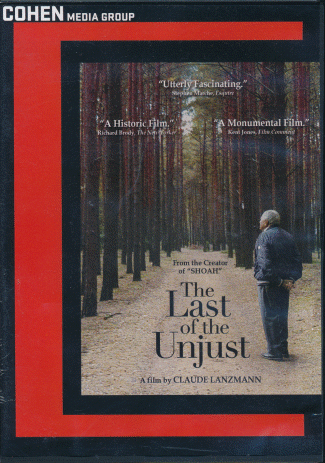
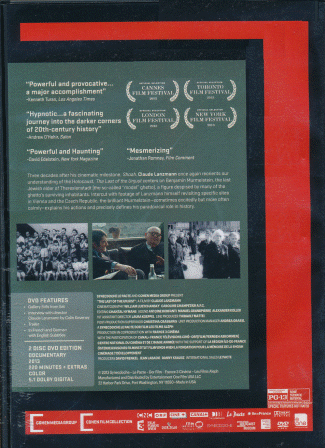
CLICK HERE TO SEE "THE LAST OF THE UNJUST" -- ILLUSTRATED SCREENPLAY
Statistics: Posted by admin — Thu Jul 02, 2015 4:30 am
]]>