PAINTED CAKES
BOOKS TO HANG OUT WITH
BHAGAVAD GITA, Translations of:
Arnold, Sir Edwin, THE SONG CELESTIAL. Dial.
Besant, Annie. Theosophical Publ. House, India.
Mascaro, Juan. Penguin Class 1962 (pap).
Prabhavananda & Isherwood. Mentor. (pap).
THE HOLY BIBLE, King James Version
Blavatsky, Helen Petrovna. THE VOICE OF THE SILENCE. India. Theosophical Publishing House.
Blofeld, John (tr.) THE ZEN TEACHINGS OF HUANG PO. NY: Grove Press, 1959 (pap).
BUDDHA, THE LIFE AND SAYINGS OF
Moore, J.H. (tr) SAYINGS OF BUDDHA. AMS Press.
Woodward, F.L. (tr.) SOME SAYINGS OF BUDDHA: ACCORDING TO THE PALI CANON, Oxford Press.
Allen, G.F. (Ed.) WORDS OF WISDOM. Hillary, 1959.
Chang, Garma (tr.) THE HUNDRED THOUSAND SONGS OF MILAREPA. University Books
TEACHINGS OF TIBETAN YOGA, NY: 1963.
Conze, Edward. SELECTED SAYINGS FROM THE PERFECTION OF WISDOM. London: Buddhist Society, 58 Eccleston Square.
BUDDHIST MEDITATION, NY: Torch (pap).
DHAMMAPADA, Translations of:
Babbitt, Irvin, NY: New Directions, (pap).
Lal, P. NY: Noonday.
Doresse, THE SECRET BOOKS OF THE EGYPTIAN GNOSTICS. Viking Press (The Gospel of Saint Thomas is included. This is an important work.)
Evans-Wentz, W.Y. THE JEWEL OF LIBERATION.
TIBET'S GREAT YOGI MILAREPA.
TIBETAN YOGA & SECRET DOCTRINES.
THE TIBETAN BOOK OF THE DEAD.
THE TIBETAN BOOK OF THE GREAT LIBERATION.
NY: Oxford University Press.
French, Reginald M. THE WAY OF A PILGRIM. NY: Seabury Press, (pap.).
Govinda, Lama. FOUNDATIONS OF TIBETAN MYSTICISM. London: Rider & Co.
Gunther, H.V. (tr.) THE JEWEL ORNAMENT OF LIBERATION. London: Rider.
Hafiz. FIFTY POEMS WITH TRANSLATION *Arberry, Ed.) Cambridge University Press. 1947.
Humphreys, Christmas. THE SUTRA OF WEI LANG. London: The Buddhist Society. (The Sutra of the Sixth Patriarch.)
Huxley, Aldous. THE PERENNIAL PHILOSOPHY. NY: Harper 1945, Meridian-World.
Kirpal Singh. THE JAPJI: THE MESSAGE OF GURU NANAK.
THE CROWN OF LIFE (A Study in Yoga)
MORNING TALKS.
Delhi: Ruhani Satsang.
(Available from Sant Bani Ashram, Franklin, New Hampshire 03235).
Lao Tzu. TAO TE CHING (Blackney, tr.) NY: Mentor (pap.).
Ch'u Ta-Kao (tr.) NY: Macmillan.
Witter Bynner (tr.) Capricorn Press
Many other translations available.
Lewis, Samuel, L.
TOWARD SPIRITUAL BROTHERHOOD
INTRODUCTION TO SPIRITUAL DANCE
THE REJECTED AVATAR.
All by Prophecy Pressworks.
M. (Swami Nikhilananda, tr.) THE GOSPEL OF SRI RAMAKRISHNA. NY: Ramakrishna Center, 1942. (Very high bhakti book.)
Meher Baba, DISCOURSES: VOLS. 1-4 (Adi K. Irani, Ed.) India: Meher Pub., Kings Road, Ahmednagar, Deccan, Bombay, 1954.
Books on the works & life of Meher aba include:
GOD SPEAKS! THE THEME OF CREATION & ITS PURPOSE. NY: Dodd, Mead & Co.
Osborne, G. TEACHINGS OF RAMANA MAHARSHI, NY: Weiser.
PHILOKALIA - WORK OF THE EARLY CHURCH FATHERS.
Ramana Maharshi, TALKS WITH SRI RAMANA MAHARSHI.
DAY BY DAY WITH BHAGAVAN.
GURU RAMANA (S.S. Cohen).
MAHARSHI'S GOSPEL.
RAMANA MAHARSHI & HIS PHILOSOPHY OF EXISTENCE.
REFLECTIONS ON "TALKS".
SADDHU'S REMINSCENCES OF RAMANA MAHARSHI (Maj. S. W. Chadwick).
SELF-INQUIRY: WHO AM I?
(These books available at various bookstores, but can be ordered directly from Arunachala Ashram, 342 E. 6th Set, NYC. "The Mountain Path," an excellent magazine, is also available.)
Shastri. ASHTAVAKRA GITA
THE RAYAYANA OF VALMIKI. London: Shantisadam.
PRAKASHA BHRAMACHARI.
SATYA SAI BABA, BRINDAVAN, and other pamphlets. New Delhi. (C. Ramachandran tr.).
THE SRIMAD BHAGAVATAM (THE WISDOM OF GOD). NY: Putnam (pap.).
Swami Prabhavananda (tr.) Capricorn, NY: (pap.).
St. John of the Cross. DARK NIGHT OF THE SOUL. NY: Doubleday, Image (pap.)
Since these proficients are still at a very low stage of progress, and follow their own nature closely in the intercourse and dealings which they have with God, because the gold of their spirit is not yet purified and refined, they still think of God as little children, and speak of God as little children, and feel and experience God as little children, even as Saint Paul says, because they have not reached perfection, which is the union of the soul with God. In the state of union, however, they will work great things in the spirit, even as grown men, and their works and faculties will then be Divine rather than human, as will afterwards be said. To this end God is pleased to strip them of this old man and clothe them with the new man, who is created according to God, as the Apostle says, in the newness of sense. He strips their faculties, affections and feelings, both spiritual and sensual, both outward and inward, leaving the understanding dark, the will dry, the memory empty and the affections in the deepest affliction, bitterness and constraint, taking from the soul the pleasure and experience of spiritual blessings which it had aforetime, in order to make of this privation one of the principles which are requisite in the spirit so that there may be introduced into it and united with it the spiritual form of the spirit, which is the union of love. All this the Lord works in the soul by means of a pure and dark contemplation, as the soul explains in the first stanza.
As a result of this, the soul feels itself to be perishing and melting away, in the presence and sight of its miseries, in a cruel spiritual death, even as if it had been swallowed by a beast and felt itself being devoured in the darkness of its belly, suffering such anguish as was endured by Jonas in the belly of that beast of the sea. For in this sepulchre of dark death it must needs abide until the spiritual resurrection which it hopes for.
This was also described by Job, who had had experience and, in these words: 'I, who was wont to be wealthy and rich, am suddenly undone and broken to pieces; He hath taken me by my neck; He hath broken me and set me up for His mark to wound me; He hath compassed me round about with His lances; He hath wounded all my loins; He hath not spared; He hath poured out my bowels on the earth; He hath broken me with wound upon wound; He hath assailed me as a strong giant; I have sewed sackcloth upon my skin and have covered my flesh with ashes; my face is become swollen with weeping and mine eyes are blinded.'
But there is another thing here that afflicts and distresses the soul greatly, which is that, as this dark night has hindered its faculties and affections in this way, it is unable to raise its affection or its mind to God, neither can it pray to Him, thinking, as Jeremias thought concerning himself, that God has set a cloud before it through which its prayer cannot pass. For it is this that is meant by that which is said in the passage referred to, namely: 'He hath shut and enclosed my paths with square stones.' And if it sometimes prays it does so with such lack of strength and of sweetness that it thinks that God neither hears it nor pays heed to it, as this Prophet likewise declares in the same passage, saying: 'When I cry and entreat, He hath shut out my prayer.' In truth this is no time for the soul to speak with God; it should rather put its mouth in the dust, as Jeremias says, so that perchance there may come to it some present hope, and it may endure its purgation with patience. It is God who is passively working here in the soul; wherefore the soul can do nothing.
Until the Lord shall have completely purged it after the manner that He wills, no means or remedy is of any service or profit for the relief of its affliction; the more so because the soul is as powerless in this case as one who has been imprisoned in a dark dungeon, and is bound hand and foot, and can neither move nor see, nor feel any favour whether from above or from below, until the spirit is humbled, softened and purified, and grows so keen and delicate and pure that it can become one with the Spirit of God, according to the degree of union of love which His mercy is pleased to grant it; in proportion to this the purgation is of greater or less severity and of greater or less duration.
Inasmuch as not only is the understanding here purged of its light, and the will of its affections, but the memory is also purged of meditation and knowledge, it is well that it be likewise annihilated with respect to all these things, so that that which David says of himself in this purgation may by fulfilled, namely: 'I was annihilated and I knew not.' For, in order that the soul may be divinely prepared and tempered with its faculties for the Divine union of love, it would be well for it to be first of all absorbed, with all its faculties, in this Divine and dark spiritual light of contemplation, and thus to be withdrawn from all the affections and apprehensions of the creatures, which condition ordinarily continues in proportion to its intensity. And thus, the simpler and the purer is this Divine light in its assault upon the soul, the more does it darken it, void it and annihilate it according to its particular apprehensions and affections, with regard both to things above and to things below.
And this is the characteristic of the spirit that is purged and annihilated with respect to all particular affections and objects of the understanding, that in this state wherein it has pleasure in nothing and understands nothing in particular, but dwells in its emptiness, darkness and obscurity, it is fully prepared to embrace everything to the end that those words of Saint Paul may be fulfilled in it: Nihil habentes, et omnia possidentes. For such poverty of spirit as this would deserve such happiness.
-- Dark Night of the Soul, by St. John of the Cross
Man is not an end, but a bridge between the animal kingdom and the Super-man. He may attain the condition of Super-man by a process of "self-upraising" (Selbstaufhebung); by an intensity of suffering so great that it leads at last to optimism. The first step is that which his disciples had already taken: intense disgust of themselves, leading them to pessimism or asceticism. Zarathustra tells them that they have not suffered enough. "For ye suffer on account of what ye are; ye have not yet suffered on account of what Man is." Only by attaining this supreme degree of pain and disgust can they develop sufficient energy to cross the last gulf which separates them from the state of Super-man.
-- Nietzsche and Madame Blavatsky: Their Doctrines Stated and Compared, by Theosophical Quarterly Magazine 1909-1912
Tyagisananda, Swami. NARADA BHAKTI SUTRAS. India: Bharati. Vijayam Press. Triplicare, Madras.
UPANISHADS, THE. Mascara (tr.) Penguin Classic (pap.).
Prabavananda & Manchester.
Vivekananda, Swami. RAJA YOGA. India: Advait Ashram. (Pantanjali's sutras with exposition.)
Watson, Burton (tr.) CHUANG TZU - BASIC WRITINGS. NY: Columbia University Press.
Wilhelm, Richard (tr.) I CHING - BOOK OF CHANGES. NY: Princeton University Press, Bollingen Series XIX. (Also Dutton (pap.), John Blofeld, tr.).
Willing, C.A. (publ.) THE IMPERSONAL LIFE. Sun Center Publication. New Canaan, Conn. (P.O. Box 54, San Gabriel, Calif.).
Yogananda, Paramahansa. AUTOBIOGRAPHY OF A YOGI. Los Angeles: Self-Realization Fellowing, 1959. (To get a great feeling for what it's really like in India. He tells it just like it is.)
BOOKS TO VISIT WITH NOW & THEN
Alexander, F.J. IN THE HOURS OF MEDITATION. Calcutta, India: Advaita Ashram.
Arberry, Arthur. DISCOURSES OF RUMI. University of Chicago Press, 1968.
Whoever says evil of the gnostic in reality says good of the gnostic; for the gnostic shies away from that quality, blame for which might settle on him. The gnostic is the enemy of that quality; hence, he who speaks evil of that quality speaks evil of the enemy of the gnostic and praises the gnostic; for the gnostic shies away from such a blameworthy thing, and he who shies away from the blameworthy is himself praiseworthy. Things become clear through their opposites.' Hence the gnostic knows that the critic is not really his enemy and his dispraiser.
-- Discourses of Rumi, translated by A. J. Arberry
Attar, Farid Ud-Din. THE CONFERENCE OF THE BIRDS. (Translation of Persian poem.) London: Routledge & Kegan.
Aurobindo, Sri. THOUGHTS & APHORISMS. Pondicherry, India.
[Aurobindo, Sri. LIFE AND TEACHINGS OF SRI AUROBINDO AND THE MOTHER. Pondicherry, India.]
Ayyangar. YOGA UPANISHADS. Adyar Library.
Avalon, Arthur (pseud. for Sir John Woodroffe). SERPENT POWER.
INTRODUCTION TO TANTRA SASTRA.
SHAKTI POWER.
GARLAND OF LETTERS.
Ganesh: Vedanta Press.
Bailey, Alice A. THE LIGHT OF THE SOUL. (Paraphrase of Patanjali.) Lucis
Blake, William. THE PENGUIN POETS, NY: Penguin Books (pap.).
Blavatsky, Helena Petrovna. ISIS UNVEILED, 2 VOLS.
THE SECRET DOCTRINE. India: Theosophical Publishing House.
With the Semite, that stooping man meant the fall of Spirit into matter, and that fall and degradation were apotheosized by him with the result of dragging Deity down to the level of man.... The Aryan views of the symbolism were those of the whole Pagan world; the Semite interpretations emanated from all were pre-eminently those of a small tribe, thus marking its national features and the idiosyncratic defects that characterize many of the Jews to this day -- gross realism, selfishness, and sensuality.
-- The Secret Doctrine -- The Synthesis of Science, Religion, and Philosophy, by Helena Petrovna Blavatsky
Bucke, Richard M. COSMIC CONSCIOUSNESS. University Books, 1961 Dutton (pap).
Bunyan, John. PILGRIM'S PROGRESS.
Byles, Maria. JOURNEY INTO BURMESE SILENCE. Lond: Allen & Unwin. (Day by day adventures at various Burmese Buddhist Meditation Centers).
PATHWAYS TO INNER CALM. London: Allen & Unwin
Collin, Rodney. THEORY OF CELESTIAL INFLUENCE. London: Vincent Stuart.
Coomaraswamy, Anana. BUDDHA & THE GOSPEL OF BUDDHISM. NY: Torch (pap).
Danielou, Alain. YOGA: THE METHOD OF REINTEGRATION. London: C. Johnson. 1940.
Daumal, Rene. MOUNT ANALOGUE. NY: Pantheon, 1962. Cal: City Lights, 1968. (The ascent of the soul symbolized by a mountain climbing expedition.)
David-Neel, Alexandra. INITIATIONS & INITIATES IN TIBET
SECRET ORAL TEACHINGS IN TIBETAN BUDDHIST SECTS.
Maha Bodhi Society, India.
de Chardin, Pierre Teilhard. THE PHENOMENON OF MAN.
THE FUTURE OF MAN
THE DIVINE MILIEU.
HYMN OF THE UNIVERSE.
NY: Harper
De Cusa, Nicholas. THE VISION OF GOD. NY: Atlantic (pap).
de Lubicz, Isha Schwaller. HER-BAK: CHICK-PEA, EGYPTIAN INITIATE, Vols. I & II. London: Hodder & Stoughten, 1967.
Duncan, Ronald. SELECTED WRITINGS OF MAHATMA GANDHI. Boston, Beacon Press.
Dutt, R.C., the RAMAYANA and the MAHABHARATA, Everyman's Library, Dutton, NY.
Eliade, Mircea. YOGA, IMMORTALITY & FREEDOM. NY: Pantheon, 1954.
Guillaumont, A. et. al. (tr.) THE GOSPEL ACCORDING TO THOMAS. (Coptic Text). NY: Harper Row, 1959
Gurdjieff, George. MEETINGS WITH REMARKABLE MEN. NY: Dutton (pap). 1963.
ALL AND EVERYTHING - BEELZEBUB's TALES TO HIS GRANDSON. NY: Dutton.
Herrigel, Eugen. ZEN IN THE ART OF ARCHERY. NY: McGraw Hill (pap).
Hesse, Herman. JOURNEY TO THE EAST. NY: Noonday (pap).
SIDDHARTHA. NY: New Directions (pap).
STEPPENWOLF. NY: Holt Rhinehart (pap).
MAGISTER LUDI (THE GLASS BEAD GAME). NY: Unger, 1964.
Hoffman. THE RELIGIONS OF TIBET. NY: MacMillan, 1961.
Humphreys, Christmas. THE WISDOM OF BUDDHISM. NY: Random House.
Huxley, Aldous. ISLAND.
Huxley, Laura. THIS TIMELESS MOMENT.
Isherwood, Christopher. RAMAKRISHNA & HIS DISCIPLES. NY: Simon & Schuster.
Jack, Homer A. THE GANDHI READER. NY: Evergreen, 1961 (pap).
Kapleau, Philip. THE THREE PILLARS OF ZEN. NY: Harper & Row. Beacon (pap).
Kirpal Singh. BABA JAIMAL SINGH: HIS LIFE AND TEACHINGS.
Delhi Ruhani Satsang.
(Available from Sant Bani Ashrma, Franklin, New Hampshire 03235)
Krishna Prem. THE YOGA OF BHAGAVAD GITA.
THE YOGA OF THE KATHUPANISHAD. Lond: J.W. Watkins
Lefort, Rafael. THE TEACHERS OF GURDJIEFF. London: Victor Gollancz, 1960.
Legge, James C. (tr.) THE TEXTS OF TAOISM (in 2 parts) NY: Dover
Marsh, John. SAINT JOHN. NY: Pelican, Penguin (pap).
Meher Baba. LISTEN HUMANITY (Narr. & ed. by D.E. Stevens)
NY: Dodd, Mead, 1957
THE EVERYTHING AND THE NOTHING. (pap).
THE PERFECT MASTER. C. B. Purdom.
AVATAR. John Adriel. Calif. J.R. Rowny Press, Santa Barbara, 1947.
THE WAYFARERS. Dr. Wm. Donkin.
WHAT AM I DOING HERE? Ivy O. Duce (pap).
(May be purchased directly from Sufism Reoriented, 1290 Sutter Street, San Francisco, Calif.)
Merton, Thomas. THE WAY OF CHUANG TZU. NY: New Directions (pap).
THE SEVEN STORY MOUNTAIN. (Autobiography) NY: Signet.
SILENCE IN HEAVEN. (Book of the Monastic Life) Signet.
THE SIGN OF JONAS. (Day by day account of life in Trappist monastery) NY: Image.
THOUGHTS IN SOLITUDE. NY: Image.
NEW SEEDS OF CONTEMPLATION. New Directions.
Niehardt, J.G. BLACK ELK SPEAKS. NY: Morrow & Co., 1932, University Nebraska (pap). 1961. (Life story of holy man of the Ogalala Sioux).
Nikhilananda, Swami. HOLY MOTHER (Life of Sri Sara Devi -- wife of Sri Ramakrishna). London: Allen & Unwin, 1962.
THE UPANISHADS. NY: Harper Torchbooks (pap).
Orage, A.R. ON LOVE. London. The Janus Press.
Ouspensky, P.D. IN SEARCH OF THE MIRACULOUS. NY: Harcourt Brace. Bantam.
Percival, H.W. THINKING & DESTINY. Word Foundation, Inc.
Prabhavananda, Swami & Isherwood, HOW TO KNOW GOD. Hollywood: Vedanta Press. (Best introduction to Patanjali Sutras).
VIVEKA CHUDAMANI (CREST JEWEL OF DISCRIMINATION). Hollywood: Vedanta Press.
Price, A.F. (tr.) THE DIAMOND SUTRA OF THE JEWEL OF TRANSCENDENTAL WISDOM. London: The Buddhist Society, 16 Gordon Square, 1947.
THE LIFE OF RAMAKRISHNA. Romain Rolland. Advaita Shram.
RAMAKRISHNA & THE VITALITY OF HINDUISM. (Solange Lamaitre) Funk & Wagnall's, 1969.
Ramdas, Swami. IN THE VISION OF GOD.
GITA SANDESH.
THE PATHLESS PATH.
WORLD IS GOD.
DIVINE LIFE.
By writer about Ramdas:
PASSAGE TO DIVINITY - A DEVOTEE'S DIARY.
SWAMI RAMDAS
Order from Anandashrama Kanhangad Rly, Stan Kerala, So. India.
Plus many booklets.
Reps, P. ZEN FLESH, ZEN BONES. A collection of Zen & Pre-Zen Writings. NY: Anchor Doubleday (pap).
Rilke, Rainier M. DUINO ELEGIES (MacIntyre, tr.) Cal: University of California (pap).
Saint Augustine. THE CONFESSIONS OF SAINT AUGUSTINE
THE CITY OF GOD. Modern Library.
Westminster: Library of Christian Classics. Vol. 7, 1955.
The construction of history sketched by Augustine of Hippo is a relevant model for understanding the framework of thought of Theology of History, if only for the historical reason that this model factually dominated the whole Catholic conception of history down to the late Middle Ages. His major work The City of God can be considered the elaboration par excellence, though in a rudimentary way, of a Christian theology of history....Augustine is considered a founding father of Christianity as a whole. He developed his thought around 400 AD, nearly 700 years before the definitive schism between the Western and the Eastern Church (1054), and thus his work goes beyond the later divergence between them....
The theological model of history elaborated by Augustine is determined by the ontological distinction between, on the one hand, the immanent level of the temporary, mutable, and incomplete human world, and, on the other, the transcendent level of God, who rests in eternity, immutability and plenitude. This dichotomy is articulated in Augustine's metaphor of the two Realms or Cities [civitates], the Earthly City and the Heavenly City. Only the Earthly City is subject to change, which is seen as a negative characteristic, as instability, fragility and imperfection. This is opposed to the perfection of the Heavenly City or City of God. The secular world as such and profane history do not have an immediate meaning, whereas the religious world of the Christian church occupies the foreground. More fundamentally, the emphasis does not lie on history as such but on the transcendent and thus extra-historical foundations of history, namely on its cause and goal in eternity....
The distinction between two realms is supported by the attribution of different characteristics to time.... The perception of the past is dominated by the figure of Christ, whose life and death is commemorated in the liturgy....The present is a decisive moment of choice in favour of God in the act of faith professed by Christians during the liturgy and prayer....It is the dimension of the future that is of central concern however, since salvation is at stake. This view of the future is eschatological in the sense that it refers to a set of views that has been revealed by God about the last events of history [from the Greek eskhaton]. A properly apocalyptic eschatology is more specific and refers to the belief that these last events are to some extent imminent. Apocalyptic eschatology, of which Augustine is a prominent example, contains a mainly catastrophic, deterministic, and dualistic view of history. It is catastrophic in the sense that it refers to radical events that are violent, cruel and punishing. It is deterministic because the future is already established. Finally, it is dualistic because the absolute god and absolute evil are depicted in the sense that there is no grey or neutral zone, no ambiguity. Apocalyptic eschatology is perhaps more current in Orthodox Russia than in Catholic Western Europe.
-- History, Sofia and the Russian Nation, A Reassessment of Vladimir Solov'ev's Views on History and His Social Committment, by Manon de Courten
If, therefore, the salamander lives in fire, as naturalists have recorded, and if certain famous mountains of Sicily have been continually on fire from the remotest antiquity until now, and yet remain entire, these are sufficiently convincing examples that everything which burns is not consumed. As the soul too, is a proof that not everything which can suffer pain can also die, why then do they yet demand that we produce real examples to prove that it is not incredible that the bodies of men condemned to everlasting punishment may retain their soul in the fire, may burn without being consumed, and may suffer without perishing? For suitable properties will be communicated to the substance of the flesh by Him who has endowed the things we see with so marvellous and diverse properties, that their very multitude prevents our wonder.
-- St. Augustin's City of God
In fashion then as of a snow-white rose
Displayed itself to me the saintly host,
Whom Christ in his own blood had made his bride...
I through the Rose go down from leaf to leaf. ...
... the great John,
Who, ever holy, desert and martyrdom
Endured, and afterwards two years in Hell.
And under him thus to divide were chosen
Francis, and Benedict, and Augustine.
-- The Divine Comedy of Dante Alighieri, translated by Henry Wadsworth Longfellow
It was the year when they finally immanentized the Eschaton.
-- The Illuminatus! Trilogy, by Robert Shea and Robert Anton Wilson
Shah, Idries. THE WAY OF THE SUFI. London: Jonathan Cape. 1968.
Sivananda, Swami. CONCENTRATION & MEDITATION.
KUNDALINI YOGA.
THE PRACTICE OF YOGA.
SADHANA.
BHAGAVAD GITA.
Snellgrove (tr.) THE JERDJRA TANTRA, 2 Vols. London: Rider & Co.
Sobhana, Dhammasudhi. INSIGHT MEDITATION. London: Buddhapadipa Temple.
Shankaracharya. THE CREST JEWEL OF WISDOM. (Charles Johnston. tr. Watkins Press).
Szekely, Edmond Bordeaux (tr.) THE ESSENE GOSPEL OF JOHN
FIRST CHRISTIAN (ESSENCE) CHURCH. 1968. (Trans. from 1st century Aramaic & Slavonic texts).
Taimni, I.K. GAYATRI - DAILY RELIGIOUS PRACTICE OF THE HINDUS. India: Ananda Publishing House.
THE SCIENCE OF YOGA. Wheaton, Ill: Quest (pap). Theosophical Publishing House
Thoreau. WALDEN.
Vishnudevanada, Swami. THE COMPLETE ILLUSTRATED BOOK OF YOGA. NY: Julian Press, 1960. (Excellent help with Hatha Yoga theory & practice).
THE URANTIA BOOK. Chicago: Urantia Foundation, 1967.
Vithaldas, Yogi: THE YOGA SYSTEMS OF HEALTH & RELIEF FROM TENSIONS. NY: Crown Publishers, 1957. (pap).
Waddell, Helen. THE DESERT FATHERS. NY: Constable & Co. 1946.
Waley, Arthur (tr.) MONKEY. NY: Grove Press.
Whitman, Walt. THE LEAVES OF GRASS. NY: Doubleday (pap).
I will make a song for these States that no one State may under any circumstances be subjected to another State,
And I will make a song that there shall be comity by day and by
night between all the States, and between any two of them,
And I will make a song for the ears of the President, full of weapons with menacing points,
And behind the weapons countless dissatisfied faces;
And a song make I of the One form'd out of all,
The fang'd and glittering One whose head is over all,
Resolute warlike One including and over all,
(However high the head of any else that head is over all.)
***
Omnes! omnes! let others ignore what they may,
I make the poem of evil also, I commemorate that part also,
I am myself just as much evil as good, and my nation is—and I say there is in fact no evil,
(Or if there is I say it is just as important to you, to the land or to me, as any thing else.)
I too, following many and follow'd by many, inaugurate a religion, I descend into the arena,
(It may be I am destin'd to utter the loudest cries there, the winner's pealing shouts,
Who knows? they may rise from me yet, and soar above every thing.)
Each is not for its own sake,
I say the whole earth and all the stars in the sky are for religion's sake.
I say no man has ever yet been half devout enough,
None has ever yet adored or worship'd half enough,
None has begun to think how divine he himself is, and how certain the future is.
I say that the real and permanent grandeur of these States must be their religion,
Otherwise there is just no real and permanent grandeur;
(Nor character nor life worthy the name without religion,
Nor land nor man or woman without religion.)
***
I do not despise you priests, all time, the world over,
My faith is the greatest of faiths and the least of faiths,
Enclosing worship ancient and modern and all between ancient and modern,
Believing I shall come again upon the earth after five thousand years,
Waiting responses from oracles, honoring the gods, saluting the sun,
Making a fetich of the first rock or stump, powowing with sticks in the circle of obis,
Helping the llama or brahmin as he trims the lamps of the idols,
Dancing yet through the streets in a phallic procession, rapt and austere in the woods a gymnosophist,
Drinking mead from the skull-cap, to Shastas and Vedas admirant, minding the Koran,
Walking the teokallis, spotted with gore from the stone and knife, beating the serpent-skin drum,
Accepting the Gospels, accepting him that was crucified, knowing assuredly that he is divine,
To the mass kneeling or the puritan's prayer rising, or sitting patiently in a pew,
Ranting and frothing in my insane crisis, or waiting dead-like till my spirit arouses me,
Looking forth on pavement and land, or outside of pavement and land,
Belonging to the winders of the circuit of circuits.
***
From my own voice resonant, singing the phallus,
Singing the song of procreation,
Singing the need of superb children and therein superb grown people,
Singing the muscular urge and the blending.
***
O the orator's joys!
To inflate the chest, to roll the thunder of the voice out from the ribs and throat,
To make the people rage, weep, hate, desire, with yourself,
To lead America—to quell America with a great tongue.
-- Leaves of Grass, by Walt Whitman
Wilhelm, Richard. THE SECRET OF THE GOLDEN FLOWER. NY: Harcourt Brace.
BOOKS ITS USEFUL TO HAVE MET
A Kempis, Thomas, THE IMITATION OF CHRIST. NY: Image (pap).
Asimov, Isaac. THE FOUNDATION TRILOGY. NY: Doublday.
Bailey, Alice. THE REAPPEARANCE OF THE CHRIST.
THE SOUL AND ITS MECHANISM.
FROM INTELLECT TO INTUITION.
INITIATION HUMAN & SOLAR.
LETTERS ON OCCULT MEDITATION.
A TREATISE ON WHITE MAGIC.
A TREATISE ON COSMIC FIRE.
TELEPATHY AND THE ETHERIC VEHICLE.
GLAMOUR: A WORLD PROBLEM.
A TREATISE ON THE SEVEN RAYS, 5 vols.
NY: Lucis Publishing Co.
Beevers, John. STORM OF GLORY (About St. Theresa of Lisieux) NY: Image (pap).
Bernard, Theos. HATHA YOGA. NY: Columbia University Press, 1944.
LAND OF A THOUSAND BUDDHAS. London: Rider.
Besant, Annie. KARMA.
DEATH AND AFTER.
DHARMA
REINCARNATION.
ESOTERIC CHRISTIANITY.
India: Theosophical Publishing House. Adyar.
Blakney, Raymond B. MEISTER ECKHART, 14th CENTURY MYSTIC & SCHOLAR. Torch.
Boehme, Jacob. THE WAY TO CHRIST (4 Treatises) London, 1961.
Borges, Jorge. LABYRINTHS, SELECTED STORIES & OTHER WRITINGS. NY: New Directions (pap).
Bradbury, Ray. THE ILLUSTRATED MAN. NY: Doubleday, 1958.
Brother Lawrence (tr. from French) THE PRACTICE OF THE PRESENCE OF GOD. Revell Inspirational Classics.
Buber, Martin. HASIDISM & MODERN MAN. (Friedman, M. tr.) NY: Harper Row (pap).
I AND THOU. (R. Gregor Smith, tr.) NY: Scribner Lib. (pap).
TALES OF THE HASIDIM.
Bucke, R.M. "Memorial Society Newsletter Review" (An outstanding spiritual newsletter. $1/copy). R. M. Bucke Memorial Society, 1266 Pine Ave. W. Montreal.
Campbell, Joseph. MASKS OF GOD. NY: Viking (pap).
Castaneda, Carlos. THE TEACHINGS OF DON JUAN: A YAQUI WAY OF KNOWLEDGE. NY: Ballantine (pap).
Dante, A. THE DIVINE COMEDY. (Tr. Carlyle) NY: Modern Library
de Lubicz, R.A. Schwaller. LE TEMPLE de L'HOMME. Blackwell's, Broad Street, Oxford, England.
De Ropp, Robert. THE MASTER GAME. NY: Dell, 1969. (pap).
Descartes, Rene. MEDITATIONS (tr. Lafleur) NY: Bobbs, 1951. (pap).
Dridedi, M.J. THE YOGA SUTRAS OF PATANJALI.
Fischer, Louis. THE LIFE OF MAHATMA GANDHI. NY: MacMillan, 1962.
Fowles, John. THE MAGUS. NY: Dell. (pap).
Giles, Herbert A. CHUANG TZU - TAOIST PHILOSOPHER & CHINESE MYSTIC. London: Allen & Unwin, 1961.
Govinda, Lama. THE WAY OF THE WHITE CLOUD. London: Hutchinson.
Heinlein, Robert A. STRANGER IN A STRANGE LAND. NY: Putnam, 1961. Avon.
Hills, Christopher. NUCLEAR EVOLUTION.
Jha, Gangautha. THE YOGA DARSANA.
Johnston, Charles. THE YOGA SUTRAS OF PATANJALI. London: Stuart & Watkin.
Jonas, Hans. THE GNOSTIC RELIGION. Boston, Beacon Press.
Judge, William Q. YOGA APHORISMS OF PATANJALI.
Kazantzakis. THE LAST TEMPTATION OF CHRIST. NY: Simon Schuster (pap).
Kesey, K. ONE FLEW OVER THE CUCKOO'S NEST. NY: Signet (pap).
Kierkegaard, Soren. FEAR & TREMBLING: SICKNESS UNTO DEATH. tr. Lowrie. NJ: Princeton University Press (pap).
EITHER/OR. 2 Vols. NY: Anchor Doubleday.
AN ANTHOLOGY OF KIERKEGAARD. Modern Library, 1959.
King, C. Daly. THE STATES OF HUMAN CONSCIOUSNESS. Llevellyn Pub. (Pages 137-146 are excellent help in understanding pharaonic mentality.)
Kirpal Singh. PRAYER: ITS NATURE & TECHNIQUE
THE WHEEL OF LIFE: THE LAW OF ACTION & REACTION.
NAAM OR WORD.
Delhi: Ruhani Satsang.
(Available from Sant Bani Ashram, Franklin, N.H. 03235).
KORAN. Everyman's Library.
Krishnamurti. EDUCATION & THE SIGNIFICANCE OF LIFE. NY: Harper & Row.
Laing, R.D. THE POLITICS OF EXPERIENCE. NY: Ballantine (pap).
Laski, Margharita. ECSTASY. London: Cresset Press, 1961. (A study of religious & secular experiences.)
Law, Willilam. A SERIOUS CALL TO A DEVOUT & HOLY LIFE. Fontana Library.
Leadbeater, D.W. THE CHAKRAS. India: Theos. Publ. House, 1966.
Leary, T. THE POLITICS OF ECSTASY.
Lewis, C.S. PERELANDRA. NY: Macmillan (pap).
Lu K'uan Yu (Charles Luk) THE SECRETS OF CHINESE MEDITATION. NY: S. Weiser.
Mahathera, P.W. BUDDHIST MEDITATION IN THEORY & PRACTICE, 1962.
Maynard, Theodore. SAINTS FOR OUR TIMES. (18 saints) NY: Image (pap).
Mayrink. THE GOLEM. NY: Ungar (pap).
Mead, G.R.S. (tr.) THRICE GREATEST HERMES, HERMES TRISMEGISTUS. London.
Merton, Thomas. MYSTICS & ZEN MASTERS. NY: Dell (pap). 1969.
Milton, John. PARADISE LOST: PARADISE REGAINED. NY: MacMillan, 1966. (pap).
Mishra, Rammurti. FUNDAMENTALS OF YOGA. NY: Julian Press. Lancer (pap).
Narayananda, Swami. THE SECRETS OF PRANA, PRANAYAM AND YOGA ASANAS.
Nicholson. RUMI, POET & MYSTIC. London: Allen & Unwin.
Nicoll, Maurice. LIVING TIME - AND THE INTEGRATION OF LIFE. London: Vincent Stuarts, 1964.
THE NEW MAN. London: Stuart & Richards, 1950.
Nin, Anais. SEDUCTION OF THE MINOTAUR & OTHER STORIES. NY: Swallow (pap).
Ouspensky, P.D. THE PSYCHOLOGY OF MAN'S POSSIBLE EVOLUTION.
A NEW MODEL OF THE UNIVERSE.
THE FOURTH WAY. NY: Knopf.
Owens, Clifford P. A STORY OF JESUS. NY: ARE, 34 W. 35th.
Pali Canon. JATAKA STORIES, Vols. 1-3. Pali Text Society.
Pascal, Blaise. PENSEES. NY: Modern Library (pap).
Plotinus. ENNEADS (tr. MacKenna Stephen) NY: Pantheon, 1957.
ON THE IMPASSIVITY OF THE INCORPOREAL (tr. MacKenna) Medici Society.
PLATO, THE WORKS OF. NY: Modern Library.
Prassad, Ram O. THE YOGA SUTRAS OF PATANJALI.
Rahula, Walpole. WHAT THE BUDDHA TAUGHT. NY: Grove, 1962.
Ramanar K. Venkata NARGARJUNA'S PHILOSOPHY. Tuttle.
Ram Tirtha. IN THE WOODS OF GOD REALIZATION.
Reich, William. THE FUNCTION OF THE ORGASM. NY: Noonday Press.
CHARACTER ANALYSIS.
COSMIC SUPERIMPOSITION.
THE SELECTED WRITINGS OF WILHELM REICH.
REICH SPEAKS OF FREUD.
(All Noonday Press)
Rice, Cyprian. THE PERSIAN SUFIS. London: Allen & Unwin, 1963.
ROSICRUCIAN. May be ordered from Rosicrucian Fellowship, Mt. Ecclesia, Oceanside, Calif.
THE MESSAGE OF THE STARS. Max Heindel.
ROSICRUCIAN COSMO CONCEPTION OR MYSTIC CHRISTIANITY. Max Heindel.
ETHERIC VISION & WHAT IT REVEALS.
Runes, D. Dagobert. THE WISDOM OF THE KABBALAH. NY: Citadel (pap).
Saint Exupery, Antoine. (tr. Woods) THE LITTLE PRINCE. H.B. & W. (pap).
Saint Francis de Sales. INTRODUCTION TO THE DEVOUT LIFE. (Ed. Ryan) NY: Image.
Salinger, J.D. NINE STORIES, NY: Little, 1953.
FRANNY & ZOOEY. Little.
Schopenhauer, Arthur. THE WORLD AS WILL & IDEA. (tr. Haldone) NY: Humanities.
Schrodinger, Erwin. MY VIEW OF THE WORLD. Cambridge University Press.
Shabistari Mahmud. THE SECRET GARDEN. (tr. Johnson Pasha) London: Octagon.
Shah, Idries. TALES OF THE DERVISHES. London: Octagon press.
Shattock, E. H. (Rear Admiral) AN EXPERIMENT IN MINDFULNESS. NY: Dutton (Satipatthana Method).
Singh, Jogendra (tr.) THE PERSIAN MYSTICS. London: Paragon.
THE INVOCATIONS OF SHEIKH ANSARI (Verses by 11th century Sufi mystic) London: John Murray.
Snyder, Gary. THE BACK COUNTRY. NY: New Directions (pap).
Steiger, Brad. IN MY SOUL I AM FREE. NY: Lancer (pap), 1968.
Suzuki, D.T. ZEN DOCTRINE & NO MIND. London: Rider & Co. (pap).
THE TRAINING OF THE ZEN BUDDHIST MONK, NY: University Books.
Swedenborg, Emmanuel. SWEDENBORG'S WORKS. NY: Houghton Mifflin.
AN INTRODUCTION TO SWEDENBORG'S RELIGIOUS THOUGHT. (J. H. Spalding) NY: Swedenborg Publishing Assoc.
Tagore, Rabindranath. THE RELIGION OF MAN. Boston: Beacon Press, (pap).
POEMS OF KABIR.
Tennyson, H. INDIA'S WALKING SAINT.
Tolkien, J.R. R. THE HOBBIT, AND THE RING CYCLE. Boston: Houghton Mifflin. NY: Ballantine (pap). 1965.
Tookaran, Rajararm. YOGA PHILOSOPHY.
Trungpa, Chogyam. BORN IN TIBET. NY: Harcourt Brace.
MEDITATION IN ACTION. London: Stuart Watkins. (pap).
Tucci, Guiseppe. THE THEORY& PRACTICE OF THE MANDALA. London: Rider (pap).
Underhill, Evelyn. THE ESSENTIALS OF MYSTICISM. NY: Dutton (pap).
THE CLOUD OF UNKNOWING. London. Watkins.
Virajananda, Swami. PARAMARTHA PRASANGA - TOWARD THE GOAL SUPREME. Hollywood: Vedanta Press.
Waley, Arthur. THE NO PLAYS OF JAPAN. NY: Grove Press.
Walker, Kenneth. THE CONSCIOUS MIND. NY: Wehman, 1962.
Warren, H.C. BUDDHISM. NY: Atheneum Press, 1963 (pap).
Waters, Frank. BOOK OF THE HOPI, NY: Viking Press, 1963.
Watts, Alan. PSYCHOTHERAPY EAST & WEST. NY: Ballantine (pap). 1969.
BEYOND THEOLOGY: THE ART OF GODMANSHIP. NY: Pantheon, 1964.
Whitehead, Alfred North. SCIENCE & THE MODERN WORLD. NY: Free Press (pap).
PROCESS & REALITY. NY: Free Press (pap).
Woods, J.H. YOGA SYSTEM OF PATANJALI. Harvard Oriental Series.
Workman, Herbert B. EVOLUTION OF THE MONASTIC IDEAL. NY: Beacon (pap).
Yesudian and Haich. YOGA AND HEALTH. NY: Harper & Bros., 1953.
Yukteswar, Swami Sri. KAWALYA DARSANAN or THE HOLY SCIENCE. India: Yogoda Satsanga Society, Ranchi, Bihar, 1963.
Zehner. MYSTICISM SACRED AND PROFANE. Oxford Press (pap).
Sat Prem, AUROBINDO OR ADVENTURES IN CONSCIOUSNESS
SRI AUROBINDO ASHRAM. Pindicherry, India.
Dane Rudhyar, PLANETARIZATION OF CONSCIOUSNESS (avail. from Shamballa Pub., Berkeley, Cal.)
Nicholson, Reynold, THE MATHNAWI OF RUMI. Luzak & Co., 1968.
Khan, Hazrat Innayat, THE SUFI MESSAGE. (8 vols.) Barrie & Rockliff, London, 1961.
Suzuki, Roshi, Shunyru, ZEN MIND BEGINNERS MIND. Walker/Weatherhill, 1970.
Where books may not be available at local bookstores, the following are book specialists of the oriental and occult, etc.
SAMUEL WEISER, 734 Broadway, New York, NY 10003 (GR 7-8453)
ORIENTALIA, INC. 61 Fourth Ave., New York, NY 10003 (473-6730)
MASON'S BOOKSHOP, 789 Lexington Ave. New York, NY (832-8958)
SHAMBALLA BOOKSTORES, Telegraph Ave., Berkeley, Calif.
BROTHERHOOD OF LIFE, 110 Dartmouth St., S.E., Albuquerque, N. Mex. 87166.
EAST-WEST BOOK SHOP, 1170 El Camino Real, Menlo Park, Calif. 94025.
THE PILGRIM'S WAY BOOKSTORE, P.O. Box 1044, Carmel, Calif. 93921.
PARAGON BOOK GALLERY, N.Y.C.
FIELDS, San Francisco, California
THE SPHINX, Cambridge, Mass.
Ram Dass Tapes available through
NOUMEDIA COMPANY, P.O. Box 750, Port Chester, N.Y. 10573
BIG SUR RECORDINGS, P.O. Box 303, Mill Valley, Calif. 94941
Statistics: Posted by admin — Fri Sep 25, 2015 8:32 pm
]]>
FAMILY SADHANA
The course of family sadhana in the West in the 1970's is a difficult one to practice. Whereas in the past in both East and West there have been precise models these have been built around a culture and tradition which was supportive of this practice. In Western culture the support system has been destroyed by the industrial revolution and the money economy which has caused the virtual destruction of the family as a spiritual and psychic union by compelling at least one and often both principal members to become money earners. This necessitates daily absence from the home and reliance on day-care centers, nursery schools or regular schools to provide a spiritual foundation which one cannot expect them to provide as they essentially are educating and directing children to become "good members" of the same society which is in essence profane and in extension looking only to continue its existence at the present level of consciousness. Consequently the family is dispersed, its members isolated from each other and effectively only together as an economic and sleeping unit. The family thus has no center to radiate from and no spiritual-psychic support system. It is dead. The outlook is bleak from this vantage point.
However, in the last decade there has been a resurgence of spiritual life brought about by lysergic acid, the bomb, rock 'n' roll, visiting teachers from the East and the incredible vacuum and death that is the rot at the core. And as life will not permit a vacuum, the times they are a-changing.
SO
HOW?
TO BEGIN?
To begin we must begin at the beginning. At the beginning is the spirit. Spirit is a Latin word meaning breath. It's like breathing out and breathing in, NO THING -- yup, no thing. And this no thing is basic for our life. Breathe spirit, this spirit which sustains and maintains, without which we die to this form. This no thing is the foundation upon which all must be based. Life must be dedicated to the spirit alone for as it has been laid out ... seek you first the kingdom of heaven and all else shall be added to you ... so ... with the family sadhana as with all sadhana this is where we begin. The family and all it is thru /by / in extension must be dedicated solely to the spirit.
Next:
An earth-real consideration of physical plane realities. Food, shelter, and clothing. An examination in truth of real needs. Not desires, not fantasies, but you know: how many pairs of pants? what kind of food? what type of shelter? how big? who for? where? and then?
HOW NOW
Can you afford to take a cut? Can you afford not to? Can you and will you let go of all the things and values and trips that you have gotten caught in? If you can adapt your present means of livelihood to your spiritual work then you're cool. (See section on "Money and Right Livelihood.") If you can't then you'll probably have to make a radical change in your life. Try getting into subsistence economy. Just making it. Not too much not too little but just enough to make it. Buy an old farm (there're lots -- cheap) or set up a craft scene. Use the system to teach yourself how to operate these well and efficiently. Keep it all together. Run a good ship. This is our second base. Apply consciousness clearly. Understand values. Don't be afraid to make mistakes but don't court disaster.
Why a farm, why a small craft scene? Just this. The family can "be" together. There are functions in these situations for all the members from the children to the adults. The work is clear and definite. Jesus was a carpenter. Ghandi spun. This daily concern with the vehicle of sustenance on the gross plane must be clear, straight and simple. As work / time / space is shared (based all ways on the spirit) a family grows together. Here exists mutuality, trust, openness, a psychic organism develops -- this is what a family is. The possibilities on this level are endless: farm, crafts, natural food store, general store, restaurant, creamery, small paper, bookstore. Drop into reality.
Now we have an environment and a basis for practice.
First turn the environment into a shrine, a temple. If the family is primarily bhakti, plaster the walls with holy pictures, light incense, radiate love; if it's Christian make it a home for Christ; if it's more austere, moving toward Zen, reflect nothingness. Whatever your trip make the whole environment support it.
Next set up a clear movement thru time. Rise daily at the same time, meditate together, pray together, offer all actions to the spirit, offer all food to the spirit, cook in love for love, keep the home clean, calm and clear so if Lord Buddha walked in he'd feel right at home. Maintain the body as a temple, clean it, feed it, take good care of it, have compassion for it; love it. The discipline of a daily schedule is a drag at first, after a while you will feel the results. It all runs on automatic. Don't think. Fill your whole mind with the spirit. BE! And in being together in the spirit be in love together. It's all making love. Make love in beauty, in joy, in seeing each other in truth, choose your marriage model. The Sun and the Moon, Heaven and Earth, Yab-Yum, Shiva-Shakti, Siva and Parvati, the Eternal Companions, the Alchemical Marriage, Mohammed and his Wives, Adam and Eve, Christ and his Bride.
Let the man worship woman as God, the Holy Mother, the Divine Shakti, the Mana, the Food of Life, the Sustainer of Being, Isis, Astarte, the Good Earth, Terrible Kali, and Herself -- All Of It. She is all of it.
Let the woman worship man as God, the Son, the Sun, the Father, the Lite of Her Life, the Creator, the Provider, as Jesus, as Ram, as Shiva, as Krishna, as all of them and Himself.
Surrender and die to one another. Become one. The glorious Mystic Rose in the garden of the Heavenly Father. Permeate the universe, fill it, become it for this is the union beyond duality.
O Holy Family
This is the seat of the practice.
And as the children who are the fruit of the union appear, see them as divine avatars, holy beings who have come recently from our true HOME to teach. Nourish and feed them as they feed you. Listen for their tone, see their ray so as to help them fulfill their spiritual destiny, provide a matrix for their consciousness. Great care must be taken to guide the entity on this plane. Choose carefully the initial impressions which they will be registering as you would the food they eat. They are the hope and destiny of the universe. Respect and honor them. Guide them clearly. Keep the home calm and free of chaotic inputs. Let love burn in all the lamps. Thru all of this face and cope out the difficulties. For the woman there will be the heavy pull of the earth element. The children will feel any psychic withdrawal on her part. She must find a place a little removed for deep meditation. When they wake up during meditation explain clearly what you are doing. Read them holy stories to acquaint them with spirit life so that they may remember. Keep your practice regular and the children will stay in tune. Don't trip too far too fast or psychic disequilibrium will upset months of work. Do not sacrifice relationships with the children for what you may think is spiritual necessity. The whole thing is sadhana. Chant mantras together. The first word of one infant here was Allah (God). Children really love bhajan. They go around singing Bhaja Shri Krishna Chaitanya or Om Sri Ram Jai Ram Jai Jai Ram. Bring them in. Sing together.
For men it's most often astral tripping. Far out trips in far out worlds that get so far out they become disconnected and then have to find someone to understand and then its Drama Drama Drama instead of Rama Rama Rama. Men struggle with death and rebirth and fear it's a tough trip alone and being together makes it both easier and harder. The key to it all is absolute and total surrender to the spirit. With this it is all possible.
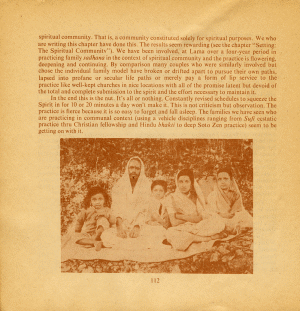
The real difficulty in family sadhana seems to be in the maintenance over a long period of time of the discipline. In most other sadhana there is either overt or covert reliance on a sangha. In any given area there are just not that many people who will gravitate towards family sadhana. Most people are on their own spiritual paths. While it is true that these people constitute a sangha of sorts the uniqueness of family sadhana makes it difficult to tie all of this together. A very good alternative is to join together with others and form a spiritual community. That is, a community constituted solely for spiritual purposes. We who are writing this chapter have done this. The results seem rewarding (see the chapter "Setting: The Spiritual Community"). We have been involved, at Lama over a four-year period in practicing family sadhana in the context of spiritual community and the practice is flowering, deepening and continuing. By comparison many couples who were similarly involved but chose the individual family model have broken or drifted apart to pursue their own paths, lapsed into profane or secular life paths or merely pay a form of lip service to the practice like well-kept churches in nice locations with all the promise latent but devoid of the total and complete submission to the spirit and the effort necessary to maintain it.
In the end this is the nut. It's all or nothing. Constantly revised schedules to squeeze the Spirit in for 10 or 20 minutes a day won't make it. This is not criticism but observation. The practice is fierce because it is so easy to forget and fall asleep. The families we have seen who are practicing in communal context (using as a vehicle disciplines ranging from Sufi ecstatic practice thru Christian fellowship and Hindu bhakti to deep Soto Zen practice) seem to be getting on with it.
SADHANA IF YOU LIVE ALONE
You naturally have more flexibility and more life time to work on your sadhana when you live alone. You can get up very early in the morning, chant you mantras out loud, light candles, burn incense, ring a bell, or do whatever brings you into the Spirit without disturbing anybody else. If you are fasting, nobody feels disturbed about it, or if you want to eat some special diet which makes you feel light and in the Spirit (but which tastes like a horsehair mattress) you can feast on it whenever you feel hungry.
And then there is the silence. If you prefer to live in a quiet world, free of radio, TV, or records, you can spend a lot of time, if you live alone, in a warm cocoon of silence.
And then there is noise. If you are developing the witness and want to carry on a dramatic monologue to help you remember, you can play the star role aloud:
"He's heading toward the refrigerator now. He's thinking about eating some ice cream. He's decided to do some pranayam instead ..." A running commentary like this helps to keep you in the witness but it doesn't help you fill the role of the ideal roommate.
Although you may have more chance to work on your sadhana when you live alone, you have less chance to practice that most difficult of all paths, karma yoga. In solitude you don't have many demands made upon you, nor do you develop the elasticity which comes with the give-and-take of living with others. If your work is also solitary, you may want to preserve a balance by seeking opportunities to interact with others. You may look for continuing situations where the interaction will be on a deep rather than a superficial, social level, such as teaching at a community center, taking on a group of scouts, etc. Situations which are totally engrossing are most apt to capture you and therefore provide the best practice in keeping your witness an d your center. (Working with others will also enable you to see how losing and regaining your center affects those around you.)
However, if you live alone, you probably spend a large part of your time in solitude. Solitude does not mean that you are really living alone, even if you seem to be living alone. You know that when you shut the door and darken the room and look within that the door is open, the light is on, and "Someone is in your room ... darkness like a dark bird, flies away ... flies away.
The vibration sweeps along, touching with its swift wing the whole universe and the germ that dwelleth in darkness.
-- The Secret Doctrine -- The Synthesis of Science, Religion, and Philosophy, by Helena Petrovna Blavatsky
DYING
You must live before you can die. But you must die before you can live.
Live consciously ! Die consciously !
Gandhi, the Indian Politician-Saint, was assassinated as he walked out of his home by an assassin who fired four bullets directly into his body. In the moment Gandhi fell, he was heard to utter the name, "RAM." The rishis (the men of India who know) say that to die uttering the name of God takes you immediately "beyond the beyond" with no further effort.
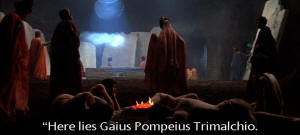
[Priest] Listen to his epitaph:
"Here lies Gaius Pompeius Trimalchio. A pious, strong, and faithful patron who came from nothing ... he left 30 million sesterces and never listened to a philosopher. And the same be for you!
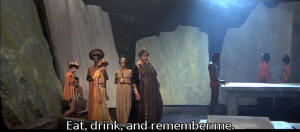
[Trimalchio] Act like you're guests at my funeral banquet.
Eat, drink, and remember me. Call the musicians, and have them play something pretty. Farewell ... farewell ... There ...
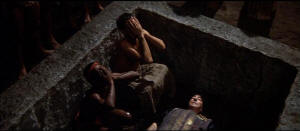
I'm dead.
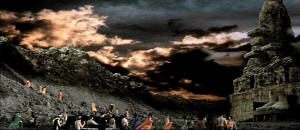
-- Satyricon, directed by Federico Fellini
Practice Dying
1. Experience your own death:
Ritual death has been practiced throughout the world for centuries. Many Buddhist meditation exercises are designed to take you through your own death. Christian ascetics experience their death through contemplation for a vision of life sub specie aeternitatis (as Eternal Present). See, for example, St. Ignatius Loyola's recommendations in his Spiritual Exercises.)
Laura Huxley has members of her seminars experience their own death psychologically. For example:
"Have the room comfortably dark or dimly lighted.
Lie down on your bed or sofa or on the floor.
Let your body go. Imagine that the life is out of it. Do not speak or move.
Imagine that you have died: Your body is passive, lifeless, useless. Your body is discarded. Your funeral is about to take place.
Let go of your body. Let it be there as something which is no longer yours. Follow to the limit this feeling of being completely alone, abandoned, not loved -- not in life, not in death. Cry, scream, curse, if this is what you feel. Go to the limit of your feeling. And after you have cried and screamed and cursed, when you are empty and exhausted, stop and listen.
This is your last party. Speak to everyone there, tell them all about yourself, about your mistakes and your suffering, about your love and your longings. No longer do you need to protect yourself, no longer do you need to hide behind a wall or a suit of armor. It is your last party: you can explode, you can be miserable or pitiful, insignificant or despicable. At your funeral you can be yourself.
This is your chance: do what others have failed to do. Look at the unloved one, the miserable one. This is your chance to do an act of love toward one who has had no love. This is your chance to do justice where intentional or unintentional injustice has been committed. This is your chance to give warmth and courage to one who feels only coldness, loneliness and death.
Let your tears flow from the very depth of you. Let your bitterness flow out with them. And when the bitterness is out, your tears will be gentle and sweet. Then take the hand of this lifeless body of yours, take it in your hands and with respect and love bring it to your lips and kiss it.
Now gently come back to your living body.
With this feeling of respect and love, come back to your living body, and let this feeling remain with you, inside of you. Let it spread to each nerve, to each muscle, along every vein and artery. Let this feeling of respect and love spread inside you, throughout your entire organism, and then let it spread out around you in everything, object or animal or human, that is part of your life. Feel this feeling of love and respect circulating inside you with the force of life itself; let it be in your blood, in the air you breathe. Feel it -- accept it -- give it." (A "recipe" from You are Not the Target, Laura Huxley.)
The Tibetan Book of the Dead is a manual of practices for dying, and being re-born. There have been many ancient manuals for dying, e.g., the Egyptian Book of the Dead. Their purpose is to take a dying person through the various steps in this energy transformation dance called dying.
The psychedelics have been used with these manuals and exercises as sets or programs to experience death / rebirth. (See The Psychedelic Experience.)
Each time we can "let go" -- of goals, of our ego-image compulsions, of controlling, of driving ourselves -- and BE instead of DO, we die (as ego) and are reborn (as Self, as Buddha). Use a signal (the name Ram, a mantra word or phrase, a mandala image) to trigger that death whenever you are aware of your body being up-tight in the shape it's desire-tension holds it in; then feel your breathing distribute itself throughout your body diffusing and lightening it as you die to desire, to ego, and then "not I but He lives in me."
Suicide, we might be reminded here, is a different type of death in which one remains attached to his ego. Rather than liberation it brings perpetual bondage ... which is why it has been condemned at all times by enlightened men.
2. Experience death with someone else:
To be with a person who is dying, to share consciousness with him, and to help him die consciously is one of the most exquisite manifestations of the bodhisattva role. It should be sought out.
A few suggestions for practicing this yoga:
Meditate together or separately, whichever feels right. Meditation helps you remain in the Eternal Present where no-thing is happening ... and it helps you serve lovingly with total involvement and with no attachment.
Don't teach by other than your being. If you remain centered, your calm presence helps to free all those about you who are ready.
Speak the truth as you see it ... but only if asked! Speak nothing untrue.
See in the dying person only that which is eternal. You are merely seeing the Divine Mother doing it again. All forms you see in another person are, after all, but the manifestations of your own desire. A realized being wherever he looks sees no-thing or all things simultaneously, and knows them to be the same.
Read silently or aloud from the words of Those Who Know.
Perhaps one day we will have in this country Centers for dying and for being born ... places located near mountains or the ocean where anyone who wishes might go to be in the presence of conscious beings during these crucial events. There would be healers and helpers as well as guides to assist along the way of any path -- religious-metaphoric, yogic, or psychedelic -- anyone might choose.
We all die in each moment ... and we are all born in each moment ... in truth, whether this death / rebirth is called physical or psychological. We can apply all of the above suggestions ever day and in every interaction with people so as to be aware of this and conscious in it.
"Lightly, my darling, lightly. Even when it comes to dying. Nothing ponderous, or portentious, or emphatic. No rhetoric, no tremelos, no self-conscious persona putting on its celebrated imitation of Christ or Goethe or Little Nell. And, of course, no theology, no metaphysics. Just the fact of dying and the fact of the Clear Light. So throw away all your baggage and go forward. There are quicksands all about you, sucking at your feet, trying to suck you down into fear and self-pity and despair. That's why you must walk so lightly ..."
"The Light," came the hoarse whisper, "the Clear Light. It's here -- along with the pain, in spite of the pain."
"And where are you?"
"Over there, in the corner. I can see myself there. And she can see my body on the bed."
"Brighter," came the barely audible whisper, "brighter." And a smile of happiness intense almost to the point of elation transfigured her face.
Through his tears Dr. Robert smiled back at her. "So now you can let go, my darling." He stroked her gray hair. "Now you can let go. Let go," he insisted. "Let go of this poor old body. You don't need it anymore. Let it fall away from you. Leave it lying there like a pile of worn-out clothes ... Go on, go on into the Light, into the peace, into the living peace of the Clear Light." -- Aldous Huxley, Island.
GLOSSARY
A
ajna - the point between the eyebrows; third eye; sixth of the seven chakras; actually located in the midbrain, related to the thalamus.
akasha - ether; subtlest, all-pervading material manifestation.
asana - comfortable posture; seat; third of the eight parts of yoga.
ashram - monastic retreat, usually directed by a guru.
Atman - Soul-Spirit; individualized Brahman.
avatar - (lit. to come from without) an incarnation of the Supreme Lord in human form, e.g., Christ, Krishna, Rama, Zoroastor, Buddha.
avidya - ignorance.
B
ban marg - the left-handed path.
bardo - the state between death and rebirth.
Bhakti Yoga - the yoga of devotion.
bhajan - singing of holy songs; devotional music
bindu - a lower form of pran.
brahmacharya - (lit. to live in Brahma) sexual continence (a frequent meaning).
Brahman - the absolute one from which all else emanates; Ultimate Reality.
C
chakras - (lit. wheels) psychic energy vortices in the body, associated with the plexuses.
chela - disciple.
chillum - an earthen pipe cylinder used for smoking ganga or chars.
D
Dharma - Universal Law; the Way.
dhyana - meditation; identification with the Divine One.
G
gasho - a bow in reverence to another being with the understanding of the essential Buddha nature in all sentient beings.
gopis - the dancing milkmaids charmed by the cowboy flute player, Lord Krishna.
guru - spiritual guide, or preceptor.
H
Hatha Yoga - (ha-sun; tha-moon) work with the body.
hridayam - spiritual heart.
I
ida - subtle nerve on the left side of the shushumna (the kundalini channel within the spine); the lunar nadi. See pingala.
Ista Devata -- a personal God (Ishvara) who receives prayers and protects the chela on the path
J
japa - repetition of the Name of God, usually with a mala.
Jnana Yoga - the path of knowledge arrived at through reasoning and discrimination.
K
Kargyupa - an ascetic Tibetan Buddhist sect.
karma -- (lit. action) the law of cause and effect; the apparent spread of energy through thoughts, words and deeds
Karma Yoga - realization through action; selfless service (Sat Sewa).
kinhin - walking meditation practiced in Zen Buddhism.
kirtan - repetition in song of the Names of God.
koan - meditation exercise in question or paradox form used in Rinzai Zen practice.
kundalini - energy channeled from the base of the spine; aroused like a serpent by various yoga exercises to light the chakra lamps of consciousness.
L
Love - say the Word and you will be FREE; we do not HAVE love when we ARE love.
lama - teacher
M
Mahamudra - the union union of opposites; the Middle Path; the Great Gesture; the Great Symbol.
Mayana - the Great Vehicle or High Way of northern Buddhism, Tibetan, Chinese and Japanese.
maithuna - the practice of yab-yum (sexual intercourse in which the woman sits astride the man facing him).
mala - a string of 108 beads and a guru (Meru) bead, used for japa; rosary.
mandala - (lit. a circle) a geometric and psychometric arrangement of lines, forms and colors. used as a vehicle for meditation.
mantra - words, syllables or phrases manifested to effect psychic states by sounding the chakras.
maya - the phenomenal world.
Meru - the mountain in the Center.
mouni - a sadhu who uses silence as an upaya.
moxa - liberation.
mudra - a gesture of the fingers or hands or limbs, used to affect prana.
muhlbandh - the closing of the anal sphincter.
N
Nad Yoga - the yoga of inner sound (from nadi, nerve channel).
nadi - nerve channel.
nirvakalpa samadhi - the highest superconscious, formless state, in which there is no distinction between subject and object.
nirvana - at-one-ment with the all and everything, the everything and no-thing; beyond karma.
Nyingmapa - a Tantric Tibetan Buddhist sect which does not require its members to be monks.
O
ojas - the highest form of pran.
OM(AUM) - the sum total of all energy; the first cause; all-pervading sound.
P
padmasan - the full lotus asana in which the legs are crossed and the feet rest on the thighs.
pandit - a learned man.
pingala - subtle nerve channel on the right side; solar nadi. See ida.
prajna - supreme intuitive wisdom.
pran(a) - life energy.
pranayama - control of prana through control of breathing.
prasad - consecrated food.
R
Ram(a) - solar avatar incarnated in Satya Yuga.
Rimpoche - (lit. Precious One) title accorded high lamas and tulkus.
roshi - a zen guide.
S
sadhak - a spiritual aspirant doing sadhana.
sadhana - a spiritual way, work, or exercise.
sadhu - a full-time worker; a holy man.
samadhi - oneness of mind; undistracted union of subject and object.
samsara - the repetitious cycle of birth-death-rebirth.
sanyasi - a renunciate; a mendicant monk in achre robe.
Sat Chit Ananda - complete Being-Knowledge-Bliss; our true nature; reality.
Satipatthana Vipassana - application of mindfulness.
Satsang (Sangha) - communion or community of Workers on the Way. (Sat Guru - Sat Sang - Sat Seva: pure guide - pure companion - pure service)
Sattvic - pure.
Satya Yuga - the Golden Age of Truth-Purity.
siddhi - occult (hidden) power
Siva - the dancing destroyer (of ego); e.g., incarnated as Shankara, Bhagavan Ramana Maharishi.
T
Tao - the way and The Way.
Tantra Yoga - the yoga of using the senses to go beyond the senses; often called the Rapid Path.
tapasya - austerity; penance; purification by fire.
tratak - the discipline of gazing at and "grokking" a seed object such as a candle flame, a flower, the Sun.
U
udyanahandh - closing of the upper intestinal door.
upaya - method.
V
vairag - the failing away of worldly desires.
Vajrayana - the Adamantine Way.
Vichara Atma - "Who Am I?'
Vishnu - the Preserver; incarnated as Rama, Krishna, Buddha, Jesus.
Y
yoga - a yoke; union; making straight the Path through which God realizes Himself.
Z
zazen - being in the natural state; ceasing conceptual activity.
zendo - the place where zazen is practiced.
Statistics: Posted by admin — Fri Sep 25, 2015 7:54 pm
]]>
Man's rational mind, the instrument with which he can think about things, has given him great power. This power he has used primarily to increase his potential for survival, to increase his pleasure or sensual gratification, and to enhance his ego through mastery or control of his environment. To visit one of the great cities of the world, to see a television image in your own home of the first man to set foot on the moon, to study the complexities of existing civilizations, cannot but fill one with awe as to the manifestations of the rational mind. And yet at the same time, to see the horror of urban living with its pollution and tensions, to see war and killing, to see the runaway imbalances in ecology, to study the statistics about neurosis and tranquilizers and crime and highway fatalities, cannot but lead one to wonder whether man's rational mind is enough.
The answer is that it is not. In an evolutionary perspective, the rational mind takes us a certain distance and no further, and we must be able to transcend it, to go on to other ways, other vehicles, if we are to cross the great ocean.
"A new type of thinking is essential if mankind is to survive and move towards higher levels." -- A. Einstein
If you sense the limitations of a specific tool you do not necessarily throw the tool away. You first explore whether there is a way of using this very powerful tool in such a way as to develop a better tool or vehicle. That is, can you use the rational mind to transcend itself? The answer is yes. And the technique is known as jnana yoga, or the path of knowledge arrived at through reasoning and discrimination.
As with the use of sexual energies in sadhana, using the rational mind is making use of great powers which can lead to freedom or to greater enslavement. To understand the risk involved in jnana yoga you need to reflect upon the precise limit of the rational mind. The rational mind functions by separating subject from object, that is, the knower from the known. It works with data derived from the senses and the associative processes of the intellect (the memory). It works by analysis, a systematic processing technique that is based on the laws of logic.
Its limitations are that it cannot handle paradoxical or illogical information (e.g., that, points at the opposite ends of a continuum are the same point, or that something can be "a" and "not a" at the same time) and that it cannot know that which can only be experienced subjectively.
It is interesting that in the autobiographical accounts of the great breakthroughs in man's understanding of the universe, the role of intuition, or some mysterious comprehension, led to the breakthrough rather than any systematic analytic process.
"I didn't arrive at my understanding of the fundamental laws of the universe through my rational mind." -- A. Einstein
William James, the philosopher, pointed to other types of consciousness, or ways of knowing which are: (a) discontinuous with our rational mind, and (b) screened from us by the veil of our attachment to our rational mind. And he cautioned man against prematurely closing his accounts with reality before he had incorporated these other ways of knowing.
Now if you very dispassionately understand all the above, as well as understanding the truth of yoga, or union, and if you understand the essence of the fundamental truth that it is attachment that keeps man caught in the illusion of separateness, you begin to understand more and more of the way in which the universe functions. And with such study comes further discrimination, a further understanding and transcending of your own desires and thus a deeper and broader understanding of "how it all is." This is known as the work of the "causal plane" and is connected with the sixth chakra (the energy focal center located behind point between the eyebrows).
Finally you come to a point where you almost know it all. You are very wise. You are very pure ... except for the fact that you may well have gotten caught in the last trap ... the desire to know it all and still be you, "the knower." This is an impossibility. For all of the finite knowledge does not add up to the infinite. In order to take the final step, the knower must go. That is, you can only BE it all, but you can't know it all. The goal is nondualistic -- as long as there is a "knower" and "known" you are in dualism.
"There is only ONE GOD, and none else besides." -- Old Testament
Many of the greatest minds in history have gotten caught in this trap of wanting to be God and at the same time to retain their separate identity. They are caught because they still have energy attached to the third chakra, the desire for ego power. And to be God IS obviously the ultimate power trip.
In order to avoid this pitfall associated with jnana yoga, tremendous discipline is necessary. In Zen Buddhism, the relationship of the koan (the exercises in thought which confound the rational mind) to zazen (formal meditation) is an example of such discipline.
Exercises
One of the techniques used extensively in India was expounded by Ramana Maharshi and is called Vichara Atma (Who Am I?). It is a method for turning the mind in upon itself to first know its true nature and then to be its true nature. The method is technically simple, though extremely difficult to execute.
(1) You ask yourself, "Who am I?" Then step by step, in a systematic fashion, you proceed to dissociate yourself from all the elements you previously identified as "I."
(2) You answer, "I am not my torso or body." Then you attempt to experience yourself as separate from your body. It is helpful to some people at the outset to place the "I" in the middle of the head and then see it as separate from the other parts to be set forth.
(3) Then you say, "I am not the five organs of motion: the arms, the legs, the tongue, the sphincter, the genitals." As you say each of these, experience your "I" as separate from that part of the body.
(4) Then you say, "I am not the five organs of sense: the eyes, the ears, the nose, the mouth, the skin." Again, stop with each and experience it as separate from "I".
(5) Then say, "I am not the five internal organs: the organs of respiration, digestion, excretion, circulation, perspiration." Again you stop with each of these sets of organs, attempt to experience the organ or to imagine its functioning, and then proceed to experience "I" as separate from that organ.
(6) If you have carried out the above instructions exactly, the only thing that is left are your thoughts. And, thus, the final step is to say "I am not these thoughts." Now the exquisite difficulty at this point is that the thought of "I" which you originally placed in the middle of your head is also (and specifically) a thought which you are not. So even the thought of "I" must go ... It's a little like climbing out on the farthest branch of a tree and then cutting off the branch.
Potent Quote:
The major missions he and Delta Force undertook were often performed in conjunction with the CIA. It was an uneasy relationship between Delta and the Agency. Increasingly the Agency came to view Delta as its paramilitary arm, a role Delta did not relish. Freedman and the men of Delta knew they could rely on each other. The Agency, on the other hand, had demonstrated a propensity to distance itself from anything that could go awry and seemed to be planning escape routes from responsibility even before operations commenced. "They'll have you crawl way out on a limb and then saw off the branch," said one former Delta Force leader. "They've done it many times."
-- The Book of Honor -- The Secret Lives and Deaths of CIA Operatives, by Ted Gup
"The inert body does not say 'I.' Reality-Consciousness does not emerge. Between the two, and limited to the measure of the body, something emerges as 'I.' It is that that is known as Chit-jada-granthi (the knot between the conscious and the inert), and also as bondage, soul, subtle body, ego samsara, mind, and so forth" -- Ramana Maharshi
If you have sufficient discipline of mind to carry this exercise through to completion. you have entered into the realm of SAT CHIT ANANDA (Reality-Consciousness) ... your True Self ... where there is only ONE.
Potent Quotes
"What can't be said can't be said, and it can't be whistled either." -- Ram Tirtha
"All that the imagination can imagine and the reason conceive and understand in this life is not, and cannot be, a proximate means of union with God." -- St. John of the Cross
" ... because the mind of the flesh is enmity against God." -- Paul of Tarsus
"All that is made seems planless to the darkened mind, because there are more plans than it looked for. So with the Great Dance. Set your eyes on one movement and it will lead you through all patterns and it will seem to you the master movement. But the seeming will be true. Let no mouth open to gainsay it. There seems no plan because it is all plan: there seems no center because it is all center. Blessed be He ..." -- C.S. Lewis, Perelandra
"Kill therefore with the sword of wisdom the doubt born of ignorance that lies in thy heart. Be one in self-harmony, in Yoga, and arise, great warrior, arise." -- Bhagavad Gita
"Have patience, Candidate, as one who fears no failure, courts no success. Fix thy soul's gaze upon the star whose ray thou art, the flaming star that shines within the lightless depths of ever-being." -- Blavatsky
"Allegiance to the void implies denial of its Voidness
The more you talk about it, the more you think about it,
the further from it you go.
Stop talking, stop thinking, and there is nothing you will not
understand.
Return to the root and you will find the meaning
Pursue the light, and you lose its source.
Look inward and in a flash you will conquer the apparent and
the void.
All come from mistaken views
There is no need to seek truth, only stop having views." -- Seng T'san
"A student once asked Joshu:
'If I haven't anything in my mind, what shall I do'"
Joshu replied: 'Throw it out.'
'But if I haven't anything how can I throw it out?' the student continued,
Said Joshu, 'Well, then, carry it out'." -- Reps
"Our existence as embodied beings is purely momentary; what are a hundred years in eternity? But if we shatter the chains of egotism, and melt into the ocean of humanity, we share its dignity. To feel that we are something is to set up a barrier between God and ourselves; to cease feeling that we are something is to become one with God." -- Gandhi
"Cease to seek after God as without thee
And the universe and things similar to these.
Seek him from out of thyself and learn who it is
Who once and for all appropriateth all in thee
Unto Himself.
And say, My God, My Mind, My Reason, My Soul, My Body, and learn whence is Sorrow and Joy and Love and Hate, and waking though one would not, and sleeping though one would not, and falling in love though one would not. And if thou shouldst closely investigate these things, thou wilt find Him in thyself, one and many, just as the atom, Thus finding, from thyself, a way out of thyself." -- Manoimus the Heretic
Potent Quote:
A million or a zillion years
In future, you agree,
People could be that damn smart
And know what they can see.
But not today,
And no way me --
Don't try to take me there,
I need belief,
A life of grief.
There's not much I can say.
You clutch your idols,
Worn with care,
You urge me to be kind,
You can't depart your fixed ideas,
Your mind, my God,
Your mind.
American Buddha, by Charles Carreon
"Make your will one! Don't listen with your ears, listen with your mind. No, don't listen with your mind, but listen with your spirit. Listening stops with the ears, the mind stops with recognition, but the spirit is empty and waits on all things. The Way gathers in emptiness alone. Emptiness is the fasting of the mind. It is easy to keep from walking; the hard thing is to walk without touching the ground." -- Chuang Tzu
"If therefore thine eye be single, the whole body shall be full of light." -- Jesus
"That which sees through the eye but whom the eye sees not; that is the Atman." -- Mundaka Upanishad
"The Self is the witness, all-pervading, perfect, free, one, consciousness, actionless, not attached to any object, desireless, ever-tranquil. It appears through illusion as the world." -- Ashtavakra Gita
"If it is said that Liberation is of three kinds, with form or without form, then let me tell you that the extinction of the three forms of Liberation is the only true Liberation." -- Ramana Maharshi
"Who realizes what? That is realization." Hari Dass Baba
"May all beings realize the ecstatic transparency of their own minds." Karma LoTsu
TIME AND SPACE
Exercises
1. Ask yourself: Where am I?
Answer: Here.
Ask yourself: What time is it?
Answer: Now.
Say it until you can hear it.
2. Set alarm clocks or design your day or put up notes on the wall so that a number of times during the day when you are in the midst of various occupations you confront yourself with the questions:
(a) Where Am I? and then answer (see answer below)
(b) What time is it? and then answer (see answer below)
Each time you do this, try to feel the immediacy of the Here and Now. Begin to notice that wherever you go or whatever time it is by the clock ... it is ALWAYS HERE AND NOW. In fact you will begin to see that you can't get away from the HERE and NOW. Let the clock and the earth do their "thing". . . let the comings and goings of life continue. . . But YOU stay HERE and NOW. This is an exercise to bring you to the ETERNAL PRESENT ... where it all is.
J. For specific periods of time focus your thoughts in the present.
DON'T THINK ABOUT THE FUTURE.
JUST BE HERE NOW.
DON'T THINK ABOUT THE PAST.
JUST BE HERE NOW.
4. Reflect on the thought that if you are truly Here and Now --
(a) it is ENOUGH, and
(b) you will have optimum power and understanding to do the best thing at the given moment. Thus when "then" (the future) becomes Now -- if you have learned this discipline -- you will then be in a ideal position to do the best thing. So you need not spend your time now worrying about them.
5. Reflect on the fact that you can plan the future in the Here and Now as long as when then is Now ... you are fully Here and Now. Seem paradoxical? Of course' Keep reflecting!
6, "Think that you are not yet begotten, think that you are in the womb, that you are young, that you are old, that you are dead, that you are in the world beyond the grace, grasp all that in your thought at once, all times and places ..." -- Hermetica
Answers: (a) HERE (b) NOW
Potent Quotes
"The Oversoul is before Time, and Time, Father of all else, is one of His children." -- Emerson
"Thought is time, and time creates fear."
"How are we to know that the mind has become concentrated? Because the idea of time will vanish. The more time passes un-noticed the more concentrated we are ... All time will have the tendency to come and stand in the one present. So the definition is given, when the past and present come and stand in one, the mind is said to be concentrated." -- Vivekananda
"'A Zen student must learn to waste time conscientiously." -- Suzuki Roshi
"If we could feel the idea of time itself, of all our life lying in Time, the momentary I of passing time would not have the same hold over us." -- Nicoll
PSYCHEDELICS AS AN UPAYA (Method)
There are many paths that lead toward enlightenment. Some of these paths lead all the way, while others take a pilgrim only a little way. Some paths are steep and dangerous; others slow and gentle. You will notice that as you come to meet more and more pilgrims you will find that they are attached to the particular method they are pursuing at the moment. That attachment is because the method is giving them a return of some greater light or bliss or knowledge or sense of being than that to which they are accustomed.
In India, the trap of becoming attached or addicted to any particular method, be it pranayam or devotion, or whatever, is well known. As a safeguard against this there is a time schedule in a sadhana. The first twenty years of life are for study. The second twenty years are for worldly participation and family; the third twenty years are for religious study and the pursuit of various intense methods of sadhana. In the last twenty years, however, the sadhak forgoes all methods. He becomes a sanyasi and wanders without ties to family or temple or method ... having given up all attachment.
Psychedelics as an upaya at first seem to hold infinite promise. But as one works with them further, one comes to realize the possible finiteness of the method. At this point, however, the individual may have become so attached to the experience of "getting high" that he doesn't want to continue on his way by finding other methods. At this point he is being dishonest with himself, conning himself. Such a tactic is a short-term strategy at best and usually produces negative emotions.
"A man who has attained certain powers through medicines, or through words, or through mortification, still has desires, but that man who has attained to Samadhi (through concentration is alone free from all desires." -- Vivekananada.
"But when the King came in to look at the guests, he saw there a man who had no wedding garment; and he said to him, 'Friend how did you get in here without a wedding garment?' And he was speechless. Then the King said to the attendants, 'Bind him hand and foot, and cast him into the outer darkness; there men will weep and gnash their teeth.' For many are called, but few are chosen." -- Jesus
What are psychedelics?
They are a group of chemicals which can expand consciousness. Included are such chemicals as LSD, marijuana, peyote, mescaline, psylocybin, DMT, DET, hashish ... These vary in the degree to which they contain other than psychedelic components. Some have side effects of euphoria or agitation or nausea or lethargy.
Is speed (amphetamines, methamphetamines, etc.) psychedelic? It can be. However, it has very strong side effects which ultimately are seriously detrimental to one's work. They tend to facilitate thought loops or spinning out of old associations somewhat endlessly. In addition, speed is strongly habit forming and demands increasing dosage over time. Furthermore, speed slowly does your body in. And if you destroy the temple in which you must do the work before the work is finished ... you lose.
How are the opium derivatives (heroin, morphine, etc.) different from psychedelics? The opiates are truly "drugs" in the exact sense of the term. That is, they allow an individual to escape from an unpleasant environment, be it physical or psychological. They make everything seem irrelevant. Their effect is sought by those deeply entrapped in the subtle sphere of sense enjoyment. They are not only habit forming but appear to be physiologically addicting. For someone who realizes that, as Buddha points out, attachment is the cause of suffering, heroin and other opiates which are a sure trip into new attachments hardly seem the path to enlightenment.
What use are psychedelics in this work?
The "pros" of psychedelics are as follows:
1. For a person deeply attached to any finite reality which he takes to be absolute, the psychedelics can, under proper conditions, help him to break out of the imprisoning model created by his own mind. Of course, there is a paradox here: if he wants to take a psychedelic in order to break out, he already knows of another possibility ... and thus could proceed without psychedelics. If, on the other hand, he takes psychedelics for kicks or for other reasons without seeking to know another reality, the experience may help his spiritual work (the shock may be quite dramatic).
"LSD is like Christ in America which is awakening the young folk in Kali Yuga. America is most materialistic country therefore God has shown His Avatar in a form of LSD (a material). They wanted a material for approaching God and they got it in the form of LSD. A man who has not tasted things thinking as true, how he will get the feeling of those things?" -- Hari Dass Baba
"To a few sincere seekers such as yourself, LSD may have served as a means to arouse that spiritual longing which has brought you into contact with Meher Baba, but once that purpose is served further ingestion would not only be harmful but have no point or purpose." -- Adi K. Irani
2. The use of psychedelics can provide experiences which in the short term strengthen your faith in the possibility of enlightenment sufficiently to pursue systematic purification (which ultimately will, of course, include giving up psychedelics). They often serve this function even though the glimpse they give may only be of a low astral plane.
3. Carefully programmed psychedelic sessions can have significant therapeutic value in providing new perspectives for areas of strong attachment. That is, for a person who is caught, for example, in strongly learned oral or sexual habits, a psychedelic session can provide a moment of transcending these habits, and thus experiencing the possibility of alternative reactions. This experience will be temporary, for you are merely overriding the desires which feed the habits in the first place. However, the experience may give leverage to your work with these strong drive areas.
4. The deepest psychedelic experiences allow one to transcend polarities and thus get beyond fears of death, or entrapments in the guilt created by attachment to the polarity of good and evil.
5. The milder psychedelics are used by many sadhus in bhakti yoga. They smoke in order to release emotion and allow them to commune with God with open hearts. This is true of many wandering sadhus in India. Smoking is looked down upon by most temple and ashram residents in India.
The "cons" of psychedelics are as follows:
1. You still come down. The experience is not permanent. Coming down brings despair.
2. Because the psychedelic agent is external to yourself, its use tends to subtlely reinforce in you a feeling that you are not enough. Ultimately, of course, at the end of the path you come to realize that you have been Enough all the way along.
3. The intensity with which the psychedelics show you "more" makes you greedy to be done before you are ready. This attaches you to the experience of "getting high" which, after a period of time, becomes a cul-de-sac. The goal of the path is to BE high, not GET high.
4. Many people who use psychedelics primarily experience astral planes where their ego is present. Thus they often attempt to use the powers that are available in such an astral plane in the service of their own ego. This creates additional karma for them -- for it is action which comes out of attachment. Many messianic trips are of this nature. Sometimes such individuals get stuck at one or another astral plane and lose contact with the gross physical plane. In the West such beings are usually hospitalized until they find their way back to the physical plane. Of course, what in fact has happened is that they have not gone far enough. For the psychiatrist is attached to the physical plane (denying the reality of other planes) in the same way that the patient is attached to the astral plane (denying the reality of other planes including the physical). The only true reality includes all these planes and is beyond them all at the same time. This is known as the paradox of Mahamudra -- the paradox of two-in-one.
5. Using violent methods as one's upaya, such as strong psychedelics or kundalini yoga, severe fasts, etc., lead to an unevenness in the individual's vibrations. This creates waves in the environment because the person is not quite able to keep it all together. You should be able to remember your zip code even as you drift in intergalactic ecstasy. Keeping it all together is hard.
6. Psychedelics are, for the most part, illegal. This means that in order to use them you must break the law. Breaking the law involves risks which create anxiety and paranoia. Anxiety and paranoia are not good states of mind in which to pursue one's sadhana. Furthermore, breaking the law means that you must function without the polarity of "we" and "them." Only a very advanced being can do this without attachment.
7. There is at present no conclusive evidence that psychedelics are damaging to the physiological organism. The research on chromosome damage has been largely political in nature. There may be energy depletions and subtle physiological effects not yet measured. Most of the physiological reactions are psychological in origin and usually are the result of fear or anxiety.
THE COURSE OF SADHANA
Doing sadhana can be as much of a trap as any other melodrama. It is useful to have some perspective about the path in order to keep yourself from getting too caught up in the stage in which you are working. These pointers may help:
1. Each stage that one can label must pass away. Even the labelling will ultimately pass. A person who says, "I'm enlightened" probably isn't.
2. The initial euphoria that comes through the first awakening into even a little consciousness, except in a very few cases, will pass away ... leaving a sense of loss, or a feeling of falling out of grace, or despair. The Dark Night of the Soul by St. John of the Cross deals with that state.
3. Sadhana is a bit like a roller coaster. Each new height is usually followed by a new low. Understanding this makes it a bit easier to ride with both phases.
4. As you further purify yourself, your impurities will seem grosser and larger. Understand that it's not that you are getting more caught in the illusion, it's just that you are seeing it more clearly. The lions guarding the gates of the temples get fiercer as you proceed towards each inner temple. But of course the light is brighter also. It all becomes more intense because of the additional energy involved at each stage of sadhana.
5. At first you will think of your sadhana as a limited part of your life. In time you will come to realize that everything you do is part of your sadhana.
6. One of the traps along the way is the sattvic trap -- the trap of purity. You will be doing everything just as you should -- and get caught in how pure you are. In India it's called the "golden chain." It's not a chain of iron, but it's still a chain. You'll have to finally give up even your idea of purity if you expect to do it all in this life-time.
7. Early in the journey you wonder how long the journey will take and whether you will make it in this lifetime. Later you will see that where you are going is HERE and you will arrive NOW ... so you stop asking.
8. At first you try. Later you just do your sadhana because. "What else is there to do?"
9. At certain stages you will take your sadhana very seriously. Later you will see the wisdom of the statement of Jesus that to seek the Lord, men need not disfigure their faces. Cosmic humor, especially about your own predicament, is an important part of your Journey.
10. At some stages you will experience a plateau -- as if everything has stopped. This is a hard point in the journey. Know that once the process has started it doesn't stop: it only appears to stop from where you are looking. Just keep going. It doesn't really matter whether you think "it's happening" or not. In fact, the thought "it's happening" is just another obstacle.
11. You may have expected that enlightenment would come ZAP! instantaneous and permanent. This is unlikely: After the first "Ah Ha" experience, the unfolding is gradual and almost indiscernible. It can be thought of as the thinning of a layer of clouds ... until only the most transparent veil remains.
12. There is, in addition to the "up and down" cycles, an "in and out" cycle. That is, there are stages at which you feel pulled in to inner work and all you seek is a quiet place to meditate and to get on with it. Then there are times when you turn outward and seek to be involved in the market place. Both of these parts of the cycle are a part of one's sadhana. For what happens to you in the market place helps in your meditation and what happens to you in meditation helps you to participate in the market place without attachment.
13. What is happening to you is nothing less than death and rebirth. What is dying is the entire way in which you understood "who you are" and "how it all is." What is being reborn is the child of the Spirit for whom things all are new. This process of attending an ego that is dying at the same time as you are going through a birth process is awesome. Be gentle and honor him (self) who is dying as well as him (Self) who is being born.
Potent Quotes
"On the way of true development, something old must die and something new must be born in him ..." -- Collins
"How to get rid of the lower self: The blossom vanishes of itself as the fruit grows, so will your lower self vanish as the divine grows in you." -- Ramakrishna
"Lakes in the Dry Season: drop by drop their depths are diminished, like as the enlightened gradually lose all notions of self." -- Ramakrishna
"The Soul flees just at the very moment when we seem to hold its gleaming splendour in our hands and all we are left with is one more dead butterfly to add to our mouldering collection." -- Krishna Prem
"All of a sudden the progress will stop one day, and you will find yourself, as it were, stranded. Persevere. All progress proceeds by such rise and fall." -- Vivekananda
"... every individual existence is brought into rhythm by a pendulum to which the heart gives type and name. There is a time for expanding and a time for contraction; one provokes the other and the other calls for the return of the first ... Never are we nearer the Light than when the darkness is deepest ..." -- Vivekananda
"But first the disciple must pass through the complexity in order to exhaust the various possibilities until the awakening of the consciousness which leads towards simplicity: would he be able to bear the intermediate phase between his dream and reality." -- de Lubicz
"Wipe out the delusions of the will, undo the snares of the heart, rid yourself of the entanglements to virtue; open up the roadblocks in the Way. Eminence and wealth, recognition and authority, fame and profit -- these six are the delusions of the will. Appearance and carriage, complexion and features, temperament and attitude -- these six are the snares of the heart. Loathing and desire, joy and anger, grief and happiness --these six are entanglements of virtue, Rejecting and accepting, taking and giving, knowledge and ability -- these six are the roadblocks of the way. When these four sixes not longer seethe within the breast, then you will achieve uprightness; being upright, you will be still; being still you will be enlightened; being enlightened you will he empty; and being empty you will do nothing, and yet there will be nothing that is not done." -- Chuang Tzu
"When crystallization is achieved, renunciations, privations, and sacrifices are no longer necessary. Then a man may have everything he wants. There are no longer any laws for him, he is a law unto himself." -- Ouspensky
"Having, therefore, ascended all these degrees of humility, the monk will presently arrive at that love of God which, being perfect, casteth out fear; whereby he shall begin to keep, without labour, and as it were naturally and by custom all those precepts which he had hitherto observed through fear.
No longer through dread of hell, but for the love of Christ, and of a good habit and a delight in virtue: which God will vouchsafe to manifest by the Holy Spirit in his labourer, now cleansed from vice and sin." -- Rule of St. Benedict
I know
that I know
and that I don't know.
But I forget.
I see that I am blind
and I see the blinding light
in everything
but I forget
I see what I know
I think
1 know what I see,
But sometimes
I forget.
And This is the Way
It should be.
At the end of every forget
I remember -- Lonny Brown
SETTING
As you begin to calm your mind through meditation or mantra, you become increasingly aware of the forces acting upon you -- forces within as well as outside your body. Previously you sought continuous stimulation but now you gravitate towards situations in which there is less and less stimulation. For some well advanced upon the path, the cave -- the traditional haunt of yogis -- is sought, for here the rock is insulation against many of the subtle vibrations which are distracting for those who have become sensitive.
"Where there is fire, or in water or on ground which is strewn with dry leaves, where there are many ant-hills, where there are wild animals, or danger, where four streets meet, where there is too much noise, where there are many wicked persons, Yoga must not be practiced." -- Vivekananda
For most Westerners embarking upon their sadhana, a cave is neither a desirable or even a possible alternative. Not desirable in the sense that their karma still requires commerce with worldly stimulation. Under such conditions the seeking out of a cave and attempting to pursue a sadhana such as that of the Tibetan renunciate, Milarepa, can start out and remain a subtle ego trip. It would seem wiser to start your sadhana from exactly where you are, and then let any changes occur in your style of life and environment in a slow and natural fashion. For it is true that at the early stages, any waves you make in carrying out your sadhana merely created more karma. Let your inner pull towards enlightenment lead you, so to speak. Let the Light pull you towards itself (like a moth to a flame). You will finally seek more and more pure environments because you "have to" -- because it's the only thing you can do, not because you think you ought to.
Where you are at this moment is the first thing to assess. Married or single? Children? Parents? Existing contracts with other beings (social, vocational, economic, religious, national, familial, etc.)? Available opportunities?
Perhaps the most appropriate initial step in view of your present predicament is to continue with your daily life in the customary manner with the simple addition of a mantra. Such a mantra can initially be used for 15 minutes in the morning and evening as suggested by Maharishi Mahesh in his program for Transcendental Meditation. You can set up a corner of your room for this purpose.
Create a quiet corner in your home ... an Om Home ... a launching pad to the infinite ... a meditation seat ... a shrine. Bring to it that which is simple and pure: a mat, perhaps a candle, maybe a picture of a realized being whose life has turned you on -- Buddha, or Christ, or Ramakrishna, or Ramana Maharshi, possibly some incense. Create a seat in which you can sit comfortably with spine straight out and turn off your body. Those who have developed the triangular seat of paadmasa (full lotus), siddhasa (Half lotus), or even sukhasa (the easy pose) ... remember, no suffering.
In this corner establish a regular ritual for purification, for reflection, for calming the mind. Just as water wears away stone, so daily sadhana will thin the veil of avidya (ignorance).
At quite the opposite end of the continuum is the total moment-to-moment discipline of each thought and act required in a monastery or ashram. Here is but one example, presently functioning in the United States. It is Tassajara, a Zen Buddhist center in California.
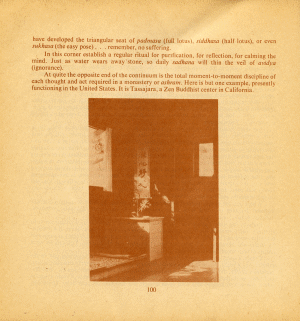
The Zen Center
Bell ringing at 4 a.m. You get up immediately.
Han (block of hard ash wood struck with wooden mallet) starts at 4:05, 15 minute han, 3 rounds. You should be in the zendo by end of second round.
Zazen (sitting meditation) starts at 4:20. 40 minute period. Roshi makes a round of the zendo in the beginning. People bowing as he approaches (actually gassho-ing -- hands together and bow).
Bell sounds after 40 minutes. Kinhin (walking meditation) begins. Kinhin for 15 minutes. (Hands on chest, walking very slowly in a line, about a half step with each breath).
Second period of zazen (40 minutes).
Service at 5:50. Consists of bowing to the floor 9 times, reciting the Heart Sutra 3 times, bowing to floor 3 times; lasts about 20 minutes. With bells and large wooden drum.
Study period. One hour. In large room with fire if it's cold. Kerosene lamps. Tea is served. Warmth often makes you drowsy. You read various texts. Short chant at beginning and end of period.
Han for breakfast starts at 7:10.
Breakfast is served in the zendo. You sit on cushions in meditation posture. Each student has: an oryoki (set of 3 bowls, spoon and chopsticks, a scraper, setsu (stick with cloth end), and 3 cloths (for napkin, bowl-wiping, and cloth in which entire oryoki is wrapped -- folded and tied in prescribed manner). Ritual way for untying and removing bowls. Bowls are placed on an eating board in front of each student. Complicated oryoki ritual helps to focus attention. Meals are a sort of meditation, in silence, with as little noise as possible.
Chanting precedes meal (in English at breakfast, Japanese at lunch). After short chant, students set up their oryokis. Chanting resumes and servers enter. As server stops before student, they bow to each other, server kneels and dishes food into bowl, they bow again and server goes on to next student. There is chanting while food is served (reciting names of Buddha and Bodhisattvas). When servers leave there is more chanting (we should be mindful of where this food comes from and whether our practice deserved it). Meal is eaten. When meal is finished server enters with hot water and there is a short chant. Hot water is poured in large bowl. Bowl is cleaned and water poured in second bowl, bowl wiped with cloth, and so on until the bowls are cleaned. Water is drunk, with a little bit saved and collected at the end (it's taken out and poured on a plant). Oryokis are tied up and put away (placed by the side of each student). Clackers and bow at the end of meal, roshi and priests leave, then students leave. As students file out of zendo they exchange bows with the cook.
Short period (about 20 minutes) in which you change into work clothes, take care of toilet, etc.
Work drum sounds at 8:40. Students assemble for work meeting. Short informal meeting to make sure each student knows what he's doing, has some task assigned to him, and jobs are co-ordinated.
Work period until han 11:10. Gardening, carpentry, masonry, roofing, garbage collecting, cleaning, sewing, etc.
Han at 11:10, 20 minutes to clean up, change into robes and get to zendo.
(There is a 15 minute han for this, so one can gauge his time.)
Zazen (40 minutes).
Service (bowing and reciting Heart Sutra).
Lunch (same procedure as breakfast). Usually soup, bread, and vegetable.
After lunch there is a rest period, about 30-40 minutes. (This is the chance to get some sun.)
Work drum sounds at 2 (or 2:05). After short work meeting you return to your job.
At 3:30 a bell signals tea. Everyone gathers on steps in front of zendo (where there is still some sun), a short chant and tea is served. Sometimes there is a treat (crackers, cookies). A short chant at the end and people return to work. At 5 p.m. drum signals end of work. Clean up, put away tools, tidy work area.
Bath time. Everyone heads for the hot sulphur baths. Before entering bath student bows before altar and recites gatha (verse). Silence in bath. (It is already dark in the winter, and quite cold. Kerosene lamp, cement grotto, steam rising from water, shadowy forms. Bath, at about 110 degrees is the one chance for the body -- feeling all day like a piece of cold iron -- to get really warm. Blood returns to body.) Students bow and recite gatha before leaving.
Bell begins at 5:35. 15 minutes to service.
Evening service (as before).
Supper. No chanting, simply clackers before and after meal.
Brown rice, miso soup, and vegetable.
After supper there is free time. You return to your cabin or go to the large room where there is a fire.
Han starts at 7:30.
Study period (at 7:45) when there is no lecture.
Lecture -- by roshi, priest, or student -- is in zendo, at 8.
Zazen (at 8:35, lecture may extend into this period). Ends with slow deep chanting of Heart Sutra.
Students return to cabins.
Lights out at 9:30.
There is a day off on 4 and 9 days (for example, the 4th, 9th, 14th ...). This begins after breakfast. On 4 days (officially only 1/2 day off) there is a general discussion in the morning attended by all; completely open -- gripes, questions, views, personal problems; feedback for those directing Tassajara; very helpful for students to know where other students are, what sort of problems they're facing. On days off, students are expected to take care of personal needs -- laundry, mending, shaving head, and so forth.
The Fall Practice period is 2 months; the Winter (or Spring) Practice period is 3 months. Each period ends with a 7 day sesshin -- periods of intense meditation -- 17 hours a day of zazen and kinhin, including meals, lecture, bath, and short work period.
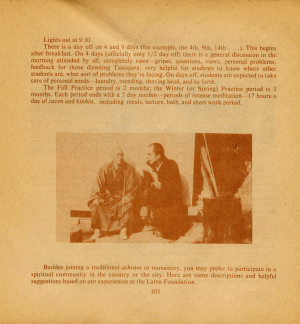
Besides joining a traditional ashram or monastery, you may prefer to participate in a spiritual community in the country or the city. Here are some descriptions and helpful suggestions based on our experiences at the Lama Foundation.
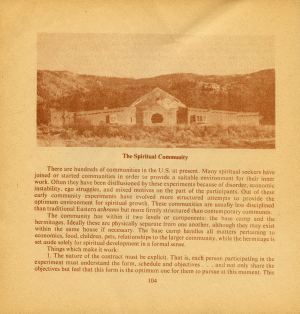
The Spiritual Community
There are hundreds of communities in the U.S. at present. Many spiritual seekers have joined or started communities in order to provide a suitable environment for their inner work. Often they have been disillusioned by these experiments because of disorder, economic instability, ego struggles, and mixed motives on the part of the participants. Out of these early community experiments have evolved more structured attempts to provide the optimum environment for spiritual growth. These communities are usually less disciplined than traditional Eastern ashrams but more firmly structured than contemporary communes.
The community has within it two levels or components: the base camp and the hermitages. Ideally these are physically separate from one another, although they may exist within the same house if necessary. The base cap handles all matters pertaining to economics, food, children, pets, relationships to the larger community, while the hermitage is set aside solely for spiritual development in a formal sense.
Things which make it work:
1. The nature of the contract must be explicit. That is, each person participating in the experiment must understand the form, schedule and objectives ... and not only share the objectives but feel that this form is the optimum one for them to pursue at this moment. This experiment cannot work properly if the group has many ideas of "how it should be done." In traditional ashrams there is usually a guru or teacher who leads the way ... or a traditional structure which is known to every one who seeks to participate.
2. All members of the community (with the exception of small children) have consciously and freely chosen to participate in the experiment. Any exceptions to this rule reduce the effectiveness of the experiment.: In the most rigid selection procedures, if one partner of a couple does not wish to fully participate in the experiment, then neither would participate and they would leave the community, at least for the period of the experiment. It takes very few people who do not share the desire to work on themselves in this way to destroy the effectiveness of a spiritual community.
It was the great calamity of our people that drove us to the struggle, brought us together, and left us greater. Those who do not understand, have not experienced the same calamities among their people. These things appear enigmatic and mysterious, that hundreds of thousands would be led to assemble amidst calamity and passion. Others cannot understand that this is not an order of the State! They are deceiving themselves! The State does not order us! We order the State! The State did not create us! Rather we created our own State! No, the movement lives, and it is grounded hard and fast. And as long as one of us can draw a breath, he will give his strengths to the movement, just as it was in yesteryear. Then drum will join drum, flag will join flag, group will join group. Gau to Gau, and after that, this earlier divided people, will follow these sacred columns of the Nation. It would be an outrage if we were to lose what we have fought for with so much labor, so much worry, so much sacrifice, and so many privations. One cannot live faithfully and give up what has given meaning and purpose to one's entire life. That would not be so if it were not a cardinal command. And no earthly power gave us that command. For the God, our God, who created our people, gave us that command! So it is our vow this evening that each hour, on every day to think only of Germany, of the People and Reich, and of our German nation! To the German people! Hail Victory! Hail Victory!
-- Triumph of the Will, directed by Leni Riefenstahl
3. All participants in the community (with the exception of the smaller children) spend time in the hermitage as well as the base camp and share base camp activities and responsibilities.
If you are living with others who are sharing the journey even minimally, it is important that a group meditation room be set aside. In fact, it is wise when moving into a new home to create the center -- the meditation room or alcove -- first, before you get the kitchen and bedrooms in order.
1. Collaboratively pick the place for the meditation area.
2. Clean it up and bring the most beautiful things to it. Keep it simple.
3. Then light a candle and perhaps some incense ... everyone sit together silently ... and reflect on why you are here ... the goal of your work together ... and then perhaps read from some holy books. Perhaps take a reading of the I-Ching for your work together ... and only after all that is done do you set up housekeeping.
4. Keep that area very special. No social conversations, no other books, no other uses, no sleeping there.
5. Try to build a natural ritual into your lives so that you use that space to share a daily moment when you transcend your ego games. Perhaps early morning silent meditations, or evening chanting, or reading from holy books aloud ...
The Base Camp
The base camp includes all the living facilities with the exception of the hermitage rooms or buildings. Participants in the base camp follow a schedule as follows:
5:30 Rise
5:45 - 6:30 Group Silent Meditation
6:30 - 7:00 Chanting, reading aloud, singing.
7:00 - 9:00 Dancing, asanas, pranayam, breakfast, getting the children to school, clean up, etc.
9:00 - 12:00 Karma yoga (work) period -- assignments for an entire week are usually made once a week on Saturday morning.
12:00 - 2:00 Bringing food and supplies to hermit and preparing and having prasad (consecrated food), taken in silence. Then rest or relaxation and clean-up.
2:00 - 4:00 Karma yoga period.
4:00 - 5:30 Group study, and exercises in consciousness.
5:30 - 6:30 Pranayam, asanas, preparing evening food, etc.
6:30-8:00 Evening prasad (silently) plus clean-up and relaxation, reading, etc.
8:00 - 9:00 Group meditation and chanting and singing.
By assigning the karma yoga tasks over a period of a week you can use the karma yoga periods in a fluid fashion. One's person's karma yoga, for example, might include milking goats, making cheese, weaving, picking the kids up at school, getting the car fixed, etc. Also a person may design his schedule to use a few of the morning karma yoga periods for personal study or meditation. The use of these periods is largely dependent upon the number of participants, and the amount of man-hours required for right livelihood and community maintenance. Time not spent in fulfilling assignments should be used on inner work (study, meditation, asanas, singing kirtan).
Most activities can be carried on in silence. Groups working together on a shared project such as gardening, building, etc. can either do these tasks in silence or do mantra during the work. Silence is an important part of the work. Formal discussions at the base camp of the hermitage experiences of the participants can be useful. Gossip, small talk, and hanging out ... have a limited value in breaking through the illusion.
It is well to realize that the relationships in this community are not the dominant concern. Ideally, personality falls away in the common endeavor. If you want at all costs to hold onto your personality, don't join a spiritual community ... because no one is going to be interested. Interpersonal matters are dealt with only to the extent that they are disruptive (i.e. capture the consciousness of the group or some participants). Such matters can be dealt with at a group meeting if necessary ... but the moment the group gets bogged down in heavy melodrama ... it is well to call a meditation interlude until everyone can find a center again. Melodrama sucks us in again and again, but diminishes in power if actively thwarted.
The Hermitage
Each participant in the community spends a portion of his or her time in solitude in a hermitage. The amount of time spent by each individual is a function of the number of participants and the number of spaces. The minimum time for a hermitage visit is twenty-four hours. (The maximum we have worked with is three weeks.) Usually an initial period of three to five days is a good "shake-down cruise."
You bring into the hermitage the minimum requirements. A sleeping bag, toothbrush, blanket or cushion, candles, incense, etc. Beyond the requirements for survival the stay in a hermitage should be designed to include items useful to your specific sadhana. The fiercest confrontation is to merely walk into an empty room with your basic survival gear and close the door. The most gentle trip is to include knitting, books, notebook, drawing pad, walks in the woods, photo albums, etc. Only books written by very advanced beings should be brought in, only pictures of holy beings or religious subjects or nature should be around you.
Each day food is brought at noon. One large meal a day is usually enough. The tray may include enough fruit for the evening. Survival apparatus may include facilities for making tea. (Those who are ready for the fierce tapasya may choose to fast while in the hermitage.) The food and supplies are left outside the door by one of the members of the base camp. No social contact is made. Any needs are communicated by a note left outside the door for the messenger to pick up.
The only reason to leave the hermitage room is for toileting and washing, both of which should be done without social interaction.
If the hermitage is in a noisy place, ear plugs may be used during your stay.
As a hermit, you usually spend a good deal of your time in meditation. It is good to have a little training or knowledge of meditation to help you calm your mind. A good deal of the time is spent initially watching your wild out-of-control mind do "its thing." It is only under these minimal stimulus conditions that you can really watch it do its thing.
The Abbot
Unless there is a teacher in the group, leadership is risky. However, it is possible to rotate the duties of an abbot in the event that no teacher is available. The abbot has the responsibility for making things run smoothly on the physical plane as well as for keeping the objectives of the community uppermost in everyone's mind. In order to fulfill such responsibilities, the abbot must spend much time meditating to keep his own spiritual center in order so that he does not become an agent of more confusion and illusion and power trips. Perhaps the abbot could be the person who has just come out of the hermitage if rotation is required.
One of the functions of the abbot can be to visit a hermit if the hermit sends a note requesting such a visit. During his visit the abbot must keep his concerns strictly on the spiritual unfolding of the hermit. Often merely a silent meditation between the hermit and the abbot will suffice to fulfill the needs of the hermit.
Mood or Tone
All of this structure sounds heavy ... and it is ... but it need not be carried out in a serious or heavy mood. A light joyful style is not in any way incompatible with spiritual work. The ability to retain a sense of cosmic humor is very crucial for the effectiveness of a spiritual community. Heavy religiosity (much evaluation) is a drag.
If you are living in a city and are involved in karma yoga, it may be possible to design a modified form of the community-ashram. A large house, shared by a number of people who have consciously come together solely for the purpose of working on themselves, is a useful setting. Perhaps one or two rooms can be set aside in the quietest part of the house as hermitage quarters. Another room can be set aside as the group meditation room. It should be possible for each participant to spend some time in the hermitage, being cared for by the other members of the group. The value of this procedure is that it creates a collaboration specifically for the spiritual evolution of each individual, based on the assumption that the group members each directly profit from the spiritual evolvement of each of the other members.
Still another possibility for city dwellers is to have satsang (or a gathering of monks on the path) at a different apartment each evening. The formats should be kept simple and non-competitive. Perhaps some reading, a meditation, a few songs and light prasad (consecrated food). There should be a real effort to reduce the amount of talk or stimulation that is not definitely involved in the journey. Even cosmic gossip can slow down the work. Silence before and after the formal aspects of the evening helps.
Statistics: Posted by admin — Fri Sep 25, 2015 7:46 pm
]]>

THIS ONE IS DEDICATED TO THE ONE EYE LOVE
Money is "green energy." And any energy you work with brings with it its own vibrations. If you are sufficiently evolved to be able to transmute negative vibrations, then it makes little difference where the energy comes from. For most of us, however, we are affected for good or ill by the energies with which we interact. Also, the manner in which you obtain the energy from others affects them. Because we are all interrelated, what affects another person affects you.
The method of gaining your livelihood must not, by its very nature, increase the paranoia and separateness in the world. A dishonest or exploitive venture would be a case in point. Most means of gaining livelihood do not, in and of themselves, increase the illusion of separateness. However, the beings who do the work do it -- because of their own level of involvement -- in such a way as to increase the illusion. When you are involved in such vocations, then it is your work on yourself which makes the particular vocation a vehicle for bringing man out of illusion and into yoga.
Suitable right livelihood for any specific individual is determined by the totality of forces acting upon him. These forces (vectors) include social, cultural, economic, hereditary, and experiential factors. To hear the way in which the interplay of these forces determines your right livelihood requires much calming of the mind. The quieter you become the more you can hear.
As you progress with your sadhana you may find it necessary to change your occupation. Or you may find that it is only necessary to change the way in which you perform your current occupation in order to bring it into line with your new understanding of how it all is. The more conscious that a being becomes, the more he can use any occupation as a vehicle for spreading light. The next true being of Buddha-nature that you meet may appear as a bus driver, a doctor, a weaver, an insurance salesman, a musician, a chef, a teacher, or any of the thousands of roles that are required in a complex society -- the many parts of Christ's body. You will know him because the simple dance that may transpire between you -- such as handing him change as you board the bus -- will strengthen in you the faith in the divinity of man. It's as simple as that.
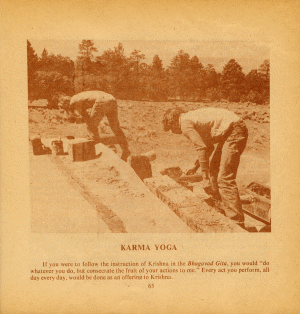
KARMA YOGA
If you were to follow the instruction of Krishna in the Bhagavad Gita, you would "do whatever you do, but consecrate the fruit of your actions to me." Every act you perform, all day every day, would be done as an offering to Krishna.
If we recall that Krishna is synonymous with Love, with Highest Consciousness, with the Eternal Witness, with the Spirit ... and that He is actually our innermost Self, then we can understand that by consecrating an act, we are indeed offering our every action into the service of higher consciousness. Our every act becomes an act of waking up.
Using the stuff that makes up your daily life as the vehicle for coming to Union is called karma yoga. It is a most available yoga for all, and at the same time a most difficult one. It is difficult because it starts with an action which you are initially performing for an end of maintaining your individual ego, and it overrides or converts that motivation into one of service to the higher Self which transcends ego.
In order to perform karma yoga, there is a simple general principle to keep in mind: bring a third component into every action. If, for example, you are digging a ditch, there is you who is digging the ditch, and the ditch which is being dug. Now add a third focus: say, a disinterested person who is seeing you dig the ditch. Now run the entire action through his head while you are digging. It's as simple as that. Through this method you would ultimately free yourself from identifying with him who is digging the ditch. You would merely see a ditch being dug.
The difficulty with adding just any third party is that you might attribute to that other person certain motives or values. In order to avoid that, it is useful to pick the third focal point with an eye towards your goal of enlightenment. That is, pick someone who is already enlightened, such as Krishna or Ram or a Buddha or Christ. They see it all. They are beyond it all. They understand how it all is. As they watch you digging the ditch, they see the act in all its cosmic significance ... it's the first and last digging of a ditch. They understand why you are doing it and all the thoughts in your head, all your history, and they even understand the future -- how it is when the ditch is all dug. And from this vantage point they have total compassion, total appreciation for all that is involved. To run the act of you digging a ditch through one of their heads allows you to get free of the ego-centric predicament, "I am digging a ditch."
http://rapeutation.com/beherenowram.13r_small.gif
Spades at ease!
One People! One Leader! One Reich! Germany! Today we work together in the swamp. We work in the swamp. And in the sand. We dam the North Sea. We plant trees. We build roads from town to town, and city to city. We provide the farmer with new soil, forests and fields, land and bread, for Germany. We didn't stand in the trenches. Nor were we under the shell fire of grenades, and still we are soldiers. Sharpen the hammers, axes, pick axes and spades! We are the Reich's young manhood!
My Labor Service Men. You represent a great idea, and we know that for millions of our national comrades, physical labor will no longer be a divisive concept. But it will instead bind us together and, furthermore no longer will it be the case in Germany that physical labor will be seen as anything less than any other work. The whole nation passes through your school. The time will come when no German can be admitted into the community of the people until he has first become a member of your group.
-- Triumph of the Will, directed by Leni Riefenstahl
There are a variety of techniques for introducing this third focal point into your life in a systematic fashion. It can be done in a devotional form through, as Krishna suggests, offering the fruit of each action to Him. Thus you keep in mind some manifestation of God -- some form of a guru -- to whom you are offering in loving service your every act. He may be felt to reside in your heart or your head or atop your head or on your shoulder or "out there."
March past of farmers in traditional costume and presentation of the harvest to Hitler
-- Triumph of the Will, directed by Leni Riefenstahl
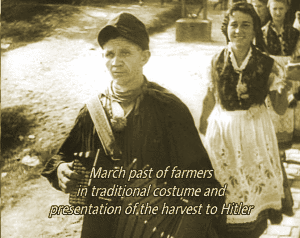
Or you can introduce as a third focal point the thought -- in one form or another -- that all forms and acts are part of the One. A continuing thought such as, "It's all the Divine Mother," or repeating japa such as saying over and over OM OM OM or RAMA RAMA RAMA, or TAT TWAM ASI or OM TAT SAT. All of these mantras are designed to remind you over and over that it is all One and that it only appears, within the illusion, as if something were happening such as digging a ditch.
Another systematic technique for introducing an additional focal point is the technique called self-remembering, which utilizes a device called the witness. The following is a description of this method.
The Witness
George Gurdjieff, a Russian philosopher-mystic, noted that if you set an alarm clock at night in order to get up early to get some work done, who you are in the morning when the alarm goes off is quite different from who you were the night before. In the morning you might even say, "Who the %X**!! set that alarm clock?" A moment's reflection will show you that you play many roles in the course of a day ... and that who you are from moment to moment changes. There is the angry you, and the kind you, the lazy you, the lustful you -- hundreds of different you's. Gurdjieff points out that sometimes one "you" does something for which all the other "you's" must pay for years or possibly the rest of this life.
Each of these "you's" reflects an identification with a desire, or a feeling, or a thought. If, as we have seen, the work is to break these identifications, we can work effectively throughout each day by making each of these "you's" objects, i.e., by breaking the identification with each of them. This is not so easy.
There is one technique which is known as adopting the role of the witness ... and holding on to that role ... ultimately to the exclusion of all other roles.
Who is the Witness?
1. It is a part of the rational mind. As such it is only useful up to a point ... the point at which you go through the "doorway." When you go through the doorway you merge with the One ... the Eternal Witness ... Buddha Consciousness ... (we differentiate these two witnesses by referring to the small, rational mind, ego witness without the capital letter).
2. The witness could be thought of as an eye ... or "I" which sees, though it does not look. That is, it is not an active thing. It just sees it all happening.
3. The witness is not evaluative. It does not judge your actions. It merely notes them. Thus, if you perform an act because of desire, such as eating something that is not sattvic (helpful to your sadhana, and then you put yourself down for having eaten it ... the witness -- which it finally appears -- would merely note: (A) he is eating such-and-such, and (b) he is putting himself down for eating such-and-such. Thus, the witness has noted a "you" of desires and a super-ego you ... two "you's."
This point is important. Most of the time the inner voices of most people are continually evaluative. "I'm good for doing this," or "I'm bad for doing that." You must make that evaluative role an object of contemplation as well. Keep in mind that the witness does not care whether you become enlightened or not. It merely notes how it all is.
Appearance of the Witness
At first the witness is adopted because of an intellectual understanding of the need to separate the Self from the Doer. You probably remember your witness only now and then, when you are in a calm dispassionate state of mind. The moment you get distracted you lose the witness. Later you "come to" and remember that you forgot.
For example, you are walking down a street witnessing yourself walking down a street. You feel happy and witness feeling happy ... and so it goes. Then you meet someone or see something that irritates you. Immediately you get irritated and forget all about the witness. The adrenalin pumps through you and you think angry thoughts. At this point "angry me" is who you are. Only much later do you remember that you were attempting to witness.
At that point you promise yourself that you won't forget again. Ah, how little you know about the subtleties of the seductions of the other "you's." Again you are walking and again witnessing walking and so forth. This time you meet with another situation which irritates you. Again you lose your witness (or center as it is called sometimes) and again your endocrine glands secret and you think angry thoughts. But this time right in the middle of the entire drama you "wake up" ... that is, you realize your predicament. But at this point it is difficult to get free of the angry you because you are already getting much gratification. (It's like trying to stop in the midst of a sexual act.) And so you use some rationalization such as "I know I should be witnessing but after all he deserves to be punished" and with that you climb back into the "angry you" role with a certain amount of self-righteousness. And so it goes through thousands of such experiences.
After a time (however long is necessary) you notice that although you still lose the witness (fall asleep) as often as before, you are starting to "remember" sooner. That is, you are getting to the point where the actual falling asleep is starting to "wake" you. This is a big step forward.
Again, after some time, it all gets much more subtle. Now you are walking down the street and again you are witnessing it all ... and again an "irritant" presents itself. This time -- as you are about to get angry -- the witness says "Ah, about to get angry, I see." This often short-circuits the energy the "angry you" was fueling up with, and it falls away. So now the lapse between being awake and being asleep is getting much smaller. Simultaneously, you begin to note that you don't fall asleep (i.e., fall out of the witness) nearly as often. Throughout the day you are remaining centered in the witness watching the drama of life unfold.
On the surface, this method looks like what psychologists call the "defense mechanism of dissociation." A girl goes to a dance and no one asks her to dance ... and she adopts a superior separateness ... watching it all with the thought: "I couldn't be less interested in dancing." This response of separating herself from her desire arises because she so badly wants to dance. It must be differentiated from the adoption of a witness when you have finished with dancing, so to speak. The witness we are considering here is hardly an unconscious defense mechanism. Though they look alike on the surface, they are quite different. But only you know which is which.
There is a side effect which occurs while you are developing the witness which, though unpleasant, will soon disappear. It is the feeling that life has lost its zest as a result of keeping the witness going. It is difficult to fully get lost in the subtle sensual gratifications of eating when you are witnessing yourself eat. "He is chewing ... tasting ... savoring, etc." It all seems so dispassionate. And truly it is. Here it is well to remember the oft-quoted stipulation that you must "die to be reborn" or "give it all up to have it all." Keep in mind that the loss of full sensory gratification is but a stage (and one of the more difficult ones at that) of your sadhana. And it will only be when you are living quietly and calmly in the dispassionate witness that you will be ready to "permanently" pass through the next doorway.
You will also note that as you break identification with more and more of your roles and begin to live more calmly in the witness, that you begin to be aware of much more. You begin to see how the laws of the universe are manifesting in all aspects of nature, outstandingly those which you have so recently been involved with, such as your own body and personality. Now you are beginning to live on the causal plane. This experience of seeing how it is ... is a very heady feeling. It must be witnessed, too, or else you will get caught in a new ego game of playing "the eye of God" --- while still being you. This is a sticking point for many intellectuals. They enjoy intellectual power so much that they cannot forego it by witnessing it ... in order to go the final step in which they give up their separateness as an individual "knower" to dissolve in the sea of knowledge.
4. The witness is always in the Here and Now. It lives in each instant of living. It is well to keep in mind that whatever device you choose as a third focal point, it is a temporary crutch. It is dualistic in nature. Once you have successfully broken identification with the Doer, and are solely the witness or a servant of Krishna, or whatever, then you must go the final step in which servant and master, witness and that which is witnessed, become One. The goal is non-dualistic. The means is dualistic. Such a means is a sturdy vessel to get you across the ocean of samsara (illusion). Once you reach the far shore, you leave the boat behind.
Potent Quotes
"Whatever you do, or eat, or give, or offer in adoration, let it be an offering to me; and whatever you suffer, suffer it for me. Thus you shall be free from the bonds of Karma which yield fruits that are evil and good; and with your soul one in renunciation you shall be free and come to me." -- Bhagavad Gita
"In regard to every action one must know the result that is expected to follow, the means thereto, and the capacity for it. He, who being thus equipped, is without desire for the result, and is yet wholly engrossed in the due fulfillment of the task before him, is said to have renounced the fruits of his action." -- Gandhi
"He who sees the inaction that is in action, and the action that is in inaction, is wise indeed. Even when he is engaged in action he remains poised in the tranquility of the Atman." -- Bhagavad Gita
"But that state of Supreme Love and Immortality is made possible only by giving up the objective reality of the world as it appears to the ego-centric intellect and senses, and the consequent renunciation of attachment, by uninterrupted loving service." -- Narada Bhakti Sutras
"To study Buddhism is to study ourselves. To study ourselves is to go beyond ourselves. To go beyond ourselves is to be enlightened by all things. To be enlightened by all things is to free our body and mind, and to free the bodies and minds of others. No trace of enlightenment remains, and this no-trace continues endlessly." -- Dogen Zenji
"If you observe well, your own heart will answer." -- de Lubicz
"An art of living which will enable one to utilize each activity (of body, speech and mind) as an aid on the path is indispensable." -- Tibetan Yoga and Secret Doctine
"How does the emancipated soul live in the world? He lives in the world like a diver bird. It dives into water, but the water does not wet its plumage; the few drops of water which may possibly stick to its body are easily jerked off when it once flaps its wing." -- Ramakrishna
"At first whenever I fell back into sin I used to weep and rage against myself and against God for having suffered it. Afterwards it was as much as I could dare ask, 'Why has thou rolled me again in the mud, O my playfellow?' Then even that came to my mind to seem to bold and presumptuous; I could only get up in silence, look at him out of the corner of my eye and clean myself." -- Aurobindo
"All the urges of the passions express vital natural impulses, and it is the animal in us which gives rise to them. The wise man is conscious of them, he knows how to give them their true name and to make use of them as you direct your donkey. But the wise man is rare, and egoism finds a thousand reasons for giving those impulses legitimate motives and flattering names. The human passions are life impulses which have been perverted ... and so skillfully perverted that it is very difficult to discover, beneath their complications, the almost divine power which is their source -- de Lubicz
"What you receive depends upon what you give. The workman gives the toil of his arm, his energy, his movement; for this the craft gives him a notion of the resistance of the material and its manner of reaction. The artisan gives the craft his love; and to him the craft responds by making him one with his work. But the craftsman gives the craft his passionate research into the laws of Nature which govern it; and the craft teaches him Wisdom." -- de Lubicz
"But he learned more from the river than Vasudeva could teach him. He learned from it continually. Above all, he learned from it how to listen with a still heart, with a waiting, open soul, without passion, without desire, without judgement, without opinions." -- Hesse
"As long as one feels that he is the doer, he cannot escape from the wheel of births." -- Buddha
"If you can serve a cup of tea right, you can do anything." -- Gurdjieff
"Ch'ing, the chief carpenter, was carving wood into a stand for musical instruments. When finished, the work appeared to those who saw it as though of supernatural execution; and the Prince of Lu asked him, saying, 'What mystery is there in your art?'
'No mystery, Your highness,' replied Ch'ing. 'And yet there is something. When I am about to make such a stand, I guard against any diminution of my vital power. I first reduce my mind to absolute quiescence. Three days in this condition, and I become oblivious of any reward to be gained. Five days, and I become oblivious of any fame to be acquired. Seven days, and I become unconscious of my four limbs and my physical frame. Then, with no thought of the Court present in my mind, my skill becomes concentrated, and all disturbing elements from without are gone. I enter some mountain forest, I search for a suitable tree. It contains the form required, which is afterwards elaborated. I see the stand in my mind's eye, and then set to work. Beyond that there is nothing. I bring my own native capacity into relation with that of the wood. What was suspected to be of supernatural execution in my work was due solely to this." -- Chuang Tzu.
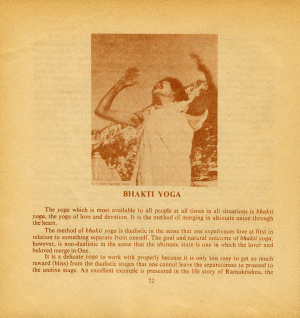
BHAKTI YOGA
The yoga which is most available to all people at all times in all situations is bhakti yoga, the yoga of love and devotion. It is the method of merging in ultimate union through the heart.
The method of bhakti yoga is dualistic in the sense that one experiences love at first in relation to something separate from oneself. The goal and natural outcome of bhakti yoga, however, is non-dualistic in the sense that the ultimate state is one in which the lover and beloved merge in One.
It is a delicate yoga to work with properly because it is only too easy to get so much reward (bliss) from the dualistic stages that one cannot leave the separateness to proceed to the unitive stage. An excellent example is presented in the life story of Ramakrishna, the Indian saint who was so in love with Kali, a manifestation of the Divine Mother, that he resisted breaking through into the Oneness. Only after his guru forced him, did he do so.
This yoga is difficult for us in the West to understand because we have used the term "love" in such a profane sense ... that is, to reflect attachment to worldly objects or people. We speak of "loving" that food or drink or automobile or person ... often in the same sense. We are so "action-oriented" that we think of love as "something to do." But most people have sadly found that you can't "make love" if love does not already exist. Meher Baba, a recent Indian saint who advocated love as the supreme vehicle said:
"Love has to spring spontaneously from within: and it is in no way amenable to any form of inner or outer force. Love and coercion can never go together: but though love cannot be forced on anyone, it can be awakened in him through love itself. Love is essentially self-communicative: Those who do not have it catch it from those who have it. True love is unconquerable and irresistible; and it goes on gathering power and spreading itself, until eventually it transforms everyone whom it touches."
The specific object of love which concerns the bhakti yogi is the Spirit or the manifestation of the Divine ... in anything and everything. It is the love for light or for love itself or for the Life Force or for truth or beauty. It is love for the purest manifestations of these abstractions. The roles through which this love may be expressed are many; the relation of worship or piety; the pure relationship of servant to master; the relation of friend to friend; the relation of wife to husband; parent to child; child to parent; the lover to the beloved; etc. Though the "vehicles differ from role to role, the essence -- the love -- is the same stuff. In each instance what one is loving in the object of one's love is love itself ... the inner light in everyone and everything.
When we speak of falling in love, we might find that a slight restatement of the experience would help clarify our direction. For when you say "I fell in love" with him or her you are saying that he or she was the key that unlocked your heart -- the place within yourself where you are love. When the experience is mutual, you can see that the psychic chemistry of the situation allows both partners to "fall in love" or to "awake into love" or to "come into the Spirit." Since love is a state of being -- and the Divine state at that -- the state to which we all yearn to return, we wish to possess love. At best we can try to possess the key to our hearts -- our beloved -- but sooner or later we find that even that is impossible. To possess the key is to lose it.
Just as with every other method of coming to the Light, if it works we get attached to the method, failing to realize that it is the goals and not the method which we crave. A relationship starting out as one that awakens love can only remain a living vehicle for love to the extent that it is continually made new or reconsecrated. That is, each partner in love must always strain to see through the veils of personality and body to see the Divine Essence within -- within himself and his partner. And he must come to see the veils ... as maya, the Divine Illusion, the Divine Mother ... and worship even the veils without getting trapped into them them real. Such ideas are reflected in the highest marriages, or for that matter in the highest form of any relationship. Play your role in the Divine Dance, but know it to be such and worship its divinity.
Song, dance changing and prayer have been throughout the ages traditional forms of bhakti yoga. There are many levels at which you can participate in these rituals. At first such rituals are matters of curiosity, and you are the observer. Then you arrive at the stage of peripheral participation -- a "sing along." Then in time you become familiar with the routines and you start to identify with the process. As your identification deepens, other thoughts and evaluations fall away until finally you and the ritual become one. At that point the ritual has become the living process and can take you through the door into perfect unity. To know that these stages exist does not mean that you can jump ahead of where you are. Whatever stage you are in, accept it. When you have fully accepted your present degree of participation, only then will you start to experience the next level.
Singing and music: Most familiar to us is the use of song to open the heart. Hymns such as "Holy, Holy, Holy" or "We Gather Together To Ask The Lord's Blessing" or "Mine Eyes Have Seen the Glory of the Coming of the Lord," "Stand Up, Stand Up for Jesus," "Amazing Grace" -- have touched the hearts of millions with the Spirit. In India, bhajan (the singing of holy songs) has been until recent times practically the only social function in the villages. Evenings the men gather, squatting or sitting on the ground in a circle with their chillums (pipes) and a harmonium, a set of tabla (drums), perhaps a serangi or violin (stringed instruments) and cymbals ... and they take turns singing the stories of the holy beings such as Krishna and Ram. Night after night they participate in this simple pastime, keeping themselves close to the Spirit.
It is often startling to a Westerner to realize that it is not the beauty of the voice but the purity of the spirit of the singer that is revered by these people. It was only when music was profaned that it became a vehicle for gratification of the senses. Prior to that it was a method of communion with the Spirit.
A special form of bhajan is called kirtan ... which is the repetition in song of the Holy Names of God. Perhaps the most familiar of these in the West at present is:
HARI KRISHNA, HARI KRISHNA, KRISHNA, KRISHNA
HARI HARI ... HARI RAMA, HARI RAMA, RAMA, RAMA
HARI HARI
Hari can be translated as "Lord" and Ram and Krishna are names of incarnations of God.
The melody of kirtan is usually basically simple and it is only after many repetitions that the process of coming into the spirit starts to happen. Singing the same phrases over for two to five hours is not unusual for the true seeker. And you will find as you let yourself into the repetitive rhythm and melody that you experience level after level of opening.
Exercises
On the record that is included in the box From Bindu to Ojas, there are a number of examples of kirtan. Take any one of them and tape one single repetition on it onto a tape loop which you can run over and over through your tape machine. Then turn up the volume and join US.
There are many records and tapes of kirtan available (and more appearing all the time). Work with a variety of these until they have worked deeply into your heart.
When you have an opportunity to join with others in the si
Potent Quotes
"God respects me when I work
But he loves me when I sing." -- Tagore
"Love me, my brothers, for I am infinitely superfluous, and your love shall be like His, born neither of your need nor of my deserving, but a plain bounty. Blessed be He." -- C.S. Lewis
'Bhakti, love of God, is the essence of all spiritual discipline ... Through love one acquires renunciation and discrimination naturally." -- Ramakrishna
"Oh thou who art trying to learn the marvel of love from the copybook of reason, I am very much afraid that you will never really see the point." -- Hafiz
"To savour in our hearts in a certain manner and to endeavor to experience in our souls the power of the Divine Presence and the sweetness of heavenly glory, and this, not only after death but even in this mortal existence. This is most truly to drink of the gushing fount of the Joy of God." -- Institution of the First Monks
"Love without attachment is light." -- N.O. Brown
"God alone is Real and the goal of life is to become united with Him through Love." -- Meher Baba
"If you have love you will do all things well." -- T. Merton
"Love suffereth long, and is kind; love envieth not; love vaunteth not itself, is not puffed up, does not behave itself unseemly, seeketh not its own, is not provoked, taketh not account of evil; rejoiceth not in unrighteousness, but rejoiceth with truth; beareth all things, hopeth all things, endureth all things. Love never faileth." -- Paul of Tarsus
LOVE in the World's Great Religions:
Christianity: "Beloved, let us love one another, for love is of God; and everyone that loveth is born of God, and knoweth God. He that loveth not, knoweth not God, for God is Love."
Confucianism: "To love all men is the greatest benevolence."
Buddhism: "Let a man cultivate towards the whole world a heart of Love."
Hinduism: "One can best worship the Lord through Love."
Islam: "Love is this, that thou shouldst account thyself very little and God very great."
Taoism: "Heaven arms with Love those it would not see destroyed."
Sikhism: "God will regenerate those in whose hearts there is Love."
Judaism: "Thou shalt Love the Lord thy God with all thy heart and thy neighbor as thyself."
Jainism: "The days are of most profit to him who acts in Love."
Zoroastrianism: "Man is the beloved of the Lord and should Love him in return."
Baha'i: "Love Me that I may love thee. If thou lovest Me not, My love can no wise reach thee."
Shinto: "Love is the representative of the Lord."
I LOVE YOU
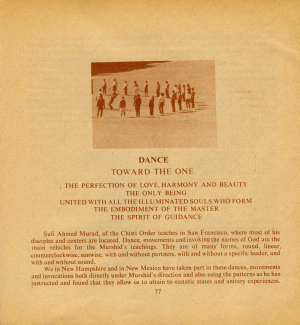
DANCE
TOWARD THE ONE
THE PERFECTION OF LOVE, HARMONY AND BEAUTY
THE ONLY BEING
UNITED WITH ALL THE ILLUMINATED SOULS WHO FORM
THE EMBODIMENT OF THE MASTER
THE SPIRIT OF GUIDANCE
Sufi Ahmed Murad, of the Chisti Order teaches in San Francisco, where most of his disciples and centers are located. Dance, movements and invoking the names of God are the main vehicles for the Murshid's teachings. They are of many forms, round, linear, counterclockwise, sunwise, with and without partners, with and without a specific leader, and with and without sound.
We in New Hampshire and in New Mexico have taken part in these dances, movements and invocations both directly under Murshid's direction and also using the patterns as he has instructed and found that they allow us to attain to ecstatic states and unitary experiences. They are in Murshid's words "practical proof of higher states which are available."
We hope either to publish or to help see published both the patterns and words of the dances and the Murshid's commentaries on their meaning and significance.
Following are paragraphs excerpted from some of the Murshid's papers on "Spiritual Dancing" which give some impression of his style and method. Those interested in this material or in working/practicing under the Murshid should contact him thru his secretary Wali Ali, 410 Precita Ave., San Francisco, Calif. 94110.
"Spiritual Dancing" is that which elevates the consciousness. Dancing may be said to be the movement of the body or any of its parts to rhythm, and spiritual is that which helps to make man realise that this body is really the Divine Temple. Therefore the use of sacred phrases and words, or the practice of deep meditation before starting, are necessary. For no dance is a Spiritual Dance because it is called that; it does not mean a certain form or technique, nor a ritual, nor something so esoteric that there is no understanding by performers and no communication to audience.
"The principle of PATH appears in several religions. It is not only in their mystical aspects but in many ceremonies and rituals. Circumambulation of an altar or shrine is also important, even regarded as an important act of devotion. The very word 'path' signifies that which comes from the feet treading -- it almost means 'what is footed'. It is now important to study the Walk both as a physical exercise and as a super-physical endeavor, making both movement and rest the most fundamental things in life.
"One thing almost obvious in the consideration of Walk is that the feet themselves are connected with Shrines. When one does the Lotus and other postures the human body is the shrine and the feet are accordingly tucked either under or over the legs. When one uses an external shrine, then there is Walking, But if one agrees with Kabir that God is everywhere, one can learn to walk that the body is the real temple and that every place is a holy shrine.
"It should be recognized that before we can run we must be able to walk, and by the same token even before we walk we should be able to breathe, to breathe is life ... Breath-currents have energy-values as well as chemical and mechanical ones. These are studied in Sufi mysticism and also in the works of Rama Prasad. If one stops breathing, functions also stop and some Indians identify 'prana', the breath, with life itself ... It cannot be emphasized too much that life depends on breath. Our willing has nothing to do with it. If one ambles, if one slouches, one does not manifest magnetism. From the very beginning of discipleships talibs in Sufism are given the instructions in breathing which aid in increasing both magnetism and the capacity for vitality.
"If one has a goal, physical or mental, while walking, it brings all the magnetisms together. It is a living concentration. For instance a loving person going to meet his or her beloved, is endowed and imbued with a living spirit which makes action easier and fatigue disappears. If we practice a 'TOWARD THE ONE,' whatever be the goal or purpose, walking becomes much easier. And therefore also sacred phrases may be thought or repeated, consciously or unconsciously.
" ... one should breathe concentrating on 'TOWARD THE ONE' with both inhalation and exhalation, the same phrase. This can be done best by leaning on the breath, but also one can take so many steps to each breath. This is somewhat more complicated. In between comes in listening to music wherein the rhythm is most important ... As one breathes in and out with this concentration all the essence of the universe can enter with the breath, and also all poisons can go out of the system. If this is not sufficient, one can be taught sacred phrases but for a group 'TOWARD THE ONE' is very good. Besides a group so joining builds up magnetism and as the group progresses from walk to ceremonial or ritual and from ritual to dance the dynamism and magnetism of both person and group increase; and also the capacity for the divine baraka, manifesting on the earthsphere increases.
" ... no mechanical means, no rules, no rituals, nothing controlled by man alone can liberate man.
"The Japanese, concentrating on the abdomen, rid their minds of useless luggage. The Sufi dervishes, using their feet, also rid their minds of useless luggage. The ridding of luggage is more important than the method. What is needed is a method that works, not a philosophy about method which can be very confusing."
S.A.M.
BELOVED SAMUEL L. LEWIS
MURSHID: SUFI AHMED MURAD: CHISTI
1896-1971
THE WORK WILL CONTINUE
OM SRI RAM JAI RAM JAI JAI RAM
Samuel Lewis (October 18, 1896–January 15, 1971) was an American mystic and dance teacher who founded the Dances of Universal Peace movement. He was also known under his Sufi name Sufi Ahmed Murad Chisti and was addressed by his mureeds and others as Murshid. This is an arabic word that means, "Exalted Teacher." He was popularly known as Sufi Sam.
Lewis was born to Jewish parents. Lewis' father Jacob Lewis was a vice president of the Levi Strauss jeans manufacturing company. His mother was Harriett Rosenthal, the daughter of Lenore Rothschild of the international banking family.
To his parents' dismay Lewis showed a keen interest in religion and spirituality from an early age and later rejected their attempts at as business career for him. Lewis studied mathematics at Columbia University in 1916.
In 1919 Lewis entered a Sufi community in Fairfax, California where he met and was influenced by the teachings of Hazrat Inayat Khan an Indian Sufi teacher and musician . A year later he began Zen study with Sogaku Shaku, a disciple of the Rinzai Zen Buddhist Abbot Soyen Shaku. The twin spiritual influences of Sufism and Zen were to remain central throughout his life.
Lewis remained in the Fairfax Sufi community through the early 1920s. In 1926 he collaborated with Nyogen Senzaki, a Rinzai Zen Buddhist monk, in opening the first official Zen meditation hall (zendo) in San Francisco.
Lewis continued to study Sufism and Zen, as well as yoga. He developed an interest in horticulture and promoted seed exchanges internationally.
In 1956 he visited Japan, India, Pakistan and Egypt, seeking the company of other mystics and teachers. In 1966 he was ordained a "Zen-Shi" (Zen Master) by Korean Zen master Dr. Kyung-Bo Seo.
In 1967 whilst recovering from a heart attack in a hospital Lewis claimed that he heard the voice of god say, "I make you spiritual leader of the hippies." For the remainder of his life Lewis traveled around California developing and teaching the Dances of Universal Peace, which draw on all the spiritual traditions he had encountered. The movement he created continues today in a formal way as Sufi Ruhaniat International, as well as informally through the wide adoption of the Dances of Universal Peace by many other Sufi and non-Sufi groups.
-- Samuel L. Lewis, by Wikipedia
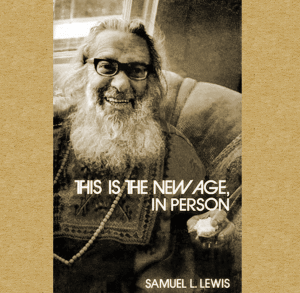
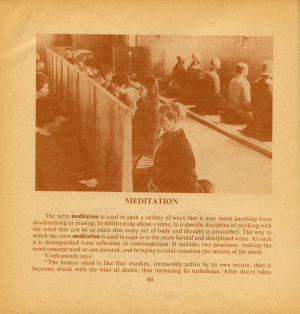
MEDITATION
The term meditation is used in such a variety of ways that it may mean anything from daydreaming or musing, to deliberating about a topic, to a specific discipline of working with the mind that can be so exact that every act of body and thought is prescribed. The way in which the term meditation is used in yoga is in the more formal and disciplined sense. As such it is distinguished from reflection or contemplation. It includes two processes: making the mind concentrated or one-pointed, and bringing to total cessation the turning of the mind.
Vivekananda says:
"The human mind is like that monkey, incessantly active by its own nature, then it becomes drunk with the wine of desire, thus increasing its turbulence. After desire takes possession comes the sting of the scorpion of jealousy at the success of others, and last of all the demon of pride enters the mind, making it think itself of all importance."
As long as the mind is caught in the senses and you are caught in your mind, you remain in the illusion ... since in the last analysis, your thoughts create your universe, Only when your mind has become completely calm will you reach Buddhahood or enlightenment.
"The soul has the means, Thinking is the means, It is inanimate, When thinking has completed its task of release, it has done what it had to do, and ceases," -- Vishnu Parana
Exercises
1. The simplest instructions for meditation are given by Tilopa in the Song of Mahamudra:
"Do nought with the body but relax
Shut firm the mouth and silent remain
Empty your mind and think of nought
Like a hollow bamboo
Rest at ease your body
Giving not nor taking
Put your mind at rest
The great way is a mind that clings to nought
Thus practicing, in time you will reach Buddhahood"
2. The southern Buddhists (Therevadin) practice a form of meditation called Satipatthana Vipassana (Application of Mindfulness). It starts with the simple exercise of Bare Attention. All that you do is register thoughts, states, etc. in the present. This process slows down the transition from the receptive to the active phase of the cognitive process. You don't think about your thoughts. You merely note them. This produces "peaceful penetration," You transcend conceptual thought.
Instructions:
(a) Find a quiet and peaceful place where you will not be disturbed. If you wish to purify the spot first before you meditate in it, stir a glass of water with the fourth finger of your right hand while repeating the following mantra three times:
OM APWITRAH PAVITRORWA
SARVA WASTANG GATOPIWA
YEH SMARET PUNDARl
KAKSHAM SABAHYA
BHUANTARAH SUCHIH
Then sprinkle the water around the spot you plan to sit in (moving in a clockwise fashion). This mantra is used by jungle sadhus in India to purify the ground.
(b) Get into a comfortable seat. It should be a position you can remain in for at least thirty minutes without moving or discomfort. It is desirable that the head, neck and chest be in a straight line.
(c) At first let your mind wander and just watch it. Just note how your mind works. Don't think about the thoughts. Just note them. Do this for about thirty minutes a day for a week.
(d) Then find a muscle in your abdomen, just below your rib cage, which moves when you breathe such that it (the muscle) rises and falls. Attend to it. Every time the muscle rises, think "Rising," and every time it falls, think "Falling" ... rising ... falling ... rising ... falling. Let all other thoughts drift by and keep your attention focused on this muscle. Don't lose heart. At first the mind will wander frequently. Each time it does, follow it immediately upon becoming conscious of its wandering. Note where it wandered to, and then immediately return to rising. . . falling. . . rising. . . falling. . .
Or if you prefer, you can substitute counting for rising and falling. Om (in-breath) .., 1 (out-breath), Om ... 2 ... Om ... 3 etc. Two or more syllable numbers can be divided into in and out breath, e.g., four ... teen ... etc. If you wish, you can set goals for yourself during the initial stages. Start with 250 and increase by 50 each day. Remember ... your only task is to count that muscle going up and down. All other thoughts don't belong here. Don't try to suppress them (for that is just another thought). Rather, note the intruding thought, give it a label, and return to the task at hand. After about a month you will note a great calm and sense of peace from this exercise.
(e) After you get in the habit of merely noting each stimuli in the Here and Now without thinking about it, then add additional steps designed to further free you from illusion. Specifically, you add Clear Comprehension. This advanced practice involves describing the noted thought or state in terms of its purpose, its suitability, the way in which it relates to spiritual practice, and finally in terms of its total impersonality. These descriptions (which are described in detail in a number of books on Buddhist meditation) are ritualistic in nature and help you to see the impermanence of thought, the way in which it perpetuates suffering, and the fact that it does not in any way imply the presence of an ego or "I" who thinks it.
Great gains in meditative practice may be made without these advanced stages. The simple technique of bare attention is very powerful. With the advanced techniques available in the Buddhist texts you develop in time a totally dispassionate view of the thoughts which fill your consciousness.
3. Tratak
Set a candle at a distance of about twenty inches in front of you. The height of the flame should be at a level with a point between your eyebrows when you are sitting up straight. Sit comfortably, but with head, neck and chest in a straight line.
If you are able to do so, close your muhlbandh. That is, pull up at a point halfway between your genitals and your anus. This closes the sphincters and pulls energy up towards the upper part of the body. Don't strain to do this. With practice it comes naturally.
Starting with five minutes and increasing by about five minutes a day up to one hour ... just sit with the candle.
Don't try to do anything. Just hang out with the candleflame. Let any thoughts that enter your mind pass by like clouds in the sky. See all thoughts and sensations as tiny insects hovering around the flame. Don't try to make the flame change or to focus or to see ... just BE with the flame. If your eyes water it is all right. If your eyes hurt, then stop.
After a period of time there will be just you and the candle flame ...
Note: You may do Japa (mantra on name of God) simultaneously if you wish.
4. Nad Yoga
This is a yoga of attending to the inner sounds. It is extremely effective and powerful.
Find a comfortable position where your head, neck and chest are in a straight line. You may lie down if reclining doesn't lead to sleep. You may wish to use earplugs if there is much erratic external noise. They are not necessary, especially if you can find a quiet place or time of night in which to do this exercise. Keep your eyes and mouth closed.
Now tune in on any inner sound in your head that you can find. Narrow in on that sound until it is the dominant sound you are attending to. Let all other sounds and thoughts pass by.
As you allow that sound to more and more fill your consciousness, you will ultimately merge with that sound so that you do not hear it any longer. At that point you will start to hear another sound. Now tune in on the new sound and repeat the process. There are seven or ten sounds (depending upon the number of discriminations you make).
The seven are described by Madame Blavatsky as follows:
"The first is like the nightingale's sweet voice, chanting a parting song to its mate. The next resembles the sound of silver cymbals of the Dhyanis, awakening the twinkling stars. It is followed by the plain melodies of the ocean's spirit imprisoned in a conch shell, which in turn gives place to the chant of Vina. The melodious flute-like symphony is then heard. It changes into a trumpet blast, vibrating like the dull rumbling of a thunder cloud. The seventh swallows all other sounds. They die and then are heard no more."
Other descriptions include: the buzzing of bees, the sounds of crowds in a large gathering place such as a railway station, drums, etc. You need not initially concern yourself with the order, for until the final stages there are some individual differences.
You can think of these sounds as the vibrations of various nerves. Or you can think of these various nerves as tiny receivers for various planes of vibration. Later in your work you will find that each of the sounds is associated with specific visual and kinesthetic experiences .... each is a specific astral plane.
This is a technique of climbing the ladder of sound.
Notes: Some of these sounds, such as that of the flutes, are very attractive and may trap you in bliss. After a few days of such enjoyment it is well to get on with it.
Following the highest sound, you may have a fever for twenty-four hours. This will only occur when you arrive at a very high level of purification.
In meditation, perseverence furthers.
"At first a yogi feels his mind
Is tumbling like a waterfall,
In mid course like the Ganges
It flows on slow and gentle,
In the end it is a great vast ocean
Where the lights of Son and Mother merge in One." -- Tilopa
Potent Quotes
"Right mindfulness snatches the pearl of Freedom from the Dragon Time." -- Heart of Buddhist Meditation
"We are not trying to check the thought-waves by smashing the organs which record them. We have to do something much more difficult -- to unlearn the false identification of the thought-waves with the ego-sense. This process of unlearning involves a complete transformation of character, a 'renewal of the mind' as St. Paul put it." -- Isherwood
"A system of meditation which will produce the power of concentrating the mind on anything whatsoever is indispensable." -- Tibetan Yoga and Secret Doctrine
"There are no impediments to meditation. The very thought of such obstacles is the greatest impediment." -- Ramana Maharshi
Statistics: Posted by admin — Fri Sep 25, 2015 7:38 pm
]]>
TRANSMUTING ENERGY
The entire cosmos, at every plane and in every form, is energy. This energy is known as pran. Your body is a form of pran, so is your thought and feeling, and so is light. These forms of pran differ from one another in terms of the rate and amplitude of their vibrations. Solids are pran in a grosser for; light, in a finer form. The finest form of pran, the tiniest quantum of energy, is the Universe ... the highest plane of form (as opposed to formless), from which all other planes are derived, is the Clear White Light: a homogenous light field which includes everything. Every quantum of energy is interchangeable with every other one, and there is continuous change: continuous transformation of energy from one form to another. Thus everything in the universe is interrelated.
At the level at which there is only pure pran, a number of labels are interchangeable. This plane could also be called pure light or pure consciousness as well as pure pran. The implications of this are far reaching. For it means that the universe is consciousness. It follows that when you have succeeded in fully breaking the identification with your body, senses, and thoughts, then you merge into pure consciousness -- Universal Consciousness. What you thought was "your" consciousness turns out to be only a part of a Consciousness caught in the illusion of separateness. A person who has severed all attachments and has thus become one with Consciousness is said to be in SAT CHIT ANANDA: total existence, total knowledge, total bliss. This is the highest form of samadhi. Short of this state, however, there are many intermediate steps in which you become free of attachments to the grosser forms of pran and function in more rarified planes.
Input of energy:
Until the final state of Sat Chit Ananda, an individual keeps his separate identity. And this separate "being" is a conduit through which energy passes. This separate entity is able to receive pran at a vibration similar to the plane at which there is still attachment. Thus, if you are attached to your body, you receive pran in the grossest form, that is, through food, water, and air. Some of this pran is expended in gross muscle activity and reproduction, while another part of the pran is transformed into a finer form which is usable as thought, feelings, or, in the highest form, as the experience of the Spirit or pure consciousness. This highest form of pran is called ojas, the lower form is known as bindu.
For a person who has broken his identification on the gross physical plane, pran is available to him at a higher vibration. He is able to transform this pran which can come from thoughts, sights, etc. into finer vibrations as before, or into more gross vibrations. Thus, he is able, as was Theresa Neumann, to feed his body directly with Light, alleviating the necessity for taking in food. Such powers are of course unnecessary in most cases. It is more usual to evolve to the point where one eats what one needs with enjoyment, though without attachment. The sun emits the higher vibrational forms of pran which most of us can only use when it has gone through a vibrational step-down through the medium of plants, etc.
If you have broken your attachments at the physical plane, then you have available to you energy at a vibrational rate of a subtle or astral plane as well as the gross physical energy to which you are accustomed. Therefore, as you proceed with purification, you experience considerably greater energy. Of course, the end of the path is the point at which you become ALL energy. However, even at the early stages of the journey, the additional energy poses certain problems. All of your habits of reaction are based on your usual input of energy. As you feed in more energy, it is like feeding in a 220 current into a home that is wired for 110. Unless the electrical fixtures in the home are suitably adapted, you will burn out all the appliances. You might try to "carry on business as usual" ... only with greater intensity and duration ... physical activity, sexual activity, talking, etc. ... but you soon find that these channels are not adequate.
What you must do is develop a framework of new habits of thought as to (a) who you are, and (b) how to use energy. There are two strategies that you can pursue once you realize this. The first is to avoid the fulfilling of the still-active desires, using the energy instead for specific acts of purification. The second alternative is to use the energy to fulfill the desire once again, but simultaneously to be conscious of the entire process, that is, use the experience to get finished with the desire. This second method, called ban marg, or the left-handed path, is very risky. Most people who attempt to use it are not successful and succeed only in creating more karma. However, it is such a seductive route that most Westerners prefer it and wrap their subsequent failure in layers of rationalization.
What is required is the surrender of the model of a finite ego. But that model dies hard, for it is the model that keeps the dance of nature mechanically proceeding. And the ego would be only too happy to have under its control all this additional energy to gratify its own desires. Such use, however, turns out to be short-lived, for using powers in the service of the ego creates new karma and new attachment which ultimately lead to the loss of the power. That is, one gets re-attached at the grosser plane and loses the new resource of energy.
However, the using of increased amounts of energy to fulfill old desires has another effect. One finally uses up the desire. It's like having a craving for peanut butter and then getting a large amount and eating it directly out of the jar. Finally you arrive at the point where the desire for peanut butter is satiated. If you keep eating it beyond satiation -- because you are still living out the old thought pattern "I desire peanut butter" -- you ultimately arrive at a point where the experience is so negative that you may permanently lose desire for peanut butter.
As this happens with more and more desires, that is, as they fall away, you at first experience loss, emptiness and despair in your life ... a deadened meaninglessness. At that point you may try to resurrect old desires, but it really doesn't work. It's at this point of despair that you are truly ripe to begin to tune in to the next level of consciousness.
Now you can see the pros and cons of using the new energy to fulfill old desires. On the one hand you are satiating and finishing with these desires. On the other hand you are getting more deeply enmeshed because every time you satisfy a desire you strengthen the habits connected with it. And every desire, no matter how perverse it may seem, is an attempt to get to the light. (The Devil knows not for whom he works.)
Further clarification:
Here is another way of stating your predicament: you have some activity going on in the first four chakras (centers). Survival, sex, power, and compassionate oneness with other beings all bid as motivators of your perceptions and behaviors. If all of your energy were localized in the second chakra, for example, your life would be relatively simple. You would be primarily motivated and preoccupied with sexual gratification. You would notice and be attracted to possible sexual partners and your actions with these people would all be directed towards sexual gratification. If your energy were all localized in the third chakra, then it would still be simple ... all power. You would see each person only in terms of whether that person could be used to enhance your ego. You would experience fear and hatred of those who held power over you. Your behavior would be subservient or officious or beningnly paternalistic. You would be unable to see another human being as a peer but only as superior or inferior to you in one dimension or another. In those dimensions where you are equal, you would not notice the other person.
If you had crossed the first great barrier (between the third and fourth chakras) so completely that all your energy were localized in the fourth chakra, then you would experience only the compassionate feelings of the brotherhood of the Spirit with all other beings. Whether in a sexual embrace or in a business or social contact, the only feeling towards the other person would be one of "us-ness," of brotherhood. Since you would no longer have any investment in yourself as a separate entity, all of your actions would be in perfect harmony with all the forces acting in the field at that moment. You would be living in the Tao.
But your predicament is that you are simultaneously involved in all of these chakras: So if you try to seduce someone as if the second chakra is what it's all about, you suddenly find your sexual desires fluctuating as you experience waves of compassionate love interspersed with lust. Or if you join with someone in prayer or singing the praises of God, you become aware of sexual desires towards that person or desires to control him. Many of the relationships to spiritual teachers have components of power and sex in them.
At the outset, it is necessary to acknowledge where you are in your development. All of these forces are present. Denial will not help. What will help?
As you come to understand fully that you will be finished with human suffering only when you are living in the fourth chakra (or higher), and you become strongly committed to "getting on with it," then the method is straightforward. Keep converting every relationship into one of compassion. Keep a compassionate model uppermost in your consciousness at all times. Every time you slip back into one of the lower chakras, don't pity yourself or damn yourself. Merely redefine the situation in terms of the fourth chakra ... in terms of compassionate love for all beings. If you find you are in a relationship with someone which is gratifying to him, you because of the power you have over them, consider that you and he are both manifestations of the One ... look him in the eye until you both see clearly where power stops and where love begins. Once you have seen through that veil, then you have transmuted the energy for the third to the fourth chakra. This is the Divine Work: making the profane sacred.
What is the risk? By working with energies associated with the lower chakras you are arousing all the habits which keep you stuck in those chakras. If your will is not strong enough (i.e., your desire to get on with it), you may end up just strengthening the illusion and increasing your karma. The safest strategy is to keep as far away from the fires of the lower chakras as possible. When you have to get near them, then transmute the energy. The riskiest strategy is to seek out stimuli which arouse the lower chakra energies and then attempt to transmute those energies. Keep in mind that most people who attempt this high-risk strategy stay caught in the illusion of separateness for their entire lifetime.
Between these two extremes is the path that most Westerners who are on the path follow. They design their life in such a way as not to be inundated by stimuli connected with the lower chakras. At the same time, they do not avoid such stimuli. When one comes along, they do their best to transmute the energy. They accept their own limitations, feel no guilt about getting caught again, and yet slowly and gently they learn to transmute the energy. This is the middle path: living life joyfully and as consciously as possible.
PRANAYAM
Exercises
One of the manifestations of pran, or life force, in the human body is breathing. By working with your breath you are able to tune in to the larger energies of the universe. Furthermore, there is an intimate relationship between thought and breath. When you calm your breath, there is simultaneous calming of the mind. When you succeed either in stopping the breath altogether or in stopping all thought, then you are in a state of samadhi or super-consciousness. The two are so intimately related that to stop one is to stop the other also.
Pranayam is the control of vital force or energy or pran through a series of disciplined breathing exercises. The actual stopping of the breath is only possible for advanced yogis who have done much sadhana. However, there are some beginning exercises which are almost immediately effective in calming you down. In addition, these exercises are preparatory to the more advanced breathing retention exercises by which the kundalini is aroused (energy moving up the spinal column to the head). For the advanced exercises, supervision is important.
In addition to bringing about a calmness and a sense of peacefulness throughout the day, these exercises also alter the constitution of the blood through oxygen exchange, and lead to more shallow breathing throughout the day. You will notice that advanced yogis all have very gentle breath and never get "out of breath."
These breathing exercises can be done anywhere from one to four times in twenty-four hours, depending upon the intensity of your sadhana. They must be done on an empty stomach (at least three hours after taking food and one hour after taking liquid). Most people will find that doing pranayam as part of the early morning purification is ideal. A second suitable time is at sunset before the evening meal.
While it is good to learn deep breathing, these particular exercises limit breath to the thoracic cavity rather than the abdominal cavity. During the remainder of the day you should be using deep breathing, that is, breathing which involves the lower abdominal cavity as well as the upper thoracic cavity.
1. Sit upright. If you can sit in the lotus position do so. On the other hand you can sit in a chair as long as you keep your head, neck, and chest in a straight line.
2. Close the muhlbandh. This means to pull in and up on the anal sphincter and genitals. At first you will find this very difficult to maintain. With a little practice, however, it will become easy to retain this closed position during the entire set of exercises. If you wish you can make a small ball of cloth about the size of a golf ball and sit on it so that it presses up on a spot midway between the anus and the genitals. This will help.
3. Pull in slightly on the udyanabadh. That is, pull in your gut ... slightly contract your abdominal muscles. Keep them that way throughout these exercises. Do not raise your shoulders or tighten your body when doing these exercises.
Exercise 1: SHEETLI (ALSO CALLED SITALI)
Extend the tongue out of the mouth as far as possible. Form it into a "U" shape with the sides high and middle low (like a trough). If you don't think you can do this, look into a mirror and get as close to that position as possible. Then breathe in through the mouth as deeply as is comfortable with the abdominal muscles slightly contracted. Then retract the tongue into the mouth and breathe out through the nose.
During the inhalation, imagine that you are brining into your body pure pran or life force or light or consciousness. Throughout the exercise focus on the point between the eyebrows so that you experience bringing the pran to that point. As you breathe out, imagine breathing out impurities of body and mind.
Initially do five of these the first day. Increase by one each day until you are doing fifty a day. Continue at that rate.
Exercise 2: BHASTRIKA (also called kapalabhati or bellows)
This breathing involves a rhythmic shallow breathing through the nose only. There is no pause between inhalation and exhalation. You start slowly in order to keep the in-breath and out-breath of equal intensity and duration. Once you have equated them, then you can increase the rate and intensity. Ultimately the breath is short and staccato in nature with a definite feeling of impact at the points between the in-breath and the out-breath and in-breath.
During this exercise focus on the inside of the tip of the nose at the point where the air hits the nasal passage during exhalation.
Do this exercise for about thirty seconds. Stop. Rest. Then do it again for about thirty seconds. Later, if you wish, you can increase the number of these thirty second units to three or four at a sitting.
If you are doing it properly, at the end of two to four weeks you will notice that at the end of this exercise you smell a new and pleasantly sweet smell at the tip of your nose at the completion of this exercise.
Exercise 3: NARI SODHANA
Place the right hand so that the third finger is resting between the eyebrows, the thumb is by the right nostril, and the fourth finger is by the left nostril. Close the right nostril with the thumb and inhale slowly and evenly through the left nostril (about 4 seconds). Then hold the nose by closing both nostrils for about 2 seconds. Then remove the thumb and exhale slowly and evenly through the right nostril (about 8 seconds). Then after a second or two, inhale through the right nostril (4 seconds), hold (2 seconds) and exhale through the left nostril (8 seconds). In other words, you change nostrils before each exhalation.
As you take in the breath through your left nostril, imagine a charge of energy going down the ida (a nerve on the left side of your spine). As you then hold the breath for the two seconds, imagine that charge of energy crossing from the left to the right side at the base of your spine. Then as you exhale through the right nostril, imagine that charge of energy coming up the pingala (a nerve on the right side of the spine). As your total purification program proceeds, these imaginings will be replaced by actual sensations in your spinal column.
Start with five of this exercise on the first day and increase to fifty a day and continue at that rate.
If you experience hiccoughs or pain from doing these exercises, stop at once and concentrate on other forms of yoga for a year or two before attempting pranayam again.
Potent Quotes
"Human endeavor must always remain short of perfection; besides no one will ever weed out the tendencies innate in his particular nature; the point is to change their force into life power." -- Ouspensky
"Just as hunger, not greed, has a legitimate purpose ... so the sexual instinct has been implanted by nature solely for the propagation of the species, not for the kindling of insatiable longings. Destroy wrong desires now; otherwise they will remain with you after the astral body has been separated from its physical casing. Even when the flesh is weak, the mind should be constantly resistant. If temptation assails you with cruel force, overcome it by impersonal analysis and indomitable will. Every natural passion can be mastered." -- Sri Yukteswar
"Fire animates man; a sexual fire reproduces him. These two fires are one at their source. Man can either drain this fire for his pleasure, or he can sublimate it into a divine force ..." de Lubiz
SEXUAL ENERGY
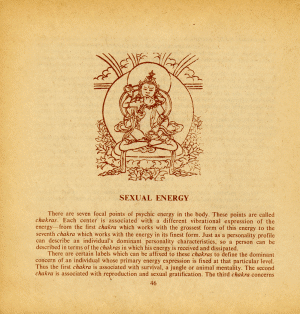
There are seven focal points of psychic energy in the body. These points are called chakras. Each center is associated with a different vibrational expression of the energy -- from the first chakra which works with the grossest form of this energy to the seventh chakra which works with the energy in its finest form. Just as a personality profile can describe an individual's dominant personality characteristics, so a person can be described in terms of the chakras in which his energy is received and dissipated.
There are certain labels which can be affixed to these chakras to define the dominant concern of an individual whose primary energy expression is fixed at that particular level. Thus the first chakra is associated with survival, a jungle or animal mentality. The second chakra is associated with reproduction and sexual gratification. The third chakra concerns power and mastery. These three chaktras are the focal points for most of the energy presently used by man in his worldly endeavors. These three chakras are primarily concerned with the use of energy for the maintenance and enhancement of the ego.
It is only when we arrive at the fourth chakra, the heart chakra, that we enter into a realm which starts to transcend the ego. This fourth chakra is primarily concerned with compassion. The fifth is concerned with the seeking of God. The sixth located between the eyebrows) is concerned with wisdom (the third eye); and the seventh, with full enlightenment or union.
The spiritual path can be conceived, from an energy point of view, as the path up the spine ... that is, the movement and transformation of energy from the lower to the higher chakras ... the purification of energy. With this definition in mind, it is apparent that any use of energy which further strengthens the hold, or intensity of the lower chakras interferes with the spiritual progress.
The experience and habits associated with lust are the domain of the second chakra. Freud was the master spokesman of the person who is fixated in the second chakra, just as Adler was the spokesman for the third chakra, and perhaps Jung the spokesman of the fourth.
In our Western culture there has been such an investment in the models of man associated with the second and third chakra (sex and power) that we have developed strong and deeply held habits of perceiving the inner and outer universe in these terms. Though we may realize intellectually that the spiritual journey requires the transformation of energy from these preoccupations to higher centers, we find it difficult to override these strong habits which seem to be reinforced by the vibration of the culture in which we live.
Thus it seems "normal" to have certain ego needs with regard to sex and power. It is difficult for us to comprehend that what is normal for a second-chakra preoccupied person is hardly normal for a fourth-chakra person.
A second-chakra person, as so well described by Freud, thinks of everything as sexual in nature ... a pencil is phallic, political power is sexual potency, etc. Freud describes religion as sublimated sexuality. A third-chakra person sees it all in terms of power or mastery. Even his sexual activity is seen in that light.
All "takes" of the Universe in terms of the first, second and third chakra are profane. That is, they maintain and enhance man's illusion of separateness. Every time you live out an act in terms (habits of thought) of a lower chakra, you strengthen the hold of that chakra.
There are two strategies with regard to the very powerful energies localized at the level of the second or sexual chakra in human beings. You can avoid arousing these energies and simultaneously work from within to transmute these latent forces into spiritual energy. This requires sexual continence and is called brahmacharya. The alternative is to continue to arouse the second chakra energies and to attempt to direct these now manifest energies into spiritual realms. This technique is known as sexual tantra.
Brahmacharya
Brahmacharya -- sexual continence -- is a specific process of taking energy you might otherwise use in second chakra acts and moving the energy up the spine into the higher chakras. The purpose is to generate or collect energy which you can use in the service of becoming enlightened. Most brahamacharyas are converting and moving the energy up to the higher centers so effectively that they experience little of the sexual frustration that someone who is "celibate" in the usual sense might. They experience higher energy of the specific nature that is useful in breaking through in meditation into the state of Sat Chit Ananda. The techniques involved include primarily pranayam, mantra, diet, and the avoidance of second chakra stimuli.
From a habitual Western vantage point it looks as if such a person is giving up something and must be suffering. But the true brahmacharya is not only not suffering, but is often experiencing far higher and more permanent stages of bliss than can be experienced through the lower chakras.
Sexual Tantra
In bhakti yoga -- the yoga of devotion -- the highest form of the method (as reflected in the story of Krishna and the Gopis) is the relation of devotee to God as lover to beloved. The gopis (milkmaids) are in love with Krishna -- the young handsome boy with the flute. On autumn evenings by the full moon he would play his flute by the river bank and call the gopis to him. And there he would manifest himself in 16,000 forms -- one for each gopi -- and proceed to make love to each in the way most desired by her. This brought all the energy contained in the desire for merging that exists between a lover and the beloved (as two, i.e., dualism) into the service of union in total love with God.
Krishna says in the Bhagavad Gita, "Do what you do but dedicate the fruits of your acts to me" -- all acts, and the act of sex is no exception.
To practice sexual tantra, total truth and total trust are required. You and your partner must both consciously understand that you are working together as an act of purification to burn away all impurities so that you may become ONE. You have agreed to share karma. This has nothing to do with any specific acts either now or later, it only implies that there is no holding back or unwillingness to accept how it is at this moment.
It is totally Here and Now. All fantasies are shared and brought to the Here and Now. Thoughts must be openly, fully openly, shared until the paranoia attendant to lust has been replaced by the luxurious warmth of love.
The practice starts with meditation together and after perhaps the sharing of a cardamom seed. Slowly the dance evolves ... the dance in which every breath ... touch ... movement ... even thought ... is totally savoured (compassionately understood)_ by the one consciousness that you are sharing. You are both man and you are both woman ... and there is an act in which two bodies are involved, but the act (like two hands clapping) is a unity experienced by a single consciousness.
The body of the partner becomes the body of Ram or the Divine Mother. Each touch or kiss is an act of devotion to that sacred being. The entire experience is the act of worship and the orgasm itself ceases to be of paramount importance.
The difficulty with this method, of course, is the tendency to get lost in the personal sensual gratification which draws you and your partner apart and casts you back into a second chakra dance which merely once again perpetuates the illusion of separateness. There are numerous specific techniques which reduce the risk of losing your center. An example is the mathuna position in which the woman sits astride the man. This position slows down the arousal process and the orgasm, thus allowing the partners to remain conscious throughout the entire practice.
None of us who are collaborating in the preparation of this manuscript are sufficiently evolved in the use of this method to present this section in a more definitive fashion as this time.
A woman once came to Mahatma Gandhi with her little boy. She asked, "Mahatma-ji, tell my little boy to stop eating sugar."
"Come back in three days," said Gandhi.
In three days the woman and the little boy returned and Mahatma Gandhi said to the little boy, "Stop eating sugar."
The woman asked, "Why was it necessary for us to return only after three days for you to tell my little boy that?"
The Mahatma replied: "Three days ago I had not stopped eating sugar."
SIDDHIS
"And in the fourth watch of the night Jesus went unto them, walking on the sea. And when the disciples saw him walking on the sea, they were troubled, saying, It is a spirit; and they cried out for fear. But straightaway Jesus spake unto them saying, Be of good cheer; It is I; be not afraid.
And Peter answered him and said, Lord, if it be thou, bid me come unto thee on the water. And he said, Come. And when Peter was come down out of the ship, he walked on the water to go to Jesus.
But when he saw the wind boisterous, he was afraid; and beginning to sink he cried, Lord, save me.
And immediately Jesus stretched forth his hand, and caught him, and said unto him, O, thou of little faith, wherefore didst thou doubt?
And when they were come into the ship, the wind ceased." -- Matthew
Levitation? Astral travel? Mind-reading? Parting the Red Sea? Withering the fig tree? Moving mountains?
What role do powers play in the spiritual journey?
As one purifies one's mind and body, i.e., increases the one-pointedness of mind, one gains more and more powers (siddhis). At each stage there is the option to use or not to use a newly gained power.
If you are interested in powers, you'll get them. That's the trouble! Along with each step of purification, i.e., with increasing ability to bring the mind to one-pointedness, all of the powers you've either read about or thought about become available to you. These are like the lions at the gates of each successive inner temple. The lions become more and more ferocious.
If you have a desire other than the desire for enlightenment, at each stage of your work you become increasingly capable of gratifying that desire. If you want wealth, wealth will be yours. If you want a beautiful lover, why, a beautiful lover will be yours. The problem of course is that everytime you direct your attention to the gratification of a specific desire, you create more thoughts about that desire and thus strengthen its hold over you. Thus, you slow down your own journey into the light. Since you already realize that the gratification of that desire is going to be finite and ultimately not enough, the new power has in fact sucked you into another cul-de-sac. And so it goes for most people until they truly see each new power as one more seductive enticement of maya.
The Universe is called, with everything in it, Maya, because all is temporary therein, from the ephemeral life of a fire-fly to that of the Sun. Compared to the eternal immutability of the One, and the changelessness of that Principle, the Universe, with its evanescent ever-changing forms, must be necessarily, in the mind of a philosopher, no better than a will-o’-the-wisp. Yet, the Universe is real enough to the conscious beings in it, which are as unreal as it is itself. Among the conceptions of Occult philosophy, the noumenal essences have more reality than their objective counterparts; it resembles therein the mediaeval Nominalists, for whom it was the Universals that were the realities.
-- The Secret Doctrine -- The Synthesis of Science, Religion, and Philosophy, by Helena Petrovna Blavatsky
Some people when they become aware of having gained a new power justify their use of the power in terms of social good, i.e., the welfare of their fellow man. However, to the extent that they are attached to doing good, their desires affect their perception and they, in fact, cannot truly see what is best for the welfare of their fellow man. Often, in their zeal to do good, they only increase man's illusion and make perception of the truth more difficult.
These days most people put their faith in man's intellect and his power of reason. Consequently, those few who have powers which transcend the rational mind are in an unusual and extraordinary position. It becomes tempting for them to want to experiment. There are many stories in India of yogis who in the course of very intense sadhana have developed certain powers which they use either for fame or wealth or more subtle forms of ego enhancement. They read minds, change their physiological processes such as heart beat, body heat, reaction to cold, etc. As an example of a misuse of power, one sadhu lifts a 100 pound bag of sand with his penis.
The simple rule of the game, repeated in the most profound mystical texts, reminds us that it is not my but THY will, O Lord ... not my trip but THY Trip. Quite simply, if you are wondering whether to use a power ... don't! If, on the other hand, in the unfolding of your karma, some power is required, it will appear and serve. The only thing that will hold back your evolvement is the use of power in the service of the ego.
With each new level of surrender and purification, and of faith to give up your present control and power, you achieve new powers. Finally, when you have given up all of your position and power, you end up having all powers. When Jesus said, "Had ye faith ye could move mountains," he was speaking literal truth. The cosmic humor is that if you desire to move mountains and you continue to purify yourself, ultimately you will arrive at the place where you are able to move mountains. But in order to arrive at this position of power you will have had to give up being he-who-wanted-to-move-mountains so that you can be he-who-put-the-mountain-there-in-the-first-place. The humor is that finally when you have the power to move the mountain, you are the person who placed it there -- so there the mountain stays.
One can only stand in total awe of such a divine plan, and experience much compassion about the poignancy of one's petty concerns about power.
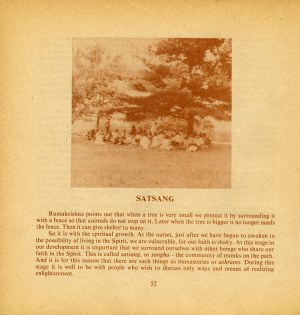
SATSANG
Ramakrishna points out that when a tree is very small we protect it by surrounding it with a fence so that animals do not step on it. Later when the tree is bigger it no longer needs the fence. Then it can give shelter to many.
So it is with the spiritual growth. At the outset, just after we have begun to awaken to the possibility of living in the Spirit, we are vulnerable, for our faith is shaky. At this stage in our development it is important that we surround ourselves with other beings who share our faith in the Spirit. This is called satsang, or sangha -- the community of monks on the path. And it is for this reason that there are such things as monasteries or ashrams. During this stage it is well to be with people who wish to discuss only ways and means of realizing enlightenment.
This progression is quite inevitable. After some time on the path of awakening, the type of associates you share time with changes. Finally you realize that except for existing karmic commitments -- such as familial or societal commitments -- there is no reason to spend time with anyone except as an aid to one's sadhana. So all new relationships, be they friendships, roommates, marriages, business partnerships, take on implicitly, and finally explicitly, this contractual basis.
When your center is firm, when your faith is strong and unwavering, then it will not matter what company you keep. Then you will see that all beings are on the evolutionary journey of consciousness. They differ only to the degree that the veil of illusion clouds their vision. But for you ... you will see behind the veil to the place where we are all ONE.
Potent Quotes
"Our friends found us becoming dull. Gurdjieff said, "There is worse to come ... he is an interesting man who lies [sic] well ... you have already begun to die. It is a long way yet to complete death but still a certain amount of silliness is going out of you. You can no longer deceive yourselves as sincerely as you did before. You have now got the taste of truth.'" -- Ouspensky
"Bad company is loss, and good company is gain; ... In company with the wind the dust flies heavenwards; if it joins water, it becomes mud and sinks." -- Tulsi Das
"When going through spiritual exercises (sadhana) do not associate with those who never concern themselves with matters spiritual. Such people scoff at those who worship God and meditate upon Him and they ridicule piety and the pious. Keep yourself far aloof from them." -- Ramakrishna
"I must now whisper very unceasingly I was not born separate from you." / Gv
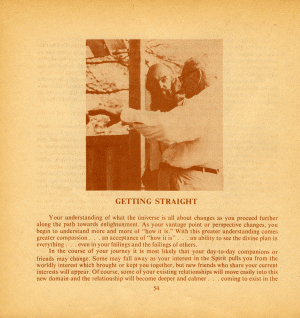
GETTING STRAIGHT
Your understanding of what the universe is all about changes as you proceed further along the path towards enlightenment. As your vantage point or perspective changes, you begin to understand more and more of "how it is." With this greater understanding comes greater compassion ... an acceptance of "how it is" ... an ability to see the divine plan in everything ... even in your failings and the failings of others.
In the course of your journey it is most likely that your day-to-day companions or friends may change. Some may fall away as your interest in the Spirit pulls you from the worldly interest which brought or kept you together, but new friends who share your current interests will appear. Of course, some of your existing relationships will move easily into this new domain and the relationship will become deeper and calmer ... coming to exist in the eternal present.
This transition in traveling companions is a delicate and troubling matter. To find that someone whom you assumed shared all your values and interests over many years has no interest shat-so-ever in enlightenment or in becoming more conscious or coming into the Spirit is a shock. You want to share this "trip" with him in the same way as you shared others in the past. That desire to proselytize, to turn him on, to show him, to bring him to the light ... is a reflection of your lack of wisdom. For only some people can hear. Only some can awaken in this lifetime. It's a little like seeing a friend drowning and being unable to catch his hand. You want so badly to DO something. But in truth you can only BE ... be as straight and as open and as HERE as you can be ... and if your friend can hear, he will hear. And if he cannot hear, he will turn away from you. No blame.
What is important is that you get your house in order at each stage of the journey so that you can proceed.
"If some day it be given to you to pass into the inner temple, you must leave no enemies behind." -- de Lubicz
For example, if you never got on well with one of your parents and you have left that parent behind on your journey in such a way that the thought of that parent arouses anger or frustration or self-pity or any emotion ... you are still attached. You are still stuck. And you must get that relationship straight before you can finish your work. And what, specifically, does "getting it straight" mean? Well, it means re-perceiving that parent, or whoever it may be, with total compassion ... seeing him as a being of the spirit, just like you, who happens to be your parent ... and who happens to have this or that characteristic, and who happens to be at a certain stage of his evolutionary journey. You must see that all beings are just beings ... and that all the wrappings of personality and role and body are the coverings. Your attachments are only to the coverings, and as long as you are attached to someone else's covering you are stuck, and you keep them stuck, in that attachment. Only when you can see the essence, can see God, in each human being do you free yourself and those about you. It's hard work when you have spent years building a fixed model of who someone else is to abandon it, but until that model is superceded by a compassionate model, you are still stuck.
In India they say that in order to proceed with one's work one needs one's parents' blessings. Even if the parent has died, you must in your heart and mind, re-perceive that relationship until it becomes, like every one of your current relationships, one of light. If the person is still alive you may, when you have proceeded far enough, revisit and bring the relationship into the present. For, if you can keep the visit totally in the present, you will be free and finished. The parent may or may not be ... but that is his karmic predicament. And if you have been truly in the present, and if you find a place in which you can share even a brief eternal moment ... this is all it takes to get the blessing of your parent! It obviously doesn't demand that the parent say, "I bless you." Rather it means that he hears you as a fellow being, and honors the divine spark within you. And even a moment in the Here and Now ... a single second shared in the eternal present ... in love ... is all that is required to free you both, if you are ready to be freed. From then on, it's your own individual karma that determines how long you can maintain that high moment.
This getting straight not only applies to people but to things as well, such as favorite music, disliked foods, special treats, avoided places, all your toys, etc. Everything must be rerun through your compassion machine. You must revisit, at least in meditation, all your old attachments and re-see them in the light of the Spirit. As you do, they fall away ... unless, of course, the attachment to them is so strong that you are not able yet to re-see them with pure compassion. To stumble in that way on the path merely indicates the work yet to be done. Thus it gives direction to your sadhana ... which is work on those desires that cause you to stumble, by bringing them into the light of mantra or the witness until they fall away of their own.
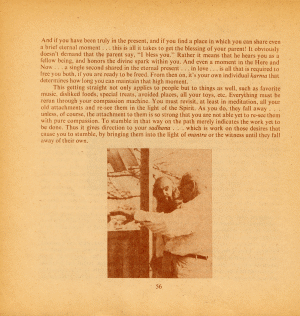
TRUTH
Truth gets you high. There is no doubt about it. Lies bring you down. To lie to another person you have to see them as "him" or "her" or "them," i.e., as an object. Such distance that the act of lying creates turns out in the long run to cost more than the lie gained for you in the first place. Once you understand the workings of karma you see that there is no escape from the effects, both short and long terms, of your acts, i.e., acts done in the service of the ego.
Reflect upon each of the following quotes. Then reflect upon some lie or half truth you have attempted to perpetuate with regard to yourself or with others. Notice the corrosive side effects of the lie. Now consider how your life would be changed were the truth "known." It is useful here to remember that your guru, even though you may not have met him in his manifest form ... KNOWS EVERYTHING ABOUT YOU ... EVERYTHING ... And he understands why you do what you do and he has compassion for your predicament. And you look him directly in the eye ... and you suddenly know that it is all right to live in truth. For where it counts ... in the matters of the spirit ... you are not vulnerable at all. So how can truth hurt? This may take a great deal of reflection.
Potent Quotes
"Moreover, Son of Pandu! wert thou worst of all wrong-doers, this fair ship of Truth should bear thee safe and dry across the sea of thy transgressions." -- Bhagavad Gita
"Indeed we are running away all the time to avoid coming face to face with our real selves, and we barter the truth for trifles." -- Way of a Pilgrim
"Our sins are created in secrecy. The moment we realize that God witnesses even our thoughts we shall be free." -- Wisdom of the Ages, from Sat Sandesh
"What makes a man unworthy of the Temple is the cowardice which prompts him to avoid the experience of shame, for this avoidance breeds oblivion. For shame accepted is the greatest treasure. The Door will open before your eyes when you have understood this: the only thing that is humiliating is helplessness. The cause of such helplessness lies in ignorance of your errors; awareness thereof, on the contrary, attracts you to the power of your God.
If you deny the existence of your fault or error, it will strengthen its hold over you. If you recognize it, your awareness will destroy it. He who rejects this will never know the entrance to the Temple." -- de Lubicz
"Illusions are like mistresses. We can have many of them without tying ourselves down to responsibility. But truth insists on marriage. Once a person embraces truth, he is in its ruthless, but gentle, grasp." -- Rabazar Tarzs
"... When she caught me stealing jelly beans in the kitchen one day, she grabbed my closed fist in her palm and held it up to the light.
'Open up your hand, child,' she said, 'and don't be so prideful. It ain't nothing but stuff you got hiding there.'" -- a novel
DROP OUT / COP OUT
Can you undertake sadhana without defaulting in your social responsibilities?
If you could stand back for but a moment you could see that if man were more conscious from moment to moment he could transcend most of the difficulties he now faces: poverty, war, pollution, neurosis, disease.
Where does such consciousness come from? From you!
"Can he rectify false weight whose own scales are uncertain? Can you enlighten your neighbor while you yourself have no light? -- Ramakrishna
Man is presently caught in a plane of consciousness which is nourished by the workings of his rational mind. That is, the plane of polarities ... of good and evil ... and left and right ... of old and young ... of us and them ... and of man and woman.
To be "not caught" means to be unattached. To be unattached does not mean to be uninvolved, it means to be involved "without attachment."
A conscious being is capable of making as many discriminations among components of the Universe as anyone else (perhaps even more). However, he is not caught in them. Just because you are seeing divine light, experiencing waves of bliss, or conversing with Gods and Goddesses is no reason to not know your zip code. Keeping it together means keeping conscious at all levels -- all planes -- with no attachment to any of them.
Let us consider an example of the relation of a group called "hippies" and a group called "police." If a "confrontation" occurs during a protest, what is the result? .. If the hippies see the police only as "them" and the police see the hippies only as "them" ... then the result is an increase in polarization and distance between the two groups. Each returns to its headquarters and plans an increase in its own strength to overcome "them."
Why does the distance increase? Because nobody wants to be "them." Everyone wants to be "us." And if you meet someone who sees you as "him" or "one of them," that meeting arouses in you all your paranoia and you, in turn, see the other person as "him" or "one of them."
Such cycles get worse and worse until there is violent confrontation. What is the conscious alternative? It is not to avoid protest or confrontation. Rather it is for the participants to become more "conscious." And what does that mean? It means that though you may be protesting against someone or some group, you realize that behind the ways in which you differ, you are the same. That is, you understand protest as a form of social communication among US ... and that "where it counts" there is only US. US includes: black and white, young and old, man and woman, American and Russian, rich and poor, saint and rogue.
So the simple rule of conscious participation is:
YOU MAY PROTEST IF YOU CAN LOVE THE PERSON YOU ARE PROTESTING AGAINST AS MUCH AS YOU LOVE YOURSELF.
You may disagree with all his values, but behind all of them ... HERE WE ARE ... all manifestations of the Spirit.
The effect of "conscious" protest is that it reduces the polarization and the paranoia and thus allows each side to hear the other's concern more clearly because there is less fear and anxiety. It's all so simple (and so difficult). There can be conscious revolution.
Thus, the rule of the game that everyone work on himself in order to find the center where "we all are" -- within himself -- in order that he can meet with other human beings in that place ... is the sine qua non (without which nothing) of social responsibility.
What about helping suffering people -- starving Biafrans and such? Sure. Do it. It's karma yoga. But do it without attachment. To be attached means that you identify with your role as the GIVER of help. This in turn casts the other person in the role of the RECEIVER of help. Such identification with roles may fill bellies, but it increases human distance. A conscious being knows that there is neither giver nor receiver ... there are only empty bellies, storehouses of wheat ... and effort required to move the wheat from the storehouses to the belly. It is OUR wheat, OUR belly, OUR effort. And when all this energy has been transferred, a conscious being realizes that nothing has happened. Thanks are absurd ... does your left hand thank your right hand?
To think that working on oneself requires "dropping-out" of society is to miss the point. Certainly you must drop out ... but the drop-out is internal, not external. One drops out of one's attachments; one drops out of one's identification with the illusion of separateness.
Those who think the drop-out from one or another social institution is truly dropping out are naive. It is merely more of the illusion, for we can see that the dropouts almost immediately form new social institutions ... new religions and priesthoods ... new traps for keeping themselves in the illusion.
Buddha says:
"As long as you think there is a 'do-er' you are still caught in the wheel of birth and death."
Does that mean that you should sit in bed and not do anything? Well, that's doing something. In fact, as long as you are in your body you must do things. So that couldn't be what Buddha meant. No, he meant something much "farther out." He meant that you do what you do, but you do not identify with the doing of it. All "doing" is happening as part of the dance of nature ... and though your body and mind speed about their business, you remain in your calm center ... HERE ... "where we all are."
Potent Quotes
"A man bound hand and foot in the endless chain of cause and effect cannot free another." -- Ramakrishna
"Judge not, that ye be not judged. For with what judgment ye judge, ye shall be judged: and with what measure ye mete, it shall be measured to you again. And why beholdest thou the mote that is in thy brother's eyes, but considerest not the beam that is in thine own eye? Or wilt thou say to thy brother, Let me pull out the mote out of thine eye; and behold, a beam is in thine own eye? Thou hypocrite, first cast out the beam out of thine own eye; then shalt thou see clearly to cast out the mote out of thy brother's eye." -- Jesus
"He who has so little knowledge of human nature as to seek happiness by changing anything but his own disposition will waste his life in fruitless efforts." -- Samuel Johnson
"The higher one climbs on the spiritual ladder, the more will he grant others their own freedom and give less interference to another's state of consciousness." -- Twitchell
"Though I speak with the tongues of men and angels, and have not charity, I am become as sounding brass, or a tinkling symbol. And though I have the gift of prophecy, and understand all mysteries, and all knowledge; and though I have all faith, so that I could remove mountains, and have not charity, I am nothing.
And though I bestow all my goods to feed the poor, and though I give my body to be burned, and have not charity, it profiteth me nothing. Charity suffereth long, and is kind; charity envieth not; charity vaunteth not itself, is not puffed up.
Doth not behave itself unseemly, seeketh not her own, is not easily provoked, thinketh no evil;
Rejoiceth not in iniquity, but rejoiceth in truth;
Beareth all things, believeth all things, hopeth all things, endureth all things.
Charity never faileth: but whither there be prophecies, they shall fail; whither there be tongues, they shall cease; whither there be knowledge it shall vanish away.
For we know in part, and we prophecy in part.
But when that which is perfect is come, then that which is in part shall be done away.
When I was a child, I spake as a child, I understood as a child, I thought as a child: but when I became a man, I put away childish things. For now we see through a glass darkly; but then, face to face; now I know in part: but thenn shall I know even as also I am known.
And now abideth faith, hope, charity, these three; but the greatest of these is charity." -- Paul of Tarsus
(Brunton to Ramana Maharshi): "Will Maharaj-ji express an opinion about the future of the world, as we are living in critical times? M: Why should you trouble yourself about the future? You do not even properly know about the present. Take care of the present, the future will take care of itself." -- Osborne
"Since the world points up beauty as such; There is ugliness too; If goodness is taken as goodness; Wickedness enters as well." -- Tao Te Ching
"By passion for the 'pairs of opposites'; By those twin snares of Like and Dislike, Prince; All creatures live bewildered, save some few; Who, quit of sins, holy in act, informed; Freed from the 'opposites' and fixed in faith; Cleave Unto Me." -- Bhagavad Gita
"If you call it a stick, you affirm. If you call it not a stick, you negate. Beyond affirmation and negation, what would you call it?" -- Tai-hui
"Thus saith He who formulateth in darkness; I am Lord, not of light alone; But of darkness also; For I the One am all-pervading." -- Book of Tokens
"I, the Lord, destroy with darkness; But with darkness do I also create; The wise discern this; Fools, deluded by outward appearance; Create a demon out of the web of their folly." -- Book of Tokens
"Take this word: 'grok'. Its literal meaning, one which I suspect goes back to the origin of the Martian race as thinking creatures -- and which throws light on their whole 'map' -- is easy, 'Grok' means 'to drink' ... But a Martian would use 'Grok' even if I had named a hundred other English words, words which we think of as different concepts, even antithetical concepts. "Grok' means all of these. It means 'fear,' it means 'love,' it means 'hate' -- proper hate, for by the Martian 'map' you cannot hate anything unless you grok it, understand it so thoroughly you merge with it and it merges with you -- then you can hate. By hating yourself. But this implies that you love it, too, and cherish it and would not have it otherwise. Then you can hate -- and (I think) Martian hate is an emotion so black that the nearest human equivalent could only be called mild distaste ...
'Grok' means 'identically equal.' The human cliche 'This hurts me worse than it does you' has a Martian flavor. The Martians seem to know instinctively what we learned painfully from modern physics, that observer interacts with observed through the process of observation. 'Grok' means to understand so thoroughly that the observer becomes a part of the observed -- to merge, blend, intermarry, lose identity in group experience. It means almost everything we mean by religion, philosophy and science -- and it means as little to us as color means to a blind man ... If I chopped you up and made a stew, you and the stew, whatever was in it, would 'grok' -- and when I ate you, we would 'grok' together and nothing would be lost and it would not matter which one of us did the eating." -- Heinlein
[Captain]: The ship that was to carry slaves and precious goods to Africa will not set sail tonight.
Our master is dead. He left a strange will, sir.
Listen ...
All those named as beneficiaries in my will, except the freemen, will come into possession of all I've left behind on the condition that they rip my body to pieces and eat me in full view of everyone. I urge my friends not to reject my invitation, but to devour my body with the same enthusiasm with which they sent my soul to hell." This is impossible ...
it has to be a joke.
-- Satyricon, by Federico Fellini

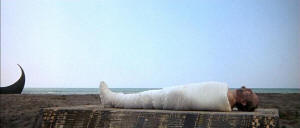
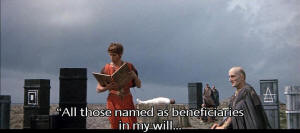
"In the presence of a man perfect in ahimsa (nonviolence), enmity (in any creature) does not arise." -- Patanjali
Statistics: Posted by admin — Fri Sep 25, 2015 7:00 pm
]]>
Extend your arms very slowly over your head until they are stretched out straight behind you. Slowly sit up, bringing your arms and head up together and keeping your heels on the ground. Bend at the waist.
Smoothly proceed forward until you touch your toes. Keep your legs straight. If you can, hold your feet with your hands, pulling your feet towards you and bending your elbows until they are touching the ground on either side of your legs.
Make sure you are bending from as low in your back as possible. Don't strain. Get into the asana as far as possible. Then take small breaths and with each exhalation go a little further.
Now stop and become aware of your entire body ... note the pains and the stretching muscles and the tight places. Just BE for a moment. Now gently raise your arms and return to a prone position (inhaling as you do).
Work up daily until you are doing about thirty of these. Some may be started from a sitting position with hands extended over your head. Remember to avoid thinking "I am doing an asana." Just experience the asana happening. Working with your eyes closed will help.
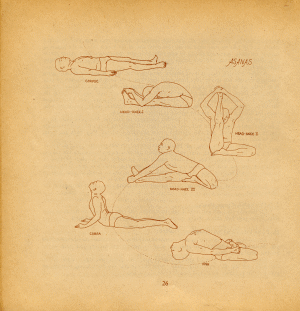
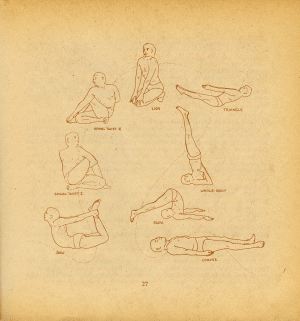
III. JANU-SIRASANA (Head-Knee Position):
Sit up with your legs stretched out in front of you. Now bend your left leg and place the sole of your left foot against the inside of the thigh of your right leg (which is still straight). Maintain that position. Raise your arms over your head and bring them slowly down towards your right foot. Bend as low in the back as possible.
Bring your head down until it is just to the left of your right knee. Then after a pause for the eternal moment, gently raise the upper part of your body until your hands are once again extended over your head. Work up daily until you are doing thirty of these.
THE HOLY MOMENT (Pun, there!)
["... yet it will be a training school like a holy order for political leaders." -- -- Adolph Hitler]
Waking Life, directed by Richard Linklater

IV. JANU-SIRASANA (Head-Knee Position):
Now change legs so that the left leg is extended and the right is bent. Repeat the asana as above.
You may also modify these two asanas by putting the foot on top of the thigh instead of next to it.
During the first few weeks you will probably experience pains and aches as well as the presence of muscles you never knew you had. Just be gently persistent. You will also notice dramatic improvement at first. Don't get hung up measuring improvement. Just quietly and calmly do you asanas each day. Work at your own rate.
V. BHUJANGASANA (Cobra Position):
Roll over on your stomach and lie flat with your legs together and your hands by your sides. Bend your arms until your hands are flat on the floor next to your chest. Very gently start to push up with your forearms, thus raising the upper part of your body. Raise your head first, then your neck, and then slowly raise lower and lower parts of your spine.
At the same time you are raising the upper part of your body, press down into the ground with your pelvis. When the asana is done properly, you will finally feel the pressure at the tip of your spine.
Keep your head up. It is helpful to keep your eyes open and to keep trying to look further and further over your head.
When you have reached the point that you can reach comfortably, stop and remain in that position for about 15 seconds and then gently starting at the base of your spine, lower the upper part of your body to the ground. The head touches down last.
Remember your breathing. As you go up, breathe in; as you return, breathe out. Do about three of these.
You can also work with the "moving cobra." Proceed as above until you have raised yourself as far as possible. Then, instead of returning to the ground, bend your knees until you are sitting back on your calves with your arms still stretched out before you. This forces you to curve your back towards the ground. Then keeping your head and upper part of your body very close to the ground, glide along the ground until you are again out straight and then start to raise the head and on down the spine. This moving cobra is one continuous serpentine movement.
IV. MATSYASANA (Fish Position):
Sit up and cross your legs. If you are able to get into the lotus position (that is, with the top of the foot resting upon the opposite thigh) do so. Don't strain. You can adopt any cross-legged position that is comfortable.
Place your hands behind you and slowly let yourself back down until you are resting on your elbows. Then lower your head until the top of your head touches the ground. Arch your back. Rest the upper part of your body on the top of your head and the lower part of your body on your cross-legged seat. Now place your hands lightly on top of your thighs (or feet if you are in the lotus position). Remain in the position for about 15 to 30 seconds and then slowly return to a sitting position.
If you wish, at this point you can continue forward until your head is on the floor and your shoulders are resting on your thighs (or feet if you are in the lotus position). Then holding the wrist of one arm with the hand of the other behind your back, slowly raise your arms behind you as high as you can. Then bring them down and relax.
VII. DHANURASANA (Bow Position):
Roll over on your stomach. Behind your back take hold of your ankles with your hands, firmly. Now push away with your feet (attempt to extend your legs). This will bring your head and chest up. Keep lifting in this fashion until your thighs are fully off the ground. Look straight ahead. When you have gotten up as far as you can without strain, then remain in in that position calmly for 15 to 30 seconds. Gently return to the ground. Do this asana three times. If you wish, when you are in the asana you can rock back and forth like a rocking chair.
VIII. ARDHA-HATSYENDRASANA (Twist Position):
Sit up straight with your legs out straight before you on the floor. Bend your left knee and put your left leg under your right leg so that the left heel is to the right of (and pressed firmly against) your right buttock. Now bring your right leg up by bending it at the knee and place the right foot flat on the ground to the left of the left knee.
Raise your left arm and twist the upper part of the body to the right until your left armpit is directly over your right thigh. Now turn your left forearm in such a fashion that you can pass it back through the triangle made by the bend in your right knee. At this point your left armpit is almost resting on top of the right thigh.
Reach around behind you with your right arm until your right and left hands can grip each other. Turn your head so that you are looking behind you over your right shoulder. Without straining, twist as far as possible. Then hold the position for about 15 to 30 seconds and return to a straight sitting position. Now do the twist to the left, reversing all the above instructions.
IX. SIMHASANA (Lion Position):
Assume a kneeling position. Place your hands on your knees so that your fingers are extended outwards and you are leaning slightly forward.
Extend the tongue outward as far as possible and turn the eyes upward and towards the middle of the forehead. Exhale the breath as much as possible and contract the throat muscles. Make the entire body as taut as possible -- as if you were a lion about to spring. Stop, return, and then relax. Repeat this asana about four times.
X. TOLANGULASANA (Balance Position):
Lie on your back. Raise your legs off the ground and spread them, keeping them straight. Then raise the upper part of your body to form a V with the point of contact with the ground being the tip of your spine. Stretch your arms forward between your spread legs. Remain in this position for 30 seconds. Don't strain. Return to a relaxed position.
XI. SARVANGASANA (Neck Stand):
Lie flat on your back. Very gently, in one smooth movement, lift your legs off the ground (keeping them straight) and raise them until they are at a 90 degree angle to your torso. Then placing your hands behind your back, slowly lift your hips off the ground and more and more of your back, until only your head and neck are on the ground. Your back is supported by your hands, which should be as high up (close to the neck) on your back as possible. Elbows are on the ground. Remain with legs and body straight up for two minutes.
XII. HALASAN (Plough Position):
Starting from the neck stand, gently bring legs over head, still keeping them straight, until your toes touch the ground behind your head. Keeping your legs straight, attempt to bring your heels to the ground and to walk in towards your head. When you have gotten as close as possible without straining, then stop for 10 seconds.
XIII. KARNA PEEDASAN (Ear-Knee Position):
Starting from last position, now bend your knees until they touch the floor next to your ears. Remain in that position for ten seconds. Then gently retrace your steps, one by one, until you are back on the ground resting on your back. You can sense how limber your spine is as you come down from the neck stand. As you lower your body, press each vertebrae against the ground from the neck down. You should hear clicks along the way.
XIV. SAVASANA (Corpse Position):
Return to Corpse position and remain there for five minutes.
OM TAT SAT
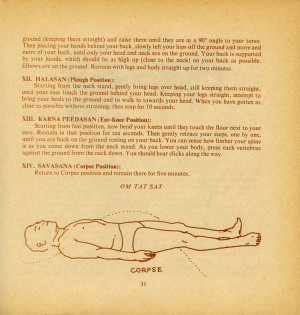
MANTRA
The major obstacle at every stage of the path of enlightenment is our own thoughts. Thoughts keep us separate. Even the thought of Unity is far different from Unity. And the thoughts keep coming; each one making its bid for our attention and identification.
Are all thoughts part of the illusion? Yes.
Are some thoughts better than others? Just diving into the water is aided by a spring board, and crossing the great ocean is aided by a raft, so certain thoughts are useful along the way. At the final moment, of course, even these thoughts must be transcended.
What are the steps of the process of calming the mind? Think of a lake in whose depths lies hidden what you seek. You try to see down into the lake, but you can't because the surface is covered with waves going in all directions ... choppy water ... thoughts coming from all directions ... from your senses, from your memory ... habits of thought learned unconsciously, running off mechanically ... the causes of which are too subtle for your analytic mind to grasp.
Now, create an artificial wave ... consciously add a new component ... choose a single thought ... and consciously set about making that thought dominant ... so that a continuous sequence of even waves all coming from one direction overrides all the choppy water, as an ocean wave absorbs all the eddying waters at the shoreline. Now each wave is that same thought over and over again ... no other thought can capture your attention which remains fixed upon the single thought.
Does this mean that other thoughts stop? No. Thoughts continue as a natural process in nature, but you run them through on automatic (base brain) -- the same way most people drive an automobile, that is, without attending to each movement of the accelerator or steering wheel. We function under the fallacy (cogito ergo sum) that we are our thoughts and therefore must attend to them in order for them to be realized.
To break your identification with your own thoughts is to achieve inner freedom.
So you identify with this new thought you have added, until you and that thought become one and all other thoughts are passing just like clouds in the sky.
When you have arrived at the point where that one thought is the dominant one for you at all times ... when going to sleep or waking ... when walking or sitting ... when talking or eating ... then all of your life is on automatic. Then you are free of all but that one thought ... and then ... through deep meditation ... you leave that thought aside too.
Which thoughts are useful to repeat? There are different kinds of mantras (phrases). Different mantras take you to different planes. Some seed (beej) mantras resonate within in such a way as to open one of your chakras (energy centers). There are power mantras to strengthen your will, and other mantras to open your heart in such a way as to deepen your compassion. For example:
"I send a beam of love from my heart to the heart(s) of my brother (sister, brothers and sisters)." -- Herman Rednick
ADITYA HRIDAYAM PUNYAM
SARV SHATRU BENA SHENAM
(All evil vanishes from life for him who keeps the sun in his heart.) -- Ramayana
Some mantras are useful to help you accept the Divine Plan without feeling you have to act or do anything about it. For example:
"Let It Be" -- McCartney
And That Too
TAT TWAM ASI (That thou art)
Also helpful in getting you to listen carefully in order to understand the part you play in the sacred dance is the mantra:
Not my but Thy will, O Lord.
Then there are special mantras used at special times of the day or for certain acts: for taking showers, toileting, washing clothes, cooking. The use of such special mantras is to help you see the act you are performing or about to perform in such a way as to prevent your identifying with the do-er of the act. Example:
When taking a shower you place water in your left hand. Then with your right fourth finger you touch the water and then touch in succession your mouth, nose, eyes, ears, forehead, and heart.
The simple mantra is:
OM VISHNU OM VISHNU OM VISHNU
OM WAK (mouth) OM PRAN (nose) OM SHAKSHU
OM SROTRAM OM SHIRAH OM HRIDAYAM
OM OM OM
and then continue to chant OM during the entire shower. This mantra reminds you that ALL is part of the ONE.
A mantra to be used while going to the toilet:
UTTISH THANTU SURAH SERUE YEX
GANDHARV KINNERAH PISACHA-GUHYAKASH
CHEV MAL MOOTRAM KAROMYA HAM
And a mantra for taking dope:
OM SHIVA SHANKARA
HARI HARI GANGA
You can make up other mantras for other daily acts to bring to consciousness your center so that you break the identification with an ego who is performing the act.
And then finally there are general mantras ... mantras which can be used by anyone ... and which move you from whatever stage you are at to the next stage, until you finally arrive at the doorway at which even mantra must go. For example:
OM
RAMA
HARI KRISHNA
GATE GATE PARAGATE
PARASAMGATE BODHI SWAHA
(Beyond, beyond, beyond the beyond. To thee, homage!)
OM MANI PADME HUM
(See Lama Govinda's Foundations of Tibetan Mysticism for discussion of this mantra)
OM TAT SAT
OM NAMAH SHIVAYA (To Siva, I bow)
Does a mantra have to be invested for it to work? Not in the usual sense ... that is, not necessarily on the physical plane. Investing of a mantra means that it is passed in the Spirit. That is, if I am working with a mantra and the mantra is so deep within me that when I repeat it, it takes me into the Spirit, then I can hand it on to someone else. Whether he will be able to use it will depend upon how much faith he brings to it. If he brings little faith or commitment to it, then he will get little return; if he brings much faith he will get the highest returns. Many teachers who invest mantras will do so only when they know the student to be "ready" to receive the mantra, having sufficient faith to use the mantra profitably. Mantras which are purchased or which come from a source in which the student does not have full trust do not work unless the student is so advanced that he can transmute negative energy.
"The power and the effect of a mantra depend on the spiritual attitude, the knowledge and the responsiveness of the individual. The sabda or sound of the mantra is not a physical sound (though it may be accompanied by such a one) but a spiritual one. It cannot be heard by the ears but only by the heart, and it cannot be uttered by the mouth but only by the mind." -- Lama Govinda
Can I use a mantra that I read in a book? If you feel that the author of the book is pure in his intent in transmitting the information, and if you sense that the book is in the spirit (i.e., it gets you high to read it), then you can find profit in working with the mantra. Get high, and then start working with it. An excellent book is The Way of a Pilgrim (translated from Russian), in which the mantra is "the Jesus prayer" (Lord Jesus Christ, have mercy on me.) used by the Greek Orthodox Christian mystics.
Why are we using mantras that are in the Sanskrit language? Wouldn't it be better to use English? No. Sanskrit is the root of the Indo-Aryan languages of which English is a part. It is a language that was evolved consciously, i.e., each sound syllable resonates in a specific chakra. Thus use of a Sanskrit mantra not only affects the user through the rational medium -- the meaning of the mantra -- but through the sound of the mantra as well. Often the investing of a mantra includes the pronunciation as well. However, if a person works with a mantra with sufficient purity to be able to "hear," he will come to hear the mantra outside / inside of himself (in the akash, or ether) and he will come to say the mantra in unison with these voices in which he hears.
What is Japa? Japa is mantra which is the name of God. RAMA is such a mantra. To repeat the name of God over and over brings you closer to Oneness with the Divine.
How do you do mantra? Don't do mantra. Let it happen. For example, if you feel the desire to work with the mantra RAMA:
(1) Consider who RAM was historically. Ram was the Avatar in the Sat Yuga -- the purest period. At that time most of the people in the world were in the Spirit so they recognized and honored the Avatar. The story of the Ramayana tells of the life of Ram. He is pictured as the perfect son, husband, brother, father, king -- that is, a perfect karma yogi. He represents living daily life as an act of worship.
He is a beautiful dark being of great light, love and compassion, wisdom and power -- in perfect harmony. Ram is the essence of who you are when you realize your true Self (the Atman).
(2) Consider Ram as a Spiritual Being. He is another statement of Eternal Perfection reflected in the form of a human being. He is pure light, love, energy, compassion, wisdom, power. Like the sun, he emits light and warmth and life force. He is as Real at this moment as you have faith to allow him to be.
(3) Start to pronounce His name silently. It is two syllables: Ra and Ma. However, the "a" of Ma is sounded silently. Listen inside until you can hear the name and then begin to let it come outside, as if you were speaking along with the inside voice which is whispering it. Then keep saying it.
(4) After some time you will notice that though you are still repeating it with your tongue, the mantra is moving, perhaps first to a sub-vocal point and then to your brain. Finally, if you have done the mantra long enough, it will start to sound in your heart.
(5) You should keep doing it consciously until it has become a strong habit. Take a walk and say the mantra all the time you are walking. Notice everything but keep the mantra going. Keep realizing that God is It All ... and therefore everything you look at is part of Ram. Everyone you meet is Ram who has come to teach you something. You are continually meeting and merging into perfection.
(6) Make yourself like Hanuman (the monkey in the Ramayana) -- the perfect servant and lover of Ram.
(7) If you wish to use an external aid to help keep the mantra in your awareness, you might obtain a mala. This is a string of 108 prayer beads plus a guru bead. In the West it is usually called a rosary. These beads you can pass between the thumb and fourth or third finger (the index finger is not used because in India it is used for pointing in accusation) of your right hand, bead by bead, repeating the name of Ram with each bead. In using a mala you proceed up to the guru bead and then turn the beads and go the other way. You do not complete the circle. The beads are moved towards you. After a period of usage your beads will begin to have an investment of the pran or Spiritual Force which your doing of Japa has brought to them.
(8) Get in the habit of coming out of sleep into mantra.
(9) Get in the habit of having every strong emotion -- positive or negative -- serve as a reminder to bring you back to your mantra.
(10) Get in the habit of cutting through your own thought prisons by just dissolving it all back into the mantra.
(11) Do mantra with others who are in the spirit. Do mantra when you are high.
(12) Do not discuss the mantra with anyone who is less into the spirit than you. If you can't make that discrimination, then don't discuss it with anyone. For every time you run your mantra through the head of someone who doubts or is cynical, their doubt or cynicism will resonate with the places in you where your own faith is not enough. That is why mantras are often invested secretly.
(13) Some practices with mantra require that at the outset one work with the mantra only about 15 minutes in the morning and 15 minutes in the evening. If you prefer you may follow this system and then let the mantra expand out into your life as it naturally will. If you "try" to make the mantra work -- or force it as an act of egoic will -- then you will lose it (though it can be regained). So it is good to keep in mind that in truth the mantra is doing you. You are not doing the mantra. Let it pull you towards itself as you are ready. Be a passive instrument in its hands.
Potent Quotes
"When the mind perceives an object it is transformed into the shape of that object. So the mind which thinks of the Divinity which it worships (Ista-devata) is at length, through continued devotion, transformed into the likeness of that Devata. By allowing the Devata thus to occupy the mind for long it becomes as pure as the Devata. This is the fundamental principle of Tantric Sadhana or religious practice." -- Woodroffe
"World comes into play only when one forgets the Lord. By constant remembrance of God, one while living in the world among friends and relations is yet not of the world." -- Persian Divine
"I do not feel that I am walking at all. I am only aware of the fact that I am saying the prayer. When the bitter cold pierces me, I begin to say my prayer more earnestly and I quickly get warm all over. When hunger begins to overcome me I call more often on the name of Jesus and I forget my wish for food ... I have become a sort of half-conscious person. I have no cares and no interests. The fussy business of the world I would not give a glance to. The one thing I wish for is to be alone, and all by myself to pray, to pray without ceasing: and doing this I am filled with joy." -- Way of a Pilgrim
"After no great lapse of time I had the feeling that the Prayer had, so to speak, by its own action passed from my lips to my heart. Further, there came into my heart a gracious warmth. -- Way of a Pilgrim
"None of these things made me feel at all cast down. It was as though they happened to someone else, and I merely watched them. The prayer brought sweetness into my heart and made me unaware, so to speak, of everything else." -- Way of a Pilgrim
"If the enemy cannot turn us from prayer by means of vain thoughts and sinful ideas, then he brings back into our minds good things we have been taught, and fills us with beautiful ideas, so that one way or another he may lure us away from prayer, which is a thing he cannot bear. It is called 'a theft from the right hand side.'
He taught me therefore not to admit during times of prayer even the most lofty of spiritual thoughts. And if I saw that in the course of the day time had been spent more in improving thought and talk than in actual prayer of the heart then I was to think of it as a loss of the sense of proportion or a sign of spiritual greed." -- Way of a Pilgrim
"Everywhere, wherever you may find yourself, you can set up an altar to God in your mind by means of prayer ..." -- Way of a Pilgrim
"Free from sensual passions and absorbed in devout affection to Rama the soul disports itself like a fish in the ambrosial lake of his beloved name." -- Tulsi Das
"Place the name of Rama as a jewelled lamp at the door of your lips and there will be light, as you will, both inside and out." -- Tulsi Das
"Any wretch who invokes his name is able to cross the vast and boundless ocean of existence, and you are his messengers; have then no fear, but with Rama's image impressed upon your soul, concert your plans." -- Tulsi Das
"Devi, imagine the Sanskrit letters inthese honey-filled foci of awareness, first as letters, then more subtly as sounds, then as most subtle feeling. Then leaving them aside, be free." -- Reps
Statistics: Posted by admin — Fri Sep 25, 2015 9:55 am
]]>
THIS ONE
IS
DEDICATED
TO
THE ONE EYE
LOVE
INGREDIENTS
Introduction
Readiness
Guru and Teacher
Renunciation
Tapasya
Sleeping
Eating
Study
Asanas
Mantra
Transmuting Energy
Pranayum
Sexual Energy
Siddhis
Satsang
Getting Straight
Truth
Drop Out/Cop Out
Money and Right Livelihood
Karma Yoga
Bhakti Yoga
Dance
Meditation
The Rational Mind
Time and Space
Psychedelic, as an Upaya
The Course of Sadhana
Setting
Family Sadhana
Sadhana If You Live Alone
Dying
Glossary
COOK BOOK FOR A SACRED LIFE
Dedicated to those who wish to get on with it.
INTRODUCTION
We offer this book with humility and a compassionate awareness of our own predicament -- and yours. We are all on the journey towards enlightenment and at each stage must share what has been discovered with those who will listen. The sharing is part of the work. The listening is part of the work. We are all on the path.
"The journey of a thousand miles begins with one step." -- Lao Tzu
BUT WHERE DO WE BEGIN? The answer is simple: you begin just where you are.
"If thou but settest foot on this Path, thou shalt see it everywhere ..." -- Hermes Trismegistus
Then you become aware of the inevitable process of the evolution of consciousness ... that daily, slowly, the cloud of illusion becomes thinner and thinner ... until, at last, there is light.
This manual concerns no more or no less than the living of daily life. At first you "do" sadhana (work on the spiritual path) within certain time and space boundaries, such as going to church on Sunday mornings, or getting high on Saturday nights, or meditating each morning. Eventually, it turns out that SADHANA IS EVERYTHING YOU DO.
"WARNING: if you don't have room in your livingroom for an elephant -- don't make friends with the elephant trainer ..." -- Sufi mystic
This manual contains a wide variety of techniques. Everyone's needs are different and everyone is at a different stage along the path. But, as with any recipe book, you choose what suits you. If you listen to your own inner voice, it will tell you where you are now, and which method will work best for you in your evolution toward the light.
"May the longtime
sun shine 'pon you
All love surround you
and the pure light within you
Guide your way home."
-- The Incredible String Band
READINESS
Potent Quotes
"To everything there is a season, and a time to every purpose under the heaven." - Ecclesiastes
"Who hath ears, let him hear." - Jesus
"Dislodging a green nut from a shell is almost impossible, but let it dry and the lightest tap will do it." - Ramakrishna
"Is it then not a mistake to precipitate the time of awakening? He himself has given the answer: he wants to know. As to the rest of the way, not the greatest master can go even one step for his disciple; in himself he must experience each stage of developing consciousness. Therefore he will know nothing for which he is not ripe." - de Lubicz
"You can't teach a hunter it is wrong to kill." - Hari Dass Baba
"I found that the chief difficulty for most people was to realize that they had really heard 'new things': that is, things that they had never heard before. They kept translating what they heard into their habitual language. They had ceased to hope and believe there might be anything new." - Ouspensky
"But the natural man receiveth not the things of the Spirit of God: for they are foolishness unto him. Neither can he know them, because they are spiritually discerned." - Paul of Tarsus
"If he wants to work on himself, he must destroy his peace. To have them both is in no way possible. A man must make a choice. But when chosing [sic] the result is very often deceit, that is to say, a man tries to deceive himself. In words he choses [sic] work but in reality he does not want to lose his peace.
Such submission is the most difficult thing there can be for a man who thinks that he is capable of deciding anything." - Ouspensky
"I wish I could join the Solitaries instead of being Superior and having to write books. But I don't wish to have what I wish, of course." - Abbot John Chapman
"It can be said that there is one general rule for everybody. In order to approach this system seriously, people must be disappointed, first of all in themselves, that is to say, in their powers, and secondly in all the old ways ... A man ... if he is a scientist should be disappointed in his science. If he is a religious man he should be disappointed in his religion. If he is a politician he should be disappointed in philosophy. If he is a theosophist he should be disappointed in theosophy. If he is an occultist he should be disappointed in occultism. And so on." - Gurdjieff, by Ouspensky
"It is time now for us to rise from sleep." - St. Benedict
"The eternal world or the external life is not a valley of suffering for those who enjoy it, but only for those who know of a higher life. The animal enjoys animal life; the intellect the intellectual realm; but he who has entered into regeneration recognizes his terrestrial existence as a burden and prison. With this recognition he takes upon himself the cross of Christ." - Jacob Boehme
"Most truly I say unto you, unless anyone is born again, he cannot see the kingdom of God ... Unless anyone is born from water and spirit, he cannot enter into the kingdom of God. What has been born from the flesh is flesh, and what has been born from the spirit is spirit." - Jesus
"We are born into the world of nature; our second birth is into the world of spirit." - Bhagavad Gita
"Except ye be converted and become as little children, ye shall not enter into the kingdom of heaven." - Jesus
"I have brought you this far, and I have been your leader. Right here I'll take off the cap of authority, which was a crown of thorns for the person I remember myself to be. Far within me, where the memory of what I am is still unclouded, a little child is waking up and making an old man's mask weep. A little child looking for mother and father, looking with you for protection and help -- protection from his pleasures and his dreams, and help in order to become what he is without imitating anyone." - Daumal
"But I had seen myself, that is, I had seen things in myself that I had never seen before. There could be no doubt about it and although I afterwards became the same as I had been before, I could not help knowing that this had been and I could forget nothing." - Ouspensky
"As soon as a man is fully disposed to be alone with God, he is alone with God no matter where he may be ... in the country, the monastery, the woods or the city. The lightning flashes from East to West, illuminating the whole horizon and striking where it pleases and at the same instant the infinite liberty of God flashes in the depths of that man's soul, and he is illumined. At that moment he sees that though he seems to be in the middle of his journey, he has already arrived at the end. For the life of Grace on earth is the beginning of the life of Glory. Although he is a traveler in time, he has opened his eyes for a moment in eternity." - Merton
"Ask, and it shall be given to you; seek, and ye shall find; knock and it shall be opened unto you: For everyone that asketh receiveth; and he that seeketh findeth; and to him that knocketh it shall be opened." - Jesus
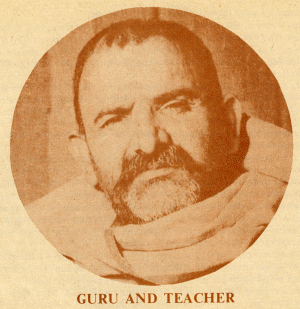
GURU AND TEACHER
Question: I have read in many holy books that you need to have a guru, a spiritual guide, to realize an enlightened state. If this is true, how do I go about finding one?
Answer: At certain stages in the spiritual journey, there is a quickening of the spirit which is brought about through the grace of a guru. When you are at one of the stages where you need this catalyst, it will be forthcoming. There is really nothing you can do about gurus. It doesn't work that way. If you go looking for a guru and you are not ready to find one, you will not find what you are looking for. On the other hand, when you are ready the guru will be exactly where you are at the appropriate moment.
All you can do is purify yourself in body and mind. Each stage of purification will make you sensitive to new levels of perception. Finally you arrive at a level where the guru is. There is no one who is ready for the grace of the guru who does not receive it at that very moment.
Question: Does everyone have a guru?
Answer: Yes. However, you may or may not meet your guru on the physical plane in this lifetime. It isn't necessary. Since the relation between a guru and chela (disciple) is not on the physical plane, the guru can act upon you from within yourself. You may meet him through dreams or visions or merely sense his presence. However, it is only after much purification that you will honor these meetings rather than rejecting them in favor of the more gross manifestations. There have been many saints who realized enlightenment without ever meeting their guru in a physical manifestation.
Question: How will I know how to purify myself without the guidance of a guru?
Answer: Relax. You are being guided. In fact, the next message you need in the treasure hunt is exactly where you are when you need it. The message may be in the form of a teacher or a lover or an enemy or a pet or a rock or a chemical or a book or a feeling of great despair or a physical illness or the eyes of a person you pass on the street.
Question: What is the difference between a teacher and a guru?
Answer: A teacher points the way. A guru is the Way. In the course of your awakening you will have thousands of teachers. Throughout all of this teaching, the guru waits, beckoning from beyond.
Question: There are many beings who profess to be gurus. Should I follow one of them? How do I choose from among them?
Answer: You can't choose to follow a guru. It doesn't work that way. If you are in doubt, don't. When the correct manifestation of the guru for you appears, you'll know it with all your heart. It is surrender which is no surrender. It is inevitable and totally compelling.
Now, it is possible that a being who is ultimately to be known to you as your guru comes forward and says, "I am your Guru." And you hold back. That's because you are not yet ready. You can't honestly do otherwise. Don't worry. When you are ready, he'll be back. Just relax and trust the process.
Question: What kind of teachers should I study with?
Answer: Listen to your inner being. If you are at the point where you sense you need instruction in calming your mind or getting your body in shape, then you will become sensitized to available teachers who can instruct you concerning the specific practices required. Often you will find a teacher who knows the specific information although he doesn't elicit in you a great love or trust. Honor him as your teacher, learn what you can, and then move on. Trust the messages coming from your heart and intuition.
This journey is an inner journey. The charisma of an impure being such as a Hitler would not be of influence on another person were that person totally honest with himself and totally true to his inner voice. There is a place in each human being where at all times he knows exactly "where it is at." So, if in doubt about the next step, just listen. And if still in doubt, wait. When it's time to move, you'll know.
Exercises
1. Purification Exercise with Guru Rimpoche
Consider a being of pure light and love (whom you can name Padmasambhava, the Lotus-evolved One, if you would like), who is sitting in the midst of a lake on a lotus flower in front of you. He is seen as being in front of you and slightly above you ... so that you look up to him at about a thirty degree angle. He will come into your heart when you have sufficiently purified yourself.
1. Closing your left nostril, breathe three deep breaths out of your right nostril. Visualize the air being ejected as dark red and consider it to be all of your bodily diseases and attachments.
2. Close your right nostril. Now breathe out three deep breaths through your left nostril. Visualize the air being ejected as a blue-grey and consider it to be all your mental obstacles and anger.
3. Now breathe out three deep breaths through your mouth. Visualize this air as purple and consider it as the sloth that impedes your progress ... the inertia ... breathe it out.
4. Now visualize that from the ajna (the point between the eyebrows) of Padmasambhava directly to your ajna there is a piercing beam of white light which, as it burns into you, rids you of bodily sins and wrongs (the sound connected with this is OM).
5. Now visualize a red beam from the throat chakra (point of energy) of Padmasambhava directly to your throat center. This beam rids you of lapses of speech, of untruths (the sound connected with this is AH).
6. Now visualize a blue beam of light coming from the heart of Padmasambhava to your heart. This beam purifies you of wrongs done in ignorance, wrong thoughts (i.e., thoughts which maintain the illusion). (The sound associated with this beam is HUM.)
7. Now allow that blue beam to become a broad blue avenue of light. Then you will see Padmasambhava come down that avenue and come directly into your heart. Here he will sit in your hridayam (spiritual heart). His mantra is: Om Ah Hum Vajra Guru Padma Siddhi Hum. This means three-in-one (the unmanifest, imminent manifestation, and manifestation) lightning-bolt Guru of unbearable compassion and infinite power who resides in my heart. To say his mantra is to keep Him in your heart ... until finally you and He become One.
2. The Four Bodhisattva Vows (say three times)
1. I resolve to become enlightened for the sake of all living beings.
2. I will cut the roots of all delusive passions.
3. I will penetrate the farthest gate of Dharma.
4. I will realize the supreme way of Buddha.
Potent Quotes
"Guru, God, and Self are One." - Ramana Maharshi
"Silence thy thoughts and fix thy whole attention on thy Master, whom thou dost not see, but whom thou feelest" - Blavatsky
"The influence of the Guru is obstructed by mental activity, by reliance on one's own exertions and by every kind of self-consciousness and self-exertion." - Sathya Sai Baba
"What is the nature of Guru's grace?
It is beyond thought and word.
Then how can it be said that the devotee realizes his true
Being by virtue of the Guru's grace?
It is like an elephant waking up on seeing a lion in a dream.
Just as the appearance of the dream lion is enough to wake the
elephant so also the glance of grace from the master is enough to
waken the devotee from the sleep of ignorance to the Knowledge of
the Real. It is sure and certain." - Ramana Maharshi
Disembodied guru to disciple: "Child you must meditate more. Your gaze is not yet faultless. I was fairly extinguished in the ether by the agitation of your, restless mind." - Babaji
"I beseeched him fervently thus: 'It is my great desire that I should actually experience your gracious wisdom. Kindly fulfill my desire.' In those days Sri Ramana was not speaking much. Still he spoke kindly as follows: 'Is it the body in front of me which desires to obtain my grace? Or is the awareness within it? If it is the awareness, is it not now looking upon itself as the body and making this request? If so let the awareness first of all know its real nature. It will then automatically know God and my grace. The truth of this can be realized even now and here.'" - Ramana Maharshi magazine
"Rain water falling upon the roof of a house flows down to the ground through spouts shaped grotesquely like a tiger's head. One gets the impression that the water comes from the tiger's mouth, but in reality it descends from the sky. In the same way the holy teachings that come from the mouths of godly men seem to be uttered by those men themselves, while in reality they proceed from God." - Ramakrishna
"The Grace of the Guru is like an ocean. If one comes with a cup he will only get a cupful. It is no use complaining of the niggardliness of the ocean. The bigger the vessel the more one will be able to carry. It is entirely up to him." - Ramana Maharshi
RENUNCIATION
You might think of renunciation in terms of some external act like a New Year's resolution, or leaving family and friends to go off to a cave. But renunciation is much more subtle than that -- and much harder -- and much much more continuing. On the spiritual journey, renunciation means non-attachment.
To become free of attachment means to break the link identifying you with your desires. The desires continue; they are part of the dance of nature. But a renunciate no longer thinks that he is his desires.
"What is the necessity of giving up the world altogether. It is enough to give up the attachment to it." - Ramakrishna
A sadhak (someone doing sadhana) sees clearly that his craving is creating his own veil of illusion. At this point desires start to fall away of themselves. This process is called the onset of vairag (the falling away of worldly desires). As each one falls away, more subtle forms of desire arise. These too must be given up. Eventually the only desire is for bliss. Then that one must be thrown away ...
As long as any desire pulls or pushes you, you are like a flame which flickers in the winds. But as you come to your center, as you break the identification with desire, you become calm, like a candle in a niche where no wind comes.
Remember you can't do away with desire or give it up or try to get rid of it. However, with increased wisdom and preoccupation with your sadhana, desires will just fall away.
"You can't rip the skin from the snake. It will shed its skin when it is ready." - Hari Dass Baba
And as you extricate yourself from your attachments and become quiet, you will be able to know more and more clearly how it all is ... The Way. And the more clearly you hear, the more your actions will be in harmony with the Way ... with His Will. Then you will truly understand:
Not my but Thy will, O Lord.
Potent Quotes
"Desire is a trap
Desirelessness is MOXA (liberation)
Desire is the world
Desire is the creator
Desire is the destroyer." - Hari Dass Baba
"Lay not up for yourselves treasures upon earth, where moth and rust doth corrupt, and where thieves break through and steal: but lay up for yourselves treasures in heaven, where neither moth nor rust doth corrupt, and where thieves do not break through nor steal; for where your treasure is, there will your heart be also." - Jesus
"If a pickpocket meets a Holy Man, he will see only His pockets." - Hari Dass Baba
"Everywhere I look I see only my own desires." - Hari Dass Baba
"Wheresoever the body is, thither will the eagles be gathered together." - Jesus
"On the hat of poverty three renouncements are inscribed: Quit this world, quit the next world, quit quitting." - Sufi poet
"When you got nothing, you got nothing to lose. You're invisible now, you got no secrets to conceal." - Bob Dylan
"The fly that touches honey cannot use its wings; so the soul that clings to spiritual sweetness ruins its freedom and hinders contemplation." - Aurobindo
"He consciously moves with the cosmic current. In moving he loses nothing but his limitations. He can take with him in essence all the experiences and understanding that he has gained." - Collins
"The essence of civilization consists not in the multiplication of wants but in their deliberate and voluntary renunciation." - Gandhi
"Lay it down, drop it, let go, sing it out, throw it out. Going all the Way is holy but alas some linger on the path to see and smell the pretty golden sunflower or hold hands with Eternity or practice Ecstasy Bliss or circulate the light or reach neither perception nor nonperception but lingering anywhere you might . . . get stuck for Kalpas . . . You can't go forwards or backwards or stand still. Move! Move! Mu ..." - Bhagavan Dass
"Therefore I say unto you, Take no thought for your life, what ye shall eat, or what ye shall drink; nor yet for your body, what ye shall put on. Is not the life more than meat, and the body than raiment?" - Jesus
"He that loveth father or mother more than me is not worthy of me." - Jesus
"By letting it go it all gets done
The world is won by those who let it go.
But when you try and try
The world is then beyond the winning." - Tao Te Ching
TAPASYA
The simplest and most direct type of renunciation would seem to be to just give up the satisfying of one's desires. That is, if one is preoccupied with eating and oral gratifications, just fast. If one is obsessed with sexual concerns, just give up sex. And so on. This technique is known as tapasya or "straightening by fire."
"If a man gives way to all his desires, or panders to them, there will be no inner struggle in him, no 'friction,' no fire. But if, for the sake of attaining a definite aim, he struggles with the desires that hinder him, he will then create a fire which will gradually transform his inner world into a single whole." - Ouspensky
The struggle that comes through imposing austerities upon oneself as a systematic part of one's sadhana is a powerful form of inner confrontation. It certainly shows you where you are not. For example, if you usual1y get up at 8 a.m. as everyone else does, try getting up at 4 a.m. every morning. (Buddha and other high beings have noted that the best time of day to work on oneself is between 4 and 7.) Or perhaps you like sleeping in a really comfortable bed ... start sleeping on a thin mat on the floor.
But there are two warnings to be kept in mind with regard to any austerities:
1. Austerities can be performed in ways to enhance or strengthen the ego. Pride in how much one is suffering and masochism, are two examples.
"Another thing that people must sacrifice is their suffering. No one who has not sacrificed his suffering can work. Nothing can he attained without suffering but at the same time one must begin by sacrificing suffering." - Ouspensky
2. Austerities that are excessive (in relation to the degree of spiritual development of the individual) are merely demonstrations of ego will and as such can harm the body or the mind in such a way as to make further sadhana in this lifetime difficult or even impossible.
"And even in his corrections, let him act with prudence, and not go too far, lest while he seeketh too eagerly to scrape off the rust, the vessel be broken." Rule for the Abbot. Ch. 64
Two examples:
There is a method of meditation in which a sadhak sits in the lotus position in the desert and looks directly into the sun without blinking from sunrise to sunset. Now it is obvious that if most people were to try this they would blind themselves through burning their retina. This particular exercise is only safe to do when one has evolved to such a point that his mind is totally one-pointed and thus he can keep his eyes open and directed at the sun without ever even once "looking" at the sun.
Pranayam, which utilizes control of breath in order to control pran or life force, involves in its advanced forms the stopping of the breath for extended periods of time. One arrives at these very delicate forms of pranayam only after considerable purification of body and mind for they require that the breath stop although the sadhak feels no experience of holding his breath. One over-zealous aspirant injected chemical agents to strengthen "his will" and override his body's warning system ... and then forced himself into deeper and deeper pranayam. He died. And leaving the body this way entails ego and is thus a subtle form of suicide which leaves him with more work to do, but no body to do it in ... until next time.
Such warnings make a person really want a nice, wise, paternal type teacher to impose discipline. But waiting for such a teacher is usually a cop-out, for at this point practically everything a teacher would say to us we already know. There are many ways on our own that we can "get on with it." (Later, when we have progressed on the path of purification and really need a teacher, he will appear.)
In undertaking any tapasya, one is usually overwhelmed by the amount of ego that creeps in. Pride, self-pity, wanting to stop because it all seems meaningless or confusing or is too slow . . . all of these ego demons and many more drop around to foil any such undertaking. A thousand times they will succeed and you will give up your program in disgust. But a thousand and one times you will return to your efforts because you see how it all is. That's just the way it is. As many times as you trip and fall, i.e., give in to a desire -- just get up. There is a tendency when we fall for many of us to sit around and feel guilty and wallow in self-recrimination.
"However sinful a person may be, if he would stop wailing inconsolably: 'Alas! I am a sinner, how shall I attain liberation?' and, casting away even the thought that he is a sinner, if he would zealously carry on ... he would most assuredly get reformed." - Ramana Maharshi
Such self-recrimination is just more of the ego dance. Let it go by and get on with it. After all, if you were finished, you wouldn't need to begin. Just accept where you are in the here and now and proceed full speed.
And so for those who can undertake austerities without feeling that they are too austere. perhaps even proceed joyfully, here are some suggested exercises.
Exercises
1. Get in the habit of remaining silent for a few hours a day. This is most easily done when one is at home or around people who understand what you are trying to do. (In India if you are silent everyone immediately says, "Ah, Mouna" and honors you. In the West people either interpret silence as a sign of your hostility towards them or as a physical illness about which they feel pity. Either of these reactions makes your work more difficult.) At first you may want to remain by yourself during these few hours. Later you will be able to be around people comfortably without having to speak.
Soon you may feel that you are ready to undertake one day of silence a week. Some spiritual communities have incorporated a day of silence into their program for the entire group. Many communities take meals in silence.
2. If you wish to undertake longer periods of silence you may wish to work with a chalk board. A piece of light slate about 4" by 5" can be worn on a piece of twine or rope around the neck. With a piece of chalk also attached to the twine, you can convey any necessary messages of practical import. This device, although somewhat cumbersome, is an excellent technique for showing a person his own verbosity. To have to write down every communication quickly leads one to convey the essence of the communication without all the redundancies and amplifications. With such a device, Hari Dass Baba has carried on much worldly work for fifteen years without speaking.
The effects of this very modest tapasya will very quickly be manifested in the forms of more calmness of mind and more energy and the ability to hear more around you.
Other exercises of tapasya are included in other sections of this cookbook.
Potent Quotes
"Conserve your powers. Daily renewed sense yearnings sap your inner peace; they are like openings in a reservoir that allow vital waters to be wasted in the desert soil of materialism.
The forceful activating impulse of wrong desire is the greatest enemy to the happiness of man. Roam in the world as a lion of self control; don't let the frogs of sense weakness kick you around." - Sri Yukteswar
"I realized in this place that people feared silence more than anything else, that our tendency to talk arises from self-defense and is always based upon a reluctance to see something, a reluctance to confess something to oneself.
Directly a person is quiet himself, that is, awakes a little, he hears the different intonations and begins to distinguish other people's lies." - Ouspensky
"The more you talk about it, the more you think about it, the further from it you go;
STOP TALKING, STOP THINKING, AND THERE IS NOTHING YOU WILL NOT UNDERSTAND." - Seng-ts'an
"Drown all sound in My Silence to hear My Word of words." - Meher Baba
"The whole world is tormented by words
And there is no one who does without words.
But in so far as one is free from words
Does one really understand words." - Saraha, Treasury of Songs. v. 88
"To reconnect consciousness with the unconscious, to make consciousness symbolical is to reconnect words with silence; to let the silence in. If consciousness is all words and no silence, the unconscious remains unconscious." -- N.O. Brown
"I said I will take heed to my ways, that I sin not with my tongue, I have placed a watch over my mouth; I became dumb and was silent, and held my peace even from good things." -- SI. Benedict
"Quietness is master of the dead." - Tao Te Ching
"Those who know do not talk
And talkers do not know." - Tao Te Ching
"He who tells the truth says almost nothing." - Porchia
"Do not squander your treasure. Exuberance is a good stimulus towards action, but the inner light grows in silence and concentration."
"Ephrem the Syrian says, 'Good speech is silver, but silence is pure gold.'" - Way of a Pilgrim.
"I did not eat so they said I was fasting;
I did not speak so they said I was mouni." - Ramana Maharshi
"Oh Lord, Thou shalt open my lips, and my mouth shall declare Thy praise." - Bible
SLEEPING
Exercises
As you get further on the path you will need less and less sleep. Start from where you are. Get as much sleep as you seem to need. However, it is helpful in facilitating your transformation to:
(a) Go to bed early and get up early. Most people in the West fill their evenings with activity and stimulation. As you get into a yogic way of life, those activities such as "hanging out," movies, TV, "making out," etc., cease to exert such a strong influence over you. Then the change in schedule becomes easy. If you have the opportunity to live away from electricity for a period of time, it is easier to notice the sunset and sunrise and to adapt your schedule to the natural order of things. If you think you are matinal or nocturnal don't worry about it ... just slowly bring your schedule into harmony.
(b) Sleep on a firm surface -- perhaps a mat on the floor or a thick mattress. At first this may be uncomfortable if you are unaccustomed to it, but quickly you adapt and find that the patterns and nature of your sleep change markedly as you change the surface upon which you sleep.
(c) It is good to sleep on your back or upon your side. (The left side is often recommended for reasons concerning which nostril it is most useful to breathe through during the night. Most of the time you breathe through one nostril dominantly. There is an evolved science in yoga concerning the effects of breathing through one nostril or the other. The nostril opposite the side you are sleeping on stays open.)
(d) Sleep without a pillow or with a small pillow under your neck. It is good to keep your spine as straight as possible.
(e) Meditate for a few minutes before lying down to go to sleep.
Patterns of Sleep
When you first lie down, relax your body progressively from feet to top of head. Experience the relaxation at each point along the way. Get out of the habit of "thinking about things" when you are going into sleep. Clear your mind. If you work with mantra, it is good to repeat your mantra and let all else fall away. As your sadhana proceeds you will be able to remain more conscious through the period of transition from your normal waking state into the states of sleep. You will witness these transitions in planes of consciousness from the vantage point of the calm niche created by your mantra (witnessing vantage point).
During the first part of your sleep you will be in a state of deep sleep. This is a dreamless state in which you merge once again into the unity of the One. Through this re-uniting you tune in on much pran and become refreshed. (Parallels are often made between this state and Nirvikalp Samadhi and the First Bardo.) Only when you have evolved far along the path will you remain conscious throughout the period of deep sleep. At that stage you no longer sleep but merely pass the night by going into deeper states of samadhi.
Once your being has been sufficiently refreshed through deep sleep, you begin to reenter through various planes of consciousness -- finally coming to the physical plane at which point you usually say that you have "awakened." The various planes you pass through prior to returning to the physical plane are generally referred to by most laymen in the West as the "dream state." Actually, what we refer to as "dreams" are merely experiences which we are having on planes other than the physical plane. Such experiences are going on all the time but usually our awareness is attached to the physical plane and we are oblivious of any other information coming from these other planes.
Most of us have had the experience of being awakened by an alarm clock and being in the middle of a dream. Sometimes we are able to finish the dream without "going back to sleep." That is, we keep in mind that the alarm has gone off, but we stay in the state of half awake/half asleep in order to finish the dream. Many people are trained to do this in psychoanalysis. It is possible almost immediately upon embarking on one's sadhana to become aware in the same way during the process of dreaming.
Once you know how to center through mantra, witness, etc., it is easy to observe your dreams running on. With very little practice you will find that by sleeping on a hard surface you sleep more lightly, which allows you to awaken into your dreams almost immediately upon coming out of deep sleep. It is useful to keep a mantra going while the dreams pass. Although you may be an actor in your dream, if you identify with your mantra or witness, you can still watch your dreams in the same way as you might watch a movie -- watching yourself as one of the actors.
This is a technique for learning a great deal about who you are on planes other than the one with which you are familiar. The major advantage of some familiarity with other than the physical plane of consciousness is that it helps you to see that what you call your "waking state" is little more than another plane of consciousness ... no more and no less. Once you know this and live this knowledge from moment to moment, then such exercises with dreams are unnecessary for they merely clutter your head with more illusion. At that stage it is good as soon as you come out of deep sleep and become aware again to get up immediately and go into meditation ... keeping as free from any thoughts as possible.
EATING
Our body is our temple where we live and where we do the work of becoming enlightened. Just as certain external environments are more conducive to increased awareness than others (at least in the early stages of awakening), so it is with the inner environment --the body itself. It can be a "clean, well-lighted place."
"We are what we eat" may be an oversimplification, but it contains a gram of truth. What we eat affects the nature of the body cells and organs and the way they function. At another level, you could say that the vibrations of anything you put into the organism modifies the vibrations of the total organism.
At the outset of sadhana, you cannot radically change your eating pattern without damage to the physical body. But what you can do is to attend to what and how you eat. Basically, there is a program of diet for the sadhak:
1. Don't eat too much. The traditional way of saying this is that at the conclusion of a meal. a yogi's stomach should be half full of food, one-quarter full of water and one-quarter full of air.
2. Eat light, healthy, unadulterated foods which are easily digestable. It would be desirable if we could find one agreed-upon diet that would be optimal for sadhana. But it is apparent from the many controversies that rage concerning which foods are "good" and which are "bad," that no single diet is universally considered desirable.
Such a welter of conflicting information may confuse a beginner. But such confusion may be constructive if it precipitates closer scrutiny of diet and a search for what is the essence of the matter behind all diets. Much of the controversy is the result of a failure to realize that a sadhak needs different kinds of foods at different stages of his journey. When he is first shedding his habitual meat diet he may wish to substitute whole grains, such as brown rice and whole wheat, along with vegetables, some fish, fruit, honey instead of sugar, nuts and dairy products. Later, he may find as he further purifies his body that certain of these foods interfere with his sadhana by producing mucus or vibrations which made meditation more difficult. He may eventually find, if he is leading a contemplative life, that fruit and nuts are enough.
Even such a sparse diet as that is merely a step upon the path. At the conclusion, one is capable of living upon light alone.
We, as separate entities, could be characterized as energy transformers. We take in energy (pran) in certain forms, transform this energy and then emit it in other forms. Beings whose consciousness is totally attached to the physical plane consider food, water and air as the major sources of their energy. As a being progresses along the path, he comes to understand that there are other sources of energy available to him. Finally he arrives at the stage where he is able to transmute everything in the Universe into useful energy. In modern Western science, the relationship between mass and energy as set forth by Einstein reflects this truth:
"That is, what appears to us to be mass is merely huge amounts of bound energy. If and when the mass can be broken down there is a release of energies. From this came the splitting of the atom."
3. Abstain as much as possible from strong (hot, spicy or pungent) foods. Also go light on stimulants such as coffee, tea and "spirits." Certain spices are useful in digestion and these may be used in moderation.
In order to go the spice trip, you have to alter your model of why you eat. Most Westerners are very sensual and spend large amounts of time in titillating their palates with variety and subtlety in tastes. The gourmet represents the epitome of such a value. The sadhak, however, realizes that all sense gratification is merely perpetuating the enslavement to desire so he attempts, early on, to surrender the taste trip in favor of his spiritual goal. But this is not necessarily required. At the early stages of work, it is useful to simplify one's diet (even to the taking of the same menu every day), making it as tasty as possible with mild and healthful spices. This repetition and blandness may be distasteful at first, but soon one develops new sensitivities in taste and new feelings of lightness in mind and body which more than compensate for what has been "given up."
4. Be concerned with the vibrations associated with the source, preparation and eating of foods. Most of us are so gross in our sensitivity that we can hardly even appreciate this point. But those of us who have been doing sadhana for a period of time, or who have lived with very pure beings, find these rules to be obvious:
(a) Any food which entails violence (killing) in its source is not to be taken. At one end of the continuum is meat -- the preparation of which obviously includes the killing of an animal which has a rudimentary self-consciousness. It thus experiences fear and releases into its system adrenalin and other chemicals from the endocrine glands which are not helpful for meditation. At the other end of this continuum are fruits which fall from trees -- given as a gift for our needs. Which of the foods in the middle of the continuum involve some violence to the natural order of things in order to obtain them (e.g., vegetables, milk) is a much debated question. In this manual we can only recognize the existence of such a continuum and bring it to your attention.
(b) Food which entails cooking in its preparation should only be eaten when it has been cooked with mantra and/or love. The vibrations of the person preparing the food enter into food cooked over fire. A Sanskrit mantra which can be used for preparing food is:
OM ANNAM BRAHMA RASO BISHNUR BHOKTA DEBO
JANARDANAHI AWAEM GYANTWA TO YO BHUNKT ANN
DOSHORN LIPYATE
which means: Food is Brahma. asa (juice) is Vishnu. The whole world (Life Being) is its user. Having this thought makes ineffective the evils connected with this food.
(c) There is a state of mind suitable for taking of food -- calmness. There is a Sufi saying: "If a person eats with anger, the food turns to poison."
5. Finally, consecrate the food you take. Such food is called prasad. Consecrating food means to offer the food up. Another way of saying this is that the taking of the food should be considered as part of one's spiritual work or sadhana. In the West we sometimes say grace before meals. This is one form of consecrating the food. All you have to do now is continue to say grace, but now listen to it.
A Sanskrit consecration of food taken from the Gita is as follows:
BRAHMAPANAM - BRAHMA HAVIRE
BRAHMAGNI - BRAHMANA HOTA
BRAHMAI - TAN - CANPABYAM
BRAHMA - KARMA - SAMADHINIAH
GURU BRAHMA - GURU VISHNU GURU
DAWVO MAHISH WARA
GURU SAKSHAT
PARAM BRAHMA TUS MA EE
SHRI GURU VEY NA MAHA
OM SHANTI SHANTI SHANTI
Translation: This ritual is Brahma. The food is Brahma. He who offers the food is Brahma. The fire (hunger) is also Brahma. And karma is Brahma. He who knows this may go to Brahma. I offer this food to the Guru who is the creator, the preserver, and the agent of change. To the Guru who is also energy and who is the Sun beyond all. I touch the lotus feet of the Guru. OM, Peace, Peace, Peace. (Just before OM, SHANTI, SHANTI, SHANTI ... you may wish to inject silently some additional beings whom you wish to honor by offering the food.)
It is true that food offered with a pure heart is received in essence.
In a short story by J.D. Salinger called "Teddy," a young boy who is a very high being describes how he first realized in this lifetime how it all was:
"I was about six years old and was watching my little sister in her highchair drinking milk. Suddenly I saw it was like pouring God into God if you know what I mean."
Perhaps you would find it a meaningful mantra to merely think upon pouring God into God, if you know what I mean.
Potent Quotes
"AND GOD SAID, 'Behold I have given you every plant yielding seed which is on the face of all the earth and every tree yielding seed in its fruit; you shall have them for food. And to every beast of the earth, and to every bird of the air, and to everything that creeps on the earth, everything that has the breath of life, I have given every green plant for food'." -- Genesis
"When you are at table, speak to none, keep your eyes lowered and think of the heavenly table, of the food that is served thereon, which food is God Himself, and of the guests at this table, who are the angels." -- St. Teresa of Avila
"Complaint of the Stomach:
One day there had been feasting at the Ashram. Many had been upset by the large quantity of rich food. Someone quoted the following complaint about the stomach by the Tamil poet Avvayar:
'You will not go without food even for one day, nor will you take enough for two days at a time. You have no idea of the trouble I have on your account, Oh wretched stomach! It is impossible to get on with you!'
Bhagavan immediately replied with a parody giving the stomach's complaint against the ego:
'You will not give even an hour's rest to me, your stomach. Day after day, every hour, you keep on eating. You have no idea how I suffer, Oh trouble-making ego! It is impossible to get on with you'." -- Osborne
"Ravana's gigantic brother, Khumba-karn, obtained as a boon from Brahma that whenever he had satisfied his voracious appetite the slumber of repletion might be the longest and deepest, and he might only wake to eat again." -- Ramayana
STUDY
Study, like mantra, is a technique for bringing you close to the higher (more conscious) ideas of higher beings. As a member of a culture which dotes on collecting knowledge, you may first set out on the path wanting to read what is written about higher consciousness. You might get books about the history of mysticism, the lives of the prophets of the great religions, the curricula of obscure schools of thought, the writings and sayings of great mystics, the implications of mysticism for modern man, and books on methods. This reading provides a context for your personal experiences. It demonstrates that throughout the history of man there have always been mystics, that what can be said about the mystical experience from an external observer's point of view is relatively trivial, and that though the words differ from one mystic to another, the communality of experience is amazing.
There are four categories into which these writings can be placed (in terms of the author's own state of development):
1. Realized or enlightened beings. For the most part they have written very little; often their words (e.g., Gospels) have been recorded by disciples.)
2. Spiritual seekers who are very much on the path and are sharing their insights, methods, etc.
3. Pandits, intellectuals, scientists who evolve highly intellectually sophisticated subtle models and explanations of the mystical experience. (The veil for many of these writers is still heavy, though often they have had some mystical experience of their own on which to anchor their writings.)
4. Professional writers who write objective, superficial, and quite external accounts of mysticism. They seek the "facts."
After you have completed the first superficial reading overview, it becomes apparent that if you are to change your way of thinking about the universe, it would be a good idea to "hang out with"
(a) those who know, and
(b) those who are seriously working on themselves.
Thus your reading quickly narrows to the first two categories of authors listed above.
The second stage of study is often called reflection. It is described in the following passage from Autobiography of a Yogi, by Yogananda.
"The scene was a forest hermitage in Eastern Bengal . . . Dabru Ballav had gathered his disciples around him in the sylvan solitudes. The holy Bhagavad Gita was open before them. Steadfastly they looked at one passage for half an hour, then closed their eyes. Another half hour slipped away. The master gave a brief comment. Motionless they meditated again for an hour. Finally the Guru spoke.
'Do you now understand the stanza?'
'Yes, Sir.' One of the group ventured his assertion.
'No, not fully. Seek the spiritual vitality that has given these words the power to rejuvenate India century after century.'
Another hour passed in silence."
Daily Exercise
Working with one of the books containing the words of a realized being (e.g., the Bhagavad Gita, the Tao Te Ching, the words of Jesus in the Gospels, Sayings of Ramana Maharshi or Ramakrishna, the I Ching, etc.), take one passage -- perhaps a phrase -- certainly no more than a page. Read and re-read and re-re-read it. Then let your thoughts work around it. Paraphrase it. See how it applies to others and to yourself. Note if and how it differs from the way in which you usually think about things . . . different assumptions, etc. What are its implications regarding your own journey? Read it again. What laws of nature is it reflecting? Then, sitting quietly, let your mind associate to the passage. And then be quiet. Certainly a half hour a day is not too long to spend on this exercise.
ASANAS
"Let a man though living in the body, so treat his body that, with right effort, right watchfulness and right concentration he will overcome the sorrow that is produced by the sensations that arise in the body." -- Dhammapada
The word asana is sometimes translated as "easy, comfortable" and sometimes as "eat." It concerns a comfortable seat in which one can remain for long periods of time.
"To remain motionless for a long time without effort is an asana." -- Yoga Darshana
"The aim of the bodily posture is secured when 'the physical reactions of the body are eliminated and the mind dissolves into the Infinite.'" -- Danielou, quoting from Yoga Darshana
You work with your body for some very obvious reasons. First, it is the environment in which you dwell in this incarnation on the physical plane. Second, unless you can cool out your body, it keeps on capturing your attention over and over again and thus distracts you from the one-pointedness of mind that you are seeking.
Third, to work with body energies and to be able to move such energies up the spine requires sensitization to nerves in the body of which most people are unaware. Until you can hear your body, you cannot bring it under voluntary control in such a way that it helps you rather than interferes with your sadhana. And fourth, a yogi realizes that the message of his being is reflected in all his manifestations and he seeks the power of the one-pointedness that comes from having his body as well as his thoughts directed towards the state of realization. Just as bringing the hands together in prayer or challenging someone with a raised fist have associated with them various thoughts and feelings, so it is with the total body. At any moment it is making its statement, and as you come to hear such statements you bring the messages of your body in line with the messages of your heart and head. For a realized being, every movement is a perfect statement.
It is well in undertaking work with the body (hatha yoga) to keep in mind these reasons. If in your head you undertake hatha yoga as a form of exercise or body building, you will end up with just what you reached for ... a more beautiful body. On the other hand, if you undertake hatha yoga as a form of yoga then it will, in a relatively short time, bring about a profound metamorphosis in your body calmness, sensitivity, and lightness ... all of which will facilitate your sadhana.
In undertaking asanas it is desirable to have a teacher who can demonstrate the correct positions and correct any bad habits that develop in your performance of the asanas. It is useful at the beginning to take an introductory course or set of lessons in hatha yoga if it is available to you. These lessons will start you on the right path. Even if a qualified teacher is not available, a friend who has had a teacher can point out errors in your asanas which will help you.
A note of caution, however. Teachers of hatha yoga who teach only hatha yoga often mistake the shadow for the substance. Although they may be able to point out correct postures and procedures, many of these teachers do not themselves comprehend the implications of the term yoga ... that is, they are not doing asanas as a means of union with the One. A student who works with such teachers runs the risk of profaning the undertaking in the very beginning by developing a poor mental set towards this work. With this caution in mind, however, it is possible for you, if you understand the reasons (especially the one concerning the use of body positions as a form of prayer) for doing asanas, to learn specific methodology from a teacher who himself does not understand these reasons.
If a teacher is not available it is still possible for you to undertake the regular practice of asanas profitably. Under these conditions, however, you must move slowly and gently ... don't force your body ... listen very carefully to the information that your body gives you. By proper centering you will, in fact, be calling upon an inner teacher who will guide you.
Asanas are positions. Once you have gotten into the position and made the statement connected with that position you are there. You become a statue in each asana.
The statue image is a useful one. No matter how unusual the position of the asana may seem to you, once you are in the position then you become totally centered in that position. It -- your body -- comes to be a position of rest ... as if you were always in that position, as a statue.
We see the Soul, Plato said, as men see the statue of Glaucus, recovered from the sea wherein it had lain many years -- which viewing, it was not easy, if possible, to discern what was its original nature, its limbs having been partly broken and partly worn and by defacement changed, by the action of the waves, and shells, weeds, and pebbles adhering to it, so that it more resembled some strange monster than that which it was when it left its Divine Source. Even so, he said, we see the Soul, deformed by innumerable things that have done it harm, have mutilated and defaced it. But the Mason who hath the ROYAL SECRET can also with him argue, from beholding its love of wisdom, its tendency toward association with what is divine and immortal, its larger aspirations, its struggles, though they may have ended in defeat, with the impediments and enthralments of the senses and the passions, that when it shall have been rescued from the material environments that now prove too strong for it, and be freed from the deforming and disfiguring accretions that here adhere to it, it will again be seen in its true nature, and by degrees ascend by the mystic ladder of the Spheres, to its first home and place of origin.
-- Morals and Dogma of the Ancient and Accepted Scottish Rite of Freemasonry, by Albert Pike
Your state of mind is of paramount importance in asanas. Don't identify with the ego who is doing the asanas. Merely watch the body move into the appropriate position. Stay in a place inside yourself where nothing is happening at all.
Only a few emperors ...
have had a mausoleum comparable to mine.
Apenna is creating a work of art.
It will all be covered with marble ...
with a pediment over 120 feet high.
On the walls, Trimalchio's entire life.
And his ships, sails unfurled.
And his favorite puppy dog.
-- Satyricon, directed by Federico Fellini
When the body has gotten into the asana as perfectly as it is able without forcing (just firm pressure) ... then go into "neutral" with the body so that it becomes perfectly relaxed and stable in the position of the asana.
There are 84 main asanas which an advanced yogi works with. Of these about 12 or 15 are sufficient until one arrives at a very advanced stage of sadhana. The following are a set of instructions for carrying out these simple asanas:
1. Find a quiet place to work. It is best to be alone. The surface on which you work should be flat. A blanket or thin mat on the floor is suitable.
2. Your clothing should be light and very flexible (leotards) or very loose. Asanas may be done naked although men sometimes find a loin cloth or athletic supporter preferable.
3. Success of asanas is dependent upon your being relaxed and calm and centered. It's going to start by relaxing yourself, just with breathing. Spread your arms wide, take in a breath, and then bring your arms across your chest and let the breath out. Let the breathing happen naturally, becoming deeper as you relax your arm movements more. Arms across your chest and then out, and then across your chest and then out. Breathe through your nose. Continue for a minute or two.
Another relaxing exercise is the turning, twisting of the body. Stand straight with arms extended straight out to the sides from your shoulders. Now twist the upper part of your body to the left so that your right arm comes out in front and the left arm is behind. At the same time, throw your left leg over to the right in front of your right leg. This forces the lower part of your body to turn in the opposite direction from the upper part. Then reverse the whole process ... so that the left arm and right leg are extended out in front across your body. Do this in a relaxed swinging fashion to limber up your body.
Now lie down on your back for another loosening up exercise. Pull your knees up to your chest and embrace them with your arms. Then roll back and forth with great relaxation just as if you're a ball, and with abandon -- total abandon -- just roll. Roll, back and forth, side to side. This is just to relax your back and loosen you up.
4. Breathing pointers: when your head comes forward towards your feet (your body jack-knifes), you let out air. When your body straights out or stretches backwards you take in air. It's like a bellows. When you have gotten into an asana that involves bending or stretching, and you wish to go into it a little further, use small breaths to help. If the asana requires forward bending, take in a little breath and then as you let it out, let your body go just a bit further forward ... and then another tiny breath, and so forth.
5. Do asanas at your own rate ... calmly maintaining your center throughout the entire session.
I. SAVASANA (Corpse Position):
Lie flat on your back and relax. Legs out straight, feet together and your hands by your sides. Relax your feet, calves, thighs, pelvis, abdomen, chest, arms, neck and head.
Statistics: Posted by admin — Fri Sep 25, 2015 9:55 am
]]>
AS LONG AS YOU'RE IN THE WORLD OF YIN YANG
OUTER DARKNESS
IT TAKES A LOT OF PURIFICATION
PURIFICATION OF WHAT
PURIFICATION OF THOUGHT
PURIFICATION OF BODY
FREEDOM FROM ATTACHMENT
AND AFTER A LONG TIME OF GOING UP AND DOWN WITH-
OUT UNDERSTANDING WHY I WAS GOING UP AND DOWN
OR HOW TO STOP IT
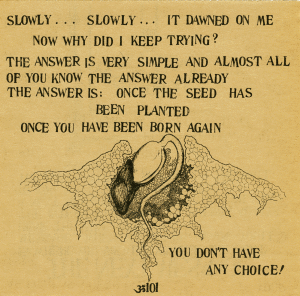
The Original Semites were the fifth and most important of the seven Atlantean Races, because in them we find the first germ of the corrective quality of Thought. Therefore the Original Semitic Race become the "seed race" for the seven races of the present Aryan Epoch....
The Original Semites regulated their desires to some extent by the mind, and instead of mere desires, came cunning and craftiness -- the means by which those people sought to attain their selfish ends. Though they were a very turbulent people, they learned to curb their passions to a great extent and accomplish their purposes by the use of cunning, as being more subtle and potent than mere brute strength. They were the first to discover that "brain" is superior to "brawn."...
Under the guidance of a great Entity, the Original Semitic Race was led eastward from the continent of Atlantis, over Europe, to the great waste in Central Asia which is known as the Gobi Desert. There it prepared them to be the seed of the seven Races of the Aryan Epoch, imbuing them potentially with the qualities to be evolved by their descendants....now his thoughts were to be turned from the visible Leaders, the Lords from Venus, whom he worshiped as messengers from the gods -- to the idea of the true God, the invisible Creator of the System. Man was to learn to worship and obey the commands of a God he could not see....
Fourfold also are the steps by which man climbs upward to God. First, through fear, he worships the God whom he begins to sense, sacrificing to propitiate Him, as do the fetish-worshipers. Next, he learns to look to God as the giver of all things, and hopes to receive from Him material benefits here and now. He sacrifices through avarice, expecting that the Lord will repay a hundredfold, or to escape swift punishment by plague, war, etc. Next, he is taught to worship God by prayer and the living of a good life; and that he must cultivate faith in a Heaven where he will be rewarded in the future; and to abstain from evil that he may escape a future punishment in Hell. At last he comes to a point where he can do right without any thought of reward, bribe, or punishment, but simply because "it is right to do right." He loves right for its own sake and seeks to govern his conduct thereby, regardless of present benefit or injury, or of painful results at some future time.
The Original Semites had reached the second of these steps. They were taught to worship an invisible God and to expect to be rewarded by material benefits, or punished by painful afflictions. Popular Christianity is at the third step. Esoteric Christians, and the pupils of all occult schools are trying to reach the highest step, which will be generally achieved in the Sixth Epoch, the new Galilee, when the unifying Christian religion will open the hearts of men, as their understanding is being opened now....
To transmute Cunning into Reason proved no easy task. The earlier changes in man's nature had been easily brought about. He could then be led without difficulty because he had no conscious desire, nor mind to guide him, but by the time of the Original Semites he had become cunning enough to resent limitations of his liberty and to circumvent repeatedly the measures taken to hold him in line. The task of guiding him was all the more difficult because it was necessary he should have some liberty of choice, that he might in time learn self-government. Therefore a law was enacted which decreed immediate rewards for obedience and instant punishment for disregard of its provisions. Thus was man taught, coaxed and coerced into reasoning in a limited manner that "the way of the transgressor is hard," and that he must "fear God," or the Leader who guided him.
Out of all who were chosen as "seed" for the new Race, few remained faithful. Most of them were rebellious and, so far as they were concerned, entirely frustrated the purpose of the Leader by intermarrying with the other Atlantean Races, thus bringing inferior blood into their descendants. That is what is meant in the Bible where the fact is recorded that the sons of God married the daughters of men. For that act of disobedience were they abandoned and "lost." Even the faithful died, according to the body, in the Desert of Gobi (the "Wilderness") in Central Asia, the cradle of our present Race. They reincarnated, as their own descendants of course, and thus inherited the "Promised Land," the Earth as it is now. They are the Aryan Races, in whom Reason is being evolved to perfection.
The rebellious ones who were abandoned are the Jews, of whom the great majority are still governed more by the Atlantean faculty of Cunning than by Reason. In them the race-feeling is so strong that they distinguish only two classes of people: Jews and Gentiles. They despise the other nations and are in turn despised by them for their cunning, selfishness and avarice....
Races are but an evanescent feature of evolution. Before the end of the Lemurian Epoch there was a "chosen people," different from the ordinary humanity of that time, who became the ancestors of the Atlantean Races. From the fifth race of those, another "chosen people" was drawn, from which the Aryan Races descended, of which there have been five and will be two more. Before a new Epoch is ushered in, however, there must be "a new Heaven and a new earth"; the physical features of the Earth will be changed and its density decreased. There will be one Race at the beginning of the next Epoch, but after that every thought and feeling of Race will disappear....
[E]xtra care must be taken that as few of the spirits as possible become enmeshed in the fetters of Race. This is exactly what happened to the spirits reborn in the Jewish Race-bodies. They attached themselves so firmly to the Race that they are drawn back into it in successive births. "Once a Jew, always a Jew" is their slogan. They have entirely forgotten their spiritual nature and glory in the material fact of being "Abraham's seed." Therefore they are neither "fish nor flesh." They have no part in the advancing Aryan Race and yet they are beyond those remnants of the Lemurian and Atlantean peoples which are still with us. They have become a people without a country, an anomaly among mankind.
Because of their bondage to the Race-idea, their one-time Leader was forced to abandon them, and they became "lost." That they might cease to regard themselves as separate from other peoples, other nations were stirred up against them at various times by the Leaders of humanity, and they were led captive from the country where they had settled, but in vain. They stubbornly refused to amalgamate with others. Again and again they returned in a body to their arid land. Prophets of their own Race were raised up who mercilessly rebuked them and predicted dire disaster, but without avail.
As a final effort to persuade them to cast off the fetters of Race, we have the seeming anomaly that the Leader of the coming Race, the Great Teacher Christ, appeared among the Jews. This still further shows the compassion and Wisdom of the great Beings who guide evolution. Among all the Races of the Earth, none other was "lost" in the same sense as the Jews; none other so sorely needed help. To send them a stranger, not one of their own Race, would have been manifestly useless. It was a foregone conclusion that they would have rejected him. As the great spirit known as Booker T. Washington incarnated among the Negroes, to be received by them as one of themselves, and thus enabled to enlighten them as no white man could, so the great Leaders hoped that the appearance of Christ among the Jews as one of their own might bring them to accept Him and His teachings and thus draw them out of the meshes of the Race-bodies. But sad it is to see how human prejudice can prevail. "He came unto His own and" they chose Barabbas.
The rejection of Christ by the Jews was the supreme proof of their thralldom to Race. Thenceforth all efforts to save them as a whole by giving them special prophets and teachers, were abandoned and, as the futility of exiling them in a body had been proven, they were, as a last expedient, scattered among all the nations of the earth. Despite all, however, the extreme tenacity of this people has prevailed even to the present day, the majority being yet orthodox. In America, however, there is now a slight falling away. The younger generation is commencing to marry outside the Race. In time, an increasing number of bodies, with fewer and fewer of the Race characteristics, will thus be provided for the incarnating spirits of the Jews of the past. In this manner will they be saved in spite of themselves. They become "lost" by marrying into inferior Races; they will be saved by amalgamating with those more advanced.
As the present Aryan Races are reasoning human beings, capable of profiting by past experience, the logical means of helping them is by telling them of past stages of growth and the fate that overtook the disobedient Jews. Those rebels had a written record of how their Leaders had dealt with them. It set forth how they had been chosen and rebelled; were punished; but were yet hopeful of ultimate redemption. That record may be profitably used by us, that we may learn how not to act....
The Original Semites were set apart and forbidden to marry into other tribes or peoples, but they were a stiff-necked and hard people, being yet led almost exclusively by desire and cunning, therefore they disobeyed the command. Their Bible records that the sons of God married the daughters of man -- the lower grades of their Atlantean compatriots. They thus frustrated the designs of Jehovah and were cast off, the fruit of such cross-breeding being useless as seed for the coming Race.
These cross-breeds were the progenitors of the present Jews, who now speak of "lost tribes." They know that some of the original number left them and went another way, but they do not know that those were the few who remained true. The story of the ten tribes being lost is a fable. Most of them perished, but the faithful ones survived, and from that faithful remnant have descended the present Aryan Races.
-- The Rosicrucian Cosmo-Conception, by Max Heindel
***
“The Seed appears and disappears continuously.” Here “Seed” stands for “the World-germ,” viewed by Science as material particles in a highly attenuated condition, but in Occult physics as “Spiritual particles,” i.e., supersensuous matter existing in a state of primeval differentiation. In theogony, every Seed is an ethereal organism, from which evolves later on a celestial being, a God.
-- The Secret Doctrine -- The Synthesis of Science, Religion, and Philosophy, by Helena Petrovna Blavatsky
***
Compare: bud = being born; bloom = living; fruit = dying; seed = death; the seed lies in the earth just as the dead lie in their graves.
-- The Religion of the Aryo-Germanic Folk: Esoteric and Exoteric, by Guido von List
***
But to return from the Personal, for which I have little taste at any time, and the contrary when it stands in any connection with myself -- in order to the removal of one main impediment to the spiritual resuscitation of Protestantism, it seems to me indispensable, that in freedom and unfearing faith, with that courage which cannot but flow from the inward and life-like assurance, "that neither death, nor things present nor things to come, nor heighth, nor depth, nor any other creature, shall be able to separate us from the love of God, which is in Christ Jesus our Lord" -- (Rom. VIII. 38, 39) -- the rulers of our Churches and our teachers of theology should meditate and draw the obvious, though perhaps unpalatable, inferences from the following two or three plain truths. -- First, that Christ, "the Spirit of Truth," has promised to be with his Church even to the end. Secondly: that Christianity was described as a Tree to be raised from the Seed, so described by Him who brought the seed from Heaven and first sowed it. Lastly: that in the process of Evolution, there are in every plant growths of transitory use and duration. "The integuments of the seed, having fulfilled their destined office of protection, burst and decay. After the leaves have unfolded, the Colyledons, that had performed their functions, wither and drop off." The husk is a genuine growth of "The Staff of Life:" yet we must separate it from the grain. It is, therefore, the cowardice of faithless superstition, if we stand in greater awe of the palpable interpolations of vermin; if we shrink from the removal of excrescences that contain nothing of nobler parentage than maggots of moth or chafer. Let us cease to confound oak-apples with acorns still less, though gilded by the fashion of the day, let us mistake them for Golden Pippins or Renates.
-- On the Constitution of the Church and State, According to the Idea of Each; With Aids Toward a Right Judgment on the Late Catholic Bill, by Samuel Taylor Coleridge
***
In order to promote the growth of the human person, involving both the plant and the seed, one incorporates the very principle of regeneration, which is consciousness. And this can only be done if the consciousness which one instills is freed from its earlier limitations and identifications. This is the secret of alchemy: to isolate mercury from the aggregate of the material which one is working with, the prima materia, then prevent it from volatilizing itself into thin air, fixing it by means of sulphur, in order to produce the philosopher's stone which is the catalyst of gold. Similarly, consciousness, symbolized by mercury, must be freed from its identifications when it identifies itself with its cosmic dimensions. There would be a loss of a sense of personality, in fact a disintegration not only of the plant but of the seed, unless consciousness were projected into the seed, or through the seed, and it is this new amalgamate which will act as a catalyst to transform the personality into the model of perfection, symbolized by gold.
-- Toward the One, by Pir Vilayat Inayat Khan
***
Your nature when it sinned so utterly
In its own seed, out of these dignities
Even as out of Paradise was driven
-- Paradiso, from The Divine Comedy of Dante Alighieri, translated by Henry Wadsworth Longfellow
***
'This world is the seedplot of the world to come.' Whatever he sows here, there he shall reap.
-- Discourses of Rumi, translated by A. J. Arberry
***
The next highest or sixth realm is the World of Virgin Spirits. Here those sparks from the divine "Flame" have their being before they commence their long pilgrimage through the five denser Worlds for the purpose of developing latent potentialities into dynamic powers. As the seed unfolds its hidden possibilities by being buried in the soil, so these virgin spirits will, in time, when they have passed through matter (the school of experience), also become divine "Flames," capable of bringing forth universes from themselves....
The Theory of Rebirth teaches that each soul is an integral part of God, enfolding all divine possibilities as the seed enfolds the plant; that by means of repeated existences in an earthly body of gradually improving quality, the latent possibilities are slowly developed into dynamic powers; that none are lost by this process, but that all mankind will ultimately attain the goal of perfection and re-union with God.
-- The Rosicrucian Cosmo-Conception, by Max Heindel
***
The daimons become reconciled in the one who has found himself, who is the source of all four streams, of the source-bearing earth. From his summit waters flow in all four directions. He is the sea that bears the sun; he is the mountain that carries the sun; he is the father of all four great streams; he is the cross that binds the four great daimons. He is the incorruptible seed of nothingness, which falls accidentally through space. This seed is the beginning, younger than all other beginnings, older than all endings.
-- The Red Book: Liber Novus, by C.G. Jung
***
Hence the fundamental thesis expressed in vi. 13; the stock of the people of Jehovah is imperishable, the holy seed retains its vitality through all the work of judgment. In other words, the community of God's grace in Israel can never be extinguished. Within the corrupt mass of Judah there ever remains a seed of true life, a precious remnant, the preservation of which is certain.
-- The Prophets of Israel and Their Place in History to the Close of the Eighth Century, B.C., by W. Robertson Smith, LL.D.
***
In Sap. IV.6 it is said: "Offspring of illicit intercourse are the progeny of depravity against their progenitors," and "the seed of unnatural (paranomos) nuptials ought to be eradicated" (Sap. III. 16). '"The defilement of entities, the alteration of birth (bastardization), the lack of discrimination in marriage, and the breeding of nameless idols is the cause of all evil, in the beginning and in the end," thus it is profoundly written in Sap. XIV.26. The word "entity" (= Heb. nepes, Lat. anima = Gk. psyche) certainly cannot be translated by "soul." This is because from the Talmud we know that the se'irim seek out Sodomite relationships, kelaim; and that from this imperfect nepes result. In Sap. XII.6 it is said that the forefathers of the Canaanites were helpless "souls," and that their seed has been cursed from the beginning.
-- Theozoology, or the Science of the Sodomite Apelings and the Divine Electron, by Dr. Jorg Lanz von Liebenfels
SLOWLY ... SLOWLY ... IT DAWNED ON ME
NOW WHY DID I KEEP TRYING?
THE ANSWER IS VERY SIMPLE AND ALMOST ALL
OF YOU KNOW THE ANSWER ALREADY
THE ANSWER IS: ONCE THE SEED HAS
BEEN PLANTED
ONCE YOU HAVE BEEN BORN AGAIN
YOU DON'T HAVE
ANY CHOICE!
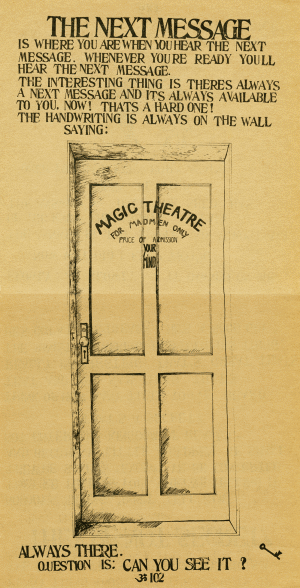
THE NEXT MESSAGE
IS WHERE YOU ARE WHEN YOU HEAR THE NEXT
MESSAGE. WHENEVER YOU'RE READY YOU'LL
HEAR THE NEXT MESSAGE.
THE INTERESTING THING IS THERE'S ALWAYS
A NEXT MESSAGE AND IT'S ALWAYS AVAILABLE
TO YOU, NOW! THAT'S A HARD ONE!
THE HANDWRITING IS ALWAYS ON THE WALL
SAYING:
MAGIC THEATRE
FOR MADMEN ONLY
PRICE OF ADMISSION
YOUR
MIND
ALWAYS THERE.
QUESTION IS: CAN YOU SEE IT?
FUNNY THING ABOUT ALL THE SECRETS OF
THE EAST OR THE SECRETS OF MYSTICISM ...
All Wisdom comes from the East; from the West we can expect nothing good; therefore, you who desire to be useful physicians, act according to the sun of true Wisdom, and not for the aggrandisement of the moonshine of self.
-- The Life of Philippus Theophrastus Bombast of Hohenheim Known by the Name of Paracelsus and the Substance of his Teachings, by Franz Hartmann, M.D.
THEY'RE NOT SECRET!
NOBODY'S SAYING "DON'T TELL HIM."
THEY'RE TELLING YOU. THEY'RE YELLING IT.
THEY'RE SAYING: "EXCEPT YE BE CONVERTED
AND BECOME AS LITTLE CHILDREN, YE SHALL
NOT ENTER THE KINGDOM OF HEAVEN."
THAT'S A SECRET?
Let us be open as the day, that we may deeper hide ourselves.
-- The Hermetic and Rosicrucian Mystery, by Arthur Edward Waite
***
Let a lover of truth make use of but a few authors, but of best note and experienced truth; let him suspect things that are quickly understood, especially in mystical names and secret operations; for truth lies hid in obscurity; nor do philosophers ever write more deceitfully than when plainly, nor ever more truly than when obscurely. The cause of this concealment among all wise men is the contempt and neglect of the secrets of wisdom by the vulgar sort, who know not how to use those things that are most excellent, or if they do conceive any worthy thing, it is altogether by chance and fortune, and they do exceedingly abuse their knowledge, to the great damage and hurt of many men, yea, even of whole societies; so that he is worse than mad that publisheth any secret, unless he conceal it from the multitude, and in such wise deliver it that even the studious and learned shall hardly understand it. Some have hidden their secrets by their modes of writing; as namely, by consonants only, so that no man can read them unless he knows the signification of the words; and this is usual among the Jews, Chaldeans, Syrians and Arabians, yea, and the Grecians too; and, therefore, there is great concealing with them, but especially with the Jews.
-- New Platonism and Alchemy, by Alexander Wilder
***
Some fifteen years ago, the writer was the first to repeat, after the Kabalists, the wise Commandments in the Esoteric Catechism. “Close thy mouth, lest thou shouldst speak of this, and thy heart, lest thou shouldst think aloud; and if thy heart has escaped thee, bring it back to its place, for such is the object of our alliance.” And again: “This is a secret which gives death: close thy mouth lest thou shouldst reveal it to the vulgar; compress thy brain lest something should escape from it and fall outside.” A few years later, a corner of the Veil of Isis had to be lifted; and now another and a larger rent is made. But old and time-honoured errors — such as become with every day more glaring and self-evident — stand arrayed in battle-order now, as they did then. Marshalled by blind conservatism, conceit and prejudice, they are constantly on the watch, ready to strangle every truth, which, awakening from its age-long sleep, happens to knock for admission. Such has been the case ever since man became an animal. That this proves in every case moral death to the revealers, who bring to light any of these old, old truths, is as certain as that it gives life and regeneration to those who are fit to profit even by the little that is now revealed to them.
-- The Secret Doctrine -- The Synthesis of Science, Religion, and Philosophy, by Helena Petrovna Blavatsky
THINK OF HOW MANY TIMES YOU'VE HEARD
THAT AND YOU SAY: "YEAH, THAT'S
REALLY INTERESTING. THAT'S GREAT. THAT'S
THE MINISTER TALKING. HE'S DOING HIS THING.
HE'S GOT A LIVING TO EARN. HE'S A GOOD GUY."
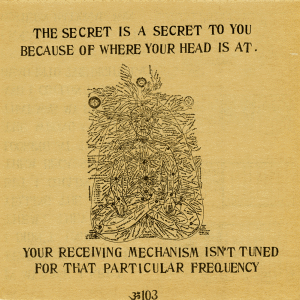
"But that which especially distinguishes the Brotherhood is their marvellous knowledge of the resources of the medical art. They work not by charms but by simples." (MS. Account of the Origin and Attributes of the True Rosicrucians.)
-- Isis Unveiled, by Helena P. Blavatsky
***
The body of a man is his house; the architect who builds it is the astral world. The carpenters are at one time Jupiter, at another Venus; at one time Taurus, at another Orion. Man is a sun and a moon and a heaven filled with stars; the world is a man, and the light of the sun and the stars is his body; the ethereal body cannot be grasped, and yet it is substantial, because substance means existence, and without substance nothing exists. If the life of the sun did not act in the world, nothing would grow. The human body is vapour materialised by sunshine mixed with the life of the stars.
-- The Life of Philippus Theophrastus Bombast of Hohenheim Known by the Name of Paracelsus and the Substance of his Teachings, by Franz Hartmann, M.D.
THE SECRET IS A SECRET TO YOU
BECAUSE OF WHERE YOUR HEAD IS AT.
YOUR RECEIVING MECHANISM ISN'T TUNED
FOR THAT PARTICULAR FREQUENCY
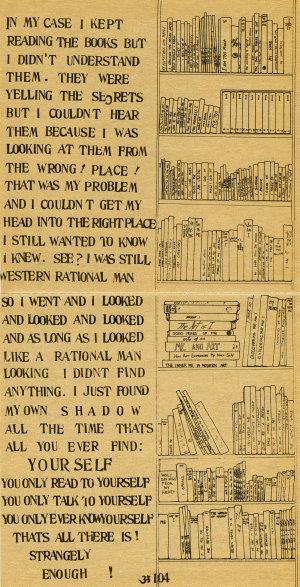
IN MY CASE I KEPT
READING THE BOOKS BUT
I DIDN'T UNDERSTAND
THEM. THEY WERE
YELLING THE SECRETS
BUT I COULDN'T HEAR
THEM BECAUSE I WAS
LOOKING AT THEM FROM
THE WRONG! PLACE!
THAT WAS MY PROBLEM
AND I COULDN'T GET MY
HEAD INTO THE RIGHT PLACE.
I STILL WANTED TO KNOW
I KNEW. SEE? I WAS STILL
WESTERN RATIONAL MAN
SO I WENT AND I LOOKED
AND LOOKED AND LOOKED
AND AS LONG AS I LOOKED
LIKE A RATIONAL MAN
LOOKING I DIDN'T FIND
ANYTHING. I JUST FOUND
MY OWN SHADOW
ALL THE TIME THAT'S
ALL YOU EVER FIND:
YOURSELF
YOU ONLY READ TO YOURSELF
YOU ONLY TALK TO YOURSELF
YOU ONLY EVER KNOW YOURSELF
THAT'S ALL THERE IS!
STRANGELY
ENOUGH!
For all practical purposes, the microcosm, our own individual world, is the only world we are condemning or denouncing, in fact, is the only world we have the slightest business to condemn or denounce...let us consider whether we have the power to judge, not the world as a whole, but any other individual whatsoever, in the world beside ourselves...we are always dealing with ourselves and our inseparable shadows, not with a foreign world....the whole point is this: that our own state of mind for the time being is strong enough to tinge the whole of the world with its colours....Bear constantly in view this fact, then, that the world we are judging is our own individual world...I want to make it quite clear that I am not taking up the cudgels in defence of that terrible bugbear "Idealism," nor doing battle with what the Philosophy of Common Sense prides itself upon denominating "Realism." My sole object is to emphasise a fact which we are very apt to ignore, and which it is of the utmost importance to remember. The world we are condemning or praising is not the world at large, but the world within ourselves.
-- Ars Vivendi (Art of Living), by Arthur Lovell
***
Nothing is permanent except the one hidden absolute existence which contains in itself the noumena of all realities. The existences belonging to every plane of being, up to the highest Dhyan-Chohans, are, in degree, of the nature of shadows cast by a magic lantern on a colourless screen; but all things are relatively real, for the cogniser is also a reflection, and the things cognised are therefore as real to him as himself. Whatever reality things possess must be looked for in them before or after they have passed like a flash through the material world; but we cannot cognise any such existence directly, so long as we have sense-instruments which bring only material existence into the field of our consciousness. Whatever plane our consciousness may be acting in, both we and the things belonging to that plane are, for the time being, our only realities. As we rise in the scale of development we perceive that during the stages through which we have passed we mistook shadows for realities, and the upward progress of the Ego is a series of progressive awakenings, each advance bringing with it the idea that now, at last, we have reached “reality;” but only when we shall have reached the absolute Consciousness, and blended our own with it, shall we be free from the delusions produced by Maya.
-- The Secret Doctrine -- The Synthesis of Science, Religion, and Philosophy, by Helena Petrovna Blavatsky
***
Intimately connected with the sidereal body is the Evestrum. Paracelsus says in his "Philosophia ad Athenienses," "To speak of the Evestrum in its mortal and immortal aspects, we may say that everything has an Evestrum, and that it is like a shadow seen upon a wall. The Evestrum comes into existence, and grows with the body, and remains with it as long as a particle of the matter composing the latter exists. The Evestrum originates contemporaneously with the first birth of each form, and everything, whether it be visible or invisible, whether it belongs to the realm of matter or to the realm of the soul, has its Evestrum. The Evestrum indicates future events by causing visions and apparitions. Only those who are gifted with great wisdom may understand the true nature of Evestrum. The Evestrum influences the sense of sight. The Evestrum causes dreams foreshadowing future events. Whenever a child is born, there is born with him an Evestrum, which is so constituted as to be able to indicate in advance all the future acts and the events in the life of the individual to whom it belongs. If that individual is about to die, his Evestrum may indicate the approach of his death by raps or knocks, audible to all, or by some other unusual noise, by the movement of furniture, the stopping of clocks, the breaking of a picture, the fall of a mirror, or any other omen; but frequently such omens are neither recognised nor noticed, and not understood."
"The Evestrum of man is born with him, and after the death of the latter it remains in the earth-sphere, and there is still some sympathetic connection between the Evestrum and the eternal and immortal part of man, and it will indicate the state of happiness or misery in which the soul of the person to whom it belongs exists. Such Evestra are not the souls of the dead walking upon the earth, but they are the ethereal duplicates of the persons to whom they belonged, remaining until the last particle of the matter composing the physical bodies of the latter has been consumed."
"All Evestra originate in the Turba, magna, the collective activity of the universe. The Evestra prophetica proceed directly from the Turba magna, the Evestra obumbrata come into existence at the time when the forms to which they belong appear. The Evestra prophetica are the harbingers of great events that may concern the well-being of the world. If some such important event is to take place, they will be the forerunners to announce it to the world, so that the latter may be prepared for it, and a person who understands the true nature of such an Evestrum is a seer and prophet. Even the highest God has his Evestrum mysteriales by which his existence and his attributes may be recognised, by which everything good may be known, and which may illuminate every mind. All the powers of evil, from the lowest to the highest, have their Evestra mysteriales, which may predict future evil, and which shed their bad influence over the world."
"Necromantia gives its signs through the Astra, which we also call 'Evestra.' They mark the bodies of the sick and the dying with spots, showing that he will die on the third day; they mark the hands and fingers of men with yellow spots, foreshowing fortunate events. Through them the dead perform signs and wonders, such as the bleeding of a corpse in the presence of the murderer, and through their power voices are sometimes heard from out of the tombs. Noises and hauntings may thus take place in charnel-houses, and the dead appear in the clothing which they used to wear while living, and various visions be seen in mirrors, stones, water, &c. A great deal might be said about such things, but it would create fears and superstitions and other evils. This we wish to avoid, and we will therefore say no more about such things, which ought not to be publicly known" (Signat. Rer., ix.).
"There are Evestra in all things, and they are all prophesying spirits, whether the bodies to which they belong are rational or irrational, sensitive or without sensation. These Evestra teach Astronomia (natural science) to him who can understand what they say. The character of each thing may be known through its Evestrum, not by making astrological charts, calculating nativities, and composing prognostics, but by looking at it with the understanding, in the same manner as we may look at the image of an object in a mirror or at the shadow of a body on the surface of the water, or upon the earth. The Ens (the eternal cause and character of a thing) is reflected in its Evestrum, The form of the latter perishes, but the spirit remains. The number and variety of Evestra are as incalculable as that of the visible and invisible forms to which they belong. The Evestra of human beings know the thoughts of men, guide their instincts, watch over them in their sleep, warn them of dangers, and prophesy future events. The Sibyls of the past have read the future in the Evestra, and the Evestra have caused the ancient prophets to speak as it were in a dream" (Philos. ad Athenienses).
"The world of the Evestra is a world of its own, although intimately interlaced and connected with ours. It has its own peculiar states of matter and objects that may be visible or invisible to its inhabitants, and yet corresponding to a certain extent to ours. Still, it is a world constituted differently from ours, and its inhabitants can know as little about our existence as we about theirs. The firmament of the universe is fourfold in its essence, and divided into four planes. One belongs to Matter (Earth), one to Water, one to Air, and one to Fire, but the firmament in which rests the Evestrum is dispersed. The latter is not the firmament containing our visible stars, but the sphere in which the Nymphae, Undines, Salamanders, Flagae, &c., live. These beings are not dependent on our sphere of existence, but they have a firmament of their own; they have their own peculiar conditions, places of dwelling, localities, stars and planets. As there is in our world water and fire, harmonies and contrasts, visible bodies and invisible essences, likewise these beings are varied in their constitution and have their own peculiarities, for which human beings have no comprehension. But the two words intermingle and throw their shadows upon each other, and this circumstance causes delusive visions, apparitions, omens, and signs, mixing strangely with the two impressions coming from the Evestra prophetica, and only an intelligence illuminated by wisdom can distinguish the true from the false.
"The first thing, however, which we ought to do is, as Christ says, to seek for the Kingdom of God and His justice. If we do this we will require no prophecies, because all that we need will be given to us" (De Arte Praesaga).
-- The Life of Philippus Theophrastus Bombast of Hohenheim Known by the Name of Paracelsus and the Substance of his Teachings, by Franz Hartmann, M.D.
I SAW THAT MY WHOLE GAME DIDN'T WORK.
IT GAVE ME ALL THE REWARDS THAT SEEMED
TO BE OFFERED BUT IT DIDN'T WORK. THERE
WAS A PLACE IN ME THAT KNEW IT WASN'T
WORKING. I KNEW THERE WAS SOMETHING ELSE
BUT I COULDN'T GET TO IT. AT THAT POINT
I GAVE UP. AND THEN I WAS READY FOR THE
NEXT MESSAGE
"The clothing closet isn't open."
-- Ram Dass, "Fierce Grace"
***
The Apocalypse of St. John 3/7: "And to the angel of the church in Philadelphia write: These things saith he that is holy, he that is true, he that hath the key of David, he that openeth and no man shutteth; and shutteth, and no man openeth. I know thy works: Behold, I have set before thee an open door, and no man can shut it: for thou hast a little strength, and hast kept my word, and hast not denied my name." The word little is not intended here as derogatory. By it is meant the little strength of the ego into which man is compressed into one point. He who has found himself as an ego -- who is no longer dependent on blood or kindred, or the circumstances of a people or a race, he has an open door before him, he can follow the Christ. ("I am the door", says the Christ.)
-- The Pictorial Language of Hieronymus Bosch, by Clement A. Wertheim Aymes
***
No one, says [Hippolytus], can be saved without the Son: "But this is the serpent. For it is he who brought the signs of the Father down from above, and it is he who carries them back again after they have been awakened from sleep, transferring them thither from hence as substances proceeding from the Substanceless. This, they say, is [what is meant by] the saying, "I am the Door." ...
But the "spiritual men" attain their proper nature by entering in through the "true door," Jesus Makarios (the blessed), and thus obtaining knowledge of their own wholeness, i.e., of the complete man. This man, unhonoured in the world, is obviously the inner, spiritual man, who becomes conscious for those who enter in through Christ, the door to life, and are illuminated by him. Two images are blended here: the image of the "strait gate," and that of John 14: 6: "I am the way, and the truth, and the life. No one comes to the Father but through me." They represent an integration process that is characteristic of psychological individuation.
-- Aion, by C.G. Jung
WHEN I WENT
THROUGH THE
DOORWAY I
THOUGHT: WOW!
IT ISN'T LIKE
I THOUGHT AT
ALL. I MEAN: IF
I AM GOING TO
SPEND MY LIFE
MANIPULATING
THIS PUNY EGO
THROUGH A SET
OF POWER GAMES
AND SENSUAL
GRATIFICATIONS
WHAT'S THE
PAYOFF? THE
END IS THAT
IT'S GOING TO
END ANYWAY
BECAUSE IT'S ALL
IN TIME
AND SUDDENLY I DIG WHO I AM AT THAT
MOMENT WHEN I'M STONED! HIGH! I AM
OUT OF TIME!
I AM OUT OF SPACE!
BUT BOY! DOES IT FEEL VALID! DOES IT
FEEL REAL! IT FEELS LIKE THE FIRST
REAL THING THAT'S EVER HAPPENED TO ME!
EVERYTHING ELSE HAD A CERTAIN HUSTLE
LIKE QUALITY TO IT
EXCEPT MY SUFFERING

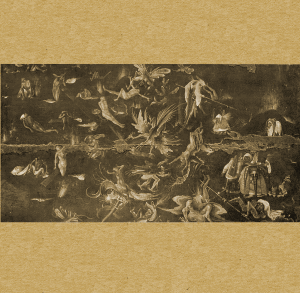
AM I HE?
I WAS REALLY INTO MY SUFFERING
YOU CAN REALLY GET INTO YOUR SUFFERING
SELF-PITY ... THAT'S REAL!
EVERYTHING ELSE MAY GO
BUT BOY! YOU'VE GOT TO SUFFER!
IT'S THE SAME FOR ALL OF US
WE'RE JUST COMING OUT OF THE
DARK NIGHT OF THE PROTESTANT ETHIC
SUFFER BABY!
THAT'S THE ONLY WAY YOU'LL BE GOOD
IT FEELS SO GOOD TO HURT SO BAD!
WE'VE ALL BEEN ON THAT TRIP
SUFFERING IS GREAT.
IT'S LIKE STRAIGHTENING-BY-FIRE
IT'S PURIFYING
IT'S VERY GOOD
FUNNY THING ... WANT ANOTHER PARADOX?
THIS TRIP
REQUIRES
TOTAL
SUFFERING BUT:
IT'S GOT TO BE SUFFERING
THAT IS NO SUFFERING
YOU'VE GOT TO GO THE WHOLE SUFFERING TRIP
BUT:
YOU CAN'T BE THE GUY WHO IS SUFFERING.
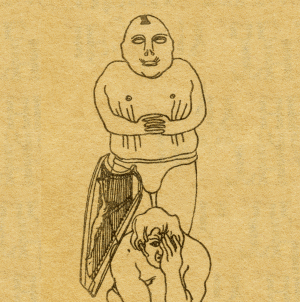
It has taken a long time for people to be convinced that Germania is the "womb and factory of nations." Only today, now that almost the whole world has succumbed to ape-nature -- right up to the Germanic countries which have not been fully spared either -- does the truth begin to dawn on us, that we are lacking a certain divine humanity in a general flood of ape-men. But it will not be long before a new priestly race will rise up in the land of the electron and the Holy Graal, which will play new songs on new harps, and as before, on the first feast of Pentecost, when the spirit descended in tongues of radiation on the apostles, so will the electrical swans of the gods come once more to the great Pentecost of mankind. Great princes, strong warriors, God-inspired priests, singers with eloquent tongues, and bright-eyed cosmologists will rise up out of Germany's ever-holy soil of the gods -- put the Sodomite apelings in chains, establish the Church of the Holy Spirit, of the Holy Graal anew and make the Earth into an "Island of the Blessed." The temples of the pastors and ape-dealers will collapse, the Graal-castle and the Church of John will, however, abide until Christ comes again! So let us lay off playing the harps of Sodom and play the harps of men, so that Apollo's holy swans can return and we can again become a congregation of Gods. German men, play on "human harps," love the strong loyal, Nordic woman in whom the divine electron still slumbers.
-- Theozoology, or the Science of the Sodomite Apelings and the Divine Electron, by Dr. Jorg Lanz von Liebenfels
Spirit passes into the body, and out of it, like a breath of air passing through the strings of an Æolian harp.
-- The Life of Philippus Theophrastus Bombast of Hohenheim Known by the Name of Paracelsus and the Substance of his Teachings, by Franz Hartmann, M.D.
**
It is useless to plead that the "materialized spirits" that have exhibited themselves [at circles] with beating hearts and loud voices (with or without a trumpet) are human spirits. The voices — if such sound can be termed a voice at all — of a spiritual apparition once heard can hardly be forgotten. That of a pure spirit is like the tremulous murmur of an Æolian harp echoed from a distance; the voice of a suffering, hence impure, if not utterly bad spirit, may be assimilated to a human voice issuing from an empty barrel.
-- Isis Unveiled, by Helena P. Blavatsky
***
Here is an example of the relation of colour to vibration well worthy of the attention of Occultists. Not only Adepts and advanced Chelas, but also the lower order of psychics, such as clairvoyants and psychometrists, can perceive a psychic Aura of various colours around every individual, corresponding to the temperament of the person within it. In other words, the mysterious records within the Auric Egg are not the heirloom of trained Adepts alone, but sometimes also of natural psychics. Every human passion, every thought and quality, is indicated in this Aura by corresponding colours and shades of colour, and certain of these are sensed and felt rather than perceived. The best of such psychics, as shown by Galton, can also perceive colours produced by the vibrations of musical instruments, every note suggesting a different colour. As a string vibrates and gives forth an audible note, so the nerves of the human body vibrate and thrill in correspondence with various emotions under the general impulse of the circulating vitality of Prana, thus producing undulations in the psychic Aura of the person which result in chromatic effects. The human nervous system as a whole, then, may be regarded as an AEolian Harp, responding to the impact of the vital force, which is no abstraction, but a dynamic reality, and manifests the subtlest shades of the individual character in colour phenomena. If these nerve vibrations are made intense enough and brought into vibratory relation with an astral element, the result is -- sound. How, then, can anyone doubt the relation between the microcosmic and macrocosmic forces?
-- The Esoteric Papers of Madame Blavatsky
-- The Pictorial Language of Hieronymus Bosch, by Clement A. Wertheim Aymes
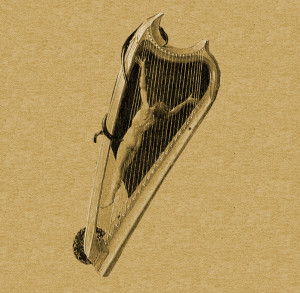
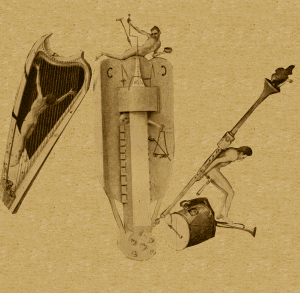
DO YOU THINK
THAT WHEN CHRIST IS LYING THERE
AND THEY'RE NAILING THE NAILS IN
HE'S SAYING, "OH MAN, DOES THAT HURT!"? HE'S
PROBABLY LOOKING AT THE GUY WHO'S NAILING HIM
WITH
ABSOLUTE COMPASSION
HE DIGS WHY THE CAT'S DOING IT
WHAT HE'S STUCK IN
HOW MUCH DUST COVERS HIS EYES
WHY HE'S GOT TO BE DOING IT
THAT'S THE WAY IT IS
HE SAID THE NIGHT BEFORE:
"WELL, TOMORROW IS THE BIG TRIP.
YEAH-RIGHT-THESE ARE THE NAILS
WOW! LOOK AT THAT!"
AM I HE WHO IS BEING PAINED?
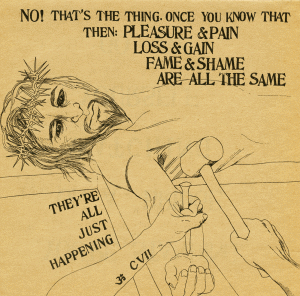
NO! THAT'S THE THING ONCE YOU KNOW THAT
THEN: PLEASURE & PAIN
LOSS & GAIN
FAME & SHAME
ARE ALL THE SAME
THEY'RE
ALL
JUST
HAPPENING
This relates to the sacred Science of the Numerals: so sacred, indeed, and so important in the study of Occultism that the subject can hardly be skimmed, even in such a large work as the present. It is on the Hierarchies and correct numbers of these Beings invisible (to us) except upon very rare occasions, that the mystery of the whole Universe is built.
-- The Secret Doctrine -- The Synthesis of Science, Religion, and Philosophy, by Helena Petrovna Blavatsky
***
The old Roman numerals I, II, III, IIII are only Ones placed next to one another, which augment one another to a higher unity (+).
-- The Religion of the Aryo-Germanic Folk: Esoteric and Exoteric, by Guido von List
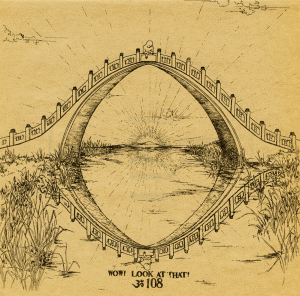
WOW! LOOK AT THAT!
YOU'RE STANDING
ON A BRIDGE
WATCHING
YOURSELF
GO BY
Just as pre-Cosmic Ideation is the root of all individual consciousness, so pre-Cosmic Substance is the substratum of matter in the various grades of its differentiation. Hence it will be apparent that the contrast of these two aspects of the Absolute is essential to the existence of the “Manifested Universe.” Apart from Cosmic Substance, Cosmic Ideation could not manifest as individual consciousness, since it is only through a vehicle of matter that consciousness wells up as “I am I,” a physical basis being necessary to focus a ray of the Universal Mind at a certain stage of complexity. The “Manifested Universe,” therefore, is pervaded by duality, which is, as it were, the very essence of its ex-istence as “manifestation.” But just as the opposite poles of subject and object, spirit and matter, are but aspects of the One Unity in which they are synthesized, so, in the manifested Universe, there is “that” which links spirit to matter, subject to object.
This something, at present unknown to Western speculation, is called by the occultists Fohat. It is the “bridge” by which the “Ideas” existing in the “Divine Thought” are impressed on Cosmic substance as the “laws of Nature.” Fohat is thus the dynamic energy of Cosmic Ideation; or, regarded from the other side, it is the intelligent medium, the guiding power of all manifestation, the “Thought Divine” transmitted and made manifest through the Dhyan Chohans, the Architects of the visible World. Thus from Spirit, or Cosmic Ideation, comes our consciousness; from Cosmic Substance the several vehicles in which that consciousness is individualised and attains to self, or reflective, consciousness; while Fohat, in its various manifestations, is the mysterious link between Mind and Matter, the animating principle electrifying every atom into life.
-- The Secret Doctrine -- The Synthesis of Science, Religion, and Philosophy, by Helena Petrovna Blavatsky
***
What is great in man is that he is a bridge and not a goal: what is lovable in man is that he is an OVER-GOING and a DOWN-GOING. I love those that know not how to live except as down-goers, for they are the over-goers.
-- Thus Spake Zarathustra, by Friedrich Nietzsche
***
When the candidate has lived such a life for a time sufficient to establish the current of spiritual force, and is found worthy and qualified to receive esoteric instruction, he is taught certain exercises, to set the pituitary body in vibration. This vibration causes the pituitary body to impinge upon and slightly defect the nearest line of force (See diagram 17). This, in turn, impinges upon the line next to it, and so the process continues until the force of the vibration has been spent. It is similar to the way in which the striking of one note on a piano will produce a number of overtones, by setting up a vibration in the other strings which are at proper intervals of pitch.
When by the increased vibration of the pituitary body, the lines of force have been deflected sufficiently to reach the pineal gland, the object has been accomplished, the gap between these two organs has been bridged. This is the bridge between the World of Sense and the World of Desire. From the time it is built, man becomes clairvoyant and able to direct his gaze where he will. Solid objects are seen both inside and out. To him space and solidity, as hindrances to observation, have ceased to exist.
He is not yet a trained clairvoyant, but he is a clairvoyant at will, a voluntary clairvoyant. His is a very different faculty from that possessed by the medium, who is usually an involuntary clairvoyant and can see only what comes; or who has, at best, very little more than the purely negative faculty. But the person in whom this bridge is once built is always in sure touch with the inner Worlds, the connection being made and broken at his will.
-- The Rosicrucian Cosmo-Conception, by Max Heindel
***
The meaning of events is the way of salvation that you create. The meaning of events comes from the possibility of life in this world that you create. It is the mastery if this world and the assertion of your soul in this world. This meaning of events is the supreme meaning, that is not in events, and not in the soul, but is the God standing between events and the soul, the mediator of life, the way, the bridge and the going across....
The holy ceremony must be dissolved and become spirit. The bridge should lead out beyond humanity, inviolable, far, of the air. There is a community of spirits founded on outer signs with a solid meaning. Community with the dead is what both you and the dead need.
-- The Red Book: Liber Novus, by C.G. Jung
***
Now, mark well, in order to understand that which follows, that the upper, indigo-blue Manas is connected with the lower, green Manas by a thin line which binds the two together. This is the Antaskarana, that path or bridge of communication which serves as a link between the personal being whose physical brain is under the sway of the lower, animal mind, and the reincarnating Individuality, the spiritual Ego, Manas, Manu, the "Divine Man." This thinking Manu, therefore, alone is that which reincarnates. In truth and in nature, the two Minds, the spiritual and the physical or animal, are one, but separate at reincarnation. For, while that portion of the divine which goes to animate the personality, consciously separating itself, like a dense but pure shadow, from the divine Ego, wedges itself into the brain and senses [Now, it is in the power of the human Ego to chase away the shadows, or sins, and multiply the brightnesses, or good deeds, which make these impressions, and thus, through Antaskarana, ensure its own permanent connection, and its final reunion with the divine Ego. Remember that the latter cannot take place while there remains a single taint of the terrestrial, or of matter, in the purity of that light. of the foetus, at the completion of its seventh month, the Higher Manas does not unite itself with the child before the completion of the first seven years of its life. This detached essence, or rather the reflection or shadow of the Higher Manas, becomes, as the child grows, a distinct thinking principle in man, its chief agent being the physical brain. No wonder the materialists, who perceive only this "rational soul," or mind, will not disconnect it with the brain and matter. But occult philosophy has, ages ago, evolved the problem of mind, and discovered the duality of Manas. Look at the Plate; see the divine Ego tending with its point upwards towards Buddhi, and the human Ego gravitating downwards, immersed in matter and connected with its higher, subjective half only by the Antaskarana. As its derivation suggests, it is the connecting link during life between the two minds -- the higher consciousness of the Ego and the human intelligence of the lower mind.
-- The Esoteric Papers of Madame Blavatsky

H
HRI
I
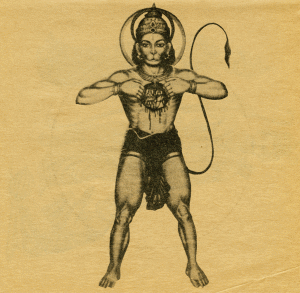
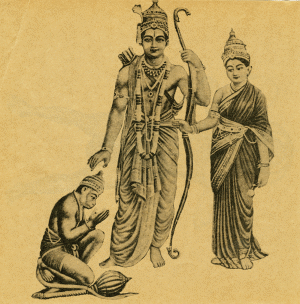
mmmmmm ...
Statistics: Posted by admin — Fri Sep 25, 2015 9:42 am
]]>
ROUND TRIP
MIND CREATES MAT-
TER. THE CAUSAL
PLANE IS THE
WORLD OF IDEAS
THAT CREATES
THE UNIVERSE
RIGHT AT THE TOP
OF THE CAUSAL
PLANE IS WHAT WE CALL THE GODHEAD IT'S THE FIRST
PLACE INTO THE UNIVERSE OF FORM IT'S THE FIRST
WORLD OF FORM IT'S THE PLACE WHERE THE MIND
THAT IS GOD MANIFESTED INTO THE UNIVERSE HIS
THOUGHT MANIFESTED INTO ALL THE LOWER LEVELS
OF THE CAUSAL PLANE ALL THE ASTRAL PLANES AND THE
PHYSICAL PLANE AND WHEN YOU GO BACK BACK BACK
YOU GO TO THAT PLACE WHERE YOU BECOME ONE WITH THE
GODHEAD YOU ARE
GOD YOU ARE THE ID-
EA THAT LIES BEHIND
THE UNIVERSE YOU
ARE LITERALLY IT
YOU'RE NOT MAKING
BELIEVE YOU'RE IT
YOU ARE IT
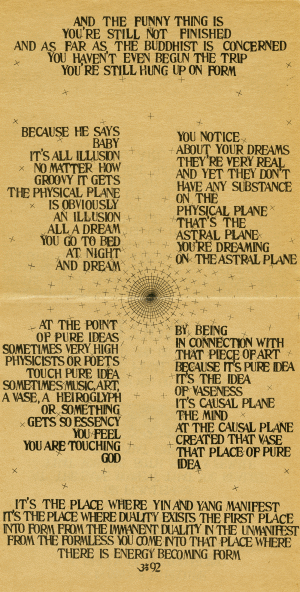
AND THE FUNNY THING IS
YOU'RE STILL NOT FINISHED
AND AS FAR AS THE BUDDHIST IS CONCERNED
YOU HAVEN'T EVEN BEGUN THE TRIP
YOU'RE STILL HUNG UP ON FORM
BECAUSE HE SAYS
BABY
IT'S ALL ILLUSION
NO MATTER HOW
GROOVY IT GETS
THE PHYSICAL PLANE
IS OBVIOUSLY
AN ILLUSION
ALL A DREAM
YOU GO TO BED
AT NIGHT
AND DREAM
YOU NOTICE
ABOUT YOUR DREAMS
THEY'RE VERY REAL
AND YET THEY DON'T
HAVE ANY SUBSTANCE
ON THE
PHYSICAL PLANE
THAT'S THE ASTRAL PLANE
YOU'RE DREAMING
ON THE ASTRAL PLANE
AT THE POINT
OF PURE IDEAS
SOMETIMES VERY HIGH
PHYSICISTS OR POETS
TOUCH PURE IDEA
SOMETIMES MUSIC, ART,
A VASE, A HEIROGLYPH
OR SOMETHING
GETS SO ESSENCY
YOU FEEL
YOU ARE TOUCHING
GOD
BY BEING
IN CONNECTION WITH
THAT PIECE OF ART
BECAUSE IT'S PURE IDEA
IT'S THE IDEA
OF VASENESS
IT'S CAUSAL PLANE
THE MIND
AT THE CAUSAL PLANE
CREATED THAT VASE
THAT PLACE OF PURE
IDEA
IT'S THE PLACE WHERE YIN AND YANG MANIFEST
IT'S THE PLACE WHERE DUALITY EXISTS THE FIRST PLACE
INTO FORM FROM THE IMMANENT DUALITY IN THE UNMANIFEST
FROM THE FORMLESS YOU COME INTO THAT PLACE WHERE
THERE IS ENERGY BECOMING FORM
For there is no light of justice or temperance or any of the higher ideas which are precious to souls in the earthly copies of them: they are seen through a glass dimly; and there are few who, going to the images, behold in them the realities, and these only with difficulty. There was a time when with the rest of the happy band they saw beauty shining in brightness,—we philosophers following in the train of Zeus, others in company with other gods; and then we beheld the beatific vision and were initiated into a mystery which may be truly called most blessed, celebrated by us in our state of innocence, before we had any experience of evils to come, when we were admitted to the sight of apparitions innocent and simple and calm and happy, which we beheld shining in pure light, pure ourselves and not yet enshrined in that living tomb which we carry about, now that we are imprisoned in the body, like an oyster in his shell.
-- Phaedrus, by Plato
***
Then may we not say, Simmias, that if, as we are always repeating, there is an absolute beauty, and goodness, and an absolute essence of all things; and if to this, which is now discovered to have existed in our former state, we refer all our sensations, and with this compare them, finding these ideas to be pre-existent and our inborn possession—then our souls must have had a prior existence, but if not, there would be no force in the argument? There is the same proof that these ideas must have existed before we were born, as that our souls existed before we were born; and if not the ideas, then not the souls....
Then now mark the point at which I am aiming:—not only do essential opposites exclude one another, but also concrete things, which, although not in themselves opposed, contain opposites; these, I say, likewise reject the idea which is opposed to that which is contained in them, and when it approaches them they either perish or withdraw. ... Then not only do opposite ideas repel the advance of one another, but also there are other natures which repel the approach of opposites.
-- Phaedo: The Last Hours of Socrates, by Plato
***
So shall we come to look at the world with new eyes. It shall answer the endless inquiry of the intellect, -- What is truth? and of the affections, -- What is good? by yielding itself passive to the educated Will. Then shall come to pass what my poet said; `Nature is not fixed but fluid. Spirit alters, moulds, makes it. The immobility or bruteness of nature, is the absence of spirit; to pure spirit, it is fluid, it is volatile, it is obedient. Every spirit builds itself a house; and beyond its house a world; and beyond its world, a heaven. Know then, that the world exists for you. For you is the phenomenon perfect. What we are, that only can we see. All that Adam had, all that Caesar could, you have and can do. Adam called his house, heaven and earth; Caesar called his house, Rome; you perhaps call yours, a cobler's trade; a hundred acres of ploughed land; or a scholar's garret. Yet line for line and point for point, your dominion is as great as theirs, though without fine names. Build, therefore, your own world. As fast as you conform your life to the pure idea in your mind, that will unfold its great proportions. A correspondent revolution in things will attend the influx of the spirit. So fast will disagreeable appearances, swine, spiders, snakes, pests, madhouses, prisons, enemies, vanish; they are temporary and shall be no more seen. The sordor and filths of nature, the sun shall dry up, and the wind exhale. As when the summer comes from the south; the snow-banks melt, and the face of the earth becomes green before it, so shall the advancing spirit create its ornaments along its path, and carry with it the beauty it visits, and the song which enchants it; it shall draw beautiful faces, warm hearts, wise discourse, and heroic acts, around its way, until evil is no more seen. The kingdom of man over nature, which cometh not with observation, -- a dominion such as now is beyond his dream of God, -- he shall enter without more wonder than the blind man feels who is gradually restored to perfect sight.'
-- Nature, by Ralph Waldo Emerson
***
As regards the soul, I understand it approximately as follows: soul = A (idea); body = non-A (matter ← dyad); non (non-A) = A [solely on the basis of diairesis, without koinonia!]; that is to say: only when the body is "negated" does the soul become "pure" idea, and only man can "negate" his body (on the basis of diairesis without koinonia, which precisely allows the body to be understood as non-A, where the Non, which appears as space-time, is derived from the non-existing dyad.) In practical terms that means: one should abandon the polis, practice dialectic in the Academy, live accordingly, and one may then perhaps as a (for an instant) "pure idea" coincide (for an instant) with the One-Good.
-- On Tyranny, by Leo Strauss
***
I will obey my soul and be true to that within me that is highest. I will search within for the pure idea of right in all things, and when I find it I will express it in my outward life. I will abandon everything I have outgrown for the best I can think. I will have the highest thoughts concerning all my relationships, and my manner and action shall express these thoughts. I surrender my body to be ruled by my mind; I yield my mind to the dominion of my soul, and I give my soul to the guidance of God.
-- The Original Mysticism in American-Rosicrucian Masonic Spirituality & Metaphysics: The Secret Lodge of New Orleans, by Magus Incognito
***
The image of the world is half the world. He who possesses the world but not its image possesses only half the world, since his soul is poor and has nothing. The wealth of the soul exists in images. He who possesses the image of the world, possesses half the world, even if his humanity is poor and owns nothing. But hunger makes the soul into a beast that devours the unbearable and is poisoned by it. My friends, it is wise to nourish the soul, otherwise you will breed dragons and devils in your heart.
-- The Red Book: Liber Novus, by C.G. Jung
***
R. Judah discoursed here on the text: Then Hezekiah turned his face unto the wall and prayed unto the Lord (Is. XXXVIII, 2). He said: 'We have derived from this verse the lesson that a man in praying should stand near the wall, with nothing intervening between himself and the wall. Now the question may be asked, why does it say of Hezekiah in particular that he turned his face to the wall, and of no one else who offered prayer, though with no less devotion, as, for instance, Moses, of whom it is written that he "prayed to the Lord" (Ibid. XVII, 4), and he "cried to the Lord" (Ex. XV, 25)? The reason is as follows. Hezekiah, as tradition tells us, was at that time not married and had no children. Isaiah therefore came to him and said: "Thou shalt die and not live", i.e. as tradition explains, "thou shalt die in this world and not live in the next world". For whoever has not laboured to beget children in this world is not established in the future world, and his soul is banished thence and can nowhere find rest; and this is the punishment referred to in the Law by the words, "They shall die childless" (Lev. XX, 20). Further, the Shekinah does not rest upon him at all. Hence Hezekiah "set his face to the wall", that is to say, he made a resolution to take a wife in order that the Shekinah, which is symbolized by a wall, might rest upon him, and hence the text continues, "and he prayed unto the Lord". From here we learn that anyone who is conscious of a sin for which he means to ask forgiveness should first form a resolution to cure himself of that sin and then offer his prayer, as it is written: "Let us search and try our ways" first, and then, "turn again unto the Lord" (Lam. III, 40). So Hezekiah, recognizing his fault, set his mind to put himself right with the Shekinah, the place against which he sinned.....
R. Hizkiah discoursed on the verse: "Thine eyes did see mine imperfect substance, and in thy book they were all written, etc." (Ps. CXXXIX, 16). 'This verse', he said, 'has been frequently expounded. All the souls which came into existence when the world was created stand before God before coming down in that same form in which they afterwards appear in the world, since that bodily appearance of man which he had in this world is also found above. When this soul is about to descend into the world, it stands before God in the form which it is to assume in the world, and God adjures it to keep the precepts of the law and not to transgress them. Hence it says: "Thine eyes saw mine imperfect form" before it appeared in the world, "and in thy book they were all written", that is to say, all the souls in their forms are recorded in the book....R. Judah said: 'I have heard from R. Simeon that this verse refers to the days which were assigned to him out of the life of Adam, namely seventy years, since it has been affirmed that David had no life of his own, but Adam gave him seventy years of his life. David therefore prayed to know why it was that he had no life of his own, and continued, "Let me know how fleeting I am", that is to say, why, like the moon, I am without light of my own, unlike all those celestial lights which all have their own life. This is what David sought to know, but permission was not given to him. Observe that all celestial blessings were delivered to this grade to transmit to all creatures, and although it has no light of its own, all blessings and all joy and all goodness are contained in it and issue from it, and therefore is it called "the cup of blessing", or even simply "blessing", as it is written, "The blessing of the Lord maketh rich" (Prov. X, 22).
-- The Zohar, translated by Harry Sperling and Maurice Simon
***
Picture men dwelling in a sort of subterranean cavern with a long entrance open to the light on its entire width. Conceive them as having their legs and necks fettered from childhood, so that they remain in the same spot, able to look forward only, and prevented by the fetters from turning their heads. Picture further the light from a fire burning higher up and at a distance behind them, and between the fire and the prisoners and above them a road along which a low wall has been built, as the exhibitors of puppet shows have partitions before the men themselves, above which they show the puppets.
All that I see, he said.
See also, then, men carrying past the wall implements of all kinds that rise above the wall, and human images and shapes of animals as well, wrought in stone and wood and every material, some of these bearers presumably speaking and others silent.
A strange image you speak of, he said, and strange prisoners.
Like to us, I said. For, to begin with, tell me do you think that these men would have seen anything of themselves or of one another except the shadows cast from the fire on the wall of the cave that fronted them?
How could they, he said, if they were compelled to hold their heads unmoved through life?
And again, would not the same be true of the objects carried past them?
Surely.
If then they were able to talk to one another, do you not think that they would suppose that in naming the things that they saw they were naming the passing objects?
Necessarily.
And if their prison had an echo from the wall opposite them, when one of the passers-by uttered a sound, do you think that they would suppose anything else than the passing shadow to be the speaker?
By Zeus, I do not, said he.
Then in every way such prisoners would deem reality to be nothing else than the shadows of the artificial objects.
-- The Republic, by Plato
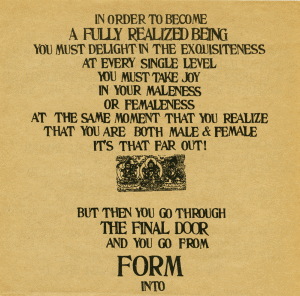
IN ORDER TO BECOME
A FULLY REALIZED BEING
YOU MUST DELIGHT IN THE EXQUISITENESS
AT EVERY SINGLE LEVEL
YOU MUST TAKE JOY
IN YOUR MALENESS
OR FEMALENESS
AT THE SAME MOMENT THAT YOU REALIZE
THAT YOU ARE BOTH MALE & FEMALE
IT'S THAT FAR OUT!
In its absoluteness, the One Principle under its two aspects (of Parabrahmam and Mulaprakriti) is sexless, unconditioned and eternal. Its periodical (manvantaric) emanation — or primal radiation — is also One, androgynous and phenomenally finite. When the radiation radiates in its turn, all its radiations are also androgynous, to become male and female principles in their lower aspects.
-- The Secret Doctrine -- The Synthesis of Science, Religion, and Philosophy, by Helena Petrovna Blavatsky
***
Today Hermaphrodites still occur among humans not all that infrequently. Today it is generally assumed that the embryo is originally bisexual. The feminine sexual organ is itself actually bisexual. This is because the clitoris is nothing other than a stunted penis. A notable phenomenon is the fact that inbreeding promotes the generation of hermaphrodites. According to the Bible, and many commentators, the man which was supposed to have been created "in the image of God" in Gen I.26 (which is not the udumu in Gen. II.7), like the "Sons of God" and the Sethites, was hermaphroditic. In all mythologies the primal god is a hermaphrodite. Thus the Egyptian Thum says: "I am the great god, who created himself." Zeus gives birth to Athene. Ymir, the Germanic primal god, generates offspring with himself. Ymir and the valkyries still live on even today among the Bavarian and Austrian people as St. Kummernis who is worshipped as a bearded half-man/half-woman. From the Koran it is clear that the angels were also thought of as hermaphrodites. (Sura XXXVII,150; XLIII,18). The angels are the Uranian-Aphrodite of the Greeks. Herodotus (I,105 and IV,67) reports concerning the Scythian hermaphrodites which everyone could see as such. Their hermaphroditism was the result of their plundering of the temple of Aphrodite-Urania in Askalon, i.e. they abducted the issuri-men from there and Sodomized them and the resulting children were hermaphrodites. Now we can also understand why the inhabitants of Sodom lusted so much after the angels which were visiting Lot. Pliny (VIII,3) emphasizes that hermaphrodites do exist, which were considered "miracles" in earlier times, but which served for the satisfaction of lust in the time of Pliny. Loki is called the "child- bearing feminine," as generally, as far as I can judge, the pure blond Germanic race has the greatest inclination to hermaphroditism. It is illustrative that the Saxon code of law [Sachsenspiegel], meant for pure-raced northern Germany contains its own legal measure concerning the "Allzuviel" (hermaphrodites). An especially unusual custom surrounding the crib of a manchild speaks further concerning the one-time existence of authentic bilateral hermaphrodites. In some regions upon the birth of a child the father has to lay down and act as if he had borne the child. Additionally it must be noted that there are really lactating men (Klaatsch Entw. d. Menscheng. 62). Among the Hebrews the child was adopted by a foster-father by him setting it on his lap and thus indicating that it has been borne by him. In an Orphic hymn it is beautifully expressed: "Zeus the First, Zeus the Last, Lord of Lightning ... Zeus was a man, Zeus was an immortal virgin."
-- Theozoology, or the Science of the Sodomite Apelings and the Divine Electron, by Dr. Jorg Lanz von Liebenfels
***
Contrary to the generally accepted idea, the Ego is bisexual. Were the Ego sexless, the body would necessarily be sexless also, for the body is but the external symbol of the indwelling spirit. The sex of the Ego does not, of course, express itself as such in the inner worlds. It manifests there as two distinct qualities -- Will and Imagination. The Will is the male power and is allied to the Sun forces; Imagination is the female power and is always linked to the Moon forces. This accounts for the imaginative trend of woman and for the special power which the Moon exercises over the female organism. When the matter of which the Earth and the Moon were afterwards formed was still a part of the Sun, the body of man-in-the-making was yet plastic, and the forces from that part which afterwards became Sun, and that part which is now Moon worked readily in all bodies, so that the man of the Hyperborean Epoch was hermaphrodite -- capable of producing another being from himself without intercourse with any other.
-- The Rosicrucian Cosmo-Conception, by Max Heindel
***
In the ancient theology of Greece, preserved in the Orphic Fragments, this Deity, the Ερως πρωτογονος, or first-begotten Love, is said to have been produced, together with Æther, by Time, or Eternity (Κρονος), and Necessity (Αναγχη), operating upon inert matter (Χαος). He is described as eternally begetting (αειγνητης); the Father of Night, called in later times, the lucid or splendid, (φανης), because he first appeared in splendour; of a double nature, (διφυης), as possessing the general power of creation and generation, both active and passive, both male and female.
-- A Discourse on the Worship of Priapus: And Its Connection with the Mystic Theology of the Ancients, by Richard Payne Knight
BUT THEN YOU GO THROUGH
THE FINAL DOOR
AND YOU GO FROM
FORM
INTO
THE
FORMLESS
INTO THE VOID
INTO THE BEYOND THE BEYOND
WHEN YOU HAVE CROSSED
THE OCEAN OF SAMSKARA
THE OCEAN OF ILLUSION
THE OCEAN OF ATTACHMENT
CALL IT WHAT YOU WILL
IT'S THE SAME OCEAN
WHEN YOU HAVE CROSSED
THROUGH ALL FORM
YOU ENTER THE STATE OF
FORMLESSNESS
IT IS ETERNALLY QUIET
IT IS ETERNALLY QUIET
IT NEVER WAS
"PUSH FAR ENOUGH INTO THE VOID
HOLD FAST ENOUGH TO QUIETNESS
AND OF THE TEN THOUSAND THINGS
NONE BUT CAN BE WORKED ON BY YOU
I HAVE BEHELD THEM WITHER THEY GO BACK
SEE ALL THINGS HOWSOEVER THEY FLOURISH
RETURN TO THE ROOTS FROM WHICH THEY GREW
May the bright flame of our enthusiasm never be extinguished. It alone gives light and warmth to the creative art of modern political propaganda. This comes from the depths of the People, and from these depths of the people, it must always again find its roots and its strength. It may be good to possess power based on strength, but it is better to win and hold the heart of a People.
-- Triumph of the Will, directed by Leni Riefenstahl
THIS RETURN TO THE ROOTS IS CALLED
QUIETNESS
QUIETNESS IS CALLED
SUBMISSION TO FATE
WHICH HAS SUBMITTED TO FATE
BECOMES PART OF THE
ALWAYS SO
TO KNOW THE ALWAYS SO IS TO BE
ILLUMINED
NOT TO KNOW IT
MEANS TO GO BLINDLY TO DISASTER"
SO SAYS LAO TZU IN THE TAO TE CHING
TO GO YOU'VE GOT TO GO THE WHOLE TRIP
ALL THE WAY TO THE BACK
BEFORE YOU GET TO THE PLACE
WHERE YOU SEE THAT BEHIND ALL THIS
THERE IS ALL THIS IN IT'S
OM
IN ITS UNMANIFEST FORM
This universal deity, being the cause of all motion, is alike the cause of creation, preservation, and destruction; which three attributes are all expressed in the mystic syllable om. To repeat this in silence, with firm devotion, and immoveable attention, is the surest means of perfection, and consequent reabsorption, since it leads to the contemplation of the Deity, in his three great characteristic attributes.
-- A Discourse on the Worship of Priapus: And Its Connection with the Mystic Theology of the Ancients, by Richard Payne Knight
ALWAYS
ETERNALLY
YOU PERCEIVE THAT
NOTHING
IS REALLY HAPPENING AT ALL
NOTHING
EVER HAPPENS
NOTHING
IS GOING TO HAPPEN
THERE'S
NOTHING
YOU'VE GOT TO DO
THERE'S NO DOER
TO DO IT ANYWAY
AND THEN:
YOU'RE IN THE VOID
THEN THE BUDDHA NATURE SEES
THERE ARE MANY BEINGS WHOSE VEILS
ARE VERY THIN AND YOU CAN COME BACK
AND TEACH THEM THROUGH YOUR BEING
THAT'S THE BODHISATTVA ROLE. BECAUSE
YOU FINALLY UNDERSTAND THAT: THOUGH
IT IS ALL ILLUSION ... IT NEVER WAS AND
NEVER WILL BE ... AT EVERY LEVEL AT WHICH
YOU EXIST YOU'RE PART OF EVERYBODY ELSE.
BECAUSE: IT'S ALL ONE BEING
REALLY!
THAT'S THE BODHISATTVA PROBLEM.
SO: WHAT HAPPENS IS:
YOU GO ALL THE WAY OUT
AND THEN YOU COME BACK TO
HERE
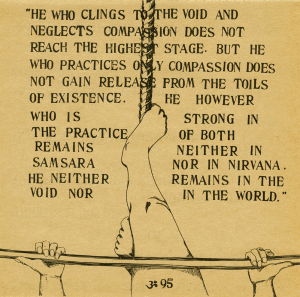
When Zarathustra arrived at the nearest town which adjoineth the forest, he found many people assembled in the market-place; for it had been announced that a rope-dancer would give a performance. And Zarathustra spake thus unto the people: I TEACH YOU THE SUPERMAN. Man is something that is to be surpassed. What have ye done to surpass man? All beings hitherto have created something beyond themselves: and ye want to be the ebb of that great tide, and would rather go back to the beast than surpass man? Where is the lightning to lick you with its tongue? Where is the frenzy with which ye should be inoculated? ...
When Zarathustra had thus spoken, one of the people called out: "We have now heard enough of the rope-dancer; it is time now for us to see him!" And all the people laughed at Zarathustra. But the rope-dancer, who thought the words applied to him, began his performance. Zarathustra, however, looked at the people and wondered. Then he spake thus: Man is a rope stretched between the animal and the Superman -- a rope over an abyss. A dangerous crossing, a dangerous wayfaring, a dangerous looking-back, a dangerous trembling and halting. What is great in man is that he is a bridge and not a goal: what is lovable in man is that he is an OVER-GOING and a DOWN-GOING. I love him who scattereth golden words in advance of his deeds, and always doeth more than he promiseth: for he seeketh his own down-going.
Then, however, something happened which made every mouth mute and every eye fixed. In the meantime, of course, the rope-dancer had commenced his performance: he had come out at a little door, and was going along the rope which was stretched between two towers, so that it hung above the market-place and the people. When he was just midway across, the little door opened once more, and a gaudily-dressed fellow like a buffoon sprang out, and went rapidly after the first one. "Go on, halt-foot," cried his frightful voice, "go on, lazy-bones, interloper, sallow-face! -- lest I tickle thee with my heel! What dost thou here between the towers? In the tower is the place for thee, thou shouldst be locked up; to one better than thyself thou blockest the way!" -- And with every word he came nearer and nearer the first one. When, however, he was but a step behind, there happened the frightful thing which made every mouth mute and every eye fixed -- he uttered a yell like a devil, and jumped over the other who was in his way. The latter, however, when he thus saw his rival triumph, lost at the same time his head and his footing on the rope; he threw his pole away, and shot downwards faster than it, like an eddy of arms and legs, into the depth.
-- Thus Spake Zarathustra, by Friedrich Nietzsche
***
The boundary of the great circle of “Pass not”, called also the Dhyanipasa, the “rope of the Angels,” the “rope” that hedges off the phenomenal from the noumenal Kosmos,
-- The Secret Doctrine -- The Synthesis of Science, Religion, and Philosophy, by Helena Petrovna Blavatsky
***
The Distribution of Flexibility: Again following Ashby, the distribution of flexibility among the many variables of a system is a matter of very great importance. The healthy system, dreamed of above, may be compared to an acrobat on a high wire. To maintain the ongoing truth of his basic premise (“I am on the wire”), he must be free to move from one position of instability to another, i.e., certain variables such as the position of his arms and the rate of movement of his arms must have great flexibility, which he uses to maintain the stability of other more fundamental and general characteristics. If his arms are fixed or paralyzed (isolated from communication), he must fall.
-- Steps to An Ecology of Mind: Collected Essays In Anthropology, Psychiatry, Evolution, and Epistemology, by Gregory Bateson
"HE WHO CLINGS TO THE VOID
AND NEGLECTS COMPASSION DOES NOT
REACH THE HIGHEST STAGE. BUT HE
WHO PRACTICES ONLY COMPASSION DOES
NOT GAIN RELEASE FROM THE TOILS
OF EXISTENCE. HE HOWEVER
WHO IS STRONG IN
THE PRACTICE OF BOTH
REMAINS NEITHER IN
SAMSARA NOR IN NIRVANA.
HE NEITHER REMAINS IN THE
VOID NOR IN THE WORLD."
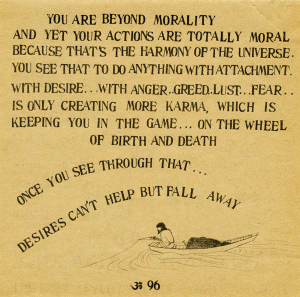
THE FINAL PLACE THAT THE GAME LEADS TO IS:
WHERE YOU LIVE CONSCIOUSLY
IN ALL OF IT
WHICH IS IN NOTHING
YOU ARE ETERNAL
YOU HAVE FINISHED PERISHING
THERE IS NO FEAR OF DEATH BECAUSE
THERE IS NO DEATH
IT'S JUST A TRANSFORMATION
AN ILLUSION
AND YET, SEEING ALL THAT, YOU STILL
CHOP WOOD AND CARRY WATER.
YOU STILL DO YOUR THING.
YOU FLOW IN HARMONY WITH THE UNIVERSE.
YOU ARE BEYOND MORALITY
AND YET YOUR ACTIONS ARE TOTALLY MORAL
BECAUSE THAT'S THE HARMONY OF THE UNIVERSE.
YOU SEE THAT TO DO ANYTHING WITH ATTACHMENT
WITH DESIRE ... WITH ANGER ... GREED ... LUST ... FEAR ...
IS ONLY CREATING MORE KARMA, WHICH IS
KEEPING YOU IN THE GAME ... ON THE WHEEL
OF BIRTH AND DEATH
ONCE YOU SEE THROUGH THAT ...
DESIRES CAN'T HELP BUT FALL AWAY
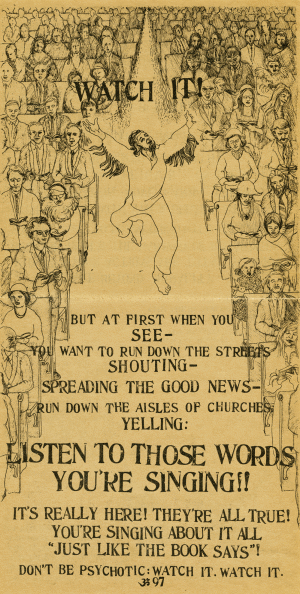
WATCH IT!
BUT AT FIRST WHEN YOU
SEE --
YOU WANT TO RUN DOWN THE STREETS
SHOUTING --
SPREADING THE GOOD NEWS --
RUN DOWN THE AISLES OF CHURCHES
YELLING:
LISTEN TO THOSE WORDS
YOU'RE SINGING!!
IT'S REALLY HERE! THEY'RE ALL TRUE!
YOU'RE SINGING ABOUT IT ALL
"JUST LIKE THE BOOK SAYS"!
DON'T BE PSYCHOTIC: WATCH IT. WATCH IT.
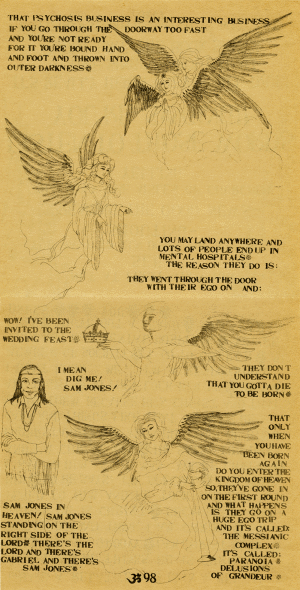
THAT PSYCHOSIS BUSINESS IS AN INTERESTING BUSINESS
IF YOU GO THROUGH THE DOORWAY TOO FAST
AND YOU'RE NOT READY
FOR IT YOU'RE BOUND HAND
AND FOOT AND THROWN INTO
OUTER DARKNESS
The actual condition of Man is not his primitive condition, that in which he was the image of the Word. His unruly passions have caused him to fall from his original lofty estate. But he may rise again, by following the teachings of Heavenly Wisdom, and the Angels whom God commissions to aid him in escaping from the entanglements of the body; and by fighting bravely against Evil, the existence of which God has allowed solely to furnish him with the means of exercising his free will.
-- Morals and Dogma of the Ancient and Accepted Scottish Rite of Freemasonry, by Albert Pike
YOU MAY LAND ANYWHERE AND
LOTS OF PEOPLE END UP IN
MENTAL HOSPITALS
THE REASON THEY DO IS:
THEY WENT THROUGH THE DOOR
WITH THEIR EGO ON AND:
WOW! I'VE BEEN
INVITED TO THE
WEDDING FEAST
The trumpets began again to sound, which so affrighted me that I awoke, and perceived that it was onely a dream, which yet was so impressed on my imagination that I was perpetually troubled about it, and methought I was still sensible of the wounds on my feet. By all these things I well understood that God had vouchsafed me to be present at this mysterious and hidden Wedding, wherefore with childlike confidence I returned thanks to His Divine Majesty, and besought Him that He would preserve me in His fear, daily fill my heart with wisdom and understanding, and graciously conduct me to the desired end. Thereupon I prepared myself for the way, put on my white linnen coat, girded my loyns, with a blood-red ribbon bound cross-ways over my shoulder. In my hat I stuck four red roses, that I might the sooner by this token be taken notice of amongst the throng.
-- The Chymical Marriage of Christian Rosencreutz
***
I am Athene!
Fairest daughter of supremest Jove!
I am the soul of man!
That mystic bride that weds him 'pon the highest height of mind,
When all he gives in gladness, that he all might gain,
Delights he, life to lose that he might live.
-- The Fire Regained, by Sidney M. Hirsch
***
The "end of the world," i.e., of external bisexual generation, will be when man has again found the woman within himself from whom he has become separated by his descending from his spiritual state and becoming gross and material. "The Lord is not without the woman;" that means to say that the paradisaical Man (the Karana sharira) is still male and female in one; but man, having ceased to be "the Lord," and become a servant to the animal kingdom in him, has ceased to recognise the true woman in him, his heavenly bride, and seeks for the woman in that which is external to him. Therefore man cannot enter into his original state of unity and purity except by means of the celestial marriage (within his soul) such as takes place during the process of spiritual regeneration.
-- The Life of Philippus Theophrastus Bombast of Hohenheim Known by the Name of Paracelsus and the Substance of his Teachings, by Franz Hartmann, M.D.
I MEAN
DIG ME!
SAM JONES!
THEY DON'T
UNDERSTAND
THAT YOU GOTTA DIE
TO BE BORN
THAT
ONLY
WHEN
YOU HAVE
BEEN BORN
AGAIN
DO YOU ENTER THE
KINGDOM OF HEAVEN
SO, THEY'VE GONE IN
ON THE FIRST ROUND
AND WHAT HAPPENS
IS THEY GO ON A
HUGE EGO TRIP
AND IT'S CALLED:
THE MESSIANIC
COMPLEX
IT'S CALLED:
PARANOIA
DELUSIONS
OF GRANDEUR
SAM JONES IN
HEAVEN! SAM JONES
STANDING ON THE
RIGHT SIDE OF THE
LORD THERE'S THE
LORD AND THERE'S
GABRIEL AND THERE'S
SAM JONES
I HAVE A RELATIVE WHO IS IN A MENTAL
HOSPITAL HE THINKS HE IS CHRIST
WELL, THAT'S GROOVY I AM CHRIST ALSO
BUT HE DOESN'T THINK I AM CHRIST HE
THINKS HE IS CHRIST BECAUSE IT HAP-
PENED TO HIM AND HE TOOK HIS EGO WITH
HIM SO HE SAYS: I'M SPECIAL AND WHEN
I SAY TO HIM: SURE MAN YOU'RE CHRIST
AND I'M CHRIST TOO HE SAYS: YOU DON'T
UNDERSTAND AND WHEN HE'S OUT HE STEALS
CARS AND THINGS LIKE THAT BECAUSE HE
NEEDS THEM BECAUSE HE'S CHRIST AND THAT'S
ALL RIGHT SO THEY LOCK HIM UP HE SAYS:
I DON'T KNOW ... ME ... I'M A RESPONSIBLE
MEMBER OF SOCIETY I GO TO CHURCH ME
THEY PUT IN A MENTAL HOSPITAL YOU'RE
FREE YOU'VE GOT A BEARD YOU WEAR A
DRESS YOU

SURE BECAUSE AS FAR AS I'M CONCERNED
WE ARE ALL GOD THAT'S THE DIFFERENCE
IF YOU REALLY THINK ANOTHER GUY IS GOD
HE DOESN'T LOCK YOU UP
FUNNY ABOUT THAT
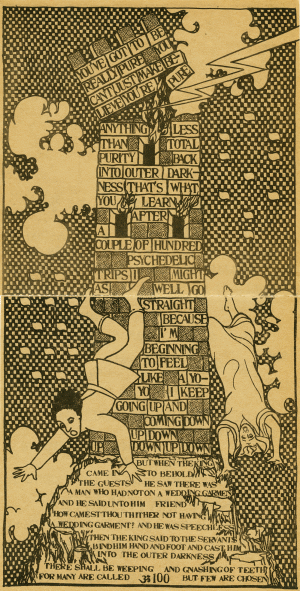
The Pythagorean Y
The Pythagoric Letter two ways spread,
Shows the two paths in which Man's life is led.
The right hand track to sacred Virtue tends,
Though steep and rough at first, in rest it ends;
The other broad and smooth, but from its Crown
On rocks the Traveller is tumbled down.
He who to Virtue by harsh toils aspires,
Subduing pains, worth and renown acquires:
But who seeks slothful luxury, and flies,
The labor of great acts, dishonor'd dies.
-Maximinus
-- The Pythagorean Sourcebook and Library, Translated by Kenneth Sylvan Guthrie
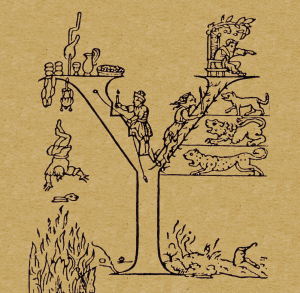
YOU'VE GOT TO BE
REALLY PURE YOU
CAN'T JUST MAKE BE-
LIEVE YOU'RE PURE
“Light,” “Flame,” “Hot,” “Cold,” “Fire,” “Heat,” “Water,” and the “water of life” are all, on our plane, the progeny; or as a modern physicist would say, the correlations of electricity. Mighty word, and a still mightier symbol! Sacred generator of a no less sacred progeny; of fire — the creator, the preserver and the destroyer; of light — the essence of our divine ancestors; of flame — the Soul of things. Electricity, the one Life at the upper rung of Being, and Astral Fluid, the Athanor of the Alchemists, at its lowest; god and devil, good and evil. . . .
-- The Secret Doctrine -- The Synthesis of Science, Religion, and Philosophy, by Helena Petrovna Blavatsky
***
The gods were not only living electrical receiving stations, they were also electrical power, and broadcasting stations. Electrical fish still exist, which is well-known. Strange deep-sea fish even have electric organs of illumination. Dinosaurs, which are especially to be taken into account here, are conspicuous for their apparently quite useless armor plates and spines. Obviously they served as electrical induction antennae and surfaces -- another purpose cannot be found and nature creates nothing without a purpose. The wings of the issuri could also easily have served to generate electrical power in a way very similar to a Wimhurst induction-machine. It is notable that dinosaurs had a large swelling in the spinal cord in the haunch area -- and this has to be accounted for in some way. -- Very serious investigators have recently proven the existence of a kind of radiation that is emitted from human beings (N-rays). Even magnetic forces are supposed to be active. Job V.7 expressly speaks of "lightning-men." The Devil descends like a bolt of lightning. The cherubim defend the Tree of life with blazing bolts of lightning. (Gen. III.24) The gods slumber in bestialized human bodies, but the day is coming when they will rise up again. We were electric, we will be electric, to be electric and to be divine is the same thing! By means of the electric eye primitive man was omniscient, through inner electrical power they were omnipotent.
-- Theozoology, or the Science of the Sodomite Apelings and the Divine Electron, by Dr. Jorg Lanz von Liebenfels
ANYTHING LESS
THAN TOTAL
PURITY BACK
INTO OUTER DARK-
NESS THAT'S WHAT
YOU LEARN
AFTER
A
COUPLE OF HUNDRED
PSYCHEDELIC
TRIPS I MIGHT
AS WELL GO
STRAIGHT
BECAUSE
I'M
BEGINNING
TO FEEL
LIKE A YO-
YO I KEEP
GOING UP AND
COMING DOWN
UP DOWN
DOWN UP DOWN
BUT WHEN THE KING
CAME IN TO BEHOLD
THE GUESTS HE SAW THERE WAS
A MAN WHO HAD NOT ON A WEDDING GARMENT
AND HE SAID UNTO HIM FRIEND
HOW CAMEST THOU THITHER NOT HAVING
A WEDDING GARMENT? AND HE WAS SPEECHLESS
THEN THE KING SAID TO THE SERVANTS
BIND HIM HAND AND FOOT AND CAST HIM
INTO THE OUTER DARKNESS
THERE SHALL BE WEEPING AND GNASHING OF TEETH
FOR MANY ARE CALLED BUT FEW ARE CHOSEN
The virgin who first brought me the invitation, and whom I had hitherto never since seen, stepped in, and giving one blast upon her trumpet declared the sentence with a very loud voice: --
"The King's Majesty, my most gratious Lord, could from his heart wish that all here assembled had, upon his Majestie's invitation, presented themselves so qualified that they might have adorned his nuptial and joyous Feast. But since it hath otherwise pleased Almighty God, he hath not wherewith to murmur, but is forced, contrary to his inclination, to abide by the antient and laudable constitutions of this Kingdom, albeit, that his Majesty's clemency may be celebrated, the usual sentence shall be considerably lenified. He vouchsafes to the Lords and Potentates not only their lives intirely, but also freely dismisses them, courteously intreating your Lordships not to take it in evil part that you cannot be present at his Feast of Honour. Neither is your reputation hereby prejudiced, although you be rejected by this our Order, since we cannot at once do all things, and forasmuch as your Lordships have been seduced by base rascals, it shall not pass unrevenged. Furthermore, his Majesty resolveth shortly to communicate with you a Catalogue of Hereticks, or Index Expurgatorius, that you may with better judgment discern between good and evil. And because his Majesty also purposeth to rummage his library, and offer the seductive writings to Vulcan, he courteously entreats every one of you to put the same in execution with your own, whereby it is to be hoped that all evil and mischief may be remedied. And you are admonished never henceforth so inconsiderately to covet entrance hither, least the former excuse of seducers be taken from you. In fine, as the estates of the Land have still somewhat to demand of your Lordships, his Majesty hopes that no man will think it much to redeem himself with a chain, or what else he hath about him, and so, in friendly manner, depart from us.
"The others who stood not at the first, third, and fourth weight, his Majesty will not so lightly dismiss, but that they also may experience his gentleness, it is his command to strip them naked, and so send them forth. Those who in the second and fifth weight were found too light shall, besides stripping, be noted with one or more brands, according as each was lighter or heavier. They who were drawn up by the sixth or seventh shall be somewhat more gratiously dealt with, and so forward, for unto every combination there is a certain punishment ordained. They who yesterday separated themselves of their own accord shall go at liberty without blame. Finally, the convicted vagabond-cheats, who could move up none of the weights, shall be punished, in body and life, with sword, halter, water, and rods, and such execution of judgment shall be inviolably observed for an example unto others."
-- The Chymical Marriage of Christian Rosencreutz
Statistics: Posted by admin — Fri Sep 25, 2015 9:07 am
]]>
THERE ARE OTHERS WHO LEAVE A THIN,
VERY, VERY THIN THREAD OF EGO.
THERE'S ONE BEING WHO FOR TWENTY
YEARS WAS LOCKED UP IN A CAVE:
AND EVERY YEAR HIS DEVOTEES OPENED
THE CAVE. ONCE A YEAR THEY'D GO IN
TO HAVE HIS DARSHAN. THERE WAS
NO FOOD. NOTHING. AND HE LOOKED
LIKE A CORPSE EXCEPT THAT HIS HAIR
KEPT GROWING AND HIS NAILS KEPT GROW-
ING ... FOR TWENTY YEARS ...
HE WAS NOT HANGING OUT WITH MUCH
HE WAS JUST LEAVING A SUBTLE
THREAD TO KEEP
IN CONTACT.
The Rosicrucian theory, that the whole universe is a musical instrument, is the Pythagorean doctrine of the music of the spheres.
-- The Secret Doctrine -- The Synthesis of Science, Religion, and Philosophy, by Helena Petrovna Blavatsky
***
That the harmony of the spheres is sounding here is shown by the presence of musicians and the instruments which they play (a trumpet and a drum, the two instruments which are often used to depict that a communication of a spiritual nature is taking place).
-- The Pictorial Language of Hieronymus Bosch, by Clement A. Wertheim Aymes
If spiritualists are anxious to keep strictly dogmatic in their notions of the "spirit-world," they must not set scientists to investigate their phenomena in the true experimental spirit. The attempt would most surely result in a partial re-discovery of the magic of old — that of Moses and Paracelsus. Under the deceptive beauty of some of their apparitions, they might find some day the sylphs and fair Undines of the Rosicrucians playing in the currents of psychic and odic force.
-- Isis Unveiled, by Helena P. Blavatsky
***
And she began: "Thou shouldst know,my beloved, that there exist in the elementsbeings not very unlike you men, and whoyet seldom let themselves be seen by you.The wondrous salamanders glisten and sport in the flames; the rough, malicious gnomesdwell deep in the earth; the woods arehaunted by spirits which are of the air; whilethe far-spread race of water-spirits live inlakes, and streams, and brooks; they dwelltoo in resounding crystal vaults, throughwhich heaven with its sun and stars shinesin; lofty coral plants with blue and red fruitsshine in their gardens; they wander overbright sands, and over gay, many-coloured muscles, and all that the old world possessedof beautiful which the present world is nolonger worthy to enjoy, and which the wavesconceal with their mysterious veil of silver;below still glitter noble ruins high and stately,and gently washed by loving waters whichallure forth from them delicate mosses and wreathing bulrushes. Those who dwell thereare pure and lovely to look upon, fairer thaneven mankind. Many a fisherman has hadthe good fortune to espy a mermaid as sherose up from the waters, and sang: thenwould he tell to many of her beauty; andsuch wondrous women have been called bymen Undines. Thou seest before thee anUndine, dearest."
-- Undine: A Romance, by Friedrich de la Motte Fouque
***
The Creator being both male and female, the emanations of his creative spirit, operating upon universal matter, produced subordinate ministers of both sexes, and gave, as companions to the fauns and satyrs, the nymphs of the waters, the mountains and the woods, signifying the passive productive powers of each, subdivided and diffused.
-- A Discourse on the Worship of Priapus: And Its Connection with the Mystic Theology of the Ancients, by Richard Payne Knight
The hour has now struck to ascertain whether the walls of the modern Jericho are so impregnable that no blast of the Occult trumpet is ever likely to make them crumble.
-- The Secret Doctrine -- The Synthesis of Science, Religion, and Philosophy, by Helena Petrovna Blavatsky
***
THERE COMES A TIME, SAYS HAZRAT INAYAT KHAN, WHEN THE GODLY SOUL CRIES, ANA'L-HAQQ, I AM THE TRUTH. WHEN YOU MAKE THE ULTIMATE AFFIRMATION, YOU ARE A KNIGHT, OR THE TRUMPET THROUGH WHICH GOD MAKES HIS PROCLAMATION
-- Toward the One, by Pir Vilayat Inayat Khan
***
Assemble the priests! Gather together the peoples!
Sound upon the ram's horn! Let blare the red-voiced trumpets ...
Wind upon the cornet!
For the Oracle hath spoken!
-- The Fire Regained, by Sidney M. Hirsch
***
A shrill trumpet-call had pierced the air. It was the bulletin! Victory! It always meant victory when a trumpet-call preceded the news.
-- Nineteen Eighty-Four (1984), by George Orwell
The horn signal of spirituality.
-- The Pictorial Language of Hieronymus Bosch, by Clement A. Wertheim Aymes
***
Observe that Israel gained freedom from the side of the "Jubilee"; since it shall be thus once again in the future time, as it is written, "And it shall come to pass in that day that the great trumpet shall be blown" (Isa. XXVII, 13).
-- The Zohar, translated by Harry Sperling and Maurice Simon
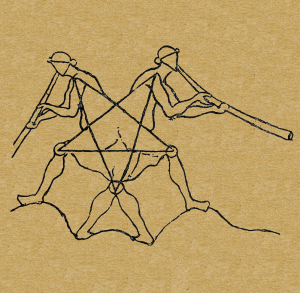
THOSE OF LITTLE FAITH
NEED LONG FINGERNAILS AND LONG HAIR
TO BELIEVE ITS HAPPENING
"LEST YE SEE MIRACLES
YE WILL NOT BELIEVE"
SAID OUR BUDDY
TALL
SAUL
AND THE
ASTRALS
EVERYTHING HE SAID WAS STRAIGHT YOU
UNDERSTAND? ALL THAT STUFF IN THE BIBLE IS
REALLY STRAIGHT. LOOK WHAT HAPPENED TO
SAUL OF TARSUS (FOR GOD'S SAKE) THERE HE WAS
RIDING ALONG IN THE DESERT ON HIS HORSE OR
CAMEL OR SOMETHING AND A VOICE SAID TO HIM
WHY ARE YOU PERSECUTING ME?
(HE WAS OUT IN THE HOT SUN AND YOU KNOW ...) HE FLIPPED OUT
HE WENT FLYING OFF HIS HORSE AND FELL
ON THE GROUND WHAT DO YOU WANT OF ME?"

That the Fall of man into generation occurred during the earliest portion of what science calls the Mesozoic times, or the age of the reptiles, is evidenced by the Bible phraseology concerning the serpent, the nature of which is explained in the Zohar. The question is not whether Eve’s incident with the tempting reptile is allegorical or textual, for no one can doubt that it is the former, but to show the antiquity of the symbolism on the very face of it, and that it was not only a Jewish but an universal idea. Now we find in the Zohar a very strange assertion, one that is calculated to provoke the reader to merry laughter by its ludicrous absurdity. It tells us that the serpent, which was used by Shamael (the supposed Satan), to seduce Eve, was a kind of flying camel. A “flying camel” is indeed too much for the most liberal-minded F.R.S. Nevertheless, the Zohar, which can hardly be expected to use the language of a Cuvier, was right in its description: for we find it called in the old Zoroastrian MSS. Aschmogh, which in the Avesta is represented as having lost after the Fall “its nature and its name,” and is described as a huge serpent with a camel’s neck.
-- The Secret Doctrine -- The Synthesis of Science, Religion, and Philosophy, by Helena Petrovna Blavatsky
START MY CHURCH!
"GO TO THE NEXT TOWN AND YOU'LL BE
INSTRUCTED" THAT'S WHAT HE HEARD AND HE
WENT THE WHOLE TRIP AND THAT'S AN ASTRAL
TRIP. A VERY GROOVY ASTRAL TRIP.
AND THAT'S WHAT THE BIBLE IS:
AN ASTRAL STORY
A VERY GROOVY ASTRAL STORY
... AT ONE LEVEL
I CAN FEEL
THE HORROR IN SOMEBODY
HE'S SAYING ...
HE'S SAYING ...
IT'S A GOOD ASTRAL STORY
BUT ILLUSIONS ARE ILLUSIONS
IT'S
HERE
IN THE SOUND OF THE TAMBOURA
IN SOUND ...
IN THE BEGINNING WAS
THE
WORD
Until now much too much mythology and much too little religious study, much too much grammar and much too little linguistic study has been undertaken to be able to recognize that the impenetrable crystal bowl around which some people uselessly circle without ever being able to open it up, will practically open itself for anyone who understands how to use as a magical key the well-known, and yet so little understood, sentence: "In the beginning was the word.''
But the apparently mystical aspects of this statement immediately disappear, and we are transported into a full state of clarity, when it is realized that, without exception, all mythological names and other kinds of mythological terms were in no way mere empty words, but rather they signified quite specific concepts, and in these very meaningful terms the key to the knowledge and understanding of the religion of our ancient ancestors is offered. Additionally, remnants of customs, sayings, tales, etc., have maintained their meaning and value only through such recognition of the force of language contained in the mythical names and terms, so that linguistic and mythic research, in a complementary way, yield a sense of the sacrality of the word in a complete vindication of the phrase: "In the beginning was the word."
-- The Religion of the Aryo-Germanic Folk: Esoteric and Exoteric, by Guido von List
***
Plato and John said, "God is Light," and if we go to one of the great observatories, and with the best telescope made, look into space, we see that there is no boundary to light. It is everywhere, and with the symbol of light there expressed there comes the idea of omnipresence and magnitude of the God we worship. John, in the first five verses of his Gospel, says: "In the beginning was the Word," and therein we have a marvelous solution of the problem, for when we go back to the beginning, we are in the realm of Truth.
At the present time we have sunk into matter, and are incapable of coming into contact with that truth directly, but when we go back in thought to the beginning of things, then we are in thought with God and more capable of recognizing the Truth. Plato spoke of a time when "there was darkness." The Old Testament tells about darkness, that state of primordial matter, or "Arche," given form by God, the Grand Architect, the primordial Builder of the universe.
When we think of the One who built things in the beginning, we come into contact with Him, with God, in that "arche" in the first sentence of the five verses we take for meditation. In the next few words we come to the second proposition: the Word. The term "Word" is mistranslated in our present Bible, for it is not only "Word," but it is also the thought, the Greek word "Logos" used in that verse meaning both the word and the logical thought back of it. Before there can be a word, there must be a logical thought back of it. Before the word could come into existence, there had to be a thinker; therefore John used the words "in arche" and "Logos." They express what we wish to understand, that in the beginning there was a homogeneous mass of matter, and in that homogeneous matter was God; and God became the "Word," the rhythmic sound that goes out in the universe, and that shapes all things.
-- The Rosicrucian Cosmo-Conception, by Max Heindel
***
When our Soul creates or evokes a thought, the representative sign of that thought is self-engraved upon the astral fluid, which is the receptacle and, so to say, the mirror of all the manifestations of being. The sign expresses the thing: the thing is the virtue of the sign. To pronounce a word is to evoke a thought, and make it present: the magnetic potency of the human speech is the commencement of every manifestation in the Occult World. To utter a Name is not only to define a Being, but to place it under and condemn it through the emission of the Word, to the influence of one or more Occult potencies. Things are, for every one of us, that which it makes them while naming them. The Word or the speech of every man is, quite unconsciously to himself, a blessing or a curse; this is why our present ignorance about the properties or attributes of the idea as well as about the attributes and properties of matter, is often fatal to us.
-- The Secret Doctrine -- The Synthesis of Science, Religion, and Philosophy, by Helena Petrovna Blavatsky
***
The Phœnician Cosmogony, like all others in Asia, was the Word of God, written in astral characters. ... "When God resolved to create the human race," said Arius, "He made a Being that He called The WORD, to the end that this Being might give existence to men." ... "In the beginning," says the extract from some older work, with which John commences his Gospel, "was the Word, and the Word was near to God, and the Word was God ... To Philo the Jew, the Supreme Being was the Primitive Light, whence the rays emanate that illuminate Souls. His Image is the WORD, a form more brilliant than fire. ...
The Degree of Roseis devoted to and symbolizes the final triumph of truth over falsehood, of liberty over slavery, of light over darkness, of life over death, and of good over evil. The great truth it inculcates is, that notwithstanding the existence of Evil, God is infinitely wise, just, and good: that though the affairs of the world proceed by no rule of right and wrong known to us in the narrowness of our views, yet all is right, for it is the work of God; and all evils, all miseries, all misfortunes, are but as drops in the vast current that is sweeping onward, guided by Him, to a great and magnificent result: that, at the appointed time, He will redeem and regenerate the world, and the Principle, the Power, and the existence of Evil will then cease; that this will be brought about by such means and instruments as He chooses to employ; whether by the merits of a Redeemer that has already appeared, or a Messiah that is yet waited for, by an incarnation of Himself, or by an inspired prophet, it does not belong to us as Masons to decide. Let each judge and believe for himself.
In the meantime, we labor to hasten the coming of that day. The morals of antiquity, of the law of Moses and of Christianity, are ours. We recognize every teacher of Morality, every Reformer, as a brother in this great work. The Eagle is to us the symbol of Liberty, the Compasses of Equality, the Pelican of Humanity, and our order of Fraternity. Laboring for these, with Faith, Hope, and Charity as our armor, we will wait with patience for the final triumph of Good and the complete manifestation of the Word of God.
-- Morals and Dogma of the Ancient and Accepted Scottish Rite of Freemasonry, by Albert Pike
***
All that hast unlearned been by thee
Hath left a void, wherein shall rush
In thy delight, purest word,
A Name that doth the all contain! ...
Thy word ... and will of mine was banished, and my will ... thy word
Be it of holocaust or hecatombs.
Or monstrous miracles with blood of goats and blood of bulls;
-- The Fire Regained, by Sidney M. Hirsch
READY
IT'S A COMBINATION OF THINGS THAT MAKE
YOU READY TO SEE THE GURU. THERE ARE
MANY PEOPLE WHO COME TO SEE MAHARAJ-JI
AND THEY JUST SEE A LITTLE OLD MAN WITH
A BLANKET.
CAN YOU IMAGINE THE HORROR?
THIS HAPPENED TO TWO PEOPLE WHO HEARD
ME & FIGURED OUT WHERE THE GURU MUST
BE THROUGH LOGICAL DEDUCTION & WENT
TO INDIA & WENT RUSHING TO HIS FEET &
FOUND A LITTLE OLD MAN IN A BLANKET
WHO THREW THEM OUT
IMAGINE WHAT THAT MUST FEEL LIKE!
BECAUSE YOU CAN SEE THE DIFFERENCE IN THEIR
MINDS & WHAT IT WAS THEY HAD A MODEL OF --
THE MODEL WAS WHAT THEY SEARCHED FOR
IT WAS THEIR OWN THOUGHT PRO-
CESS WHICH KEPT THEM FROM SEEING
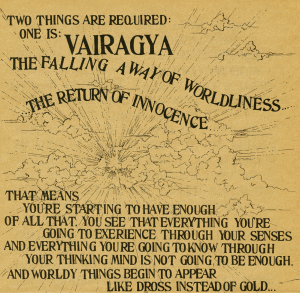
TWO THINGS ARE REQUIRED:
ONE IS: VAIRAGYA
THE FALLING AWAY OF WORLDLINESS
THE RETURN OF INNOCENCE
THAT MEANS
YOU'RE STARTING TO HAVE ENOUGH
OF ALL THAT. YOU SEE THAT EVERYTHING YOU'RE
GOING TO EXPERIENCE THROUGH YOUR SENSES
AND EVERYTHING YOU'RE GOING TO KNOW THROUGH
YOUR THINKING MIND IS NOT GOING TO BE ENOUGH.
AND WORLDLY THINGS BEGIN TO APPEAR
LIKE DROSS INSTEAD OF GOLD ...
If one takes a book on alchemy, and sees in it the speculations on gold and light by the brothers of the Rosie Cross, he will find himself certainly startled, for the simple reason that he will not understand them at all. "The Hermetic gold," he may read, "is the outflow of the sunbeam, or of light suffused invisibly and magically into the body of the world. Light is sublimated gold, rescued magically by invisible stellar attraction, out of material depths. Gold is thus the deposit of light, which of itself generates. Light in the celestial world is subtile, vaporous, magically exalted gold, or 'spirit of flame.' Gold draws inferior natures in the metals, and intensifying and multiplying, converts into itself."
-- Isis Unveiled, by Helena P. Blavatsky
JUST
NOT TOTALLY
IT BEGINS TO HAPPEN. IT'S FALLING AWAY
MY TEACHER SAID:
THE VEIL FALLS AWAY LIKE THE
SKIN OF A SNAKE
THE EGO THINS LIKE CLOUDS
UNTIL ONLY A TRANSPARENT LAYER REMAINS
THE OTHER THING THAT'S REQUIRED IS THE
PURE SEEKING
THE PURITY OF THE FAITH
THERE IS AS MUCH FAITH IN YOU
HERE IN US AT THIS MOMENT
AS ANYWHERE IN INDIA
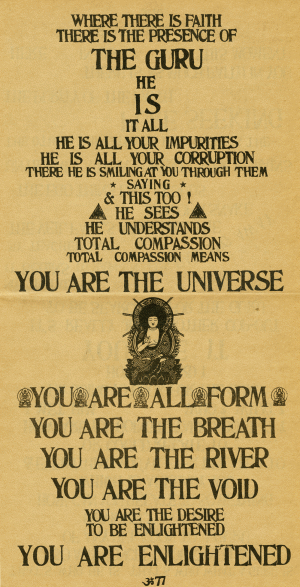
WHERE THERE IS FAITH
THERE IS THE PRESENCE OF
THE GURU
HE
IS
IT ALL
HE IS ALL YOUR IMPURITIES
HE IS ALL YOUR CORRUPTION
THERE HE IS SMILING AT YOU THROUGH THEM
* SAYING *
& THIS TOO!
HE SEES
HE UNDERSTANDS
TOTAL COMPASSION
TOTAL COMPASSION MEANS
YOU ARE THE UNIVERSE
YOU ARE ALL FORM
YOU ARE THE BREATH
YOU ARE THE RIVER
YOU ARE THE VOID
YOU ARE THE DESIRE
TO BE ENLIGHTENED
YOU ARE ENLIGHTENED
THAT'S WHO HE IS. THAT'S WHO, WHAT, A GURU IS.
SO ANY CONCEPT YOU CAN HAVE
OF ANY RELATION TO A GURU
OBVIOUSLY IS A HYPE
HOW CAN YOU RELATE TO SOMETHING
WHICH IS ALREADY YOU
& EVERYTHING YOU'VE EVER RELATED TO
OR COULD RELATE TO ...
HOW ARE YOU GOING TO TALK ABOUT IT?
I MET HIM WHO? WHAT?
I'M GOING TO LOOK FOR THE GURU
HOW ABSURD!
YOU ARE IT
IT'S REALLY JUST ANOTHER COP-OUT
TO BE SEARCHING FOR THE GURU
It is the writer's opinion that neither the heights of Contemplation, nor the final step of Adoration can be attained without the aid of a teacher. The aspirant need never fear, however, that for want of a teacher he will be delayed in taking these steps; nor need he be concerned about looking for a teacher. All that is necessary for him to do is start to improve himself, and to earnestly and persistently continue therein. In that way he will purify his vehicles. They will commence to shine in the inner Worlds, and cannot fail to attract the attention of the teachers, who are always watching for just such cases and are more than eager and glad to help those who, because of their earnest efforts to purify themselves, have won the right to receive help. Humanity is sorely in need of helpers who are able to work from the inner Worlds, therefore "seek and ye shall find," but let us not imagine that by going about from one professed teacher to another, we are seeking. "Seeking," in that sense of the word, will avail nothing in this dark world. We ourselves must kindle the light -- the light which invariably radiates from the vehicles of the earnest aspirant. That is the star which will lead us to the teacher, or rather the teacher to us.
-- The Rosicrucian Cosmo-Conception, by Max Heindel
HE'S YOUR FINGERNAIL
JUST BITE YOUR FINGERNAIL
& YOU'RE EATING HIM ALIVE
There is something like a fire within ourselves which continually consumes our form, and if we were to add nothing to our body to supply the waste caused by that combustion, our form would soon die. We continually eat our own selves; we eat our fingers, our heart, our brain, &c.; but in each morsel of food which we eat, there is contained the material required to replace that which has been consumed by that internal fire.
-- The Life of Philippus Theophrastus Bombast of Hohenheim Known by the Name of Paracelsus and the Substance of his Teachings, by Franz Hartmann, M.D.
WHEN YOU KNOW
HOW TO LISTEN
EVERYBODY
IS
THE GURU
SPEAKING TO YOU
IT'S RIGHT HERE ... ALWAYS
10. Non secretarius publicus, sed Harpocrates existens, Deoque immortali, pro bonis ac donis tantis ac tam paternis, quieto et gaudio et silentio (ne sibi ipsi periculum accersat, aliisque maleficii ansam praebeat, et propterea ira yhvh misere consumatur) gratias immortales agens. [Google translate: Secretary not the public, but existing Harpocrates, Deoque, immortal, for so great and so good and the gifts of his father's, and in silence at rest, and joy (that they had not summon the midst of danger, and other give rise to crime, and therefore is consumed with anger yhvh miserably) thanks to the immortal agent.]
-- Amphitheatrum Sapientiae Aeternae, by Heinrich Khunrath
***
Ptolemaic bronze Harpocrates as the child Horus (Gulbenkian Foundation, Lisbon)
In late Greek mythology as developed in Ptolemaic Alexandria, Harpocrates is the god of silence. Harpocrates was adapted by the Greeks from the Egyptian child god Horus. To the ancient Egyptians, Horus represented the new-born Sun, rising each day at dawn. When the Greeks conquered Egypt under Alexander the Great, they transformed the Egyptian Horus into their Hellenistic god known as Harpocrates, a rendering from Egyptian Har-pa-khered or Heru-pa-khered (meaning "Horus the Child").
-- Harpocrates, by Wikipedia
***
QUENTIN METSYS (also written MASSYS) 1465/6-1530: Allegory of Folly, painted about 1510-1420. New York, Coll. J. Held (Mondeken toe means keep your mouth shut!)
-- The Pictorial Language of Hieronymus Bosch, by Clement A. Wertheim Aymes
***
In the reading, the master of the class, who you are imagining, tells you that he or she has looked into the neophyte's heart while they are meditating and are satisfied with their progress. In other words, you imagine someone present, who is saying that they have inspected your inner consciousness and that you are now ready to proceed. You are then enjoined to silence, placing the index finger of the right hand over the lips....a kind of symbol of the perennial silence a Rosicrucian must keep about his work, first from the outside world and secondly from those who have not reached the appropriate degree in the order.
-- The Prisoner of San Jose: How I Escaped From Rosicrucian Mind Control, by Pierre S. Freeman
***
The lodge ritual often also included the performance of certain ceremonial grips or signs, which were a part of the Masonic heritage of the FS. The Grip of Brotherhood is done by touching the pulse-point of the other person with the tip of the index finger. The master sign is done by laying the right hand over the solar plexus with the thumb spread out from the hand. The sign of the 31° is the upraised index finger laid across the lips vertically, the 32° does the same with the index and middle fingers, and the 33° sign consists of laying the right hand with the thumb spread out across the throat.
-- Fire & Ice: The History, Structure, and Rituals of Germany's Most Influential Modern Magical Order: The Brotherhood of Saturn, by Stephen E. Flowers, Ph.D.
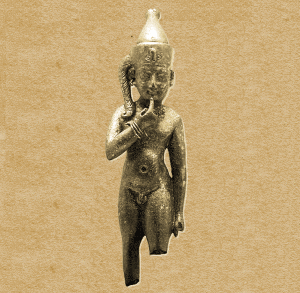
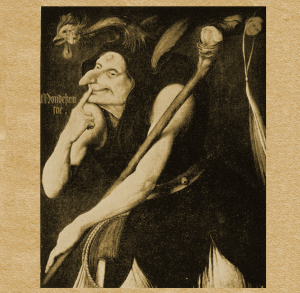
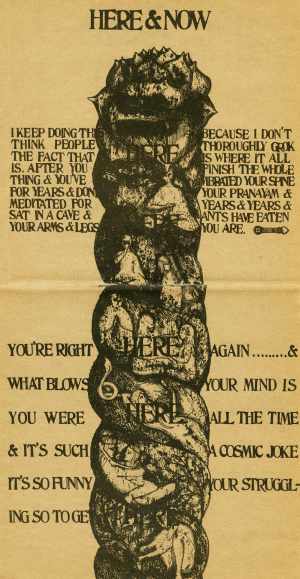
HERE & NOW
I KEEP DOING THIS BECAUSE I DON'T
THINK PEOPLE THOROUGHLY GROK
THE FACT THAT HERE IS WHERE IT ALL
IS. AFTER YOU FINISH THE WHOLE
THING & YOU'VE VIBRATED YOUR SPINE
FOR YEARS AND DONE YOUR PRANAYAM &
MEDITATED FOR YEARS & YEARS &
SAT IN A CAVE & ANTS HAVE EATEN
YOUR ARMS & LEGS YOU ARE.
YOU'RE RIGHT HERE AGAIN ... &
WHAT BLOWS YOUR MIND IS
YOU WERE HERE ALL THE TIME
& IT'S SUCH A COSMIC JOKE
IT'S SO FUNNY YOUR STRUGGL-
ING SO TO GET HERE
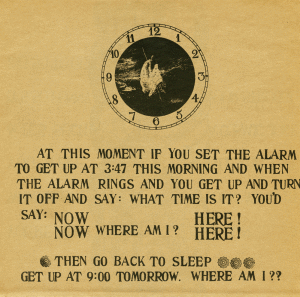
1
2
3
4
5
6
7
8
9
10
11
12
AT THIS MOMENT IF YOU SET THE ALARM
TO GET UP AT 3:47 THIS MORNING AND WHEN
THE ALARM RINGS AND YOU GET UP AND TURN
IT OFF AND SAY: WHAT TIME IS IT? YOU'D
SAY: NOW HERE!
NOW WHERE AM I? HERE!
THEN GO BACK TO SLEEP
GET UP AT 9:00 TOMORROW. WHERE AM I??
HERE! WHAT TIME IS IT? NOW!
TRY 4:32 THREE WEEKS FROM NEXT THURS.
BY GOD
IT IS -- THERE'S NO GETTING AWAY FROM IT --
THAT'S THE WAY IT IS
THAT'S THE
ETERNAL PRESENT
YOU FINALLY FIGURE OUT THAT IT'S
ONLY THE CLOCK THAT'S GOING AROUND ...
IT'S DOING ITS THING BUT YOU -- YOU'RE SITTING
HERE
RIGHT NOW
ALWAYS
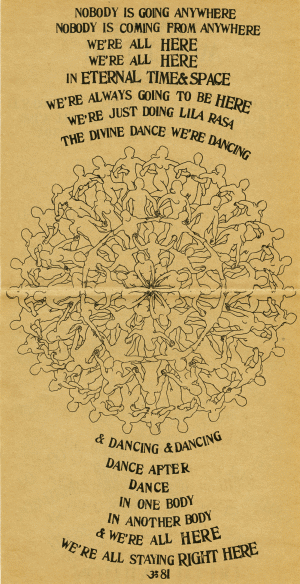
NOBODY IS GOING ANYWHERE
NOBODY IS COMING FROM ANYWHERE
WE'RE ALL HERE
WE'RE ALL HERE
IN ETERNAL TIME & SPACE
WE'RE ALWAYS GOING TO BE HERE
WE'RE JUST DOING LILA RASA
THE DIVINE DANCE WE'RE DANCING
& DANCING & DANCING
DANCE AFTER
DANCE
IN ONE BODY
IN ANOTHER BODY
& WE'RE ALL HERE
WE'RE ALL STAYING RIGHT HERE
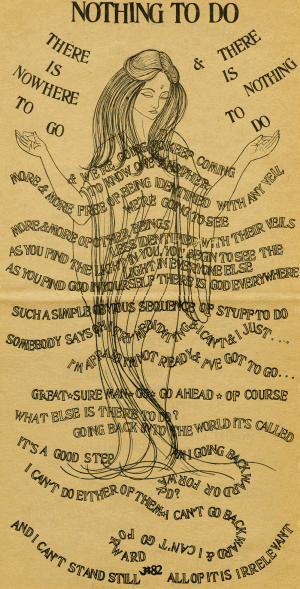
Nothing was happening ... I could see nothing below the kneecaps ... there was nothing in my universe ... and nothing new had happened ... there was nothing to say ... nothing seemed to happen ... he twinkles at me and nothing happens ... there was nothing ... he does nothing ... nothing turns you on ... nothing to do ... nothing's happened to any of it ... I do nothing but sadhana ... there is nothing ... can I say there is absolutely nothing ... the guru taught me nothing ... nothing to do with worldliness ... no food, no nothing ... nothing to do ... nowhere to go ... there is nothing to be ... doing nothing, that's drama ... nothing is really happening at all ... nothing ever happens ... there's nothing you've got to do ... it ain't nothing but stuff ... sine qua non (without which nothing) ... nothing has happened ... I am nothing ... nothing less than death and rebirth ... it profiteth me nothing ... our will has nothing to do with it ... there's no doer to do it anyway ... and then you're in the void ... the final place that game leads to is where you live consciousness, in all of it, which is in nothing ... stay in a place inside yourself where nothing is happening at all ... beyond that there is nothing ... moving toward Zen, reflect nothingness ... in the end this is the nut: it's all or nothing ... he goes into one-with-it-all into the void ... YOU ARE THE VOID ... then you go through the final door and you go from form into the formless into the void, into the beyond the beyond ... push far enough into the void ... and then you're in the void.
-- Be Here Now, by Ram Dass
NOTHING TO DO
THERE
IS
NOWHERE
TO
GO
& THERE
IS
NOTHING
TO DO
& WE'RE GOING TO KEEP COMING
TO KNOW ONE ANOTHER
MORE & MORE FREE OF BEING IDENTIFIED WITH ANY VEIL
WE'RE GOING TO SEE
MORE & MORE OF OTHER BEINGS
LESS IDENTIFIED WITH THEIR VEILS
An impenetrable veil of secrecy was thrown over the occult and religious mysteries taught, after the submersion of the last remnant of the Atlantean race, some 12,000 years ago, lest they should be shared by the unworthy, and so desecrated. Of these sciences several have now become exoteric — such as Astronomy, for instance, in its purely mathematical and physical aspect. Hence their dogmas and tenets, being all symbolised and left to the sole guardianship of parable and allegory, have been forgotten, and their meaning has become perverted. It is this secrecy which led the Fifth Race to the establishment, or rather the re-establishment of the religious mysteries, in which ancient truths might be taught to the coming generations under the veil of allegory and symbolism.
The Secret Doctrine -- The Synthesis of Science, Religion, and Philosophy, by Helena Petrovna Blavatsky
AS YOU FIND THE LIGHT IN YOU, YOU BEGIN TO SEE THE
LIGHT IN EVERYONE ELSE
AS YOU FIND GOD IN YOURSELF THERE IS GOD EVERYWHERE
SUCH A SIMPLE OBVIOUS SEQUENCE OF STUFF TO DO
SOMEBODY SAYS OH I TRY MEDITATING & I CAN'T & I JUST ...
I'M AFRAID I'M NOT READY & I'VE GOT TO GO ...
GREAT * SURE MAN * GO * GO AHEAD * OF COURSE
WHAT ELSE IS THERE TO DO?
GOING BACK INTO THE WORLD IT'S CALLED
IT'S A GOOD STEP
AM I GOING BACKWARD OR FORWARD?
I CAN'T DO EITHER OF THEM * I CAN'T GO BACKWARD & I CAN'T GO FORWARD
AND I CAN'T STAND STILL ALL OF IT IS IRRELEVANT
WE'RE ALL JUST CAUGHT IN THE DELUSION
ALL OF US CAUGHT IN THE
ILLUSION
BEING AWARE OF IT AS ILLUSION
AND YET SO MUCH IN IT!
IF YOU HAVE EVER WATCHED A BEAUTIFUL ZEN MONK,
A VERY OLD MONK WHO IS REALLY THERE.
OR HERE.
REALLY HERE, WHICHEVER ...
YOU WATCH HIM ...
HE'S COOKING FOOD
HE'S LIFTING STONES
HE'S MOVING
YOU WATCH HIM WALK AND IT'S LIKE
NOBODY'S WALKING ...
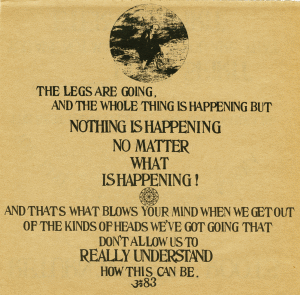
THE LEGS ARE GOING,
AND THE WHOLE THING IS HAPPENING BUT
NOTHING IS HAPPENING
NO MATTER
WHAT
IS HAPPENING!
AND THAT'S WHAT BLOWS YOUR MIND WHEN WE GET OUT
OF THE KINDS OF HEADS WE'VE GOT GOING THAT
DON'T ALLOW US TO
REALLY UNDERSTAND
HOW THIS CAN BE.
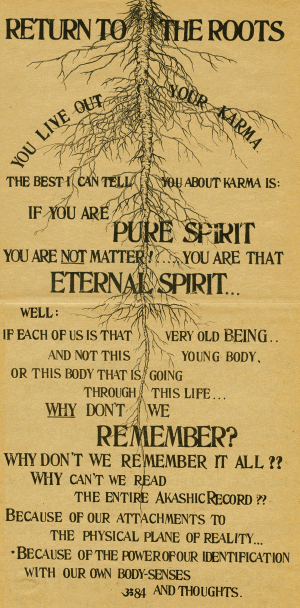
RETURN TO THE ROOTS
Oeaohoo is the “Rootless Root of All”; hence, one with Parabrahmam; in another sense it is a name for the manifested one life, the Eternal living Unity. The “Root” means, as already explained, pure knowledge, eternal unconditioned reality or sat, whether we call it Parabrahmam or Mulaprakriti, for these are the two aspects of the one.
The Secret Doctrine -- The Synthesis of Science, Religion, and Philosophy, by Helena Petrovna Blavatsky
YOU LIVE OUT YOUR KARMA
THE BEST I CAN TELL YOU ABOUT KARMA IS:
IF YOU ARE PURE SPIRIT
YOU ARE NOT MATTER! ... YOU ARE THAT
ETERNAL SPIRIT ...
WELL:
IF EACH OF US IS THAT VERY OLD BEING ...
AND NOT THIS YOUNG BODY,
OR THIS BODY THAT IS GOING
THROUGH THIS LIFE ...
WHY DON'T WE
REMEMBER?
WHY DON'T WE REMEMBER IT ALL??
WHY CAN'T WE READ
THE ENTIRE AKASHIC RECORD??
BECAUSE OF OUR ATTACHMENTS TO
THE PHYSICAL PLANE OF REALITY ...
BECAUSE OF THE POWER OF OUR IDENTIFICATION
WITH OUR OWN BODY-SENSES
AND THOUGHTS.
IF YOU COULD GO INTO A MEDITATION ROOM
CLOSE UP YOUR EARS SIT DOWN CENTER
GO IN IN IN IN
FURTHER IN -- OH MUCH FURTHER IN -- OH YOU'VE JUST BEGUN
KEEP GOING BACK IN
DON'T LINGER TO SMELL THE PRETTY SUNFLOWER
DON'T LINGER TO HOLD ON TO THE ECSTACY OF BLISS
KEEP GOING IN BEHIND THE SENSES BEHIND YOUR THOUGHTS
AND IF YOU CAN GO BACK IN FAR ENOUGH YOU WILL SEE
EVERYTHING YOU'VE IDENTIFIED WITH "HIM"
YOU WILL SEE ... YOUR OWN PERSONALITY YOUR OWN BODY
YOUR OWN LIFE DRAMA ... IT'S VERY AWESOME
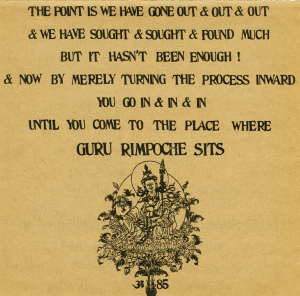
THE POINT IS WE HAVE GONE OUT & OUT & OUT
& WE HAVE SOUGHT & SOUGHT & FOUND MUCH
BUT IT HASN'T BEEN ENOUGH!
& NOW BY MERELY TURNING THE PROCESS INWARD
YOU GO IN & IN & IN
UNTIL YOU COME TO THE PLACE WHERE
GURU RIMPOCHE SITS
AND WHAT IS THIS PLACE?
HINDUS CALL IT THE ATMAN
AND WHAT IS THE ATMAN?
THE BHAGAVADAM, ONE OF THE HOLY BOOKS OF INDIA
SAYS:
THE ATMAN OR DIVINE SELF
IS SEPARATE FROM THE BODY
IT IS ONE
WITHOUT A SECOND
PURE, SELF-LUMINOUS
WITHOUT ATTRIBUTES
FREE
ALL-PERVADING
IT IS THE ETERNAL WITNESS
BLESSED IS HE WHO KNOWS THIS ATMAN
FOR, THOUGH AN EMBODIED BEING
HE SHALL BE FREE
FROM THE CHANGES AND QUALITIES
PERTAINING TO THE BODY
HE ALONE IS EVER UNITED WITH ME
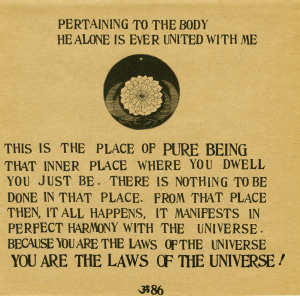
THIS IS THE PLACE OF PURE BEING
THAT INNER PLACE WHERE YOU DWELL
YOU JUST BE. THERE IS NOTHING TO BE
DONE IN THAT PLACE. FROM THAT PLACE
THEN, IT ALL HAPPENS. IT MANIFESTS IN
PERFECT HARMONY WITH THE UNIVERSE.
BECAUSE YOU ARE THE LAWS OF THE UNIVERSE
YOU ARE THE LAWS OF THE UNIVERSE!
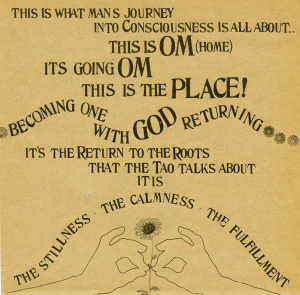
THIS IS WHAT MAN'S JOURNEY
INTO CONSCIOUSNESS IS ALL ABOUT
THIS IS OM (HOME)
IT'S GOING OM
THIS IS THE PLACE!
BECOMING ONE WITH GOD RETURNING
IT'S THE RETURN TO THE ROOTS
THAT THE TAO TALKS ABOUT
IT IS
THE STILLNESS THE CALMNESS THE FULFILLMENT
WHEN YOU MAKE LOVE AND EXPERIENCE
THE ECSTACY OF UNITY
THAT'S THE PLACE!
WHEN YOU EXPERIENCE A GREAT ACHIEVEMENT,
AND YOU FEEL A MOMENT OF EXHILARATION,
THAT'S THE PLACE!
WHEN YOU SEE A MOMENT OF POETRY IN A FLOWER
OR IN WORDS OR IN ART THE WAY IT'S SUPPOSED TO BE ...
THIS IS THE PLACE!
RIGHT HERE!
IT'S BUDDHA CONSCIOUSNESS
IT'S CHRIST CONSCIOUSNESS
JESUS SAYS:
I AND MY FATHER ARE ONE
WHEN BUDDHA SAYS:
YOU GIVE UP ATTACHMENT AND
YOU FINISH WITH THE ILLUSION
THIS IS THE PLACE!
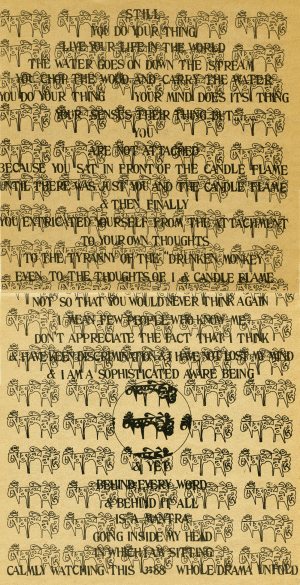
STILL
YOU DO YOUR THING
LIVE YOUR LIFE IN THE WORLD
THE WATER GOES ON DOWN THE STREAM
YOU CHOP THE WOOD AND CARRY THE WATER
YOU DO YOUR THING YOUR MIND DOES ITS THING
YOUR SENSES THEIR THING BUT
YOU
ARE NOT ATTACHED
BECAUSE YOU SAT IN FRONT OF THE CANDLE FLAME
UNTIL THERE WAS JUST YOU AND THE CANDLE FLAME
& THEN FINALLY
YOU EXTRICATED YOURSELF FROM THE ATTACHMENT
TO YOUR OWN THOUGHTS
TO THE TYRANNY OF THE "DRUNKEN MONKEY"
Alchemy of Fire: AMORC notes how religious Christians and others came to misunderstand the symbolism of fire. The true meaning of fire is a secure secret of mystical proportions, held safely by true mystics and, of course, the Rosicrucians. The laws and principles of Rosicrucian masters, since time immemorial, have been linked with fire.
Experiment: The neophyte is asked to extinguish one candle and leave the other burning. He then must sit with his feet flat on the floor, executing four or five neutral or normal breaths. Once he is completely relaxed, he must focus on the lighted candle, taking care not to blink. He must keep this focus until he feels he has become one with the candle.
-- The Prisoner of San Jose: How I Escaped From Rosicrucian Mind Control, by Pierre S. Freeman
***
It is important to collect the reports of the ancients about apes and to examine them in greater detail. In the Bible, the ape (Heb. qop), as such only occurs in I Kings X,22 and in II Chron. IX, 21. The original Hebrew text corresponds word-for-word in both cases. Solomon receives "gold," "silver," "ivory," and apes (Heb. qopim). The Latin Bible translates the word with simiae; in contrast, the Greeks translate only II Chron IX, 21 with pithekoi, as opposed to I Kings X.22 with lithoi = "stones." It is said in the Talmud that "in dreams all animals are equivalent except the ape and the long-tailed monkey. What the Talmud says in connection with this is also noteworthy: "Whoever sees a dwarf ... an ape, or a long-tailed monkey, should say: 'Blessed is he who alters the creatures!'" -- Another Semitic word for "ape" is tamewan. This word stands for a monster in Job III,16 (IV Ezra V.8) and in the Targum (the Aramaic translation of the Bible) in Is.XIII,21 and in Is. XXXIV, 4 it translates the Heb. siim. The Greeks said theria and daimonia, the Romans used bestiae and daemonia. Both Biblical passages give accounts of hordes of apes that roved about ruined places. From this it seems clear that to the ancients a demon was an ape (or similar being).
-- Theozoology, or the Science of the Sodomite Apelings and the Divine Electron, by Dr. Jorg Lanz von Liebenfels
***
If you give up your self, you live it in others; thereby you become selfish to others, and thus you deceive others. Everyone thus believes that such a life is possible. It is, however, only apish imitation. Through giving in to your apish appetite, you infect others, because the ape stimulates the apish. So you turn yourself and others into apes. Through reciprocal imitation you live according to the average expectation. The image of the hero was set up for all in every age through the appetite for imitation. Therefore the hero was murdered, since we have all been aping him. Do you know why you cannot abandon apishness? For fear of loneliness and defeat.
-- The Red Book: Liber Novus, by C.G. Jung
EVEN TO THE THOUGHTS OF I & CANDLE FLAME
NOT SO THAT YOU WOULD NEVER THINK AGAIN
I MEAN FEW PEOPLE WHO KNOW ME
DON'T APPRECIATE THE FACT THAT I THINK
& I HAVE KEEN DISCRIMINATION & I HAVE NOT LOST MY MIND
& I AM A SOPHISTICATED AWARE BEING
& YET
BEHIND EVERY WORD
& BEHIND IT ALL
IS A MANTRA
GOING INSIDE MY HEAD
IN WHICH I AM SITTING
CALMLY WATCHING THIS WHOLE DRAMA UNFOLD
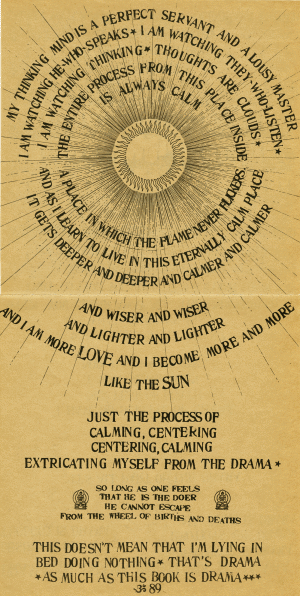
MY THINKING MIND IS A PERFECT SERVANT AND A LOUSY MASTER
I AM WATCHING HE WHO SPEAKS * I AM WATCHING THEY WHO LISTEN *
I AM WATCHING THINKING * THOUGHTS ARE CLOUDS *
THE ENTIRE PROCESS FROM THIS PLACE INSIDE
IS ALWAYS CALM
A PLACE IN WHICH THE FLAME NEVER FLICKERS.
AND AS I LEARN TO LIVE IN THIS EXTERNALLY CALM PLACE
IT GETS DEEPER AND DEEPER AND CALMER AND CALMER
AND WISER AND WISER
AND LIGHTER AND LIGHTER
AND I AM MORE LOVE AND I BECOME MORE AND MORE
LIKE THE SUN
JUST THE PROCESS OF
CALMING, CENTERING
CENTERING, CALMING
EXTRICATING MYSELF FROM THE DRAMA *
SO LONG AS ONE FEELS
THAT HE IS THE DOER
HE CANNOT ESCAPE
FROM THE WHEEL OF BIRTHS AND DEATHS
THIS DOESN'T MEAN THAT I'M LYING IN
BED DOING NOTHING * THAT'S DRAMA
* AS MUCH AS THIS BOOK IS DRAMA ***
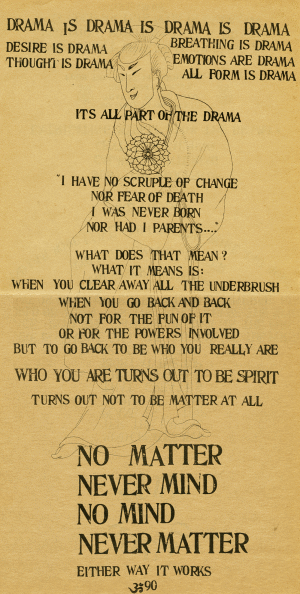
DRAMA IS DRAMA IS DRAMA IS DRAMA
DESIRE IS DRAMA
THOUGHT IS DRAMA
BREATHING IS DRAMA
EMOTIONS ARE DRAMA
ALL FORM IS DRAMA
IT'S ALL PART OF THE DRAMA
"I HAVE NO SCRUPLE OF CHANGE
NOR FEAR OF DEATH
I WAS NEVER BORN
NOR HAD I PARENTS ..."
WHAT DOES THAT MEAN?
WHAT IT MEANS IS:
WHEN YOU CLEAR AWAY ALL THE UNDERBRUSH
WHEN YOU GO BACK AND BACK
NOT FOR THE FUN OF IT
OR FOR THE POWERS INVOLVED
BUT TO GO BACK TO BE WHO YOU REALLY ARE
WHO YOU ARE TURNS OUT TO BE SPIRIT
TURNS OUT NOT TO BE MATTER AT ALL
NO MATTER
NEVER MIND
NO MIND
NEVER MATTER
EITHER WAY IT WORKS
Most important, the central doctrine of nazism, that the Jew was evil and had to be exterminated, had its origin in the Gnostic position that there were two worlds, one good and one evil, one dark and one light, one materialistic and one spiritual.
This sheds light on an otherwise incomprehensible recurring theme within Nazi literature, as, for example, "The Earth-Centered Jew Lacks a Soul," [Found in George Mosse's book "Nazi Culture"] by one of the chief architects of Nazi dogma, Alfred Rosenberg, who held that whereas other people believe in a Hereafter and in immortality, the Jew affirms the world and will not allow it to perish. The Gnostic secret is that the spirit is trapped in matter, and to free it, the world must be rejected. Thus, in his total lack of world-denial, the Jew is snuffing out the inner light, and preventing the millennium:Where the idea of the immortal dwells, the longing for the journey or the withdrawal from temporality must always emerge again; hence, a denial of the world will always reappear. And this is the meaning of the non-Jewish peoples: they are the custodians of world-negation, of the idea of the Hereafter, even if they maintain it in the poorest way. Hence, one or another of them can quietly go under, but what really matters lives on in their descendants. If, however, the Jewish people were to perish, no nation would be left which would hold world-affirmation in high esteem-the end of all time would be here.
... the Jew, the only consistent and consequently the only viable yea-sayer to the world, must be found wherever other men bear in themselves ... a compulsion to overcome the world.... On the other hand, if the Jew were continually to stifle us, we would never be able to fulfill our mission, which is the salvation of the world, but would, to be frank, succumb to insanity, for pure world-affirmation, the unrestrained will for a vain existence, leads to no other goal. It would literally lead to a void, to the destruction not only of the illusory earthly world but also of the truly existent, the spiritual. Considered in himself the Jew represents nothing else but this blind will for destruction, the insanity of mankind. It is known that Jewish people are especially prone to mental disease. "Dominated by delusions," said Schopenhauer about the Jew.
... To strip the world of its soul, that and nothing else is what Judaism wants. This, however, would be tantamount to the world's destruction.
This remarkable statement, seemingly the rantings of a lunatic, expresses the Gnostic theme that the spirit of man, essentially divine, is imprisoned in an evil world. The way out of this world is through rejection of it. But the Jew alone stands in the way. Behind all the talk about "the earth-centered Jew" who "lacks a soul"; about the demonic Jew who will despoil the Aryan maiden; about the cabalistic work of the devil in Jewish finance; about the sinister revolutionary Jewish plot to take over the world and cause the decline of civilization, there is the shadow of ancient Gnosticism.
-- Gods & Beasts: The Nazis & the Occult, by Dusty Sklar
Statistics: Posted by admin — Fri Sep 25, 2015 8:56 am
]]>
THE GURU
IT'S HARD TO SPEAK IN WORDS ABOUT
THE GURU ... TO SPEAK OF THE DIF-
FERENCE BETWEEN AN UPA GURU AND
A SAT GURU.
IT'S INTERESTING THAT WHEN I TELL THE
STORY OF MY JOURNEY IN INDIA AND TELL OF THE GURU, I AL-
WAYS SPEAK OF HIS MIRACLES, ALTHOUGH, FROM MY POINT
OF VIEW THEY ARE NOT THE ESSENCE OF THE MATTER AT ALL.
BUT: THEY ARE THAT WHICH IS SPEAKABLE OF ...
IT'S A LITTLE LIKE THAT PERSIAN STORY WHERE NASRUDDIN IS
LOOKING FOR HIS HOUSEKEY UNDER THE STREETLAMP AND
OTHERS COME TO HELP HIM AND FINALLY THEY ASK HIM
"WHERE DID YOU LOSE IT?' AND HE ANSWERS, "IN MY
HOUSE, BUT IT'S DARK IN THERE AND SINCE IT'S LIGHT OUT
HERE THIS IS THE BEST PLACE TO LOOK."
I FIND MYSELF TALKING ABOUT
THINGS THAT ARE TALKABLE ABOUT
WHAT CAN I SAY?
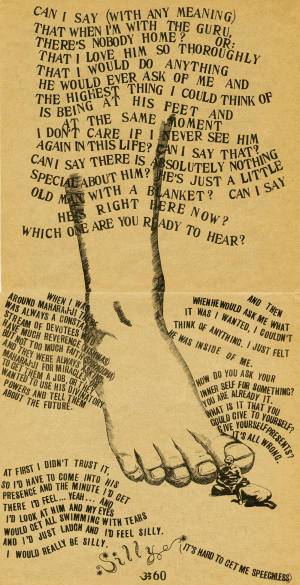
CAN I SAY (WITH ANY MEANING)
THAT WHEN I'M WITH THE GURU,
THERE'S NOBODY HOME? OR:
THAT I LOVE HIM SO THOROUGHLY
THAT I WOULD DO ANYTHING
HE WOULD EVER ASK OF ME AND
THE HIGHEST THING I COULD THINK OF
IS BEING AT HIS FEET AND
AT THE SAME MOMENT
I DON'T CARE IF I NEVER SEE HIM
AGAIN IN THIS LIFE? CAN I SAY THAT?
CAN I SAY THERE IS ABSOLUTELY NOTHING
SPECIAL ABOUT HIM? HE'S JUST A LITTLE
OLD MAN WITH A BLANKET? CAN I SAY
HE'S RIGHT HERE NOW?
WHICH ONE ARE YOU READY TO HEAR?
WHEN I WAS
AROUND MAJARAJ-JI THERE
WAS ALWAYS A CONSTANT
STREAM OF DEVOTEES WHO
HAVE MUCH REVERENCE (VISHWAS)
BUT NOT TOO MUCH FAITH (SHRADDHA)
AND THEY WERE ALWAYS ASKING
MAHARAJ-JI FOR MIRACLES, OR
TO GET THEM A JOB, OR THEY
WANTED TO USE HIS DIVINATORY
POWERS AND TELL THEM
ABOUT THE FUTURE
AND THEN
WHEN HE WOULD ASK ME WHAT
IT WAS I WANTED, I COULDN'T
THINK OF ANYTHING. I JUST FELT
HE WAS INSIDE OF ME.
HOW DO YOU ASK YOUR
INNER SELF FOR SOMETHING?
YOU ARE ALREADY IT.
WHAT IS IT THAT YOU COULD GIVE TO YOURSELF?
GIVE YOURSELF PRESENTS?
IT'S ALL WRONG.
AT FIRST I DIDN'T TRUST IT,
SO I'D HAVE TO COME INTO HIS
PRESENCE AND THE MINUTE I'D GET
THERE I'D FEEL ... YEAH ... AND
I'D LOOK AT HIM AND MY EYES
WOULD GET ALL SWIMMING WITH TEARS
AND I'D JUST LAUGH AND I'D FEEL SILLY.
I WOULD REALLY BE SILLY.
SILLY (IT'S HARD TO GET ME SPEECHLESS)
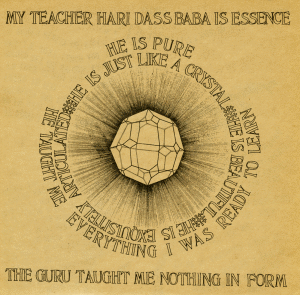
In this unmerged, yet undivided union of matter and light, both preserve their nature, yet neither are visible in their separateness. What is visible is pure light-bearing matter and incarnated light: enlightened coal and petrified rainbow.
-- Vladimir Solov'ev on Spiritual Nationhood, Russia and the Jews, by Judith Deutsch Kornblatt
***
The crystal is the formed thought that reflects what is to come in what has gone before.
-- The Red Book: Liber Novus, by C.G. Jung
MY TEACHER HARI DASS BABA IS ESSENCE
HE IS PURE
HE IS JUST LIKE A CRYSTAL
HE IS BEAUTIFUL
HE IS EXQUISITELY ARTICULATED
HE TAUGHT ME EVERYTHING
I WAS READY TO LEARN
THE GURU TAUGHT ME NOTHING IN FORM
HE NEVER EXPLAINED ANYTHING
HE'D LAUGH AT ME AND TWIRL MY HAIR
AND HAND ME AN ORANGE AND SAY THINGS LIKE:
YOU MAKE MANY PEOPLE LAUGH IN AMERICA?
AND I'D SAY "YES" AND HE'D SAY "THAT'S GOOD"
THAT DOESN'T TEACH YOU MUCH THAT'S JUST HANGING
OUT. THE TEACHER ON THE OTHER HAND WAS ALL
SPIT AND POLISH ... ALL BUSINESS. HE IS A PURE BRAHMIN
AND HE HAS WORK TO DO AND HE IS GOING TO TEACH ME
AND IT WAS ALL NO NONSENSE.
HE WOULD BE MAKING ME A ROPE TO GO AROUND
MY WAIST WITH SEVEN STRANDS
AND HE WOULD BE EXPLAINING EACH STRAND ...
AND I HONOR HIM AND LOVE HIM
AND WISH TO SERVE HIM
ONE OF THEM IS IN THE WORLD FOR ME
AND ONE OF THEM IS NOT
THE RELATIONSHIP TO THE GURU
HAS NOTHING TO DO WITH WORLDLINESS
WITH THE WORLDLY
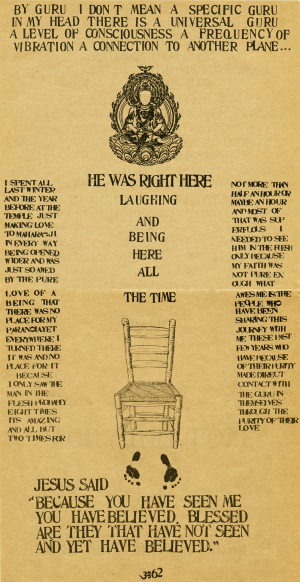
BY GURU I DON'T MEAN A SPECIFIC GURU
IN MY HEAD THERE IS A UNIVERSAL GURU
A LEVEL OF CONSCIOUSNESS A FREQUENCY OF
VIBRATION A CONNECTION TO ANOTHER PLANE ...
HE WAS RIGHT HERE
LAUGHING
AND
BEING
HERE
ALL
THE TIME
I SPENT ALL
LAST WINTER
AND THE YEAR
BEFORE AT THE
TEMPLE JUST
MAKING LOVE
TO MAHARA-JI
IN EVERY WAY
BEING OPENED
WIDER AND WAS
JUST SO AWED
BY THE PURE
LOVE OF A
BEING THAT
THERE WAS NO
PLACE FOR MY
PARANOIA. YET
EVERYWHERE I
TURNED THERE
IT WAS AND NO
PLACE FOR IT
BECAUSE
I ONLY SAW THE
MAN IN THE
FLESH PROBABLY
EIGHT TIMES
IT'S AMAZING
AND ALL BUT
TWO TIMES FOR
NOT MORE THAN
HALF AN HOUR OR
MAYBE AN HOUR
AND MOST OF
THAT WAS SUP-
ERFLUOUS I
NEEDED TO SEE
HIM IN THE FLESH
ONLY BECAUSE
MY FAITH WAS
NOT PURE EN-
OUGH WHAT
AWES ME IS THE
PEOPLE WHO
HAVE BEEN
SHARING THIS
JOURNEY WITH
ME THESE PAST
FEW YEARS WHO
HAVE BECAUSE
OF THEIR PURITY
MADE DIRECT
CONTACT WITH
THE GURU IN
THEMSELVES
THROUGH THE
PURITY OF THEIR
LOVE
JESUS SAID
"BECAUSE YOU HAVE SEEN ME
YOU HAVE BELIEVED. BLESSED
ARE THEY THAT HAVE NOT SEEN
AND YET HAVE BELIEVED."
THE WAY BHAKTI WORKS
YOU JUST LOVE
UNTIL

YOU
AND THE
BELOVED
BECOME
ONE

The ROSE was anciently sacred to Aurora and the Sun. It is a symbol of Dawn, of the resurrection of Light and the renewal of life, and therefore of the dawn of the first day, and more particularly of the resurrection.
-- Morals and Dogma of the Ancient and Accepted Scottish Rite of Freemasonry, by Albert Pike
***
"See how the roses burn!
Bring wine to quench the fire!
Alas! the flames come up with us, --
We perish with desire."
-- Hafiz, Letters and Social Aims, by Ralph Waldo Emerson
***
"A rose is a rose is a rose is a rose."
-- Gertrude Stein, by Wikipedia
***
"The rose is beautiful and has a sweet odour as long as it remains in the form; but to manifest its medicinal qualities in the constitution of man, its form must be destroyed and its spirit enter the body of man. Only that which enters into regeneration is useful; the rest is useless. In this regeneration enters the true Sulphur, Mercury, and Salt."
-- The Life of Philippus Theophrastus Bombast of Hohenheim Known by the Name of Paracelsus and the Substance of his Teachings, by Franz Hartmann, M.D.
***
The Hermetic Rose....As that Rose out of a rude mountain, so issues from the inchoate nature of the man of earth the many-petalled flower of spiritual being: so gradually and slowly unfold our potencies -- like petals -- from within.
-- The Ancient and Primitive Rite of Memphis and Misraim, Excerpts from "A New Encyclopaedia of Freemasonry," by Arthur Edward Waite
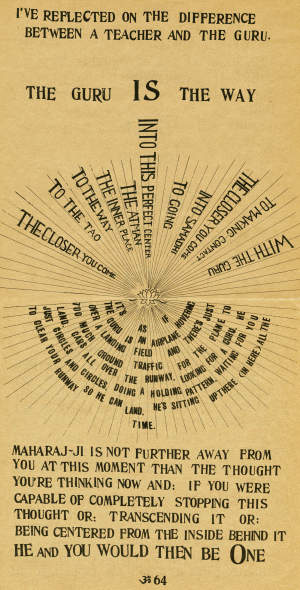
I'VE REFLECTED ON THE DIFFERENCE
BETWEEN A TEACHER AND THE GURU.
THE GURU IS THE WAY
INTO THIS PERFECT CENTER
TO GOING
INTO SAMADHI
THE CLOSER YOU COME
TO MAKING CONTACT
WITH THE GURU
THE CLOSER YOU COME
TO THE TAO
TO THE WAY
TO THE INNER PLACE
THE ATMAN
IT'S AS IF
THE GURU IS AN AIRPLANE HOVERING
OVER A LANDING FIELD AND THERE'S JUST
TOO MUCH GROUND TRAFFIC FOR THE PLANE TO
LAND. CARS ALL OVER THE RUNWAY. LOOKING FOR A GURU HE
JUST CIRCLES AND CIRCLES, DOING A HOLDING PATTERN, WAITING FOR YOU
TO CLEAR YOUR RUNWAY SO HE CAN LAND. HE'S SITTING UP THERE (IN HERE) ALL THE
TIME.
MAHARAJ-JI IS NOT FURTHER AWAY FROM
YOU AT THIS MOMENT THAN THE THOUGHT
YOU'RE THINKING NOW AND: IF YOU WERE
CAPABLE OF COMPLETELY STOPPING THIS
THOUGHT OR: TRANSCENDING IT OR:
BEING CENTERED FROM THE INSIDE BEHIND IT
HE AND YOU WOULD THEN BE ONE
YOU DIG THAT MY SPECIAL RELATIONSHIP
TO HIM (IF INDEED, HE IS LIVING IN SAT
CHIT ANANDA) CANNOT CONCEIVABLY BE
SPECIAL. THERE'S NO MEANING TO THAT.
SPECIALNESS CAN ONLY BE IN EACH PERSON'S
KARMA. IT'S NOT AN INTERPERSONAL RELATION-
SHIP -- WITH A BEING THAT IS NOT INTER-
PERSONAL. PEOPLE SAY: YOU'VE GOT SOME-
THING GOING WITH THE GURU. THAT'S ABSURD.
I JUST HAVE WHAT I HAVE GOING WITH MY
OWN KARMA. EACH PERSON IS AS CLOSE TO
THE GURU AT EVERY MOMENT. AND PEOPLE
SAY: MAYBE THE GURU WOULD INTERVENE
AND TAKE ON MY KARMA. BUT FROM A
GURU'S POINT OF VIEW
HE JUST UNDERSTANDS
HOW IT ALL IS IN
ETERNAL
TIME AND SPACE
HE HAS NO ATTACHMENT
EITHER TO LIFE. OR DEATH
AND: IF HE TAKES ON YOUR KARMA
IT IS YOUR KARMA THAT HE SHOULD
TAKE ON YOUR KARMA
SIMPLE AS THAT
YOU SEE:
YOU ARE THE GURU
THAT'S WHAT'S SO FAR OUT ...
YOU ARE YOUR OWN GURU
I AM MY OWN GRANDPA
AND THAT'S WHAT YOU FINALLY KNOW WHEN
YOU ARE HANGING OUT WITH ONE OF THESE GUYS
YOU HANG OUT WITH YOURSELF
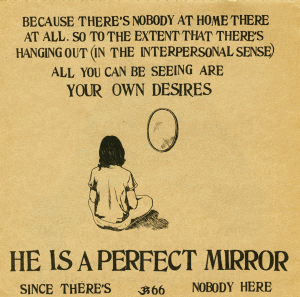
BECAUSE THERE'S NOBODY AT HOME THERE
AT ALL. SO TO THE EXTENT THAT THERE'S
HANGING OUT (IN THE INTERPERSONAL SENSE)
ALL YOU CAN BE SEEING ARE
YOUR OWN DESIRES
HE IS A PERFECT MIRROR
SINCE THERE'S NOBODY HERE
Secundam Animam, in mentis, Deo iunctae, aut luce Diuina illuminatae, speculo: idque tam dormiendo, quam uigilando: ut testes quoque conscientiae propriae mille, ueritatem perhibentes, iuxta Legem in cordibus nostris, Diuinitus scriptam.
[Google translate: According to the soul, in the mind, grew up alongside God, or Divine light illuminated, a mirror, and that so while asleep, than uigilando: that a thousand witnesses of their own conscience also, witness the truth, according to the law in our hearts, the divinity written.]
Naturam nosce, uniuersaliter, et particulariter; ex libro sanctissimae Scripturae: Naturae ipsius, qui est, et Mundus maior, totus: et Mundus minor, hoc est homo, puta, secundum et corpus et spiritum suum: denique, aut mediate, ex angelis bonis, aut immediate, in speculo mentis tuae purgatae, ex Deo Ipso: theosophice; physice; physicomedice; physicochemice; physicomagice; hyperphysicomagice; cabalice.
[Google translate: Nature knows universally, and particularly of the Most Holy Scripture from the book: nature of Him who is, The World and greater, all: The World and less, this is a man, for example, and according to their own spirit and the body: in short, or mediately, from the angels of good, or immediately, in a mirror of your mind are cleansed, from God Him: theosophice; physically; physicomedice; physicochemice; physicomagice; hyperphysicomagice; cabalice.
-- Amphitheatrum Sapientiae Aeternae, by Heinrich Khunrath
***
Shaikh Sar-razi, God's mercy be upon him, was seated one day amongst his disciples. One of the disciples had a longing for some roasted sheep's head. The Shaikh signalled, saying, 'You must bring him some roasted sheep's head.'
'How did you know that he wanted some roasted sheep's head?' the disciples asked.
'Because it is now thirty years that no desire has remained in me,' the Shaikh answered. 'I have cleansed and purified myself of all desires and have become clear as an unscratched mirror. When the thought of roasted sheep's head entered my mind and whetted my appetite and became a desire, I knew that that belonged to our friend yonder. For the mirror is without any image of itself; if an image shows in the mirror, it is the image of another.'
-- Discourses of Rumi, translated by A. J. Arberry
***
"While we are on this earth we ought to keep our mirror in God, so as to be in every respect as a child is like its father.
-- The Life of Philippus Theophrastus Bombast of Hohenheim Known by the Name of Paracelsus and the Substance of his Teachings, by Franz Hartmann, M.D.
***
There is a transcendental set of causes put in motion in the occurrence of these phenomena, which, not being in relation to our narrow range of cognition, can only be traced to their source and their nature, and understood by the Spiritual faculties of the Adept. They are, as Asclepios puts it to the King, “incorporeal corporealities” such as “appear in the mirror."
-- The Secret Doctrine -- The Synthesis of Science, Religion, and Philosophy, by Helena Petrovna Blavatsky
***
But perhaps it was in the sphere of contemplation that Suhrawardi's life proved the most revealing, for here he shook to their core all our preconceived ideas about knowledge. In the first stage, in meditation, we think we are a consciousness concentrating upon an object, something tangible, objective, unaware that we are being duped by an anthropocentric mirage: For what we think we know is only a reflection of reality; this is speculative knowledge, knowledge of the mirror (speculum.) Secondly you realize that everything in the universe is to be found within you in yourself, reflected as in a mirror so that you discover that what you are contemplating is the reflection of the universe in yourself and that you are the mirror. Thirdly you realize that it is not your consciousness that is aware, but that it is only a channel of the divine consciousness and that you are only a witness of this phenomenon. Finally you understand that there is no room for another presence or subject than the one and only being; and you realize that he is the only knower. This analysis reminds one very much of Bastami.
"For thirty years God most high was my mirror, now I am my own mirror and that which I was I am no more, for "I and God" represent polytheism, a denial of his unity. Since I am no more, God most high is his own mirror. Behold now I say that God is the mirror of myself, for with my tongue he speaks and I have passed away."
-- Toward the One, by Pir Vilayat Khan
***
R. Eleazar once asked R. Simeon his father, in the presence of R. Abba: 'Why is it said here "I appeared", instead of "I spoke to Abraham, etc."?' R. Simeon replied: 'My son, this contains a deep mystery. Observe now. There are colours disclosed and undisclosed, this being a part of the mystery of Faith, but men neither know nor reflect on these matters. Observe now. There are colours disclosed and undisclosed, this being a part of the mystery of Faith, but men neither know nor reflect on these matters. The visible colours were not perceived by any human being before the Patriarchs, Abraham, Isaac and Jacob. Therefore it says "and I appeared". And what are these visible colours? Those of El Shaddai, the reflection of higher colours. But these latter are hidden, and Moses alone perceived them. The Patriarchs, however, were not entirely ignorant of them; since they apprehended those undisclosed ones through the visible ones which they already knew. It is written: "And the wise shall be resplendent as the splendour of the firmament, and they that turn many to righteousness shall be like the stars for ever and ever." The "wise" is he who by the power of his own contemplation attains to the perception of profound mysteries which cannot be expressed in words. The "firmament" is the "firmament of Moses" (his grade of Divine knowledge), which is set at the centre and whose splendour is veiled. This firmament is above that other which is non-resplendent and the colours of which are visible and not so bright as the invisible. There are four lights (i.e. Emanations), three of which are recondite and one disclosed. There is one which sheds light abroad (Hesed); one which shines for itself only (Geburah), being like the heavens in purity; one of purple hue which gathers light into itself (Tifereth); and one which is of itself lightless (Malkuth), but which looks up to the others and reflects them as a lamp reflects the sun. The first three are recondite and brood over the one which is disclosed. (Of all this the eye is the symbol. In the eye three colours are visible, but none of these shines, because they are non-luminous. They are the parallel of those lights which are revealed; and it was by means of these visible colours that the Patriarchs were enabled to discern the colours which are luminous but invisible -- that is, those colours of which Moses alone had cognizance, which were concealed from all others but revealed to him in that firmament to which he had attained, and which are above the visible colours.) To understand this mystery, close thine eye and press thine eyeball, and thou wilt discern radiating and luminous colours which can only be seen with closed eyes. For this reason we say that Moses was possessed of the "luminous mirror", which is above the "nonluminous", which alone is vouchsafed to others. The Patriarchs, however, were able by means of the revealed colours to conceive of those that were concealed. This is the meaning of the words, "I appeared unto Abraham, etc", namely, in those visible colours, "but by My Name YHVH was I not known to them", namely, in the supernal hidden luminous colours, which only Moses was privileged to behold. The closed eye sees the mirror of light: the open eye sees the mirror which is not luminous. Therefore in regard to the lightless mirror, the term "see" is used, because it is discernible, but in regard to the luminous mirror the term "know" is used, because it is in concealment.'
-- The Zohar, translated by Harry Sperling and Maurice Simon

THE CHICKEN SEES
The hart expresses the union of man's soul and body, while the unbound soul which is free, is regarded as a more bird-like creature, because in nature the birds are much less bound to the earth and can remain suspended in the air. The erect stag represents a stage between two situations, which is also indicated by the symbol of the chicken. The chicken is a bird but it is unable to fly, as the soul can in the supersensible realm when it is free from its body.
-- The Pictorial Language of Hieronymus Bosch, by Clement A. Wertheim Aymes
***
Man lives within the invisible world comparable to the yolk in an egg. The chicken grows from the white of the egg, which constitutes its chaos, and man is nourished by his chaos. Within man are the sun and moon, the planets and all the rest of the stars, and also the chaos.
-- The Life of Philippus Theophrastus Bombast of Hohenheim Known by the Name of Paracelsus and the Substance of his Teachings, by Franz Hartmann, M.D.
WHEN I MET MY GURU WHO KNEW
EVERYTHING
IN MY HEAD,
I REALIZED
THAT HE KNEW
EVERYTHING
IN MY HEAD
WHETHER "I" LIKED IT OR NOT.
HE KNEW IT.
AND THERE WOULD BE TIMES AFTER A PARTICULARLY BEAUTIFUL DARSHAN
WITH HIM WHEN HE'D SAY TO ME: "OH! YOU GAVE MUCH MONEY TO A LAMA" AND
I'D SAY YES AND HE'D SAY: YOU'RE VERY GOOD, YOU'RE COMING ALONG WITH
YOUR SADHANA AND I FELT SO GOOD AND THEN I'D GO BACK TO THE TEMPLE
AND THINK "BOY! I'M GOING TO BE A GREAT YOGI. I'LL HAVE GREAT
POWERS. WHAT AM I GOING TO DO WITH THEM?" ... AND I'D START TO
HAVE THESE HORRIBLE THOUGHTS AND ALL MY IMPURITIES WOULD
RISE TO THE SURFACE AND THEY WOULD REALLY BE ... AND THEN I'D
GO TO BED AND HAVE ALL KINDS OF SEXUAL FANTASIES AND I'D THINK
"LOOK YOU'RE BEING A YOGI AND YOU SEE THE ABSURDITY
OF THAT SITUATION YOU'RE IN ..." BUT I'D STILL HAVE THE
THOUGHT. AND THEN, IN THE COURSE OF IT, I'D HAVE A
THOUGHT (I'D BE GOING THROUGH MY SHOULDER BAG AND
COME ACROSS A NOTE I'D WRITTEN TO MYSELF: '"REMEMBER TO VISIT
LAMA GOVINDA") AND I'D THINK, "I MUST VISIT LAMA GOVINDA WHILE
I'M IN INDIA."
AND THE NEXT MORNING AT 8 O'CLOCK THERE IS THE MES-
SENGER WITH INSTRUCTIONS: "THE GURU SAID YOU'RE TO GO
VISIT LAMA GOVINDA."
NOW THERE ISN'T A MESSAGE SAYING: "CUT OUT THOSE
SEXUAL THOUGHTS," BUT HE MUST OBVIOUSLY KNOW THEM. DO
YOU THINK HE JUST PICKED UP ON THE LAMA GOVINDA THING?
CAN I ASSUME THE PROBABILITIES ARE HE ONLY TUNES IN
EVERY TIME I HAVE A POSITIVE THOUGHT?
AND THEN I COME BEFORE HIM AND NOW I'M FREAKED
BECAUSE I KNOW HE KNOWS IT ALL: AND I WALK IN, AND HE
LOOKS AT ME WITH TOTAL
LOVE
AND I THINK: HOW CAN HE DO IT?
THIS GUY MUST BE NUTS! HE'S LOVING
THIS CORRUPT ... WHY ISN'T HE ...?
YOU SEE THE PREDICAMENT I WAS IN?
AND THEN! WHAT I UNDERSTOOD WAS:
HE WAS LOVING THAT IN ME WHICH WAS
BEHIND MY PERSONALITY AND BEHIND
MY BODY.
NOT: "I REALLY LOVE RAM DASS"
IT WASN'T INTERPERSONAL LOVE
IT WASN'T POSSESSIVE LOVE
IT WASN'T NEEDFUL LOVE
IT WAS THE FACT THAT
HE IS LOVE

Outside this world of which we are speaking there is another world for us to seek. This world and its delights cater to the animality of man; these all feed his animality, whilst the root principle, man, goes into a decline. After all, they say, 'Man is a rational animal.' So man consists of two things. That which feeds his animality in this material world is these lusts and desires. But as for that which is his true essence, its food is knowledge and wisdom and the sight of God. The animality in man flees away from God, whilst his humanity flees away from this world.
-- Discourses of Rumi, translated by A. J. Arberry
***
All religions teach the sevenfold constitution of the body. Precise knowledge can best be obtained on this by studying the Rosicrucian lessons of Heindel.
The Immortal Part
1. Atma, the self, god in us / Sun
2. Buddhi, the heavenly soul / Moon
3. Buddhi-Manas, reason, causal body / Mercury
The Mortal Part
4. Kama-Manas, intellect / Venus
5. Kama-body (astral body), desire / Mars
6. Prana, life-force (aetheric-body-Linga-Bhuta / Jupiter
7. Sthula-Bhuta, body / Saturn
The last quadrad is called "the animal in us" by Paracelsus. The Science of the Key gives us the way to conquer this animal in us and to ascend to the causal plane...."Cut off the neck of the beast," says an old text.
-- The Practice of the Ancient Turkish Freemasons: The Key to the Understanding of Alchemy, by Baron Rudolf von Sebottendorf
***
"The nature of the universe delights not in anything so much as to alter all things, and present them under another form. This is her conceit to play one game and begin another. Matter is placed before her like a piece of wax and she shapes it to all forms and figures. Now she makes a bird, then out of the bird a beast — now a flower, then a frog, and she is pleased with her own magical performances as men are with their own fancies."
Before any of our modern teachers thought of evolution, the ancients taught us, through Hermes, that nothing can be abrupt in nature; that she never proceeds by jumps and starts, that everything in her works is slow harmony, and that there is nothing sudden, not even violent death.
The slow development from preexisting forms was a doctrine with the Rosicrucian Illuminati.
-- Isis Unveiled, by Helena P. Blavatsky
WHERE HE SAW ME
HE LOOKED AT ME
AND HE SAW THAT
PLACE IN ME
WHICH IS
LOVE
AND
HERE WE ARE
IN
LOVE
THAT'S THE WORLD HE LIVES IN
AND ONCE I APPRECIATED THAT
AND COULD SEE THAT HE
COULD LOOK AT THIS CORRUPT
IMPURE
UGLY
BEING
AND HE COULD LOVE
IT THAT MUCH
NOBODY HAD EVER
DONE THAT
BEFORE
EVERYBODY HAD SAID
I'LL LOVE YOU IF ...
AND HE JUST SAID
WHERE YOU
REALLY ARE
AND WHERE I
REALLY AM
WE
ARE
LOVE
AND
WHEN I WAS AROUND HIM
I WAS
IN
LOVE
NOW: ONCE I HAD TASTED OF THAT
UNIVERSE
WERE WE ARE ALL US ... THIS PLACE:
THAT'S THE SEA OF LOVE
BOY! I'M GOING TO LIVE IN IT!
I'M GOING TO BE IT!
I'M GOING TO SUBMERGE MYSELF IN IT!
YOU GOTTA PROTECT YOURSELF ...
FROM WHAT?
LOVE?
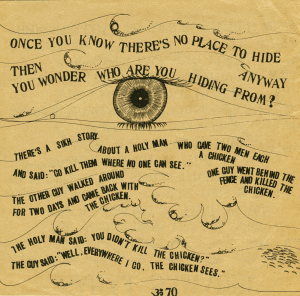
ONCE YOU KNOW THERE'S NO PLACE TO HIDE
THEN
YOU WONDER WHO ARE YOU HIDING FROM
ANYWAY?
THERE'S A SIKH STORY ABOUT A HOLY MAN WHO GAVE TWO MEN EACH
A CHICKEN
AND SAID: "GO KILL THEM WHERE NO ONE CAN SEE."
ONE GUY WENT BEHIND THE
FENCE AND KILLED THE
CHICKEN.
THE OTHER GUY WALKED AROUND
FOR TWO DAYS AND CAME BACK WITH
THE CHICKEN.
THE HOLY MAN SAID: YOU DIDN'T KILL THE CHICKEN?"
THE GUY SAID: "WELL, EVERYWHERE I GO, THE CHICKEN SEES."
Alone the Initiate, rich with the lore acquired by numberless generations of his predecessors, directs the “Eye of Dangma” toward the essence of things in which no Maya can have any influence. It is here that the teachings of esoteric philosophy in relation to the Nidanas and the Four Truths become of the greatest importance; but they are secret.
-- The Secret Doctrine -- The Synthesis of Science, Religion, and Philosophy, by Helena Petrovna Blavatsky
***
[T]he eye is the window of the soul.
-- The Rosicrucian Cosmo-Conception, by Max Heindel
SAHAJ SAMADHI
THE GURU IS ON AN ENDLESS WAVE
JUST HANGING OUT IN THAT PLACE
HE'S HANGING WHERE DOES HE RESIDE?
HE RESIDES IN THIS REALLY INTERESTING PLACE
HE RESIDES RIGHT IN THAT PLACE
WHERE THE DIVINE MOTHER
MERGES INTO HERSELF
HE'S RIGHT BETWEEN THE TWO SIDES OF THE COIN
HE'S RIGHT AT THAT PLACE
HE GOES INTO ONE-WITH-IT-ALL INTO THE VOID
& HE COMES BACK INTO FORM
IN ORDER TO LOVE IT ALL & THEN
THROUGH HIS LOVE HE GOES BACK INTO IT AGAIN
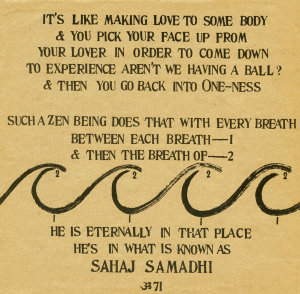
IT'S LIKE MAKING LOVE TO SOME BODY
& YOU PICK YOUR FACE UP FROM
YOUR LOVER IN ORDER TO COME DOWN
TO EXPERIENCE AREN'T WE HAVING A BALL?
& THEN YOU GO BACK INTO ONE-NESS.
SUCH A ZEN BEING DOES THAT WITH EVERY BREATH
BETWEEN EACH BREATH -- 1
& THEN THE BREATH OF -- 2
HE IS ETERNALLY IN THAT PLACE
HE'S IN WHAT IS KNOWN AS
SAHAJ SAMADHI
HE'S RIGHT AT THE EDGE
HE STAYS AT THAT EDGE
AND THAT'S WHY HE STAYS
IN HIS BODY ... IF HE
JUST STAYED IN THE VOID
THE BODY (AFTER 21 DAYS)
JUST FALLS AWAY
THERE'S NO EGO LEFT
TO HOLD IT TOGETHER
THAT'S THE RULE OF THE GAME
IF YOU'RE WONDERING WHAT HAPPENS.
SOME BEINGS DO THAT
THEY GO INTO SAMADHI
AND THEY'VE FINISHED WITH THEIR
BODIES AND THEY JUST LEAVE THEM.
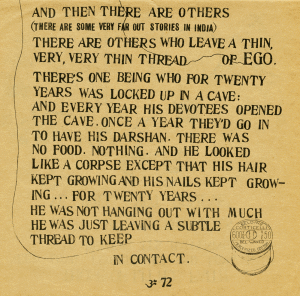

"The spark hangs from the flame by the finest thread of Fohat." The “thread of Fohat” is the thread of being which animates man and passes through all his personalities, or rebirths on this Earth, the thread on which moreover all his “Spirits” are strung, is spun from the essence of the “threefold,” the “fourfold” and the “fivefold”. What is that “Spark” which “hangs from the flame?” It is Jiva, the monad in conjunction with manas, or rather its aroma, that which remains from each personality, when worthy, and hangs from Atma-Buddhi, the Flame, by the thread of life.
-- The Secret Doctrine -- The Synthesis of Science, Religion, and Philosophy, by Helena Petrovna Blavatsky
***
The Minotaur reigned within the Labyrinth; he was a mighty bull to whom seven youths and seven maidens had to be sacrificed every year. Theseus, the hero, plans to slay this Minotaur with his club. He is saved from losing himself in the Labyrinth by the king's daughter Ariadne, who gives him a thread by means of which he finds his way back out of the darkness.
-- The Pictorial Language of Hieronymus Bosch, by Clement A. Wertheim Aymes
***
If having dismissed the supports of consciousness -- perception and representation -- one is able to maintain a continuity of flow between the levels of consciousness without losing the Ariadnian thread that fosters the sense of individuality, yet projecting beyond it where it fuses with all the Ariadnean threads that cross-cross in weaving the meshes of the universe, one reaches a point where consciousness is no longer the consciousness of a single individual.
-- Toward the One, by Pir Vilayat Inayat Khan
***
Forget not the end of the thread: constantly deny your carnal soul its desires, till you have attained your eternal desire and find deliverance out of the prison of darkness....Well, I am a whoremonger; since I was little, this has been my trade. I know that this removes hindrances, this consumes veils; this is the root of all acts of obedience, the rest are mere branches. If you do not cut the throat of a sheep, of what use is it to blow on its trotter? Fasting leads to annihilation, where is the last of all pleasures. Whatever shop is in the bazaar, or any potion, or merchandise, or trade, the end of the thread of each one of these is the need of the human soul, and that end of the thread is hidden; until the need for those things arises, the end of the thread does not stir or become visible. Similarly with every religion, every faith, every grace, every miracle, all the states of the prophets -- the end of the thread of every one of these is in the human spirit; until the need arises, that end of the thread does not stir or become visible.
-- Discourses of Rumi, translated by A. J. Arberry
***
Wherever we pick up the thread of twentieth-century Western occultism and ritual magic, we can follow it back along a trail that leads to [Franz] Hartmann.
-- Unholy Alliance: A History of Nazi Involvement with the Occult, by Peter Levenda
***
"In the eighth year from the conception of a Brahman, in the eleventh from that of a Kshatriya, and in the twelfth from that of a Vaisya, let the father invest the child with the mark of his class." (Mann, ii. 36.)
ONE of the many peculiarities that strike a stranger in India is that many Hindus have a cord or skein of thread over the left shoulder, hanging down under the right arm. It is worn as a sash would be. Probably few, except the Hindus themselves, could tell why this cord is worn; why certain persons have it whilst others have it not; or even how or of what it is made.
This article of dress or adornment forms, however, a very important factor in the Hindu cult. The yajno pavitam, as it is called, or the sacred thread of the Hindu, is the outward and visible mark that the wearer is a Dvija, or twice-born. It is a very much prized and a very sacred badge and commands respect and even adoration.
If we enquire who are privileged to assume this distinction, we find the matter very clearly defined by the ancient Hindu law-giver. In the quotation at the head of this chapter, it is clear that the Brahmans, Kshatriyas, and Vaisyas must be thus invested. In another place it is distinctly stated that none but the three twice-born classes are entitled to the distinction.
"The three twice-born classes are the sacerdotal, the military, and the commercial; but the fourth, or servile, is once-born, that is, has no second birth from the gayatri, and wears no thread." (Manu, x. 4.)
This is the law; but others besides these three privileged classes assume the distinction. It is not safe, therefore, to conclude that every wearer of the sacred thread must necessarily be a Brahmin or one of the other two highest castes. The goldsmiths, the weavers, certain classes of fishermen and others wear it. The explanation is that the goldsmith caste, many of whom are carpenters and workers in brass and copper, are themselves a class of Brahmins; at least they assume the distinction. They have their own prescribed share in the Vedas and their own ritual. They have an upanayanam or second-birth ceremony, and are considered dvijas, or twice-born; hence this privilege in the matter of the thread, as well as in many others that are peculiar to Brahmins. The goldsmith caste are said to be the descendants of Brahmin women and Kshatriya men; and this fact, together with the rights above mentioned, appears to be acknowledged by the Brahmins themselves; yet, they do not appear to command much respect as a caste. This may be on account of their mixed origin. Until recent years, for instance, they were not allowed to celebrate their marriages with public processions, to use a palanquin, or to ride a horse. It is said that about thirty years ago there was much disturbance in Masulipatam when, in India through the freedom resulting from the British rule this caste first began to have marriage processions and, in other ways, to assert themselves. Now it is quite an acknowledged thing, for it has become what is known as ma‘mul (custom) and so no one interferes. They are not, as a rule, even now, allowed to enter temples. When they are permitted to do so, it is only to that part in which Sudras are allowed. A case recently came before the law courts in Masulipatam arising out of the attempt of a goldsmith to enter a Siva temple for worship. I believe it was eventually decided that a member of this caste could not enter a temple, except by the permission of the Brabmin priest in charge. The question of the social and religious status of the goldsmith caste is a most vexed one which gives rise to much controversy. It shows that not all wearers of the thread or cord are considered of equal rank....
[O]thers such as weavers and fishermen appear unlawfully to assume the privilege of wearing the sacred thread; but, although their custom is not interfered with, no value is set upon it by orthodox Hindus. They cannot, for example, read the Vedas or even hear them read. Authority to do this, in the case of lawful thread-wearers, is conveyed by the ceremony of upanayanam, or second spiritual birth, of which the thread is the outward symbol. In these modern days, some other classes of Sudras have also adopted the yajnopavitam merely to add to their own importance; but, in all such cases, it is of no true religious value. I have heard of a case in the Orissa country where a certain Raja of the Sudra caste made himself important by assuming authority to invest people of his own caste with the thread. Some of, them, to please him, appear to have submitted to the investiture, and adopted the thread -- thus adding to the number of the unlawful wearers of this coveted mark of distinction. It is said that one unlucky wight who, on a visit to that country, was presented with this badge of honour, was, on his return home, deprived of the same and well beaten for his presumption by his indignant neighbours.
Having thus seen who are entitled to wear the sacred thread, I now pass on to mention some particulars of the thread itself and also of the mode of investiture. Originally there appears to have been some difference in the kind of thread worn, according to the class of the wearer. Thus: "The sacrificial thread of a Brahmin must be made of cotton, so as to be put on over his head in three strings; that of a Kshatriya of sana thread only; that of a Vaisya of woollen thread." (Maim, ii. 44.)
This is the law and probably in ancient times the material of which the thread was made did thus differ, according to the caste of the wearer; but in the present day no such difference is seen. The cord is universally made of cotton. A peculiar kind of very fine cotton is what ought to be employed, but ordinarily the common cotton is used. The threads are supposed to be prepared by Brahmins. Perhaps other than the Brahmins and Vaisyas are not so particular as to the manufacture, but these two castes are very careful in this respect. The threads can generally be obtained in any ordinary bazaar, but the very orthodox, in order to ensure their purity, will frequently procure their supply from the house of the Brahmins who may happen to be engaged in the manufacture.
The yajnopavitam consists of several skeins of cotton thread. Each thread consists of three strands, each skein has three threads, and a married man's cord must consist of not less than three skeins. The number three enters very largely into the structure of the cord itself, and the ceremony of investiture. This is said to represent the three gods, Brahma, Vishnu, and Siva; the three sacrificial fires; three divisions of time —morn, noon and night; and the three worlds—heaven, earth and hell. Each skein is tied with a peculiar knot called Brahma's knot. It is made by making three turns with the threads and by so tying the knot that the ends do not appear on the outside. In making each knot the following incantation is repeated by the maker: "Pronouncing the word Om, the Brahma Sutram must be tied, and afterwards worn. (The wearer) will receive purity in all his rites, It being the personification of all the gods."
A youth, if a bachelor, when first invested with the cord, receives only a single skein, and he cannot wear more than a single skein until he is married, when he must wear, at least, three skeins. The Brahmin youth must be invested with his cord when he is about seven or eight years of age. He cannot be married until thus invested, but he may, and in fact often does, marry a day or two after the ceremony. Amongst some of the Banians or Vaisyas, it is customary to defer the upanayanam until immediately before marriage.
The ceremony of investiture is as follows. On the appointed day a fire is lighted, round which the relatives and friends of the novice are seated. This fire is a very important feature of the upanayanam. The whole ceremony is called the agni karyam or fire worship. It is kept alight during the whole four days during which the ceremony lasts, and it is the proper thing to feed it, as far as possible, with the twigs of certain kinds of trees, principally those of the Indian fig tribe. At the repeating of the various mantrams which form part of the ritual, ghee is poured on to the fire as an offering. The father of the youth to be invested takes a thread of nine strands and puts it upon his son. This is not the true yajnopavitam, nor has it the Brahma knot, neither are mantrams said over it. After some time, during which various rites are performed, and the ears of the boy are bored for earrings and then adorned with thin rings of gold, the true cord is produced—a single skein of three threads. To this is attached a bit of the skin of a male deer, or, if procurable, a long strip of this skin is worn as a sash together with the cord. Deer skin is considered to be very pure, and also to be capable of imparting purity. For this reason untanned deer skin is much employed for covering the boxes and other receptacles, in which the household gods, and things pertaining thereto are kept. It is also much used. as a mat to sit upon when performing the daily rites. Mention is made in the Smritis (the teaching of the Sages) of the purity acquired by wearing deer skin, and there are several injunctions on the matter in the laws of Manu. For example: "Let the students in theology wear for their mantles the hides of black antelopes, of common deer or of goats, with lower vests of woven sana of cshuma and of wool, in the direct order of their classes." (Mann, ii. 41.)
The piece of deer skin is worn with the thread for several months when it is taken off with some short ceremony at a temple. When the father puts on the true cord, he repeats the yajnopavitam mantram, the novice saying it after him. This mantram is as follows:
"This most hallowed yajnopavitam,
In former times with Brahma born,
Author of longevity; wear it, it is pure,
May this yajnopavitam become my strength and glory."
As the new and true cord is put on, the imitation one which was first used is taken off. This completes the investiture, and the father at once proceeds to teach the novice the gayatri prayer. This is done with great care and secrecy. A cloth is thrown over the heads of both father and son, and, the sacred words are whispered into the ears, in as low a whisper as possible, so that the holy words may not fall upon the ears of any uninitiated person. The upanayanam is now complete, and the lad is now a true dvija, duly entitled to read the Vedas, and to perform any of the religious rites of his caste.
Immediately following this investiture the youth proceeds to ask alms of those present, beginning with his mother and then his father and afterwards the other relatives or friends. This act is supposed to intimate a readiness on the part of the supplicant to provide for himself and his religious preceptor. All this takes place on the first day, but for three more days the festival is kept up during which the novice is instructed in the morning, midday and evening prayers and in other ceremonial observances. There is always much feasting and rejoicing upon these occasions. Musicians are hired to enliven the company, and friends and relatives are entertained according to the ability of the host.
A new cord must be put on every year on the occasion of a certain festival. This festival is called sravanalapaurnavami -- the full moon in the month of Sravana (July-August). Should the cord be broken during the year, a new one must at once be put on. If a man has a cord of five skeins, a broken thread or two does not matter; but a bachelor must have his one skein perfect, without even a single thread being broken, and a married person must have at least three perfect skeins, every thread of which must be perfect. There are also certain kinds of defilement, as for instance touching a Pariah, that necessitate the putting on a new thread and the casting away the old one. In these days, the orthodox are not always so very particular as this, but this is the rule. Should the cord become broken, or any defilement contracted, no food can be taken until the old is replaced by a new one.
If a strict orthodox Brahmin, in passing through the bazaar, accidentally comes into contact with a Pariah, or in any other way becomes ceremonially defiled, he must get a new cord which he cannot touch until he has bathed and thus purified himself from the defilement. After bathing he takes the new cord and, dipping it into water, spreads it out on two brass or copper vessels. He then touches it with some of the pigment he uses for putting the sacred mark on his forehead. After that he walks round the vessels three times, from right to left, repeating the gayatri prayer. Then he takes the cord, skein by skein, and puts it on saying the mantram, or consecration prayer, used at the first investiture, repeating the same for each skein.
When he has thus put on the whole of the skeins, he takes off the old cord, repeating a mantram which says: "May this old yajnopavitam become my strength and glory."
The old thread is disposed of by throwing it into a river or some other water, if there should be any at hand. The ancient lawgiver says: "His girdle, his leather mantle, his staff, his sacrificial cord, and his ewe; he must throw into the water, when they are worn out or broken, and receive others hallowed by mystical texts." (Mann, ii. 64.)
Should no river, or other suitable water be conveniently near, the old thread is rolled up and thrown on to the top of the house. This is to prevent its being trodden under foot, or in any other such way defiled. This completes the re-investiture. The defiled one is now ceremonially pure, and he can proceed to perform the daily rites which must be gone through before he can partake of food.
The sacred thread is usually worn over the left shoulder, hanging down across the body under the right arm, and, as the orthodox Hindu is not encumbered with much by way of covering for the upper part of his person, it forms a very noticeable object. On certain occasions, however, the position of the thread is changed. At the time of performing the annual ceremony for deceased ancestors, the position is exactly reversed. It is then placed over the right shoulder and hangs down on the left side. On certain other occasions, it is worn as a garland round the neck: whilst at others it is placed up over the ears to prevent its being defiled. Usually when saying the gayatri prayer, the thread is taken hold of by the thumb; and on reciting various mantrams it is used somewhat as a rosary -- the worshipper winding it round the fingers to keep count of the number of times the mantram is repeated. The ancient law-giver Manu makes various allusions to the sacred thread other than those quoted above. He speaks of the sinfulness of omitting the sacred investiture (xi. 63); and he lays down the rule that no one must use a sacerdotal string that has been before used by another (iv. 66).
The yajnopavitam is to the Hindu an all important thing, being the sign of the second or spiritual birth. Without his cord the Brahmin is not a Brahmin. He is nothing better than an outcaste, he cannot perform any ceremony or partake of any food, nay, he must not even swallow his own spittle. He may breathe, and that is about all he can do until the lost or defiled cord is duly replaced with all proper ceremony.
A Sanyasi does not wear this cord, for he has entered the fourth or last stage of the Brahmin's life.
-- "Hindu Sacred Thread, 1908," oldandsold.com
Statistics: Posted by admin — Fri Sep 25, 2015 8:56 am
]]>
THE SUBTLE MOTHER
AND EVERY TIME YOU STEP BACK ONE STEP FROM
YOUR OWN MELODRAMA THE COSMIC HUMOR GETS
HIGHER AND HIGHER
THE ABSURDITY OF IT ALL
THE EXTREME BEAUTY
OF IT ALL!
THE DIVINE MOTHER
WHICH IS NATURE!
WHICH IS YOU
WHICH IS ALL OF THIS
WHICH IS THE WHOLE PHYSICAL PLANE!

AND SHE BECOMES SO
EXQUISITE
AND SHE'S
PULLING
YOU
AND THAT'S
REALLY
SOMETHING
ALL
YOU
CAN
DO
IS
HONOR
HER
AND
LOVE
HER
BECAUSE
IF YOU SAY
WOW LADY I KNOW WHO YOU ARE
YOU'RE THE KEEPER OF THIS REFORM SCHOOL
THAT'S ATTACHMENT
CAN'T HAVE HER
CAN'T REJECT HER
CAN'T LIVE WITH HER
CAN'T PUT HER AWAY
JUST HONOR AND HONOR HER
DIVINE MOTHER
YOU'VE GOT TO
WORSHIP HER
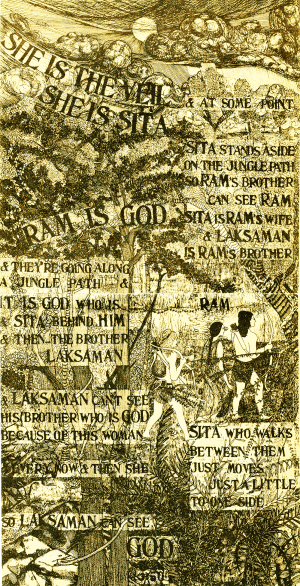
SHE IS THE VEIL & AT SOME POINT
To those who have removed the "Veil" from the "Sacred Shrine," and who have cast their "Lives" as an "Offering" into the "Flame" that forever burns up on the "Om-Altar " in the "Inmost"; — A "Mission" and a "Glory"!
-- A Call to the "Awakened" From "The Unseen and Unknown," for an Esoteric College, and For G.....R Dept. No. 1, by Vidya-Nyaika.
***
Parabrahmam is an unconditioned and absolute reality, and Mulaprakriti is a sort of veil thrown over it.
-- The Secret Doctrine -- The Synthesis of Science, Religion, and Philosophy, by Helena Petrovna Blavatsky
***
Look at man, the weak one in his wretchedness and torment, whom the Gods have singled out as their quarry -- tear to pieces the bloody veil that the lost soul has woven around man, the cruel nets woven by the death-bringing, and take hold of the divine whore who still cannot recover from her fall from grace and craves filth and power in raving blindness. Lock her up like a lecherous bitch who would like to mingle her blood with every dirty cur. Capture her, may enough at last be enough. Let her for once taste your torment so that she will get to feel man and his hammer, which he has wrested from the Gods.
-- The Red Book: Liber Novus, by C.G. Jung
***
Each of our seven physical senses (two of which are still unknown to profane Science), and also of our seven states of consciousness -- viz: (1) waking; (2) waking-dreaming; (3) natural sleeping; (4) induced or trance-sleep; (5) psychic; (6) superpsychic; and (7) purely spiritual, -- corresponds with one of the seven cosmic planes, developes and uses one of the seven super-senses, and is connected directly, in its use on the terrestro-spiritual plane, with the cosmic and divine centre of force that gave it birth, and which is its direct creator. Each is also connected with, and under the direct influence of, one of the seven Sacred Planets. These belonged to the Lesser Mysteries, whose followers were called Mystai (the veiled), seeing that they were allowed to perceive things only through a mist, as it were "with the eyes closed" while the Initiates or "Seers" of the Greater Mysteries were called Epoptai (those who see things unveiled). It was the latter only who were taught the true mysteries of the Zodiac and the relations and correspondences between its twelve signs (two secret) and the ten human orifices.
-- The Esoteric Papers of Madame Blavatsky
***
[A]ll women were burdened with ideas carried over from England with the colonists, influenced by Christian teachings. English law was summarized in a document of 1632 entitled "The Lawes Resolutions of Womens Rights":
In this consolidation which we call wedlock is a locking together. It is true, that man and wife are one person, but understand in what manner. When a small brooke or little river incorporateth with Rhodanus, Humber, or the Thames, the poor rivulet looseth her name.... A woman as soon as she is married, is called covert ... that is, "veiled"; as it were, clouded and overshadowed; she hath lost her streame. I may more truly, farre away, say to a married woman, Her new self is her superior; her companion, her master.
-- A People's History of the United States: 1492-Present, by Howard Zinn
SHE IS SITA
SITA STANDS ASIDE
IN THE JUNGLE PATH
SO RAM'S BROTHER
CAN SEE RAM
RAM IS GOD SITA IS RAM'S WIFE
& LAKSAMAN
IS RAM'S BROTHER
AND THEY'RE GOING ALONG
A JUNGLE PATH &
IT IS GOD WHO IS RAM
SITA BEHIND HIM
& THEN ... THE BROTHER
LAKSAMAN
& LAKSAMAN CAN'T SEE
HIS BROTHER WHO IS GOD
BECAUSE OF THIS WOMAN SITA WHO WALKS
BETWEEN THEM
EVERY NOW & THEN SHE JUST MOVES
JUST A LITTLE
TO ONE SIDE
SO LAKSAMAN CAN SEE
GOD

DIVINE MOTHER KALI
SHE IS MY MOTHER
SHE IS MY MOON
SHE IS MY FATHER
SHE IS MY CHILD
SHE IS MY BROTHER
SHE IS THE GRASS
SHE IS MY LOVER
SHE IS THE DEW
SHE IS MY SUN
LOOK AT HOW MUCH SHE CAN TEACH
HER TONGUE DRIPPING BLOOD
A CIRCLE OF SKULLS AROUND HER NECK
A DAGGER IN ONE HAND
GIVING BIRTH IN THE OTHER
THE WHOLE PROCESS OF NATURE
HOW EXQUISITELY SUBTLE
REMEMBER SIDDHARTHA
HIS JOURNEY, AND THE AMOUNT OF TIME HE SPENT IN THE GARDEN OF PLEASURE
WITH A WOMAN WHO HAD MUCH TO TEACH? SHE ALWAYS HAD A NEW THING
TO TEACH -- SHE WILL ALWAYS HAVE A NEW THING TO TEACH ... ALWAYS
CAN ANYONE IMAGINE THAT A WOMAN AS FULL
AND SEDUCTIVE AS THAT IS NOT GOING TO
TEACH SOMETHING?
IS NOT GOING TO CONTINUE TO TEACH
SOMETHING?
Speak, you concubine of Heaven, you divine monster! Have I not fished you from the swamp? How do you like the black hole?
-- The Red Book: Liber Novus, by C.G. Jung
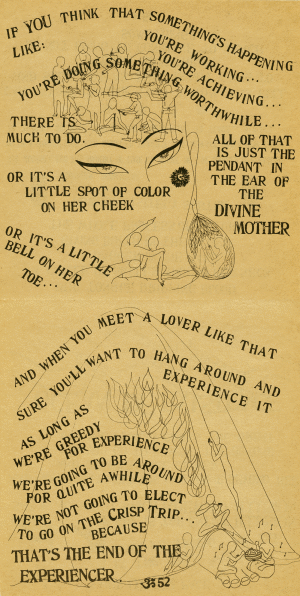
IF YOU THINK THAT SOMETHING'S HAPPENING
LIKE: YOU'RE WORKING...
YOU'RE ACHIEVING ...
YOU'RE DOING SOMETHING WORTHWHILE ...
THERE IS MUCH TO DO.
ALL OF THAT
IS JUST THE
PENDANT IN
THE EAR OF
THE
DIVINE
MOTHER
OR IT'S A
LITTLE SPOT OF COLOR
ON HER CHEEK
OR IT'S A LITTLE
BELL ON HER
TOE ...
AND WHEN YOU MEET A LOVER LIKE THAT
SURE YOU'LL WANT TO HANG AROUND AND
EXPERIENCE IT
AS LONG AS
WE'RE GREEDY
FOR EXPERIENCE
WE'RE GOING TO BE AROUND
FOR QUITE AWHILE
WE'RE NOT GOING TO ELECT
TO GO ON THE CRISP TRIP ...
BECAUSE
THAT'S THE END OF THE
EXPERIENCER.
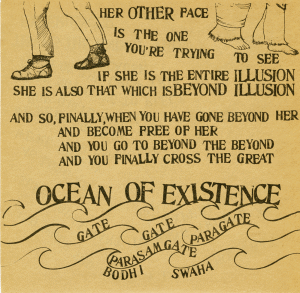
HER OTHER FACE
IS THE ONE
YOU'RE TRYING TO SEE
IF SHE IS THE ENTIRE ILLUSION
SHE IS ALSO THAT WHICH IS BEYOND ILLUSION
AND SO, FINALLY, WHEN YOU HAVE GONE BEYOND HER
AND BECOME FREE OF HER
AND YOU GO TO BEYOND THE BEYOND
AND YOU FINALLY CROSS THE GREAT
OCEAN OF EXISTENCE
GATE GATE PARAGATE
PARASAMGATE
BODHI SWAHA
The Astral Light or Anima Mundi is dual and bisexual. The male part of it is purely divine and spiritual, it is the Wisdom, it is Spirit or Purusha; while the female portion is tainted, in one sense, with matter, is indeed matter, and therefore is evil already.
-- The Secret Doctrine -- The Synthesis of Science, Religion, and Philosophy, by Helena Petrovna Blavatsky
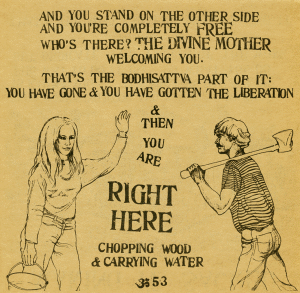
AND YOU STAND ON THE OTHER SIDE
AND YOU'RE COMPLETELY FREE
WHO'S THERE? THE DIVINE MOTHER
WELCOMING YOU.
THAT'S THE BODHISATTVA PART OF IT:
YOU HAVE GONE & YOU HAVE GOTTEN THE LIBERATION
&
THEN
YOU
ARE
RIGHT
HERE
CHOPPING WOOD
& CARRYING WATER

MAKING IT SACRED
The Sun is the ancient symbol of the life-giving and generative power of the Deity. To the ancients, light was the cause of life; and God was the source from which all light flowed; the essence of Light, the Invisible Fire, developed as flame manifested as light and splendor. The Sun was His manifestation and visible image; and the Sabæans' worshipping the Light -- God -- seemed to worship the Sun, in whom they saw the manifestation of the Deity.
The Moon was the symbol of the passive capacity of nature to produce, the female, of which the life-giving power and energy was the male. It was the symbol of Isis, Astarte, and Artemis, or Diana. The "Master of Life" was the Supreme Deity, above both, and manifested through both; Zeus, the Son of Saturn, become King of the Gods; Horus, son of Osiris and Isis, become the Master of Life; Dionusos or Bacchus, like Mithras, become the author of Light and Life and Truth.
The Master of Light and Life, the Sun and the Moon, are symbolized in every Lodge by the Master and Wardens: and this makes it the duty of the Master to dispense light to the Brethren, by himself, and through the Wardens, who are his ministers.
-- Morals and Dogma of the Ancient and Accepted Scottish Rite of Freemasonry, by Albert Pike
***
In the figure now under consideration a kind of pre-eminence seems to be given to the moon over the sun; proceeding probably from the Hindoos not possessing the true solar system, which must however have been known to the people from whom they learnt to calculate eclipses, which they still continue to do, though upon principles not understood by themselves. They now place the earth in the centre of the universe, as the later Greeks did, among whom we also find the same preference given to the lunar symbol.
-- A Discourse on the Worship of Priapus: And Its Connection with the Mystic Theology of the Ancients, by Richard Payne Knight
***
Rome, that reformed the world, accustomed was
Two suns to have, which one road and the other,
Of God and of the world, made manifest.
-- The Divine Comedy of Dante Alighieri, translated by Henry Wadsworth Longfellow
***
Hail! Hail! Unto thee Jove supernal!
Light of the Sun! Of the Sun of the Suns!
Giver of the corn, the wine, and the oil!
Bread of the heart, ecstasy of soul, light that rays the face.
Bountiful Jove! Former of form!
Hail unto Thee! Hail unto Thee!
Essence of ecstasy! Return I unto Thee in rhapsody!
Hail unto Thee, Hail! Hail!
-- The Fire Regained, by Sidney M. Hirsch
***
The Sun's resplendent deity I sing,
The beauteous offspring of almighty Jove,
Who, thro' the vivifying solar fount
Within his fabricative mind conceal'd,
A triad form'd of splendid solar gods;
From whence the world's all-various forms emerg'd
From mystic darkness into beauteous light,
Perfect, and full of intellectual goods.
Hail! Supermundane king of light divine, ...
O best of gods, blest dæmon crown'd with fire,
My soul's sure refuge in the hour of woe, ...
And oft with thee in blissful union join'd
Thro' energy ineffable, may soar
Beyond the highest super-mundane forms
-- Two Orations of the Emperor Julian, One to the Sovereign Sun and the Other to the Mother of the Gods, by Flavius Claudius Julianus
***
We people are the children of the sun, the bright source of life; we are born of the sun and will vanquish the murky fear of death.
-- Children of the Sun, by Maxim Gorky
***
The mystic, as he sees the light of the morning dawn, looks upon it as the daily coming into his soul of the primordial Creative Fiat, "Let there be Light," and as the Light of day progresses and gradually wanes in the western sky, he sees in the glorious tapestry of the sunset a something beyond description by human tongue, a something that can be felt by the soul. If we let those five verses live within us, in the way they do in the mystic, we too, shall know the light, know the truth, as we know nothing else in the world.
-- The Rosicrucian Cosmo-Conception, by Max Heindel
***
The life of the solitary would be cold were it not for the immense sun, which makes the air and rocks glow. The sun and its eternal splendor replace for the solitary his own life warmth. His heart longs for the sun. He wanders to the lands of the sun. He dreams of the flickering splendor of the sun, of the hot red stones spread out at midday, of the golden hot rays of dry sand. The solitary seeks the sun and no one else is so ready to open his heart as he is. Therefore he loves the desert above all, since he loves its deep stillness. He needs little food since the sun and its glow nourish him. Consequently the solitary loves the desert above all since it is a mother to him, giving him food and invigorating warmth at regular hours. In the desert the solitary is relieved of care and therefore turns his whole life to the sprouting garden of his soul, which can flourish only under a hot sun. In his garden the delicious red fruit grows that bears swelling sweetness under a tight skin. You think that the solitary is poor. You do not see that he strolls under laden fruit trees and that his hand touches grain a hundredfold. Under dark leaves the overfull reddish blossoms swell toward him from abundant buds, and the fruit almost bursts with thronging juices. Fragrant resins drip from his trees and under his feet thrusting seed breaks open. If the sun sinks onto the plane of the sea like an exhausted bird, the solitary envelops himself and holds his breath. He does not move and is pure expectancy until the miracle of the renewal of light rises in the East....
He gives you a small insignificant fruit, which has just fallen at his feet. It appears worthless to you, but if you consider it, you will see that this fruit tastes like a sun which you could not have dreamt of. It gives off a perfume which confuses your senses and makes you dream of rose gardens and sweet wine and whispering palm trees. And you hold this one fruit in your hands dreaming, and you would like the tree in which it grows, the garden in which this tree stands, and the sun which brought forth this garden. And you yourself want to be that solitary who strolls with the sun in his garden, his gaze resting on pendant flowers and his hand brushing a hundredfold of grain and his breath drinking the perfume from a thousand roses. Dull from the sun and drunk from fermenting wines, you lie down in ancient graves, whose walls resound with many voices and many colors of a thousand solar years....
You sleep down through the thousand solar years, and you wake up through the thousand solar years, and your dreams full of ancient lore adorn the walls of your bedchamber.
-- The Red Book: Liber Novus, by C.G. Jung
***
JUDAH, THEE SHALL THY BRETHEN PRAISE, THY HAND SHALL BE ON THE NECK OF THY ENEMIES. R. Jose discoursed here on the verse: He made the moon for seasons (Ps. CIV, 19). 'God', he said, 'made the moon for us to sanctify by it new moons and new years. Now the moon never shines except from the reflection of the sun, and when the sun is aloft the moon does not appear, but only when the sun is gathered in does the moon rule the heavens, and the moon is of no account save when the sun is gathered in. God made both of them to give light and also "for signs", to wit, Sabbaths, "and for seasons", to wit, festivals, "and for days", to wit, new moons, "and for years", to wit, New Year days, so that the Gentiles should reckon by the sun and Israel by the moon. This accords with R. Eleazar's exposition of the verse: "Thou hast multiplied the nation, thou hast increased its joy" (Is. IX, 2), where he refers "nation" to Israel and "it" to the moon, which gained accession of light for the sake of Israel. Which are superior, Israel or the Gentiles? Assuredly, the moon is highest, and the sun of the Gentiles is under this moon, and this sun derives light from this moon. See, then, the difference between Israel and the nations. Israel cling to the moon and are linked with the supernal sun, and are attached to the place which gives light to the supernal sun, as it is written: "But ye who cleave to the Lord, are alive every one of you this day" (Deut. IV, 4).'
-- The Zohar, translated by Harry Sperling and Maurice Simon
THIS (CHOPPING WOOD AND CARRYING WATER)
IS KARMA YOGA ... THE YOGA OF DAILY LIFE.
THE WAY TO DO IT IS: DO WHAT YOU DO
BUT DEDICATE THE FRUITS OF THE WORK
TO ME
THAT'S THE MOST ESOTERIC WAY OF SAYING IT.

'What is the difference between the wisdom of Solomon and the wisdom of the children of the east and the wisdom of Egypt, mentioned in the same verse?' He replied: 'The secret of Solomon's wisdom was in the name of the moon when blessed from every side. In his days the moon was magnified and reached her fullness. A thousand mountains rose before her, and she blew them away with a puff. A thousand mighty rivers flowed before her, and she swallowed them at a draught. Her nails reached out in a thousand and seventy directions, and her hands in twenty-four thousand, so that nothing could escape her. Thousands of bucklers clung to her hair. From between her feet went forth a youth who stretched from one end of the world to the other with sixty clubs of fire, and who is also called "Enoch son of Jered." He was called "son of Jered" (lit. descent) in reference to the ten stages by which the Shekinah descended to the earth. Under him are stationed many Hayyoth, under which again is fastened the hair of the moon, which is called "the knobs of the sceptre". Her hands and feet take hold of it like a strong lion holding his prey. Her nails are those who call to mind the sins of men and inscribe them with all rigour and exactness. The offscourings of her nails are all those who do not cleave to the Body of the King and suck from the side of uncleanness, when the moon begins to diminish. Now, after Solomon had inherited the moon in its fullness, he also desired to inherit it in its defective state, and therefore he sought to acquire the knowledge of spirits and demons, so as to inherit the moon on every side. As for the wisdom of Egypt, this is the lower wisdom which is called "the handmaid behind the millstones", and which was also included in the wisdom of Solomon.' Said R. Abba: 'How thankful am I that I asked you this question, since I have received so illuminating an answer.' R. Simeon said further: 'With regard to Solomon's words, "What profit hath man in all his labour?" (Eccl. I, 3), these do not apply to labour in the study of the Torah, since the statement is qualified by the words, "wherein he laboureth under the sun", and the study of the Torah is above the sun.' Said R. Hiya: 'Study of the Torah which is prosecuted for worldly ends is also accounted "under the sun", as it does not ascend aloft'....
R. Hizkiah, citing the verse, "And when the sun was going down, a deep sleep fell on Abram, etc." (Gen. XV, 12), said: 'This verse has been applied to the day of judgement, when man is removed from this world. For we have learnt that the day when man departs this world is the great day of judgement when the sun's light is withheld from the moon, as it is written, "or ever the sun be darkened" (Eccl. XII, 2). This is the holy neshamah which is withheld from man thirty days before he departs from the world. During that time he observes that he throws no shadow, the reason being that his neshamah is withheld from him. For it does not wait until he is on the point of dying, but even while he is still in his full vigour it passes out of him, and does not illumine the spirit, which in turn does not illumine the vital soul, so that his shadow no longer shows. From that day all proclaim his coming fate, even the birds of the heaven.
-- The Zohar, translated by Harry Sperling and Maurice Simon
***
When a planetary chain is in its last Round, its Globe 1 or A, before finally dying out, sends all its energy and “principles” into a neutral centre of latent force, a “laya centre,” and thereby informs a new nucleus of undifferentiated substance or matter, i.e., calls it into activity or gives it life. Suppose such a process to have taken place in the lunar “planetary” chain; suppose again, for argument’s sake, that the moon is far older than the Earth. Imagine the six fellow-globes of the moon — aeons before the first globe of our seven was evolved — just in the same position in relation to each other as the fellow-globes of our chain occupy in regard to our Earth now. And now it will be easy to imagine further Globe A of the lunar chain informing Globe A of the terrestrial chain, and — dying; Globe B of the former sending after that its energy into Globe B of the new chain; then Globe C of the lunar, creating its progeny sphere C of the terrene chain; then the Moon pouring forth into the lowest globe of our planetary ring — Globe D, our Earth — all its life, energy and powers; and, having transferred them to a new centre becoming virtually a dead planet, in which rotation has almost ceased since the birth of our globe. The Moon is now the cold residual quantity, the shadow dragged after the new body, into which her living powers and “principles” are transfused. She now is doomed for long ages to be ever pursuing the Earth, to be attracted by and to attract her progeny. Constantly vampirised by her child, she revenges herself on it by soaking it through and through with the nefarious, invisible, and poisoned influence which emanates from the occult side of her nature. For she is a dead, yet a living body. The particles of her decaying corpse are full of active and destructive life, although the body which they had formed is soulless and lifeless. Therefore its emanations are at the same time beneficent and maleficent — this circumstance finding its parallel on earth in the fact that the grass and plants are nowhere more juicy and thriving than on the graves; while at the same time it is the graveyard or corpse-emanations, which kill. And like all ghouls or vampires, the moon is the friend of the sorcerers and the foe of the unwary. From the archaic aeons and the later times of the witches of Thessaly, down to some of the present tantrikas of Bengal, her nature and properties were known to every Occultist, but have remained a closed book for physicists.
Such is the moon from the astronomical, geological, and physical standpoints. As to her metaphysical and psychic nature, it must remain an occult secret in this work. These are topics, indeed, “on which the adepts are very reserved in their communications to uninitiated pupils,” and since they have, moreover, never sanctioned or permitted any published speculations upon them, the less said the better.
***
A few words more of the Moon. There are some further details which may be added, though they border too closely on forbidden ground to be treated of fully. The last word of the mystery is divulged only to the adepts, but it may be stated that our satellite is only the gross body of its invisible principles. Seeing then that there are 7 Earths, so there are 7 Moons, the last one alone being visible; the same for the Sun, whose visible body is called a Maya, a reflection, just as man’s body is. “The real Sun and the real Moon are as invisible as the real man,” says an occult maxim.
In reality the Moon is only the satellite of the Earth in one respect, viz., that physically the Moon revolves round the Earth. But in every other respect it is the Earth which is the satellite of the Moon, and not vice versa. Startling as the statement may seem it is not without confirmation from scientific knowledge. It is evidenced by the tides, by the cyclic changes in many forms of disease which coincide with the lunar phases; it can be traced in the growth of plants, and is very marked in the phenomena of human gestation and conception. The importance of the Moon and its influence on the Earth were recognized in every ancient religion, notably the Jewish, and have been remarked by many observers of psychical and physical phenomena. But, so far as Science knows, the Earth’s action on the Moon is confined to the physical attraction, which causes her to circle in her orbit. And should an objector insist that this fact alone is sufficient evidence that the Moon is truly the Earth’s satellite on other planes of action, one may reply by asking whether a mother, who walks round and round her child’s cradle keeping watch over the infant, is the subordinate of her child or dependent upon it; though in one sense she is its satellite, yet she is certainly older and more fully developed than the child she watches.
It is, then, the Moon that plays the largest and most important part, as well in the formation of the Earth itself, as in the peopling thereof with human beings. The “Lunar Monads” or Pitris, the ancestors of man, become in reality man himself.
-- The Secret Doctrine -- The Synthesis of Science, Religion, and Philosophy, by Helena Petrovna Blavatsky
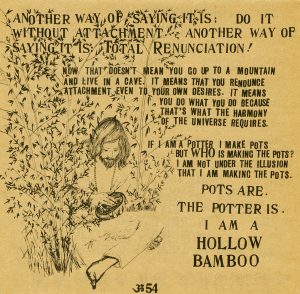
ANOTHER WAY OF SAYING IT IS: DO IT
WITHOUT ATTACHMENT ANOTHER WAY OF
SAYING IT IS: TOTAL RENUNCIATION!
NOW THAT DOESN'T MEAN YOU GO UP TO A MOUNTAIN
AND LIVE IN A CAVE. IT MEANS THAT YOU RENOUNCE
ATTACHMENT EVEN TO YOUR OWN DESIRES. IT MEANS
YOU DO WHAT YOU DO BECAUSE
THAT'S WHAT THE HARMONY OF THE UNIVERSE REQUIRES.
IF I AM A POTTER I MAKE POTS
BUT WHO IS MAKING THE POTS?
I AM NOT UNDER THE ILLUSION
THAT I AM MAKING THE POTS.
POTS ARE.
THE POTTER IS.
The Egyptian ram-headed god makes man of clay on a potter’s wheel, and so in Genesis do the Elohim fashion him out of the same material.
-- The Secret Doctrine -- The Synthesis of Science, Religion, and Philosophy, by Helena Petrovna Blavatsky
I AM A
HOLLOW BAMBOO
I AM A DOCTOR ... A STUDENT ... A DROP-OUT ...
ALL THE SAME GAME
DON'T LET THAT OFFEND YOU, BUT ... THE
EXTERNAL WORLD IS ALL THE SAME ...
IT'S ALL THE EXTERNAL WORLD!
PEOPLE OFTEN SAY TO ME:
I WOULD REALLY LIKE TO DO SADHANA, BUT ... I'M A TEACHER NOW. IF
I COULD ONLY FINISH BEING A TEACHER, I COULD DO SADHANA.
BALONEY! YOU'RE EITHER DOING SADHANA OR
YOU'RE NOT. SADHANA IS A FULL TIME THING
THAT YOU DO BECAUSE THERE IS NOTHING
ELSE TO DO. YOU DO IT WHETHER YOU'RE
TEACHING, OR SITTING IN A MONASTERY ...
WHETHER YOU'RE LYING IN BED,
GOING TO THE TOILET, MAKING LOVE,
EATING,
EVERYTHING IS PART OF
WAKING UP.
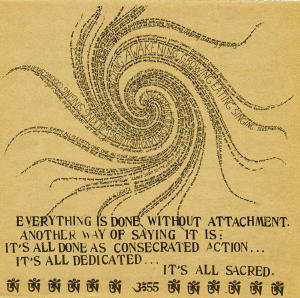
"Fohat traces spiral lines to unite the six to the seventh — the Crown." -- This tracing of “Spiral lines” refers to the evolution of man’s as well as Nature’s principles; an evolution which takes place gradually, as does everything else in nature.
-- The Secret Doctrine -- The Synthesis of Science, Religion, and Philosophy, by Helena Petrovna Blavatsky
EVERYTHING IS DONE WITHOUT ATTACHMENT.
ANOTHER WAY OF SAYING IT IS:
IT'S ALL DONE AS CONSECRATED ACTION ...
IT'S ALL DEDICATED ...
IT'S ALL SACRED.
PRAISE GOD FOR THE LIGHT IN BEING PRAISE GOD FOR THE LOVE
BEING COOKING BUILDING LAUGHING LOVING WALKING SINGING COOKING BREATHING
ALL IS LOVE EMPTY EMPTY ALL IS EMPTY ONE ONE ALL IS ONE LIGHT LIGHT ALL IS LIGHT
PRAISE GOD FOR THE LIGHT IN OUR BEING PRAISE GOD FOR THE LOVE
BEING DANCING PRAYING BUILDING SMILING DYING AWAKENING GROWING EATING SINGING SLEEPING
GROWING SEEING SINGING MOVING DYING SMILING CRYING SHITTING DANCING AWAKENING WALKING TEACHING LAUGHING LEARNING GROWING LIVING

Dew falls from the invisible air, corals grow in the water, and seeds draw their nutriment out of the soil; the earth is a great stomach, in which everything is dissolved, digested, and transformed, and each being draws its nutriment from the earth; and each living being is a stomach that serves as a tomb for other forms, and from which new forms spring into existence. Each organism requires that kind of food which is adapted to its own nature. The body cannot be nourished with theories, nor the mind with potatoes. The body requires material food, the mind mental knowledge; but the soul needs the nutriment that comes from the holy spirit of truth.
Every living being requires that particular kind of food which is adapted to its species and to its individual organism, and Life, the great alchemist, transforms the food taken. A hog, for instance, will extract nutriment out of substances that would act as poisons in the organism of man, but there is no animal known that will eat the excrements of a hog. Animals refuse to eat or drink things which are injurious to them, and they select by their natural instincts those things which they require; it is only given to intellectual man to disobey his natural instincts, and to eat or drink things which are injurious to him, but which may gratify some artificially acquired taste. Man is much more subject to diseases than animals in a state of liberty, because animals live in accordance with the laws of their nature, and man acts continually against the laws of his nature, especially in regard to his eating and drinking. As long as his body is strong it can expel or overcome the injurious influences which are continually caused in it by intemperance, gluttony, and morbid tastes; but such a continuous effort at resistance will imply a serious loss of vitality, and a time will come when disease will be the result, because the organism requires a period of rest and a renewal of strength to expel the accumulated poisonous elements.
-- The Life of Philippus Theophrastus Bombast of Hohenheim Known by the Name of Paracelsus and the Substance of his Teachings, by Franz Hartmann, M.D.
[Librarian's Comment: This assertion is precisely wrong. Gluttony results not from some inherent perversity in human nature, indicative of some tendency to deviate from natural wisdom, but rather from society's ability and inclination to over-satisfy our natural desires for wholesome substances. People become obese from eating fast-food not because they are inclined to gluttony, but because fast-food providers, for commercial benefit, appeal to the human desire for fat, sugar, and salt. Fat, sugar and salt are rare in nature, and thus we have evolved to eat as much of them as we can, whenever they are available. What is really poisoning humanity is wealth itself, and our inability to adjust to abundance after having evolved through millennia of scarcity. This is why there are signs in zoos saying, "Don't feed the animals." By providing a gorilla with a human diet, you can give a gorilla a very human heart attack. Evolutionary forces, genetic in the first instance, social in the second instance, are driving the epidemic of gluttony and substance abuse that are the bane of civilization. Few, however, are those who would return to the enforced asceticism of neolithic scarcity in order to be rid of this affliction.
The diatribe against human nature, so common among moralists of every stripe, argues that unlike animals that have remained loyal to the law of "God and Nature," human beings pursue their own perverse deviations, which in the Judaeo-Christian myth, derives from the sin of Eve, who, out of desire for a new taste-treat, succumbed to the serpent's lure and ate of the Fruit of Knowledge, aka The Apple. Thus, while animals lack free-will, and can neither be saved or damned, humans are said to suffer from the curse of free-will, that can only be cured by subjugation to the Divine Will, for which moral instruction in the form of Religion, is required. Thus, sin all comes down to appetite, and even today we find that the sin of gluttony must be countered with the virtue of "Dieting."]
IN THE OLD DAYS, LIKE MANY OF YOU (I SUPPOSE) I WAS A GOOD ORAL-TYPE PERSON
YOU OPEN THE REFRIGERATOR AND YOU
CAN'T STUFF YOUR MOUTH
FAST ENOUGH! EVERYTHING TURNS YOU ON
THE STIMULUS AROUSES THE RESPONSE
HERE'S A REAL SOUR PICKLE
UMMMMMM--
I'LL HAVE A LITTLE OF THAT!
& THERE'S SOME
ICE CREAM
AND THERE'S SOME COLE SLAW
AND THAT'LL BE GOOD WITH THE ICE CREAM
! TO GO WITH SOMETHING!
OH BOY!
IT'S TOO
MUCH!
UUMMMMMMMMMMM!
HAVE A TASTE OF FLOWER
YOU CAN GO ON THE ORAL TRIP ABOUT EVERY-
THING.
I COME RIGHT OUT OF THAT TRADITION. I WANT YOU TO KNOW
WHERE I STARTED FROM -- FROM WHAT DEPTHS
WHAT DEPTHS
WHEN I WAS AN ADOLESCENT, I WAS SO FAT THAT
ALL MY CLOTHES HAD TO BE SPECIALLY MADE. WE WOULD
GO INTO A STORE AND MY MOTHER WOULD SAY "HE
WANTS TO SEE THE DOUBLE 'Z' WITH BALLOON
SEATS ..."
IT TOOK ME AT LEAST $10,000.00 OF
MY ANALYSIS TO GET RID OF THAT
ONE, I'LL TELL YOU! SO YOU CAN
UNDERSTAND THAT I SPEAK OF
THE ORAL TRIP WITH A CERTAIN
AMOUNT OF EMPATHY
AND NOW SUDDENLY, COMES THIS
NEW RULING SENT DOWN FROM ABOVE
ALL YOUR ACTS WILL BE CONSECRATED
ALL YOUR ACTS WILL BE
CONSECRATED
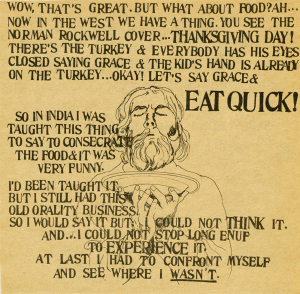
WOW, THAT'S GREAT. BUT WHAT ABOUT FOOD? AH ...
NOW IN THE WEST WE HAVE A THING. YOU SEE THE
NORMAL ROCKWELL COVER -- THANKSGIVING DAY!
THERE'S THE TURKEY & EVERYBODY HAS HIS EYES
CLOSED SAYING GRACE & THE KID'S HAND IS ALREADY
ON THE TURKEY ... OKAY! LET'S SAY GRACE &
EAT QUICK!
SO IN INDIA I WAS
TAUGHT THIS THING
TO SAY TO CONSECRATE
THE FOOD $ IT WAS
VERY FUNNY.
I'D BEEN TAUGHT IT
BUT I STILL HAD THIS
OLD ORALITY BUSINESS.
SO I WOULD SAY IT BUT, I COULD NOT THINK IT.
AND ... I COULD NOT STOP LONG ENUF
TO EXPERIENCE IT.
AT LAST I HAD TO CONFRONT MYSELF
AND SEE WHERE I WASN'T.
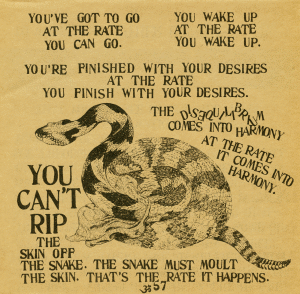
YOU'VE GOT TO GO
AT THE RATE
YOU CAN GO.
YOU WAKE UP
AT THE RATE
YOU WAKE UP.
YOU'RE FINISHED WITH YOUR DESIRES
AT THE RATE
YOU FINISH WITH YOUR DESIRES.
THE DISEQUILIBRIUM
COMES INTO HARMONY
AT THE RATE
IT COMES INTO
HARMONY.
YOU
CAN'T
RIP
THE
SKIN OFF
THE SNAKE. THE SNAKE MUST MOULT
THE SKIN. THAT'S THE RATE IT HAPPENS.
It was left with the early and ignorant Christian fathers to degrade the philosophical and highly scientific idea of this emblem into the absurd superstition called the “Devil.” But the Pagans have always shown a philosophical discrimination in their symbols. The primitive symbol of the serpent symbolised divine Wisdom and Perfection, and had always stood for psychical Regeneration and Immortality. Hence Hermes, calling the serpent the most spiritual of all beings; Moses, initiated in the wisdom of Hermes, following suit in Genesis; the Gnostic’s Serpent with the seven vowels over its head, being the emblem of the seven hierarchies of the Septenary or Planetary Creators. Hence, also, the Hindu serpent Sesha or Ananta, “the Infinite,” a name of Vishnu, whose first Vahan or vehicle on the primordial waters is this serpent. Yet they all made a difference between the good and the bad Serpent, between the former, the embodiment of divine Wisdom in the region of the Spiritual, and the latter, Evil, on the plane of matter. Jesus accepted the serpent as a synonym of Wisdom, and this formed part of his teaching: “Be ye wise as serpents,” he says. “In the beginning, before Mother became Father-Mother, the fiery Dragon moved in the infinitudes alone”. The Aitareya Brahmana calls the Earth Sarparajni, “the Serpent Queen,” and “the Mother of all that moves.” Before our globe became egg-shaped “a long trail of Cosmic dust moved and writhed like a serpent in Space.” The “Spirit of God moving on Chaos” was symbolized by every nation in the shape of a fiery serpent breathing fire and light upon the primordial waters, until it had incubated cosmic matter and made it assume the annular shape of a serpent with its tail in its mouth, which symbolises not only Eternity and Infinitude, but also the globular shape of all the bodies formed within the Universe from that fiery mist. The Universe, as well as the Earth and Man, cast off periodically, serpent-like, their old skins, to assume new ones after a time of rest. The serpent is, surely, a not less graceful or a more unpoetical image than the caterpillar and chrysalis from which springs the butterfly, the Greek emblem of Psyche, the human soul.
-- The Secret Doctrine -- The Synthesis of Science, Religion, and Philosophy, by Helena Petrovna Blavatsky
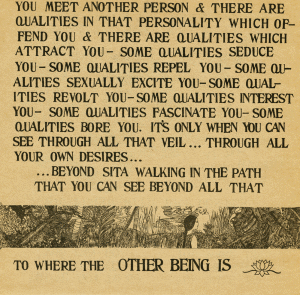
YOU MEET ANOTHER PERSON & THERE ARE
QUALITIES IN THAT PERSONALITY WHICH OF-
FEND YOU & THERE ARE QUALITIES WHICH
ATTRACT YOU -- SOME QUALITIES SEDUCE
YOU -- SOME QUALITIES REPEL YOU -- SOME QUAL-
ITIES REVOLT YOU -- SOME QUALITIES INTEREST
YOU -- SOME QUALITIES FASCINATE YOU -- SOME
QUALITIES BORE YOU. IT'S ONLY WHEN YOU CAN
SEE THROUGH ALL THAT VEIL .. THROUGH ALL
YOUR OWN DESIRES ...
... BEYOND SITA WALKING IN THE PATH
THAT YOU CAN SEE BEYOND ALL THAT
TO WHERE THE OTHER BEING IS
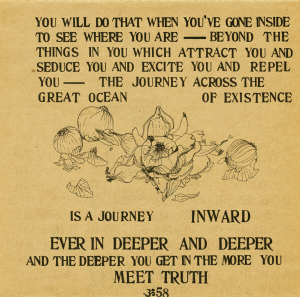
YOU WILL DO THAT WHEN YOU'VE GONE INSIDE
TO SEE WHERE YOU ARE -- BEYOND THE
THINGS IN YOU WHICH ATTRACT YOU AND
SEDUCE YOU AND EXCITE YOU AND REPEL
YOU -- THE JOURNEY ACROSS THE
GREAT OCEAN OF EXISTENCE
IS A JOURNEY INWARD
EVER IN DEEPER AND DEEPER
AND THE DEEPER YOU GET IN THE MORE YOU
MEET THE TRUTH
Statistics: Posted by admin — Fri Sep 25, 2015 8:29 am
]]>
THE FIRST ONE
CONCERNS THE FACT THAT LIFE ALWAYS HAS IN IT
THE ELEMENT OF UNFULFILLMENT:
CALL IT SUFFERING
BIRTH OLD AGE SICKNESS NOT GETTING WHAT
YOU WANT GETTING WHAT YOU DON'T WANT EVEN
GETTING WHAT YOU WANT IN THIS PHYSICAL WORLD
IS GOING TO BE SUFFERING BECAUSE:
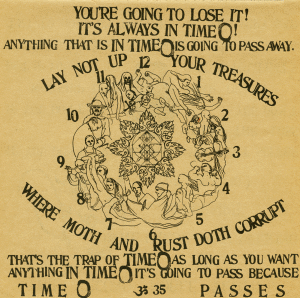
YOU'RE GOING TO LOSE IT!
IT'S ALWAYS IN TIME!
ANYTHING THAT IS IN TIME IS GOING TO PASS AWAY
LAY NOT UP YOUR TREASURES
1
2
3
4
5
6
7
8
9
10
11
12
WHERE MOTH AND RUST DOTH CORRUPT
THAT'S THE TRAP OF TIME AS LONG AS YOU WANT
ANYTHING IN TIME IT'S GOING TO PASS BECAUSE
TIME PASSES

Man had fallen, but not by the tempting of the serpent. For, with the Phoenicians, the serpent was deemed to partake of the Divine Nature, and was sacred, as he was in Egypt. He was deemed to be immortal, unless slain by violence, becoming young again in his old age, by entering into and consuming himself. Hence the Serpent in a circle, holding his tail in his mouth, was an emblem of eternity.
-- Morals and Dogma of the Ancient and Accepted Scottish Rite of Freemasonry, by Albert Pike
***
A serpent, having its tail in its mouth and thus forming a circle, held to represent "the immensity of the power of God," which has neither beginning nor end.
-- The Ancient and Primitive Rite of Memphis and Misraim, Excerpts from "A New Encyclopaedia of Freemasonry," by Arthur Edward Waite
***
En-Sof in Hebrew literally means "there is no end...the very absolute as such, or positive nothing ...the principle of unconditional unity or 'unityness' as such, the principle of freedom from all forms, from all manifestations, and, consequently, from all being)... eternally finds its opposite in itself, so that only through a relationship to this opposite can it assert itself, so that it is perfectly reciprocal."
-- Vladimir Solov'ev on Spiritual Nationhood, Russia and the Jews, by Judith Deutsch Kornblatt
***
"A living mobile trinity of moments": [Hegelian] Dialectics describes the movement of the subject of history, the spirit [Geist], passing through three main stages: first it is posed in itself (an sich, thesis), then it develops out of itself and for itself in its manifestation (fur sich, antithesis), in order to return then into itself (an und fur sich, synthesis) and be with itself as an actualised and manifested being.
-- History, Sophia and the Russian Nation, by Manon de Courten
***
"The outer darkness is a great dragon, whose tail is in his mouth, outside the whole world and surrounding the whole world. And there are many regions of chastisement within it. There are twelve mighty chastisement-dungeons and a ruler is in every dungeon and the face of the rulers is different one from another....the soul[s] of the blasphemers and of those who are in the doctrines of error and of all who teach doctrines of error, and of those who have intercourse with males, and of those stained and impious men and of atheists and murderers and adulterers and sorcerers, -- all such souls then, if while still in life they do not repent but remain persistently in their sin, and all the souls which have stayed behind without, that is those which have had the number of the circuits which are appointed them in the sphere, without having repented, -- well, at their last circuit will those souls, they and all the souls of which I have just told you, be led out of [?] the jaws of the tail of the dragon into the dungeons of the outer darkness. And when those souls of the doors of the dungeons have been led into the outer darkness into the jaws of his tail, he turneth his tail into his own mouth and shutteth them in. Thus will the souls be led into the outer darkness....
And the disk of the sun was a great dragon whose tail was in his mouth and who reached to seven powers of the Left and whom four powers in the form of white horses drew.
-- Pistis Sophia, translated by G.S.R. Mead
[I]n the idea of each power the lower derives its intelligibility from the higher: and the highest must be presumed to inhere latently or potentially in the lowest, or this latter will be wholly unintelligible, inconceivable -- you can have no conception of it. Thus in sensibility we see a power that in every instant goes out of itself, and in the same instant retracts and falls back on itself: which the great fountains of pure Mathesis, the Pythagorean and Platonic Geometricians, illustrated in the production, or self-evolution, of the point into the circle.
-- On the Constitution of the Church and State, According to the Idea of Each; With Aids Toward a Right Judgment on the Late Catholic Bill, by Samuel Taylor Coleridge
***
In October of the same year, Jung presented two talks to the Psychological Club. The first was titled "Adaptation." This took two forms: adaptation to outer and inner conditions. The "inner" was understood to designate the unconscious. Adaptation to the "inner" led to the demand for individuation, which was contrary to adaptation to others. Answering this demand and the corresponding break with conformity led to a tragic guilt that required expiation and called for a new "collective function," because the individual had to produce values that could serve as a substitute for his absence from society. These new values enabled one to make reparation to the collective. Individuation was for the few. Those who were insufficiently creative should rather reestablish collective conformity with a society. The individual had not only to create new values, but also socially recognizable ones, as society had a "right to expect realizable values." The second talk was on "Individuation and collectivity." He argued that individuation and collectivity were a pair of opposites related by guilt. Society demanded imitation. Through the process of imitation, one could gain access to values that were one's own. In analysis, "Through imitation the patient learns individuation, because it reactivates his own values."...
Jung argued that one needed to separate oneself from the unconscious by presenting it visibly as something separate from one. It was vital to differentiate the I from the non-I, namely, the collective psyche or absolute unconscious. To do this, "man must necessarily stand upon firm feet in his I-function; that is, he must fulfil his duty toward life completely, so that he may in every respect be a vitally living member of society."
-- The Red Book: Liber Novus, by C.G. Jung
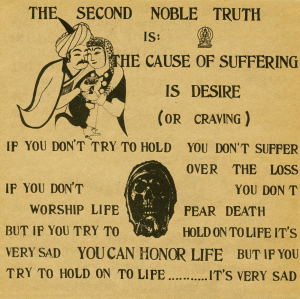
THE SECOND NOBLE TRUTH
IS:
THE CAUSE OF SUFFERING
IS DESIRE
(OR CRAVING)
IF YOU DON'T TRY TO HOLD YOU DON'T SUFFER
OVER THE LOSS
IF YOU DON'T
WORSHIP LIFE
YOU DON'T
FEAR DEATH
BUT IF YOU TRY TO HOLD ON TO LIFE IT'S
VERY SAD YOU CAN HONOR LIFE BUT IF YOU
TRY TO HOLD ON TO LIFE ... IT'S VERY SAD

DID YOU EVER SEE A REALLY BEAUTIFUL WOMAN
LIKE A TOP MODEL WHO IS JUST GETTING
TO THAT POINT WHERE HER LOOKS ARE
CHANGING INTO WHAT COULD BE AN
INTERNAL BEAUTY IF SHE HADN'T
BEEN SO BUSY WITH HER
EXTERNAL BEAUTY? SHE IS CAUGHT
IN THE BEAUTY OF TIME
WHICH WITHERS
HOW POIGNANT!
& YET
WE'VE ALL TOUCHED PEOPLE
WHO WERE SO BEAUTIFUL
AS BEINGS THAT WE
NEVER NOTICE WHETHER
THEY ARE PHYSICALLY
BEAUTIFUL IT'S LIKE
AN ETERNAL BEAUTY
LIVES WITHIN THEM
WELL
IF YOU ATTACH
YOURSELF
IF YOU CRAVE
TEMPORAL THINGS
BEAUTY POSSESSIONS
ACHIEVEMENT
ANYTHING
HOW POIGNANT!

EXAMPLE: SOMEBODY LOOKS AT YOU SEDUCTIVELY ...
AN ICE CREAM CONE GOES BY ... WILL IT EVER BE
THE BIG ICE CREAM CONE
IN THE SKY?
WILL IT EVER BE AN ETERNAL ICE CREAM CONE?
OR ... IS IT ALWAYS GOING TO MELT?
YOU GOTTA KEEP EATING IT YET IT MELTS & MELTS
THAT'S ITS PROBLEM
YOU GOTTA KEEP EATING IT CUZ IT WILL MELT ...
... & THEN IT'S GONE
& YOU KNOW THAT TASTE IN YOUR MOUTH WHEN YOU
FINISH & ... YOU WANT A GLASS OF WATER? RIGHT? ...
THEN YOU HAVE A GLASS OF WATER & THERE'S THAT
BLOATY FEELING?
THEN YOU'RE READY FOR THE NEXT ONE ...
TO GET RID OF THAT ONE ...
LET'S TAKE A WALK ... & YOU TAKE A WALK ...
IT'S COLD OUT. LET'S HAVE SOME HOT CHOCOLATE.
YES, LET'S HAVE SOME, & ON & ON & ON & IT'S CALLED
LIFE
YOU SEE: THE OPPOSITE OF CRAVING IS SAYING
BABY, THIS IS THE WAY IT IS YEAH
OK HERE & NOW THIS IS IT
I ACCEPT THE HERE & NOW
FULLY
AS IT IS
RIGHT AT THIS MOMENT!!!
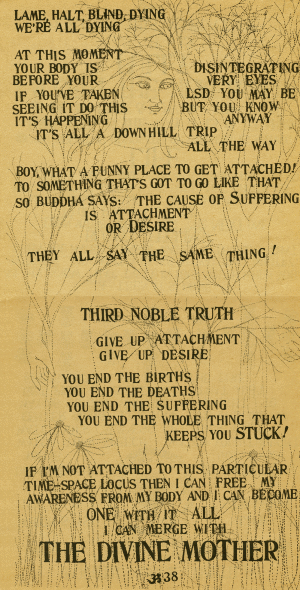
LAME, HALT, BLIND, DYING
WE'RE ALL DYING
AT THIS MOMENT
YOUR BODY IS DISINTEGRATING
BEFORE YOUR VERY EYES
IF YOU'VE TAKEN LSD YOU KNOW
IT'S HAPPENING ANYWAY
IT'S ALL A DOWNHILL TRIP
ALL THE WAY
BOY, WHAT A FUNNY PLACE TO GET ATTACHED!
TO SOMETHING THAT'S GOT TO GO LIKE THAT
SO BUDDHA SAYS: THE CAUSE OF SUFFERING
IS ATTACHMENT
OR DESIRE
THEY ALL SAY THE SAME THING!
THIRD NOBLE TRUTH
GIVE UP ATTACHMENT
GIVE UP DESIRE
YOU END THE BIRTHS
YOU END THE DEATHS
YOU END THE SUFFERING
YOU END THE WHOLE THING THAT
KEEPS YOU STUCK!
IF I'M NOT ATTACHED TO THIS PARTICULAR
TIME-SPACE LOCUS THEN I CAN FREE MY
AWARENESS FROM MY BODY AND I CAN BECOME
ONE WITH IT ALL
I CAN MERGE WITH
THE DIVINE MOTHER
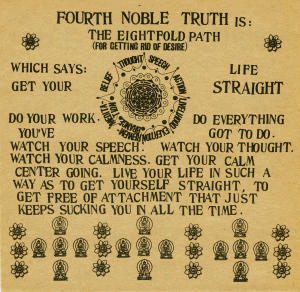
FOURTH NOBLE TRUTH IS:
THE EIGHTFOLD PATH
(FOR GETTING OUT OF DESIRE)
WHICH SAYS:
GET YOUR
LIFE
STRAIGHT
DO YOUR WORK. DO EVERYTHING
YOU'VE GOT TO DO.
WATCH YOUR SPEECH. WATCH YOUR THOUGHT.
WATCH YOUR CALMNESS. GET YOUR CALM
CENTER GOING. LIVE YOUR LIFE IN SUCH A
WAY AS TO GET YOURSELF STRAIGHT, TO
GET FREE OF ATTACHMENT THAT JUST
KEEPS SUCKING YOU IN ALL THE TIME.
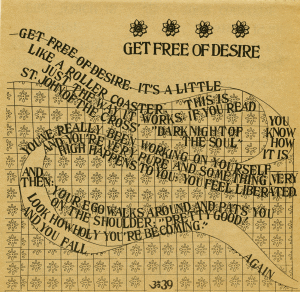
GET FREE OF DESIRE
GET FREE OF DESIRE. IT'S A LITTLE
LIKE A ROLLER COASTER. THIS IS
JUST THE WAY IT WORKS. IF YOU READ
ST. JOHN OF THE CROSS "DARK NIGHT OF
THE SOUL"
YOU KNOW HOW IT IS
However greatly the soul itself labours, it cannot actively purify itself so as to be in the least degree prepared for the Divine union of perfection of love, if God takes not its hand and purges it not in that dark fire.
-- Dark Night of the Soul, by St. John of the Cross
***
According to the Rosicrucian tenets, as handled and explained by the profane for once correctly, if only partially, so “Light and Darkness are identical in themselves, being only divisible in the human mind”; and according to Robert Fludd, “Darkness adopted illumination in order to make itself visible” (On Rosenkranz). According to the tenets of Eastern Occultism, Darkness is the one true actuality, the basis and the root of light, without which the latter could never manifest itself, nor even exist. Light is matter, and Darkness pure Spirit. Darkness, in its radical, metaphysical basis, is subjective and absolute light; while the latter in all its seeming effulgence and glory, is merely a mass of shadows, as it can never be eternal, and is simply an illusion, or Maya.
-- The Secret Doctrine -- The Synthesis of Science, Religion, and Philosophy, by Helena Petrovna Blavatsky
YOU'VE REALLY BEEN WORKING ON YOURSELF
AND YOU'RE VERY PURE AND SOMETHING VERY
HIGH HAPPENS TO YOU: YOU FEEL LIBERATED
AND
THEN:
YOUR EGO WALKS AROUND AND PATS YOU
ON THE SHOULDER: "PRETTY GOOD!
LOOK HOW HOLY YOU'RE BECOMING."
AND YOU FALL ... AGAIN ...
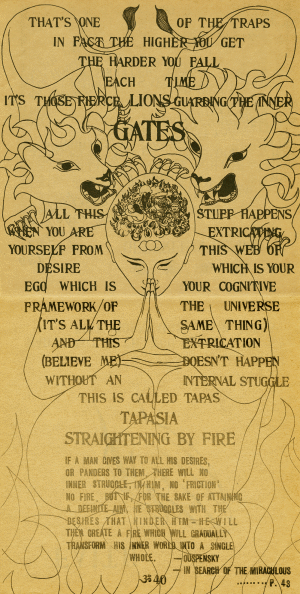
The hierarchy of Creative Powers is divided into seven (or 4 and 3) esoteric, within the twelve great Orders, recorded in the twelve signs of the Zodiac; the seven of the manifesting scale being connected, moreover, with the Seven Planets. All this is subdivided into numberless groups of divine Spiritual, semi-Spiritual, and ethereal Beings. The Chief Hierarchies among these are hinted at in the great Quaternary, or the “four bodies and the three faculties” of Brahma exoterically, and the Panchasyam, the five Brahmas, or the five Dhyani-Buddhas in the Buddhist system. The highest group is composed of the divine Flames, so-called, also spoken of as the “Fiery Lions” and the “Lions of Life,” whose esotericism is securely hidden in the Zodiacal sign of Leo. It is the nucleole of the superior divine World. They are the formless Fiery Breaths, identical in one aspect with the upper Sephirothal Triad, which is placed by the Kabalists in the “Archetypal World.”
-- The Secret Doctrine -- The Synthesis of Science, Religion, and Philosophy, by Helena Petrovna Blavatsky
THAT'S ONE OF THE TRAPS
IN FACT THE HIGHER YOU GET
THE HARDER YOU FALL
EACH TIME
IT'S THOSE FIERCE LIONS GUARDING THE INNER
GATES
ALL THIS STUFF HAPPENS
WHEN YOU ARE EXTRICATING
YOURSELF FROM THIS WEB OF
DESIRE WHICH IS YOUR
EGO WHICH IS YOUR COGNITIVE
FRAMEWORK OF THE UNIVERSE
(IT'S ALL THE SAME THING)
AND THIS EXTRICATION
(BELIEVE ME) DOESN'T HAPPEN
WITHOUT AN INTERNAL STRUGGLE
THIS IS CALLED TAPAS
TAPASIA
STRAIGHTENING BY FIRE
Herakleitus, the Ephesian, who lived five centuries before our era; the "crying" philosopher who declared that "fire was the great cause, and that all things were in a perpetual flux -- his opinions about the origin of things were the same as those of Hippocrates. Both entertained the same views of a supreme power, and, therefore, if their notions of primordial fire, regarded as a material force, in short, as one akin to Leibnitz's dynamism, were "less precise" than those of modern philosophers, a question which remains to be settled yet, on the other hand their metaphysical views of it were far more philosophical and rational than the one-sided theories of our present-day scholars. Their ideas of fire were precisely those of the later "fire-philosophers," the Rosicrucians, and the earlier Zoroastrians. They affirmed that the world was created of fire, the divine spirit of which was an omnipotent and omniscient GOD. Science has condescended to corroborate their claims as to the physical question.
Fire, in the ancient philosophy of all times and countries, including our own, has been regarded as a triple principle. As water comprises a visible fluid with invisible gases lurking within, and, behind all the spiritual principle of nature, which gives them their dynamic energy, so, in fire, they recognized: 1st. Visible flame; 2d. Invisible, or astral fire — invisible when inert, but when active producing heat, light, chemical force, and electricity, the molecular powers; 3d. Spirit. They applied the same rule to each of the elements; and everything evolved from their combinations and correlations, man included, was held by them to be triune. Fire, in the opinion of the Rosicrucians, who were but the successors of the theurgists, was the source, not only of the material atoms, but also of the forces which energize them. When a visible flame is extinguished it has disappeared, not only from the sight but also from the conception of the materialist, forever. But the Hermetic philosopher follows it through the "partition-world of the knowable, across and out on the other side into the unknowable," as he traces the disembodied human spirit, "vital spark of heavenly flame," into the Æthereum, beyond the grave.
-- Isis Unveiled, by Helena P. Blavatsky
IF A MAN GIVES WAY TO ALL HIS DESIRES,
OR PANDERS TO THEM, THERE WILL BE NO
INNER STRUGGLE IN HIM, NO 'FRICTION'
NO FIRE. BUT IF, FOR THE SAKE OF ATTAINING
A DEFINITE AIM, HE STRUGGLES WITH THE
DESIRES THAT HINDER HIM -- HE WILL
THEN CREATE A FIRE WHICH WILL GRADUALLY
TRANSFORM HIS INNER WORLD INTO A SINGLE
WHOLE. -- OUSPENSKY
-- IN SEARCH OF THE MIRACULOUS
... P. 43
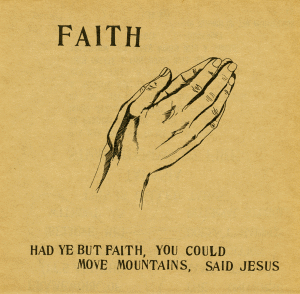
FAITH
HAD YE BUT FAITH, YOU COULD
MOVE MOUNTAINS, SAID JESUS
AND THAT IS LITERALLY TRUE
THE BIBLE IS NOT A METAPHOR
IT'S NOT A STORY MADE UP TO TEACH US
HOW TO BE MORAL BEINGS
IT'S A STRAIGHT MESSAGE OF HOW IT IS
WHEN MAN LIVES IN THE SPIRIT, AND
THE SPIRIT IS RIGHT INSIDE.
THE WAY TO GET INTO THE SPIRIT
IS NOT A LOT OF HOCUS-POCUS.
IT'S A VERY SIMPLE METHODICAL,
MECHANICAL SET OF STEPS
BUT THEY'RE ONLY AVAILABLE
TO HIM WHO CAN HEAR
LET THOSE WHO HAVE EARS HEAR
TEACH NOT HIM WHO DOES NOT WANT TO KNOW.
THE WHOLE GAME IS BASED
ON FAITH.
WHAT YOU MAY NOT UNDERSTAND IS: THE WHOLE
GAME YOU HAVE BEEN PLAYING IS ALSO BASED ON FAITH
YOU HAVE HAD FAITH IN THE RATIONAL MIND
WE ARE LIVING IN A SOCIETY WHICH IS A TEMPLE
DEDICATED TO THE RATIONAL MAN. EVEN THOUGH
THE FIRST COMMANDMENT SAYS:
I AM THE LORD THY GOD
THOU SHALT HAVE
NO OTHER GODS
BEFORE ME
There is no thoughtful soul that does not at times despair. There is perhaps none, of all that think at all of anything beyond the needs and interests of the body, that is not at times startled and terrified by the awful questions which, feeling as though it were a guilty thing for doing so, it whispers to itself in its inmost depths. Some Demon seems to torture it with doubts, and to crush it with despair, asking whether, after all, it is certain that its convictions are true, and its faith well founded: whether it is indeed sure that a God of Infinite Love and Beneficence rules the Universe, or only some great remorseless Fate and iron Necessity, hid in impenetrable gloom, and to which men and their sufferings and sorrows, their hopes and joys, their ambitions and deeds, are of no more interest or importance than the motes that dance in the sunshine. The philosophical and scientific world becomes daily more and more unbelieving. Faith and Reason are not opposites, in equilibrium; but antagonistic and hostile to each other; the result being the darkness and despair of scepticism, avowed, or half-veiled as rationalism. Many a thoughtful mind has so doubted and despaired. How many of us can say that our own faith is so well grounded and complete that we never hear those painful whisperings within the soul? Thrice blessed are they who never doubt, who ruminate in patient contentment like the kine, or doze under the opiate of a blind faith; on whose souls never rests that Awful Shadow which is the absence of the Divine Light.
-- Morals and Dogma of the Ancient and Accepted Scottish Rite of Freemasonry, by Albert Pike
***
Perhaps no word in the English language has been so misinterpreted and abused as the word "Faith." In the various creeds Faith has been degraded to a caput mortuum of dogmatic teaching, which neither saved nor damned anybody but in the imagination of those who framed the creeds; whereas faith -- used in its real sense -- is that condition of mind essential not only to "salvation," but to the performance of any act whatsoever. Without faith I could not take a single step, or write a single line. Faith is the very groundwork of our lives. It is a living force within man, not a dead make-believe in events which are recorded as having occurred in certain places and at certain times. Faith is a power, the manifestation of which lifts man to inconceivable heights of might and grandeur, and the absence of which renders him a helpless molecular mass. "He that believeth not shall be damned." "I don't believe it," says the sceptic. But, all the same, it is true that he who does not believe, not only shall be damned, but is already damned by the negative state of mind he is in -- damned much more effectually than he could be by the fire and brimstone of theology.
-- Ars Vivendi (Art of Living), by Arthur Lovell
***
This precious jewel
Upon the which is every virtue founded...
That as unjust our justice should appear
In eyes of mortals, is an argument
Of faith, and not of sin heretical.
-- Paradiso, from The Divine Comedy of Dante Alighieri, translated by Henry Wadsworth Longfellow
EVEN THOUGH THAT HAS BEEN SAID
& EVEN THOUGH WE REPEAT IT
WE STILL WORSHIP THE RATIONAL MIND AND ITS PRODUCTS
WE WORSHIP OUR OWN SENSE DATA.
IT'S ONLY WHEN WE SEE THE ASSUMPTIONS THAT
WE'VE ALREADY BEEN FUNCTIONING ON THAT
WE CAN START TO EXTRICATE OURSELVES.
WE HAVE GOT TO HAVE HEARD THE FIRST
MESSAGE
BEFORE ANY OF THE KEYS OPEN ANYTHING.
YOU DON'T EVEN KNOW THERE ARE DOORS
UNTIL YOU HAVE HEARD THE FIRST MESSAGE

GEORGES I. GURDJIEFF,
A WESTERNER WHO WENT ON THIS HIGHER TRIP
OR AT LEAST ON A LARGE PART OF THE TRIP, SAID:
YOU DON'T SEEM TO UNDERSTAND
YOU ARE IN PRISON
IF YOU ARE TO GET OUT OF PRISON
THE FIRST THING YOU MUST REALIZE IS:
YOU ARE IN PRISON
IF YOU THINK
YOU'RE FREE YOU CAN'T ESCAPE.
CHAPTER 16: The relativity of the concept of Time
AFTER A BRIEF silence Beelzebub continued "In order for you to have a more exact idea of the strange psyche of those three-brained beings who have taken your fancy and who breed on the planet Earth, and in general a better understanding of everything about this peculiar planet, in my opinion it is very necessary for you to have an accurate conception of how they calculate Time, and of how the being-sensation in their presence of what is called the 'process of the flow of Time' has gradually changed and what it has become today.
"This must be made clear to you because only then will you be able to represent to yourself and understand the events on that planet I have already spoken about and those I shall tell you about later.
"First of all, you must know that in calculating Time the three-brained beings of that planet take the 'year' as the basic unit, just as we do, and they define the duration of their year as the time it takes for their planet to make a certain movement in relation to another cosmic concentration—that is to say, the period during which their planet, in the process of 'falling' and 'catching up,' describes what is called a 'krentonalnian revolution' around its sun.
"This corresponds to our reckoning of a year on the planet Karatas, based upon the period of time between those moments when the sun 'Samos' and the sun 'Selos' are nearest to each other.
"A hundred of these years of theirs the beings of the Earth call a 'century.'
"They divide the year into twelve parts and each part they call a 'month.'
"And they determine the duration of this month by the time it takes for the larger fragment, separated from the Earth—the one they now call 'Moon'—to complete, according to the cosmic laws of falling and catching up, its full krentonalnian revolution around their planet.
"It must be remarked that twelve krentonalnian revolutions of the Moon do not correspond exactly to a single krentonalnian revolution of their planet around its sun, and they have therefore made some compromise or other in calculating these months of theirs, so that the total corresponds more or less to reality.
"Further, they divide their month into thirty 'days,' as they call them.
"And a day they reckon as that span of time during which their planet makes a complete rotation on its axis, under the action of the same cosmic laws.
"Bear in mind, by the way, that they also use the word 'day' to mean that 'trogoautoegocratic' process we call 'kshtatsavakht,' which periodically takes place in the atmosphere of their planet, as on all other planets where the cosmic process called 'ilnosoparno' is actualized. And when this occurs, they say 'it is daytime.'
"As regards the opposite process, which we call 'kldatsakhti,' they call it 'night' and say 'it is dark.'
"Thus the three-brained beings breeding on the planet Earth call their longest unit of measure of time a 'century,' and this century consists of a hundred 'years.' A year has twelve 'months,' a month has an average of thirty 'days.' Further, they divide their day into twenty-four 'hours,' their hour into sixty 'minutes,' and the minute in its turn into sixty 'seconds.'
"But since you, my boy, do not yet have any idea of the exceptional peculiarities of Time, you must first be told that genuine Objective Science defines this cosmic phenomenon thus:
"'Time in itself does not exist, there is only the totality of the results issuing from all the cosmic phenomena present in a given place.'
"Time in itself no being can understand by Reason or perceive by any outer or inner being-function It cannot even be sensed by any gradation of the instinct present in every more or less independent cosmic concentration.
"It is possible to evaluate Time only by comparing different cosmic phenomena occurring under the same conditions and in the same place where Time is being considered.
"It should be noted that in the Great Universe all phenomena, without exception, wherever they arise and are manifest, are simply successive, lawful 'fractions' of some whole phenomenon which has its prime arising on the Most Holy Sun Absolute.
"In consequence, all cosmic phenomena, wherever they proceed, have an 'objective' significance.
"And these successive, lawful fractions are actualized in every respect, even in the sense of their involution and evolution, according to the fundamental cosmic law, the sacred Heptaparaparshinokh.
"Time alone has no objective significance, since it is not the result of the fractioning of any definite cosmic phenomenon Issuing from nothing, but always blending with everything while remaining self-sufficiently independent, Time alone in the whole of the Universe can be named and extolled as the 'Ideally Unique Subjective Phenomenon.'
"Thus, my boy, Time or, as it is sometimes called, the 'Heropass,' is unique in having no source on which its origin depends, and it alone, like "divine Love," always flows independently and blends proportionately with all the phenomena present in all the arisings in any given place in our Great Universe.
"Again I say, you will only be able to understand clearly everything I have just told you when I specially explain to you, as I have already promised, all the aspects of the two fundamental laws of world-creation and world-maintenance.
"Meanwhile, simply remember this: since Time has no source of its arising, and its presence cannot be precisely established, as can be done for all other phenomena in every cosmic sphere, Objective Science has, for its examination of Time, the same 'standard unit' that is used to determine exactly the density and quality, in the sense of the vivifyingness of their vibrations, of all cosmic substances present in every place and in every sphere of our Great Universe.
"And this standard unit for the evaluation of Time has always been the moment of what is called 'sacred egokoolnatsnarnian sensation,' which appears in the Holy Cosmic Individuals dwelling on the Most Holy Sun Absolute whenever the vision of our Uni-Being Endlessness is directed into space and directly touches their presence.
"This standard unit was established in Objective Science to make it possible to define and compare with precision the different degrees of subjective sensation of conscious Individuals as well as what are called the 'diverse tempos' of the various objective phenomena which are manifested throughout the spheres of our Great Universe, and which engender all cosmic arisings, both large and small.
"The chief particularity of the process of the flow of Time consists in this: it is perceived in the same way and in the same sequence by the presences of all cosmic formations of different scales.
"To give you at least some notion of what I have just been saying, let us take as an example the process of the flow of Time in any drop of water in that decanter on the table.
"Each drop of water in that decanter is, in itself, a whole independent world—a world of 'microcosmoses ' In that little world, just as in other cosmoses, there arise and exist relatively independent, infinitesimal 'individuals' or 'beings.
"For the beings of that little world, Time flows in the same sequence as that in which it is sensed by all individuals in all other cosmoses These infinitesimal beings, like the beings of cosmoses of other scales, have the experience of a definite duration for each of their perceptions and manifestations and, like other beings, sense the flow of Time by comparing the duration of phenomena around them.
"Like the beings of other cosmoses, they are born, grow up, unite and separate for what are called 'sexual results', they also fall ill and suffer, and ultimately, like everything existing in which Objective Reason has not become fixed, they are as such destroyed forever.
"The entire process of existence of these infinitesimal beings in their tiny world requires a proportionate duration of time, which as in other worlds ensues from all the surrounding phenomena manifested on that cosmic scale.
"For them also a definite length of time is required for the process of their arising and formation, as well as for the various events in the course of their existence up to their final and complete destruction.
"In the whole course of existence of the beings in this drop of water certain definite and successive what are called 'periods' of the flow of Time are also required.
"A definite time is needed for their joys and for their sorrows, in short, for every kind of indispensable being-experiencing, down to what are called 'runs of bad luck' and even including 'periods of thirst for self-perfection.'
"I repeat, among them, too, the process of the flow of Time has its harmonious sequence, and this sequence ensues from the totality of all surrounding phenomena.
"In general, the duration of the process of the flow of Time is perceived and sensed in the same way by all cosmic individuals and by all completely formed units endowed with instinct, the only difference being due to the quality of their presence and of their state at the given moment.
"However, my boy, it must be pointed out that although, for separate individuals existing in independent cosmic units, the definition of the flow of Time is not objective in the full sense of the word, their experience acquires a sense of objectivity for them, since they perceive the flow of Time according to the completeness of their own presence.
"The same drop of water we have taken as an example can serve to give you a clearer understanding of this thought of mine.
"Although, from the standpoint of universal objectivity, the period of the process of the flow of Time in that drop of water is, for the whole of it, entirely subjective, yet for the beings existing within the drop of water itself, this same period of the flow of Time is perceived as objective.
"To clarify this idea, those beings called 'hypochondriacs' who exist among the three-brained beings of the planet Earth can serve as another example.
"It often seems to these terrestrial hypochondriacs that time passes infinitely slowly or, as they would say, it 'drags phenomenally tediously.'
"In exactly the same way, it may occasionally seem to some infinitesimal beings in that drop of water—assuming, of course, that there happen to be 'hypochondriacs' among them—that time drags phenomenally tediously.
"But in fact, according to the sensation of the duration of Time of your terrestrial favorites, the whole existence of these 'microcosmoses' lasts only a few of their 'minutes,' and sometimes only a few of their 'seconds.'
"Now, my boy, so that you may understand Time and its peculiarities better, let us compare your age with the corresponding age of a being existing on the planet Earth.
"And for this comparison we must take the same standard unit of Time that Objective Science uses for such calculations.
"Bear in mind, first of all, that Objective Science has established— according to data about which you will learn later when I have specially explained to you the fundamental laws of world-creation and worldexistence— that all normal three-brained beings, and among them of course those arising on our planet Karatas, sense the sacred 'egokoolnatsnarnian' action, by which they define Time, forty-nine times more slowly than it is sensed by the Sacred Individuals dwelling on the Most Holy Sun Absolute.
"Consequently, the process of the flow of Time is forty-nine times quicker for the three-brained beings of our Karatas than for the beings on the Sun Absolute, and this is the speed at which it also should flow for those breeding on the planet Earth.
"Moreover, it is calculated that, during the period of time in which the sun Samos completes its movement of closest approach to the sun Selos—the period considered as one 'year' on our Karatas—the planet Earth completes 389 krentonalnian revolutions around its sun Ors It follows from this that our year, according to the conventionally objective calculation of Time, is 389 times longer than the period which your favorites consider a year.
"You will surely be interested to know that these calculations were given to me in part by the great Arch-Engineer of the Universe, His Measurability, the Archangel Algamatant—may he be perfected unto the Holy Anklad! He explained them to me when, on the occasion of the first misfortune to the planet Earth, he came to the planet Mars as one of the sacred members of the third Most High Commission And further calculations were given me by the captain of the trans-space ship Omnipresent, with whom I had several friendly talks on my journey home from exile.
"Now you should note that you, as a three-brained being who arose on the planet Karatas, are at present only a twelve-year-old boy and, with regard to Being and Reason, exactly like a boy of twelve on the planet Earth who is still unformed and not yet aware of himself, an age all three-brained beings there live through in the process of growing up to the Being of a responsible being.
"All the features of your whole psyche—your 'character,' 'temperament,' and 'inclinations,' in short, all the particularities of your psyche that are manifested outwardly—are exactly the same as those of an immature and still pliant three-brained being there at the age of twelve.
"And so, from all I have just said it follows that although, according to our calculation of Time, you are only a boy of twelve, not yet formed and not yet aware of himself, like any boy of that age on the planet Earth, nevertheless, according to the calculation based upon the subjective understanding of your favorites and their being-sensations of the flow of Time, you have already existed not twelve but all of 4,668 years.
"Thanks to all I have said, you will have material for clarifying certain factors that later were the cause of the gradual diminishing of the average normal length of their existence, until it has now become, in the objective sense, 'almost nothing.'
-- Beelzebub's Tales to His Grandson: An Objectively Impartial Criticism of the Life of Man, by G.I. Gurdjieff
"While embodied in matter," [the ancient Nyaya Philosophers] said, "the Soul is in a state of imprisonment, and is under the influence of evil passions; but having, by intense study, arrived at the knowledge of the elements and principles of Nature, it attains unto the place of THE ETERNAL"
-- Morals and Dogma of the Ancient and Accepted Scottish Rite of Freemasonry, by Albert Pike
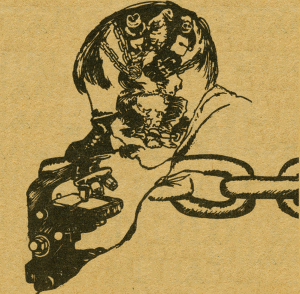
The “fire,” “heat,” and “motion” here spoken of, are, of course, not the fire, heat, and motion of physical science, but the underlying abstractions, the noumena, or the soul, of the essence of these material manifestations — the “things in themselves,” which, as modern science confesses, entirely elude the instruments of the laboratory, and which even the mind cannot grasp, although it can equally little avoid the conclusion that these underlying essences of things must exist. Physical Science is welcome to speculate upon the physiological mechanism of living beings, and to continue her fruitless efforts in trying to resolve our feelings, our sensations, mental and spiritual, into functions of their inorganic vehicles. Nevertheless, all that will ever be accomplished in this direction has already been done, and Science will go no farther. She is before a dead wall, on the face of which she traces, as she imagines, great physiological and psychic discoveries, but every one of which will be shown later on to be no better than the cobwebs spun by her scientific fancies and illusions. The tissues of our objective framework alone are subservient to the analysis and researches of physiological science. The six higher principles in them will evade for ever the hand that is guided by an animus that purposely ignores and rejects the Occult Sciences. What is our scientific philosophy but that which was so justly and so politely defined by Kant as “the Science of the limits to our Knowledge”? Where have the many attempts made by Science to bind, to connect, and define all the phenomena of organic life by mere physical and chemical manifestations, brought it to? To speculation generally — mere soap-bubbles, that burst one after the other before the men of Science were permitted to discover real facts. All this would have been avoided, and the progress of knowledge would have proceeded with gigantic strides, had only Science and its philosophy abstained from accepting hypotheses on the mere one-sided Knowledge of their Matter.
Dzyu is the one real knowledge, or Occult Wisdom; which, dealing with eternal truths and primal causes, becomes almost omnipotence when applied in the right direction. Its antithesis is Dzyu-mi, that which deals with illusions and false appearances only, as in our exoteric modern sciences.
-- The Secret Doctrine -- The Synthesis of Science, Religion, and Philosophy, by Helena Petrovna Blavatsky
***
The eyes of a world that stepped out from a night of bigotry into the light of day were dazzled and blinded for a while by the vain glitter of a pile of rubbish and broken pots that had been collected by the advocates of material science, who palmed it off for diamonds and precious stones; but the world has recovered from the effect of the glare, and realised the worthlessness of the rubbish, and it again seeks for the less dazzling but priceless light of the truth. Treasures that have long been buried and hidden away from the sight of those that were neither able to realise nor to appreciate their value are now brought to light; pearls of ancient wisdom are brought from the East; fountains of knowledge that have been for centuries closed up are again opened, and a flood of light is thrown over things that appeared impossible, mysterious, and occult.
-- The Life of Philippus Theophrastus Bombast of Hohenheim Known by the Name of Paracelsus and the Substance of his Teachings, by Franz Hartmann, M.D.
***
'Whoever desires to sit with God most High, let him sit with the people of Sufism.' These intellectual sciences are a game and a waste of life, compared with the spiritual experiences of dervishes. When a man has reached the age of discretion and is intelligent and completely formed, he no longer plays; or if he does, he keeps it secret out of exceeding shame so that no one may see him. This intellectual science and discussion and worldly whims are as the wind, and man is dust; when the wind tangles with the dust, wherever it reaches it makes the eyes sore, and nothing but conturbation and protestation accrues from its existence. But although man is dust, with every word he hears he weeps, and his tears are as running water. Now when instead of wind, water descends upon the dust, undoubtedly the exact opposite comes to pass. When dust gets water, fruit and grass and fragrant herbs and violets and roses grow. This way of poverty is a way in which you attain all your desires. Whatsoever thing you have longed for will certainly come to you on this way, whether it be the shattering of armies, victory over the enemy, capturing kingdoms, reducing people to subjection, excelling your contemporaries, elegance of speech, eloquence, and all that is like to this.
-- Discourses of Rumi, translated by A. J. Arberry
***
In our civilization the chasm that stretches between mind and heart yawns deep and wide and, as the mind flies on from discovery to discovery in the realms of science, the gulf becomes ever deeper and wider and the heart is left further and further behind. The mind loudly demands and will be satisfied with nothing less than a materially demonstrable explanation of man and his fellow-creatures that make up the phenomenal world. The heart feels instinctively that there is something greater, and it yearns for that which it feels is a higher truth than can be grasped by the mind alone. The human soul would fain soar upon ethereal pinions of intuition; would fain lave in the eternal fount of spiritual light and love; but modern scientific views have shorn its wings and it sits fettered and mute, unsatisfied longings gnawing at its tendrils as the vulture of Prometheus' liver....
As surely as the pre-existing light created the eye whereby the light is seen; as surely as the primordial desire for growth created the digestive and assimilative system for the attainment of that end; as surely as thought existed before the brain and built and still is building the brain for its expression; as surely as the mind is now forging ahead and wringing her secrets from nature by the very force of its audacity, just so surely will the heart find a way to burst its bonds and gratify its longings. At present it is shackled by the dominant brain. Some day it will gather strength to burst its prison bars and become a power greater than the mind....
Man has within himself faculties which eliminate distance and compensate for lack of size to a degree as much greater than the power of telescope and microscope as theirs exceeds that of the naked eye. These senses or faculties are the means of investigation used by occultists. They are their "open sesame" in searching for truth....
The occult scientist sees in everything that happens a cause of a spiritual nature manifesting itself, not omitting the prevalence and alarmingly increasing frequency of seismic disturbances, which it traces to the materialistic thought of modern science.
-- The Rosicrucian Cosmo-Conception, by Max Heindel
***
You should become serious, and hence take your leave from science. There is too much childishness in it. Your way goes toward the depths. Science is too superficial, mere language, mere tools....
I believe that we have the choice: I preferred the living wonders of the God. I daily weigh up my whole life and I continue to regard the fiery brilliance of the God as a higher and fuller life than the ashes of rationality. The ashes are suicide to me.
-- The Red Book: Liber Novus, by C.G. Jung
***
"You see, my boy, what coincidences occur in our Great Universe. This etherogram refers to your favorites in connection with the 'ape-beings' I just mentioned. It was sent to me from Mars and informs me, among other things, that the three-centered beings of the planet Earth are once more troubled by the 'ape question.'
"I must first tell you that on account of their abnormal being-existence, there was long ago crystallized and there is periodically intensified in the presence of those peculiar three-brained beings arising and existing on the planet Earth a strange factor, producing from time to time a 'crescendo impulse,' under the action of which they wish to find out at any cost whether they have descended from these apes or the apes have descended from them.
"Judging from the etherogram, this time the question is agitating chiefly the biped beings who breed on the continent called 'America. '
"Although this question always troubles them somewhat, every once in a while it becomes for a long time, as they express it, the 'burning question of the day. '
"I remember very well that this 'agitation of mind' over the origin of the apes occurred among them for the first time when their 'center of culture,' as they also like to express it, was the country of Tikliamish The starting point of this 'agitation of mind' was the wiseacring of a certain 'learned being of new formation' named Menitkel.
"This Menitkel became a learned being because, in the first place, his childless aunt was an excellent 'matchmaker,' and mixed a great deal with 'power-possessing beings', and because, in the second place, at the age when he was on the threshold of being a responsible being he was given as a birthday present a book entitled Manual of Bon Ton and Love-Letter Writing. As he was financially secure and therefore quite free, thanks to an inheritance from his uncle, a former pawnbroker, he compiled, out of boredom, a massive and erudite work about the origin of these apes, in which he 'cooked up' an elaborate theory supported by all kinds of 'logical proof,' but of course such 'logical proof as can be conceived and crystallized only in the Reason of those freaks who have taken your fancy.
"This Menitkel then 'proved' by his theory that their 'fellow countrymen,' the apes, were descended from none other than people who had, as they say, 'gone wild ' The other terrestrial beings of that period, as had already become proper to them, believed implicitly this Auntie's darling, without any 'essence-criticism' whatsoever, and from that time on this question, agitating the strange 'Reason' of your favorites, became the subject of disputes and fantasies, right up until what is called the seventh 'great planetary process of reciprocal destruction.'
"Thanks to this maleficent idea there was fixed in the instincts of most of the unfortunates of that period another abnormal so-called 'dictatorial factor,' which began to engender in their common presence the false feeling that these ape-beings were sacred. And this factor, which engendered such a sacrilegious impulse, passed by heredity from generation to generation and reached the instincts of many beings even of the present time.
"As for the false notion cooked up by that 'pawnshop progeny,' it held its ground for nearly two of their centuries and became an integral part of the 'Reason' of most of them. But due to various events growing out of the seventh planetary process of reciprocal destruction, which lasted nearly half a century, it gradually faded away and completely disappeared from their common presence.
"But when their so-called 'cultured existence' became concentrated on the continent of 'Europe,' and when the time again came around for that peculiar disease known as 'wiseacring' to manifest itself with maximum intensity—for this disease, by the way, had long before become subject to the fundamental cosmic law of Heptaparaparshinokh, according to which its intensity had to fluctuate with a certain periodicity—then, to the grief of three-brained beings of the whole Universe, that 'ape question,' or 'who is descended from whom,' once more arose and having become crystallized again became part of the abnormal 'Reason' of your favorites.
"In this instance also, the 'ape question' arose from the stimulus given by a learned being, of course again a 'great' one, but of an altogether 'new formation,' by the name of Darwin. This 'great' scientist, basing his theory on that same logic of theirs, set about 'proving' exactly the opposite of what Menitkel had said, that is, he 'proved' that it was they themselves who were descended from these Mister Apes.
"As for the objective reality of either of the theories of these 'great' terrestrial learned beings, I am reminded of one of the wise sayings of our esteemed Mullah Nasr Eddin:
"'Luck smiled on them both, for they both managed to find the authentic godmother of the incomparable Scheherazade on an old dunghill.'
"In any case, bear in mind that for many centuries this question, among others just as ephemeral, has provided material for the kind of thinking your favorites consider the 'highest manifestation of Reason.'
"In my opinion your favorites could get a correct answer to this question that always agitates them of how the apes arose, if only they really knew how to apply another of the maxims of our dear Mullah Nasr Eddin, who often used to say:
'The cause of every misunderstanding must be sought in woman. '
"If they had made use of this wise maxim to resolve their enigmatic question perhaps they would have finally discovered the origin of these fellow countrymen of theirs.
"As the subject of the genealogy of these apes is indeed exceedingly complicated and unusual, I shall inform your Reason about it from every possible aspect.
"The fact is that neither are your favorites descended from apes nor are apes descended from them, but the cause of the arising of these apes is in this case—as in every other misunderstanding there—their women.
-- Beelzebub's Tales to His Grandson: An Objectively Impartial Criticism of the Life of Man, by G.I. Gurdjieff
WHAT CALMING THE MIND IS ALL ABOUT
WHAT MEDITATION IS FOR
IS TO COOL YOU OUT SO YOU
RE-MEMBER
SO YOU SEE HOW IT ALL IS
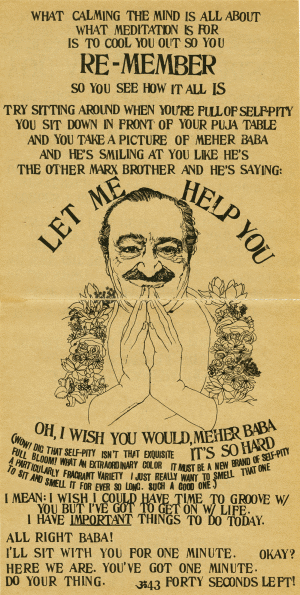
TRY SITTING AROUND WHEN YOU'RE FULL OF SELF-PITY
YOU SIT DOWN IN FRONT OF YOUR PUJA TABLE
AND YOU TAKE A PICTURE OF MEHER BABA
AND HE'S SMILING AT YOU LIKE HE'S
THE OTHER MARX BROTHER AND HE'S SAYING:
LET ME HELP YOU
OH, I WISH YOU WOULD, MEHER BABA
(WOW! DIG THAT SELF-PITY ISN'T THAT EXQUISITE IT'S SO HARD
FULL BLOOM! WHAT AN EXTRAORDINARY COLOR IT MUST BE A NEW BRAND OF SELF-PITY
A PARTICULARLY FRAGRANT VARIETY I JUST REALLY WANT TO SMELL THAT ONE
TO SIT AND SMELL IT FOR EVER SO LONG. SUCH A GOOD ONE.)
I MEAN: I WISH I COULD HAVE TIME TO GROOVE W/
YOU BUT I'VE GOT TO GET ON W/LIFE.
I HAVE IMPORTANT THINGS TO DO TODAY.
ALL RIGHT BABA!
I'LL SIT WITH YOU FOR ONE MINUTE. OKAY?
HERE WE ARE. YOU'VE GOT ONE MINUTE.
DO YOUR THING. FORTY SECONDS LEFT!
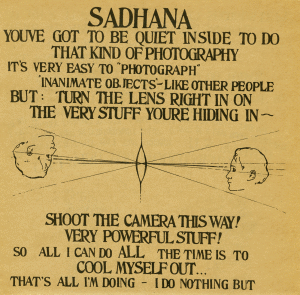
SADHANA
YOU'VE GOT TO BE QUIET INSIDE TO DO
THAT KIND OF PHOTOGRAPHY
IT'S VERY EASY TO "PHOTOGRAPH"
'INANIMATE OBJECTS' -- LIKE OTHER PEOPLE
BUT: TURN THE LENS RIGHT IN ON
THE VERY STUFF YOU'RE HIDING IN --
SHOOT THE CAMERA THIS WAY!
VERY POWERFUL STUFF!
The personality is the reflected picture of the Spirit, the mind being the mirror, or focus. As when reflected in a pond, the images of trees appear inverted, the foliage seeming to be the deepest down in the water, so the highest aspect of the spirit (the Divine Spirit) finds its counterpart in the lowest of the three bodies (the dense body). The next highest spirit (the life spirit) is reflected in the next lowest body (the vital body). The third spirit (the human spirit) and its reflection, the third body (the desire body), appear closest of all to the reflecting mirror, which is the mind, the latter corresponding to the surface of the pond -- the reflecting medium in our analogy. The Spirit came down from the higher Worlds during involution; and by concurrent action, the Bodies were built upward in the same period. It is the meeting of these two streams in the focusing Mind that marks the point in time when the individual, the human being, the Ego, is born -- when the Spirit takes possession of its vehicles.
-- The Rosicrucian Cosmo-Conception, by Max Heindel
***
AMORC analyzes the five senses, focusing on the eyes. In its discussion, it utilizes the example of movie projection, citing the scientific explanation of the process as correct -- but not complete.
-- The Prisoner of San Jose: How I Escaped From Rosicrucian Mind Control, by Pierre S. Freeman
***
The power of vaticination, popularly denominated "second sight," appears to have been possessed by [Emerson and Plato]. Apollonius asserts his own possession of the faculty as follows:
"I can see the present and the future in a clear mirror. The sage need not wait for the vapors of the earth and the corruption of the air to foresee plagues and fevers; he must know them later than God, but earlier than the people. The theoi or gods see the future; common men, the present; sages, that which is about to take place. My peculiar abstemious mode of life produces such an acuteness of the senses, or creates some other faculty, so that the greatest and most remarkable things may be performed."
This is what may be termed spiritual photography. The soul is the camera in which facts and events, future, past, and present, are alike fixed; and the mind becomes conscious of them. Beyond our everyday world of limits, all is as one day or state -- the past and future comprised in the present.
-- New Platonism and Alchemy, by Alexander Wilder
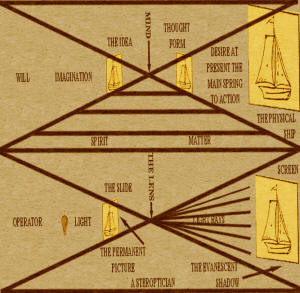

SO ALL I CAN DO ALL THE TIME IS TO
COOL MYSELF OUT ...
THAT'S ALL I'M DOING -- I DO NOTHING BUT
SADHANA
IF SOMEBODY SAYS: WHAT DO YOU DO, MAN?
I SAY: I DO SADHANA
SURE, BUT DON'T YOU LECTURE?
SURE, LECTURING HAPPENS BUT
I'M DOING SADHANA
THIS TRIP IS HELPING ME GET FREE OF MY EGO.
BECAUSE: IF I GET FREE OF MY EGO
WE ALL GET FREE OF OUR EGO
BECAUSE: THAT'S THE WAY THE TRIP WORKS
BECAUSE: WE'RE ALL THE SAME BEING AND
THAT'S THE PROBLEM -- WE CAN ONLY MOVE AS
FAST AS WE ALL CAN MOVE ...
YOU CAN HEAR THIS MESSAGE ONLY AS PURELY AS
I AM PURE. THAT'S THE WAY IT BOILS DOWN --
I CAN RESONATE WITH YOU IN THE HIGHEST PLACE
I AM
SO: I CAN DO NOTHING FOR YOU BUT
WORK ON MYSELF ...
YOU CAN DO NOTHING FOR ME BUT
WORK ON YOURSELF!
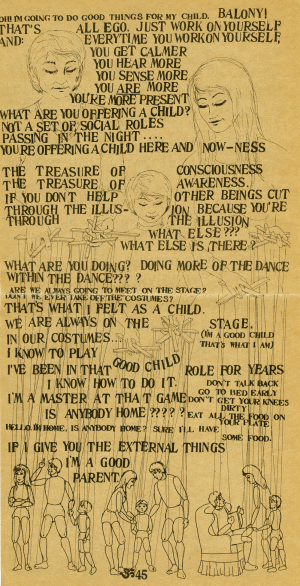
OH! I'M GOING TO DO GOOD THINGS FOR MY CHILD. BALONY!
THAT'S ALL EGO. JUST WORK ON YOURSELF
AND: EVERYTIME YOU WORK ON YOURSELF,
YOU GET CALMER
YOU HEAR MORE
YOU SENSE MORE
YOU ARE MORE
YOU'RE MORE PRESENT
WHAT ARE YOU OFFERING A CHILD?
NOT A SET OF SOCIAL ROLES
PASSING IN THE NIGHT ...
YOU'RE OFFERING A CHILD HERE AND NOW-NESS
THE TREASURE OF CONSCIOUSNESS
THE TREASURE OF AWARENESS.
IF YOU DON'T HELP OTHER BEINGS CUT
THROUGH THE ILLUS-ION BECAUSE YOU'RE
THROUGH THE ILLUSION
WHAT ELSE???
WHAT ELSE IS THERE?
WHAT ARE YOU DOING? DOING MORE OF THE DANCE
WITHIN THE DANCE??? ?
ARE WE ALWAYS GOING TO MEET ON THE STAGE?
DON'T WE EVER TAKE OFF THE COSTUMES?
THAT'S WHAT I FELT AS A CHILD.
WE ARE ALWAYS ON THE STAGE.
IN OUR COSTUMES
(I'M A GOOD CHILD
THAT'S WHAT I AM)
I KNOW TO PLAY
GOOD CHILD
I'VE BEEN IN THAT ROLE FOR YEARS
I KNOW HOW TO DO IT.
DON'T TALK BACK
GO TO BED EARLY
I'M A MASTER AT THAT GAME
DON'T GET YOUR KNEES
DIRTY
IS ANYBODY HOME???? ? EAT ALL THE FOOD ON
YOUR PLATE.
HELLO. I'M HOME. IS ANYBODY HOME? SURE I'LL HAVE
SOME FOOD.
IF I GIVE YOU THE EXTERNAL THINGS
I'M A GOOD
PARENT
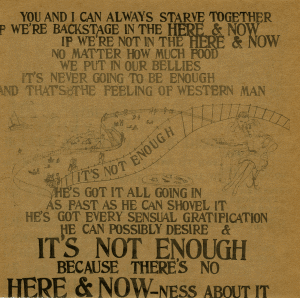
YOU AND I CAN ALWAYS STARVE TOGETHER
WE'RE BACKSTAGE IN THE HERE & NOW
IF WE'RE NOT IN THE HERE & NOW
NO MATTER HOW MUCH FOOD
WE PUT IN OUR BELLIES
IT'S NEVER GOING TO BE ENOUGH
AND THAT'S THE FEELING OF WESTERN MAN
IT'S NOT ENOUGH
HE'S GOT IT ALL GOING IN
AS FAST AS HE CAN SHOVEL IT
HE'S GOT EVERY SENSUAL GRATIFICATION
HE CAN POSSIBLY DESIRE &
IT'S NOT ENOUGH
BECAUSE THERE'S NO
HERE & NOW-NESS ABOUT IT
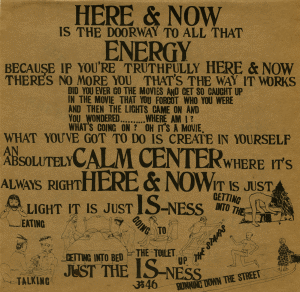
HERE & NOW
IS THE DOORWAY TO ALL THAT
ENERGY
BECAUSE IF YOU'RE TRUTHFULLY HERE & NOW
THERE'S NO MORE YOU THAT'S THE WAY IT WORKS
DID YOU EVER GO TO THE MOVIES AND GET SO CAUGHT UP
IN THE MOVIE THAT YOU FORGOT WHO YOU WERE
AND THEN THE LIGHTS CAME ON AND
YOU WONDERED ... WHERE AM I?
WHAT'S GOING ON? OH IT'S A MOVIE
WHAT YOU'VE GOT TO DO IS CREATE IN YOURSELF
AN
ABSOLUTELY CALM CENTER WHERE IT'S
ALWAYS RIGHT HERE & NOW IT IS JUST
LIGHT IT IS JUST IS-NESS GETTING INTO THE
EATING
GOING TO
THE TOILET
GETTING INTO BED
UP THE STAIRS
JUST THE IS-NESS
TALKING
RUNNING DOWN THE STREET
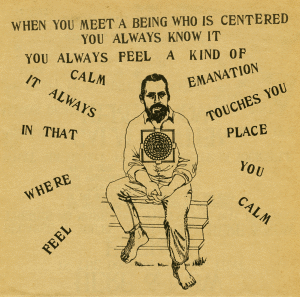
WHEN YOU MEET A BEING WHO IS CENTERED
YOU ALWAYS KNOW IT
YOU ALWAYS FEEL A KIND OF
CALM
EMANATION
IT ALWAYS
TOUCHES YOU
IN THAT
PLACE
WHERE
YOU
FEEL
CALM
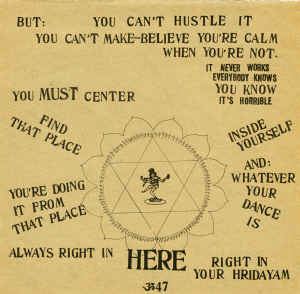
BUT: YOU CAN'T HUSTLE IT
YOU CAN'T MAKE-BELIEVE YOU'RE CALM
WHEN YOU'RE NOT.
IT NEVER WORKS
EVERYBODY KNOWS
YOU KNOW
IT'S HORRIBLE
YOU MUST CENTER
FIND THAT PLACE
INSIDE YOURSELF
AND:
WHATEVER
YOUR
DANCE
IS
YOU'RE DOING
IT FROM
THAT PLACE
ALWAYS RIGHT IN HERE RIGHT IN
YOUR HRIDAYAM
Statistics: Posted by admin — Fri Sep 25, 2015 8:15 am
]]>
1-2-ME
From the Heavens come the spiritual and immortal portion of man; from the Earth his material and mortal portion. ... and he attains the purposes of his being only when the two natures that are in him are in just equilibrium.
-- Morals and Dogma of the Ancient and Accepted Scottish Rite of Freemasonry, by Albert Pike
***
An adept keeps his two personalities — the spiritual and the physical — entirely separated.
-- The Secret Doctrine -- The Synthesis of Science, Religion, and Philosophy, by Helena Petrovna Blavatsky
***
In man a twofold and discordant nature is discerned conciliated into one, i.e. the nature of soul and body; the former of which is divine, and the latter shadowy and dark, the source of contention and strife.
-- Two Orations of the Emperor Julian, One to the Sovereign Sun and the Other to the Mother of the Gods, by Flavius Claudius Julianus
***
In order to be able to acquire the primeval feminine force of the universe, a yogi must have mastered the appropriate spiritual methods (upaya), which we examine in detail later in this study. The well-known investigator of Tibetan culture, David Snellgrove, describes their chief function as the transmutation of the feminine form into the masculine with the intention of accumulating power. It is for this and no other reason that the tantric seeks contact with a female.... the powerful feminine creates the world, the “uncreative” masculine yogi can only become a creator if he appropriates the creative powers of the goddess. “May I be born from birth to birth”, he thus cries in the Hevajra Tantra, “concentrating in myself the essence of woman”. He is the sorcerer who believes that all power is feminine, and that he knows the secret of how to manipulate it.
The key to his dreams of omnipotence lies in how he is able to transform himself into a “supernatural” being, an androgyne who has access to the potentials of both sexes. The two sexual energies now lose their equality and are brought into a hierarchical relation with each other in which the masculine part exercises absolute control over the feminine....
Since the “bisexuality” of the yogi represents a precondition for the development of his power, it forms a central topic of discussion in every highest tantra. It is known simply as the “two-in-one” principle, which suspends all oppositions, such as wisdom and method, subject and object, emptiness and compassion, but above all masculine and feminine. Other phrases include “bipolarity” or the realization of “bisexual divinity within one’s own body”.
However, the “two-in-one” principle is not directed at a state beyond sexuality and erotic love, as modern interpreters often misunderstand it to be. The tantric master deliberately utilizes the masculine/feminine sexual energies to obtain and exercise power and does not destroy them, even if they are only present within his own identity after the initiation. They continue to function there as the two polar primeval forces, but now within the androgynous yogi.
-- The Shadow of the Dalai Lama, by Victor & Victoria Trimondi
***
[T]he feeling-attitude breaks down and the progression of libido also ceases. The vital feeling that was present before disappears, and in its place the psychic value of certain conscious contents increases in an unpleasant way; subjective contents and reactions press to the fore and the situation becomes full of affect and ripe for explosions. These symptoms indicate a damming up of libido, and the stoppage is always marked by the breaking up of the pairs of opposites. During the progression of libido the pairs of opposites are united in the co-ordinated flow of psychic processes. Their working together makes possible the balanced regularity of these processes, which without this inner polarity would become one-sided and unreasonable. We are therefore justified in regarding all extravagant and exaggerated behaviour as a loss of balance, because the co-ordinating effect of the opposite impulse is obviously lacking. Hence it is essential for progression, which is the successful achievement of adaptation, that impulse and counter-impulse, positive and negative, should reach a state of regular interaction and mutual influence. This balancing and combining of pairs of opposites can be seen, for instance, in the process of reflection that precedes a difficult decision. But in the stoppage of libido that occurs when progression has become impossible, positive and negative can no longer unite in co-ordinated action, because both have attained an equal value which keeps the scales balanced. The longer the stoppage lasts, the more the value of the opposed positions increases; they become enriched with more and more associations and attach to themselves an ever-widening range of psychic material. The tension leads to conflict, the conflict leads to attempts at mutual repression, and if one of the opposing forces is successfully repressed a dissociation-ensues, a splitting of the personality, or disunion with oneself. The stage is then set for a neurosis. The acts that follow from such a condition are unco-ordinated, sometimes pathological, having the appearance of symptomatic actions. Although in part normal, they are based partly on the repressed opposite which, instead of working as an equilibrating force, has an obstructive effect, thus hindering the possibility of further progress.
-- On the Nature of the Psyche, by C.G. Jung
***
This peculiar linking-together of opposites -- knowledge with ignorance, cynicism with fanaticism -- is one of the chief distinguishing marks of Oceanic society. The official ideology abounds with contradictions even when there is no practical reason for them. Thus, the Party rejects and vilifies every principle for which the Socialist movement originally stood, and it chooses to do this in the name of Socialism. It preaches a contempt for the working class unexampled for centuries past, and it dresses its members in a uniform which was at one time peculiar to manual workers and was adopted for that reason. It systematically undermines the solidarity of the family, and it calls its leader by a name which is a direct appeal to the sentiment of family loyalty. Even the names of the four Ministries by which we are governed exhibit a sort of impudence in their deliberate reversal of the facts. The Ministry of Peace concerns itself with war, the Ministry of Truth with lies, the Ministry of Love with torture and the Ministry of Plenty with starvation. These contradictions are not accidental, nor do they result from ordinary hypocrisy; they are deliberate exercises in doublethink. For it is only by reconciling contradictions that power can be retained indefinitely. In no other way could the ancient cycle be broken. If human equality is to be for ever averted -- if the High, as we have called them, are to keep their places permanently -- then the prevailing mental condition must be controlled insanity.
-- Nineteen Eighty-Four (1984), by George Orwell
***
Now we read in regard to Job that "his sons went and feasted ... and sent and called for their three sisters to eat and to drink with them" (Job I, 4.).While they thus feasted and made merry the Accuser was daily present in their midst, but he could not prevail against them, as it is written: "Hast not thou made an hedge about him and about his house?" And when Job made sacrifices, he did not give Satan any part whatsoever, for it says, "He offered burnt-offerings according to the number of them all" (Ibid. 5), this being an offering which ascends ('olah) entirely on high, so that he gave no portion to the "other side". Had he done so, the Accuser would not have been able to prevail against him. Hence in the end he only took what was his due. As to the question which might be asked, why then did God allow Job to suffer thus, the answer would be that, had he given Satan his due, the "unholy side" would have separated itself from the holy, and so allowed the latter to ascend undisturbed into the highest spheres; but since he did not do so, the Holy One let justice be executed on him. Mark this! As Job kept evil separate from good and failed to fuse them, he was judged accordingly: first he experienced good, then what was evil, then again good. For man should be cognizant of both good and evil, and turn evil itself into good. This is a deep tenet of faith.'
-- The Zohar, translated by Harry Sperling and Maurice Simon
***
Serpent: "I am only my own half; I'm not one, but two; I'm the one and the other. I am here only as the serpentlike, the magical. But magic is useless here. I wound myself idly around this branch to await further developments. You can use me in life, but not in hanging. In the worst case, I'm ready to lead you to Hades. I know the way there."
A black form condenses before me out of the air, Satan, with a scornful laugh. He calls to me: "See what comes from the reconciliation of opposites! Recant, and in a flash you'll be down on the greening earth."
I: "I won't recant, I'm not stupid. If such is the outcome of all this, let it be the end." ...
Satan: "Reconciliation of the opposites! Equal rights for all! Follies!"
-- The Red Book: Liber Novus, by C.G. Jung
&
YOU FINALLY UNDERSTAND
THE MESSAGE YOU COMMUNICATE
WITH ANOTHER HUMAN BEING
HAS NOTHING TO DO WITH THE LOOK
ON THE MUSCULATURE OF YOUR FACE
IT'S MUCH DEEPER THAN THAT
MUCH DEEPER!
IT'S THE VIBRATIONS
THAT EMANATE FROM YOU!
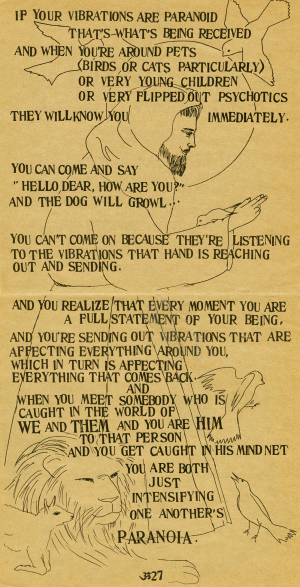
IF YOUR VIBRATIONS ARE PARANOID
THAT'S WHAT'S BEING RECEIVED
AND WHEN YOU'RE AROUND PETS
(BIRDS OR CATS PARTICULARLY)
OR VERY YOUNG CHILDREN
OR VERY FLIPPED OUT PSYCHOTICS
THEY WILL KNOW YOU IMMEDIATELY.
YOU CAN COME AND SAY
"HELLO DEAR, HOW ARE YOU?'
AND THE DOG WILL GROWL ...
YOU CAN'T COME ON BECAUSE THEY'RE LISTENING
TO THE VIBRATIONS THAT HAND IS READING
OUT AND SENDING.
AND YOU REALIZE THAT EVERY MOMENT YOU ARE
A FULL STATEMENT OF YOUR BEING,
AND YOU'RE SENDING OUT VIBRATIONS THAT ARE
AFFECTING EVERYTHING AROUND YOU,
WHICH IN TURN IS AFFECTING
EVERYTHING THAT COMES BACK
AND
WHEN YOU MEET SOMEBODY WHO IS
CAUGHT IN THE WORLD OF
WE AND THEM AND YOU ARE HIM
TO THAT PERSON
AND YOU GET CAUGHT IN HIS MIND NET
YOU ARE BOTH
JUST
INTENSIFYING
ONE ANOTHER'S
PARANOIA.
The concurrence begins with a quotation taken from the work Le Passage de la Matiere a la Vie (The Passage of Matter to Life) by Emmy Guittes, who contends that the Buddha asserted that life began with the emergence of immortalized "spirit units," which essentially serve to build physical bodies....We are reminded that the terms cohesion, adhesion, attraction, and repulsion bear a relationship to the four forces manifested in matter due to the action of spirit. Spirit manifests through the universe in the form of vibration.... AMORC details what science says about vibratory frequency, but also states that science does not tell the whole story. Vibration also occurs in the spiritual world, where you need special faculties to perceive it. This will be an essential part of the Rosicrucian teaching....The rest of this monograph makes AMORC's case that all things vibrate at certain distinct frequencies. We are living in a world of vibration. The monograph concludes with an observation that the human body, just like all other objects in the universe, is also just a bundle of vibrations in the larger, vaster ocean of vibrations.
-- The Prisoner of San Jose: How I Escaped From Rosicrucian Mind Control, by Pierre S. Freeman

HIPPIES CREATE POLICE POLICE CREATE HIPPIES
IF YOU'RE
IN POLARITY YOU'RE CREATING
POLAR OPPOSITES
YOU
CAN ONLY
PROTEST
EFFECTIVELY
WHEN
YOU LOVE
THE
PERSON
WHOSE IDEAS YOU ARE
PROTESTING AGAINST
AS MUCH AS
YOU LOVE
YOURSELF
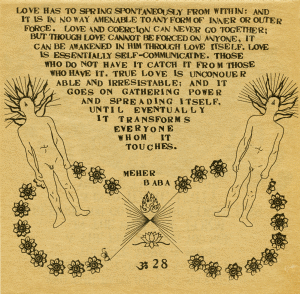
LOVE HAS TO SPRING SPONTANEOUSLY FROM WITHIN: AND
IT IS IN NO WAY AMENABLE TO ANY FORM OF INNER OR OUTER
FORCE. LOVE AND COERCION CAN NEVER GO TOGETHER;
BUT THOUGH LOVE CANNOT BE FORCED ON ANYONE, IT
CAN BE AWAKENED IN HIM THROUGH LOVE ITSELF, LOVE
IS ESSENTIALLY SELF-COMMUNICATIVE. THOSE
WHO HAVE IT. TRUE LOVE IS UNCONQUER-
ABLE AND IRRESISTABLE: AND IT
GOES ON GATHERING POWER
AND SPREADING ITSELF,
UNTIL EVENTUALLY
IT TRANSFORMS
EVERYONE
WHOM IT
TOUCHES.
MEHER BABA
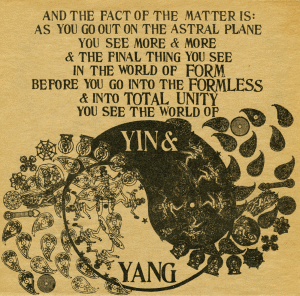
AND THE FACT OF THE MATTER IS:
AS YOU GO OUT ON THE ASTRAL PLANE
YOU SEE MORE & MORE
Truly the astral light [as to the word "light," we might substitute the word "matter", but a kind of matter that was self-luminous; we might also speak of the astral plane] of the derided Kabalists has strange and weird secrets for him who can see in it; and the mysteries concealed within its incessantly disturbed waves are there, the whole body of Materialists and scoffers notwithstanding. These secrets, along with many other mysteries, will remain non-existent to the materialists of our age, in the same way as America was a non-existent myth for Europeans during the early part of the mediaeval ages, whereas Scandinavians and Norwegians had actually reached and settled in that very old “New World” several centuries before. But, as a Columbus was born to re-discover, and to force the Old World to believe in Antipodal countries, so will there be born scientists who will discover the marvels now claimed by Occultists to exist in the regions of Ether, with their varied and multiform denizens and conscious Entities. Then, nolens volens, Science will have to accept the old “Superstition,” as it has several others.
-- The Secret Doctrine -- The Synthesis of Science, Religion, and Philosophy, by Helena Petrovna Blavatsky
& THE FINAL THING YOU SEE
IN THE WORLD OF FORM
BEFORE YOU GO INTO THE FORMLESS
& INTO TOTAL UNITY
YOU SEE THE WORLD OF
YIN &
YANG

“Wheels” are the centres of force, around which primordial Cosmic matter expands, and, passing through all the six stages of consolidation, becomes spheroidal and ends by being transformed into globes or spheres. It is one of the fundamental dogmas of Esoteric Cosmogony, that during the Kalpas of life, motion, which, during the periods of Rest “pulsates and thrills through every slumbering atom” assumes an evergrowing tendency, from the first awakening of Kosmos to a new “Day,” to circular movement. The “Deity becomes a whirlwind.” They are also called Rotae — the moving wheels of the celestial orbs participating in the world’s creation — when the meaning refers to the animating principle of the stars and planets; for in the Kabala, they are represented by the Ophanim, the Angels of the Spheres and stars, of which they are the informing Souls.
-- The Secret Doctrine -- The Synthesis of Science, Religion, and Philosophy, by Helena Petrovna Blavatsky
***
By cooperation of the mighty wheels which direct every seed to some end according as the stars accompany.
-- Purgatorio, from The Divine Comedy of Dante Alighieri, translated by Henry Wadsworth Longfellow
***
Perceiving some, the wheel an endless saraband
None amaranthine but him, ... Thanatos.
O omniman nought constant is but change!
'Cept him who thinks on thought and nought can disarrange.
-- The Fire Regained, by Sidney M. Hirsch
***
Salvation is the resolution of the task. The task is to give birth to the old in a new time. The soul of humanity is like the great wheel of the zodiac that rolls along the way. Everything that comes up in a constant movement from below to the heights was already there. There is no part of the wheel that does not come around again. Hence everything that has been streams upward there, and what has been will be again.
-- The Red Book: Liber Novus, by C.G. Jung
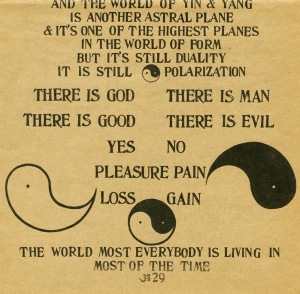
AND THE WORLD OF YIN & YANG
IS ANOTHER ASTRAL PLANE
& IT'S ONE OF THE HIGHEST PLANES
IN THE WORLD OF FORM
BUT IT'S STILL DUALITY
IT IS STILL POLARIZATION
THERE IS GOD THERE IS MAN
THERE IS GOOD THERE IS EVIL
YES NO
PLEASURE PAIN
LOSS GAIN
THE WORLD MOST EVERYBODY IS LIVING IN
MOST OF THE TIME
THE ONLY WAY OUT OF THAT IS TO TAKE
THE POLES OF EVERY SET OF OPPOSITES
AND SEE THE WAY IN WHICH
THEY ARE ONE
AND: IF YOU CAN GET INTO THAT PLACE
WHERE YOU SEE THE INTERRELATEDNESS OF
EVERYTHING
AND: YOU SEE THE ONENESS IN IT ALL
THEN: NO LONGER ARE YOU ATTACHED
TO YOUR POLARIZED POSITION
Incessantly the great currents and rivers of air flow and rush and roll from the equator to the frozen polar regions, and back from these to the torrid equatorial realms. Necessarily incident to these great, immense, equilibrated and beneficent movements, caused by the antagonism of equatorial heat and polar cold, are the typhoons, tornadoes, and cyclones that result from conflicts between the rushing currents. These and the benign trade-winds result from the same great law. God is omnipotent; but effects without causes are impossible, and these effects cannot but sometimes be evil. The fire would not warm, if it could not also burn, the human flesh. The most virulent poisons are the most sovereign remedies, when given in due proportion. The Evil is the shadow of the Good, and inseparable from it.
-- Morals and Dogma of the Ancient and Accepted Scottish Rite of Freemasonry, by Albert Pike
THE WHOLE THING ABOUT GENERATION GAPS
IS A HYPE
THE SPIRIT
IS
THE SPIRIT
"At last from this dimness, upon some eyes, the light broke; but think not that to those over whom the Origin of Evil held a sway, that dawning was vouchsafed. It could be given then, as now, only to the purest ecstasies of imagination and intellect, undistracted by the cares of a vulgar life, the appetites of the common clay. Far from descending to the assistance of a fiend, theirs was but the august ambition to approach nearer to the Fount of Good; the more they emancipated themselves from this Limbo of the planets, the more they were penetrated by the splendor and beneficence of God. And if they sought, and at last discovered, how to the eye of the spirit all the subtler modifications of being and of matter might be made apparent; if they discovered how, for the wings of the spirit, all space might be annihilated; and while the body stood heavy and solid here, the freed Idea might wander from star to star: if such discoveries became in truth their own, the sublimest luxury of their knowledge was but this -- to wonder, to venerate, and adore!" (Baron Edward Bulwer-Lytton quoted)
-- New Platonism and Alchemy, by Alexander Wilder
***
In the Bible the word "spirit" should technically always be thought of as a living entity. The spirit has wings in Os. IV.19. Accordingly II. Cor. III. 17, which says "God is a spirit," should be interpreted: God is a winged entity in an entirely zoological sense. God has wings and flies (Ps. XVI.8; XVII.11; XXXV.8). In Ps. LXIII.6-7 we read: "I remember you under the esmerot, you are my 'ezer, in the shadow (sel) of your wings I rejoice."
-- Theozoology, or the Science of the Sodomite Apelings and the Divine Electron, by Dr. Jorg Lanz von Liebenfels
***
From earliest times the soul, whether of angel or human being, has been represented by a bird. The ducks or geese come from spiritual realms (air), swim on the "oceans of the spirit on earth" and "breed on land".
-- The Pictorial Language of Hieronymus Bosch, by Clement A. Wertheim Aymes
WHEN YOU CAN CENTER AND SEE YOUR WHOLE LIFE
AS A STORY IN WHICH CHAPTERS ARE
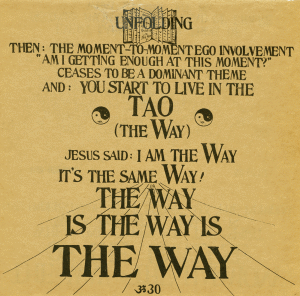
UNFOLDING
THEN: THE MOMENT TO MOMENT EGO INVOLVEMENT
"AM I GETTING ENOUGH AT THIS MOMENT?"
CEASES TO BE A DOMINANT THEME
AND: YOU START TO LIVE IN THE
TAO
(THE WAY)
JESUS SAID: I AM THE WAY
IT'S THE SAME WAY!
THE WAY
IS THE WAY IS
THE WAY
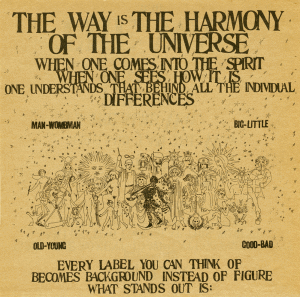
The battle for what is positive is now depicted on the next highest level. As is usual with Jeroen Bosch, he has presented what is most important and positive, in small insignificant figures, so as not to force his own view of the world and his most intimate thoughts upon those who would not understand him anyway.
-- The Pictorial Language of Hieronymus Bosch, by Clement A. Wertheim Aymes
THE WAY IS THE HARMONY
OF THE UNIVERSE
WHEN ONE COMES INTO THE SPIRIT
WHEN ONE SEES HOW IT IS
ONE UNDERSTANDS THAT BEHIND ALL THE INDIVIDUAL
DIFFERENCES
MAN-WOMBMAN
BIG-LITTLE
OLD-YOUNG
GOOD-BAD
EVERY LABEL YOU CAN THINK OF
BECOMES BACKGROUND INSTEAD OF FIGURE
WHAT STANDS OUT IS:
Lucifer, the Light-bearer! Strange and mysterious name to give to the Spirit of Darkness! Lucifer, the Son of the Morning! Is it he who bears the Light and with its splendors intolerable, blinds feeble, sensual or selfish souls? Doubt it not!
-- Morals and Dogma of the Ancient and Accepted Scottish Rite of Freemasonry, by Albert Pike

The Fifth group is a very mysterious one, as it is connected with the Microcosmic Pentagon, the five-pointed star representing man. In India and Egypt these Dhyanis were connected with the Crocodile, and their abode is in Capricornus. These are convertible terms in Indian astrology, as this sign of the Zodiac is called Makara, loosely translated “crocodile.” The word itself is occultly interpreted in various ways, as will be shown further on. In Egypt the defunct man — whose symbol is the pentagram or the five-pointed star, the points of which represent the limbs of a man — was shown emblematically transformed into a crocodile: Sebakh or Sevekh “or seventh,” as Mr. Gerald Massey says, showing it as having been the type of intelligence, is a dragon in reality, not a crocodile. He is the “Dragon of Wisdom” or Manas, the “Human Soul,” Mind, the Intelligent principle, called in our esoteric philosophy the “Fifth” principle. Says the defunct “Osirified” in ch. lxxxviii., “Book of the Dead,” or the Ritual, under the glyph of a mummiform god with a crocodile’s head: “I am the god presiding at the fear . . . at the arrival of his Soul among men. I am the god-crocodile brought for destruction” (an allusion to the destruction of divine spiritual purity when man acquires the knowledge of good and evil; also to the “fallen” gods, or angels of every theogony). "I am the fish of the great Horus. I am merged in Sekten.”
-- The Secret Doctrine -- The Synthesis of Science, Religion, and Philosophy, by Helena Petrovna Blavatsky
***
The wisdom which man ought to have does not come from the earth, nor from the astral spirit, but from the fifth essence -- the Spirit of Wisdom. Therefore man is superior to the stars and the constellation, provided he lives in the power of that superior wisdom. Such a person, being the master over heaven and earth, by means of his free will, is called a Magus, and therefore Magic is not sorcery, but supreme wisdom (De Peste).
-- The Life of Philippus Theophrastus Bombast of Hohenheim Known by the Name of Paracelsus and the Substance of his Teachings, by Franz Hartmann, M.D.
Five (5, V) fem, fim, fimf, funf, funf. Fem means that which is homogeneous, therefore even today it indicates the guild or corporation in the Dutch word veem. It had its origin in the five correlated fingers of the hand, in the correlated five senses that form man and it signified the elven cross or the witches' foot [Drudenfuss] also signified by the pentagram (femsteor).This homogeneity also belongs to the Feme, that part of the Armanenschaft devoted to the cultivation of the law. It was the Femanen who, after the forceable Christianization under Karl, King of the Franks -- or the Saxon-slayer (Slactenaere) -- came more into the forefront in the defense of everything that was indigenous (homologous) in opposition to that which was foreign; asserting indigenous law against Roman (in)justice in the high secret tribunal [Acht]. The symbolic holy-sign of the homologies was this very five-pointed star and it remains so in the secret script even today, just like all other things grouped by fives (fem), from which the numerical value was derived. Just as One was born from itself, Two from One, Three and Four also from One, five -- which grows out of 1 + 4 -- is the second odd number. From the One (Ginnungagap) grows the Four (Muspellsheim, Adhumbla, Ymir and Niflheim) which then form the Five -- the homogeneous One. When we consider the Feme as a court of law we find numerous examples, e.g. the so-called Funfe ["fives"] at Nuremberg, in the Council of Five in Venice, and in our contemporary Five-Judge Colleges which have come down to us as a compilation of single courts of law. The frequent occurrence of the number five in symbolism, as well as mysticism, makes this highly meaningful.
-- The Religion of the Aryo-Germanic Folk: Esoteric and Exoteric, by Guido von List
***
The Vulcan greeting is based upon a blessing gesture used by the kohanim during the worship service. The kohanim are the genealogical descendants of the Jewish priests who served in the Jerusalem Temple. The actual blessing is done with both arms held horizontally in front, at shoulder level, with hands touching, to form the Hebrew letter "shin." This stands for the Hebrew word for "Shaddai", meaning "Almighty [God]." Nimoy modified this gesture into one hand held upright, making it more like a salute. So, technically, the Vulcan greeting is not the same thing as the ceremonial Jewish blessing. Still, the resemblance is close enough to evoke instant recognition among knowledgeable Jews. During the synagogue service, the worshippers are not supposed to look at the kohanim while the blessing is being given. The real reason is simply to focus on receiving blessings directly from God, not from human beings.
-- The Jewish Origin of the Vulcan Salute, by Rabbi Yonassan Gershom

The seventh of the Seven-gods, is Saturn. The name consists of the two Ur-words: sa = "generate" and turn = "turn," i.e. to cause something to stop, and therefore is the equivalent of death, or passing away, or transformation toward a new arising. This name Saturn, like so many other mythological names, is only a functional characterization which became the name of an anthropomorphized elaboration of a divine essence. In the understanding of Armanism it is, however, a circumlocution for Surtur (Satur) and means "continually in the Ur," i.e. in the eternal. Through the portal of birth, in coming into being, a human encounters things such as essence, objects, events, times, etc.
Thus we have the course of becoming, life in our world of the senses, which allows us to leave this world through the gate of death -- by dying once more, and to be prepared in the Ur for a renewed arising, for rebirth. Even in the Christian Middle Ages the state of the soul in death was called the "primeval state" [Urstand] , i.e. the condition within Ur. Therefore the hieroglyph of Saturn (Surtur) is the sign of increasetogether with the sal- rune
or
, meaning an increase in salvation.
-- The Religion of the Aryo-Germanic Folk: Esoteric and Exoteric, by Guido von List
***
The Author says of the great Magic Agent — “This ambient and all-penetrating fluid, this ray detached from the (Central or ‘Spiritual’) Sun’s splendour . . . fixed by the weight of the atmosphere (?!) and the power of central attraction . . . the Astral Light, this electromagnetic ether, this vital and luminous caloric, is represented on ancient monuments by the girdle of Isis which twines round two poles . . . and in ancient theogonies by the serpent devouring its own tail, emblem of prudence and of Saturn” — emblem of infinity, immortality, and Kronos — “Time” — not the god Saturn or the planet. “It is the winged dragon of Medea, the double serpent of the caduceus, and the tempter of Genesis; but it is also the brazen snake of Moses encircling the Tau . . . lastly, it is the devil of exoteric dogmatism, and is really the blind force (it is not blind, and Levi knew it), which souls must conquer in order to detach themselves from the chains of Earth; ‘for if they should not,’ they will be absorbed by the same power which first produced them and will return to the central and eternal fire.”
***
It is “Satan who is the god of our planet and the only god,” and this without any allusive metaphor to its wickedness and depravity. For he is one with the Logos, “the first son, eldest of the gods,” in the order of microcosmic (divine) evolution; Saturn (Satan), astronomically, “is the seventh and last in the order of macrocosmic emanation, being the circumference of the kingdom of which Phoebus (the light of wisdom, also the Sun) is the centre.” The Gnostics were right, then, in calling the Jewish god “an angel of matter,” or he who breathed (conscious) life into Adam, and he whose planet was Saturn....
-- The Secret Doctrine -- The Synthesis of Science, Religion, and Philosophy, by Helena Petrovna Blavatsky
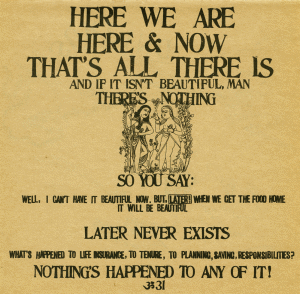
HERE WE ARE
HERE & NOW
THAT'S ALL THERE IS
AND IF IT ISN'T BEAUTIFUL, MAN
THERE'S NOTHING
“The Kosmos is eternal in its unconditioned collectivity, and finite but in its conditioned manifestations.” It is only “with a mind clear and undarkened by personality, and an assimilation of the merit of manifold existences devoted to being in its collectivity,” that one gets rid of personal existence, merging into, becoming one with, the Absolute, and continuing in full possession of Paramartha.
-- The Secret Doctrine -- The Synthesis of Science, Religion, and Philosophy, by Helena Petrovna Blavatsky
***
Whereas Communism set itself up in opposition to all religion, Nazism supported a pagan revival to replace the existing religions. It is perhaps this strategy more than any other that has allowed Nazism in various forms to survive its calamitous defeat in World War II and to continue to exert an influence over young people and old down the years into our present decade.
-- Unholy Alliance: A History of Nazi Involvement with the Occult, by Peter Levenda
SO YOU SAY:
WELL. I CAN'T HAVE IT BEAUTIFUL NOW, BUT, LATER! WHEN WE GET THE FOOD HOME
IT WILL BE BEAUTIFUL
LATER NEVER EXISTS
WHAT'S HAPPENED TO LIFE INSURANCE, TO TENURE, TO PLANNING, $AVING, RESPONSIBILITIES?
NOTHING'S HAPPENED TO ANY OF IT!
SURFING
EITHER YOU DO
IT LIKE IT'S
A BIG
WEIGHT
ON YOU
OR YOU DO IT
AS
PART OF THE DANCE
WHEN YOU UNDERSTAND
"THE THOUGHT IS THE THOUGHT
OF THE THOUGHTLESS
YOUR SINGING AND DANCING
IS NO OTHER THAN THE VOICE
OF THE DHARMA"
HAKUIN
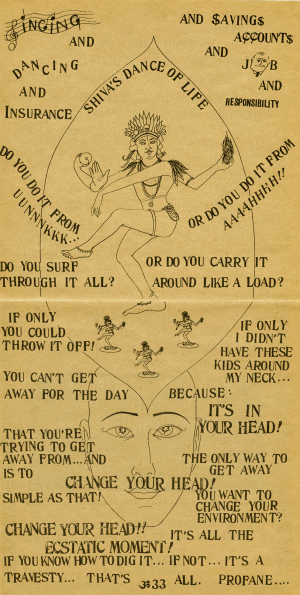
SINGING
AND
DANCING
AND
INSURANCE
AND $AVINGS
ACCOUNT$
AND
JOB
AND
RESPONSIBILITY
SHIVA'S DANCE OF LIFE
DO YOU DO IT FROM
UUNNNNKKKK ...
OR DO YOU DO IT FROM
AAAAHHHHH!!
DO YOU SURF
THROUGH IT ALL?
OR DO YOU CARRY IT
AROUND LIKE A LOAD?
IF ONLY
YOU COULD
THROW IT OFF!
IF ONLY
I DIDN'T
HAVE THESE
KIDS AROUND
MY NECK ...
YOU CAN'T GET
AWAY FOR THE DAY BECAUSE:
IT'S IN
YOUR HEAD!
THAT YOU'RE
TRYING TO GET
AWAY FROM ... AND THE ONLY WAY TO
GET AWAY
IS TO
CHANGE YOUR HEAD!
SIMPLE AS THAT!
YOU WANT TO
CHANGE YOUR
ENVIRONMENT?
CHANGE YOUR HEAD!!
IT'S ALL THE
ECSTATIC MOMENT!
IF YOU KNOW HOW TO DIG IT ... IF NOT ... IT'S A
TRAVESTY ... THAT'S ALL. PROFANE ...
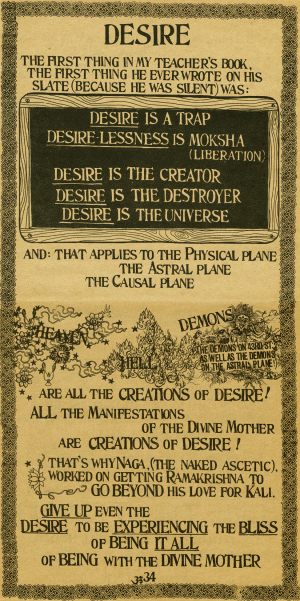
DESIRE
THE FIRST THING IN MY TEACHER'S BOOK,
THE FIRST THING HE EVER WROTE ON HIS
SLATE (BECAUSE HE WAS SILENT) WAS:
DESIRE IS A TRAP
DESIRELESSNESS IS MOKSHA
(LIBERATION)
DESIRE IS THE CREATOR
DESIRE IS THE DESTROYER
DESIRE IS THE UNIVERSE
AND: THAT APPLIES TO THE PHYSICAL PLANE
THE ASTRAL PLANE
THE CAUSAL PLANE
HEAVEN
DEMONS
HELL
(THE DEMONS ON 43RD ST.
AS WELL AS THE DEMONS
ON THE ASTRAL PLANE!)
ARE ALL THE CREATIONS OF DESIRE!
ALL THE MANIFESTATIONS
OF THE DIVINE MOTHER
ARE CREATIONS OF DESIRE!
* THAT'S WHY NAGA, (THE NAKED ASCETIC),
WORKED ON GETTING RAMAKRISHNA TO
GO BEYOND HIS LOVE FOR KALI.
What is asceticism? To forsake the world, and to turn one's face to obedience and the world to come. Well, it is necessary to know this world, its foulness and impermanence, to know the charm and permanence and everlastingness of the world to come, and to strive to obey, saying, 'How shall I obey, and what is obedience?'
-- Discourses of Rumi, translated by A. J. Arberry
GIVE UP EVEN THE
DESIRE TO BE EXPERIENCING THE BLISS
OF BEING IT ALL
OF BEING WITH THE DIVINE MOTHER
THE BUDDHISTS SAY: (I'M TALKING ABOUT THE NON-DUALISTIC
BUDDHISTS)
CUT OUT ALL THIS MIDDLE STUFF!
THEY SAY:
DON'T GET HUNG UP ON ALL THESE DIFFERENT
DESIRE TRIPS. JUST GO BEYOND IT ALL.
Statistics: Posted by admin — Fri Sep 25, 2015 8:01 am
]]>
OUR NORMAL WAKING CONSCIOUSNESS
IS BUT ONE SPECIAL TYPE OF CONSCIOUSNESS
WHILST ALL ABOUT IT
PARTED FROM IT BY THE FILMIEST OF SCREENS
THERE LIE
POTENTIAL FORMS OF CONSCIOUSNESS ENTIRELY DIFFERENT
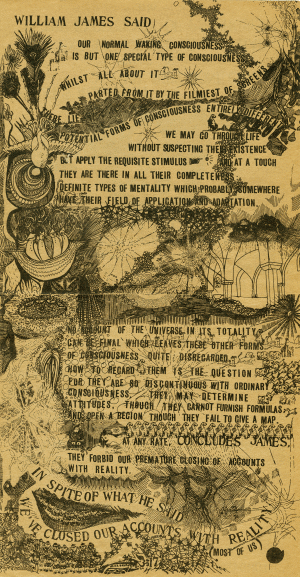
We find, in the next place, the doctrine of Elemental spirits. "When you shall be numbered among the Children of the philosophers," says the "Comte de Gabalis," "and when your eyes shall have been strengthened by the use of the most sacred medecine, you will learn that the Elements are inhabited by creatures of a singular perfection, from the knowledge of, and communication with, whom the sin of Adam has deprived his most wretched posterity. Yon vast space stretching between earth and Heaven has far nobler dwellers than the birds and the gnats; these wide seas hold other guests than the whales and the dolphins; the depths of the earth are not reserved for the moles alone; and that element of fire which is nobler than all the rest was not created to remain void and useless." According to Paracelsus, "the Elementals are not spirits, because they have flesh, blood, and bones; they live and propagate offspring; they eat and talk, act and sleep, &c.... They are beings occupying a place between men and spirits, resembling men and women in their organisation and form, and resembling spirits in the rapidity of their locomotion." They must not be confounded with the Elementaries which are the astral bodies of the dead. [2] They are divided into four classes. "The air is replete with an innumerable multitude of creatures, having human shapes, somewhat fierce in appearance, but docile in reality; great lovers of the sciences, subtle, serviceable to the Sages, and enemies of the foolish and ignorant. Their wives and daughters are beauties of the masculine type.... The seas and streams are inhabited even as the air; the ancient Sages gave the names of Undines or Nymphs to these Elementals. There are few males among them, and the women are very numerous, and of extreme beauty; the daughters of men cannot compare with them. The earth is filled by gnomes even to its centre, creatures of diminutive size, guardians of mines, treasures, and precious stones. They furnish the Children of the Sages with all the money they desire, and ask little for their services but the distinction of being commanded. The gnomides, their wives, are tiny, but very pleasing, and their apparel is exceedingly curious. As to the Salamanders, those fiery dwellers in the realm of flame, they serve the Philosophers, but do not eagerly seek their company, and their wives and daughters are seldom visible. They transcend all the others in beauty, for they are natives of a purer element."
-- The Real History of the Rosicrucians, by Arthur Edward Waite

Skandhas may produce Elementals by unconscious Kriyâshakti. Every Elemental that is thrown out by man must return to him sooner or later, since it is his own vibration. They thus become his Frankenstein. Elementals are simply effects producing effects. They are disembodied thoughts, good and bad. They remain crystallized in the Astral Light and are attracted by affinity and galvanized back into life again, when their originator returns to earth-life. You can paralyze them by reverse effects. Elementals are caught like a disease and hence are dangerous to ourselves and to others. This is why it is dangerous to influence others. The Elementals which live after your death are those which you implant in others: the rest remain latent till you are reincarnated, when they come to life in you.
-- The Esoteric Papers of Madame Blavatsky
The true doctrine has also been taught by Jacob Boehme, an uneducated shoemaker but illuminated seer, from whom all of our great philosophers have borrowed ideas. He says: "The constellation is the outspoken Word. It is the instrument through which the holy, eternally speaking Word speaks and produces objective forms. It is like a great harmony of many voices and musical instruments. They are interacting powers, wherein the essence of sound (Akasha) is the substance, and this is taken up by the Fiat and causes corporeity. This substance is the astral spirit. In it the elements become coagulated (corporified), and thus forms are born, comparable to the hatching of an egg brooded over by a hen" (Myster. Magn., xi. 26).
-- The Life of Philippus Theophrastus Bombast of Hohenheim Known by the Name of Paracelsus and the Substance of his Teachings, by Franz Hartmann, M.D.
"The Central Sun causes Fohat to collect primordial dust in the form of balls, to impel them to move in converging lines and finally to approach each other and aggregate.... Being scattered in Space, without order or system, the world-germs come into frequent collision until their final aggregation, after which they become wanderers (Comets). Then the battles and struggles begin. The older attract the younger, while others repel them. Many perish, devoured by their stronger companions. Those that escape become worlds.” -- To put it briefly, the Curds (world-stuff) become wanderers, (Comets), these become stars, and the stars (the centres of vortices) our sun and planets.
-- The Secret Doctrine -- The Synthesis of Science, Religion, and Philosophy, by Helena Petrovna Blavatsky

WE MAY GO THROUGH LIFE
WITHOUT SUSPECTING THEIR EXISTENCE
BUT APPLY THE REQUISITE STIMULUS AND AT A TOUCH
THEY ARE THERE IN ALL THEIR COMPLETENESS
DEFINITE TYPES OF MENTALITY WHICH PROBABLY SOMEWHERE
HAVE THEIR FIELD OF APPLICATION AND ADAPTATION
The chief difficulty which prevents men of science from believing in divine as well as in nature Spirits is their materialism. It is on the acceptance or rejection of the theory of the Unity of all in Nature, in its ultimate Essence, that mainly rests the belief or unbelief in the existence around us of other conscious beings besides the Spirits of the Dead. In sober truth, every “Spirit” so-called is either a disembodied or a future man. That a Spirit is endowed with intelligence is a proof to the Occultist that that Being must have been a man, and acquired his knowledge and intelligence throughout the human cycle. There is but one indivisible and absolute Omniscience and Intelligence in the Universe, and this thrills throughout every atom and infinitesimal point of the whole finite Kosmos. But the first differentiation of its reflection in the manifested World is purely Spiritual, and the Beings generated in it are not endowed with a consciousness that has any relation to the one we conceive of. They can have no human consciousness or Intelligence before they have acquired such, personally and individually. This may be a mystery, yet it is a fact, in Esoteric philosophy, and a very apparent one too.
-- The Secret Doctrine -- The Synthesis of Science, Religion, and Philosophy, by Helena Petrovna Blavatsky

The crocodile is the Egyptian dragon. It was the dual symbol of Heaven and Earth, of Sun and Moon, and was made sacred, in consequence of its amphibious nature, to Osiris and Isis. According to Eusebius, the Egyptians represented the sun in a ship as its pilot, this ship being carried along by a crocodile “to show the motion of the Sun in the moyst (Space)”. The crocodile was moreover, the symbol of Egypt herself — the lower, as being the more swampy of the two countries. The Alchemists claim another interpretation. They say that the symbol of the sun in the ship on the Ether of Space meant that the hermetic matter is the principle, or basis, of gold, or again the philosophical sun; the water, within which the crocodile is swimming, is that water or matter made liquid; the ship herself, finally, representing the vessel of nature, in which the sun, or the sulphuric, igneous principle, acts as a pilot: because it is the sun which conducts the work by his action upon the moist or mercury. The above is only for the Alchemists.
-- The Secret Doctrine -- The Synthesis of Science, Religion, and Philosophy, by Helena Petrovna Blavatsky
NO ACCOUNT OF THE UNIVERSE IN ITS TOTALITY
CAN BE FINAL WHICH LEAVES THESE OTHER FORMS
OF CONSCIOUSNESS QUITE DISREGARDED.
HOW TO REGARD THEM IS THE QUESTION
FOR THEY ARE SO DISCONTINUOUS WITH ORDINARY
CONSCIOUSNESS. THEY MAY DETERMINE
ATTITUDES, THOUGH THEY CANNOT FURNISH FORMULAS
AND OPEN A REGION THOUGH THEY FAIL TO GIVE A MAP.
AT ANY RATE, CONCLUDES JAMES,
THEY FORBID OUR PREMATURE CLOSING OF ACCOUNTS
WITH REALITY
IN SPITE OF WHAT HE SAID
WE'VE CLOSED OUR ACCOUNTS WITH REALITY
(MOST OF US)
HA HA HA
Ha explained: "Now, however, you make a bridge between you and the one longs for the below. But the serpent crawls at the top and draws the sun up. Then both of you move upward and want to go to the upper (), but the sun is below and tries to draw you down. But you draw a line above the below and long for the above and are completely at one. There the serpent comes and wants to drink from the vessel of the below. But there comes the upper cone and stops. Like the serpent, the looking coils back and moves forward again and afterward you very much (--) long to return. But the lower sun pulls and thus you become balanced again. But soon you fall backward, since the one has reached out toward the upper sun. The other does not want this and so you fall asunder, and therefore you must bind yourselves together three times. Then you stand upright again and you hold both suns before you, as if they were your eyes, the light of the above and the below before you and you stretch your arms out toward it, and you come together to become one and must separate the two suns and you long to return a little to the lower and reach out toward the upper. But the lower cone has swallowed the upper cone into itself, because the suns were so close. Therefore you place the upper cone back up again, and because the lower is then no longer there, you want to draw it up again and have a profound longing for the lower cone, while it is empty Above, since the sun Above the line is invisible. Because you have longed to return downward for so long, the upper cone comes down and tries to capture the invisible lower sun within itself. There the serpent's way goes at the very top, you are split and everything below is beneath the ground. You long to be further above, but the lower longing already comes crawling like a serpent, and you build a prison over her. But there the lower comes up, you long to be at the very bottom and the two suns suddenly reappear, close together. You long for this and come to be imprisoned. Then the one is defiant and the other longs for the below. The prison opens, the one longs even more to be below, but the defiant one longs for the above and is no longer defiant, but longs for what is to come. And thus it comes to pass: the sun rises at the bottom, but it is imprisoned and above three nest boxes are made for you two and the upper sun, which you expect, because you have imprisoned the lower one. But now the upper cone comes down powerfully and divides you and swallows the lower cone. This is impossible. Therefore you place the cones tip to tip and curl up toward the front in the center. Because that's no way to leave matters! So it has to happen otherwise. The one attempts to reach upward, the other downward; you must strive to do this, since if the tips of the cones meet, they can hardly be separated anymore --therefore I have placed the hard seed in-between. Tip to tip -- that would be too beautifully regular. This pleases father and mother, but where does that leave me? And my seed? Therefore a quick change of plan! One makes a bridge between you both, imprisons the lower sun again, the one longs for the above and the below, but the other longs especially strongly for the forward, above and below. Thus the future can become -- see, how well I can already say it -- yes, indeed, I am clever -- cleverer than you -- since you have taken matters in hand so well, you also get everything beneath the roof and into the house, the serpent, and the two suns. That is always most amusing. But you are separated and because you have drawn the line above, the serpent and the suns are too far below. This happens because beforehand you curled around yourself from below. But you come together and into agreement and stand upright, because it is good and amusing and fine and you say: thus shall it remain. But down comes the upper cone, because it felt dissatisfied, that you had set a limit above beforehand. The upper cone reaches out immediately for its sun -- but there is nowhere a sun to be found anymore and the serpent also jumps up, to catch the suns. You fall over, and one of you is eaten by the lower cone. With the help of the upper cone you get him out and in return you give the lower cone its sun and the upper cone its as well. You spread yourself out like the one-eyed, who wanders in heaven and hold the cones beneath you -- but in the end matters still go awry. You leave the cones and the suns to go and stand side by side and still do not want the same. In the end you agree to bind yourself threefold to the upper cone descending from above. / I am called Ha-Ha-Ha -- a jolly name -- I am clever -- look here, my last sign, that is the magic of the white man who lived in the great magic house, the magic which you call Christianity. Your medicine man said so himself: I and the father are one, no one comes to the father other than through me. I told you so, the upper cone is the father. He has bound himself threefold to you and stands between the other and the father. Therefore the other must go through him, if he wants to reach the cone" (pp. 13-14).
-- The Red Book: Liber Novus, by C.G. Jung

Hermetists called into being, out of the elements, the shapes of salamanders, gnomes, undines, and sylphs, which they did not pretend to create, but simply to make visible by holding open the door of nature, so that, under favoring conditions, they might step into view. For instance, if man has a preponderance of the Earthly, gnomic element, the gnomes will lead him towards assimilating metals — money and wealth, and so on.
-- The Secret Doctrine -- The Synthesis of Science, Religion, and Philosophy, by Helena Petrovna Blavatsky
***
The Cabiri are, in fact, the mysterious creative powers, the gnomes who work under the earth, i.e., below the threshold of consciousness, in order to supply us with lucky ideas. As imps and hobgoblins, however, they also lay all sorts of nasty tricks, keeping back names and dates that were 'on the tip of the tongue,' making us say the wrong thing, etc. They give an eye to everything that has not already been anticipated by consciousness and the functions at its disposal ... deeper insight will show that the primitive and archaic qualities of the inferior function conceal all sorts of significant relationships and symbolic meanings, and instead of laughing off the Cabiri as ridiculous Tom Thumbs he may begin to suspect that they are a treasure-house of hidden wisdom.
-- The Red Book: Liber Novus, by C.G. Jung
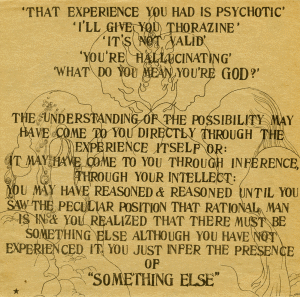
'THAT EXPERIENCE YOU HAD IS PSYCHOTIC'
'I'LL GIVE YOU THORAZINE'
'IT'S NOT VALID'
'YOU'RE HALLUCINATING'
'WHAT DO YOU MEAN, YOU'RE GOD?'
THE UNDERSTANDING OF THE POSSIBILITY MAY
HAVE COME TO YOU DIRECTLY THROUGH THE
EXPERIENCE ITSELF OR:
IT MAY HAVE COME TO YOU THROUGH INFERENCE,
THROUGH YOUR INTELLECT:
YOU MAY HAVE REASONED & REASONED UNTIL YOU
SAW THE PECULIAR POSITION THAT RATIONAL MAN
IS IN & YOU REALIZED THAT THERE MUST BE
SOMETHING ELSE ALTHOUGH YOU HAVE NOT
EXPERIENCED IT. YOU JUST INFER THE PRESENCE
OF
"SOMETHING ELSE"
What we call the Reason, that is, our imperfect human reason, not only may, but assuredly will, lead us away from the Truth in regard to things invisible and especially those of the Infinite, if we determine to believe nothing but that which it can demonstrate, or not to believe that which it can by its processes of logic prove to be contradictory, unreasonable, or absurd. Its tape-line cannot measure the arcs of Infinity.
-- Morals and Dogma of the Ancient and Accepted Scottish Rite of Freemasonry, by Albert Pike
IT DOESN'T QUITE MAKE SENSE
NOTHING "TURNS YOU ON"
YOU HAVEN'T EXPERIENCED IT DIRECTLY BUT
YOU FIGURED THERE MUST BE
SOMETHING ELSE SOMETHING THERE
& THEN YOU READ ALL THE WRITINGS OF
ST. JOHN OF THE CROSS & ST. THERESA AVILA
& ON & ON ALL THE MYSTICS
& VISIONARIES IN RECORDED HISTORY
& YOU SAY: 'WELL, THEY CAN'T ALL BE NUTS
THEY MUST BE TALKING ABOUT SOMETHING
SO YOU SORT OF INFER THE PRESENCE OF THIS
OTHER THING, BUT YOU DON'T KNOW IT IN YOUR GUTS
NOW THAT'S A TOUGH ONE.
TO BE IN THAT POSITION
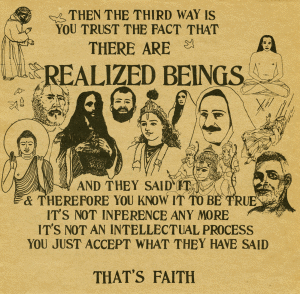
The Dhyani-Buddhas of the two higher groups, at the upper rung of the ladder of being, namely, the “Watchers” or the “Architects,” furnished the many and various races with divine kings and leaders. It is the latter who taught humanity their arts and sciences, and the former who revealed to the incarnated Monads the great spiritual truths of the transcendental worlds, the uninterrupted record covering thousands of generations of Seers whose respective experiences were made to test and to verify the traditions passed orally by one early race to another, of the teachings of higher and exalted beings, who watched over the childhood of Humanity, the “Wise Men” of the Fifth Race, of the stock saved and rescued from the last cataclysm and shifting of continents, who had passed their lives in learning, not teaching, men who have developed and perfected their physical, mental, psychic, and spiritual organisations to the utmost possible degree. None of these Beings have either individuality or personality as separate Entities, i.e., they have no individuality in the sense in which a man says, “I am myself and no one else;” in other words, they are conscious of no such distinct separateness as men and things have on earth. Individuality is the characteristic of their respective hierarchies, not of their units. The collective “Creator” of the Universe is no personal deity, i.e., an imperfect extra-cosmic god, but only the aggregate of the Dhyan-Chohans and the other forces. By eating of the fruit of knowledge which dispels ignorance, man becomes like one of the Elohim or the Dhyanis; and once on their plane the Spirit of Solidarity and perfect Harmony, which reigns in every Hierarchy, must extend over him and protect him in every particular.
-- The Secret Doctrine -- The Synthesis of Science, Religion, and Philosophy, by Helena Petrovna Blavatsky
THEN THE THIRD WAY IS
YOU TRUST THE FACT THAT
THERE ARE
REALIZED BEINGS
AND THEY SAID IT
& THEREFORE YOU KNOW IT TO BE TRUE
IT'S NOT INFERENCE ANY MORE
IT'S NOT AN INTELLECTUAL PROCESS
YOU JUST ACCEPT WHAT THEY HAVE SAID
THAT'S FAITH
Islam means submission, that is, submission to the will of God. The believer can just commend himself to the will of God simply because it is the will of God. He feels secure and does not ask why this is so and that is different -- he fulfills the divine law simply because it is the revealed law of God. He accepts his fate as being immutable and at the most attempts by means of prayer to implore for mercy from God when the burden becomes too great for him. But the sign of the true believer will consistently be that he does not ask for release from the burden, but rather for the strength to the bale to bear it. "Lead us in the way of those who do not err," the Prophet prescribes to those who pray. This faithful condition is what is most worthy to strive after according to all religious systems.
-- The Practice of the Ancient Turkish Freemasons: The Key to the Understanding of Alchemy, by Baron Rudolf von Sebottendorf
***
If we are to ask now, more than a generation later, how normal people could have committed the Nazi atrocities, we need only look at the normal people in American cults today. This may seem a harsh comparison; the parallels are certainly not universally applicable. Still, it would not be unfair to say that the same sort of normal people who obeyed the crazy commands of the Nazi hierarchy are today obeying the crazy commands of some contemporary cult leaders. The Brahmins, using the authority of the Vedas, created, through the laws of Manu, a totalitarian organization which corrupted the wisdom of Eastern philosophy and so invaded every area of private Hindu life that it was impossible to go to the bathroom without obeying certain strictures. They squeezed the heart out of India. Twentieth-century Aryans, emulating the Brahmins, set up their own ideas of caste, but instead of favoring hereditary aristocracy, made it possible for the credulous, ambitious, and unscrupulous to rise to the top.
-- Gods & Beasts -- The Nazis & the Occult, by Dusty Sklar
***
"God does not rejoice to see fools, blockheads, and simpletons, who are ready to believe anything, no matter how absurd it may be; neither does He desire that only one wise and learned man should be in each country, and that the other people should follow him blindly, as the sheep follow a ram; but we should all have our knowledge in God, and take it out of the universal fountain of wisdom."
-- The Life of Philippus Theophrastus Bombast of Hohenheim Known by the Name of Paracelsus and the Substance of his Teachings, by Franz Hartmann, M.D.
SEE: WE'VE GOTTEN SO SUPER-SOPHISTICATED
IN OUR EVALUATIVE MECHANISMS
THAT YOU QUESTION EVERYTHING YOU HEAR
HOW DO YOU KNOW YOU'RE NOT BEING HUSTLED?
I MEAN: WHAT WAS JESUS UP TO?
WHAT'S THE GAME, MAN?
WHAT'S HE INTO?
& YOU ESPECIALLY FEEL PARANOID
IF YOU ARE ONE OF THE KEEPERS OF THE TABLES
IN THE TEMPLE
IF YOU ARE COMMITTED TO AN EXISTING SYSTEM
WITH GREAT ATTACHMENT
WITH GREAT ATTACHMENT
SOME WAY OR OTHER
MOST OF YOU IN THIS ROOM
(MOST OF YOU, NOT ALL OF YOU) MOST OF YOU
HAVE SENSED THE POSSIBILITY
BUT YOU CAN'T QUITE ...!
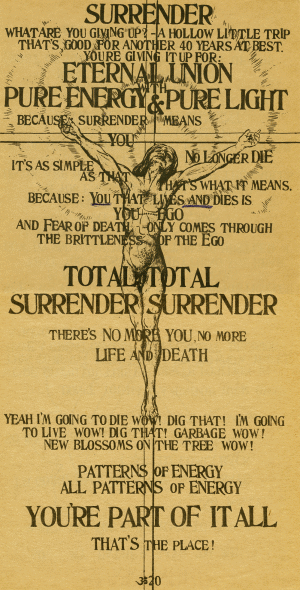
"Christ says, 'He who is with Me denies himself.' This means that he must rise superior to that which belongs to Nature in him. He must take his cross upon his shoulders, namely, the cross which Nature has put upon him, Take Nature upon your shoulders and carry her, but do not identify yourself with her. Love your neighbour, and free yourself of that carnal reason which forces you to be a servant of self."
-- The Life of Philippus Theophrastus Bombast of Hohenheim Known by the Name of Paracelsus and the Substance of his Teachings, by Franz Hartmann, M.D.
***
In order to reconcile the popular religions, and particularly the Christian, with this new system, he made the whole history of the heathen gods an allegory, maintaining that they were only celestial ministers, entitled to an inferior kind of worship; and he acknowledged that Jesus Christ was an excellent man and the friend of God, but alleged that it was not his design entirely to abolish the worship of demons, and that his only intention was to ... reinstate and restore to its primitive integrity the Wisdom of the ancients."
-- New Platonism and Alchemy, by Alexander Wilder
***
Chamberlain is careful to tell us that he does not intend to lift the veil which screens the Holy of Holies of his own belief. But it must be clear from such utterances as those upon which I have drawn above, how noble and how exalted is the conception of Christ and of His teaching which is borne in on the mind of one of the foremost thinkers of our day. He draws his inspiration at the fountainhead. For the dogmas of oecumenical councils, for the superstitions and fables of monks, he has an adequate respect: he preaches Christ and Him crucified: that is to him all-sufficing. Can there be a purer ideal?
-- The Foundations of the Nineteenth Century, by Houston Stewart Chamberlain
SURRENDER
WHAT ARE YOU GIVING UP? A HOLLOW LITTLE TRIP
THAT'S GOOD FOR ANOTHER 40 YEARS AT BEST.
YOU'RE GIVING IT UP FOR:
ETERNAL UNION
WITH
PURE ENERGY & PURE LIGHT
BECAUSE SURRENDER MEANS
YOU
NO LONGER DIE
IT'S AS SIMPLE
AS THAT
THAT'S WHAT IT MEANS.
BECAUSE: YOU THAT LIVES AND DIES IS
YOUR EGO
AND FEAR OF DEATH ONLY COMES THROUGH
THE BRITTLENESS OF THE EGO
TOTAL TOTAL
SURRENDER SURRENDER
THERE'S NO MORE YOU, NO MORE
LIFE AND DEATH
YEAH I'M GOING TO DIE WOW! DIG THAT! I'M GOING
TO LIVE WOW! DIG THAT! GARBAGE WOW!
NEW BLOSSOMS ON THE TREE WOW!
PATTERNS OF ENERGY
ALL PATTERNS OF ENERGY
YOU'RE PART OF IT ALL
THAT'S THE PLACE!
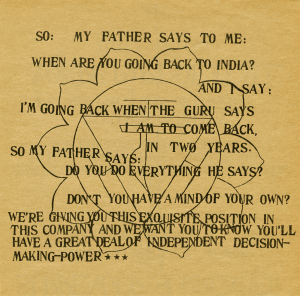
SO: MY FATHER SAYS TO ME:
WHEN ARE YOU GOING BACK TO INDIA?
AND I SAY:
I'M GOING BACK WHEN THE GURU SAYS
I AM TO COME BACK
IN TWO YEARS.
SO MY FATHER SAYS:
DO YOU DO EVERYTHING HE SAYS?
DON'T YOU HAVE A MIND OF YOUR OWN?
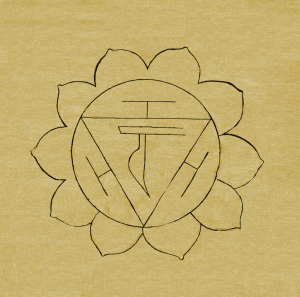
FIDELIS SUM / I AM FAITHFUL -- Let the mind be trusting, let there be faith and concord, Even unto the destruction of death, And there will be, assuredly, a gilded door in the sky.
-- The Rosicrucian Emblems of Daniel Cramer

WE'RE GIVING YOU THIS EXQUISITE POSITION IN
THIS COMPANY AND WE WANT YOU TO KNOW YOU'LL
HAVE A GREAT DEAL OF INDEPENDENT DECISION-
MAKING-POWER ***
My Fuhrer (My Leader): Just as we have always done our duty to you in the past, so too in the future, we await your orders alone. And we, Comrades, know only to obey the orders of our Fuhrer and to prove that we have remained true to the Fuhrer. Our Fuhrer, Adolf Hitler. Hail Victory! Hail Victory!
-- Triumph of the Will, directed by Leni Rifenstahl
WHAT DO YOU WANT TO DO TODAY, MARTY?
I DON'T CARE
WHAT DO YOU WANT TO DO?
I REMEMBER A FEW DAYS STAYING IN LONDON, WE
HAD FLED FROM COPENHAGEN WHERE WE HAD A VERY
UNFORTUNATE SCENE AT A PSYCHOLOGICAL
CONVENTION. WE WERE IN LONDON AND TIM AND BILL
BURROUGHS AND I WERE WALKING DOWN THE STREET
HIGH ON SOMETHING OR OTHER AND WE WERE
SPENDING DAYS GOING FROM PARK TO TEA ROOM TO
PARK TO TEA ROOM: AND EVERY NOW AND THEN WE'D
HIT A CORNER AND SOMEBODY WOULD SAY: WELL
SHOULD WE CROSS THE STREET ... AND WE'D STAND
THERE AND NOBODY WOULD SEEM TO CARE,
BECAUSE WE WERE ALL FULFILLED AT THAT MOMENT,
RIGHT THERE ON THE STREET CORNER IN LONDON.
WE WERE ALL JUST
VERY
VERY
HIGH
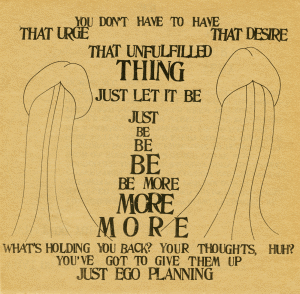
"That unfulfilled thing ... low-level tragi-comedy type thing ... this extraordinary thing ... a phony kind of liberal thing ... a horrible thing ... socialize this thing ... waiting for something to do that thing ... this interesting thing ... that sort of thing ... the whole thing ... a strange thing ... the one thing ... that powerful thing ... the last thing ... the bad thing ... the same thing ... a weird thing ... the other thing ... so many things ... this absurd thing ... the final thing ... a temporal thing ... do your thing ... good thing ... external thing ... a new thing ... a full-time thing ... a western thing ... an Indian thing ... beyond the thing ... the highest thing ... the Lama Govinda thing ... a combination of things ... a worldly thing ... doing its thing ... you do your thing ... your mind does its thing ... your senses do their thing ... the funny thing ... ten thousand things ... you still do your thing ... cars and things ... the minister's doing his thing ... the real thing ... that's the thing ... all things ... the only thing ... beautiful things ... wild out-of-control mind thing ..."
-- Ram Dass, "Be Here Now"
YOU DON'T HAVE TO HAVE
THAT URGE THAT DESIRE
THAT UNFULFILLED
THING
Of that Equilibrium between Authority and Individual Action which constitutes Free Government, by settling on immutable foundations Liberty with Obedience to Law, Equality with Subjection to Authority, and Fraternity with Subordination to the Wisest and the Best: and of that Equilibrium between the Active Energy of the Will of the Present, expressed by the Vote of the People, and the Passive Stability and Permanence of the Will of the Past, expressed in constitutions of government, written or unwritten, and in the laws and customs, gray with age and sanctified by time, as precedents and authority; which is represented by the arch resting on the two columns, Jachin and Boaz, that stand at the portals of the Temple builded by Wisdom, on one of which Masonry sets the celestial Globe, symbol of the spiritual part of our composite nature, and on the other the terrestrial Globe, symbol of the material part.
-- Morals and Dogma of the Ancient and Accepted Scottish Rite of Freemasonry, by Albert Pike
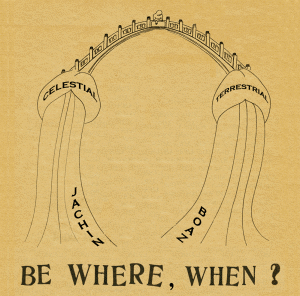
JUST LET IT BE
JUST
BE
BE
BE
BE MORE
"The double lithoi [upright phalli] placed always in front of every temple, Christian as well as heathen."
-- The Secret Doctrine -- The Synthesis of Science, Religion, and Philosophy, by Helena Petrovna Blavatsky
***
The great characteristic attribute [of the deity] was represented by the organ of generation in that state of tension and rigidity which is necessary to the due performance of its functions.
-- A Discourse on the Worship of Priapus: And Its Connection with the Mystic Theology of the Ancients, by Richard Payne Knight
MORE
MORE
If you would know Him when He comes, then check the tendency to decry the great, and to find faults in what is noble. So many people, looking at the sun, only see the spots, and no man, they say, is a hero to his valet de chambre. But why not? Not because he is not heroic, but because the heart of the valet de chambre cannot appreciate heroism. We criticise; we find petty faults; we lay stress on petty mistakes, and we miss the soul of goodness and of greatness, perchance, in those who be against the common feeling of the time. Be not ashamed to admire. Be not ashamed to be reverent to that which is greater, nobler than yourself, for the power to admire means really the faculty to achieve. That which you recognise to be noble, by the very recognition you rise nearer to it and become liker to it. Reverence greatness wherever you see it, in outer life, in inner life.
-- The Order of the Star in the East: Its Outer and Inner Work, by by Professor E. A. Wodehouse, M.A.
***
Enoch, the fifth from Seth, who prophesied of the deluge and conflagration, lest arts and sciences should slip out of the knowledge of men, raised two columns, one of brick, the other of stone, and inscribed their inventions upon them, that, if the pillar of brick happened to be overthrown by the Flood, that of stone might remain.
-- The Ancient and Primitive Rite of Memphis and Misraim, Excerpts from "A New Encyclopaedia of Freemasonry," by Arthur Edward Waite
***
The Candidate for the Second, or Fellow Craft Degree (FELLOW CRAFT = 125 = SOTHIS ABLAZE) is told at his initiation that the last seven steps leading to ‘the Middle Chamber of King Solomon’s Temple’ represent: “…especially, the seven liberal arts and sciences, which are grammar, rhetoric, logic, arithmetic, geometry, music, and astronomy.” These are, of course, the very arts and sciences taught to humanity by the Gods of Sirius (Sothis) in ancient times. The candidate earlier is conducted by: “two large brazen pillars, one on the right and one on the left hand. The name of the one on the left hand is Boaz, and signifies strength; the name of the one on the right is Jachin, and denotes establishment…These are representative of the two pillars erected at the outer porch of King Solomon’s Temple. They are said to have been in height eighteen cubits, twelve in circumference, and four in diameter.” After an excruciatingly detailed description, the conductor points to the top of the pillars: “…on the top of each (is) a globe, or ball; these globes are two artificial spherical bodies; on the convex surfaces of which are represented the countries, seas, and various parts of the earth, the face of the heavens, the planetary revolutions; and are said to be thus extensive to denote the universality of Masonry.”
-- Secret Rituals of the Men in Black, by Allen Greenfield
***
In the Kathopanishad (chapter. v, verse 9) it is stated that "Some men, according to their deeds, go into the womb and others into the 'sthanu.'" "Sthanu" is a Sanskrit word, which means "motionless," but it also means "a pillar" ... In the Book of Revelation we find these worlds: "Him that overcometh will I make a pillar in the temple of my God and he shall go no more out," referring to entire liberation from concrete existence.
-- The Rosicrucian Cosmo-Conception, by Max Heindel
WHAT'S HOLDING YOU BACK? YOUR THOUGHTS, HUH?
YOU'VE GOT TO GIVE THEM UP
JUST EGO PLANNING
WHAT ARE YOU DOING?
PLANNING FOR THE FUTURE?
WELL
IT'S ALL RIGHT NOW
BUT LATER? ... FORGET IT BABY
THAT'S LATER
NOW IS
NOW
ARE YOU GOING TO
BE HERE
OR NOT?
IT'S AS SIMPLE AS
THAT!
BUT I'M SO YOUNG!
I HAVE SO MANY THINGS TO DO YET!
WELL! THAT'LL SURE KEEP YOU FROM
BEING HERE & NOW
LIFE IS PASSING ME BY!
HMMMMMM
BUT, IF I LIVE JUST IN THE HERE & NOW
WON'T THERE BE CHAOS? WHAT HAPPENS
IF THE TELEPHONE RINGS?
WELL: THE HERE & NOW IS THE FACT
THAT THE TELEPHONE IS RINGING!
PICK IT UP!
WELL: WHAT IF SOMEBODY WANTS TO
MAKE AN APPOINTMENT TO SEE ME
3 WEEKS FROM NOW?
RIGHT!
WRITE IT DOWN. THAT'S HERE & NOW
WELL, WHAT HAPPENS 3 WEEKS FROM NOW
?
3 WEEKS FROM NOW THERE'S THAT
APPOINTMENT. THEN: THAT IS HERE & NOW
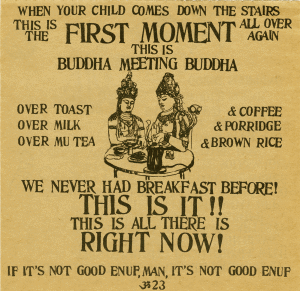
WHEN YOUR CHILD COMES DOWN THE STAIRS
THIS IS THE FIRST MOMENT ALL OVER AGAIN
THIS IS
BUDDHA MEETING BUDDHA
OVER TOAST
OVER MILK
OVER MU TEA
& COFFEE
& PORRIDGE
& BROWN RICE
WE NEVER HAD BREAKFAST BEFORE!
THIS IS IT!!
THIS IS ALL THERE IS
RIGHT NOW!
IF IT'S NOT GOOD ENUF, MAN, IT'S NOT GOOD ENUF
Each of us makes such applications to his own faith and creed, of the symbols and ceremonies of this Degree, as seems to him proper. With these special interpretations we have here nothing to do. Like the legend of the Master Khūrūm, in which some see figured the condemnation and sufferings of Christ; others those of the unfortunate Grand Master of the Templars; others those of the first Charles, King of England; and others still the annual descent of the Sun at the winter Solstice to the regions of darkness, the basis of many an ancient legend; so the ceremonies of this Degree receive different explanations; each interpreting them for himself, and being offended at the interpretation of no other.
In no other way could Masonry possess its character of Universality; that character which has ever been peculiar to it from its origin; and which enables two Kings, worshippers of different Deities, to sit together as Masters, while the walls of the first temple arose; and the men of Gebal, bowing down to the Phœnician Gods, to work by the side of the Hebrews to whom those Gods were abomination; and to sit with them in the same Lodge as brethren.
The first Masonic Legislator whose memory is preserved to us by history, was Buddha, who, about a thousand years before the Christian era, reformed the religion of Manous. He called to the Priesthood all men, without distinction of caste, who felt themselves inspired by God to instruct men. Those who so associated themselves formed a Society of Prophets under the name of Samaneans. They recognized the existence of a single uncreated God, in whose bosom everything grows, is developed and transformed. The worship of this God reposed upon the obedience of all the beings He created. His feasts were those of the Solstices. The doctrines of Buddha pervaded India, China, and Japan. The Priests of Brahma, professing a dark and bloody creed, brutalized by Superstition, united together against Buddhism, and with the aid of Despotism, exterminated its followers. But their blood fertilized the new doctrine, which produced a new Society under the name of Gymnosophists; and a large number, fleeing to Ireland, planted their doctrines there, and there erected the round towers, some of which still stand, solid and unshaken as at first, visible monuments of the remotest ages.
-- Morals and Dogma of the Ancient and Accepted Scottish Rite of Freemasonry, by Albert Pike

NOW: ABOUT FIVE YEARS AGO I'M LIVING IN
THIS COMMUNITY IN CALIFORNIA, WITH
A VERY VERY BEAUTIFUL HIGH BEING,
STEVE DURKEE, A VISIONARY ARTIST:
A VERY BEAUTIFUL GUY, HIS WIFE
AND CHILD, AND I'D HAVE A DAY OFF.
IT WOULD BE SATURDAY AND WE'D GO
TO THE STORE, THE DOG, THE BABIES
WE'D ALL GET INTO THE VOLKSWAGEN
MICROBUS. THERE'D BE JANE,
THE GAL I WAS LIVING WITH, AND
HER BABY AND ME AND STEVE AND
BARBARA, AND THE
WHOLE SCENE, GOING SHOPPING.
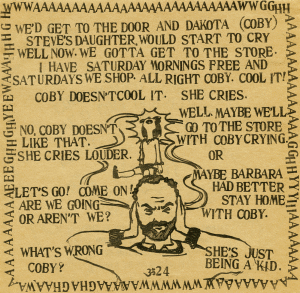
WAAAAAAAGGGGGGHHHH
WE'D GET TO THE DOOR AND DAKOTA (COBY)
STEVE'S DAUGHTER WOULD START TO CRY
WELL NOW. WE GOTTA GET TO THE STORE.
I HAVE SATURDAY MORNINGS FREE AND
SATURDAYS WE SHOP ALL RIGHT COBY. COOL IT!
COBY DOESN'T COOL IT. SHE CRIES.
WELL, MAYBE WE'LL
GO TO THE STORE
WITH COBY CRYING OR
MAYBE BARBARA
HAD BETTER
STAY HOME
WITH COBY.
NO, COBY DOESN'T
LIKE THAT.
SHE CRIES LOUDER.
LET'S GO! COME ON!
ARE WE GOING
OR AREN'T WE?
WHAT'S WRONG
COBY?
SHE'S JUST
BEING A KID.
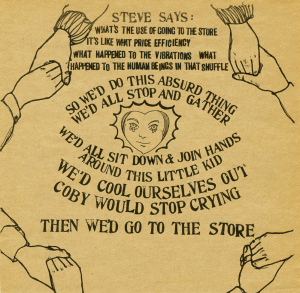
STEVE SAYS:
WHAT'S THE USE OF GOING TO THE STORE
IT'S LIKE WHAT PRICE EFFICIENCY
WHAT HAPPENED TO THE VIBRATIONS WHAT
HAPPENED TO THE HUMAN BEINGS IN THAT SHUFFLE
SO WE'D DO THIS ABSURD THING
WE'D ALL STOP AND GATHER
WE'D ALL SIT DOWN & JOIN HANDS
AROUND THIS LITTLE KID
WE'D COOL OURSELVES OUT
COBY WOULD STOP CRYING
THEN WE'D GO TO THE STORE
AND STEVE TAUGHT ME THAT:
IF YOU GET SO EFFICIENT ...
IF YOU'VE GOT TO TURN OFF ALL THE
VIBRATIONS OF THE SCENE ...
BECAUSE YOU'RE SO BUSY
ABOUT THE FUTURE
OR THE PAST
OR TIME HAS CAUGHT YOU ...
IT COSTS TOO MUCH!!
Statistics: Posted by admin — Fri Sep 25, 2015 7:41 am
]]>