"S."
Give me a "C".
"C".
Give me an "A".
"A".
Give me an "M".
"M".
What's that spell?
"SCAM."
What's that spell?
"SCAM."
What's that spell?
"SCAM."
In Lies We Trust: The CIA, Hollywood and Bioterrorism was produced to awaken a sleeping giant.
What you do once awake is your business.
This film is dedicated to slaying your inner dragons so that the outer ones simply run away
Note: This DVD is not for sale. It is provided as a gift and/or donation.
If you view this freely copied film, you will need to make more copies to share with at least two others.
As you give, we all receive.
Dr. Horowitz gives special thanks to his parents for making him different ...
Thanks also go to his children for serenity and understanding during the weeks dad spent producing this film.
FILM CREDITS & SPECIAL THANKS GO TO:
Maureen Kelleher, Maureen Kelleher Productions for inspiration and clips from her vaccine risk awareness film, The Truth Is Out There. Contact Maureen at 604-251-1479 and momagic@smartt.com.
Mystique Films and Christian Bryere for vaccine clip animations. Contact Christian at: 6-4=913-0062 and christian@mystiquefilms.com.
BridgeStone Media Group for clips from 911-In Plane Site, and One Nation Under Siege, a William Lewis Film. Contact Dave Vonkleist through The Power Hour 877-817-9829.
Joyce Riley, RN for major contributions to American veterans and citizens concerned with U.S. military official malfeasance.
Professor Garth Nicolson for his outstanding service to humanity exposing the microbiology of mycoplasma and Gulf War Syndrome.
Researchers: Alan Cantwell, M.D. and Robert Strecker, M.D., Ph.D. for providing directions in AIDS research that few dare follow.
Ingri Cassel and Don Harkins for serving the public needs for truth in an age of widespread deception through their fine publication The Idaho Observer. Contact: http://www.vaclib.org.
Jacqueline Lindenbach for script editing and production assistance.
Jim Marrs for his teachings on the corporate socialist state of America.
Dr. James Watson for the censored Hilleman interview originally recorded for Blackwell Science and WGBH television in Boston. The clips were pieced together from archives discovered in the National Library of Medicine.
Scott Huckabay for background music from several albums released through Tetrahedron Records, in albums including: Luminocity; The Light Wins; Walk on Water; Beam Us Up Scotty and Live LOVE in 528. Link to: http://www.perfectcircleofsound.com
Country Joe McDonald for the Feel Like I'm Fix'ng to Die Rag with new lyrics and performance provided by Leonard Horowitz with help from: Steve Tunnison and Mary De La Fuente's instrumentals and backup vocals in The Iraqi War Song.
Film Clip Credits include: HOLLYWOODISM: Jews, Movies, and the American Dream produced by Halpern and Jacobovichi available through most libraries.
OUTBREAK, Warner Bros.
The Health Century, Blackwell Science, Ltd.
The Coming Plague, TBS
The X-File Movie, Twentieth Century Fox
Fahrenheit 9/11 Michael Moore and Lion's Gate
The Manchurian Candidate, Paramount/Viacom
Bioterror, WGBH/PBS
History of Bioterrorism, H + HS TV
Video of Dr. Horowitz was produced by Scott Cramer, Sacramento, CA
Researched, written, and produced by Leonard George Horowitz based on his national bestselling books "Emerging Viruses: AIDS & Ebola: Nature, Accident or Intentional?" and "Healing Codes for the Biological Apocalypse" published by Tetrahedron Publishing Group, http://www.tetrahedron.org.
All copyrights have been waived in service to humanity.
Special thanks were earned by support staff at http://www.mac.com, for providing courteous and prompt technical assistance, required for Final Cut Studio 2, exclusively used in this production.
This film does not condemn all persons working for these government agencies. The pathology is systemic, not personal.
This program is freely distributed by Healthy World Distributing, LLC, 206 N. 4th Avenue, Suite 147, Sandpoing, ID 83864. For ordering by phone call: 1-888-508-4787.
Other educational products, including books, DVDs, and CDs by Dr. Horowitz are available online at: http://www.healthyworldstore.com.
Dr. Horowitz's official website is http://www.DrLenHorowitz.com
Thank you for helping to save lives by sharing this information.
[Music] Now come-on all you dumbed down men
that son-of-a-Bush needs your help again
Got us all in a terrorist jam
when daddy sent chemicals off to old Saddam
So don’t roll up your sleeves for any shots in your arm,
they don’t tell you that they're doing you harm.
And it’s one, two, three what are we fighting for?
Don’t tell me I don’t give a damn, next stop is old Baghdad.
And it’s five, six, seven open up the pearly gates,
well we’ve got no minds to question why, whoopee we’re all gonna die.
Now prepare yourselves generals for the big blast,
India and Pakistan are heating up fast,
Why you should go out and kill Afghans is
‘cause the only good Taliban is one that’s dead.
They say global peace can only be won
when they blast all to Kingdom Come.
And it’s one, two, three what are we fighting for?
The clueless just don’t give a damn, where the hell is Pakistan?
And it’s five, six, seven open up the pearly gates,
well with Prozac minds we don’t care to know why, whoopee we’re all gonna die.
Well come on Wall Street don’t be slow,
why man this is war, so go . . . go . . . go . . .
There’s plenty of big fortunes to be made
supplying the Chinese with the tools of the trade,
Just hope and pray that if they start the bombing,
they’ll drop em on Osama bin Laden.
And it’s one, two, three what are we fighting for?
The clueless just don’t give a damn, wag the dog at old Saddam.
And it’s five, six, seven open up the pearly gates,
well we’ve got no minds to question why, whoopee we’re all gonna die.
So come on mothers throughout the land, pack your boys off to old Baghdad.
Come on father, don’t hesitate, send you little girls too before their wedding day,
Be the first ones on the block to have your kids come home in a box.
And it’s one, two, three what are we fighting for,
the clueless just don’t give a damn, about the oil through Afghanistan.
And it’s five, six, seven open up the pearly gates,
well the Rockefellers say the population’s too high and half of us need to die.
So come-on all you dumbed down men that son-of-a-Bush needs your help again.
Got us all in a terrorist jam ousting daddy’s partner old Saddam.
So don’t roll up your sleeves for any shots in your arm, it’s smarter to stay on the farm.
DON’T YOU KNOW ITS A SCAM!”
Statistics: Posted by admin — Mon Mar 07, 2016 11:19 am
]]>
[Sam Daniels, OUTBREAK, Warner Bros.] Billy.
[Brigadier General Billy Ford, OUTBREAK, Warner Bros.] She was one of the first ones infected.
[Sam Daniels, OUTBREAK, Warner Bros.] What's E-1101?
[Brigadier General Billy Ford, OUTBREAK, Warner Bros.] It's an experimental anti-serum from Yale Virology. I figured it might be worth a try.
[Sam Daniels, OUTBREAK, Warner Bros.] I read the journals. I haven't read a word about E-1101. Where did you get it, Billy? You know I can call Yale in a second.
[Brigadier General Billy Ford, OUTBREAK, Warner Bros.] Damn it, Sam, I want to save these people same as you. I'm using everything in the arsenal. We have to work together, Sam.
[Sam Daniels, OUTBREAK, Warner Bros.] Are we?
[Brigadier General Billy Ford, OUTBREAK, Warner Bros.] Are we what?
[Sam Daniels, OUTBREAK, Warner Bros.] Are we working together, sir?
[MACHINE: FLATLINE: LADY'S DEAD]
[Sam Daniels, OUTBREAK, Warner Bros.] Aw, shit!
[Brigadier General Billy Ford, OUTBREAK, Warner Bros.] Don't waste your time making phone calls, Sam.
[THE NEW YORK TIMES BESTSELLER. ROBIN COOK. "MASTER OF THE MEDICAL THRILLER!" -- THE NEW YORK TIMES. OUTBREAK. "THE ULTIMATE NIGHTMARE, SPINE-TINGLING AND FEVER-PITCHED ACTION."]
[Dr. Leonard George Horowitz] So Cook, in his exciting book and film, told the truth about the CIA's release of this microbe.
[Sam Daniels, OUTBREAK, Warner Bros.] You hear me, don't you guys? I'll say it one last time. These people that you're going to bomb are not the enemy. We can kill the virus without killing these people, and I swear to you on my soul, that the President of the United States does not have the facts, he does not know that we have a serum that is working. Do you really think he wants to blow up the town? Oh, Christ, guys, if you think I'm lying, drop the bomb. If you think I'm crazy, drop the bomb. But don't drop the bomb just because you're following orders. What you haven't been told is that your superiors have another agenda. Don't you understand that right below you at Cedar Creek there's a biological weapon that they've been manufacturing illegally for the last 30 years. And I guarantee you, that the disease has spread beyond the perimeters of this town.
[Donald McClintock, OUTBREAK, Warner Bros] People, we're in a state of national emergency.
[SLOAN CANCER FOUNDATION PAID PRESTON $20,000 TO DISTRACT THE PUBLIC FROM REALIZING EBOLA EMERGED FROM BIOWEAPONS CONTRACTOR BIONETICS.]
[Dr. Leonard George Horowitz] But the biggest best seller, "The Hot Zone," by author Richard Preston, was different. Extremely dishonest. Author Richard Preston was paid by the Alfred P. Sloan Foundation, among the cancer industry's largest benefactors, intimately tied to the Rockefeller family's influence, to present easily-proven deceptions. Preston reported that Ebola emerged from bat guano, at the bottom of a deep dark cave in Southern Sudan.
The patient’s travel group consisted of 7 Dutch tourists and 2 guides. Three of the tourists, including the patient, and 1 guide visited an empty cave on June 16 in Fort Portal and the Python Cave in the Maramagambo Forest on June 19. The patient’s partner recalled bats flying around in the latter cave, bumping against the visitors, and large amounts of droppings on the ground. She incurred no bite wounds, and no preexisting wounds were exposed to bats. On July 23, the travel group came within 5 m of gorillas in the wild and visited a village inhabited by pygmies, where they saw an elderly sick woman lying under a blanket.
We postulated that the most probable source of MARV infection was the visit to the Python Cave, known for its colony of Egyptian fruit-eating bats (Rousettus aegyptiacus). The party had photographed these bats, and this species of bat has been shown to carry filoviruses, including MARV (16,17) in other sub-Saharan locations. We estimated the incubation period of the infection to be 13 days....
Ecological surveys to assess the presence of infected bats in that cave are ongoing (P. Rollin, pers. comm.).
-- Response to Imported Case of Marburg Hemorrhagic Fever, the Netherlands, by Aura Timen, Marion P.G. Koopmans, Ann C.T.M. Vossen, Gerard J.J. van Doornum, Stephan Günther, Franchette van den Berkmortel, Kees M. Verduin, Sabine Dittrich, Petra Emmerich, Albert D.M.E. Osterhaus, Jaap T. van Dissel, and Roel A. Coutinho
++++++++++++++++++++++++++++++++++
Marburg and Ebola viruses can cause large hemorrhagic fever (HF) outbreaks with high case fatality (80–90%) in human and great apes. Identification of the natural reservoir of these viruses is one of the most important topics in this field and a fundamental key to understanding their natural history. Despite the discovery of this virus family almost 40 years ago, the search for the natural reservoir of these lethal pathogens remains an enigma despite numerous ecological studies. Here, we report the discovery of Marburg virus in a common species of fruit bat (Rousettus aegyptiacus) in Gabon as shown by finding virus-specific RNA and IgG antibody in individual bats. These Marburg virus positive bats represent the first naturally infected non-primate animals identified. Furthermore, this is the first report of Marburg virus being present in this area of Africa, thus extending the known range of the virus. These data imply that more areas are at risk for MHF outbreaks than previously realized and correspond well with a recently published report in which three species of fruit bats were demonstrated to be likely reservoirs for Ebola virus.
-- Marburg Virus Infection Detected in a Common African Bat, by by Jonathan S. Towner, Xavier Pourrut, César G. Albariño, Chimène Nze Nkogue, Brian H. Bird, Gilda Grard, Thomas G. Ksiazek, Jean-Paul Gonzalez, Stuart T. Nichol, and Eric M. Leroy
The fact is, this is very close to where Litton Bionetics' labs operated, testing these precise agents on native Africans.
[BIONETICS RESEARCH LABORATORIES, INC. (NIH-71-2025)
Title: Investigations of Viral Carcinogenesis in Primates
Contractor's Project Directors: Dr. John Landon, Dr. David Valerio, Dr. Robert Ting
Project Officers (NCI): Dr. Roy Kinard, Dr. Jack Gruber, Dr. Robert Gallo
Objectives: (1) Evaluation of long-term oncogenic effects of human and animal viral inocula in primates of various species, especially newborn macaques, (2) maintenance of monkey breeding colonies and laboratories necessary for inoculation, care and monitoring of monkeys, and (3) biochemical studies of transfer RNA under conditions of neoplastic transformation and studies on the significance of RNA-dependent DNA polymerase in human leukemic tissues.
Major Findings: This contractor continues to produce over 300 excellent newborn monkeys per year. This is made possible by diligent attention to reproductive physiological states of female and male breeders. Semen evaluation, artificial insemination, vaginal cytology and ovulatory drugs are used or tried as needed.
Inoculated and control infants are hand-fed and kept in modified germ-free isolators. They are removed from isolators at about 8 weeks of age and placed in filtered air cages for months or years of observation. The holding ...
Date Contract Initiated: February 12, 1962]
Here, for close examination, is the exact experiment administered by Litton Bionetics in 1965 and ending in 1970, precisely timed for the first Marburg virus outbreak.
[Plyctm: Polycythemia
PPLO: Mycoplasma
R: Rubella
Rau Vi: Rauscher virus
RCS: Reticulum cell sarcoma
Reo 1: Reovirus 1
Reo 3: Reovirus 3
Rhabd L: Rhabdomysarcoma + leukemia
Rhabdo: Rhabdomysarcoma
RTC: Rous transformed cells
S: Sarcoma
S20S40: SV-20 + SV-40
SA 7: Simian agent 7
SCL: Stem cell leukemia
Sq S: Squamous cell sarcoma
SV-5: Simian virus 5
SV-20: Simian virus 20
SV-40: Simian virus 40]
This NCI document refers to John Landon, Chief scientist at Litton Bionetics overseeing the experiment. Notice that at least half of the Rhabdo virus simian-infected monkeys died or were transferred. The ones that lived were transferred to the vaccine production labs for vaccine production.
[MARBURG OUTBREAK]
This is how the first Marburg virus outbreaks occurred. Since that time, every single Marburg virus outbreak, as well as Ebola virus outbreak, has either been associated with a bioweapons lab accident, or an intentional release for terrorism's objectives: political or financial gain.
But not according to America's leading Outbreak journalist, Laurie Garrett. In her bestseller, "The Coming Plague," she neglects Litton's links and dismisses the CIA biological weapons contributions to these outbreaks as though she too were on the Rockefeller's payroll.
[EMERGING VIRUSES: AIDS & EBOLA: NATURE, ACCIDENT OR INTENTIONAL? BY LEONARD G. HOROWITZ]
It should be noted that these unnaturally evolved, man-made viruses are far less genetically stable. They are more fragile. They mutate more rapidly than naturally evolved viruses. That's why when the second Marburg virus outbreak occurred in the southern part of Uganda in 1975, many scientists suspected foul play by the CIA since the genetic sequence of the 1975 strain was essentially identical to the 1968 strain. The only explanation for this fact remains: refrigeration.
Year(s) / Country / Apparent or suspected origin / Reported number of human cases / Reported number (%) of deaths among cases / Situation
1975 / Johannesburg, South Africa / Zimbabwe 3 / 1 (33%) / A man with a recent travel history to Zimbabwe was admitted to hospital in South Africa. Infection spread from the man to his traveling companion and a nurse at the hospital. The man died, but both women were given vigorous supportive treatment and eventually recovered.
-- Chronology of Marburg Hermorrhagic Fever Outbreaks, by Centers for Disease Control and Prevention
[THE FILMS OF STEVEN SEAGAL]
From my perspective, the least trustworthy bioterrorist in Hollywood is CIA operative Steven Seagal. This propagandist, and egomaniacal opportunist, produced the movie "The Patriot" at my expense, merging "Emerging Viruses, AIDS & Ebola" and my third best-seller, "Healing Codes for the Biological Apocalypse" into one screenplay.
[THE LAST CANADIAN, BY WILLIAM C. HEINE]
Instead of professionally crediting me, Seagal falsely credited "The Last Canadian," for his information. Seagal boasts of his CIA alliances. In "The Patriot," he spun my character together with an admitted CIA operative named "Larry Wayne Harris," who I exposed in the late 1990s as a bioterrorist threatening the public's health. Harris was later arrested for acquiring anthrax spores.
[DECEMBER 7: SUNDAY]
[HOLLYWOODISM, HALPERN/JACOBOVICHI] Everything changed on December the 7th, 1941, with the attack on the U.S. Navy at Pearl Harbor by Hitler's Japanese allies. Now, instead of telling Hollywood to keep quiet, the U.S. Government began pushing them to fulfill their duty, and make patriotic war movies.
[Government Narrator] The motion picture industry today is supplying without charge all of its newest and best feature films to the U.S. War Department Overseas Film Division.
[Prof. Les Friedman, Author/Historian] And movies were a tremendous propagandistic tool during this time. They set up camps for the soldiers to come back in where movies were shown 24 hours a day, because that impressed the soldiers with what they were fighting for.
[Narrator] It was the beginning of an unprecedented alliance between Washington and Hollywood. While 6 million Jews died in Europe, their kinsmen in Hollywood were churning out patriotic movies to help galvanize the allies to defeat Hitler.
You're a grand old flag,
You're a high flying flag
And forever in peace may you wave.
You're the emblem of
The land I love.
The home of the free and the brave.
Every heart beats true
under Red, White and Blue,
Where there's never a boast or brag.
But should auld acquaintance be forgot ...
[HEARING ON COMMUNISM IN HOLLYWOOD, BY ED HERLIHY]
[Ed Herlihy, Hearing on Communism in Hollywood] Calling the House Un-American Activities Committee to order, Chairman J. Parnell Thomas of New Jersey opens an inquiry into possible Communist penetration of the Hollywood Film Industry. The Committee is seeking to determine if Red party members have reached the screen with subversive propaganda.
[Narrator] To the Moguls' surprise, powerful men in Washington saw Hollywood's patriotism as nothing more than thinly disguised communism. Now, at the height of their success, the Hollywood Jews watched their dream fall apart.
[John Howard Lawson] The question of communism is in no way related to this inquiry, which is an attempt to get control of the screen and to invade the basic rights of American citizens in all fields.
[Rep. John R. McDowell] Now, I must object.
[Stripling] Mr. Chairman.
[Chairman J. Parnell Thomas] [Pounding the gavel.]
[John Howard Lawson] The question here relates not only to the question of my membership in any political organization, but this committee is attempting to establish the right --
[Chairman J. Parnell Thomas] [Pounding the gavel.]
[John Howard Lawson] -- which has been historically denied to any committee of this sort, to invade the rights and privileges and immunity of American citizens, whether they be Protestant, or Methodist, or Jewish, or Catholic, whether they be Republicans or Democrats or anything else.
[Chairman J. Parnell Thomas] [Pounding the gavel] Mr. Lawson, just quiet down again. Mr. Lawson, the most pertinent question that we can ask is whether or not you have ever been a member of the Communist Party. Now, do you care to answer that question?
[John Howard Lawson] You are using the old technique which was used in Hitler's Germany in order to create a scare here.
[Stripling] Mr. Chairman, the witness is not answering the question.
[Chairman J. Parnell Thomas] [Pounding the gavel] We are going to get the answer to that question if we have to stay here for a week. Are you a member of the Communist Party, or have you ever been a member of the Communist Party?
[John Howard Lawson] I am framing my answer in the only way in which any American citizen frames his answer to a question which absolutely invades his rights.
[Chairman J. Parnell Thomas] Then you refuse to answer that question; is that correct?
[John Howard Lawson] I have told you that I will offer my beliefs, affiliations, and everything else to the American public, and they all know where I stand --
[Chairman J. Parnell Thomas] [Pounding the gavel Excuse the witness
[John Howard Lawson] -- as they do from what I have written.
[Chairman J. Parnell Thomas] [Pounding the gavel] Stand away from the stand.
[John Howard Lawson] I have written Americanism for many years, and I shall continue to fight for the Bill of Rights, which you are trying to destroy.
[Chairman J. Parnell Thomas] [Pounding the gavel] Officers, take this man away from the stand.
[Applause and boos.]
[Chairman J. Parnell Thomas] [Pounding the gavel] There will be no demonstrations. No demonstrations, for or against. Everyone will please be seated.
[Narrator] To appease HUAC, the Moguls instituted a blacklist of studio talent. Years before, they had fled European anti-semitism, but now in America, they became collaborators, helping anti-semites rid Hollywood of Jewish intellectuals. In effect, they had surrendered control of the industry.
The Moguls are gone, but their vision survives. The America of Edison and Rankin has given way to an alien ideology. It isn't the communism or Judaism that the gentile elite once feared. It's "Americanism" as defined by Hollywood. The icons endure. The little guy fighting the odds. The pogrom imagery. The desperate desire to survive. And the various races assimilating to create the ultimate happy ending.
[Rabbi] [Inaudible] Ha-shem, Elohim.
[Gentile] I'm not Jewish.
[Rabbi] Nobody's perfect.
[INDEPENDENCE DAY, TWENTIETH CENTURY FOX]
[Narrator] A white, middle-classed president, articulating the Jewish experience writ large. A new global religion: Hollywoodism.
[-- America in the Third World: Strategic Alternatives and Military Implications, by Steven Metz
The key to a positive future in the Third World would be the rise and rapid spread of an alternative value framework and politico-economic system stressing population control, ecological sanity, intergroup cooperation, and deference to authority. Because of the extent of change needed and the speed with which it must take place, such a new system would probably have to take the form of a unifying religion, either a totally new one or a mutation from an existing one. Only a religion can generate the transformative power needed to change the course of the Third World's future.]
[President Thomas Whitmore] Perhaps it's fate that today is the Fourth of July, and you will once again be fighting for our freedom. Not from tyranny, oppression, or persecution, but from annihilation. We are fighting for our right to live. To exist.
[-- Triumph of the Will, directed by Leni Riefenstahl
[Adolf Hitler] A year ago ...
we met for the first time on this field,
the first general review of political leaders ...
of the National Socialist Party.
200,000 men have assembled here.
They are not here at the summons of their hearts alone ...
but also at the summons of their loyalty.
It was the great calamity of our people that drove us to the struggle ...
brought us together ...
and left us greater.
Those who do not understand ...
have not experienced the same calamities among their people.
These things appear enigmatic and mysterious ...
that hundreds of thousands would be led to assemble ...
amidst calamity and passion.
Others cannot understand ...
that this is not an order of the State!
They are deceiving themselves!
The State does not order us!
We order the State!
The State did not create us!
Rather we created our own State!
No, the movement lives ...
and it is grounded hard and fast.
And as long as one of us can draw a breath ...
he will give his strengths to the movement ...
just as it was in yesteryear.
Then drum will join drum ...
flag will join flag ...
group will join group. Gau to Gau ...
and after that, this earlier divided people ...
will follow these sacred columns of the Nation.
It would be an outrage if we were to lose ...
what we have fought for ...
with so much labor, so much worry ...
so much sacrifice, and so many privations.
One cannot live faithfully and give up ...
what has given meaning and purpose to one's entire life.
That would not be so ...
if it were not a cardinal command.
And no earthly power gave us that command.
For the God, our God, who created our people, gave us that command!
So it is our vow this evening ...
that each hour, on every day ...
to think only of Germany of the People and Reich ...
and of our German nation!
To the German people! Hail Victory! Hail Victory!
[Man] There was a "Hollywoodism" then; there's a "Hollywoodism" today. I would go further and say, it is what is the ruling ideology of our culture. Hollywood culture is the dominant culture. It is the fantasy structure that we're all living inside.
[Lady singing] God bless America, land that I love
Stand beside her, and guide her
Through the night with a light from above
From the mountains, to the prairies
To the oceans, white with foam|
God bless America, my home sweet home
God bless America, my home sweet home
[Dorothy] Oh, Auntie Em, there's no place like home!
[HOLLYWOODLAND]
[HOLLYWOODISM]
[John Wayne] [Toasting his glass] L'chaim.
[-- Leaves of Grass, by Walt Whitman
Americanos! conquerors! marches humanitarian!
Foremost! century marches! Libertad! masses!
For you a programme of chants.
Chants of the prairies,
Chants of the long-running Mississippi, and down to the Mexican sea,
Chants of Ohio, Indiana, Illinois, Iowa, Wisconsin and Minnesota,
Chants going forth from the centre from Kansas, and thence equidistant,
Shooting in pulses of fire ceaseless to vivify all....
I too, following many and follow'd by many, inaugurate a religion, I descend into the arena,
(It may be I am destin'd to utter the loudest cries there, the winner's pealing shouts,
Who knows? they may rise from me yet, and soar above every thing.)]
[Dr. Leonard George Horowitz] With this background, you can be more discerning about the propaganda you receive from Hollywood.
[HHS Narrator] This program has been brought to you by the United States Department of Health and Human Services. You're watching HHS, the Health and Human Services network.
[Man] If a natural disaster happened and we were outside the home, we would probably all meet, all say, around the grocery store, you know.
[Woman] We would all meet at a bus stop. That is our meeting place.
[Boy 1] Well, we'll probably just meet out in front of the house.
[Boy 2] Uh, we'd probably meet at our neighbor's house.
[Boy 1] If you have no plan, then you can just plan to do what happens.
[IS YOUR PLAN ANY BETTER?
MAKE SURE YOUR FAMILY HAS A PLAN IN CASE OF AN EMERGENCY.
READY.GOV]
[HHS Narrator] Come to a place that's new and unique. A place of health, well-being, and preparedness, where connection leads to inspiration and empowerment. Come to HHS, the Health and Human Services Network, a 24/7 commercial-free resource for high-quality health and emergency preparedness information from the world's leading experts whenever and wherever it's needed: at home, at work, on the air, and on the web. HHS, the Health and Human Services Network.
[FOREIGN AFFAIRS, NOVEMBER/DECEMBER 2002: THE FUTURE OF AIDS: GRIM TOLL IN RUSSIA, CHINA, AND INDIA, BY NICHOLAS EBERSTADT]
[Dr. Leonard George Horowitz] So, if the goal is to reduce excess population, as Foreign Affairs Journal advertisement says, we need more wars, including our government's war on terrorism! We need to inject more people, especially Black people with infectious diseases.
[WHY WE NEED A SMALLER U.S. POPULATION, AND HOW WE CAN ACHIEVE IT. A MESSAGE FROM NEGATIVE POPULATION GROWTH, INC.]
This is why an image of a needle inserted into a vial of vaccine is said to be synonymous with preparedness and the positive virtues of inspiration and empowerment. Why they show flu vaccine vials rolling off the assembly line and equate the vaccine as delivering "high quality health." Why they plug CIA agents and so-called "health experts" like Dr. Anthony Fauci. Why they say the HHS will be there for you in an actual emergency, just like they were there following Hurricane Katrina. Why they need to reinforce, reiterate and convince you that they are an accurate and reliable resource, when it is precisely that which they are not. Why they show life's riskiest profiteering in genetic engineering and biotechnology as a "trusted partner in good health." And why they inject a happy Black woman for especially emergency preparedness and beckon you to come to their paradise.
In conclusion, the new unprecedented risks we now face as a nation, and world, bring us to the brink of annihilation. This prognosis includes possible extinction. The motives underlying our own destruction include greed, ignorance, generalized fear, and malice against other nations and people as shown in this persuasive propaganda.
As this program ends, I pray you are better able to make choices consistent with accurate intelligence and wisdom. Take Dr. Cono's advice: study the government propaganda on their information sites recalling what you have learned here. Each of us needs to make a critical choice. Either we awaken to the truth that shall set us free, or dismiss the truth and increase our risk of dying early.
It was once said that ignorance is bliss. Consider carefully who might benefit from your ignorance, and who might be harmed.
THE END.
Statistics: Posted by admin — Sun Jan 03, 2016 1:39 am
]]>
[Dr. Maurice Hilleman] Yeah, well it was made at Merck.
[Dr. Edward Shorter, Medical Historian] You were making it for Sabin at this point?
[Dr. Maurice Hilleman] Yeah, it was made before I came.
[Dr. Edward Shorter, Medical Historian] Yeah, but at this point Sabin is still just doing these massive field trials?
[Dr. Maurice Hilleman] Uh-huh.
[Dr. Edward Shorter, Medical Historian] Okay.
[INITIALLY MILLIONS OF RUSSIANS, LATER MILLIONS OF AMERICANS, WERE INFECTED WITH CANCER VIRUSES IN POLIO VACCINES.]
[Dr. Maurice Hilleman] In Russia and so forth. So I go down and talked about the detection of non-detectable viruses. And I told Albert, I --
[Dr. Edward Shorter, Medical Historian] But at this point Sabin is still just doing these massive field trials?
[Dr. Maurice Hilleman] Uh-huh.
[Dr. Edward Shorter, Medical Historian] Okay.
[Dr. Maurice Hilleman] In Russia and so forth. So I go down and talked about the detection of non-detectable viruses. And I told Albert, I said, "Listen, Albert," I said, "You know, you and I are good friends." But I said, "I'm going to go down there -- you're going to get upset -- but I'm going to talk about a virus that's in your vaccine. Now, you're going to get rid of the virus. Don't worry about it. You're going to get rid of it. So of course, Albert was very upset with me.
[Dr. Edward Shorter, Medical Historian] What did he say?
[Dr. Maurice Hilleman] Well, he said, basically that this is just another obfuscation that is going to upset vaccines.
[VISIT A FREE POLIO VACCINE STATION TODAY]
And I said, "Well, you know, you're absolutely right." But I said, "We have a new era here, we have a new era of a detection. And the important thing is to get rid of these viruses.
[Dr. Edward Shorter, Medical Historian] Why would he call it an "obfuscation" if it was a virus that was contaminating the vaccine?
[40 DIFFERENT VIRUSES IN THESE VACCINES ... NOT ALL INACTIVATED]
[Dr. Maurice Hilleman] Well, there were 40 different viruses in these vaccines anyway that we were inactivating. And --
[Dr. Edward Shorter, Medical Historian] But you weren't inactivating the [inaudible].
[YELLOW FEVER VACCINE HAD LEUKEMIA VIRUS IN IT.]
[THIS IS IN THE DAYS OF VERY CRUDE SCIENCE.]
[Dr. Maurice Hilleman] That's correct. No, that's right. But, sheesh, yellow fever vaccine had leukemia virus in it. You know, this is in the days of very crude science.
George and Margaret Gey were husband-and-wife pioneers in the field of tissue culture. George, who stood well over six feet tall and had a broad chest, was an idea man and a tinkerer. Among his many inventions was something called a roller tube, a sealed glass vessel in which living cells were periodically bathed in a nutrient solution as the tube was slowly rotated. He blew the glass for the first tube himself and rigged up a primitive rotor using the pendulum of a clock. It became a standard in the field. A zealot when it came to the care and feeding of cells, George Gey once bought an entire boxcar full of powdered soap for washing culture dishes; it seems the local market had switched to a newfangled detergent that sometimes left residues harmful to cells, and George wanted to make sure he'd never be forced to use the stuff. Although a native of Pittsburgh, he had a country boy's air. He spoke plainly and with warmth as readily to cab drivers as to scientific dignitaries. He ran his lab like an informal college of tissue culture, sharing equipment and knowledge with any student or scientist who wanted to learn. And for a few hours every Wednesday, he went fishing.
Margaret, trained as a surgical nurse, was the meticulous director of day-to-day operations in the laboratory. As long as everyone did his share, she was an amicable boss. If necessary, however, she could play the role of the stern head nurse. She saw to it that the cultures were fed on schedule, that the glassware was sterilized according to specifications, that the records were kept in order. George was regularly out of the lab, hunting for funds and lecturing, but Margaret was always there, working long days and weekends, all of it without pay.
Together the Geys were trying to put some science into the folk art of growing cells. If reliable methods could be devised to keep cells alive in a roller tube and to trick them into thinking they were still inside a body, then scientists could learn firsthand about human biology without having to experiment on human beings directly. The workings not only of healthy cells but also of sick ones could be revealed. That possibility -- of capturing human diseases under glass and dissecting them for their underlying causes -- was what lured the Geys and several other research teams into the business of culturing tissue. Their greatest hope was to establish and study long-lasting cultures of the most dread human disease, to have, as some put it, "a tumor in a test tube."
But it was slow, difficult, sometimes grizzly work. In order to give their cells a proper feeding solution, for example, they had to find the raw materials themselves. Several times a week Margaret went to the Hopkins hospital's maternity ward to collect one ingredient believed to stimulate cell growth: blood from human placentas. One of the maternity nurses would press a button that set off a buzzer in the Geys' lab, signaling that a fresh placenta was being put aside for them. Margaret soon arrived, cleaned off the sac's umbilical cord, and, plunging a fat syringe into one of the cord's larger blood vessels, pulled out as much as 50 cubic centimeters, about a third of a cup. Back at the lab the serum component, the slightly yellowish fluid containing proteins, was removed from the blood and combined with what the Geys called beef embryo extract. This was the ground-up remains of a three-week-old cattle embryo, collected periodically from a cooperative packing house. Because the recipe also called for chicken plasma, every so often the Geys visited a nearby poultry factory. They usually went about dawn so that few workers would be around to witness the spectacle. Margaret's job was to pull back the wing, swab the area around the ribs with alcohol, and hold the animal still while George poked the syringe directly into its heart. They took 50 cubic centimeters from each chicken, and most walked right off the table and back to the yard. They had a deal with the owner to buy any bird that didn't survive. On such occasions Margaret cooked the unlucky animal for dinner that evening.
As for the cells to be grown in this elixir of plasma and serum and embryo mash, the Geys had to go out and collect them as well. Every day George scanned the hospital's list of upcoming operations and procedures, looking for interesting sources of tissue. He or Margaret or one of the technicians stood in the appropriate operating room holding a few petri dishes ready for a scrap. Then they raced back to the lab, placed the pulpy fragment on a clot of chicken plasma, added the remaining parts of their cell food, and hoped that it would take.
It was discouraging. No matter how clean their glassware, no matter how potent their nutrient solution, no matter how careful their technique, cells simply weren't comfortable growing outside the human body. The Geys had had considerably more success with animal cells, including some that had survived for years now. But most human cells shriveled and died right away. Some held on for a few weeks, coaxed and coddled by Margaret's diligence, and then gave up. It was a testimony to the Geys' abilities that by early 1951, they had managed to keep a few lines of human cancer cells alive for several months. It was a testimony to their determination that they kept trying to establish new ones.
Mary Kubicek, however, was running low on determination. A twenty-one-year-old technician just out of college and newly trained by the Geys, Mary was frustrated by her current assignment: an attempt to establish a culture of cervical cancer cells. Mary was shy and slightly insecure; that made her doubly careful and especially hardworking, even measured by the high standards of the Gey lab. Nonetheless after trying samples of cervical cancer from a dozen different patients, all she and her fellow technicians had to show were dead cultures. When George Gey announced around noon on 9 February that he had dropped off yet another cervical cancer biopsy in Mary's work area, she didn't attend to it right away. Uncharacteristically, she lingered a few minutes at the lunch table and finished her sandwich. What's the difference, she thought. It'll just be another useless attempt.
The tumor fragment was red, roughly square, less than half an inch on a side. Gey explained that it had been taken from a patient in the women's clinic just before she underwent radiation therapy. Following the usual procedure, the tissue was code-named with the first two letters of the donor's first and last names: HeLa. Mary cut away the decaying, brown tissue around the edges and sliced the remaining chunk into tiny cubes. She pipetted a few drops of chicken plasma into several roller tubes and placed four cubes of tissue in each tube. She waited five minutes for the plasma to stiffen into a clot, and then added the rest of the feeding solution. Finally, she placed the tubes into a rolling rack inside the laboratory's incubator.
Had Mary been staring through the glass doors of the incubator, she wouldn't have seen the early signs of life. It happens so slowly at first and so sporadically. Maybe it was a matter of hours, maybe the better part of a day passed. At some point, the cells in each little island of tumor began to quiver and dance ... and multiply. Where there had been one, there were now two. Where there had been two, now four, now sixteen, now thirty-two. In a few days, the signs of growth were visible: around each cube a translucent band of new cells was taking shape. On the fourth day Mary had to remove the burgeoning bits of flesh from the roller tubes, carve them up into smaller pieces, and transfer the cuttings into additional tubes.
Every other human cell line in the Gey lab had eventually weakened and faltered. Yet as the months passed the HeLa cells showed no such vulnerability. They just kept growing, doubling their number every twenty-four hours "spreading like crabgrass!" was how Margaret Gey described it. At one point George Gey compared the performance of the cancerous HeLa cells to the performance of the normal cervical tissue taken from Henrietta Lacks: the tumor cells were growing ten to twenty times faster. It was too early to start celebrating, and George Gey wasn't the sort to stop and congratulate himself anyway. But there was no doubt about it, these cells were different.
***
The tumor within Henrietta Lacks was different too, though the doctors didn't know it at the time. Most cervical tumors -- especially those found at an early stage, as was Henrietta's -- were easily beaten back by radiation. Most patients were still alive five years after therapy. So after several more radium treatments, the doctors gave her one month of X-ray therapy and hoped that would be the end of it. "No symptoms referable to the pelvis," wrote one who examined her in May. "Cervix is normal in size, mucosa red and smooth, cervix freely movable. Good radiation result. Rx: Return in one month." In June he wrote: "Patient feels fairly well, but continues to complain of vague lower abdominal discomfort. Cervix appears perfectly normal. No evidence of recurrence. Rx: Return in one month."
By late July Henrietta's side aches could no longer be described as vague. Now they were extreme and radiating down into the groin. Not only that, something was constricting the area around her bladder so severely that her kidneys began to swell with urine. The doctors also found a large, stony mass of tissue on the inside of her pelvis and another tumor in a lymph gland. With shocking speed the cancer had reappeared and spread so extensively that the doctors considered it inoperable: "For this reason, we are giving the patient a second course of deep X-ray therapy purely as a symptomatic therapy."
She was admitted to the hospital on 8 August, ten days before her thirty-first birthday. For the next twenty-two days she ran a constant fever of 100 to 102 degrees; she also began vomiting regularly. Despite the X-ray treatment, tumors were filling her abdomen. The treatment was halted.
In mid-September, with the fever, pain, and nausea continuing, she developed uremia, a buildup in the blood of poisonous waste products normally eliminated by the kidneys and bladder. The doctors tried to insert a catheter tube through the mass of tumors that choked her bladder, but failed. They gave her transfusions, replacing her own polluted blood with a fresh supply. Her intestine, however, was also blocked and her abdomen was beginning to expand.
On 26 September one of the doctors looked over her order sheet, the long list of various drugs, procedures, and treatments that had been prescribed to try to save Henrietta Lacks. At the bottom of the list, he scrawled: "Discontinue all medication and treatments except analgesics." All he could do was try to relieve the pain. On 29 September, Henrietta Lacks became disoriented, apparently confused about where she was and what she had been going through. She stopped breathing at fifteen minutes after midnight on 4 October 1951.
It had been only eight months from the time the small red patch was first discovered in her cervix to the day it killed her. For cancer of the cervix, the doctors said, it was some kind of a record.
***
No one in the Gey laboratory laid eyes on their unfortunate benefactor until 4 October when George Gey noticed a listing for the autopsy and went to observe. Because he wanted a few more samples of the remarkable tumor cell, he asked Mary Kubicek to meet him there and collect them.
The Hopkins autopsy room was buried in the basement of another building. Mary had never been there before. In fact she had never been to any autopsy facility or to a morgue or to anything like that. She made her way anxiously through the maze of dim underground hallways that connected the laboratory building to the other basement.
The room had high ceilings and a bare stone floor. At the far end Mary saw a body on the table. A pathologist was hunched over it, at work, and Gey stood nearby. The dead woman's arms had been pulled up and back so that the pathologist could get at her chest. Even from a distance Mary could see that the body had been split down the middle and opened wide.
She walked to the table, sidestepped one of the outstretched arms, and held out her petri dishes. As she waited she gaped at the greyish white tumor globules that filled the corpse. It looked as if the inside of the body was studded with pearls. Strings of them ran over the surfaces of the liver, diaphragm, intestine, appendix, rectum, and heart. Thick clusters were heaped on top of the ovaries and fallopian tubes. The bladder area was the worst, covered by a solid mass of cancerous tissue. "Bladder pushed to anterior abdominal wall," wrote the pathologist, "Almost entirely replaced with tumor."
Mary's eyes wandered down toward the corpse's feet and suddenly she was overcome. The toes. They were painted with bright red nail polish, and a dainty job it was. It suddenly made this carved-up cadaver real. All the laboratory experimentation had never hinted at the tragedy of this disease. But here, she thought, over here on the table is the proper demonstration. Here is what cancer does.
The pathologist sliced pieces of tumor from different organs and dropped them one-by-one into the dishes in Mary's hands. It seemed to Mary that he took forever. Finally, she fled: across the expansive stone floor and out of the autopsy room, through the catacombs, and up the stairs from the basement. Back at the lab she concentrated on the task at hand, cutting up the tissue and placing the pieces into roller tubes. In the bright familiar surroundings, her horror quickly faded. The image of the delicately polished toenails, however, lingered. In the years that followed, that sight came back to her often.
As for the cadaverous cells, they would not grow. The uremia had made it impossible for anything to live within the body of Henrietta Lacks. The cancer's sabotage had been so effective, it killed not only its host, but also itself.
That's not quite right, of course. Part of what had been Henrietta Lacks's cancer was not dead. Some of the cells had escaped their own poisonous wreckage eight months earlier on the edge of a surgeon's knife, abetted by the tissue culturing skills of Mary Kubicek. Dining on clotted chicken plasma, chopped beef embryo, and the blood from human placentas, the surviving cancer cells of Henrietta Lacks were living quite comfortably -- thriving, in fact -- in glass tubes in George Gey's lab.
***
In the early 1950s many Americans would have named cellophane science's niftiest invention. To the small community of researchers trying to grow human cells in their laboratories, however, the truly great breakthrough was the HeLa cell. At last, here was a cell with staying power, the first durable piece of a human being that could be watched up close and tinkered with. No more racing to finish an experiment before a sickly culture wheezed and fell dead. This cell would last, not just through one series of tests but through dozens, for months, maybe for years.
In fact George Gey and two co-workers at the University of Minnesota showed that HeLa cells were so rugged they could survive a 2,500-mile trip through the mail. They sent twenty-nine live cultures by air, rail, and truck from Minneapolis to Norwich, New York, and back; all but one returned in fine health. A cell line that held on in the lab was what everyone had been hoping for, of course, but one that could endure handling by the U.S. Post Office was a blessed miracle.
Soon it seemed every biomedical scientist in the country was either sending or receiving a HeLagram. Gey started it by mailing samples of HeLa cells to a few close colleagues, who grew up some extra cultures and sent them to their friends, who did likewise. When the frenzied demand for HeLa outpaced this informal network, a number of laboratories set up full-scale production lines and began passing around HeLa cultures the way McDonald's shovels out its burgers and fries. Mary Kubicek heard that one shipment of HeLa was being carried by backpack into Chile and another was on its way to Turkey. In a few years HeLa cells would even travel into space aboard the Discoverer XVII satellite.
Cancer researchers craved HeLa most of all because it was their long-sought tumor in a test tube. They watched the cells react to a battery of toxic chemicals and photographed the weirdly shaped chromosomes. Scientists interested in the general workings of human cells clocked the rate at which HeLa cells multiplied and studied their production of proteins. Virologists, who found that polio viruses multiplied a millionfold just two to three days after infecting a HeLa culture, made HeLa their major new tool for studying the viruses. A year later they knew enough about polio to produce the first successful vaccine.
And, of course, every scientist who wanted to learn the methods of tissue culture insisted on starting with HeLa. The newcomers had been told how frustrating much of the work would be, how rarely a piece of tissue would yield a sustainable cell line. But with HeLa, they knew they couldn't lose. The advent of HeLa was not only a boost for the beginners, though. It also seemed to change the luck of the researchers who were struggling to establish other human cell lines.
It was as though George Gey had broken biology's four-minute mile. Once he had shown it was possible to produce a strong and long-lived cell line from human tissue, his fellow cell culturists went back to the lab with new confidence and enthusiasm -- and damned if they weren't able to do it too. One scientist successfully cultivated a hardy strain of human liver cells. Another started up a cell line from a bit of amniotic sac. Then came a culture from a tumor of the larynx, followed quickly by sturdy lines of embryonic kidney cells and adult heart cells and cancerous blood cells. True, the cultures didn't always bloom right away. But eventually, a few days or a few weeks after being seeded, somehow they all began growing at a strong and steady pace. For the next ten years, from the early 1950s to the early 1960s, the science of cell culture flourished as well.
***
A few of the old guard saw the calamity coming. With so many new cells in circulation, and with no means of positively identifying them, they knew there would be mixups. So they tried to head off the problem. Some learned to tell cells apart by the shapes of the chromosomes, others by how antibodies reacted to particular cultures. The methods were crude, but they worked well enough to show the scientists they had been right to worry.
One of the first cultures they checked was a human line that one day, for no apparent reason, lost its susceptibility to polio. Their identification tests suggested the cells were no longer human but had somehow been replaced by mouse cells. Then the same thing happened to a monkey cell line. Soon they found human cells growing in what should have been pig, duck, and mouse cultures. And there were mouse cells growing in rabbit cultures and rabbit cells where monkey cells should have been.
Most cell culturists were still celebrating the renaissance. But by the late 1950s many samples of the useful cell lines -- both the old, established animal cultures and some of the new human ones -- had lost their identities. An investigator who needed a normal monkey cell for his experiments could no longer be sure he wasn't working on a tumor cell from a human larynx. How could he interpret results when he couldn't even say what he had been experimenting on?
The reasons for the mess were obvious to the old guard. In a word these new people were sloppy. They were probably mislabeling cultures. Hell, they were probably using the same pipettes to feed different cultures, inadvertently picking up a few cells out of one dish and dropping them into another. If the first cells were stronger, they would grow over the second culture and replace it. Such faux pas slipped by unnoticed in many hectic labs where accurate record keeping had become a lost art. In addition, cell swapping was rampant. And when one researcher traded materials with another, he also traded mistakes.
Well, things simply couldn't go on this way, declared the veterans who had uncovered the confusion. They decided to rescue the field by setting up a central cell bank, a Fort Knox for cell cultures. Not just any cell cultures, you understand, only those with clearly defined characteristics and carefully documented histories. No shadowy pasts allowed, no vagabond cells that had wandered from one nameless lab to another. With the help of the National Cancer Institute, which was also beginning to worry about the quality of cell cultures, the group announced in 1962 that the nation's "reference cells" would be housed at the American Type Culture Collection, a private supplier of biological materials in Washington, D.C. Workers there would maintain these purebred cultures and distribute them to any researcher who wanted the very best. Over the next four years, the cell bank filled its refrigerators and incubators with more than two dozen high-quality cultures. It looked as if the science of tissue culture had backed away from the brink of chaos.
Yet as careful as they were, the founders of the bank were for years haunted by doubts. Most of their screening tests determined only what kind of animal a cell line came from. They could tell mouse from human, but they couldn't easily tell most human cells apart. What they needed were markers, chemical or structural fingerprints that were readily recognized and unique to each cell line within a species.
In 1966 a Seattle geneticist named Stanley Cartier stood up at a scientific meeting in Bedford, Pennsylvania, and offered the tissue culturists just what they needed. In appreciation, the tissue culturists practically ran him out of town.
***
As part of his study of human genes, Cartier had been looking for long-lasting cell lines that produced certain isoenzymes, enzymes that are present in every human cell but may vary in style from person to person. One of the isoenzymes of interest to Cartier was C6PD, the glucose metabolizing enzyme that comes in two styles, type A and B. Another was PCM, available in types 1, 2, and 1-2, a combination of styles analogous to the blood type AB.
Cartier first analyzed the PCM in a few of the established human cell lines and was surprised to find the same form of the enzyme in each: type 1. He tested a few more and then a few more. He stopped at eighteen. Now it is true that in an average population many people would have type 1 in their cells, but the statistics require that nearly a third of them should not. That was what bothered Cartier. When he tested the cultures for the C6PD enzyme, again they were all the same: type A. That meant that every cell line he checked had come from a black person. Most of the established cell lines, however, had reportedly been cultured from Caucasian patients. Only HeLa was known to have come from a black.
Because HeLa was the earliest successful cell line, used in virtually every lab before the rest of these eighteen cultures came along, Cartier drew what he thought was an obvious conclusion.
Oddly enough he didn't think his serendipitous finding was all that important. After all, it offered no new scientific principle or insight. The main point to him was that these variants of different enzymes could be used for telling human cells apart; they were practical tools for sorting out existing mix-ups and preventing future ones. In fact the title of the paper he submitted to the Bedford conference was "Genetic Markers as Tracers in Cell Culture." But then Stan Cartier was a geneticist, not a tissue culturist.
"My Cod, they're going to tear you limb from limb," said a friend when Cartier arrived at the meeting to deliver his report. "I can't believe what you're saying."
Cartier said it nonetheless. He stood up in the convention hall of the Bedford Springs Hotel and said that his tools for distinguishing human cell cultures demonstrated that most of them weren't different at all. He said that the eighteen cell lines he tested, samples of which were now in the vaults of the nation's new cell bank, were really just the ever-popular HeLa cells. He added, almost incidentally, that researchers who had experimented on these cervical cancer cells believing they were liver, or blood, or bone marrow, or anything else had better reconsider their findings. "The work is open to serious question," said Cartier, "and in my opinion would be best discarded."
The tissue culturists were not pleased to hear this, particularly from a geneticist, particularly since they had spent the last ten or fifteen years studying samples of these cells, thinking they were looking at many distinct forms of cancer and at normal tissue from lots of different organs. Even the founders of the cell bank who had suspected trouble found it hard to believe. And to the researchers who had actually created the cultures on Cartier's list of spoiled goods, who had toiled for years and suffered repeated disappointments before they finally got those cultures to take root, his findings were impossible. They began hurling skeptical questions.
Just how did he know the cells hadn't been taken over by HeLa in his own laboratory?
They were all analyzed as soon as he received them, Gartler answered.
But hadn't some been sent to him frozen?
We can analyze frozen samples, said Gartler.
Well, isn't it possible for a cell to change its enzyme type -- from G6PD type B to A, for instance -- and still remain the same in all other ways?
Gartler sighed. These people were obviously not geneticists. He explained that there are indeed some characteristics in a cell that may readily change. In a developing embryo, for example, a cell that had been relatively nondescript may, in the process of "differentiating," turn on various genes that manufacture different kinds of proteins. But there is only one gene in each cell that controls the production of the G6PD enzyme; that gene specifies either type A or type B, and it is always turned on.
What about random mutations?
Gartler estimated that the chances of a mutation reshaping the gene for type B into a gene for type A would be less than one in a billion. Even if so unlikely a mutation took place in a single cell, why would that single cell overtake the rest of a culture, Gartler asked. And why should such unlikely occurrences have happened in all eighteen cell lines?
Leonard Hayflick stood up. A highly respected cell biologist and an officer of the Tissue Culture Association, which was sponsoring the conference, Hayflick was also the originator of a cell line known as WISH. WISH was one of the cultures that Gartler had discredited. It was a culture grown from a scrap of amniotic sac. In fact, Hayflick told the attentive audience, WISH had been taken from the amniotic sac in which his daughter Susan came into the world. WISH stood for Wistar Institute, where Hayflick was working, and for Susan Hayflick. Since Hayflick and his wife were both Caucasian, the claim that WISH showed a genetic trait found only in blacks was a tad awkward.
In perfect deadpan, Hayflick announced, "I have just telephoned my wife, who assured me that my worst fears are unfounded."
The crowd thought that was hilarious, and the tension eased. But Gartler wasn't so sure that Hayflick was genuinely jovial. And when the laughter died down, the eminent cell biologist dismissed the geneticist's conclusions, saying simply they were very difficult for him to accept.
Then rose Harvard University's Robert Chang, another luminary of cell biology and a trustee of the Tissue Culture Association. Chang was the creator of one of the most popular of human cell lines. The Chang liver culture was used extensively in studies of liver function.
Whatever culture Gartler claims to have analyzed, said Chang, it wasn't a culture that came from Chang. "I have never sent him any cell line, and I don't remember ever having corresponded with him."
Gartler explained that one of his samples of Chang liver had come from a co-worker at the University of Washington in Seattle. The other came directly from the cell bank at the American Type Culture Collection. In fact, six of the eighteen cultures he examined had come straight from that storehouse of only the best and most carefully screened cultures. The important point, said Gartler, is that while there may well be some genuine samples of these cultures at certain laboratories, there are others in active use that are impostors. Unless experimenters can tell the bona fide from the bogus, he said, much of the research done on these cultures is in doubt.
It looked to Gartler as if Chang was contemplating murder -- or suicide -- but all he did was sit down.
More skeptical questions, more icy speeches. The session finally ended at noon, Gartler escaped from the room, and the tissue culturists changed their tactics. Now it was a war of isolation. They ostracized him for his wild and insolent claims. Through most of lunch he sat alone. One of the few who dared to join him was a young researcher from California. As a technical advisor to the cell bank, the researcher was as disturbed as the others about Cartier's findings. At the same time, though, he admired Cartier for sticking his neck out, and he told him so. The researcher's name was Walter Nelson-Rees.
***
It wasn't until two years later that Gartler's incredible conclusions were confirmed. By 1968 two independent research teams had applied his methods to all the human cultures deposited in the cell bank at the American Type Culture Collection. Out of thirty-four cell lines, they found twenty-four to be HeLa.
How could it have happened?
The most likely explanation was the same combination of sloppiness and opportunity that in the late 1950s had shuffled mouse cells with human cells and duck cells with monkey cells. HeLa had a number of advantages that helped it pull the trick off on a disastrously large scale. Since it was the first useful human cell line, it was the most ubiquitous: wherever technicians were careless, there were always a few HeLa cells nearby to take advantage. Because it was also one of the most vigorous cultures known, it could easily take over weaker cultures if given half a chance.
HeLa was so tenacious, in fact, that it probably didn't need to wait for a lab worker to use the same pipette on different cultures. A startling series of experiments reported in 1961 by Lewis Coriell, one of the old guard who had helped start the reference cell bank, had shown HeLa could literally appear out of thin air. Coriell, working at the Institute for Medical Research in Camden, New Jersey, found that merely pulling a stopper from a test tube or dispensing liquid from a dropper could launch tiny airborne droplets containing a few HeLa cells. When the drops landed on open petri dishes holding live cultures, the HeLa cells began growing so feverishly that in three weeks they overwhelmed the original cultures.
To some it had seemed an unbelievable observation. But now it looked as though much the same thing must have happened to all the human cultures that appeared in the 1950s soon after HeLa. Those cells had probably been as weak and hard to cultivate as the ones that had been tried in the pioneering days; they were easy victims for HeLa. A few of the more cynical scientists suspected there had never been anything but HeLa in those new cultures. The cells from the original tissue samples had probably died immediately, leaving a culture dish of nutrients ripe and ready for the next HeLa cell that happened by.
Either way, for Coriell and some of the other experts, HeLa's surreptitious spread explained a few puzzling observations that cancer researchers had made in recent years. One such enigma was "spontaneous transformation," a mysterious process by which benign cells suddenly turned malignant. There it was right in the dish, the very nut of the cancer problem: healthy cells, going along in a calm and orderly way, abruptly burst into unbridled growth. Not only did they grow faster, they were no longer bound by the normal cells' lifetime limit of fifty to sixty divisions. The transformed cells ignored their biological clocks and continued doubling without end.
The weird thing about spontaneous transformation was that until the late 1950s and early 1960s, it was never known to occur in human cells. Cultures of rat, mouse, hamster, and other animal cells had been spontaneously transforming for years, but never a human cell culture. Then suddenly it was happening all the time. Not only that, these spontaneously transformed cells grew rings around many cells taken directly from patients' tumors. Nobody could explain why normal cells that turned malignant in the lab should be more aggressive than cells that had become malignant while in the body, but for the moment scientists were delighted to have all these tenacious new cultures.
Much later it became clear that these transformations were not spontaneous at all, but had been triggered by outside agents. In the case of the nonhuman cells, chemicals in the nutrient medium, oxygen in the air over the cultures, even fluorescent lighting in the laboratory were eventually found to inflict genetic harm that can turn normal cells cancerous. As for the human cells, most "transformations" appeared to be nothing more than takeovers of the cultures by the feisty HeLa cells.
Spontaneous transformation was not the only myth HeLa created about the nature of cancer. Researchers had observed that cancer cells shared many fundamental characteristics, and there had begun to emerge a unifying theory: all cancer cells grew relatively quickly and had the same basic nutritional requirements; they seeded new tumors when inoculated into the cheeks of hamsters; many had abnormally shaped chromosomes; and most carried the same surface antigens, proteins on the outside of the cell that stimulate the body's immune system. Like winning lemons in a casino full of rigged slot machines, these traits kept coming up one after another in dozens of cell lines the scientists thought had come from dozens of cancer patients. The truth was they had been studying one line of cells masquerading as all the others, and the common traits they saw were those of a single tumor, the one that killed Henrietta Lacks.
"They described a lot of things they thought were being produced by intestine and kidney and other cells," recalled Coriell years later. "There was a lot of data in the literature that was just wrong, just a lot of wasted time because they were all working with HeLa."
Cyril Stulberg of the Child Research Center in Detroit, like Coriell one of the deans of cell culture, came as close as anyone to assessing HeLa's effect on this early period of cell biology and cancer work. He made the remark in a letter to Nelson-Rees many years after Cartier's HeLa revelations. "I didn't realize then what the succeeding years would bring," Stulberg wrote. "Naturally, at the time, I was very defensive because I saw 15 years work go down the drain."
But Stulberg, Coriell, and the other veterans faced up to the calamity and began to clear away the wreckage. As the architects of the fledgling central cell bank, they were reluctant to simply throw out the twenty-four HeLa-contaminated cultures. HeLa, after all was a sturdy line and these individual strains had various quirks and characteristics that made them particularly useful to certain fields of research. The solution, they decided, was an addendum to the cell bank's catalogue in 1968 warning that the twenty-four lines were actually HeLa and should be used as such. Moreover, they required even more detailed descriptions of new lines deposited in the bank and recommended not only Cartier's enzyme tests but any other promising techniques of identification as well.
This time, they hoped, they would put HeLa contamination and all the other chaos behind them. And, indeed, as the 1960s came to a close, it appeared that the cell biologists had recovered from Stan Cartier's bombshell. Cartier himself went back to studying genetics, having done quite enough for cell culture.
-- A Conspiracy of Cells: One Woman's Immortal Legacy and the Medical Scandal It Caused, by Michael Gold
So anyway, I went down and talked to him, and Albert said, "Well, why are you concerned about it?" I said, "Well, I'll tell you what." I said, "I have a feeling in my bones that this virus is different. I don't know why to tell you this, but I've been around [inaudible] a long time. I just think this virus may have some long-term effects." And he said, "What?" And I said, "Cancer."
[WGBH Production Staff] [Laughing]
[Dr. Edward Shorter, Medical Historian] [Laughing] I love it. I love it. Go ahead.
[Dr. Maurice Hilleman] And Albert said, "No!" I said, "Albert," I said, "You're probably going to think I'm nuts, but I just have that feeling."
[THIS INITIATED THE GLOBAL CANCER PANDEMIC MORE THAN ANYTHING ELSE.]
Well, in the meantime we had taken this virus and put it into monkey -- into hamsters
[Dr. Edward Shorter, Medical Historian] Uh huh.
[U.S. DEPARTMENT OF HEALTH, EDUCATION AND WELFARE, PUBLIC HEALTH SERVICE, NATIONAL INSTITUTES OF HEALTH]
[Dr. Maurice Hilleman] So we had this meeting, and that was sort of the topic of the day, and the jokes that were going around was "Gee, we would win the Olympics because the Russians would all be loaded down with tumors." [Laughing]
[Dr. Edward Shorter, Medical Historian] [Laughing]
[WGBH Production Staff] [Laughing]
[ORIGINAL SOUNDTRACK. LAUGHTER NOT ADDED.]
[Dr. Maurice Hilleman] This is where the vaccine was being tested.
[Dr. Edward Shorter, Medical Historian] Yeah, right. Right.
[Dr. Maurice Hilleman] So we really destroyed the [inaudible]
[Dr. Edward Shorter, Medical Historian] Yeah, right.
[Dr. Maurice Hilleman] And so, it was sort of a topic. Anyway --
[DR. SHORTER IS CURRENTLY CHAIRMAN OF THE DEPARTMENT OF MEDICAL HISTORY AT THE UNIV. OF TORONTO.]
[Dr. Edward Shorter, Medical Historian] Was this the Cancer Society meeting that New York --
[Dr. Maurice Hilleman] No, no, this was the Sister Kenny.
[Dr. Edward Shorter, Medical Historian] Oh, the Sister Kenny!
[Dr. Maurice Hilleman] And Delbecco? got up and said that he foresaw problems with these kinds of agents.
[Dr. Edward Shorter, Medical Historian] Why didn't this get out in the press?
[WE HAD NO PRESS RELEASE ON IT. OBVIOUSLY, YOU DON'T GO OUT [TO TELL THIS TRUTH.] THIS IS A SCIENTIFIC AFFAIR WITHIN THE SCIENTIFIC COMMUNITY.]
[Dr. Maurice Hilleman] Well, I guess it did. I don't remember. We had no press release on it. Obviously you don't go out to -- this is a scientific affair within the scientific community.
[SALK VACCINE HAILED AS MEDICAL VICTORY. END OF DREAD, CRIPPLING DISEASE WITHIN SPACE OF TWO YEARS NOW SEEN A POSSIBILITY. NO FATALITIES RECORDED AMONG 460,000 CHILDREN GIVEN THE THREE INJECTIONS LAST YEAR. FIRST AND SECOND GRADERS (ABOUT 250,000) TO GET BAY STATE INJECTIONS ... THE ANNOUNCEMENT WAS MADE HERE TODAY WITH ALL THE BUILDUP AND DRAMA OF A HOLLYWOOD PRODUCTION ... DR. FRANCIS ASSERTED THAT THE VACCINE DEVELOPED BY DR. JONAS E. SALK PROVED "INCREDIBLY SAFE." HE SAID THAT THE VACCINATION WAS 80 TO 90 PERCENT EFFECTIVE AGAINST PARALYTIC POLIOMYELITIS, 60 TO 70 THE DISEASE CAUSED BY THE MOST COMMON BRUNHILDE TYPE OF VIRUS, 90 PER CENT AND MORE EFFECTIVE AGAINST THE TWO OTHERS STRAINS LEON AND LANSING.]
[NATION-WIDE TESTS PROVE DR. SALK'S VACCINE A SUCCESS, COMMENTARY BY PETER ROBERTS, NEWS OF THE DAY]
[Peter Roberts, News of the Day] An historic victory over a dread disease that dramatically unfolded at the University of Michigan. Here, scientists usher in a new medical age with the monumental report that proved the Salk vaccine against crippling polio to be a sensational success! It's a day of triumph for 40-year-old Dr. Jonas E. Salk, developer of the vaccine. He arrives with Basel O'Connor head of the National Foundation for Infantile Paralysis which financed the tests. Hundreds of reporters and scientists from all over the nation gather for the momentous announcement!
[Dr. Albert Sabin, Polio Vaccine Pioneer] It was too much of a show! There was too much Hollywood! There was too much exaggeration! And the impression in 1957 that was -- no, in 1954 that was given, was that the problem had been solved, that polio had been conquered. [Shaking his head "no."]
[WE KNEW [SV40] WAS IN OUR [VACCINE CULTURE] SEED-STOCK.]
[Dr. Maurice Hilleman] But anyway, we knew it was in our seed-stock for making the vaccine.
[CANCER VIRUS SV40]
[IT WAS GOOD SCIENCE AT THE TIME.]
That virus, you see, is 1 in 10,000 particles is not inactivated by formaldehyde. It was good science at the time because that was what you did. You didn't worry about those wild viruses.
[CONFLICTING INTERESTS: THE MERCK DRUG COMPANY RECEIVED A LION'S SHARE OF THE NAZI WARCHEST AT THE TIME COMPANY PRESIDENT, GEORGE W. MERCK, WAS AMERICA'S BIOLOGICAL WEAPONS INDUSTRY DIRECTOR.]
[Dr. Edward Shorter, Medical Historian] So you discovered it wasn't being inactivated in the Salk vaccine?
[Dr. Maurice Hilleman] Right. So then the next thing you know is three or four weeks after that we found that there were tumors popping on these hamsters.
[Dr. Leonard George Horowitz] Despite AIDS and leukemia suddenly becoming pandemic from "wild viruses," Hilleman said "this was good science at that time."
[DR. HILLEMAN DIED APRIL 11, 2005]
Statistics: Posted by admin — Sun Jan 03, 2016 1:34 am
]]>
[Dr. Leonard George Horowitz] Listen now to the voice of the world's leading vaccine expert, Dr. Maurice Hilleman, Chief of the Merck Pharmaceutical Company's Vaccine Division, relay this problem he was having with imported monkeys. He best explains the origin of AIDS, but what you are about to hear was cut from any public disclosures.
[Dr. Maurice Hilleman] And I think that vaccines have to be considered the bargain basement technology for the twentieth century.
[Narrator, The Health Century, Blackwell/WGBH/PBS] Fifty years ago when Maurice Hilleman was a high school student, in Miles City, Montana, he hoped he might qualify as a management trainee for the local JC Penney store. Instead, he went on to pioneer more breakthroughs in vaccine research and development than anyone in the history of American medicine. Among the discoveries he made at Merck, are vaccines for mumps, rubella, and measles.
[Dr. Edward Shorter, Medical Historian] Tell me how you found SV40 in the polio vaccine.
[CENSORED INTERVIEW OF MERCK COMPANY CHIEF RECORDED FOR BOSTON'S FAMED PUBLIC BROADCASTING STATION, WGBH. PRODUCTION STAFF ARE HEARD IN THE BACKGROUND.]
[Dr. Maurice Hilleman] Well, that was a Merck thing. I came to Merck and I was going to develop vaccines. And we had wild viruses in those days. Remember the wild monkey kidney viruses and so forth? And I finally, after six months, gave up. I said that you cannot develop vaccines with these damn monkeys. We're finished. And if I can't do something, I wasn't going to try it. So I went down to see Bill Mann at the zoo in Washington, D.C. And I told Bill Mann, I said, "Look, I've got a problem. I don't know what the hell to do." Bill Mann is a real bright guy. I said, "These lousy monkeys are picking it up while being stored in the airports in transit at these loading and offloading ... He said. "It's very simple." He said, "You go ahead, get your monkeys out of West Africa, and get the African Green, bring them into Madrid, unload them there, there are no other traffic through there for animals, fly them into Philadelphia, pick 'em up. Or fly them into New York and pick 'em up -- right off the airplane." So I brought African Greens in. I didn't know we were importing AIDS virus at the time.
[WGBH Production Staff] [Laughing]
[Man, WGBH Production Staff] Oh, it was you who introduced AIDS virus in the country.
[Woman, WGBH Production Staff] Now we know!
[Man, WGBH Production Staff] Oh, it was you who introduced AIDS virus in the country.
[Woman, WGBH Production Staff] Now we know!
[Man, WGBH Production Staff] Oh, it was you who introduced AIDS virus in the country.
[Woman, WGBH Production Staff] Now we know!
[Dr. Maurice Hilleman] This is the real story.
[Dr. Maurice Hilleman] This is the real story.
[Dr. Maurice Hilleman] This is the real story.
[Man, WGBH Production Staff] What Merck won't do to develop a vaccine.
[Man, WGBH Production Staff] What Merck won't do to develop a vaccine.
[Man, WGBH Production Staff] What Merck won't do to develop a vaccine.
[Dr. Maurice Hilleman] So what he did --
[Woman, WGBH Production Staff] Yeah, right!
[Dr. Maurice Hilleman] -- he brought in, I mean we brought in those monkeys, and then we had those. And this was the solution, because those monkeys didn't have the wild viruses. But we had all of these --
[Dr. Edward Shorter, Medical Historian] Why didn't the Greens have the wild viruses, since they came from Africa?
[CENSORED INTERVIEW]
[Dr. Maurice Hilleman] Because they weren't, they weren't being infected in these group holding things with all the other 40 different viruses.
[Dr. Edward Shorter, Medical Historian] But they had the ones they brought from the jungle, though?
[Dr. Maurice Hilleman] Yeah, they had those, but there were relatively few. What you do is you have a gang housing, you're going to have an epidemic transmission of an infection in a confined space.
[Dr. Edward Shorter, Medical Historian] Oh, is that the problem?
[ALL VACCINES CONTAIN FOREIGN DNA, RNA, AND PROTEIN THAT MAY PROMPT ALLERGIES AND AUTOIMMUNE DISEASES FROM BACTERIA, VIRUSES, FUNGI, YEAST, BOVINE FETAL SERUM, MONKEY KIDNEY TISSUES, TOXIC METALS, MERCURY AND ALUMINUM, MSG, AND CORPSE PRESERVATIVES FORMALDEHYDE AND FORMALIN.]
[Dr. Maurice Hilleman] So anyway, the Greens came in and we not only had these, and then we're taking our seed stocks to clean them up, and God! Now I'm discovering new viruses! So I said, "Judas Priest!"
[UNIVERSITY OF PITTSBURGH, VIRUS RESEARCH LABORATORY, DR. JONAS E. SALK]
Well, I got an invitation from the Sister Kenny Foundation, which was the opposing foundation, and it was the live virus.
[Dr. Edward Shorter, Medical Historian] Oh, right.
[DR. ALBERT SABIN, POLIO VACCINE PIONEER]
[Dr. Maurice Hilleman] Yeah, they jumped on Sabin's bandwagon. They asked me to come down and give a talk at the Sister Kenny Foundation meeting, and I said -- it was an international meeting -- "God, what am I going to talk about? I know what I'm going to do! I'm going to talk about detection of nondetectable viruses as a topic."
[Dr. Albert Sabin, Polio Vaccine Pioneer] There were those who didn't want a live virus vaccine. They concentrated, National Foundation For Infantile Paralysis, concentrated all its efforts on getting more and more people to use the kill virus vaccine -- while they were supporting me for research on the live virus vaccine.
Attorney Walter Kyle of Cape Cod, Massachusetts, began representing Plaintiffs with vaccine injuries ten years before the Vaccine Injury Act began, and has argued more than forty cases before the Special Masters of the United States Court of Federal Claims [under the Vaccine Injury Compensation Act] – 42 U.S.C.A. §300aa, et.seq. As a result, Attorney Kyle has unique insight into the nuances of vaccine injury law.
Q. To start our interview, may I ask how you became involved in vaccine law?
A. I began representation of vaccine-injured clients in Arkansas in 1977. My first case out of law school was representing a paraplegic mother who acquired paralytic polio from mutated Sabin live trivalent oral polio vaccine [TOPV] viruses shed from her three-month-old infant’s diapers. Centers for Disease control classified the woman in the “immune deficient” category of “vaccine associated contact cases” from Type 2 Sabin vaccine.
Q. Walter, you just mentioned the phrase “vaccine viruses shed.” For those who are not familiar with such terminology I’d like to say it means certain types of vaccines contain certain viruses that are alive and once injected into [orally administered to] an individual can infect others via contact with bodily fluids, excrement, and sometimes coughing or sneezing. In your first vaccine case, the mother contracted paralytic polio from viruses “shed” in her infant’s diapers soiled with urine and feces.
Walter, how did you present that case at court?
A. In the first case against the manufacturer, American Cyanamid, which defended based on the fact that the woman was categorized as “immune deficient” and implied the reaction was her fault, I countered with the position that the Type 2 vaccine caused her immune deficiency since she had never been sick in her life before contact with that vaccine. After settling that lawsuit against the manufacturer for failure to warn, I instituted a Federal Tort Claims Act (FTCA) lawsuit against HEW for regulatory violations in the license and release of OPV, in general, and the individual Lot of polio vaccine, in particular. In addition, I challenged the FDA’s intention to use Sabin’s live oral polio vaccine (OPV) for immunization of unwitting contacts of vaccine recipients as an unconstitutional invasion of their privacy (see Loge v. United States, 662 F.2d 1268 8th Cir. 1981), which evolved into civil actions of “battery” against the sole manufacturer of the Sabin vaccine –American Cyanamid.
Q. Can you tell us what happened in that case?
A. From my perspective I gained a profound disrespect for the FDA and pro-vaccine defense experts who pretended the case could have been from wild polio in spite of the fact that most, if not all of the polio in the United States at that time, arose from parents coming into contact with the polio viruses shed in their child’s stool or saliva.
Their justification then, similar to their justification now, arose from an unwritten CDC/FDA policy to “sacrifice some for the good of the whole” – a comment related to me by a senior CDC physician, Dr. Michael Gregg, in a private conversation.
This explains why zero funding is available to do clinical studies of vaccine reactions in the United States.
Both of the lawsuits settled before trial. The trial judge dismissed the FTCA lawsuit and was overturned on appeal in the decision cited above.
Q. Before you go further, can you please explain what a Vaccine Injury Table is?
A. According to HHS Health Resources and Services Administration, “The Vaccine Injury Table (Table) makes it easier for some people to get compensation.” [1]
It makes it easier for some and impossible for others. Certain reactions within a set time period are automatically compensated. For example, the parent of a child who became paralyzed by polio within 60 days of the child’s receiving the live polio vaccine would automatically be compensated. This was the most common reaction to both live and inactivated polio vaccines.
However, a child acquiring an encephalitis where the Colburn strain of CMV (cytomegalovirus) was isolated from his brain at the age of six, would not be compensated unless his lawyer were clever enough to discover that the Colburn strain of CMV is actually simian in origin and came from the African green monkeys used to produce the live polio vaccine.
Recently Baboon endogenous retrovirus (BERV) was discovered in MMR vaccine, but no one has access to the tests to detect it in children with possible vaccine reactions. Since it is a live vaccine, one would expect the onset to occur within 3 days to three years, nor would anyone know how to correlate it to the particular Lot of vaccine given as FDA keeps such information secret.a “commercial privilege” protection under FOIA.
Q. Walter, what I find interesting about the Vaccine Injury Table is something most proponents of vaccines/vaccinations probably are not aware and it is “The Table lists and explains injuries/conditions that are presumed to be caused by vaccines.” [1] So, in effect, HHS/CDC/FDA agree vaccines can cause damage. I suggest every parent becomes familiar with the Vaccine Injury Table in the link at reference [1].
A. The Table is per se inadequate and a mother or father should follow their gut instinct when faced with a vaccine reaction most of which are probably not on the Vaccine Injury Table. Currently there are laboratory-testing methods developed, but withheld from diagnostic use by FDA that can quickly and cheaply link reactions to vaccines. I do not feel anyone should subject their child to an immunization unless faced with an actual, not a CDC forecast, epidemic of a life-threatening pathogen. That is, until those testing procedures are made available to the general public for diagnostic evaluations of both the injured and of the vaccines which are administered.
I am not anti-vaccine but strongly oppose FDA/CDC/NIH B.S. (rhetoric and hyperbole) when it comes to evaluation of vaccine reactions. For example: Dr. Jonas Salk, developer of the inactivated polio vaccine (IPV) gave unchallenged testimony before the Senate Committee establishing the Vaccine Injury Table that there had been no paralytic reactions to the Salk vaccine in 450,000,000 doses resulting in a Table that provided no compensation for IPV-caused polio. The FDA stood by and said absolutely nothing, but had good reason to know Salk’s testimony was not true. Really!
Salk had provided expert assistance and consultation to me for 12 years while the ongoing feud between Sabin and Salk brewed over which vaccine should be used in the United States.
When the Chief Special Master appointed me to head an Attorneys Committee to investigate the possibility that Salk’s vaccine had caused hundreds of cases of polio that had never been linked to the vaccine by FDA, I truly believed that Salk’s vaccine had never caused polio except in one isolated manufacturing problem in 1955.
After the Committee investigated and discovered that not only had Salk’s IPV caused polio, it had probably started epidemics, and the famous “Frances Field Trials,” which the FDA’s predecessor touted as proving IPV’s absolute safety, were “rigged” and probably caused as much polio as they prevented.
Q. Walter, that’s something that isn’t well known and apparently pushed under the carpet, as they say.
A. Under the carpet would have been nice, HHS pushed the attorneys on my committee out the door. The Justice Department attorney began attacking members of the Committee on trivial issues, objected to our being paid promptly in all matters including other cases and ultimately all of us stopped practicing in the Vaccine Injury Compensation Program.
By 1988, I concluded, based on evidence discovered from the OPV manufacturer’s files and FOIA litigation against the FDA, that FDA allowed release of live Sabin oral polio vaccines that also contained live simian retroviruses and/or viable genetic sequences of such retroviruses within the polio vaccine itself – a fact admitted by the Director of the Bureau of Biologics on April 15, 1980 in the Federal Register.
In 1992 a world renowned medical journal, The Lancet, published my paper, “Simian retroviruses, polio vaccine and origin of AIDS” 339:600-601 (Mar. 7 1992), which linked the 1981 AIDS outbreak in the United States to the nationwide use of OPV for treatment of genital herpes in homosexual men by dermatologists. Following multiple oral doses of OPV, the viruses passed in their stools along with the then unknown simian retroviruses and herpes viruses (i.e., SIV and KSHV – Kaposi’s Sarcoma Herpes Virus – and CMV – Cytomegalovirus). Curiously, this panorama of simian herpes viruses also infected the first AIDS victims.
That article identified specific lots of contaminated OPV and suggested independent testing, which FDA refused to retest, but “pretended” that it had through false press releases in 1996. The FDA faced huge liability here so they spent millions sending someone to find AIDS-like virus in chimpanzees which is more genetically similar to HIV than any of the other simian viruses, problem was, the chimps would eat the same African green monkeys, the source of all SIVs, which were used in the oral polio vaccine.
Curiously, Sabin’s Type II oral polio vaccine, most frequently (of the three Types in a single dose of Sabin OPV) associated with the immune deficient category of paralytic polio was administered to and ultimately isolated from the stool of a chimpanzee.
I believe an honest evaluation of the science would place AIDS under the vaccine injury table, and what a massive expense that would be.
-- Exposing The FDA’s Vaccine Injury Cover-Up: An Interview With Walter Kyle, Esq., by Catherine J. Frompovich
[HILLEMAN REALIZED THAT THE DISCOVERY OF THESE "VACULATING VIRUSES" BY BERNICE EDDY AND SARAH STEWART FORESHADOWED PANDEMIC CANCER.]
[Dr. Maurice Hilleman] So now I've got to have something, you know, that's going to attract attention.
[Woman, WGBH Production Staff] [Laughing]
[Dr. Maurice Hilleman] So I thought, "Gee, that damn SV40, I mean, that damn vaculating agent that we have. I'm going to just pick that particular one. That virus has got to be in vaccines. And it's got to be in Sabin's vaccines, so I quickly tested it.
[WGBH Production Staff] [Laughing]
[Dr. Maurice Hilleman] Sure enough, it was in there.
[Dr. Edward Shorter, Medical Historian] I'll be damned.
[Dr. Maurice Hilleman] And so now, I go ahead --
Statistics: Posted by admin — Sun Jan 03, 2016 1:20 am
]]>
[Joanne Cono, M.D., ScM, Centers for Disease Control and Prevention] Before the discovery of the smallpox vaccine, smallpox was in fact used as a weapon. One of the best documented examples of this occurred during the French and Indian war. The British had been defeated in their attempt to conquer Fort Carrillon on Lake Champlain so Sir Jeffrey Amherst, Commander of the British forces, met with Indians who were sympathetic to the French. Under the pretense of friendship, he deliberately offered them blankets previously used by smallpox victims. The Indians, who lacked immunity to smallpox, suffered a devastating outbreak of the disease. The English were then able to successfully attack the fort, which by the way was renamed Fort Ticonderoga. Military forces have also been devastated by endemic smallpox.
During the Siege of Quebec, George Washington's troops suffered massive losses from smallpox. He subsequently required all new recruits to be inoculated against the virus.
[William C. Patrick III, Biological Warfare Consultant, HHS] I'd like to comment for a few minutes on the Soviet program and their development of smallpox, variola major. They first worked with smallpox in embryonic chicken eggs, and since a very small amount of material is produced in the egg, you can imagine the large numbers of eggs that were required to produce 100 metric tons of dried agent. Now as their program advanced, and starting in the early '90s, they were using tissue culture as a means of generating the virus. But 100 metric tons loaded into an ICBM aimed at our major cities is cause for worry.
[Joanne Cono, M.D., ScM, Centers for Disease Control and Prevention] It's incredibly ironic that the great public health triumph of eradicating smallpox in the 1970s, and the discontinuation of worldwide vaccination have opened the door for this virus to be once again used as a weapon.
[Dr. Leonard George Horowitz] Contrary to popular belief, generated by similar propaganda, the smallpox vaccine did little if anything to reduce smallpox worldwide. A great expose on the sham of smallpox vaccinations was developed by members of Vaccination Liberation Organization, spearheaded by Ingri Casell Harkins. It was called, "Smallpox Alert," and is still available online at http://www.vaclib.org, along with many other informative articles.
Given their conspiracy to corner the market, a smallpox vaccine was being touted by the same officials and private industry interests that promoted the anthrax vaccine.
[DR. LEDERBERG, A ROCKEFELLER UNIV. GENETICIST AND ATCC CURATOR, LIED TO CONGRESS ABOUT SHIPPING BIOWEAPONS TO IRAQ AND PROSTITUTED HIMSELF ON BEHALF OF DEADLY ANTHRAX AND SMALLPOX VACCINE MAKERS.]
Think about it. With so many other biological weapons from which to choose, why would federal officials only decree the need to purchase these two risky and hurried vaccines?
[ANTHRAX AND SMALLPOX]
Because these inside traders had the opportunity to profit wildly from these vaccines exclusively.
HHS Secretary Tommy Thompson at that time collaborated with the profiteers to make the smallpox vaccine required for every American, beginning with healthcare workers and emergency responders. As the "Smallpox Alert!" explains, this vaccine dates back to the 1950s. It had been diluted five times. There was no scientific justification that it was or would be effective against any modern form of genetically engineered smallpox.
[250 MILLION DOSES "FOR EVERY MAN, WOMAN AND CHILD IN AMERICA." $$$$$ THE VACCINE WAS UNSAFE AND WIDELY KNOWN TO BE INEFFECTIVE AGAINST MODERN SMALLPOX THREATS.]
[THE MOST DANGEROUS VACCINE: DAN RATHER REPORTS ON THE DEBATE OVER SAFETY OF SMALLPOX VACCINE]
[NEW FEARS ABOUT SMALLPOX VACCINE: CBS: GOV'T MAY SLOW INOCULATION PROGRAM DUE TO BAD SIDE EFFECTS, MAY 7, 2003]
[ -- New Fears About Smallpox Vaccine, by Dan Collins
Three months into the smallpox inoculation campaign, sources say the government is doing an about-face and will let states stop administering the high-risk vaccine, if they choose, reports CBS News Correspondent Sharyl Attkisson.
That's a sharp contrast to the original rush to vaccinate a half-million health care workers as a frontline defense against a possible bio-terror attack. So far, only 35,000 of the targeted workers have been inoculated.
Dr. Brian Strom of the University of Pennsylvania School of Medicine heads the independent advisory committee that urged the government to slow – or stop – its program.
"This is a toxic vaccine. We should only use it in people who need it," says Strom. "And we need a few weeks or months to just step back and say let's replan the plans to see how many people need to get the vaccine before we continue on with it."
The turnaround comes amid serious and unexpected adverse events in the first people to get the shots.
An aggressive government surveillance program set up to detect any dangerous trends recently uncovered one: 11 cases of unusual heart inflammation among military troops who got the smallpox vaccine; three civilian deaths are also under investigation.
But CBS News has learned of one high-profile death that hasn't yet been counted – that of NBC Correspondent David Bloom. He died of an apparent blood clot several weeks after getting both the smallpox and anthrax vaccines.
Asked if an individual death that occurred within a matter of weeks a smallpox vaccination should have been reported, Strom said, "Yes."
The link between the smallpox vaccines and blood clots like Bloom's isn't widely accepted in the medical community, but has been claimed for years by some researchers. All adverse events are required to be reported so researchers can look for new, dangerous trends and see whether the vaccine may be at fault.
Strom says it would be "a surprise if we did not see new adverse reactions emerge."
Bloom's case may have mistakenly gone uncounted because civilians are being monitored under a civilian system and the military is tracking the troops. But it's unclear who – if anybody – is tracking the hundreds of civilian journalists who embedded with the military during the war with Iraq.
Bloom's case would make four deaths under investigation for a possible link to the smallpox vaccine. Already considered the riskiest of its kind, the smallpox vaccine may be even more dangerous than anyone thought.]
Happily, most scientists, nurses and medical doctors did not go along with this ruse. The consensus proclaimed that mass smallpox vaccinations should not be encouraged. By the way, if you still don't question this is medical madness, or murder, just remember smallpox vaccines are made from cow pus. If you think that getting injected with a 60-year-old formula containing cow pus as the active ingredient will protect you from smallpox, perhaps you should [inaudible].
[VIRAL HEMORRHAGIC FEVERS]
[Joanne Cono, M.D., ScM, Centers for Disease Control and Prevention] Ebola strikes fear in the hearts of people who hear the word. Movies have been made about the dreadful outcome of becoming infected with Ebola. But it's just one of several deadly hemorrhagic fever viruses that can be used as a weapon against mankind. There are many types of viruses in the world, some more deadly than others. Some viruses cause mild colds, while other viruses cause severe illness and death. The viral hemorrhagic fever viruses are of great concern. These viruses cause internal and external bleeding in people who get infected. Viral hemorrhagic fevers is caused by four families of viruses. They include Ebola, Marburg, Lhasa Fever, Yellow Fever, and a few others.
[Dr. Leonard George Horowitz] Dr. Cono is right. Ebola and hemorrhagic fever viruses have been the subject of much Hollywood filming and bio-terror hype. Let me show you where these viruses really came from and who in Hollywood is leading the propagandist attack on the public's mind.
[Brigadier General Billy Ford, OUTBREAK, Warner Bros] You know, Colonel Daniels is not going to like this going behind his back like this.
[Donald McClintock, OUTBREAK, Warner Bros] Then we'll kill him. Ha ha. Lighten up, Billy. We have no alternative. He's so goddamned sentimental. That's the trouble with this country.
[Phone ringing]
[Man on Phone, OUTBREAK, Warner Bros] Sir, the [inaudible] are ready.
[Brigadier General Billy Ford, OUTBREAK, Warner Bros] They are ready.
[Turns on video]
Oh my god! It's our African friend. It's back.
[Donald McClintock, OUTBREAK, Warner Bros] We have to be very careful now, Billy. We wiped out a whole camp to keep this bug secret.
[Brigadier General Billy Ford, OUTBREAK, Warner Bros] Right.
[Donald McClintock, OUTBREAK, Warner Bros] Lock it up! Shelve it! You know about this; I know about this. Nobody else. Get your friend Daniels off the case. I don't want that nosey little bastard messing up 30 years of our work.
[Dr. Leonard George Horowitz] The mother of Ebola is the Marburg virus that first broke out in three vaccine production facilities in three different parts of the world simultaneously in 1967, killing seven people and injuring another 31. This grave risk came from the fact that the monkey supplier, Litton Bionetics, was also a leading biological weapons contractor for the military and the CIA by 1969.
[Fig. 6.7. Major United States Army Biological Weapons Contractors for Fiscal Year 1969
Mr. Mahon. List for the record the major contractors and the sums allocated to them in this program in fiscal year 1969
(The information follows:)
The following list contains the major contractors and amounts of each contract
Contractor / Fiscal year 1969
Miami, University, of Coral Gables Fla. / $545,000
Herner and Co., Bethesda, Md. / 515,000
Missouri, University of, Columbia, Mo. / 250,000
Chicago, University of Chicago, Ill. / 210,000
Aerojet General Corp., Sacramento, Calif. 210,000
Bionetics Research Laboratories, Inc., Falls Church, Va. / 180,000
West Virginia University, Morgantown, W. Va. / 177,000
Maryland, University of, College Park, Md. / 170,000
Dow Chemical Co., Midland, Mich. / 158,000
Hazelton Laboratories, Inc., Falls Church, Reston, Va. / 143,000
New York University Medical Center, New York, N.Y. / 142,000
Midwest Research Institute, Kansas City, Mo. / 134,000
Stanford University, Palo Alto, Calif. / 126,000
Stanford Research Institute, Menlo Park, Calif. / 124,000
Pfizer and Co., Inc., New York, N.Y. / 120,000
Aldrich Chemical Co., Inc., Milwaukee, Wis. / 117,000
Computer Usage Development Corp., Washington, D.C. / 110,000
New England Nuclear corp., Boston, Mass. / 104,000
Source: Department of Defense Appropriations For 1970. Hearings Before a Subcommittee of the Committee on Appropriations, Ninety First Congress, First Session, H.R. 15090, Part 5, Research, Development, Test and Evaluation of Biological Weapons, Dept. of the Army. U.S. Government Printing Office. Washington, D.C., 1969, p. 689.]
With military and White House influence, no one would dare declare Bionetics' negligence and liability in any outbreak.
Statistics: Posted by admin — Sun Jan 03, 2016 1:16 am
]]>
[Dr. Leonard George Horowitz] The Old Japanese military was not the only ones growing plague and other dangerous bio-weapons risking severe outbreaks. Numerous experts say that besides Germany's bio-warriors coming to America, the U.S. inherited all of Japan's bio-weapons secrets following World War II, including a dangerous germ originally called Kuru. This agent, on the 1971 list of National Cancer Institute studies, is believed to have come from the Japanese experimenting on aboriginal people in New Guinea who, modern spin-doctors, made a big deal about their being cannibals. They blame the cannibals for this disease's spread. But cannibals did not spread this agent to the National Cancer Institute. Carleton Gadjusek did.
[D. CARLETON GADJUSEK: THE NOBEL PRIZE IN PHYSIOLOGY OR MEDICINE 1976
AUTOBIOGRAPHY
My scientific interests started before my school years, when as a boy of five years I wandered through gardens, fields and woods with my mother's entomologist-sister, Tante Irene, as we overturned rocks and sought to find how many different plant and animal species of previously hidden life lay before us. We gut open galls to find the insects responsible for the tumors, and collected strange hardening gummy masses on twigs which hatched indoors to fill the curtains with tiny praying mantises, and discovered wasps with long ovipositors laying their eggs into the larvae of wood-boring beetles. In petri dishes we watched some leaf-eating insects succumb to insecticide poison while others survived, and on exciting excursions visited the laboratories and experimental greenhouses of the Boyce Thompson Institute for Plant Research in my hometown of Yonkers, New York, where my aunt, Irene Doborscky, worked, studying in the 1920s virus inclusions in the cells of leaf -hoppers.]
This Nobel Prize winner, and convicted pedophile, is credited for having isolated the Kuru agent now renamed a "prion," and responsible for mad cow disease called Creutzfeldt-Jakob disease in humans.
[PRION]
So you see, as this National Cancer Institute document shows, what started in Japan, settled in New Guinea, and then expanded in America to what is now another worldwide plague. The risk of these and new genocides emerging is multiplied by what is ongoing throughout America today in some 113 university, government, hospital, and corporate laboratories.
[BIOSAFETY LEVEL 1: MINIMAL BIOHAZARD. STUDY OF LOW RISK INFECTIOUS AGENTS: PENUMOCOCCUS, SALMONELLA.]
Here the global elite are engaged in biotechnology research with potential to be used for germ warfare.
[BIOSAFETY LEVEL 2: MODERATE BIOHAZARD, INFECTIOUS AGENTS: HEPATITIS, LYME DISEASE, INFLUENZA]
Most alarming, these labs operate secretively, contrary to federal rules. From California to New York, and Chicago to San Antonio, often in major population centers, biological warfare labs are financed today by nearly $20 billion in government grants.
[BIOSAFETY LEVEL 3: HIGH BIOHAZARD. MULTIPLE VACCINATIONS REQUIRED. INFECTIOUS AGENTS: ANTHRAX, TYPHUS, H.I.V.]
These labs are literally crawling with germs advanced militarily. Reportedly, in many of the laboratories, security is lax and safety procedures are inadequate to protect the public from sabotage, theft, and periodic outbreaks.
Now Grand Dr. Patrick is going to tell you the truth about this gravest risk of all: outbreaks stemming from laboratory activities. Listen here:
[Joanne Cono, M.D., ScM, Centers for Disease Control and Prevention] Plague is attractive as a weapon because it generates fear, it spreads easily, and it kills very quickly. The United States offensive program did some research on plague but it was never fully weaponized in this country. We could not overcome the challenge of maintaining virulence when it was grown in large quantities.
[William C. Patrick III, Biological Warfare Consultant, HHS] It's a weapon, you know, it's a contagious agent. And we felt that in retrospect that we had enough problems controlling an aerosol under meteorological conditions and change without having an organism that is so contagious so that you're not able to control where that organism might end up. It might come back to bite you, not only bite your forces, but some of your friendly ally forces also.
[Dr. Leonard George Horowitz] Well, what about civilian forces? The risk and damage to the general public from cancers, for instance, caused by our own trusted biotech labs operating throughout the United States is more severe, untold, and unimaginable. Numerous recorded outbreaks have foreshadowed what this government propaganda is really intended to relay, that you could expect a deadly outbreak sometime soon whether you are prepared for it or not. And terrorists, not our biologists, will be blamed.
[THE COMING PLAGUE: EBOLA, AIDS, HIV, HEPATITIS, YELLOW FEVER, MALARIA, VIRUS HUNTERS]
[CHOOSE YOUR COVER: http://WWW.CDC.GOV/CHOOSEYOURCOVER. CDC.]
And what does the government expect you to do? Number 1: get vaccinated. They are spinning or pinning responsibility for prevention and security on you to take their profitable, risky, and other deadly vaccines. Instead of telling the truth of breaking ties with special interests, our politicians are turning blind eyes to serial slayings, mass murders, and have set nearly everyone up to be ill or killed. If you find this disturbing, or hard to believe, so does everyone who first comes across documentation like this demented experimental creation.
[NATIONAL CANCER INSTITUTE
A12540 Adenovirus 12 + SV-40
A2540 2 + SV-40
Ad 2P 2 + para influenza
Ad 7 7
Al Acute leukemia
ALL Acute lymphocytic leukemia
ALL1 Acute lymphocytic leukemia + influenza
ALL P1 + para influenza
AM BL American Burkitt's lymphoma
AML Acute myelogenous leukemia
AM MOL Acute myelogenous leukemia + monocytic leukemia
AMOL Acute monocytic leukemia
Arbo Arthropod-borne virus
AT MON Atypical monocytosis
Au Ag Australia antigen]
Here, from the National Cancer Institute, how would you like to have airborne leukemia viruses circulating in your community. You have no assurance that it hasn't already happened or that a release isn't planned. There's a lot of talk about avian flu. This is the cancer flu. The laws regulating the potential release of such agents don't really protect you anymore from experiments like this:
[Brigadier General Billy Ford, OUTBREAK, Warner Bros.] Are you telling me there's another outbreak?
[Sam Daniels, OUTBREAK, Warner Bros.] Yeah.
[Brigadier General Billy Ford, OUTBREAK, Warner Bros.] Besides the one in Boston?
[Sam Daniels, OUTBREAK, Warner Bros.] I don't understand why you're reluctant. The CDC and USAMRID are the only two agencies capable of dealing with a virus like this. That's why I want to get out of here tonight. They need all the help ...
[Brigadier General Billy Ford, OUTBREAK, Warner Bros.] Sorry, Sam. Can't do it.
[Sam Daniels, OUTBREAK, Warner Bros.] Billy, why in God's name would you keep me out of there?
[Brigadier General Billy Ford, OUTBREAK, Warner Bros.] It's a civilian matter, Sam.
[Sam Daniels, OUTBREAK, Warner Bros.] That's bullshit!
[Brigadier General Billy Ford, OUTBREAK, Warner Bros.] CDC is on it. Let them do their job. Besides, we don't have a charter.
[Sam Daniels, OUTBREAK, Warner Bros.]Oh, fuck the charter, Billy. It's not about a charter. People are dying. It's about you being a doctor. It's about that sacred oath that we took, remember? Billy, we've been friends for 20 years --
[Brigadier General Billy Ford, OUTBREAK, Warner Bros.] Yes, we're friends, Sam, but I'm also your boss! I run this outfit! It's not run by committee. You do what the hell I say do! I'm your boss, I have my boss. Is that clear to you?
[Sam Daniels, OUTBREAK, Warner Bros.] Yeah, get your boss on the phone. Call up McClintock. Tell him to put me on a plane before the two of you kill a lot of people.
[Brigadier General Billy Ford, OUTBREAK, Warner Bros.] Colonel, I'm going to suggest that you shut up now before you say something else you're going to be sorry for. And don't forget who you're talking to!
[Sam Daniels, OUTBREAK, Warner Bros.] Well, tell me who I'm talking to, because I don't know who I'm talking to anymore, Billy. Am I talking to USAMRID, the Pentagon, the CIA, fucking McClintock, Dugway, tell me who I'm talking to.
[Brigadier General Billy Ford, OUTBREAK, Warner Bros.] This conversation is over.
[Sam Daniels, OUTBREAK, Warner Bros.] Can you tell me who I'm talking to?
[Brigadier General Billy Ford, OUTBREAK, Warner Bros.] You're on a flight to New Mexico this morning. I suggest you go home and get packed, or do whatever you have to do, Colonel, and I suggest you do it now.
[Dr. Leonard George Horowitz] And what are you going to do about it when it happens? Simply follow official instructions from people likely behind these outbreaks.
Here are the official recommendations you are told to heed from the Department of Homeland Security. In fact, they are happy to send you this propaganda for free. Mind you, the subtitle to their book is, "An In-depth Guide to Citizen Preparedness."
[ARE YOU READY? AN IN-DEPTH GUIDE TO CITIZEN PREPAREDNESS
IS 22 / AUGUST 2004
FEMA]
Yet, most reasonable people who read these recommendations find them far from comprehensive or comforting. Getting vaccinated against a bioweapon not yet known to exist, and not yet released, is not prudent, or even reasonable. Nor is it likely that people will bear the time and expense to install, according to official recommendations, hepa filters in their homes to keep infectious germs out. Rather than in-depth, most intelligent, well-informed people would conclude these recommendations are insane.
Statistics: Posted by admin — Sun Jan 03, 2016 1:14 am
]]>
[Dr. Leonard George Horowitz] Two months after I urged the FBI to investigate Bayer and the sole anthrax vaccine maker Bioport LLC, the Washington Post reported that the Bureau was pursuing the possibility that financial gain was the primary motive behind the mailings. Washington Post writers Susan Schmidt and Joby Warrick reported on December 21st that the FBI was probing at least two military industrial contractors that shipped the specified mailed anthrax powder. The first was the Army's Dugway Proving Grounds, and the second was the Battelle Memorial Institute, BMI, a sort of one stop shopping mall for everything military.
BMI is allegedly a non-profit CIA and military contractor involved in vaccine acquisitions and development. It also administers and supplies bioweapons facilities at Dugway Proving Grounds, including their main aerosol germ testing structure they euphemistically call "The Life Sciences Building."
[BATELLE MEMORIAL INSTITUTE]
Based on extensive evidence, BMI appeared to be the only anthrax supplier staffed with the resources, human and otherwise, capable of producing the hyper-weaponized anthrax that was mailed. BMI developed the specific Ames strain of powdered anthrax that was twice as concentrated as anything the Soviets had ever produced. Plus, it was electromagnetized to spread easily and rapidly. This work was done under a top secret, CIA bioweapons program an anonymous Pentagon official called "Project Jefferson." William Broad of the New York Times twice reported this project was named "Clearvision." I telephoned William Broad after emailing him for months. We spoke of Battelle's labs in West Jefferson, Ohio as the leading institutional suspect with ties to the Drug Cartel and the anthrax vaccine maker Bioport. BMI also administered the U.S. Military's "Joint Vaccine Acquisitions Program," a multi-billion dollar enterprise. Extensive efforts were being made before and after the mailings to get governing officials to approve of a quarter of a billion dollar anthrax vaccine purchase from Bioport.
[BIOPORT]
Meanwhile, Congressional investigations have proven Bioport grossly negligent in vaccine quality control. The sole supplier of anthrax vaccine was completely untrustworthy according to the Congressional Records.
[FUAD EL HIBRI, SAUDI/CITICORP LINKS]
The private Bioport company was directed by a wealthy Saudi with banking and suspected terrorist ties, as well as military and Presidential ties, and to U.S. Ambassador to England William Crowe, a retired Navy admiral.
Crowe and friends evolved a company in association with Britain's primary biological weapons testing organization at Porton Down. In other words, Bioport was an American profit-making venture spun from a British-government-directed war supplier. The Washington Post reported that the FBI learned about, but evaded, the BMI-CIA defensive project. This, despite the fact their biowarfare contract evolved the precise strain of anthrax that was mailed.
So what's really going on here? The Press, and the FBI, were aware that Battelle had contracted with the CIA operative and anthrax expert, our good old grand Dr. William Patrick, III., to prepare a report approximately two years prior to the anthrax mailings on what this precise germ's capability and lethality would be if mailed.
[PREPARED ANTHRAX MAILING PROTOCOL TWO YEARS BEFORE FELLOW AGENT(S) WITH SECURITY CLEARANCE SEIZED AND MAILED THE ANTHRAX]
[TOM BROKAW, NBC TV, 30 ROCKEFELLER PLAZA, NEW YORK, NY 10112]
[4TH GRADE, GREENDALE SCHOOL, FRANKLIN PARK, NJ 08852. SENATOR LEAHY, 433 RUSSELL SENATE OFFICE BUILDING, WASHINGTON, D.C. 20150-4502
This would not have been done unless someone in that organization had not foreseen its use in the very way it was used for bioterrorism to generate fear and financial rewards.
[911: IN PLANE SITE, BY VONKLEIST/LEWIS]
[WAR ON TERROR]
[George Bush] Freedom and fear are at war. The advance of human freedom, the great achievement of our time, and the great hope of every time, now depends on us. Our nation, this generation, will lift the dark threat of violence from our people and our future.
[Dr. Leonard George Horowitz] This reality-check implicates our government's most powerful intelligence agencies in a conspiracy to commit murder, treason, military-industrial sabotage, and bioterrorism, a profitable, media-supported form of genocide.
In summary, Dr. Cono's primary expert testimony for this "History of Bioterrorism" comes from the two men most suspiciously linked to the deadly anthrax mailings. No other suspects would be so capable, nor high-tech hardware available to them, to bioengineer this hyper-concentrated electromagnetized and silica sensitized mutant that would spread, carry, and kill far better than anything the world had ever seen.
Next, let's return to Dr. Cono who will inform you about becoming "enlightened to the risk of dying from a bioterrorist attack without being frightened." Her mixed message is allegedly provided to prepare you for such an attack by visiting the Government's propaganda mill at http://www.ready.gov. Here you are given simple preparedness instructions that include buying prepaid calling cards. Then it's time for a commercial break. Watch these commercials that especially target Black people. Health officials justify targeting African Americans with their messages more than Whites due to increased diseases among Blacks. But there's a lot more to this story as you will soon learn.
[COERCIVE COMMERCIAL COMING]
[Joanne Cono, M.D., ScM, Centers for Disease Control and Prevention] In October of 2001, the United States experienced anthrax attacks using powder sent through the United States Postal Service. 22 people got sick and five people died from this attack. We learned just how dangerous anthrax could be. But there are things we can do. The best offense against a bioterrorism attack is knowledge and preparation. The web page ready.gov is a good resource for preparedness information. It can be found at http://www.ready.gov. Visit this webpage for detailed guidelines, facts, and what you can do to be ready in the event of an emergency. A small amount of time spent becoming informed, developing a plan, and preparing yourself against terrorist threats now can prove to be invaluable should the need arise. Don't be afraid, be ready.
[HISTORY OF BIOTERRORISM]
[Black Woman] My mom made the decision for them to be screened for colon cancer.
[Black Girl] Grandpa!
[Black Woman] They found polyps, and they were able to remove them before they developed into cancer.
[Black Grandpa] What a beautiful day!
[Black Woman] When I see my daughter [laughing & choking up] with my father, I feel grateful that he's here.
[SCREEN FOR LIFE: NATIONAL COLORECTAL CANCER ACTION CAMPAIGN, 1-800-MEDICARE]
[Dr. Leonard George Horowitz] Spin doctors for the CDC, and their propaganda ministers, are very skilled. They know precisely what moves people to act. In this commercial, it is simply "love of life" and "family." So I wonder if your family values include this? National Security Council Memorandum 46, a specific genocidal campaign administered by the CIA to target Black nationalists and other opposition groups, not terrorist groups, in America.
[NATIONAL SECURITY COUNCIL MEMORANDUM 46, BY ZBIGNIEW BREZINSKI]
[MARK YOUR CALENDAR: MAY 19TH, A TRIBUTE TO MALCOLM X, CLUB TIMBUKTU, 520 EAST CENTER ST.]
This was an extension of what the FBI's assignments were under COINTELPRO, directed by J. Edgar Hoover.
[COINTELPRO]
Were these programs simply part of Kissinger-Rockefeller population policies aimed at sustaining white supremacy, generating class warfare, controlling working class numbers, and squelching effective Black activism? This is, after all, why modern genetics began at Cold Spring Harbor Labs in New York affiliated with Rockefeller University. They call this population control movement "Eugenics."
[EUGENICS]
Indeed, eugenics was pioneered and funded by the Anglo-American ruling elite: the old money families, the wealthiest industries' directors, and yes, even the Bush family was represented here by Prescott.
[Prescott Bush, X-File Movie, 20th Century Fox] Has Strughold arrived?
[Yes Man, X-File Movie, 20th Century Fox] Yes. They're waiting in the library, sir.
[Conrad Strughold, X-File Movie, 20th Century Fox] We began to worry. Some of us have traveled so far. You were the last to arrive. While we've been made to wait, we watched surveillance tapes, which have raised more concerns.
[Prescott Bush, X-File Movie, 20th Century Fox] More concerns than what?
[Conrad Strughold, X-File Movie, 20th Century Fox] We have been forced to reassess our role in colonization by new facts of biology which have presented themselves.
[Elder, X-File Movie, 20th Century Fox] The virus has mutated.
[Prescott Bush, X-File Movie, 20th Century Fox] Into what?
[Conrad Strughold, X-File Movie, 20th Century Fox] A new extraterrestrial biological entity.
[Prescott Bush, X-File Movie, 20th Century Fox] My God!
[Conrad Strughold, X-File Movie, 20th Century Fox] The geometry of mass infection presents certain conceptual reevaluations for us about our place in the colonization.
[Prescott Bush, X-File Movie, 20th Century Fox] This isn't colonization; this is spontaneous re-population.
[Dr. Leonard George Horowitz] Eugenicists' primary reason for funding population planning, and genetic engineering, was to control ethnic and Black populations that potentially posed threats of popular uprisings and labor revolts as further detailed in Kissinger's National Security Memorandum 200. The controllers of politics and profits are not stupid. They were aware of, even boasted advances of biotechnology on the cutting edge of "cancer research," "instead of a politically risky objective of population control." For such a kind and gentler nation, sourcing from 1,000 points of light, here is a compelling revelation. A public, biological weapons experimentation license granted by the United States Congress to researchers under contract with military intelligence organizations including the CIA and DARPA. All that's required to conduct offensive biological warfare experiments on you or other people without informed consent is the secret notification of Congress in a classified report, along with a civilian official sworn to secrecy. In this way, believe it or not, any military or intelligence agency or even one of their private corporate contractors, can transmit a deadly disease or create a devastating outbreak without the media or public ever finding out.
[§ 1520. Use of human subjects for testing of chemical or biological agents by Department of Defense; accounting to Congressional committees with respect to experiments and studies; notification of local civilian officials.
(a) Not later than thirty days after final approval within the Department of Defense of plans for any experiment or study to be conducted by the Department o Defense, whether directly or under contract, involving the use of human subjects for the testing of chemical or biological agents, the Secretary of Defense shall supply the Committees on Armed Services of the Senate and House of Representatives with a full accounting of such plans for such experiment or study, and such experiment or study may then be conducted only after the expiration of the thirty-day period beginning on the date such accounting is received by such committees.
(b) (1) The Secretary of Defense may not conduct any test or experiment involving the use of any chemical or biological agent on civilian populations unless local civilian officials in the area in which the test or experiment is to be conducted are notified in advance of such test or experiment, and such test or experiment may then be conducted only after the expiration of the thirty-day period beginning on the date of such notification.
(2) Paragraph (1) shall apply to tests and experiments conducted by Department of Defense personnel and tests and experiments conducted on behalf of the Department of Defense by contractors.
(Pub. L. 95-79, title VIII, Sec. 808, July 30, 1977, 91 Stat. 334; Pub. L. 97-375, title II, Sec. 203(a)(1), Dec. 21, 1982, 96 Stat. 1822.)
The above text has been reset verbatim from United States Code Annotated Title __, War and National Defense, Chapter 3). Chemical and Biological Warfare Program Title _____ on the Use of human subjects for testing of a chemical or biological agent by Department of Defense. January, 1996, pp. 410. This represents a revision from 1977 Act House Report No. _____ and House Conference Report No. _____, see 1977 U.S. Code Cong. and Adm. News, p. ___]
The CIA tested a variety of germs, alleged to be safe, on the public in San Francisco, New York, Pennsylvania and elsewhere throughout the 1950s and 1960s as shown here.
[BIOLOGICAL FIELD TESTING, ANTI-PERSONNEL, BIOLOGICAL SIMULANTS INVOLVING PUBLIC DOMAIN
LOCATION OF TEST / DATE(S) OF TEST / SIMULANT/AGENT USED
Washington, D.C. / 18 Aug 1949; 24 Aug. 1949; 12-13 Dec. 1949; 11 Mar. 1950 / Serratia marcescens
USS Coral Sea anchored in Kampton Rds, & USS F.D. Bailey at sea off entrance to Kampton Roads, Kampton Roads, VA 1 trial at anchor. 16 trials at sea off the entrance / 1-21 Apr. 1950 / Bacillus globigii (Bacillus subtilis or niger); Serratia marcescens
San Francisco, CA / Sep. 1950 / Serratia marcescens, Bacillus globigii]
As detailed in a U.S. Senate Report from 1976, this report heavily condemned the targeting of Black people and their political organizations, especially during J. Edgar Hoover's reign over the FBI and the COINTELPRO campaign.
[UNITED STATES GOVERNMENT
Memorandum
To: Mr. A.H. Belmont
From: Mr. W.C. Sullivan
Subject: Communist Party, USA, Negro Question, Communist Influence in Racial Matters, Internal Security -- Communist
Date: January 27, 1964
Memorandum 1/23/64 from Mr. F.J. Baumgardner to myself advised of authority given to the Milwaukee Office for a microphone surveillance [illegible] to cover the activities of Martin Luther King, Jr., and his associates while in Milwaukee, Wisconsin, where he is scheduled to appear for a talk tonight (1/27/64), [DELETE]
SAC Baker of the Milwaukee Office phone me this morning to advise that King had arrived in Milwaukee and checked into the [illegible] Hotel as scheduled and that the [illegible] activated at 10:30 a.m. today. Symbol numbers assigned are [DELETE] and [DELETE]
Baker also advised that the local police have taken a room close to the suite of rooms engaged by King so that protection might be afforded King. In view of this, it was the conjecture of [illegible] that the likelihood of King's going ahead with any [DELETE] plans is greatly minimized. I agree with this observation.
Milwaukee is to keep the Bureau promptly advised of all developments and upon receipt of additional information you will be further informed.
-- Mr. Belmont
Mr. Sullivan
Mr. Baumgardner
[illegible]]
Mr. Forsyth
Mr. Ryan
Mr. Donohue]
Now you can better understand how and why the infamous Tuskegee experiment came to be. Now you know why the health agency that conducted Tuskegee now brings you terrorizing propaganda in the form they call "History of Bioterrorism."
[THE COMING PLAGUE, TBS]
[Black Woman] [Screaming]
[Narrator] Scientists nervously wonder what might happen if the deadly virus mutates, and goes airborne like the flu.
[Laura Bush] Disasters like floods, fires, and earthquakes can be devastating. But you can take steps to keep your family safe. Get an emergency supply kit, make a family emergency plan, and practice it together. Be prepared for the different types of emergencies that could happen in your community.
[PLAGUE]
[Joanne Cono, M.D., ScM, Centers for Disease Control and Prevention] Man has used organisms found in nature to kill or disable his enemy since the Middle Ages. One of the earlier examples occurred in the 14th century when the Tartar army laid siege to Kaffa, a walled city along the Black Sea. When an outbreak of bubonic plague began to ravish the Tartars, they decided to catapult the plague-ridden corpses into the city, thereby hoping to start an outbreak within the walls. Shortly thereafter, the Genoese defenders within the city were stricken with plague and fled to Italy. They carried this infection with them to Europe beginning the outbreak of the horrible Black Death which decimated the European population. With our current knowledge of the epidemiology of plague, we know that fleas leave a body quickly after it cools; therefore, it's most likely that the outbreak was actually spread in Kaffa by flea-infested rats which were already within the city.
[Dr. Leonard George Horowitz] What you have just heard Dr. Cono tell of the Old Great Plague is the truth, with modern implications. Here's the lesson. Major epidemics and outbreaks are always linked to major socio-political upheaval. Today, our cancer and AIDS pandemics, explosive diabetes and heart disease rates, obesity poisonings, and even recent avian flu frights, are all man-made, politically contrived, and financially triggered and sustained. These are socio-political impositions not nature's curses. When you gain your intelligence from mainstream news sources, this mainly results from news tips or press releases generated by people or companies in business aiming to make a profit from each fright. This best explains the vast majority of biological threats to which Americans have become sensitized or terrorized by mainstream news sources without regard to the millions of Americans who are already disabled and depressed or phobic.
[SEARLE]
[THE NUTRASWEET COMPANY]
Consider the avian flu fright. It appears to have largely benefited Donald Rumsfeld. Besides directing the Department of Defense, few people recall his position as CEO of Searle Company, maker of NutraSweet, a poisonous sugar substitute controversially approved by the FDA along with the first oral birth control pill.
[GILEAD SCIENCES]
Rumsfeld chaired the board of Gilead Sciences, Inc., initially a small company that developed, and now licenses Tamiflu to the drug giant Hoffman-La Roche. Tamiflu is the only government recommended treatment for an epidemic that hasn't happened yet.
[NATIONAL GEOGRAPHIC NEWS: BIRD-FLU FEARS SPUR SALES OF STAR ANISE SPICE, BY BRIAN HANDWERK, NOVEMBER 28, 2005]
The fight over the avian flue sent Rumsfeld's cronies' stock soaring.
Other examples of white-collar bio-terrorist attacks include several alleged E-Coli outbreaks, meat-packaging company takeovers, and SARS. Vast industries are built, company takeovers occur, or competition is destroyed by death threats and terror campaigns.
Statistics: Posted by admin — Sun Jan 03, 2016 1:08 am
]]>
[IMMUNIZATIONS VS. VACCINATIONS]
Contrast this nightmare Dr. Nicolson lived through with Dr. Cono's matter-of-factly, and incorrectly, claiming the vaccinations given to troops were "immunizations." In fact, for the sake of accuracy, evading for the moment the use of vaccinations to make people sick, the use of the two terms, "vaccinations" and "immunizations" have been successfully confused by the government and industry propagandists. Immunizations and vaccinations are not the same. Vaccinations typically cause hypersensitization reactions including allergies, asthma, auto-immune diseases, and with contaminants such as mycoplasma, or frequently inoculated herpes type viruses such as the Epstein-Barr virus, cancers can be triggered.
[THE COMING PLAGUE, TBS]
Immunizations, on the other hand, are caused by natural exposures to foreign proteins that challenge our immune systems. The confusion persists simply because health officials and professionals, acting as propagandists, like Dr. Cono, want people to believe that vaccinations prompt natural immunity, which, they do not.
[PROPAGANDA]
With all vaccinations, whatever desirable sensitivity occurs against germs, comes with great risks of side effects. Just read their package inserts, or a Physician's Desk Reference. Or Google search them to learn more about the sad truth.
[MICROBES, HEAVY METALS AND FOREIGN GENETICS]
Now, let's examine the source of the anthrax that Dr. Cono says woke us up to just how dangerous anthrax can be. According to experts investigating the anthrax mailings, this frightening attack and serial homicide was done with the help of America's own anthrax specialists, exclusively the two people Dr. Cono has introduced you to: Dr. William Patrick, III, and his CIA sidekick Dr. Alibekov.
[NEWSWEEK: AFTER THE AIR WAR. ANTHRAX: A SPREADING SCARE THE MEDICAL FACTS. FBI OFFICIALS SKEPTICAL THAT ANTHRAX CASES CONNECTED TO TERRORISTS]
How would I know this? I was the first science analyst to offer the FBI help in the case of the mysterious anthrax mailings.
[RENSE.COM: INVESTIGATORS CLAIM RUSSIAN DEFECTOR LEAD SUSPECT IN ANTHRAX MAILINGS, BY RANDY BOSWELL]
I began alerting officials two weeks prior to the media's first reported mailing. I was alerted by years of anthrax research, and two segments of the ABC News with Peter Jennings the nights of September 26th and 27th, 2001. Jennings ended his Wednesday night broadcast saying, "Tomorrow we are going to cover Anthrax. We are going through your fears, one by one, day by day. Goodnight."
Thinking this peculiar, and having done extensive research on the anthrax vaccine, I tuned into Thursday night's program which turned out to be a virtual infomercial for Cipro.
[CIPRO]
[INVESTIGATIVE REPORT: BIOTERRORISM: GOVERNMENT RIPOFF ON THE CIPRO DEAL, BY KELLY PATRICIA]
The Bayer Company was on the verge of bankruptcy, they said, prior to the broadcast. Their Cipro sold for more than $700 for a 60-day supply. Peculiarly, the FDA had made this poorly tested highly toxic antibiotic the only endorsed method of treating anthrax. That was bizarre, because most doctors realized you could treat anthrax far less expensively with many other antibiotics.
Bayer's infamous connection to I.G. Farben and the Nazi Rockefeller biomedical-biowarfare cartel, concerned me. So I contacted the FBI. Consistent with the nefarious connections between government investigators and drug industrialists, the FBI refused to respond to my urgent warnings, and later, pleas.
[X-FILE MOVIE, TWENTIETH CENTURY FOX]
The anthrax mailing operation, including the media's coverage of the mailings, sent Bayer's stock soaring, and approximately 30,000 people in the nation's capital alone to their local drugstores for this potion. Within six months, nearly 90% of those frightened people suffered brain damage, in many cases irreversible. This was reported in the Washington Times. The story, by investigative journalist Kelly O'Meara was published in the papers Insight Magazine.
[FBI DIRECTOR ROBERT MUELLER
FBI OFFERS $1 MILLION REWARD TO SOLVE MYSTERY OF ANTHRAX MAILINGS.]
By October 12, 2001, the FBI had posted a million dollar reward for valuable clues in the anthrax mailing mystery. It took the FBI six months to respond to my relentless communications. Then, rather than awarding me anything, even a simple thank you, FBI agents were dispatched to interrogate me as a suspect!
[Dr. Alvin Kurtzweil, X-File Movie, Twentieth Century Fox] See this crap? Somebody knows I'm talking to you.
[Fox William Mulder, FBI Special Agent, X-File Movie, Twentieth Century Fox] Not according to the men in blue.
[Dr. Alvin Kurtzweil, X-File Movie, Twentieth Century Fox] Oh, what is it this time? Kiddie porn again. Sexual battery of a patient?
[Fox William Mulder, FBI Special Agent, X-File Movie, Twentieth Century Fox] They want to discredit you for what?
[Dr. Alvin Kurtzweil, X-File Movie, Twentieth Century Fox] Because I'm a dangerous man. Because I know too much about the truth.
[Fox William Mulder, FBI Special Agent, X-File Movie, Twentieth Century Fox] Ah, that end of the world, apocalyptic garbage you write?
[Dr. Alvin Kurtzweil, X-File Movie, Twentieth Century Fox] You know my work?
[Fox William Mulder, FBI Special Agent, X-File Movie, Twentieth Century Fox] [Laughs and turns away]
[Dr. Alvin Kurtzweil, X-File Movie, Twentieth Century Fox] I was right about Dallas, wasn't I?
[Fox William Mulder, FBI Special Agent, X-File Movie, Twentieth Century Fox] How? How were you right?
[Dr. Alvin Kurtzweil, X-File Movie, Twentieth Century Fox] Are you familiar with the antivirus Hanta?
[Fox William Mulder, FBI Special Agent, X-File Movie, Twentieth Century Fox] Yeah, it was a deadly virus spread by field mice in the southwestern United States several years ago.
[Dr. Alvin Kurtzweil, X-File Movie, Twentieth Century Fox] According to the newspaper, FEMA was called out to manage an outbreak of the antivirus. Are you familiar with what the Federal Emergence Management Agency's real power is? FEMA allows the White House to suspend constitutional government upon declaration of a national emergency. Think about that. Why does an Agency with such broad, sweeping power doing managing a small viral outbreak in suburban Texas?
[Fox William Mulder, FBI Special Agent, X-File Movie, Twentieth Century Fox] You're saying it wasn't such a small outbreak?
[Dr. Alvin Kurtzweil, X-File Movie, Twentieth Century Fox] No. I'm saying it wasn't the antivirus.
[Fox William Mulder, FBI Special Agent, X-File Movie, Twentieth Century Fox] Well, what was it?
[Police siren, cop car drives by]
[Fox William Mulder, FBI Special Agent, X-File Movie, Twentieth Century Fox] What was it?
[Dr. Alvin Kurtzweil, X-File Movie, Twentieth Century Fox] When we were young men in the military your father and I were recruited for a project. They told us it was biological warfare, a virus.
[Fox William Mulder, FBI Special Agent, X-File Movie, Twentieth Century Fox] What killed those men?
[Dr. Alvin Kurtzweil, X-File Movie, Twentieth Century Fox] What killed them, I won't even write about. We have no context for what killed those men, or any appreciation of the scale in which it will be unleashed in the future.
[Fox William Mulder, FBI Special Agent, X-File Movie, Twentieth Century Fox] A plague?
[Dr. Alvin Kurtzweil, X-File Movie, Twentieth Century Fox] A plague to end all plagues, Agent Malder. A silent weapon for quiet war. The systematic release of an indiscriminant organism for which the men who will bring it on still have no cure. They've been working on this for 50 years while the rest of the world has been fighting Gooks and Commies, these men have been secretly negotiating a planned Armageddon.
[Fox William Mulder, FBI Special Agent, X-File Movie, Twentieth Century Fox] Negotiating with whom?
[Dr. Alvin Kurtzweil, X-File Movie, Twentieth Century Fox] I think you know. The time, [inaudible] said, it will happen on a holiday when people are away from their homes. The President will declare a state of emergency at which time all government, all federal agencies, will come under the power of the Federal Emergency Management Agency -- FEMA, the secret government.
[Fox William Mulder, FBI Special Agent, X-File Movie, Twentieth Century Fox] They call me paranoid.
[Dr. Alvin Kurtzweil, X-File Movie, Twentieth Century Fox] Go back to Dallas, Agent Mulder and dig. Or we're going to find out along with the rest of the country when it's too late.
Statistics: Posted by admin — Sun Jan 03, 2016 1:00 am
]]>
[FIGURE 16.5. US-USSR AGREEMENT UNDER WHICH BIOLOGICAL WEAPONS INCLUDING THE MOST ADVANCED CANCER VIRUSES, WERE TREATED DURING THE COLD WAR
US-USSR Agreement. A Memorandum of Understanding for cooperation in the study of the microbiology, immunology, and molecular biology of cancer viruses was first signed on November 18, 1972. The Memorandum established procedures for joint studies through the exchange of information, materials and scientists between the two countries.
Delegation Meetings: November, 1972: Moscow, USSR
November, 1973: Bethesda, USA (Subcommittee)
May, 1974: Moscow, USSR
May, 1975: Bethesda, USA
June, 1976: Sukhumi, USSR
October, 1977: Bethesda, USA
September, 1978: Riga, Latvian USSR
As agreed, the fifth meeting of the US-USSR Joint Working Group on Cancer Virology, Co-Chairman Dr. J.B. Moloney and Professor V.M. Zhdanov, took place at the National Institutes of Health, Bethesda, Maryland, USA, on October 26-28, 1977. At a symposium held on October 27 and 28, members of both delegations and invited speakers presented recent studies in cancer virology. The main emphasis at this meeting was given to reviewing the progress of current cooperative efforts and assessing the problem of recombinant DNA research. Dr. Michael Crawford (University of Kansas)presented preliminary results of a study to determine the role of genetic factors in an outbreak of leukemia in baboons. This work, conducted jointly by laboratories in the USA and in the USSR, is an excellent example of the cooperative research efforts sponsored under the US-USSR Agreement.
The Chairmen of both sides reported on the recommendations made in the ...
Delegates expressed interest in conducting co ... following areas: (1) studies of viruses isolated from human tissues in cell culture or in animals and their possible role in the pathogenesis of human neoplasia; (2) continuation of studies on non-human primate viruses as they relate to human cancer; (3) studies on the role of viruses in the induction of human breast tumors, including continuation of studies on MPMV and related viruses; (4) studies on cocarcinogenesis -- viral/viral, viral/chemical, and viral/hormonal; (5) characterization of nucleic acids and their role in the induction of animal and human cancers, particularly the detection of transforming sequences in cellular nucleic acids and molecular genetic studies with DNA from human tumor cells; (6) studies on viral proteins as probes for viral gene expression in animals and humans; and (7) studies on oncogenic viruses important to human ecology, e.g., those derived from bovine, avian, ...]
Here is the historic account of American biologists and virologists transferring the most sophisticated bio-weapons of mass destruction to Soviet scientists during the Cold War, even though as Dr. Cono accurately states, the Russians were developing their biological weapons programs at rocket speed.
These documents provide conclusive evidence that the NCI's molecular biologists, including Dr. Robert Gallo, traded America's most advanced secrets in bioweapons production, with precise methods and materials for cancer induction, genocidal weapon preparation, and bacteriological and virological bioterrorism, with their Russian counterparts and others during the Cold War.
[Man] We had developed a fairly effective biological weapons program. But the Soviet Union, exploiting the revolution in genetic engineering and molecular biology that happened in the 1970s and 1980s, went 10, 20, 30 years beyond what we ever achieved in the sophistication and lethality and variety of biological weapons.
[Narrator, BIOTERROR, WGBH/NOVA] In laboratories like this one, Vector in Siberia, Soviet scientists were able to use modern biotechnology to combine traits from several organisms into one. Even to create entirely new diseases unknown to nature.
[William Broad, Journalist, New York Times] There's a guy named Sergei Popov who did this research for a long time for the Soviets. And, yeah, what he did was scary. He scares himself. And yet at the same time -- you see it when you talk to him -- you see him still fascinated. You know, he can't help himself. You know, it's like Oppenheimer and the atom bomb, you know? It's so technically sweet. Well, you talk to Sergei and he is still infused with this sense of possibility. You know, "Gosh, if I just took one from column A and one from column B and one from column C and put them together in a new way! Eureka!" You know, "What crazy things could we concoct?" And some of them are crazy. Some of them are terrifyingly crazy.
[Sergei Popov] I was in charge of relatively a large team, the biggest team, probably, in the history of the Soviet Union dealing with synthetic DNA.
[Narrator, BIOTERROR, WGBH/NOVA] Sergei Popov is now working in Virginia under a U.S. Defense Department contract to do biomedical research.
[Sergei Popov] Right now we protect people from biological agents, but in the former Soviet Union we have developed for more than 15, 17 years, we've tried to develop more dangerous biological agents. The process is quite similar: it could protect people, and it could be used to create more dangerous biological agents.
[EXPLOITING THE GENETIC ENGINEERING (MICROBE MUTATING) TECHNOLOGY PROVIDED BY NATIONAL CANCER INSTITUTE INVESTIGATORS AT THE TIME, KISSINGER AND THE ROCKEFELLERS WERE DEPLOYING PROFITABLE WEAPONS OF MASS DESTRUCTION ... THIS GROSSLY EVIDENCES A GLOBAL CONSPIRACY TO COMMIT TREASON AND GENOCIDE AGAINST HUMANITY WITH ALL BIOLOGY AT RISK.]
[Narrator, BIOTERROR, WGBH/NOVA] Popov is now studying how to help the human immune system fight disease. But as a biowarrior, he turned the immune system into a killer. He did it with genetic engineering.
[Sergei Popov] So these are bacterial cells. They are ready to take up the new genetic information which is encoded in plasmid DNA.
[Narrator, BIOTERROR, WGBH/NOVA] A plasmid is a small ring of DNA found in many bacteria. This DNA provides instructions for certain traits, including production of toxins, or resistance to antibiotics. Each trait is encoded in a segment of DNA called a "gene." This clear liquid contains gene fragments.
[Sergei Popov] So we mix this small amount of DNA, the cells.
[Narrator, BIOTERROR, WGBH/NOVA] Using techniques developed since the 70s, scientists are able to take genes from one organism and transfer them to another. If done properly, the inserted gene will take up residence within the DNA of its new home.
[BEFORE THE 70S, EARLIER METHODS WERE USED BY THE MILITARY AND CANCER INDUSTRY TO MUTATE AND MASS PRODUCE GERMS.]
[AUTOIMMUNE DISEASES MOST COMMONLY COME FROM VACCINES INJECTING FOREIGN PROTEINS INTO YOUR BLOOD. THESE FORM ANTIGENIC COMPLEXES THAT CONFUSE YOUR IMMUNE SYSTEM. INSTEAD OF SIMPLY KILLING GERMS, YOUR IMMUNE DEFENSES START ATTACKING YOUR OWN BODY.]
In this demonstration for NOVA, Dr. Popov transferred an animal gene, one that makes a sea anemone red, to a colony of bacteria, which turns red in the process.
[Sergei Popov] Essentially, we had used the same technique in the former Soviet Union to create new biological weapons, new biological agents, with essentially new properties and higher virulence.
[Narrator, BIOTERROR, WGBH/NOVA] In the Soviet Union, Popov isolated a gene that produces the protein myelin, which helps conduct nerve signals. He extracted the myelin gene from a small mammal [RABBIT] and inserted it into the bacteria that causes Legionnaires' disease.
[William Broad, Journalist, New York Times] One of his projects at Obolensk was to take Legionella, this sort of mild flu bug in humans, and make it worse, right?
[Sergei Popov] It's better to say it's mild pneumonia.
[William Broad, Journalist, New York Times] Mild pneumonia, yes, yes.
[Sergei Popov] It's pneumonia-like symptoms. And the agent which incorporated new genes was capable to induce absolutely new symptoms, which resembled in animals multiple sclerosis.
[LEGIONNAIRE'S DISEASE CAME, LIKEWISE, FROM LABS. IT WAS NAMED FROM ITS APPARENT TEST ON VETERANS ATTENDING THE AMERICAN LEGION'S BICENTENNIAL CONVENTION IN PHILADELPHIA, JULY 21-24, 1976 AT THE BELLEVUE-STRATFORD HOTEL. THE AEROSOLIZED GERM KILLED 34 AND SICKENED 221.]
[Narrator, BIOTERROR, WGBH/NOVA] Exposed to Popov's genetically engineered bacteria, rabbits became ill with Legionnaires' Disease. Then something strange happened. Their immune systems attached the myelin around their own nerves as if it were an invading pathogen.
[Sergei Popov] The majority of animals died of unusual symptoms, because pneumonia went away. At the time symptoms developed, there was no particular agent inside the animals.
[William Broad, Journalist, New York Times] So if you were a physician trying to figure out what happened --
[Sergei Popov] That would be impossible to find any kind of disease.
[William Broad, Journalist, New York Times] No trace.
[Sergei Popov] So the animals were completely healthy, but several weeks later -- it's better to say two weeks later, first symptoms appeared. And those symptoms were severe paralysis and final death.
[William Broad, Journalist, New York Times] The terrifying thing for me as a science reporter is that, you know, he turned this theory of "bad bugs," of "designer bad bugs," and made it real.
[Dr. Leonard George Horowitz] Knowing, for example, that American military labs created AIDS, the Russian military and Soviet media had a field day, and the opportunity to produce this comic. This was widely circulated in Russia during the 1980s. Here, American biological weapons contractors working for the National Cancer Institute, are depicted exchanging a test tube full of AIDS viruses with a U.S. military officer who pays cash for the bioweapon.
[Joanne Cono, M.D., ScM, Centers for Disease Control and Prevention] Our worse fears were confirmed in 1979 when an accidental release of anthrax occurred at a biological research facility in the town of Sverdlovsk.
[ANTHRAX SPORES BLAMED IN '79 SOVIET DEATHS, BY ASSOCIATED PRESS]
Much of our recent knowledge about their joint military and civilian program comes from a Soviet defector, Dr. Ken Alibek, formerly known as Dr. Kanatzhan Alibekov. He was the deputy director of Biopreparat, a cover organization for their civilian bioweapon and production facilities.
[Dr. Leonard George Horowitz] Meet the CIA's leading bioterror propagandist, who along with our grand Dr. William Patrick, III, officiated the development of the world's deadliest anthrax.
[Narrator, HHS] Dr. Ken Alibek is a Soviet Union weapons defector who provided much information about the biological weapons programs in his country. He has indicated that his country and the United States held similar studies trying to engineer two [inaudible] strains that would be resistant to antibiotics and vaccines.
[Dr. Leonard George Horowitz] Since his defection to America, Dr. Alibekov, alias Ken Alibek, has authored numerous articles, and even a book to spread, like this government film, propaganda and bioterror. In essence, he is a pawn in a global war game featuring fear and educational indoctrination, along with terrorization of the population.
[Joanne Cono, M.D., ScM, Centers for Disease Control and Prevention] Although we had suspected for years that they had continued their offensive program, some of the information he provided was a real wake-up call for the United States. Prior to the Gulf War, the Intelligence community suspected that the Iraqis had done research on anthrax, but they didn't know just how extensive their program was. So, as a precautionary measure during the war, about 150,000 U.S. service members were vaccinated against anthrax. And more would have been immunized if the war hadn't ended so quickly.
[Dr. Leonard George Horowitz] Dr. Cono lies again here when she said that prior to the Gulf War, the Intelligence community suspected the Iraqis had done research on anthrax. This is a lie because the Intelligence community did not "suspect" this, they absolutely knew it. How did they know? Because the U.S. Commerce Department licensed the transfer of the anthrax to Iraq by the "American Type Culture Collection," a company shown here in a copy of Senator Don Riegle's Congressional investigation report of 1995.
[U.S. CHEMICAL AND BIOLOGICAL WARFARE-RELATED DUAL USE EXPORTS TO IRAQ AND THEIR POSSIBLE IMPACT ON THE HEALTH CONSEQUENCES OF THE PERSIAN GULF WAR. A REPORT OF CHAIRMAN DONALD W. RIEGLE, JR. AND RANKING MEMBER ALFONSE M. D'AMATO OF THE COMMITTEE ON BANKING, HOUSING AND URBAN AFFAIRS WITH RESPECT TO EXPORT ADMINISTRATION, UNITED STATES SENATE, MAY 25, 1994.]
[-- U.S. Chemical and Biological Warfare-Related Dual Use Exports to Iraq and Their Possible Impact on the Health Consequences of the Gulf War: A Report of Chairman Donald W. Riegle, Jr. and Ranking Member Alfonse M. D'Amato of the Committee on Banking, Housing and Urban Affairs With Respect to Export Administration]
Listed here are just a few of the many varieties of biological weapons shipped to Saddam Hussein during the 1980s. So all that controversy about the CIA providing false intelligence about the Iraqis developing weapons of mass destruction is hereby shown to be a fraud and cover-up.
[FRAUD]
[Colin Powell] Active Chemical Munitions Bunkers, Mobile Production facilities ...
[George Bush] We know he has chemical weapons ...
[George Bush] He's got 'em.
[George Bush] He's got 'em.
[George Bush] He's got 'em.
[Colin Powell, February, 2001] He has not developed any significant capability with respect to weapons of mass destruction. He is unable to project conventional power against his neighbors.
[Condoleezza Rice, July, 2001] We are able to keep arms from him. His military forces have not been rebuilt.
[Donald Rumsfeld] You get told things every day that don't happen. It doesn't seem to bother people.
[Dr. Leonard George Horowitz] In fact, every member of Congress knows quite well that the CIA's intelligence was accurate.
[1983 DONALD RUMSFELD & SADDAM HUSSEIN]
They were obviously avoiding self-incriminating discussion about this evidence proving an American-based, multinational, corporate-controlled organization shipped Saddam Hussein all of these weapons as published in the United States Congressional Record. These pages of war provisions clearly prove the profitable supply of deadly germs sent to three places: (1) The Iraq Atomic Energy Commission, (2) The Ministry of Higher Education, and (3) the Ministry of Trade.
More evidence of malfeasance comes from the Khamisiyah Weapons Arsenal in Iraq. Saddam Hussein's army did have biological and chemical weapons of mass destruction that were shipped from the heartland of America.
[General Norman Schwarzkopf (Ret.), Gulf War Commander, Gulf War Illnesses, Senate Veterans' Affairs Cmte, C-Span Today] I never received before, during, or after hostilities, any report of Iraqi use of chemical weapons, nor the discovery of or destruction of Iraqi chemical weapons.
[C-Span Reporter] However, a little later in his testimony, General Schwarzkopf apparently contradicted himself when he said the following:
[General Norman Schwarzkopf (Ret.), Gulf War Commander, Gulf War Illnesses, Senate Veterans' Affairs Cmte, C-Span Today] I remember General Franks came to me, and I assume it was Khamisiyah he was talking about at the time, because it was about the same time frame, and talked about this huge ammunition dump that they had found with literally tons and tons and tons of ammunition in it, and there was no way they could possibly retrograde it, and I challenged him on that, and he convinced me that, "No, they couldn't retrograde it, and therefore they were going to destroy it in place," and I said "Fine." And that's Camisea. From what I heard about the size of the bunker that Franks was talking about, and the others that they blew up, these were huge bunkers with crates and crates and crates and crates of ammunition in them, and I can only assume that they looked, and either didn't recognize them, or didn't see them at the time ...
[Gozer] Subcreatures! Gozer the Gozerian, Gozer the Destructor,
Volguus, Zildrohar, the Traveller has come. Choose and perish.
[Dr. Ray Stantz] What do you mean, "choose"? We don't understand.
[Gozer] Choose. Choose the form of the destructor.
[Dr. Peter Venkman] Oh, I get it. I get it. Oh, very cute. Whatever we think of. If we think of J. Edgar Hoover, J. Edgar Hoover will appear and destroy us. Okay? So empty your heads. Empty your heads. Don't think of anything. We've only got one shot at this.
[Gozer] The choice is made.
[Dr. Peter Venkman] Whoa, whoa, whoa, whoa!
[Gozer] The Traveller has come.
[Dr. Peter Venkman] Nobody choosed anything! [To Egon] Did you choose anything?
[Dr. Egon Spengler] No.
[Dr. Peter Venkman] [To Winston] Did you?
[Winston Zeddmore] My mind is totally blank.
[Dr. Peter Venkman] I didn't choose anything!
[Dr. Raymond Stantz] I couldn't help it. It just popped in there.
[Dr. Peter Venkman] What? What just popped in there?
[Dr. Raymond Stantz] I tried to think --
[Dr. Egon Spengler] Look!
[Dr. Raymond Stantz] No! It can't be.
[Dr. Peter Venkman] What is it?
[Dr. Raymond Stantz] It can't be.
[Dr. Peter Venkman] What did you do, Ray?
[Winston Zeddmore] Oh, shit.
[Dr. Raymond Stantz] It's the Stay Puft Marshmallow Man.
[Marshmallow Man roaring and stomping]
[Dr. Peter Venkman] Well, there's something you don't see everyday.
[Dr. Raymond Stantz] I tried to think of the most harmless thing. Something I loved from my childhood. Something that could never ever possibly destroy us. Mr. Stay Puft.
[Dr. Peter Venkman] Nice thinking, Ray.
[Dr. Raymond Stantz] We used to roast Stay Puft marshmallows by the fire at Camp Waconda.
[Dr. Peter Venkman] Ray has gone bye-bye, Egon. What have you got left?
[Dr. Egon Spengler] Sorry, Venkman.
I'm terrified beyond the capacity for rational thought.
[Marshmallow Man roars and stomps on a church]
-- Ghostbusters, directed by Ivan Reitman













[Dan Topolski] I'm Dan Topolski. I was the nuclear, biological and chemical defense NCO for B Company, 37th Engineer Battalion. I was on the Khamisiyah Bunker complex mission.
[Dave VonKleist] Sgt. Topolski was one of the nuclear, biological and chemical non-commissioned officers in charge of identifying munitions at the Khamisiyah Bunker Complex in Iraq. This Complex consisted of over 100 bunkers and 49 warehouses, each the size of a football field, and he feels that he and his men were exposed to chemicals and biologicals when they were ordered to blow it up. Here's how he felt when he entered this Complex.
[Dan Topolski] I felt betrayed. I felt like we had been sold out for dollars when I saw what I saw inside those bunkers.
[Dave VonKleist] Why would Sgt. Topolski feel betrayed? What was it that he saw when he and the others from the 37th Engineer Battalion entered those bunkers? General Schwarzkopf discussed how the enemy identifies their munitions in his testimony when he said the following:
[General Norman Schwarzkopf (Ret.), Gulf War Commander, Gulf War Illnesses, Senate Veterans' Affairs Cmte, C-Span Today] Even though I had 40-some years in military service, if you were to bring in a bunch of ammunition and pile it up in front of me, and one of them was a 122 mm. rocket with chemicals in it, I would not be able to tell you that that had chemicals in it, particularly if it was an Iraqi rocket with Arabic writing on it or something. We identify ours -- we had them -- in a very specific way by color coding. I don't have the slightest idea what the Arabs did.
[Dave VonKleist] General Schwarzkopf stated that we identified ours, when we had them, by color coding. As you can see, the colored bands on these munitions, indicate that there were chemical and biological munitions inside these bunkers at Khamisiyah. According to Sgt. Topolski, the yellow or purple bands indicate chemical munitions, where the green bands indicate biological munitions. Schwartzkopf also indicated that he could not identify munitions particularly if they had Iraqi markings on them. You'll also note that the markings on these munitions are plainly written in English, and they indicated that these munitions were supplied to Iraq by countries like Jordan, Middlesex, England, the Soviet Union or Russia, as well as the United States of America.
[FILMED BY U.S. MILITARY PERSONNEL, WITHOUT ORDERS, HOURS BEFORE BLOWING UP THE ARSENAL. THE MAINSTREAM MEDIA HAS NEVER REPORTED ON THIS FILM OR GEN. SCHWARTZKOPF'S PERJURY.]
[CARTRIDGES: W/FUZE MR2515]
According to the 1972 Geneva Convention, weapons of mass destruction are illegal; therefore, according to Sgt. Dan Topolski, it is very likely that these munitions were destroyed not so much to prevent Saddam Hussein from regaining control of them, but rather, to destroy the evidence of these countries breaking International law.
[Dr. Leonard George Horowitz] This footage was widely distributed by Gulf War Veterans Association President Joyce Riley, a nurse and captain in the Reserves at that time, who published it for the world to see to help stop the killing.
[JOYCE RILEY, RN]
Captain Riley, who was never biologically or chemically exposed to fallout during the Gulf War, is certain she was infected when forced to take the anthrax vaccination. The anthrax vaccine given to all of our troops and allies, except for French soldiers, was poisonously prepared and deadly to receive. Let's listen again to Dr. Cono, to what she has to say about this vaccination business.
[Joanne Cono, M.D., ScM, Centers for Disease Control and Prevention] As a precautionary measure, during the war, about 150,000 U.S. service members were vaccinated against anthrax, and more would have been immunized if the war hadn't ended so quickly.
[Dr. Leonard George Horowitz] These numbers are plainly wrong. There were hundreds of thousands more Americans victimized by the vaccines. Numerous experts have now linked the anthrax vaccine to hundreds of thousands of deaths in a currently advancing plague that emerged exclusively from the Gulf War called "Gulf War Syndrome." The Senate thoroughly investigated this subject in 1994 and published proof that our troops were unwittingly used experimentally, or alternatively, targeted for disease and death by the vaccine makers with official political consent.
[-- United States Dual Use Exports to Iraq and Their Impact on the Health of the Persian Gulf Veterans, Hearing Before the Committee on Banking, Housing and Urban Affairs , United States Senate, 103rd Congress, 2nd Session, on United States Chemical and Biological Warfare-Related Dual-Use Exports to Iraq and Their Possible Impact on the Health Consequences of the Persian Gulf War]
Spreading across America and the world now is a flu-like illness that resists standard medical treatments. You probably know people suffering with severe, recurring respiratory illness experts have linked to an agent called "Mycoplasma." In fact, Chronic Fatigue, Low Body Temperature, and a flu that keeps coming back is associated with this germ isolated and patented by the United States Armed Forces Institute of Pathology in a patent shown here.
[UNITED STATES PATENT [19] 5,242,820
September 7, 1993
LO
[54] PATHOGENIC MYCOPLASMA
[75] INVENTOR: SHYH-CHING LO, POTOMAC, MD.
[73] ASSIGNEE: AMERICAN REGISTRY OF PATHOLOGY, WASHINGTON, D.C.
[21] APPL. NO.: 710,361
[22] FILED: JUN. 6, 1991
RELATED U.S. APPLICATION DATA
[63] CONTINUATION-IN-PART OF SER. NO. 265,920, NOV. 2, 1988, ABANDONED, WHICH IS A CONTINUATION-IN-PART OF SER. NO. 875,535, JUN. 18, 1986, ABANDONED
[51] INT. CL.: C12N 5/00; C12N 5/02; C12N 1/00; C12Q 1/70
[57] ABSTRACT
The invention relates to a novel pathogenic mycoplasma isolated from patients with Acquired Immune Deficiency Syndrome (AIDS) and its use in detecting antibodies in sera of AIDS patients, patients with AIDS-related complex (ARC) or patients dying of diseases and symptoms resembling AIDS diseases. The invention further relates to specific DNA sequences, antibodies against the pathogenic mycoplasma, and their use in detecting DNA or antigens of the pathogenic mycoplasma or other genetically and serologically closely related mycoplasmas in infected tissue of patients with AIDS or ARC or patients dying of symptoms resembling AIDS diseases. The invention still further relates to a variety of different forms of vaccine against mycoplasma infection in humans and/or animals.]
This agent, mycoplasma, apparently contaminated the anthrax vaccine given to more than a half million American troops that served in the first Gulf War. Dr. Cono, from the Centers for Disease Control, applauds this invention.
This next government document was obtained by lawyers for the victims I just described. Here you can see the array of biological weapons being tested on the prisoners in Texas as overseen by Baylor College of Medicine. Baylor, at that time, boasted having George H. W. Bush serving on their board of directors.
[TABLE 2: SUMMARY OF RESEARCH PROGRAMS CONDUCTED BY BAYLOR UNIVERSITY SCHOOL OF MEDICINE:
Hong Kong Flu program
Flu-influenza vaccine
Rhinovirus 353 vaccine
Adenovirus vaccine
A/Z Hong Kong flu
Equine Flu study: 7-26-69
Adenovirus 5 challenge: 9-27-69
Influenza: 11-08-69
Blood draw: 1-27-70
Parainfluenza study: 5-29-70
Mycoplasma pneumonia vaccine study: 9-10-70
Rhinovirus type 15 plague pool: 9-10-70
Parainfluenza: 3-17-71
Mycoplasma pneumonia hall study: 5-19-71
X-32 vaccine hall study:6-13-71]
The dates listed here also coincide with the alleged transition of America's offensive bio-warfare program to defensive. Notice the Mycoplasma. Both defensive and offensive studies were conducted: A vaccine study, and a hall study in which prisoners were actually exposed to this airborne agent in the meeting hall.
[A REPORT OF CHAIRMAN DONALD W. RIEGLE, JR. AND RANKING MEMBER ALFONSE M. D'AMATO OF THE COMMITTEE ON BANKING, HOUSING AND URBAN AFFAIRS WITH RESPECT TO EXPORT ADMINISTRATION, UNITED STATES SENATE]
According to Congressional testimony by one of the nation's leading experts in Mycoplasma and Gulf War Syndrome as it relates to Mycoplasma-contaminated vaccines, Dr. Garth Nicolson, these Texas studies linked the Baylor College of Medicine as well as a privately owned biotech company called Tannox Biosystems of Houston, a company -- incredibly -- co-owned by James Baker, III, the man charged with overseeing the President's Florida vote recount that secured his heavily-contested election. Here is a copy of Dr. Nicolson's letter to an investigating official. It reads:
[THE INSTITUTE FOR MOLECULAR MEDICINE
... MYCOPLASMA FERMENTANS (INCOGNITOS STRAIN), AN UNUSUAL ORGANISM THAT HAD BEEN FOUND PREVIOUSLY IN SOME AIDS PATIENTS BY DR. SHYH-CHING LO OF THE ARMED FORCES INSTITUTE OF PATHOLOGY IN WASHINGTON, D.C. WE DID NOT REALIZE AT THAT TIME THAT DR. LO HAD PREVIOUSLY BEEN EMPLOYED AT THE BAYLOR COLLEGE OF MEDICINE AND TANNOX BIOSYSTEMS OF HOUSTON, A PRIVATELY HELD BIOTECHNOLOGY COMPANY THAT HAS BEEN NAMED IN DESERT STORM VETERANS' LAWSUITS (FILED BY COLLARD & PITTS, AMONG OTHERS) AS ONE OF THE COMPANIES THAT ILLEGALLY SOLD BIOLOGICAL WEAPONS TO IRAQ."
CONGRESSIONAL TESTIMONY: DR. GARTH L. NICOLSON, PH.D.]
Dr. Nicolson, previously the chairman of Cancer Research and full professor at the University of Texas, at Houston, went on to report how he was persecuted and academically blacklisted following his attempts to serve the public's health.
Statistics: Posted by admin — Sun Jan 03, 2016 12:58 am
]]>
[CHAPTER 5. THE FALLACY OF DEFENSIVE BIOLOGICAL WEAPON PROGRAMMES, BY HARLEE STRAUSS AND JONATHAN KING
I. Introduction
Organisms dangerous to human health and welfare, such as influenza virus, dengue virus, Bacillus [illegible] already plague human society. There is little doubt, given the fiscal resources available to the military establishments of major industrial nations and the new developments in biotechnology, that new variations of these and many other harmful organisms can be generated. Despite this development in the name of national security, the existence of such organisms is likely to increase significantly the risk of [illegible] and international security.
Article I of the Biological Weapons Convention of 19 [illegible] pledges signatory ...]
"From the point of view of a target population, the notion of an effective defense against such agents is misleading. Neither individuals nor populations can be vaccinated against all possible naturally existing strains and variants of viruses that might be used as weapons."
"The use of recombinant DNA technologies to alter viruses limits the possibility even against specific strains."
In other words, using football metaphorically for what really happened in 1969, many touchdowns in football are made by the defense. Fort Detrick, in fact, scored much more money than it had previously received for offense by shifting programs and players allegedly, that is politically, to defense. Biological weapons defenses featured vaccines for which you needed to produce the offensive weapons -- the footballs -- before you could run the plays for the military industrial complex. But this defensive/offensive activity "with nearly seven deadly biological weapons at Ford Detrick" was a drop in the bucket. There was a revolution in military affairs taking place at this time. Older biological weapons, methods of culturing and cloning them, mutating germs, and mass producing viruses, even recombining bacterial and viral genetics, were being advanced with new bio-technology.
So the focus on weapons of mass destruction shifted from simple infectious disease producers to the realm of immunological attackers using cancer viruses manufactured in labs.
These two agendas both heavily featured a new field called retrovirology, that included the production of AIDS-like and Ebola-like immune system destroyers for both germ warfare and population control.
[William C. Patrick III, Biological Warfare Consultant, HHS] ... we all lost our job, and that was a very traumatic experience.
[Dr. Leonard George Horowitz] Who is this grandfather-like figure who tells us he's lost his job?! Let me introduce you to America's leading anthrax developer and top secret CIA propagandist William Patrick, III.
["Mr. Anthrax"]
Dr. Patrick was not so kind and candid when asked by New York Times reporter William Broad to discuss his CIA contract for Cuba, and later his work upon which the infamous anthrax attack on America was waged.
[William Broad, New York Times Reporter, BIOTERROR, NOVA/WGBH] That there was interest in using these kinds of weapons that were under development at Detrick, possibly as a contingency, you know, for possible war against Cuba. What can you say about any or all of it?
[William C. Patrick III, Biological Warfare Consultant] I have nothing to say.
[William Broad, New York Times Reporter, BIOTERROR, NOVA/WGBH] Not a damn thing?
[William C. Patrick III, Biological Warfare Consultant] Not a thing.
[William Broad, New York Times Reporter, BIOTERROR, NOVA/WGBH] Yeah.
[William C. Patrick III, Biological Warfare Consultant] No.
[Narrator, BIOTERROR, NOVA/WGBH] Bill Patrick wouldn't talk on camera about secret war plans against Cuba, but he's been very forthcoming in his lectures to military personnel, such as this 1999 lecture at Maxwell Air Force Base.
[CRITERIA FOR POTENTIAL BW AGENTS ...]
[William C. Patrick III, Biological Warfare Consultant] For example, when we were having trouble with the Soviet Union and Cuba, we produced about 3,000 gallons of Q fever, and about 2,500 gallons of VEE virus slurry, both liquid, and the concept was if we got into a shooting war, that we would spray these organisms concomitantly ...
[Dr. Leonard George Horowitz] Dr. Patrick, credited as simply being a biological weapons consultant, says he recalls precisely the date of the 25th of November, 1969, as the day he lost his job.
[William C. Patrick III, Biological Warfare Consultant, HHS] But following his presidential announcement on this date, the entire United States offensive program on biological warfare came to a close ...
[Dr. Leonard George Horowitz] But Dr. Patrick's little career trauma is discredited by his lie. In fact, this film clip is from 1971, not 1969, and this is important historically. This was the celebration for making Fort Detrick the new home of the National Cancer Institute and headquarters for the greatest, most lucrative war ever: the war on cancer.
[WAR ON CANCER]
[Joanne Cono, M.D., ScM, Centers for Disease Control and Prevention] Even at its peak, the U.S. offensive program paled compared to the Soviet Union's. The Soviets had a massive, extensive, sophisticated top-secret program which employed tens of thousands of scientists and engineers in numerous research and production facilities. The Soviets signed the Biological Warfare Convention in the 1970s, and yet their program continued uninterrupted, and in fact intensified.
[Dr. Leonard George Horowitz] In fact, historic records prove the secret intensification of the biological weapons race in America made the Soviet efforts pale by comparison. Here to prove it are three of the most stunning and condemning documents in biological warfare history.
[DEPARTMENT OF DEFENSE APPROPRIATIONS FOR 1970. SYNTHETIC BIOLOGICAL AGENTS.
There are two things about the biological agent field I would like to mention. One is the possibility of technological surprise. Molecular biology is a field that is advancing very rapidly and eminent biologists believe that within a period of 5 to 10 years it would be possible to produce a synthetic biological agent, an agent that does not naturally exist and for which no natural immunity could have been acquired.
MR. SIKES. Are we doing any work in that field?
DR. MACARTHUR. We are not.
MR. SIKES. Why not? Lack of money or lack of interest?
DR. MACARTHUR. Certainly not lack of interest.
MR. SIKES. Would you provide for our records information on what would be required, what the advantages of such a program would be, the time and the cost involved?
DR. MACARTHUR. We will be very happy to.
(The information follows:)
The dramatic progress being made in the field of molecular biology led us to investigate the relevance of this field of science to biological warfare. A small group of experts considered this matter and provided the following observations: 1. All biological agents up to the present time are representatives of naturally occurring disease, and are thus known by scientists throughout the world. They are easily available to qualified scientists for research, either for offensive or defensive purposes.
2. Within the next 5 to 10 years, it would probably be possible to make a new infective microorganism which could differ in certain important aspects from any known disease-causing organisms. Most important of these is that it might be refractory to the immunological and therapeutic processes upon which we depend to maintain our relative freedom from infectious disease.
3. A research program to explore the feasibility of this could be completed in approximately 5 years at a total cost of $10 million.
4. It would be very difficult to establish such a program. Molecular biology is a relatively new science. There are not many highly competent scientists in the field. Almost all are in university laboratories, and they are generally adequately supported from sources other than DOD. However, it was considered possible to initiate an adequate program through the National Academy of Sciences - National Research Council (NAS-NRC).
The matter was discussed with the NAS-NRC, and tentative plans were made to initiate the program. However decreasing funds in CB, growing criticism of the CB program, and our reluctance to involve the NAS-NRC in such a controversial endeavor have led us to postpone it for the past 2 years.
It is a highly controversial issue and there are many who believe such research should not be undertaken lest it lead to yet another method of massive killing of large populations. On the other hand, without the sure scientific knowledge that such a weapon is possible, and an understanding of the ways it could be done, there is little that can be done to devise defensive measures."
Should an enemy develop it, there is little doubt that this is an important area of potential military technological inferiority in which there is no adequate research program.
CROSS-COUNTRY SHIPMENT OF LETHAL AGENTS
MR. SIKES. Now, let's talk about shipments. There has been a great deal of discussion--most of it hostile--about the proposal to ship certain stocks of nerve gas across country for transporting to a deep ...]
First is a never declassified congressional record of 1969 showing the Department of Defense requested $10 million to develop "Synthetic Biological Agents for germ warfare" through the National Academy of Sciences, National Research Council, that is, the NAS and NRC. That's nearly half of the amount of money given to all of biological weaponry that year. These new laboratory creations were descriptively and functionally identical to HIV AIDS.
[Within the next 5 to 10 years, it would probably be possible to make a new infective microorganism which could differ in certain important aspects from any known disease-causing organisms. Most important of these is that it might be refractory to the immunological and therapeutic processes upon which we depend to maintain our relative freedom from infectious disease....It is a highly controversial issue and there are many who believe such research should not be undertaken ..."]
Mind you, this was 15 years before the contested discovery of the AIDS virus by this man, Dr. Robert Gallo, who, as you will see in a minute, oversaw Litton Bionetics, the Army's sixth leading biological weapons contractor at that time.
Bionetics also operated the entire administration of the National Cancer Institute's programs at Fort Detrick at that time as well. This private company was a medical subsidiary of the mega military weapons contractor called Litton Industries.
[LITTON INDUSTRIES]
Litton's president, Roy Ash was Nixon's alternate for the National Security Advisor post he gave to Kissinger. In consolation, the President made Ash his White House Chief of American Business and Industry. As Roy Ash was joining the Nixon White House staff, Kissinger ordered Admiral Zumwalt of the Navy to do a reassessment of America's biological weapons capabilities. The Navy has always been at the forefront of such things. Bioweapons were cheaper to make and could be made to target certain people, even certain ethnic groups.
[THE CANCER SOLUTION]
There is no doubt that Fort Detrick's sudden cancer focus was part of a greater depopulation plan. According to congressional records, and his biographer, Time Magazine's managing editor, Walter Isaacson, Kissinger selected the option presented by Admiral Zumwalt, to develop AIDS-like and Ebola-like bioweapons, and the contract went to his White House colleague's company, Litton Bionetics.
[BIONETICS RESEARCH LABORATORIES, INC. (NIH-71-2025)
Title: Investigations of Viral Carcinogenesis in Primates
Contractor's Project Directors: Dr. John Landon, Dr. David Valerio, Dr. Robert Ting
Project Officers (NCI): Dr. Roy Kinard, Dr. Jack Gruber, Dr. Robert Gallo
Objectives: (1) Evaluation of long-term oncogenic effects of human and animal viral inocula in primates of various species, especially newborn macaques, (2) maintenance of monkey breeding colonies and laboratories necessary for inoculation, care and monitoring of monkeys, and (3) biochemical studies of transfer RNA under conditions of neoplastic transformation and studies on the significance of RNA-dependent DNA polymerase in human leukemic tissues.
Major Findings: This contractor continues to produce over 300 excellent newborn monkeys per year. This is made possible by diligent attention to reproductive physiological states of female and male breeders. Semen evaluation, artificial insemination, vaginal cytology and ovulatory drugs are used or tried as needed.
Inoculated and control infants are hand-fed and kept in modified germ-free isolators. They are removed from isolators at about 8 weeks of age and placed in filtered air cages for months or years of observation. The holding ...
Date Contract Initiated: February 12, 1962]
There is now no doubt that Dr. Gallo officiated the development of these AIDS complex viruses. His group at Bionetics combined leukemia, lymphoma, and sarcoma viruses from various species of animals nearly 15 years before he was credited by the Department of Health and Human Services for having discovered the cause of AIDS, a similar retrovirus.
[DOCUMENT PROVES GENE CLONING AND RETROVIRAL ENGINEERING UNDERWAY BY THE LATE 1960s.]
They said this would lead to a cure, an AIDS vaccine within three years. It never happened.
[Reporter] Horowitz is one of the many top-dog researchers who is in Vancouver for the International Conference on AIDS. He is Harvard-educated. He has a doctorate in Dental Medicine from Tufts University in Massachusetts. He's an international authority in Public Health education. And he's also a prolific author. When Dr. Horowitz first heard the theory that the AIDS virus and other killer germs were deliberately cultured as biological weapons and deliberately targeted at unsuspecting victims, he thought the mere idea mad, some wild conspiracy perhaps, or at least good grist for a sci/fi novel. Somewhere along the way he's changed his mind. He's presenting his investigations at the AIDS conference in Vancouver on Wednesday. And Dr. Horowitz joins us in our studio. When did you go from thinking this was a mad idea to a possibility?
[Dr. Leonard George Horowitz] It took me about eight months having a document sit on my desk, which was a 1970 appropriations request for $10 million dollars for the development of AIDS-like viruses. And it sat on my desk and I realized I read it, it said "The National Academy of Sciences, National Research Council, and [inaudible] the Department of Defense, that they could develop synthetic biological agents for germ warfare in 1970, over five years, for the cost of $10 million. And that led me to investigate whether that document was accurate, whether it was real. And then I began to investigate what happened to the money. And that's what ended up in me looking, finding the origin of AIDS and Ebola.
[Reporter] What do you believe about the origin of AIDS?
[Dr. Leonard George Horowitz] What I know, and what I'm presenting on Wednesday, is that it's a man-made virus. There's no question in my mind these viruses are man-made biological weapons, if you will, or they were developed for cancer research models by National Cancer Institute researchers, people under National Cancer Institute contract, who also were contractors for the Department of Defense.
So I know that they were man-made. The question that I leave the readers of my book, "Emerging Viruses," and what I'm going to be sharing the information on Wednesday, is that I leave it to you to figure out whether it was an accident whether these viruses got out accidentally, or whether they were intentionally deployed as some people would have us believe, or some of the evidence shows.
[EMERGING VIRUSES: AIDS & EBOLA, BY LEONARD G. HOROWITZ, DMD, MA, MPH]
[FIG. 6.5. DEVELOPMENT OF AIDS-LIKE VIRUSES, BY ROBERT GALLO AND ASSOCIATES AT THE NCI AND LITTON BIONETICS.
Gallo's group at the NCI and Litton Bionetics also experimented with other simian and human cancer viruses. (e.g., SV40), [10, 11] and developed recombinants (i.e., mutants) of these with other viral nucleic acids including those that caused the prominent features of AIDS-WBC dysfunction, leukemias, lymphomas, sarcomas, progressive wasting, and ultimate death in rats, mice, chickens, and humans. [10, 12-14] All this in the likely presence of other easily mutated retrovirus contaminants.
In 1971, Gallo and co-workers reported that a simian foamy virus (SFV) -- a common contaminant of monkey kidney cells used to make vaccines -- was the "only one" of 27 then known retroviruses, containing reverse transcriptase, that could not cause cancer in humans. [10] For this reason, little attempt to remove them from cancer virus cell cultures and viral vaccines was made.
Finally, these and other NCI investigators injected such mutant viruses into human WBC and fetal tissue cultures to enable them to infect humans and even transmit these same diseases. [15, 16]
[Dr. Leonard George Horowitz] I managed to catch up to Dr. Gallo at the 11th International Conference on AIDS in Vancouver in 1997. I asked him if he was concerned that some of his experiments might have given rise to the AIDS virus, or AIDS virus relatives that might have contaminated monkeys and chimpanzees shipped by Litton to the Merck's vaccine division in New York for the production of the earliest Hepatitis B vaccines. Here is the exchange Dr. Gallo eventually apologized to me for. He was obviously aggravated.
[Dr. Leonard George Horowitz] Do you have any concern that your early experiments in taking Simian virus 40 in the presence of Simian foamy retroviruses, and recombining them with cat leukemia and chicken leukemia sarcoma viruses, might have given rise to HIV or its relatives following their culture in human tissues, and that these mutants could have contaminated some live viral vaccines produced in contaminated monkeys and chimps supplied to vaccine manufacturers through your affiliates at Litton Bionetics?
[Dr. Robert Gallo] Frankly, I don't know what the hell you are talking about!
[Crowd] [Laughing]
[Dr. Leonard George Horowitz] I'll cite your paper, Dr. Gallo.
[Dr. Robert Gallo] If you can. You've got a paper that I don't know I ever published.
[Dr. Leonard George Horowitz] Okay.
[Dr. Robert Gallo] I'd sure like you to recite it. Would you begin?
[Dr. Leonard George Horowitz] I'd be happy to. National Academy of Sciences, 1970, Gallo, et al. It was an oral presentation that you presented for NATO, and NATO audiences in Mol. Belgium. You published it in the National Academy of Sciences. I would be happy to show you the paper.
[1970: Herrera F. Adamson RH and Gallo RC. Uptake of Transfer Ribonucleic Acid by Normal and Leukemic Cells. Proceedings of the National Academy of Sciences. 1970; 67;4:1943-1950. Presented at the NATO International Symposium on Uptake of Informative Molecules by Living Cells, Mol, Belgium, 1970.]
[Dr. Robert Gallo] Stop! Stop! I mean, this is beyond asinine. In Mol, Belgium, my first trip to Europe, if I can remember it, a NATO meeting did take place. NATO meetings fund all scientific meetings all over the world, even East/West at that time. Biological meetings, scientific, chemistry meetings -- all kinds of meetings. Meetings about motherhood, fatherhood, everything. And what I talked about in Mol, Belgium, was in the 1960s, long before gene cloning took place, before I ever worked in virology. What I talked about was cellular transfer RNA. Okay? That's Mol, Belgium. Proceedings in the National Academy of Science and SV-40, I never published a paper in my life on SV-40 -- EXCEPT the transfer RNA species in SV-40 transformed [CAUSED CANCER] hamster cells compared to non-transformed cells as a control. You've got pineapples, kiwis, grapes, and cherries mixed in with some other tutti frutti. I don't know what in the hell you're talking about.
[CROWD] [LAUGHING]
I'm a little bit tired of this kind of nonsense and crap!
[Dr. Leonard George Horowitz] And Gallo, Sarin, et al., who were Litton Bionetic researchers, were your coauthors, in which you combined cat leukemia and chicken sarcoma viruses to create ...
[Dr. Robert Gallo] [Rudely interrupting]
[Dr. Leonard George Horowitz] That's right, leukemia, sarcoma complex models.
[DISCOVERY OF REVERSE TRANSCRIPTASE ACTIVITY IN HUMAN TYPE ... ATED WITH LYMPHOMA. BY ADDING A SYNTHETIC RNA AND ... LEUKAEMIA VIRUS "TEMPLATE" TO THE HUMAN VIRUS, THE RATE OF ... (AND SUBSEQUENT PROVIRUS SYNTHESIS) INCREASE TWO AND ... SPECTIVELY. THIS HUMAN "TYPE C VIRUS" POSSESSES A DNA ... VERSE TRANSCRIPTASE) WHICH CAN UTILIZE BOTH ENDOGENOUS (I.E. ... RAL) RNA, OR "EXOGENOUS RNA" AS A TEMPLATE, (I.E., FOREIGN ... FROM OTHER CELLS OR VIRUSES) TO PRODUCE THE EFFECTS ON THE HUMAN ... FOR BY THE NEW GENETIC MATERIAL.]
[DISCOVERY OF AIDS ENZYME, REVERSE TRANSCRIPTASE, IN LYMPHOMA CANCER VIRUSES ADDED TO CAT LEUKEMIA VIRUS "TEMPLATES" FORMING NEW HUMAN CANCER VIRUSES.]
[Dr. Robert Gallo] Yes, we did. Everything was created by us working in a laboratory. Look, just for those with some little bit of understanding of this, who care about this kind of idea. I've never, I mean I've heard a lot of things said, but never had anything quite like that one.
There were people who thought and made postulations that -- it was not actually directed at me; this is a good one; a new one -- that HIV could have been created in laboratory experiments. There are two answers to that that are definitive, conclusive, that no scientist could have deliberately created them UNLESS he was a super genius and ten years ahead of his time. The AIDS virus definitively existed long before molecular cloning. That's point 1. Point 2: we know the full sequence of the genome of HIV was published by our lab in 1985, and by a group from Paris around the same time.
[UNPROVEN DEFENSE NEGLECTS MILITARY'S 10-15 YEAR LEAD OVER BIOTECHNOLOGY R&D, AND EARLIER METHODS USED TO RECOMBINE VIRUSES.]
The genome has no homology to any known existing virus in the world, EXCEPT SIV discovered after it. It has nothing to do with cats; has nothing to do with chicken sarcoma viruses. SV-40 is a DNA virus that comes from little animals [MONKEYS] that can transform cells in culture [CAUSE CANCER], and has no sequences in HIV [LIE].

Further, we never worked with SV-40 with those viruses together [LIE], and if we did [HE DID], the whole thing would be irrelevant. And I think you need to begin with Biology 101 high school. Okay?
[BIONETICS RESEARCH LABORATORIES, INC. (NIH-71-2025)
Title: Investigations of Viral Carcinogenesis in Primates
Contractor's Project Directors: Dr. John Landon, Dr. David Valerio, Dr. Robert Ting
Project Officers (NCI): Dr. Roy Kinard, Dr. Jack Gruber, Dr. Robert Gallo
Objectives: (1) Evaluation of long-term oncogenic effects of human and animal viral inocula in primates of various species, especially newborn macaques, (2) maintenance of monkey breeding colonies and laboratories necessary for inoculation, care and monitoring of monkeys, and (3) biochemical studies of transfer RNA under conditions of neoplastic transformation and studies on the significance of RNA-dependent DNA polymerase in human leukemic tissues.
Major Findings: This contractor continues to produce over 300 excellent newborn monkeys per year. This is made possible by diligent attention to reproductive physiological states of female and male breeders. Semen evaluation, artificial insemination, vaginal cytology and ovulatory drugs are used or tried as needed.
Inoculated and control infants are hand-fed and kept in modified germ-free isolators. They are removed from isolators at about 8 weeks of age and placed in filtered air cages for months or years of observation. The holding ...
Date Contract Initiated: February 12, 1962]
[LITTON BIONETICS CONTRACT CO-DIRECTED BY ROBERT GALLO TO DEVELOP AIDS-LIKE VIRUSES CREATING THE NEVER-BEFORE-SEEN LEUKEMIA-LYMPHOMA-SARCOMA CANCERS WE NOW CALL AIDS.]
[Dr. Leonard George Horowitz] These documents, including the U.S. government contracts, best explain how AIDS emerged on two far removed continents in Black Africans and gay New Yorkers by 1978. These were precisely the populations that received the first hepatitis B vaccines produced in Litton's chimpanzees just four years earlier. By the way, the man sitting to Dr. Robert Gallo's right is Dr. Jonathan Mann. At the time, Dr. Mann was the AIDS Czar for the World Health Organization. Not long after Dr. Mann witnessed my exchange with Gallo, he quit his most esteemed position saying,
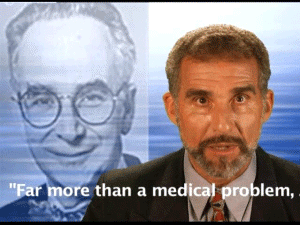
"Far more than a medical problem,
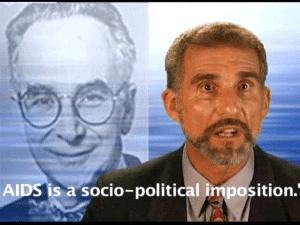
AIDS is a socio-political imposition."
If I am right, and these documents are legitimate, then generally trusted vaccines, the sacred cow of public health, given mostly to our nation's youth, said to have contributed most to conquering infectious diseases, are alternatively, the world's worst curse and nightmare!
Statistics: Posted by admin — Sun Jan 03, 2016 12:52 am
]]>
[WAR AND THE ROLE OF THE MASS MEDIA]
Just two decades after the "Report From Iron Mountain" was released, and its policies enacted, a policy transition known as "The Revolution in Military Affairs" occurred. This transition is formally credited to the United State's Army's War College that issued a report on this "revolution" in 1994.
[THE REVOLUTION IN MILITARY AFFAIRS AND CONFLICT SHORT OF WAR, BY STEVEN METZ AND JAMES KIEVIT
While advances in robotics and information technologies may make it possible to perform many commercial activities with fewer employees in dangerous regions, those Americans who are overseas will be more isolated and dispersed. This complicates the main problems of NEOs: identification and notification of the individuals to be evacuated, identification of safe evacuation routes, and assessment of threats to the evacuation. Technology could diminish these problems. In the near future every American at risk could be equipped with an electronic individual position locator device (IPLD). The device, derived from the electronic bracelet used to control some criminal offenders or parolees, would continuously inform a central data bank of the individuals' locations. Eventually such a device could be permanently implanted under the skin, with automatic remote activation either upon departure from U.S. territory (while passing through the security screening system at the airport, for example) or by transmission of a NEO alert code to areas of conflict. Implantation would help preclude removal of the device (although, of course, some terrorists might be willing to remove a portion of the hostage's body if they knew where the device was implanted). The IPLD could also act as a form of IFFN (identification friend, foe, or neutral) if U.S. military personnel were equipped with appropriate challenge/response devices. Finally, such a device might eventually serve, like Dick Tracey's wrist radio, as a two-way communication channel permitting the NEO notification to be done covertly.]
[-- The Revolution in Military Affairs and Conflict Short of War, by Steven Metz and James Kievit
The use of new technology may also run counter to basic American values. Information age--and in particular information warfare--technologies cause concerns about privacy.38 For example, the individual position locator raises several thorny issues: Would Americans overseas be forced to wear (or worse have implanted) such a device or would its use be voluntary? If forced, would it apply equally to those employed overseas and tourists? Will Americans accept the fact that the government might, by access to the NEO locator data base, know every move they make? If a locator device could be remotely activated, how could Americans be sure that activation was only effective outside the United States? How would they know that "wrist radios" were not used to monitor personal conversations? Similarly, military use of television against foreign adversaries raises the specter of domestic applications. Even if domestic use was never contemplated, its possibility might cause greater public skepticism regarding television appearances, reducing the impact of one of the American politician's greatest communication tools. Deception, while frequently of great military or political value, is thought of as somehow "un-American."
American values also make the use of directed energy weapons against suspected narco-trafficking aircraft technologically feasible but morally difficult, perhaps unacceptable. The advantage of directed energy weapons over conventional ones is deniability. Against whom is such deniability aimed? Certainly not the narco-traffickers, who will quickly recognize that interception by the Drug Enforcement Agency (DEA) or military planes leads to loss of their aircraft.39 Instead, deniability must be aimed at the American people, who do not sanction the imprisonment, much less execution, of individuals without a trial (and execution is how they will perceive it--the argument "we only disabled the aircraft, it was the crash which killed the pilot" will carry little weight). Deniability will not last long, since narco-traffickers can choose any number of ways to make such interceptions public such as landing and then challenging the intercept technique in court, or arranging to relay communications with their aircraft to a ground station which could broadcast the "nonlethal" downing (ideally of a plane carrying no drugs). The American public may perceive the DEA or military involved in such actions to be as bad or worse than the narco-traffickers.
Certain biotechnical weapons--considered by some to violate the biological warfare convention to which the United States is a signatory--also may transgress American values regarding appropriate means.40 Most Americans would not support the use of a weapon designed to target only a specific racial or ethnic group in anything less than a war for survival of the nation.41 Could the government and military of this multi-ethnic republic face charges that it was developing or using a weapon targeting Africans, Jews, Koreans, Hispanics, etc.? Would defense against such a charge occupy the attention of policymakers to the detriment of other essential business? And even accidental injuries or deaths caused by "nonlethal" anti-material substances could be politically damaging.
American values and attitudes thus form significant constraints on full use of emerging technology, at least in anything short of a perceived war for national survival. Overcoming these constraints to make a RMA in conflict short of war would require fundamental changes in the United States--an ethical and political revolution may be necessary to make a military revolution.]
But many of its strategies for population control began years earlier ...
[NATIONAL SECURITY MANAGEMENT: GLOBAL PSYCHOLOGICAL CONFLICT, BY RALPH SANDERS]
as you can see in this publication from the 1960s.
[NATIONAL SECURITY MANAGEMENT: GLOBAL PSYCHOLOGICAL CONFLICT, BY RALPH SANDERS
INTRODUCTION
The celebrated Chinese, Sun Tzu, writing on military affairs in the Fifth Century B.C., in his The Book of War, stressed the importance of destroying the enemy's will to fight through such means as surprise and noise. This ancient Chinese suggested beacons and drums in night fighting, using great numbers of banners in day fighting, and spreading tales of treachery of trusted leaders and their associations with enemy leaders. All this was calculated to destroy the enemy's will to resist with minimum cost to one's own fighting capacity. Some 2500 years later, Sun Tzu's doctrines have come back to haunt mankind. The Sino-Soviet bloc, aiming to defeat the West with minimum cost to itself, and bidding to dominate the world, has refined Suz Tzu's simple prescriptions into a fine art.
This volume provides a concise treatment of the psychological aspects of the global conflict. Mainly, it offers discussions of the efforts to direct and sway the attitudes considered relevant in the cold war. Conversely, it does not examine in any detail specific psychological techniques and devices used in open warfare. Its analyses deal with Communist and Free World motivations and the methods employed to influence the minds of men.
The economics of national security can be better understood through familiarizing oneself with the international aspects of mobilizing all resources to meet the Communist menace. And, as we shall see, the manner in which we use our resources undoubtedly has a great influence on the thinking of millions of people throughout the world. The thoughts and attitudes of these millions are of paramount significance since the mind is one of the most important battlegrounds of the cold war. Consequently, it is important to learn the ideology advocated by each side as well as the respective approaches to and operational techniques of psychological conflict. Chapter I reviews the role of ideology in this conflict, its importance, and its relation to national power.
Psychological operations are not formulated or executed in a vacuum; they need direction and organization. There must be a policymaking apparatus and an implementation mechanism, both under capable leadership. Since psychological factors influence or are influenced by a multitude of actions, ranging over the entire spectrum of national life, governments must coordinate, at least, the major plans and operations of their psychological efforts. Chapters II and III examine the organization of the psychological activities of the Soviet Union and the United States. The next two chapters investigate the views of the chief contenders in the psychological battle and their attitudes toward psychological strategy.
Chapter VI is concerned with the use of the language tool in the struggle for men's minds. The message is often clothed in semantic apparel designed to be attractive, and preferably, seductive. The bulk of chapter VI examines how the Soviets manipulate words to serve their psychological ends.
Chapters VII and VIII examine the psychological considerations in our conduct of foreign relations in the cold war. The first of these chapters discusses the importance of human reactions and behavior as they relate to general foreign policy; the second covers the psychological factors underlying the economics of the cold war. The West now faces a growing Communist economic offensive in many parts of the world. There is no doubt that Russia intends to reap more than just the gratitude of underdeveloped peoples for the aid it provides; in fact, it seeks a psychological and political payoff. By highlighting the psychological aspects of this economic conflict, the chapter should aid the student to understand a very important international phase of the economics of national security.
The last chapter summarizes the material of the previous chapters, relating them to the deeper psychological characteristics of contemporary societies. It examines how the Communists exploit personal and group insecurity so prevalent in today's complex world to serve their own ends. Technology, especially sophisticated weaponry, increasingly prompts irrational behavior from which the Communist can profit. It is concluded that there is a need for an understanding of these deeper psychological functions by the Free World.]
How important is this revolution? The military equated its content to the discovery of gunpowder and the atomic bomb that revolutionized warfare globally.
"And, we shall see, the manner in which we use our resources undoubtedly has a great influence on the thinking of millions of people throughout the world. The thoughts and attitudes of these millions are of paramount significance since the mind is one of the most important battlegrounds of the cold war."
This new type of military action emphasizes warfare, mistaken called "non-lethal." The weapons deployed in this revolution, like cancer viruses, are deadly, but they kill slowly and most expensively through medical management.
[Jim] This is morphine for the pain. This is for the nausea I'm going to have.
[Narrator, The Coming Plague, TBS] The constant battle with disease and pain has also left Jim struggling with depression.
[Jim] [Swallowing pills] God, I hate that stuff! Being tied to the pill bottle, being nauseous and sick all the time, is not quality of life for me. That's not life. I mean, I'm living, but I'm not part of life. Come on, Jim, relax. Relax. I don't know whether just to stop all the medications and allow the disease to run its course, or to keep fighting. My dreams lately have been reliving my life. Every time they tell me I'm near the end, I do that.
[ Dr. Leonard George Horowitz] These "non-lethal" armaments include the use of toxic biological, chemical, and electromagnetic technologies, including genetically modified microorganisms called GMOs used to slowly, but surely, make people sick.
[Revolution in Military Affairs]
Here is where the use of the media, and especially Hollywood comes in. Critical for the success of these weapons of mass destruction, and these secret military operations is what's called "Command and Control Warfare," abbreviated "C2W."
[WAR AND THE ROLE OF THE MASS MEDIA: C2W]
Officials at the War College were very concerned that these new systems of control may run contrary to American values and that their introduction might be opposed by "unconditioned individuals." So the media has been used to change American values and condition everyone to accept new wars and methods of conducting war. The infusion of psychiatric teachings into American government, academic institutions, schools, and companies, applied propaganda methods intensively.
[PSYCHIATRISTS: THE MEN BEHIND HITLER, BY DR. THOMAS RODER]
[NO CHILD LEFT BEHIND]
A specialized part of this revolution in military affairs involved chemical, as well as biological weapons. This warfare provides a key for criminal cover, which is called "plausible deniability." Experts say the CIA uses this all the time to get away with assassinations and other crimes.
Worst of all, no effective cures can be found while the scientific community debates for decades about what is actually causing the many contemporary sicknesses and diseases experts increasingly say are related to this one-two punch: chemical-biological intoxication.
Watch now as we begin the United States Government's version of History of Bioterrorism.
[Joanne Cono, M.D., ScM, Centers for Disease Control and Prevention] The idea of using disease as a weapon gained a new level of sophistication in the early 1930s as nationally funded research programs on biological warfare were developed. The Japanese had a very active offensive biowarfare research program which included a battalion known as 731. In their program, the Japanese conducted experiments on humans using 15-20 different disease-causing agents, with anthrax being one of their favorites. Allied prisoners of war and innocent Manchurian civilians in nearby villages provided an almost endless supply of experimental subjects.
[SECRET: ACTIVITIES AT PINGFAN
SUBJECT: Biological Warfare
DATE: 11 October 1945
INTERVIEWED: Col. Tomosada MASUDA, Lt. Col. Seiichi Niizuma
INTERVIEWER: Lt. Col. Murray Sanders]
When word of Unit 731 leaked to the West, Allied forces began their own programs, concerned that Japan, and possibly Germany, would gain a military advantage in biowarfare research.
[Narrator] On the third day after, exposure the [inaudible] begins: dead sheep can be seen further down the line. It is, of course, necessary to confirm that they've died of anthrax.
[GRUINARD ISLAND: THIS ISLAND IS GOVERNMENT PROPERTY UNDER EXPERIMENT. THE GROUND IS CONTAMINATED WITH ANTHRAX AND DANGEROUS. LANDING IS PROHIBITED. BY ORDER -1981-]
[Joanne Cono, M.D., ScM, Centers for Disease Control and Prevention] In 1942, on Gruinard Island off the coast of Scotland, the British conducted their first scientifically controlled biowarfare field trials. Scientists exploded anthrax bombs near immobilized sheep to determine if the spores would survive an explosion and retain the ability to infect anyone nearby. Test results showed that anthrax could in fact be effectively dispersed by explosive devices, and could also remain viable in the soil for decades. This brought home the realization that if an anthrax bomb were dropped on a city like London, the results could have been catastrophic. Gruinard Island was declared off limits until it was decontaminated in the 1980s. It's now safe for both humans and animals.
Like our allies, the United States responded to the perceived threats from Germany and Japan. In 1943, we began an offensive biological program with a modest research and development facility at Camp Detrick, which is now Fort Detrick, Maryland. By the end of the program, we had weaponized a total of seven incapacitating or lethal human agents, including anthrax.
In 1969, Richard Nixon renounced the use of biological weapons for the United States.
[Dr. Leonard George Horowitz] Now here is Joanne Con-o from the U.S. Center for Disease Control providing several half-truths and even complete lies. The most amazing thing of all is, she doesn't even know she is dispensing deception as a propagandist. How is this possible? It's the same for most of the doctors and health officials you are about to meet. First of all, this doctor was selected to perform as a pleasant-looking, obviously intelligent, expertly trained, trustworthy physician getting paid to read a script. You can assume that while she thinks she is serving the best interests of our nation, all she really knows is what was given to her to read from a script on the left side of her camera. If she was really an expert, not simply made to look like one, she would know after critically reviewing textbooks, congressional records, and several history books on biological warfare that some of her dates are off, and all of her information is misleading.
Before I evidence these facts, allow me to provide some commentary on how it is possible that Dr. Cono's participation in this C2W psyop could be effected without her even knowing it. Many of you have seen or heard about the movie "The Manchurian Candidate."
[Major Bennett "Ben" Marco] This is rich people, Manchurian Global, funding bad science.
[The Manchurian Candidate, Paramount]
[Cpl. Al Melvin] Raymond Shaw is probably the ...
[Soldier 1] kindest ...
[Soldier 2] bravest ...
[Major Bennett "Ben" Marco] ... human being I've ever known.
[Dr. Leonard George Horowitz] Hypnotized government assassins who, like Dr. Cono here, had no idea they were being used to kill. They are mind-controlled, and behaviorally engineered to serve unwittingly military agendas and CIA programs.
Medical education relies on many of the same training methods. Medical schools conduct a virtual hazing process they call "professional training."
[WHO'S TEACHING THE DOCTORS? DRUG FIRMS SPONSOR REQUIRED COURSES -- AND SEE THEIR SALES RISE, BY DAN VERGANO]
After prolonged, intense studies, and life and health jeopardizing clinical exposures, medical residents are deprived of sleep, sometimes for days. This form of high-stress, trauma-based education is completely consistent with standardized techniques used in mind-control and cult indoctrination programs.
[SALES PITCH: DRUG FIRMS USE PERKS TO PUSH PILLS: COMPANIES PLY DOCTORS TO WRITE PRESCRIPTIONS, BY JULIE APPLEBY]
This is commonly called "brainwashing," but it is really a subtle form of hypnosis that relies on fear and trauma to capture and control your attention and shape your behavior. The end result is you get a heavily trained, egocentric professional that earnestly believes they are operating for the public's greatest good, and arrogantly defends their actions based on the limited and limiting science that they have learned. Many people are offended by this egoist attitude in medicine. But few realize it is rooted in the same German psychiatry that proclaimed at the gates of Auschwitz that "Work Makes You Free."
[ARBEIT MACHT FREI]
Unlike most cult followers, however, who know who their leaders are, Dr. Cono here has no idea she is mostly serving the Rockefeller family.
[CONFESSIONS OF A NAZI SPY]
She probably never learned that the Nazi-party-partnered-Rockefellers monopolized American medicine and public health by the early 1930s.
This not so gentle redirection of American medicine was largely due to the prostitution of Abraham Flexner cited by Time Magazine as the "Autocrat of the Moneybags."
[TIME MAGAZINE, OCT. 7, 1940, AUTOCRAT OF THE MONEYBAGS
A wonderful attraction for money had Abraham Flexner. For 30 years the fattest moneybags in the U. S. opened to his touch. He loosened up no mean part of the Rockefeller, Carnegie, Eastman and Morgan fortunes, channeled them into U. S. education. Last week, in his autobiography, I Remember (Simon & Schuster; $3.75), billiard-bald, wizened Dr. Flexner, 73, explained how he did it.
Louisville-born Abraham Flexner got a job with the Carnegie Foundation in 1908. His first assignment was to investigate the 155 U. S. and Canadian medical schools. His now famed report enabled...]
In 1940, Flexner operated for the Carnegie and Rockefeller Foundation's fortunes to extend their medical monopoly. Naturally these changes in healthcare were said, by these profiteers, to be in the best interest of public health. But they insisted in quashing all medical competition in the natural healing arts and sciences, including the professions of chiropractic, natural medicine, herbology, homeopathy, acupuncture, massage, essential oils, and most forms of energy medicine.
These wealthy industrialists politically contrived their exclusive control over medical education. They exclusively emphasized the most profitable approaches to healthcare. They funded only students, faculties and academic institutions that served their needs for drug sales and profitability. This is how the pharmaceutical industry assumed its awesome control over healthcare, and, our lives,
Dr. Cono makes other nations, including the Japanese, appear evil for their human rights violations, using Allied prisoners of war and Mongolians for biological weapons experiments. But even a superficial review of history books and medical journals, shows America's entities did the same or even worse.
[PARTNERS IN DISCOVERY: GOVERNMENT, ACADEMIC, INDUSTRY]
[Narrator] Funding for the Health Century has been provided by these partners in discovery who have joined together to mark the centennial of the National Institute of Health and America's unique partnership of government, academia and industry for the advancement of biomedical research:
American Home Products Company
Bristol-Meyers Company
Burroughs Wellcome Co.
Ciba-Geigy Corp.
Eli Lilly and Company
Hoffman-LaRouche Inc.
Johnson and Johnson
Merck and Co., Inc.
Pfizer Inc.
Schering-Plough Foundation
SmithKline Beckman Corp.
Squibb Corp.
The Upjohn Company
Warner-Lambert Company
[Dr. Leonard George Horowitz] Are these Anglo-American corporations any less criminal than the Japanese military organizations Dr. Cono recalls?
[CUTTING EDGE: A HISTORY OF FORT DETRICK, MARYLAND, 1943-1993, COMPILED AND WRITTEN BY NORMAN M. COVERT]
And her date is off. It was 1941, according to this text of the United States Congressional Record, that America's biological weapons program began under the direction of George W. Merck, president of the German drug giant, the Merck Pharmaceutical Company.
Though many people recall the Tuskegee Syphilis Study conducted by the United States Public Health Service, infecting 400 black men with the deadly syphilis bacteria, few people ever heard about the Rockefeller Institute's Puerto Rican cancer experiment of 1932 that killed at least 13 innocent people by injecting them with cancer viruses.
[ROCKEFELLER CANCER EXPERIMENT]
The Tuskegee experiment victims remained untreated as part of their study until 1972, after which many more died of diseases associated with their infections.
Yet even these damaging experiments pale by comparison to the deaths and disease caused by Merck pharmaceutical Company's recent release of Vioxx. This harmed millions of people worldwide prior to the company pulling it from the market.
[MONEY. MERCK HALTS VIOXX SALES, BY RITA RUBIN, USA TODAY]
So America was by no means lagging behind the Nazis, the Japanese, or even the Russians in administering atrocities, as Dr. Con-o leads you to believe.
[ANTHRAX SPORES BLAMED IN '79 SOVIET DEATHS, BY ASSOCIATED PRESS]
Suspiciously, you can't even read the secret document the government presents here to support its claims. But you can read the ones I am about to present.
[SECRET: ACTIVITIES AT PINGFAN
SUBJECT: Biological Warfare
DATE: 11 October 1945
INTERVIEWED: Col. Tomosada MASUDA, Lt. Col. Seiichi Niizuma
INTERVIEWER: Lt. Col. Murray Sanders]
Dr. Cono contends that the Detrick operation was "a modest research and development facility." In fact, Detrick's own history recalls it being a large sophisticated biological warfare testing centre. The facility employed some 300 scientists, including 240 microbiologists, 40 of whom had PhDs, 250 specialists in other disciplines ranging from plant pathology to mathematical statistics, and between 700 and 1000 supporting staff. The operations occupied some 1,230 acres of federally owned land, upon which 450 structures were maintained.
[CHAPTER 4: THE ROAD TO FORT DETRICK RUNS THROUGH BETHESDA
DETRICK'S SILVER ANNIVERSARY
Fort Detrick was the nation's, and likely the world's, "largest and most sophisticated" BW testing center. The facility employed some 300 scientists, including 140 microbiologists, 40 of whom had PHds, 150 specialists "in other disciplines ranging from plant pathology to mathematical statistics," and between 700 and 1,000 supporting staff. The operation occupied "some 1,230 acres of federally owned land" upon which 450 structures were maintained. It produced annually "some 900,000 mice, 50,000 guinea pigs, 2,500 rabbits ... and 4,000 monkeys." There was also a large "corral" area for holding larger animals such as horses, cattle and sheep. The cost of running Detrick's BW research alone was reported as $21.9 million in 1969. [1-3]
Among the academic festivities planned for Detrick's twenty-fifth anniversary was an international symposium dealing with the "entry and control of foreign nucleic acid" into cells during the process of human and animal immunosuppression. The frank threat of manipulating nature's own ...]
It produced annually some 900,000 mice, 50,000 guinea pigs, 2,500 rabbits, and 4,000 monkeys. There was also a large corral area for holding larger animals such as horses, cattle, and sheep. The cost of running Detrick's biological weapons research alone was reported at $21.9 million in 1969.
And here's another fact: by the falsely alleged end of Fort Detrick's biological weapons program in 1969, there were not simply seven germs that America had weaponized. Conservatively, there were thousands when you include the bio-terrorizing cancer viruses and other germs being cloned, mutated, and mass produced for global distribution in support of the Drug Cartel's burgeoning cancer industry. This developing cancer industry really got a shot in the arm back in the 1950s ...
[THE DETROIT FREE PRESS: SALK: SERUM IMPROVED; U.S. OK'S PRIVATE SALE]
[-- Progress Report #8, Special Virus Cancer Program, Etiology Area -- National Cancer Institute, U.S. Department of Health, Education, and Welfare, Public Health Service, National Institutes of Health, August 1971]
[-- An Administrative History of the National Cancer Institute’s Viruses and Cancer Programs, 1950-1972, by Carl G. Baker, M.D.
Continuing analysis of grant supported research, assisted in part by the analysis by the NCI Grants and Training staff was made. In addition to several grants made in conjunction with the cooperative program on cell culture characterization and certification, a major effort is underway in many laboratories attempting to evaluate the role of viruses in human cancer. The finding of Trentin that human adenovirus-type 12 induces tumors in hamsters (confirmed by Huebner and Rowe along with the demonstration that adenovirus-type 18 also is oncogenic in hamsters) and confirmation of the oncogenic nature of SV-40, further characterization of its properties in tissue culture (e.g., growth of virus and transformation with chromosomal changes in human cells in culture), and delineation of the nature of the PAPOVA viruses (especially by Melnick, Koprowski, and Hilleman) represent important highlights resulting from grant supported research. Production of tumors by combinations of viruses and chemical agents (e.g., lung epidermoid carcinoma induction in mice with influenza virus and an ozonized gasoline fraction) has provided base information for NCI program expansion aimed at clarifying interrelationships among chemicals, viruses, and radiation in their roles in carcinogenesis. Production of Shope papilloma tumors with highly purified nucleic acid by Ito and Evans adds to the growing body of information indicating that bare nucleic acid can produce disease (polyoma, poliomyelitis, phage, etc.). Knowledge of the type of nucleic acid and the intracellular sites of virus production for several oncogenic viruses has now been determined. The studies of Rubin on avian lymphomatosis which showed that chickens carrying the virus from the egg stage did not develop antibodies against the virus (presumably because of immune tolerance) have important implications for approaches to be employed in studying human cancer. These same studies showed that chickens free of virus at birth could become infected when placed in a flock containing chickens with the virus, but that the incidence of disease was six times lower in these chickens than in those which contained the virus in the egg stage. Studies on virus interference phenomena are throwing further light on the problems in need of solution for the detection of viruses in tumor and other tissues, and some leads have been developed in viral chemotherapy (fermentation producers, e.g., statolon, xersin; naturally occurring products, e.g., interferon; synthetic products, e.g., iododeoxyuridine, thiosemicarbazones, etc.)(Internal NCI document, September 10, 1962)....
Other items on the agenda included: a Proposal for Sero-Epidemiological Survey of Human Cancers (Dr. Rowe for Dr. Huebner); a status report on Surveillance of SV-40 Inoculated Patients; and an open discussion of Strategic Approaches to Virus-Cancer Targets....
II. Viruses-initiated reactions in which viruses of different types act as biological carcinogens in the production of a variety of autonomous neoplasms of different tissues and in different species, but the virus is not associated with continuation of the neoplastic reaction (at least in a detectable form). Examples: tumors, or in vitro cell transformations, induced by the polyoma and SV-40 viruses and by adenoviruses 12 and 18....
The cell-free transmission of methylcholanthrene-induced lymphomas and development of murine leukemia viral antibody suggested that unmasking of latent leukemia virus might represent an indigenous actuating cause of the leukemia. Dr. Miller, based on experience gained from study of mass-immunization with polio-vaccine containing SV-40, suggested four steps that would greatly simplify follow-up studies:
1. to maintain samples of vaccine lots frozen in storage;
2. for manufacturers to keep records identifying persons experimentally immunized, with notation of the vaccine lot used;
3. for physicians to note on their records the lot numbers of (at least) newly approved vaccines for general use; and
4. for similar permanent immunization records to be kept by the mother for each of her children....
Identification and production of mutants of DNA and RNA tumor viruses were underway in 1968-1969 by Leo Sachs, Renato Dulbecco, Howard Temin, Peter Vogt, David Baltimore, and G.S. Martin. A SVCP contract with Dulbecco was active to produce such mutants of polyoma and SV-40; they would be made available to investigators. These research activities led to very important tools: temperature-sensitive mutants. Some of these Rous sarcoma virus mutants would induce oncogenic transformation of tissue culture cells grown at 34 degrees C., but would lose that ability if growth was at 41 degrees C. These changes were reversible. The viruses would continue to multiply at either temperature. Further studies indicated that a single gene -called src - was involved in transformation. Thus, the stage was set for mapping the region (about 2000 nucleotides) of the src gene...
Dr. Robert Miller, et al., have identified family clusters of cancer that suggested a hereditary tendency. In these families healthy persons potentially at high risk of cancer can be identified for intensive study by new laboratory procedures. These tests may detect subclinical abnormalities that account for predisposition to neoplasia. One such procedure, developed by Dr. Todaro, measures the susceptibility of skin fibroblasts to “malignant” transformation in vitro by SV-40, a virus that causes cancer in laboratory animals.]
when the first polio vaccines, produced in contaminated monkey kidney tissues containing cancer viruses, were being tested and injected in millions of people worldwide.
The cancer virus was later identified as SV40.
[SV40]
It was determined to cause cancer in nearly every species it was injected.
After scientists and informed industrialists realized these vaccines were going to produce epidemics of cancer, cartel officials within the National Cancer Institute started a special virus-cancer program, the SVCP, in 1962, according to secreted documents. Here is simply a partial list of the deadly viruses they created in labs by 1971. These included leukemia viruses, lymphoma viruses, sarcoma viruses, encephalitis agents,
genital herpes, Hodgkin's disease, influenza, infectious mononucleosis, kuru -- that is the mad cow disease prion -- breast tumor viruses, and much more.
[A12540 Adenovirus 12 + SV-40
A2540 2 + SV-40
Ad 2P 2 + para influenza
Ad 7 7
Al Acute leukemia
ALL Acute lymphocytic leukemia
ALL1 Acute lymphocytic leukemia + influenza
ALL P1 + para influenza
AM BL American Burkitt's lymphoma
AML Acute myelogenous leukemia
AM MOL Acute myelogenous leukemia + monocytic leukemia
AMOL Acute monocytic leukemia
Arbo Arthropod-borne virus
AT MON Atypical monocytosis
Au Ag Australia antigen
Bac Agt Bacterial agent
BL Burkitt's lymphoma
BoL Bovine leukemia
CA Condyloma acunatum
CCHy Congenital cerebral hiperplasia
CF Control familial
C H Chediak Higashi
Chondrosarcoma
Chronic lymphocytic leukemia
Chronic myelogenous leukemia
Cytomegalovirus
Congenital stem cell leukemia
Dawson's encephalitis
Ecovirus 9
Erythroid leukemia
Eosinophilia
Fibrosarcoma
Glioblasloma
H 1 virus
H. genitalis
H. simplex
Hodgkin's disease
Herpes virus
Influenza
Infectious mononucleosis
Kuru (mad cow disease prion)
Leukemia
Mammary tumour
Meningitis
Miscellaneous leukemia
Moloney sarcoma virus
Moloney sarcoma virus + leukemia]
[President Richard Nixon] I have decided that the United States of America will renounce the use of any form of deadly biological weapons that either kill or incapacitate.
[William C. Patrick III, Biological Warfare Consultant, HHS] President Nixon visited Fort Detrick on the 25th of November, 1969. I remember that date quite well because following his announcement of taking munitions and beating them into ploughshares, we all lost our job, and that was a very traumatic experience. But following his presidential announcement on this date, the entire United States offensive program on biological warfare came to a close within two years. We destroyed all of our seed stocks, we destroyed all of our production material at Pine Bluff, Arkansas, and we completely got out of the biological warfare business.
[Dr. Leonard George Horowitz] Sure, President Nixon renounced the use of biological weapons in 1969, as a political ploy. In fact, here is what really happened. Trickie Dick, as he was called back then, lied. As you can read here from the prestigious scientific journal Nature:
"By 1970, a year after Nixon ratified the Geneva Protocol, nothing had changed except the public's perception of Chemical/Biological/Warfare risks."
"Rather than receive the promised annual cut in biological warfare research funding, the DOD's biological weapons budget increased from $21.9 million to $23.2 million"
"The stockpiled biological weapons Nixon pledged would be rapidly destroyed, remained intact in Pine Bluff, Arkansas ..."
"... and the announced transition of Fort Detrick from a biological weapons testing facility to a solely defensive NIH run health research lab had not occurred."
So it can be seen that Dr. Cono's propaganda simply reflects her ignorance. Or is it professional negligence to allege lies are honest truths? Is it unjust, or too blunt, to conclude Dr. Cono is a professional prostitute for drug cartel-influenced government?
Statistics: Posted by admin — Sun Jan 03, 2016 12:37 am
]]>
Currently showing on television around the world via satellite is the United States Department of Human Health Services' "History of Bioterrorism." This program, featured in a new 24-hour preparedness programming network was co-produced with the Department of Homeland Security, with the CIA's involvement. It is said to be an educational encouragement to prepare you and your family for threatened, virtually impending catastrophes, especially bioterrorist and nuclear attacks. The network's featured documentary provides the opportunity to critically examine whether or not officials representing our government are telling us enough of the truth to make informed choices impacting life or death.
Many critical choices now need to be made. The government explains this for your health and safety. Without honest information, your decisions might literally kill you or your loved ones. That's why this program is so important. This documentary provides honest messages proving with visible documents reflecting the most disturbing political and scientific history ever recorded.
[UNITED STATES GOVERNMENT
Memorandum
To: Mr. A.H. Belmont
From: Mr. W.C. Sullivan
Subject: Communist Party, USA, Negro Question, Communist Influence in Racial Matters, Internal Security -- Communist
Date: January 27, 1964
Memorandum 1/23/64 from Mr. F.J. Baumgardner to myself advised of authority given to the Milwaukee Office for a microphone surveillance [illegible] to cover the activities of Martin Luther King, Jr., and his associates while in Milwaukee, Wisconsin, where he is scheduled to appear for a talk tonight (1/27/64), [DELETE]
SAC Baker of the Milwaukee Office phone me this morning to advise that King had arrived in Milwaukee and checked into the [illegible] Hotel as scheduled and that the [illegible] activated at 10:30 a.m. today. Symbol numbers assigned are [DELETE] and [DELETE]
Baker also advised that the local police have taken a room close to the suite of rooms engaged by King so that protection might be afforded King. In view of this, it was the conjecture of [illegible] that the likelihood of King's going ahead with any [DELETE] plans is greatly minimized. I agree with this observation.
Milwaukee is to keep the Bureau promptly advised of all developments and upon receipt of additional information you will be further informed.
-- Mr. Belmont
Mr. Sullivan
Mr. Baumgardner
[Illegible]]
[UNITED STATES GOVERNMENT
Memorandum
To : Mr. A. H. Belmont
From : Mr. W. C. Sullivan
Subject : COMMUNIST PARTY, USA, NEGRO QUESTION, IS - C
Date : August 30, 1963
Reference is made to the enclosed material on which the Director has written: "This memo reminds me vividly of those I received when Castro took over Cuba: You contended then that Castro and his cohorts were not Communists and not influenced by Communists. Time alone proved you wrong. I for one can't ignore the memos re King, [DELETE] et al as having only an infinitesimal effect on the efforts to exploit the American Negro by the Communists."
The Director is correct. We were completely wrong about believing the evidence was not sufficient to determine some years ago that Fidel Castro was not a communist or under communist influence. On investigating and writing about communism and the American Negro, we had better remember this and profit by the lesson it should teach us.
I do think that much of the difficulty relating to the memorandum rightly questioned by the Director is to be found centered in the word ""influence."" We do not have, and no Government agency or private organization has, any yardstick which can accurately measure ""influence"" in this particular context, even when we know it does exist such as in the case of the obvious influence of [DELETE] over Martin Luther King and King's influence over other Negro leaders. Personally, I believe in the light of King's powerful demagogic speech yesterday he stands head and shoulders over all other Negro leaders put together when it comes to influencing great masses of Negroes. We must mark him now, if we have not done so before, as the most dangerous Negro of the future in this Nation from the standpoint of communism, the Negro and national security.
On determining membership of Negroes in the Communist Party, we are not confronted with the same problem. We do have here accurate yardsticks for establishing membership. Of course, our standards are very exacting. This means there are many Negroes who are fellow-travellers, sympathizers or who aid the Party, knowingly or unknowingly, but do not qualify as members. These we must not ignore. The old communist principle still holds: "Communism must be built with non-communist hands." Therefore, it may be unrealistic to limit ourselves as we have been doing to legalistic proof or definitely conclusive evidence [DELETE]]
[UNITED STATES GOVERNMENT
Memorandum
To : Mr. W.C. Sullivan
From: Mr. F.J. Baumgardner
Subject : COMMUNIST PARTY, USA, NEGRO QUESTION, COMMUNIST INFLUENCE IN RADICAL MATTERS, INTERNAL SECURITY -- COMMUNIST
Date : September 16, 1963
This memorandum recommends increased coverage of communist influence on the Negro. The history of the Communist Party, USA (CPUSA), is replete with its attempts to exploit, influence and recruit the Negro. The March on Washington, 3-28-63, was a striking example of such communist activity as Party leaders early put into motion efforts to accrue gains for the CPUSA from the March. Well-documented information concerning the Party's influence on a principal March leader, Reverend Martin Luther King Jr., is but an example. The presence at the March of around 200 Party members, ranging from several national functionaries headed by CPUSA General Secretary Gus Hall, to many rank-and-file members, is clear indication of the Party's favorite target ( the Negro) today.
All indications are that the March was not the "end of the line" and that the Party will step up its efforts to exploit racial unrest and in every possible way claim credit for itself relating to any "gains" achieved by the Negro. A clear-cut indication of the Party's designs is revealed in its plans to hold a highly secretive leadership meeting in November, 1963, which will deal primarily with the Negro situation. This meeting is to be preceded by a Gus Hall "barnstorming" trip through key areas of the country to meet Party people and thus better prepare himself for the November meeting.
The entire field is being alerted to this situation in a proposed SAC letter (attached). The field is being instructed to intensify our coverage of communist influence on the Negro by giving fullest consideration to the use of all possible investigative techniques. In addition, the field is being told to intensify its coverage of those communist fronts through which the Party channels its influence and to intensify its investigations of the many Party members and dupes who engage in activities on behalf on the Party in the Negro field. Further, we are stressing the urgent need for imaginative and aggressive tactics to be utilized through our Counter-intelligence Program -- these are designed to attempt to neutralize or disrupt the Party's activities in the Negro field. Necessity for prompt handling of all facets of this matter to insure timely dissemination to the Department and other interested agencies is also being emphasized."]
[Memorandum to Mr. Sullivan
RE: COMMUNIST PARTY, USA, NEGRO QUESTION, COMMUNIST INFLUENCE IN RACIAL MATTERS
100-3-116
The proposed SAC Letter requires key security offices to submit to the Bureau, within 30 days, an analysis of their current coverage of communist activities in the Negro field plus details of their plans for intensification. Also, those 10 offices participating in the Counterintelligence Program on a regular basis are being required to include in their next monthly letters due 10-15-63 their plans to neutralize or disrupt Party activities in the Negro field.
RECOMMENDATION:
If approved, attached SAC Letter go forward apprising the field as above and urging full implementation so that the desired results may be achieved. Also attached for approval are necessary Manual changes.]
[To:Mr. A. H. Belmont
From:Mr. W. C. Sullivan
Re:COMMUNIST PARTY, USA, NEGRO QUESTION, COMMUNIST INFLUENCE IN RACIAL MATTERS , INTERNAL SECURITY -- C
Date: September 25, 1963
Predication:
Reference is made to the enclosed memorandum dated 9/16/63 and to the attached proposed SAC Letter.
On returning from a few days leave I have been advised of the Director's continued dissatisfaction with the manner in which we prepared a Brief on the above-captioned matter and subsequent memoranda on the same subject matter. This situation is very disturbing to those of us in the Domestic Intelligence Division responsible for this area of work, and we certainly want to do everything possible to correct our shortcomings. We absolutely will not be stubborn about admitting any mistakes we have made or be stiff-necked and unbending concerning our analysis of this matter. The Director indicated he would not approve our last SAC Letter until there was a clarification and a meeting of minds relative to the question of the extent of communist influence over Negroes and their leaders. In this memorandum I will seriously and sincerely try to clarify a most regrettable situation. It is prepared not on official office memorandum but rather on plain bond believing this discussion need not be made a matter of official record.
Common Agreement:
First, I am sure we are all in agreement on the following which was in both the cover memorandum and the detailed brief attached: (1) for the past 44 years the Communist Party, USA, has spent enormous sums of money and ceaseless efforts to influence Negroes and to make communists out of them; (2) the 19 million Negroes in the country today constitute the greatest single racial target of the Communist Party, USA; (3) Negro leader Martin Luther King, [DELETE] does have as an extremely important advisor [DELETE]; (4) we are right now in this nation engaged in a form of social revolution and the tie has never been so right for exploitation of the Negroes by communist propagandists; and (5) the Communist Party could in the future make prodigious strides and great successes with the American Negro to the serious detriment of our national security. In addition to the above, the material furnished contained many pages of specific examples of communist policies, programs, and activities.]
[Memorandum for Mr. Belmont
RE:COMMUNIST PARTY, USA, NEGRO QUESTION, COMMUNIST INFLUENCE IN RACIAL MATTERS
showing communist involvement in Negro racial matters in this nation, relative to which we can all agree.
Essence of the Situation:
The essence of the situation seems to be this: We presented what facts there are in our files in the Brief in question and I know that the Director certainly would not want us to do other than this. The position taken at the time the Brief was written was that, while there is communist influence being exerted on Negroes and Negro leaders, it has not reached the point of control or domination. This historically has been the position of the Bureau in this matter in light of file reviews going back ten to twenty years. [Handwritten note: "Certainly this is not true with respect to the [DELETE] King] correct.]
The Historical Position:
For example, in a detailed document prepared on Communist Party and the Negro in 1953, we find the statement referring to "the failure of the Communist Party to attract even a significant number of Negroes in the United States to its number." Another example is to be found in an analysis in this same field prepared by the Bureau in 1956 to the effect that communist efforts have been "unsuccessful on a state or national level" in infiltrating "legitimate Negro-fraternal, protest and improvement organizations," although they made limited success in some "isolated chapters." The Director's book, Masters of Deceit, published in 1958, states: "It became obvious that the Party, despite great efforts, had failed to win over even a significant minority of Negroes." In 1960 the Director's statement to The Committee on the Judiciary, United States Senate, reads: "It is no secret that one of the bitterest disappointments of communistic efforts in this Nation has been their failure to lure our Negro citizens into the Party." In 1962 similar public statements were made. On page seven of the Brief submitted to the Director under the date of August 23, 1963, this historical position was restated and it was said, "One of the bitterest disappointments of the communists has been their single failure to lure any significant number of our Negro citizens into the Party." This statement was set forth in the cover memorandum which the Director marked.
The point I wish to make here is this: The fact that this has been our historical position in the Bureau for many years is no reason to assume that it is the correct position at this time, as the Director has clearly explained. Times and conditions change and, as the evidence mounts, naturally we need to change our position along with this evidence.]
[UNITED STATES DEPARTMENT OF JUSTICE
FEDERAL BUREAU OF INVESTIGATION
WASHINGTON, D.C.
In Reply, Please Refer to
File No. 100-106670
100-3-116
October 7, 1963
MEMORANDUM FOR THE ATTORNEY GENERAL
RE: MARTIN LUTHER KING, JR., SECURITY MATTER - COMMUNIST, COMMUNIST INFLUENCE IN RACIAL MATERS
[DELETE]
It is further requested that authority be granted to place a technical surveillance on the SCLC office at the current New York address or to any other address to which it may be moved.
Respectfully,
John Edgar Hoover
Director]
[10/17/63
Mr. Tolson:
The attached analysis of Communism and the Negro Movement is highly explosive. It can be regarded as a personal attack on Martin Luther King. There is no doubt that it will have a heavy impact on the Attorney General and anyone else to whom we disseminate it. It is labeled TOP SECRET. However, even such a classification seems to be no bar today to a leak, and should this leak out it will add fuel to a matter which may already be in the cards as a political issue during the forthcoming Presidential campaign.
The memorandum makes good reading and is based on information from reliable sources. We may well be charged, however with expressing opinions and conclusions, particularly with reference to some of the statements about King.
[Handwritten Note: "We must do our duty." H.]
This memorandum may startle the Attorney General, particularly in view of his past association with King, and the fact that we are disseminating this outside the Department. He may resent this. Nevertheless, the memorandum is a powerful warning against Communist influence in the Negro movement, and we will be carrying out our responsibility by disseminating it to the people indicated in the attached memorandum.
[Handwritten Note: I am glad this [illegible]]
[UNITED STATES GOVERNMENT
Memorandum
To: Mr. Mohr
From: C.D. DeLoach
Subject: Martin Luther King, Dissemination of Monograph [DELETE]
December 7, 1964
Bill Moyers, Special Assistant to the President called me on Friday, 12/4/64, to indicate that he and the President had read the Director's letter in connection with possible dissemination of captioned monograph. He stated it was both his and the President's opinion that the FBI should disseminate this monograph if it was felt that dissemination would be in the best interest of internal security.
I told Moyers that under the circumstances he appeared to be telling me that we should go ahead and disseminate. He answered in the affirmative.
ACTION:
For record purposes.
1 - Mr. Belmont
1 - Mr. Sullivan
1 - Mr. Jones
ADDENDUM 12/7/64 - Attached are appropriate letters, disseminating this monograph to appropriate government officials
A.H. Belmont]
[UNITED STATES GOVERNMENT
Memorandum
To. Mr. A.H. Belmont
From Mr. W.C. Sullivan
Subject: COMMUNIST PARTY USA, NEGRO QUESTION, COMMUNIST INFLUENCE IN RACIAL MATTERS, INTERNAL SECURITY- COMMUNIST
In view of the influence the Communist Party, USA (CPUSA), is exerting on the racial situation, particularly through Martin Luther King, head of the Southern Christian Leadership Conference (SCLC), the Director approved a conference be held between representatives of our Atlanta Office and Seat of Government personnel.
Recognizing the delicacy of this entire situation because of the prominence of King, the primary purpose of the conference was to explore how best to carry on our investigation to produce the desired results without embarrassment to the bureau. Included in our discussion was a complete analysis of the avenue of approach aimed at neutralizing King as an effective Negro leader and developing evidence concerning King's continued dependence on communists for guidance and direction.
The conference was held at the Seat of Government on 12-23-63. It was attended by Security Supervisor [DELETE] and SA [DELETE] from our Atlanta Office. The Seat of Government representatives were Assistant Director W.C. Sullivan, Inspector Joseph A. Sizoo, Section Chief F.J. Baumgardner, and Supervisors [DELETE] and [DELETE]. The conference lasted from 9 a.m. to 6 p.m.
Assistant Director Sullivan briefed the conference on the task at hand. He pointed out the necessity for good judgment and discreetness in conducting any investigation concerning this matter. He made it clear it was necessary for us to continue obtaining evidence of the CPUSA's influence on King and, through King, influence on the Negro people. Mr. Sullivan also stressed the fact that, although King is a minister, we have already developed information concerning weaknesses in his character which are of such a nature as to make him unfit to serve as a minister of the gospel.
Mr. Sullivan pointed out that the field should continue to gather information concerning King [DELETE]
FJB:skw]
[Memorandum to Mr. Belmont
RE: COMMUNIST PARTY, USA, NEGRO QUESTION, COMMUNIST INFLUENCE IN RACIAL MATTERS
100-3-116
[DELETE] in order that we may consider using this information at an opportune time in a counterintelligence move to discredit him.
During the discussion which followed, the men from the field outlined in detail the operation of the SCLC in Atlanta and the manner in which it is managed by King.
Our discreet approach to this case has been necessitated by King's prominence and the delicate situation which surrounds the entire racial movement. A wrong move could well result in extreme embarrassment to the Bureau. As a result of the conference, it was decided we need to develop additional information in the following areas:
(1) We must determine and check out all of the employees of the SCLC.
(2) We must locate and monitor the funds of the SCLC.
(3) We must identify and check out the sources who contribute to the SCLC.
(4) We must continue to keep close watch on King's personal activities.
(5) We will, at the proper time when it can be done without embarrassment to the Bureau, expose King as an immoral opportunist who is not a sincere person but is exploiting the racial situation for personal gain.
(6) We will explore the possibility of utilizing additional specialized investigative techniques at the SCLC office.
Our technical coverage on King and the SCLC is producing excellent information. It was decided that, in view of this fact and since we could not engage in active investigation at this time without embarrassment to the Bureau, we would hold in abeyance open investigation as outlined above for another 90 days. During this time, we will utilize the information obtained from our technical coverage and conduct whatever investigation can be made discreetly.]
[Memorandum to Mr. Belmont
RE: COMMUNIST PARTY, USA, NEGRO QUESTION, COMMUNIST INFLUENCE IN RACIAL MATTERS
100-3-116
This conference proved to be most beneficial, and the men from the field expressed their appreciation for the opportunity of being brought in the Seat of Government for the purpose of exploring this entire matter. They were both enthusiastic about the case and stated the conference was of assistance in setting the future course of the investigation.
ACTION:
We will continue to give this case priority attention both at the Seat of Government and in the field and will expose King for the clerical fraud and Marxist he is at the first opportunity. At the end of the 90-day period, or sooner if conditions permit, we will make a further recommendation as to whether we are in a position at that time to take further action against King and the SCLS without embarrassment to the Bureau.]
[Dr. Leonard George Horowitz] Controversial as this is, it is also sufficient for your needs to gain a balanced view that government officials are not providing and be well informed, and thereby empowered to make several life-saving decisions that health officials are now encouraging you to make.
["Duck and Cover", U.S. Propaganda Film] Deedledumdum, deedledumdum, deedledumdum, deedledumdum. There was a turtle by the name of Burt, and Burt the turtle was very alert, when danger threatened him he never got hurt, because he knew just what to do. He ducked and covered, he ducked and covered. He did what we all must learn to do, you and you and you and you: duck and cover! Be sure and remember what Burt the Turtle just did friends, because every one of us must remember to do the same thing. That's what this film is all about: "Duck and Cover." This is an official civil defense film produced in co-operation with the Federal Civil Defense Administration, and in consultation with the Safety Commission of the National Education Association.
[Dr. Leonard George Horowitz] If you are my age, you might recall during the 1950s and early '60s, school children throughout America were required to brace themselves beneath their desks at schools in defense of a cold war nuclear weapons attack. I remember as a child how completely absurd this was in the event a nuclear bomb were to explode within a hundred miles of my classroom as I was shown repeatedly the devastating effects relayed by television and movie theatre newsreels. The waves of destruction spread hundreds of miles around ground zero leaving nothing but ashes and debris. Only recently did I learn that those civil defense procedures were generated by nuclear weapons industry leaders in collaboration with our elected officials who pledged this defense of our nation was required to maintain the world's "balance of powers": economic stability and military might.
[Teacher, "Duck and Cover," U.S. Propaganda Film] First, you have to know what happens when an atomic bomb explodes. You will know when it comes. We hope it never comes, but we must get ready. It looks something like this: there is a bright flash, brighter than the sun, brighter than anything you've ever seen. If you are not ready, and do not know what to do, it could hurt you in different ways. It could knock you down hard, or throw you against a tree or a wall. It is such a big explosion it can smash in buildings and knock sign boards over and break windows all over town. But if you duck and cover, like Burt, you will be much safer.
[Dr. Leonard George Horowitz] This documentary examines the government's latest efforts to get you to duck and cover. It exposes the CIA and puppet politicians operating as prostitutes for multinational corporate criminals behind whose policies for preparedness lies genocide.
[Narrator, "History of Bioterrorism"] Coming up next, discover how bioterrorism has been used historically and in the present on "History of Bioterrorism." And actor Andre Brower looks back at the biggest flu epidemic in history on "Standing in the Safety Zone: Baltimore Remembers the 1918 Flu Epidemic," and what every family needs to know about potential flu pandemic on "Keeping Our Children Safe and Secure: Pandemic Flu and Emergency Safety Preparedness," coming up on HHS Network.
[GENOCIDE: THE MASS KILLING OR ENSLAVING OF PEOPLE FOR PROFIT, POLITICS, AND/OR IDEOLOGY.]
[COULD THIS BE HAPPENING IN AMERICA?]
[Dr. Leonard George Horowitz] As you are about to learn, the real bioterrorists produce illegitimate programming called "propaganda" for profit. The real villains are those who spread fear and loathing for financial gain, power, and control.
[Narrator, "History of Bioterrorism"] Come to a place that's new and unique, a place of health, well-being, and preparedness. Where connection leads to inspiration and empowerment.
[EMPOWERMENT?]
[WAKE UP!]
[Empowerment, empowerment, empowerment. WAKE UP! Come to the HHS, Come to the HHS, Come to the HHS ...]
[Dr. Leonard George Horowitz] To the extent that populations are being increasingly dependent, virtually enslaved to drugs, called "drug dependencies," the politics, policies, and profiteering of pharmaceutical firms and those who run them is genocidal. Most people realize that wars of any kind make money for arms dealers, industry manufacturers, and stocks, bonds, and futures investors. The wars against infectious diseases and cancers is no different. The war on cancer, the war on AIDS, the battle against breast and prostate malignancies, colon cancers, children's tumors, diabetes and heart diseases is no different. Many industries and officials thrive off of this sickness. Could all of these declared wars, including the war on terrorism, and medically frightening bioterrorism, be part of an economic and political ploy by inside traders, or un-American traitors wielding the mass media for deception? Let's see.
In 1963, as the plot to assassinate President John F. Kennedy was being hatched, a global policy think-tank met at Iron Mountain near Hudson, New York, to discuss possibilities for economic sustainability in a world without war. You may have heard it said that "money makes the world go round." Well, most intelligent people knew at that time that war economies kept bankers and businessmen most profitable.
[REPORT FROM IRON MOUNTAIN: ON THE POSSIBILITY AND DESIRABILITY OF PEACE, BY THE SPECIAL STUDY GROUP, WITH INTRODUCTORY MATERIAL BY LEONARD C. LEWIN]
[Dr. Leonard George Horowitz] So the big question asked and answered in the "Report From Iron Mountain," on the desirability and possibility of peace, regarded the possibility of transitioning into the 21st century keeping growing populations manageable and large corporations in business. The participants in Iron Mountain considered the functions of war as necessary for political, economic, and social progress. "The functions of war," they wrote, "are essential to the survival of social systems we know today." Under "Political Requirements," the report stated: "A viable political substitute for war must posit a generalized external menace to each society of a nature and degree sufficient to require the organization and acceptance of political authority." In other words, a form of controlled life with threats other than large-scale devastating wars was considered. A way to control populations without destroying expensive infrastructures, roads, utilities, and real estate as in past world wars. This report provided economic substitutes for war and suggested developing a comprehensive social welfare program, and a giant, open-ended space research program, both of which we have today. Political substitutes for war included: "An omnipresent, virtually omnipotent international police force." The current global war on terrorism assures this. And fictitious, alternate enemies about which this documentary speaks is evident in today's focus on terrorism.
But who are the deadliest terrorists, really? Do contemporary terrorists seek social control through a "modern, sophisticated form of slavery?"
Ecological bioterrorism, and human genetic destruction, was also recommended by the Report From Iron Mountain think-tank. They suggested a "comprehensive program of applied eugenics," that means genetically culling and killing perceived social misfits, or having them die from environmental toxicity, and the Report's cultural replacements in science included, besides space research and social welfare, this concept of eugenic/genetic control.
In essence, these policy analysts, representing global industrialists, concluded that viable alternatives to traditional warfare could be made available to keep the world's economies going, and the burgeoning populations controlled.
[Jim Marrs, Journalist/Author: "Rule by Secrecy"] It might come as a shock to many people, but the form of government we have in this country today basically is socialistic. We have social programs for everything. We have educational programs to bring the curriculum around to what the national education authorities want. And basically we have a socialist program, but instead of the benefits going to the people, the benefits go to the corporations. Okay? So I think anyone who stops and looks at it would agree that we have socialism geared to benefit the multinational corporations.
Now, interestingly enough, this is pushed along by a fervent nationalism: "What's good for GM is good for the country." Okay? And "Our country right or wrong," and "We're going to go take our form of freedom and democracy to some other country, and if you don't like it we'll just invade you and occupy you." Okay? Now, what does that tell us? That tells us that the form of government that we're occupying under today is National Socialism. And that should come as a shock to many people particularly when you consider that National Socialism in German, shortened down, means "Nazi." Because the Nazi party was the National Socialist German Worker's Party, "Nationalsozialistische Deutsche Arbeiterpartei." Okay? And so they shortened it to "Nazis." And by the way, that was a form of fascism. Okay? And the man who coined the term "fascism" was Benito Mussolini in Italy. But Benito Mussolini himself said that "fascism" really wasn't the proper term, that it more correctly should have been called "corporatism." And that is simply when you have the corporations running the country and controlling the government.
Now this is what we saw in fascist Italy; this is what we saw in Nazi Germany. But the difference is this: In those countries, before World War II, the State took over the corporations. In the United States today, the corporations have taken over the State. But the end result is the same.
[Dr. Leonard George Horowitz] Consistent with the "Report From Iron Mountain," U.S. government records show a definitive genetics, eugenics, depopulation campaign was well underway by the early 1970s. Here, for instance, is a copy of National Security Memorandum 200, which called for massive third-world depopulation.
[NSSM 200:
Implications of Worldwide Population Growth for U.S. Security and Overseas Interests
December 10, 1974
Classified by Harry C. Blaney, III, Subject to General Declassification Schedule of Executive Order11652 Automatically Downgraded At Two Year Intervals and Declassified on December 31, 1980.]
This was compiled by request of America's nuclear weapons guru, Dr. Henry Kissinger, the U.S. National Security Advisor under Richard Nixon, overseeing CIA, FBI, and foreign policy.
[Nixon, Kissinger and Nixon, TNT] I want this explained to me now! My Jew Boy! Haldeman -- where the hell is my Jew Boy? Bob!
[Bob Haldeman, Kissinger and Nixon, TNT] He's here, Mr. President. I put in a call to him as soon as State sent us that signal.
[Henry Kissinger, Kissinger and Nixon, TNT] [To Haldeman opening the door] Thank you.
[Nixon, Kissinger and Nixon, TNT] Henry -- just what the hell is this?
[Henry Kissinger, Kissinger and Nixon, TNT] Evidently the State Department has been eavesdropping.
[Nixon, Kissinger and Nixon, TNT] And a good thing, too! How else would I ever hear about what it is you're actually doing around here.
[Henry Kissinger, Kissinger and Nixon, TNT] Mr. President -- I would never keep anything from you. Surely the day-to-day details --
[Nixon, Kissinger and Nixon, TNT] Henry -- we can't have the receiver calling plays the quarterback doesn't know! Is this signal correct?
[Henry Kissinger, Kissinger and Nixon, TNT] You see, this is the point, Mr. President, we cannot truly say; not at the moment.
[Nixon, Kissinger and Nixon, TNT] Yes, yes, I can see that, but you know how I hate it when State needles me about you running a secret foreign policy and cutting them out.
[Henry Kissinger, Kissinger and Nixon, TNT] Yes, I do Mr. President. I do.
[Dr. Leonard George Horowitz] If you are wondering why we have both nuclear weapons and biological weapons deployed around the planet, an investigation of Kissinger and Rockefeller is completely condemning. Read along with me this document classified by Kissinger concerning his plan to reduce the third-world populations. It reads: "There is a major risk of severe damage to world economic, political, and ecological systems and, as these systems begin to fail, to our humanitarian values." "The urban slum dwellers (though apparently not recent migrants) may serve as a volatile, violent force which threatens political stability."
"In International relations, population factors are crucial in, and often determinants of, violent conflicts in developing areas." And "There is no single approach which will solve the population problem. The complex social and economic factors involved call for a comprehensive strategy ..." "At the same time actions and programs must be tailored to specific countries and groups."
According to Time Magazine's managing editor, Walter Isaacson, whose biographies include "Kissinger," having served the fledgling CIA as a Nazi hunter at the end of World War II, Kissinger was ordered to bring Nazis, not to justice in the Nuremberg trials, but to America, to serve at high-level military and industrial positions.
Here is the classified document showing his top-second Nazi exfiltration program was carried out under the code name, Project PAPERCLIP.
[Subject: Civilian Personnel Spaces to Accommodate the PAPERCLIP and PROJECT 63 Programs.
1. The Department of Defense has two classified projects, deemed of utmost important, that result in the employment and exploitation of foreign scientists by the Department:
a. The first, PAPERCLIP, provides a means of obtaining services of foreign specialists for specific assignments within the technical services of the Departments of Army, Navy, and Air Force. The Primary function of this program is the utilization of the individual, the denial aspect being a highly desirable, although secondary feature. Such specialists sign a year's contract for a specific assignment prior to leaving their place of residence.
b. PROJECT 63 is primarily a denial program with utilization as a desirable feature. The aim of this program is to secure employment in the United States of certain preeminent German and Austrian specialists, thus denying their services to potential enemies. Such specialists sign a six-month Department of Defense contract which guarantees them an income until permanent employment is arranged with Department of Defense agencies or industry within the United States.]
Chief officials in the Nazi party ran a company called I.G. Farben. They were contracted with Rockefeller's Standard Oil Company to develop rubber, and purchase oil to gain the fuel for Hitler's war machine. Chief Counsel and Intelligence Officer for the Rockefeller's Standard Oil Company was at that time Allen Dulles. Here, from CBS News' award winning correspondent Paul Manning from his timeless text, "Martin Bormann: Nazi in Exile," is a photograph of CIA Director Allen Dulles next to I.G. Farben President and Rockefeller partner Hermann Schmitz. Among Paperclip's Nazis that went to work for the U.S. Navy was Erich Traub and his assistant Anna Burger.
In 1951, Traub worked for the Naval Medical Research Institute Laboratory in Bethesda. His work with Burger included investigating 40 strains of highly infectious viruses. Erich Traub was Hitler's top biological weapons developer.
So America actually inherited Hitler's biological warfare program, and Kissinger knew all about it. Two decades later, Kissinger was positioned in the Nixon Whitehouse by Vice-President Nelson Rockefeller, who also appointed Henry to direct the Council on Foreign Relations Study Group concerning the deployment of nuclear weapons throughout Europe. This is how America came to develop, with the help of Kissinger and the CIA, it's modern arsenals of nuclear and biological weapons. It was a sweet marriage between the economic and political interests, government and private industry, directed secretly through covert intelligence.
[Helicopter Flying In]
[Doctor, Outbreak, Warner Bros.] This way! Men wounded in battle we can deal with. But this strange disease. 30 men dead yesterday, 18 the day before. We need supplies, plasma, penicillin.
[Hooded Military Man, Outbreak, Warner Bros.] We'll get you everything you need, doctor.
[Man, Outbreak, Warner Bros.] Here come the Americans! Yeah! Yeah!
[Americans, Outbreak, Warner Bros] [Drop bomb]
Statistics: Posted by admin — Sun Jan 03, 2016 12:29 am
]]>
Copying this DVD is legal and lawful, including the upcoming segments produced by Hollywood and independent film makers. This right to free copying, distributing, and rebroadcasting anytime and anywhere is provided by fair usage laws serving national security, public interest, health education, social welfare, civilization's safety, and world peace.
This film is dedicated to Truth Tellers and Truth Seekers who will copy and distribute this life-saving gift.
A commitment by viewers to make at least two copies of this DVD to gift to others is encouraged.
Donations for copies of this production in support of more works like it are greatly appreciated and made by calling toll free: 1-888-508-4787.
[Transcribed from the movie by Tara Carreon]
[60 MINUTES
Produced by Josh Howard]
[Mike Wallace, 60 Minutes News Anchor] Back in 1990, the story of Kimberly Bergalis stunned the nation. She was the first of six Florida dental patients who said that their dentist had infected them with the AIDS virus. The dentist died of AIDS. Kimberly died, as have two of the other patients. All of the patients claiming that they couldn't have gotten AIDS any other way, sued the dentist, his estate, and his insurance companies. And they've collected so far an estimated ten million dollars in out-of-court settlements. The case made a lot of us worry about going to our own dentists, and it made us wonder about how it could happen. Concerns like these helped launch a national campaign to test all healthcare workers for AIDS, with Kimberly Bergalis making an emotional plea before Congress.
[Kimberly Bergalis] I did nothing wrong, yet I`m being made to suffer like this. My life has been taken away. Please enact legislation so that no other patient or health care provider will have to go through the hell that I have.
[Dr. Leonard George Horowitz] At that time, I was the chief professional adviser for the largest dental and medical catalog supply company in the world, Henry Schein Inc. Early in my career, I published books and tapes using my knowledge of the behavioral sciences including the "Overcoming Your Fear of the Dentist," program, and for this company, "Dentistry in The Age of AIDS."
[OVERCOMING YOUR FEAR OF THE DENTIST, BY LEONARD G. HOROWITZ, D.M.D., M.A., M.P.H.]
[DR. LEONARD HOROWITZ, AUTHOR, "DEADLY INNOCENCE"]
[DENTISTRY IN THE AGE OF AIDS: A PRACTICE BUILDING MANUAL: INSPIRING CONFIDENCE & MARKETING INFECTION CONTROL TO YOUR PATIENTS, BY LEONARD G. HOROWITZ, MA.A, M.P.H.]
By then I had published dozens of scientific articles.
[AUDIOTAPED RELAXATION, IMPLOSION, AND REHEARSAL FOR THE TREATMENT OF PATIENTS WITH DENTAL PHOBIE, BY LEONARD G. HOROWITZ]
[SURVEY ON AIDS, FEAR AND INFECTION CONTROL: ATTITUDES AFFECTING MANAGEMENT DECISIONS, BY LEONARD G. HOROWITZ, D.M.D., M.A., M.P.H. AND ROBERT D. LIPKOWITZ, D.D.S.]
[SEXUAL HOMICIDE WITH HIVA IN A FLORIDA DENTAL PRACTICE? AND MURDER AND COVER-UP COULD EXPLAIN THE FLORIDA DENTAL AIDS MYSTERY, BY LEONARD G. HOROWITZ, D.M.D., M.A., M.P.H., BRITISH DENTAL JOURNAL, DECEMBER, 1994, THE JOURNAL OF CLINICAL PEDIATRIC DENTISTRY]
Because of this case, and my background, the company sent me on a lecture circuit between 1990 and 1993, when I personally trained nearly 30,000 health-care professionals in the psychology and clinical practices of infection control.
[LEONARD G. HOROWITZ, DMD, MA, MPH, DNM, DMM]
[CENTERS FOR DISEASE CONTROL]
[HENRY SCHEIN]
But the government, and my employer, did not like my research.
[LEONARD HOROWITZ, EDUCATOR/AUTHOR, CKCK TELEVISION]
The controversy I created by publishing reports that conflicted with what officials were saying, based on my use of the FBI's official methods and materials, resulted in my corporate dismissal and black listing from lecture circuits of all dental and medical associations.
CORRELATES AND PREDICTORS OF SEXUAL HOMICIDE WITH HIV IN THE FLORIDA DENTAL AIDS TRAGEDY, BY LEONARD G. HOROWITZ, DMD, MA, MPH, AIDS PATIENT CARE, AUGUST, 1994]
[ADA, AMA]
Because of this, you might think I have an axe to grind, or that I'm biased against the government. Some people, especially health officials, dismiss my credibility because I began my career as a dentist. Even though I received advanced degrees, one from Harvard University in Public Health, Behavioral Science, and two more doctorates since then.
In short, I have been character assassinates sufficiently to say, "It is easy to assassinate a messenger. It is a lot harder for intelligent people to dismiss an honest, well-documented message.
TETRAHEDRON, LLC AND HEALTHY WORLD DISTRIBUTING, LLC, IN COLLABORATION WITH BRIDGESTONE MEDIA GROUP
PRESENTS
A LEONARD G. HOROWITZ PRODUCTION
IN ASSOCIATION WITH OP/ED FILMS, MAUREEN KELLEHER PRODUCTIONS, WILLIAM LEWIS, AND DAVE VONKLEIST
MUSIC BY SCOTT HUCKABAY
[ Dr. Leonard George Horowitz] Hello, I'm Dr. Leonard Horowitz. What you are about to watch is a documentary critical of the roles national leaders, trusted medical doctors, and the Central Intelligence Agency have played in advancing the war on cancer, the war on AIDS, and now the war on bioterrorism.
IN LIES WE TRUST: THE CIA, HOLLYWOOD AND BIOTERRORISM
Statistics: Posted by admin — Sun Jan 03, 2016 12:11 am
]]>
a documentary by Dr. Leonard George Horowitz
NOTICE: THIS WORK MAY BE PROTECTED BY COPYRIGHT
YOU ARE REQUIRED TO READ THE COPYRIGHT NOTICE AT THIS LINK BEFORE YOU READ THE FOLLOWING WORK, THAT IS AVAILABLE SOLELY FOR PRIVATE STUDY, SCHOLARSHIP OR RESEARCH PURSUANT TO 17 U.S.C. SECTION 107 AND 108. IN THE EVENT THAT THE LIBRARY DETERMINES THAT UNLAWFUL COPYING OF THIS WORK HAS OCCURRED, THE LIBRARY HAS THE RIGHT TO BLOCK THE I.P. ADDRESS AT WHICH THE UNLAWFUL COPYING APPEARED TO HAVE OCCURRED. THANK YOU FOR RESPECTING THE RIGHTS OF COPYRIGHT OWNERS.
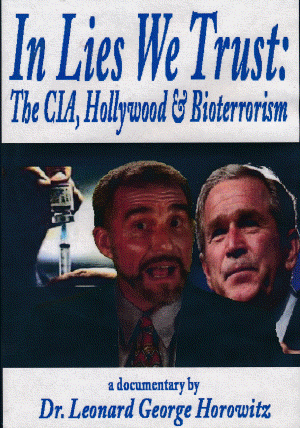
CLICK HERE TO SEE "IN LIES WE TRUST" -- ILLUSTRATED SCREENPLAY
Statistics: Posted by admin — Sun Jan 03, 2016 12:09 am
]]>