By Kristin Chirico, Kirsten King, Sheridan Watson, Nina Mohan, Allison Bagg, Candace Lowry, Macey J Foronda, Charlotte Gomez (BuzzFeed Staff), Caitlin Cowie (BuzzFeed Contributor)
December 10, 2015
NOTICE: THIS WORK MAY BE PROTECTED BY COPYRIGHT
YOU ARE REQUIRED TO READ THE COPYRIGHT NOTICE AT THIS LINK BEFORE YOU READ THE FOLLOWING WORK, THAT IS AVAILABLE SOLELY FOR PRIVATE STUDY, SCHOLARSHIP OR RESEARCH PURSUANT TO 17 U.S.C. SECTION 107 AND 108. IN THE EVENT THAT THE LIBRARY DETERMINES THAT UNLAWFUL COPYING OF THIS WORK HAS OCCURRED, THE LIBRARY HAS THE RIGHT TO BLOCK THE I.P. ADDRESS AT WHICH THE UNLAWFUL COPYING APPEARED TO HAVE OCCURRED. THANK YOU FOR RESPECTING THE RIGHTS OF COPYRIGHT OWNERS.
Warning: This post contains photoshopped images of bodies that some may find triggering.
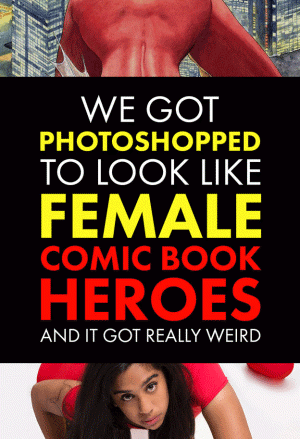
WE GOT PHOTOSHOPPED TO LOOK LIKE FEMALE COMIC BOOK HEROES AND IT GOT REALLY WEIRD
While everyone knows that comic books are fantasy, many of the poses that female characters are drawn in look a little painful:
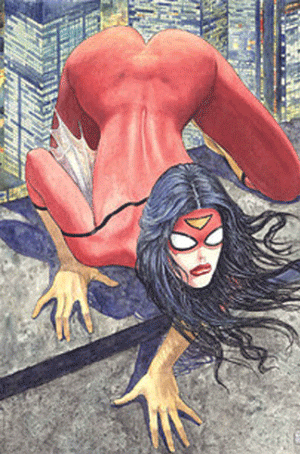
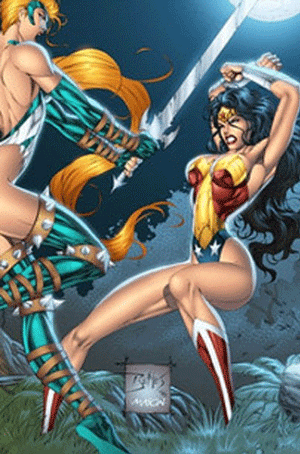
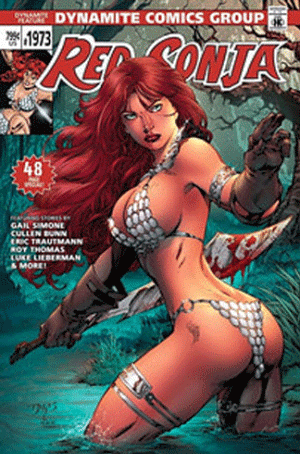
Marvel Comics / DC Comics / Marvel Comics
Many people, such as Ami Angelwings who runs the Tumblr Escher Girls, or these people attempting to sit in the impossible Mary Jane position, have drawn attention to the uncomfortably contorted positions that female comic book characters often find themselves in, in order to make sure they are showing ~MAXIMUM BOOBS AND BUTTS~.
So, a group of us ladies (of various shapes and sizes) decided to try out some of these poses to see juuuuust how funcomfortable they really are:
object
It was, uh, interesting!
Afterward, we had the photos of our poses photoshopped so that they resembled the actual characters.
Because we wanted to see what our bodies would look like if we could ACTUALLY get them in these positions.
Nina tried one of Spider-Woman’s poses:
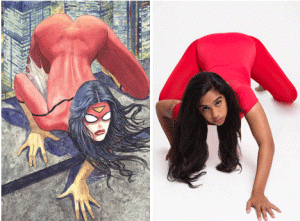
How doing the post felt: I thought it would be fairly easy to rest on my forearms and knees and just pop my butt up a little but it was HARD AF. Everyone kept telling me to adjust myself in impossible ways to match the picture. I legit broke a sweat!


Photo: Macey J. Foronda/BuzzFeed / Photoshop: Charlotte Gomez/BuzzFeed
Changes made to Nina’s photo: Lengthened and slimmed thighs, lengthened back, slimmed back, exaggerated butt, enlarged butt crack.
Nina’s reaction to the photoshopped photo: BEHOLD MY HEART BUTT. It’s like my ass is saying “I love you” to the world. Also my thighs are about a foot longer. I guess this is how I’d look if I were 6’3”. The top half of the photo just isn’t me at all. They might as well have just put my face on a cartoon body, because that’s what it is. I don’t look human.
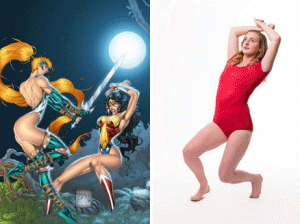
Kirsten tried one of Wonder Woman’s poses:
DC Comics / Macey J. Foronda for BuzzFeed
How doing the pose felt: MAN, did my pose hurt. I used muscles in my body I never knew I had (or maybe don’t have and that’s the issue?). I was in major pain and at one point my leg cramped up. If someone was actually charging at me, I wouldn’t have time to pop my ass out beforehand.


Photo: Macey J. Foronda/BuzzFeed / Photoshop: Charlotte Gomez/BuzzFeed
Changes made to Kirsten’s photo: Enlarged and pushed up breasts, slimmed waist, enlarged butt, exaggerated hip, slimmed and lengthened thighs, slimmed and lengthened lower leg
Kirsten’s reaction to the photoshopped photo: My stomach looks like it has room for exactly two peas in it. And that is the absolute maximum capacity. I don’t know who that lady is, but she is nottttt me. The weird thing is, I didn’t THINK I looked large in the original until I saw it side by side with the other one.
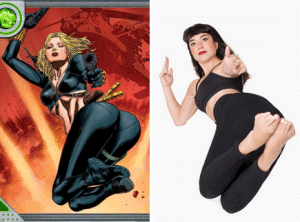
Allison tried a pose belonging to Black Widow*:
Marvel Comics / Macey J. Foronda/BuzzFeed
How doing the pose felt: This shit is physically impossible if you have bones, muscles, and organs. Without those things you might stand a chance. Maybe if I go to yoga every day for a decade, I might be able to get it half right? I expected it to be a damn mess, and it was. It really was. Pretty sure I need to see a chiropracter now.
*This is the Yelena Belova Black Widow, not Natasha Romanov!


Photo: Macey J. Foronda for BuzzFeed / Photoshop: Charlotte Gomez
Changes made to Allison’s photo: Enlarged and pushed up breasts, shortened and repositioned lower legs, lengthened torso, slimmed waist, added and enlarged right buttcheek.
On seeing the photoshopped photo: Look at that booty! But why didn’t they photoshop my toes to make them look normal?
Sheridan tried out one of Red Sonja’s poses:

Marvel Comics / Macey J. Foronda/BuzzFeed
How doing the pose felt: I never went back after the free introductory yoga class, but for some reason, I thought posing as if I was taking a standing-up dump would be my second calling. It was not. I couldn’t understand how all of my body parts were supposed to come together and effortlessly pose like a sexy cartoon superhero. You see my hand? I’m trying to stop hell from coming for me.


Photo: Macey J. Foronda/BuzzFeed / Photoshop: Charlotte Gomez/BuzzFeed
Changes made to Sheridan’s photo: Enlarged and pushed up breasts, slimmed waist, enlarged butt, exaggerated hip, slimmed and lengthened thighs, slimmed and lengthened lower leg.
Sheridan’s reaction to her photoshopped photo: Well, I learned something new today: rib cages — who needs ‘em? I think I look like Kim Kardashian when she gets a little too trigger happy with the photoshopping on her Instagram pics. It’s just so laughable to me. My boobs, however, have never been so perky. Seriously not even two push-up bras could get me that sort of lift on a normal day. Huzzah!
Candace tried out one of Storm’s poses:

Marvel Comics / Macey J. Foronda for BuzzFeed
How doing the pose felt: I thought I would just be chillin’, waiting to save the day, but that hip pop was hard for a basic girl like me. My knees were killing me, but I’ll tell you this right now, I would not be adorned in a red lip and push-up bra if I was fighting crime.


Photo: Macey J. Foronda/BuzzFeed / Photoshop: Charlotte Gomez/BuzzFeed
Changes made to Candace’s photo: Rounded shoulders, curved and pushed arms back, enlarged and pushed up breasts, slimmed waist, slimmed thighs, exaggerated hip, moved and restructured pelvis.
On seeing the photoshopped photo: WOWOW I look like Sofia Vergara and a Barbie gave birth to me TBH, but my vagina looks like a FUPA meets a balloon. Now I know what I look like with big boobs so I guess that’s a plus?
Kristin tried one of Psylocke’s pose:

Marvel Comics / Macey J. Foronda/BuzzFeed
How doing the pose felt: I was pretty sure the legs would be the hardest part of this pose. THAT WAS FALSE. As it turns out, my torso is actually too short. So in order to show everyone my boobs and butt at the same time, I had to bend my back in half, like a really annoyed taco who hates you.


Photo: Macey J. Foronda for BuzzFeed/Photoshop: Charlotte Gomez/BuzzFeed
Changes made to Kristin’s photo: enlarged and pushed out breasts, slimmed and lengthened thighs, separated right thigh, pulled leg out, created a composite butt, pulled butt out from underneath body.
Kristin’s reaction to the photoshopped photo: I look like someone grafted a Barbie onto a busted pair of hot dogs. Like my right thigh is literally so angry that it is just flipping people off, and frankly, I don’t blame it.
FINAL THOUGHTS:
Nina (Spider-Woman): I get that comics are stylized and that’s fantasy. But why does so much of the fantasy revolve around half-naked women contorted to show off their boobs and butts? It feels like a way to take away their power. Like “Oh yea, she’s strong and powerful, but she’s definitely fuckable too, don’t worry.” We should be able to celebrate our power and strength without needing to worry if we’re sufficiently “hot.”
Kirsten (Wonder Woman): Seeing myself and the other ladies in these poses looks unnatural AF. I would prefer to see all of us in strength poses, especially since we’re supposed to be emulating superheroes. Heroines are supposed to fight crime and save the world, not twerk while they’re rescuing humankind.
Allison (Black Widow): This bums me out to see how ridiculous the poses are for every single female superhero. It would be really cool to see powerful, nonsexualized poses that don’t objectify women be the norm instead of this crap.
Sheridan (Red Sonja): I just find everything so hilariously awful. I know a lot of people will say “it’s just a cartoon” or “it’s not real” but what people don’t realize is how these images can actually affect women — and men alike. We’re perpetuating an image that is physically impossible to attain. Is there something wrong with having women with rib cages fight crime? Or do they HAVE to have heart-shaped bums in order to succeed?
Candace (Storm): Man, we all look so crazy, and have such an unrealistic expectation to look incredible. This pretty much goes for men in comics too. I mean, yes, I would be ripped if I was tearing through the city skyline but would that also call for rapid boob growth and my clothes to disappear? Nah. I didn’t realize how insane the proportions were until we were actually photoshopped.
Kristin (Psylocke): Unless you completely lack object permanence, you can deal with not seeing both boobs and butt at the same time. Like, give readers some credit: When a character turns around, it’s not like we all go “BUT WHERE DID THE BOOBS GO? ARE THE BOOBS GONE FOREVER? I NEED ASSURANCES THAT THERE ARE STILL BOOBS HERE.” In fact, the only people who actually think this way are real-life babies, and they can’t read comics, anyway!
Statistics: Posted by admin — Sat Dec 12, 2015 1:07 am
]]>
[Jim Lee, Co-Publisher of DC Entertainment] At that point, he kind of loses his frame of reference, ...
and decides to create almost a totalitarian state, ...
where he's the ultimate authority. And so again, in his mind, ...
he is trying to prevent what happened to Lois and his unborn child ...
from happening in the world, by becoming, ...
you know, the enlightened dictator.
But, you know, you can see sort of the holes in logic of that.
You know, ultimately, you are creating a greater evil ...
by trying to do some small sense of good.
It is now clear that we are facing an implacable enemy whose avowed objective is world domination by whatever means and at whatever cost. There are no rules in such a game. Hitherto acceptable norms of human conduct do not apply. If the United States is to survive, longstanding concepts of fair play must be reconsidered. We must develop effective espionage and counterespionage services and must learn to subvert, sabotage and destroy our enemies by more clever, more sophisticated and more effective methods than those used against us. It may become necessary that the American people be made acquainted with, understand and support this fundamentally repugnant philosophy.
-- WWII Lieutenant Gen. James Doolittle
[Geoff Johns, Chief Creative Officer of DC Entertainment] There have been a few stories where heroes go villainous for some time, ...
and I think probably the most famous one is Hal Jordan, when Coast City, ...
the city he called home, was attacked.
And many people were killed and destroyed. And he wanted to bring them back.
And he went to the Guardians and said, "Give me this power so I can do it."
And they said no. And he ultimately killed them, ...
and became, ...
went crazy, became this big villain in the DC universe.
[Marc Guggenheim, Executive Producer of Arrow] You know, they say that power corrupts, and absolute power corrupts absolutely.
Usually, when a hero falls from grace, it's because they've succumbed ...
to their own power. Like when Hal Jordan became Parallax.
It was Hal Jordan overreaching, ...
and trying to use his power as the Green Lantern to recreate an entire city.
And he kept wanting more and more power.
And he basically got corrupted by his own, ...
you know, by his own super power.
And I think that is usually the path down -- you know, down darkness.
[James Robinson, Writer of "Earth 2"] Through becoming the Spectre, ...
and ultimately becoming Green Lantern, again, he found redemption.
But it took years, and it was a great hero's journey that we got to witness.
John came forward and said: "My Lord, suppose a sinning and a law-breaking man is replete in all iniquities, and he hath ceased from these for the sake of the kingdom of heaven and renounced the whole world and the whole matter therein, and we give him from the beginning onwards the mysteries of the Light which are in the first space from without, and if he receiveth the mysteries, and after a little while again if he returneth and transgresseth, and thereafter again if he turneth and ceaseth from all sins and turneth and renounceth the whole world and the whole matter therein, so that he cometh again and is in great repentance, and if we know truly in truth that he longeth after God, so that we give him the second mystery of the first space which is from without; -- in like manner if he turneth anew and transgresseth and is again in the sins of the world, and again if he thereafter turneth and ceaseth from the sins of the world and again renounceth the whole world and the whole matter therein and again is in great repentance, and we know it with certainty that he is not a play-actor, so that we turn and give him the mysteries of the beginning, which [are] in the first space from without; -- in like manner, if he turneth again and sinneth and is in every type [of sin]; -- desirest thou that we forgive him unto seven times and give him the mysteries which are in the first space from without, unto seven times or not?"
The Saviour answered again and said unto John: "Not only forgive him unto seven times, but amēn, I say unto you: Forgive him unto many times seven times, and every time give him the mysteries from the beginning onwards which are in the first space from without. Perchance ye win the soul of that brother and he inheriteth the Light-kingdom.
-- Pistis Sophia: A Gnostic Miscellany, translated by G.R.S. Mead
[Geoff Johns, Chief Creative Officer of DC Entertainment] Hal Jordan was always about overcoming fear, and I thought, "Well, ...
if he's all about overcoming fear, there's gotta be a moment that he gave in to fear.
And when was that weakness?" That weak point was when he was worried ...
something else was gonna happen, once Coast City was destroyed.
And in that moment, he let fear kind of take hold of his heart.
That's when Sinestro unleashed Parallax, who was this --
we created this entity of terror that could possess his soul, and corrupt his body.
And essentially turn him into Parallax.
And by having Hal still make a mistake, and give in to fear, ...
it was still on point, and gave him a point of failure.
But at the same time, ...
adding Parallax allowed for an easier redemption.
[Mike Carlin, Creative Director of Animation, DC Entertainment] So if a hero does cross the line, ...
does he just go back to work the next day? The idea was no.
It was a 10-year problem for him.
[Marv Wolfman, Writer of "The New Teen Titans"] Comic books by, I think, their basic nature, is about wish fulfillment. Therefore, the concept of second chances ...
is actually built into the very concept of the type of material we do.
So the idea that a hero or a villain could be redeemed, ...
is exactly what comics have to be about.
We can take bad and turn it good.
And we can make good even better.
And that's what comics and fantasy storytelling is all about.
[James Robinson, Writer of "Earth 2"] Cry for Justice began with a bunch of heroes trying to track down Prometheus.
Prometheus has actually taken the identity of one of the heroes.
So he actually is amongst them the entire time.
At the end of it, ...
Prometheus has worked out a way to destroy most of Star City, ...
which is Green Arrow's home.
He also maims Arsenal, ...
and then ultimately Arsenal's daughter is killed.
What happens at the very end is the one moderate person, ...
Green Arrow, then tracks down Prometheus on his own, and executes him.
And that then led to a long arc for Green Arrow, where he had to redeem himself.
[Mike Carlin, Creative Director of Animation, DC Entertainment] Green Arrow crossed the line, and took the life of a villain.
He did not just come back from that adventure ...
and say, "Oh, well, I'm never gonna kill people again."
He had a mental breakdown. And we did a year, ...
a year and a half long story, where he lost it.
And it was to show that there's consequences for this kind of stuff.
I do think that in modern comics it's okay for the heroes to fail.
You just got to have it mean something.
And not just teach them something, ...
but have them suffer, because they did something wrong.
[Peter J. Tomasi, Writer of "Batman and Robin] Taking someone's life, you know, you take away all they're ever gonna have, and all they ever will be.
And it stays with you, even if you do it for the right and proper thing.
So, you know, killing in comics is -- when the hero pulls the trigger, ...
I think it's not done a lot, but I think when it's done, ...
it has to be done in a real big way, ...
that has an emotional punch to the hero's psyche and soul.
[Narrator] After we've witnessed such heinous crimes, ...
after we've experienced firsthand ...
pure evil in the face of villainy, can the evildoer be redeemed?
In this comic book world, where heroes often get second chances, ...
can the villain ever be forgiven?
[Paul Levitz, President of DC Comics (2002-2009) It's a lot harder to figure out how somebody who spent years ...
taking what they wanted, killing people, ...
whatever set of misdeeds, will suddenly turn around ...
and find God, and become moral the rest of their lives.
Does it happen?
It probably does in reality, but it's a real tough story to tell.
[Geoff Johns, Chief Creative Officer of DC Entertainment] Black Adam is an interesting character. He was chosen by the wizard Shazam, ...
given powers back in the ancient Egyptian days.
He was a slave in Kahndaq.
He took these powers, became Black Adam, the champion, and he was a hero.
And over time, he was corrupted by that power.
He went back to Kahndaq and he said, "I'm leading Kahndaq now; you are free.
I'm here." And then he found someone he fell in love with. Isis was born, ...
and then Isis' brother, Osiris. Like, we kind of created a Black Adam family.
And then that family was torn apart, and they were killed.
And Isis, who had been such a great presence for Adam, who had preached peace, and this and that, ...
as she's dying in his arms, the last words she says is, "Avenge us."
And that sends Black Adam off.
And he kills an entire country out of rage.
And obviously, it's hard to redeem somebody after that.
He believes in doing the right thing.
He just goes about it in such a barbaric and awful way.
[Doug Mahnke, Artist of "Green Lantern"] Pete Tomasi wrote a fantastic story wrapped around a character everybody should hate, ...
and made him, you know, made him a hero ...
in a very, you know, from a very villainous past.
[Peter J. Tomasi, Writer of "Batman and Robin] It's a weird spot to be in when you're a writer, when you have to say:
"I just committed genocide, but I have to make this character relatable, ...
and in a weird way, have people understand where he was coming from at that point."
So it's a tough line to walk when you're a writer writing a character ...
who's as three-dimensional as Black Adam, ...
because he really is one of those great three-dimensional characters ...
that you could horribly understand why he does something.
[James Robinson, Writer of "Earth 2"] With villains, though, when you try and turn them into heroes, ...
they can lose their, what makes them special.
So it's a very rare case where a villain is better as a hero.
Most of the time, most readers just can't wait for them to be villainous again.
[Andrea Romano, Voice Director of DC Animated Titles] Recently, when we worked on Dark Knight Returns, ...
where we have Doctor Wolper ...
trying to bring the Joker back, and trying to work with him, ...
and now Doctor Wolper also has an enormous ego.
And so you've got Joker's ego, and Wolper's ego.
It doesn't work out well. It doesn't work out well for Wolper.
But the Joker absolutely was all about:
"I am rehabilitated. I'm here. I've seen the error of my ways."
And he really just used that as a matter to get himself out of Arkham, ...
so he could commit tremendous crimes.
[Dan Didio, Co-Publisher of DC Entertainment] I think some of them can be redeemed, but I think what you gotta do ...
is you gotta dangle the sense of redemption in front of them, and then rip it away.
Because ultimately, you show why they were a villain in the first place.
"THE NEW 52" AND BEYOND
[Narrator] As society continues to evolve, so too do our villains.
In September of 2011, ...
DC relaunched its entire line of comics, ...
dubbed "The New 52."
[Jim Lee, Co-Publisher of DC Entertainment] Two years ago, we relaunched the DC universe.
We called that "The New 52." And it was basically a soft reset of the universe, ...
where we basically fixed the things that we felt weren't working, ...
and kept going with the things that were.
We really sat down and thought about, "What do we need more of in the DC universe?"
And one of the things that we wanted to address was the villains.
[Geoff Johns, Chief Creative Officer of DC Entertainment] What is villainy to us in 2013? What is real evil in 2013?
It's horrendous, right? And sometimes, if you get too close to the reality of it, ...
it takes you out of the comic book.
So using super villains as metaphors for whatever that is, ...
and for the brutal attacks that they do, it's gotten darker. It's clearly darker. And it's scarier.
And the attacks come without notice sometimes. And they're personal.
[Marc Guggenheim, Executive Producer of Arrow] I think that's because we live in a very sort of fearful time.
You know, ever since 9/11, the world's been on edge, ...
and no one knows when the next shoe is gonna drop.
Is it gonna be a tsunami? Is it gonna be economic collapse?
And villains that sort of embody that sense of unpredictability, ...
that sense of, you know, doom, can come in any form and at any time.
I think that speaks to everyone's sort of hidden fears.
[Geoff Boucher, Senior Writer of Entertainment Weekly] Instead of characters of good and evil, it became about characters of order and chaos.
It became about anarchy.
[Mike Carlin, Creative Director of Animation, DC Entertainment] We are artists, and we're trying to reflect what's going on in the world.
That's what all art does. It's a mirror.
The glorification of violence receives some of its strongest reinforcement from the traditional image of the military as a unique noble and honorable enterprise. Within this tradition, killing of the enemy is elevated from the status of a necessary evil to that of a commendable good; productivity and proficiency in its performance are among the marks of the military hero. In the United States, this traditional adulation of the military has suffered some setbacks during the Vietnam War. The elaborately staged homecoming of our prisoners of war was aimed, among other things, at reviving popular enthusiasm for the military by casting these men in the traditional roles of returning heroes. The men deserve our fullest sympathy, respect, and support as human beings who have been subjected to extreme suffering and who have shown a high degree of personal courage. We must also remember, however, that most of these men were not only victims, but also victimizers -- active (and in some cases enthusiastic) participants in the massive bombardments of the people of Vietnam. To treat them as military heroes is to honor them in their roles as victimizers and thus to support our political and military authorities in their efforts to glorify mass violence.
At the other end of the political spectrum, some of the revolutionary rhetoric of recent years has made its own contribution to the glorification of violence (Arendt, 1969; also Kelman, 1968, Chapter 9). Terrorist acts have in some quarters been romanticized and their perpetrators elevated to the status of revolutionary heroes. A revolutionary mystique has evolved in which violence is not merely a means of struggle used as a last resort by oppressed people but a valued end in its own right. Some of the writings of Fanon (1963), in particular, are often cited as intellectual justification for the idea that violence on the part of oppressed people is in itself a vital part of the struggle, serving as a cleansing and creative force.
The glorification of violence among the rank and file -- whether in a military or a revolutionary context -- may well be a response to the dehumanizing experiences to which they themselves have been subjected. Both regimentation and oppression create a feeling of powerlessness, a loss of personal agency, a deprivation of the sense of identity. Violence can offer a person the illusion that he is in control, that he is able to act on his environment, that he has found a means of self-expression. It may be the only way left to him to regain some semblance of identity, to convince himself that he really exists. The sad irony is that violence is a response to dehumanization that only deepens the loss that it seeks to undo; it is an attempt to regain one's sense of identity by further destroying one's sense of community.
The appeal of doctrines (on the right or the left of the political spectrum) that glorify violence can be understood more readily if we recognize their close relationship to commonly held stereotypes of masculinity. In our culture, as in many others, violence is often taken as evidence of the toughness and aggressiveness, the lack of sentimentality, and the emotional stoicism that males are expected to demonstrate. Thus the readiness to proclaim or endorse the glories of violence is often a response to the perceived requirements of the male sex role; to shy away from violence is to fail a challenge to prove one's manliness. Similarly, those who feel particularly oppressed by their powerlessness and lack of personal agency may resort to violence because they see it as a way of regaining their lost manhood.
To counteract the glorification of violence, we must challenge the concept that killing is a heroic enterprise or a legitimate form of self-expression. We must learn to overcome the reluctance to take a firm stand against the jingoist or terrorist who declares that violence is the only way, even at the risk of appearing insufficiently patriotic or insufficiently radical as the case may be. More fundamentally, we must find ways of counteracting the rigid sex-role stereotypes that are so deeply rooted in our culture and that have a profoundly dehumanizing influence. Just as commonly held notions of the female role tend to undermine women's sense of identity by restricting them in the development and expression of personal agency, so do commonly held notions of the male role undermine men's sense of community by restricting them in the development and expression of empathy toward their fellow human beings.
-- Violence Without Moral Restraint: Reflections on the Dehumanization of Victims and Victimizers, by Herbert C. Kelman
[Narrator] While DC's rogues gallery of villains is already enormous ...
there's always room for a little more evil.
With the advent of "The New 52," the heroes of the DC universe ...
must face new threats and adversaries.
[Marv Wolfman, Writer of "The New Teen Titans"] I have a strange belief about the way one proceeds with comics ...
is to using old characters and introducing new characters.
My belief is if you're gonna use one or two old characters, ...
you have to introduce a new one.
I don't think we should ever be so content to keep riding on the same horse.
If the hero has to survive for 16, 20, 30 years, ...
you wanna know all the different aspects of that character.
And the villain will make them face certain parts about themselves ...
that on their own ...
they may not even think about, or can come up in a storyline.
But a villain will find that, because they're always trying to find something new ...
to use against the hero, ...
which makes you explore your hero even more.
[Zack Snyder, Director of Man of Steel] The goal of any villain is to challenge our hero, right?
Actually, not to challenge him, but to take him to the ragged edge ...
of his existence in every way.
[Scott Snyder, Writer of "Batman"] The idea is to try and think about what the character is most afraid of ...
at that particular moment in his or her life, the hero, ...
and then create a villain that comes right at that thing.
So for "Court of Owls," that story was really about, ...
you know, a moment when Batman was on top of the world.
He felt very confident in Gotham, and it made me realize, ...
Batman might think he knows the city, but he can't know the history of the city.
He can't know everything about it. And so what if the city itself begins to come at him saying, you know, ...
"You don't know me that well." So, with the Court of Owls, ...
they're this group buried and layered into the past of the city in ways that I think are scary to him.
At first he doesn't believe they exist at all.
And then, he sees that they actually have nests for their Talons ...
inside Wayne buildings. And then, in the penultimate scene, ...
he realizes that the person behind the story ...
is actually someone who claims to be a Wayne himself.
[Geoff Johns, Chief Creative Officer of DC Entertainment] The Guardians of the Universe were characters that are ancient beings, billions of years old, ...
that divorced themselves from emotion a long time ago.
Because they thought emotion was dangerous.
They always say the law is supposed to be devoid of emotion.
The First Lantern is the being who got the first ring, ...
who was there to witness the divorcing of the Guardians and their emotional hearts.
And he took that emotional power for himself.
And he had changed who he was, ...
and the Guardians imprisoned him, and they locked him away, like they did with their emotions.
The First Lantern is a metaphor for all the pent up emotion the Guardians have buried.
And that First Lantern is now free.
At one point, the First Lantern says, as he's got them captured, ...
he's turned the tables and he says, "I'm gonna change this universe now.
But before I do, I want you to have your emotions back.
I want you to feel this."
And the Guardians, for the first time in billions of years, ...
have their emotions back. And they feel shame, and fear, ...
and horror about what they've done, and what they've become, ...
which I really enjoyed.
And then that's right before Sinestro wipes them out.
Recently, when I got into Aquaman, and I was launching Aquaman for "The New 52," ...
my attitude was he wants to be on land.
So he made a conscious decision in issue one, "My life is on land here."
And I wanted to have something that was gonna drag him back into the ocean.
So we created, Ivan Reis and I, created this race of sea creatures, ...
humanoid sea creatures, man-eating creatures, ...
that were starving. They are from the trench. And they had eaten all their food down there,...
and they were coming up for something else.
And they come up out of the ocean, and they attack a town.
And Aquaman gets involved with that attack, ...
and has to go back into the water.
And what Aquaman doesn't know is, they're actually another kingdom.
They're actually another underwater kingdom that is one of many, with Atlantis.
[Narrator] Although it was spawned from comics, ...
the DC universe isn't limited to panels and pages.
It has expanded to include all forms of media, and given its villains new worlds to explore.
[Geoff Johns, Chief Creative Officer of DC Entertainment] DC Comics isn't just comics, you know?
It starts in the comics -- all the characters come from the comics --
but then they explode into everything else.
[Ames Kirshen, VP of Production of Warner Bros. Interactive Entertainment] If it wasn't for these amazingly rich, and complex, and multilayered villains ...
that we had to craft our stories around, and what is driving you through the story, ...
what is pushing Batman, you know, to push his limits, ...
to get to the end of the game, is ultimately the plan, ...
and the storytelling, around the villain ...
and the villains' interactions with each other, as they all try to take down Batman.
[Villain] You had your shot, Deathstroke, but you're not the only assassin in town.
[Ames Kirshen, VP of Production of Warner Bros. Interactive Entertainment] There is such rich material here, and such deep, amazing characters, ...
that have such long history and love from the fans, ...
for 50, 60, 70 years, that we wanna tell great stories in our games.
We don't want it to just be about the gameplay and cool visuals.
There's gotta be the meat there of a great story.
[Jim Lee, Co-Publisher of DC Entertainment] To me, as a fan, it's a lot of fun to see that, because it really explores the world of these characters, ....
and it doesn't just give you one flavor, month in, month out.
[Narrator] The future, including the upcoming Forever Evil comic event, ...
will continue to emphasize the villains, and their many diabolical deeds.
[Geoff Johns, Chief Creative Officer of DC Entertainment] As DC celebrates its villainy, we're doing the first "New 52" event series.
I'm writing it. David Finch is drawing it. It's called "Forever Evil."
And the context of this is the Justice League is dead.
The villains have inherited the earth. They've been killed by the Crime Syndicate.
So we create an event that now carries on throughout the rest of 2013 and 2014, ...
that's all about the villains.
For the anti-Semite, what makes the Jew is the presence in him of "Jewishness," a Jewish principle analogous to phlogiston or the soporific virtue of opium. We must not be deceived: explanations on the basis of heredity and race came later; they are the slender scientific coating of this primitive conviction. Long before Mendel and Gobineau there was a horror of the Jew, and those who felt it could not explain it except by saying, like Montaigne of his friendship for La Boétie: "Because he is he, because I am I." Without the presence of this metaphysical essence, the activities ascribed to the Jew would be entirely incomprehensible. Indeed, how could we conceive of the obstinate folly of a rich Jewish merchant who, we are told, makes every effort to ruin his country, whereas if he were reasonable, he would desire the prosperity of the country in which he does business? How could we otherwise understand the evil internationalism of men whom their families, their affections, their habits, their interests, the nature and source of their fortunes should attach to the destiny of a particular country?
Facile talkers speak of a Jewish will to dominate the world. Here again, if we did not have the key, the manifestations of this will would certainly be unintelligible to us. We are told in almost the same breath that behind the Jew lurks international capitalism and the imperialism of the trusts and the munitions makers, and that he is the front man for piratical Bolshevism with a knife between its teeth. There is no embarrassment or hesitation about imputing responsibility for communism to Jewish bankers, whom it would horrify, or responsibility for capitalist imperialism to the wretched Jews who crowd the rue des Rosiers. But everything is made clear if we renounce any expectation from the Jew of a course of conduct that is reasonable and in conformity with his interests, if, instead, we discern in him a metaphysical principle that drives him to do evil under all circumstances, even though he thereby destroy himself. This principle, one may suspect, is magical. On the one hand, it is an essence, a substantial form, and the Jew, whatever he does, cannot modify it, any more than fire can keep itself from burning. On the other hand, it is necessary in order to be able to hate the Jew -- for one does not hate natural phenomena like earthquakes and plagues of locusts -- that it also have the virtue of freedom. Only the freedom in question is carefully limited: The Jew is free to do evil, not good; he has only as much free will as is necessary for him to take full responsibility for the crimes of which he is the author; he does not have enough to be able to achieve a reformation. Strange liberty, which instead of preceding and constituting the essence, remains subordinate to it, is only an irrational quality of it, and yet remains liberty.
There is only one creature, to my knowledge, who is thus totally free and yet chained to evil; that is the Spirit of Evil himself, Satan. Thus the Jew is assimilable to the spirit of evil. His will, unlike the Kantian will, is one which wills itself purely, gratuitously, and universally to be evil. It is the will to evil. Through him Evil arrives on the earth. All that is bad in society (crises, wars, famines, upheavals, and revolts) is directly or indirectly imputable to him. The anti-Semite is afraid of discovering that the world is ill-contrived, for then it would be necessary for him to invent and modify, with the result that man would be found to be the master of his own destinies, burdened with an agonizing and infinite responsibility. Thus he localizes all the evil of the universe in the Jew. If nations war with each other, the conflict does not arise from the fact that the idea of nationality, in its present form, implies imperialism and the clash of interests. No, it is because the Jew is there, behind the governments, breathing discord. If there is a class struggle, it is not because the economic organization leaves something to be desired. It is because Jewish demagogues, hook-nosed agitators, have seduced the workers.
Anti-Semitism is thus seen to be at bottom a form of Manichaeism. It explains the course of the world by the struggle of the principle of Good with the principle of Evil. Between these two principles no reconciliation is conceivable; one of them must triumph and the other be annihilated. Look at Celine: his vision of the universe is catastrophic. The Jew is everywhere, the earth is lost, it is up to the Aryan not to compromise, never to make peace. Yet he must be on his guard: if he breathes, he has already lost his purity, for the very air that penetrates his bronchial tubes is contaminated. Does that not read like a diatribe by a Manichaean? If Celine supported the socialist theses of the Nazis, it was because he was paid to do so. At the bottom of his heart he did not believe in them. For him there is no solution except collective suicide, non-reproduction, death. Others — Maurras or the P.P.F. [4] — are less discouraging. They envisage a long and often doubtful struggle, with the final triumph of Good. It is Ormazd against Ahriman. The reader understands that the anti-Semite does not have recourse to Manichaeism as a secondary principle of explanation. It is the original choice he makes of Manichaeism which explains and conditions anti-Semitism. We must therefore ask ourselves what this original choice can mean for a man of today.
Let us compare for a moment the revolutionary idea of the class struggle with the Manichaeism of the anti-Semite. In the eyes of the Marxist, the class struggle is in no sense a struggle between Good and Evil; it is a conflict of interests between human groups. The reason why the revolutionary adopts the point of view of the proletariat is, first of all, because it is his own class, then because it is oppressed, because it is by far the most numerous and consequently involves the fate of mankind in its own destiny, finally because the results of its victory will necessarily include the abolition of the class structure. The goal of the revolutionary is to change the organization of society. To do that it will no doubt be necessary to destroy the old regime. But that will not be sufficient; above all it will be necessary to build a new order. If by some impossible chance the privileged class were willing to co-operate in the socialist reconstruction and gave clear proofs of its good faith, there would be no valid reason for repulsing it. If it is highly improbable that it will offer its support to the socialists in good faith, it is because its very situation as a privileged class prevents it from doing so, not because of some indefinable interior demon which impels it to do evil in its own despite. In any case, if portions of this class break away from it, they can be constantly assimilated to the oppressed class, and they will be judged by their acts, not by their essence. "I don't give a damn for your eternal essence," Politzer told me one day.
On the other hand, the Manichaean anti-Semite puts his emphasis on destruction. What he sees is not a conflict of interests but the damage which an evil power causes society. Therefore Good consists above all in the destruction of Evil. Underneath the bitterness of the anti-Semite is concealed the optimistic belief that harm only will be re-established of itself, once Evil is eliminated. His task is therefore purely negative: there is no question of building a new society, but only of purifying the one which exists. In the attainment of this goal the co-operation of Jews of good will would be useless and even fatal, and anyhow no Jew could be a man of good will. Knight-errant of the Good, the anti-Semite is a holy man. The Jew also is holy in his manner — holy like the untouchables, like savages under the interdict of a taboo. Thus the conflict is raised to a religious plane, and the end of the combat can be nothing other than a holy destruction.
The advantages of this position are many. To begin with, it favours laziness of mind. We have seen that the anti-Semite understands nothing about modern society. He would be incapable of conceiving of a constructive plan; his action cannot reach the level of the methodical; it remains on the ground of passion. To a long-term enterprise he prefers an explosion of rage analogous to the running amuck of the Malays. His intellectual activity is confined to interpretation; he seeks in historical events the signs of the presence of an evil power. Out of this spring those childish and elaborate fabrications which give him his resemblance to the extreme paranoiacs. In addition, anti-Semitism channels evolutionary drives toward the destruction of certain men, not of institutions. An anti-Semitic mob will consider it has done enough when it has massacred some Jews and burned a few synagogues. It represents, therefore, a safety valve for the owning classes, who encourage it and thus substitute for a dangerous hate against their regime a beneficent hate against particular people. Above all this naive dualism is eminently reassuring to the anti-Semite himself. If all he has to do is to remove Evil, that means that the Good is already given. He has no need to seek it in anguish, to invent it, to scrutinize it patiently when he has found it, to prove it in action, to verify it by its consequences, or, finally, to shoulder the responsibilities of the moral choice he has made.
It is not by chance that the great outbursts of anti-Semitic rage conceal a basic optimism. The anti-Semite has cast his lot for Evil so as not to have to cast his lot for Good. The more one is absorbed in fighting Evil, the less one is tempted to place the Good in question. One does not need to talk about it, yet it is always understood in the discourse of the anti-Semite and it remains understood in his thought. When he has fulfilled his mission as holy destroyer, the Lost Paradise will reconstitute itself. For the moment so many tasks confront the anti-Semite that he does not have time to think about it. He is in the breach, fighting, and each of his outbursts of rage is a pretext to avoid the anguished search for the Good.
But that is not all, and now we touch on the domain of psychoanalysis. Manichaeism conceals a deep-seated attraction toward Evil. For the anti-Semite Evil is his lot, his Job's portion. Those who come after will concern themselves with the Good, if there is occasion. As for him, he is in the front rank of society, fighting with his back turned to the pure virtues that he defends. His business is with Evil; his duty is to unmask it, to denounce it, to measure its extent. That is why he is so obsessed with piling up anecdotes that reveal the lubricity of the Jew, his appetite for money, his ruses, and his treasons. He bathes his hands in ordure. Read again La France Juive of Drumont; that book of a "high French morality" is a collection of ignoble or obscene stories. Nothing reflects better the complex nature of the anti-Semite. Since through fear of standing out from the crowd he has not wished to choose his Good, allowing everybody else's to be imposed on him, his morality is never based on an intuition of values or on what Plato calls Love. It shows itself only by the strictest taboos, by the most rigorous and most gratuitous imperatives.
What he contemplates without intermission, that for which he has an intuition and almost a taste, is Evil. He can thus glut himself to the point of obsession with the recital of obscene or criminal actions which excite and satisfy his perverse leanings; but since at the same time he attributes them to those infamous Jews on whom he heaps his scorn, he satisfies himself without being compromised. In Berlin I knew a Protestant in whom sexual desire took the form of indignation. The sight of women in bathing suits aroused him to fury; he willingly encouraged that fury and passed his time at swimming pools. The anti-Semite is like that, and one of the elements of his hatred is a profound sexual attraction toward Jews.
-- Anti-Semite and Jew: An Exploration of the Etiology of Hate, by Jean-Paul Sartre
[Jim Lee, Co-Publisher of DC Entertainment] When we looked at the whole lineup of characters, it really came down to, ...
"Why does this character exist in the DC universe?
What role does this character fill?
How do we show that function through story, and through character development?"
[Geoff Johns, Chief Creative Officer of DC Entertainment] Seeing all the villains manifest themselves in animation, ...
and television, and film, and videogames from the comic books, that's, ...
I mean, that's the true power and testament to the characters themselves.
[Narrator] The supervillains of DC Comics ...
come in all manners of shapes, sizes, personalities, ...
dark recesses, and eccentricities.
They conquer worlds, eradicate cities, and terrorize the innocent, ...
all while fighting the hero.
And it's this bond between villain and hero that is inseverable, ...
unbreakable, a fusion of soul, a sense of feeling, ...
a deeply rooted connection that cannot be extricated.
Theirs is a war of intellect, of strength, ...
of darkness, and intertwined fate and destiny, to keep doing battle.
They can't give up on each other.
Without the hero, there is no villain.
Without a villain, there can be no hero.
[Man Laughing]
A Warner Bros. Home Entertainment Production
In Association with mOcean
Produced by J. M. Kenny and Scott Devine
Narrated by Christopher Lee
Edited by Ryan Halferty, Shay Thompson
Director of Photography: Adam Biggs
Associate Editor: Brandy Oswald Markovich
Coordinating Producer: Taryn Teigue
Graphics and title treatment creative director: Craig Oelrich
Super-Villains and all characters, their distinctive likenesses, and related elements are trademarks of and copyright DC Comics.
Copyright 2013 Warner Bros. Entertainment Inc.
All Rights Reserved.
Statistics: Posted by admin — Fri Jul 31, 2015 11:36 am
]]>
[Mike Carlin, Creative Director of Animation, DC Entertainment] I think any time you can make the character strong, ...
whether they're male or female, you'll end up with a good villain.
Another statement by a comic-book expert that has gained wide currency is that comic books contain "a strikingly advanced concept of femininity and masculinity." In further explanation of this statement it is said: "Women in the stories are placed on an equal footing with men and indulge in the same type of activities. They are generally aggressive and have positions which carry responsibility. Male heroes predominate but to a large extent even these are essentially unsexed creatures. The men and women have secondary sexual mannerisms, but in their relationship to each other they are de-sexed."
If a normal person looks at comic books in the light of this statement he soon realizes that the "advanced concept of femininity and masculinity" is really a regressive formula of perversity. Let's compare this statement with the facts. One of the many comics endorsed by this child psychiatrist has the typical Batman story, the muscular superman who lives blissfully with an adolescent. Is it so advanced to suggest, stimulate or reinforce such fantasies? The normal concept for a boy is to wish to become a man, not a superman, and to live with a girl rather than with a superheroic he-man. One team-expert has himself admitted that among the three comic-book characters "most widely disapproved" by adults are Superman and Batman -- the prototypes of this "advanced concept of masculinity." Evidently the healthy normal adult rejects them.
As to the "advanced femininity," what are the activities in comic books which women "indulge in on an equal footing with men"? They do not work. They are not homemakers. They do not bring up a family. Mother-love is entirely absent. Even when Wonder Woman adopts a girl there are Lesbian overtones. They are either superwomen flying through the air, scantily dressed or uniformed, outsmarting hostile natives, animals or wicked men, functioning like Wonder Woman in a fascistic-futurist setting, or they are molls or prizes to be pushed around and sadistically abused. In no other literature for children has the image of womanhood been so degraded. Where in any other childhood literature except children's comics do you find a woman called (and treated as) a "fat slut"? The activities which women share with men are mostly related to force and violence. I admit they often use language -- "advanced," I suppose -- which is not usually associated with women. Dr. Richmond Barbour mentions an example: "'Try this in ya belly, ya louse' the young lady says as she shoots the uniformed policeman in his midsection. Scantily dressed, thighs and breasts exposed, she is leading three similar gun-girls. One has been shot, and she is falling. Another girl shoots at the police with a revolver and mutters, 'Here's one fer luck!'"
The prototype of the super-she with "advanced femininity" is Wonder Woman, also endorsed by this same expert. Wonder Woman is not the natural daughter of a natural mother, nor was she born like Athena from the head of Zeus. She was concocted on a sales formula. Her originator, a psychologist retained by the industry, has described it: "Who wants to be a girl? And that's the point. Not even girls want to be girls.... The obvious remedy is to create a feminine character with all the strength of Superman.... Give (men) an alluring woman stronger than themselves to submit to and they'll be proud to become her willing slaves." Neither folklore nor normal sexuality, nor books for children, come about this way. If it were possible to translate a cardboard figure like Wonder Woman into life, every normal-minded young man would know there is something wrong with her.
-- Seduction of the Innocent, by Fredric Wertham, M.D.
[Narrator] It should come as no surprise, no coincidence, really, ...
that the more popular heroes are the ones who typically battle the most sinister ...
and charismatic rogues galleries.
For it's this dynamic roster of villains ...
that bolster and buoy the popularity of our hero.
[Jim Lee, Co-Publisher of DC Entertainment] When you look at the very best characters, the very best heroes, ...
in comic book mythology, they typically have the strongest rogues gallery.
[Paul Levitz, President of DC Comics (2002-2009) I think you develop a better rogues gallery around the superhero ...
if the scale of the superhero ...
is one where it's easy to imagine the villain coming into being.
You look at Batman, Batman ultimately is a human being.
So therefore, you can have villains that face him that are human, plus a little.
[Marc Guggenheim, Executive Producer of Arrow] Batman's rogues gallery, which I actually think, to me, is the best rogues gallery ...
of sort of all the DC heroes, that resonates the most.
And I think those characters are considered, you know, sort of the greater villains.
There's an interesting thing about a lot of Batman's rogues, ...
and here I'm specifically thinking of, like, the Penguin, and Two-Face, ...
and Clayface, and the Joker.
They're all physically deformed in some way.
And that physical deformity actually drives their evil.
[Paul Levitz, President of DC Comics (2002-2009) It's massively more difficult to have villains of scale for Superman.
Character is incredibly powerful.
Who's tough enough to fight him?
[Marv Wolfman, Writer of "The New Teen Titans"] Brainiac felt like a character who could actually fight Superman, and win without superpowers, ...
because he's a computer. He's a computer character.
[Superman] So you must be Brainiac. Okay.
[Michael E. Uslan, Executive Producer of The Dark Knight Rises] Brainiac was an alien, who was collecting cities ...
of different world cultures as he moved throughout the galaxy, ...
throughout the universe.
And he comes to Earth to shrink Metropolis, among other cities, ...
and put it in a glass bottle, ...
and take it in his interplanetary collection back to wherever he may have come from.
[Mike Carlin, Creative Director of Animation, DC Entertainment] We didn't want it to always be Lex Luthor that was fighting Superman, or Brainiac.
But then you start running out of the famous names.
So we kept coming up with new guys, you know.
[Dr. Travis Langley, Author of "Batman and Psychology: A Dark and Stormy Knight"] The Parasite, he becomes this individual who draws power from others.
He draws super power from Superman, or other superheroes he was around.
He draws life force from other people, ...
sometimes even identity from other people.
[Andrea Romano, Voice Director of DC Animated Titles] I think Metallo's a really interesting villain.
And a large part of why I like him is because he was human, ...
but now he's got this Kryptonite heart.
So he still has a heart, but it's a deformed heart.
It's an obscene heart. It's a heart of evil.
And that heart affects what he does. And it has such a massive effect on Superman.
[Dan Didio, Co-Publisher of DC Entertainment] When you run into characters like Superman, and Wonder Woman, the rogues galleries get a lot smaller.
Wonder Woman, in particular, has a very small gallery, ...
because of who she is, and what she represents.
And how she becomes more iconic in her own rights, makes it harder to play off of her weaknesses, ...
because a lot of people don't see perceived weaknesses in the character.
So there's no major villainy that could exploit those weaknesses in her.
[Brian Azzarello, Writer of "Wonder Woman"] We added another layer to Wonder Woman's origin, by making her the daughter of Zeus.
So she has divine blood.
And then we wanted to take it even further.
And it's like, "Well, let's create somebody new, a new god."
And it is -- we created this character called the First Born.
He has no name. He was the first child of Zeus and Hera.
And he was cast out of Olympus, because there was a prophecy ...
that he would take over Olympus.
So here is her original brother, who's been cast out of heaven and hated by all.
So now he's got a major hate-on for his family and the world.
VILLAINS UNITED
[Narrator] Just as heroes will bond together to fight a common enemy, ...
so too will the villains.
The fusion of good is matched only by the unification of evil.
The Crime Syndicate, the Secret Society ...
... The Rogues, the Legion of Doom.
Though their members differ ...
all villain team-ups employ the same battle-tested strategy:
There is strength in numbers.
[Len Wein, Writer of "Swamp Thing"] My favorite aspect of working in this business ...
is when I have created various incarnations of various teams.
Alright, we need one character who can fly; we need one character who's really strong; ...
we need one character who's maybe got some magical powers.
And just putting that together is half the challenge.
The story writes itself more often than not after that.
[Ames Kirshen, VP of Production of Warner Bros. Interactive Entertainment] The opening of The Challenge of the Super Friends, ...
where you've got the Justice League members marching ...
towards the screen, and then the other side the Legion of Doom are all in rank file, marching.
And they're coming at each other. And there's this big explosion when the two sides hit each other.
I mean, you know as a 6-, 7-year-old kid, you know, it blew your mind.
[Ed Boon, Creative Director of Netherrealm Studios-Injustice] Normally, villains are seen as individuals, and they have their own personal plot ...
to, you know, take over the world, or something like that.
But the idea of them combining together, you know, makes their threat that much bigger.
[Marc Guggenheim, Executive Producer of Arrow] Supervillain team-ups, ha, ha, are their own unique animal, ...
because on the one hand ...
there's a huge potential, and disappointment ratio, ...
when supervillains team up.
The potential is, well, ...
it's two great tastes that taste great together;
it's two threats are better than one.
You know, when Lex Luthor and Brainiac team up, ...
you know, when the Joker and the Riddler team up, ...
that's incredibly, you know, resonant and powerful.
The problem is that 99.9 percent of the time, ...
the ability of the superhero to overcome their plan, ...
is usually hidden in the conflict between the supervillains.
The supervillains, they just can't get their act together. A comic book is 22 pages.
They can get their act together for 19 pages, but those last three are just, ugh, ...
they're just falling apart.
[Grodd] I'd like to complete this transaction with as little bloodshed as possible, Lex.
Now put your hands up, and have Toy Man turn us around.
[Woman] Don't look at him, Big Boy.
Grodd is leader.
[Scott Porter, Actor of Hart of Dixie] The Rogues are a little bit different. The Rogues can come together for a common goal.
They're guys that seem silly, at first, but you look at somebody like Mirror Maste,r --
okay, the guy can teleport through any reflective surface, not just a mirror.
He can bend light, illusions.
And there's so many things.
He can make himself appear in multiple places at once.
I mean, there's so many very interesting things that he can do on his own, ...
that when you put him into a group, with a bunch of other villains that are also extremely versatile, ...
you have a really cool set of personalities and powers.
[Brian Buccellato, Writer of "The Flash"] Although they do have, you know, specific rivalries, ...
Heat Wave and Captain Cold don't like each other.
Yeah, one's hot and one's cold, but there are other reasons.
And in our "Flash Run," all the Rogues, ...
they used to have guns, and wands, and mechanical devices dating back ...
to when they were originally created. But we made them have superpowers.
And it's because of Captain Cold.
He made them undergo this transformation that gave them superpowers.
Well, it had negative side effects.
For poor Heat Wave, it burnt off basically all the top layer of his skin, ...
so he looks really gross and messed up. So he hates Captain Cold for making him look that way.
[Geoff Johns, Chief Creative Officer of DC Entertainment] Why do they hang out together?
Well, there's strength in numbers. And Flash is fast enough.
He can fight more than one person at a time.
But there's something about the Rogues.
They just wanna pull their jobs, live their lives, and be left alone.
[Brian Buccellato, Writer of "The Flash"] Like, it's their job to pull off heists and steal stuff. And that's how they make their living. Like, they consider themselves blue-collar guys.
"We're gonna pop a beer, and then we're gonna spend the money that we made by robbing the bank."
[Geoff Johns, Chief Creative Officer of DC Entertainment] What other villains can you think about, like they pull a heist, they escape the Flash, ...
and then they go to a bar to have a beer?
[James Robinson, Writer of "Earth 2"] I think the Suicide Squad is the exception to the rule.
And what makes it interesting is, it's a bunch of villains ...
who are forced by the government to go on missions that are for the good of the people.
And if they fail, if they decide to try and escape, they have devices that will kill them.
So they are forced to do it.
I think the fact that they are forced to be heroes, despite their own instincts, ...
and the fact that they're constantly trying to work out ways to undermine their own missions, ...
and to sometimes betray their teammates, and be villains even while they're ...
forced to do the right thing, is the reason why that team, and that book, ...
is always around, and is always popular.
[Mike Carlin, Creative Director of Animation, DC Entertainment] None of their motivation is theirs.
They're doing the bidding of Amanda Waller, and the government.
[Jim Lee, Co-Publisher of DC Entertainment] Are the people that are planting these bombs ...
on the backs of the Suicide Squad members, ...
are they the heroes?
You know, purportedly they are.
But the way, they're doing it, it really, you know comes down to, ...
it's an extreme form of water boarding I think.
[Bobbie Chase, Editorial Director of DC Comics] They have reason to hate their handlers, who are supposed to be the good guys.
But they're not seen that way in the books.
So it's an interesting study in what makes a villain, and what makes a hero, ...
because it's kind of flip-flopped in that book.
[Mike Carlin, Creative Director of Animation, DC Entertainment] They're not there to personally screw the other guy standing next to them.
They are there just to survive.
And they are -- they don't want it to be their suicide mission.
And I do think that that's a different and new angle.
Many of the people studied in the experiment were in some sense against what they did to the learner, and many protested even while they obeyed. But between thoughts, words, and the critical step of disobeying a malevolent authority lies another ingredient, the capacity for transforming beliefs and values into action. Some subjects were totally convinced of the wrongness of what they were doing but could not bring themselves to make an open break with authority. Some derived satisfaction from their thoughts and felt that -- within themselves, at least -- they had been on the side of the angels. What they failed to realize is that subjective feelings are largely irrelevant to the moral issue at hand so long as they are not transformed into action. Political control is effected through action. The attitudes of the guards at a concentration camp are of no consequence when in fact they are allowing the slaughter of innocent men to take place before them. Similarly, so-called “intellectual resistance” in occupied Europe -- in which persons by a twist of thought felt that they had defied the invader -- was merely indulgence in a consoling psychological mechanism. Tyrannies are perpetuated by diffident men who do not possess the courage to act out their beliefs. Time and again in the experiment people disvalued what they were doing but could not muster the inner resources to translate their values into action.
A variation of the basic experiment depicts a dilemma more common than the one outlined above: the subject was not ordered to push the trigger that shocked the victim, but merely to perform a subsidiary act (administering the word-pair test) before another subject actually delivered the shock. In this situation, 37 of 40 adults from the New Haven area continued to the highest shock level on the generator. Predictably, subjects excused their behavior by saying that the responsibility belonged to the man who actually pulled the switch. This may illustrate a dangerously typical situation in complex society: it is psychologically easy to ignore responsibility when one is only an intermediate link in a chain of evil action but is far from the final consequences of the action. Even Eichmann was sickened when he toured the concentration camps, but to participate in mass murder he had only to sit at a desk and shuffle papers. At the same time the man in the camp who actually dropped Cyclon-B into the gas chambers was able to justify his behavior on the grounds that he was only following orders from above. Thus there is a fragmentation of the total human act; no one man decides to carry out the evil act and is confronted with its consequences. The person who assumes full responsibility for the act has evaporated. Perhaps this is the most common characteristic of socially organized evil in modern society.
The problem of obedience, therefore, is not wholly psychological. The form and shape of society and the way it is developing have much to do with it. There was a time, perhaps, when men were able to give a fully human response to any situation because they were fully absorbed in it as human beings. But as soon as there was a division of labor among men, things changed. Beyond a certain point, the breaking up of society into people carrying out narrow and very special jobs takes away from the human quality of work and life. A person does not get to see the whole situation but only a small part of it, and is thus unable to act without some kind of over-all direction. He yields to authority but in doing so is alienated from his own actions.
-- Obedience to Authority, by Stanley Milgram
[Dan Didio, Co-Publisher of DC Entertainment] Suicide Squad is successful because it has a rotating cast.
Of course you can kill some members off. So there's always that question, ...
of something happening to that cast that could change the status quo.
There's always that anticipation that if a mission goes wrong, ...
somebody could actually die.
[Mike Carlin, Creative Director of Animation, DC Entertainment] It's a gut-level survival instinct.
For the reader, you're just like, ...
"Who's gonna make it through this mission, and how?"
You know, and then, you know, "Are they gonna manage to actually get free, ...
so they can take care of Amanda Waller?" Heh, heh, heh.
[James Robinson, Writer of "Earth 2"] Sometimes it's more exciting to find a villain that's so powerful, ...
the combined might of an entire team can't defeat them.
[Jim Lee, Co-Publisher of DC Entertainment] So the superheroes, and the supervillains, actually have to band together, ...
you know, put aside their differences.
And then you always have that classic shot where they reach out and shake hands with one another ...
and like, "Alright, Let's team up."
And to me, that's like the ultimate odd couple.
Washington, D.C., 25 February 2003 - The National Security Archive at George Washington University today published on the Web a series of declassified U.S. documents detailing the U.S. embrace of Saddam Hussein in the early 1980's, including the renewal of diplomatic relations that had been suspended since 1967. The documents show that during this period of renewed U.S. support for Saddam, he had invaded his neighbor (Iran), had long-range nuclear aspirations that would "probably" include "an eventual nuclear weapon capability," harbored known terrorists in Baghdad, abused the human rights of his citizens, and possessed and used chemical weapons on Iranians and his own people. The U.S. response was to renew ties, to provide intelligence and aid to ensure Iraq would not be defeated by Iran, and to send a high-level presidential envoy named Donald Rumsfeld to shake hands with Saddam (20 December 1983).
--U.S. Documents Show Embrace of Saddam Hussein in Early 1980s Despite Chemical Weapons, External Aggression, Human Rights Abuses, by The National Security Archive
[James Robinson, Writer of "Earth 2"] The problem is, though, that there aren't that many of those kinds of villains.
So it's always a challenge to find one villain that is powerful enough to take out all of them.
It's interesting that someone like Lex Luthor could probably do it ...
just because he has the skill to out-think them.
So it isn't always power. Sometimes it's that X-factor.
But if you can manage to do the right storyline, ...
again, it can be a lot of fun, and a really great challenge.
[Hero] I'm not here to challenge you, Darkseid. Quite the contrary.
I've got something you want. The only thing you want.
[Jim Lee, Co-Publisher of DC Entertainment] I think people can identify with that, ...
because when we're faced with something that endangers ...
our way of life, ...
we can set aside our differences and work together.
In March 1960, President Dwight Eisenhower of the United States approved a CIA plan to overthrow Castro. The strategy was organised by Bissell. Sidney Gottlieb of the CIA Technical Services Division was asked to come up with proposals that would undermine Castro's popularity with the Cuban people. Plans included a scheme to spray a television studio in which he was about to appear with an hallucinogenic drug and contaminating his shoes with thallium which they believed would cause the hair in his beard to fall out.
These schemes were rejected and instead Bissell decided to arrange the assassination of Fidel Castro. In September 1960, Bissell and Allen W. Dulles, the director of the Central Intelligence Agency (CIA), initiated talks with two leading figures of the Mafia, Johnny Roselli and Sam Giancana. Later, other crime bosses such as Carlos Marcello, Santos Trafficante and Meyer Lansky became involved in this plot against Castro.
The strategy was managed by Sheffield Edwards and Robert Maheu, a veteran of CIA counter-espionage activities, was instructed to offer the Mafia $150,000 to kill Fidel Castro. The advantage of employing the Mafia for this work is that it provided CIA with a credible cover story. The Mafia were known to be angry with Castro for closing down their profitable brothels and casinos in Cuba. If the assassins were killed or captured the media would accept that the Mafia were working on their own.
The Federal Bureau of Investigation had to be brought into this plan as part of the deal involved protection against investigations against the Mafia in the United States. Castro was later to complain that there were twenty ClA-sponsored attempts on his life. Eventually Johnny Roselli and his friends became convinced that the Cuban revolution could not be reversed by simply removing its leader. However, they continued to play along with this CIA plot in order to prevent them being prosecuted for criminal offences committed in the United States.
-- BIOGRAPHIES OF MAJOR PLAYERS, by spartacus.schoolnet.co.uk
FALL AND REDEMPTION
[Narrator] A fine line exists between a hero and a villain.
And sometimes the line is crossed.
In essence, the hero becomes the villain.
But when a hero loses their way, is salvation possible?
[Paul Levitz, President of DC Comics (2002-2009) One of the great classic stories of literature ...
is the drama of the good man goes bad.
What is it that can happen to us that puts us through ...
a set of circumstances that drives us to do something we don't morally believe in?
That's a powerful tale.
[Marv Wolfman, Writer of "The New Teen Titans"] Trying to turn a hero, you have to actually figure out how to affect their moral center.
[James Robinson, Writer of "Earth 2"] It's in the face of a planet being blown up, a city being blown up, ...
a wife or a lover dying.
And the idea that, "I wasn't strong enough; I wasn't powerful enough; and perhaps ...
me doing the right thing, or being a hero, was the problem.
If I'd been more vicious, if I'd been more brutal, maybe I could have changed things."
I think every great turn of a hero to a villain, it comes from that.
[Jim Lee, Co-Publisher of DC Entertainment] In Injustice, the storyline is that the Joker has killed Lois, ...
and it's not just Lois' death that drives Superman to almost a level of insanity, ...
but the fact that Lois was carrying his child.
And so it has double significance and impact on him.
[Batman] That's enough.
Statistics: Posted by admin — Fri Jul 31, 2015 11:35 am
]]>
He's "What if Aquaman went down a different path?"
In the case of Flash, it's Reverse-Flash.
Literally, it's a reverse version of the Flash, a mirror of him.
And then the opposite would be Captain Cold.
Because, on first blush you're like, "Oh, it's ice. So what, he slips?"
And you look at Captain Cold, and you analyze him a little bit more.
When they introduced him, he was called "The Man Who Mastered Absolute Zero."
And absolute zero means zero atomic motion.
That means the atoms do not move.
You know, when things are colder, they're slower on the atomic level.
So that's why Captain Cold, to me, always captured ...
the essence of an opposite of the Flash.
Nihilism is the belief that all values are baseless and that nothing can be known or communicated. It is often associated with extreme pessimism and a radical skepticism that condemns existence. A true nihilist would believe in nothing, have no loyalties, and no purpose other than, perhaps, an impulse to destroy. While few philosophers would claim to be nihilists, nihilism is most often associated with Friedrich Nietzsche who argued that its corrosive effects would eventually destroy all moral, religious, and metaphysical convictions and precipitate the greatest crisis in human history. In the 20th century, nihilistic themes--epistemological failure, value destruction, and cosmic purposelessness--have preoccupied artists, social critics, and philosophers. Mid-century, for example, the existentialists helped popularize tenets of nihilism in their attempts to blunt its destructive potential. By the end of the century, existential despair as a response to nihilism gave way to an attitude of indifference, often associated with antifoundationalism.
-- Nihilism, by Alan Pratt, Ph.D.
[Paul Dini, Producer of Batman: The Animated Series] When you look at somebody like Batman, ...
Catwoman is certainly the sexual challenge to him.
Riddler is the intellectual challenge.
Penguin is almost a mockery of what Bruce Wayne is on the social scene.
And the Joker is the horrific version of what Batman is to ordinary people.
Whereas Batman scares criminals, the Joker scares and horrifies the ordinary people.
[Mike Carlin, Creative Director of Animation, DC Entertainment] Black Adam is another good opposite number character.
He's kind of got a costume that's similar to Shazam's costume, but it's black.
He's also another member of a police force that has kind of fallen from grace, ...
the Wizards' Protector Society, which is what Shazam is, and what Black Adam was.
[Geoff Johns, Chief Creative Officer of DC Entertainment] The Crime Syndicate characters that have been around for decades, ...
they come from a version,a parallel Earth, a version of our Earth ...
where everyone who's good is bad, and everyone who is bad is good.
And so you've got an evil Superman in Ultraman.
Then you have Owlman, who is a dark version of Batman.
And Superwoman, who is a dark version of Wonder Woman.
You have Johnny Quick and Power Ring. Power Ring is this twisted Green Lantern ...
who's a coward.
The Crime Syndicate represent the Justice League completely flipped on its head, ...
and if they were horrible, horrible, evil people.
[James Robinson, Writer of "Earth 2"] In terms of what they can accomplish, and who they can defeat, ...
they're on a par with the Justice League. But their goals are so perverted, ...
compared to the honor and the morality that the Justice League have.
[Villain] Which leaves the governments of the world with two choices: bow down to us or die.
[Geoff Johns, Chief Creative Officer of DC Entertainment] The best supervillains that resonate the most, they do it on two levels.
They do it, how they psychologically reflect or challenge your superhero, ...
and then also, in the story, what they've done to affect the superhero's life.
[Jim Lee, Co-Publisher of DC Entertainment] If there is not that personal connection, it just weakens it.
It just becomes another person trying to do something dastardly.
[Claudia Black, "Cheetah-Justice League: Doom] When they are really well-paired, the villain's been able to get inside the superhero's head.
It's almost as if he knows precisely what makes them vulnerable, what their greatest fear is.
[Kevin Shinick, Writer/Co-Producer of Robot Chicken: DC Comics Special] When they make it personal, and when they can make it personal, ...
when the villains have the knowledge to make it personal, and know your inner secrets, ...
that's when things get real.
The experts further claim that comic books are an aid for children in their general adaptation to life and, as one of them puts it, can serve as "mechanisms for personal experimentation with reality." It is not clear how children are supposed to do this. Are they supposed to play the hunters or the hunted? The torturers or the tortured? The rapers or the raped? Are they to fantasy that they stab wild animals or girls in the eye or that wild animals will come to their aid when they need help? Where does the reality of life come in? Adaptation to the reality of life consists in learning to use one's faculties for something constructive, to make an effort to apply oneself, to seek guidance from those who know better, to respect the rights and wishes of others, to learn self-discipline. The reality of life may consist in a struggle, but that does not mean a continual violent physical fight between those who are not allowed to kill and those who are permitted to kill.
-- Seduction of the Innocent, by Fredric Wertham, M.D.
[Andrea Romano, Voice Director of DC Animated Titles] Talia al Ghul, she fell in love with Batman.
And so when it comes to the point of killing Batman, ...
many times, in many stories, she draws the line there.
She will not kill him. She wants him for her own.
[Michael E. Uslan, Executive Producer of The Dark Knight Rises] Star Sapphire was not only Hal Jordan's boss, but also girlfriend.
And when she was manipulated, ...
she did not know consciously that she had become Star Sapphire.
Then you've got this interesting dynamic ...
of when he ultimately finds out that this is his girlfriend, and he's got to battle her, ...
and how does he battle her when she's so smart without hurting her?
[Andrea Romano, Voice Director of DC Animated Titles] That kind of conflict, of people who were once friends and become enemies, ...
you know, it's almost like the Greek tragedies, these enormous stories of betrayal.
Dr. George E. Reed, director of a large psychiatric hospital affiliated with McGill University, in a paper read before the American Psychiatric Association, reported on a study of the effect of comic books on normal children from seven to fourteen. He proceeded in a strictly scientific manner, using among other procedures a "game technique." He determined the latent as well as manifest meaning of the pictures to the child. It is noteworthy that his observations were made before crime comics came to full bloom in the blood-and-bra formula. In contrast to the experts for the defense, Dr. Reed said what the comic books are about: "Violence is the continuous theme, not only violence to others but in the impossible accomplishments of the heroes, heroines and animals." He found undue stress on superdevelopment of hero and heroine: "... any variation from this 'norm' is the subject of suspicion, ridicule or pity." He noted that "distorted educational data are common"; that "direct action" by the hero is "superior to the dumb and incompetent police"; that race hatred is taught: "... foreigners are all criminals"; that "scantily clad females [are] man-handled or held in a position of opisthotonos [exaggerated intercourse-like position]." It was his opinion that juvenile delinquency is in part dependent on environment and that "comic books are of increasing importance as a part of children's environment." With regard to sexual development he drew this important conclusion: "The repeated visualization of women being treated violently by men can do nothing but instill an ambivalent emotional attitude in the child toward heterosexual contacts." In other words, he pointed to a profound disturbance of normal psychosexual development of children through the medium of comic books. As a result of his studies he regarded it as "fallacious" to consider comic books as a substitute for mythology or folklore, or to regard them as a normal emotional outlet for normal children. In vain will you look for any mention of this carefully weighed psychiatric report in any of the writings of the team-experts professing to express both sides and enlighten the public.
-- Seduction of the Innocent, by Fredric Wertham, M.D.
[Geoff Johns, Chief Creative Officer of DC Entertainment] I just ended my run with Green Lantern 20.
And as I was wrapping it up, the story kind of organically revolved around not only Hal, ...
but Hal and Sinestro. And that relationship is really key to Green Lantern to me.
There is this moment where Sinestro, who blames the Guardians of the Universe, ...
who founded the Green Lantern Corp, who have done all these horrible, horrible things ...
against the Corp they created. They tried to destroy it.
They're ultimately the big bad guys of the piece.
And Sinestro vows to destroy them, "I'm going to kill them one by one."
And Hal says, "I can't let you do that." And he grabs him.
And Sinestro says, "You think they can still be saved?
You think that they can be redeemed?"
And Hal says, "This isn't about them, this is about you."
He says, "I wanna save you.
You don't have to lower yourself to this level. You don't have to kill them.
You can be a great Green Lantern."
And he goes, "Because I believe in you."
And Sinestro looks at him and he says, "Jordan, it's too late. I've already killed them."
And you reveal that Sinestro has already wiped out the Guardians, one by one by one.
And Sinestro's like, "I'm leaving forever.
But before I go, you had a question you wanted to ask me."
And Hal says, "You know, were we ever friends, Sinestro?"
And Sinestro, who has never called him by his first name --
he's always called him Jordan --
says, "You know, that's the tragedy of all this, Jordan."
He goes, "Hal, we'll always be friends."
[Narrator] Might is not reserved solely for the just.
While heroes can exhibit incredible strength or skills ...
... villains may possess abilities equal to, or even greater than, their foes.
It's not enough for villains merely to offer a challenge to the heroes, ...
but, rather, they must present the all-too-real possibility ...
that good might not triumph over evil.
[Jim Lee, Co-Publisher of DC Entertainment] You're defined by the height of the mountain you climb.
And so the higher the mountain, the more the epic struggle it is to climb that, ...
the greater the adventure, the greater the hero.
[Villain] If I have the powers of the gods, then am I not a god myself?
[James Robinson, Writer of "Earth 2"] A good villain, you have to believe that he can win.
If you have Superman fighting a common mugger, that's not interesting.
You know that Superman's gonna win.
The idea that Lex Luthor can out-think Superman, that he is smarter than Superman, ...
and no matter what Superman's powers are, Lex Luthor can think of a way to defeat him, ...
makes that dynamic between the pair of them brilliant.
[Neal Adams, Art of "Batman"] It's why we created Ra's al Ghul.
You need a Moriarty for Sherlock Holmes.
If Sherlock Holmes is superior to every criminal out there, ...
what's his value?
So we want Sherlock Holmes to have a Moriarty.
We want Batman to have a Ra's al Ghul.
And we want it to be neck and neck.
[Michael Shannon, "General Zod"-Man of Steel] Superman has all his powers, because he's on Earth, ...
and watching Zod discover that he has those same powers ...
... I think Superman and Zod could fight for centuries.
And basically, it just comes down to, ...
the person who's gonna win that fight is the person who puts the most heart into it.
The learning of aggressive attitudes is facilitated when respected and glorified figures, for example, professional athletes, movie stars, and political figures, engage in various kinds of aggressive behavior for which they reap many rewards. It is easy for a youngster to justify aggressive solutions to problems by referring to norms for such behavior promulgated by the media and others.
--Stability of Aggression Over Time and Generations, by L. Rowell Huesmann and Leonard D. Eron
[Len Wein, Writer of "Swamp Thing"] When I was writing Superman, at one point I created the character called Mongul, ...
who has become very big in the mythos since.
Basically, because I felt, "All right, this is silly.
You've got a guy here who moves planets, ...
and he has to fight a guy he has to outsmart to beat.
What about somebody who can kick his butt?"
So I came up with Mongul, who was bigger, and strong, and taller.
And he gives somebody a physical challenge.
Somebody Superman has to work to beat, just on a hands-on basis.
[Tony S. Daniel, Writer/Artist-"Detective Comics"] Darkseid is a great villain, just because of the amount of power that he holds.
He's godlike, and it's not easy to fight him, and come back alive.
Going up against a character like Darkseid, really proves your hero's worth.
[Bob Harras, Editor-In-Chief of DC Comics] The Anti-Monitor, he's one of those characters like Darkseid, one of our cosmic-level villains.
He's a force of nature, a force of danger.
Darkseid and the Anti-Monitor can literally cross time and space, ...
and they represent a threat that, again, only a hero such as a Superman, ...
or a hero of that level, can face. And that's why they are almost more frightening.
But again, to an earlier point, that's why we need a Superman, ...
because they have to deal with threats that we as common people can't.
[Narrator] In a battle of equals, the outcome always remains uncertain, ...
and on occasion, fortune favors the fiendish.
The villain escapes scot-free.
They get their lucky break, or manage to land the killing blow.
What does it mean when the hero falls in battle and the villain emerges victorious?
[Phil Morris, "Vandal Savage"-Justice League: Doom] If it's all too clean, and too neat, why are we continuing to buy books?
Why are we continuing to read these stories ...
if we don't have the sense that there's a certain danger, ...
or a mortal danger to our hero?
[Dan Didio, Co-Publisher of DC Entertainment] You know, we have a very clear statement. We said, you know, ...
"The hero has to win every time.
The villain only has to win once."
[Jim Lee, Co-Publisher of DC Entertainment] Even though we want ultimate good to triumph over evil, ...
there will be battles along the way where there are setbacks.
[Marv Wolfman, Writer of "The New Teen Titans"] The question of, "Can the villain succeed?" is always a tricky one.
I believe they can, ...
but obviously you have to make certain that you're careful, the extent of it.
[Len Wein, Writer of "Swamp Thing"] There are different kinds of villains, ...
and thus different kinds of impact to what a villain does.
Most of the criminal villains, ...
the guys who are just out there to rob a bank or do whatever, ...
don't leave lasting impact.
The ones like the Joker potentially can affect an entire series.
[The Joker] Don't you just love a happy ending?
[Andrea Letamendi, Ph.D., Clinical Psychology Researcher, UCLA] One of the risks of being a superhero is that the people that you love, ...
whether they're superheroes themselves or citizens, ...
you put them at risk.
And so, with Jason Todd, essentially that is what happened, ...
where the Joker murders him.
And we have one of these rare instances where a primary character was murdered.
For Batman, that meant incredible guilt.
That meant feeling that he was responsible for the death, ...
and that was what the Joker essentially wanted.
[Geoff Johns, Chief Creative Officer of DC Entertainment] I always loved Black Manta. You never knew his real name.
He had that helmet that covered his face. He killed Aquaman's baby.
You have to be a real sick, cold bastard to kill a baby.
It felt so horrific to me that I couldn't do anything ...
but look at this character and go, "This is the coldest guy in the DC universe."
[Bob Harras, Editor-In-Chief of DC Comics] In a lot of ways, I think Black Manta to Aquaman ...
is very much akin to what Bane is to the Batman.
Both characters were very capable, ...
and did cause great harm and pain, to the main characters.
[Michael E. Uslan, Executive Producer of The Dark Knight Rises] When Bane broke Bruce Wayne's back, ...
it was proof positive to all the readers around the world ...
that, yes, you got this right all these years.
This is a superhero who has no superpowers, ...
who, arguably, his greatest superpower is his humanity, ...
who is vulnerable, ...
whom you can identify with, because he has no superpowers.
And now, maybe for the first time, we're taking that one extra step.
We are crossing the Rubicon, ...
and we are showing you, and his back is broken, ...
and Batman is either dead or incapacitated.
[Bob Harras, Editor-In-Chief of DC Comics] And I think readers still remember that. Readers have a visceral reaction to that.
This is someone who could hurt Batman. This is someone, I'm sure Batman, ...
even in his calmest of nights, wakes up and thinks, ...
"This is a guy who once really severely hurt me. This is a guy who's still out there."
So I think that's why Bane still has that kind of attraction to readers.
[Michael E. Uslan, Executive Producer of The Dark Knight Rises] What Bane was to Batman, Doomsday was to Superman, ...
the embodiment of brutal physical force.
[Dr. Travis Langley, Author of "Batman and Psychology: A Dark and Stormy Knight"] This is the great fear Superman has:
having a foe that he cannot find a way to stop, one way or another.
[James Robinson, Writer of "Earth 2"] He was designed to kill Superman.
Every time he dies, he comes back stronger, ...
with whatever killed him now no longer something that can kill him.
[Dr. Travis Langley, Author of "Batman and Psychology: A Dark and Stormy Knight"] Doomsday stirs up massive chaos, ...
and delivers the hero his biggest defeat ever.
Doomsday kills Superman.
[James Robinson, Writer of "Earth 2"] I can't think of another villain, where his appearance on the stage is enough that, ...
you know, the world is shaking.
[Mike Carlin, Creative Director of Animation, DC Entertainment] I would even argue that the death of Superman story itself isn't even a story.
It's just a fight scene.
The story comes from how the world reacts afterwards.
When you get to see the "Funeral For a Friend," ...
you see what Superman meant to the world, ...
which reflected what the real world did a lot ...
when they thought we were really gonna leave Superman dead.
They went crazy sad.
[Jim Lee, Co-Publisher of DC Entertainment] Any time you have that level of tragedy impacting a DC character, ...
we go through and show the repercussions of that act, ...
and how it affects the relationships between all the heroes, ...
and the impact it has on all their friends and family.
And so, to me, it's not done lightly.
[Mike Carlin, Creative Director of Animation, DC Entertainment] We don't have last episodes. We have the next episode.
And we do have to deal with the repercussions.
And, again, if the bad guys are winning too often, ...
then that hero doesn't deserve his own title, and he should probably stop being a hero.
[Geoff Johns, Chief Creative Officer of DC Entertainment] Superman died, but that wasn't what the story was about.
His death was a piece of that story.
It was almost the beginning of the story.
And then Dan Jurgens, and Mike Carlin, all those guys created Reign of the Supermen, ...
which is all about Superman's return.
With Batman breaking his back, it was the same thing.
How strong is Bruce Wayne?
His back's broken, but the city still needs him.
So he heals himself, and comes back as Batman.
He overcomes that. But sometimes the villains do win, ...
but it's only momentarily.
[Jim Lee, Co-Publisher of DC Entertainment] Any general can tell you it's not the battles, it's the ultimate war.
And I think, if you look at the grand scope of the DC universe, ...
it is ultimately good triumphing over evil.
I think the best stories, the stories that kind of last with you, ...
are the ones that even though good wins, there's a price to be had for that victory.
[Dan Didio, Co-Publisher of DC Entertainment] I don't consider the hero having a victory if it doesn't come at a cost.
They have to have something sacrificed, either personal or physical, ...
that occurs every time they win.
They have to be giving up something of what they are in order to help mankind.
They're making a sacrifice every time they put that costume on.
They're making a sacrifice every time they're confronting something, and putting themselves at risk.
So, therefore, there should be something given up in their social life, ...
their personal life, about who they are.
And they should be a little more broken because of what they've done.
And the only thing that keeps them going is the sense they're doing something for the better good, ...
and for helping other people.
But it must be noted that, as I began to say just now, this love is not as a rule felt at first, but only the dryness and emptiness are felt whereof we are speaking. Then in place of this love which afterwards becomes gradually enkindled, what the soul experiences in the midst of these aridities and emptinesses of the faculties is an habitual care and solicitude with respect to God, together with grief and fear that it is not serving Him. But it is a sacrifice which is not a little pleasing to God that the soul should go about afflicted and solicitous for His love. This solicitude and care leads the soul into that secret contemplation, until, the senses (that is, the sensual part) having in course of time been in some degree purged of the natural affections and powers by means of the aridities which it causes within them, this Divine love begins to be enkindled in the spirit. Meanwhile, however, like one who has begun a cure, the soul knows only suffering in this dark and arid purgation of the desire; by this means it becomes healed of many imperfections, and exercises itself in many virtues in order to make itself meet for the said love, as we shall now say with respect to the line following: Oh, happy chance! When God leads the soul into this night of sense in order to purge the sense of its lower part and to subdue it, unite it and bring it into conformity with the spirit, by setting it in darkness and causing it to cease from meditation (as He afterwards does in order to purify the spirit to unite it with God, as we shall afterwards say), He brings it into the night of the spirit, and (although it appears not so to it) the soul gains so many benefits that it holds it to be a happy chance to have escaped from the bonds and restrictions of the senses of or its lower self, by means of this night aforesaid; and utters the present line, namely: Oh, happy chance!
-- Dark Night of the Soul, by St. John of the Cross
VILLAINS CLASSIFIED
[Michael E. Uslan, Executive Producer of The Dark Knight Rises] In the history of comics, DC in particular, ...
there are not hundreds, there are thousands of supervillains.
Thousands of supervillains.
And there's no way we can talk about all of them.
We can only talk about a fraction of them.
[Bob Harras, Editor-In-Chief of DC Comics] I think that the very fact that we have such a wide variety of villains ...
that can be anything from, you know, ...
essentially what is a high-tech bank robber, to someone like Darkseid who is a new god, ...
is something I think strengthens our whole universe.
It gives us, you know, a great spectrum of villainy.
[Narrator] This spectrum of evil is diverse and dynamic, ...
falling into a vast array of villainous categories and characteristics.
Indeed, the tropes and commonalities of villainy are far-reaching.
First off is the uncontrollable beast ...
that rages and rains down destruction on those unfortunate souls caught in its path ...
the monster.
[Scott Snyder, Writer of "Batman"] My favorite monster is my --
the classic monsters, the reason that they're enduring and scary, ...
is because they almost, hey look like people that you love, ...
or that you care about, or that you trust:
your neighbors, your wife, your mother.
And then something infects them, or turns them into something that's an unstoppable, horrifying force.
[Michael E. Uslan, Executive Producer of The Dark Knight Rises] Probably the most illustrious monster of the Golden Age of comics was Solomon Grundy.
[Dr. Travis Langley, Author of "Batman and Psychology: A Dark and Stormy Knight"] He's an animated corpse.
The heroes, even Batman at times, is okay with trying to destroy Grundy, ...
because he's dead already.
[Brian Buccellato, Writer of "The Flash"] I like Bizarro Superman, because he's just so off-the-wall.
I mean, he's like just sort of a crazy, super powerful, ...
almost Frankenstein monster version of Superman.
[Narrator] A villain as old as literature, ...
but only heightened by the advent of the atomic bomb, ...
the mad scientist reflects our mistrust and fear of technology, ...
of advances that could undo us as a people.
[Michael E. Uslan, Executive Producer of The Dark Knight Rises] New inventions come along that could be ...
the most wonderful boon for humanity, ...
or it could mean the seeds of their destruction.
So it figures that mad scientists would be one of the true fears ...
incorporated into the personified forms of supervillains.
Doctor Sivana was a cackling, bald, bespectacled scientist, ...
who usually could be seen in a white coat.
And he was responsible continually for the near demise of Shazam.
[Paul Dini, Producer of Batman: The Animated Series] Before there was a Doctor Sivana, for Lex Luthor, ...
there was the Ultra-Humanite, ...
who was sort of like the very first mad scientist.
He could put his brain into other people's bodies, or his consciousness into other people's bodies.
So I believe, at one time, he was a beautiful woman.
He was different people throughout his history.
And now he's like a white ape-like creature.
[Ultra-Humanite] Charmed, I'm sure.
[Paul Dini, Producer of Batman: The Animated Series] But that just goes to show the power of the mind over the matter.
It doesn't matter what you look like on the outside.
As long as that brain survives, that brain is going to be trouble for you.
You should become serious, and hence take your leave from science. There is too much childishness in it. Your way goes toward the depths. Science is too superficial, mere language, mere tools....
I believe that we have the choice: I preferred the living wonders of the God. I daily weigh up my whole life and I continue to regard the fiery brilliance of the God as a higher and fuller life than the ashes of rationality. The ashes are suicide to me.
-- The Red Book: Liber Novus, by C.G. Jung
[Narrator] A militant general, ...
a despot, a conqueror.
This is a villain not far removed from our world's own tyrants.
We know them as the dictator, or more simply the overlord.
[Zod] I have a duty to my people.
And I will not allow anyone to prevent me from carrying it out.
[Michael Shannon, "General Zod"-Man of Steel] With Zod, it's a pure power thing.
There's something very moving about the fact ...
that this story begins with him, ...
basically seeing his entire planet explode, ...
like his home evaporate into nothing.
I can't imagine a bigger launching-off point for a character, ...
[Arthur Dent] Look, I hate to ask this Ford, but what exactly am I doing here?
[Ford Prefect] Simple. I rescued you from the Earth.
[Arthur Dent] Well, what happened to the Earth?
[Ford Prefect] It's been disintegrated.
[Arthur Dent] Has it?
[Ford Prefect] Yes. It just boiled away into space.
[Arthur Dent] Listen, I'm a bit upset about that.
[Ford Prefect] Oh, well.
[Arthur Dent] All gone? Nothing left? What about the book? Maybe the book's got something!
[WHIRRING]
[Arthur Dent] It doesn't seem to have an entry.
[Ford Prefect] Yes, it does -- at the bottom of the screen. Under Eccentrica Gullumbits, the triple-breasted whore of Eroticon 6.
[Arthur Dent] Oh, yes. What does it say? "Harmless." Just one word? Harmless?
[Ford Prefect] Well, it's the old edition. Listen, there are 100 billion stars in the Galaxy, and not much space in the book. No one knew much about Earth then, of course!
[Arthur Dent] Well, I hope you managed to rectify that a bit!
[Ford Prefect] Well, yes. I transmitted a new entry off to the editor. It's not much, but it's still an improvement.
[Arthur Dent] What does it say now?
[Ford Prefect] "Mostly harmless."
[Arthur Dent] "Mostly harmless"?
[Ford Prefect] Oh, come. I think that's pretty good coverage for a disintegrated pile of rubble!
[Arthur Dent] I see. And that's supposed to make me feel better, is it?
[Ford Prefect] Come on! Let's get down to the teleport.
-- Hitchhiker's Guide to the Galaxy, directed by Douglas Adams
and then knowing that he'll do whatever he can to make a new Krypton, ...
because he can't help himself.
It's the only option he has.
It's what he was born to do.
That's what he's been training to do his whole life.
[Zack Snyder, Director of Man of Steel] He's fighting for Krypton, for his people.
And he's a warrior.
And so he's capable of committing, like, ...
horrific crimes against humanity and/or anything living.
[Michael E. Uslan, Executive Producer of The Dark Knight Rises] Starro, the Conqueror, is an alien starfish, ...
giant starfish that comes down on Earth, and seizes control, city by city.
And then, in terms of seizing their minds, it was right out of Invasion of the Body Snatchers.
[Narrator] Culled from our own Mob-laden underworld, ...
the criminal mastermind is both power-hungry and immoral.
Feeding their insatiable desire for control, ...
they keep the public in fear as they tighten their grasp on their domain.
[Paul Dini, Producer of Batman: The Animated Series] Certainly, one of the great types of villains is the criminal mastermind, ...
the guy who holds an entire city, or town, or village, or whatever, in a grip of fear.
[Dr. Travis Langley, Author of "Batman and Psychology: A Dark and Stormy Knight"] Penguin has what is informally known as a Napoleon complex, ...
the small man who wants to be big.
If he could lose any of that weight, he wouldn't, because it helps him take up more space.
You know, his hat makes him taller.
His umbrella, when extended, helps him take up more area.
From the very first story he appears in, ...
he wants to rise up in high society, and wants to be a crime boss.
A number of stories feature him running for mayor, ...
not because he wants to do something great for Gotham, but because he wants that status.
He wants the power that goes with it, ...
and he wants the status to be the big man over everybody else in Gotham.
[Paul Dini, Producer of Batman: The Animated Series] The criminal mastermind is sort of an extension of the real ...
Mob crime organizations, or crime families, that have been a part of American history, ...
almost since the country was founded. That's a great character for comics, ...
because you can take that into the area of caricature.
Currently, guys like Black Mask --
what's more hideous than a guy in this, you know, ...
awful-looking skull mask, ...
wearing a business suit, commanding a legion of street troopers?
I mean, that's a great foe for Batman.
To guys like Penguin, and Black Mask, they're out to really dominate the city.
They wanna be the distorted, hideous, grotesque face of Gotham City.
[Man] Can we get some girls in here?
[Catwoman] Careful what you wish for.
[Man] Unh!
[Catwoman] Cat got your tongue?
[Narrator] The apple on the tree.
The seductive siren song of the temptress.
The femme fatale.
The femme fatale crystallizes the qualities of both a villain and a love interest, ...
all at the same time.
[Michael E. Uslan, Executive Producer of The Dark Knight Rises] You can find roots in movies.
You can find the actresses ...
who maybe inspired some of the villainesses who were created.
And these were women, who used their beauty to lure the hero in, ...
to get the hero to do their bidding, ...
and that, of course, was reflected in the comics.
It was part of the inherent, popular culture.
Concerning woman, one should only talk unto men....Everything in woman is a riddle, and everything in woman hath one solution -- it is called pregnancy....Man is for woman a means: the purpose is always the child. But what is woman for man? ...Man shall be trained for war, and woman for the recreation of the warrior: all else is folly....Bitter is even the sweetest woman....A plaything let woman be, pure and fine like the precious stone, illumined with the virtues of a world not yet come....Let man fear woman when she hateth: for man in his innermost soul is merely evil; woman, however, is mean....The happiness of man is, "I will." The happiness of woman is, "He will." ...Obey, must the woman, and find a depth for her surface. Surface, is woman's soul, a mobile, stormy film on shallow water. Man's soul, however, is deep, its current gusheth in subterranean caverns: woman surmiseth its force, but comprehendeth it not...."Thou goest to women? Do not forget thy whip!" ...Worthy did this man seem, and ripe for the meaning of the earth: but when I saw his wife, the earth seemed to me a home for madcaps. Yea, I would that the earth shook with convulsions when a saint and a goose mate with one another....Careful, have I found all buyers, and all of them have astute eyes. But even the astutest of them buyeth his wife in a sack....When ye despise pleasant things, and the effeminate couch, and cannot couch far enough from the effeminate: there is the origin of your virtue....Sooner will I believe in the man in the moon than in the woman....And because we know little, therefore are we pleased from the heart with the poor in spirit, especially when they are young women! ...Thus would I have man and woman: fit for war, the one; fit for maternity...Never yet have I found the woman by whom I should like to have children, unless it be this woman whom I love: for I love thee, O Eternity!
-- Thus Spake Zarathustra, by Friedrich Nietzsche
[Andrea Letamendi, Ph.D., Clinical Psychology Researcher, UCLA] Poison Ivy is a great example of a female villain ...
who will actually take advantage, knowing that the male characters, ...
the male heroes, and even the male villains ...
that she's working with, are the ones susceptible to love, ...
to connecting with her.
And she uses those assumptions for her own gain.
She finds that her power is in, essentially, ...
taking advantage of other people's vulnerability to emotions.
[Scott Porter, Actor of Hart of Dixie] She took everything that could be seen as objectification towards women, ...
and then used it as her own power, and turns it around on the guys.
[Dr. Travis Langley, Author of "Batman and Psychology: A Dark and Stormy Knight"] She's very interested in controlling people.
The foundations of early Christian misogyny — its guilt about sex, its insistence on female subjection, its dread of female seduction — are all in St. Paul's epistles.
-- Misogyny, by Wikipedia
Harley Quinn is a case of love gone bad.
The individual who's fascinated with the supervillains, ...
fascinated with their egos, and their qualities. And Joker plays to that.
[Andrea Letamendi, Ph.D., Clinical Psychology Researcher, UCLA] So Harleen Quinzel is a woman ...
who is a psychiatry intern, essentially, at Arkham Asylum.
[Paul Dini, Producer of Batman: The Animated Series] When Bruce Timm and I wrote the origin for her ...
in Mad Love, then we really got into her personality:
that she wanted to write a tell-all book about Gotham's psychotic criminals, ...
and then wound up falling under the sway of one, and becoming one herself.
[Andrea Letamendi, Ph.D., Clinical Psychology Researcher, UCLA] She wants the toughest case possible.
And who is the toughest case? It's the Joker.
And there's this connection that they have together.
And I do think there is an element of manipulation on his end, ...
that he, um, ...
I think he fancies her. But also, that he's realizing that ...
here's an opportunity for him to get out of Arkham Asylum.
[Dr. Travis Langley, Author of "Batman and Psychology: A Dark and Stormy Knight"] Harley's a bit of a social chameleon.
She molds herself to the people around her. When she hangs out with heroes, she's more heroic.
When she hangs out with villains, she's more villainous. When she's with the Joker, she's more murderous ...
than she is at other times.
[Scott Porter, Actor of Hart of Dixie] Some of the villainesses that we have in the DC universe ...
are almost more powerful than the villains.
[Bobbie Chase, Editorial Director of DC Comics] The sky is the limit ...
as far as the female villains are concerned.
[Scott Porter, Actor of Hart of Dixie] See someone like Cheetah, who is just crazy ferocious.
[Geoff Johns, Chief Creative Officer of DC Entertainment] With the Cheetah, I wanted to create somebody ...
who resonated with Wonder Woman, with Diana.
And we added kind of a back-story that they were friends, ...
and then ultimately she became the Cheetah.
And Wonder Woman later learned she was never really her friend.
It was all just a play. And it was a bond of trust that was broken.
And the Cheetah has turned into this savage creature that wants to destroy humanity ...
as much as Wonder Woman wants to protect it.
[Michael E. Uslan, Executive Producer of The Dark Knight Rises] At this point in time ...
I think we're lucky enough to be in an era where there is a lot more equality.
And you're getting some great stories.
They can be defined by what their plot is, ...
what their motive is, what their goals are, what their methods are.
And that's great that you don't simply have to define them by gender.
[Paul Dini, Producer of Batman: The Animated Series] The female villain, you know, historically ...
goes back all the way to Greek mythology.
You look at a character like Hera, for instance, ...
who is both a heroine and a villain, depending on the story.
Other female villains throughout time have a lot of that same complexity to them.
You look at a character like Catwoman, for instance.
In her original incarnation, I believe, she was just an adventurer.
She was out there being a burglar, and a jewel robber, ...
simply because of the thrill of it.
We began learning more about her in the 80s, what her past might have been.
And that certainly made her more of a complex, and more of a sympathetic character.
And then to the present day where she is, ...
I believe, one of the members of the Justice League.
So she's gone all the way from being a villain, to anti-hero, to straight-on heroine.
[Andrea Letamendi, Ph.D., Clinical Psychology Researcher, UCLA] She's very curious to us. She has that duality of both good and evil.
And I think that that allows her to be relatable.
I think that she's the most realistic.
[Claudia Black, "Cheetah-Justice League: Doom] It was just interesting to see this strong, female character.
And she was a precursor, I think, ...
to a lot of the sort of heroines that we now see on screen.
Women really started to become more popular on the big screen, and on TV.
As a result, I think of characters like Catwoman being portrayed ...
in the early days of television and film.
[Michael E. Uslan, Executive Producer of The Dark Knight Rises] Today, happily, from what I have seen and read, ...
you have superheroes, superheroines, supervillains, supervillainesses, ...
all on a level playing field.
Statistics: Posted by admin — Fri Jul 31, 2015 11:34 am
]]>
[Anti-Monitor] Behold the definition of true power.
[Marv Wolfman, Writer of "The New Teen Titans"] He's not doing it because he cares at all about life.
And that makes him frightening, because you can't reason with him.
He's not an intellect that you can talk to and say, ...
"Don't you realize you're doing something really bad?
Can't we figure out something else to do?" He's not interested. He has one need.
The tragedy in Charleston last week will no doubt lead to more discussion of several important and recurring issues in American culture—particularly racism and gun violence—but these dialogues are unlikely to bear much fruit until the nation undertakes a serious self-examination. Decrying racism and gun violence is fine, but for too long America’s social dysfunction has continued to intensify as the nation has ignored a key underlying pathology: anti-intellectualism.
America is killing itself through its embrace and exaltation of ignorance, and the evidence is all around us. Dylann Roof, the Charleston shooter who used race as a basis for hate and mass murder, is just the latest horrific example. Many will correctly blame Roof's actions on America's culture of racism and gun violence, but it's time to realize that such phenomena are directly tied to the nation's culture of ignorance.
In a country where a sitting congressman told a crowd that evolution and the Big Bang are “lies straight from the pit of hell,” where the chairman of a Senate environmental panel brought a snowball into the chamber as evidence that climate change is a hoax, where almost one in three citizens can’t name the vice president, it is beyond dispute that critical thinking has been abandoned as a cultural value. Our failure as a society to connect the dots, to see that such anti-intellectualism comes with a huge price, could eventually be our downfall.
In considering the senseless loss of nine lives in Charleston, of course racism jumps out as the main issue. But isn’t ignorance at the root of racism? And it’s true that the bloodshed is a reflection of America's violent, gun-crazed culture, but it is only our aversion to reason as a society that has allowed violence to define the culture. Rational public policy, including policies that allow reasonable restraints on gun access, simply isn't possible without an informed, engaged, and rationally thinking public.
Some will point out, correctly, that even educated people can still be racists, but this shouldn’t remove the spotlight from anti-intellectualism. Yes, even intelligent and educated individuals, often due to cultural and institutional influences, can sometimes carry racist biases. But critically thinking individuals recognize racism as wrong and undesirable, even if they aren’t yet able to eliminate every morsel of bias from their own psyches or from social institutions. An anti-intellectual society, however, will have large swaths of people who are motivated by fear, susceptible to tribalism and simplistic explanations, incapable of emotional maturity, and prone to violent solutions. Sound familiar?
And even though it may seem counter-intuitive, anti-intellectualism has little to do with intelligence. We know little about the raw intellectual abilities of Dylann Roof, but we do know that he is an ignorant racist who willfully allowed irrational hatred of an entire demographic to dictate his actions. Whatever his IQ, to some extent he is a product of a culture driven by fear and emotion, not rational thinking, and his actions reflect the paranoid mentality of one who fails to grasp basic notions of what it means to be human.
What Americans rarely acknowledge is that many of their social problems are rooted in the rejection of critical thinking or, conversely, the glorification of the emotional and irrational.
-- Anti-Intellectualism Is Killing America, by David Niose
[Len Wein, Writer of "Swamp Thing"] When I created Clayface III at the behest of the late great Julius Schwartz, ...
I came up with a character who was a monster ...
because he had screwed up.
He was someone born with acromegaly -- essentially the elephant man disease --
and in trying to fix himself, ...
became somebody who basically can draw the calcium out of your body, ...
and reduce people to little clay-like masses.
But he didn't want to. It's just how he survived.
[Andrea Romano, Voice Director of DC Animated Titles] There may also be, certainly, revenge involved.
[Andrew Kreisberg, Producer of Arrow] A lot of villains feel that they've been wronged in some way, ...
whether it's by society, or a loved one, or the police.
[Paul Dini, Producer of Batman: The Animated Series] With Mr. Freeze, when we developed the character for Batman: The Animated Series, ...
I thought, you know, "Somebody that cold has to be that cold for a reason."
[Andrea Letamendi, Ph.D., Clinical Psychology Researcher, UCLA] Essentially he had some funding to carry out his research to cure his wife, Nora.
And the man who pulled that funding, ...
he then became the focus of Mr. Freeze's evil-doing.
His mission is to go after the one man who took away the love of his life.
He actually says to Batman, ...
"This is my sole purpose, and if you get in the way, you'll pay for it."
Which kind of implies, like, "Look, if you just step aside, I won't harm you."
[Dr. Travis Langley, Author of "Batman and Psychology: A Dark and Stormy Knight"] As a villain, you can argue whether he's a villain or not.
Atrocitus, he was motivated by anger at the Guardians of the Universe.
His family got killed because the Guardians of the Universe, ...
they created these manhunters, androids, ...
which were their predecessors to the Green Lantern Corps.
Atrocitus skips over the denial stage of grief, ...
goes straight into anger, and stays there. Forget going into the later ones.
The only bargain he makes is to stay angry, ...
and avenge his family by going after the Guardians, however he can.
[CM Punk, WWE Wrestling Superstar] That's why the Joker is so interesting, because he sort of doesn't have a motive.
[Marv Wolfman, Writer of "The New Teen Titans"] He knows he's crazy.
Most of the crazy villains, most of the villains who in comics, who are insane, ...
have no idea they are.
But the Joker is aware of it, and he loves it.
He loves the concept that he is chaos to Batman's logic and order.
[CM Punk, WWE Wrestling Superstar] And, obviously, we have the most recent incarnation on the big screen.
Heath Ledger's Joker is a perfect example of that.
And he even says it. He's a dog chasing a car.
And when he catches it, he doesn't -- he doesn't know what he's doing.
He just sort of does things.
[Arthur Dent] Ow! Let go of me, you brute!
[Ford Prefect] Don't worry -- I'll think of something.
[Vogon Guard] Resistance is useless!
[Arthur Dent] What is all this, Ford? I woke up this morning, thought I'd have a nice, relaxed day, do a bit of reading, brush the dog. It's just now after 4:00 in the afternoon, and I'm already being thrown out of an alien spaceship five light years from the smoking remains of the Earth.
[Ford Prefect] Alright, just stop panicking!
[Arthur Dent] Who said anything about panicking?
This is just culture shock! Wait till I've settled down and found my bearings! Then I'll start panicking!
[Ford Prefect] Arthur, you're getting hysterical! Shut up!
[Vogon Guard] Resistance is useless!
[Ford Prefect] And you!
[Vogon Guard] Resistance is useless!
[Ford Prefect] Aw, give it a rest! Do you enjoy this sort of thing?
[Vogon Guard] What? What do you mean?
[Ford Prefect] I mean, does it give you a full, satisfying life?
[Vogon Guard] Full, satisfying life?
[Ford Prefect] Yeah, stomping around, shouting, pushing people off spaceships.
[Vogon Guard] Well, the hours are good!
[Ford Prefect] They'd have to be!
[Arthur Dent] Ford, what are you doing?
[Ford Prefect] [To Arthur] Shh! [To Vogon Guard] So, the hours are good, are they?
[Vogon Guard] Yeah. But now you come to mention it, most of the actual minutes are pretty lousy. Except some of the shouting I quite like. RESISTANCE ... !
[Ford Prefect] Sure, yes, you're good at that, I can tell. But if the rest of it is so lousy, why do you do it? The girls?
The rubber? The machismo?
[Vogon Guard] Oh, I don't know, really. I think I just sort of ... do it. You see, my aunt said that spaceship guard was a good career for a young Vogon, you know: the uniform, the low-slung stun-ray holster, mindless tedium.
[Arthur Dent] Ford, this guy's half-throttling me!
[Ford Prefect] Yeah, but try and understand his problem. Here he is, poor guy, his entire life is spent stamping around, pushing people off spaceships ...
[Vogon Guard] And shouting ...
[Ford Prefect] Yeah, and shouting! Yeah! And he doesn't even know why he's doing it.
[Arthur Dent] Oh, poignant, very poignant!
[Vogon Guard] Oh, put it like that ...
[Ford Prefect] Good lad.
[Vogon Guard] All right, but what's the alternative?
[Ford Prefect] Well, stop doing it of course! Tell them you're not going to do it any more. Stand up to them!
[Vogon Guard] Doesn't sound that great to me!
[Ford Prefect] Oh, but that's just the start. There's more to it than that, you see ...
[Vogon Guard] No, if it's all the same to you, I think I'll just get you two shoved out ...
and then get on with some other piece of shouting I've got to do. RESISTANCE IS USELESS!
[Ford Prefect] But come on now, look!
[Arthur Dent] Ow! Stop that!
[Ford Prefect] Hang on! There's music and art and things to tell you about yet!
[Vogon Guard] I think I better just stick to what I know, thanks ...
but thanks for taking an interest.
[Arthur Dent] I've got a headache! I don't want to go to heaven with a headache! I'll be all cross, and I won't enjoy it.
[Ford Prefect] Look. There's a whole world you know nothing about. Now listen. How about this ...?
(he hums Beethoven's Fifth) Doesn't that stir anything in you?
[Vogon Guard] No. Bye.
I'll tell my aunt what you said.
[CLANG!]
[Ford Prefect] Potentially bright lad, I thought.
[Vogon Guard] (He hums Beethoven's Fifth) Nah!
-- Hitchhiker's Guide to the Galaxy, directed by Douglas Adams
[Scott Porter, Actor of Hart of Dixie] With Lex Luthor, he just wants power.
But how does he attain it?
How many ways does he have to go?
Why is he jealous of Superman?
Oh, because he wants to be more powerful than Superman.
[Clancy Brown, "Lex Luthor"-Superman: The Animated Series] Those self-made men tend to feel that they have license, ...
tend to feel that they're superior to everybody else.
[Andrea Letamendi, Ph.D., Clinical Psychology Researcher, UCLA] He has these personality characteristics that one would consider narcissistic, ...
in the sense that he has this element of superiority, ...
that he is more powerful than others, thinks that he's more intelligent than others, ...
and, therefore, believes that he deserves more than what other people deserve.
[Brian Azzarello, Writer of "Wonder Woman"] He is like the pinnacle of humanity. He has made himself the best man.
And then there's this alien that's better than him.
[Marv Wolfman, Writer of "The New Teen Titans"] I did the revision of Luthor back in the 1980s.
I turned him into a character who brought jobs to Metropolis.
He provided museums, and philharmonic orchestras, ....
and did all this stuff, as long as everyone knew he was the best.
He wanted the power. He wanted the control. And he was happy.
He was delighted, because everyone honored him.
[Len Wein, Writer of "Swamp Thing"] And then Superman came along, who could fly.
It was ego.
"I am the person who looks down on everybody else."
And the first time Superman and he meet, Superman says, ...
"I'll be around. If you wanna find me, just look up."
And suddenly, there was somebody who was over Luthor. And he couldn't deal with that.
[Andrea Romano, Voice Director of DC Animated Titles] I think that's also part of the ego, is that villains love to hear themselves talk.
They love to hear their theories, as expounded upon by themselves.
When you point one finger, there are three fingers pointing back to you.
[Dr. Travis Langley, Author of "Batman and Psychology: A Dark and Stormy Knight"] The Penguin made a comment in one comic book, ...
"What's the point in committing the perfect crime, if no one knows it was you who did it?"
[Richard Donner, Director of Superman: The Movie] Lex Luthor's brain, as evil as it is, is brilliant.
Once he had him, and he was incapacitated ...
to the degree that Lex could do anything he wanted with him, ...
he could aggrandize himself in front of him: "Let me tell you how brilliant I am."
[Lex Luthor] You were great in your day, Superman, but it just stands to reason, ...
when it came time to cash in your chips, ...
this old, diseased maniac, would be your banker.
Mind over muscle.
[Dr. Travis Langley, Author of "Batman and Psychology: A Dark and Stormy Knight"] The grandiose nature of the villains figures into every one of those key aspects.
Whatever their mission is in life, the main thing they want to do, ...
the one who wants to get the money, he wants to do it in the outlandish way, ...
the creative, different way.
[Andrew Kreisberg, Producer of Arrow] When you think of some of the more flamboyant villains in the DC Universe, ...
you sort of think about like, ...
"Would they really be happy with all the money in the world?
You know, would they really be happy with running the city?
You know, it seems to be they're much happier trying to take the city, than actually having it.
That's why you don't see a lot of books about supervillains now running city hall, ...
or, "Now I'm the mayor," or, you know, ...
what are they gonna do with, you know, a billion dollars?
So I do think it's sort of more the pursuit.
[Marc Guggenheim, Executive Producer of Arrow] It's not enough for the Riddler to rob a bank, or steal a diamond.
He's got to drop clues on his way to robbing a bank, or stealing a diamond.
The Riddler's probably the most self-defeating villain in the history of comic books, ...
because he's always providing Batman with a clue to his comeuppance.
[Andrew Kreisberg, Producer of Arrow] He's obviously got some deep, dark, ...
damaged psychological reason that, you know, deep down he wants to be caught.
The team-experts like the word deep. It occurs over and over again in their writings, e.g. "the appeal of comic books is deeply rooted in our emotional nature." They use this word as an answer to any objection that is raised. The reply that things are "deep" or "deeper" or "far deeper" is supposed to answer everything. In one short paper the word occurs four times: "The motivation toward unsocial acts lies much deeper than any casual contact with ideas on a printed page"; the language habits of children "derive from deeply rooted home and school standards and not from any casual contact with any entertainment medium"; these "comic book characters are deeply human"; only if a child is "in deep emotional conflict he may be further burdened or disturbed by his comics reading." One hopes to find in these writings at least one case where a comic-book addict seemed to be adversely influenced by comics in which it was proved that not comic books but something "deep" was the real cause. But in all the writings of the experts I found not a single case like this. Instead there are again and again flat statements like this: "the roots of delinquency and crime are far deeper," or "... the roots of [the] difficulties lie in ... his life ... rather than in the storybooks that he reads." Who then has gone to the root of the problem? One expert tells us: "Superman strikes at the root of juvenile delinquency" and apparently this is "deep" enough.
-- Seduction of the Innocent, by Fredric Wertham, M.D.
He wants to be punished.
Otherwise, he wouldn't leave these ridiculous riddles to be left for Batman to solve.
EVIL IN PERSPECTIVE
[Narrator] The journey toward evil follows a long road, ...
with many possible avenues.
But for the fallen, the question remains, ...
"Were they born bad, or did they willingly turn down the dark path?
Is it the end result of a lifetime of suffering, ...
or did one horrible incident forever push them over the edge?"
[Kevin Conroy, "Bruce Wayne/Batman" - Batman: The Animated Series) Is there real evil? Does evil in itself really exist?
Or it is always a reaction to something? Is it a reaction to some childhood trauma?
[Andrea Letamendi, Ph.D., Clinical Psychology Researcher, UCLA] There are a number of different, I guess, causes, or trajectories, toward evil-doing, ...
or toward a life of villainy.
[Zack Snyder, Director of Man of Steel] The best villains probably are born bad.
You want them to be, at least.
But I think there's always, like, maybe they were born bad, and then you had those horrible incidents occur ...
that sort of kept them down that path.
[Andrea Letamendi, Ph.D., Clinical Psychology Researcher, UCLA] We have yet really to have true examples of these particular experiences ...
that the Joker, Harvey Dent, and other villains have gone through.
So I think there is a lot of room for the fictional writing, ...
and the fictional exploration of one event creating ---
completely redefining a person where it turns them to villains.
The violence that manifests itself in violent crimes is not the expression of an inborn instinct of aggression and destruction. People like to be non-violent. It is always other negative factors in personality development and in the social medium where growth of the personality takes place that lead to murderous acts of violence. The murderer can never kill without a transformation of values which may come from the innermost mind but is always derived ultimately from social prejudgments and prejudices.
-- Seduction of the Innocent, by Fredric Wertham, M.D.
[Neal Adams, Art of "Batman"] I created a character called Man-Bat.
It's this guy who is a Batman fan.
He is a genius. He is a scientist.
Works in museums. But he's just a little off.
And he thinks that if he creates a serum out of bats, ...
that he can give it as a gift to Batman, ...
and Batman will have the attributes of a bat.
Wouldn't that be great?
But somebody has to test it.
So he tests it on himself.
It's Jekyll and Hyde.
He's turned into this creature. He becomes a man-bat.
You can say, "Well, Man-Bat is a villain." No, he's not a villain.
He can be manipulated by villains, but he's a good guy.
In fact, he loves Batman.
He thinks Batman is the greatest hero on earth.
And he wants to be like Batman.
But if he's like Batman, he becomes a drug addict that becomes this monster.
[General Zod] You will bow down before me!
First you, and then one day your heirs!
[James Robinson, Writer of "Earth 2"] General Zod is a fantastic villain for Superman.
While some of his actions aren't justifiable, you completely understand why he is the man he is.
[Scott Porter, Actor of Hart of Dixie] You know, someone like the Scarecrow, ...
the fact that he was bullied into submission, ...
and picked on by way more powerful people than him, ...
and he was so scared to live his life because he had this constant air of fear around him, ...
it drove him to figure out why that fear existed within him, ...
and then, at the end of the day, how he could inflict it upon other people.
[Scott Snyder, Writer of "Batman"] You're writing it, and you see, ...
"Why can't you just go left instead of right at this seminal moment?"
And that kind of story, I think, is equally inspiring and exciting to read ...
for different reasons. But because mostly you see that making the wrong choice, ...
or falling victim to sort of difficult circumstances, and letting them turn you, ...
and twist you that way, is something that gets you nowhere but Blackgate or Arkham, ...
or, you know, the Phantom Zone, or that sort of thing. Heh, heh.
[Narrator] Consider this.
The function and role of the hero and the villain is all simply a matter of perspective.
If we reversed focus, and considered the story from the point of view of the villain, ....
wouldn't they be the hero, and the hero the villain?
[Paul Levitz, President of DC Comics (2002-2009) You have to think that pretty much everyone's a hero in their own story.
The villains who are really interesting characters, ...
have an affirmative reason for what they're doing.
[Marv Wolfman, Writer of "The New Teen Titans"] Their strength comes from ...
absolute certainty, 100 percent certainty, that they are correct.
If they're uncertain about what they're doing, then they're not interesting characters.
[Kevin Shinick, Writer/Co-Producer of Robot Chicken: DC Comics Special] Perspective of ants. You know, do ants see us as giant villains?
We're walking around. It's ruining my picnic. So I'm just stomping on these ants. And I'm not thinking about anything.
But, you know, to someone's point of view down there, ...
we are these giant gods who are villainous, and are destroying their civilization.
So it's really just about your point of view.
A common argument against relativism suggests that it inherently contradicts, refutes, or stultifies itself: the statement "all is relative" classes either as a relative statement or as an absolute one. If it is relative, then this statement does not rule out absolutes. If the statement is absolute, on the other hand, then it provides an example of an absolute statement, proving that not all truths are relative. However, this argument against relativism only applies to relativism that positions truth as relative–i.e. epistemological/truth-value relativism. More specifically, it is only extreme forms of epistemological relativism that can come in for this criticism as there are many epistemological relativists who posit that some aspects of what is regarded as factually "true" are not universal, yet still accept that other universal truths exist (e.g. gas laws or moral laws).
Another argument against relativism posits a Natural Law. Simply put, the physical universe works under basic principles: the "Laws of Nature". Some contend that a natural Moral Law may also exist, for example as argued by Richard Dawkins in The God Delusion (2006) and addressed by C. S. Lewis in "Mere Christianity" (1952). Dawkins said "I think we face an equal but much more sinister challenge from the left, in the shape of cultural relativism -- the view that scientific truth is only one kind of truth and it is not to be especially privileged". Philosopher Hilary Putnam, among others, states that some forms of relativism make it impossible to believe one is in error. If there is no truth beyond an individual's belief that something is true, then an individual cannot hold their own beliefs to be false or mistaken. A related criticism is that relativizing truth to individuals destroys the distinction between truth and belief.
-- Relativism, by Wikipedia
[Geoff Johns, Chief Creative Officer of DC Entertainment] Sinestro, he wanted to control things so much on Korugar, his home world, ...
he wanted it to be safe for everybody, that he started to instill fear like, "I'm in control."
[Peter J. Tomasi, Writer of "Batman and Robin] Sinestro is a villain who really did see himself as a hero, and couldn't believe ...
that he was being chopped off at the knees by the Guardians all the time, ...
and being perceived to be someone who wasn't looking out ...
for the better interest of the universe, and his own people.
And eventually, it pushed Sinestro into a dark place, ...
where he finally just had to use his powers ...
to bring to light what he thought was the best thing.
[Geoff Johns, Chief Creative Officer of DC Entertainment] And Hal Jordan ultimately had to stop this guy, who had gone renegade.
[Peter J. Tomasi, Writer of "Batman and Robin] So it just set them on a collision course.
[Clancy Brown, "Lex Luthor Superman: The Animated Series] Lex doesn't perceive himself as a bad person.
He doesn't perceive himself as anything ...
but the agent of order and civilization.
[Lex Luthor] You hold the future of the entire planet in your hands.
I'm here to take it back.
[Man] Lex?
[Lex Luthor] You'll never threaten the world again.
[Brian Azzarello, Writer of "Wonder Woman"] I think Luthor is correct in the way he views the world.
He's right. Superman is an alien, and we shouldn't trust him.
[Jim Lee, Co-Publisher of DC Entertainment] He has a lot of people on his side today ...
in that, I think, in the '50s, during the Eisenhower years, ...
the idea of a superman with all these incredible powers ...
that we can't stop, even if we wanted to, but he's a benign force for good, that's reassuring.
In today's day and age, I don't know if that's as reassuring.
So the idea that there's a guy who is a businessman, ...
you know, a tycoon, who's looking out for his fellow humans ...
against a threat that actually can't be contained or controlled, ...
I don't know. I think it really speaks to I think a lot of people's fears ...
about authority and power today.
[Narrator] In modern story, ...
just as it is in life, ...
the choice between right and wrong often isn't so cut and dry.
Heroes are flawed, sometimes villains justified.
But it's the villain, and sometimes society itself, ...
that further blurs the line.
[Jim Lee, Co-Publisher of DC Entertainment] The same way there's a thin line between love and hate, to me, ...
the best heroes are the ones that probably act a little villainous.
And the best villains are the ones that might have martyr complexes.
[Dan Didio, Co-Publisher of DC Entertainment] Where we are in comics right now, we probably examine the line between good and evil a lot more ...
than ever had been done before.
[Glen Murakami, Producer of Beware the Batman] Batman is always sort of trying to maintain that control within himself.
You know, "This is how my parents were killed.
I'm gonna make sure that doesn't happen to anybody else."
[Tony S. Daniel, Writer/Artist-"Detective Comics"] He is a guy who's fighting to not become a bad guy.
[Michael E. Uslan, Executive Producer of The Dark Knight Rises] Had it not been for the humanizing anchors of his humanity, Alfred, ...
and a few other key people keeping him in line, ...
young Bruce Wayne, traumatized ...
by witnessing the murder of his parents before his eyes, ...
could easily have gone to the dark side of that line.
[Batman] All I've ever wanted to do is kill him.
A day doesn't go by when I don't think about subjecting him ...
to every horrendous torture he's dealt out to others.
And then end him.
But if I do that, if I allow myself to go down into that place, ...
I'll never come back.
[Glen Murakami, Producer of Beware the Batman] There's sort of a power struggle going on with the villains too.
[Paul Dini, Producer of Batman: The Animated Series] There's the character that's sort of more of a gray nature, ...
who was originally maybe intended to be a villain, ...
who cleaned up his act a little bit, or who is just so engaging that you like him a lot.
You look at a character like Lobo, for instance.
Here's this guy who should not be called a hero by any stretch of the imagination, ...
but he's got just enough honor, I guess you'd say, ...
like, you know, he's a bounty hunter.
And if he goes after somebody, for better or for worse, he'll honor the deal.
And he'll track down the guy, and bring him in.
[Geoff Johns, Chief Creative Officer of DC Entertainment] The appeal of Lobo is just the over-the-top black comedy and violence ...
I think the character brings.
[Paul Dini, Producer of Batman: The Animated Series] You know, he's a badass biker from outer space.
Who doesn't love somebody like that?
The cultural background of millions of American children comes from the teaching of the home, the teaching of the school (and church), the teaching of the street and from crime comic books. For many children the last is the most exciting. It arouses their interest, their mental participation, their passions and their sympathies, but almost entirely in the wrong direction. The atmosphere of crime comic books is unparalleled in the history of children's literature of any time or any nation. It is a distillation of viciousness. The world of the comic book is the world of the strong, the ruthless, the bluffer, the shrewd deceiver, the torturer and the thief. All the emphasis is on exploits where somebody takes advantage of somebody else, violently, sexually or threateningly. It is no more the world of braves and squaws, but one of punks and molls. Force and violence in any conceivable form are romanticized. Constructive and creative forces in children are channeled by comic books into destructive avenues. Trust, loyalty, confidence, solidarity, sympathy, charity, compassion are ridiculed. Hostility and hate set the pace of almost every story. A natural scientist who had looked over comic books expressed this to me, tersely, "In comic books life is worth nothing; there is no dignity of a human being."
-- Seduction of the Innocent, by Fredric Wertham, M.D.
[Marc Guggenheim, Executive Producer of Arrow] Deadshot is nice, and simple, and clear.
He's like a bullet. He goes from point A to point B, and he doesn't waver.
[Ames Kirshen, VP of Production of Warner Bros. Interactive Entertainment] He's got layers to him. He's not just doing this for the sake of fun.
He's doing it because this is the thing he's good at. He's good at killing people.
And he only does it for money.
The most subtle and pervading effect of crime comics on children can be summarized in a single phrase: moral disarmament. I have studied this in children who do not commit overt acts of delinquency, who do not show any of the more conspicuous symptoms of emotional disorder and who may not have difficulty in school. The more subtle this influence is, the more detrimental it may be. It is an influence on character, on attitude, on the higher functions of social responsibility, on superego formation and on the intuitive feeling for right and wrong. To put it more concretely, it consists chiefly in a blunting of the finer feelings of conscience, of mercy, of sympathy for other people's suffering and of respect for women as women and not merely as sex objects to be bandied around or as luxury prizes to be fought over. Crime comics are such highly flavored fare that they affect children's taste for the finer influences of education, for art, for literature and for the decent and constructive relationships between human beings and especially between the sexes.
-- Seduction of the Innocent, by Fredric Wertham, M.D.
[Marv Wolfman, Writer of "The New Teen Titans"] With a character like Deathstroke, I actually did not create him to be a villain.
I created him thinking he was a character who was morally ambiguous, ...
who was doing certain things for his own reasons.
He was a hunter, he was a mercenary, he was an assassin, ...
but always on a political, for-hire basis.
And then, because his son was trapped by the H.I.V.E., he was forced into becoming a villain.
He didn't want to be, and no matter how many times he wants to get out of it, ...
he can't, because he has a certain code of ethics ...
that says he promised to complete his son's mission, ...
and he can't stop until he does, even though he knows it's not his mission, ...
and even though he knows it's wrong.
[Geoff Johns, Chief Creative Officer of DC Entertainment] Amanda Waller is one of the greatest characters in DC comics.
She is the black ops government leader of the Suicide Squad ...
... the program that recruits supervillains, and forces them to do missions for them.
And she is manipulative, super smart.
[Dan Didio, Co-Publisher of DC Entertainment] Amanda Waller can only be viewed as a bad guy, because she makes the tough choices.
That's the reason why.
And what she's doing is she is willing to sacrifice the individual for the greater good.
The Individual and Liberty.
Anti-individualistic, the Fascist conception is for the State; it is for the individual only in so far as he coincides with the State, universal consciousness and will of man in his historic existence. It is opposed to the classic Liberalism which arose out of the need of reaction against absolutism, and had accomplished its mission in history when the State itself had become transformed in the popular will and consciousness.
Liberalism denied the State in the interests of the particular individual; Fascism reaffirms the State as the only true expression of the individual.
And if liberty is to be the attribute of the real man, and not of the scarecrow invented by the individualistic Liberalism, then Fascism is for liberty. It is for the only kind of liberty that is serious—the liberty of the State and of the individual in the State. Because, for the Fascist, all is comprised in the State and nothing spiritual or human exists—much less has any value—outside the State. In this respect Fascism is a totalising concept, and the Fascist State—the unification and synthesis of every value—interprets, develops and potentiates the whole life of the people.
-- The Doctrine of Fascism, by Benito Mussolini
[Geoff Johns, Chief Creative Officer of DC Entertainment] Amanda Waller continues to be a presence in the DC universe.
She's created a Justice League called the Justice League of America, ...
that is designed to take out the real Justice League if need be.
She's prepared for the worst, because she's experienced the worst.
[Dan Didio, Co-Publisher of DC Entertainment] She has a very clear moral line. And whether you agree with it or not, it doesn't shift.
So therefore, that's why you'll have that level of discussion going back and forth, ....
of whether Amanda Waller is a hero or villain.
Racism, by its perhaps simplest definition, is prejudice and discrimination based on race. One with racist beliefs might hate certain groups of people according to their race (i.e., bigotry), or in the case of institutional racism, certain racial groups may be denied rights or benefits. Racism inherently starts with the assumption that there are taxonomic differences between different groups of people. Without this assumption, prejudices against different peoples would be categorized as being prejudices related to national or regional origin, religion, occupation, social status or some other distinction.
--Racism, by Wikipedia
[Narrator] Heroes typically have a strong moral code.
"I will not kill.
I will uphold the law."
But just because villains commit crimes ...
does not mean they are completely without principles.
There does exist honor among thieves, even if that honor is warped and twisted.
[Mike Carlin, Creative Director of Animation, DC Entertainment] I don't think you can generalize about villains ..
the same way as you can't generalize about heroes across the board.
You know, I do think that there are some villains who have a moral code, ...
or have a line that they personally will not cross.
[Jim Lee, Co-Publisher of DC Entertainment] Two-Face, where he basically lets his morality be decided by a flip of a coin.
[Geoff Johns, Chief Creative Officer of DC Entertainment] Sinestro certainly has a code of ethics he thinks he's following, ...
and in a strange way, he is following it.
He believes in the Green Lantern Corps so much, he's willing to be a villain to them.
[Ra's al Ghul] Allow me to introduce myself.
I am he who is called Ra's al Ghul.
[Alan Burnett, Co-Producer of Justice League: The Flashpoint Paradox] Ra's al Ghul knows who Batman is.
He can give it away.
And he doesn't. Because there's sort of a respect that he has for Batman.
And he has this hope that one day Batman will come to his side.
So he doesn't destroy Batman that way.
[Brian Buccellato, Writer of "The Flash"] Specifically, the Rogues, they won't kill somebody. Like that's where they draw the line.
They do have their own, you know, it may be a warped code, but they have their code.
[Geoff Johns, Chief Creative Officer of DC Entertainment] If you go to the Rogues and say, "You have a chance to kill the Flash; here's the master plan; this is how we're gonna kill the Flash; once and for all we're gonna kill the Flash ..."
Captain Cold would be like, "You're out of your mind.
If we kill the Flash, the whole Justice League's on top us.
We don't need that right now.
We have this thing going. We don't wanna kill the Flash. He's just in our way."
There's versions of the Rogues who have been more bloodthirsty.
Their versions I don't necessarily respond to, because I don't think that's who the Rogues are.
The last thing they would ever do is kill the Flash.
That doesn't mean they're uninteresting characters to watch, ...
or uninteresting characters for the Flash to go up against.
That makes them more interesting. Because they want to do different things. What are their motivations?
EVIL ON THE ATTACK
[Narrator] The best villains represent the counterpoint to the hero.
A polar opposite in many respects, ...
but also bearing subtle, or sometimes striking, similarities.
The villains often mirror the hero's dark reflection, ...
the result of a divergent path, a different road taken.
This peculiar linking-together of opposites -- knowledge with ignorance, cynicism with fanaticism -- is one of the chief distinguishing marks of Oceanic society. The official ideology abounds with contradictions even when there is no practical reason for them. Thus, the Party rejects and vilifies every principle for which the Socialist movement originally stood, and it chooses to do this in the name of Socialism. It preaches a contempt for the working class unexampled for centuries past, and it dresses its members in a uniform which was at one time peculiar to manual workers and was adopted for that reason. It systematically undermines the solidarity of the family, and it calls its leader by a name which is a direct appeal to the sentiment of family loyalty. Even the names of the four Ministries by which we are governed exhibit a sort of impudence in their deliberate reversal of the facts. The Ministry of Peace concerns itself with war, the Ministry of Truth with lies, the Ministry of Love with torture and the Ministry of Plenty with starvation. These contradictions are not accidental, nor do they result from ordinary hypocrisy; they are deliberate exercises in doublethink. For it is only by reconciling contradictions that power can be retained indefinitely. In no other way could the ancient cycle be broken. If human equality is to be for ever averted -- if the High, as we have called them, are to keep their places permanently -- then the prevailing mental condition must be controlled insanity.
-- Nineteen Eighty-Four (1984), by George Orwell
[Guillermo Del Toro, Director of Pacific Rim] I think a good nemesis for a hero needs to ...
have some of the qualities of a hero in him.
You are defined as much by the dark side of the mythology, ...
as you are defined by this light side of mythology.
So for every mythology about demons, there need to be angels, and vice versa.
[James Robinson, Writer of "Earth 2"] You need to have a degree of polar opposite.
And at the same time, there needs to be those things ...
that make them mirror images of themselves.
The fundamental principle, is the reconciliation of the opposites. We cannot choose one opposite over another. We must experience the relationship between the two, and reconcile them into a higher synthesis. This does not mean to be in the middle. For instance, the proper balance between wealth and poverty is not the mathematical average between $1,000,000 and $1, i.e. $500,000. There are people who are poor at $1,000,000, others who are rich at $1. Reconciling the opposites is not that simple.
Let us begin by identifying the pairs of opposites. They are literally beyond number, but tradition has given us 7 pairs that between them, cover the whole of human of experience.
SEED/DESOLATION
LIFE/DEATH
WEALTH/POVERTY
GRACE/UGLINESS
WISDOM/FOLLY
PEACE/WAR
DOMINANCE/SUBJUGATION
What does it mean to reconcile the pairs of opposites? Already we are struggling to find words to explain the concept, let alone the experience. And this is the point, it is an experience that we must have. That is why these pairs are processes that we must go through. If words fail, nevertheless tradition gives a clue to the meaning of these processes of transformation: Ecclesiastes ch 3 v 1-8.
SEED: To be born; To plant
DESOLATION: To die; To reap
LIFE: To heal; To build
DEATH: To kill; To destroy
WEALTH: To gather; To get
POVERTY: To cast away; To Lose
GRACE: To embrace; To safeguard
UGLINESS: To shun; To discard
WISDOM: To be silent' To sew
FOLLY: To speak; To tear
PEACE: Of peace; To love
WAR: Of war; To hate
DOMINANCE: To dance; To laugh
SUBJUGATION: To mourn; To weep
It is still difficult to understand these processes of transformation. It would be a great help if someone who has gone before us would describe the experience. What would he say of himself if he had reconciled the opposites?
1. I AM the bread of life: John 6:35
2. I AM the light of the world: John 8:12
3. I AM the door of the sheepfold: John 10:7
4. I AM the good shepherd: John 10:11
5. I AM the resurrection and the life: John 11:25
6. I AM the way the truth and the life: John 14:6
7. I AM the true vine: John 15:1
If we can recognise such a person by his signs what epitomises the nature of the experience that he has? What concept better describes the process of reconciliation of the opposites, than suffering?
1. Whipping: John 19:1-29
2. Crown of thorns: John 19:1-29
3. Humiliation: John 19:1-29
4. Beating: John 19:1-29
5. Carrying cross: John 19:1-29
6. Crucifixion: John 19:1-29
7. Vinegar : John 19:1-29
The clue to the process of reconciliation is that the opposites are not antagonistic. They are symbiotic. The best example of this concept is the Yin and the Yang in their ceaseless rhythmic dance as they manifest the Tao. In this relationship, the opposites bring healing and wholeness.
When we have experienced the processes of reconciling the opposites, we too can say "I AM". Only then will we be transformed on the level of Being known as the World of Formation.
-- Reconciliation, Orientation and Unity, by Jack Courtis
[Geoff Johns, Chief Creative Officer of DC Entertainment] You have Ocean Master, who is kind of a mirror of Aquaman.
He is an Atlantean king, like Aquaman, but he's Aquaman gone wrong.
Science speaks only of evolution. It fails to consider the lines of degeneration which are slowly but surely destroying such bodies as have crystallized beyond possibility of improvement....
As the heavy fogs of Atlantis condensed more and more, the increased quantity of water gradually inundated that continent, destroying the greater part of the population and the evidences of their civilization. Great numbers were driven from the doomed continent by the floods, and wandered across Europe. The Mongolian races are the descendants of those Atlantean refugees. The Negroes and the savage races with curly hair, are the last remnants of the Lemurians....
The sixteen Races are called the "Sixteen paths to destruction" because there is always, in each Race, a danger that the soul may become too much attached to the Race; that it may become so enmeshed in Race characteristics it cannot rise above the Race idea, and will therefore fail to advance; that it may, so to speak, crystallize into that Race and consequently be confined to the Race bodies when they start to degenerate, as happened to the Jews....
The Original Semites were the fifth and most important of the seven Atlantean Races, because in them we find the first germ of the corrective quality of Thought. Therefore the Original Semitic Race become the "seed race" for the seven races of the present Aryan Epoch....
The Original Semites regulated their desires to some extent by the mind, and instead of mere desires, came cunning and craftiness -- the means by which those people sought to attain their selfish ends. Though they were a very turbulent people, they learned to curb their passions to a great extent and accomplish their purposes by the use of cunning, as being more subtle and potent than mere brute strength. They were the first to discover that "brain" is superior to "brawn."...
Under the guidance of a great Entity, the Original Semitic Race was led eastward from the continent of Atlantis, over Europe, to the great waste in Central Asia which is known as the Gobi Desert. There it prepared them to be the seed of the seven Races of the Aryan Epoch, imbuing them potentially with the qualities to be evolved by their descendants....now his thoughts were to be turned from the visible Leaders, the Lords from Venus, whom he worshiped as messengers from the gods -- to the idea of the true God, the invisible Creator of the System. Man was to learn to worship and obey the commands of a God he could not see....
Fourfold also are the steps by which man climbs upward to God. First, through fear, he worships the God whom he begins to sense, sacrificing to propitiate Him, as do the fetish-worshipers. Next, he learns to look to God as the giver of all things, and hopes to receive from Him material benefits here and now. He sacrifices through avarice, expecting that the Lord will repay a hundredfold, or to escape swift punishment by plague, war, etc. Next, he is taught to worship God by prayer and the living of a good life; and that he must cultivate faith in a Heaven where he will be rewarded in the future; and to abstain from evil that he may escape a future punishment in Hell. At last he comes to a point where he can do right without any thought of reward, bribe, or punishment, but simply because "it is right to do right." He loves right for its own sake and seeks to govern his conduct thereby, regardless of present benefit or injury, or of painful results at some future time.
The Original Semites had reached the second of these steps. They were taught to worship an invisible God and to expect to be rewarded by material benefits, or punished by painful afflictions. Popular Christianity is at the third step. Esoteric Christians, and the pupils of all occult schools are trying to reach the highest step, which will be generally achieved in the Sixth Epoch, the new Galilee, when the unifying Christian religion will open the hearts of men, as their understanding is being opened now....
To transmute Cunning into Reason proved no easy task. The earlier changes in man's nature had been easily brought about. He could then be led without difficulty because he had no conscious desire, nor mind to guide him, but by the time of the Original Semites he had become cunning enough to resent limitations of his liberty and to circumvent repeatedly the measures taken to hold him in line. The task of guiding him was all the more difficult because it was necessary he should have some liberty of choice, that he might in time learn self-government. Therefore a law was enacted which decreed immediate rewards for obedience and instant punishment for disregard of its provisions. Thus was man taught, coaxed and coerced into reasoning in a limited manner that "the way of the transgressor is hard," and that he must "fear God," or the Leader who guided him.
Out of all who were chosen as "seed" for the new Race, few remained faithful. Most of them were rebellious and, so far as they were concerned, entirely frustrated the purpose of the Leader by intermarrying with the other Atlantean Races, thus bringing inferior blood into their descendants. That is what is meant in the Bible where the fact is recorded that the sons of God married the daughters of men. For that act of disobedience were they abandoned and "lost." Even the faithful died, according to the body, in the Desert of Gobi (the "Wilderness") in Central Asia, the cradle of our present Race. They reincarnated, as their own descendants of course, and thus inherited the "Promised Land," the Earth as it is now. They are the Aryan Races, in whom Reason is being evolved to perfection.
The rebellious ones who were abandoned are the Jews, of whom the great majority are still governed more by the Atlantean faculty of Cunning than by Reason. In them the race-feeling is so strong that they distinguish only two classes of people: Jews and Gentiles. They despise the other nations and are in turn despised by them for their cunning, selfishness and avarice....
Races are but an evanescent feature of evolution. Before the end of the Lemurian Epoch there was a "chosen people," different from the ordinary humanity of that time, who became the ancestors of the Atlantean Races. From the fifth race of those, another "chosen people" was drawn, from which the Aryan Races descended, of which there have been five and will be two more. Before a new Epoch is ushered in, however, there must be "a new Heaven and a new earth"; the physical features of the Earth will be changed and its density decreased. There will be one Race at the beginning of the next Epoch, but after that every thought and feeling of Race will disappear....
[E]xtra care must be taken that as few of the spirits as possible become enmeshed in the fetters of Race. This is exactly what happened to the spirits reborn in the Jewish Race-bodies. They attached themselves so firmly to the Race that they are drawn back into it in successive births. "Once a Jew, always a Jew" is their slogan. They have entirely forgotten their spiritual nature and glory in the material fact of being "Abraham's seed." Therefore they are neither "fish nor flesh." They have no part in the advancing Aryan Race and yet they are beyond those remnants of the Lemurian and Atlantean peoples which are still with us. They have become a people without a country, an anomaly among mankind.
Because of their bondage to the Race-idea, their one-time Leader was forced to abandon them, and they became "lost." That they might cease to regard themselves as separate from other peoples, other nations were stirred up against them at various times by the Leaders of humanity, and they were led captive from the country where they had settled, but in vain. They stubbornly refused to amalgamate with others. Again and again they returned in a body to their arid land. Prophets of their own Race were raised up who mercilessly rebuked them and predicted dire disaster, but without avail.
As a final effort to persuade them to cast off the fetters of Race, we have the seeming anomaly that the Leader of the coming Race, the Great Teacher Christ, appeared among the Jews. This still further shows the compassion and Wisdom of the great Beings who guide evolution. Among all the Races of the Earth, none other was "lost" in the same sense as the Jews; none other so sorely needed help. To send them a stranger, not one of their own Race, would have been manifestly useless. It was a foregone conclusion that they would have rejected him. As the great spirit known as Booker T. Washington incarnated among the Negroes, to be received by them as one of themselves, and thus enabled to enlighten them as no white man could, so the great Leaders hoped that the appearance of Christ among the Jews as one of their own might bring them to accept Him and His teachings and thus draw them out of the meshes of the Race-bodies. But sad it is to see how human prejudice can prevail. "He came unto His own and" they chose Barabbas.
The rejection of Christ by the Jews was the supreme proof of their thralldom to Race. Thenceforth all efforts to save them as a whole by giving them special prophets and teachers, were abandoned and, as the futility of exiling them in a body had been proven, they were, as a last expedient, scattered among all the nations of the earth. Despite all, however, the extreme tenacity of this people has prevailed even to the present day, the majority being yet orthodox. In America, however, there is now a slight falling away. The younger generation is commencing to marry outside the Race. In time, an increasing number of bodies, with fewer and fewer of the Race characteristics, will thus be provided for the incarnating spirits of the Jews of the past. In this manner will they be saved in spite of themselves. They become "lost" by marrying into inferior Races; they will be saved by amalgamating with those more advanced.
As the present Aryan Races are reasoning human beings, capable of profiting by past experience, the logical means of helping them is by telling them of past stages of growth and the fate that overtook the disobedient Jews. Those rebels had a written record of how their Leaders had dealt with them. It set forth how they had been chosen and rebelled; were punished; but were yet hopeful of ultimate redemption. That record may be profitably used by us, that we may learn how not to act....
The Original Semites were set apart and forbidden to marry into other tribes or peoples, but they were a stiff-necked and hard people, being yet led almost exclusively by desire and cunning, therefore they disobeyed the command. Their Bible records that the sons of God married the daughters of man -- the lower grades of their Atlantean compatriots. They thus frustrated the designs of Jehovah and were cast off, the fruit of such cross-breeding being useless as seed for the coming Race.
These cross-breeds were the progenitors of the present Jews, who now speak of "lost tribes." They know that some of the original number left them and went another way, but they do not know that those were the few who remained true. The story of the ten tribes being lost is a fable. Most of them perished, but the faithful ones survived, and from that faithful remnant have descended the present Aryan Races.
-- The Rosicrucian Cosmo-Conception, by Max Heindel
Statistics: Posted by admin — Fri Jul 31, 2015 11:33 am
]]>
Screenplay:
[Transcribed from the movie by Tara Carreon]
[Narrator] Evil has many faces.
[Joker cackling]
A man who laughs.
The master of Metropolis.
The Guardian of fear.
A conqueror of worlds.
Many faces but just one name:
The supervillain.
Powerful, charismatic, ...
intelligent, ruthless.
The supervillain reflects our fears and frustrations, ...
the dangers and perils of everyday life.
They commit the heinous crimes we will not.
And in a world where right and wrong are not absolute, ...
where shades of gray exist in life as well as the comic page, ...
evil isn't just unavoidable, it's necessary.
NECESSARY EVIL: SUPER-VILLAINS OF DC COMICS
[Narrator] In the world of comics, one could argue that the villain is even more vital to the story ...
than the just and moral hero.
For without a proper adversary, ...
we lack the very essence of story:
Conflict.
After all, isn't it the villain who catapults the hero into action?
Fascism emphasizes direct action, including supporting the legitimacy of political violence, as a core part of its politics. Fascism views violent action as a necessity in politics that fascism identifies as being an "endless struggle".
The basis of fascism's support of violent action in politics is connected to social Darwinism. Fascist movements have commonly held social Darwinist views of nations, races, and societies. They argue that nations and races must purge themselves of socially and biologically weak or degenerate people, while simultaneously promoting the creation of strong people, in order to survive in a world defined by perpetual national and racial conflict.
-- Fascism, by Wikipedia
[Zack Snyder, Director of Man of Steel] Without the villain, there's really no story. The superhero exists, and he does nothing.
[Marv Wolfman, Writer of "The New Teen Titans"] If the villain isn't acting out, Superman stays Clark Kent.
[Geoff Boucher, Senior Writer of Entertainment Weekly] The superheroes are always reacting. The villains are the ones making things happen.
The villains are the ones with a plan. The villains are the ones who are taking the initiative.
[Alan Burnett, Co-Producer of Justice League: The Flashpoint Paradox] If you define "protagonist" as somebody who sets something in motion, ...
and "antagonist" as somebody who stops him, ...
almost all the villains in comic books are protagonists.
[Paul Dini, Producer of Batman, The Animated Series] You need that ongoing impetus of the bad guy, the villain, the one who's always gonna be a challenge, ...
the one who is going to threaten society's rules, ...
and be put in their place by somebody who upholds those rules.
Again, again, and again will there be this struggle between God and the Devil, between light and darkness. It will come to an end only with the final redemption of the world.
Until then, we who call ourselves German and who feel in our blood that we are Germans must persevere in this struggle, even if it costs us our lives!
-- Germany Must Live, by Friedrich Bubenden, from Nazi Culture: Intellectual, Cultural and Social Life in the Third Reich, by George L. Mosse
UNDERSTANDING EVIL
[Narrator] Not only is there no story or conflict without the villain, ...
but it's through the villain that we see our hero at their very core.
We see their many flaws; we see their many weaknesses;
we see what makes them the hero they are.
[Zack Snyder, Director of Man of Steel] Without the villain to define the hero, ...
you don't have a hero.
You have no anvil from which the superhero is pounded into the shape that he is.
[Andrea Letamendi, Ph.D., Clinical Psychology Researcher, UCLA] Villains in comic book stories ...
allow the hero, or the superhero, to really flex her muscles.
[Bobbie Chase, Editorial Director of DC Comics] And the more power the supervillains have, ...
the more you can showcase how important that superhero is.
[Geoff Johns, Chief Creative Officer of DC Entertainment] So the stronger your villains are, the stronger your hero is. Just because they have to overcome ...
somebody who's smart, powerful, ...
who knows what they want, and who's on a mission that they have to do, and that they believe in.
So if the hero can stop them, you know, it makes them that much better.
Manichaeism was a major Gnostic religion that was founded by the Iranian prophet Mani (c. 216–276 AD) in the Sasanian Empire.
Manichaeism taught an elaborate dualistic cosmology describing the struggle between a good, spiritual world of light, and an evil, material world of darkness. Through an ongoing process which takes place in human history, light is gradually removed from the world of matter and returned to the world of light from whence it came. Its beliefs were based on local Mesopotamian gnostic and religious movements.
-- Manichaeism, by Wikipedia
[Ames Kirshen, VP of Production of Warner Bros. Interactive Entertainment] But all the more true in the DC universe, because we have such rich villains.
[Bob Harras, Editor-In-Chief of DC Comics] One of the classic examples is Flash and Reverse-Flash. The very names give you what they are.
[Scott Porter, Actor of Hart of Dixie] Reverse-Flash suffered something so horrible, ...
and he felt like the Flash could have fixed it. He knew that the Flash could go through time.
He'd seen it happen before.
He said, "Why don't you go back, and prevent this from happening? Why won't you do that?"
The guy won't do it.
"Well, he won't do it, because he hasn't felt tragedy like I have.
So I'm going to have him feel tragedy to make him a better hero.
You need to be able to take the measures to protect everyone you love.
You wouldn't do it for me; maybe you'll do it for yourself. So I'm going to put you to the test."
[Scott Snyder, Writer of "Batman"] The Riddler -- he's all about Batman's intellect.
You know, he, to me, is the sword-sharpener. He's the guy that says:
"If you are not clever enough, you know, everybody dies in that way."
He shows, in some ways, that Batman at his roots ...
needs to still be the greatest detective.
At his heart, he's born in Detective Comics. And at the core of the character, is that Sherlock Holmes.
He's that guy that, because he's human, needs to be smarter than anybody else ...
to solve these crimes.
And, for me, the Riddler steps on to the stage, and challenges that really, really basic and fundamental element ......
of Batman's capabilities that needs to be there, almost more than any other.
I mean, that's Batman's superpower. He's the greatest detective of all time.
[Narrator] The relationship between a villain and their rival is more complicated ...
than the question of right versus wrong, good versus evil.
Together, they form a dynamic that is, at times, interdependent.
Doctrines recognizing the powers of witches were mistrusted by the Church for two reasons, at first because they looked like survivals of paganism, the gods of which were identified with devils; then because they were tainted with Manicheism, setting up a principle of evil against a principle of good. But owing to the pressure of the popular beliefs in which the non-logical impulses involved in magic expressed themselves, the Church finally yielded to something it could not prevent, and with little trouble found an interpretation humouring popular superstition and at the same time not incompatible with Catholic theology. After all, what did it want? It wanted the principle of evil to be subordinate to the principle of good. No sooner said than done! We can grant, to be sure, that magic is the work of the Devil — but we will add, "God permitting." That will remain the final doctrine of the Catholic Church.
-- The Mind and Society, by Vilfredo Pareto
A villain cannot exist without a hero, and a hero, his or her villain.
[Jim Lee, Co-Publisher of DC Entertainment] They're very much in a symbiotic relationship, in that if the villains were to do off the hero, ...
I think they would probably find themselves a little listless.
[Scott Snyder, Writer of "Batman"] When we did "Death of the Family" story, ...
he comes at Batman saying, "Deep down, we really love each other."
And, of course, Batman says, "I hate nothing more on the earth than you, Joker."
[Peter J. Tomasi, Writer of "Batman and Robin] The Joker feels that the family that Batman has built around him all these years ...
is dragging him down.
He says, "These people are draining your soul.
These other members of the Bat family, they're sucking the life out of you.
I'm your friend. I wanna make you be the best that you can be, ...
so that we can both have a relationship that we could enjoy for so many years, ...
without these knuckleheads on the side constantly draining you.
And so I'm gonna take care of them for you. And I'm going to wipe out all these family members, ...
so you can be free of their encumbrance."
[Scott Snyder, Writer of "Batman"] What the Joker at his core is saying is that:
"You might not love us the way that we love you, ...
or you might not want to admit you love us the way that we love you, ...
but this rogue's gallery that you have," he's like, "All of us love you.
All of us are here only to make you a better superhero."
[Dan Didio, Co-Publisher of DC Entertainment] The question always becomes: "What came first, the hero or the villain?"
Did the hero introduce himself to society to do better good, ...
and because they put on that costume, ...
the costumed villain arose to confront him and to challenge him?
Or did the costumed villain arrive first, ...
and the hero was created in order to stop that type of villain from succeeding ...
or getting more powerful?
[Bob Harras, Editor-In-Chief of DC Comics] There are threats that Superman has to face, intergalactic threats, ...
where I would tend to think we're grateful Superman is there.
But on the flip side, people might say, "If Superman weren't here, would these menaces be coming to Earth?"
[Dr. Travis Langley, Author of "Batman and Psychology: A Dark and Stormy Knight"] Bane comes to Gotham specifically to fight Batman.
This is the Riddler as he originally appeared.
He first moved to Gotham because he was attracted by the challenge of Batman.
They both came there to challenge Batman, ...
to see if he could be a foe worthy of them, give them something interesting to do.
[Dan Didio, Co-Publisher of DC Entertainment] So the question is which came first?
And I'm not sure if I really wanna answer that question.
The one thing I can say, one can't exist without the other.
As long as we have villains, there will be heroes.
And as long as we have heroes, there will be villains.
[Narrator] But what is it about the villain that keeps us so entranced, ...
that captivates and enthralls us?
What makes us applaud the very person we want to see vanquished?
The reasons are often as multifaceted as the villains we enjoy.
[Jim Lee, Co-Publisher of DC Entertainment] You know what makes a great supervillain, is something that we can relate to.
It's the same thing that makes for a great superhero.
[Andrea Letamendi, Ph.D., Clinical Psychology Researcher, UCLA] In the superhero, we have this exaggeration of what our hopes and desires are.
At the same time, the villain has aspects of us ...
that challenge the strengths that we're admiring in the superhero.
[Jim Lee, Co-Publisher of DC Entertainment] I would like to think that most people identify with the hero. Heh.
But in this day and age, there might be some who identify with the villain.
[Brian Azzarello, Writer of "Wonder Woman"] I understand getting a gun that shoots ice, and going into a bank and trying to rob it.
[Dr. Travis Langley, Author of "Batman and Psychology: A Dark and Stormy Knight"] We understand temptation.
The oldest stories ever told have to do with temptation, ...
whether it's Pandora, or Adam and Eve.
This very basic quality in human beings, that runs with us throughout our lives.
[Geoff Johns, Chief Creative Officer of DC Entertainment] Now there are villains like the Joker, or Black Hand, ...
that are so twisted and dark ...
you love seeing them do their stuff, but you don't relate to them.
At least, you don't admit you do.
[Marc Guggenheim, Executive Producer of Arrow] Everyone wishes that they could turn invisible, or fly, or have x-ray vision.
And I think what's cool about villains is everyone wishes that they could break bad.
[Claudia Black, "Cheetah-Justice League: Doom] What's the point of having a villain who can't act out the aspects of ourselves that we must repress?
I can be evil. Listen, I'm gonna give you my husband's phone number, ...
and you can have a long chat with him. Heh, heh, heh.
The most insidious thesis of the experts is that comic books "serve as a release for children's feelings of aggression." Children, so the stereotyped argument runs, need vicarious violence to overcome frustration through aggression. If comic books make people get rid of their aggressions, why are millions of them given to young soldiers at the front whom we want to be aggressive? Comic books help people to get rid not of their aggressions, but of their inhibitions.
-- Seduction of the Innocent, by Fredric Wertham, M.D.
[Marc Guggenheim, Executive Producer of Arrow] I think there are some people who really associate themselves with, like, a Superman.
On the other hand, people covet Lex Luthor's keen intellect.
When I was growing up, I loved the character of Vandal Savage.
DC had relaunched The Flash, with Wally West as the Flash, ...
after Crisis on Infinite Earth. And his first villain that he fought was Vandal Savage in the first two issues.
He was immortal. And who wouldn't want to be immortal?
And who wouldn't want to have this far reach into history?
[Phil Morris, "Vandal Savage"-Justice League: Doom] He's one of those villains that has nothing to lose. You know, that's a very dangerous man.
You know, he just knows he will be resurrected.
How do you defeat that person?
[Riddler] You look good. Been working out?
You could probably use a little sun.
Then again, who am I to talk?
[Andrew Kreisberg, Producer of Arrow] They seem to be happy. Heh. They seem to really enjoy being bad.
Most of the heroes, especially of late, ...
they're all kind of broody and sad. They never seem to be enjoying anything.
But you look at the villains, and they're having the time of their lives.
Do we really know so little about children's needs as these experts imply? Children need friendliness, they need a feeling of identification with a group, they need cheer and beauty. And they want and need honest and disinterested guidance, because it gives them a feeling of security. It is precisely here that the comic-book industry and its experts stab them in the back.
-- Seduction of the Innocent, by Fredric Wertham, M.D.
[Paul Dini, Producer of Batman: The Animated Series] Harley became popular because, in part, she's funny.
She can stand up to the Joker. She can tell a joke. She can get a laugh.
When I go to conventions, and I see young ladies cosplaying as her, ...
I think they just tap into that feeling of fun, and that she can just be, you know, kind of whimsical.
[Geoff Johns, Chief Creative Officer of DC Entertainment] Harley Quinn certainly is one of those characters you love.
Even if she's smashing somebody with a hammer, you still love her.
There's a handful of those villains, like Larfleeze, ...
the Orange Lantern. He's deadly, but he's fun.
He's overwhelmed with greed, and he'll kill for it. But he's still funny because of that.
The last contextual feature is humor. Viewers interpret violence that is cast in a humorous light as less devastating and less harmful (Gunter, 1985). Humor also may seem like a reward for violence. For these reasons, the presence of humor in a violent scene can increase the chances that viewers will imitate or learn aggression from such a portrayal. Indeed, studies have revealed that exposure to violence in a humorous setting increases aggressive behavior (Baron, 1978; Berkowitz, 1970). Humor can also desensitize viewers to the seriousness of violence (Jablonski & Zillmann, 1995).
-- Children and Media Violence, edited by Ulla Carlsson and Cecilia von Feilitzen
He comes to Earth, and he finds out there's a being here called Santa Claus ...
who gives people things that you list.
So when Larfleeze finds out there's a being called Santa Claus ...
that answers your Christmas list, he makes a giant Christmas list.
And when Santa Claus doesn't show up, he gets pissed off, and he says:
"I'm gonna kill him." And he goes on a hunt for Santa Claus.
There's very few characters that you can pull that story off with.
Larfleeze is one of those characters.
To counteract the powerful tactics of these recruiting agents requires providing meaningful life-affirming alternatives to this next generation. It requires new national leadership that explores every negotiating strategy that could lead to peace and not to death. It requires these young people to share their values, their education, their resources, to explore their commonalities, not highlight differences. The suicide, the murder, of any young person is a gash in the fabric of the human connection that we elders from every nation must unite to prevent. To encourage the sacrifice of youth for the sake of advancing ideologies of the old might be considered a form of evil from a more cosmic perspective that transcends local politics and expedient strategies.
-- The Psychology of Power and Evil: All Power to the Person? To the Situation? To the System?, by Philip G. Zimbardo
[Narrator] But while villains can be fun, as well as fascinating, ...
they're also a direct reflection of our own fears.
They force us to examine the deep and personal terrors ...
that we are unable to face in our everyday lives.
[Dr. Travis Langley, Author of "Batman and Psychology: A Dark and Stormy Knight"] When writers create supervillains, ...
when children imagine monsters, ...
they're trying to make sense of a scary world.
They're trying to feel strong.
They're trying to do so many things.
This passage by one expert is often quoted by the others: "Much of what children find in the comics deals with their own unconscious fantasies. It is possible ... that they need this material as a pattern for their dreams to give them content with which to dream out their problems." This is the most derogatory statement about normal children that I have ever read. It confuses what a child needs with what he can be seduced to desire. Some comic books depict necrophilia. Does that supply a need in the child? Many comic books describe every conceivable method of disposing of corpses. Do children need that for their daydreaming? It is a fallacy to regard the aberrations of adults as the needs of children.
-- Seduction of the Innocent, by Fredric Wertham, M.D.
[Bob Harras, Editor-In-Chief of DC Comics] Villains in some ways, you know, should reflect our fears and our concerns, ...
you know, both as individuals and as a society.
They change over time.
But the more important thing the villains present is our more global fear, ...
our more human fear, our fear of loss, ...
our fear of death, our fear of the unknown.
[Guillermo Del Toro, Director of Pacific Rim] The villain represents basically everything that we fear, ...
or everything that we need to fight against.
Dr. B. Liber, experienced psychiatrist and author of a textbook of psychiatry, states that "abnormal thinking and behavior may be due to other causes as well, but the comic books contribute their share." He cites the case of a nine-year-old boy: "His gestures with arms and legs and his motions with his entire body illustrated the crimes which he feared and enjoyed at the same time -- 'strangling is like this and like this...'" This boy described his fears and thrills: "Then there is the natives. They tear a guy apart. In two halves ... I like the Superman. . . . I like stabbing a tiger ... I like Nero fiddling Rome with some fire." Dr. Liber sums up his opinion like this: "The problem of the comic books has not been solved and will not be as long as somebody can make much money through their existence and popularity. Their source is fiendishness, viciousness, greed and stupidity. And their effect is foolishness, mental disturbance and cruelty."
-- Seduction of the Innocent, by Fredric Wertham, M.D.
[Clancy Brown, "Lex Luthor"-Superman: The Animated Series] Parallax is interesting because the idea that it's a world-eater, that scares the hell out of us.
At any moment, some universal malevolence ...
can come and take us over. That's a pretty scary thing.
'What are the stars?' said O'Brien indifferently. 'They are bits of fire a few kilometres away. We could reach them if we wanted to. Or we could blot them out. The earth is the centre of the universe. The sun and the stars go round it.'
Winston made another convulsive movement. This time he did not say anything. O'Brien continued as though answering a spoken objection:
'For certain purposes, of course, that is not true. When we navigate the ocean, or when we predict an eclipse, we often find it convenient to assume that the earth goes round the sun and that the stars are millions upon millions of kilometres away. But what of it? Do you suppose it is beyond us to produce a dual system of astronomy? The stars can be near or distant, according as we need them. Do you suppose our mathematicians are unequal to that? Have you forgotten doublethink?'
Winston shrank back upon the bed. Whatever he said, the swift answer crushed him like a bludgeon. And yet he knew, he knew, that he was in the right. The belief that nothing exists outside your own mind -- surely there must be some way of demonstrating that it was false? Had it not been exposed long ago as a fallacy? There was even a name for it, which he had forgotten. A faint smile twitched the corners of O'Brien's mouth as he looked down at him.
'I told you, Winston,' he said, 'that metaphysics is not your strong point. The word you are trying to think of is solipsism. But you are mistaken. This is not solipsism. Collective solipsism, if you like. But that is a different thing: in fact, the opposite thing. All this is a digression,' he added in a different tone. 'The real power, the power we have to fight for night and day, is not power over things, but over men.' He paused, and for a moment assumed again his air of a schoolmaster questioning a promising pupil: 'How does one man assert his power over another, Winston?'
Winston thought. 'By making him suffer,' he said.
'Exactly. By making him suffer. Obedience is not enough. Unless he is suffering, how can you be sure that he is obeying your will and not his own? Power is in inflicting pain and humiliation. Power is in tearing human minds to pieces and putting them together again in new shapes of your own choosing. Do you begin to see, then, what kind of world we are creating? It is the exact opposite of the stupid hedonistic Utopias that the old reformers imagined. A world of fear and treachery is torment, a world of trampling and being trampled upon, a world which will grow not less but more merciless as it refines itself. Progress in our world will be progress towards more pain. The old civilizations claimed that they were founded on love or justice. Ours is founded upon hatred. In our world there will be no emotions except fear, rage, triumph, and self-abasement. Everything else we shall destroy everything. Already we are breaking down the habits of thought which have survived from before the Revolution. We have cut the links between child and parent, and between man and man, and between man and woman. No one dares trust a wife or a child or a friend any longer. But in the future there will be no wives and no friends. Children will be taken from their mothers at birth, as one takes eggs from a hen. The sex instinct will be eradicated. Procreation will be an annual formality like the renewal of a ration card. We shall abolish the orgasm. Our neurologists are at work upon it now. There will be no loyalty, except loyalty towards the Party. There will be no love, except the love of Big Brother. There will be no laughter, except the laugh of triumph over a defeated enemy. There will be no art, no literature, no science. When we are omnipotent we shall have no more need of science. There will be no distinction between beauty and ugliness. There will be no curiosity, no enjoyment of the process of life. All competing pleasures will be destroyed. But always -- do not forget this, Winston -- always there will be the intoxication of power, constantly increasing and constantly growing subtler. Always, at every moment, there will be the thrill of victory, the sensation of trampling on an enemy who is helpless. If you want a picture of the future, imagine a boot stamping on a human face -- for ever.'
He paused as though he expected Winston to speak. Winston had tried to shrink back into the surface of the bed again. He could not say anything. His heart seemed to be frozen. O'Brien went on:
'And remember that it is for ever. The face will always be there to be stamped upon. The heretic, the enemy of society, will always be there, so that he can be defeated and humiliated over again. Everything that you have undergone since you have been in our hands -- all that will continue, and worse. The espionage, the betrayals, the arrests, the tortures, the executions, the disappearances will never cease. It will be a world of terror as much as a world of triumph. The more the Party is powerful, the less it will be tolerant: the weaker the opposition, the tighter the despotism. Goldstein and his heresies will live for ever. Every day, at every moment, they will be defeated, discredited, ridiculed, spat upon and yet they will always survive. This drama that I have played out with you during seven years will be played out over and over again generation after generation, always in subtler forms. Always we shall have the heretic here at our mercy, screaming with pain, broken up, contemptible -- and in the end utterly penitent, saved from himself, crawling to our feet of his own accord. That is the world that we are preparing, Winston. A world of victory after victory, triumph after triumph after triumph: an endless pressing, pressing, pressing upon the nerve of power. You are beginning, I can see, to realize what that world will be like. But in the end you will do more than understand it. You will accept it, welcome it, become part of it.'
Winston had recovered himself sufficiently to speak. 'You can't!' he said weakly.
'What do you mean by that remark, Winston?'
'You could not create such a world as you have just described. It is a dream. It is impossible.'
'Why?'
'It is impossible to found a civilization on fear and hatred and cruelty. It would never endure.'
'Why not?'
'It would have no vitality. It would disintegrate. It would commit suicide.'
'Nonsense. You are under the impression that hatred is more exhausting than love. Why should it be? And if it were, what difference would that make? Suppose that we choose to wear ourselves out faster. Suppose that we quicken the tempo of human life till men are senile at thirty. Still what difference would it make? Can you not understand that the death of the individual is not death? The party is immortal.'
-- Nineteen Eighty-Four (1984), by George Orwell
[Andrew Kreisberg, Producer of Arrow] By the time they were doing the Superman animated show, I was already an adult.
But whenever you'd watch those Darkseid episodes, I'd always be like:
"Oh, God, this is gonna be bad." You know, ...
anybody who can make Superman bleed ...
is somebody that you don't wanna be trifled with.
Because what are any of us really gonna do against him?
[Geoff Johns, Chief Creative Officer of DC Entertainment] I really made Sinestro, and the Sinestro Corps, embody fear.
They were cosmic terrorists.
It is a convenient familiar ideological theme that fascist governments and military juntas have used to destroy socialist or communist opposition. When citizens fear that their national security is being threatened they are willing to surrender their basic freedoms when the government offers them that exchange. In the United States, the fear of the threat to national security posed by terrorists has led too many citizens to accept torture of prisoners as a necessary tactic for securing information that could prevent further attacks. That reasoning contributed to the background of the abuses by the American guards at Abu Ghraib prison.
-- The Psychology of Power and Evil: All Power to the Person? To the Situation? To the System?, by Philip G. Zimbardo
Their mission when they come down here is to destroy Coast City.
"We're gonna make Green Lantern's town a crater ...
and a symbol of fear, so that nobody will ever come back here."
And Hal Jordan, and the Green Lantern Corps, says, "We're not afraid. We're gonna fight your fear."
Hal flies to his brother's house, and his brother is there with his wife and his kids.
Hal Jordan says to his brother, "You have to leave right now."
And his brother says, "We're not going anywhere." Like, "We believe in you.
We're not afraid. We're standing our ground."
And suddenly, another Green Lantern says, "Hal, look outside."
And someone's put a green light in their window, ...
and another person puts a green light in their window, ...
and then another person.
And suddenly there's green lights all throughout the city ...
as a symbolic gesture to Hal.
And for me, that was a recharge moment for Hal Jordan overcoming fear.
But it was also a moment, emotionally for me, saying like:
"This is how we deal with fear. We take a stand."
[Scott Snyder, Writer of "Batman"] They're our personal demons.
Like, they're the fears that we have about ourselves ...
come to life in these incredibly colorful and bright, ...
and sometimes funny, sometimes terrifying, ways.
All of us face those things in our lives, where you face adversity in some way, ...
where you're positive you're not gonna make it through this one.
You know, and I think we've all been there at some point where you're just thinking to yourself:
"I am not capable of overcoming this."
Whether it's a small day-to-day thing, or it's a big thing.
And what villains do is they represent those fears on this macro way, ...
I think, for the hero, who's the representative of all the things we think, ...
We hope that humanity is capable of, or we're capable of at our best.
And when the hero overcomes those things at the end, because they have to, ...
it says to us that we can too.
Can you see the oak tree over there atop the bald hill?
Proudly the strong trunk carries the mighty crown. Centuries have passed over it. Legend tells us that the Swedes, as early as the first of the world wars, which they call the Thirty Years' War, used its gnarled branches as gallows. Six men are not able to encompass the mighty trunk with their arms. When, about forty years ago, a terrible hurricane felled hundreds of giant trees in this vicinity like so many matchsticks, the oak tree stood straight and strong through the howling storm and the foul weather.
Where do you think this giant among trees draws its mighty strength?
The mystery is not too difficult to fathom. From its earliest youth this oak tree had to depend on itself. Free and without protection, it stood on its lonely height. It had to defend itself, to hold its own in the battle against wind and water and weather! In summer and winter the storms blew through its crown and bent its trunk until its very roots groaned and moaned.
But that was precisely what made this tree so enormously strong. The wilder the foul weather that fell upon its branches, the stronger did the tree defend itself against the attacker, the deeper the brown roots dug into the soil. The tree had no time for idle rest. Above it stood the law of motion, of survival, of self-defense, of necessity. The tree was a fighter from the beginning.
May this oak tree, German youth, be a picture of yourself. You should be like it! Sound and strong and stately, of tough strength and noble marrow. And it can teach you the secret of its deep strength too. Don't you hear what the leaves up there whisper to you? "Fight! Struggle!" they whisper. "Temper your strength! Then you will become like me. Never back out of a battle! Grow with the obstacles. What does not break you will make you stronger."
And now, German child, come with me into the great forest and hearken to its voices. It too knows the secret of its strength and its powerful life. Listen! Listen to its dialogue with the booming northeast wind that falls crashing into its crowns. There is no asking for mercy. There is only challenge and the joyful certainty of victory:
"Swing the boys, and swing them strong!"
Shouts the forest to the storm.
"Even if they should whimper with fatigue,
Don't let up on them.
Only thus can they learn to keep their feet,
Only thus will marrow fill arm and breast,
Only thus can they grow to proud heights,
A joy to my heart to behold.
For I hate the dwarfish breed
And the swamp-dweller,
Huddled against the weather,
Always in the air of closed rooms.
Pale and bald in the spring's juice,
A small breeze will carry them off."
German boy! German maid! This is spoken for you. You also should temper your strength in battle. Rest will make you rusty. Stay-at-homes are pale and bloodless. Their muscles are slack and their minds dim and joyless.
You do not want that! Well, then come with us into the open to the ever-flowing springs of noble joys and true strength. They are called light, air, sun, and water. Come, join us! You will experience wonders. Your tired eye will have a new sparkle. Your pale cheeks will become fresh and red again. Your sluggish blood will flow with fresh movement, your muscles will gain new sap and strength.
From a series of "class reading matter for the New German School": Die Schule im Dritten Reich. No. 59: Deutsche Jugend, gesund und stark! (Berlin: JugendzeitschriftenVerlag Heinrich Beenken, n.d.), pp. 9-10.
-- From the Oak Tree to Certain Victory, by WILHELM STECKELINGS, from "Nazi Culture: Intellectual, Cultural and Social Life in the Third Reich," by George L. Mosse
TRAITS OF VILLAINY
[Narrator] Every myth has a creation.
Just like our heroes, every villain must have an origin.
And what qualities do we see in the most popular villains?
Instilling a sense of fear simply isn't enough.
Villains must be layered, nuanced.
We must ask ourselves: "What makes a bad guy a bad guy?"
[Alan Burnett, Co-Producer of Justice League: The Flashpoint Paradox] You wanna give your villain idiosyncrasies, and you want to make him strangely weird, ...
and interesting psychologically.
[Brian Azzarello, Writer of "Wonder Woman"] Those kind of characters lend themselves to having stories told about them ...
because their bones are so strong.
You can put, you know, ...
you can hang a lot of meat on them.
[Mike Carlin, Creative Director of Animation, DC Entertainment] They have their own path and, you know, they all have their own story.
And you know, while their powers may be similar, ...
hopefully their personalities are not.
[Guillermo Del Toro, Director of Pacific Rim] If a villain is great-looking, or is great just visually, ...
but doesn't have a back-story, ...
it really takes away from enjoying its run.
[Andrea Letamendi, Ph.D., Clinical Psychology Researcher, UCLA] The wonderful thing about Batman: The Animated Series, ...
is that they not only featured ...
and celebrated a number of DC villains in Gotham City, ...
but introduced a number of origin stories.
Of course, we have this back-story of Harvey Dent, ...
and his struggles with his anger.
We even get to see this session he has with a psychiatrist.
And the psychiatrist puts him into this stage of hypnotism, ...
and asks him to draw up his alter ego.
He calls it Big Bad Harvey.
The pookah takes many forms, but is most famous when he appears as a giant, six-foot white rabbit -- which is the form most Americans know from the play and film, Harvey. Whatever form the pookah takes, he retains the special ability of his species, which is like that of Thoth in Egyptian legend, Coyote in Native American myth, or Hanuman the Divine Monkey in Hindu lore -- he can move us from one universe, or Belief System, into another, and he likes to play games with our ideas about 'reality.'"
Cosmic Trigger Volume 2, by Robert Anton Wilson
Later in the episode, of course, we see his full development into Two-Face.
And I'll never forget that moment ...
where he breaks open the door out of his hospital room.
He then turns at the same time that there's lightning, ...
and we see the image of the second half of his face.
From magazines, newspapers and the radio, and from the endorsements on so many comic books, one may get the wrong impression that there are many scientific experts defending comic books. Actually the brunt of the defense is borne by a mere handful of experts. Their names occur over and over again. They are connected with well-known institutions, such as universities, hospitals, child-study associations or clinics. That carries enormous weight with professional people and, of course, even more so with casual lay readers and parents all over the country. In their actual effect the experts for the defense represent a team. This, of course, does not mean that they work as a team. They work individually. But their way of reasoning, their apologetic attitude for the industry and its products, their conclusions -- and even their way of stating them -- are much alike....
The experts not only justify sadism but advise it. One of them, a child psychiatrist, writes: "In general we have offered to the strip writer the following advice: 'Actual mutilation ... should not occur ... unless the situation can be morally justified. ... If such an act is committed by some fanciful primitive or by some enemy character it can be more readily accepted and used by the child.'" In its long and tortuous history, psychiatry has never reached a lower point of morality than this "advice" by a psychiatric defender of comic books.
-- Seduction of the Innocent, by Fredric Wertham, M.D.
[Doug Mahnke, Artist of "Green Lantern"] Black Hand really came into his own ...
in Green Lantern 43, when his origin was revealed.
[Geoff Johns, Chief Creative Officer of DC Entertainment] Taking a character like Black Hand, who was a minor Green Lantern villain, ...
and looking at him and saying, "Well, if we have an emotional spectrum, ...
and all the colors represent life, ...
the absence of color has to represent death. There's got to be a black in there."
Black Hand, by becoming the avatar of death, having a black ring, ...
committing suicide to become a zombified Black Lantern, ...
which is, I think, one of the best moments Doug Mahnke's ever drawn in his life --
it's creepy, twisted, dark.
[Doug Mahnke, Artist of "Green Lantern"] Once people actually got to get inside his head a little bit, and see who he was, ...
then it became much more of a connection.
[Narrator] A hero's motive is usually straightforward:
Save the day, serve justice, defeat evil.
Villains, however, are driven by a variety of forces.
It could be as grandiose as taking over the world, ...
or as direct as forcing others to share their agony.
They can be much more complex, personal, and often even relatable.
[Marv Wolfman, Writer of "The New Teen Titans"] What makes a villain the most memorable is the reason they're doing whatever it is they do.
It's not the crime. We've seen a hundred thousand crimes.
We've seen Luthor break into banks.
We've seen all these characters do weird things.
But why they do it.
[Andrew Kreisberg, Producer of Arrow] Every one of us is driven by, you know, our own singular, you know, needs and wants.
So are villains.
[Marv Wolfman, Writer of "The New Teen Titans"] A character like the Anti-Monitor from Crisis on Infinite Earths ...
needs to absorb all the universes.
And that's the only way he could survive.
Moreover, most aggression on television is glamorized and trivialized: 44% of the violent interactions involve perpetrators who have some attractive qualities worthy of emulation; nearly 40% of the violent scenes involve humor either directed at the violence or used by characters involved with the violence; and nearly 75% of all violent scenes feature no immediate punishment or condemnation for violence. Almost 45% of all programs feature “bad” characters who are never or rarely punished for their aggressive actions. Much of the violence is also sanitized: 51% of violent behavioral interactions on television feature no pain, 47% feature no harm, and 34% depict harm unrealistically. The greatest prevalence of unrealistic harm appears in children’s programming, presumably in cartoons. Of all violent scenes on television, 86% feature no blood or gore, and only 16% of violent programs depict the long-term, realistic consequences of violence.
-- The Influence of Media Violence on Youth, by y Craig A. Anderson, Leonard Berkowitz, Edward Donnerstein, L. Rowell Huesmann, James D. Johnson, Daniel Linz, Neil M. Malamuth, and Ellen Wartella
Statistics: Posted by admin — Sun Jan 05, 2014 9:39 pm
]]>
TM & © 2013 DC Comics
NOTICE: THIS WORK MAY BE PROTECTED BY COPYRIGHT
YOU ARE REQUIRED TO READ THE COPYRIGHT NOTICE AT THIS LINK BEFORE YOU READ THE FOLLOWING WORK, THAT IS AVAILABLE SOLELY FOR PRIVATE STUDY, SCHOLARSHIP OR RESEARCH PURSUANT TO 17 U.S.C. SECTION 107 AND 108. IN THE EVENT THAT THE LIBRARY DETERMINES THAT UNLAWFUL COPYING OF THIS WORK HAS OCCURRED, THE LIBRARY HAS THE RIGHT TO BLOCK THE I.P. ADDRESS AT WHICH THE UNLAWFUL COPYING APPEARED TO HAVE OCCURRED. THANK YOU FOR RESPECTING THE RIGHTS OF COPYRIGHT OWNERS.
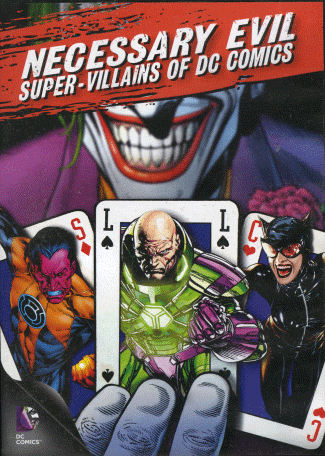
CLICK HERE TO SEE "NECESSARY EVIL" -- ILLUSTRATED SCREENPLAY
Statistics: Posted by admin — Sun Jan 05, 2014 9:37 pm
]]>